 |
| ||||||||||||||||||||||||||||||||||||||||||||||||||||||||||||||||||||||||||||||||


|
| ||||||||||||||||||||||||||||||||||||||||||||||||||||||||||||||||||||||||||||||||
A Publication of the Deutsches Zentrum f�r Entwicklungstechnologien - GATE, a Division of the Deutsche Gesellschaft f�r Technische Zusammenarbeit (GTZ) GmbH - 1991
NOTE 1: The technical details were provided by the producers. GATE is not in a position to verify these data and therefore cannot accept responsability for any inaccuracies. In cases where prices have been quoted, these are subject to change and are thus meant to serve only as guidelines valid for 1991.
NOTE 2: from the cd-rom library editors: if you perform a search
on “Soil” in other sections or documents in this cd-rom, you will find
articles, books or information that may usefully complement or update the
information contained herein.
|
| ||||||||||||||||||||||||||||||||||||||||||||||||||||||||||||||||||||||||||||||||
Acknowledgements
German Appropriate Technology Exchange
Dag-Hammarskjold-Weg
1
Postfach 5180
D-6236 Eschborn 1
Federal Republic of Germany
Tel.
(06196) 79-0 Tlx. 41523-0 gtz d
GATE - stands for German Appropriate Technology Exchange, founded in 1978 as a special division (Division 4020) of the government-owned Deutsche Gesellschaft f�r Technische Zusammenarbeit (GTZ) GmbH (German Agency for Technical Cooperation).
GATE is a centre for the dissemination and promotion of appropriate technologies for developing countries. GATE defines "appropriate technologies" as those which appear particularly apposite in the light of economic, social and cultural criteria. They should contribute to socio-economic development whilst ensuring optimal utilization of resources and minimal detriment to the environment. Depending on the case at hand, a traditional, intermediate or highly developed technology can be the "appropriate" one.
GATE focuses its work on the following areas:
- Technology Dissemination
- Research and Development
- Environmental Protection
GATE offers a free information service in appropriate technologies for all public and private development institutions in countries dealing with the development, adaptation, application and introduction of technologies.
BASIN is a coordinated network of experienced international professionals, set up to provide qualified advice and information in the field of building materials and construction technologies.
The activities of BASIN are divided between four leading European, non-profit appropriate technology organizations, each of which covers a separate specialized subject area, in order to provide more qualified expertise with greater efficiency.
The services offered by BASIN encompass:
responses to technical enquiries;
maintenance of a documentation and computer database with. evaluated information on documents, technologies, equipment, institutions, consultants, projects, etc;
monitoring of practical field experiences;preparation of publications to close information gaps;
organization of training courses, workshops, seminars and exhibition;
implementation and management of research and development projects.
This Product Information Portfolio was conceived to inform users as objectively as possible about fibre concrete and micro concrete roofing in general, and more specifically about the available equipment, as well as aspects of selecting and buying the most suitable type. The aim was not to deal with the technology in depth, as sufficient literature is available elsewhere, but to give practical information for the user to understand the advantages and limitations of the alternative 'technical systems and equipment available in different regions.
This enables the user to compare the machines with each other, and make a preliminary selection, before requesting more detailed information from the manufacturer.
Note: The technical details were provided by the producers. GATE is not in a position to verify these data and therefore cannot accept the responsibility for any inaccurracies. As the prices and exchange rates are subject to change, they are only meant to serve as guidelines.
Text, illustrations, layout:
K. Mukerji, H. Worner, SKAT
(1991)
|
| ||||||||||||||||||||||||||||||||||||||||||||||||||||||||||||||||||||||||||||||||
Technology
General
For every earth construction technique there is a preferred set of characteristics of the material. When the earth is excavated, it does not necessarily possess these favourable characteristics and can thus be the cause of unsatisfactory performance or limited durability of the end product. Therefore, special attention must be given to soil preparation and handling, prior to building construction.
Raw earth can have two major deficiencies:
- Texture deficiency: in the case of earth containing an unsatisfactory grain size distribution, that is, for instance, too much sand and gravel with too little silt and clay to obtain a compact and cohesive material, or containing too much clay, which leads to excessive swelling and shrinkage. The texture is also deficient when the earth contains too much plant material (eg in the form of roots) or when the soil is excavated from different layers, each containing different proportions of coarse and fine material.
- Structural deficiency: in the case of earth containing lumps of consolidated material, or being too wet.
The need for preliminary operations to correct these deficiencies should not be underestimated. They ensure the quality of the end product and subsequently the quality and durability of the buildings. They also guarantee that the structure is built economically in the sense that they optimize the proportions of the materials and the additives, if the earth is stabilized. If sieving, pulverizing and mixing is properly done, up to 50 % of the stabilizing agent can be saved without reducing the crushing strength of the end product, or in other words, the effect of the stabilizer in providing crushing strength and resistance to abrasion and moisture penetration can be greatly increased.
While all earth construction techniques need soil preparation, the emphasis here is on compressed soil block production.
Procedures
Excavation
For the self-builder, the advantage of earth construction is that the raw material is obtained directly on the building site, or close by, depending on the suitability of the soil. After removing the top soil, it is usually dug out with simple tools.
In large scale undertakings, the problems involved in excavating earth for construction purposes are similar to the excavation of materials for the ceramics and cement industry, in stone quarrying and even for agriculture and road building. In these cases, the methods of excavation depend upon several factors that are not specific to earth construction, for instance, geological and engineering aspects, economic and legal considerations. With regard to earth construction, the only relevant aspect of excavation is the suitability of the soil.
Soil Testing and Quality Control
The suitability of the soil has to be tested, not only before commencing full-scale excavation and when changing the excavation site, but also at different points within a single excavation pit, as the type and composition of earth can vary even within distances of a few metres.
There are basically two types of tests for approving the excavation of a soil deposit:
- Indicator or field tests: which are mainly by sight, smell, touch, by making balls, ribbons and threads, by sedimentation in a glass jar and by dropping, for the preliminary selection of soils, before conducting
- Laboratory tests: which require special apparatus, for instance, for particle size analysis by sieving, for determining shrinkage, plasticity, dry strength, compressibility, optimum moisture content, cohesion, etc, for an accurate characterization of the soil.
The list of tests is long and not all are needed for each soil type and use. However, for the day-to-day running of a production unit, two types of tests have to be conducted regularly:
- Control tests during production: which serve to check the quality of of the production process at different stages, that is, delivery of new raw material, moisture content and uniformity of the mixture, and quality of the compaction. These tests should be conducted at least twice for each new mixture.
- Acceptance tests on the final product: which serves to verify the conformity of the production process or products in comparison with the required performances of a reference sample. The tests are mainly visual inspection to check dimensional tolerances, surface and edge smoothness, presence of lamination or cracks, etc, and compressive strength tests to determine the quality of compaction and stabilization. In the ease of soil blocks, for instance, at least 5 samples should be tested for each delivery of 2000 blocks. If the samples do not pass the tests, the complete production must be rejected. It is therefore important to clearly identify each daily production with standardized indicators, and not to mix the production of different days in the storage area.
Pulverization
Earth is usually excavated in a dry state, in which the clay fraction normally occurs in the form of lumps that can attain sizes of 200 mm and more. Since this is not acceptable for any form of earth construction, it is necessary to break up these lumps.
Three cases have to be considered when pulverizing earth:
- If the grain size distribution of the soil is correct or acceptable, the larger homogenious particles (pebbles, gravel) should not be crushed.
- If the quantity of large particles exceeds the required proportion, pulverization must be followed by sifting out the excess particles.
- If the proportion of gravel and stones is correct, but the particles are larger than the permissible size, they may be crushed to the required size during pulverization.
Sieving
Sifting is indispensable either when the earth has texture defects (that is, when it contains oversized particles or organic matter) or when pulverization is unsatisfactory. The most appropriate grain diameter depends upon the construction technique aimed at and the specifications of the construction project.
For most earth construction techniques, the maximum grain size is 20 mm, although for making better quality soil blocks 10 mm should be the upper limit, whereas for rammed earth stones of 50 mm diameter are acceptable.
Mixing
Unless the earth can be used directly after excavation, pulverization or sieving, some form of mixing is usually required, and can be of three types:
- mixing of the ingredients of the same soil, which was separated out into distinct fractions;- mixing of different soils (as in the case of soil improvement); and
- blending of other materials (eg water, stabilizer, fibres, waterproofing additives, etc) with the above two mixes.
Only dry materials should be mixed with each other or with a liquid. Mixing dry and moist materials together rarely gives good results. Therefore when stabilization is carried out with powdered hydraulic binders, such as cement and lime, preliminary dry mixing is essential. Water is only added afterwards by progressive sprinkling of small quantities either in gushes, fine spray, droplets or in steam under pressure, according to the level of sophistication employed.
For mechanical mixing, it is usually necessary to provide 2 to 4 minutes of mixing, depending on the efficiency of the mixing process. In any case, the colour of the mix should be uniform at the end of the process.
|
| ||||||||||||||||||||||||||||||||||||||||||||||||||||||||||||||||||||||||||||||||
Equipment
Traditional earth construction techniques are generally associated with manual operations and simple, locally made tools. Today, a variety of equipment is available for the preparation of soil for building construction, reducing the necessary manual operations to a minimum, greatly increasing the output rates and considerably improving the quality of the material and final product. Some of the main types of equipment are described below.
Excavation Equipment
If an entrepreneur contemplates the use of more sophisticated equipment than shovels and wheelbarrows for excavation, a variety of special tools and machines can be used, depending on several factors, such as:
- the area and depth of excavation,- the required output,
- the characteristies of the site, that is, its angle of slope, its accessibility, the kind and amount of vegetation on it, the quality of the soil, etc,
- safety considerations, and- the availability of skilled manpower.
Typical excavation tools, which are mainly used in quarries, road building, agriculture, landscaping, etc, are, for instance, pneumatic picks, motorized wheelbarrows, scrapers, excavator tractors, bulldozers, and the like. However, their use for earth construction in a developing country is most likely to be very limited, on account of the high capital and operating costs, import restrictions, problems of maintenance and repair, and other limiting factors.
Laboratory Equipment for Control Tests
It is not possible to describe all the equipment that can be used for soil testing and quality control, as they are too numerous and some are very specialized. Therefore, only a few of the most common devices are described below:
Grain size distribution
The sieving test consists of passing the soil through a series of standardized sieves with the help of water, and after drying, observing the grain fractions retained by each sieve. This fraction will be expressed in percentage by weight compared to the dry initial sample. The equipment required for this test is:
- a rubber pestle end mortar of 500 ml capacity for preliminary disintegration;- 4 standard soil test sieves (ASTM, AFNOR or DIN) of 100 or 200 mm diameter;
- at least 2 metal mixing pans for collecting the material in the sieves and drying on
- a butane field stove (hot air laboratory stoves are too slow);
- a resistant sieve brush and a plastic 200 ml dispensing bottle;
- a field balance of minimum 1 kg capacity and a precision of 1 gram.
A soil texture kit is recommended to separate the soil into its 3 basic mineral fractions (sand, silt and clay) and to determine the approximate percentages. The test is not recommended for soils containing a lot of gravel and the sample has to be dry before use. The kit includes 3 calibrated conical tubes, stand as well as dispersing and flocculating reagents.
The sand equivalent test is intended to indicate the relative proportions of clay-like or plastic fines and dusts in granular soils and fine aggregates that pass the 5 mm sieve. The kit should comprise at least 2 sand equivalent cylinders with rubber stoppers, 1 measuring can, 1 bottle of stock solution, 1 weighted foot assembly, a wide mouth plastic funnel, a syphon assembly with 5 litre polythene bottle and an irrigation tube. A sand equivalent shaker is also needed and can be electric or hand operated. All these tools are standardized; all other tools are already included in the sieving test.
Optimum moisture content
The moisture content can be determined by using some of the equipment required for the sieving test (eg butane field stove, pan, field balance), however, a special kit called "Speedy Moisture Tester" is also available, but relatively expensive. The test system is based on the reaction between moisture in the test specimen and calcium carbide which forms a gas, the quantity of which is in direct relationship to the water present. This is indicated on a built-in pressure gauge, which is calibrated in percentage of moisture. This test is not appropriate for very clayey soils. Three models are available, depending on the initial amount of sample to be introduced: 6 g, 26 g and 200 g (the 200 g model is preferable, the 6 g model is not recommended). Each kit is supplied with a balance, measuring spoon, cleaning cloth and brushes, calcium carbide reagent and carrying case. A special moisture tester reagent can be ordered separately.
Quality of compaction
The density of blocks can be determined by means of a pocket penetrometer, which measures the resistance to penetration of a plunger for a fixed depth of penetration, and comparing it to a predetermined threshold of acceptability. The range of measurement should be between 0 and 15 kg/cm². Usually the smallest plunger of 0 6.35 mm is enough; larger plungers make it difficult for accurate readings.
To check the uniformity of block production, the humid (or dry) density can be quickly ascertained by measuring the volume of the block and its humid (or dry) weight. For this a portable platform scale or spring suspension scale with hanging scoop (capacity 20 kg, precision 10 to 50 grams) and a ruler to measure the blocks are needed.
Dry compressive strength
The conventional presses found in laboratories for geotechnical or concrete testing can be suitable for testing earth blocks, if the gauge allows for precise readings within a range from 0 to 100 kN; the speed of compression is variable; one of the plates has a rotula (to overcome problems of parallelism); and the press is designed to test specimens of sizes corresponding to the typical soil block dimensions (otherwise the blocks will have to be sawn, or smaller samples have to be made, which are unlikely to give representative results). It is, however, possible to construct simple lever presses, using small steel or wooden beams, or even small presses using a lorry jack.
The surface hardness of a block can also be measured in a non-destructive way, using a pendulum sclerometer. The range of measurements should be from 0 to 500 or 800 N, which corresponds to a sclerometer known as model "PT". It is advisable to maintain a stock of spare parts, especially the small sticks which stop the pendulum by friction. Concrete test hammers, known as sclerometer model "N", are not appropriate, as the impact energy is too high.
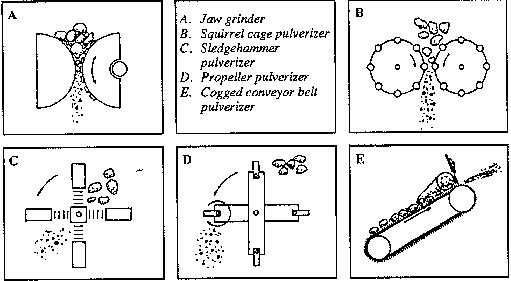
Pulverizers
Not so much equipment has been designed especially for earth construction. Some of the existing equipment is part of an integrated production line and is difficult to purchase separately. However, equipment used in agriculture, quarrying and ceramic industry can also be suitable for earth construction.
Jaw grinders
The motorized pulverizers of this type are usually very heavy, very expensive and consume a lot of energy, but they are very robust. Manual models, which are more efficient when the earth contains no gravel, are best fitted with a simple pendulum mechanism.
Squirrel cage pulverizers
These are motorized and consist of one or two squirrel cages placed relatively close together, turning at very high speeds in the same and sometimes in opposite directions. The bars of the single squirrel cage type are sometimes equipped with small metallic masses, acting like hammers. Usually the output of these pulverizers is not very high, although sufficient in most cases.
Sledgehammer pulverizers
They are motorized and consist of a series of sledgehammers, mounted, by means of chains or springs, on a central rotating shaft. The sledgehammers hit the earth at a very high speed. This is one of the most efficient systems and, depending upon the dimensions of the device, very high outputs can be obtained.
Propeller pulverizers
These are motorized and very similar to machines used to shred compost. Outputs are usually not very high, and if the earth contains too much gravel, the wear of the propeller is considerable.
Cogged conveyor belt pulverizers
The principle of these motorized machines is to transport the earth on a cogged conveyor belt, forcing it through a kind of comb, where it is pulverized and projected out of the machine. This type of pulverizer is very sensitive to dust. In general the belt has to be replaced quite often, which is not an easy task, as the two axes have to be perfectly aligned. The earth should be dry and should not contain gravel.
FIGURE
Sieves
Not so much equipment has been designed especially for earth construction. Some of the existing equipment is part of an integrate production line and is difficult to purchase separately. However, equipment used in agriculture, quarrying and ceramic industry can also be suitable for earth construction. There are principally two types of sieves:
Rotating sieves
These consist of a manually operated or motorized rotating metal grate cylinder of simple construction. It is possible to sift in succession and divide the earth into several portions which permits the reconstituting of the earth texture with selected portions. This is the type of equipment that is used the most.
Vibrating sieves
These are motorized and have one or more vibrating screens placed one above the other They permit successive sifting and the division of earth into several portions, which again al lows for the reconstituting of the earth texture with selected portions. Vibrating sieves for large outputs are often complex, heavy and consume a lot of energy, while those for small scale use are simple and easy to manufacture
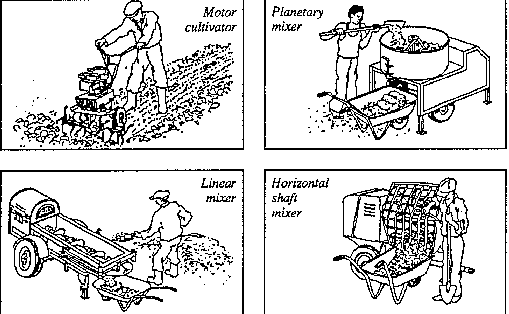
Mixers
Not so much equipment has been designed especially for earth construction. Some of the existing equipment is part of an integrated production line and is difficult to purchase' separately. However, equipment used in agriculture and the ceramic industry can also besuitable for earth construction. Conventional rotary or tilting concrete mixers are not recommended, because of the formation o lumps. There are four principal types of mixers
Motor cultivators
These are motorized and operated by one per son in a similar way as a wheeled plough. The' consist of a series of milling cutters mounted on a rotating horizontal shaft, which allows for the simultaneous pulverizing and mixing of the earth. Outputs are about 8 to 10 m³ per day. This method requires a great deal of space and the earth tends to dry out quickly.
Planetary mixers
These motorized machines have blades fixed to a vertical rotating shaft which turns inside a tank. The blade movement is more or less complex, depending on the level of sophistication of the mechanisms. There are models in which the tank rotates. Outputs are about 15 m³ per day. Planetary mixers are the most suitable for compressed soil blocks.
Linear mixers
These are relatively sophisticated motorized machines, consisting of blades fixed to a shaft in the form of a discontinuous or continuous helical screw, which turns inside a horizontal or vertical cylindrical tank. The horizontal systems are more sophisticated than the vertical ones, since they often comprise a double tank with two axes. Outputs are about 20 m³ per day. The shafts have to be very sturdy, making the machines extremely heavy and expensive.
Horizontal shaft mixers
These are principally the same as the horizontal linear mixers, but have a series of separate blades fixed to the horizontal shaft (instead of a helical screw) and the tank dimensions are much smaller. Outputs are about 10 m3 per day. These mixers are suitable for all types of soil and stabilizers.
FIGURE

FIGURE
|
| ||||||||||||||||||||||||||||||||||||||||||||||||||||||||||||||||||||||||||||||||
Criteria for selection and purchase
General Considerations
In view of the vast choice of machines and devices available, it seems difficult to decide which one should be bought. If there is not enough money to buy expensive equipment, the choice is smaller and the decision much easier. But generally, a number of points need to be considered, especially when the available resources allow for the purchase of higher priced equipment.
Since there are various categories of soil preparation equipment, the specific selection criteria of each one are described first, and are followed by aspects that are common to all.
Excavation Equipment
In developing countries, the excavation of soil on a small or medium scale is preferably a manual operation, using picks, shovels, wheelbarrows, baskets, etc, as they cost the least, are labour intensive, easy to replace and can be used without special training. In large scale projects, where high outputs are essential, more efficient mechanized equipment is necessary, as described above, but they are expensive (usually imported), require only a few but well trained workers, and are not always easy to maintain and repair locally.
Mechanized equipment for soil excavation is not usually offered by suppliers of earth construction equipment. These have to be obtained from suppliers of quarrying, road building or agricultural equipment. Special transportation tools, such as conveyor belts, motorized wheelbarrows, pick-ups, front loaders, lorries, and the like, will also be needed.
Laboratory Equipment
Before considering the purchase of laboratory equipment for soil testing and quality control, it is advisable to investigate whether a building materials laboratory is close by. They possess the necessary equipment and expertise to carry out the tests, and if these services are available to the entrepreneur, he can save the costs of buying the equipment and training his staff. Only the instruments for daily tests need to be procured.
Manufacturers of laboratory equipment rarely produce all the apparatus needed, but generally operate as distributors of the remaining equipment. These distribution channels are sometimes very slow, on account of the specialization of the market. It is therefore advisable to contact each manufacturer separately. It is also advisable to work with companies having a local branch office or representation, that can assure sufficient follow-up.
Most of the testing equipment is produced on the basis of well-known standards, such as ASTM, AFNOR and DIN, so the variety of equipment is limited, which facilitates choice.
Pulverizers
Pulverizers should be capable of processing both dry and humid earth without clogging the mechanism. Thus, machines in which the impact energy can be controlled (eg by variable speed) are advantageous, as this permits adaptation of the pulverizing parameters to each specific type of earth, and optimization of the end result. A further advantage would be if the machines were designed to control the maximum grain size. Generally, pulverizers must be able to produce earth in which at least 50 % of the reconstituted grains (bound by clay) have a diameter of less than 5 mm and 100 % less than 10 mm.
Jaw grinders are capable of crushing pebbles, which could be undesirable for a correct grain size distribution. Moreover, the jaws are usually designed to move apart if bigger particles threaten to jam the mechanism. When the jaws part, a large quantity of uncrushed material bypasses the system, spoiling the quality of the processed material. Such machines should only be used for very uniform types of earth.
To facilitate work, pulverizers should be designed such that a wheelbarrow can be put below the discharge opening to collect the pulverized material. The height of the feeding hopper should also be limited, in oder to allow easy access. The machine should also be equipped with an inertial system (eg pendulum, flywheel, etc).
Motorized feeding and discharge systems, as well as replaceable and/or adaptable sieves would be further advantages. For smaller, non-automatic mechanized production it is an asset for the pulverizers to be equipped with wheels. This allows moving the pulverizers along the raw material heap, rather than transporting the latter to a central processing plant.
Sieves
Sieves can have two types of holes: round and square. Round holes are made by drilling through metal sheets; such sieves are therefore very sturdy, but also expensive. Sieves with square holes are made of woven wire; they are not very durable, but also not very expensive.
Sieves with round holes of a certain nominal diameter allow particles having that diameter (or less) in one direction to fall through; only its length can be greater than the diameter of the hole. The nominal size for square holes is the side of the square, and since the diagonal dimension is larger, particles having diameters greater than the nominal size can easily pass through. Therefore, the side of a square hole should be 0.8 times the diameter of around hole in order to obtain the same result in sieving.
When producing compressed earth blocks, the largest particle size can be up to 20 mm for solid blocks or those made with extremely high compression, and up to 5 mm for hollow blocks or those made with low compaction force.
Since sieves can get damaged, it should be possible to repair or replace them easily.
Sieve designs should also foresee direct collection of the sifted material by means of a wheelbarrow placed at the discharge opening. For smaller, non-automatic mechanized production units it is an asset for the sieves to be equipped with wheels, so that they can be moved along the raw material heap, rather than transporting the latter to a central processing plant.
Mixers
Earth can contain a high proportion of abrasive particles, especially lateritic earth, which can cause rapid wear of the tank and blades. Therefore, these parts have to be made of especially resistant steel. The paddle should be shaped such that the blades penetrate the earth with the least abrasion and the most displacement of the earth.
If the use of a concrete mixer is contemplated, it must be remembered that earth is a cohesive material in the humid state, while concrete is not. Far more power is required to mix earth than to mix concrete, hence the concrete mixer must be equipped with a more powerful engine. The useful capacities of these machines indicated by the manufacturers often refer to data concerning the mixing of cement concrete, and must be reduced by half when referring to the mixing of earth.
For the production of compressed earth blocks and pise (rammed earth), ordinary tilting concrete or mortar mixers are unfit, unless used for dry mixing only. Damp earth is likely to produce conglomerate balls of earth, which is unsuitable for block production.
While the height of the feeding hopper should allow easy access for filling, the mixer design should foresee direct discharge of the mix into a wheelbarrow. Mixers should also be equipped with wheels to reduce the need for transporting raw materials or mixes to a minimum.
Design of Equipment
Of special importance with regard to production efficiency and output rate is the spatial arrangement and organization of the various working areas. Some equipment manufacturers supply complete production units with a system of machines and equipment that can be combined to form a production line, which is tailored to the user's requirements.
Special consideration should be given to the working conditions for the production team, especially with regard to operation procedures and handling of products, that is, avoidance of exceptionally hard manual work and activities that have to be done in a bent position.
Special attention should also be given to safety measures, such as avoidance of projecting moving parts, designing manual operations such that hands cannot get jammed between moving parts, clearly marking and/or protecting dangerous points, incorporating thermal fuses, security pins, etc. Automatic machines must at all cost be equipped with an emergency stop switch, which is easily accessible.
A balance must be found between the desired output rate, quality standard and level of sophistication. Complicated mechanical and electronic control devices often necessitate special training and experience for maintenance and repairs. Spare parts are usually expensive and difficult to procure (import). As far as possible, the machines should be sturdy enough to withstand rough use and harsh climatic conditions. Furthermore, wearing parts should not only be easy to remove and replace, but they should also be of such a simple design that they can be produced locally.
Manufacturer
Equipment suppliers for soil preparation equipment range from small to large companies, with varying degrees of commercialization offering a very diverse choice of products and services. The larger companies are usually better known, experienced in international trade and consequently reliable business partners. Small firms or their machines are often not so well-known, because of small advertising budgets, hence their list of references can be small in spite of a good product.
Personal visits to the manufacturer and/of sites at which their machines are in use should be undertaken as far as possible. The value of reference lists is to be able to meet or correspond with users, to learn about their experiences. If such lists do not contain addresses, these should be specifically asked for.
Purchase of Machine
The "FOB" price (free on board) includes packaging, transportation and insurance costs of the machine within the retailer's country. This price can be artificially inflated in order to compensate for the reduction offered on the factory price.
It is advisable to include a penalty clause in the contract, to safeguard against late delivery.
In the case of an after sales service contract, the waiting period for repairs and maintenance must be clearly indicated. A detailed handbook should be provided, including specifications of all spare parts and a maintenance plan, indicating operations necessary and expected maintenance frequency.
|
| ||||||||||||||||||||||||||||||||||||||||||||||||||||||||||||||||||||||||||||||||
Checklist for potential buyers
The following is a summary of the main points to be considered when selecting the most suitable soil preparation equipment:
Available financial resources (budget restraints can limit the choice considerably).
Required production rate (this depends on the expected market demand; larger output rates require higher degrees of mechanization).
Weight and mobility of equipment (these may have to be moved frequently from site to site).
Available energy sources (not only the costs must be considered, but also the frequency of power failures and supply shortages of diesel, petrol, etc.).
Availability of spares and skilled technicians for maintenance and repairs (machines with standardized parts create less problems).
Compatibility of equipment (machines from different manufacturers may not conform to the same standards; equipment from a single supplier is generally dimensionally coordinated, facilitating special arrangement and organization, and some spare parts may be interchangeable).
Operational safety (for this, several demonstrations of use, especially with unskilled workers, should be seen).
References (contacts with equipment users should be sought whenever possible).
Conditions of purchase (since machines with similar outputs are available, comparisons of prices, discounts for large orders, delivery time, etc. are urgently recommended).
After sales services (not only should the manufacturers be fair enough to rectify defects of their machines by providing technical assistance or supplying spare pares at minimum or no-case; users should also take the trouble to send accounts of their experiences and suggestions for improvements to the manufacturers, for without this feedback no effective development is possible).
|
| ||||||||||||||||||||||||||||||||||||||||||||||||||||||||||||||||||||||||||||||||
Cerades H2 clay disintegrator
Manufacturer
CERATEC
Rue du Touquet 228
B-7793
Ploegsteert
Belgium
Tel. [ . . 32] 56 - 58 86 45
Tlx. 57 834 plocer
b
Fax. 3256-587101
Description
The CERADES disintegrator has been especially developed to be used with a CERATEC manual or automatic press (ie a CERAMAN or CERAMATIC press) in the production of stabilized soil blocks or burnt clay bricks and tiles. The CERADES H2 is an impact rotor crusher consisting of two counterrotating hollow drums (squirrel cage type). The machine can be delivered in several versions with an electric motor or diesel enginge, and can include a 4m conveyor belt powered by the same engine.
The machine is used for the primary crushing mixing and homogenizing of raw soil of medium hardness (Mohs hardness 1 - 3), and with a moisture content ranging between 0 and 20%.
The working principle of the CERADES H2 excludes wear and tear, because there is no friction between the raw material and the mechanical parts.
Operating the CERADES
The CERADES is only used for the preparation of relatively dry clay or earth. The average natural moisture of earth before extraction is usually between 10 and l5 %, which is the ideal moisture content for disintegrating.
Only one person is required to feed the CERADES. After starting the engine, the earth is continuously shovelled into the machine from the top. Thus, if site conditions permit, the disintegrator should be positioned at a lower level than the earth pile, in order to reduce the effort needed to feed the machine.
For the production of stabilized soil blocks, the stabilizer (usually cement) has to be blended with the soil very well. This can be done by premixing the dry soil and stabilizer on the ground and adding a small amount of water to the mix, before feeding it to the disintegrator.
The outcoming mixture can be carried away manually, or automatically on a conveyor belt. Generally, the freshly disintegrated mix is ready for use in a brick press.
|
Technical Details |
CERADES H2E [H2D] - without conveyor belt |
CERADES H2TE [H2TD] with conveyor belt | ||
|
Size of machine (length x width x height) |
130 x I 10 x 140 em (51 x 43 x 55 in) |
480 x I 10 x 183 cm (189 x 43 x 72 in) | ||
|
Weight of machine |
437 [550] kg |
754 [867] kg |
| |
|
Size of crate for shipment |
151 x 129 x 95 cm (59 x 51 x 37 in) |
151 x 129 x 95 em (59 x 51 x 37 in) plus 277 x 104 x 102 cm (109 x 41 x 40 in) | ||
|
Weight of packed machine (with set of spare parts) |
586 [699] kg |
1142 [1255] kg | ||
|
Motor / Energy transmission |
electric [diesel] / mechanical |
electric [diesel] / mechanical | ||
|
Rotating speed of drums |
840 rev/min |
840 rev/min | ||
|
Volumetric output |
up to about 9 m³/hour |
up to about 9m³/hour | ||
|
Labour force required |
2 to 4 men |
1 or 2 men | ||
|
Price (ex works) |
CERADES H2E |
132000 FB (~ 3780 US$) |
CERADES H2TE4 |
310000 FB (~ 8860 US$) |
|
valid June 1 991 |
CERADES H2D |
1 92000 FB (~ 5490 US$) |
CERADES H2TD |
370000 FB (~ 1 0580 US$) |
|
FB = Belgian Francs |
Spare part kit |
21000 FB(~ 600 US$) |
Spare part kit |
25000 FB(~ 720 US$) |
|
| ||||||||||||||||||||||||||||||||||||||||||||||||||||||||||||||||||||||||||||||||
E.S.A. Malaxeurs CMD/SED
Manufacturer
E.S.A. - Etudes Sp�ciales Appliqu�es
1854,
route de Saint Romain / BP 2
F - 42153 Riorges
France
Tel. [ . . 33] 77
71 97 77
Tlx. 300985 f
Fax.[ . . 33] 77 71 63 22
Description
E.S.A. produces a complete range of planetary type mixers with capacities ranging from 301 to 001. They principally comprise a flat-bottom, circular tank with an adjustable paddling tool that can be removed from the main shaft.
The power is transmitted from the engine by means of double belts and a well-dimensioned angle gear. The engine type and output is selected according to the capacity of each version, whereby either an electric motor or petrol engine can be supplied.
The 1001 version is fitted with castors, while the 2001 and 2501 versions have pneumatic wheels for transportation. The 3201 and 5001 versions are designed to facilitate tank feeding with the help of motorized equipment.
The discharge opening has a simple rotating flap, which is not waterproof, but can be provided as such for liquid mixing. The manufacturer also offers an extra-flat frame option to enable the mixer to be fixed on a platform in order to set up a mini-plant on a building or production site.
Operating the E.S.A. Malaxeurs
Feeding the 200 and 2501 versions of the CMDSELD mixers is done by shoveling the pulverized soil and then adding the stabilizer, if any, in order to obtain the best blending of soil and stabilizer. A wire mesh on the top of the mixer keeps out large lumps and prevents the workers from accidentally putting their hands into the tank.
Water is progressively sprinkled with a watering can during mixing, whereby the drop test has to be performed at intervals to determine the correct moisture content. When the mix is ready it is discharged by opening the flap, and collecting it in a wheelbarrow or - in the case of the larger versions - transporting it on a conveyor belt or by means of a proportioning hopper mounted on a fork-Uft elevator.
|
Technical Details |
CMD 200 LC [CMD 250 LC] |
CMD 320 LC [ CMD 500 LC] | ||
|
Size of machine (length x width x height) in cm |
135 x 105 x 115 cm [150 x 115 x 115 cm] |
140 x 125 x 170 cm [150 x 130 x 170 cm] | ||
|
Size of machine in inches |
53 x 41 x 45 in [59 x 45 x 45 in] |
55 x 49 x 67 in 159 x 51 x 67 in] | ||
|
Weight of machine |
230 [260] kg |
380 [420] kg | ||
|
Size of crate for shipment (l x w x h) in cm |
150 x 130 x 150 cm [170 x 130 x 150 cm] |
170 x 150 x 200 cm [180 x 150 x 200 cm] | ||
|
Weight of packed machine |
350 [395] kg |
590 [640] kg | ||
|
Motor / Energy input |
Electric motor |
5.5 hp, 220/380 tri [7.5 hp, 220/380 tri] |
10 hp, 220/380 tri [12 hp, 220/380 tri] | |
| |
Petrol engine |
7.5 or 8.5 hp [7.5 or 8.5 or 10 hp] |
10 hp [12 hp] | |
|
Capacity in litres: total (practical) |
200 (100/150) [250 (125/180)] |
320 (160/240) [500 (240/375)] | ||
|
Labour force required |
1 man [ 1 man] |
1 -2 men [ 1 -2 men] | ||
|
Price (ex works) valid June 1991 |
CMD 200 LC |
20500 FF (~ 3400 US$) |
CMD 320 LC |
34700 FF (~ 5800 US$) |
|
FF = French Francs |
CMD 250 LC |
23800 FF(~ 4000 US$) |
CMD 500 LC |
40500 FF(~ 6800 US$) |
|
| ||||||||||||||||||||||||||||||||||||||||||||||||||||||||||||||||||||||||||||||||
TERSTARAM ground breaker
Manufacturer
APPRO-TECHNO
24, rue de la Ri�ze
B-5660
Couvin (Cul-des-Sarts)
Belgium
Tel. [ . . 32] 60 - 37 76 71
Tlx. 51622
ap tec b
Fax.[ . . 32] 60 - 37 78 87
Description
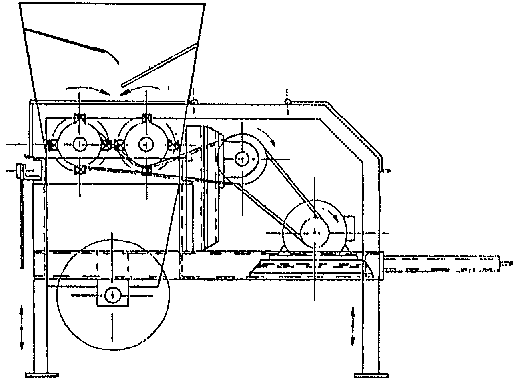
The TERSTARAM Ground Breaker was specially designed to prepare soil of a grain size suitable for the production of compressed earth blocks and burnt clay bricks and tiles. The pulverizer is of the squirrel cage type, consisting of two cage rotors made of 4 easily removable high carbon steel square rods. The rotors are parallel and counter-rotate at 750 rpm., whereby the dry soil lumps are crushed by the impact of the rods.
Power is transmitted from a 2.2 kW (= 3 hp) electric motor, or 4.5 hp Hatz diesel engine, by means of double belts. Depending on the moisture content of the raw material, the final grain size of the soil varies from 0.1 to 20 mm. The maximum output is 9 m3/h, depending on the quality of raw material.
The machine is equipped with two wheels for easy transportation and daily cleaning operations.
Operating the Ground Breaker
Before operating the machine, it must be setup on its telescopic legs. When the engine has reached its maximum speed, the workers start to feed the machine with shovels or by means of a conveyor belt' through the hopper located above the rotors.
The TERSTARAM Ground Breaker is based on the principle of pulverization of the lumps by impact, hence it gives best results when the earth is dry. An adjustable shutter prevents particularly large clods from passing through. The pulverized soil is collected in a wheelbarrow or in the hopper of a conveyor belt and then transported to a mixer or the mixing area.
Daily maintenance is facilitated by easily accessible greasing points. Since the belts and other replaceable parts are of standard sizes, spare parts are available from any local car parts retailer. All the revolving parts are protected from direct contact with the soil, thus only the removable square rods have to withstand wear and tear.
|
Technical Details |
TERSTARAM Ground Breaker - electric |
TERSTARAM Ground Breaker - diesel | ||
|
Size of machine (length x width x height) |
130 x 100 x 155 cm (51 x 39 x 61 in) |
130 x 100 x 155 cm (51 x 39 x 61 in) | ||
|
Weight of machine |
430 kg |
448 kg | ||
|
Size of crate for shipment |
140 x 110 x 170 cm (55 x 43 x 67 in) |
140 x 110 x 170 cm (55 x 43 x 67 in) | ||
|
Weight of packed machine |
580 kg |
598 kg | ||
|
Energy input |
2.2 kW (3 hp) 220/380 V |
5 hp /0.9 hp | ||
|
Rotating speed of drums |
750 rev/min |
750 rev/min | ||
|
Volumetric output |
up to about 9 m³/hour |
up to about 9m³/hour | ||
|
Labour force required |
1 - 2 workers |
1 - 2 workers | ||
|
Price (ex works) |
TERSTARAM-Electric |
98000 FB(~2800 US$) |
TERSTARAM-Diesel |
138000 FB (~ 4000 US$) |
|
valid June 1991 |
Seaworthy packing |
6900 FB (~ 200 US$) |
Seaworthy packing |
6900 FB (~ 200 US$) |
|
FB = Belgian Francs |
Spare parts kit |
10600 FB (~ 300 US$) |
Spare parts kit |
10600 FB (~ 300 US$) |
FIGURE
|
| ||||||||||||||||||||||||||||||||||||||||||||||||||||||||||||||||||||||||||||||||
TERSTAMIX mixing machine
Description
The TERSTAMIX (also available under the trade name TETRAMIX) is a planetary mixer comprising anon-fuming, anti-wear steer tank and a two-paddle rotary mill. The paddles can be adjusted in any direction to give the best penetration angle in the raw material and to achieve a good mix with a minimum of effort. The paddles are equipped with wear knives which can be adjusted or removed. The horizontal mixing tool is connected to the vertical main shaft by a square head so it can be removed easily for cleaning or maintenance.
Power is transmitted to the main shaft from a 7.5 hp electric motor or a 9 hp diesel engine by means of double belts and an angle gear with a 1/32 ratio. The operational capacity of the mixer is 2001, which is ideally suited for small and medium scale production lines.
Transportation within the production site is facilitated by two hard rubber wheels.
Operating the TERSTAMIX
The production site must be organized such that handling and transportation operations are minimized. The mixer can be wheeled near to the pile of soil or close to the press. Before operation, the machine must be set up on its telescopic legs. When the engine has reached its normal speed, a measured proportion of soil is introduced, after which the stabilizer can be added. Once a uniform dry mix is achieved, the contents of the tank are progressively moistened. Controlled by means of a manual flap, the final mix is discharged into a wheelbarrow through a hole in the bottom of the mixer. The mixer may also be used on a building site to prepare mortar and rendering, in which case more water is needed, in order to obtain a plastic consistency.
The only maintenance required is daily cleaning after work, oil change of the angle gear every 400 h and normal engine maintenance.
Training
APPRO-TECHNO offers to organize 4 weeks training courses for technicians, either on site, or in Belgium (APPRO-TECHNO, Couvin), or in France (CRATerre, Grenoble).
Overview of APPRO-TECHNO Equipment
APPRO-TECHNO produces a variety of machines for building material production in the low-income housing sector:
TERSTARAM Earth BreakerTERSTAMIX Soil Mixer
TERSTARAM Hand Operated Block Press
SEMI-TERSTAMATIQUE Motor Operated Block Press
TEGULAMATIC Fibre Concrete / Micro Concrete Rooftile Production Plant
|
Technical Details |
TERSTAMIX Soil Mixer - electric T |
ERSTAMIX Soil Mixer - diesel | ||
|
Size of machine (length x width x height) |
140 x 110 x 120 cm (55 x 43 x 47 in) |
140 x 110 x 120 cm (55 x 43 x 47 in) | ||
|
Weight of machine |
428 kg |
450 kg | ||
|
Size of crate for shipment |
170 x 110 x 115 cm (67 x 43 x 45 in) |
170 x 110 x 115 cm (67 x 43 x 45 in) | ||
|
Weight of packed machine |
578 kg |
600 kg | ||
|
Energy input |
5.5 kW (7.5 hp) 220/380 V |
9 hp / 1.7 l/h | ||
|
Total capacity |
250 l |
250 l | ||
|
Operational capacity |
200 l |
200 l | ||
|
Labour force required |
1 worker |
1 worker | ||
|
Price (ex works) |
TERSTAMIX-Electric |
165000 FB (~ 4700 US$) |
TERSTAMIX-Diesel |
222000 FB (~ 6300 US$) |
|
valid June l991 |
Seaworthy packing |
6900FB (~200US$) |
Seaworthy packing |
6900FB (~200US$) |
|
FB = Belgian Francs |
Spare parts kit |
14800 FB(~ 420 US$) |
Spare parts kit |
14800 FB(~ 420 US$) |
|
| ||||||||||||||||||||||||||||||||||||||||||||||||||||||||||||||||||||||||||||||||
ALTECH soil disintegrators
Manufacturer
ALTECH - Soci�t� Alpine
de Technologies
Nouvelles
Rue des Cordeliers
F-05200 Embrun
France
Tel. [ . . 33] 92
43 21 90
Tlx. 405 918 f
Fax. [ . . 33] 92 43 42 75 (attn. ALTECH)
Description
ALTECH has specialized in the manufacture of equipment for all phases of compressed earth block (CEB) production, and the ALTECH Soil Disintegrator, of which two versions are available, represent the beginning of the CEB production line.
The smaller of the two types of disintegrator, the Projecting Disintegrator, is designed to project the crushed soil away from the machine, for example, onto the mixing area, and the larger one, Sieving Disintegrator, incorporates a vibrating screen, through which the pulverized material is discharged into a wheelbarrow.
The ALTECH Disintegrators are of the sledgehammer type and have an output large enough to feed two motorized presses or four manually operated block presses. The power is provided either by an electric motor (5 hp, 380 V, three phase) or an 8 hp petrol engine. A pair of wheels facilitate transportation to and manouvering within the production site. The machines are light enough to be moved by a single person.
ALTECH also offers conveyor belts and proportioning hoppers to facilitate the feeding of the disintegrator or collection of the output.
Operating the ALTECH Soil Disintegrator
While the main body of the two disintegrator types is the same, the feeding hopper of the Sieving Disintegrator is 60 cm higher than that of the Projecting Disintegrator. Hence, in the latter case, the raw material can be shovelled into the hopper manually, whereas it is more practical to feed the higher hopper with the help of a conveyor belt, or by installing a raised platform, from which a wheelbarrow can be emptied.
The hammers are detachable, so that they can easily be replaced when they are worn out. The sieve of the larger machine can also be used separately (without detatching it), even if the disintegrator is not in use.
|
m |
ALTECH Projecting Disintegrator |
ALTECH Sieving Disintegrator | ||
|
Size of machine (length x width x height) |
150 x 110 x 120 cm (59 x 43 x 47 in) |
200 x 110 x 180 em (78 x 43 x 70 in) | ||
|
Weight of machine |
200 kg |
280 kg | ||
|
Size of crate for shipment |
160x 120x 130cm(63x47x51 in) |
140x 110x 170 cm(55x43 x67 in) | ||
|
Weight of packed machine |
320 kg |
480 kg | ||
|
Energy input |
Electric motor 4 kW (5 hp) 380 V 3 -phase |
Electric motor 4 kW (5 hp) 380 V 3 -phase | ||
| |
Petrol engine 8 hp |
Petrol engine 8 hp | ||
|
Volumetric output |
6 - 8 m³/hour |
6 - 8 m³/hour | ||
|
Labour force required |
1 worker |
1 worker | ||
|
Price (ex works) |
ALTECH Projecting Disintegrator |
ALTECH Sieving Disintegrator | ||
|
valid June 1991 |
with electric motor |
16453FF (~2740US$) |
with electric motor |
25228FF (~4200US$) |
|
FF= French Francs |
with petrol engine |
19881FF (~3310US$) |
with petrol engine |
28656FF ( 4770 US$) |
|
| ||||||||||||||||||||||||||||||||||||||||||||||||||||||||||||||||||||||||||||||||
ALTECH soil mixers
Description
The ALTECH Soil Mixers, which are available in two sizes (with total/practical capacities o 250/180 and 320/240 litres respectively) are adaptations of cement mortar mixers, modified, to suit the specific characteristics of soil mixes.
The planetary type mixers have steel tanks wit vertical walls and two-paddle rotary tool. which can be removed quite easily from the main shaft. The adjustable wear blades have been designed to achieve a good mix and to prevent the formation of lumps or crust on the tank wall.
The power is transmitted from an electric motor (380 V / 3-phase, 7.5 hp and 10 hp respectively or petrol engine (8.5 hp and 12 hp respective!, by means of double belts. The larger mixer can also be supplied with a 12 hp diesel engine.
The ALTECH mixers are fitted with wheels facilitate transportation and movement on the production site, but they are also designed to to integrated in a CEB production line.
Operating the ALTECH Soil Mixer
On a common production site, the mixer is either wheeled near to the pile of sold or close to the press, but if the mixer (usually the 320 l version) is integrated in a production line with a motorized press, it is best to raise it on a platform just above the press, so that the mix can be fed directly into the press. Before operation, the machine must be set up on its telescopic legs.
When the engine has reached its normal speed, a measured proportion of soil is introduced (either by means of shovels or with the help of a conveyor belt from the soil pile or the soil disintegrator). The stabilizer should be added to the dry material. Once a uniform dry mix is achieved, water is gradually added. When the flap is opened, the final mix is discharged through a hole in the bottom of the mixer into a wheelbarrow or into the proportioning hopper of the block press.
Training
ALTECH offers to conduct training courses according to the users' requirements. The courses cover all practical aspects of CEB production, and the use and maintenance of equipment.
Overview of ALTECH Equipment
ALTECH produces a complete set of machine. for the production of compressed earth block in a coordinated production line:
Conveyor belt
Soil projecting disintegrator
Soil sieving disintegrator
Proportioning hopper
Soil mixer
Manual press G�o 50
Motorized press PACT 500
Gravity roller conveyor for blocks
|
Technical Details |
ALTECH Soil Mixer 250 l |
ALTECH Soil Mixer 320 l | |||
|
Size of machine (length x width x height) |
150x 115 x I IS cm (59 x 45 x 45 in) |
170 x 145 x 140 cm (67 x 57 x 55 in) | |||
|
Weight of machine |
260 kg |
380 kg | |||
|
Size of crate for shipment |
160 x 125 x 125 cm (63 x 49 x 49 in) |
180 x 155 x 150 cm (70 x 61 x 59 in) | |||
|
Weight of packed machine |
395 kg |
520 kg | |||
|
Energy input |
Electric motor |
7.5 hp, 380 V 3-phase |
Electric motor |
10 hp, 380 V 3-phase | |
| |
Petrol engine |
8.5 hp |
Petrol/diesel engine |
12 hp | |
|
Volumetric output |
3 - 4 m³/hour |
4 - 5 m³/hour | |||
|
Labour force required |
1 worker |
1 worker | |||
|
Price (ex works) |
ALTECH Soil Mixer 250 l |
ALTECH Soil Mixer 320 l | |||
|
valid June 1991 |
with electric motor |
28203FF (~4700US$) |
with electric motor |
40941FF (~6820US$) | |
| |
with petrol engine |
31336 FF (~ 5220 US$) |
with petrol engine |
44428 FF (~ 7400 US$) | |
|
FF = French Francs |
| |
with diesel engine |
47642 FF (~ 7940 US$) | |
|
| ||||||||||||||||||||||||||||||||||||||||||||||||||||||||||||||||||||||||||||||||
Parry/ITW pendulum clay crusher
Manufacturer
JPM Parry & Associates Ltd
Overend Road,
Cradley Heath
West Midlands B64 7DD
United Kingdom
Tel. [ . . 44] 384 -
69171 (3 lines)
Tlx. 334132 it parr g
Fax. [ . . 44] 384 - 637753
Description
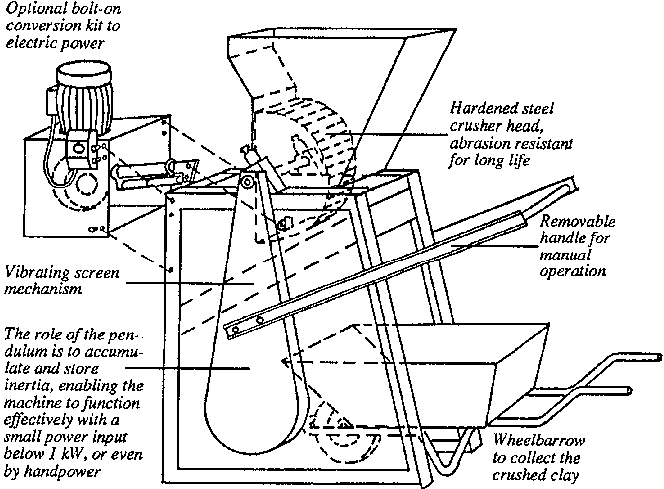
The ITW Pendulum Clay Crusher is designed to meet the needs of small scale product manufacturers, such as brickmakers. The machine crushes, grinds and screens dry lumps of clay (or shale, laterite and friable rock), producing a fine powder, which can then be easily turned into a smooth malleable clay by the addition of water. The resulting clay will be free of lumps and ready for moulding into high quality bricks or other clay products.
The clay is disintegrated between a flat static plate and a semi-circular, reciprocating, hardened steel crusher head, which works on the pendulum principle. The role of the pendulum is to accumulate and store inertia, enabling the machine to function effectively with a small manual power input. An optional bolt-on conversion kit to electric power is also available. The power input is less than 1 kW.
Operating the ITW Pendulum Clay Crusher
To operate the machine, the pendulum is gradually swung manually by pushing and pulling the (removable) handle, or electrically with the bolt-on electric motor. The raw material is shoveled into the feed hopper above the crusher head. In order to reduce the worker's effort, an easily accessible platform can be provided at a suitable height next to the opening of the hopper.
The moving crusher head entraps and breaks up the clay lumps as the head rotates in a downward direction. Ground clay falls through by gravity onto a built-in oscillating screen, which can be of any desired mesh size. On the upward return move, any remaining clay is cleared from the grinding surfaces prior to the next downward swing, so that a slight dampness of the clay is not a major problem.
The ground and screened clay is collected in a wheelbarrow, which fits into the enclosed space below the screen. Rejects from sieving accumulate on the other side of the machine and can be returned to the feeder hopper for renewed crushing. The only servicing necessary is occasional greasing of the bearing of the pendulum, and from time to time inspecting the the machine for wear.
|
Technical Details |
ITW Clay Crusher - Hand powered [Electric] | |
|
Size of machine (length x width x height) |
157 x 83 x 167 cm (62 x 33 x 66 in) | |
|
Weight of machine |
320 [410] kg |
|
|
Size of crate for shipment |
154 x 88 x 121 cm (61 x 35 x 48 in) | |
|
Weight of packed machine |
372 [460] kg |
|
|
Energy input manual |
[380 V/tri; 1 kW] |
|
|
Volumetric output |
0.1 to 1 [l] m³/hour | |
|
Labour force required |
2 men [1 man] |
|
|
Price (FOB) |
ITV Pendulum Clay Crusher (manual) |
1730 £ Sterling (~ 3030 US$) |
|
valid June 1991 |
ITW Pendulum Clay Crusher (electric) |
4030 £ Sterling (~ 7060 US$) |
FIGURE
|
| ||||||||||||||||||||||||||||||||||||||||||||||||||||||||||||||||||||||||||||||||
Kompofix soil disintegrators and mixers
Manufacturer
M�schle Kessel- und Apparatebau
GmbH
Kinzigtalstrasse 1
D-7601 Ortenberg/Baden
Federal Republic of
Germany
Tel. [ . . 49] 781 - 4850
Fax. [ . . 49] 781 - 48522
Description
The Kompofix machines are soil disintegrators and mixers, primarily used to prepare suitable soils and compost for agriculture and gardening, that is, they disintegrate all kinds of soil and organic material, and can mix them in any desired proportion. Hence these machines all well suited for the pulverization of dry soils for earth construction.
The machines principally consist of a strong steel casing, with a disintegrating chamber, above which is a feed tray with a detachable safety feed hopper and adjustable feed flap (to prevent material from bouncing back through the opening). The hopper opening can be adjusted for manual (shovel) or mechanical (conveyor belt) feeding. Similarly, the ejection chute can be adjusted and removed.
The disintegrating tools comprise the following components:
the feeder or breaker, which pre-shreds the material and carries it to the disintegrating chamber below, which consists of
a willowing drum withexchangeable and reversible comb bars, which beat the material through
an anvil bar, which is screwed to
the spring mounted safety ejection flap, which allows foreign bodies, that cannot be processed, to escape.
The motor drives the main shaft by means of a V-belt, while the feeder, which has a lower speed, is driven by the drum shaft through a reduction gear. By displacing the V-belt at the drive side, the speed of the drum may be increased or reduced, thus producing coarser or finer structured material.
The smaller Kompofilx machine, KO-300 E 4 (with 3-phase electric motor) has an output of 3 - 5 m3/h, while the KO-500 E 10 (with electric motor) and KO-500 B (with fourstroke petrol engine) have outputs of 6 - 8 m³/h. Each machine is equipped with a pair of pneumatic wheels for easy transportation to and around the production site.
Operating the Kompofix
The height of the hopper is adjusted according to the method of feeding, that is, either by means of shovels or with the help of a conveyor belt. Similarly, the ejection chute has to be adjusted such that the pulverized material leaving the machine cannot cause any damage.
When the machine has reached its operation speed, the operators can begin to shovel the earth into the hopper. While care must be taken not to overload the machine, it has a protective switch (overload contactor), which ensures that excessive loads cannot cause damage.
The only maintenance required is daily cleaning after work and occasional lubrication of moveable parts. Since both sides of the comb and anvil bars can tee used, they just have to be fumed around when one side is worn out.
|
Technical Details | |
KO 300 E 4, KO 500 E 10, KO 500 B | |
|
Size of machine (I x w x h) |
a. KO-300 E 4 |
115 x 80 x 110 cm (45 x 31 x 43 in) | |
| |
b. KO-500 E 10 |
115x 110 x 120 cm(45x43 x47 in) | |
| |
c. KO-500 B |
135 x 110 x 120 cm (53 x 43 x 47 in) | |
|
Weight of machine |
a. / b. / c |
170/380/380 kg | |
|
Size of crate for shipment |
a. = b. = c. |
120 x 80 x 120 cm (47 x 31 x 47 in) | |
|
Weight of pecked machine |
a. /b./c |
200/410/410 kg | |
|
Energy input |
Electric motor (3-phase, 380 V) |
a.: 4 hp; b.: 10 hp | |
| |
Petrol engine (four stroke) |
c.: 10 hp | |
|
Volumetric output |
a.: 3 - 5 m³/h; b. and c.: 6 - 8 m³/h | ||
|
Labour force required |
1 - 2 men | ||
|
Price (ex works) |
KO-300 E 4 (electric motor) |
5610 DM |
(~ 3300 US$) |
|
valid June 1991 |
KO-500 E 10 (electric motor) |
7690 DM |
(~ 4500 US$) |
| |
KO-500 B (petrol engine) |
8690 DM |
(~ 5100 US$) |
|
DM = |
Spare sets of comb and anvil bars: | | |
|
Deutsche Mark |
for KO-300 (5 bars) |
223 DM |
(~ 130 US$) |
| |
for KO-500 (10 bars) |
445 DM |
(~ 260 US$) |
|
| ||||||||||||||||||||||||||||||||||||||||||||||||||||||||||||||||||||||||||||||||
Boll RAPIDO earth disintegrators
Manufacturer
Max Boll GmbH
Neue Strasse 3
D-7853
Steinen 1
Federal Republic of Germany
Tel. [ . . 49] 7627 - 510
Fax. [
. . 49] 7627 - 520
Description
Max Boll GmbH manufacturers a large variety of RAPIDO earth disintegrators of the sledgehammer type. They belong to a family of machines used to prepare soil and compost for gardening and agriculture, but since they are capable of pulverizing clay lumps, they are well suited for the preparation of soils for earth constructions.
The smallest version is the RAPIDO Junior series, which is available with different types of electric motors or petrol engine, but all of which have the same overall dimensions, a rotor fitted with 16 hammers, a built-in vibrator end a pair of hard rubber castors for mobility. AU parts can be dismantled for replacements.
The hammer chamber is made of one piece and the 16 hammers are attached individually, so that their flexibility even permits stones to pass through. Their output rate is 5-6 m³ per hour.
The RAPIDO I series, for instance, the EI and BI, with electric motor and petrol engine respectively, are principally the same as the RAPIDO Junior machines, except that they are larger, have 24 hammers and higher output rates of 10-12 m³ per hour.
Operating the RAPIDO Disintegrators
Before operating the disintegrator, care must be taken that it is positioned such that the crushed earth and stones ejected from the machine cannot cause any damage.
When the motor has reached its maximum speed, the operator feeds the machine with shovels or by means of a conveyor belt, through the large hopper mounted on top of the machine. The pulverized earth is collected in a wheelbarrow or in the hopper of a coveyor belt and then transported to a mixer or mixing area.
When the work is completed and the machine is switched off, it must be cleaned with a dry brush, never with water. No lubrication or other maintenance work is needed.
Other Max Boll Machines
Apart from the RAPIDO Junior and I series Soil Disintegrators and the larger m series, all of which are available with electric motor, petrol or diesel engine and a variety of accessories Max Boll also produces rotating sieves of four different sizes to suit any required scale of production. The SEBMEISTER Junior shown below is the smallest with a cylinder of 100 cm length and 40 cm diameter. The 120 kg machine has an output of 2-3 m³/hour.
|
Technical Details |
RAPIDO Junior 2.2 / B 2.57 |
RAPIDO EI /BI | ||
|
Size of machine (length x width x height) |
160 x 67 x 138 cm (63 x 26 x 54 in) |
168 x 86 x 145 cm (66 x 34 x 57 in) | ||
|
Weight of machine |
190 kg |
290 kg | ||
|
Size of crate for shipment |
140x 130 x 90cm (55 x 51 x 35 in) |
160x 150x 110 cm (63 x 59 x 43 in) | ||
|
Weight of packed machine |
300 kg |
400 kg | ||
|
Energy input |
Electric motor |
RAPIDO 2.2 2. 2 kW, 220/380 V 3-phase |
RAPIDO EI 5.5 kW, 380 V 3-phase | |
| |
Petrol engine |
RAPIDO B 2.57 2. 57 kW |
RAPIDO BI 7.3 kW | |
|
Rotating speed of hammers |
/min |
RAPIDO 2.2/ B 2.57 1000 / 1000 rev |
RAPIDO EI / BI 1000 / 1200 rev/min | |
|
Volumetric output |
5-6 m³/hour |
10- 12 m³/hour | ||
|
Labour force required |
1 worker |
1 worker | ||
|
Price (ex works) |
Junior 2.2 |
4760 DM (~ 2800 US$) |
EI |
6808 DM (~ 4000 US$) |
|
valid dune 1991 |
Junior B2.57 |
6106DM (~3600 US$) |
BIH (hand starter) |
8072DM (~4750 US$) |
|
DM = Deutsche Mark |
| |
BI E (electric starter) 8667 DM(~ 5100 US$) | |
|
| ||||||||||||||||||||||||||||||||||||||||||||||||||||||||||||||||||||||||||||||||
ERDWOLF earth crusher and mixer
Manufacturer
Simon M�hringer GmbH
Simon M�hringer Strasse
4
D-8714 Wiesentheid
Federal Republic of Germany
Tel. [ . . 49] 9383 -
811
Fax. [ . . 49] 9383 -1270
Description
The ERDWOLF is an earth crusher and mixer, primarily used to prepare suitable soils for agriculture and gardening, that is, it disintegrates all kinds of soil (even of very hard consistency) and organic material (plant residues, peat, farmyard manure, straw, etc) and is also capable of mixing them in any desired proportion.
The robust steel casing which stands on three legs, has a wide cylindrical steel hopper, the height of which can be adjusted to facilitate feeding. The hopper also has an adjustable, two-fold rebound safety lock to prevent stones from bouncing back through the opening.
The hardened steel rotating tools (2 blades for coarse crushing and 3 blades for fine crushing) are manufactured in one piece and are reversible, that is, both edges can be used. Counter tools are bolted onto the inside wall of the steel casing to break up stalks, roots and wood waste.
Depending on the capacity requirements, the ERDWOLF can be equipped with a 3-phase electric motor, which is fixed between the legs for protection and saving of space. The 4 hp motor has an output of 5-8 m3 per hour, while the 5.5 and 7.5 hp motors have outputs of 7-11 and 8-14 m3 per hour respectively. The machine is also available with a petrol engine (7 hp, ejecting 5-8 m3 per hour), in which case a protective shield is attached to the hopper. Alternatively, a power take-off connection can be provided.
A pair of, hard rubber or pneumatic castors are provided for easy transportation to and around the production site.
Operating the ERDWOLF
By releasing three lock nuts, the height of the hopper can be adjusted vertically: the higher it is fixed, the greater the output of a coarser consistency, the lower it is fixed, the less the output and finer the material discharged.
Taking care that the deflection guard of the discharge opening does not face any person or item that can be endangered by the material thrown out, the motor switch lever is fumed to position I. When the machine has reached its operation speed, the lever is shifted to position II and the operators can begin to shovel the earth into the hopper. While care must be taken not to overload the machine, it has a protective switch (overload contactor), which ensures that excessive loads cannot cause damage.
The only maintenance required is daily cleaning after work by filling the hopper with water while the machine is in operation. The addition of a few shovels of sand gives even better results. Every 2 years the motor should be lubricated and cleaned by a trained person, and worn-out tools replaced whenever necessary.
|
Technical Details |
ERDWOLF | |
|
Size of machine( length x width x height) |
100 x 100 x 130 cm (39 x 39 x 51 in) | |
|
Weight of machine |
150 kg | |
|
Size of crate for shipment |
110 x 110 x 140 cm (43 x 43 x 55 in) | |
|
Weight of packed machine |
185 kg | |
|
Energy input |
Electric motor |
a.: 4 hp; b.: 5.5 hp; c.: 75 hp |
| |
Petrol engine |
d.: 7 hp |
|
Volumetric output |
a. and d.: 5-8 m³/h; b.; 7-11 m'/h; c.: 8-14 m³/h | |
|
Labour force required |
1 - 2 men | |
|
Price (ex works) |
ERDWOLF (electric motor, 4 hp) |
5115 DM(~ 3000 US$) |
|
valid June 1991 |
ERDWOLF (power take-off) |
5115 DM(~ 3000 US$) |
| |
ERDWOLF (petrol engine) |
8345 DM(~ 4900 US$) |
| |
Extra charge for: |
|
|
DM = |
Electric motor, 5.5 hp |
420 DM(~ 250 US$) |
|
Deutsche Mark |
Electric motor, 7.5 hp |
1170 DM(~ 690 US$) |
| |
Cardan shaft, ~ 1 m long |
787 DM(~ 460 US$) |
| |
(all items without packing) | |
|
| ||||||||||||||||||||||||||||||||||||||||||||||||||||||||||||||||||||||||||||||||
Heuser soil mixer type LZM
Manufacturer
Heuser Maschinenbau GmbH
Katharinenstrasse
4
D-5410 H�hr-Grenzhausen
Federal Republic of Germany
Tel. [ . . 49]
2624 - 7132
Fax. [ . . 49] 2624 - 6923
Description
The Heuser LZM is a horizontal shaft mixer designed for easy feeding and discharging, and is suitable for mixing dry soils as well as wet, clay-rich mixes.
The mixing drum and shaft, which have special large-sized ball bearings, are equipped with 6 plough-shaped blades to ensure thorough mixing of the soil and additives.
The machine is driven by a 3 kW electric motor with a special gear system, while the tilting ofthe drum to discharge the mix is done manual] with the help of a hand wheel.
For transportation to and manouvering around the building site, the machine is equipped with 4 wheels, which can turn in all direction Pneumatic tyres can also be supplied on request. For a rigid and horizontal positioning of the mixer, 4 stabilizing and levelling jacks are provided
A large wheeled tray to transport the discharged mix is supplied as part of the machine.
A special feeding hopper (not shown in the picture) is also supplied with the machine as a security measure. It is fixed independently on top of the drum, that is, it stays in place when the drum is tilted down. When the sides of the hopper are folded up to facilitate loading, the mixer is automatically switched off to avoid accidents. However, when the hopper is closed and the mixer in operation, it is still possible to fill in water, sand etc through the metal screen.
Operating the Heuser LZM
Earth, sand, stabilizer and/or other materials together with water can be filled into the mixer, either at standstill through the open feeding hopper, or through the screen, with the hopper closed and the mixer in operation.
After the mixing is completed, the mixer is switched off and the opening of the drum fumed down to empty the contents onto the wheeled tray below. It is also possible to secure the drum in this position and turn on the mixer manually (security switch) to facilitate discharge of the mix.
|
Technical Details |
Heuser Soil Mixer Type-LZM | |
|
Size of machine (length x width x height) |
200 x 115 x 150 cm (79 x 45 x 59 in) | |
|
Weight of machine |
420 kg | |
|
Size of crate for shipment |
215 x 130 x 180 cm (85 x 51 x 71 in) | |
|
Weight of packed machine |
520 kg | |
|
Diameter / Length of drum |
70/100 cm | |
|
Capacity of mixer drum |
380 litres | |
|
Optimum volume of material for mixing |
190 - 220 litres | |
|
Electric motor |
3 kW; 4 hp; 220/380 V; 50 Hz or 60 Hz | |
|
(Petrol or diesel engine can be supplied on request) | | |
|
Labour force required |
1 - 2 men | |
|
Price (ex works) |
Heuser LZM |
13 870 DM (~ 8 150 US$) |
|
valid June 1991 |
(without packing) |
DM = Deutsche Mark |
|
| ||||||||||||||||||||||||||||||||||||||||||||||||||||||||||||||||||||||||||||||||
ATIKA soil mixers TZ 100/60 and TZ 200/125
Manufacturer
ATIK A -Maschinenfabrik
Wilhelm Pollmeier
GmbH & Co.
Schinkelstrasse 97
D-4730 Ahlen
Federal Republic of
Germany
Tel. [ . . 49] 2382 - 8920
Fax. [ . . 49] 2382 - 81812
Description
The ATIKA TZ 200/125 is a planetary mixer comprising anon-turning steel tank and a three paddle rotary mill. The total capacity of the tank is 200 litres, while the operational capacity is 125 litres, which is ideally suited for small and medium scale production lines.
The ATIKA TZ 100/60 is principally the same type of mixer, but of extremely compact size and with half the capacity of the TZ 200/125, enabling the machine to be used for small jobs in the narrowest corner of a building site.
The machines are normally used to mix concrete and mortar, but can also be used to prepare earth mixes with moderate or low clay contents, because clay-rich mixes tend to be very sticky, giving unsatisfactory results and making it difficult to empty the tank. The paddles are adjusted at optimum angles to achieve a good mix with a minimum of time and effort. One of the paddles has an extension which slides along the tank wall, removing any material sticking to it.
A screen cover on the tank ensures operational safety and reduces spillage, thus also reducing the effort and time needed to clean the mixer.
The mixers are driven by electric motors and are equipped with castors for easy transportation to and around the production site.
Operating the ATIKA Soil Mixers
The use of these mixers is simple and requires no special preparation. They can be wheeled to any convenient horizontal position and used straight away. Especially the TZ 100/60 is narrow enough to pass through doors, so it can even be used inside buildings.
When the engine has reached its normal speed, a measured proportion of soil is introduced, after which the stabilizer can be added. Once a uniform dry mix is achieved, the contents of the tank are progressively moistened. Through an opening at the bottom of the tank, the final mix is discharged into a wheelbarrow or bucket.
|
Technical Details |
ATIKA Soil Mixer TZ 100/60 |
ATIKA Soil Mixer TZ 200/125 | ||
|
Size of machine (length x width x height) |
70 x 70 x 103 cm (28 x 28 x 41 in) |
140 x 110 x 120 cm (55 x 43 x 47 in) | ||
|
Weight of machine |
80 kg |
275 kg | ||
|
Size of crate for shipment |
85 x 83 x 115 cm (34 x 33 x 45 in) |
155 x 125 x 135 cm (61 x 49 x 53 in) | ||
|
Weight of packed machine |
100 kg |
300 kg | ||
|
Electric motor |
1.5 kW 220/380 V |
2.2 kW 380 V | ||
|
Total capacity |
100 l |
200 l | ||
|
Operational capacity |
60 l |
125 l | ||
|
Labour force required |
1 worker |
1 worker | ||
|
Price (ex works) |
ATIKA TZ 100/60 |
3 660 DM (~ 2 150 US$) |
ATIKA TZ 200/125 |
4 990 DM (~ 2 940 US$) |
|
valid June 1991 |
same price for AC (220 V) motor or |
with car coupling |
5 075 DM (~ 2 990 US$) | |
|
DM = Deutsche Mark |
three-phase (380 V) motor |
stationary (3 legs) |
4 960 DM (~ 2 920 US$) | |