 |
| ||||||||||||||||||||||||||||||||||||||||||||||||||||||||||||||||||||||||||||||||||||||||||||||||||||||||||||||||||||||||||||||||||||||||||||||||||||||||||||||||||||||||||||||||||||||||||||||||||||||||||||||||||||||||||||||||||||||||||||||||||||||||||||||||||||||||||||||||||||||||||||||||||||||||||||||||||||||


|
| |||||||||||||||||||||||||||||||||||||||||||||||||||||||||||||||||||||||||||||||||||||||||||||||||||||||||
Henrik Norsker, James Danisch
A Publication of the Deutsches Zentrum f�r Entwicklungstechnologien - GATE in: Deutsche Gesellschaft f�r Technische Zusammenarbeit (GTZ) GmbH - 1991
|
| |||||||||||||||||||||||||||||||||||||||||||||||||||||||||||||||||||||||||||||||||||||||||||||||||||||||||
Acknowledgements
Deutsches Zentrum f�r Entwicklungstechnologien - GATE
Deutsches Zentrum f�r Entwicklungstechnologien - GATE - stands for German Appropriate Technology Exchange. It was founded in 1978 as a special division of the Deutsche Gesellschaft f�r Technische Zusammenarbeit (GTZ) GmbH. GATE is a centre for the dissemination and promotion of appropriate technologies for developing countries. GATE defines “Appropriate technologies” as those which are suitable and acceptable in the light of economic, social and cultural criteria. They should contribute to socio-economic development whilst ensuring optimal utilization of resources and minimal detriment to the environment. Depending on the case at hand a traditional, intermediate or highly-developed can be the “appropriate” one. GATE focusses its work on the key areas:
- Dissemination of Appropriate Technologies: Collecting, processing and disseminating information on technologies appropriate to the needs of the developing countries: ascertaining the technological requirements of Third World countries: support in the form of personnel, material and equipment to promote the development and adaptation of technologies for developing countries.
- Research and Development : Conducting and/or promoting research and development work in appropriate technologies.
- Environmental Protection. The growing importance of ecology and environmental protection require better coordination and harmonization of projects. In order to tackle these tasks more effectively, a coordination center was set up within GATE in 1985.
GATE has entered into cooperation agreements with a number of technology centres in Third World countries.
GATE offers a free information service on appropriate technologies for all public and private development institutions in developing countries, dealing with the development, adaptation, introduction and application of technologies.
Deutsche Gesellschaft f�r Technische Zusammenarbeit (GTZ) GmbH
The government-owned GTZ operates in the field of Technical Cooperation. 2200 German experts are working together with partners from about 100 countries of Africa, Asia and Latin America in projects covering practically every sector of agriculture, forestry, economic development, social services and institutional and material infrastructure. - The GTZ is commissioned to do this work both by the Government of the Federal Republic of Germany and by other government or semi-government authorities.
The GTZ activities encompass:
- appraisal, technical planning, control and supervision of
technical cooperation projects commissioned by the Government of the Federal
Republic or by other authorities
- providing an advisory service to other
agencies also working on development projects
- the recruitment, selection,
briefing, assignment, administration of expert personnel and their welfare and
technical backstopping during their period of assignment
- provision of
materials and equipment for projects, planning work, selection, purchasing and
shipment to the developing countries
- management of all financial
obligations to the partner-country.
Deutsches Zentrum f�r Entwicklungstechnologien - GATE
in:
Deutsche Gesellschaft f�r Technische Zusammenarbeit (GTZ) GmbH
P. O. Box
5180
D-6236 Eschborn
Federal Republic of Germany
Tel.: (06196)
79-0
Telex: 41523-0 gtz d
Fax: (06196) 794820
The authors:
Henrik Norsker has been making pottery since 1970. He left his pottery workshop in Denmark in 1976 to establish a pottery school in a village in Tanzania. Since then he has continued working in developing countries with promotion of small scale ceramics industries. Besides Tansania he has been employed in ceramic projects in Burma, Bangladesh and Nepal.
James Danisch has been making, selling and experimenting with ceramics since 1963. He has taught college level ceramics in Scotland and California, and has conducted workshops in the US, South America and Canada. From 1984 to 1992, he has been working with small scale and rural ceramics development in Nepal. His articles on ceramics have been published in several magazines, and he has studied traditional and modern techniques in Europe, Nepal, India, Thailand, Burma, South America and Mexico.
Books by the same author include:
The Self-Reliant Potter:
Refractories and Kilns
GATE / Vieweg, 1987
Clay Materials - for the Self-Reliant Potter
GATE / Vieweg,
1990
Die Deutsche Bibliothek - CIP-Einheitsaufnahme
Norsker, Henrik:
Forming techniques - for the self-reliant
potter: a publication of Deutsches Zentrum f�r Entwicklungstechnologien - GATE
in: Deutsche Gesellschaft f�r Technische Zusammenarbeit (GTZ) GmbH / Henrik
Norsker; James Danisch.
Braunschweig: Vieweg, 1991
ISBN 3-528-02061-X
NE: Danisch, James:
All rights reserved.
© Deutsche Gesellschaft f�r
Technische Zusammenarbeit (GTZ) GmbH, Eschborn 1991.
Published by Friedr. Vieweg & Sohn Verlagsgesellschaft
mbH,Braunschweig
Printed in the Federal Republic of Germany by Lengericher
Handelsdruckerei, Lengerich
ISBN 3-528-02061-X
|
| |||||||||||||||||||||||||||||||||||||||||||||||||||||||||||||||||||||||||||||||||||||||||||||||||||||||||
1. Introduction and scope
This book is intended as a practical guide for cottage and small-scale ceramics production, primarily in developing countries, using locally-based technology and available raw materials, where machinery usually needs to be made locally in order to be practical. However, we think it may also be of use in developed countries, as many “studio” potters are shifting from one-person production to a group approach, creating interest in the revival of jiggers, handmade tiles, etc.
It is assumed that the reader is already producing ceramics, or is looking into the possibility of starting ceramics as a business.
Much of the material is based on the direct experience of the authors in developing countries, in particular Nepal, Burma, Tanzania, India, Bangladesh and Thailand, where we both have been involved for several years in ceramics development projects, and have looked closely at the various problems and solutions, past and present. Information about forming systems and machinery designs is for the most part not available in books. Nor has there been much documentation of successful systems that small factories use in developing countries. We hope that this book will help to fill the gap.
|
| ||||||||||||||||||||||||||||||
Forming Techniques for the Self-Reliant Potter (GTZ, 1991, 194 p.)
2. Products and options
This chapter presents a summary of various articles that the small producer can make.
2.1. Market sectors and forming considerations
2.1.1. THE EXPORT MARKET
2.1.2. THE LOCAL MARKET
In developing countries, there are two main market sectors: the
export market and the local market. They require different kinds of products in
most cases.
2.1.1. The export
market
CAUTION!
Exportation from many countries is very difficult, due to customs regulations. Before dreaming about huge profits from exports, it is important to find out about rules and costs, and to be sure that you have a reliable buyer.
profitability
Because of high labor costs in industrialized countries, it has become profitable in developing countries to produce ceramics for export. There is now a very large market for floor and wall tiles, tableware, and decorative or novelty items, which are very competitive in the world market in spite of high shipping costs. Any product which is labor-intensive (for example, requiring hand-painting or large amounts of handling) has a good scope for export, because it takes advantage of low labor costs.
success in Thailand
For example, factories in northern Thailand producing cheap novelty items for export have orders for the coming two years, and are finding it difficult to increase their capacity enough to supply the demand. Many of these factories are small-scale and use simple forming techniques, such as slip casting or jiggering. The products are often designed by the customer, and most of these products do not require special finishing and quality control. For example, 1,000,000 “Elvis Presley” figurines were ordered from Thailand for a U.S. promotion campaign. They were produced by slip casting with something like a 500% profit margin.
traditional products
Another market sector is “ethnic” arts, for example ceramic dolls dressed in the traditional costumes of their country. Although this is not a large volume market, it can be profitable for a small producer. In Nepal, one small pottery makes most of its profit sending hand-painted dolls to Japan. Similarly, decorative pottery (like candlestands, ashtrays, etc.) that is done with traditional shapes and decoration has its own market for export.
labor-intensive products
Anything handmade has an export market for example, special designs of handmade tile can fetch a high price in the West. Similarly, there are some businesses which import high-quality tableware from Europe, hand-paint it with overglaze, and send it back to the country of origin for a high profit.
joint venture factories
Another export sector which is growing rapidly is joint-venture floor and wall tile production. This is usually done on a large scale, using high capital-investment foreign machinery, and as such is outside the scope of this book.
punctual delivery
Products for export need to be selected very carefully, and problems of quality control and punctual delivery must be thought about. Western buyers expect to get their orders on time, and will not accept excuses for late delivery. This means that the producer must have a realistic idea about whether he has the capacity to produce an order, and he has to make an accurate estimate of the time it will take. It may be tempting to accept a big order, but if it requires ten times your normal capacity, it would be foolish to do so.
Be sure of your ability to produce
Traditional designs already being made in your country, but
adjusted for export, are easier to control for quality, because they are
familiar to the workers. Orders for designs that have not been tried before
should never be accepted- the rule is, do not try to fool the customer, because
it will only backfire on you in the end.
2.1.2. The local market
The local market usually already has a demand for glazed ceramics, except in remote areas where they may still be unknown.
However, needs for new products are changing fast, in line with modern times. It is easy to see that in every country the introduction of plastic and aluminum has revolutionized the way people live. In the same way, a ceramics producer who keeps his eyes open to how things are changing will find a good market for new products.
example: Nepal
Nepal had no glazed ceramics production until very recently. However, the market had developed based on household ware imported from India, which is mostly low-quality- white stoneware. Because there are no suitable local raw materials for stoneware, Ceramics Promotion Project developed low temperature glazed red clay technology. Now, small producers are finding a good market. The new industry has found customers ranging from tourist hotels to local housewives. Because the products are low-cost, they can be sold even though the quality still has to be improved. This is a good example of introducing a new variation into an existing market.
local market possibilities
There are at least three main possibilities for the local market:
Import substitution: where feasible, local production of goods that are usually imported.
Improving existing products.
Introducing new products.
Import substitution is only feasible if locally made products can be made more cheaply than the imports, or if import duties keep the cost high. Wherever there is a tourist trade, obvious customers are hotels and restaurants. Hotels often like to have locally-made ceramics as decoration and advertisement, such as ashtrays and flower vases. A small producer who can capture the orders of even one large hotel has a guaranteed business, as smart hotels encourage customers to take ashtrays home as souvenirs - it is good advertising for them.
Where there is already local production, a clever producer may find ways to produce the same quality at a lower cost, or to improve the product in a way (better glaze, more attractive decoration) that attracts customers.
New products are often risky for the producer, since the market is unknown. However, part of being a successful producer is being able to see a need that nobody else has seen. For example, everybody needs containers for drinking water, and replacing traditional jars with new designs fitted with a tap appeals to customers wanting to be modern. Likewise, there is a lot of money in rural sanitation projects, and these projects generally are interested in promoting local production efforts.
hotels and restaurants
Within the local market, there are also several different sectors. Mainly, there is the profitable hotel and restaurant trade, which is low in volume but has a high profit margin. In the beginning, producers will try to capture that until the market is saturated. In the long run, most producers will be supported by the local market for cheap household items, which is large in volume but has a much lower profit margin.
2.2. Investment decisions
Because risk is high in starting any new industry, it usually is best to start small and expand gradually.
A profitable ceramics business can be run in the corner of a room, and requires only a table, clay, glaze and a small electric kiln. The total investment may be less than US$100, and the products would be small, handmade decorative and novelty items (like animals, dolls, etc.).
At the other extreme, perhaps the most costly “small”-scale investment would be a sewage pipe factory, where equipment and kilns could total US$ 750,000. This is also a profitable business, but requires large volume production in order to pay back the machinery.
questions to ask
Before deciding to invest in ceramics, you should answer the following questions, which are standard questions for any new business:
1. Is there a market for the product? If so, what is the size of the market? If the product is being made locally, how much of the market sector can you expect to capture? If the product is imported, can you equal the quality or make it significantly cheaper?2. Do you know enough about the business? Can you get machinery? Technical assistance?
3. Is there enough skilled labor available?
4. Is the amount of investment required too much? Are you able to get a loan? If so, what is the payback period - and are you able to get the business running smoothly in time?
2.3. Choosing your product line
2.3.1. MACHINERY CONSIDERATIONS
For new producers of ceramics, there is one main rule to follow: KEEP IT SIMPLE. Choose only one product line, and make that successful before trying to diversify. Avoid trying too many kinds of forming at once (don’t start jiggering, slip casting and semidry pressing at the same time). As with most businesses, if there is one successful unit, it will soon be copied. If the market sector is large enough, this is a safe way to go. On the other hand, the really successful producers are usually the ones who start a new business before anyone else does. There is more risk in this, but by definition being a businessman means being willing to take greater risks than most people.
expanding your product line
For existing producers wanting to expand their product line, it
is important to think about the total system. In other words, if you are already
producing cups by jigger, it is easy to make new moulds for producing soup
bowls, with little additional investment. On the other hand, this may mean
purchasing additional jigger machines, getting additional workers, and expanding
kiln capacity. If you want to produce glazed tiles by semidry pressing, this
requires a greater investment, since the clay processing, production line and
even the kilns will have to be different.
2.3.1. MACHINERY CONSIDERATIONS
Depending on the size of your industry, there are several options for machinery.
Ready-made machinery
Most countries have suppliers for ceramics machinery that is appropriate for local conditions. In big countries such as India, there are many suppliers producing different qualities. Try to get the right machine for the work to be done. Before choosing an expensive machine, you should get as much advice as possible regarding what capacity and quality you need. For example, nondeairing pug mills can be very cheap, and are often satisfactory if you do not run the machine all the time and do not mind doing periodic maintenance and repairs (they usually are made from low quality steel and have cheap bearings). However, if you expect to be running your pug mill at full capacity for 2 shifts per day, it probably is a cheaper long-term investment to get a more expensive, better quality pug mill.
Talk to other producers using machinery to get a better idea. Never believe a machinery salesman until you have talked to his other customers.
Used machinery
It is often possible to buy already-used machinery at low cost from factories that are upgrading their machinery or that have gone out of business. Many small producers have started out this way.
If you are starting a small-scale industry which requires heavier machinery, it is often possible to get used machines from Europe at a low cost. Their condition is generally certified, and many are almost new. European factories have to upgrade their equipment quite frequently in order to compete, and many have gone out of business because of competition from imports! So there are some good bargains available. Catalogs and price lists are available from advertisements in “Interceram” and “Tile & Brick International” magazines (see Appendix).
Making your own machinery
It is not recommended to make your own machinery unless you have another machine to copy, or a lot of money to spend. Even simple machines like hand extruders need some attention to detail. We have made a lot of prototype machinery in Nepal (potter’s wheels, pug mills, vibrating screens, etc., many of which are shown in this book), and have rarely had a successful prototype the first time. On the other hand, an inventive mechanic could probably follow plans and have a good chance of success - but he will probably have to try the machine out and make some changes before it works correctly.
Make it strong
In any case, it is most important to get the details right: for example, use good bearings if available, and always make things stronger than you think is necessary. Even simple machines like hand extruders can have problems: the metal piece that holds the die in place can break if the steel is too thin, the handle can bend if too thin, etc.
|
| |||||||||||||||||||||||||||||||||||||||||||||
Forming Techniques for the Self-Reliant Potter (GTZ, 1991, 194 p.)
3. Main product lines and forming options
This chapter focuses on a catalog of products, and what is required for forming them. The specific forming systems are discussed in detail in later chapters.
3.1. Household ware, crockery, decorative and novelty items
3.1.1. HAND METHODS
3.1.2. POTTER’S WHEEL
3.1.3.
PRESS MOULD
3.1.4. SLIP CASTING
3.1.5. JIGGER
3.1.6. OTHER FORMING
METHODS
Household ware and crockery mean approximately the same thing. These are products such as cups, plates, storage jars, teapots, bowls, lamp bases, etc. Decorative and novelty items are such things as flower vases, figurines, wall hangings and souvenirs. These products are capable of being produced in one and the same factory, as long as the forming methods are the same.
Household items are usually the easiest to produce without
introducing complicated forming techniques. In most countries, there is already
a tradition of ceramic household items, although they may not be glazed. From
the point of view of forming, this does not present a major change in
technology. The following is a list of forming methods, and some typical
products that can be successfully made.
3.1.1. HAND METHODS
Hand methods refer to using slabs, coils and pieces of clay to assemble various forms, using only the hands and simple tools.
novelty items
There are few highly marketable items that can be made by these
methods, but there are some successful microbusinesses that produce very small
novelty items by hand, such as animals, flowers, etc. The process for animals is
to make the body from a piece of clay, and then to add feet, ears, tail, etc.,
all by hand. The main point is to use fine detail, which makes the product
attractive to the customer. These items are made at very low cost (mainly labor)
and have a high profit margin. They are easy to export, being small.
3.1.2. POTTER’S WHEEL
The potter’s wheel still remains a very important production tool. It can be used for unique items, or for series of identical products. It depends on having highly-skilled “throwers” to produce quality items. Although handmade items are no longer so attractive in the local market, industrialized countries have a big demand for handmade products, and there is growing local prestige market and a tourist market for handcrafted ceramics.
Typical products are cups, containers, bowls, candlestands, lamp
bases, flowerpots and novelties, as well as hundreds of other household and
decorative items.
3.1.3. PRESS MOULD
Press moulding is the process of forming plastic clay by forcing it by hand into plaster, cement or wooden moulds. It is used to produce items with detailed relief decoration, or large forms that cannot be made any other way. Like all moulded products, it has the advantage of producing large numbers of identical items with low investment. In pressmoulding, several shapes are often pressed separately and then assembled into complicated sculptural forms.
Typical products are tiles with relief designs, sculpture
(animals, gods), large flowerpots with relief designs, water containers, pipes,
etc.
3.1.4. SLIP CASTING
Slip casting is the process of pouring liquid clay slip into plaster of parts moulds. It has the advantage of producing large quantities of identical forms, and is especially good for products that are not round (square pots, irregular shapes, etc.).
Typical products are flower vases, lamp bases, relief design
tableware, figurines, etc.
3.1.5. JIGGER
This is a machine that is really a semiautomatic potter’s wheel, which uses plaster moulds to produce identical items. It is most useful for hollow ware, which means open forms (cups, bowls, plates) that have a big mouth, and is best for round shapes. This machine is frequently called a “jigger-jolly”, but for simplicity’s, in this book it will always be called “jigger”.
The jigger is the standard method for making dinner plates, soup
bowls, teacups, and similar forms.
3.1.6. OTHER FOAMING METHODS
Other methods usually are combinations of the above. For example, cups produced by jigger may have handles made by slip casting.
3.2. Tiles
3.2.1. SCOPE FOR THE SMALL PRODUCER
3.2.2. HANDMADE TILES
3.2.3. PLASTIC-PRESSED TILES
3.2.4. SEMIDRY PRESSED TILES
3.2.5.
GLAZED AND UNGLAZED TILE CONSIDERATIONS
Tiles refer to flat plates of clay that can be set together to
cover walls and floors, or specially shaped tiles for roofing. There are many
kinds of tiles, glazed and unglazed, with relief designs and plain. Tiles are
popular all over the world for use in and on buildings.
3.2.1. SCOPE FOR THE SMALL
PRODUCER
Nowadays, most standard glazed tiles are produced by very large-scale, automated factories, which are able to make their profit through large volume and low amount of handling. Because the industry is so large and aggressive, it is impossible for the small producer to compete directly in terms of quality and cost.
competing with big industries
However, there is also a good market for special decorative
tiles, which may have relief designs or painted glaze designs. These are in
great demand in industrialized countries, where they have a high profit margin.
Another product is unglazed red clay tiles, which are very popular for floor and
wall covering. These are best for the local market, since they normally are not
transported for long distances (which increases their cost too much). They have
a low profit margin, but like the brick industry, they are profitable because of
large volume production. Similarly, unglazed roofing tiles are also marketed in
the local area.
3.2.2. HANDMADE TILES
Handmade tiles are a good business in many countries. There are two types:
- unglazed red clay tiles, which can range from 30 cm x 30 cm x 3 cm for floors, down to about 10 cm x 10 cm x 1.5 cm.- glazed relief design tiles, which usually range from 15 cm x 15 cm x 2 cm down to small sizes.
These tiles are made in frames or plaster of parts moulds, and
require only a small investment in machinery.
3.2.3. PLASTIC-PRESSED TILES
These tiles are usually plain-surfaced, but are more uniform in size and finishing compared to handmade tiles. They are made with a press machine which uses metal dies, and the machine may be hand-operated or motorized. They use clay in the plastic state. They are relatively easy to produce, but require quite a large amount of transporting and hand finishing.
The process is most suitable for unglazed floor and wall tiles,
but can also be used for glazed tiles and is the normal system for making
roofing tiles.
3.2.4. SEMIDRY
PRESSED TILES
These are tiles made with clay powder having a low moisture content of up to 10%, or using leather-hard clay (a variation of plastic pressing). They are usually plain-surfaced, and are faster to produce compared to plastic-pressed tiles. However, they require more control in clay preparation, and may need more investment in machinery. They use the same type of press machine as above (with higher pressure), but have the advantage of being almost dry after they are pressed. This reduces drying problems and minimizes the amount of handling and transport required.
The process is commonly used for glazed and unglazed wall and
floor tiles.
3.2.5. GLAZED
AND UNGLAZED TILE CONSIDERATIONS
As mentioned above, the small producer is not advised to compete directly with standard glazed tile manufacturers. It is much easier to enter into unglazed tile production, which will give better results with fewer problems. There is always a good scope for unglazed floor tile, facing brick, etc. There are many successful businesses in Thailand making unglazed relief tile for the outside of buildings. Likewise, there is good scope for unglazed roofing tile - in countries like Nepal and Burma, there is not enough good quality roofing tile to meet the demand.
relief tile
Glazed relief tile has a good scope for the small producer, and requires only investment in a few plaster of parts moulds. Even small orders can be profitable, since there can be a good profit margin added. A producer who is already making household items can consider making relief tile, without having to change any of his equipment.
3.3. Refractories and miscellaneous industry support products
3.3.1. FORMING METHODS
3.3.2. KILN FURNITURE
Refractories are all of the products that are necessary for firing ceramics. “Refractory” means “capable of withstanding high temperature”, and the refractories industry produces firebricks, insulating bricks, kiln shelves (setter slabs), etc. Additionally, ceramics factories need special items like porcelain balls and lining bricks for ball mills, and porcelain jars for pot mills. Where a substantial ceramics industry already exists, there is often enough business to support a refractories factory. If you have a fairly large ceramics industry and are purchasing expensive imported refractories, it is worth thinking about producing certain items yourself as a sideline, and possibly selling them to nearby factories as well.
Miscellaneous industry support products are pot mill jars, balls and brick linings for ball mills, mortars and pestles, chemical storage containers, etc.

FIGURE 3.3-A Examples of ceramic
products: a mortar and pestle, a jar mill and lining bricks and pebbles for ball
mills.
3.3.1. FORMING METHODS
Refractories can be made by simple methods, including
hand-extrusion, semidry pressing, hand-moulding and casting.
3.3.2. KILN FURNITURE
Kiln furniture refers to setter slabs (kiln shelves), saggers and various stands, specialized setters for plates, tiles, etc. These are generally formed as follows:
- Extrusion: A hand extruder can be used for producing stands to support kiln shelves.- Semidry pressing: Kiln shelves are made with semidry (about 10 % water) clay. They cannot be made in standard screw press machines, which do not have sufficient pressure. The classical and still best way to make them is in a metal frame, handbeating the clay to make it uniform and dense. Other specialized shapes, such as “thimbles” for tile setting, are made in presses. Firebricks are made either by pressing in screw presses, or, for better quality, beating clay by hand into metal moulds.
- Hand-moulding: Setters for plates can be moulded by hand on the potter’s wheel. Porcelain balls for ball mills are often made simply by rolling clay in the hands. Saggars are usually made by wrapping clay slabs around wooden forms and beating them into shape. Insulating bricks are usually “slop-moulded” in wooden forms (as is done everywhere for common bricks), and are sometimes pressed in a screw press when they have stiffened to give them a more uniform size.
- Slip casting: Ball mill jars are sometimes cast, or simply thrown on the potter’s wheel (which makes a stronger jar because it aligns the clay particles better). Setter slabs (shelves) are also sometimes cast.
For more information, see Refractories and Kilns, in this series of books.
3.4. Pipe
3.4.1. KINDS OF CERAMIC PIPE
Ceramic pipe can be glazed or unglazed, d pending on its use and required strength. There are several uses for pipe:
- Simple, low-pressure water pipe: This is usually unglazed, is used only for short distances, and can be made on the potter’s wheel or in a two-piece mould. Another system involves wrapping plastic clay slabs around a wooden form. It requires almost no investment, and is suitable for traditional (no kiln) firing systems.
- Perforated drainage pipe: This is unglazed, has holes along one side, and is used for collecting excess water under roads, or in soak pits (leach fields) for septic tanks. It can be made on the potter’s wheel, extruded, or in a two-piece mould. It has the same requirements as water pipe.
- Chimney pipe for stoves: This is unglazed, and also is made on the potter’s wheel or in a two-piece mould. It is the same as making water pipe.
- Sewage pipe: This is glazed and fired to higher temperatures, and is best made in quantity by an extruder machine. Sewage pipe is also suitable for carrying irrigation water, and is capable of withstanding relatively high pressure. It is suitable for small-scale industry, and requires high capital investment.
- Semicircular roofing tiles: These are thrown as small pipe and later cut in half. This is the usual way to make village roofing tiles, which is slowly disappearing because the roof is very heavy and requires too much wood for construction.
3.5. Electrical products
3.5.1. SEMIDRY PRESSING
Electrical products suitable for small producers are low-tension
insulators and fuse holders. These are relatively easy to produce and do not
require too much quality control. These products are formed by:
3.5.1. SEMIDRY PRESSING
- Fuse holders are made in small toggle presses or screw presses. These hand-operated presses require low investment. They often are made as a cottage industry, where there is one central clay supplier and firing center. The fuse holders are pressed in homes, usually by one person using one toggle press. Each morning, these workers come to the center with their finished goods and collect enough clay for the day’s production. They are paid by the piece.
- Low-tension insulators are formed in presses. They can be made according to the same system as fuse holders. They sometimes are extruded and then shaped on a potter’s wheel.
3.6. Miscellaneous products
3.6.1. WATER FILTERS
3.6.2. AGRICULTURAL ITEMS
3.6.3.
SANITARY WARE
3.6.1. WATER FILTERS
With more and more education on hygiene and the need for clean
drinking water, water filter units are becoming popular. The water containers
can be made cheaply, on the potter’s wheel or by using plaster moulds and
hand-pressing. The filter candles are more complicated, because they require a
special clay body, and have to be fired to an accurate temperature. They can be
formed by casting, or by pressing in a metal mould.
3.6.2. AGRICULTURAL ITEMS
Agricultural items include animal feeding containers and
irrigation pipes (as mentioned above). These are usually made by hand, on the
potter’s wheel, or by using simple moulds.
3.6.3. SANITARY WARE
Although the small producer should not expect to make high quality vitrified china sanitary ware, there is good scope for simple products intended for the low-cost market. These can be formed with a low investment, but, in the case of toilet pans, require a large kiln Products include:
- simple toilet pans, footrests and traps, using red or white clay, which are formed by hand in press moulds;- large unglazed red clay rings used for lining pit toilets, which are formed in hand press moulds.
|
| ||||||||||||||||||||||||||||||||||||||||
Forming Techniques for the Self-Reliant Potter (GTZ, 1991, 194 p.)
4. Plastic clay forming
4.1. Plastic clay preparation
4.1.1. DRY PROCESS
4.1.2. WET PROCESS
This is a brief review of plastic clay preparation. A complete explanation of clay mining and processing is found in “Clay Materials - for The Self-Reliant Potter”, also in this series.
definition of plastic clay
Plastic clay means clay that has about 30 % water content. It can be manipulated into any shape, and is the standard consistency for most forming processes. Nowadays, the word “plastic” is understood to mean the range of modern materials used for familiar products such as plastic bags, buckets, etc. Originally, “plastic” meant a material that did not have any form of its own, but could easily be formed into any shape.
There are two methods of preparing plastic clay, depending on
the kind of product and quality of the raw materials. These are:
4.1.1. DRY PROCESS
This process is used mainly for red clay products, which do not require extremely fine clay. It is cheaper to set up than the wet process (described below). It also is satisfactory for white clay products, where already washed raw materials can be obtained. The work flow is shown in Fig. 4.1.1-A.
NOTES ON PLASTIC CLAY:
- For most traditional pottery, the (dry) clay lumps are simply soaked with water, allowed to set, then kneaded by hand and foot. Large lumps, rocks and roots are removed during the hand kneading (wedging) process. Only for more refined glazed products may screening be necessary.
- Many industries making whiteware do not do their own clay processing. If washed and ground raw materials can be easily obtained from a supplier, this is usually cheaper than doing your own clay processing.

FIGURE 4.1.1-A Work flow for dry
process clay making (A)
A) Dry clay storage. Store enough dry clay to last throughout the rainy season.

FIGURE 4.1.1-A Work flow for dry
process clay making (B)
B) Drying in the sun directly on the ground, or, better still, on raised brick platforms which can be covered by plastic in case of rain.
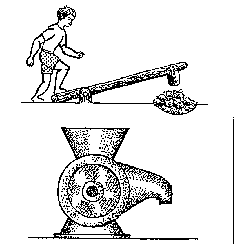
FIGURE 4.1.1-A Work flow for
dry process clay making (C)
C) Making clay powder by hand, with a rice huller or a hammer mill.
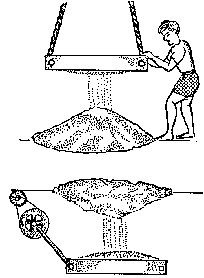
FIGURE 4.1.1-A Work flow for dry
process clay making (D)
D) Screening to remove coarse particles (16-100 mesh depending on required fineness) by hand sieve or motorized vibrating screen.
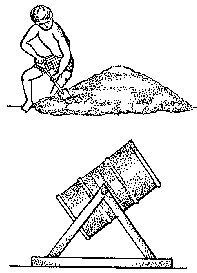
FIGURE 4.1.1-A Work flow for dry
process clay making (E)
E) Mixing with other materials (clays, feldspar, talc, quartz) manually or in a drum mixer.
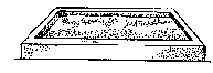
FIGURE 4.1.1-A Work flow for dry
process clay making (F)
F) Soaking is necessary to allow all clay particles to absorb water ( for a minimum of 24 hours).
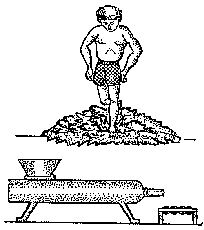
FIGURE 4.1.1-A Work flow for dry
process clay making (G)
G) Kneading can be done manually (or with the feet) or in a pug mill.
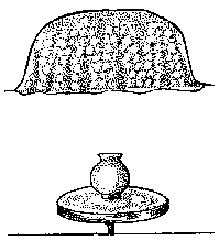
FIGURE 4.1.1-A Work flow for dry
process clay making (H; I)
H) Maturing under a plastic cover for a minimum of 3 days, or,
better still , several weeks.
I) The plastic clay will need a little kneading
before being used for forming.
4.1.2.
WET PROCESS
The wet process is used to make finer clay, and is necessary for white bodies where it is necessary to remove iron particles. It is easy and cheap when done by hand for cottage industries, but is complicated and expensive when it is done on an industrial scale.
To do it BY HAND requires only two tanks of brick lined with cement. The work flow is shown in Fig. 4.1.2-B.
Clay preparation BY MACHINE (Fig. 4.1.2-C) follows the same principle as by hand. The machines make the initial costs much higher, but the two methods could be combined. The filter press is the most costly part and it could be replaced by dewatering trays.

FIGURE 4.1.2-B Work flow of manual
wet clay process.(A; B)
A) Clay storage shed.
B) Clay that is completely dried is
easier to soak , but drying is not necessary.

FIGURE 4.1.2-B Work flow of manual
wet clay process.(C; D)
C) Soak clay and water in a tank , until it makes a fluid slip.
NEVER STIR CLAY BEFORE IT IS COMPLETELY SOAKED.
D) The clay slip is screened
and transferred to another tank.

FIGURE 4.1.2-B Work flow of manual
wet clay process.(E; F)
E) The clay is left in the settling tank.
F) When
the clay has settled, clear water is siphoned off and the thick clay slip is
transferred to a dewatering tray.
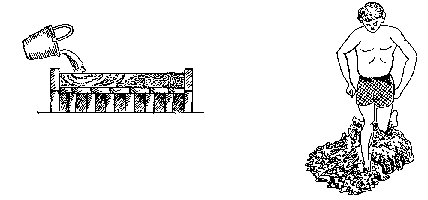
FIGURE 4.1.2-B Work flow of manual
wet clay process.(G; H)
G) Dewatering tanks can be common bricks, or cloth placed in a
depression in the ground.
H) Kneading by hand or foot.

FIGURE 4.1.2-B Work flow of manual
wet clay process.(I)
I) Clay is matured in order to increase its plasticity.

FIGURE 4.1.2-C Work flow of wet
process by machine.(A; B)
A) Clay storage open or covered.
B) Electric-powered blunger
turns the clay into slip.

FIGURE 4.1.2-C Work flow of wet
process by machine.(C1;2;3)
C1) From the blunger the slip runs through a vibrating sieve (1)
and a strong magnet (2) which
removes iron particles.
2)From an
underground tank with a stirrer (3) the clay slip pumped (4) under high pressure
into a filter press.
3) In the filter press water runs off and the clay is
retained by filter cloth

FIGURE 4.1.2-C Work flow of wet
process by machine.(D; E)
D) The filter press clay “cakes” are removed from the
press and taken to the pugmill.
E) Pugging is often done in a de-airing pug
mill.

FIGURE 4.1.2-C Work flow of wet
process by machine.(F; G)
F) Pugged clay is transferred to clay storage.
G) Clay is
stored under moist
conditions.
4.2. Hand-forming
4.2.1. TOOLS FOR HAND-FORMING
4.2.2. THE BASICS: HOW TO MAKE
COILS AND SLABS
4.2.3. ASSEMBLING COILS AND SLABS
4.2.4. USEFUL HINTS
Hand-forming methods use only the hands and a few simple tools. They are the oldest methods of making ceramics, but still are useful in modern times. They require a very small investment.
Typical products made by hand-forming are:
- Small items, such as animal figurines and small sculpture- Large items, such as storage jars for grain and water, special flowerpots, basins for washing clothes, and big sculpture.
4.2.1. TOOLS FOR HAND-FORMING
The basic operations in hand-forming are cutting, scraping, joining, smoothing and slab making. Tools are easy to make by yourself. Useful tools are:
- for smoothing and cutting: carved wooden tools;- for cutting, smoothing, scraping: metal tools, which can be made from old hacksaw blades and heavy wire. Various shapes made from old plastic buckets, etc.
- for shaping: wooden paddles for beating clay and flattening slabs;
- for joining, finishing: sponges for wetting clay.
4.2.2. THE BASICS: HOW TO MAKE COILS AND SLABS
Coils are long cylinders or “snakes” of plastic clay. Depending on how they are to be used they can be as small as a matchstick or as large as a man’s arm. There are three techniques which need to be mastered:
Coilmaking
Coils are easily made by rolling plastic clay on a smooth surface. The difficult part is keeping the coil even in diameter and round. This requires some practice. It is helpful to remember to roll the coil from the center to the outside, and to roll it as far as possible each time (from the tips of the fingers to the base of the hand) - this will help to keep it round.
A method requiring more expertise is to start with an elongated ball of clay between the hands, and by rolling the hands back and forth, to gradually cause a coil to move downwards. This is a very useful method when working on large pots, and, when mastered, is very fast.
Coils can also be made by using a hand extruder (see page 78).
Slabmaking
There are several ways of making slabs, all of which require a flat surface to work on:
Small slabs can be made by simply pounding a piece of clay with the hand and a wooden paddle. Or, when the slab is partly flattened, it can be rolled with a wooden cylinder (such as is used for rolling pastry dough).
Large slabs can be started by slamming a ball of clay down on the floor, turning it over, and repeating the process until it is sufficiently thin. With practice, slabs almost I meter by I meter can be made quickly with this method.
Large, thick slabs for big flowerpots, etc., are best made on a flat floor - it is helpful to sprinkle dry clay powder to keep the slab from sticking. Partly-flattened lumps of clay are joined by walking and jumping on them. They then are thinned as much as required by further jumping and beating with a wooden paddle.
Another way to make slabs is the “cutting method”. This is often used for making rough slabs for tiles. A large rectangular lump of clay is prepared and set on a flat surface. Then a series of long wooden sticks, cut the thickness of the desired slab, is piled up on either side of the clay. These are used as guides for a cutting wire. After each slab is cut, one stick is removed from each pile, and the next slab is cut. This is a cheap and fast method.
Slabs are sometimes made by pouring deflocculated slip. This process is described in the section on slip casting.

FIGURE 4.2.2-B Cutting slabs with
wooden stick guides.
4.2.3.
ASSEMBLING COILS AND SLABS
No matter how you make slabs, they are used as basic building elements for a large variety of shapes. Because slabs are most appropriate for flat surfaces, they are most frequently used for the bottoms of large pots, and for constructing rectangular shapes.
rectangular forms
Rectangular shapes are made by first letting the slabs dry to the leather-hard (half-dry) stage. Pieces of the appropriate size are cut and assembled.
joining parts
Joining leather-hard slabs must be done carefully, so that the joints do not separate while drying. The safest method is shown in Fig. 4.2.3-B.
coils
Forming pots by coil is a standard method, which is still used in many countries for making traditional pottery as well as more modern items. Usually the coil method is combined with beating and scraping, and is often used in combination with the potter’s wheel (see below).
The coil method is best used for large round or curved shapes, such as flowerpots, that are too big to make on the potter’s wheel.

FIGURE 4.2.3-B Slab joining step by
step.(A)
A) Apply a coat of slip to the surfaces to be joined.
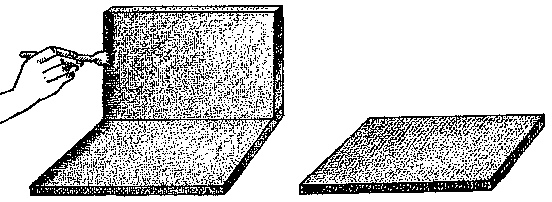
FIGURE 4.1.2-C Work flow of wet
process by machine.(B)
B) The slip then is worked into the clay by scratching
the surface - this is most easily done with a tool such as an ordinary fork, or
a piece of sheet metal with a serrated edge.
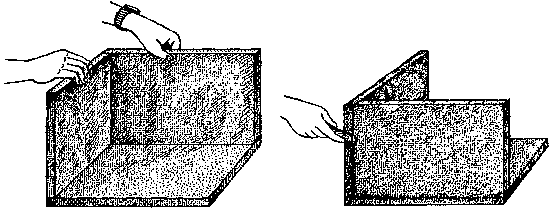
FIGURE 4.1.2-C Work flow of wet
process by machine.(C; D)
C) The pieces are then pressed together while the
slip is still wet. REMEMBER TO FIRST APPLY THE SLIP , THEN TO SCRATCH IT -this
works much clay particles to join very securely. When the better than doing it
the other way around.
D) After joining the pieces, gently beat all the seams
with a wooden paddle. This helps the seams with a wooden paddle.This helps the
joining slip is no longer wet, the seams can be finished with wooden and metal
tools.
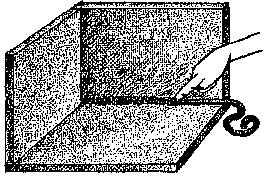
FIGURE 4.1.2-C Work flow of wet
process by machine.(E)
E) Joins of large pieces can be reinforced with a clay
coil on the inside.
The basic method is:
- Make a base for the pot from a slab. This usually is placed on a wooden plank or a plaster plate (bat), and it is easiest to put this on top of a turntable of some kind (although not essential).
- A supply of coils is then made and kept near the working area to be used immediately (coils should not be stored, as they are likely to dry out). Otherwise, many potters make coils as they go along. The diameter of the coils depends on the size of the pot, but usually will be between 2 and 5 cm.
- Join the first coil to the bottom slab very carefully - this is best done with clay slip and scratching as for slab pots (see above). For large forms, the coil is pinched between the fingers to make it slightly thinner and to raise it up.
- Then build up the walls of the pot by adding a coil all around. It works best to add the coil to the inside of the wall, and then to pinch the two coils together. This makes a strong joint, since it is overlapped, and, because the wall tends to move out when pinching it, it makes it easier to control the shape.
- Repeat the process until the pot is tall enough. Large pots can be built up over a period of several days to allow the clay walls to harden in order to carry the additional weight.
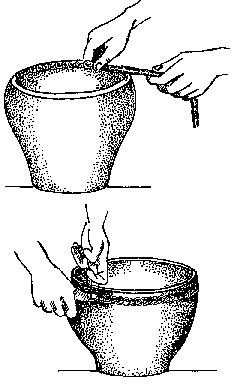
FIGURE 4.2.3-C A coil is added all
around whike one hand pinches the inside. Once the coil is on, pinching and
smoothing are done on the outside.
remember
Usually coil pots are made narrower and thicker than their final
shape. As they start to dry, the final shape is given by beating the walls of
the pot, which makes the clay thinner and expands the form. This is done by
holding a rounded piece of fired clay inside and beating the pot with a flat
wooden pallet from the outside (Fig 4.2.3-C). The surface is then smoothed by
sponging and scraping.
It is difficult to make coil pots round and
symmetrical - this comes with practice, and an expertly-made coil pot is
difficult to distinguish from a wheel-thrown pot.
4.2.4. USEFUL HINTS
- Clay for coiling and slab making should be less plastic than clay for throwing.
- If coils are added too rapidly the lower part may sag. When making large pots, allow the walls to dry while keeping the rim moist.
- When joining different parts make sure they have the same moisture content otherwise the pot may crack when drying.
- Allow large pieces to dry slowly by covering them with plastic. Parts of the pot tending to dry faster, like handles, can be covered with wet cloth or plastic so they will dry at the same rate as the rest of the pot.
4.3. Potter’s wheel
4.3.1. CLAY REQUIREMENTS FOR THE POTTER’S WHEEL
4.3.2.
TYPES OF POTTER’S WHEELS
4.3.3. FORMING ON THE POTTER’S WHEEL
4.3.4. TOOLS FOR THE POTTER’S WHEEL
4.3.5. FINISHING ON THE
POTTER’S WHEEL
4.3.6. DRYING
The potter’s wheel was invented in order to make pots faster than is possible by hand methods. It is a very old tool, and has many variations from country to country. All potter’s wheels work on the same principle, which is that a rotating plate (wheelhead) spins a lump of clay around, which then can be pushed and shaped by the hands of the potter. There are many local variations in size, method of propulsion, height, etc.
Shapes that can be made on the wheel are necessarily round, but they may be altered after forming by beating or stretching to make oval or square shapes.
The process of forming clay on the wheel is called
“throwing” in English. Nobody knows why this word is used - its
meaning has nothing to do with “throwing” a rock. Usually the forming
process is referred to as “throwing a pot” or “turning a
pot”, and the skilled worker who does so is called a “thrower” or
“turner”.
4.3.1.
CLAY REQUIREMENTS FOR THE POTTER’S WHEEL
Almost any kind of plastic clay can be used on the wheel, and sometimes clay is used that is very difficult to shape (such as porcelain). Ideally, though, most potters prefer clay that is quite plastic, free from rocks and roots, and strong enough to hold any shape. These requirements are met by clay that has been carefully prepared, and then matured for several weeks or months (even years in some cases) to develop plasticity.
clay for small and big pots
For small pots, the clay can be fairly soft, but not so soft
that it loses its shape when removed from the wheel. Potters who make large
items often prefer clay that has up to 30 % grog or sand to reduce shrinkage,
and prepared as stiff as possible in order to prevent it from collapsing. Grog
can be very fine (even dust) if smooth finishing is necessary, but often is up
to 20 mesh in size. It is always best to have a variety of grog sizes for
example from 60 to 30 mesh.
4.3.2. TYPES OF POTTER’S
WHEELS
There are many types of potter’s wheels, and generally they are chosen to suit work habits of the particular culture. There are two main categories: unmotorized and motorized. All potter’s wheels have the following main parts:
Flywheel: a heavy circular disc that provides momentum. It sometimes is also used as the working surface. Flywheels can be made from wood, cement, steel, clay/cow manure, car tires or combinations of these.
Wheelhead: a circular disc that is used as the working surface to which the clay is attached. Wheelheads are made from steel, aluminum, wood, plaster of parts, cement, etc.
Axle: the shaft to which the flywheel and wheelhead are attached. Axles are usually made of wood or steel.
Bearing(s): the device in which the axle rotates. Bearings may be metal bushing types, ball bearings, wood, leather, or stone.
Power source: this is either the foot, the hand or a motor.
UNMOTORIZED WHEELS
Unmotorized wheels usually depend on a heavy flywheel to keep them moving once started. The main types are:
Lightweight “turntables”: These are used for making small pots, and are nothing more than a round wooden plate about 20 cm in diameter fastened at the center to a round stick that turns in a hole in the ground. The potter attaches a small lump of clay, which is shaped with one hand while he rotates the wheel with the other hand. Often, the “coil and throw” method is used (see below).
Advantages: very cheap; often one potter will have a dozen or more wheels which he works on in rotation.
Disadvantages: is only suitable for fairly small products.
Asian low wheel (single bearing): This type of wheel has a combined flywheel and wheelhead, which may be from 60 cm to 100 cm in diameter. It can weigh up to 50 kg. The axle is usually wooden and very short, and has a pointed end which rotates in a single stone bearing. Sometimes the axle is fixed to the flywheel and the bearing is set into the ground, and sometimes it is done the opposite way. The wheel is usually rotated with a stick that is placed into a socket on the edge of the wheel. After it is started, the weight of the wheel keeps it going level, based on the gyroscopic principle (like a toy top). It is suitable for small products such as simple cups which are made very quickly entirely by throwing; larger products are partly thrown on the wheel and finished by beating and stretching.
These wheels are traditionally made from wood, or from a wood and bamboo frame which is covered with a heavy layer of clay mixed with straw, cow’s dung, hair and sugar.
Nowadays, the wheel is often made from a cast cement disc, or from a truck tire, mounted on a wooden crosspiece which is attached to the bearing.
Advantages: easy to make with low technology and local materials.
Disadvantages: Because of only the one bearing, the wheel does not stay level. This makes finishing on the wheel very difficult. Large pots cannot be made by throwing alone.
Asian low wheel (two-bearing type): This wheel also sits near the ground, and also uses its flywheel as the wheelhead. It has a slightly longer axle set in the ground, and the flywheel is fitted with two bearings (which may be wooden, or preferably ball bearings). As above, the wheel is rotated with a stick.
Advantages: Because the wheel is stable, it permits throwing larger forms quite thin, and accurate finishing of the bottom is possible. Because the potter works in a squatting position, there is no strain on his back (this is also true for the single-bearing type above).
Disadvantages: The large diameter fly wheel keeps the potter from getting close to his work. This is not really a problem for a skilled potter.
European kick wheel: This type of wheel has a long axle, and a separate flywheel and wheelhead. The flywheel may weigh from 30 to 150 kg. The potter works in a sitting position, and can rotate the wheel with his feet while working on the clay, which makes the speed easy to vary as required.
Kick wheels may be constructed with wooden or metal frames, and the flywheel may be made of wood, cement, or steel. The main requirement is an extremely sturdy frame that will not vibrate when the flywheel is kicked.
Advantages: The potter can get closer to his work because of the small wheelhead, which makes it easy to brace the arms for stability. It is also a convenient wheel for finishing,
Disadvantages: Puts strain and stress on the potters back because of the awkward sitting position, makes it difficult to see the shape of the pot because the eyes are above it, causes uneven strain on the leg muscles because one leg works harder than the other. It is a very heavy machine and is difficult to move to another location.
Treadle wheel: This is in principle like a kick wheel, but the axle has an eccentric which is driven by an attached foot treadle, and the flywheel is much lighter in weight (10-20 kg). The potter can work either standing or sitting, and unlike with other wheels keeps his foot working the treadle continuously.
Advantages: The body is not excessively strained because of the standing position, and the wheel speed can be easily varied with the foot treadle.
Disadvantages: mechanically more complicated than the above wheels, but not difficult to construct with simple machine shop facilities.
Two-person wheels: These wheels use one person to turn the wheel, while the potter works the clay. This can be done with the Asian two-bearing wheel, where one person rotates the wheel with his foot; or sometimes a special wheel with a flywheel and separate wheelhead is equipped with a hand-driven crank which drives a cycle chain and gear attached to the axle. A third version is shown in Fig. 4.3.2-F
Advantages: This system is often used for making very large pots by the coil and throw system, when a single thrower cannot manage to turn the wheel and throw at the same time. It also is used where labor is very cheap: otherwise it is a very costly method.
Disadvantages: Requires too much manpower; if electricity is available, it is usually cheaper in the long run to invest in a motorized wheel.

FIGURE 4.3.2-E The treadle wheel is
operated by pushing the foot treadle (1) back and forth.The foot treadle can be
placed either on the left or the right.
MOTORIZED WHEELS
There are many variations on motorized wheels. The two main types use fixed speed motors or variable speed motors.
fixed speed motors
These wheels all use standard AC electric motors. Usually, the smallest size motor for continuous production is 0.5 HP. If large pots are being made (up to 25 kg), it is better to increase to 1.0 HP or for very large pots (25 kg and more) 2.0 HP.
Sometimes motors are directly coupled to the wheel, which allows only one speed to be used. This means the wheel is either running full speed or stationary. (IMPOR-TANT: do NOT try to make an AC motor work with a variable resistor (rheostat) - this will burn up your motor at low speeds). Fixed speed wheels are suitable for producing the same product repeatedly (for example, factories making only large flowerpots sometimes use this system). In fact, some factories have one large motor connected to several potter’s wheels with a shaft and belt system.
The advantages of a one-speed wheel are the low cost and mechanical simplicity. The disadvantage is lack of versatility.
changing the speed
Potter’s wheels that have to produce a variety of sizes use several different systems to convert fixed speed motors into variable speeds:
Friction drive: This simplest system is also called the “power-assisted kick wheel”. It is simply a kick wheel which has a motor added. The motor is provided with a rubber wheel on its shaft, and is mounted in such a way that the wheel can be pressed against the flywheel by use of a pedal. Essentially, this replaces kicking with the foot, which can be done if there is a power failure. The speed of the wheel is controlled by engaging and disengaging the motor. This is a simple system to install, and is very reliable - it only requires periodic replacing of the rubber drive wheel.
A variation of this wheel was developed in Nepal. It has the advantage of low cost and light weight, because the flywheel and wheelhead are combined. The maximum speed of the wheel is about 200 r.p.m., which has proven to be suitable for all sizes of product.
Cone drive: Another old system that is often used in factories is the “cone drive” system. Between the motor and wheelhead is a pair of cones that rotate against each other, and move up and down to vary the speed. This is a fairly complicated system to manufacture, as well as being expensive, and has mainly been replaced by electronically-controlled DC motors.
Ring cone system: A variation on the cone drive system is called the “ring cone” system - the motor has a metal cone mounted on its shaft, and the whole motor can be moved in and out, so that the cone drives a rubber ring connected to the wheelhead at variable speeds. This type of wheel usually is made to run from almost 0 r.p.m. up to a maximum of 300 r.p.m.
If you have to construct your own wheel (with the help of a simple machine shop), it is probably best to use the friction drive system, as this can be managed by a mechanic who is unfamiliar with potter’s wheels.
variable Speed Motors
There are two types of variable speed motors. The older type uses the principle of movable brushes to provide variable speed with constant torque. These motors are expensive, and are difficult to find nowadays. They have been replaced by variable speed electronically-controlled DC motors, which are also quite expensive.
DC motor wheels
The advantage of a DC motor is that it provides variable speed
with constant torque, and can be controlled very accurately. The potter’s
wheel is mechanically simple, because the motor is coupled with a V-belt to the
wheelhead. Unless you have a lot of money to spend, this type of wheel is not
recommended, especially in rural areas where repairs are a problem. There is no
doubt that this is the system for the future, however.
4.3.3. FORMING ON THE
POTTER’S WHEEL
It is not the intention of this book to give detailed instructions for using the poker’s wheel. There are many books which describe the basic technique, and it is something that can only be learned with the help of an experienced teacher. It should be remembered that throwing is a highly-skilled technique, and usually requires years of practice before the potter deserves to be called a “master potter”.
There are a few advanced techniques, however, which are not often described in books, and which can be easily understood and learned by an experienced thrower: some of these are described below.
OPEN FORMS
Open forms are those where the mouth diameter is larger than any other diameter of the pot. This includes cups, bowls, flowerpots, plates, etc.
Here is a list of suggestions for successful shaping:
general shaping techniques
When producing a large number of identical shapes, weigh the clay lumps before starting to work. A measuring tool is set according to the size of mouth and depth of the pot. Keep a record of the weight and measurements and a drawing of all your standard products.
Open forms are likely to warp in drying and fir-ing: a rim that is a little bit thicker than the wall of the pot, and which is given a convex curve, will help to hold the shape of the pot. The rim should be rounded (without sharp corners) to prevent chipping in use.
Never use clear water for throwing. It will “cut” the clay and cause the pot to collapse more easily during throwing. Instead use a fairly thick clay slip for throwing.

FIGURE 4.3.3-A The various parts of a
pot are named after the human body, as shown in the drawing. From the bottom up,
they are 1) the foot ( if it is a ring, called foot rimg), 2) the belly, 3) the
shoulder, 4) the neck, 5) the mouth (or rim).

FIGURE 4.3.3-B A post gauge placed
next to the wheelhead is used when throwing many pots of the same size.The upper
pointer measures the height and width and a second pointer may be used for
marking the width of the belly.
big bowls
Bowls of 10-25 kg require a special technique, and to be made in one piece a motorized wheel is best. The clay should be as stiff as possible and addition of grog helps.
A wooden or plaster bat should be fixed to the wheelhead first, so that the pot can be removed when it is finished without collapsing it. If you forget to do this, it is helpful to fasten a piece of newspaper over the mouth of the bowl, using a little water to stick it on. There are a variety of “lifters” which help to remove large pots from the wheel: a large flat wooden scraper can be pushed under the pot, or two flat pieces of sheet metal can be used.
CLOSED FORMS
Closed forms are those where the mouth diameter is smaller than the largest diameter of the pot: this includes bottles, vases, etc.
big bottles and jars
Big jars for storage, lamp bases, etc., of 10 to 25 kg can be thrown very thin in one piece if the clay is stiff enough and a motorized wheel is used. It requires a special technique in order to get enough height and to keep the mouth small. For best results, a plaster or wooden bat should be fastened to the wheelhead, so the finished pot can be removed without collapsing.
- If the clay is the correct stiffness, and the throwing is well done, the result will be a jar with a wall about 0.5 cm thick above the belly, and about 1 cm thick below the belly. The only thick area will be the bottom 5 or 10 cm, which requires some trimming.- Another way to make big jars is by joining 2 or more sections, or using a combination of coiling, throwing and beating. Fig. 4.3.3-E shows how potters in Swebo, Burma, are doing this.
JOINED FORMS
Joined forms are assembled from separately-thrown sections: they include large bottles, cups with stands, candlestands, and other forms that cannot be made in one piece. They also include forms with lids - although these are not physically joined, they need to be made to the same degree of accuracy. All joined forms require careful measuring. It is also important to make all the pieces at the same time, so that they shrink at the same rate and will fit correctly. IT NEVER WORKS TO MAKE LIDS AFTER THEIR POTS ARE ALREADY DRY!
lids
The main purpose of a lid is either to keep things from getting into a pot, or to keep the contents of the pot from getting out. For this reason, lids should fit accurately.
interlocking systems
There are many different kinds of lids, which differ mainly in the way they fit together. This is called the interlocking system. Lids may fit inside the mouth, outside the mouth, etc. Measuring tools should always be used for fitting lids correctly. A skilled potter can make lids that fit tightly without much trimming, but usually it is best to make the lid slightly oversize and then fit it accurately when trimming. Also, if you plan to glaze both the mouth of the pot and the lid, there needs to be enough space for the thickness of the glaze.
knobs
The knob is a small round handle attached to the lid, used for lifting it off the pot. Knobs may be small and solid, or are made hollow for larger sizes. Instead of a knob a pulled handle can be placed on top of the lid.
lids that are thrown right side up
Some lids are thrown in the same position as they will sit on the pot. Often, the knob is made at the same time. This type of lid only needs a small amount of trimming.
lids that are thrown upside down
These lids are thrown like bowls. The rim becomes the part that interlocks with the mouth of the pot. This type requires more trimming to finish the knob. There are many ways to make the knob: A) it can be separately thrown and attached after trimming, B) a small piece of plastic clay is centered on the trimmed lid and shaped into the knob, C) the knob is thrown as the base of the lid (Fig. 4.3.3-G (1) & (2)) and trimmed to shape, D) a handle is pulled and attached to the top of the lid (Fig. 4.3.3-G (3)).
lid and pot thrown in one piece
Skilled throwers can throw small containers with lids in one piece. The lid is made as a continuation of the container as shown in Fig. 4.3.3-H (1). The thrown piece is left until leather-hard and then cut and trimmed.
cups with stands (goblets)
Although these are often attempted in one piece, they never are really satisfactory because it is difficult to remove clay from the stand when finishing. They are best thrown (at the same time) as a cup, and a stand which is made upside down. When both are leather-hard, it is easy to center the cup upside down on the wheel, join the stand, and then remove excess clay while making a smooth connection.
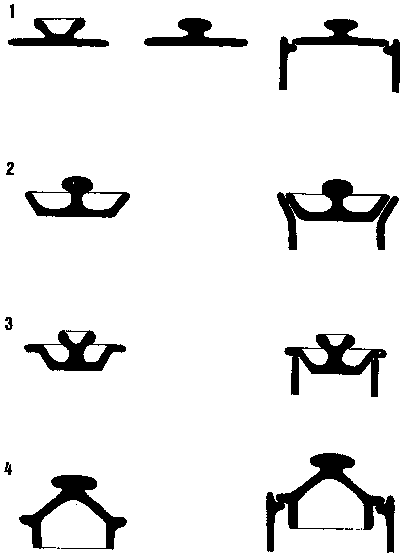
FIGURE 4.3.3-F Lids that are thrown
right side up. Their interlocking with the pot is shown in the right column.
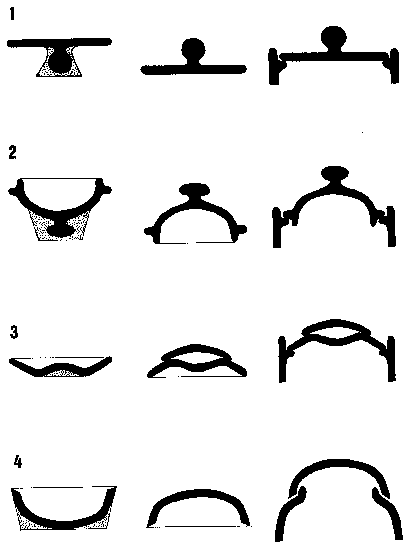
FIGURE 4.3.3-G Lids that are thrown
upside down. The left column shows how the lids are thrown on the wheel. In the
middle is shown how they are trimmed and right column shows the interlocking
with the pots.
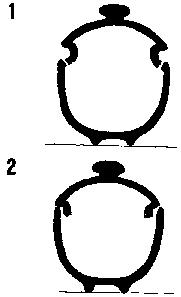
FIGURE 4.3.3-H Lid and pot thrown in
one piece (1). When leather-hard, the lid and pot are separated and trimmed to
fit.
two-piece bottles
Unless you are a highly-skilled thrower, it is difficult to make
large bottles with small, tall necks in one piece. It is much easier to throw
the body and close it in to the base of the neck, and then separately throw the
neck. When the parts have stiffened enough to be picked up without deforming,
they are joined - this is best done by finishing the foot of the bottle,
centering it on the wheel, and then joining the neck while the wheel is
rotating.
4.3.4. TOOLS FOR
THE POTTER’S WHEEL
The tools that you use for the potter’s wheel are mainly a matter of personal preference. The main categories of tools are:
wetting and smoothing: sponges of various sorts (the best are natural sea sponges), a piece of cloth, a piece of soft leather.
cutting: A needle tool is essential for cutting rims and checking wall thickness. This can be made from a big needle, a nail, a piece of wire. A knife can be used, or a sharpened piece of wood or bamboo.
shaping: For smooth surfaces, wooden, plastic, rubber or metal “ribs” are used, mainly on the outside but sometimes on the inside of the pot.
finishing: A triangular piece of sheet metal or a sharp wooden knife is useful for undercutting the bottom before removing the pot from the wheel.
measuring: A variety of wooden sticks, calipers, etc., are used for accurate measuring of mouth size, lid size, depth of pot, etc.

FIGURE 4.3.4-A Tools for throwing:
ruler (1),pointed knife (2), V-shaped cutter for the base (3), calipers for
measuring both inside (4) and outside (5).
4.3.5. FINISHING ON THE
POTTER’S WHEEL
Finishing requires just as much skill as throwing, and profitable production depends on efficient finishing. By “finishing”, we mean the process of removing excess clay from the bottom of the pot, and forming the foot ring that the pot sits on. This is sometimes called “trimming”. The amount of finishing and the style of finishing depend upon the quality of the product being made. Common pottery normally is not finished very much, if at all, but high quality pottery also needs high quality finishing.
Different qualities of finishing are described below, starting with the simplest (for common pottery) and going on to the most complicated. Quality finishing takes a lot of time and is too costly for common pottery often, making a foot ring takes longer than the making of the pot itself.
common pots
Cheap storage jars and other low-cost items are simply cut off the wheel and dried. With some clays, this results in cracks in the base, which are caused by not compressing the bottom of the pot enough when opening up the clay. This happens frequently when making multiple small pots from a single large lump of clay. If this is a problem, it usually can be corrected while throwing in the opening-up stage: the bottom is opened out as usual, then the fingers move from the outside in to the center of the bottom, while pressing downward. This compresses the clay particles in the bottom.
Another way to correct the problem is to beat the bottom of the pot when it is leather-hard (half dry). This is done by placing the pot on a plaster of parts bat, and using a round wooden stick with a flat end to compress the bottom from the inside.
rolled foot
The foot of a pot can be rounded and finished when leather-hard by rolling it on a flat surface. It is also a good idea to slightly press in the bottom to make it sit better and to help prevent drying cracks.
better quality pots
These require foot rings. The purpose of the foot ring is to give the pot a stable base to sit on, and especially to make setting in the kiln easier. The foot ring is usually not glazed(except for high biscuit, low glaze firing tableware), and it makes a logical stopping place for the glaze.
The process of making the foot ring involves removal of excess clay. This is called “trimming” or “turning” (the same word is used for lathe work. This is confusing, because the same word is sometimes used for throwing!). Trimming needs to be done when the clay is at just the right stage of leather-hardness - otherwise it is difficult and the result will not be satisfactory. There are many different tools used, and choosing a tool is mostly a matter of individual preference. The main types of tools are wooden tools, metal tools, and wire loop tools - a variety is shown here.
centering for trimming
The first step is to center the pot UPSIDE DOWN on the wheelhead. This requires a lot of practice before it can be done quickly and easily.
- One method is to slowly rotate the pot, and hold a pointed tool steadily near the foot: it will make a line where the pot is farthest from center - this line is pushed toward the center of the wheel, and the process is repeated until the tool makes an even line all around the foot. This is a slow process, and normally is done only for special shapes, or pots with fairly small mouths that do not sit stably on the wheelhead. The pot is then secured to the wheelhead with pieces of plastic clay.
- For small and medium open forms, experienced throwers use the “tap cantering” method. A small amount of water is first placed on the wheelhead in the area of the pot’s mouth. The pot is then placed upside down as much on center as possible, and the wheel is rotated at medium speed. While slightly pressing the bottom of the pot with one hand, the potter gently taps the pot with his other hand until it is on center (this process is impossible to describe in writing, and must be learned from an experienced potter). It needs to be done quickly and surely, and if the pot is at the right of stage of dryness, the water will stick it securely to the wheelhead.
chucks
When trimming a large number of identical shapes, or shapes that will not sit on the wheelhead (closed forms), the potter makes use of a “chuck”. This is a cylinder of bisque-fired or dry clay, or sometimes plaster of parts, which is used to hold closed forms inside it, or open forms outside it. The potter makes his own chucks according to his products.
When using chucks, the main problem is to hold the pot firmly without damaging it. The chuck needs to be centered on the wheel, and then a coil of plastic clay is fastened inside it, and also must be centered accurately. A plastic clay chuck, on the other hand, is sometimes covered with a piece of cloth or plastic to keep it from sticking to the pot.
In either case, the pot is placed on the chuck, and then is centered by making sure its bottom is perfectly level. If done correctly, the entire pot will then be on center, and can now be trimmed.
Trimming itself is done in many different ways, all of which work satisfactorily if the potter is skilled. Usually, the foot ring is located first, and then excess clay is removed from the inside. A skilled potter knows when the bottom is thin enough just by the feel of his tool. If he is in doubt, he can tap gently on the center of the bottom with a finger, and the sound will tell him if the thickness is correct. Then the excess clay is removed from the outside of the foot ring, and the ring is smoothed with a fingertip or a damp sponge.
It is usually helpful to use a smooth wooden tool to compress
the bottom, working from the outside to the center. With sensitive clay, this
also helps to prevent cracks in the base.
Before removing the trimmed pot
from the wheel, it should be smoothed with a damp sponge (although many potters
like to leave the marks of the trimming tool).
After the completed pot is removed from the wheelhead, the rim should be smoothed with a sponge, and is usually placed upside down for drying.
If very high foot rings are required, they are either made separately as for goblets (above), or another technique is to throw the foot ring directly on the pot. After centering the leather-hard pot upside down on the wheelhead, either a ball of plastic clay is joined to the bottom and thrown to the necessary shape; or, for larger pots, a thick ring may be thrown separately, joined to the bottom, and then thrown to the final shape.
The foot ring should in any case be made wide enough to give stability to the pot. A bowl with a narrow foot ring easily tilts, spilling its contents.

FIGURE 4.3.5-A Trimming tools: wire
loop tools (1) and tools (2) made from metal strips.

FIGURE 4.3.5.-B Chuck used for
trimming a vase with a narrow mouth (1).Another chuck (2) is used for trimming
saucers of identical shape.
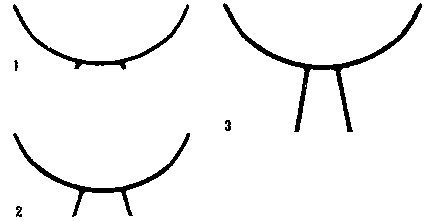
FIGURE 4.3.5-D A bowl’s function
and appearance depend on its foot.Here three different types are shown .(1) is
made by turning away excess clay , (2) is made by throwing on the pot and (3) is
made by joining individually-made leather-hard parts; bowl and foot ring.
4.3.6. DRYING
The main problems occurring during drying are warping and cracking. As with all clay products, the best way to prevent these problems is by drying slowly and evenly. This means avoiding wind direct sun, and covering products in dry weather.
helpful hints for drying
Open forms (cups, bowls, plates) of the same size are best dried stacked rim to rim. This helps to prevent warping.
- When drying pots to the leather-hard stage for trimming, they need to be watched very carefully to be sure that the rims do not get too dry. When the rims are leather-hard, it is a good idea to turn the pots upside down until the foot is ready for trimming.
- Large open pieces can have their mouths covered with plastic to keep them from drying too fast.
- Covering pots with wet cloth and plastic can keep them from drying indefinitely.
Pots that have accidentally become too dry for joining should usually be thrown in the scrap bucket. However, they can sometimes be wetted by dipping them in clean water.
4.4. Joining techniques
4.4.1. HANDLES
4.4.2. JOINING COMPLICATED FORMS
4.4.3.
SPECIAL JOINING TECHNIQUES
Many products require joining of several parts. In general, when
clay is joined it often causes problems of cracking or separation during drying.
It needs to be done carefully and skillfully in order to be successful. This
section discusses special problems in joining.
4.4.1. HANDLES
Handles are formed in a variety of ways. The small workshop usually makes handles by hand or extrusion, and then joins them to leather-hard (and already-trimmed) products:
coil
A coil is rolled to the desired diameter, and then it is shaped by pressing and smoothing with a damp sponge.
pulling
A piece of plastic clay is slightly elongated and then is stretched into a handle by repeatedly pulling it with a wet hand (like milking a cow). The wetting should be done with clay slip, not clean water. Some prefer first to attach a lump of clay to the pot then do the pulling while holding the pot with their other hand. The handle can also be pulled first and then joined.
extruding
Handles are extruded from a hand extruder (see below). This is a fast method for making large numbers of handles. Fig. 4.4.1-B shows a method for unskilled workers to produce quality handles. A skilled potter will not need templates to produce evensized handles.
pressing
Handles are pressed from plastic clay, using a small plaster two-piece mould.
slip casting
This is a standard method for industries producing large volumes of crockery by casting or jiggering. The handles are cast in moulds that produce many handles with one pouring.
drying items with handles
Products to have handles added should be turned upside down as
soon as possible after throwing. This allows them to dry slowly and evenly. Many
products with handles are damaged by cracking that occurs when a wet handle is
joined to a dry product. Dry products can be wetted with clean water before
joining the handle, but this should only be done in emergencies. After joining
the handles, turn the pot upside down for even drying.
4.4.2. JOINING COMPLICATED FORMS
The main point to remember about joining separate parts is that the clay must have reached the correct stage of dryness meaning leather-hard. In general, all parts should be at about the same dryness.
When joining, always:
- FIRST coat both surfaces to be joined with clay slip.
-
Scratch both wetted surfaces with a fork or serrated-edge tool, which works the
slip into the clay.
- Press the two surfaces together firmly.
- If
possible, beat the joined area lightly with a wooden paddle, and work the seam
together with a rounded wooden tool.
Another important point is that drying should be slower than usual, so that the different areas of the pot dry evenly.
Some potters do not need to take this much care when joining
different parts, because they have a tolerant clay body. But if you have
cracking problems you should follow all the steps mentioned above.
4.4.3. SPECIAL JOINING TECHNIQUES
deflocculated slip
If a lot of joining has to be done on a regular basis (for example, a factory that produces rectangular flowerpots using the slab method), it is worthwhile using deflocculated casting slip as “glue”, which is made from the same body as the slabs. This permits faster joining, because the surfaces require a minimum of scratching before joining. It also has about the same water content as plastic clay, so even a thick layer of it will shrink about the same amount in drying, which helps to prevent cracks. (See slip casting and fiberslip below).
pegged joining
When joining big handles or handles that have to carry a heavy load, it is a good idea to use an interlocked joint, similar to a carpenter’s joint. A hole can be cut in the pot, and the end of the handle shaped to fit into it. The surfaces are slipped and scratched a usual (this is a particularly good use for casting slip), then fitted together, and the end of the handle inside the pot is pressed and finished like a metal rivet. This is not usually needed, but if there are problems with specialized products, it does give them an added amount of strength.
4.5. Jigger
4.5.1. APPROPRIATE USE OF THE JIGGER
4.5.2. AVERAGE
PRODUCTION QUANTITIES
4.5.3. JIGGER WORK FLOW
4.5.4. JIGGER MACHINE
PRINCIPLES AND CONSTRUCTION
4.5.5. MOULD MAKING FOR THE JIGGER
4.5.6.
FORMING PROCESS
4.5.7. FINISHING
4.5.8. DRYING
4.5.9. JIGGER
PROBLEMS AND SOLUTIONS
The jigger is nothing more than a potter’s wheel which has been modified to produce uniform products semiautomatically or automatically. It has been a standard forming tool in the ceramics industry for many years, and is likely to be around for a long time in the future, as it continues to develop into a more and more sophisticated (even computer-controlled) machine. Roller head machines are now replacing the jigger machine for flatware production in larger industries.
Basically, the jigger machine consists of a spinning wheelhead which is fitted to hold plaster of parts moulds, and a movable arm which holds a metal profile. Clay is placed in or on the mould, and the operator purls down the profile, which forces the clay into the shape of the product. The forming method is called jiggering .
The forerunner of the jigger is still used in many countries,
usually for making plates with shallow relief designs. Plaster moulds for the
inside curve of the plate are centered and fastened to a potter’s wheel, a
slab of clay is placed on the mould, and the potter smooths and shapes the back
of the plate and foot ring. Excess clay is trimmed from the rim, and the product
is set aside to dry. The rim is finished when it is stiff enough to hold its
shape.
4.5.1. APPROPRIATE
USE OF THE JIGGER
It is a necessary tool for industries which produce tableware, such as cups, plates, bowls, and other open shapes. It is mostly used for products that are round and simple in shape, but there even have been jiggers developed for making oval shapes.
It is not suitable for small, one-man industries, as it is only cost-effective if its full capacity for production is used. One jigger can produce several hundred pieces per day, and the factory needs enough kiln capacity to manage these quantities.
Most forms made on the jigger can also be produced by slip
casting, but this is actually slower and requires more finishing time. The
jigger requires a large number of moulds, but because the moulds are relatively
thin, they can be dried and reused faster than slip casting moulds - they also
do not absorb as much water, since plastic clay is used in the process.
4.5.2. AVERAGE PRODUCTION
QUANTITIES
Average production quantities for the basic jigger vary greatly according to the skill and management of workers, as well as being different for large and small products.
However, the following figures can serve as a guide to setting production quotas:
|
Thailand/Burma: |
1200 teacups per day |
|
India: |
2000 mugs per day |
|
Nepal: |
800 cups per day |
|
Europe: |
1600 sugar bowls per day |
| |
2400 saucers per day |
Semiautomatic jiggers in Europe produce from 8 to 14 articles per minute.
Mould life also varies greatly, depending on the quality of the
product, the quality of the plaster of parts, and care taken in handling the
moulds. Average figures are several hundred times for one mould - high quality
products require more frequent mould replacement.
4.5.3. JIGGER WORK FLOW
JIGGER WORK FLOW AND REQUIREMENTS
raw materials
Plastic clay for jigger work can be any standard clay body. However, it is prepared much softer than clay for wheel throwing. This allows it to be easily shaped in the mould. The clay does not need to be as plastic as for throwing, although plastic clay gets a smoother finish.
mould use
The same mould can be used several times per day, depending on how fast it is dried. Most small producers air-dry their moulds, which usually limits use to twice per day, depending on how dry the air is. Producers using an artificial dryer can use moulds up to 4 times in a single shift.
finishing
The method of finishing depends on the properties of the clay body. Normally, the only finishing necessary is smoothing the mouth. In many factories, this is done at the bone-dry stage, using sandpaper. This is not recommended, because the dust is a health hazard for the operator; it should only be done if a good exhaust fan and dust mask are used. Instead, finishing should be done with a wet sponge at the leather-hard stage (Fig. 4.3.5-C).
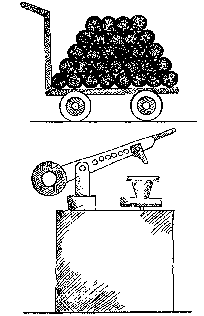
FIGURE 4.5.3-A Work flow of
jiggering (A;B)
A) Clay, softer than used for hand throwing, is brought to the
jigger. One worker prepares even lumps of clay ready for forming.
B) A
plaster mould is placed in the chuck and forming is done by bringing down the
inside template.

FIGURE 4.5.3-A Work flow of
jiggering (C)
C) The operator takes empty moulds from a trolley rack next to the jigger and returns them when they are filled.When all moulds are finished the rack is replaced with a new one.
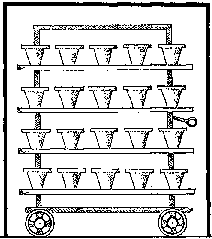
FIGURE 4.5.3-A Work flow of
jiggering (D)
D) The trolley rack with full moulds is placed in a dryer.

FIGURE 4.5.3-A Work flow of
jiggering (E)
E) After the formed items have dried a little they are taken out of the moulds and placed on ware boards. The moulds are returned to the jigger machine.

FIGURE 4.5.3-A Work flow of
jiggering (F; G)
F) Finishing of the rim is done in a spinning chuck.
G) The
leather-hard items are ready for next production step: attaching handles or
drying.
4.5.4. JIGGER
MACHINE PRINCIPLES AND CONSTRUCTION
We describe here only the simplest types of jigger machines, since the more sophisticated ones cannot be made by a simple machine shop. The machine shown from Nepal was constructed using only a machine lathe and an electric arc welder.
main parts of the jigger
Wheelhead: This is equipped with a chuck for holding the plaster mould, as shown. There are two options: 1) chucks made of mild steel or cast iron, 2) a flat wheelhead on which a plaster chuck is fitted. The wheelhead is usually set to rotate at 250-350 r.p.m. Small products like cups can be rotated faster - some machines go up to 400 r.p.m. It is very Important for the chuck to run true.
Because plaster chucks wear out fast, causing the moulds to go off center, they are sometimes reinforced on the inside rim with a rubber lining, a metal ring or a lead collar the latter is melted and poured in place.
Axle and bearings: The axle should be 2.5 cm in diameter, and good quality ball bearings should be used.
Drive system: Machines which have individual motors use pulleys and V-belts to reduce the motor speed and provide mechanical advantage. In factories where several machines are needed for larger production, one large motor often drives a long shaft, and the machines are connected to the shaft with flat belts. In this case, a simple clutch system is necessary for each machine, in order to stop it when necessary.
Clutch: The clutch is optional. Many machines have wheelheads with no clutch. A skilled operator can insert and remove moulds without stopping the wheel. Clutches are of two types: a spring clutch is used with V-belt drives, whereas a sliding belt system is used with flat-belt drives.
Variable speed drive: This is also optional. Most producers make standard products, and one speed is sufficient for products ranging from plates to cups. In more sophisticated machines, a friction drive allows the speed to be reduced for larger items. A cheaper solution is to fit multiple size pulleys on motor and axle so speed can be adjusted by changing the V-belt.
Jigger arm: There are numerous jigger arm shapes. The main requirement is that it be very rigid (it must not vibrate in use), so cast iron is the preferred material. The bearing where it rotates also must be very solid: the usual system is a cone-type bushing, where the cone tension can be adjusted with lock nuts.
Profile or template: Normally, the profile is made from mild steel, which is carefully ground to the exact shape. The steel needs to be at least 3 mm thick. Metal profiles are sometimes backed up with wood to give them better rigidity. The profile will wear down with use, and it is necessary to regrind it from time to time. Additionally, master profiles should be kept for standard production items, so that new working profiles can be made as necessary.
The profile has to be adjusted so it is exactly on center and does not leave a “bump” or spiral in the center of the article.
For limited production items, profiles are sometimes made from acrylic plastic or even from wood. These, of course, have a much shorter working life than mild steel.
The profile is mounted with adjustable nuts and bolts, which allow it to be accurately positioned and shifted as necessary.
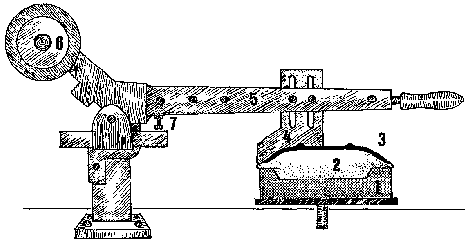
FIGURE 4.5.4-A Jigger system for
forming plates. Main parts are: wheelhead with chuck (1), mould (2), plate(3),
profile (4), jigger arm (5), counter balance (6), stop adjustment(7).
4.5.5. MOULD MAKING FOR THE
JIGGER
As with slip-casting moulds, jigger moulds require a plaster model, master mould, and case mould from which the working moulds are made. (Refer to section 6. on mould making).
limitations on shape
One-piece moulds: Usually, moulds are only made in one piece. Because the product needs to be easily removed from the mould when leather-hard, shapes must be designed for this purpose. Moulds must not have any undercuts which might catch the clay. Also, there should not be any sharp edges - foot rings must be rounded and not very high.
Cylinder shapes are not very successful because the working moulds are very difficult to separate from the case mould. Instead, straight-sided shapes should be slightly tapering.
Two-piece moulds: Sometimes, two-piece moulds are used for shapes that curve in slightly at the top, or have a foot ring that curves out slightly. Usually, it is more efficient to form this kind of shape by slip casting.
decorated moulds: Moulds are often made with shallow relief designs. This is particularly effective with plates. Some factories use this technique, and then finish the plate by hand-carving when leather-hard. This gives an effect that seems 100 % handmade, and greatly increases the retail price of the product.

FIGURE 4.5.5-A The left jigger mould
has undercut at (1) This will make it impossible to release the pot from the
mould. The right jigger mould has no undercuts and its slightly tapering shape
makes mould release easy.
4.5.6.
FORMING PROCESS
adjusting profiles:
The profile has to be adjusted so that the jiggered item has the right shape and thickness. This is done by cutting the jiggered item in half with a knife. The thickness should match that of the original sample. The profile may get out of position and its surface will wear out, so the production supervisor should cut control samples at least once a day to make sure products are up to standard.
profile on the inside:
- Prepare balls of clay in advance. They should be weighed for accuracy, but experienced operators will be able to judge the correct quantity by taking lumps from clay on the bench. If clay is prepared in a pug mill the extruded clay wad can be cut in slices of a length corresponding with the required weight. They are then placed in a convenient location for the worker.
- Also prepare ware boards and moulds in advance, which means they MUST BE CLEAN, and set in a convenient location.
- Place a mould in the chuck. (Normally, the machine is running and does not need to be stopped to insert or remove working moulds).
- Place or throw a ball of clay in the mould. It is pressed into the bottom and then opened up with one hand for large items. With small shapes, the profile can be brought directly down on the ball of clay.
- Bring the jigger arm down into the mould, which will force the clay into shape. Excess clay is removed from the top of the mould and from the profile. Before removing the profile, the inside of the article must be wet with water to smooth the surface.
- Remove the mould from the chuck and set it on a ware board.
profile on the outside:
- Prepare slabs of clay in advance. This is usually done by cutting slabs from a block of clay using wooden sticks and a cutting wire (see slabs, above). Slabs can also be beaten out on a wet plaster bat with a wet plaster beater. (If the beater is dry, the slabs will stick - it is soaked in water every night for the next day’s work). Plates made from such slabs need more finishing work. For better quality plates slabs are prepared by throwing on a potter’s wheel or on a bat making jigger machine as in Fig. 4.5.6-B.
- Put a mould in the chuck with the already-prepared slab on it.
- Sponge and press the slab with the hand while it rotates to stick it firmly to the mould.
- Bring the jigger arm down to form the back surface of the plate, at the same time letting water drip from a sponge to smooth the surface.
- Remove excess clay.
- Remove the mould and plate and set the latter on a ware
board.
4.5.7. FINISHING
Finishing is a separate operation and is best done by a separate worker if there is enough production. This keeps forming and finishing going continuously.
Finishing can be done on a jigger wheel, or on a potter’s wheel. The wheel is set up with a chuck, which often is thrown from plastic clay to fit the inside of the form. It is best, however, to make a chuck from plaster which exactly fits the product.
All clay products are best finished when they are leather-hard.
In this case, the piece is set in the chuck, the wheel is rotated, and the
outside is finished with a wet sponge. Normally, the area most needing finishing
is the mouth or rim.
4.5.8. DRYING
Drying of jigger products requires no special techniques, but
the general recommendations for potter’s wheel products should be followed,
such as setting pieces rim to rim to prevent warping. Wet jigger moulds will not
release the jiggered item and in order to increase production artificial drying
of moulds should be considered (see chapter 9.2).
4.5.9. JIGGER PROBLEMS AND
SOLUTIONS
Problem: Clay sticks to the moulds.
Solution: This is sometimes a difficulty with new moulds. They may be dusted with a small amount of talc or fine grog powder to prevent sticking. Usually, the problem stops after a mould has been used a few times.
Problem: Breakage of moulds.
Solution: Early breakage of moulds may be caused by poor quality plaster of parts. Sometimes, adding about 5 % cement to the plaster mix will help the strength, although it is better to look for another plaster supplier, if possible. Or moulds may be too thin, especially in the top rim, and should be made thicker. Moulds are often reinforced by setting a wire ring inside the rim during mould casting.
Problem: “Feathering” in the bottom of the inside (cups, bowls), or on the bottom of saucers - this Looks like a spiral or “butterfly”.
Solution: Correct adjustment of the profile. Metal of profile too thin, which causes “chattering”. Jigger arm too thin, which causes vibration. First make the profile thicker or place a wooden plate on its back. If this is not enough try to reinforce the jigger arm.
Problem: Rapid wearing out of plaster chucks.
Solution: Metal rings can be cut accurately from 2-mm mild steel, and set into the rim of the chuck for long chuck life. A rim of rubber inside the chuck is often used but it is difficult to make it run true. An old method is to pour melted lead into the chuck Am. Melted lead does not harm the plaster and it is easy to trim.
Problem: Uneven thickness of products.
Solution: Wrong setting of the profile causes uneven thickness of a product’s cut-through profile. Profile is refixed or it may need to be reground. A plaster mould running off center causes the jigger item to be thick on one side and thin on the other. The problem may be that the jigger head or plaster chuck is off center or that the clearance between mould and head has become too great. The plaster mould may from the beginning be off center due to faulty original models or case moulds.
4.6. Extrusion
4.6.1. HAND EXTRUDERS
4.6.2. MOTORIZED EXTRUDERS
4.6.3.
TYPICAL EXTRUDED PRODUCTS
Extrusion means the process of forcing plastic clay through a
shaped mouth, called an extrusion die or nozzle. The verb is “to
extrude”. The simplest extruders are hand-powered for forming handles,
etc., and the most complicated ones are very sophisticated machines for
producing large products like pipe.
4.6.1. HAND EXTRUDERS
Hand extruders consist of a cylinder to hold clay, and a piston to force it through a die attached to one end. A medical syringe (with the needle removed) can be used to produce very small coils for decoration - so this is actually a very simple extruder. Hand extruders can be used for small solid extrusions (like handles), and can also extrude hollow pipe up to about 15 cm in diameter. There are two systems for providing the necessary pressure:
- Screw system: This uses a long screw attached to the piston to compress the clay. This machine is sometimes called a “wad box”.
- Lever system: A lever arm is attached to the piston, and pulling it down forces the clay through the die. There are two ways to drive the lever arm: by a “ratchet” system, where the end of the lever is engaged in slots on the support arm, or by the faction system, where a metal ring holds the lever arm in position. In either case, the principle is the same as a “bumper jack” for automobiles, and this type of jack can actually be modified to power an extruder.
Dies for the extruder can be made from mild steel, acrylic plastic, or waterproof plywood. The extruder cylinder is fitted with a screw on cap which holds the dies, so it is easy to change them as required.
Clay for hand extruders needs to be fairly soft, so that it can
be pushed through the die easily. If pipes are being extruded, they can only be
made relatively short, because the soft clay is difficult to transport without
collapsing. These “pipes” are normally used as cylinders for making
products like flowerpots.
4.6.2.
MOTORIZED EXTRUDERS
Motorized extruders are simply pug mills equipped with extruder
dies according to their purpose. Most pug mills are used for the purpose of
producing plastic clay body for other forming methods, but almost any pug mill
can be used for extruding products such as small hollow bricks.
Specially-designed pug mills are used for extruding stoneware pipes and split
tiles, which require higher pressure and more control.
There are several
different kinds of pug mills that can be made with simple technology. The main
parts are:
- Motor: ranging from 1 HP for very small mills up to 30 HP and more for the largest ones.
- Reduction gear system: Because speeds range from 15 to 25 r.p.m., reduction is usually done with gears. This may be a combined V-belt, pulley and gear system, or direct gear system. Frequently, either an automobile transmission or differential gearbox is used.
- Axle and blades: The main problem with the axle design is that any gears or bearings should be isolated from the clay. Blades can be made simply from flat mild steel. When thorough mixing is required the blades are spaced widely at the beginning and more closely at the outlet. For high output it is made the other way around, but in both cases at least two blades are spaced opposite each other at the outlet, like a propeller, to produce compression and proper extrusion. High quality units use stainless steel for both shaft and blades to avoid contamination of white clay bodies with iron oxide.
- De-airing chamber: This is optional. De-airing treatment improves plasticity and reduces lamination problems, but proper maturing and brief kneading after pugging will do the same. It consists of an input screen which feeds clay “noodles” into the box, and a vacuum pump which removes air from the clay. It is fairly complicated to make your own de-airing chamber, as it needs to be absolutely airtight. Correct design is also very important, since a common problem is that clay does not exit from the chamber fast enough, resulting in blockage.
De-airing chambers have a door which can be opened for cleaning, and the better ones have an easily removable screen, for the same reason.
- Extruding mouth: For clay production, either a round or
rectangular extruding mouth is used. This is a cone section with a cylindrical
mouth. The purpose of the cone is to compress the clay, which improves its
quality. The diameter of the outlet mouth is normally about 2/3 of the
barrel’s diameter.
Pug mills can be fitted with a variety of special
extrusion dies for directly making products. Common dies are for solid bricks,
hollow bricks (of various shapes and sizes), split tiles, and pipes. NOTE: Many
of these products require very stiff clay and therefore specialized pug mills.
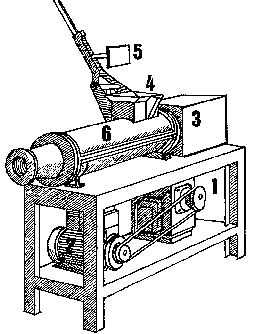
FIGURE 4.6.2-A Horizontal pug mill
with main parts named: gearbox (1), 3-HP motor (2), bearing house (3), feed
hopper (4), plunger (5), mixing barrel (6).

FIGURE 4.6.2-B Interior of pug mill
barrel with feed auger under hopper (1), mixing blades (2) and extrusion cone
mouth (3).
Common types of pug mills
Vertical pug mill
- drum type, non de-airing, side extrusion. This is a pug mill which uses a drum up to 60 cm in diameter for mixing clay. The earliest version of this mill used an animal to turn it, and the mill often consisted of a wooden box, which contained a wooden shaft mounted with a series of wooden blades (which sometimes had wires running between them to cut the clay). More modern versions are made from metal drums, and have a metal axle and blades which are powered by an electric motor. The speed of the pug mill is quite slow - about 8-15 r.p.m., and the speed reduction can be obtained by a combination of V-belts and pulleys, which are connected to an old automobile differential gearbox. The clay is extruded from a rectangular opening about 10 x 15 cm at the bottom. The limitation of these pug mills is that they can only extrude rather soft clay, and cannot be used for direct product extrusion, but the low cost and simplicity of the machine make it very popular for small producers.
The pug mill shown in Fig. 4.6.2-C is larger than usual, and is used mainly for mixing clay for insulating bricks (50 % by volume rice husks and sawdust), which normally needs to be quite soft. It can be filled with dry clay body mixture and water, unlike ordinary pug mills, which are usually fed with already plastic clay. It is equipped with a door on the extruder mouth, which is closed while the clay is mixing, and then opened to empty the mill. It has a 5-HP, 3-phase motor.
Vertical pug mill
- single shaft, non de-airing, bottom extrusion. This is also a simple kind of pug mill, and is capable of being made by a small producer. It consists of a cylinder and a series of blades which mix the clay and force it out of the end. It cannot practically be used for forming, because compression is too low.
Horizontal pug mill
- single shaft, non de-airing. This is as simple as the horizontal pug mill, but sits horizontally. It can be fitted with simple dies and a cutting table, for products like hollow bricks.
Horizontal pug mill
- single shaft, de-airing: Has a vacuum box which removes air from the clay. This requires a screen, which extrudes small “noodles” of clay into the vacuum box. After the air is removed, the clay is recompressed and extruded. This is used for producing high quality clay body, and can also be used for hollow bricks and split tiles. De-airing pug mills are rather sophisticated to construct, and should not be attempted by the inexperienced. Single shaft pug mills are a bit difficult to feed, because the clay tends to get stuck in the feeding mouth. Many of them are fitted with a metal roller, which helps force the clay into the blades, or with a plunger like the one shown in Fig. 4.6.2-A.
Horizontal pug mill
- double shaft, de-airing: This is the same as above, but in the first mixing chamber, it uses two shafts fitted with screw blades that turn toward each other. This makes feeding it easier, and it also mixes the clay better. The clay is compressed and extruded by a third shaft.
- Combined vertical drum mixer and horizontal extruder, non de-airing: This type of machine is widely used in small-scale tile and hollow brick industries. It uses a drum to thoroughly mix (already plastic) clay, and then feeds the clay into a horizontal extruder.
- Combined horizontal mixer and vertical pipe extruder,
de-airing: This is a mixer which feeds a vertical pug mill equipped with a die
for pipes. The machinery is heavy duty, because the clay for pipes must be quite
stiff.
4.6.3. TYPICAL
EXTRUDED PRODUCTS
Extrusion in recent years has gained more and more popularity, as it becomes very sophisticated. It probably finds its main use in the heavy clay industry, for production of hollow construction bricks and blocks, and for split tiles. While most of these products are too complicated for the small producer, there is good scope for the smaller and simpler types of hollow bricks.
Most small producers can benefit from the use of a simple hand extruder, which is a small investment that can quickly pay for itself in increased production of handles or decorative elements.
Clay for hand extruders should be prepared as for wheel throwing; i.e. thoroughly kneaded so there are no air bubbles. The clay is then formed into a cylinder slightly smaller than the extruder pipe, and placed in the pipe (which previously has been cleaned and fitted with the appropriate die). Clay is then extruded and cut to the needed length.
Extruded products
kiln shelf stands
Also called “posts”, these are easily made with a hand extruder (Fig. 4.6.3-A). Plans are given here for typical cross sections, and the construction of dies for hollow forms is shown.
A typical clay body for stands is fireclay with about 30 % fine grog (60 mesh and below).
The extruding step is quite easy - usually long pieces (30 to 45 cm) are made, but stands require accurate cutting and finishing so they are easy to use. Cutting is best done when the clay is softly leather-hard. First, the extrusion is straightened and trued by gently rolling it on a flat surface. A wire cutter can be used with a cutting box similar to a standard carpenter’s miser box. When enough stands of the same size have been made, they should be placed together vertically on a flat surface, and accurately sized by placing a flat wooden plank on top of them. This is beaten gently to make the stands exactly the same size. They then are ready for drying.

FIGURE 4.6.3-A Cross section of kiln
shelf stand with hollow extrusion die.
tiles
The most common type of tile made by extrusion is the split tile, which is made by special pug mill extruders that are capable of using very stiff clay. The tiles are extruded in pairs which are cut in two after firing.
Particle orientation and lamination_ produced by the auger action cause the tile to warp in drying or firing. This tendency can be reduced by striking the right balance between stiffness and plasticity of the clay body, auger speed and length of reducer and extrusion die. Sometimes wires are set inside the barrel after the last extruder blades in order to reduce lamination by cutting up the clay.
It is nearly impossible for the inexperienced potter to make his own tile extrusion dies. In industrialized countries this job is left to specialists who will tailor dies for the particular extruder and clay body used by the customer It is not recommended for the small producer to try to make his own extrusion dies for split tile making.
However, for small decorative tiles that do not need to be especially flat or exactly equal in size, the hand extruder can be used. The pug mill can be used for extruding clay slabs to be used for leather hard pressing, because the pressing breaks up the auger lamination by realigning the clay particles.
handles
One of the best uses of the hand extruder is for making handles. Lengths of clay are extruded, and then cut to the desired size (see chapter 4.4.1).
bricks
Bricks are made with a horizontal pug mill, or with a combined vertical drum pug mill with horizontal extruder. There are two systems - using soft clay and using stiff clay which require different machinery. De-airing is not normally used for common quality bricks made by small factories, although it certainly is necessary when special quality bricks (glazed bricks, for example) are desired. In large brick industries, where large and complicated bricks are made, very heavy duty de-airing extruders are used.
hollow bricks
When bricks are formed by extrusion they can be extruded hollow as shown in Fig. 4.6.3-C. This has the advantage of reducing the amount of clay used for each brick and thereby also reducing fuel cost. The bricks are still strong enough for normal construction and they are better heat insulators compared to solid bricks.
clay for hollow bricks
The clay used is fairly rough clay suitable for common bricks, but may need slightly higher plasticity. It normally is not washed, and in fact may often contain some roots and rocks. For this reason, if the pug mill extruder has a screen, it is generally removed so that it does not become blocked.
hollow bricks - soft clay system
Machinery for the soft clay system does not need to be heavy duty, so it is quite inexpensive. It produces a brick from clay the consistency of wheel-throwing clay, so it is feasible to fit a die on a standard pug mill. The main disadvantage is that the product is difficult to handle, so it requires large numbers of boards on which the wet bricks are placed for drying. The holes are normally made to run through the largest face of a standard size brick (as in Fig. 4.6.3-C), because this gives it the greatest strength when used in construction. Extruders with a small barrel can be made to extrude bricks with the holes running through the end faces (Fig. 4.6.3-D). These will be less strong but they are quite suitable for filling in walls in reinforced concrete constructions and for single storied houses.
hollow bricks - stiff clay system
The stiff clay system requires more expensive machinery, which must be strong enough to extrude almost leather-hard clay. The advantage is that the bricks are strong enough to handle immediately after extrusion, and can even be stacked for drying. It also permits easily making larger size bricks.
Extruding machinery can be powered either by an electric motor, where a 3-phase line of suitable capacity is available, or by a petrol or diesel engine. For a typical soft clay extruder, a 10-HP motor is required, and for the larger stiff clay extruder, up to a 30-HP motor.
Hollow bricks production need not be done in a factory, and the bricks are usually made during the dry season in monsoon countries. The only requirement is a simple shed roof to cover the machinery and motor. Kilns may be the periodic type, which may or may not be covered with a roof, or a continuous type of kiln is used (usually a “bull-ring” kiln). Standard brick kilns can be used for hollow bricks with no conversion. Another system for firing uses rice husks as fuel. Bricks are stacked inside a semipermanent kiln wall which is also made of hollow bricks, and gaps between the bricks are filled with rice husks. The “kiln” is left open at the top, and the fire is started from one side on the bottom. As the rice husks burn and settle, more rice husks are filled from the top. This type of firing may take several days.
pipe
Clay pipe has been used since ancient times for carrying both fresh water and sewage. It also is used as stovepipe for cooking stoves, and as perforated pipe for drainage and irrigation.
Ceramic pipe can be made with diameters up to about 1 meter. It usually is produced in lengths up to one meter, as longer pipes are difficult to dry and fire without bending.
Additionally, a variety of special shapes are made: bends (elbows), tees, siphons, etc.

FIGURE 4.6.3-E Hollow brick work
flow.(A; B; C)
A) Clay is stored in the open. If possible the brickwork is put
up next to the clay pit.
B) Clay is soaked with water into the pug mill
C) Clay is mixed in a U-mixer or a drum mixer.This normally feeds directly.
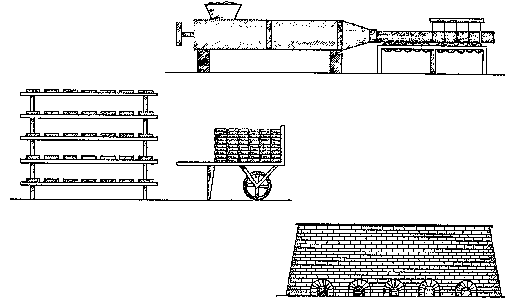
FIGURE 4.6.3-E Hollow brick work
flow.(D; E; F)
D) The premixed clay is extruded onto a cutting table from where the cut bricks are taken for drying.
E) Soft extruded bricks are initially dried on boards and as soon as they can be handled they are dried in normal stacks.
F) Hollow bricks are fired in ordinary brick kilns
parts of ceramic pipe
- Barrel: This means the main tube of the pipe.
- Flange:
This is the expanded end of the pipe, sometimes called the
“collar”.
- Socket: the inside of the flange
- Nipple: the small
end of the barrel, which fits inside the flange.
pipe forming and appropriate products
wheel throwing
This is generally used for relatively thin pipe for stove chimneys, or for short distance, low pressure water lines. Pipes made this way are relatively rough, but quite suitable for these uses and can easily be made by traditional potters as a new product. (Smokeless stoves are very popular in development work, and provide new sources of income for traditional potters). These pipes are generally 10 to 15 cm in diameter, and are easily made 60 cm long.
The process is to make the pipe in 2 pieces, each about 30 cm long, on the potter’s wheel. One piece is a straight pipe, and the other one is thrown with a flange on the top. The sections are joined when leather-hard.
These pipes are generally fired at low temperatures, using common clay and traditional firing systems. There is no reason, however, why they cannot be made from stoneware clay and glazed, where small quantities are required.
Average daily production: from 10 to 30 pieces.
slab construction on wooden moulds
This technique uses a wooden form shaped to the inside of the pipe. Slabs are prepared using any standard method (see slab construction, above) and then are wrapped around the form and joined. A special shaping device fits into the top of the form, and by rotating it around the slab, the flange is finished.
These pipes can be used in the same way as hand-thrown pipe. They have the advantage of being more uniform than wheel-thrown pipes.
Average daily production: about 30 pieces, by 2 persons.
slab construction in plaster moulds
This uses a two-piece mould made from plaster of parts, or clay/cement (see moulds below). Rather stiff clay is made into slabs, and cut into two long strips which are fitted into the two halves of the mould. The edges are trimmed so that they come slightly above the edges of the mould. Then they are coated with slip and scratched. The two halves of the mould are placed together and pressure is applied. Then the seam is pressed together from the inside, using a sponge and the hands. If the clay is stiff enough, the mould can immediately be placed upright so the pipe sits on its small end (not on the flange). The mould is carefully removed and can immediately be used again. This is quite a fast process for an experienced worker.
This process is suitable for straight pipes, and also is commonly used for special fittings, such as bends.
More complicated shapes such as tees, Y-connectors, junction boxes and reduction fittings are usually made by piecing together sections of straight pipes that have been cut to the appropriate contour.
Average daily production: about 30 pieces.
extrusion
The standard industrial process for making stoneware sewage pipe and water pipe is by extrusion. This is done with rather heavy machinery, and depends on fairly large production quantities to make it profitable (starting from a minimum of about 8 tonnes per day). Therefore it is recommended only if there are a sure market and sufficient supply of raw materials. Additionally, sewage pipe because of its low profit margin tends to be produced for a fairly local market, since transportation cost over long distances is not competitive.
Because pipe manufacturing on this scale requires a major investment and specialized equipment, it is recommended that first the process be studied in an existing factory. Additionally, machinery manufacturers should be consulted for their recommendations, bearing in mind that they have a vested interest. Before deciding to order machinery, the wise producer will first visit other factories using their machinery and discuss problems with the operator. It is also important to find out about servicing the machinery. If your factory is far from the equipment supplier, you should make sure that the machinery can be maintained and repaired by local mechanics.
pipe production hints
There are variations in the work flow, depending on what kind of clay, firing system, etc., are used. For example:
- different clays require different grinding machinery. A hard, nonplastic clay usually requires a pan grinder to break it down. For this kind of dry grinding, the type of pan grinder with a perforated pan works well, but a solid pan type may be a better choice, because it also can be used for wet or semi-dry mixing if necessary. For softer clays, a rotary hammer mill or pin mill of sufficient capacity will do a good job, as well as being cheaper.
- Screening: Since pipe clay is rather coarse, a rotary screen is sufficient for removing particles bigger than 16 mesh (standard insect screen can be used). This can easily be fabricated locally, is cheap and easy to maintain. Alternatively, a very simple vibrating screen can be used.
- An alternative to soaking the clay and then using a standard pug mill is to use a double shaft mixer (U-mixer), which mixes powdered clay body and water efficiently. However, a standard pug mill can be used for other purposes if desired - for example, for producing hollow bricks.
- The pipe extruding machine is really the only specialized machine required for this process. It is essentially a vertical extruder equipped with a die for the pipe barrel. It is equipped with a special die that first moves up under the extruder to form the pipe flange under pressure, then moves downward as the pipe barrel is extruded.
- A clutch system disengages the extruder while the pipe is cut or even just pulled off the machine. Then the flange die moves back into position under the extruder and another pipe is formed.
- The trimming and finishing machine is simply a rotating horizontal metal cylinder that fits the inside diameter of the pipe. A leather-hard pipe is pushed onto it, and then is cut to the correct length with a special knife tool, that also makes grooves at the end of the barrel for gripping the mortar better.
- Drying the pipes is normally done in the open air, with the pipes lying vertically on the floor. It is important to rotate them several times a day, as they will bend if they dry unevenly. Factories located in monsoon countries have difficulty with drying during the rainy season. If a continuous kiln is used, it can be built under a high roof so that the top of the kiln can be used as a hot floor dryer. More sophisticated drying systems are normally not used, as they increase the cost of the pipes too much.
- Grog: Pipe clay body normally contains about 10 % grog. This grog is obtained from pipe that is damaged in firing, which in a successfully running factory is normally about 10 %. The grog can be made in the same pan grinder used for grinding clay body.

FIGURE 4.6.3-G Pipe extrusion work
flow.(A)
A) Clay is stored dried.

FIGURE 4.6.3-G Pipe extrusion work
flow.(B)
B) Clay and grog are mixed and crushed in a pan grinder and then screened
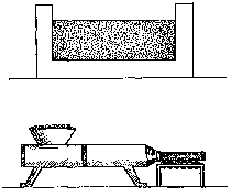
FIGURE 4.6.3-G Pipe extrusion work
flow.(C;D)
C) The screened pipe body is soaked with water.
D) The soaked
clay is premixed in a pug mill.
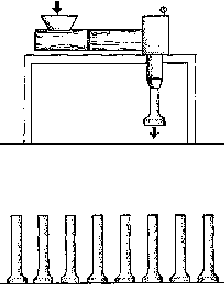
FIGURE 4.6.3-G Pipe extrusion work
flow.(E;F)
E) Combined horizontal pug mill with vertical extruder forms
pipes with flanges.
F) The extruded pipes are left to dry until leather-hard.
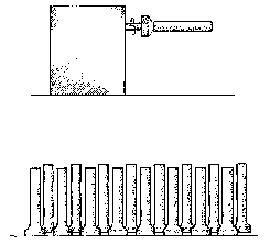
FIGURE 4.6.3-G Pipe extrusion work
flow.(G;H)
G) The leather-hard pipes are cut to size on a trimming
machine.
H) The pipes are left to dry in the open ,in a dryer or on top of
the kiln.

FIGURE 4.6.3-G Pipe extrusion work
flow.(I;J)
I) Before firing the pipes are glazed with a slip glaze.
J)
The pipes are fired to vitrification in special
kilns.
|
| |||||||||||||||||||||||||||||||||||
Forming Techniques for the Self-Reliant Potter (GTZ, 1991, 194 p.)
5. Semidry foaming
This type of forming is done with press machines, which work on the principle of applying high pressure to force the clay into a mould. Press moulding of soft clay is mainly used for forming roofing tiles with complicated interlocking shapes, but there are drawbacks with soft clay pressing: clay easily sticks to steel dies, the soft products are difficult to handle, high drying shrinkage causes warping and cracking during drying. Dies for soft clay pressing are often made from plaster provided with air holes so release is done by forcing compressed air through the mould.
Semidry forming processes were developed to reduce some of these problems associated with plastic clay forming.
Semidry powder pressing
Semidry powder means clay with 7 to 12 % water content that is prepared in powder form. The clay looks like powder, but when some of it is squeezed in the hand, it sticks together and holds its form. Because of this characteristic, semidry forming is limited to products that can be made under pressure in a mould or die, such as tiles, simple electrical articles (fuse holders, low tension insulators) and kiln shelves.
leather-hard pressing
Leather-hard means clay with about 15 % water content. It is prepared to approximately the final shape when plastic, then allowed to dry until leather-hard before pressing.
Semidry forming either requires beating by hand, or the use of a press machine with a metal die.
dry pressing
This uses clay with only 2 to 7 % water content. Because this requires great pressure, the machinery is too expensive for small producers.
5.1. Advantages and disadvantages
The major single user of semidry pressing is the wall and floor tile industry. Tile making is an attractive industry, as use is growing rapidly all over the world, and the market is increasing for exports from developing countries. Tiles at first glance seem a simple product to make, since they are just flat squares of clay. However, the big problem is keeping them flat and square through the various stages of drying and firing, and keeping them the same size in firing (unless the temperature is perfectly even, there will be differences in firing shrinkage).
In order to reduce these problems as much as possible, there is clearly an advantage in semidry pressing, which at least prevents most drying shrinkage problems.
large tile industries:
However, as mentioned in the introduction, the small producer cannot compete with highly-automated, large-scale industries. The state of the art for large-scale wall tile production is based on using local red-firing clays, automatically dry pressing them under tremendous pressure, and then fast-firing them (under 45 minutes) in roller hearth kilns. Very accurate temperature control produces accurately-sized tiles, with a very small rejection rate. These production lines are often computerized, and all the handling of tiles is done on automated conveyor belts - even grading and selecting and packaging of the finished products.
market niches:
This leaves the small tile producer with the possibility of
other market niches, such as hand-decorated tile (relief, engobe, underglaze,
overglaze) and especially unglazed floor and wall tile made from local
red-firing clay. These tiles can be produced with relatively inexpensive
machinery, and periodic kilns can be used for firing with profitable results.
Semidry pressing is then feasible (either powder or leather-hard system).
Marketing can be aimed either at the local construction industry, or at the
specialty export sector.
Nowadays in developing countries, there is a
rapidly growing middle and upper class that is interested in adding status to
their homes. This means that there is a growing market for items like tiles for
the outside of houses, either glazed or unglazed, facing bricks (which are tiles
made to imitate good quality bricks), floor tiles for interior and exterior, and
even glazed roofing tiles. All of these are made by semidry pressing.
Because the work flow for semidry pressing is very different from plastic clay, and different clay preparation machinery is used, it usually is not combined in the same factory as plastic clay forming, or else a separate section of the factory is set up exclusively for this process.
electrical insulators:
For making simple electrical goods like fuse holders, where a nonhollow form is required, semidry pressing is also the method of choice. Hollow electrical goods are generally slip-cast. A successful fuse holder factory can make use of cottage industry, as described in the introduction. By only producing clay body and firing finished goods, this type of industry reduces labor problems and factory space, by simply purchasing the unfired fuse holders.
5.2. Press machines
5.2.1. DIES
5.2.2. HAND-OPERATED SCREW PRESS
5.2.3.
FRICTION PRESS
5.2.4. TOGGLE PRESS
5.2.5. ECCENTRIC PRESS
5.2.6.
SIMPLE LEVER PRESS
5.2.7. HYDRAULIC PRESSES
Because press machines are needed for most of these products,
this section will describe various types that are available.
5.2.1. DIES
All press machines depend on a mould, which, because of the heavy pressure used, is made of steel. This type of mould is called a “die”.
tile dies
Inexpensive dies are made from mild steel, which is easy to machine but does not have a long life ( 1-2 months for dies that are used daily). They are suitable for very simple tiles that do not have details like curved edges, and for small pressings like fuse holders.
Better dies are made from hardened steel, and are correspondingly expensive. They make up for their cost by having a long working life, and can be machined to have sophisticated rounded edges.
A set of dies consists of a top die, also called a plunger, and a bottom die. The bottom die is shaped like a shallow box. It has a metal frame of mild steel which makes up the sides, and in good dies, this frame is removable from its support, which is designed to fasten to the base of the press. The frame wears down after many thousands of pressings, and periodically must be replaced. The floor of the die can slide up and down in the frame, and is provided with a lifting device that fits into it from the bottom. After pressing a tile, the lifter is operated, and the tile is raised up to the level of the frame for easy removal.
The top die is fitted to the screw in such a way that it does not rotate. Correct alignment of top and bottom dies is EXTREMELY important, as an expensive die can be damaged beyond repair very easily. If the press is operated without any clay in the die, this will also damage the die.
In some tile dies the frame is lifted for releasing the pressed tile instead of the bottom plate. This arrangement is used on the friction press in Fig. 5.2.3-A.
pressure requirements
The size of tile that can be powder-pressed depends on the amount of pressure applied. One source¦ gives the following data:
|
dry |
2-7 % water |
300-500 kg/cm² |
|
semidry |
9-12 % water |
100-250 kg/cm² |
|
plastic |
15-20 % water |
100-150 kg/cm² |
Successful pressing also depends on the type of clay body used, and needs to be tried out.
Standard friction presses are rated at 40 to 80 tonnes total pressure. This equals 80000 kg force applied to the die. Because the pressure of the die is distributed across the total area to be pressed, the kg per square centimeter will be less with larger dies. For example, a tile die measuring 15 cm x 15 cm has an area of 225 cm². Then:
40000kg/225 cm² = 178 kg per cm²
This may not be sufficient pressure to produce a strong 15 x 15 cm tile.
However, a tile die measuring 10 x 10 cm has an area of 100 cm². Then:
40000kg/100cm² = 400 kg per cm²
This would make a compact and strong tile on the same press.
For smaller tiles, dies capable of pressing up to 4 tiles at the same time can be made.
other dies
Dies for fuse holders and other small shapes sometimes are fairly complex, and are made from mild steel by machining. They often have removable pins for producing necessary holes in the pressing. These pins are removed after each pressing, and replaced for the next.
Dies are also used for pressing “thimbles” small devices for separating tiles during firing.
Large dies are used for pressing saggers, firebricks, and items like flowerpots.
semiautomatic presses
For semi-automatic production, presses are equipped with rotating heads that have up to 6 bottom dies. As one die is pressed, the next one is being filled, and the previously-pressed tile is removed. This increases production quantities greatly. This type of press is often used for roofing tiles.
manual forming
For making kiln shelves (setter slabs), powder clay is used in a
metal frame, which is made from reinforced angle iron. It is fitted with a sheet
metal bottom plate. This is not used in a press machine, because the size
requires more pressure than ordinary presses can supply. Instead, the clay is
beaten into the frame by hand (see kiln shelves, below).
5.2.2. HAND-OPERATED SCREW PRESS
This machine uses a long screw to supply pressure to a metal die. The screw turns in a brass bearing, and the quality of this bearing determines the usefulness of the machine. The machine is available in a variety of sizes, and depends on a heavy hand-turned flywheel to supply the necessary pressure.
teamwork
It is quite a heavy machine, and must be fixed to a foundation to keep it from shifting in use. This type of press can be used for any product, with either powder or leatherhard clay. Small screw presses are used for tiles, and have a two- or three-man team: one man manages the clay and die, and the other two turn the flywheel. The largest sizes press saggers and firebricks, and may have as many as 3 workers turning the flywheel, while two workers manage the clay and heavy die.
production capacity
Daily production figures quoted from Europe (8-hour day) can be
up to 2000 tiles, or one every 14 seconds. This is with a very experienced and
motivated work crew. An inexpert crew might manage half that amount. It also
assumes that there are no delays, such as lack of clay, machinery breakdowns,
etc.
5.2.3. FRICTION PRESS
This is simply a motorized version of the screw press, which has two movable “friction wheels” which can be moved horizontally. These wheels are driven by a motor through a belt system, and in one position move the press down, and in the opposite mode move it up. They are usually made of cast iron or mild steel, and the flywheel is provided with a leather or fiber surface (the same as used for flat belt drives) which provides the necessary friction.
80-tonne press
Friction presses also come in a variety of sizes. They normally are rated according to “tonnes”, which means the amount of tonnes/force they can supply. A common size for up to 15 by 15 cm tiles is “80 tonnes”. This size of press commonly uses a 3-5 HP 3-phase motor. Larger presses are available. Friction presses do not necessarily apply more pressure than hand screw presses. The advantage is that they do it with less manual labor.
When selecting any screw press, it is important to be sure that it has sufficient stroke length. This is the distance the top die travels from top to bottom of each stroke. For pressing saggers, there needs to be enough distance to remove the sagger easily.
Typical production figures for friction presses with inexperienced workers are about 125 presses per hour (double stroke).
Friction presses are often equipped with double bottom dies. In
this system, the dies slide back and forth, so that one is being pressed while
the other is emptied and refilled. This greatly increases production
quantities.
5.2.4. TOGGLE PRESS
The toggle press is used for light pressing, such as fuse
holders and other very small items. It works on a rack and pinion gear
principle.
5.2.5. ECCENTRIC PRESS
The eccentric press is also commonly used for tile production,
but only with leatherhard clay. It works on the principle of an eccentric shaft
which rotates and activates a piston on which the die is mounted. This supplies
a very high mechanical advantage, so high pressure can be supplied with a
relatively small motor. However, it has the drawback of a short stroke length.
For leather-hard tiles, it is an efficient and low-cost machine. It cannot be
used for powder pressing, because it is too difficult to fill the die.
5.2.6. SIMPLE LEVER PRESS
There are two types of lever press which can be used for pressing soft clay, as for tiles with relief designs. These are used for low production, custom-made tiles.
lever press
One is simply a long lever arm attached to a fulcrum, with a plaster mould or a metal die connected. A slab of clay is placed on the table, the mould is pressed into it, and excess clay is then trimmed from the sides.
ratchet press
The other type uses a mechanical principle which is the same as an automobile jack, except that it is operated by a lever arm rather than a screw. Mechanical advantage comes at the top of the stroke, where rather high pressure is obtained. This is also used with plastic clay.
soil block press
Another type of lever press is commonly used for pressing soil
blocks for house construction. There are many variations on this, with the
original known as the “Cinva-Ram”. This type of press could be used
for firebrick pressing, and even for tiles, but those who have tried it say that
it is slow and produces uneven work.
5.2.7. HYDRAULIC PRESSES
Hydraulic presses use hydraulic cylinders to provide pressure. They have the advantage of producing very high pressure, but also are very expensive, and unless specially equipped, are slower than friction presses.
hydraulic ram press
A specialized type of hydraulic press is known as the “ram press”. It uses plastic clay and special moulds made of hydrostone, that are fitted with air tubes to release the pressing. This was a patented process until recently, and only used in the U.S.
5.3. Semidry pressing with leather-hard clay
This process is used for all types of tiles floor, wall, and roof. The general work flow is shown in Fig. 5.3-A.
leather-hard clay requirements
Clay for leather-hard pressing varies according to the type of product. As usual, large tiles (such as roof tiles) should have a higher percentage of nonplastic materials like sand or grog added. The clay can be prepared by hand, or for larger production by machines (see chapter 4.1).
blanks:
As seen in the work flow, the first step is preparing “blanks”. A blank is simply a slab of clay, which can be made in a number of ways. Frequently, slabs are cut from a clay block using the sticks and cutting wire method. However, since the tile blanks should all be a uniform size, frequently a wooden or metal mould is used.
dry separator:
The mould is sprinkled with a dry separator, which usually is dry clay powder kept in an open-weave cloth bag (such as a jute bag). This is quickly done by shaking the bag in the mould. Then a piece of clay is pressed into the mould, and the excess is cut from the top with a cutting wire. The mould is inverted onto a ware board, so that the blank neatly falls out.
wet separator:
The water release method is also used, where the blank is formed in a metal frame with water used as a separator.
finishing:
The leather-hard tiles, after pressing, are set on ware boards to dry further. In some cases the edges of the tiles are made smooth immediately after pressing, but this may also be done just before firing. This process is called fettling.
warping:
During drying the tiles may need to be turned once or twice to avoid warping. When they are distinctly leather-hard, they are checked for warping. Warping can be corrected by placing the tile in a single bottom die, and gently beating it. They then are dried completely.

FIGURE 5.3-A Work flow for
leather-hard pressing.(A; B-1)
A) Plastic clay is taken from store.The clay is prepared as
described in chapter 4.1.
B-1) Blanks are formed in a mould.Excess clay is
cut off by a wire.
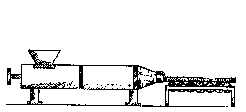
FIGURE 5.3-A Work flow for
leather-hard pressing.(B-2)
B-2) Blanks can also be extruded and then cut.

FIGURE 5.3-A Work flow for
leather-hard pressing.(C; D)
C) Blanks are placed on ware boards and left to dry until
leather-hard.
D) The blanks are taken to the press machine for pressing.

FIGURE 5.3-A Work flow for
leather-hard pressing.(E; F)
E) After pressing the tiles are placed on boards and then
finished by hand.
F) Drying completely.
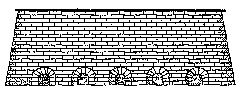
FIGURE 5.3-A Work flow for
leather-hard pressing.(G)
G) Kiln firing is started with a long smoking pericol.
5.4. Pressing with powder clay
5.4.1. SEMIDRY POWDER PRESSING WORK FLOW
5.4.2. HINTS FOR
SUCCESSFUL PRESSING
5.4.3. SAFETY SAFETY SAFETY !
5.4.4. PRESSING
PROBLEMS AND SOLUTIONS
5.4.5. REFRACTORIES
As mentioned before, the advantage of pressing with semidry
powder is that the pressed product is almost dry, and has almost no shrinkage,
and thus minimum warping. Besides the actual pressing, the clay body needs to be
specially prepared in the form of granules containing 6 to 10% water. Various
methods for doing this are described below. The work flow for semidry powder
pressing is:
5.4.1. SEMIDRY
POWDER PRESSING WORK FLOW
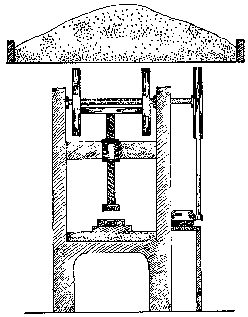
FIGURE 5.4.1-A Work flow of semidry
pressing.(A; B)
A) Granules of clay with right moisture content are taken from
store to press machine.
B) Measured amount of body is filled in the die,
leveled off and pressed twice.

FIGURE 5.4.1-A Work flow of semidry
pressing.(C)
C) The pressed tiles are placed on boards.
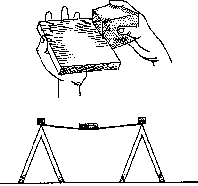
FIGURE 5.4.1-A Work flow of semidry
pressing.(D)
D) Tile edges are fettled with a damp sponge or by maving the tile back and forth on a coarse screen

FIGURE 5.4.1-A Work flow of semidry
pressing.(E; F)
E) The tiles are dried completely.
F) Firing after a long
soaking period.
granulation
There are three main processes for preparing clay granules, with the following work flows:
- DRY PROCESS
This is the simplest of the processes in terms of equipment required and number of steps taken.
Many variations in this work flow are possible. The optimum process depends on the nature of the clay, the force of the press and the size and shape of the tile. It may be possible just to grind the clay, adjust its moisture content and then press it. Granulation can also be done in a pin mill without a screen. The pan mill and the final screening to remove the fines may be left out if the press body does not tend to cause lamination. Granules can also be produced in a pan mill with perforated bottom. The mixing can be done in the pan mill if this is operated in batches instead of continuously.

FIGURE 5.4.1-B Work flow of dry
process granulation (A)
A) Clay from storage.

FIGURE 5.4.1-B Work flow of dry
process granulation (B; C)
B) Clay is dried to less than 10% moisture content.
C) Clay
is powdered in a hammer mill or pin mill.

FIGURE 5.4.1-B Work flow of dry
process granulation (D; E)
D) Powdered clay is screened. This may not be necessary.
E)
Clay is mixed with possible other materials in a drum mixer or with a shovel.

FIGURE 5.4.1-B Work flow of dry
process granulation (F; G)
F) Clay body with addition of water is mixed in a pan mill
G)
Screening through 10 mesh and 40-60 mesh. Material coarser than 10 mesh and
finer than 40-60 mesh is returned to the pan mill.

FIGURE
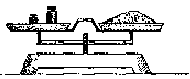
FIGURE 5.4.1-B Work flow of dry
process granulation(H)
H) Granules with a moisture content slightly higher than needed for pressing are left to mature for several days.
FIGURE 5.4.1-B Work flow of dry
process granulation(I)
I) Moisture content is checked before pressing. Granules are taken to press machines
- WET PROCESS
This starts with the standard wet process of preparing clay (see chapter 4.1.2). Following that process the plastic clay is here used as the starting point of the granulation process.
Although complicated and requiring expensive equipment (filter press, blunger, agitator, diaphragm pump) this prepares reliable body that works with any suitable body composition.
spray drying
Clay body is first prepared as in the wet process, but instead of being pumped into a filter press, it is pumped into a spray drying tower, where it is sprayed into a stream of hot air that dries it to the correct moisture content, as well as producing more or less spherical granules. It then goes directly to the press. This is the state of the art system which is appropriate only for relatively large-scale industries, due to cost and sophistication of the machinery.
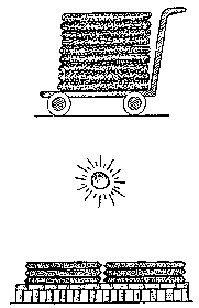
FIGURE 5.4.1-C Work flow of wet
process granulation (A; B)
A) Clay cakes are taken from filter press to drying area.
B)
The clay is air-dried to a water content slightly higher than needed for
pressing.

FIGURE 5.4.1-C Work flow of wet
process granulation (C)
C) The clay with a water content of 10 - 15% is granulated in a pan mill or pin mill.

FIGURE 5.4.1-C Work flow of wet
process granulation (D)
D) Granules are matured for a few days until the moisture content is correct.
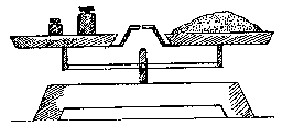
FIGURE 5.4.1-C Work flow of wet
process granulation (E)
E) Moisture content is checked before taking the granules to
pressing machines.
5.4.2.
MINTS FOR SUCCESSFUL PRESSING
There are some aspects of the process which are worth discussing in detail, as they are problems that have come up in our experience and that are not discussed in available books.
granulating
The main purpose of granulating is to get the clay particles into coarse condition, so that they consist of small “clumps” or “balls” of clay body larger than 40 to 60 mesh. This is important to prevent lamination problems (discussed in pressing, below).
Granulating is not necessary for all clay bodies. Generally, bodies which are fairly coarse - containing coarse fireclay and grog (ranging approximately up to 30 mesh) - can be dry-blended and then mixed with the correct amount of water. With such easy-to-press bodies, tbe water is usually estimated by volume, and is sprinkled evenly into the dry body while stirring and turning it with a shovel. It is correct when body squeezed in the hand holds its shape.
A simple form of granules can be produced by adding all water to the grog which is then mixed with the dry clay body. The clay will stick to the grog and form small granules and at the same time the water will be distributed evenly.
The body is often mixed with kerosene oil about 1-2% (sometimes up to 5% is necessary) as well as water, which prevents sticking to the die. This type of body may also press successfully without maturing, although it is always better to mature clay before forming it. Both green and fired strength of the pressed tile increase considerably if the body is allowed to mature for some days.
Bodies that contain high amounts of fine clay (ball clay, clay high in montmorillonite), or slippery materials such as some kinds of talc, cause greater problems for powder pressing, and require granulation. For tiles, this is corrected in two ways: by adding grog to the body, and by adding wetting agents (soap) to the water.
pressing work flow
Pressing itself has a fairly complicated work flow:
- Inspection: Checking that die is clean. Clay tends to stick to the die, and needs to be removed with a stiff brush (fiber or brass wire type) periodically.
- lubrication of die: The die needs to be lubricated periodically with light oil to prevent clay from sticking. Frequency of lubrication and type of oil that is successful depend on the clay body. Commonly used oils are kerosene, diesel oil, waste crankcase oil (either plain or thinned with kerosene), coconut oil, palm oil thinned with kerosene, etc. This can be applied with a piece of cloth.
- filling the die: In order to get the same thickness of tile every time, the die must be filled the same amount. This is done by adjusting the bottom plate, so that when filled to the top and levered, the tile is the correct thickness. It is easy to make a filling device, which is simply a metal or wooden frame that contains clay powder. Sliding the frame over the bottom die automatically fills the die, and sliding it back on the press table scrapes the clay level.
- pressing stroke: With coarse bodies, it is possible to press only one time. However, with most bodies, two pressings are required for each tile. The first press stroke is done rather slowly - its purpose is to allow air to come out of the clay powder. Then, a second press stroke is done rapidly, which fully compresses the clay.
- lifting the bottom die: This is done as the top die is raised to its highest position.
- removing the tile: The tile is lifted carefully from the die,
and placed on a ware board. If the bottom die is plain, without relief pattern
or rounded edges, the filling frame can be used to push the tiles to the other
side, where it is picked up by an assistant or by a conveyor belt.
5.4.3. SAFETY SAFETY SAFETY!
ALL PRESS MACHINES ARE DANGEROUS! It is very easy to lose a finger or even a hand. Workers need to be instructed in correct use of the machine. The main point is that BOTH HANDS MUST BE USED TO PULL THE PRESS LEVER, so that there is no chance of having a hand under the die. It is much safer for the same person who fills the die to also pull the press lever. If two persons are working with the press (as is common with presses having two sliding dies), there needs to be a system of signaling between the workers.
safety switches
Many countries now have safety regulations for workers using dangerous machinery. It is common for press machines to be equipped with two switches, which must be held down in order for the press to move -one is on the press lever, and the other is located some distance away so that both hands are out of the way before the machine will operate. This is difficult to do with a friction press, but it is highly recommended that the manufacturer be required to equip his machinery with such a safety device.
dust
Semidry bodies produce a lot of dust during body preparation and
during pressing and fettling. Inhalation of clay dust over a long period of time
will damage the lungs. Therefore, workers should be equipped with dust masks and
good ventilation is needed in work areas.
5.4.4. PRESSING PROBLEMS AND
SOLUTIONS
lamination problem
The main problem with powder pressing is lamination in tiles, which means that the tile will split apart in horizontal layers. These layers are caused mainly by sideways slipping of the clay under pressure, which causes clay particles to line up in the same direction and not to get good adhesion. It is made worse when air cannot escape quickly enough from the body, which also causes separation of clay layers. Another factor in lamination is suction caused when the die is lifted: if the die does not release easily from the clay, it will actually tear the tile apart.
Lamination can be difficult to cure. Possible solutions that can be tried are:
- Changing the clay body, which means reducing the amount of slippery substances such as talc, or changing the type of talc from “plate-type particles” to “rough particles” (there are many varieties of talc), or using talc with a rougher particle size.
- Adding coarser clays and/or grog, which gives the clay more “tooth” and helps prevent it from slipping.
- Adding organic binders, such as starch, sugar, CMC gum.
- Adding wetting agents to the water, such as liquid soap, or sodium lauryl sulfate (which is the common wetting agent in liquid soap).
- Maturing the clay for a longer period.
- Changing from dry clay processing to the leather-hard method.
- Prepressing the clay body into bricks or blocks (with a slightly higher water content), then drying them to the necessary water percentage, and breaking and granulating them.
- increasing the granule size.
cracking problem
Cracking of tiles normally only shows after firing. Its main cause is lamination. Other causes: the green strength is too low to withstand stresses from handling and drying. The cure is to increase: thickness of the tile, moisture content of press body, the proportion of plastic clay, the pressing force or maturing time of body. The pressure can be increased by reducing the size of the tile, by increasing the speed of the flywheel or by pressing and extra time.
- Uneven thickness is corrected by ensuring that the same amount of clay is used for each tile, by keeping moisture content constant, and by applying the same pressure to each tile.
- Crumbling corners are caused by too low moisture content, by attempting to press too thin tiles, by lack of pressure or by uneven filling of the die.
- Top center section separating from the rest of the tile is a
form of lamination. The pressure in the center is always less than at the edges,
where the clay powder is better compacted when the material bounces back from
the die frame. The cure is to strengthen bonding by increasing moisture content
and if that is not sufficient by granulating the press body.
5.4.5. REFRACTORIES
Kiln shelves (sometimes called setter slabs) for low and medium temperatures can be made from a simple body of 50% fireclay and 50% grog (with the dust fraction removed). This is prepared by blending by hand with about 10% water- as described above, a small amount squeezed in the hand will stick together and hold its shape. This is aged for at least 24 hours, and then is filled into the metal frame described in dies, above. The clay is beaten with a wooden mallet, taking care to beat it well into the corners. More clay is added, and again beaten until the frame is filled level and the clay is as compressed as possible. Then the frame is turned over, and the opposite side is also beaten thoroughly. The shelf is removed from the frame, and set aside for drying.
Other refractory products for kiln construction can be made in a similar way. Fig. 5.4.5-A shows a die and moulding table for production of large refractory firebricks. A similar system could be used for kiln shelf production.
Sufficient beating is very important, in order to closely pack all the clay particles. This makes a shelf that will not easily bend in firing or crack during handling. Standard press machines do not provide enough pressure for the large surface area of kiln shelves (an 80-tonne press used for a 30 x 30 cm shelf can supply only 88 kg per cm2). For more information on making refractories see “The Self-Reliant Potter: Refractories and Kilns” also in this series.
|
| ||||||||||||||||||||||||||||||||||||||||
Forming Techniques for the Self-Reliant Potter (GTZ, 1991, 194 p.)
6. Mouldmaking and Plaster of Paris
The use of moulds in ceramics is as old as ceramics itself. In fact, it seems likely that people were pressing soft clay onto hard objects even before they discovered how to fire it (baskets sealed with clay, etc.), or pressing hard objects into soft clay to make designs. When useful objects started to be made from clay, it was a logical step to use simple moulds so as to easily get the same shape every time.
What is a mould?
A mould is simply the shape of the space which surrounds an object to be produced. Because space itself has no form, the mould must be made from a rigid material such as wood, metal, biscuit-fired clay, stone, or, most commonly, plaster of parts. Moulds include those which are used to actually form a product (moulds for containers, sculpture, etc.) and stamps, which are used to produce a relief design on an already-formed product.
Porous moulds
Moulds made from plaster absorb moisture from plastic clay or from liquid clay.
This causes the clay to shrink after forming in the mould and it makes it easier to remove the moulded item. Biscuit clay moulds are also porous but to a much lesser
6.1. STAMPS
Stamps are also called “chops”, and are the oldest tools used for decorating or writing on clay products. Usually, they are made from wood or biscuit-fired clay.
roller stamps
These are special stamping devices, which are used for making bands of decoration quickly. They are made from biscuit-fired clay or plaster, and mounted on a wooden or wire axle so they can be rolled on a pot.
metal stamps
It is also possible to use metal stamps for impressing your company name, for example. This is usually a good idea, because customers like to buy names that they know or that their friends have recommended to them. These stamps can be ordered from printing shops.
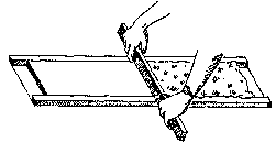
FIGURE 6.1-A Making a plaster roller
stamp.(A)
A) Make a long smooth clay slab.

FIGURE 6.1-A Making a plaster roller
stamp.(B; C)
B) A pattern is impressed by band or by a stamp as shown
C)
The clay slab is left to dry until it can be easily removed.

FIGURE 6.1-A Making a plaster roller
stamp.(D)
D) Form the slab into a cylinder with a stick set in a clay slab exactly in the center.

FIGURE 6.1-A Making a plaster roller
stamp.(E)
E) Fill the cylinder with plaster.

FIGURE 6.1-A Making a plaster roller
stamp.(F; G)
F) After setting, the clay is removed and the cylindrical plaster roller is ready to be fitted with a handle
G) The roller used for decorating a clay surface.
6.2. Moulds for plastic clay pressing, biscuit clay moulds
6.2.1. ONE-PIECE MOULDS
6.2.2. PIECE MOULDS
6.2.1. ONE-PIECE MOULDS
moulds for simple forms
These are moulds used to produce simple open forms, such as bowls, plates and tiles. They consist of one simple curve, and often have relief designs carved into them. Hump moulds are used for forming slabs of clay. They are mostly used for forming shallow bowls, or they may be used on the potter’s wheel for making plates.
Moulds for jigger use are also one-piece moulds, and are described below.
fired pots as moulds
The simplest kind of one-piece biscuit mould is another fired pot. Most traditional potters who use the coil and beating method use curved sections of broken pots to shape new ones. In parts of Nepal, water jars are still made by covering an old water jar with cloth, then applying clay all around it. When the clay is leather-hard, the pot is cut in two pieces, removed from the mould, and joined back together. This makes quite a rough product, but it works successfully in small villages where women make pots only for their own household.
detailed biscuit moulds
More sophisticated and detailed one-piece moulds are made from biscuit-fired clay.
The process is not complicated. First, the object to be moulded (model) is selected: this may be a model in stone, wood, or usually also biscuit-fired clay. Stone or wood usually needs a light dusting of talcum powder or clay powder to keep the mould from sticking to it. A slab of clay about 3 cm thick is carefully pressed around the model, making sure that it is pushed into all the details. Excess clay is then cut off, and the mould is left to dry until it can be carefully removed. After drying completely, it is biscuit-fired in the usual way and is then ready for use. As with all moulds, the model has to be free from undercuts that will prevent the mould from being removed. Undercuts are places that hold the clay, such as deeply carved lines, or parts that stick out from the model.
biscuit mould shrinkage
It should be remembered that the mould will shrink (up to 10 %) and that the casting taken from the mould will also shrink up to 10 % or more, so the total shrinkage compared to the model can be 20-25 %! For this reason, the size of the model needs to be considered carefully.
wooden moulds
Moulds can be made from wood. Fig. 6.2.1C shows a cylindrical wooden mould that forms the inside of a water filter container. First the bottom is made from a slab of clay and the mould is placed on this. Another slab of clay is wrapped around the mould and the slabs are joined together (see chapter 4.2.2). After joining from the outside the wooden mould is pulled out and the joins are worked over from the inside. The outside finishing can be done on a wheel, while the mould is still in place.
hinged mould
A mould forming the outside of a flowerpot (Fig. 6.2.1-D) can be made from pieces of wood hinged together. The pot is formed by joining slabs inside the mould. The pot is released by unfolding the hinged mould.

FIGURE 6.2.1-B A mould (1) without
undercuts allows easy release. The other mould (2) has undercuts and cannot be
released. This shape has to be made with a two-piece mould.
6.2.2. PIECE MOULDS
two-piece-mould
Simple closed shapes can be formed in two piece moulds, such as vases, bottles and even more complicated forms. Early South American pottery was formed exclusively in two-piece biscuit moulds.
As above, the mould is made from a model, which is either bone-dry clay or biscuit clay. The main thing is to carefully locate the midline of the model, and to actually draw this line on the model. Then, a 3-cm thick slab of clay is wrapped and pressed around half of the model, extending slightly beyond the midline. This is allowed to dry until leatherhard, and then is accurately cut with a knife along the midline. Several slight indentations are made on the edge of the mould, to serve as “keys” to lock in the second half. The second half is then pressed onto the model, and also must be carefully pressed up against the other mould half. It is next dried until leather-hard (it may be necessary to cover the first half in plastic) and both halves are carefully removed, checked to see that they still fit correctly, dried and fired.
using two-piece moulds
Forming in a two-piece mould is the same as described for pipes, above. Slabs are carefully pressed in both halves of the mould, then are trimmed off just above the mould edge. After they are slipped and scratched, the mould is pressed together, and the inside seam is worked together with a wooden tool (if possible).
two-piece water jar mould
An interesting variation on this process is used for making water jars in parts of northern India. The mould consists of two halves of the jar, divided along the belly. One half has an opening in its center the size of the water jar neck. This mould half is fastened on the potter’s wheel, and clay is centered end thrown in it. The same is done in the other half. The neck half is then joined to the bottom (on the wheel), and the neck is opened up and pulled to form the mouth. The assembly is allowed to dry until leatherhard, when the mould is removed and any finishing is done. The mould for the shoulder of the pot usually has a relief design carved into it.
plaster moulds
These simple moulds can also be made from plaster of parts. The only difference is that the model needs to be leather-hard clay, or it has to be coated with a separator (see plaster moulds below). Usually the easiest is leather-hard clay, which the plaster can be removed from easily - note, however, that in this process you lose your model.
The midline is located as above, and a strip of clay is placed with one edge coming just up to it. This strip has keys pushed into it. Plaster is applied on this half, and after setting, the clay divider is removed and the plaster is coated with liquid soap separator. Plaster is then mixed and applied to the other side. After it sets, the mould can be smoothed and the plaster carefully removed.
plaster throwing
The main trick is applying the plaster so that it gets all the details. This is done by “throwing” the wet plaster on the model, which is done “backhanded” while the plaster is still thin. This first thin coat is allowed to set, and when the plaster is a bit thicker, a second coat is applied the same way. When the plaster starts to become plastic, it is applied and smoothed by the handful, until the mould is 3-5 cm thick.
multipiece mould
Complicated forms with many undercuts can be made in a mould made up of many pieces. The mould is made in a similar way as described for casting moulds (chapter 6.5.2). Forming in the mould is done by building up a layer of soft plastic clay inside the mould. The mould is opened when the clay is hard enough to support itself.
6.3. Plaster substitutes
There is no really good substitute for plaster of parts, but in areas where this is very expensive, of poor quality, or unavailable, moulds for pressing plastic clay can be made as follows:
cement mould recipe
PARTS BY VOLUME
Common cement 1 part
Common clay 40 mesh 1
part
Common brick grog 40 mesh 5 parts
Fiber 0.5% by weight
Almost any fiber can be used (jute, coir, cotton, animal hair, nylon, etc). This should be in the form of separate fibers, cut into about 3-6-cm lengths. The purpose of the fiber is to give the mould strength.
The materials are mixed with water to standard cement consistency, and this is then applied to the model like plaster. It is not suitable for very detailed moulds.
These moulds are useful for large items, such as pipes. For small items, it is probably better to use biscuit clay.
6.4. Plaster of Paris
6.4.1. GYPSUM
6.4.2. PLASTER OF PARIS PRODUCTION
6.4.3.
SHIPPING AND STORAGE
6.4.4. MIXING PLASTER OF PARIS
The word “plaster” means a substance which, like clay, can be moulded to almost any shape when soft, but either dries or cures to a hard material. Clay and cow dung mixtures used for surfacing walls and floors are called “clay plaster”, and this material simply dries (with some shrinkage) to a hard material. However, it can be made plastic again by adding water. Lime plaster and gypsum plaster have the special quality of “curing” after they are mixed, which means they undergo a chemical reaction that makes them hard, so that even if placed in water, they will not become soft again. On heating to 120ºC gypsum releases about 20 % of its weight as water. This chemical reaction can be written thus:
2(CaSO4.2H2O) - 2CaSO4.H2O + 3H2O
In words: gypsum + heat = plaster (and water which goes into the air).
When the plaster is mixed with water the process is reversed and the plaster returns to its original gypsum state and becomes hard.
“Plaster of Paris” is the type of plaster used for
making moulds for ceramics. It was developed in France around 1770, which gives
it its name. With the use of plaster of parts, the ceramics industry was
revolutionized, because it made possible mass production by slip casting, which
was previously unknown. Plaster of parts has the special property of easily
absorbing large quantities of water, and there is no other material that can be
substituted for slip casting.
6.4.1. GYPSUM
The raw material for making plaster of parts is gypsum, which is
hydrous calcium sulfate (CA2SO4.2H2O). Gypsum
deposits are found in most countries. Very simply, making plaster is done by
grinding the gypsum, and then heating it until chemically-bonded water
evaporates at 110ºC. This is similar to the process of making lime, which
is known in most countries. It can be done on a very simple level, but
industrially is done on a large scale and controlled in a sophisticated way.
6.4.2. PLASTER OF PARIS
PRODUCTION
It is normally not worthwhile to produce your own plaster if ready-made plaster is available. In several countries this is not the case and the potter may have to make his own plaster from gypsum. Often he will be able to sell his plaster in the local market to other potters or to manufacturers of writing chalk.
raw gypsum
Gypsum is a soft rock that may occur as transparent or slightly white to grey crystals, and sometimes as fibrous granules. Several geological varieties exist: selenite is a clear crystal; satin spar is white and fibrous; alabaster is massive and normally white; and gypsite is a mixture of gypsum and white sand. The crystal form can be scratched with a finger nail, which produces a white line. Gypsum is also used by the cement industry, and in some places farmers use it as a source of calcium for the soil. Deposits of gypsum are rarely pure and the gypsum content may be only 65 % of the bulk material, the rest being impurities of lime, clay or sand. The purer the raw gypsum the better the finished plaster product will be. If possible, check the deposit of gypsum before taking delivery and explain to the supplier that you only want the clear crystals.
recalcining plaster
Old plaster moulds can be ground and recalcined, since already-set plaster is gypsum (chemically speaking). This should only be tried if raw gypsum is not easily available or very costly, since the quality will not be as good as with freshly-calcined gypsum.
Production moulds get contaminated with deflocculants and clay. First the moulds are cleaned of clay, dust and deflocculant crystals deposited on the mould surface. The moulds are then crushed and the fine lumps are washed in water, which will remove the soluble deflocculants. After drying, the material is processed as described below. The quality of recycled plaster is not as good as plaster made from raw gypsum and the extra cost of cleaning the old plaster should be compared with the cost of fresh raw gypsum.
gypsum calcination
First, wash away sand, clay and other impurities from the raw gypsum. The gypsum is then pulverized in a hammer mill. Smaller quantities are simply heated in a pan and when the gypsum starts to boil it is stirred gently until all of it has been boiled. It is difficult to judge when the gypsum has been heated enough - it is better to overheat slightly.
first & second set
Gypsum starts boiling around 120ºC s. Original S. 112 and more water is released.
Plaster that has been through this “second set” is less plastic than “first set” plasteron the other hand it is stronger. With simple equipment like a pan it is not possible to control when the “first set” is over, because some of the plaster in the bottom of the pan starts boiling again before all gypsum has been through the “first set”. Generally, it is better to have some “second set” plaster, rather than risking uncalcined gypsum, which will weaken the plaster moulds and shorten the time it takes for the plaster to harden after mixing with water.
calcining kettle
For making larger quantities, a kettle for calcining can be made locally. A cylindrical pan made of brickwork or sheet metal is set inside an oven heated from below. Mechanical agitators stir the gypsum to ensure even heating. A thermometer inserted in the gypsum enables the operator to know how the calcination is progressing. At around 120ºC boiling starts and the temperature in the upper layers will drop to around 100ºC until the first set is finished. Then the temperature will rise again to 170ºC when the second boiling starts. If heating is too fast, it may be difficult to recognize that the boiling of the “first set” has stopped before the second starts. In Burma we went through the “first set”, and after seeing the temperature rising again we heated until the gypsum started to boil. We then let this second boiling go on for about 15 minutes (600 kg batch) before ending the heating. The agitators were left to stir for another 20 minutes to allow all moisture to evaporate.
screening & storing
After cooling, the plaster is screened through 60-100 mesh and packed in bags, which are stored in a dry place. If the plaster becomes moist it will set and be spoiled in the bag.
Freshly-boiled plaster requires more water to become fluid, resulting in moulds that are porous and weak. After some weeks ageing the plaster will absorb a little moisture from the air and this will enable a plaster mixture to be produced with less water. For this reason it is better to store the freshly calcined plaster for 1-4 months before using it. In industrial production, a small amount of dissolved deliquescent salt is added to the plaster during calcination and this has the same effect.
industrial production
Plaster is widely used in industrialized countries. Large-scale plants either use big kettles holding up to 20 tonnes or rotary kilns. In principle the process is the same as the one taking place in a simple pan, only much better controlled and yielding a plaster of consistent quality.
setting times
Plaster is often available with different setting times. For example, U.S. suppliers can provide “20-minute casting plaster” or “30 minute casting plaster”, and offer more than 30 different types of plaster and gypsum cement. For specialized model making, these products are often useful.
Setting time can be retarded and speeded up by addition of chemicals. Retardants are sodium carbonate, vinegar, dextrin. Accelerators are warm water and salt. For specialized model making, this is often useful, but normally it is better to use the plaster without any addition since this reduces its strength. Small amounts of uncalcined gypsum will speed up the setting time. Shorter setting time is a sign that your plaster is not stored properly and has become too old.
gypsum cement
A special plaster is produced by calcining the gypsum under
pressure in an autoclave to 120ºC. The calcining thus takes place under
humid conditions and this produces plaster with a special crystal structure
(alpha plaster) that makes the finished set plaster much stronger, as more
plaster can be added to the water. This type of plaster is, of course, more
expensive, but the extra cost is justified when used for model making and for
block and case mould production. It is essential for moulds used in the ram
press.
Plaster suppliers offer many different qualities made from mixtures of
ordinary plaster (beta plaster) and gypsum-cement plaster (alpha plaster).
However, in many countries only one quality is available.
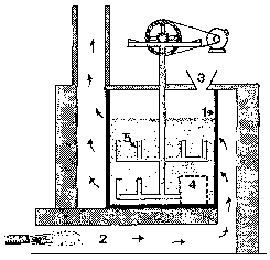
FIGURE 6.4.2-C.1 A steel kettle (1)
is placed on top of a firebox (2) inside a brickwork cylinder. Gypsum is loaded
at (3) and plaster is discharged through a door at (4). Stirrers (5) rotate at
15 r.p.m.

FIGURE 6.4.2-D Work flow of gypsum
calcining (A; B)
A) The raw gypsum is cleaned.
B) Gypsum is crushed in a
hammer mill.

FIGURE 6.4.2-D Work flow of gypsum
calcining (C; D)
C) Gypsum is changed to plaster in a calcining kettle.
D)
Screening on a fine sieve. Residue is reground in a hammer mill.
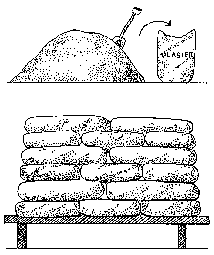
FIGURE 6.4.2-D Work flow of gypsum
calcining (E; F)
E) Screened plaster is packed in bags.
F) Plaster in stored
in a dry place.
6.4.3.
SHIPPING AND STORAGE
Because plaster of parts is easily damaged by water, care should be taken with shipping and storage.
If you must order plaster of parts in some quantity, it is
better not to order more than 6 months’ supply at a time. Request the
supplier to provide it in polythene-lined bags, or in sealed drums. Plaster
should be stored above the floor: bags may be placed on top of boards, to allow
air circulation below and prevent any water from getting into the bags. It
should not touch the wall. It also should be stored so that the oldest plaster
is used up first.
6.4.4.
MIXING PLASTER OF PARIS
When mixing plaster, it is very important to always use the same amounts of water and plaster powder. If more water is used, the strength will be less and the water absorption greater. Less water will make a thicker mixture, which will be stronger and which will have less water absorption. This will cause problems in the slip casting section, with moulds casting at different speeds.
plaster to water ratio
The strongest mixture of standard quality pottery plaster is 70 parts (by weight) water to 100 parts plaster. This is used for case moulds. Working moulds used for jiggering and casting are mixed with 75 - 80 parts water to 100 parts plaster. Where plaster is expensive it is better to use a high proportion of plaster, because the working moulds will last longer.
Plaster used for bats or dewatering trays are mix with 90 parts water to 100 parts plaster.
Gypsum cement (alpha plaster) can be mixed with only 40 parts water to 100 parts plaster. This produces a very hard plaster with high expansion and low absorption, ideal for master and case moulds.
The right ratio of water to plaster cannot be fixed. It will vary from one source to the next and from batch to batch. So every new batch should be tested and compared with the last batch.
rules for plaster work
RULE 1: ALWAYS WEIGH THE PLASTER AND THE WATER !
Most mould makers get lazy after a time, and start to just estimate the amounts. Sooner or later, they will make mistakes, and the casting section will have problems. PROBLEMS COST MONEY!
RULE 2: NEVER PUT WET HANDS OR TOOLS IN THE PLASTER BAG !
Always use a dry bowl or spoon when taking plaster from the bag. Any moisture will cause the plaster to set in the bag.
RULE 3: AFTER STARTING TO MIX, NEVER ADD MORE WATER !
After you start to mix plaster, the chemical reaction begins immediately. Sometimes, if the plaster starts to get thick too soon, the mould maker will try to add water to make it thinner. This doesn’t work - the mould will be soft and may never set.
RULE 4: DO NOT PUT AIR BUBBLES IN THE PLASTER !
Air bubbles are Enemy Number One of the mould maker. If they are on the surface of the mould, the quality will be very bad. Follow the instructions below for mixing plaster very carefully. Air bubbles do not come from the plaster - they come from the hands of the mould maker.
Here is the detailed work process for mixing plaster of paris:
1 containers
For good quality moulds, it is important to have clean tools. Always use a clean container to mix the plaster. Plastic buckets are best, because they are easy to clean. Dirty tools and mixing containers will result in poor quality moulds. Tools should be washed immediately after use.
2 weighing
Always weigh the water first, and then add the correct amount of plaster by weight. Experienced mould makers think that they can estimate amounts correctly. This is not true: usually mistakes will be made, and the quality of moulds will be uneven. Temperature of water is also important. Cool water means slow setting; hot water means fast setting.
3 sieving
Plaster should be sifted into the water through a coarse sieve to remove big particles.
4 mixing time
The time for mixing and pouring should always be the same. After plaster is added to water, it should be left without stirring for 2 minutes. This allows the plaster particles to absorb water. At the same time, air bubbles rise to the surface.
5 by hand or machine
Hand-mixing is satisfactory for amounts under 3 kg. Larger amounts should be powermixed. The mixer should force plaster from the bottom tip-not suck air into the mixture.
In hand-mixing plaster, it is important to stir the plaster quickly, but not to mix air into the plaster. First put your hand slowly into the plaster. All mixing should be done from the bottom with the fingers. The hand should not come above the surface of the plaster.
6 pouring plaster
Pouring the plaster into the mould should be smooth and steady, so that air cannot enter. It is best to place a small board in the mould first, and to pour the plaster over it - this spreads out the stream of plaster without introducing air bubbles. Experienced mould makers hit the table with their body while pouring plaster - this helps to release bubbles. The best way to remove bubbles is by using a brush, which is gently moved about the surface of the model immediately after pouring in the plaster.
7 setting of plaster
Plaster goes through several stages of becoming hard:
- liquid: As the chemical reaction starts to occur, the liquid will become gradually stiffer.- plastic: This is the stage when plaster is like “cheese”, and can still be shaped.
- solid: After pouring, the plaster surface is glossy. When it starts to become solid, the surface will appear dull.
- final crystallisation: The plaster becomes hot, and expands slightly (about 0.3 %).
8 clean-up
Remember that it is easiest to clean up plaster before it gets hard. Discard any excess plaster in a suitable container or old plaster bag. Buckets and tools should be washed immediately in a bucket of water always kept ready for that purpose. NEVER put plaster in a sink or drain, as this will block it.
Old, hardened plaster that falls from tools or buckets into fresh plaster will speed up the setting time, and cause bad quality moulds.

FIGURE 6.4.4-A Graph of plaster
porosity and expansion. With increase of plaster content expansion increases,
but porosity decreases.

FIGURE 6.4.4-B Plaster mixing
work flow (A; B; C;)
A) Measured amount of water is filled in the mixing bucket.
B) Correct amount of plaster is added to the water,
C) The mixture is
left to soak for 2 minutes.

FIGURE 6.4.4-B Plaster mixing
work flow (D; E; F)
D) The mixture is stirred for 2 minutes. Stir with upward
movements that release air bubbles.
E) The plaster is poured onto a piece of
wood to release air bubbles.
F) The bucket and other tools are cleaned
immediately
6.5. Plaster mould making
6.5.1. MODEL
6.5.2. MAKING MOULDS FOR PRODUCTION
6.5.3.
MOULD PROBLEMS AND SOLUTIONS
Mould making from plaster of parts is a highly specialized skill, and small-scale producers who produce by slip casting or by jigger often have a full-time mould maker, and an area that is set aside specifically for mould making. Because the same mould needs to be reproduced sometimes hundreds of times, there is a well-established system for doing this, which involves several stages. It is a bit complicated to remember the different names for each stage. When we talk about “positive”, this means the shape itself: for example, the positive of an apple looks just like the apple. “Negative” means the shape of the space around the apple, just as the inside of a shoe is the “negative” of the foot.
steps in mould making
- model (positive): This is the original design from which all the other moulds are made. It looks exactly like the intended product. It is usually made from plaster of parts, which may be built up by hand and carved, formed on a variety of hand-operated devices, or turned on a special plaster wheel.
- master mould (negative): This is the mould made from the model, and is also called the “block”. Both the model and the master mould are kept in a special place - if they are lost or damaged an entirely new set of moulds needs to be made.
- double case mould: This is identical except it has an additional outer casing for making case moulds. If large-scale production is planned, several double case moulds are made, since frequently a mould is damaged.
- case mould (positive): This is made from the master mould or the double case mould, and looks exactly like the model, except that it also includes the outer casing. For largescale production several hundred working moulds are needed and when producing these it is practical to have as many case moulds as can be cast from one plaster mix batch.
- working moulds (negative): As many of these as are needed can
be produced from the case mould.
6.5.1. MODEL
In detail, the process of making the different moulds is:
The way of making the model depends mostly on whether it is to be
- asymmetrical, free-form, or not round: for example, sculpture,
rectangular objects, handles, spouts, etc.;
- circular and symmetrical: for
example, plates, bowls, vases and other standard container shapes.
not round model
Complicated sculptural objects (human figures, etc.) are usually made first in plastic clay (as above) because it is easier to model small details and to make alterations. These models are generally made from solid clay (as opposed to hollow), which is built up around a wire armature to give it strength.
This process will not be described here in detail, as there are entire books on this subject alone.
If the object is to be produced on a large scale, a master mould is then made.
Another material used for models is wax, which is usually the same kind of soft modeling wax that is normally used by bronze casters. This is built up and worked with hot metal tools.
Simpler forms, such as rectangular dishes, oval vases, and the like, are often made by casting a block of plaster and then carving it to shape, or by building up plaster on an armature to the rough form, and then filing it to shape.
round model
- plastic clay process: Round models can be made in plastic clay, as above. The disadvantage of this is that the model is destroyed in making the master mould. However, the master mould can be used to make as many case moulds as needed. Using plastic clay is very fast, and allows a number of variations on a design to be made quickly, before selecting the final one. Because only the outside of the model is used for mould making, throwing is normally done thicker than usual. This method is very useful for larger items, or for items that do not have a lot of fine detailing. The model is set up leather-hard before the master mould is made. Remember that the model needs to be about 10 % larger than the final product - if accuracy is required, the drying plus firing shrinkage (total shrinkage) of your production clay should be used.
the plaster wheel
The most common method of making round models is in plaster of parts. There are several advantages to this method:
- If the original design has been made as a drawing on paper, the size can be calculated very accurately, and a cardboard profile made of the contour, which is then used to check the model.
- No shrinkage to consider since the original model can be made to the same size as the working mould.
- The plaster model can be kept permanently in storage, and, if needed, can be used to produce a new master mould.
- The model can be carefully detailed, and altered millimeter by millimeter if required.
Normally, this work is done on a special plaster wheel, which is basically a motorized potter’s wheel, with either fixed or variable speed. The wheelhead is fitted so that plaster can be attached to it, and a special brace is attached so that the worker can hold his arms steady.
making the model
To start work, a cylinder of flexible material called a “cottle” is mounted on the wheelhead.
This is filled with plaster of paris, and as soon as it has set enough to hold its shape, the cottle is removed and rough shaping is done immediately while the plaster is still wet and soft. The shaping is done with a set of special tools, which can be made by a welding shop, and can be worked on a grinder when special shapes are needed.
The work is more or less the same as using a wood lathe, except that the plaster is turning vertically. Usually, an experienced wood or metal turner can easily learn to turn plaster, as it is softer and easier to work than other materials. A master plaster turner is amazing to watch, as plaster literally flies in all directions as he quickly develops the shape.
Once the rough shaping is done, it does not matter if the plaster gets hard, although it is best to keep it covered with plastic so it does not dry out until the shape is final. The shape can be checked very accurately if a stiff paper or sheet metal profile is made. In this way, fine shaping can even be done over a period of several days if necessary.
In this process, plaster is always removed down to the correct curve, and new plaster should not be added. If too much plaster is removed, it usually is better and saves time to start over again. Even though more plaster can be added to already-set plaster, it often will not join really well, may be harder or softer, and usually results in a rough area when cutting through the joined place. If it cannot be avoided, plaster can be joined by scratching the already-set plaster surface and soaking it completely with water before pouring fresh plaster onto it.
If necessary, a standard potter’s wheel can be used as a plaster wheel. This is not really recommended, but if you produce only a few models, there is no point in investing in a special plaster wheel.
WARNING! ALL PLASTER WORK SHOULD BE DONE AWAY FROM CLAY WORKING AREAS. EVEN SMALL PINHEAD SIZE PIECES OF PLASTER THAT GET INTO THE CLAY WILL CAUSE YOUR POTTERY TO LOW OUT PIECES! So make a separate area for working with plaster, and be careful that plaster does not get into the clay.
the turning box
This is a wooden frame which is fitted with a metal shaft that can be rotated by a hand crank. It is used in combination with a profile. The metal shaft is first prepared by wrapping it with paper or cloth, and providing it with a metal pin. The paper prevents plaster from sticking to the shaft, and the pin is fixed so that it keeps the plaster from spinning freely while working, but it can be removed when finished so the plaster can slide off the shaft. Plaster is first built up on the shaft by applying it and rotating at the same time. When it is a little smaller than the profile, more plaster is applied, and the profile shapes it to the final form. WARNING: This seems like a simple device, but in fact requires a lot of skill to operate correctly. It is not recommended unless you can find an experienced person to teach you.
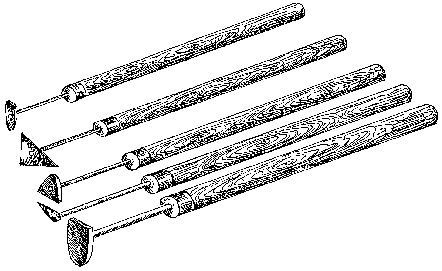
FIGURE 6.5.1-D Various shapes of
tools for plaster wheel

FIGURE 6.5.1-E Plaster turning box
with a profile of a vase to be modeled.
6.5.2. MAKING MOULDS FOR
PRODUCTION
Although making moulds is virtually always the same process: MODEL, MASTER MOULD, CASE MOULD, WORKING MOULDS, the specific steps are different for making jigger moulds, two-piece moulds, and multiple-piece moulds.
Some important points to remember are:
- Mixing and pouring plaster: according to section on
plaster.
- Cottle: This is the word used for the device that holds the liquid
plaster around the mould.
Round cottles are made from sheet metal or linoleum (Fig. 6.5.1-C), which is rolled into a cylinder with the appropriate diameter, and held in shape with wire. A separator is not required for these materials. The height is not important - it must be higher than the intended depth of plaster, and not so high that pouring the plaster is difficult to control.
Rectangular cottles are made from wooden planks, or, for smaller sizes, pieces of glass or rigid plastic. Wood should be soaped to keep the plaster from sticking. For most purposes, a “universal cottle” is used, which can be adjusted to any shape. Special clamps can be made to hold the cottle in position and are very convenient if many moulds are to be made, but this is rarefy done. In practice, bricks, clay, etc., are generally used to hold the cottle.
Cottles are sealed with plastic clay to prevent plaster from leaking out. Take care with this step, as the pressure of liquid plaster is sometimes surprising, and a lot of work can be lost if all the plaster runs out of the cottle.
- Separator: Plaster can be poured onto clay, linoleum, glass and wet wood without sticking. But if it is poured onto another plaster surface, it will stick unless a separator has been used. Modern separators are often made from silicon compounds in spray cans, which are very expensive. However, liquid soap is the standard one and works very well if correctly applied. The standard soap is thick brown potash soap diluted with water (about 0.25 kg soap to 1 lifer water). If this is not available, bar soap used for laundry can be prepared by boiling 500 g soap in 2 lifers water. After it has cooled another 2 lifers water are added.
- Applying separator: The separator can be applied with a soft brush or with a sponge. The first coat is done with a very thin separator which will reduce the absorption of the plaster. Wipe the soap off with a sponge. The next applications are done with a thicker soap separator. After each application, excess soap is wiped off with a sponge. Do not clean the sponge or your hands in water. This is done 5 times on a fresh mould and 3 times on a mould that has already been used. The last coat is wiped off very carefully so that no excess soap is left on the surface because that will spoil the surface of the new cast.

FIGURE 6.5.2-A Universal cottle with
clamps made from iron bars.
- Mould sealer: Normally five coats of soap will be enough to seal the plaster surface. However, some potter’s prefer to apply a special sealer to the mould surface before using a separator. The sealer is usually shellac, which is thinned with denatured alcohol. 3 to 4 coats of shellac are needed, but each application should be allowed to dry completely before applying the next, otherwise the earlier shellac layers will be partly dissolved by the new coat and form bumps on the mould surface.
If shellac is not available thin enamel paint can be used instead. The mould should be dry before applying the paint. Either dry it in the sun for several days, or in a heated cabinet that is below 50ºC.
- Pouring plaster: Never pour plaster directly onto the face of the case mould. The point of pouring will become more dense and for a slip casting mould this would produce an uneven cast. Pouring should be done without splashing so that no air bubbles are trapped. Place a piece of wood inside the cottle and pour onto that. Immediately after pouring, air bubbles can be released by moving a soft brush gently over the mould surface.
- Opening the mould: This is a step which often can cause difficulty, especially with single-piece moulds with vertical sides (such as cup moulds for the jigger). If you have correctly done the sealing and soap application, and the mould does not have any undercuts, it should be possible to separate the mould. The mould should be opened when the plaster is hottest. The heat makes the mould “sweat” a little, softening the soap separator and this helps release.
Normally this can be done by inserting a thin knife blade in the seam, and gently tapping it with a wooden mallet. Do this all along the seam, and repeat it all around until the mould comes away. The greatest difficulty is often found with jigger moulds, which are rather deep and often create a strong suction which resists all attempts to open the mould. If you have compressed air available, this is the best solution to the problem. A hole (quite small, about 2 mm will do) is drilled through the mould up to the model - don’t worry if you penetrate the model, as this can be filled with a bit of plaster later. The hole can also be made by inserting a nail in the plaster before it stiffens (Fig. 6.5.2-C. Then apply a rubber or plastic hose to the hole and force in air. If nothing else is available, a bicycle pump often works, but the metal end should be removed.
- Case mould: Although case moulds are normally made from plaster of parts, wax is sometimes used for limited production. It has the advantage of being easier to remove from the master mould, and can be used to produce a large number of working moulds. Plain paraffin wax (the same used for making candles) can be used, but a better mixture is 2 parts paraffin to I part beeswax (if available). The master mould is set up as usual, and sufficient wax is melted to fill the mould. Hot wax shrinks when it cools, so to minimize this, the wax should be cooled in its melting container until a crust starts to form at the edge. It is then ready for pouring. As with slip clay, pouring must be done quickly and without hesitation - otherwise rings will form on the wax surface.
In modern European practice, case moulds are made from silicone rubber (a 2-component product, which when mixed sets to make a rubber-like material that is flexible).

FIGURE 6.5.2-C (A; B)
A) A nail is inserted in the soft plaster of a jigger cup
mould.
B) Compressed air enters between the case mould (1) and the working
mould (2) and forces them apart.
one-piece moulds
- jigger mould: One-piece working moulds are very frequently used for jigger work. However, in order to produce them, it requires a fairly complicated master mould. All steps from making the model to producing working moulds for a jigger cup are shown in Fig. 6.5.2-E.
- plaster expansion: The plaster expands about 0.2 % on setting. The expansion of the working mould may crack the case mould. There are two solutions to this. The first is to make the case mould stronger by using more plaster for the same amount of water and by inserting reinforcing metal bands in the case mould during its casting. If extra gypsum cement plaster (alpha plaster) is available this is used for case moulds.
The second option is to allow the case mould to crack. Before casting the first working mould a vertical incision is made in the case mould from the outside so that a neat, straight crack is produced during the first casting. A metal wire is then tightened around the case mould, but during each casting the case mould will still yield a little to the expanding working mould. The advantage is that it is easy to release the working mould, but the disadvantage is that the working mould is not running perfectly true when placed in the jigger head. The working moulds can be trimmed on the plaster wheel to run true, but this of course adds to the cost of production. However, in many countries this method is the only practical solution, when plaster is of poor quality.

FIGURE 6.5.2-E Work flow of making a
jigger mould (A; B)
A) Place a cottle on the plaster wheelhead and cast a rough
cylinder.
B) Turn a model of the cup on the wheel, seal it with shellac and
apply a soap separator.

FIGURE 6.5.2-E Work flow of making a
jigger mould(C;D)
C) Place a cottle around the model and make a cast.
D) The
master mould, also called block mould, is cut on its outside to fit the jigger
head on the jigger machine.

FIGURE 6.5.2-E Work flow of making a
jigger mould (E; F)
E) Cut the base of the model down, slightly sloping as shown at
(1). Apply sealer and separator.
F) Make a cast of the master mould. This is
the CASE MOULD.

FIGURE 6.5.2-E Work flow of making a
jigger mould (G; H)
G) Cut the CASE MOULD so it is slightly sloping and cut the base
of the model down a bit further. Apply sealer and separator.
H) Make a cast
of the case mould. This is the DOUBLE CASE MOULD.

FIGURE 6.5.2-E Work flow of making a
jigger mould (I; J)
I) After turning the outside of the double case mould the whole
set is ready: model (1), master mould (2), case mould (3), double case mould
(4).
J) Take the moulds #24 off the plaster wheel, turn them upside down and
cast an extra model.

FIGURE 6.5.2-E Work flow of making a
jigger mould (K; L)
K) Cast an extra set of model, master mould and case mould and
store them for future reproduction. Then cast a number of case moulds from the
other set of moulds.
L) Produce working moulds from the case moulds

FIGURE 6.5.2-E Work flow of making a
jigger mould (M; N)
M) Before the plaster starts setting turn the case mould on a
potter’s wheel while touching the mould surface with a soft brush.
N)
Dry the working moulds completely before use. The first few cups formed in the
new moulds may be difficult to release.
two-piece mould for slip casting
This is probably the most common type of mould for slip casting most simple shapes, like flower vases, small decorative objects, etc. Although moulds for slip casting should be of uniform thickness so that water is absorbed equally from all areas, in fact they are often made square or rectangular in section for ease of producing and handling the working moulds.
The model may sometimes be prepared from clay, but normally is made from plaster of parts, as above. It is important to remember that moulds for slip casting require a “spare”, which is the slip pouring spout that holds an extra reservoir of slip and permits accurate finishing of the mouth.
multiple-piece mould
The vase we made above m the two-piece mould had to have a flat bottom, because otherwise it would have an undercut in the bottom and could not be released from the mould. An indented bottom can easily be made with the help of a third mould piece. This type of mould is shown in Fig. 6.5.2-H.

FIGURE 6.5.2-I Steps in making a
two-piece slip casting mould (A; B)
A) Mark the midline of the vase with a pencil. Seal the
model.
B) Set the model in plastic clay up to the marked midline. Make the
clay surface smooth and make a clay plug at the mouth to form the spare.

FIGURE 6.5.2-I Steps in making a
two-piece slip casting mould(C)
C) Place a casting cottle around the model. Allow about 4 cm between cottle and largest diameter of the vase. Seal gaps with clay. Apply separator to the model.

FIGURE 6.5.2-I Steps in making a
two-piece slip casting mould(D)
D) Pour plaster slowly into one corner. Vibrate the mould gently or move a soft brush over the mould surface to remove air bubbles.

FIGURE 6.5.2-I Steps in making a
two-piece slip casting mould (E; F)
E) Remove cottle and clay and turn the new mould over, keeping
the model in place. Clean clay from all plaster surfaces. Make keys or notches
in the plaster, place a new clay plug at the mouth.
F) Replace the cottle and
soap the model as usual, taking extra care to soap the notch holes.

FIGURE 6.5.2-I Steps in making a
two-piece slip casting mould(G)
G) After separating the two moulds, we have a set of master moulds also called block moulds. Make an extra set of these to keep in store together with the model.

FIGURE 6.5.2-I Steps in making a
two-piece slip casting mould (H; I)
H) From the two master moulds make as many sets of case moulds
as needed.
I) From the case moulds working moulds are produced.
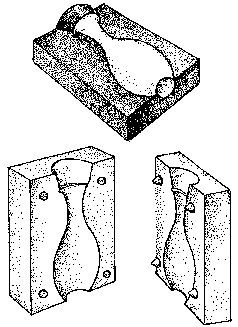
FIGURE 6.5.2-J Steps in making a
three-piece casting mould.(A; B)
A) Set the model in clay as before’ but with the bottom at
the edge as shown. Otherwise proceed as above.
B) The two master moulds
without bottom part.
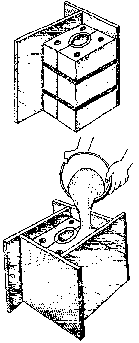
FIGURE 6.5.2-J Steps in making a
three-piece casting mould.(C; D)
C) Assemble the two master moulds with the model inside. Hold it
together with rubber bands, turn it upside down’ cut notches and place a
cottle around it.
D) Soap well and pour plaster to cast the third mould
piece.
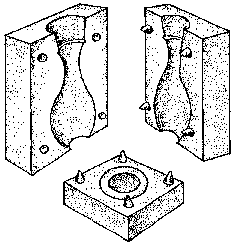
FIGURE 6.5.2-J Steps in making a
three-piece casting mould.(E)
E) The three master mould pieces after separation.
multiple moulds for irregular shapes
Pottery shapes can also be square, triangular, oval or even completely irregular as for example a sculpture. Slip casting of such items requires moulds divided into many sections.
The first step is to determine how many pieces of mould are required, and where the separation lines will be. This is largely a matter of experience and good judgement. There must not be any “undercuts” which prevent the mould from being pulled away from the model. When the lines have been determined, they can be drawn on the model with pencil.
A multiple-piece mould can also be made without using a cottle. First the largest area defined by the separation lines has a clay dam built around it, which normally can be about 4 cm high. The plaster is applied by splashing it on layer by layer until about 4 cm thick. The clay is then removed and the plaster face is “keyed” as described above. The area next to the new cast is then dammed in by clay and the process is repeated.

FIGURE 6.5.2-K Steps in making a
multiple-piece mould (A; B)
A) Draw separation lines on the model.
B) Build up clay walls
along the separation lines.
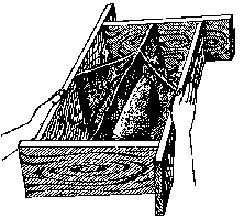
FIGURE 6.5.2-K Steps in making a
multiple-piece mould(C)
C) Place a cottle around it and extend the clay walls to the walls of the cottle.

FIGURE 6.5.2-K Steps in making a
multiple-piece mould (D)
D) Pour plaster into sections not bordering each other.

FIGURE 6.5.2-K Steps in making a
multiple-piece mould (E)
E) Open the cottle, remove clay walls and cut key notches in the plaster.

FIGURE 6.5.2-K Steps in making a
multiple-piece mould (F)
F) Replace the cottle, apply separator and pour plaster into the other sections.

FIGURE 6.5.2-K Steps in making a
multiple-piece mould (G)
G) Remove the cottle, turn the mould upside down, cut key notches and pour plaster into the last section.

FIGURE 6.5.2-K Steps in making a
multiple-piece mould (H)
H) The finished casting mould. The casting slip is poured
through the four legs of the figure
6.5.3. MOULD PROBLEMS AND
SOLUTIONS
|
Problem: |
Plaster sets too fast. |
|
Cause: |
i. plaster is not properly calcined, contains gypsum |
| |
ii. equipment dirty |
| |
iii. high ratio of plaster to water |
| |
iv. mixing water too hot. |
|
Cure: |
i. replace the plaster |
| |
ii. clean equipment |
| |
iii. increase water content |
| |
iv. try with cooler water. |
|
Problem: |
Plaster sets too slowly. |
|
Cause: |
i. plaster is contaminated with clay, sand, etc. |
| |
ii. too much water in the mixture. |
|
Cure: |
i. discard the plaster |
| |
ii. reduce water content of the mixture. |
|
Problem: |
Air bubbles on the mould surface. This is one of the most common problems with plaster moulds |
|
Cause: |
improper mixing and pouring. |
|
Cure: |
Follow instructions on mixing and pouring procedure given in 6.4.4. |
|
In particular, |
let plaster soak completely before stirring. Vibrate mould gently or move a soft brush over the mould face after pouring. |
|
Problem |
Rough mould surface, or soft mould surface. |
|
Cause: |
i. soap used as separator was not wiped off before pouring |
| |
ii. coarse grains in the plaster. |
|
Cure: |
i. wipe the separator off with a squeezed sponge |
| |
ii. screen the plaster through 100 mesh, regrind the plaster, complain to supplier. Make a thicker mix so the large particles do not settle on the surface. |
|
Problem: |
Mould is too soft and breaks down easily. |
|
Cause: |
i. too much water in the mixture |
| |
ii. plaster is contaminated or too old |
| |
iii. moulds were dried at high temperature. |
|
Cure: |
i. correct water/plaster ratio |
| |
ii. discard plaster |
| |
iii. dry moulds below 50ºC. |
|
Problem: |
Casting or jigger items stick to the mould the first few times in use. |
|
Cause: |
salts in the plaster deposited on the mould surface during drying. |
|
Cure: |
Dust the mould with talc or grog dust before using it the first few times. Drying moulds from the outside only will reduce the problem |
|
| |||||||||||||||||||||||||
Forming Techniques for the Self-Reliant Potter (GTZ, 1991, 194 p.)
7. Slip casting
Slip casting is a specialized way of using plaster moulds for mass production of ceramics. The word “slip” means a single clay or a mixture of clays and other materials that has been mixed with enough water to make it liquid, so that it can be poured into a plaster mould.
Slip casting is a fairly new process in the history of ceramics, as it only became practical after the invention of plaster of parts 200 years ago.
drain casting
The slip casting process shown in Fig. 7-A produces a hollow item which outside has the shape of the mould. This process is called drain casting because the moulds are emptied of excess slip.
solid casting
In this method the mould forms both the inner and outer face of the cast. The advantage is, that all casts will be identical and the cast can have walls of varied thickness. Solid casting moulds are more complicated to make and they are mainly used for high quality ware and for items that need to be of uniform size. Fig. 4.4.1-D shows an example of solid casting of handles.

FIGURE 7-A The slip casting process
(A; B; C; D)
A) A three-piece plaster mould is filled with casting slip. Water is absorbed by the plaster and the clay that was mixed with that water forms a layer of clay on the inside.
B) After 20-40 minutes the mould is emptied. A layer of clay, forming a vase, remains inside the mould.
C) The mould absorbs more water from the clay and when the vase is hard enough to handle the “spare” is trimmed and the vase is released from the mould.
D) The vase is placed on a board for finishing and the mould is reassembled and used for another casting.
7.1. Casting body
7.1.1. GUIDELINES FOR DEVELOPING A CASTING BODY
7.1.2.
CASTING SLIP PREPARATION
7.1.3. CASTING PROBLEMS, CAUSES AND CURES
Slip casting gives potters more problems than other forming techniques. A good casting slip is often difficult to develop, and preparation of the clay slip has to be done carefully following the same procedures each time. The following factors play a role in making a casting slip:
fluidity
The clay body needs to be fluid enough to be poured into the plaster moulds, and after the clay sets on the mould surface, the remaining clay must drain out without leaving “runs” or “tears” on the inner surface of the cast. Fluidity is the opposite of viscosity; a stiff liquid is said to have high viscosity, and a very fluid liquid has low viscosity. The viscosity of a clay slip is adjusted by addition of water or deflocculating chemicals like soda ash (sodium carbonate) and water glass (sodium silicate).
density
The clay slip should contain as little water as possible. A high amount of water produces a less dense cast and increases drying shrinkage of the clay. It will also lengthen the casting time, and the plaster moulds will have to absorb more water, which reduces the number of items that can be cast per day and the life of the moulds. Water content of the slip should be 25 % to 45 % by weight of the slip. Density is measured by weighing 1 lifer of the slip. 1 lifer of water weighs 1 kg, and we say it has a density of 1; clay slip will have a density higher than 1.
permeability
As soon as the clay slip is poured into the mould, the plaster starts to suck water from the slip, and a denser layer of clay body is built up next to the plaster. As this layer thickens, it takes a longer time for the plaster to draw water from the slip, so the casting rate is lowered. If the casting slip has a high proportion of fine plastic clay, it will lengthen the casting time considerably. Therefore, casting slips should normally contain less plastic clay than plastic bodies. As a rule, a casting slip should contain 50 % clay and 50 % nonplastic materials (by dry weight).
clay body strength
The finished cast should be strong enough to handle when it is taken out of the mould, and there should be no sticking to the mould. The green strength of the clay body needs to be enough for handling without breaking.
deflocculation
Clay particles are extremely small and shaped like plates. In a
plastic clay a thin film of water surrounds each clay particle and enables the
particles to slide over one another when pressure is applied during forming. As
more and more water is added, the clay particles start to move more freely, and
gradually the clay becomes a slip. An increase of water lowers viscosity. Equal
amounts of water and clay make a slip.
So much water makes the slip
impractical to cast. This problem is solved by adding chemicals, which changes
the behavior of the clay particles.
Clay particles behave in two different ways when freely suspended in water. If an acid is added to the water the clay particles will attract each other, and it is said that the clay slip is “flocculated”. With addition of an alkali (e.g. soda ash), the clay particles will repel each other and this state is called “deflocculated”.
Fig. 7.1-B shows clay particles enlarged approximately 100,000 times. In an acid environment, clay particles carry electrostatic charges on their surface: positive charges at their edges and negative charges on their two faces. The clay particles behave like small magnets, and the positive edges are attracted to the negative faces. This results in packing of the clay particles, and in increased viscosity.
When the clay slip is deflocculated by addition of an alkali the particles become negatively charged all over and they will then repulse one another (Fig. 7.1-C). This repulsion makes the slip fluid with less water.
thixotropy
This means the property of clay to become more viscous when it is left undisturbed. When a slip is left all night, it often becomes thick and viscous. If it is stirred, it again will become fluid. Thixotropy is useful in a casting slip because it helps the newly-cast items to keep their shape in the mould. However, too high thixotropy makes it difficult to empty the moulds. Water glass decreases thixotropy, whereas soda ash does not affect it.
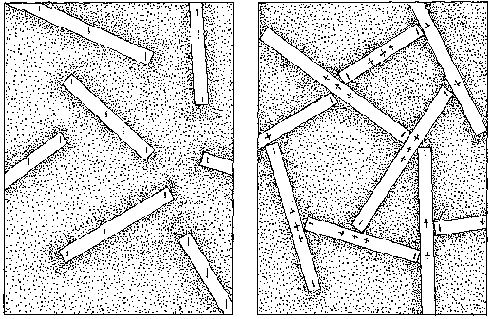
FIGURE (A; B)
A) Clay particles are attracted to one another in a flocculated
slip.
B) Clay particles are repelled by each other in a deflocculated
slip.
7.1.1. GUIDELINES FOR
DEVELOPING A CASTING BODY
As a starting point, a casting body can be developed from a plastic body. However, the body needs to be adjusted keeping the following points in mind:
- A casting body should contain approximately 50 % clay material and 50 % nonplastic materials.
- Very fine clay particles will reduce the casting rate by blocking the flow of water from the slip into the plaster mould. Plastic clays should be substituted for less plastic ones and the clay part should be made up from more than one type of clay.
- Natural clays contain soluble salts, and these will act as flocculants, increasing the necessary amount of deflocculants. Some clays prove impossible to deflocculate. The salts may come from the water, and, as a rule, you should never use recycled water from clay preparation for casting slip mixing.
- Clays containing sulfates are also difficult to deflocculate. Sulfates can be neutralized by additions of barium carbonate, usually 0.2-1 %.
- Addition of frit as a body flux may also introduce flocculants, since the frit may be slightly soluble. As a remedy try to use another frit or use glass powder.
- Clays containing montmorillonite (like bentonite) contain high amounts of colloidal silica that may cause the slip to gel and in general are difficult to deflocculate. This is called “livering”.
- The standard deflocculant is a 3 to 1 mixture of sodium silicate and soda ash. The ratio of sodium silicate should be higher for a body of low plasticity, whereas more soda ash is used for bodies containing higher amounts of plastic clay.
Sodium silicate tends to cause the cast item to stick to the mould, produces stringy slip that drains unevenly and results in a hard cast. Too much soda ash produces casts that never get hard, clay bodies that thicken up more quickly, and causes the mould to wear out faster. Soda ash should be purchased fresh, and kept in an airtight container. Old soda ash absorbs water from the air and becomes soda bicarbonate, which will no longer work as a deflocculant.
- The amount of deflocculant should be as low as possible and not higher than 0.3 % (based on dry weight of body). High amounts cause excessive wear of moulds and make the cast stick to the mould.
testing
After developing a suitable body, the right amount of deflocculant is found by doing a simple test. First, weigh all ingredients accurately. Mix the measured body with water until the body becomes just fluid. Then, dissolve a mixture of sodium silicate and soda ash in hot water.
Example:
5 g soda ash + 15 g sodium silicate in 200 ml water equals 0.01 g deflocculant for each 1 ml water. So each 1 ml of solution added to 1 kg body means an addition of 0.01 % deflocculant.
What we want to find is the amount of deflocculant producing the most fluid slip. The fluidity is tested by filling a large funnel to the rim with slip while closing the outlet with a finger. The time (in seconds) it takes for the slip to drain out after releasing one’s finger is a relative measure of its fluidity. First the run-through time for slip without deflocculants is found and then the deflocculant solution is added to the slip 5 ml at a time. With each addition the slip is stirred well and run through the funnel. Initially, the slip will run faster with increase of deflocculant, but as the concentration of deflocculant increases, the slip will become less fluid. At that point the test is stopped and the results are plotted on a graph as shown in Fig. 7.1.1-B. A line is drawn between the dots, and from this graph the amount of deflocculant with lowest viscosity is read. Normally a point a little to the left of this is used, since it is important to use as little deflocculant as possible.
trial batch
Now prepare a 10-kg test batch of casting body following the standard procedure and using the amount of deflocculant found from our funnel test. In the above test we did not find the right amount of water for the slip. This is now done by adding only 33 % water and the deflocculants to the dry body (which means a water content of 25 % of slip). Leave it for 24 hours. After that, additional water is added during blunging until the slip has the right consistency. The slip is tested by casting some items. If it works and if you have measured all components accurately, you have the final recipe for your casting slip.
ageing
A deflocculated casting slip should be used within 2-3 weeks. Carbon dioxide from the air enters the slip and this acts as a flocculant which will make the slip less fluid. The ageing can be slowed down by keeping the slip in an airtight container or by sealing the slip surface with a thin layer of oil.
grog
Grog can be added to a casting slip. It will stay in suspension in the deflocculated slip. The finished surface will be as smooth as if no grog was used. Grog is used for casting large items, especially sanitary ware. It is also used for casting of refractory kiln furniture.

FIGURE 7.1.1-B Funnel used for
testing fluidity of casting slip.

FIGURE 7.1.1-C Results of a fluidity
test presented as a graph.25 ml solution (0.25 % of dry body) is the right
amount of deflocculant in this example.
7.1.2. CASTING SLIP PREPARATION
1) Dry all body materials and weigh them accurately.
2) Fill the right amount of water in the blunger. Gradually add soda ash dissolved in hot water, then add half of the body. After some blunging add the remaining body and the sodium silicate.
3) Leave the slip to age for 24 hours.
4) Screen it through 60 mesh. Check fluidity with the funnel test and density by weighing 1 lifer of slip. Cast a few items to be sure the slip is working correctly.
recommended procedure for casting
1 Before casting examine the moulds for clay or dust on the inside.2 Clean dirt from the moulds with an air hose or a soft dry brush. Never use water it will damage the mould.
3 Arrange the moulds in the order of cas-ting: heavy moulds first, then medium size, then small size.
4 Join the moulds tightly together with rubber.
5 Stir the slip just before casting and check that it does not contain air bubbles.
6 Pour the slip slowly and evenly into the mould without stopping and splashing. The slip should hit the bottom of the mould.
7 Top up the mould every 5-10 minutes.
8 Let the mould set until the casting has reached correct thickness.
9 A good mould can be used 2 to 4 times per day, depending on weather conditions. Before each casting, the mould must be dried in the sun or in the drying cupboard Otherwise moulds wear out fast.
10 After correct thickness is reached, drain out the excess slip. If the slip is drained into its main container, do this through a coarse screen that will retain pieces of plaster and dry clay.
11 Then keep the mould upsidedown until the clay is stiff enough to remove.
12 Take the cast product out when the clay starts to pull away from the plaster mould.
helpful hints
Costing: In costing greenware, the guideline is to charge 10 %
of the mould cost for each casting. This can be adjusted according to how
complicated the mould is.
7.1.3. CASTING PROBLEMS, CAUSES
AND CURES
Problem: Slip gelling in the mould.
“To gel” or
“gelling” means slip becoming too thick in the mould, so that excess
slip cannot be poured out.
Cause: Underdeflocculated slip.
Cure: Adjust the slip batch
by adding more sodium silicate in very small amounts (to prevent
overdeflocculation).
Cause: Slip that has not been mixed sufficiently.
Cure: Mix
the batch for a longer time.
Cause: Too much free iron or alkaline in the clay itself, or too
much organic matter in the clay (black ball clays often cause this
problem).
Cure: Reduce the amount of clay causing the problem, by
experimenting with variations on the body recipe.
Problem: Uneven casting thickness. This means the walls of the casting are thick and thin.
Cause: Difference in mould absorption due to difference in the
thickness of a mould thick areas absorb water faster than thin areas, causing
excess buildup of slip.
Cure: Check the quality of your mould. It may be
necessary to change the thickness of the mould - thick areas in the mould may
need to be made thinner.
Cause: Moulds are too old and are starting to harden.
Cure:
Throw out nonabsorbing moulds. Average mould life is 150-200 castings.
Problem: Greenware cracking in the mould. This means the greenware cracks before it is removed from the mould.
Cause: The most common cause is too much water in the
slip.
Cure: The amount of deflocculant needs to be corrected, or there may be
problems with some of the clay ingredients - in this case, it may be necessary
to change raw materials.
Cause: Slip with insufficient plastic ingredients.
Cure: It
may be necessary to add more plastic clay to the body.
Cause: Poorly designed moulds.
Cure: If this problem seems to
occur with one or two particular moulds, then the moulds are probably the cause
of cracking. They may have undercuts which catch the slip.
Cause: Greenware is allowed to remain in the mould too
long.
Cure: Check your casting process. Are you leaving the greenware in the
mould too long after draining it? It should be removed as soon as it is stiff
enough to be handled without damage.
Problem: Greenware sticking to the mould. Cause: New moulds with
greasy or soapy surfaces.
Cure: Dust the inside of the moulds with talcum
powder. The problem should disappear after making a few casts.
Cause: Too much organic material or large amounts of fine
particles in the clay. Black ball clay often has too much organic
material.
Cure: It may be necessary to substitute some of the ball clay for
china clay.
Cause: Underdeflocculated slip which does not shrink and takes
longer to dry in the mould, or overdeflocculated slip with too much sodium
silicate (this is the most common cause).
Cure: Adjust the amount of
deflocculant.
Cause: Moulds are saturated with water.
Cure: Completely dry
the mould at a temperature below 50ºC. (If mould becomes too hot, the
plaster will disintegrate).
Problem: Stiff and brittle greenware. This means leather-hard or dry greenware that breaks too easily.
Cause: Overdeflocculated slip. If you experience slow casting
times and greenware with a sandy surface, overdeflocculation is usually the
problem.
Cure: Overdeflocculated slip usually needs to be thrown out. The
amount of deflocculation, especially sodium silicate, must then be reduced.
Cause: Clay particle size may be too coarse.
Cure: Slip
plasticity can be improved by ageing it at least 24 hours. If this does not
solve the problem, then the recipe needs to be adjusted with more plastic clay.
Problem: Pinholes in the surface of greenware or fired ware.
Cause: Trapped air bubbles in the slip. Bubbles in slip occur if
the slip is mixed at too high a speed.
Cure: Bubbles in slip can be prevented
if slower mixing speed is used.
Cause: The slip has too low fluidity. Cure: Increase
deflocculants and/or water.
Cause: There is a high carbonate content in the
water used to make the slip.
Cure: It may be necessary to use water from a different
source.
Cause: There is a high content of organic material in the clay which
releases gas when it decomposes. Especially black clay contains a high amount of
organic materials. Cure: Screen the slip through a 60-mesh sieve. This will
release the trapped gas.
Cause: The soda ash in slip decomposes because of too long
storage time.
Cure: Throw out the slip.
Cause: Fast pouring into the mould may introduce air bubbles and
the return of excess slip after casting may do the same.
Cure: Pour the slip
slowly without stopping until the mould is full and stir the slip before casting
to release air bubbles.
Cause: Poor quality moulds with pinholes on the
surface.
Cure: Improve mould-making process, by mixing plaster more carefully
to prevent any air
bubbles.
7.2. Slip building and fiberslip
There are a few specialized ways of working with slip that are not found in most ceramics books: one is using deflocculated slip for joining plastic clay, and the other is making large slabs by mixing fiber into the slip, called “fiberslip”.
As already mentioned in the section on plastic clay, there is an advantage in using deflocculated slip for joining leather-hard clay, because the shrinkage is the same as plastic clay - this is especially true when joining large pieces, which tend to crack at the seams in drying. The process is:
- Mix deflocculated slip, using the same body recipe as your plastic clay. This type of slip is most easily deflocculated with “Calgon” (sodium hexametaphosphate) in amounts up to 1%. Calgon is mixed first with water, and then the clay body is gradually added while blunging.
- When joining, it is not necessary to scratch the surfaces to be joined (this may not be true with all clay bodies, and needs to be tested). Apply slip to both surfaces with a brush, and press them together immediately. Excess slip can be removed from the seams after it has set a bit.
- For extra reinforcement of the joints, they can actually be “taped” together. The tape is made by cutting strips of very open weave fabric, such as cotton mosquito netting or cotton gauze; or if available, a very open weave fiberglass cloth. These tapes are dipped in slip, and applied to the joined pieces. The tape provides very high green strength and resistance to drying cracks. In the firing, it burns up, leaving only the slip. The disadvantage of this method is that the tape produces a texture at the joints - however, if used on the inside of items such as large planter boxes, this is not a problem. It also is possible to incorporate it as decoration on the outside.
building forms with slip
It is also possible to build with slip, using moulds. This process is suited for making slabs, or for producing forms that are too large for practical casting in the normal way:
- Deflocculated slip is prepared as usual, but as little water as possible is added. The slip should be just thin enough for the mixer still to work successfully - it will not pour as easily as regular casting slip. It can be used like this, or, for extra strong and more easily workable slip, it can be mixed with 0.5 % chopped nylon fibers - these are sometimes available in bulk, and should be cut to about 2 cm. It is important that they be single, unwoven fibers. It also is possible to make these fibers yourself, by chopping nylon rope. Nylon fibers work the best, because they are very fine and easy to separate. One half percent seems like a very small amount, but it is surprising how it increases the viscosity of the slip, and it gives incredible green strength.
Alternatively, finely-chopped jute fiber can be used. In India, this is often used in unfired clay sculpture.
- Building with this “fiberslip” is best done inside plaster moulds. The slip is simply spread on by hand or with a trowel, and built up to the necessary thickness (which will be about the same as plastic clay). The advantage is that slabs do not need to be made, and there are no problems with joining. Drying shrinkage is less than plastic clay, and cracking problems cannot occur because of the fiber. The nylon fiber is so fine that even though it burns up in firing, the finished appearance is no different from regular clay.
- Because the green strength is so great, it is a useful technique for large pots that are difficult to transport when green.
fiberslip for sculpture
Another way of using fiberslip is for slab making or for sculpture. Again, this is a process that ordinarily would not be used, but for large-scale work, where there are shrinkage problems, it is worth trying:
- The same slip as above is used, preferably with the addition of chopped nylon fiber.- The process of building up slabs is the same as making fiberglass, where glass cloth is used to reinforce plastic resin. With fiberslip, various kinds of cloth can be used: the main requirement is that they be very open weave so the slip can penetrate through them. Fiberglass cloth is good if it is about the same weave as mosquito netting; nylon net or cotton mosquito netting can be used; or “cheesecloth” (open-weave cotton gauze) also works well.
- To make a slab, first a paper (newspaper) separator is laid on a flat surface. Next, a piece of cloth the desired size is laid on this. Then, a layer of slip about 2-4 mm thick is spread on the cloth. Another piece of cloth is laid on the slip, and the process is continued until the slab is the desired thickness. When the slab is leather-hard, it can be cut (with a sharp knife) and assembled with slip and tape as above.
- For making large sculpture, the process can be quite useful. An armature (support) can be made from wood, wire, etc. and then covered with wire netting. This is then covered with cloth, and fiberslip is built up on the surface as for making a slab. Usually, the outer layers will be fiberslip only (with no reinforcing cloth) so that the surface can be caved and modeled. The pieces can be fired together - the armature will burn and melt in the process, but as it is inside the sculpture, this does not present a problem. Clay with low shrinkage is best for the process, such as plastic clay with a large grog percentage, or low-firing white clay such as 50 % ball clay/50 % talc.
|
| |||||||||||||||||||||||||||||||||||
Forming Techniques for the Self-Reliant Potter (GTZ, 1991, 194 p.)
8. Finishing and quality control
Finishing is the process of completing all the details on a product - since this book is about forming, we will discuss finishing only up to the stage when the product is ready for firing.
Quality control is an activity that ought to be a part of the production process, but which is very often neglected. First the producer has to decide what is an acceptable quality of the finished product and then he has to find out where in the production process control is needed to ensure that his products are up to standard. Finishing should always be followed by an inspection of quality.
8.1. Importance of finishing
Your customers will expect your products to be finished correctly, so that each piece has the same quality. It is the responsibility of the producer to guarantee his products, and to check the work at each production step.
Workers need to be instructed on their individual responsibilities for finishing, and the supervisor should be strict in rejecting products that do not meet the expected standard. The ideal system is: “Every worker is a quality controller”, but this seldom works without careful instructions and an incentive scheme.
There are several ways of paying workers:
- fixed salary: Workers are paid a fixed monthly wage, regardless of production quantity. This is not usually a satisfactory system, as workers will tend to work as little as possible.- piece rate: This was the standard system for many years in the ceramics industry. However, with the introduction of labor unions, and the idea that factory owners should provide better treatment for labor, the system is not used so much nowadays.
- basic salary plus incentive for high production: many factories now use this system. Each worker has a fixed minimum production quantity, which is the amount of work he must produce in order to pay his production costs. If he produces more than the minimum quantity, he is paid extra according to the labor cost per piece.
These systems can be introduced by considering each main step in production as a separate industry. For example, the jigger section is responsible for producing finished greenware. This greenware is inspected and counted by the supervisor, and the workers in the jigger section are paid according to the amount of acceptable greenware. Similarly, the glazing section is paid according to the amount of correctly-glazed ware, and the firing section is paid according to the percentage of successfully-fired ware.
8.2. Steps in finishing
The steps in finishing vary according to the production method. For example:
Forming on the potter’s wheel
- Before removing from the wheel: The rim must be smoothed, and the bottom is undercut to make trimming easy.
- Leather-hard: The foot ring is trimmed and smoothed with a sponge. No further finishing should be required.
- Bone-dry: The product is inspected for cracks and imperfections, and any poor quality products are thrown in the scrap container.
Slip casting
- After the casting has started to pull away from the mould, the spare line is cut.
- Leather-hard: The mould line is cut away and smoothed with a sponge.
- Bone-dry: No further finishing should be required - only inspection and rejection of poor quality products.
Joining
- After forming of the individual parts: They are joined and all excess clay from the joining, fingerprints and marks are sponged away.
- Drying: The items are turned or paired to avoid cracking and warping.
- Bone-dry: inspection of quality.
Press moulding
- After pressing: Tile edges are fettled and in the case of plastic-pressed products press seams are cut and sponged.
- Bone-dry: inspection of quality.
8.3. Methods of finishing
The methods of finishing have been discussed according to various forming systems potter’s wheel, extrusion, jigger, slip casting, etc. Here are some general hints:
- Finish ware as soon as possible. It is usually easiest to finish ware as soon as it is possible to pick it up without damage. Potter’s wheel products should be trimmed as soft as possible - waiting too long slows down the process and causes damaged products. If ware becomes too dry, it is best to throw it out, as trying to rewet it usually takes longer than starting over again. Trying to finish bone-dry ware with sandpaper is rarely satisfactory - it takes a long time, produces dust which is a health hazard, and leaves a rough surface.
- Use the correct tool. Although one tool can be used for many finishing jobs, it is best to have specific tools in order to make finishing easier. For example, special tools can be easily made for jobs that need to be repeated many times: if you need to produce several hundred 2-inch posts, then it makes good sense to make a wooden cutting box which is set up for cutting the correct length.
- Tools should be in good condition. Clay trimming tools should be sharpened regularly. Tools should be cleaned after use, and kept in a convenient location.
8.4. Quality control
Acceptable quality varies according to the product. Common ware, such as low-cost storage jars, is often very roughly finished. Fine quality porcelain is rejected for even the slightest flaw, and often up to 50 % of products are not acceptable as top quality.
setting a standard
The producer must keep a constant watch on quality, and should try continuously to improve his product. A customer who receives even one batch of poor quality products is likely to look for another supplier. The level of quality depends on what quality competitors in the market are supplying and the expectation of the customers. Small tea shops will demand strong teacups, but will be more concerned about the price of the cup than its looks. So for that market quality means a cup with a strong handle, a rounded rim and no chipping or crazing of the glaze.
Quality does not mean that the products are beautiful; it means that the customer gets the product he expects. Good quality is not necessarily more costly or difficult to produce, but it pays attention to details and good management.
controlling quality
Once you have decided what your standard is for a particular product you can simply sort your finished products into two groups: acceptable and unacceptable. The rejected products could be sold at a lower price. This method is costly, because you have invested a lot of time, labor and materials in a product you will have to sell I cheap or even throw out. The most cost-effective method is to look at the whole production process and decide where mistakes could be discovered early. As soon as a mistake is discovered the product can be rejected and no more time and money are wasted on a faulty product. Let us look at an example that shows where inspection could prevent faults in the finished product (table on p. 164).
In a small industry where the producer or the supervisor is directly involved in the production he would check the production at most of the steps listed above. He could make inspection a part of another activity to save time. If the supervisor packs the biscuit kiln all products will have to go through his hands and this is a good opportunity to check all products.
In larger industries more formal quality control procedures are needed. In the example above inspection could be reduced to a check of the casting slip and a check when the products are completely dry. At that point both the quality and the quantity can be assessed as part of a piece rate pay system. The factory manager should make frequent spot checks at all steps in the production to make sure that the quality control system works.
fulfilling orders
The biggest problem for small producers is accepting more orders than they can complete in time. Rush orders are likely to be poorly finished, and customers will never accept excuses for poor quality. For that reason, producers must learn to correctly estimate production time, and should never tell customers that they can do it faster. At the time of taking orders the producers should also show their customers what quality they can expect. In ceramics production, especially in small industries, there will always be variations in color, texture, etc. The customer should be shown these and not only a few chance samples, that will be hard to reproduce.
Customers come back again if they know they can trust a producer to tell them the truth.
Slip-cast cup: quality control points
|
OPERATION |
POSSIBLE FAULT |
INSPECTION |
|
Slip preparation |
Pinholes |
Air bubbles in slip before casting |
|
Slip casting |
Cup too thick/thin |
Casting time |
|
Trimming rim |
Uneven rim, sharp edge |
Rims |
|
Attaching handles |
Handles easily come off |
Dryness of cup |
|
Finishing/drying |
Warping, rough surface, handles out of position, cracking |
When dry, before biscuit firing, all rejects put in clay scrap bin. |
|
Unpacking biscuit |
Cracking, overfiring |
Cracks and warping |
|
Glazing |
Crawling, pinholes, running, etc. |
Dirty biscuit ware, glaze thickness |
|
Firing |
Over/underfiring, etc. |
Cones, draw trials |
|
Transfer to store |
All the above-mentioned standard. |
Sorting according to |
|
| |||||||||||||||||||||||||
Forming Techniques for the Self-Reliant Potter (GTZ, 1991, 194 p.)
9. Drying of ware and moulds
Drying takes place when the water in the clay transfers to the surrounding air. When the air outside the clay contains as much moisture as the air inside the clay, the process of drying stops.
leather-hard
As the water leaves the spaces between the clay particles, these move closer together. That causes the clay to shrink as the water disappears; but when the particles all touch each other, little more shrinkage will take place. This stage is termed leather-hard, and there is still plenty of water left between the clay particles. The graph shows the relationship between drying shrinkage and water content of a clay.
rate of drying
Clay dries faster in warm, dry and windy weather. The rate of drying can be slowed down by covering the clay with plastic sheets or wet cloth, which causes the air surrounding the clay to become more humid.
The clay ware should dry evenly so that it shrinks evenly. A handle on a cup tends to dry faster than the cup itself, end the different rate of shrinkage will produce a crack in the handle - unless care is taken to let the whole cup dry slowly.
warping
Warping is caused by uneven drying. A tile will dry more on its upper surface so this will shrink and bend the tile upward. Cracking and warping are reduced by turning the products frequently during drying. Warping of plates and bowls is avoided by stacking them on top of each other rim to rim.
Thin clay ware dries faster and more evenly than thick ware, and is therefore less prone to cracking and warping. Thick-walled designs should be allowed to dry extremely slowly or should be made from clay with a high content of coarse materials like grog and sand.
Small products can be dried rapidly without problems. Large items require special care in drying, especially in dry weather or hot climates.

FIGURE 9-A Example of relationship
between water content, shrinkage and pores. After 50 hours the clay has become
leather-hard and shrinkage stops. The condition of the clay at points 1-3 is
illustrated in Fig. 9-B.

FIGURE 9-B Three stages of clay from
forming to dry (enlarged about 100,000 times).(1)
1) Water surrounds all particles, the clay is plastic.

FIGURE 9-B Three stages of clay from
forming to dry (enlarged about 100,000 times).(2;3)
2) The clay is leather hard. Particles touch one another.
3)
Clay is dry. Only a little water remains in the clay pores. The water remaining
between the clay particles in the pores continues to move out of the clay to the
surface, from where it evaporates. When no water remains in the pores the clay
is called bone-dry.
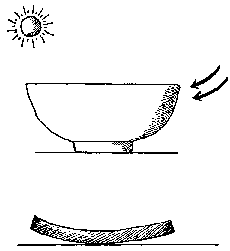
FIGURE 9-C Drying hints.(A; B)
A) Keep drying items away from sun and wind.
B) Rotate items
several times a day if they seem to be drying unevenly. Flatware like tiles are
sure to warp if not turned.

FIGURE 9-C Drying hints.(C)
C) Placing bowls, plates, cups, etc., rim to rim prevents warping.

FIGURE 9-C Drying hints.(D)
D) Large items should be dried very slowly, and can be loosely covered with plastic sheets.

FIGURE 9-C Drying hints.(E; F)
E) Added parts, such as large handles, can be wrapped in plastic
or painted with liquid wax emulsion, so that they do not dry faster than the
rest of the pot.
F) Items with large bottoms may crack across the center of
the bottom, because the bottom sticks to its support and when it shrinks the
periphery cannot follow. Sticking can be prevented by placing the pot on sheets
of paper or dusting its support with sand or fine grog.
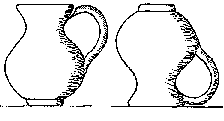
FIGURE 9-C Drying hints.(G)
G) After attaching handles let the pot dry upside down. Otherwise the rim will dry faster and this may crack the handle.

FIGURE 9-C Drying hints.(H; I)
H) Typical crack of plastic-formed tiles dried in bungs. Edges
dry first, but the center of the tile is under pressure and cannot accommodate
the shrinkage of the edges so they crack. Stack tiles more openly. Dust pressed
tiles crack in the same way, but more easily because they have less green
strength and additional problems with lamination.
I) For plastic-formed
tiles: the edges dried first and the center accommodated the shrinkage. When the
center shrunk the rigid edges caused it to crack. Semidry spressed tiles: the
pressure in the center caused less stress due to differences in particle
orientation.

FIGURE 9-C Drying hints.(J)
J) Pots with handles or spouts attached should be dried slowly. Place them on the bottom of the rack where it is cooler and drying is slower. Cover with plastic if necessary.
9.1. Drying systems
Air can absorb water until saturated. How much it can absorb depends on how much it holds already and on its temperature. The higher the temperature, the more water can be contained in the same volume of air. There are three basic approaches to air drying of clay ware:
- A large amount of unheated air is circulated around the ware. Example: outside drying sheds for drying of bricks and roofing tiles.- A small amount of air is heated to a high temperature. This is seldom used except in the ceramics laboratory.
- A medium amount of air is heated moderately. Example: batch dryers for clay ware and plaster moulds. Rapid circulation of air is more energy-efficient for drying than high temperature.
Thin-walled crockery will dry by itself on the ware racks. Drying of heavy articles like bricks, tiles or pipes may need the help of dryers, especially in the rainy or cold seasons.
The simplest way of speeding up drying is to carry the ware outside and leave it in the sun to dry. Trolley racks make this easier.
Artificial drying is most often done by heating air and circulating it around the drying ware. For heavy clay products like sanitary ware, it is sometimes done by placing the ware on a heated floor. Infrared light is a technically good solution, but electricity is expensive. The cheapest way is to make use of the waste heat from kiln firings.
kiln drying racks
Racks for holding drying ware can be arranged around the kiln or on top of it, so that the heat radiating from the kiln during firing and cooling dries the ware. The warm kiln will create a draught of warm air that also helps drying.
drying chamber
For medium-scale industries with large outputs, or for drying plaster moulds, a drying chamber is useful. Inside the chamber a ware rack is made for ware boards, or better still, the chamber is made to hold one or more ware trolleys so that drying goods can be taken in and out quickly.
cross draught chamber
Warm air from a cooling kiln or from an additional stove is introduced from one side and a fan provides a draught across the chamber through the ware racks. A constant movement of air over the drying ware is as important as heat. The air is not saturated with water by just passing through the chamber once, so in order to economize, most of the air should be recirculated by the fan. A centrifugal fan is most appropriate for this.
The centrifugal fan can at the same time draw hot air from the kiln via a duct system. However, combustion air should not be used directly. It contains soot that will dirty the ware, along with moisture and sulfuric acids that may corrode the duct system.
tunnel dryer
The same principle can also be used in a tunnel dryer where the ware trolleys enter at one end and are taken out at the other. The trolleys should move in the same direction as the drying air.
cabinet dryer
A more simple drying chamber can be made as a cabinet with a ware board rack inside, a heating device in the bottom and a hole at the top for moisture to escape. Heating can be done by electricity or by a stove. Combustion air, except from burning gas, should not enter the drying chamber since the ware will be dirtied by soot. The hot combustion gas can instead be led through the chamber in stove pipes. Combustion itself takes place in a small stove or firebox next to the drying chamber.
mangle dryer
For large potteries a mangle dryer is a cost-effective way of drying ware and moulds. An endless chain is carrying shelves loaded with ware inside a drying chamber. The shelves are loaded at one end next to the forming unit and emptied at the other end. The size of the shelves and the speed and length of the chain are designed according to the capacity of the forming unit. This type of dryer is mainly used in jigger ware production and its initially higher cost is justified by longer mould life, lower labor cost, and saving on space, racks and ware boards.

FIGURE 9.1-C Drying chamber with a
fan (1) recirculating air and drawing waste heat through a duct (2) from the
kilns. A damper (3) regulates amount of air to be recirculated.

FIGURE 9.1-D Trolley tunnel dryer.
Waste heat enter at (A) and exits at (B).Ware trolleys enter at (C) and are
taken out at (D).
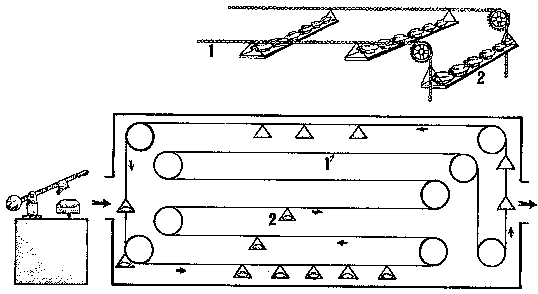
FIGURE 9.1-E Mangle dryer. The
endless chain (1) carries shelves (2) with ware and
moulds.
9.2. Drying of plaster moulds
Plaster moulds used in casting or jigger production need to be dried regularly. Working with wet moulds slows down production and moulds that are constantly wet become soft and “rotten”. Hardness and strength of wet moulds are only half of that of dry moulds. This reduces the number of times moulds can be used, and consequently increases production cost per unit. Moulds need to be dried at least once a day if they are to last long.
cost of drying:
Drying of plaster moulds follows the same principles as for drying clay ware. However, the need for drying is more urgent, because the production requires a constant supply of dry moulds. If no artificial drying is used, it means that a large number of moulds has to be in stock. This takes up a lot of space, increases labor cost since the workers will have to carries farther for the moulds, and more money will be tied up in a large stock of moulds. All of this costs money, and with jigger or casting production of some scale, it may be more economical to use artificial drying.
recalcination of moulds:
Plaster should not be overheated, because it will then start to recalcine. Gypsum starts to calcine from around 100ºC, and since set plaster is actually gypsum, the plaster moulds also become calcined on heating. At temperatures above 50ºC, the plaster moulds will start to soften and become chalky at the edges. This will’ of course weaken the moulds and reduce their service life.
dryer operation:
When operating the dryer it is very important to make sure that the temperature inside the dryer does not exceed 50ºC. An ordinary thermometer is placed inside the dryer and its temperature is checked regularly. As long as the moulds are wet, they do not become hot even if the air is above 50ºC, but once they are dry they will suffer damage, especially on their edges and comers which dry out first. Recalcination and cracking due to thermal shock can be reduced by painting mould edges with a 10 % solution of corn sugar. It is safer to take the moulds out of the dryer when they are still slightly damp.
deflocculants:
Plaster moulds used in slip casting should be dried only from their outer surface. That means they should be kept assembled as for casting so that only a little water will evaporate from the inner mould surface. The casting slip and therefore also the water in the casting moulds contains deflocculants, and when the water evaporates, the deflocculants remain on the mould surface. Deflocculants attack plaster, so it is better if they are concentrated on the outside of the mould, where they do little harm. If the mould dries from its inner surface it will wear out faster.
dryer location:
One advantage of using a mould dryer is that less time is spent
on handling moulds. The dryer should be located close to the forming area.
Jigger moulds may be placed in the dryer with the clay items inside, so when the
moulds are taken out of the dryer they are emptied before returning to the
jigger operator. The jiggered items are then put on ware boards which are
brought to another area for finishing. Before deciding on where to place the
dryer, the work flow of the whole process should be worked out.
Additional
information on drying is given in sections 4.2.4. and
4.3.6.
|
| ||||||||||||||||||||
Forming Techniques for the Self-Reliant Potter (GTZ, 1991, 194 p.)
10. Work flow and factory layout
Work flow is simply all the steps that are necessary from beginning to end of any production process. For anybody engaged in production, it is very useful to take the time to list all the steps, and to find out where time and energy are being wasted.
The various steps in a production work flow can all be broken down into the following, and shown in a graphic way with symbols:
Analyzing your work flow is very helpful for increasing production efficiency. When you understand all the steps, you can often make work easier and increase profitability by:
|
STEP |
SYMBOL |
EXPLANATION |
|
Raw materials’ storage |
V | |
|
Operation |
O |
action which changes the form of a material, like cutting, pressing, throwing, etc. |
|
Transport |
D |
moving material from one location to another |
|
Delay |
> |
necessary step which takes significant time, like drying |
|
Operation/delay |
# |
operation that takes significant time, like firing |
|
Inspection |
* |
quality control check |
|
Finished goods’ storage |
^ | |
- ORGANIZING THE WORKPLACEThe location where forming or finishing work is done should be furnished with a good source of light and enough space around the workplace to allow easy movement. Remove all unnecessary equipment and rubbish which will hamper work. Only equipment that is needed should be kept at the workplace. Frequently-used tools could be hung on the wall. Keen racks for storing products nearby.
- TRANSPORTING EQUIPMENT
Ceramic products go through many operations so they are moved around a lot. Carrying one pot at a time is a waste of time. Most pottery can be carried on ware boards about 120 cm long and 10 - 20 cm wide. A ware board can carry 20 cups at a time and they can be stored on stationary racks or on trolley racks.
Raw materials and heavy products like bricks and pipes can be moved on carts.
- MAKING TRANSPORTATION DISTANCES AS SHORT AS POSSIBLE
If you can rearrange your workshop so that clay only has to be carried 10 meters instead of 50 meters, this saves a lot of wasted effort. Another example is a pipe factory, where pipe has to be carried over rough ground and around heaps of coal, etc., to get to the kiln. This creates a lot of extra work, and disturbs the workers, as well as possibly being the cause of injuries. It would make good economic sense to take a day to construct a clear pathway, as the work would go much better afterwards.
- REDUCING DELAYS AS MUCH AS POSSIBLE
Often there is not much that can be done about delays. For example, it may not be possible to shorten firing time. Another frequent delay is drying - in this case, it is worth getting some help to compare the cost of artificial drying with air drying.
Even though the initial investment may be high, sometimes the time saved makes it financially advisable. This may be especially true for jigger production, where a forced air dryer can cut down on the number of moulds required and increase daily production capacity at the same time.
However, we do not recommend investing in expensive equipment unless the benefits have been carefully analyzed beforehand. Factory owners often buy the latest equipment just because it is new, and regret it later when it does not meet expectations.
production capacity
Once you have analyzed your production flow and made a good plan for reducing time wasted on internal transport, etc., you will also find that some sections in your production are bottlenecks. That means they delay the flow of products causing other sections to be idle while they wait for materials or semifinished products. There are various possibilities for curing bottlenecks or increasing production capacity in general:
- reorganize work procedures and workplace
- increase number of workers
- introduce incentive pay scheme
- work in two or three shifts
- increase capacity of machinery.
Several options may be used at the same time. Before you start to change anything try to make two or three different plans and then compare the cost of them.
consultants
There are actually industrial consultants who make very detailed work flows, to the point of finding out how many seconds each step takes, and then try to find ways to shorten the time. This is useful up to a point, but most small producers either operate a family business, or have quite a small number of workers, who are not likely to cooperate if they are asked to take 5 seconds for an operation that normally takes them 6 seconds. People are not machines, after all, even though management would often like to see them that way.
Work flow is the starting point for planning factory layout. This is true for planning new factories, as well as remodeling old ones (which often have expanded gradually and have become inefficient in the process).
10.1. Work flow example
The following work flow analysis of a jigger cup production in Burma is an example of how production can be reorganized with simple means.
original situation
Before the reorganization of the production, jigger moulds were placed on racks behind the jigger machines and two assistants for each jigger machine would run between the rack and the jigger machine with 2 to 3 moulds at a time. After being taken out of the moulds, the jiggered cups were carried by hand in stacks 15 to 20 cups high to fettling machines. This system was very laborintensive and the stacking caused many cracks.
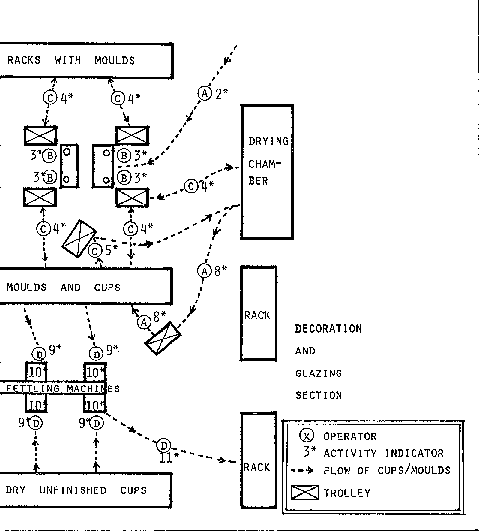
FIGURE 10.1-A Work flow plan of the
jiggering production analyzed below.
reorganization
A system for internal transport of products was established. Ware boards for carrying cups and moulds were introduced together with stationary racks and trolleys to hold the boards. One board could carry 6 cup moulds. A trolley could hold 36 boards or a total of 216 cup moulds. In the work flow analysis 216 cups are used as the batch unit.
A drying chamber was constructed so that it could accommodate four trolleys with ware and moulds. The jigger machines were relocated and placed so that they were close to both drying chamber and the fettling machines. The layout is shown in the process flow plan in Fig. 10.1-A, which corresponds with the work flow chart in Fig. 10.1-B.
The jigger operator (B) would always have one trolley next to her and she would pick one mould at a time directly from the board on the trolley. When the moulds on one side were filled with jiggered cups she would just turn the whole trolley and start with fresh moulds. An assistant (C) would replace the boards with filled moulds with fresh ones from the rack next to the jigger machines. During the rainy season the assistant would take the whole trolley to the drying chamber and replace it with another. With this system one assistant could service two jigger machines.
Another worker (A) would supply clay to all jigger machines and would also transfer dried cups to the fettling machines. The stationary racks were placed between the jigger section and the fettling section so that jiggered products placed in the rack from one side could be taken out by the fettling operators on the other side.
The work flow chart below shows the minutes it takes for each operator to finish one batch, equal to 216 cups. The production capacity is planned according to the daily output of the four jigger machines. If another step in the production flow cannot finish this quantity per day it becomes a bottleneck. A work flow chart shows such bottlenecks and indicates how to solve them.
The longest time it takes on average for one group of operators to finish one batch is 20 minutes. That means that during a workday of 7 hours, 21 batches or 4536 cups can be produced. If the fettling unit could produce more by having an extra machine or working overtime, average batch time could be 16 minutes. This would increase production to 5040 cups per day. This could be achieved by having the fettling unit work 45 minutes extra per day.
The flow chart also shows that operator A only spends 11 minutes per batch. He could therefore be given an additional task like looking after the drying chamber.
|
ACTIVITIES |
|
OPERATORS |
MINUTES | |||
| |
|
A |
B |
C |
D | |
|
1 clay storage |
V | | | | | |
|
2 clay to jigger machines | |
D | | | |
1 |
|
3 jiggering cups |
| |
O | | |
64 |
|
4 replacing filled moulds | | | |
D | |
15 |
|
5 emptying moulds of cups | | | |
O | |
15 |
|
6 cups to dryer |
| | |
D | |
2 |
|
7 cups drying |
> | | | | |
240 |
|
8 dryer to fettling rack | |
D | | | |
10 |
|
9 rack to fettling machine | | | | |
D |
3 |
|
10 fettling cups |
| | |
|
O |
74 |
|
11 cups to decoration rack | | | | |
D |
3 |
|
Minutes per type of operator: | |
11 |
64 |
32 |
80 | |
|
Number of respective operators: | |
1 |
4 |
2 |
4 | |
|
Average batch time per operator | |
11 |
16 |
16 |
20 | |