Glazes - for the Self-reliant Potter (GTZ, 1993, 179 p.)
1. Introduction and scope
(introduction...)
1.1. Glaze making using local materials as far as possible
1.2. Glaze and clay systems
Glazes - for the Self-reliant Potter (GTZ, 1993, 179 p.)
1. Introduction and scope
There are already many books in the world on the subject of
ceramic glazes. So the obvious question is: why yet another book on the subject?
The authors have worked together for several years in a ceramics development
project in Nepal, which is based on using local raw materials and resources.
There are few existing books which offer much help in this area, especially
working in the low temperature range from 900°C to 1100°C, where lead
glazes have been the tradition but which now, with greater understanding of
health hazards, need to be replaced with lead-free glazes. This book is intended
to provide practical information for ceramists working in developing countries,
with little access to the prepared and controlled glaze materials available in
industrialized nations.
Glazes are at one and the same time the area of most fascination
and most difficulty for potters. Most potters have little inclination or time to
devote to developing glazes, faced as they are by the daily need to produce for
the market. However, there often are times when familiar glazes suddenly stop
working correctly or special glazes are required for customers. This book offers
guidelines for developing and altering glazes, understanding where problems with
glazes come from, and standard procedures for testing and developing glazes when
there is no laboratory equipment available. It has been written for potters who
have little knowledge of chemistry and
mathematics.
1.1. Glaze making using local materials as far as possible
Most small producers of glazed ceramics will use glazes that are
prepared by a company specializing in supplying industry. However, these glazes
are often unreliable, as big companies tend to serve large-scale producers and
have little interest in the special glazes needed by small industries. For that
reason, the small producer is often forced to rely on his own glaze production,
with little or no laboratory equipment available. Additionally, the small
producer does not usually have access to raw materials at reasonable prices, so
he must use locally available raw materials that do not have an accurate
chemical
analysis.
1.2. Glaze and clay systems
The producer must think carefully before starting production.
When a particular glaze is wanted, it must work with the available clay body,
production system and firing system. For example, if you only have
low-temperature red clay available, your glazes must work at around 1050°C.
If you only have coal available for firing, you must make sure that it will work
for your product. The following chapters provide information which will help you
to make these
decisions.
Glazes - for the Self-reliant Potter (GTZ, 1993, 179 p.)
2. The nature of glazes
2.1. Glass and glaze, benefit of glaze
2.2. Glaze making is difficult
2.3. History of glazes
2.4. Classification (earthenware, stoneware etc.)
Glazes - for the Self-reliant Potter (GTZ, 1993, 179 p.)
2. The nature of glazes
2.1. Glass and glaze, benefit of glaze
Glass is a useful material that has been known for thousands of
years. It can be produced in many different shapes for many purposes, and it has
many useful qualities: it is transparent, hard, resistant to chemicals, and can
have many colors.
Glaze is a special type of glass, made for coating ceramic
products. Whereas glass is suitable for forming into bottles or windows, glaze
is different because it is applied on a ceramic surface and must form a hard,
durable coating after being melted in the kiln. It must not run off the product
and must stay on the product after firing without
cracking.
2.2. Glaze making is difficult
Because glaze before firing looks nothing like the finished
product and because we are not able to directly understand what happens when
glaze melts at high temperatures, making glazes is very difficult. We must try
to understand which materials melt at certain temperatures and what happens when
materials are combined. It requires a lot of direct experience before you start
to understand causes and effects. In this way it is like cooking: we are
familiar with cooking because we know the raw materials, and by trial and error
we have a good idea of what the finished meal will be like. However, imagine
that you are in a foreign country with unfamiliar food in the market and you
want to make a meal: How do you start? The best way is with a cookbook full of
recipes and a local friend to tell you if the result is correct or not. This
book is intended as a cookbook for the independent potter.
Although by just reading this book and experimenting with it you
will probably be able to make glazes after some time, there is no substitute for
learning about glazes from an experienced teacher, who can save you a lot of
time by guiding you in proven
directions.
2.3. History of glazes
Unglazed ceramics have been in existence for over 10,000 years.
It has only been in the last 2000 years that there have been glazed ceramics and
only in the last 100 years that a scientific approach to glaze making was
developed. For that reason, glazes still occupy a mysterious area somewhere
between science and magic.
The first glazes were probably invented in middle eastern
countries, where there naturally exist deposits of sodium and potassium
compounds (soda ash and pearl ash) that melt at low temperatures
(800°-1000°C). By chance, early potters discovered that some clays
when put in the fire developed a shiny surface. These self-glazing clays are
known as "Egyptian paste". They are not very useful for making household items,
being difficult to form.
The next step was to develop these substances so that they could
be applied to the surface of pottery clay in order to give it the desirable
qualities of a hard, shiny, easy-toclean and durable surface. Because early
potters did not have the technology to reach high firing temperatures, they had
to use materials with low melting points, mainly sodium, potassium and lead
compounds. Glaze development had to be done by trial and error, since these
early potters had no idea of chemistry. This took a lot of time and effort, and
naturally successful glazes were closely guarded secrets. These early glazes
were often soft and not durable, and had problems such as cracking and
eventually falling off the pot. Additionally, glazes based on lead were
poisonous both for the potters who worked with them and for users.
It was only when potters learned to reach high temperatures that
truly permanent ceramics were developed. There are many more common chemicals
and minerals that melt above 1100°C to form glazes, and clay that is fired
to these high temperatures is also much stronger and resistant to
water.
2.4. Classification (earthenware, stoneware etc.)
Although there are many different ways to classify glazes, the
simplest way to understand them is according to the firing temperature. The
useful range of temperatures for glaze melting is from 900°-1300°C. In
this book, we talk about two different categories of glaze:
- low temperature from 900-1100°C, called
earthenware; - high temperature from 1100-1300°C, called
stoneware.
These two categories are used because they require different raw
materials as the main ingredients of the
glaze.
Glazes - for the Self-reliant Potter (GTZ, 1993, 179 p.)
3. Temperature ranges and requirements
3.1. What is temperature?
3.2. Low temperature range 900-1100°C
3.3. High temperature range 1100-1300°C
3.4. Firing systems and glaze effects
Glazes - for the Self-reliant Potter (GTZ, 1993, 179 p.)
3. Temperature ranges and requirements
3.1. What is temperature?
Temperature means the amount of heat energy in a material. We
raise the temperature of a material by providing it with heat energy, using a
fire or electricity. What effect does this have on a material? We know that many
familiar substances can exist in different states of solid, liquid and gas. For
example, water can exist as ice, liquid water or steam. What is different about
it? Only the temperature. All materials consist of atoms and molecules which are
in constant motion. The amount of motion depends on the temperature. Cold
materials have less motion and therefore appear solid to us (e.g. ice). When the
temperature is increased, the motion of the molecules becomes greater and they
can move more freely around each other (e.g. water). When the temperature is
increased even more, the molecules become very active, as we can see when water
boils. Then the molecules are even less bonded together and we see gas (e.g.
steam).
Similarly, glazes are solid when they are cold (at room
temperature), liquid when they are heated sufficiently (in the kiln), and become
gas when they are heated too much.
It is also important to understand the relationship between clay
and glaze. Most common red clay (such as brick clay) melts by 1100°C. This
makes it useful for forming low temperature products. 1200°C, it can be
used as a
glaze.
3.2. Low temperature range 900-1100°C
Products called earthenware, whiteware, low-temperature
ceramics, and terra cotta are all fired in the range of 900-1100°C. We will
call these products generally "earthenware". What they have in common are clay
bodies that develop their maximum strength in this range, and glazes that are
based on low-melting compounds such as lead, sodium and potassium. 3.2.1. ADVANTAGES/DISADVANTAGES
Advantages: low temperature ceramics have the advantage of easy
firing -it is much simpler to construct kilns and burner systems that have to
reach no more than 1100°C, and fuel costs are lower. Bright colors are
possible in this range. Most common clays cannot be fired higher than this.
Disadvantages: earthenware is often not as strong as high
temperature ware, because the clay does not become vitreous. This means that it
also has some porosity (the property of absorbing water) with the result that
earthenware products often do not hold water unless the glaze is perfectly
fitted to the body. Also, it is easier to chip the glaze away from the clay.
Historically, many earthenware glazes were based on poisonous
lead because it is easy to melt: nowadays this is not a problem because lead can
be replaced by non-poisonous materials.
Modern earthenware glazes are usually based on frits, which are
expensive -the lower firing cost must be compared to the higher cost of the
glaze. 3.2.2. APPROPRIATE
PRODUCTS
Earthenware is used for all common household containers -cups,
bowls, storage containers, oil lamps etc. Ordinary wall tiles, most low-cost
tableware, sanitary ware, common unglazed containers, bricks, roof tiles etc.
are all made in the low temperature range. Many countries have a long tradition
of glazed red clay products, which are still useful in modern times. Most modern
factories have changed their production to white clay products, which have
become more feasible with recent developments of white bodies that become strong
enough at low temperatures. 3.2.3. CLAY/GLAZE
CHARACTERISTICS
Earthenware clay
Common red-burning clay is normally used, often mixed with
talcum powder to increase its firing range. In many countries, red clay which
contains lime is used because it makes it easier to formulate glazes that do not
craze (crack). White firing clay bodies are often based on talc, ball clay and
fluxes to make them harder.
Earthenware glaze
Earthenware glazes are based on low-melting materials, mainly
lead oxide (white lead oxide, red lead oxide), sodium and boron compounds (soda
ash, borax, boric acid) and potassium compounds (pearl ash, also known as
potassium carbonate). Usually it is necessary to use these compounds in the form
of frits (see chapter on frits). 3.2.4. RAW MATERIAL
REQUIREMENTS
Most of the raw materials for low temperature glazes can be
obtained from commonly available sources. They include: local clays, wood and
rice husk ash, limestone, and even soap powder (based on sodium and boron
compounds). Materials such as borax must be obtained from chemical suppliers.
Ready-made frits can be obtained from glaze suppliers, but in many locations it
is necessary to make them from raw
materials.
3.3. High temperature range 1100-1300°C
Types of ware fired in this range are known as stoneware and
porcelain. 3.3.1.
ADVANTAGES/DISADVANTAGES
Advantages
High temperature products are generally stronger, more acid and
abrasion-resistant. Raw materials do not require fritting. The clay is more
vitreous and thus does not have problems of water seepage.
Disadvantages
Kilns for high temperatures require more sophisticated bricks
and kiln furniture, and better burner systems. Fuel costs are higher. 3.3.2. APPROPRIATE PRODUCTS
High temperature products include stoneware utilitarian items,
whiteware of various types, porcelain and electrical insulators. 3.3.3. CLAY/GLAZE
CHARACTERISTICS
Clay
Clay body raw materials are limited to those clays which can
withstand high temperatures without melting: fireclays, ball clays, china clays,
"stoneware" clays. Most bodies also include feldspar to cause vitrification,
which prevents water seepage through the body.
Glaze
High temperature glaze is easier to make than the low
temperature sort, mainly because it is not necessary to frit the
ingredients. 3.3.4. RAW
MATERIAL REQUIREMENTS
Most stoneware and porcelain glazes are based on feldspar,
quartz, limestone and clay, with other ingredients to provide specific
properties of surface, color
etc.
3.4. Firing systems and glaze effects
Different types of kilns and fuels have specific effects on
glaze color and surface. 3.4.1. OIL, GAS, WOOD, COAL,
ELECTRICITY, OTHER
These are the main options for fuel. Each fuel requires a
different kiln design and burner system. You must first decide which fuel is
most available and most economical. The choice of fuel will determine whether
products can be open-fired on shelves, or whether it is necessary to use saggers
to protect the glaze from ash and contamination from dirty fuel.
The cost of fuel should be thought about very carefully. One kg
of fuel produces a certain amount of heat. Heat is usually measured in calories
or in British Thermal Units (BTU). One calorie is the amount of heat required to
raise the temperature of one cubic centimeter of water 1°C. The table at
page 170 shows the heat value of different fuels. Because a calorie is very
small, the usual unit of heat is expressed as kilocalories (kilo = 1000, so 1
kilocalorie = 1000 calories).
A particular kiln, loaded with an average number of products and
fired to a specific temperature, will usually require the same amount of fuel
each time, since it requires a specific number of calories to convert raw clay
and glaze into finished ceramics. When you know the total kg of products and the
total cost of one firing, it is easy to calculate the cost per kg of product:
Total cost/Total kg = cost per kg
You can also calculate the total number of calories required to
do one firing. If you are using kerosene, you can find from the table that one
lifer of kerosene supplies about 12,000 kilocalories of heat. So, if you use 80
lifers to do a firing, the calculation is:
(Total fuel) X (kilocalories per unit) = total kilocalories
required
80 X 12,000 = 960,000 kilocalories
When deciding on the type of fuel to use, you should find out
the cost per kilocalorie for different fuels in your area.
Oil
Oil is available in many different forms, all of which can be
used by the potter, including kerosene, diesel, furnace oil, and waste crankcase
oil. Kerosene is the most clean-burning (without too much smoke or impurities),
and waste crankcase oil is the dirtiest to use. Normally, products can be
open-fired, but oil will produce some discoloration. For high quality whiteware,
saggars may be necessary. Oil is suitable for high or low temperatures. Oil
provides between 9000 and 11000 kilocalories per kg.
Gas
Gas is available as natural gas, producer gas or liquid propane
gas. Where gas is available at a reasonable cost (compared to other fuels), it
is the easiest fuel to use. Gas is very clean-burning, does not require saggars,
and the burners are also simple to manufacture locally. It is suitable for any
temperature.
Wood
Almost any kind of wood can be used for firing kilns. Nowadays,
wood is a scarce resource in most countries and more and more it is being
replaced by other fuels. Firing with wood is labor-intensive. Because it
produces a large volume of ash, it is usually necessary to fire the ware in
saggers. It is suitable for any temperature.
On the other hand, wood is a renewable resource and in many
areas of the world it is produced as a cash crop, which makes it appropriate to
use.
The calorific value of wood is difficult to calculate, because
it depends on the type of wood, whether it is wet or dry, and the efficiency of
burning. Dry wood can supply between 3000 and 4500 kilocalories per kg, whereas
the same wood when wet may produce only half the calories.
Coal
Coal comes in many different grades, all of which are suitable
for firing kilns. Firing with coal is labor-intensive, but in many countries it
is the cheapest fuel available. Coal also produces ash and impurities, so it is
usually necessary to fire the ware in saggars. It is best for high temperatures,
but can be used at any temperature.
Coal can provide between 4500 and 7700 kilocalories per kg.
Electricity
Electric kilns are practical for the small producer where there
is a reliable source of electricity. Because there is no combustion, electricity
is the cleanest fuel of all. Electric kilns fire very evenly and do not require
saggers. Electricity is best for temperatures up to 1100°C.
Other fuels
These include tires, which burn very well but produce a lot of
smoke, and also produce poisonous gases. They can be used in kilns designed to
burn wood or coal. Some brick industries use scrap asphalt from roads as fuel.
Also in this category are such fuels as brushwood, sawdust and rice husk. Most
of these are dirty-burning, so require the use of saggers. They are best for low
temperatures. 3.4.2.
OXIDATION/REDUCTION
To understand oxidation and reduction, it is necessary to know
how fuel burns. All fuel produces heat when it combines with the oxygen in the
air. As anyone knows who has made a wood fire, if there is plenty of air the
fire burns hot and clean, with little smoke. This is called an oxidation fire.
If the air is reduced, there will be less heat and more smoke. This is called a
reduction (or reducing) fire, which simply means reducing the amount of oxygen.
So:
- Oxidation firing means there is plenty of air and
no smoke. - Reduction firing means there is little air and more
smoke.
Glazes will have different colors and surfaces depending on
whether they are fired in oxidation or reduction conditions. Oxidation has its
greatest effect on the metallic oxides that are used to create color in glazes.
For example:
OXIDE
OXIDATION
REDUCTION
red iron oxide
brown
red-brown, black
copper oxide
green, blue
red
Iron also changes from a grey color to a red color when it
rusts. This is because oxide from the air-combines with the metal and forms iron
oxide.
In firing, it is difficult to exactly control the amount of
oxidation or reduction. Many beautiful glazes can be obtained in reduction
firing, so it is widely used for decorative stoneware, and for lusterware.
However, the results are variable and difficult to reproduce every time, and
even in one kiln-load there will be differences. For that reason, most producers
who need to supply a uniform product use oxidation firing. 3.4.3. VAPOR GLAZING
In vapor glazing techniques, the glaze is not applied to the
product before firing in the usual manner. Instead, glaze is introduced into the
kiln through the firebox at the end of the firing, when there is enough heat to
change the glaze into vapor form. The most common material for vapor glazing is
ordinary salt. At temperatures above 1100°C, salt breaks down into sodium
and chlorine vapor, which circulates through the kiln. The sodium is attracted
to silica in the clay and forms a strong, durable glaze. Salt glazing is used
mainly for sewage pipes, because it is cheap and a perfectly glazed surface is
not necessary. In Europe, it was once used widely for household items, even
including beer bottles. Nowadays, salt glazing is less popular because it
produces toxic smoke that harms the environment.
Salt is sometimes replaced by soda ash and sodium bicarbonate,
which produce a similar vapor glaze without the poisonous side effects. Vapor
glazing is not recommended for the small producer, except for making specialized
art ceramics.
Glazes - for the Self-reliant Potter (GTZ, 1993, 179 p.)
4. Decisions
(introduction...)
4.1. Selecting your best firing temperature
4.2. Market factors
4.3. Strength requirements
4.4. Investment and production costs
Glazes - for the Self-reliant Potter (GTZ, 1993, 179 p.)
4. Decisions
As a ceramics entrepreneur, you must start by making decisions:
what product? what temperature? how much technology? These decisions depend on
your market, raw material and fuel availability. In industrialized countries,
where everything is easily available, the decision will usually be based first
on the market, and then the best combination of clay body, glazes and kiln can
be decided on.
In developing countries, it is usually necessary to start by
thinking about raw materials and fuel. Then the product can be selected.
Usually, it is easiest to use the same technology as other
producers, as most of the problems will have already been solved. On the other
hand, a new type of technology can capture a new market sector with no
competition. However, a new technology may cause technical problems that a
potter cannot solve without outside help.
Some typical questions for the entrepreneur to answer are given
below.
4.1. Selecting your best firing temperature
Is high-firing clay available?
If so, it may be best to decide on high temperature ceramics
(stoneware or porcelain), as producing reliable glazes will be easier.
Is only low-firing clay available?
If so, it will be necessary to select a low temperature system
and to make frits or purchase ready-made ones.
Are ready-made glazes available?
If there is a reliable source of glazes nearby, a lot of trouble
can be saved by using these.
What are the fuel constraints?
If only electric firing is available, then only low temperature
systems will be practical. If oil or coal is available, the additional costs of
using saggers should be compared with the cost of clean-burning
fuels.
4.2. Market factors
Most producers decide to enter the ceramics sector because there
is already a good market and not enough local supply or because they think they
can create a market for products that are not yet common in their area.
What is the existing market?
For example, if there is already a good market for glazed white
earthenware (perhaps imported), the potential producer will have to find out if
he can produce similar products at competitive prices. If he wants to compete
directly, he will have to take up the same clay/glaze/firing system.
Is there a possible new market?
On the other hand, it may be possible to produce a product with
the same function, but using a less costly technology. For example, it may be
possible to produce glazed red clay earthenware cheaper than the whiteware on
the market and thus to create a new market.
Small-scale vs. large-scale
Large-scale ceramics industries are able to produce a large
volume at a low profit margin. For this reason, it is difficult for the small
producer to compete directly. The small producer has an advantage of flexibility
- he can produce a variety of products on demand and thus can supply local
customers with special requirements.
For example, the modern tile industry is mostly very large-scale
and can supply very cheap tiles of a uniform quality. The small producer can
never compete directly with this. However, there is a growing market for
specialty tiles, with decorations or relief designs, which the large producers
cannot make. Many customers are interested in small quantities of special
decorative tiles made according to their own design, even if the price per
square foot is higher than mass-produced tiles.
Ceramics substituted for products made from other materials
In some countries, products like glasses for drinking tea may be
produced more cheaply in ceramics. Or cement sewage pipes and toilet pans may be
replaced by longer-lasting, more hygienic ceramic
products.
4.3. Strength requirements
Household items
Most common tableware items (cups, plates) can be made
satisfactorily using either high or low temperature systems. Low temperature
ceramics are more easily chipped and broken, but their low cost may be an
advantage. High temperature products are stronger, and most hotels and
restaurants will prefer them, unless the lower cost of earthenware makes up for
the higher rate of breakage.
Electrical insulators
Low tension insulators, fuse holders (kit-kats) etc. do not have
to be very strong, so can be made in the low temperature range. High tension
insulators have special requirements for porosity and strength, so must
necessarily be made at high temperature.
Tiles
Glazed tiles are most commonly produced at low temperatures,
which gives them sufficient strength for wall and floor applications.
Cold climates
Ceramic products to be used outdoors in freezing temperatures
have special requirements, because of damage that can come from water freezing
inside the product and causing it to break. These products are generally made at
high temperatures, which make it possible to control water
absorption.
4.4. Investment and production costs
After considering the above decisions, the entrepreneur must
then make an analysis of investment and production costs. These calculations are
not easy to do, as the production of ceramics depends on so many complicated
factors. For the new entrepreneur, it is important to start small and as simply
as possible.
Low temperature systems usually require a lower initial
investment, as kilns and burners will be cheaper. Fuel is usually the highest
cost of production, and firing at low temperatures can save production costs. On
the other hand, the cost of high temperature glazes is lower, as it is not
necessary to use expensive frits.
In preparing a scheme for a new business, it is best to get help
from a ceramics expert' who can help to figure out the comparative costs of the
various options. Besides the usual overhead costs, it is necessary to consider:
- cost of clay body - cost of glaze - labor
costs in production - capital investment for equipment - fuel costs -
working capital requirements.
Glazes - for the Self-reliant Potter (GTZ, 1993, 179 p.)
5. Simple glaze theory
5.1. Basic chemistry
5.2. Glaze structure
5.3. Effect of heat
5.4. Melted glaze behavior
5.5. Interface between glaze and body
5.6. Cooling and crystal formation
5.7. Transparency and opacity
5.8. Shiny or matt glaze
Glazes - for the Self-reliant Potter (GTZ, 1993, 179 p.)
5. Simple glaze theory
5.1. Basic chemistry
Chemistry is the science which describes what substances are
made of and how they combine with each other. This science uses special names
and symbols which are described below. 5.1.1. ELEMENTS/COMPOUNDS
Elements
An element is made of only one kind of atom. It cannot be broken
down into more simple substances. Oxygen (O) is the most common element on
earth.
Compounds
A compound is composed of more than one element combined
chemically. Water (H2O) is a compound made up of two atoms of
hydrogen (H) and one atom of oxygen (O). Silica (SiO2) is another
compound and consists of one atom of silicon (Si) and two atoms of oxygen (O).
This is the most abundant material in the earth's crust. Two or more atoms
combined form a molecule.
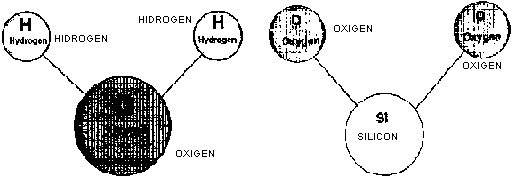
Figure 5.1.1.A. Water is two elements
combined. A molecule of water consist of two atoms of hydrogen and one of
oxygen. Figure 5.1.1.B. A molecule of the compound silica (sand) has two atoms
of oxygen and one of silicon
Ceramic raw materials are usually in the form of oxides: an
oxide is a compound that includes oxygen (O). Minerals are compounds. 5.1.2. SOLID, LIQUID, GAS
Solid, liquid and gas are the three states of matter. Most
materials can exist in all of these states, depending on their temperature. A
familiar example is water, which is solid below 0°C, liquid from 0°C
to 100°C, and gas above 100°C.
Making glaze depends on mixing solids together, applying them on
a pot and then changing them to liquid in the kiln. Some of the glaze materials
also become gas during firing and leave the glaze. On cooling, the glaze again
becomes solid.
Mixture
A mixture is a physical, not chemical, combination of compounds
(and sometimes elements) and each compound remains chemically unchanged in the
mixture. Air is a mixture of oxygen, carbon dioxide, nitrogen and other gases. A
glaze made of feldspar, quartz and lime is prepared by combining the compounds
as a mixture, but during firing a chemical combination takes place and the fired
glaze becomes a compound.
Chemical symbols
There are about 100 elements, and each of these has a name and a
chemical symbol, which is used as an abbreviation of its name. Some of these
symbols are the same as the first letters of the English name, but some are not!
For example:
Oxygen is "O" Hydrogen is "H" Silicon is "Si" Alumina
is "Al" Sodium is "Na" Lead is "Pb"
Compounds are written in a similar way with capital letters
marking the individual elements: for example, water is "H2O" and salt
is "NaCl"
The small number "2" in "H2O" indicates that there
are two atoms of hydrogen for each atom of oxygen in water. If there is no
number, it is understood that there is only one atom -so salt is one atom of
sodium and one atom of chlorine.
The formulas of complex ceramic materials are written as
compounds of oxides with a raised period (·) between them to show they are
chemically combined. For example potash feldspar is written:
K2O Al2O3 6SiO2
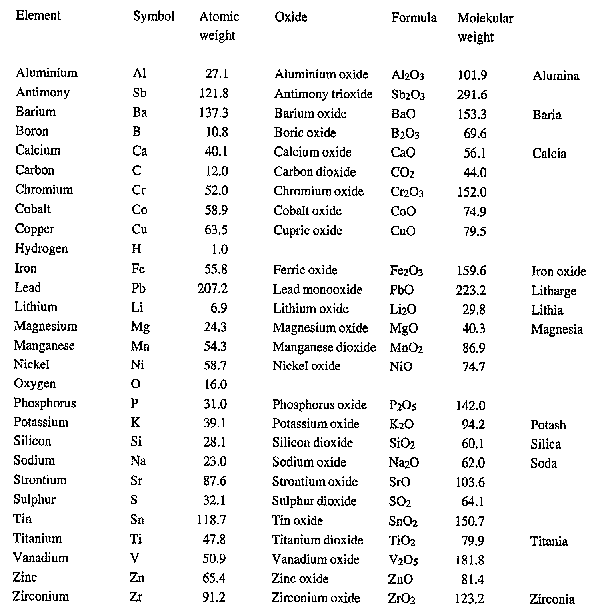
In the appendix the chemical formulas of other materials are
listed. 5.1.3. CHEMICAL
REACTIONS
The formation of clay from feldspar can be written in chemical
symbols:
K2O Al2O3 6SiO2
+ H2O
(feldspar)
+ (water)
®Al2O3
2SiO2
2H2O + K2O
+ SiO2
(clay)
+ (potash)
+ (silica)
All materials are built up of elements which are chemically
bonded together. When heated to a high temperature, chemical bonds can break
down and the material will change its properties. The production of quicklime by
heating limestone to 900°C is an example of this:
CaCO3®
CaO
+ CO2
(limestone)
(quicklime)
(carbon dioxide)
Carbon dioxide (CO2) goes into the air, and the
remaining quicklime (CaO) is slaked with water and can then be mixed with sand
to form mortar for house construction. The mortar sets when the calcium oxide
(CaO) takes back carbon dioxide (CO2) from the air and thereby
regains the hardness of the original limestone (CaCO3):
CaO
+ CO2
®CaCO3
(soft mortar)
(from air)
(set mortar)
5.1.4.
SOLUTION/SUSPENSION
Solution
A solution is a mixture of molecules. For example, sugar
completely dissolves in water: the separate particles consist of molecules of
sugar and water. Sugar and water remain a solution until the water evaporates.
The higher the temperature of the liquid, the more solid
material can dissolve in the liquid. When no more solid can be dissolved the
solution is called "saturated".
Suspension
In a suspension the particles are bigger than molecules. A
mixture of clay and water is a suspension. The clay particles are not changed by
the water, and after some time the clay will settle at the bottom of the vessel.
The clay is insoluble in water. 5.1.5. CRYSTAL STRUCTURES
Crystal structure
If we heat water to 90°C and add salt (NaCl), it will
become dissolved in the water. If we continue to add salt until no more salt can
be dissolved, the suspension is saturated with salt. If we let the solution cool
to room temperature (20°C) the water can hold much less salt in solution,
with the result that some of the salt will separate in the form of salt
crystals.
All minerals have the form of crystals. When the water cools,
the excess salt molecules start to combine with one another in regular patterns
like small building blocks. The way the salt molecules connect to one another is
very orderly and produces a cube-shaped crystal. Different materials will
produce crystals of different shapes. The shape of a mineral's crystal is used
to identify it.
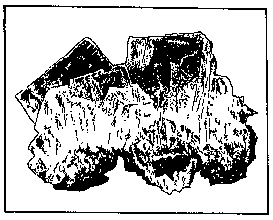
Figure 5.1.5.A. The cubic shape of a
salt
crystal.
5.2. Glaze structure
Glaze is similar to glass. Making glazes is confusing because
there are so many raw materials that can be used. However, all of these raw
materials can be broken down into three categories:
- flux - glass former -
stabilizer.
All glazes require these three components. The main glass former
is silica, the main stabilizer is kaolin, and the rest of the glaze is composed
of one or more fluxes. 5.2.1.
GLASS STRUCTURE
Silica (SiO2) alone will make an excellent glaze if
it is fired to its melting point (1715°C). Since this temperature is too
high for ordinary kilns, other materials are added to lower the melting point of
silica. Quartz is a crystalline form of silica found in nature. If a glaze forms
quartz crystals when it cools, it will not be transparent, since light is
refracted in many different directions by the crystal faces. Because glass or
glaze is not usually crystalline, this does not happen.
A glaze or glass is a mixture of compounds that melts when
heated. The melted liquid glass is like a solution. When the liquid cools,
crystals start to form in a similar way as in a salt solution. However, the
liquid glaze is very viscous (meaning sticky and semifluid) and the molecules
cannot easily move around to form a regular crystalline pattern. So normally no
crystals form during cooling, and the glaze remains clear like a liquid.
Glaze is, therefore, like a solid solution and is sometimes
called a supercooled liquid. 5.2.2. FLUXES
Fluxes are the materials which lower the melting point of a
glaze. They can be called melters.
Silica melts by itself but at a very high temperature. Therefore
it needs additions of flux to make a practical glaze. The most common flux for
temperatures below 1100°C is lead oxide (PbO), but since it is poisonous it
is no longer used in modern crockery glazes. Another powerful flux is boron or
boric oxide, B2O3, which is not poisonous and is used in glazes in the form of
borax or boric acid. There are many other fluxes which contribute various
properties of hardness, opacity, color response etc.
Fluxes are also called basic oxides or network modifiers. 5.2.3. GLASS FORMERS
Silica forms the main part of all glazes and is called a
glassformer. The other glass-former is boron. Silica and boron are the building
blocks of a glass or glaze. Other materials are only used to modify their
behavior in the glaze.
Titanium oxide (TiO2), tin oxide (SnO2)
and zirconium oxide (ZrO2) also belong to this group. Sometimes they
are called the acidic oxides or network former, or the acid portion of the
glaze. 5.2.4. STABILIZERS
Aluminum oxide, Al2O3, is added to make
the melted glaze stiffer, so that it will not run off the pots during firing. It
is called a stabilizer. Other words for stabilizer are: amphoteric, neutral or
intermediate oxide.
Aluminum oxide has a high melting point and will increase the
melting point of the glaze. It is usually added to the glaze as kaolin (china
clay).
(Boron is termed a stabilizer in the USA but a glass former in
Europe.)
5.3. Effect of heat
As heat is increased, the molecules in the glaze move faster,
resulting in drying, sintering, melting and gas escape. All of these effects
occur when the glaze molecules move so fast that they start to break down,
releasing some of their atoms and combining with other molecules to form the
glaze. 5.3.1. DRYING
When the powdered glaze on the surface of the ceramic ware is
heated, the water evaporates above 100°C (no matter how dry the glaze seems
to be, there will always be some water remaining in it). The glaze layer should
be as dry as possible before setting in the kiln. If the glaze layer dries too
fast when firing starts, it may crack. This can cause crawling of the glaze
after it melts. 5.3.2.
SINTERING, MELTING, GAS ESCAPE
Sintering
As the temperature rises above 600°C, the sintering of the
glaze powder starts. Sintering also takes place in the clay at this temperature.
Sintering means that the glaze (or clay) particles start to stick to one another
where they touch. The finer the glaze particles are ground, the earlier the
sintering will start and the stronger the bond will become.
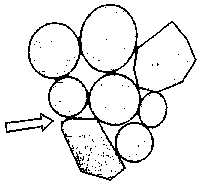
Figure 5.3.2.A. The glaze particles
are enraged many thousand times showing sintering in a glaze heated to
600°C. At the points of contact (arrow) a weak bond is formed.
Fusion
As the temperature rises further, the most fusible (easy
melting) materials in the glaze start to melt. This is celled fusion. The
refractory (hard melting) particles are surrounded by the liquid materials and
are slowly included in the liquid.
The temperature at which melting starts depends on the materials
in the glaze. Silica alone melts at 1715°C, but with additions of other
materials the melting point will go down. Aluminum oxide
(Al2O3) melts at 2050°C and calcium oxide (CaO) at
2570°C, but a mixture of 62% silica, 14.75% aluminum oxide and 23.25% lime
melts at only 1170°C. A mixture which has a lower melting point than any of
the single materials in the mixture is called an eutectic.
A mixture with many different materials will form eutectics (and
will melt) at a lower temperature. Fine grinding of the glaze materials and
prolonged firing time above the sintering temperature will also lower the
melting point.
When fusion starts, the compounds also start to change. The
chemically bonded water in clay has already been released. Around 900°C,
limestone (CaCO3) releases carbon dioxide (CO2) and so do
other materials containing carbonates, like barium carbonate (BaCO3).
Gases of sulfates, oxides etc. are also released both from the glaze and from
the body. These gases have to pass through the glaze layer. This action mixes
the glaze, helping it to become homogeneous.
In the beginning the melted glaze is very stiff (high
viscosity), but as the temperature keeps rising the glaze becomes more fluid
and, when watching the melting glaze surface through a spyhole in the kiln,
bubbling or even boiling can be seen. When the glaze reaches its maturing
temperature, the reactions stop and the glaze becomes smooth.
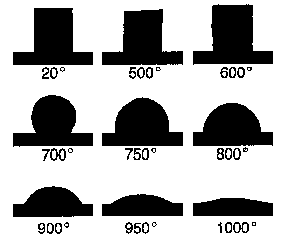
Figure 5.3.2.B. A cube of glaze is
gradually heated up to 1000°C. At 500°C the glaze shrinks slightly
(sintering), but at 600°C it swells as gases develop. Melting starts before
700°C and is completed at 1000°C. 5.3.3. MATERIALS WHICH
INCREASE/LOWER MELTING POINT
This chart shows the oxides according to their influence on
melting temperature:
OXIDES WHICH RAISE MELTING TEMPERATURE
Al2O3
High
SiO2
MgO
|
Cr2O3
|
SnO2
|
ZrO2
|
NiO
|
Fe2O3
|
TiO2
|
CaO
|
ZnO
|
BaO
|
FeO
|
CoO
|
CuO
|
MnO
|
PbO
|
B2O3
|
Na2O
|
K2O
¯
Li2O
Low
Note this scale is not linear and depends on firing temperature
and amount of oxide in the glaze
OXIDES WHICH LOWER MELTING
TEMPERATURE
5.4. Melted glaze behavior
Fluid state
The fluid state of the glaze should be maintained long enough to
allow all bubbles time to escape, so the glaze layer can heal over the holes
left by the escaping bubbles. If a glaze tends to produce pinholes and craters,
it can be given a soaking period (keeping the kiln at maturing temperature for
some time) or the firing temperature can be raised in order to make the glaze
more fluid (reduce viscosity).
If the glaze is too fluid, it will run off the pot or the fluid
glaze will soak into a porous body leaving matt, dry spots on the surface.
The following chart shows materials which increase or decrease
viscosity.
MATERIALS THAT INCREASE VISCOSITY
Al2O3
High
ZrO2
SiO2
|
Cr2O3
|
SnO2
|
NiO
|
Fe2O3
|
TiO2
|
CaO
|
MgO
|
ZnO
|
SrO
|
BaO
|
CoO
|
MnO
|
PbO
|
K2O
|
Na2O
|
B2O3
¯
Li2O
Low
Materials at top increase viscosity most. Note these materials
are mainly stabilizers and glass formers. (Scale is not linear.) Most materials
in this group are fluxes. Materials at bottom decrease viscosity most.
MATERIALS THAT DECREASE VISCOSITY 5.4.1. SURFACE TENSION
To understand surface tension, fill a glass with water to the
rim and look at the water surface. The middle of the water surface will be
higher than the rim, but the water will not run over. The surface tension of the
water holds it as if it were held by a plastic membrane.
A small amount of water forms a spherical drop. Larger amounts
of water flatten the spherical form because the force of gravity increases with
the weight of water. The fluid glaze behaves in a similar manner, and if the
surface tension of the fluid glaze is too high the glaze will pull itself into
small islands, leaving the clay body uncovered. This is called crawling.
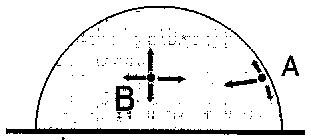
Figure 5.4.1.A. Surface tension is
created by the difference of forces acting on water in the center (B) and at the
surface (A). A water particle at B has forces of traction of the water around it
evenly distributed. But at A the force is mainly directed away from the surface.
This difference causes water to from itself ion spherical drops.
Increasing temperature lowers the surface tension as Fig.
5.3.2.B illustrates. At 800°C the glaze forms a half globe but at
1000°C it
has completely flattened out. Different ceramic oxides influence
the surface tension as listed in this chart:
MATERIALS THAT INCREASE SURFACE TENSION
MgO
High
Al2O3
ZrO2
|
ZnO
|
CaO
|
SnO2
|
Cr2O3
|
NiO
|
BaO
|
SrO
|
Fe2O3
|
SiO2
|
TiO2
|
Li2O
|
Na2O
|
K2O
|
B2O3
¯
PbO
Low
Note the scale is not linear and the sequence of oxides may
change due to other factors like viscosity, flue gas
MATERIALS THAT DECREASE SURFACE TENSION 5.4.2. CRAWLING
Crawling is caused by two factors:
- high surface tension of the glaze; - difficulty
for the glaze to stick to the body.
If the body surface is greasy or dusty the problem is
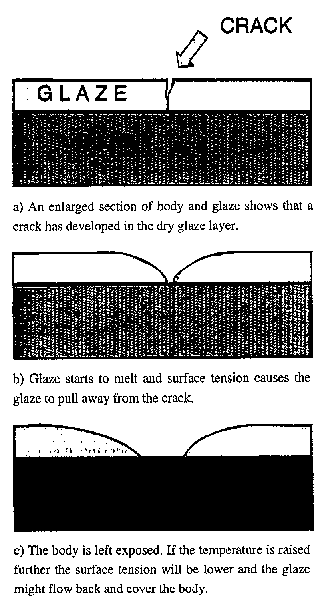
aggravated. Crawling may also happen if the glaze layer cracks before it is
sintered. This happens if the glaze contains a high amount of clay or has been
ground for too long in the ball mill. The surface tension will then pull the
glaze away from the cracks.
Figure 5.4.2.A. Crawling 5.4.3. CRATERS, PINHOLES
The lower the surface tension, the shinier the surface of the
glaze becomes and the easier it is for the glaze to heal over craters, bubbles
and pinholes.
Interesting effects can be obtained by applying glazes with
different surface tensions on top of each other (see page 80).
Surface tension, viscosity and melting temperature are
interrelated, so when replacing materials all three will be
affected.
5.5. Interface between glaze and body
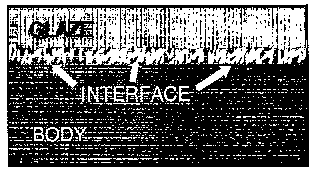
During firing the glaze interacts with the clay body. Some of
the glaze will sink into the body and some of the body material will mix with
the glaze so that an intermediate layer is formed between the body and the
glaze. This layer bonds the clay and glaze together. It is called the glaze/body
interface or "buffer" layer.
Figure 5.5.0.A. Interphase layer
created during firing by mixing of materials in the body and the glaze.
Effects of interface
Some of the coloring oxides in the body may enter the glaze and
change its colon The higher the firing temperature the stronger the interface
layer. The interface layer produces a strong bond between glaze and body that
reduces the tendency to craze or peel.
Glazing on greenware (raw glazing or green glazing or single
firing) promotes interaction between body and glaze. If too much of the glaze's
flux combines with the refractory materials in the body, the glaze may become
matt or
dry.
5.6. Cooling and crystal formation
Glaze or glass is called a supercooled liquid because, during
cooling, crystals have no time to form in the rather sticky mass, and glass by
definition does not contain crystals. But some matt glazes and opaque glazes
depend on the formation of crystals. For these, cooling should be slow to allow
the crystals to grow. ZnO, BaO and TiO2 are used for making matt glazes, but if
cooling is rapid the glaze will become glossy instead of matt.
To avoid crystal formation, glossy transparent glazes should be
cooled quickly after the maturing temperature has been
reached.
5.7. Transparency and opacity
Transparency is the property of allowing light to pass through
the glaze to-the clay below. Transparent glazes may be colorless or have color
in them - transparent blue, green, brown etc. It is necessary to use transparent
glazes in combination with underglaze decoration. Transparent glazes are always
shiny.
Opacity is the property of not allowing light to pass through
the glaze. Colorless opaque glazes usually look white or gray. When coloring
oxides are added, they can be any possible colors. They generally are used with
overglaze or on-glaze.
It is possible to make glazes with every degree of transparency
or opacity, such as semitransparent or semiopaque.
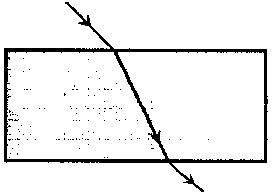
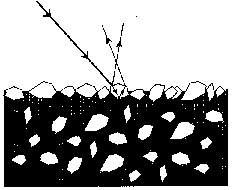
Figure 5.7.0.A. Section of a window
glass. A beam of light passes through it - it is transparent. The lights
dissection is slightly bent when passing from one medium (air) to another
(glass). This is called refraction. 5.7.1. REFRACTION OF LIGHT
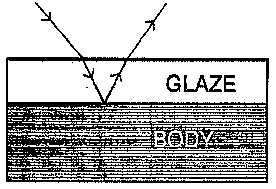
Transparency and opacity are determined by the glaze's ability
to transmit light. When light strikes a transparent glaze, most of it passes
through the glaze layer to the clay underneath, and the color we see is
determined by the color of the clay. Thus, a transparent glaze on a brown clay
body will look brown whereas the same glaze on a white clay body will look
white. If the transparent glaze is colored, the clay body color will be changed
by the fact that the glaze is green or blue, etc.
Figure 5.7.1.A. A transparent glaze
reflects the color of the underlying body.
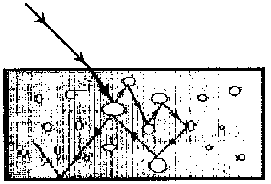
Opaque glazes have a large number of particles in them that
reflect light, without allowing it to pass through the glaze. So we are not able
to see through the glaze. Thus what we observe is only the surface of the glaze,
which is not affected by the color of the clay underneath.
Semitransparent glazes have smaller numbers of light-reflecting
particles, so they look cloudy or milky, and their color will be affected by the
clay color underneath.
Transparent glazes can be made opaque by the addition of
opacifiers, which are finely ground particles that do not enter into the melting
of the glaze. These particles stay suspended in the glaze and reflect light.
This is similar to mixing clay with water, which makes the water opaque.
Opaque glazes cannot be made transparent without changing their
formula (unless they are transparent glazes with opacifier added).
The causes of opacity in glazes can be divided into 4 groups:
1. Presence of very fine particles, which do not dissolve in the
glaze melt. The light going through the glaze is scattered by the fine
particles. Tin oxide (SnO2) and zircon (ZrSiO4) are used
for this.
Figure 5.7.1.B. Fine particles of
zircon or tin oxide in the glaze scatter the light and produce opacity.
2. Crystals formed in the glaze during cooling will scatter the
light, causing opacity. Titanium dioxide (TiO2) recrystallizes if the
cooling is slow and can make glazes opaque.
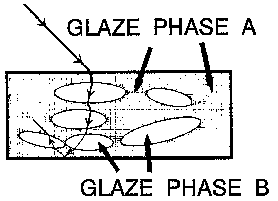
Figure 5.7.1.C. Two glaze phases, A
and B, in the melt cause opacity. Both glaze phases may be transparent but the
light gets lost passing from one phase to the other.
3. Opacity is also caused when two melting phases of the glaze
do not mix. The light will be scattered when it passes through the border
between the two different melts. This takes place in boron glazes and with
calcium phosphate (bone ash).
4. Gas bubbles scatter the light and produce opacity. This type
of opacity is difficult to control and the method is not recommended.
In practice, a combination of the four methods is used. For
example, an opaque glaze can be made with boron and additions of lime, zinc
oxide and zircon. 5.7.2.
MATERIALS CAUSING OPACITY
The best opacifier is tin oxide, which will make most glazes
opaque in additions of up to 7%. However, it is a very expensive material and
today is only used for special high-cost products.
Commercially available opacifiers are based on zirconium
silicate, prepared with other additions such as magnesia and zinc oxide. They
are marketed under names such as "zirconium opacifier", "zirconium silicate",
"zinc zirconium silicate" and "magnesium zirconium silicate". Most of these are
added to glazes from 5 to 10% and produce different results depending on the
type of base glaze. They also vary widely in quality, and it is important to
test them before ordering a large quantity. Zirconium opacifiers have the
disadvantage of making glazes more refractory and often cause pinholing
problems.
The main opacifiers are:
Tin oxide, SnO2 Zircon, zirconium silicate,
ZrSiO4 Titanium dioxide, TiO2 Alumina,
Al2O3 (high content in boron glazes will reduce
opacity) Calcium oxide, CaO (improves opacity in boron glazes) Zinc oxide,
ZnO Calcium phosphate, bone ash, Ca3(PO4)2.
Particle Size
The finer the particle size of the opacifier, the better it
works. Zircon is often included in the frit batch for greater opacity. In this
way opacity is obtained with less zircon, thus reducing some of zircon's bad
side effects like high viscosity and the tendency to cause pinholes.
Unfortunately the addition of zircon to the frit increases its melting point,
making it more difficult to run it off the frit kiln. It also increases the
hardness of the frit so much that it may be difficult to grind it with ordinary
pebbles and ball mill lining.
It is important to make sure that the opacifier is well
dispersed in the glaze. The fine particles tend to lump together. This reduces
the opacity effect. By ball milling the opacifier together with the glaze a good
dispersion is
assured.
5.8. Shiny or matt glaze
Glazes are also defined by the way they reflect light: they may
be shiny or matt or in between.
Shiny
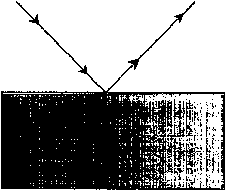
Shiny glazes are also known as "glossy" or "bright". They have
the property of reflecting light like a mirror. They are best for utilitarian
wares, sanitary ware and insulators, as they are easy to wash and do not scratch
easily.
Figure 5.8.0.A. A glossy glaze with a
smooth surface reflects the light without scattering it.
Matt
Matt glazes are also known as "dull" or "non-reflective". Their
surface can vary from smooth to very rough. They are useful for decorative wares
and are very popular for floor tiles, which need to be beautiful but not
slippery. The matt surface is not functional for dinnerware, because used with
cutlery it makes an unpleasant sound and scratches easily. 5.8.1. MATERIALS CAUSING
MATTNESS
There are several ways to produce a matt glaze:
Underfiring
As glaze begins to melt, it becomes glassy. If the firing is
stopped before the glaze is completely melted, even glossy glazes will appear
matt. Often these underfired glazes will have other problems such as blisters
and pinholes, but some glossy glazes make very good matt glazes if fired a few
cones below their normal temperature. Similarly, adding refractory oxides to a
glaze (such as china clay or calcium carbonate) will produce a matt glaze that
really is just an underfired glossy glaze.
Crystalline matt
Crystalline matt glazes develop small crystals which break up
light (Fig. 5.8.1.A). This type of matt glaze usually produces a more smooth
surface than underfired matt glazes. Some matt glazes depend on slow cooling to
have time for the crystals to develop.
Figure 5.8.1.A. Surface of crystal
matt glaze enlarged several hundred times. Crystals in the glaze scater the
light by sending it in many different directions.
Barium carbonate, zinc oxide, titanium dioxide, magnesium oxide
and calcium oxide are the agents for crystal matt glazes. For more details see
page 113. 5.8.2. OTHER CAUSES
Sometimes glazes that should be glossy will become matt. Some of
the reasons are:
- Some of the flux materials may evaporate during
firing, leaving a matt surface. - Sulfates from fuel may settle on the
surface of the glaze. - The glaze is applied too thin. - The glaze was not
mixed sufficiently or not sieved finely enough.
Glazes - for the Self-reliant Potter (GTZ, 1993, 179 p.)
6. Obtaining glaze materials
6.1. Materials suppliers
6.2. Materials from natural sources
6.3. Other sources of materials
6.4. Storing, packaging and labeling
Glazes - for the Self-reliant Potter (GTZ, 1993, 179 p.)
6. Obtaining glaze materials
6.1. Materials suppliers
In countries with large ceramics industries, there are suppliers
that specialize in collecting and distributing raw materials. These may be
mining companies that can supply specific items like clay and feldspar. If these
can be obtained directly, it saves the costs of middlemen. However, these
companies often deal only in large quantities. For the small producer, it is
often best to get supplies from reliable distributors. 6.1.1. LOCAL SUPPLIERS OF
CHEMICALS
General chemical suppliers or pharmacies often have many of the
necessary ingredients for glazes (which are often used in other industries).
They are useful for obtaining small amounts of chemicals, but often their prices
are high. 6.1.2.
SUPPLIERS OF OTHER INDUSTRIES
Glaze materials are often available from other types of
suppliers. For example, agricultural suppliers can provide calcined limestone.
Paint industries use materials such as iron oxide and opacifiers. 6.1.3. IMPORTED MATERIALS
Imported materials should only be considered if there are no
local sources, as they are expensive and often customs and import regulations
make it difficult or impossible for the small producer to obtain them. On the
other hand, it is often worth paying the additional price, if it makes possible
production of special glazes or decoration effects that are in demand in the
market.
In Thailand, for example, where there is a large export market
for decorative ceramics, many producers import clay, glazes and overglazes from
Japan. Their profit comes from cheap labor and high value
added.
6.2. Materials from natural sources
Small producers can mine their own materials if these are
available in the area. Historically, pottery centers located themselves where
the necessary clay and glaze materials were available. Where stoneware clay and
high temperatures are used, it is possible to make glazes from low-temperature
clay alone. Generally, stoneware glazes are made from the basic ingredients of
feldspar, quartz, limestone and clay, which are quite common. Wood ash is
another common base for high temperature glazes. The process of mining,
selecting and grinding is quite time-consuming, and with the advent of modern
transportation it is often cheaper to purchase materials from suppliers.
In Nepal, we developed low-temperature glazes based on borax,
which must be imported. The bulk of the glaze is composed of local materials
such as rice husk ash (for silica), limestone and local clay, which are all easy
to get and cheap. 6.2.1. CRYSTAL
ROCKS
Igneous rocks
When the young earth slowly started to cool, different minerals
formed crystals in the mass of molten rocks (magma). A variety of crystalline
rocks were formed differing in composition according to their locality. For
example, the igneous rock called basalt was created at a great depth and
contains little feldspar compared to granite, which formed near the surface.
If rock cools very slowly, crystals have time to grow large,
whereas rapid cooling produces small crystals. This process is still going on
today where movement in the crust of the earth causes deep layers of molten
materials to rise to the surface. An erupting volcano lets out hot magma, which
cools quickly. The resulting volcanic rocks have microscopic-size crystals,
since the rapid cooling allows little time for crystals to grow.
The most common crystal rocks used in glazes are feldspar and
quartz. If a piece of granite is picked up and broken in two, the fresh faces of
the stone will show a shiny surface and the crystals of the different minerals
can be identified. The black crystals are mica or tourmaline. The yellow, white
or red colored crystals with a pearly shine are different types of feldspar. The
clear colorless crystals are quartz. The weathered surface of the granite will
most probably show a rough surface with many holes, where the soluble feldspar
crystals have been washed away by rain, whereas the less soluble crystals of
mica and quartz remain. Coarse granite (known as pegmatite) often breaks up in
weathering, leaving large pieces of quartz and feldspar lying on the ground.
These can be collected, ground and used in glazes.
Volcanic rocks
These are rocks formed by the action of volcanoes, often in the
form of molten lava that flows out of the volcano. The crystals in the rock are
extremely small because the lava cooled very fast. Lava is essentially a glaze
and can be used as the basis of high temperature glazes. 6.2.2. SEDIMENTARY ROCKS
Sedimentary rocks are made of materials produced by the
crumbling of old rocks. All rocks eventually break up in the course of time when
exposed to weather, and the broken-up rock particles are carried away by water.
These particles of clay and sand are transported to lower lying areas or to the
sea where they settle one layer upon the other. In the span of millions of
years, the growing weight of sediments causes the deeper layers to compact and
gradually turn into rocks, called sedimentary rocks. Much later, the movement of
landmasses sometimes turns the whole area upside down, so that the old sea
floor, with its sedimentary rocks, becomes a new range of mountains.
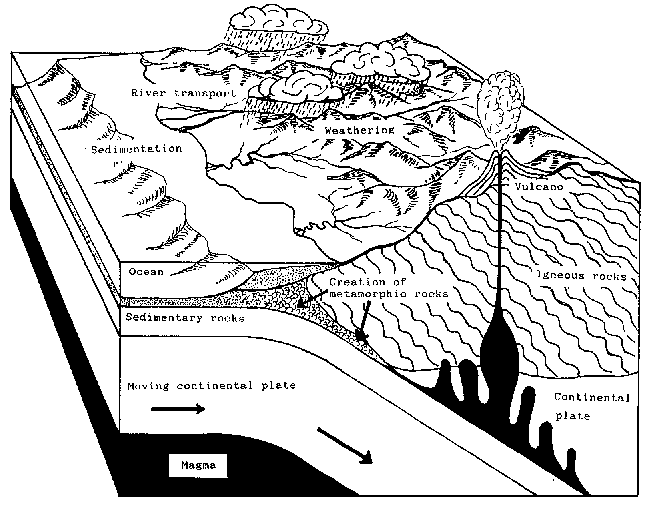
Figure 6.2.1.B. A coutout of a
section of the crust of the earth shows a continental plate moving under
another. The friction of the plates generates heat, which melts rocks and feeds
a volcano. Rain falls and old rocks are weathered and washed to the sea creating
new layers of sediments. Later the sediments are compressed into rocks.
The upper part of new mountains consists of sedimentary rocks
resting on deeply set igneous rocks. Sedimentary rocks like sandstone, shale and
slate can often be recognized by their layered structure. Limestone is a
sedimentary rock created by the skeletons of billions of small animals that
lived in the ancient seas. Gypsum is formed by chemical sedimentation in areas
where seawater evaporates on a large scale. This produces a high concentration
of gypsum which forms crystals like the formation of salt crystals in a glass of
salty water.
For the glazemaker, sedimentary shale can be a source of glaze.
At high temperatures, shale melts and with a few additions will produce glazes
that are usually brown. Although shale often does not slake in water, it can be
ground in a pan mill and used in glaze. 6.2.3. METAMORPHIC ROCKS
Igneous and sedimentary rocks are sometimes changed into new
forms by high temperature and pressure. Marble is an example of a metamorphic
rock formed from the sedimentary rock limestone. 6.2.4. HOW TO GET INFORMATION
Local authorities
First of all, information about the geology and the minerals of
the region should be gathered from local authorities, like industrial
development organizations, agricultural institutions, National Geological
Institutes or mining corporations. They may have little information and the
authorities may even say that no materials are available in the region. However,
that is often not true and should not keep anybody from looking on his own.
Practical people
It is worth talking to people who make water wells, and builders
of dams and roads. They sometimes have useful information about the minerals of
the region. Farmers in the area will know about the upper layers of soil on
their fields and about local rocks. Sometimes glaze minerals are used for other
purposes, like whitewashing houses or medicine.
The best source of information is often other potters. 6.2.5. LOOKING FOR MINERALS
Good places to look for minerals are in riverbeds, where many
different types of rocks will wash down from the mountains above. Although most
of these may not be useful, it is often possible to find quartz and feldspar.
Any rock with an unusual color is worth testing. Rocks that are unusually heavy
may contain metallic oxides. For the potter, however, there are few rocks that
are directly useful, other than quartz, feldspar and limestone, and some of the
volcanic rocks.
Other minerals that are useful in glazes are sodium and
potassium compounds, which sometimes form on the edge of lakes, particularly in
desert areas. These usually look like a white powder and are soluble in
water. 6.2.6. TESTING
To begin with, the most useful test is to take a small sample of
the material, place it in a clay bowl and fire it in a regular glaze firing.
This will indicate if it melts or not. If it melts, it certainly can be used in
a glaze. Materials that do not melt should not be automatically rejected, as
many useful glaze materials (such as calcium carbonate and quartz) only melt
when combined with other materials. The simplest way to find out if they are of
use is to make a line blend of one of your standard glazes, combined with the
unknown material.
Rock minerals can be identified by their crystal shape, color,
specific gravity and hardness. If you are seriously looking for rock minerals
there are good books presenting most common minerals with color photos.
Hardness
Mohs' scale of hardness is based on the hardness of 10 different
minerals:
1
Talc
2
Gypsum
3
Calcite
4
Fluorspar
5
Apatite
6
Orthoclase feldspar
7
Quartz
8
Topaz
9
Corundum (pure alumina)
10
Diamond
Window glass and a penknife are about 5.5 and a metal file about
6.5.
Two materials have the same hardness if they cannot scratch each
other. Quartz can scratch feldspar but not topaz. In the field a piece of glass
and a penknife are used to find out if the hardness of a rock is higher or lower
than 5.5.
Chemical analysis If a testing laboratory is available,
samples can be sent there for chemical analysis. This is usually expensive but
may be helpful if the material looks useful after
firing.
6.3. Other sources of materials
Recycled materials are often useful in glazes. These may be
by-products from other industries, such as rice husk ash or bone meal, or waste
materials. Some other sources of useful materials are discussed below. 6.3.1. METALLIC OXIDES
Metallic oxides are used as coloring agents in glazes. Commonly
available are:
Iron oxide, which can be obtained by scraping rust from old
steel. It is often possible to get this from paint and hardware suppliers, who
use "red oxide" for coloring paint and cement.
Manganese dioxide, which is the main ingredient in torch
batteries (the black substance which can be removed from old batteries).
Copper oxide, which can be collected from makers of copper pots.
The oxide is the black powder that forms on the surface of copper when it is
heated. Another way is to fire copper wire in the kiln and to use the resulting
black copper oxide. 6.3.2. ASHES
Wood ashes are used as the basis for high temperature glazes,
since they contain sodium, potassium, silica and other ingredients. Early glazes
were often simple mixtures of wood ash and clay. Most wood ash is suitable for
this purpose, but each type of wood will produce different characteristics and
will have a different melting point. So it is important to have a consistent
supply. Ash must be sieved to remove unburned material and is usually washed in
water and dried before use. If it is not washed it contains more fluxes but they
are soluble and make the glaze slip caustic.
At cone 8 to 11, a good starting point is 2 parts ash, 2 parts
feldspar and 1 part clay. Ash glazes have the following general limits:
Ash
20-70%
Feldspar
20-70%
Whiting
5-20%
Flint
15-25%
Clay
5-20%
Rice husk ash contains more than 90% silica, so it can be used
instead of quartz in many cases. For accuracy, it should be burned white - if
there is much black carbon in it, it will make calculations incorrect. In the
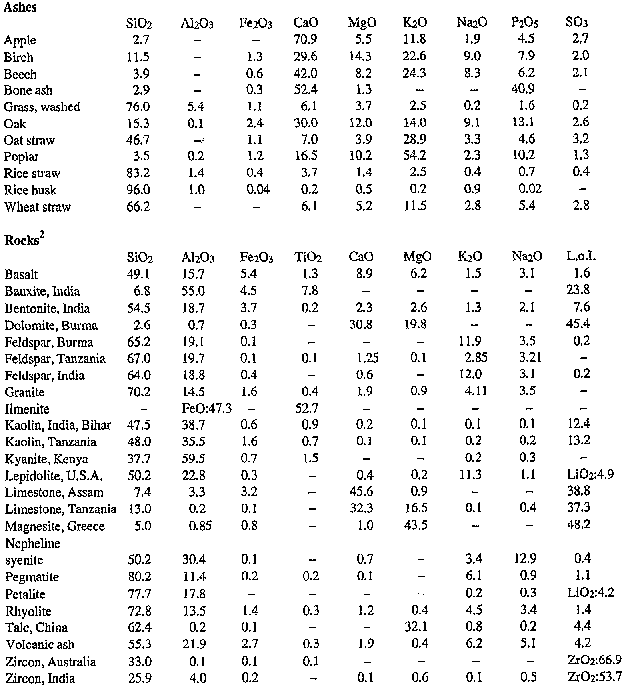
Appendix the chemical composition of different ashes is
given.
6.4. Storing, packaging and labeling
If you use local materials, they will change from time to time.
For this reason, it is best to store as much material as possible and to check
each new batch by trying it in a standard glaze. For example, feldspar tends to
be variable and, as the mine is used, the chemical composition will change.
Suppliers of feldspar usually keep several large storage areas of material from
different parts of the mine. In order to keep it uniform, they mix the different
feldspars together when supplying.
Some materials are damaged by water. Borax, boric acid, soda ash
and plaster of parts should all be kept in a dry place. In particular, soda ash
absorbs water (up to 7% after one year, 11% after two years) and will thereafter
no longer be effective as a slip deflocculant; and plaster will not set
correctly after damp storage.
When you get local materials, each batch should be kept
separately and labeled with date and source. It is often a good idea to purchase
more material when your old supply is about 50% finished and to test it to see
if it is the same or not. If it is not greatly different, the new material can
be mixed with the old and your glaze will not change unexpectedly.
A good labeling system is very important, as most glaze
chemicals look rather alike. Never depend on your memory - keep a permanent
label on the bag or jar of material. Additionally, if you order bags of material
from a supplier, ask him to label the outside of the bag, and also to put a
label inside the bag as labels are often lost in
shipping.
Glazes - for the Self-reliant Potter (GTZ, 1993, 179 p.)
7. Frits and fritmaking
(introduction...)
7.1. Why make frits?
7.2. Frit production
7.3. Frit kilns
Glazes - for the Self-reliant Potter (GTZ, 1993, 179 p.)
7. Frits and fritmaking
Most low-temperature glazes require fluxes that are either
poisonous (lead) or water-soluble (sodium and potassium). Traditionally, these
materials were used raw, but this is not satisfactory for modern potters. Raw
lead is poisonous and sodium/potassium are water-soluble. Borax is sometimes
used raw in glazes, but these glazes cannot be stored for a long time, as the
borax will go into solution or form crystals.
The principle of fritmaking is very simple: molecules of
poisonous or soluble fluxes should be chemically combined with glass-making
materials to eliminate these undesirable characteristics.
A frit is a combination of a flux or several fluxes (lead,
borax, boric acid, potassium carbonate) that is combined with other insoluble
materials (quartz, feldspar, lime etc.), melted in a kiln to form an insoluble
glass, and ground to be used as the base for making glazes. (Many low
temperature glazes are simply 90% frit and 10% china clay).
Fritmaking is not usually practical for the small producer, as
it takes time and requires a special kiln and a ball mill for grinding. On the
other hand, if reliable frits are not commercially available, the potter may
have to produce his own. Frit glazes are more expensive than raw glazes, but
their convenience usually makes up for the additional cost.
There are many different commercially available frits, all
designed for different temperatures, surface qualities, coefficients of
expansion, and color responses. The potter trying to decide which frit to use
must depend on the supplier, as formulas are usually kept secret. Suppliers will
give advice on which frit is best for the potter's purpose. There are two main
types of frit:
Lead frits
These are all designed to provide lead in a nontoxic form. Lead
oxide is combined with other materials to give desired properties of surface,
opacity, and color response. The standard lead frit is called lead bisilicate
and is simply a combination of lead oxide and silica, which combines the lead in
an insoluble form. This can be used as the base for a large variety of lead
glazes.
Other frits used commonly in the tableware industry are called
lead-borosilicate frits, which combine the desirable properties of both lead and
boron and are generally safer to use.
WARNING! Lead frits can still be poisonous, and glazes made from
them can be poisonous if they are not combined with sufficient silica to combine
with all the lead molecules.
Leadless frits These are based on boron compounds, again
combined with other materials. Because glazes compounded with lead are difficult
to control for lead release, leadless frits are recommended for small
producers.
7.1. Why make frits?
Frit making is only suggested if reliable commercial sources are
not available. Often frit manufacturers are not interested in supplying small
amounts. Dishonest frit manufacturers sometimes sell bad batches of frit to
small producers. Even though frit making is complicated, the small producer who
makes his own frits at least has the process under his own control.
Raw borax glazes can be used, but they must be used immediately
after mixing or problems will result from the soluble borax. This may be
satisfactory for art pottery but, if consistent results are needed, it is better
to use fritted glazes.
Similarly, raw lead glazes are widely used. This is a danger for
the workers, who will eventually develop lead poisoning unless they take extreme
care in handling the glaze. Modern industries never use raw lead glazes, and
industrialized countries all have severe restrictions on the use of lead in
glazes. In developing countries, workers in industry suffer from lead poisoning,
and it is the responsibility of the industrialist alone to take care of the
workers' health. As lead poisoning takes several years to develop, many factory
owners do not understand the seriousness of the problem and continue to harm
their workers. IT CAN TAKE UP TO 20 YEARS TO DEVELOP SYMPTOMS OF LEAD
POISONING!
7.2. Frit production
Frit composition
All the soluble materials are included in the frit batch along
with silica, in order to form a glass when fired in the frit kiln. Other ma"
serials may be included for modifying the frit or helping to melt it.
The main frit raw materials are:
Silica sand, SiO2 Rice husk ash, almost 95%
SiO2 Borax, or sodium borate,
Na2B4O7 10H2O Boric acid,
H3BO3 Limestone, CaCO3 Feldspar, soda
and/or potash, K2O &
Na2O Al2O3 6SiO2 Clay,
Al2O3 2SiO2 Zinc oxide,
ZnO Zircon,ZrSiO4 (opacifier) Red lead oxide,
Pb3O4 Other materials like talc, barium carbonate and
bone ash may be added.
In order to have a frit with low viscosity that easily runs out
of the kiln, the clay or alumina of the glaze is not added to the frit. However,
in order to make the ingredients insoluble, 2-3% kaolin should be included in
the frit.
Work flow
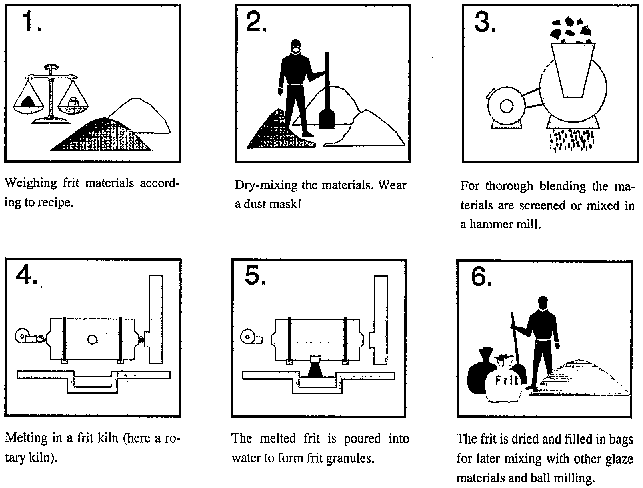
The work flow for frit production is shown in Fig. 7.2.0.A. It
is better economy to prepare large frit batches when firing a continuous-type
frit kiln.
Figure 7.2.0.A. Work flow of frit
production.
Prepare materials
All materials for frit need to be clean, dry and ground to pass
through a 60-100-mesh sieve. The finer the material, the easier it will be to
melt it. If rice husk ash is used as the source of silica, it should be
well-burned to a white color, so that unnecessary carbon is not introduced. If
there is a large amount of black carbon, this will decrease the amount of silica
available. The content of carbon in rice husk ash may vary more than 30% from
batch to batch. If materials are wet, they should be dried completely so that
the weight of water is not included in the recipe. In frit calculations, the
loss on ignition (see page 146) needs to be included to account for loss of
material during firing.
Blend materials
Weigh the materials accurately and blend them together dry. WEAR
A DUST MASK! Small amounts can be mixed by hand in a bucket, and larger amounts
can be mixed with a shovel on a clean cement floor. After mixing the frit
materials they are screened through a 16-mesh sieve (mosquito net) to ensure
thorough blending or the materials are run through a hammer mill.
Melt the frit in a kiln
There are many different systems for melting frit, which are
described below in section 7.2. In each system, the principle is to thoroughly
melt the frit until all ingredient! are combined. Most frit is melted at
1150°C to 1250°C.
Check the frit
A sample of molten frit should be taken and examined to see if
the melt is complete The frit should be uniform, without particle! of unmelted
material.
With continuous frit kilns, the rate of feeding raw frit and the
speed of the melted frit must be adjusted so that all the material melts
completely and has time to mix' properly.
Quench the frit in cold water
The molten frit is poured into cold water, which "shatters" it
into small pieces that can easily be ground. With continuous melting and
discharging it is necessary to let fresh cold water run continuously.
Grind the frit
If the frit is quenched correctly, it will be easy to put it
directly into a ball mill and grind it until it can be passed through a 100-mesh
sieve. The granulated frit may be first dried and then stored in bags until it
is needed for glaze making. Then it is ball-milled together with clay and other
glaze materials. Alternatively, the still wet frit is ball-milled first.
Sieve the wet frit
When the frit is removed from the ball mill, it should be sieved
through 100 mesh to remove any large particles that were not ground.
Dry the frit
The wet frit is settled, excess water is poured off, and the
remaining frit can be spread out to dry, either in the sun or in a dryer.
Test the frit
Each batch of frit should be tested for correctness. The
simplest way is to fire it in a kiln on a specially made flow tester, along with
a sample of correct frit (page 131). If the frit flows evenly to the control
sample, it will probably be correct but should be double-checked by trying it in
a standard glaze.
Additionally, the frit should be tested for solubility in water.
A sample amount is boiled in water for several hours, then allowed to sit for 2
weeks. If crystals do not form during this time, the frit can be considered
stable. If crystals form, it means that there is not enough silica/alumina in
the frit and the composition will need to be changed (frit calculations page
144). The causes of crystal formation could also be with the frit firing, e.g.
overcharging, too short a firing time and improper mixing.
The finished tested frit may be sold to other ceramics producers
either as a milled powder or in granular
form.
7.3. Frit kilns
There are many different kinds of frit kilns, which are selected
according to the amount of frit that needs to be regularly produced.
Normally, each type of frit -transparent, opaque, lead -
requires a separate kiln to prevent contamination. When one kiln is used for
several frits, it must be cleaned out before each different batch by melting
frit in it to remove most of the old batch. This contaminated frit is then kept
separately, to be used as "clean-out" frit before changing to different
compositions. 7.3.1. CRUCIBLE
FRITTING
Small amounts of frit for testing are easily made in a fireclay
crucible. The crucible with frit is fired together in a glaze firing, which will
melt the frit into a solid block of glass. After firing, the crucible is broken
away from the frit and the frit can be crushed and ground. It is a good idea to
first paint the inside of the crucible with china clay slip, as this will make
it easier to separate the frit. NOTE: Frits containing boric acid often cannot
be melted successfully this way, as the boric acid melts at a very low
temperature and flows to the bottom before the rest of the ingredients melt.
Frits with rice husk ash may also be difficult to melt in this way, because the
upper layer of the frit melts first sealing off the frit mixture so that the
carbon remaining in the ash cannot burn out. Carbon is highly refractory and it
will prevent the frit from melting.
This is only suitable for test production and is not a safe
method, since the pot often cracks, resulting in frit running out, destroying
other ware, kiln furniture and the kiln lining.
CAUTION: Borax frits boil during melting with a great increase
in volume. The crucible should be filled only half with frit, and a tile placed
over the top to prevent boiling over. 7.3.2. CRUCIBLE KILN
For fritting small amounts of frit a simple frit kiln is shown
in Fig. 7.3.2.A. It can be fitted with several crucibles arranged in a row for
melting different frits at the same time. The crucibles can be loaded with raw
frit from the top. The fuel economy of this type of kiln is less than for the
other kilns.
Figure 7.3.2.A. Coal-fired frit kiln
with three crucibles. 7.3.3.
OPEN HEARTH KILNS
Open hearth kilns consist of a tank made of firebricks, which is
set in a crossdraft kiln. The kiln may be fired by coal, firewood, oil or gas.
The hot flue gases heat the arch over the frit. The arch in turn heats the frit.
In batch-type frit kilns, the frit melt is checked by drawing out some melted
frit with an iron rod for inspection.
After the frit is completely melted, a hole at the bottom of the
tank is opened and the frit flows out into cold water. Then another batch of
frit may be charged from an opening in the arch.
Figure 7.3.3.A. Open-hearth frit kiln
for coal firing.
The melting of several tonnes of frit may take 6-12 hours
consuming 1-1.5 tonne coal per 1 tonne melted frit. 7.3.4. CONTINUOUS FLOW
The continuous-flow frit kiln uses a kiln with a sloping floor,
made of fireclay refractories. The raw frit is introduced at the upper end and,
as it melts, it flows down while mixing to an exit chute by the burner and then
into cold water. The kiln shown in Fig. 7.3.4.B was developed in Nepal. It uses
a steam/kerosene burner, but any forced draft oil or gas burner can be used.
Figure 7.3.4.B. DSide elevation of a
continuous flow kiln.
The rate of flow is controlled by introducing limited amounts of
raw frit. Too much frit at one time may result in incomplete melting. If the
frit runs very fast through the kiln, the low melting materials will not melt
properly together with the silica. This may be a cause of water-soluble frit.
The frit can be slowed down in the kiln by making less of a
slope and by putting some obstacles in the way (like kiln shelf supports). 7.3.5. ROTARY
Rotary frit kilns are large refractory-lined cylinders, which
have a burner (gas or oil) that passes through them. The raw frit is introduced,
and the kiln rotates full turns (or back and forth) as the frit melts. This has
the double purpose of ensuring good mixing and of transferring the heat of the
firebrick lining to the frit as this constantly moves over it. When the frit is
completely melted, the kiln is turned so that the frit flows out through an
opening into cold water.
Figure 7.3.5.A. Front and side
elevation of a rotary frit kiln. It consists of a firebrick-lined steel drum
resting on rolers. It is gas-or oil-fired. 7.3.6. FUEL ECONOMY
If much frit is to be produced, fuel economy is an important
factor. In general, the more frit that can be made at one time, the lower will
be the fuel cost. In a continuous frit kiln, it takes several hours to heat the
kiln sufficiently to melt the frit at maximum speed -this preheating period
consumes a lot of fuel. It is best to fire several hundred kg of frit at the
same time to reduce firing costs.
Frit industries generally use rotary kilns, as they are the most
economical for long, continuous use. However, the continuous kiln developed in
Nepal by the Ceramics Promotion Project compares favorably with standard
fuel/frit ratios obtained with rotary furnaces.
Examples of fuel to melted frit ratios are:
Frit kiln type
Batch amount
Fritting time
kcal/kg melted frit
Open hearth coal
1 - 2 tones
6 - 12 hours
7500 - 11250
Nepal, continuous flow
1.5 - 2 tones
48 hours
5150
Rotary, India
300 kg
2 hours
5700
Glazes - for the Self-reliant Potter (GTZ, 1993, 179 p.)
8. Preparation of glazes
(introduction...)
8.1. Raw materials requirements
8.2. Grinding glaze materials
8.3. Weighing, mixing, using batch cards
8.4. Sieving
8.5. Suspending and binding agents
8.6. Density specific gravity
8.7. Old glazes, problems
8.8. Test your glazes!
8.9. Commercial production of glazes
Glazes - for the Self-reliant Potter (GTZ, 1993, 179 p.)
8. Preparation of glazes
Glazes should be prepared in a systematic manner in order to
prevent mistakes. Most problems with glazes come from simple things, like
incorrect weighing, mistakes in identifying raw materials or not sieving the
glaze correctly.
Glaze mistakes are expensive, as they can result in the loss of
an entire kilnload. For this reason, it is important to have the right person in
charge of making glazes -cleanliness, orderliness, careful record-keeping, and
reliability are required.
Most small producers do not need a large variety of glazes -in
fact, many use only one or two standard glazes and achieve variety by changing
the colors, doubleglazing or using engobe decoration.
Designing a glaze is somewhat like choosing a paint in the paint
store. First of all, you must decide if you want a glossy or matt surface,
transparent or opaque. Then you can add different colors.
Base glaze
The base glaze is simply the combination of materials that melts
at the desired temperature. It is either transparent or opaque, matt, semimatt,
glossy etc. without any particular colon
Glaze additions
These are usually coloring oxides that are added to the glaze.
In Nepal a glaze supplying system serving small producers was established. A
base glaze was supplied in 5kg bags and 8 different colors were supplied in
small bags that produced standard colors when added to 5 kg base glaze. The
small bags contain coloring oxides mixed with a small amount of base glaze so
the colors disperse more easily in the base
glaze.
8.1. Raw materials requirements
Raw materials need to be as reliable as possible and always
ground to the same mesh. If obtained from a glaze supplier, the materials are
usually ground to at least 100 mesh. Because materials that are finely ground
melt more easily, some ingredients may be as fine as 400 mesh. This is
particularly true of quartz -200-mesh quartz will produce a different result
than 400-mesh quartz.
When you get new raw materials, they always should be tested
before using them in production. The best way is to try them in a standard glaze
that you know well and to compare the results with the known
glaze.
8.2. Grinding glaze materials
8.2.1. COARSE MATERIALS
There are several steps in grinding glaze materials. Since many
of them (feldspar, quartz, limestone) come as rocks, they first need to be
reduced to pebble size. Feldspar and quartz rocks are first calcined to make
them soft enough to crush. Calcining means firing to just above 600°C. This
can be done in the cold spots of a biscuit firing or for large productions in a
special kiln. Crushing of small amounts can be done with a hammer (use eye
protection), and large amounts are usually done in a jaw crusher. 8.2.2. BALL MILLING
Ball mill operation
Ball mills are used for fine grinding of ceramic materials. The
material has to be reduced to sand size (2 mm or less) before grinding in a ball
mill.
Some typical uses of ball mills are:
- grinding clay that does not easily slake -
preparation of casting slips - grinding of body additions like feldspar,
quartz and glass powder - grinding of frit granules grinding of glazes -
grinding of engobes and terra sigillata - preparing color pigments for glaze,
engobes or bodies.
There are two main types of mills:
- Large mills with an axle system are called ball
mills. - Small mills are called pot mills or jar mills.
These are usually small (up to 5 lifer) porcelain jars or
plastic jars, which rotate on two rubber-covered rollers.
Conical ball mill
For large production conical ball mills are used. Various sizes
of pebbles are used and the material is fed from one end and discharged at the
other. Variation of the centrifugal force caused by a conical 30° slope at
the discharge side classifies both pebbles and material so only fine material is
discharged.
Vibro energy mill
This is a new type of grinding machine consisting of cylindric
grinding chamber suspended on springs and vibrated at high frequency with the
help of an excentric mounted on an electric motor. The chamber is completely
packed with very hard small cylinders between which the material is filled. The
vibrations make the small cylinders grind against each other and the material to
be ground. The vibrating mill is better at ultrafine grinding and is more
energy-efficient than ball mills.
Lining
The grinding action takes place between the pebbles, and not
between the pebbles and lining. Therefore a ball mill with a steel drum can work
without a lining (except for white body, where rust particles will cause
discoloration). Pebbles constantly falling on a steel drum make a lot of noise.
A lining will reduce the noise and at the same time prolong the life of the
steel. Traditionally, linings are made of porcelain or stoneware bricks set in a
cement mortar, using high alumina cement and coarse silica sand. Common cement
can be used if necessary but may cause pinhole problems in glazes. The bricks
should be dense and vitreous. A porcelain body for lining bricks and pebbles
(fire to 1250°C or higher) is:
China clay
40%
Quartz
25%
Feldspar
30%
Bond clay
5%
One type of brick is made concave to fit the curve of the drum
and another type is made for the end walls of the drum.
Linings can be made from granite, quartzite or similar hard
rocks (not limestone or marble). They are cut to shape and set in a high alumina
cement mortar. They last far longer than porcelain bricks. Stoneware bricks can
be used for the end walls, which are worn out more slowly.
Instead of a hard lining, thick rubber sheet glued to the inside
makes a very long-lasting and quiet lining.
Pebbles
Pebbles or balls can be made from vitreous clay bodies. However,
it is often cheaper to collect stones of granite, quartz or quartzite along
riverbeds. Flint, a variety of quartz, is excellent for pebbles. The hardness is
tested with a penknife to make sure it is above 5.5 (see Mohs' scale). Pebbles
of limestone are not satisfactory, as they contaminate the glaze. The shape
should not be flat or elongated but spherical. (Cylinders of equal diameter and
length are sometimes used to obtain particles with less variation in particle
size.) Size should be between 2.5 and 5 cm in diameter.
Pebbles wear out, so occasionally take out all the pebbles for
inspection. Those that are broken or flat should be discarded. In large mills,
pebbles are removed when they are less than 2-3 cm. In small mills pebbles
smaller than 1.5-2 cm are discarded.
Figure 8.2.2.E. A cross section of a
ball mill running at speeds from 30-90% of critical speed. At 30% the grinding
takes place mainly between pebbles and lining, at 70% a good cascading rolling
produces efficient grinding, and at 90% very little grinding takes place.
As the pebbles grind down, they contribute a small amount of
material to the glaze. Usually this is not enough to make a difference in the
glaze. However, if you have glaze problems that cannot be traced to any other
cause, the ball mill pebbles should be checked.
Ball mill speed
Grinding of material takes place between the pebbles of the ball
mill as they roll down the slope of the cylinder. If the speed is too high, the
grinding action stops because centrifugal force stops the pebbles from falling.
This happens when the cylinder is running at its critical speed.
Critical speed is calculated from the inside diameter of the cylinder:
(r = internal radius in meters)
The actual speed of the ball mill should be 60 -80 % of critical
speed. Small ball mills can be closer to 80 % and large ones closer to 60 %
Appropriate speed can be read from Fig. 8.2.2.F.
The most efficient grinding is achieved when the pebbles roll as
shown in the center ball mill of Fig. 8.2.2.E. The pebbles cascade in a steady
stream, and grinding takes place between the pebbles. The speed of the ball mill
at 80% is too high. The pebbles have started to fall freely and this causes
excessive wear as the pebbles hit one another and the lining.
Unfortunately it is not possible to look inside during milling,
but if the pebbles make a low, rumbling sound the speed is correct. If they make
a loud banging noise, the speed is too high or there is too much water, charge
or pebbles in the mill. Porcelain jar mills crack if they run at too high a
speed.
Figure 8.2.2.F. Graph of ball mill
speeds.
Charge
With a speed of 60 -80% of critical speed the charge should
be: (by volume)
Pebbles:
45 -55 %
Water:
12 -20 %
Material:
20 -25 %
When the mill is filled to maximum capacity, the speed should be
closer to 60% of critical speed. The water content should be enough to produce a
thin slip. After filling, about 30 % of the volume should remain empty. If you
measure all the materials separately, total volume may seem to be 85% of ball
mill capacity. However, since the water and material fill the spaces between the
balls, this will still result in 30% empty space.
Example
A ball mill with new lining measures inside:
width 0.64 m, diameter 0.445 m
60%-80% of critical speed = 31.7 rpm -42.3 rpm
Charge: (by volume)
Pebbles
144-176 l.
Water
38-64 l.
Material
64-80 l.
A typical glaze has a density (specific gravity) of
approximately 2.7. That means that the glaze charge should be 24-30 kg.
Ball milling time
The time for ball milling varies with the hardness of materials.
Soft materials such as frits may require only 2-3 hours, whereas hard materials
like quartz can take 24 hours or more.
When you ball-mill standard materials, it is important to mill
each batch for the same amount of time. For this reason, it is a wise investment
to purchase a timer switch for the mill. This will avoid human errors. Too much
ball milling can cause glaze crawling.
Operating procedure
Before each operation:
1) Check that the ball mill is clean inside. 2)
Check that pebbles fill half of the ball mill -refill if necessary. 3) Fill
in materials (20-25% of mill volume). 4) Fill water until pebbles and
material are just covered. 5) Be very careful about correct ball milling
time. If possible, use an automatic timer.
After operation:
6) After emptying the ball mill, clean it thoroughly
with water by filling it and running it with the pebbles. If the same material
is to be ground, cleaning is not needed.
Every month:
7) Empty the pebbles out and remove all pebbles that
are too flat or less than 2 cm in diameter. 8) Inspect the inside lining for
signs of wear, and repair as
necessary.
8.3. Weighing, mixing, using batch cards
Weighing glaze ingredients
First, you must have an accurate scale. This can be a small
balance, such as is used by jewelers, or a triple beam balance, which is faster
to use. Spring scales are not accurate enough, nor are postal scales. For large
quantities, the most accurate low-cost balance is the common beam balance which
uses standard weights.
Batch cards
For best results, a batch card system should be used. These are
simply cards that have the glaze recipe written on them. As each ingredient is
weighed, it is checked off on the list. When all materials are weighed, the
batch card is given a number (usually the date). The same number is written on
the glaze container. This makes it easier to find out the problem when the glaze
does not work correctly.
Figure 8.3.0.B. Example of a glaze
batch card used for quality control.
Water
The ingredients are then added to a container which already has
the approximate amount of water in it. CAUTION: The water must always be clean.
After mixing, the water is adjusted. It is always best to start with less water
than required. If the glaze is too fluid, it is difficult to remove excess
water.
Containers
Containers for glaze should be plastic or wooden. Metal
containers cause contamination and rapid settling of
glazes.
8.4. Sieving
Glazes are normally sieved through a 100mesh screen. The glaze
should be poured through without forcing it. Never use your hand to force glaze
through a sieve, as this will quickly break down the wire mesh. A brush should
be used
instead.
8.5. Suspending and binding agents
Because glazes are mixtures and not solutions, they tend to
settle at the bottom of the container. Normally, the clay content of the glaze
will be sufficient to keep them in suspension during application. However, some
glazes tend to settle as a cement-like layer on the bottom and are difficult to
stir. These glazes require the addition of a suspending agent.
Suspending agent
The most common suspending agent is bentonite, in 1-2%
additions. This will normally not be enough to affect the glaze when fired. Dry
bentonite cannot be added to wet glaze, as it will just form lumps and be
impossible to mix in thoroughly. Instead it should either be mixed separately
with water into a thin slip and then added to the glaze or it should be added to
the dry glaze and mixed in well before adding water.
Binder
Another common problem is that some glazes tend to be powdery,
and come off when loading the kiln. For this problem a binder is
added. Bentonite also works as a binder and is the simplest to use. Another
common binder is CMC gum (carboxymethyl cellulose), which is available in either
liquid or powder form. The liquid can be used directly, about 1%. The powder
needs to be dissolved in water (1:10) overnight and then is added to the glaze
as liquid.
Organic binders such as gum arable, wheat flour, sugar or starch
(0.1-0.5% of dry glaze) are sometimes used. These have the disadvantage of
fermenting. They should be used immediately after mixing, or if stored a few
drops of chlorine bleach or formaldehyde can be added as a preservative.
Addition of 1% raw borax produces a hard surface that does not
powder when painted on. Flocculation
Addition of a flocculation agent will make the glaze more
creamy. The pottery will absorb the water more easily so glaze is picked up
faster.
This works better in combination with clay or bentonite. Common
flocculants are: Epsom salts (magnesium sulfate), calcium chloride, calcium
nitrate and borax. They are prepared by adding 100 g flocculant to 200 ml hot
water and the solution is added to the glaze one tablespoonful at a time (up to
1% of dry glaze weight). Plaster of parts (already set) can also be used.
Flocculation is also used for nonporous ware often in
combination with a binder. The creamy glaze forms a thick loose layer that stays
on the nonporous surface.
Deflocculation
When the glaze is deflocculated it becomes more fluid with the
same amount of water. This is sometimes used for glazing nonporous ware that
cannot absorb water. Sodium silicate and soda ash are the most common
deflocculants and they are prepared in the same way as flocculants.
CAUTION: Binders, deflocculants or flocculants should only be
added after the glaze is
ball-milled.
8.6. Density specific gravity
Most potters judge the consistency of their glaze by experience
and feel, or by test application to a few pieces of biscuit to see if the
thickness is correct. The standard test is to check thickness with a fingernail,
which is a very accurate test for an experienced glazer. Then adjust the water
as necessary.
A more accurate method is to measure the specific gravity of the
glaze with a hydrometer, such as is commonly used to judge the amount of water
that has been mixed with milk. When reading the depth the hydrometer sinks, take
care that it is really showing the correct density. If the glaze is thick you
have to vibrate the bucket repeatedly to make sure the hydrometer sinks in.
Figure 8.6.0.B. Hydrometer made from
a glass test tube.
Specific gravity (s.g.) is a measure of the density of a liquid
compared to water, which has a standard specific gravity of 1. Glazes will
always be heavier than water. The specific gravity is found by weighing a
specific volume, say 1000 ml (milliliters). If this weighs 1500 g the s.g. is
1.5. Weighing is more accurate than using a hydrometer.
After you find out the correct amount of water by trial and
error, the specific gravity can be measured and future batches of the same glaze
made to the same specific gravity.
CAUTION: This is not always a reliable method because the water
absorption of your biscuit will vary with its firing temperature. The water will
still need to be adjusted by trial and error. Trial application and testing with
a fingernail still constitute the most reliable
method.
8.7. Old glazes, problems
If you keep wet glazes around for a long time, they will usually
have problems with settling or drying up. These glazes can still be used but it
will be necessary to adjust the water and to resieve them. If the glaze is
extremely thick, it is sometimes best to dry it out completely, crush it and
remix it.
Before using a glaze that has set in the bucket for a few days,
it should always be sieved through 60 or 100 mesh.
Too much water in the glaze is also a problem. The glaze can be
allowed to settle and excess water carefully taken off the top. CAUTION: With
soluble glazes, this can remove some of the ingredients and result in a glaze
that no longer works correctly. In this case, the water should be allowed to
evaporate until the thickness is correct.
Glazes made with raw borax, or incomplete borax frits, will
often grow crystals. These cannot be sieved. The glaze should be dried out, the
crystals crushed and remixed.
Some glazes will develop mold and begin to smell. Although they
can still be used, it is probably better to just throw them
out.
8.8. Test your glazes!
The wise potter will never glaze a kilnload with untested glaze.
Enough glaze should be kept on hand, so that each new batch can be test-fired in
the regular glaze firing before it is used for
application.
8.9. Commercial production of glazes
Glazes that are sold commercially are usually in dry powder
form. They are made as standard glazes by ball milling, then are dried and
packaged.
These glazes are simply mixed with the correct amount of water
and sieved before using.
Glazes - for the Self-reliant Potter (GTZ, 1993, 179 p.)
9. Glaze application
(introduction...)
9.1. Work place, cleaning area
9.2. Application methods
9.3. Density, binders, glaze thickness
9.4. Waxing
9.5. Single-fire glazing
9.6. Handling, drying before firing
9.7. Salt glazing
Glazes - for the Self-reliant Potter (GTZ, 1993, 179 p.)
9. Glaze application
Glaze application is a skill that takes some time to learn. In
order to get consistent results, it needs to be done carefully and the same way
every time. Thin and thick application will give different results, and careless
application is always ruinous.
Glazing should be done just before loading the kiln, as glazed
pieces that lie around gather dust and get damaged. Some glazes tend to crawl if
fired right after glazing. If you have such problems, allow the glazed ware time
to dry completely before
firing.
9.1. Work place, cleaning area
Before glazing, you should have a neat and clean area to work
in. Dust thoroughly and remove small children. The biscuit to be glazed should
be organized in one place, with all like items grouped together (cups, bowls,
vases etc.). Ware boards are cleaned and arranged, ready to take the glazed ware
to the kiln. The glaze should be sieved and checked just before starting the
application. Clean water and sponges should be available.
Large items are usually glazed first, as they require a full
bucket for even application.
Correct application depends on many different factors:
- Density of the glaze - Viscosity of the
glaze - Particle size (depending on grinding time) - Expertise of the
worker - Porosity of the biscuit - Thickness of the piece - Dipping
time.
Although some of these factors can be controlled accurately in
large industries, the small producer will have to depend on experience. Mistakes
will be made at first, and it is important to be able to understand what went
wrong, so it can be
corrected.
9.2. Application methods
The particular method of applying glaze depends on the type of
ware -small, big, sculpture, tiles, open forms, closed forms etc.
Generally the inside of an object is glazed before the outside,
to prevent handling defects.
Loading systems need to be considered carefully. Most pots are
loaded on shelves directly, so the feet must be left unglazed. If foot rings are
to be glazed, then each piece must be individually set on special kiln furniture
in the kiln. 9.2.1. PAINTING
Glaze is sometimes applied with a brush. This is not recommended
because it takes a great deal of skill to obtain an even coat, as well as a lot
of time. Painting is used on sculptural objects that cannot be dipped or
sprayed. Three to four coats are brushed on, letting each coat dry before
applying the next. In order to see each coat, sometimes organic color dye (food
coloring) is added. 9.2.2.
DIPPING AND POURING
Dipping and pouring constitute the most common method.
Figure 9.2.2.D. Three steps of
glazing the inside and outside of a cup in one dip.
The glaze needs to be stirred frequently during application
time.
Cups and bowls
Cups can be glazed inside and out in one movement (after some
practice). Hold the cup by the foot and dip it at a slant to let glaze inside,
while the outside is also coated with glaze. Then quickly pull up and push down.
This results in a "fountain" of glaze that covers the entire inside.
Figure 9.2.2.H. Dipping tiles in
glaze.
Tiles
To dip tiles, hold them by the edges and dip them in the glaze
while moving sideways. This also requires practice!
Double dipping
Applying a second coat of the same or a different glaze over the
first is known as double dipping. This often happens inadvertently. When glazing
the inside, sometimes there will be runs of glaze on the outside. These should
be sponged clean before doing the outside. Larger items are often partly dipped
to cover the top, then turned over and dipped again to coat the bottom. This
usually results in a line of double glaze, which will look different. If the
overlapping area is chosen carefully, it can become a part of the design.
Otherwise, it will look like a mistake.
For decorative effects, a pot is sometimes dipped partly in one
glaze and then again in a different glaze. This results in a third color where
the two overlap.
Waterfall glazing
In the commercial glazing of tiles, the "waterfall" system is
used. This consists of a conveyor belt, which carries the tiles under a thin
waterfall of glaze that pours over them. The thickness of application is
controlled by the speed of the conveyor belt and the amount of glaze flow.
Excess glaze runs into a tank, which is again pumped up to the waterfall. These
machines are often equipped with automatic cleaners that take excess glaze off
the sides of the tiles. 9.2.3. SPRAYING
Spraying is used for items that cannot easily be dipped or
poured. It requires an air compressor and a spray gun, as well as a spray booth
equipped with an exhaust fan. This is not recommended for the small producer,
unless it is required for frequent use or for special decorative effects.
Ordinary spray guns for paint can be used, but they wear out quickly because
glaze is abrasive. Special spray guns for glaze are equipped with silicon
carbide spray heads.
Figure 9.2.2.J. Waterfall glazing of
tiles. The tiles run through a curtain of glaze which is continuously recycled
with the help of a pump.
Spraying has the disadvantage of wasting a lot of glaze that
goes into the air. This is dangerous to inhale, and a spray booth should be
provided with an exhaust fan to the outside, as well as having a filter to catch
excess glaze. If a great deal of spraying is done, the excess glaze can be
collected from the filter and the inside of the booth and reused.
As usual, the inside of the item is glazed first (usually by
pouring), and the spraying is done in several even, systematic coats. Each one
must be applied before the first one dries, or the glaze may lift off the pot.
Each coat should be lightly applied, so that it looks a bit powdery.
It is difficult to judge the correct thickness of glaze and to
get it even all over, especially in difficult areas like under handles. In time
the glazer will learn to measure the thickness by feeling it with a fingernail.
Airbrush
An airbrush is a very small spray gun that can be adjusted from
a pencil-thin spray to a wide pattern. These are not used for glaze application,
but are often used for decorative effects-with underglazes and overglazes.
Care of the spray gun
Spray guns are very sensitive. They tend to get clogged, so make
sure that your glaze is sieved before putting it in the gun. Clean the spray gun
immediately after use by rinsing it out and spraying clean water through it
until there is no sign of glaze. Glaze left in the spray gun will corrode it and
make it unusable.
Glaze fountain
For glazing the inside of large items a glaze fountain as shown
in Fig. 9.2.3.D is helpful. The pot is placed over a nozzle from which an
electric pump provides a powerful upward shower of glaze when activated with a
switch on the
floor.
9.3. Density, binders, glaze thickness
As described above, it is important to have the correct a nouns
of water in your glaze. The glaze should always be checked and corrected by test
dipping some biscuit before starting and then relying on your experience to
judge if the thickness is correct. Checking specific gravity with a hydrometer
or by weighing is a good practice but should not be relied on.
It is best not to use binders unless you have no choice. CMC gum
is the most satisfactory.
Nonporous biscuit
As previously mentioned, differences in biscuit firing
temperature cause differences in porosity and can cause problems in glaze
application. Overfired biscuit is especially difficult to glaze, as it will not
absorb water. In the making of whiteware, the biscuit temperature is usually
higher than the glaze temperature. This results in a semivitrified body that has
special glaze application problems. If it is necessary to reglaze pots that have
firing defects, they also require special handling.
If you only have a few pieces, they can be heated until almost
too hot to handle and then dipped, poured or sprayed (spraying is most
satisfactory). The heat will make excess water evaporate.
If glazing vitrified ware is part of your standard production,
then it is best to flocculate your glaze. This is the opposite of deflocculation
(as used with casting slip) and results in a thick, pudding-like glaze with the
normal water
content.
9.4. Waxing
In order to keep glaze from being applied to the foot of your
pots, it is often more efficient to wax the bottoms as compared to sponging them
clean. The coating of wax prevents glaze from sticking. There are two common
waxing methods:
Hot wax
Paraffin wax is kept melted in a shallow metal pan over an
electric heater or a smoldering charcoal fire (an open fire should not be used
as the paraffin may start to burn). It should be hot, but not so hot that it
starts to smoke. Before applying the glaze, the foot rings are dipped in the
paraffin.
Liquid wax resist
It is much easier to use liquid wax resist, which is a wax
emulsion in a water base. It can be thinned with water but after drying cannot
be dissolved. This is commercially available in some countries specifically for
glaze application. It is also possible to use liquid floor wax.
Liquid wax resist is also used for
decoration.
9.5. Single-fire glazing
Single-fire glazing is sometimes called "raw glazing", but this
term is confusing as "raw glaze" also is used for unfritted lead or borax
glazes. Glaze is applied directly to bone-dry or leather-hard ware and fired
once up to the glaze temperature. Not all glazes and bodies are suitable for
single firing, and each combination needs to be tested.
Glazes that work on biscuit ware will often also work on
bone-dry clay with a small addition of a plastic clay or bentonite. Glazes for
leather-hard glazing will need more clay so the glaze layer will shrink along
with the clay during drying. The leather-hard method is less practical, since
each batch of leather-hard pots must be glazed immediately, causing problems in
the work flow.
The advantage of single firing is that it avoids the fuel and
extra handling needed for biscuit firing. The main problem with single firing is
crawling caused by different shrinkage rates of clay and glaze in the early
stages of the firing. Single-fire glazes usually have a high percentage of clay.
Delicate ware cannot usually be single-fired successfully, as it
tends to be damaged by the water.
Single-fire glazing needs to be done quickly and carefully,
without letting glaze stand inside the pot for a long time. Dipping and pouring
can be used, and spraying is also effective.
Firing needs to be done more slowly than usual, so that pots do
not explode. The early stages of firing should be done as with biscuit firing.
Single firing is used most often in large tile industries, where
it saves
fuel.
9.6. Handling, drying before firing
Good glaze application requires careful handling. Many pots are
spoiled by fingerprints or glaze that is knocked off during handling. Pots
should be allowed to dry before loading in the kiln.
The kiln loader should be responsible for checking each pot as
he places it in the kiln. This means inspecting the foot to see if it is clean
and rejecting pots with damaged or thick glaze. The loader should constantly
clean his hands of glaze dust especially when loading ware with different
colored glazes. Otherwise colored fingerprints will mark the
pots.
9.7. Salt glazing
In salt glazing, no glaze is actually applied to the pot before
firing. The ware is single-fired up to the maturing point of the clay and rock
salt is then introduced directly into the firebox. The salt breaks down into
sodium and chlorine gas. The sodium combines with silica on the surface of the
pot to make a durable glaze and the chlorine goes up the chimney, combining with
water in the air to form hydrochloric acid. This is an irritant, as well as
causing damage to vegetation and metal structures in the immediate vicinity.
Another problem is that the salt erodes the firebricks in the kiln rather fast.
Salt glazing normally is done on stoneware at temperatures above
1100°C. Salt is often mixed with borax to lower the melting point (see also
page
19).
Glazes - for the Self-reliant Potter (GTZ, 1993, 179 p.)
10. Decoration
(introduction...)
10.1. Decoration and design
10.2. Glaze decoration
10.3. Engobe decoration
10.4. Terra sigillata
Glazes - for the Self-reliant Potter (GTZ, 1993, 179 p.)
10. Decoration
Decoration is a very big field, which deserves a separate book
to cover it in detail. Here we will only discuss some of the main techniques for
using glazes and
engobes.
10.1. Decoration and design
The main reason for
decorating pots is for pure enjoyment. As pottery is something that is used
intimately every day, it should be attractive and interesting, besides being
simply functional. Decorated pottery also has a better market value and often
more than pays for the extra time taken.
Good decoration is always related to the design of the pot. It
should be used to emphasize and enhance the shape of the pot, rather than being
applied randomly.
There are several approaches to decoration;
Banding
Plain or decorative bands of color are painted around the pot,
usually by spinning the pot on a banding wheel and applying color with a brush.
The bands are placed where they emphasize changes in the curve of the pot, for
example, at the rim, the belly, the shoulder.
Area decoration
Decoration is placed inside a defined area, such as a circle.
Again this should be done to emphasize the natural curves of the pot.
Overall patterns
These are patterns that are repeated around the pot, often
expanding and contracting as the pot does.
Contrasting shapes
These are strongly shaped areas of pattern or color that
contrast with the shape of the pot. 10.1.1. MOTIFS, STYLES, LOCAL
INPUTS
There are as many motifs and styles of decoration as there are
cultures in the world. In traditional cultures, motifs are selected from
mythology and familiar designs. Nowadays, with the mixing of cultures around the
world, pots are often designed for what can be marketed for export, and design
tends to be based on fashion rather than tradition.
The potter selling to tourists will generally choose traditional
motifs, since tourists are interested in the culture of the
area.
10.2. Glaze decoration
Glaze decoration is done with the glaze itself or with colorants
under the glaze or on top of the glaze. 10.2.1. UNDERGLAZE
Underglaze decoration is decoration that is applied under the
glaze. It is affected by the transparency and fluidity of the glaze.
Underglazing is usually done under a transparent glaze in order
to show it clearly. However, beautiful effects can be obtained under opaque or
semiopaque glazes.
A variety of pigments and oxides may be used.
Metallic oxides
The more fusible metallic oxides can be used directly as
underglaze pigments, mixed thinly with water. The satisfactory ones are red iron
oxide, cobalt carbonate, manganese dioxide and copper carbonate. Designs made
with oxides alone will often run with the glaze. Refractory oxides, such as
chrome oxide and rutile, can cause crawling.
Oxides mixed with glaze
Metallic oxides can be mixed about 50/50 with glaze, which will
prevent the problem of crawling. However, the decoration will usually flow with
the glaze and should be designed with this in mind.
Underglaze pigments
These are pigments that are specially prepared by fritting
metallic oxides in a base glaze that fires hard but is not fluid. Rather than
preparing them yourself, it is usually better to purchase commercial underglazes
from a supplier. These are supplied for venous firing temperatures and firing
conditions in a wide range of colors. Not all colors can be used under all
conditions, and suppliers can usually tell you which are suitable for oxidation
and reduction and what type of base glaze will develop the best colors. 10.2.2. ON-GLAZE
On-glaze decoration is applied on top of the unfired glaze. It
may be done with a contrasting color of glaze or with metallic oxides or glaze
pigments.
Figure 10.2.2.C. Double glazing with
the high-surface-tension glaze on top. This draws itself into islands leaving
the bottom glaze in irregular patterns.
Application is done by brushing or spraying. Even more than
underglaze, on-glaze decoration will tend to flow with the glaze. If distinct
patterns are desired, a stiff, viscous glaze will give the best results.
Figure 10.2.2.D. Double glazing with
the low-surface-tension glaze on top. This produces a different effect.
Double glazing
Glazes high in surface tension (see page 30) tend to form into
small islands on melting. This may cause crawling, but it can also be used as a
decorative effect by applying two different glazes on top of each other. The
glazes must have different degrees of surface tension. This is achieved by
adding clay or talc to one of the glazes. The colors should be contrasting. The
best results are obtained with a light-colored glaze at the bottom. 10.2.3. OVERGLAZE
Overglaze decoration is often called "china painting". The pot
is glaze-fired as usual and then is decorated with special low-temperature
enamels that fire at around 700°C. The enamels are prepared from color
pigments and low-temperature frits and are best purchased from commercial
suppliers. They are available in every color and have the advantage of firing to
true colors, making them suitable for elaborate painting effects. They also stay
where they are applied, as there is no chance of the glaze running at this low
temperature.
Overglaze is available as powder, which must be mixed with a
medium. This is best done by grinding the pigment and medium on a glass plate
with a thin palette knife.
Sometimes plain water is used -this works well when filling
areas with solid colors. It helps to add some water-soluble glue (white glue) to
provide dry strength.
For more elaborate painting, pigment is mixed with special oils.
The best is oil of lavender, which is thickened as desired with a thicker oil.
The consistency is controlled very much like with oil paint.
Some suppliers have ready-mixed overglaze, which comes in tubes.
This can be used directly, without grinding.
Special metallic or iridescent overglazes are known as "luster".
These are available commercially as liquid gold, platinum and a variety of
mother of pearl colors. They also are fired at 700°C. NOTE: Lusters take on
the same surface as the glaze, i.e. a matt glaze will produce a matt luster and
a shiny glaze will give a mirror-like effect.
Overglazes are applied by brushing or by spraying.
Overglaze transfers or decals
Most commercially sold decorated dinnerware is decorated with
decals (sometimes called transfers), which are made from overglaze that is
silkscreen-printed onto decal paper. These are available from suppliers in a
range of standard designs and can also be custom-made (in large quantities).
They are applied to already glaze-fired ware.
The decal is soaked in water until the design can easily be slid
off the paper. The wet paper is placed in the correct location and is carefully
slid from under the design, leaving the design adhered to the pot. The design is
carefully smoothed, dried and fired like standard overglaze. 10.2.4. REGLAZING, MULTIPLE
GLAZING
Reglazing means applying glaze and firing an article that
already has been fired once. It is sometimes necessary when glazes do not work
correctly the first time -they may be too thin, underfired or not the right
color.
Multiple glazing is the process of glazing and firing an article
two or more times in order to get special glaze effects that cannot be achieved
in one firing. It often involves first glaze firing the pot at a high
temperature and then glaze firing with lower temperature glazes, in order to get
special colors or textures. For example, a pot may be fired to cone 10, then be
refired with cone 06 glazes to get bright colors. It may be fired several times
at cone 010 for overglazes and lusters.
Reglazing or multiple glazing makes an article more expensive,
but it can also be sold at a much higher price.
Reglazing hints
Because already fired ware is no longer porous, it is difficult
to apply enough glaze. It helps to first heat the article (as hot as you can
hold in your hand), and spraying is the most effective way to apply more glaze.
For multiple glazing, glaze can be specially prepared by adding
cellulose gum (CMC). This thickens the glaze and gives it better handling
strength.
10.3. Engobe decoration
Engobe is a specialized type of clay slip that is used for
decoration under the glaze. The engobe shows through a transparent or
semitransparent glaze and can have the range of color that is possible in
glaze. 10.3.1.
ADVANTAGE/DISADVANTAGE COMPARED TO GLAZE DECORATION
Engobes stay where they are applied and do not run with the
glaze. This makes it possible to do designs with sharp edges or a lot of detail.
Engobes are often used on dark clay bodies in order to provide a
bright, white background for glazes. 10.3.2. ENGOBE MAKING,
ADJUSTING TO BODY
Engobe is generally prepared as a white base and then colored
with appropriate coloring oxides. If you are already using a white clay body,
this becomes an engobe simply by thinning it with water. A dark body will
require a white engobe formula that fits it correctly.
The main problem with engobe is getting a good fit between
engobe and clay body. It must have about the same amount of shrinkage as the
body or it will tend to flake off or crack. The engobe should also mature at the
same temperature as the clay body in order to provide a strong clay-glaze
interface. Engobes can be applied at three different stages:
Leather-hard
This is the best stage for applying engobes, as it permits the
widest range of decorating techniques (brushing, incising, inlaying, stencil
etc. -see below). The engobe must have enough clay in it to shrink at the same
rate as the body.
Bone-dry
Engobes for bone-dry application need to have less shrinkage, so
that they adhere to the body.
Biscuit
Engobes for biscuit application are more like underfired glazes.
Some typical engobe recipes are (from. D. Rhodes: Clay and
Glazes for the Potter):
Temperature range
Cone 08 - 1
Cone 1 - 6
Cone 6 -11
Body condition
DAMP
DRY
BISC
DAMP
DRY
BISC
DAMP
DRY
BISC
Kaolin
25
15
5
25
15
5
25
15
5
Ball clay
25
15
15
25
15
15
25
15
15
Calcined kaolin
20
20
20
20
20
20
Leadless frit
15
15
15
5
5
Nepheline syenite
15
15
20
5
Feldspar
20
20
20
Talc
5
5
15
5
5
5
Quartz (flint)
20
20
20
20
20
20
20
20
20
Opacifier (zircon)
5
5
5
5
5
5
5
5
5
Borax
5
5
5
5
5
5
5
5
5
Usually engobes designed for plastic clay will not fit on bone
dry or biscuit clay and vice versa.
Engobe composition
Engobe is made up of a mixture of plastic and nonplastic
ingredients. Recipes for engobes look like those for glazes with a high
percentage of refractory ingredients.
For white engobes, the plastic ingredients are china clay and
ball clay. The amount of ball clay can be adjusted to get correct shrinkage.
The nonplastic ingredients are feldspar and quartz, and for
low-temperature engobes frit is sometimes added to lower the vitrification
point.
Small amounts of borax are often added to give better dry
strength and to fuse the other ingredients together.
Engobes are often deflocculated like a casting slip, and in fact
you can often use a casting slip which fires at the same temperature as your
clay body. 10.3.3. COLOR
OXIDE ADDITIONS TO ENGOBE
Coloring oxides are added to engobes as a percentage, as with
glazes. However, since the color is diluted by the glaze over it, larger amounts
are required. You should also remember that the oxide reactions will depend on
the type of glaze being applied and on whether oxidation or reduction firing is
used. Typical colors and oxide amounts are:
Red iron oxide
1-5%
light green to light brown
5-10%
brown
10-15%
dark brown to black
Copper oxide or carbonate
1-5%
green or blue, red in reduction
Cobalt oxide or carbonate
1-5%
light to dark blue
Chrome oxide
1-5%
green
Manganese dioxide
1-10%
purple-brown
Nickel oxide
1-5%
grey or gray-green
Titanium dioxide or rutile
1-10%
tan, or mottled colors
Commercial glaze stains
1-50%
produces the color of the stain
As with glaze colorants, the most interesting colors are usually
obtained by mixing combinations of oxides. 10.3.4. APPLICATION METHODS
A wide variety of decoration techniques can be used with engobe.
Leather-hard ware permits the largest variety of techniques and usually has
fewer technical problems compared to application on bone-dry or biscuit ware.
Work flow for leather-hard engobe decoration is:
- Apply the engobe. - Biscuit-fire. - Apply
the glaze. - Glaze-fire.
Dipping, pouring
This is done the same as with glazes. The engobe should be just
thick enough to completely cover the clay. Too thick application will often
crack, especially on rims. If applied leather-hard, pouring and dipping should
be done quickly, so that the pot does not get too soft from absorbing water.
Brushing
Brushing is one of the most satisfactory methods, especially for
making bands or areas of engobe. The technique requires some skill in order to
get an even coating. The brush should be fully loaded with engobe and should
spread it evenly.
Spraying
The engobe must be thin enough to flow through the spray gun. It
should be applied in several even coats, taking care to keep a smooth surface
and to cover all areas equally.
Scratching or "sgraffito"
To get fine lines, engobe is applied to an area and, after it
sets, it is scratched with a sharp tool. This is called "sgraffito", which means
"scratching". The clay color shows as a line.
Inlay
Lines are scratched on the leather-hard pot and then filled with
engobe. The excess engobe is removed with a metal scraper after it sets, or with
sandpaper after the pot is bone-dry. This results in a smooth surface, with the
engobe lines contrasting with the clay colon
Stencil
Paper or plastic stencils are placed on the leather-hard pot,
and engobe is brushed or sprayed over them. Afterwards the stencil is removed
leaving the design of the stencil.
Trailing
Usually called "slip" trailing, the engobe is applied by
allowing it to flow from a device with a small opening, which produces raised
line decoration. It is easiest to use a rubber bulb (such as an ear syringe
available in pharmacies) or plastic containers used for soap or cosmetics. The
opening can be made smaller by inserting small metal tubes.
Engobe hints
Engobes will show most clearly under a fully transparent glaze.
However, semitransparent or even opaque glazes can give beautiful effects,
clouding the engobe colors.
Sophisticated decorators can take advantage of different glazes
over the engobe to produce different colors. Complicated effects can result from
applying different glazes to different areas of the decorated piece. 10.3.5. ENGOBE PROBLEMS
Often engobe will come off the pot. This almost always is caused
by a different shrinkage rate of clay body and engobe and usually happens before
firing. In many cases the engobe is applied too thick.
Engobe shrinks more than clay body
In this case, the engobe will develop cracks and will flake off,
with the flakes curling away from the ware. The solution is to reduce the amount
of plastic clay or substitute raw clay with calcined clay. Deflocculating
usually helps.
Engobe shrinks less than clay body
In this case, the engobe will flake off, especially on rims and
sharp edges, and the flakes will be flat. The solution is to add more plastic
clay or to substitute calcined clay with raw clay.
Flaking after firing
This is caused by differences in firing shrinkage between clay
and engobe. Usually adding flux to the engobe will help.
Spit-outs
Application of engobe to biscuit ware sometimes causes the
engobe to lift off in small bubbles. This may only show up after glaze firing,
but it arises during application. If the biscuit ware is very porous, it absorbs
the water in the engobe so fast that air inside the body comes under pressure.
When the air is released, it may blow out the engobe layer where the air
escapes. The solution is to reduce the absorption by dipping the biscuit in
water some time before engobe
application.
10.4. Terra sigillata
The technique of coating pottery with terra sigillata was used
by Roman and Greek potters and is still used by traditional potters in India and
Nepal. It produces a thin, opaque and low gloss finish to pottery. 10.4.1. PREPARING TERRA
SIGILLATA
Terra sigillata is made from clay. For temperatures below
1100°C local sedimentary clays are more suitable. The finer the clay
particles the better. Such clays normally contain iron and fire to a red colon
It is more difficult to produce white-fring terra sigillata from ball clay or
kaolin.
by weight:
Clay
0
Water
0
Sodium metaphosphate + 0.5%
The best result is obtained when ball milling the clay. Some
clay can be prepared without ball milling. After ball milling the batch is
transferred to a container and left for 24 hours. The coarse particles will
settle and the upper 2/3 of the batch is siphoned off. A bucket with a tap
placed 1/3 up is useful for regular production of terra sigillata.
Colors can be made by adding color oxides or pigments. First the
terra sigillata is dried and the color oxide is added in amounts similar to what
is mentioned for engobes (by dry weight). Then water is added and the batch is
again ball-milled for 4 hours. It is then ready for use. 10.4.2. APPLICATION
The terra sigillata should be adjusted to a density of 1.15 to
1.20 for application on leather-hard clay. For dry and biscuit ware more water
is added to obtain a density of 1.05 to 1.10. The ware should be clean and
dust-free before application.
Application can be done by dipping, brushing and spraying. After
drying the gloss can be improved by polishing the surface with a cloth. 10.4.3. ADVANTAGES
The use of terra sigillata makes it possible to produce
attractive decorations on low-fired pottery without using glazes. The coating
gives a dense, glossy and impervious surface. A very beautiful glossy black can
be produced by placing the terra sigillata items in a ridded pot filled with
sawdust. This is fired in a normal firing either in a kiln or in a traditional
pottery firing. The strong reduction will change the normal red color to black.
The use of terra sigillata coatings as an intermediate layer
between body and glaze is reported to reduce crazing and bubbles in the
glaze.
Glazes - for the Self-reliant Potter (GTZ, 1993, 179 p.)
11. Glaze problems
(introduction...)
11.1. Introduction to glaze problems
11.2. Trouble-shooting checklist
11.3. Specific problem explanations
Glazes - for the Self-reliant Potter (GTZ, 1993, 179 p.)
11. Glaze problems
Anybody with even a little experience with glazes will realize
that problems often arise. Knowing what to do about them requires a lot of
experience, and even expert glazers often find it difficult to establish the
source of a
problem.
11.1. Introduction to glaze problems
It is one thing to develop a nice glaze but quite another to
keep it working. One potter may want a glaze that crazes, whereas another wants
his glaze to be craze-free. A glaze fault may not mean that the glaze is ugly,
just that it reacts differently and does not look like the desired effect.
When a glaze suddenly starts to react differently from what we
want, we call it a glaze fault. Solving the problem is seldom easy, and usually
several factors are involved. The first thing to check is what changes have
occurred since the glaze last worked without problems. The following things
should be checked:
1. Was the right recipe used and were the materials
weighed out correctly? (Always use batch cards for glaze weighing).
2. Were the right raw materials used? Was there any chance of
mistaking one material for another? Was the labeling of materials in stock
correct?
3. Have new raw materials or a new frit batch been used since
the last fault-free glaze batch was produced? If so, check if the new material
is different from the original material in stock.
4. Has the body been changed in any way? For example: new
preparation method, change of clay material, change of body recipe, higher or
lower biscuit firing?
5. Was the preparation of the glaze done as usual? For example:
same ball milling time, same screening, same specific gravity of glaze slip?
6. Was there any change in glaze application and were the
products clean and dust-free before application?
7. Were there changes in the kiln setting? Was the glazed ware
dry before firing started? Were there any changes in fuel, firing schedule,
firing atmosphere (reducing/oxidizing) and was the correct top temperature
reached (setting of cones, draw trials) ?
Once we know which conditions have changed, we may already be
close to establishing what caused the glaze problem. The following
trouble-shooting lists may be helpful to find solutions to the
problem.
11.2. Trouble-shooting checklist
11.2.1. GLAZE SLIP PROBLEMS
Problem: The glaze or part of the glaze settles too fast in the
bucket.
Causes:
- High amount of frit in the glaze. - Glaze
materials too coarse. - Water content of glaze slip too high. - Ball
milling time was too short. - Too little clay in the slip. - Metal buckets
cause fast settling.
Solutions:
- Add 5-10% plastic clay or 0.5-2% bentonite. -
Reduce amount of frit by removing some of the insoluble materials from the frit
recipe and adding these to the glaze batch instead. - Longer ball milling of
glaze materials. - Add a small amount of vinegar (acetic acid) to the
glaze. - Use plastic buckets or wooden containers.
Problem: Glaze slip is too thin, low viscosity.
Causes:
- Water content too high. - Alkali materials from
frit or feldspar have been dissolved in the water, so the slip is
deflocculated.
Solutions:
- Let the glaze stand for a day and decant the clear
water off the top. Because some materials may be removed with the water, it is
better to allow excess water to evaporate. - Add flocculant (magnesium
sulfate, calcium chloride), but only if the ware has too low a porosity. This is
often done in production methods which use high-fired biscuit and lower
temperature glaze.
11.2.2. PROBLEMS OF APPLICATION
AND DRYING
Problem: Glaze layer too thin after dipping.
Causes:
- Water content of glaze slip too high. - Clay
body absorbs too little water.
Solutions:
- Increase density of slip (decrease water). -
Biscuit-fire at a lower temperature. - Glaze only one side of the article at
a time and allow it to dry before glazing the other side. - Add flocculant to
the slip so that glaze layer becomes thicker.
Problem: Glaze layer becomes too thick.
Causes:
- Glaze slip density is too high (too little
water). - The glaze does not contain enough clay materials. - The biscuit
body absorbs the water too fast. - The glaze slip releases its water too
fast. - Dipping or pouring is done too slowly.
Solutions:
- Reduce density by adding water. - Add plastic
clay, bentonite or cellulose (CMC) binder. - Biscuit-fire to a higher
temperature or moisten the pots before glazing. - Dip.
Problem: Glaze layer cracks during drying.
Causes:
- Glaze has too high a drying shrinkage due to high
content of clay or zinc oxide or due to over-grinding in the ball mill. - The
glaze is applied too thickly. - Single-fire glaze was applied to biscuit
ware. - In double glazing, the second glaze may tend to crack. - Glaze is
poured over a sprayed glaze.
Solutions:
- Less ball mill grinding of glaze materials. -
Calcine zinc oxide or add it to the frit. - Replace part of the clay with
calcined clay or introduce alumina (Al2O3) as feldspar. - Reduce viscosity of
glaze by adding water. - Apply single-fire glaze to leather-hard pots. -
When double glazing, reduce clay content of the second glaze. - When double
glazing, apply the second glaze before the first one dries
completely.
Problem: Glaze layer does not stick to the body.
Causes:
- Glaze adhesion to body is too low due
to:
greasy or dusty body
surface too fast and too thick application too high body porosity too
fine grinding of glaze dusty surface from underglaze
colors.
- In single-fire glazing,
the glaze shrinks less than the moist body.
Solutions:
- Clean the body surface by brushing or
sponging. - Reduce speed of dipping and, if spraying, apply less glaze at a
time. - Biscuit-fire at a higher temperature. - Add cellulose binder (CMC)
when single-fire glazing. - Add clay, borax, soda ash or glaze to the
underglaze colors. - Reduce grinding time of glaze.
Problem: Glaze dusts off easily after drying.
Causes:
- Too little binding power of the glaze and low
adhesion to body.
Solutions:
- Add 2-5% plastic clay or 0.5-1% bentonite. -
Add a binder like cellulose (CMC) or 12% borax.
11.2.3. PROBLEMS IN GLAZE
MELTING
Problem: Glaze runs.
Causes:
- Firing temperature too high. - Viscosity of
glaze too low. - Glaze layer too thick.
Solutions:
- Adjust firing temperature. - Add alumina (clay,
feldspar) or silica (quartz, zircon) to the glaze. - Glaze
thinner.
Problem: Glaze does not melt properly.
Causes:
- Firing temperature too low. - Too much silica
or alumina. - Not enough glass formers (SiO2 or
B2O3) and to much CaO, MgO, BaO. - Glaze materials too
coarse. - Evaporation of fluxes in the firing (extended firing
time).
Solutions:
- Fire at higher temperature. - Slower firing and
longer soaking at the end. - Increase amount of fluxes, reduce content of
alumina. - Longer milling of glaze materials. - Add the evaporating fluxes
to the frit.
Problem: Pinholes or eggshell surface.
This is one of the most common glaze problems and often the most
difficult to cure. It is usually caused by gas escaping from the body or glaze,
leaving small holes that do not have time to smooth over.
Causes:
- Firing temperature too low, glaze does not have
time to melt completely. - Firing temperature too high, glaze reacts with
body, forming gas bubbles. - Glaze has high surface tension and viscosity,
which do not allow gas bubbles to escape. - Glaze is too thick, not allowing
gases to escape. - Release of gases from body or engobe. - Early reduction
firing forms carbon and sulfates in the body, which cause pinholes when they are
later released. - Body contains organic particles which burn out, leaving
small pits. - Body contains air bubbles from incorrect slip casting. -
Glaze contains zirconium opacifier, which causes large amounts of gas. -
Contamination from ball milling, usually by linings set in lime cement. -
Contaminated water used to mix glazes. - Dirty biscuit or dust on the
glaze.
Solutions:
- Fire to the correct temperature. - After final
glaze temperature is reached, "soak" the kiln by holding at the same temperature
for about half an hour. - Reduce viscosity and surface tension by changing
the glaze recipe. - Less reduction, especially in early stages of
firing. - Thinner glaze application. Higher biscuit firing. - Body must be
prepared to eliminate organic materials (sometimes long aging to decompose the
material and repugging will solve the problem). - Slip must be mixed and
poured carefully to eliminate air bubbles. - Increasing viscosity of
zirconium-opacified glazes by addition of clay or talc may reduce the
problem. - Ball mill linings should be fastened with high-alumina cement
mortar. - Use only clean water to mix glazes. - Biscuit should not be
stored too long and should always be cleaned before glazing. Glazed ware should
be put in the kiln as soon as possible.
Problem: Glaze crawls.
Normally this is caused by cracking or lifting of the glaze
layer before firing (see section 11.2.2. for additional causes and solutions).
Causes:
- The viscosity and surface tension of the melted
glaze are too high. - Too fast firing. - During firing, the body released
gases (steam, carbon, sulfur), which lifted the glaze layer off. - Drying and
sintering shrinkage high. - Glazed ware was still wet when
fired.
Solutions:
- Reduce surface tension and viscosity by firing
higher. - Reduce alumina, magnesia and zircon. - Increase biscuit
temperature. - Correct what causes cracking and lifting of dry glaze (see
above). - Reduce grinding time of glaze. - Reduce drying and sintering
shrinkage by calcining part of clay and zinc oxide content. - Dry the glazed
ware before firing. - Add 1-2% borax to the glaze. - Add clay, borax or
frit to underglaze colors.
Problem: Glossy glaze turns matt.
Causes:
- Glaze is absorbed by the body (glaze layer is too
thin). - Flux materials evaporate in firing. - Sulfates from fuel are
deposited on the glaze surface. - Too much steam in the kiln. Glaze is
underfired - Crystals form due to very slow cooling. - Glaze slip was not
properly mixed.
Solutions:
- Glaze thicker. - Glazed ware set next to
biscuit ware or on new shelves, which may attract volatile fluxes from the
glaze. Do not mix glaze and biscuit firing. - Introduce volatile fluxes in
the frit. - Fire with more draft and less reduction and cool quickly. -
Always stir glaze immediately before application and screen it through at least
60 mesh.
Problem: Matt glaze turns glossy.
Causes:
- Glaze is overfired. - Too fast cooling. -
Oxides from the body combine with the glaze.
Solutions:
- Slower firing, or longer soaking period at the end
of the firing. - Cool slowly, closing all dampers and fire-boxes. - Use
another matting agent.
Problem: Glaze color changes.
Causes:
- Wrong firing temperature, often over-firing. -
Change in reduction/oxidation atmosphere. - Impurities in glaze or body. -
Coloring oxides not ground fine enough. - Color pigment from engobe or
underglaze melts into the glaze.
Solutions:
- Better control of firing temperature,
oxidation/reduction. - Check materials for impurities. - Control the
grinding time of coloring oxides. - Add clay or quartz to underglaze pigments
and engobes.
11.2.4. PROBLEMS AFTER FIRING
These are problems that only appear right after firing or after
the article has been used for some time.
Problem: Crazing of the glaze
Causes:
- Thermal expansion of the glaze is higher than the
body, which causes the glaze to contract more in cooling. This may be caused
by: - Too much alkali (soda and potash). - Too little silica, alumina or
zinc oxide. - Too little cristobalite formation in the body. - Lack of
strong clay/glaze interface. - Glaze is too thick. - Fast
cooling.
Solutions:
- Apply glaze more thinly. - Higher glaze firing
temperature (to increase cristobalite). - Higher biscuit firing
temperature. - Reduce amount of soda and potash in glaze by replacing with
boron (to decrease thermal expansion of glaze). - Add additional boron,
silica, zinc oxide or calcium carbonate to the glaze (to decrease thermal
expansion of glaze). - Add quartz or talc to the body. Quartz forms
cristobalite in the body, which has a high thermal expansion. - Longer
soaking at top temperature, slower cooling.
Causes:
- Moisture expansion (sometimes called delayed
crazing). Porous bodies expand when they absorb moisture from the air and force
the glaze to craze. This is a common problem with earthenware.
Solutions:
- Fire at higher temperature or add flux to the
body, making the body more vitreous. - Add calcium carbonate, talc or
dolomite to the body. - Reduce the thermal expansion of the
glaze.
Problem: Shivering of glaze
This is usually seen as particles of glaze falling off the pot
after firing (sometimes after a few weeks). It happens most often on sharp
edges, but the entire glaze may shiver or the pot may crack.
Causes:
- Thermal expansion of the glaze is less than the
body, which leaves the glaze under strong compression. This may be caused
by: - Too high content of silica, boron or zinc oxide in the glaze. - Too
high content of silica in the body. - Too low content of soda or potash in
the glaze.
Solutions:
- Reduce the amount of quartz in the glaze. -
Reduce the amount of quartz in the body. - Add more soda or potash to the
glaze.
Problem. Lime popping
This is seen as small pieces of glaze popping off the pot, often
several weeks or even months after firing. Under each flake of glaze a small
white particle can be seen imbedded in the body.
Causes:
- Small pieces of limestone or plaster in the clay
body. These slowly absorb moisture from the air and expand, forcing the glaze
off the pot.
Solutions:
- Find the source of the lime pieces. - Replace
contaminated material or screen it through 40 mesh. - Plaster that has gotten
into the clay. All contaminated clay must be thrown out, and better care taken
in clay mixing. The problem often comes from recycled clay, which has picked up
plaster in the forming
section.
11.3. Specific problem explanations
11.3.1. CRAZING AND
SHIVERING
As already mentioned, crazing and shivering are caused by
differences in thermal expansion/contraction between the glaze and body.
Crazing
Crazing appears as cracks in the glaze. This occurs during
cooling, if the glaze contracts more than the clay. Cures for crazing are
mentioned above.
Shivering
Shivering is the opposite of crazing and occurs during cooling
if the clay contracts more than the glaze. Cures for crazing are mentioned
above.
Thermal expansion
All materials expand when heated. This is called thermal
expansion. Some materials expand more than others, and the degree of expansion
can be measured. Numbers are used as a scale of thermal expansion, and this is
called the coefficient of expansion (CE). The glaze layer on a pot has one
coefficient of expansion and the body has another.
Glaze-body tensions
After a pot is fired and taken out of the kiln, it will be
exposed to a sudden decrease in temperature. The glaze layer and the body will
contract, but most often at different rates. Below is shown what happens when 1)
glaze contracts more than body and 2) body contracts more than glaze.
This figure shows a body (white) with a glaze on top (black).
The glaze and the body have contracted at the same rate. We say: they have the
same coefficient of expansion (CE).
Figure
This figure shows a glaze that has a higher coefficient of
expansion (CE) than the body.
Figure
The glaze contracted more, so it is shorter and therefore the
glaze is under a tensile stress (it is pulled apart). If the body is very thin
it will bend as shown. The arrows show the direction of the stress the glaze is
under.
Figure
More often the tensile stress is relieved by cracks in the glaze
as shown in this figure. This is called crazing. The stress caused by high CE of
the glaze may be relieved by crazing as soon as the pot is taken out of the kiln
or it may take days, months or years. The longer it takes, the closer is the CE
of body and glaze.
Figure
This figure shows a body with higher CE than the glaze. The body
contracted more than the glaze. The glaze is under compression, and if the clay
is thin it may bend as shown to relieve the pressure. If body contraction is
only slightly greater than glaze contraction, nothing will happen.
Figure
If a glaze contracts much less than the body, the compression on
the glaze becomes too much and the glaze will start to flake off like this
(shivering). This may not happen by itself, but only if something hits the pot.
Typically, the rim of a cup will easily chip off.
Figure
High compression of the glaze may also be relieved by cracking
of the body.
Moisture swelling
When the body has been exposed to humidity for a long period,
water enters the body, which expands slightly (moisture swelling). This
expansion causes the glaze to go into tension and it will craze. This kind of
crazing is called delayed crazing.
Solutions
As we saw above, crazing and shivering are caused by different
rates of contraction and expansion (different CE's). The problems are cured by
adjusting the CE of body and glaze, so that the two contract and expand more
closely. It is best if the glaze is left under slight compression.
Coefficients of expansion for various materials
Ceramic materials have different coefficients of expansion (CE).
The following list shows the relative values for the most common:
Na2O
High CE
contracts more in cooling.
K2O
CaO
|
BaO
|
TiO2
|
Fe2O3
|
Al2O3
|
PbO
|
CuO
|
MnO
|
ZrO2
|
SnO2
|
P2O5
|
ZnO
|
MgO
|
SiO2
¯
contracts less in cooling.
B2O3
Low CE
Adjusting CE of glaze
From this list we can see that if we replace soda
(Na2O) with boron (B2O3) in a glaze we will
lower the CE of the whole glaze. This can be done without changing the melting
point of the glaze. Addition of silica will lower the glaze's CE but will also
raise its melting point.
If shivering occurs, it means the CE of the glaze is too low.
Adjusting it means adding soda (Na2O) and reducing boron
(B2O3).
Adjusting body
Adjustment of body CE is not done according to the CE of the
materials listed above. The contraction rate of the body depends to a much
higher degree on the sudden reversible contraction of silica crystals when these
change their crystal structure (cristobalite).
Quartz change
Quartz is a crystal form of silica. Quartz is created in the
body during firing when the clay crystal changes form and releases some of its
silica. When quartz is heated it changes its crystal structure at 573°C.
This happens very suddenly and is accompanied by a 1% expansion. On cooling to
below 573°C it contracts again.
Figure Figure 11.3.1.B The volume
change of quartz is caused by a rearrangement of the bond between the atoms. At
573°C the angle suddenly shifts as shown.
Cristobalite
Cristobalite is another crystal form of silica. It changes its
size around 220°C and the volume change is nearly 3%. Cristobalite is
created at temperatures above 900°C from silica released from the clay
(Al2O3 2SiO2) or talc (3MgO ·
4SiO2) or from quartz.
Figure 11.3.1.C. The graph shows
volume changes of three forms of silica. The two crystal forms change
dramatically but silica in glass hardly changes.
Body-glaze contraction
The two graphs below show how the body and its glaze contract
during cooling. The graph in Figure 11.3.1.D shows a body that does not contain
any cristobalite. At 573°C the body contracts suddenly due to the
contraction of quartz, but at this temperature the glaze is still fluid enough
to follow the contraction of the body.
Figure 11.3.1.D. Contraction of body
and glaze during cooling. Glaze contracts more so it will craze.
Around 500°C the earthenware glaze hardens and from then
onwards contracts according to its own CE. In this example the glaze has a
higher CE than the body; it contracts more. This leaves the glaze under tensile
stress; the glaze is smaller than the body. This will cause the glaze to craze.
Figure 11.3.1.E. The body in this
graph contains crisotobalite and shows a sudden contraction at 220°C. This
causes an overall higher contraction of body compared to glaze.
The graph in Figure 11.3.1.E shows contraction of a body
containing cristobalite. As above, the glaze first follows the quartz
contraction, then hardens and starts to contract more than the body. However, at
220°C the cristobalite change causes the body to contract, and at this
temperature the glaze is hard so it is left under compression. This compression
will prevent the glaze from crazing.
Moisture crazing
After firing, the porous earthenware body will absorb moisture
and this causes the body to expand. If the glaze is not under sufficient
compression it will craze. Such delayed crazing may occur a long time after
firing. The moisture expansion of the body is reduced by making the body more
vitreous. Additions of talc or limestone to the body reduce moisture crazing.
Crazing cure
For both types of crazing the cure is:
- Add quartz (or silica), talc or limestone to the
body. - Biscuit-fire to a higher temperature. - Glaze-fire to a higher
temperature. - Add silica to the glaze. - In the glaze, replace fluxes
with high thermal expansion, like soda (Na2O) and potash
(K2O), with boron oxide (B2O3).
It may seem strange that the cure for crazing is to add silica
to both body and glaze. The reason is that adding silica to glaze makes it
contract less, but silica added to the body causes the body to contract more.
Crazing test There are several ways to test how the expansion
of glaze and body fit each other. The most simple ones are:
- Rings of clay with a diameter of 5 to 10 cm are
made with a small gap and biscuit-The gap is measured, the ring is glazed on its
outer surface and refired. After firing the gap is measured to see if the ring
has contracted or expanded. If the gap has become greater the glaze will
craze. - Glazed samples are exposed to thermal shocks by repeated heating and
cooling.
The thermal shocks can be from boiling water into ice water. The
number of cycles the sample can withstand before crazing indicates its craze
resistance.
Another method is to heat the sample at first to 100°C then
cool it in 20°C water. This is repeated while raising the temperature in
steps of 10 or 20 degrees. The higher the heating temperature the sample
withstands without crazing the longer it will be able to stay craze-free under
normal conditions.
A rough guide is:
120°C
craze-free for
8 days
150°C
craze-free for
100 days
180°C
craze-free for
2 years
200°C
craze-free for
life
Even if a sample survives the thermal shock test it may still
craze due to moisture swelling. This can be tested in an autoclave which is
simply a pressure cooker that can withstand higher pressures. A pressure cooker
can be used instead. The glaze sample is placed in the pressure cooker with some
water. It is kept under pressure for a period and then checked for crazing. The
time it can withstand pressure without crazing indicates the time it may stay
craze-free under normal circumstances. The following rough guide is for testing
in an autoclave under a pressure of 3 atmospheres (about 3 bars). If using a
pressure with, say, a pressure of 1.5 atmospheres the testing time in the table
should be doubled:
Hours in autoclave
Expected craze-free life
1
1 -2 years
2
2 -3 years
3
4 -6 years
4
9 -10 years
5
13-15 years
All the tests provide only a rough indication of craze
resistance. When you do the test you will develop your own procedure' which then
should always be followed faithfully. In this way you will be able to compare
your crazing test with your previous results. 11.3.2. CRAWLING
Crawling appears as areas of clay that are not covered by the
glaze. It may be small areas or, in extreme cases, the glaze may pull up into a
pattern of small balls or islands, leaving bare clay in between.
Crawling is caused by:
Poor adhesion of glaze
Dusty or oily biscuit prevents the glaze from sticking to the
body. Refractory oxides (chrome, rutile) or underglazes that act as a dust layer
prevent the formation of an interface. Adding clay, borax or frit to the
underglaze colorants helps.
High surface tension
High surface tension of the glaze in melting pulls it into
islands before the clay/glaze interface forms. This is caused by certain oxides,
especially magnesia, clay and zinc oxide. The solution is to replace magnesia by
other materials, to calcine part of the clay or to use calcined zinc oxide
instead of raw.
Cracking of glaze layer
Extensive shrinkage of glaze in drying and early stages of
firing, usually caused by too much clay content or by overgrinding the glaze,
causes the glaze to crack and separate from the body. A thick glaze layer is
more likely to crack. 11.3.3. PINHOLING AND
BLISTERING
Pinholes appear as tiny holes in the glaze surface. Blisters
look like frozen bubbles or craters. They are a problem in utilitarian ware, as
they collect dirt. They may be only on the surface of the glaze or may penetrate
to the clay layer.
Figure 11.3.3.A. Pinholing.
Pinholes
During firing gas bubbles are formed in the melted glaze. The
bubbles will move to the surface of the fluid glaze and be released.
If you watch any glaze metling, you can actually see this
process. Some glazes (especially those containing raw borax) foam and boil until
they finally smooth out. When the firing is stopped before the glaze has had
time to heal over, a pinhole or crater is left (see Fig. 11.3.3.A). Since
overfiring also causes pinholes it is better to keep the maximum temperature for
some time (soaking period).
The main sources of the gas are:
- After glazing, a large volume of air exists in the
space between the solid glaze materials. The air gathers into bubbles during
sintering and melting. - Release of sulfates and carbon in the body and from
some of the glaze materials. - Air bubbles in the body introduced by improper
handling of the casting slip. - Sulfates and carbon from the fuel may deposit
in the body during the initial stages of firing. Above 900°C the gas will
be released.
It is important to find out if the problem is in the glaze or in
the body. Relatively large pinholes that go all the way to the body are usually
caused by small holes in the body that do not accept the glaze-this is most
common with slip-cast ware, or with common red clay that contains particles of
organic matter, sand or mica.
Problems arise if the glaze starts to cool and solidify while
bubbles or craters are still forming.
Detailed causes and solutions are given in section 11.2.3. 11.3.4. COLOR CHANGES
Potters are often plagued by changes in glaze color, either
within the same kiln-load or from separate firings.
Often this problem can be traced to glaze preparation. The
colors may not be ground finely enough, weighing may be incorrect, raw materials
may have changed.
Otherwise, the problem usually is due to more or less reduction
than usual. This is one of the most difficult conditions to control in firing
and depends completely on the skill of the firemaster.
The problem is worst in glazes that contain color oxides that
are sensitive to reduction. The most sensitive is copper, which is green in
oxidation and red in reduction; and iron oxide, which is yellow, red to brown in
oxidation and mottled red-brown, grey to blue or green in reduction. Other
oxides change less.
Heavy reduction will darken the iron in the body, which will
affect the glaze, also darkening it. Sometimes a pot will be dark on the reduced
side and light on the oxidized side.
Other causes and solutions are given
above.
Glazes - for the Self-reliant Potter (GTZ, 1993, 179 p.)
12. Developing glazes
(introduction...)
12.1. Modifying existing glazes
12.2. Basic equipment
12.3. Testing methods
12.4. Developing a base glaze
12.5. Modifying a base glaze
12.6. Colored glaze
Glazes - for the Self-reliant Potter (GTZ, 1993, 179 p.)
12. Developing glazes
Most potters do not know much about glaze chemistry and are
usually afraid to develop their own glazes. It is true that glaze chemistry is
difficult to understand without a background in chemistry. Still, a simple
knowledge of fluxes, stabilizers and glass formers and how they combine to make
glaze is useful. It will give even the nontechnical potter an idea of how to
approach glaze problems and develop new colors and textures. The reader with
more technical background can make use of the Seger formula for a more
sophisticated approach to glazes.
Remember that glaze chemistry is something new in the history of
ceramics. Before it existed, potters found out how to make glazes by trial and
error, without modern methods of analysis or even accurate methods of weighing.
It is also true that once glaze recipes were developed they were
closely guarded secrets. A special glaze that no one else could duplicate gave
an advantage over the competition. The modern systematic, scientific approach to
glaze development has largely made "secret" glazes obsolete because the action
of the various glaze ingredients is now well known.
On the other hand, glaze making is very much like cooking. The
same recipe may produce very different results when prepared by two different
cooks! Standard glaze recipes as published in books often do not work because of
differences in raw materials, firing technique etc. Just as a good cook should
know how to substitute materials, a good glaze maker can develop an intuitive
knowledge of glazes. Like most things, this only comes from hard-won
experience. Potters should not be afraid to experiment with glaze
development, although most of them simply do not have the time to take away from
production. The following chapters describe standard approaches to glaze
development and will be useful to those who want to experiment with
glazes.
12.1. Modifying existing glazes
The easiest approach to working with glazes is to start by
modifying existing glazes. These may be new recipes from books, or recipes that
you are already using. Although you can take a trial-and-error approach, this
takes a lot of time and money, and results are largely a matter of luck. It is
best to use some of the systematic methods presented below and knowing even a
little about the nature of the various glaze materials will help you reach your
goal more efficiently.
There are three approaches to modifying glazes:
- You have a goal for a particular surface, color,
texture etc. - You have a glaze problem that needs to be corrected. - You
have no special goal but just want to see what happens when you change the
recipe.
12.2. Basic equipment
The minimum equipment required for glaze testing is:
- Accurate balance, either a triple beam balance or
a goldsmith's balance with weight. Spring-type scales are not accurate enough
for weighing glazes. - A mortar and pestle for grinding materials. These
should be porcelain, so that they do not contaminate tests. - A 100-mesh
sieve. This can be bought ready-made, or you can make your own using brass or
stainless steel screen. - Firing can be done in your regular glaze
firing.
12.3. Testing methods
12.3.1. TEST PIECES
The type of test piece you use is largely a matter of personal
preference. In order to show glaze behavior under various circumstances, it
should have:
- A horizontal and vertical surface. - A textured
area. - A hole to tie it. This helps to keep similar tests together for
future reference. - An area for labeling. It is best to write the full recipe
of the test on each test tile (with a brush and iron oxide and water, or chrome
oxide or engobe etc.) since code numbers often get confused and notebooks get
lost.
The first step in understanding your materials is to fire all
available materials in small bowls at your standard glaze firing temperature.
A small quantity of each material (ground and sieved through 100
mesh) is placed dry in the bowl. This will show you which ones melt alone, and
which ones remain as powder. Most of the materials will not melt but may change
in color or may react with the clay. Only the strong fluxes will melt by
themselves -other materials that do not melt may be fluxes, but only in
combination with other materials. 12.3.2. LINE BLENDING
Line blending is a systematic way of finding out the reactions
of two different materials (or mixtures of materials).
The easiest way is to prepare the two materials by grinding,
sieving and mixing them with water in two separate containers. To make the line
blend, the materials are mixed by volume (using a small spoon) and applied on a
test tile, starting with one material alone and adding the other material in
equal steps. Since the tests are measured by volume it is important that the
same amount of water is added to the two line blend materials.
Glaze half of the test tile twice to show variation in glaze
thickness.
MATERIAL
PARTS BY VOLUME (number of spoonfuls)
material A
0
1
2
3
4
5
6
7
8
9
10
material B
10
9
8
7
6
5
4
3
2
1
0
Line blend 10 steps
An example of a line blend in 10 steps, which gives the full
range of combinations of 2 materials, is shown in the table above.
The most common use of the line blend is to find out the effect
of one material in a standard glaze recipe. If material A is the standard glaze
recipe, material B could be the standard glaze + a coloring oxide addition of
5-10%.
Line blend 5 steps
Usually, 5 steps will be enough for the first test. In this
example material A is the basic glaze, material B is the basic glaze + 10%
copper oxide.
PARTS BY VOLUME
Test Number
A
B
C
D
E
F
GLAZE
0
1
2
3
4
5
GLAZE
+ 10 % CuO
5
4
3
2
1
0
CuO in test
10 %
8 %
6 %
4 %
2 %
0 %
Mixing procedure
- First prepare a line blend mixing card like the
one above. - Prepare the two mixtures as usual and add the same amount of
water to each. - Place the two materials in bowls in front of you, glaze A to
your left and glaze B to your right. - In the middle place an empty bowl into
which you pour the spoonfuls from the two other bowls according to the number
for each test on your line blend card. Keep track of the spoon counting by
marking the line blend card. - Stir the test mixture well. - Mark a test
tile with the mixture's test number (date + serial number). - Glaze the test
tile. - Discard the remaining glaze and continue with the other line blend
mixtures.
Calculation example
In the case above it was easy to calculate the copper oxide
addition in each of the tests. When more complex mixtures are used in a line
blend the calculation becomes more complicated. Here is an example of mixing two
glazes:
Glaze A:
Frit X
70
feldspar
15
quartz
5
kaolin
10
Glaze B:
Frit Y
80
zircon
10
kaolin
10
PARTS BY VOLUME
Test Number
A
B
C
D
E
F
GLAZE A
0
1
2
3
4
5
GLAZE B
5
4
3
2
1
0
After firing, test number D turned out to be the most
interesting. We now want to test a larger amount of this and the recipe is
calculated in this way (see table next page):
TEST D
PARTS
FRIT X
FRIT Y
FELDSPAR
QUARTZ
ZIRCON
KAOLIN
GLAZE A
3
210
-
45
15
-
30
GLAZE B
2
-
160
-
-
20
20
TOTAL PARTS
5
210
160
45
15
-
50
NEW GLAZE D
1/5
42
32
9
3
4
10
Materials in glaze A were multiplied by 3 and those in glaze B
by 2.
The sums of each material were then divided by 5 and the final
recipe is:
Test D:
Frit X
42%
Frit Y
32
Feldspar
9
Quartz
3
Zircon
4
Kaolin
10
The recipe is based on a line blend test measured by spoonfuls.
That is not very accurate so, before going any further, the test result should
be retested by weighing the dry materials. 12.3.3. TRIAXIAL BLENDING
Triaxial blending is a method of testing varying amounts of
three different materials or colors.
Figure 12.3.3.B. A triaxial blending
chart system with 10 steps. Composition of a test at an intersection is found by
following the lines to the periphery of the triangle.
Each corner of the triangle represents 100% of the material.
Each side of the triangle is the line blend of the materials at its ends, and
the intersections inside the triangle represent combinations of all three
materials. So the result is three line blends, plus all the combinations. Fig.
12.3.3.B is an example of a biaxial system with 66 tests.
The system is better explained by an example. You may have a
basic opaque glaze and you want to see how it responds to 3 different coloring
oxides: cobalt oxide, copper oxide and iron oxide. In this case we use a simple
biaxial blend with only 21 tests as shown in Fig. 12.3.3.C.
Figure 12.3.3.C. triaxial system
with 5 steps. The number at each point refers to the test number on the triaxial
blending card.
The procedure is:
- Prepare a biaxial blending card as shown. -
Prepare 3 mixtures of basic glaze with oxide
additions:
A glaze + 5% cobalt
oxide B glaze + 10% iron oxide C glaze + 10% copper
oxide
- Add same amount of water,
screen 100 mesh. - Place 3 bowls with the mixtures in front of you: B on the
left, C on the right, A in the center. Right in front of you place an empty
bowl. - Have all test tiles numbered and arranged in sequence near by. -
Collect teaspoonfuls of each mixture; A,B,C according to the numbers on the
biaxial card. Mark each time you have finished collecting from each bowl. -
The mixture is collected in the empty bowl. - Stir the mixture, pick the test
tile with the right biaxial blend number. - Glaze the test tile.
Figure 12.3.3.D. Arrangement of
bowls for triaxial mixing.
Getting the right number of spoonfuls into the collection bowl
for each test takes a lot of concentration. A mixing card as shown below helps
you to keep track of your progress with the spoon counting.
TRIAXIAL BLENDING CARD
TEST NUMBER
1
2
3
4
5
6
7
8
9
10
11
12
13
14
15
16
17
18
19
20
21
MATERIAL
NUMBER OF SPOONFULS
MIXTURE A
5
4
4
3
3
3
2
2
2
2
1
1
1
1
1
0
0
0
0
0
0
MIXTURE B
0
1
0
2
1
0
3
2
1
0
4
3
2
1
0
5
4
3
2
1
0
MIXTURE C
0
0
1
0
1
2
0
1
2
3
0
1
2
3
4
0
1
2
3
4
5
If you want to know the recipe of one of the tests, say number
14, you calculate this in the same way as for line blends:
PARTS
GLAZE
COBALT O.
IRON O.
COPPER O.
MIXTURE A
1
100
5
-
-
MIXTURE B
1
100
-
10
-
MIXTURE C
3
300
-
-
30
TOTAL
5
500
5
10
30
D RECIPE
total/5
100 %
+ 1 %
+ 2 %
+ 6 %
Once you get used to working with biaxial blends, you will be
able to read the percentage directly from the triangular chart.
This biaxial blend was based on only 21 variations. Out of these
only 6 were blendings of all three mixtures; the rest were simply line blends
involving only two mixtures. A larger biaxial blend system would produce more
intermixing of all three materials, but also a lot of extra work. However, you
could use a system with 10 steps on each side as shown in Fig. 12.3.3.B, but
leaving out the line blends A-B, A-C and B-C, and only blend the 36 tests in the
center of the triangle. 12.3.4.
KEEPING RECORDS
The key to experimenting with glazes is keeping accurate records
and labeling them in such a way that the actual tests can be compared with your
notebook.
As mentioned above, it is best to write the entire recipe on the
test tile itself, along with the date of testing. This is possible with a simple
test like adding coloring oxides to your basic glaze. For more complicated tests
and line blend or biaxial blend tests, you will have to rely on the test number
on the tile. Mark the date, the number and, if you do more than one test a day,
add a serial number. In your notebook, the date and recipe are also written.
Make it a habit to take notes of the fired results immediately
after unloading the kiln. Write down firing conditions, location of test tile in
the kiln, and your impression of the glaze. Is it well melted, running, pinholes
or tendency to crawl? Use a whole sheet of paper for each test or test series.
Finally write down your conclusion like "make I kg test batch", "test again with
5% increase of clay". You could make a standard record form like the one in Fig.
12.3.4.B.
Testing is costly and the records help you to avoid unnecessary
tests. When planning your next test, first take a look at your earlier results
and compare them with your notes. When deciding which materials to add or which
to decrease you may check with the oxide list below (page 122). As long as you
work with one particular problem or line of research keep the test tiles close
by for easy reference. Once you have finished the research you can store all the
tests together by hanging them on a string in chronological order.
Figure 12.3.4.B Example of glaze test
record
form.
12.4. Developing a base glaze
The first step in developing a new glaze is to develop a base
glaze, which is simply the combination of materials that melts at the desired
temperature (without addition of colorants). Here, we describe an approach to
making base glazes without knowing anything about the chemical composition of
the materials.
Since all glazes require flux, stabilizer and glass former,
these three materials are the starting point. There are a large number of fluxes
available (divided into primary and secondary' fluxes), but the stabilizer is
usually china clay (kaolin) and the glass former is usually quartz (silica). The
main differences are between low temperature and high temperature glazes. Below
only the main materials (not chemicals) are mentioned. This list is a rough
guide only.
Low temperature (900-1100°C)
Low temperature glazes require more flux and stronger flux than
high temperature ones.
- primary flux:
red lead, white lead, borax or boric acid, soda ash, gerstley
borate (calcium borate), or most often frit (either lead, borax, or lead
borosilicate).
In the appendix there is a selection of glazes that can be used
as a starting point for developing new glazes. 12.4.1. SELECTION OF MATERIALS
Materials necessarily have to be selected from what is available
in your area, as most potters do not have access to suppliers with everything on
hand.
When selecting materials to use in glazes, a general rule is to
use materials that supply more than one oxide. For example, if magnesia (MgO)
and silica (SiO2) are both required, it is better to use talc (3MgO
4SiO2) than magnesium carbonate and quartz. This is because the
elements are already combined and contribute to a better glaze melt.
The biggest trouble with glazes is not to develop a nice new
glaze but to keep it nice. Most materials vary from batch to batch and some
materials may not be in regular supply. Therefore try to base your basic glaze
on materials that you can rely on. Chemical stores often have ceramic oxides,
but in a chemically pure form that is always very expensive. Instead look for
the natural mineral containing the same oxide. 12.4.2. USING GENERAL RECIPES
There are hundreds of books on ceramics, most of which have
recipes for glazes. These are limited in their usefulness, as often the raw
materials are not available or are different from what you have in your country.
Most of the time, these recipes do not work as expected and require
modification. Without knowing the chemical analysis of materials, it is still
possible to develop good glazes, using standard ones as a starting point and
then modifying them systematically using the methods below.
LINE BLEND
PARTS BY VOLUME
TEST NO
A
B
C
D
E
F
G
H
I
J
K
GLAZE
10
9
8
7
6
5
4
3
2
1
0
GLAZE + 30 % ZnO
0
1
2
3
4
5
6
7
8
9
10
ZnO% IN GLAZE TEST
0
3%
6%
9%
12%
15%
18%
21%
24%
27%
30%
12.4.3.
TESTING 2, 3 OR MORE MATERIALS USING LINE OR TRIAXIAL BLENDS
Line blends are the best place to start. A recipe for a glaze is
made up, and then one material is selected to test in a line blend. It is added
in steps, starting with a small amount and working up to perhaps 50% of the
total, as described in section 12.3.2. This will give a range that may produce
interesting results.
For example, use the following recipe from Ali Sheriff,
Tanzania, for an unfritted borax glaze:
Boric acid
30%
Potash feldspar
25
Quartz
15
Dolomite
20
Ball clay
10
You might decide to see the effect of adding zinc oxide to the
glaze. As a start a 10-step line blend is usefull (see the table above).
From this line blend you will get a good idea of how zinc oxide
works in your basic glaze. Try the same with some more materials that are
available like talc, limestone and zircon. From these line blends you will have
a general idea of the amount of oxides which can be added.
The next step could be to try 2 or more materials in a biaxial
blend. You might decide to try zinc oxide and talc. In this case, one point of
the triangle would be 100% glaze, another point zinc oxide and the third point
talc. 12.4.4. EVALUATING
AND CARRYING OUT TESTS
After you finish a test, the next step is to evaluate it and
decide how to proceed. Usually there will be at least one result that looks
promising and, if you are really lucky, you might get a usable result the first
time. Usually the best result from the first test will be the basis for further
tests. For example if your zinc oxide line blend showed an almost-good glaze
with 6% zinc oxide, you might want to try another line blend with smaller
variations below and above 6% (see table below).
LINE BLEND
PARTS BY VOLUME
TEST NO
A
B
C
D
E
F
G
H
I
J
K
A: GLAZE + 3% ZnO
10
9
8
7
6
5
4
3
2
1
0
B: GLAZE + 9 % ZnO
0
1
2
3
4
5
6
7
8
9
10
Zn % IN GLAZE TEST
3%
3.6%
4.2%
4.8%
5.4%
6.0%
6.6%
7.2%
7.8%
8.4%
9%
If this is still not satisfactory, you might take the best
result as the new base glaze and try to improve it in a new line blend, using
another raw material. When deciding which materials to try, study the oxide list
(page 122). Under each oxide you will find a list of its effects and you then
choose accordingly. If your glaze is too stiff (high viscosity) you look for
materials with low viscosity etc.
12.5. Modifying a base glaze
12.5.1. MATT GLAZE
Matt glazes have non-reflecting, dull surfaces, like eggshell,
paper or river rocks (page 35). This kind of surface is called "matt". Matt
glazes are especially popular for decorative ware, and for floor tiles because
they are not slippery.
Matt glazes are developed in several different ways:
Underfired matt glaze
Most glazes that are fired below their maturing point become
matt. In a similar way, overloading the glaze with a glaze material will produce
a matt surface, because the material will act as a refractory that cannot be
dissolved in the glaze melt.
-alumina matt:
The addition of kaolin will produce a rather dull matt, but
above 1200°C a smooth, pleasing matt is possible.
-silica matt:
Excess amount of silica will cause small silica crystals to
settle out of the melt during cooling. Alumina content should be low. If silica
content is too high, the glaze will be matt from underfiring.
Crystalline matt glaze
During slow cooling, the glaze develops small crystals on the
surface, which break up light and appear matt. These glazes are usually smoother
than underfired matt glazes. If cooling is too rapid, crystals may not have time
to develop, and the glaze will be glossy.
- barium matt:
Barium carbonate is a common material to produce matt glazes,
usually in amounts of 15-40 %. It is almost impossible to achieve a transparent
matt glaze, but with luck it can be done with barium carbonate. Barium matt
glazes are sensitive to firing conditions and it is better used together with
other matting agents like zinc oxide and titanium dioxide.
- zinc matt:
For low temperatures zinc oxide is a reliable agent for matt
glaze. At temperatures above 1150°C it tends to build too large crytars,
but a high alumina (Al2O3) content will reduce the size of
the crystals. Pure zinc matt glazes are soft and not acid-proof, so for
dinnerware it should be used in combination with other matting agents.
- titanium matt:
Addition of 8-15% titanium dioxide will make a transparent glaze
matt. The oxide easily combines with any iron in the body producing yellow to
brown colors.
- calcium matt:
The range of addition is 10-30% whiting (CaCO3) or
20-40% wollastonite (CaO SiO2). Bone ash
(Ca3(PO4)2) will produce smooth matt glazes for
low temperatures when added to the frit.
- magnesium matt:
Magnesium carbonate (magnesite MgCO3), talc (3MgO
4SiO2 H2O) 10-18%, dolomite (CaCO3
MgCO3) often produce smooth, "buttery" matt glazes above 1 100°
C.
With a high amount of matting agent, the surface may turn too
dull matt. This can be countered by either adding clay (alumina) that will
reduce the crystal size or by reducing the matting agent.
Combining matting agents
A combination of matting agents will produce matt glazes less
sensitive to firing conditions, harder and with better acid resistance. Below
recipes of four different mixtures are suggested. The materials are premixed and
added together to the glaze in amounts of 10-30%:
- Zinc oxide
50
Kaolin
50
Mixed and calcined above 800°C.
- Titanium dioxide
40
Whiting
30
Zinc oxide
30
- Titanium dioxide
30
Tin oxide
30
Zinc oxide
30
- Barium carbonate
40
Whiting
20
Zinc oxide
20
Talc
20
The different mixtures are added to the glaze in line
blends. 12.5.2. OPAQUE GLAZE
"Opaque" means you cannot see through the glaze. Opacity is
developed by:
Opacifiers These are finely ground materials that do not
enter the glaze melt but remain as small white particles suspended throughout
the glaze. They reflect light and make the glaze opaque. Standard opacifiers
are:
- Tin oxide (SnO2), addition 3-10%. Tin
oxide is very expensive and is hardly used in the ceramics industry. It works
well in combination with other opacifiers and produces a soft white color.
- Zircon (zirconium silicate, ZrSiO4) is the main
opacifier, addition 10-30%. It is used instead of the more expensive zirconium
oxide (ZrO2). Soda and potash content should be low. Very fine
grinding promotes opacity. Commercial opacifiers are normally extremely finely
ground zircon. It is better to add the zircon to the frit, but this may not be
practical.
- Titanium dioxide (TiO2), addition 5-10%. Produces a
creamish color and combines easily with iron in the body. Works well in
combination with oxides of zinc, calcium and magnesium, especially in boron
glazes. Opacifying effect depends on crystals forming during cooling.
- Bone ash (calcium phosphate,
Ca3(PO4)2), addition 5-15%. In amounts above 5%
it may cause blistering and crawling in low temperature glazes and it is better
added to the frit.
A variety of combinations of zinc, calcium, magnesium and
titanium dioxide produces opacity in boron glazes. Zircon may be added (5-10%)
to increase opacity further. By such combinations it is possible to produce a
reliable zircon-based opaque glaze without the pinholing trouble otherwise seen
with zircon glazes. 12.5.3. CRYSTAL, CRACKLE GLAZE:
Crystal (or crystalline) and crackle glazes are used for special
effects.
Crystalline glazes
Crystals develop in glazes that are low in alumina and that are
cooled slowly. Usually these are small crystals that produce matt glazes.
Very large crystals, from a few mm to several cm long, can be
formed in special glazes. These glazes are fired to their maturing point, soaked
for several hours and then cooled very slowly. That gives the crystals time to
grow. To further increase the size of the crystals, the temperature can be kept
slightly below the glaze's maturing point for several more hours. The outcome is
very uncertain and many test firings are needed before the right firing and
cooling method is developed.
Large crystals only grow in a very fluid glaze melt. So the
glaze should contain little alumina and little silica but a large amount of
flux. The best fluxes are lead, lithium, soda and potash.
The main agents for crystal formation are zinc oxide (20-3D%)
and titanium dioxide (5-15%). Lithium, calcium, magnesium and barium are
supportive additions.
Crackle glazes
These are glazes that craze, which are popular for decorative
pottery. Crackle glaze should not be used on pots for food.
Most glazes can be made to craze by decreasing the quartz or
increasing high-expansion oxides like soda and potash (see page 95 on crazing).
Rapid cooling of the kiln helps to produce fine patterns of crazing.
To enhance the crackle, pots can be soaked in strong tea, or ink
can be rubbed into the lines. Reglazing and refiring crackled pots with a
contrasting glaze sometimes result in interesting patterns.
12.6. Colored glaze
Colored glazes are developed by adding coloring oxides. These
are added to the base glaze as a percentage, based on the range for each oxide
as listed below. Different oxides have different strengths, so some of them are
used in much larger amounts than others.
For example, you might want a brown glaze. Looking at the list
of oxides, you find that brown can be developed with iron oxide from 5-10%. This
can be done as a line blend, adding 5,6,7,8,9 and 10% to the base glaze. The
percentage is in addition to the total base glaze weight:
Glaze
100 g
Iron oxide
6%
100g x 0.06 = 6g
Glaze + oxide = 106 g
Ready-made glaze pigments, called glaze stains, are also used to
develop colors that cannot be made easily with oxides alone. 12.6.1. LIST OF OXIDE ADDITIONS
It is more or less impossible to give an accurate guide to
colors in glaze, because there are so many variables of chemical reaction in
different base glazes.
The firing conditions, temperature and oxidation/reduction also
greatly influence the color of the glaze.
The table below should be considered a rough guide. See also
chapter 13 for color reactions in different types of base glazes.
Single oxides
Percent
Effects
Iron oxide, Fe2O3
1 - 5 %
Green, cream, light brown
5 - 10 %
Brown, red-brown
10 - 15 %
Dark brown, black
Cobalt oxide, CoO
0.2 - 3 %
Blue
Cobalt carbonate, CoCO3
Manganese dioxide, MnO2
2 - 10 %
Brown, purple-brown
Manganese carbonate, MnCO3
Rutile, TiO2
1 - 10 %
Yellow, tan, mottled colors
Chrome oxide, Cr2O3
1 - 5 %
Green
Copper oxide, CuO
0.5 - 5 %
Green, blue, red in reduction
Copper carbonate, CuCO3
Nickel oxide, CuO
0.5 - 3 %
Gray, green-brown
Ilmenite, magnetite (contains iron)
1 - 10 %
In granular form produces speck and spots in the glaze.
Antimony oxide, Sb2O3
1 - 5 %
Cream to yellow in lead glazes
12.6.2.
LINE, TRIAXIAL BLEND PLANNING
The most interesting colors often come from combining 2 or more
oxides in the same base glaze. Usually it is best to test the base glaze first
with various oxides alone and to use the best results in combination with each
other. Line blends are useful for this kind of test, and biaxial blends can also
be used for 3 oxides in combination (see page 105, 107 for details on line and
biaxial blending).
One-color line blend For testing a color oxide, you prepare
two mixtures for a line blend.
Example:
Mixture A:
100 parts your basic glaze
Mixture B:
100 parts basic glaze
10 parts titanium dioxide
Make line blends with all the coloring oxides you have. After
firing, you will have a good idea of the color range you can get with your basic
glazes. Maybe you will already now have all the colors you need. If you want to
try a combination of several oxides you can do this by line blends or biaxial
blends.
Two-color line blend
Choose one of the colors you got from your first set of line
blend testing. Make this your basic glaze and then try another coloring oxide in
addition to this.
Example:
Mixture A:
100 glaze
Mixture B:
100 glaze
4 copper oxide
5 iron oxide
Note that when mixing several coloring oxides their total amount
should normally not exceed 10% of the glaze.
This type of Line blending can be continued with any combination
of oxides. Do it one step at a time with only one or two line blends at a time
in your regular glaze firing. After firing you can choose the best results and
do more tests along those lines.
Triaxial blend
From your first set of line blends choose three coloring oxides
and test their combinations in a biaxial blend. When setting up the biaxial
blend, make the points A, B and C with oxide additions about 30% higher than
what you expect to use in the final glaze.
You can even try four color oxides in one biaxial blend.
Example:
Your line blend showed that 1.5% addition of cobalt oxide
produced a nice blue, but you want to modify it with other color oxides:
Base glaze: glaze + 1.5% cobalt oxide
A: base glaze + 6% iron oxide B: base glaze + 5% copper
oxide C: base glaze + 8% titanium dioxide
After doing the tests you have to calculate the final recipe.
This is done by setting up a calculation table as shown on page 109. 12.6.3. COLOR PIGMENTS
Glazes can be colored by adding metallic oxides directly to
them. Some oxides can be used as on-glaze colorants by painting them directly on
the unfired glazed object.
Ceramic pigments are produced from the same coloring oxides, but
other materials are added in order to change the colors and make them more
stable or cheaper.
The materials used for pigments can be divided into four groups:
Color agent - metallic oxides; for example, iron oxide,
copper oxide.
Modifier - influences coloring effect of oxides. Examples of
modifiers: titanium dioxide, zinc oxide, zirconium oxide, antimony oxide.
Filler - raises melting point of the pigment and stabilizes
the coloring oxides. Examples of fillers: alumina, quartz, feldspar, clay body.
Flux - lowers melting point of the pigment. Examples of
fluxes: borax, lead, frit or glaze.
Fluxes are added according to the use of the color pigment. The
pigments can be adjusted for use as:
Under-glaze colorant: - The pigment is painted directly on
the raw or biscuit-fired body and a glaze is applied on top.
Maiolica or on-glaze: - Decoration on the unfired glaze
layer.
Overglaze enamel: - Applied to the already fired glaze.
In-glaze colorant: - Added to a basic glaze as a coloring
agent.
Production of Color pigments
Close production control, accurate weighing and the use of the
right materials are especially important when producing color pigments. Even
slight deviations may result in the change of a fired colour.
Four main processes are used in the production:
1) Mixing of raw materials 2) Calcination 3)
Washing 4) Grinding
Mixing
If all raw materials of the recipe are already finely ground
mixing can be done manually ensuring good mixing by screening the batch twice
through 60 mesh. Normally materials will be coarse, so after weighing out the
pigment recipe the batch is ball-milled.
After milling drying and calcination follow.
Calcination
The calcination will burn away carbonates' water, sulfates and
the coloring oxides will form new crystalline combinations with the other
materials in the batch. This will stabilize the colors so that they will not be
easily dissolved in the glaze.
The temperature of calcination is in the range of 700°C to
1400°C. In general, the color pigment should be calcined at least to the
temperature at which it is going to be used and preferably higher. Some colors
will disappear if fired high whereas other colors will only develop correctly at
1300°-1400°C.
Calcination is done in small saggers or clay pots with a lid.
The pigments are fired in a small kiln (e.g. test kiln) to the desired
temperature or in the hot spots of the normal production kiln.
Washing
After calcination the sintered pigments are crushed to sand size
and then washed with water in order to remove any soluble materials that may
remain. The washing is normally not important except for pigments to be used in
delicate decorations where possible soluble materials may cause a blurred final
image.
Grinding
The pigment is ground in a small ball mill. For enamel overglaze
decorations it should be ground very fine. In normal practice it should pass 250
mesh. When used as a glaze colorant, 150 mesh is fine enough, but in general the
coloring quality is better with fineness.
For special decorative speckled effects the pigment can be made
coarse "rained.
After grinding the pigment is dried, packed and labeled and a
color test made before releasing for sale or production.
The basic pigment can now be used for mixing of underglaze,
on-glaze or enamel colorants with additions of fluxes, clay, silica etc. as
described below.
Underglaze
These colorants are applied to raw body, body covered with
engobe or to biscuit-fired body. Colored engobes can also be termed underglaze
colors.
The colorants should not react with or be dissolved by the
overlying glaze. A high content of clay, feldspar or whiting prevents this.
If applying to raw clay, shrinkage should be adjusted to fit
with that of the body. For biscuit body some 5-10% raw clay will give better
adhesion and strength to the dried surface. 3-5% raw borax reduces tendency of
glaze crawling over the decoration and adds strength to the decoration before
glazing. 10-20% addition of the glaze used for final glazing is normally also
added.
Addition of glue like sugar, dextrin, CMC helps adhesion.
Maiolica or on-glaze
These colorants are applied onto the already glazed but unfired
pot. The colorants sink into the glaze during firing and melt together with the
main glaze. More fluxes are added to maiolica colorants than to underglaze
colorants and the lower the viscosity of the colors and the glaze is, the more
the decoration will run and the contours of the decoration will be blurred.
About one part frit is added to one part pigment. With a low
melting frit or a pigment containing a high amount of copper oxide the frit
content is lowered.
Maiolica colorants can be made by adding a little glaze or frit
to the raw color oxide. The maiolica technique can also be used by decorating
with coloured glazes on top of the basic glaze. To prevent running, the melting
point of the colored glaze can be raised by adding silica and clay. Color oxide
mixed with water can also be used when thinly applied. The oxide will then melt
together with the glaze. If the oxide layer is too thick the glaze cannot "wet"
the oxide and the decoration will be dry and dark in color after firing.
Overglaze enamel
Overglazes (or "China paints") consist of frit and pigment and
they are fired at low temperatures of 700°-850°C. The flux content is
70-90% of the enamel color.
Examples of lead-free fluxes for 400-600°C
1)
Borax
380
2)
ZnO
37
Quartz
100
Borax
60
Whiting
7
The flux and the color pigment are melted together and ground.
The ground colorant is mixed with about 50% organic oil (linseed
oil, olive oil) as a medium for painting on the fired glaze surface. Turpentine
is used for thinning. If no proper oil is available turpentine which has had
some of its volatile parts removed by boiling can be used as a medium. Another
medium for suspending the colorant is water with the addition of white
carpenter's glue.
Glaze colorant
The color pigments can also be used for coloring basic opaque or
transparent glazes. Coloring can be done by directly adding color oxides to the
glaze. However, there are some benefits from doing the coloring with prepared
pigments:
- The color effect of oxides is increased and thus cost of
expensive oxides like cobalt can be reduced. - Colors can be made more stable
so they will be less influenced by kiln atmosphere and glaze materials. -
More colors can be produced. - Blisters and pinholes produced by coloring
oxides (MnO) can be avoided.
Glazes - for the Self-reliant Potter (GTZ, 1993, 179 p.)
Color effect: - Increase of alumina makes red and
yellow-brown iron oxide color more brownish. - MnO colors turn brown and less
violet. - CoO colors turn darker.
BARIUM OXIDE, BARIA, BaO (flux), MP 1923°C
Source:
- Barium carbonate (BaCO3). Poisonous if
it enters the blood. - Barium sulfate (BaSO4) - Selenite (BaO,
SeO2)
Mineral sources: Witherite, barytes, celsian, bromlite,
barytocalcite.
Effect:
- BaO reduces boron's tendency to form opaque
"clouds" and therefore helps to make boron glaze transparent. - Reduces
chemical resistance. - High amounts (above 25%) produce matt glaze due to
formation of crystals. BaO matt glazes are not stable. - Lowers melting
point. - Slow in giving off CO2. Sometimes sulfate problems in
coal-or oil-fired kilns. - Helps formation of crystalline glazes. -
Improves hardness. - Small amounts improve gloss.
Formula:
- Generally, below 1100°C BaO should be less
than 0.10 mole. - Above 0.3 mole BaO raises melting point of
glaze.
Color effect:
- CoO colors turn more violet,
Cr2O3 below 1% turns more yellow. - CuO colors turn
from green to blue-green. - Iron colors are subdued. - NiO colors turn
more brownish.
BORIC OXIDE, B2O3 (stabilizer or glass
former), MP 741°C
Source:
- Borax (Na2B4O7
·10H2O) - Boric acid (B2O3 ·
3H2O) - Both materials are soluble in water and they are normally
introduced in a frit. - Colemanite, gerstley borate (2CaO ·
3B2O3 · 5H2O). The only insoluble mineral
form of borax, only mined in the USA. - Calcium borate (CaO ·
B2O3 · 6H2O2), the chemical
form of colemanite.
Boric oxide is sometimes classified as a stabilizer (USA) and
sometimes as a glass former (UK).
Mineral sources: Borax (tincal), kernite, ulexite,
colemanite, boracite, sassolin.
Effect:
- Strongly lowers melting point. Mainly used below
1100°C. - Improves formation of an intermediate layer between glaze and
body. - Boric oxide below 15% reduces tendency to craze, higher amounts
increase crazing. - Lowers viscosity and surface tension. - Low thermal
expansion rate. - B2O3 less than 10% lowers surface
tension. - High content of boric oxide forms opaque clouds especially in
combinations with CaO and SnO2. This is reduced by addition of BaO or
SrCO3. - Extends the firing range. - Reduces tendency to
crystallize.
Formula:
- Boric oxide ratio to silica is normally 1:10 and
should not be less than 1:2. In frits a ratio below 1:2 will leave the frit
water-soluble.
Color effect:
- MnO colors turn a violet hue. - Iron colors
become yellowish-reddish. - CoO colors become brighter. - CuO colors
change from green to bluish green.
Sometimes a small percentage of raw borax is added to glaze or
to engobe. When the glaze layer dries, the borax recrystallizes and this gives
strength to the raw glaze layer which means it will not be damaged during
handling.
- Combines readily with silica in glaze and, if CaO
is present in body, it reacts with SiO2 in glaze to form a strong
interface, reducing crazing. - Increases hardness, especially with boron
glazes. - Reduces tendency to craze. - Primary flux for temperatures above
1100°C. - Below 1100°C small additions act as secondary flux. -
High CaO produces opacity in boron glazes, and white matt wax-like glazes can be
produced. - Too high CaO gives dull, matt finish. - CaCO3 gives
off CO2 at 825° C. -In zircon white glaze CaO increases
pinholes and a dull surface. -Decreases lead solubility.
Formula:
- At cone 03 CaO not above 0.25-0.28 mole - At
cone 01 CaO not above 0.30-0.35 mole
Color effect:
- CaO turns Cr2O3 colors
yellow. - MnO browns and violets are improved with CaO. - CaO is important
for production of iron-red, chrome-green and blue color pigments.
LEAD OXIDE, PbO (flux), MP 888°C
Source:
- Litharge (PLO) - Red lead (Pb3O4) - White
lead, lead carbonate (2PbCO3Pb(OH)2)
Lead is a very good flux but it is very poisonous and expensive.
It should never be used in ware that will contain food, but still is used
frequently for decorative ware. If you use lead, it should always be in frit
form.
- Smooth, shiny low-temperature glazes. - Strong
flux. - Good for transparent glazes. - Reduces viscosity and surface
tension. - Reduces hardness and chemical resistance. - Evaporates easily
during firing. - Combined with boric oxide, it is a common flux for
earthenware glazes. - It is more dangerous with copper oxide, which increases
lead release 10 times. - Small amounts in high temperature increase
smoothness.
Formula: Simple lead-alumina-silicate combinations make
glazes in the following ratios3:
PbO · 0.10 Al2O3 · 1.0 SiO2
900°C
PbO · 0.11 Al2O3 · 1.1 SiO2
920°C
PbO · 0.12 Al2O3 · 1.2 SiO2
940°C
PbO · 0.13 Al2O3 · 1.3 SiO2
960°C
PbO · 0.14 Al2O3 · 1.4 SiO2
980°C
PbO · 0.15 Al2O3 · 1.5 SiO2
1000°C
....
PbO · 0.25 Al2O3 · 2.5 SiO2
1200°C
Color effect:
- Good with almost all colorants. - Lead
transparent glazes produce pleasant colors for engobe decorations. - With
iron, rich tans, browns, reds. - With copper, rich greens (caution: lead
release is increased 10 times). - With antimony oxide, yellow.
LITHIUM OXIDE, Li2O (flux), MP above 618°C
Source:
- Lepidolite (lithium mica) 1.5%-6% lithium
oxide. - Petalite (Li2O · Al2O3 ·
SiO2), 2%-4% lithium oxide. - Spodumene (Li2O ·
Al2O3 · 4SiO2), about 8% lithium
oxide. - Lithium carbonate (Li2CO3). - A number of
artificial lithium chemicals exist. - High price.
Effect:
- A strong flux - Lowers viscosity. - Improves
hardness. - Improves gloss. - High Li2O content furthers
formation of crystals in the melted glaze. - Already 1% additions of
Li2CO3 improve gloss and smoothness of glaze.
Color effect:
- CuO turns to blue colors. - In lithium glaze 1%
SnO2 + 0.5% CuO produces Chinese reds in reduction
firings.
Mineral sources: Soapstone or steatite, serpentine,
meerschaum, vermiculite, periclase magnesia, magnesite, brucite.
Effect:
- Raises melting point. - High surface
tension. - Reduces crazing due to its low thermal expansion. - Small
amounts increase gloss. - Larger amounts make matt glaze (best above
1100°C). - With double glazing, good for special-effect crawling
glaze.
Formula:
- Below 1100°C, less than 0.1 mole MgO
increases gloss and 0.2 -0.4 mole MgO produces matt glazes.
Color effect:
- CoO blue turns violet with MgO. - MgO glaze on
red iron rich body turns the red color to a dirty yellow-brown color. Therefore
transparent glaze should contain no MgO. - Cr2O3 green
only accepts small amounts of MgO. Large amounts bleach the green
color.
PHOSPHORUS OXIDE, P2O5 (glass former), MP 569°C
Source:
- Bone ash, calcium phosphate
(Ca3(PO4)2) -
Apatite,3Ca3(PO4)2Ca(Cl
F)2.
Mineral sources: Bone ash (made from calcining animal bones),
apatite, wavellite, vivianite.
Effect:
- P2O5 can replace some of the
SiO2 in the glaze. - Strong flux, especially with MgO, BaO and
alkalis. - Additions above 5% form opaque glaze, especially in combination
with ZnO and in lead-free glazes. - Additions of up to 4% may increase
melting and reduce pinholes. However, bone ash often increases pinholes due to
high release of gas (instead add the bone ash to the frit). - High additions
(above 10%) produce matt glaze. - Additions above 25%-30% make the glaze too
soluble (less acid-or weather-resistant).
Color effect:
- CoO blue turns more violet. - In
B2O3 glazes iron colors turn yellowish. - In alkaline
glazes iron colors turn white with high amount of
P2O5. - CuO greens turn bluish and with high
P2O5 spotted. - MnO colors turn more violet. -
Cr2O3 colors are improved to lighter shades. -
Interesting special surface effects with high
P2O5.
POTASSIUM OXIDE, POTASH, K2O (flux), MP 896°C
Source:
- Potassium carbonate, potash (pearl ash)
(K2CO3), water-soluble. - Potassium nitrate, saltpeter
(KNO3), water-soluble -also used as fertilizer. - Potash feldspar
(K2O · Al2O3 ·6SiO2),
exists as minerals named orthoclase and microcline, melting at 1200°C. -
Nepheline syenite (3Na2O · K2O ·
4Al2O · 8SiO2).
Mineral sources: Saltpeter, potassium bichromate, leucite
Effect:
- Potash's effect is very similar to soda, but it is
a slightly less powerful flux. - Potash increases crazing, but a little less
than soda does.
Flint, chalcedony, chert, sand, quartzite, diatomite, granite,
part of all rocks.
Effect:
- A glass former, a part of all glazes. -
Generally raises melting temperature. - Low thermal expansion, addition
reduces crazing. - Addition to body also reduces crazing (see glaze
faults). - Increases viscosity of glaze melt. - Increases acid and weather
resistance. - Increases hardness of glaze. - High amounts make the glaze
shiver.
Formula:
- Addition of 0.1 mole SiO2 increases
melting point by 20°C. - Amount of SiO2 depends on other
glass-forming oxides. In general, earthenware 1-2.5 mole SiO2 and
stoneware 1-4 mole SiO2.
Color effects:
- SiO2 has little influence on
effect of coloring oxides.
SODIUM OXIDE, SODA, Na2O (flux), MP about 800°C
Source:
- Sodium carbonate (Na2CO3) as crystal soda or
calcined soda -also named soda ash, soluble in water, absorbs moisture from the
air. - Sodium nitrate (NaNO3). Sodium saltpeter (Chile saltpeter), soluble in
water. - Sodium chloride (NaCl). Table salt, water-soluble, used in salt
glazing, used in frit for reducing discoloration of frit by iron compounds. -
Soda feldspar or albite (Na2O · Al2O ·
6SiO2), a white mineral melting at 1170°C. - Nepheline
syenite, (K2O · 3Na2O ·
4Al2O3 · 8SiO2), mineral melting at
1100°-1200°C.
- Strong fluxing agent. - Improves gloss. -
Very high thermal expansion induces crazing. - Lowers elasticity of glaze,
which becomes brittle with high amount of Na2O. - Low viscosity, causes glaze
to run. Short melting range. - Evaporates easily above 1100°C (salt
glazing).
Color effect:
- High amount of Na2O or K2O
produces "alkaline colors", noted for their brightness and interesting
shades. - Copper oxide turns blue instead of green. - Manganese oxide
turns violet. - Cobalt gives a light blue. - Iron oxide produces red in
connection with boron.
Formula:
- In alkaline frits I mole alkali with at least 2.5
mole SiO2, otherwise the alkalis Na2O and K2O
will remain water-soluble.
TIN OXIDE, SnO2 (glass former group), MP 1930°C
Source:
- Tin oxide, SnO2
(artificial)
Mineral sources:
Cassiterite (tinstone), stannite, tin pyrites.
Effect:
- Opacifier with 5-10% addition, less efficient in
alkali-rich glazes. - Opacifying effect increases with CaO, TiO2
and ZrO2. Fine grinding improves opacifying effect. - Increases
viscosity and melting point. - Increases hardness and acid resistance. -
Increases elasticity of glaze (reduces crazing)
Color effect:
- In leadless glaze turns CuO bluish. - Produces
pink in combination with Cr2O3 and CaO. - Iron brown
colors turn redder. - Manganese brown turns more violet. - Used for
stabilizing colors in pigment production.
TITANIUM DIOXIDE, TiO2 (glass former group), MP
1855°C
- Opacifier but not so reliable. Opacity improves
with addition of ZnO and CaO. - Above 10% TiO2, glaze turns matt
due to forming of small crystals if cooling is slow. Mattness depends very much
on firing conditions. - Reduces crazing. - Increases acid resistance. -
Reduces lead solubility when introduced in small amounts. - Used for crystal
glazes in combination with ZnO.
Color effect:
- Pure TiO2 produces white colors in
alkali-rich, lead-free glazes. - In lead glazes and high boron glazes with
small amounts of iron oxide a slight yellow color is obtained. - Rutile
contains some iron. The pure TiO2 will work as rutile with an
addition of about 5% iron oxide. - On iron-rich bodies (red firing)
TiO2 combines with the iron of the body to form yellow-brown
colors. - TiO2 addition turns CoO blue to gray-blue and with high
CoO to green. - Low CuO turns yellowish, high CuO bluish. -
Cr2O3 becomes dirty greyish. - MnO2 turns
greyish - NiO red and blue colors changed to green.
Sphalerite or blende (zinc sulfide), the original zinc ore,
smithsonite, hydrozincite, willemite.
Effect:
- Above 1100°C a strong flux. - In small
amounts increases brilliance. - High amounts produce matt glazes. -
Reduces viscosity, increases surface tension. - Increases boron clouds and
helps opacity in combination with other opacifiers. - Reduces crazing due to
its low thermal expansion and high elasticity. - Its high drying shrinkage
may cause crawling if added without prior calcination. - In high amounts best
agent for forming crystals. - Produces special surface and color effect in
high boron glazes.
Color effect:
- Generally increases brightness of colors. -
Chrome-green turns gray. - Cobalt blue becomes lighter with less of a violet
hue. - Manganese violet turns brown.
ZIRCONIUM OXIDE, ZrO2 (glass former group), MP
2700°C
Zircon is found in beach sands, baddeleyite (ZrO2).
Effect:
- Zircon additions of 10-20% produce opaque white
glaze (due to its high price zirconium oxide is seldom used). - Used in
combination with ZnO, MgO, BaO, SnO2 opacity is increased. -
Opacity is furthered by fine grinding and by adding zircon to the frit instead
of the batch. - Increases melting point. - Increases hardness, viscosity
and surface tension. - Increases tendency to form pinholes. - Reduces
crazing.
Glazes - for the Self-reliant Potter (GTZ, 1993, 179 p.)
14. Quality control
(introduction...)
14.1. Raw materials control
14.2. Glaze preparation control
Glazes - for the Self-reliant Potter (GTZ, 1993, 179 p.)
14. Quality control
A successful business depends on consistent results. This can
only be done if quality control is made a habit. This means having regular
procedures for storing glaze materials, checking new shipments, weighing,
grinding; mixing, and checking each new e batch of glaze before using it in
production.
14.1. Raw materials control
Raw materials suppliers have their own problems with getting
consistent materials. Sometimes they may send you a different material without
any notification, or the quality of material from the mine may change. If you
have enough working capital and storage area, it is best to get raw materials in
large quantities, up to one year's need. 14.1.1. RAW MATERIAL TESTING
When you get a new shipment of raw materials, each one should be
tested. For the individual potter this is simply done by testing each one in the
standard glaze recipe to see if there is any change. About 200 g glaze is mixed
using the old stock materials and replacing only one of the new materials at a
time. If the test glaze is different from your standard glaze, it will be
necessary to alter your glaze recipe. 14.1.2. STORING OF GLAZE
MATERIALS
All materials should be kept in bags or buckets so there is no
chance of mixing up different materials. Mark the contents of all bags and
buckets and the material's delivery date on labels that cannot easily be
removed. Keep the glaze material store separated from working areas and make
sure that only responsible persons have access to it.
14.2. Glaze preparation control
Many glaze problems are caused by carelessness during mixing of
the glaze. When preparing glazes and frit, make sure that the right recipe is
used and that the weighing is done correctly.
Batch cards
If you are running a small pottery and you are doing all glaze
work yourself, you can rely on a very simple system. Still, write down your
recipe, keep it next to the balance and after weighing each material tick it off
on the recipe.
For larger productions use a batch card system. A batch card
form is shown in Fig. 8.3.0.B. The card follows the glaze batch during its
preparation and later when the glaze is used in production. It has three
purposes:
- It shows the glaze mixer the recipe, ball milling
time, density of the glaze slip. - The supervisor can easily check if all
instructions are followed. - If something goes wrong, the batch card helps to
trace the cause of the problem.
The batch card number should be marked on the glaze bucket. To
avoid mistakes tie a tile glazed with the same glaze to the bucket.
Balance
The balance and the weights need to be checked now and then. The
weights should be clean. The balance may become inaccurate because the scales
get dirty or the pivots or beams get out of alignment. After cleaning the
weights they and the balance are checked by weighing something with a known
weight ( 1 lifer of water weighs 1 kg).
Graduated cylinder
Cylinders or flasks used for measuring volume are used for
adjusting density of glaze slips. Unfortunately, measuring cylinders are often
not graduated correctly by the manufacturer. The cylinder can be checked by
filling it with water to its mark, say 250 ml and then checking if the water
weighs 250g. In some cases they have been out by more than 10%.
Ball milling
The fineness of the glaze particles influences the glaze very
much. To keep this constant, make sure that the ball milling time is the same.
The time should be noted on the batch card. If different glazes are milled in
the same ball mill, the worker must enter on the card that he has cleaned the
ball mill before loading it. The supervisor should check that the ball mill
lining and pebbles are correct.
Sieving
The glaze should be screened before use. On the batch card
screen mesh size is mentioned. Check the residue on the screen. If you get more
residue than usual, there may be something wrong with the ball milling. 14.2.1. METHODS OF TESTING
BATCHES OF GLAZE AND FRITS
Testing frit
Molten frit can be drawn from the frit kiln to see whether all
ingredients are well melted and whether air bubbles are released. Air bubbles
may not be a problem, since many of them will be released during grinding and
the second glaze firing. But if air bubbles (pinholes) give trouble during glaze
firing, it may be a good idea to extend fritting time, so that the air has time
to escape. In continuous frit kilns, bars of refractory brick can be placed on
the sloping floor to slow down the flow of frit.
After fritting is over, the melting temperature and the
viscosity of the frit can be compared with previous batches of frit by melting a
fixed amount of frit on a sloped tile.
Testing glaze
Each new batch of glaze should be made at least one firing
before using it. This will give enough time to apply the glaze to a few test
pieces and fire them in the regular glaze firing. Glaze at least three pieces
and place one in a cold spot, one in a normal and one in a hot spot. If
something is wrong with the glaze, this will prevent a whole kilnload from being
ruined.
Glazes - for the Self-reliant Potter (GTZ, 1993, 179 p.)
15. Health and safety
(introduction...)
15.1. Machinery
15.2. Dust
15.3. Toxic materials
Glazes - for the Self-reliant Potter (GTZ, 1993, 179 p.)
15. Health and safety
As in all other types of industries, precautions are needed to
avoid health hazards to the ceramics
workers.
15.1. Machinery
Moving parts of machinery used in the workshop should be
enclosed to prevent hands, clothing or hair being caught in them. The belts and
gears of ball mills, hammer mills etc. are especially dangerous.
Place the electrical switch next to machines, where the operator
can reach
it.
15.2. Dust
Workers in the ceramics industry are constantly exposed to dust.
Inhalation of-dust from clay materials and quartz will cause silicosis. This is
an incurable lung disease. The dangerous dust is so fine it cannot be seen.
The workshop floor should be cleaned regularly by scrubbing it
with water. Dry sweeping should never take place. If it is not possible to wash
the floors they can be swept after spreading wet or better still oiled sawdust.
Tables, shelves and other surfaces collecting dust should be cleaned with a wet
sponge at least once a week.
Dry blending of glaze and clay materials should be avoided. If
it is done, the worker must wear a dust mask.
If the climate allows it, keep doors and windows open. Good
ventilation will reduce the dust hazard.
15.3. Toxic materials
Hazard to workers
Some glaze materials are directly poisonous if eaten or inhaled.
The effect is not immediate but accumulates in the body over the years. The most
dangerous are raw lead materials. Lead compounds should only be used as a frit.
Other toxic materials are:
Antimony oxide Barium carbonate Cadmium compounds (in
color pigment) Chromium dioxide Cobalt oxide and carbonate Copper oxide
and carbonate Nickel oxide Zinc oxide
Preventive rules are:
- Wear a dust mask when dry mixing the
materials. - Wash hands after working with these materials. - Wear special
clothing only for working. - Never eat, drink or smoke in the
workshop.
Hazard to crockery users
The main danger for users of crockery is the release of lead
from glazes. This may happend if the glaze contains free lead and the glaze is
used for storing acidic food. Glazes made with leadfrits may be perfectly safe'
but it depends very much on the composition of the glaze. Unless your crockery
can be checked regularly by a chemical laboratory, it is safer not to use lead
glazes for items meant for food.
Glazes - for the Self-reliant Potter (GTZ, 1993, 179 p.)
16. Glaze formula calculations
(introduction...)
16.1. Glaze formula chemistry
16.2. Seger formula
16.3. Frit calculation
Glazes - for the Self-reliant Potter (GTZ, 1993, 179 p.)
16. Glaze formula calculations
Glazes are expressed in several different forms:
Recipe: a list of actual materials and weights, used directly to
make the glaze.
Molecular formula: shows the relative proportion of molecules of
flux, alumina and silica in the glaze. Must be converted to recipe to make the
glaze.
Chemical analysis: shows the percentage of oxides in the glaze.
Also known as ultimate composition.
Seger formula: a special molecular formula, which makes it
easier to compare glazes. It is also known as the "empirical
formula".
16.1. Glaze formula chemistry
Why glaze formulas?
As you already know, glaze materials are complicated and if you
only work with clay, limestone, talc, quartz etc. there is no way to
theoretically understand how they combine in the glaze. For this reason, in
order to make glazing scientific and systematic, it is necessary to use
chemistry. This makes it possible to write materials as chemical symbols and to
make calculations that help to invent new glazes and to alter existing
recipes. 16.1.1. USING
CHEMICAL SYMBOLS
Chemical symbols are a language for describing atoms, molecules
and the way they are combined to make up the various materials used in chemistry
and in glazes.
As already described at the beginning of the book, there are
more than 100 elements, which are the basic building blocks of glaze materials.
Each one has a chemical symbol:
Calcium = Ca Copper = Cu Iron = Fe etc. 16.1.2. CHEMICAL REACTIONS
Elements are usually not found by themselves in nature. The
basic nature of elements is to combine with each other: this process is called a
chemical reaction and takes place in nature through the effects of heat,
pressure etc. When elements combine, they are called compounds and they can be
described by chemical formulas, which show the number of atoms and how they are
attached to each other.
For example, china clay is written as
Al2O3 · 2SiO2 · 2H2O. Each
element is followed by a number written below the line: this is the number of
atoms in the compound.
Al2 means 2 atoms of alumina and O3 means
3 atoms of oxygen. This is the compound aluminum oxide.
If no number follows the element symbol, it is understood to be
only 1 atom.
The raised period (·) shows that the compounds are joined
together chemically to form a complex compound. The large numbers before each
compound mean the number of molecules that combine. If there is no number in
front, it is understood to mean 1 molecule.
Al2O3 means 1 molecule of aluminum oxide.
2SiO2 means 2 molecules of silicon oxide.
So AL2O3 · 2SiO2 ·
2H2O is a complex compound consisting of 1 molecule of aluminum
oxide, 2 molecules of silicon oxide and 2 molecules of water.
These compounds cannot be broken down physically but can combine
with other compounds when heated sufficiently in the kiln. 16.1.3. MOLECULAR WEIGHTS
Each kind of molecule has a specific weight. We all know that 1
kg of lead is much smaller than 1 kg of aluminum. This is because the molecules
are heavier and are packed together more closely.
Because it is impossible to weigh individual molecules, they
have all been assigned molecular weights, which are relative to hydrogen, which
has been given the molecular weight of 1. The molecular weights of all the other
elements are based on how much heavier they are compared to hydrogen.
So the molecular weight of oxygen = 16, meaning it is 16 times
heavier than hydrogen. 16.1.4. FORMULA WEIGHT OF
MINERALS
The molecular weights of all the elements in a compound can be
added together to get the total molecular weight. This is called the formula
weight. In our example of kaolin clay, we can look in the table of elements and
oxides in the appendix to find out the individual molecular weights. Molecular
weight is abbreviated to "MW". In order to simplify calculations we round up the
MW figures. This is accurate enough since we seldom know the exact composition
of our raw materials anyway.
Al2O3 · 2SiO2 · 2H2O
ELEMENT
MW
NUMBER OF ATOMS
OXIDE WEIGHT
COMPOUND WEIGHT
Al
27
2
2 x 27 = 54
O
16
3
3 x 16 = 48
102
1 x 102 = 102
Si
28
1
1 x 28 = 28
O
16
2
2 x 16 = 32
60
2 x 60 = 120
H
1
2
2 x 1 = 2
O
16
1
1 x 16 = 16
18
2 x 18 = 36
So the total MW of Al2O3 ·
2SiO2 · 2H2O
= 258
This is known as formula weight. 16.1.5. PERCENTAGE TO FORMULA
Glaze formulas are often given as percentages of the various
oxides. In order to find out the chemical formula, the rule is to:
Divide each oxide by its molecular weight!
In the appendix you will find the molecular weight of glaze
oxide and materials.
Example:
Calculation of molecular formula of kaolin with the following
chemical composition:
OXIDE
SYMBOL
PERCENT
MW
CALCULATION
Silica
SiO2
46.51%
60
46.51/60 = 0.775
Alumina
Al2O3
39.53%
102
39.53/102 = 0.387
Water
H2O
13.96%
18
13.96/18 = 0.775
The molecular formula is 0.387Al2O3 · 0.775SiO2
· 0.775H2O
Because this is difficult to use, we divide all the numbers by
the smallest one.
The formula comes out neatly as the familiar
Al2O3 · 2SiO2 · 2H2O, or
kaolin!
For using a material in glaze calculation we need to calculate
its formula weight. This is done as shown above for
kaolin.
16.2. Seger formula
About 100 years ago a German ceramist, Hermann Seger, developed
Seger cones for measuring temperatures in kilns. He also proposed writing the
composition of glazes according to the number of different oxides in the glaze
instead of listing the raw materials used in the glaze.
For example: Aluminum oxide can be added to the glaze either in
the form of clay (Al2O3 · 2SiO2 ·
2H2O) or feldspar (K2O· Al2O3
· 6SiO2).
The oxides used in glazes are divided into three groups
according to the way the oxides work in the glaze.
Fluxes
This group of oxides functions as melter, and fluxes are also
called basic oxides or bases. They are written RO or R2O, where R
represents any atom and O represents oxygen. So all the fluxes are a combination
of one or two element atoms and one oxygen atom.
Stabilizers
These work as stiffeners in the melted glaze to prevent it from
running too much. They are considered neutral oxides and are writen as
R2O3 or two atoms of some element combined with three
oxygen atoms.
Glass formers
These form the noncrystalline structure of the glaze. They are
called acidic oxides and are written as RO2 or one element atom
combined with two oxygen atoms.
Seger formulas allow all glaze formulas to be expressed in a
table, keeping the groups separate in order to make comparison of different
formulas easy (see below).
In the table form, the sum of the fluxes must always equal 1,
which makes different formulas easy to compare.
Examples The organization of the Seger formula is always
according to the table shown below.
FLUXES
STABILIZER
GLASS FORMERS
RO, R2O
R2O3
RO2
Alkalis:
Al2O3
SiO2
K2O
B2O3
TiO2
Na2O
B2O3
Li2O
Alkaline earths:
CaO
MgO
BaO
Other:
PbO
ZnO
Note: B2O3 is sometimes listed under
stabilizers and sometimes under glass formers, since it has both
characteristics.
TABLE OF LIMIT FORMULAS*
NOTE: "KNaO" is a symbol for either sodium or potassium oxide.
c012 - 08 Lead Glazes
PbO
0.7 - 1.0
Al2O3
0.05 - 0.2
SiO2
1.0 - 1.5
KNaO
0 - 0.3
ZnO
0 - 0.1
CaO
0 - 0.2
c08 - 01 Lead Glazes
PbO
0.7 - 1.0
Al2O3
0.1 - 0.25
SiO2
1.5 - 2.0
KNaO
0 - 0.3
ZnO
0 - 0.2
CaO
0 - 0.3
c08 - 04 Alkaline Glazes
PbO
0 - 0.5
Al2O3
0.5 - 0.25
SiO2
1.5 - 2.5
KNaO
0.4 - 0.8
ZnO
0 - 0.2
CaO
0 - 0.3
c08 - 04 Lead-Boron
PbO
0.2 - 0.6
Al2O3
0.15 - 0.2
SiO2
1.5 - 2.5
KNaO
0.1 - 0.25
B2O3
0.15 - 0.6
ZnO
0.1 - 0.25
CaO
0.3 - 0.6
BaO
0 - 0.15
c2 - 5 Lead Glazes
PbO
0.4 - 0.6
Al2O3
0.2 - 0.28
SiO2
2.0 - 3.0
KNaO
0.1 - 0.25
ZnO
0 - 0.25
CaO
0.1 - 0.4
c2 - 5 Boron
KNaO
0.1 - 0.25
Al2O3
0.2 - 0.28
SiO2
2.0 - 3.0
ZnO
0.1 - 0.25
B2O3
0.3 - 0.6
CaO
0.2 - 0.5
BaO
0.1 - 0.25
c2 - 5 Lead Borosilicate
PbO
0.2 - 0.3
Al2O3
0.25 - 0.35
SiO2
2.5 - 3.5
KNaO
0.2 - 0.3
B2O3
0.2 - 0.6
ZnO
0 - 0.1
CaO
0.35 - 0.5
c8 - 12 Stoneware and Porcelain
KNaO
0.2 - 0.4
Al2O3
0.3 - 0.5
SiO2
3.0 - 5.0
ZnO
0 - 0.3
B2O3
0.1 - 0.3
CaO
0.4 - 0.7
BaO
0 - 0.3
MgO
0 - 0.3
* D. Rhodes: Clay and Glazes for the Potter.
For example, a simple unfritted lead glaze would look like this:
FLUXES
STABILIZER
GLASS FORMERS
RO, R2O
R2O3
RO2
PbO 1.0
Al2O3 0.1
SiO2 1.5
Remember that the flux column always totals 1.0.
A more complicated formula is the unfritted boron glaze:
CaO
.414
Al2O3
.322
SiO2
2.291
MgO
.414
B2O3
.931
K20
.172
1.000
There are some basic rules for the ratio of oxides in the 3
different groups, according to glaze temperature. These are called limit
formulas (see page 139). They should only be considered guidelines, as many
glazes exceed the limits m practice.
- Addition of 0.1 part SiO2 to a glaze will increase
the melting point by about 20°C. - Addition of 0.05 part
B2O3 will lower the melting point by 20°C.
The formulas of pyrometric Seger cones are listed in the
appendix. These can also be used as a guide for glazes by choosing a cone
formula 4 to 5 cones below the glaze firing temperature. If you need a glaze for
cone 9, 1280°C, you can use the cone 5 formula for the glaze. 16.2.1. BENEFITS OF USING SEGER
FORMULA
The main usefulness of the Seger formula is that it presents
glazes in a way that is easy to compare. It is used for:
Originating new glazes
Glazes with desired characteristics of color, mattress etc. can
first be written as Seger formulas, selecting oxides that are known to produce
the effects.
Comparing glaze recipes
It is difficult to look at two recipes and see how they are
different. If they are converted into Seger formulas, the differences can easily
be seen.
Substituting materials
If a material is no longer available, other materials can be
substituted by working out the quantities in the Seger formula.
Modifying glazes
Glazes that change character, have problems etc. can be analyzed
as Seger formulas, and directions for testing decided.
The Seger formula should be considered a guide only, as most
theoretical glazes do not react as expected and still require empirical testing
to develop them fully. If you want to use Seger formulas for your glazes it is
nice to have exact chemical analysis of your raw materials, but this is seldom
the case. Instead you will have to pick one of the materials listed in the
appendix. They may be close enough for practical work. 16.2.2. GLAZE RECIPE FROM
FORMULA
To get the glaze recipe from the formula, there is a standard
series of calculations.
Simple lead glaze example
PbO 1.0
Al2O3 0.1
SiO2 1.5
First decide which raw materials to use. For lead oxide, PbO,
the choices are red lead, white lead or litharge. Al2O3 is almost always
obtained from china clay, and SiO2 usually from quartz powder.
The calculation is helped a table like this:
Material and formula
Mol. Parts
PbO 1.0
Al2O3 0.1
SiO2 1.5
Litharge, PbO
1.0
1.0
Kaolin, Al2O3 · 2SiO2
· 2H2O
0.1
0.1
0.2
Quartz, SiO2
1.3
1.3
TOTAL
1.0
0.1
1.5
1.0 molecular part (MP) of litharge provides all PbO needed. We
enter kaolin and its formula in the table and write 0.1 for MP. When we take 0.1
part kaolin, we get 0.1 Al2O3 and we enter this on the
right. In the kaolin formula we have 2 SiO2 so when we take 0.1
kaolin we get 0.2 SiO2. We list this under SiO2. We need 1.5
SiO2 so 1.3 remains and we get this from quartz.
Next the required molecular parts, MP, of each material are
multipled by their molecular weights, MW, to get the batch weight of each
material:
Material
MP
MW
Calculation
Batch weight
Litharge
1.0
223
223 x 1
223
Kaolin
0.1
258
258 x 0.1
25.8
Quartz
1.3
60
60 x 1.3
78.0
To change the recipe into percentages, all the figures are
divided by the total:
Litharge
223/326.8 = .68 = 68%
Kaolin
25.8/326.8 = .08 = 8%
Quartz
78.0/326.8 = .24 = 24%
Boron glaze example
A more complicated formula is the unfritted boron glaze.
CaO
.414
Al2O3
.322
SiO2
2.291
MgO
.414
B2O3
.931
K2O
.172
Again, the first step is to select materials. Because materials
that supply more than one oxide usually work better in glazes, they are
preferred if available. We need both CaO and MgO, which are supplied by
dolomite, CaCO3 · MgCO3. Potash feldspar supplies K2O along with Al2Ok3 and
SiO2. Quartz provides SiO2. For boron, boric acid is selected.
CALCULATION PROCEDURE
1. Enter formula at top of calculation table. 2. Select
materials, enter formula and MW. 3. Multiply each material's MW with its MW
and enter result in part's weight. 4. Enter MP of each oxide of the material
under the formula to check oxide balance. 5. Convert parts' weight into a
percentage recipe.
As before we change the recipe to percentage:
Dolomite
76/384 x 100 = 19.8
20%
Potash
feldspar
96/384 x 100 = 25
25%
Kaolin
39/384 x 100 = 10.2
10%
Quartz
58/384 x 100 = 15.1
15%
Boric acid
115/384 x 100 = 29.9
30%
When calculating from formula to recipe, there is no need to
carry out results beyond round figures, particularly when we do not know the
exact chemical analysis of our materials.
Figure 16.2.2.A Copy this example of
a calculation table. 16.2.3. FORMULA FROM GLAZE
RECIPE
Calculating from a recipe to the Seger formula is the same
process in reverse. We will use the same raw boric acid glaze as an example.
Again we use the calculation table and the following steps:
1. Enter recipe materials and their formulas in the
left column and MW and recipe figures in MP's weight column.
2. Write oxides of the materials at top of table.
3. Divide each recipe figure with its MW and enter result under
MP.
4. Multiply MP with each oxide in material formula and enter
result under respective oxide in the right columns.
5. Add together all oxides and list them according to
RO-R2O3-RO2.
6. Add oxides in RO and divide all RO figures with the
total.
Note that from dolomite only CaO and MgO are entered in the
formula. CO2 is released during heating and does not take part in the glaze
melt. H2O of kaolin and boric acid likewise evaporates.
The oxides are set up in the standard Seger formula:
K2O
.045
Al2O3
.084
SiO2
.598
CaO
.109
B2O3
.244
MgO
.109
.263
The formula is brought to unity by dividing all the figures by
the total, .263, in the left column.
K2O
.171
Al2O3
.319
SiO2
2.27
CaO
.414
B2O3
.928
MgO
.414
NOTE: The figures are not exactly the same as the original
formula above, due to rounding off the figures. This is accurate enough for
practical work.
If you have a chemical analysis of materials you want to use in
a glaze, you first have to calculate the formula of the material as described on
page 137. Then you enter this formula and its formula weight in the table under
MW.
16.3. Frit calculation
Frit calculation is done in the same way as calculating a glaze,
but the calculation is slightly more complicated. As with glazes it is important
to follow the recipes accurately.
This also means that you have to make sure that the raw
materials are not wet when you weigh them. Also remember that materials like
calcined soda and borax will absorb moisture from the air if they are not kept
in a sealed container. 16.3.1. MOISTURE COMPENSATION
If you have to weigh materials with a high moisture content you
can compensate for this. Weigh 100 g of the material, dry it and then weigh it
again. Moisture content is:
(wet weight -dry weight x 100)/dry weight = x%
This x % is added to the amount you are weighing to compensate
for its moisture content. Example:
100 g kaolin weighs 92 g after drying.
(100 -92)/92 x 100 = 8.7 %
kaolin in recipe
3500 g
compensation 8.7 % x 3500
304.5 g
total amount needed
3804.5 g
16.3.2.
FORMULA RULES FOR FRIT
The practice of fritting was described in section 7. The main
reason for fritting is to make glaze materials insoluble, which is possible if
the frit materials are mixed in the right proportion. In formula terms they
should fall within these limits:
- Ratio flux: SiO2 should be between l:
1.5 and 1:3.
- The sum of K2O and Na2O should not
exceed 0.5 molecular parts on the flux side, the rest being other fluxes like
PbO, CaO, ZnO, BaO.
- B2O3 to SiO2 not less than
1:2, but with other materials like PbO, CaO, MgO, K2O in the frit the
proportion can go down to 1:1.5.
- A little Al2O3 at least 0.05 mol. parts,
reduces solubility but it should not exceed 0.2 mol. parts because it reduces
the fluidity of the frit melt.
16.3.3. FRIT BASED ON GLAZE
FORMULA
We have a glaze formula of an opaque boron glaze for
1100°C:
K2O
.23
Al2O3
.30
SiO=
2.60
ZnO
.27
B2O3
.80
CaO
.50
Initially we calculate the recipe as it was done for the
unfritted glaze. We get the K2O from potash feldspar. Borax cannot be used for
boric oxide because no Na2O is needed in the formula and so boric acid is
required. We get the CaO from whiting and the rest of the materials will be
kaolin, quartz and zinc oxide.
We now decide what material to include in the frit batch and
what to include in the ball milling only. This is done according to the above
rules. We need to include all the soluble boric acid. Along with that we can
also include whiting and zinc oxide and some potash feldspar but not all because
its Al2O3 will reduce the frit's fluidity.
A frit formula could be:
K2O
.1
Al2O3
.1
SiO2
1.60
ZnO
.27
B2O3
.80
CaO
.50
One problem still remains. When the frit melts, a large amount
of H2O and CO2 is lost. Thus loss does not influence the recipe if we weigh the
raw frit materials, melt the frit and use all the melted frit in the glaze,
adding the other material according to the original amount of raw frit. But it
is much more practical to produce a large batch of frit at a time and later
weigh the melted frit to produce smaller batches of glaze. We need to find out
how much weight is lost. 16.3.4. FRIT LOSS CALCULATION
Practical loss
The loss can be found simply by weighing the amount of melted
frit that is produced from a batch of frit. Example:
Raw frit batch weighs in total 500 kg. After firing the (dry)
frit weighs 280 kg.
Loss in % = (500 -280)/500 x 100 = 44 %
Theoretical loss
The loss can also be calculated based on the formula of the
frit. On heating, whiting changes to calcium oxide:
CaCO3 + heat ® CaO +
CO2
Only CaO enters the melted frit and we can calculate how much
this weighs:
The MW of calcium carbonate is 100 and that of calcium oxide is
56 so loss is 44 parts. In percentage this is 44 % The number used to find the
amount of oxide entering fusion is called the conversion factor, CF. In the
material table in the appendix one column lists the conversion factor for all
materials. At the bottom of the left column there is a list for the most common
frit materials.
Material
CF
% loss
Barium carbonate
0.777
22.3
Borax (crystal)
0.526
47.4
Boric acid
0.563
43.7
Dolomite
0.523
47.7
Kaolin
0.861
13.9
Laed carbonate (white)
0.863
13.7
Lead oxide (red)
0.977
2.3
Magnesium carbonate
0.478
52.2
Pearl ash
0.682
31.8
Soda ash
0.585
41.5
Soda crystals
0.217
78.3
Whiting
0.561
43.9
Frit glaze example
We can now calculate the loss of our frit from before.
Frit Recipe:
Raw
CF
Melted
Potash feldspar
55.6
55.6
Whiting
50.0
x 0.561
28.1
Quartz
60.0
60.0
Zinc oxide
21.9
21.9
Boric acid
98.4
x 0.563
55.4
Total
285.9
221.0
Theoretically we get only 77.3 % melted frit from our raw frit
batch. We found that 286.3 parts raw frit equal 221.2 parts melted frit so
finally we can establish our glaze recipe based on melted frit:
Final glaze recipe:
Frit
221.0
69.9%
Potash feldspar
72.3
22.9%
Kaolin
18.1
5.7%
Quartz
4.8
1.5%
16.3.5.
GLAZE RECIPE WITH STANDARD FRIT
Very often a ceramics producer gets the frit from a commercial
supplier or wants to use only a few standard frits. Above we calculated a new
frit based on the glaze formula. We will now calculate a glaze recipe from
formula using a standard frit instead.
Example of a standard frit formula:
K2O
.26
Al2O3
.05
SiO2
2.5
ZnO
.13
B2O3
1.0
CaO
.61
We will try to use the frit for the following glaze:
K2O
.30
Al2O3
.40
SiO2
3.5
ZnO
.20
B2O3
0.8
CaO
.50
The calculation is done as with the unfritted glaze. First
oxides are entered at the top of the table and we start to select materials to
satisfy them. Before starting, we need to know the formula weight of the frit.
In the appendix we get the MW of all the oxides and these we total.
K2O
.26 x 94
=
24.4
Na2O
.13 x 62
=
8.1
CaO
.61 x 56
=
34.2
Al2O3
.05 x 102
=
5.1
SiO2
2.5 x 60
=
150.0
B2O3
1.0 x 70
=
70.0
Frit MW
291.8
This we round off to
292
The frit is entered in the calculation table like other
materials with many oxides. The MP is selected according to the need of B2O3 It
takes 0.8 MP of frit to get the needed 0.8 B2O3 and all the oxides listed in the
frit formula are multiplied by this number and the results entered on the right
of the table.
Glaze Recipe
Parts
%
Frit
233.6
61.7
Potash feldspar
51.2
13.5
Soda feldspar
50.3
13.3
Kaolin
42.7
11.2
Whiting
1
0.3
16.3.6.
HINTS FOR USING UNKNOWN LOCAL MATERIALS
We have already discussed above calculating local materials by
guessing their closest theoretical formula. This will usually give a good
starting point for making line blends, which then can be used to get a working
glaze or frit.
What do you do when you have a recipe or formula but do not know
the analysis of your local materials and cannot get pure ones? Usually you can
create a glaze using the formula or recipe as a starting point, but it is
unlikely to match the description in the book.
The most common local materials are usually:
Clays
Common clays can be used in most glazes instead of kaolin, since
they all contain Al2O3 and SiO2. But they will have lower melting
points and probably change the glaze color, since they will introduce
K2O, Na2O, Fe2O3, CaO, MgO and
perhaps other fluxes. Probably the easiest way to work with them is simply to
substitute directly for the kaolin, fire a sample and then use it as the basis
for line blends to get a working glaze.
Feldspars
There are a tremendous number of different feldspars, all of
which vary in the relative amounts of K2O, Na2O, CaO, MgO,
Al2O3 and SiO2 they supply. This means that
directly substituting feldspars will affect the melting point of the glaze, and
possibly its color response. Try them out as direct substitutions, and then the
result can be altered using line blends. If the new glaze seems underfired (dry
surface), the fluxes can be increased. If it seems overfired (too fluid), the
clay content can be increased.
CaO sources
Calcium is introduced into glazes from a large variety of raw
materials: calcium carbonate, whiting, limestone, marble, seashells, coral,
agricultural lime, etc. Usually, substituting will not make much difference, but
again the result can be developed using line blends of the new material.
Glass cullet
Glass cullet means waste glass, which can be used as the basis
for cheap glazes. The best glass to use is window glass, which can usually be
obtained free of charge or cheap from glass suppliers. Window glass consists of
soda-lime-silica and can be used as a frit in glazes. It melts at about
1100°C. With the addition of some flux and clay, it can be made into a low
temperature glaze. However, because of its high CE, it will usually craze.
Unknown materials
If you find new materials that are completely unknown, the
easiest way to find out what they do is to first fire a small sample of the
material alone, to see if it melts or not and what color it becomes. If it
melts, it is a strong flux. If it does not melt, it may still be a flux. Check
the test carefully to see if it has reacted with the clay body. If it develops a
strong color, it will probably affect the glaze colour.
The material should also be tested by adding it to a known glaze
recipe as a line blend.
Glazes - for the Self-reliant Potter (GTZ, 1993, 179 p.)
Appendix
Glaze Recipes
Color Pigments
Ceramics Elements and Oxides
Common Glaze Raw Materials
Chemical Analysis of Glaze Materials
Table of Standard Sives
Table of Seger Cone Formulas
Table of Seger Cones
Table of Orton Cones
Conversion Table for Pint Weights
Density
Dry content of a liquid
Twaddell scale
Properties of fuels
Metric system
Temperature conversion formula
Glazes - for the Self-reliant Potter (GTZ, 1993, 179 p.)
Appendix
Glaze Recipes
Glaze recipes are included in this book with a word of caution:
Because of the wide variations in raw materials around the world, the same
recipe will produce different results in different locations.
So please consider these recipes to be good starting points.
They are not guaranteed to work without some modifications but will put you in
the general area of success. Most of the glazes are not described as glossy,
matt, opaque etc. Try them out and modify them according to what you have
learned in this book.
With regard to frits these vary from one manufacturer to
another. As frit making is not economical for the small potter, it is suggested
to substitute locally available frits. The recipes are compiled from many
different sources, which are listed below. Fritted boron glazes for low
temperatures
GLAZE #1. Temperature: 980 °C
Frit recipe
Borax
15.5
Potash feldspar
34.8
Marble
17.9
Boric acid
31.8
Glaze recipe
Frit
35.7
Potash feldspar
25.8
Kaolin
1.0
Quartz
17.2
Soda feldspar
20.3
Glaze formula
0.25
K2O
0.40
Al2O3
3.50
SiO2
0.15
Na2O
1.00
B2O3
0.60
CaO
GLAZE #2. Temperature: 980°C
Frit recipe
Borax
33.3
Potash feldspar
21.1
Marble
16.6
Kaolin
9.0
Quartz
20.0
Glaze recipe
Frit
35.1
Potash feldspar
24.3
Magnesium carbonate
4.3
Barium carbonate
8.2
Kaolin
11.9
Quartz
17.2
Glaze formula
0.17
K2O
0.47
Al2O3
3.42
SiO2
0.16
Na2O
0.83
B2O3
0.25
CaO
0.25
MgO
0.17
BaO
GLAZE #3. Temperature: 1080°C
Glaze recipe
Frit from glaze #2
35.9
Potash feldspar
16.7
Kaolin
15.5
Quartz
14.4
Marble
12.0
Dolomite
5.5
Glaze formula
0.40
K2O
0.30
Al2O3
2.80
SiO2
0.50
CaO
0.60
B2O3
0. 10
MgO
GLAZE #4. Temperature: 1100°C
Frit recipe
Borax
10.0
Potash feldspar
33.5
Marble
15.3
Kaolin
4.0
Quartz
12.8
Boric acid
24.4
Glaze recipe
Frit
94.0
Kaolin
6.0
Glaze formula
0.34
K2O
0.34
Al2O3
3.5
SiO2
0.66
CaO
1.0
B2O3
GLAZE #5. Temperature: 1040 °C Clear transparent
glaze will craze on most bodies.
Frit recipe
Borax
47.50
Boric acid
10.50
Potash feldspar
10.50
Quartz
21.00
Kaolin
8.50
Zinc oxide
2.00
Glaze recipe
Frit
62.00
Local red clay
12.00
Kaolin
8.00
Quartz
8.00
Potash feldspar
5.00
Barium carbonate
5.00
Glaze formula
0.11
K2O
0.48
Al2O3
3.83
SiO2
0.53
Na2O
0.16
BaO
1.36
B2O3
0.10
MgO
0.10
ZnO
Calculation of this formula is based on chemical analysis of
local glaze materials.
GLAZE #6. Temperature: 1040 °C Semiopaque glaze.
Frit recipe
Borax
43.70
Marble
2.40
Talc
0.60
Zinc oxide
0.30
Kaolin
0.60
Rice husk ash*
40.00
Quartz
7.00
* About 30 parts quartz can replace the rice husk ash.
Glaze recipe
Frit
37.7
Wollastonite
5.0
Kaolin
16.0
Potash feldspar
6.0
Quartz
7.8
Zinc oxide
7.5
Zircon
20.0
Glaze formula
0.04
K2O
0.37
Al2O3
4.37
SiO2
0.27
Na2O
0.16
ZrO2
0.39
ZnO
0.48
B2O3
0.30
CaO
Calculation of this formula is based on chemical analysis of the
local glaze materials. The content of zirconium oxide in the zircon used in this
recipe is only half of what is normal for standard quality zircon.
GLAZE#7. Temperature: 1040°C Opaque, silky matt
glaze.
Frit recipe
Borax
40.5
Marble
2.2
Talc
0.6
Zinc oxide
0.2
Kaolin
5,5
Quartz
43.7
Bone ash calcined
7.3
Glaze recipe
Frit
57.0
Kaolin
9.0
Ball clay
8.0
Quartz
11.0
Marble
2.0
Zinc oxide
13.0
Glaze formula
0.05
MgO
0.26
Al2O3
2.90
SiO2
0.25
Na2O
0.53
ZnO
0,50
B2O3
0.17
CaO
Nonfritted borax
glazes
GLAZE #8. Temperature: 1040 -1080 °C
Glaze recipe
Borax
7.2
Black local clay
15.00
Glass cullet
48.00
Barium carbonate
15.00
Manganese dioxide
15.00
Black glossy glaze used for tiles and sewage pipes.
Glaze formula
0.25
Na2O
0.06
Al2O3
1.25
SiO2
0.17
BaO
0.16
CaO
0.09
B2O3
0.11
MgO
0.3 I
MnO
GLAZE #9. Temperature: 1020 -1040 °C
Glaze recipe
Borax
50.00
Local red clay
5.00
Rice husk ash
30.00
Whiting
4.00
Yellow ochre
11.00
Transparent, glossy glaze.
Glaze formula
0.73
K2O
0.11
Al2O3
1.71
SiO2
0.17
CaO
0.10
MgO
134
B2O3
GLAZE #10. Temperature 1050 -1100 °C
Glaze recipe
Borax
30.00
Potash feldspar
25.00
Quartz
15.00
Dolomite
20.00
Ball clay
10.00
Glaze formula
0.41
CaO
0.29
Al2O3
2.29
SiO2
0.41
MgO
0.17
K2O
0.91
B2O3
GLAZE #11. Temperature: 1260°C
Glaze recipe
Potash feldspar
16.6
Kaolin
11.0
Quartz
23.7
Marble
15.0
Borax
22.2
Soda ash
11.5
Glaze formula
0.09
K2O
0.21
Al2O3
1.90
SiO2
0.48
Na2O
0.43
CaO
0.36
B2O3
Glazes for
heavy clay products
GLAZE #12. Temperature: 960 -980 °C
Glaze recipe
Sodium silicate
34.0
Glass cullet
11.0
Zircon
30.0
Quartz
10.0
Kaolin
5.0
GLAZE #13. Temperature: 920 -960 °C
Glaze recipe
Glass cullet
70.0
Local red clay
15.0
Whiting
15.0
Opaque low-cost glaze.
Glaze formula
0.56
CaO
0.13
Al203
1.94
SiO2
0,32
Na2O
0.12
Mg
GLAZE #14. Temperature: 1000 °C
Frit recipe
Red lead
30.00
Quartz
26.30
Potash feldspar
12.20
Whiting
7.00
Borax
10.50
Magnesium carbonate
7.00
Zinc oxide
7.00
Glaze recipe
Frit
92
Kaolin
8
Glaze formula
0.31
PbO
0.12
Al2O3
1.50
SiO2
0.17
CaO
0.20
MgO
0.13
B2O3
0.05
K2O
0.07
Na2O
0.20
ZnO
GLAZE #15. Temperature: 1000 °C
Prit recipe
Red lead
17.80
Quartz
26.10
Potash feldspar
22.40
Whiting
10.30
Boric acid
16.40
Soda ash
3.00
Kaolin
4.00
Glaze recipe
Frit
92.0
Kaolin
8.0
Glaze formula
0.31
PbO
0.34
Al2O3
3.07
SiO2
0.41
CaO
0.16
K2O
0.53
B2O3
0.11
Na2O
GLAZE #16. Temperature: 1050°C
Frit recipe
Quartz
20.00
Potash feldspar
25.00
Whiting
7.00
Borax
25.00
Magnesium carbonate
5.00
Zjnc oxide
8.00
Zircon
10.00
Glaze recipe
Frit
92.0
Kaolin
8.0
Glaze formula
0.21
CaO
0.22
Al2O3
2.11
SiO2
0.18
MgO
0.16
ZrO2
0.13
K2O
0.39
B2O3
0.19
Na2O
0.29
ZnO
GLAZE #17. Temperature: 950-1050°C
Frit recipe
Quartz
28.30
Potash feldspar
40.80
Whiting
7.00
Borax
13.00
Soda ash
5.10
Titanium dioxide
5.60
Glaze recipe
Frit
94.0
Kaolin
6.0
Glaze formula
0.32
CaO
0.42
Al2O3
4.20
SiO2
0.32
K2O
0.31
TiO2
0.36
Na2O
0.34
B2O3
GLAZE #18. Temperature: 1000 -1100 °C
Frit recipe
Red lead
30.56
Quartz
20.83
Whiting
18.05
Borax
25.00
Kaolin
5.56
Glaze recipe
Frit
94 0
Kaolin
6.0
Glaze formula
0.47
CaO
0.11
Al2O3
1.13
SiO2
0.35
PbO
0.17
Na2O
0.34
B2O3
GLAZE #19. Temperature: 1050 -1130 °C
Prit recipe
Quartz
34.20
Whiting
5.90
Borax
30.10
Zinc oxide
1.20
Boric acid
4.00
Kaolin
11.00
Zircon
12.70
Barium carbonate
1.00
Glaze recipe
Frit
95.0
Kaolin
3.0
Bentonite
2.0
Glaze formula
0.03
BaO
0.34
Al2O3
4.78
SiO2
0.37
CaO
0.43
ZrO2
0.50
Na2O
1.19
B2O3
0.10
ZnO
Stoneware glazes
GLAZE #20. Temperature: 1200 -1250 °C
Glaze recipe
Potash feldspar
72.0
Kaolin
7.0
Quartz
8.0
Whiting
13.0
Glaze formula
0.50
CaO
0.60
Al2O3
3.72
SiO2
0.50
K2O3
GLAZE #21. Temperature: 1200 -1250 °C
Glaze recipe
Local feldspar
62.0
Kaolin
5.5
Quartz
10.0
Whiting
11.0
Zinc oxide
5.0
Zlrcon
6.5
Glaze rormula
0.274
K2O
0.485
Al2O3
3.147
SiO2
0.124
Na2O
0.084
ZrO2
0.286
CaO
0.216
ZnO
Calculation based on analysis of local materials.
GLAZE#22. Temperature: 1200 -1250 °C
Glaze recipe
Local feldspar
53.0
Kaolin
2.0
Quartz
28.0
Whiting
17.0
Zircon
+ 10.0
Glaze formula
0.250
K2O
0.403
Al2O3
3.912
SiO2
0.113
Na2O
0.637
CaO
GLAZE #23. Temperature: 1250°C
Glaze recipe
Feldspar
40
Quartz
30
Whiting
20
Kaolin
10
Glaze formula
0.74
CaO
0.41
Al2O3
3.71
SiO2
0.26
K2O
GLAZE#24. Temperature: 1180-1200°C
Glaze recipe
Potash feldspar
46.5
Quartz
10.7
Barium carbonate
16.5
Colemanite
1.6
Zinc oxide
6.7
Glaze formula
0.24
BaO
0.24
Al2O3
1.97
SiO2
0.28
CaO
0.24
K2O
0.41
B2O3
0.24
ZnO
GLAZE#25. Temperature: 1200°C
Glaze recipe
Feldspar
51. 1
Quartz
5.9
Kaolin
10.8
Whiting
18.6
Zinc oxide
8.7
Bentonite
4.9
Glaze formula
0.48
CaO
0.37
Al2O3
2.03
SiO2
0.17
K2O
0.05
Na2O
0.02
MgO
0.27
ZnO
GLAZE#26. Temperature: 1200-1250°C
Glaze recipe
Dolomite
3.9
Kaolin
7.7
Nepheline syenite
53.8
Quartz
23.1
Whiting
11.5
Glaze formula
0.51
CaO
0.56
Al2O3
3.56
SiO2
0.08
MgO
0.10
K2O
0.31
Na2O
GLAZE#27. Temperature: 1250°C
Glaze recipe
Granite
63.6
Dolomite
27.3
Kaolin
9.1
Glaze formula
0.41
CaO
0.31
Al2O3
1.99
SiO2
0.39
MgO
0.10
K2O
0.10
Na2O
GLAZE #28. Temperature: 1200 °C
Glaze recipe
Wood ash
50
Kaolin
5
Dolomite
3
Whiting
10
Bentonite
2
Feldspar
20
Quartz
5
Nepheline syenite
5
Glaze formula
0.51
CaO
0.09
Al2O3
0.73
SiO2
0.22
MgO
0.15
K2O
0.12
Na2O
GLAZE #29. Temperature: 1240-1300°C
Glaze recipe
Feldspar
40
Ash
40
Pike clay
20
Glaze formula
0.35
CaO
0.17
Al2O3
1.27
SiO2
0.25
MgO
0.27
K2O
0.13
Na2O
Calculation based on oak ash.
Sources of recipes Many of the glaze recipes are taken from
Ceramic Glazes, Stefanov/Batschwarov, Bauverlag GmbH, Wiesbaden and Berlin,
1988, and the original sources are also
mentioned.
Color Pigments
Below are listed some recipes for color pigments. In the chapter
on color pigments you will find instructions on how to prepare them. These
recipes will seldom work right away, but they can be used as starting points for
developing color pigments based on local materials. As with all ceramic colors,
the color depends very much on firing conditions, purity of the raw materials
and composition of clay and glazes.
Cobalt Blue Pigments
Sky blue
Light blue
Royal blue
Green- blue
Dark blue
Dark blue
Cobalt oxide
5
10
20
10
45
44.6
Alumina
90
60
60
10
55.4
Zinc oxide
5
30
20
80
Kaolin
55
Green Pigments
Victoria green
Bluish green
Russian Green
Green Green
Olive Green
Olive
Chrome oxide
25.0
25.8
15.0
30
19.6
32
Cobalt oxide
35.5
10.0
Nickel oxide
8.7
16
Alumina
38.7
Whiting
50.0
Quartz
25.0
60.0
20
39.1
28
Feldspar
15.0
50
Calcined borax
32.6
24
Black Pigments
Black
Black
Black
Dark brown
Greenish black
Brownish black
Chrome oxide
44
17
32.3
65.5
48.8
Cobalt oxide
22
20
20.6
Iron oxide
24
35
41.2
45.5
34.5
51.2
Manganese oxide
10
20
5.9
54.5
Nickel oxide
8
Pink/Yellow Pigments
Pink pink
Dark yellow
Deep yellow
Yellow yellow
Titan
Naples
Antimony oxide
40
40
Chrome oxide
1
1.7
Iron oxide
8
(+5)
Tin oxide
45
20
Quartz
30
54.5
Whiting
24
Red lead
3.5
40
40
Zinc oxide
40.3
50
Soda ash
12
Kaolin
11.3
Feldspar
20.8
Rutile
67.9
50
Red/Brown Pigments
Orange brown
Red- brown
Light red- brown
Yellow- brown
Chocolate red
Iron
Rutile
37.5
Iron oxide
22.8
17.8
13.7
27.3
50.0
Chrome oxide
21.7
16.9
13.1
18.2
Zinc oxide
16.7
55.5
53.9
55.6
50.0
Alumina
11.4
17.6
50.0
Kaolin
16.7
4.5
Tin oxide
29.1
Violet/Turquoise
Deep violet
Dark violet
Blue violet
Turquoises blue
Turquoise
Manganese oxide
40
70
45
Cobalt oxide
7
10
27
Cobalt carbonate
2
Chrome oxide
18
Copper oxide
40
Alumina
55
Quartz
53
25
Tin oxide
15
75
Kaolin
25
Zinc oxide
20
Ceramics Elements and Oxides
The molecular weights are listed with
one decimal point. For glaze formula calculations you can use round up figures,
eg. for iron with MW 55.8 you round it up to
56.
Common Glaze Raw Materials
CF
=
conversion factor
MP
=
melting point, °C (degrees Celsius)
*
=
decomposing temperatur
NOTE: melting point and decomposing temperature are only
relative indicators of how materials behave in glaze. Melting point are affected
by combinations of materials! (See eutectics).
Table "Common Glaze Raw Material"
1 Table "Common Glaze Raw Material"
2 Table "Common Glaze Raw Material" 3
Chemical Analysis of Glaze Materials
Table "Chemical Analysis of Glaze
Materials"
Table of Standard Sives
Mesh means the number of threads per
linear cm or inch of sieve cloth. Openings indicate the distance in mm between
two
threads.
Table of Seger Cone Formulas
"Table of Seger Cone Formulas"
1 "Table of Seger Cone Formulas"
2 "Table of Seger Cone Formulas"
3
Table of Seger Cones
"Table of Seger
Cones"
Table of Orton Cones
(United States, Ohio, The E. Orton Jr. Ceramic Foundation)
Bending temperatures of large cones when heated at 150°/hour
°C
°F
Cone No.
°C
°F
Cone No.
600
1112
022
1120
2048
02
614
1137
021
1137
2079
01
635
1175
020
1154
2109
1
683
1261
019
1162
2124
2
717
1323
018
1168
2134
3
747
1377
017
1186
2167
4
792
1458
016
1196
2185
5
804
1479
015
1222
2232
6
838
1540
014
1240
2264
7
852
1566
013
1263
2305
8
884
1623
012
1280
2336
9
894
1641
011
1305
2381
10
894
1641
010
1315
2399
11
923
1693
09
1326
2419
12
955
1751
08
1346
2455
13
984
1803
07
1366
2491
14
999
1830
06
1431
2608
15
1046
1915
05
1473
2683
16
1060
1940
04
1485
1705
17
1101
2014
03
1506
2743
18
Note: The temperatures indicated in these cone tables may not be
the same as when the cones bend in the individual potter's kiln. Cones are not
used for measuring temperatures but for indicating the condition of clay and
glazes.
Conversion Table for Pint Weights
oz/pt UK
oz/pt US
S.G.
°TW
22
18.3
1.10
20
22.8
19
1.14
28
23
19.2
1.15
30
24
20
1.20
40
25
20.8
1.25
50
25.2
21
1.26
52
26
21.7
1.30
60
26.4
22
1.32
64
27
22.5
1.35
70
27.6
23
1.38
76
28
23.3
1.40
80
28.8
24
1.44
88
29
24.2
1.45
90
30
25
1.50
100
31
25.8
1.55
110
31.2
26
1.56
112
32
26.7
1.60
120
32.4
27
1.62
124
33
27.5
1.65
130
33.6
28
1.68
136
34
28.3
1.70
140
34.8
29
1.74
148
35
29.2
1.75
150
36
30
1.80
160
37
30.8
1.85
170
37.2
31
1.86
171
38
31.6
1.89
179
Density
Specific gravity (SG) of a material, a mixture of materials or a
clay slip is expressed as how many times it is heavier than the same amount of
water, i.e. how many kg per 1 liter volume or gram per cm³. Density is the
weight per volume unit and in the metric system this equals specific gravity
(g/cc or kg/l) but in many countries slip densities are still measured in ounces
per pint.
The density of a clay slip is found by weighing 1 liter of the
slip. If it weighs 1.6 kg the slip has a density of
1.6.
Dry content of a liquid
Brogniart's Formula.
It is often useful to know the dry weight of materials in liquid
clay slips or glazes. First find the weight of 1 liter of the liquid. The
density (specific gravity, g/cm³) of the dry material has to be known. For
clay materials it is close to 2.5 . Density of glazes has to be calculated from
the density of the materials in the glaze recipe.
Dry weight in g = (W -1000) x D / D -1
W = weight in g of 1 liter liquid D = density of dry
material
Twaddell scale
Clay and glaze suspensions have normally densities between 1.0
and 2.0. On hydrometers used for measuring glaze and slip densities the
densities between 1.0 and 2.0 have been divided into 200 units. These units are
called degrees Twaddell and the formula for calculating these is:
°TW = (density -1) x 200
°TW Density = °TW/200 +
1
Properties of fuels
Average properties of solid fuels
Wood
Peat
Lignite
Bituminous Coal
Charcoal
Moisture content as found
%
25 - 50
90
50
2
Moisture content at firing
%
10 - 15
15 - 20
15
2
2
Volatile matters
%
80
65
50
30
10
fixed carbon
%
20
30
45
65
89
ash
%
trace
5
5
5
1
Chemical analysis:
carbon, C
%
50.0
57.5
70.0
86.0
93.0
hydrogen, H
%
6.0
5.5
5.0
5.5
2.5
oxygen, O
%
43.0
35.0
23.00
6.0
3.0
nitrogen + sulphur
1.0
2.0
2.0
2.5
1.5
Calorific value:
cal/g
dry fuel
gross
4450
5000
6400
8600
8300
net
4130
4710
6140
8310
8170
normal fuel
gross
3780
3800
5170
8000
8050
net
3420
3460
4870
7720
7910
Properties of dry wood
Specific gravity
Ash %
cal/g
Hardwood:
ash
.74
.6
4450
beech
.68
.6
4500
oak
.83
.4
4360
softwood:
fir
.45
.3
4770
pine
.48
.4
4820
elm
.56
.5
4470
Note: Heat or calorific value is measured in calories per
gram of fuel. One calorie is the heat required to heat 1 gram of water 1°C.
Gross clorific value is the heat that theoretically can be
obtained, whereas net value is what is normally obtained when firing a kiln.
Both values are included for comparison with other fuels.
Properties of liquid fuels
Waste oil
Heavy fuel oil
Medium fuel oil
Light fuel oil
Kerosene
Specific gravity
0.9 - 1
1.1 - 0.94
0.93 - 0.91
0.9 - 0.81
0.78
flash point °C
250
200
150
105
55
viscosity
very high
high
medium
low
very low
calorific value:
cal/g
gross
10300
10055
10130
10300
11100
net
9480
9536
9695
Metric system
"Metric
system"
Temperature conversion formula
"Temperature conversion formula"
Conversion formulas:
X°C = X x 9/5 + 32 °F
Y°C = Y x 32/9 + 5 °C
Example: 573 °C = 1058° + 5.4° = 1063.4 °F
500 is found in the left column and the 70 is found at the top.
The equivalent of 570 is the crossing point and then the final digit is
added.
Glazes - for the Self-reliant Potter (GTZ, 1993, 179 p.)