 | | | Biogas Plants (GTZ, 1988, 85 p.) | | | 3. Biogas plants | | | 3.1 Feed methods | | | 3.2 Plant types |
|
Biogas Plants (GTZ, 1988, 85 p.)
3. Biogas plants
3.1 Feed methods
A distinction is made between batch and continuous plants.
Batch plants are filled completely and then emptied completely
after a fixed retention time. Each design and each fermentation material is
suitable for batch filling.
Large gasholders or a number of digesters are required for
uniform gas supply from batch plants.
Continuous plants are filled and emptied regularly
—normally daily. Each design is suitable for continuous operation, but the
feed material must be flowable and uniform.
Continuous plants empty automatically through the overflow.
Continuous plants are more suitable for rural households. The
necessary work fits better. into the daily round. Gas production is constant,
and somewhat higher than in batch plants.
If straw and dung are to be digested together, a biogas plant
can be operated on a semibatch basis. The slowly digested straw-type material is
fed in about twice a year as a batch load. The dung is added and removed
regularly.
3.2 Plant types
Three main types of simple biogas plants can be distinguished
(see Figure 3):
- balloon plants,
- fixed-dome plants,
- floating-drum plants.
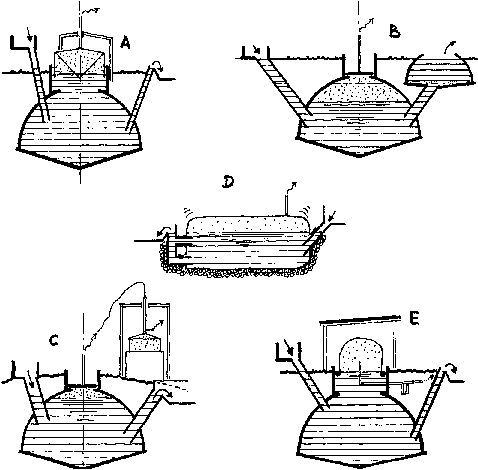
Fig. 3: Simple biogas plants A
Floating-drum plant B Fixed-dome plant C Fixed-dome plant with separate
gasholder. The gas pressure is kept constant by the floating gasholder. The unit
can be operated as a continuous overflow-type plant with no compensating tank.
The use of an agitator is recommended. D Balloon plant E Channel-type digester
with folia and sunshade
3.2.1
Balloon Plants
A balloon plant consists of a plastic or rubber digester bag, in
the upper part of which the gas is stored. The inlet and outlet are attached
direct to the skin of the balloon. When the gas space is full, the plant works
like a fixed-dome plant - i.e., the balloon is not inflated; it is not very
elastic.
The fermentation slurry is agitated slightly by the movement of
the balloon skin. This is favourable to the digestion process. Even difficult
feed materials, such as water hyacinths, can be used in a balloon plant. The
balloon material must be UV-resistant. Materials which have been used
successfully include RMP (red mud plastic), Trevira and butyl.
Advantages:
Low cost, ease of transportation, low
construction (important if the water table is high), high digester temperatures,
uncomplicated cleaning, emptying and maintenance.
Disadvantages:
Short life (about five years), easily damaged,
does not create employment locally, little scope for self-help.
Balloon plants can be recommended wherever the balloon skin is
not likely to be damaged and where the temperature is even and high. One variant
of the balloon plant is the channel-type digester with folia and sunshade.
3.2.2 Fixed-Dome Plants
A fixed-dome plant (Figure 4) consists of an enclosed digester
with a fixed, non-movable gas space. The gas is stored in the upper part of the
digester. When gas production commences, the slurry is displaced into the
compensating tank. Gas pressure increases with the volume of gas stored,
therefore the volume of the digester should not exceed 20 m³. If there is
little gas in the holder, the gas pressure is low.
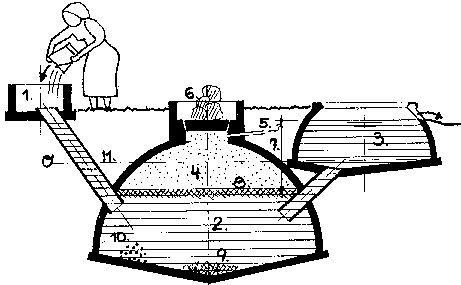
Fig. 4: Fixed-dome plant 1. Mixing
tank with inlet pipe. 2. Digester. 3. Compensating and removal tank. 4.
Gasholder. 5. Gaspipe. 6. Entry hatch, with gaslight seal and weighted. 7.
Difference in level = gas pressure in cm WC. 8. Supernatant scum; broken up by
varying level. 9. Accumulation of thick sludge. 10. Accumulation of grit and
stones. 11. Zero line: filling height without gas pressure.
If the gas is required at constant pressure (e.g., for engines),
a gas pressure regulator or a floating gasholder is required. Engines require a
great deal of gas, and hence large gasholders. The gas pressure then becomes too
high if there is no floating gasholder.
Advantages:
Low construction cost, no moving parts, no
rusting steel parts, hence long life (20 years or more), underground
construction, affording protection from winter cold and saving space, creates
employment locally.
Disadvantages:
Plants often not gaslight (porosity and
cracks), gas pressure fluctuates substantially and is often very high, low
digester temperatures.
Fixed-dome plants can be recommended only where construction can
be supervised by experienced biogas technicians.
3.2.3 Floating-Drum Plants
Floating-drum plants (Figure 5) consist of a digester and a
moving gasholder. The gasholder floats either direct on the fermentation slurry
or in a water jacket of its own. The gas collects in the gas drum, which thereby
rises. If gas is drawn off, it falls again. The gas drum is prevented from
tilting by a guide frame.
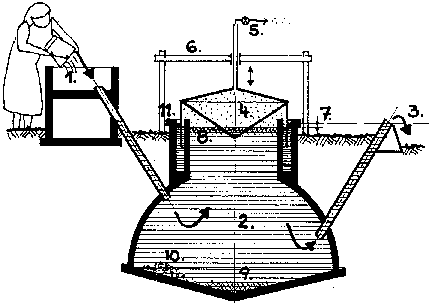
Fig. 5: Floating-drum plant 1. Mixing
tank with inlet pipe. 2. Digester. 3. Overflow on outlet pipe. 4. Gasholder with
braces for breaking up surface scum. 5. Gas outlet with main cock. 6. Gas drum
guide structure. 7. Difference in level = gas pressure in cm WC. 8. Floating
scum in the case of fibrous feed material. 9. Accumulation of thick sludge. 10.
Accumulation of grit and stones. 11. Water jacket with oil film.
Advantages:
Simple, easily understood operation, constant gas
pressure, volume of stored gas visible directly, few mistakes in construction.
Disadvantages:
High construction cost of floating-drum, many
steel parts liable to corrosion, resulting in short life (up to 15 years; in
tropical coastal regions about five years for the drum), regular maintenance
costs due to painting.
In spite of these disadvantages, floating-drum plants are always
to be recommended in cases of doubt. Water-jacket plants are universally
applicable and especially easy to maintain. The drum won't stick, even if the
substrate has a high solids content.
Floating-drums made of glass-fibre reinforced plastic and
highdensity polyethylene have been used successfully, but the construction cost
is higher than with steel. Floating-drums made of wire-mesh-reinforced concrete
are liable to hairline cracking and are intrinsically porous. They require a
gaslight, elastic internal coating. PVC drums are unsuitable because not
resistant to UV.
The floating gas drum can be replaced by a balloon above the
digester. This reduces construction costs (channel type digester with folia),
but in practice problems always arise with the attachment of the balloon at the
edge. Such plants are still being tested under practical
conditions.
| | | Biogas Plants (GTZ, 1988, 85 p.) | | | 4. Scaling of biogas plants | | | 4.1 Definitions | | | 4.2 Scaling of the digester | | | 4.3 Scaling of gasholder | | | 4.4 Digester/gasholder ratio | | | 4.5 Measuring and test programmes |
|
Biogas Plants (GTZ, 1988, 85 p.)
4. Scaling of biogas plants
4.1 Definitions
To calculate the scale of a biogas plant, certain characteristic
parameters are used. These are as follows for simple biogas plants:
- Daily fermentation slurry arisings
(Sd),
- Retention time (RT),
- Specific gas production per day (Gd), which
depends on the retention time and the feed material.
The following additional concepts and parameters are also used
in the theoretical literature:
- Dry matter (DM). The water content of
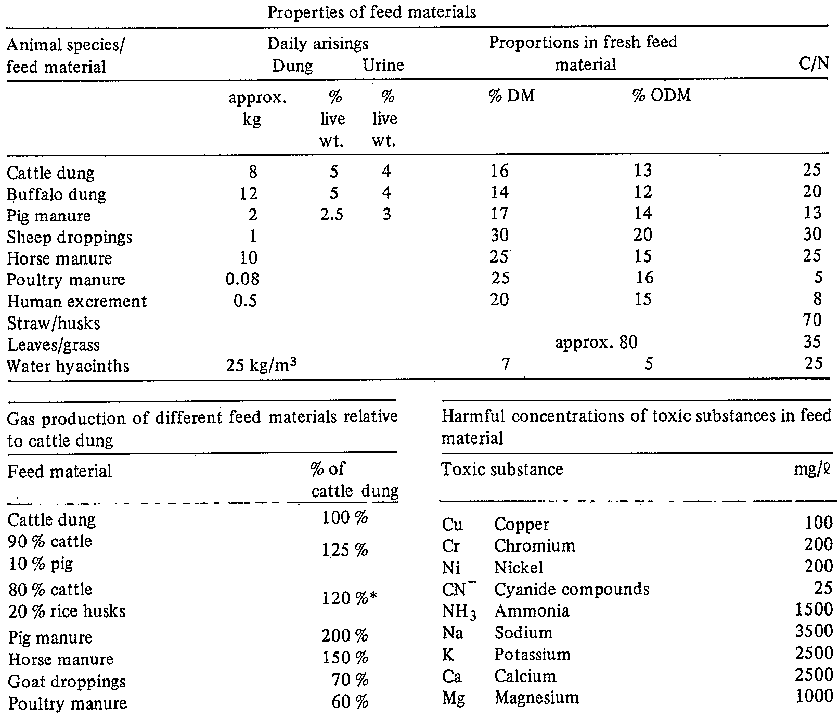
natural feed materials varies. For this reason the solids or dry matter content
of the feed material is used for exact scientific work (see table in Fig. 2).
- Organic dry matter (ODM or VS). Only the organic or volatile
constituents of the feed material are important for the digestion process. For
this reason, only the organic part of the dry matter content is considered.
- Digester loading (R). The digester loading indicates how much
organic material per day has to be supplied to the digester or has to be
digested. The digester loading is calculated in kilograms of organic dry matter
per cubic metre of digester volume per day (kg ODM/m³/day). Long retention
times result in low digester loadings. In a simple biogas plant, 1.5 kg/m3/day
is already quite a high loading. Temperature-controlled and mechanically stirred
large-scale plants can be loaded at about 5 kg/m3/day. If the digester loading
is too high, the pH falls. The plant then remains in the acid phase because
there is more feed material than methane bacteria.
Example:
Calculation of digester loading
Digester volume (VD): 48001
(4.8 m³) Retention time (RT): 80 days
Daily amount of fermentation
slurry (Sd): 60 kg
Proportion of organic matter: 5 %
R = 5x60/100 x 4.8 = 0.625 kg/m3/day
Retention time (RT or t) indicates the period spent by the feed
material in the digester. It is chosen by economic criteria. The retention time
is appreciably shorter than the total time required for complete digestion of
the feed material.
Specific gas production may be quoted for the amount of
fermentation slurry, the dry matter, content or only the organic dry matter. In
practice, it represents the gas production of a specific feed material in a
specific retention time at specific digester temperatures.
Degree of digestion is measured as a percentage. It indicates
the amount of gas obtained as a proportion of total specific gas production. The
difference from 100% indicates the proportion of feed material which is not yet
fully digested. In simple biogas plants, the degree of digestion is about 50 %.
This means that half the feed material is not used.
Biochemical oxygen demand (BOD) is an important parameter in
effluent treatment. It indicates the degree of pollution of effluents or sewage.
The BOD is a measure of the amount of oxygen consumed by bacteria in biological
purification.
4.2 Scaling of the digester
The size of the digester - the digester volume (VD) - is
determined by the length of the retention time (RT) and by the amount of
fermentation slurry supplied daily (Sd). The amount of fermentation slurry
consists of the feed material (e.g., cattle dung) and the mixing water.
Example:
30 l dung + 30 l water = 60 l fermentation slurry
The digester volume is calculated by the formula
VD(l) = Sd(l/day) x RT (days)
Example:
Daily supply (Sd): 60 l
Retention time (RT): 80
days
Digester volume (VD):
60 l/day x 80 days = 4800 1 (4.8 m³)
For a specific digester volume and a known amount of
fermentation slurry, the actual retention time is given by the formula
RT(days) = VD (l) -:-Sd (l/day)
Example:
Digester volume (VD): 4800 l
Daily supply (Sd): 60 l/day
Retention time (RT):
4800 l -:- 60 l/day = 80 days
If the digester size is given and a specific retention time is
required, the daily amount of feed is calculated by the formula
Sd (l/day) = VD (l) . RT(days)
Example:
Digester volume (VD): 4800 l
Retention time (RT): 80 days
Daily fermentation slurry requirement (Sd):
4800 l -:- 80 days = 60
l/day
If a biogas plant is loaded not daily but at relatively long
intervals, the daily supply (Sd) decreases although the fermentation slurry
proportion (S) remains the same. The retention time is correspondingly
prolonged.
Example:
Digester volume (VD): 4800 l
Fermentation slurry proportion
(S): 60 l
1. Daily loading, i.e. Sd = S =
60 l/day:
Retention time (RT):
4800l -:- 60 l/day = 80 days
2. Loading
every other day, i.e.
Sd=S 2=30Q/day:
Retention time (RT):
4800 l -:- 30 £/day = 160 days
3. Loading twice a week,
i.e.
Sd = S x 2/7 = 17.2 l/day:
Retention time (RT):
4800 l
-:- 17.2 l/day = 279
days
4.3 Scaling of gasholder
The size of the gasholder - the gasholder volume (VG, see Figure
6)—depends on gas production and the volume of gas drawn off.
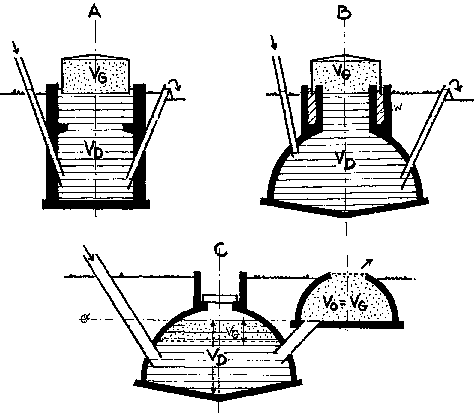
Fig. 6: Digester and gasholder Each
biogas plant consists of a digester (VD) and a gasholder (VG). For calculation
purposes, only the net digester volume or gas space is relevant. In the
fixed-dome plant (C), the net gas space corresponds to the size of the
compensating tank (Vo) above the zero line. The zero line is the filling limit.
Gas production depends on the amount and nature of the
fermentation slurry, digester, temperature and retention time (Figures 7,8).

Fig. 7: Gas production from fresh
cattle manure depending on retention time and digester temperature
The curves represent averages of laboratory and empirical
values. The values vary a wide range owing to differences in the solids content
of the dung, animal feeds and types of biogas plant. Regular stirring increases
gas production. The 26-28 °C line is a secure basis for scaling in the
majority of cases.
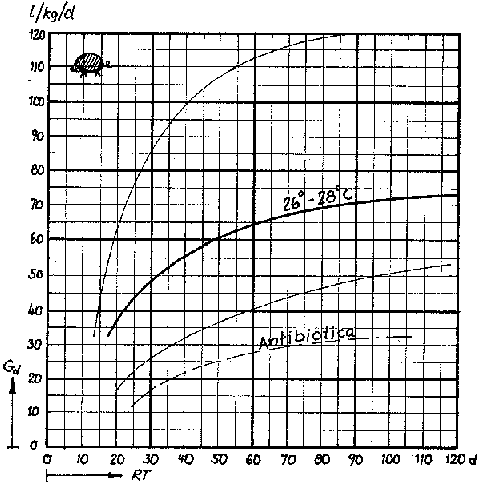
Fig. 8: Gas production from fresh pig
manure depending on retention time and digester temperature
The curves represent averages of laboratory and empirical
values. The measured values show an even wider range of variation than in the
case of cattle dung. Particularly large variations occur if antibiotics are
added to the feed. The 26-28 °C curve is a realistic guide for the planning
of a plant.
Gas production is encouraged by high, uniform temperatures
(e.g., 33°C), long retention times (e.g., 100 days) and thorough mixing of
the slurry.
Gas production is adversely affected by low and fluctuating
temperatures (15-25 °C), short retention times (e.g., 30 days) and poor
mixing.
Example:
1 kg of cattle dung yields only 15 lof biogas in a retention
time of 30 days at a digester temperature of 20 °C. If the retention time
is increased to 100 days and the digester temperature to 33 °C, 1 kg of
cattle dung gives 54 lof biogas (Figure 7). The size of the gasholder is
determined, primarily by the amount of gas drawn off and when it is drawn.
Examples:
A refrigerator operating round the clock consumes all the gas
produced on a given day. The gasholder merely has to compensate for fluctuations
in the,daily volume of gas produced.
A water pump consumes the entire daily
gas production in a few hours. The gasholder must every day collect the entire
daytime and night-time production and compensate for daily production
fluctuations.
The ratio of gasholder volume (VG) to daily gas production (G)
is called the gasholder capacity (C).
Example:
Gasholder volume (VG): 1.5m³ (1500l)
Daily gas
production (G): 2.4 m³
Gasholder capacity (C):
1.5 m³ 2.4
m³ = 0.625 = 62.5 %.
The required gasholder capacity and hence the required gasholder
size is an important planning parameter. If the gasholder capacity is
insufficient' part of the gas produced will be lost. The remaining volume of gas
will not be enough. If the gasholder is made too large, construction costs will
be unnecessarily high, but plant operation will be more convenient. The
gasholder must therefore be made large enough to be able to accept the entire
volume of gas consumed at a time. It must also be able to accept all the gas
produced between consumption times. Furthermore, the gasholder must be able to
compensate for daily fluctuations in gas production. These fluctuations range
from 75 % to 125 % of calculated gas production.
Calculation examples for gasholder size:
Daily gas production: 2400 l
Hourly gas production: 2400 -:-
24 = 100 l/h
Gas consumption
|
from 0600 to 0800 hrs |
=2h |
|
from 1200 to 1400 hrs |
=2h |
|
from 1900 to 2100 hrs |
=2h |
|
Duration of gas consumption: |
6 h |
To simplify the calculation, uniform gas consumption is assumed.
Hourly gas consumption:
2400 l -:- 6 h = 400 l/h
Gas is also produced during consumption. For this reason, only
the difference between consumption and production is relevant to the
calculation.
DG = 400 l/h - 100 l/h = 300 l/h
The necessary gasholder size during consumption is therefore:
VG(1)=300l/h x 2h=600l.
The longest interval between periods of consumption is from 2100
to 0600 hrs (9 hours). The necessary gasholder size is therefore:
VG(2) = 100 l/h x 9 h = 900 Q.
VG(2) is the maximum relevant gasholder size. With
the safety margin of 25%, this gives a gasholder size of
VG = 900 l x 1.25 = 1125 £.
The required gasholder capacity is thus:
C = 1 125 l -:- 2400 l= 0.47 = 47 %
Daily gas production: 2400 l
Hourly gas production: 100 l/h
Gas consumption
|
from 0530 to 0830 hrs |
=3h |
|
from 1830 to 2000 hrs |
=1.5h |
|
Duration of gas consumption: |
4.5 h |
Gas consumption per hour:
2400 l -:- 4.5 h = 533 l/h.
Difference between gas production and consumption:
DG = 533 l/h -100 l/h = 433 l/h.
Hence the necessary gasholder size during consumption is:
VG(1)= 433 l/h x 3 h = 1299 l.
The necessary gasholder size in the intervals between
consumption results from the period from 0830 to 1830 hrs (10 h). The necessary
gasholder size is therefore:
VG(2) = 100 l/h x 10 h = 1000 Q.
VG(1) is the larger volume and must therefore be used
as the basis. Allowing for the safety margin of 25 %, the gasholder size is thus
VG = 1299 l X 1.25 = 1624 Q.
The required gasholder capacity thus works out as
C = 1624 l
-:- 2400 l= 0.68 = 68 %.
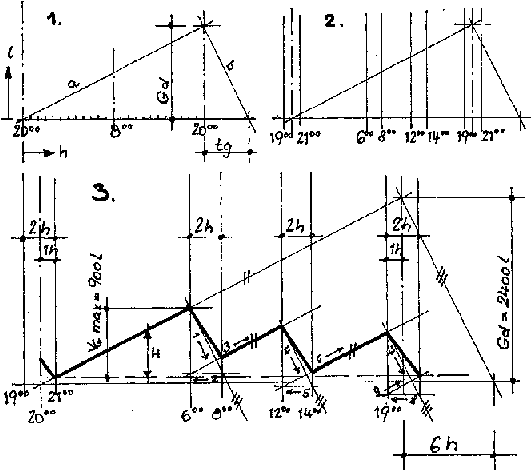
Fig 9: Graphic determination of
required gasholder volume in accordance with the first example, page 21/22.
Working steps: 1. Plotting of gas production curve (a) and gas consumption curve
(b). 2. Plotting of gas consumption times. 3. The gasholder curve (thick line)
is determined by parallel shifting in accordance with the numbered arrows (1-9).
The value VG does not yet include the safety margin of 25 %
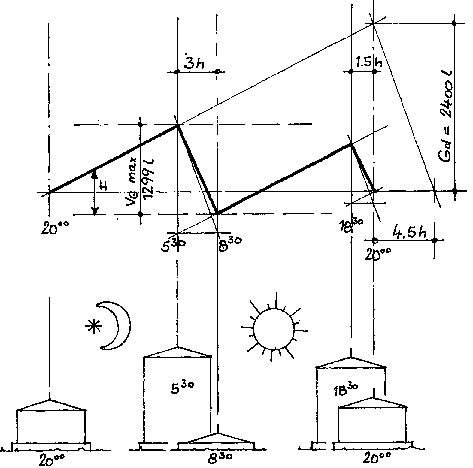
Fig. 10: Graphic determination of the
required gasholder volume in accordance with the second example on page 23/24.
The safety margin of 25 % for fluctuating gas production must be added to the
value VG. The distance H can also be regarded as the height of the floating gas
drum. Experience shows that about the same volume of gas per hour is produced
day and night.
A gasholder capacity of 50-60% is normally correct for peasant
households in Third World countries. A capacity of 70 % or even more must be
allowed only where not more than one meal a day is cooked regularly or where
eating habits are highly
irregular.
4.4 Digester/gasholder ratio
The form of a biogas plant is determined by the size ratio
between the digester and the gasholder (see Figures 11 - 13).

Fig. 11: Digester/gasholder ratio The
ratio of the digester volume (VD) and gasholder volume (VG) substantially
determines the shape and design of a biogas plant. These two parameters must be
calculated before any project is planned. For a digester/gasholder volume ratio
of VD:VG = 6:1, a spherical shell is far more economical than a cylinder even in
floating-drum plants.

Fig. 12: Dependence of shape on
retention time on a floating-drum plant (cattle dung above; pig manure below)
Filling volume and gasholder capacity (C = 55 %) are the same in each case. The
differences in digester/ gasholder ratios result solely from the differing
retention times (RT).
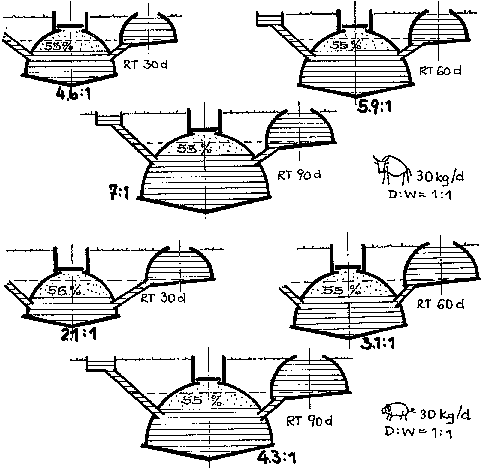
Fig. 13: Dependence of shape on
retention time on a fixed-dome plant (cattle dung above; pig manure below) The
filling volume and gasholder capacity (C = 55 %) are the same in each case. The
differences in digester/ compensating tank ratios result solely from the
different retention time (Gd as a result of RT, Figures 7 and 8).
For floating-drum plants with a low digester/ gasholder ratio
(1:1 to 3:1), the best shape for the digester is a cylinder. If the ratio is
larger, shell and vault structures are worthwhile.
The digester/gasholder ratio depends primarily on:
- retention time (RT),
- specific gas
production (Gd),
- gasholder capacity (C).
The digester/gasholder ratio chosen must be correct regardless
of the type of plant, otherwise the biogas plant will not serve its purpose.
In a fixed-dome plant, the digester/gasholder ratio corresponds
to the size ratio between the net digestion space and the compensating tank
above the zero line (see Figure 6): VD: VG corresponds to VD: VO
The examples given below show the importance of the specific gas
production for the scaling of the plant and for the digester/ gasholder ratio.
For extensive biogas plant construction programmes, a knowledge
of the specific gas production and the necessary gasholder capacity is
particularly important. It is then a good plan to carry out measurements and
tests of one's own (see Section 4.5).
Examples for the Calculation:
Feed material: cattle dung, amount
(Dd):
30 kg/day
Mixing ratio: dung: water = 1:1
Fermentation
slurry amount (Sd):
30 kg/day x 2 = 60 l/day
Retention time
(RT): 80 days
Digester volume (VD):
60 l/day x 80 days = 4800
l
Digester temperature (t): 26 - 28 °C
Specific -gas production
(Gd) from Fig. 7:
40 l/kg
Daily gas production (G):
40 l/kg
x 30 kg/day = 1200 l/day
Gasholder capacity (C): 60 %
Gasholder volume
(VG):
1200 l x 0.60= 720 l
Digester/gasholder ratio:
VD:VG= 4800l: 720 l
=6.67: 1
Feed material: pig manure, amount (Dd):
20
kg/day
Mixing ratio: manure: water = 1: 2
Fermentation slurry amount
(Sd):
20 kg/day x 3 = 60 l/day
Retention time (RT): 80
days
Digester volume (VD):
60 l/day x 80 days = 4800
l
Digester temperature (t): 26-28 °C
Specific gas production (Gd)
from figure 8:
112 l/day
Daily gas production (G):
122 l/kg x 20 kg/day
= 2240 l/day
Gasholder capacity (C): 60
Gasholder volume
(VG):
2240 lx 0.60 = 1344 l
Digester/gasholder
ratio:
VD: VG = 4800 l 1344 l= 3.6:
1
4.5 Measuring and test programmes
The aim of a measuring and test programme is to determine the
specific gas production obtained at specific retention times.
Since digester temperature affects gas production, the latter
should be measured at both the coldest and hottest time of the year.
The programme consists of a set of at least four biogas plants
of different sizes. A given filling volume results in different retention times,
in turn yielding different amounts of gas production for one and the same
filling volume.
Example (Figure 14):

Fig. 14: Biogas plants for a test
programme for determinantion of gas production The length of the retention time
(RT) has the greatest effect on digester size (VD). Test plants may have any
shape. However' they should all be identical and should preferably conform to
the type to be used later in a biogas programme. The test plants must be filled
regularly for at least three months before gas production is measured. The
gasholders must be all the larger, the longer the time between tests. Safe
spanning of the after-dark hours must be ensured.
Filling volume: 30 kg manure and 30 lwater; 60
l/day
Retention times (RT) chosen: 30, 45, 60 and 90 days
Required digester volume:
RT(30): VD
= 30 x 60 = 1800 l (1.8 m³)
RT(45): VD = 45 x 60 = 2700 l (2.7
m³)
RT(60): VD = 60 x 60 = 3600 l (3.6 m³)
RT(90): VD = 90 X 60
= 5400 l (5.4 m³)
Specific gas production is determined by dividing the daily
volume of gas measured by the amount of slurry loaded into the plant (30 kg).
The results are plotted in a curve(like Figure 7 and 8) and are
used for the scaling and calculation of the digester and gasholder volumes.
If a test programme is too expensive or complicated, the actual
gas production values can also be derived from the results of measurement of a
number of existing plants. For this purpose, the volume of gas stored must be
measured before and after each consumption (Figure 15). Measurements must be
effected for at least three consecutive days and nights.
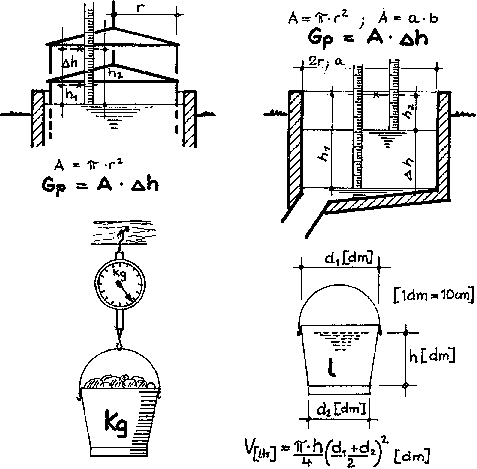
Fig. 15: Measuring gas production on
the plant In a floating-drum plant, the height of the gasholder is measured (top
left), In a fixed-dome plant, the height of the slurry level is measured (top
right). The manure is either weighed or measured in litres before introduction
to the plant. Containers whose shape is easy to calculate are more accurate. If
the lengths are measured in dm (1 dm = 10 cm), the volume in litres is obtained
directly.
| | | Biogas Plants (GTZ, 1988, 85 p.) | | | 5. Design of biogas plants | | | 5.1 Shape and static loading | | | 5.2 Bottom slab | | | 5.3 Spherical shell of masonry construction | | | 5.4 Masonry and mortar | | | 5.5 The parts of a biogas plant and their functions | | | 5.6 Floating gas drum | | | 5.7 Water-lacket plant | | | 5.8 Fixed-dome plants | | | 5.9 Large-scale plants | | | 5.10 Biogas plants in cold regions |
|
Biogas Plants (GTZ, 1988, 85 p.)
5. Design of biogas plants
5.1 Shape and static loading
A biogas plant should be watertight. The gasholder must be
gaslight. For this reason a biogas plant must have no cracks. But structures of
masonry or concrete always crack. One can try to keep the cracks small. And one
can determine the position where the cracks are to arise.
Cracks always arise where the tensile stresses are highest.
Tensile stresses arise from tensile forces, flexure, displacements, settling and
temperature fluctuations. When mortar or concrete sets, shrinkage cracks also
form.
Stresses are high where the "external" forces are high.
"External" forces are earth pressure, dead weight and applied load. Stresses are
highest where the "internal" forces are highest. "Internal" forces are flexural,
normal, gravitational and torsional forces.
The "external" forces can be reduced by favourable shaping of
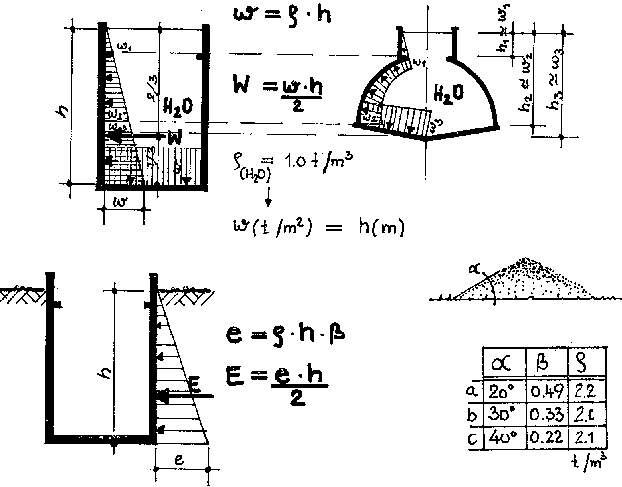
the structure. The liquid pressure and earth pressure are less in a low biogas
plant. This is because both depend directly on the height (see Figure 57).
The "internal" forces can also be reduced by favourable shaping
of the structure. If the "external" forces can act in one direction only, high
"internal" forces arise. If, however, the "external" forces can be distributed
in a number of directions, small "internal" forces arise. This is the case with
all curved surfaces or "shells" (see Figure 16).

Fig. 16: Shape and load-bearing
capacity Slabs will support a heavier load than beams for a given thickness of
material. A curved shell supports more than a flat slab. A shell cuned in more
than one dimension supports more than a shell of simple curvature. Curved
structural components are more rigid; the stresses are smaller in them. Just
imagine how thick the shell of a hen's egg would have to be if it were shaped
like a cube!
Cracks arise where stresses are high. Particularly high stresses
- "peak stresses" - arise at points where the stress pattern is disturbed.
Such disturbances occur at edges, angles, corners and under
concentrated, applied or other loads. Disturbances arise along the line of
intersection of surfaces. Cracks form at these points due to peak stresses.
Peak stresses always arise at the edges of angular structures.
For this reason the gas space of a fixed-dome plant must never be angular.
Cracks arise owing to tensile stresses. If a component is under
compression, it is free from cracks. The gas space of a fixed-dome plant should
therefore always be under pressure at every point.
The liquid pressure of the fermentation slurry is directed
outwards. The earth pressure is directed inwards. If the two forces balance
reliably, the load on the structure is relieved. In a vaulted shape' the
external loading is obtained even if the earth is stiff and cracked owing to
drought (Figure 17-19).
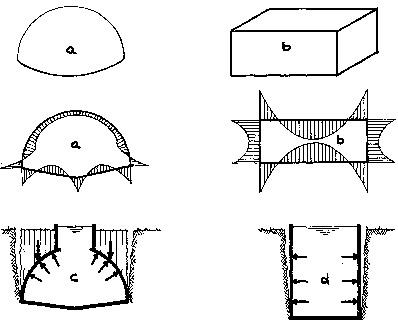
Fig. 17: Same volume - different shape
Different shapes have different stress patterns under the same load (a and b).
The round shape has lower stresses. The angular shape has high stresses and many
stress peaks. Different shapes are often loaded differently. In a vaulted shape,
the loads acting in different directions are more reliably balanced than with a
vertical wall (c and d).
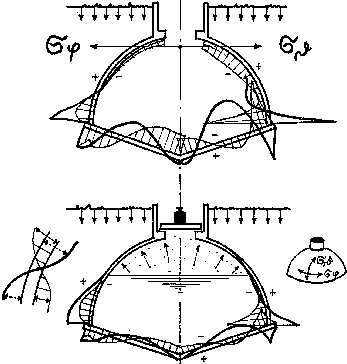
Fig. 18: Pattern of stresses in a
fixed-dome plant of masonry construction Top: empty; bottom: filled and with
maximum gas pressure. The peak stresses shown are those resulting from the first
approximation calculation. In practice they are reduced by deformation (with or
without cracking). Positive (+) tensile stresses do not occur in the gas space.
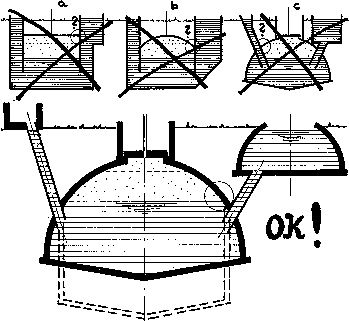
Fig. 19: Cracks in the gas space of a
fixed-dome plant Angular gas spaces must on no account be used (a)! The
transition from the roof arch to the wall must never be at a higher level than
the lowest slurry line (b). Inlet and outlet penetrations must never be situated
in the gas space (c). The gas space must remain undisturbed. Only the entry
hatch at the top is allowed, because it can easily be checked.
A round shape is always a good shape, Because a round shape has
no corners. Because its load pattern is more favourable. And because it uses
less material. A round shape is often easier to build than an angular one (see
Section 5.3). The rounder the
better!
5.2 Bottom slab
The bottom slab is loaded at its edge by the weight of the
digester wall. In the case of a spherical shell, the weight of the earth load
also acts on it. The bottom slab distributes the weight over the ground of the
site. The larger the foundation area, the less settlement will be experienced.
The more even the loads, the more even the settlement. The more even the
settlement, the less the risk of cracking.
A "rigid" shell distributes the weight better than a "soft"
slab.
The weight of the fermentation slurry presses uniformly on the
ground. Where the ground is of unequal consistency (e.g., boulders in loamy
soil), loads must be distributed within the bottom slab. If the slab is too
weak, it will break and cease to be watertight.
A "rigid" shell distributes the loads better than a "soft slab".
A vaulted shell is the best foundation shape. But a concial
shell is easier to excavate. The only implement required is a straight piece of
wood.
Building material available locally is used for the bottom slab.
One of the following will be chosen on grounds of economy:
- quarrystone with a cement mortar filling
and a cement floor,
- brick masonry with a cement floor,
-
concrete.
Steel ring reinforcement at the outer edge increases the
loadbearing capacity of the bottom. However, such reinforcement is not usually
necessary. It is more important for the ground to be firm and clean. If the soil
consists of muddy loam, it must first be covered with a thin layer of sand.
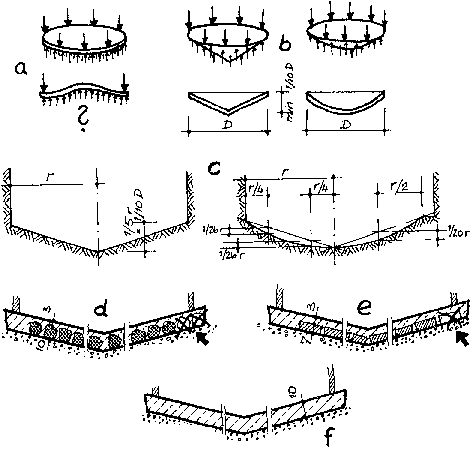
Fig. 20: The bottom slab A flat slab
must be flexurally rigid if it is to distribute the edge loads over the entire
surface (a). Shells ate flexurally rigid (b). Proceeding from a conical shell to
a spherical shell (c). Possible forms of construction: Quarrystone with cement
mortar (d). Masonry with cement floor (e) and concrete (f). Underneath the wall
the bottom slab should be made out of massive
concrete.
5.3 Spherical shell of masonry construction
The construction of a spherical shell from masonry (Figure 21)
is completely problem-free. Every bricklayer can master this technique after
once being shown how to do it. Concreting a vault, on the other hand, calls for
much more skill and craftsmanship owing to the complicated formwork - the one
exception being when the masoned shell is intended to serve as permanent
formwork. A spherical shell of masonry is simple to construct because the radius
always extends from the same centre. A trammel (A) is the only aid required.
Bricks are stacked to get the right height for the centre. Lean mortar is used
for the stack, which is subsequently demolished (M). No centring is necessary
for laying the bricks.
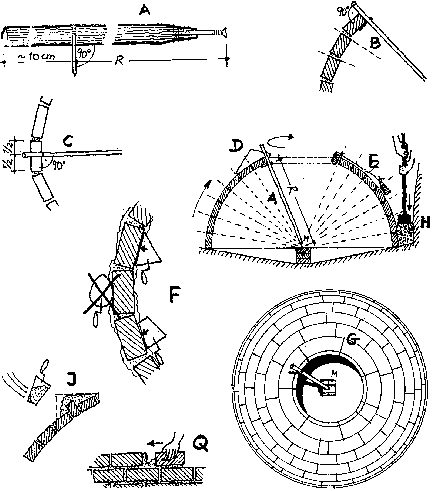
Fig. 21: Construction of a spherical
shell from masonry
When the bricks are laid, it is important for their tops to be
parallel with the bottom edge of the trammel (B), from the very first course.
The bricks are laid perpendicularly and centrally to the trammel (C). In the
upper part - when the trammel is standing at a steeper angle than 45° - the
first brick in each course must be held until the circle is complete. Each brick
inbetween must be held only until the next brick is set. For this purpose,
clamps (D) or counterweights of stones tied together (E) are used. The bricks
can also be supported with sticks.
The mortar must be mixed from finely sieved sand (maximum
particle size 3 mm). If the sand is too coarse, the mortar will be difficult to
work. It has to "stick" to the sloping, narrow surface of the brick. Compo
(cement/ lime) mortar is "stickier" than pure cement mortar. "Squeezed joints"
(Q) should be used. The trowel should have straight sides, so that the
squeezed-out mortar can be scraped off and reused (F). As in any masonry
construction, the joints must be offset (G). The terminal ring is rendered. The
last but one course of bricks is laid on end (J).
When backfilling, the footing point must be tamped particularly
well: one man filling and two men tamping
(H).
5.4 Masonry and mortar
The mortar and bricks should have about the same strenght. If
the bricks are soft, the mortar must also not be too hard. If a good brick is
thrown on to the ground three metres away, it must not break. If the bricks are
of poor quality, the walls must be thicker. Mortar consists of sand, water and
the binders. Cement gives a solid, watertight mortar. Cement mortar is brittle
in masonry construction. Lime gives a soft, sticky mortar.
For masonry construction, cement mortar should always include a
certain amount of lime. This makes it more workable, and the masonry becomes
more watertight.
Mixing ratio:
|
Masonry mortar |
2 (cement) |
: 1 (lime) |
|
|
: 10(sand) |
|
or |
1 (cement) |
: 6 (sand) |
|
Rendering mortar |
1 (cement) |
: 4 (sand) |
|
better |
1 (cement) |
: 3 (sand) |
The most important part of the mortar is the sand. It must be
clean. It should not contain any loam, dust or organic matter. Mortar sand with
a high proportion of dust or loam "eats up" much more cement than clean sand.
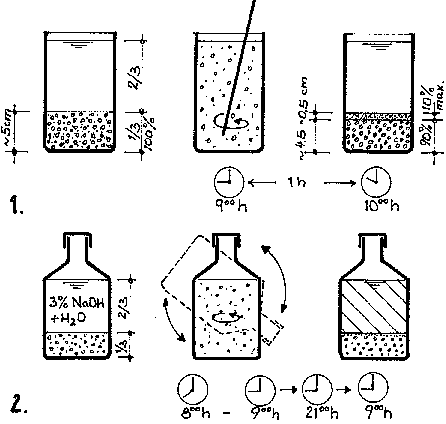
Fig. 22: Testing of mortar sand 1.
Fines (loam, dust): Water glass 1/3 sand, 2/3 water. stir vigorously. Leave to
stand for one hour. Measure fines. A maximum of 10 % of the amount of sand is
permissible. 2. Organic matter: Bottle with stopper (not cork) to be filled with
1/3 sand and 2/3 soda lye (3 %). Shake repeatedly within an hour. Leave to stand
for 24 hours. Water colour clear or light yellow: good; red or brown: bad.
The bricklayer or works foreman must check the sand before use
(Figure 22). Sand may contain not more than 10% dust or loam, otherwise it must
be washed. Soda Iye can be used to test whether the sand contains excessive
organic matter. The following points are important when rendering:
- The rendering mortar must be compressed
by vigorous, circular rubbing.
- All edges must be rounded.
- All
internal angles must be rounded with a glass bottle.
5.5 The parts of a biogas plant and their functions
The feed material is mixed with water in the mixing tank (Figure
23). Impurities liable to clog the plant are removed here. The fermentation
slurry flows through the inlet (Figure 24) into the digester. A stick is
inserted through the inlet pipe' to poke and agitate the slurry. The bacteria
from the fermentation slurry are intended to produce biogas in the digester
(Figure 25). For this purpose they need time. Time to multiply and to spread
through- ' out the slurry. The digester must be designed so that only fully
digested slurry can leave it. Partitions (Figure 26) ensure that the slurry in
the digester has long flow paths. The bacteria are distributed in the slurry by
stirring (with a stick or stirring facilities, see Figure 27). If stirring is
excessive, the bacteria have no time "to eat". The ideal is gentle but intensive
stirring about every four hours. Optimum stirring substantially reduces the
retention time.
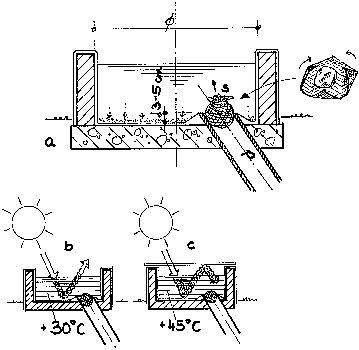
Fig. 23: Mixing tank at inlet Grit and
stones settle at the bottom of the mixing tank. For this reason the inlet pipe
(p) should be 3-5 cm higher than the tank bottom. A round, cylindrical shape is
cheapest and best for the mixing tank. If the tank is filled in the morning and
then covered, the slurry heats up in the sun until the evening (c). Only then is
the plug removed (s).

Fig. 24: The inlet The inlet must be
straight. The axis of the inlet pipe should, as far as possible, be directed
into the centre of the digester. This facilitates stirring and poking. The inlet
should be as high as possible, so that gritty deposits do not block the inlet
pipe. In fixed-dome plants, the inlet pipe must not pass through the gas space
(a). For fibrous feed material, the diameter should be 200-400 mm.
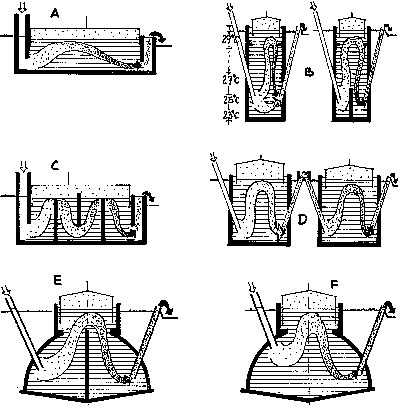
Fig. 25: Path of the fermentation
slurry in the digester Fresh fermentation material is lighter than fully
digested sludge. For this reason the former quickly rises to the surface and
then sinks only gradually. The digestion process has two phases. The better
these phases are separated, the more intensive the gas production. The
fermentation channel (A) satisfies these conditions best. Tandem plants are
expensive and complicated (D). The deeper the digester, the lower and less
uniform its temperature.
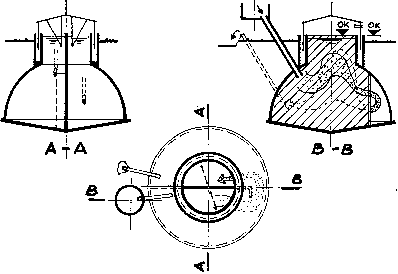
Fig. 26: Hemispherical plant with
partition wall The principle of the fermentation channel is obtained by the fact
that the inlet and outlet pipes are close together. The partition wall extends
up above the surface level of the fermentation slurry. The gasholder must
therefore float in a water jacket. The "horizontal KVIC gobar gas plant", which
is similar in design, works perfectly with high gas production.
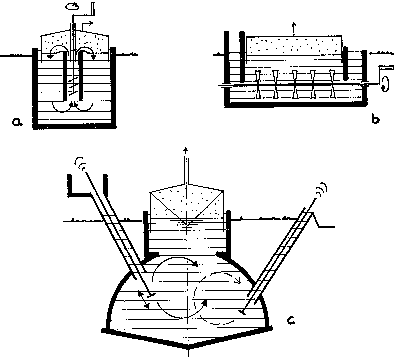
Fig. 27: Stirring facilities in the
digester The impeller stirrer (a) has given good results especially in sewage
treatment plants. The horizontal shaft (b) stirs the fermentation channel
without mixing up the phases. Both schemes originate from large-scale plant
practice. For simple household plants, poking with a stick is the simplest and
safest stirring method (c). What matters is not how good the stirring
arrangements are but how well the stirring is performed (see page 38).
The fully digested slurry leaves the digester through the outlet
(Figure 28).

Fig 28: Outlet (overflow) of a
floating-drum plant The outlet should be placed below the middle of the
digester, otherwise too much fresh feed material will flow out of the plant too
soon, thus reducing gas production by as much as 35 % (b). The height of the
outlet determines the level of the surface of the fermentation slurry (c-f).
This should be 8cm below the top edge of the wall. If this is not the case,
difficulty will be experienced in painting. If the outlet is too low, digester
volume is lost (d). If it is too high, the slurry will overflow the edge of the
wall (e).
The biogas is collected and stored until the time of consumption
in the gasholder. The prime requirement for the gasholder is that it must be
gaslight. Floating gasholders are held by a guide.
In fixed-dome plants, the compensating tank acts as a storage
facility for the slurry displaced by the biogas. In this case the gas is
collected and stored in the upper part of the digester.
The gas pipe carries the biogas to the place where it is
consumed. Condensation collecting in the gas pipe is removed by a tap or water
trap. Flexible gas pipes laid in the open must be
UV-resistant.
5.6 Floating gas drum
The gas drum normally consists of 2.5 mm steel sheet for the
sides and 2 mm sheet for the cover. It has welded-in braces. These break up
surface scum when the drum rotates.
The drum must be protected against corrosion. Suitable coating
products are oil paints, synthetic paints and bitumen paints. Correct priming is
important.
One coat is as good as no coat. Two coats are not enough. There
must be at least two preliminary coats and one topcoat.
Coatings of used oil are cheap. They must be renewed monthly.
Plastic sheeting stuck to bitumen sealant has not given good results. In coastal
regions, repainting is necessary at least once a year, and in dry uplands at
least every other year. Gas production will be higher if the drum is painted
black or red than with blue or white, because the digester temperature is
increased by solar radiation. Gas drums made of 2 cm wire-mesh-reinforced
concrete or fibrocement must receive a gaslight internal coating.
The gas drum should have a slightly sloping roof (Figure 29),
otherwise rainwater will be trapped on it, leading to rust damage. An
excessively steep-pitched roof is unnecessarily expensive. The gas in the tip
cannot be used because the drum is already resting on the bottom and the gas is
no longer under pressure.
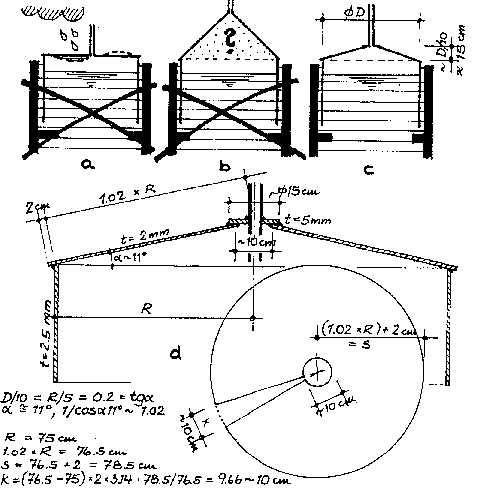
Fig. 29: The gas drum The gas drum
should have a slightly sloping roof. When the cover plate is cut, a wedge (k)
should be cut out. The cover plate must be rather larger than the diameter of
the drum (see calculation at bottom left). In- accuracies can more easily be
corrected if a lateral overhang of 2 cm is allowed.
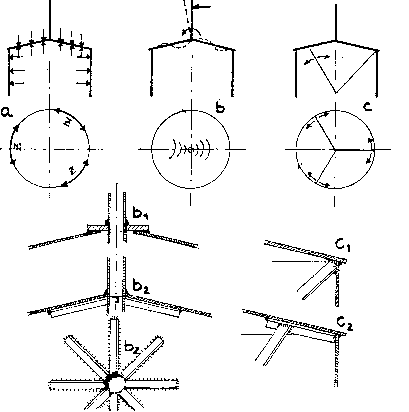
Fig. 30: Forces on the gas drum The
gas pressure and the weight of the metal itself give rise only to tensile forces
in the jacket sheet. No reinforcements are necessary for these to be withstood
(a). The loads from the guide tube must be reliably transmitted to the cover
plate (b). A flange plate (b1 ) or angle iron (b2) is required for this purpose.
The braces are stressed when the drum i,s rotated (c). They should not simply
butt on to the metal but end in a corner (c, ) or at an angle (c2).
The side wall of the gas drum should be just as high as the wall
above the support ledge. The floating-drum must not scrape on the outer walls.
It must not tilt, otherwise the paintwork will be damaged or it will jam. For
this reason a floating-drum always requires a guide (see Figures 31 and 32). The
guide frame must be designed so that the gas drum can be removed for repair. The
drum can only be removed if air can flow into it, either the gas pipe should be
uncoupled and the valve opened, or the water jacket emptied.
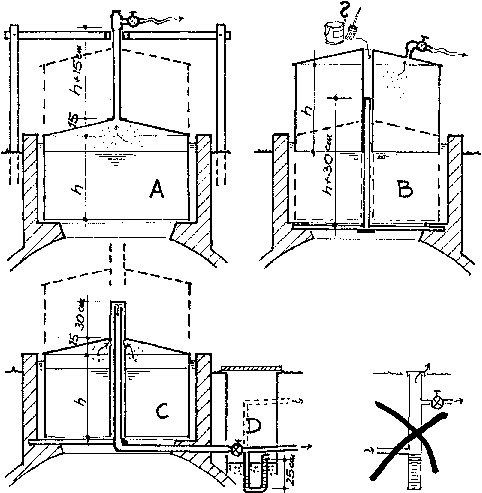
Fig. 31: Floating drum guide frame An
external guide frame (A) is cheapest. It is made of tubular steel, sectional
steel or wood. The guide tube also acts as the gas outlet. With scheme (B), the
open pipe is problematic. It cannot be reliably painted. The tidiest, but also
the most expensive, solution is a guide with internal gas outlet (C). For the
water trap (D) see also Figure 40. Guide frames for heavy gas drums must
withstand large forces. All joints and anchor points must be just as strong as
the pipes themselves.
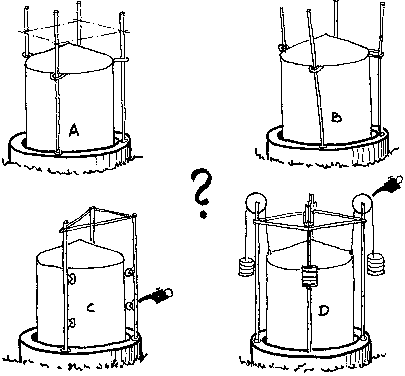
Fig. 32: Unsuitable guidance systems
for floating drums With these guides, the gas drum cannot be rotated. This means
that floating scum cannot be broken up. The rollers and bearings must be
lubricated. In arrangement (C), the paintwork of the drum is damaged. Plant (B)
is jammed if only one of the guide rods is not vertical. A central guide tube is
always
better!
5.7 Water-lacket plant
The water-jacket plant (Figure 33) is a special case of the
floating-drum plant. The drum floats in a water bath and not direct in the
slurry. Water-jacket plants can handle substrates with a high solids content
without danger of drum blockage due to crust formation.

Fig. 33: The water jacket
The floating-drum must be able to move freely up and down in the
water jacket. It must be free to rotate. The inner braces must not rest on the
inner edge of the wall (d). They must therefore begin offset at least 20 cm
inwards (i). The water jacket must always be filled to the top, as the gas space
will otherwise be reduced (c). A few drops of oil slow down the evaporation of
water (g). The inner wall must either be gaslight at the base or rest on a ring
of "gaslight" mortar (h). An overflow pipe can be installed to keep excessive
rainwater from carrying off the oil film during the rainy season (k). The
overflow pipe must not protrude into the water jacket.
The water-jacket is particularly suitable where human excrement
is to be digested. Of all simple systems, the water-jacket plant is the
cleanest. The gas drum rusts less in the water jacket than if it were floating
directly in the slurry.
The water in the jacket evaporates quickly. For this reason the
water level must be checked regularly. A few drops of used oil on the water
surface prevent rapid evaporation and protect against corrosion (Figure 33,g). A
rainwater overflow pipe can be quite helpful.
The inner wall of the water jacket is inside the gas space. Its
upper part must receive a gaslight coating or rest on a gaslight ring, otherwise
the gas will escape through the porous wall (Figure 33,h).
The water jacket must be kept absolutely free. If it is not, the
floating drum cannot move up and down without impediment. The inlet or gas pipes
must of course not be fed through the water jacket (Figure 33, f). The water
jacket must be wide enough to allow objects inadvertently dropped into it to be
retrieved (Figure 33, e).
The walls of the water jacket are as high as those of the gas
drum.
If the drum is too high, the last gas cannot be used. The weight
of the gas drum cannot then exert any more pressure on the gas (Figure 33, a).
If the walls of the ring are too high, unnecessary construction
costs arise.
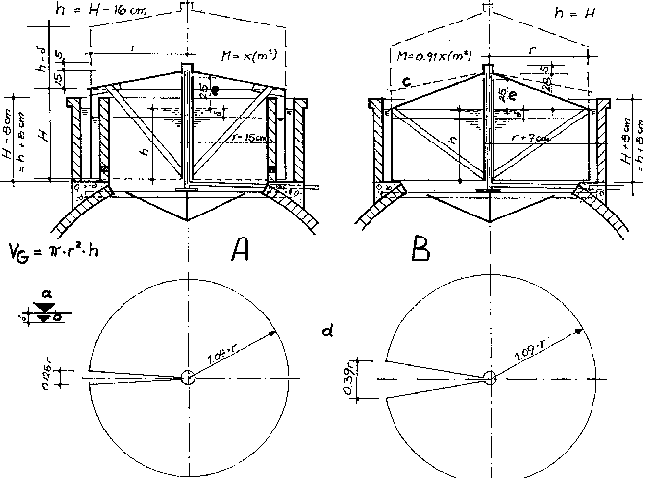
Fig. 34: Comparison of floating drums
for water-jacket plants (A) and for plants with internal gas outlet (B): Bot
types of plant are assumed to have the same gas-holding capacity. The distance
between the top rim of the gas outlet pipe and the slurry level (A) depends on
the shape of the drum. a: Overflow level or unpressurized slurry level; b:
Pressurized slurry level; c: gasholder configuration as in A; d: Comparison of
sheet metal cutouts for drum
lids.
5.8 Fixed-dome plants
The top part of a fixed-dome plant (the gas space) must be
gaslight. Concrete, masonry and cement rendering are not gaslight. The gas space
must therefore be painted with a gaslight product.
Gastight paints must be elastic, This is the only way to bridge
cracks in the structure.
Latex or synthetic paints (PVC or polyester) are suitable. Epoxy
resin paints are particularly good. Polyethylene is not very gaslight. Hot
paraffin coatings also serve well. The walls are first heated with a torch. Then
hot paraffin (as hot as possible) is applied. Since the paraffin will only
adhere to thoroughly dry masonry, it may have to be dried out first with the aid
of a charcoal fire.
Fixed-dome plants produce just as much gas as floating-drum
plants - but only if they are gaslight. However, utilization of the gas is less
effective as the gas pressure fluctuates substantially. Burners cannot be set
optimally.
Figures 35 and 36 show mayor details of the compensating tank.
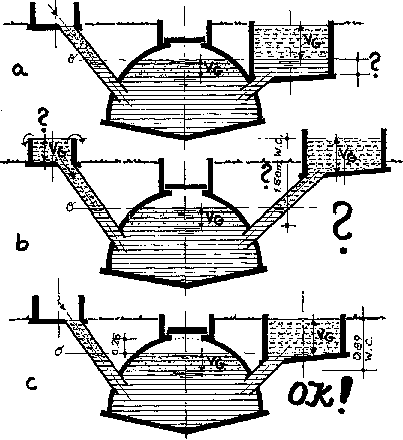
Fig. 35: Correct height of
compensating tank The bottom of the compensating tank is at the level of the
zero line (filling line). The zero line is 25 cm below the head of the digester
dome (c). Wrong: (a) the bottom of the compensating tank is too low. Part of the
slurry is always in contact with air. Gas is lost. Unnecessary cost. (b) The
bottom of the compensating tank is too high. The gas pressure rises very fast
and to a very high level.
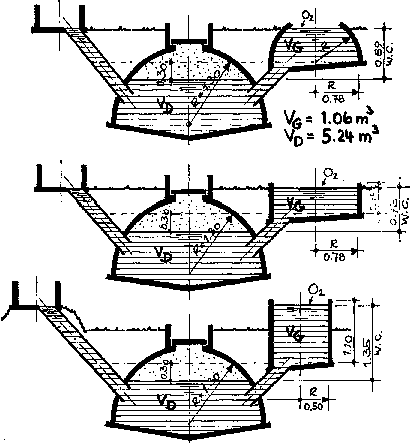
Fig. 36: Shape of compensating tank
The shape of the compensating tank determines the height of the slurry surface
and hence the gas pressure (cm WC). The lower the compensating tank, the lower
and more even the gas pressure. However, the lower the tank, the larger the area
exposed to atmospheric oxygen. Differences in building costs due to shape are
slight.
Figure 37 shows details of the entry hatch.

Fig. 37: Detail of a fixed-dome entry
hatch The gas pipe penetrates the shaft a few centimeters below the cover. The
cover is sealed with screened and well-worked clay. The bottom of the cover is
sealed with paraffin. Rocks are placed on the lid to weigh it down, and the
shaft is filled with water to keep the clay gaslight. A few drops of oil keep
the water from
evaporating.
5.9 Large-scale plants
Large plants do not come under the heading of "simple" plants.
For this reason they are not described in detail here. However, the designer
must know that he cannot "simply" enlarge the plans for a "simple" plant to any
degree.
The digester can be enlarged without major changes in the
design. However, large floating drums quickly become awkward and heavy: to
manufacture, to transport, to maintain.
A floating drum 5 m in diameter cannot be turned by one person.
The surface scum in the plant is not broken. It will become more and more solid.
Gas production will fall. In plants with digester volumes exceeding 50 m³,
poking no longer provides sufficient agitation. Stirring or agitation facilities
are required.
A floating drum with a diameter exceeding 5 m requires a more
precise guide frame, otherwise the drum will tilt so badly that it jams.
Water-jacket plants are particularly at risk in this respect.
In fixed-dome plants, the gas pressure also varies directly with
size. If the shape of the structure is unaltered but the size is doubled, the
gas pressure doubles. For this reason, large fixed-dome plants always require a
separate gasholder and an agitator.
In large plants, large quantities of feed material and water
must be obtained and mixed. Mechanical mixers become necessary. Large volumes of
fermentation slurry require a larger drying area, as the thickness of the slurry
layer cannot be increased indefinitely. Feed material or fermentation slurry
often has to be stored for several weeks. This calls for large and expensive
containers.
5.10 Biogas plants in cold regions
Simple biogas plants are usable only conditionally in tropical
uplands or in temperate climatic zones. At latitudes as high as only 25 -
30°, gas production in winter generally falls to about half the summer
level.
Whether it is worthwhile to heat a plant must be decided on an
individual-case basis. In Europe, large-scale plants use up 20-30 % of their gas
production for heating. Practicable heating systems for simple plants have not
yet been developed.
Utilization of solar energy in the mixing tank (Figure 23) and
insulation by covering with straw are insufficient where frost occurs. Floating
drums have the highest heat losses. Underground fixed-dome plants maintain more
even but generally lower temperatures. Fixed-dome plants with floating
gasholders (Figures 3 and 52) may be a valid solution for cold regions although
more expensive. Good results are obtained with roofed-over biogas plants.
However, the cost of a "greenhouse" superstructure is relatively high. It is
worthwhile only where low temperatures are combined with high insolation. Good
results have been obtained by placing the plant under a compost heap. If the
digester is surrounded externally by soft insulation, the wall cannot be
"relieved of its load" by the earth pressure (see Figure 17).
Again, insulation must always remain dry. The only exception is
special insulation with closed pores. Biogas plants are completely shut down in
winter in the north of China; they are used for only six to eight months per
year.
Where frost occurs, mixing and filling tanks must be roofed
over. Transport of feed material is difficult in snow. It is essential to
consider in detail how the plant is to be operated before commencing
construction. Energy is particularly expensive in cold regions. This is why
biogas plants have to be used in these regions. Unfortunately, appropriate types
of simple plants have not yet been developed.
| | | Biogas Plants (GTZ, 1988, 85 p.) | | | 6. Biogas utilization | | | (introduction...) | | | 6.1 Biogas appliances |
|
Biogas Plants (GTZ, 1988, 85 p.)
6. Biogas utilization
Biogas can be used in the same way as any other combustible gas.
When biogas is mixed with air in the proportions of 1:20, highly explosive
detonating gas forms. Leaky gas pipes in enclosed spaces constitute a hazard!
However, there have been no reports of dangerous explosions caused by biogas.
The calorific value of biogas is about 6 kWh/m³ - this corresponds to about
half a litre of diesel oil. The net calorific value depends on the efficiency of
the burners or appliances (see Table, Figure 38).
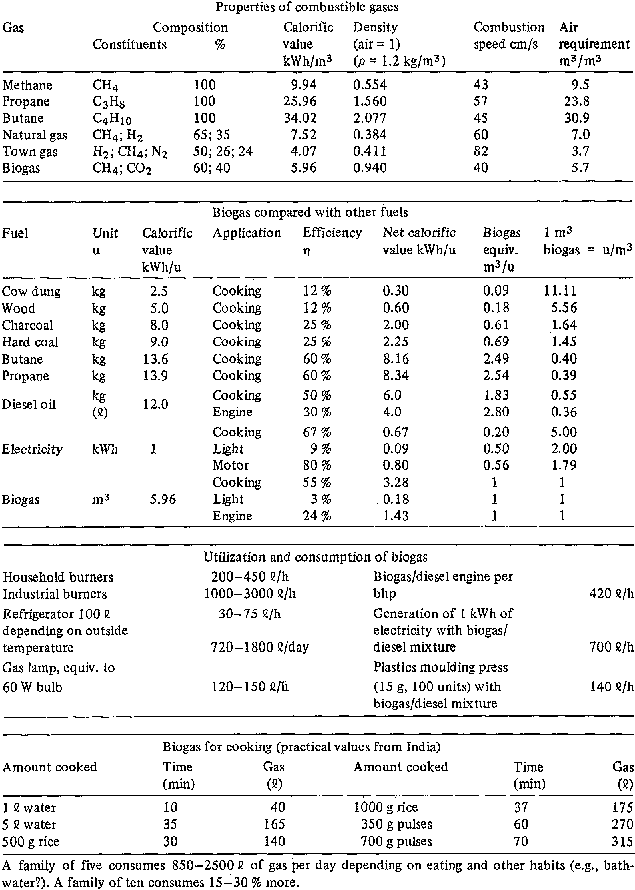
Fig. 38: Biogas: properties and
utilization
Efficiency is high if, for example, a litre of water boils
quickly. This takes longer if the burner is wrongly set. Efficiency is then
poor. The air supply substantially determines the efficiency.
A gas pressure of 5-20 cm WG is best for cooking. Lamps require
a pressure of about 10 cm WG.
The hydrogen sulphide in the biogas combines with condensate to
form corrosive acids. Water-heating appliances and utensils and refrigerators
are particularly at risk. The combustion chambers and burners should be made of
cast steel, high-grade steel or enamel.
Biogas can be rid of sulphur by iron oxide filters
(FeO + H2S ® FeS +
H2O; 2FeS + O2 ® 2FeO +
2S).
With large volumes of gas, the filter material has to be
replaced frequently and this becomes a laborious task. In this case filtration
should be omitted and high-grade steel utensils should be used despite the
higher cost. The gas does not have to be filtered for use in engines. The gas
pressure may be low because the engine aspirates the gas. It is seldom
worthwhile using the gas from simple plants to run engines.
Biogas cannot be economically liquefied. Gas pipes may be made
of steel, copper, ruber or plastic. Rubber hoses and rigid PVC pipes quickly
become porous and leaky when exposed to the sun and should therefore either be
shaded or wrapped in some sort of protective material.
The longer the gas pipes are the greater is the decrease of
pressure (Figure 39). The gas pipe must have an outlet for perspiration water
(Figure 40).
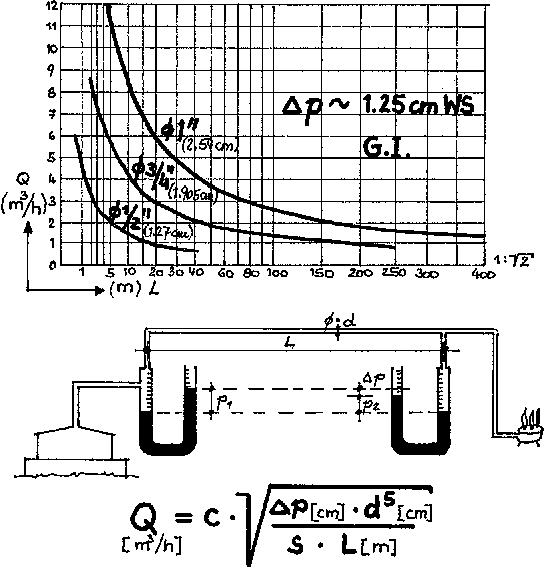
Fig. 39: Pressure drop in gas pipes
The gas pressure (p) falls with pipe length (L). The density relative to air is
indicated by "s". The pressure drop depends on the pipe friction (c) and
especially on the diameter of pipe (c = 2.24 in galvanized steel pipes (G.I.); c
= 2.80 in smooth plastic pipes). The curve shows the gas flow (Q) in a
galvanized steel pipe allowing for a pressure drop of p = 1.25 cm WC. Bends
increase the pressure drop.
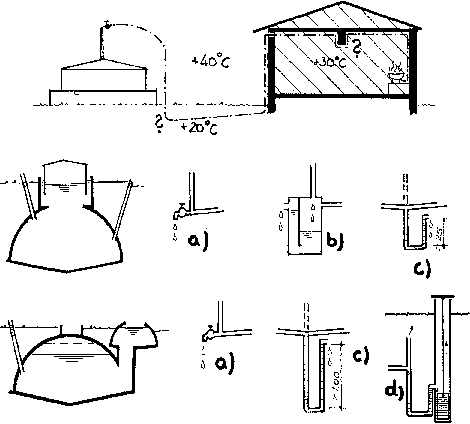
Fig. 40: Condensate trap Biogas
contains water vapour. If the gas is cooled, condensate forms. It always
collects at the lowest point in the pipe. It must be possible to drain
condensate from this point, otherwise the pipe will be blocked. Water pockets
must be avoided. Condensate may be drained by: (a) a gaslight water tap (ball
valve), (b) a Patel type overflow water trap, or (c) a simple U-shaped trap (see
also Figure 31). Approach (d) is recommended for cases involving a high
groundwater
level.
6.1 Biogas appliances
Biogas appliances are domestic appliances. They serve a
practical purpose. However, they are also relevant to the self-image of the
housewife or master of the house. The biogas plant will be looked after better
the higher the prestige value of the gas appliances. For this reason even
simple, inexpensive gas appliances made in the village should be of appealing
design. They must be not only cheap but also, and in particular, "modern".
Most households cook on two flames. Two-flame burners are
preferred. The burners (Figure 41) should be set initially and then fixed.
Efficiency will then remain at a high practical level.
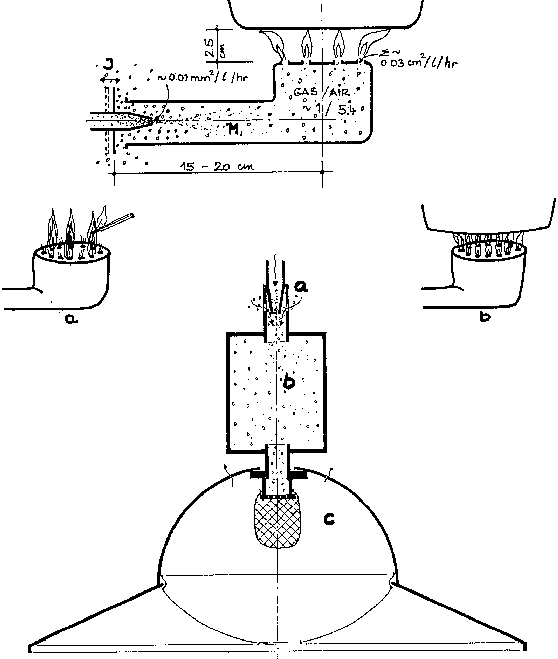
Fig. 41: Diagram of a gas burner and a
lamp
Burner: The values given are rules of thumb for a gas pressure
of 5-10 cm WG. If the pressure is higher, the mixing chamber (M) must be
enlarged so that the gas particles can mix adequately with oxygen. The gas/air
mixture is regulated by means of the adjusting screw (J). A burner is correctly
adjusted if only half of all the flames are burning before the pan is placed in
position.
Lamp: Things to watch for include the right area ratio between the
air hole and the gas nozzle (a), adequately sized gas/air mixing chamber (b) and
an air trap (c) that ensures a sufficiently high temperature around the gas
mantle without causing a shortage of oxygen for combustion.
In villages without electricity, lighting is a basic peed and a
status symbol. However, biogas lamps have low efficiency. This means that they
also get very trot.' If they hang directly below the roof, there is a fire risk.
The mantles do not last long. It is important that the gas and air in a biogas
lamp be thoroughly blended before the mixture reaches the gas mantle, and that
the air space around the mantle be adequately warm.
Particular problems also arise with biogas-operated
refrigerators. The composition of biogas varies substantially from day to day.
The gas pressure fluctuates excessively with the amount of gas stored even in a
floating-drum plant. Special' stable-burning jets are therefore needed -
especially if the refrigerator is thermostatically controlled and the flame
burns only when required. On every ignition there is a risk of the flame going
out. Gas will then discharge without burning. The gas supply must therefore
automatically be cut off if the flame goes out.
A gas appliance specialist must always be called in where biogas
is to be used in refrigerators!
For use of biogas in engines see Figure 42.

Fig. 42: Gas connection to diesel
engine
The gas is drawn into the cylinders together with the combustion
air. The connection to the intake manifold may take different forms. Detail A2
gave the best results in Chinese tests. Owing to the high ignition temperature
of biogas, a diesel engine must always be operated with a mixture of biogas and
diesel oil. A spark-ignition engine will also operate on 100% biogas. Biogas
burns less rapidly than diesel fuel. Consequently, engines designed for less
than 2000 rpm are the better choice. Spark-ignition engines run about twice as
fast as diesel engines, thus leading to lower efficiency when operating on
biogas.
| | | Biogas Plants (GTZ, 1988, 85 p.) | | | (introduction...) | | | Acknowledgements | | | Preface | | | 0. Biogas as appropriate technology | | | 1. Benefits and costs of a biogas plant | | | 2. The dgestion process | | | 3. Biogas plants | | | 4. Scaling of biogas plants | | | 5. Design of biogas plants | | | 6. Biogas utilization | | | 7. Planning, design and construction | | | 8. Appendix | | | Bibliography |
|
7. Planning, design and construction
Floating-drum plant with filler funnel
Floating-drum
Floating-drum plant without water jacket
Floating-drum
plant with water jacket
Fixed-dome plant without upper opening
Fixed-dome plant with upper opening
Floating-drum plant (quarrystone
masonry)
Floating-drum plant with extremely low VD/VG ratio
Channel-type
digester with folia
The following pages contain constructional drawings for
different types of biogas plants.
The form of the plant is determined when the size of the
digester and that of the gasholder are known (see calculation on page 26 f.).
The nature of the feed material is another important fundamental
planning parameter. The plant shown in Figure 43 is intended particularly for
long-fibre feed material. It has a larger outlet diameter to cope with this. The
light but hard fibrous constituents accumulate on the surface and form a
floating scum. This has to be broken up and if necessary removed. Gas is lost
through the inlet funnel. But the floating scum can be raked off without
removing the gas bell. Inlet and outlet pipes with a diameter of 100 mm are
sufficient for pure manure without litter or for toilet contents. Supernatant
scum formation is virtually no problem here.
The plant shown in Figure 51 has an extremely low
digester/gasholder volume ratio. The plant is of low construction. The distance
from the inlet pipe to the outlet is short. A partition will prevent fresh feed
material from discharging again immediately.
In the case of shell structures, the construction dimensions are
somewhat difficult to calculate. Consequently, the results of calculation have
been simplified, i.e. rendered in tabular form.
The vertical, cylindrical plant (Figure 50) is not optimal,
because the digester temperature is lower at the bottom and the water pressure
increases with depth. However, this plant may be economic if quarrystone masonry
is used instead of brickwork and a shell structure is too complicated.
The cover plate of a floating drum is always thinner than the
metal of the side walls, because the covers rust less than the sides. For the
guide frame, the cheapest solution is the best.
Floating-drum plant with filler
funnel

Fig. 43: Constructional drawing of a
floating-drum plant with filler funnel for long-fibre feed material; external
guide, external gas outlet.
Floating-drum

Fig. 44: Constructional drawing of a
floating-drum plant
Floating-drum plant without water
jacket

Fig. 45: Constructional drawing of a
floating-drum plant with an internal gas outlet and no water jacket
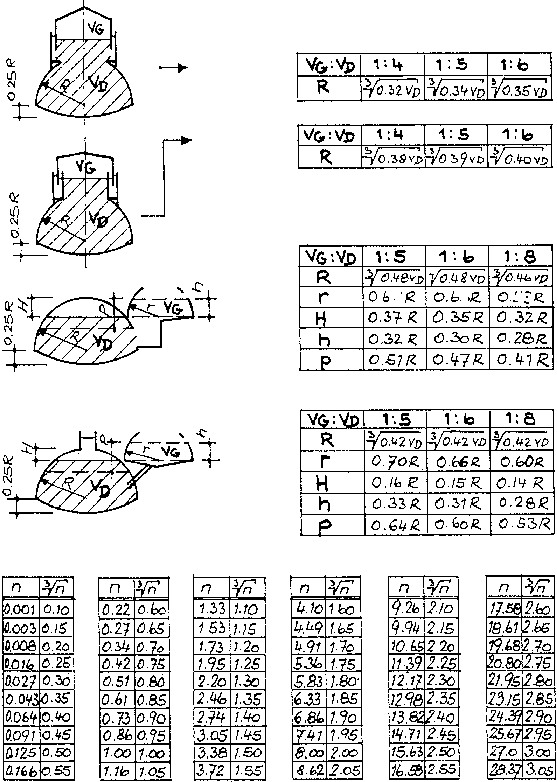
Fig. 46: Calculation of dimensions
Floating-drum plant with
water jacket

Fig. 47: Constructional drawing of a
floating-drum plant with water jacket. Compared to the one is shown in figure
45, this plant is about 40% more expensive but can be expected to last twice as
long and will handle substrate that tends to form substantial amounts of scum.
Detailed building instructions for a system of this kind are available in
several different languages.
Fixed-dome plant without upper
opening
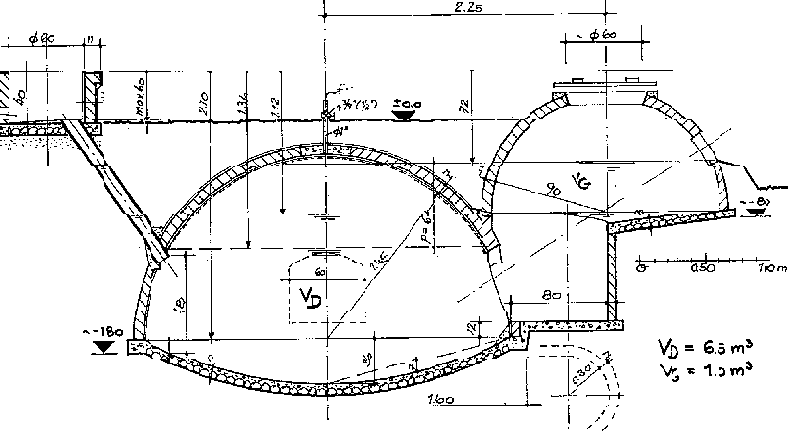
Fig. 48: Constructional drawing of a
fixed-dome plant without upper opening
Fixed-dome plant with upper
opening
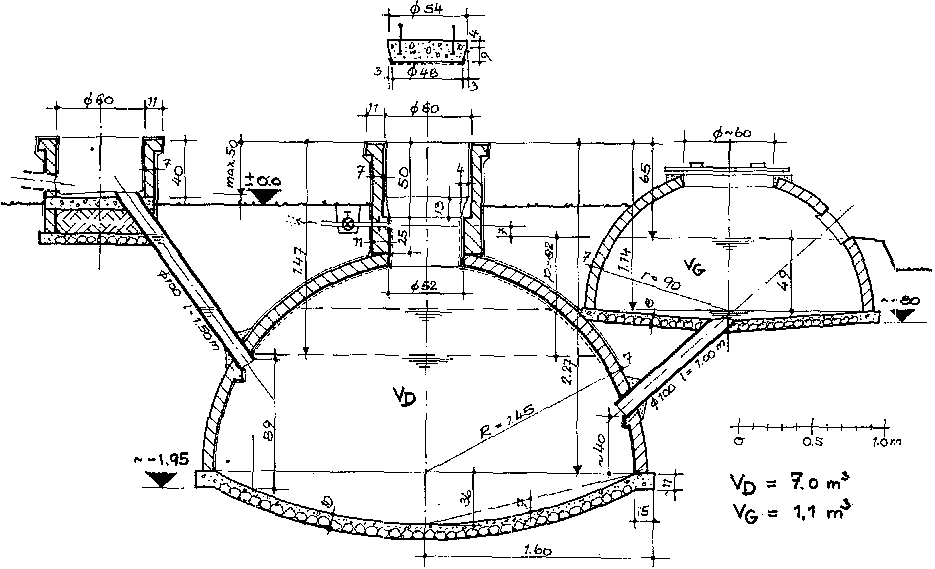
Fig. 49: Constructional drawing of a
fixed-dome plant with upper opening
Floating-drum plant (quarrystone
masonry)
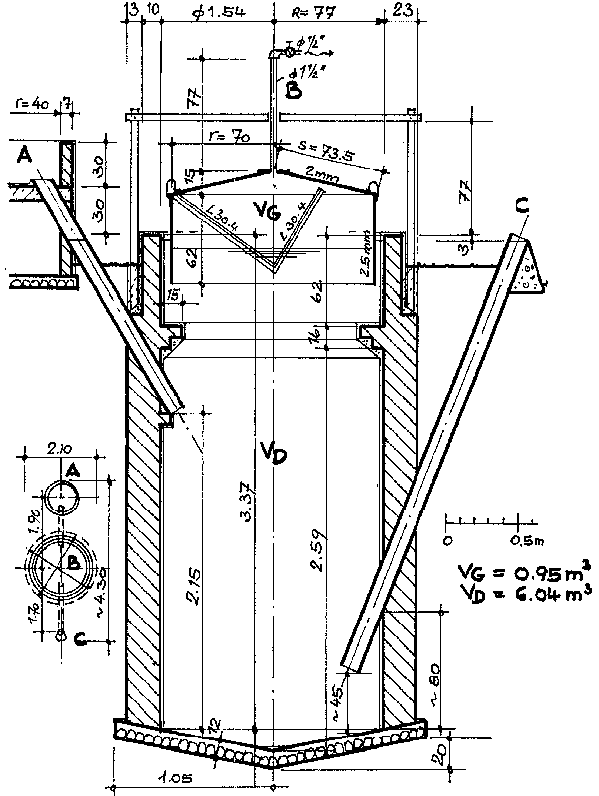
Fig 50: Constructional drawing of a
floating-drum plant for quarrystone masonry (vertical plant)
Floating-drum plant with
extremely low VD/VG ratio

Fig. 51: Constructional drawing of a
plant with an extremely low digester/gasholder volume ratio
Channel-type digester with folia
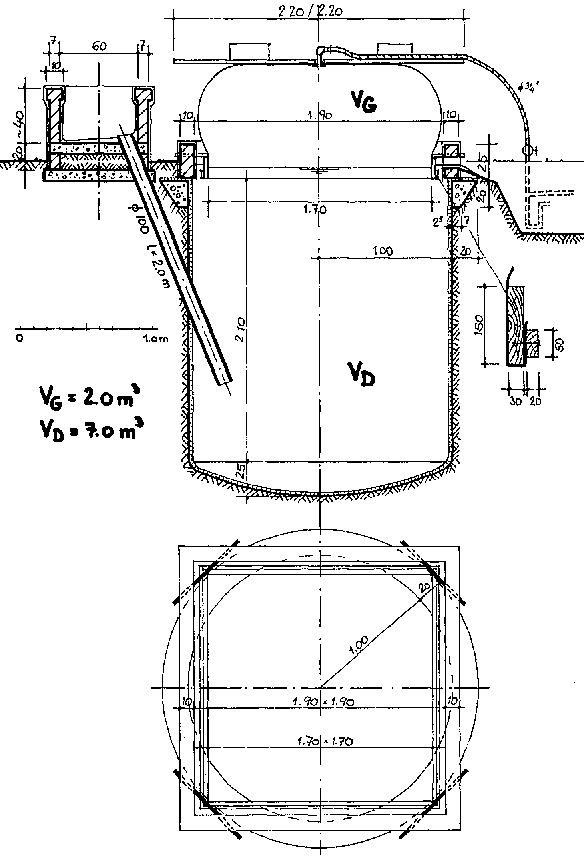
Fig. 52: Constructional drawing of a
channel-type digester with folia (Henning system) The digester walls consists of
netting-wire-reinforced rendering on the surrounding ground. The balloon serving
as gasholder is mounted on a wooden frame. A plywood panel or straw mat on
lathing serves as a sunshade. Weights placed on top make the gas pressure
higher.
| | | Biogas Plants (GTZ, 1988, 85 p.) | | | (introduction...) | | | Acknowledgements | | | Preface | | | 0. Biogas as appropriate technology | | | 1. Benefits and costs of a biogas plant | | | 2. The dgestion process | | | 3. Biogas plants | | | 4. Scaling of biogas plants | | | 5. Design of biogas plants | | | 6. Biogas utilization | | | 7. Planning, design and construction | | | 8. Appendix | | | Bibliography |
|
Bibliography
Literature list:
|
Acharya, C. N. |
Biogas Achievements and Challenges. Delhi 1976 |
|
ASTRA Research Team |
Studies in Biogas Technology; Proceedings Indian Academy of
Science V2, Part 3. Bangalore 1979 |
|
Baader, W., Dohne, E., Brenndorfer, M. |
Biogas in Theorie und Praxis. KTBL-Schrift 229, Darmstadt 1978
|
|
Barnett, A., Pyle, L., Subramanian, S. K. |
Biogas in the Third World: A Multidisciplinary review. IDRC 103
e Ottawa 1978 |
|
BORDA Biogas Team |
Biogas Guide for Housewives, Poona 1981 |
|
Biogas in China - Erfahrungsaustausch. Projektbericht, GTZ/Land
Bremen. Bremen 1979 |
|
Biogas Knowledge Report. GTZ/Land Bremen 1979 |
|
Biogas Manual for the Realisation of Biogas Programmes. CTZ/Land
Bremen. Bremen 1981 |
|
Biogas plants, Building instructions. GATE, Eschborn 1980 |
|
Enssle, G. |
Biogas, Ermittlung verfahrenstechnischer Kennwerte an zwei
Biogasanlagen unterschiedlicher BaugroiBe. Agrartechnische Berichte
Stuttgart-Hohenhcim 1981 |
|
Kaltwasser, B. |
Biogas, Regenerative Energieerzeugung durch anaerobe
Fermentation organischer Abfalle. Bauverlag Wiesbaden und Berun 1980 |
|
Khadi & Village Ind. |
Gobar Gas Why and How, Bombay 1980 |
|
Commission (KVIC) |
Technical drawings and Lists of Material, 1982 |
|
Mazumdar, A., Paul, T. M., |
Biogas Handbook (pilot edition) TATA Energy Research Institute.
Bombay |
|
Sathianathan, M. A. |
1982 |
|
Review of Literature on the promotion of biogas systems (pilot
edition). |
|
TATA Energy Research Institute, Bombay 1982 |
|
Patankar, G. L. |
Recent Development in Goba Gas Technology. KVIC, Bombay 1977
|
|
Philipp, O. |
Zur Verwertung der Wasserhyazinthe. Stuttgart-Hohenheim 1981
|
|
Planning Research & Actian Division (PRAD) |
Janata Biogas Systems, an Evaluation. State Planning Institute,
Lucknow 1980 |
|
Saubolle, B. R. |
Fuel Gas from Cowdung. Kathmandu 1976 |
|
Sichuan Provincial Office of Biogas Dev. |
Biogas Technology and Utilisation. Changdu Seminary Chcngdu 1979
|
|
United Nations |
Guidebook on Biogas Development. New York 1980 |
|
United Nations Dev. |
Biogas Fertilizer System. Technical Report on a Training
Seminary in China |
|
Programme (UNDP) |
UNDP Reports and Proceedings Series 2. Nairobi 1981 |
|
Wenzlaff, R. |
Erfahrungen mit Biogas im praktischen Betrieb. KTBL-Schrift 266.
Darmstadt 1981 |
|
Wesenberg, R. |
The Construction and Testing of Biogas Plants in Cameroon. CTZ
project report. 1981 |
|
Yadava, L. S., Hesse, P. R. |
The Development and Use of Biogas Technology in Rural Areas of
Asia. FAO project Field Document No. 10 New Delhi 1981 |
Periodical biogas literature:
|
Biogas Forum |
Bremen Overseas Research and Development Association (BORDA),
Bremen |
|
Biogas-Gobar Gas Newsletter |
Kahdi &Village Industries Commission (KVIC), Bombay. |
|
Newsletter Biogas |
Gobar Gas Development Committee/Dept. of Agriculture, HMG and
SATA. Kathmandu. |
General technical standard works:
|
Staufenbiel, G. |
WestermannTabellen-Bau. Hannover 1973 |
|
Verein Deutscher Eisenhuttenleute |
Stahl im Hochbau. Handbuch. Dsseldorf 1953 |
|
Buderus'sche Eisenwerke |
Handbuch fur Heizungs- und Klimatechnik. Wetzlar 1975 |
Individual articles and index of persons:
It is impossible for reasons of space to mention all information
and suggestions used. Information or literature from the following experts was
very important for the author's work on this book (in alphabetical order):
M. C. Adhav, A. Bachmann, Chit Chaiwong, A. S. Deshpande, W.
Edelmann, G. Eggeling, H. Falkner, R. Finley, R. Gadre, S. H. Godbole, S. T.
Gujar, He De-Zhao, P. Hildebrandt, G; HiHiges, Li Fan-Quiang, Li Hua, P.
Meagaard, R. M. Myles, M. Nietsch, A. Ntaganira, G. Pabel, V. Padmanabhan,
Arvind Pandya J. J. Patel, U. J. Patel, D. R. Ranade, Mohan Rao, Ren Yuan-Tsai,
U. Reeps, S. R. Sabnis, D. P. Shinde, Sermol Ratasuk, Pichit Skulbhram, Ram Bux
Singh, H. R. Srinivasan, K. Steffens, B. Stephan, C. Tietjen, Boontham Tesna, E.
Uwimana, J. P. Vuilleumier, R. Wagner, U. Werner, Xue Bing-Kui, Zhang Wei.
Illustations:
Figures 43, 45, 47, 48, 49 and 52 by courtesy of BORDA,
Bremen.