 |
| ||||||||||||||||||||||||||||||||||||||||||||||||||||||||||||||||||||||||||||||||||||||||||||||||||||||||||||||||||||||||||||||||||||||||||||||||||||||||||||||||
|
| ||||||||||||||||||||||||||||||||||||||||||||||||||||||||||||
G178
Tropical Development and Research Institute
C. G. Jarman and A. J. Canning
November 1983 Tropical Development and Research Institute 127
Clerkenwell Road
London EC1R 5DB
Overseas Development
Administration
|
| ||||||||||||||||||||||||||||||||||||||||||||||||||||||||||||
Acknowledgements
We are grateful to the following dyestuff manufacturers for information and the provision of samples: Imperial Chemical Industries pie, Organics Division Bayer Dyestuffs Ltd, UK, and their parent company Sandoz Products Ltd, UK Ciba-Geigy plc Dupont (UK) Ltd
Vinyl Products Ltd and Catomance Ltd are thanked for samples of finishing agents and technical advice on their use.
© Crown copyright 1983
This report was produced by the Tropical Development and Research Institute (formed by the amalgamation of the Tropical Products Institute and the Centre for Overseas Pest Research) a British Government organisation, funded by the Overseas Development Administration, which provides technical assistance to developing countries. The Institute specialises in post-harvest problems and pest and vector management.
Short extracts of material from this report may be reproduced in any non-advertising, non-profit context provided that the source is acknowledged as follows:
Jarman, C. G. and Canning, A. J. (1983) Dyeing of leaves and straws: A handbook for craft instructors. Report of the Tropical Development and Research Institute, G178, v+37 pp.
Permission for commercial reproduction should, however, be sought from the Head, Publications, Publicity and Public Relations Section, Tropical Development and Research Institute, 127 Clerkenwell Road, London EC1R 5DB, England.
No charge is made for single copies of this publication sent to governmental and educational establishments, research institutions and non-profit making organisations working in countries eligible for British Aid. Free copies cannot normally be addressed to individuals by name but only under their official titles.
Tropical Development and Research Institute
ISBN: 0 85954
173-8
ISSN: 0264 763
X
|
| ||||||||||||||||||||||||||||||||||||||||||||||||||||||||||||
Note
Mention of a particular company or product does not imply recommendation by the Tropical Development and Research Institute to the exclusion of others.
|
| |||||||||||||||||||||||||
Dyeing of Leaves and Straws: A Handbook for Craft Instructors (NRI)
Summaries
Summary
This report describes some of the straws and leaves commonly used as craft materials, such as iraca straw and jippi-jappa, big thatch and silver thatch, pandanus, vetiver grass, and coconut leaves. The recommended dyeing methods are those described in more detail in an earlier Tropical Development and Research Institute report 'G176 Dyeing of sisal and other plant fibres: A handbook for craft instructors' (Canning and Jarman, 1983). Results for light fastness and water fastness of the colours produced by a limited selection of acid, basic and disperse dyes (and in the case of coconut leaves, direct dyes) are given.
Resume
Ce rapport d�crit certaines pailles et feuilles couramment utilis�es comme mat�riaux dans l'artisanat, notamment la paille d'iraca et jippi-jappa, le grand chaume et le chaume d'argent, le pandanus, le vetiver et les feuilles du cocotier. Les m�thodes de teinture recommand�es vent celles d�crites plus en detail dans un rapport ant�rieur de l'Institut pour le D�veloppement et la Recherche Tropicale - "G176 Teinture des fibres de sisal et d'autres fibres v�g�tales: Manuel pour techniciens-instructeurs" (Canning et Jarman, 1983). On pr�sente les r�sultats des tests de determination de la stabilise a la lumi�re et a l'eau des couleurs obtenues avec un choix limit� de colorants acides, basiques et en pulverisation (et dans le cas des feuilles du cocotier, de colourants directs).
Resumen
En este informe se describer algunas de las pajas y hojas usadas normalmente en la artesania, tales como la paja iraca y la jipijapa, la paja de techar de tipo grande y de tipo plateado, el arbusto pandanus, la hierba vetiver y las hojas de cocotero. Los m�todos recomendados de tenido son los descritos mas detalladamente en el informe anteriormente publicado por el Instituto de Desarrollo y Investigacion Tropical titulado: "G176 Tenido del sisal y de otras fibres vegetales - Manual pare los instructores de artesania" (Canning y Jarman, 1983). Se incluyen los resultados correspondientes a la solidez a la luz y al ague de los colores obtenidos mediante una selecci�n limitada de tintes �cidos, b�sicos y de dispersi�n (y en el cave de las hojas de cocotero, de tintes directos).
Dyeing leaves and straws: A handbook for craft instructors
|
| ||||||||||||||||||||||||||||||||||||||||||||||||||||||||||||
Introduction
An earlier Tropical Development and Research Institute (TDRI)* report 'G176 Dyeing of sisal and other plant fibres: A handbook for craft instructors' (Canning and Jarman, 1983) described techniques for obtaining fast colours on plant fibres such as sisal, abaca and coin The present handbook only supplements the information given in the earlier report and should be used in conjunction with it.
The materials described in this handbook are all leaf and straw materials obtained from plants. Some undergo very little processing before dyeing (e.g. vetiver grass) whereas others (e.g. jippi-jappa) are extracted using quite elaborate techniques.
The materials differ fundamentally from fibres such as sisal in that they all possess a cuticle or skin which acts as a barrier to dye penetration. The very few dyes which do penetrate the cuticle belong to the acid, basic and disperse classes of dyestuffs. In some materials, such as prepared coconut leaves, a fibrous surface is exposed during processing and therefore a wider range of dyes can be used, including direct dyes.
Very few of the dyes give colours of good fastness properties on leaves and straws but the range of fast shades can be extended by blending dyes. Disperse dyes can be mixed with either acid or basic dyes after they have been dissolved separately and the mixtures are applied as acid or basic dyes as appropriate. However, acid and basic dyes must not be mixed since they will neutralise one another to form an insoluble complex.
|
| ||||||||||||||||||||||||||||||||||||||||
Dyeing of Leaves and Straws: A Handbook for Craft Instructors (NRI)
Raw materials
Iraca straw and jippi-jappa
Source and areas of production
The toquilla palm (Carludovica palmate) is the source of the iraca straw used in Colombia to make 'Panama hats' and handicrafts. The straw is also called 'Paja de toquilla' or 'jipi japa'. The toquilla palm has no true stem, the leaves growing from the ground on long petioles which may attain a length of 3 m. Most of the straw is obtained from wild plants. However, the plant grows well on banana plantations in the shade of the banana plants. In Jamaica the 'jippi-jappa' plant (C. jamaiciensis) yields a straw which is used for similar purposes. These palms belong to the Cyclanthaceae or 'screw pine' family.
The toquilla palm is found in an area stretching from Guatemala and Honduras in Central America to Ecuador, Peru and Colombia in South America. It also grows east of the Andes in Venezuela and in Guyana and has been introduced into Puerto Rico and the Philippines (du Frane, 1945). C. jamaiciensis has been introduced into Singapore.
Extraction and processing of iraca straw
The straw is extracted from the young unexpanded leaf which is about 1 m long. The leaf is made up of four divisions, each of which is then divided into six or seven segments or bands. The leaf is 'ripped' with a comb-like tool and the mid-ribs removed, leaving the straw strips which are later used for weaving. Although most of the leaf is ripped, the base is untouched so as to keep the strips together for easy handling. Bunches of strips are boiled for 2 hours in a large pot, after which they are hung in the shade during the middle of the day until they are dry. Once dry they are laid upon the ground in the sun for 3 days. The bunches are then placed in chambers where for about 12 hours they are exposed to the fumes from burning sulphur. The bleaching action of the sulphur dioxide produced is more effective if the leaves have been dampened first. The quality of the straw depends on the combined effects of the sun and sulphur treatment.
Extraction and processing of jippi-jappa
The extraction and processing of jippi-jappa is basically similar to iraca straw (Spence, 1964) but differs in the following respects:
(i) Drying is carried out in the bright sun - it takes 2 days.
(ii) The straws are damped after drying and then placed on a clean dry surface to dry.
(iii) Before bleaching, the articles are washed in soapy water, rinsed and partially dried.
(iv) Bleaching, carried out in a box or a barrel, takes 15 minutes.
Suitable classes of dye
Basic and disperse dyes are, apart from a very few acid dyes, the only ones which can be used with these materials. Some of the shades obtained are quite durable although light fastness is always lower than on other materials and the build up of shade varies greatly from batch to batch (see Tables 1(a), 2(a) and 3(a)).
Big thatch, cabbage palm and Puerto Rican hat palm
Source and areas of production
The palm Sabal jamaiciencis, which is known in Jamaica as 'big thatch', comes from a genus of palms known as 'fan palms'. Although a native of the warmer parts of North and South America the genus has been introduced elsewhere. The 'Sabal palm' or 'cabbage palm' (Sabal palmetto), so called because of its edible bud, yields the palmetto fibre which is used as a brush filling. The best quality brush fibre is obtained from the young leaf stems. The leaves are also used in making hats, mats, baskets and various novelties for the tourist trade.
S. causiarum is known in Puerto Rico as the 'yaray'. It is also known as the 'Puerto Rican hat palm'. The shiny green curved leaves attain a length of 1 m or more and are borne on a smooth trunk 3 - 5 m high. The palm grows in abundance in sandy soils on the west coast of Puerto Rico and the east coast of the Dominican Republic.
Extraction and processing of big thatch
The extraction and processing of big thatch has been described by Spence (1964). Alternate heart leaves are cut whilst they are still sword-shaped. One leaf is always left on the plant. The sword is 'fermented' or 'cured' by being kept indoors and away from direct heat. Complete curing takes about 4 days under normal conditions (for quick curing, the sword is put to dry in the sun, either in a hanging position or on a flat hard surface and turned occasionally). If the thatch becomes brittle it is put in the dew for an hour or more. While working it is kept cool and moist by wrapping the strips in a lightly damped cloth or newspaper. Skeining or removal of the ribs is carried out using a small pointed knife. The knife is run from the base to the tip of the leaf and the ribs are stripped off. During the skeining all strips are produced at a uniform width. The blades or leaflets are split into strips with the finger nails. The tops and bottoms are cut off giving a length of 50 cm. The more pliable strips are selected for plaiting.
Processing of Puerto Rican hat palm
Only young unfolded leaves are collected. They are dipped in boiling water and dried in the sun. The thin, tough segments of the leaves are split into narrow strips and these are woven into hats, mats, baskets and many useful and fancy articles. Since the strips are flat and rather firm in texture they are not woven so closely as to prevent ventilation. The finer quality hats are woven in the morning and evening or in rainy weather, but the cheaper hats may be woven at any time (Dewey, 1943).
Suitable classes of dye
Basic, acid and disperse dyes will produce durable shades (see Tables 1(b), 2(b) and 3(b)). Intense colours are best obtained using acid dyes.
Silver thatch
Sources and areas of production
The source of the material used in Jamaica for plaiting into ribbons which will be made up into baskets, etc., is the palm Cocothrinex fragrans which much resembles C. argentea but has yellow fragrant flowers. C. argentea has leaflets which are dull green above and silvery beneath. The trunk grows to a height of 9 m (McCurragh, 1960).
Extraction and processing
The material is extracted and processed in a similar way to big thatch.
Suitable classes of dye
The straw behaves in a similar way to big thatch (see above); however, since the differences between the upper and lower surfaces cannot be concealed, it is best to use them for effect.
Pandanus ('screw pine')
Source and areas of production
Pandanus tectorius (P. odoratissimus) the 'textile screwpine' is common in the tidal forests of South-East Asia and Polynesia. The leaves are used for making mats, baskets, hats and other craft goods (Morton, 1976). The tree is extensively branched and grows to a height of about 5 m. Several races have been selected for cultivation from the wild plant, which is var. Iittoralis. Among these are the races without thorns cultivated in gardens, which collectively make var. Iaevis (Burkill, 1935). Varieties of pandanus are found also in the Caribbean and are used in handicrafts in Dominica, Grenada and Jamaica. In the Philippines pandanus is widely used for hats and matting. The very strong and durable 'sabutan hats' are made from the young leaves while they are still green.
Extraction and processing
For making matting in Malaysia, the leaves are cut and allowed to dry slightly over a fire before being split into two down their length by removing the spiny mid-rib. The halves are then cut into strips - the Malays do this by dragging them over a board with brass spikes in it - and the prickly edges are thrown away. Elsewhere the prickly edges may be removed with the mid-rib. The strips are then pulled over a bamboo and beaten with a pestle to improve their suppleness (Burkill, 1935). After soaking for 3 days in changes of water, and bleaching in the sun, the strips are ready for weaving into baskets, etc.
In Grenada, craft straws are obtained by first boiling the green leaves for about 30 minutes and then bleaching them in the sun. To do this, the wet leaves are spread out in direct sunlight but not allowed to dry. When the green colour has been discharged the damp leaves are rolled end-to-end to prevent them shrivelling during the final stage of drying. The coiled leaves are allowed to dry naturally in the shade and are finally split into strips of useful width.
Suitable classes of dye
Pandanus leaves can be dyed with selected acid, basic and disperse dyes. Few dyes give colours of good light and water fastness. However, with careful selection the fastness properties will be adequate for many purposes (see Tables 1(c), 2(c) and 3(c)).
Basic, disperse and 1:2 metal complex acid dyes (e.g. Bayer 'Isolan' dyes) give the most uniform colours.
Vetiver grass
Sources and areas of production
The small genus Vetiveria of the grass family Graminae is found in the tropics of Africa and Asia. Two species are very common: Vetiveria nigritana, which is found in Africa where its tough leaves are used for thatching; and V. zizanoides, which is found in Asia (Burkill, 1935). V. zizanoides is cultivated mainly for its root which, on distillation, yields an oil used in perfumery. The plant is also grown as a soil binder to prevent coastal erosion. The dried grass is used for making brooms as well as thatching roofs (Council of Scientific and Industrial Research, 1976). In Dominica the production of verti-vert (vetiver) straw plaits and mats provides a valuable source of employment for girls in the rural areas.
Processing
Apart from being laid out in the sun to dry, the material is not processed. The resulting pastel green colour can be lightened using a method similar to that used for pandanus in Grenada; however, the treatment may have to be repeated.
Suitable classes of dye
The pale green straw is readily coloured with selected acid and basic dyes; however, the natural green colour of the straw must first be discharged, e.g. by sun bleaching, if clear uniform colours of the best possible light fastness are required. Although none have been used on this material it would be worthwhile trying disperse dyes.
Of the dyes evaluated, the 1:2 metal complex dyes (e.g. Bayer 'Isolan' dyes) appear to be the best choice but some selected ordinary acid dyes also look promising. In general, the basic dyes produce colours with better water fastness than those from ordinary acid dyes but the colours tend to be weak and the light fastness tends to be low (see Tables 1(d) and 2(d)).
Coconut leaves
Source and areas of production
A useful craft straw can be obtained from the leaves of the coconut palm (Cocos nucifera) which is the most important of all the cultivated palms and is widely distributed throughout the tropics.
Extraction and processing
In some countries the straw is prepared by first boiling the fresh leaves and separating the two faces of each leaf which are then split into strips of convenient width and boiled for 1 - 2 hours in a 5 - 8 per cent solution of soda ash (sodium carbonate). The strips are chemically bleached (for 1 - 3 days), washed and finally dried in the shade. This treatment yields a smooth semitransparent raffia-like material which is said to be strong, elastic, light and similar in quality to iraca straw.
Suitable classes of dye
Limited dyeing trials on the material gave promising results when using acid, basic, disperse and direct dyes (see Table 4). In addition to the dyes listed, dyers should also experiment using dyes which give good fastness properties on other materials evaluated (see Tables 1 - 3). Methods of applying direct dyes have been described by Canning and Jarman (1983).
|
| ||||||||||||||||||||||||||||||||||||||||||||||||||
Dyeing of Leaves and Straws: A Handbook for Craft Instructors (NRI)
Methods of applying dyes
Preparation of material
By using material that has already been cut and trimmed for weaving, dyeing costs will be kept to a minimum. Normally the material should be thoroughly wetted before dyeing. This can be done quickly by boiling it for 30 - 60 minutes in water containing a wetting agent, then leaving the material in the bath while it cools. However, when using disperse dyes it is not necessary to wet the material.
Acid dyes
Choice of dyes
Most acid dyes cannot be used with leaves and straws. However, among a large number tested on big thatch a few were found to be suitable (see Table 1(b)). It was found that these same dyes (especially the 1:2 metal complex dyes) were, in general, also largely suitable for other palm leaves such as palmyra (Borassus flabellifer) and doum palm (Hyphaene spp.), pandanus leaves and vetiver grass. (Jippi-jappa was an exception in that it would take up very few acid dyes and it is better therefore to use other classes of dye on this material.) With an unknown material it is well worthwhile, therefore, to experiment first with those dyes which give good results with big thatch.
Because of the 'bleeding' of dye from the split edges of the straws, most acid dyes give rather poor results for water fastness. A substantial improvement is obtained if the freshly dyed material is soaked for a short time in very hot water to remove surplus dye. The leaves could be dyed before splitting, but this would waste dye as some parts of the leaves are discarded.
Dissolving the dyes
The dye powders are mixed to a smooth paste with water. The paste is then added to boiling water, using additional water to rinse the dye paste from its container. Boiling is continued for 2 - 3 minutes with stirring, to dissolve the dye. Each 10 9 of dye will need about 1 litre of water to dissolve it completely.
Acids to use
Acid must be added to the dyebath, in order to fix the dye. Acetic acid is suitable for use with the 1:2 metal complex dyes (e.g. Bayer 'Isolan' dyes) and, with these, 4 9 of the 30% strength acid is to be used with each 100 9 of material, regardless of the depth of colour. However, other types of dye may require a stronger acid and usually it is recommended that 3 - 5 9 of 85% strength formic acid is used for each 100 9 of material dyed. The ideal amount depends to some extent on the nature of the individual dyes, but the deeper shades usually require larger amounts of acid.
With straws, the acid can usually be put in the bath at the start of dyeing. However, if there is difficulty in distributing the dye evenly over the straw surface the acid should be added a portion at a time, throughout the dyeing period.
Basic dyes
Choice of dyes
Almost all basic dyes are readily taken up by leaves and straws to give strong colours. They are therefore widely used for craft work since short dyeing times and small amounts of dye can often be used to produce cheap colours. However, the fastness properties of these cheap colours are poor and the basic dyes cannot be generally recommended for use on durable goods.
Selected basic dyes will give moderately good light fastness
with good water fastness when properly applied to iraca straw and jippi-jappa
(see Table 2(a)). The same dyes also produce good results on big thatch,
pandanus and vetiver grass. Therefore, when dyeing an unknown material for the
first time it is well worthwhile to experiment with the few basic dyes which
give the better fastness properties on other materials.
Only a few of the
many dyes investigated are suitable for blending to give a range of fast
colours. This range will be limited by the colours of the best dyes, but may be
extended by the use of selected disperse dyes in the blend. Basic and disperse
dyes should not be blended before the powders have been mixed with water.
Dissolving the dyes
The dye powder is first wetted with a little industrial spirit (methylated spirit) or acetic acid to prevent it from forming sticky tars with water. The dye is then mixed to a smooth paste with water, making certain that no lumps remain. Hot water, near the boil, is added with stirring until the dye is dissolved. At least 1 litre of water for every 10 9 of dye will be needed to make a solution.
Acetic acid is used in the dyebath to assist even dyeing. Between 2 9 and 5 9 of 30% strength acetic acid is sufficient for each 100 9 of straw dyed; the larger amounts of acid are needed with pale colours. The acid is added before dyeing commences and some of it is used initially to paste the dye. Vinegar (between 12 9 and 30 9 for each 100 9 of material) can be used instead of acetic acid.
Disperse dyes
Choice of dyes
Disperse dyes, including the reactive disperse (ICI 'Procinyl') dyes, are readily taken up by leaf and straw materials but few give colours which combine good light fastness with good water fastness. However, the dyes are very easy to use and the use of selected members of the class should be considered - especially for jippi-jappa, which does not take acid dyes very well.
Promising dyes can be selected from the large number evaluated on iraca straw and jippi-jappa (see Table 3(a)). A number of the same dyes have been evaluated on big thatch and pandanus with similar results. Although none have been evaluated on vetiver grass it is well worth experimenting with the more promising dyes on this, or any other material, which needs to be dyed.
Some disperse dyes build up to pale colours only (particularly Cl Disperse Red 60*) and care should be taken to ensure that excessive amounts of dye are not used in the bath. This will limit the range of fast shades that can be blended: for deep shades, especially those containing red, it may be better to use basic dyes or blends of basic and disperse dyes. Basic and disperse dyes should not be blended before they are mixed with water.
Dissolving the dyes
Disperse dyes do not dissolve in water, but contain auxiliary agents which suspend them in water as finely-divided particles. It is important that the correct amounts of water are used when initially dispersing the dye particles otherwise the dispersing agent in the dye may not be effective.
The dyes are available either as fine powders, grains, liquids or pastes. The method of dispersing the dye into water is different with each:
(i) Fine powders are sprinkled, with stirring, into water which is just too hot to touch (50°C) using 10 - 20 ml of water for each gram of dye. The mixture is then left to stand for 5 minutes with occasional stirring.
(ii) Grains are dispersed by pouring them onto moving, hot, but not boiling (50 - 80°C) water using 10 - 15 ml of water for each gram of dye. The mixture is then left to stand for at least 5 minutes before stirring. The mixture is ready for use when no grains remain in the liquid.
(iii) Pastes and liquids are stirred into warm water.
Preparing the dyebath
The use of a wetting and penetrating agent (a form of detergent) in the bath will help to obtain even dyeing. For straw dyeing, a 'non-ionic' type, such as Synperonic BD or Metapol HC, is recommended. Both of these non-ionic wetting agents are available from Durham Chemicals Distributors Ltd (see Appendix for address). Washing-up liquids are often of the 'anionic' types and are likely to interfere with the dyeing process. However, it may be worthwhile to experiment with various brands. The amount of detergent needed is of the order of 1 9 for each litre of the dyebath (1 teaspoonful equals approximately 5 g).
Normally, 20 - 30 litres of dye liquor are needed for each kilogram of straw. However, if the straw is bulky it may be necessary to increase the amount of liquor in order that the straw can be both submerged, and freely moved through the liquor. The pre-dissolved dye is added to the bath and made up to almost the required volume with cold water. With acid and basic dyes it is sometimes
convenient to prepare the dye solution directly in the dyebath, using one-quarter to one-third of the total volume of water that will be used for dyeing. The hot solution can then be diluted with the remaining cold water to reduce the temperature of the bath to about 50°C. This is about the correct temperature to start dyeing. Soft water (e.g. rain water) is best, but with acid and basic dyes it should not be alkaline. Alkaline waters must be neutralized with additional acetic acid before dyeing. The detergent and acids are added as required. The bath is made up to its full volume with water and stirred well to mix the ingredients.
Dyeing
The material is placed in the dyebath which is then slowly heated, with stirring, to the boil. (This warming up period is the most important part of the dyeing process since it is in this period that even, or uneven, colours are made. Usually, a period of about 30 minutes is sufficient, but longer periods can be used at the dyer's discretion, to ensure that the dye is deposited evenly over the material.)
Dyeing, at the boil, is continued for at least one hour. Further increases of colour intensity and depth of penetration can be obtained for most dyes by increasing this time to 2 hours or more. The exact time needed (for each dyeing) can only be determined by experience. Acid dyes usually require more time at the boil than basic or disperse dyes.
Efficient circulation of liquor round the straws is difficult to obtain. Repeated steeping of the material is recommended. Alternatively, special equipment could be designed in which the straight laid material is tumbled in a horizontally placed drum.
After dyeing at the boil, the material can be removed from the liquor. However, if left in the cooling liquor the material will absorb more dye. The dyer must decide whether or not to leave the material in the cooling liquor.
The dyed material is removed from the dyebath and rinsed in cold, preferably, running water. This removes adhering dye liquor and thus prevents the formation of loose dye powder on the surface of the material during drying. Finally, the material is spread in the shade to dry.
After-treatment
Dyed straws tend to become brittle on drying. Some will recover their suppleness if they are first re-wetted in cold water for about one hour, then redried. Straws which do not have their suppleness restored by this treatment will often benefit from immersion in a 10 per cent aqueous solution of glycerine, followed by drying. If the dried material looks wet, the concentration of glycerine should be reduced. Unfortunately there is often a considerable loss of dye during this treatment. Immersion for about 2 hours in acrylic emulsions (e.g. Vinacril 4000) diluted with water to a resin solid content of 2 per cent gives a considerable improvement in handle particularly with big thatch and silver thatch. These treatments always produce a shade change due to the swelling of the material.
Some leaf materials become brittle with age (Jayaraj and Sivaramalingham, 1967). This is attributed to fungal and bacterial attack. Treatment for 20 minutes in a 1 per cent aqueous solution of sodium pentachlorophenate, also containing 1 9 of wetting agent for each litre, followed by treatment in a 5 per cent aqueous zinc sulphate solution will overcome this problem.
Safety note: With sodium pentachlorophenate there is serious risk of poisoning by inhalation, swallowing or skin contact. Wear gloves and a facemask when handling the chemical. Spillages should be mixed with sand and buried in a safe open place and the site of the spillage should be washed thoroughly with water and soap or detergent. Straws are usually easier to weave if they are dampened slightly before weaving. Some weavers store their material in damp newspaper for a few hours before using it.
Finishing
Finishing agents can be used to increase the stiffness or the flexibility of straw goods and to enhance their lustre and water resistance. Some agents will improve several properties at the same time.
Water resistance is a particularly important consideration since straw goods readily lose their shape in damp or humid conditions.
Frohlich 11963) gave examples of commonly used agents for stiffening. These included glue, gelatine, mucilage (tragacanth), starch and dextrin, which are all applied in similar ways: for gelatine, the work is dipped in a hot solution containing 30 - 40 9 of gelatine for each litre then dried at moderate temperatures. However, these agents are only partially successful, and are not water resistant. Appretan (plastic dispersions from Hoechst AG based on polyvinyl acetate), and shellac solutions, particularly in alcohol, are more suitable. Collodion solutions (nitrocellulose lacquers) and natural resins are also examples of stiffening agents. However, only cellulose lacquers which are flexible should be used and manufacturers should be consulted about the formulation of a special 'dope' for the purpose (Martin, 1938). Martin also records that a synthetic product (probably a formaldehyde resin) gave many desirable properties and was superseding gelatine as a stiffening agent for sisal hats.
Flexibility can be improved by treatment of the straw in a solution of glycerine (glycerol) or a soluble oil after dyeing. For some straws, as little as 10 ml of glycerine in each litre of solution will suffice when treatment is for 15 - 20 minutes in a standing bath at 40°C (Martin, 1938): sponging with a solution containing 50 ml of a soluble oil and 10 ml of glycerine in each litre is given as an alternative treatment for straw which is to be pressed under high pressure. Waxes are also included with other finishes to impart additional water resistance and flexibility (Frohlich, 1963). These finishes just described, particularly cellulose lacquers, usually give the desired lustre.
At the Tropical Development and Research Institute (TDRI), preliminary trials have been carried out on big thatch using a wax from Catomance Ltd, and some synthetic resins from Vinyl Products Ltd. The wax, Mystolene SP30, was applied by dipping the hats in a solution containing 50 g of wax in each litre of a non-polar solvent (e.g. white spirit) then allowing them to dry. The resultant hats, which were slightly yellowed by the wax, could be filled with water then shaken dry, without loss of shape. Vinalak 5920 (Vinyl Products Ltd) similarly applied" using a solution containing 5 per cent solids gave a lustrous, colourless flexible finish that was also water resistant.
A wide variety of resins either in organic solvents or emulsified with water is available from Vinyl Products Ltd and many of these could be useful to rural workers for imparting special qualities to their straw goods. Trials at TDRI showed that thin coatings to provide lustre and water resistance were best obtained using the resins in organic solvent, since thin coatings from emulsions were permeable to water (thicker coatings gave the straw the appearance of plastic). The Vinalak 5920 was the more flexible of the resins in organic solvent used in the trials. However, resins and finishes can be modified to suit particular applications and rural workers are advised to consult manufacturers about their specific needs.
|
| |||||||||||||||||||||||||
Dyeing of Leaves and Straws: A Handbook for Craft Instructors (NRI)
Properties of selected dyes
Introduction
From the wide ranges available, a limited selection of dyes was evaluated on iraca straw, jippi-jappa, big thatch, pandanus, vetiver grass and processed coconut leaf. The results for light and water fastness of the colours produced are given in Tables 1 - 4.
In the tables, dyes are listed, where possible, in order of their Colour Index Generic Name (Colour Index Number). Dyes that have not been assigned a Colour Index Generic Name are not listed in the Colour Index (Society of Dyers and Colourists/American Association of Textile Chemists and Colorists, 1982) and information on their availability can be obtained only from their respective manufacturers.
The commercial name of the dye evaluated is given with the Colour Index Generic Name. Those dyes where the commercial name is marked with a dagger were not available at April 1982. Examples of near equivalents of some withdrawn brands are given in Table 5 together with a code name for their respective manufacturers; the full names and addresses are given in the Appendix. Where near equivalents were not available at April 1982 a dagger appears against the Colour Index Generic Name. Information on the availability of dyes was derived from the Co/our Index.
It is emphasised that, unless listed in Tables 1 - 4, the alternative brands given in Table 5 have not been evaluated at TDRI and therefore it cannot be guaranteed that these dyes will give results identical to those obtained from the evaluated brands.
There may be many dyes amongst those not evaluated which will also give good fastness and penetration on straw materials and some manufacturers may be able to give information on the suitability of dyes in their own ranges.
Guide to tables
A useful comparison between dyestuffs can be made only by using samples to produce the same visual depth of colour on the same material, and then evaluating the properties of the resulting colours. In this handbook, fastness ratings are, wherever possible, reported for shades approximating to the 1/3, 1/1 and 2/1 standard depths* illustrated in British Standard BS1006: Section AOI: 1978 Standard depth: matt, a set of pattern cards supplementary to BS1006: 1978 Methods of test for colour fastness of textiles and leather. Fastness ratings for these shades, subsequently referred to as 1/3N, 1/1N and 2/1N, are given in the tables in ascending order of visual depth.
Light fastness was determined using BS1006: 1971 Methods for the determination of the colour fastness of textiles to light and weathering. Water fastness (staining onto cotton and wool) was determined using BS2681: 1961 Method for the determination of colour fastness to water; staining of undyed material of the same type was determined by immersion of a plait, comprising equal weights of dyed and undyed material, in thirty times its weight of cold water for 4 hours then, after drying in air, assessing staining using BS2663: 1961 Grey scale for assessing staining. No attempt has been made to assess change of shade in view of the variation in colour between different batches of material.
In the tables, only the percentage depths of shade (the amount of dye used in the dyebath expressed as a percentage of the weight of air dry straw dyed) which produced the standard visual depths evaluated are given. These represent the standard depths as shown by the example overleaf:
|
Colour Index Generic Name |
Commercial name |
Percentage strode |
|
Cl Basic Orange 48 |
Synacril Yellow R |
0.5 (= 1/3N) |
| |
(ICI) |
2.0 (= 1/1N) |
| |
|
5.0 (= 2/1N) |
|
Cl Reactive Yellow 5 |
Procinyl Yellow G |
0.5 (= 1/3N) |
| |
(ICI) |
1.0 (= 1/1N) |
| |
|
2.0 (= 2/1N) |
Percentage shades will give an indication of the strength of the dye, e.g. in the example Procinyl Yellow G has two and a half times the colour strength of the Synacril Yellow dye when producing 2/1N depths. This is an important factor when comparing the cost of dyes. However, colour yield is affected by dyebath exhaustion (the Procinyl dye loses its advantage at paler shades, which exhaust more readily), so care should be taken to ensure that each dye is applied under the most appropriate conditions.
When, for practical reasons, it was not possible to evaluate standard depths of shade, symbols (e.g. 1/3N- or 1/1N+ representing shades slightly paler or deeper respectively than standard depths) are used, as in the following example:
|
Colour Index Generic Name |
Commercial name |
Percontago strode |
|
Cl Acid Blue 25 |
Nylomine Blue A - G |
1.0 (1/3N +) |
| |
(ICI) |
2.0 (1/1N +) |
| |
|
3.0 (1/2N -) |
(Note that if, for example, the 2.0 per cent shade were without a symbol it would be of standard depth (1/1N)).
In the following example [for Cl Acid Green 41: namely Alizarine Cyanine Green 5G (Bayer)] fastness ratings are for a 2.0 per cent shade. However, for staining on undyed big thatch a 3.0 per cent shade was assessed in place of the 2.0 per cent shade.
|
Percentage shade |
Light fastness |
Water fastness: staining onto | |
| | |
Undyed big thatch |
Cotton and wool |
|
2.0 |
XXXXX |
XXXXX (3.0%) |
XXX |
Not all dyes were evaluated at the three standard depths. For example, when a 1/1N shade was of poor light fastness it was clearly unnecessary to evaluate a paler shade. Similarly if a 1/3N shade had poor water fastness it would only be worse at 1/1 N.
Fastness properties and the uptake of dye can be affected by small variations in dyeing technique, in the nature of the substrate, and the environment in which the dyed material is used. Whilst every effort has been made to ensure that the information given in the tables is accurate, it cannot be guaranteed that identical results will always be obtained.
Key to ratings used in the tables
The numerical ratings described in the British Standards for light and water fastness have been expressed as sets of crosses in Tables 1 - 4 (ratings marked with an asterisk (*) have been taken from ICI data sheets). How the numerical ratings relate to the ratings used in the tables is shown below.
Key to light fastness ratings
|
Numerical rating |
Table rating |
|
5 - 6 and above |
XXXXX |
|
4 - 5 and 5 |
XXXX |
|
3 - 4 and 4 |
XXX |
|
2 - 3 and 3 |
XX |
|
2 and below |
X |
The light fastness ratings are mainly for daylight in London. However, for many of the trials it was necessary to use artificial light, either an 'Atlas' carbon are fadeometer or a 'Microscal' mercury/tungsten blended lamp fadeometer. Use of these has been indicated in the tables by the letter 'A' (for Atlas) or 'M' (for Microscal) after the light fastness rating.
Key to water fastness ratings
|
Numerical rating |
Table rating |
|
4 - 5 and 5 |
XXXXX |
|
4 |
XXXX |
|
3-4 |
XXX |
|
3 |
XX |
|
2 - 3 and below |
X |
The water fastness ratings are for staining onto adjacent undyed straw of the same type, cotton and wool. Where the test samples underwent significant change in colour (greater than 4 - 5 on the British Standard scale), this has been indicated by the use of letters L (for loss of colour) and C (for change in hue) after the water fastness rating.
|
| ||||||||||||||||||||||||||||||||||||||||||||||||||||||||||||
References
BRITISH STANDARDS INSTITUTION (1961) BS2663: 1961 Grey scale for assessing staining. London: BSI.
BRITISH STANDARDS INSTITUTION (1961) BS2681: 1961 Method for the determination of colour fastness to water. London: BSI.
BRITISH STANDARDS INSTITUTION (1971) BS1006: 1971 Methods for the determination of the colour fastness of textiles to light and weathering. London: BSI.
BRITISH STANDARDS INSTITUTION (1978) BS1006: Section A01: 1978 General principles of testing. In: BS1006: 1978 Methods of test for colour fastness of textiles and leather. London: BSI.
BURKILL, I. H. (1935) A dictionary of the economic products of the Malay Peninsula. London: The Crown Agents for the Colonies, 2402 pp.
CANNING, A. J. and JARMAN, C. G. (1983) Dyeing of sisal and other plant fibres: A handbook for craft instructors. Report of the Tropical Development and Research Institute, G 176, vi+86 pp.
COUNCIL OF SCIENTIFIC AND INDUSTRIAL RESEARCH (1976) Vetiveria. In: The wealth of India: A dictionary of Indian raw materials and industrial products - Raw materials series, Volume X, pp. 451 - 457. New Delhi: Publications and Information Directorate, CSIR, 591 pp.
DEWEY, L. H. (1943) Fiber production in the western hemisphere. United States Department of Agriculture, Miscellaneous Publication No. 518. Washington: USDA, 95 pp.
DU FRANK, B. (1945) Ecuador's Panama hat industry. Agriculture in the Americas, 5(4), 67.
FROHLICH, H. G. (1963) The bleaching, dyeing and processing of hat woven work obtained from natural fibrous material. SVF-Fachorgan, 18, 569 - 578.
JAYARAJ, E. E. and SIVARAMALINGHAM, R. (1967) Young leaf. In: Products from the palmyrah palm. Ceylon Institute of Scientific and Industrial Research Bulletin No. 2, pp. 1 - 4. Colombo: CISIR.
MARTIN, D. (1938) The bleaching, dyeing and finishing of straw fibres. The Dyer, 79, 257 - 259.
McCURRACH, J. C. (1960) Palms of the world. New York: Harpers, 290 pp.
MORTON, J. F. (1976) Craft industries from coastal wetland vegetation. In: Estuarine processes, Volume 1. Uses, stresses and adaptation to the estuary (ea. M. Wiley), pp. 254 - 266. New York: Academic Press.
SOCIETY OF DYERS AND COLOURISTS/AMERICAN ASSOCIATION OF TEXTILE CHEMISTS AND COLORISTS (1982) Colour Index, Third Edition (Second Revision (1982)), Volume 5 and Additions and Amendments Nos 37 (October 1980) to 43 (April 1982). Bradford and London: Lund Humphries.
SPENCE, D. (1964) Jamaican straw-craft: types of straw and their methods of use. 39 pp
|
| ||||||||||||||||||||||||||||||||||||||||||||||||||||||||||||
Tables
Acid dyes
Tables 1 (a) - 1 (d) show light and water fastness ratings of some acid dyes on iraca straw and jippi-jappa, big thatch, pandanus, and vetiver grass respectively. The dyes are a selection from the following ranges:
'Acilan' (Bayer)
'Alizarine' (Bayer)
'Benzyl'
(Ciba-Geigy)
'Coomassie' (ICI)
'Daramene' (ICI)
'Erio'
(Ciba-Geigy)
'Erionyl' (Ciba-Geigy)
'Isolan' (Bayer)
'Lissamine'
(ICI)
'Nylomine' (ICI)
'Supramin' (Bayer)
'Supranol' (Bayer)
The number of dyes evaluated on big thatch was greater than for the other materials investigated. This does not imply that dyes listed only under big thatch are unsuitable for use on other materials. However, for jippi-jappa very few acid dyes, other than those in the table, will be suitable.
Anomalies between the depth of shade and the amount of dye used are the result of using different wetting agents.
Straw material is processed into narrow strips before dyeing. The heavy stains produced on the cotton and wool cloths in water fastness testing were invariably from the split edge of the strips. Considerable improvement in water fastness can be achieved if the straws are dyed before being processed into strips, but this wastes dye as some parts of the leaves will be discarded.
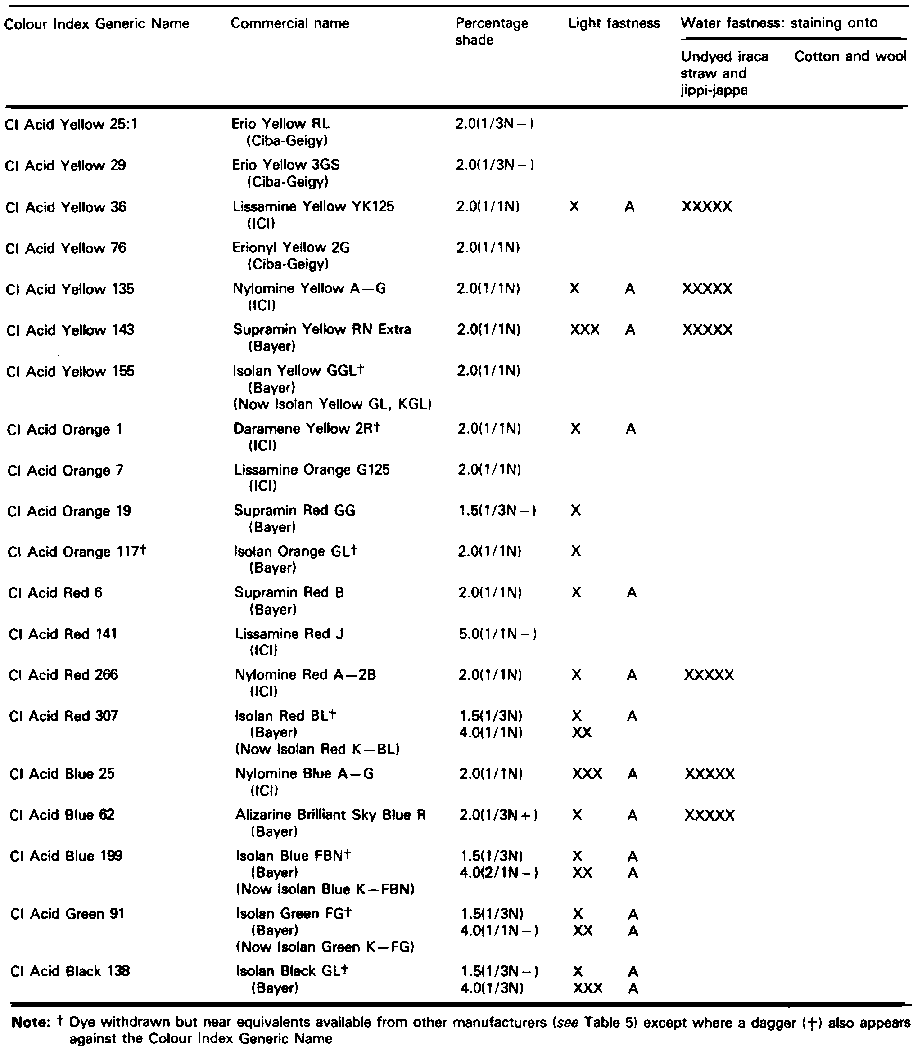
Table 1(a) - Acid dyes on iraca straw
and jippi-jappa
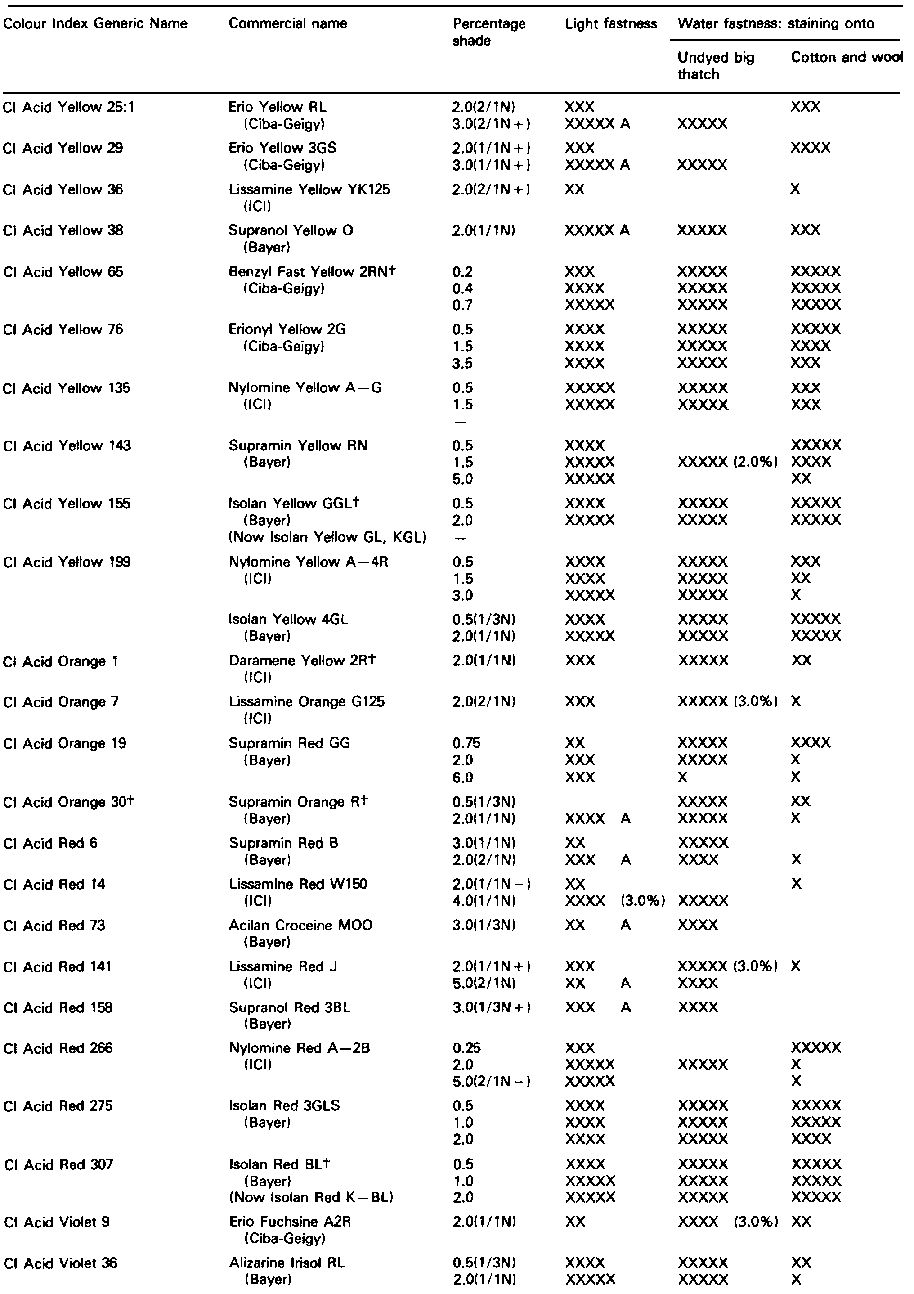
Table 1(b) - Acid dyes on big thatch

Table 1(b) - Acid dyes on big thatch
(continued)
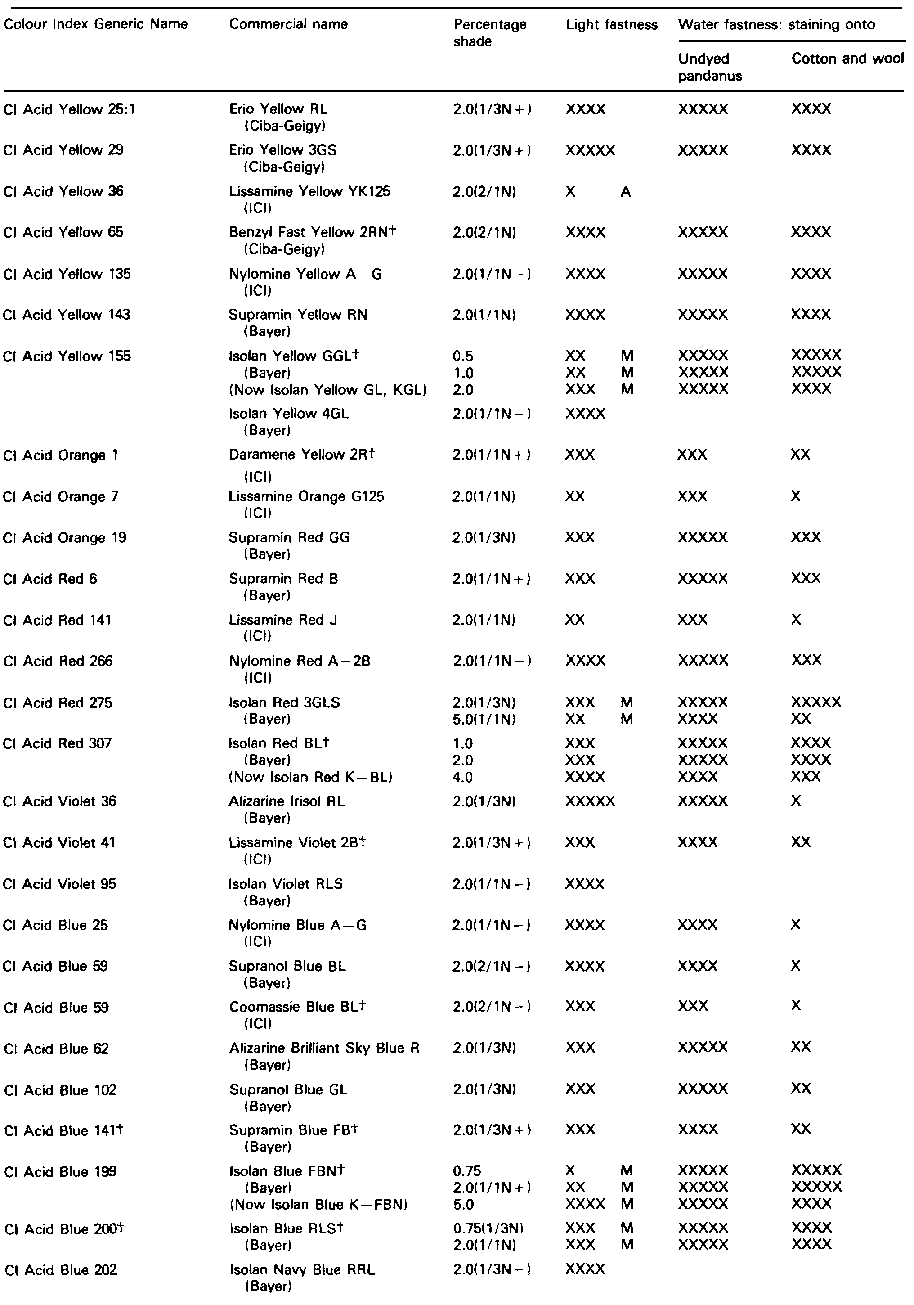
Table 1(c) - Acid dyes on pandanus

Table 1(c) - Acid dyes on pandanus
(continued)

Table 1(d) - Acid dyes vetivar grass

Table 1(d) - Acid dyes vetivar grass
(continued)
Basic dyes
Tables 2(a) - 2(d) show light and water fastness ratings of some basic dyes on iraca straw and jippi-jappa, big thatch, pandanus, and vetiver grass respectively. The dyes are a selection from the following ranges:
'Astrazon' (Bayer)
'Maxilon' (Ciba-Geigy)
'Sandocryl
(Sandoz)
'Sevron' (Dupont)
'Synacril (ICI)
Also included are some basic dyes which retain their traditional names (e.g. Safranine).
The number of dyes evaluated on iraca straw and jippi-jappa was greater than for the other materials investigated. This does not imply that dyes listed only under iraca straw and jippi-jappa are unsuitable for use on other materials. Experience has shown that basic dyes, almost without exception, will readily dye leaf and straw materials. However, the properties of the colours vary with material and poor light fastness on some materials is likely to restrict the usefulness of some of the dyes.
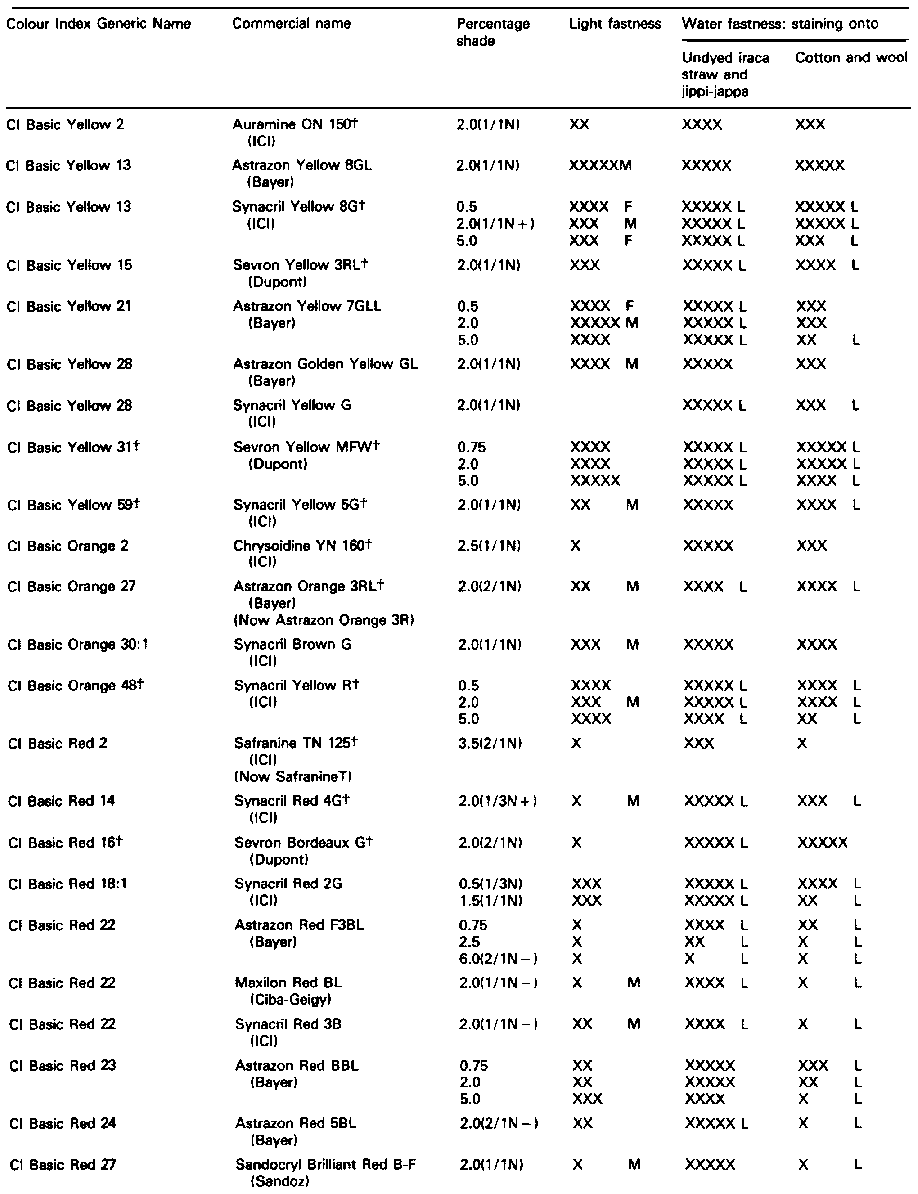
Table 2(a) - Basic dyes on iraca straw
and jippi-jappa
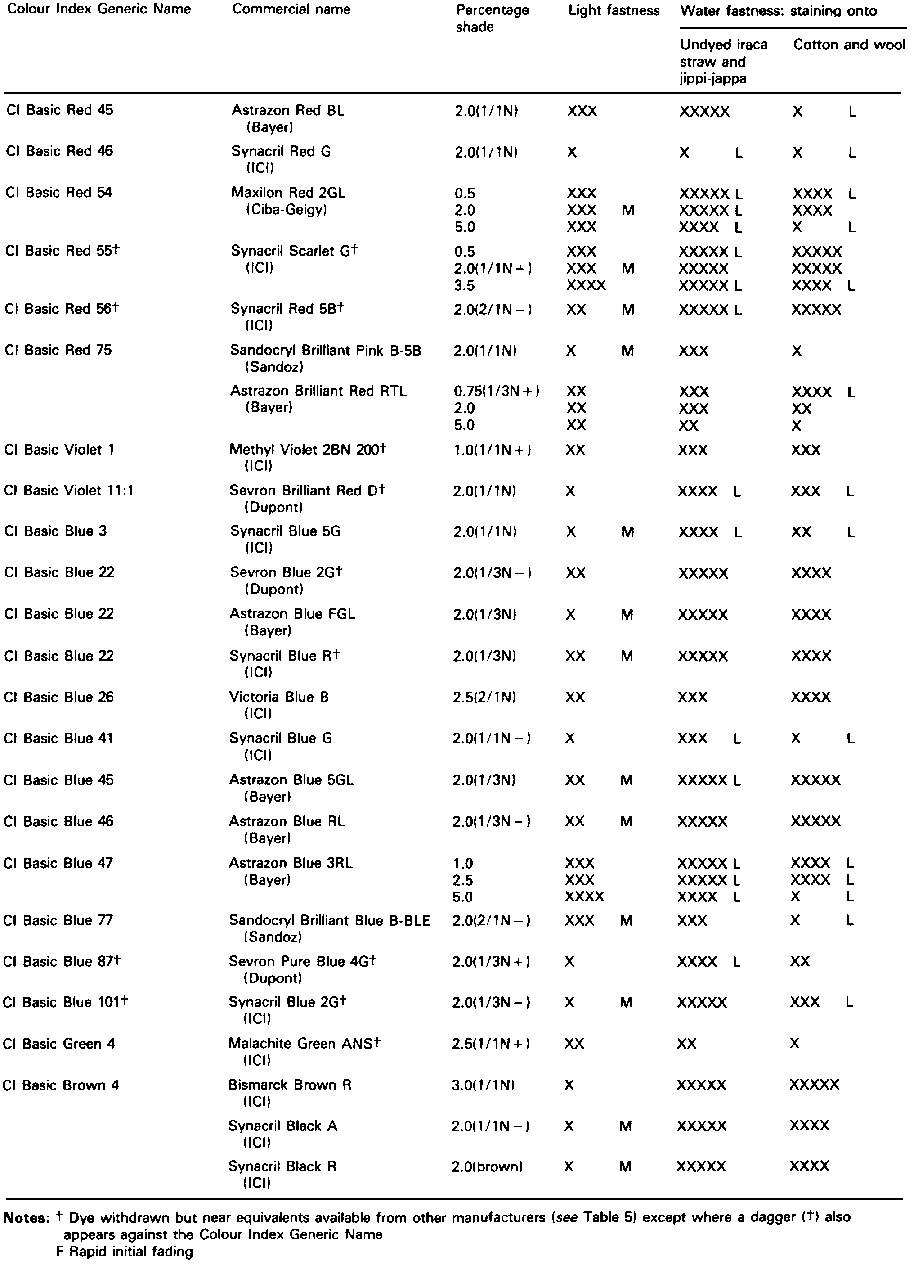
Table 2(a) - Basic dyes on iraca straw
and jippi-jappa (continued)

Table 2(b) - Basic dyes on big thatch

Table 2(c) - Basic dyes on pandanus

Table 2(c) - Basic dyes on pandanus
(continued 1)

Table 2(c) - Basic dyes on pandanus
(continued 2)

Table 2(d) - Basic dyes vetiver grass
Disperse dyes
Tables 3(a) - 3(c) show light and water fastness ratings of some disperse dyes on iraca straw and jippi-jappa, big thatch, and pandanus respectively. The dyes are a selection from the following ranges:
'Artisil' (Sandoz)
'Cibacet' (Ciba-Geigy)
'Dispersol'
(ICI)
'Foron' (Sandoz)
'Resolin' (Bayer)
Ratings of some reactive disperse dyes from the 'Procinyl' (ICI) range used as ordinary disperse dyes are included in the tables.
The number of dyes evaluated on iraca straw and jippi-jappa was greater than for the other materials investigated. This does not imply that dyes listed only under iraca straw and jippi-jappa are unsuitable for use on other materials. Neither does the absence of information about disperse dyes on vetiver grass imply that they are unsuitable for this material. Experience has shown that a large number of disperse dyes are suitable for leaf and straw materials. However, the depth of colour obtained is often weak and the fastness properties variable.
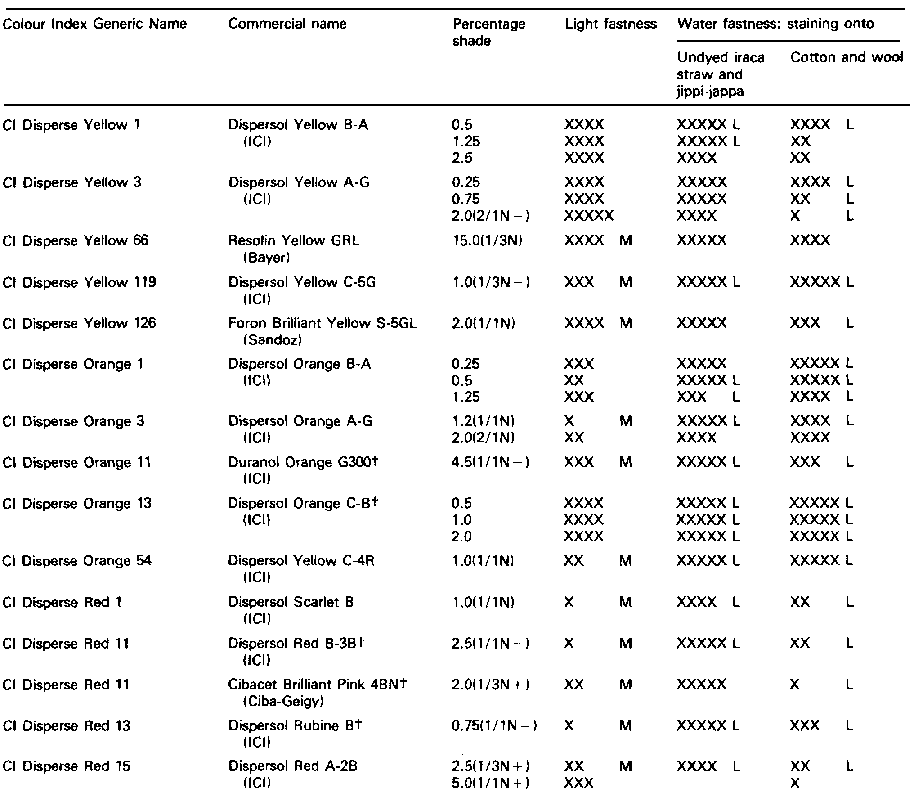
Table 3(a) - Disperse dyes on iraca
straw and jippi-jappa
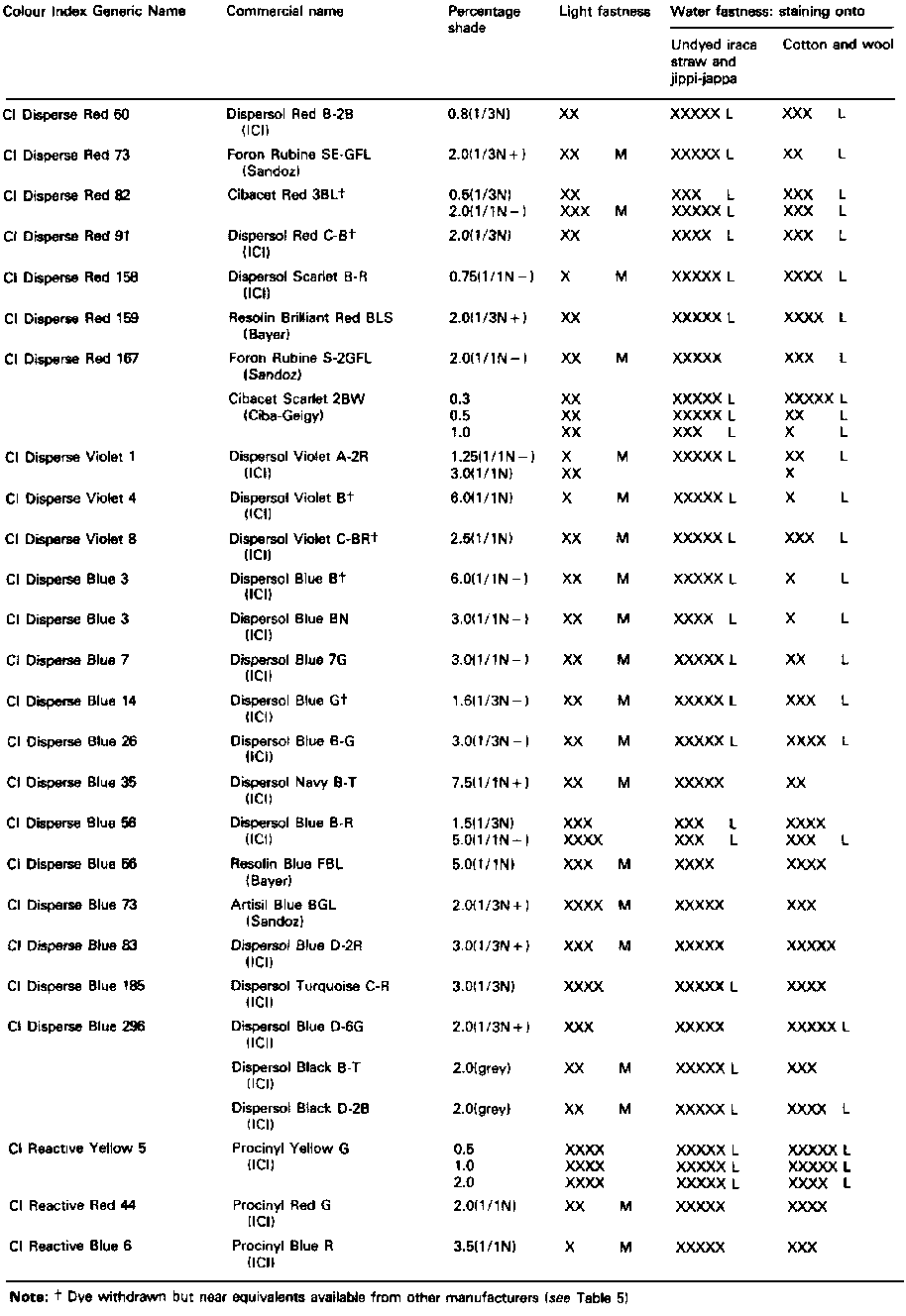
Table 3(a) - Disperse dyes on iraca
straw and jippi-jappa (continued)
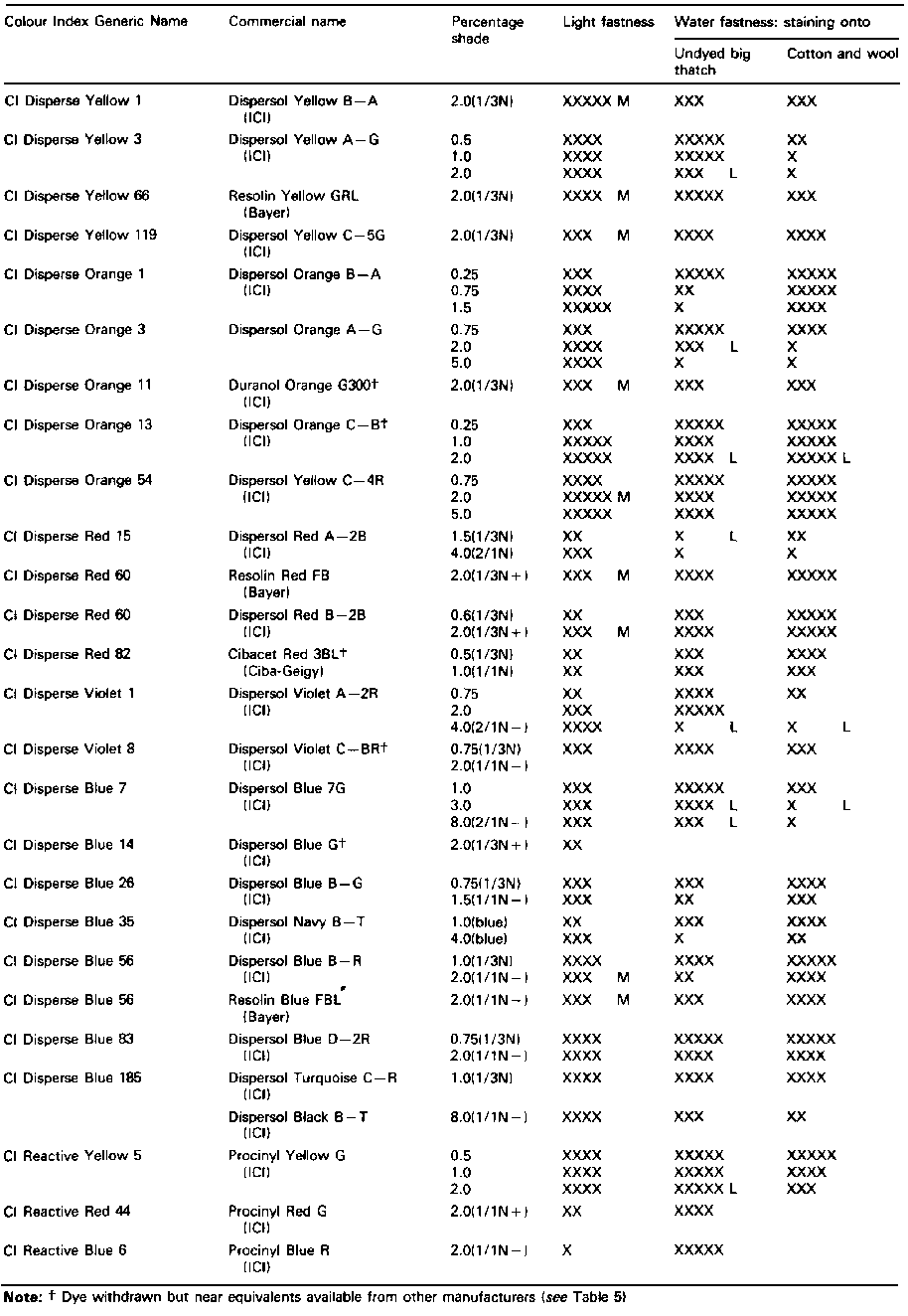
Table 3(b) - Disperse dyes on big
thatch
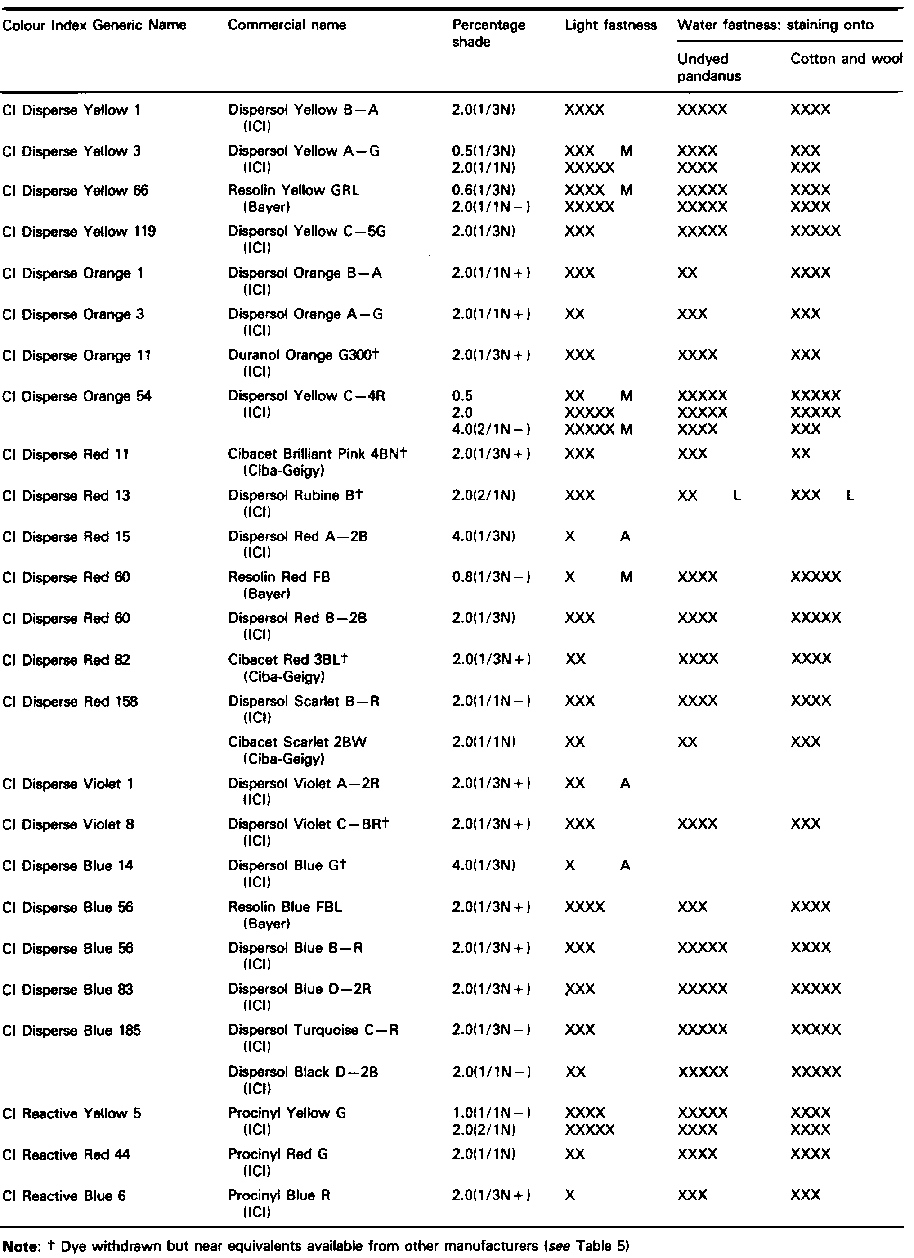
Table 3(c) - Disperse dyes on pandanus
Table 4 shows light and water fastness ratings of some acid, basic, direct and disperse dyes on processed coconut leaf. The dyes are a limited selection from the following ranges:
'Astrazon' (Bayer)
'Dispersol' (ICI)
'Durazol'
(ICI)
'Isolan' (Bayer)
'Lissamine'(ICI)
'Nylomine' (ICI)
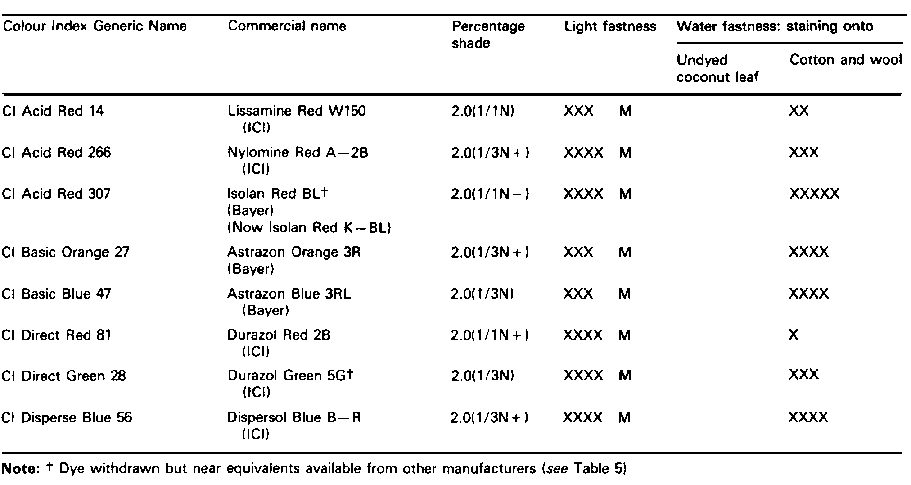
Table 4 - Dyes evaluated on processed
coconut leaf
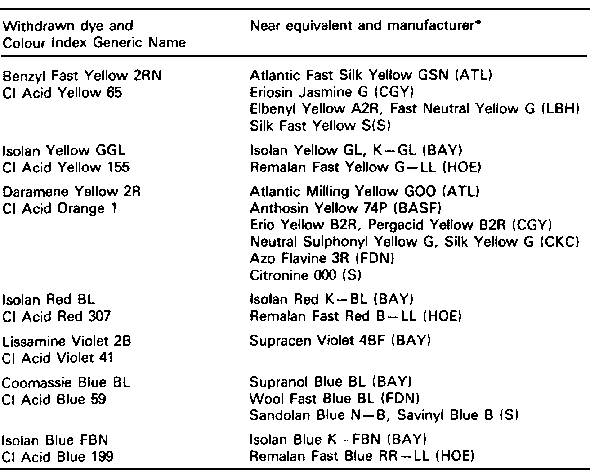
Table 5 - Near equivalents of
withdrawn dyes (available April 1982)

Table 5 - Near equivalents of
withdrawn dyes (available April 1982) (continued 1)

Table 5 - Near equivalents of
withdrawn dyes (available April 1982) (continued
2)
|
| ||||||||||||||||||||||||||||||||||||||||||||||||||||||||||||
Appendix: Addresses of dyestuff and chemical manufacturers or their agents
Manufacturers of dyestuffs and chemicals are too numerous to be listed here. However, an extensive list of dyestuff manufacturers can be found in Volume 5 of the Colour Index together with trade names of dyes listed by their Colour Index Generic Name (Colour Index Number). Dyestuff manufacturers frequently also offer a range of dyebath assistants and after-treating agents. There are also companies which specialise in making textile processing chemicals. Only companies able to supply those dyes (or their near equivalents) and proprietary chemicals mentioned in this handbook are given. Sources of common chemicals such as salt, soda and acetic and formic acids are not included. Abbreviations used in the text for the names of manufacturers are given before the full name and address.
Mention of a particular company or product does not imply recommendation by the Tropical Development and Research Institute to the exclusion of others.
Dyestuff manufacturers or their agents
|
Amar |
Amritlal Chemaux Ltd |
| |
Rang Vdyan |
| |
Sitladevi Temple Road |
| |
Mahim |
| |
Bombay 400 016 |
| |
INDIA |
|
AP |
Atul Products Ltd |
| |
PO Atul |
| |
Valsad 396 020 |
| |
Gujarat |
| |
INDIA |
|
ATL |
Atlantic Chemical Export Corp. |
| |
10 Kingsland Road |
| |
Nutley |
| |
NJ 07110 |
| |
USA |
|
BASF |
BASF AG |
| |
Carl Boschstrasse 33 |
| |
D - 6700 Ludwigshafen |
| |
FEDERAL REPUBLIC OF GERMANY |
|
BAY |
Bayer AG |
| |
D - 5090 Leverkusen - Bayerwerk |
| |
FEDERAL REPUBLIC OF GERMANY |
|
CAS |
Cassella AG |
| |
Hanauer Landstrasse 526 |
| |
PO Box 6000 |
| |
Frankfurt/M 61 |
| |
FEDERAL REPUBLIC OF GERMANY |
|
CE |
Chemiequip Ltd |
| |
501 Embassy Centre |
| |
Nariman Point |
| |
Bombay 400 021 |
| |
INDIA |
|
CGY |
Ciba-Geigy AG |
| |
CH - 4002 Basel |
| |
SWITZERLAND |
|
Chem |
Chemapol AG |
| |
Kodahska 46, CS 100 10 |
| |
Prague 10 |
| |
CZECHOSLOVAKIA |
|
CKC |
Crompton and Knowles |
| |
Dyes and Chemicals International Division |
| |
PO Box 33188 |
| |
Charlotte |
| |
NC 28233 |
| |
USA |
| |
Durham Chemicals Distributors Ltd |
| |
55-57 Glengall Road |
| |
London SE15 6NQ |
| |
ENGLAND |
|
FDN |
N.V. Frado |
| |
Tilburg |
| |
THE NETHERLANDS |
|
FW |
Chemie-Export-lmport |
| |
Storkowerstrasse 133 |
| |
DDR-1055 Berlin |
| |
GERMAN DEMOCRATIC REPUBLIC |
|
HOE |
Hoechst AG |
| |
ATA Geschaftsbereich D/Farben |
| |
Postfach 80 03 20 |
| |
6230 Frankfurt/M 80 |
| |
FEDERAL REPUBLIC OF GERMANY |
|
ICI |
Imperial Chemical Industries plc |
| |
PO Box 42 |
| |
Hexagon House |
| |
Blackley |
| |
Manchester M9 3DA |
| |
ENGLAND |
|
IDI |
Indian Dyestuff Industries Ltd |
| |
Mafatlal Centre |
| |
Nariman Point |
| |
Bombay 400 021 |
| |
INDIA |
|
KYK |
Nippon Kagaku Co. Ltd |
| |
Tokyo |
| |
JAPAN |
|
LBH |
Holliday Dyes and Chemicals Ltd |
| |
PO Box B22 |
| |
Leeds Road |
| |
Deighton |
| |
Huddersfield HD2 1UH |
| |
ENGLAND |
|
Mult |
Muitichrom SAIC |
| |
Almirante Brown 778 |
| |
Ramos Mejia-Pcia |
| |
Buenos Aires |
| |
ARGENTINA |
|
NSK |
Sumitomo Chemical Co. Ltd |
| |
Osaka |
| |
JAPAN |
|
POL |
CIECH |
| |
Jasna 12 |
| |
Postfach 271 |
| |
PL - 00 - 950 Warsaw |
| |
POLAND |
|
PyO |
Pigmentos y Oxidos SA |
| |
Ave. Industrias Pte. 930 |
| |
Apartado Postal No. 844 |
| |
Monterrey |
| |
N.L. |
| |
MEXICO |
|
RBM |
S.A. Rovira, Bachs y Macia |
| |
Avda. Jose Antonio 744 |
| |
Barcelona 13 |
| |
SPAIN |
|
Roum |
Chimimportexport BD |
| |
Republicii 10 |
| |
Postfach 1-74 |
| |
R-70033 Bucharest |
| |
ROUMANIA |
|
S |
Sandoz AG |
| |
Lichstrasse 35 |
| |
CH-4002 Basel |
| |
SWITZER LAN D |
|
VIL |
Vilmax SA |
| |
Parera 114 |
| |
Buenos Aires |
| |
ARGENTINA |
|
YCL |
Yorkshire Chemicals plc |
| |
Kirkstall Road |
| |
Leeds LS3 ILL |
| |
ENGLAND |
Chemical manufacturers or their agents
Wetting and penetrating agents
Cargo Fleet Chemical Co. Ltd
Eaglescliffe Industrial
Estate
Eaglescliffe
|
Stockton-on-Tees |
(Aents for products of ICI Petrochemicals |
|
Cleveland TS16 OPN |
Division, e.. Synperonic BD) |
ENGLAND
Durham Chemicals Distributors Ltd
55-57 Glengall
Road
London SE15 6NQ
ENGLAND
Finishing agents
Catomance Ltd
88-96 Bridge Road East
Welwyn Garden
City
Hertfordshire AL7 1JW
ENGLAND
Hoechst AG
ATA Geschaftsbereich D/Farben
Postfach 80 03
20
6230 Frankfurt/M 80
FEDERAL REPUBLIC OF GERMANY
Vinyl Products Ltd
Mill Lane
Carshalton
Surrey SM5
2JU
ENGLAND