World Energy Assessment - Energy and the Challenge of Sustainability (UNDESA - UNDP - WEA - WEC, 2000, 517 p.)
Contents — 13 sections
- Section 1
- Section 2
- Foreword
- Preface
- Acknowledgements
- Editorial board
- Establishing institutions
- World Energy Assessment - Energy and the Challenge of Sustainability (UNDESA - UNDP - WEA - WEC, 200
- World Energy Assessment - Energy and the Challenge of Sustainability (UNDESA - UNDP - WEA - WEC, 200
- World Energy Assessment - Energy and the Challenge of Sustainability (UNDESA - UNDP - WEA - WEC, 200
- World Energy Assessment - Energy and the Challenge of Sustainability (UNDESA - UNDP - WEA - WEC, 200
- World Energy Assessment - Energy and the Challenge of Sustainability (UNDESA - UNDP - WEA - WEC, 200
- World Energy Assessment - Energy and the Challenge of Sustainability (UNDESA - UNDP - WEA - WEC, 200
 | | | World Energy Assessment - Energy and the Challenge of Sustainability (UNDESA - UNDP - WEA - WEC, 2000, 517 p.) | | | (introduction...) | | | Foreword | | | Preface | | | Acknowledgements | | | Editorial board | | | Establishing institutions | | | Overview - Energy and the challenge of sustainability | | | Introduction | | | Part I: Energy and major global issues | | | Part II: Energy resources and technological options | | | Part III: Are sustainable futures possible? | | | Part IV: Where do we go from here? | | | PART I. ENERGY AND MAJOR GLOBAL ISSUES | | | Chapter 1. An Introduction to Energy | | | (introduction...) | | | What is sustainable energy development? | | | Evolution of the energy system | | | Demand for energy services | | | Energy trade patterns and globalisation | | | (introduction...) | | | Crude oil and oil products | | | Coal | | | Natural gas | | | Energy prices and taxes | | | Energy investments | | | (introduction...) | | | General features | | | Capital flows | | | Chapter 2. Energy and Social Issues | | | (introduction...) | | | Towards a new approach to energy for human uses | | | Energy and poverty in developing countries | | | (introduction...) | | | Dimensions of poverty | | | The energy-poverty nexus | | | The energy ladder and household decisions about fuel choice | | | Energy strategies for alleviating poverty in developing countries | | | Energy and poverty in industrialised countries | | | Energy and women | | | (introduction...) | | | Factors determining energy-women linkages | | | Specific concerns and priority areas | | | Energy for improving the position of women | | | Energy and population | | | (introduction...) | | | Demographic transitions | | | Population momentum | | | The energy-population nexus | | | Rural energy consumption and population implications | | | Traditional biomass-based cooking and demographic indicators | | | Energy-population nexus at the global level | | | Energy and urbanisation | | | (introduction...) | | | Urbanisation and energy linkages | | | Urbanisation and energy strategies | | | Energy to improve the urban environment | | | Energy and lifestyles | | | (introduction...) | | | Energy use in the United States | | | Trends towards increased energy use | | | Conclusion | | | Chapter 3. Energy, the Environment, and Health | | | (introduction...) | | | Household scale | | | (introduction...) | | | Harvesting | | | Combustion | | | Estimated health effects | | | Greenhouse gases | | | Workplace scale | | | (introduction...) | | | Biomass | | | Coal | | | Oil and gas | | | Hydropower and other renewables | | | Nuclear danger | | | Number of workers and quantitative health effects estimates | | | Community scale | | | (introduction...) | | | Fuel-derived air pollution in cities of industrialised countries | | | Fuel-derived air pollution in cities of developing countries | | | Urban pollution control in the longer run | | | Hydroelectric dams6 | | | Nuclear power | | | Regional scale | | | (introduction...) | | | Emissions and energy | | | Future emissions | | | Acid deposition | | | Tropospheric ozone | | | Suspended fine particles | | | Regional climate change | | | Global scale: climate change from greenhouse gases | | | (introduction...) | | | Consequences of greenhouse gas-induced climate change | | | Alternative energy futures and greenhouse gas emissions | | | International agreements to address global climate change | | | Cross-scale impacts | | | (introduction...) | | | Environmental risk transition | | | Win-win strategies to link environmental improvements at different scales | | | Assessment methods | | | Implications for the future | | | (introduction...) | | | Household scale | | | Workplace scale | | | Community scale | | | Regional scale | | | Global scale | | | Cross-scale | | | Conclusion | | | Chapter 4. Energy Security | | | (introduction...) | | | New dimensions and challenges to energy security | | | (introduction...) | | | Security of electric power supply | | | Routes to enhanced energy security | | | Energy adequacy | | | (introduction...) | | | Crude oil | | | Natural gas | | | Coal | | | Nuclear energy | | | Renewables | | | The resource outlook | | | Supply security | | | (introduction...) | | | Security of crude oil supply | | | Security of natural gas supply | | | Security of coal supply | | | Nuclear energy and energy security | | | Energy intensity | | | The environment and energy security | | | Markets and energy security | | | (introduction...) | | | The role of the state | | | Regional cooperation and the growing importance of regional electricity grids and network energies | | | Conclusion | | | PART II. ENERGY RESOURCES AND TECHNOLOGY OPTIONS | | | Chapter 5. Energy Resources | | | (introduction...) | | | Definitions and units | | | Oil reserves and resources | | | (introduction...) | | | Ultimately recoverable resources - the static or geologists’ view | | | Available resources - the dynamic or economists’ view | | | Reconciling the two views | | | Gas reserves and resources | | | (introduction...) | | | Conventional gas | | | Unconventional gas | | | Coal reserves and resources | | | (introduction...) | | | Current resources and reserves | | | Additional resources | | | Summary of fossil resources | | | Reserves and resources of fissile materials | | | (introduction...) | | | Uranium reserves | | | Uranium resources | | | Thorium reserves and resources | | | Hydroelectric resources | | | (introduction...) | | | Theoretical potential | | | Technical potential | | | Economic potential | | | Major constraints to hydroelectricity expansion | | | Biomass resources | | | (introduction...) | | | Sources | | | Perceptions and problems | | | Technical potential of biomass energy plantations | | | Energy balances and biomass productivity | | | Agricultural and forestry residues and municipal waste | | | Environmental implications of biomass production | | | Environmentally motivated responses to biomass production | | | Economics | | | Solar energy resources | | | Wind energy resources | | | Geothermal energy resources | | | Ocean energy resources | | | Conclusion | | | Chapter 6. Energy End-Use Efficiency | | | (introduction...) | | | Recent trends in energy intensity in countries and regions | | | (introduction...) | | | OECD countries | | | Eastern Europe and the Commonwealth of Independent States | | | Developing Asia, Africa, and Latin America | | | Potential benefits of technology transfer | | | (introduction...) | | | Transition economies | | | Developing countries | | | Types of potential for increased energy efficiency | | | The economic potential of energy efficiency by region and sector | | | (introduction...) | | | Western Europe | | | North America | | | Japan and Southeast Asia | | | Eastern Europe | | | Russia and other members of the Commonwealth of Independent States | | | India | | | China | | | Latin America | | | Africa | | | The economic potential of energy efficiency - a systemic perspective | | | Technical and theoretical potentials for rational energy use after 2020 | | | Obstacles, market imperfections, and disincentives for efficient energy use | | | (introduction...) | | | General obstacles | | | Target group-specific and technology-specific obstacles | | | National and international policies to exploit the economic potential of energy efficiency in end-use sectors | | | (introduction...) | | | General policy measures | | | Sector- and technology-specific policy measures | | | International policy measures | | | Conclusion | | | Chapter 7. Renewable Energy Technologies | | | (introduction...) | | | Biomass energy | | | (introduction...) | | | The potential of biomass energy | | | Biomass energy conversion technologies | | | Environmental impacts of biomass energy systems | | | Economics of biomass energy systems | | | Implementation issues | | | Conclusion | | | Wind energy | | | (introduction...) | | | The potential of wind energy | | | Development of installed wind power | | | Technology developments | | | System aspects | | | Environmental aspects | | | Economic aspects | | | Implementation issues | | | Conclusion | | | Photovoltaic solar energy | | | (introduction...) | | | Characteristics of the source | | | The potential of photovoltaic solar energy | | | Photovoltaic market developments | | | Current status and future development of photovoltaic solar cells and modules | | | System aspects | | | Environmental aspects | | | Economic aspects | | | Implementation issues | | | Space-based solar energy | | | Conclusion | | | Solar thermal electricity | | | (introduction...) | | | The potential of solar thermal electricity | | | Solar thermal electricity market developments | | | Solar thermal electricity technologies | | | Economic aspects | | | Environmental and social aspects | | | Conclusion | | | Low-temperature solar energy | | | (introduction...) | | | Low-temperature solar energy potential and market developments | | | Low-temperature solar energy technologies and systems | | | Implementation issues | | | Conclusion | | | Hydroelectricity | | | (introduction...) | | | The potential of hydroelectricity | | | Hydroelectric technology development | | | System aspects | | | Environmental and social impacts | | | Economic and financial aspects | | | Conclusion | | | Geothermal energy | | | (introduction...) | | | The potential of geothermal energy | | | Recent developments | | | Potential market developments | | | Environmental aspects | | | Conclusion | | | Marine energy technologies | | | (introduction...) | | | The potential and technology of marine energy | | | Economic aspects | | | Environmental aspects | | | Implementation issues | | | Conclusion | | | System aspects | | | (introduction...) | | | Trends in the energy sector | | | Characteristics of renewable energy systems | | | Electrical system design | | | Grid integration of intermittent renewables | | | Intermittent renewables and energy storage | | | Value of renewables | | | Conclusion | | | Policies and instruments | | | (introduction...) | | | Cost of competing conventional energy | | | Financing and fiscal policy | | | Regulation | | | Getting new technologies started | | | Conclusion | | | Chapter 8. Advanced Energy Supply Technologies | | | (introduction...) | | | Advanced fossil energy technologies | | | Fossil fuel supply considerations as a context for fossil energy innovation | | | Setting goals for advanced fossil energy technologies | | | Technologies and strategies for moving towards near-zero emissions | | | Other near-term advanced fossil energy technologies | | | Conclusion | | | Advanced nuclear energy technologies | | | (introduction...) | | | Rationale for reconsidering the nuclear option | | | The need for advanced technologies | | | Advanced nuclear generating options for the immediate future | | | Nuclear energy for the long term | | | The outlook for addressing the challenges | | | PART III: ARE SUSTAINABLE FUTURES POSSIBLE? | | | Chapter 9. Energy Scenarios | | | (introduction...) | | | What are scenarios and how are they used for energy assessments? | | | (introduction...) | | | Alternative development paths and how they are reflected in scenarios | | | Energy scenarios for sustainable development | | | Brief review of the literature on energy scenarios | | | Three energy scenarios for the 21st century | | | (introduction...) | | | Economic development and equity | | | Improvement of energy intensities | | | Primary energy requirements and supply | | | Technological dynamics and structural change | | | The structure of final energy requirements | | | Temporal and spatial scales of scenarios | | | The legacy of past generations | | | The role of policies | | | Implications of sustainable energy scenarios | | | (introduction...) | | | RD&D trends and requirements and technological diffusion | | | Capital requirements and financing | | | Technological diffusion | | | International energy trade and security | | | Environmental issues at the local and regional scales | | | Climate change: Land use and other global issues | | | Conclusion | | | Chapter 10. Rural Energy in Developing Countries | | | (introduction...) | | | Rungs on the energy ladder | | | Fuels in rural areas: climbing the energy ladder | | | (introduction...) | | | Improved cooking stoves | | | Kerosene and liquefied petroleum gas | | | Biogas for cooking | | | Producer gas for cooking | | | Rural electrification | | | (introduction...) | | | The centralised approach | | | The decentralised approach | | | Leapfrogging to new rungs on the energy ladder | | | The time horizon for technological options | | | Accelerating rural energy development | | | (introduction...) | | | Integrated rural development | | | Involving rural people (particularly women) in decision-making | | | Strategies for expanding access to modern energy services | | | Strategies for making modern energy services affordable | | | Conclusion | | | Annex. Case studies of crop-residue-derived modern energy carriers in China | | | PART IV. WHERE DO WE GO FROM HERE? | | | Chapter 11. Energy and Economic Prosperity | | | (introduction...) | | | Energy consumption and economic well-being | | | (introduction...) | | | The transition from traditional to modern energy sources | | | The benefits of service extension | | | Energy use forecasts and energy efficiency | | | (introduction...) | | | Ambiguities in the evidence and shortcomings in methods | | | Energy efficiency as a beneficial stimulus to energy use | | | Reconciling increased energy consumption and environmental protection | | | (introduction...) | | | Reducing local and regional pollution | | | Mitigating global warming | | | Liberalisation and globalisation | | | Conclusion: economic perspectives on policy | | | Chapter 12. Energy Policies for Sustainable Development | | | (introduction...) | | | Policy goals and challenges | | | (introduction...) | | | The findings so far | | | Defining the goals of policy | | | Responding to the challenge of widening access | | | Improving environmental acceptability | | | Making markets work better | | | (introduction...) | | | Internalising externalities | | | Phasing out subsidies to conventional energy | | | Regulatory options for restructured energy sectors | | | Raising energy efficiency | | | Mobilising investments in sustainable energy | | | (introduction...) | | | Attracting private capital | | | Tapping other sources of funding | | | Encouraging technological innovation for sustainable energy development | | | (introduction...) | | | Understanding the energy innovation chain | | | The rationale for public policies in support of energy innovation | | | Policy options for promoting technological innovation | | | Encouraging technological innovation in developing countries | | | (introduction...) | | | Opportunities for technological leadership | | | Supporting demonstration and diffusion | | | International industrial collaboration | | | Towards a supportive policy framework | | | Capacity and institution building | | | Moving towards more effective cooperation | | | (introduction...) | | | Cooperative efforts to ensure supply security | | | International cooperation on climate change | | | Widening the involvement in sustainable energy development | | | Conclusion | | | (introduction...) | | | Making markets work better | | | Mobilising additional investments in sustainable energy | | | Encouraging technological innovation | | | Supporting technological leadership and capacity building in developing countries | | | Encouraging greater international cooperation | | | Annex. Trends in research and development funding | | | PART V. FURTHER INFORMATION AND REFERENCE MATERIAL | | | Annexes | | | Annex A: Energy units, conversion factors, and abbreviations | | | Annex B: Data consistency | | | Annex C: Energy trends | | | Annex D: Carbon emissions | | | Editorial board - Brief biographies of Editorial Board members | | | Glossary - Selected terminology | | | Contributors - World Energy Assessment Advisory Panel and peer reviewers |
|
| | | World Energy Assessment - Energy and the Challenge of Sustainability (UNDESA - UNDP - WEA - WEC, 2000, 517 p.) | | | (introduction...) | | | Foreword | | | Preface | | | Acknowledgements | | | Editorial board | | | Establishing institutions | | | Overview - Energy and the challenge of sustainability | | | PART I. ENERGY AND MAJOR GLOBAL ISSUES | | | PART II. ENERGY RESOURCES AND TECHNOLOGY OPTIONS | | | PART III: ARE SUSTAINABLE FUTURES POSSIBLE? | | | PART IV. WHERE DO WE GO FROM HERE? | | | PART V. FURTHER INFORMATION AND REFERENCE MATERIAL |
|

World
Energy
Assessment

UNITED
NATIONS
DEVELOPMENT PROGRAMME
Bureau for Development
Policy
One United Nations Plaza
New York, NY
10017
United States of
America
https://www.undp.org/seed/eap

UNITED NATIONS
DEPARTMENT
OF ECONOMIC AND SOCIAL AFFAIRS
Two United Nations
Plaza, DC-2
New York, NY 10017
United States of
America
https://www.un.org/esa

THE WORLD ENERGY
COUNCIL
Regency House, 5th Floor
1-4 Warwick
Street
London W1R 6LE
United
Kingdom
https://www.worldenergy.org
|
The editorial phase and the production of the World Energy
Assessment benefited from contributions from the governments of Austria,
Finland, Norway, and Sweden, and the Energy Foundation. The consultative and
outreach phases of the report have been made possible through funding from the
United Nations Foundation. |
© 2000 UNDP
United Nations Development Programme
Bureau for Development
Policy
One United Nations Plaza
New York, NY 10017
All rights reserved
Manufactured in the United States of
America
First printing September 2000
The analysis and conclusions of the World Energy Assessment do
not necessarily reflect the views of the United Nations Development Programme,
its Executive Board, the United Nations Department of Economic and Social
Affairs, the Member States of the United Nations, or the Member Committees of
the World Energy Council.
ISBN: 92-1-126126-0
Sales Number: 00.III.B.5
Final editing by Communications Development Incorporated,
Washington, D.C.
Design by Julia Ptasznik, Suazion, Staten Island, NY
Printed on recycled, acid-free
paper
| | | World Energy Assessment - Energy and the Challenge of Sustainability (UNDESA - UNDP - WEA - WEC, 2000, 517 p.) | | | (introduction...) | | | Foreword | | | Preface | | | Acknowledgements | | | Editorial board | | | Establishing institutions | | | Overview - Energy and the challenge of sustainability | | | PART I. ENERGY AND MAJOR GLOBAL ISSUES | | | PART II. ENERGY RESOURCES AND TECHNOLOGY OPTIONS | | | PART III: ARE SUSTAINABLE FUTURES POSSIBLE? | | | PART IV. WHERE DO WE GO FROM HERE? | | | PART V. FURTHER INFORMATION AND REFERENCE MATERIAL |
|
Foreword
Mark Malloch
Brown
Administrator
United Nations
Development
Programme
Nitin Desai
Under
Secretary-General
United Nations
Department of Economic and
Social Affairs
Gerald Doucet
Secretary General
World
Energy Council
More than 175 governments have committed to Agenda 21, the
programme for achieving human-centred sustainable development adopted at the
1992 United Nations Conference on Environment and Development in Rio de Janeiro.
Agenda 21 noted energy's importance to sustainable development. The June 1997
Special Session of the UN General Assembly, convened to review progress on
Agenda 21, went further. It emphasised that sustainable patterns of energy
production, distribution, and use are crucial to continued improvements in the
quality of life. It also declared that the ninth session of the United Nations
Commission on Sustainable Development (CSD-9), in 2001, should focus on issues
related to the atmosphere and energy and to energy and transport.
To inform the discussion and debate, the United Nations
Development Programme (UNDP), United Nations Department of Economic and Social
Affairs (UNDESA), and World Energy Council (WEC) initiated the World Energy
Assessment in late 1998. This report analyses the social, economic,
environmental, and security issues linked to energy supply and use, and assesses
options for sustainability in each area.
We offer the World Energy Assessment as an input to the CSD-9
process, the "Rio Plus Ten" meeting in 2002, and beyond. We believe that a
synthesis of reviewed and validated information on energy production and
consumption patterns will be a valuable tool for energy planners at the regional
and national levels, and for many other audiences as well.
Our energy future will largely depend on the actions not only of
governments, but also regional alliances, the private sector, and civil society.
For this reason, this assessment is the centrepiece of an outreach effort by
UNDP, UNDESA, and WEC. This outreach includes regional dialogues, exchanges
among developing countries and between developing and industrialised countries,
and consultations with a wide range of stakeholders, including the private
sector, which is not always brought into debates.
The World Energy Assessment represents a collaborative effort
involving the three founding organisations, 12 convening lead authors, and the
teams of experts they assembled. Drafts of the report were sent out to a wide
audience of experts and government representatives for review and consultation.
This review included a special Advisory Panel meeting, an electronic posting,
and consultations at the local, regional, and global levels, as well as with
non-governmental organisations. The Editorial Board considered the content of
the chapters at six meetings over the course of 16 months. Whereas the overview
reflects the combined judgement and scrutiny of the Editorial Board, each
chapter is the responsibility of its convening lead
author.
| | | World Energy Assessment - Energy and the Challenge of Sustainability (UNDESA - UNDP - WEA - WEC, 2000, 517 p.) | | | (introduction...) | | | Foreword | | | Preface | | | Acknowledgements | | | Editorial board | | | Establishing institutions | | | Overview - Energy and the challenge of sustainability | | | PART I. ENERGY AND MAJOR GLOBAL ISSUES | | | PART II. ENERGY RESOURCES AND TECHNOLOGY OPTIONS | | | PART III: ARE SUSTAINABLE FUTURES POSSIBLE? | | | PART IV. WHERE DO WE GO FROM HERE? | | | PART V. FURTHER INFORMATION AND REFERENCE MATERIAL |
|
Preface
Jos� Goldemberg
Chair, World Energy
Assessment
Energy is central to achieving the interrelated economic,
social, and environmental aims of sustainable human development. But if we are
to realise this important goal, the kinds of energy we produce and the ways we
use them will have to change. Otherwise, environmental damage will accelerate,
inequity will increase, and global economic growth will be jeopardised.
We cannot simply ignore the energy needs of the 2 billion people
who have no means of escaping continuing cycles of poverty and deprivation. Nor
will the local, regional, and global environmental problems linked to
conventional ways of using energy go away on their own. Other challenges
confront us as well: the high prices of energy supplies in many countries, the
vulnerability to interruptions in supply, and the need for more energy services
to support continued development.
The World Energy Assessment affirms that solutions to these
urgent problems are possible, and that the future is much more a matter of
choice than destiny. By acting now to embrace enlightened policies, we can
create energy systems that lead to a more equitable, environmentally sound, and
economically viable world.
But changing energy systems is no simple matter. It is a complex
and long-term process - one that will require major and concerted efforts by
governments, businesses, and members of civil society. Consensus on energy
trends and needed changes in energy systems can accelerate this process.
The World Energy Assessment was undertaken, in part, to build
consensus on how we can most effectively use energy as a tool for sustainable
development. Its analysis shows that we need to do more to promote energy
efficiency and renewables, and to encourage advanced technologies that offer
alternatives for clean and safe energy supply and use. We also need to help
developing countries find ways to avoid retracing the wasteful and destructive
stages that have characterised industrialisation in the past.
Considerable work by many individuals went into this
publication, and my hope is that it contributes to a more equitable, prosperous,
and sustainable
world.
| | | World Energy Assessment - Energy and the Challenge of Sustainability (UNDESA - UNDP - WEA - WEC, 2000, 517 p.) | | | (introduction...) | | | Foreword | | | Preface | | | Acknowledgements | | | Editorial board | | | Establishing institutions | | | Overview - Energy and the challenge of sustainability | | | PART I. ENERGY AND MAJOR GLOBAL ISSUES | | | PART II. ENERGY RESOURCES AND TECHNOLOGY OPTIONS | | | PART III: ARE SUSTAINABLE FUTURES POSSIBLE? | | | PART IV. WHERE DO WE GO FROM HERE? | | | PART V. FURTHER INFORMATION AND REFERENCE MATERIAL |
|
Acknowledgements
|
This publication would not have been possible without the
strenuous efforts of many people, starting with the members of the Editorial
Board and the authors of each chapter, as well as those who represented the
establishing institutions. The establishing institutions greatly appreciate
their efforts.
The editorial process was skilfully guided by Chair Jos�
Goldemberg of Brazil. His extensive experience in energy, policy issues, and
international relations has been invaluable, and his unwavering commitment to
the success of this project has been an inspiration to everyone involved. We are
also deeply grateful to the other members of the Editorial Board for their
painstaking work in preparing and reviewing this publication under an extremely
tight schedule, for their willingness to challenge one another while maintaining
a spirit of cooperation, and for their shared commitment to the idea of energy
as a tool for sustainable human development.
Project manager Caitlin Allen was instrumental to the success
of this project. Her desk was the nexus of communications for the members of the
Editorial Board, who were located all over the world. She also managed the
administrative, editorial, and graphic design staff that assisted in the
preparation of this book, and planned and implemented the outreach phase.
We appreciate the dedicated work of the entire World Energy
Assessment team, including Janet Jensen for editorial assistance throughout the
project, Nerissa Cortes for handling myriad administrative details, and Natty
Davis for assisting with the outreach phase. We are grateful to Julia Ptasznik
for creating the distinctive look of the publication and associated materials,
and to Communications Development Incorporated for final editing and
proofreading.
The establishing organisations also thank the Advisory Panel,
peer reviewers, and participants in the consultative and outreach phases of the
book. |
| | | World Energy Assessment - Energy and the Challenge of Sustainability (UNDESA - UNDP - WEA - WEC, 2000, 517 p.) | | | (introduction...) | | | Foreword | | | Preface | | | Acknowledgements | | | Editorial board | | | Establishing institutions | | | Overview - Energy and the challenge of sustainability | | | PART I. ENERGY AND MAJOR GLOBAL ISSUES | | | PART II. ENERGY RESOURCES AND TECHNOLOGY OPTIONS | | | PART III: ARE SUSTAINABLE FUTURES POSSIBLE? | | | PART IV. WHERE DO WE GO FROM HERE? | | | PART V. FURTHER INFORMATION AND REFERENCE MATERIAL |
|
Editorial board
Chair
Jos� Goldemberg, Brazil
Vice-chairs
John W. Baker, United
Kingdom
Safiatou Ba-N'Daw, C�te d'Ivoire
Hisham Khatib,
Jordan
Anca Popescu, Romania
Francisco L. Viray,
Philippines
Convening lead authors
Dennis Anderson, United
Kingdom
John P. Holdren, United States
Michael Jefferson,
United Kingdom
Eberhard Jochem, Germany
Nebojsa Nakicenovic,
Austria
Amulya K.N. Reddy, India
Hans-Holger Rogner,
Germany
Kirk R. Smith, United States
Wim C. Turkenburg,
Netherlands
Robert H. Williams, United States
Establishing institutions
Thomas B. Johansson, UNDP
representative
JoAnne DiSano and Kui-nang Mak, UNDESA
representatives
Gerald Doucet and Emad El-Sharkawi, WEC
representatives
Caitlin Allen, project manager
Janet Jensen,
managing
editor
| | | World Energy Assessment - Energy and the Challenge of Sustainability (UNDESA - UNDP - WEA - WEC, 2000, 517 p.) | | | (introduction...) | | | Foreword | | | Preface | | | Acknowledgements | | | Editorial board | | | Establishing institutions | | | Overview - Energy and the challenge of sustainability | | | PART I. ENERGY AND MAJOR GLOBAL ISSUES | | | PART II. ENERGY RESOURCES AND TECHNOLOGY OPTIONS | | | PART III: ARE SUSTAINABLE FUTURES POSSIBLE? | | | PART IV. WHERE DO WE GO FROM HERE? | | | PART V. FURTHER INFORMATION AND REFERENCE MATERIAL |
|
Establishing institutions
The United Nations Development Programme's (UNDP) mission
is to help countries achieve sustainable human development by assisting their
efforts to build their capacity to design and carry out development programmes
in poverty eradication, employment creation and sustainable livelihoods,
empowerment of women, and protection and regeneration of the environment, giving
first priority to poverty eradication. UNDP focuses on policy support and
institution building in programme countries through its network of 136 country
offices.
The United Nations Department of Economic and Social Affairs
(UNDESA) facilitates intergovernmental processes and, through its Division
for Sustainable Development, services such bodies as the UN Commission on
Sustainable Development and the UN Committee on Energy and Natural Resources for
Development. UNDESA also undertakes, among other things, statistical and
analytical work to monitor the environment and sustainable development, provides
policy and technical advisory services, and implements technical cooperation
projects at the request of developing countries in the followup to the 1992
Earth Summit.
The World Energy Council (WEC) is a multi-energy,
non-governmental, global organisation founded in 1923. In recent years, WEC has
built a reputation in the energy field through its studies, technical services,
and regional programmes. Its work covers long-term energy scenarios, developing
country and transitional economy energy issues, energy financing, energy
efficiency and liberalization policies, and environmental concerns. Through its
member committees in close to 100 countries, it has encouraged the participation
of private industry throughout the editorial and consultative process for this
report.
For more information on the activities and publications of the
three establishing organisations, please visit the following Websites:
UNDP:
https://www.undp.org/seed/eap
UNDESA: https://www.un.org/esa
WEC:
https://www.worldenergy.org
| | | World Energy Assessment - Energy and the Challenge of Sustainability (UNDESA - UNDP - WEA - WEC, 2000, 517 p.) | | | Overview - Energy and the challenge of sustainability | | | Introduction | | | Part I: Energy and major global issues | | | Part II: Energy resources and technological options | | | Part III: Are sustainable futures possible? | | | Part IV: Where do we go from here? |
|
World Energy Assessment - Energy and the Challenge of Sustainability (UNDESA - UNDP - WEA - WEC, 2000, 517 p.)
Overview - Energy and the challenge of sustainability
Introduction
|
The World Energy Assessment provides analytical background
and scientific information for decision-makers at all levels. It describes
energy's fundamental relationship to sustainable development and analyses how
energy can serve as an instrument to reach that goal. This overview synthesises
the key findings of the report, which is divided into four parts.
Part 1 (chapters 1-4) begins with an introduction to energy,
especially its relationship to economic development. It then considers the
linkages between the present energy system and major global challenges,
including poverty alleviation, health, environmental protection, energy
security, and the improvement of women's lives. The chapters find that although
energy is critical to economic growth and human development, affordable
commercial energy is beyond the reach of one-third of humanity, and many
countries and individuals are vulnerable to disruptions in energy supply.
Further, energy production and use have negative impacts at the local, regional,
and global levels that threaten human health and the long-term ecological
balance.
Part 2 (chapters 5-8) examines the energy resources and
technological options available to meet the challenges identified in part 1. It
concludes that physical resources are plentiful enough to supply the world's
energy needs through the 21st century and beyond, but that their use may be
constrained by environmental and other concerns. Options to address these
concerns - through greater energy efficiency, renewables, and next-generation
technologies - are then analysed. The analysis indicates that the technical and
economic potential of energy efficiency measures are under-realised, and that a
larger contribution of renewables to world energy consumption is already
economically viable. Over the longer term, a variety of new renewable and
advanced energy technologies may be able to provide substantial amounts of
energy safely, at affordable costs and with near-zero emissions.
Part 3 (chapters 9-10) synthesises and integrates the
material presented in the earlier chapters by considering whether sustainable
futures - which simultaneously address the issues raised in part 1 using the
options identified in part 2 - are possible. As a way of answering that
question, chapter 9 examines three scenarios to explore how the future might
unfold using different policy approaches and technical developments. The
analysis shows that a reference scenario based on current trends does not meet
several criteria of sustainability. Two other scenarios, particularly one that
is ecologically driven, are able to incorporate more characteristics of
sustainable development. Chapter 10 examines the challenge of bringing
affordable energy to rural areas of developing countries. It presents approaches
to widening access to liquid and gaseous fuels for cooking and heating and to
electricity for meeting basic needs and stimulating income-generating
activities.
Part 4 (chapters 11-12) analyses policy issues and options
that could shift current unsustainable practices in the direction of sustainable
development (as called for by every major United Nations conference of the
1990s), using energy as an instrument to reach that goal. Creating energy
systems that support sustainable development will require policies that take
advantage of the market to promote higher energy efficiency, increased use of
renewables, and the development and diffusion of cleaner, next-generation
energy. Given proper signals, the market could deliver much of what is needed.
But because market forces alone are unlikely to meet the energy needs of poor
people, or to adequately protect the environment, sustainable development
demands frameworks (including consistent policy measures and transparent
regulatory regimes) to address these issues. |
One way of looking at human development is in terms of the
choices and opportunities available to individuals. Energy can dramatically
widen these choices. Simply harnessing oxen, for example, multiplied the power
available to a human being by a factor of 10. The invention of the vertical
waterwheel increased productivity by another factor of 6; the steam engine
increased it by yet another order of magnitude. The use of motor vehicles
greatly reduced journey times and expanded human ability to transport goods to
markets.
Today the ready availability of plentiful, affordable energy
allows many people to enjoy unprecedented comfort, mobility, and productivity.
In industrialised countries people use more than 100 times as much energy, on a
per capita basis, as humans did before they learned to exploit the energy
potential of fire.1
Although energy fuels economic growth, and is therefore a key
concern for all countries, access to and use of energy vary widely among them,
as well as between the rich and poor within each country. In fact, 2 billion
people - one-third of the world's population - rely almost completely on
traditional energy sources and so are not able to take advantage of the
opportunities made possible by modern forms of energy (World Bank, 1996;
WEC-FAO, 1999; UNDP, 1997).2 Moreover, most current energy generation
and use are accompanied by environmental impacts at local, regional, and global
levels that threaten human well-being now and well into the future.
In Agenda 21 the United Nations and its member states have
strongly endorsed the goal of sustainable development, which implies meeting the
needs of the present without compromising the ability of future generations to
meet their needs (WCED, 1987, p. 8).3 The importance of energy as a
tool for meeting this goal was acknowledged at every major United Nations
conference in the 1990s, starting with the Rio Earth Summit (UN Conference on
Environment and Development) in 1992.4 But current energy systems, as
analysed in this report and summarised here, are not addressing the basic needs
of all people, and the continuation of business-as-usual practices may
compromise the prospects of future generations.
Energy produced and used in ways that support human
development over the long term, in all its social, economic, and environmental
dimensions, is what is meant in this report by the term sustainable energy.
In other words, this term does not refer simply to a continuing supply of
energy, but to the production and use of energy resources in ways that promote -
or at least are compatible with - long-term human well-being and ecological
balance.
|
Energy produced and used in ways that
support human
development in all its
social, economic and environmental
dimensions is
what is meant by
sustainable energy. |
Many current energy practices do not fit this definition. As
noted in Agenda 21, "Much of the world's energy...is currently produced and
consumed in ways that could not be sustained if technology were to remain
constant and if overall quantities were to increase substantially" (UN, 1992,
chapter 9.9).5 Energy's link to global warming through greenhouse gas
emissions (most of which are produced by fossil fuel consumption) was addressed
by the United Nations Framework Convention on Climate Change, adopted in 1992.
And in 1997 a United Nations General Assembly Special Session identified energy
and transport issues as being central to achieving a sustainable future, and set
key objectives in these areas.
The energy industry also recognises the need to address
energy issues within a broad context. For example, the conclusions and
recommendations of the 17th Congress of the World Energy Council discuss the
need to provide commercial energy to those without it, and to address
energy-linked environmental impacts at all levels (WEC, 1998).6
Although there seem to be no physical limits to the world's
energy supply for at least the next 50 years, today's energy system is
unsustainable because of equity issues as well as environmental, economic, and
geopolitical concerns that have implications far into the future. Aspects of the
unsustainability of the current system include:
· Modern fuels
and electricity are not universally accessible, an inequity that has moral,
political, and practical dimensions in a world that is becoming increasingly
interconnected.
· The current energy system
is not sufficiently reliable or affordable to support widespread economic
growth. The productivity of one-third of the world's people is compromised by
lack of access to commercial energy, and perhaps another third suffer economic
hardship and insecurity due to unreliable energy supplies.
· Negative local, regional,
and global environmental impacts of energy production and use threaten the
health and well-being of current and future generations.
More specific - and more quantifiable - elements of
sustainability are identified below in the section on energy scenarios. Before
looking into the future, however, some basic features of energy and its
relationship to economic development are described, and the linkages between
energy and major global challenges are
analysed.
Part I: Energy and major global issues
|
Part 1 analyses the linkages between energy and the economy,
social and health issues, environmental protection, and security, and describes
aspects of energy use that are incompatible with the goal of sustainable
development. It shows that:
· Affordable,
modern energy supplies - including gaseous and liquid fuels, electricity, and
more efficient end-use technologies - are not accessible by 2 billion people.
This constrains their opportunities for economic development and improved living
standards. Women and children are disproportionately burdened by a dependence on
traditional fuels.
· Wide disparities in access
to affordable commercial energy and energy services are inequitable, run counter
to the concept of human development, and threaten social stability.
· Unreliable supplies are a
hardship and economic burden for a large portion of the world's population. In
addition, dependence on imported fuels leaves many countries vulnerable to
disruptions in supply.
· Human health is threatened
by high levels of pollution resulting from energy use at the household,
community, and regional levels.
· The environmental impacts
of a host of energy-linked emissions - including suspended fine particles and
precursors of acid deposition - contribute to air pollution and ecosystem
degradation.
· Emissions of anthropogenic
greenhouse gases, mostly from the production and use of energy, are altering the
atmosphere in ways that may already be having a discernible influence on the
global climate.
Finding ways to expand energy services while simultaneously
addressing the environmental impacts associated with energy use represents a
critical challenge to humanity. The resources and options available to meet this
challenge - energy efficiency, renewables, and advanced energy technologies -
are analysed in the next sections. |
An introduction to energy
An energy system is made up of an energy supply sector and
energy end-use technologies. The object of the energy system is to deliver to
consumers the benefits that energy offers. The term energy services is
used to describe these benefits, which in households include illumination,
cooked food, comfortable indoor temperatures, refrigeration, and transportation.
Energy services are also required for virtually every commercial and industrial
activity. For instance, heating and cooling are needed for many industrial
processes, motive power is needed for agriculture, and electricity is needed for
telecommunications and electronics.
The energy chain that delivers these services begins with the
collection or extraction of primary energy that, in one or several steps, may be
converted into energy carriers, such as electricity or diesel oil, that are
suitable for end uses. Energy end-use equipment - stoves, light bulbs, vehicles,
machinery - converts final energy into useful energy, which provides the desired
benefits: the energy services. An example of an energy chain - beginning with
coal extraction from a mine (primary energy) and ending with produced steel as
an energy service - is shown in figure 1.
Energy services are the result of a combination of various
technologies, infrastructure (capital), labour (know-how), materials, and
primary energy. Each of these inputs carries a price tag, and they are partly
substitutable for one another. From the consumer's perspective, the important
issues are the economic value or utility derived from the services. Consumers
are often unaware of the upstream activities required to produce energy
services.
Per capita consumption of primary energy in the United States
was 330 gigajoules in 1995, more than eight times as much as used by an average
Sub-Saharan African (who used 40 gigajoules that year when both commercial and
traditional energy are included). Many people in the least developed countries
use much less. Figure 2 shows commercial and non-commercial energy consumption
in various regions.
In most low-income developing countries, a small, affluent
minority uses various forms of commercial energy in much the same way as do most
people in the industrialised world. But most people in low-income developing
countries rely on traditional, non-commercial sources of energy using
inefficient technologies such as unventilated stoves or open fires. Traditional
energy sources are generally not reflected in energy statistics. Analysis based
on per capita consumption of commercially distributed energy resources is common
because the data are much easier to collect. The resulting analysis, however,
does not accurately reflect the world's energy situation, which is why estimates
of non-commercial energy use are included in table 1 and figure 2. Though less
well documented, non-commercial energy is very significant globally, and is used
far more widely than commercial energy in rural areas of many developing
countries, particularly the least developed countries.
The rate of global commercial energy consumption is thousands of
times smaller than the energy flows from the sun to the earth. Primary energy
consumption is reliant on fossil fuels (oil, natural gas, and coal), which
represent nearly 80 percent of the total fuel mix (table 1). Nuclear power
contributes slightly more than 6 percent, and hydropower and new renewables each
contribute about 2 percent.
World-wide, traditional (often non-commercial) energy accounts
for about 10 percent of the total fuel mix. But the distribution is uneven:
non-commercial energy accounts for perhaps 2 percent of energy consumption in
industrialised countries, but an average of 30 percent in developing ones. In
some low-income developing countries, traditional biomass accounts for 90
percent or more of total energy consumption.
If the global growth rate of about 2 percent a year of primary
energy use continues, it will mean a doubling of energy consumption by 2035
relative to 1998, and a tripling by 2055. In the past 30 years developing
countries' commercial energy use has increased at a rate three and a half times
that of OECD countries, the result of life-style changes made possible by rising
personal incomes, coupled with higher population growth rates and a shift from
traditional to commercial energy. On a per capita basis, however, the increase
in total primary energy use has not resulted in any notable way in more
equitable access to energy services between industrialised and developing
countries. Clearly, more energy will be needed to fuel global economic growth
and to deliver opportunities to the billions of people in developing countries
who do not have access to adequate energy services.
However, the amount of additional energy required to provide the
energy services needed in the future will depend on the efficiencies with which
the energy is produced, delivered, and used. Energy efficiency improvements
could help reduce financial investments in new energy supply systems, as they
have over the past 200 years. The degree of interdependence between economic
activity and energy use is neither static nor uniform across regions. Energy
intensity (the ratio of energy demand to GDP) often depends on a country's stage
of development. In OECD countries, which enjoy abundant energy services, growth
in energy demand is less tightly linked to economic productivity than it was in
the past (figure 3).
The trend towards a reduction in energy intensity as economic
development proceeds can be discerned over a long historical period, as shown in
figure 4, which includes the developing country examples of China and India. A
detailed, long-term analysis of energy intensity for a number of countries
reveals a common pattern of energy use driven by the following factors:
· The shift from
non-commercial to commercial forms of energy, industrialisation, and
motorisation initially increase the commercial energy-GDP ratio. (In the 1990s
this ratio increased in transition in economies, mainly because of slower
economic growth.)
· As industrialisation proceeds
and incomes rise, saturation effects, as well as an expansion of the service
sector (which is less energy intensive), decrease the ratio of commercial energy
to GDP after it reaches a peak. This maximum energy intensity has been passed by
many countries, but not by low-income developing countries.
· As a result of world-wide
technology transfer and diffusion, energy efficiency improvements can be the
main limiting factor in the growth of energy demand arising from increasing
populations and growing production and incomes.
· The more efficient use of
materials in better-quality, well-designed, miniaturised products, the recycling
of energy-intensive materials, and the saturation of bulk markets for basic
materials in industrialised countries contribute to additional decreases in
energy intensity.
· In developing countries,
technological leapfrogging to the use of highly efficient appliances, machinery,
processes, vehicles, and transportation systems offers considerable potential
for energy efficiency improvements.
These drivers are leading to a common pattern of energy use per
unit of GDP in industrialised and developing countries.
Energy prices influence consumer choices and behaviour and can
affect economic development and growth. High energy prices can lead to
increasing import bills, with adverse consequences for business, employment, and
social welfare. High energy prices can also stimulate exploration and
development of additional resources, create a pull for innovation, and provide
incentives for efficiency improvements.
Although some impacts of energy prices are fairly steady, others
are more transient. For example, different absolute price levels have had little
effect on economic development in OECD European countries or Japan relative to
the much lower energy prices in the United States and some developing countries.
What affected economic growth in all energy-importing countries were the price
hikes of the 1970s. It appears that economies are more sensitive to price
changes than to prices per se.
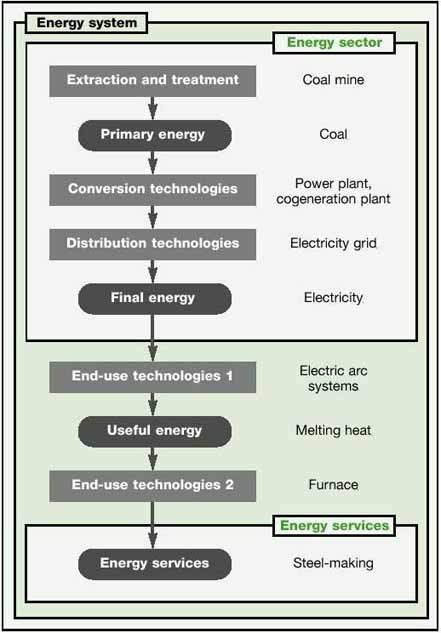
FIGURE 1. AN EXAMPLE OF THE ENERGY
CHAIN FROM EXTRACTION TO SERVICES
Source: Adapted from chapter 6.
TABLE 1. WORLD PRIMARY ENERGY CONSUMPTION, 1998
|
Source |
Primary energy (exajoules) |
Primary energy (109 tonnes of oil
equivalent) |
Percentage of total |
Static reserve-production ratio (years)a
|
Static resource base - production ratio
(years)b |
Dynamic resource base - production ratio
(years)c |
|
Fossil fuels |
320 |
7.63 |
79.6 |
|
|
|
|
Oil |
142 |
3.39 |
35.3 |
45 |
~ 200 |
95 |
|
Natural gas |
85 |
2.02 |
21.1 |
69 |
~ 400 |
230 |
|
Coal |
93 |
2.22 |
23.1 |
452 |
~ 1,500 |
1,000 |
|
Renewables |
56 |
1.33 |
13.9 |
|
|
|
|
Large hydro |
9 |
0.21 |
2.2 |
Renewable |
|
Traditional biomass |
38 |
0.91 |
9.5 |
Renewable |
|
'New' renewablesd |
9 |
0.21 |
2.2 |
Renewable |
|
Nuclear |
26 |
0.62 |
6.5 |
|
|
|
|
Nucleare |
26 |
0.62 |
6.5 |
50f |
>> 300f |
|
|
Total |
402 |
9.58 |
100.0 |
|
|
|
a. Based on constant production and static reserves.
b. Includes both conventional and unconventional reserves and resources. c. Data
refer to the energy use of a business-as-usual scenario - that is, production is
dynamic and a function of demand (see chapter 9). Thus these ratios are subject
to change under different scenarios. d. Includes modern biomass, small
hydropower, geothermal energy, wind energy, solar energy, and marine energy (see
chapter 7). Modern biomass accounts for about 7 exajoules, and 2 exajoules comes
from all other renewables. e. Converted from electricity produced to fuels
consumed assuming a 33 percent thermal efficiency of power plants. f. Based on
once-through uranium fuel cycles excluding thorium and low-concentration uranium
from seawater. The uranium resource base is effectively 60 times larger if fast
breeder reactors are used.
Source: Chapter 5.
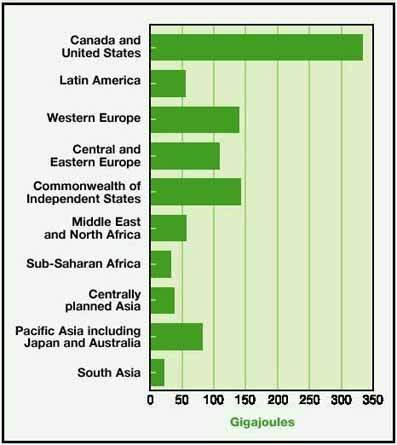
FIGURE 2. PRIMARY PER CAPITA
ENERGY CONSUMPTION (COMMERCIAL AND NON-COMMERCIAL) BY REGION, 1995
Source: World Bank, 1997; WRI,
1998.
Capital investment is a prerequisite for energy development.
Energy system development and structural change are the results of investment in
plants, equipment, and energy system infrastructure. Difficulties in attracting
capital for energy investment may impede economic development, especially in the
least developed countries. Scarce public funds, especially in developing
countries, are needed for many projects - ranging from rural development,
education, and health care to energy supplies. Because energy supply, more than
any other alternative, is often seen as more readily capable of generating early
revenues, energy investments are increasingly viewed as a private sector affair.
Yet private funds are not flowing into many developing countries for a variety
of reasons, especially risks to investors.
Foreign direct investment approached $400 billion in 1997 - up
from $50 billion in 1984 - and represents an increasing share of international
investment flows.7 Foreign direct investment is generally
commercially motivated, and investors not only expect to recover the initial
capital but also count on competitive returns. These outcomes cannot be
guaranteed in developing countries with potentially fragile governments or
without free markets. In fact, very little foreign direct investment reaches the
least developed countries.
Unlike foreign direct investment, official development
assistance has remained flat relative to gross world product. In 1997 it
totalled $56 billion, or 0.25 percent of the GDP of OECD countries - which have
agreed in principle to a target of 0.7 percent of GDP.8 Against this
backdrop, financing is inadequate for energy projects in developing countries.
Until the economic risks to foreign investors can be managed (for example,
through clear and stable rules for energy and financial markets, steady revenue
generation through bill collection, and profit transfers), most developing
countries may have to continue to finance their energy development from domestic
savings.
Although energy investment as a share of total investment varies
greatly among countries and at different stages of economic development, on
balance, 1.0-1.5 percent of GDP is invested in the energy sector. This ratio is
expected to remain relatively stable. Based on these rules of thumb, current
energy supply sector investment totals $290-430 billion a year. But this does
not include investment in end-use energy efficiency.
Energy and social issues
Energy use is closely linked to a range of social issues,
including poverty alleviation, population growth, urbanisation, and a lack of
opportunities for women. Although these issues affect energy demand, the
relationship is two-way: the quality and quantity of energy services, and how
they are achieved, have an effect on social issues as well.
Poverty is the overriding social consideration for developing
countries. Some 1.3 billion people in the developing world live on less than $1
a day. Income measurement alone, however, does not fully capture the misery and
the absence of choice that poverty represents. The energy consumption patterns
of poor people - especially their reliance on traditional fuels in rural areas -
tend to keep them impoverished.
World-wide, 2 billion people are without access to electricity
and an equal number continue to use traditional solid fuels for cooking. As
shown in the next section, cooking with poorly vented stoves has significant
health impacts. In addition, hundreds of millions of people - mainly women and
children - spend several hours a day in the drudgery of gathering firewood and
carrying water, often from considerable distances, for household needs. Because
of these demands on their time and energy, women and children often miss out on
opportunities for education and other productive activities.
Lack of electricity usually means inadequate illumination and
few labour-saving appliances, as well as limited telecommunications and
possibilities for commercial enterprise. Greater access to electricity and
modern fuels and stoves for cooking can enable people to enjoy both short-term
and self-reinforcing, long-term advances in their quality of life. Table 2
summarises some of the specific improvements that may result.
Limited income may force households to use traditional fuels and
inefficient technologies. Figure 5 shows the average primary energy demand for
various fuels as a function of income levels in Brazil. For low-income
households, firewood is the dominant fuel. At higher incomes, wood is replaced
by commercial fuels and electricity, which offer much greater convenience,
energy efficiency, and cleanliness. Because convenient, affordable energy can
contribute to a household's productivity and income-generating potential, its
availability can become a lever for breaking out of a cycle of poverty.
|
World-wide, 2 billion people are
without access to
electricity and
an equal number continue to
use traditional solid
fuels
for cooking. |
Although population growth tends to increase energy demand, it
is less widely understood that the availability of adequate energy services can
lower birth rates. Adequate energy services can shift the relative benefits and
costs of fertility towards a lower number of desired births in a family. An
acceleration of the demographic transition to low mortality and low fertility
(as has occurred in industrialised countries) depends on crucial developmental
tasks, including improving the local environment, educating women, and
ameliorating the extreme poverty that may make child labour a necessity. All
these tasks have links to the availability of low-cost energy services.
The growing concentration of people in urban centres is another
key demographic issue linked to energy. Although the general trend towards
urbanisation has many components and may be inevitable, providing more options
to rural residents through energy interventions could potentially slow migration
and reduce pressure on rapidly growing cities. Although the negative
externalities associated with energy use in urban areas can be severe, various
strategies can mitigate their effects and promote energy conservation. Taking
energy into consideration in land-use planning, and in designing physical
infrastructure, construction standards, and transportation systems, can reduce
some of the growth in energy demand that accompanies rapid urbanisation.
Transportation systems may be especially important in this
regard, given the rapid growth in the number of motor vehicles world-wide. Since
about 1970 the global fleet has been increasing by 16 million vehicles a year,
and more than 1 billion cars will likely be on the road by 2020. Most of these
cars will be driven in the cities of the developing world, where they will
create more congestion, aggravate urban pollution, and undermine human health -
even with optimistic projections about efficiency improvements and alternative
fuels.
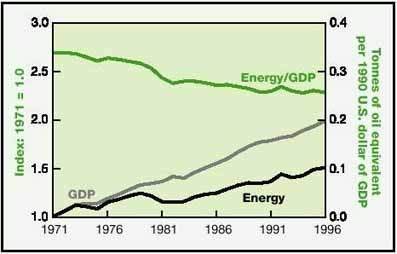
FIGURE 3. GDP AND PRIMARY ENERGY
CONSUMPTION IN OECD COUNTRIES, 1971-96
Source: IEA, 1999.
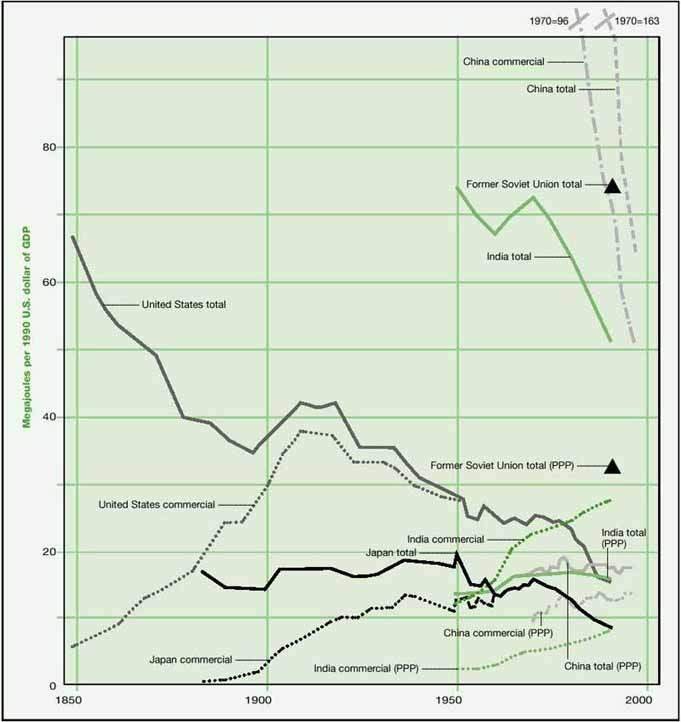
FIGURE 4. PRIMARY ENERGY
INTENSITIES IN VARIOUS COUNTRIES, 1850-2000
Two energy intensity paths are shown for Japan
and the United States, one based on total energy consumption from all sources
and the other only on commercial energy. The paths converge where traditional
sources have been replaced by commercial energy. Because of distortions from
market fluctuations, energy intensity paths for China and India are calculated
in two ways: using total and commercial energy divided by GDP measured at market
exchange rates (as with Japan and the United States), and divided by GDP
measured at purchasing power parities (PPP). Energy intensities for the former
Soviet Union, derived using both market exchange rates and PPP, are data points
only.
Source: Nakicenovic, Gr�bler, and McDonald,
1998.
In developing countries, addressing the energy needs of the
poor, who represent a large majority, will require major structural changes. On
the other hand, in industrialised countries adequate access to affordable energy
is problematic only for a minority, and thus more amenable to social policy
solutions. Throughout the world, however, poor households pay a larger fraction
of their incomes for energy than do the rich, and so are vulnerable to rapid
increases in the price of energy. Increases in the price of oil in the winter of
1999/2000, for example, posed a hardship for many people, even in some
industrialised countries.
Eradicating poverty is a long-term goal of development. But long
before that goal is achieved, convenient and affordable energy services could
dramatically improve living standards and offer more opportunities to people.
Today's inequity is unsustainable. Satisfying the energy needs of the poor with
modern technologies has the potential to improve standards of living and health,
and to create new jobs and business opportunities. Allowing one-third of the
world's population to continue to endure the constraints associated with
traditional energy is unacceptable from a humanitarian and moral standpoint.
Making commercial energy more widely available makes sense from a political
perspective as well. The wave of democratisation sweeping the world is putting
political power in the hands of the economically disenfranchised. Societies with
grave inequalities and disparities tend to be unstable, and large populations
below the poverty line are fertile ground for social upheavals.
TABLE 2. ENERGY-RELATED OPTIONS TO ADDRESS SOCIAL
ISSUES
|
Social challenge |
Energy linkages and interventions |
|
Alleviating poverty in developing countries |
· Improve health and increase
productivity by providing universal access to adequate energy services -
particularly for cooking, lighting, and transport - through affordable,
high-quality, safe, and environmentally acceptable energy carriers and end-use
devices.
· Make commercial energy available
to increase income-generating opportunities. |
|
Increasing opportunities for women |
· Encourage the use of improved
stoves and liquid or gaseous fuels to reduce indoor air pollution and improve
women's health.
· Support the use of
affordable commercial energy to minimise arduous and time-consuming physical
labour at home and at work.
· Use women's
managerial and entrepreneurial skills to develop, run, and profit from
decentralised energy systems. |
|
Speeding the demographic transition (to low mortality and low
fertility) |
· Reduce child mortality by
introducing cleaner fuels and cooking devices and providing safe, potable
water.
· Use energy initiatives to shift the
relative benefits and costs of fertility - for example, adequate energy services
can reduce the need for children's physical labour for household
chores.
· Influence attitudes about family
size and opportunities for women through communications made accessible through
modern energy carriers. |
|
Mitigating the problems associated with rapid urbanisation |
· Reduce the 'push' factor in
rural-urban migration by improving the energy services in rural areas.
· Exploit the advantages of high-density settlements
through land planning.
· Provide universal
access to affordable multi-modal transport services and public
transportation.
· Take advantage of new
technologies to avoid energy-intensive, environmentally unsound development
paths. |
Source: Adapted from chapter 2.
Energy, the environment, and health
The environmental impacts of energy use are not new. For
centuries, wood burning has contributed to the deforestation of many areas. Even
in the early stages of industrialisation, local air, water, and land pollution
reached high levels. What is relatively new is an acknowledgement of energy
linkages to regional and global environmental problems and of their
implications. Although energy's potential for enhancing human well-being is
unquestionable, conventional energy9 production and consumption are
closely linked to environmental degradation. This degradation threatens human
health and quality of life, and affects ecological balance and biological
diversity.
The environment-energy linkage is illustrated in table 3, which
shows the share of toxic emissions and other pollutants attributable to the
energy supply. The human disruption index is the ratio of the human-generated
flow of a given pollutant (such as sulphur dioxide) to the natural, or baseline,
flow. Thus, in the case of sulphur, the index is 2.7, which means that
human-generated emissions of 84 million tonnes a year are 2.7 times the natural
baseline flow of 31 million tonnes a year. The table indicates that, together
with other human activities, energy systems significantly affect the global
cycling of important chemicals. Although by itself the index does not
demonstrate that these emissions translate into negative impacts, their
magnitudes provide warning that such impacts could be considerable. Some
impacts, as discussed below, are already significant.
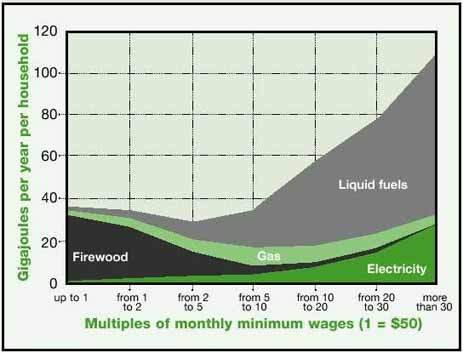
FIGURE 5. AVERAGE ENERGY DEMAND BY
INCOME SEGMENT IN BRAZIL, 1988
Source: De Almeida and de Oliveira,
1995.
Just in the course of the past 100 years, during which the
world's population more than tripled, human environmental insults10
grew from local perturbations to global disruptions. The human disruptions of
the 20th century - driven by more than 20-fold growth in the use of fossil
fuels, and augmented by a tripling in the use of traditional energy forms such
as biomass - have amounted to no less than the emergence of civilisation as a
global ecological and geochemical force. In other words, the accelerating impact
of human life is altering the world at the global level.
TABLE 3. ENVIRONMENTAL INSULTS DUE TO HUMAN ACTIVITIES BY
SECTOR, MID-1990s
|
Insult |
Natural base- line (tonnes per year) |
Human disruption indexa |
Share of human disruption caused by |
|
|
|
Commercial energy supply |
Traditional energy supply |
Agriculture |
Manufacturing, other |
|
Lead emissions to atmosphereb |
12,000 |
18 |
41% (fossil fuel burning, including additives) |
Negligible |
Negligible |
59% (metal processing, manufacturing, refuse burning) |
|
Oil added to oceans |
200,000 |
10 |
44% (petroleum harvesting, processing, and transport) |
Negligible |
Negligible |
56% (disposal of oil wastes, including motor oil changes)
|
|
Cadmium emissions to atmosphere |
1,400 |
5.4 |
13% (fossil fuel burning) |
5% (traditional fuel burning) |
12% (agricultural burning) |
70% (metals processing, manufacturing, refuse burning) |
|
Sulphur emissions to atmosphere |
31 million (sulphur) |
2.7 |
85% (fossil fuel burning) |
0.5% (traditional fuel burning) |
1% (agricultural burning) |
13% (smelting, refuse burning) |
|
Methane flow to atmosphere |
160 million |
2.3 |
18% (fossil fuel harvesting and processing) |
5% (traditional fuel burning) |
65% (rice paddies, domestic animals, land clearing) |
12% (landfills) |
|
Nitrogen fixation (as nitrogen oxide and ammonium)c
|
140 million (nitrogen) |
1.5 |
30% (fossil fuel burning) |
2% (traditional fuel burning) |
67% (fertiliser, agricultural burning) |
1% (refuse burning) |
|
Mercury emissions to atmosphere |
2,500 |
1.4 |
20% (fossil fuel burning) |
1% (traditional fuel burning) |
2% (agricultural burning) |
77% (metals processing, manufacturing, refuse burning) |
|
Nitrous oxide flows to atmosphere |
33 million |
0.5 |
12% (fossil fuel burning) |
8% (traditional fuel burning) |
80% (fertiliser, land clearing, aquifer disruption) |
Negligible |
|
Particulate emissions to atmosphere |
3,100 milliond |
0.12 |
35% (fossil fuel burning) |
10% (traditional fuel burning) |
40% (agricultural burning) |
15% (smelting, non-agricultural land clearing, refuse) |
|
Non-methane hydrocarbon emissions to atmosphere |
1,000 million |
0.12 |
35% (fossil fuel processing and burning) |
5% (traditional fuel burning) |
40% (agricultural burning) |
20% (non-agricultural land clearing, refuse burning) |
|
Carbon dioxide flows to atmosphere |
150 billion (carbon) |
0.05e |
75% (fossil fuel burning) |
3% (net deforestation for fuelwood) |
15% (net deforestation for land clearing) |
7% (net deforestation for lumber, cement manufacturing) |
Note: The magnitude of the insult is only one factor
determining the size of the actual environmental impact. a. The human disruption
index is the ratio of human-generated flow to the natural (baseline) flow. b.
The automotive portion of human-induced lead emissions in this table is assumed
to be 50 percent of global automotive emissions in the early 1990s. c.
Calculated from total nitrogen fixation minus that from nitrous oxide. d. Dry
mass. e. Although seemingly small, because of the long atmospheric lifetime and
other characteristics of carbon dioxide, this slight imbalance in natural flows
is causing a 0.4 percent annual increase in the global atmospheric concentration
of carbon dioxide.
Source: Chapter 3.
At every level (local, regional, global), the environmental
consequences of current patterns of energy generation and use make up a
significant fraction of human impacts on the environment. At the household
level, solid fuel use for cooking and heat has significant health impacts. Poor
air quality - at the household, local, and regional levels - is associated with
increased sickness and premature death. About 2 million premature deaths a year
- disproportionately of women and children - are estimated to occur from
exposure to indoor air pollution caused by burning solid fuels in poorly
ventilated spaces. Particulate matter (which is both emitted directly and formed
in the air as the result of the emissions of gaseous precursors in the form of
oxides of sulphur and nitrogen) and hydrocarbons are growing concerns
world-wide. They are especially troublesome in many parts of the developing
world, where dirtier fuels predominate with little emissions abatement. No safe
threshold level for exposure to small particulate matter has been established.
Fossil fuel combustion is problematic on several levels
(although natural gas produces significantly fewer harmful emissions than do oil
or coal). The main pollutants emitted in the combustion of fossil fuels are
sulphur and nitrogen oxides, carbon monoxide, and suspended particulate matter.
Ozone is formed in the troposphere from interactions among hydrocarbons,
nitrogen oxides, and sunlight. Energy-related emissions from fossil fuel
combustion, including in the transport sector, are major contributors to urban
air pollution. Precursors of acid deposition from fuel combustion can be
precipitated thousands of kilometres from their point of origin - often crossing
national boundaries. The resulting acidification is causing significant damage
to natural systems, crops, and human-made structures; and can, over time, alter
the composition and function of entire ecosystems. In many regions acidification
has diminished the productivity of forests, fisheries, and farmlands. Large
hydropower projects often raise environmental issues related to flooding,
whereas in the case of nuclear power, issues such as waste disposal raise
concern.
Fossil fuel combustion produces more carbon dioxide
(CO2) than any other human activity. This is the biggest source of
the anthropogenic greenhouse gas emissions that are changing the composition of
the atmosphere and could alter the global climate system, including the amount
and pattern of rainfall. Achieving a stable atmospheric CO2
concentration at any level would require that CO2 emissions
eventually be cut by more than half from current levels. Stabilising
CO2 at close to the present concentration would require reducing
emissions to half of current levels within the next few decades. Instead,
CO2 emissions continue to increase. Current CO2 emission
trends, if not controlled, will lead to more than a doubling of atmospheric
concentrations before 2070, relative to pre-industrial levels. Changes have been
observed in climate patterns that correspond to scientific projections based on
increasing concentrations of greenhouse gases. The balance of evidence,
according to the Intergovernmental Panel on Climate Change, suggests that there
is already a discernible human influence on global climate.
|
Numerous energy
strategies could simultaneously
benefit
the environment,
the economy and human
well-being. |
Because, by definition, sustainable energy systems must support
both human and ecosystem health over the long term, goals on tolerable emissions
should look well into the future. They should also take into account the
public's tendency to demand more health and environmental protection as
prosperity increases.
Although the scope of environmental problems related to energy
may seem overwhelming, numerous 'win-win' strategies could simultaneously
benefit the environment (at several levels), the economy, and human well-being.
For example, the replacement of solid fuels for cooking with gaseous or liquid
fuels could have significant environmental benefits at the local, community,
regional, and global scales, with attendant benefits for health and
productivity.
Energy security
Energy security means the availability of energy at all times in
various forms, in sufficient quantities, and at affordable prices. These
conditions must prevail over the long term if energy is to contribute to
sustainable development.
Attention to energy security is critical because of the uneven
distribution both of the fossil fuel resources on which most countries currently
rely and of capacity to develop other resources. The energy supply could become
more vulnerable over the near term due to the growing global reliance on
imported oil. For example, the oil dependence (net imports as a share of total
demand) of OECD countries is expected to grow from 56 percent in 1996 to 72
percent in 2010.
In addition, although energy security has been adequate for the
past 20 years, and has in fact improved, the potential for conflict, sabotage,
disruption of trade, and reduction in strategic reserves cannot be dismissed.
These potential threats point to the necessity of strengthening global as well
as regional and national energy security. Options to enhance energy security
include:
· Avoiding excessive
dependence on imports by increasing end-use efficiency and encouraging greater
reliance on local resources (particularly those whose development will have
other positive externalities such as job creation, capacity building, and
pollution reduction), provided these do not involve disproportionate costs or
waste scarce resources.
· Diversifying supply (including
both suppliers and energy forms).
· Fostering greater political
stability through international cooperation and long-term agreements among
energy-importing countries and between importing and exporting countries.
Examples might include wider adoption - and more effective implementation of -
the Energy Charter Treaty,11 as well as increased sharing of
infrastructure for transporting natural gas.
· Encouraging technology
transfers (for example, through joint ventures and public-private partnerships)
to developing countries so they can develop local resources and improve energy
efficiencies.
· Increasing national and
regional strategic reserves of crude oil and oil products through increased
investment and advanced exploration technologies.
Although markets play a prominent role in securing energy supply
in OECD countries, their role is modest in some developing countries and absent
in others. Where markets do not flourish, the security of supply and services
depends almost solely on government action and multinational companies, which
may not serve the best interests of consumers. In such situations, energy
security can be enhanced by encouraging the development of frameworks that allow
markets to contribute to the allocation of energy resources.
Because of small fuel requirements, nuclear power contributes to
the diversity of supply and to supply security. But public concerns about
economic necessity, reactor safety, and radioactive waste transport and disposal
- as well as weapons proliferation - have curbed nuclear energy development in
many countries. A nuclear accident anywhere in the world or a proliferation
incident linked to nuclear power could further reduce support for nuclear power
programmes, with long-term loss in the diversity of the energy supply mix. But
if generally accepted responses could be found to the above concerns, nuclear
energy could contribute significantly to secure electricity generation in many
parts of the world.
Individuals and commercial enterprises are also vulnerable to
disruptions of energy supply. Although the trend towards the liberalisation of
energy markets generally has enhanced energy security by offering more options,
supplies, and competition, it has also raised concerns that those who are
impoverished will be left out of the process, resulting in continued energy
insecurity for some
individuals.
Part II: Energy resources and technological options
|
Physical resources and technical opportunities are available
- or could become available - to meet the challenge of sustainable development.
Without policy changes, cost differentials may favour conventional fuels for
years to come. Options for using energy in ways that support sustainable
development, which requires addressing environmental concerns, include:
· More efficient
use of energy, especially at the point of end use in buildings, electric
appliances, vehicles, and production processes.
· Increased reliance on
renewable energy sources.
· Accelerated development and
deployment of new energy technologies, particularly next-generation fossil fuel
technologies that produce near-zero harmful emissions - but also nuclear
technologies, if the problems associated with nuclear energy can be
resolved.
All three options have considerable potential, but realising
this potential will require removing obstacles to wider diffusion, developing
market signals that reflect environmental costs, and encouraging technological
innovation. |
Energy resources
Careful analysis of the long-term availability of energy
resources, starting with conventional and unconventional oil and gas, indicates
that these resources could last another 50-100 years - and possibly much longer
- with known exploration and extraction technologies and anticipated technical
progress in upstream operations. Coal resources and nuclear materials are so
abundant that they could, respectively, last for centuries or millennia.
Moreover, although fossil fuel prices may rise slowly over time, the large,
cost-driven increases in energy prices projected in the 1970s and 1980s will not
take place in the foreseeable future.
As evidenced by rising oil prices in the winter of 1999/2000,
however, prices are subject to volatility. This may occur, for example, if
cartels set prices independent of production costs. Some fluctuations in prices
can also be expected, especially during the transition to a large-scale use of
unconventional oil and gas resources, because the timing of investments in
upstream production capacities may not correspond with demand. Other
cost-pushing factors could arise from the environmentally more challenging
extraction of unconventional oil resources.
Renewable resources are more evenly distributed than fossil and
nuclear resources, and energy flows from renewable resources are more than three
orders of magnitude higher than current global energy use. But the economic
potential of renewables is affected by many constraints - including competing
land uses, the amount and timing of solar irradiation, environmental concerns,
and wind patterns.
Although there are no real limitations on future energy
availability from a resource point of view, the existence of resources is of
little relevance without consideration of how these can contribute to the supply
of (downstream) energy services. Rather, the key concerns are: Can technologies
to extract, harvest, and convert these vast energy stocks and flows be developed
in time? Will these processes have adverse implications? Will the energy
services eventually generated from these resources be affordable? Historical
evidence suggests that these concerns may be at least partly offset by
technological progress, but that such progress needs to be encouraged - by
regulations to improve market performance, temporary subsidies, tax incentives,
or other mechanisms - if it is to occur in a timely fashion.
Energy end-use efficiency
The quadrupling of oil prices in the 1970s, the growing
awareness of energy-related pollution, and the possibility of climate change
have all contributed to a re-evaluation of energy use. The result has been an
improvement in the efficiency with which energy is used in industry and power
generation as well as in lighting, household appliances, transportation, and
heating and cooling of buildings. This more efficient use of energy is a major
factor contributing to the improvements in energy intensity that have occurred
historically in almost all OECD countries, and more recently in many transition
economies, as well as in some in fast-growing developing countries such as
Brazil and China.
Today the global energy efficiency of converting primary energy
to useful energy is about one-third (see figure 1). In other words, two-thirds
of primary energy is dissipated in the conversion processes, mostly as
low-temperature heat. Further significant losses occur when the useful energy
delivers the energy service. Numerous and varied economic opportunities exist
for energy efficiency improvements, particularly in this final conversion step
from useful energy to energy services. Taking advantage of these opportunities,
which have received relatively little attention, has the largest potential for
cost-effective efficiency improvements. It would mean less costly energy
services and lower energy-related pollution and emissions.
Over the next 20 years the amount of primary energy required for
a given level of energy services could be cost-effectively reduced by 25-35
percent in industrialised countries (the higher figure being achievable by more
effective policies). These reductions are mostly in the conversion step of
useful energy to energy services in the residential, industrial, transportation,
public, and commercial sectors. Reductions of more than 40 percent are
cost-effectively achievable in transition economies. And in most developing
countries - which tend to have high economic growth and old capital and vehicle
stocks - the cost-effective improvement potentials range from 30 to more than 45
percent, relative to energy efficiencies achieved with existing capital
stock.12
The improvements of about 2 percent a year implied by the above
figures could be enhanced by structural changes in industrialised and transition
economies, by shifts to less energy-intensive industrial production, and by
saturation effects in the residential and transportation sectors. These combined
effects, made up by efficiency improvements and structural changes, could lead
to decreases in energy intensity of 2.5 percent a year. How much of this
potential will be realised depends on the effectiveness of policy frameworks and
measures, changes in attitudes and behaviour, and the level of entrepreneurial
activity in energy conservation.
The next few decades will likely see new processes, motor
systems, materials, vehicles, and buildings designed to reduce useful energy
demand. Because the demand for cars is expected to grow rapidly in the
developing world, gaining greater efficiencies in this area will be very
important. In addition, rapidly industrialising countries could greatly profit
from the introduction of radically new and more efficient technologies in their
energy-intensive basic materials processing. Because these countries are still
building their physical infrastructure, they have a growing demand for basic
materials. This opens a window of opportunity to innovate and improve
efficiencies of production, particularly in countries undergoing market reform.
The opportunities are larger at the point of new investment, relative to
retrofitting.
|
Over the next 20 years the amount of
primary energy
required for a given
level of energy services could be
cost-effectively
reduced by 25-35
percent in industrialised
countries. |
Over the long term, additional and dramatic gains in efficiency
are possible at all stages of energy conversion, particularly from useful energy
to energy services. Analysis shows that current technologies are not close to
reaching theoretical limits, and that improvements of an order of magnitude for
the whole energy system may eventually be achieved.13
For a number of reasons the technical and economic potentials of
energy efficiency, as well as its positive impact on sustainable development,
have traditionally been under-realised. Achieving higher end-use efficiency
involves a great variety of technical options and players. Because it is a
decentralised, dispersed activity, it is a difficult issue for which to organise
support. And because it has little visibility, energy efficiency is not
generally a popular cause for politicians, the media, or individuals looking for
recognition and acknowledgement. In addition, significant barriers - primarily
market imperfections that could be overcome by targeted policy instruments -
prevent the realisation of greater end-use efficiencies. These barriers include:
· Lack of adequate
information, technical knowledge, and training.
· Uncertainties about the
performance of investments in new and energy-efficient technologies.
· Lack of adequate capital or
financing possibilities.
· High initial and perceived
costs of more efficient technologies.
· High transaction costs (for
searching and assessing information and for training).
· Lack of incentives for careful
maintenance.
· The differential benefits to
the user relative to the investor (for example, when energy bills are paid by
the renter rather than the property owner).
· External costs of energy use,
not included in energy prices.
· Patterns and habits of
consumers, operators, and decision-makers, which may be influenced by many
factors, including ideas of social prestige and professional norms.
Realising cost-effective energy efficiency potentials will be
beneficial not only for individual energy consumers, but also for the economy as
a whole. For example, saved energy costs can be used to produce energy-saving
domestic goods and services. And as cost-effective energy improvements are
realised, additional profitable opportunities for improvement will continue to
open up as a result of research and development, learning curves, and economies
of scale. That means that continual cost-effective energy efficiency
improvements can be expected.
Energy efficiency policies that use direct or indirect price
mechanisms (such as the removal of subsidies and the incorporation of
externalities) are effective in lowering consumption trends in price-sensitive
sectors and applications. But even without changing the overall price
environment, energy efficiency policies should be pursued to address market
failures. For example, efficiency standards, appliance and product labelling,
voluntary agreements, and professional training or contracting can increase GDP
growth by improving environmental and economic performance, using a given
quantity of energy. Legal standards; well-informed consumers, planners, and
decision-makers; motivated operators; and an adequate payments system for energy
are central to the successful implementation of energy efficiency
improvements.14
Renewable energy technologies
Renewable energy sources (including biomass, solar, wind,
geothermal, and hydropower) that use indigenous resources have the potential to
provide energy services with zero or almost zero emissions of both air
pollutants and greenhouse gases. Currently, renewable energy sources supply 14
percent of the total world energy demand. The supply is dominated by traditional
biomass used for cooking and heating, especially in rural areas of developing
countries. Large-scale hydropower supplies 20 percent of global electricity. Its
scope for expansion is limited in the industrialised world, where it has nearly
reached its economic capacity. In the developing world, considerable potential
still exists, but large hydropower projects may face financial, environmental,
and social constraints.
Altogether, new renewable energy sources contributed 2 percent
of the world's energy consumption in 1998, including 7 exajoules from modern
biomass and 2 exajoules for all other renewables (geothermal, wind, solar, and
marine energy, and small-scale hydropower). Solar photovoltaics and
grid-connected wind installed capacities are growing at a rate of 30 percent a
year. Even so, it will likely be decades before these new renewables add up to a
major fraction of total energy consumption, because they currently represent
such a small percentage.
Substantial price reductions in the past few decades have made
some renewables competitive with fossil fuels in certain applications in growing
markets. Modern, distributed forms of biomass seem particularly promising for
their potential to provide rural areas with clean forms of energy based on the
use of biomass resources that have traditionally been used in inefficient,
polluting ways. Biomass can be economically produced with minimal or even
positive environmental impacts through perennial crops. Wind power in coastal
and other windy regions is promising as well.
Unlike hydropower and conventional thermal power sources, wind
and solar thermal or electric sources are intermittent. Nevertheless, they can
be important energy sources in rural areas where grid extension is expensive.
They can also contribute to grid-connected electricity supplies in appropriate
hybrid configurations. Intermittent renewables can reliably provide 10-30
percent of total electricity supplies if operated in conjunction with hydropower
- or fuel-based power generation. Emerging storage possibilities and new
strategies for operating grids offer promise that the role of intermittent
technologies could be considerably larger.
|
Renewable energy sources have
the potential to provide
energy
services with zero or almost zero
emissions of both
air
pollutants and green-
house gases. |
Significant barriers, which could be overcome by appropriate
frameworks and policies, stand in the way of the accelerated development of
renewable technologies. These barriers include economic risks, regulatory
obstacles, limited availability of products, information and technology gaps,
and lack of investment. The greatest challenge is financial, even though costs
have come down significantly over the past several decades. Table 4 summarises
the status of various renewable technologies, and also provides information on
trends in cost and capacity.
Many renewable technologies, because they are small in scale and
modular, are good candidates for continued cost-cutting as a result of field
experience. The cost reductions of manufactured goods, which are typically rapid
at first and then taper off as the industry matures, are called experience
curves. These curves resulted in industry-wide cost declines of about 20 percent
for each cumulative doubling of production for solar photovoltaics, wind
generators, and gas turbines - due to learning effects, marginal technological
improvements, and economies of scale (figure 6). Similar declines are expected
for other small-scale renewables.
A rapid expansion of renewable-based energy systems will require
actions to stimulate the market in this direction. This expansion can be
achieved by finding ways to drive down the relative cost of renewables in their
early stages of development and commercialisation, while still taking advantage
of the economic efficiencies of the marketplace. Pricing based on the full costs
of conventional energy sources (including phasing out subsidies and
internalising externalities) will make renewables more competitive. Because
internalising external costs may be controversial for some time, 'green' pricing
of electricity and heat (which lets consumers pay more for environmentally
benign energy supplies if they choose) may be an immediate option in
industrialised countries.
Advanced energy technologies
Fossil energy
Sustainability goals indicate the importance of evolving fossil
energy technologies towards the long-term goal of near-zero air pollutant and
greenhouse gas emissions without complicated end-of-pipe control technologies.
Near-term technologies and strategies should support this long-term goal.
The technological revolution under way in power generation,
where advanced systems are replacing steam turbine technologies, does support
this long-term goal. Natural-gas-fired combined cycles offering low costs, high
efficiency, and low environmental impacts are being chosen wherever natural gas
is readily available - in some countries even displacing large new hydropower
projects. Cogeneration is more cost-effective and can play a much larger role in
the energy economy - if based on gas turbines and combined cycles rather than on
steam turbines.
Reciprocating engines and emerging microturbine and fuel cell
technologies are also strong candidates for cogeneration at smaller scales,
including commercial and apartment buildings. Coal gasification by partial
oxidation with oxygen to produce syngas (mainly carbon monoxide and hydrogen)
makes it possible to provide electricity through integrated gasifier combined
cycle (IGCC) plants with air pollutant emissions nearly as low as for natural
gas combined cycles. Today power from IGCC cogeneration plants is often
competitive with power from coal steam-electric plants in either cogeneration or
power-only configurations.
Although synthetic liquid fuels made in single-product
facilities are not competitive, superclean syngas-derived synthetic fuels (such
as synthetic middle distillates and dimethyl ether) produced in polygeneration
facilities that make several products simultaneously may soon be. Syngas can be
produced from natural gas by steam reforming or other means or from coal by
gasification using oxygen, as noted. Expanding markets for clean synthetic fuels
are likely to result from toughening air pollution regulations. Synthetic fuels
produced through polygeneration will be based on natural gas if it is readily
available. Synthetic middle distillates so produced are likely to be competitive
where low-cost natural gas is available (as at remote developing country sites);
the technology might facilitate exploitation of relatively small remote natural
gas fields.
In natural-gas-poor, coal-rich regions, polygeneration based on
coal gasification is promising. Such systems might include production of extra
syngas for distribution by pipelines to small-scale cogeneration systems in
factories and buildings - making possible clean and efficient use of coal at
small as well as large scales. Rapidly growing polygeneration activity is
already under way in several countries based on the gasification of low-quality
petroleum feedstocks - activity that is helping to pave the way for coal-based
systems.
TABLE 4. CURRENT STATUS AND POTENTIAL FUTURE COSTS OF
RENEWABLE ENERGY TECHNOLOGIES
|
Technology |
Increase in installed capacity in past five years (percent
a year) |
Operating capacity, end 1998 |
Capacity factor (percent) |
Energy production, 1998 |
Turnkey investment costs (U.S. dollars per kilowatt)
|
Current energy cost |
Potential future energy cost |
|
Biomass energy |
|
|
|
|
|
|
|
|
Electricity |
» 3 |
40 Gwe |
25-80 |
160 TWh (e) |
900-3000 |
5-15 ¢/kWh |
4-10 ¢/kWh |
|
Heata |
» 3 |
> 200 GWth |
25-80 |
>700 TWh (th) |
250-750 |
1-5 ¢/kWh |
1-5 ¢/kWh |
|
Ethanol |
» 3 |
18 billion litres |
|
420 PJ |
|
8-25 $/GJ |
6-10 $/GJ |
|
Wind electricity |
» 30 |
10 Gwe |
20-30 |
18 TWh (e) |
1100-1700 |
5-13 ¢/kWh |
3-10 ¢/kWh |
|
Solar photovoltaic electricity |
» 30 |
500 MWe |
8-20 |
0.5 TWh (e) |
5000-10000 |
25-125 ¢/kWh |
5 or 6-25 |
|
Solar thermal electricity |
» 5 |
400 MWe |
20-35 |
1 TWh (e) |
3000-4000 |
12-18 ¢/kWh |
4-10 ¢/kWh |
|
Low-temperature solar heat |
» 8 |
18 GWth
(30 million m2) |
8-20 |
14 TWh (th) |
500-1700 |
3-20 ¢/kWh |
2 or 3-10 |
|
Hydroelectricity |
|
|
|
|
|
|
|
|
Large |
» 2 |
640 GWe |
35-60 |
2510 TWh (e) |
1000-3500 |
2-8 ¢/kWh |
2-8 ¢/kWh |
|
Small |
» 3 |
23 Gwe |
20-70 |
90 TWh (e) |
1200-3000 |
4-10 ¢/kWh |
3-10 ¢/kWh |
|
Geothermal energy |
|
|
|
|
|
|
|
|
Electricity |
» 4 |
8 GWe |
45-90 |
46 TWh (e) |
800-3000 |
2-10 ¢/kWh |
1 or 2-8 ¢/kWh |
|
Heat |
» 6 |
11 GWth |
20-70 |
40 TWh (th) |
200-2000 |
0.5-5¢/kWh |
0.5-5 ¢/kWh |
|
Marine energy |
|
|
|
|
|
|
|
|
Tidal |
0 |
300 MWe |
20-30 |
0.6 TWh (e) |
1700-2500 |
8-15 ¢/kWh |
8-15 ¢/kWh |
|
Wave |
- |
exp. phase |
20-35 |
Unclear |
1500-3000 |
8-20 ¢/kWh |
Unclear |
|
Current |
- |
exp. phase |
25-35 |
Unclear |
2000-3000 |
8-15 ¢/kWh |
5-7 ¢/kWh |
|
OTEC |
- |
exp. phase |
70-80 |
Unclear |
Unclear |
Unclear |
Unclear |
Note: The cost of grid-supplied electricity in urban
areas ranges from 2-3 (c/kWh (off-peak) to 15-25c/kWh) (peak). See chapter 11.
a. Heat embodied in steam (or hot water in district heating), often produced by
combined heat and power systems using forest residues, black liquor, or bagasse.
Source: Chapter 7.
Barriers to widespread deployment of advanced cogeneration and
polygeneration systems are mainly institutional. Most systems will produce far
more electricity than can be consumed on-site, so achieving favourable economics
depends on being able to sell co-product electricity at competitive prices into
electric grids. Utility policies have often made doing so difficult, but under
the competitive market conditions towards which electric systems are evolving in
many regions, cogeneration and polygeneration systems will often fare well.

FIGURE 6. EXPERIENCE CURVES FOR
PHOTOVOLTAICS, WINDMILLS, AND GAS TURBINES IN JAPAN AND THE UNITED STATES
Technology performance and costs improve with
experience, and there is a pattern to such improvements common to many
technologies. The specific shape depends on the technology, but the persistent
characteristic of diminishing costs is termed the 'learning' or 'experience'
curve. The curve is likely to fall more sharply as technologies first seek a
market niche, then full commercialisation, because lower costs become
increasingly important for wider success.
Source: Nakicenovic, Gr�bler, and McDonald,
1998.
The near-term pursuit of a syngas-based strategy could pave the
way for widespread use of hydrogen (H2) as an energy carrier, because
for decades the cheapest way to make H2 will be from
fossil-fuel-derived syngas. The successful development of fuel cells would
facilitate the introduction of H2 for energy. Fuel cells are getting
intense attention, especially for transportation, because they offer high
efficiency and near-zero air pollutant emissions. Automakers are racing to
develop fuel cell cars, with market entry targeted for 2004-10. The fuel cell
car will compete for the role of 'car of the future' with the hybrid internal
combustion engine/battery powered car already being introduced into the market.
Syngas-based power and H2 production strategies also
facilitate separation and storage of CO2 from fossil energy systems,
making it possible to obtain useful energy with near-zero emissions of
green-house gases without large increases in energy costs. Recent research
suggests that the global capacity for secure disposal of CO2 in
geological reservoirs might be adequate to dispose of CO2 from fossil
fuel use for hundreds of years, although more research is needed to be sure
about this.
Other advanced technologies (ultrasupercritical steam plants,
pressurised fluidised-bed combustion, coal IGCC based on partial oxidation in
air for power generation, direct coal liquefaction for synthetic fuels
production) offer benefits relative to conventional technologies. But unlike
syngas-based technologies, such options in the near term would not offer clear
paths to the long-term goal of near-zero emissions without significant increases
in costs for energy services.
Nuclear energy
World-wide, nuclear energy accounts for 6 percent of energy and
16 percent of electricity. Although nuclear energy dominates electricity
generation in some countries, its initial promise has not been widely realised.
Most analysts project that nuclear energy's contribution to global energy will
not grow - and might decline during the initial decades of the 21st century.
Nuclear power is more costly than originally projected, competition from
alternative technologies is increasing, and there has been a loss of public
confidence because of concerns related to safety, radioactive waste management,
and potential nuclear weapons proliferation.
But because nuclear power can provide energy without emitting
conventional air pollutants and greenhouse gases, it is worth exploring if
advanced technologies could offer simultaneously lower costs, boost public
confidence in the safety of nuclear reactors, assure that peaceful nuclear
programs are not used for military purposes, and demonstrate effective nuclear
waste management practices. Unlike Chernobyl-type reactors, the light water
reactors (LWRs) that dominate nuclear power globally have a good safety record -
although this record has been achieved at considerable cost to minimise the risk
of accidents.
|
If wise decisions
are not made during the next
few
decades, certain development
opportunities might not
be achievable. |
The potential linkage between peaceful and military uses of
nuclear energy was recognised at the dawn of the nuclear age. Efforts to create
a non-proliferation regime through the Nuclear Non-Proliferation Treaty and a
series of regional treaties, controls on commerce in nuclear materials and goods
and services that might be used to further military ambitions, and safeguards
applied to nuclear materials in peaceful nuclear applications have been largely
successful in separating peaceful and military uses. If there is to be an energy
future in which nuclear power eventually contributes much more than at present,
stronger institutional measures will be needed to maintain this separation.
These measures should be complemented by technological advances aimed at
limiting opportunities to acquire nuclear weapons under the guise of peaceful
nuclear energy applications and to steal weapons-usable nuclear materials.
Reactor development activity for the near term has involved both
evolutionary LWRs and new concepts. Reactor vendors now offer several
evolutionary LWRs with improved safety features and standardised designs, for
which there can be a high degree of confidence that performance and cost targets
will be met. Another evolutionary activity involves modifying LWRs to make them
more proliferation resistant through a denatured uranium or thorium fuel cycle.
One concept being revisited, the pebble bed modular reactor, offers the
potential for a high degree of inherent safety without the need for complicated,
capital-intensive safety controls. A pebble bed modular reactor could also be
operated on a proliferation resistant denatured uranium - or thorium fuel cycle.
Access to low-cost uranium supplies could constrain nuclear
power development based on LWRs. The plutonium breeder reactor, which requires
reprocessing spent fuel to recover plutonium for recycling in fresh fuel, was
once thought to be a viable option for addressing this challenge. But
electricity costs for breeders would probably be higher than for LWRs, at least
until late in the 21st century, and preventing proliferation is much more
challenging with reprocessing and plutonium recycling than with LWRs operated on
once-through fuel cycles.
Other long-term options for addressing the nuclear resource
constraint are alternative breeder concepts - including
particle-accelerator-driven reactors, uranium from seawater, and thermonuclear
fusion. The prospective costs, safety, and proliferation resistance features of
such alternative breeder concepts are uncertain, and the concepts would take
decades to develop. Recent research suggests it might be feasible, at relatively
low cost, to extract uranium from seawater, where its concentration is low but
total quantities are vast. If the technology could be deployed at globally
significant scales, it might be feasible to avoid making major commitments to
nuclear fuel reprocessing and plutonium recycling. Fusion could provide an
almost inexhaustible energy supply, but it will probably not be commercially
available before 2050.
Radioactive waste by-products of nuclear energy must be isolated
so that they can never return to the human environment in concentrations that
could cause significant harm. Although the safety of long-term waste disposal
has not been proven, the technical community is confident that this objective
can be realised - largely because of the small volumes of wastes involved. But
in most countries there is no social consensus on the goals and standards for
radioactive waste disposal and on strategies (both interim and long-term) for
implementing them. The issues involved are only partly technical. The current
social stalemate on waste disposal not only clouds prospects for nuclear
expansion, it also has made spent fuel reprocessing a de facto interim nuclear
waste management strategy in some countries. This has happened even though fuel
reprocessing does not offer economic gains and does not solve the waste disposal
problem - it merely buys time and is creating large inventories of plutonium
that must be disposed of with low proliferation
risk.
Part III: Are sustainable futures possible?
|
Analysis using energy scenarios indicates that it is possible
to simultaneously address the sustainable development objectives set forth in
part 1 using the resources and technical options presented in part 2. The
scenarios exercise and subsequent sections suggest that:
· Continuing
along the current path of energy system development is not compatible with
sustainable development objectives.
· Realising sustainable
futures will require much greater reliance on some combination of higher energy
efficiencies, renewable resources, and advanced energy technologies.
· A prerequisite for
achieving an energy future compatible with sustainable development objectives is
finding ways to accelerate progress for new technologies along the energy
innovation chain, from research and development to demonstration, deployment,
and diffusion.
· Providing energy services to rural areas poses
particular challenges. But it also offers considerable opportunity for improving
the lives of billions of people within a relatively short period. Promising
approaches include decentralised solutions, appropriate technologies, innovative
credit arrangements, and local involvement in decision-making. |
Energy scenarios
Energy scenarios provide a framework for exploring future energy
perspectives, including various combinations of technology options and their
implications. Many scenarios in the literature illustrate the degree to which
energy system developments will affect the global issues analysed in part 1.
Some describe energy futures that are compatible with sustainable development
goals. Key developments in sustainable scenarios include increases in energy
efficiencies and the adoption of advanced energy supply technologies.
Sustainable development scenarios are characterised by low environmental impacts
(local, regional, and global) and equitable allocation of resources and wealth.
The three cases of alternative global developments presented in
chapter 9 suggest how the future could unfold in terms of economic growth,
population trends, and energy use. The challenge is formidable. For example, by
2100, 6-8 billion additional people - significantly more than today's world
population - will need access to affordable, reliable, flexible, and convenient
energy services.15 All three cases achieve this through different
energy system developments, but with varying degrees of success in terms of
sustainability (table 5).
A middle-course, or reference, case (B) includes one scenario
and is based on the general direction in which the world is now headed. This
scenario assumes the continuation of an intermediate level of economic growth
and modest technological improvement, and it leads to adverse environmental
impacts, including regional acidification and climate change. Although this
middle-course scenario represents a substantial improvement relative to the
current situation, it falls short of achieving a transition towards sustainable
development. The other two scenarios and their variants lead to higher economic
development with vigorous improvement of energy technologies. They both - and
especially the ecologically driven case (C) - achieve, to a much higher degree,
a transition towards sustainable development (table 6).
For instance, one of the three high-growth case A scenarios (A3)
achieves some goals of sustainable development, primarily through rapid economic
growth and a shift towards environmentally more benign energy technologies and
options. In this scenario, higher levels of affluence result from impressive
technological development, including a significant role for clean fossil,
renewable, and nuclear energy. Dedicated decarbonisation of the energy system
contributes to environmental sustainability. Two other variants of this
high-growth case are also considered. Both lead to higher dependence on
carbon-intensive fossil fuels, resulting in high energy-related emissions.
Consequently, they are unsustainable from an environmental point of view.
A third case (C) includes two scenarios and is ecologically
driven, with high growth in developing countries (towards being rich and
'green'). The difference between the two scenarios is that one, C1, assumes a
global phase-out of nuclear energy by 2100, whereas the other, C2, does not.
Both assume the introduction of carbon and energy taxes directed at promoting
renewables and end-use efficiency improvements. The revenues from carbon and
energy taxes are assumed to be used to enhance economic growth and promote
renewables and end-use efficiency, rather than to reduce other taxes in
industrialised regions.
TABLE 5. SUMMARY OF THREE ENERGY DEVELOPMENT CASES IN 2050
AND 2100 COMPARED WITH 1990
|
|
Case A
High growth |
Case B
Middle growth |
Case C
Ecologically driven |
|
Population (billions) |
1990 |
5.3 |
5.3 |
5.3 |
|
2050 |
10.1 |
10.1 |
10.1 |
|
2100 |
11.7 |
11.7 |
11.7 |
|
Gross world product (trillions of 1990 dollars) |
1990 |
20 |
20 |
20 |
|
2050 |
100 |
75 |
75 |
|
2100 |
300 |
200 |
220 |
|
Gross world product (annual percentage change) |
1990 - 2050 |
High |
Medium |
Medium |
|
1990 - 2100 |
2.7 |
2.2 |
2.2 |
|
|
2.5 |
2.1 |
2.2 |
|
Primary energy intensity (megajoules per 1990 dollar of gross
world product) |
1990 |
19.0 |
19.0 |
19.0 |
|
2050 |
10.4 |
11.2 |
8.0 |
|
2100 |
6.1 |
7.3 |
4.0 |
|
Primary energy intensity improvement rate (annual percentage
change) |
1990 - 2050 |
Medium |
Low |
High |
|
1990 - 2100 |
- 0.9 |
-0.8 |
- 1.4 |
|
|
- 1.0 |
-0.8 |
- 1.4 |
|
Primary energy consumption (exajoules) |
1990 |
379 |
379 |
379 |
|
2050 |
1,041 |
837 |
601 |
|
2100 |
1,859 |
1,464 |
880 |
|
Cumulative primary energy consumption, 1990-2100 (thousands
of exajoules) |
Coal |
8.9 - 30.7 |
17.5 |
7.1 - 7.2 |
|
Oil |
27.6 - 15.7 |
15.3 |
10.9 |
|
Natural gas |
18.4 - 28.7 |
15.8 |
12.2 - 12.9 |
|
Nuclear energy |
6.2 - 11.2 |
10.5 |
2.1 - 6.2 |
|
Hydropower |
3.7 - 4.2 |
3.6 |
3.6 - 4.0 |
|
Biomass |
7.4 - 14.3 |
8.3 |
9.1 - 10.1 |
|
Solar energy |
1.8 - 7.7 |
1.9 |
6.3 - 7.4 |
|
Other |
3.0 - 4.7 |
4.3 |
1.4 - 2.2 |
|
Global total |
94.0 - 94.9 |
77.2 |
56.9 |
|
Energy technology cost reductions (through learning)
|
Fossil |
High |
Medium |
Low |
|
Non-fossil |
High |
Medium |
High |
|
Energy technology diffusion rates |
Fossil |
High |
Medium |
Medium |
|
Non-fossil |
High |
Medium |
High |
|
Environmental taxes (excluding carbon dioxide taxes)
|
|
No |
No |
Yes |
|
Sulphur dioxide emissions (millions of tonnes of sulphur)
|
1990 |
58.6 |
58.6 |
58.6 |
|
2050 |
44.8 - 64.2 |
54.9 |
22.1 |
|
2100 |
9.3 - 55.4 |
58.3 |
7.1 |
|
Carbon dioxide emission constraints and taxes |
|
No |
No |
Yes |
|
Net carbon dioxide emissions (gigatonnes of carbon) |
1990 |
6 |
6 |
6 |
|
2050 |
9 - 15 |
10 |
5 |
|
2100 |
6 - 20 |
11 |
2 |
|
Cumulative carbon dioxide emissions (gigatonnes of
carbon) |
1990 - 2100 |
910 - 1,450 |
1,000 |
540 |
|
Carbon dioxide concentrations (parts per million by
volume) |
1990 |
358 |
358 |
358 |
|
2050 |
460 - 510 |
470 |
430 |
|
2100 |
530 - 730 |
590 |
430 |
|
Carbon intensity (grams of carbon per 1990 dollar of gross
world product) |
1990 |
280 |
280 |
280 |
|
2050 |
90 - 140 |
130 |
70 |
|
2100 |
20 - 60 |
60 |
10 |
|
Investments in energy supply sector (trillions of 1990
dollars) |
1990 - 2020 |
15.7 |
12.4 |
9.4 |
|
2020 - 50 |
24.7 |
22.3 |
14.1 |
|
2050 - 2100 |
93.7 |
82.3 |
43.3 |
|
Number of scenarios |
|
3 |
1 |
2 |
The three cases unfold into six scenarios of
energy system alternatives: three case A scenarios (A1, ample oil and gas; A2,
return to coal; and A3, non-fossil future), a single case B scenario (middle
course), and two case C scenarios (C1, new renewables; and C2, new renewables
and new nuclear). Some of the scenario characteristics, such as cumulative
energy consumption, cumulative carbon dioxide emissions, and decarbonisation,
are shown as ranges for the three case A and two C scenarios.
Source: Nakicenovic, Gr�bler, and McDonald,
1998.
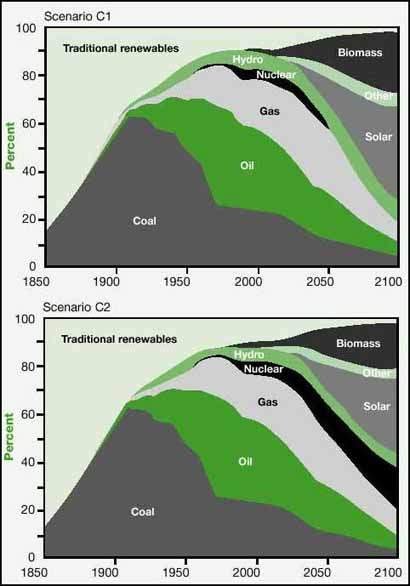
FIGURE 7. PRIMARY ENERGY SHARES,
1850-1990, AND IN SCENARIOS C1 AND C2 TO 2100
Source: Nakicenovic, Gr�bler, and McDonald,
1998.
Both case C scenarios assume decentralisation of energy systems
and reliance on local solutions. They also require considerably lower
supply-side investments than the others. They would, however, require
substantial investments in the end-use sector, which is not captured in the
scenarios. Ambitious policy measures control local and regional pollutants, and
a global regime results in reduced greenhouse gas emissions. Of the three cases
considered, case C is the most compatible with the aims of sustainable
development, as analysed in part 1 (table 6). In scenario C1 this occurs through
a diminishing contribution of coal and oil to the primary energy mix, with a
large increase in the share of solar and biomass energy by 2100 (figure 7).
Also shown for illustrative purposes is the primary energy mix
for scenario C2, in which nuclear energy could play a large role if the problems
associated with it (cost, safety, waste disposal and weapons proliferation) can
be adequately resolved.
The considerable differences in expected total energy
consumption among the scenarios reflect different approaches to addressing the
needs for energy services in the future, and they demonstrate clearly that
policy matters (figure 8). Achieving the two scenarios with characteristics of
sustainable development will require a substantial increase in private and
public research, development, and deployment efforts to support new energy
technologies. Otherwise, most clean fossil and renewable technologies, as well
as many energy-efficient end-use technologies, may not reach competitiveness.
(The mix of needed efforts may vary depending on the maturity of the specific
technology.) Significant technological advances will be required, as will
incremental improvements in conventional energy technologies.
In terms of their expected high growth in energy demand,
developing countries are well-positioned to take advantage of innovations in
energy technologies and policies that support them. In general, scenarios A3,
C1, and C2 require significant policy and behavioural changes within the next
several decades to achieve more sustainable development paths. Taken together,
the outcomes of these changes, which are described in more detail in part 4,
represent a clear departure from a business-as-usual approach.
Another crucial prerequisite for achieving sustainability in the
scenarios is near-universal access to adequate, affordable energy services and
more equitable allocation of resources. Finally, environmental protection - from
indoor pollution to climate change - is an essential characteristic of
sustainable development in these scenarios. The resolution of these future
challenges offers a window of opportunity between now and 2020. The nature of
the decisions made during this time will largely determine whether the evolution
of the energy system is consistent with current practices (along the lines of
the B scenario), or whether it achieves the transition towards more sustainable
development paths (along the lines of the A3, C1, and C2 scenarios).
Because of the long lifetimes of power plants, refineries, steel
plants, buildings, and other energy-related investments such as transportation
infrastructure, there is not sufficient turnover of such facilities to reveal
large differences among the alternative scenarios presented here before 2020.
But the seeds of the post-2020 world will have been sown by then. Thus choices
about the world's future energy systems are relatively wide open now. This
window of opportunity is particularly significant where much infrastructure has
yet to be installed, offering the possibility of a rapid introduction of new,
environmentally sound technologies.
Once the infrastructure is in place, a phase of largely
replacement investments begins. Changes can be made in this phase, but they take
much longer to affect average system performance. If wise decisions are not made
during the next few decades, we will be locked into those choices, and certain
development opportunities might not be achievable. Thus the achievement of
sustainable development demands a global perspective, a very long time horizon,
and the timely introduction of policy measures.
Rural energy in developing countries
Between 1970 and 1990 about 800 million additional people were
reached by rural electrification programmes. Some 500 million saw their lives
improve substantially through the use of better methods for cooking and other
rural energy tasks, particularly in China. Despite these enormous efforts to
improve energy services to rural populations in the past 20-30 years, the
unserved population has remained about the same in absolute numbers - 2 billion
people.
|
An effective strategy
to address the energy needs
of the
rural populations is
to promote the climbing of
the 'energy ladder'. |
Although the unavailability of adequate energy services in rural
areas is probably the most serious energy problem confronting humanity in the
near future, rural energy remains low on the list of priorities of most
government and corporate planners. And the increased demands of the more
influential (and rapidly growing) urban population will make it more difficult
to keep rural development on the agenda.
An effective strategy to address the energy needs of rural
populations is to promote the climbing of the 'energy ladder'. This implies
moving from simple biomass fuels (dung, crop residues, firewood) to the most
convenient, efficient form of energy appropriate to the task at hand - usually
liquid or gaseous fuels for cooking and heating and electricity for most other
uses. Such climbing involves not only a shift to modern fuels but is often also
complemented by the synergistic use of modern, more efficient end-use devices
such as cooking stoves.
Climbing the energy ladder does not necessarily mean that all
the rungs used in the past should be reclimbed. In the case of cooking, for
example, users do not have to go from fuelwood to kerosene to liquefied
petroleum gas (LPG) or electricity. What users should do - whenever possible -
is leapfrog directly from fuelwood to the most efficient end-use technologies
and the least polluting energy forms (including new renewables) available.
Because of the emergence of new technologies, it is also possible to introduce
new rungs on the energy ladder, and gain even greater efficiencies and
environmental acceptability.
TABLE 6. CHARACTERISTICS OF SUSTAINABILITY IN THREE ENERGY
DEVELOPMENT SCENARIOS IN 2050 AND 2100 COMPARED WITH 1990
|
Indicator of sustainability |
1990 |
Scenario A3 |
Scenario B |
Scenario C1 |
|
Eradicating poverty |
Low |
Very high |
Medium |
Very high |
|
Reducing relative income gaps |
Low |
High |
Medium |
Very high |
|
Providing universal access to energy |
Low |
Very high |
High |
Very high |
|
Increasing affordability of energy |
Low |
High |
Medium |
Very high |
|
Reducing adverse health impacts |
Medium |
Very high |
High |
Very high |
|
Reducing air pollution |
Medium |
Very high |
High |
Very high |
|
Limiting long-lived radionuclides |
Medium |
Very low |
Very low |
High |
|
Limiting toxic materialsa |
Medium |
High |
Low |
High |
|
Limiting GHG emissions |
Low |
High |
Low |
Very high |
|
Raising indigenous energy use |
Medium |
High |
Low |
Very high |
|
Improving supply efficiency |
Medium |
Very high |
High |
Very high |
|
Increasing end-use efficiency |
Low |
High |
Medium |
Very high |
|
Accelerating technology diffusion |
Low |
Very high |
Medium |
Medium |
a. For this row only, the qualitative indicators are
not based on quantitative features of the scenarios, but were specified by the
authors on the basis of additional assumptions.
Source: Chapter 9.
The energy-related sustainable development goals for rural areas
are to:
· Satisfy basic
human needs by providing all households with minimally adequate amounts of
electricity for uses such as lighting and fans, in addition to cleaner cooking
fuels. Specifically, all households should move away from unprocessed solid
fuels (biomass and coal) for cooking and heating to modern energy forms, which
may potentially be derived from renewable sources (biomass and solar) or fossil
fuels.
· Provide electricity that is
sufficiently affordable to support industrial activity in rural areas, which can
provide employment and help curb urban migration.
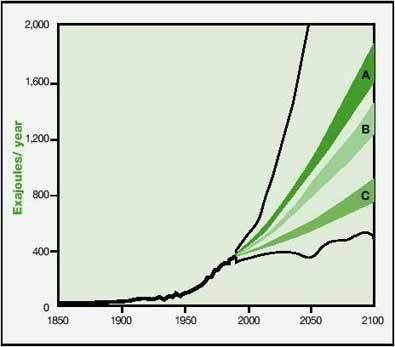
FIGURE 8. GLOBAL PRIMARY ENERGY
REQUIREMENTS, 1850-1990, AND IN THREE CASES, 1990-2100
The figure also shows the wide range of future energy
requirements for other scenarios in the literature. The vertical line that spans
the scenario range in 1990 indicates the uncertainty across the literature of
base-year energy requirements.
Source: Nakicenovic, Gr�bler, and McDonald,
1998; Morita and Lee, 1998; Nakicenovic, Victor, and Morita,
1998.
|
The current path of
energy development, and the rate
of
change, are not compatible with
key elements of sustainable
development.
|
In many cases the rural poor are willing and able to pay for
energy services if appropriate financing options are offered to help them meet
high first costs. The economics of providing basic electricity to rural
households should be evaluated according to the costs of supplying comparable
energy services through less efficient carriers. In most cases home solar
photovoltaic systems can provide energy services at a lower cost than the
kerosene and batteries they replace and can be an economically viable source of
rural household power, even at relatively low levels of service provision.
The availability of affordable and adequate energy services in
rural areas could lead to significant improvements in living conditions and to
the fulfilment of basic human needs over a relatively short time frame. The
amount of energy needed to provide such services in rural areas is relatively
small. Modern ways of using biomass more efficiently could go a long way towards
achieving this objective. Experience has shown that to find the most viable and
appropriate solutions to rural energy, the active participation of the people
who will use it is a must.
The challenge is to find ways to make modern energy carriers
affordable to satisfy the basic needs of all rural residents - which may, at
least initially, require subsidies. The key is to introduce market efficiencies
if possible to use the smallest subsidy needed to achieve social objectives. If
a subsidy is required, it might be provided as an integral part of a new social
contract, whereby energy providers serve rural energy needs while
simultaneously, highly competitive conditions are created in the energy sector
(a key element of energy reforms). One way to finance the subsidies that might
be needed would be to complement the creation of competitive markets with the
establishment of a public benefits fund generated by non-bypassable wire and
pipe charges on electricity and on gas providers. Such funds have been adopted
or are under consideration in several countries as a means of protecting public
benefits under competitive market conditions. Other options include carefully
designed economic incentives, perhaps using tax regimes.
Specifically, some of these revenues could be used to subsidise
the very poorest households until they are able to work themselves out of
poverty. This strategy could be made entirely consistent with a shift to greater
reliance on market forces to efficiently allocate resources. If, for example, a
rural energy concession was the preferred approach for bringing adequate energy
services at a set price to a particular rural area, and if the concession was
awarded competitively, market forces would be brought into play to find the
least costly mix of energy technologies with the least amount of subsidy to
satisfy the concessionaire's obligation to provide affordable energy services to
all.
Part IV: Where do we go from here?
|
Part 4 identifies key strategies and policies for achieving
both economic growth and sustainable human development. They include:
· Setting the
right framework conditions - including continued market reforms, consistent
regulations, and targeted policies - to encourage competition in energy markets,
reduce the cost of energy services to end users, and protect important public
benefits.
· Sending accurate price
signals, including phasing out subsidies to conventional energy and
internalising externalities.
· Removing obstacles or
providing incentives, as needed, to encourage greater energy efficiency and the
development and diffusion to wider markets of new sustainable energy
technologies.
The challenge of sustainable energy will require a concerted
effort from national governments, the energy community, civil society, the
private sector, international organisations, and individuals. Whatever the
difficulties of taking appropriate action, they are small relative to what is at
stake. Because today's world is in a dynamic and critical period of economic,
technological, demographic, and structural transition, and because energy
systems take decades to change, the time to act is now. |
Energy and economic prosperity
The demand of industrialised and transition economies for energy
services is likely to grow, although increasing efficiency in conversion and end
uses may result in a levelling off or even a reduction in the demand for primary
energy. In developing countries, however, primary energy demand is expected to
grow at about 2.5 percent a year as industrialisation and motorisation proceed
and living standards improve.
Meeting these projected demands will be essential if developing
countries are to achieve economic prosperity. It will require considerable
investment - on the order of 2.0-2.5 percent of the GDP of developing countries
over the next 20 years. This is close to historical norms and, with good
financial and economic policies, should be affordable. In the past, energy
investments in developing countries rested heavily - and unnecessarily - on
government subsidies, and too little on the financial resources that would be
generated by real cost-based pricing, regulatory policies, and efficient
management.
In general, there is no reason the energy sector should not be
financially self-sufficient in the following sense: appropriate pricing and
regulatory policies would raise revenues to cover operating costs and generate
returns on investment sufficient to attract large-scale private finance and
investment. Indeed, one of the primary aims of market liberalisation and the new
forms of regulation introduced in many countries in the 1990s was precisely
this: to reduce the need for government subvention and to attract private
capital and investment to the energy sector. The other aims were to encourage
innovation, cost-effectiveness, and managerial efficiency.
But temporary government subsidies may be needed to help people
who are excluded from the market by extreme poverty. Just as poor areas in
today's industrialised countries benefited in the past from non-market energy
policies, such options should be still available, when justified, in developing
countries. Moreover, the poor may need to be shielded from economic hardships
caused by trends over which they have no control. In some developing countries,
for instance, the oil price increases of the 1970s and early 1980s contributed
to large increases in external debt - up to 50 percent in some
cases.16 The effects of that debt - impoverishment of the country and
widespread unemployment - were particularly hard on the poor, even though their
main source of fuel was and continues to be firewood rather than oil. The debt
burden from the 1970s persists in many developing countries.
Although there seem to be no physical limitations on total
energy resources, potentially severe problems are likely if appropriate
economic, technological, and environmental policies are not developed in a
timely manner. Rational energy pricing is part of what is needed, but so is a
willingness to prompt markets to find technological solutions to problems before
they begin exacting high societal and environmental costs. Finding ways to curb
energy-related greenhouse gas emissions and to address other environmental
problems, while still expanding energy services, will require enlightened
research, development, and demonstration policies. Much therefore will depend on
the energy and environmental policies that are introduced, and on their
relationship to the forces of globalisation and liberalisation (discussed
below).
Thanks to technological advances and better information on
impacts, developing countries are in a position to address local and regional
environmental problems early in the 21st century, and at an earlier stage of
development than industrialised countries did. By addressing these negative
externalities of energy generation and use early on, developing countries would
find their overall economic well-being and the prospects of their people
improved, not diminished. The issue of global climate change, however, may prove
more difficult to reconcile with high levels of economic growth.
Overall, however, the analysis in this report suggests that
there are no fundamental technological, economic, or resource limits
constraining the world from enjoying the benefits of both high levels of energy
services and a better environment. This is not to suggest that these benefits
are to be expected - only that they are achievable. As the scenarios discussed
above demonstrate, sustainable futures depend on ambitious policy measures and
support for technological innovation.
In analysing appropriate policies, it is important to keep in
mind key features of the political and economic environment in which new energy
systems will evolve:
· The broad
structure of macroeconomic and development policies - particularly those for
education and broad-based growth. Below a certain level of per capita income,
subsistence needs other than energy dominate household budgets and priorities.
Income growth among groups without access is the most important determinant of
whether they will be willing to pay for energy services (and thus provide the
demand required for markets to work effectively). This, in turn, depends on
policies beyond the control of energy industries.
· The widespread
liberalisation of energy markets and the restructuring of the energy sector.
These changes are driven by inefficient monopolies, government budget
constraints, and expanding technological opportunities - especially in electric
power generation. Liberalisation and restructuring can lower costs and generate
the finance required for the expansion and extension of supplies (as long as it
is profitable to do so). But in restructured energy markets, cross-subsidies
will not be available to increase access in areas that are not attractive to
investors, unless restructuring is accompanied by policy measures that
specifically address such concerns.
· Globalisation and the
transformations of the information age. Related to the liberalisation of
markets is globalisation - the world-wide expansion of major companies and their
acquisition of, or partnership with, local companies. Procurement of materials
and services from distant and foreign sources has become common. New
technologies are also diffusing at rates faster than ever before, spurred by
world-wide access to the Internet and other information technologies. This
expansion can expedite the awareness of sustainable energy options and the
deployment of new technologies.
Energy policies for sustainable development
The scenarios exercise showed that, although energy can
contribute to sustainable development, its performance in this respect will
depend on a range of factors. These include attitudes and behaviour, information
and technologies, the availability of finance and supporting institutions, and -
in particular - policies and policy frameworks that encourage change in the
desired direction. The current path of energy development, and the rate of
change, are not compatible with key elements of sustainable development. The
divergence of alternative futures that becomes apparent in the scenarios after
about 20 years reflects the long-term nature of energy systems. It also
indicates that if governments, corporations, and international institutions do
not introduce appropriate policies and measures now, critical windows of
opportunity are likely to close. It will then become even more difficult to
change course.
The most critical issues that sustainable energy strategies and
the policies derived from them need to address are how to widen access to
reliable and affordable modern energy supplies, and how to ease the negative
health and environmental impacts of energy use.
Given proper frameworks, pricing signals, and regulatory
regimes, markets can efficiently deliver on the economic objectives of
sustainable development. But markets alone cannot be expected to meet the needs
of the most vulnerable groups and to protect the environment. Where markets fail
to protect these and other important public benefits, targeted government
policies and consistent regulatory approaches will be needed. The problem is
that government interventions are usually less efficient than market approaches.
Government intervention may have unintended consequences at odds with its
original aims. For that reason, there is a need to try different approaches and
learn from the experiences of other countries.
Policies and policy frameworks in support of sustainable
development should focus on widening access, encouraging energy efficiency,
accelerating new renewable energy diffusion, and expanding the use of advanced
clean fossil fuel technologies, while keeping open the nuclear option. These
policy areas, as well as related decisions on private-public transportation and
city planning, have the greatest relevance to the environmental and safety
problems associated with conventional fuels.
The broad strategies for encouraging sustainable energy systems
are straightforward. But achieving them will require wide acknowledgement of the
challenges we face and stronger commitment to specific policies. The strategies
are largely aimed at harnessing market efficiencies to the goal of sustainable
development and using additional measures to speed up innovation, overcome
obstacles and market imperfections, and protect important public benefits. Among
the basic strategies, six stand out.
Making markets work better
Driven by the forces of competition, markets do a better job
than administered systems in allocating resources. But the marketplace fails to
adequately account for the social and environmental costs of energy provision
and use. Policies that reduce market distortions - that level the playing field
- would give sustainable energy (renewable sources, energy efficiency measures,
new technologies with near-zero emissions) a considerably better market position
relative to current uses and practices.
Market distortions can be reduced by phasing out permanent
subsidies to conventional energy (estimated at $250-300 billion a year in the
mid-1990s) and by including social and environmental costs in prices. Several
countries have experimented with energy and environment taxes as a way to
address the latter. In many cases incentives will be needed to induce or
accelerate changes. One such option is a targeted, time-limited (through a
'sunset clause') subsidy. Where energy markets cannot function effectively
because of absolute poverty, additional resources, including official
development assistance, are required.
Another aspect of making markets work better is finding ways to
overcome obstacles to energy end-use efficiency measures. Even in the absence of
subsidies, market barriers - such as lack of technological knowledge, different
interests of investors and users, and high transaction costs of individual
investors - keep energy efficiency measures from reaching their cost-effective
potential. Options to overcome these barriers include voluntary or mandatory
standards (effectively applied) for appliances, vehicles, and buildings,
labelling schemes to better inform consumers, procurement policies to achieve
higher standards and economies of scale, technical training in new energy
efficiency technologies and their maintenance, and credit mechanisms to help
consumers meet higher first costs.
Complementing energy sector restructuring with regulations
that encourage sustainable energy
The ongoing, world-wide restructuring of the energy industry -
largely driven by the increasing globalisation of the economy - will lead to
more economically efficient energy markets. This restructuring presents a window
of opportunity for ensuring that the energy-related public benefits needed for
sustainable development are adequately addressed in emerging policies for energy
market reform. The process could be enhanced if governments set goals that
define the performance characteristics of qualifying sustainable energy
technologies (for example, by specifying air pollution emission limits or
minimum standards on plants, machinery, and vehicles).
These goals for suppliers can be complemented by mechanisms that
favour sustainable energy technologies in energy market choices. Other
regulatory approaches supportive of sustainable energy include mandating that a
certain percentage of energy comes from renewable sources, requiring that energy
grids be open to independent power producers, and ensuring that rural
populations are served. Such regulations are based on the recognition that
energy market restructuring in itself may not help achieve sustainable
development.
Mobilising additional investments in sustainable energy
Energy markets in many countries are rapidly becoming more
competitive. For that reason, successful sustainable energy policies, whether
involving financing, incentives, taxes, or regulations, must engage the private
sector and catalyse private investment on a large scale. But for political or
institutional reasons, many of the transition and developing economies that most
need investment have problems attracting private enterprise and gaining access
to financial markets. Reliable commercial legislation and jurisdiction, as well
as incentives, may be needed to encourage private companies to invest in
sustainable energy - or to defray the risks associated with such investments.
Official developement assistance may also need to play a greater
role in the least developed countries, especially in those where the conditions
that attract private sector investment are lacking. Political stability,
application of the rule of law, avoidance of arbitrary intervention, and the
existence of institutions that facilitate savings and investment are generally
important for promoting investment. Supportive financial and credit arrangements
(including microcredit arrangements like those now in existence) will be needed
to introduce commercial energy to people excluded from markets, especially in
rural areas.
Encouraging technological innovation
Currently applied technologies are not adequate and profitable
enough to deliver the energy services that will be needed in the 21st century
and simultaneously protect human health and environmental stability. Adequate
support for a portfolio of promising advanced and new technologies is one way to
help ensure that options will be available as the need for them becomes more
acute. Energy innovations face barriers all along the energy innovation chain
(from research and development, to demonstration projects, to cost buy-down, to
widespread diffusion). Some of these barriers reflect market imperfections, some
inadequacies in the public sector, and some different views about needs,
corporate priorities, relevant time horizons, and reasonable costs.
|
Innovation and leadership
in energy technologies could
be
highly profitable for developing
countries in
economic,
environmental, and
human terms. |
The public support needed to overcome such barriers will vary
from one technology to the next, depending on its maturity and market potential.
Obstacles to technology diffusion, for example, may need to be given higher
priority than barriers to innovation. Direct government support is more likely
to be needed for radically new technologies than for incremental advances, where
the private sector usually functions relatively effectively. Options to support
technological innovation, while still using competition to keep down costs,
include tax incentives, collaborative research and development ventures,
government or cooperative procurement policies, 'green' labelling schemes, and
market transformation initiatives.
Supporting technological leadership and capacity building in
developing countries
Because most of the projected growth in energy demand will occur
in the developing world, innovation and leadership in energy technologies could
be highly profitable for developing countries in economic, environmental, and
human terms. Developing economies need to further develop their resources -
human, natural, and technological - so they can create energy systems
appropriate to their own circumstances. But they also need assistance with
technology transfer, financing, and capacity building.
The declining share of official development assistance relative
to required investment capital suggests that much of this investment will need
to be led by the private sector or private-public partnerships. International
industrial collaboration offers one means by which the private sector could gain
markets while fostering the private research institutes, and regional institutes
that provide training in technological management offer additional possibilities
for furthering technology sharing and capacity building.
Encouraging greater cooperation at the international
level
The ongoing process of globalisation means that ideas, finances,
and energy flow from one country to another. Productive ways of moving forward
might include combining national efforts, for example, in the procurement of
renewable energy technologies. Other options include international harmonisation
of environmental taxes and emissions trading (particularly among industrialised
countries), as well as energy efficiency standards for mass-produced products
and imports of used machinery and vehicles. The need for concerted action on
energy is clear from Agenda 21, which emerged from the 1992 Earth Summit.
The challenge of sustainable energy includes crucial enabling
roles for governments, international organisations, multilateral financial
institutions, and civil society, including non-governmental organisations and
individual consumers. Partnerships will be required, based on more integrated,
cooperative approaches and drawing on a range of practical experience. A common
denominator across all sectors and regions is setting the right framework
conditions and making public institutions work effectively and efficiently with
the rest of society and other economic actors to reach beneficial, shared
objectives.
|
Clearly, energy can
serve as a powerful tool
for
sustainable
development. |
Clearly, energy can serve as a powerful tool for sustainable
development. Redirecting its power to work towards that overarching goal,
however, will require major changes of policy within an enabling overall
framework. Poverty, inequity, inefficiency, unreliable service, immediate
environmental priorities, a lack of information and basic skills, and an absence
of needed institutions and resources - require changes to be made. Unless these
changes occur within the next few decades, many of the opportunities now
available will be lost, the possibilities for future generations diminished, and
the goal of sustainable development unrealised.
References
De Almeida, E., and A. de Oliveira. 1995. "Brazilian Life Style
and Energy Consumption". In Energy Demand, Life Style Changes and
Technology Development. London: World Energy Council.
IEA (International Energy Agency). 1999. Energy
Balances of OECD Countries. Paris.
Morita, T., and H.-C. Lee. 1998. "IPCC SRES Database, Version
0.1, Emission Scenario". Database prepared for IPCC Special Report on Emissions
Scenarios, https://www.cger.nies.go.jp/cger-e/db/ipcc.html
Nakicenovic, N., A. Gr�bler, and A. McDonald, eds. 1998.
Global Energy Perspectives. Cambridge: Cambridge University Press.
Nakicenovic, N., N. Victor, and T. Morita. 1998. "Emissions
Scenarios Database and Review of Scenarios". Mitigation and Adaptation
Strategies for Global Change 3 (2-4): 95-120.
UN (United Nations). 1992. Earth Summit Agenda 21: The United
Nations Programme of Action from Rio. New York.
UNDP (United Nations Development Programme). 1997. Energy
after Rio. New York.
WCED (World Commission on Environment and Development). 1987.
Our Common Future. Oxford: Oxford University Press.
WEC (World Energy Council). 1998. Round Up: 17th Congress of
the World Energy Council. London.
WEC (World Energy Council). 2000. Statement 2000: Energy for
Tomorrow's World - Acting Now! London.
WEC-FAO (World Energy Council and Food and Agriculture
Organization of the United Nations). 1999. The Challenge of Rural Energy
Poverty in Developing Countries. London.
World Bank. 1996. Rural Energy and Development: Improving Energy
Supplies for Two Billion People. Washington, D.C.
World Bank. 1997. World Development Indicators 1997. Washington,
D.C.
WRI (World Resources Institute). 1998. A Guide to the
Global Environment. Oxford: Oxford University Press.
Notes
1. In this report the term industrialised countries
refers primarily to high-income countries that belong to the Organisation
for Economic Co-operation and Development (OECD). Developing countries
generally refers to lower income countries that are members of the G-77 and
China. Although many transition economies also have a high degree of
industrialisation, they are often considered and discussed separately because of
their specific development requirements.
2. In this report the terms traditional energy and
non-commercial energy are used to denote locally collected and
unprocessed biomass-based fuels, such as crop residues, wood, and animal dung.
Although traditional energy sources can be used renewably, in this report the
term new renewables refers to modern biofuels, wind, solar, small-scale
hydropower, marine, and geothermal energy.
3. The Brundtland Report, as the World Commission on Environment
and Development report is commonly known, set forth a global agenda for change.
4. Energy's links to sustainable development were most recently
acknowledged by the UN General Assembly Special Session on Small Island
Developing States in 1999. The major conferences that noted the importance of
energy issues were the UN Conference on Population and the UN Conference on
Small Island Developing States in 1994, the Copenhagen Social Summit and the
Beijing Fourth World Conference on Women in 1995, and the World Food Summit and
HABITAT II in 1996. The energy issues emerging from these conferences are
summarised in chapters 1 and 2 of UNDP (1997).
5. Agenda 21 is the plan of action for sustainable development
adopted at the Rio Earth Summit.
6. Means for achieving these objectives are discussed in more
detail in WEC (2000).
7. Unless otherwise noted, all prices are in U.S. dollars.
8. This target was reaffirmed in 1992 (in chapter 33 of Agenda
21).
9. In this report the term conventional energy is used to
refer to fossil fuel, nuclear energy, and large-scale hydropower.
10. In this report the word insult is used to describe a
physical stressor produced by the energy system, such as air pollution. The word
impact is used to describe the resulting outcome, such as respiratory
disease or forest degradation.
11. The Energy Charter Treaty, together with a protocol on
energy efficiency and related environmental aspects, entered into force in 1998.
It has been signed by about 50 countries, including the members of the European
Union and the Commonwealth of Independent States, Australia, and Japan.
12. Analysis of efficiency potentials in end-use sectors in the
next 20 years appears in chapter 6 of this report and is based on detailed
techno-economic studies and examples of best practices.
13. Conventionally, energy efficiency has been defined on the
basis of the first law of thermodynamics. The second law of thermodynamics
recognises that different forms of energy have different potentials to carry out
specific tasks. For example, a gas boiler for space heating may operate at close
to 100 percent efficiency (in terms based on the first law of thermodynamics).
This seems to suggest that limited additional efficiency improvements are
possible. But by extracting heat from the ground or other sources, a gas-driven
heat pump could generate considerably more low-temperature heat with the same
energy input. The second example illustrates the potential for energy efficiency
improvements according to the second law of thermodynamics.
14. An adequate payments system means using meters and payment
collection to ensure that all energy services have a price that is paid by all
users on a regular basis.
15. Both figures include the 2 billion currently without access
to commercial energy. UN population projections were revised downwards in 1998,
after the scenarios described here were developed. Although the population
assumption used for the scenarios described here (11.7 billion by 2100) is
slightly higher than the UN medium scenario (10.4 billion), the two are not
inconsistent.
16. The policies of industrialised countries and inflationary
pressures from petro-dollars could also have contributed to debt
levels.
| | | World Energy Assessment - Energy and the Challenge of Sustainability (UNDESA - UNDP - WEA - WEC, 2000, 517 p.) | | | PART I. ENERGY AND MAJOR GLOBAL ISSUES | | | Chapter 1. An Introduction to Energy | | | (introduction...) | | | What is sustainable energy development? | | | Evolution of the energy system | | | Demand for energy services | | | Energy trade patterns and globalisation | | | (introduction...) | | | Crude oil and oil products | | | Coal | | | Natural gas | | | Energy prices and taxes | | | Energy investments | | | (introduction...) | | | General features | | | Capital flows | | | Chapter 2. Energy and Social Issues | | | (introduction...) | | | Towards a new approach to energy for human uses | | | Energy and poverty in developing countries | | | (introduction...) | | | Dimensions of poverty | | | The energy-poverty nexus | | | The energy ladder and household decisions about fuel choice | | | Energy strategies for alleviating poverty in developing countries | | | Energy and poverty in industrialised countries | | | Energy and women | | | (introduction...) | | | Factors determining energy-women linkages | | | Specific concerns and priority areas | | | Energy for improving the position of women | | | Energy and population | | | (introduction...) | | | Demographic transitions | | | Population momentum | | | The energy-population nexus | | | Rural energy consumption and population implications | | | Traditional biomass-based cooking and demographic indicators | | | Energy-population nexus at the global level | | | Energy and urbanisation | | | (introduction...) | | | Urbanisation and energy linkages | | | Urbanisation and energy strategies | | | Energy to improve the urban environment | | | Energy and lifestyles | | | (introduction...) | | | Energy use in the United States | | | Trends towards increased energy use | | | Conclusion | | | Chapter 3. Energy, the Environment, and Health | | | (introduction...) | | | Household scale | | | (introduction...) | | | Harvesting | | | Combustion | | | Estimated health effects | | | Greenhouse gases | | | Workplace scale | | | (introduction...) | | | Biomass | | | Coal | | | Oil and gas | | | Hydropower and other renewables | | | Nuclear danger | | | Number of workers and quantitative health effects estimates | | | Community scale | | | (introduction...) | | | Fuel-derived air pollution in cities of industrialised countries | | | Fuel-derived air pollution in cities of developing countries | | | Urban pollution control in the longer run | | | Hydroelectric dams6 | | | Nuclear power | | | Regional scale | | | (introduction...) | | | Emissions and energy | | | Future emissions | | | Acid deposition | | | Tropospheric ozone | | | Suspended fine particles | | | Regional climate change | | | Global scale: climate change from greenhouse gases | | | (introduction...) | | | Consequences of greenhouse gas-induced climate change | | | Alternative energy futures and greenhouse gas emissions | | | International agreements to address global climate change | | | Cross-scale impacts | | | (introduction...) | | | Environmental risk transition | | | Win-win strategies to link environmental improvements at different scales | | | Assessment methods | | | Implications for the future | | | (introduction...) | | | Household scale | | | Workplace scale | | | Community scale | | | Regional scale | | | Global scale | | | Cross-scale | | | Conclusion | | | Chapter 4. Energy Security | | | (introduction...) | | | New dimensions and challenges to energy security | | | (introduction...) | | | Security of electric power supply | | | Routes to enhanced energy security | | | Energy adequacy | | | (introduction...) | | | Crude oil | | | Natural gas | | | Coal | | | Nuclear energy | | | Renewables | | | The resource outlook | | | Supply security | | | (introduction...) | | | Security of crude oil supply | | | Security of natural gas supply | | | Security of coal supply | | | Nuclear energy and energy security | | | Energy intensity | | | The environment and energy security | | | Markets and energy security | | | (introduction...) | | | The role of the state | | | Regional cooperation and the growing importance of regional electricity grids and network energies | | | Conclusion |
|
World Energy Assessment - Energy and the Challenge of Sustainability (UNDESA - UNDP - WEA - WEC, 2000, 517 p.)
PART I. ENERGY AND MAJOR GLOBAL ISSUES
Chapter 1. An Introduction to Energy
Hans-Holger Rogner (Germany)
Anca
Popescu (Romania)
Life is but a continuous process of energy conversion and
transformation. The accomplishments of civilisation have largely been achieved
through the increasingly efficient and extensive harnessing of various forms of
energy to extend human capabilities and ingenuity. Energy is similarly
indispensable for continued human development and economic growth. Providing
adequate, affordable energy is essential for eradicating poverty, improving
human welfare, and raising living standards world-wide. And without economic
growth, it will be difficult to address environmental challenges, especially
those associated with poverty.
But energy production, conversion, and use always generate
undesirable by-products and emissions - at a minimum in the form of dissipated
heat. Energy cannot be created or destroyed, but it can be converted from one
form to another. The same amount of energy entering a conversion process, say,
natural gas in a home furnace, also leaves the device - some 80-90 percent as
desirable space heat or warm water, the rest as waste heat, most through the
smokestack. Although it is common to discuss energy consumption, energy is
actually transformed rather than consumed. What is consumed is the ability of
oil, gas, coal, biomass, or wind to produce useful work. Among fossil fuels the
chemical composition of the original fuel changes, resulting in by-products of
combustion, or emissions.
This chapter provides a brief introduction to energy's
importance for human life and economic functioning, and paints a broad picture
of the current energy scene. (More extensive data on energy trends appear in the
annexes to this report.) Chapters 2, 3, and 4 examine in greater detail the
links between energy and important global challenges, including social issues,
health and the environment, and energy security. Chapter 11 analyses prospects
for achieving widespread and sustainable prosperity and for reconciling high
levels of energy services with environmental
protection.
What is sustainable energy development?
In its 1987 report, Our Common Future, the World
Commission on Environment and Development defines sustainable development as
development that "meets the needs of the present without compromising the
ability of future generations to meet their own needs"(p. 8). The report further
describes sustainable development "as a process of change in which the
exploitation of resources, the direction of investments, the orientation of
technological development, and institutional change are all in harmony and
enhance both current and future potentials to meet human needs and aspirations"
(p. 46). In its broadest sense, the report notes, "the strategy for sustainable
development aims to promote harmony among human beings and between humanity and
nature" (p. 65).
The relationship between energy production and use and
sustainable development has two important features. One is the importance of
adequate energy services for satisfying basic human needs, improving social
welfare, and achieving economic development - in short, energy as a source of
prosperity. The other is that the production and use of energy should not
endanger the quality of life of current and future generations and should not
exceed the carrying capacity of ecosystems.
|
The production and use of energy should
not endanger the
quality of life of
current and future generations
and should not exceed
the
carrying capacity of
ecosystems. |
Throughout the 20th century, the ready availability of
commercial energy fuelled global economic development. But much of the
developing world continues to rely on non-commercial energy sources, mainly
fuelwood, and has limited access to modern energy such as electricity and liquid
fuels. Lack of capital and technological capacity hinders the development of
adequate supplies, with deleterious effects on economic and social development.
Because they affect affordability and economic competitiveness,
energy prices need to be taken into account when analysing options for
sustainable energy development. Moreover, energy supplies should be secure and
reliable. For that reason, attention should be given to:
· The dependence on
energy supplies from politically unstable regions or unevenly distributed
locations.
· The possible disruption of
energy supplies due to severe accidents.
· The sociocultural environment
in which energy systems operate.
· The eventual exhaustion of
finite energy resources such as coal, crude oil, natural gas, and uranium, for
which alternative options must be developed.
Finally, the development and introduction of sustainable energy
technology must occur in a socially acceptable manner, with a broad range of
citizens participating in decision-making.
No energy production or conversion technology is without risk or
waste. Somewhere along all energy chains - from the extraction of resources to
the provision of energy services - pollutants are produced, emitted, or disposed
of, often with severe impacts on human health and the environment. The
combustion of fossil fuels is responsible for most urban air pollution, regional
acidification, and risks of human-induced climate change. The use of nuclear
power has created a number of concerns about the safety of nuclear
installations, the storage and disposal of high-level radioactive waste, and the
proliferation of nuclear weapons. The manufacturing of photovoltaic panels
generates toxic waste, and in some developing countries the use of biomass
contributes to desertification and biodiversity losses.
As noted, to be considered sustainable, energy systems must not
overload the carrying capacity of ecosystems. Nor should the use of finite
resources compromise the ability of future generations to meet their energy
service requirements. Efficient use of resources, clean conversion processes,
and the timely development of inexhaustible supply options - such as renewable
forms or nuclear energy based on breeding or fusion - are therefore the
principal strategies for sustainable energy
development.
Evolution of the energy system
From the perspective of society, energy is not an end in itself.
The energy system is designed to meet demands for a variety of services such as
cooking, illumination, comfortable indoor climate, refrigerated storage,
transportation, information, and consumer goods. People are interested not in
energy, but in energy services.
An energy system comprises an energy supply sector and the
end-use technology needed to provide energy services (see figure 1 the overview
and figure 6.1). The energy supply sector involves complex processes for
extracting energy resources (such as coal or oil), for converting these into
more desirable and suitable forms of energy (such as electricity or gasoline),
and for delivering energy to places where demand exists. The end-use part of the
system transforms this energy into energy services (such as illumination or
mobility).
Energy services are the result of a combination of technology,
infrastructure (capital), labour (know-how), materials, and energy carriers. All
these inputs carry a price and, within each category, are partly substitutable
for one another. From the perspective of consumers, the important issues are the
economic value or utility derived from the services. The energy carrier and the
source of that carrier often matter little. Consumers are generally unaware of
the upstream activities of the energy system. The energy system is service
driven (from the bottom up), whereas energy flows are driven by resource
availability and conversion processes (from the top down). Energy flows and
driving forces interact intimately (see below). Thus the energy sector should
never be analysed in isolation. It is not sufficient to consider only how energy
is supplied; the analysis must also include how and for what purposes energy is
used.
Modern energy systems rely on manufactured or processed fuels
and sophisticated conversion equipment. Traditional energy usually means
unprocessed fuels close to their primary form and low-technology conversion
devices (or no technology). Low-technology energy conversion usually implies low
efficiency and high pollution. Thus technology is a critical link between the
supply of energy services and access, affordability, and environmental
compatibility. Technology is more than a power plant, an automobile, or a
refrigerator. It includes infrastructure such as buildings, settlement patterns,
road and transportation systems, and industrial plants and equipment. It also
includes social and cultural preferences as well as laws and regulations that
reflect the compatibility of technology options with social preferences and
capabilities and cultural backgrounds.
The overall efficiency of an energy system depends on individual
process efficiencies, the structure of energy supply and conversion, and energy
end-use patterns. It is the result of compounding the efficiencies of the entire
chain of energy supply, conversion, distribution, and end-use processes. The
weakest link in the analysis of the efficiency of various energy chains is the
determination of energy services and their quantification, mostly due to a lack
of data on end-use devices and actual patterns of their use.
In 1997 the global efficiency of converting primary energy
(including non-commercial energy) to final energy, including electricity, was
about 70 percent (279 exajoules over 399 exajoules). The efficiency of
converting final energy to useful energy is lower, with an estimated global
average of 40 percent (Nakicenovic and others, 1990; Gilli, Nakicenovic, and
Kurz, 1995). The resulting average global efficiency of converting primary to
useful energy is the product of these two efficiencies, or 28 percent. Because
detailed statistics do not exist for most energy services and many rough
estimates enter the efficiency calculations, the overall efficiency reported in
the literature spans a wide range, from 15 to 30 percent (Olivier and Miall,
1983; Ayres, 1989; Wall, 1990; Nakienovic and others, 1990; Schaeffer and
Wirtshafter, 1992; and Wall, Scuibba, and Naso, 1994).
|
Technology is a critical link between
the supply of energy
services
and access, affordability,
and environmental
compatibility.
|
Specific energy services are supplied by various combinations of
energy and technology. In this context, technology is often viewed as capital
and know-how. To a large extent, energy and technology, capital, and know-how
can substitute for one another. Replacing less efficient and dirty technology
with more efficient and cleaner technology is the substitution of capital and
know-how for energy. Capital investment, however, typically involves energy
embedded in materials, manufacturing, and construction, as well as labour and
know-how.
The core business of the energy sector has traditionally
involved delivering electricity to homes and businesses, natural gas to
industries, and gasoline to gas stations. In the past, electricity supply -
especially electrification of unserved areas - was a matter of sociopolitical
development strategy. As a matter of state importance, energy supply was often
directed by a regional utility under essentially monopolistic conditions. More
recently, energy sector liberalisation has turned strategic goods into
commodities, changing the sector from selling kilowatt-hours or litres of
gasoline to selling energy services. With competition among suppliers, energy
companies will become increasingly active in providing energy services, which
may also include end-use
technologies.
Demand for energy services
The structure and size of the energy system are driven by the
demand for energy services. Energy services, in turn, are determined by driving
forces, including:
· Economic
structure, economic activity, income levels and distribution, access to capital,
relative prices, and market conditions.
· Demographics such as
population, age distribution, labour force participation rate, family sizes, and
degree of urbanisation.
· Geography, including climatic
conditions and distances between major metropolitan centres.
· Technology base, age of
existing infrastructure, level of innovation, access to research and
development, technical skills, and technology diffusion.
· Natural resource endowment and
access to indigenous energy resources.
· Lifestyles, settlement
patterns, mobility, individual and social preferences, and cultural mores.
· Policy factors that influence
economic trends, energy, the environment, standards and codes, subsidies, and
social welfare.
· Laws, institutions, and
regulations.
The structure and level of demand for energy services, together
with the performance of end-use technologies, largely determine the magnitude of
final energy demand. The amount of final energy per unit of economic output
(usually in terms of gross domestic product, or GDP), known as the final energy
intensity, is often used to measure the effectiveness of energy use and the
consumption patterns of different economies. Economies with a large share of
services in GDP and a large share of electricity in the final energy mix usually
have lower final energy intensities than do economies based on materials and
smokestack-based industries and fuelled by coal and oil. The final energy demand
mix, the structure and efficiency of energy supply (resource extraction,
conversion, transmission, and distribution), domestic resource availability,
supply security, and national energy considerations then determine primary
energy use.
Global primary energy use expanded by about 2 percent a year in
1970-98 (table 1.1). This growth rate fell to just under 1 percent a year in
1990-98 as a result of regional differences in socioeconomic development. First,
the severe economic collapse of transition economies in Eastern Europe and the
former Soviet Union reduced income by 40 percent and primary energy use by 35
percent between 1990 and 1998. Second, the rapid growth experienced by
developing countries in the 1980s slowed in the early 1990s and slowed even more
during the financial crisis of 1997-98. Third, among OECD regions, energy growth
exceeded the long-term global average only in Pacific OECD countries. In North
America, despite continued economic expansion and the availability of
inexpensive energy services throughout the 1990s, total energy use grew by just
1.4 percent a year (the same as the OECD average). If corrected for weak
economic performance in transition economies and the 1997-98 financial crisis,
global energy use would have continued to grow by 2 percent a year throughout
the 1990s.
Energy use by developing countries has increased three to four
times as quickly as that by OECD countries - the result of life-style changes
made possible by rising incomes and higher population growth. As a result the
share of developing countries in global commercial energy use increased from 13
percent in 1970 to almost 30 percent in 1998. On a per capita basis, however,
the increase in primary energy use has not resulted in more equitable access to
energy services between developed and developing countries. (Annex C provides
energy data and trends related to the discussion in this chapter, disaggregated
by country and region.)
In Africa per capita energy use has barely increased since 1970
and remains at less than 10 percent of per capita use in North America (annex
table C2). The same is true for Asia despite a near-doubling in per capita
energy use since 1970. In essence this means that most Africans and Asians have
no access to commercial energy. Latin America saw little improvement, while
China and especially the Middle East made above-average progress in providing
access to modern energy services. Energy use in non-OECD Europe and the former
Soviet Union has been affected by economic restructuring, which in the former
Soviet Union led to negative per capita growth in energy use between 1971 and
1997. Per capita energy use stayed nearly constant in North America, while
substantial growth occurred in the Pacific OECD.
TABLE 1.1. COMMERCIAL PRIMARY ENERGY USE BY REGION,
1970-98a
|
Region |
1970
(exajoules) |
1980
(exajoules) |
1990
(exajoules) |
1998
(exajoules) |
1998 as share of world total (percent) |
Annual growth rate, 1970-98 (percent) |
Annual growth rate, 1970-80 (percent) |
Annual growth rate, 1980-90 (percent) |
Annual growth rate, 1990-98 (percent) |
|
North America |
74.7 |
85.6 |
93.4 |
104.3 |
29.4 |
1.2 |
1.4 |
0.9 |
1.4 |
|
Latin America |
5.7 |
9.2 |
11.3 |
15.1 |
4.3 |
3.6 |
4.9 |
2.1 |
3.7 |
|
OECD Europeb |
51.6 |
61.9 |
66.5 |
70.1 |
19.7 |
1.1 |
1.8 |
0.7 |
0.7 |
|
Non-OECD Europec |
3.6 |
6.1 |
6.5 |
4.8 |
1.3 |
1.0 |
5.3 |
0.5 |
-3.8 |
|
Former Soviet Union |
31.8 |
47.2 |
58.5 |
37.5 |
10.6 |
0.6 |
4.0 |
2.2 |
-5.4 |
|
Middle East |
3.0 |
5.6 |
10.6 |
15.4 |
4.3 |
6.0 |
6.4 |
6.6 |
4.7 |
|
Africa |
2.9 |
5.6 |
8.9 |
11.0 |
3.1 |
4.8 |
6.6 |
4.8 |
2.7 |
|
China |
9.8 |
17.8 |
28.5 |
36.0 |
10.1 |
4.8 |
6.2 |
4.8 |
3.0 |
|
Asiad |
6.0 |
10.6 |
18.8 |
28.1 |
7.9 |
5.7 |
5.9 |
5.9 |
5.2 |
|
Pacific OECDe |
14.1 |
19.4 |
26.0 |
32.8 |
9.2 |
3.0 |
3.2 |
3.0 |
2.9 |
|
World total |
203.2 |
269.0 |
328.9 |
354.9 |
100.0 |
2.0 |
2.8 |
2.0 |
1.0 |
|
OECD countries |
140.4 |
166.9 |
185.9 |
207.2 |
58.4 |
1.4 |
1.7 |
1.1 |
1.4 |
|
Transition economies |
35.4 |
53.3 |
65.0 |
42.3 |
11.9 |
0.6 |
4.2 |
2.0 |
-5.2 |
|
Developing countries |
27.4 |
48.8 |
78.0 |
105.5 |
29.7 |
4.9 |
5.9 |
4.8 |
3.8 |
a. Excluding commercial biomass. b. Includes Czech
Republic, Hungary, and Poland. c. Excludes the former Soviet Union. d. Excludes
China. e. Australia, Japan, Republic of Korea, and New Zealand.
Source: BP, 1999.
Regional energy use is even more inequitable when viewed in
terms of per capita electricity use. The difference between the least developed
countries (83 kilowatt-hours per capita) and the OECD average (8,053
kilowatt-hours per capita) is two orders of magnitude (see annex table C.2).
The link between energy use and economic activity is neither
static nor uniform across regions. In the past, energy and economic development
were closely related. But this relationship does not necessarily hold at higher
levels of economic development. During 1960-78 changes in primary energy use and
GDP grew at the same rate in OECD countries (figure 1.1). Thereafter, a change
in elasticity between energy and economic activity suggests that the
often-postulated one-to-one relationship between primary energy use and economic
activity can be changed, at least temporarily. Because of its versatility,
convenience, cleanliness (at point of use), and productivity-enhancing features,
the increase in electricity use has outpaced GDP growth in all regions - often
by a large margin. In addition, the efficiency of converting electricity from
final energy to energy services is the highest of all fuels.
Energy transformation is the fastest-growing sector in all
countries except transition economies, generally followed by transportation.
Electricity generation dominates energy transformation, reflecting the continued
importance of electricity for economic development. Oil refining, coal
transformation (coking), gasworks, centralised heat production, transmission,
and distribution losses account for the rest of the energy used by energy
transformation.
Energy trade patterns and globalisation
The growing share of traded goods and services in gross world
product reflects a continued shift towards integrated global commodity markets.
This share approached 43 percent in 1996, up from 25 percent in 1960. The value
share of energy in trade peaked in 1979 at almost 14 percent, then fell to 3-5
percent in the 1990s.
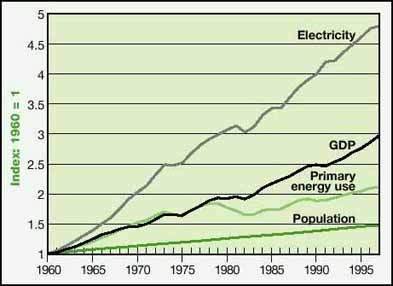
FIGURE 1.1. CHANGES IN GDP,
POPULATION, PRIMARY ENERGY USE, AND ELECTRICITY USE IN OECD COUNTRIES,
1960-97
Source: IEA, 1999.
Still, the world energy system has become more integrated, as
evidenced by the rising share of energy crossing borders before reaching final
consumers. Energy trade slipped to 40 percent of primary energy use in 1985
(down from 50 percent in 1970) but rebounded after the collapse in oil prices in
1986. By the end of the 20th century this share was approaching 55 percent.
The fast-growing Asian economies contributed significantly to
this increase. Their energy imports tripled between 1985 and 1997, reaching 13
percent of world energy imports. The share of OECD countries in global energy
trade dropped 6 percentage points thanks to stepped-up intraregional trade and
increased domestic production of oil (accounting for 13 percent of domestic oil
production in 1990, up from 6 percent in 1985) and gas (30 percent of domestic
gas production in 1985). OECD countries in Europe cut their share of global
imports from 25 percent in 1985 to 16 percent in 1997, while North America
doubled its share to 8 percent over the same period.
Global energy trade remains dominated by crude oil and oil
products. Despite steady growth in coal trade and accelerated penetration of
natural gas in the 1990s, the share of crude oil and oil products in trade only
fell from 90 percent in 1971 to 77 percent in 1997. While trade in coal, natural
gas, and even oil products expanded largely unaffected by world oil market
prices, trade in crude oil definitely responds - though with a lag - to market
price changes. Thus crude oil remains the world's swing fuel, with Middle
Eastern countries as the swing supplier despite the fact that the Middle East
has the lowest production
costs.
Crude oil and oil products
Developing countries have almost doubled their share of crude
oil and oil product imports since 1979. While other major importers such as
Western Europe and Japan have reduced or held steady their share of the global
oil trade, the U.S. thirst for oil has reached an all-time high, accounting for
25 percent of global oil trade. In 1998 some 46 percent of oil trade originated
in the Middle East - up from 38 percent in 1985. The region is on track to
regain market shares of well above 50 percent. Its low production costs (on
average, less than $5 a barrel) exposes investments in oil production capacity
elsewhere to above-average risks. It appears that Organisation of the Petroleum
Exporting Countries (OPEC) countries have regained their monopoly power lost in
1986, and can control oil market prices in either direction.
For importing countries, concerns about oil import dependence
and supply security appear to have given way to market forces and high
expectations that new exploration and development will bring new oil to the
market at a rate commensurate with demand. Moreover, in the wake of
globalisation and non-polarisation, quasi-open access to OPEC oil has
accelerated the shift of oil from a strategic good to a commodity, further
lowering supply security concerns.
Still, the world oil market remains fragile. In March 1999 OPEC
countries cut production by 85 million tonnes a year, or 2.5 percent of world
oil production. This was in addition to an earlier cut of 125 million tonnes. As
a result of strong world oil demand, including that from the rebounding Asian
economies and the surging U.S. economy, market prices almost tripled within
about a year. (World market prices for API Gravity 2 oil were $9.39 a barrel in
December 1998 and $27.55 a barrel in March 2000.)
The impact of oil market prices or of high dependence on oil
imports (or both) on the economies of several developing countries is shown in
figure 1.2. In several countries oil imports absorb a large share of export
earnings. The low oil market prices of the mid-1990s benefited these economies
relative to 1985 (the year before oil prices collapsed) and 1990 (when prices
soared during the Gulf war). The pattern for Haiti differs from those of the
other countries in figure 1.2. There the share of export earnings spent on oil
imports has more than doubled since 1985. The 1999 hike in oil prices will
likely absorb similar shares of export earnings as in 1985 and
1990.
Coal
World coal production runs about 4,500 million tonnes,
equivalent to some 2,230 million tonnes of oil equivalent (Mtoe), 210 Mtoe of
which corresponds to steam coal trade. In recent years coal exports have grown
by 4 percent a year. There is no indication that demand will outstrip supply in
the foreseeable future. Production capacity is well developed, and new market
entrants (Colombia, Kazakhstan, Russia, Venezuela) are eager to join the trade.
Over the past 20 years a quasi-unified coal market has emerged
in which the United States has assumed the role of marginal supplier. Indeed,
U.S. capacities are among the world's highest-cost supplies. Everything else
being equal, prices tend to gravitate towards the production costs of the
marginal producer. Because productivity advances determine the cost of U.S.
production, U.S. productivity levels determine the world price of coal.
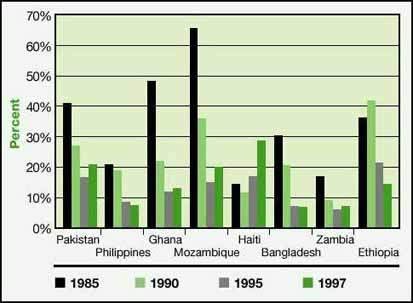
FIGURE 1.2. OIL IMPORTS AS A SHARE
OF EXPORT EARNINGS IN VARIOUS DEVELOPING COUNTRIES, 1985-97
Source: World Bank, 1999.
|
Since 1990 electricity rates have
declined steadily,
especially in
countries where electricity market
deregulation has
been
or is about to be
introduced. |
Natural gas
Unlike oil and coal markets, natural gas has yet to play a
significant role in global markets. Some 20 percent of global gas crosses
borders before reaching final consumers. About 75 percent of that gas is traded
by pipe between essentially neighbouring countries. Hence natural gas trade has
developed primarily at the regional level or between adjacent regions. Pipeline
transmission is capital-intensive and allows little flexibility in the choice of
buyers and sellers. Still, pipeline gas is traded between production and
consumption sites more than 4,000 kilometres apart. Three major regional gas
trade markets have emerged:
· The almost fully
integrated North American market, characterised by accelerated growth of
Canadian exports to the U.S. market (from 26 Mtoe in 1990 to 79 Mtoe in 1998).
There have also been minor exchanges between Mexico and the United States.
· The European market, with the
following principal suppliers: the former Soviet Union (with a pipeline
producing 108 Mtoe in 1998), Norway (pipeline producing 38 Mtoe), and the
Netherlands (pipeline producing 33 Mtoe), and Algeria with minor liquefied
natural gas supplies from Libya (pipeline and liquefied natural gas producing 47
Mtoe). Gas trade expanded by 2.7 percent a year in 1990-98.
· The Asian gas market is
dominated by liquefied natural gas (which increased from 47 Mtoe in 1990 to 77
Mtoe in 1998). The main suppliers are Indonesia, Malaysia, Australia, Brunei,
the United Arab Emirates, and Qatar. Japan, the Republic of Korea, China, and
Taiwan (China) are the main customers.
A gas market has also begun to develop in Latin America, with
exports from Bolivia to Argentina and Argentina to
Chile.
Energy prices and taxes
Energy prices influence consumer choices and behaviour and can
affect economic development and growth. High energy prices can lead to
skyrocketing import bills, with adverse consequences for business, employment,
and social welfare. Energy exporters benefit from high energy prices. High
energy prices also stimulate exploration and development of additional
resources, foster innovation, and encourage efficiency improvements.
While some impacts of energy prices are fairly steady, others
are more transient. For example, higher absolute prices have had little impact
on economic development in Japan and OECD countries in Europe relative to the
much lower prices in the United States and some developing countries. The price
hikes of the 1970s affected economic growth in all energy-importing countries,
however. Thus it appears that economies are more sensitive to price changes than
to price levels. But even price changes appear not to cause the turbulence of
the past. The recent near-tripling in world oil market prices has, at least in
OECD countries, not yet had any impact on economic development.
Energy prices, which include taxes, must be clearly
distinguished from costs, average costs from marginal costs, and contract
markets from spot markets. Two types of exchange modes - contract markets and
spot markets - prevail in most major energy markets. Contracts are long-term
trade agreements between exporters and, in the case of oil, refineries.
Contracts account for about 80 percent of traded oil. The prices associated with
these contracts are usually not disclosed. Contract prices are quasi-fixed for
the contract period but include certain adjustment mechanisms that account for
major market changes.
The remaining 15-20 percent of international oil is traded in
spot markets. Spot sales are more or less instantaneous sales of entire cargoes.
Initially, spot market transactions served as a mechanism to clear markets for a
small share of production that was not contracted or became available for other
reasons - say, seasonal market fluctuations. The spot market has since become
the principal mechanism for setting oil prices as well as an essential
ingredient for managing risk.
Steam coal prices are less volatile than oil, which is one
reason coal remains a popular fuel for electricity generation. In addition, coal
can be significantly cheaper than natural gas and oil. While internationally
traded energy prices are an important factor in the approximately $450 billion
business (at $20 a barrel), the energy bills presented to users are considerably
higher than the trade prices because most countries tax energy use. In general,
OECD taxes on residential energy use are higher than those on industry. In some
developing and transition economies taxes are higher for industry, usually as a
cross-subsidy to provide energy services to the poor. Energy taxes and subsidies
are an important tool for governments pursuing energy development objectives.
Since 1990 electricity rates have declined steadily, especially
in countries where electricity market deregulation has been or is about to be
introduced. Market liberalisation has a more profound impact on the electricity
rates of industry than of households. Prices for light oil at the national level
largely mirror movements in the global market price for oil. Light oil prices
are much lower in India and other developing countries than in OECD countries,
reflecting government
subsidies.
Energy investments
Capital investment is a prerequisite for energy development.
Energy system development and structural change are the results of investments
in plants and equipment as well as in energy system infrastructure. Difficulties
in attracting capital for energy investments may impede economic development,
especially in the least developed countries. Although energy investments account
for only a small share of the global capital market, the provision of the
capital required to finance the growing needs of the energy sector cannot be
assumed, especially in developing countries.
|
Market size and product mobility
often favour investments
in oil
exploration and development
over, for example, natural gas
or
energy efficiency. |
General features
The challenges of raising funds for energy investments include
the perceived risk to investors and the uncertainty on rates of return. Returns
on energy investments do not always compare well to those on other
infrastructure investments. During 1974-92 electricity projects supported by the
World Bank achieved average rates of return of 11 percent a year - while returns
to urban development projects were 23 percent and to transport projects, 21
percent (Hyman, 1994). Also important is the allocation of funds within the
energy sector. Rate of return considerations discriminate against small-scale,
clean, and innovative energy supplies and against investments in energy
efficiency. Market size and product mobility often favour investments in oil
exploration and development over, for example, natural gas or energy efficiency.
Investments in energy plants, equipment, and infrastructure must
be viewed in the context of economic growth, savings, and the size and degree of
liberalisation of capital markets. The current average global savings rate is
about 22 percent of GDP - 21 percent in developed countries and 24 percent in
developing countries. In transition economies recent declines in GDP have been
matched by reduced savings, keeping the savings rate at about 20 percent (World
Bank, 1999). Although energy investments as a share of total investments vary
greatly among countries and between stages of economic development, an average
of 1.0-1.5 percent of GDP is invested in energy. This share is expected to
remain relatively stable.
Thus current energy investments amount to $290-430 billion a
year. But such investments do not include investments in end-use devices and
appliances, energy efficiency improvements in buildings, and so on. Including
these investments doubles capital requirements.
Energy investments have long lives. Investments in electricity
generating plants, refineries, and energy-related infrastructure made in the
next 10 years will likely still be in operation in 2050 and beyond. Hence there
is a fair amount of inertia with regard to the rate of change that can be
introduced in the energy system. For example, the current global average
conversion efficiency for coal-fired electricity generation is 34 percent and
for gas-fired electricity generation, 37 percent. The best commercially
available coal and gas power plants have much higher efficiencies: 43-48 percent
for coal and 55-60 percent for natural gas.
Given the longevity of the existing capital stock, it is
unlikely that the global average will reach, say, 45 percent for coal-fired
electricity by 2050 unless the most efficient plants are adopted universally.
But most efficient does not always mean least cost - low-cost domestic coal can
be burnt more economically in a medium-efficient plant than in a high-efficient
but more capital-intensive alternative.
The efficiency of electricity generation also varies widely
among regions. The Middle East introduced coal for electricity generation in the
early 1980s and, because most coal is imported, adopted the latest coal
combustion technology. As a result the region's average conversion efficiency
exceeds that of OECD countries. Another aspect affecting efficiency is the
introduction of sulphur and nitrogen oxide abatement equipment, which tends to
reduce efficiency (as in Asia and
Africa).
Capital flows
The globalisation of economic production has led to an
acceleration of capital flows. Indeed, capital markets have been growing faster
than GDP for some time, and this trend is unlikely to change. Annual global
energy investments account for about 7 percent of international credit
financing, which is about $3.6 trillion (Hanke, 1995). With capital markets
growing relative to GDP, and assuming relatively stable future energy investment
ratios, capital market size does not appear to be a limiting factor for energy
sector finance.
Scarce public funds, especially in developing countries, are
sought by many needy projects ranging from rural development, education, and
health care to energy supply. Because energy supply, more than any other
alternative, is often seen as more readily capable of generating revenues early
on, energy investments are increasingly viewed as a private sector affair. Yet
private funds are not flowing into most developing countries.
Foreign direct investment approached $400 billion in 1997, up
from $50 billion in 1984, and accounted for 1.8 percent of OECD GDP (up from 0.6
percent in 1984; figure 1.3). Foreign direct investment in energy projects is
estimated at 5-15 percent of the total (Victor, 2000). Foreign direct investment
is generally commercially motivated, with the sponsor of investments expecting
not only to recover the initial capital but also counting on competitive
returns. This cannot always be guaranteed in developing countries with
potentially fragile governments or the absence of free markets. Indeed, 25
countries received 89 percent of global foreign direct investment in 1996, and
only 10 of these are developing countries - none are among the 47 least
developed countries. Brazil, China, and Mexico are the only developing countries
to receive more than 2 percent of the world total.
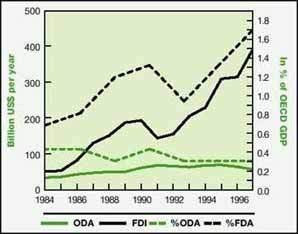
FIGURE 1.3. FOREIGN DIRECT
INVESTMENTS AND OFFICIAL DEVELOPMENT ASSISTANCE, 1984-97, IN US$ AND AS SHARE OF
OECD GDP
Source: World Bank, 1999.
In contrast to foreign direct investment, official development
assistance is meant as development aid in the form of grants. Official
development assistance increased from $34 billion in 1984 to $69 billion in 1995
but slipped to $56 billion in 1997, or 0.25 percent of OECD GDP - a far cry from
the 0.7 percent target agreed to by developed countries (see figure 1.3).
Against these recent developments in international financial and
capital flows, prospects for financing energy projects in developing countries
generally look bleak. Most foreign investors lack confidence in the ability of
developing country energy projects to provide stable (and competitive) returns
until the investment has been recovered. Hence, until the economic risk to
foreign investors can be eliminated (through deregulated energy and financial
markets, steady revenue generation through bill collection, firm policies on
profit transfers, and the like), developing countries will have to continue to
finance their energy development from domestic savings.
References
Ayres, R.U. 1989. Energy Inefficiency in the US Economy: A
New Case for Conservation. RR-89-12. International Institute for Applied
Systems Analysis, Laxenburg, Austria.
BP (British Petroleum). 1999. BP Statistical Review of World
Energy. London.
Gilli, P.-V., N. Nakicenovic, and R. Kurz. 1995. "First- and
Second-Law Efficiencies of the Global and Regional Energy Systems." Paper
presented at the World Energy Council's 16th Congress, 8-13 October, Tokyo.
Hanke, T. 1995. "Die M�erkte spielen verr�eckt." Die Zeit
18: 33.
Hyman, L. S. 1994: "Financing Electricity Expansion." World
Energy Council Journal (July): 15-20.
IEA (International Energy Agency). 1999. Energy Balances.
Paris: Organisation for Economic Co-operation and Development.
IMF (International Monetary Fund). 1998. International
Financial Statistics (May). Washington, D.C.
Nakicenovic, N., L. Bodda, A. Gruebler, and P.-V. Gilli. 1990.
"Technological Progress, Structural Change and Efficient Energy Use: Trends
Worldwide and in Austria." International part of a study supported by the
�esterreichische Elektrizit¨aetswirtschaft AG and International Institute
for Applied Systems Analysis, Laxenburg, Austria.
Olivier, D., and H. Miall. 1983. Energy Efficient Futures:
Opening the Solar Option. London: Earth Resources Limited.
Schaeffer, R. and R. M. Wirtshafter. 1992. "An Exergy Analysis
of the Brazilian Economy: From Energy Product to Final Energy Use." Energy
17: 841-61.
Victor, D. 2000. Private communication. Council of Foreign
Relations, 9 March, New York, NY.
Wall, G. 1990. "Exergy Conversion in the Japanese Society."
Energy 15: 435-44.
Wall, G., E. Scuibba, and V. Naso. 1994. "Exergy Use in the
Italian Society." Energy 19: 1267-74.
WCED (World Commission on Environment and Development). 1987.
Our Common Future. Oxford: Oxford University Press.
World Bank. 1999. World Development Indicators 1999
CD-ROM. Washington,
D.C.
Chapter 2. Energy and Social Issues
Amulya K.N. Reddy (India)
LEAD AUTHORS: Wendy Annecke (South Africa), Kornelis Blok
(Netherlands), David Bloom (United States), Brenda Boardman (United Kingdom),
Anton Eberhard (South Africa), Jamuna Ramakrishna (India), Quentin Wodon
(Belgium), and Anita Kaniz Mehdi Zaidi (United Kingdom and
Pakistan)
|
ABSTRACT
Poverty is the most fundamental reality of developing
countries - and the energy consumption patterns of poor people tend to add to
their misery and aggravate their poverty. A direct improvement in energy
services would allow the poor to enjoy both short-term and long-term advances in
living standards. Required are energy strategies based on increasing the use of
energy carriers other than biomass, or on using biomass in modern ways. Poverty
alleviation and development depend on universal access to energy services that
are affordable, reliable, and of good quality.
It has been noted that “poverty has a woman’s
face”. Energy and women are linked in many diverse ways, particularly
through the nature of the (predominantly biomass) energy resource base, the
characteristics of the household and community economy, the features of energy
policy, and the position of women in families and communities. Energy can be a
vital entry point for improving the position of women in households and
societies.
Many of today’s global problems arise from the
availability and use of natural resources, which depend on the size of the human
population putting pressure on them. But population is more than just an
external factor influencing energy consumption. Energy consumption patterns can
also influence population growth through their effect on the desired number of
births in a family and the relative benefits and costs of fertility.
Energy is linked to urbanisation through its implications for
land use, transportation, industry, construction, infrastructure, domestic
appliances and products, biomass consumption, and gender. Energy strategies can
be designed to improve the urban environment - particularly for transport,
industrialisation, mitigation of heat island effects, and construction.
Although energy devices (houses, vehicles, appliances) have
become much more efficient in industrialised countries, the number and use of
these devices have increased markedly. If appliances and their use (the material
basis of lifestyles) are taken as determinants of energy consumption, then
strategies can be devised based on reducing the number and use of
energy-intensive appliances.
Almost every industrialised country has poor and
disadvantaged populations. But the energy aspects of poverty are radically
different for industrialised and developing countries. Energy exacerbates
poverty in industrialised countries - for example, through the disconnection of
energy services or the absence in cold countries of universal affordable
warmth.
There are two-way linkages between energy and poverty, women,
population growth, urbanisation, and lifestyles. That is, these global issues
determine energy consumption, and energy systems influence the issues. Current
energy consumption patterns are aggravating these global issues, leading to
unsustainability. But energy can also help solve major global problems -
particularly those related to poverty, women, population growth, urbanisation,
and lifestyles. To realise this potential, energy must be brought to centre
stage and given the same importance as the other major global issues. |
Human society cannot survive without a continuous use, and hence
supply, of energy. The original source of energy for social activities was human
energy - the energy of human muscle provided the mechanical power necessary at
the dawn of civilisation. Then came the control and use of fire from the
combustion of wood, and with this, the ability to exploit chemical
transformations brought about by heat energy, and thereby to cook food, heat
dwellings, and extract metals (bronze and iron). The energy of flowing water and
wind was also harnessed. The energy of draught animals began to play a role in
agriculture, transport, and even industry. Finally, in rapid succession, human
societies acquired control over coal, steam, oil, electricity, and gas. Thus
from one perspective, history is the story of the control over energy sources
for the benefit of society.
Modern economies are energy dependent, and their tendency has
been to see the provision of sufficient energy as the central problem of the
energy sector. Indeed, the magnitude of energy consumed per capita became an
indicator of a country’s ‘modernisation’ and progress. Energy
concerns have long been driven by one simple preoccupation: increasing the
supply of energy. Over the past few decades, however, serious doubts have arisen
about the wisdom of pursuing a supply-obsessed approach. Attention is shifting
towards a more balanced view that also looks at the demand side of energy. But
access to, and the use of, energy continues to be a necessary and vital
component of development.
In the supply-driven approach, the appetite for energy often
exceeded the capacity of local sources of supply. The energy supplies of some
countries had to be brought from halfway round the world. Efforts to establish
control over oil wells and oil sea routes have generated persistent tensions and
political problems. This situation has also shaped national policies for foreign
affairs, economics, science, and technology - and influenced the political map
of the world. The security of energy supplies was a major geostrategic issue
throughout the 20th century.
At the same time, the magnitude and intensity of energy
production and use began to have deleterious impacts on the environment. By the
late 1960s the gravity of the environmental problems arising from toxic
substances had become clear. Awareness of the environmental issue of acid rain
followed. The problems of urban air pollution have been known for a long time.
Climate change discussions intensified in the mid-1970s. All these problems are
directly related to the quality and quantity of fuel combustion.
Then came the oil shocks of 1973 and 1979, along with price
increases that led to economic disruption at international, national, and local
levels. The oil shocks thrust the energy problem into the range of awareness of
individuals. Some oil-importing developing countries suffered serious balance of
payments problems, and in some cases landed in debt traps. The development of
indigenous fossil fuel resources and power generation faced the hurdle of
capital availability. And more recently, the accumulation of greenhouse gases in
the atmosphere resulting from energy consumption has focussed attention on the
threat of climate change, with the possibility of far-reaching consequences. In
parallel, the lack of control over energy resources has highlighted the
importance of national and local self-reliance (as distinct from
self-sufficiency).1
|
What human beings want
is not oil or coal, or even
gasoline
or electricity per se, but the
services that those
energy
sources provide. |
Thus, quite apart from the critical issues related to the supply
of fossil fuels, the political, social, and economic institutions dealing with
energy have failed to overcome a new series of grave problems - problems of
economics (access to capital), empowerment (self-reliance), equity, and the
environment. Many of the human-made threats to the species and the biosphere,
indeed to civilisation’s future, are energy-related. Awareness of the
energy dimensions of these issues has arisen more recently, but the underlying
energy bases of the issues are still imperfectly appreciated by decision-makers,
perhaps because this understanding has not been disseminated widely.
This chapter is devoted to the main linkages between energy and
social issues. It shows that energy strategies have impacts on major issues
related to poverty, women, population, urbanisation, and lifestyles. Data on
infant mortality, illiteracy, life expectancy, and total fertility as a function
of energy use are shown in figure 2.1, which is not meant to suggest that there
is a causal relation between the parameters represented.2
These linkages imply that energy has to be tackled in such a way
that social problems are at least not aggravated - which is what conventional
energy strategies tend to do, because they are so preoccupied with energy
supplies that they ignore these problems completely or deal with them
inadequately. Because of its linkages to social problems, energy can contribute
to their solution. Unfortunately, energy and the major problems of today’s
world are not being dealt with in an integrated way by national and
international
policy-makers.
Towards a new approach to energy for human uses
Another approach is called for: one that recognises that the
satisfaction of social needs by energy is best achieved by treating neither
energy supply nor energy consumption as ends in themselves. After all, what
human beings want is not oil or coal, or even gasoline or electricity per se,
but the services that those energy sources provide. Thus it is important to
focus on the demand side of the energy system, the end uses of energy, and the
services that energy provides.
In fact, one can identify a rather small set of the most
important of these energy services. They include the basic services of cooking,
heating, lighting, space conditioning, and safe storage of food. In addition,
the provision of clean water and sanitation, which is facilitated by energy,
affects public health in cities as well as rural areas. Societies also require
services such as transportation, motive power for industry and agriculture, heat
for materials processing (steel, cement, and so on), and energy for commerce,
communication, and other economic and social activities.
FIGURE 2.1a. COMMERCIAL ENERGY USE AND INFANT MORTALITY IN
INDUSTRIALISED AND DEVELOPING COUNTRIES
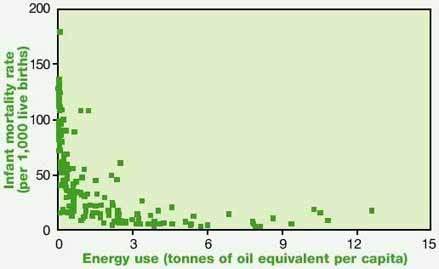
Figure
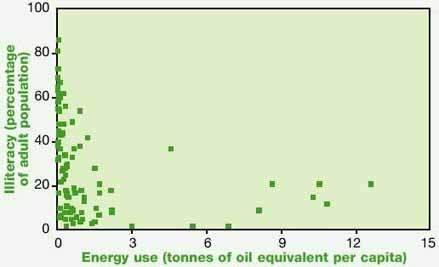
Figure
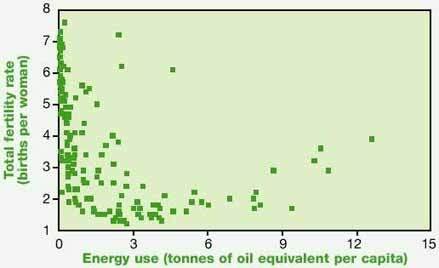
Figure
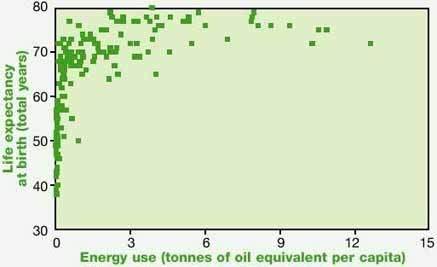
Figure
Note: Data on commercial energy use are for 1994;
data on social indicators are for 1995.
Source: World Bank, 1997.
The demand-side, end-use-oriented energy services approach
stresses another difference. The end user cares less about the original sources
or fuels used to provide the service than about crucial attributes of the final
energy carrier from a social standpoint. Among the most important attributes are
energy’s accessibility (particularly for the poor, women, and those in
remote areas), affordability, adequacy, quality, reliability, safety, and impact
(particularly on the immediate environment).
The traditional supply-side approach tends to forecast energy
demand on the basis of projections of past and present economic and demographic
trends. It tends to ignore the large variety of scenarios that are feasible
considering the opportunities and potentials offered by changes in energy
demand, improvements in energy efficiency, shifts from traditional energy
sources to modern energy carriers, and dissemination of new energy technologies.
To best serve humanity, the energy system should help achieve
the goals laid down at the 1992 United Nations Conference on Environment and
Development (the so-called Earth Summit) in Rio de Janeiro, and in other UN
contexts. These goals include the promotion of economically viable, socially
harmonious, environmentally safe, and strategically secure societies. Meeting
these goals requires five crucial components: economic efficiency, equity
(particularly for the poor, women, ethnic minorities, and those in remote
areas), empowerment or self-reliance, environmental soundness, and peace.
Together these components can be taken as some of the most essential measures of
sustainable development.
The Earth Summit led to greater awareness that development needs
to be sustainable if it is to serve humanity’s short- and long-term goals.
More than 150 governments committed themselves to the protection of the
environment through the Rio Declaration and Agenda 21. Government
representatives considered that key commitments related to energy would be
covered under the United Nations Framework Convention on Climate Change
(UNFCCC), which was signed on this occasion. Agenda 21 makes this important
statement:
Energy is essential to economic and social
development and improved quality of life. Much of the world’s energy,
however, is currently produced and consumed in ways that could not be sustained
if technology were to remain constant and if overall quantities were to increase
substantially. The need to control atmospheric emissions and other gases and
substances will increasingly need to be based on efficiency in energy
production, transmission, distribution and consumption, and on growing reliance
on environmentally sound energy systems, particularly new and renewable sources
of energy. (UN, 1993b, ch. 9.9)
The Framework Convention on Climate Change, which has been
ratified by 164 countries, defines an ecological target - without linking this
target to social impacts! - that implies the implementation of energy measures.
The Intergovernmental Panel on Climate Change (IPCC) also has presented
scientific assessments of data related to climate change and prospects for
inputs, adaptation, and mitigation of climate change and their relationship to
energy issues.
Since the Earth Summit many other initiatives have been taken at
various levels to promote sustainable energy through increased energy
efficiency, support for renewable energy sources, and integrated energy resource
planning. There are now good examples, significant benchmarks, and success
stories all around the world of efforts in these areas. But these efforts are
dispersed. Though they provide a good starting point, they cannot meet the
tremendous energy challenges facing humanity during the 21st century.
Energy issues tend to get sidelined in many international
forums. Such major global issues as poverty, women, population, urbanisation,
lifestyles, undernutrition, environment, economics, and security tend to get
higher priority than energy. But missing from most discussions of these issues
is the important linkage between each of them and global and local energy
systems. It is too little appreciated that achieving progress in these other
arenas can be greatly assisted by manipulation of energy systems.
Even when this linkage is mentioned, the discussion focuses on
how these global issues determine energy consumption patterns. Energy is treated
as the dependent variable. Very little attention is directed at understanding
whether current energy patterns are aggravating these issues, and almost no
attention is given to how alternative energy strategies can contribute to their
solution.
Thus a fresh conceptual framework is required. The framework
elaborated in this chapter, and depicted in figure 2.2, concerns the linkage
between energy, on the one hand, and poverty, women, population, urbanisation,
and lifestyles, on the other.3
The linkage between energy and food security is also crucial,
particularly because it concerns the important social problem of undernutrition
that is so widespread and serious, especially in developing countries. Despite
this, the energy-undernutrition dimension is not addressed in this chapter,
primarily because of space considerations. Moreover, the energy-undernutrition
link has been treated adequately in other contexts, particularly in Energy
after Rio: Prospects and Challenges (UNDP, 1997a), which explains how energy
strategies can play a powerful role in increasing the supply of food as well as
building an environment in which food is absorbed more effectively.
|
Indoor air pollution is a major
by-product of the
traditional use of
biomass, which diminishes the quality
of life,
especially for women
and young children. |
As humankind enters the new millennium, it is important to
highlight energy’s critical relationship to major global problems. The
timeliness of the challenge derives from three critical elements that are
converging to make the world thirstier for energy services: aspirations for a
higher living standards, booming economies in large regions, and population
growth.
The assessment that follows draws together a number of diverse
elements that are relevant to sustainable development, and for which issues of
supply and demand of energy are significant. It goes on to show new options for
using energy more efficiently, and also how both renewable and fossil sources of
energy can be used in cleaner, more efficient ways to help create a more
sustainable future. In fact, the global goal for energy can be stated very
simply: sustainable development of the world. Energy services therefore are a
necessary condition for sustainable
development.
Energy and poverty in developing countries
Poverty is the most fundamental reality of developing
countries.4 Poverty refers to an individual’s (or family’s)
lack of access - associated primarily with inadequate income - to basic human
needs such as food, shelter, fuel, clothing, safe water, sanitation, health
care, and education. Poverty is manifested as the inability to achieve a minimum
standard of what is needed for material well-being. Human poverty also entails
the denial of opportunities and choices most vital to human development -
including a long, healthy, creative life, a decent standard of living, dignity,
self-esteem, the respect of others, and the things that people value in
life.
Dimensions of poverty
Poverty is usually conceptualised and measured in terms of the
proportion of people who do not achieve specified levels of health, education,
or body weight. Operationally, however, poverty standards are typically
expressed in a single dimension: the monetary resources that would enable an
individual to consume either a fixed bundle of basic goods and services
(absolute poverty5), or a fraction of the bundle of goods and
services that a reference group is able to, or actually does, consume (relative
poverty).
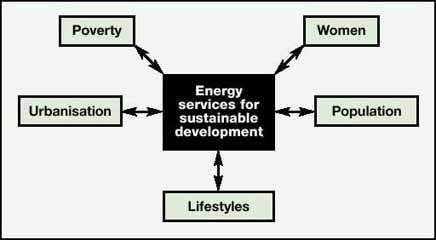
FIGURE 2.2. ENERGY AND SOCIAL
ISSUES
UNDP’s human poverty index goes beyond mere income poverty.
It measures deprivation in three essential dimensions of human life: longevity
(or vulnerability to death at an early age), knowledge (access to reading and
communication), and a decent standard of living in terms of overall economic and
social needs (percentage of people without access to safe water and health
services and the percentage of underweight children under five).
Whether measured directly with a range of indicators of basic
human outcomes, or indirectly with a single monetary dimension, poverty is
indisputably among the world’s largest, most urgent, and most fundamental
problems. Its pervasiveness - as revealed by the extent to which elementary
minimum needs are not satisfied - is undeniable. Whether food, shelter, health,
education, or employment is considered, living standards of the majority in most
developing countries are pathetically low. They represent a full-time struggle
for survival - a type of existence largely unknown, and perhaps even
unimaginable, in industrialised countries. This struggle is quite apart from
associated psychological reactions of deprivation and feelings of hopelessness
and social disempowerment, often accompanied by deep feelings of personal need.
In perhaps the most ambitious and careful attempt yet undertaken
to measure absolute poverty in developing countries, it has been estimated that,
as of 1993, roughly 1.3 billion people in developing countries - 30 percent of
their total population - consumed less than $1 a day worth of goods and
services.6
Statistics on the inability of people in developing countries to
satisfy basic human needs corroborate the enormous scale of poverty and
highlight its breadth and complexity. For example, an estimated 20 percent of
people in developing countries do not have access to health services, 30 percent
lack access to safe water, and 61 percent lack access to sanitation (UNDP,
1996). And infant and child mortality rates in developing countries are more
than 5 times higher than in industrialised countries, the proportion of children
below age five who are underweight is 8 times higher, the maternal mortality
rate is 14 times higher, and the proportion of births not attended by trained
health personnel is 37 times higher.
Significant and widening disparities in human development and
poverty are also found within countries between the rich and the poor, between
rural and urban areas, between regions, between different ethnic groups, and
between women and men. And income and development inequalities are greater
within developing countries than within industrialised OECD countries. The
richest 10 percent account for nearly half of national income or consumption in
Brazil and South Africa. In contrast, the richest 10 percent in countries such
as Germany, Japan, Norway, Switzerland, and the United States account for about
25 percent of their country’s national income and spending. Industrialised
countries not only have higher human development and lower poverty indexes; they
are also more equitable than developing countries. But there has been overall
progress in human development over the past 30 years, as indicated by an
examination of measures such as UNDP’s Human Development Index (HDI). On
average, a child born in a developing country today can expect to live 16 years
longer than a child born in 1970. Adult literacy rates since then have increased
by nearly half (UNDP, 1998).
|
Because efficient devices tend to have
higher first costs,
the poor invariably
end up with less efficient devices
that consume more
energy
for a given level
of service. |
Yet these favourable aggregate trends mask slow progress or even
setbacks in many countries, especially among the poorest people. For example,
life expectancy in Africa is still 20 years lower than in East Asia or Latin
America and the Caribbean. And adult literacy rates in South Asia (51 percent)
are shockingly lower than in Southeast Asia (90 percent) or in nearly all
industrialised countries (UNDP, 1998).
The alleviation, if not eradication, of poverty is among the
world’s largest, most urgent, and most fundamental challenges - and not
merely for humanitarian reasons. Societies with grave inequalities and
disparities tend to be unstable. Large populations below the poverty line are
explosive material for social upheavals. Thus poverty has politically
unsustainable characteristics. It merits urgent consideration and immediate
action.
The energy-poverty nexus
Energy services are a crucial input to the primary development
challenge of providing adequate food, shelter, clothing, water, sanitation,
medical care, schooling, and access to information. Thus energy is one dimension
or determinant of poverty and development, but it is vital. Energy supports the
provision of basic needs such as cooked food, a comfortable living temperature,
lighting, the use of appliances, piped water or sewerage, essential health care
(refrigerated vaccines, emergency and intensive care), educational aids,
communication (radio, television, electronic mail, the World Wide Web), and
transport. Energy also fuels productive activities, including agriculture,
commerce, manufacture, industry, and mining. Conversely, lack of access to
energy contributes to poverty and deprivation and can contribute to economic
decline.
The energy dimension of poverty - energy poverty - may be
defined as the absence of sufficient choice in accessing adequate, affordable,
reliable, high-quality, safe, and environmentally benign energy services to
support economic and human development. The numbers are staggering: 2 billion
people are without clean, safe cooking fuels and must depend on traditional
biomass sources; 1.7 billion are without electricity. Increased access to such
energy services will not, in itself, result in economic or social development.
But lack of adequate energy inputs can be a severe constraint on development.
Universally accessible energy services that are adequate, affordable, reliable,
of good quality, safe, and environmentally benign are therefore a necessary but
insufficient condition for
development.
The energy ladder and household decisions about fuel choice
Poor people tend to rely on a significantly different set of
energy carriers than the rich. The poor use proportionately more wood, dung, and
other biomass fuels in traditional ways, and less electricity and liquefied
petroleum gas (LPG). To illustrate this point, evidence from Brazil is shown in
figure 2.3.
The observation that roughly 2 billion people depend mainly on
traditional fuels for cooking is significant in part because indoor air
pollution is a major by-product of the traditional use of biomass. This
pollution diminishes the quality of life, especially for women and young
children.
Households use fuel for a variety of activities, including
cooking, water heating, lighting, and space heating. Different energy carriers
can be used for each of these activities. For instance, firewood, dung,
charcoal, coal, kerosene, electricity, and LPG can be used for cooking; and
kerosene and electricity for lighting.
These carriers (for a particular activity) form what is commonly
referred to as an ‘energy ladder’ for that activity. Each rung
corresponds to the dominant (but not sole7) fuel used by a particular
income group, and different income groups use different fuels and occupy
different rungs (Hosier and Dowd, 1987; Reddy and Reddy, 1994). Wood, dung, and
other biomass fuels represent the lowest rung on the energy ladder for cooking.
Charcoal and coal (when available) and kerosene represent higher steps up the
ladder to the highest rungs, electricity and LPG.
The ordering of fuels on the energy ladder also tends to
correspond to the efficiency of the associated systems (the fraction of energy
released from the carrier that is actually used by the end-use device) and their
‘cleanliness’. For example, the cook-stove efficiencies of firewood
(as traditionally used), kerosene, and gas are roughly 15, 50, and 65 percent,
respectively. As one proceeds up the energy ladder, the emission into the air of
carbon dioxide, sulphur dioxide, and particulates also tends to decline.
Households seem to make choices among energy carrier options on
the basis of both the household’s socioeconomic characteristics and
attitudes and the attributes of alternative carriers. Income is the main
characteristic that appears to influence a household’s choice of carrier
(Leach, 1992; Reddy and Reddy, 1994).
Relevant attributes of energy carriers include accessibility,
convenience, controllability, cleanliness, efficiency, current cost, and
expected distribution of future costs. Because different fuels require different
appliances - stoves, lamps, and so on - with varying costs and durability, fuel
costs have both fixed and variable components.
The importance of this distinction between fixed and variable
costs is magnified by three factors: the presence of quasi-fixed costs, such as
fixed monthly charges for a natural gas or electricity hookup; the need to make
large ‘lumpy’ purchases of some fuels, such as tanks for storing
propane gas; and the need to make sometimes sizeable security deposits, either
to guarantee the payment of monthly bills or the return of equipment such as LPG
cylinders or canisters. Despite the fact that they are refundable, security
deposits impose a present cost on households, the magnitude of which depends
upon the return on those funds in their next best use, or their
‘opportunity cost’.
The division of costs into fixed, quasi-fixed, and variable
components affects household decisions about fuel choice. The outcome of these
decisions depends on the household’s preparedness to forgo present
consumption for future benefits. The degree to which a household discounts
future benefits may be determined in part by its level of wealth and its
liquidity. Households may apply high discount rates to fuel consumption
decisions, because of the high cost of either diverting resources from other
uses or of borrowing funds to cover up-front capital costs. Thus they will tend
to prefer fuel carriers that involve lower up-front or first costs. Poor people
use much higher discount rates than the rich when making energy carrier
decisions (Reddy and Reddy, 1994). Lack of reliable income may force them to
think almost solely in terms of the first cost, rather than the life-cycle cost.
Because efficient devices tend to have higher first costs, the poor invariably
end up with less efficient devices that consume more energy for a given level of
service. Fuel costs may be determined either in a market or implicitly in terms
of the opportunity cost of time spent gathering the fuel, such as
firewood.
Energy strategies for alleviating poverty in developing countries
The poor pay more money, or spend more time for energy services,
than those who are better off. This has a powerful implication. The economic
hardship endured by poor households is understated when their income
(consumption expenditure) is evaluated in terms of its command over the basket
of goods and services purchased by households with average income or consumption
expenditures.
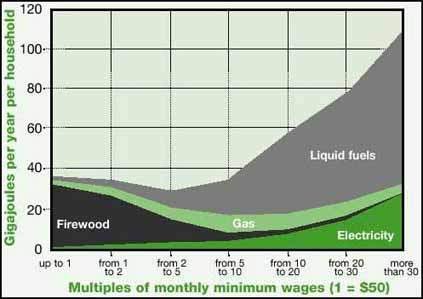
FIGURE 2.3. AVERAGE ENERGY DEMAND
BY INCOME SEGMENT IN BRAZIL, 1988
Source: De Almeida and de Oliveira,
1995.
Further, in many places, poor households could achieve the same
level of energy services at much less daily cost if they could move up the
energy ladder to LPG or electricity. Demonstration projects have shown that the
price that the poorest household is prepared to pay for electric lighting is
near the full cost because the alternative of kerosene lamps involves much
higher expenditures.
Substitution of energy carriers or devices that enable greater
efficiency would confer sizeable gains in purchasing power on poor urban
households. This analysis of the expenditure patterns of households in different
income groups suggests that such an increase in effective resources would be
devoted almost entirely to better satisfying basic needs for food, shelter,
clothing, health, education, and additional fuel. Thus cost-effective
improvements in energy efficiency have considerable potential to reduce poverty
in all of its key dimensions.
It appears that the energy consumption patterns of poor people
tend to add to their misery and aggravate their poverty for the following
reasons:
· Because the poor
pay more for daily energy needs, they are less likely to accumulate the wealth
needed to make the investments that are necessary to make use of cheaper and
more efficient fuels and appliances.
· The use of biomass compromises
the health of household members, especially when it is burned indoors without
either a proper stove to help control the generation of smoke or a chimney to
draw the smoke outside. Thus in addition to its relatively high cost, the use of
biomass fuel may promote higher medical care expenditures and diminish the
poor’s ability to work productively (chapter 3).
· Biomass also has deleterious
environmental consequences outside the household. These effects are reinforced
by the fact that biomass users are less likely to boil the water they drink, for
reasons of cost or custom. Insofar as the use of biomass in urban areas promotes
deforestation, reliance on biomass may also tend to increase its future cost,
further diminishing the living standards of the poor (Leach, 1992; Dasgupta,
1993).
The linkages between energy and poverty have implications for
strategies to alleviate poverty. The standard poverty alleviation strategies of
macroeconomic growth, human capital investment, and wealth redistribution do not
directly address the energy-poverty nexus in developing countries. If patterns
of energy use among the poor depress their nutrition, health, and productivity,
the poor are likely to absorb the benefits of economic growth only very slowly.
Education will continue to increase their earning capacity, but by less when
kerosene rather than electricity is the main illuminant, when lighting is poor,
and when access to knowledge though radio and television is limited. The
situation is worsened when traditional biomass is the dominant cooking fuel:
school attendance flags because of the burden of collecting it and the
respiratory illness caused by cooking with it.
|
Dramatic increases in
living standards in
developing
countries can theoretically be
achieved with small inputs
of
energy. |
In contrast, strategies that, in addition to standard poverty
alleviation strategies and rural development, include direct improvement of
energy services allow the poor to enjoy both short-term and self-reinforcing
long-term advances in their living standards. Such strategies should promote
increased use of energy carriers other than biomass, or use of biomass in modern
ways.
In fact, this approach suggests that major advances in poverty
alleviation can be achieved with relatively small inputs of energy, as evidenced
from the so-called 1 kilowatt per capita scenario (Goldemberg and others, 1985).
This scenario was based on a ‘thought experiment’ in which the
following question was explored: If all developing countries achieved a level of
energy services comparable to that of Western Europe in the 1970s,8
and if they deployed the most efficient energy technologies and energy
carriers available in the 1980s, what would be the per capita energy consumption
corresponding to this vastly improved standard of living?
The surprising answer was that, provided that the most
energy-efficient technologies and energy carriers available are implemented, a
mere 1 kilowatt per capita - that is, a 10 percent increase in today’s
energy per capita - would be required for the populations of developing
countries to enjoy a standard of living as high as that of Western Europe in the
1970s. In other words, dramatic increases in living standards in developing
countries can theoretically be achieved with small inputs of
energy.9
Energy and poverty in industrialised countries
Almost every industrialised country has its poor and
disadvantaged, but the energy aspects of their poverty are radically different
from those for developing countries. The poor in industrialised countries are
not energy poor in an absolute sense. Indeed, the direct use of energy by the
poor in the United States for homes and automobiles is 1.65 times the average
use in developing countries for all purposes, including the indirect use of
energy for industrial and commercial purposes and public transportation. The
high energy expenditures of the poor relative to those in developing countries
are also not an indicator of affluence. These expenditures are essential to meet
basic needs in the industrialised country context. The poor in industrialised
countries consume much more energy than their counterparts in developing
countries because of the much wider use of energy-intensive technologies.
Despite this apparent energy affluence of the poor in
industrialised countries relative to the masses in developing countries, their
economic plight cannot be ignored. The poor in industrialised countries spend a
larger fraction of their income on energy relative to the average. Energy
patterns clearly exacerbate poverty in industrialised countries - just as they
do in developing ones. This linkage is not taken into account in conventional
energy planning and policy-making. Rather, conventional energy strategies adopt
the ‘energy trickle-down’ approach to social welfare and implicitly
assume that if energy supplies are increased, these problems will take care of
themselves. In industrialised countries the problem is not that the poor do not
have access to enough energy to satisfy their needs, but rather that their
circumstances require them to consume too much energy and therefore to spend too
large a fraction of their income on it. If they cannot meet this expenditure,
their access to energy is disrupted.
An alternative energy strategy is needed that addresses the
energy-poverty link in industrialised countries and makes the poor less
vulnerable to the high costs of energy. The most promising approach is to make
available to the poor more energy-efficient technologies for space heating,
household appliances, and transportation services.
A central challenge for many developing countries is the
expansion of access to electricity for the poor. In contrast, maintaining access
is the critical issue in some medium-income countries and economies in
transition, as well as in OECD countries. The uninterrupted availability of
access to vital energy services is particularly important to the poor,
highlighting the health and other hazards associated with the lack of heating
and light. Disconnection can be life-threatening. It is part of the general
question of how the poor should be protected during the liberalisation and
privatisation that are sweeping electric utilities around the world. There is
increasing recognition of the importance of dealing with material hardship (lack
of access to energy) rather than just income poverty in both industrialised and
developing
countries.
Energy and women
Poverty has a woman’s face. Of the approximately 1.3
billion people living in poverty, 70% are women. (UNDP, 1997a. p. 12)
Compared to men, women in developing countries spend long
hours working in survival activities...[This] time spent...is largely invisible
in current methods of reporting energy patterns and statistics. (UNDP,
1997a, p. 15)
In developing countries, biomass accounts for about one-third
of all energy and nearly 90% in some of the least-developed countries. About two
billion people rely mainly or exclusively on traditional fuels (mostly biomass)
for their daily energy needs. (UNDP, 1997a, pp. 36-37)
Human energy conservation must be central to any energy
strategy, as it is a major component of energy used at the domestic level. The
traditional division of labour allocates most tasks to women in the household.
(Viklund, 1989, p. 10)
Energy and women are linked in many diverse ways.10
These linkages vary spatially, over time, across classes, between urban
and rural areas, and between countries. Some of these variations are common to
women, men, and children of a given era, class, or country. But certain features
of the relationship between energy and women are worth
considering.
Factors determining energy-women linkages
Four main factors influence the nature of linkages between
energy and women: the nature of the (energy) resource base, the characteristics
of the household and community economy, the features of energy policy, and the
position of women in families and communities.
Resource base. The survival and lives of most people in
the developing world depend on the biomass resource base, rather than on coal,
oil, or nuclear energy. Their consumption of energy (other than human energy and
animate energy sources) is for survival needs, primarily cooking. For these
needs, most people depend on biomass sources such as fuelwood, crop residues,
and animal dung.
But this biomass resource base is being degraded.11
As a result, in the course of a single generation, the time and effort
required to meet minimum household energy needs have increased. Because many
households rely on biomass fuels that are gathered or received as payment for
services rendered, national energy accounts tend to under-represent the
importance of biomass fuels as energy sources.
Likewise, labour and human investment (contributed primarily by
women) added to this resource base are not fully understood or recognised. In
fact, only fairly recently has it become accepted that deforestation in most
areas is not caused by household use of fuel-wood. Nonetheless, the cost (human
effort and financial outlay) involved in securing household energy needs has
escalated to such an extent that many households have been forced to shift to
less efficient and less clean fuels. The health impacts on women and children of
exposure to high concentrations of particulate matter, carbon monoxide, and
hundreds of other pollutants emitted when biomass fuels are burned have been
investigated and documented in some depth during the past 20 years (see chapter
3).
Household and community economy. Energy choices depend on
the extent to which the local economy is based on subsistence agriculture or on
raising livestock. A further issue is the degree of monetisation of the economy,
and whether wages are paid in cash or in kind - for instance, in grain or, more
pertinently, in crop residues. Each of these variables may influence the choices
made - whether fuel is gathered or bought, whether improved (more efficient and
less polluting) stoves are adopted, and what type of fuel is used.
Like the resource base, the local economy is dynamic,
particularly now that macroeconomic factors are bringing about vast changes in
microeconomies. These factors will determine the disposable income of
households, as well as the opportunity costs of depending on the labour and time
of women and children to supply household energy needs.
Energy policy. The linkages between women and energy are
also shaped by the prevailing energy policy, especially its degree of
sensitivity to the needs and priorities of (rural) women. Particularly in many
developing countries, energy policy is designed in such a way that energy
resources are not equally available to all. Industrial, commercial, urban, and
male users receive priority service and attention in energy policies. At the
bottom of the list are agricultural, domestic, rural, and female users. The
structure and functioning of the energy sector also cater to those in the
favoured categories.
The effect of these biases and predilections is evident in the
rural areas of most developing countries. Even well-intentioned initiatives such
as rural electrification often begin and end with a ‘pole in every
village’. Few affordable, viable options have been developed for the
domestic sector, where much of women’s work occurs.
Position of women in families and communities. One can
see evidence in many places of a highly degraded biomass energy resource base.
Yet investments to improve kitchens, stoves, and cooking fuels either do not
figure in the hierarchy of household expenditures or appear very low on the
list. Why?
A partial answer is that the livelihoods of people living in
such environments are also under threat. In other words, they have other, even
more urgent priorities. But another and crucial part of the answer is related to
the position of women in families and communities.
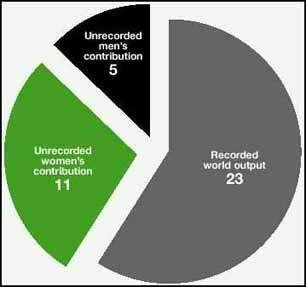
FIGURE 2.4. WOMEN’S SHARE OF
WORLD OUTPUT, 1993 (TRILLIONS OF U.S. DOLLARS)
Source: De Almeida and de Oliveira,
1995.
The four factors discussed here - the energy resource base, the
local economy, energy policy, and the position of women in families and
communities - are closely connected. But the last of these factors is perhaps
more fundamental than the others. It is a root cause, the reason it is necessary
to study linkages not only between women and energy but also between women and a
range of productive assets and social services. Women, by virtue of their
position in society (or lack thereof), stand disadvantaged in decision-making
processes in family, community, and country, as well as in accessing productive
assets. Poor women in developing countries are doubly disadvantaged, while their
sisters in rural areas are triply disenfranchised. Two aspects of this
disenfranchisement that have particular bearing on the linkages between women
and energy deserve closer attention: the value assigned to women’s labour
and the value placed on women’s time.
· Valuing
women’s labour. Across cultures and economic rankings, women’s
work has been under-valued, sometimes to the extent that it has been rendered
invisible. This applies not only to women’s reproductive work and household
work but also to their immensely active participation in the so-called informal
sector of the economy. This under-valuation, in terms of what is included in the
UN System of National Accounts (SNA) and what is not, is similar in
industrialised and developing countries.12 In both cases only about
one-third of women’s work is taken into account. Two-thirds is left out.
Women’s contribution to world output is also under-valued,
and to a much greater extent (figure 2.4). According to published statistics,
world output in 1993 totalled $23 trillion. But this reflects only recorded
economic activity - and the unrecorded economic contributions of women are
almost 45 percent of this amount (UNDP, 1995).
Furthermore, women are under-paid relative to men for the same
tasks. Again, this applies both in industrialised and developing countries.
Women also shoulder the burden of household survival activities (cooking,
cleaning, collecting fuel and water, and caring for children, plus sometimes
raising kitchen gardens), all of which are largely unacknowledged. The result is
that across the globe, women work longer hours than men. One of the most
tangible linkages between women and energy is that the growing scarcity and cost
of cooking fuel have lengthened women’s workdays and made them more
arduous.
· Valuing women’s
time. Rural women in developing countries have been forced to become experts
at multitasking.13 Faced with impossible workloads and only their own
time and labour to fall back on, poor rural women have become very efficient at
managing time. These skills are not assigned any value in the labour market.
Even women often do not consider what they do as ‘work’. Though the
survival of the family - in literal as well as economic terms - may depend on
the skill with which a woman manages her household, she has little or no
economic decision-making power, and her time and her work have very low status.
Not only are the cash-earning activities of the male members of the household
given higher status, but even the leisure time of men may rank higher than the
work time of women (Nathan, 1997).
To summarise, many of the world’s women (roughly 400
million) rely on energy sources that are not part of the market economy in order
to fulfil their survival activities and household responsibilities. They often
depend on these sources for their economic activities as well. Women are more
vulnerable than men to environmental degradation, because there is often a
direct impact on their workload. They are also more likely to be directly
affected by increases in fuel prices and by scarcity. Often the only asset that
women can turn to in times of scarcity or high prices is their own bodies, their
own labour. This results not only in longer workdays but also in declining
health, nutrition, and a score of other ill effects. Apart from the overwhelming
importance of biomass energy, the role of human energy and particularly of
women’s energy must be recognised (chapter
3).
Specific concerns and priority areas
Health and sanitation. Thus there is a very direct link
between energy and women’s health. Most of the burdens placed by energy
scarcity are borne by women. Even where biomass energy is relatively easily
available, women feel the health impacts of having to collect fuelwood. These
impacts may range from cuts, falls, bites, and back injuries to sexual
harassment (Government of India, 1988). Often these problems are compounded by
having to haul water for the household as well.
Exposure to indoor air pollution is another well-documented
health risk associated with the use of biomass fuels in traditional stoves that
are little more than shielded fires in poorly ventilated kitchens (WHO, 1992).
Rural women and children in developing countries are most affected by this
pollution. The rural-urban differential in pollutant concentrations and
exposures is marked, as are differences between countries at different stages of
human development (figure 2.5). The urban-rural differential is reversed in
high-HDI countries, where exposures are higher due to the greater amount of time
spent indoors and due to building characteristics and materials.
Fuel scarcity has wider implications. Women may be forced to
move to foods that can be cooked more quickly or to eat more raw food. Such a
shift can have health repercussions for the whole family, especially children
(Batliwala, 1982; Ramakrishna, 1992).
An additional critical factor related to health is the lack of
sanitation in many rural areas of developing countries, which is directly
related to the difficulty of accessing clean water. There is an
energy-sanitation link here because energy often has to be used to lift
‘clean’ sub-soil water or to boil water to reduce the health risk from
contamination. The convenience of the water supply - for instance, the distance
to the source and the number of sources - correlates with the amount of water
used daily per capita. For most rural people in developing countries, the amount
of clean water available per capita is well below the minimum required for
maintaining sanitation. In addition, the supply of drinking water is highly
inadequate. As water drawers and carriers and household managers, women feel the
impact of water shortages most keenly. The availability, supply, and quality of
water could be greatly improved by increasing the amount of energy available for
these functions.
Environmental quality. Energy scarcity often relates
directly to environmental quality for households and for communities in general.
The implications of this relationship are particularly relevant for women.
Deteriorating environmental quality places greater burdens on women’s time
and labour. In addition, as mentioned above, women’s health and
productivity may be significantly undermined. This is only partly due to the
increased effort required to meet minimum household energy requirements.
|
Apart from the overwhelming
importance of biomass energy,
the
role of human energy and
particularly of women's energy
must be
recognised. |
Energy, after all, is only one of the inputs that women must
secure for survival. Water also becomes scarce with increasing environmental
degradation. In cases of severe environmental decline, male migration often
increases, as in Sub-Saharan Africa. In such circumstances women have to bear
the additional responsibility of heading households. A key intervention to
arrest or slow environmental degradation in many developing countries would be
to increase the energy options for poor rural women. In particular, the
potential of renewable energy sources has not been realised.
Economic activities. The linkages between women’s
economic activities and energy have two aspects. One is the strong correlation
between the time women have for economic activities and the time they have for
survival activities, including collecting and preparing cooking fuels. The other
is securing energy inputs for economic activities. The main point is that
women’s choices are often very restricted, and they do not have much margin
for error for the unforeseen. Given that most women, whether bakers, brewers, or
food processors, are small-scale producers whose businesses are frequently
biomass-energy intensive, both technology development and improved energy supply
could greatly enhance their productivity.
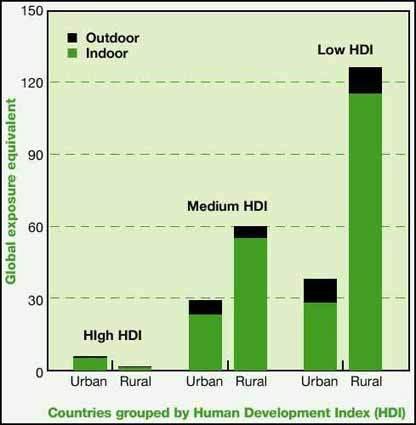
FIGURE 2.5. GLOBAL EXPOSURE
EQUIVALENTS FOR PARTICULATES IN 12 MAJOR MICROENVIRONMENTS
The global exposure equivalent is defined as the
equivalent (particulate) concentration that the entire world’s population
would have to breathe continuously to equal the population exposure in each
micro-environment.
Note: Data are for various years from the late 1980s to early
1990s.
Source: Based on Smith, 1993.
Education. Despite momentous advances in the literacy of
women, much remains to be done. As long as the drudgery of survival activities
continues to grow, given the division of labour in most households, getting
girls into schools will be an uphill battle. Improved access to better-quality,
affordable, reliable cooking fuels could make an enormous difference. As it is,
girls are the first to be called on to shoulder survival activities that cannot
be managed by the adult women of the household. Invariably, girls’
education suffers as a result.
Human productivity. The gravest consequence of energy
scarcity is probably that human productivity - especially women’s
productivity - is depressed. When survival of the family becomes the goal, there
is no opportunity to develop human potentials and talents. This is a loss not
only to the individual, but to society as
well.
Energy for improving the position of women
Energy can be a vital entry point or ‘lever’ for
improving the position of women in the household and society. As a bottleneck
and burden, the lack of affordable energy has often constrained the options and
opportunities available to women. But there are many strategic advantages in
using energy as an entry point.
Energy scarcity condemns many women to spend all their days and
a good part of their nights meeting basic survival needs. Enhancing their access
to affordable, clean energy sources would go a long way towards reducing the
drudgery they face, and allow them to use their time and energy for other
purposes. This could lead to improved health, education, nutrition, and economic
status, not only for women but for their families as well. The greatest benefit
would accrue to the next generation; and in particular to girls, who would gain
- as their workload at home decreases - better health and nutrition and
opportunities to go to school.
Energy is also a key productive asset for strengthening the
economic standing of women. In many cases it is also necessary for providing
equal access to productive resources (Batliwala and Reddy, 1996). Whether a
woman is engaged in food processing or in farming, her economic return largely
depends on a dependable supply of energy and on improvements in energy
technology products relevant to her trade.
Energy is a good organising issue for women, because energy is a
primary concern in their daily lives - especially poor women’s. Energy
resource scarcity, cost, quality, and reliability are their constant concerns.
Whereas alone each woman may be able to do little to improve the situation,
together their power could be fairly easily demonstrated. In some countries
farmers (mainly men) have organised themselves to demand affordable and reliable
energy supplies. Women can broaden these movements by adding their agenda.
|
Energy can be
a vital entry point or 'lever'
for
improving the position of
women in the household
and society. |
Finally, energy provides many opportunities for skill building
among women. That these skills would be non-traditional ones, and would not
restrict women to the kitchen and home (as do those perennial-favourite
income-generation schemes tailoring and pickle-making) are added advantages. The
exploitation of such opportunities, combined with improved access to credit for
women, could result in considerable entrepreneurial activity.
This perspective can also be turned on its head with good
effect. Involving women more integrally in the energy sector could be a boon for
the sector as well. The energy sector has evolved as a capital-intensive,
expert-dominated, centralised sector. But there is a role for decentralised
energy in which women can play an important part. In fact, the
‘engendering’ of the energy sector could be its salvation in the long
run, leading to decentralisation, longer-term perspectives, and investment, and
a better fit between energy source, energy quality, and end use - in other
words, to a greater emphasis on renewable energy sources, in keeping with the
underlying philosophy of sustainable
development.
Energy and population
Many of today’s global problems arise from the availability
and use of natural resources, which depend on the size of the human population
putting pressure on them. This pressure has been escalating in an alarming
manner.
The world’s population has increased explosively over the
past 100 years. “It took the world population millions of years to reach
the first billion, then 123 years to get to the second, 33 years to the third,
14 years to the fourth, 13 years to the fifth billion” (Sen, 1994).
Additions to the population have been unprecedented: “Between 1980 and
1990, the number of people on earth grew by about 923 million, an increase
nearly the size of the total world population in Malthus’ time” (about
1800; Sen, 1994).
This explosive growth has led to talk of a runaway population
inexorably bringing humanity to its doom and of a situation of ‘standing
room only’ on this planet. But these predictions have generally assumed the
persistence of the very high population growth rates of the 1950s, which
corresponded to a doubling every 23 years or
so.
Demographic transitions
The recent tremendous increase in world population is associated
with what is known as a demographic transition. In such a transition, the
population moves from a pre-industrial balance of high mortality and high
fertility to a post-industrial balance of low mortality and low fertility.
Demographic transitions have occurred in the past - in Western
Europe in the 19th century, and in Southern and Eastern Europe in the first
quarter of the 20th century. They are now taking place all over the developing
world. In some countries they are just starting. In others they are well under
way. And in the remaining countries they are over or almost over.
The demographic transition currently under way in developing
countries has been initiated by the rapid fall in mortality in these countries,
brought about by improvements in public health and advances in medical
technology. For example, an increase in life expectancy from 40 to 50 years was
accomplished in developing countries in just 15 years, from 1950-65. In
comparison, a similar increase of life expectancy required 70 years (from
1830-1900) in Western Europe and 25 years (from 1900-25) in southern and Eastern
Europe.
If a large reduction in mortality were not accompanied by a fall
in fertility, the population would increase indefinitely. But what happened in
industrialised countries is that fertility also fell, and the low value of
mortality was balanced by a new low value of fertility. Thus the growth rate of
population is low both before and after the demographic transition during which
the population grows rapidly:
The rate of world population growth is certainly
declining, and even over the last two decades, its percentage growth rate has
fallen from 2.2 percent per year between 1970 and 1980 to 1.7 percent between
1980 and 1992. This rate is expected to go down steadily until the size of the
world’s population becomes nearly stationary (Sen, 1994).
The crucial question, therefore, is whether the reduction in
mortality that took place in developing countries from 1950-65 has been followed
by a fall in fertility. The evidence seems clear. Until the mid-1960s there was
no sign of a fertility decline, but since then fertility has begun to fall in
almost all developing countries, except those in Sub-Saharan Africa. The average
total fertility rate in developing countries fell from 5.9 to 4.7, that is, by
about 20 percent, from 1965-70.14
It is important to note that the response of fertility is not as
rapid as the decline in mortality - fertility is not in sync with mortality. The
delay in fertility decline leads to a ‘bulge’ in the time variation of
population. This bulge gives rise to the problems associated with population
size. Thus it seems that a demographic transition is taking place and that the
population of developing countries and of the world is likely to stabilise
eventually. But the world is sure to have a growing population for quite some
time because of ‘population momentum (Sen,
1994).
Population momentum
Population momentum has important geographic, locational, and
age dimensions. First, the geographic distribution of population growth is
uneven - 90 percent of the growth is taking place in developing countries. These
additions to population are primarily in populous countries with a low average
income. In addition, the population explosion is worse in countries that already
have a severe population problem. Second, the locational distribution of
population growth is such that the urban share of growth has increased and will
continue to go up.
Third, the age distribution of the population is changing in all
countries, but the nature of the change varies among them. The population is
becoming older in rich countries because life expectancy is increasing while
infant mortality is relatively stable. In poor countries the age distribution
depends on the phase of the demographic transition. In the initial phase the
dependent non-working-age population grows faster because infant mortality is
declining much more than the increase in life expectancy. In the middle phase
the growth of the working-age population (with the potential of being
economically active) is relatively greater.15 And in the final phase,
the elderly population grows faster.16
It is important to estimate this future population. An average
of the 1992 UN medium estimate and the World Bank estimate of the future
population yields 9.79 billion in 2050,17 11.15 billion in 2100, and
11.45 billion in 2150. In 1998 the UN Population Division projected 8.9 billion
people by 2050, thanks to the fertility rate decreasing around the world (New
York Times, 21 October 1998, p. A8). The bulk of the population increase is
expected to take place in developing countries, where the population is expected
to triple to 9 billion by 2110.
The increase in global population before its expected
stabilisation by about 2100 means that per capita resources will continuously
decline in the near future. In fact, per capita estimates conceal the
differential growth that is likely to take place in industrialised and
developing countries, which will exacerbate the already serious disparities
between these two
worlds.
The energy-population nexus
Population levels influence the magnitude of energy demand in a
straightforward way: The larger the population, the more total energy is
required, with the magnitude of this total energy depending on per capita energy
consumption. This is perhaps the basis of a view that population increases in
developing countries represent the most serious threat to the global atmosphere
through the phenomenon of global warming (Atiq, Robins, and Roncerel, 1998).
There is an another view, however. The patterns of energy
consumption in rich industrialised and poor developing countries, and the rich
and poor within developing countries, are such that industrialised countries,
and the rich within developing countries, have - because of their
energy-intensive consumption patterns - far greater per capita impact on the
global atmosphere. Hence the greater rates of population growth of poor
developing countries, and the poor within developing countries, are far less
relevant to global warming than the lower rates of population growth of
industrialised countries, and the rich within developing countries. In fact, 49
percent of the growth in world energy demand from 1890-1990 was due to
population growth, with the remaining 51 percent due to increasing energy use
per capita.18 This relationship will hold true for the future if per
capita energy consumption does not change significantly.
Thus the conventional view of the energy-population nexus is
that population is an external factor influencing energy consumption. This
exogenous impact of population on energy is the well-known (and obvious) aspect
of the population-energy connection, although many people seem not to realise
the scale of its impact even today.
But there can be another connection, in which energy strategies
may lessen the intensity of the population problem. If energy consumption and
population growth are a dialectical pair - each transforming the other, and each
being an effect when the other is the cause - then the pattern of energy
consumption should also have an effect on population growth.
This is the other side of the coin - energy consumption patterns
influencing the rate of population growth through their effect on the desired
number of births in a family and the relative benefits and costs of fertility.
These patterns can retard or accelerate the demographic transition (Goldemberg
and others, 1988).
This dimension of the energy-population nexus - not yet
elaborated sufficiently - will be sketched through the influence of energy
consumption on population growth at two levels: the micro level of villages in
developing countries and the macro level of the world. The implication is that
energy can play a key role in accelerating the demographic transition,
particularly by achieving dramatic reductions in fertility to stabilise global
population as quickly as possible and at as low a level as
possible.
Rural energy consumption and population implications
To proceed, several features of rural energy consumption in
developing countries must be highlighted. Though these features vary with
country and agroclimatic conditions, a few numbers typical of south Indian
villages are presented to give a flavour of the features involved (ASTRA, 1982):
· Commercial energy
accounts for a very small percentage of the inanimate energy used in villages;
the bulk of the energy comes from fuelwood.19
· Animate sources - human beings
and draught animals such as bullocks - account for less than 10 percent of the
total energy, but the real significance of this contribution is that these
animate sources represent the bulk of the energy used in agriculture.
· Nearly all the energy
consumption comes from traditional renewable sources. Thus agriculture is
largely based on human beings and bullocks, and domestic cooking (which uses the
bulk of the total inanimate energy) is based entirely on fuelwood.20
But the environmental soundness of this pattern of dependence on renewable
resources comes at an exorbitant price. Levels of agricultural productivity are
very low, and large amounts of human energy are spent on fuelwood gathering (for
example, about 2-6 hours and 4-8 kilometres a day per family to collect about 10
kilograms of fuelwood).
· Fetching water for domestic
consumption also uses a great deal of human energy (an average of 1.5 hours and
1.6 kilometres a day per household) to achieve an extremely low per capita water
consumption of 1.7 litres a day.
· Almost half of the human
energy is spent on grazing livestock (5-8 hours a day per household), which is a
crucial source of supplementary household income in these parts of the country.
· Children contribute about
one-third of the labour for gathering fuelwood, fetching water, and grazing
livestock. Their labour contributions are vital to the survival of families.
This point is usually ignored by population and education planners.
· The end uses of human energy
in villages show that their inhabitants, particularly women and children, suffer
burdens that have been largely eliminated in urban settings by the deployment of
inanimate energy. For example, gathering fuelwood and fetching water can be
eliminated by changing, respectively, the supply of cooking fuel and water.
There are also serious gender and health implications of rural energy
consumption patterns (Batliwala, 1982).
|
Industrialised countries have -
because of their
energy-intensive
consumption patterns - far greater
per capita impact on
the
global atmosphere. |
To understand the population implications of these features of
energy consumption in villages, it is necessary to consider how these features
influence the desired number of births in a family and the relative benefits and
costs of fertility. A useful starting point is the general preconditions for a
decline of fertility, as set forth by the demographer A. J. Coale (1973, 1983):
· Fertility must be
within the calculus of conscious choice. Potential parents must consider it an
acceptable mode of thought and form of behaviour to balance advantages and
disadvantages before deciding to have another child.
· Reduced fertility must be
advantageous. Perceived social and economic circumstances must make reduced
fertility seem an advantage to individual couples.
· Effective fertility reduction
techniques must be available. Procedures that will prevent births must be known,
and there must be sufficient communication between spouses and sufficient
sustained will, in both, to use them successfully.
The exercise of choice in matters of fertility is a
culture-dependent issue, and awareness and availability of fertility-reduction
techniques depend on specific technologies and the success with which they are
spread. But the desired number of births, and therefore the relative benefits
and costs of fertility, depend upon socioeconomic factors such as
· Infant
mortality and the probability of offspring surviving. The lower this
probability, the larger the number of children aspired to and the greater the
exposure of the mother to the possibility of additional pregnancies.
· The role of women in
arduous, time-consuming household chores. The greater this role, the smaller
the scope and emphasis on women’s education and the lower the age of
marriage.
· The use of children to
perform essential household tasks. The greater the use of children for these
tasks, the more they become essential for the survival of the household.
· Opportunities for children
to earn wages. Wage-earning children become desirable as economic
assets.
Only a few of these factors enter into perceptions of advantages
and disadvantages of fertility and family size. Nevertheless, the reduction of
fertility, and therefore the acceleration of the demographic transition, depends
on crucial developmental tasks. These tasks include an increase in life
expectancy, improvement of the immediate environment (including drinking water,
sanitation, and housing), education of women, and diversion of children away
from household support tasks and employment to schooling.
Further, almost every one of these socioeconomic preconditions
for smaller family size and fertility decline depends on energy-using
technologies. Infant mortality has much to do with inadequate, unsafe supplies
of domestic water and with an unhealthy indoor environment resulting from
polluting fuel-stove cooking systems. The conditions for women’s education
become favourable if the drudgery of their household chores is reduced with
efficient energy sources and devices for cooking and with energy-using
technologies to supply water for domestic uses. The deployment of energy for
industries that generate employment and income for women can also help delay the
marriage age, which is an important determinant of fertility. And if the use of
energy results in child labour becoming unnecessary for crucial household tasks
(cooking, gathering fuelwood, fetching drinking water, grazing livestock), an
important rationale for large families is eliminated.
From this standpoint, it is obvious that prevailing patterns of
energy consumption in villages do not emphasise energy inputs for the following
tasks:
· Providing safe and
sufficient supplies of drinking water.
·
Maintaining a clean and healthy environment.
· Reducing the drudgery of household chores
traditionally performed by women.
· Relieving
children of menial tasks.
· Establishing
income-generating industries in rural areas.
Thus current energy consumption patterns exclude the type of
energy-using technologies needed to promote the socioeconomic preconditions for
fertility decline. In fact, they encourage an increase in the desired number of
births in a family and an increase in the relative benefits of fertility
(Batliwala and Reddy,
1996).
Traditional biomass-based cooking and demographic indicators
Traditional biomass-based cooking is predominant in most
developing countries, particularly in rural areas. The negative health impacts
of this are discussed in chapter 3. The low efficiencies of traditional biomass
stoves derive from the incomplete combustion of the biomass, resulting in a
number of health-damaging pollutants, particularly suspended particulates and
carbon monoxide. These pollutants exceed acceptable levels inside poorly
ventilated houses, especially those without chimneys. Thus one would expect to
find a correlation between the percentage of biomass use in total energy use and
a number of demographic indicators, especially those related to women and young
children, who are thought to be most vulnerable.
Indeed, such a correlation has been revealed by recent work on a
large number of developing countries (Bloom and Zaidi, 1999). Table 2.1 shows
that, as the percentage of biomass increases, life expectancy decreases, infant
(and child) mortality increases, and the annual population growth rate
increases. Such trends do not prove causality but are consistent with the view
that traditional biomass use impedes the demographic
transition.
Energy-population nexus at the global level
One way of considering the energy-population nexus at the global
level is through the 1 kilowatt per capita scenario (Goldemberg and others,
1985) described above. That scenario shows that, if the most energy-efficient
technologies and energy carriers available today were implemented, a mere 10
percent increase in the magnitude of energy would be required for the
populations of developing countries to enjoy a standard of living as high as
that in Western Europe in the 1970s. In other words, under the conditions of
this scenario, energy supplies need not become a constraint, and dramatic
increases in living standards can be attained in developing countries. It
follows that, if energy-efficient technologies and modern energy carriers were
implemented to enable the populations of developing countries to realise higher
living standards, then these standards would likely result in low growth rates
for developing country populations, similar to rates in Western European
countries. Insofar as current energy strategies do not sufficiently emphasise
energy-efficient technologies and modern energy carriers, they are not
addressing directly the population problem.
TABLE 2.1 BIOMASS USE AND DEMOGRAPHIC INDICATORS
|
Indicator |
Percentage of biomass in total fuel use |
|
0-20 |
20-40 |
40-60 |
60-80 |
Above 80 |
|
Number of countries |
70.00 |
12.00 |
14.00 |
10.00 |
16.00 |
|
Female life expectancy (years) |
74.70 |
68.80 |
62.00 |
56.10 |
48.30 |
|
Life expectancy (years) |
71.50 |
66.50 |
59.90 |
54.50 |
47.00 |
|
Male life expectancy (years) |
68.50 |
64.00 |
57.80 |
53.00 |
45.80 |
|
Infant mortality (per 1,000 live births) |
22.50 |
46.60 |
64.70 |
82.60 |
116.80 |
|
Under-five mortality (per 1,000 live births) |
27.50 |
59.30 |
93.00 |
135.30 |
173.00 |
|
Total fertility rate |
2.51 |
3.26 |
4.64 |
5.35 |
6.33 |
|
Crude birth rate |
19.20 |
26.20 |
35.00 |
39.10 |
45.00 |
|
Crude death rate |
8.60 |
7.60 |
10.90 |
12.80 |
18.10 |
|
Annual population growth rate (percent) |
1.00 |
1.61 |
2.43 |
2.74 |
2.52 |
|
Female-male life expectancy gap (years) |
6.20 |
4.50 |
4.20 |
3.10 |
2.60 |
Sources: UN, 1993a; World Bank,
1998.
Energy and urbanisation
A century ago, even visionaries could not imagine a city with
more than 1 million inhabitants.21 Yet by 2010 more than 500 such
concentrations will dot the globe, 25 of them with more than 10 million people
(so-called megacities). The availability of energy sources in combination with
the phenomena of motorisation and industrialisation have substantially altered
the manner in which people relate to their environment.
Urban dwellers will soon outnumber those in traditionally rural
areas and constitute half the world’s population. Of the 1.23 billion urban
residents added to the world population since 1970, 84 percent have been in less
developed regions. The global population is growing by 2.5 percent a year (3.5
percent a year in less developed regions, and 0.8 percent in more industrialised
regions). The annual growth is 61 million people - roughly the equivalent of
adding six cities with a population of 10 million to the urban population
world-wide. By 2020-25 the global annual urban growth rate will have declined to
less than 2 percent, but the urban population will increase by 93 million people
a year - more than the current annual increase in the total world population.
The rate of urbanisation and its attendant impacts differ in
regions across the globe. Thus strategies to capitalise on the positive factors
of urbanisation and to mitigate the negative factors will also differ by region.
Latin America is the most urbanised region in the developing world. Nearly
three-quarters of Latin Americans live in urban areas. Although Africa is the
least urbanised region, it is experiencing the highest urban growth rate, and
already a third of its people live in cities. However Asia contains almost half
the world’s megacities and continues to urbanise rapidly. Given its current
annual growth rate, Asia’s urban population is expected to double in less
than 20 years.
Increasingly, larger portions of the world’s people live in
the biggest cities. In addition, more live in intermediate-sized cities than
ever before. In 1950 there were 83 cities or urban areas with more than 1
million people. Today 280 such urban areas exist. The growth of large cities
also affects smaller cities, particularly in less developed regions. Over the
next 15 years the number of cities with 5-10 million residents will increase
significantly. Further, the number of people in them will more than double, as
will the population of cities in the 1-5 million and 0.5-1.0 million ranges.
This means that while megacities are the most visible symbols of problems and
challenges, smaller cities are no less significant.
Urbanisation reflects more than demographic change. It is both
driven by and profoundly influences the context and processes of development. It
exerts both direct and indirect advantages in the struggle towards global
sustainability and human development. The origins of many global environmental
problems related to air and water pollution are located in cities - this is the
urbanisation-pollution linkage. Unsustainable consumption and production
patterns are also a feature of cities. But it is also in cities that one can
find potential solutions, because they have several positive features.
Birth rates are three to four times lower in urban areas than in
rural areas, thereby reducing environmental pressures from population growth.
Cities provide greater accessibility to education, services, and training. They
increase the access of residents to information on environmental issues and
facilitate their integration into the policy process according to identified
needs and priorities. Because of their concentrated form and efficiencies of
scale, cities offer major opportunities to reduce energy demand and minimise
pressures on surrounding land and natural resources. Women are also the direct
beneficiaries of urbanisation, because their interests and demands are more
easily articulated and negotiated in their new, dynamic social environment.
Cities are the engines of economic growth and centres of
employment and opportunity for expanding and diversified national economies.
Eleven of the twelve urban agglomerations with 10 million or more people are
located within one of the 25 largest economies. The economic prosperity of
nations will depend on the performance of their cities. With a focus on cities,
appropriate energy policy can be targeted more effectively and resources
leveraged far more efficiently to affect large numbers of individuals,
communities, industries, and services. But a lack of competent and accountable
urban governance can lead to the loss of much of the potential contribution of
cities to sustainable economic and social development and, at worst, to a
completely dysfunctional living environment. Concerned and innovative urban
development planning, on the other hand, can enable growing urban populations to
contribute towards sustainable human development by empowering individuals to
convert their creative assets into global
wealth.
Urbanisation and energy linkages
The 1996 United Nations Conference on Sustainable Human
Settlements, known as Habitat II, reaffirmed that the vast majority of
population growth in developing countries will occur in urban centres. The type
and scale of urban development will largely affect future energy consumption. In
turn, urbanisation also has a profound effect on the amount and type of energy
consumed. Other factors - including economic development, industrialisation, and
such social-cultural particularities as consumption patterns - also drive the
global increase in energy demand. Although traditional rural societies rely
heavily on human and animal energy and on wood for fuel, today’s urban
societies rely primarily on fossil fuels and electricity.
Per capita energy consumption remains low in the developing
world. For many urban Africans and Asians, biomass fuels meet a large portion of
energy needs. As these countries urbanise, energy demand increases, and
traditional bulky fuels (such as wood and charcoal, which require
energy-intensive forms of transportation), food, and other materials consumed in
urban areas must be transported across greater distances. Urban manufacturing
and industry also require more energy than traditional agriculture. In addition,
the provision of infrastructure and services to new urban residents requires
energy that is not typically consumed in rural settlements.
Urbanisation imposes enormous demands on the ecosphere, because
most urban activities at the industrial, community, and household levels are
based on natural capital depletion. Housing construction, transportation,
economic activities, and the generation of residential heat and electricity all
put stress on the environment and compete for ecological space. Energy use is
already high in industrialised countries and is increasing rapidly in developing
countries as they industrialise. But energy can be an instrument for sustainable
development with an emphasis on more efficient use of energy, and an increased
use of renewable energy sources, among other
measures.
Urbanisation and energy strategies
Although many countries prepared national plans of action for
Habitat II, most did not formulate a national policy on the linkages between
urbanisation and energy. Few governments have allocated significant resources to
encouraging more effective use of non-renewable energy resources or to
increasing the long-term supply of renewable energy resources. In light of
current urbanisation trends and the opportunities presented by new
energy-efficient technologies and processes, the moment is opportune for this
discussion to take place.
Cities have the potential to be far more environmentally benign.
The spatial concentration of humans and their activities can minimise pressures
on surrounding land and natural resources. Well-designed cities can channel
development far away from wetlands and other sensitive areas, and protect
natural resources. By integrating land-use and transportation planning, cities
can reduce both congestion and pollution.
Cities offer important opportunities for protecting the
environment. With proper planning, dense settlement patterns can ease pressures
on per capita energy consumption and provide opportunities to increase energy
efficiency. For example, recycling becomes more feasible due to the large
quantities of materials and the number of industries that can benefit from it.
In addition, land use, infrastructure, and services are better used, and the
need for extensive transportation networks and residential heating is reduced.
Low-density communities tend to have the opposite characteristics.
Transportation. Mobility and access remain among the
greatest challenges for cities in the developing world, especially considering
the growing proportion of lower-income people. A city that cannot be accessed by
all its inhabitants is not sustainable. Because motor vehicle ownership remains
relatively low in many of these cities, there is a window of opportunity to
avoid the mistakes made in the industrialised world and design urban
transportation systems that facilitate walking, bicycling, and public
transportation. Such measures can improve the environmental health of cities and
citizens as well as mitigate the threat of global warming.
|
The new millennium is ushering
in a new urbanised era. For
the first
time ever, more people will reside
in urban settlements
than
in rural. |
Cities are centres of employment, residence, and leisure, and of
the integration between them. Mobility and access are therefore complementary
aspects of the same problem. Mobility implies movement: people going to work,
people going to the market, people bringing vegetables to sell in the market.
Access implies the ability to take advantage of urban functions: people
developing ‘backyard industries’, people being able to find in their
neighbourhoods the services they need, people being able to walk to work. A
sensible balance between mobility and accessibility concerns should result in a
more energy-efficient transport strategy based on demand management. In this
regard, the systemic integration between land use and transport is much more
important than an isolated concern with vehicles, fuels, and emissions. These
are also important complementary concerns.
To illustrate, given the opportunity to work legally at home
(for example, inputting data or transcribing reports from remote places), the
informal sector, a thriving and integral sector in developing economies, would
be formalised and backyard industries would proliferate, reducing the need for
urban residents to commute to places of employment. The integration of
sustainable transport and employment-related strategies could reduce stress on
the local environment, promote more creative employment options (especially for
women), and lead to a general improvement in quality of life.
Patterns of energy consumption also depend on the means and
availability of transport. Where extensive road networks, vehicles, and other
transport infrastructure exist, there is a high risk of depending on a
supply-driven vicious circle. As is well known, conventional traffic planning
based on individual modes of transport can lead to potentially difficult
situations, as has occurred, for example, in Bangkok (Thailand), Kuala Lumpur
(Malaysia), Mexico City, and S�o Paulo (Brazil). The creation of appropriate
land-use legislation for residential and commercial sites and access to public
transportation services can mediate the demand for more energy-intensive
transport use.
Considerable opportunity exists to design more efficient
transportation systems and create more liveable cities. A critical step for
industrialised and developing countries is to move towards managing urban travel
demand rather than simply increasing the supply by reducing or averting
over-reliance on the privately owned car through appropriate pricing, spatial
settlement policies, and regulatory measures.
A number of strategies are available to governments to advance a
sustainable transport sector (Rabinovitch, 1993; UN, 1996):
· Exploration of
surface (rather than above-ground or underground) solutions based on affordable
technologies. Buses should be considered before a high-technology rail system.
· Development of an integrated
transport strategy that explores the full array of technical and management
options and pays due attention to the needs of all population groups, especially
those whose mobility is constrained because of disability, age, poverty, or
other factors.
· Coordination of land-use and
transport planning to encourage spatial settlement patterns that facilitate
access to basic needs such as places of employment, schools, health centres, and
recreation, thereby reducing the need to travel.
· Encouragement and promotion of
public access to electronic information services and technology.
· Promotion, regulation, and
enforcement of quiet, use-efficient, low-polluting technologies, including
fuel-efficient engine and emission controls, fuel with a low level of polluting
emissions, and other alternative forms of energy.
· Provision or promotion of
effective, affordable, physically accessible, and environmentally sound public
transport and communication systems that give priority to collective means of
transport, with adequate carrying capacity and frequency to support basic needs
and reduce traffic flows.
· Exploration of partnerships
with private-sector providers. Ideally the public sector should provide
monitoring and operational standards, and the private sector should invest in
capacity and contribute managerial comparative advantages and
entrepreneurship.
Construction. Low-energy building materials such as
timber, soil, sand, and stone require little energy in their manufacture and
processing. The durability of many of these materials can be improved without
large energy expenditures. These materials are often used in the construction of
housing in developing countries. It is often possible to improve the use of such
materials through appropriate construction methods and design techniques that
maximise their functionality and natural advantage.
One example is construction using earth, in which the mechanical
energy required is ultimately much more efficient than that for ceramic building
materials, which require large amounts of heat (usually applied inefficiently).
The low costs of locally available renewable energy resources could potentially
ensure a continuous supply of energy to meet the demand of domestic,
agricultural, and small-scale industrial sectors. These materials also have the
advantage of being familiar to local building operators and
planners.
Energy to improve the urban environment
The new millennium is ushering in a new urbanised era. For the
first time ever, more people will reside in urban settlements than in rural.
Perhaps the forces of change - economic, social, technological, and political -
render this process inevitable. If so, policy design and prescriptions should be
targeted differently. Rather than attempting to arrest rural-urban migration, it
is important to make rural life less difficult and arduous and more pleasant and
attractive.
|
The rapid expansion of urbanised areas,
especially in
developing countries,
creates a unique opportunity
to implement
'leapfrogging'
approaches. |
Energy interventions can play a positive role in this task
through electrification of homes for lighting, labour-saving appliances, and
entertainment, as well as for the supply of safe piped water. Thus an
improvement in the quality of rural life can decrease the negative aspects of
urbanisation, making it wise to pursue balanced urban and rural development and
to ensure synergies between the two. The focus of development efforts should be
redirected towards achieving more sustainable urban and rural living
environments in light of the inevitability of a mostly urban world.
Rapid urbanisation is associated with a rise in energy demand -
which potentially threatens the sustainability of human settlements and the
natural environment. The spatial concentration and diversification of human and
economic activities hasten the demand for resources and compromise the carrying
capacity of final disposal systems and infrastructure. In addition, the rise in
disposable income of urban populations is likely to lead to a concomitant desire
for more material goods and services.
Yet many of the negative effects of urbanisation can be
mitigated through innovative energy policies. In developing countries rapid
urbanisation and its attendant demands on material and financial resources have
severely compromised the ability of governments to foster sustainable
environment. Although the use of fossil fuels in industrial processes, heating,
electricity, and motor vehicles tends to expand with economic growth, measures
can be taken to promote renewable, clean technologies that lessen the burden of
economic activity on human populations and ecosystems. In cities in
industrialised countries, control of motor vehicle emissions has led to a
dramatic reduction in ground-level ozone and carbon monoxide levels on or near
major roads.
Urban areas offer enormous potential for easing the demand for
energy-intensive materials and increasing the efficiency of resource use. The
agglomeration of social networks fosters an environment that is more accessible
to public awareness campaigns, creating a favourable learning environment for
changing wasteful patterns of consumption on a large scale. The application of
new energy-efficient technology is more easily accelerated in an urban setting
because business and industry may be more amenable to experimentation and thus
bypass the environmentally deleterious path of excessive technological use that
has often been followed in industrialised countries.
Most technologies used in cities in the industrialised world
were invented about a century ago. The rapid expansion of urbanised areas,
especially in developing countries, creates a unique opportunity to implement
‘leapfrogging’ approaches. Widespread urbanisation may provide the
economies of scale needed to implement innovative affordable technologies.
The urban environment is also conducive to offering education
opportunities and creating jobs. This facilitates capacity-building efforts to
deal with the operation and maintenance of environmentally friendly energy
infrastructure based on renewable sources. Opportunities for reducing the
material inputs of production by recycling waste by-products are more feasible
in urban areas. For urban services such as transportation, a reduction in cost
and in the share of energy-intensive services provides an additional means by
which energy strategies can take advantage of the positive aspects of
urbanisation. A prime example is the promotion of surface bus modes of
transportation rather than expensive solutions such as
subways.
Energy and lifestyles
After the oil shocks of the 1970s, one of the issues that often
arose in discussions of energy was the sustainability of a world with glaring
and grave disparities in per capita energy consumption between industrialised
and developing countries. A related issue was the need for convergence in per
capita consumption through minimisation, if not removal, of these disparities.
These discussions were set aside because of optimists’
belief in the enormous potential of efficiency improvements. These improvements
- it was believed - would enable industrialised countries to sustain their
energy services (and therefore living standards and lifestyles) with far less
energy consumption. At the same time, the improvements would enable developing
countries to achieve dramatic improvements in their standards of living with
only marginal increases in their inputs of energy. Now, almost 30 years after
the oil shocks, the time has come to revisit these fundamental issues by
analysing the experiences of industrialised
countries.
Energy use in the United States
Consider the United States.22 Following the oil
shocks and for almost 10 years, from 1973-83, the United States reduced its
consumption even as its population and economy expanded. “Americans learned
to do more with less” (Myerson, 1998). For instance, there was an emphasis
on thicker insulation and tighter windows to cut space-heating bills. Compact,
fuel-efficient cars became popular. There was investment in more efficient
appliances, machines, and engines. As a result per capita residential energy
consumption fell by a tenth. It looked as if energy patterns were following the
hopes of the optimists.
But during the next 15 years, from 1983-98, the United States
lost all the gains in energy conservation it achieved in 1973-83. Declining
energy prices offset the conservation gains. In 1983-98 per capita residential
energy consumption rose by 10 percent, offsetting its 10 percent reduction from
1973-83 and rising to within 2 percent of its 1973 peak. Americans returned to
consuming nearly as much energy as before the oil shocks.
In 1999 Americans were expected to burn more fuel per capita
than in 1973. U.S. dependence on oil imports has increased - in 1973 imports
were 35 percent of consumption; in 1998, 50 percent. In 1973, 5 percent of oil
imports came from the Gulf; in 1998, 10 percent. The reduction in the energy
intensity of the U.S. economy has tapered off; from 1972-86 energy per unit of
GDP fell 43 percent; but from 1987-97 the fall was only 8 percent. It appears as
if, to one-third of Americans, “conservation means doing less, worse or
without, i.e., privation, discomfort and curtailment” (Myerson, 1998).
Houses. The number of people in the average U.S.
household has shrunk by one-sixth, but the area of the average new home has
grown by one-third. In 1973 the average new home was 1,600 square feet for the
average family of 3.6 people; by 1998 the average size had increased to 2,100
square feet even though the average family had shrunk to 3.0 people. In
addition, many energy-intensive changes have taken place inside the home. For
example, the average ceiling height, which was 8 feet in 1973, had risen to 9
feet by 1998. Ceilings are often so high that ceiling fans are required in
winter to blow back rising heat.
Appliances. The penetration of energy-intensive
appliances has increased. For example, in 1973 fewer than 40 percent of homes
had central air conditioning. But in 1998 more than 80 percent had it. Forty
percent of homes had two or more television sets in 1970; by 1997, the
percentage was 85 percent. And homes with dishwashers increased from 19 percent
in 1970 to 57 percent in 1996. There has also been an invasion of new always-on,
electricity-sucking ‘vampires’ such as computers, videocassette
recorders, microwave ovens, and telecommunications equipment. The energy
consumption of these gadgets is rising 5 percent a year, and they will soon
consume more per household than a refrigerator.
Transport. Americans are driving automobiles more than
ever, primarily because there are more wage earners per family and more urban
sprawl. The number of women working or looking for work increased from 47
percent in 1975 to 72 percent in 1997. Households with three or more cars
increased from 4 percent in 1969 to 20 percent in 1998. From 1983-95 average
commuting distance increased by one-third, from 9.72 to 11.6 miles. And only 15
percent of commuters use public transit.
Fuel-intensive minivans, sport utility vehicles, and pickup
trucks are growing in popularity. As a result the average horsepower of motor
vehicles increased from 99 in 1982 to 156 in 1996. It took 14.4 seconds to
accelerate from 0-60 miles per hour in 1982, but only 10.7 seconds in 1996.
Gasoline prices are a key factor in these developments. The 1973
per gallon price (adjusted for inflation) was $1.10, but the 1998 price was only
$1.00. U.S. gasoline prices are only about a third of those in Europe and Japan.
No wonder U.S. per capita consumption is much higher than that in Europe and
Japan.
Industry and commerce. U.S. corporations have all but
stopped making improvements solely to save energy. Industrial and commercial
energy use fell 18 percent from 1973-83 but rose 37 percent from 1983-97.
Environment. Clearly, energy prices and environmental
concerns point in opposite directions. At the 1992 Earth Summit, U.S. President
George Bush pledged to reduce carbon emissions by 7 percent between 1990 and
2010. But the U.S. Energy Information Administration predicts that emissions
will rise 33 percent. If fears of global warming are justified, it looks as if
the pattern of U.S. energy consumption during the past 25 years has grave
implications for the global environment - even though U.S. national and urban
environments are much cleaner.
Energy and income. How have changes in lifestyle
influenced the pattern of energy use in industrialised countries?23
What are the determinants of energy consumption? What are the driving
forces of energy consumption patterns?
The general relationship between per capita GDP and per capita
energy use has been established in many studies (Nakicenovic and John, 1991).
The relationship is non-linear - energy use typically grows slower than GDP. For
instance, in 1985-95 per capita GDP in OECD countries grew 1.6 percent a year,
whereas per capita energy use grew 0.8 percent (IEA, 1997).
It is instructive to look at energy use from the point of view
of individual consumers or households. Households use energy directly (for
example, electricity, natural gas, and gasoline) as well as indirectly, in the
goods and services that they purchase. The sum of direct and indirect use
represents the total energy requirements of a household. If it is assumed that,
in the ultimate analysis, all products and services of society are produced for
the service of households, then an overall picture of the energy requirements of
society can be obtained.
The relationship between household income and energy
requirements (using input-output analysis) has been known for a long time. In
the early 1970s it was found that, if the income of households increases by 1
percent, their use of energy increases by 0.7-0.8 percent - that is, the income
elasticity of energy requirements for any year lies between 0.7 and 0.8
(Roberts, 1975). More detailed research in the Netherlands using a combination
of process analysis and input-output analysis came to similar findings; for 1990
the income elasticity of energy requirements was 0.63.
The most salient finding is that income is the main determinant
of energy consumption. Other household characteristics, such as size, age of
oldest member, life-cycle phase, degree of urbanisation, education level, and so
on, turn out to be relatively unimportant (Vringer and Blok, 1995; Vringer,
Gerlach, and Blok, 1997).
Income elasticity is smaller than unity because the growth of
direct energy consumption is less than the growth of income. In contrast the
indirect part of energy consumption grows in proportion to income. Thus a shift
to less energy-intensive products does not take place as household income grows.
In the case of direct energy use, saturation effects occur.
Lower-income households already use a large amount of natural gas (or other
energy carriers for space heating). Gasoline consumption saturates at a much
higher income level. Electricity consumption did not saturate in the income
categories considered.
|
While some saturation
effects occur, lifestyles
in
industrialised countries still
evolve towards higher
levels of
energy use. |
A cross-sectional analysis for 1948-96 yielded similar results.
Indirect energy use grew at a rate more or less proportional to income. Direct
energy consumption shows a different behaviour; from 1976-96 it grew at less
than average income levels (Vringer and Blok, 1995).
Thus the lifestyle issue becomes an income issue. Seen from the
perspective of households, income is by far the main driver of energy
requirements. There does not seem to be any tendency to adopt less
energy-intensive consumption patterns with rising
incomes.
Trends towards increased energy use
Increasing income levels tend to lead to a higher use of energy
services by citizens of modern society. Some saturation effects occur, but they
do not have a dominant effect on energy consumption. The effects of
energy-efficiency improvements, especially in space heating and large
appliances, may be more important. Nevertheless, lifestyles in industrialised
countries still evolve towards higher levels of energy use.
Many of the driving forces described here cannot easily be
altered to lead to lower energy use. But energy-efficiency improvement
(including design that stimulates energy-efficient use of equipment) had a
considerable impact in the early 1980s. Hence increasing the rate of efficiency
improvement seems to be the most straightforward approach to limiting the growth
of energy consumption.
If it is necessary to go beyond the limits of efficiency
improvements, it is not sufficient to identify income as the determinant. After
all, one cannot look for income reduction strategies. But income is only a proxy
for more fundamental determinants of energy use. Income is translated into
consumption, which is the material expression (more appliances, bigger homes,
heavier cars, more goods) of lifestyles. If one takes these material expressions
as determinants, one can think of strategies directed towards altering the
consumption patterns associated with the most energy-intensive categories of
energy use without impairing quality of life. But a great deal of thought and
action will be required to influence lifestyles in this way. They may require a
fundamental change in current pricing and taxing policies - not to mention
taking advantage of the Internet revolution to change
trends.
Conclusion
This chapter has clarified the two-way linkages between energy,
on the one hand, and poverty, women, population, urbanisation, and lifestyles,
on the other. The relationship between energy and these major global issues is
dialectical - the global issues determine energy consumption, and in turn,
energy systems influence the issues. If attention is focussed on the global
issues as the cause, then energy becomes the effect. But if the focus is on
energy as the cause, then one can see the myriad ways in which energy shapes the
global issues.
It has also been shown that current energy consumption patterns
are aggravating various global problems, leading to further unsustainability.
But energy can also contribute to the solution of problems; in particular,
poverty, the situation of women, population growth, unplanned urbanisation, and
excessively consumptive lifestyles. To realise energy’s enormous potential
in these areas, it must be brought to centre stage and given the same importance
as other major global concerns.
A goal is an objective to be achieved, a strategy is a broad
plan to achieve the goal, and a policy is a specific course of action to
implement a strategy. Policies are implemented through policy agents working
with policy instruments.
The goal for energy systems is sustainable development. Energy
strategies to advance this goal should be derived from the details of the
linkages between energy and social issues. In particular strategies should
emerge from the manner in which energy can contribute to the solution of social
problems.
Thus poverty alleviation in developing countries should involve
the energy strategy of universal access to adequate, affordable, reliable,
high-quality, safe, and environmentally benign modern energy services,
particularly for cooking, lighting, income generation, and transport. Poverty
alleviation in industrialised countries requires the energy strategy of
universal protection and maintenance of access to affordable energy services,
particularly for space heating and lighting.
Improvement in the position of women requires energy strategies
that minimise, if not eliminate, arduous physical labour at home and at work,
replace traditional biomass-based fuel-stove cooking systems with modern
(preferably gaseous) fuels and cooking devices, and use the intrinsic managerial
and entrepreneurial capabilities of women in decentralised energy systems.
Control over population growth can benefit from energy
strategies that increase life expectancy and reduce infant (and child) mortality
in developing countries through modern fuels and cooking devices that render
unnecessary the physical labour of children for household chores such as
gathering fuelwood, cooking, fetching drinking water, and grazing livestock -
and that improve the quality of life of women.
Accentuating the positive aspects of urbanisation and
alleviating its negative aspects require energy strategies that exploit the
advantages of high-density settlements, provide universal access to affordable
multi-modal public transportation, and reduce the ‘push’ factor in
rural-urban migration by improving energy services in rural settlements.
Finally, reducing energy consumption through lifestyle changes
requires a strategy - using pricing and taxation - of discouraging the use of
energy-intensive devices and encouraging the use of energy-conserving devices.
To be successful, the strategies outlined above must harness
both appropriate supply and end-use technologies. The strategies must also be
converted into policies wielded by policy agents through policy instruments.
Complete hardware plus ‘software’ - policies, management, financing,
training, institutions - solutions are essential for the deployment of energy as
an instrument of sustainable development. These challenges will be discussed in
the chapters that follow.
Notes
1. Self-reliance does not preclude imports and exports but
requires that control over destiny be indigenous.
2. Energy use is taken as a proxy for useful energy, which means
that the efficiency of energy use has been held constant.
3. The linkages between energy and security, between energy and
economics, and between energy and environment are dealt with in later chapters.
4. This section is based on inputs from Anton Eberhard and Wendy
Annecke of the Energy Research Development Centre, University of Cape Town, and
from David Bloom, Harvard University.
5. Unfortunately, estimates of absolute poverty are quite
sensitive to the methods used to make these adjustments. In addition, all such
methods focus on the cost of a standardised bundle consumed by an average
household, not on the typical bundle consumed by a poor household. Insofar as
market baskets consumed by poor households tend to be filled with relatively
high proportions of less costly non-tradable goods and services, absolute
poverty will be overstated with all methods of estimation.
6. This number has been adjusted for differences in the
purchasing power of different national currencies in 1985 using estimates
contained in Penn World Table 5.6 (Center for International Comparisons at the
University of Pennsylvania, 2000).
7. Because of irregularities in supply, price rises, and so on,
households have, in addition to a preferred or dominant fuel, other fuels as
back-ups. Thus when LPG, for instance, is in short supply, households may be
forced to switch to electricity.
8. The thought experiment was not intended to recommend Western
European living standards as the goal for developing countries or to establish
activity level targets for these countries to be achieved by some particular
date. The appropriate mix and levels of activities for the future in developing
countries will have to be different to be consistent with their climate,
culture, and development goals. Rather, the purpose of the thought experiment
was to show that it is possible not only to meet basic human needs but also to
provide improvements in living standards that go far beyond the satisfaction of
basic needs, without significant increases in per capita energy use. Thus energy
supply availability need not be a fundamental constraint on development.
9. The correspondence between the 1 kilowatt per capita increase
(about 30 gigajoules per capita annually) and a vastly improved standard of
living is not very different from the threshold of 1 tonne of oil equivalent per
capita (about 40 gigajoules per capita annually), above which infant mortality,
illiteracy, life expectancy, and fertility all show substantial improvement and
saturation (see figure 2.1).
10. This section is based on the paper prepared for this chapter
by Jamuna Ramakrishna, Humanist Institute for Cooperation with Developing
Countries (HIVOS), Bangalore, India.
11. The initial (early 1970s) belief that this degradation was
the result of villagers’ dependence on biomass for cooking has given way to
a broader understanding that includes factors such as urban demand for biomass,
industrial needs, logging, and clearing for agriculture. The fact remains that
biomass cover (indicated, for instance, by remote sensing) is decreasing.
12. Under the criteria set forth in the 1993 revision of the
SNA, the boundary between productive activities that are market-oriented and
those that are not is drawn in such a way that the majority of household work
and community voluntary work is excluded from the SNA. Education is also
excluded. Although this leads to a gross under-estimation of women’s
economic contributions, the 1993 revision is actually an improvement over the
previous version of the SNA, which excluded production of household goods for
own consumption and activities such as carrying water (UNDP, 1995).
13. This section is based on the paper prepared for this chapter
by Jamuna Ramakrishna, HIVOS, Bangalore, India.
14. Total fertility is a measure of the average number of
children a woman will bear throughout her child-bearing years if at each age she
has the average fertility corresponding to that age group.
15. Incidentally, the growth in the percentage of the
working-age population capable of being economically active (relative to the
total population) has been ascribed a key role in the East Asian economic
miracle in conjunction with educational, health, and institutional measures to
realise the economic potential of this boom in the labour force. Thus the middle
phase of the demographic transition has important implications for economic
growth.
16. The importance of the percentage of working-age population
was brought out by Bloom and Williamson (1998).
17. The ‘demographic indicators for countries of the world,
1950-2050, medium variant’ (UN, 1996) estimates 9.37 billion in 2050.
18. Data are from John Holdren, Harvard University.
19. In one of the villages studied, fuelwood consumption
corresponded to about 217 tonnes of firewood per year; that is, about 0.6 tonnes
per day for the village, or 0.6 tonnes per year per capita.
20. Unlike in some rural areas of India, dung cakes are not used
as cooking fuel in the region studied. In situations where agro-wastes (such as
coconut husks) are not abundant, it appears that, if firewood is available
within some convenient range (determined by the capacity of head-load
transportation), dung cakes are never burnt as fuel. Instead dung is used as
manure.
21. This section is based on the paper prepared for this chapter
by Jonas Rabinovitch, senior urban development adviser, UNDP, with the
assistance of Raquel Wexler.
22. Apart from information provided by the U.S. Energy
Information Administration, an excellent article is Myerson (1998).
23. This section is based on the input of Kornelis Blok, Utrecht
University.
References
ASTRA (Centre for the Application of Science and Technology to
Rural Areas). 1982. “Rural Energy Consumption Patterns: A Field
Study.” Biomass 2 (4): 255-80.
Atiq R.A., N. Robins, and A. Roncerel, eds. 1998. Exploding
the Population Myth: Consumption versus Population - Which Is the Population
Bomb? Dhaka: Dhaka University Press.
Batliwala, S. 1982. “Rural Energy Scarcity and Nutrition: A
New Perspective.” Economic and Political Weekly 17 (9): 329-33.
Batliwala, S. 1984. “Rural Energy Situation: Consequences
for Women’s Health.” Socialist Health Review 1 (2): 75.
Batliwala, S. 1987. “Women’s Access to Food.”
Indian Journal of Social Work 48 (3): 255-71.
Batliwala, S., and A.K.N. Reddy. 1994. “Energy Consumption
and Population.” In Population: The Complex Reality. London: The
Royal Society.
Batliwala, S., and A.K.N. Reddy. 1996. “Energy for Women
and Women for Energy (Engendering Energy and Empowering Women).” Paper
presented at a meeting of Energia: Women and Energy Network, 4-5 June,
University of Twente, Enschede, Netherlands.
Bloom, D.E., and J.G. Williamson. 1998. “Demographic
Transitions and Economic Miracles in Emerging Asia.” The World Bank
Economic Review 12 (3): 419-55.
Bloom, D.E., and A. Zaidi. 1999. “Energy-Population
Linkages in Developing Countries.” Paper presented at World Energy
Assessment Lead Authors Meeting, London, March.
Bloom, D.E., P. Craig, and P. Malaney. 2000. The Quality of
Life in Rural Asia. Hong Kong: Oxford University Press.
Center for International Comparisons at the University of
Pennsylvania. 2000. Penn World Table, http://pwt.econ.upenn.edu/
Coale, A.J. 1973. “The Demographic Transition
Reconsidered.” Paper presented at International Population Conference,
Li�ge, Belgium.
Coale, A.J. 1983. “Recent Trends in Fertility in Less
Developed Countries.” Science 221: 828-32.
Dasgupta, P.S. 1993. Scientific American: 26-31.
De Almeida, E., and A. de Oliveira. 1995. “Brazilian Life
Style and Energy Consumption.” In Energy Demand, Life Style Changes and
Technology Development. London: World Energy Council.
Goldemberg, J., T.B. Johansson, A.K.N. Reddy, and R.H. Williams.
1985. “Basic Needs and Much More with One Kilowatt per Capita.”
Ambio 14 (4-5): 190-200.
Goldemberg, J., T.B. Johansson, A.K.N. Reddy, and R.H. Williams.
1988. Energy for a Sustainable World. New Delhi: Wiley-Eastern.
Government of India. 1988. Shramshakti Report. Report of the
National Commission of Self-Employed Women and Women in the Informal Sector.
New Delhi.
Hosier, R.H., and J. Dowd. 1987. “Household Fuel Choice in
Zimbabwe: An Empirical Test of the Energy Ladder Hypothesis.” Resources
and Energy 13 (9): 347-61.
IEA (International Energy Agency). 1997. Indicators of Energy
Use and Energy Efficiency. Paris.
Leach, G. 1992. “The Energy Transition.” Energy
Policy 20 (2): 116-23.
Myerson, A.R. 1998. “U.S. Splurging on Energy after Falling
Off Its Diet.” New York Times, 22 October: A1.
Nakicenovic, N., and A. John. 1991. “CO2
Reduction and Removal: Measures for the Next Century.” Energy, the
International Journal 16: 1347-77.
Nathan, D. 1997. “Economic Factors in Adoption of Improved
Stoves.” Wood Energy News 12 (1): 16-18.
Rabinovitch, J. 1993. “Urban Public Transport Management in
Curitiba, Brazil.” UNEP Industry and Environment (January-June):
18-20.
Ramakrishna, J. 1992. “Improved Stoves, Time, Fuel:
Implications for the Nutrition and Health of Women and Children.”
Boiling Point 27: 4-6.
Reddy, A.K.N., and B.S. Reddy, 1994. “Substitution of
Energy Carriers for Cooking in Bangalore.” Energy 19 (5): 561-71.
Roberts, P.C. 1975. “Energy Analysis in Modelling.” In
I.M. Blair, B.D. Jones, and A.J. van Horn, eds., Aspects of Energy
Conversion. Oxford: Pergamon Press.
Sen, A. 1994. “Population: Delusion and Reality.”
New York Review of Books 41 (15): 1-8.
Smith, K.R. 1993. “Fuel Combustion, Air Pollution Exposure,
and Health: The Situation in Developing Countries.” Annual Review of
Energy and Environment 18: 529-66.
UN (United Nations). 1993a. Energy Statistics Yearbook
1993. New York.
UN (United Nations). 1993b. Report of the United Nations
Conference on Environment and Development (UNCED), Agenda 21. Document
A/Conf. 151/26/Rev. 1., Vol. 1. New York.
UN (United Nations). 1996. Habitat Agenda and Istanbul
Declaration. New York: United Nations Department of Public Information.
UNDP (United Nations Development Programme). 1995. Human
Development Report 1995. New Delhi: Oxford University Press.
UNDP (United Nations Development Programme). 1996. Human
Development Report 1996. New Delhi: Oxford University Press.
UNDP (United Nations Development Programme). 1997a. Energy
after Rio: Prospects and Challenges. New York: UNDP, in collaboration with
International Energy Initiative, Stockholm Environment Institute, and United
Nations Conference on Environment and Development.
UNDP (United Nations Development Programme). 1997b. Human
Development Report 1997. New Delhi: Oxford University Press.
UNDP (United Nations Development Programme). 1998. Human
Development Report 1998. New Delhi: Oxford University Press.
Viklund, E., ed. 1989. Nordic Seminar on Domestic Energy in
Developing Countries: A Seminar Report. Publication 31. Lund University,
Lund Centre for Habitat Studies, Sweden.
Vringer, K., and K. Blok. 1995. “The Direct and Indirect
Energy Requirement of Households in the Netherlands.” Energy Policy
23: 893-910.
Vringer, K., T. Gerlach, and K. Blok. 1997. “The Direct and
Indirect Energy Requirement of Netherlands’ Households in 1995 [in
Dutch].” Utrecht University, Department of Science, Technology and Society,
Utrecht, Netherlands.
WHO (World Health Organisation). 1992. Epidemiological,
Social, and Technical Aspects of Indoor Air Pollution from Biomass Fuels: Report
of a WHO Consultation, June 1991. Geneva.
World Bank. 1998. World Development Indicators 1998.
Washington,
D.C.
Chapter 3. Energy, the Environment, and Health
John P. Holdren (United States)
Kirk R.
Smith (United States)
LEAD AUTHORS: Tord Kjellstrom (New Zealand),
David Streets (United States), and Xiaodong Wang (China)
CONTRIBUTING AUTHORS: Susan Fischer (United States), Donna
Green (Australia), Emi Nagata (Japan), and Jennifer Slotnick (United States)
MAJOR REVIEWERS: Jyoti Parikh (India) and Yasmin Von
Schirnding (South Africa)
|
ABSTRACT
In this chapter, the principal environmental and health
impacts of energy are discussed according to the scale at which they
occur. About half of the world’s households use solid fuels (biomass
and coal) for cooking and heating in simple devices that produce large amounts
of air pollution-pollution that is probably responsible for 4-5 percent of the
global burden of disease. The chief ecosystem impacts relate to charcoal
production and fuelwood harvesting.
At the workplace scale, solid-fuel fuel cycles create
significant risks for workers and have the largest impacts on populations among
energy systems. In communities, fuel use is the main cause of urban air
pollution, though there is substantial variation among cities in the relative
contributions of vehicles and stationary sources. Diesel-fuelled vehicles, which
are more prominent in developing countries, pose a growing challenge for urban
health. The chief ecosystem impacts result from large-scale hydropower projects
in forests, although surface mining causes significant damage in some areas.
At the regional scale, fine particles and ozone are
the most widespread health-damaging pollutants from energy use, and can extend
hundreds of kilometres from their sources. Similarly, nitrogen and sulphur
emissions lead to acid deposition far from their sources. Such deposition is
associated with damage to forests, soils, and lakes in various parts of the
world. At the global scale, energy systems account for two-thirds of
human-generated greenhouse gas increases. Thus energy use is the human activity
most closely linked to potential climate change. Climate change is feared to
have significant direct impacts on human health and on ecosystems.
There are important opportunities for ‘no regrets’
strategies that achieve benefits at more than one scale. For example, if
greenhouse gas controls are targeted to reduce solid fuel use in households and
other energy systems with large health impacts (such as vehicle fleets),
significant improvements can occur at the local, community, regional, and global
scales. |
The harvesting, processing, distribution, and use of fuels and
other sources of energy have major environmental implications. Insults include
major land-use changes due to fuel cycles such as coal, biomass, and hydropower,
which have implications for the natural as well as human environment.1
Perhaps the most important insult from energy systems is the routine and
accidental release of pollutants. Human activities disperse a wide variety of
biologically and climatologically active elements and compounds into the
atmosphere, surface waters, and soil at rates far beyond the natural flows of
these substances. The results of these alterations include a 10-fold increasein
the acidity of rain and snow over millions of square kilometres and significant
changes in the global composition of the stratosphere (upper atmosphere) and
troposphere (lower atmosphere).
The rough proportions of various pollutants released into the
environment by human activities are shown in table 3.1. Note the importance of
energy supply systems, both industrial and traditional, in the mobilisation of
such toxic substances as sulphur oxides and particles as well as in the release
of carbon dioxide, the principal greenhouse gas. Also shown is the human
disruption index for each substance, which is the ratio of the amount released
by human activities to natural releases. This indicates that together with other
human activities, energy systems are significantly affecting the cycling of
important chemical species at the global scale. Although by themselves these
indexes do not demonstrate that these insults are translated into negative
impacts, their magnitudes provide warning that such impacts could be
considerable.
In the past hundred years most of these phenomena have grown
from local perturbations to global disruptions. The environmental transition of
the 20th century-driven by more than 20-fold growth in the use of fossil fuels
and augmented by a tripling in the use of traditional energy forms such as
biomass-has amounted to no less than the emergence of civilisation as a global
ecological and geochemical force.
The impacts from energy systems, however, occur from the
household to the global scale. Indeed, at every scale the environmental impacts
of human energy production and use account for a significant portion of human
impacts on the environment.
This chapter examines the insults and impacts of energy systems
according to the scale at which the principal dynamics occur-meaning the scale
at which it makes the most sense to monitor, evaluate, and control the insults
that lead to environmental impacts. In addition, some cross-scale problems are
considered to illustrate the need to control insults occurring at one scale
because of the impacts they have at other scales. Impacts are divided into two
broad categories: those directly affecting human health (environmental health
impacts) and those indirectly affecting human welfare through impacts on the
natural environment (ecosystem impacts).
Because of their ubiquity and size, energy systems influence
nearly every category of environmental insult and impact. Indeed, large
multiple-volume treatises have been devoted to discussing the environmental
problem of just part of the energy system in single countries (as with U.S.
electric power production in ORNL and RFF, 1992-98). A detailed review of the
environmental connections of energy systems world-wide is beyond the scope of
this volume. Indeed, simply cataloguing the routes of insults and types of
impacts of energy systems world-wide would take substantially more space than is
available here, even if accompanied by little comment.
|
Because of their ubiquity and
size, energy systems
influence
nearly every category of
environmental insult
and impact.
|
In addition, for three other reasons reproducing catalogues
involving simple listings of insults and impacts for each of the many types of
energy systems would not serve the interests of readers. First, many detailed
studies in recent years have done this job much better than we could here. Thus
we will cite a range of such material to enable interested readers to expand
their understanding. In addition, there is a substantial amount of such
information in other chapters, for example, on the environmental and health
impacts of renewable energy systems in chapter 7 and of fossil and nuclear power
systems in chapter 8. Chapter 8 also addresses the technological implications of
reducing urban pollution according to changes in local willingness to pay for
health improvements. Chapter 1 discusses some of the relationships between
environment and energy development, and chapter 9 has much discussion of the
implications of various future energy scenarios for greenhouse gas emissions.
The second reason relates to our desire to help readers
understand the relative importance of the problems. The significance of known
environmental impacts from energy systems varies by orders of magnitude, from
the measurable but minuscule to the planet-threatening. Just as the other
chapters in this volume must focus on just a few of the most important energy
system issues for the next half-century, we must do so for environmental
impacts.
Finally, we feel that it is as important to give readers a
framework for thinking about environmental impacts as it is to document current
knowledge about individual problems. Thus we have devoted much of our effort to
laying out the problems in a systematic manner using scale as the organising
principle. Near the end of the chapter we also discuss two of the most common
analytical frameworks for making aggregate comparisons involving a range of
environmental impacts from energy systems: economic valuation and comparative
risk assessment using fuel-cycle analysis.
Given space limitations and the reasons summarised above, we
focus below on the two or three most important environmental insults and impacts
at each scale. This approach brings what may seem to be a geographic bias as
well-examples at each scale tend to be focused not only on the most important
problems but also on the places in the world where the problems are most severe.
We recognise that there are innumerable other impacts and places that could be
mentioned as well, but we offer this set as candidates for those that ought to
have the highest priority in the next few decades.
Indeed, if these environmental problems were brought under
control, the world would have moved most of the way towards a sustainable energy
future from an environmental standpoint.
This chapter focuses almost entirely on the environmental
insults and impacts associated with today’s energy systems, in line with
this report’s goal of exploring the sustainability of current practices. In
later chapters, as part of efforts to examine the feasibility of advanced energy
conversion technologies, new sources of energy, and enhanced end-use
efficiencies, the potential environmental impacts of future energy systems are
explored.
TABLE 3.1. ENVIRONMENTAL INSULTS DUE TO HUMAN ACTIVITIES BY
SECTOR, MID-1990S
|
Insult |
Natural baseline (tonnes a year) |
Human disruption indexa |
Share of human disruption caused by |
|
|
|
Commercial energy supply |
Traditional energy supply |
Agriculture |
Manufacturing, other |
|
Lead emissions to atmosphereb |
12,000 |
18 |
41% (fossil fuel burning, including additives) |
Negligible |
Negligible |
59% (metal processing, manufacturing, refuse burning) |
|
Oil added to oceans |
200,000 |
10 |
44% (petroleum harvesting, processing, and transport) |
Negligible |
Negligible |
56% (disposal of oil wastes, including motor oil changes)
|
|
Cadmium emissions to atmosphere |
1,400 |
5.4 |
13% (fossil fuel burning) |
5% (traditional fuel burning) |
12% (agricultural burning) |
70% (metals processing, manufacturing, refuse burning) |
|
Sulphur emissions to atmosphere |
31 million (sulphur) |
2.7 |
85% (fossil fuel burning) |
0.5% (traditional fuel burning) |
1% (agricultural burning) |
13% (smelting, refuse burning) |
|
Methane flow to atmosphere |
160 million |
2.3 |
18% (fossil fuel harvesting and processing) |
5% (traditional fuel burning) |
65% (rice paddies, domestic animals, land clearing) |
12% (landfills) |
|
Nitrogen fixation(as nitrogen oxide and ammonium)c
|
140 million (nitrogen) |
1.5 |
30% (fossil fuel burning) |
2% (traditional fuel burning) |
67% (fertiliser, agricultural burning) |
1% (refuse burning) |
|
Mercury emissions to atmosphere |
2,500 |
1.4 |
20% (fossil fuel burning) |
1% (traditional fuel burning) |
2% (agricultural burning) |
77% (metals processing, manufacturing, refuse burning) |
|
Nitrous oxide flows to atmosphere |
33 million |
0.5 |
12% (fossil fuel burning) |
8% (traditional fuel burning) |
80% (fertiliser, land clearing, aquifer disruption) |
Negligible |
|
Particulate emissions to atmosphere |
3,100 milliond |
0.12 |
35% (fossil fuel burning) |
10% (traditional fuel burning) |
40% (agricultural burning) |
15% (smelting, non-agricultural land clearing, refuse) |
|
Non-methane hydrocarbon emissions to atmosphere |
1,000 million |
0.12 |
35% (fossil fuel processing and burning) |
5% (traditional fuel burning) |
40% (agricultural burning) |
20% (non-agricultural land clearing, refuse burning) |
|
Carbon dioxide flows to atmosphere |
150 billion (carbon) |
0.05e |
75% (fossil fuel burning) |
3% (net deforestation for fuelwood) |
15% (net deforestation for land clearing) |
7% (net deforestation for lumber, cement manufacturing) |
Note: The magnitude of the insult is only one factor
determining the size of the actual environmental impact. a. The human disruption
index is the ratio of human-generated flow to the natural (baseline) flow. b.
The automotive portion of anthropogenic lead emissions in the mid-1990s is
assumed to be 50 percent of global automotive emissions in the early 1990s. c.
Calculated from total nitrogen fixation minus that from nitrous oxide. d. Dry
mass. e. Although seemingly small, because of the long atmospheric lifetime and
other characteristics of carbon dioxide, this slight imbalance in natural flows
is causing a 0.4 percent annual increase in the global atmospheric concentration
of carbon dioxide.
Source: Updated from Holdren, 1992 using Houghton
and others, 1994; IPCC, 1996b; Johnson and Derwent, 1996; Lelieveld and others,
1997; Nriagu, 1989, 1990; Smithsonian Institution, 1996; Smith and Flegal, 1995;
and WRI,
1998.
Household scale
The oldest human energy technology, the home cooking fire,
persists as the most prevalent fuel-using technology in the world. For much of
the world’s population, the home cooking fire accounts for most direct
energy demand. Household fuel demand accounts for more than half of energy
demand in most countries with per capita incomes under $1,000 (see figure 2.1).
The ‘energy ladder’ is a useful framework for
examining trends and impacts of household fuel use (see figure 10.1). The ladder
ranks household fuels along a spectrum running from simple biomass fuels (dung,
crop residues, wood) through fossil fuels (kerosene and gas) to the most modern
form (electricity). The fuel-stove combinations that represent rungs in the
ladder tend to become cleaner, more efficient, more storable, and more
controllable in moving up the ladder.2 But capital costs and
dependence on centralised fuel cycles also tend to increase in moving up the
ladder (OTA, 1992).
Although there are local exceptions, history has generally shown
that when alternatives are affordable and available, populations tend to move up
the ladder to higher-quality fuel-stove combinations. Although all of humanity
had its start a quarter of a million years ago at the top of the energy ladder
in those times (wood), only about half has moved up to higher-quality rungs
(figure 3.1). The remaining half is either still using wood or has been forced
by local wood shortages down the ladder to crop residues, dung, or, in some
severe situations, to the poorest-quality fuels such as shrubs and grass.
Throughout history in places where coal is easily available,
local wood shortages have led some populations to move to coal for household
use. This shift occurred about a thousand years ago in the United Kingdom, for
example, although it is relatively uncommon there today (Brimblecome, 1987). In
the past 150 years such transitions occurred in Eastern Europe and China, where
coal use still persists in millions of households (see figure 3.1). In terms of
the energy ladder, coal represents an upward movement in terms of efficiency and
storability. Because of these characteristics and its higher energy densities,
it is possible to ship coal economically over longer distances than wood and to
efficiently supply urban markets. In these senses, coal is like other household
fossil fuels. Unlike kerosene and gas, however, coal is often a dirtier fuel
than wood.
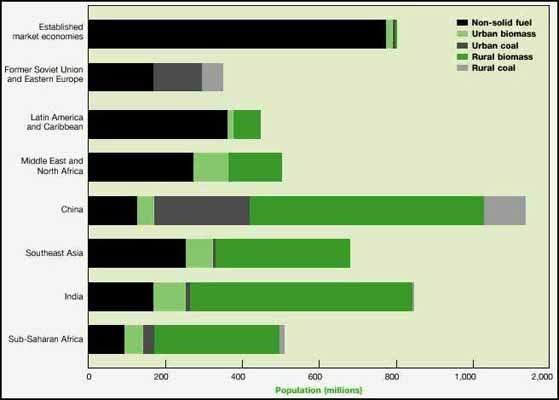
FIGURE 3.1. POPULATION AND
HOUSEHOLD FUEL USE BY REGION, 1995
Source: Updated from Reddy, Williams, and
Johansson,
1997.
Harvesting
The chief environmental impacts of household fuel cycles relate
to harvesting and combustion. In the 1970s books and newspapers called attention
to the ‘other’ energy crisis, referring to the growing and alarming
shortage of woodfuel affecting a large fraction of the world population that
depended on it. Since deforestation and desertification were often also
occurring in such places, it was perhaps a logical conclusion that fuel demand
was to blame. It is still common today to read that deforestation is caused by
fuel gathering in rural areas of developing countries. Detailed studies in many
areas around the world, however, have rarely documented cases in which fuel
demand is a significant cause of deforestation. The most important cause by far
seems to be expansion of agricultural lands, followed by lumbering and road
building. Indeed, the causation is more often the reverse-that is, the shortage
of fuelwood is due to deforestation, rather than the other way around.
Part of the misunderstanding stems from the assumption that
rural households gather woodfuel from forests. In many areas villagers gather
significant amounts of fuelwood from what Gerald Leach has called
‘invisible trees’-the trees around fields, next to houses, along
roads, and so on that do not show up in most satellite remote sensing surveys or
national forest statistics. Thus when estimates of local fuelwood demand appear
to exceed growth rates in local forests, it does not necessarily imply that
deforestation is taking place. Conversely, if deforestation is known to be
occurring, it does not mean that fuel demand is necessarily the reason.
Similarly, desertification in the Sahel and elsewhere in
Sub-Saharan Africa has links to fuel demand. But it has been difficult to
separate out the influence of all the relevant factors, including climate
change, intensification of grazing, land-use shifts, and fuel harvesting.
Nevertheless, as with deforestation, there are some poor areas where harvesting
of wood and brush plays an important role.
|
BOX 3.1. HEALTH-DAMAGING POLLUTANTS IN SOLID FUEL SMOKE
FROM HOUSEHOLD STOVES IN INDIA
Biomass smoke
· Small particles,
carbon monoxide, nitrogen dioxide.
· Formaldehyde, acrolein,
benzene, 1,3-butadiene, toluene, styrene, and so on.
· Polyaromatic hydrocarbons such
as benzo(a)pyrene.
Coal smoke
· All the above
plus, depending on coal quality, sulphur oxides and such toxic elements as
arsenic, lead, fluorine, and mercury. |
|
|
Physical form and contaminant
content are the two
characteristics
of fuels that most affect
their pollutant
emissions
when burned. |
Although the link between fuelwood harvesting and deforestation
is far from universal, there are localised cases in which fuelwood demand seems
to contribute significantly to forest depletion. Most prominent among these are
places, mainly in Sub-Saharan Africa, where commercial charcoal production is
practised. In these areas temporary kilns (legal or illegal) in forested areas
are used until local wood resources are depleted, then moved or rebuilt
elsewhere. Charcoal, being a relatively high-quality and high-density fuel, can
be trucked economically across long distances to urban markets. Thus large
charcoal-using cities can have ‘wood sheds’ extending hundreds of
kilometres along roadways, though there is evidence that significant regrowth
often occurs over long enough periods. In some arid and semiarid areas,
harvesting by woodfuel traders to meet urban demand seems to contribute to
forest depletion, although, again, regrowth is often occurring. The quality of
regrowth in terms of biodiversity and other ecosystem parameters is not well
documented, however.
The harvesting of dung and crop residues as fuel does not have
much direct environmental impact. But in some areas it may deprive local soils
of needed nutrients and other conditioners. Indeed, in most rural areas the use
of dung as fuel rather than fertiliser is probably a sign of poverty and lack of
fuel alternatives. Crop residues, on the other hand, consist of a wide variety
of materials, many of which do not have much value as fertiliser or soil
conditioner. Indeed, in some cases disposal becomes a serious problem if these
residues are not gathered for fuel. In these cases the usual practice is to burn
the residues in place on the fields, with consequent pollution implications
(although sometimes with benefits in terms of pest control). Consequently,
regardless of development level, air pollution from post-harvest burning of
farmland is a significant seasonal source of air pollution in many agricultural
areas around the world (see chapter 10). Harvesting and preparation of household
biomass fuels also have occupational health impacts on women and children, due,
for example, to heavy loads and burns (see the section on workplace scale,
below).
Combustion
It is generally difficult to pre-mix solid fuels sufficiently
with air to assure good combustion in simple small-scale devices such as
household stoves. Consequently, even though most biomass fuels contain few
noxious contaminants, they are usually burned incompletely in household stoves
and so produce a wide range of health-damaging pollutants (box 3.1). Wood and
other biomass fuels would produce little other than non-toxic products, carbon
dioxide, and water when combusted completely. But in practice sometimes as much
as one-fifth of the fuel carbon is diverted to products of incomplete
combustion, many of which are important health-damaging pollutants.
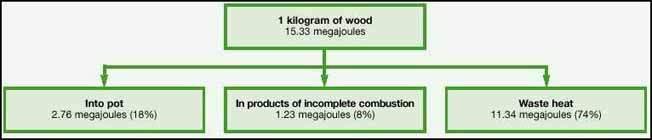
FIGURE 3.2A. ENERGY FLOWS IN A
TYPICAL WOOD-FIRED COOKING STOVE
Source: Smith and others, 2000
a.
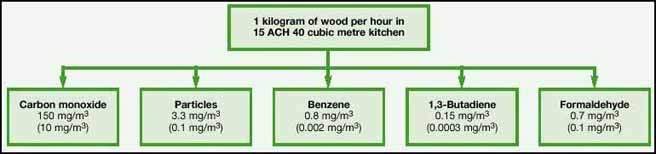
FIGURE 3.2B. INDOOR
CONCENTRATIONS OF HEALTH-DAMAGING POLLUTANTS FROM A TYPICAL WOOD-FIRED COOKING
STOVE
Note: Dozens of other health-damaging pollutants are
known to be in woodsmoke. Mg/m3 stands for milligrams per cubic
metre. Numbers in parentheses are typical standards set to protect health.
Source: Smith and others, 2000 a.

FIGURE 3.2C. GREENHOUSE GAS
EMISSIONS FROM A TYPICAL BIOMASS COOKSTOVE
Note: Numbers in parentheses are carbon dioxide
equivalents of non-carbon dioxide gases.
Source: Smith and others, 2000 a.
Coal, on the other hand, is not only difficult to burn
completely because it is solid, but also often contains significant intrinsic
contaminants that add to its emissions of health-damaging pollutants. Most
prominent among such emissions are sulphur oxides (see box 3.1). But in many
areas coal also contains arsenic, fluorine, and other toxic elements that can
lead to serious health-damaging pollutants. Tens of millions of people in China,
for example, are exposed to such pollutants from household coal use.
Petroleum-based liquid and gaseous fuels, such as kerosene and
liquefied petroleum gas, can also contain sulphur and other contaminants, though
in much smaller amounts than in many coals. In addition, their physical forms
allow much better pre-mixing with air in simple devices, assuring much higher
combustion efficiencies and lower emissions of health-damaging pollutants in the
form of products of incomplete combustion. Furthermore, stoves for
petroleum-based liquid and gaseous fuels are much more energy efficient than
those for coal. As a result emissions of health-damaging pollutants per meal
from these fuels are at least an order of magnitude less than those from solid
fuels (Smith and others, 2000a).
Not only do solid-fuel stoves produce substantial emissions of
health-damaging pollutants per meal, but a large fraction do not have chimneys
for removing the emissions from the home. Consequently, indoor concentrations of
health-damaging pollutants can reach very high levels. Figure 3.2a shows the
energy flows of a typical wood-fired cooking stove, in which a large fraction of
the fuel energy is lost because of low combustion efficiency or low transfer of
the heat to the pot. Figure 3.2b shows the excessive pollutant levels commonly
reached in these circumstances, well beyond World Health Organization
guidelines. Even in households with chimneys, however, heavily polluting
solid-fuel stoves can produce significant local outdoor pollution. This is
particularly true in dense urban slums, where such ‘neighbourhood’
pollution can be much higher than average urban pollution levels.
To estimate the health damage from pollution, it is necessary to
take into account the amount of pollution released. Equally important, however,
is the behaviour of the population at risk. Even a large amount of pollution
will not have much health impact if little of it reaches people. But a
relatively small amount of pollution can have a big health impact if it is
released at the times and places where people are present, such that a large
fraction is breathed in. Thus it is necessary to look not only at where the
pollution is but also at where the people are.
Unfortunately, pollution from household stoves is released right
at the times and places where people are present-that is, in every household
every day. This is the formula for high pollution exposures: significant amounts
of pollution often released in poorly ventilated spaces at just the times when
people are present. Moreover, because of their nearly universal responsibility
for cooking, women and their youngest children are generally the most exposed.
Thus, although the total amount of health-damaging pollution
released from stoves world-wide is not high relative to that from large-scale
use of fossil fuels, human exposures to a number of important pollutants are
much larger than those created by outdoor pollution. As a result the health
effects can be expected to be higher as well.
In many ways the harvesting impacts and air pollution from use
of biomass fuels are the result of fuel shortages, particularly where inferior
forms (dung and crop residues) are in use. Thus these can be considered part of
the health effects of too little energy, along with lower nutrition and chilling
(box 3.2).
|
BOX 3.2. HEALTH EFFECTS OF TOO LITTLE WOODFUEL
Lack of sufficient fuel for heating and cooking has several
negative health impacts. First, in many places women and children must walk
further and work harder to gather fuel, using more energy and time and placing
themselves at increased risk of assault and natural hazards such as leeches and
snakes. In addition, nutrition can be negatively affected if families have to
walk long distances to gather cooking fuel. When seasonal changes result in
longer fuel collection times, families are unable to compensate by reducing the
time spent on agricultural activities. Instead the time is subtracted from
resting and food preparation.
Inferior fuels, such as twigs and grass, that are used as
substitutes in times of shortage require more attention from women during
cooking, keeping them from other tasks. These fuels also produce more
health-damaging smoke and are inadequate for processing more nutritious foods
such as cereals and beans (since they have long cooking times). The figure at
right outlines some coping strategies adopted by households to deal with fuel
shortages and their health consequences.
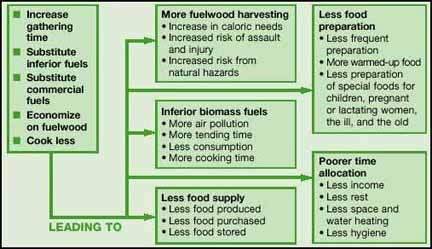
Household coping strategies for
fuelwood shortages
Source: Agarwal, 1985; Brouwer, 1994. |
|
|
BOX 3.3. NATIONAL BURDEN OF DISEASE FROM HOUSEHOLD SOLID
FUEL USE IN INDIA
National surveys, including the 1991 national census, show that
nearly 80% of Indian households use biomass as their primary cooking fuel. As a
result, a large portion of the Indian population is potentially exposed to
indoor and outdoor levels of pollution produced by cooking stoves. Based on
risks derived solely from studies of the health effects of individual diseases
occurring in biomass-using households in developing countries, many in India
itself, it is possible to estimate the total national burden of disease in India
from use of these fuels:
Acute respiratory infection. More than a dozen studies
around the world have found that household use of solid fuels is associated with
acute respiratory infection in young children (although, as with all the
diseases discussed here, there are other important risk factors, including
malnutrition and crowding). Acute respiratory infection is the leading cause of
death of the world’s children and the largest category of ill health in the
world in terms of disease burden. Almost 9 percent of the global burden of ill
health and 12 percent of India’s is due to acute respiratory infection.
Acute respiratory infection linked to solid fuel use is estimated to cause
290,000-440,000 premature deaths a year in Indian children under 5.
Tuberculosis has been associated with household solid
fuel use in a national survey in India involving nearly 90,000 households as
well as in smaller studies. Although this relationship is not yet established
with complete certainty, it would be highly significant because tuberculosis is
on the rise in many developing countries due to HIV infection and the increase
in drug-resistant strains. In India 50,000-130,000 cases of tuberculosis in
women under 15 are associated with solid fuel use.
Chronic respiratory disease, such as chronic bronchitis,
is almost entirely due to smoking in the industrialised world. But studies in
Asia and Latin America have found the chronic respiratory disease develops in
women after long years of cooking with solid fuels. In India 19,000-34,000 women
under 45 suffer from chronic respiratory disease linked to solid fuel use.
Lung cancer, which is also dominated by smoking in
industrialised countries, has been found to result from long-term exposure to
cooking with coal in more than 20 studies in China. No such effect has been
shown for biomass fuels, however. In India 400-800 women under 45 suffer from
lung cancer linked to solid fuel use; the number is small because households
rarely use coal.
Cardiovascular (heart) disease. Although there are
apparently no studies in biomass-using households, studies of urban air
pollution suggest that in India 50,000-190,000 women under 30 suffer from
pollution-related heart disease.
Adverse pregnancy outcomes. Stillbirth and low
birthweight have been associated with solid fuel use by pregnant women in Latin
America and India. Low birthweight is a big problem in developing countries
because it is a risk factor for a range of health problems. In India, however,
there are too few studies to calculate the impacts of solid fuel use on adverse
pregnancy outcomes.
Total. Because there is more uncertainty in the estimates
for tuberculosis and heart disease, only the low ends of the estimated ranges
are used. In India 410,000-570,000 premature deaths a year in women and
children, of 5.8 million total, seem to be due to biomass fuel use. Given the
age distribution of these deaths and the associated days of illness involved,
5-6 percent of the national burden of disease in women and young children can be
attributed to biomass fuel use in households. For comparison, about 10 percent
of the Indian national burden of disease is attributed to lack of clean water
and sanitation. |
Source: Smith, 2000; Smith and others, 2000;
Murray and Lopez,
1996.
Estimated health effects
Considering the sizes of the relevant populations and the
exposures to health-damaging pollutants, there has been relatively little
scientific investigation of the health effects of indoor air pollution in
developing countries relative to studies of outdoor air pollution in cities.
Nevertheless, enough has been done to enable rough estimates of the total impact
of air pollution, at least for women and young children (who suffer the highest
exposures).
Four main types of health effects are thought to occur, based on
studies in households that use solid fuels and corroborated by studies of active
and passive smoking and outdoor air pollution (Smith, 1998):
· Infectious
respiratory diseases such as acute respiratory infections and tuberculosis.
· Chronic respiratory diseases
such as chronic bronchitis and lung cancer.
· Adverse pregnancy outcomes
such as stillbirth and low birth-weight in babies born to women exposed during
pregnancy.
· Blindness, asthma, and heart
disease (less evidence to date).
The best estimates of such effects for developing countries have
been done for India (box 3.3). These indicate that household solid fuel use
causes about 500,000 premature deaths a year in women and children under 5. This
is 5-6 percent of the national burden of ill health, or 6-9 percent of the
burden for these two population groups.3 This is comparable to,
though somewhat less than, the estimated national health impacts of poor water
and sanitation at the household level-and more than the national burdens of such
major health hazards as malaria, tuberculosis, tobacco, AIDS, heart disease, or
cancer (Murray and Lopez, 1996).
Given that India contains about one-quarter of the world’s
solid-fuel cooking stoves, the global impact could be expected to be about four
times larger, or about 2 million deaths a year in women and children. This is
roughly compatible with World Health Organization estimates of about 2.5
million, estimates that were generated by extrapolating studies from
industrialised country cities to developing country conditions (WHO, 1997). The
global burden of disease from major risk factors, including indoor air
pollution, is shown in figure
3.3.
Greenhouse gases
The same incomplete combustion processes that produce emissions
of health-damaging pollutants from household solid-fuel stoves also produce
greenhouse gas emissions. (Greenhouse gas emissions and their global impacts are
described below, in the section on the global scale.) A large amount of fuel
carbon is typically diverted to gaseous products of incomplete combustion, all
of which cause greater global warming per carbon atom than would be the case if
complete combustion occurred and all the carbon was released as carbon dioxide
(see figure 3.2c). The most powerful of these is methane, which over a 20-year
period causes more than 20 times the global warming from the same amount of
carbon as carbon dioxide (equivalent to a discount rate of about 4 percent).
Greenhouse gas emissions from several of the most important
household fuels in developing countries (as measured in India) are shown in
figure 3.4. Because of significant emissions of non-carbon dioxide greenhouse
gases, solid biomass fuels, even though renewable, can have a larger greenhouse
gas commitment per meal than fossil fuels, kerosene, and liquefied petroleum
gas. These relationships have several important policy implications:
· Even if renewably
harvested, many biomass fuel cycles are not greenhouse gas neutral because of
their substantial production of products of incomplete combustion.
· In some situations, therefore,
substitution of fossil fuels for renewable biomass might be recommended to
reduce greenhouse gas emissions.
· To be greenhouse gas neutral,
biomass fuel cycles must be based on renewable harvesting and must have close to
100 percent combustion efficiency (which most do not in their current
configurations).
· Improved biomass stoves should
be designed to increase overall efficiency and to reduce combustion
inefficiency, which is the cause of greenhouse gas and health-damaging
pollutants.
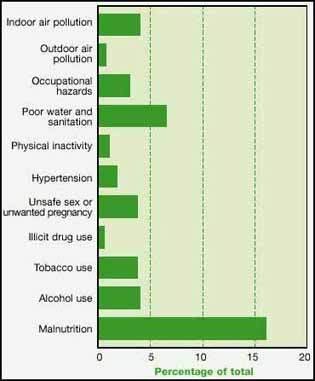
FIGURE 3.3. GLOBAL BURDEN OF
DISEASE FROM SELECTED MAJOR RISK FACTORS, 1995
Note: Burden of indoor air pollution extrapolated
from data for India.
Source: Smith, 2000; Murray and Lopez,
1996.
Stoves using biogas, which is made in household or village
anaerobic digesters from dung (see chapter 10), have by far the least greenhouse
gas emissions per meal-only about 10 percent of those for liquefied petroleum
gas and a factor of 80 less than the average stove burning dung directly (see
figure 3.4). A complete comparison of these fuel-stove combinations would
require evaluating greenhouse gas emissions over the entire fuel cycle in each
case, for example, including methane leaking from biogas digesters and releases
from oil refineries making kerosene. Nevertheless, the extremely low greenhouse
gas emissions from biogas stoves illustrate the potentially great advantage for
greenhouse gas emissions of processed biomass fuels such as biogas. Such fuels
can be both renewably harvested as well as burned as liquids or gases with high
combustion efficiency. (The section on cross-scale impacts, below, discusses
some of the potential opportunities for reducing impacts at the household and
global scales through improvements in household cooking.)
Reducing the human health and global warming impacts of
household stoves will require better stoves with higher efficiency, lower
emissions, and cleaner fuels. These issues are discussed in chapter 10. Of
course, the largest greenhouse gas emissions are from energy systems used in
industrialised countries, as discussed in later
sections.
Workplace scale
The extraction, transport, use, and waste management of energy
sources involve important health hazards related to the work and workplaces
involved in these activities. Many of the jobs involved, such as forestry and
mining for solid fuels, are particularly dangerous. Many workers are engaged in
these jobs, particularly in countries that are rapidly developing their
industries and the energy sources that the industries require. In addition, much
of the work needed for household energy supply in developing countries is
carried out as a household task that does not figure in national statistics as
an ‘occupational issue’.
This section analyses these health issues based on the type of
energy source and give examples of how the effects have been documented in
different countries. The fourth edition of the International Labour
Organisation’s Encyclopaedia of Occupational Safety and Health
(Stellman, 1998) provides additional detail about energy jobs and their health
hazards.
Biomass
As noted, wood, crop residues, dung, and the like are common
energy sources for poor households in developing countries. Wood is also still
widely used in industrialised countries, in some cases promoted in the interest
of reducing greenhouse gas emissions. Wood and agricultural waste are often
collected by women and children (Sims, 1994). Such collection is part of daily
survival activities, which also include water hauling, food processing, and
cooking (see chapters 2 and 10). An analysis in four developing countries found
that women spend 9-12 hours a week on these activities, while men spend 5-8
hours (Reddy, Williams, and Johansson, 1997). Women’s role in firewood
collection is most prominent in Nepal (2.4 hours a day for women and 0.8 hours
for men).
Firewood collection may be combined with harvesting of wood for
local use in construction and small-scale cottage industry manufacturing. This
subsistence work is often seasonal, unpaid, and not recorded in national
economic accounts. Globally about 16 million people are involved in forestry
(Poschen, 1998), more than 14 million of them in developing countries and 12.8
million in subsistence forestry.
A number of health hazards are associated with the basic
conditions of the forest. Forest workers have a high risk of insect bites,
stings from poisonous plants, leech infestation, cuts, falls, and drowning. In
tropical countries the heat and humidity put great strain on the body, while in
temperate countries the effects of cold are a potential hazard. The work is
outside, and in sunny countries ultraviolet radiation can be another health
hazard, increasing the risk of skin cancer and eye cataracts (WHO, 1994). All
forestry work is hard physical labour, with a risk of ergonomic damage such as
painful backs and joints as well as fatigue, which increases the risk of
injuries. Heavy loads of firewood contribute to ergonomic damage (Poschen,
1998). Women carrying heavy loads of firewood are a common sight in areas with
subsistence forestry (Sims, 1994). Falling trees, sharp tools, dangerous
machinery, and falls from heights are the main causes of injuries. In addition,
the living conditions of forestry workers are often poor, and workers may be
spending long periods in simple huts in the forest with limited protection
against the weather and poor sanitary facilities.
Urbanisation leads to the development of a commercial market for
firewood and larger-scale production of firewood from logs or from smaller waste
material left over after logs have been harvested. Energy forestry then becomes
more mechanised, exposing workers to additional hazards (Poschen, 1998).
Motorised hand tools (such as chain saws) become more common, resulting in high
risks of injuries, noise-induced hearing losses, and ‘white finger
disease’ caused by vibration of the hands. In addition, fertilisers and
pesticides become part of the production system, with the potential for
poisoning those who spray pesticides. As forestry develops further, more logging
becomes mechanised, with very large machinery reducing the direct contact
between workers and materials. Workers in highly mechanised forestry have only
15 percent of the injury risk of highly skilled forestry workers using chain
saws (Poschen, 1998). Still, firewood production remains an operation that
requires manual handling of the product at some stage and so tends to remain
hazardous.
Another health aspect of wood-based energy is the risk of
burning wood that has been treated against insect damage with copper-arsenic
compounds or that has been painted with lead paint. Such wood may be harder to
sell and so may be used to a greater extent by firewood production workers in
stoves and open fires. When burned, poisonous arsenic and lead compounds will be
emitted with the smoke. These compounds are health hazards when
inhaled.
Coal
Coal is a major global energy source, accounting for 23 percent
of total energy consumption. It was the primary energy source from 1900 until
1960, when it was overtaken by oil (WHO, 1997). Coal can be produced through
surface (open cast) mining or underground mining. Like mining in general, both
operations are inherently dangerous to the health of the workers. About 1
percent of the global workforce is engaged in mining, but these workers account
for 8 percent of the 15,000 fatal occupational accidents each year. Armstrong
and Menon (1998) offer a detailed review of occupational health and safety
issues in coal mining and other mining.
|
Pollution from household stoves
is released right at the
times and
places where people are present -
that is, in every
household
every day. |
Underground coal miners are exposed to the hazards of excavating
and transporting materials underground. These hazards include injuries from
falling rocks and falls into mine shafts, as well as injuries from machinery
used in the mine. There are no reliable data on injuries of this type from
developing countries (Jennings, 1998), but in industrialised countries miners
have some of the highest rates of compensation for injuries - and the situation
is likely to be worse in developing countries. In addition, much of the
excavation involves drilling into silica-based rock, creating high levels of
silica dust inside the mine. Pneumoconiosis silicosis is therefore a common
health effect in coal miners (Jennings, 1998).
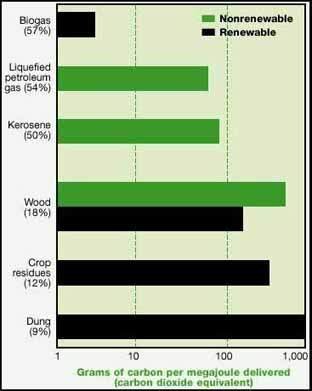
FIGURE 3.4. GREENHOUSE GAS
EMISSIONS FROM HOUSEHOLD FUELS
Note: Includes warming from all greenhouse gases
emitted: carbon dioxide, methane, carbon monoxide, non-methane hydrocarbons, and
nitrous oxide. Weighted by stove distribution in India. Numbers in parentheses
are average stove energy efficiency.
Source: Smith and others, 2000 b.
Other health hazards specific to underground coal mining include
coal dust, which can cause ‘coal worker’s pneumoconiosis’ or
anthracosis, often combined with silicosis. Coal dust is explosive, and
explosions in underground coal mines are a constant danger for coal miners. Coal
inherently burns, and fires in coal mines are notuncommon. Once such a fire has
started, it may be almost impossible to extinguish. Apart from the danger of
burns, the production of smoke and toxic fumes create great health risks for the
miners.
Even without fires, the coal material produces toxic gases when
it is disturbed: carbon monoxide, carbon dioxide, and methane (Weeks, 1998).
Carbon monoxide is extremely toxic because it binds to haemoglobin in the blood,
blocking oxygen transport and creating chemical suffocation (Bascom and others,
1996). Carbon monoxide is a colourless and odourless gas and so gives no warning
before the symptoms of drowsiness, dizziness, headache, and unconsciousness
occur. Carbon dioxide, also colourless and odourless, displaces oxygen in
underground air and can also cause suffocation. Another health hazard in mining
is exhaust from the diesel engines used in underground machinery and transport
vehicles. This exhaust contains very fine particles, nitrogen oxides, and carbon
monoxide, all of which pose serious health hazards (Bascom and others, 1996).
Exposure to fine particles in diesel exhaust increases the risk of lung cancer
(Holgate and others, 1999).
Surface coal mining avoids some of the hazards of working
underground. Still, it involves the risk of injuries from machinery, falls, and
falling rocks. In addition, coal mining is energy-intensive work, and heat,
humidity, and other weather factors can affect workers’ health. The
machinery used is also noisy, and hearing loss is a common among miners. Another
health hazard is the often squalid conditions under which many coal workers and
their families in developing countries live, creating particular risk for the
diseases of poverty. In addition, such workers are likely to receive part of
their compensation in the form of coal for use as household fuel, with
consequent indoor and neighbourhood pollution.
After extraction, coal needs to be processed and transported to
residential areas, power stations, and industries. This creates other types of
occupational hazards (Armstrong and Menon, 1998). For instance, coal for
residential use is often ground and formed into briquettes. This work involves
high levels of coal dust as well as noise hazards. Loading, transportation, and
off-loading of large amounts of coal involves ergonomic, noise, and injury
hazards.
The large-scale use of coal in power stations and industry
creates yet more hazards. One is the conversion of coal to coke in steel
production. This process distils a large number of volatile polycyclic aromatic
hydrocarbons in coal, the so-called coal tar pitch volatiles (Moffit, 1998).
Exposure to these hydrocarbons puts coke oven workers at twice the lung cancer
risk of the general population (IARC, 1984). (This process is not entirely
associated with energy supply, as an important aim is to provide carbon to
reduce iron oxides to elemental iron.) Additional health hazards are created for
workers when the large amounts of ash produced by power stations and industry
need to be transported and deposited. Crane (1998) reviews the health hazards
faced by power generation workers.
|
Solid biomass fuels, even though
renewable, can have a
larger greenhouse
gas commitment per meal than
fossil fuels, kerosene,
and
liquefied petroleum gas. |
Oil and gas
Oil and gas exploration, drilling, extraction, processing, and
transport involve a number of the same hazards as mining: heavy workload,
ergonomic hazards, injury risk noise, vibration, and chemical exposures (Kraus,
1998). This work is often carried out in isolated areas with inclement weather
conditions. Long-distance commuting may also be involved, causing fatigue,
stress, and traffic accident risks.
The ergonomic hazards lead to risks of back pain and joint pain.
Injury hazards include burns and explosions. Skin damage from exposure to oil
and to chemicals used in drilling creates a need for well-designed protective
clothing. In addition, many oil and gas installations have used asbestos to
insulate pipes and equipment. Inhalation of asbestos dust in the installation
and repair of such equipment creates a risk of lung cancer, asbestosis, and
mesothelioma (WHO, 1998a).
A lot of exploration and drilling for oil and gas occur
offshore. This involves underwater diving, which is dangerous. In addition,
weather-related exposures can be extreme, particularly since the work often
requires round-the-clock operations (Kraus,
1998).
Hydropower and other renewables
Major hazards occur when a hydroelectric power station is built,
because this usually requires constructing a large dam, excavating underground
water channels, and building large structures to house the generator. McManus
(1998) lists 28 occupational hazards potentially involved in the construction
and operation of hydroelectric power stations. These include asbestos exposure,
diesel and welding fumes, work in confined spaces or awkward positions,
drowning, electrocution, noise, heat, electromagnetic fields, vibration,
weather-related problems, and chemical exposures from paints, oils, and PCBs
(polychlorinated biphenyls). As in any industry, however, proper attention to
health and safety can keep the risks to acceptable levels.
The manufacture of wind and solar power equipment involves the
typical hazards in manufacturing: injuries, noise, chemical exposures, and so
on. In addition, the technologies for solar electricity generation involve new
chemical compounds, some based on rare metals with poorly known toxic properties
(Crane,
1998).
Nuclear danger
Nuclear power generation has its own hazards due to the
radiation danger involved in mining, processing, and transporting uranium, as
well as the radiation in nuclear power stations. In addition, occupational
hazards will develop as countries start to deal with the backlog of radioactive
waste. Due to the major potential risk to the general public from a
malfunctioning nuclear power station, the safety of stations is always
paramount. This has contributed to a low average occupational health risk for
workers in the stations (Morison, 1998).
The mining of uranium has been an important occupational health
hazard in nuclear power generation, as underground mining for uranium often
entails high exposure to radon, a radioactive gas emitted from uranium. Radon
exposure leads to an increased risk of lung cancer. In addition, the same
occupational hazards in mining noted above occur, although the relatively high
energy content of uranium ore means that there are fewer health effects per unit
of electricity produced.
Until the Chernobyl accident, relatively few nuclear power
station workers had been affected by radiation exposure. In that accident,
however, 40 workers lost their lives in the fire or due to acute radiation
exposure. The long-term impact on workers exposed during the accident in the
form of cancer and other radiation-related effects is not yet known, however.
The clean-up after the accident may eventually create substantially more
effects. As many as 900,000 army, police, and other workers were called on to
take part. Many workers were needed because they were only allowed to work for a
short time, until they had reached the maximum allowable radiation dose. In some
cases this dose was reached in a few minutes. Studies are now being undertaken
to establish the exposure of each clean-up worker and the long-term health
impacts (WHO,
1996).
Number of workers and quantitative health effects estimates
It is difficult to estimate the number of workers involved in
meeting the energy requirements of communities. As noted, in poor communities
much of this work is carried out by family members, particularly women, who are
not formally employed. In addition, much of this work is carried out by small
industries that are not always recorded in national employment statistics.
As noted, an estimated 16 million people are involved in
forestry, most of them in developing countries. In industrialised countries with
reliable statistics, the occupational mortality rate for agricultural workers is
5-10 times the average for all workers (Kjellstrom, 1994). Because of the
additional risks in forestry, mortality rates for these workers are possibly
twice as high again, or 32,000-160,000 at a global level. Not all of this
activity is directly related to fuel demand, however.
As noted, miners are a large occupational group in international
statistics (UN Demographic Yearbooks). They represent up to 2 percent of the
economically active population in certain developing countries. Mining is an
extremely dangerous occupation. Recent data show that occupational mortality
rates for miners are up to 20 times the average for all occupations (ILO, 1998).
The range of mortality rates may be as wide as that for forestry (2-10 per 1,000
workers per year). In most countries the economically active population is 40-60
percent of the population over 15. Thus miners may account for 1 percent of the
population over 15, or about 30 million people world-wide. If half of these
miners are coal miners, the number of miners killed each year in accidents would
be about the same as for forestry workers (30,000-150,000). Another approach to
this calculation is through total coal production. If applied to the
world’s coal production today, about 70 percent of which is in developing
countries, the mean death rate in U.S. mines from 1890-1939 of 3.1 deaths per
million tons produced would predict 16,000 coal mining deaths a year world-wide
(ORNL and RFF, 1994a). This may be low, however, because China alone has about
6,500 coal mining deaths a year according to official statistics, which tend to
be incomplete (Horii, 1999). The estimate of 6,500 of 16,000 deaths, on the
other hand, is roughly consistent with China’s 30 percent share of global
production (BP, 1998).
For energy production and distribution as a whole, occupational
mortality may sum to 70,000-350,000 a year. These numbers are likely to exclude
many cases of occupational disease (such as cancers caused by asbestos or
radiation) and deaths among the many workers in informal workplaces. The upper
limit of the numbers, however, may also be inflated by the crude estimates of
mortality rates and number of workers. Occupational mortality rates in energy
jobs in industrialised countries are generally 10-30 times lower than in
developing countries (Kjellstrom, 1994; ILO, 1998), indicating that more
effective prevention programs could eliminate more than 90 percent of the deaths
referred to above. Still, energy-related jobs have inherent health risks that
need to be considered when assessing the full impact of energy production and
distribution.
Although too often ignored in discussions of environmental
health risks, the burden of occupational disease and injury is substantial on a
global scale. It is conservatively estimated that with well over 1 million
deaths a year, nearly 3 percent of the global burden of ill health is directly
attributable to occupational conditions (Leigh and others, 1996). This is
substantial, accounting for more than motor vehicles, malaria, or HIV and about
equal to tuberculosis or stroke. Although the fraction due directly to supplying
energy is unclear, energy systems employ many millions of people worldwide in
jobs substantially riskier than average-particularly in jobs producing solid
fuels.
Community scale
Energy systems are associated with a vast array of insults and
impacts (see table 3.1). Many of these are expressed at the community scale,
including problems associated with coal and uranium mining, petroleum and gas
extraction, water use and contamination by power plants, thermal pollution, and
noise from wind farms. Here we can only focus on the largest of these impacts
world-wide.
Urban air pollution is the chief environmental impact of energy
systems at the community level. Although there are industrial and other sources
of some pollutants, the vast bulk-whether measured by mass or by hazard-is
generated by fuel combustion or, as in the case of photochemical smog, is
created in the urban atmosphere by precursor chemicals largely released in the
course of fuel use. From the 1930s to the 1950s a number of urban air pollution
episodes in the industri-alised world brought air pollution to the attention of
the public. The first major improvements came by banning the burning of refuse
and coal within city limits. By the early 1970s the infamous London smogs (and
their parallels in other cities), caused by coal combustion, were memories. Two
other community-level impacts are also discussed in this section: those due to
large hydroelectric dams and to nuclear
power.
Fuel-derived air pollution in cities of industrialised countries
During the past 25 years the cities of the industrialised world
have generally brought energy-derived urban air pollutants under even greater
control. In the United States, for example, emissions per unit of useful energy
from power plants and automobiles-the two largest urban energy polluters-have
fallen 65 percent and 50 percent in health hazard (weighted by the relative
standards for each pollutant).4 Japan and Western Europe have
achieved similar results.
In the power sector these achievements have mostly come about by
relying more on nuclear power and natural gas and by requiring smokestack
controls for particles and nitrogen and sulphur oxides at coal-fired power
plants. In addition, thermal power plants have become more efficient, and more
improvements are expected, particularly for those using gas (see chapter 8). For
vehicles, the reductions have come from a mix of improvements in engine
combustion, increases in fuel efficiency (in North America), and the nearly
universal requirement of catalytic converters (devices to help control pollutant
emissions). Thus, despite significant increases in power production and vehicle
use since 1975, overall emissions of most pollutants are now lower.
As a result of these emission reductions, urban air quality has
generally improved throughout the industrialised world. Although fuel combustion
produces a number of health-damaging pollutants, as explained above, small
particles are probably the best single indicator. Suspended small particles are
a mix of primary combustion particles-carbonaceous materials and associated
trace elements-and secondary conversion products such as sulphate and nitrate
aerosols. In many parts of the world, windblown and urban dust can also be
significant contributors to suspended particles.
Small particles are deposited deep in the lungs, where their
clearance is slow and their ability to cause damage is enhanced. Small particles
also carry adsorbed trace metals and carcinogenic hydrocarbons into the lungs,
intensifying the potential for health damage. Assessments of the human health
effects of air pollutants increasingly focus on these small particles. Still,
there are few measurements of these particles in most cities, although more
cities are measuring PM10 (particles less than 10 micrograms), which
is considered a better indicator than simple total particulate levels (National
Research Council, 1998).5 In the late 1990s the mean annual cocentration of
PM10 in North American, Western European, and Japanese cities ranged
from 30-45 micrograms per cubic metre (figure 3.5). (The U.S. standard is 50
micrograms per cubic metre.) In the 1960s particulate levels were probably two
to four times higher. (Small particles were not measured routinely until the
mid-1980s, so previous levels have to be inferred from measurements of total
particles.)
|
About 1 percent of the global
workforce is engaged in
mining,
but these workers account for
8 percent of the 15,000
fatal
occupational accidents
each year. |
Still, industrialised countries face a number of energy-related
air pollution challenges. Nitrogen dioxide and ozone levels exceed standards in
many cities, particularly in sunny cities with large auto fleets such as Los
Angeles (California) and Athens (Greece). The recent evidence suggesting that
small particles (less than 2.5 micrograms) may be even better indicators of ill
health than PM10 has led the United States to propose new regulations
aimed at PM2.5, potentially putting a number of cities out of
compliance. European countries are also considering such regulations. Since
long-term data are not widely available, it is not clear how much
PM2.5 levels have decreased in recent decades, partly because such
particles are transported over much larger areas than larger particles.
This focus on even smaller particles has brought diesel exhaust
particles under more scrutiny. Unlike gasoline, diesel produces a significant
amount of emissions of particles that are not only smaller but may have chemical
properties that make them more dangerous. This feature raises questions about
the future of diesel-fuelled vehicles, even though such vehicles can be slightly
more fuel-efficient and cost-effective than gasoline-fuelled vehicles. The
tendency for many countries to keep diesel prices low relative to gasoline-as a
means of assisting farming, fishing, and other industries-can artificially
promote diesel passenger vehicles. (See the section on cross-scale impacts,
below, for a discussion of the economic implications of diesel particle health
effects.)
Since the 1980s studies have seemed to indicate that there is no
threshold for the health effects of particle pollution. In other words, there no
longer seems to be an identifiable level that can be termed safe. All that can
be said is that the effect is lower at lower levels, but does not seem to
disappear even at the lowest (background) concentrations. Indeed, in the late
1990s European and global offices of the World Health Organization revised their
particle guidelines to reflect the absence of thresholds (figure 3.6).
Because it is rarely (if ever) practical to set a standard of
zero for pollutants with significant natural sources, standard setting is much
harder for pollutants with no threshold for significant effects. Policy-makers
must determine that the benefits of fuel combustion outweigh the extra mortality
produced by the resulting pollution-for example, that the 5 percent increase in
mortality ‘allowed’ by a PM10 standard of 50 micrograms per
cubic metre above background (see figure 3.6) is acceptable given the societal
advantages of fuel use. This is a difficult determination, and much more
politically difficult than endorsing a standard that has some scientific
validity of being below a ‘no effects’ level, which is how most
standards are set. The likely result will be continuous pressure to tighten
particle standards, with stronger incentives for lower particle emissions from
vehicles, power plants, and other fuel-using sources. Indeed, as discussed in
later chapters, emission reductions are the driving forces for new power and
transport technologies.
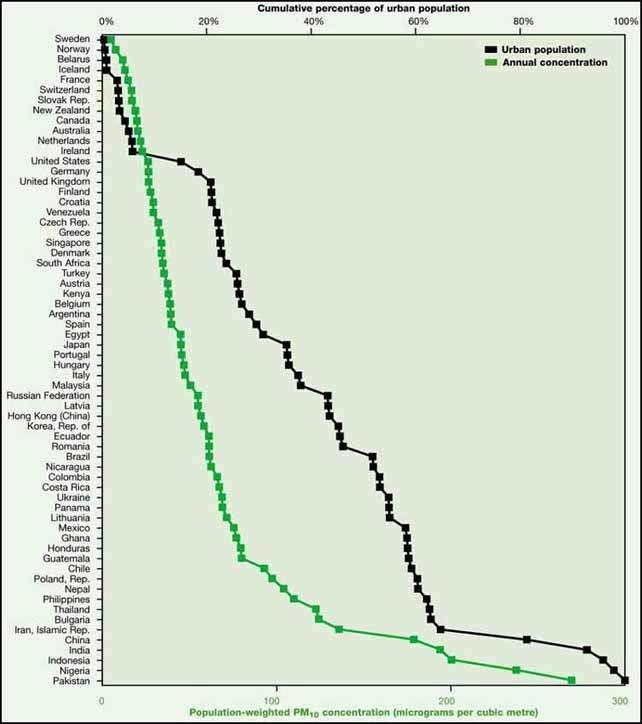
FIGURE 3.5. GLOBAL DISTRIBUTION OF
URBAN PM10 CONCENTRATIONS
Note: In many cases, PM10 levels have
been entirely estimated from measurements of total particles.
Source: WRI, 1998; WHO, 1998b.
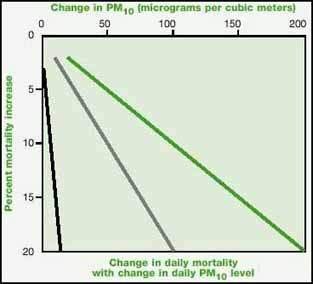
FIGURE 3.6. PROVISIONAL GLOBAL AIR
QUALITY GUIDELINES FOR PARTICLES
Source: WHO, 1999.
As recently as the early 1990s, the main source of lead
emissions throughout the world was tetra-ethyl-lead used as an additive to raise
octane in gasoline. But nearly every country now has a plan to remove lead from
gasoline (box 3.4). Still, significant numbers of children in many
industrialised and developing countries have blood lead levels above those
thought to affect cognitive development (intelligence). These levels will
decline as lead is removed from the rest of the world’s gasoline, although
industrial and other sources must be controlled as
well.
Fuel-derived air pollution in cities of developing countries
Developing country cities have much higher mean pollutant
concentrations than industrialised country cities (see figure 3.5). In cities in
China and India, averages seem to be nearly 200 micrograms per cubic metre of
PM10, though there is much variation by season and city. Such
concentrations must be causing significant premature deaths-perhaps 15 percent
or more above background levels. Indeed, estimates for premature mortality from
urban air pollution range from 170,000-290,000 a year in China (World Bank,
1997; Florig, 1997) and 90,000-200,000 in India (Murray and Lopez, 1996; Saksena
and Dayal, 1997).
|
BOX 3.4. GETTING THE LEAD OUT: A SLOW SUCCESS STORY
“The current consensus is that no amount of Pb [lead] in
the environment can be considered safe” (Schwela and Zali, 1999). Although
this was not the first reason to remove lead from gasoline, it soon became the
driving force. The introduction of catalytic converters spawned the need for
unleaded gasoline to protect the devices. Shortly after, concerns about the
health effects of lead emissions led to an increase in sales of unleaded gas and
a reduction in the lead content of leaded fuel. Since leaded gasoline has been
responsible for about 90 percent of lead emissions, it was the most logical
target for reduction (Lovei, 1998).
Many nations have taken action to phase out lead from fuel.
Canada, Japan, and the United States have completely phased out leaded gasoline
(Lovei, 1998; Schwela and Zali, 1999). Los Angeles (California) saw a 98 percent
reduction in the lead exposure of commuters between 1979 and 1989. In Western
Europe leaded gasoline has a very low lead content, and unleaded fuel has a
large market share in most countries. In addition, a few developing nations have
lowered or even banned lead in gasoline (Lovei, 1998).
Over the past 20 years Singapore has taken significant steps to
phase out lead in fuel. Between 1980 and 1987 the lead content of leaded
gasoline fell to a low 0.15 grams a litre. In 1991 unleaded petrol was
introduced and taxes were changed to make it cheaper than leaded fuel. By the
end of 1997 unleaded fuel accounted for about 75 percent of gasoline sales. In
addition, more stringent exhaust emission standards were implemented for
gasoline-fuelled vehicles, promoting an unleaded fuel market. Finally, oil
companies agreed to phase out leaded gasoline by July 1998.
Mexico has also taken steps to reduce the lead content of fuel,
though it still has far to go. Since 1994 the lead content of leaded fuel has
been cut to 0.15 grams a litre. But it appears that the Mexican National
Petroleum Co. has recently raised lead levels. No government agency has the
authority to ensure fuel quality, making enforcement of low lead levels a
challenge. Unleaded gasoline accounts for 46 percent of sales in Mexico City and
84 percent in Monterrey (which is wealthier and closer to the U.S. border).
Leaded fuel is still cheaper, however. Mexico is implementing new standards
requiring catalytic converters and so unleaded gas.
But large problems remain in many developing countries. The
biggest lead problems are in Africa and in petroleum-exporting nations. These
countries, including Venezuela and those in the Middle East, are dominated by
powerful oil companies and state-owned refineries.
Although in 1994 two-thirds of global gasoline sales were
unleaded, additional efforts are needed. Several mechanisms can encourage the
reduction of lead in gasoline. The most promising is to set fuel taxes so that
unleaded gasoline is cheaper than leaded fuel. Fuel filler inlets should be
required in automobiles to allow only the narrower nozzles of unleaded fuel
pumps to be used. Requiring catalytic converters in vehicles would further
decrease the use of leaded fuel. Emphasising other benefits of using unleaded
gasoline, such as lower exhaust emissions of hydrocarbons, also promotes the
reduction of lead in gasoline (Schwela and Zali, 1999). Finally, as shown in
Brazil, it is possible to substitute 5-10 percent ethanol for lead as an octane
booster, thereby promoting renewable fuels.
An enduring urban myth exists that some older cars need lead to
operate well. As long as the fuel has the correct octane level, no engine needs
lead. Indeed, in many cases the removal of lead will have direct benefits in the
form of less engine maintenance. The persistence of this myth slows the
introduction of low-lead fuels despite technical evidence to the contrary. |
The causes of air pollution in developing country cities are
much more varied than in industrialised countries. Although automobile ownership
rates are much lower, there tend to be many other types of vehicles as well,
including two- and three-wheelers using highly polluting two-stoke engines.
There also tend to be larger portions of light-duty and heavy-duty vehicles
using diesel rather than gasoline. In addition to power plants and large
industries with limited pollution controls, developing country cities tend to
have large numbers of small boilers, engines, and open fires in the commercial
and light-industry sectors, as well as in informal sectors such as street food.
These enterprises tend to rely on the most inexpensive and thus dirty fuels in
inefficient applications without pollution controls-and so have high emissions
per unit of useful energy.
Furthermore, such cities often do not have adequate refuse and
garbage collection, leading to street-side trash burning, a highly polluting
activity. Even when collected, trash often burns uncontrollably in landfills in
or near cities, wasting potential energy and producing clouds of noxious
emissions. Another major non-energy source of particle pollution in many cities
is dust from construction sites and unmanaged empty land. Finally, unlike in
industrialised countries, a large fraction of urban households in developing
countries still use solid fuels for cooking and space heating in inefficient
stoves with no pollution controls (see figure 3.1). Although individually small,
their large number means that these stoves can contribute significantly to urban
pollution.
In addition to dealing with trash, dust, and other non-energy
issues, the most pressing need for pollution control in developing country
cities is to reduce and eventually eliminate small- and medium-scale combustion
of dirty fuels. For stationary sources, this means shifting away from solid
fuels (coal and biomass) and high-sulphur fuels of any kind. For mobile sources,
it means dealing soon with, in order of priority, two-stroke engines, poorly
operating diesel engines, and gasoline-fuelled vehicles without catalytic
converters. In addition, as is happening in Bangkok (Thailand) and New Delhi
(India), there is great advantage in shifting vehicle fleets (taxis, buses,
government vehicles) to clean-burning gaseous fuels such as compressed natural
gas or liquefied petroleum gas (Mage and Zali,
1992).
Urban pollution control in the longer run
Because the best commercial technology in terms of energy
efficiency and emissions has not been deployed completely in industrialised
countries and has been used little in developing countries, much improvement is
possible in the next 20 years without switching to advanced technologies. In the
longer term, however, if air pollution levels are to be brought down to and kept
at low levels given the projected increase in population, urbanisation, economic
activity, and energy use, it will be necessary to develop and deploy new, even
cleaner and more efficient energy-using technologies. A number of advanced power
plant technologies potentially offer such performance (see chapter 8).
|
Dams affect Earth
at scales rivalling other major
human
activities, such as
urbanisation and
road building. |
In addition, some near-commercial vehicle technologies may allow
vehicle densities in developing country cities to grow for several decades and
still meet air quality goals (box 3.5). Strong pollution controls will be needed
to bring these technologies into wide use, however.
In addition to technical changes in vehicles of all types (not
just private cars), a range of other improvements will be needed if the
world’s cities are to accommodate the greater demand for transport that
increases in population and income will bring. These include improvements that
result in significant and sustained enhancement in the attractiveness of public
transport, land-use planning to reduce the need for intraurban trips, and
implementation of policy tools such as time-of-day, congestion, and central-zone
pricing. In addition, significant switches to public transport might occur
through such means as including the cost of vehicle insurance in the price of
fuel and taxing employer-provided parking as income (see chapter
11).
Hydroelectric dams6
Dams, large and small, have brought tremendous benefits to many
regions, including important contributions to development in industrialised
countries. It is important not to deny these benefits to developing countries.
But such dams need to be designed and constructed with care. Although dams
frequently serve many purposes-including flood control, irrigation, navigation,
and recreation-major dams (those over 150 metres high, with 25 cubic kilometres
of storage, or 1,000 megawatts of electricity) tend to have hydropower as one of
the their main objectives. Such dams often have big impacts on the environment.
There are more than 300 major dams world-wide, and nearly all have hydropower as
a major component of their function. The environmental impact per unit of
electricity production, however, can often be smaller for large than for small
dams. The type rather than the size can be the most important factor (Gleick,
1992).
With a total capacity of about 640,000 megawatts of electricity,
hydropower provides about one-fifth of the world’s electricity (Gleick,
1992). In Central and South America hydropower provides about 60 percent of
electricity; in Asia this figure is about 15 percent. Itaipu, on the border of
Brazil and Paraguay, is the most powerful hydropower dam built to date, with a
capacity of 12,600 megawatts of electricity. It cost $20 billion to build. When
finished, China’s Three Gorges Dam will produce about 18,200 megawatts of
electricity and may cost as much as $75 billion (The Economist, 1999).
Thus hydroelectric dams are the most expensive energy projects in the world.
No major river in the world is without existing or planned
hydroelectric dams. Nearly four-fifths of the discharge of the largest rivers in
Canada, Europe, the former Soviet Union, and the United States are strongly or
moderately affected by flow regulation, diversions, and the fragmentation of
river channels by dams (Dynesius and Nilsson, 1994). More than 500,000 square
kilometres-the area of Spain-have been inundated by dam reservoirs world-wide,
though not all for hydropower (Collier, Webb, and Schmidt, 1996). (Indeed, many
hydropower plants have no reservoirs.) Globally, about 200 cubic kilometres of
water a year-about 7 percent of the freshwater consumed by human activities-are
evaporated from the surface of reservoirs due to their increased exposed surface
area (Shiklomanov, 1998). Thus dams affect Earth at scales rivalling other major
human activities, such as urbanisation and road building.
Direct human impacts. During the 20th century 30-60
million people were flooded off their lands by dams (Dunn, 1998). The World
Bank, using Chinese government figures, estimates that 10.2 million people were
displaced by reservoirs in China between 1950 and 1989 (World Bank, 1993). Given
that a number of major dams are under construction or planned in developing
countries, there will be no slackening in the pace of population displacement.
China’s Three Gorges Dam, for example, is expected to displace more than 1
million people, and the proposed Pa Mong Dam between Lao PDR and Thailand is
expected to displace more than 500,000 (Gleick, 1998).
Large population resettlements can have a number of direct
social and health impacts. The social and cultural stress, loss of income,
disruption of traditional support services, and other problems facing displaced
populations often lead to lowered health status. Even when efforts are made to
resettle people in new areas, it is difficult to locate land of similar
productivity because other groups are likely to already occupy the best areas.
Some 13,500 people have been swept to their deaths by the 200 or so dams
(outside China) that have collapsed or been overtopped in the 20th century. In
1975 in Henan, China, about 230,000 people died from a series of dam bursts
(Gleick, 1998).
|
BOX 3.5. ALTERNATIVE VEHICLES
With growing energy and environmental concerns surrounding
today’s conventional vehicles, a great deal of research is going into
alternative vehicles. Four main types of alternative vehicles have the potential
to reduce the environmental and efficiency deficits of conventional vehicles and
to become commercially available in the near future. Electric vehicles are
powered by rechargeable batteries and have no internal combustion engines. The
battery, which can be made of lead-acid, nickel-metal hydride, and
lithium-polymer, can be recharged at home or, in the future, at recharging
stations.
Electric vehicles have several environmental benefits relative
to conventional vehicles, including no tailpipe emissions and lower hydrocarbon,
carbon monoxide, and nitrogen oxide emissions (including emissions from the
production of electricity). Other advantages include lower maintenance costs and
the elimination of the need for complicated tailpipe emission controls.
But electric vehicles also have several disadvantages, such as
the environmental concerns of an increase in electricity use, increasing
emissions of sulphur oxides, and possible contamination from the disposal and
recycling of batteries. There are also disadvantages in terms of convenience and
cost, such as lengthy recharging and lack of infrastructure for recharging
stations, short driving ranges (though electric vehicles are good for local
trips and commuting for two-car households), an inability to maintain high
speeds, and high battery costs. Today electric vehicles cost about $30,000,
which is too expensive for most markets.
Hybrid electric vehicles combine the battery and electric motor
of an electric vehicle with the internal combustion engine and fuel tank of a
conventional vehicle, to obtain the benefits from both technologies. The engine,
which is much smaller than that in a conventional vehicle, operates at a
constant power load and so is more efficient, and less polluting, and generates
only the power required for most operations. Hybrid electric vehicles have
several advantages over conventional vehicles and fewer disavantages than
electric vehicles. Hybrid electric vehicles have higher fuel economy and lower
emissions than vehicles with internal combustion engines, and better range and
more rapid refuelling than electric vehicles. Hybrid electric vehicles also
reduce petroleum consumption and increase energy diversity by using alternative
engines, which can use a range of fuels. But hybrid electric vehicles are still
expensive and not yet fully developed. Programs are in place to develop and
improve hybrid electric vehicles, and several automobile manufacturers are or
will soon be marketing models.
Compressed natural gas vehicles are powered by an abundant,
inexpensive fuel composed largely of methane. Natural gas is a clean-burning
fuel with lower carbon dioxide, carbon monoxide, hydrocarbon, and nitrous oxide
emissions than gasoline. This is partly due to the lower carbon content per unit
of energy in natural gas relative to other fossil fuels. In addition to its
environmental benefits, natural gas vehicles are cheaper to maintain, requiring
service less frequently than conventional vehicles as well as having a lower
cost of refuelling. Converting vehicle fleets such as taxis, three-wheelers, and
buses to natural gas is an important interim way to improve air quality in
developing country cities. Conversion costs are relatively small, although
baggage space is reduced because of the need to add pressurised tanks. It is
hard to use compressed natural gas for private vehicles because of the need to
create many fuelling stations. Urban vehicle fleets, on the other hand, can
operate with relatively few centralised fuelling stations.
Fuel-cell vehicles operate by combining hydrogen and oxygen
gases into an electrochemical device, a cell, that converts them into water and
electricity without using combustion. The hydrogen gas can come from a number of
sources, including multiple forms of pure hydrogen and a variety of hydrocarbon
fuels. Fuel-cell vehicles have many advantages over conventional vehicles. Fuel
cells have a much greater engine efficiency and fuel economy, drastically reduce
pollution emissions (including greenhouse gas emissions), and can use a wide
variety of fuels, promoting energy diversity.
In addition, they are quieter and smoother in operation, have
tested at high performance levels, have long driving ranges, and have about the
same operating costs as conventional automobiles. Still, there are several
drawbacks to fuel-cell vehicles, including the lack of infrastructure to
distribute hydrogen or another fuel (unless gasoline is used), difficult storage
of pure hydrogen, and possible safety concerns. Major automobile companies are
planning to have commercially available fuel-cell vehicles by 2004 and are
currently demonstrating prototypes and improving on them. Large cost reductions
need to occur, however, and fuel infrastructure issues must be resolved before
fuel-cell vehicles are ready for the marketplace.
Of these four alternatives to conventional vehicles, electric
vehicles have the fewest barriers to market entry. But they probably have the
least consumer appeal in terms of environmental improvements and convenience.
Fuel-cell vehicles will probably be found to be the most environmentally
friendly, but they are the furthest from commercial development. Hybrid electric
vehicles also offer a good option in the near future, with convenience and
environmental benefits. All these cars will likely begin to enter the market in
the next 5-10 years, and infrastructure will have to be built to accommodate all
of them as well as today’s automobiles. |
Source: American Honda Motor Company, 1999;
California Energy Commission, 1998; California Environmental Protection Agency,
1999; Ford Motor Company, 1998, 2000; General Motors Corporation, 1999; Global
Toyota, 1999; Gould and Golob, 1997; Hanisch, 1999; Krebs, 1999; Kremer, 2000;
Mark, Ohi, and Hudson, 1994; Matsumoto, Inaba, and Yanagisawa, 1997; Mendler,
1997; National Fuel Cell Research Center, 1999; Natural Gas Vehicle Coalition.
2000a, b; Neil, 1999; Steinbugler and Williams, 1998; USDOE, 1995; USEPA, 1994,
1998b
TABLE 3.2. ECOLOGICAL INSULTS AND IMPACTS OF LARGE DAMS
|
Insult caused by dam |
Impacts seen |
Severity of impact |
Example of impact |
|
Changes in the chemical properties of release water |
Deterioration of downstream ecosystem cased by inability to
process the increased dissolved minerals |
Depends on the sensitivity of the affected ecosystem(tropical
ecosystems are especially sensitive) |
Enhanced algae growth in the reservoir consumes the oxygen in
the epilimnion and, as it decays, the mass sinks to the already oxygen-deficient
hypolimnion, where decay processes reduce the oxygen concentration even further,
resulting in acid conditions at lower levels and the dissolution of minerals
from the reservoir bed. |
|
Changes in the thermal properties of release water |
Thermal pollution often results in species diversity reduction,
species extinction, and productivity changes in the reservoir |
Diversity, biomass, distribution, and density of fish stocks can
be affected, disrupting breeding cycles |
Productivity levels in the surface waters of new reservoirs
often increase before long-term declines occur (Horne, 1994). China’s Three
Gorges Dam may be the final critical factor for driving to extinction the
Yangtze River dolphin. |
|
Changes in the flow rate and timing of release water |
Erosion increases downstream of dam. Settling of sediments in
the reservoir causes high sediment loads to be picked up in the area immediately
below the dam |
Erosion of natural riverbeds can disturb the nurseries and
spawning of many aquatic organisms, disturbing their breeding cycles |
Changes in the downstream river morphology and ecosystem
productivity. |
|
Changes in the sediment load of the river |
High trap efficiencies of dams prevent the natural processes of
sediments and associated nutrients refreshing downstream soils |
Effects often noticed most severely in high-productivity areas
downstream from the dam that no longer receive annual fertilisation |
Before the Aswan High Dam was constructed, the Nile carried
about 124 million tonnes of sediment to the sea each year, depositing nearly 10
million tonnes on the floodplain and the delta. Today 98 percent of the sediment
remains behind the dam, resulting in a drop in soil productivity and depth,
among other serious changes to Egypt’s floodplain agriculture (Pottinger,
1997). |
|
Changes in the dynamics of downstream riverbeds |
Increased likelihood of lower water tables, which can create
problems in areas near the dam where groundwater is a major source |
Reduced access to potable water is a huge problem in many
developing countries |
Within nine years of the closure opening of the Hoover Dam, 110
million cubic metres of material had been washed away from the first 145
kilometres of riverbed below the dam (McCully, 1996). |
|
Changes in the coastal area morphology |
The loss of sediment in the rivers flowing through deltas and
into the sea often results in a gradual process of delta and coastal degradation
|
Financially expensive for many areas where there is a large
population living near the coastal zone. |
Over the past 80 years dams have reduced by four-fifths the
sediment reaching the coasts of southern California. This has reduced the beach
cover at the base of cliffs along these shorelines, causing cliffs to collapse
(Jenkins and others, 1988). |
Disease can spread from vectors that thrive in secondary dam
systems, such as irrigation canals and even dam reservoirs. Mosquitoes carrying
malaria, for example, have thrived in conditions created by dams. The parasitic
disease schistosomiasis has also become more prevalent through the creation of
habitats for snails that act as the disease vector. Nearby populations, for
example, suffered nearly universal infection after several large African dams
were filled, including Aswan (Egypt), Akosombo (Ghana), and Sennar (Sudan)
(Nash, 1993).
Ecosystem impacts. An internal survey of World Bank
hydroelectric dam projects found that 58 percent were planned and built without
any consideration of downstream impacts-even when these impacts could be
predicted to cause coastal erosion, pollution, and other problems (Dixon, 1989).
The main ecological insults and impacts of large dams (not just those producing
hydropower) are summarised in table 3.2.
Dams and greenhouse gases. The work assessing the impacts
of dams on greenhouse gas emissions is incomplete, but some estimates have been
made. The most immediate changes are in the carbon flow between the flooded
vegetation and the atmosphere. The decomposition of plants and soils causes the
gradual release of their stored carbon (Rudd and others, 1993).
From a greenhouse gas standpoint, it might be thought that
vegetation decaying in a reservoir would be no worse than the same amount of
deforestation. Because of the low-oxygen conditions near and in the bottoms of
many reservoirs, however, relative to deforestation a larger fraction of the
biomass carbon is likely to be released as methane rather than as carbon
dioxide. Since methane is a much more powerful greenhouse gas than carbon
dioxide, the global warming impacts are greater than the same amount of carbon
released as carbon dioxide.
The peak greenhouse gas emissions, however, are unlikely to
rival those of a similarly sized fossil power plant, emissions from which would
not decrease with age like those from a reservoir. In addition, it is difficult
to determine the baseline in tropical forests-that is, how much methane and
other non-carbon dioxide greenhouse gases are released in natural conditions. In
colder climates reservoirs apparently emit greenhouse gases at much lower rates
(Gagnon,
1998).
Nuclear power
There are two main environmental concerns about nuclear power,
both mostly with regard to its potential impacts on human health. One involves
the highly radioactive products produced by nuclear fission inside power
reactors. Such products require careful management at the reactor and during and
after disposal. The other concern revolves around the weapons-grade plutonium or
uranium that might be clandestinely derived from the nuclear power fuel cycle to
make bombs or other weapons of mass destruction by nations or subnational groups
(see chapter 8).
The routine (non-accidental) emissions of pollutants from the
harvesting, processing, and conversion of nuclear fuels are not negligible. And
more than many technologies, they are vulnerable to being enhanced by
mismanagement. Still, the impacts of these emissions are generally substantially
less than those involved with producing power with current coal technologies,
the chief competitor in many areas. Although involving different pollutants,
routine emissions from nuclear power systems are probably no more dangerous than
those from new natural gas power systems-with the important exception of carbon
dioxide, which is not produced by nuclear power. If public concerns about
reactor safety, proliferation, and waste disposal can be satisfied, nuclear
power may be able to play a significant role in de-carbonising the world energy
system in the next 50 years (see chapter
8).
Regional scale
Nested between local-scale issues-such as the health effects of
urban pollution-and global-scale issues-such as climate change-are a number of
regional-scale problems that affect human health and ecosystems over areas the
size of countries and continents. The most important regional-scale issues are
acid deposition, tropospheric ozone, and suspended fine particles.
Matched with the regional spatial scale is a temporal scale that
requires air pollutants to remain aloft for periods ranging from days to weeks
and thereby be transported by prevailing winds and transformed by chemical
reactions. Gases and fine particles meet this criterion; larger particles
(greater than 1 micron or so in diameter) tend to settle out quickly and are
considered contributors to local, rather than regional, impacts. Fine particles
may be solid (such as elemental ‘black’ carbon) or liquid (such as
aerosol droplets).
Contributing to regional pollution are a number of precursor
species, most of which are generated by the use of fossil fuels and biofuels.
Prominent among them are sulphur dioxide (SO2) and nitrogen oxides
(NOx). Sulphur dioxide is released during the combustion of the
sulphur found naturally in fossil fuels, while nitrogen oxides originate either
as fuel nitrogen or as atmospheric nitrogen oxidised during combustion. Other
species of importance are particulate matter (PM), carbon monoxide (CO), methane
(CH4), and non-methane volatile organic compounds (NMVOC), released
during incomplete combustion and other activities. Ammonia (NH3) is a
significant regional pollutant, but fuel combustion is not its primary source.
TABLE 3.3. ANTHROPOGENIC EMISSIONS OF IMPORTANT SPECIES BY
REGION, 1990 (MILLIONS OF TONNES)
|
Region |
Sulphur dioxide as sulphur) |
Nitrogen oxides as nitrogen) |
Carbon monoxide |
Non-methane volatile organic compounds |
Methane |
|
Energy- related |
Non- energy- related |
Energy- related |
Non- energy- related |
Energy- related |
Non- energy- related |
Energy- related |
Non- energy- related |
Energy- |
Non- |
|
Western Europe |
8.8 |
2.5 |
3.6 |
0.4 |
45 |
23 |
10.1 |
7.6 |
5.5 |
18.0 |
|
Eastern Europe and former Soviet Union |
13.5 |
3.4 |
3.5 |
0.6 |
47 |
36 |
13.9 |
6.2 |
37.6 |
20.3 |
|
North America |
11.6 |
0.7 |
7.6 |
0.3 |
82 |
24 |
13.2 |
8.7 |
23.9 |
21.5 |
|
Asia |
17.9 |
3.0 |
5.6 |
1.9 |
165 |
132 |
30.7 |
24.2 |
25.7 |
98.6 |
|
Rest of world |
8.8 |
4.1 |
3.2 |
4.4 |
105 |
316 |
31.7 |
31.2 |
15.5 |
54.0 |
|
Total |
60.6 |
13.6 |
23.5 |
7.6 |
444 |
531 |
99.6 |
77.9 |
108.2 |
212.3 |
|
74.2 |
31.1 |
975 |
177.5 |
320.4 |
Note: These numbers are slightly different from
those in table 3.1 because of different assumptions and methods. Energy-related
sources include the combustion, extraction, processing, and distribution of
fossil fuels and biofuels. Non-energy-related sources include industrial
processes, deforestation, savannah burning, agricultural waste burning, and
uncontrolled waste burning.
Source: Olivier and others, 1996.
When emissions of these primary species are released into the
atmosphere, they form a complex, reactive ‘soup,’ the chemical and
physical behaviour of which is determined by such factors as temperature,
humidity, and sunlight. The primary species are transported and deposited,
influencing the health of humans and of natural ecosystems. But these primary
species are also transformed into secondary species-such as sulphate, nitrate,
acids, ozone, and miscellaneous organic compounds-that can have effects even
more damaging than their precursors and in areas far removed from the primary
sources. This can lead to transboundary problems, where a country or regionhas
little control over the emissions that damage its
environment.
Emissions and energy
A snapshot of global and regional anthropogenic (human-caused)
emissions in 1990 is provided in table 3.3. The emissions are partitioned into
those derived from energy-related activities (including combustion, extraction,
processing, and distribution of fossil fuels and biofuels) and those derived
from non-energy activities (which have a wide variety of sources, including
industrial processes, deforestation, savannah burning, agricultural waste
burning, and uncontrolled waste burning). Non-anthropogenic sources (volcanoes,
soils) are not included.
Energy activities account for 82 percent of anthropogenic
emissions of sulphur dioxide and 76 percent for nitrogen oxides. Energy
activities play a less dominant role for the three other species-56 percent for
non-methane volatile organic compounds, 46 percent for carbon monoxide, and 34
percent for methane. The smaller role of energy in emissions of these three
species reflects the important contributions of deforestation, savannah burning,
and agricultural waste burning in the generation of products of incomplete
combustion, coupled with rice cultivation and enteric fermentation in the case
of methane. Nevertheless, table 3.3 demonstrates the critical contribution of
energy to emissions of regional-scale pollutants. It also highlights the
importance of the developing world in current patterns of regional emissions.
Sulphur dioxide and nitrogen oxides play a role in the formation
of acid deposition, because they can be transformed to acids in the atmosphere.
The transformation products are fine particles, solid or aerosol, in the form of
sulphates and nitrates. In addition, nitrogen oxides are a major precursor to
the formation of regional tropospheric ozone. Finally, sulphates and nitrates
have the ability to scatter and absorb radiation and so contribute to global and
regional climate change, probably with a net cooling effect.
Carbon monoxide is an important regional atmospheric pollutant
from several perspectives. It acts as an indirect greenhouse gas with a
potential for global warming (see above, in the section on greenhouse gases) on
a 20-year time horizon of about 4.5 due to its influence on the atmospheric
lifetime of methane (IPCC, 1990). In addition, carbon monoxide is toxic to
humans and is a critical component of many photo-chemical reactions in the
atmosphere. It is a scavenger of hydroxyl radicals and so influences the
production of ozone. There are many relatively easy ways to reduce carbon
monoxide emissions-catalytic converters for automobiles, improved household
stoves, and reuse of carbon monoxide gas in industry.
|
Energy activities account
for 82 percent of
anthropogenic
emissions of sulphur dioxide
and 76 percent for
nitrogen
oxides |
Non-methane volatile organic compounds consist of a variety of
chemical species. In China, for example, the mix of organic compounds is 46
percent paraffins, 32 percent olefins, 21 percent aromatics, and 1 percent
aldehydes (Piccot, Watson, and Jones, 1992). These compounds are important in
the chemistry of the atmosphere because of their influence on the formation and
destruction of ozone and methane. Non-methane volatile organic compounds are a
product of the incomplete combustion of fossil fuels, biofuels, and other
carbonaceous materials. They are also emitted during the extraction, processing,
and handling of gaseous and liquid fossil fuels. And they are released through
the evaporation of miscellaneous organic products in industry and households.
Ammonia is a significant component of regional emissions. Being
an alkaline substance, it neutralises acids in the atmosphere. But once it is
deposited on land, it can be converted to acid through biochemical processes in
the soil. Ammonia emissions are largely derived from animal waste, fertiliser
application, and fuel combustion. In 1990 energy-related activities accounted
for just 5 percent of global ammonia emissions-2.7 of 52.0 teragrams (Olivier
and others, 1998). Most ammonia emissions are from Asia and other developing
countries, due to the rural nature of these countries, the intensive use of
fertiliser for food production, and the heavy use of fossil fuels. In 1990
ammonia emissions in Asia were 22.5 teragrams, compared with 3.5 teragrams in
Western Europe and 4.1 teragrams in North
America.
Future emissions
Sulphur dioxide. The latest energy projections indicate
that global sulphur dioxide emissions will likely stay roughly constant between
1990 and 2020, at about 59 teragrams of sulphur (Nakicenovic, Gr�bler, and
McDonald, 1998). This ‘middle-course’ scenario incorporates modest
economic growth, continued reliance on fossil fuels, and the elimination of
trade barriers. At the regional level, however, a distinctive pattern emerges
for all the important species. Emissions will decline in the industrialised
regions of the Northern hemisphere-Europe, the former Soviet Union, North
America-and increase sharply the developing regions of the Southern hemisphere
and the Far East-Latin America, Africa, Asia (figure 3.7).
In Western Europe strong national environmental policies,
changes in national energy policies, and implementation of the 1985 Helsinki
Protocol and 1994 Oslo Protocol (under the 1979 Convention on Long-range
Transboundary Air Pollution) have driven down sulphur dioxide emissions. As a
result the region could see a 60 percent drop in sulphur dioxide emissions
between 1990 and 2020. Similarly, in North America the adoption by the United
States of the 1990 amendments to the Clean Air Act has reduced sulphur dioxide
emissions. North America’s sulphur dioxide emissions in 2020 are expected
to be about 35 percent below 1990 levels. In Central and Eastern Europe and the
former Soviet Union, a 50 percent reduction is anticipated.
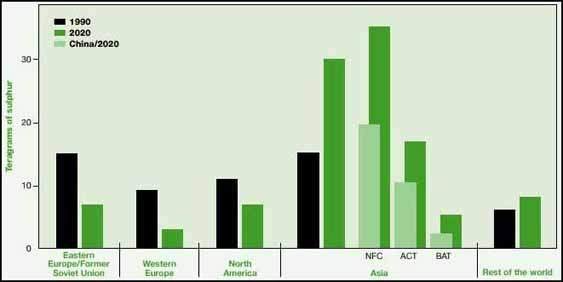
FIGURE 3.7. SULPHUR DIOXIDE
EMISSIONS BY REGION, 1990 AND 2020 (PROJECTED)
Source: Nakicenovic, Gr�bler, and McDonald, 1998;
Foell and others, 1995.
The problem of sulphur dioxide emissions has shifted to the
developing world, with emissions in Latin America, Africa, and the Middle East
expected to increase by about 30 percent between 1990 and 2020. The main problem
region is Asia, where emissions are already high-with 17 teragrams of sulphur
emissions in 1990-and could double by 2020. If that happens, Asia will account
for 58 percent of global emissions, much of them from China.
Three emission scenarios from the RAINS-ASIA model are also
shown in figure 3.7 (Foell and others, 1995; Arndt and others, 1997; Streets and
others, 1999). Driven by a similar energy forecast, the model projects that
Asia’s sulphur dioxide emissions in 2020 will be bounded by an upper value
of 40 teragrams of sulphur (under the assumption of no further control policies
beyond those in place in 1990-the NFC scenario) and a lower value of 6 teragrams
of sulphur (with the assumption of very tight controls, similar to those in
Western Europe). A mid-range estimate is 20 teragrams of sulphur, to be achieved
if all large, new facilities are fitted with flue-gas desulphurisation units and
other fossil-fuel users switch to low-sulphur fuels.
China continues to be the largest contributor to Asia’s
sulphur dioxide emissions, emitting about half of the continental total. But the
establishment in 1997 of China’s Two Control Zone policy for sulphur
dioxide emissions has generated optimism that emissions will not grow as fast as
once thought. Emissions of 11.9 teragrams of sulphur in 1995 are used as a
baseline, and the plan is to limit national emissions to 12.3 teragrams of
sulphur in 2000 by capping emissions in certain provinces at their 1995 levels.
While implementation and enforcement questions linger, there is a commitment at
the highest level in China to holding down sulphur dioxide emissions. The
official (but undocumented) estimate for China’s emissions in 2020 is 19.5
teragrams of sulphur.
The message from figure 3.7 is one of opportunity. With rapid
growth in Asia, many of the coal-fired plants projected to be needed after 2000
have yet to be built. Thus the opportunity exists to fit these plants with
emission controls or lower-emission technology at the time of construction. The
incremental cost of emission reduction is then the only hurdle to be
overcome-though it is a high hurdle ($25 billion a year for the ACT scenario,
rising to $65 billion a year for the BAT scenario). Substitution of natural gas
for coal is an attractive interim measure, and any possibilities for increasing
the efficiency of energy use and moving towards renewable energy would reduce
emissions of sulphur, nitrogen, and other species. The ecologically driven
scenario (chapter 9), for example, would lower global 2020 emissions from 59
teragrams of sulphur to 34 teragrams.
Nitrogen oxides. The situation for nitrogen oxides
emissions is even more challenging, because of the added emissions from
transportation. Though nitrogen emissions were not estimated by Nakicenovic,
Gr�bler, and McDonald (1998), other analyses suggest a regional pattern similar
to that of sulphur dioxide. An earlier study, Energy for Tomorrow’s
World (WEC, 1993), which was more optimistic about economic growth, forecast
a 13 percent increase in global emissions of nitrogen oxide between 1990 and
2020 (from 24 teragrams of nitrogen to 27 teragrams) under case B assumptions.
The increase in Asia was 70 percent (from 6.8 teragrams of nitrogen to 11.5
teragrams). Use of the RAINS-ASIA model, with its daunting view of the growth of
fossil-fuel-based energy systems in Asia, yields an estimated increase of more
than 300 percent in this period (van Aardenne and others, 1999).
Carbon monoxide and non-methane volatile organic compounds.
Though there are no published projections for emissions of carbon monoxide
and non-methane volatile organic compounds, carbon monoxide emissions are
unlikely to increase in Asia, because inefficient combustion of biofuels will
fall and inefficient vehicles will be replaced. On the other hand, emissions of
non-methane volatile organic compounds may grow rapidly as expanding industrial
production calls for greatly increased solvent use, increased vehicle use
generates more hydrocarbons, and rising living standards increase the demand for
domestic and commercial paints and solvents. Together, the expected rise in
emissions of nitrogen oxides non-methane volatile organic compounds bodes ill
for the formation of regional ozone in the developing
world.
Acid deposition
Acid deposition-or acid precipitation in its ‘wet’
form-is perhaps the most important regional-scale manifestation of energy
generation through fuel combustion. Acid deposition occurs when sulphur dioxide
and nitrogen oxides are oxidised in the atmosphere to - sulphuric acid
(H2SO4) and nitric acid (HNO3), respectively,
and dissolved in rainwater. Clean rainwater is naturally acidic, with a pH of
about 5.6. In the industrialised regions of Europe, North America, and Asia,
rainfall pH values of 4.0-6.0 are common-and values as low as 3.0 have been
measured in isolated events.
Acid deposition is a problem because it causes damage to natural
and human-made surfaces with which it comes into contact. If soils contain
insufficient alkali to neutralise the acid, damage can be caused to vegetation,
particularly sensitive tree species and agricultural crops. Lakes can become
acidified, leading to the demise of fish populations. Over time the entire
natural structure and function of ecosystems can change. Manufactured materials
can be attacked: metal surfaces rust, and alkaline materials like concrete,
limestone, and marble are eroded (box 3.6).
In Europe forest damage has long been attributed to acid
deposition. Despite emission reductions, the health of European forests still
seems to be deteriorating (UNECE, 1996). In a 1995 survey of 117,000 trees in 30
countries, more than 25 percent showed signs of significant defoliation, and
more than 10 percent showed significant leaf discoloration. Both direct and
indirect effects of air pollution, of which acid deposition is but one part, are
considered the cause. Surveys of forest soils show that, while sulphur
deposition has dropped drastically since the 1970s, nitrogen deposition is still
high, impairing soil chemistry and nutrient status. For acidification of surface
waters, there appears to be an overall improvement (with higher pH, for
example), probably as a result of reductions in acid deposition (UNECE, 1997).
With projected reductions in sulphur and nitrogen emissions through 2020,
continued progress is expected towards healthier ecosystems in Europe.
|
BOX 3.6. ENVIRONMENTAL IMPACTS OF ACID DEPOSITION
In general, the exposure-response relationships between acid
deposition and impacts on ecosystems, materials, visibility, and human health
are complex. Some are reasonably well understood, but others involve poorly
known relationships involving climate, geography, other chemicals, and time.
Much research has been devoted to studies in North America and Western Europe,
while relatively little has been done in Asia-where most of the growth in
acid-depositing emissions is expected over the next few decades.
Acid deposition has harmful effects on many lakes and rivers,
hurting aquatic life. In affected regions such as eastern Canada, lakes have
acid levels that are unsafe for fish and other aquatic life. While species of
fish vary in their sensitivities to acidification, those with low tolerance
decline in population, at times to the point of extinction. This not only
affects the species directly harmed, but loss of species diversity damages the
ecosystem as a whole due to the interdependence among species (Curren and Nixon,
1992).
Although the impacts of acid rain on terrestrial systems are
known with less certainty, several aspects are likely outcomes of acid
deposition. Effects on soil include reducing the availability of nutrients and
enhancing the solubility of metals. But nitrogen deposition into the soil can
enhance its nutrient content, and some soils are fairly resistant to damage.
Acid deposition can cause damage to foliage of trees and crops, however (Curren
and Nixon, 1992). Forests, especially those at high elevations, are also
affected by acid deposition directly through increased susceptibility to natural
stresses and indirectly through a loss of nutrients obtained from soil (USEPA,
1999). Considerable uncertainty relates to long-term impacts that may not yet
have been observed (NAPAP, 1998).
Several human health problems are linked to acid deposition. For
example, many respiratory diseases, including bronchitis and emphysema, are
likely caused or aggravated by sulphur particulates and nitrogen oxides.
Respiratory problems are particularly noted in sensitive populations, such as
children and asthmatics, as in Hong Kong, China (Hong Kong Municipal Government,
1999). Another potential human health problem comes from increased levels of
toxic metals leached from soil, especially aluminium, into drinking water in
rural areas (Environment Canada, 1999).
Acid precipitation is also known to have negative non-ecological
consequences. It causes the erosion of materials and structures, leading to
aesthetic and functional damage as well as increased maintenance costs. This
damage to structures includes those that have a great deal of historical
significance and are considered highly valuable. Another impact of acid
deposition is haze, or a lesseningof visibility, largely an aesthetic problem
(USEPA, 1999).
The largest documented economic disruptions have been to
fishery, forestry, and agricultural industries. The damage occurring to their
products is causing a loss of productivity and jobs (Environment Canada, 1999).
Furthermore, recreational use of aquatic regions and forests has diminished,
causing a loss in revenue (NAPAP, 1998). |
North America has seen significant reductions in the sulphate
concentration and pH of precipitation as a result of the 1990 amendments to the
Clean Air Act. Reductions in nitrate concentration have not been observed,
however, because requirements for lower nitrogen oxide emissions did not go into
effect until 1996 (NAPAP, 1998). On the whole, it is too early to tell if there
has been significant improvement in the health of ecosystems. There is evidence
of recovery in some New England lakes, but the U.S. Environmental Protection
Agency has reported that additional reductions in sulphur and nitrogen
deposition will be needed to fully restore the health of sensitive Adirondack
lakes (USEPA, 1999). High-elevation spruce fir forests in the eastern United
States continue to show signs of damage. But, as in Europe, there is reason to
hope for improvement.
Asia is the region of greatest concern. Acid deposition is being
reported throughout Asia (Wang and Wang, 1995), with many areas receiving levels
that exceed the carrying capacity of their soils. Long-range transport is
receiving scientific and political attention as countries receive increasing
pollution from neighbouring and even distant countries (Huang and others, 1995;
Ichikawa and Fujita, 1995; Streets and others, 1999). By far the worst episodes
of acid deposition occur in southwestern China (Zhao and Xiong, 1988). Average
rainwater pH values of 4.0-5.0 are observed in the Sichuan Basin, and values
below 3.0 have been recorded in individual episodes. Atmospheric conditions in
Sichuan and Guizhou provinces, with weak winds and frequent temperature
inversions, are conducive to high pollutant concentrations. Emissions are also
high there because of the widespread burning of high-sulphur coal in small
stoves and medium-size industrial boilers.
Southwestern China has seen damage from acid deposition. Sulphur
deposition levels are more than 10 grams of sulphur per square metre per year,
making the situation comparable to the worst parts of the former Czechoslovakia
in the 1960s and 1970s. Zhao and Xiong (1988) report the following effects in
the vicinity of Chongqing and the provinces of Sichuan and Guizhou:
· A 50 percent
dieback of pine forests on Nanshan Mountain, about 20 kilometres from Chongqing,
attributed to acid deposition and air pollution.
· A more than 50 percent
reduction in biomass production in commercial spruce forests in areas
experiencing rain with a pH of less than 4.5.
· A yellowing of rice in large
areas near Chongqing after rainfalls with a pH of less than 4.5.
Seip and others (1995) sampled soil water and stream water in a
7-hectare catchment near Guiyang in Guizhou Province, about 350 kilometres south
of Chongqing. Sulphate concentrations were very high, pH values were as low as
4.3, and aluminium concentrations were elevated. Despite these factors, no
apparent damage to vegetation was observed. It appears that neutralisation of
acid inputs by deep soils and underlying bedrock may be averting ecosystem
damage. Because of the heterogeneity of Chinese soils, however, local
acidification and damage may be occurring in sensitive areas that have not been
studied. A more recent survey of acidification in China by the Norwegian
Institute for Water Research (Lydersen and others, 1997) reported severe effects
of acid deposition on soils, water bodies with high loadings showing typical
signs of acidification, and observed effects on surface water organisms.
Zhao and Xiong (1988, p. 342) describe some of the severe
materials damage observed in Chongqing: “Metal structures are scraped of
rust and painted once every 1-3 years. Shells of buses are generally replaced
every 1-2 years. Structural components made of stainless steel become rusty
after a few years. Some concrete works built in the 1950s have corroded in such
a manner that the gravel is exposed. It is estimated that the corrosion depth
reaches 0.5 cm in less than 30 years”.
In northern China, by contrast, rainwater pH values are
typically 6.0-7.0. Although emissions are high in many parts of northern China,
meteorological conditions are more conducive to pollutant dispersion, and
windblown dust from central Asian deserts tends to neutralise the acidity. The
line delineating acid precipitation in China (pH of 5.6) extends just west of
Beijing and along the eastern edge of the Greater Khingan mountain range. Since
1982 the area receiving acid deposition may have expanded by 600,000-700,000
square kilometres (Wang and Wang, 1995).
Acidification is responsible for much of the air
pollution-related damage in China, though the relative roles of acid rain, dry
deposition of sulphur dioxide, nitrates, particulates, ozone, and other factors
have not been determined. Areas with lower rain acidity see much less damage
than Chongqing and neighbouring cities of southwestern China. Acid rain damage
to crops, forests, materials, and human health in China in 1995 is estimated to
total more than $13 billion (China Daily, 9 March 1998).
In Asia there is also considerable concern about the fate of
cultural materials as pollution levels rise. Concerns about the deterioration of
the Taj Mahal were raised as far back as 1981 (Lal, Gauri, and Holdren, 1981).
Throughout Asia, cultural buildings and monuments made of alkaline-based
materials are vulnerable to attack. Glass, paper, textiles, and archives are
also subject to accelerated deterioration in the warm, moist, polluted
atmospheres of Asia. These problems are greatly under-appreciated and should be
given high priority in future research before rich areas of cultural heritage
are destroyed.
Finally, although not yet major emitters, Sub-Saharan Africa and
Latin American have the potential for significant sulphur emissions as fossil
fuel use
increases.
Tropospheric ozone
Ozone is an important air pollutant that can cause damage to
crops, trees, and human health. It is a major component of the harmful smog that
forms in urban areas during periods of high temperature, intense solar
radiation, low wind speed, and an absence of precipitation. In the polluted air
mass, ozone is produced by a complex set of chemical reactions involving
nitrogen oxides and non-methane volatile organic compounds. North America and
Europe are developing coordinated strategies to reduce emissions of ozone
precursors and thereby reduce some of the health and ecosystem damage attributed
to it. Although there is still progress to be made in these regions, it is again
in Asia that concern is greatest.
Episodes of high ozone concentrations are now common in the
megacities (cities containing more than 10 million people) of southern Asia that
have industrial emissions (producing volatile organic compounds), transportation
(producing nitrogen oxides), and conducive climates-Bangkok (Thailand), Hong
Kong (China), Mumbai (India), and Shanghai (China), to name a few. In addition,
the formation and transport of regional ozone have been observed in measurement
campaigns such as PEM-West (Akimoto and others, 1996; Jaffe and others, 1996).
Ozone concentrations were observed to be regionally enhanced by photochemical
activity in continental air masses passing through areas with high nitrogen
oxides emissions.
The potential effects of elevated ozone concentrations on human
health and crop production in Asia are just beginning to be explored (Chameides
and others, 1994). Studies in the West have established that crop yields are
depressed by repeated exposures to ozone levels above 50-70 parts per billion;
these concentrations are exceeded in fall and winter throughout large areas of
southern China. There is concern that damage to winter wheat and other crops in
the Yangtze Delta may endanger China’s ability to meet increasing food
demands. These analyses are still in their infancy, however, and much more work
is needed on meteorological analysis, the gathering of monitoring data, field
studies on crop responses to elevated concentrations, and regional assessments
of economic impact. Until more of this work is done in Asia, a definitive
statement cannot be made about the relationship between regional emissions of
non-methane volatile organic compounds and nitrogen oxides and impacts on human
health and
vegetation.
Suspended fine particles
Particulate emissions are relatively well controlled in the
industrialised world. Control systems on stationary and mobile sources are
effective in limiting the release of primary particles, and secondary fine
particles (such as aerosols) are being checked by reductions in emissions of
their precursors. In the outdoor environments of many Asian cities, however,
concentrations of fine particles are very high, exacerbated by domestic
solid-fuel combustion, small-scale industrial activities, and inefficient
transportation systems (see above). In many parts of the world the build-up of
secondary fine particles over large regional areas during hot, dry spells leads
to regional haze, impaired visibility, inhalation health effects, and related
ecosystem problems.
|
Acid deposition is being
reported throughout Asia,
with
many areas receiving levels that
exceed the carrying capacity
of
their soils |
Alkaline dust is also important in Asia because of its ability
to neutralise the acidity of precipitation and deposition. In the spring (March,
April, May) large dust storms build in the Taklamakan and Gobi deserts and the
loess plateau areas of China and Mongolia. These storms are associated with
strong cold fronts and prevailing westerly winds. Dust particles are lifted as
high as 6 kilometres into the atmosphere and transported over long distances to
eastern China, the Republic of Korea, Japan, the Pacific Ocean, and even North
America. The dust contains high concentrations of calcium, which neutralises
part of the acidity in rainfall. Thus, while sulphate levels in northeast Asian
deposition are high and similar to those in North America and Europe, pH values
are less acid (typically 5.3-7.0+).
Although large amounts of carbonaceous particles are emitted
from the burning of coal, most of the larger particles fall to ground quickly
and are not part of the regional emissions picture. Similarly, a large portion
of particles is collected, for even in the most polluted regions some form of
particulate collection is usually employed. Nevertheless, a certain portion of
fine particles from fuel combustion is carried aloft and transported over long
distances. These particles are usually less than 1 micron in diameter and
consist of carbonaceous solids-so-called black carbon-and organic compounds in
aerosol form. These particles can participate in chemical reactions, contribute
to reduced visibility, and lead to soiling of surfaces. They scatter and absorb
solar radiation and hence play a role in global warming. They also affect cloud
albedo (ability to reflect sunlight), because their hydrophilic qualities
increase the number of cloud condensation nuclei. On balance, black carbon is
thought to contribute a net warming of about 0.5 degrees Celsius (C) globally
(Penner, Ghan, and Walton, 1991).
The combustion of biofuels and coal in rural households and
diesel fuel in vehicles is a prime contributor to these fine particles. There is
an urgent need to better characterise the anthropogenic emissions of primary
particles from Asian sources, both by size and chemical and physical
characteristics. Diesel vehicles that are poorly designed, operated, and
maintained emit large quantities of fine particles in much of the developing
world.
Forest fires are a large source of particle emissions in all
size ranges. Some of these fires are of natural origin (caused by lightning
strikes), while others are caused by human activities such as forest clearing.
The fires in Indonesia in the summer of 1997 caused a months-long regional air
pollution episode in Indonesia, Malaysia, Singapore, and parts of Thailand and
the Philippines. The health of tens of millions of people was affected.
Increases in acute respiratory infections, asthma, and conjunctivitis were noted
in Kuala Lumpur (Malaysia), Sarawak (Malaysia), and Singapore. Tests on school
children in Malaysia noted significant decreases in lung function, the chronic
effects of which will not be known for a long time (Brauer and Hisham-Hashim,
1998). Fine particles from such fires can be transported thousands of kilometres
if atmospheric conditions are
conducive.
Regional climate change
In the early 1990s it was recognised that sulphate aerosols can
influence the global climate by scattering and absorbing incoming solar
radiation (Charlson and others, 1992) and hence exerting a cooling effect. The
role of sulphate aerosols has now been clarified (IPCC, 1996a). Indeed, sulphate
aerosols contribute negative radiative forcing (of about -0.4 watts per square
metre) that offsets the positive forcing of carbon dioxide and other greenhouse
gases. Hence a reduction in sulphur dioxide or nitrogen oxide emissions would be
expected to reduce sulphate aerosol concentrations and increase the potential
for global warming. The radiative forcing is spatially inhomogeneous, with
values as large as -11 watts per square metre over heavily polluted areas such
as Central Europe and eastern China.
Lal and others (1995) have suggested that sulphate aerosols can
also interfere with local climates. The cooling effect of the aerosol haze
reduces the difference between land and sea temperatures and weakens the
monsoon. In addition, the cooler land surface reduces evaporation and lowers the
amount of water vapour in the atmosphere. The authors estimate that sulphate
aerosols in the Asian atmosphere will reduce monsoon rainfall over India and
parts of China by the middle of this century. The calculated reduction of 7-14
percent over the fertile north and central Indian plains would be a serious
threat to agricultural production. It also appears that large-scale forest fires
can reduce rainfall
regionally.
Global scale: climate change from greenhouse gases
The two most important human-caused problems associated with
environmental processes operating at the global scale are:
· The disruption of
climate as the result of energy-related emissions of heat-trapping (greenhouse)
gases with long atmospheric residence times.
· The depletion of stratospheric
ozone as a result of emissions of chlorofluorocarbons and related compounds from
air-conditioning and refrigeration equipment (among other sources).
The character and origins of the first of these are discussed in
this section. Stratospheric ozone is not addressed here because it is not
primarily an energy issue, although it has connections to energy end-use
technologies.7
It has been known since the work of Swedish scientist Gustav
Arrhenius at the end of the 19th century that certain gases present in
Earth’s atmosphere in trace quantities exert a thermal blanketing effect
that keeps the planet’s surface much warmer than it would otherwise be.
These are called ‘greenhouse gases’ because they work in a way
analogous to one of the functions of the glass in a greenhouse, letting sunlight
in but trapping outgoing heat by absorbing it and re-radiating some of it back
to the ground.
The most important greenhouse gas naturally present in
Earth’s atmosphere is water vapour. Next in importance is carbon dioxide
(CO2), followed by methane (CH4) and nitrous oxide
(N2O). The concentrations of these gases in the atmosphere before the
start of the industrial revolution kept the mean global surface air temperature
about 33 degrees Celsius warmer than it would have been in absence of an
atmosphere with such natural levels of greenhouse gases. (This natural
‘greenhouse effect’ is highly beneficial to life on Earth, since
without it the average temperature would be far below freezing.8)
Although water vapour contributes the largest part of the
natural greenhouse effect, its concentration in the atmosphere globally-on which
the size of the water-vapour contribution to the greenhouse effect depends-is
not significantly affected by emissions of water vapour from human activities.
The most important anthropogenic greenhouse gas emissions are those of carbon
dioxide (CO2), which arise mainly from combustion of fossil and
biomass fuels and from deforestation (see below).9, 10 An important
indirect effect of human activities on the atmospheric concentration of water
vapour results from increased evaporation of water from the surface of Earth
because of the warming caused by increasing concentrations of anthropogenic
greenhouse gases in the atmosphere. The resulting increase in atmospheric
water-vapour content further warms Earth’s surface-a significant
‘positive feedback’ in the anthropogenic greenhouse
effect.11
Concerns developed many decades ago that human-caused increases
in the carbon dioxide content of the atmosphere might accentuate the natural
greenhouse effect enough to disturb the global climatic patterns to which human
habitation, agriculture, forestry, and fisheries had become accustomed. As a
result, in 1958 scientists began to take direct measurements of the atmospheric
concentration of carbon dioxide at locations far from its main human
sources.12 The continuous record of such measurements, at various
remote locations on land and from ships and aircraft, has revealed a steady
increase in the global atmospheric inventory of carbon dioxide, reaching 14
percent above the 1958 level by 1995.
Reconstruction of the earlier history of atmospheric carbon
dioxide content (by analysis of air bubbles trapped in layered cores taken from
polar ice sheets) has established that the increase from pre-industrial times to
1958 was about 13 percent. Thus the ratio of the 1995 concentration to the
pre-industrial one is 1.14 x 1.13 = 1.29, representing an increase of 29 percent
(figure 3.8). The rise in the atmosphere’s inventory of carbon dioxide
closely tracks the rise in global fossil-fuel burning over the past 150 years.
Moreover, studies based on relatively abundant carbon isotopes confirm the role
of fossil-fuel-derived carbon in the observed increase. There is reason to
believe that the slower increase in the 100 years before that was due mainly to
widespread deforestation for timber, fuelwood, and charcoal.
Not all of the carbon added to the atmosphere by human
activities stays there. A substantial part is absorbed by dissolution into the
surface layer of the world’s oceans (from which oceanic mixing processes
gradually transport the dissolved carbon dioxide into the much larger volume of
water in the deep oceans). And part is absorbed into forests and soils in areas
where the forest ‘standing crop’ or soil carbon inventory is
growing.13 Estimates for the balance of sources, sinks, and
atmospheric accumulation of anthropogenic carbon during the 1980s are summarised
in table 3.4. The mean residence time in the atmosphere of carbon dioxide
contributed by human activities, relative to the processes that remove it, is
more than 100 years.
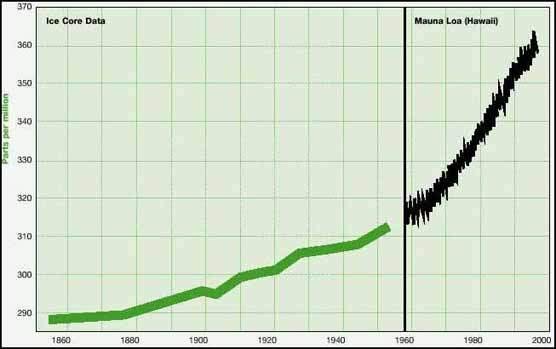
FIGURE 3.8. ATMOSPHERIC
CONCENTRATIONS OF CARBON DIOXIDE, 1850-1995
Source: OSTP, 2000.
Measurements and analyses over the past 20 years have revealed
that the atmospheric concentrations of two other naturally occurring greenhouse
gases-methane (CH4) and nitrous oxide (N2O)- have
increased by 145 percent and 14 percent since pre-industrial times. Apparently
these increases are at least partly due to direct inputs from human activities
as well as to alteration of ecological conditions. The wholly anthropogenic
chlorofluorocarbons (CFCs) implicated in the depletion of stratospheric ozone
are potent greenhouse gases as well. The warming effect of ozone, itself a
greenhouse gas, has been increased in the troposphere (as a result of
anthropogenic emissions of hydrocarbons and nitrogen oxides) by more than CFCs
have decreased it in the stratosphere.
Changes in the atmospheric concentrations of methane, nitrous
oxide, chlorofluorocarbons, and ozone since pre-industrial times are thought to
have increased by about 75 percent the warming potential that would be expected
from the observed increases in carbon dioxide concentrations alone. Increases
over this same period in the atmospheric concentrations of particulate matter
produced by combustion of fossil fuels and biomass have offset part of the
warming effect of the greenhouse gas increases.14 This offset, for
which the best estimate is about half of the overall warming effect that would
otherwise have occurred through 1995, is likely to diminish as emissions of
particulates and their precursors are more tightly regulated.15
Estimated effects of the various anthropogenic greenhouse gases on
Earth’s energy balance are shown in table 3.5, together with estimates of
other changing influences on this balance.
TABLE 3.4. SOURCES AND FATES OF ANTHROPOGENIC CARBON
EMISSIONS, 1980S
|
Source |
Billions of tonnes of
contained carbon |
|
Emissions from fossil fuel combustion and cement production
|
5.5 ± 0.5 |
|
Emissions from tropical deforestation |
1.6 ± 1.0 |
|
Total anthropogenic emissions |
7.1 ± 1.1 |
|
Fate |
|
|
Storage in the atmosphere |
3.3 ± 0.2 |
|
Uptake by the oceans |
2.0 ± 0.8 |
|
Uptake by terrestrial ecosystems |
1.8 ± 1.6 |
Source: IPCC, 1996.
TABLE 3.5. CHANGES IN EARTH’S ENERGY BALANCE,
PRE-INDUSTRIAL TIMES-1992
|
Effect |
Global average watts
per square metre |
|
Direct effect of increasing carbon dioxide |
1.6 ± 0.2 |
|
Direct effect of increasing methane |
0.5 ± 0.1 |
|
Direct effect of increasing halocarbons |
0.25 ± 0.04 |
|
Direct effect of increasing tropospheric ozone |
0.4 ± 0.2 |
|
Direct effect of decreasing stratospheric ozone |
0.1 ± 0.02 |
|
Direct effect of tropospheric aerosols |
-0.5 ± 0.3 |
|
Indirect effect of tropospheric aerosols |
-0.8 ± 0.8 |
|
Direct effect of natural changes in solar output (since 1850)
|
0.3 ± 0.1 |
Source: IPCC, 1996b.
Are the changes in climate being observed in the forms and
magnitudes that theory predicts for the measured increases in greenhouse gases?
Although natural fluctuations in climatic variables would tend to mask
human-caused disruption in its early stages, a variety of evidence indicates
that the ‘signal’ of anthropogenic change is becoming visible despite
the ‘noise’ of these fluctuations. Specifically:
· Near-surface air
temperatures around the globe have increased by 0.3-0.6 degrees Celsius since
the late 19th century.16 The 11 hottest years since 1860 have all
occurred since 1983 (notwithstanding the multiyear cooling effect of particulate
matter injected into the stratosphere by a major volcanic eruption in 1991).
· Directly measured ocean
surface-water temperatures have also increased by 0.3-0.6 degrees Celsius on a
global average over the past century. In the same period the global sea level,
as determined from tidal-range measurements, rose 10-25 centimetres (4-10
inches). Mountain glaciers have generally been in retreat all over the world,
and mid- to high-latitude cloudiness and precipitation have generally been
increasing.
These observed changes in climatic variables are consistent, in
overall magnitudes and in the general pattern of their geographic distribution,
with the predictions of basic theory for the effects of the changes in
greenhouse gas and particulate matter concentrations known to have occurred over
this period.
The observed climatic changes are also similar to the
predictions of the most sophisticated computer models of global climate, when
these models include the observed build-up of greenhouse gases (corrected for
the effect of atmospheric particulate matter).17 This agreement among
theory, observation, and computer modelling extends, moreover, to a variety of
subtler trends for which reliable measurements have become available only for
the past 15-25 years, such as cooling in the lower stratosphere, reduction of
day-night temperature differences, and maximum surface warming in northern high
latitudes in winter. Taken together, these phenomena are
‘fingerprints’ of greenhouse gas-induced climate change-consistent
with the hypothesis that increases in those gases explain the observed changes,
and inconsistent with alternative hypotheses.
Based on the evidence and arguments summarised here, the
Intergovernmental Panel on Climate Change (IPCC) concluded in its Second
Assessment that “the balance of evidence suggests a discernible human
influence on climate” (IPCC, 1996b, p. 4). In that report the IPCC also
extended its earlier analyses of how the human influence on climate would be
expected to grow under a business-as-usual trajectory of future greenhouse gas
emissions and under higher and lower trajectories. The panel found that, under
the range of trajectories considered (and taking into account the uncertainty in
the global temperature response to a given increase in greenhouse gas
concentrations), the global average surface air temperature would be 1.0-3.5
degrees Celsius higher in 2100 than in 1990.18
In all these cases, according to the IPCC (1996b, p. 5), the
average rate of warming in the 21st century “would probably be greater than
any seen in the last 10,000 years”. In the IPCC’s
‘business-as-usual’ emissions scenario, the average global temperature
increase between 1990 and 2100 is 2.0 degrees Celsius-about 2.5 degrees Celsius
above the temperature a century ago-which would make the world warmer than it
has been at any time in the last 125,000 years. In this scenario the sea level
would rise 50 centimetres between 1990 and 2100, then “continue to rise at
a similar rate in future centuries beyond 2100, even if concentrations of
greenhouse gases were stabilized by that time, and would continue to do so even
beyond the time of stabilization of global mean temperature” (IPCC, 1996b,
p. 5).
The IPCC assessment gives due consideration to the range of
possible outcomes and to the size of the uncertainties attached to the
group’s best estimates. Still, the range of expected ecological and social
impacts of climate changes in the next century leaves little room for
complacency even at the lower end of the range. And the uncertainties include
the possibility of unpleasant surprises that would extend the upper end:
Further unexpected, large and rapid climate system
changes (as have occurred in the past) are, by their nature, difficult to
predict. This implies that future climate changes may also involve
“surprises”. In particular these arise from the non-linear nature of
the climate system. When rapidly forced, non-linear systems are especially
subject to unexpected behavior. Progress can be made by investigating non-linear
processes and subcomponents of the climate system. Examples of such non-linear
behavior include rapid circulation changes in the North Atlantic and feedbacks
associated with terrestrial ecosystem changes (IPCC, 1996b, p.
6).19
Since the IPCC’s Second Assessment, scientific evidence has
continued to accumulate concerning human influences on the global climate
system.20 In particular, the data and analyses show more compellingly
than ever that Earth’s average surface temperature is increasing and that
this increase can largely be attributed to the accumulation of greenhouse gases
in the atmosphere caused by human activities. Among the recent findings:
· 1998 appears to
have been the warmest year in a millennium, and the 1990s were the warmest
decade in 1,000 years for the Northern hemisphere. Scientists have reconstructed
the millennial temperature record in the Northern hemisphere using proxy data
for temperatures, such as ice cores, lake sediments, corals, and tree rings
(Mann, Bradley, and Hughes, 1999).
· Greenhouse gases from human
activities are the driver of these temperature increases. While solar
variability, volcanic eruptions, and El Ni�o cycles also contribute to these
global temperature patterns, the 20th century record cannot be explained solely
by invoking these phenomena (Mann, Bradley, and Hughes, 1998).
· Regional patterns of
temperature change across Earth’s surface and vertical patterns of
temperature change in the atmosphere provide further evidence of human-induced
global warming. These patterns are consistent with what is expected under
anthropogenic climate change-and are inconsistent with hypotheses that suggest
that solar variability or the urban-heat island effect can be used to explain
the instrumental temperature record (see Wigley, Smith, and Santer, 1998; Wentz
and Schabel, 1998; and Peterson and others,
1999).
Consequences of greenhouse gas-induced climate change
There is a natural tendency to suppose that an average global
warming of 2.5 degrees Celsius-around the mid-range projection for the year 2100
relative to 1900-would not be such a bad thing. Raising Earth’s average
surface temperature from 15.0 to 17.5 degrees Celsius (from 59.0 to 63.5 degrees
Fahrenheit) does not, at first glance, seem to be especially problematic. Some
regions would have longer growing seasons, and some would have shorter seasons
of freezing weather. What would be so bad about that?
Such complacency is unwarranted for several reasons. Most
important, small changes in the average global surface temperature will cause
many changes in other climatic variables-latitudinal temperature differences,
frequency of extreme temperatures, atmospheric circulation patterns,
precipitation patterns, humidity, soil moisture, ocean currents, and more-that
affect human wellbeing in myriad ways. Climatic conditions are the
‘envelope’ in which all other environmental conditions and processes
exist and operate. Thus climate exerts powerful influences over, for example,
the productivity of farms, forests, and fisheries, the geography of human
disease, and the abundance and distribution of the plants, animals, and
microorganisms constituting biodiversity, as well as determining the
availability of water, the productivity of farms, forests, and fisheries, the
geography of human disease, and the abundance and distribution of the plants,
animals, and microorganisms constituting biodiversity, as well as determining
the availability of water, the productivity of farms, forests, and fisheries,
the geography of human disease, and the abundance and distribution of the
plants, animals, and microorganisms constituting biodiversity, as well as
determining the availability of water, the frequency and intensity of damage
from storms and floods, the combination of heat and humidity that determines
liveability (and requirements for air conditioning) in warm regions in summer,
and the potential property loss from rising sea level.
|
Mountain glaciers
have generally been
in retreat all
over
the world |
The average global surface temperature, then, is not a number
that by itself reveals the features of climate that matter most-the spatial and
temporal patterns of hot and cold, wet and dry, wind and calm, frost and thaw
that constitute the climate locally and regionally, where people live. Rather,
it is a single, highly aggregated index of the global climatic state that is
correlated in complicated ways with those crucial local and regional climatic
features. When the average global temperature increases, the regional increases
will be greater on land than on the ocean surface, greater inland than near the
coasts, and greater at high latitudes than near the equator. In mid-latitude,
mid-continent regions-the midwestern United States, for example-the increase in
average temperature is expected to be 1.3-2.0 times the average global increase
(hence as much as a 5 degree Celsius increase when the global average has gone
up by 2.5 degrees; Wigley, 1999 and IPCC, 1996b). At higher latitudes-central
Canada, northern Russia-the increase could be three times the global average, or
more.
Evaporation and, hence, precipitation are expected to increase
about 3 percent for each 1 degree Celsius increase in the average global
temperature. (Thus a 2.5 degree Celsius increase in the average global
temperature would produce a 7.5 percent increase in precipitation.) In addition,
a larger fraction of the precipitation is expected to occur during extreme
precipitation events, leading to an increase in flooding.21
Notwithstanding the increase in precipitation, the increase in evaporation
will likely reduce summer soil moisture over large regions, increasing the
frequency and severity of droughts in some. At the same time, humid regions will
likely become more so. Climate simulations conducted at the Geophysical Fluid
Dynamics Laboratory of the U.S. National Oceanographic and Atmospheric
Administration show that the average heat index (a discomfort indicator
combining temperature and humidity) for the southeastern United States in July
will increase from about 30 degrees Celsius (86 degrees Fahrenheit) today to
about 35 degrees Celsius (95 degrees Fahrenheit) by the time the average global
surface temperature has increased 2.5 degrees Celsius (GFDL, 1997).
As the average temperature and average heat index go up, the
frequency of days with extremely high temperature and humidity increases
disproportionately. An average warming of 1 degree Celsius might increase the
number of days over a particular threshold by 10 percent, while a 2 degree
Celsius increase would increase the number of days over that threshold by
substantially more than 20 percent (Wigley, 1999; IPCC, 1996b). This result
portends not only much higher summer discomfort in a greenhouse gas-warmed
climate but also a possibility of substantial increases in death rates from heat
stress in areas that are already hot and humid in summer. A decrease in
cold-related deaths in winter would partly offset this effect, but for a variety
of reasons seems unlikely to offset it entirely (IPCC, 1996a).
An increase in sea level at the mid-range value of 50
centimetres between 1990 and 2100 would be devastating to low-lying islands and
seriously damaging to coastal wetlands and many coastal communities. As with
temperature, the damage will come not just from the increase in the average but
from the increase in extremes. In the case of sea level, this refers to the
damage done by storm surges and storm waves starting from a higher baseline
(IPCC, 1996a).
As for the frequency and intensity of damaging storms
themselves-hurricanes and typhoons in particular-some lines of argument and
evidence suggest increases in a greenhouse gas-warmed world, but the origins and
dynamics of such storms are complicated. The higher sea surface temperatures and
higher atmospheric moisture contents associated with a warmer world tend to
produce more powerful storms, all else being equal, but other relevant factors
that could be affected by climate change might offset this tendency. There is
evidence of an increase in the frequency of Atlantic hurricanes based on a
correlation with sea surface temperatures, and there are simulation results
indicating higher wind speeds and lower pressures in tropical storms world-wide
under global temperature increases in the range expected for the 21st century
(see Wigley, 1999 and Knutson, Tuleya, and Kurihara, 1998).
Also subject to considerable uncertainty are the effects of
global warming on the large-scale patterns of atmospheric and oceanic
circulation that are so crucial in determining regional climates. One thinks
particularly of the El Ni�o/Southern Oscillation phenomenon that affects
climates across the central Pacific and the Americas and all the way to Africa,
the monsoons that are so critical across Africa and South Asia, and the North
Atlantic thermohaline circulation that drives the Gulf Stream and greatly
moderates the winter climate in Western and Northern Europe. Although there is
every reason to expect that global warming would influence these phenomena,
neither historical correlations nor the ocean-atmosphere models used to simulate
global climate have proven adequate for predicting with confidence what the
exact effects will be.
There are, however, some suggestive preliminary findings. Some
modelling results, for example, indicate a substantial weakening of the North
Atlantic thermohaline circulation from greenhouse gas-induced warming, setting
in well before the pre-industrial carbon dioxide concentration has doubled
(Broecker, 1997; GFDL, 1997). Such a weakening would, somewhat paradoxically,
make Europe much colder in winter in a world that was warmer overall.
And even bigger changes, such as some that might ensue from
ocean-atmosphere-ice interactions, cannot be ruled out. One such scenario
involves the complete melting of the Arctic sea ice (with no effect on sea
level, since floating ice displaces its weight in water, but with large
potential effects on oceanic and atmospheric circulations). Another involves the
collapse of the largely land-borne but ocean-anchored West Antarctic Ice Sheet,
the slow slide of which into the ocean if the anchor points melted away could
raise sea level by 5 metres in 500 years (Oppenheimer, 1998).
|
In a range of cases considered by
the IPCC, the average
rate of warming
in the 21st century "would probably
be greater than any
seen in
the last 10,000 years." |
If the ways in which global warming will affect regional
climates are uncertain, the ecological consequences of those regional changes
are even more so. Certainly both the averages and extremes of temperature,
humidity, and precipitation are critical in governing the distribution and
abundance of terrestrial animals, plants, and microorganisms, just as the
averages and extremes of ocean temperatures, salinities, and current patterns
are critical to marine life. The organisms in question include, of course, the
plants that are the foundation of all terrestrial and oceanic food
chains-including all those that support the human population-and they include
the pests and pathogens that can destroy crops, fell farm animals, ravage
forests, and bring debilitating diseases to humans. Even without the capacity to
predict specific effects in detail (which is lacking because of inadequacies in
ecological as well as climatological understanding), it is worth noting that:
· The conditions
governing what grows where on land are generally the result of co-evolution of
soils, vegetation, and climate. Adjusting to climate change is therefore not
just a matter of allowing cropping patterns and forest characteristics to
rapidly migrate to a rearranged set of climatic zones; reaching a new
equilibrium could take centuries. And where drastic changes in agricultural
practices are required to deal with climate change, the capital- and
infrastructure-poor developing world will be differentially disadvantaged.
· Winter is the best pesticide
(which is why crop pests and many disease vectors and pathogens are more
problematic in the tropics than in temperate zones). This means that warmer
winters outside the tropics will be problematic for food production and for
human disease.
· The warmer, wetter conditions
that global warming will bring to many of the world’s temperate zones will
expand the ranges of a variety of diseases (including, quite probably, malaria,
cholera, and dengue fever). Industrialised countries’ technological and
biomedical defences against these diseases may prove less robust than optimists
predict, not least because of the continuing emergence of drug-resistant
strains.
The conclusions of the IPCC Second Assessment about the
consequences of the greenhouse gas-induced warming expected over the 21st
century include the following (IPCC, 1996a):
· Agricultural
productivity “is projected to increase in some areas and decrease in
others, especially the tropics and subtropics”.22
“Low-income populations depending on isolated agricultural systems,
particularly dryland systems in semi-arid and arid regions, are particularly
vulnerable to hunger and severe hardship” (p. 6).
· “As a consequence of
possible changes in temperature and water availability under doubled equivalent
of CO2 equilibrium conditions, a substantial fraction (a global
average of one-third, varying by region from one-seventh to two-thirds) of the
existing forested area of the world will undergo major changes in broad
vegetation types-with the greatest changes occurring in high latitudes and the
least in the tropics” (pp. 5-6).
· “Climate change is likely
to have wide-ranging and mostly adverse impacts on human health, with
significant loss of life...Net climate-change-related increases in the
geographic distribution (altitude and latitude) of the vector organisms of
infectious diseases (e.g., malarial mosquitoes, schistosome-spreading snails)
and changes in the life-cycle dynamics of both vector and infective parasites
would, in aggregate, increase the potential transmission of many vector-borne
diseases...Increases in non-vector-borne infectious diseases such as cholera,
salmonellosis, and other food- and water-related infections also could occur,
particularly in tropical and subtropical regions, because of climatic impacts on
water distribution, temperature, and microorganism proliferation... [H]otter
temperatures in urban environments would enhance both the formation of secondary
pollutants (e.g., ozone) and the health impact of certain air pollutants. There
would be increases in the frequency of allergic disorders and of
cardiorespiratory disorders and deaths caused by various air pollutants”.
· “Climate change and the
resulting sea-level rise can have a number of negative impacts on energy,
industry, and transportation infrastructure; human settlements; the property
insurance industry; tourism; and cultural systems and values”.
Nearly all attempts to predict the consequences of greenhouse
gas-induced climate change, including those of the IPCC, have confined
themselves to addressing the changes associated with roughly a doubling of
pre-industrial carbon dioxide concentrations. This has been done so that the
results of studies by different investigators would be readily comparable,
inasmuch as they were all looking at a similar degree of climate change-not
because there is any particular reason to believe that no more than a doubling
of pre-industrial carbon dioxide will occur. Indeed, as the next section
indicates, the world could end up with carbon dioxide levels three or even four
times the pre-industrial value. But the prevalence of studies that look only at
the effects of a doubling seems to have led many people to suppose that these
are the most that could occur.
In reality, as the few studies of higher levels of warming make
plain, the uncertainties and controversies surrounding whether a doubling of
atmospheric carbon dioxide would have overwhelmingly negative consequences are
of much less importance when one contemplates a quadrupling. A study of
quadrupling by one of the main U.S. climate study centres concluded, for
example, that the average temperature increases in Northern hemisphere
mid-continent regions would be 8-12 degrees Celsius (15-22 degrees Fahrenheit);
that mid-continent soil moisture in summer would fall about 50 percent from
1990s levels; that the sea level rise from thermal expansion alone (not allowing
for the melting of any of the Greenland or Antarctic ice sheets) would approach
2 metres; that the North Atlantic thermohaline circulation would shut down
completely; and that the July heat index for the southeastern United States
would reach 44 degrees Celsius (110 degrees Fahrenheit). The ecological
consequences of such changes-and their influence on humans-would be immense.
Greenhouse gas-induced climate change could also affect energy
systems, potentially influencing their cost and reliability. The attractiveness
of hydropower, windpower, and biomass energy systems, for example, depends on
favourable and stable, or at least predictable, climate conditions at their
sites over decades. Energy demand is also a function of climate, and changes in
temperature, precipitation, wind, and the like will affect it. Thus it is
conceivable that climate-change-related reductions in the attractiveness of
renewables combined with increases in energy demand could act as positive
feedback mechanisms-increasing greenhouse gas emissions faster than they would
otherwise because of greater use of fossil
fuels.
Alternative energy futures and greenhouse gas emissions
According to the IPCC, in 1990 global emissions of carbon
dioxide from fossil fuel burning totalled about 5.9 billion tonnes of contained
carbon. (It is customary to keep track of carbon dioxide emissions in terms of
their carbon content rather than their total mass, to facilitate comparisons
with other stocks and flows in the global carbon cycle, in which carbon may be
in a variety of chemical compounds.) Carbon dioxide emissions from tropical
deforestation totalled about 1.5 billion tonnes, with an uncertainty of plus or
minus 1.0 billion tonnes. The IPCC assumes that rates of tropical deforestation
will decline in the 21st century, becoming even smaller relative to fossil fuel
carbon dioxide emissions. In 1997 fossil fuel combustion produced about 6.3
billion tonnes of carbon emissions (table 3.6).
The geographic distribution of industrial emissions of carbon-
that is, emissions from fossil fuel combustion (including flaring of natural
gas) and cement manufacturing-is shown in figure 3.9 for 1995 and projects for
2035 under a business-as-usual energy future. In 1995 nearly three-quarters of
these emissions came from industrialised countries. Under the business-as-usual
scenario, the developing country share will equal that of industrialised
countries by 2035. (The cumulative contribution of developing countries to the
atmospheric burden of anthropogenic carbon dioxide will remain smaller than that
of industrialised countries for some time thereafter, however, and per capita
emissions from developing countries will remain smaller than those from
industrialised ones for longer still.)
TABLE 3.6 SOURCES OF INDUSTRIAL CARBON EMISSIONS, 1997
(BILLIONS OF TONNES)
|
Combustion of petroleum products |
2.70 |
|
Combustion of coal |
2.40 |
|
Combustion of natural gas for energy use |
1.20 |
|
Cement manufacturing |
0.20 |
|
Flaring of natural gas |
0.05 |
|
Total |
6.60 |
Source: Authors’ calculations based on
energy data from BP, 1998; USEIA, 2000.
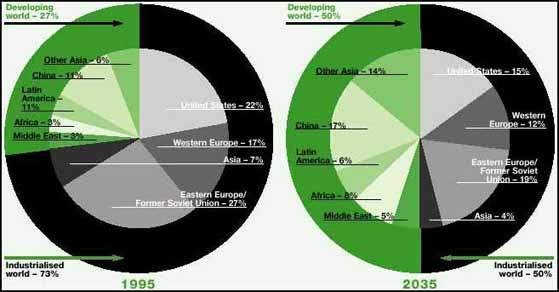
FIGURE 3.9. SOURCES OF INDUSTRIAL
CARBON DIOXIDE EMISSIONS, 1995 AND 2035
Source: OSTP, 2000.
The IPCC analysis and its scenarios for future emissions also
take into account the other anthropogenic greenhouse gases-methane, tropospheric
ozone, nitrous oxide, and halocarbons-and anthropogenic particulate matter in
the atmosphere that partly offsets the heat-trapping effect of the greenhouse
gases by screening out incoming sunlight. As noted, the IPCC found that, as of
the mid-1990s, the non-carbon dioxide greenhouse gases had added about 75
percent to the heat-trapping effect that would have resulted from the build-up
of carbon dioxide alone. But the IPCC’s best estimate of the effect of
increasing particle concentrations was that these had approximately cancelled
out the effect of the increases in non-carbon dioxide greenhouse gases. In one
of the six scenarios developed by the IPCC in 1992, the ‘central’
scenario, designated IS92a, increases in the effects of atmospheric particles
over the next 100 years continue to roughly counterbalance the effects of
increases in the non-carbon dioxide greenhouse gases. Thus the net increase in
the heat-trapping effect over this period is about what would be expected from
the carbon dioxide build-up alone.
The IS92a scenario is very similar to the
‘unsustainable’ IIASA-WEC (International Institute for Applied Systems
Analysis - World Energy Council) A2 scenario presented in chapter 9. Both are
based on World Bank ‘medium’ population projections; the IS92a
scenario uses an older median projection in which the world population reaches
11.3 billion by 2100 and the IIASA-WEC uses a newer projection of 10.7 billion
by 2100. The IS92a scenario assumes that real economic growth world-wide
averages 2.9 percent a year from 1990 to 2025 and 2.0 percent a year from 2025
to 2100, resulting in overall growth of 2.3 percent a year from 1990-2100
compared with 2.5 percent a year in the A2 scenario. Both scenarios assume that
the energy intensity of economic activity (energy per unit of real GDP) declines
by 1.0 percent a year from 1990-2100 and that the carbon intensity of energy
supply (kilograms of carbon emitted in carbon dioxide per unit of energy
supplied) decreases by 0.2 percent a year over this period. The result is that
global carbon emissions increase in both scenarios from 7.4 billion tonnes a
year in 1990 to 20.0 billion tonnes a year in 2100, and cumulative carbon
emissions between 1990 and 2100 total 1,500 billion tonnes.
The carbon content of the atmosphere in 2100 under the IS92a and
A2 scenarios would be some 1,500 billion tonnes, or about 715 parts per million
of carbon dioxide by volume, 2.5 times the preindustrial level, and still rising
steeply. (Only about half of the 1,500 billion tonnes of carbon added between
1990 and 2100 would have remained in the atmosphere, the rest having been taken
up by oceans and by vegetation according to the IPCC’s carbon cycle model.)
This is the scenario for which the IPCC obtained the surface temperature and sea
level estimates mentioned above. Because of the thermal lag time of the oceans
and the continuing melting of polar ice under warmer conditions, both
temperature and sea level would continue to rise after 2100 even if the growth
of atmospheric carbon dioxide were halted at that point.
The challenge of stabilising the carbon dioxide content of the
atmosphere is illustrated in the IPCC’s Second Assessment with emission
trajectories that would be able to achieve stabilisation at concentrations
ranging from 450-1,000 parts per million by volume (ppmv). (The pre-industrial
concentration was about 280 ppmv; today’s is 365 ppmv.) These trajectories
can be characterised by the cumulative and average emissions they entail between
1990 and 2100 (although what happens after that also matters). The results are
summarised in table 3.7.
The IPCC’s IS92a scenario and the IIASA-WEC A2 scenario,
with cumulative emissions of 1,500 billion tonnes of carbon between 1990 and
2100 and annual emissions of 20 billion tonnes of carbon in 2100, are both above
even the highest of these stabilisation trajectories. Such emissions would
nearly triple pre-industrial atmospheric carbon content by 2100 and create a
situation in which an eventual quadrupling or more could not be avoided no
matter what measures were taken thereafter. (These levels are so high as to
render irrelevant the current controversies over exactly how severe the climatic
consequences of a doubling of atmospheric carbon might be; a quadrupling would
transform Earth’s climate beyond recognition; see GFDL, 1997.)
To illustrate the challenge associated with reducing emissions
to the levels being debated in the context of the United Nations Framework
Convention on Climate Change (UNFCCC), consider what the numbers above imply for
the stabilisation target for atmospheric carbon dioxide of 550 ppmv, about twice
the preindustrial level. (While there can be no confidence that this level would
avoid climate change seriously disruptive of human wellbeing throughout much of
the world, a doubled carbon dioxide target is widely discussed because it is, at
least arguably, near the upper limit of what is tolerable and near the lower
limit of what seems achievable.) This would require that cumulative emissions
between 1990 and 2100 be less than two-thirds those in the IS92a scenario. It
would also require that emissions begin to decline after peaking at about 11
billion tonnes of carbon a year around 2030.
This more sustainable development path and the challenge of
achieving the transition towards such a path are illustrated by the IIASA-WEC C
scenario presented in chapter 9. That scenario leads to the stabilisation of
atmospheric carbon concentrations at about 430 ppmv and cumulative emissions of
some 540 billion tonnes of carbon from 1990-2100. Perhaps more important, the
development path that leads to atmospheric stabilisation of carbon at a
relatively benign level also leads to the fulfilment of most of the other
criteria for sustainable development discussed in this report.
The difficulty of achieving this goal becomes particularly
apparent when one views it in terms of the roles of industrialised and
developing countries. In 1990 industrialised countries emitted about 4.5 billion
tonnes of carbon from fossil fuel burning (three-quarters of the world total, or
3.6 tonnes per inhabitant of these countries). Developing countries emitted 1.5
billion tonnes (about 0.37 tonnes per capita). In 1992, as part of the UNFCC,
industrialised countries agreed to try to limit their carbon emissions in 2000
to 1990 levels (see below). But few are on a track towards achieving this. For
example, in 1997 U.S. carbon emissions were about 9 percent higher than in 1990.
Considerably more effort is required. For example, assume that
industrialised countries were willing and able to return to their 1990 carbon
emissions by 2010-a decade after the initial UNFCCC target (and a performance
considerably weaker than called for in the 1997 Kyoto Protocol; see below)-and
were also willing and able to reduce these levels by 10 percent a decade
thereafter. Even then, stabilising atmospheric carbon dioxide concentrations at
550 ppmv would still require that per capita emissions in developing countries
not exceed 1 tonne of carbon in the global peak-emissions year of 2030. (This
assumes that emissions from deforestation have been eliminated by 2030 and that
the population of developing countries is about 7.5 billion at that time,
consistent with the ‘medium’ World Bank projection.) As shown in later
chapters, with vigorous promotion of renewables and energy-efficient
technologies, such a per capita level could produce much higher living
standards.
TABLE 3.7. IPCC SCENARIOS FOR STABILISING CARBON DIOXIDE
LEVELS, 2075-2375
|
To stabilise concentrations at (parts per million by volume)
|
450 |
550 |
650 |
750 |
1,000 |
|
By about the year |
2075 |
2125 |
2175 |
2200 |
2375 |
|
Cumulative emissions in 1990-2100 would need to be in the range
of (billions of tonnes of carbon) |
550-750 |
750-1,100 |
970-1,270 |
1,090-1,430 |
1,220-1,610 |
|
Average emissions in 1990-2100 would be in the range of
(billions of tonnes of carbon per year) |
5.7-5.9 |
7.9-9.0 |
10.2-10.8 |
10.0-11.8 |
12.7 |
|
And peak emissions (billions of tonnes of carbon per year) |
9.5 |
11 |
12.5 |
13.5 |
15 |
|
In the year |
2012 |
2030 |
2050 |
2060 |
2075 |
Source: IPCC, 1996b.
Even more challenging, given the justifiable economic
aspirations of developing countries, the unwillingness of many industrialised
countries to take the steps needed to reduce emissions, and the common
expectations of all countries to rely heavily on expanded fossil fuel use, is
that the per capita emissions of both industrialised and developing countries
would need to fall sharply after 2030 to stay on this 550 ppmv stabilisation
trajectory. (See chapter 9 for more discussion of carbon emission scenarios,
particularly the C scenario, which achieves the required emissions reduction
discussed
here.)
International agreements to address global climate change
The UNFCCC is the first binding international legal instrument
that deals directly with the threat of climate change. Since its enactment at
the 1992 ‘Earth Summit’ in Rio de Janeiro, the convention has been
signed by more than 165 states (plus the European Union). It came into force in
March 1994.
Signatory countries agreed to take action to realise the goal
outlined in article 2 of the convention, namely the “stabilization of
greenhouse gas concentrations in the atmosphere at a level that would prevent
dangerous anthropogenic interference with the climate system.” To achieve
this, all parties to the convention, both industrialised and developing, are
committed under article 4 to adopt national programs for mitigating climate
change; to promote the sustainable management and conservation of greenhouse gas
‘sinks’ (such as forests); to develop adaptation strategies; to take
climate change into account when setting relevant social, economic, and
environmental policies; to cooperate in technical, scientific, and educational
matters; and to promote scientific research and information exchange.
|
BOX 3.7. GREENHOUSE GASES AND NATURAL DEBT
Countries take on national debt when they spend money faster
than their economies produce it. Building up national debt is essentially a way
of borrowing from the country’s future earnings. A little national debt can
be beneficial, by providing resources so that the economy grows faster than it
otherwise might. But a lot of national debt can be quite disruptive. Countries
can also take on ‘natural debt’ by putting pollutants into the
environment faster than they are naturally removed. In this way they borrow from
the environment’s future assimilative capacity.
Humanity has been adding greenhouse gases to the atmosphere
faster than they can be naturally removed. As a result the global atmospheric
burden of carbon dioxide and other greenhouse gases has been rising. The extra
burden of greenhouse gases in the atmosphere above pre-industrial levels is a
measure of the global natural debt. Indeed, this natural greenhouse gas debt is
the principal driver of climate change, since it determines the extra radiative
forcing (warming).
Although most discussions of greenhouse gas control address the
current emissions of countries, cumulative emissions (natural debt) are the
chief determinant of the impact on the climate. The natural debts of countries
differ substantially more than do current emissions, because some countries have
been emitting large amounts for much longer than others have. The largest
natural debts have been accrued by industrialised countries, which started
burning large amounts of fossil fuels early in the 20th century. Some of those
greenhouse gases have been removed naturally from the atmosphere, but some
remain because of long residence times. The table below compares the natural
debts of a number of countries that together account for 55 percent of the
world’s population and about 75 percent of global carbon dioxide emissions.
It has been argued that it would be more appropriate to
determine a country’s responsibility for reducing emissions based on its
natural debt relative to that of other countries rather than on current
emissions, since natural debt (cumulative greenhouse gases in the atmosphere) is
more closely related to actual climate impact. Such proposals are not welcomed
by negotiators for most industrialised countries.
|
|
Natural debt: Carbon as carbon dioxide remaining in the
global atmosphere from fossil fuel combustion |
|
Current emissions 1996
(tonnes per capita)
|
Cumulative emissions 1950-96
(tonnes per
capita) |
|
United States |
5.3 |
119 |
|
Canada |
4.2 |
91 |
|
Germany |
3.3 |
87 |
|
Russia |
3.9 |
78 |
|
United Kingdom |
2.7 |
78 |
|
Australia |
4.1 |
70 |
|
Sweden |
1.7 |
54 |
|
France |
1.8 |
49 |
|
Japan |
2.4 |
41 |
|
Korea, Dem. Rep. |
3.0 |
32 |
|
Korea, Rep. |
1.7 |
16 |
|
China |
0.6 |
8 |
|
India |
0.2 |
3 |
|
One argument against using natural debt as a measure of
responsibility is that it would be unfair. After all, it is argued, the
ancestors of today’s populations in industrialised countries did not know
they were causing a problem by emitting greenhouse gases. Thus today’s
populations, who did not do the polluting, should not have to pay for past
mistakes. This view is partly accounted for in the table, which only shows
emissions from 1950. But there are two important counter-arguments:
· Today’s rich
populations have enjoyed the (considerable) benefits derived from past use of
fossil fuels and other greenhouse gas-generating activities and thus should
accept the debts that go along with those benefits. It is not a matter of
punishment, but one of recognising the debits as well as the credits (the
polluter pays principle).
·
Saying that if someone did not know they were doing a risky thing that they need
not be held responsible is a sure way to encourage people not to make the effort
to discover whether their activities might cause problems for future
generations. It essentially rewards ignorance. A sustainable world energy
system, on the other hand, is one in which cross-generational responsibility is
accepted by all. |
Source: Smith, 1991a; Hayes and Smith, 1994;
Smith, 1997.
The UNFCCC also establishes more demanding obligations for
industrialised countries, which agreed to try to reduce emissions of carbon
dioxide and other greenhouse gases to 1990 levels by 2000. OECD countries are
also committed to facilitating the transfer of financial and technological
resources to developing countries, beyond those already available through
existing development assistance. The convention requires industrialised
countries to take the lead in adopting measures to combat climate change,
recognising that they are mainly responsible for historic and current emissions
of greenhouse gases, and that developing countries will need assistance to meet
the treaty’s obligations (box 3.7).
The structure provided by the UNFCCC is being built on with
additions agreed in a series of conferences of the parties. Most notably:
· The first
conference of the parties, held in Berlin (Germany) in March 1995, focused on
the need to reinforce the commitments in article 4 of the UNFCCC with
“quantified limitation and reduction” objectives for annex 1 countries
after 2000.24 The mandate did not call for new commitments for
developing country parties but only for enhanced efforts at implementing the
existing commitments relating to these countries in article 4.
· The third conference of the
parties, held in Kyoto (Japan) in December 1997, produced a protocol to the
framework convention codifying commitments for reductions in greenhouse gas
emissions after 2000. The protocol commits annex I parties (except Australia,
Iceland, New Zealand, Norway, Russia, and Ukraine) to reduce greenhouse gas
emissions by 5-8 percent below 1990 levels between 2008 and 2012 and to make
“demonstrable progress” towards achieving these commitments by 2005.
Overall emissions are to be computed on a net basis, accounting for
afforestation, reforestation, and deforestation as well as emissions from energy
supply and other industrial activities. (See box 3.7 for a discussion of another
approach to measuring a country’s greenhouse gas
contributions.)
The Kyoto Protocol, having not yet been ratified by the
requisite number of nations, is not in force. It has been criticised by some
(especially in the United States) as demanding too much too soon of
industrialised nations while not requiring anything of developing countries. It
has been criticised by others as not requiring enough of anyone, representing
only a small ‘down payment’ on the kinds of emission reductions that
will be required over the 21st century to avoid intolerable climate change from
greenhouse
gases.
Cross-scale impacts
Some types of pollutants are created and create problems at
every scale and easily transfer between scales. Aerosols (particulates) are a
good example. At the household and community scales, they are probably the chief
source of human ill health from energy systems. At the workplace scale, in the
form of coal dust for example, they are a principal contributor. At the regional
scale, secondary particulates from sulphur and nitrogen gases contribute to ill
health and form the basis for acid deposition. At the global scale, they
contribute to climate change through local warming or cooling, depending on
particle composition and ground characteristics. Overall, it is believed that
human-caused aerosols had a net cooling effect during the 20th century, masking
some of the warming that would have occurred through greenhouse gas build-up.
|
Climate change is likely
to have wide-ranging and
mostly
adverse impacts on human
health, with significant
loss of life.
|
The transfer of aerosols from one scale to another is governed
by complicated processes involving geography, elevation, wind, moisture, size,
composition, and so on. Nevertheless, in general it can be said that reducing
emissions at one scale will have impacts at other scales. In most cases these
benefits are beneficial. As particulates and their precursors such as sulphur
oxides are brought under control because of concerns at other scales, however,
greenhouse gas warming may actually become greater than in the immediate past
because of the apparent net cooling effect in the
atmosphere.
Environmental risk transition
During development, societies tend to push off environmental
problems from smaller to larger scales (Smith, 1990, 1997). For energy,
household hazards dominate fuel cycles in the poorest parts of the world, while
community impacts dominate fuel cycles in middle-income cities through
industrial and vehicular pollution. In the richest countries, household and
community problems have mostly been pushed off to the global level in the form
of greenhouse gases (figure 3.10). In all countries, however, occupational risks
per worker-hour tend to be much higher than risk per hour of public exposure. As
with other exposures, however, occupational risks also tend to be higher in
poorer countries (box 3.8).

FIGURE 3.10. ENVIRONMENTAL RISK
TRANSITION
Source: McGranahan and others, 2000; Smith and
Akbar, 1999.
The environmental risk transition curves in figure 3.10 should
not be considered fixed in the sense that today’s developing nations will
be forced to go through them in the same way that today’s industrialised
countries have done. Rather, the curves should be viewed as a management
framework by which to judge the progress of development policy. The task in
developing countries is to avoid the excesses of the past, to continue to push
down the household curve, and to not let the community curve rise out of hand.
This might be considered a kind of ‘tunnelling’ through the curves to
avoid climbing over the peaks by applying cleaner, more efficient energy supply
and use technologies earlier in the development process than has occurred to
date.
Win-win strategies to link environmental improvements at different scales
The most convincing argument for spending resources to reduce
current greenhouse gas emissions is that the benefits from reduced impacts of
climate change will be greater than the costs. Among the important benefits are
avoiding or reducing the direct impacts on human health that might accompany
climate change, and avoiding ecosystem effects that could have significant
indirect impacts on humanity. Reducing current greenhouse gas emissions could
generate long-term health benefits such as fewer malarial mosquitoes, fewer
extreme climatic events (including tropical cyclones and heat episodes), shifts
in atmospheric composition towards less pollution, reduced impacts on food
production, and decreasing refugee populations from reduced sea level rise and
other factors (McMichael and others, 1996). Similarly, reduced greenhouse gas
emissions could lead to less damage to important ecosystems.
Each step of the causal chain from greenhouse gas emissions to
global warming to direct effects on health and ecosystems is not understood with
certainty, however. As a result of that uncertainty, many observers are still
unconvinced that the potential but distant health and ecosystem benefits justify
large spending on greenhouse gas reductions today. Although the consensus
scientific opinion (as represented by the IPCC) is that such ill effects are
likely if current trends in greenhouse gas emissions continue, scepticism holds
back international agreements to significantly alter current greenhouse gas
emissions. This is particularly so in developing countries, which must contend
with many urgent problems related to human health and welfare. But it also
applies to many groups in industrialised countries.
|
BOX 3.8. THE KUZNETS ENVIRONMENTAL CURVE: FACT OR
FALLACY?
An illustration of the environmental risk transition between
scales is seen in the figure below, which plots the relationship between urban
PM10 (particulates smaller than 10 microns in diameter)
concentrations and countries’ development status as indicated by their UNDP
human development index (a function of income, literacy, and life expectancy).
Superficially, urban PM10 concentrations seem to follow the so-called
Kuznets environmental curve-that is, they first rise during development, reach a
peak, then decline (Grossman and Kruger, 1994). (The curve is named after the
Nobel Prize-winning economist Simon Kuznets, who noted in the 1960s that many
countries go through a period of increasing income inequality during development
before becoming more equitable.) From the standpoint of the risk transition,
however, this curve only addresses the community scale in the form of ambient
urban air pollution. It ignores what happens at other scales, which may be more
important.
The main concern about particulates is their impact on human
health. From a health standpoint, it is not so much urban concentrations that
are critical but human exposure, which is a function of not only where the
pollution is but also where the people are. Because people spend a lot of time
indoors and in other places close to local sources of pollution, exposure
patterns can be quite different from patterns of ambient pollution. Thus, as
shown in the figure, because household sources dominate exposure in the poorest
countries, the pattern of exposures is quite different than that of urban
ambient concentrations. Instead of rising and then falling, exposures decline
continuously-illustrating that the Kuznets curve misses the actual trend, which
is that overall risk tends to fall even though community risk rises, because of
the shift of household to community impacts (Smith, 1993)
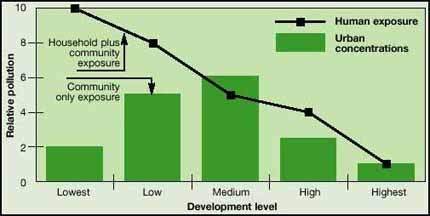
Urban particulate concentrations,
human exposure, and national development
|
|
BOX 3.9. WIN-WIN CROSS-SCALE ENVIRONMENTAL STRATEGIES IN
CHINA
A recent study found that greenhouse gas reductions resulting
from changes in energy use would generally be accompanied by substantial
near-term human health benefits in China (Wang and Smith, 1998). But the level
of health benefits would vary greatly with the choice of energy technologies and
sectors. Shifting from conventional coal-fired power plants to natural gas, for
example, has larger health benefits than reducing global warming potential,
while shifting from coal power to hydropower results in the same percentage
reduction in emissions of health-damaging pollutants and greenhouse gases.
This variation in health benefits is even larger between
sectors. The conservative estimates in the study show that the health benefits
of a 1 tonne reduction in particulate emissions from household stoves are at
least 40 times those from reduction of the same amount from coal-fired power
plants. In terms of human health benefits, the choice of energy technologies and
sectors in which to conduct greenhouse gas reduction efforts is more important
than choice of a particular target for greenhouse gas reduction.
In many developing country households the particulate emissions
from burning unprocessed solid fuels (biomass and coal) routinely exceed by an
order of magnitude or more the safe levels specified by the World Health
Organization. Thus a 15 percent reduction by 2020 in Chinese households’
greenhouse gas emissions below the ‘business-as-usual’ level would
avoid more than 100,000 premature deaths a year. Reduced emissions of
health-damaging pollutants through household improvements in energy efficiency
and changes in the fuel mix would also reduce greenhouse gases. Thus reducing
greenhouse gas emissions at the global scale could significantly ease human
health impacts at the household scale.
On a national scale, a 15 percent reduction in greenhouse gases
below business as usual by 2020 would result in 125,000-185,000 fewer premature
deaths in both the power and household sectors, depending on different control
pathways (energy efficiency or fuel substitution). This range represents about 1
percent of the total mortality in China by 2020. Other countries with high
household and industrial dependence on solid fuels, such as India, could be
expected to see similar benefits.
Acid deposition is increasingly serious in many regions,
damaging forests, crops, and aquatic animals. The RAINS-ASIA model (Foell and
others, 1995) indicates that large areas in Asia have acidity levels in excess
of critical loads due to sulphur deposition, posing significant environmental
threats to a variety of ecosystems. The model also projects that sulphur
deposition will eventually exceed critical loads by a factor of more than 10 in
many parts of Asia as a result of the growing dependence on fossil fuels. This
increase will threaten the sustainability of many natural and agricultural
ecosystems in the region. The model develops a series of emission control
scenarios and shows that energy efficiency and fuel substitution pathways, which
are also the main mitigation options for greenhouse gases, can be important
instruments for controlling acid-forming emissions |
One approach to resolving this impasse is to promote ‘no
regrets’ scenarios for reducing greenhouse gases. Such scenarios achieve
significant near-term benefits for human health and ecosystems in addition to
reducing greenhouse gases. Thus such immediate actions can be justified even if
climate sensitivity to additional greenhouse gases turns out to be less than is
now thought (Repetto and Austin, 1997). Examples of such near-term benefits
include the environmental and energy-security advantages that would accrue
through less dependence on fossil fuels, and the human welfare benefits that
could emerge if an international greenhouse gas control regime were oriented
towards assisting economic development and reducing vulnerability among poor
populations (Hayes and Smith, 1994).
Among the significant near-term benefits of greenhouse gas
reductions are the human health benefits resulting from changes in the
efficiency and structure of energy use that would be a large part of most
greenhouse gas reduction scenarios. Although fuel cycles have several effects on
health and ecosystems-for example, through water pollution, the potential for
large accidents, and occupational health and safety-the largest and most
sensitive to change are probably those related to pollutant emissions from the
processing and burning of fuels. The same combustion processes that produce
greenhouse gas emissions such as carbon dioxide and methane also generate local
and regional airborne health-damaging and acid-precursor pollutants such as
particulates and sulphur oxides. Thus a reduction in greenhouse gases at the
global scale, through improvements in energy efficiency and changes in the mix
of fuels, can be expected to reduce health-damaging and acid-precursor
pollutants as well, potentially bringing immediate environmental improvements at
the household, community, and regional scales. This is a win-win strategy to
link environmental improvements between scales.
The potential health benefits from reduced greenhouse gases can
be estimated from the global burden of ill health from air pollution. Using
airborne particulates as the indicator pollutant, the World Health Organization
estimates that air pollution causes 2.7-3.0 million premature deaths a year, or
5-6 percent of global mortality (WHO, 1997). Since most of this pollution comes
from the combustion of fossil and biomass fuels, which would be among the main
targets of any effort to control greenhouse gases, the potential reduction in
health-damaging emissions would seem to be at least as great as the target
reduction in greenhouse gas emissions. Arguably it is even greater, however,
since switching from dirty, less efficient fuels (such as coal) to cleaner, more
efficient fuels (such as natural gas) reduces emissions of health-damaging
pollutants even more than greenhouse gas emissions. With greenhouse gas
reduction targets on the order of 10-20 percent, the scale of emissions of
health-damaging pollutants and associated reduction of ill health could be in
the same range or somewhat higher-perhaps a 250,000-750,000 annual reduction in
premature deaths world-wide.
To more accurately estimate these near-term health benefits, it
is necessary to link each technological option in a particular greenhouse gas
reduction scenario with the accompanying reduction in emissions of
health-damaging pollutants. The health impact of these emissions, however,
depends on the sector of the economy in which they are taken. This is because
the degree of human exposure created by a unit of emissions of health-damaging
pollutants depends on where they are released relative to where people spend
time, their ‘exposure effectiveness’. Thus a tonne of emissions
averted in the household or transportation sectors close to where people spend
much of the time will generally cause a much greater reduction in human exposure
(and improvement in health) than a tonne averted in the industrial or power
sectors. An example of such a win-win possibility in China is presented in box
3.9.
On a community scale, more than 1.1 billion people living in
urban areas world-wide are exposed to particulate or sulphur dioxide levels in
excess of World Health Organization guidelines (Schwela, 1995). These pollutants
are released by industrial, household, and transportation energy use. Air
pollution is particularly severe in megacities. Again, reducing greenhouse gas
emissions by changing energy use and structure can also reduce the particulate
and sulphur dioxide emissions that cause severe urban air pollution.
The same principle applies in the cities of the industrialised
world, although the scale of absolute benefits is less because air pollution
levels are lower. From an economic standpoint, however, there can still be
substantial secondary benefits from greenhouse gas controls through associated
reductions in health-damaging pollutants, acid precipitation, and the like. The
value of these benefits could in many cases rival the costs of the greenhouse
gas controls, making a win-win result (Elkins, 1996; Burtraw and Mansur, 1999).
As noted, the near-term health and ecosystem benefits of
reducing greenhouse gases provide the opportunity for a true no-regrets
reduction policy in which substantial advantages accrue at various scales even
if the risk of human-induced climate change turns out to be less than many
people now fear. Increases in energy production and end-use efficiency and
changes in the mix of fuels can reduce environmental impacts at the household,
community, regional, and global scales, while meeting greenhouse gas targets. To
achieve these benefits effectively, however, considerations of health and other
secondary benefits should be included from the start in designing greenhouse gas
control strategies.
This no-regrets strategy also has important implications for
emissions trading in the form, for example, of joint implementation and clean
development mechanisms. Because the near-term health improvements are local,
they accrue almost entirely to the nation in which greenhouse gas control
projects are undertaken-unlike the benefits of greenhouse gas reductions, which
accrue globally. These large local benefits may provide a significant extra
incentive for other developing countries to enter into arrangements in which
local greenhouse gas controls are financed externally and the emission credits
are shared. Indeed, a greenhouse gas reduction strategy can be consistent with
such critical national development objectives as reducing local air pollution,
increasing energy efficiency, and improving social equity by providing energy
services to remote areas through renewable energy.
|
The World Health Organization
estimates that air pollution
causes
2.7-3.0 million premature deaths
a year, or 5-6 percent
of
global mortality |
Assessment methods
A number of methods have been developed to compare the disparate
effects of energy systems on a common basis. Here we discuss perhaps the two
most common, economic valuation and fuel-cycle analysis. In both cases there is
still much uncertainty and some controversy on the fundamental nature of the
analyses and on the data inputs required. Thus we present these examples not as
definitive, but as illustrative of the type of information they can provide.
How much is clean air worth? Because it generally becomes
increasingly expensive to reduce pollution as emission controls tighten, a
fundamental question is how much money each bit of emissions control is worth.
If the value of averting damage were known, then the degree of control could be
set such that the total cost (control cost plus residual damage cost) is
minimised. Normally, the cost of control is fairly well known. Similarly, damage
is fairly easy to value for simple property destruction, such as corrosion of
buildings and reduction of crop yields. But valuing damage to critical
ecosystems or human health is not straightforward. As a result there are no
universally accepted methods.
Several approaches are used to value human health, including:
· Human capital-the
value of lost wages and associated medical costs from illness or injury and
premature death.
· Value of statistical life-the
imputed value from extrapolating human risk-averting behaviour. For example, if
the labour market shows that inducing a worker to accept a job with an
additional death risk of 1/1,000 a year requires extra wages of X dollars a
year, then X multiplied by 1,000 would equal the value of a lost life.
· Willingness to pay-in which
people are asked how much they would be willing to pay to avoid certain risks.
These amounts are then extrapolated to find the equivalent value of a
life.
In recent years the willingness to pay approach has become more
widely used, because it holds more theoretical appeal for economists than other
approaches. But beyond the obvious difficulty of finding accurate data, there
are three important problems with this approach. First, measured willingness to
pay can be quite different for the same issue depending on how the question is
phrased, raising doubt about the measure’s intrinsic utility. Second,
willingness to pay to avoid a certain risk depends on the respondent’s
knowledge about the risk, which varies dramatically by geography, demography,
education, and time, and which is quite difficult to account for in surveys.
Finally, although it is clear that willingness to pay varies with income, it is
not clear by how much. As people grow richer, their willingness to pay to avoid
a given risk generally increases even faster. But this relationship is not clear
across different periods and cultures.
Consider some examples of how willingness to pay has been used
to value air pollution in developing and industrialised countries. In China, the
dirtiest fossil fuel, coal is widely used, its use is expected to grow rapidly
in the next few decades, and effective pollution controls are not widely used. A
recent study estimated that air pollution cost China about $48 billion in 1995
(7 percent of GDP), including impacts of acid deposition as well as health
effects from outdoor and indoor air pollution (World Bank, 1997). The study
found that the dominant cost came from health costs for urban residents, some
$32 billion (5 percent of GDP). Moreover, it projected that under
business-as-usual conditions, pollution-related health costs for urban residents
would increase to $98 billion by 2020 at current income levels, or $390 billion
(13 percent of GDP) with adjustments to willingness to pay related to growth in
income. This is substantially more than the estimated economic damage of
greenhouse gas emissions from the same facilities.
China’s high pollution-related health costs are partly due
to relatively limited pollution controls. Even in countries with relatively
extensive pollution controls, however, pollution-related health costs can be
high because aggregate energy-related emissions can be high even if emissions
per unit of energy provided are low. Moreover, the willingness to pay to avoid
pollution damages will be high in high-income countries. And in densely
populated regions such as Europe and Japan, large populations are generally
exposed to air pollution.
Recent studies in Europe have shown that health impacts dominate
the external social costs of pollution, and estimate that the costs of health
impacts due to fine particle air pollution are especially high (Rabl and
Spadaro, 2000; Spadaro and Rabl, 1998; Spadaro and others, 1998; Krewitt and
others, 1999). These economic calculations reflect recent epidemiological
studies indicating that fine particles are associated with serious health
effects, including premature death (see the section on community scale).
Although considerable uncertainty remains about health impacts
from small particles, the economic value of these impacts is expected to be
high-at least in densely populated regions of high-income countries, where large
populations are exposed to air pollution that can shorten lives by a few months.
These populations are willing to pay considerable amounts to avoid this life
shortening. Table 3.8 presents recent estimates of the health impacts of coal
and natural gas power plants equipped with the best available control
technologies. For natural gas combined-cycle plants the only significant health
costs are associated with nitrogen oxide emissions, and these costs are
relatively low (typically about 5 percent of the electricity generation cost).
But for coal the estimated health costs (mostly due to health damage from fine
particle air pollutants) are large and comparable to the electricity generation
cost. These estimates are quite uncertain, however.
Table 3.9 presents estimates of health costs in France for air
pollution from gasoline-fuelled cars equipped with pollution controls and for
diesel-fuelled cars. The estimated health impacts, measured per litre of fuel
sold, are high (though, as with power generation, quite uncertain), especially
for urban driving-about twice the retail price (excluding retail taxes) for
gasoline cars and 25 times the retail price for diesel cars. As in China, the
economic costs of greenhouse gas emissions from European cars and power plants
would seem to be much lower.
These costs will vary significantly by region depending on the
mix of rural and urban driving, whether emissions are at ground level or from
tall stacks, local and regional population densities, and income, which affects
willingness to pay. Applying the results in table 3.9 to developing countries,
where per capita income averaged about $2,800 in 1995, the imputed health costs
would be 0.1-0.5 times those estimated for France when all other factors are
equal, depending on how willingness to pay varies with income.
If willingness to pay continues to increase more rapidly than
income, health impacts will become increasingly important for developing
countries even if emission controls are put in place. That is because their
income and energy consumption levels will rise more rapidly than energy
consumption levels, even with emission controls in place. To illustrate,
consider the WEC projection that in developing countries the number of cars will
increase 6-fold between 1990 and 2020 (WEC, 1995). Even if all were
gasoline-fuelled cars equipped with three-way catalytic converters, health costs
in developing countries would increase to $40-120 billion in 2020, depending on
the rate of increase in willingness to pay. If all cars were diesel, health
costs would be six times as high. These health cost estimates do not include
health impacts associated with buses, trucks, and locomotives.
TABLE 3.8. AIR POLLUTANT EMISSIONS AND ESTIMATED HEALTH
COSTS FOR EUROPEAN POWER PLANTS EQUIPPED WITH THE BEST AVAILABLE CONTROL
TECHNOLOGIES
|
Siting |
Unit health cost (cents per gram) |
Emission rate (grams per kilowatt-hour) |
Unit health cost (cents per kilowatt-hour) |
|
|
Pulverised coal steam-electric |
Natural gas combined cycle |
Pulverised coal steam-electric |
Natural gas combined cycle |
|
Sulphur dioxide |
Nitrogen oxides |
PM10 |
Sulphur dioxide |
Nitrogen oxides |
PM10 |
Nitrogen oxides |
Sulphur dioxide |
Nitrogen oxides |
PM10 |
Total |
Nitrogen oxides |
|
Typical |
1.0 |
1.6 |
1.7 |
1.0 |
2.0 |
0.2 |
0.1a |
1.0 |
3.2 |
0.3 |
4.5 |
0.16 |
|
Urban |
1.6 |
2.3 |
5.1 |
1.0 |
2.0 |
0.2 |
0.1a |
1.6 |
4.6 |
0.5 |
6.7 |
0.23 |
|
Rural |
0.7 |
1.1 |
0.5 |
1.0 |
2.0 |
0.2 |
0.1a |
0.7 |
2.2 |
0.1 |
3.0 |
0.11 |
Note: These calculations were carried out as part of
the European Commission’s ExternE Program. Studies under the program have
estimated the economic values of health impacts by assessing people’s
willingness to pay to avoid adverse health effects. The health cost estimates
shown are median values; the 68 percent confidence interval is 0.25-4.0 times
the median cost.
Source: Rabl and Spadaro, 2000.
TABLE 3.9. AUTOMOTIVE NITROGEN OXIDE AND PARTICULATE
EMISSIONS AND ASSOCIATED PUBLIC HEALTH COSTS IN FRANCE
|
Fuel and driving environment |
Fuel economy (kilometres per litre) |
Emission rate(grams per kilometre) |
Health costs (dollars) |
|
|
|
Per gram |
Per kilometre |
Per litre of fuel |
|
|
Nitrogen oxides |
Particulates |
Nitrogen oxides |
Particulates |
Nitrogen oxides |
Particulates |
Total |
Nitrogen oxides |
Particulates |
Total |
|
Gasoline |
|
Urban |
8.7 |
0.68 |
0.017 |
0.022 |
2.750 |
0.015 |
0.047 |
0.062 |
0.13 |
0.41 |
0.54 |
|
Rural |
10.3 |
0.79 |
0.015 |
0.027 |
0.188 |
0.021 |
0.003 |
0.024 |
0.22 |
0.03 |
0.25 |
|
Diesel |
|
Urban |
10.4 |
0.75 |
0.174 |
0.022 |
2.750 |
0.017 |
0.479 |
0.496 |
0.17 |
4.98 |
5.15 |
|
Rural |
12.7 |
0.62 |
0.150 |
0.027 |
0.188 |
0.017 |
0.028 |
0.045 |
0.21 |
0.36 |
0.57 |
Note: These calculations were carried out as part of
the European Commission’s ExternE Program. Studies under the program have
estimated the economic values of health impacts by assessing people’s
willingness to pay to avoid adverse health effects. The health cost estimates
shown are median values; the 68 percent confidence interval is 0.25-4.0 times
the median cost. The gasoline cases are for cars equipped with catalytic
converters.
Source: Spadaro and Rabl, 1998; Spadaro and others,
1998.
Health costs might end up being much higher than these estimates
because real world emission levels tend to be considerably higher than regulated
emission levels (Ross and others, 1995). That happens for a variety of reasons,
including that regulated emissions are for well-maintained cars and that
regulations tend to be for driving cycles that often do not reflect the way
people actually drive.
These high estimated future health costs argue for much tighter
emission controls than can be achieved with widely used current technologies.
How much additional control will be needed? This is one of the critical
questions for providing sustainable transport systems for the world’s
cities. Nevertheless, despite large uncertainties due to the willingness to pay
method as well as to basic understanding of air pollution health effects, it
seems safe to conclude that the economic value of air pollution abatement is
substantial in developing and industrialised countries alike.
Fuel cycle analysis. Supplying modern energy often
involves processes at a chain of facilities that may be quite physically
distinct from one another. These processes are usually referred to as ‘fuel
cycles’, although they rarely rely on any cycling. Comparisons based on
fuel cycles are useful for organising impact analyses of energy supply and
demand.
Consider the fuel cycle supporting the operation of an electric
appliance. It may involve a coal mine, coal washery, coal train, coal power
plant, and transmission lines, as well as ancillary facilities such as coal
tailings piles, washery settling lagoons, and power-plant ash disposal. Each of
these facilities has environmental impacts and is, in a sense, ‘switched
on’ whenever the appliance is used even though it may be physically
unconnected and thousands of kilometres away. Furthermore, environmental impacts
occur not only during normal operations of these facilities, but also during
their construction, repair, and dismantling-what is called their life cycle.
Even non-fuel energy systems, such as photovoltaic power plants, have fuel
cycles and life cycles, including the harvesting, processing, and transport of
the materials used to construct the facility.
Comparative risk assessment is one term used for studies of the
life-cycle impacts of alternative fuel cycles, such as different ways to produce
electric power. Such studies are usually normalised according to an appropriate
unit of energy output-for example, impacts may be scaled per kilowatt-hour or
per barrel of oil equivalent. The idea is that in this way all the impacts can
be fairly compared across alternative energy systems, giving full and consistent
information to decision-makers. Such studies first account for insults over the
life cycle of each part of the fuel cycle, such as land used, tonnes of
pollution released, long-term waste generated, water consumed, and labour
required per unit of output. Then most comparative risk assessments try to
convert as many insults as possible into impacts with common measures, such as
deaths, injuries, illnesses, and financial damage costs. Since the occupational
impacts of energy systems can be significant (see the section on workplace
scale), often both public and worker risks are determined (box 3.10).
In addition to the methodological and other problems of
fuel-cycle analysis and comparative risk assessment mentioned in box 3.10, there
are some fundamental concerns with these kinds of comparisons that revolve
around this unit of analysis-that is, the production of a certain amount of
energy. For occupational impacts, for example, the number of accidents or
illnesses per unit of energy output is just as much a measure of labour
intensity as of safety. Indeed, from a societal standpoint, putting many people
to work in low-risk activities is much better than employing a few people in
high-risk activities. But both may look the same in the comparisons.
In addition, by using energy as the output measure, such
analyses reveal little about the impact of such facilities on overall public
health, which uses time as the risk denominator. It may be that one way of
producing electricity has slightly different public health implications than
another, but neither may have much significance overall or, conversely, neither
may be acceptable. Entirely different kinds of analyses are needed to evaluate
these kinds of
questions.
Implications for the future
As noted in the introduction, there has not been space in this
chapter to present what is known and suspected about the many environmental
insults of different energy systems and the resulting impacts on ecosystems and
human health. But we have addressed a large fraction of the most important ones.
The central task of this report is to outline the main characteristics of a
sustainable energy future. Thus it is appropriate to examine the main categories
of insults and impacts discussed in this chapter to see what requirements they
impose on such a
future.
Household scale
About half of the world’s households use solid fuels
(biomass and coal) for cooking and heating in simple devices that produce large
amounts of air pollution. Because the pollution is released at the times and
places where people spend time, the health impact is high, accounting for 4-5
percent of the global burden of disease. The chief ecosystem impact relates to
charcoal production and urban fuelwood harvesting, which puts pressure on
forests near cities and may account for a few percentage points of global
deforestation.
It is difficult to envisage a sustainable energy future in which
unprocessed solid fuels remain an important source of energy for a significant
fraction of the world’s households. Gases, liquids, and electricity are the
main clean alternatives. Although today these alternatives mostly derive from
fossil fuels, this need not be the case in the future. In the future these
alternatives may be made from renewable biomass fuels such as wood and crop
residues (see chapters 7, 8, and 10). Indeed, a further criterion for
sustainable energy is that any biomass harvested to make household fuels should
be done on a renewable basis to ease pressure on forests and other natural
ecosystems.
Workplace scale
The harvesting of solid fuels (biomass, coal, uranium) creates
the highest risks per energy worker and the largest impacts on the energy
workforce world-wide. Risks to coal miners, for example, are many times those
for the average industrial worker. To be sustainable, average miner risks will
probably have to be lowered to those in the safest mines today.
|
It is difficult to envisage a sustainable
energy future in
which unprocessed
solid fuels remain an important
source of energy for a
significant
fraction of the world's
households |
Community scale
Fuel use is the chief cause of urban air pollution, though there
is substantial variation among cities in the relative contributions of vehicles
and stationary sources. Diesel-fuelled vehicles, which are more prominent in
developing countries, pose a growing challenge to meeting urban health-related
pollution guidelines (responsible for about 1 percent of the global burden of
disease).
To be sustainable, mean urban air pollution around the world
will need to be no greater than what is common in rich countries today-for
example, less than 30 micrograms per cubic metre of PM10. An
additional requirement for sustainability is that urban ambient ozone levels not
rise as vehicle fleets grow. Sufficiently clean power generation by fossil and
nuclear sources is technically feasible, although costs are uncertain (see
chapter 8). Similarly, hybrid vehicles are substantially cleaner than current
types (see box 3.5). Achieving sustainability, however, will probably require
moving most of the world’s fleet to fuel cells or comparably clean systems
by the middle of the 21st
century.
Regional scale
The problem of regional atmospheric emissions will not go away
quickly. The increasing demand for energy, especially in developing countries,
will put heavy pressure on cheap and easily obtainable fossil fuels such as coal
and oil. Prospects for constraining increases in regional emissions are better
for some pollutants and source types. An ambitious goal for sulphur dioxide
emissions, for example, would be a 50 percent reduction world-wide by 2050. This
goal could be achieved by reducing the sulphur content of fossil fuels and using
emission controls on new, large power plants and industrial facilities.
Switching to natural gas in developing countries would also considerably aid the
achievement of this goal. Increases in sulphur dioxide emissions in the
developing world will be offset by legislatively driven reductions in
industrialised countries.
Nitrogen oxide emissions are a bigger problem. The expansion of
transportation systems in developing countries will add to the nitrogen oxide
burden from industrial production and power generation. Moreover, nitrogen
oxides are much harder to control than sulphur dioxide. An ambitious goal would
be to stabilise nitrogen oxide emissions at current levels by 2050. Only a major
shift away from fossil fuels in all parts of the world or a shift to alternative
energy carriers such as hydrogen derived from fossil fuels will enable this goal
to be achieved.
Carbon monoxide emissions will likely fall significantly as
developing countries move away from biofuels and as automobiles become more
efficient world-wide. Emissions of volatile organic compounds from energy
sources will likely be reduced, but large increases can be expected from
non-energy sources, particularly as the commercial and residential use of
solvents increases in the developing world. Holding global emissions of volatile
organic compounds to a 20-50 percent increase by 2050 will be a challenge. The
faster that clean and efficient vehicles and fuels can replace current vehicles
and fuels, the greater will be the reduction in emissions of nitrogen oxides,
carbon monoxide, and volatile organic compounds.
|
BOX 3.10. COMPARATIVE RISK ASSESSMENT USING FUEL-CYCLE
ANALYSIS
A number of concerns drive the need to assess the environmental
and human health damage associated with electricity production. These include
informing utility planning decisions in terms of total social costs,
enlightening cost-benefit analyses of pollution mitigation technologies,
facilitating formulation of regulatory procedures, and delineating the secondary
benefits of reducing greenhouse gas emissions. Attempts to quantify damages
incurred by electricity generation technologies date to the 1970s and are known
as fuel-cycle analyses or comparative risk assessments. Most fuel-cycle analyses
have been undertaken in industrialised countries, but a few have considered
electricity production in developing countries (such as Lazarus and others,
1995).
Fuel-cycle analyses attempt to account for all damages caused by
physical and chemical processes and activities undertaken to generate
electricity from a specific fuel or resource, from fuel acquisition to waste
disposal in a steady-state operations approach, or from construction to
decommissioning in a facility lifetime approach. Because different insults exert
their impacts over different temporal and spatial scales, the geographic extent
and time horizon of an analysis must be carefully defined to cover all
significant impacts. Contemporary fuel-cycle analyses generally follow a damage
function or impact pathway approach whereby dominant impacts are identified;
stresses (incremental population exposures to air pollution, occupational
hazards, transportation risks) are quantified; stresses are translated to
impacts, typically through exposure-response functions or actuarial data; and
impacts are quantified and aggregated in terms of the study’s chosen metric
(ORNL and RFF, 1992; Curtiss and Rabl, 1996). The study design stage entails a
number of choices on impacts to be considered (public and occupational health,
ecological damage, agricultural losses, material corrosion, visual amenity),
temporal and spatial assessment boundaries, models and hypotheses for analysis,
economic parameters such as the discount rate, and the treatment of accident
scenarios for which no actuarial data exist (such as expected and worst case).
A fuel-cycle analysis typically results in a list of impacts per
unit of output in the form of premature deaths, ecosystem damage, global
warming, and the like. To provide a common metric for comparison, many studies
then attempt to monetise these impacts. This process introduces substantially
more uncertainty and controversy into the process.
Fuel-cycle analyses have typically generated ‘total
cost’ figures in terms of m$ ($0.001) or mECU per kilowatt-hour, with
recent (post-1990) European and U.S. estimates ranging from 0.016-80 m$ per
kilowatt-hour for coal and from 0.002-23 m$ per kilowatt-hour for nuclear (Rabl
and Spadaro, 2000). Given the four orders of magnitude spanned by these fuel
chain damage costs, it is clear that they are sensitive to the particular
designs and metrics of the studies. Accordingly, interpretation of studies’
results requires extensive supplementary information to illuminate, for example,
the specific impacts assessed and the study-specific approaches to valuation of
life, valuation of non-fatal outcomes, weighting of public and occupational
health outcomes, and discount rates. Thus fuel-cycle analysis damage costs
cannot stand alone and are difficult to compare, despite the fact that they may
superficially appear to be based on comparable metrics (dollars per
kilowatt-hour).
Although comparative risk assessment using fuel-cycle analysis
cannot yet indicate unambiguous preferences or even readily allow for
comparisons between studies, recent studies suggest that public health and
occupational health effects dominate the externalities associated with the
nuclear fuel chain. Health effects and global warming dominate conventional coal
technologies (Rabl and Spadaro, 2000). Biomass as an energy resource is less
easily characterised even in terms of dominant impacts because it is highly
dispersed, the nature of its production and use is extremely site-specific, and
its associated damages and benefits depend on other local activities such as
agriculture (Lazarus and others, 1995). Similarly, hydroelectric utilities elude
concise generalisation due to the wide range of sophistication among
technologies and the site-specificity of ecological and human health risks.
Fuel-cycle analyses yield widely disparate conclusions for solar thermal and
dispersed photovoltaic technologies. Some studies, particularly those focusing
on operation of energy systems, suggest that these solar technologies confer
negligible human health and ecological risks (Rabl and Spadaro, 2000). Other
studies assert that the occupational risks and short-term environmental damage
associated with solar technologies can exceed those of conventional electricity
generation methods (Hallenbeck, 1995; Bezdek, 1993).
Pitfalls associated with fuel-cycle analysis include the use of
poorly defined or inconsistent study boundaries, confusion of average and
marginal effects, underestimation of the uncertainty associated with
quantification of damages, neglect or inadequate treatment of environmental
stochasticity, and focus on what is easily quantified rather than on what is
actually significant (Koomey, 1990).
A number of outstanding issues remain for streamlining
approaches to fuel-cycle analysis. These issues include identifying the
functional relations and key parameters defining uncertainty, the variation in
damages with key parameters, the degree of accuracy and resolution with regard
to atmospheric modelling and receptor distribution (needed to capture the
site-specificity of impacts), and the magnitude of error incurred by using
‘typical’ average values rather than detailed, site-specific data
(Curtiss and Rabl, 1996). In addition, metrics used in fuel-cycle analysis to
deal with incommensurate impacts-such as the soiling of buildings, crop damage,
and human morbidity and mortality-are not uniform between studies
A sampling of results from fuel-cycle analyses, which have been
used in a variety of contexts, follows:
· An investigation
of externalities of electricity production from biomass and coal in the
Netherlands suggests that while average private costs for the biomass strategy
assessed are projected to be about twice those for coal in 2005, internalisation
of external damages and benefits would yield about equal social costs. The most
important distinguishing factors between coal and biomass are differences in
carbon dioxide emissions and indirect economic effects such as employment (Faaij
and others, 1998).
· A comparison of fuel-intensive
combustion-based utilities (coal, oil, gas, and biomass), selected renewable
energy technologies (solar thermal, photovoltaic, wind, and hydroelectric), and
nuclear technologies (light water reactor, fast breeder reactor, and
hypothetical fusion reactor) suggests that coal inflicts the greatest delayed
occupational health burden (such as disease), with a central estimate of 0.1
fatalities per gigawatt-year of electricity and an upper estimate of about 3
fatalities per GWy(e). Acute occupational risks (such as accidents) posed by
combustion technologies are purported to be marginally less than those
associated with renewable energy technologies-with central estimates on the
order of 1 fatality per GWy(e)-but greater by an order of magnitude than those
associated with fission technologies and comparable to those for fusion. In the
public health domain, with central estimates of about 2 fatalities per GWy(e),
coal and oil appear to confer greater delayed mortality burdens by a factor of
two (relative to photovoltaic systems) to three or four orders of magnitude
(relative to wind, hydroelectric, and nuclear technologies). While acute risks
associated with renewable energy technologies are highly uncertain, this study
places them as comparable to or somewhat higher than those associated with
fuel-intensive combustion technologies, at 0.1-1.0 fatalities per GWy(e)
(Fritzsche, 1989).
· A study by the Stockholm
Environmental Institute suggests that in terms of greenhouse gas emissions,
natural gas is preferred to residual fuel for electricity generation in
Venezuela, even under the assumption of relatively high methane emissions
through natural gas system losses. In this context the global warming potential
per kilowatt-hour of natural gas electricity generation is projected to be 12-27
percent lower than that associated with residual fuel (Lazarus and others,
1995).
· Since the early
1990s several studies have tried to quantify greenhouse gas emissions associated
with different fuel cycles (see table below). Some of the variability arises
from the different conversion efficiencies of the technologies assessed-for
example, biomass configurations include a wood steam boiler, an atmospheric
fluidised bed combustor, and an integrated gasifier combined-cycle turbine. But
methodological issues and assumptions associated with activities outside the
generation stage account for a large portion of the variability. For example,
one study credits product heat from cogeneration cycles for displacing
greenhouse gases from gas heating systems (Fritsche, 1992). In this framework
the greenhouse gas intensity of biomass can become negative, and that of natural
gas fuel cycles can be reduced 50 percent below the next lowest estimate. Among
fossil fuels, the greenhouse gas intensity of natural gas is most variable,
primarily due to different assumptions about methane emissions during drilling,
processing, and transport. For non-fossil fuels, estimates generally span at
least an order of magnitude, primarily because of the sensitivity of these
cycles to assumptions on the operation life of the facility and the greenhouse
gas intensity of the electric and manufacturing sectors on which equipment
production depends. In addition, the hydroelectric cycle’s greenhouse gas
intensity is sensitive to the area of land flooded and, for projects with
multiple generating units per reservoir, the boundary of the system considered
|
|
Greenhouse gas emission intensities for selected fuels
(grams of carbon dioxide equivalent per kilowatt-hour) |
|
Conventional coal |
Advanced coal |
Oil |
Gas |
Nuclear |
Biomass |
Photovoltaic |
Hydroelectric |
Wind |
|
960-1,300 |
800-860 |
690-870 |
460-1,230a |
9-100 |
37-166a |
30-150 |
2-410 |
11-75 |
Note: These estimates encompass a range of
technologies and countries as described in Pearce and Bann, 1992; Fritsche,
1992; Yasukawa and others, 1992; ORNL and RFF, 1992-98; Gagnon and van de Vate,
1997; and Rogner and Khan, 1998.
a. Natural gas and biomass fuel cycles were also
analysed in cogeneration configurations, with product heat credited for
displacing greenhouse gas emissions from gas heating systems. That approach
reduced greenhouse gas emissions to 220 grams of carbon dioxide equivalent per
kilowatt-hour for natural gas and -400 for biomass (Fritsche, 1992). Other
cycles could incorporate cogeneration and be analysed in this
manner.
It seems that acid deposition world-wide will increasingly
become a nitrogen oxide (and possibly an ammonia) problem rather than a sulphur
dioxide problem. On balance, reductions in acidification in Europe and North
America are likely to continue, but hotspots of damage in the developing world
(such as southwestern China) may persist for years and worsen. Regional ozone
will increasingly be the biggest problem because of the expected difficulties in
mitigating emissions of nitrogen oxides and volatile organic compounds, the two
main precursors of ozone. Only small improvements in regional ozone levels may
occur in North America and Europe in the next 10-20 years. And considerable
deterioration is likely in Asia, Africa, and Latin America, endangering human
health and agricultural production.
Large dams will continue to provide potential for significant
benefits and severe environmental impacts, depending on their location and
design. For sustainability, much better evaluation will be needed to maximise
the benefits and minimise the environmental
impacts.
Global scale
Energy systems generate two-thirds of human-caused greenhouse
gases. Thus energy use is the human activity most closely linked to the
potential for climate change. Climate change is feared to entail significant
direct impacts on human health as well as on Earth’s ecosystems. As noted,
there has been a tendency for environmental problems at the local level to be
solved partly by pushing off the impacts to larger scales. Greenhouse gases and
their potential for global climate change represent the final and, in many ways,
most challenging of the stages. Although there are promising technologies for
fossil systems that capture and sequester the greenhouse gases resulting from
combustion, as well as fossil, nuclear, and solar systems releasing no
greenhouse gases, their prospects are not entirely understood (see chapters 7
and 8).
It is difficult to define a sustainable level of greenhouse
warming above the natural background. Achieving something akin to the natural
background, on the other hand, will not be possible for many centuries, barring
major, unprecedented, and unforeseen technical breakthroughs, global
catastrophes, or changes in human behaviour. What then, might be considered a
workable definition of ‘sustainable’ for the climate change impacts of
the world energy system?
The coming climate change can be considered in two parts:
magnitude (total warming) and rate (annual increase). Some types of impacts are
more sensitive to one than the other. For example, sea level rise is more
sensitive to magnitude, and ecosystem damage is more sensitive to rate. Perhaps
the most worrisome aspect of human-engendered warming, however, is that it
threatens to cause warming at rates completely unprecedented in Earth’s
recent geologic history. The magnitude of potential change is somewhat less
unprecedented. Thus it may be reasonable to establish a somewhat less stringent
definition of sustainability for greenhouse gas emissions-one that calls for
stabilising atmospheric levels as quickly as possible, recognising that the
resulting levels (and their warming) will be considerably higher than the
natural background.
Achieving stable atmospheric levels during the 21st century will
require bringing human greenhouse gas emissions to annual rates substantially
below those today. Doing so will not be easy. Indeed, it will require major
commitments of resources and political will (see the section on the global scale
and chapter 9). The longer such efforts are delayed, the higher and longer will
be the eventual stable warming level and accompanying impacts.
Reaching emission levels in 2050 below those in 2000 will
probably require annual declines in energy intensity of at least 1.4 percent and
in carbon intensity of energy of at least 0.4 percent. With the assumptions in
table 9.1, even these major accomplishments would still allow emissions growth
of 0.4 percent a year to 22 percent above 2000 emissions by 2050. With such
modest growth, however, and 50 years of experience promoting efficient and
low-carbon energy sources, it might be possible to achieve emissions below 2000
levels within a few years after
2050.
Cross-scale
There are important opportunities for ‘no regrets’
strategies that achieve benefits at more than one scale. For example, if
greenhouse gas controls are targeted towards reducing solid fuel use in
households and in other energy systems with large health impacts (such as
vehicle fleets), significant improvements can occur at the local, community, and
global scales. Fine particles are generated and have impacts at all scales, so
control measures will benefit from integrated approaches. Similarly, the
regional impacts from sulphur and nitrogen emissions can be reduced in
conjunction with control efforts at the community and global scales. Much
additional effort is needed to identify environmental control pathways that
optimise these multiple
benefits.
Conclusion
Impacts other than those discussed in this chapter need to be
considered, particularly in local situations. But if the environmental insults
and their ecosystem and health impacts focused on here were controlled as
indicated, the world would have moved most of the way towards a sustainable
energy system.
Among the other impacts requiring careful consideration are the
relationships between energy systems and military, political, and economic
security-the subjects of the next chapter.
Notes
1. Insult is defined here as the physical stressor (such
as air pollution) produced by an energy system. Impact, in contrast, is
defined as the potential negative (or positive) outcome (such as respiratory
disease or forest destruction) affecting humanity. As with other useful terms
(diagnosis, prognosis, pathology) the term insult is borrowed from medicine,
where it is defined as “a generic term for any stressful stimulus, which
under normal circumstances does not affect the host organism, but may result in
morbidity when it occurs in a background of pre-existing compromising
conditions” (Segen, 1992). It has been used in environmental discussions,
however, since at least the mid-1970s (see Ehrlich and others, 1977).
2. Modern fuels involve extensive fuel cycles with relevant
environmental impacts and energy efficiencies at several points. The air
pollution exposures per meal are still lower than that from solid fuels,
however.
3. The burden of disease refers to the total healthy life years
lost due to this risk factor. It is composed of two parts that are added
together: life years lost to deaths and life years lost to diseases and injuries
weighted by a severity factor.
4. These include the main gaseous pollutants as well as
particulates. For lead emissions, the overall reduction in hazard per vehicle
mile was about 75 percent (US Census Bureau, 1996; USEPA, 1996).
5. PM10 are particles less than 10 microns
(millionths of a meter) in size, which penetrate deeper into the respiratory
system than larger particles.
6. The World Commission on Dams, which began deliberating in
1998, is publishing its reports in mid-2000 (WCD, 1999). These will include 8-10
case studies examining social, economic, environmental, energy, financial,
managerial, and other aspects plus a database of 150 dams in different
countries.
7. This section draws heavily on IPCC (1996a, b). The IPCC was
established by the World Meteorological Organization and United Nations
Environment Programme in 1988 to assess the scientific, technological, economic,
and social aspects of anthropogenic climate change. Some 2,000 scientists and
other specialists from more than 40 countries served as authors and reviewers of
the 17 volumes of exposition and analysis issued by the IPCC through 1996. The
IPCC’s first assessment report, completed in late 1990, served as the basis
for the negotiations of the United Nations Framework Convention on Climate
Change, concluded in 1992 and discussed below.
8. The mean global surface temperature of the Earth is about 15
degrees Celsius (59 degrees Fahrenheit). Without greenhouse gases, it would be
-18 degrees Celsius (0 degrees Fahrenheit).
9. Combustion emits water vapour and carbon dioxide in
comparable quantities. But the rate of water addition to the global atmosphere
by combustion is tens of thousands of times smaller than the rates of addition
and removal by evaporation and precipitation. And because the added water
remains in the atmosphere only a few days, these human additions cause at most
local effects and no long-term build-up. In contrast, the quantity of carbon
dioxide added by combustion is only about 10 times smaller than what is added
and removed by natural photosynthesis and decomposition, and a large part of the
anthropogenic increment remains in the atmosphere for decades. Thus it has time
to become uniformly distributed around the globe, irrespective of where it was
emitted, and to accumulate over long periods (as long as the sum of the natural
and anthropogenic addition rates is greater than the removal rate).
10. There is no net accumulation of carbon dioxide in the
atmosphere from combustion of wood and other biomass fuels, as long as new plant
growth replaces what is burned. This is because a growing plant removes from the
atmosphere exactly as much carbon dioxide as is released when the plant
decomposes or burns. When new growth does not replace what is burned or
decomposed, as in deforestation, a net addition of carbon dioxide to the
atmosphere results. (See the section on greenhouse gas emissions at the
household scale, for a discussion of non-carbon dioxide greenhouse gas emissions
from incomplete biomass combustion.)
11. Feedbacks are phenomena wherein the consequences of a
disturbance act back on its cause, making the disturbance either bigger
(positive feedback) or smaller (negative feedback) than it started out.
12. The first and longest-running series of measurements was
initiated by Charles Keeling at a monitoring station atop the Mauna Loa volcano
on the island of Hawaii.
13. The main such terrestrial ‘sinks’ for atmospheric
carbon are in the Northern hemisphere (see Houghton, 1996; Fan and others,
1998).
14. Particles in the atmosphere exert both cooling and warming
effects on the Earth’s surface temperature, depending on the
characteristics of the specific particles in terms of absorption and scattering
of incoming solar and outgoing terrestrial radiation, and on the roles of
different particles in cloud formation. Averaged over the globe and the
different types of anthropogenic particles, the net effect is cooling.
15. Because particulate matter and its gaseous precursors have
much shorter residence times in the atmosphere than any of the major greenhouse
gases, its offset of part of the greenhouse effect will shrink in line with
declining particulate and precursor emissions.
16. This range corresponds to 0.54-1.08 degrees Fahrenheit, but
the two-significant-figure precision resulting from applying the exact
conversion (1 degree Celsius = 1.8 degrees Fahrenheit) is illusory. The warming
is not uniform, however, being generally greater near the poles than near the
equator. And because of the complexity of the heat transfer processes of the
climatic system, some regions may get colder even as the globe gets warmer on
average.
17. The most sophisticated models demonstrate the fundamental
soundness of their representations of global climatic processes by simulating
quite accurately the undisturbed climate of the planet in respects such as the
variation of geographic patterns of temperature and precipitation with the
changes of the seasons.
18. Temperatures would continue to rise thereafter, even in the
cases in which the atmospheric concentrations of greenhouse gases had been
stabilised by then, because of the climate-response lag time caused by the
thermal inertia of the oceans.
19. Non-linear means that small disturbances can have
large consequences. Forcing is the technical term for an externally
imposed disturbance, such as a change in greenhouse gas concentrations. An
example of a potential positive feedback on global warming from terrestrial
ecosystems is that the warming could increase the rate of release of greenhouse
gases into the atmosphere from decomposition of dead organic matter in forests
and swamps.
20. The discussion here is drawn from a treatment prepared by
one of the authors (Holdren) for the report of the Panel on International
Cooperation in Energy Research, Development, Demonstration, and Deployment,
President’s Committee of Advisors on Science and Technology (PCAST, 1999).
21. See IPCC (1996b). Both trends-an increase in rainfall and an
increase in the fraction of it occurring in extreme events-have been
convincingly documented for the period since 1900 in the United States (Karl and
Knight, 1998).
22. The improvements in agricultural productivity foreseen for
some regions by the IPCC are due partly to carbon dioxide fertilisation of plant
growth, partly to increased water availability from increased precipitation, and
partly to technological change. Although the IPCC discusses at length how plant
pests and pathogens could prove increasingly problematic in a greenhouse
gas-warmed world, these possibilities do not seem to be fully reflected in the
productivity projections.
23. This section draws heavily on material written by one of the
authors (Holdren) for the report of the Panel on Federal Energy Research and
Development, President’s Committee of Advisors on Science and Technology
(PCAST, 1997).
24. Annex 1 countries, as defined in the UNFCCC, are OECD
countries plus the countries of Eastern Europe and some of those of the former
Soviet Union (the Baltics, Belarus, Russia, Ukraine).
References
Agarwal, B. 1985. Cold Hearths, Barren Slopes. New Delhi: Allied
Pubs.
Akimoto, H., H. Mukai, M. Nishikawa, K. Murano, S. Hatakeyama,
C. Liu, M. Buhr, K.J. Hsu, D.A. Jaffe, L. Zhang, R. Honrath, J.T. Merrill, and
R.E. Newell. 1996. “Long-range Transport of Ozone in the East Asian Pacific
Rim Region.” Journal of Geophysical Research 101: 1999-2010.
Albright, D., and H.A. Feiveson. 1988. “Plutonium Recycling
and the Problem of Nuclear Proliferation.” Annual Review of Energy
13: 239-65.
American Honda Motor Company. 1999. “Honda Hybrid To Be
Called ‘Insight’-Will Feature (IMA) Integrated Motor Assist System,
Lightweight Aluminum Body Structure.”
https://www.honda2000.com/insight/press.html
Armstrong, J., and R. Menon. 1998. “Mining and
Quarrying.” In J.M. Stellman, ed., Encyclopaedia of Occupational Health
and Safety. 4th ed. Geneva: International Labour Organization.
Arndt, R.L., G.R. Carmichael, D.G. Streets, and N. Bhatti. 1997.
“Sulfur Dioxide Emissions and Sectoral Contributions to Sulfur Deposition
in Asia.” Atmospheric Environment 31: 1553-72.
Arthur, E.A., ed. 1997. “Technology Development Examples
Applicable to Nuclear Energy and Fuel-Cycle Improvement.” Report
LA-UR-97-2989. Los Alamos National Laboratory and Sandia National Laboratory,
Los Alamos, N.M.
Bascom, R., and others. 1996. “Health Effects of Outdoor
Air Pollution. American Journal of Respiratory Critical Care Medicine
153: 477-98.
Bezdek, R. H. 1993. “The Environmental, Health, and Safety
Implications of Solar Energy in Central Station Power Production.”
Energy 18 (6): 681-85.
Bolin, B. 1998. “The Kyoto Negotiations on Climate Change:
A Science Perspective.” Science 279: 330-31.
Bourke, G. 1988. “Subduing the Sea’s Onslaught.”
South (July).
Bower, B.T., and others. 1987. “Guide for Analysis for
Integrated Residuals Management.” Draft final report. Resources for the
Future, Washington, D.C.
BP (British Petroleum). 1998. BP Statistical Review of World
Energy 1998. London.
Brauer, M., and J. Hisham-Hashim. 1998. “Fires in
Indonesia: Crisis and Reaction.” Environmental Science and Technology
9: 404A-407A.
Braunstein, H.M., and others. 1981. Biomass Energy Systems
and the Environment. New York: Pergamon Press.
Brimblecombe, P. 1987. The Big Smoke: A History of Air
Pollution in London since Medieval Times. London: Methuen.
Broecker, W.S. 1997. “Thermohaline Circulation, the
Achilles Heel of Our Climate System: Will Man-made CO2 Upset the
Current Balance?” Science 278: 1582-88.
Brouwer, I.D. 1994. “Food and Fuel: A Hidden Dimension in
Human Nutrition.” Diss. Wageningen University, Netherlands.
Burtraw, D., and E. Mansur 1999. “Environmental Effects of
SO2 Trading and Banking.” Environmental Science &
Technology 33 (20): 3489-94.
California Energy Commission. 1998. “Electric
Vehicles.” https://www.energy.ca.gov/afvs/ev/q_a.html
California Environmental Protection Agency. 1999. “Fuel
Cell Electric Vehicles Fact Sheet.” Air Resources Board Zero-Emission
Vehicles Program. https://www.arb.ca.gov/msprog/zevprog/fuelcell/fcell_fs.pdf
Carpenter, L., and others. 1990. “Health Related Selection
and Death Rates in the United Kingdom Atomic Energy Authority Workforce.”
British Journal of Industrial Medicine 47 (4): 248-58.
Carpenter, R.A., and others. 1990. Environmental Risk
Assessment: Dealing with Uncertainty in Environmental Impact Assessment.
Manila: Asian Development Bank.
Chameides, W.L., P.S. Kasibhatla, J. Yienger, and H. Levy. 1994.
“Growth of Continental-scale Metro-agro-plexes, Regional Ozone Pollution,
and World Food Production.” Science 264: 74-77.
Charlson, R.J., S.E. Schwartz, J.M. Hales, R.D. Cess, J.A.
Coakley, J.E. Hansen, and J. Hoffman. 1992. “Climate Forcing by
Anthropogenic Aerosols.” Science 255: 423-30.
Charpak, G., and R.L. Garwin. 1997. Feux Follets et
Champignons Nucleaires. Paris: Editions Odile Jacob.
Collier, M., R.H. Webb, and J.C. Schmidt. 1996. “Dams and
Rivers: Primer on the Downstream Effects of Dams.” Circular 1126. U.S.
Geological Survey, Branch of Information Services, Tucson, Ariz., and Denver,
Colo.
Crane, M. 1998. “Power Generation and Distribution.”
In J.M. Stellman, ed., Encyclopaedia of Occupational Health and Safety.
4th ed. Geneva: International Labour Organization.
Curren, T., and A. Nixon. 1992. “Current Issue Review: Acid
Rain.” Library of Parliament, Research Branch, Ottawa, Canada.
Curtiss, P.S., and A. Rabl. 1996. “Impacts of Air
Pollution: General Relationships and Site Dependence.” Atmospheric
Environment 30: 3331-47.
Dixon, J.A., and others. 1989. Dams and the Environment:
Considerations in World Bank Projects. Washington, D.C.: World Bank.
Dohan, M.R., and others. 1974. “The Effect of Specific
Energy Uses on Air Pollutant Emissions in New York City.” Brookhaven
National Laboratory, Upton, NY.
Dunn, S. 1998. “Hydroelectric Power Up Slightly.”
In VitalSigns. New York: Norton and Co.
Dvorak, A.J., and B.G. Lewis. 1978. “Impacts of Coal-fired
Power Plants on Fish, Wildlife, and Their Habitats.” Argonne National
Laboratory, Division of Environmental Impact Studies, Ann Arbor, Mich.
Dynesius, M., and C. Nilsson. 1994. “Fragmentation and Flow
Regulation of River Systems in the Northern Third of the World.” Science
266 (4): 759-62.
Ehrlich, P.R., and others. 1977. Ecoscience: Population,
Resources, Environment. San Francisco, Calif.: W.H. Freeman.
EIA (Energy Information Administration). 1995. Electricity
Generation and Environmental Externalities: Case Studies. Washington, D.C.:
U.S. Department of Energy.
Elkins, P. 1996. “How Large a Carbon Tax Is Justified by
the Secondary Benefits of CO2 Abatement?” Resource and Energy
Economics 18: 161-87.
Environment Canada. 1999. “A Primer on Environmental
Citizenship.” https://www.ns.ec.gc.ca/aeb/ssd/acid/acidfaq.html
Evans, J.S. 1991. “Radiological Health Effects Models for
Nuclear Power Plant Accident Consequence Analysis: An Update (1990).”
Nuclear Technology 94 (2): 204-12.
Faaij, A., and others. 1998. “Externalities of Biomass
Based Electricity Production Compared with Power Generation from Coal in the
Netherlands.” Biomass and Bioenergy 14 (2): 125-47.
Fearnside, P. 1995. “Hydroelectric Dams in the Brazilian
Amazon as Sources of ‘Greenhouse’ Gases.” Environmental
Conservation 22(1).
Florig, H.K. 1997. “China’s Air Pollution Risks.”
Environmental Science and Technology 31(6): 276A-79A.
Foell, W., M. Amann, G. Carmichael, M. Chadwick, J. Hettelingh,
L. Hordijk, and D. Zhao, eds. 1995. RAINS-ASIA: An Assessment Model for Air
Pollution in Asia. Washington, D.C.: World Bank.
Ford Motor Company. 1998. “1998 Ford Ranger Electric
Vehicle Specifications.”
https://wwwu.ford.com/electricvehicle/rangspecs.html
Ford Motor Company. 2000. “Crown Victoria Natural Gas
Vehicle Specifications.” https://www.ford.com/default.asp?pageid=429
Fritsche, U. 1992. “TEMIS: A Computerized Tool for Energy
and Environmental Fuel and Life-Cycle Analysis.” Paper presented at an
International Energy Agency expert workshop on Life-Cycle Analysis of Energy
Systems: Methods and Experience, Paris.
Fritzsche, A.F. 1989. “The Health Risks of Energy
Production.” Risk Analysis 9 (4): 565-77.
Fthenakis, V.M., and others. 1995. “An Assessment of
Mercury Emissions and Health Risks from a Coal-Fired Power Plant.”
Journal of Hazardous Materials 44 (2-3): 267-83.
Funk, K., and A. Rabl. 1999. “Electric Versus Conventional
Vehicles: Social Costs and Benefits in France.” Transport and
Environment 4 (6): 397-411.
Gagnon, L. 1998. “Greenhouse Gas Emissions from Hydro
Reservoirs: The Level of Scientific Uncertainty in 1998.” Hydro-Quebec,
Montreal.
Gagnon, L., and J.P. van de Vate. 1997. “Greenhouse Gas
Emissions from Hydropower.” Energy Policy 25 (1): 7-13.
General Motors Corporation. 1999. “EV1 Electric:
Specs/Pricing.” https://www.gmev.com/specs/specs.htm
GFDL (Geophysical Fluid Dynamics Laboratory). 1997. Climate
Impact of Quadrupling Atmospheric CO2. National Oceanic and
Atmospheric Administration, Princeton, N.J.
Gilinksy, V. 1977. “Plutonium, Proliferation, and
Policy.” Technology Review 79(4): 58-65.
Gleick, P.H. 1992. “Environmental Consequences of
Hydroelectric Development: The Role of Size and Type”. Energy
17:735-47.
Global Toyota. 1999. “Future Vehicles: RAV4 EV.”
https://www.toyota.com
Gould, J., and T.F. Golob. 1997. “Clean Air Forever? A
Longitudinal Analysis of Options about Air Pollution and Electric
Vehicles.” University of California at Irvine, Institute of Transportation
Studies.
Grossman, G., and A. Krueger. 1994. “Economic Growth and
the Environment.” NBER Working Paper 4634. National Bureau of Economic
Research, Cambridge, Mass.
Gupta, N. 1989. “Health Implications of Nuclear
Energy.” Economic and Political Weekly 24 (39): 2166.
Habegger, L.J., and others. 1982. Direct and Indirect Health
and Safety Impacts of Electrical Generation Options. Vienna: International
Atomic Energy Agency.
Haefele, W. 1990. “Energy from Nuclear Power.”
Scientific American 9: 136-44.
Hallenbeck, W.H. 1995. “Health Impact of a Proposed
Waste-to-Energy Facility in Illinois.” Bulletin of Environmental
Contamination and Toxicology 54 (3): 342-48.
Hanisch, C. 1999. “Powering Tomorrow’s Cars.”
Environmental Science and Technology 33 (11): 458A-62A.
Hayes, P., and K.R. Smith, eds. 1994. Global Greenhouse
Regime: Who Pays? London and Tokyo: Earthscan and United Nations University
Press.
Hiraoka, T. 1994. “Nuclear Electricity Generation by
Seawater Uranium. Journal of the Atomic Energy Society of Japan 36(7):
644-45.
Holdren, J.P. 1983. “Nuclear Power and Nuclear Weapons: The
Connection Is Dangerous.” Bulletin of the Atomic Scientists 1.
Holdren, J.P. 1989. “Civilian Nuclear Technologies and
Nuclear Weapons Proliferation.” In C. Schaerf, B. Holden-Reid, and D.
Carlton, eds., New Technologies and the Arms Race. London: Macmillan.
Holdren, J.P. 1992. “The Transition to Costlier
Energy.” In L. Schipper and S. Meyers, eds., Energy Efficiency and Human
Activity: Past Trends, Future Prospects. Cambridge: Cambridge University
Press.
Holgate, S.T., and others, eds. 1999. Air Pollution and
Health. San Diego, Calif.: Academic Press.
Holland, M. 1996. “Quantifying the Externalities of Fuel
Cycle Activities outside the European Union.” Maintenance Note 1 for the
ExternE CORE Project, Energy Technology Support Unit. Didcot, Oxfordshire.
Hong Kong Municipal Government. 1999. “Air Pollution
Components, Effects and Causes.” Planning, Environment, and Lands Bureau.
https://www.plb.gov.hk/cleanair/cne.htm
Horii, N. 1999. “Evolution of Energy Demand after
China’s Economic Reform.”
Horne, A. J., and C.R. Goldman. 1994. Limnology. New
York: McGraw-Hill.
Houghton, J.T., and others, eds. 1994. Climate Change 1994:
Radiative Forcing of Climate Change and an Evaluation of the IPCC IS92 Emission
Scenarios. Cambridge: Cambridge University Press.
Huang, M., Z. Wang, D. He, H. Xu, and L. Zhou. 1995.
“Modeling Studies on Sulfur Deposition and Transport in East Asia.
Water, Air and Soil Pollution 85: 1921-26.
IARC (International Agency for Research on Cancer). 1984.
Carcinogenicity Monographs 1984.
Ichikawa, Y., and S. Fujita. 1995. “An analysis of Wet
Deposition of Sulfate Using a Trajectory Model for East Asia.” Water,
Air and Soil Pollution 85: 1927-32.
ILO (International Labour Organization). 1998. Yearbook of
Labour Statistics. Geneva.
IPCC (Intergovernmental Panel on Climate Change). 1990.
Climate Change: The IPCC Scientific Assessment. Cambridge: Cambridge
University Press.
IPCC (Intergovernmental Panel on Climate Change). 1995.
Climate Change 1994: Radiative Forcing of Climate Change. Cambridge:
Cambridge University Press.
IPCC (Intergovernmental Panel on Climate Change). 1996a.
Climate Change 1995: Impacts, Adaptations, and Mitigation of Climate Change:
Scientific-Technical Analyses. Cambridge: Cambridge University Press.
IPCC (Intergovernmental Panel on Climate Change). 1996b. The
Science of Climate Change: Summary for Policymakers and Technical Summary of the
Working Group I Report. Cambridge: Cambridge University Press.
Jaffe, D.A., R.E. Honrath, L. Zhang, H. Akimoto, A. Shimizu, H.
Mukai. K. Murano, S. Hatakeyama, and J. Merrill. 1996. Journal of Geophysical
Research 101: 2037-48.
Jenkins, S.A., and others. 1988. “The Impacts of Dam
Building on the California Coastal Zone.” California Waterfront Age
(September).
Jennings N.S. 1998. “Mining: An Overview.” In J.M.
Stellman, ed., Encyclopaedia of Occupational Health and Safety. 4th ed.
Geneva: International Labour Organization.
Johnson, C.E., and R.G. Derwent. 1996. “Relative Radiative
Forcing Consequences of Global Emissions of Hydrocarbons, Carbon Monoxide and
Nitrogen Oxide from Human Activities Estimated with a Zonally-Averaged
Two-Dimensional Model.” Climatic Change 34 (3-4): 439-62.
Johnson, F.R., and W. H. Desvousges. 1997. “Estimating
Stated Preferences with Rated-pair Data: Environmental, Health, and Employment
Effects of Energy Programs.” Journal of Environmental Economics and
Management 34 (1): 79-99.
Karl, T.R., and R.W. Knight. 1998. “Secular Trends of
Precipitation Amount, Frequency, and Intensity in the USA.” Bulletin of
the American Meteorological Society 79: 231-41.
Kiehl, J.T., and others. 2000. “Radiative Forcing due to
Sulfate Aerosols from Simulations with the National Center for Atmospheric
Research Community Climate Model, Version 3.” Journal of Geophysical
Research-Atmospheres 105 (D1): 1441-57.
Kjellstrom, T. 1994. “Issues in the Developing World.”
In L. Rosenstock and M. Cullen, eds., Textbook of Clinical Occupational and
Environmental Medicine. Philadelphia, Pa.: W.B. Saunders and Co.
Kjellstrom, T., J.P. Koplan, and R.B. Rothenberg. 1992.
“Current and Future Determinants of Adult Ill Health. In R. Feachem and
others, eds., The Health of Adults in the Developing World. Oxford:
Oxford University Press.
Knutson, T.R., R. E. Tuleya, and Y. Kurihara. 1998.
“Simulated Increase of Hurricane Intensities in a CO2-warmed
Climate.” Science 279: 1018-20.
Koomey, J. 1990. “Comparative Analysis of Monetary
Estimates of External Environmental Costs Associated with Combustion of Fossil
Fuels.” University of California, Lawrence Berkeley Laboratory, Applied
Science Division.
Kraus, R.S. 1998. “Oil Exploration and Drilling.” In
J.M. Stellman, ed., Encyclopaedia of Occupational Health and Safety. 4th
ed. Geneva: International Labour Organization.
Krebs, M. 1999. “Promise, and Pitfalls, of Fuel
Cells.” The New York Times, 2 April, F1.
Kremer, J. 2000. “MOBILE6 and Compressed Natural Gas
Vehicles.” U.S. Environmental Protection Agency, Office of Mobile Sources,
Washington, D.C.
Krewitt, W., T. Heck, A. Truckenmueller, and R. Friedrich. 1999.
“Environmental Damage Costs from Fossil Electricity Generation in Germany
and Europe.” Energy Policy 27: 173-83.
Krewitt, W., and others. 1998. “Health Risks of Energy
Systems.” Risk Analysis 18 (4): 377-83.
Lal, M, K. Gauri, and G.C. Holdren. 1981. “Pollutant
Effects on Stone Monuments.” Environmental Science and Technology
15: 386-90.
Lal, M., U. Cubasch, R. Voss, and J. Waszkewitz. 1995.
“Effect of Transient Increase in Greenhouse Gases and Sulphate Aerosols on
Monsoon Climate.” Current Science 69: 752-63.
Lazarus, M., and others. 1995. The SEI/UNEP Fuel Chain
Project: Methods, Issues and Case Studies in Developing Countries. Boston,
Mass.: Stockholm Environment Institute-Boston.
Leach, Gerald. 2000. Personal communication.
Leigh, J., P. Macaskill, C. Corvalan, E. Kuosma, and J. Mandryk.
1996. “Global Burden of Disease and Injury Due to Occupational
Factors.” WHO/EHG/96.20. World Health Organization, Geneva.
Lelieveld, J., and others. 1997. “Terrestrial Sources and
Distribution of Atmospheric Sulphur.” Philosophical Transactions of the
Royal Society of London Series B-Biological Sciences 352 (1350): 149-58.
Lerman, Y., A. Finkelstein, and others. 1990. “Asbestos
Related Health Hazards among Power Plant Workers.” British Journal of
Industrial Medicine 47 (4): 281-82.
Lew, C.S., and others. 1996. “Use of the Pisces Database:
Power Plant Aqueous Stream Compositions.” Water, Air and Soil Pollution
90: 113-22.
Lovei, M. 1998. Phasing Out Lead from Gasoline: Worldwide
Experience and Policy Implications. World Bank Technical Paper 397.
Washington, D.C.
Lydersen, E., V. Angell, O. Eilertsen, T. Larssen, J. Mulder,
I.P. Muniz, H.M. Seip, A. Semb, R.D. Vogt, and P. Aagaard. 1997. “Planning
of an Integrated Acidification Study and Survey on Acid Rain Impacts in
China.” Norwegian Institute for Water Research Report SNO 3719-97. Oslo,
Norway.
MacKenzie, J. 1997. Climate Protection and the National
Interest: The Links among Climate Change, Air Pollution, and Energy
Security. Washington, D.C.: World Resources Institute.
Mage, D.R., and O. Zali, eds. 1992. “Motor Vehicle Air
Pollution: Public Health Impact and Control Measures.” WHO/PEP/92.4. World
Health Organization, Geneva.
Mann, M.E., R.S., Bradley, and M.K. Hughes. 1998.
“Global-scale Temperature Patterns and Climate Forcing over the Past Six
Centuries.” Nature 392: 779-87.
Mann, M.E., R.S., Bradley, and M.K. Hughes. 1999. “Northern
Hemisphere Temperatures during the Past Millennium: Inferences, Uncertainties,
and Limitations.” Geophysical Research Letters (15 March).
Mark, J., J. M. Ohi, and D.V. Hudson, Jr. 1994. “Fuel
Savings and Emissions Reductions from Light Duty Fuel Cell Vehicles.”
NREL/TP-463-6157. National Renewable Energy Laboratory, Golden, Colo.
Matsumoto, S., A. Inaba, and Y. Yanagisawa. 1997.
“Technology Assessment of Alternative Fuels by CO2 Fixation Use
in Passenger Cars.” Energy Conversion and Management 38: S455-60.
McCully, P. 1996. Silenced Rivers: The Ecology and Politics
of Large Dams. London: Zed Books.
McGranahan, G., and others. 2000. Citizens at Risk: From
Urban Sanitation to Sustainable Cities. London: Earthscan.
McManus, N. 1998. “Hydroelectric Power Generation.” In
J.M. Stellman, ed., Encyclopaedia of Occupational Health and Safety. 4th
ed. Geneva: International Labour Organization.
McMichael, A.J., E. Haines, R. Slooff, and S. Kovats, eds. 1996.
“Climate Change and Human Health.” Assessment Prepared by a Task Group
on behalf of the World Health Organization, World Meteorological Organization,
and United Nations Environment Programme. Geneva, Switzerland.
Mendler, C. 1997. “Taking a New Look at Hybrid Electric
Vehicle Efficiency.” Automotive Engineering 105 (2): 67-70.
Mills, W.B., and others. 1998. “Predictions of Potential
Human Health and Ecological Risks from Power Plant Discharges of Total Residual
Chlorine and Chloroform into Rivers.” Environmental Science &
Technology 32 (14): 2162-71.
Moffit, A. 1998. “Iron and Steel.” In J.M. Stellman,
ed., Encyclopaedia of Occupational Health and Safety. 4th ed. Geneva:
International Labour Organization.
Morison, W.G. 1998. “Nuclear Power Generation.” In
J.M. Stellman, ed., Encyclopaedia of Occupational Health and Safety. 4th
ed. Geneva: International Labour Organization.
Morris, S.C., and others. 1980. “Health and Environmental
Effects of the National Energy Plan: A Critical Review of Some Selected
Issues.” Brookhaven National Laboratory, Upton, NY.
Moskowits, P.D., M.D. Rowe, and others. 1977. “Workshop
Report on Quantifying Environmental Damage from Energy Activities.”
Brookhaven National Laboratory, National Center for Analysis of Energy Systems,
Office of Environmental Policy, Upton, NY.
MRC (Medical Research Council). 1996. Electrification and
Health: The Interface between Energy, Development, and Public Health.
Community Health Research Group. Tygerberg, South Africa.
Murray, C., and A. Lopez, eds. 1996. Global Burden of
Disease. World Health Organization, World Bank, and Harvard School of Public
Health. Cambridge, Mass.: Harvard University Press.
Nakicenovic, N., A. Gr�bler, and A. McDonald, eds. 1998.
Global Energy Perspectives. Cambridge: Cambridge University Press.
NAPAP (National Acid Precipitation Assessment Program). 1998.
Biennial Report to Congress: An Integrated Assessment. National Science and
Technology Council, Committee on Environment and Natural Resources.
Washington, D.C. https://www.nnic.noaa.gov/CENR/NAPAP/NAPAP_96.htm
Nash, L. 1993. “Water Quality and Health.” In P.H.
Gleick, ed., Water in Crisis: A Guide to the World’s Fresh Water
Resources. New York: Oxford University Press.
National Academy of Sciences. 1994. Management and
Disposition of Excess Weapons Plutonium. Washington, D.C.: National Academy
Press.
National Academy of Sciences. 1995. Management and
Disposition of Excess Weapons Plutonium: Reactor-Related Options.
Washington, D.C.: National Academy Press.
National Fuel Cell Research Center. 1999. “What Is a Fuel
Cell?” https://www.nfcrc.uci.edu/fcinfo/what.htm
National Research Council. 1992. Nuclear Power: Technical and
Institutional Options for the Future. Committee on Future Nuclear Power
Development. Washington, D.C.: National Academy Press.
National Research Council. 1998. Research Priorities for
Airborne Particulate Matter. ational Academy of Sciences, Washington, D.C.
Natural Gas Vehicle Coalition. 2000a. “Questions and
Answers about Natural Gas Vehicles.” https://www.ngvc.org/qa.html
Natural Gas Vehicle Coalition. 2000b. “The NGV Message:
Environmental and Health Benefits.” https://www.ngvc.org/ngvmess.html
Neil, D. 1999. “Pump This.” Car and Driver 44
(10): 110-16.
Nriagu, J.O. 1989. “A Global Assessment of Natural Sources
of Atmospheric Trace Metals.” Nature 338 (6210): 47-49.
Nriagu, J.O. 1990. “Global Metal Pollution: Poisoning the
Biosphere.” Environment 32 (7): 6-16.
Office of Science and Technology Policy. 2000. White House
Initiative on Global Climate Change, Washington D.C.
www.whitehouse.gov/Initiatives/Climate/greenhouse.html
Olivier, J.G.J., A.F. Bouwman, K.W. Van der Hoek, and J.J.M.
Berdowski. 1998. “Global Air Emission Inventories for Anthropogenic Sources
of NOx, NH3, and N2O in 1990.”
Environmental Pollution 102: 135-48.
Olivier, J.G.J., A.F. Bouwman, C.W.M. van der Maas, J.J.M.
Berdowski, C. Veldt, J.P.J. Bloos, A.J.H. Visschedijk, P.Y.J. Zandveld, and J.L.
Haverlag. 1996. “Description of EDGAR Version 2.0.” RIVM Report 771060
002. Bilthoven, the Netherlands.
Oppenheimer, M. 1998. “Global Warming and the Stability of
the West Antarctic Ice Sheet.” Nature 393: 325-32.
ORNL and RFF (Oak Ridge National Laboratory and Resources for
the Future). 1992. “U.S.-EC Fuel Cycle Study: Background Document to the
Approach and Issues.” Oak Ridge, Tenn.
ORNL and RFF (Oak Ridge National Laboratory and Resources for
the Future). 1994a. Estimating Externalities of Coal Fuel Cycles. Oak
Ridge, Tenn.
ORNL and RFF (Oak Ridge National Laboratory and Resources for
the Future). 1994b. Estimating Externalities of Hydroelectric Fuel
Cycles. Oak Ridge, Tenn.
ORNL and RFF (Oak Ridge National Laboratory and Resources for
the Future). 1994c. Fuel Cycle Externalities: Analytical Methods and
Issues. Oak Ridge, Tenn.
ORNL and RFF (Oak Ridge National Laboratory and Resources for
the Future). 1995. Estimating Externalities of Nuclear Fuel Cycles. Oak
Ridge, Tenn.
ORNL and RFF (Oak Ridge National Laboratory and Resources for
the Future). 1996. Estimating Externalities of Oil Fuel Cycles. Oak
Ridge, Tenn.
ORNL and RFF (Oak Ridge National Laboratory and Resources for
the Future). 1998a. Estimating Externalities of Biomass Fuel Cycles. Oak
Ridge, Tenn.
ORNL and RFF (Oak Ridge National Laboratory and Resources for
the Future). 1998b. Estimating Externalities of Natural Gas Fuel Cycles.
Oak Ridge, Tenn.
Osepchuk, J.M. 1996. “Health and Safety Issues for
Microwave Power Transmission.” Solar Energy 56 (1): 53-60.
OTA (Office of Technology Assessment). 1992. Fueling
Development: Energy Technologies for Developing Countries. OTA-E516.
Washington, D.C.: U.S. Government Printing Office.
Page, W.P., and others. 1982. “Direct Monetary Losses to
the Agricultural Sector from Coal-fired Electricity Generation and Background: A
Regional Analysis.” Energy 7 (9): 759-68.
PCAST (President’s Committee of Advisors on Science and
Technology). 1997. “Federal Energy Research and Development for the
Challenges of the 21st Century.” Office of Science and Technology Policy,
Panel on Energy Research and Development, Washington, D.C.
PCAST (President’s Committee of Advisors on Science and
Technology). 1999. “Powerful Partnerships: The Federal Role in
International Cooperation on Energy Innovation.” Office of Science and
Technology Policy, Panel on International Cooperation in Energy Research,
Development, Demonstration, and Deployment, Washington, D.C.
Pearce, D., and C. Bann. 1992. “The Social Costs of
Electricity Generation in the U.K.” Paper presented at an International
Energy Agency expert workshop on Life-Cycle Analysis of Energy Systems: Methods
and Experience, Paris.
Penner, J.E., S.J. Ghan, and J.J. Walton. 1991. “The Role
of Biomass Burning in the Budget and Cycle of Carbonaceous Soot Aerosols and
Their Climate Impact.” In J.S. Levine, ed., Global Biomass Burning:
Atmospheric, Climatic, and Biospheric Implications. Cambridge, Mass.: MIT
Press.
Peterson, T.C., K.P. Gallo, J. Lawrimore, T.W. Owen, A. Huang,
and D.A. McKittrick. 1999. “Global Rural Temperature Trends.”
Geophysical Research Letters 26: 329-32.
Petrini, C., and P. Vecchia. 1993. “Health Problems Related
to High-Power Transmission Lines [in Italian].” Aei Automazione Energia
Informazione 80 (4): 430-33.
Piccot, S.D., J.J. Watson, and J.W. Jones. 1992. “A Global
Inventory of Volatile Organic Compound Emissions from Anthropogenic
Sources.” Journal of Geophysical Research 97: 9897-9912.
Poschen, P. 1998. “Forestry.” In J.M. Stellman, ed.,
Encyclopaedia of Occupational Health and Safety. 4th ed. Geneva:
International Labour Organization.
Pottinger, I. 1997. “The Environmental Impacts of Large
Dams.” International Rivers Network.
https://www.irn.org/basics/impacts.shtml Rabl, A. 1998. “Mortality Risks of
Air Pollution: The Role of Exposure-response Functions.” Journal of
Hazardous Materials 61 (1-3): 91-98.
Rabl, A. and J.V. Spadaro. 1999. “Damages and Costs of Air
Pollution: An Analysis of Uncertainties.” Environment International
25 (1): 29-46.
Rabl, A. and J.V. Spadaro. 2000. “Public Health Impact of
Air Pollution and Implications for the Energy System.” Annual Review of
Energy and the Environment 25.
Rabl, A., and others. 1998. “Health Risks of Air Pollution
from Incinerators: A Perspective.” Waste Management & Research
16 (4): 365-88.
Reddy, A.K.N., R.H. Williams, and T.B. Johansson. 1997.
Energy after Rio: Prospects and Challenges. New York: United Nations
Development Programme.
Repetto, R., and D. Austin. 1997. The Costs of Climate
Protection: A Guide for the Perplexed. Washington, D.C.: World Resources
Institute.
Rogner, H.-H. and A. Khan. 1998. “Comparing Energy Options:
The Inter-agency DECADES Project.” IAEA Bulletin 40 (1).
Ross, M., R. Goodwin, R. Watkins, M.Q. Wang, and T. Wenzel.
1995. “Real-World Emissions from Model Year 1993, 2000, and 2010 Passenger
Cars.” Report prepared for Energy Foundation and U.S. Department of Energy
through Lawrence Berkeley Laboratory and Oak Ridge National Laboratory. American
Council for an Energy-Efficient Economy, Berkeley, Calif.
Rowe, M.D. 1981. “Human Exposure to Particulate Emissions
from Power Plants.” Brookhaven National Laboratory, Upton, N.Y.
Rubin, E.S. 1999. “Toxic Releases from Power Plants.”
Environmental Science and Technology 33 (18): 3062-67.
Rudd, J., and others. 1993. “Are Hydroelectric Reservoirs
Significant Sources of Greenhouse Gases?” Ambio 22 (4).
Saez, R.M., and others. 1998. “Assessment of the
Externalities of Biomass Energy, and a Comparison of Its Full Costs with
Coal.” Biomass and Bioenergy 14 (5/6): 469-78.
Saksena, S., and V. Dayal. 1997. “Total Exposures As a
Basis for the Economic Valuation of Air Pollution in India.” Energy
Environment Monitor 13 (2): 93-102.
Schwela, D. 1995. “Public Health Implications of Urban Air
Pollution in Developing Countries.” Paper presented at the Tenth World
Clean Air Congress, 28 May-2 June, Erjos, Finland.
Schwela, D., and O. Zali, eds. 1999. Urban Traffic Pollution.
New York: E & FN Spon.
Segen, J. C. 1992. The Dictionary of Modern Medicine.
Park Ridge, N.J.: Parthenon.
Seigneur, C., and others. 1996. “Multipathway Health Risk
Assessment of Power Plant Water Discharges.” Water Air and Soil
Pollution 90 (1-2): 55-64.
Seip, H., D. Zhao, J. Xiong, D. Zhao, T. Larssen, B. Liao, and
R. Vogt. 1995. “Acidic Deposition and Its Effects in Southwestern
China.” Water, Air and Soil Pollution 85: 2301-06.
Shiklomanov, I. 1998. Assessment of Water Resources and Water
Availability in the World. Report for the Comprehensive Assessment of the
Fresh Water Resources of the World, United Nations, New York.
Sims, J. 1994. Women, Health and Environment: An
Anthology. WHO/EHG/94.11. Geneva: World Health Organization.
Smith, D.R., and A.R. Flegal. 1995. “Lead in the Biosphere:
Recent Trends.” Ambio 24 (1): 21-23.
Smith, K.R. 1990. “Risk Transition and Global
Warming.” Journal of Energy Engineering-Asce 116 (3): 178-88.
Smith, K.R. 1991a. “Allocating Responsibility for Global
Warming: The Natural Debt Index.” Ambio 20 (2): 95-96.
Smith, K.R. 1991b. “Managing the Risk Transition.”
Toxicology and Industrial Health 7 (5-6): 319-27.
Smith, K.R. 1993. “Fuel Combustion, Air Pollution Exposure,
and Health: The Situation in Developing Countries.” Annual Review of
Energy and Environment 18: 529-66.
Smith, K.R. 1997. “Development, Health, and the
Environmental Risk Transition.” In G. Shahi, B.S. Levy, A. Binger, and
others, eds., International Perspectives in Environment, Development, and
Health. New York: Springer Publications.
Smith, K.R. 1998. The National Burden of Disease from Indoor
Air Pollution in India. Mumbai: Indira Gandhi Institute of Development
Research.
Smith, K.R. 2000. “National Burden of Disease in India from
Indoor Air Pollution.” Proceedings of the National Academy of Sciences
97.
Smith, K.R., and S. Akbar. 1999. “Health-damaging Air
Pollution: A Matter of Scale.” In G. McGranahan and G. Murray, eds., Health
and Air Pollution in Rapidly Developing Countries. York, U.K.: Stockholm
Environment Institute of York.
Smith, K.R. J.M. Samet, I. Romieu, and N. Bruce. 2000.
“Indoor Air Pollution in Developing Countries and ALRI in Children.”
Thorax 55: 518-32.
Smith, K.R., J. Weyant, and J.P. Holdren. 1975. “Evaluation
of Conventional Power Systems.” University of California at Berkeley,
Energy and Resources Program.
Smith, K.R., C. Corvalan and T.Kjellstrom. 1999. “How Much
Global Ill-health Is Attributable to Environmental Factors?”
Epidemiology 10.
Smith, K.R. and others. 2000a., “Greenhouse Gases from
Small-scale Combustion Devices in Developing Countries, Phase IIa: Household
Stoves in India.” EPA-600/R-00-052 U.S. Environmetal Protection Agency,
Office of Research and Development, Washington, D.C.
Smith, K.R. and others. 2000b. “Greenhouse Implications of
Household Stoves: An Analysis for India.” Annual Review of Energy and
Environment 25: 741-63.
Smithsonian Institution. 1996. “Ocean Planet: Oil
Pollution.” http://seawifs.
gsfc.nasa.gov/OCEAN_PLANET/HTML/peril_oil_pollution.html
Spadaro, J.V., and A. Rabl. 1998. “External Costs of
Energy: Application of the ExternE Methodology in France.” ARMINES (Ecole
des Mines), Paris.
Spadaro, J.V., and others. 1998. “External Costs of Air
Pollution: Case Study and Results for Transport between Paris and Lyon.”
International Journal of Vehicle Design 20 (1-4): 274-82.
Spinrad, B. 1983. “Nuclear Power and Nuclear Weapons: The
Connection Is Tenuous.” Bulletin of the Atomic Scientists 2.
Steinbugler, M.M., and R.H. Williams. 1998. “Beyond
Combustion: Fuel Cell Cars for the 21st Century.” Forum for Applied
Research and Public Policy 13 (4): 102-07.
Stellman, J.M., ed. 1998. Encyclopaedia of Occupational
Health and Safety. 4th ed. Geneva: International Labour Organization.
Streets, D.G., G.R. Carmichael, M. Amann, and R.L. Arndt. 1999.
“Energy Consumption and Acid Deposition in Northeast Asia.” Ambio
28: 135-43.
Sweet, W. 1984. “The Nuclear Age: Power, Proliferation, and
the Arms Race.” Congressional Quarterly, Washington, D.C.
Thornton, E.W. 1994. “Health Risks of Energy Saving.”
Nature 372 (6504): 327.
UN (United Nations). 1995. Framework Convention on Climate
Change. United Nations Conference of the Parties, First Session, Berlin,
Germany.
UNECE (United Nations Economic Commission for Europe). 1996.
“The State of Transboundary Air Pollution.” Air Pollution Studies
12. Geneva.
UNEP (United Nations Environment Programme). 1998. Protecting
Our Planet, Securing Our Future. United Nations Environment Programme, U.S.
National Aeronautics and Space Administration, and World Bank.
UNEP and WHO (United Nations Environment Programme and World
Health Organization). 1992. Urban Air Pollution in Megacities of the World.
Blackwell Publishers.
USAEC (U.S. Atomic Energy Commission). 1974. “Comparative
Risk-Cost-Benefit Study of Alternative Sources of Electrical Energy.”
Office of Energy Systems Analysis, Washington, D.C.
U.S. Census Bureau. 1996. Statistical Abstract of the US:
National Data Book. Washington D.C.: U.S. Department of Commerce.
USDOE (U.S. Department of Energy). 1980. Nuclear
Proliferation and Civilian Nuclear Power: Report of the Non-Proliferation
Alternative Systems Assessment Program. Washington, D.C.: U.S. Government
Printing Office.
USDOE (U.S. Department of Energy). 1995. “Executive
Summary: Encouraging the Purchase and Use of Electric Motor Vehicles.”
Office of Transportation Technologies, Washington, D.C.
USDOE (U.S. Department of Energy). 1997. Final
Nonproliferation and Arms Control Assessment of Weapons-Usable Fissile Material
Storage and Excess Plutonium Disposition Alternatives. Washington, D.C.
US Energy Information Administration. 2000. International
Energy Annual 1998. US Department of Energy: Washington D.C.
USEPA (U.S. Environmental Protection Agency). 1994. “Motor
Vehicles and the 1990 Clean Air Act.” Office of Mobile Sources, Washington,
D.C.
USEPA (U.S. Environmental Protection Agency). 1996. National
Air Pollution Emission Trends: 1900-1995. Washington, D.C.
USEPA (U.S. Environmental Protection Agency). 1997.
“Regulatory Impact Analyses for the Particulate Matter and Ozone National
Ambient Air Quality Standards and Proposed Regional Haze Rule.” Research
Triangle Park, N.C.
USEPA (U.S. Environmental Protection Agency). 1998a. “Study
of Hazardous Air Pollutant Emissions from Electric Utility Steam Generating
Units.” Final report to Congress, vol. 1. Washington, D.C.
USEPA (U.S. Environmental Protection Agency). 1998b.
“Toyota Prius Hybrid System (THS).” Office of Air and Radiation.
https://www.epa.gov/orcdizux/reports/adv-tech/priustst.pdf
USEPA (U.S. Environmental Protection Agency). 1999.
“Environmental Effects of Acid Rain.”
https://www.epa.gov/docs/acidrain/effects/envben.html
van Aardenne, J.A., G.R. Carmichael, H. Levy, D. Streets, and L.
Hordijk. 1999. “Anthropogenic NOx Emissions in Asia in the
Period 1990-2020.” Atmospheric Environment 33: 633-46.
Wang, W., and T. Wang. 1995. “On the Origin and the Trend
of Acid Precipitation in China.” Water, Air and Soil Pollution 85:
2295-2300.
Wang, X., and K.R. Smith. 1998. “Near-term Health Benefits
of Greenhouse Gas Reductions: A Proposed Method for Assessment and Application
to China.” WHO/EHG/98.12. World Health Organization, Geneva.
WCD (World Commission on Dams). 1999. “Work Programme in
Brief.” Cape Town, South Africa. https://www.dams.org
WEC (World Energy Council). 1993. Energy for Tomorrow’s
World. London: Kogan Page.
WEC (World Energy Council). 1995. Global Transport Sector
Energy Demand towards 2020. London.
Weeks, J.L. 1998. “Health Hazards of Mining and
Quarrying.” In J.M. Stellman, ed., Encyclopaedia of Occupational Health
and Safety. 4th ed. Geneva: International Labour Organization.
Wentz, F.J., and M. Schabel. 1998. “Effects of Orbital
Decay on Satellite-derived Lower-tropospheric Temperature Trends.”
Nature 394: 661-64.
WHO (World Health Organization). 1994. “Ultraviolet
Radiation.” Environmental Health Criteria 160. Geneva.
WHO (World Health Organization). 1996. “Health Effects of
the Chernobyl Accident.” WHO/EHG/96.X. Geneva.
WHO (World Health Organization). 1997. “Health and
Environment in Sustainable Development: Five Years after the Earth Summit.”
WHO/EHG/97.8. Geneva.
WHO (World Health Organization). 1998a. “Chrysotile
Asbestos.” Environmental Health Criteria 190. Geneva.
WHO (World Health Organization). 1998b. Healthy Cities Air
Information Management System 2.0. Geneva.
WHO (World Health Organization). 1999. Provisional Global Air
Quality Guidelines. Geneva.
Wigley, T.M. 1999. The Science of Climate Change: Global and
U.S. Perspectives. Arlington, Va.: Pew Center on Global Climate
Change.
Wigley, T.M., R.L. Smith, and B.D. Santer. 1998.
“Anthropogenic Influence on the Autocorrelation Structure of
Hemispheric-mean Temperatures.” Science 282: 1676-79.
Willrich, M., and T. Taylor. 1974. Nuclear Theft: Risks and
Safeguards. Cambridge, Mass.: Ballinger.
WMO (World Meteorological Organization). 1995. Scientific
Assessment of Ozone Depletion: 1994. Geneva.
WMO (World Meteorological Organization). 1999. Scientific
Assessment of Ozone Depletion: 1998. Geneva.
World Bank. 1992. World Development Report 1992: Development
and the Environment. New York: Oxford University Press.
World Bank. 1993. China: Involuntary Resettlement.
Washington, D.C.
World Bank. 1997. Clear Water, Blue Skies: China’s
Environment in the New Century. China 2020 series. Washington, D.C.
WRI (World Resources Institute). 1998. World Resources Report
1998-99: Environmental Change and Human Health. New York: Oxford University
Press.
Yasukawa, S., and others. 1992. “Life Cycle CO2
Emission from Nuclear Power Reactor and Fuel Cycle System.” Paper presented
at an International Energy Agency expert workshop on Life-Cycle Analysis of
Energy Systems: Methods and Experience, Paris.
Zhao, D., and J. Xiong. 1988. “Acidification in
Southwestern China.” In H. Rodhe and R. Herrera, eds., Acidification in
Tropical Countries. Chichester, U.K.: John Wiley and Sons
Ltd.
Chapter 4. Energy Security
Hisham Khatib (Jordan)
LEAD AUTHORS: Alexander Barnes (France), Isam Chalabi (Iraq),
H. Steeg (Germany), K. Yokobori (Japan, on behalf of Asia-Pacific Economic
Cooperation), and the Planning Department, Organisation of Arab Oil Producing
Countries (Kuwait)
The ideas expressed in the chapter are entirely the
responsibility of the Convening Lead Author.
|
ABSTRACT
Energy security - the continuous availability of energy in
varied forms, in sufficient quantities, and at reasonable prices - has many
aspects. It means limited vulnerability to transient or longer disruptions of
imported supplies. It also means the availability of local and imported
resources to meet, over time and at reasonable prices, the growing demand for
energy. Environmental challenges, liberalisation and deregulation, and the
growing dominance of market forces all have profound implications for energy
security. These forces have introduced new elements into energy security,
affecting the traditionally vital role of government.
In the past, and especially since the early 1970s, energy
security has been narrowly viewed as reduced dependence on oil consumption and
imports, particularly in OECD and other major oil-importing countries. But
changes in oil and other energy markets have altered that view. Suppliers have
increased, as have proven reserves and stocks, and prices have become flexible
and transparent, dictated by market forces rather than by cartel arrangements.
Global tensions as well as regional conflicts are lessening, and trade is
flourishing and becoming freer. Suppliers have not imposed any oil sanctions
since the early 1980s, nor have there been any real shortages anywhere in the
world. Instead, the United Nations and other actors have applied sanctions to
some oil suppliers, but without affecting world oil trade or creating shortages.
All this points to the present availability of abundant oil supplies at all
times, an availability that has been greatly enhanced thanks in large part to
technological advances. Moreover, in today’s market environment energy
security is a shared issue for importing and exporting countries.
Energy security can be ensured through local adequacy -
abundant and varied forms of indigenous energy resources. But for countries that
face local shortages, as most do, energy security can be enhanced through:
· The ability, of
the state or of market players, to draw on foreign energy resources and products
that can be freely imported through ports or other transport channels and
through cross-boundary energy grids (pipelines and electricity networks). This
is increasingly aided by energy treaties and charters and by investment and
trade agreements.
· Adequate national (or
regional) strategic reserves to address any transient interruption, shortages,
or unpredictably high demand.
· Technological and financial
resources and know-how to develop indigenous renewable energy sources and
domestic power generating facilities to meet part of local energy
requirements.
· Adequate attention to
environmental challenges.
· Diversification of import
sources and types of fuels.
Energy security can also be greatly enhanced by energy
conservation and efficiency measures, because reducing energy intensity will
reduce the dependence of the economy on energy consumption and imports.
But while all this is very encouraging, new threats to energy
security have appeared in recent years. Regional shortages are becoming more
acute, and the possibility of insecurity of supplies - due to disruption of
trade and reduction in strategic reserves, as a result of conflicts or sabotage
- still exists, although it is decreasing. All this points to a need to
strengthen global as well as regional and national energy security. This chapter
discusses some means and instruments for doing so. |
The world has generally seen considerable development and
progress in the past 50 years. Living standards have improved, people have
become healthier and longer-lived, and science and technology have considerably
enhanced human welfare. No doubt the availability of abundant and cheap sources
of energy, mainly in the form of crude oil from the Middle East, contributed to
these achievements. Adequate global energy supplies, for the world as a whole as
well as for individual countries, are essential for sustainable development,
proper functioning of the economy, and human well-being. Thus the continuous
availability of energy - in the quantities and forms required by the economy and
society - must be ensured and secured.
Energy security - the continuous availability of energy in
varied forms, in sufficient quantities, and at reasonable prices - has several
aspects. It means limited vulnerability to transient or longer disruptions of
imported supplies. It also means the availability of local and imported
resources to meet growing demand over time and at reasonable prices.
Beginning in the early 1970s energy security was narrowly viewed
as reduced dependence on oil consumption and imports, particularly in OECD and
other major oil-importing countries. Since that time considerable changes in oil
and other energy markets have altered the picture. Suppliers have increased, as
have proven reserves and stocks, and prices have become flexible and
transparent, dictated by market forces rather than by cartel arrangements.
Global tensions and regional conflicts are lessening, and trade is flourishing
and becoming freer. Suppliers have not imposed any oil sanctions since the early
1980s, nor have there been any real shortages anywhere in the world. Instead,
the United Nations and other actors have applied sanctions to some oil
suppliers, but without affecting world oil trade or creating shortages.
All this points to the present abundance of oil supplies.
Moreover, in today’s market environment energy security is a shared issue
for importing and exporting countries. As much as importing countries are
anxious to ensure security by having sustainable sources, exporting countries
are anxious to export to ensure sustainable income (Mitchell, 1997).
However, although all these developments are very encouraging,
they are no cause for complacency. New threats to energy security have emerged
in recent years. Regional shortages are becoming more acute, and the possibility
of insecurity of supplies - due to disruption of trade and reduction in
strategic reserves, as a result of conflicts or sabotage - persists, although it
is decreasing. These situations point to a need to strengthen global as well as
regional and national energy security (some means for doing this are discussed
later in the chapter). There is also a need for a strong plea, under the
auspices of the World Trade Organization (WTO), to refrain from restrictions on
trade in energy products on grounds of competition or differences in
environmental or labour standards.
Environmental challenges to sustainable development are gaining
momentum and have profound implications for energy security, as do the current
trends of liberalisation, deregulation, and the growing dominance of market
forces. These forces have introduced new elements into energy security,
affecting the traditionally vital role of government, as described below. They
also have consequences for medium-size companies and individual consumers, who
may be tempted by cheap competitive prices and lack of information to sacrifice,
sometimes temporarily, supply security.
|
Energy insecurity
and shortages handicap
productive
activities and
undermine consumer
welfare. |
Energy has always been important to humanity. But its importance
is increasing each year. Interruptions of energy supply - even if brief - can
cause serious financial, economic, and social losses. Some energy products and
carriers have become absolutely essential for modern life and business.
Interruption of electricity supply can cause major financial losses and create
havoc in cities and urban centres. The absolute security of the energy supply,
particularly electricity, is therefore critical. With the widespread use of
computers and other voltage- and frequency-sensitive electronic equipment, the
quality of supply has also become vital. In the electricity supply industry, a
significant share of investment goes into reserve generating plants, standby
equipment, and other redundant facilities needed to protect the continuity and
quality of supply.
Energy insecurity and shortages affect countries in two ways:
they handicap productive activities, and they undermine consumer welfare. Energy
insecurity discourages investors by threatening production and increasing costs.
Shortages in electricity supplies (as in many developing countries) require more
investment for on-site electricity production or standby supplies. For small
investors, the cost of operation is increased, since electricity from private
small-scale generation is more expensive than public national supplies.
Electricity interruptions at home cause consumers great inconvenience,
frustration, and loss of productivity, sometimes threatening their well-being.
For any economy, an unreliable energy supply results in both
short- and long-term costs. The costs are measured in terms of loss of welfare
and production, and the adjustments that consumers (such as firms) facing
unreliable fuel and electric power supplies undertake to mitigate their losses.
Interruptions in supply may trigger loss of production, costs related to product
spoilage, and damage to equipment. The extent of these direct economic costs
depends on a host of factors, such as advance notification, duration of the
interruption, and timing of the interruption, which relates to the time of day
or season and to the prevailing market conditions and demand for the firm’s
output. These direct costs can be very high. In addition, the economy is
affected indirectly because of the secondary costs that arise from the
interdependence between one firm’s output and another firm’s
input.
New dimensions and challenges to energy security
Energy security needs to be investigated at several levels:
globally, to ensure adequacy of resources; regionally, to ensure that networking
and trade can take place; at the country level, to ensure national security of
supply; and at the consumer level, to ensure that consumer demand can be
satisfied. At the country level, energy security is based on the availability of
all energy consumption requirements at all times from indigenous sources or
imports and from stocks. Normally in most countries, this is a state
responsibility. However, markets in some OECD countries are increasingly
shouldering part of this responsibility. To ensure energy security, projections,
plans, and supply arrangements should look beyond short-term requirements to
medium- and long-term demand as well.
With the increasing deregulation and competition among private
and independent suppliers, supply security at the consumer level can become more
vulnerable and correspondingly more important in some cases. Consumer demand for
energy services can be met by different suppliers competing to deliver different
forms of energy at different prices, while the consumer remains unaware of the
degree of supply security.
As explained above, environmental challenges, deregulation, and
market forces have introduced new players to the energy security scene. This
chapter considers energy security at the national (and regional) level as well
as consumer security in terms of energy services. In most countries these two
levels of security are one and the same. But in some OECD countries, with
markets and competition emerging at the consumer level, the two may diverge. The
chapter also covers the geopolitical aspects of energy security as well as the
limitations of the resource base and other factors that may affect long-term
energy security.
Of all energy sources, crude oil and its products are the most
versatile, capable of meeting every requirement for energy use and services,
particularly in transport. The other fossil fuels, coal and natural gas, are
well suited for electricity production and such stationary uses as generation of
heat and steam. Coal, increasingly used for electricity production, requires
relatively expensive clean technologies, and treatment for liquefaction and
gasification to make it more versatile. Natural gas also requires expensive
infrastructure, and special treatment to make it useful for transport.
Hydropower, newer renewable resources such as wind and photovoltaics, and
nuclear energy have limited use beyond electricity production.
Given the versatility of crude oil and its products and the
limitations of other energy sources, energy security depends more than anything
else on the availability of crude oil in the required amounts (by ship or
pipeline) to any importing country in the world. Thus, although energy security
has to be interpreted more broadly than in the past, the uninterrupted supply of
crude oil in the required amounts and at reasonable prices will continue to be
the most important determinant of energy security. Uninterrupted supply - of oil
and other forms of energy - includes uninterrupted transit through third
countries. As the chapter details later, work is under way, through the Energy
Charter Treaty, to improve security for exporters and importers and to promote a
favourable climate for investments in upgrading and building new and diversified
pipeline routes.
|
Reducing energy intensity
will reduce the dependence
of
the economy on
energy consumption
and imports. |
Security of electric power supply
Chronic energy shortages and poor security of the electric power
supply trigger long-term adjustments. If firms expect shortages and unreliable
service to persist, they will respond in one or more ways. The most common
long-term adjustment by commercial consumers and small industrial firms is to
install back-up diesel generator sets. It has been estimated that in many
developing countries such standby generation on customer premises accounts for
20 percent or more of the total installed generating capacity (USAID, 1988).
The shortages and inadequate maintenance of the grid also add to
poor security. In some developing countries half the public electricity supply
is inoperable at any given time. Many manufacturing firms have had to purchase
their own generators to meet their demand for electricity. In Nigeria about 92
percent of firms surveyed in the mid-1990s had their own generators. This
purchase added to their fixed costs, raised production costs, and tended to
discourage new investments. For small firms, the investment in generating
capacity represented almost a quarter of their total investment, and for large
firms, a tenth (ADB, 1999). Moreover, in many developing countries the electric
power system losses (technical and non-technical) are very high, exceeding a
quarter of generation in some and as much as half in a few.
Shortages of electric power and supply interruptions are not
uncommon, particularly in many developing countries. They occur for two main
reasons:
· System
inadequacy - shortfalls of delivered electricity under even the best
conditions in the electric power system. Such shortfalls, most common in
developing countries, usually occur because of an inadequate number of
generating facilities capable of meeting peak demand and limitations in the
transmission and distribution system, particularly to rural areas.
· Supply insecurity -
unreliability of supply due to non-availability of generating plants or
breakdowns in the transmission and distribution system. This can occur in
varying degrees in any power system in the world.
To ensure system adequacy - the ability of a power system to
meet demand and deliver adequate electricity to consumers - requires investment.
Most investments in electric power security are meant to reduce the likelihood
of shortages and maintain and improve reliability. Most shortages occur as a
result of growth in demand, which necessitates expanding generation capacity and
strengthening networks. But even with large investments, interruptions are
inevitable. And the costs of improving continuity of supply can become very high
once a certain level of reliability has been reached.
The function of the electric power system is to provide
electricity as economically as possible and with an acceptable degree of
security and quality. The economics of electric power security (reliability)
involve striking a reasonable balance between cost and quality of service. This
balance varies from country to country, and from one category of consumers to
another.
To improve supply security, countries invest in redundant
facilities. These investments, in reserve generating capacity and other network
facilities, normally amount to at least a third of the investments by the
electricity supply industry. Low-income developing countries cannot afford such
huge investments, leading to supply insecurity. Thus in many developing
countries, electricity supplies are enhanced by standby plants on consumer
premises. Many industries and commercial outlets have to spend heavily on
in-house generation or standby plants to attain a reasonable standard of
continuity. This greatly increases the cost of attaining supply security and
places an added burden on the limited economic resources of these countries.
Supply interruptions occur not only because of shortages in
generating plants or limitations in the grid. They are also attributed to
inadequate maintenance due to lack of skilled staff or shortage of spare parts.
Attaining a reasonable standard of performance in developing countries’
public systems is essential not only to improve electricity supply security but
also to limit the wasted resources in standby plants and reserve generating
capacity. This can be achieved through proper planning of the system and by
investing in training and maintenance rather than only in system expansion.
The cost of insecurity of the electricity system in developing
countries varies by country depending on the extent of electrification and
quality of the supply. However, in industrialised countries the costs of supply
insecurity for non-deferrable economic activities are huge. In the United States
it was estimated that these costs might exceed $5 billion a year (Newton-Evans
Research Company, 1998). Most of these costs are borne by industrial and
commercial consumers (box
4.1).
Routes to enhanced energy security
Energy security can be ensured by local adequacy - abundant and
varied forms of indigenous energy resources. In the case of local shortages,
which occur in most countries, energy security can be enhanced through:
· The ability, of
the state or of market players, to draw on foreign energy resources and products
that can be freely imported through ports or other transport channels and
through cross-boundary energy grids (pipelines and electricity networks).
· Adequate national (or
regional) strategic reserves to address any transient interruption, shortages,
or unpredictable surge in demand.
· Technological and financial
resources and know-how to develop indigenous renewable sources and power
generating facilities to meet part of local energy requirements.
· Adequate attention to
environmental challenges.
Energy security can also be enhanced through energy conservation
and efficiency measures. Reducing energy intensity will reduce the dependence of
the economy on energy consumption and imports.
To achieve energy security requires first of all ensuring global
energy adequacy - the existence of enough energy resources, or other prospects,
to meet long-term world energy
needs.
Energy adequacy
Although energy resources are examined in detail elsewhere in
this report (see chapter 5), a quick review is provided here because energy
security depends, to a great extent, on the availability of an adequate resource
base. The resource base is the sum of reserves and resources. Reserves are
occurrences (of all types and forms of hydrocarbon deposits, natural uranium,
and thorium) that are known and economically recoverable with present
technologies. Resources are less certain, are not economically recoverable with
present technologies, or are both. In the future, with advances in technology
and geophysics, many of today’s resources are likely to become reserves
(McKelvey, 1972).
Most of the world’s future energy requirements, at least
until the middle of the 21st century, will have to be met by fossil fuels
(figure 4.1). Many attempts have been made to assess the global fossil fuel
resource base. Table 4.1 shows the results of two.
|
BOX 4.1 VALUING THE COST OF ELECTRICITY SUPPLY SECURITY
The cost of electricity to a consumer - the consumer’s
valuation of the electricity supply (ignoring consumer surplus) - equals
payments for electricity consumed plus the economic (social) cost of
interruptions.
Supply insecurity causes disutility and inconvenience, in
varying degrees and in different ways, to different classes of consumers -
domestic, commercial, and industrial. The costs and losses (L) for the average
consumer from supply interruptions are a function of the following:
· Dependence of the
consumer on the supply (C).
·
Duration of the interruptions (D).
· Frequency of their occurrence during the year
(F).
· Time of day in which
they occur (T).
That is, L = C (Dd × Ff,
Tt), where d, f, and t are constants that
vary from one consumer category to another.
The table shows estimates of the annual cost of electricity
supply interruptions for the U.S. economy. |
|
Economic cost of electricity supply interruptions for
non-deferrable economic activities the United States, 1997 |
|
Consumer class and average duration of interruption
|
Cost to consumer per outage (U.S. dollars) |
Cost to consumer per lengthy outage (U.S. dollars)
|
Estimated total annual losses (billions of U.S.
dollars) |
|
Residential
(20 minutes) |
0 - 20 |
50 - 250 |
0.9 - 2.7 |
|
Commercial
(10 minutes) |
25 - 500 |
5 - 20
(per minute) |
2.9 - 11.7 |
|
Industrial
(less than 30 seconds) |
200 - 500
(small plant)
1,000 - 10,000
(large plant)
|
5,000 - 50,000
(per 8-hour day) |
1.1 - 13.5 |
Note: Assumes nine outages a year for each class of
consumer.
Source: Newton-Evans Research Company, 1998.
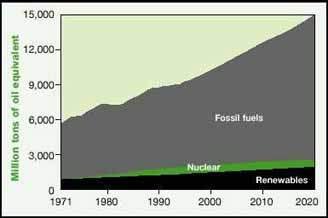
FIGURE 4.1. SHARE OF FUELS IN
GLOBAL ENERGY SUPPLY, 1971 - 2020
Source: IEA, 1998.
In 1998 world consumption of primary energy totalled almost 355
exajoules, or 8,460 million tonnes of oil equivalent (Mtoe) - 7,630 Mtoe of
fossil fuels, 620 Mtoe of nuclear energy, and 210 Mtoe of hydropower. To this
should be added around 47 exajoules (1,120 Mtoe) of biomass and other
renewables, for a total of 402 exajoules (9,580 Mtoe). The huge resource base of
fossil and nuclear fuels will be adequate to meet such global requirements for
decades to
come.
Crude oil
Proven oil reserves have increased steadily over the past 20
years, mainly because oil companies have expanded their estimates of the
reserves in already discovered fields. This optimism stems from better knowledge
of the fields, increased productivity, and advances in technology. New
technologies have led to more accurate estimates of reserves through better
seismic (three- and four-dimensional) exploration, have improved drilling
techniques (such as horizontal and offshore drilling), and have increased
recovery factors - the share of oil that can be recovered - from 30 percent to
40 - 50 percent (Campbell and Laherrere, 1998).
Huge amounts of untapped unconventional oil also exist,
augmenting conventional oil reserves. Some 1.2 trillion barrels of heavy oil are
found in the Orinoco oil belt in Venezuela. And the tar sands of Canada and oil
shale deposits of the Russian Federation may contain 300 billion barrels of oil.
The U.S. Geological Survey assessed ultimate oil and gas reserves at the
beginning of 1993 (IEA 1998; WEC, 1998). The results, which tally with the World
Energy Council (WEC) and International Energy Agency (IEA) figures (see table
4.1), point to ultimate conventional oil reserves of 2,300 billion barrels, with
cumulative production until 1993 amounting to 700 billion barrels and
unidentified reserves to 470 billion. No shortage of conventional liquid fuels
is foreseen before 2020. Any deficiencies after that can be met by the ample
reserves of unconventional
oil.
Natural gas
The U.S. Geological Survey also assessed ultimate natural gas
reserves in 1993 (Masters, 1994). It estimated ultimate reserves at 11,448
trillion cubic feet (11,214 exajoules, or 267 gigatonnes of oil equivalent
[Gtoe]), with cumulative production until 1993 amounting to 1,750 trillion cubic
feet (1,722 exajoules, or 41 Gtoe). Cumulative world gas production through the
end of 1995 was only 17.1 percent of the U.S. Geological Survey’s estimate
of conventional gas reserves.
Natural gas consumption is projected to grow 2.6 percent a year,
mostly as a result of growth in electricity generation in non-OECD countries.
Despite this growth, cumulative production is expected to be no more than 41
percent of the U.S. Geological Survey’s estimate of conventional gas
reserves by 2020. This points to a resource base large enough to serve global
requirements for natural gas well into the second half of the 21st century.
TABLE 4.1. GLOBAL ENERGY RESOURCE BASE (EXAJOULES EXCEPT
WHERE OTHERWISE INDICATED)
|
Term |
World Energy Council estimates |
Institute for Applied Systems Analysis estimates |
Consumption |
|
Proven reserves |
Ultimately recoverable |
Reserves |
Resources |
Resource base |
1998 |
|
Conventional oil |
6,300 (150) |
8,400 (200) |
6,300 (150) |
6,090 (145) |
12,390 (295) |
142.8 (3.4) |
|
Unconventional oil |
- |
23,100 (550) |
8,190 (195) |
13,944 (332) |
22,050 (525) |
n.a. |
|
Conventional gas |
5,586 (133) |
9,240 (220) |
5,922 (141) |
11,718 (279) |
17,640 (420) |
85 (2.0) |
|
Unconventional gas |
- |
- |
8,064 (192) |
10,836 (258) |
18,900 (450) |
n.a. |
|
Coal and lignite |
18,060 (430) |
142,800 (3,400) |
25,452 (606) |
117,348 (2,794) |
142,800 (3,400) |
93 (2.2) |
|
Uranium |
3.4 × 10⁹ tonnes |
17 × 109 tonnes |
(57) |
(203) |
(260) |
64,000 tonnes |
- Not available; n.a. Not applicable.
Note: Numbers in parentheses are in gigatonnes of oil
equivalent. For definitions of conventional and unconventional resources, see
chapter 5. a. Because of uncertainties about the method of conversion,
quantities of uranium have been left in the units reported by the sources.
Source: WEC, 1998; IIASA,
1998.
Coal
Coal is the world’s most abundant fossil fuel, with
reserves estimated at almost 1,000 billion tonnes, equivalent to 27,300
exajoules, or 650,000 Mtoe (WEC, 1998). At the present rate of production, these
reserves should last for more than 220 years. Thus the resource base of coal is
much larger than that of oil and gas. In addition, coal reserves are more evenly
distributed across the world. And coal is cheap. Efforts are being made to
reduce production costs and to apply clean coal technologies to reduce the
environmental impact.
Coal demand is forecast to grow at a rate slightly higher than
global energy growth. Most of this growth will be for power generation in
non-OECD countries, mostly in Asia. Although trade in coal is still low, it is
likely to increase slowly over time. Long-term trends in direct coal utilisation
are difficult to predict because of the potential impact of climate change
policies. Coal gasification and liquefaction will augment global oil and gas
resources in the
future.
Nuclear energy
Although nuclear energy is sometimes grouped with fossil fuels,
it relies on a different resource base. In 1998 nuclear energy production
amounted to 2,350 terawatt-hours of electricity, replacing 620 Mtoe of other
fuels. Uranium requirements amounted to 63,700 tonnes in 1997, against
reasonably assured resources (reserves) of 3.4 million tonnes. Ultimately
recoverable reserves amount to almost 17 million tonnes. Considering the
relative stagnation in the growth of nuclear power, the enormous occurrences of
low-grade uranium, and the prospects for recycling nuclear fuels, such reserves
will suffice for many
decades.
Renewables
Renewable energy sources - especially hydroelectric power,
biomass, wind power, and geothermal energy - account for a growing share of
world energy consumption. Today hydropower and biomass together contribute
around 15 percent.
Hydroelectric power contributes around 2,500 terawatt-hours of
electricity a year, slightly more than nuclear power does. It replaces almost
675 Mtoe of fuels a year, although its direct contribution to primary energy
consumption is only a third of this. But it has still more potential.
Technically exploitable hydro resources could potentially produce more than
14,000 terawatt-hours of electricity a year, equivalent to the world’s
total electricity requirements in 1998 (WEC, 1998). For environmental and
economic reasons, however, most of these resources will not be exploited.
Still, hydropower will continue to develop. Hydropower is the
most important among renewable energy sources. It is a clean, cheap source of
energy, requiring only minimal running costs and with a conversion efficiency of
almost 100 percent. Thus its annual growth could exceed the growth of global
energy demand, slightly improving hydropower’s modest contribution towards
meeting world requirements.
|
Techniques for gasification,
fermentation, and anaerobic
digestion
are all increasing the potential
of biomass as a
sustainable
energy source. |
Renewable energy sources other than hydro are substantial. These
take the form mainly of biomass. Traditional biomass includes fuelwood - the
main source of biomass energy - dung, and crop and forest residues. Lack of
statistics makes it difficult to accurately estimate the contribution of
renewables to the world’s primary energy consumption. But it is estimated
that the world consumed around 1.20 Gtoe in 1998. About two-thirds of this was
from fuelwood, and the remainder from crop residues and dung. Much of this
contribution is sustainable from a supply standpoint. But the resulting energy
services could be substantially increased by improving conversion efficiencies,
which are typically very low.
The contribution of biomass to world energy consumption is
expected to increase slightly. It is mainly used as an energy source in
developing countries. While energy demand in these countries is steadily
increasing, some of the demand is being met by switching from traditional to
commercial energy sources.
Biomass energy technology is rapidly advancing. Besides direct
combustion, techniques for gasification, fermentation, and anaerobic digestion
are all increasing the potential of biomass as a sustainable energy source. The
viability of wind energy is increasing as well. Some 2,100 megawatts of new
capacity was commissioned in 1998, pushing global wind generating capacity to
9,600 megawatts. Wind power accounted for an estimated 21 terawatt-hours of
electricity production in 1999. While that still amounts to only 0.15 percent of
global electricity production, the competitiveness of wind power is improving
and its growth potential is substantial. Use of geothermal energy for
electricity generation is also increasing, with a present generating capacity of
more than 8,300
megawatts.
The resource outlook
To summarise, no serious global shortage of energy resources is
likely during at least the first half of the 21st century. Reserves of
traditional commercial fuels - oil, gas, and coal - will suffice for decades to
come. When conventional oil resources are depleted, the huge unconventional oil
and gas reserves will be tapped as new extraction and clean generating
technologies mature. Coal reserves are also huge: the resource base is more than
twice that of conventional and unconventional oil and gas. Clean technologies
for coal will allow greater exploitation of this huge resource base, mainly in
electricity production, but also through conversion into oil and gas, minimising
environmentally harmful emissions.
The uranium resource base is also immense, and it is unlikely,
at least in the short term, to be tapped in increasing amounts. The ultimately
recoverable uranium reserves will easily meet any nuclear power requirements
during this century.
The renewable resource base is also promising. Only part of the
global hydro potential has been tapped. Hydropower plants will continue to be
built as demand for electricity grows and the economics of long-distance,
extra-high-voltage transmission improve. Biomass has substantial potential and
will continue to be used not only as a traditional fuel but also in increasingly
sophisticated ways, through thermochemical and biochemical applications. New
renewable sources, particularly wind power, will gradually increase the
contribution of renewables to global energy supplies as the economies and
technologies of these environmentally attractive sources continue to improve.

FIGURE 4.2. SHIFTING CONCENTRATION
OF WORLD ENERGY DEMAND, 1995 - 2020
Source: IEA, 1998.
In short, the world’s energy supplies offer good prospects
for energy security in the 21st century. The fossil fuel reserves amount to
1,300 Gtoe and the fossil fuel resource base to around 5,000 Gtoe (see table
4.1), amounts sufficient to cover global requirements throughout this century,
even with a high-growth scenario. That does not mean there will be no temporary
or structural energy shortages, but as long as the energy resources are being
explored and exploited, these shortages will not be due to resource
inadequacy.
Supply security
Energy resources are not evenly distributed across the world.
Oil in particular, and natural gas to a lesser extent, are concentrated in a few
regions. The concentration of oil reserves in the Persian Gulf region has always
caused concerns about continuity of supply. Most countries, particularly OECD
countries, experienced oil shortages and high prices in the 1970s and early
1980s, with physical disruption in supply leading to economic disruption. Energy
importers are anxious not to repeat such experiences.
The oil supply situation has improved significantly since then.
OECD countries’ share of the energy market is decreasing, while that of
developing countries is increasing (figure 4.2). This adds to the security of
oil supplies because many developing countries are oil producers or have supply
arrangements with producers. OECD countries, which accounted for 70 percent of
the energy market in the 1970s, will see their market share fall to less than
half by 2010. Technological advance has allowed the discovery and development of
new energy reserves and reduced the cost of supplies. It has also helped
increase efficiency in energy use, loosening the historically tight link between
economic development and energy consumption.
Another major favourable development is the reduction in the
sources of conflict that can affect global energy security. The cold war is
over, and stability in the Middle East, although still precarious, is improving,
with the Arab-Israeli conflict moving towards resolution.
However, some other global developments present both
opportunities and new challenges to the energy sector. The policy emphasis on
environmentally sustainable development, particularly in OECD countries, has
important long-term implications for energy security. And the market
liberalisation taking place in most industrialised countries has reduced the
state’s role in energy security - and increased that of consumers.
Energy security is also important for energy producers and
exporters. History shows that oil supply disruptions have negative effects on
oil-exporting economies. As consumers in importing economies shift away from
oil, the lower demand causes severe economic damage to the exporters. In
addition, many oil-exporting countries have recently obtained stakes in
downstream operations in importing countries. This involvement in OECD economies
will contribute towards energy security, as supply disruptions could mean a loss
of business opportunities for both oil exporters and importers.
Causes of supply disruption are not limited to disturbances in
production facilities. Disruptions can also occur in the long supply chains,
such as serious tanker accidents in the most heavily travelled zones - the
Strait of Malacca, for example. Vulnerability to disruption may grow as energy
supplies are increasingly delivered through grids (gas pipelines and
extra-high-voltage transmission networks). Some of these cross national
boundaries and are at least theoretically vulnerable to damage through sabotage
and other political disturbances. Terrorist actions could damage liquefied
natural gas (LNG) conversion and receiving stations and tankers. But such
possibilities are remote. Most energy supplies are delivered under long-term
contracts that commit governments to ensuring safe transit and security.
Despite the favourable developments in the energy market, energy
security continues to concern planners and strategists in most importing
countries. Long-term energy security can be enhanced in several ways:
· Increasing energy
independence by fostering and developing local resources (although some may not
be economical). Supply security should not be measured solely by energy
independence, however. An intelligent supply policy that includes external
energy sources can offset many of the drawbacks of dependence and be more
economical than a policy that precludes energy imports.
· Diversifying sources of supply
and forms of energy used (box 4.2).
· Encouraging international
cooperation and agreements among energy-importing countries and between consumer
and supplier countries, whether between governments or between companies.
· Investing in and transferring
technology to developing countries. Enabling developing countries to develop
more energy supplies will enhance the availability of global supplies. Helping
these countries increase the efficiency of energy use and improve environmental
management will have a similar effect.
· Enhancing and increasing
national and regional strategic reserves of crude oil and its
products.
|
No serious global
shortage of energy resources
is likely
during at least
the first half of the
21st century. |
Of all the forms of energy, crude oil and its products are still
the most important for energy security, because of oil’s versatility and
because it is the optimal form of energy for the transport sector. Natural gas,
because of its affordability and cleanliness, is gaining in importance. Nuclear
energy, despite its past promise, faces many difficulties. The security of all
these energy forms, as well as coal, is discussed below. Energy intensity is
also discussed, because improvements in this area could yield a wider range of
benefits for energy security than could providing new sources of
energy.
Security of crude oil supply
Over the past 20 years many changes in the oil market have
improved the overall security of the energy market. The world economy has become
less dependent on oil, as most regions have diversified their energy sources.
Oil constituted almost 46 percent of world commercial energy sources in 1973,
compared with 40 percent now. There has also been diversification of supply. In
the early 1970s the Organization of Petroleum Exporting Countries (OPEC)
accounted for more than half the world’s oil; today it provides only 42
percent. The world now has 80 oil-producing countries (although very few have
the surge capacity needed in emergencies). The oil markets have become more like
traditional commodity markets (with futures markets), transparent and able to
respond quickly to changing circumstances.
|
BOX 4.2. FRANCE’S EFFORTS TO ENHANCE ENERGY
SECURITY
France has few energy resources and yet is highly industrialised
and thus heavily dependent on adequate and reliable energy supplies. Its total
energy consumption is estimated at 240 million tonnes of oil equivalent (Mtoe) a
year, while domestic primary energy production of oil, gas, and coal amounts to
only 8 Mtoe and is declining.
France, which produced half its total energy requirements in the
early 1960s, saw its energy self-sufficiency decline sharply by the 1970s, when
it produced only 22 percent of its requirements. But through intensive effort
and ambitious energy planning, France reversed this trend of increasing
dependence on imported energy. Thanks to its advanced technological skills,
France was able to undertake an ambitious nuclear energy programme that helped
it regain its 50 percent energy self-sufficiency in the late 1980s and to
maintain it since.
To enhance its energy security, France pursued the following
actions, which take into account its high standard of living, extensive
industrialisation, and limited indigenous sources of primary energy:
· Diversification of
energy sources and structure of energy use. France significantly reduced its
dependence on imported oil from the Middle East, increased its dependence on
gas, mainly from European and Algerian sources, and considerably increased its
dependence on domestic electricity produced by nuclear power stations (see the
table below).
· Participation in regional
cooperation and joint actions, including the International Energy Agency and the
Energy Charter Treaty.
· Reduction and rationalisation
of demand by improving energy efficiency and encouraging conservation through
pricing and taxation, particularly of petroleum products.
· Regional interconnection of
gas and electricity networks, helping to mitigate temporary problems in the
supply chain.
· Substitution of natural gas
and nuclear electricity for petroleum products wherever possible.
By focusing on nuclear energy, France no doubt enhanced its
energy security. But it also introduced a new vulnerability into its system.
Nuclear power is a viable link in the energy chain as long as it is safe and
publicly accepted. With the accidents at U.S., Russian, and Japanese nuclear
plants and the growing strength of anti-nuclear parties in Europe, there is no
guarantee that it will remain publicly accepted over the long term. |
|
Energy supply structure in France, 1973 and 1997
(percent) |
|
Cost |
1973 |
1997 |
|
Primary energy |
|
|
|
Coal |
14.5 |
5.6 |
|
Oil |
66.3 |
39.7 |
|
Gas |
7.0 |
13.1 |
|
Primary electricitya |
7.0 |
36.6 |
|
Renewablesb |
5.2 |
5.0 |
|
Final energy |
|
|
|
Coal |
11.0 |
4.0 |
|
Oil |
56.4 |
37.1 |
|
Gas |
5.5 |
13.9 |
|
Electricity |
20.9 |
39.1 |
|
Renewablesb |
6.2 |
5.9 |
a. Most primary electricity is from nuclear fuels.
b. Excluding hydroelectricity but including non-commercial uses.
Source: Maillard, 1999.
Big strides have been made in energy efficiency, gradually
reducing the dependence of economic growth on increased oil consumption.
Advances in technology have led to discoveries of more oil, reduced the cost of
discoveries, and significantly improved the recovery rate, increasing the oil
resource base to an estimated 2,300 trillion barrels. World trade has flourished
in recent years. In 1998 it was three times that in 1980, and now accounts for
44 percent of global GDP, compared with 39 percent in 1980. Both energy
exporters and importers benefit from trade. Most exporters are low-income
countries that badly need oil income for development.
Even with the increase in oil-producing countries, the fact
remains that almost two-thirds of the world’s oil resources are in the
Middle East, mostly in the Gulf region (the Islamic Republic of Iran, Iraq,
Kuwait, Qatar, Saudi Arabia, and the United Arab Emirates). Although these six
countries now account for only 27 percent of global crude oil supplies, they are
expected to double their share to 52 percent in 2010. The Middle East,
particularly the Gulf region, has not been historically known for political
stability and security. But as mentioned, the situation is improving.
OECD countries, which account for almost 80 percent of the
world’s economic activity and 63 percent of global oil consumption, are
particularly dependent on oil imports. All OECD countries are expected to
increase their dependence on oil imports over the next few years. Their oil
imports, 56 percent of their energy requirements in 1996, are expected to rise
to 76 percent in 2020 (table 4.2).
Asia-Pacific countries’ crude oil imports are expected to
increase to 72 percent of their requirements in 2005 (up from 56 percent in
1993). The Middle East is expected to account for 92 percent of the
region’s imports, with the Gulf countries the main source of supply. The
Gulf region is expected to supply 18 million barrels a day to Asia-Pacific
countries in 2010 (figure 4.3), far more than its expected total supplies to
Europe and the United States of 12 million barrels a day. That is why oil
security, particularly for the major oil-importing countries, and the stability
of the Gulf region have such importance to overall energy security and the world
economy. This importance will only increase in the future.
TABLE 4.2. OIL IMPORTS AS A SHARE OF TOTAL ENERGY
REQUIREMENTS IN OECD COUNTRIES (PERCENT)
|
OECD country group |
1996 |
2010 |
2020 |
|
North America |
45 |
63 |
63 |
|
Europe |
53 |
74 |
85 |
|
Pacific |
90 |
96 |
96 |
|
Total OECD |
56 |
72 |
76 |
Source: IEA, 1998.
|
Despite the favourable developments
in the energy market,
energy security
continues to concern planners
and strategists in
most
importing countries. |
Differences between regional requirements and regional supplies
will be accentuated in the future. Nowhere will this be more serious than in
Asia, particularly among the large oil-consuming countries - China, India,
Japan, and the Republic of Korea. Competition for supplies may intensify during
emergencies, creating a potential for severe strains among Asian powers.
Shortages may tempt some of these countries to project political and even
military power to ensure adequate oil supplies. Already some of them - as well
as the United States - have increased their naval presence in the Asian and
Indian oceans (Jaffe, 1998). And U.S efforts for cooperation and conflict
resolution are linked to its military planning and presence in the Gulf region
and key oil export sea routes (Kemp and Harkavy, 1997).
Threats to security in oil-exporting countries can be both
internal and external. Continued supply from Saudi Arabia is the most important
element of energy security. Saudi supplies, now more than 9 million barrels a
day, will have to increase to 13 - 15 million barrels a day in 2010 to meet
growing world demand and offset resource depletion in non-OPEC suppliers. By
that time the United States will be importing more than 60 percent of its oil.
Saudi Arabia has both the potential and the reserves to meet projected demand,
but the expansion will call for investment resources from that country as well
as the world financial community. For a healthy oil sector, the availability of
such financing should be no problem. Over the past few decades the Gulf
countries have proved to be stable; continued internal and external stability is
crucial to energy security. Disruption of the Gulf oil flow would lead to a deep
world-wide recession. This has been presented as one of the gravest threats
imaginable to U.S. interests, short of physical attack (David, 1999).
The cost of energy security goes beyond investing in redundant
facilities and building pipelines, grids, and strategic reserves. Tremendous
military expenditures - both visible and invisible - are required to head off
any threats to the flow of oil, particularly from the Gulf countries. These
costs cannot be easily computed or ascertained. The enormous expenditures on the
1990 - 91 Gulf War, totalling several hundred billion dollars, were meant to
ensure energy security for major oil importers and the world oil markets in
general. The six Gulf Cooperation Council (GCC) states, which control nearly 45
percent of the world’s recoverable oil resources, contributed more than $60
billion to the U.S.-led allied offensive to eject Iraqi forces from Kuwait in
1991 (AFP, 1998). The GCC countries’ contribution in 1991 exceeded their
oil export income in 1998 or 1999. The United States maintains a costly military
and naval presence in strategic locations to ensure the uninterrupted flow of
GCC oil exports to world markets. At the beginning of 1998, along with the
United Kingdom, it assembled large air and naval forces to address perceived
threats to the security of oil supply from the Gulf.
Although short-term disruptions in energy supply due to regional
conflicts cannot be ruled out, means to overcome such disruptions already exist.
The best illustration of this is the minimal effect on oil markets from the
Iraqi invasion of Kuwait in 1990. Although 4 million barrels of oil a day
dropped out of the market, Saudi Arabia increased its production and restored
stability to the oil market and to prices within a few weeks. Instruments for
stabilising the oil market are improving year after year - strategic stocks held
by oil companies and major importing countries, development and liberalisation
of markets, and regional and global energy agreements. And once transport and
transit issues are resolved, the Caspian Sea countries’ hydrocarbon
resources, as a supplement to the North Sea resources, can be added to this
list.
FIGURE 4.3. FLOW OF GULF OIL
SUPPLIES, 2010
Source: Kemp and Harkavy, 1997.
Oil stocks: cushioning against supply disruptions. Oil
stocks are usually held by oil companies for operational purposes, and by
countries and state utilities to provide a cushion against unexpected surges in
demand and possible disruptions in imports. Oil companies usually hold stocks
that account for 55 - 65 days of consumption. International Energy Agency
members are required to hold emergency oil stocks equivalent to at least 90 days
of net imports. The European Union requires its members - also IEA members - to
hold stocks equivalent to at least 90 days of consumption. It is not easy to
estimate oil stocks held by developing countries. Because of the cost, their
stocks are relatively smaller than those of OECD countries, but can amount to 25
- 55 days of consumption, which is also typical for oil companies in these
countries. Correspondingly, world oil stocks in 1997 were about 5,500 million
barrels, equal to 70 - 80 days of average global consumption. This, at present,
is adequate for unexpected transient shortages or temporary interruptions.
With the continued growth of non-OECD oil consumption, oil
stocks will function less effectively. Their size relative to the global oil
market will decline, since most developing countries do not maintain emergency
oil stocks (many cannot afford them). If this trend continues, vulnerability to
sudden and substantial oil supply disruptions will increase.
Liberalisation of markets: easing the flow of oil.
Another aspect of security is the liberalisation of energy markets in importing
countries. Liberalisation and deregulation, coupled with the development of oil
futures and forwards markets, mean an easier and more secure flow of oil from
exporting to importing countries. Most oil producers are now inviting foreign
companies to participate in oil development, which will significantly enhance
the security of the oil market. And the strengthening of the World Trade
Organization will add further to the security of the energy market.
Although security in terms of flows of oil and gas to importing
countries is improving, the security of supply to consumers faces new
challenges. Liberalisation, the withdrawal of government responsibility for
supply, and competition among private suppliers are creating challenges in
securing reliable supply to individual consumers. These are discussed later in
detail.
Energy treaties and agreements: enhancing energy security
through cooperation. In response to insecurity after the first oil shocks,
OECD countries convened a conference in Washington, D.C., in 1974 that led to
the establishment of the International Energy Programme (IEP), the founding
charter of the International Energy Agency(IEA). To improve energy security, the
participating countries pledged to hold oil stocks equivalent to 90 days of net
imports. They also developed an integrated set of emergency response measures
that included demand restraint, fuel switching, and surge oil production. These
measures also included the important provision of stock draw-down and sharing of
available supplies in the event of oil supply disruptions involving a loss of 7
percent or more for any member country or for the group (Martin, Imai, and
Steeg, 1996).
In 1977 the IEA developed another set of coordinated emergency
response measures that allow for a rapid and flexible response to an impending
oil security crisis. Also in that year, IEA countries agreed to long-term energy
policies and programmes aimed at diversifying resources, employing energy
efficiency measures, and developing new energy technologies. And in response to
changing circumstances, the IEA updated its policies in a statement of shared
goals at its ministerial meeting in 1993.
In 1991, 51 countries signed the European Energy Charter to
enhance energy security throughout the Eurasian continent and promote the
creation of an open and non-discriminatory energy market. The signatories
included the European Communities and their member states, the countries of
Central and Eastern Europe, all the members of the Commonwealth of Independent
States (CIS), and Australia, Canada, Japan, and the United States. By applying
the principles of non-discrimination and market-oriented policies, the charter
was aimed at improving energy security, increasing the efficiency of all links
in the energy chain, enhancing safety, and minimising environmental impacts.
Three years later, in 1994, all the signatories to the European
Energy Charter (except Canada and the United States) signed the Energy Charter
Treaty, along with a protocol on Energy Efficiency and Related Environmental
Aspects, which entered into force in 1998. Japan and the Central Asian states
have since signed the Charter Treaty and China is showing increasing interest in
it, enhancing its geopolitical scope. The treaty applies to all economic
activities related to a broadly defined energy sector. Its main purpose is to
promote the creation of an open and non-discriminatory energy market throughout
the Eurasian continent (Schuetterle, 1999). The Charter Treaty obligates
signatories to encourage and create stable, equitable, and transparent
conditions for foreign investors in their countries, stipulates that General
Agreement on Tariffs and Trade (GATT) provisions will govern trade in energy
materials and products, ensures the transit of energy exports through third
countries, and sets out procedures for settling disputes relating to the
treaty’s provisions.
|
OECD countries, which account for
almost 80 percent of the
world's
economic activity and 63 percent
of global oil consumption,
are
particularly dependent on
oil imports. |
Also serving to enhance energy security are interregional and
intraregional agreements established to foster economic cooperation between
member countries, such as Asia-Pacific Economic Cooperation (APEC), which
involves 21 economies of Asia, Oceania, and the Americas (box 4.3). Enhancing
energy security is one of the aims of APEC, which set up its own Energy Work
Group and the Asia Pacific Energy Research Centre (APERC) for this purpose.
No doubt the above-mentioned treaties and arrangements helped to
foster energy investments and improve energy security - not only for their
members, but also globally - by encouraging sustainable energy policies.
Oil in transport: a special point of vulnerability. The
transport sector accounts for half of global oil demand, with heating,
electricity generation, industrial processes, and petrochemicals accounting for
the rest. Demand for oil in transport is growing rapidly, particularly in
aviation. Over the next 20 years demand for oil in transport is expected to grow
by 2.3 percent a year, compared with growth in total demand for oil of around
1.9 percent a year. Most of this growth will occur in non-OECD countries, where
it is expected to average 3.6 percent a year, with the highest growth projected
for China and East and South Asia. Demand in OECD countries, which are already
witnessing some saturation in vehicle ownership, is expected to grow at
one-third that rate.
In the near term there is no cheap and viable alternative to oil
in transport, particularly in private vehicles and aviation (Douaud, 1999). Use
of oil for mobility will increase in all countries, as the transport fleet grows
and uses exceed improvements in transport efficiency. An interruption in oil
supply, however temporary, could cause major disruption to the transport sector
and to the world economy.
Oil prices: a source of insecurity. The severe volatility
of oil prices in the 1970s and early 1980s contributed to the insecurity in
energy markets. The price of oil is the market leader for energy pricing. Gas
and coal, because of competition, are priced accordingly.
OPEC has the power to influence oil prices by allocating supply
and monitoring and restricting production by its members. With the growing
discipline in its ranks, this influence may increase in the future. Moreover,
the depletion of non-OPEC oil and future growth in its marginal cost will
increase oil prices in the medium and long term. Prices will be further
increased by the development of the more expensive non-conventional oil, once
crude oil supply peaks around 2010. Although short-term price volatility, like
that in 1998 - 2000, cannot be ruled out because of the many factors explained
above, oil prices are not expected to be as volatile as in the past. After 2010
gradual, moderate price increases are expected. Many recent predictions have
been made of future oil prices. Two of these are given in table 4.3.
|
BOX 4.3. ASIA-PACIFIC ECONOMIC COOPERATION’S EFFORTS
TO ENHANCE ENERGY SECURITY
Asia-Pacific Economic Cooperation (APEC) includes the following
member economies in six ‘sub-regions’:
· The United
States.
· Other Americas - Canada, Chile, and
Mexico.
· China.
· Other Asia - Hong Kong (China), Japan, Republic of
Korea, and Taiwan (China).
· Oceania -
Australia, New Zealand, and Papua New Guinea.
· Southeast Asia - Brunei Darussalam, Indonesia,
Malaysia, Philippines, Singapore, and Thailand.
In addition, Peru, the Russian Federation, and Viet Nam joined
APEC in November 1998.
APEC was formed to foster economic cooperation among its member
economies, one aspect of which is energy cooperation and security. APEC
economies’ energy requirements account for more than half of the
world’s primary energy supply. The group has rich coal resources, and gas
resources almost adequate for its requirements. But it is very short in crude
oil resources. By 2010 APEC economies will have to import an estimated 55
percent of their energy requirements. The recent incorporation of Russia, with
its enormous gas resources and its oil, has helped alleviate APEC’s serious
energy security problem. Nevertheless, APEC’s significant crude oil
shortages are expected to continue. APEC tries to enhance its energy security
through the following actions:
· Encouraging expansion of
energy production. The entry into APEC of Russia, with 40 percent of global
gas reserves and 9 percent of oil reserves, should facilitate the development of
energy resources in the Asian part of Russia and enhance the supply potential to
the growing Asian energy market. The need for expanded production will lead to
more energy development and greater cooperation between APEC economies and other
energy-producing economies outside the traditional APEC region. The
participation of firms from Asian oil-importing economies in upstream
hydrocarbon resource activities will enhance efforts to expand oil and gas
production. Similarly, the participation of firms from oil-exporting countries
in downstream operations in Asian markets will contribute to the security of
energy supply.
· Allowing more flexible fuel
choices. As a group, APEC economies are heavily biased towards coal use. The
main reason is that China, which accounts for a fifth of APEC’s
requirements, uses coal to meet more than 70 percent of energy demand.
Institutional and technological changes to support more flexible choices that
are compatible with sustainable development are being considered. Within APEC,
nuclear options have been and will be pursued in the Americas and East Asia. In
the Americas, however, nuclear power is expected to play a reduced role, while
in East Asia nuclear power is expected to expand. In Southeast Asia there is no
likelihood that nuclear power will be introduced before 2010.
· Preparing for energy supply
disruptions. Emergency oil stocks, like those held by members of the
International Energy Agency (IEA), are a key element of energy security. With
the growth of non-IEA oil consumption, IEA emergency oil reserves will function
less effectively, as their size relative to the global market will decline and
most non-IEA countries do not maintain emergency oil stocks. If this situation
persists, vulnerability to sudden and substantial oil supply disruptions will
grow. The issue of emergency preparedness therefore needs to be examined in a
broader context. For this reason the Asia Pacific Energy Research Centre is
conducting a study to assess the value of emergency oil stocks in APEC
economies.
· Promoting energy reforms.
The increased competition resulting from regulatory reforms in energy
markets promotes energy security in many ways. Yet despite the global trend
towards energy sector liberalisation, some APEC economies in Asia still believe
that energy security requires maintaining a regulated energy market. Attitudes
towards deregulation are gradually softening, however, as long as it does not
preclude the state from continuing to play a role when needed to enhance
security.
· Developing transborder
energy delivery infrastructure. APEC economies are examining the feasibility
of developing transborder infrastructure. Members of the Association of
Southeast Asian Nations (ASEAN) have studied the creation of both gas pipeline
networks and electricity grids linking producer and consumer members. In
Northeast Asia the concept of a gas pipeline network linking former Soviet
economies (Russia and Turkmenistan, for example) with China, the Republic of
Korea, and Japan has been discussed. Finally, Russia is promoting the idea of
linking electricity grids with neighbouring economies. Besides economic
viability, there are many other considerations in such projects: improved
regional political stability through cooperation, better use of untapped
resources, and increased capacity utilisation, energy supply, and demand
diversity. |
Such moderate price increases, along with continuous improvement
in energy efficiency, mean that oil prices are unlikely to place a more serious
burden on the global economy than they do now. Moreover, the expected
improvements in the real price of oil will spur producing countries to enhance
and expand their production and provide them with the badly needed financial
resources to do so.
Income security for oil-exporting countries. Some
countries depend - for income and for development - on energy exports,
particularly oil. This group is not limited to the Middle East; it includes a
few countries in Sub-Saharan Africa and Latin America. Nor is this dependence on
oil export income restricted to exporting countries; the benefits of oil export
income spread to other countries in the region through wage remittances and
financial assistance.
In the Gulf countries three-quarters of government revenue is
derived from oil exports. Energy exports account for almost two-thirds of
government revenue for other countries in the region, such as Algeria, the
Islamic Republic of Iran, and Yemen. The dramatic drop in oil prices in 1998 and
early 1999 led not only to budgetary problems in many energy-exporting
countries, but also to unemployment and significant drops in incomes. Such
economic problems were not only restricted to the oil exporters but were also
experienced by their neighbours, which depend on revenues from exports of goods
and services to the oil-rich countries and on remittances from workers in these
countries. For energy-exporting countries, export security is becoming as
important as energy import security is to resource-short countries. All this is
enhancing the prospects for global energy security.
TABLE 4.3. OIL PRICE PROJECTIONS (1997 U.S. DOLLARS PER
BARREL)
|
Source of projections |
1997 |
1998 - 2010 |
2015 - 2020 |
|
International Energy Agency |
18.50 |
24.50 |
26.20 |
|
U.S. Department of Energy |
18.55 |
21.30 |
22.73 |
Source: IEA, 1998; USDOE, 1998.
Dependence on oil exports has an additional implication for
exporting countries. These countries, particularly OPEC members, are worried
about the possible long-term impact on export demand of policies to mitigate
environmental impacts, promote energy efficiency, and increase use of renewable
energy sources. Although exaggerated in the short term, the potential impact
could pose long-term problems for the countries, adversely affecting their
economic and social development. Having met the needs of the global energy
sector satisfactorily over the past 25 years, oil-exporting countries are asking
for compensation if mitigation actions start to bite. This request is being
reviewed in international negotiations. It may be many years before exporting
countries’ income is affected. Meantime, it is hoped that with
international assistance and compensation, they will be able to diversify their
income sources and reduce their dependence on oil
exports.
Security of natural gas supply
Natural gas is slowly gaining importance in the energy market.
Between 1987 and 1997 gas consumption increased from 1,756 giga cubic metres to
2,197, for an annual growth rate of 2.27 percent, compared with 1.47 percent for
total primary commercial energy consumption. Over the period until 2020 natural
gas demand is expected to grow still faster - at an annual rate of 2.6 percent,
compared with 1.9 percent for oil. And natural gas supply, since it is starting
from a much lower base than oil supply, is not expected to peak until well
beyond 2020 (IEA, 1998).
Internationally traded natural gas accounted for 19 percent of
gas consumption in 1997, compared with 44 percent for oil. So, just as for oil,
though to a lesser extent, there is a mismatch between the location of gas
supply and its consumption. Security of supply is therefore critical. But the
physical characteristics of natural gas make ensuring security of supply for gas
more complicated than for oil. Crude oil is an eminently fungible commodity,
portable by ship, pipeline, road tanker, or even barrel. In contrast, gas
requires expensive pipelines or LNG infrastructure. These delivery systems are
relatively inflexible: pipelines cannot be moved or built overnight, and LNG,
although somewhat portable, still requires an expensive receiving terminal.
Crude oil and, more important, refined oil products can be transported to any
location that can receive a ship or road tanker. Moreover, gas is difficult to
store in significant quantities. The energy content per unit of volume is much
lower for gas than for oil. Gas is simply more difficult to handle than liquid.
Its storage often depends on the suitability of geological structures, while oil
tank farms can be built relatively easily and cheaply. All these factors mean
that the solutions used to ensure security of oil supply (storage,
diversification of supplies) do not apply as easily to gas.
At its simplest level, gas supply security can mean operational
reliability - in other words, that gas flows to the consumer when it is
required. In particular, this means meeting consumer needs on days of peak
demand, usually in winter. The gas supply system must be configured to give the
required flexibility.
Security of supply also involves reducing strategic risk,
namely, the risk of a major disruption to supplies caused by, for example,
political factors or major technical failure, such as the failure of a
high-pressure pipeline. This is an extension of operational security, but of a
different order of magnitude. Strategic risk is growing in parallel with the
growing share of gas in meeting countries’ primary energy requirements. It
can be reduced through:
· Interconnectivity,
the degree of physical interconnection with other gas systems, an important
factor in ensuring strategic security of supply. Interconnectivity is more than
simply a guard against potential failure; it also encourages diversity of
supply.
· Diversity of supply, which is
fundamental to security of supply because it spreads risk. All sources of supply
are unlikely to fail at the same time. Countries have often explicitly
diversified supply by contracting with several countries. France, for example,
buys gas from Algeria, the Netherlands, Norway, and Russia. In recent years
there have been a number of spot LNG sales into Europe from LNG suppliers using
spare capacity.
Security of supply also entails guarding against long-term risk
- ensuring that consuming countries can secure future and additional supplies as
their existing supplies are depleted. This represents a challenge, as the bulk
of the world’s gas reserves are in areas that are far from current markets
and also often have a high level of country risk.
Some gas-importing countries, such as France, use long-term
strategic storage to guard against significant disruption of supply. Such
storage can be in depleted oil or gas fields, aquifers, salt caverns, or other
geological structures.
Political risks to gas supplies and security of interregional
grids. With the increase in internationally traded natural gas and LNG,
political risk to gas supplies and cross-boundary networks will increase. One of
the measures taken to reduce political risk is the Energy Charter Treaty, which
attempts to provide a legal framework for the transit of hydrocarbons and
electricity through pipelines and grids. The treaty prohibits contracting
parties from imposing unreasonable charges for the transit of energy or taking
unreasonable or discriminatory actions. Most important, in the event of a
dispute over transit, transit states may not interrupt or reduce existing
transit until the parties have had an opportunity to resolve the dispute using
the treaty’s dispute resolution mechanisms. As a further aid to
international gas trade, the treaty prohibits countries from refusing new
transit or new capacity to other treaty signatories solely on the basis of the
origin, destination, or ownership of the energy being transported.
Political risk is also an issue for investment in the gas
industry. Because of the capital intensity of the industry, a sound investment
environment is needed to encourage companies to invest. This requires clear
legal, fiscal, and contractual frameworks; transparent regulatory processes; and
regulatory certainty. To improve the international investment environment for
projects involving the transit of gas as well as oil and electricity across
national boundaries, the Energy Charter Conference, an intergovernmental body
made up of the 51 states that have signed the Energy Charter Treaty, began in
1999 to elaborate the Multilateral Transit Framework Agreement. The aim is to
strengthen the international rule of law on transit issues by further developing
the treaty’s transit provisions.
With increasing utilisation of gas, lengthy gas pipeline grids
across countries and boundaries are becoming familiar. This raises concerns
about political and security problems relating to the integrity of the pipeline
and continuity of supply - because of possible regional disputes, disagreements
among firms, or accidents or sabotage. One of the principal aims of the Energy
Charter Treaty is to provide for such contingencies. But not all countries are
signatories to the treaty, though the numbers are increasing. However, the
treaty provides guidelines (explained above) that non-member countries can
incorporate in agreements relating to cross-boundary pipelines. Moreover, the
increasing strength of markets, the World Trade Organization regulations, and
the increasing interdependence of markets and countries enhance the security of
supply from regional gas grids.
Natural gas is an ideal fuel for electricity generation. It is
environmentally benign compared with coal and offers the potential for very high
efficiencies in combined cycle plants. Like oil, natural gas resources are
unevenly distributed across the world, but unlike oil, gas is not easily
transportable or tradable. Expensive interregional gas grids are a solution as
long as security is guaranteed, an aim of the Multilateral Transit Framework
Agreement. Interregional grids provide benefits to all - suppliers, consumers,
and transit countries. In addition, the increased security inherent in pipeline
systems enhances cooperation among the countries involved.
Satisfying the increasing energy demand in India and South and
East Asia may require building a very large interregional pipeline from the
Islamic Republic of Iran or the Gulf. This would require not only a huge
investment but also a coordinated regional arrangement and guarantees. Such a
pipeline could sustainably meet the increasing demand for electrification in
parts of Asia that account for more than a third of the world’s population
and where electricity demand is growing at twice the world average.
Risks to internal security of supply. In addition to the
external risks, internal security risks are on the increase. These include the
risk of electricity shortages due to increasing dependence on gas in electricity
production. This increasing reliance on gas also raises supply security issues
because of the possible domino effect in the event of gas supply problems. As a
result of an interruption in gas supply to gas-fired power stations, a national
grid could find itself short of capacity just as demand is peaking. Such
security risks can be reduced, however, through coordination between the gas
grid and the electric utilities, by switching combined cycle gas turbines (CCGT)
to other fuels in the event of gas shortages, and by diversifying the energy
sources for power generation (coal, nuclear, oil, gas, and hydro).
|
Tremendous military
expenditures - both visible
and
invisible - are required to head
off any threats to the
flow of
oil. |
Diversity is more important than origin of supply. The
mechanisms for securing diversity can be based on market instruments (payments
for reserve capacity) or regulation (requirements for storing a certain number
of days’ worth of backup fuel supply). The U.S. gas market has shown how
the price mechanism can enhance security of supply during less severe shortages.
Many power stations burn both fuel oil and natural gas. As gas prices rise and
the supply-demand balance tightens, the generators switch to the cheaper fuel,
freeing up supply for gas consumers who cannot switch.
Development of national gas markets. Traditionally,
international gas trade has been conducted on the basis of long-term
(several-year) take-or-pay contracts. Under these contracts, designed to manage
risk, the buyer agrees to take a certain volume over a period of time and to pay
for that volume regardless of whether it is actually used. In effect, the buyer
takes all the volume risk (the risk as to how much gas the end-use market will
actually consume). The seller agrees to sell a certain quantity at a price
indexed to such factors as the price of competing fuels, the price of
electricity, and producer inflation. The seller therefore takes the risk that
this price will cover its costs of production and provide a return on its
investment. This is completely different from a commodity market, where supply
and demand balance at whatever is the market-clearing price.
The ‘traditional’ take-or-pay system also frequently
involved either monopsony or oligopoly buyers such as the European utilities
(including the old British Gas and Gaz de France) and the Japanese utilities
(Tepco). It has been argued that such a system was the only way to match supply
and demand, ensure orderly development of the market, and allow all parties to
recoup their investments. The approach has evidently worked: the record on gas
supply security in Europe and Japan has been exemplary.
Recently, however, attention has focused on the implications of
the liberalisation of gas markets for security of supply. In the United States
the natural monopoly aspect of gas supply, gas transport by pipeline, has been
separated from the other functions - production, wholesale, and retail.
Regulated third-party access has given any gas producer the ability to transport
its product to the end market, and any customer the ability to buy gas from any
producer or wholesaler. In short, the approach has enhanced U.S. supply
security. But the U.S. experience cannot necessarily be applied to other
countries.
Long-term take-or-pay contracts do not completely eliminate
political or commercial risks. If a country is unable or unwilling to export its
gas reserves for whatever reason, who has legal title to them is irrelevant.
What such contracts can do, and have done in the past, is to give the parties a
degree of confidence in the viability of a project and help secure financing.
By separating transport from supply, liberalisation, over the
long term, will encourage the producers able to supply the market at lowest cost
to meet consumers’ demand. Moreover, the U.S. experience suggests that as
pricing of gas supply and associated services becomes more transparent and
explicit, market participants will search for the most cost-effective way of
ensuring gas supply. In the United States this has led to greater and more
innovative use of storage. The results depend, however, on how the industry
structure and regulations evolve - whether dominant players effectively keep out
new entrants, for example, or a more level playing field develops.
In summary, while the physical characteristics of gas make
supply security problematic, it can nevertheless be enhanced by a variety of
mechanisms, enabling gas to continue to play its part in the world’s energy
balance. Liberalisation of energy markets is not incompatible with supply
security, and can arguably enhance
it.
Security of coal supply
Coal presents fewer challenges - other than environmental ones -
to energy security than do oil and gas. It is abundant and more evenly
distributed around the world than oil or gas. It is cheap, and costs are
continuously being reduced by competition. The many suppliers and the
possibility of switching from one to another mean supply security. The global
ratio of coal reserves to production is 225 years; for OECD countries, it is
even higher. Coal is still a local fuel, however. International trade in coal is
limited, amounting to only 13 percent of production, a smaller share than for
gas.
The huge reserves of coal and their even distribution contribute
to global energy security. Coal will continue to play a major part in ensuring
the energy security of large energy consumers, particularly China (the largest
coal consumer), the United States, and South Asia. Over the next few decades the
growth in demand for coal is expected to continue to be healthy, exceeding the
growth in overall energy demand.
Most of that growth will be for electricity generation, with
coal consumption in the electricity sector expected to grow in all regions. But
this is also the area where the main security challenge arises, because of the
environmental effects of coal use - locally, regionally, and also possibly
globally. Coal utilisation is very inefficient, particularly in power
generation, where its efficiency is less than 25 percent (Ecoal, 1998). The
efficiency of oil and gas in electricity generation is at least 50 percent
higher.
For coal to play its deserved role in global energy security,
its many detrimental environmental impacts must be addressed. This will require
not only clean coal technologies for new plants, but also rehabilitation and
refurbishment of existing inefficient plants. And this must happen not only in
industrialised countries, but also in developing countries, which are expected
to account for most coal use. All this calls for technology transfer and huge
investments, which many developing countries will be unable to afford. Thus
technical assistance to developing countries will be
essential.
Nuclear energy and energy security
Nuclear energy could continue to add to the energy security of
countries short of hydropower and indigenous fossil fuel resources, for several
reasons. Uranium resources are widely distributed and abundant world-wide (see
chapter 5). Nuclear fuel is cheap: at the price of present long-term uranium
supply contracts, the cost of natural uranium per kilowatt-hour is equivalent to
an oil price of $0.35 per barrel, so several years’ supply could be kept in
reserve against possible future supply disruption at a low cost. And the cost of
uranium contributes only about 2 percent to the cost of nuclear electricity
generation, compared with 40 - 70 percent for fossil fuels in electricity
generation,1 making the cost of nuclear electricity relatively
insensitive to possible future increases in the uranium price.
These considerations played a key part in the decisions of such
economies as France, the Republic of Korea, Japan, and Taiwan (China) to launch
major nuclear power programmes. In all likelihood, such considerations will also
be important determinants in similar decisions by countries with a shortage of
indigenous resources and a heavy reliance on imports. Moreover, the fact that
nuclear power releases virtually no environmentally damaging emissions of carbon
dioxide, sulphur dioxide, and nitrogen oxide could make it an attractive option
for many countries seeking technologies leading to reduced greenhouse gas
emissions or abatement of local and regional pollution.
In the 1960s and 1970s, particularly after the first oil shock,
nuclear power promised to be a viable solution for industrialised countries
looking for energy security and cheap power. Largely as a result of investment
decisions made in that period, nuclear power has grown to the point where it
dominates electricity generation in several industrialised countries, providing
about a sixth of global electricity in 1998. But the outlook for nuclear power
is not bright. Most of the promise of nuclear energy has evaporated as a result
of loss of investor and public confidence in the technology. There is likely to
be growth in nuclear power in some Asian countries in the period to 2020 and
modest expansion at the global level until 2010. But most projections show
nuclear power accounting for a smaller share of global electricity generation in
2020 than today, and many show its absolute contribution staying the same or
even shrinking.
The loss of investor and public confidence in nuclear technology
is due to concerns about costs, nuclear safety, radioactive waste disposal, and
proliferation or diversion (see chapter 8). Until these concerns are adequately
dealt with, nuclear energy is unlikely to play an expanding role in enhancing
global energy security. The energy security benefits provided by nuclear power
might even be diminished if there is another reactor accident involving
substantial releases of radioactivity or a proliferation or diversion incident
that could be plausibly linked in the public mind to nuclear power.
Recognition that another major accident might not only diminish
prospects for nuclear expansion but also trigger demands to shut down existing
nuclear plants has catalysed private sector-led efforts, under the auspices of
the World Association of Nuclear Operators, to instil a culture of safety in the
world's nuclear industry. This situation has also prompted an international
effort, led by the International Atomic Energy Agency, to bolster national
nuclear regulatory regimes. This effort is embodied in the Convention on Nuclear
Safety, adopted by the organisation’s members. (For discussion of
technological strategies for improving the safety of future reactors, see
chapter 8.)
The Nuclear Non-Proliferation Treaty and associated
international safeguards and nuclear supplier agreements have been implemented
to minimise the nuclear weapons link to nuclear power (Murray, 1995). To date,
all but a few states (apart from the five nuclear weapons states recognised in
the 1968 Non-Proliferation Treaty, these are India, Israel, and Pakistan) have
committed themselves to putting all nuclear material, including the material
used for uranium enrichment and reprocessing, indefinitely under safeguard of
the International Atomic Energy Agency.
Recent events and concerns about the limitations of existing
policies have led various experts to call for further efforts to weaken the
nuclear weapons link to nuclear power. But because the risk of proliferation and
diversion is not at the forefront of public concerns about nuclear power (and
may not be until there is an incident), because national policies in this area
differ widely, and because there is much disagreement in the technical community
about the best approaches for minimising this risk, there has been less action
in this area than there has been in improving reactor safety. Increasing the
authority and resources of the International Atomic Energy Agency for monitoring
enrichment plants and spent fuel is the principal way immediately available to
reduce the proliferation risks associated with existing uranium enrichment and
fuel reprocessing capabilities. (For a discussion of institutional strategies
for further weakening the nuclear weapons link, see Walker, 1998. For a
discussion of future options for weakening this link with advanced technologies,
see chapter 8.)
In summary, for the next couple of decades the prospects for
enhancing energy security through expansion of nuclear power are not bright at
the global level, although they are somewhat better in some Asian countries. In
the longer term whether nuclear power can contribute to energy security depends
not only on technical and economic considerations to be sorted out by the
market, but also on the extent to which the public can be convinced that nuclear
power is safe and that wastes can be disposed of safely. It also depends on
whether the industry can avoid major accidents and proliferation and diversion
incidents, and whether national and international policy-makers and the
technical community can reach consensus on what needs to be done to make nuclear
energy technology widely acceptable.
|
If the world economy continues
to grow at the expected
average rate
of 2.7 percent, in 2020 global
energy demand will be
45-51
percent higher than
in 1998. |
Energy intensity
One way to improve energy security in any country is by reducing
its energy intensity - the amount of energy required to produce one unit of GDP.
The rate of change in energy intensity reflects the overall improvement in
energy efficiency as well as structural changes in the economy. Declining rates
of energy intensity indicate that economic growth is less tightly linked to
increases in energy use.
Energy intensity has improved considerably in industrialised
countries. In the United States over the past two centuries it has declined 1
percent a year on average. One unit of GDP now requires only a fifth of the
primary energy required 200 years ago (IIASA and WEC, 1998). In the past 15
years energy intensity in the United States has improved 20 percent.
Energy intensity differs depending on the level of economic
development. OECD countries generally have an energy intensity that is a
fraction of that in developing countries. In 1996 the commercial energy
intensity of middle-income developing countries was three times that of
high-income countries. This finding remains whether GDP is measured in market
dollars or in purchasing power parity (PPP) terms. In most developing countries
energy intensity is stagnant or even increasing because these countries are in
the early take-off stages of industrialisation, when energy-intensive industries
and infrastructure are being established. Moreover, low-income developing
countries usually show increasing commercial energy intensity because commercial
energy sources are replacing non-commercial fuels.
The prospects for lowering energy intensity are reduced in many
developing countries by the proliferation of energy price subsidies and by the
use of inefficient and outdated plants and equipment. Generally, however, energy
intensity in developing countries is similar to that in industrialised countries
when they were at an earlier stage of development.
Economic growth in developing countries has been relatively high
in recent years, averaging 2.8 percent a year in the 1990s, compared with 2.1
percent for industrialised countries and 2.3 percent for the world. This trend
is likely to continue. If this growth is matched by measures to conserve energy
- such as phasing out subsidies and improving environmental awareness - energy
security in developing countries is likely to continue to improve as well.
Predicting the future of energy intensity is difficult,
particularly for developing countries. In low-income countries energy intensity
may increase in the next few years as these countries substitute commercial
energy for traditional fuels. But for the world as a whole, energy intensity is
likely to improve. Average improvements will range from 0.8 percent to 1.0
percent a year, depending on such factors as environmental awareness and energy
prices (IIASA and WEC, 1998). If the world economy continues to grow at the
expected average rate of 2.7 percent, energy demand growth will average 1.7 -
1.9 percent a year. That means that in 2020 global energy demand will be 45 - 51
percent higher than in 1998. This is a substantial increase. But without the
expected efficiency improvements in global energy utilisation, the demand could
grow as much as 80 percent.
The potential for efficiency improvements is high in many energy
applications (see chapter 6). Some of the most important progress in energy
efficiency is that taking place in the conversion of energy to electricity.
Modern combined cycle gas turbines burning natural gas have efficiencies
approaching 60 percent, and efficiencies of 70 percent are within reach in the
foreseeable future. Such efficiencies are more than double the average of 31
percent for the world stock of existing generating plants. As old plants are
phased out and new, CCGT-type plants - or the traditional thermal generating
plant firing coal at more than 40 percent efficiency - take over, considerable
improvements in energy utilisation will gradually occur. In addition, the
increased use of electricity as an energy carrier world-wide will further
improve energy efficiency. In some applications electricity is more efficient
than other forms of energy, and its use is now growing 2.8 - 3.2 percent a year,
a rate more than 50 percent higher than that for primary energy overall (Khatib,
1997). All this will significantly lower energy intensity and thus improve
prospects for global energy
security.
The environment and energy security
The idea of sustainable development is gaining acceptance on the
official level as well as among the public. Sustainable development demands
environmental preservation. Energy production and utilisation, particularly in
the case of fossil fuels, can be major sources of environmental degradation.
These detrimental environmental impacts have a direct bearing on the future of
energy - in terms of fuels and the extent of their use - and on energy security.
(For a discussion of the environmental impacts of energy use, see chapter 3.)
The United Nations Framework Convention on Climate Change,
adopted at the Rio Earth Summit in 1992, and the Kyoto Protocol, signed by more
than 160 countries in 1997, call for major reductions of greenhouse gas
emissions, which are caused mainly by energy use. Fulfilling the commitments as
agreed and at the schedules approved would greatly affect the use of energy
resources and could compromise global economic progress. There is a large gap
between the commitments and the means for implementation. Targets agreed upon by
negotiators were not necessarily implemented by legislators or other
policy-makers. Implementation of such targets is hindered not only by cost but
also by the need to maintain energy security.
All indications are that fossil fuels will continue to dominate
global energy resources for at least the first decades of the 21st century.
Moreover, the demand for energy services will continue to increase. Most of the
growth will be in developing countries, which can ill afford the high cost of
containment measures. It is therefore essential to find means to contain
energy-related emissions without compromising energy security.
The environmental effects of energy use occur at the local,
regional, and global levels. Local effects consist primarily of heavy
hydrocarbons and particulate matter (including sulphur flakes) that are
deposited within hours and can travel up to 100 kilometres from the source.
Regional effects include emissions and effluents, the most important of which
are sulphur and nitrogen oxides, which are converted into acids; these acids,
which last for a few days in the atmosphere, may travel up to a few thousand
kilometres before being deposited, often after crossing boundaries. Global
environmental impacts are exemplified by emissions of carbon dioxide and other
gases (mainly methane) that have long residence times in the atmosphere.
|
The increased use of
electricity as an energy
carrier
world-wide will further
improve energy
efficiency. |
Local and regional impacts can be addressed by technologies.
However, some of these technologies are expensive for developing countries,
where growth in the use of low-quality coal will be particularly high. There are
no easy answers in dealing with greenhouse gas emissions. Mitigation and
sequestration measures are still to be developed. The most practical solution is
to reduce the growth in fossil fuel use by increasing efficiency in energy
utilisation.
Enhancing efficiency in energy use not only helps greatly to
mitigate emissions; it also improves energy security. But for greater benefits
for energy security, energy use should also be made more compatible with the
aims of sustainable development through better containment of emissions. Such
simple measures as washing coal will rid it of 20 - 50 percent of its sulphur.
Advanced burners and scrubbers remove pollutants and effluent gases from smoke
stacks and chimneys. Fuel substitution is another effective measure. A modern
CCGT power station, firing gas, will emit only 40 percent as much carbon dioxide
as a traditional coal-fired thermal power station. The slow but persistent
growth in the use of electricity as an energy carrier will also contribute
towards energy security. Besides offering greater efficiency than other forms of
energy in many applications, electricity concentrates emissions in a single
remote location - the site of the power station - making them easier and cheaper
to deal
with.
Markets and energy security
Approaches to ensuring energy supply security in the 21st
century should differ from past approaches that concentrated on oil
substitution. Besides sustainable growth challenges, new approaches need to
tackle the new energy security issues raised by market liberalisation.
The enhanced role of markets is tied closely to the process of
globalisation. Globalisation, which is still gaining momentum, has encouraged
competition and strengthened markets and regional and international trade,
particularly for crude oil and oil products, natural gas, and energy services.
Globalisation is bringing new opportunities for energy security, such as better
access to markets and services and the transfer of technologies that are helping
to reduce the cost of energy exploration and expand proven reserves.
International trade in energy resources and services is vital
for energy security. The creation of the World Trade Organization in 1995, built
on the GATT, is the latest multilateral step towards creating an environment
conducive to the exchange of goods and services. It will assist in trade
liberalisation and allow countries greater recourse to trade dispute settlement
mechanisms. Foreign trade has grown more quickly than the world economy in
recent years, a trend that is likely to continue. For developing countries,
trade is growing faster than national income, reaching 50 percent of GDP, and a
good share of that trade is in energy. The flow of information has become much
easier and more transparent, increasing the resources and services available for
trade and reducing prices. All this aids greatly in enhancing energy security.
The introduction of a single market in Europe will lead to more
competition in energy services and supply of cheaper electricity. Improvements
in transport networks and technology are reducing the cost of energy trade. The
liberalisation of European gas and electricity markets will initiate major
structural changes in European energy enterprises, increasing competition,
improving economic performance, and contributing towards fuel diversification
and greater energy security (EC, 1999).
In studying the influence of markets, there is a need to
distinguish between OECD countries, where free markets prevail, and developing
countries, where market liberalisation is still at a very early stage. Security
of supply is a public policy objective. But in free markets decisions are made
by market players rather than by governments. Markets allow even small and
medium-size consumers - as well as suppliers - a say in energy decisions. That
requires redefining the political dimension of energy security.
Markets clearly produce benefits for consumers: trade,
innovation, cost reduction, technological advances, and better allocation of
resources. Moreover, unbundling the supply chain enhances transparency and
allows tariffs to reflect real costs. Markets have also taught us a few lessons:
they have proven that they can adjust more easily than governments to changing
circumstances in the energy market and that it is costly to intervene against
the market for an extended period.
Market liberalisation is leaving much of the decision-making to
consumers. Are the consumers capable of making the right choices? Or would they
choose cheaper options (such as interruptible supply) even if that compromises
their energy supply security? This possibility suggests a need for a government
role. Moreover, liberalisation will not necessarily cover the entire supply
chain. Certain monopolies will remain in transmission and distribution.
Governments therefore have a duty to protect consumers at the very end of the
supply chain (retail consumers). In addition, the energy market may ignore the
interests of other consumer classes, such as remote and isolated consumers. All
this necessitates that government continue to be involved in the energy market
to a certain extent in almost every country.
The argument applies particularly to the supply side. Energy
development entails long-term, capital-intensive investments. Private investors
may demand a higher rate of return in a liberalised market than in a
government-controlled energy industry. In addition, markets usually look for
short-term profits and may therefore forgo diversification of supplies, which is
associated with high up-front investment and risk but long-term benefits. How
will markets respond to the long-term requirements of sustainable development,
which demands heavy investments in research and development? How can they meet
societies’ long-term interest in secure supplies at reasonable prices when
their interest is mainly in the short term? How can markets respond to an
emergency disruption of supply in exporting countries? The division between the
production and supply functions does not allow full integration of the security
function. Will the energy markets be able to internalise all the costs of
security, including political risk?
Having said all that, there are several reasons to believe that
regulatory reforms in the energy market that are aimed at enhancing competition
would promote energy security. First, as discussed, reforms can lead to
increased investment and trade in energy resources, which will, in turn,
facilitate expansion of energy production, increase inter-fuel competition, and
encourage the construction of trans-boundary energy delivery infrastructure,
such as oil and gas pipelines.
Second, also as discussed, the participation in downstream
operations by firms from oil-exporting economies, and the participation in
upstream operations by firms from oil-importing economies (all of which is
facilitated by market liberalisation), will be mutually beneficial and thus
increase both exporters’ and importers’ interest in energy security.
In Asia deregulation and other energy sector liberalisation will also promote
accelerated growth in energy supplies and a greater sense of energy security.
Third, regulatory reforms will enhance efficiency and
effectiveness, even in the area of energy supply emergency response. The
IEA’s oil supply emergency systems place growing emphasis on drawdowns of
oil stocks compared with such measures as demand restraint. The release of oil
stocks into the market is more market-oriented than government intervention to
restrain demand.
Thus energy sector regulatory reforms could be compatible with
or even enhance energy supply security. Governments, while withdrawing from
energy investments themselves, need to create a positive climate for trade and
investment. With increasing market liberalisation, there is a growing need for
governments to monitor private sector actors and deal with market failures.
Certain investors might be looking for concentration through mergers and joint
ventures, for example, which might conflict with government policy of promoting
liberalisation and fostering competition.
In considering the role of markets, the following questions are
increasingly asked: Can the important issue of energy security be left entirely
to markets? What is the role of the state in ensuring energy security in a
liberalised market
environment?
The role of the state
Markets are playing an increasingly progressive role in energy.
This role is prominent in most OECD countries, modest in some developing
countries, and absent in others, where the state remains almost solely
responsible for the energy market and the security of supplies and services.
In a globalised market economy, energy security becomes a matter
of prices, economic growth rates, and wealth transfers. In an energy (oil)
crisis it cannot be assumed that free market conditions will prevail throughout
the crisis (Jaffe, 1998). Thus the state still has an important role to play in
almost in every country:
· Sending clear
signals to markets so that they can be guided by the state’s long-term
energy policy.
· Continuing to act as a
regulator to ensure fair play in the market.
· Ensuring long-term security by
making the bold or costly decisions that the market cannot make on its own, such
as diversifying fuels and encouraging renewables.
· Preserving the environment and
enforcing environmental policies.
· Holding oil stocks for supply
security and coordinating with other governments in such arrangements.
· Collecting and disseminating
accurate energy market information in the event of emergencies. Left on their
own, markets may respond nervously to rumours or distorted information, adding
to the confusion and insecurity. Official information systems greatly helped to
calm the markets in 1991 following the Gulf war and restored market stability.
· Financing and investing in
research and development of new energy technologies and in improving efficiency,
and encouraging markets to invest in research and development by offering tax
and other incentives.
· Trying to incorporate the
‘externalities’ (such as long-term assurance of supply, environmental
protection, and protection against possible disruptions) in a market-oriented
setting.
Structural reforms are helping to foster competition by
liberalising markets, but such competition and cost cutting should not be
allowed to threaten long-term security of supplies to final consumers. That
remains a government
responsibility.
Regional cooperation and the growing importance of regional electricity grids and network energies
Use of electricity is growing more rapidly than use of all
energy services. Over the next 20 years electricity production is expected to
increase by about 3 percent a year, compared with average growth in total energy
use of less than 2 percent a year. With this will come growth of electricity
grids and regional interconnections. National and regional natural gas networks
are also growing as reliance on gas increases because of its price and its
environmental attractiveness. All this reflects consumers’ growing
preference for network energy. Energy security for consumers is thus no longer
limited to the availability of resources and geo-political considerations. It is
becoming increasingly dependent on markets and competition and on the security
of regional networks, a vitally important issue.
Interconnection of neighbouring national grids (electricity and
gas networks) into regional grids greatly enhances energy security. It also
reduces the cost of supply by taking advantage of differences in peak demand and
by allowing a reduction in standby power and reserve generating capacity and the
use of cheaper resources. Today regional electricity grids exist not only in
Europe but also in many other parts of the world. While the increasing
interconnections across borders are providing great benefits to consumers,
supply interruptions still occur, mainly because of problems in the local
distribution system.
|
Markets usually
look for short-term
profits and may
therefore
forgo diversification
of supplies. |
Conclusion
· All indications
point to a gradual but steady improvement in energy security in all parts of the
world, thanks to technological advances, adequacy of resources, and regional
cooperation, energy agencies and treaties, and international trade
organisations.
· Present energy security aims
go beyond merely ensuring the availability of abundant oil supplies at
affordable prices. They also include ensuring long-term energy adequacy in a new
economic environment of deregulated and liberalised markets and fostering
sustainable development.
· The resource base of fossil
fuels is clearly adequate for meeting global energy service requirements well
into the second half of the 21st century. But the resources - particularly crude
oil and, to a lesser extent, gas - are mismatched between regions and between
consuming and producing countries, raising geopolitical questions. Oil resources
are heavily concentrated in the Gulf region, a part of the world that has
experienced security problems. However, recent trends in energy utilisation and
oil technologies are contributing greatly towards stability of supplies and
prices in the oil market.
· The world will continue to
depend on fossil fuels for decades to come. But these fuels have detrimental
impacts on the environment that must be dealt with to achieve sustainable
development. This requires promoting clean energy technologies, pursuing energy
efficiency, developing renewable forms of energy, and providing technical
assistance to developing countries, where most growth in energy use will take
place.
· Deregulation and market
liberalisation pose questions for energy security and for the future role of the
state with respect to energy security. Markets lead to innovation, reduce costs,
increase trade, improve allocation of resources, and spur technological
development, all of which enhance energy security. Markets also normally pursue
short-term objectives, while energy security demands long-term planning,
investment, and political will. The state therefore needs to continue to play a
role in ensuring national long-term security of supplies and protecting
consumers.
· Consumers are gradually opting
for energy supplied by grid (electricity and gas). This greatly enhances
security of supply, reduces costs, and fosters regional cooperation.
· With energy services
increasingly being supplied by electricity, the security of the electric power
supply, in terms of both continuity and quality, is becoming paramount.
Interruptions, even transient ones, cause serious income and welfare losses for
consumers. In many developing countries the security and availability of the
electricity supply leave much to be desired, pointing to a need for capital
investments. The steady expansion of regional electricity grids, however, is
helping to improve the security of electricity supply.
Note
1. The total nuclear fuel cycle cost, including enrichment and
other fuel processing services, contributes 15 - 20 percent to the cost of
nuclear electricity, but the cost of uranium presently accounts for only about
10 percent of the nuclear fuel cycle cost.
References
ADB (African Development Bank). 1999. Infrastructure
Development in Africa. Abidjan.
AFP (Agence France-Presse). 1998. "Gulf States Cannot Afford to
Finance Another War." Jordan Times, 16 February, p. 10.
Campbell, C.J., and J.H. Laherrere. 1998. "The End of Cheap
Oil." Scientific American 278: 60 - 65.
David, S.R. 1999. "Saving America from the Coming Civil Wars."
Foreign Affairs 78: 103 - 16.
Douaud, A. 1999. "Automotive Fuels." Oxford Energy Forum
(36): 18 - 19.
EC (European Commission). 1999. "Economic Foundations for Energy
Policy." Energy in Europe (special issue, December): 1 - 170.
Ecoal. 1998. World Coal Institute 28(1).
IEA (International Energy Agency). 1998. World Energy
Outlook. Paris.
IIASA (International Institute for Applied Systems Analysis) and
WEC (World Energy Council). 1998. Global Energy Perspectives. Edited by
Nebojsa Nakicenovic, Arnulf Gr�bler, and Alan McDonald. Cambridge: Cambridge
University Press.
Jaffe, A. 1998. "The Political, Economic, Social, Cultural and
Religious Trends in the Middle East and the Gulf and Their Impact on Energy
Supply, Security and Pricing - Energy Security." Rice University, Baker
Institute, Houston, Tex.
Kemp, G., and R. Harkavy. 1997. Strategic Geography and the
Changing Middle East. Washington, D.C.: Brookings Institution Press.
Khatib, H. 1997. Financial and Economic Evaluation of
Projects. London: Institution of Electrical Engineers.
Maillard, D. 1999. "Energy Security." Ministry of Economy,
Finance, and Industry, Paris.
Martin, W., R. Imai, and H. Steeg. 1996. Maintaining Energy
Security in a Global Context. New York: Trilateral Commission.
Masters, C.D. 1994. World Petroleum Assessment and
Analysis. Proceedings of the 14th World Petroleum Congress. New York: John
Wiley & Sons.
McKelvey, V.E. 1972. "Mineral Resource Estimates and Public
Policy." American Scientist 60: 32 - 40.
Mitchell, J.V. 1997. Will Western Europe Face an Energy
Shortage? Strasbourg: Energy Council of France.
Murray, J. 1995. "Nuclear Non-proliferation: Challenges for the
Future." Speech to the Australian Institute of International Affairs, Melbourne,
December.
Newton-Evans Research Company. 1998. Market Trend Digest
(summer). Baltimore.
Schuetterle, P. 1999. Secretary-General of the Energy Charter.
Personal correspondence. January.
USAID (U.S. Agency for International Development). 1988.
Power Shortages in Developing Countries: Magnitude, Impacts, Solutions, and
the Role of the Private Sector. Report to U.S. Congress. March. Washington,
D.C.
USDOE (U.S. Department of Energy). 1998. Annual Energy
Outlook 1999. Washington, D.C.
Walker, W. 1998. "Nuclear Power and Nonproliferation." In M.
Poireau and A. Zurita, eds., Nuclear in a Changing World: Proceedings of the
European Seminar. Vol. 2. XII/0318/98.EN. Brussels: European Commission,
Directorate-General XII, Science, Research and Development.
WEC (World Energy Council). 1998. Survey of Energy Resources.
London.
World Bank. 1999. World Development Report 1999/2000:
Entering the 21st Century. New York: Oxford University
Press.
| | | World Energy Assessment - Energy and the Challenge of Sustainability (UNDESA - UNDP - WEA - WEC, 2000, 517 p.) | | | PART II. ENERGY RESOURCES AND TECHNOLOGY OPTIONS | | | Chapter 5. Energy Resources | | | (introduction...) | | | Definitions and units | | | Oil reserves and resources | | | (introduction...) | | | Ultimately recoverable resources - the static or geologists’ view | | | Available resources - the dynamic or economists’ view | | | Reconciling the two views | | | Gas reserves and resources | | | (introduction...) | | | Conventional gas | | | Unconventional gas | | | Coal reserves and resources | | | (introduction...) | | | Current resources and reserves | | | Additional resources | | | Summary of fossil resources | | | Reserves and resources of fissile materials | | | (introduction...) | | | Uranium reserves | | | Uranium resources | | | Thorium reserves and resources | | | Hydroelectric resources | | | (introduction...) | | | Theoretical potential | | | Technical potential | | | Economic potential | | | Major constraints to hydroelectricity expansion | | | Biomass resources | | | (introduction...) | | | Sources | | | Perceptions and problems | | | Technical potential of biomass energy plantations | | | Energy balances and biomass productivity | | | Agricultural and forestry residues and municipal waste | | | Environmental implications of biomass production | | | Environmentally motivated responses to biomass production | | | Economics | | | Solar energy resources | | | Wind energy resources | | | Geothermal energy resources | | | Ocean energy resources | | | Conclusion | | | Chapter 6. Energy End-Use Efficiency | | | (introduction...) | | | Recent trends in energy intensity in countries and regions | | | (introduction...) | | | OECD countries | | | Eastern Europe and the Commonwealth of Independent States | | | Developing Asia, Africa, and Latin America | | | Potential benefits of technology transfer | | | (introduction...) | | | Transition economies | | | Developing countries | | | Types of potential for increased energy efficiency | | | The economic potential of energy efficiency by region and sector | | | (introduction...) | | | Western Europe | | | North America | | | Japan and Southeast Asia | | | Eastern Europe | | | Russia and other members of the Commonwealth of Independent States | | | India | | | China | | | Latin America | | | Africa | | | The economic potential of energy efficiency - a systemic perspective | | | Technical and theoretical potentials for rational energy use after 2020 | | | Obstacles, market imperfections, and disincentives for efficient energy use | | | (introduction...) | | | General obstacles | | | Target group-specific and technology-specific obstacles | | | National and international policies to exploit the economic potential of energy efficiency in end-use sectors | | | (introduction...) | | | General policy measures | | | Sector- and technology-specific policy measures | | | International policy measures | | | Conclusion | | | Chapter 7. Renewable Energy Technologies | | | (introduction...) | | | Biomass energy | | | (introduction...) | | | The potential of biomass energy | | | Biomass energy conversion technologies | | | Environmental impacts of biomass energy systems | | | Economics of biomass energy systems | | | Implementation issues | | | Conclusion | | | Wind energy | | | (introduction...) | | | The potential of wind energy | | | Development of installed wind power | | | Technology developments | | | System aspects | | | Environmental aspects | | | Economic aspects | | | Implementation issues | | | Conclusion | | | Photovoltaic solar energy | | | (introduction...) | | | Characteristics of the source | | | The potential of photovoltaic solar energy | | | Photovoltaic market developments | | | Current status and future development of photovoltaic solar cells and modules | | | System aspects | | | Environmental aspects | | | Economic aspects | | | Implementation issues | | | Space-based solar energy | | | Conclusion | | | Solar thermal electricity | | | (introduction...) | | | The potential of solar thermal electricity | | | Solar thermal electricity market developments | | | Solar thermal electricity technologies | | | Economic aspects | | | Environmental and social aspects | | | Conclusion | | | Low-temperature solar energy | | | (introduction...) | | | Low-temperature solar energy potential and market developments | | | Low-temperature solar energy technologies and systems | | | Implementation issues | | | Conclusion | | | Hydroelectricity | | | (introduction...) | | | The potential of hydroelectricity | | | Hydroelectric technology development | | | System aspects | | | Environmental and social impacts | | | Economic and financial aspects | | | Conclusion | | | Geothermal energy | | | (introduction...) | | | The potential of geothermal energy | | | Recent developments | | | Potential market developments | | | Environmental aspects | | | Conclusion | | | Marine energy technologies | | | (introduction...) | | | The potential and technology of marine energy | | | Economic aspects | | | Environmental aspects | | | Implementation issues | | | Conclusion | | | System aspects | | | (introduction...) | | | Trends in the energy sector | | | Characteristics of renewable energy systems | | | Electrical system design | | | Grid integration of intermittent renewables | | | Intermittent renewables and energy storage | | | Value of renewables | | | Conclusion | | | Policies and instruments | | | (introduction...) | | | Cost of competing conventional energy | | | Financing and fiscal policy | | | Regulation | | | Getting new technologies started | | | Conclusion | | | Chapter 8. Advanced Energy Supply Technologies | | | (introduction...) | | | Advanced fossil energy technologies | | | Fossil fuel supply considerations as a context for fossil energy innovation | | | Setting goals for advanced fossil energy technologies | | | Technologies and strategies for moving towards near-zero emissions | | | Other near-term advanced fossil energy technologies | | | Conclusion | | | Advanced nuclear energy technologies | | | (introduction...) | | | Rationale for reconsidering the nuclear option | | | The need for advanced technologies | | | Advanced nuclear generating options for the immediate future | | | Nuclear energy for the long term | | | The outlook for addressing the challenges |
|
World Energy Assessment - Energy and the Challenge of Sustainability (UNDESA - UNDP - WEA - WEC, 2000, 517 p.)
PART II. ENERGY RESOURCES AND TECHNOLOGY OPTIONS
Chapter 5. Energy Resources
Hans-Holger Rogner (Germany)
LEAD AUTHORS: Fritz Barthel (Germany), Maritess Cabrera
(Philippines), Andre Faaij (Netherlands), Marc Giroux (France), David Hall
(United Kingdom), Vladimir Kagramanian (Russian Federation), Serguei Kononov
(Russian Federation), Thierry Lefevre (France), Roberto Moreira (Brazil), R.
N�tstaller (Austria), Peter Odell (United Kingdom), and Martin Taylor (United
States and United Kingdom)
|
ABSTRACT
A comprehensive account of the world’s energy resource
endowment is essential for any long-term energy assessment. Energy resources
exist in different forms - some exist as stocks and so are exhaustible, others
exist as flows and are inexhaustible, and a third form is based on exhaustible
stocks that can be leveraged to resemble renewables. Most important, energy
resources evolve dynamically as a function of human engineering ingenuity,
driven by the desire to supply affordable and convenient energy services.
Although the term stocks suggests finiteness (which is ultimately correct), the
accessible portion depends on technology and on the future demand for that
resource. Resources not demanded by the market are ‘neutral stuff’.
Demand plus advances in technology and knowledge turn neutral stuff into
reserves that are replenished upon use by further advances in technology and
knowledge, enabling humans to tap into resources previously beyond reach. But
for stocks there will eventually be a limit. In contrast, resources based on
annually recurring flows are distinctly different from stocks: harvested
prudently, they are renewable. But resources are not an end in themselves, and
their attractiveness must be seen in the context of societies’ energy
service needs, of the technologies that convert resources into energy services,
and of the economics associated with their use. This chapter assesses whether
long-term energy resource availability could impede sustainable development and,
based on a dynamic technology concept, provides a comprehensive account of the
world’s energy resource endowment. |
This chapter reviews fossil, nuclear, and renewable
energy resources. The reserve and resource volumes presented here cover the
ranges considered robust by most of the lead authors. The main controversy yet
to be resolved concerns the different views on the roles of technology and
demand in the long-term availability of a particular resource. Subject to debate
is the extent to which reserves can be converted from additional conventional
resources with lower geological assurance and from unconventional resources
lacking economic attractiveness given current markets and technologies. Natural
flows are immense for renewable resources, but the level of their future use
will depend on the technological and economic performance of technologies
feeding on these flows as well as on possible constraints on their use. The
long-term availability of energy resources will likely become more an issue of
the degree to which future societies want to balance environmental and economic
tradeoffs, control greenhouse gas emissions, and internalise externalities, or
of the technological and economic performance of different clean energy
conversion technologies, than a question of resource existence.
This chapter examines long-term energy resource availability
primarily from the perspectives of theoretical maximums, or ultimately
recoverable resources. Admittedly, it can be argued that an analysis based on
ultimately recoverable resources is irrelevant - hydrocarbon occurrences or
natural flows become resources only if there is demand for them and appropriate
technology has been developed for their conversion and use. Indeed, energy
resources generally should not be scrutinised without reference to the chain
extending from the extraction of resources to the supply of energy services -
that is, along all the conversion steps to the point of what consumers really
want: transportation, communication, air conditioning, and so on. But the
assessment in this volume has been structured so that each link of the chain is
explored separately. Energy conversion technologies are discussed in chapters 7
(renewable energy technologies) and 8 (advanced fossil and nuclear energy
technologies), as well as in chapter 6 (energy efficiency).
|
Hydrocarbon occurrences
become resources only if there
is
demand for them and appropriate
technology has been developed
for
their conversion
and use. |
Definitions and units
A variety of terms are used to describe energy reserves, and
different authors and institutions have different meanings for the same terms.
Meanings also vary for different energy sources. The World Energy Council
defines resources as "the occurrences of material in recognisable form" (WEC,
1998). For oil, it is essentially the amount of oil in the ground. Reserves
represent a portion of resources and is the term used by the extraction
industry. British Petroleum notes that proven reserves of oil are "generally
taken to be those quantities that geological and engineering information
indicates with reasonable certainty can be recovered in the future from known
reservoirs under existing economic and operating conditions" (BP, 1999). Other
common terms include probable reserves, indicated reserves, and inferred
reserves - that is, hydrocarbon occurrences that do not meet the criteria of
proven reserves. Undiscovered resources are what remains and, by definition, one
can only speculate on their existence. Ultimately recoverable resources are the
sum of identified reserves and the possibly recoverable fraction of undiscovered
resources and generally also include production to date. Then there is the
difference between conventional and unconventional occurrences (oil shale, tar
sands, coalbed methane, clathrates, uranium in black shale or dissolved in sea
water), especially the rate at which unconventional resources can be converted
into conventional reserves.
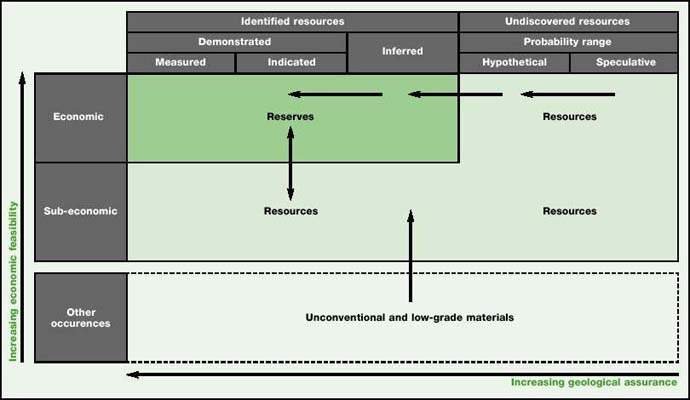
FIGURE 5.1. PRINCIPLES OF RESOURCE
CLASSIFICATION
Source: Based on McKelvey, 1967.
To the extent possible, this chapter uses the McKelvey box,
which presents resource categories in a matrix with increasing degrees of
geological assurance and economic feasibility (figure 5.1). This scheme,
developed by the U.S. Bureau of Mines and the U.S. Geological Survey (USGS,
1980), is to some extent also reflected in the international classification
system recently proposed by the United Nations.
In this classification system, resources are defined as
concentrations of naturally occurring solid, liquid, or gaseous material in or
on the Earth’s crust in such form that economic extraction is potentially
feasible. The geologic dimension is divided into identified and undiscovered
resources. Identified resources are deposits that have known location, grade,
quality, and quantity or that can be estimated from geologic evidence.
Identified resources are further subdivided into demonstrated (measured plus
indicated) and inferred resources, to reflect varying degrees of geological
assurance. Reserves are identified resources that are economically recoverable
at the time of assessment (see the British Petroleum definition, above).
Undiscovered resources are quantities expected or postulated to
exist under analogous geologic conditions. Other occurrences are materials that
are too low-grade or for other reasons not considered technically or
economically extractable. For the most part, unconventional resources are
included in ‘other occurrences’.
The boundary between reserves, resources, and occurrences is
current or expected profitability of exploitation, governed by the ratio of
market price to cost of production. Production costs of reserves are usually
supported by actual production experience and feasibility analyses, while cost
estimates for resources are often inferred from current production experience
adjusted for specific geological and geographic conditions.
|
Technological improvements
are continuously pushing
resources
into the reserve category by
advancing knowledge and
lowering
extraction costs. |
For several reasons, reserve and resource quantities and related
supply-cost curves are subject to continuous revision. Production inevitably
depletes reserves and eventually exhausts deposits, while successful exploration
and prospecting add new reserves and resources. Price increases and cost
reductions expand reserves by moving resources into the reserve category and
vice versa. The dynamic nature of the reserve-resource relationship is
illustrated by the arrows in figure 5.1. Technology is the most important force
in this process. Technological improvements are continuously pushing resources
into the reserve category by advancing knowledge and lowering extraction costs.
The outer boundary of resources and the interface to other
occurrences is less clearly defined and often subject to a much wider margin of
interpretation and judgement. Other occurrences are not considered to have
economic potential at the time of classification. But over the very long term,
technological progress may upgrade significant portions to resources.
In 1992 the United Nations Economic Commission on Europe (UNECE)
launched an effort to define a generally applicable resource classification
scheme with a higher resolution of technical and economic feasibility than the
McKelvey box. By adding a third dimension - the level of actual feasibility of
extraction based on geological engineering assessments - this new classification
provides a more accurate picture of the accessibility of resources. In 1997 the
United Nations International Framework Classification for Reserves/Resources -
Solid Fuels and Mineral Commodities (UNFC) was completed and recommended by the
Economic and Social Council (ECOSOC) for world-wide application. But it will
take time for the UNFC to be universally adopted by public and private
institutions and for fossil reserves and resources to be consistently reported
in compliance with the UNFC.
For renewable energy sources, the concepts of reserves,
resources, and occurrences need to be modified. Renewables represent annual
flows available, in principle, on an indefinite sustainable basis. Fossil energy
reserves and resources, although expanding over time, are fundamentally finite
quantities. In this context the annual natural flows of solar, wind, hydro, and
geothermal energy and quantities grown by nature in the form of biomass (often
referred to as theoretical potentials) would correspond to occurrences. The
concept of technical potentials can be used as a proxy for energy resources,
while economic potentials correspond to reserves. The distinction between
theoretical and technical potentials reflects the degree of use determined by
thermodynamic or technological limitations without consideration of practical
feasibility or costs. Thus the economic potential is the portion of the
technical potential that could be used cost-effectively. In terms of reserves,
resources, and occurrences of hydrocarbons, economic and technical potentials
are dynamically moving targets in response to market conditions and technology
availability and performance.
This chapter reports oil resources in gigatonnes (1 Gt =
109 tonnes) and exajoules (1 EJ = 1018 joules) using the
energy equivalent of 42 gigajoules per tonne of oil equivalent (GJ per toe). Gas
resources are reported in tera cubic metres (1 Tm3 = 1012
cubic metres) and converted to EJ using 37 gigajoules per 1,000 cubic
metres (GJ per 1,000 m3). Coal resources are usually reported in
natural units, although the energy content of coal may vary considerably within
and between different coal categories. The Bundesanstalt f�r Geowissenschaften
und Rohstoffe (Federal Institute for Geosciences and Natural Resources, referred
to here as the BGR) in Hannover (Germany) is the only institution that converts
regional coal occurrences into tonnes of coal equivalent (1 tce = 29
gigajoules). Thus coal resource data come from the BGR. Uranium and other
nuclear materials are usually reported in tonnes of metal. The thermal energy
equivalent of 1 tonne of uranium in average once-through fuel cycles is about
589 terajoules (IPCC,
1996a).
Oil reserves and resources
Views on the long-term availability of oil and natural gas
continue to spark controversy and debate. One school of thought believes that
the best oil fields have already been discovered and that the amount of oil
still to be discovered is somewhat limited. The other school regards oil
reserves as a dynamic quantity, driven by demand and technological advances. The
second school is more optimistic about future hydrocarbon
availability.
Ultimately recoverable resources - the static or geologists’ view
For many years, world oil reserves have experienced small but
steady increases, which implies that the discovery or delineation of new
reserves has at least kept pace with production. But many geologists focus on
the concept of a quasi-fixed stock of hydrocarbon occurrences that, once
production commences, can only decrease. For oil, they argue that few new oil
fields have been discovered since the mid-1970s, and that most reserve increases
have come from revisions of previously underestimated existing reserves
(Hatfield, 1997; Campbell and Laherrere, 1998) and improved recovery techniques.
Peak production lags behind peak discovery (of the mid-1960s) by several
decades. Larger and more obvious fields are found first, leading to an early
peak in discovery and diminishing returns in exploration: the more that is
found, the less is left to find. Fields that are smaller and harder to find and
to exploit follow, but eventually the fixed stock will be exhausted. Some 90
percent of current global oil production comes from fields more than 20 years
old.
TABLE 5.1. ESTIMATED OIL RESERVES
|
Region |
Identified reserves (Masters and others, 1994) |
Identified reserves plus 95%a (Masters and
others, 1994) |
Identified reserves plus modeb (Masters and
others, 1994) |
Identified reserves plus 5%c (Masters and
others, 1994) |
Proven recoverable reserves (WEC, 1998) |
Proven reserves (BP, 1999) |
Total resources from enhanced oil recoveryd
|
|
Gigatonnes |
Exajoules |
Gigatonnes |
Exajoules |
Gigatonnes |
Exajoules |
Gigatonnes |
Exajoules |
Gigatonnes |
Exajoules |
Gigatonnes |
Exajoules |
Gigatonnes |
Exajoules |
|
North America |
8.5 |
356 |
14.3 |
599 |
17.0 |
712 |
23.7 |
992 |
4.6 |
193 |
4.6 |
193 |
13.6 |
569 |
|
Latin America and Caribbean |
17.3 |
724 |
22.6 |
946 |
26.2 |
1,097 |
41.6 |
1,742 |
19.2 |
804 |
19.9 |
833 |
23.8 |
996 |
|
Western Europe |
5.6 |
234 |
6.8 |
285 |
7.7 |
322 |
11.2 |
469 |
2.5 |
105 |
2.5 |
105 |
3.9 |
163 |
|
Central and Eastern Europe |
0.3 |
13 |
0.4 |
17 |
0.5 |
21 |
1.1 |
46 |
0.3 |
13 |
0.2 |
8 |
0.5 |
21 |
|
Former Soviet Union |
17.0 |
712 |
25.1 |
1,051 |
30.6 |
1,281 |
49.9 |
2,089 |
8.0 |
335 |
9.1 |
381 |
11.2 |
469 |
|
Middle East and North Africa |
87.6 |
3,668 |
97.0 |
4,061 |
104.6 |
4,379 |
126.4 |
5,292 |
99.6 |
4,170 |
96.8 |
4,053 |
59.2 |
2,479 |
|
Sub-Saharan Africa |
4.0 |
167 |
5.9 |
247 |
7.3 |
306 |
12.3 |
515 |
4.0 |
167 |
4.5 |
188 |
3.3 |
138 |
|
Pacific Asia |
3.1 |
130 |
4.1 |
172 |
4.8 |
201 |
7.3 |
306 |
1.5 |
63 |
1.5 |
63 |
2.1 |
88 |
|
South Asia |
1.0 |
42 |
1.1 |
46 |
1.3 |
54 |
1.8 |
75 |
0.8 |
33 |
0.5 |
21 |
0.6 |
25 |
|
Centrally planned Asia |
5.1 |
214 |
7.8 |
327 |
9.8 |
410 |
17.9 |
749 |
5.4 |
226 |
3.4 |
142 |
3.7 |
155 |
|
Pacific OECD |
0.4 |
17 |
0.6 |
25 |
0.7 |
29 |
1.3 |
54 |
0.4 |
17 |
0.4 |
17 |
0.5 |
21 |
|
Totale |
150 |
6,277 |
186 |
7,776 |
210 |
8,812 |
295 |
12,329 |
146 |
6,126 |
143 |
6,004 |
123 |
5,124 |
Note: Excludes cumulative production to the date of
assessment. a. Identified reserves plus estimates of undiscovered resources with
a 95 percent probability of discovery. b. Identified reserves plus estimates of
undiscovered resources with a 50 percent probability of discovery. c. Identified
reserves plus estimates of undiscovered resources with a 5 percent probability
of discovery. d. Includes enhanced recovery of past and future oil production.
e. Totals rounded.
Cumulative production is a good proxy for geological knowledge
gained through exploration experience. All these facts leave no room for any
conclusion other than that peak production is being approached rapidly. In the
1960s ultimately recoverable resources became a popular concept for quantifying
the fixed stock of hydrocarbon occurrences. Ultimately recoverable resources
include cumulative production, proven reserves at the time of estimation, and
oil remaining to be discovered - in other words, the ultimate oil wealth
available to humans. For the past 40 years most estimates of ultimately
recoverable resources for conventional oil have ranged from 200 - 400
gigatonnes. More recently, Campbell and Laherrere (1998) put ultimately
recoverable reserves at about 250 gigatonnes, Hiller (1999) at 350 gigatonnes,
Edwards (1997) at 385 gigatonnes, Masters and others (1994) at 281 - 390
gigatonnes, and Odell (1997) at 410 gigatonnes. All these estimates include
production to the date of estimation (96 - 110 gigatonnes).
The debate on the size of ultimately recoverable resources and
the time horizon when the depletion midpoint will be reached includes only
conventional oil occurrences. Shale oil, tar sands (natural bitumen), and heavy
crude oil are considered unconventional oil resources, defined as occurrences
that cannot be tapped with conventional production methods for technical or
economic reasons or both (Rogner, 1997; Gregory and Rogner, 1998). These
resources form a large part of the vast store of hydrocarbons in the
Earth’s crust and, in the case of oil, have been assessed to be at least as
large as conventional oil resources (see below). The existence of unconventional
oil and gas is acknowledged by ‘fixed stock’ analysts, but they are
less sanguine about the future technological potential for bringing these
resources to market. Technological pessimism and an exclusive focus on
conventional oil largely explain the geologists’ view that global oil
production will reach its peak and mid-depletion point in the near future.
Conventional oil. Table 5.1 reports recent estimates,
excluding cumulative production to date, of identified or proven oil reserves
and natural gas liquids. All these estimates report reserves at around 1,000
billion barrels of oil (143 - 150 gigatonnes).
Masters and others (1994) estimate identified reserves on 1
January 1993 to be 150 gigatonnes (6,277 exajoules), only slightly higher than
British Petroleum and World Energy Council estimates of proven reserves at the
end of 1997.1 Masters and others also estimate undiscovered oil
resources based on a modified Delphi technique and geological analogies. Their
low estimate (95 percent probability of discovery) brings their total for
recoverable conventional oil reserves to 186 gigatonnes (7,771 exajoules). If
cumulative production until 1994 of 95 gigatonnes (3,990 exajoules) is added,
the total for ultimately recoverable resources is 281 gigatonnes (11,800
exajoules). The medium (mode) estimate of undiscovered resources brings total
recoverable oil reserves to 210 gigatonnes (8,812 exajoules) and ultimately
recoverable resources to 305 gigatonnes (12,810 exajoules). The high (5 percent
probability) estimate of undiscovered resources brings total recoverable oil
reserves to 295 gigatonnes (12,329 exajoules) and ultimately recoverable
resources to 390 gigatonnes (16,380 exajoules).
TABLE 5.2. ESTIMATED UNCONVENTIONAL OIL RESERVES AND
RESOURCES
|
Region |
Oil shale |
Heavy crude oil |
Tar sands (natural bitumen) |
|
Identified resources(BGR, 1998) |
Total resources(BGR, 1998) |
Proven recoverable and estimated additional reserves(WEC,
1998) |
Oil in place(BGR, 1998) |
Reserves and resources(BGR, 1998) |
Future potential recovery(Meyer, 1997) |
Oil in place(BGR, 1998) |
Reserves and resources(BGR, 1998) |
Proven recoverable and estimated additional reserves(WEC,
1998) |
|
Gigatonnes |
Exajoules |
Gigatonnes |
Exajoules |
Gigatonnes |
Exajoules |
Gigatonnes |
Exajoules |
Gigatonnes |
Exajoules |
Gigatonnes |
Exajoules |
Gigatonnes |
Exajoules |
Gigatonnes |
Exajoules |
Gigatonnes |
Exajoules |
|
North America |
1.1 |
48 |
351.6 |
14,767 |
217.0 |
9,114 |
15.7 |
659 |
2.3 |
96 |
2.0 |
82 |
233 |
9,786 |
40.7 |
1,710 |
51.7 |
2,173 |
|
Latin America and Caribbean |
0.3 |
14 |
19.4 |
814 |
9.6 |
405 |
229.3 |
9,631 |
59.7 |
2,509 |
51.2 |
2,152 |
190 |
7,980 |
33.2 |
1,395 |
1.2 |
49 |
|
Western Europe |
0.5 |
22 |
8.9 |
374 |
0.0 |
1 |
9.8 |
412 |
3.7 |
155 |
3.2 |
133 |
0 |
0 |
0.0 |
0 |
0.0 |
0 |
|
Central and Eastern Europe |
1.1 |
45 |
2.8 |
116 |
0.0 |
0 |
0.1 |
4 |
0.1 |
5 |
0.1 |
5 |
0 |
0 |
0.0 |
0 |
0.0 |
0 |
|
Former Soviet Union |
4.2 |
178 |
9.6 |
405 |
6.5 |
273 |
0.1 |
4 |
19.2 |
805 |
16.4 |
690 |
232 |
9,744 |
40.5 |
1,703 |
0.0 |
0 |
|
Middle East and North Africa |
7.6 |
319 |
8.1 |
340 |
28.0 |
1,175 |
45.2 |
1,898 |
20.2 |
847 |
17.3 |
726 |
0 |
0 |
0.0 |
0 |
0.0 |
0 |
|
Sub-Saharan Africa |
0.0 |
0 |
16.4 |
690 |
0.0 |
0 |
1.4 |
59 |
0.9 |
39 |
0.6 |
27 |
3 |
126 |
0.5 |
22 |
0.0 |
0 |
|
Pacific Asia |
1.0 |
40 |
1.0 |
40 |
1.7 |
71 |
1.1 |
46 |
1.5 |
62 |
1.4 |
59 |
0 |
0 |
0.0 |
0 |
0.0 |
0 |
|
South Asia |
0.0 |
0 |
0.0 |
0 |
0.0 |
0 |
1.0 |
42 |
0.0 |
2 |
0.0 |
1 |
0 |
0 |
0.0 |
0 |
0.0 |
0 |
|
Centrally planned Asia |
0.6 |
25 |
20.0 |
840 |
0.0 |
0 |
10.8 |
454 |
2.6 |
111 |
2.3 |
95 |
0 |
0 |
0.0 |
0 |
0.0 |
0 |
|
Pacific OECD |
3.8 |
160 |
44.5 |
1,870 |
36.0 |
1,513 |
0.0 |
0 |
0.0 |
1 |
0.0 |
1 |
0 |
0 |
0.0 |
0 |
0.0 |
0 |
|
Total |
20.3 |
851 |
482.3 |
20,256 |
298.9 |
12,552 |
314.5 |
13,209 |
110.3 |
4,632 |
94.5 |
3,971 |
658 |
27,636 |
115.0 |
4,830 |
52.9 |
2,222 |
In its 1998 survey the World Energy Council reported proven
recoverable oil reserves of 146 gigatonnes (6,126 exajoules) and estimates
additional recoverable reserves (excluding speculative occurrences) of 28
gigatonnes (1,192 exajoules), for a total of 174 gigatonnes (7,318 exajoules).
This compares well with the Masters and others estimate of identified reserves
plus 95 percent probability of undiscovered resources of 186 gigatonnes. The oil
reserve estimates in table 5.1 reflect the views of geologists on the
availability of conventional oil and are consistent with the ultimately
recoverable resource estimates presented earlier.
Today only about 35 percent of the oil in place is recovered by
primary and secondary production methods. With enhanced oil recovery methods,
this rate can be increased to as much as 65 percent of the original oil in place
in a reservoir, though at higher extraction costs (BGR, 1995). Thus the
application of enhanced oil recovery methods in abandoned fields and new
developments increases conventional oil resources.
Table 5.1 shows the potential resources resulting from the use
of enhanced oil recovery techniques. Resources are calculated based on an
average recovery rate of 35 percent achieved in historical production and used
in the delineation of proven recoverable reserves, and an enhanced oil recovery
rate of 15 percent, for an overall recovery rate of 50 percent.
Unconventional oil. The vast amounts of unconventional
oil occurrences include oil shale, heavy crude oil, and tar sands.
Unconventional oil is already economic to exploit in some places, so some is
defined as reserves. Further development may depend on higher oil prices,
technological developments, and long-term demand for liquid fuels. According to
BGR (1998), reserves of unconventional oil could be as high as 245 gigatonnes,
substantially exceeding proven reserves of conventional oil (table 5.2).
Oil shale is a sedimentary rock rich in organic matter
containing more than 10 percent kerogen. It can be used directly as a fuel in
power plants or processed to produce synthetic petroleum products. The kerogen
content of oil shale varies widely. According to BGR (1995), only about 1
percent of world resources contains more than 100 litres of oil per cubic metre
rock, while 85 percent have less than 40 litres per cubic metre.
Data on oil shale resources are presented in table 5.2. The most
recent BGR (1998) estimate of oil shale resources is 482 gigatonnes, down from
920 gigatonnes in the 1995 estimate. WEC (1998) estimates recoverable and
estimated additional reserves at 299 gigatonnes. Major oil shale resources are
in China, Estonia, the United States, Australia, and Jordan. The large regional
differences between the BGR and WEC estimates are likely the result of different
definitions.
Because of the high costs of mining and processing, oil shale is
produced only in small quantities in China and Estonia. Estonia is the only
country with an economy dominated by oil shale as a source of energy and for
more than 70 years has been the largest user of oil shale in power generation.
Recent production totalled 20 million tonnes of oil shale a year (Hobbs, 1995).
Heavy crude oil is defined as high-viscosity crude oil
with a density equal to or less than 20° API (934 kilograms per cubic
metre). Extra heavy oil is crude oil with a density equal to or less than
10° API (1,000 kilograms per cubic metre). Unlike tar sands, the viscosity
of these hydrocarbons is below 10,000 millipoise (see below). Heavy oil is
formed by the degradation of conventional oil in shallow reservoirs.
Recent estimates of heavy oil resources are summarised in table
5.2. BGR (1995) estimates oil in place to be 315 gigatonnes. In BGR (1998), 33
of these are considered reserves and 77 are considered resources, for a total of
110 gigatonnes - well within the range of future potential recovery given by
Meyer (1997). About half of heavy oil resources are in Venezuela; the former
Soviet Union, Kuwait, Iraq, Mexico, and China account for most of the rest.
Meyer (1997) uses the term unproved reserves because his
estimates include some probable and possible reserves. Quantities stated under
undiscovered potential recovery include all resources based on geological and
engineering judgement, using a recovery factor of 10 percent.
Some 8 percent of world oil production come from heavy oil
reservoirs, with Venezuela, the United States, Canada, Iraq, Mexico, and the
former Soviet Union being major producers (BGR, 1998). Due to the nature of
heavy oil, enhanced oil recovery methods such as steam flooding and hot water,
polymer, and carbon dioxide injection are generally required for its extraction.
Tar sands (natural bitumen) and extra heavy oil
are sands or sandstones that contain a large portion of tarry hydrocarbons
with a viscosity exceeding 10,000 millipoise. They are formed by thermal
metamorphism and biodegradation of conventional oil deposits. The high viscosity
of these hydrocarbons requires unconventional extraction methods such as mining
with bucket-wheel excavators or in truck and shovel operations. Natural bitumen
typically contains large portions of sulphur and trace elements, including
vanadium and nickel.
BGR (1998) estimates that 115 of the 658 gigatonnes of tar sands
qualify as possible reserves (see table 5.2). Commercial production is limited
to the Athabasca tar sand deposits of Alberta (Canada), with a volume of 25
million tonnes in 1998 (WEC, 1998). To reduce the environmental disturbance
caused by surface mining, in situ techniques are increasingly used (box 5.1). In
addition, new extraction technologies, such as steam-assisted gravity drainage,
are being developed to reduce oil viscosity through steam injection (George,
1998). The use of extra heavy oil has commenced in the Orinoco oil belt of
Venezuela (BGR,
1998).
Available resources - the dynamic or economists’ view
Unlike geologists, who tend to treat resources as an innate
component of the physical world, economists view what exists in the Earth’s
crust as ‘neutral stuff’ (Odell, 1998) that becomes a resource only if
there is a market demand for it. Put differently, "there are huge amounts of
hydrocarbons in the earth’s crust� (Adelman and Lynch, 1997), and
"estimates of declining reserves and production are incurably wrong because they
treat as a quantity what is really a dynamic process driven by growing
knowledge" (Nehring, 1998). Improvements in technology - such as
three-dimensional seismic surveys and extended-reach drilling - have allowed
higher recovery rates from existing reservoirs and the profitable development of
fields once considered uneconomic or technically beyond reach, expanding the
boundary of reserves and shifting resources into the reserve category.
|
BOX 5.1. ENVIRONMENTAL OBSTACLES TO EXTRACTING
UNCONVENTIONAL OIL
The production of unconventional oil and the necessary upgrade
to marketable fuels can hurt local environments. Mining, conversion, and
upgrading to synthetic crude oil can produce toxic heavy metals and large
quantities of solid and acidic liquid and gaseous wastes that need to be
contained, cleaned, and disposed ofin an environmentally benign manner. This may
require stringent environmental controls and new policies for toxic waste
disposal. Extracting hydrocarbons from unconventional oils such as tar sands,
heavy oils, and oil shale involves very large surface (open-pit or strip) mining
and underground mining (room and pillar technique), steam soaking, steam
flooding, or in situ combustion. Here the production of tar sand and its
upgrading to synthetic crude oil are used to show the potential environmental
constraints of large-scale unconventional oil production.
The production of synthetic crude oil from Alberta,
Canada’s tar sand deposits involves open-pit mining and handling of 5
tonnes of tar sands and overburden per barrel of oil produced (Penner and
others, 1982), milling to separate the bitumen from the sand, and upgrading it
to commercial quality. Syncrude, a Canadian company, processes 510,000 tonnes of
tar sands a day and recovers about one barrel of heavy oil for every 2 tonnes of
tar sands processed (Stosur and others, 1998). A hot water process is the most
common for extracting oil from the sand. The process is energy-intensive and
requires large quantities of hot water. Syncrude operations require 1,400 tonnes
an hour of water heated to nearly 500 degrees Celsius. Water is recycled to the
maximum extent (90 percent). The remaining materials (tailings) after the
bitumen has been extracted (extraction rate some 90 percent)are liquids and
sand. Most of the tailings are the excavated overburden rock and rejected sand;
both can be stockpiled and used as backfill with little threat to the
environment (Stosur and others, 1998).
Things are different for the liquid tailings, which are
contaminated with organic and inorganic compounds (sulphur, porphyrins, salts of
organic acids) and can seriously damage nearby aquatic ecosystems. The liquid is
stored in settling ponds, allowing water to clarify before it is recycled. These
ponds are designed as ‘zero discharge’ basins, and no process-affected
water is discharged in running waters. But while tailings sand settles out
quickly, the fine-grained materials (silts and clays) and residual bitumen
consolidate slowly and can pose a long-term problem and liability. Tailings
ponds must be constructed to last several decades and must be guarded against
erosion, breaching, and foundation creep until better disposal practices become
available (Stosur and others, 1998). New processes such as dry retorting - which
generates dry tailings - are expected to minimise the risk of acid drainage from
tar sand tailings. Other methods include faster consolidation of fine tailings,
detoxification of tailing pond water, and reprocessing of fine tailings
(including co-production of minerals and metals).
Spent tar sand (mainly sand, silt, and clay contaminated with
the remaining bitumen and caustic compounds) is put in specially designed
storage areas to avoid acid drainage or used as fill material in mine
reclamation efforts. While the disrupted land area can be considerable, land
reclamation is usually imposed on mine operators to limit permanent
environmental damage and to return land to a stable, biologically
self-sustaining state.
Upgrading operations are the primary source of airborne
emissions. Sulphur dioxide, particulates, hydrocarbons, vanadium, and nickel
were originally of major concern. In addition, bitumen contains several
carcinogenic polycyclic aromatic hydrocarbons (WHO, 1982). Hydrotreaters remove
sulphur and nitrogen and produce elemental sulphur as a by-product. Nitrogen is
removed as ammonia and used as an under-boiler fuel or for chemical feedstock.
Hydrogen sulphide is removed from the by-product fuel gas that fuels parts of
the upgrading operations. The synthetic crude oil produced from Alberta’s
tar sand deposits is 32 - 33o API with 0.1 - 0.2 percent sulphur. It
contains no residue, while typical conventional crudes have about 8 percent
residue.
Stosur and others (1998) estimate that only 15 percent of tar
sand resources are suitable for surface mining. The rest would have to be
extracted by in situ methods, which minimise land disturbance through multiwell
pads and horizontal drilling (Sadler and Houlihan, 1998). To reduce odour and
greenhouse gas emissions, care must be taken to collect and reuse or flare the
gases generated by the process.
Alberta’s tar sand operations indicate that environmental
protection is the result of effective environmental regulation and controls,
including a balance of resource development and resource conservation and of
environmental and socioeconomic policies. |
In addition, economists argue, a distinction between
conventional and unconventional occurrences is irrelevant. Today most
unconventional occurrences are neutral stuff and will become resources and
reserves if there is sufficient demand. In fact, certain unconventional
occurrences - heavy oil, tar sands, coalbed methane and gas from aquifers - have
already started to ‘come in from the margin’. Conventional discoveries
previously regarded as uneconomic can now be developed profitably, and
recoverable reserves can be increased in fields being developed or under
production. In short, economists view oil and gas reserves as a portion of the
total hydrocarbon occurrences contained in the Earth’s crust, where volumes
depend on exploration know-how to locate and evaluate a play (delineated
deposit) and on the capability of technology to extract it at an acceptable cost
given sufficient demand.
The question of long-term hydrocarbon resource availability,
then, is viewed from the perspective of anticipated demand in competitive
markets - taking into account technological change and growing knowledge. In the
presence of sufficiently large conventional oil reserves there is, at present,
no demand for the large-scale use of abundant unconventional oil occurrences
(see above). This explains the absence of any significant motivation for a
comprehensive and systematic evaluation of these resources or for the
development of technology for their economic and environmentally acceptable
recovery.
Economists take proven conventional oil reserves of 150
gigatonnes as a point of departure that, based on their definition, can be
brought to the market at post-1986 price levels. In addition, economists point
to industry expectations that proven reserves will grow 50-70 gigatonnes by 2020
(Shell, 1996). They point out that the oil industry has historically responded
to demand by finding and developing reserves, even given the long lead time for
this process: since World War II it has taken more than 40 years to move from
identifying reserves to producing resources. This is seen as a clear indication
that the process of stock replenishment is working effectively.
A bigger role for unconventional oil. Economists also
argue that unconventional oil should be viewed as an important element of the
oil resource base - and after 2030 it will be a critical complement to
conventional oil production in keeping the oil supply curve moving upwards. This
long process of the changing supply pattern will be seamless from the viewpoint
of oil producers. From the point of view of users the process will be
unimportant, because no essential difference will arise for them merely because
of the changing nature of exploitation of oil habitats in the Earth’s
surface. In precisely the same way, today’s oil consumers do not need to
consider whether their supply is from shallow or deep horizons, or from onshore
or offshore locations.
|
The oil industry has historically
responded to demand by
finding
and developing reserves, even
given the long lead time
for this
process. |
The ultimate resource base of unconventional oil is irrelevant
to the 21st century’s energy supply. Occurrences of such oil that are
already known and under exploitation can provide the global supply likely to be
required in the 21st century. On the other hand, economic or environmental
considerations - or both - could convert unconventional resources back to
neutral stuff, as has occurred in recent decades with previously designated coal
resources.
Costs and technological developments. New technologies
for exploring and extracting oil have lowered exploration, development, and
production costs while expanding the oil resource base. Further advances in
technology must also be expected, resulting in additional reductions in cost.
Part of these productivity gains will be offset by the use of more remote,
harder-to-access, and smaller deposits. Still, it appears plausible that
technological progress will continue to keep production costs in check.2
The technology learning curve for synthetic crude oil production from tar
sands in Alberta is a good example of the impact of technology on production
costs. In 1978 a barrel of synthetic crude oil cost about $26 a barrel. By 1996
breakthroughs in the technology for producing and refining bitumen as well as
better operating procedures had lowered these costs to $9.60 a barrel (Polikar
and Cyr, 1998).
Two developments will likely put upward pressure on prices. The
first is the increasing volume of energy that will be demanded in the first half
of the 21st century. The second is the significantly increased cash flows
required by the international oil industry to sustain enhanced investment in the
initial large-scale exploitation of rapidly increasing volumes of unconventional
oil and gas. In the 1950s the ability of consumers to secure large volumes of
international oil depended on the super-normal profits that the industry was
able to generate. More recent breakthroughs for gas in Europe and elsewhere were
likewise achieved because of super-normal profitability in the industry. After
2030, following the introduction to global markets of large-scale unconventional
hydrocarbons, prices should fall back as the long-run supply prices of the two
commodities once again start to decline under conditions of advancing technology
and increasing economies of scale (Odell,
1998).
Reconciling the two views
The differences between geologists’ (static) and
economists’ (dynamic) views of oil resources can be partly explained by the
way the different schools view unconventional oil. Geologists draw a strict line
between conventional oil (the oil they look for) and unconventional oil (the oil
that does not fit their template). Although some unconventional oil is being
exploited economically, geologists take a conservative view of its long-term
commercial viability. In contrast, economists consider irrelevant the dividing
line between conventional and unconventional oil. They anticipate a seamless
transition from one to the other as long as demand and market prices allow for a
profitable return on investment. In that case, unconventional occurrences
estimated to exist in the Earth’s crust (see table 5.2) would extend the
oil age well beyond the mid-21st century. Without demand, the issue of resource
availability becomes meaningless and unconventional oil occurrences remain
neutral stuff.
A historical review of the most popular guideline for the
industry, the ratio of reserves to production, puts into perspective the two
schools of thought. This ratio compares known reserves and current production
and so measures the temporal reach of exhaustible energy reserves. These ratios
typically fluctuate between 20 and 40 years.
But the notion of a reserve-to-production ratio is seriously
flawed and, in the past, has led to aberrant conclusions (MacKenzie, 1996). The
most erroneous conclusion is that the world will be running out of reserves by
the time suggested by the ratio.3 For oil, ratios of 20 - 40 years
have existed since the early 20th century (figure 5.2). According to this ratio,
the world should have run out of oil a long time ago. Instead, driven by
economics (in essence, demand for oil), advances in geoscience, and
technological progress in upstream production, reserves have been continuously
replenished from previously unknown sources (new discoveries) or technologically
or economically inaccessible occurrences. Although reserve additions have
shifted to more difficult and potentially more costly locations, technological
progress has outbalanced potentially diminishing returns.
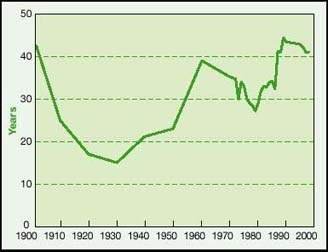
FIGURE 5.2. RATIO OF RESERVES TO
PRODUCTION FOR CONVENTIONAL CRUDE OIL, 1900 - 98
Source: Adapted from BP, 1998.
|
New technologies for exploring and
extracting oil have
lowered exploration,
development, and production
costs while expanding
the
oil resource base. |
Gas reserves and resources
Unlike oil, gas is not subject to controversy on estimates of
ultimately recoverable reserves. Proven reserves are comparable to those of oil
but high relative to current and cumulative production. Still, natural gas is
often viewed as the poor stepsister of oil. The development of natural gas
fields requires large investments in transmission and distribution
infrastructure.4 As a result gas discoveries, especially in
developing countries, are often not reported. But this does not imply a lack of
gas occurrence - in fact, over the 21st century there is enormous potential for
major gas
discoveries.
Conventional gas
The most recent estimates of conventional gas reserves come from
WEC (1998) for the end of 1996 and BP (1998) for the end of 1998. WEC gives
total reserves as 177 Tm3 (6,534 exajoules) at the end of 1996, 147
Tm3 (5,450 exajoules) of which were proven recoverable reserves
(table 5.3). The rest were additional recoverable reserves. The International
Gas Union (IGU, 2000) reports total potentially recoverable reserves as high as
502 Tm3 (18,390 exajoules).
Reserves have generally increased from survey to survey,
reflecting dramatic changes in the economics of gas exploration and recovery.
Reservoirs are being added in areas previously thought to have been exhausted,
and new reservoirs that were previously overlooked or ignored are now being
developed. Over the past 10 years reserve additions averaged 3.7 Tm3
(134 exajoules) a year, much higher than the 1997 production of 2.2
Tm3. Ivanhoe and Leckie (1993) note that fewer gas than oil fields
are reported in developing regions, probably because gas has a lower economic
and utility value, not because there are fewer gas fields.
Enhanced gas recovery using advanced recovery methods - notably
hydraulic fracturing aimed at improving the permeability of reservoir rock - can
substantially increase natural gas recovery in abandoned fields and newly
developed reservoirs. Another, more innovative technique, horizontal air
drilling, can also increase gas recovery in depleted gas zones (Elrod, 1997).
Estimates of potential reserves of natural gas resulting from
enhanced gas recovery are based on a historical average gas recovery rate of 50
percent and an enhanced recovery rate of 30 percent, for a total recovery factor
of 80 percent. Schollnberger (1998) uses similar assumptions in an assessment of
possible reserve development through 2100. Global cumulative natural gas
production through 1998 totalled 62 Tm3 (2,276 exajoules). Applying
an average recovery factor of 50 percent leads to an original amount of 124
Tm3. Enhanced gas recovery of 30 percent then enlarges reserves by 37
Tm3. Likewise, enhanced gas recovery reserves from future production
are estimated at 106 Tm3 using WEC (1998) total recoverable reserves
of 177 Tm3 (see table 5.3). Thus total potential natural gas reserves
available from enhanced oil recovery methods are estimated at 143 Tm3
(5,290 exajoules), an amount only slightly lower than proven natural gas
reserves and almost identical to the potential crude oil reserves expected from
enhanced recovery
methods.
Unconventional gas
BGR (1995) defines unconventional gas as natural gas derived
from reservoirs not exploitable by conventional recovery techniques.
Unconventional gas types include coalbed methane, tight formation gas, gas
hydrates (clathrates), and aquifer (geopressured) gas. Regional estimates of
unconventional gas occurrences in place are provided in table 5.4. The total
resource potential exceeds 25,000 Tm3 (960,000 exajoules).
Coalbed methane. Coalbed methane is a natural gas mixture
containing more than 90 percent methane. It occurs primarily in high-rank coal
seams from where it can migrate into the surrounding rock strata. Methane
contents in coal seams can range from traces to 25 cubic metres per tonne of
coal (Davidson, 1995). Regional resources of coalbed methane are genetically
associated with the geographic distribution of bituminous coal and anthracite
deposits. The former Soviet Union accounts for nearly 50 percent of recoverable
resources, centrally planned Asia (including China) has about 20 percent, and
North America has 15 percent.
Coalbed methane can be a by-product of underground coal mining
or be produced for the methane exclusively. In fact, coalbed methane is an
explosive hazard in underground mining operations and for safety reasons has
traditionally been vented with mines’ fresh air circulation. Since the
1970s methane captured from underground mining has increasingly been used to
supplement local gas supplies. Thus methane capture and use can significantly
mitigate greenhouse gas emissions because it avoids the release of methane - a
potent greenhouse gas - and may replace fossil fuels with a higher carbon
content. For long-term and stable methane supplies from coalbeds, however,
dedicated drilling in coalbeds is more important than the methane from active
underground coal mines.
Commercial coalbed methane production occurs only in the United
States, contributing about 5 percent to natural gas production (BGR, 1998). But
pilot projects are under way in a number of other countries, including
Australia, China, India, Poland, Russia, Ukraine, and the United Kingdom.
Estimates of methane resources range from 85 - 262 Tm3 (BGR, 1995,
1998; Rice, Law, and Clayton, 1993). This assessment uses the BGR (1995)
estimate of 233 Tm3 (see table 5.4).
Tight formation gas. Tight formation gas is natural gas
trapped in low-permeability reservoirs with in situ permeability of less than
0.1 millidarcy (mD), regardless of the type of the reservoir rock (Law and
Spencer, 1993). Production of tight gas requires artificial stimulation
techniques - such as massive hydraulic fracturing - to improve reservoir
permeability. An advanced technique is horizontal drilling to develop tight gas
formations, often in combination with massive hydraulic fracturing. These
stimulation methods can achieve gas flow rates two to three times those of
conventional vertical wells. In recent years about 3 percent of natural gas
production has come from tight gas reservoirs.
TABLE 5.3. ESTIMATED NATURAL GAS RESERVES
|
Region |
Proven recoverable reserves(WEC, 1998) |
Total recoverable reserves(WEC, 1998) |
Proven and additional reserves(IGU, 2000) |
Proven reserves(BP, 1999) |
Enhanced gas recovery |
|
Exajoules |
Tm3 |
Exajoules |
Tm3 |
Exajoules |
Tm3 |
Exajoules |
Tm3 |
Exajoules |
Tm3 |
|
North America |
252 |
6.8 |
389 |
10.5 |
2,307 |
63.0 |
244 |
6.6 |
884 |
23.9 |
|
Latin America and Caribbean |
303 |
8.2 |
426 |
11.5 |
1,556 |
42.5 |
298 |
8.0 |
306 |
8.3 |
|
Western Europe |
181 |
4.9 |
300 |
8.1 |
436 |
11.9 |
177 |
4.8 |
306 |
8.3 |
|
Central and Eastern Europe |
26 |
0.7 |
26 |
0.7 |
77 |
2.1 |
17 |
0.5 |
45 |
1.2 |
|
Former Soviet Union |
2,087 |
56.4 |
2,583 |
69.8 |
5,767 |
157.5 |
2,112 |
56.7 |
1,923 |
52.0 |
|
Middle East and North Africa |
2,076 |
56.1 |
2,250 |
60.8 |
5,343 |
149.5 |
2,065 |
55.4 |
1,421 |
38.4 |
|
Sub-Saharan Africa |
155 |
4.2 |
155 |
4.2 |
238 |
6.5 |
161 |
4.3 |
93 |
2.5 |
|
Pacific Asia |
207 |
5.6 |
207 |
5.6 |
798 |
21.8 |
196 |
5.3 |
158 |
4.3 |
|
South Asia |
63 |
1.7 |
63 |
1.7 |
377 |
10.3 |
54 |
1.5 |
50 |
1.4 |
|
Centrally planned Asia |
48 |
1.3 |
48 |
1.3 |
641 |
17.5 |
82 |
2.2 |
41 |
1.1 |
|
Pacific OECD |
56 |
1.5 |
89 |
2.4 |
850 |
23.2 |
47 |
1.3 |
62 |
1.7 |
|
Total |
5,450 |
147.3 |
6,534 |
176.6 |
18,390 |
502.2 |
5,454 |
146.4 |
5,290 |
143.0 |
TABLE 5.4. ESTIMATED UNCONVENTIONAL NATURAL GAS RESOURCE
POTENTIAL IN PLACE
|
Region |
Coalbed methane |
Tight formation gas |
Gas hydrates |
Geopressured gas |
Total unconventional gas |
|
|
Exajoules |
Tm3 |
Exajoules |
Tm3 |
Exajoules |
Tm3 |
Exajoules |
Tm3 |
Exajoules |
Tm3 |
|
North America |
2,898 |
78 |
518 |
14 |
80,575 |
2,178 |
109,964 |
2,972 |
193,955 |
5,242 |
|
Latin America and Caribbean |
0 |
0 |
222 |
6 |
57,331 |
1,549 |
103,341 |
2,793 |
160,894 |
4,348 |
|
Western Europe |
168 |
5 |
222 |
6 |
19,806 |
535 |
27,861 |
753 |
48,057 |
1,299 |
|
Central and Eastern Europe |
126 |
3 |
37 |
1 |
0 |
0 |
6,623 |
179 |
6,786 |
183 |
|
Former Soviet Union |
2,646 |
72 |
1,665 |
45 |
151,533 |
4,095 |
73,667 |
1,991 |
229,511 |
6,203 |
|
Middle East and North Africa |
0 |
0 |
925 |
25 |
4,788 |
129 |
67,784 |
1,832 |
73,497 |
1,986 |
|
Sub-Saharan Africa |
42 |
1 |
111 |
3 |
4,788 |
129 |
63,677 |
1,721 |
68,618 |
1,854 |
|
Pacific Asia |
210 |
6 |
148 |
4 |
0 |
0 |
45,103 |
1,219 |
45,461 |
1,229 |
|
South Asia |
42 |
1 |
37 |
1 |
4,788 |
129 |
17,427 |
471 |
22,294 |
602 |
|
Centrally planned Asia |
2,058 |
56 |
333 |
9 |
0 |
0 |
27,824 |
752 |
30,215 |
817 |
|
Pacific OECD |
420 |
11 |
37 |
1 |
23,857 |
645 |
56,166 |
1,518 |
80,480 |
2,175 |
|
Total |
8,610 |
233 |
4,255 |
114 |
347,467 |
9,391 |
599,437 |
16,201 |
959,769 |
25,940 |
Source: BGR, 1995, 1998; Rogner,
1997.
Although tight gas reservoirs exist in many regions, only the
tight gas resources in the United States have been assessed. The U.S. potential
of tight gas resources from tight sandstone and Devonian shale reservoirs is
13.4 Tm3 (BGR, 1995). BGR (1998) applies these U.S. estimates to
extrapolate tight gas resource potential for other countries and regions,
arriving at a global potential of 114 Tm3 (see table 5.4).
Gas hydrates. IGU (1997) includes some unconventional gas
in its definition of additional recoverable reserves - those that are at least
of foreseeable economic interest and that may prove technically and economically
recoverable with a reasonable level of confidence. This definition appears to
exclude gas hydrates (clathrates). IGU (1997) notes that:
Current scientific inquiries around the world are
considering gas hydrates as a potential future supply of natural gas. The
hydrates are frozen ice-like deposits that probably cover a significant portion
of the ocean floor. The extent of their coverage and the high methane content of
gas hydrates motivate speculation about the gigantic quantities of methane that
could become available. At the present time there has been no attractive
proposal for a technique to allow this methane to be recovered. Nor has there
been any scientific confirmation of the quantities of methane that might be
involved. Nevertheless, such investigations might bear fruit at some stage and
radically alter current ideas regarding natural gas availability.
The existence of gas hydrates has been confirmed by direct
evidence through sampling and by indirect evidence through geochemical and
geophysical investigations. Samples have been recovered in 14 parts of the
world; indirect evidence has been found in 30 others. Many oceanic occurrences
have been inferred based on a special geophysical exploration technique -
bottom-stimulating reflection. Resource estimates for gas hydrates are highly
uncertain. BGR (1998) reports global clathrate occurrences of more than 9,000
Tm3 (see table 5.4). Other estimates report clathrates as high as
20,000 Tm3 (MacDonald, 1990a, b; Collet, 1993).
There are no economically attractive technological proposals for
recovering methane hydrates (box 5.2). But given their enormous resource
potential, it is plausible to expect that extraction methods will eventually be
developed if long-term global gas demand warrants clathrate recovery. Research
projects are under way in India, Japan, and the United States to examine the
viability of gas hydrate recovery (Collet and Kuuskraa, 1998; BGR, 1998).
Aquifer (geopressured) gas. In many parts of the world,
natural gas is found dissolved in aquifers under normal hydrostatic pressure,
primarily in the form of methane (Marsden, 1993). This unconventional gas is
also referred to as hydropressured gas or brine gas. The amount of gas dissolved
in underground liquids increases substantially with depth. At depths up to 4,000
metres, 0.5 - 1.5 cubic metre of gas is dissolved per metre of water in
aquifers. This gas factor jumps to 7 - 20 at depths of 7,000 - 8,000 metres
(BGR, 1995).
Aquifer gas is expected to occur in nearly all sedimentary
basins (Marsden, 1993). While no detailed assessment of aquifer gas resources is
available, BGR (1998) derives potential aquifer gas in place from the
groundwater volume contained in high-permeability sand stones in the
hydrosphere. This approach leads to an estimate of 2,400 - 30,000 Tm3
of geopressured gas in place, with a mean estimate of 16,200
Tm3. In the absence of a more detailed assessment, a practical
approach had to be taken in delineating regional resource quantities. The
regional breakdown in table 5.4 was obtained by weighting the global mean
estimate of gas occurrence in place with regional shares of total sedimentary
area.
While these estimates of aquifer gas occurrences are highly
speculative, the potential quantities are staggering. Even a future recovery
factor of 5 percent implies a resource volume five times the conventional
reserves estimates of BP. Aquifer gas is already produced in small quantities
from shallow reservoirs in Italy, Japan, and the United States. But in all cases
aquifer gas recovery has been motivated by the production of trace elements
(such as iodine) rather than by the gas
itself.
Coal reserves and resources
Coal deposits can be found in sedimentary basins of various
geological ages. Mineable coal deposits require a minimum seam thickness over a
sufficiently large area. Coal production occurs in open-pit extraction or
underground mining. Coal resource estimates are generally based on drill-hole
tests and geological observations. Coal is subdivided into several broadly
defined types according to their caloric values. Generally, the types are
bituminous coal (including anthracite), sub-bituminous coal, and lignite. For
practical purposes, the subdivision is based on energy content, with the value
of 16,500 kilojoules per kilogram as demarcation between hard coal (bituminous
and high-energy sub-bituminous coals) and soft brown coal (lignite and
low-energy sub-bituminous coals).
For almost 200 years coal has provided the basis for energy
production as well as iron and steel manufacturing. It also fuelled the
industrial revolution of the 19th century. In the 20th century - mainly after
World War II - coal lost its leading position to crude oil. But the welfare and
economic development of many countries continue to be based on coal. Coal
provides about 22 percent of the world energy supply and is the most important
fuel for electricity generation. About 40 percent of global electricity is
produced in coal-fuelled power stations.
|
The differences between static and
dynamic views of oil
resources can be
partly explained by the way the
different schools
view
unconventional oil. |
Coal will likely contribute substantially to the future world
energy supply. Assuming no intervention policies targeted at preventing climate
change, projections by IEA (1998c) and Nakicenovic, Gr�bler, and McDonald (1998)
show global coal production increasing from 2.4 gigatonnes of oil equivalent
(Gtoe) in 1995 to 4.0 Gtoe by 2020. Given its enormous proven reserves, the
current rate of coal production could continue well into the future.
The size of coal resources is not a restraining factor to its
use throughout the 21st century. Rather, continued coal use will depend on the
timely development of production facilities and related infrastructure, given
lead times of up to five years for open-cast operations and drift mines.
Nevertheless, there is considerable potential for a significant increase in coal
production capacity in the short to medium term. Although environmental
considerations may limit coal use with current combustion technologies, advanced
conversion technology - with carbon abatement and disposal - may create new
market opportunities (see chapter
8).
Current resources and reserves
World coal resources in place are estimated at more than 7,400
billion tonnes of coal, or about 4,470 Gtoe (WEC 1998). The recoverable portion
is estimated at roughly 500 Gtoe, which corresponds to the amount generally
labelled reserves. About 85 percent of the resources in place are classified as
bituminous or sub-bituminous (hard) coal; the rest is lignite (soft brown) coal.
(Similar proportions apply to reserves.)
|
BOX 5.2. ARE GAS HYDRATES AN EXPLOITABLE ENERGY
RESOURCE?
A gas hydrate is a crystalline cage of water molecules that can
trap various gases. Hydrates can form under conditions of high pressure and low
temperatures. Methane hydrates exist in polar permafrost and in sediments below
the ocean floor where conditions are appropriate. Hydrates will not exist below
a depth where the reservoir temperature is too high for their stability. But
solid hydrate layers can provide top seals for reservoirs of free methane that
can accumulate beneath. Offshore methane hydrate deposits have been identified
near the coasts of many countries - including countries (such as Japan)
otherwise poor in fossil fuels.
The amount of methane associated with hydrates is highly
uncertain, but the quantities are probably far greater than conventional oil and
gas resources combined. Estimates of global methane hydrate resources range from
0.1 - 300 million exajoules (Collet and Kuuskraa, 1998; Max, Pellanbarg, and
Hurdle, 1997). How much can be practically and affordably recovered is also
highly uncertain (USDOE, 1998). An emerging view is that free gas trapped
beneath solid hydrate layers will be easier to recover than gas in hydrates
(Max, Pellanbarg, and Hurdle, 1997). Free gas recovery would depressurise the
reservoir, leading to hydrate melting at the hydrate - free gas interface and
thus to free gas replenishment. The process could continue as long as the
hydrate layer remains thick enough to cap the free gas below. Preliminary
(though dated) estimates for recovering methane at favourable sites suggest that
it might not be significantly more costly than recovering conventional natural
gas (Holder, Kamath, and Godbole, 1984). But even if this proves accurate,
getting the gas to major markets could often be quite costly because of high
transport costs, since hydrate deposits are often far from such markets. |
Three-quarters of global coal reserves are in Australia, China,
India, South Africa, and the United States. Among regions, North America has the
largest coal reserves (table 5.5). Substantial reserves are also available in
the former Soviet Union and in South Asia. The European share has to be viewed
with caution because reserves may soon be declassified to resources (neutral
stuff) as production subsidies are eliminated and industry begins to close
unprofitable operations.
In 1997 global coal production totalled 2,310 Gtoe, 91 percent
of which was hard coal. China was the largest producer of hard coal (31 percent
of the world total), followed by the United States (26 percent), India (7
percent), Australia (6 percent), and South Africa (6 percent). All other
producers hold shares of less than 5 percent.
Almost 90 percent of world coal production is used domestically.
In 1997 the 10 largest coal exporters traded about 500 million tonnes of hard
coal. The largest exporter was Australia with a traded share of about 30
percent, followed by the United States with 15 percent.
TABLE 5.5. ESTIMATED COAL RESERVES (MILLIONS OF TONNES)
|
Region |
Bituminous (incl. anthracite) |
Sub-bituminous |
Lignite |
Total (exajoules) |
|
North America |
115,600 |
103,300 |
36,200 |
6,065 |
|
Latin America and Caribbean |
8,700 |
13,900 |
200 |
533 |
|
Western Europe |
26,300 |
600 |
47,700 |
1,178 |
|
Central and Eastern Europe |
15,400 |
5,500 |
10,700 |
744 |
|
Former Soviet Union |
97,500 |
113,500 |
36,700 |
4,981 |
|
Middle East and North Africa |
200 |
20 |
0 |
6 |
|
Sub-Saharan Africa |
61,000 |
200 |
< 100 |
1,465 |
|
Pacific Asia |
900 |
1,600 |
5,100 |
10 |
|
South Asia |
72,800 |
3,000 |
2,000 |
1,611 |
|
Centrally planned Asia |
62,700 |
34,000 |
18,600 |
2,344 |
|
Pacific OECD |
48,100 |
2,000 |
41,600 |
1,729 |
|
Total |
509,200 |
277,600 |
198,900 |
20,666 |
Source: WEC, 1998.
|
Projections show
global coal production
increasing from
2.4 Gtoe
in 1995 to 4.0 Gtoe
by 2020. |
Additional resources
WEC (1998) also provides information on coal resources by type.
But because of incomplete country coverage, no regional or global aggregates are
given. BGR (1995) estimated global coal resources at 5,000 Gtoe, of which 4,600
Gtoe are hard coal. In a 1998 update, BGR revised the estimate for additional
coal resources in place to 4,300 Gtoe billion, of which about 3,500 Gtoe are
additional hard coal resources. The Russian Federation has the largest share -
about 2,100 Gtoe of hard coal. About 80 percent of the additional resources in
the Russian Federation are in remote areas of Siberia. Large investments for
infrastructure and development limit the conversion of these resources into
reserves. Because of the large reserves, there is no immediate need for
additional investigation of the resource potential world-wide. Estimates of the
regional distribution of world total resources (including reserves) are shown in
table
5.6.
Summary of fossil resources
Fossil fuel reserves, resources, and additional occurrences are
shown relative to cumulative consumption and current (1998) use in table 5.7.
For an analysis that extends well into the 21st century and explores the
long-term availability of fossil resources, the fossil resource base is the
relevant yardstick. The resource base for conventional and unconventional oil
and gas is large enough to last comfortably for another 50 - 100 years - and
possibly much longer - essentially at prices not much different from today. This
projection assumes that past hydrocarbon productivity gains in the upstream
sector can be maintained and that these resources remain in demand.
Tapping into the vast fossil resource base may eventually become
a transportation challenge. For one thing, fossil resources are not evenly
distributed around the globe. For another, the location of many unconventional
oil and, more important, gas occurrences is far from the centres of energy
demand. In China and India coal delivery costs (for rail transport) already
approach production costs. Transportation logistics and costs may affect the
economic attractiveness of remote resource sites. Long-distance and
trans-boundary energy transport raises concerns about the security of energy
supply (see chapter 4).
The fossil resource data in table 5.7 are also shown in terms of
their carbon content. Since the onset of the industrial revolution, 296
gigatonnes of carbon contained in fossil fuels have been oxidised and released
to the atmosphere. The resource base represents a carbon volume of some 6,500
gigatonnes of carbon. The 296 gigatonnes of carbon emitted to the atmosphere
already raise concerns about climate stability - and humankind has the means to
add several times that amount during the 21st century. Fossil resource scarcity
will not come to the rescue. Nakicenovic, Gr�bler, and McDonald (1998) indicate
that between 1990 and 2100 emissions under the A2 scenario (see chapter 9) of
some 1,600 gigatonnes of carbon - roughly the carbon content of conventional
fossil reserves (see table 5.7) - could raise the atmospheric concentration of
carbon dioxide to 750 parts per million by volume (ppmv). (Before the industrial
revolution, carbon dioxide concentrations were 280 ppmv; today they are 360
ppmv.) The corresponding increase in global mean temperature could be 2.0-4.5
Kelvin.5
Since 1973 the tradable price of oil (the ‘marker’ for
competing fuels) has been much higher than the marginal cost of the highest-cost
producer, reflecting geopolitics and a lack of competing fuels. Today the
highest marginal cost of production is less than $10 a barrel - and in the Gulf
it is just $2-3 a barrel (Rogner, 1997; Odell, 1998). Economic rent accounts for
the rest of the tradable price. This rent could be reduced if competing fuels -
unconventional oil, synliquids from gas or coal, renewable or nuclear energy -
could equal the marginal cost of production. Thus the true cost of oil for the
entrance of competitors is less than $10 a barrel. This cost level has already
been achieved by some producers of unconventional oil and gas - tar sands in
Alberta (Chadwick, 1998), heavy oil in Venezuela (Aalund, 1998), coalbed methane
in the United States (BGR, 1998). The question then is, can technological
advances balance the higher costs of more difficult production? Experience
suggests that the answer is probably yes in the long run. But in the Gulf,
marginal costs are unlikely to exceed $5 - $10 a barrel even in the long term.
One question of interest to many upstream investment planners
is, when will the call on unconventional fossil occurrences commence? To some
extent it is already here. Alberta’s tar sand production started more than
30 years ago and, after some difficulties in the wake of the oil price collapse
of 1986, it is now competitive in today’s markets. Venezuela’s heavy
oil has also been produced for many years. Still, the share of unconventional
oil - and, for that matter, natural gas - is only about 6 percent of world
production.
The future production profile of unconventional oil will be a
function of the demand for oil products, the price and availability of
conventional oil, and the cost and availability of oil substitutes. So what are
the prospects for future conventional oil production? The answer is by no means
conclusive. The February 1998 issue of the Explorer, the journal of the
American Association of Petroleum Geologists, writes that "it is not comforting
that experts disagree on almost every aspect of the world outlook, from annual
production to current reserves to projected energy demand...One majority opinion
emerges: Sometime in the coming century, world-wide production of petroleum
liquids will reach a peak and then begin to decline...[but] there is little
agreement about when this will happen, and how steep or gradual the decline will
be".
TABLE 5.6. ESTIMATED COAL RESOURCES (BILLIONS OF TONNES OF
COAL EQUIVALENT)
|
Region |
Hard coal |
Soft coal/ lignite |
Total (exajoules) |
|
North America |
674 |
201 |
25,638 |
|
Latin America and Caribbean |
37 |
2 |
1,143 |
|
Western Europe |
337 |
11 |
10,196 |
|
Central and Eastern Europe |
106 |
14 |
3,516 |
|
Former Soviet Union |
3,025 |
751 |
110,637 |
|
Middle East and North Africa |
1 |
1 |
58 |
|
Sub-Saharan Africa |
181 |
< 1 |
5,303 |
|
Pacific Asia |
7 |
5 |
352 |
|
South Asia |
84 |
1 |
2,491 |
|
Centrally planned Asia |
429 |
35 |
13,595 |
|
Pacific OECD |
139 |
67 |
6,030 |
|
Total |
5,021 |
1,089 |
178,959 |
Note: Includes reserves.
Source: BGR, 1998.
TABLE 5.7. AGGREGATE FOSSIL ENERGY OCCURRENCES
|
Type |
Consumption |
Reserves |
Resourcesa |
Resource baseb |
Additional occurrences |
|
1860 - 1998 |
1998 |
|
|
|
|
|
Exajoules |
Gigatonnes of carbon |
Exajoules |
Gigatonnes of carbon |
Exajoules |
Gigatonnes of carbon |
Exajoules |
Gigatonnes of carbon |
Exajoules |
Gigatonnes of carbon |
Exajoules |
Gigatonnes of carbon |
|
Oil |
|
|
|
|
|
|
|
|
|
|
|
|
|
Conventional |
4,854 |
97 |
132.7 |
2.65 |
6,004 |
120 |
6,071 |
121 |
12,074 |
241 |
|
|
|
Unconventional |
285 |
6 |
9.2 |
0.18 |
5,108 |
102 |
15,240 |
305 |
20,348 |
407 |
45,000 |
914 |
|
Natural gasc |
|
|
|
|
|
|
|
|
|
|
|
|
|
Conventional |
2,346 |
36 |
80.2 |
1.23 |
5,454 |
83 |
11,113 |
170 |
16,567 |
253 |
|
|
|
Unconventional |
33 |
1 |
4.2 |
0.06 |
9,424 |
144 |
23,814 |
364 |
33,238 |
509 |
930,000 |
14,176 |
|
Coal |
5,990 |
155 |
92.2 |
2.40 |
20,666 |
533 |
179,000 |
4,618 |
199,666 |
5,151 |
n.a. |
|
|
Total |
13,508 |
294 |
319.3 |
6.53 |
46,655 |
983 |
235,238 |
5,579 |
281,893 |
6,562 |
975,000 |
15,090 |
a. Reserves to be discovered or resources to be
developed as reserves. b. The sum of reserves and resources. c. Includes natural
gas liquids.
Source: Compiled by author from tables 5.1 -
5.6.
Assuming ultimately recoverable conventional oil resources of,
say, 400 gigatonnes and a demand development of about 1.5 percent a year,
conventional oil production will peak around 2030 (reach the depletion
mid-point) with an annual production of 4.4 gigatonnes, up from 3.5 gigatonnes
in 1998. Total oil demand, however, would run at 5.8 gigatonnes - implying that
unconventional oil will account for 1.4 gigatonnes (Odell, 1998). In other
words, unconventional sources will have to be tapped speedily during the first
decade of the 21st century. But experience with unconventional oil production
shows a long gestation period and high threshold costs of up to $30 a barrel.
Most oil price projections for 2010 (which have an extremely poor track record)
expect oil prices of $13 - $29 a barrel.
Thus accelerated expansion of unconventional oil production
(primarily tar sands in Alberta and extra heavy oil in Venezuela and Russia)
hinges on:
· Short-term
developments in oil prices.
· Actual
developments in demand.
· Technological
progress in field growth for conventional occurrences.
· Technological advances in the production of
unconventional occurrences.
· The risk
attitude of investors in unconventional production capacity.
TABLE 5.8. REASONABLY ASSURED URANIUM RESOURCES RECOVERABLE
AT LESS THAN $80 A KILOGRAM (RESERVES) AND AT $80 - 130 A KILOGRAM (TONNES OF
URANIUM)
|
Region |
< $80 a kilograma |
$80 - 130 a kilogram |
Total |
|
North America |
420,000 |
251,000 |
671,000 |
|
Latin America and Caribbean |
136,400 |
5,600 |
142,000 |
|
Western Europe |
37,300 |
53,500 |
90,800 |
|
Central and Eastern Europe |
14,000 |
25,800 |
39,800 |
|
Former Soviet Union |
564,300 |
210,200 |
774,500 |
|
Middle East and North Africa |
21,000 |
8,400 |
29,400 |
|
Sub-Saharan Africa |
453,600 |
96,000 |
549,600 |
|
Pacific Asia |
0 |
16,800 |
16,800 |
|
South Asia |
5,000 |
52,000 |
57,000 |
|
Centrally planned Asia |
49,300 |
65,300 |
114,600 |
|
Pacific OECD |
615,000 |
99,600 |
714,600 |
|
Total |
2,315,900 |
884,200 |
3,200,100 |
a. Adjusted for mining and milling losses and
production of 1997.
Source: NEA and IAEA, 1997.
|
Sometime in the coming century,
world-wide production
of
petroleum liquids will reach
a peak and then begin
to decline. |
Current market prospects for unconventional oil production
remain modest at best. But this may change drastically - for example, changing
geopolitics could raise oil prices high enough to facilitate investments in
unconventional oil. In general, most oil market outlooks project a steady
increase in OPEC’s share in global oil
production.
Reserves and resources of fissile materials
Naturally occurring fissile materials - natural uranium and
thorium - can be found in various types of geological deposits. Although they
may occur jointly, most uranium and thorium reside in separate deposits. Like
fossil occurrences, uranium and thorium are finite in the Earth’s crust,
and recoverable quantities depend on demand and market conditions, type of
deposit, and technology.
During the 1970s, when large increases in uranium demand before
the turn of the century were expected, the recovery of low-concentration uranium
from seawater was investigated. Although technically feasible, estimated
production costs appeared prohibitively high relative to alternatives. More
recent research and development indicate that the costs of recovering uranium
from seawater have fallen considerably, but are still too high given current and
expected market prices for uranium. With the declining demand for uranium,
recovery is concentrated on terrestrial deposits where uranium availability is
estimated according to different production cost categories - such as
recoverable at less than $40 a kilogram, less than $80 a kilogram, and less than
$130 a kilogram.
Due to the limited development of thorium-fuelled reactors,
little effort has been made to explore and delineate thorium. But reserves and
resources are known to exist in substantial quantities.
The resource outlook presented below is based on a
‘once-through fuel cycle’ of uranium in normal power reactors - that
is, ‘burner’ reactors. But the supply of raw material for reactor fuel
is determined not only by uranium presently mined but also by fissile material
initially produced for military purposes, which since the mid-1990s has become
available for civil use. Reprocessed uranium and plutonium are additional supply
sources with the capacity to displace up to 30 percent of the initial demand
through
recycling.
Uranium reserves
Uranium reserves are periodically estimated by the Organisation
for Economic Co-operation and Development’s Nuclear Energy Agency (NEA)
together with the International Atomic Energy Agency (IAEA), Uranium Institute
(UI), World Energy Council (WEC), and numerous national geological institutions.
Although these organisations use different reserve and resource definitions, the
differences between their estimates are usually insignificant.
Because NEA-IAEA estimates have the widest coverage, the
reserves reported in their latest survey are reported here (NEA-IAEA, 1997). The
two organisations define as reserves those deposits that could be produced
competitively in an expanding market. This category is called reasonably assured
resources and includes uranium occurrences that are recoverable at less than $80
a kilogram. (Because of declining market prospects, a number of countries have
begun to report estimates of reasonably assured uranium resources at less than
$40 a kilogram.6) Uranium reserves are estimated at 2.3 million
tonnes (table 5.8). These reserves are sufficient to meet the demand of existing
and planned nuclear power plants well into the 21st century.
The fission of 1 kilogram of natural uranium produces about 573
gigajoules of thermal energy - some 14,000 times as much as in 1 kilogram of
oil. But this is still only a small fraction of the energy potentially available
from the uranium; up to 100 times this amount can be derived in a fast neutron
reactor (a technology that is well developed but not commercially viable). In
today's plants, 22 tonnes of uranium are typically needed to produce 1
terawatt-hour of
electricity.
Uranium resources
Uranium resources are classified according to the degree of
their geological assurance and the economic feasibility of their recovery.
Resources that cost less than $80 a kilogram to recover (that is, reasonably
assured resources) are considered reserves. Under higher market price
assumptions, reasonably assured resources recoverable at less than $130 a
kilogram would also qualify as reserves. Resources beyond these categories have
been estimated, but with a lower degree of geological assurance. NEA-IAEA (1997)
define two categories of estimated additional resources, EAR-I and EAR-II.7
Another resource category, speculative resources, is also applied. While
reasonably assured resources and EAR-I include known or delineated resources,
EAR-II and speculative resources have yet to be discovered (table 5.9). Global
conventional uranium reserves and resources total about 20 million tonnes.
In addition, vast quantities of unconventional uranium resources
exist, essentially low-concentration occurrences that were of temporary interest
when medium-term demand expectations for uranium were thought to exceed known
conventional resources. Such unconventional resources include phosphate deposits
with uranium concentrations of 100 - 200 parts per million in sedimentary rocks,
and in exceptional conditions more than 1,000 parts per million in igneous
rocks. The uranium content of the world’s sedimentary phosphates is
estimated at nearly 15 million tonnes, more than half of them in Morocco. To
date the only way to extract uranium on an industrial basis, demonstrated mainly
in the United States, is through recovery from phosphoric acid. This
liquid-liquid separation process uses solvent to extract uranium, allowing for
the recovery of up to 70 percent of the uranium contained in the ore. Globally,
phosphoric acid plants have a theoretical capacity of supplying about 10,000
tonnes of uranium a year, provided economic conditions can be met.
TABLE 5.9. ESTIMATED ADDITIONAL AMOUNTS AND SPECULATIVE
RESOURCES OF URANIUM (TONNES OF URANIUM)
|
Region |
Estimated additional amounta |
Speculative resources |
|
North America |
2,559,000 |
2,040,000 |
|
Latin America and Caribbean |
277,300 |
920,000 |
|
Western Europe |
66,900 |
158,000 |
|
Central and Eastern Europe |
90,900 |
198,000 |
|
Former Soviet Union |
914,000 |
1,833,000 |
|
Middle East and North Africa |
12,000 |
40,000 |
|
Sub-Saharan Africa |
852,800 |
1,138,000 |
|
Pacific Asia |
5,000 |
0 |
|
South Asia |
46,000 |
17,000 |
|
Centrally planned Asia |
96,500 |
3,183,000 |
|
Pacific OECD |
180,000 |
2,600,00 |
|
Total |
5,100,400 |
12,127,000 |
a. Includes reasonably assured resources at
extraction costs of $130 - 260 a kilogram as well as estimated additional
resource categories I and II at less than $260 a kilogram.
Source: NEA and IAEA, 1997.
Other unconventional uranium resources that have been explored
are black shale deposits and granite rocks with elevated uranium concentrations.
Although their estimated theoretical resource potential is substantial,
exploration and extraction have been limited to experimental scales. The low
uranium content and potential environmental challenges associated with the
production of these occurrences have led to the termination of all efforts.
Another low-concentration source of uranium is the vast amount contained in
seawater - about 4.5 billion tonnes at 3 parts per billion, often seen as an
eventual ‘back-stop’ uranium resource (box 5.3).
|
BOX 5.3 URANIUM FROM SEAWATER
Seawater contains a low concentration of uranium - less than 3
parts per billion. But the quantity of contained uranium is vast - some 4.5
billion tonnes, or 700 times known terrestrial resources recoverable at less
than $130 a kilogram. It might be possible to extract uranium from seawater at
low cost. Early research in Japan suggested that it might be feasible to recover
uranium from seawater at a cost of $300 a kilogram of uranium (Nobukawa and
others, 1994). More recent work in France and Japan suggests that costs might be
as low as $80 - 100 a kilogram (Charpak and Garwin, 1998; Garwin, 1999). But
these estimates are based on methods used to recover gram quantities of uranium,
and unforeseen difficulties may arise in scaling up these methods a million-fold
or more. The implications of developing this uranium recovery technology are
discussed in chapter 8. |
Thorium reserves and resources
Thorium-fuelled burner and breeder reactors were developed in
the 1960s and 1970s but fell behind thereafter due to lower than expected market
penetration of nuclear power and to a focus on advancing uranium-fuelled nuclear
power technologies. Moreover, thorium is not readily useable in a nuclear
reactor because the number of neutrons released in each fission makes it
difficult to sustain the chain reaction. India has far more thorium than uranium
resources, and is attempting to develop the thorium fuel cycle. Important
commercial developments of reactors using thorium have not materialised
elsewhere. But high-temperature, gas-cooled reactors, like the one in South
Africa, could also use a thorium-based fuel cycle. Thorium resources are widely
available and could support a large-scale thorium fuel cycle. But given the
global availability of inexpensive uranium, thorium-fuelled reactors are
unlikely to be significant in resource terms in the next 50 years.
Monazite, a rare-earth and thorium phosphate mineral, is the
primary source of thorium. In the absence of demand for rare-earth elements,
monazite would probably not be recovered for its thorium content. Other ore
minerals with higher thorium contents, such as thorite, would be more likely
sources if demand increased significantly. But no thorium demand is expected. In
addition, world-wide demand for thorium-bearing rare-earth ores remains low.
Thorium disposal is the primary concern in obtaining mining permits for
thorium-containing ores. Reserves exist primarily in recent and ancient placer
deposits. Lesser quantities of thorium-bearing monazite reserves occur in vein
deposits and carbonatites.
TABLE 5.10. ESTIMATED THORIUM RESERVES AND ADDITIONAL
RESOURCES (TONNES OF THORIUM)
|
Region |
Reserves |
Additional resources |
|
North America |
258,000 |
402,000 |
|
Latin America and Caribbean |
608,000 |
702,000 |
|
Western Europe |
600,000 |
724,000 |
|
Central and Eastern Europe |
n.a. |
n.a. |
|
Former Soviet Union |
n.a. |
n.a. |
|
Middle East and North Africa |
15,000 |
310,000 |
|
Sub-Saharan Africa |
38,000 |
146,000 |
|
Pacific Asia |
24,000 |
26,000 |
|
South Asia |
319,000 |
4,000 |
|
Centrally planned Asia |
n.a. |
n.a. |
|
Pacific OECD |
300,000 |
40,000 |
|
Total |
2,162,000 |
2,354,000 |
n.a. Not available.
Source: BGR Data Bank.
|
Hydro energy
is not evenly accessible,
and sizeable
hydro
resources are often
remotely located. |
Thorium resources occur in provinces similar to those of
reserves. The largest share is contained in placer deposits. Resources of more
than 500,000 tonnes are contained in placer, vein, and carbonatite deposits.
Global thorium reserves and resources outside the former Soviet
Union and China are estimated at 4.5 million tonnes, of which about 2.2 million
tonnes are reserves (table 5.10). Large thorium deposits are found in Australia,
Brazil, Canada, Greenland, India, the Middle East and North Africa, South
Africa, and the United States. Disseminated deposits in other alkaline igneous
rocks contain additional resources of more than 2 million
tonnes.
Hydroelectric resources
Hydroelectricity, which depends on the natural evaporation of
water by solar energy, is by far the largest renewable resource used for
electricity generation. In 1997 hydroelectricity generation totalled 2,566
terawatt-hours (IEA, 1999). Water evaporation per unit of surface area is larger
for oceans than for land and, assisted by wind, is the principal cause of the
continuous transfer of water vapour from oceans to land through precipitation.
The maintenance of a global water balance requires that the water precipitated
on land eventually returns to the oceans as runoff through rivers.
As with all renewable resources, the amount of water runoff is
finite for a defined amount of time but, all else being equal, this finite
amount is forever available. By applying knowledge of the hydrological cycle,
the world-wide amount of runoff water can be assessed quite accurately.
Hydroelectricity is obtained by mechanical conversion of the potential energy of
water. An assessment of its energy potential requires detailed information on
the locational and geographical factors of runoff water (available head, flow
volumeper unit of time, and so on).
Because rainfall varies by region and even country, hydro energy
is not evenly accessible. Moreover, sizeable hydro resources are often remotely
located. As a result of advances in transmission technology and significant
capital spending, electricity is being delivered to places far from the
generation stations, making energy from water more affordable to more people.
Projects considering the connection of electric grids between countries,
regions, and even continents have been implemented or are planned (Moreira and
Poole, 1993).
Although hydroelectricity is generally considered a clean energy
source, it is not totally devoid of greenhouse gas emissions, ecosystem burdens,
or adverse socioeconomic impacts (see chapter 3). For comparable electricity
outputs, greenhouse gas emissions associated with hydropower are one or two
orders of magnitude lower than those from fossil-generated electricity.
Ecosystem impacts usually occur downstream and range from changes in fish
biodiversity and in the sediment load of the river to coastal erosion and
pollution (McCulley, 1996). Potentially adverse socio-economic aspects of
hydroelectricity include its capital intensity and social and environmental
impacts (McCulley, 1996). Capital-intensive projects with long construction and
amortisation periods become less attractive in privatising markets. Higher
education levels and increasing population densities along river beds
substantially raise the socioeconomic costs of relocation. Local environmental
issues require more thorough management than before because modern
communications and determined citizen groups can easily turn a remote or local
problem into a global issue that can influence international capital and
financing markets. Large hydropower projects increasingly encounter public
resistance and, as a result, face higher costs.
Integration aspects may increase the competitiveness of
hydroelectricity because of its quick response to fluctuations in demand. When
hydropower provides spinning reserve and peak supply, this ability allows
thermal electric plants to operate closer to their optimal efficiency, lowering
fuel costs and reducing emissions from burning fossil fuels. Pump storage might
absorb off-peak power or power from intermittent supplies for peak use at a
later
point.
Theoretical potential
The world’s annual water balance is shown in table 5.11. Of
the 577,000 cubic kilometres of water evaporating from ocean and land surfaces,
119,000 cubic kilometres precipitate on land. About two-thirds is absorbed in
about equal parts by vegetation and soil; the remaining third becomes runoff
water. Most of the fraction absorbed by vegetation and soil evaporates again and
amounts to 72,000 cubic kilometres. The difference of 47,000 cubic kilometres
is, in principle, available for energy purposes.
The amount of inland precipitation varies slightly by continent,
from 740 - 800 millimetres a year. The two exceptions are South America (1,600
millimetres a year) and Antarctica (165 millimetres). Thus runoff water per unit
of land area in South America is at least two times that elsewhere.
Convolution of runoff water volumes with average altitudes
allows for the evaluation of theoretical hydropower potential by region (table
5.12). Asia (including Pacific Asia, South Asia, and centrally planned Asia) has
the largest potential, because its average altitude of 950 metres is the highest
of all continents (except Antarctica, which has an average altitude of 2,040
metres). But average altitudes are insufficient for calculating theoretical
hydropower potential - runoff is not evenly distributed across a continent. In
addition, seasonal variations in runoff influence theoretical potentials.
Estimates of the global theoretical hydroelectricity potential range from 36,000
- 44,000 terawatt-hours a year (Raabe, 1985; Boiteux, 1989; Bloss and others,
1980; World Atlas and Industry Guide, 1998).
The global water balance and regional precipitation patterns may
change as a result of climate change. Current models suggest that global
precipitation will increase but that regional precipitation patterns will shift.
These changes will affect global hydropower
potential.
Technical potential
Appraisals of technical potential are based on simplified
engineering criteria with few, if any, environmental considerations. Although
the technical potential should exclude economic aspects, these appear to be
inherent in such appraisals. Evaluation criteria may differ substantially by
country and, especially in developing countries, may be quite unsophisticated.
Reported technical potentials could be inflated or, because of incomplete
assessments, seriously underestimated (Bloss and others, 1980; International
Water Power and Dam Construction, 1989; World Atlas and Industry Guide,
1998).
TABLE 5.11. ANNUAL WORLD WATER BALANCE
|
Region |
Surface area 106 km2 |
Precipitation |
Evaporation |
Runoffa |
|
|
Millimetres |
Thousands of cubic kilometres |
Millimetres |
Thousands of cubic kilometres |
Millimetres |
Thousands of cubic kilometres |
|
Europe |
10.5 |
790 |
8.3 |
507 |
5.3 |
283 |
3.0 |
|
Asia |
43.5 |
740 |
32.2 |
416 |
18.1 |
324 |
14.1 |
|
Africa |
30.1 |
740 |
22.3 |
587 |
17.7 |
153 |
4.6 |
|
North America |
24.2 |
756 |
18.3 |
418 |
10.1 |
339 |
8.2 |
|
South America |
17.8 |
1,600 |
28.4 |
910 |
16.2 |
685 |
12.2 |
|
Australia and Oceania |
8.9 |
791 |
7.1 |
511 |
4.6 |
280 |
2.5 |
|
Antarctica |
14.0 |
165 |
2.3 |
0 |
0.0 |
165 |
2.3 |
|
Total/average) |
149 |
800 |
119 |
485 |
72 |
315 |
47.0 |
|
Pacific Ocean |
178.7 |
1,460 |
260.0 |
1,510 |
269.7 |
-83 |
-14.8 |
|
Atlantic Ocean |
91.7 |
1,010 |
92.7 |
1,360 |
124.4 |
-226 |
-20.8 |
|
Indian Ocean |
76.2 |
1,320 |
100.4 |
1,420 |
108.0 |
-81 |
-6.1 |
|
Arctic Ocean |
14.7 |
361 |
5.3 |
220 |
8.2 |
-355 |
-5.2 |
|
Total/average |
361 |
1,270 |
458 |
1,400 |
505 |
-130 |
-47.0 |
|
Globe |
510 |
1,130 |
577 |
1,130 |
577 |
0 |
0 |
a. Outflow of water from continents into oceans.
Source: UNESC, 1997.
Most significant are the differences in theoretical, technical,
and economic potential by region, especially for Africa, North America, and the
former Soviet Union (figure 5.3).8 In general, total technical
potential has not been fully measured for most developing countries. In Brazil,
for example, hydroelectricity is responsible for 96 percent of electricity
generation. Of the 260 gigawatts of technical hydropower potential, more than
one-third is accounted as estimated. Of that, 32 gigawatts have never been
individually analysed (ANEEL, 1999).
Technological advances tend to increase the technical potential
and so broaden the prospects for hydropower meeting future electricity
requirements. Improvements in the efficiency and utility of turbines for
low-head and small hydro sites permit more effective use of a larger number of
sites in a less environmentally intrusive manner. Advances in adjustable-speed
generation and new large turbines enable the rehabilitation and expansion of
existing capacities (Churchill, 1997). Refurbishment of plants has shown that
advanced technologies can significantly increase the energy output at
essentially unchanged primary water flows (International Water Power
and Dam Construction, 1989; Taylor, 1989). In addition, technological
improvements enable the use of previously uneconomical potentials and new sites.
|
Large hydropower
projects increasingly
encounter public
resistance
and, as a result, face
higher costs. |
But hydroelectric generation is a mature technology for which
most components are nearing their practically achievable maximum. As a result
further improvements in performance are expected to be modest. Average
efficiencies of existing plants are about 85 percent; a 10 percentage point
increase would be a major
accomplishment.
Economic potential
The economic potential of hydropower is based on detailed
economic, social, environmental, geological, and technical evaluations.9
It is by far the most difficult potential to establish because the
financial, environmental, and social parameters that determine it are driven by
societal preferences that are inherently difficult to project.
One approach is to use the historically observed fraction of the
technical potential used in industrialised countries with extensive hydropower
developments. Western Europe has developed 65 percent of its technical
hydropower potential, and the United States has developed 76 percent (World
Atlas and Industry Guide, 1998). A utilisation rate of 40 - 60 percent of a
region’s technical potential is a reasonable assumption and leads to a
global economic hydroelectricity potential of 6,000 - 9,000 terawatt-hours a
year. More detailed analysis based on current technological and economic puts
the global economic potential at 8,100 terawatt-hours a year (see table 5.12).
TABLE 5.12. THEORETICAL, TECHNICAL, AND ECONOMIC
HYDROELECTRIC POTENTIALS, INSTALLED CAPACITIES, AND CAPACITIES UNDER
CONSTRUCTION, 1997 (TERAWATT-HOURS UNLESS OTHERWISE INDICATED)
|
Region |
Gross theoretical potential |
Technical potential |
Economic potential |
Installed hydro capacity (gigawatts) |
Hydropower production |
Hydro capacity under construction (megawatts) |
|
North America |
5,817 |
1,509 |
912 |
141 |
697 |
882 |
|
Latin America and Caribbean |
7,533 |
2,868 |
1,199 |
114 |
519 |
18,331 |
|
Western Europe |
3,294 |
1,822 |
809 |
16 |
48 |
2,464 |
|
Central and Eastern Europe |
195 |
216 |
128 |
9 |
27 |
7,749 |
|
Former Soviet Union |
3,258 |
1,235 |
770 |
147 |
498 |
6,707 |
|
Middle East and North Africa |
304 |
171 |
128 |
21 |
66 |
1,211 |
|
Sub-Saharan Africa |
3,583 |
1,992 |
1,288 |
66 |
225 |
16,613 |
|
Pacific Asiaa |
5,520 |
814 |
142 |
14 |
41 |
4,688 |
|
South Asiaa |
3,635 |
948 |
103 |
28 |
105 |
13,003 |
|
Centrally planned Asia |
6,511 |
2,159 |
1,302 |
64 |
226 |
51,672 |
|
Pacific OECD |
1,134 |
211 |
184 |
34 |
129 |
841 |
|
Total |
40,784 |
13,945 |
6,964 |
655 |
2,582 |
124,161 |
|
Totalb |
40,500 |
14,320 |
8,100 |
660 |
2,600 |
126,000 |
a. Several countries in Pacific Asia and South Asia
do not publicise their economic potential. As a result the reported economic
potentials for the regions are too low - and in South Asia the economic
potential is even lower than the electricity generated. b. These are the values
listed in the source. They differ from the total in the previous row due to
typographical errors and due to the inclusion of estimations for countries for
which data are not available.
Source: World Atlas and Industry Guide,
1998.
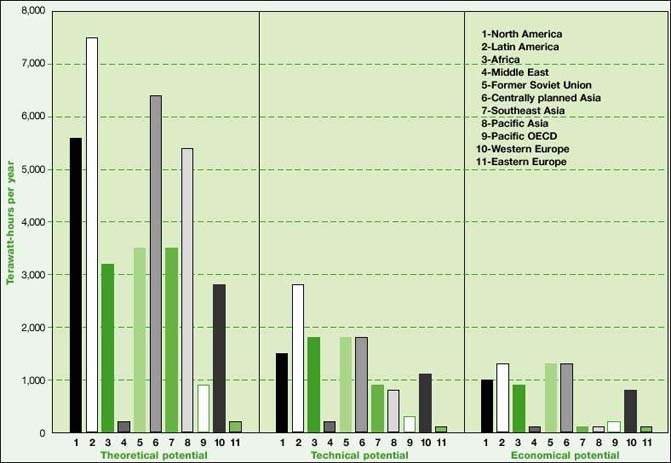
FIGURE 5.3 GLOBAL THEORETICAL,
TECHNICAL, AND ECONOMIC HYDROELECTRIC POTENTIALS (TERAWATT-HOURS A YEAR)
Source: World Atlas and Industry Guide,
1998.
Major constraints to hydroelectricity expansion
Physical constraints. Global water runoff is 47,000 cubic
kilometres a year, 28,000 cubic kilometres of which is surface runoff and 13,000
of which is stable underground flow into rivers (L’vovich, 1987). Only
about three-quarters of the stable underground flow (9,000 cubic kilometres) is
easily accessible and economically usable (WRI, 1998). In addition, 3,000 cubic
kilometres of useful capacity is available in form of human-made lakes and
reservoirs (L’vovich, 1987). Global anthropogenic water withdrawals are
about 27 percent of total availability, or 3,250 cubic kilometres a year.
Agriculture accounts for 65 percent of the diverted water, industries for 24
percent, and households and other municipal users for 7 percent, while 4 percent
is evaporated from reservoirs (Shiklomanov, 1993).
Water use in agriculture totals 2,300 cubic kilometres a year
and is expected to increase with growing food demand. The United Nations
projects a 50 - 100 percent increase in irrigation water by 2025 (Raskin and
others, 1997). Most of the projected increase in water demand will occur in
developing countries because of rapid growth in population, industry, and
agriculture. Water pollution adds enormously to local and regional water
scarcity by eliminating large volumes from the available supply. Many developing
countries undergoing rapid industrialisation face the full range of modern toxic
pollution problems - eutrophication, heavy metals, acidification, and persistent
organic pollutants (WHO, 1997).
Globally, water supplies are abundant. But they are unevenly
distributed among and within countries. In some areas water withdrawal has
reached such dimensions that surface water supplies are shrinking and
groundwater reserves are being depleted faster than they can be replenished by
precipitation (WHO, 1997). One-third of the world’s people live in
countries experiencing moderate to high water stress, and that share could rise
to two-thirds by 2025 (WRI, 1998). Since 1940 the amount of freshwater used by
humans has roughly quadrupled as the world population has doubled (Population
Action International, 1997). Another doubling of the world population by 2100
cannot be ruled out. Assuming an upper limit of usable renewable freshwater of
9,000 - 14,000 cubic kilometres a year, a second quadrupling of world water use
appears highly improbable.
In connection with the physical constraints to the use of water
for power generation listed above, it should be noted that electricity
generation - unlike, say, irrigation and domestic and industrial uses - is a
non-consumptive use of water. Under otherwise favourable conditions, such as
irrigation at low altitudes, water can be used first to generate power and then
for other purposes.
A physical factor needed to develop hydropower economically is
the availability of a suitable head. This limitation does not apply to other
water uses. This factor is critical in many water-rich but low-lying regions.
Environmental and social constraints. More than 400,000
cubic kilometres of land have been inundated by the construction of dams
(Shiklomanov, 1993). These dams generate 2,600 terawatt-hours a year of
electricity. Assuming that all flooded areas are used for hydroelectricity, the
energy density is 62 megawatt-hours a hectare per year. But hydroelectric plants
vary widely in this respect. Goodland (1996) reports on installed capacity,
flooded land, and relocated persons for 34 hydroelectric plants, mostly in
developing countries. These plants have an average energy density of 135
megawatt-hours a hectare per year. The most land-intensive of them yields 3.5
megawatt-hours a year per hectare of flooded land, but the least land-intensive
yields 1.48 million megawatt-hours a year per hectare.
Eleven of the thirty-four plants yield more than 1,800
megawatt-hours a hectare per year (0.205 kilowatt-years per year), the standard
for a fixed array photovoltaic plant in sunny areas (see below). Biomass from
forests (15 oven dry tonnes a hectare per year) and from crop plantation (10,000
litres of ethanol a hectare per year using sugarcane) have energy densities of
about 20 megawatt-hours a hectare per year. Thus hydroelectricity is
land-intensive - more so than photovoltaics but less so than biomass
plantations.
Hydroelectricity has sparked controversy when large dams with
energy densities as low as 0.2 megawatt-hours a hectare per year require
large-scale flooding and displace people. Some large dams involve the
resettlement of more than 100,000 people (Goodland, 1997). Mandatory
resettlement and the boom and bust effects of dam construction on local
economies have become contentious social and environmental issues. In the past,
resettlement was the responsibility of governments and public utilities involved
in the project. Despite enormous financial expenditures and compensation
packages, resettlement efforts have had modest success. If private utilities are
to finance hydro projects, they will have to take responsibility for dealing
with resettlement issues.
|
Biomass-derived fuels can substitute
for fossil fuels in
existing energy
supply infrastructure without
contributing to the build-up
of
greenhouse gases. |
National and international cooperation on the development of
environmental best practices (such as through working groups on hydropower and
the environment in partnership with nongovernmental organisations) may foster
public acceptance of hydropower projects. For example, the World Commission on
Dams, an independent international commission established in 1998, is reviewing
the development effectiveness of large dams and developing internationally
acceptable criteria for future decision-making on
dams.
Biomass resources
The world derives about 11 percent of its energy from biomass
(IEA, 1998b). In developing countries biomass is the most important energy
source, accounting for about 35 percent of the total (WEC, 1994). (In the
largest developing countries, China and India, biomass accounts for 19 percent
and 42 percent of the primary energy supply mix.) But in the world's poorest
countries, biomass accounts for up to 90 percent of the energy supply, mostly in
traditional or noncommercial forms.10 This explains why biomass is
often perceived as a fuel of the past - one that will be left behind as
countries industrialise and their technological base develops.
But biomass resources are abundant in most parts of the world,
and various commercially available conversion technologies could transform
current traditional and low-tech uses of biomass to modern energy. If dedicated
energy crops and advanced conversion technologies are introduced extensively
(see chapter 7), biomass could make a substantial contribution to the global
energy mix by 2100. Although most biomass is used in traditional ways (as fuel
for households and small industries) and not necessarily in a sustainable
manner, modern industrial-scale biomass applications have increasingly become
commercially available. In 1996 estimates of biomass consumption ranged from 33
- 55 exajoules (WEC, 1998; IEA, 1998a; Hall,
1997).
Sources
Biomass can be classified as plant biomass (woody, non-woody,
processed waste, or processed fuel; table 5.13) or animal biomass. Most woody
biomass is supplied by forestry plantations, natural forests, and natural
woodlands. Non-woody biomass and processed waste are products or by-products of
agroindustrial activities. Animal manure can be used as cooking fuel or as
feedstock for biogas generation. Municipal solid waste is also considered a
biomass resource.
The annual global primary production of biomatter totals 220
billion oven dry tonnes, or 4,500 exajoules. The theoretically harvestable
bioenergy potential is estimated to be 2,900 exajoules, of which 270 exajoules
could be considered technically available on a sustainable basis (Hall and
Rosillo-Calle, 1998). Hall and Rao (1994) conclude that the biomass challenge is
not availability but sustainable management, conversion, and delivery to the
market in the form of modern and affordable energy services. Biomass resources
can be converted to chemical fuels or electricity through several routes (see
chapter 7).
Two major studies have recently acknowledged the benefits of
sustainably produced biomass energy in future energy scenarios. The first is by
Shell International Petroleum Company (Shell, 1996), which assessed potential
major new sources of energy after 2020, when renewable energies are expected to
become competitive with fossil fuels. The Intergovernmental Panel on Climate
Change (IPCC, 1996a) has considered a range of options for mitigating climate
change, and increased use of biomass for energy features in all its scenarios.
The expected role of biomass in the future energy supply of
industrialised countries is based on two main considerations:
· The development of
competitive biomass production, collection, and conversion systems to create
biomass-derived fuels that can substitute for fossil fuels in existing energy
supply infrastructure without contributing to the build-up of greenhouse gases
in the atmosphere. Intermittent renewables, such as wind and solar energy, are
more challenging to fit into existing distribution and consumption schemes.
· The potential resource base is
generally considered substantial given the existence of land not needed or
unsuitable for food production, as well as agricultural food yields that
continue to rise faster than population growth.
In developing countries an assessment of potential bioenergy
development must first address issues ranging from land-use conflicts with food
production to health and environmental
problems.
Perceptions and problems
Biomass is often perceived as a fuel of the past because of its
low efficiency, high pollution, and associations with poverty.
· Biomass is the
fuel most closely associated with energy-related health problems in developing
countries. Exposure to particulates from biomass or coal burning causes
respiratory infections in children, and carbon monoxide is implicated in
problems in pregnancy (see chapter 3).
· Biomass fuels are bulky and
may have a high water content. Fuel quality may be unpredictable, and physical
handling of the material can be challenging. But technologies for biomass fuel
upgrading (into pellets or briquettes, for example) are advancing, and the
development of dedicated energy crops will also improve fuel standardisation.
· For biomass to become a major
fuel, energy crops and plantations will have to become a significant land-use
category. Land requirements will depend on energy crop yields, water
availability, and the efficiency of biomass conversion to usable fuels. Assuming
a 45 percent conversion efficiency to electricity and yields of 15 ovendry
tonnes a hectare per year, 2 square kilometres of plantation would be needed per
megawatt of electricity of installed capacity running 4,000 hours a year.
· The energy balance is not
always favourable. While woody biomass energy output is 10 - 30 times greater
than the energy input, the issue is less clear for liquid fuels derived from
biomass (Shapouri, Duffield, and Graboski, 1995). Nevertheless, the use of
sugarcane as a source of ethanol yields a very positive balance and is
responsible for a net abatement of 9 million tonnes of carbon a year in Brazil
(Moreira and Goldemberg, 1999). With the promising development of enzymatic
hydrolysis, cellulose can be transformed into ethanol with a very favourable
energy balance (PCAST, 1997).
· Large-scale production of
biomass can have considerable negative impacts on soil fertility, water and
agrochemical use, leaching of nutrients, and biodiversity and landscape. The
collection and transport of biomass will increase vehicle and infrastructure use
and air-borne
emissions.
Technical potential of biomass energy plantations
To estimate future technical biomass potentials, it is necessary
to know:
· The amount of land
available for biomass plantation.
· The
regional distribution of this land and distances to consumption
centres.
· The productivity of the land for
biomass production, including water availability.
· The environmental implications of biomass
production.
· The technical and economic
performance of conversion technologies and net energy balance.
TABLE 5.13. TYPES AND EXAMPLES OF PLANT BIOMASS
|
Woody biomass |
Non-woody biomass |
Processed waste |
Processed fuels |
|
· Trees
· Shrubs and scrub
·
Bushes such as coffee and tea
· Sweepings
from forest floor
· Bamboo
· Palms |
· Energy crops such as
sugarcane
· Cereal straw
· Cotton, cassava, tobacco stems and roots (partly
woody)
· Grass
· Bananas, plantains, and the like
· Soft stems such as pulses and potatoes
· Swamp and water plants |
· Cereal husks and
cobs
· Bagasse
· Wastes from pineapple and other fruits
· Nut shells, flesh, and the like
· Plant oil cake
·
Sawmill wastes
· Industrial wood bark and
logging wastes
· Black liquor from pulp
mills
· Municipal waste |
· Charcoal (wood and residues)
· Briquette/densified biomass
· Methanol/ethanol (wood alcohol)
· Plant oils from palm, rape, sunflower, and the
like
· Producer gas
· Biogas |
Source: Adapted from IEA, 1998a.
TABLE 5.14. CURRENT GLOBAL LAND-USE PATTERN
|
Cropland (arableland and permanent crops) |
Forests and woodland |
Permanent pastures |
Other land |
|
|
|
Total other land |
Land with rainfed cultivation potential |
|
Gha |
% of total |
Gha |
% of total |
Gha |
% of total |
Gha |
% of total |
Gha |
|
1.5 |
11 |
4.2 |
21 |
3.4 |
26 |
4.0 |
31 |
1.6 - 1.8 |
Note: Gha stands for billions of hectares. Total
land availability is 13.1 billion hectares.
Source: FAO, 1993, 1999; Fischer and Heilig, 1998; WRI,
1998.
TABLE 5.15. PROJECTED BIOMASS ENERGY POTENTIAL, 2050
(BILLIONS OF HECTARES UNLESS OTHERWISE INDICATED)
|
1 |
2 |
3 |
4 |
5 |
6a |
7b |
7c |
|
Region |
Population in 2050 (billions) |
Land with crop production potential in 1990 |
Cultivated land in 1990 |
Additional cultivated land required in 2050 |
Maximum additional area for biomass production |
Maximum additional amount of energy from biomass
(exajoules) |
|
Industrialised countriesd |
- |
- |
0.670 |
0.050 |
0.100 |
17 |
30 |
|
Latin America |
|
|
|
|
|
|
|
|
Central and Caribbean |
0.286 |
0.087 |
0.037 |
0.015 |
0.035 |
6 |
11 |
|
South America |
0.524 |
0.865 |
0.153 |
0.082 |
0.630 |
107 |
189 |
|
Africa |
|
|
|
|
|
|
|
|
East |
0.698 |
0.251 |
0.063 |
0.068 |
0.120 |
20 |
36 |
|
Central |
0.284 |
0.383 |
0.043 |
0.052 |
0.288 |
49 |
86 |
|
North |
0.317 |
0.104 |
0.040 |
0.014 |
0.050 |
9 |
15 |
|
Southern |
0.106 |
0.044 |
0.016 |
0.012 |
0.016 |
3 |
5 |
|
West |
0.639 |
0.196 |
0.090 |
0.096 |
0.010 |
2 |
3 |
|
Asia (excl. China) |
|
|
|
|
|
|
|
|
Western |
0.387 |
0.042 |
0.037 |
0.010 |
-0.005 |
0 |
0 |
|
South-central |
2.521 |
0.200 |
0.205 |
0.021 |
-0.026 |
0 |
0 |
|
East |
1.722 |
0.175 |
0.131 |
0.008 |
0.036 |
6 |
11 |
|
South-east |
0.812 |
0.148 |
0.082 |
0.038 |
0.028 |
5 |
8 |
|
China |
- |
- |
- |
- |
- |
2e |
2e |
|
Totalf |
8.296 |
2.495 |
0.897 |
0.416 |
1.28 |
226 |
396 |
|
Global biomass energy potential |
276g |
446g |
a. (6) = (3) - (4) - (5). b. (7) = (6) x 8.5 [oven
dry tonnes a hectare per year] x 20 [GJ per oven dry tonne] based on higher
heating value (18 GJ per oven dry tonne for lower heating value). The
assumptions for biomass productivity may appear on the high side, but they
represent technically achievable yields given dedicated research, development,
and dissemination. c. (7) = (6) ×15 [oven dry tonnes a hectare per year]
×20 [GJ per oven dry tonne] based on higher heating value (18 GJ per oven
dry tonne for lower heating value). d. OECD, Central and Eastern Europe, newly
independent states of the former Soviet Union. e. Data are projected values from
d’Apote (1998), not maximum estimates. f. Totals in (2), (3), (4), and (5)
exclude industrialised countries. g. Includes 50 EJ of current biomass energy
generation.
Source: Derived from Fischer and Heilig, 1998; d’Apote,
1998; Nakicenovic, Gr�bler, and McDonald, 1998.
Current land-use patterns are shown in table 5.14. Land use is
split into cropland, forests and woodland, permanent pastures, and other land.
‘Other land’ includes uncultivated land, grassland not used for
pasture, built-on areas, wastelands, wetlands, roads, barren land, and protected
forests. Less than a half of this land (1.6 - 1.8 billion hectares) can be used
for rainfed cultivation, including biomass production (FAO, 1993; Fischer and
Heilig, 1998).
Because energy plantations will likely account for 80 - 100
percent of biomass supply, large-scale use of biomass may compete with land for
agriculture and food production. But biomass production for energy purposes
should not infringe on food production. By 2100 an additional 1,700 million
hectares of land are expected to be needed for agriculture, while 690 - 1,350
million hectares of additional land would be needed to support biomass energy
requirements under a high-growth biomass energy scenario. Hence land-use
conflicts could arise.
Land availability. Considerable areas are potentially
available for large-scale production of biomass. In tropical countries large
areas of deforested and degraded lands could benefit from the establishment of
bioenergy plantations. While the theoretical potential of biomass production is
one order of magnitude larger than current global energy use, the technical and
economic potentials are much smaller. Technical and economic potentials will be
determined by numerous factors ranging from current uses of degraded land (which
in developing countries is often used by the poor to graze livestock) and land
productivity to the economic reach of the land with respect to centres of energy
demand.
The United Nations Food and Agriculture Organization’s
"World Agriculture towards 2010 study (Alexandratos, 1995) assesses potential
cropland resources in more than 90 developing countries. In 2025 developing
countries will be using only 40 percent of their potential cropland, but with
large regional variations. Asia (excluding China, for which data were
unavailable) will have a deficit of 47 million hectares, but yields of most food
crops are low, and there is great potential for improvement using better genetic
strains and management techniques. Modern agricultural technologies have not
reached many rural farmers and could boost yields by as much as 50 percent.
Whether future productivity gains can avoid a food deficit remains to be seen.
Africa currently only uses 20 percent of its potential cropland and would still
have 75 percent remaining in 2025. Latin America, currently using only 15
percent of its potential cropland, would have 77 percent left in 2025 - land
capable of producing nearly eight times its present energy consumption.
Large areas of surplus agricultural land in North America and
Europe could become significant biomass production areas. U.S. farmers are paid
not to farm about 10 percent of their land, and in the European Union 15 percent
of arable farmland can be set aside (amounting to 15 - 20 million hectares by
2010, and possibly more than 50 million hectares later in the 21st century). In
addition to more than 30 million hectares of cropland already set aside in the
United States to reduce production or conserve land, another 43 million hectares
of cropland have high erosion rates. Another 43 million hectares have wetness
problems that could be eased with a shift to perennial energy crops. The U.S.
Department of Agriculture estimates that a further 60 million hectares may be
idled over the next 25 years.
A projection of these parameters for 2050 is shown in table
5.15. The theoretical and technical potential for biomass energy is about ten
times current use (445 exajoules relative to 45 exajoules) and close to current
global primary energy use of 402 exajoules a year. But the extent to which this
potential can be achieved will depend on numerous factors. These include the
share of land allocated to other uses (for example, plantations for timber and
pulp), actually achievable specific biomass productivity, technologies for
converting biomass to convenient energy services, transport distances, water
availability, biodiversity, and the need for fertilisers.
Water resources. The supply of freshwater may become a
limiting factor for both food and bioenergy production. Several studies have
addressed water issues related to agriculture (FAO, 1999; Fischer and Heilig,
1998; WRI, 1998; Seckler and others, 1998, Falkenmark, 1997). But water
availability for biomass production has not been addressed in great detail. The
common view is that "the food needs of the world’s rapidly growing
population will introduce severe problems, either because the rate of growth
will be too rapid for the additional water mobilisation to be met, or because
the overall water demands will grow unrealistically high so that they cannot be
met" (Falkenmark, 1997, p. 74).
Current and projected water resources, by region, are shown in
table 5.16. Two levels of water requirements can be used to estimate water
sufficiency. The lowest level of sufficiency is generally considered to be 1,000
cubic metres per capita a year, while the availability of more than 2,000 cubic
metres per capita a year makes for a small probability of water shortages
(Seckler and others, 1998, Falkenmark, 1997). In addition, a recent study
commissioned by the United Nations Commission on Sustainable Development (Raskin
and others, 1997) puts the upper limit of sustainable water consumption at 40
percent of available resources.
Even without considering water requirements for biomass
production, water shortages (supply below 2,000 cubic metres per capita a year)
are possible for about half the world’s population as early as 2025. Thus
the water constraint for extended biomass production will likely be of
importance, especially in the long term (see also the section on physical
constraints to hydroelectricity expansion, above).
TABLE 5.16. SUFFICIENCY OF WATER RESOURCES, 1990 AND
2025
|
Region |
Population in 1990 (millions) |
Water resources per capita in 1990 (cubic metres) |
Water resources per capita in 2025 (cubic metres) |
Supply in 2025 as percentage of available water
resources |
|
North America |
278 |
19,370 |
36,200 |
6,065 |
|
Latin America and Caribbean |
433 |
30,920 |
200 |
533 |
|
Western Europe |
459 |
10,604 |
47,700 |
1,178 |
|
Central and Eastern Europe |
277 |
1,902 |
10,700 |
744 |
|
Former Soviet Union |
428 |
4,561 |
36,700 |
4,981 |
|
Middle East and North Africa |
n.a. |
n.a. |
0 |
6 |
|
Sub-Saharan Africa |
n.a. |
n.a. |
< 100 |
1,465 |
|
Pacific Asia |
405 |
11,463 |
5,100 |
10 |
|
South Asia |
1,133 |
4,537 |
2,000 |
1,611 |
|
Centrally planned Asia |
1,252 |
2,987 |
18,600 |
2,344 |
|
Pacific OECD |
144 |
8,463 |
41,600 |
1,729 |
|
Total |
4,809 |
8,497 |
198,900 |
20,666 |
n.a. Not available.
Source: Seckler and others, 1998.
TABLE 5.17. CURRENT AND FEASIBLE BIOMASS PRODUCTIVITY,
ENERGY RATIOS, AND ENERGY YIELDS FOR VARIOUS CROPS AND CONDITIONS
|
Crop and conditions |
Yield (dry tonnes a hectare per year) |
Energy ratio |
Net energy yield (gigajoules a hectare per year) |
|
Short rotation crops(willow, hybrid poplar; United States,
Europe) |
|
|
|
|
· Short term |
10-12 |
10:1 |
180-200 |
|
· Longer term |
12-15 |
20:1 |
220-260 |
|
Tropical plantations(such as eucalyptus) |
|
|
|
|
· No genetic improvement,
fertiliser use, and irrigation |
2-10 |
10:1 |
30-180 |
|
· Genetic improvement and
fertiliser use |
6-30 |
20:1 |
100-550 |
|
· Genetic improvement,
fertiliser and water added |
20-30 |
|
340-550 |
|
Miscanthus/switchgrass |
|
|
|
|
· Short term |
10-12 |
12:1 |
180-200 |
|
· Longer term |
12-15 |
20:1 |
220-260 |
|
Sugarcane (Brazil, Zambia) |
15-20 |
18:1a |
400-500 |
|
Wood (commercial forestry) |
1- 4 |
20/30:1 |
30- 80 |
|
Sugar beet(northwest Europe) |
|
|
|
|
· Short term |
10-16 |
10:1 |
30-100 |
|
· Longer term |
16-21 |
20:1 |
140-200 |
|
Rapeseed (including straw yields; northwest Europe) |
|
|
|
|
· Short term |
4- 7 |
4:1 |
50- 90 |
|
· Longer term |
7-10 |
10:1 |
100-170 |
a. The value in Moreira and Goldemberg (1999) -
7.9:1 - includes spending on transportation and processing of sugarcane to the
final product ethanol.
Source: Biewinga and. van der Bijl, 1996; Hall and Scrase,
1998; IEA, 1994; Kaltschmitt, Reinhardt, and Stelzer, 1996; de Jager, Faaij, and
Troelstra, 1998; IPCC, 1996a; Ravindranath and Hall,
1996.
Energy balances and biomass productivity
The energy production per hectare of various crops depends on
climatic, soil, and management conditions. Examples of net energy yields -
output minus energy inputs for agricultural operations, fertiliser, harvest, and
the like - are given in table 5.17. Generally, perennial crops (woody biomass
such as willow, eucalyptus, hybrid poplar, miscanthus or switchgrass grasses,
sugarcane) perform better than annual crops (which are planted and harvested
each year; examples include sorghum and hemp). This is because perennial crops
have lower inputs and thus lower production costs as well as lower ecological
impacts. Different management situations - irrigation, fertiliser application,
genetic plant improvements, or some combination of the three - can also increase
biomass productivity, by a factor of up to 10.
In addition to production and harvesting, biomass requires
transportation to a conversion facility. The energy used to transport biomass
over land averages about 0.5 megajoules per tonne-kilometre, depending on
infrastructure and vehicle type (Borjesson, 1996). This means that land
transport of biomass can become a significant energy penalty for distances of
more than 100 kilometres. But such a radius covers a surface of hundreds of
thousands of hectares, and is sufficient to supply enough biomass for conversion
facilities of hundreds of megawatts of thermal power.
Transporting biomass by sea is also an option. Sea transport
from Latin America to Europe, for example, would require less than 10 percent of
the energy input of the biomass (Agterberg and Faaij, 1998). International
transport of biomass (or rather, energy forms derived from biomass) is feasible
from an energy (and cost) point of view. Sea transport of biomass is already
practised: large paper and pulp complexes import wood from all over the
world.
Agricultural and forestry residues and municipal waste
Agricultural and forestry residues are the organic by-products
from food, fibre, and forest-product industries. Hall and others (1993) estimate
the energy contents of these residues at more than one-third of global
commercial energy use, of which about 30 percent is recoverable. Limitations
arise from the impracticality of recovering all residues and from the need to
leave some residues at the site (for fertilisation, for example) to ensure
sustainable production of the main product.
Forestry residues obtained from sound forest management do not
deplete the resource base. Under sustainable management, trees are replanted,
the forest is managed for regeneration to enhance its health and future
productivity, or both steps are taken. Energy is just one of the many outputs of
forests. One of the difficulties is accurately estimating the potential of
residues that can be available for energy use on a national or regional scale.
Municipal solid waste and industrial residues are indirect parts
of the biomass resource base. Industrialised countries generate 0.9 - 1.9
kilograms per capita of municipal solid waste every day. Energy contents range
from 4 - 13 megajoules per kilogram (IPPC, 1996a). Johansson and others (1993)
report heating values as high as 15.9 megajoules per kilogram in Canada and the
United States. Waste incineration, thermochemical gasification, and biodigestion
convert municipal solid waste into electricity, heat, or even gaseous and liquid
fuels. Because landfill disposal of municipal solid waste in densely populated
areas is increasingly constrained and associated with rising tipping fees, such
energy conversion can be profitable. Separating and recycling non-combustible
contents.
Municipal solid waste incineration requires tight air pollution
abatement due to the generation of complex compounds, some of which - such as
dioxins - are carcinogenic (WEC, 1994). Advanced pollution abatement equipment
essentially eliminates harmful pollutant emissions (Chen, 1995).
Johansson and others (1993) project that in industrialised
countries energy production from urban refuse will reach about 3 exajoules a
year by 2025.11 Data on municipal solid waste in developing countries
could not be found, but with rising living standards these same as those in
low-income OECD countries. Globally, this could double the potential energy
supply from municipal solid waste to 6
exajoules.
Environmental implications of biomass production
Forest energy plantations consist of intensively managed crops
of predominantly coppiced hardwoods, grown on cutting cycles of three to five
years and harvested solely for use as a source of energy. The site, local,
regional, and global impacts of these crops need to be considered. For example,
if short-rotation energy crops replace natural forests, the main negative
effects include increased risks of erosion, sediment loading, soil compaction,
soil organic matter depletion, and reduced long-term site productivity. Water
pollution from intensively managed sites usually results from sediment loading,
enhanced nutrient concentrations, and chemical residues from herbicides. In
contrast, if short-rotation crops replace unused or degraded agricultural land,
this reduces erosion, nutrient leaching, and so on.
Developing new crops is a slow and costly process involving many
technical and non-technical obstacles (Rosillo-Calle and others, 1996). Farmers
have been slow to adopt new crops because of the long-term (more than 15 years)
commitment needed. But research and development in Sweden and the United Kingdom
have found frost- and pest-resistant clones and generated high yields by using
mixed-clone planting and other management practices (Hall and Scrase, 1998).
Soil and nutrients. The abundant use of fertilisers and
manure in agriculture has led to considerable environmental problems in various
regions. These problems include nitrification of groundwater, saturation of
soils with phosphate (leading to eutrophication), and difficulties meeting
drinking water standards. In addition, the application of phosphates has
increased heavy metal flux to the soil.
The agricultural use of pesticides can affect the health of
people as well as the quality of groundwater and surface water - and,
consequently, plants and animals. Specific effects depend on the type of
chemical, the quantities used, and the method of application. Experience with
perennial crops (willow, poplar, eucalyptus) suggests that they meet strict
environmental standards. Agrochemical applications per hectare are 5 - 20 times
lower for perennial energy crops than for food crops like cereals (Hall, 1997).
Limited evidence on the soil effects of energy forestry
indicates that our understanding of this area is still relatively poor. Current
evidence indicates that, with proper practices, forest soil management need not
negatively affect physical, chemical, and biological soil parameters. Soil
organic matter can improve soil fertility, biology, and physical properties
(such as bulk density and water relations).12 Relative to arable
agriculture, energy plantations can improve the physical properties of soil
because heavy machinery is used less often and soil disturbances are fewer. Soil
solution nitrate can also be significantly reduced in soils planted with
fast-growing trees, as long as nitrogen fertilisers are applied in accordance
with the nutrient demands of the trees.
|
In tropical countries
large areas of deforested
and
degraded lands could benefit
from the establishment of
bioenergy
plantations. |
Biological fertilisers may replace chemical nitrogen fertilisers
in energy forestry and crops.
Biological fertilisation may include:
· Direct planting of
nitrogen-fixing woody species and interplanting with nitrogen-fixing trees or
ley crops.
· Soil amendments with various
forms of organic matter (sewage sludge, wastewater, contaminated groundwater,
farmyard manure, green manure).
· Stimulation or introduction of
rhizosphere micro-organisms that improve plant nutrient uptake.
· Biological
fallow.
Overall, from a nutritional point of view, there is no reason to
believe that energy forest plantations will have significant environmental and
ecological impacts when proper management practices are applied (Ericson, 1994).
Erosion. Erosion is related to the cultivation of many
annual crops in many regions and is a concern with woody energy crops during
their establishment phase. Little field data are available for comparison with
arable crops. One of the most crucial erosion issues relates to the additional
soil stabilisation measures required during the establishment of energy
plantations. Growing ground-cover vegetation strips between rows of trees can
mitigate erosion as long as competition does not occur.
Changing land use from agricultural production to an energy
forest plantation reduces precipitation excess (groundwater recharges) and
nutrient leaching. Nitrogen leaching decreases with energy plantations because
the standard nutrient supply and the use of animal slurries lead to good uptake
efficiencies relative to agricultural production systems. Nitrogen uptake
efficiency for arable crops is about 50 percent, for grass 60 percent, and for
forest plantations about 75 percent. The losses in these systems are mainly due
to leaching and de-nitrification (Rijtman and Vries, 1994).
Another concern relates to possible soil compaction caused by
heavy harvesting machinery. But these effects tend to be small to moderate due
to the infrequency of forest harvesting (Smith, 1995). Overall, these impacts
can be significantly lower than for conventional agriculture. When harvesting
perennials, soil erosion can be kept to an absolute minimum because the roots
remain in the soil. In the United States millions of hectares covered by grasses
that fall under the soil conservation programme could provide a promising
biomass production area, since biomass production can be combined with soil
protection. Another benefit of perennial crops relative to annual crops is that
their extensive root system adds to the organic matter content of the soil.
Generally, diseases (such as eels) are prevented and the soil gets a better
structure.
Many of the environmental and ecological impacts noted thus far
can be alleviated with compensating measures. Energy crops are generally more
environmentally acceptable than intensive agriculture because chemical inputs
are lower and the soil undergoes less disturbance and compaction.
Biodiversity and landscape. Biomass plantations may be
criticised because the range of biological species they support is much narrower
than is found in natural ecosystems, such as forests. While this is generally
true, it is not always relevant. Where plantations are established on degraded
or excess agricultural lands, the restored lands are likely to support a more
diverse ecology than before. Moreover, degraded land areas are plentiful: in
developing countries about 0.5 billion hectares of degraded land are available
(Bekkering, 1992). In any case, it is desirable to restore such land surfaces
for water retention, erosion prevention, and microclimate control.
A good plantation design - including set-aside areas for native
plants and animals situated in the landscape in a natural way - can avoid
problems normally associated with monocultures. The presence of natural
predators (such as insects) can also prevent the outbreak of pests and diseases.
Altogether, more research and insights on plantations are needed, taking into
account local conditions, species, and cultural
aspects.
Environmentally motivated responses to biomass production
Management practices are a key factor in the sustainable
production and use of biomass. Yet very little is known about managing
large-scale energy forest plantations or even agricultural and forestry residues
for energy use.13 The potential adverse environmental effects of
large-scale dedicated energy crops and forestry plantations have raised
concerns. Considerable effort has gone into investigatingthese concerns, and
much knowledge has been gained (see Tolbert, 1998 and Lowe and Smith, 1997).
As a result good practice guidelines are being developed for the
production and use of biomass for energy in Austria, Sweden, the United Kingdom,
and the United States, as well as across Europe.
TABLE 5.18 ANNUAL SOLAR ENERGY RECEIVED BY THE EARTH
|
Parameter |
Energy |
|
Solar energy intercepted by the Earth at ~1.37 kilowatts per
square metre |
5.5×10⁶ |
|
Solar energy reflected by the atmosphere back to space at ~0.3
kilowatts per square metre) |
1.6×10⁶ |
|
Solar energy potentially usable at ~1.0 kilowatts per square
metre |
3.9×10⁶ |
|
Ratio of potentially usable solar energy to current primary
energy consumption (402 exajoules) |
~9,000 |
Source: Author’s
calculations.
|
Very little is known about
managing large-scale energy
forest
plantations or even agricultural
and forestry residues
for
energy use. |
These guidelines focus on short-rotation coppice and recognise
the central importance of site-specific factors and the breadth of social and
environmental issues that should be taken into consideration. But given that
residues may remain more widely used than energy crops for quite some time,
guidelines are urgently needed on when it is appropriate to use residues for
energy, what fraction can be used, and how potential environmental advantages
can be maximised.
A key message of these guidelines is that site and crop
selection must be made carefully, and the crop must be managed sensitively.
Energy crops should not displace land uses of high agricultural and ecological
value. Consideration needs to be given to the landscape and visibility, soil
type, water use, vehicle access, nature conservation, pests and diseases, and
public access (ETSU, 1996; Hall and Scrase, 1998). The guidelines also stress
the importance of consulting with local people at the early planning stage, and
of ongoing community involvement in the development stages. Issues such as
changes to the landscape, increased traffic movements, or new employment
opportunities in rural areas may prove very significant to local
people.
Economics
The production costs of plantation biomass are already
favourable in some developing countries. Eucalyptus plantations in Brazil supply
wood chips for $1.5 - 2.0 a gigajoule (Carpentieri, Larson, and Woods, 1993).
Based on this commercial experience, Carpentieri, Larson, and Woods (1993)
project future biomass (wood chip) production of 13 exajoules a year on 50
million hectares of land. Costs are much higher in industrialised countries
(with top values of around $4 a gigajoule in parts of Europe). But in the longer
run, by about 2020, better crops and production systems are expected to cut
biomass production costs in the United States to $1.5 - 2.0 a gigajoule for
substantial land surfaces (Graham and others, 1995; Turnure and others, 1995).
Biomass costs are influenced by yield, land rent, and labour
costs. Thus increases in productivity are essential to reducing biomass
production costs. Yields can be improved through crop development, production
integration (multiproduct plantation), and mechanisation. Competition for land
use should be avoided to minimise inflated land rental rates. Labour costs can
be lowered through
mechanisation.
Solar energy resources
Solar energy has immense theoretical potential. The amount of
solar radiation intercepted by Earth is more than three orders of magnitude
higher than annual global energy use (table 5.18). But for several reasons the
actual potential of solar energy is somewhat lower:
· Time
variation. The amount of solar energy available at a given point is subject
to daily and seasonal variations. So, while the maximum solar flux at the
surface is about 1 kilowatt per square meter, the annual average for a given
point can be as low as 0.1 - 0.3 kilowatts per square meter, depending on
location. For large-scale application of solar energy - more than 5 - 10 percent
of the capacity of an integrated electricity system - the variability of
insolation necessitates energy storage or backup systems to achieve a reliable
energy supply.
· Geographic variation.
The availability of solar energy also depends on latitude. Areas near the
equator receive more solar radiation than subpolar regions. But geographic
variation can be significantly reduced by using collectors capable of following
the position of the sun. Polar regions show a notable increase in irradiance due
to light reflection from snow.
· Weather conditions.
Weather is another, even stronger, factor influencing the availability of solar
energy. Annual average sky clearness may vary by 80 - 90 percent in locations
such as Khartoum (Sudan), Dakar (Bangladesh), Kuwait, Baghdad (Iraq), Salt Lake
City (Utah), and by 40 - 50 percent in Tokyo (Japan) and Bonn (Germany; WEC,
1994). Solar irradiance is often quite diffuse, leading to lower average power
densities. Thus large-scale generation of solar energy can require significant
land.
· Siting options. While
building structures provide interesting local siting possibilities,14
large-scale solar collectors can be located on land that is not being used
- which amounts to about 4 billion hectares (FAO, 1999). Assuming 10 percent of
this unused land is allocated for habitation (cities, towns, villages) and
infrastructure (roads, ports, railways), some 3.6 billion hectares are available
for solar energy.
Large-scale availability of solar energy will thus depend on a
region’s geographic position, typical weather conditions, and land
availability. Using rough estimates of these factors, solar energy potential is
shown in table 5.19. This assessment is made in terms of primary energy - that
is, energy before the conversion to secondary or final energy is estimated. The
amount of final energy will depend on the efficiency of the conversion device
used (such as the photovoltaic cell applied). Issues related to energy
conversion and its impact on the amount of energy delivered are considered in
chapter 7.
This assessment also reflects the physical potential of solar
energy. Thus it does not take into account possible technological, economic, and
social constraints on the penetration of solar energy except for two different
assumptions on available land. The consideration of such constraints is likely
to result in much lower estimates - as in WEC (1994), where global solar energy
potential in 2020 ranges from 5 - 230 exajoules a year.
The solar energy potential in table 5.19 is more than sufficient
to meet current and projected energy uses well beyond 2100. Thus the
contribution of solar energy to global energy supplies will not be limited by
resource availability. Rather, three factors will determine the extent to which
solar energy is used in the longer run: the availability of efficient and
low-cost technologies to convert solar energy into electricity and eventually
hydrogen, of effective energy storage technologies for electricity and hydrogen,
and of high-efficiency end-use technologies fuelled by electricity and hydrogen.
TABLE 5.19. ANNUAL SOLAR ENERGY POTENTIAL (EXAJOULES)
|
Region |
Minimum |
Maximum |
|
North America |
181.1 |
7,410 |
|
Latin America and Caribbean |
112.6 |
3,385 |
|
Western Europe |
25.1 |
914 |
|
Central and Eastern Europe |
4.5 |
154 |
|
Former Soviet Union |
199.3 |
8,655 |
|
Middle East and North Africa |
412.4 |
11,060 |
|
Sub-Saharan Africa |
371.9 |
9,528 |
|
Pacific Asia |
41.0 |
994 |
|
South Asia |
38.8 |
1,339 |
|
Centrally planned Asia |
115.5 |
4,135 |
|
Pacific OECD |
72.6 |
2,263 |
|
Total |
1,575.0 |
49,837 |
|
Ratio to current primary energy consumption (402
exajoules) |
3.9 |
124 |
|
Ratio to projected primary energy consumption in 2050 (590 -
1,050 exajoules) |
2.7 - 1.5 |
84 - 47 |
|
Ratio to the projected primary energy consumption in 2100
(880 - 1,900 exajoules) |
1.8 - 0.8 |
57 - 26 |
Note: The minimum and maximum reflect different
assumptions on annual clear sky irradiance, annual average sky clearance, and
available land area.
Source: IEA, 1998c; Nakicenovic, Gr�bler, and McDonald,
1998.
Wind energy resources
Winds develop when solar radiation reaches the Earth’s
highly varied surface unevenly, creating temperature, density, and pressure
differences. Tropical regions have a net gain of heat due to solar radiation,
while polar regions are subject to a net loss. This means that the Earth’s
atmosphere has to circulate to transport heat from the tropics towards the
poles. The Earth’s rotation further contributes to semipermanent,
planetary-scale circulation patterns in the atmosphere. Topographical features
and local temperature gradients also alter wind energy distribution.
A region’s mean wind speed and its frequency distribution
have to be taken into account to calculate the amount of electricity that can be
produced by wind turbines. Wind resources can be exploited in areas where wind
power density is at least 400 watts per square metre at 30 metres above the
ground (or 500 watts per square metre at 50 metres). Moreover, technical
advances are expected to open new areas to development. The following assessment
includes regions where the average annual wind power density exceeds 250 - 300
watts per square metre at 50 metres - corresponding to class 3 or higher in the
widely used U.S. classification of wind resources.
TABLE 5.20. ANNUAL WIND ENERGY POTENTIAL
|
Region |
Percentage of land area |
Population density (people per square kilometre) |
Gross electric potential (thousands of terawatt- hours)
|
Assessed wind energy potential (exajoules) |
Estimated second-order potential (thousands of terawatt-
hours) |
Assessed wind energy potential, (exajoules) |
|
Africa |
24 |
20 |
106 |
1,272 |
10.6 |
127 |
|
Australia |
17 |
2 |
30 |
360 |
3 |
36 |
|
North America |
35 |
15 |
139 |
1,670 |
14 |
168 |
|
Latin America |
18 |
15 |
54 |
648 |
5.4 |
65 |
|
Western Europe |
42 |
102 |
31 |
377 |
4.8 |
58 |
|
Eastern Europe and former Soviet Union |
29 |
13 |
106 |
1,272 |
10.6 |
127 |
|
Asia (excl. former Soviet Union) |
9 |
100 |
32 |
384 |
4.9 |
59 |
|
Total |
23 |
|
500 |
6,000 |
53 |
640 |
Note: Refers to wind energy with average annual
power density of more than 250 - 300 watts per square metre at 50 metres
(resources class 3 and higher in the U.S. classification of wind resources). The
energy equivalent in exajoules is calculated based on the electricity generation
potential of the referenced sources by dividing the electricity generation
potential by a factor of 0.3 (a representative value for the efficiency of wind
turbines, including transmission losses), resulting in a primary energy
estimate. Totals are rounded.
Source: Grubb and Meyer, 1993.
TABLE 5.21. ESTIMATED ANNUAL WIND ENERGY RESOURCES
|
Region |
Land surface with wind class 3 - 7 |
Wind energy resources without land restriction |
Wind energy resources if less than 4 percent of land is
used |
|
|
Percent |
Thousands of square kilometres |
Thousands of terawatt- hours |
Exajoules |
Thousands of terawatt- hours |
Exajoules |
|
North America |
41 |
7,876 |
126 |
1,512 |
5.0 |
60 |
|
Latin America and Caribbean |
18 |
3,310 |
53 |
636 |
2.1 |
25 |
|
Western Europe |
42 |
1,968 |
31 |
372 |
1.3 |
16 |
|
Eastern Europe and former Soviet Union |
29 |
6,783 |
109 |
1,308 |
4.3 |
52 |
|
Middle East and North Africa |
32 |
2,566 |
41 |
492 |
1.6 |
19 |
|
Sub-Saharan Africa |
30 |
2,209 |
35 |
420 |
1.4 |
17 |
|
Pacific Asia |
20 |
4,188 |
67 |
804 |
2.7 |
32 |
|
China |
11 |
1,056 |
17 |
204 |
0.7 |
8 |
|
Central and South Asia |
6 |
243 |
4 |
48 |
0.2 |
2 |
|
Totala |
27 |
30,200 |
483 |
5,800 |
18.7 |
231 |
Note: The energy equivalent in exajoules is
calculated based on the electricity generation potential of the referenced
sources by dividing the electricity generation potential by a factor of 0.3 (a
representative value for the efficiency of wind turbines, including transmission
losses), resulting in a primary energy estimate. a. Excludes China.
Source: WEC, 1994.
Several studies have analysed the global potential of power
production using wind. To define technical wind power potential, one needs take
into account siting constraints. First-order exclusions may include definite
constraints such as cities, forests, difficult terrain, and inaccessible
mountain areas. The most important limitations arise from social, environmental,
and land-use constraints, including visual and noise impacts, all of which
depend on political and social judgements and traditions and may vary by region.
Regional estimates of wind electricity potentials (class 3 and above) are
summarised in table 5.20.
Grubb and Meyer (1993) estimate the theoretical electricity
generation potential of global wind energy resources (class 3 and above) to be
500,000 terawatt-hours a year (see table 5.20). Only about 10 percent of this
theoretical potential may be realistically harvested.
WEC (1994) places the global theoretical wind potential at
483,000 terawatt-hours a year (table 5.21). This estimate is based on the
assumption that 27 percent of the Earth’s land surface is exposed to an
annual mean wind speed higher than 5.1 metres per second at 10 metres above
ground (class 3 and above), and that this entire area could be used for wind
farms. WEC also suggests a more conservative estimate of 19,000 terawatt-hours a
year, assuming for practical reasons that just 4 percent of the area exposed to
this wind speed can be used for wind farms. (The 4 percent estimate comes from
detailed studies of wind power potential in the Netherlands and the United
States.)
Geothermal energy resources
Geothermal energy is generally defined as heat stored within the
Earth. The Earth’s temperature increases by about 3 degrees Celsius for
every 100 metres in depth, though this value is highly variable. Heat originates
from the Earth’s molten interior and from the decay of radioactive
materials.
Four types of geothermal energy are usually distinguished:
· Hydrothermal - hot
water or steam at moderate depths (100 - 4,500 metres).
· Geopressed - hot-water
aquifers containing dissolved methane under high pressure at depths of 3 - 6
kilometres.
· Hot dry rock - abnormally hot
geologic formations with little or no water.
· Magma - molten rock at
temperatures of 700 - 1,200 degrees Celsius.
Today only hydrothermal resources are used on a commercial scale
for electricity generation (some 44 terawatt-hours of electricity in 1997) and
as a direct heat source (38 terawatt-hours of heat; Bj�rnsson and others, 1998).
The global potential of geothermal energy is on the order of
140,000,000 exajoules. But a much smaller amount can be classified as resources
and reserves (table 5.22). Still, geothermal energy has enormous potential. Even
the most accessible part, classified as reserves (about 434 exajoules), exceeds
current annual consumption of primary energy. But like other renewable resources
(solar energy, wind energy), geothermal energy is widely dispersed. Thus the
technological ability to use geothermal energy, not its quantity, will determine
its future share. The regional distribution of geothermal energy potential is
shown in table 5.23.
Environmental aspects of geothermal energy use relate primarily
to gas admixtures to the geothermal fluids such as carbon dioxide, nitrogen,
hydrogen sulphides or ammonia and heavy metals such as mercury. The quantities
vary considerably with location and temperatures of the feed fluid but are
generally low compared to those associated with fossil fuel use. Because the
chemicals are dissolved in the feed water which is usually re-injected into the
drill holes, releases are
minimal.
Ocean energy resources
Four types of ocean energy are known:
· Tidal energy -
energy transferred to oceans from the Earth’s rotation through gravity of
the sun and moon.
· Wave energy - mechanical
energy from wind retained by waves.
· Ocean thermal energy - energy
stored in warm surface waters that can be made available using the temperature
difference with water in ocean depths.
· Salt gradient energy - the
energy coming from salinity differences between freshwater discharges into
oceans and ocean water.
Tidal energy is the most advanced in terms of current use, with
a number of commercial plants in operation. Despite notable progress in recent
years, the other ocean energy resources are generally not considered mature
enough for commercial applications.
TABLE 5.22. ANNUAL GEOTHERMAL POTENTIAL (EXAJOULES)
|
Resource category |
Energy |
|
Accessible resource base (amount of heat that could
theoretically be tapped within a depth of 5 kilometres) |
140,000,000 |
|
Useful accessible resource base |
600,000 |
|
Resources (portion of the accessible resource base expected to
become economical within 40 - 50 years) |
5,000 |
|
Reserves (portion of the accessible resource base expected to
become economical within 10 - 20 years) |
500 |
Source: Palmerini, 1993; Bj�rnsson and others,
1998.
TABLE 5.23. ANNUAL GEOTHERMAL POTENTIAL BY REGION
(EXAJOULES)
|
Resource category |
Energy |
|
North America |
26,000,000·(18.9) |
|
Latin America and Caribbean |
26,000,000·(18.6) |
|
Western Europe |
7,000,000·(5.0) |
|
Eastern Europe and former Soviet Union |
23,000,000·(16.7) |
|
Middle East and North Africa |
6,000,000·(4.5) |
|
Sub-Saharan Africa |
17,000,000·(11.9) |
|
Pacific Asia (excl. China) |
11,000,000·(8.1) |
|
China |
11,000,000·(7.8) |
|
Central and South Asia |
13,000,000·(9.4) |
|
Total |
140,000,000 |
Note: Numbers in parentheses are shares of world
total.
Source: WEC, 1994; EPRI, 1978.
TABLE 5.24. ANNUAL OCEAN ENERGY POTENTIAL
|
Resource category |
Terawatt-hours |
Exajoules |
|
Tidal energy |
22,000 |
79 |
|
Wave energy |
18,000 |
65 |
|
Ocean thermal energya |
2,000,000 |
7,200 |
|
Salt gradient energyb |
23,000 |
83 |
|
Total |
2,063,000 |
7,400 |
a. The potential of ocean thermal energy is
difficult to assess but is known to be much larger than for the other types of
ocean energy. The estimate used here assumes that the potential for ocean
thermal energy is two orders of magnitude higher than for tidal, wave, or salt
gradient energy. b. Assumes the use of all the world’s rivers with devices
of perfect efficiency.
Source: WEC, 1994, 1998; Cavanagh, Clarke, and Price,
1993.
The theoretical potential of each type of ocean energy is quite
large (table 5.24). But like other renewables, these energy resources are
diffuse, which makes it difficult to use the energy. The difficulties are
specific to each type of ocean energy, so technical approaches and progress
differ as
well.
Conclusion
Globally, energy resources are plentiful and are unlikely to
constrain sustainable development even beyond the 21st century (tables 5.25 and
5.26). If historical observations are any indication, possible intergenerational
equity conflicts on resource availability and costs will most likely be
equilibrated by technological progress. The fossil resource base is at least 600
times current fossil fuel use, or 16 times cumulative fossil fuel consumption
between 1860 and 1998. (The resource base does not include methane clathrates
and other oil, gas, and coal occurrences, the inclusion of which could quadruple
the resource base.)
While the availability and costs of fossil fuels are unlikely to
impede sustainable development, current practices for their use and waste
disposal are not sustainable (UNCED, 1993). In their natural states, energy
resources are environmentally inert (from the perspective of sustainable
development). Even mining and production of fossil resources interfere little
with sustainable development relative to current pollution emissions and wastes
associated with their combustion for the provision of energy services. Thus the
economic and environmental performance of fossil, nuclear, and renewable
conversion technologies - from resource extraction to waste disposal - will
determine the extent to which an energy resource can be considered sustainable.
Relative economic and environmental aspects make up the demand
pull for the development of future energy resources. Sociopolitical preferences
and policies can appreciably amplify or weaken the demand pull. In many
countries, especially transition economies but also several energy-exporting
developing countries, the domestic fossil energy resource endowment has yet to
be evaluated using market-based criteria. Such evaluations may lead to a
substantial revision of readily available reserve volumes and point to
unforeseen investments in up-stream operations to raise productivity to
international standards.
Energy resources are not evenly distributed across the globe.
Although renewables are more evenly distributed and accessible than fossil and
nuclear resources, their economic potential is affected by land-use constraints,
variation of availability as a function of latitude (solar power) and location
(wind power and hydroelectricity), solar irradiation, and water and soil quality
(biomass). Still, renewable energy flows are three orders of magnitude larger
than current global energy use (figure 5.4). Their use will depend primarily on
the commercialisation of conversion technologies. Similarly, uranium and thorium
resources are plentiful and do not pose a constraint to the long-term deployment
of nuclear power.
TABLE 5.25. SUMMARY OF GLOBAL FOSSILE AND FISSILE RESOURSES
(THOUSANDS OF EXAJOULES)
|
Resource |
Consumed by end 1998 |
Consumed in 1998 |
Reserves |
Resources |
Resource basea |
Additional occurrences |
|
Oil |
5.14 |
0.14 |
11.11 |
21.31 |
32.42 |
45 |
|
Conventional |
4.85 |
0.13 |
6.00 |
6.07 |
12.08 |
|
|
Unconventional |
0.29 |
0.01 |
5.11 |
15.24 |
20.35 |
45 |
|
Gas |
2.38 |
0.08 |
14.88 |
34.93 |
49.81 |
930 |
|
Conventional |
2.35 |
0.08 |
5.45 |
11.11 |
16.57 |
|
|
Unconventional |
0.03 |
0.00 |
9.42 |
23.81 |
33.24 |
930 |
|
Coal |
5.99 |
0.09 |
20.67 |
179.00 |
199.67 |
|
|
Fossile total |
13.51 |
0.32 |
46.66 |
235.24 |
281.89 |
975 |
|
Uranium |
|
|
|
|
|
|
|
Open cycle in thermal reactorsb |
n.e. |
0.04 |
1.89 |
3.52 |
5.41 |
7.1c |
|
Closed cycle with fast reactorsd |
- |
- |
113 |
211 |
325 |
426b |
|
Fossile and fissile totale |
n.e. |
0.36 |
48 |
446 |
575 |
1,400 |
n.e. Not estimated. - Negligible. a. Sum of reserves
and resources. b. Calculated from the amount in tonnes of uranium, assuming 1
tonne = 589 terajoules (IPCC, 1996a). c. Does not include uranium from seawater
or other fissile materials. d. Calculated assuming a 60-fold increase relative
to the open cycle, with 1 tonne = 35,340 terajoules. e. All totals are rounded.
Source: Author’s calculations from previous chapter
tables.

FIGURE 5.4. GLOBAL ENERGY BALANCE
AND FLOWS WITHOUT ANTHROPOGENIC INTERFERENCE
Note: Energy flows are in thousands of exajoules a
year. Numbers in parentheses are uncertain or rounded.
Source: S�rensen, 1979.
Most long-term energy demand and supply scenarios involve
increasing global energy trade, irrespective of the underlying assumptions of
energy resource and technology development. Supply security considerations may
tilt the balance in favour of one energy resource or set of resources. Supply
security improves with the share of energy supplies from national sources. A
thorough evaluation of a nation’s energy resource endowment based on market
criteria is an important step towards supply security.
The world energy system’s current dependence on fossil fuel
conversion is considered unsustainable by the United Nations (UNDP, 1997). It
has often been assumed that fossil resource limitations or the "running out of
resources" phenomenon (Meadows and others, 1972) would wean the energy system
off fossil sources and bring about the necessary course correction towards
sustainable energy development. Based on long-term global energy demand
expectations, current understanding of the world’s fossil resource
endowment, and production economics, this is unlikely to happen before the end
of the 21st century. Thus a transition to sustainable energy systems that
continue to rely predominantly on fossil fuels will depend on the development
and commercialisation of fossil technologies that do not close their fuel cycle
through the atmosphere.15 Alternatively, the transition will likely
require determined policies to move away from fossil fuels. Large increases in
fossil fuel prices as a result of rapid resource depletion are unlikely to drive
the transition.
TABLE 5.26. SUMMARY OF THE RENEWABLE RESOURCE BASE
(EXAJOULES A YEAR)
|
Resource |
Current usea |
Technical potential |
Theoretical potential |
|
Hydropower |
9 |
50 |
147 |
|
Biomass energy |
50 |
>276 |
2,900 |
|
Solar energy |
0.1 |
>1,575 |
3,900,000 |
|
Wind energy |
0.12 |
640 |
6,000 |
|
Geothermal energy |
0.6 |
5,000 |
140,000,000 |
|
Ocean energy |
n.e. |
n.e. |
7,400 |
|
Total |
56 |
> 7,600 |
> 144,000,000 |
n.e. Not estimated. a. The electricity part of
current use is converted to primary energy with an average factor of 0.385.
Source: Author’s calculations from previous chapter
tables.
|
Renewable energy
flows are three orders of
magnitude
larger than
current global
energy use. |
Transitions motivated by factors other than short-term economics
usually invoke extra costs that have to be borne by contemporary societies for
the benefit of future ones. In either case - making the use of fossil fuels
sustainable or shifting to non-fossil energy sources - society must first
recognise that the current energy system is unsustainable and that adequate
policy measures need to be introduced. These measures may stimulate
technological advances and development, change consumer preferences, or both.
After all, the existence of enormous fossil, nuclear, and renewable resources is
irrelevant unless there is a demand for them and unless technologies for their
extraction and sustainable conversion to energy services are commercially
available. Otherwise, resources remain ‘neutral stuff’.
Notes
1. However, Masters and others argue that most major
oil-producing countries are reporting as proven reserves what the authors would
define as identified reserves (proven plus probable plus possible).
2. Oil production costs and market prices may differ
significantly, however. Oil is a highly political commodity with market prices
that often have little relation to costs. While economic rationality suggests
that the least-cost oil reserves are produced first, this has not been the case,
at least since 1973. That gives low-cost and lowest-cost producers quite a bit
of leverage in engineering market price instabilities or backing out of
high-cost production.
3. The ratio of reserves to production assumes constant demand
for a resource as well as constant production over the period suggested by the
ratio. In essence, it implies that production will plummet from full output in
one year to zero output in another. In reality, production peaks and then
declines along a quasi-logistic curve, and supplies will last much longer,
though at much lower volumes than suggested by the ratio.
4. Once an investment has been committed for gas export
pipelines, it cannot easily be designated for other uses (whereas an oil tanker
may be rerouted instantly by a single radio call). Disputes between trading
partners may put the investment at risk and lead to disruptions in supply and
off take.
5. Temperature increases as a function of high atmospheric
carbon concentrations are highly uncertain. For example, the mean global
temperature increase estimated for a doubling of carbon dioxide concentrations
ranges from 1.5 - 4.5 Kelvin (IPCC, 1996b).
6. Uranium reserves as defined by the Uranium Institute are
proven and probable reserves (labelled Reserve Class I) at production costs of
less than $40 a kilogram, less than $60 a kilogram, and less than $80 a
kilogram. WEC (1998) uses the term proven reserves for the NEA-IAEA
category reasonably assure resources.
7. The Uranium Institute uses for the lesser-known category
Reserve Class II. WEC (1998) defines its estimated additional amounts
recoverable to correspond to NEA-IAEA EAR I.
8. A detailed and consistent compilation for all countries is
not available, and country-specific information is often published without
verification. The International Water Power and Dams Construction Yearbook
(1998) and even the World Atlas and Industry Guide (1998) present a
few inconsistencies. Nevertheless, a cross-check showed a similar world total
for these two sources.
9. The consideration of social and environmental aspects
suggests that this is the market potential. Because of inconsistencies in the
definitions used in different appraisals, here the notion of economic potential
is maintained.
10. Non-commercial biomass is difficult to account for
accurately or goes unreported. For instance, biomass data for China and India
are not included in the WEC statistics.
11. It is assumed that 75 percent of the energy in urban refuse
can be recovered and that the waste generation rate per capita is constant over
time. Estimates for Canada and the United States are based on a per capita waste
generation rate of 330 kilograms a year and a heating value of 15.9 megajoules
per kilogram (and a 50 percent recycling rate). Estimates for other OECD
countries are based on a per capita waste generation rate of 300 kilograms a
year and a heating value of 12.7 megajoules per kilogram.
12. A review of the literature indicates that over time there
are few, if any, long-term losses of soil carbon after forest harvesting and
reforestation. But substantial losses of soil carbon are reported for systems
involving harvesting followed by intensive burning or mechanical site damage.
Holistic, life-cycle approaches are required to estimate the contribution of
intensive forest management and bioenergy systems to local and global carbon
balances.
13. There are exceptions: a lot is known about eucalyptus for
charcoal production and sugarcane for ethanol production in Brazil (which tend
to follow traditional agricultural and forestry practices). Similarly, there is
extensive knowledge about willows for heat power generation in Sweden, where the
cultivation of about 16,000 hectares has also borrowed considerably from
traditional forestry and agricultural activities.
14. For example, if the performance and costs of solar
collectors integrated with buildings are improved, commercial buildings could
become local energy production centres. Such integration would enlarge the space
available for solar collection and allow buildings to contribute to their energy
use.
15. Decarbonisation of fuels (before use) or greenhouse gas
abatement (after fuel production or use) and subsequent carbon dioxide disposal
could eventually avoid closing the carbon fuel cycle through the atmosphere (see
chapters 8 and 11).
References
Aalund, L.R. 1998. "Technology, Money Unlocking Vast Orinoco
Reserves." Oil and Gas Journal Special 96 (42): 49 - 50.
Adelman, M.A., and M.C. Lynch. 1997. "Fixed View of Resources
Limits Creates Undue Pessimism." Oil and Gas Journal 95 (14): 56 - 60.
Agterberg, A., and A. Faaij. 1998. "Biotrade: International
Trade in Renewable Energy from Biomass." In Proceedings of the 10th European
Conference on Biomass for Energy and Industry. Utrecht University,
Department of Science, Technology, and Society, W�rzburg, Netherlands.
Alexandratos, N. 1995. "World Agriculture towards 2010
Netherlands". A study by the Food and Agriculture Organization of the United
Nations. Chichester: John Wiley & Sons.
ANEEL (Agencia Nacional de Energia Eletrica). 1999.
www.aneel.gov.br. Brasilia, Brazil.
Bekkering, T.D. 1992. "Using Tropical Forests to Fix Atmospheric
Carbon: The Potential in Theory and Practice." Ambio 21: 414 - 19.
BGR (Bundesanstalt f�r Geowissenschaften und Rohstoffe [Federal
Institute for Geosciences and Natural Resources]). 1995. Reserven, Ressourcen
und Verf�gbarkeit von Energierohstoffen 1995 [Availability of Energy Reserves
and Resources 1995]. Hannover, Germany.
BGR (Bundesanstalt f�r Geowissenschaften und Rohstoffe [Federal
Institute for Geosciences and Natural Resources]). 1998. Reserven, Ressourcen
und Verf�gbarkeit von Energierohstoffen 1998 [Availability of Energy Reserves
and Resources 1998]. Hanover, Germany.
Biewinga, E.E., and G. van der Bijl. 1996. Sustainability of
Energy Crops in Europe: A Methodology Developed and Applied. CLM 234.
Utrecht: Netherlands Centre for Agriculture and Environment.
Bj�rnsson, J., and others. 1998. "The Potential Role of
Geothermal Energy and Hydropower in the World Energy Scenario in Year 2020."
Paper presented at the 17th Congress of the World Energy Council, 13 - 18
September, Houston, Tex.
Bloss, W.H., O. Kappelmeyer, J. Koch, J. Meyer, and E. Schubert.
1980. Survey of Energy Resources. Hannover, Germany: Federal Institute
for Geosciences and Natural Sciences.
Boiteux, M. 1989. "Hydro: An Ancient Source of Power for the
Future." International Water Power and Dam Construction Yearbook. Sutton,
Surrey. England. Buisness Press International.
Borjesson, P. 1996. "Emission of CO2 from Biomass
Production and Transportation in Agriculture and Forestry." Energy Conversion
and Management 37: 6 - 8.
BP (British Petroleum). 1998. BP Statistical Review of World
Energy. London.
BP (British Petroleum).1999. BP Statistical Review of World
Energy. London.
Campbell, C.J., and J.H. Laherrere. 1998. "The End of Cheap
Oil." Scientific American 278 (3): 78 - 83.
Carpentieri, E., E. Larson, and J. Woods. 1993. "Future
Biomass-Based Power Generation in Northeast Brazil." Biomass and Bioenergy
4 (3): 149 - 73.
Cavanagh, J.E., J.H. Clarke, and R. Price. 1993. "Ocean Energy
Systems." In T.B. Johansson, H. Kelly, A.K.N. Reddy, and R.H. Williams, eds.,
Renewable Energy: Sources for Fuels and Electricity. Washington, D.C.:
Island Press.
Chadwick, J. 1998. "Mining Alberta’s Oil Sands." Mining
Magazine 179 (2): 58 - 73.
Charpak, G., and R.L. Garwin. 1998. Feux Follets et
Champignons Nucleaires. Paris: Editions Odile Jacob.
Chen, J. 1995. "The Production of Methanol and Hydrogen from
Municipal Solid Waste." MSE Thesis, CEES Report 289. Princeton University,
Mechanical and Aerospace Engineering Department, Princeton, N.J.
Churchill, A.A. 1997. "Meeting Hydro’s Financing and
Development Challenges." In T. Dorcey, ed., Large Dams: Learning from the
Past, Looking at the Future. Gland, Switzerland: World Conservation Union
and the World Bank.
Collet, T.S. 1993. "Natural Gas Production from Arctic Gas
Hydrates." U.S. Geological Survey 65: 299 - 311.
Collet, T.S., and V.A. Kuuskraa. 1998. "Hydrates Contain Vast
Store of World Gas Resources." Oil and Gas Journal 96 (19).
D’Apote, S.L. 1998. "IEA Biomass Energy Analysis and
Projections." In Biomass Energy: Data, Analysis and Trends. Proceedings
of the Organisation for Economic Co-operation and Development and the
International Energy Agency conference, 23 - 24 March, Paris.
Davidson, R.M. 1995. Coalbed Methane Extraction. London:
International Energy Agency Coal Research.
De Jager, D., A. Faaij, and W.P. Troelstra. 1998.
Cost-Effectiveness of Transportation Fuels from Biomass. Report prepared
for NOVEM (EWAB rapport 9830). Utrecht University, Department of Science,
Technology, and Society, Innas B.V., Utrecht, the Netherlands.
Edwards, J.D. 1997. "Crude Oil and Alternative Energy Production
Forecasts for the Twenty-first Century: the End of the Hydrocarbon Era." AAPG
Bulletin 81 (8): 1292 - 315.
Elrod, J.P. 1997. "Horizontal Air Drilling Increases Gas
Recovery in Depleted Zone." Oil and Gas Journal 95 (26): 49 - 63.
EPRI (Electric Power Research Institute). 1978. Geothermal
Energy Prospects for the Next 50 Years. Palo Alto, Calif.
Ericson, T. 1994. "Nutrient Cycling in Energy Forest
Plantations." Biomass and Bioenergy 6: 115 - 21.
ETSU (Energy Technology Support Unit). 1996. Good Practices
Guidelines: Short Rotation Coppice for Energy Production. Department of
Trade and Industry. London: Seacourt Press.
Falkenmark, M.. 1997. "Meeting Water Requirements of an
Expanding World." Phil. Trans. R. Soc. Lond. B352: 929 - 36.
FAO (Food and Agriculture Organization of the United Nations)
1993. "Agriculture: Towards 2010." FAO Conference (27th Session), Rome.
FAO (Food and Agriculture Organization of the United Nations).
1999. "Statistical Databases on the Internet."
http://apps.fao.org/cgi-bin/nph-db.pl?subset=agriculture. Rome.
Fischer, G., and G.K. Heilig. 1998. "Population Momentum and the
Demand on Land and Water Resources." Report IIASA-RR-98-1. International
Institute for Applied Systems Analysis, Laxenburg, Austria.
Garwin, R.L. 1999. Personal communication. September.
George, R.L. 1998. "Mining for Oil." Scientific American
278 (3): 84 - 85.
Goodland, R. 1996. "Distinguishing Better Dams from Worse."
International Water Power and Dam Construction. Sutton, Surre, England:
Buisness Press International.
Goodland, R. 1997. "Environmental Sustainability in the Hydro
Industry: Desegregating the Debate." In T. Dorcey, ed., Large Dams: Learning
from the Past, Looking at the Future. Gland, Switzerland: World Conservation
Union and the World Bank.
Graham, R., E. Lichtenberg, V. Roningen, H. Shapouri, and M.
Walsh. 1995. "The Economics of Biomass Production in the United States." In
Proceedings of the Second Biomass Conference of the Americas. Golden,
Colo.: National Renewable Energy Laboratory.
Gregory, K., and H-H. Rogner. 1998. "Energy Resources and
Conversion Technologies for the 21st Century." Mitigation and Adaptation
Strategies for Global Change 3: 171 - 229.
Grubb, M.J., and N.I. Meyer. 1993. "Wind Energy: Resources,
Systems, and Regional Strategies." In Johansson T.B and others, eds.,
Renewable Energy: Sources for Fuels and Electricity. Washington, D.C.:
Island Press.
Hall, D.O. 1997. "Biomass Energy in Industrialized Countries: A
View of the Future." Forest Ecology and Management 91: 17 - 45.
Hall, D.O., and K.K. Rao. 1994. Photosynthesis.
Cambridge: Cambridge University Press.
Hall, D.O., and F. Rosillo-Calle. 1998. Biomass Resources
Other than Wood. London: World Energy Council.
Hall, D.O., and J.I. Scrase. 1998. "Will Biomass Be the
Environmentally Friendly Fuel of the Future?" Biomass and Bioenergy 15
(4/5): 357 - 67.
Hall, D O, Rosillo-Calle F, R.H. Williams, and J. Woods. 1993.
"Biomass for Energy: Supply, Prospects." In T.B.J. Johansson and others, eds.,
Renewable Energy for Fuels and Electricity. Washington, D.C.: Island
Press.
Hatfield, C.B. 1997. "Oil Back on the Global Agenda." Nature
387: 121.
Hiller, K. 1999. "Verf�gbarkeit von Erd�l [The Availability of
Petroleum]." Erd�l Erdgas Kohle 115 (2): 50 - 54.
Hobbs, G.W. 1995. "Energy Minerals. Oil Shale, Coalbed Gas,
Geothermal Trends Sized Up." Oil and Gas Journal 93 (37).
Holder, G.D., V.A. Kamath, and S.P. Godbole. 1984. "The
Potential of Natural Gas Hydrates as an Energy Source." Annual Review of
Energy 9: 427 - 45.
IEA (International Energy Agency. 1998a. Biomass Energy:
Data, Analysis and Trends. Paris.
IEA (International Energy Agency. 1998b. Energy Statistics
and Balances of Non-OECD Countries, 1995 - 1996. Paris.
IEA (International Energy Agency. 1998c. World Energy
Outlook. Paris
IEA (International Energy Agency. 1999. Key World Energy
Statistics from the IEA. Paris.
IGU (International Gas Union). 1997. World Gas Prospects:
Strategies and Economics. Proceedings of the 20th World Gas Conference, 10 -
13 June, Copenhagen, Denmark.
IGU (International Gas Union). 2000. World Gas Prospects:
Strategies and Economics. Proceedings of the 21st World Gas Conference, 6 -
9 June, Nice, France.
International Water Power and Dam Construction. 1989.
"The Increasing Importance of Power Plant Refurbishment." Sutton, Surrey,
England: Business Press International.
International Water Power and Dam Construction. 1998.
Water Power and Dam Construction Yearbook. Sutton, Surrey, England:
Business Press International.
IPCC (Intergovernmental Panel on Climate Change). 1996a.
"Climate Change 1995." In R.T. Watson, M.C. Zinyowera, and R.H. Moss, eds.,
Facts, Adaptations and Mitigation of Climate Change: Scientific-technical
Analysis. Contribution of Working Group II to the Second Assessment Report of
the Intergovernmental Panel on Climate Change. Cambridge: Cambridge
University Press.
IPCC (Intergovernmental Panel on Climate Change). 1996b.
"Climate Change 1995: The Science of Climate Change." In J.T. Houghton, L.G.
Meira Filho, B.A. Callander, N. Harris, A. Kattenberg, and K. Maskell, eds.,
Contribution of Working Group I to the Second Assessment Report of the
Intergovernmental Panel on Climate Change. Cambridge: Cambridge University
Press.
Ivanhoe, L.F., and G.G Leckie. 1993. "Global Oil, Gas Fields,
Sizes Tallied, Analyzed." Oil and Gas Journal 15: 87 - 91.
Johansson, T.B., H. Kelly, A. K.N. Reddy, and H. Williams. 1993.
"Appendix to Chapter 1: A Renewable-Intensive Global Energy Scenario." In T.B.
Johansson, H. Kelly, K.N. Reddy, and R.H. Williams, eds., Renewable Energy:
Sources for Fuels and Electricity. Washington, D.C.: Island Press.
Kaltschmitt, M., G.A. Reinhardt, and T. Stelzer. 1996. "LCA of
Biofuels under Different Environmental Aspects." Universit�t Stuttgart, Institut
f�r Energiewirtschaft und Rationelle Energieanwendung, Stuttgart, Germany.
Law, B.E., and C.W. Spencer. 1993. "Gas in Tight Reservoirs: An
Emerging Major Source of Energy." In The Future of Energy Gases.
Professional Paper 1570. Reston, Va.: U.S. Geological Survey.
Lowe, A.T, and C.T. Smith. 1997. "Environmental Guidelines for
Developing Sustainable Energy Output from Biomass." Biomass and Bioenergy
13 (special issue): 187 - 328.
L’vovich, M.I. 1987. "Ecological Foundations of Global
Water Resources Conservation." In D.J. McLaren and B. J Skinner, eds.,
Resources and World Development. Chichester, N.Y.: John Wiley & Sons.
MacDonald, G.J. 1990a. "The Future of Methane as an Energy
Resource." Annual Review of Energy 15: 53 - 83.
MacDonald, G.J. 1990b. "Role of Methane Clathrates in Past and
Future." Climate Change 16: 247 - 81.
MacKenzie, J.J. 1996. Oil As a Finite Resource: When Is
Global Production Likely to Peak? Washington, D.C.: World Resources
Institute.
Marsden, S. 1993. "A Survey of Natural Gas Dissolved in Brine."
In The Future of Energy Gases. Professional Paper 1570. Reston, Va.: U.S.
Geological Survey.
Masters, C.D., E.D. Attanasi, and D.H. Root. 1994. World
Petroleum Assessment and Analysis. Proceedings of the 14th World Petroleum
Congress. New York: John Wiley & Sons.
Max, M.D., R.E. Pellanbarg, and B.G. Hurdle. 1997. "Methane
Hydrate, a Special Clathrate: Its Attributes and Potential." Report
NRL/MR/6101-97-7926. Naval Research Laboratory. Washington D.C.
McCully, P. 1996. Silenced Rivers: The Ecology and Politics
of Large Dams. London: ZED Books.
McKelvey, V.E. 1967. "Mineral Resource Estimates and Public
Policy." American Scientist 60: 32 - 40.
Meadows, C.D., D. Meadows, J. Randers, and W.W. Behrens. 1972.
The Limits to Growth: A Report for the Club of Rome’s Project on the
Predicament of Mankind. New York: Universe Books.
Meyer, R.F. 1997. World Heavy Crude Oil Resources.
Proceedings of the 15th World Petroleum Congress. New York: John Wiley &
Sons.
Moreira, J.R., and J. Goldemberg. 1999. "The Alcohol Program."
Energy Policy 27: 229 - 45.
Moreira, J. R., and A.D. Poole. 1993. "Hydropower and Its
Constraints." In T.B. Johansson H. Kelly, K.N. Reddy, and R.H. Williams, eds.,
Renewable Energy: Sources for Fuels and Electricity. Washington, D.C.:
Island Press.
Nakicenovic, N., A. Gr�bler, and A. McDonald, eds. 1998.
Global Energy Perspectives. Cambridge: Cambridge University Press.
NEA (Nuclear Energy Agency) and IAEA (International Atomic
Energy Agency). 1997. Uranium Resources Production and Demand ("Red
Book"). Paris and Vienna: Organisation for Economic Co-operation and
Development.
Nehring, R. 1998. "Knowledge, Technology Improvements Boosting
U.S. Upstream Operations." Oil and Gas Journal 96 (44): 94 - 97.
Nobukawa, H., and others. 1994. "Development of a Floating Type
System for Uranium Extraction from Seawater Using Sea Current and Wave Power."
Proceedings of the 4th (1994) International Offshore and Polar
Engineering Conference. Cupertino, Calif.: International Society of Offshore
and Polar Engineers.
Odell, P.R. 1997. "Oil Reserves: Much More than Meets the Eye."
Petroleum Economist 64: 29 - 31.
Odell, P.R. 1998. Fossil Fuel Resources in the 21st Century.
Vienna: International Atomic Energy Agency.
Palmerini, C.G. 1993. "Geothermal Energy." In T.B. Johansson and
others, eds., Renewable Energy: Sources for Fuels and Electricity.
Washington, D.C.: Island Press.
PCAST (President’s Committee of Advisors on Science and
Technology), Panel on Energy Research and Development. 1997. Report to the
President on Federal Energy Research and Development for the Challenges of the
Twenty-first Century. Executive Office of the President, Washington D.C.
Penner, S.S., and others. 1982. "Assessment of Research Needs
for Oil Recovery from Heavy Oil Sources and Tar Sands." Energy 7 (567).
Polikar, M., and T. Cyr. 1998. "Alberta Oil Sands: The Advance
of Technology, 1978 - 1998 and Beyond." In Proceedings of the 7th UNITAR
International Conference on Heavy Crude and Tar Sands. Paper 1998.002.
Beijing, China.
Population Action International. 1997. "Why Population Matters.
Population Action International."
https://www.populationaction.org/why-pop/graph29.htm
Raabe, I.J. 1985. "Hydro Power: The Design, Use, and Function of
Hydro-mechanical, Hydraulic, and Electrical Equipment." VDI-Verlarg, D�sseldorf,
Germany.
Raskin, P., P. Gleick, P. Kirschen, G. Pontius, and K. Strzepek.
1997. Water Futures: Assessment of Long-range Patterns and Problems.
Stockholm: Stockholm Environment Institute.
Ravindranath, N.H., and D.O. Hall. 1996. Energy for
Sustainable Development 2: 14 - 20.
Rice, D.R., B.E. Law, and J.L. Clayton. 1993. "Coalbed Gas: An
Undeveloped Resource." In The Future of Energy Gases. Professional Paper
1570. U.S. Geological Survey. Reston, Va.
Rijtman, P E., and D. Vries. 1994. "Differences in Precipitation
Excess and Nitrogen Leaching from Agricultural Lands and Forest Plantations."
Biomass and Bioenergy 6: 103 - 13.
Rogner, H-H. 1997. "An Assessment of World Hydrocarbon
Resources." Annual Review of Energy and the Environment 22: 217 - 62.
Rosillo-Calle, F., M.E. Rezende, P. Furtado, and D.O. Hall.
1996. The Charcoal Dilemma. Finding a Sustainable Solution for Brazilian
Industry. London: IT Publications.
Sadler, K., and R. Houlihan. 1998. "Oil Sands Development in
Alberta: An EUB Perspective." In Proceedings of the 7th UNITAR
International Conference on Heavy Crude and Tar Sands. Paper 1998.012.
Beijing.
Schollnberger, W.E. 1998. "Gedanken �ber die
Kohlenwasserstoffreserven der Erde. Wie lange k�nnen sie vorhalten? [Reflections
on Global Hydrocarbon Reserves: How Long Will These Last?]" In J. Zemann, ed.,
Energievorr�te und mineralische Rohstoffe: Wie lange noch? [Energy Resources
and Mineral Resources]. Vienna: Verlag der �sterreichischen Akademie der
Wissenschaften.
Seckler, D., U. Amarasinghe, D. Molden, R. de Silva, and R.
Barker. 1998. World Water Demand and Supply, 1990 to 2025: Scenarios and
Issues. Research Report 19. Colombo, Sri Lanka: International Water
Management Institute.
Shapouri, H., J.A. Duffield, and M.S. Graboski. 1995.
Estimating the Net Energy Balance of Corn Ethanol. Econ. Res. Serv. Rep.
721. U.S. Department of Agriculture, Washington, D.C.
Shell. 1996. The Evolution of the World’s Energy System.
Group External Affairs, London.
Shiklomanov, I.A. 1993. "World Fresh Water Resources." In P.H.
Gleick, ed., Water in Crisis: A Guide to the World’s Fresh Water
Resources. Oxford: Oxford University Press.
Smith, C.T. 1995. "Environmental Consequences of Intensive
Harvesting." Biomass and Bioenergy 27 (10): 161 - 79.
S�rensen, B. 1979. Renewable Energy. London: Academic
Press.
Stosur, G.J., S.L. Waisley, T.B. Reid, and L.C. Marchant. 1998.
"Tar Sands: Technologies, Economics, and Environmental Issues for Commercial
Production beyond the Year 2000." In Proceedings of the 7th UNITAR
International Conference on Heavy Crude and Tar Sands. Paper 1998.002.
Beijing.
Taylor, J. 1989. "Extending the Operating Life of Hydro
Equipment." International Water Power and Dam Construction Yearbook.
Sutton, Surrey, England. Buisness Press International.
Tolbert, V. 1998. "Environmental Effects of Biomass Crop
Production. What Do We Know? What Do We Need to Now?" Biomass and Bioenergy
(special issue): 1301 - 1414.
Turnure, J.T., S. Winnett, R. Shackleton, and W. Hohenstein.
1995. "Biomass Electricity: Long-run Economic Prospects and Climate Policy
Implications." In Proceedings of the Second Biomass Conference of the
Americas. Golden, Colo.: National Renewable Energy Laboratory.
UNCED (United Nations Conference on Environment and
Development). 1993. Agenda 21: Resolutions Adopted by the Conference.
Document A/Conf. 151/26/REV.1. New York.
USDOE (United States Department of Energy). 1998. A Strategy
for Methane Hydrates Research and Development. Office of Fossil Energy,
Washington, D.C.
UNDP (United Nations Development Programme). 1997. Energy
after Rio: Prospects and Challenges. Sustainable Energy and Environment
Division, Energy and Atmosphere Programme, New York.
UNEP (United Nations Environment Programme). 1985. "The
Environmental Impacts of Exploitation of Oil Shales and Tar Sands." Energy
Report Series, ERS-13-85. Nairobi, Kenya.
UNESC (United Nations Economic and Social Council). 1997.
"United Nations International Framework Classification for Reserves/Resources."
Economic Commission for Europe, Geneva.
USGS (U.S. Geological Survey). 1980. "Principles of a
Resource/Reserve Classification for Minerals." U.S. Geological Survey Circular
831.
WEC (World Energy Council). 1994. New Renewable Energy
Resources: A Guide to the Future. London: Kogan Page Limited.
WEC (World Energy Council). 1998. Survey of Energy Resources.
18th ed. London. WEC.
WHO (World Health Organization). 1982. Environmental Health
Criteria 20: Selected Petroleum Products. Geneva.
WHO (World Health Organization). 1997. Health and Environment
in Sustainable Development: Five Years after the Earth Summit. Geneva.
Woods, J., and D.O. Hall. 1994. "Bioenergy for Development." FAO
Paper 13. Food and Agriculture Organisation, Rome.
World Atlas and Industry Guide. 1998. "Annual Summary."
International Journal on Hydropower and Dams. Sutton, Surrey: Aqua-M�dia
International.
WRI (World Resources Institute). 1998. World Resources 1998 -
99. Oxford: Oxford University
Press.
Chapter 6. Energy End-Use Efficiency
Eberhard Jochem (Germany)
LEAD AUTHORS: Anthony Adegbulugbe (Nigeria), Bernard
Aebischer (Switzerland), Somnath Bhattacharjee (India), Inna Gritsevich
(Russia), Gilberto Jannuzzi (Brazil), Tamas Jaszay (Hungary), Bidyut Baran Saha
(Japan), Ernst Worrell (United States), and Zhou Fengqi (China)
CONTRIBUTING AUTHORS: Mohamed Taoufik Adyel (Morocco), John
Akinbami (Nigeria), David Bonilla (Japan), Allen Chen (United States), Alexander
Kolesov (Russia), Hans Florentin Krause (United States), Wilhelm Mannsbart
(Germany), Tim McIntosch (Canada), Louise Metivier (Canada), Folasade Oketola
(Nigeria), David Pelemo (Nigeria), Jean Pierre Des Rosiers (France), Lee
Schipper (United States), and XiuJian Hu (China)
|
ABSTRACT
Since the 1970s more efficient energy use in OECD countries
has weakened or eliminated the link between economic growth and energy use. At
the global level just 37 percent of primary energy is converted to useful energy
- meaning that nearly two-thirds is lost. The next 20 years will likely see
energy efficiency gains of 25-35 percent in most industrialised countries and
more than 40 percent in transition economies. Dematerialization and recycling
will further reduce energy intensity. Thus energy efficiency is one of the main
technological drivers of sustainable development world-wide.
Energy policy has traditionally underestimated the benefits
of end-use efficiency for society, the environment, and employment. Achievable
levels of economic efficiency depend on a country’s industrialisation,
motorization, electrification, human capital, and policies. But their
realisation can be slowed by sector - and technology-specific obstacles -
including lack of knowledge, legal and administrative obstacles, and the market
power of energy industries. Governments and companies should recognise
innovations that can lower these obstacles. The external costs of energy use can
be covered by energy taxes, environmental legislation, and greenhouse gas
emissions trading. There is also an important role for international
harmonisation of regulations for efficiency of traded products. Rapid growth in
demand provides especially favourable conditions for innovations in developing
countries - enabling these countries to leapfrog stages of development if market
reforms are also in place.
The economic potentials of more efficient energy use will
continue to grow with new technologies and with cost reductions resulting from
economies of scale and learning effects. Considerations of the second law of
thermodynamics at all levels of energy conversion and technological improvements
at the level of useful energy suggest further potential for technical efficiency
of almost one order of magnitude that may become available during this century.
Finally, structural changes in industrialised and transition economies - moving
to less energy-intensive production and consumption - will likely contribute to
stagnant or lower energy demand per capita in these countries. |
Today more than 400,000 petajoules a year of primary energy
deliver almost 300,000 petajoules of final energy to customers, resulting in an
estimated 150,000 petajoules of useful energy after conversion in end-use
devices. Thus 250,000 petajoules are lost, mostly as low- and medium-temperature
heat. Globally, then, the energy efficiency of converting primary to useful
energy is estimated at 37 percent. Moreover, considering the capacity to work
(that is, the exergy) of primary energy relative to the exergy needed by useful
energy according to the second law of thermodynamics, the efficiency of
today’s energy systems in industrialised countries is less than 15 percent.
But energy efficiency can be improved - and energy losses avoided - during the
often overlooked step between useful energy and energy services (figure 6.1).
One main goal of energy analysis in the context of sustainable
development is to explore ways to reduce the amount of energy used to produce a
service or a unit of economic output - and, indirectly, to reduce related
emissions. Two questions are key: How tight is the link between final energy use
and the energy service in a given end use? And what is the potential for
technological and organisational changes to weaken that link in the next 10-20
years? Because the technologies used in different regions differ substantially,
the potential for economic efficiency varies. Still, more efficient energy use
is one of the main options for achieving global sustainable development in the
21st century.
This chapter focuses on end-use energy efficiency - that is,
more efficient use of final energy or useful energy in industry, services,
agriculture, households, transportation, and other areas (see figure 6.1).
Supply-side energy efficiency (energy extraction, conversion, transportation,
and distribution) is treated in chapters 5 and 8. Supply-side efficiency has
been the focus of energy investment and research and development since the early
20th century. End-use efficiency has received similar attention only since the
mid-1970s, having been proven cheaper in many cases but often more difficult to
achieve for reasons discussed below.
Energy efficiency - and indirectly, improved material efficiency
- alleviates the conflicting objectives of energy policy. Competitive and low
(but full-cost) energy prices support economic development. But they increase
the environmental burden of energy use. They also increase net imports of
conventional energies and so tend to decrease the diversity of supply. Using
less energy for the same service is one way to avoid this conflict. The other
way is to increase the use of renewable energies (chapter
7).
Recent trends in energy intensity in countries and regions
A sector’s energy use, divided by gross domestic product
(GDP), is the starting point for understanding differences in the efficient use
of final energy by sector, country, or period. With few exceptions, such
analyses have been carried out over long periods only in OECD countries (IEA,
1997a; Morovic and others, 1989; Diekmann and others, 1999). These ratios are
instructive for what they say about energy use in different economies at a given
point in time. They can also be used to measure changes in energy efficiency and
other components of energy use - such as changes in the structure and
consumption of a given sector or subsector. Changes in energy efficiency are
driven by higher prices, technical improvements, new technologies, cost
competition, and energy conservation programmes.
|
More efficient energy use
is one of the main options
for
achieving global sustainable
development in the
21st century. |
OECD countries
Over the past 30 years every OECD country and region saw a sharp
decline in ratios of energy to GDP (figure 6.2; box 6.1).1 Changes in
energy use were distributed unevenly among sectors, however, and only part of
the decline was related to increased energy efficiency:
· Industry
experienced the largest reductions in ratios of energy to GDP - between 20 and
50 percent. Energy efficiency (if structural change is excluded by holding
constant the mix of output in 1990) increased by more than 1 percent a year
through the late 1980s, after which lower fuel prices caused a slowdown in
improvements (Diekmann and others, 1999). In Japan, the United States, and West
Germany the absolute demand for energy by industry dropped about 10 percent
because of changes in the mix of products. In other countries structural changes
had little impact on energy use.
· Among households, energy
requirements per unit of floor area fell modestly, led by space heating. Despite
far more extensive indoor heating (with more central heating), in almost all
OECD countries energy use was lower in the 1990s than in the early 1970s. (The
only notable exception was Japan, where income-driven improvements in heating
outweighed savings from added insulation in new buildings and from more
efficient heating equipment.) In addition, in most countries the unit
consumption of appliances (in kilowatt-hours per year) fell. Increased
efficiency outpaced trends towards larger appliances. On the structural side,
however, household size continued to shrink, raising per capita energy use. New
homes had larger areas per capita and more appliances, continuing an income
effect dating from the early 1950s.
· Space heating in the service
sector also required less energy - in heat per square metre - in most OECD
countries. Electricity use remained closely tied to service sector GDP, but
showed little upward trend except where electric heating was important. This
outcome may be surprising given the enormous importance of electrification and
office automation in the service sector. Over time there is a close relationship
between electricity use and floor area.
· In passenger transportation,
energy use is dominated by cars and in a few countries (such as the United
States) by light trucks. In Canada and the United States in the early 1990s fuel
use per kilometre by light-duty vehicles was 30 percent below its 1973 level,
though by 1995 reductions had ceased (figure 6.3). Reductions ceased relative to
person-kilometres because there were only 1.5 people per car in the mid-1990s,
compared with more than 2.0 in 1970. Europe saw only small (less than 15
percent) reductions in fuel use per kilometre by cars, almost all of which were
offset by a similar drop in load factors. Taxes on gasoline and diesel seem to
be the main influence on the average efficiency of the car fleet, with the
lowest taxes in the United States (averaging $0.10 a litre) and the highest in
France ($0.74 a litre). For air travel, most OECD countries experienced more
than a 50 percent drop in fuel use per passenger-kilometre due to improved load
factors and increased fuel efficiency. Higher mobility per capita and shifts
from trains, buses, and local transport towards cars and air travel, however,
counterbalanced the efficiency gains in most countries.
· Freight transport experienced
rather small changes in energy use per tonne-kilometre. Improvements in fuel
efficiency were offset by a shift towards trucking. This shift was driven by
higher GDP, less shipping of bulk goods by rail and ship, and more lifting of
high-value partially manufactured and final goods by trucks and
aeroplanes.
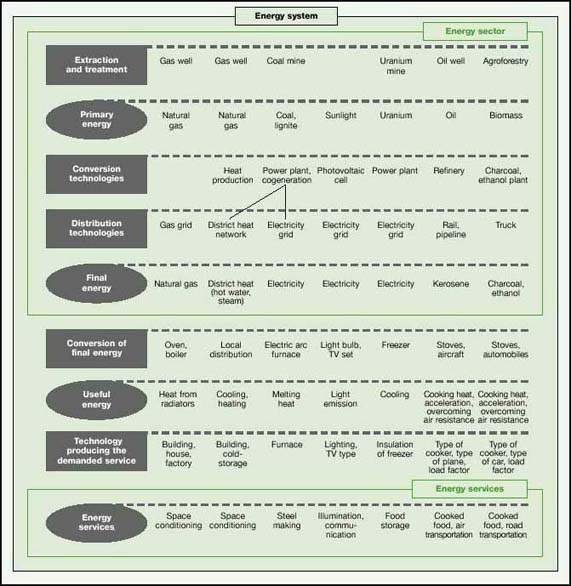
FIGURE 6.1. ENERGY CONVERSION
STEPS, TYPES OF ENERGY, AND ENERGY SERVICES: POTENTIALS FOR ENERGY
EFFICIENCY
Potential improvements in energy efficiency are
often discussed and focused on energy-converting technologies or between the
level of final energy and useful energy. But one major potential of energy
efficiency, often not strategically considered, is realised at the level of
energy services by avoiding energy losses through new technologies. Such
technologies include new building materials and window systems, membrane
techniques instead of thermal separation, sheet casting instead of steel
rolling, biotechnology applications, and vehicles made of lighter materials such
as plastics and foamed metals. Energy storage and reuse of break energy, along
with better designs and organisational measures, can also increase energy
efficiency.
In most OECD countries energy intensities fell less rapidly in
the 1990s than before. One clear reason - besides higher income - was lower
energy prices since 1986 and lower electricity prices (due to the liberalisation
of the electricity market in many OECD countries), which slowed the rate of
energy efficiency improvement for new systems and
technologies.
Eastern Europe and the Commonwealth of Independent States
Relative to OECD countries, the statistical basis for ratios of
energy to GDP is somewhat limited in Eastern Europe and the Commonwealth of
Independent States.3 Ratios of primary energy demand to GDP have
risen in the Commonwealth of Independent States since 1970 (Dobozi, 1991) but
began to decline in many Eastern European countries in the mid-1980s (table
6.1). General shortcomings of central planning, an abundance of energy resources
in some countries, a large share of heavy industries, low energy prices, and a
deceleration of technological progress have been the main reasons for limited
progress (Radetzki, 1991; Dobozi, 1991; Sinyak, 1991; Gritsevich, 1993).
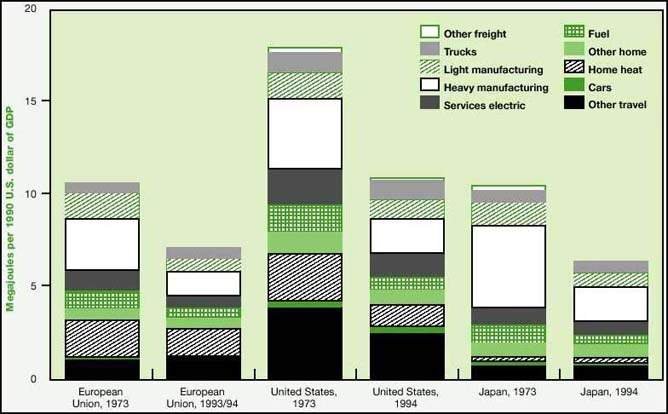
FIGURE 6.2. RATIOS OF ENERGY TO
GDP IN OECD COUNTRIES BY END USE, 1973 AND 1994
Note: Measured using purchasing power parity.
Source: Schipper, 1997.
|
BOX 6.1. DRIVERS OF LOWER ENERGY DEMAND: DEMATERIALIZATION,
MATERIAL SUBSTITUTION, SATURATION, AND CHANGING BEHAVIOUR
Like ratios of energy to GDP, the production of energy-intensive
materials per unit of GDP is falling in almost all industrialised countries
(with a few exceptions such as Australia, Iceland, and Russia). Changes in the
production of basic materials may affect changes in ratios of energy to GDP. In
many OECD countries declining production of steel and primary aluminium is
supporting lower ratios of energy to GDP. But production of young,
energy-intensive materials - such as polymers substituting for traditional steel
or aluminium use - is increasing relative to GDP. In addition, ratios of
energy-intensive materials to GDP are increasing slightly in developing
countries, almost balancing out the declines in industrialised countries for
steel and primary aluminium over the past 25 years.
Dematerialization has different definitions covering the
absolute or relative reduction in the quantity of material used to produce a
unit of economic output. In its relative definition of tonnes or volumes of
material used per unit of GDP, dematerialization has occurred over several
decades in many industrial countries. This shift has contributed to structural
changes in industry - particularly in energy-intensive areas such as chemicals
and construction materials (Carter, 1996; Jaenicke, 1998; Hinterberger, Luks,
and Schmidt-Bleek, 1997).
A number of forces are driving dematerialization in
industrialised countries (Ayres, 1996; Bernadini, 1993):
· As incomes rise,
consumer preferences shift towards services with lower ratios of material
content to price.
· As economies mature, there is
less demand for new infrastructure (buildings, bridges, roads, railways,
factories), reducing the need for steel, cement, non-ferrous metals, and other
basic materials.
· Material use is more efficient
- as with thinner car sheets, thinner tin cans, and lighter paper for print
media.
· Cheaper, lighter, more
durable, and sometimes more desirable materials are substituted - as with the
substitution of plastics for metal and glass, and fibre optics for copper.
· Recycling of energy-intensive
materials (steel, aluminium, glass, paper, plastics, asphalt) contributes to
less energy-intensive production. Recycling may be supported by environmental
regulation and taxes (Angerer, 1995).
· Reuse of products, longer
lifetimes of products (Hiessl, Meyer-Krahmer, and Sch�n, 1995), and intensified
use (leasing, renting, car sharing) decrease new material requirements per unit
of service.
· Industrialised countries with
high energy imports and energy prices tend to decrease their domestic production
of bulk materials, whereas resource-rich developing countries try to integrate
the first and second production steps of bulk materials into their domestic
industries (Cleveland and Ruth, 1999).
But industrialised countries are also experiencing some of the
drivers of increased material use per capita. Increasing urbanisation, mobility,
and per capita incomes increase the demand for material-intensive
infrastructure, buildings, and products. Smaller households, the increasing
importance of suburban communities and shopping centres, and second homes create
additional mobility. The move from repair to replacement of products and trends
towards throwaway products and packaging work against higher material
efficiencies - and, hence, against energy efficiency and sustainable
development.
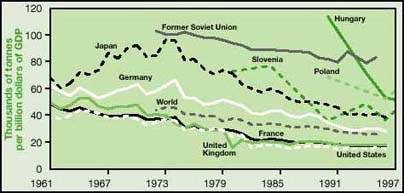
Steel production intensity in
various countries, 1961-96
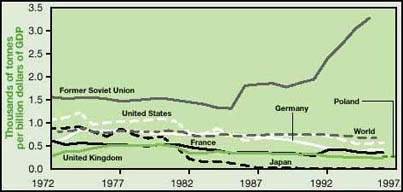
Primary aluminium production
intensity in various countries, 1972-96
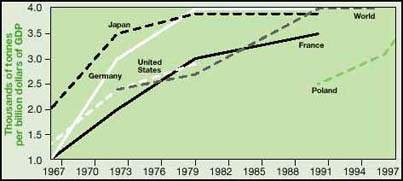
Polymer production intensity in
various countries, 1966-97
Note: For the world, includes all plastics. For
France, Germany, Japan, and the United States, includes only polyethylene,
polypropylene, polystyrene, and
polyvinylchloride.
Source: UN, 1999; German Federal
Statistical Office; IEA 1998. |
Ratios of primary energy to GDP have gone through two phases in
these countries, separated by the onset of economic and political reform in the
late 1980s and the 1990s. Whereas the ratio increased in Russia, it declined in
Armenia, Belarus, Estonia, Kyrgyzstan, Latvia, and Tajikistan. Among the other
members of the Commonwealth of Independent States the ratio fluctuated for
reasons other than improvements in energy efficiency (IEA, 1997a, 1998). Since
1990 the ratio has declined in most Eastern European countries (see table 6.1).
· In industry, final
energy consumption per unit of output fell less than 1 percent a year in Eastern
Europe in 1990-97 but increased almost 7 percent a year in Russia (CENEf, 1998).
· Transportation saw few changes
in energy use per passenger-kilometre or tonne-kilometre for the two main modes,
cars and trucks.
· Among households, small gains
in the thermal integrity of buildings could not overcome increasing demands for
heating and comfort. Indeed, in the mid-1980s centrally heated Eastern European
buildings required 50-100 percent more final energy per unit of area and per
degree day (that is, using standardised winter outdoor temperatures) than
similar buildings in Western Europe. Moreover, home appliances were often small
and inefficient.
In the early 1990s economic reforms began to restructure
production and consumption patterns and raise once-subsidised energy prices. In
the Baltics, the Czech Republic, Hungary, and Poland this phase led to real
declines in ratios of primary energy to GDP as efficiency increased and the
structure of manufacturing changed (see table 6.1). Several transition economies
also saw lower household fuel use for space and water heating. Such changes were
often not related to efficiency, however, and were instead caused by energy
shortages, higher energy prices, and related changes in heating behaviour.
Overall, transition economies showed a remarkable contraction in
energy use by industry, mostly because of structural changes (Bashmakov, 1997a).
But this trend has nearly been outweighed by rapid growth in road transportation
and (in some countries) in electricity for appliances and services. Structural
changes in industry, integration with global markets, and investments in new
processes, buildings, and infrastructure are expected to improve energy
efficiency considerably over the next 20 years. These trends will likely help
stabilise energy demand despite rising incomes and GDP in these countries.
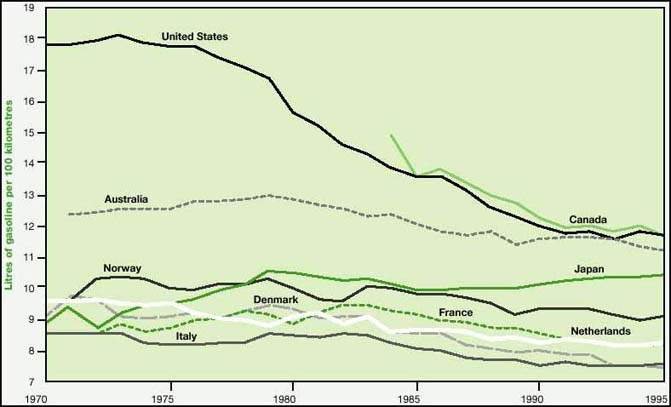
FIGURE 6.3. WEIGHTED AVERAGE OF
ON-ROAD AUTOMOBILE GASOLINE AND DIESEL FUEL INTENSITIES IN OECD COUNTRIES,
1970-95
Source: Schipper,
1997.
Developing Asia, Africa, and Latin America
In many developing countries energy use will be driven by
industrialisation, urbanisation, increasing road transportation, and increasing
personal incomes.4 Indeed, per capita energy use in developing
countries tends to be higher where per capita incomes are higher (in purchasing
power parity terms), as in Latin America, India, and Southeast Asia. Wide income
disparities in many developing countries are also reflected in energy
consumption patterns. Often a small portion of the population accounts for most
commercial energy demand. Data limitations hamper careful analysis in many
developing countries, however.
Higher-income developing countries (per capita income
above $1,200 in 1998 purchasing power parity terms). Energy demand in industry
has fallen in most higher-income developing countries, both as a result of
higher energy prices in the 1970s and 1980s and open borders to international
competition. China has shown the most dramatic developments, but most Latin
American and other Asian economies have also shown energy intensity improvements
in this sector. In recent years many manufacturers in industrialised nations
have moved energy-intensive industries to developing countries, often to take
advantage of cheaper labour, less stringent environmental regulation, and lower
overhead and transportation costs. Many of these countries (Brazil, China,
India, Indonesia) also need their own basic product industries.
TABLE 6.1. RATIOS OF PRIMARY ENERGY TO GDP IN TRANSITION
ECONOMIES, 1985-96
|
Region/country |
Energy consumption per capita, 1996 (gigajoules) |
Megajoules per unit of GDP (1990 purchasing power parity
dollars) |
|
|
1985 |
1990 |
1995 |
|
Commonwealth of Independent States |
135 |
29.8 |
29.4 |
41.4 |
|
Belarus |
100 |
|
|
20.5 |
|
Russia |
170 |
|
|
36.8 |
|
Ukraine |
127 |
|
|
45.2 |
|
Eastern Europe |
89a |
23.9 |
21.8 |
20.9 |
|
Bulgaria |
120 |
36.0 |
29.7 |
31.8 |
|
Czech Republic |
165 |
23.6 |
19.6 |
18.2 |
|
Hungary |
108 |
18.3 |
16.5 |
16.3 |
|
Poland |
117 |
26.5 |
21.6 |
19.2 |
|
Romania |
84 |
28.5 |
31.8 |
25.1 |
|
Sloveniab |
124 |
|
12.6 |
13.8 |
|
Former Yugoslavia |
53a |
12.6 |
14.7 |
21.4 |
a. Data are for 1995. b. Based on exchange rates.
Source: IEA, 1997a, Kos, 1999.
TABLE 6.2. RATIOS OF PRIMARY ENERGY TO GDP IN DEVELOPING
COUNTRIES, 1975-95
|
Country or region |
Energy consumption per capita, 1996 (gigajoules) |
Megajoules per unit of GDP (1990 purchasing power parity
dollars) |
|
|
1975 |
1980 |
1985 |
1990 |
1995 |
|
China |
36.3a |
23.4 |
22.6 |
17.3 |
15.0 |
10.9 |
|
India |
14.6a |
7.5 |
7.8 |
8.3 |
8.7 |
9.2 |
|
Indonesia |
18.4 |
3.3 |
4.2 |
4.6 |
5.4 |
5.4 |
|
Argentina |
64.1 |
8.0 |
8.4 |
9.2 |
9.6 |
9.6 |
|
Brazil |
61.0a,b |
4.6 |
4.6 |
5.0 |
5.4 |
5.9 |
|
Mexico |
61.4 |
7.2 |
8.2 |
8.5 |
8.7 |
8.7 |
|
Venezuela |
94.0a |
10.5 |
11.3 |
12.6 |
12.1 |
12.1 |
|
North Africac |
29.2 |
5.4 |
6.3 |
7.9 |
8.8 |
9.4 |
|
Southern Africad |
27.4 |
10.8 |
11.6 |
15.2 |
13.9 |
14.4 |
|
Rest of Africa |
2.5 |
2.6 |
2.9 |
2.6 |
2.6 |
2.9 |
|
Middle East |
80.4 |
8.4 |
10.9 |
17.6 |
20.9 |
22.6 |
a. Data are for 1996. b. Includes non-commercial
energy. c. Ratios of energy to GDP are for Algeria, Egypt, Libya, Morocco, and
Tunisia. d. Ratios of energy to GDP are for Nigeria, South Africa, Zambia, and
Zimbabwe.
Source: EC, various years; IEA, 1998.
Household appliances, cookers, and water heaters have become
more energy efficient in higher-income developing countries. But the rapid
acquisition of household devices has far outpaced the impact of greater
efficiency.
A similar trend has occurred in the service and public sectors.
Buildings in warm higher-income developing countries have increasing rates of
air conditioning. Higher lighting levels, increased office automation, and other
developments have also contributed to rapidly rising electricity use in this
sector (IEA, 1997b).
Transportation accounts for a rising share of energy use in
higher-income developing countries. Growing numbers of vehicles, often rising at
1.5 times the rate of GDP growth, have dominated the transportation energy use
picture. Many cars and light trucks sold in the developing world have become
less fuel intensive. But increased urbanisation and traffic congestion and
reduced occupancy have eaten up many of the improvements in vehicle technology.
Overall, more efficient manufacturing does not dominate the
increase in ratios of primary energy to GDP in higher-income developing
countries (Argentina, Brazil, India, Mexico). Increasing numbers of cars and
trucks, electrification of rural areas, and increased energy use by households
have played a bigger role (table 6.2). Such energy uses were hardly mature
before the 1970s. Motor vehicles and household appliances were far more
expensive, in real terms, than they are today. Today such items are less costly
and, more important, are often made in developing countries. (China is an
exception to this pattern. In 1978, when it initiated economic reform, China
exploited economies of scale in manufacturing - such as steel-making - to
realise high efficiency improvements in industry and energy.)
Lower-income developing countries (per capita income
below $1,200 in 1998 purchasing power parity terms). The situation in
lower-income developing countries is somewhat different.
· When disposable
income increases, energy consumption by households in low-income developing
countries shifts from traditional to commercial fuels. This trend has
significant implications for energy efficiency in households. Since the
technical efficiencies of cooking appliances using commercial fuels are higher
than those of biomass, composite energy consumption per household tends to fall.
A typical example is the move from a fuelwood stove with a technical efficiency
of 12-18 percent to a kerosene stove with an efficiency of 48 percent, or to a
liquefied petroleum gas stove with an efficiency of 60 percent. On the other
hand, the substitution of commercial for traditional fuels raises ratios of
energy to GDP, because traditional energy is typically not included when such
ratios are calculated. In addition, electrification in rural areas and
increasing income and mobility in urbanising areas increase energy use.
· Most of the technology used by
industry in lower-income developing countries is imported from industrialised
countries. Thus these industries should continue to benefit from technological
improvements that promote rational energy use (see below). While this is
expected to make energy demand fall, the use of obsolete and energy-inefficient
technology imported from industrialised countries will drive the specific energy
demand of industry.
· Similarly, the transportation
sector should benefit from the global trend towards improving vehicle fuel
efficiency. Because lower-income developing countries import vehicles from other
countries, the energy intensity of road transport should decrease. But the large
share of used vehicles imported by lower-income developing countries is helping
to maintain a relatively old car stock with high specific fuel
demand.
|
In many developing countries energy
use will be driven by
industrialisation,
urbanisation, increasing road
transportation, and
increasing
personal incomes. |
Energy intensity in lower-income developing countries will
largely depend on the interplay between these factors. Although available data
(which are patchy at best) show that, for example, Africa’s ratio of energy
to GDP increased by 1.8 percent a year in 1975-95, that trend may be
substantially influenced by the substitution of commercial for non-commercial
forms of
energy.
Potential benefits of technology transfer
In many cases used factories, machines, and vehicles from
industrialised countries are transferred to developing or transition economies,
saddling them with inefficient equipment and vehicles for many years.5
The transfer of energy-efficient equipment and vehicles to developing and
transition economies offers an important opportunity for leapfrogging the
typical development curves of energy intensity and for achieving sustainable
development while maximising know-how transfer and employment opportunities. The
transfer of energy-efficient technology represents a win-win-situation for the
technology provider and the recipient. Benefits on the receiving end include
reduced energy imports, increased demand for skilled workers, job creation,
reduced operating costs of facilities, and faster progress in improving energy
efficiency. The scope for improving energy efficiency through technology
transfer can be seen by comparing energy uses in various industries and
countries (table 6.3).
TABLE 6.3. FINAL ENERGY USE IN SELECTED INDUSTRIES AND
COUNTRIES, MID-1990S (GIGAJOULES PER TONNE)
|
Country |
Steel |
Cement |
Pulp and paper |
|
India |
39.7 |
8.4 |
46.6 |
|
China |
27.5-35.0 |
5.9 |
|
|
United States |
25.4 |
4.0 |
40.6 |
|
Sweden |
21.0 |
5.9 |
31.6 |
|
Japan |
17.5 |
5.0 |
|
Source: Lead authors.
Used equipment and vehicles are traded for lack of capital, lack
of life-cycle costing by investors, the investor-user dilemma (see below), and
lack of public transportation in developing countries (President’s
Committee of Advisors on Science and Technology, 1999, p. 4-3; IPCC, 1999b).
Thus high efficiency standards for products, machinery, and vechicles in OECD
countries will also affect standards in developing and transition economies,
particularly for mass-produced and tradable products and for world-wide
investments by global players. Opportunities for technology transfer among
developing countries will also become more important and should be encouraged.
Many of these countries already have well-established domestic expertise and
produce goods, technologies, and services suitable for the conditions and
climates of other developing
countries.
Transition economies
About 40 percent of the fuel consumed in transition economies is
used in low-temperature heat supply. Slightly less than half of that heat is
directed by district heating systems to residential buildings, public services
(schools, kindergartens, hospitals, government agencies), and commercial
customers (shops and the like). District heating systems exist in many cities
containing more than 20,000 people. In many transition economies a significant
share of the building stock (about 20 percent in Hungary) was built using
prefabricated concrete panels with poor heat insulation and air infiltration.
Advanced Western technology (automated heat distribution plants,
balancing valves, heat mirrors, efficient taps, showerheads, heat-reflecting
layers of windows) offers significant potential for more efficient heat use in
buildings (Gritsevich, Dashevsky, and Zhuze, 1997). Such technology can save up
to 30 percent of heat and hot water and increase indoor comfort. Among the main
advantages of Western products are their reliability, efficiency, accuracy,
design, and sometimes competitive prices. Some Western companies have launched
joint ventures with Eastern European, Ukrainian, and Russian partners or created
their own production lines using local workers. In many cases this seems to be a
better option than imports, because underemployed factories and human capital
may otherwise induce conflicts of interest.
Many transition economies have developed advanced
energy-efficiency technology (powder metallurgy, variable-speed drives for
super-powerful motors, fuel cells for space stations, plasmic technologies to
strengthen working surfaces of turbine blades). Thus the greatest benefits can
be gained when domestic technology and human capital and an understanding of
local conditions are combined with the best Western technology and
practices.
Developing countries
|
Many developing countries do not
have the infrastructure
needed
to study and evaluate all the
technological options that
might
suit their needs. |
Despite the many positive implications of transferring
energy-efficient technology, some major issues need to be addressed to fully
exploit the potential benefits to developing countries (UNDP, 1999):
· Proper
technology assessment and selection. The technology transfer process must
help user enterprises evaluate their technological options in the context of
their identified requirements (TERI, 1997a). Developing countries are at a great
disadvantage in selecting technology through licensing. Companies develop
technology mainly to suit their current markets; technology is not necessarily
optimised for the conditions in recipient countries. Many developing countries
do not have the infrastructure needed to study and evaluate all the
technological options that might suit their needs. Moreover, an enterprise
trying to sell a technology to a developing country will rarely give complete
and unbiased advice. So, there is an urgent need to develop an information
support system and institutional infrastructure to facilitate the selection of
appropriate technologies. In India, for example, a Technology Development Board
was established in 1996 to facilitate the assimilation and adaptation of
imported technology (CMIE, 1997).
· Adaptation and absorption
capability. Technology transfer is not a one-time phenomenon. The
transferred technology needs to be updated from time to time, either
indigenously or through periodic imports. Moreover, lack of local capability can
result in the transferred technology seldom reaching the designed operational
efficiency, and often deteriorating significantly. This raises the need for
local capacity building to manage technological change. In a narrower sense,
this could be facilitated by policies requiring foreign technology and
investment to be accompanied by adequate training of local staff
(President’s Committee of Advisors on Science and Technology, 1999).
· Access to state-of-the-art
technology and to capital. In many cases transferred technology is not state
of the art, for several reasons. First, enterprises in industrialised countries
need to recover the costs of technology development before transferring the
technology to other countries, introducing a time lag in the process. Second, in
some developing countries there is a demand lag for the latest technology due to
factors such as lack of capital or trained staff. Third, there are inappropriate
technology transfers because of the higher costs of acquiring state-of-the-art
technology. A lack of capital and strong desire to minimise investment costs
have often led developing countries to import obsolete used plants and
machinery.
· The problems of small and
medium-sized enterprises. Small industrial enterprises account for a large
share of energy and technology use in many developing countries. These
enterprises may play an important role in the national economy but generally
remain isolated from or ignorant of the benefits of technology upgrading. For
such enterprises, where off-the-shelf solutions are seldom available, knock-down
technology packages from industrialised countries are rarely possible. An
important element of technology transfer for this group is proper competence
pooling to arrive at appropriate technology solutions.
Again, the situation differs between higher- and lower-income
developing countries. Several countries in Latin America and Southeast Asia are
producing highly efficient technology and vehicles - electrical motors,
refrigerator compressors, cars - through local companies or subsidiaries of
multinational companies. Control systems, super-efficient windows, and new
materials that improve the thermal insulation of buildings may offer further
opportunities for technology transfer to higher-income developing countries
(Hagler Bailley Services,
1997).
Types of potential for increased energy efficiency
As noted, the global energy efficiency of converting primary to
useful energy is estimated to be 37 percent.6 But the useful energy
needed for a desired energy service will likely fall. Estimated improvements are
based on known technologies, expected costs, consumer behaviour, market
penetration rates, and policy measures. When considering the potential for
increased energy efficiency, it is essential to distinguish between several
types of potential, each describing future technological achievements with
different time horizons and boundary assumptions (as well as level of analysis
in the case of economic potential). This report uses the following definitions
(Enqu�te Commission, 1991; IEA; 1997a; figure 6.4):
· The theoretical
potential represents achievable energy savings under theoretical considerations
of thermodynamics where energy services (such as air conditioning and steel
production) are kept constant but useful energy demand and energy losses can be
minimised through process substitution, heat and material reuse, and avoided
heat losses (see section below on theoretical potentials after 2020).
· The technical potential
represents achievable energy savings that result from implementing the most
energy-efficient commercial and near-commercial technology available at a given
time, regardless of cost considerations and reinvestment cycles. This can be
expressed as a phased-in potential that reflects the total replacement of
existing energy-converting and -using capital stocks.
· The market trend potential -
or expected potential - is the efficiency improvement that can be expected to be
realised for a projected year and given set of boundary conditions (such as
energy prices, consumer preferences, and energy policies). The market trend
potential reflects obstacles and market imperfections that keep efficiency
potentials from being fully realised (see the section below on
obstacles).
· The economic
potential is the energy savings that would result if during each year over the
time horizon in question, all replacements, retrofits, and new investments were
shifted to the most energy-efficient technologies that are still cost-effective
at given energy market prices. It also includes all organisational measures such
as maintenance, sensitive operation and control, and timely repairs. The
economic potential has subdefinitions depending on the economic perspective
being used: the business (or project) perspective, the macroeconomic
perspective, or the societal (or welfare-based) perspective (box 6.2). The
economic potential implies a well-functioning market, with competition between
investments in energy supply and demand. It also assumes that the barriers to
such competition have been corrected by energy policies. It is assumed that as a
result of such policies, all users have easy access to reliable information
about the cost-effectiveness and technical performance of existing and emerging
options for energy efficiency. The transaction costs for individual investors,
and the indirect costs of policies associated with implementing these options,
are assumed to have been lowered to their irreducible minimum.
· The societal (or
welfare-based) potential represents ‘cost-effective’ savings when
externalities are taken into consideration. These include damage or avoided
damage costs from health impacts, air pollution, global warming, and other
ecological impacts, as well as energy-related occupational accidents that accrue
to society. This wider definition of cost-effectiveness is the most important
for a holistic energy policy that includes energy security and environmental
quality (OTA, 1993).
· Finally, the policy-based
achievable potential represents the energy savings that can be realised with
various policy instruments or packages of policy instruments. Here field data
are used to estimate participation rates and per participant savings in
voluntary or standards-based technology programmes. The policy-based achievable
potential lies between the market trend potential and the economic potential
(which can be influenced by energy taxes).
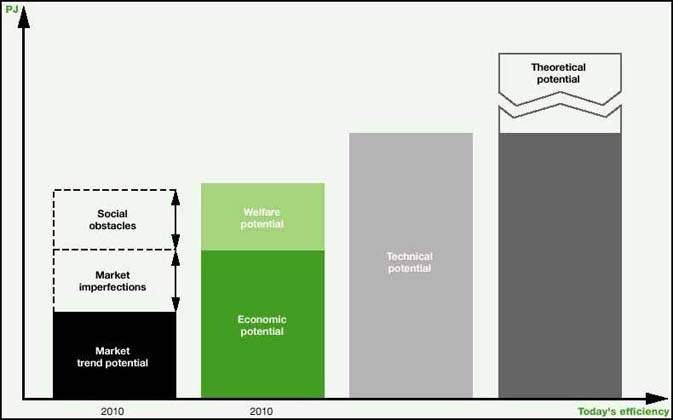
FIGURE 6.4. THEORETICAL,
TECHNICAL, ECONOMIC, AND MARKET TREND POTENTIALS OF ENERGY EFFICIENCY
Source: Enqu�te Commission,
1991.
|
BOX 6.2. DIFFERENT PERSPECTIVES ON THE ECONOMIC POTENTIAL
OF ENERGY EFFICIENCY
In all definitions of the economic potential of energy
efficiency, the core cost-effectiveness test is the life-cycle cost of providing
a given level of energy services. Different definitions of the economic
potential arise because of different cost-benefit perspectives. These
perspectives influence how costs and financial parameters are defined and
whether policy-dependent implementation costs or reductions in external costs
are included.
The economic potential at the business level is calculated from
the perspective of an individual investor based on engineering and economic
life-cycle costs, using a financial perspective. In this narrowest of all
definitions, total costs consist of the levelised capital costs of energy
efficiency investments plus changes in annual energy and non-energy operation
and maintenance costs. Neither the costs of large-scale policy implementation
nor the cost savings from policy-induced feedback effects are attached to this
potential. The discount rate for evaluating the cost-effectiveness of energy
efficiency investments is typically set to reflect the costs of capital of
particular sectors, industries, or households. After-tax energy efficiency
investments are compared to after-tax average energy prices as projected for
each sector or group of energy users.
The macroeconomic potential is based on a more comprehensive
accounting of costs and on a different financial perspective. Here the
administrative costs of implementing various required policies are included. In
addition, energy efficiency investment costs and policy implementation costs are
corrected in a forward-looking manner to account for changes in manufacturer
pricing strategies, economies of scale, and learning effects. |
|
Achieving two benefits of
increased energy efficiency -
positive
economic effects and reduced
environmental burden - is
called
a 'double dividend'. |
This chapter focuses on the economic potential. The economic
perspective underlying the potentials reported here, however, varies by study.
Most current estimates are based on a business (financial) perspective, though
there are also hybrids that use a macroeconomic perspective (see box 6.2).
Quantitative comparisons between business and macroeconomic efficiency
potentials suggest that microeconomic approaches underestimate the
cost-effective savings potential (Krause, 1996). Similarly, macroeconomic
approaches underestimate cost-effective savings potentials relative to a
societal
perspective.
The economic potential of energy efficiency by region and sector
Economic potentials of energy efficiency depend on current and
foreseeable technology developments and on current and anticipated energy prices
(box 6.3). In a world of low energy prices, the potential is relatively small.
But high energy prices could be achieved through energy taxes at a national,
regional, or global level. The economic potential presented below for each
region is based on the energy prices assumed in the literature. Calculations of
the economic potential of energy efficiency cover different technologies:
· The potential of
mono-functional and concise energy-converting technology (boilers, heat
exchangers, electrical motors) is usually determined by standard profitability
calculations comparing the full costs of alternative and statistically relevant
conversion technology.
· Process substitution and new
building concepts or transportation systems include other changes in economic
efficiency (capital, labour, and so on) and in product or service quality. Here
it becomes difficult to talk about the profitability of the technology in the
narrow sense of energy efficiency if the new, higher-efficiency technology is
considered competitive in the broader sense (as with new catalysts in the
production of petrochemicals, separation by membranes instead of
energy-intensive distillation, or low-energy houses instead of conventional
houses).
· Branch-specific but
technology-clustered energy efficiency potentials of low energy-intensive
sectors in industry or the commercial sector are estimated by trend
extrapolation of statistical data or by generalisation of calculations made for
representative or typified plants or factories. To avoid misinterpretation, data
on branch-specific energy efficiency potentials should not include intrabranch
structural changes (such as a shift of high value added but low energy-intensive
pharmaceuticals to higher shares of total value added in the chemical
industry).
These different cost assessments may help explain the
differences in certainty about the economic potentials cited below. The data on
economic potentials provide projections for 2010 and 2020. This means that where
reinvestment cycles last more than 20 years (as with buildings, public
transport, and plants of basic product industries), the economic potentials are
only partly realised by 2020. The sectors and technological areas discussed in
this section were chosen based on the relevance of the efficiency technology and
the availability of the literature for the region or country considered.
Deviations from a given economic potential reflect changes in
energy prices, economies of scale, or local differences. In many cases the
life-cycle cost functions have rather broad minima (such as optimal insulation
thickness), which means that there is little risk of overinvesting in energy
efficiency or of overestimating the cited
potentials.
Western Europe
Industry. Until the early 1990s industry was the largest
consumer of final energy in Western Europe.8 But despite production
growth of about 2 percent a year, the final energy demand of Western European
industry has hovered near 11,500 petajoules for the past 20 years. Yet industry
still holds substantial economic efficiency potential, even in energy-intensive
sectors where investment has focused on efficiency improvements to lower high
energy costs (Phylipsen, Blok, and Worrell, 1998).
· De Beer (1998, pp.
75-102) estimates that by 2020 paper mills operating with new pressing and
drying techniques, latent heat recovery systems, and a number of minor
improvements (closed water circulation, graduated heat recovery) will have 50
percent lower specific heat demand and that investment costs may be lower than
for conventional paper-making (table 6.4). The economic efficiency potential of
steel-making is less extraordinary, between 13 and 20 percent, and results from
thin slab casting, more efficient blast furnaces, and minor improvements in the
oxygen steel process by 2020 (Jochem and Bradke, 1996). Similar economic
efficiency potential has been described for refineries (Refining Processes,
1998), petrochemical processes (Patel, 1999) and basic organic chemicals (Brewer
and Lopez, 1998), construction materials (Rosemann and Ellerbrock, 1998;
Ottoboni and others, 1998), glass production (ATLAS, 1997), and the food
industry (Jochem and Bradke, 1996).
· For Dutch light industry, the
economic efficiency improvements in 2000 (relative to 1990) are estimated at 30
percent (with a 5 percent discount rate) and 27 percent (with a 10 percent
discount rate; Blok and others, 1996; B�de and others, 1999).
· Baumgartner and Muggli (1996)
evaluated the efficiency improvements of cross-cutting technologies in Swiss
industry. Savings of 15-35 percent were found for electrical and mechanical
drives over the next 10-15 years (Almeida, Bertoldi, and Leonhard, 1997).
Metering, controlling, and optimal regulation can lead to efficiency
improvements of up to 15 percent in most industrial processes. Cogeneration in
Western Europe still holds economic potential, particularly with the midterm
effects of liberalising electricity supply and small cogeneration (ATLAS, 1997;
EC, 1999).
Residential. The economic efficiency potential in heating
of residential buildings depends - besides regional aspects - on the stock of
boilers and their reinvestment cycles, the rate of constructing new buildings,
and the rate of refurbishing existing buildings. Condensing boilers are about 10
percent more energy efficient than a new low-temperature boiler and 15-25
percent more efficient than existing boilers (Ziesing and others, 1999).
Insulation of building elements, highly efficient window systems, and adequately
thick insulation are economic within the cycle of refurbishment (ETSU, 1994).In
new buildings, low-energy houses (those with annual heat demand of 50-100
kilowatt-hours per square metre) are now cost-effective due to better design and
low-cost insulation techniques and window sytems (Altner and others, 1995).
|
BOX 6.3. ECONOMIC BENEFITS OF INCREASED ENERGY EFFICIENCY
IN END USES - THE UNKNOWN DOUBLE DIVIDEND
Energy consumers benefit when profitable energy efficiency
potentials are realised.7 But the economy also benefits, because
saved energy costs can be reallocated, energy imports are replaced (in many
countries) by domestically produced energy-efficient products and (energy)
services, and labour-intensive branches can grow in industry, construction, and
services (instead of capital-intensive energy supply), spurring innovation.
Macroeconomic analyses for Germany and the United States show that policies to
improve energy efficiency and to shift to advanced technology and less
carbon-intensive fuels generate four important benefits for the national economy
(Jochem and Hohmeyer, 1992; Laitner, Bernow, and DeCicco, 1998). Such policies:
· Spur economic
growth to a small degree (by less than 1 percent of the absolute growth rate of
GDP) due to the reallocation of saved energy costs.
· Generate jobs (including
entrepreneurial jobs that foster resourceful, self-sufficient, and satisfied
workers) for the reasons mentioned above. Net employment increases by 40-60 new
jobs per petajoule saved each year.
· Increase exports of
high-technology products. In 1976-92 exports of 12 energy-efficient products
increased more than 50 percent faster than West Germany’s total exports.
· Reduce the environmental and
social costs of energy use that were previously uncounted in market transactions
for fuel. Such costs may be as high as $0.02 per kilowatt-hour of electricity
(Friedrich and Krewitt, 1997) and almost $0.01 per kilowatt-hour of oil product
used, not including the impacts of climate change (Hohmeyer, Ottinger, and
Rennings, 1997).
Achieving two benefits of increased energy efficiency - positive
economic effects and reduced environmental burden - is called a ‘double
dividend’. Unlike many other employment effects of investment, the jobs
created by efficiency investments are not evenly distributed over time. In most
cases they are created during the initial period of investment - when wall
insulation is installed or investments are made in condensing boilers or
high-efficiency window systems. In addition, the regional distribution of net
employment becomes more equitable. Employment in the energy supply sector is
concentrated in urban and industrial areas, while efficiency involves planners,
crafts, trade, and banking in the entire country. |
TABLE 6.4. ECONOMIC ENERGY EFFICIENCY POTENTIALS IN WESTERN
EUROPE, 2010 AND 2020
|
Sector and technological area |
Economic potential (percent)a |
Energy price level assumed |
Base year |
Source |
|
2010 |
2020 |
|
|
|
|
Industry |
|
|
|
|
|
|
Iron and steel, coke ovens |
9-15 |
13-20 |
1994 |
1995 |
Jochem and Bradke, 1996; Ameling and others, 1998 |
|
Construction materials |
5-10 |
8-15 |
1997 |
1997 |
|
|
Glass production |
10-15 |
15-25 |
1997 |
1997 |
ATLAS, 1997 |
|
Refineries |
5-8 |
7-10 |
1995 |
1997 |
Refining Processes, 1998 |
|
Basic organic chemicals |
5-10 |
|
1997 |
1996 |
Patel, 1999; Brewer and Lopez, 1998 |
|
Pulp and paper |
|
50 |
1996 |
1997 |
De Beer, 1998 |
|
Investment and consumer goods |
10-20 |
15-25 |
1994 |
1995 |
Jochem and Bradke, 1996; B�de and others, 1999 |
|
Food |
10-15 |
|
1997 |
1997 |
Jochem and Bradke, 1996 |
|
Cogeneration in industry |
|
10-20 |
1997 |
1997 |
ATLAS, 1997; EC, 1999 |
|
Residential |
|
|
|
|
|
|
Existing buildings |
|
|
|
|
|
|
Boilers and burners |
15-20 |
20-25 |
today’s prices |
1997 |
ETSU, 1994; B�de and others, 1999 |
|
Building envelopes |
8-12 |
10-20 |
today’s prices |
1995 |
Ziesing and others, 1999 |
|
New buildings |
|
20-30 |
today’s prices |
1995 |
Altner, Durr, Michelson, 1995 |
|
Electric appliances |
20-30 |
35-45 |
1997 |
1997 |
GEA, 1995; ECODROME, 1999; Hennicke and others, 1998; Boardman
and others, 1997 |
|
Commercial, public, and agriculture |
|
|
|
|
|
|
Commercial buildings |
10-20 |
30 |
8-13 cts/kWh |
1995 |
Geiger and others, 1999 |
|
Electricity |
10-25 |
20-37 |
4-10 cts/kWh |
1997 |
ECODROME, 1998 |
|
Heat |
|
15-25 |
today’s prices |
1998 |
Zeising and others, 1999 |
|
Public buildings |
|
30-40 |
7-15 cts/kWh |
1992 |
Brechb�hl, 1992 |
|
Agriculture and forestry |
|
15-20 |
today’s prices |
|
Neyer and Strebel, 1996 |
|
Horticulture |
|
20-30 |
today’s prices |
|
Arbeitsgemeinschaft, 1992 |
|
Decentralised cogeneration |
|
20-30 |
today’s prices |
1995 |
Ravel, 1994 |
|
Office equipment |
|
40-50 |
1995 |
1995 |
Aebischer and others, 1996; MACEBUR, 1998; Hallenga and Kok,
1998 |
|
Transportation |
|
|
|
|
|
|
Cars |
25 |
|
today’s prices |
1995 |
IPSEP, 1995 |
|
Door-to-door integration |
4 |
|
|
1995 |
Zeising and others, 1999 |
|
Modal split of freight transport |
|
3b |
|
1995 |
|
|
Trains and railways |
|
20 |
today’s prices |
1999 |
Brunner and Gartner, 1999 |
|
Aircraft, logistics |
15-20 |
25-30 |
today’s prices |
1998 |
IPCC, 1999a |
a. Assumes a constant structure or use of the sector
or technology considered. b. Refers to the final energy use of the entire
sector.
The economic efficiency potential of electric appliances in 2010
is best evaluated by comparing the equipment in use with the equipment available
on the market. But the market is not homogeneous: a survey of washing machines,
dryers, and dishwashers available in the European Union showed minimum:maximum
ratios of specific consumption between 1:2.5 for washing machines and 1:4 for
condenser tumble dryers (GEA, 1995). Initial costs are sometimes higher for
efficient equipment, but life-cycle costs are generally lower. In France a
detailed end-use study showed that electricity savings of 40 percent can be
achieved by replacing average equipment with the most efficient appliances
readily available on the market (Rath and others, 1997; ECODROME, 1998). These
results are confirmed by Hennicke and others (1998) and Ziesing and others
(1999). Given the relatively short lives of lights and appliances, savings of 33
percent could be achieved in the United Kingdom by 2010 with the widespread
adoption of better lights and appliances using known technologies (Boardman and
others, 1997).
Service and public sectors. In 1990 office equipment
consumed just 3-4 percent of the electricity used in Western Europe’s
service sector (Aebischer, Schwarz, and Spreng, 1996). But office equipment is
the fastest-growing consumer of electricity. About two-thirds of this
electricity is used in standby and off modes. Thus easy and cost-effective
savings are possible for most equipment (Hallenga and Kok, 1998; MACEBUR, 1998).
With the fast increase in the amount of office equipment and its short lives,
these improvements could be realised by 2010. Hennicke and others (1998) reports
that 27-35 percent of the electricity consumed by Germany’s service sector
could be saved for $0.043-0.071 a kilowatt-hour.
The economic potential for reducing space and process heat
demand in commercial buildings ranges from 15-25 percent (Ziesing and others,
1999; Aebischer and others, 1996). The efficiency of heat generation and
distribution could be improved by 10-15 percent through reinvestmentsin boilers,
burners, and insulation and control techniques, in some cases by direct process
heat generation (avoiding steam and hot water systems), and by engine-driven
cogeneration.
TABLE 6.5. ECONOMIC ENERGY EFFICIENCY POTENTIALS IN NORTH
AMERICA, 2010
|
Sector and area |
Economic potential (percent) |
Energy price level assumed |
Base year |
Source |
|
United Statesa |
Canada |
|
|
|
|
Industry |
|
|
|
|
|
|
Iron and steel |
4-8 |
29 |
United States: scenario for price developmentsb |
United States: 1995 |
United States: Interlab, 1997; |
|
Aluminium (primary) |
2-4 |
|
|
|
Brown and others, 1998; |
|
Cement |
4-8 |
|
|
|
Romm, 1999 |
|
Glass production |
4-8 |
|
|
Canada: 1990 |
|
|
Refineries |
4-8 |
23 |
Canada: price scenario by provincec |
|
Canada: Jaccard and Willis, 1996; |
|
Bulk chemicals |
4-9 |
18 |
|
|
Bailie and others, 1998 |
|
Pulp and paper |
4-8 |
9 |
|
|
|
|
Light manufacturing |
10-18 |
|
|
|
|
|
Mining |
n.a. |
7 |
|
|
|
|
Industrial minerals |
n.a. |
9 |
|
|
|
|
Residential |
|
|
|
|
|
|
Lighting |
53 |
|
United States: scenario for price developments |
United States: 1995 |
United States: Interlab, 1997; |
|
Space heating |
11-25 |
|
|
|
Brown and others, 1998; |
|
Space cooling |
16 |
|
|
|
OTA, 1992 |
|
Water heating |
28-29 |
|
|
Canada: 1990 |
|
|
Appliances |
10-33 |
|
Canada: price scenario |
|
Canada: Bailie and others, 1998 |
|
Overall |
|
13 |
|
|
|
|
Commercial and public |
|
|
|
|
|
|
Space heating |
48 |
|
United States: scenario for price developments |
United States: 1995 |
United States: Interlab, 1997; |
|
Space cooling |
48 |
|
|
|
Brown and others, 1998 |
|
Lighting |
25 |
|
|
|
|
|
Water heating |
10-20 |
|
|
Canada: 1990 |
Canada: Bailie and others, 1998 |
|
Refrigeration |
31 |
|
Canada: price scenario |
|
|
|
Miscellaneous |
10-33 |
|
|
|
|
|
Overall |
n.a. |
9 |
|
|
|
|
Transportation |
|
|
|
|
|
|
Passenger cars |
11-17 |
|
United States: scenario for price developments |
United States: 1997 |
United States: Interlab, 1997; |
|
Freight trucks |
8-9 |
|
|
|
Brown and others, 1998 |
|
Railways |
16-25 |
|
|
|
|
|
Aeroplanes |
6-11 |
|
|
Canada: 1990 |
Canada: Bailie and others, 1998 |
|
Overall |
10-14 |
3 |
Canada: price scenario |
|
|
a. Industrial energy efficiency potentials in the
United States reflect an estimated penetration potential under different
conditions based on the Interlaboratory Working Group on Energy Efficient and
Low-Carbon Technologies (1997). There are no separate estimates available for
the economic potential. The economic potential under business-as-usual fuel
price developments is estimated at 7 percent in energy-intensive industries and
16 percent in light industries. b. The Inter-Laboratory Working Group study
(1997) used price scenarios for 1997-2010 to estimate the potential for energy
efficiency improvement, based on the Annual Energy Outlook 1997 scenario
(EIA, 1996). The scenario assumes a 1.2 percent annual increase in oil prices
from 1997 levels. c. For comparison; in 2010 light fuel oil prices are $6-8 a
gigajoule at the 1999 exchange rate (Jaccard and Willis Energy Services,
1996).
Transportation. Between 1990 and 2010 final energy use by
transport may increase by 40 percent in Western Europe if no efficiency
potentials are used. About 50 percent of this energy is used by passenger cars
and almost 40 percent by road freight. A voluntary agreement concluded by the
Association of European Car Manufacturers reflects the potential for
energy-efficient car use: in 2008 new cars will be 25 percent more fuel
efficient than in 1995. Using taxes and insurance to internalise the external
costs of road transport, estimated at $20-70 billion, would increase efficiency
by another 7-16 percent.
Relative to road transport, Western Europe’s rail transport
is about 3 times less energy-intensive for passengers and up to 10 times less
energy-intensive for goods. With lighter trains, reduced air drag, and better
drive concepts, the specific electricity consumption of rail transport could
drop almost 50 percent over the next 40 years (Brunner and Gartner, 1999). A 25
percent cut in railway freight tariffs due to increased productivity and
cross-border harmonisation is expected to induce a shift from road to rail,
allowing a 3 percent reduction in final energy use for the transport sector as a
whole. Although aeroplanes and related logistics have substantial efficiency
potential (IPCC, 1999a), it is not expected to compensate for the growth in air
transport
mileage.
North America
North America - defined here as Canada and the United States,
but not Mexico - has higher energy consumption per capita than any other
region.9 Canada and the United States share several characteristics
(large size, low energy prices) but also differ substantially (climate). In both
countries recent studies have assessed the potential for increased energy
efficiency by 2010. In the United States the Interlaboratory Working Group on
Energy-Efficient and Low-Carbon Technologies (1997) assessed the economic
potential for efficiency improvement, while a recent follow-up study assesses
the potential impact of policies. In Canada a study has assessed several
industrial sectors in detail (Jaccard and Willis Energy Services, 1996), while
others have assessed the economic potential of sets of technologies in all
sectors (Bailie and others, 1998; Brown and others, 1998; Faruqui and others,
1990; OTA, 1991). Both countries are assessing policies to address climate
change, and the results may vary from previous studies (table 6.5).
Under the business-as-usual scenario, energy growth in the
United States through 2010 would increase energy demand by 26 percent relative
to 1990. Two other scenarios address, with progressively stronger measures, the
adoption of energy-efficient technologies. The first, the efficiency scenario,
assumes that technology-based reductions in energy and carbon emissions become
cost-effective and so attractive to the marketplace. The second, the
high-efficiency/low-carbon scenario, assumes that the United States makes an
even greater commitment to reducing carbon emissions through federal and state
programs and policies, as well as active private sector involvement. The
high-efficiency/low-carbon scenario assumes that the emission charge is $25 or
$50 per tonne of carbon.
Industry. Because of the complexity of industrial
processes, the Interlaboratory Working Group did not model from the bottom up
using explicit estimates of changes in efficiency expected from the introduction
of energy-efficient technologies. Instead, the group used existing models to
estimate the potential for increased general investment in industrial energy
efficiency, supplemented by examples of a few technologies that have potential
throughout the industrial sector (for example, advanced gas turbines and
efficient motors). The models single out seven energy-intensive industries that
together account for 80 percent of manufacturing energy use. Light manufacturing
is considered a separate category.
Under the business-as-usual scenario, manufacturing grows 2.1
percent a year through 2010, divided between energy-intensive industries (1.3
percent a year) and non-intensive industries (2.6 percent a year). Total energy
intensity is projected to decline by 1.1 percent a year (Interlaboratory Working
Group, 1997).
In the efficiency scenario, industrial energy consumption drops
6.6 percent relative to the business as usual scenario. In the
high-efficiency/low-carbon scenario, consumption falls 12.5 percent. Energy
efficiency improvements are larger in light industry than in heavy manufacturing
because there are more opportunities to adopt energy-efficient-technologies.
Energy is a smaller component of overall manufacturing costs, so there is less
incentive to adopt new technology than in the past. A recent bottom-up study
(Worrell, Martin, and Price, 1999) of energy efficiency potential in the U.S.
iron and steel industry estimates the potential contribution of nearly 50
technologies, and suggests that the potential is twice as high as indicated by
the Interlaboratory Working Group study.
|
Between 1990 and 2010 final
energy use by transport may
increase
by 40 percent in Western Europe,
if no efficiency
potentials
are used. |
Bailie and others (1998) estimate at 8 percent the
cost-effective potential for reducing carbon dioxide (CO2) emissions
through increased energy efficiency in Canadian industry. The authors use high
discount rates to reflect the market rates of time preference.10
Jaccard and Willis Energy Services (1996) estimate the economic and
technical potential for increased energy efficiency in six major industrial
sectors using the same model and a discount rate of 7 percent in assessing the
macroeconomic potential (see box 6.2). They find technical potential in 2010 to
vary by industry from 8 to 38 percent (relative to 1990), while economic
potential varies from 7 to 29 percent. These findings are similar to those for
Western Europe (see table 6.4).
Buildings. In the efficiency scenario, buildings use 36.0
exajoules of energy in 2010, compared with 38.0 exajoules in the business as
usual scenario. The efficiency scenario assumes that by 2010 buildings will have
achieved just over one-third of their cost-effective energy efficiency savings
potential of 15 percent (Interlaboratory Working Group, 1997). Energy services
cost $11 billion a year less than in the business-as-usual scenario. Costs are
lower because the decrease in energy spending that results from installing more
efficient technology is larger than the cost of purchasing and installing this
technology in buildings. The high-efficiency/low-carbon scenario assumes that
nearly two-thirds of the cost-effective energy efficiency savings are achieved
by 2010. The result is a larger drop in energy use, to 33.3 exajoules - or by 13
percent relative to the business-as-usual scenario.
Bailie and others (1998) assume that energy efficiency measures
are implemented in Canadian buildings. While households show moderate economic
potential (13 percent), the economic potential for commercial buildings is
limited (9 percent).11 Although the technical potential is high
(Bailie and others, 1998), the assumed high costs and additional office
automation lead to smaller economic potentials.
Transportation. The business as usual scenario for U.S.
transportation assumes that the passenger car fuel efficiency rate (in litres
per 100 kilometres) will improve from 8.55 in 1997 to 7.47 in 2010. But this
represents a 1.4 percent annual increase in fuel economy, an improvement that
has not been seen in the past without increased fuel mileage standards or higher
oil prices. The business-as-usual scenario also assumes that the fuel efficiency
of light trucks will not increase. The result is an increase in transportation
energy use from 26,000 petajoules in 1997 to 34,000 petajoules in 2010 despite a
10 percent improvement in overall efficiency. Under the efficiency scenario,
transportation energy use is 10 percent lower in 2010. Under the
high-efficiency/low-carbon scenario, it is 14 percent lower (Interlaboratory
Working Group, 1997).
The high-efficiency/low-carbon scenario includes the efficiency
scenario assumptions as well as major breakthroughs in fuel cells for light-duty
vehicles, large gains in the energy efficiency of aircraft, and an optimistic
estimate of the cost of ethanol fuel from biomass. This modelling approach is
very different from that taken for buildings, because of the assumption of
breakthrough technology in transportation.
Bailie and others (1998), however, estimate an extremely low
economic potential for energy efficiency improvement in Canada’s
transportation sector.12 The study concentrates on efficiency
standards for engines but also includes fuel switching. The baseline scenario
assumes large growth in transport demand, dramatically increasing energy demand
in Canada between 1990 and 2010. The study finds a large technical potential for
efficiency improvement, but the costs of the economic potential are prohibitive.
Hence the economic potential is estimated at just 3 percent relative to 2010
baseline energy
use.
Japan and Southeast Asia
The literature on energy efficiency potentials in Japan and
Southeast Asia is somewhat limited (table 6.6).13 Although the region
has a relatively young capital stock, economic efficiency potentials are still
quite high. This is due to intensive technological innovations and relatively
high energy prices (Rumsey and Flanagan, 1995a).
Between 1975 and 1995 primary energy demand more than
quadrupled, shifting the centre of the energy market from the Atlantic Basin to
the Pacific Basin (Fesharaki, 1998). Hence energy efficiency is a paramount
policy objective. The Asia Least Cost Greenhouse Gas Abatement Strategy (ADB,
GEF, and UNDP, 1998) cites cumulative potentials for 2010 and 2020.
Industry. Goto (1996) estimates industrial energy
efficiency improvements through 2010 for several energy-intensive branches in
Japan (see table 6.6). The energy savings for iron and steel range from 10-12
percent, for chemicals from 5-10 percent, for cement production from 2-8
percent, and for pulp and paper from 6-18 percent (box 6.4). For Southeast Asia,
ADB, GEF, and UNDP (1998), IIEC (1995), Adi (1999), Ishiguro and Akiyama (1995),
and the Viet Namese government find that similar savings are possible in 2010
and 2020.
Residential, commercial, and public sectors. The energy
savings potential of residential and commercial uses could be untapped with
various demand-side management programmes for air conditioning, refrigeration,
lighting, and cooling. Some 300-450 petajoules a year could be gained in
Japan’s residential sector by insulating existing buildings within their
reinvestment cycle. IIEC (1995) reports savings of 20-60 percent for electric
appliances.
TABLE 6.6. ECONOMIC ENERGY EFFICIENCY POTENTIALS IN JAPAN
AND SOUTHEAST ASIA, 2010 AND 2020
|
Sector and area |
Economic potential (percent or petajoules a
year)a |
Energy price level assumed (U.S. cents per
kilowatt-hour) |
If percent, base year |
Source |
|
Japan 2010 |
Southeast Asia 2020 |
|
|
|
|
Industry |
|
|
|
|
Japan: Goto, 1996; JISF, 1993 |
|
Iron and steel |
10-12% |
|
0.2 |
1990-95 |
Southeast Asia: Ishiguro and |
|
Cement |
2-8% |
|
2-20 |
1990-95 |
Akiyama, 1995; ALGAS, 1998, |
|
Chemicals |
5-10% |
|
0.4-7.8 |
1990-95 |
IIEC, 1995; Adi 1999; Government |
|
Pulp and paper |
6-18% |
|
1.5-3.3 |
1990-95 |
of Viet Nam; Nguyen |
|
Electric motors |
|
20% |
1998 prices |
1995 |
Thuong, 1998; Aim Project |
|
Total industry |
|
2,017 PJ |
1998 prices |
1998 |
Team, 1994 |
|
Residential |
|
|
|
|
Kaya and others, 1991; IIEC, |
|
Existing buildings |
|
|
|
|
1995; ALGAS, 1998; |
|
50-100 millimetre insulation |
290-450 PJ |
|
2.0-8.5 |
1995 |
Wanwacharakul, 1993 |
|
Electric appliances |
20-60% |
20-60% |
|
|
|
|
Illumination |
20-75% |
20-60% |
|
|
|
|
Commercial and public sectors |
|
|
|
|
IIEC, 1995; ALGAS, 1999 |
|
Buildings 50-100 millimetre insulation |
240-280 PJ |
293 PJ |
2-5 |
1991,92 |
|
|
Transportation |
|
2,275 PJ |
|
1992 |
IIEC, 1995 |
|
Compact cars |
1.8% |
|
0.044 |
1990 |
Japan: Goto, 1996; |
|
Buses |
0.2% |
|
0.196 |
1990 |
Aim Project Team, 1994 |
|
Trucks |
2.8% |
|
0 |
1990 |
|
|
Compact cargo vehicles |
13.7% |
|
0 |
1990 |
|
|
Within cities |
|
|
|
|
|
|
Vehicles |
7% |
|
0.01-0.06 |
1990 |
|
|
Buses, trucks cargo vehicles |
14% |
|
0.01-0.06 |
1990 |
|
|
Passenger cars |
0.3% |
|
0.06 |
1990 |
|
a. Assuming constant structure or use of the sector
or technology considered.
|
BOX 6.4. JAPANESE COMPANIES GO AFTER OPPORTUNITIES
Hitachi city district heating system. Energy displacement
between industry and buildings entails the use of residual heat from a cement
factory for district heating and cooling in Hitachi city covering a total area
of 12.5 hectares. Some 107,000 square metres of floor area will be covered by
the district heating system, with a maximum supply capacity of 8.93 gigawatts of
heat and 11.9 gigawatts of cooling. When the system produces a surplus of heat,
the excess heat is used for electricity production with a 373 kilowatt-hour
generator (Kashiwagi, 1994).
Iron and steel. Efficient ignition of a sintering furnace
for crude steel production is possible through installed segregation equipment,
slit burners, and changes in waste heat recovery - for savings of 56.5
gigajoules a year. Ignition fuel was reduced by 70 percent with a payback period
of 1.6 years at 1986 prices (CADDET, 1997).
Cogeneration. The Jujo Kimberly K.K cogeneration power
plant for a paper mill uses an aeroengine-driven gas turbine with an output of
7,600 kilowatts of electricity and 20 tonnes per hour of steam, meeting 70
percent of the mill’s electricity requirements. The system attains an
overall efficiency of 81 percent, with a payback of four years. Energy costs
were cut 30 percent, and labour costs 20 percent. The space saves confers an
additional economic benefit. |
In the commercial and public sectors the same efficiency
technology would save 240-280 petajoules a year. Mungwitikul and Mohanty (1997)
report electricity savings of 25 percent for office equipment at no additional
cost in Thailand.
Transportation. In 1980-95 transport was the largest
consumer of energy in Japan and Southeast Asia, with annual growth of 8.8
percent (excluding Viet Nam). Transport energy demand is still increasing
because larger vehicles are becoming more popular, while the share of small
vehicles in new car sales fell to 60 percent in 1996. Japanese government policy
is now aiming to introduce the ‘top runner method’, setting efficiency
standards above the performance standards currently achievable in order to raise
vehicle fuel efficiencies. These measures include subsidies for hybrid vehicles,
which double fuel efficiencies. Smaller cars are expected to reduce their fuel
consumption to 3.0-3.6 litres per 100 kilometres, and one car manufacturer plans
to increase efficiency by 25 percent between 1995 and 2005.
Energy policy also attempts to improve the energy efficiency of
trains, ships, and planes, upgrading distribution efficiency by promoting
railroad transportation, coastal shipping, and public transport. A study on an
electric mass transit project under construction in Thailand identified
potential savings of 28 petajoules a year. The savings would come from switching
to diesel fuel in city buses. The introduction of fuel cells in road vehicles
will further improve efficiency after 2010.
TABLE 6.7. ECONOMIC ENERGY EFFICIENCY POTENTIALS IN EASTERN
EUROPE, 2010
|
Sector and area |
Economic potential (percent) |
Energy price level assumed |
Base year |
Source |
|
Industry |
|
|
|
|
|
Pig iron |
3 |
EU, 1995 |
|
Ministry of Industry, Poland, 1990 |
|
Electric steel |
10 |
EU, 1995 |
|
|
|
Hot rolled products |
32 |
EU, 1995 |
|
|
|
Ferrous metallurgy |
24 |
EU, 1995 |
|
|
|
Electrolytic copper |
15 |
EU, 1995 |
|
|
|
Aluminium |
24 |
EU, 1995 |
|
National Energy Agency, Bulgaria, 1998 |
|
Non-ferrous metals |
4 |
EU, 1995 |
|
|
|
Chemical products |
31 |
EU, 1995 |
1995 |
|
|
Synthetic fibres |
12 |
EU, 1995 |
|
|
|
Building materials |
48 |
EU, 1995 |
|
|
|
Cement dry |
16 |
EU, 1995 |
|
|
|
Leather, footwear |
4 |
EU, 1995 |
1995 |
|
|
Timber, wood industry |
5 |
EU, 1995 |
1995 |
|
|
Food industry |
23 |
EU, 1995 |
1995 |
|
|
Machine manufacturing |
22 |
EU, 1995 |
1995 |
|
|
Construction industry |
24 |
EU, 1995 |
1995 |
|
|
Residential |
|
|
|
|
|
Existing stock |
25 |
EU, 1995 |
1995 |
IEA, 1999 |
|
New buildings |
30 |
EU, 1995 |
1995 |
|
|
Electric appliances |
25 |
EU, 1995 |
1995 |
|
|
Commercial/public |
|
|
|
|
|
Heating |
25 |
|
1995 |
IEA, 1999 |
|
Office equipment |
20 |
|
1995 |
|
|
Lighting |
40 |
EU, 1995 |
1995 |
|
|
Agriculture |
|
|
|
|
|
Heating, drying |
22 |
EU, 1995 |
1995 |
IEA, 1999 |
|
Electricity |
15 |
EU, 1995 |
1995 |
|
|
Transportation |
|
|
|
|
|
Cars |
20 |
EU, 1995 |
1995 |
IEA, 1999 |
|
Public transportation, cities |
15 |
EU, 1995 |
1995 |
|
|
Railways |
25 |
EU, 1995 |
1995 |
|
|
Air transport |
22 |
EU, 1995 |
1995 |
|
Eastern Europe
Economic restructuring is playing a decisive role for the energy
system and its efficiency path in Eastern Europe, because the drivers of
economic policy are now totally different from those under central
planning.14 Under communist rule a standing ambition for expansion
led to a very old capital stock with low energy efficiency for basic industries,
buildings, and the energy industry itself. Because the region started the
transition from an extremely weak social and financial position, the economic
crisis - an unavoidable element of large-scale restructuring - influences voters
(Levine and others, 1991).
As a result governments (who wish to remain in power) are often
reluctant to take the restrictive steps needed for economic restructuring in
general and energy pricing in particular. Countries starting from a better
position (Czech Republic, Hungary, Poland, Slovakia, Slovenia) can take the
painful steps earlier. Because statistical systems and aggregation practices
differ considerably among transition economies and future developments are
uncertain, the data on economic efficiency energy potential in table 6.7 should
be viewed only as cautious estimates. The data may be subject to major changes
when more empirical data become available.
Industry. Specific energy consumption and related
efficiency potentials are related to physical production in energy-intensive
industries. The economic potential of other sectors ranges from 4 percent
(leather) to 40 percent (building materials) by 2010 (see table 6.7). Available
data are from climatically and economically different countries (from Bulgaria
to Poland) but most of the figures are similar - reflecting a shared history of
Soviet technology and standards.
Residential. Individual heat metering in multifamily
houses in Eastern Europe represents an energy efficiency potential of at least
15-20 percent. In panel-built housing estates, individual metering of domestic
warm water consumption has already resulted in savings of up to 40 percent where
it has been introduced. A programme to improve thermal insulation in these
buildings began in the mid-1990s with central support. Thus a 20-30 percent
reduction of the heat demand in these buildings can be achieved in the next 10
years.
For 2020 and beyond, specific energy and material demands are
expected to be close to the EU average. Economic and technology development in
Eastern Europe will likely be carried out through the expansion of multinational
companies, integration with the European Union, and globalisation. As a
consequence, by 2020 technologies will be in place that are technically and
economically acceptable and comparable to EU standards. Exceptions will be some
parts of the non-refurbished building stock.
Commercial and public sectors. Improved boilers and
heating systems, insulation, high-efficiency window systems, and new lighting
systems will contribute to substantial savings in the commercial and public
sectors.
Transportation. Although specific energy consumption will
likely fall by at least 1 percent a year, the final energy consumed by road
transportation will substantially increase due to motorization in Eastern
Europe.
Russia and other members of the Commonwealth of Independent States
Members of the Commonwealth of Independent States face very
different climates, domestic energy resources, and levels of industrialisation
and motorisation.15 The last extensive studies of economic energy
efficiency potentials for the former Soviet Union were performed in the early
1990s (WBNSS, 1999). About 120 technologies and energy-saving measures with
potential savings greater than 5.8 petajoules a year were considered, covering
all the sectors and assuming the replacement of technology and equipment in use
at that time with best-practice, world-class technology (CENEf, 1993). Potential
savings were estimated at 21,690 petajoules a year, about 77 percent of which
was considered economical by 2005.
TABLE 6.8. ECONOMIC ENERGY EFFICIENCY POTENTIALS IN RUSSIA
AND UKRAINE, 2010
|
Sector and technological area |
Economic potential (percent or petajoules a year) |
Energy price level assumed |
If percent, base year |
Source |
|
Russia |
Ukraine |
|
Russia |
Ukraine |
|
|
Industry |
3,370-4,980 PJ |
1,430-2,485 PJ |
1990s price levels of Western Europe |
1995 |
1990 |
Russia: Federal Ministry of Fuel and Energy, 1998 |
|
General |
1,524-2,198 PJ |
|
|
1995 |
|
Ukraine: ARENA-ECO, 1997; Vakulko/Zlobin, 1997 |
|
Metallurgy |
733-1,026 PJ |
284-361 PJ |
|
1995 |
1990 |
|
|
Iron and steel, coke ovens |
132-161 PJ |
|
|
1995 |
|
|
|
Construction materials |
440 PJ |
|
|
|
|
|
|
|
Cement |
176 PJ |
|
|
1995 |
|
|
|
|
Refineries |
176-205 PJ |
73-138 PJa |
|
1995 |
1990 |
|
|
Basic organic chemicals |
176-322 PJ |
|
|
1995 |
|
|
|
Pulp and paper |
176-322 PJ |
|
|
1995 |
|
|
|
Investment goods industry |
322-469 PJ |
247-249 PJ |
|
1995 |
1990 |
|
|
Electricity savings |
More than 30% |
|
|
1997 |
|
|
|
Food industries |
|
114-205 PJ |
|
|
|
|
|
Commercial and public sectors and agriculture |
|
|
1995 price levels of European Union |
|
|
Bashmakov, Gritsevich, and Sorokina, 1996; ARENA-ECO, 1997;
Lapir, 1997 |
|
Commercial buildings |
|
|
|
|
|
|
|
Agriculture |
791-879 PJ |
91-138 PJ |
|
1995 |
1990 |
|
|
Horticulture |
Up to 3 times |
|
|
1997 |
|
|
|
Residential |
1,905-2,198 PJ |
475-570 PJb |
1995 price levels of European Union |
1995 |
1990 |
Bashmakov, Gritsevich, and Sorokina, 1996; ARENA-ECO, 1997 |
|
Automated boilers |
20-40% |
|
|
1995 |
|
|
|
Existing building stock |
20-30% |
|
|
1995 |
|
|
|
New buildings |
381-431 PJ |
|
|
1995 |
|
|
|
Hot water supply |
197-276 PJ |
|
|
1995 |
|
|
|
Transportation |
967-1,172 PJ |
290-293 PJ |
1995 price levels of European Union |
1995 |
1990 |
Russia: SNAP, 1999; Russian Federation, Ministry of Transport,
1995 |
|
Trains |
10-15% |
|
|
1997 |
|
|
a. Refineries and chemicals. b. Residential and
commercial sectors.
|
BOX 6.5. MARKET FORCES DRIVE MORE ENERGY-EFFICIENT INDUSTRY
IN THE COMMONWEALTH OF INDEPENDENT STATES
Automated controls introduced in the processing of
petrochemicals reduced electricity consumption per unit of output by 40-65
percent at the Kirishinefteorgsyntez plant in Leningrad oblast. Narrower
fluctuations in technological parameters also increased the lives of electric
motors, valves, and transmitters (Goushin and Stavinski, 1998).
At one of Russia’s largest ferrous metallurgy plants,
Magnitogorski, the energy management department developed and implemented a
programme for energy saving and efficiency that took into account the
plant’s new market environment. The programme focuses on making better use
of internal energy resources. Steam is now used for electric power cogeneration
(26 megawatts), and coke gas is used as a fuel at boilers-utilisers and in the
drying of containers for transporting iron, replacing 19,000 cubic metres of
natural gas (Nikiforov, 1998). |
In 1996 Russia and Ukraine - the two largest members of the
Commonwealth of Independent States - used 83 percent of the region’s
primary energy. The most recent estimate of Russia’s energy efficiency
potential was developed in 1997 (Russian Federation Ministry of Fuel and Energy,
1998). It projects savings of 13,000-15,500 petajoules by 2010; 80 percent of
these savings are expected in the end-use sector. The most comprehensive recent
evaluation of technological and economic potentials for energy efficiency in
Ukraine was undertaken by the Agency for Rational Energy Use and Ecology
(ARENA-ECO, 1997).
Industry. The economic efficiency potential of industry
in 2010 is about 4,000 petajoules a year (table 6.8). This is equal to about 30
percent of the economic efficiency potential of the entire economy, or more than
30 percent of the projected energy demand for 2010. In ferrous metallurgy,
replacing open-heart furnaces with oxygen converters and electric steel furnaces
could save 73-88 petajoules a year (box 6.5). Introducing continuous casting on
greater scale could save 59-70 petajoules a year. Recycling an additional 10
million tonnes of ferrous scrap would save 290 petajoules a year.
In primary aluminium production it is realistic to cut the use
of electric power to 13,200 kilowatt-hours per tonne by using elec-trolysers of
greater capacity and introducing automated control of technological parameters.
In the production of building materials the transfer of cement clinker
production to dry process in the production of bricks and lime and other related
measures may cut energy use by 400 petajoules a year. In the chemical industry,
replacing obsolete with modern technology in the production of ammonia,
olefines, aromates, alcohols, and the like will not only reduce energy intensity
to levels comparable to the best world examples (around 200 petajoules in 2010),
it will also improve the product mix.
According to Vakulko and Zlobin (1997), the main directions for
rational use of electricity in industrial facilities are: installing electricity
metering and control devices, practising power compensation, determining the
optimal number of working transformers, and making efficient use of lighting and
lighting devices, high-efficiency electric drives, electrothermal devices,
welding transformers and units, and converters. Ukraine’s energy efficiency
potential in industry is similar once adjusted for the smaller country, but are
still about 2,000 petajoules a year by 2010 (see table 6.8).
Residential. Better building insulation will reduce heat
losses. Overall, by 2010 Russia could save at least 2,000 petajoules a year in
its residential sector. Ukraine could save 500 petajoules a year (see table
6.8). Typical for Russian households, a 250-360-litre refrigerator consumes
500-600 kilowatt-hours a year. According to Bashmakov, Gritsevich, and Sorokina
(1996), more energy-efficient refrigerators could save up to 175 petajoules a
year by 2010. The efficiency measures in this sector and the commercial sector
are very similar to those in Russia (installing new metering and control
devices, improving insulation of buildings and heating systems).
Transportation. Russia’s Ministry of Transport has
adopted several programmes to make the transportation system more efficient,
safe, and comfortable (SNAP, 1999). In 1995 the ministry introduced a programme
aimed at introducing energy-saving vehicles, optimising the structure of the
vehicle stock, developing energy-efficient engines, and introducing
energy-saving fuels and lubricants (Russian Federation Ministry of Transport
1995). Among other measures, the programme is expected to increase of the share
of diesel-fuelled trucks and buses and modernise aeroplanes and helicopters.
Though there is great potential for economic energy savings,
these savings will be difficult to achieve. Russia and Ukraine cannot provide
the necessary financial support to industry and municipalities. Current
investments in energy-saving measures are so low that less than 10 percent of
economic energy saving potential is being reached in the Commonwealth of
Independent States (Bashmakov, Gritsevich, and Sorokina, 1996). But this is
likely to change with the economic recovery of Russia and Ukraine over the next
10
years.
India
With more than 1 billion inhabitants, India is one of the
world’s biggest emerging economies.16 In the 50 years since
independence the use of commercial energy has increased by ten times, and in
1996/97 was 10,300 petajoules (GOI, Ninth Plan Document, 1996). But per capita
energy consumption is only about 15 gigajoules a year (including non-commercial
energy) - far below the world average of 65 gigajoules. Given the ever-widening
gap between energy supply and demand in India, and the resource constraint
impeding large-scale energy generation at source, efficient energy use is an
extremely important, cost-effective option. Commercial energy use is dominated
by industry (51 percent), followed by transportation (22 percent), households
(12 percent), agriculture (9 percent), and other sectors including basic
petrochemical products (6 percent).
Industry. Indian industry is highly energy-intensive,
with energy efficiency well below that of industrialised countries (see table
6.3). Efforts to promote energy efficiency in such industries could
substantially reduce operating costs. About 65-70 percent of industrial energy
consumption is accounted for by seven sectors - fertiliser, cement, pulp and
paper, textiles, iron and steel, aluminium, and refineries. The other areas
considered for this report are brick-making, foundries, and industrial
cogeneration. Potential efficiency improvements are the result of a bundle of
feasible and economic energy-saving options, identified through energy and
technology audits (table 6.9, box 6.6).
TABLE 6.9. ECONOMIC ENERGY EFFICIENCY POTENTIALS IN INDIA,
2010
|
Sector and technological area |
Economic potential (percent or units of energy a year)
|
Energy price level assumed |
If percent, base year |
Source |
|
Industry |
|
|
|
|
|
Fertiliser |
12.6 gigajoules per tonne of NH3 |
Today’s price |
|
TERI and FAI, 1995 |
|
Cement |
17% |
Today’s price |
1992 |
TIFAC, 1992 |
|
|
Electrical |
17% |
|
|
|
|
|
Thermal |
27% |
|
|
|
|
Pulp and paper |
20-25% |
Today’s price |
1994 |
CII, 1994 |
|
Textiles |
23% |
Today’s price |
1998 |
TERI, 1999 |
|
Iron and steel |
15% |
Today’s price |
1998 |
TERI, 1996a |
|
Aluminium |
15-20% |
Today’s price |
1996 |
TERI, 1996b |
|
Refineries |
8-10% |
Today’s price |
1996 |
Raghuraman, 1989 |
|
Brick-making |
15-40% |
Today’s price |
1989 |
TERI, 1997b |
|
Foundries |
30-50% |
Today’s price |
1997 |
TERI, 1998 |
|
Industrial cogeneration |
3,500 megawatts (sugar) |
Today’s price |
1997 |
TERI, 1994 |
|
Residential |
|
|
|
|
|
Lighting |
10-70% |
Today’s price |
1996 |
TERI, 1997c |
|
Refrigerator |
25% |
Today’s price |
1996 |
TERI, 1997c |
|
Air conditioning |
10% |
Today’s price |
1996 |
TERI, 1997c |
|
Agriculture |
|
|
|
|
|
Pump sets |
25-55% |
Today’s price |
1995 |
Kuldip and others, 1995 |
|
Transportation |
|
|
|
|
|
Two- and three-wheelers |
25% |
Today’s price |
1995 |
IIP, 1995 |
|
Cars |
7.5-10% |
Today’s price |
1992 |
TERI, 1992 |
|
Trains (diesel) |
5-10% |
Today’s price |
1997 |
TERI, 1997c |
|
Trains (electric) |
5-10% |
Today’s price |
1997 |
TERI, 1997c |
Residential. Energy consumption in India’s
residential sector varies widely across low-, medium-, and high-income classes
in rural and urban areas. Household demand for electricity will likely expand
rapidly as urbanisation continues and the availability of consumer durables
expands with increasing income. About 40 percent of the electricity used by the
sector goes to meet lighting demand, followed by 31 percent for fans and 28
percent for appliances (refrigerators, air conditioners, televisions). The
economic potential of efficiency improvements was estimated for lighting (up to
70 percent), refrigerators (25 percent), and air conditioners (10 percent; see
table 6.9).
Agriculture. The main areas for conserving energy in
agriculture are diesel-fuelled and electric pumps, 16 million of which were in
operation in 1991/92. The estimated savings potential of 25-55 percent involves
avoiding such common drawbacks as improper selection of pumps and prime movers,
improper installation, poor pump characteristics, high friction losses in the
valves and the piping system, air inflow in the suction pipe, and improper
maintenance and servicing.
Transportation. Transportation accounts for almost half
of India’s oil product consumption, in the form of high-speed diesel and
gasoline (TERI, 1999). Two major structural aspects of transportation are
related to energy efficiency. First, the rail-dominant economy of the 1950s gave
way to the road-dominant economy of the 1990s, reaching 81 percent of the
sector’s energy consumption (TERI, 1997c). Second, inadequate public
transport systems and increasing incomes have led to a rapid increase in
personalised modes of transport and intermediate public transport, some of which
are extremely energy-inefficient.
A large number of two-stroke-engine two-wheelers are used as
personal vehicles. (In 1996 the number of registered two-wheelers was 23.1
million.) Efficiency improvements of 25 percent are possible for two-stroke
engines (two- and three-wheelers). The stringent emission standards proposed for
two- and three-wheelers will force manufacturers to switch to four-stroke
engines. Efficiency improvements for cars and buses are expected to come
primarily from switching from gasoline and diesel to compressed natural gas
(TERI, 1992).
|
BOX 6.6. MORE ENERGY-EFFICIENT FOUNDRIES IN INDIA
Until recently most of India’s 6,000 small foundries had
conventional cupolas (melting furnaces) with low energy efficiencies and high
emissions. In 1998 a new divided-blast cupola and pollution control system were
commissioned and fine-tuned. Once various control parameters were optimised, the
demonstration cupola was far more energy efficient, with coke savings ranging
from 33-65 percent relative to average small-scale foundries in India. Emissions
of total suspended particulates are below the most stringent emission norm
prevailing in India. In addition, the new cupola has a much reduced oxidation
loss for silicon and manganese. This success story outlines an appropriate
strategy for small-scale foundries to upgrade to an energy-efficient and
environmentally cleaner option. This strategy can be adapted not only to other
industry clusters in India, but also to units operating under similar conditions
in other countries. |
Source: TERI, 1998.
The importance of research and development for increasing energy
efficiency is still underestimated in India. Spending on research and
development increased from 0.35 percent of GNP in 1970 to 0.81 percent in 1994.
But this share is still just one-third of the ratio in industrialised countries.
Tackling the complex technological problems of the energy sector, particularly
end-use efficiencies, will require research and development on a steadily
increasing
scale.
China
Like India, China is one of the world’s main emerging
economies, with a population of more than 1.2 billion.17 In 1996
China’s primary energy demand was 44,000 petajoules, or 36 gigajoules per
capita. Substantial energy efficiency gains could be realised through intensive
investments in the country’s productive sectors.
Industry. In 1995 steel and iron industry consumed 3,740
petajoules, accounting for 13 percent of China’s final energy use with a
performance of 46 percent energy efficiency. Energy consumption per tonne of
steel will likely drop from 44 gigajoules in 1995 to 35 gigajoules in 2010,
which is a little higher than the level in industrialised countries in the 1970s
(table 6.10). The potential efficiency savings in some other energy-intensive
branches are higher - construction materials could achieve 20 percent and
chemicals up to 30 percent, with particular savings in basic chemicals such as
ammonia, sulphate, soda, carbide, and olefine production.
Residential. Since the 1980s domestic energy consumption
has increased because of higher living standards and expanded living space.
Measures such as preventing heat losses, improving electric appliance
efficiency, replacing incandescent lamps with fluorescent lamps, improving
stoves and boilers, and using cogeneration will enhance energy efficiency in
this sector. In 1995 the average efficiency of China’s energy use - as
defined by the relationship between useful energy and final energy - was 45
percent in urban areas and 25 percent in rural areas, indicating considerable
potential for improvement. By 2010 energy efficiency is expected to reach 50
percent in urban areas and 45 percent in rural areas, close to levels in
industrialised countries in the early 1990s (box 6.7). This means savings of
10-15 percent in urban areas and 80 percent in rural areas. These gains are
important because the drivers for energy services will be increasing by 5-18
percent a year.
TABLE 6.10. ECONOMIC ENERGY EFFICIENCY POTENTIALS IN CHINA,
2010
|
Sector and area |
Economic potential (percent) |
Energy price level assumed |
Base year |
Reference |
|
Industry |
|
|
|
|
|
Iron and steel |
15-25 |
Today’s price |
1995 |
Hu, 1997 |
|
Cement |
10-20 |
Today’s price |
1995 |
Hu, 1997 |
|
Foundries |
8-14 |
Today’s price |
1995 |
Hu, 1997 |
|
Pulp and paper |
20-40 |
Today’s price |
1995 |
Hu and Jiang, 1997 |
|
Textiles |
15-28 |
Today’s price |
1995 |
Hu, 1997 |
|
Fertiliser |
10-20 |
Today’s price |
1995 |
Hu and Jiang, 1997 |
|
Aluminium |
20 |
Today’s price |
1995 |
Hu and Jiang, 1997 |
|
Brick kilns |
32 |
Today’s price |
1995 |
Hu and Jiang, 1997 |
|
Refineries |
5-10 |
Today’s price |
1995 |
Hu and Jiang, 1997 |
|
Ethylene |
10-30 |
Today’s price |
1995 |
Hu and Jiang, 1997 |
|
Calcium carbide |
10-22 |
Today’s price |
1995 |
Hu and Jiang, 1997 |
|
Sulphate |
14-25 |
Today’s price |
1995 |
CIECC, 1997 |
|
Caustic soda |
10-30 |
Today’s price |
1995 |
CIECC, 1997 |
|
Household |
|
|
|
|
|
Lighting |
10-40 |
Today’s price |
1995 |
CIECC, 1997 |
|
Refrigerator |
10-15 |
Today’s price |
1995 |
CIECC, 1997 |
|
Air conditioner |
15 |
Today’s price |
1995 |
CIECC, 1997 |
|
Washing machine |
15 |
Today’s price |
1995 |
CIECC, 1997 |
|
Cooking utensils |
20-40 |
Today’s price |
1995 |
CIECC, 1997 |
|
Heating equipment |
10-30 |
Today’s price |
1995 |
CIECC, 1997 |
|
Agriculture |
|
|
|
|
|
Motors |
10-30 |
Today’s price |
1995 |
CIECC, 1997 |
|
Pump sets |
20-50 |
Today’s price |
1995 |
CIECC, 1997 |
|
Transportation |
|
|
|
|
|
Train (diesel) |
5-15 |
Today’s price |
1995 |
Hu, 1997 |
|
Train (electric) |
8-14 |
Today’s price |
1995 |
Hu, 1997 |
|
Cars |
10-15 |
Today’s price |
1995 |
Hu, 1997 |
|
Vessels |
10 |
Today’s price |
1995 |
Hu, 1997 |
Other sectors. In 1995 other final energy users in the
service sector had an average end-use efficiency of about 40 percent. By 2010
technological progress and technical measures are expected to increase the
efficiency level by 5-10 percentage points over 1995, reaching the level of
industrialised countries in the early 1990s.
Transportation. Transportation is a large and
fast-growing energy-consuming sector, especially for petroleum products (2,640
petajoules in 1995, including public transport). By 2010 energy consumption will
almost double, with oil products accounting for 87 percent of transport energy
consumption. Relative to other sectors, transportation has a low end-use
efficiency of around 30 percent. The main technical measures for increasing
efficiency are similar to those elsewhere: increase the share of diesel
vehicles, rationalise the weight of cars, speed up road construction and improve
its quality; increase the share of electric engines and internal combustion
engines on trains, and optimise engines. Better-designed propellers on ships
could save 5 percent on ships’ fuel consumption. Optimal ship shape
energy-saving technology will save 4-10 percent of fuel, and the use of tidal
energy another 3-5
percent.
Latin America
Primary energy demand in Latin America grew 2.3 percent a year
over the past 20 years, reaching 18,130 petajoules in 1996.18 The
region also contains several emerging economies that are increasing world energy
demand. In 1997 Argentina, Brazil, Mexico, and Venezuela used 85 percent of the
region’s primary energy (EIA, 1999b).
Industry. Four sectors (cement, iron and steel,
chemicals, food and beverages) consume 60 percent of industrial energy in Latin
America. Iron and steel alone account for 23 percent of industrial energy.
Better management of blast furnaces, the injection of gases, and improved
processes could reduce energy demand by 10-28 percent (Cavaliero, 1998). Machado
and Shaeffer (1998) estimate potential electricity savings of 23 percent in
Brazil’s iron and steel industry and 11-38 percent in its cement industry
(table 6.11). The food and beverage industry and chemical industry have similar
efficiency potential (Argentina Secretaria de Energ�a, 1997; Jannuzzi, 1998).
In Brazil’s industrial sector, electrical motors consume 51
percent of electricity, electrochemical processes 21 percent, electrothermal
processes 20 percent, refrigeration 6 percent, and lighting 2 percent (Geller
and others, 1997 and 1998). In Argentina nearly 75 percent of industrial
electricity is used in motors (Dutt and Tanides, 1994) and in Chile it is 85
percent (Valdes-Arrieta, 1993). The Brazilian Electricity Conservation Agency
estimates that savings of 8-15 percent are achievable in Brazilian industry
based on cost-effective measures such as replacing oversized motors, improving
transmission systems, replacing overloaded internal lines and transformers,
correcting low power factors, and reducing excessive peak loads (box 6.8).
Additional savings of 7-15 percent could be achieved by using efficient motors
and variable speed drives; improving electrical furnaces, boilers, and
electrolytic process efficiencies; and disseminating cogeneration in industry
(Geller and others, 1998; Soares and Tabosa, 1996). Recycling the heat surplus
or installing more efficient equipment could reduce by 10 percent the amount of
electricity used in electric ovens. Similar savings for Argentina have been
estimated by Dutt and Tanides (1994) and Argentina Secretaria de Energ�a (1997).
|
Low-energy houses need only
10-30 percent of the heat
per
square metre that is used in the
average residential building
in
West Germany. |
The significant potential of combined heat and power is
under-exploited in most Latin American countries. The potential is great in
sectors such as paper and pulp, chemicals, and the alcohol-sugar industry,
because they produce industrial residues that can be used to generate a surplus
of electricity, which can then be sold to the common grid. Legislation
establishing independent power producers is in place, but there are still
problems in regulating buy-back rates, maintenance power, and wheeling between
industry and electric utilities.
Residential. Annual energy use for cooking is estimated
at 5.2 gigajoules per capita, nearly half of which is from firewood (data cover
only Argentina, Brazil, Mexico, and Venezuela). The use of biomass (firewood and
charcoal) is declining, however, and the use of liquefied petroleum gas and
natural gas is on the rise. Because these fuels are more efficient, per capita
energy consumption will be 20 percent lower by 2020. During 1990-95 per capita
residential electricity use increased by 4-5 percent a year in Brazil and
Mexico. Specific savings in electricity use by appliances range from 20-40
percent over the next 10-20 years for several Latin American countries (see
table 6.11).
Commercial and public sectors. More efficient energy use
in the commercial and public sectors can be achieved by introducing better
boilers and maintenance practices as well as small cogeneration. Mexico is
implementing building standards, which will accelerate improvements in energy
use (Huang and others, 1998). For lighting, air conditioning, and refrigeration,
the main electrical end uses, substantial efficiency improvements are possible
for most Latin American countries (see table 6.11).
|
BOX 6.7. GREEN LIGHT PROGRAMME OF CHINA
China’s Green Light Programme is an energy conservation
project supported by UNDP and organised and carried out by the State Economic
and Trade Commission of China. The programme is designed to increase the use of
lighting systems that are highly efficient, long-lasting, safe, and stable. The
goal is to save electricity, reduce environmental pollution from power
generation, and improve the quality of working and living. The programme has had
several achievements:
· Electricity
savings. During 1995-2000, 300 million compact fluorescent lamps, thin-tube
fluorescent lamps, and other high-efficiency illumination products will save 22
terawatt-hours of electricity (as final energy).
· Reduced emissions. By
2000 sulphur dioxide emissions will be reduced by 200,000 tonnes and carbon
dioxide emissions by 7.4 million tonnes.
· Establishing the market. By creating
market-driven demand for high-efficiency lighting products, China will minimise
spending for the associated gains. Close attention has been given to upgrading
energy-efficient products by improving quality standards and certification.
|
TABLE 6.11. ECONOMIC ENERGY EFFICIENCY POTENTIALS IN LATIN
AMERICA, 2010 AND 2020
|
Sector and area |
Economic potential (percent) |
Country/ region |
Energy price level assumed |
Base year |
Source |
|
2010 |
2020 |
|
|
|
|
|
Industry |
|
|
|
|
|
|
|
Electric motors and drives |
15-30a,d |
30 |
Mexico |
0.06-0.09 |
1996 |
M�xico Secretaria de Energ�a, 1997; Argentina Secretaria de
Energ�a, 1997; EIA, 1999a; Geller and others 1998; IIEC, 1995; Sheinbaum and
Rodriguez, 1997 |
|
Refrigeration |
27-42b |
15-30c |
Argentina |
(elect)d |
1997 |
|
|
Process heat |
10-20 |
21-44 |
Brazil |
|
1997 |
|
|
|
|
Chile |
0.01-0.02
(fuels)b |
1994 |
|
|
Iron and steel |
|
23b (elect) |
Brazil |
|
1998 |
Machado and Shaeffer, 1998; Cavaliero 1998; Argentina Secretaria
de Energ�a, 1997; EIA, 1999a; IIEC, 1995 |
|
|
28b (coke) |
|
|
1994 |
|
|
|
15a |
|
|
|
|
|
|
10d |
Argentina
Chile |
|
|
|
|
Cement |
|
11-38b (elect) |
Brazil |
|
1998 |
Machado and Shaeffer, 1998; Sheinbaum and Ozawa, 1998 |
|
Food and beverage |
|
20b |
Brazil |
|
1998 |
Jannuzzi, 1998; Argentina Secretaria de Energ�a, 1997; EIA,
1999a; IIEC, 1995 |
|
|
30a |
Argentina |
|
1998 |
|
|
|
6d (elect) |
Chile |
|
1994 |
|
|
Residential |
|
20-40 (elect) |
Mexico, |
|
1996 |
M�xico Secretaria de Energ�a, 1997; Argentina Secretaria de
Energ�a, 1997; EIA, 1999a; Machado and Shaeffer, 1998; Friedmann, 1994 |
|
|
|
Argentina |
|
1997 |
|
|
|
|
Brazil |
|
1998 |
|
|
Cooking |
|
24 |
Latin America |
|
1997 |
Author’s estimate |
|
Electrical appliances |
20-25 |
20-40 |
Mexico |
|
1996 |
M�xico Secretaria de Energ�a, 1997; Geller and others 1998 |
|
|
|
Brazil |
|
1997 |
|
|
Lighting |
30-80 |
|
Brazil |
0.03-0.13 |
1997 |
Jannuzzi, 1998; Argentina Secretaria de Energ�a, 1997; EIA,
1999a; Blanc and de Buen, 1994 |
|
|
|
Argentina |
(fuels and electricity)b |
1991 |
|
|
Refrigeration |
|
35-50 |
Brazil
Argentina |
|
1998 |
Machado and Shaeffer, 1998; M�xico Secretaria de Energ�a, 1997
|
|
|
|
Mexico |
|
1996 |
|
|
Commercial and public |
20-40 (elect.) |
|
Mexico |
|
1996 |
M�xico Secretaria de Energ�a, 1997; |
|
|
|
Argentina
Chile |
|
1997 |
Argentina Secretaria de Energ�a, 1997; EIA, 1999a; IIEC, 1995
|
|
Shopping centres |
|
13-38 (elect.) |
Brazil |
|
1998 |
Machado and Shaeffer, 1998 |
|
Hotels |
|
12-23 |
Brazil |
|
1998 |
Machado and Shaeffer, 1998 |
|
Lighting |
40 |
|
Mexico |
|
1996 |
M�xico Secretaria de Energ�a, 1997; Jannuzzi and others, 1991;
Bandala, 1995 |
|
|
|
Brazil |
|
1990 |
|
|
Public lighting |
21-44a |
|
Argentina |
|
1991 |
Argentina Secretaria de Energ�a, 1997; EIA, 1999a; IIEC, 1995
|
|
37d |
|
Chile |
0.05d |
|
|
|
Transportation |
25 |
|
Argentina |
|
1998 |
|
Note: Data for Argentina refer to the estimated
technical potential. Data for Chile are for 2020; for Brazil, 2020 or 2010, as
indicated; for Argentina, 2010 or 1998, as indicated; and for Mexico, 2006. a.
Argentina. b. Brazil. c. Mexico. d. Chile.
Transportation. About two-thirds of Latin America’s
transport energy demand is concentrated in Brazil and Mexico, where road
transport accounts for 90 percent of the sector’s energy consumption. Past
improvements in the average specific energy consumption of passenger cars in
Mexico (from 491 megajoules per 100 kilometres in 1975 to 423 megajoules in
1990) will likely continue at a similar rate (Sheinbaum, Meyers, and Sathaye,
1994). Mexico’s freight transport has seen efficiency improve from 2.47
megajoules per ton-kilometre in 1975 to 1.8 megajoules per ton-kilometre in
1988. Subway systems have not grown at the same rate as passenger demand for
travel in Latin America’s major cities, the exception being Curitiba,
Brazil. In Argentina the Energy Secretariat estimates that 12 petajoules of fuel
can be saved each year in passenger and freight transportation (about 25 percent
of the transport sector’s energy use in 1995; Argentina Secretaria de
Energ�a, 1998f).
|
BOX 6.8. EFFORTS TO PROMOTE ENERGY USE BY THE BRAZILIAN
ELECTRICITY CONSERVATION AGENCY
In the mid-1980s the Brazilian government established PROCEL, a
national electricity conservation agency. The agency is responsible for funding
and coordinating energy efficiency projects carried out by state and local
utilities, state agencies, private companies, universities, and research
institutes. It is also responsible for evaluating efficiency programs carried
out by privatised utilities. PROCEL also helps utilities obtain low-interest
financing for major energy efficiency projects. In 1998 PROCEL’s core
budget for grants, staff, and consultants was about $20 million, with about $140
million a year going towards project financing.
PROCEL estimates that its activities saved 5.3 terawatt-hours of
electricity in 1998, equivalent to 1.8 percent of Brazil’s electricity use.
In addition, PROCEL took credit for 1.4 terawatt-hours of additional power
production due to power plant improvements that year. The electricity savings
and additional generation enabled utilities to avoid constructing about 1,560
megawatts of new capacity, meaning approximately $3.1 billion of avoided
investments in new power plants and transmission and distribution facilities.
The overall benefit-cost ratio for the utility sector was 12:1. About 33 percent
of the savings in 1998 came from efficiency improvements in refrigerators,
freezers, and air conditioners, 31 percent from more efficient lighting, 13
percent from installation of meters, 11 percent from motor projects, 8 percent
from industrial programs, and 4 percent from other activities (Geller and
others, 1998). |
Africa
Africa has great potential for energy efficiency savings in
industry, households, and transportation, which together account for more than
80 percent of the continent’s energy consumption (21 gigajoules per capita
in 1996).19 When assessing the economic efficiency potentials in
table 6.12, however, one has to keep in mind the enormous differences in
development in Africa and the fact that the literature on this subject is scarce
and often dated. South Africa and most North African countries are at more
advanced stages of industrialisation and motorisation than the rest of the
continent.
TABLE 6.12. ECONOMIC ENERGY EFFICIENCY POTENTIALS IN
AFRICA, 2020
|
Sector and area |
Economic potential (percent) |
Country |
Energy price level assumed |
Base year |
Source |
|
Industry |
|
|
|
|
|
|
Total industry |
15 |
Zimbabwe |
|
1990 |
TAU, 1991 |
|
about30 |
Zambia |
|
1995 |
SADC, 1996 |
|
32 |
Ghana |
|
1991 |
Davidson and Karekezi, 1991; Adegbulugbe, 1992a |
|
25 |
Nigeria |
|
1985 |
Davidson and Karekezi, 1991; SADC, 1997 |
|
>20 |
Sierra Leone |
|
1991 |
Adegbulugbe, 1993 |
|
20 |
Mozambique |
|
|
|
|
Iron and steel |
7.2 |
Kenya |
|
|
Nyoike, 1993 |
|
Cement |
11.3 |
Kenya |
|
|
Nyoike, 1993 |
|
15.4 |
Ghana |
|
1988 |
Opam, 1992 |
|
9.8 |
Kenya |
|
|
Nyoike, 1993 |
|
Aluminium (sec.) |
44.8 |
Kenya |
|
|
Nyoike, 1993 |
|
Refineries |
6.3 |
Kenya |
|
|
Nyoike, 1993 |
|
Inorganic chemicals |
19.0 |
Kenya |
|
|
Nyoike, 1993 |
|
Consumer goods |
25 |
Kenya |
|
|
Nyoike, 1993 |
|
Food |
16-24 |
Mozambique |
|
1993 |
SADC, 1997 |
|
1-30 |
Ghana |
|
1988 |
Opam, 1992 |
|
Cogeneration |
600 MW |
Egypt |
|
1998 |
Alnakeeb, 1998 |
|
Residential |
|
|
|
|
|
|
Electric appliances |
20-25 |
Mozambique |
1993 |
1991 |
SADC, 1997 |
|
11 |
South Africa |
|
1995 |
Energy Efficiency News, 1996 |
|
Commercial/public/agriculture |
|
|
|
|
|
|
Electricity |
20-25 |
Mozambique |
1993 |
1995 |
SADC, 1997 |
|
up to 50 |
Egypt |
1998 |
1998 |
Alnakeeb and others, 1998 |
|
Agriculture/ forestry |
12.5 |
Tanzania (biopower) |
1993 |
1993 |
|
|
Transportation |
|
|
|
|
|
|
Cars, road system |
30 |
Nigeria |
|
1985 |
Adegbulugbe, 1992a |
|
Total transport |
30 |
Ethiopia |
|
1995 |
Mengistu, 1995 |
|
BOX 6.9. ENERGY-EFFICIENT COOKING IN RURAL AFRICA
The Kenya Ceramic Jiko initiative is one of the most successful
urban cookstove projects in Africa. The initiative promotes a charcoal-based
cookstove with an energy efficiency of about 30 percent. The stove is made of
local ceramic and metal components. Since the mid-1980s more than 500,000 of the
stoves have been produced and distributed in Kenya. The stove is not a radical
departure from the traditional all-metal stove. Rather, it is an incremental
development. On the other hand, the stove requires that charcoal be produced and
transported.
The improved stove is fabricated and distributed by the same
people who manufacture and sell traditional stoves. From the beginning the stove
initiative received no subsidies - a decision that had a tremendous impact on
its development, encouraging private entrepreneurs to invest their capital and
work hard to recover their investment. This drive to recover the original
investment helped ensure self-sustained production, marketing, and
commercialisation of the charcoal stoves. In addition, the lack of subsidy
enhanced competition between producers, bringing down its market price to a more
realistic and affordable level for Kenya’s low-income urban households. The
stove design has been successfully replicated in Malawi, Rwanda, Senegal, Sudan,
Tanzania, and Uganda. |
Industry. Studies indicate that good housekeeping
measures can save substantial amounts of energy in African industries (see table
6.12). Potential energy savings in national industries range from 15-32 percent
by 2020. Results from energy audits in Nigeria (of two cement plants, one steel
plant, and a furniture manufacturing plant) show potential savings of up to 25
percent. In 28 small- and medium-size industries in Zambia and Zimbabwe the
potential savings are between 15 and 30 percent, in Kenyan industries about 25
percent, in nine industrial plants in Egypt about 23 percent, in Ghana 32
percent, and in Sierra Leone more than 20 percent. A more recent analysis
carried out in industries in Mozambique indicates an economic electricity saving
potential of 20 percent (SADC, 1997). Cogeneration also seems to have
unexploited potential - in Egypt four industrial branches could save 600
megawatts by engaging in cogeneration (Alnakeeb, 1998).
Residential. The use of inefficient traditional
three-stone fuelwood stoves for cooking, mainly in rural areas, results in
considerable energy losses. The end-use efficiency of the stoves ranges from
12-18 percent. Promoting better biomass-cooking stoves and switching to modern
fuels would greatly reduce the huge energy losses in this sector. Better cooking
stoves could raise efficiency to 30-42 percent in Ghana, Kenya, and Uganda (box
6.9). In urban areas the focus should be on energy-efficient appliances,
lighting, and other housekeeping measures for domestic appliances. In lighting a
shift from kerosene to incandescent lamps, and from incandescent lamps to
fluorescent and compact fluorescent lamps, would increase energy efficiency (see
table 6.12).
Transportation. Road transport is the dominant mode in
Africa. Nearly all vehicles are imported from overseas, often used cars and
trucks. Potential savings are achievable by using roadworthy vehicles and
changing policies. Vehicles tend to have low fuel efficiency. The average fuel
efficiency in Nigeria is estimated to be about 18 litres of gasoline per 100
kilometres (Adegbulugbe, 1992a). Fuel efficiency is low because the vehicle
fleet is old and poorly maintained, because of traffic congestion in most urban
centres, and because of bad driving habits. Energy savings of 30 percent could
be achieved in the road subsector by shifting from an energy-intensive transport
mode to a less energy-intensive public transport system and by adopting traffic
management schemes. In Ethiopia and Nigeria the demand for gasoline and diesel
could be cut by 30 percent by emphasising public transportation over private
automobiles (Adegbulugbe, 1992b; Mengistu,
1995).
The economic potential of energy efficiency - a systemic perspective
The preceding section covered only individual technology for
energy conversion and use.20 But additional - and sometimes major -
energy savings can be realised by looking at energy-using systems in a broader
sense. Aspects of this systemic view include:
· Optimising the
transport and distribution of energy. Commercial energy use is often highly
decentralised, yet the energy is produced in central plants; examples include
electricity and district heating networks.
· Optimising the location of
energy users to avoid transporting goods or people.
· Optimising according the
second law of thermodynamics by supplying the suitable form of energy, including
heat at the needed temperature and pressure, or by exploiting opportunities for
energy cascading.
These concepts are not new. But they are often neglected in the
planning of cities and suburbs, industrial sites and areas, airports, power
plants, and greenhouses.
Excellent examples of the systemic approach include not only
technical systems but also innovations in joint planning and coordinated - or
even joint - operation or financing of energy generating, distributing, or using
systems (IEA, 1997a):
· A district heating
system in Kryukovo, Russia, that supplies almost 10 petajoules of heat was to a
large extent manually controlled and monitored. Automated control of
substations, remote sensing, and control between substations and the operator
working station resulted in savings of 20-25 percent.
· Organising urban mobility is a
major challenge for all countries. In areas with rapidly growing populations,
planning decisions on residential, industrial, and commercial areas do not
adequately consider induced mobility demand and possible modes of
transportation. Incentives for car sharing, park-and-ride systems, and parking
influence the use of cars and public transportation. In developing countries a
lack of capital for subways must not lead to disastrous traffic jams. A possible
solution has been realised by the bus system in Curitiba, Brazil (IEA, 1997a, p.
103).
· The adequate use of the exergy
of energy carriers is another systemic aspect of energy efficiency. Cogeneration
takes many forms: combined gas and steam turbines, gas turbines instead of
burners, engine-driven cogeneration, and fuel cells that can supply heat at the
correct levels of temperature and pressure (Kashiwagi, 1999). Excess heat at low
temperatures may be used in heat transformers, heat pumps, or adsorption cooling
systems. Production processes with high-temperature heat demand can be located
in industrial parks surrounded by production processes with lower-temperature
heat that can be reused in greenhouses or fish ponds (Kashiwagi,
1995).
These systemic aspects have been investigated less intensively
because such systems demand a lot of coordinated planning and action by several
actors and institutions. They often also demand changes in legal frameworks and
decision-making in companies and administrations. Additional risks have to be
managed by new entrepreneurial solutions and insurance services. In many cases,
however, the efficiency potentials if such systems may exceed the economic
efficiency potentials of individual
technologies.
Technical and theoretical potentials for rational energy use after 2020
Many energy economists expect energy demand to increase in
industrialised countries, accompanied by a substantial shift to natural gas,
nuclear power, and renewables to avoid climate changes caused by energy-related
greenhouse gases (chapter 9).21 Explicitly or implicitly, those
expectations assume that substantial cost-effective efficiency improvements will
be exhausted within the next 20 years, contributing to new growth in energy
demand after some 25 years of stagnation. But applied scientists and engineers
have questioned the judgement that feasible improvements in energy efficiency
are limited to 30-40 percent (Jochem, 1991; De Beer, 1998; ETSU, 1994; Blok and
others, 1996; Kashiwagi and others, 1998). These authors argue that, depending
on new technology and scientific knowledge, the long-term technical potential
for rational energy use may even exceed 80 percent in the 21st century, driven
by efforts to:
· Increase exergy
efficiency (which today is less than 15 percent, even in industrialised
countries) by exploiting the different temperatures of heat streams and using
the adequate form of final energy or heat at the needed temperature level.
· Decrease the level of
useful energy by reducing losses (for example, through insulation or heat
recovery) and by substituting energy-intensive processes (such as membrane and
absorption technologies instead of thermal separation, thin slab casting of
steel instead of rolling steel sheets, new catalysts or enzymes, new
bio-technical processes, and inductive electric processes instead of thermal
surface treatment).
· Apply new materials
(new compound plastics, foamed metals, nano-technology applications).
· Intensify recycling of
energy-intensive materials (increased shares of recycled plastics,
aluminium, or flat glass, which still have low recycling rates in most regions).
· Re-substitute wood, natural
fibres, and natural raw materials for energy-intensive plastics (due to
great potential for genetic manipulation of plants and substitution among
energy-intensive materials; see box 6.1).
|
Catalysts, enzymes,
new materials, and new
processes
will make possible the
substitution of many energy-
intensive processes.
|
Because of the unbalanced perception between the long-term
potential for rational energy use and energy conversion and supply technologies
(Jochem, 1991), the huge long-term potential for increasing energy efficiency at
the end-use level will likely remain underestimated for some time. Indeed, given
the enormous economies of scale in fast-growing national, regional, and global
markets, the economic efficiency potentials cited above for 2010 and 2020 may be
too small in many cases.
To use as many energy sources as possible, the concept of
cascaded energy use must be introduced in the energy conversion and end-use
sectors. Cascaded energy use involves fully harnessing the heat produced by
fossil fuel combustion (from its initial 1,700°C down to near-ambient
temperatures), with a thermal ‘down flow’ of heat analogous to the
downward flow of water in a cascade (Kashiwagi, 1995; Shimazaki and others,
1997). Applications that exploit the full exergetic potential of energy in
multiple stages (cascaded) are not common. To exploit the exergetic potential of
industrial waste heat, energy transfers between the industrial and residential
or commercial sectors are advisable. But low energy prices make it difficult to
find economically attractive projects.
For refrigeration, air conditioning, and hot water supply, it is
possible to meet most of the heat demand with low-exergy waste heat obtained as
a by-product of high-temperature, high-grade primary energy use in heat engines
or fuel cells, in a cascaded use of cogeneration. From a thermodynamic viewpoint
it is appropriate to combine low-exergy heat sources, such as solar and waste
heat, with systems requiring low-exergy heat, such as heating, cooling, and air
conditioning.
The level of specific useful energy demand can be influenced by
innumerable technological changes without reducing the energy services provided
by energy use and without impairing comfort. A few examples demonstrate these
almost unconverted possibilities:
· The quality of
insulation and air-tightness determine the demand for useful energy in
buildings, furnaces, refrigerators and freezers.
· Low-energy houses need only
10-30 percent of the heat per square metre that is used in the average
residential building in West Germany (box 6.12). A cold-storage depot or a
refrigerator could be operated by outdoor air in the winter in zones with
moderate climate. A substantial part of industrial waste heat occurs at
temperatures below 50oC. Water adsorption chillers provide a way to
recover such heat sources and produce cooling energy (Saha and Kashiwagi, 1997),
increasing energy efficiency.
· Catalysts, enzymes, new
materials, and new processes will make possible the substitution of many
energy-intensive processes. High energy demand to activate chemical reactions,
with high-pressure and high-temperature processes, may be rendered unnecessary
by new catalysts or biotechnological processes. Membrane processes will use only
a small percentage of the useful energy needed today in thermal separation
processes. The production of iron - which today involves energy-intensive
sintering and coke-making - will be switched to the new coal metallurgy, with
substantial energy savings. Over the long term, the energy-intensive
rolling-mill operation of steel-making will be replaced by continuous thin slab
casting or even spraying of steel sheets.
· New materials for cutting
edges will improve surface quality, avoiding several machine operations. Lasers
will reduce the specific energy demand of metal cutting, and inductive electric
processes will save energy in thermal surface treatment. New compound plastics
or foamed metals will induce less energy demand in manufacturing and (because of
smaller specific weight and reduced losses due to inertia) be used in vehicles
and moving parts of machines and engines.
Over the past century energy systems in industrialised countries
saw efficiency increase by 1.0-1.5 percent a year. Looking at the theoretical
and technical potential of future energy efficiency, a similar increase of
1.0-1.5 percent a year appears possible over the next century. Increases in
efficiency will be steadily exhausted by implementing economic efficiency
opportunities and steadily fed by implementing technical innovations and cost
reductions for energy-efficient technology. This process can be understood as a
constant economic efficiency potential of 25-30 percent over the next 20 years,
similar to the observation at the energy supply side that the ratio of proven
reserves to consumption of oil remains at 30-40 years due to continuous
searching for new reserves and technical progress on prospecting, drilling, and
production
techniques.
Obstacles, market imperfections, and disincentives for efficient energy use
Energy efficiency improvements since the oil shock of 1973 may
have done more to redesign energy markets than did changes in conventional
energy supply systems.22 And as noted, such improvements still offer
huge opportunities and can contribute to sustainable development in all regions.
But given today’s levels of energy-related knowledge, decision-making, and
power structures, there is much evidence that the great potential for rational
energy use will be overlooked by many companies, administrations, and households
or deemed purely theoretical or unfeasible.
Of course, it will not be easy to fully achieve economic
efficiency potentials, the ‘fifth energy resource’. The technologies
are decentralised and technologically very different, and increased efficiency
is harder to measure than energy consumption. In addition, instead of a dozen
large energy supply companies or a few engineering companies in a country,
millions of energy consumers have to decide on their energy efficiency
investments and organisational measures. The heterogeneity and diversity of
energy consumers and manufacturers of energy-efficient equipment contribute to a
low perception of the high potential of energy efficiency. Because of this
variety and complexity, energy efficiency is not appealing for the media or for
politicians (Jochem, 1991).
In theory, given all the benefits of energy efficiency at the
micro-economic and macroeconomic levels, a perfect market would invest in, and
allocate the rewards from, new energy-efficient technologies and strategies. But
in practice, many obstacles and market imperfections prevent profitable energy
efficiency from being fully realised (Jochem and Gruber, 1990; Hirst, 1991; IEA,
1997a; Gardner and Stern, 1996; Reddy, 1991). Although these obstacles and
market imperfections are universal in principle, their importance differs among
sectors, institutions, and
regions.
General obstacles
Obstacles to end-use efficiency vary by country for many
reasons, including technical education and training, entrepreneurial and
household traditions, the availability of capital, and existing legislation.
Market imperfections include the external costs of energy use (Hohmeyer,
Ottinger, and Rennings, 1997) as well as subsidies, traditional legislation and
rules, and traditions, motivations, and decision-making in households,
companies, and administrations. Finally, an inherent obstacle is the fact that
most energy efficiency investments remain invisible and do not contribute to
politicians’ public image. The invisibility of energy efficiency measures
(in contrast to photovoltaic or solar thermal collectors) and the difficulty of
demonstrating and quantifying their impacts are also important. Aspects of
social prestige influence the decisions on efficiency of private households - as
when buying large cars (Sanstad and Howarth, 1994; Jochem, Sathaye, and Bouille,
2000).
OECD countries. Obstacles to and market imperfections for
energy efficiency in end-use sectors have been observed in OECD countries for
more than 20 years.23 While limited, empirical research on the
barriers underscores the diversity of individual investors (with thousands of
firms, hundreds of thousands of landlords, and millions of consumers in a single
country).
Lack of knowledge, know-how, and technical skills and high
transaction costs. Improved energy efficiency is brought about by new
technology, organisational changes, and minor changes in a known product,
process, or vehicle. This implies that investors and energy users are able to
get to know and understand the perceived benefits of the technical efficiency
improvement as well as evaluate possible risks. It also implies that investors
and users have to be prepared to realise the improvement and to take time to
absorb the new information and evaluate the innovation (OTA, 1993; Levine and
others, 1995; Sioshansi, 1991). But most households and private car drivers,
small and medium-size companies, and small public administrations do not have
enough knowledge, technical skills, and market information about possibilities
for energy savings. The construction industry and many medium-size investment
firms face the same problem as small companies on the user’s side.
Managers, preoccupied with routine business, can only engage themselves in the
most immediately important tasks (Velthuijsen, 1995; Ramesohl, 1999). Because
energy efficiency reduces a small share of the energy costs of total production
or household costs, it gets placed on the back burner.
Lack of access to capital and historically or socially formed
investment patterns. The same energy consumers, even if they gain knowledge,
often have trouble raising funds for energy efficiency investments. Their
capital may be limited, and addi-tional credit may be expensive. Especially when
interest rates are high, households and small firms tend to prefer to accept
higher current costs and the risk of rising energy prices instead of taking a
postponed energy credit (DeCanio, 1993; Gruber and Brand, 1991).
Disparity of profitability expectations of energy supply and
demand. The lack of knowledge about energy efficiency among small energy
consumers raises their perceptions of risk, so energy consumers and suppliers
expect different rates of return on investments (Hassett and Metcalf, 1993).
Energy supply companies in countries with monopolistic energy market structures
are willing to accept nominal internal rates of return of 8-15 percent (after
tax) for major supply projects (IEA, 1987). But for efficiency investments,
energy consumers demand - explicitly or without calculating - payback periods
between one and five years, which are equivalent to a nominal internal rate of
return of 15-50 percent (DeCanio, 1993; Gruber and Brand, 1991). This disparity
in rate of return expectations also seems to apply to international loans,
putting energy efficiency investments in developing countries at a disadvantage
(Levine and others, 1995).
The impact of grid-based price structures on efficient energy
use. Grid-based forms of energy play a dominant role in OECD countries. The
structure of gas, electricity, and district heat tariffs for small consumers and
the level of the load-independent energy charge are important for energy
conservation. Tariff structures are designed in two parts to reflect two
services - the potential to obtain a certain amount of capacity at any given
time, and the delivered energy. The capacity charge plays an important role in
profitability calculations for investments where efficiency improvements do not
reduce capacity demand, such as inverters on electric engines or control
techniques in gas or district heating (IEA, 1991). In addition, in most OECD
countries utilities still do not offer time-of-use or seasonal rates to small
consumers, which would reward them for using energy during off-peak hours. This,
however, may change in fully liberalised electricity and gas markets.
Legal and administrative obstacles. There are legal and
administrative obstacles in almost all end-use sectors. They are mostly country
specific, and often date back to before 1973, when energy prices were low and
declining in real terms and there was no threat of global warming. For most
local government authorities the budgeting format is an ‘annual budgeting
fixation’, which means that they cannot transfer funds from the recurrent
to the investment budget. With a lot of other urgent needs calling for capital
investment, energy efficiency measures are given low priority. The poor
perception of public goods adds to the obstacles confronting energy efficiency
in developing and transition economies (see below).
Other market barriers. The investor-user dilemma points
to the fact that for rented dwellings or leased buildings, machines, or
vehicles, there are few incentives for renters to invest in property that they
do not own. Similarly, landlords, builders, and owners have few incentives to
invest because of the uncertainty of recovering their investment through higher
rent (Fisher and Rothkopf, 1989; Golove, 1994). Finally, the quality of
delivered energy (as with unstable frequencies or voltages of electricity or
impurities in gasoline or diesel) may pose a severe barrier for effi-ciency
investments (electronic control or high efficiency motors).
|
Because energy efficiency
reduces a small share of
the
energy costs of total production or
household costs, it gets
placed
on the back burner. |
Additional barriers in transition economies.24
Transition economies did not experience the sharp increase in world energy
prices in the 1970s. As a result opportunities for more efficient energy use
were scarcely realised in these countries. Most transition economies suffer from
all the barriers described above for OECD countries, as well as from additional
market problems stemming from the legacy of central planning. The deep economic
and structural crisis during the early years of transition shifted the
investment priorities of industrial and commercial companies to short-term
decisions, helping them to survive. Technological innovations that increase
energy efficiency are hardly considered a priority in many transition economies
(Borisova and others, 1997). There are, however, substantial differences among
most Eastern European countries and members of the Commonwealth of Independent
States.
Unpaid energy bills. The economic crisis in transition
economies created special obstacles to investing in energy efficiency, including
non-payments and non-monetary payments (barter, promissory notes, and other
surrogates by energy consumers, mutual debt clearing between companies). In
Georgia less than 30 percent of residential electricity rates were paid in 1994;
industrial payments fell to 16 percent, and 25-50 percent of the electricity
supply was not accounted or billed (World Bank, 1996; TACIS, 1996). In Russia
about 25 percent of generated electricity was not paid for by customers in
1995-97 (BEA, 1998). Industrial and commercial customers covered up to 80
percent of their energy bills using non-monetary and surrogate means (Russian
Federation Ministry of Fuel and Energy, 1998). The use of barter is contributing
to the neglect of potential reductions in energy costs through efficiency
measures. Experience in Eastern Europe, however, demonstrates that cutting
customers off from the electricity or gas supply persuades them to pay (box
6.10).
|
BOX 6.10. THE IMPLICATIONS OF TERMINATING ELECTRICITY
SUBSIDIES IN HUNGARY
Raising energy prices to cost-covering levels can produce
miracles. Until 1997 Hungary spent $5-10 million a year on energy efficiency
improvements. In January 1997 energy prices were raised to market-based levels -
and in just two years, investments in energy efficiency jumped to $80 million a
year. The usual argument against correct energy pricing, that consumers cannot
pay the bills, is not proven in Hungary. Just 10 percent of the national energy
bill remained unpaid, and that just partly. True, retirees with low incomes have
difficulties. But they are not the big consumers with high bills. The problem is
a social problem, and has been solved by special payment schemes in the social
policy framework of local and national budgets. |
Barriers to energy metering. Many energy customers in
transition economies are still not equipped with meters and controllers or have
simplistic, outdated meters. In particular, residential customers in the
Commonwealth of Independent States often have no meters to measure the use of
natural gas, heat, and hot water, reflecting a long-held view that heat and fuel
are public goods. According to the Russian Federation Ministry of Fuel and
Energy (1998), only about 10 percent of heat customers (and no more than 15
percent of hot water and natural gas customers) are equipped with meters. Since
1994, however, significant efforts have been made to manufacture modern meters
and controllers and to develop related services (certification, maintenance, and
verification) (Minfopenergo, 1996). Meters are far more common in Eastern
Europe, because since the 1980s these countries have had to import needed
energies in exchange for hard currency.
Lack of cost-based tariffs for grid-based energies.
Natural gas, electricity, heat, and hot water are supplied to users in the
Commonwealth of Independent States and some Eastern European countries by
regional or local energy monopolies with government participation and municipal
distribution companies. Energy tariffs are still set by federal and regional
energy commissions in most of the Commonwealth of Independent States. In Russia
a large portion of customers are subsidised; fuels are of poor quality,
expensive, or both; resellers charge excessive costs and receive large profits;
detailed information is lacking on the production costs of suppliers; and the
decisions of regional commissions do not sufficiently reflect cost
considerations, but depend on the political priorities of the local authorities
(Vasiliev and others, 1998).
Subsidies. In all Commonwealth of Independent States
countries and a few Eastern European countries the grid-based energy supply of
residential and agricultural customers is still subsidised. Subsidies are driven
by traditional concepts of public goods or social policy. In addition, some
groups (war veterans, low income families) pay discounted residential tariffs.
In Ukraine the government paid 20 percent of the cost of natural gas for
residential customers in 1996 (Gnedoy, 1998). Russian municipalities spend 25-45
percent of their budgets on residential heat subsidies, covering more than half
of heat bills (Bashmakov, 1997a).
Subsidised energy prices reduce the economic attractiveness
of energy efficiency measures. Cross-subsidies for electric power in the
Commonwealth of Independent States distort price signals between groups of
customers. For instance, cross-subsidies for residential electricity account for
20-60 percent of prices for industrial customers in different regions of Russia
(Moloduik, 1997; Kretinina, Nekrasov, and Voronina, 1998). In principle, this
price structure would lead to large investments in efficiency in Russian
industry. But non-payment of energy bills prevents that from happening. The case
for abolishing electricity subsidies in most Eastern European countries
demonstrates that the social aspects of such a pricing policy can be addressed
by social policy at the municipality level (see box 6.10).
|
Subsidised energy
prices reduce the
economic
attractiveness of energy
efficiency measures. |
Additional barriers in developing countries. The general
obstacles to efficient energy use are sometimes more intense in developing
countries than in OECD or transition economies.25 But there are
similarities between subsidies and pricing policies in developing and transition
economies. The situation in developing countries may be more complex given the
big differences in energy use, income, development, and infrastructure between
urban and rural areas in India, China, Latin America, and Africa.
Lack of awareness of potential benefits. The limited
awareness of the potential for energy efficiency is the most important obstacle
to wide-scale adoption of energy efficiency measures and technologies in
developing countries. Limited awareness is a by-product of inadequate
information infrastructure to raise awareness of the potential for energy
efficiency and of available technologies and proven practices. The media used to
raise awareness in most developing countries limit the audience. Awareness
campaigns rely on radio, television, and newspapers, which most rural
populations - the majority of the population in developing countries - do not
have access to. In addition, managers in industry do not have timely information
on available efficiency technology (Reddy, 1991), and many producers of end-use
equipment are unacquainted with energy-efficient technology and related
knowledge.
Many developing countries still lack an effective energy
efficiency policy at the national level. Energy supply policies are
preferred in most developing countries because of the focus on development
policies. This pattern may also be due to the fact that grid-based energy
supplies are often owned by national or local governments, a pattern that
supports rigid hierarchical structures and closed networks of decision-makers.
Energy supply constraints. In some developing countries,
energy supply constraints provide no alternative fuel and technology options for
consumers. The limited availability of commercial fuels (petroleum products,
electricity) in rural areas impedes switching to more energy-efficient stoves,
dryers, and other technologies, posing a major challenge for energy policy (see
chapter 10).
Inappropriate energy pricing and cross-subsidies. Energy
prices are still below marginal opportunity costs in many developing countries,
reflecting the desire of governments to use energy supply to achieve political
objectives. Successive governments have upheld energy subsidies over decades,
making it politically difficult to raise energy prices to the level of marginal
opportunity costs (box 6.11; Nadel, Kothari, and Gopinath, 1991).
Lack of trained staff, operators, and maintenance workers.
Insufficient energy workers are an important constraint to the investment
and operation of buildings, machines, plants, and transport systems (Suzuki,
Ueta, and Mori, 1996).
Lack of capital and import of inefficient used plants and
vehicles. Many energy efficiency measures are delayed by a lack of
financing. The availability of credit at high interest rates tends to make
energy efficiency investments a low priority. In many developing countries there
is also a conflict among investment priorities. Growing economies generally
favour investments in additional capacity over investments in energy efficiency.
This tendency and lack of capital lead to imports of used plants, machinery, and
vehicles, aggravating the problem (see the section on technology transfer,
above).
Proliferation of inefficient equipment and the desire to
minimise initial costs. In the absence of energy labelling schemes and of
standards for energy efficiency, energy-inefficient products continue to be
manufactured and marketed. Examples include diesel-fuelled irrigation pumps,
motors, and transformers. Many users focus on minimising initial costs, with
little regard for operating efficiency and life-cycle costs. Thus they tend to
opt for cheaper, locally manufactured, inefficient
equipment.
Target group-specific and technology-specific obstacles
Many target group-specific and technology-specific obstacles
also impede investments in energy efficiency.26
Buildings. Lack of information and knowledge is a problem
not only among building owners, tenants, and users in industrialised
countries, but also among architects, consulting engineers, and installers
(IEA, 1997a; Enqu�te Commission, 1991). These groups have a remarkable influence
on the investment decisions of builders, small and medium-size companies, and
public authorities. The separation of spending and benefits (or the
landlord-tenant dilemma) is common in rented buildings because the owner of a
building is not the same as the user (IEA, 1991). This obstacle impedes the
adoption of efficient space heating, air conditioning, ventilation, cooling, and
lighting equipment in leased buildings and appliances. It is also a problem in
the public sector, where schools, sports halls, hospitals, and leased office
buildings may have a variety of owners - or where local governments operate and
use buildings owned by state or federal governments. Building managers are often
not sufficiently trained and do not receive adequate incentives for excellent
performance. Planners and architects are often reimbursed based on the total
investment cost, not the projected life-cycle cost of the planned building or
equipment.
|
BOX 6.11. DISTORTED ENERGY PRICES RESULT IN BIG LOSSES FOR
INDIAN SUPPLIERS
Distorted energy prices are a major obstacle to energy
efficiency. In India electricity tariffs vary considerably between states and
types of users. The average cost of supply for the country’s electricity
boards is $0.049 a kilowatt-hour - yet revenue collection averages just $0.037 a
kilowatt-hour. Utility losses are mounting and were reported to be $1.49 billion
in 1994/95 (GOI, 1995). High commercial losses are mainly caused by the
irrational tariff structure, which provides large subsidies to agricultural and
domestic uses (see table). |
|
Electricity tariffs in Indian states, 1998 (U.S. cents per
kilowatt-hour) |
|
State electricity board |
User |
|
Domestic |
Commercial |
Agriculture/ irrigation |
Industry |
Rail transport |
Exports to other states |
Average |
|
Haryana |
4.7 |
7.5 |
1.2 |
7.5 |
7.5 |
3.2 |
5.3 |
|
Himachal Pradesh |
1.6 |
4 |
1.4 |
3.5 |
n.a. |
3.5 |
2.8 |
|
Jammu, Kashmir |
0.7 |
1.2 |
0.2 |
0.9 |
n.a. |
n.a. |
0.8 |
|
Kerala |
1.4 |
4.6 |
0.5 |
2.4 |
n.a. |
n.a. |
2.2 |
|
Madhya, Pradesh |
1.7 |
7.3 |
0.1 |
7.4 |
11.8 |
2.1 |
5.1 |
|
West Bengal |
1.9 |
4.7 |
0.6 |
5.9 |
6.7 |
n.a. |
3.3 |
|
Average |
2.9 |
6.7 |
0.5 |
6.9 |
8.5 |
2.9 |
4.1 |
n.a. Not available.
Source: Ministry of Power,
Government of India (http://powermin.nic.in/plc72.htm).
In many developing countries building design has been
imitated from industrialised countries regardless of different climates,
domestic construction materials, and construction traditions. This approach
often results in an extremely energy-consuming design for cooling equipment in
office buildings in warm developing countries. Houses in higher-income
developing countries are often built by the affluent with a view to projecting
prestige rather than reflecting economic concerns. Such buildings are generally
devoid of energy efficiency aspects. Lack of information on energy-efficient
architecture also undermines energy-efficient building standards and
regulations. And in countries where such standards and regulations exist,
non-compliance is a constraint.
Household appliances and office automation. Residential
consumers in industrialised countries substantially underinvest in
energy-efficient appliances or require returns of 20 to more than 50 percent to
make such investments (Sioshansi, 1991; Lovins and Hennicke, 1999). Related
obstacles include a lack of life-cycle costing in a culture of convenience,
longstanding ties to certain manufacturers, aspects of prestige, and the
investor-user dilemma in the case of rented apartments or office equipment.
Low incomes make it difficult for households in developing
countries to switch from lower efficiency to higher efficiency (but more
expensive) devices (improved biomass cook stoves, and liquefied petroleum gas
and kerosene stoves). Similarly, fluorescent and compact fluorescent lamps are
often not bought due to the lack of life-cycle costing by households.
Small and medium-size companies and public
administration. In most small and medium-sized companies, all investments
except infrastructure are decided according to payback periods instead of
internal interest rate calculations. If the lifespan of energy-saving
investments (such as a new condensing boiler or a heat exchanger) is longer than
that of existing production plants and machinery and if the payback period is
expected to be even for both investments, entrepreneurs expect (consciously or
unconsciously) higher profits from energy-saving investments (table 6.13).
Lack of funds is a severe constraint for small and medium-size
local governments in many countries. Many communities with high unemployment are
highly indebted. Making matters worse, municipalities often receive a
significant share of their annual budgets through some kind of tax or surcharge
on electricity, gas, or district heat sales to their residents, lowering the
enthusiasm of local politicians for promoting energy conservation. Finally, in
public budget planning, budgets for operating costs are often separate from
budgets for investment. Thus possible savings in the operating budget from
energy efficiency investments are often not adequately considered in the
investment budget.
For small and medium-sized enterprises and communities,
installing new energy-efficient equipment is far more difficult than simply
paying for energy (Reddy, 1991). Many firms (especially with the current shift
towards lean firms) suffer from a shortage of trained technical staff (OTA,
1993) because most personnel are busy maintaining production. In the Netherlands
a lack of available personnel was considered a barrier to investing in
energy-efficient equipment by one-third of surveyed firms (Velthuijsen, 1995).
Insufficient maintenance of energy-converting systems and
related control equipment causes substantial energy losses. Outsiders (external
consultants, utilities) are not always welcome, especially if proprietary
processes are involved (OTA, 1993). Many companies cannot evaluate the risks
connected with new equipment or control techniques in terms of their possible
effects on product quality, process reliability, maintenance needs, or
performance (OTA, 1993). Thus firms are less likely to invest in new,
commercially unproven technology. An aversion to perceived risks is an
especially powerful barrier in small and medium-size enterprises (Yakowitz and
Hanmer, 1993).
In transition economies small companies and local
authorities may not be able to afford an energy manager.
In developing countries lack of information and technical
skills is an enormous problem for small and medium-sized firms, because such
firms often account for a large portion of the economy. In addition, the
possible disruption of production is perceived as a barrier to investments in
energy efficiency. Although such an investment may be economically attractive,
unexpected changes in production increase the risk that the investment will not
be fully depreciated.
TABLE 6.13 PAYBACK CALCULATIONS AS A RISK INDICATOR LEAD TO
UNDER-INVESTMENT IN PROFITABLE, LONG-LASTING ENERGY EFFICIENCY INVESTMENTS
|
Useful life of plant (years) |
|
3 |
4 |
5 |
6 |
7 |
10 |
12 |
15 |
|
Payback |
2 |
24% |
35% |
41% |
45% |
47% |
49% |
49.5% |
50% |
|
time |
3 |
0% |
13% |
20% |
25% |
27% |
31% |
32% |
33% |
|
requirement |
4 |
|
0% |
8% |
13% |
17% |
22% |
23% |
24% |
|
(years) |
5 |
|
|
0% |
6% |
10% |
16% |
17% |
18.5% |
|
6 |
|
|
|
0% |
4% |
10.5% |
12.5% |
14.5% |
|
8 |
Unprofitable |
|
|
|
4.5% |
7% |
9% |
Note: Percentages are annual internal rates of
return. Continuous energy saving is assumed over the entire useful life of the
plant. Profitable investment possibilities are eliminated by a four-year payback
time requirement.
Large enterprises and public administrations. Mechanisms
are often lacking to acknowledge energy savings by local administrations, public
or private. Public procurement is generally not carried out on the basis of
life-cycle cost analysis. Instead, the cheapest bidder gets the contract - and
as long as the offered investment meets the project’s specifications for
energy use, it need not be energy efficient. The industrial sector, where
managers are motivated to minimise costs, poses the fewest barriers to
energy-efficient investment (Golove, 1994). But DeCanio (1993) shows that firms
typically establish internal hurdle rates for energy efficiency investments that
are higher than the cost of capital to the firm. This fact reflects the low
priority that top managers place on increasing profits by raising energy
productivity.
Developing countries often lack sufficient human
resources to implement energy efficiency projects and to adequately operate and
service them. Thus, even when firms recognise the potential of energy efficiency
and want to harness the benefits of energy efficiency measures, they are often
hampered by a dearth of skilled staff and consultants and by a lack of competent
energy service companies. Capital constrains also impede rational energy use in
these countries. Furthermore, low capacity use (sometimes as low as 30 percent;
World Bank, 1989) affects efficient energy use by industry. Low capacity use is
caused by many factors, including poor maintenance, lack of spare parts and raw
materials, and unsuitable scale and design of plants.
These factors are often complicated by the risk-averse
management of big firms. This attitude usually stems from resistance to change,
limited knowledge on the technical and economic analysis of energy efficiency
technology, and a paucity of data on the experiences of previous users of such
measures or technology.
Transportation. The transport policies of most countries
rarely view transportation as an energy issue. Rather, transportation is
considered a driver of economic growth with the development of infrastructure
for moving goods and people. This policy is strongly supported by associations
of car drivers, the road transport and aviation industries, and vehicle
manufacturers. Most countries have no fuel efficiency standards for new
vehicles; the exceptions are for cars as in Canada, Japan, and the United States
(Bradbrook, 1997) and a recent voluntary agreement among Western European car
manufacturers to improve fuel efficiency by 25 percent between 1995 and 2008. In
nearly all countries, cars owned by companies or public authorities are often
inappropriately powered. Bad driving habits, especially of government- and
company-owned vehicles, also impede the rational use of energy in road
transportation.
The benefits of fuel efficiency standards are evident from the
success of mandatory Corporate Average Fuel Economy (CAFE) standards being
introduced in North America (though the standards do not apply to light
vehicles). Many voters in OECD countries consider driving a car to be an
expression of individual freedom. As a result most drivers and politicians do
not pay much attention to fuel efficiency.
The weak finances of local and national governments in
transition economies make it difficult to introduce modern public
transport systems or to upgrade existing ones. The limited financial resources
of households and small companies are the main reason for heavy imports of used
cars from Western Europe and Japan.
In developing countries road transportation increases
mobility without the huge public upfront investment needed for railways,
subways, and trams. Thus one major obstacle to improved energy efficiency is the
limited number of alternative transport modes. In many developing countries
vehicles are either assembled or imported. Economic problems and devaluations of
local currencies have driven up vehicle prices. As a result many people and
small firms cannot afford new vehicles, so a lot of car buyers opt for imported
used vehicles that have been used for several years in the country of origin.
Similar problems are being encountered with the pricing of spare parts. In
addition, most developing countries lack regulation on regular car inspections.
Together these problems have resulted in poor vehicle maintenance that has
exacerbated energy inefficiency.
The Intergovernmental Panel on Climate Change report on aviation
(IPCC, 1999a) projects a 20 percent improvement in fuel efficiency by 2015 and a
40 percent improvement by 2050 relative to aircraft produced today. Improvements
in air traffic management would reduce fuel demand by another 8-18 percent.
Environmental levies and emissions trading can help realise these improvements
by encouraging technological innovation and reducing the growth in demand for
air travel.
Agriculture. Agriculture is the main beneficiary of
subsidised electricity in developing countries. In some cases electricity
is even provided to agricultural consumers free of charge. One major fallout of
this approach is the phenomenal growth in electricity consumption by this
sector. In the 1980s agriculture consumed 18 percent of India’s
electricity; by 1994 it consumed 30 percent (CMIE, 1996). Even after accounting
for the additional pump sets installed during this period, extremely low
electricity prices are one of the main reasons for the increase in the
sector’s energy intensity.
Cogeneration. Cogeneration has considerable potential in
industrial sites and district heating systems. Yet the monopolistic structure of
the electricity sector in many countries has led to high prices for maintenance
and peak power, rather low buyback rates and costly technical standards for grid
connection, and to dumping prices in the case of planning new cogeneration
capacity (VDEW, 1997). As a result many auto producers restrict the capacity of
the cogeneration plant to their minimum electricity and heat needs, although
they may wish to produce more heat by cogeneration. This situation is changing
now in countries (such as France) with liberalised electricity markets and
regulated or competitive buyback rates.
In Central and Eastern Europe centralised district
heating remains a widespread solution for heating big housing estates. The
economics of centralising the heat supply of a certain area is regarded not as a
question of profitability, but a historical fact. But inadequate pricing,
inefficient operation, mismanagement, and lack of full use of cogeneration
potential are encouraging heat consumers to disconnect from the district heating
grid. The easy availability of natural gas, existence of small and medium-size
cogeneration units (namely, gas engines and gas turbines), and desire for
independence also encourage consumers to disconnect. This tends to make the heat
demand density leaner, driving the system in a negative spiral that may end in
the economic collapse of many district heating enterprises in transition
economies.
|
Low incomes make it difficult for
households in developing
countries
to switch from lower efficiency
to higher efficiency (but
more
expensive) devices. |
The potential for industrial cogeneration is estimated at 20-25
percent of industrial and commercial electricity demand in several developing
countries (TERI, 1994; Alnakeeb, 1998). India’s sugar industry, for
instance, generates 3,500 megawatts of bagasse-based cogenerated power. But the
full potential of industrial cogeneration in China, India, and Latin America has
yet to be realised because of slow progress on power buyback arrangements and
the wheeling and banking of cogenerated power by state electricity boards.
Although institutional barriers are considered the main obstacle in this regard,
limited indigenous capacity to manufacture high-pressure boilers and turbines is
also an important barrier, as hard currency is scarce in developing countries
(TERI, 1994).
For every obstacle and market imperfection discussed in this
section, there are interrelated measures of energy efficiency policy that could
remove or reduce them (figure 6.5). But the choice of which policies to pursue
must be made with care, because their effectiveness depends on many regional,
cultural, and societal circumstances and on the different weights of the
obstacles in different
regions.
National and international policies to exploit the economic potential of energy efficiency in end-use sectors
Despite the clear warnings of the scientific community (IPCC,
1995) and the commitments made under the Kyoto Protocol, and despite possible
reductions in energy costs and the benefits of energy efficiency for employment
and economic development (see box 6.3), many scientists and non-governmental
organisations (NGOs) feel that “policy makers are still doing too little to
use energy efficiency potentials in order to safeguard their citizens and their
future” (Lovins and Hennicke, 1999, pp. 7-10; Phylipsen, Blok, and
Hendriks, 1999; further citations).27 These authors ask for more
activity in policy areas such as energy efficiency, transportation, and
renewables.
Over the past 25 years individual and ad hoc policy measures -
such as information, training, grants, or energy taxes - have often produced
limited results (Dasgupta, 1999). But integrated energy demand policies - which
consider simultaneous obstacles and the interdependence of regulations,
consultations, training programmes, and financial incentives - and long-lasting
programmes have been relatively successful. Energy demand policy is not only
initiated by governments. Companies, utilities, industrial associations, and
NGOs may also play an important part.
An integrated energy, transportation, financial, and economic
policy is one of the main opportunities for realising the huge economic energy
saving potentials not only of individual parts and technologies, but also of a
country’s energy-using systems. There is a strong need to formulate a
long-term strategy that promotes energy efficiency improvements in all sectors
of the economy and that takes into account general obstacles, market
imperfections, and target group-specific barriers. This section presents the
policy initiatives to be taken in different end-use sectors in a linear manner,
but such initiatives have to be implemented together to contribute to
sustainable development (see figure 6.5). These policies include general policy
instruments such as energy taxes, direct tax credits, emissions trading, a
general energy conservation law, general education on energy issues in schools,
and research and development (see chapter 11). In some cases international
cooperation by governments and industrial associations may play an important
supporting
role.
General policy measures
General policies to promote energy efficiency try to overcome
general obstacles and market imperfections. They may also be implemented in the
context of broader economic issues, such as shifting the tax burden from labour
to non-renewable resources through an ecotax at the national or multinational
level (see chapter 11). Or new regulation may be needed to limit the ambiguous
impacts of liberalised electricity and gas markets in their transition phase.
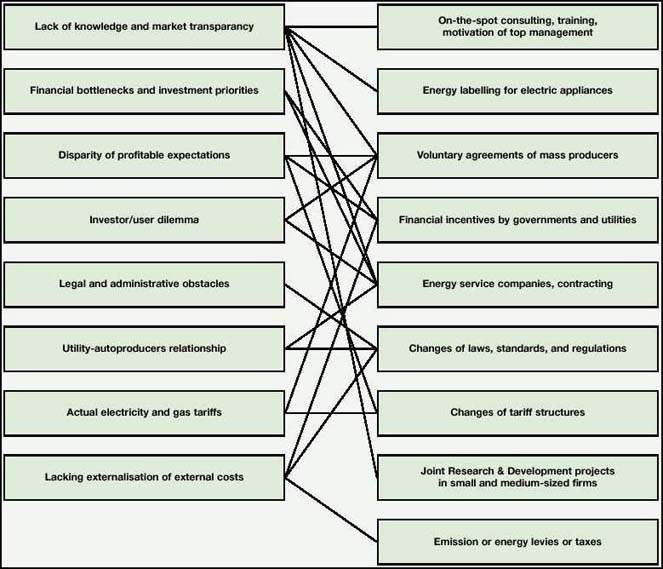
FIGURE 6.5. OBSTACLES AND MARKET
IMPERFECTIONS FOR ENERGY EFFICIENCY AND RELATED POLICIES: A SCHEME FOR POLICY
OPTIONS AND INTEGRATED EFFICIENCY POLICY
The acceptance of such policy measures differs by country and
varies over time depending on how much an energy policy objective is violated or
in question. Energy efficiency policy was widely accepted in OECD countries in
the 1970s and early 1980s, when dependence on oil imports from OPEC countries
was high and higher fuel prices had changed cost structures and weakened
competitiveness in energy-intensive industries. With declining world energy
prices between 1986 and 1999, reduced dependence on energy imports in many OECD
countries, and stagnating negotiations on the implementation of the Kyoto
Protocol, public interest in energy efficiency policy has fallen in many OECD
countries.
By contrast, energy efficiency receives considerable attention
from governments, industries, and households in Eastern European countries, in
some Commonwealth of Independent States countries without indigenous energy
resources, and in many emerging economies facing problems with sufficient and
reliable supplies of commercial energy.
Energy conservation laws have been passed in many countries
(Australia, Canada, China, Finland, Germany, Japan, Russia, Switzerland, the
United States) or are in the process of being passed (India). Such laws are
important for establishing a legal framework for sector regulation (building
codes, labelling, technical standards for equipment and appliances) and for
implementing other measures (energy agencies, financial funds for economic
incentives or public procurement). In many countries with federal structures,
however, much of the legislative power to enact energy conservation laws rests
with individual states - posing problems for compliance and joint action.
Education on energy efficiency issues in primary or secondary
schools, along with professional training, raises consciousness and basic
knowledge about the efficient use of energy and the most recent technologies.
Direct subsidies and tax credits were often used to promote
energy efficiency in the past. Direct subsidies often suffer from a free-rider
effect when they are used for investments that would have been made anyway.
Although it is difficult to evaluate this effect, in Western Europe 50-80
percent of direct subsidies are estimated to go to free riders (Farla and Blok,
1995). Low-interest loans for energy efficiency projects appear to be a more
effective subsidy, although they may have a distribution effect.
Energy service companies are a promising entrepreneurial
development, as they simultaneously overcome several obstacles by providing
professional engineering, operational, managerial, and financial expertise,
along with financial resources. Such companies either get paid a fee based on
achieved savings or sign a contract to provide defined energy services such as
heating, cooling, illumination, delivery of compressed air, or hot water.
|
Energy demand policy is not only
initiated by governments.
Companies,
utilities, industrial associations,
and NGOs may also
play
an important part. |
Transition economies. From a policy perspective,
efficient energy use creates enormous opportunities in light of huge
reinvestments in industry and infrastructure and large new investments in
buildings, vehicles, and appliances. In the Commonwealth of Independent States
and Eastern Europe increased energy efficiency was made a top political priority
in the early and mid-1990s - as with Russia’s 1994 National Energy Strategy
(IEA, 1995). But according to the Russian Federation Ministry of Fuel and Energy
(1998), government support for such activities was less than 8 percent of the
planned funding in 1993-97.
Transition economies that were relatively open under central
planning (defined as those for whom foreign trade accounted for more than 30
percent of GDP) have had an easier time adjusting to world markets.
Multinational companies from Western Europe and other OECD countries maintain
their technical standards when building new factories in transition economies.
In addition, Eastern European countries are trying to approach (and later, to
meet) Western European technical standards as part of their eventual accession
to the European Union (Krawczynski and Michna, 1996; Michna, 1994).
Energy efficiency policies developed differently according to
the speed of transition and economic growth in these countries. Some elements of
efficiency programmes have been quite successful despite economic difficulties:
laws, energy agencies, energy auditing of federal buildings. In most transition
economies the first energy service companies were established with the support
of international institutions. Some industrial enterprises established internal
energy monitoring and control, reinforced by incentives and sanctions for
particular shops and their management. The results of such activities differed
considerably among transition economies, reflecting levels of organisation,
human and financial capital, trade experience, foreign investment, energy
subsidies, and other factors.
Developing countries. The phasing out of substantial
energy subsidies can often be complemented by capacity building, professional
training, and design assistance. Utilities in Mexico and Brazil, for example,
have been active in demand-side management programmes with cost-benefit ratios
of more than 10 to 1 (Dutt and others, 1996). Given the shortage of capital in
many developing countries, financial incentives seem to have a large impact on
energy efficiency (unlike in OECD countries). An example is China in the 1980s,
where such incentives contributed to the remarkable decline in China’s
industrial energy intensity (Sinton and Levine,
1994).
Sector- and technology-specific policy measures
Given the many obstacles that keep economic energy-saving
potential from being realised on a sectoral or technological level, any actor
will look for a single instrument that can alleviate all obstacles. For mass
products, performance standards are considered an efficient instrument because
they can be developed after discussions with scientists, engineers, and
industrial associations, manufacturers, and importers. Standards and labelling
avoid the need for information, high transaction costs, and dissemination to,
consultations with, and training of millions of households, car drivers, and
small and medium-size companies (Natural Resources Canada, 1998).
|
BOX 6.12. THE MULTIMEASURE CHARACTER OF NATIONAL ENERGY
EFFICIENCY POLICY - A 20-YEAR LEARNING CURVE FOR MULTIFAMILY BUILDINGS IN WEST
GERMANY
After the oil shocks of the 1970s, German professional
organisations made recommendations for new building standards. In addition, the
federal government enacted an ordinance for boiler efficiencies to accelerate
the replacement of old boilers by new, more efficient ones. Building codes and
boiler standards have since been tightened three times, and regulations on
individual heat metering were introduced in the early 1980s. Research and
development enabled the new standards to be met. Twenty-five years later, the
results are convincing. New buildings are 50-70 percent more efficient, and
retrofits have cut energy consumption by 50 percent in Germany (and by at least
30 percent in most Western European countries).
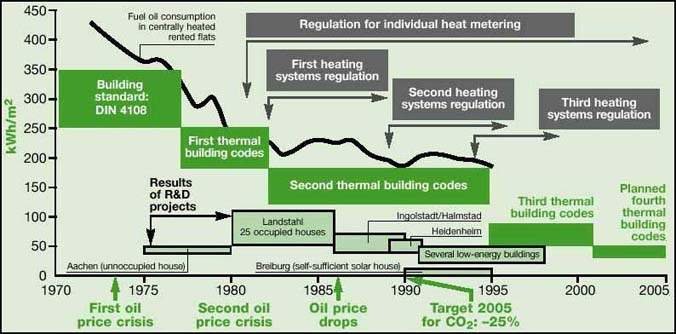
Interrelation between research to
lower costs, proof of technical feasibility, and heating and insulation
regulation in Germany
Source: EC, 1999b. |
|
But no single, highly efficient instrument will be available in
all cases (as with the refurbishing of buildings or efficiency improvements in
industrial plants). In these cases a package of policy measures has to be
implemented to alleviate obstacles (see figure 6.5).
Buildings. There seems to be an intellectual barrier
between planners and architects for buildings in cold and warm climates,
although building codes may offer huge efficiency potential in most countries.
Jochem and Hohmeyer (1992) conclude that if comprehensive policy strategies are
implemented, governments will discover that the economics of end-use efficiency
are far more attractive than is currently believed. A good example is the
refurbishing of residential buildings. Homes and apartment buildings consume
about 20 percent of final energy in many countries. Refurbishing a building may
be primarily an individual event, but its effectiveness depends on such
political and social remedies as:
· Advanced education
and training of architects, planners, installers, and builders, as carried out
in the Swiss ‘impulse programme’, which has had outstanding results
since 1978.
· Information and education for
landlords and home owners (particularly on the substitution of energy costs for
capital costs).
· Training professional advisers
to perform audits and provide practical recommendations. These audits should be
subsidised; otherwise they may be considered too costly by landlords or home
owners. Such subsidies have proven cost-effective.
· Investment subsidies tied to a
registered energy consultant and a formal heat survey report and minimum energy
efficiency level.
· Investment subsidies for
specific groups of home owners or multifamily buildings to overcome financial
bottlenecks or risks of the investor-user dilemma. The cost-effectiveness of
such subsidies has often been overestimated, however.
· Economically justified
insulation and window design secured by new building codes that also cover the
refurbishing of buildings.
· Research and development to
improve building design (low-energy houses, passive solar buildings), insulation
material, or windows, or to reduce construction costs.
Energy-saving programs in Denmark, Finland, Germany, Sweden, and
Switzerland owe much of their success to this multimeasure approach, which is
increasingly being adopted by other countries (box 6.12). The combination of
measures has increased capacity in the construction sectors of those countries.
Energy labelling for buildings has been introduced in a few OECD countries and
is being considered in several others (Bradbrook, 1991). Such labelling provides
information on a building’s energy costs when it is being rented or bought
(Hicks and Clough, 1998). Building standards for cooling have been adopted in
Indonesia, Mexico, Singapore, and Thailand. Compliance with building codes is
uncertain in many countries, however, because (expensive) controls are lacking
(Duffy, 1996).
Household appliances and office automation. Household
appliances and office equipment are well suited for technical standards and
labelling. Varone (1998) compared instruments used between 1973 and 1997 in
Canada, Denmark, Sweden, Switzerland, and the United States to promote
energy-efficient household appliances and office equipment. About 20 instruments
were identified (table 6.14). Various attempts have been made in the past 10
years to coordinate and harmonise policies at an international level. Some
analysts consider international cooperation to be the only real means for
inducing a market transformation in office equipment. Varone and Aebischer
(1999) prefer to keep a diversity of instruments in different countries - an
approach that allows for the testing of new instruments, offers the possibility
of testing diverse combinations of instruments, and takes advantage of political
windows of opportunity specific to each country (as with the Energy Star Program
for office equipment in the United States) (Geller, 1995).
Some developing countries (China, India) try to follow
OECD policies on technical standards and energy labelling. OECD governments
should be aware of this implication (box 6.13).
Small and medium-sized companies and public
administrations. Small and medium-sized companies and public administrations
are typical targets when several policy measures have to be taken
simultaneously: professional training, support for initial consulting by
external experts, demonstration projects to increase trust in new technical
solutions, energy agencies for several tasks (see above), and soft loans. These
companies and administrations are also affected by standards for labelling and
for cross-cutting technologies such as boilers and electrical motors and drives
(Bradbrook, 1992).
This policy mix seems to be successful for this target group in
almost all countries. In Russia and most Eastern European countries, energy
agencies are responsible for energy efficiency initiatives in end-use sectors.
These agencies are playing an important role, supported by energy service
companies that provide financial and technical assistance to realise the
identified potentials. Brazil and Mexico have also established national agencies
for energy efficiency (see box 6.8). With the privatisation of Brazilian
utilities, the new concessionaires are required to spend 1 percent of their
revenues (less taxes) on energy efficiency, with 0.25 percent specifically for
end-use efficiency measures.
Big enterprises and public administrations. Big
enterprises and public administrations have specialised staff and energy
managers, but they still need specific policy measures to achieve their economic
potential. The government of India occasionally uses expert committees to
develop policy recommendations. The reports of the committees include several
recommendations to encourage energy efficiency improvements (box 6.14). A
‘minister’s breakfast’ is a key tool for motivating top managers
of companies and administrations and for raising awareness of energy efficiency
potential. In addition, keynote speakers at the annual meetings of industrial
associations can help convey positive experiences with new efficient
technologies among the responsible middle managers.
|
BOX 6.13. FAST TRANSMISSION OF EFFICIENCY PROGRAMMES FROM
OECD TO DEVELOPING COUNTRIES: THE CASE OF EFFICIENT LIGHTING
Mexico was the first developing country to implement a
large-scale energy-efficient lighting programme for the residential sector. The
programme was funded by the Mexican Electricity Commission, ($10 million), the
Global Environment Facility ($10 million), and the Norwegian government ($3
million). Between 1995 and 1998 about 1 million compact fluorescent lamps were
sold in the areas covered by the programme. Use of the lamps avoided 66.3
megawatts of peak capacity and resulted in monthly energy savings of 30
gigawatt-hours. Given the lifetime of the efficient lamps, the impacts of the
programme are expected to last until 2006 (Padilla, 1999).
Economic evaluations show positive returns to households, the
power sector, and society. The programme, ILUMEX (Illumination of Mexico), has
also helped generate direct and indirect jobs, training and building indigenous
capacity to design and implement large-scale efficiency programmes (Vargas
Nieto, 1999). Smaller residential energy-efficient lighting programmes have been
introduced in other Latin American countries, including Bolivia, Brazil, Costa
Rica, Ecuador, and Peru. |
Local governments should consider using life-cycle costs and
increasing flexibility between investment and operating budgets. This move may
require changes in legislation in some countries.
TABLE 6.14. POLICIES TO INCREASE EFFICIENCY IN ELECTRIC
APPLIANCES AND OFFICE EQUIPMENT, VARIOUS OECD COUNTRIES
|
Area |
Canada |
Denmark |
Sweden |
Switzerland |
United States |
|
Household appliances |
Mandatory labelling (1978)
Standards (1992) |
Mandatory labelling (1982)
Standards (1994) |
Mandatory labelling (1976)
Technology procurement (1988)
|
Negotiated target values (1990)
Voluntary labelling (1990)
|
Voluntary labelling (1973)
Negotiated target values
(1975)
Mandatory labelling (1975)
Standards (1978)
Technology
procurement (1992) |
|
Office equipment |
|
|
|
Negotiated target values (1990)
Quality labelling
(1994)
Public purchasing (1994) |
Quality labelling (1992)
Public purchasing (1993) |
Source: Varone 1998, p. 143.
Transportation. Policies on road transportation may
include efficiency standards for vehicles imposed by national governments or
technical objectives achieved through voluntary agreements among car
manufacturers and importers (Bradbrook, 1994). Similar measures can be taken by
aeroplane, truck, and bus manufacturers. High fuel taxes in countries with low
taxation may support technical progress. A more systemic view relates to several
areas of transport systems and policy measures (IEA, 1997a):
· Subsidies for
mobility (such as for daily commuting, national airlines, or public urban
transport) increase the demand for transportation, especially road transport,
and should be removed where socially acceptable. An untaxed benefit for
employees driving a car bought by companies or institutions should also be
removed.
· Road user charges and parking
charges may reduce driving in cities, cut down on congestion and road accidents,
and shift some mobility to public transport. Car sharing also has implications
for car use and occupancy levels.
· It is possible to lower the
cost of public transport through automation and international procurement, as is
a better organisation of rail freight crossing national borders.
· In the long term, intelligent
city planning that does not divide an urban area by functions and related
sections creates substantial potential for reduced mobility.
|
BOX 6.14. ENERGY EFFICIENCY POLICY RECOMMENDATIONS BY
EXPERT COMMITTEES FOR COMPANIES IN INDIA
Technical and operational measures
· Detailed energy
audit should be made mandatory in all large and medium-sized enterprises.
· Potential cogeneration
opportunities should be identified and pursued by providing financial assistance
· Energy consumption norms
should be set for each industry type and penalties and rewards instituted based
on the performance of the industry.
Fiscal and economic measures
· Creation of an
energy conservation fund by levying energy conservation taxes on industrial
consumption of petroleum products, coal, and electricity.
· Customs duty relief on energy
conservation equipment.
Energy pricing
· Energy pricing
policies must ensure that sufficient surplus is generated to finance energy
sector investments, economical energy use is induced, and interfuel substitution
is encouraged.
Industrial licensing, production, and growth
· Before licenses
are given to new units, the capacity of existing units and the capacity use
factor should be taken into consideration.
· In setting up new units, the
technology should be the least energy-intensive option.
· The possibility of using waste
heat from power plants by setting up appropriate industries in the vicinity
should be considered.
Organisational measures
· The appointment of
energy managers in large and medium-sized industries should be mandatory. For
small-scale enterprises, a mechanism should be instituted for energy auditing
and reporting.
Energy equipment
· Better standards
should be set for energy-consuming equipment.
· Restrictions must be placed on
the sale of low-efficiency equipment.
· Manufacture of instruments
required to monitor energy flows must be encouraged. Imports of such instruments
and spare parts should be free of customs duty.
Research and development
· Each industrial
process should be reviewed to identify the research and development required to
reduce energy consumption.
· Research and development on
energy efficiency should be sponsored by the government as a distinct component
of the science and technology plan.
Other measures
· Formal training to
develop energy conservation expertise should be introduced in technical
institutions.
· The government should
recognise and honour individuals and organisations for outstanding performance
on energy conservation.
·
Efforts to raise awareness on energy conservation should be intensified. |
Source: Bhattacharjee, 1999.
In higher-income developing countries there are concerns
that a shift from fuel-efficient to fuel-inefficient transport is threatening
the oil security of these countries. To address these concerns, policies should
encourage a shift from road transport to subways and rail transport by reducing
travel times and increasing the costs of road transportation. These countries
should also search for new financing to replace old bus fleets.
Agriculture. Two main issues affect the energy efficiency
of agriculture in developing countries. The first is related to
subsidised electricity tariffs for this sector; the second is the use of highly
inefficient prime movers for agricultural pump sets and the ineffective
configuration in which they are often used. Increases in electricity tariffs
should be accompanied by free consultation by experts and an expansion of credit
and savings schemes to help rural people keep their energy costs at an
acceptable level. Efficient prime movers and appliances and organisational
measures in water use efficiency and irrigation management would help achieve
that goal.
Cogeneration. Liberalisation of the electricity market
may have different implications for cogeneration in different countries (Jochem
and T�nsing, 1998; AGFW, 2000). Earlier obstacles, such as low buyback rates and
high rates for maintenance and emergency power, are alleviated by competition.
But a legal framework for wheeling and public control seems to be necessary to
level the playing field, particularly during the adaptation phase of
liberalisation and for small and medium-size cogeneration plants of independent
power producers. Lack of expertise and the trend of outsourcing cogeneration
plants in industry can be addressed by supporting energy service companies with
training, standardised contracts for small units, and deductions on fuels for
cogeneration.
Maintaining energy-efficient cogeneration with district heating
in industrialised and transition economies requires determination, a
legal framework, technical and economic skills, and financial resources. Several
steps are needed to make or to keep centralised district heating systems
competitive:
· A possibility of
switching between fuels (lowering gas prices by switching to storable oil in the
coldest 100-200 hours of the winter) and using cheap fuel (‘puffer’
gas, coal, municipal solid waste, garbage incineration, sewage treatment
biogas).
· Proper and economic sharing of
heat generation between centralised heat units and peak load boilers, and an
increase in the electricity production planted on the given heat demand by
turning to higher parameters in the power-generating cycle (such as combined gas
and steam cycles).
· Better performance control of
the heating system, variable mass-flow in addition to temperature control in hot
water systems, lower temperatures in the heating system, and the use of heat for
cooling (through absorption techniques) to improve the seasonal load of the
system.
· One-by-one metering and price
collection for consumers in transition economies.
· A minimum buyback rate for
cogenerated electricity in the adaptation phase of liberalisation (AGFW,
2000).
Such a bundle of measures can assure the competitiveness of
other options and the realisation of the huge potential for cogeneration in
centralised heating systems.
In developing countries a lack of knowledge, capital, and
hard currency may constrain cogeneration investments. Thus policy measures and
incentives are often needed - and were recommended, for example, by a task force
in India in 1993. The Ministry of Non-Conventional Energy Sources launched a
national programme promoting bagasse-based cogeneration. The process of agreeing
on mutually acceptable buyback rates and wheeling of power by state electricity
boards is still under way, but there is hope that the institutional barriers
will give way to large-scale cogeneration, particularly in liberalised
electricity
markets.
International policy measures
The globalisation of many industrial sectors creates enormous
potential for improving energy efficiency at the global scale. Harmonising
technical standards for manufactured goods offers new opportunities for
economies of scale, lowering the cost of energy-efficient products. To avoid the
import of energy-inefficient products, governments, associations of importers,
and NGOs may consider negotiating efficiency standards for appliances and other
mass-produced products imported from industrialised countries. Imported
vehicles, used cars, buses, and trucks should not be more than five or six years
old (as in Bangladesh and Hungary). Similar rules could be introduced for major
imported and energy-intensive plants.
The Energy Charter Protocol on Energy Efficiency and Related
Environmental Aspects entered into force in April 1998. The protocol is legally
binding but does not impose enforceable obligations on nations to take specified
measures. It is a ‘soft law’ requiring actions such as:
· Formulating aims
and strategies for improving energy efficiency and establishing energy
efficiency policies.
· Developing, implementing, and
updating efficiency programmes and establishing energy efficiency bodies that
are sufficiently funded and staffed to develop and implement policies.
· Creating the necessary legal,
regulatory, and institutional environment for energy efficiency, with
signatories cooperating or assisting each other in this area.
The protocol received significant political support from the EU
Environmental Ministers Conference in June 1998. By December 1998, however, it
had only about 40 signatories, mainly Western European countries and transition
economies. Thus it has no world-wide support (Bradbrook, 1997).
|
The globalisation
of many industrial sectors
creates
enormous potential for
improving energy efficiency
at the global scale.
|
Commitments to the Kyoto Protocol by Annex B countries are a
major driver of energy efficiency, as about 70 percent of these countries’
greenhouse gas emissions are related to energy use. Although energy efficiency
is a major contributor for achieving the targets of the protocol, there are few
references to it in the text of the document. Ratification of the protocol and
implementation of the flexible instruments will be important for developing
policy awareness in industrialised countries of the substantial potential that
improved energy efficiency offers for meeting the objectives.
Better air traffic management will likely reduce aviation fuel
burn by some 10 percent if fully implemented in the next 20 years - provided the
necessary international regulatory and institutional arrangements have been put
in place in time. Stringent aircraft engine emission and energy efficiency
regulations or voluntary agreements among airlines can expedite technological
innovations. Efforts to remove subsidies, impose environmental levies (charges
or taxes), and promote emissions trading could be negotiated at the
international level (IPCC, 1999b). These economic policies - though generally
preferred by industry - may be highly
controversial.
Conclusion
As the long-term potential for energy efficiency reduces useful
energy demand and the proceeding levels of energy conversion, future energy
policy of most countries and on the international level will have to broaden
substantially its scope from energy supply to energy services. This kind of
policy will be much more demanding in designing target group-specific and
technology-specific bundles of policy measures. But the success of this new
policy process will be worth the effort from the economic, social and
environmental perspective.
Notes
1. Lee Schipper was the lead author of this section.
2. Eberhard Jochem was the lead author of this box.
3. Inna Gritsevich and Eberhard Jochem were the lead authors of
this section.
4. Anthony Adegbulugbe was the lead author of this section.
5. Somnath Bhattacharjee was the lead author of this section.
6. Eberhard Jochem was the lead author of this section.
7. Eberhard Jochem was the lead author of this box.
8. Bernard Aebischer and Eberhard Jochem were the lead authors
of this section.
9. Ernst Worrell, Allen Chen, Tim McIntosch, and Louise Metirer
were the lead authors of this section.
10. This means that the cost-effective potential is probably
equivalent to the microeconomic potential (see the introduction to the section
on potential economic benefits).
11. The estimates of the economic potential are based on supply
curves for each sector developed by Bailie and others (1998). It is unclear what
discount rate was used to estimate the economic potential. Hence we cannot
determine if the study estimates a microeconomic or macroeconomic potential (see
box 6.2).
12. It is unclear what discount rate was used to estimate the
economic potential. In some economic assessments in this report a discount rate
of 50 percent is used for investments in the transportation sector.
13. Bidyut Baran Saha and David Bonilla were the lead authors of
this section.
14. Tamas Jaszay was the lead author of this section.
15. Inna Gritsevich was the lead author of this section.
16. Somnath Bhattacharjee was the lead author of this section.
17. Fengqi Zhou was the lead author of this section.
18. Gilberto M. Jannuzzi was the lead author of this section.
19. Anthony Adegbulugbe was the lead author of this section.
20. Eberhard Jochem was the lead author of this section.
21. Eberhard Jochem was the lead author of this section.
22. Eberhard Jochem was the lead author of this section.
23. Jean Pierre Des Rosiers was the lead author of this section.
24. Inna Gritsevich and Tamas Jaszay were the lead authors of
this section.
25. Somnath Bhattacharjee, Gilberto Jannuzzi, and Fengqi Zhou
were the lead authors of this section.
26. Eberhard Jochem was the lead author of this section.
27. Eberhard Jochem was the lead author of this section.
References
ADB (Asian Development Bank), GEF (Global Environment Facility),
and UNDP (United Nations Development Programme). 1998. “Asia Least Cost
Greenhouse Gas Abatement Strategy.” Manila, Philippines.
Adegbulugbe, A.O. 1992a. “The Energy-Environment Nexus: The
Role of Energy Efficiency.” In Energy Issues in Nigeria: Today and
Tomorrow. Proceedings of a conference held at the Nigerian Institute of
International Affairs, Victoria Island, Lagos.
Adegbulugbe, A.O., ed. 1992b. “Energy for Tomorrow’s
World: The Realities, the Real Options and the Agenda for Achievement.”
Sub-Saharan Africa Regional Report. Presented at the 15th World Energy
Council Congress, Madrid.
Adegbulugbe, A.O. 1993. “Energy Efficiency in Industry: A
Regional Perspective.” In S. Karekezi and G.A. Mackenzie, eds., Energy
Options for Africa: Environmentally Sustainable Alternatives. London: Zed
Books.
Adi Cahyono A. 1999. Personal communication. Ministry for Mines
and Energy, Indonesia.
Aebischer, B., J. Schwarz, and D. Spreng. 1996.
“Perspectives of Energy Demand of the Tertiary Sector: Scenarios I to III,
1990-2030 [in German].” Federal Office of Energy, Bern, Switzerland.
AGFW (Arbeitsgemeinschaft Fernw�rme). 2000. “ Strategien
und Technologien einer pluralistischen Fern- und Nahw�rmeversorgung in einem
liberalisierten Energiemarkt unter besonderer Ber�cksichtigung der
Kraft-W�rme-Kopplung und erneuerbaren Energien.” Studie
Kurzzusammenfassung, Frankfurt.
Aim Project Team. 1994. “An Energy Technology Model for
Forecasting Carbon Dioxide Emissions in Japan [in Japanese].” Report
F-64-94. National Institute for Environmental Studies.
ALGAS, 1998. Asian Least-Cost Greenhouse Gas Abatement Study.
Tokyo, Japan.
Almeida, A., P. Bertoldi, and W. Leonhard, eds. 1997. Energy
Efficiency Improvements in Electric Motors and Drives. Berlin: Springer.
Alnakeeb, H. 1998. “Co-generation Potential in Egyptian
Industry.” Organization for Energy Consumption and Planning, Cairo.
Alnakeeb, H., M. El Gazzar, and M. Emam. 1998. “Demand Side
Management of Efficient Lighting: A Case Study of an Administrative
Building.” Organization for Energy Consumption and Planning, Cairo.
Altner, G., H.-P. D�rr, and G. Michelsen. 1995. Zuk�nftige
Energiepolitik: Vorrang f�r rationelle Energienutzung und regenerative
Energiequellen [Future Energy Policy Priority for Energy Efficiency and
Renewables]. Bonn: Economica Verlag.
Ameling, D., and others. 1998. “Coke Production Technology
in 2000: The State of the Art and New Structures [in German].” Eisen und
Stahl 118 (11): 55-61.
Angerer, G. 1995. “Auf dem Weg zu einer �kologischen
Stoffwirtschaft. Teil I: Die Rolle des Recycling.” GAIA 4 (2): 77.
Arbeitsgemeinschaft. 1992. “Arbeitsgemeinschaft Amstein
& Walthert und Intep AG. Methode zur Optimierung des
Elektrizit�tsverbrauchs. Sparpotentiale beim Elektrizit�tsverbrauch von zehn
ausgew�hlten art-typischen Dienstleistungsbetrieben.” Schlussbericht.
Bundesamt f�r Energie, Bern.
ARENA-ECO (Agency for Rational Energy Use and Ecology). 1997.
Ukraine: On the Way to Energy Efficiency. Kiev, Ukraine.
Argentina Secretaria de Energ�a. 1997. “Prospectiva del
sector el�ctrico 1997 [in Spanish].” [https://www.mecon.ar/energia/].
Argentina Secretaria de Energ�a. 1998a. “Balances
energ�ticos [in Spanish].” [http://energia.mecon.
gov.ar/Balances%20/Energeticos/balances.asp].
Argentina Secretaria de Energ�a. 1998b. “Cogeneraci�n de
energ�a: Analisis sectoriales [in Spanish].”
[https://www.mecon.ar/energia/ure/anlisis.htm].
Argentina Secretaria de Energ�a. 1998c. “Cogeneraci�n de
energ�a en el sector industrial [in Spanish].”
[http://energia.mecon.ar/ure/oportunidades.htm].
Argentina Secretaria de Energ�a. 1998d. “Cogeneraci�n de
energ�a en el sector terci�rio [in Spanish].”
[http://energia.mecon.ar/ure/].
Argentina Secretaria de Energ�a. 1998e. “Equipos para
conservaci�n de alimentos en hogares [in Spanish].”
[http://energia.mecon.ar/ure/oportunidades.htm].
Argentina Secretaria de Energ�a. 1998f. “Uso racional de la
energ�a en el sector transporte [in Spanish].”
[http://energia.mecon.ar/ure/anlisis.htm].
ATLAS Report Compendium of Technology Modules. 1997.
“Industry: Energy Technology Information Base 1980-2010.” European
Commission, Brussels.
Ayres, R. 1996. Industrial Ecology: Towards Closing the
Materials Cycle. London: Edward Elgar.
Bailie, A., B. Sadownik, A. Taylor, M. Nanduri, R. Murphy, J.
Nyboer, M. Jaccard, and A. Pape. 1998. “Cost Curve Estimations for Reducing
CO2 Emissions in Canada: An Analysis by Province and Sector.”
Simon Fraser University, Energy Research Group, Vancouver, Canada.
Bandala, A. 1995. “Importance of the Mexican Lighting
Systems in Commerce and Services.” Proceedings of the third European
Conference on Energy-Efficient Lighting, Newcastle upon Tyne, England.
Bashmakov, I. 1997a. “Heat, Money and Housing Reform.”
Energy Efficiency 14 (January-March).
Bashmakov, I. 1997b. “Strengthening the Russian Economy
through Climate Change Policies.” Energy Efficiency Bulletin 17.
Centre for Energy Efficiency, Moscow.
Bashmakov, I., I. Gritsevich, and S. Sorokina. 1996.
“System of Institutional Measures to Stimulate Energy Efficiency in Russia
as Part of the GHG Mitigation Strategy.” Report to the Country Study
Program. Centre for Energy Efficiency, Moscow.
Baumgartner, W., and C. Muggli. 1996. “Perspectives of
Energy Demand of the Industrial Sector: Scenarios I to III, 1990-2030 [in
German].” Federal Office of Energy, Bern, Switzerland.
Baxter, L.W. 1995. “Assessment of Net Lost Revenue
Adjustment Mechanisms for Utility DSM Programs.” Oak Ridge National
Laboratory, Oak Ridge, Tenn.
BEA (Bureau of Economic Analysis). 1998. “Survey on
Economic Policy in Russia in 1997.” Moscow.
Beer, de, Jeroen. 1998. “Potential for Industrial Energy
Efficiency Improvement in the Long Term.” PhD. diss. University of Utrecht,
Netherlands.
Bernadini, R. 1993. “Dematerialization: Long-term Trends in
the Intensity of Use of Materials and Energy.” Futures 25: 431-47.
Bhattacharjee, S. 1999. Personal communication. Tata Energy
Research Institute, Mumbai, India.
Blanc, A., and O. de Buen. 1994. “Residential Lighting
Efficiency in Mexico: The Road to ILUMEX.” In Proceedings of the ACEEE
Summer Study on Energy Efficiency in Buildings. Asilomar, Calif.: American
Council for an Energy-Efficient Economy.
Blok, K., W.C. Turkenburg, W. Eichhammer, U. Farinelli, and T.B.
Johansson. 1996. “Overview of Energy RD&D Options for a Sustainable
Future.” European Commission, Luxembourg.
B�de, U., and others. 1999. “Efficient Energy Use: A
Literature Survey [in German].” BWK 86 (4): 86-90.
Boardman, B., T. Fawcett, H. Griffin, M. Hinnels, K. Lane, and
J. Palmer. 1997. “DECADE: Domestic Equipment and Carbon Dioxide
Emissions.” University of Oxford, Energy and Environment Program.
Borisova, I., and others. 1997. “Energy Intensity of
Russian Economy.” Problems of Forecasting 6: 11-36.
Bradbrook, A. 1991. “The Development of Energy Conservation
Legislation for Private Rental Hosing.” Environmental and Planning Law
Journal 8 (2): 91-1107.
Bradbrook, A. 1992. “Energy Conservation Legislation for
Industry.” Journal of Energy and Natural Resources Law 1 (2):
145-63.
Bradbrook, A. 1994. “Regulation for Fuel Efficiency in the
Road Transportation Sector.” Australian Journal of Natural Resources Law
and Policy 1 (1): 1-31.
Bradbrook, A. 1997. “Energy Efficiency and the Energy
Charter Treaty.” Environmental and Planning Law Journal 14 (5):
327-40.
Brechb�hl B. 1992. “Energiesparma�nahmen in L�ftungsanlagen
mittels adaptiver Einzelraumregulierung.” Proceedings of an international
symposium on Energy for Urban Areas, August 25-26, Z�rich.
Brewer, W.M., and S.F. Lopez. 1998. “Successful Closed-loop
Olefins Plant Optimisation.” Hydrocarbon Processing 6: 83-89.
Brown, M., M. Levine, J. Romm, and A. Rosenfeld. 1998.
“Engineering Economic Studies of Energy Technologies to Reduce Greenhouse
Gas Emissions: Opportunities and Challenges.” Annual Review of Energy
and the Environment 23.
Brunner, C.U., and R. Gartner. 1999. Energieeffizienz im
Schienenverkehr. Neue Eisenbahnkonzepte senken den Energieverbrauch um 50%.
Bulletin SEV/VSE 11/99.
CADDET (Centre for the Analysis and Dissemination of
Demonstrated Energy Technology). 1997. “International Data on Successfully
Demonstrated Energy Efficiency Projects.” Sittard, Netherlands.
Carter, A.P. 1996. “The Economics of Technological
Change.” Scientific American 214: 25-31.
Cavaliero, C.K.N. 1998. “Redu��o das Emiss�es de
CO2 do Segmento Sider�rgico Nacional atrav�s da Inje��o de
Combust�vel Auxiliar em Alto Forno: Estudos de Casos na Acesita e Cosipa.”
Planejamento de Sistemas Energ�ticos thesis. Universidade Estadual de Campinas
(UNICAMP), Faculdade de Engenharia Mec�nica, Brazil.
CENEf (Centre for Energy Efficiency). 1993. Energy Efficiency
Potential and Strategy for Russia [in Russian]. Moscow.
CENEf (Centre for Energy Efficiency). 1998. Russian Energy
Picture Statistical Yearbook. Moscow.
CIECC (China International Engineering Consultant Corporation).
1997. “Comparison between China and Foreign Countries on Unit Energy
Consumption of Energy Intensive Industries.” State Development Planning
Commission, Beijing.
CII (Confederation of Indian Industry). 1994. “Specific
Energy Consumption Norm in Indian Pulp and Paper Industry.” CII Energy
Summit, Madras.
Cleveland, C.J., and M. Ruth. 1999. “ Indicators of
Dematerialization and the Materials Intensity of Use.” Journal of
Industrial Ecology 3 (3): 15-50.
CMIE (Centre for Monitoring the Indian Economy). 1996.
India’s Energy Sector. Mumbai, India.
CMIE (Centre for Monitoring the Indian Economy). 1997.
“Approach Paper to Ninth Five-year Plan.” Mumbai, India.
CODA. 1989. “Household Energy Planning Programme
(HEPP).” Uganda, Ministry of Energy, Kampala.
Dadhich P., and B. Bhatia. 1994. “Co-generation - A DSM
Option for India.” Energy and Environment Monitor 10 (1): 27-34.
Dasgupta, N. 1999. “Energy Efficiency and Environmental
Improvements in Small Scale Industries: Present Initiatives in India Are Not
Working.” Energy Policy 27 (13): 789-800.
Davidson, O., and S. Karekezi. 1991. “A New
Environmentally-Sound Energy Strategy for the Development of Sub-Saharan
Africa.” AFREPREN, Nairobi, Kenya.
Davidson, O.R., A.M. Al-Shatti, and A.O. Adegbulugbe. 1991.
“CO2 Emissions from Developing Countries: Better Understanding
the Role of Energy in the Long Term.” Lawrence Berkeley Laboratory Report
30061 UC-350. Berkeley, Calif.
Davis, S. 1997. “Transportation Energy Data Book Edition
17.” Oak Ridge National Laboratory, Oak Ridge, Tenn.
DeCanio, S.J. 1993. “Barriers within Firms to
Energy-Efficient Investments.” Energy Policy 21: 906-14.
Diekmann, J., and others. 1999. “Energy Efficiency
Indicators: Statistical Bases, Theoretical Foundation, and Basis for Orientation
in Policy Practice [in German].” Physica-Verlag, Heidelberg
Dobozi, I. 1991. “Impacts of Market Reforms on USSR Energy
Consumption.” Energy Policy 19 (4): 303-24.
Duffy J. 1996. “Energy Labelling Standards and Building
Codes: A Global Survey and Assessment for Selected Developing Countries.”
International Institute for Energy Conservation, Washington, D.C.
Dutt, G., and C. Tanides. 1994. “Potencial de Uso Eficiente
de la Energ�a El�ctrica: Una Primera Aproximaci�n.” Proceedings of Actas de
la 17ª Reuni�n de Trabajo de la Asociaci�n Argentina de Energ�a Solar,
Rosario, Argentina.
Dutt, G., C. Tanides, and M. Brugnoni. 1996. “DSM
(Demand-Side Management) y Empresas Distribuidoras en Mercados Desregulados:
Possibilidades para Argentina.” Proceedings of the International Conference
on Electricity Distribution, Buenos Aires, Argentina.
EC (European Commission). 1999a. Energy in Europe: Energy
Outlook 2020. Special issue. Brussels.
EC (European Commission). 1999b. Foundations of Energy
Policy:Energy in Europe: Special Issue. Brussels.
EC (European Commission). Various years. Energy in Europe:
Annual Energy Review. Special issue. Brussels.
ECODROME. 1998. “Etude experimentale des appareils
electrom�nagers � haute �fficacit� �n�rg�tique places en situation reelle.”
SAVE programme 4.1031./S/94-093. Auteur Cabinet Olivier Sidler. Partenaire:
DGXVII, ADEME, OSRAM, Groupe Brant, Electrolux, Liebher.
EIA (Energy Information Agency). 1996. Annual Energy Outlook
1997: With Projections to 2015. DOE/EIA-0383 (97). Washington, D.C.: U.S.
Department of Energy.
EIA (Energy Information Agency). 1999a. “Country Profile:
Argentina.” [https://www.eia.doe.gov/ emeu/cabs/argentna.html].
EIA (Energy Information Agency). 1999b. “Energy in the
Americas.” [https://www.eia.doe.gov/ emeu/cabs/theamerics].
Enqu�te Commission (German Bundestag). 1991. Protecting the
Earth: A Status Report with Recommendations for a New Energy Policy. vol. 2.
Bonn: Bonner University Press.
ETSU (Energy Technical Support Unit). 1994. “An Appraisal
of UK Energy Research, Development, Demonstration and Dissemination.” Her
Majesty’s Stationery Office, London.
Farla, J.C.M., and K. Blok. 1995. “Energy Conservation
Investment Behaviour of Firms: Business as Usual?” In Proceedings of the
1995 ECEEE Summer Study: Sustainability and the Reinvention of the Government -
A Challenge for Energy Efficiency. Stockholm.
Faruaui, A., M. Mauldin, S. Schick, K. Seiden, and G. Wilder.
1990. “Efficient Electricity Use: Estimates for Maximum Energy
Savings.” Prepared by Barakat & Chamberlin, Inc. for the Electric Power
Research Institute, Palo Alto, Calif.
Fesharaki, F. 1998. “Asia As the Center of Gravity of the
World Energy System.” Energy: The International Journal 19 (4):
85-105.
Fisher, A., and C. Rothkopf. 1989. “Market Failure and
Energy Policy.” Energy Policy 17: 397-406.
Friedmann, R. 1994. “Saving Electricity in Mexican Homes:
Potential and Accomplishments to Date.” In Proceedings of the ACEEE
Summer Study on Energy Efficiency in Buildings. Asilomar, Calif.: American
Council for an Energy-Efficient Economy.
Friedrich, R., and W. Krewitt. 1997. Umwelt- und
Gesundheitssch�den durch die Stromerzeugung. Heidelberg/Berlin: Springer.
Gardner, G.T., and P.C Stern. 1996. Environmental Problems
and Human Behaviour. Needham Heights, Mass.: Allyn and Bacon.
GEA (Group for Efficient Appliances). 1995. Washing Machines,
Dryers and Dishwashers. Final Report. European Energy Network Working Group.
Copenhagen: Danish Energy Agency.
Geiger, B., W. Eichhammer, E. Gruber, D. K�wener, H. Kottmann,
W. Mannsbart, U. Mielicke, M. Patel, and D. Saage. 1999. Energieverbrauch und
Energieeinsparung in Handel, Gewerbe und Dienstleistung. Heidelberg:
Physica-Verl.
Geller, H. 1995. National Appliance Efficiency Standards:
Cost-effective Federal Regulations. Washington D.C.: American Council for an
Energy-Efficient Economy.
Geller, H., G. M. Jannuzzi, R. Schaeffer, and M. T. Tolmasquim.
1998. “The Efficient Use of Electricity in Brazil: Progress and
Opportunities.” Energy Policy 26 (11): 859-72.
Geller, H., P. Leonelli, R. Abreu, I. Ara�jo, and H. Polis.
1997. “Energy-Efficient Lighting in Brazil: Market Evolution, Electricity
Savings and Public Policies.” In Proceedings of the Fourth European
Conference on Energy-Efficient Lighting. Copenhagen: International
Association of Energy-Efficient Lighting.
German Statistical Office, various years. Statisches
Jahrbuch. Wiesbaden, Germany.
Gnedoy, N. 1998. “Energy Situation in Ukraine.”
Industrial Energy 5: 10-14.
Gnedoy, N. 1983. “Inter Ministerial Working Group Report on
Utilisation and Conservation of Energy.” New Delhi.
Gnedoy, N. 1985. “Report of the Advisory Board on
Energy.” New Delhi.
Gnedoy, N. 1994. “Consultancy Capabilities in Energy
Conservation and Management for the Industrial Sector in India.” New Delhi.
Gnedoy, N. 1995. “State Electricity Boards and Electricity
Departments.” Planning Commission, Power and Energy Division, New Delhi.
Gnedoy, N. 1996. Ninth Plan Document (1997-2002). New
Delhi.
Gnedoy, N. 1997. “Handbook of Industrial Policy and
Statistics.” Ministry of Industry, Office of the Economic Adviser, New
Delhi.
Golove, W. 1994. “Are Investments in Energy Efficiency Over
or Under: An Analysis of the Literature.” In Proceedings of the 1994
ACEEE Summer Study on Energy Efficiency in Buildings. Asilomar, Calif.:
American Council for an Energy-Efficient Economy.
Goscomstat of Russia. 1996. Industry of Russia. Moscow.
Goscomstat of Russia. 1997. Russian Statistical Yearbook.
Moscow.
Goto, N. 1996. “Macroeconomic and Sectoral Impacts of
Carbon Taxation: A Case Study for the Japanese Economy.” In A. Amano, ed.,
Global Warming, Carbon Limitation and Economic Development. National
Institute for Environmental Studies and Environment Agency of Japan, Centre for
Global Environmental Research, Tokyo.
Goushin, S., and G. Stavinski. 1998. “Case of
Implementation of Energy Saving Technologies at Kirishi Refinery Plant
‘Kirishinefteorgsyntez’.” Energomeneger 12: 20-23.
Greene, David, 1998. “Why CAFE Worked.” Energy
Policy 26 (8): 595-613.
Gritsevich, I. 1993. “Energy Conservation Problem under
Conditions of Transition to Market Economy.” Economics and Mathematical
Methods 29 (2): 209-16.
Gritsevich, I., Y. Dashevsky, and V. Zhuze. 1997.
“Prospects for Western Technologies in Improving District Heating Energy
Efficiency in Russia.” In Greenhouse Gas Mitigation: Technologies for
Activities Implemented Jointly. Proceedings of the International Conference
on Technologies for Activities Implemented Jointly, May, Vancouver, Canada.
Gruber, E., and M. Brand. 1991. “Promoting Energy
Conservation in Small and Medium-sized Companies.” Energy Policy
279-87.
Hagler Bailly Services, Inc. 1997. “The Energy Efficiency
Market in Developing Countries: Trends and Policy Implications.” Business
Focus Series. U.S. Agency for International Development, Office of Energy,
Environment, and Technology, Washington, D.C.
Hallenga, R.J., and I.C. Kok. 1998. “Inventory of Office
Equipment Energy Efficiency.” Report 98 PO/PRO 606. TNO Institute of
Industrial Technology. Delft, Netherlands.
Hassett, K.A., and G.E. Metcalf. 1993. “Energy Conservation
Investment: Do Consumers Discount the Future Correctly?” Energy Policy
21: 710-16.
Hennicke, P., and others. 1995. “Integrierte
Ressourcenplanung.” Die LCP-Fallstudie der Stadtwerke Hannover AG.
Ergebnisband, Hannover, Germany.
Hennicke, P., and others. 1998. “Interdisciplinary Analysis
of Successful Implementation of Energy Efficiency in the Industrial, Commercial
and Service Sectors.” Final report. Copenhagen, Karlsruhe, Kiel, Vienna,
Wuppertal.
Hicks, T.W., and D.W. Clough. 1998. “The ENERGY STAR
Building Label: Building Performance through Benchmarking and Recognition.”
In Proceedings of the ACEEE Summer Study on Energy Efficiency in Buildings.
Asilomar, Calif.: American Council for an Energy-Efficient Economy.
Hiessl, H., F. Meyer-Krahmer, and M. Sch�n. 1995. “Auf dem
Weg zu einer �kologischen Stoffwirtschaft. Teil II: Die Rolle einer
ganzheitlichen Produktpolitik.” GAIA 4 (2): 89.
Hinterberger, F., F. Luks, and F. Schmidt-Bleek. 1997.
“Material Flows versus ‘Natural Capital’: What Makes an Economy
Sustainable?” Ecological Economics 23: 1-14.
Hirst, E. 1991. “Improving Energy Efficiency in the USA:
The Federal Role.” Energy Policy 19 (6): 567-77.
Hohmeyer, O., R.L. Ottinger, and K. Rennings, eds. 1997.
Social Costs and Sustainability: Valuation and Implementation in the Energy
and Transport Sector. Berlin/Heidelberg: Springer.
Hu, X. 1997. “Chart for Energy System Network of China and
Energy Efficiency Study Report.”
Hu, X., and K. Jiang. 1997. “The Structure and Simulation
Results Analysis of China AIM Energy Emission Model.”
Huang, J., and others. 1998. “A Commercial Building Energy
Standard for Mexico.” In Proceedings of the ACEEE Summer Study on Energy
Efficiency in Buildings. American Council for an Energy-Efficient Economy,
Asilomar, Calif.
IEA (International Energy Agency). 1987. Energy Conservation
in IEA Countries. Paris.
IEA (International Energy Agency). 1991. Energy Efficiency
and the Environment. Paris.
IEA (International Energy Agency). 1995. Energy Policies of
the Russian Federation. Paris.
IEA (International Energy Agency). 1997a. Energy Efficiency
Initiative. vol. 1. Paris
IEA (International Energy Agency). 1997b. Energy Efficiency
Initiative. vol. 2. Paris.
IEA (International Energy Agency). 1998. Energy Statistics
and Balances of Non-OECD Countries, 1995-1996. Paris.
IEA (International Energy Agency). 1999. Energy Policies of
IEA Countries: Hungary 1999 Review. Paris.
IIEC (International Institute of Energy Conservation). 1995.
Asian Energy Efficiency Success Stories. Washington D.C.
IIP (Indian Institute of Petroleum). 1995. State of the Art
Report on Vehicular Pollution.
Interlaboratory Working Group on Energy Efficient and Low-Carbon
Technologies. 1997. “Scenarios of U.S. Carbon Reductions: Potential Impacts
of Energy Technologies by 2010 and Beyond.” Lawrence Berkeley National
Laboratory, Berkeley, Calif.
IPCC (Intergovernmental Panel on Climate Change). 1995.
Second Assessment Report. Cambridge: Cambridge University Press.
IPCC (Intergovernmental Panel on Climate Change). 1999a.
Aviation and the Global Atmosphere. Cambridge: Cambridge University
Press.
IPCC (Intergovernmental Panel on Climate Change). 1999b.
Methodological and Technological Issues in Technology Transfer.
Cambridge: Cambridge University Press.
IPSEP (International Project for Sustainable Energy Paths).
1995. “Negawatt Power: The Cost and Potential of Efficiency Resources in
Western Europe.” Part 3B in Energy Policy in the Greenhouse, vol.
II. El Cerrito, Calif.
Ishiguro, M., and T. Akiyama. 1995. Energy Demand in Five
Major Asian Developing Countries: Structure and Prospects. World Bank
Discussion Paper 277. Washington, D.C.
Jaccard, M.K., and Willis Energy Services. 1996.
“Industrial Energy End-Use Analysis & Conservation Potential in Six
Major Industries in Canada.” Natural Resources Canada, Ottawa.
Jaenicke M. 1998. “Towards an End to the ‘Era of
Materials’? Discussion of a Hypothesis.” Forschungsstelle f�r
Umweltpolitik, Berlin.
Jannuzzi, G.M. 1998. “A Sectoral Review of Energy in
Brazil: Supply and Demand and Opportunities for Reducing Carbon Emissions.”
M. Kaplan. Denver, Colorado, Institute for Policy Research and Implementation,
Graduate Studies of Public Affairs, University of Colorado at Denver and C�mara
de Com�rcio Brasil-Estados Unidos.
JISF (Japan Iron and Steel Federation). 1993. “Energy
Efficient Measures and Energy Reduction in Integrated Steel Mills in Japan [in
Japanese].” Tokyo.
Jochem, E., 1991. “Long-Term Potentials of Rational Energy
Use - The Unknown Possibilities of Reducing Greenhouse Gas Emissions.”
Energy Environment 2 (1): 31-44.
Jochem, E., and H. Bradke.1996. Energieeffizienz, Strukturwandel
und Produktionsentwicklung der deutschen Industrie: IKARUS. Instrumente f�r
Klimagas-Reduktionsstrategien. Abschlu�bericht Teilprojekt 6
“Industrie”. J�lich: Forschungszentrum J�lich, Zentralbibliothek,
Germany.
Jochem, E., and E. Gruber. 1990. “Obstacles to Rational
Electricity Use and Measures to Alleviate Them.” Energy Policy 18
(5): 340-50.
Jochem, E., and O. Hohmeyer. 1992. “The Economics of
Near-Term Reductions in Greenhouse Gases.” In J.M. Mintzer, ed.,
Confronting Climate Change. Cambridge: Cambridge University Press.
Jochem, E., and E. T�nsing. 1998. “The Impact of the
Liberalisation of Electricity and Gas Supply on Rational Energy Use in Germany
[in German].” UWF 6 (3): 8-11.
Jochem, E., J. Sathaye, and D. Bouille, eds. 2000. Society,
Behaviour, and Climate Change Mitigation. Kluwer: Dordrecht, Netherlands.
Kashiwagi, T. 1994. “Industrial Energy Efficiency Policies
and Programmes.” Presented at the International Energy Agency International
Workshop, May 26-27, Washington D.C.
Kashiwagi, T. 1995: “Second Assessment Report of the
Intergovernmental Panel on Climate Change.” Cambridge: Cambridge University
Press.
Kashiwagi, T. 1999. “The Future Vision of Urban Energy
Systems by the Introduction of Polymer Electrolyte Fuel Cell Technology.”
Osaka Research and Development Forum, Japan.
Kashiwagi T., B.B. Saha, and A. Akisawa. 1998.
“Technological Breakthrough for the Environmental Issues in Japan.”
Japan Society of Mechanical Engineers News 9 (1): 3-10.
Kaya, Y., Y. Fujii, R. Matsuhashi, K. Yamaji, Y. Shindo, H.
Saiki, I. Furugaki, and O. Kobayashi. 1991. “Assessment of Technological
Options for Mitigating Global Warming.” Paper presented to the Energy and
Industry Subgroup, WG 3 of IPCC, August, Geneva.
Kishimba, M., and F. Musomba. 1996. “Production of Energy
from Biomass and Biomass Waste.” African Energy Policy Research Network
Working Paper 103.
Kos, M. 1999. “Energy Efficiency in Post-Communist
Countries.” Written communication. Ljubljana, Slovenia.
Krause, F. 1996. “The Costs of Mitigating Carbon Emissions:
A Review of Methods and Findings from European Studies.” Energy Policy,
Special Issue on the Second UN IPCC Assessment Report, Working Group III, 24
(10/11): 899-915.
Krawczynski, F., and J. Michna. 1997. “Effektivit�t
westlicher Hilfe im Energiesektor.” Energiewirtschaftliche Tagesfragen
47(1/2): 23.
Kretinina, Yu., A. Nekrasov, and S. Voronina. 1998. “Energy
Price for Population.” Studies on Russian Economic Development (6):
44-55.
Kuldip, K., and others. 1995. “Energy Conservation in
Agricultural Pumping Systems.” Proceedings of the National Workshop on
Energy Conservation, September 8-9, New Delhi.
Laitner, S., St. Bernow, and J. DeCicco. 1998. “Employment
and Other Macroeconomic Benefits of an Innovation-led Climate Strategy for the
United States.” Energy Policy 26 (5): 425-32.
Lapir, M. 1997. “On Energy Saving Activities in the City of
Moscow [in Russian].” Industrial Energy (9): 7-10.
Levine, M.D., and R. Sonnenblick. 1994. “On the Assessment
of Utility Demand-side Management Programs.” Energy Policy 22.
Levine, M.D., E. Hirst, J.G Koomey, J.E. McMahon, and A.H.
Sanstad. 1994. “Energy Efficiency, Market Failures, and Government
Policy.” Lawrence Berkeley National Laboratory, Berkley, Calif.; and Oak
Ridge National Laboratory, Oak Ridge, Calif.
Levine, M.D., J. Koomey, J. McMahin, A. Sanstad, and E. Hirst.
1995. “Energy Efficiency Policies and Market Failures.” Annual
Review of Energy and the Environment 20: 535-55.
Levine, M.D., A. Gadgil, S. Meyers, J. Sathaye, J. Stafurik, and
Wilbanks. 1991. “Energy Efficiency, Developing Nations and Eastern
Europe.” A report to the U.S. Working Group on Global Energy Efficiency,
Lawrence Berkeley Lab, Berkeley, Calif.
Livinski, A., 1998. “On Energy Saving Activities in
Russia.” Energomeneger (10): 4-6.
Lovins, A., and P. Hennicke. 1999. “Voller Energie [in
German; Full of Energy].” Campus Frankfurt/N.Y.
MACEBUR. 1998. “Energy-Efficient Office Technologies: The
One Watt-One Ampere Challenge.” European Commission. Contract No
XVII/4.1301/s/94-87. Brussels.
Machado, A.C., and R. Shaeffer. 1998. “Estimativa do
Potencial de Conserva��o de Energia El�trica Pelo Lado da Demanda no
Brasil.” PROCEL/COPPETEC/ PNUD BRA/93/032, COPPE, Rio de Janeiro.
Mengistu T. 1995. “Energy in the Transport Sector: The Case
of Ethiopia.” African Energy Policy Research Network Newsletter 19.
M�xico Secretar�a de Energ�a. 1997. “Prospectiva Del Sector
El�ctrico 1996-2006.” Mexico City.
Michna, J., 1994. “Energy Conservation during the
Transition Period. Special Issue on Central and Eastern European Energy
Policy.” International Journal of Global Energy Issues 6: 183- 90.
Mintopenergo. 1996. “Federal Target Programme of
Development of Manufacturing of Certified Metering Devices and System and
Equipping Customers in 1996-2000.”
Moloduik, V. 1997a. “ Main Directions of Restructuring
Natural Monopolies in Fuels and Energy Complex.” Energomeneger 8:
6-8.
Moloduik, V. 1997b. “ Problems of Electricity Tariffs
Regulation.” Energomeneger 6: 14- 17.
Morovic, T. 1989. Energy Conservation Indicators II.
Heidelberg, N.Y.: Springer.
Moscow Government. 1997. “Moscow City Energy Saving
Programme in 1998-2003.” Moscow.
Mungwititkul W., and B. Mohanty. 1997. “Energy Efficiency
of Office Equipment in Commercial Buildings: The Case of Thailand.”
Energy The International Journal 22 (7): 673-80.
Nadel, S., V. Kothari, and S. Gopinath. 1991.
“Opportunities for Improving End-use Electricity Efficiency in India.”
American Council for an Energy-Efficient Economy, Washington, D.C.
National Energy Efficiency Agency at the Council of Ministers of
Bulgaria. 1998. “National Energy Efficiency Program of Bulgaria.”
Sofia, Bulgaria.
Natural Resources Canada. 1998. “Energy Efficiency Trends
in Canada, 1990 to 1996.” Ottawa.
Nelson, K. 1994. “Finding and Implementing Projects that
Reduce Waste.” In R.H. Socolow, C. Andres, F. Berkhout, and V. Thomas, eds.
Neyer A., and M. Strebel. 1996. “Grundlagenarbeiten f�r
Perspektiven des Energieverbrauchs in Dienstleistungsbetrieben und
Landwirtschaft. Schlussbericht. Z�rich.”
Nikiforov, G. 1998. “On Approaches to Reducing Production
Energy Use at MMK.” Energomeneger (11): 21-23.
Nguyen Thuong. 1998. “Energy Saving Potential in Industry
in Vietnam and Climate Friendly Technology.” Presented at the First
CTI/Industry Joint Seminar on Technology Diffusion in Asia, May, Beijing.
Nyoike, P.M., and Okech, B., 1992. “Energy Management in
the Manufacturing Industry - The Case of Kenya.” In M.R. Bhagavan and S.
Karekezi, eds., Energy Management in Africa. London: Zed Books.
Opam M. 1992. “Country Paper on Efficiency and Conservation
in Energy Resource Development: The Ghanaian Experience.” Energy Sector
Workshop, Abidjan, C�te d’Ivoire.
Organizaci�n Latino-americana de Energ�a. 1998.
“Energy-Economic Information System (SIEE).” Quito, Ecuador.
OTA (Office of Technology Assessment), U.S. Congress. 1991.
Changing by Degrees: Steps to Reduce Greenhouse Gases. OTA-0-482.
Washington, D.C.: U.S. Government Printing Office.
OTA (Office of Technology Assessment), U.S. Congress. 1992.
Building Energy Efficiency. OTA-E-518. Washington, D.C.: U.S. Government
Printing Office.
OTA (Office of Technology Assessment), U.S. Congress. 1993.
“Industrial Energy Efficiency.” Washington, D.C.
Ottoboni, and others. 1998. “Efficiency of Destruction of
Waste Used in the Co-incineration in the Rotary Kilns.” Energy
Conversion and Management 39 (16-18): 1899-909.
Padilla, A.M. 1999. “Evaluaci�n del Impacto El�ctrico de
ILUMEX.” In Proceedings International ILUMEX Seminar. Puerto
Vallarta, Mexico.
Patel, M. 1999. “Closing Carbon Cycles. Carbon Use for
Materials in the Context of Resource Efficiency and Climate Change.”
Dissertation, University of Utrecht, Netherlands.
Phylipsen, D., K. Blok, and Ch. Hendriks. 1999. “A Review
of the Stage of Implementation of European Union Policies and Measures for
CO2 Emission Reduction.” Report no. 98077. University of
Utrecht, Netherlands.
Phylipsen, G.J.M. K Blok, and E. Worrell. 1998. “Handbook
on International Comparisons of Energy Efficiency in the Manufacturing
Industry.” University of Utrecht, Netherlands.
Poland Ministry of Industry. 1990. “Status and Assumptions
for Future Development of the Polish Energy Sector in the Years 1990 to
2010.” Warsaw.
President’s Committee of Advisors on Science and
Technology. 1999. “Powerful Partnerships: The Federal Role in International
Cooperation on Energy Innovation.” Washington, D.C.
Radetzki, M. 1991. “USSR Energy Exports
Post-perestroika.” Energy Policy 19 (4): 291-302.
Raghuraman, V. 1989. “Study Report on Reducing Energy
Intensity in Selected Indian Industrial Sectors.”
Ramesohl, S., 1999. “Opening the Black Box - What Can Be
Learned from Socio-economic Research for Energy Policy Analysis?” In IEA
and U.S. Department of Energy, eds., Proceedings of the International
Workshop “Technology to Reduce Greenhouse Gas Emissions:
Engineering-Economic Analysis of Conserved Energy and Carbon.”
Washington, D.C.
Rath, U., M. Hartmann, A. Pr�ffcke, and C. Mordziol. 1997.
“Climate Protection by Reducing the Losses of Electrical Motors [in
German].” Research report 204.08 541 UBA-FB 97-071. Umweltbundesamt,
Berlin.
Ravel. 1994. Praxislehrst�cke, wie Ausgaben f�r einen
rationelleren Stromeinsatz zur lohnenden Investition werden. Bundesamt f�r
Konjunkturfragen, Bern.
Reddy, A.K. 1991. “Barriers to Improvement in Energy
Efficiency.” Energy Policy 19: 953-61.
Reddy, A.K., R.H. Williams, and R.B. Johansson. 1997. Energy
After Rio - Prospects and Challenges. United Nations Development Programme,
New York.
Refining Processes. 1998. “Flow Diagrams and Summary
Descriptions Represent Typical Processes Used by Modern Refineries.”
Hydrocarbon Processing 77 (11): 53-114L.
Ritt, A. 1997. “Acme Rolls 0.030 Inch Hot Band.”
New Steel 13 (5).
Romm, J.J. 1999. Cool Companies - How the Best Businesses
Boost Profits and Productivity by Cutting Greenhouse Gas Emissions. London:
Earthscan.
Rosemann, H., and H.G. Ellerbrock. 1998. “Milling
Technology of Cement Production [in German].” ZKG International
51(2): 51-62.
Rumsey P.R., and T. Flanagan. 1995a. “South East Asian
Energy Efficiency Success Stories, Singapore, Malaysia and Indonesia.”
International Institute for Energy Conservation.
Rumsey P.R., and T. Flanagan. 1995b. “Standards and
Labelling: The Philippines Residential Air Conditioning Market.”
International Institute for Energy Conservation.
Russian Federation, Ministry of Fuel and Energy. 1998.
“Federal Target Program ‘Energy Saving in Russia’.” Moscow.
Russian Federation, Ministry of Transport. 1995. “Target
Programme ‘Fuels and Energy Saving in Transport’ [in Russian].”
SADC (South African Development Cooperation). 1996: “Focus
on Zambia: Energy Conservation in Zambia.” Energy Management Newsletter
1 (4).
SADC (South African Development Cooperation). 1997. “Focus
on Mozambique: Potential for Energy Conservation in Mozambique.” Energy
Management Newsletter 3 (1).
Saha B.B., and T. Kashiwagi. 1997. “Experimental
Investigation of an Advanced Adsorption Refrigeration Cycle.” ASHRAE
Trans. 103: 50-57.
Sanstad, A.H., and R.B. Howarth. 1994. “‘Normal’
Markets, Market Imperfections and Energy Efficiency.” Energy Policy
22: 811-18.
Schipper, L. 1997. “Indicators of Energy Use and
Efficiency: Understanding the Link Between Energy and Human Activity.”
International Energy Agency and Organisation for Economic Co-operation and
Development, Paris.
Sheinbaum, C, and L. Ozawa. 1998. “Energy Use and
CO2 Emissions for Mexico’s Cement Industry.” Energy
Policy 23 (9): 725-32.
Sheinbaum, C., and V. Rodr�guez. 1997. “Recent Trends in
Mexican Industrial Energy Use and Their Impact on Carbon Dioxide
Emissions.” Energy Policy 25 (7-9): 825-31.
Sheinbaum, C., S. Meyers, and J. Sathaye. 1994.
“Transportation Energy Used in Mexico.” Lawrence Berkeley National
Laboratory. LBL-35919. Berkeley, Calif.
Shimazaki Y., A. Akisawa, and T. Kashiwagi. 1997. “ A Model
Analysis on the Effects of Energy Cascaded Systems.” Proceedings of the
Thermodynamic Analysis and Improvement of Energy Systems, Beijing.
Sinton, J.E., and M.D. Levine. 1994. “Changing Energy
Intensity in Chinese Industry.” Energy Policy 22: 239-55.
Sinyak, Yu. 1991. “USSR: Energy Efficiency and
Prospects.” Energy 16 (5): 791-815.
Sioshansi, F.P. 1991. “The Myths and Facts of Energy
Efficiency.” Energy Policy 19: 231-43.
SNAP (Strategic National Action Plan). 1999. Climate Change
Action Plan Report to the Country Study Programme. Moscow.
Soares, J.A., and R.P. Tabosa. 1996. “Motores El�tricos:
Uma An�lise Comparativa de Mercado e Efici�ncia.” Proceedings: VII
Congresso Brasileiro de Energia. Rio de Janeiro, COPPE/UFRJ.
Suzuki Y., K. Ueta, and S. Mori, eds. 1996. Global
Environmental Security. Berlin: Springer.
TACIS (Technical Assistance for CIS Countries). 1996.
“Development of Energy Policy in Georgia.” TACIS/92/EG001. Brussels.
Tanides, C., M. Brugnoni, and G. Dutt. 1996.
“Characterisation of Residential Electricity Use in Argentina and
Implications for Energy Conservation Programmes.” Proceedings of the 31st
Universities Power Engineering Conference (UPEC 96), Heraklion, Creece.
TAU of SADCC, Energy Sector. 1991. “Experience in Energy
Conservation: Zimbabwe Case.” Paper presented at the International Seminar
on Energy in Africa, Abidjan, C�te d’Ivoire.
TERI (Tata Energy Research Institute). 1992. “State of the
Art Report on Use of CNG in the Transport Sector.” New Delhi.
TERI (Tata Energy Research Institute). 1994. “National
Programme in Bagasse Based Co-generation.” TERI Energy and Environment
Monitor 10 (1).
TERI (Tata Energy Research Institute). 1996a. “Research on
Energy-intensive Industries in India.” New Delhi.
TERI (Tata Energy Research Institute). 1996b. “Sector
Analysis, Aluminium Industry.” Prepared for the Energy Efficiency Support
Project, New Delhi.
TERI (Tata Energy Research Institute). 1997a. “Capacity
Building for Technology Transfer in the Context of the Climate Change.” New
Delhi.
TERI (Tata Energy Research Institute). 1997b. “Report on
Small-scale Brick Industry in India.” New Delhi.
TERI (Tata Energy Research Institute). 1997c. “Technical
Paper on GHG Mitigation/Abatement Options.” New Delhi.
TERI (Tata Energy Research Institute). 1998. “Action
Research Project in Small Scale Foundry Industry.” New Delhi.
TERI (Tata Energy Research Institute). 1999. TERI Energy Data
Directory and Yearbook 1998-99 (TEDDY). New Delhi.
TERI (Tata Energy Research Institute), and FAI (Fertilizer
Association of India). 1995. “Development of Oil Consumption Norm for the
Fertilizer Industry.” New Delhi.
TIFAC (Technology Information Forecasting and Assessment
Council). 1992. “Recommendations on Energy Conservation in Cement
Industry.” Government of India, Department of Scientific and Industrial
Research.
Turyareeba, P. 1993. “Mobilizing Local Financial Resources
- The Case of Uganda.” In S. Karekezi and G.A. Mackenzie, eds., Energy
Options for Africa - Environmentally Sustainable Alternatives. London: Zed
Books.
UN (United Nations). 1999. Yearbook of Industrial Statistics,
1999. Vol. II. New York.
UNDP (United Nations Development Programme). 1999. Energy as
a Tool for Sustainable Development for African, Caribbean and Pacific Countries.
New York.
UNFCCC (United Nation Framework Convention on Climate Change).
1997. Horticultural Project in Tyumen. Uniform Report on Activities
Implemented Jointly Under the Pilot Phase. UNFCCC Secretariat, Bonn.
UNFCCC (United Nation Framework Convention on Climate Change).
1998. 1998 Annual Energy Review. Washington, D.C.
Vakulko, A.G., and A.A. Zlobin. 1997. “Energy Saving
Measures in Electricity Supply Systems of Industrial Enterprices.”
Vestnik Glavgosenergonadzora Rossii no.1, Moscow.
Valdes-Arrieta, F. 1993. “Saving Energy in Chile: an
Assessment of Energy Use and Potential Efficiency Improvements.”
International Institute for Energy Conservation, Santiago, Chile.
Vargas Nieto, E. 1999. “ILUMEX Project: A General
Vision.” In Proceedings International ILUMEX Seminar. Puerto
Vallarta, Mexico.
Varone, F. 1998. “Le choix des instruments des politiques
publiques. Une analyse comar�e des politique d’efficience �nerg�tique du
Canada, du Danmark, des Etats-Unis, de la Su�de et de la Suisse.” Editions
Paul Haupt. Bern, Switzerland.
Varone, F., and B. Aebischer. 1999. “From National Policies
to Global Market Transformation: The Challenges of (International) Policy
Design.” In Proceedings of the 1999 ECEEE Summer Study “Energy
Efficiency and CO2 Reduction: The Dimensions of the Social
Challenge” Paris: ADEME Editions.
Vasiliev, A., and others. 1998. “Improvements of Tariffs
Regulations at End-users Energy Markets.” Energomeneger (11): 12-14
[in Russian].
VDEW (German Electricity Utility Association). 1997.
“Stromversorger r�sten sich f�r den Wettbewerb.” Stromthemen 7:
1-2.
Velthuijsen, J.W. 1995. “Determinants of Investment in
Energy Conservation.” SEO, University of Amsterdam, Netherlands.
Wanwacharakul V. 1993. “Reducing CO2 Emission in
Thailand.” Quarterly Environmental Journal, Thailand Environment
Institute 1 (1): 50-65.
WBCSD (World Business Council for Sustainable Development).
1996. “Eco-efficient Leadership for Improved Economic and Environmental
Performance.” Geneva.
WBNSS (World Bank National Strategy Study). 1999. “Study on
Russian National Strategy of Greenhouse Gas Emissions Reduction.” Task 4.
Moscow.
Wereko-Brobby C. 1993. “Innovative Energy Policy
Instruments and Institutional Reform - The Case of Ghana.” In S. Karekezi
and G.A. Mackenzie, eds., Energy Options for Africa - Environmentally
Sustainable Alternatives. London: Zed Books.
Werling, E., J. Hall, and D. Meseigeier. 1998. “Lessons
Learned in the ENERGY STAR Homes Program.” In Proceedings of the ACEEE
Summer Study on Energy Efficiency in Buildings. Asilomar, Calif.: American
Council for an Energy-Efficient Economy.
Wirtschaftvereinigung Stahl. 1998. Statistical Yearbooks of
the Steel Industry [in German].
World Bank. 1989. Sub-Saharan Africa: From Crisis to
Sustainable Growth. Washington, D.C.
World Bank. 1993. “Energy Efficiency and Conservation in
the Developing World. The World Bank’s Role.” Policy Paper,
Washington, D.C.
World Bank. 1996. Georgia: Energy Sector Review.
Washington, D.C.
Worrell, E., N. Martin, and L. Price. 1999. “Energy
Efficiency and Carbon Emissions Reduction Opportunities in the U.S. Iron and
Steel Industry.” Lawrence Berkeley National Laboratory, LBNL-41724.
Berkeley, Calif.
Yakowitz, H. and R. Hanmer. 1993. “Policy Options -
Encouraging Cleaner Production in the 1990s.” In: T. Jackson, ed., Clean
Production Strategies. Boca Raton, Fla.: Lewis Publishers.
Ziesing, H.-J., and others. 1999. “Scenarios and Measures
for Mitigating CO2-Emissions in Germany until 2005.” In G. Stein
and B. Strobel, eds., Policy Scenarios for Climate Protection [in
German]. Forschungszentrum J�lich,
Germany.
Chapter 7. Renewable Energy Technologies
Wim C. Turkenburg (Netherlands)
LEAD AUTHORS: Jos Beurskens (Netherlands), Andr� Faaij
(Netherlands), Peter Fraenkel (United Kingdom), Ingvar Fridleifsson (Iceland),
Erik Lysen (Netherlands), David Mills (Australia), Jose Roberto Moreira
(Brazil), Lars J. Nilsson (Sweden), Anton Schaap (Netherlands), and Wim C. Sinke
(Netherlands)
CONTRIBUTING AUTHORS: Per Dannemand Andersen (Denmark),
Sheila Bailey (United States), Jakob Bj�rnsson (Iceland), Teun Bokhoven
(Netherlands), Lex Bosselaar (Netherlands), Suani Teixeira Coelho (Brazil),
Baldur Eliasson (Switzerland), Brian Erb (Canada), David Hall (United Kingdom),
Peter Helby (Sweden), Stephen Karekezi (Kenya), Eric Larson (United States),
Joachim Luther (Germany), Birger Madson (Denmark), E.V.R. Sastry (India), Yohji
Uchiyama (Japan), and Richard van den Broek (Netherlands)
|
ABSTRACT
In 1998 renewable energy sources supplied 56 ± 10
exajoules, or about 14 percent of world primary energy consumption. The supply
was dominated by traditional biomass (38 ±10 exajoules a year). Other major
contributions came from large hydropower (9 exajoules a year) and from modern
biomass (7 exajoules). The contribution of all other renewables - small
hydropower, geothermal, wind, solar, and marine energy - was about 2 exajoules.
That means that the energy supply from new renewables was about 9 exajoules
(about 2 percent of world consumption). The commercial primary energy supply
from renewable sources was 27 ± 6 exajoules (nearly 7 percent of world
consumption), with 16 ± 6 exajoules from biomass.
Renewable energy sources can meet many times the present
world energy demand, so their potential is enormous. They can enhance diversity
in energy supply markets, secure long-term sustainable energy supplies, and
reduce local and global atmospheric emissions. They can also provide
commercially attractive options to meet specific needs for energy services
(particularly in developing countries and rural areas), create new employment
opportunities, and offer possibilities for local manufacturing of equipment.
There are many renewable technologies. Although often
commercially available, most are still at an early stage of development and not
technically mature. They demand continuing research, development, and
demonstration efforts. In addition, few renewable energy technologies can
compete with conventional fuels on cost, except in some niche markets. But
substantial cost reductions can be achieved for most renewables, closing gaps
and making them more competitive. That will require further technology
development and market deployment - and boosting production capacities to mass
production.
For the long term and under very favourable conditions, the
lowest cost to produce electricity might be $0.01 - 0.02 a kilowatt-hour for
geothermal, $0.03 a kilowatt-hour for wind and hydro, $0.04 a kilowatt-hour for
solar thermal and biomass, and $0.05 - 0.06 a kilowatt-hour for photovoltaics
and marine currents. The lowest cost to produce heat might be $0.005 a
kilowatt-hour for geothermal, $0.01 a kilowatt-hour for biomass, and $0.02 -
0.03 a kilowatt-hour for solar thermal. The lowest cost to produce fuels might
be $1.5 a gigajoule for biomass, $6 - 7 a gigajoule for ethanol, $7 - 10 a
gigajoule for methanol, and $6 - 8 a gigajoule for hydrogen.
Scenarios investigating the potential of renewables reveal
that they might contribute 20 - 50 percent of energy supplies in the second half
of the 21st century. A transition to renewables-based energy systems would have
to rely on:
· Successful
development and diffusion of renewable energy technologies that become more
competitive through cost reductions from technological and organisational
developments.
· Political will to
internalise environmental costs and other externalities that permanently
increase fossil fuel prices.
Many countries have found ways to promote renewables. As
renewable energy activities grow and require more funding, the tendency in many
countries is to move away from methods that let taxpayers carry the burden of
promoting renewables, towards economic and regulatory methods that let energy
consumers carry the burden. |
Renewable energy sources have been important for humans
since the beginning of civilisation. For centuries and in many ways, biomass has
been used for heating, cooking, steam raising, and power generation - and
hydropower and wind energy, for movement and later for electricity production.
Renewable energy sources generally depend on energy flows through the
Earth’s ecosystem from the insolation of the sun and the geothermal energy
of the Earth. One can distinguish:
· Biomass energy
(plant growth driven by solar radiation).
·
Wind energy (moving air masses driven by solar energy).
· Direct use of solar energy (as for heating and
electricity production).
·
Hydropower.
· Marine energy (such as wave
energy, marine current energy, and energy from tidal barrages).
· Geothermal energy (from heat stored in rock by the
natural heat flow of the Earth).
|
Many renewables technologies are
suited to small off-grid
applications,
good for rural, remote areas, where
energy is often crucial
in
human development. |
If applied in a modern way, renewable energy sources (or
renewables) are considered highly responsive to overall energy policy guidelines
and environmental, social, and economic goals:
· Diversifying
energy carriers for the production of heat, fuels, and electricity.
· Improving access to clean energy sources.
· Balancing the use of fossil fuels, saving them for
other applications and for future generations.
· Increasing the flexibility of power systems as
electricity demand changes.
· Reducing
pollution and emissions from conventional energy systems.
· Reducing dependency and minimising spending on
imported fuels.
Furthermore, many renewables technologies are suited to small
off-grid applications, good for rural, remote areas, where energy is often
crucial in human development. At the same time, such small energy systems can
contribute to the local economy and create local jobs.
The natural energy flows through the Earth’s ecosystem are
immense, and the theoretical potential of what they can produce for human needs
exceeds current energy consumption by many times. For example, solar power
plants on 1 percent of the world’s desert area would generate the
world’s entire electricity demand today. With ample resources and
technologies at hand for renewable energy use, the question of future
development boils down to economic and political competitiveness with other
energy sources. Since the performance and costs of conversion technologies
largely determine the competitiveness of renewables, technological development
is the key. Still, the World Energy Council, Shell, the Intergovernmental Panel
on Climate Change (IPCC), and several UN bodies project a growing role for
renewable energy in the 21st century with major contributions from biomass,
hydropower, wind, and solar.
TABLE 7.1. CATEGORIES OF RENEWABLE ENERGY CONVERSION
TECHNOLOGIES
|
Technology |
Energy product |
Application |
|
Biomass energy |
|
|
|
Combustion(domestic scale) |
Heat (cooking, space heating) |
Widely applied; improved technologies available |
|
Combustion(industrial scale) |
Process heat, steam, electricity |
Widely applied; potential for improvement |
|
Gasification/power production |
Electricity, heat (CHP). |
Demonstration phase |
|
Gasification/fuel production |
Hydrocarbons, methanol, H2 |
Development phase |
|
Hydrolysis and fermentation |
Ethanol |
Commercially applied for sugar/starch crops; production from
wood under development |
|
Pyrolysis/production of liquid fuels |
Bio-oils |
Pilot phase; some technical barriers |
|
Pyrolysis/production of solid fuels |
Charcoal |
Widely applied; wide range of efficiencies |
|
Extraction |
Biodiesel |
Applied; relatively expensive |
|
Digestion |
Biogas |
Commercially applied |
|
Wind energy |
|
|
|
Water pumping and battery charging |
Movement, power |
Small wind machines, widely applied |
|
Onshore wind turbines |
Electricity |
Widely applied commercially |
|
Offshore wind turbines |
Electricity |
Development and demonstration phase |
|
Solar energy |
|
|
|
Photovoltaic solar energy conversion |
Electricity |
Widely applied; rather expensive; further development needed
|
|
Solar thermal electricity |
Heat, steam, electricity |
Demonstrated; further development needed |
|
Low-temperature solar energy use |
Heat (water and space heating, cooking, drying) and cold |
Solar collectors commercially applied; solar cookers widely
applied in some regions; solar drying demonstrated and applied |
|
Passive solar energy use |
Heat, cold, light, ventilation |
Demonstrations and applications; no active parts |
|
Artificial photosynthesis |
H2 or hydrogen rich fuels |
Fundamental and applied research |
|
Hydropower |
Power, electricity |
Commercially applied; small and large scale applications |
|
Geothermal energy |
Heat, steam, electricity |
Commercially applied |
|
Marine energy |
|
|
|
Tidal energy |
Electricity |
Applied; relatively expensive |
|
Wave energy |
Electricity |
Research, development, and demonstration phase |
|
Current energy |
Electricity |
Research and development phase |
|
Ocean thermal energy conversion |
Heat, electricity |
Research, development, and demonstration phase |
|
Salinity gradient/osmotic energy |
Electricity |
Theoretical option |
|
Marine biomass production |
Fuels |
Research and development phase |
|
BOX 7.1. LAND USE REQUIREMENTS FOR ENERGY PRODUCTION
Biomass production requires land. The productivity of a
perennial crop (willow, eucalyptus, switchgrass) is 8 - 12 tonnes of dry matter
per hectare a year. The lower heating value (LHV) of dry clean wood amounts to
about 18 gigajoules a tonne; the higher heating value about 20 gigajoules a
tonne. Thus 1 hectare can produce 140 - 220 gigajoules per hectare a year (LHV;
gross energy yield; taking into account energy inputs for cultivation,
fertiliser, harvest, and so on, of about 5 percent in total). The production of
1 petajoule currently requires 4,500 - 7,000 hectares. To fuel a baseload
biomass energy power plant of 600 megawatts of electricity with a conversion
efficiency of 40 percent would require 140,000 - 230,000 hectares. Annual
production of 100 exajoules (one-quarter of the world’s current energy use)
would take 450 - 700 million hectares. |
A wide variety of technologies are available or under
development to provide inexpensive, reliable, and sustainable energy services
from renewables (table 7.1). But the stage of development and the
competitiveness of those technologies differ greatly. Moreover, performance and
competitiveness are determined by local conditions, physical and socioeconomic,
and on the local availability of fossil fuels.
All renewable energy sources can be converted to electricity.
Since some major renewable energy sources are intermittent (wind, solar),
fitting such supplies into a grid creates challenges. This is less of a problem
for biomass, hydropower, and geothermal. Only a few of them produce liquid and
gaseous fuels as well as heat
directly.
Biomass energy
Biomass is a rather simple term for all organic material that
stems from plants (including algae), trees, and crops. Biomass sources are
therefore diverse, including organic waste streams, agricultural and forestry
residues, as well as crops grown to produce heat, fuels, and electricity (energy
plantations).
Biomass contributes significantly to the world’s energy
supply - probably accounting for 45 ± 10 exajoules a year (9 - 13 percent
of the world’s energy supply; IEA, 1998; WEC, 1998; Hall, 1997). Its
largest contribution to energy consumption - on average between a third and a
fifth - is found in developing countries. Compare that with 3 percent in
industrialised countries (Hall and others, 1993; WEC, 1994b; IEA REWP, 1999).
Dominating the traditional use of biomass, particularly in
developing countries, is firewood for cooking and heating. Some traditional use
is not sustainable because it may deprive local soils of needed nutrients, cause
indoor and outdoor air pollution, and result in poor health. It may also
contribute to greenhouse gas emissions and affect ecosystems (chapters 3 and
10). The modern use of biomass, to produce electricity, steam, and biofuels, is
estimated at 7 exajoules a year. This is considered fully commercial, based on
bought biomass or used for productive purposes. That leaves the traditional at
38 ± 10 exajoules a year. Part of this is commercial - the household
fuelwood in industrialised countries and charcoal and firewood in urban and
industrial areas in developing countries. But there are almost no data on the
size of this market. If it can be estimated at between 10 percent and 30 percent
(9 ± 6 exajoules a year), which seems probable, the total commercial use of
biomass in 1998 was 16 ± 6 exajoules.
Since the early 1990s biomass has gained considerable interest
world-wide. It is carbon neutral when produced sustainably. Its geographic
distribution is relatively even. It has the potential to produce modern energy
carriers that are clean and convenient to use. It can make a large contribution
to rural development. And its attractive costs make it a promising energy source
in many regions. With various technologies available to convert biomass into
modern energy carriers, the application of commercial and modern biomass energy
systems is growing in many countries.
TABLE 7.2. POTENTIAL CONTRIBUTION OF BIOMASS TO THE
WORLD’S ENERGY NEEDS
|
Source |
Time frame (year) |
Total projected global energy demand (exajoules a year)
|
Contribution of biomass to energy demand (exajoules a
year) |
Comments |
|
RIGES (Johansson and others, 1993) |
2025
2050 |
395
561 |
145
206 |
Based on calculation with the RIGES model |
|
SHELL (Kassler, 1994) |
2060 |
1,500
900 |
220
200 |
Sustained growth scenario
Dematerialization scenario |
|
WEC (1994a) |
2050
2100 |
671 - 1,057
895 - 1,880 |
94 - 157
132 - 215 |
Range given here reflects the outcomes of three scenarios |
|
Greenpeace and SEI (Lazarus and others, 1993) |
2050
2100 |
610
986 |
114
181 |
A scenario in which fossil fuels are phased out during the 21st
century |
|
IPCC (Ishitani and Johansson, 1996) |
2050
2100 |
560
710 |
280
325 |
Biomass intensive energy system development |
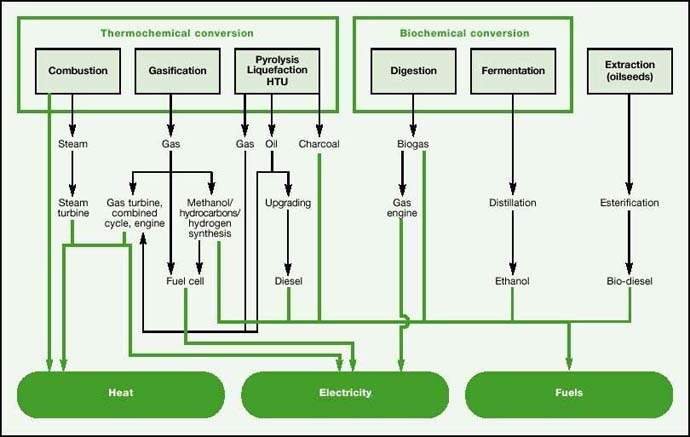
FIGURE 7.1. MAIN BIOMASS ENERGY
CONVERSION ROUTES
The potential of biomass energy
The resource potential of biomass energy is much larger than
current world energy consumption (chapter 5). But given the low conversion
efficiency of solar to biomass energy (less than 1 percent), large areas are
needed to produce modern energy carriers in substantial amounts (box 7.1). With
agriculture modernised up to reasonable standards in various regions, and given
the need to preserve and improve the world’s natural areas, 700 - 1,400
million hectares may be available for biomass energy production well into the
21st century (Hall and others, 1993; Larson and others, 1995; Ishitani and
others, 1996; IIASA and WEC, 1998; Larson, Williams, and Johansson, 1999). This
includes degraded, unproductive lands and excess agricultural lands. The
availability of land for energy plantations strongly depends on the food
supplies needed and on the possibilities for intensifying agricultural
production in a sustainable way.
A number of studies have assessed the potential contribution of
biomass to the world energy supply (table 7.2). Although the percentage
contribution of biomass varies considerably, especially depending on expected
land availability and future energy demand, the absolute potential contribution
of biomass in the long term is high - from 100 - 300 exajoules a year.
World-wide annual primary energy consumption is now about 400
exajoules.
Biomass energy conversion technologies
Conversion routes to produce heat, electricity, and/or fuels
from biomass are plentiful (figure 7.1).
Production of heat. In developing countries the
development and introduction of improved stoves for cooking and heating can have
a big impact on biomass use (chapters 3 and 10). Especially in colder climates
(Scandinavia, Austria, Germany) domestic biomass-fired heating systems are
widespread. Improved heating systems are automated, have catalytic gas cleaning,
and use standard fuel (such as pellets). The benefit over open fireplaces is
considerable, with advanced domestic heaters obtaining efficiencies of more than
70 percent and producing far fewer atmospheric emissions. The present heat-
generating capacity is estimated to be more than 200 gigawatts of thermal
energy.
Production of electricity. Some features of the main
thermochemcial biomass energy conversion routes to electricity and combined heat
and power (CHP) are presented in table 7.3. Combustion of biomass to produce
electricity is applied commercially in many regions, with the total installed
capacity estimated at 40 gigawatts of electricity. The application of fluid bed
combustion and advanced gas cleaning allows for efficient production of
electricity (and heat) from biomass. At a scale of 20 - 100 megawatts of
electricity, electrical efficiencies of 20 - 40 percent are possible (van den
Broek and others, 1996; Solantausta and others, 1996). Often the electricity is
produced along with heat or steam (CHP) in Denmark and Sweden. In Southeast
Asia, through the Association of Southeast Asian Nations - European Union COGEN
Programme, sawmill factories in Indonesia, Malaysia, and Thailand have
cogeneration systems, using wood-waste from the factories.
Co-combustion systems - combining, say, natural gas and coal
with biomass - are built in such places as Denmark with the benefits of greater
economies of scale and reduced fuel supply risks. Co-combustion of biomass in
coal-fired power plants is a popular way to increase biomass-based power
generation capacity with minimal investment (chapter 8). Other advantages over
coal-based power production are the higher efficiencies (due in most cases to
the large scale of the existing power plant) and lower sulphur dioxide
(SO2) and nitrogen oxide (NOx) emissions (Meuleman and
Faaij, 1999).
Large gasification. Gasification technologies can convert
biomass into fuel gas, cleaned before its combustion in, say, a gas turbine.
Biomass integrated gasification/combined cycle (BIG/CC) systems combine flexible
fuel characteristics and high electrical efficiency. Electrical conversion
efficiencies of 40 percent (LHV) are possible at a scale of about 30 megawatts
of electricity (Consonni and Larson, 1994a, b; Faaij and others, 1997).
Demonstration projects are under way in various countries and
for various gasification concepts. In Brazil a project supported by the World
Bank and Global Environment Facility will demonstrate a 30 megawatts-electric
BIG/CC unit fired with cultivated eucalyptus (Elliott and Booth, 1993).
Sweden’s first BIG/CC unit, based on pressurised gasification, has several
thousands of hours of operational experience. Three other demonstration units
around the 6 - 10 megawatts-electric scale are under way. An atmospheric BIG/CC
system is being commissioned in Yorkshire, United Kingdom. In the United States
an indirect gasification process is under demonstration at the Burlington power
station.
The first generation of BIG/CC systems shows high unit capital
costs. Depending on the scale, prices are $2,800 - 5,000 a kilowatt of
electricity. But cost reduction potential is considerable for BIG/CC systems -
capital costs might come down to $1,100 - 2,000 a kilowatt (Williams, 1996;
Solantausta and others, 1996; Faaij, Meuleman, and Van Ree, 1998).
Co-gasification of biomass, another option, is being applied in the United
States and Europe. An interesting alternative for fuel gas produced through
biomass gasification is its use in existing (or new) natural gas-fired combined
cycles. In this way, economies of scale come with a safe fuel supply (Walter and
others, 1998). This option has not been demonstrated yet, but more research is
under way.
Small gasification. Small (fixed bed) gasifiers coupled
to diesel or gasoline engines (typically for systems of 100 - 200 kilowatts of
electricity with an approximate electrical efficiency of 15 - 25 percent) are
commercially available on the market. But high costs and the need for gas
cleaning and careful operation have blocked application in large numbers. Some
systems are being applied fairly successfully in rural India and in China and
Indonesia (Kaltschmitt and others, 1998; Stassen, 1995).
Biogas production. Anaerobic digestion of biomass has
been demonstrated and applied commercially with success in many situations and
for a variety of feedstocks - such as organic domestic waste, organic industrial
wastes, manure, and sludges. Large advanced systems are developed for wet
industrial waste streams and applied in many countries. In India there is
widespread production of biogas from animal and other wastes for cooking,
lighting, and power generation (chapter 10).
TABLE 7.3. MAIN THERMOCHEMICAL BIOMASS ENERGY CONVERSION
ROUTES TO HEAT AND ELECTRICITY
|
Conversion system |
Range |
Net efficiency (percent, LHV) |
Investment cost (dollars a kilowatt of electricity)
|
|
Combustion |
|
|
|
|
Combined heat and power (CHP) |
100 kWe to 1 MWe |
60 - 90 (overall) |
|
|
1 - 10 MWe |
80 - 99 (overall) |
|
|
Standalone |
20 - 100 MWe |
20 - 40 (electrical) |
1,600 - 2,500 |
|
Co-combustion |
5 - 20 MWe |
30 - 40 (electrical) |
250 plus costs of existing power plant |
|
Gasification |
|
|
|
|
CHP |
|
|
900 - 3,000 (depending on location and configuration) |
|
|
Diesel |
100 kWe to 1 MWe |
15 - 25 (electrical) |
|
|
|
Gas turbine |
1 - 10 MWe |
25 - 30 (electrical) |
|
|
BIG/CC |
30 - 100 MWe |
40 - 55 (electrical) |
1,100 - 2,000 (when commercially proven) |
|
Digestion |
|
|
|
|
Wet biomass materials |
Up to several MWe |
10 - 15 (electrical) |
5,000 |
Digestion has a low overall electric conversion efficiency
(roughly 10 - 15 percent, depending on the feedstock) and is particularly suited
for wet biomass materials. Landfills contribute to atmospheric methane
emissions. In many situations the collection of landfill gas and its conversion
to electricity using gas engines is profitable, and such systems are becoming
more widespread (Faaij, Hekkert, and others, 1998).
Production of liquid and gaseous fuels from biomass (bio-oil
and biocrude). At temperatures around 500 degrees Celsius in the absence of
oxygen, pyrolysis converts biomass to liquid (bio-oil), gaseous, and solid
(charcoal) fractions. With flash pyrolysis techniques (fast pyrolysis) the
liquid fraction can be up to 70 percent of the thermal biomass input. Bio-oil
contains about 40 weight-percent of oxygen and is corrosive and acidic. The oil
can be upgraded to reduce the oxygen content, but that has economic and energy
penalties. Pyrolysis and upgrading technology are still largely in the pilot
phase (Bridgewater, 1998).
Hydrothermal upgrading (HTU), originally developed by Shell,
converts biomass at a high pressure and at moderate temperatures in water to
biocrude. Biocrude contains far less oxygen than bio-oil produced through
pyrolysis, but the process is still in a pre-pilot phase (Naber and others
1997).
Ethanol. Production of ethanol by fermenting sugars is a
classic conversion route for sugar cane, maize, and corn on a large scale,
especially in Brazil, France, and the United States. Zimbabwe also has a
considerable fuel ethanol programme using sugar cane (Hemstock and Hall, 1995).
The U.S. and European programmes convert surplus food crops to a useful(by)
product. But ethanol production from maize and corn is far from being
competitive with gasoline and diesel. Nor is the overall energy balance of such
systems very favourable.
An exception is Brazil’s PRO-ALCOOL programme, due to the
high productivity of sugar cane (Rosillo-Calle and Cortez, 1998). This programme
is discussed in some detail later in this chapter. In 1998 world production of
ethanol was estimated at 18 billion litres (equivalent to 420 petajoules).
Ethanol can also be produced by the hydrolysis of
lignocellulosic biomass, a potentially low-cost and efficient option. Hydrolysis
techniques are gaining more development attention, particularly in Sweden and
the United States, but some fundamental issues need to be resolved. If these
barriers are lowered and ethanol production is combined with efficient
electricity production from unconverted wood fractions (such as lignine),
ethanol costs could come close to current gasoline prices - as low as $0.12 a
litre at biomass costs of about $2 a gigajoule (Lynd, 1996). Overall system
conversion efficiency could go up to about 70 percent (LHV).
Esters from oilseeds. Oilseeds, such as rapeseed, can be
extracted and converted to esters and are well suited to replace diesel.
Substantial quantities of RME (rape methyl esters) are produced in the European
Union and to a lesser extent in North America. But RME requires substantial
subsidies to compete with diesel. Energy balances for RME systems are less
favourable than those for perennial crops (Ishitani and Johansson, 1996), so the
net energy production per hectare is low. These balances can be improved if
by-products (such as straw) are also used as an energy source.
|
Biomass has gained
considerable interest world-
wide. It
is carbon neutral
when produced
sustainably. |
Methanol, hydrogen, and hydrocarbons through
gasification. Production of methanol and hydrogen using gasification
technology and traditional syngas conversion processes could offer an attractive
conversion route for biomass over the long term. Although such concepts received
serious attention in the early 1980s, low oil prices made them unattractive. New
technology - such as liquid phase methanol production (combined with electricity
generation) and new gas separation technology - offers lower production costs
and higher overall conversion efficiencies. With large-scale conversion and the
production of both fuel and electricity, methanol and hydrogen from
lignocellulosic biomass might compete with gasoline and diesel (Spath and
others, 2000; Faaij and others, 1999). In addition, synthetic hydrocarbons and
methanol can be produced from syngas using Fischer-Tropsch synthesis (Larson and
Jin, 1999a,
b).
Environmental impacts of biomass energy systems
Biomass energy can be carbon neutral when all biomass produced
is used for energy (short carbon cycle). But sustained production on the same
surface of land can have considerable negative impacts on soil fertility, water
use, agrochemical use, biodiversity, and landscape. Furthermore, the collection
and transport of biomass increases the use of vehicles and infrastructure and
the emissions to the atmosphere (Tolbert, 1998; Borjesson, 1999; Faaij,
Meuleman, and others, 1998). Seen world-wide, climatic, soil, and socioeconomic
conditions set strongly variable demands for what biomass production will be
sustainable.
Erosion. Erosion is a problem related to the cultivation
of many annual crops in many regions. The best-suited energy crops are
perennials, with much better land cover than food crops. And during harvest, the
removal of soil can be kept to a minimum, since the roots remain in the soil.
Another positive effect is that the formation of an extensive root system adds
to the organic matter content of the soil. Generally, diseases (such as
eelworms) are prevented, and the soil structure is improved.
Water use. Increased water use caused by additional
demands of (new) vegetation can become a concern, particularly in arid and
semi-arid regions. The choice of crop can have a considerable effect on
water-use efficiency. Some eucalyptus species have a very good water-use
efficiency, considering the amount of water needed per tonne of biomass
produced. But a eucalyptus plantation on a large area could increase the local
demand for groundwater and affect its level. On the other hand, improved land
cover generally is good for water retention and microclimatic conditions. Thus
the impacts on the hydrological situation should be evaluated at the local
level.
Agrochemicals. Pesticides affect the quality of
groundwater and surface water and thus plants and animals. Specific effects
depend on the type of chemical, the quantity used, and the method of
application. Experience with perennial crops (willow, poplar, eucalyptus,
miscanthus) suggests that they meet strict environmental standards. Compared
with food crops like cereals, application rates of agrochemicals per hectare are
a fifth to a twentieth for perennial energy crops (Faaij, Meuleman, and others,
1998; Borjesson, 1999).
Nutrients. The abundant use of fertilisers and manure in
agriculture has led to considerable environmental problems in various regions:
nitrification of groundwater, saturation of soils with phosphate,
eutrophication, and unpotable water. Phosphates have also increased the heavy
metal flux of the soil. But energy farming with short rotation forestry and
perennial grasses requires less fertiliser than conventional agriculture
(Kaltschmitt and others, 1996). With perennials, better recycling of nutrients
is obtained. The leaching of nitrogen for willow cultivation can be a half to a
tenth that for food crops, meeting stringent standards for groundwater
protection. The use of plantation biomass will result in removal of nutrients
from the soil that have to be replenished in one way or the other. Recycling of
ashes is feasible for returning crucial trace elements and phosphates to the
soil, already common practice in Austria and Sweden. In Brazil stillage, a
nutrient rich remainder of sugar cane fermentation, is returned to sugar cane
plantations.
Biodiversity and landscape. Biomass plantations can be
criticised because the range of biological species they support is much narrower
than what natural forests support (Beyea and others, 1991). Although this is
generally true, it is not always relevant. It would be if a virgin forest is
replaced by a biomass plantation. But if plantations are established on degraded
lands or on excess agricultural lands, the restored lands are likely to support
a more diverse ecology.
Degraded lands are plentiful: estimates indicate that about 2
billion hectares of degraded land are ‘available’ in developing
countries (Larson, Williams, and Johansson, 1999; IIASA and WEC, 1998). It would
be desirable to restore such land surfaces anyway - for water retention, erosion
prevention, and (micro-) climate control. A good plantation design, including
areas set aside for native plants and animals fitting in the landscape in a
natural way, can avoid the problems normally associated with monocultures,
acknowledging that a plantation of energy crops does not always mean a
monoculture.
Other risks (fire, disease). Landscaping and managing
biomass production systems can considerably reduce the risks of fire and
disease. Thus they deserve more attention in coming projects, policies, and
research.
Conversion and end use. Conversion of biomass to desired
intermediate energy carriers and their use for energy services should meet
strict environmental standards as well. Problems that could occur (such as
emissions to air) can be easily countered with technology that is well
understood and available. Clean combustion of biomass is now common practice in
Scandinavia. Gasification allows for cleaning fuel gas prior to combustion or
further processing. Care should be paid to small (less than 1 megawatts of
thermal energy) conversion systems: technology to meet strict emission standards
is available but can have a serious impact on the investment and operational
costs of such small systems (Kaltschmitt and others, 1998; Stassen,
1995).
Economics of biomass energy systems
Biomass is a profitable alternative mainly when cheap or even
negative-cost biomass residues or wastes are available. To make biomass
competitive with fossil fuels, the production of biomass, the conversion
technologies, and total bio-energy systems require further optimisation.
TABLE 7.4. MAIN PERFORMANCE DATA FOR SOME CONVERSION ROUTES
OF BIOMASS TO FUELS
|
RME |
Ethanol from sugar or starch crops |
Ethanol from lignocellulosic biomass |
Hydrogen from lignocellulosic biomass |
Methanol from lignocellulosic biomass |
Bio-oil from lignocellulosic biomass |
|
Concept |
Extraction and esterification |
Fermentation |
Hydrolysis, fermentation, and electricity production |
Gasification |
Gasification |
Flash pyrolysis |
|
Net energy efficiency of conversion |
75 percent based onallenergy inputs |
50 percent for sugar beet;
44 percent for sugar cane |
60 - 70 percent (longer term with power generation included)
|
55 - 65 percent
60 - 70 percent (longer term) |
50 - 60 percent
60 - 70 percent (longer term) |
70 percent
(raw bio-oil) |
|
Cost range, short terma |
$15 - 25 a gigajoule (northwest Europe) |
$15 - 25 a gigajoule for sugar beet;
$8 - 10 a gigajoule for
sugar cane |
$10 - 15 a gigajoule |
$8 - 10 a gigajoule |
$11 - 13 a gigajoule |
n.a. |
|
Cost range, long terma |
n.a. |
n.a. |
$6 - 7 a gigajoule |
$6 - 8 a gigajoule |
$7 - 10 a gigajoule |
Unclear |
a. Diesel and gasoline production costs vary widely
depending on the oil price. Longer - term projections give estimates of roughly
$0.25 - 0.35 a litre, or $8 - 11 a gigajoule. Retail fuel transport prices are
usually dominated by taxes of $0.50 - 1.30 a litre depending on the country.
Source: Wyman and others, 1993; IEA, 1994; Williams and
others, 1995; Jager and others, 1998; Faaij, Hamelinck, and Agterberg,
forthcoming.
Biomass production. Plantation biomass costs already are
favourable in some developing countries. Eucalyptus plantations in northeast
Brazil supply wood chips at prices between $1.5 - 2.0 a gigajoule (Carpentieri
and others, 1993). Costs are (much) higher in indus-trialised countries, such as
$4 a gigajoule in parts of northwest Europe (Rijk, 1994; van den Broek and
others, 1997). But by about 2020, with improved crops and production systems,
biomass production costs in the United States could be about $1.5 - 2.0 a
gigajoule for substantial land surfaces (Graham and others, 1995; Turnure and
others, 1995; Hughes and Wiltsee, 1995). It is expected for large areas in the
world that low-cost biomass can be produced in large quantities. Its
competitiveness will depend on the prices of coal (and natural gas), but also on
the costs and net returns from alternative, competing uses of productive land.
Power generation from biomass. With biomass prices of
about $2 a gigajoule, state of the art combustion technology at a scale of 40 -
60 megawatts of electricity can result in electricity production costs of $0.05
- 0.06 a kilowatt-hour (USDOE, 1998b; Solantausta and others, 1996).
Co-combustion, particularly at efficient coal-fired power plants, can obtain
similar costs. If BIG/CC technology becomes available commercially, production
costs could drop further to about $0.04 a kilowatt-hour, especially with higher
electrical efficiencies. For larger scales (more than 100 megawatts of
electricity) it is expected that cultivated biomass will compete with fossil
fuels in many situations. The benefitsoflower specific capital costs and
increased efficiency certainly outweigh the increase in costs and energy use for
transport for considerable distances if a reasonably well-developed
infrastructure is in place (Marrison and Larson, 1995a, b; Faaij, Hamelinck, and
Agterberg, forthcoming).
Decentralised power (and heat) production is generally more
expensive and therefore is better suited for off-grid applications. The costs of
gasifier/diesel systems are still unclear and depend on what emissions and fuel
quality are considered acceptable. Combined heat and power generation is
generally economically attractive when heat is required with a high load factor.
Production of liquid and gaseous fuels from biomass. The
economies of ‘traditional’ fuels like RME and ethanol from starch and
sugar cropsin moderate climate zones are poor and unlikely to reach competitive
price levels. Methanol, hydrogen, and ethanol from lig-nocellulosic biomass
offer better potential in the longer term (table
7.4).
Implementation issues
Modern use of biomass is important in the energy systems of a
number of countries (table 7.5). Other countries can be mentioned as well - as
in Asia, where biomass, mainly traditional biomass, can account for 50 - 90
percent of total energy. India has installed more than 2.9 million biomass
digesters in villages and produces biogas for cooking - and is using small
gasifier diesel systems for rural electrification. Biomass power projects with
an aggregate capacity of 222 megawatts have been commissioned in India, with
another 280 megawatts under construction (MNCES, 1999). And with tens of
millions of hectares of degraded soil, India is involved in wood-for-energy
production schemes. Throughout Southeast Asia the interest in modern bio-energy
applications has increased in recent years, partly because of the fast-growing
demand for power and because biomass residues from various agricultural
production systems are plentiful (box 7.2; Lefevre and others, 1997).
TABLE 7.5. BIOMASS IN THE ENERGY SYSTEMS OF SELECTED
COUNTRIES
|
Country |
Role of biomass in the energy system |
|
Austria |
Modern biomass accounts for 11 percent of the national energy
supply. Forest residues are used for (district) heating, largely in systems of a
relatively small scale. |
|
Brazil |
Biomass accounts for about a third of the energy supply. Main
modern applications are ethanol for vehicles produced from sugar cane (13 - 14
billion litres a year) and substantial use of charcoal in steel industry.
Government supports ethanol. PRO-ALCOOL is moving towards a rationalisation
programme to increase efficiency and lower costs. |
|
Denmark |
A programme is under way to use 1.2 million tonnes of straw as
well as use forest residues. Various concepts have been devised for co-firing
biomass in larger-scale combined heating and power plants, district heating, and
digestion of biomass residues. |
|
Finland |
Twenty percent of its primary energy demand comes from modern
biomass. The pulp and paper industry makes a large contribution through
efficient residue and black liquor use for energy production. The government
supports biomass; a doubling of the contribution is possible with available
resources. |
|
Sweden |
Modern biomass accounts for 17 percent of national energy
demand. Use of residues in the pulp and paper industry and district heating
(CHP) and use of wood for space heating are dominant. Biomass is projected to
contribute 40 percent to the national energy supply in 2020. |
|
United States |
About 10,700 megawatts-electric biomass-fired capacity was
installed by 1998; largely forest residues. Four billion litres per year of
ethanol are produced. |
|
Zimbabwe |
Forty million litres of ethanol are produced a year. Biomass
satisfies about 75 percent of national energy demand. |
Source: Kaltschmitt and others, 1998;
Rosillo-Calle and others, 1996; Rosillo and Cortez, 1998; NUTEK, 1996; USDOE,
1998a; Hemstock and Hall, 1995.
Barriers. Bio-energy use varies remarkably among
countries. Varying resource potentials and population densities are not the only
reasons. Other barriers hamper implementation:
· Uncompetitive
costs. The main barrier is that the energy carriers are not competitive
unless cheap or negative cost biomass wastes and residues are used. Technology
development could reduce the costs of bio-energy. In Denmark and Sweden, where
carbon and energy taxes have been introduced, more expensive wood fuels and
straw are now used on a large scale. But world-wide, the commercial production
of energy crops is almost non-existent. (Brazil is a major exception, having
introduced subsidies to make ethanol from sugar cane competitive with gasoline.)
· The need for efficient,
cheap, environmentally sound energy conversion technologies. Strongly
related to costs issues are the availability and the full-scale demonstration of
advanced conversion technology, combining a high energy conversion efficiency
and environmentally sound performance with low investment costs. Biomass
integrated gasifier/combined cycle (BIG/CC) technology can attain higher
conversion efficiency at lower costs. Further development of gasification
technologies is also important for a cheaper production of methanol and hydrogen
from biomass.
· Required development of
dedicated fuel supply systems. Experience with dedicated fuel supply systems
based on ‘new’ energy crops, such as perennial grasses, is very
limited. Higher yields, greater pest resistance, better management techniques,
reduced inputs, and further development of machinery are all needed to lower
costs and raise productivity. The same is true for harvesting, storage, and
logistics.
· Specific biomass
characteristics. The solar energy conversion efficiencyof biomass production
is low - in practice less than 1 percent. So, fairly large land surfaces are
required to produce a substantially amount of energy. Moreover, biomass has a
low energy density. Compare coal’s energy density of 28 gigajoules a tonne,
mineral oil’s 42 gigajoules a tonne, and liquefied natural gas’s 52
gigajoules a tonne with biomass’s 8 gigajoules a tonne of wood (at 50
percent moisture content). Transport is thus an essential element of biomass
energy systems, and transportation distances can become a limiting factor.
Another complication is that biomass production is usually bound to seasons,
challenging the supply and logistics of a total system. And varying weather
conditions affect production year-to-year.
· Socioeconomic and
organisational barriers. The production of crops based on perennial grasses
or short rotation forestry differs substantially from that of conventional food
crops. Annual crops provide farmers with a constant cash flow for each hectare
of land. For short rotation coppice, however, the intervals between harvests can
be 2 - 10 years, restricting the flexibility of farmers to shift from one crop
to another. In addition, bio-energy systems require complex organisations and
many actors, creating non-technical barriers.
· Public acceptability.
Since biomass energy systems require substantial land areas if they are to
contribute much to the total energy supply, the needed changes in land-use,
crops, and landscape might incite public resistance. And to be acceptable to
most people, the ecological impacts of biomass production systems have to be
minimal. Increased traffic in biomass production areas might also be seen as a
negative.
· Ecological aspects. Not
much is known about the effects of large-scale energy farming on landscapes and
biodiversity. Energy crop plantations have to fit into the landscape both
ecologically and aesthetically. And in addition to minimising the environmental
impact, attention should be paid to fitting biomass production into existing
agricultural systems.
· Competition for land use.
Competition for land or various land claims may turn out to be a limitation
in various regions. Opinions differ on how much (agricultural) land will become
available for energy crops (Dyson, 1996; Brown and others, 1996; Gardner, 1996).
An accepted principle is that biomass production for energy should not conflict
with food production. But given the large potential to increase the productivity
of conventional agriculture (Luyten, 1995; WRR, 1992; Larson, Williams, and
Johansson, 1999), land’s availability is not necessarily a barrier. If
conventional agriculture has higher productivity, it will become more profitable
- so bio-energy will face even stiffer competition from conventional crops than
it does today.
|
BOX 7.2. INDUSTRIAL USES OF BIO-ENERGY
Two large industrial sectors offer excellent opportunities to
use biomass resources efficiently and competitively world-wide: paper and pulp,
and sugar (particularly using sugar cane as feed). Traditionally, these sectors
use biomass residues (wood waste and bagasse) for their internal energy needs,
usually inefficient conversions to low-pressure steam and some power. The
absence of regulations to ensure reasonable electricity tariffs for independent
power producers make it unattractive for industries to invest in more efficient
power generation. But the liberalisation of energy markets in many countries is
removing this barrier, opening a window to reduce production costs and modernise
production capacity.
Efficient boilers have been installed in many production
facilities. Gasification technology could offer even further efficiency gains
and lower costs - say, when applied for converting black liquor (Larson and
others, 1998). The power generated is generally competitive with grid prices. In
Nicaragua electricity production from bagasse using improved boilers could meet
the national demand for electricity (van den Broek and van Wijk, 1998). |
|
Some 700-1,400
million hectares may be
available for
biomass energy
production well into
the 21st century. |
Strategies. Six areas are essential for successful
development and implementation of sustainable and economically competitive
bio-energy systems: technologies, production, markets, polygeneration,
externalities, and policy.
Technological development and demonstration of key conversion
technologies. Research, demonstration, and commercialisation of advanced
power generation technology are essential - especially for BIG/CC technology,
which can offer high conversion efficiencies, low emissions, and low costs.
Another interesting route is producing modern biofuels, using hydrolysis and
gasification. Combining biomass with fossil fuels can be an excellent way to
achieve economies of scale and reduce the risks of supply disruptions.
More experience with and improvement of biomass production.
Local assessments are needed to identify optimal biomass production systems,
and more practical experience is needed with a wide variety of systems and
crops. Certainly, more research and testing are needed to monitor the impact of
energy crops, with particular attention to water use, pest abatement, nutrient
leaching, soil quality, biodiversity (on various levels), and proper
landscaping. Perennial crops (grasses) and short rotation coppice (eucalyptus,
willow) can be applied with minimal ecological impacts.
Cost reduction is essential, though several countries already
obtain biomass production costs below $2 a gigajoule. Larger plantations,
improved species, and better production systems and equipment can reduce costs
further. Another promising way to lower costs is to combine biomass production
for energy with other (agricultural or forest) products (multi-output production
systems). Yet another is to seek other benefits from biomass production -
preventing erosion, removing soil contaminants, and creating recreational and
buffer zones.
Creating markets for biomass production, trade, and use.
At local and regional scales, the starting phase of getting bio-energy
‘off the ground’ can be difficult. The supply and demand for biomass
need to be matched over prolonged periods. Diversifying biomass supplies can be
a key in creating a better biomass market. Flexible conversion capacity to deal
with different biomass streams, as well as fossil fuels, is also important. And
international trade in bio-energy can buffer supply fluctuations.
Production can also be started in niches. Major examples are the
modernisation of power generation in the sugar, in paper and pulp, and in
(organic) waste treatment. Regulations - such as acceptable payback tariffs for
independent power producers - are essential. Niche markets can also be found for
modern biofuels, such as high-value fuel additives, as mixes with gasoline, or
for specific parts of a local transport fleet (such as buses). Successful
biomass markets are working in Scandinavian countries and in Brazil (boxes 7.3
and 7.4).
Polygeneration of products and energy carriers. To
compete with coal (chapter 8), biomass energy may have to follow a
polygeneration strategy - coproducing electricity, fuels, fibres, and food from
biomass. One example would be the generation of electricity by a BIG/CC plant as
well as any fluid that can be produced from the syngas: methanol, dimethyl ether
(DME), other liquids using Fischer-Tropps synthesis (Larson and Jin, 1999a;
Faaij and others, 1999). Another could combine biomass and fossil fuels to
coproduce modern energy carriers (Oonk and others, 1997).
|
BOX 7.3. BRAZIL’S NATIONAL ALCOHOL PROGRAMME
PRO-ALCOOL in Brazil is the largest programme of commercial
biomass utilisation in the world. Despite economic difficulties during some of
its 25 years of operation, it presents several environmental benefits, reduces
import expenditures, and creates jobs in rural areas.
Roughly 700,000 rural jobs in sugar-alcohol are distributed
among 350 private industrial units and 50,000 private sugarcane growers.
Moreover, the cost of creating a job in sugar-alcohol is much lower than in
other industries. But mechanical harvesting could change this.
Despite a small reduction in harvested surface, Brazilian
sugar-cane production has shown a continuous increase, reaching 313 million
tonnes in the 1998/99 season. Alcohol consumption has been steady, even though
almost no new hydrated ethanol powered automobiles are being produced. The
decline in consumption from the partial age retirement of this fleet has been
balanced by significant growth in the number of automobiles using a blend of 26
percent anhydrous ethanol in gasoline.
Subsidies were reduced in recent years in the southeast of
Brazil, where 80 percent of the ethanol is produced, and then fully removed
early in 1999. Some government actions - compulsory increases in the amount of
ethanol blended in gasoline and special financial conditions for acquisition of
new hydrated ethanol powered cars - have favoured producers. Very recently the
alcohol price at the pump stations was reduced, triggering the interest of
consumers and carmakers in hydrated ethanol cars. Other government policies may
include tax reductions on new alcohol cars, ‘green’ fleets, and mixing
alcohol-diesel for diesel motors.
Another promising option is the implementation of a large
cogeneration programme for sugar and alcohol. Revenues from electricity sales
could allow further reductions in the cost of alcohol production, although it is
not yet enough to make it competitive with gasoline in a free market. Even so,
production costs continue to come down from learning by doing.
The programme has positive environmental and economic impacts.
In 1999 it resulted in an emission reduction of almost 13 mega-tonnes of carbon.
And the hard currency saved by not importing oil totals $40 billion over the 25
years since alcohol’s introduction. |
|
BOX 7.4. BIOMASS USE IN SWEDEN
Sweden is probably the world leader in creating a working
biomass market. Its use of biomass for energy purposes - domestic heating with
advanced heating systems, district heating, and combined heat and power
generation - has increased 4 - 5-fold in the past 10 years. And the average
costs of biomass have come down considerably. Swedish forests have met this
growing demand with ease.
The growing contribution of biomass has been combined with a big
increase in the number of companies supplying wood and wood products and in the
number of parties using biomass. As a result competition has led to lower
prices, combined with innovation and more efficient biomass supply systems.
Some 14,000 hectares in short rotation willow plantations have
been established. Sweden also imports some biomass, which make up only a small
part of the total supply but keep prices low.
Sweden plans to increase the 20 percent share of biomass in the
total primary energy supply to 40 percent in 2020, largely by extending and
improving the use of residues from production forests and wood processing
industries (NUTEK, 1996). |
Internalising external costs and benefits. Bio-energy can
offer benefits over fossil fuels that do not show up in its cost - that is, it
can offer externalities. Being carbon-neutral is one. Another is the very low
sulphur content. A third is that biomass is available in most countries, while
fossil fuels often need to be imported. The domestic production of bio-energy
also brings macro-economic and employment benefits (Faaij, Meuleman, and others,
1998). It can offer large numbers of unskilled jobs (van den Broek and van Wijk,
1998). It has fewer external costs than (imported) coal and oil (Borjesson,
1999; Faaij, Meuleman, and others, 1998).
Policies. Carbon taxes, price supports, and long-running
research and development (R&D) programmes are often central in gaining
experience, building infrastructure developing technology, and fostering the
national market. Scandinavia and Brazil - and to a somewhat less extent
northwest Europe and the United States - show that modernisation is essential
for realising the promise of biomass as an alternative energy source
(Ravindranath and Hall, 1995). It may even help in phasing out agricultural
subsidies.
Conclusion
· Biomass can make a
large contribution to the future world’s energy supply. Land for biomass
production should not be a bottleneck, if the modernisation of conventional
agricultural production continues. Recent evaluations indicate that if land
surfaces of 400 - 700 million hectares were used for biomass energy production
halfway into the 21st century, there could be no conflicts with other land-use
functions and the preservation of nature.
· Bio-energy’s current
contribution of 45 ± 10 exajoules a year - of which probably 16 ± 6
exajoules a year is commercial - could increase to 100 - 300 exajoules a year in
the 21st century.
· The primary use of biomass for
modern production of energy carriers accounts for about 7 exajoules a year.
Modern biomass energy production can play an important role in rural
development.
· Although developing countries
are the main consumers of biomass, the potential, production, and use of biomass
in these countries are often poorly quantified and documented.
· Biomass can be used for energy
production in many forms. The resource use, the technologies applied, and the
set-up of systems will depend on local conditions, both physical and
socioeconomic. Perennial crops offer cheap and productive biomass production,
with low or even positive environmental impacts.
· Production costs of biomass
can be $1.5 - 2 a gigajoule in many regions. Genetic improvement and optimised
production systems - and multi-output production systems, cascading biomass, and
multifunctional land use - could bring bio-mass close to the (expected) costs of
coal.
· A key issue for bio-energy is
mod-ernising it to fit sustainable development. Conversion of biomass to modern
energy carriers (electricity, fuels) gives biomass commercial value that can
provide income and development for local (rural) economies.
· Modernised biomass use can be
a full-scale player in the portfolio of energy options for the longer term. The
production of electricity and fuels from lignocellulosic biomass are promising
options. But they require the development of markets, infrastructure, key
conversion technologies (BIG/CC), and advanced fuel production systems.
· Flexible energy systems
combining biomass and fossil fuels are likely to become the backbone for
low-risk, low-cost energy supply systems.
|
An accepted principle
is that biomass production
for
energy should not
conflict with food
production. |
Wind energy
Wind energy, in common with other renewable energy sources, is
broadly available but diffuse. The global wind resource has been described in
chapter 5. Wind energy was widely used as a source of power before the
industrial revolution, but later displaced by fossil fuel use because of
differences in costs and reliability. The oil crises of the 1970s, however,
triggered renewed interest in wind energy technology for grid-connected
electricity production, water pumping, and power supply in remote areas (WEC,
1994b).
In recent decades enormous progress has been made in the
development of wind turbines for electricity production. Around 1980 the first
modern grid-connected wind turbines were installed. In 1990 about 2,000
megawatts of grid-connected wind power was in operation world-wide - at the
beginning of 2000, about 13,500 megawatts. In addition, more than 1 million
water-pumping wind turbines (wind pumps), manufactured in many developing
countries, supply water for livestock, mainly in remote areas. And tens of
thousands of small battery-charging wind generators are operated in China,
Mongolia, and Central Asia (chapter
10).
The potential of wind energy
The technical potential of onshore wind energy to fulfil energy
needs is very large - 20,000 - 50,000 terawatt-hours a year (chapter 5). The
economic potential of wind energy depends on the economics of wind turbine
systems and of alternative options. Apart from investment costs, the most
important parameter determining the economics of a wind turbine system is annual
energy output, in turn determined by such parameters as average wind speed,
statistical wind speed distribution, turbulence intensities, and roughness of
the surrounding terrain. The power in wind is proportional to the third power of
the momentary wind speed.
Because of the sensitivity to wind speed, determining the
potential of wind energy at a specific site is not straightforward. More
accurate meteorological measurements and wind energy maps and handbooks are
being produced and (mostly) published, enabling wind project developers to
better assess the long-term economic performance of their projects.
In densely populated countries the best sites on land are
occupied, and public resistance makes it difficult to realise new projects at
acceptable cost. That is why Denmark and the Netherlands are developing offshore
projects, despite less favourable economics. Sweden and the United Kingdom are
developing offshore projects to preserve the landscape.
Resources offshore are much larger than those onshore, but to be
interesting they have to be close to electric infrastructure. A comprehensive
study by Germanische Lloyd and Garrad Hassan & Partners (Matthies and
others, 1995) concluded that around 3,000 terawatt-hours a year of electricity
could be generated in the coastal areas of the European Union (excluding Finland
and Sweden). With electricity consumption in those 12 countries at about 2,000
terawatt-hours a year, offshore options should be included in assessments of the
potential of wind
electricity.
Development of installed wind power
In 1997 the installed wind power was about 7,400 megawatts, in
1998 close to 10,000 megawatts, and in 1999 another annual 3,600 megawatts was
installed (BTM Consult, 1999 and 2000). Between 1994 and 1999 the annual growth
of installed operating capacity varied between 27 and 33 percent. The
electricity generated by wind turbines can be estimated at 18 terawatt-hours in
1998 and 24 terawatt-hours in 1999.
There are 29 countries that have active wind energy programmes.
Most of the capacity added in 1998 (2,048 megawatts) was in four countries: for
Germany 793 megawatts, for the United States 577 megawatts, for Spain 368
megawatts, and for Denmark 310 megawatts (table 7.6).
Based on an analysis of the national energy policies for the
most relevant countries, BMT Consult expects the global installed power to grow
to around 30,000 megawatts of electricity in 2004.
Several generic scenarios assess the growth of wind power in the
coming decades. One of the most interesting - by BTM Consult for the FORUM for
Energy & Development, presented at the COP-4 of the UN-FCCC in Buenos Aires
in December 1998 - addresses three questions. Can wind power contribute 10
percent of the world’s electricity needs within three decades? How long
will it take to achieve this? How will wind power be distributed over the world?
Two scenarios were developed. The recent trends scenario
extrapolates current market development, while the international agreements
scenario assumes that international agreements are realised. Both scenarios
assumed that integrating up to 20 percent of wind power in the grid (in energy
terms) would not be a problem with present grids, modern fossil fuel power
plants, and modern wind turbines. Analysis of the world’s exploitable wind
resources, with growth of electricity demand as indicated in the World Energy
Outlook (IEA, 1995 and 1996), led to the following conclusions:
· Under the recent
trends scenario - starting with 20,000 megawatts by the end of 2002 and assuming
a 15 percent cost reduction, and later 12 percent and 10 percent, for each
doubling of the accumulated number of installations - 10 percent penetration
is achieved around 2025, and saturation in 2030 - 35, at about 1.1
terawatt. In this scenario the cost of generating wind electricity would come
down to $0.032 a kilowatt-hour (1998 level) on average, ± 15 percent
(depending on wind speed, connection costs to the grid, and other
considerations).
· Under the international
agreements scenario - with the same starting conditions but a slightly different
learning curve - growth is faster and 10 percent penetration is achieved around
2016, with saturation in 2030 - 35 at about 1.9 terawatts. In this scenario the
cost would come down to $0.027 a kilowatt-hour on average, again ± 15
percent.
TABLE 7.6. INSTALLED WIND POWER, 1997 AND 1998
|
Installed megawatts 1997 |
Cumulative megawatts 1997 |
Installed megawatts 1998 |
Cumulative megawatts 1998 |
|
Canada |
4 |
26 |
57 |
83 |
|
Mexico |
0 |
2 |
0 |
2 |
|
United States |
29 |
1.611 |
577 |
2.141 |
|
Latin America |
10 |
42 |
24 |
66 |
|
Total Americas |
43 |
1.681 |
658 |
2.292 |
|
Denmark |
285 |
1.116 |
310 |
1.420 |
|
Finland |
5 |
12 |
6 |
18 |
|
France |
8 |
13 |
8 |
21 |
|
Germany |
533 |
2.081 |
793 |
2.874 |
|
Greece |
0 |
29 |
26 |
55 |
|
Ireland |
42 |
53 |
11 |
64 |
|
Italy |
33 |
103 |
94 |
197 |
|
Netherlands |
44 |
329 |
50 |
379 |
|
Portugal |
20 |
39 |
13 |
51 |
|
Spain |
262 |
512 |
368 |
880 |
|
Sweden |
19 |
122 |
54 |
176 |
|
United Kingdom |
55 |
328 |
10 |
338 |
|
Other Europe |
13 |
57 |
23 |
80 |
|
Total Europe |
1.318 |
4.793 |
1.766 |
6.553 |
|
China |
67 |
146 |
54 |
200 |
|
India |
65 |
940 |
52 |
992 |
|
Other Asia |
9 |
22 |
11 |
33 |
|
Total Asia |
141 |
1.108 |
117 |
1.224 |
|
Australia and New Zealand |
2 |
8 |
26 |
34 |
|
Pacific Islands |
0 |
3 |
0 |
3 |
|
North Africa (incl. Egypt) |
0 |
9 |
0 |
9 |
|
Middle East |
8 |
18 |
0 |
18 |
|
Former Soviet Union |
1 |
19 |
11 |
19 |
|
Total other continents and areas |
11 |
57 |
37 |
83 |
|
Annual installed capacity worldwide |
1.513 |
|
2.577 |
|
|
Cumulative capacity installed worldwide |
|
7.639 |
|
10.153 |
Note: The cumulative installed capacity by the end
of 1998 is not always equal to the 1997 data plus installed capacity during
1998, because of adjustments for decommissioned and dismantled capacity.
Source: BTM Consult, 1999.
In this second scenario, the regional distribution of wind power
is North America 23 percent, Latin America 6 percent, Europe (Eastern and
Western) 14 percent, Asia 23 percent, Pacific OECD 8 percent, North Africa 5
percent, former Soviet Union 16 percent, and rest of the world 5
percent.
Technology developments
Wind turbines become larger. From the beginning of the
modern wind energy technology era in the mid-1970s, there has been gradual
growth in the unit size of commercial machines. In the mid-1970s the typical
size of a wind turbine was 30 kilowatts of generating capacity, with a rotor
diameter of 10 metres. The largest units installed in 1998 had capacities of
1,650 kilowatts with rotor diameters of 66 metres. By 1999, 460 units with a
generating capacity of 1 megawatt or more were installed world-wide. Turbines
with an installed power of 2 megawatts (70 metres diameter) are being introduced
in the market, and 3 - 5 megawatt machines are on the drawing board (table 7.7).
Market demands drive the trend towards larger machines:
economies of scale, less visual impacts on the landscape per unit of installed
power, and expectations that offshore potential will soon be developed. The
average size of wind turbines installed is expected to be 1,200 kilowatts before
2005 and 1,500 kilowatts thereafter. Note, however, that the optimum size of a
turbine - in cost, impact, and public acceptance - differs for onshore (nearby
as well as remote) and offshore applications.
Wind turbines become more controllable and
grid-compatible. The output of stall regulated wind turbines is hardly
controllable, apart from switching the machine on and off. Output varies with
the wind speed until reaching the rated wind speed value. As the application of
the aerodynamic stall phenomena to structural compliant machines gets more
difficult with bigger turbines, blade pitch control systems are being applied to
them. For structural dynamics and reliability, a blade-pitch system should be
combined with a variable speed electric conversion system. Such systems
typically incorporate synchronous generators combined with electronic AC-DC-AC
converters.
TABLE 7.7. AVERAGE SIZE OF INSTALLED WIND TURBINES, 1992 -
99
|
Year |
Size (kilowatts) |
|
1992 |
200 |
|
1994 |
300 |
|
1996 |
500 |
|
1998 |
600 |
|
1999 |
700 |
Modern electronic components have enabled designers to control
output - within the operational envelope of the wind speed - and produce
excellent power quality. These developments make wind turbines more suitable for
integration with the electricity infrastructure and ultimately for higher
penetration. These advantages are of particular interest for weak grids, often
in rural and remote areas that have a lot of wind.
Wind turbines will have fewer components. For lower costs
and greater reliability and maintainability, designers now seek technology with
fewer components - such as directly driven, slow-running generators, with
passive yaw and passive blade pitch control. In Germany 34 percent of the
installed power in 1998 (770 megawatts) was realised with this type of
technology.
Special offshore designs are on the drawing board. With
the first offshore wind farms in Europe, industrial designers are developing
dedicated turbine technologies for large wind farms in the open sea (Beurskens,
2000). Outages onshore can often be corrected quickly so that only a small
amount of energy is lost. But offshore the window for carrying out repairs or
replacing components is often limited. The high cost of complete installations
implies the use of large wind turbines, which will probably have installed
powers of 3 - 6 megawatts. Offshore design features will include novel
installation concepts, electricity conversion and transport systems, corrosion
protection, and integration with external conditions (both wind and wave
loading).
Time to market is becoming shorter than project preparation
time. Although there is a temporary shortage of supply of wind turbines in
some countries, competition among manufacturers is fierce. One way to become
more competitive is to keep implementing innovations and component improvements
to reduce cost. Times to market new products are also becoming short (two to
three years). As a result, just as the construction of a wind farm commences,
the technology is already
outdated.
System aspects
Wind turbines deliver energy, but little capacity.
Because wind energy is intermittent, wind turbines mainly deliver energy, but
little capacity value often 20 percent or less of the installed wind power. And
this percentage falls when the penetration of wind turbines increases, requiring
even more back-up power for a reliable energy supply. But wind-generated
electricity can be transformed from intermittent to baseload power if it is
combined with, say, compressed air energy storage. In this way a high capacity
factor can be achieved with a small economic penalty, potentially about $0.01 a
kilowatt-hour (Cavallo, 1995). This option becomes attractive when wind
electricity generation costs fall below $0.03 a kilowatt-hour. It also opens the
possibility of exploiting wind resources remote from markets, as in the Great
Plains of the United States (Cavallo, 1995) and in inner Mongolia and northwest
China (Lew and others, 1998).
Wind power becomes more predictable. Meteorological
research on predicting the output of wind farms a few hours in advance has
produced computer programs that optimise the operational and fuel costs of
regional electricity production parks (Denmark, Germany). This will increase the
capacity value of wind power and the value of the electricity produced.
Capacity factors are somewhat adjustable. Some general
misconceptions sometimes lead to the wrong decisions or conclusions. The
capacity factor (annual energy output/output based on full-time operation at
rated power) depends on local winds and wind turbines. By optimising the turbine
characteristics to the local wind regime, the capacity factor - now often 20 -
25 percent - can be optimised without losing too much energy output. But extreme
capacity factors - say, 40 percent - automatically means a large loss of
potential energy output.
Renewed interest in autonomous systems. In the mid-1980s
interest grew in the application of wind turbines in isolated areas without an
energy infrastructure. Two systems can be distinguished:
· Hybrid systems, in
which a wind turbine operates in parallel with, for example, a diesel set (to
save fuel consumption and to decrease maintenance and repairs) or a diesel
generator combined with a battery storage unit.
· Standalone units, for charging
batteries, pumping water for irrigation, domestic use, watering cattle, or
desalination and cooling.
More than 30 experimental hybrid systems have been developed and
tested, almost all stopped without a commercial follow up, because of unreliable
and expensive components. The interest in hybrid and standalone systems is being
revived - initiated by the search for new markets for renewable energy systems
and influenced by spectacular improvements in performance and cost for wind
turbines and power electronics (box 7.5 and chapter 10). For successful market
entry, systems have to be modular, and standards for components and subsystems
introduced.
Small battery-charging wind generators are manufactured by the
thousand in China, Mongolia, and elsewhere, making them more numerous than
larger diameter wind generators. Although their contribution to world energy
supply is negligible, their potential impact on the energy needs of rural and
nomadic families is significant (as with photovoltaic home
systems).
Environmental aspects
Environmental aspects come into play in the three phases of a
wind turbine project: building and manufacturing, normal operation during the
turbine’s lifetime, decommissioning
|
Industrial designers
are developing dedicated
turbine
technologies for
large wind farms in
the open sea. |
Building and manufacturing. No exotic materials or
manufacturing processes are required in producing a wind turbine or building the
civil works. The energy payback time of a large wind turbine, under typical
Danish conditions, is 3 to 4 months (Dannemand Andersen, 1998).
Normal operation. Negative environmental aspects
connected to the use of wind turbines are: acoustic noise emission, visual
impact on the landscape, impact on bird life, moving shadows caused by the
rotor, and electromagnetic interference with radio, television, and radar
signals. In practice the noise and visual impact cause the most problems.
Acoustic noise emission prevents designers from increasing the tip speed of
rotor blades, which would increase the rotational speed of the drive train shaft
and thus reduce the cost of gearboxes or generators. Aero-acoustic research has
provided design tools and blade configurations to make blades considerably more
silent, reducing the distance needed between wind turbines and houses.
The impact on bird life appears to be minor if the turbines are
properly located. A research project in the Netherlands showed that the bird
casualties from collisions with rotating rotor blades on a wind farm of 1,000
megawatts is a very small fraction of those from hunting, high voltage lines,
and vehicle traffic (Winkelman, 1992). In addition, acoustic devices might help
prevent birds from flying into rotor blades (Davis, 1995).
During normal operation a wind turbine causes no emissions, so
the potential to reduce carbon dioxide emissions depends on the fuel mix of the
fossil-fuelled plants the wind turbine is working with. A study by BTM Consult
(1999) indicates that in 2025 wind energy could prevent the emission of 1.4 -
2.5 gigatonnes of carbon dioxide a year.
Decommissioning. Because all components are conventional,
the recycling methods for decommissioning the wind turbine are also
conventional. Most blades are made from glass or carbon fibre reinforced
plastics, processed by incineration. To replace glass and carbon and close the
cycle of material use, wood composites are being applied and biofibres
developed.
|
BOX 7.5. HYBRID WIND, BATTERY, AND DIESEL SYSTEMS IN
CHINA
Since 1994 the 360 inhabitants of the village of Bayinaobao in
Inner Mongolia have been provided with electricity from a hybrid electricity
system that employs two 5-kilowatt wind turbines, a battery storage unit, and a
diesel generator. In this system the wind turbines provide about 80 percent of
the electricity generated. The technology is being developed under a
German-Chinese industrial joint venture aimed at transferring the
German-developed wind turbine and ancillary technologies. By the time 140
systems have been built, local content should account for about 70 percent of
the wind turbine technology, reducing the cost of an imported system by half.
Based on the performance of the first unit and the costs projected for
components, the electricity from the hybrid system will cost less (up to 22
percent less, at a diesel fuel price of $0.38 a litre) than from the
conventional diesel system (Weise and others, 1995). |
Economic aspects
The energy generation costs of wind turbines are basically
determined by five parameters:
· Turnkey project
cost. Initial investment costs (expressed in U.S. dollars a square metre of
swept rotor area), project preparation, and infrastructure make up the turnkey
project costs. The costs of European wind turbines are typically $410 a square
metre (machine cost, excluding foundation). Project preparation and
infrastructure costs depend heavily on local circumstances, such as soil
conditions, road conditions, and the availability of electrical substations.
Turnkey costs vary from $460 a square metre to $660 a square metre (with 1 ECU =
1.1 U.S. dollar).
· Energy output of the
system. The energy output of a wind turbine can be estimated by E =
b. V3 kilowatt-hours a square metre, where E is the annual
energy output, b is the performance factor, and V is the average wind
speed at hub height. The factor b depends on the system efficiency of the
wind turbine and the statistical distribution of wind speeds. In coastal
climates in Europe a value of 3.15 for b is representative for modern
wind turbines and not too far away from the theoretical maximum. On good
locations in Denmark, northern Germany, and the Netherlands annual outputs of
more than 1,000 kilowatt-hours a square metre are often achieved.
· Local average wind speed.
In general, local average wind speed should exceed five metres a second at a
height of 10 metres to allow economic exploitation of grid-connected wind
turbines. Availability of the system. The technical availability of
modern wind farms exceeds 96 percent.
· Lifetime of the system.
Design tools have improved so much that designing on the basis of fatigue
lifetime has become possible. As a result one can confidently use lifetimes of
15 - 20 years for economic calculations.
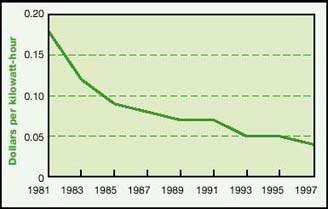
FIGURE 7.2. DEVELOPMENT OF WIND
ELECTRICITY GENERATION COSTS IN DENMARK, 1981 - 1997
Source: BTM Consult, 1999.
For Europe a state-of-the-art reference calculation uses the
following values:
|
Turnkey cost |
$600 a square metre |
|
Interest |
5 percent |
|
Economic lifetime |
15 years |
|
Technical availability |
95 percent |
|
Annual energy output |
3.15 V3 kilowatt-hours a square metre |
|
O & M costs |
$0.005 a kilowatt-hour |
If average wind speeds at the hub height range from 5.6 - 7.5
metres a second, the corresponding electricity production cost is $0.12 - 0.05 a
kilowatt-hour. Because the energy of the wind is proportional to the third power
of the wind speed, the economic calculations are very sensitive to the local
average annual wind speed.
Figure 7.2 illustrates the cost reductions for electricity
generation from wind turbines in Denmark since 1981. But take care in
translating these figures to other regions, for the cost of project preparation,
infrastructure, and civil works in Denmark is low relative to many other
regions. BTM Consult (1999) expects a 35 - 45 percent reduction in generation
costs in the next 15 - 20 years (figure
7.3).
Implementation issues
Manufacturers and project developers usually identify the
following items as serious barriers for efficient implementation of wind turbine
projects:
· Fluctuating demand
for wind turbines as a result of changing national policies and support schemes.
· Uncertainties leading to
financing costs as a result of changing governmental policies.
· Complicated, time-consuming,
and expensive institutional procedures, resulting from a lack of public
acceptance, which varies consid-erablyfrom country to country.
· Project preparation time often
longer than the ‘time to market’ of new wind turbine types.
· Lack of sufficient
international acceptance of certification procedures and standards.
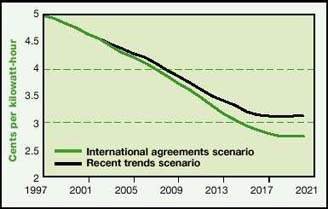
FIGURE 7.3. POTENTIAL COST
REDUCTIONS FOR WIND POWER, 1997 - 2020
Source: BTM Consult, 1999.
Denmark and the United States were the first to introduce an
integrated approach to wind energy, encompassing both technical development and
the introduction of market incentives. Now more than 25 countries use a great
variety of incentives, some very successful and some complete failures. The
applied incentive schemes can be grouped in three categories, or in combinations
of these categories:
· Fixed tariff
systems, such as those of Denmark, Germany, and Spain (favourable payback
tariffs are fixed for a period of, say, 10 years).
· Quota or concession systems,
such as the Non Fossil Fuel Obligation of England and the systems of France,
Ireland, and Scotland (competitive bidding for projects until a set amount of
electricity production is realised).
· Other systems to stimulate the
application of wind energy, such as tax breaks, carbon taxes, green electricity,
and tradable green labels.
With the first schemes, Denmark, Germany, and Spain installed
many more wind turbines than countries using other schemes. Elsewhere in Europe,
the second system has demonstrated success also (table 7.8). But none of the
schemes can be easily translated from one country to another. Legal
circumstances and public acceptance may differ completely. Moreover, several
incentives have been introduced only recently, and their effectiveness is not
yet known.
Under favourable legislation and general acceptance by the
public, a fixed tariff system may be quite successful, because it provides
financial security to project developers, owners, and financiers. In the long
term, however, fixed tariffs will become too expensive to subsidise if they are
not modified. As a result the industry might collapse unless the incentive
program brings the cost of the technology down. Quota systems based on calls for
tenders only once in two or three years may lead to extreme fluctuations in the
market growth. Concessions appear interesting for harnessing large, high-quality
wind resources in regions remote from major electricity markets (PCAST, 1999).
However, very large wind projects for remote wind resources require a different
industry structure from today’s. Needed are large project developers with
deep financial pockets - not wind turbine suppliers. The installation of wind
turbines can also increase if individuals, groups of individuals, or
cooperatives are allowed to own one or more wind turbines as small independent
power producers (IPPs) and to sell electricity to the grid.
It is too early to judge whether tradable green certificates,
connected to a quota system, are viable. Marketing green electricity seems to
developsuccessfully only when the public recognises green electricity as a
product different from regular electricity, worth the additional costs.
TABLE 7.8. TYPE OF INCENTIVE AND WIND POWER ADDED IN
1998
|
Type of incentive |
Country |
Megawatts added |
Percentage increase |
|
Fixed tariffs |
Denmark |
310 |
28 |
|
Germany |
793 |
38 |
|
Spain |
368 |
72 |
|
Total |
1,471 |
40 |
|
Quota or concession systems |
France |
8 |
62 |
|
Ireland |
11 |
21 |
|
United Kingdom |
10 |
3 |
|
Total |
29 |
7 |
Conclusion
· The potential of
wind energy is large, with the technical potential of generating electricity
onshore estimated at 20,000 - 50,000 terawatt-hours a year.
· When investigating the
potential, special attention should go to possibilities offshore. Studies for
Europe indicate that the offshore wind resources that can be tapped are bigger
than the total electricity demand in Europe.
· The average growth rate of the
cumulative capacity over the last six years has been about 30 percent a year,
bringing the cumulative installed wind turbine capacity to about 10,000
megawatts at the end of 1998 and about 13,500 megawatts at the end of 1999 - and
wind energy production to 18 terawatt-hours in 1998 and 24 terawatt-hours in
1999.
· Wind turbines are becoming
larger, with the average size installed in 1998 at 600 kilowatts, up from about
30 kilowatts in the mid-1970s. Turbines of megawatt size are being developed and
should soon be commercially available.
· Costs have to come down
further, requiring development of advanced flexible concepts and dedicated
offshore wind energy systems. Cost reductions up to 45 percent are feasible
within 15 years. Ultimately wind electricity costs might come down to about
$0.03 a kilowatt-hour.
· Although wind-generated
electricity is an intermittent resource, it can be transformed to baseload power
supply if combined with energy storage. For compressed air energy storage the
additional costs may be limited to about $0.01 a kilowatt-hour, opening the
possibility of exploiting good wind resources remote from markets.
· The environmental impacts of
wind turbines are limited, with noise and visibility causing the most problems,
increasing public resistance against the installation of new turbines in densely
populated countries.
· Interest in small turbines is
being revived for standalone and autonomous systems in rural
areas.
Photovoltaic solar energy
Photovoltaic solar energy conversion is the direct conversion of
sunlight into electricity. This can be done by flat plate and concentrator
systems.
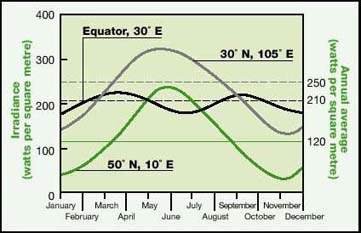
FIGURE 7.4. VARIATIONS IN AVERAGE
MONTHLY INSOLATION OVER THE YEAR IN THREE LOCATIONS
Source: Eliasson, 1998.
TABLE 7.9. POTENTIAL CONTRIBUTION OF SOLAR ENERGY
TECHNOLOGIES TO WORLD ENERGY CONSUMPTION ACCORDING TO DIFFERENT STUDIES
(EXAJOULES OF ELECTRICITY)
|
Study |
2020 - 2025 |
2050 |
2100 |
|
WEC, 1994 a,b |
16 |
|
|
|
IIASA and WEC, 1998 |
2 - 4 |
7 - 14 |
|
|
RIGES, 1993 (solar and wind) |
17 |
35 |
|
|
Shell, 1996 |
<10 |
200 |
|
|
Greenpeace and SEI, 1993(solar and wind) |
90 |
270 |
830 |
|
Reference: total world energy consumption |
400 - 600 |
400 - 1,200 |
|
An essential component of these systems is the solar cell, in
which the photovoltaic effect - the generation of free electrons using the
energy of light particles - takes place. These electrons are used to generate
electricity.
Characteristics of the source
Solar radiation is available at any location on the surface of
the Earth. The maximum irradiance (power density) of sunlight on Earth is about
1,000 watts a square metre, irrespective of location. It is common to describe
the solar source in terms of insolation - the energy available per unit of area
and per unit of time (such as kilowatt-hours per square metre a year). Measured
in a horizontal plane, annual insolation varies over the Earth’s surface by
a factor of 3 - from roughly 800 kilowatt-hours per square metre a year in
northern Scandinavia and Canada to a maximum of 2,500 kilowatt-hours per square
metre a year in some dry desert areas.
The differences in average monthly insolation (June to December)
can vary from 25 percent close to the equator to a factor of 10 in very northern
and southern areas (figure 7.4), determining the annual production pattern of
solar energy systems. The ratio of diffuse to total annual insolation can range
from 10 percent for bright sunny areas to 60 percent or more for areas with a
moderate climate, such as Western Europe. The actual ratio largely determines
the type of solar energy technology that can be used (non-concentrating or
concentrating).
The potential of photovoltaic solar energy
The average power density of solar radiation is 100 - 300 watts
a square metre. The net conversion efficiency of solar electric power systems
(sunlight to electricity) is typically 10 - 15 percent. So substantial areas are
required to capture and convert significant amounts of solar energy to fulfil
energy needs (especially in industrialised countries, relative to today’s
energy consumption). For instance, at a plant efficiency of 10 percent, an area
of 3 - 10 square kilometres is required to generate an average of 100 megawatts
of electricity - 0.9 terawatt-hours of electricity or 3.2 petajoules of
electricity a year - using a photovoltaic (or solar thermal electricity) system.
The total average power available at the Earth’s surface in
the form of solar radiation exceeds the total human power consumption by roughly
a factor of 1,500. Calculated per person, the average solar power available is 3
megawatts, while the consumption varies from 100 watts (least industrialised
countries) to 10 kilowatts (United States), with an average of 2 kilowatts.
Although these numbers provide a useful rough picture of the absolute boundaries
of the possibilities of solar energy, they have little significance for the
technical and economic potential. Because of differences in the solar energy
supply pattern, energy infrastructure, population density, geographic
conditions, and the like, a detailed analysis of the technical and economic
potential of solar energy is best made regionally or nationally. The global
potential is then the sum of these national or regional potentials.
The economic potential of solar energy, a matter of
debate, depends on the perspectives for cost reduction. In the recent past
several scenario studies have assessed the potential application of solar energy
technologies (IIASA and WEC, 1998; WEC, 1994a,b; Johansson and others, 1993a;
Shell, 1996; Greenpeace and SEI, 1993). They provide a picture of different
views on the potential penetration of solar energy in the 21st century (table
7.9).
The technical potential of photovoltaics has been studied
in some detail in several countries. In densely populated countries with a
well-developed infrastructure, there is an emphasis on applications of
grid-connected photovoltaic systems in the built environment (including
infrastructural objects like railways and roads). These systems are necessarily
small- or medium-sized, typically 1 kilowatt to 1 megawatt.1 The
electricity is generated physically close to the place where electricity is also
consumed. In less densely populated countries there is also considerable
interest in ‘ground-based’ systems, generally larger than 1 megawatt.
The area that would be required to generate an average electrical power equal to
the total present human power consumption - assuming 10 percent plant efficiency
and an insolation of 2,000 kilowatt-hours per square metre a year - is roughly
750 x 750 square kilometres. In countries or rural regions with a weak or
incomplete grid infrastructure, small standalone systems and modular electric
systems may be used for electrification of houses or village
communities.
Photovoltaic market developments
Between 1983 and 1999 photovoltaic shipments grew by just over
15 percent a year (figure 7.5). In 1998 around 150 megawatts of solar cell
modules were produced, in 1999 nearly 200 megawatts. In 1998 cumulative
production was around 800 megawatts. Probably about 500 megawatts, perhaps 600
megawatts, of this production was in operation in 1998, generating about 0.5
terawatt-hours a year. In 1993 - 98 operating capacity increased by roughly 30
percent a year.
In 1990 - 94 the market share of solar home systems and village
power systems was 20 percent (based on power volume). Grid-connected systems
accounted for 11 percent, with the rest for water pumping, communication,
leisure, consumer products, and the like (EPIA and Altener, 1996). In 1995 - 98
the relative importance of grid-connected systems increased to 23 percent
(Maycock,
1998).
Current status and future development of photovoltaic solar cells and modules
The major component of photovoltaic solar energy systems is the
solar module, normally a number of solar cells connected in series. The
efficiency of an ideal photovoltaic cell is about 30 percent at most (for a
single cell under natural sunlight). Higher efficiencies can be achieved by
stacking cells with different optical properties in a tandem device, by using
concentrator cells, or by combining these two. The efficiency of practical solar
cells is determined by several loss mechanisms. An overview of efficiencies
achieved through 1999 for different cells and modules is given in table 7.10.
Solar cells and their corresponding modules can be divided into
two main categories: wafer-type and thin-film. Wafer-type cells are made from
silicon wafers cut from a rod or ingot, or from silicon ribbons. Thin-film cells
are deposited directly onto a substrate (glass, stainless steel, plastic). For
flat-plate applications, the individual cells are connected in series to form a
module. Solar cells for concentrator systems are mounted in a one-dimensional or
two-dimensional optical concentrator.
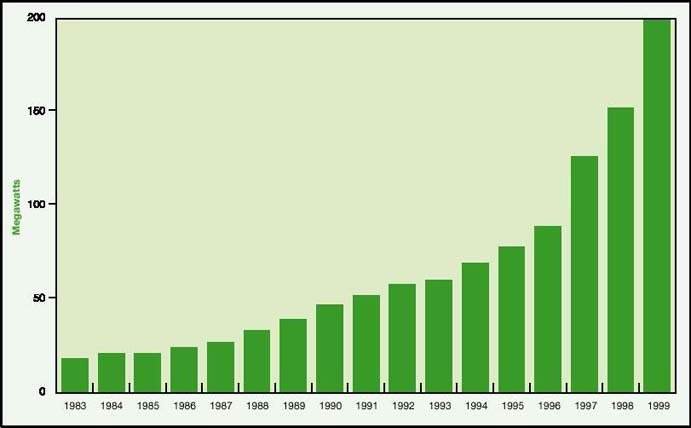
FIGURE 7.5. PHOTOVOLTAIC
SHIPMENTS, 1983 - 1999
Source: Based on a Maycock, 1998; PVIR,
1999.
TABLE 7.10. IMPORTANT PHOTOVOLTAIC SOLAR CELL AND MODULE
TECHNOLOGIES
|
Technology |
Symbol |
Characteristic |
Record efficiency laboratory cells (percent) |
Typical efficiency commercial flat-plate modules
(percent) |
|
Single crystal silicon |
sc-Si |
Wafer-type |
24 |
13 - 15 |
|
Multi-crystalline silicon |
mc-Si |
Wafer-type |
19 |
12 - 14 |
|
Crystalline silicon films on ceramics |
f-Si |
Wafer type |
17 |
(8 - 11) |
|
Crystalline silicon films on glass |
|
Thin film |
9 |
|
|
Amorphous silicon (including silicon-germanium tandems) |
a-Si |
Thin film |
13 |
6 - 9 |
|
Copper-indium/gallium-diselenide |
CIGS |
Thin film |
18 |
(8 - 11) |
|
Cadmium telluride |
CdTe |
Thin film |
16 |
(7 - 10) |
|
Organic cells (including dye-sensitised titanium dioxide cells)
|
|
Thin film |
11 |
|
|
High-efficiency tandem cells |
III-V |
Wafer-type and thin film |
30 |
|
|
High-efficiency concentrator cells |
III-V |
Wafer-type and thin-film |
33 (tandem)
28 (single) |
|
Note: Numbers in parentheses are results from pilot
production or first commercial production.
Source: Green and others, 1999.
For the technologies in table 7.10, sc-Si, mc-Si, and a-Si are
fully commercial, with the first two taking 85 percent of the 1998 commercial
market, and the third 13 percent. (PVIR, 1999). CIGS and CdTe are emerging
commercial technologies, whereas f-Si and one form of crystalline silicon films
on glass appear to be in a pilot production phase. Organic cells are still in a
laboratory stage, though dye-sensitised titanium dioxide cells are considered
for near-term indoor applications. High-efficiency cells are used in
concentrator systems.
It is still too early to identify winners or losers among the
photo-voltaic technologies under development or in production. There is
reasonable consensus that thin-film technologies generally offer the best
long-term perspective for very low production cost. But crystalline silicon
wafer technology also still has a huge potential for cost reduction through
economies of scale and technological improvements. This perspective recently
triggered major investments in new production capacity. So it is not yet clear
when thin films will become dominant in the photovoltaics market.
The conversion efficiency of commercial modules should increase
steadily over the next decades (irrespective of the technology). For the medium
term (2010) the efficiency is likely to be about 12 - 20 percent (Maycock,
1998), and for the longer term (beyond 2020) possibly 30 percent or even
somewhat more (EUREC Agency, 1996). Note, however, that this is based on an
evaluation of what is physically possible, not on what could be done
technologically at low cost. Moreover, it is not expected that these high
efficiencies can be obtained by simple extrapolation of today’s commercial
technologies. It is not very likely that modules with the lowest manufacturing
cost per watt have the highest
efficiency.
System aspects
Photovoltaic system components. To make use of the
electricity from photovoltaic cells and modules, one has to build a complete
system, also comprising electronic parts, support structures, and sometimes
electricity storage. It is customary to use the term balance-of-system (BOS) for
the sum of system components and installation excluding modules.
Type and size of photovoltaic systems. Photovoltaics can
be used in a wide variety of applications, from consumer products and small
standalone units for rural use (such as solar home systems and solar lanterns)
to grid-connected rooftop systems and large power stations. Typical system size
varies from 50 watts to 1 kilowatt for standalone systems with battery storage,
from 500 watts to 5 kilowatts for rooftop grid-connected systems, and from 10
kilowatts to many megawatts for grid-connected ground-based systems and larger
building-integrated systems. Of these market segments, rural electrification for
sustainable development and building-integrated systems (as forerunners of
large-scale implementation) are expected to grow rapidly because of concentrated
marketing efforts and financial incentives.
Need for storage. Because photovoltaic modules offer an
intermittent source of energy, most standalone systems are equipped with battery
storage (usually a lead-acid battery) to provide energy during the night or
during days with insufficient sunshine. In some cases batteries store energy
during longer periods. When using grid-connected photovoltaic systems, the grid
serves as ‘virtual storage’: electricity fed into the grid by
photovoltaics effectively reduces the use of fuel by power plants fired by coal,
oil, or gas.
Performance ratio of photovoltaic systems. It is of great
practical importance to be able to predict the actual energy that a
photo-voltaic system of a certain size feeds into the grid. But that requires
reliable information on the insolation in the plane of the system, on the system
power under standard test conditions, and on the system losses. For simplicity,
all system losses in grid-connected photo-voltaic systems are taken together in
the performance ratio, which is the ratio of the time-averaged system efficiency
to the module efficiency under standard conditions. For grid-connected
photo-voltaic systems the state-of-the-art performance ratio, now typically 0.75
- 0.85, could increase to 0.9 in the longer term. For state-of-the-art
standalone systems the typical performance ratio is
0.6.
Environmental aspects
Environmental life-cycle analysis. Solar technologies do
not cause emissions during operation, but they do cause emissions during
manufacturing and possibly on decommissioning (unless produced entirely by
‘solar breeders’). With the industry growing, there is now
considerable interest in environmental aspects of solar technologies.
Environmental life-cycle analyses of photovoltaic systems and components (Alsema
and Nieuwlaar, 1998) are already leading to the development of different
materials and processes in the manufacturing of photovoltaic modules (see Tsuo
and others, 1998). An example is developing water-based pastes instead of pastes
based on organic solvents for screen printing. In addition, several recycling
processes have been developed for off-spec or rejected modules.
Energy payback time. One of the most controversial issues
for photovoltaics is whether the amount of energy required to manufacture a
complete system is smaller or larger than the energy produced over its lifetime.
Early photovoltaic systems were net consumers of energy rather than producers.
In other words, the energy payback time of these systems was longer than their
lifetime. This situation has changed and modern grid-connected rooftop
photovoltaic systems now have payback times much shorter than their (expected)
technical lifetime of roughly 30 years (Alsema, Frankl, and Kato, 1998) (table
7.11).
For grid-connected ground-based systems the energy payback time
of the balance of system is longer than for rooftop systems, because of
materials used in foundation and support. The energy payback time, now three to
nine years, will decrease to one to two years.
For standalone photovoltaic systems with battery storage (such
as solar home systems) the situation is less favourable than for grid-connected
systems, because of the long energy payback time associated with the (lead-acid)
battery. At an insolation of 2,000 kilowatt-hours per square metre a year, the
energy payback time of modern solar home systems is now seven to 10 years
(Alsema and Nieuwlaar, 1998). This number may come down to roughly six years, of
which five are due to the battery. Since the technical lifetime of a battery in
a photovoltaic system is usually five years or less, the direct effectiveness of
(present generation) solar home systems for the reduction of greenhouse gas
emissions is a matter of debate.
|
The total average power available at the
Earth's surface in
the form of solar
radiation exceeds the total human
power consumption
by
roughly a factor
of 1,500. |
Carbon dioxide mitigation potential. The carbon dioxide
mitigation potential of photovoltaics can be roughly inferred from the data on
energy payback time, assuming that emissions of greenhouse gases (SF6
and CF4) related to photovoltaic cell and module production are
effectively minimised. As an example, a photovoltaic system with an energy
payback time of two years at 1,500 kilowatt-hours per square metre a year and a
technical lifetime of 30 years (ratio 1:15) will produce 15 kilowatt-hours of
electricity without emissions for each kilowatt-hour of electricity
‘invested’ in manufacturing. Specific carbon dioxide emissions are
therefore fifteen times lower than those of the relevant fuel mix - the mix used
in supplying the total photovoltaics industry chain with energy.
Materials availability. The crystalline silicon
photovoltaics industry has so far used off-grade material from the semiconductor
industry as its feedstock. Very fast growth of the crystalline silicon
photo-voltaics industry would require dedicated production of ‘solar
grade’ silicon (Bruton and others, 1997). Although several processes for
solar grade silicon have been developed to a laboratory scale, none has been
taken into commercial production. It is expected, however, that new feedstock
can be made available in time if necessary. The availability of some of the
elements in thin-film photovoltaic modules (like indium and tellurium) is a
subject of concern. There apparently are no short-term supply limitations, but
the match between demand from the photovoltaics industry and world market supply
may become an issue at very large (multiple gigawatts a year) production levels
(Johansson and others, 1993b). CdTe and CIGS may therefore be valuable bridging
technologies (Andersson, 1998).
TABLE 7.11. ESTIMATED ENERGY PAYBACK TIME OF GRID-CONNECTED
ROOFTOP PHOTOVOLTAIC SYSTEMS (YEARS)
|
State of the art |
Near to medium term (<10 years) |
Long term |
|
Modules |
|
|
|
|
Crystalline silicon |
3 - 8 |
1.5 - 2.5 |
<1.5 |
|
Thin film |
2 - 3 |
0.5 - 1.5 |
<0.5 |
|
Balance of system |
<1 |
0.5 |
<0.5 |
|
Total system |
|
|
|
|
Crystalline silicon |
4 - 9 |
2 - 3 |
<2 |
|
Thin film |
3 - 4 |
1 - 2 |
<1 |
Note: Based on an insolation of 1,500 kilowatt-hours
per square metre a year.
Source: Alsema, Frankl and Kato, 1998.
Health. Of special concern is the acceptance of
cadmium-containing photovoltaic modules. The cadmium content of CdTe (and CIGS)
modules appears to be well within limits for safe use (Alsema and Nieuwlaar,
1998). And production processes can fulfil all applicable requirements. But
political and public acceptance is not automatic. Therefore, there are efforts
to eliminate cadmium from CIGS modules even at the cost of a reduced efficiency.
Also a closed cycle for reclaiming and recycling of disposed CdTe modules has
been developed (Bohland and others,
1998).
Economic aspects
Photovoltaic system cost. The turnkey cost of a
photovoltaic system is determined by the module cost and by the
balance-of-system (BOS) costs, which contains the cost of all other system
components, electrical installation costs, and costs associated with building
integration, site preparation, erection of support structures, and so on. The
turnkey price is generally 20 - 40 percent higher than the cost.
In 1998 photovoltaic module prices were $3 - 6 a watt, depending
on supplier, type, and size of order (Maycock, 1998; IEA PVPS, 1998). The prices
of complete photovoltaic systems vary widely with system type and size, and from
country to country (Thomas and others, 1999; IEA PVPS, 1998). But $5 - 10 a watt
for grid-connected systems and $8 - 40 a watt for standalone systems are
considered representative today.
The future cost and price reduction of photovoltaic modules and
systems can be evaluated in two ways. The first is by detailed analysis of
manufacturing costs for a specific technology as function of technology
improvements and innovations - and of production volumes. The second is by
general analysis of photovoltaic markets and industries, using a learning curve
approach. (Note that the second approach deals with prices rather than costs.)
TABLE 7.12. POSSIBLE COSTS OF GRID-CONNECTED PHOTOVOLTAIC
SYSTEMS, BASED ON DIFFERENT EVALUATIONS OF PHOTOVOLTAIC PRODUCTION TECHNOLOGIES
(APPROACH 1) (1998 DOLLARS PER WATT)
|
Element |
1998 |
Short term (to 2005) |
Medium term (2005 - 15) |
Long term (after 2015) |
|
Modules |
3 - 4 |
1 - 2 |
0.5 - 1.0 |
£ 0.5 |
|
Balance of system |
2 - 6 |
1 - 2 |
0.5 - 1.0 |
£ 0.5 |
|
Turnkey systems |
5 - 10 |
2 - 4 |
1 - 2 |
£ 1.0 |
Note: Prices are 20 - 40 percent higher than
costs.
|
It is still too early to identify
winners or losers
among
the photovoltaic technologies
under development or
in production.
|
· Approach 1.
For crystalline silicon technologies, the manufacturing cost of solar cell
modules can be reduced from the present $3 - 4 a watt down to $1.5 - 2 a watt in
the short term and to around $1 a watt in the longer term. For thin films (a-Si,
CdTe, and CIGS), the module costs are expected to fall to $1 - 1.5 a watt in the
short term, $0.5 - 1 a watt in the longer term (Carlson and Wagner, 1993; Bruton
and others, 1997; Little and Nowlan, 1997; Maycock, 1998). EUREC Agency (1996,
p.84) even mentions module costs as low as $0.30 a watt. The corresponding
prices are again 20 - 40 percent higher.
The balance-of-system costs for rooftop and ground-based
grid-connected systems are now typically $2 - 6 a watt. Improvements and
economies of scale in power electronics, integration in the building process,
and standardisation will enable reductions to $1 - 2 a watt in the short term,
$0.5 a watt in the longer term. The turnkey system cost is therefore expected to
decrease to $2 - 4 a watt in the short to medium term and to $1.0 - 1.5 a watt
in the longer term. Ultimately (after 2015) system costs around or even below $1
a watt are foreseen (Johansson and others, 1993b; WEC, 1994b; B�er, 1998),
resulting in prices of roughly $1 a watt (table 7.12). For such extremely low
prices it is necessary to use very cheap modules with high efficiencies (15 - 30
percent), to reduce area-related balance of system costs.
· Approach 2. An
evaluation of the development of photovoltaic (mostly module) costs and prices
using a learning curve can be found in IIASA and WEC (1998), Maycock (1998), ECN
(1999b), and elsewhere. For 1975 - 97 the learning rate has been roughly 20
percent: prices have been reduced by 20 percent for each doubling of the
cumulative sales. When the technology and market mature, as for gas turbines,
the learning rate may fall to 10 percent (IIASA and WEC, 1998). It is not clear,
however, whether this will apply to photovoltaics as well, since the range for
all industries is 10 - 30 percent and the value for the semiconductor industry
is roughly 30 percent (ECN, 1999a). Here it is assumed that the learning rate
stays at 20 percent - and that this rate applies to the total system price, not
just to the module price.
In 1998 cumulative sales were roughly 800 megawatts. Production
was about 150 megawatts. At growth of 15 percent a year (the average over the
past 15 years; IEA PVPS, 1998), annual sales will double every five years - to
about 3 gigawatts a year in 2020, when cumulative sales would be 25 gigawatts.
As a result prices will have fallen in 2020 to a third of the 1998 level. With
far more optimistic growth of 25 percent a year, annual sales would be 20
gigawatts a year in 2020, and cumulative sales 100 gigawatts. Prices will then
have fallen to a fifth of the 1998 level.
Table 7.13 gives an overview of the cost estimates using a
learning curve approach, for a learning rate of 20 percent (historic value).
Results for a low learning rate of 10 percent are given for comparison. The
projections using a learning curve approach show a somewhat slower decrease than
those based on evaluations of photovoltaic production technologies. Note,
however, that new technologies based on the use of thin-film solar cells can
follow a different (lower) learning curve than the sum of all technologies.
Photovoltaic electricity costs. Electricity costs are
determined by turnkey system costs, economic lifetime (depreciation period),
interest rates, operation and maintenance costs (including possible replacement
of components), electricity yields of the system (a function of insolation and
thus of geographic location), insurance costs, and so on (table
7.14).
Implementation issues
Since the cost of photovoltaic electricity is now well above
that of electricity from the grid, photovoltaics are implemented through two
distinct paths. One is market development of commercial high-value applications.
The second is stimulating the installation of grid-connected systems. Both paths
are generally supported through government and international aid programs.
The first path deals mainly with standalone photovoltaic systems
and (more recently but to less extent) with small grid-connected systems for
private use. The photovoltaics industry has survived the past decades by
actively developing niche markets in telecommunication, leisure, lighting,
signalling, water-pumping, and rural electrification. The rural market is now
being actively pursued as potentially huge, since an estimated 2 billion people
in developing countries do not have access to a grid (see chapter 10).
Photovoltaics are often a viable alternative for bringing small
amounts of electricity (less than 1 kilowatt-hour a day) to end users. More than
300,000 solar home systems (typically 50 watts) have been installed over the
past 10 years, only a very modest step towards true large-scale use (B�er,
1998). In addition a large number of even smaller systems has been sold. This
rural market cannot be judged by the total peak power of the systems (300,000 x
50 watts = 15 megawatts). Even if all 2 billion people were to own a 100 watt
photovoltaic system, this would contribute less than 1 exajoule of electricity
to the world’s energy consumption. Instead, it is the large number of
people involved that is significant - and even more that photovoltaics provide
light, radio, television, and other important services to them.
A major barrier for rapid growth and very widespread use is the
lack (in most countries) of properly developed financing schemes and the
infrastructure for distribution, after-sales service, and so on. Financing is
essential because few of those 2 billion people can pay cash of $400 for a
system. But some can pay a smaller amount, or even a monthly rate of a few
dollars up to tens of dollars. This widely acknowledged problem has two
solutions. The first is the full commercial development of very small
photovoltaic systems to meet basic needs and be paid for in cash (mainly
photovoltaic lanterns and other lighting systems in the range of 5 - 20 watts).
The second is financing schemes using a down payment and monthly fees of roughly
$5 - 20 a lease, or fee-for-service (B�er, 1998).
For grid-connected systems it is important to distinguish
between small and medium-sized decentralised systems (typically 500 watts to 1
megawatt) integrated in the built environment and large ground-based, central
systems (typically greater than 1 megawatt). Decentralised integrated systems
have some advantages over central ground-based ones. Their balance of system
costs are generally lower. And they have more technical and non-technical
possibilities to increase their competitiveness.
Photovoltaic market development through government programs in
industrialised countries (IEA PVPV, 1998) applies mainly to systems integrated
in the built environment. The aim of these programs is to boost the development
and application of photo-voltaic technology as an essential step towards future
large-scale use. They provide market volume to the photovoltaics industry to
achieve economies of scale and experience with a completely new way of
sustainable (decentralised) electricity generation. Clearly, this policy-driven
market depends on public support and high expectations for photovoltaics as a
major electricity source for the future.
TABLE 7.13. POSSIBLE EVOLUTION OF TYPICAL COSTS OF
GRID-CONNECTED PHOTOVOLTAIC SYSTEMS USING A LEARNING CURVE (APPROACH 2)
|
1998 |
Medium term (2010) |
Long term (2020) |
|
Average annual market growth rate (percent) |
15
(1983 - 98) |
15 |
25 |
15 |
25 |
|
Annual sales (gigawatts) |
0.15 |
0.8 |
2 |
3 |
20 |
|
Cumulative sales (gigawatts) |
0.8 |
6 |
11 |
25 |
100 |
|
Turnkey system price (1998 dollars per watt) at a learning
rate of 20 percent |
5 - 10 |
2.7 - 5.3 |
2.2 - 4.3 |
1.7 - 3.3 |
1 - 2 |
|
Turnkey system price (1998 dollars per watt) at a learning
rate of 10 percent |
5 - 10 |
3.7 - 7.4 |
3.4 - 6.8 |
3.0 - 5.9 |
2.4 - 4.8 |
TABLE 7.14 ELECTRICITY COST AS A FUNCTION OF COST, ECONOMIC
LIFETIME, AND ELECTRICITY YIELD OF PHOTOVOLTAIC SYSTEMS (DOLLARS A
KILOWATT-HOUR)
|
Turnkey system cost (dollars a watt) |
Economic lifetime (years) |
Electricity yield (kilowatt-hours a year per kilowatt of
installed capacity) |
|
|
750 |
1,500 |
|
5 |
10 |
1.00 - 1.22 |
0.51 - 0.61 |
|
(lower limit 1998) |
25 |
0.61 - 0.87 |
0.31 - 0.44 |
|
1 |
10 |
0.12 - 0.24 |
0.10 - 0.12 |
|
(long term) |
25 |
0.12 - 0.17 |
0.06 - 0.09 |
Note: Operation and maintenance and insurance costs
are 2 percent of the annual system cost. The interest rate is 5 - 10
percent.
|
BOX 7.6 SELECTED NATIONAL AND INTERNATIONAL PHOTOVOLTAIC
PROGRAMMES
Japan. In 1994 the Japanese government adopted the New
Energy Introduction Outline, with targets for renewable energy technologies,
including photovoltaics. The aim is to install 400 megawatts of (mainly
residential grid-connected) photovoltaic systems by 2000 and 4,600 megawatts by
2010 (Luchi, 1998). The program is based on gradually decreasing subsidies
(starting at 50 percent) and net metering.
United States. The Million Solar Roofs program aims to
install 1,000,000 solar hot water systems and photovoltaic systems by 2010 (IEA
PVPS, 1998; B�er, 1998). The trend is from demonstrations and tests towards
market-centred projects with funding primarily from the private sector. The
program works by creating partnerships between communities, federal agencies,
and the Department of Energy (Rannels, 1998).
Germany. The 100,000 Roofs program (300 - 350 megawatts
in 2005) is dedicated to grid-connected photovoltaic systems. Private
investments in photovoltaics are stimulated by interest-free loans and a subsidy
of 12.5 percent (Photon, 1999b). In addition, the government decided recently to
pay nearly 1 deutsche mark a kilowatt-hour to owners of photovoltaic systems,
financed by a small increase of electricity rates.
Italy. The 10,000 Rooftops program aims to install 50
megawatts by around 2005 (Garrozzo and Causi, 1998). With a focus on building
small- and medium-sized integrated, grid-connected photovoltaic systems, funding
may be mixed public (75 percent) and private (25 percent).
European Union. The target for photovoltaics is an
installed capacity of 3 gigawatts by 2010. This has been translated into a
Million Roofs program to install 500,000 grid-connected photovoltaic systems on
roofs and facades in the Union and to export another 500,000 village systems for
decentralised electrification in developing countries (EC, 1997; EC, 1999; IEA
PVPS, 1998).
Indonesia. In 1998 the installed capacity of photovoltaic
systems in Indonesia was 5 megawatts. A new strategy has been developed to
enhance the use of renewable energy technologies, especially photovoltaics. Some
characteristics of this strategy are: establish renewable energy
non-governmental organisations, prepare renewable energy product standards, run
demonstration projects in partnership with the private sector, provide training,
disseminate information, strengthen international cooperation, and institute
policy development and regulation.
India. With a total installed capacity of about 40
megawatts of photovoltaic systems, India has among the world’s largest
national programs in photovoltaics. The five-year national plan 1997 - 2002
envisages a deployment of 58 megawatts in addition to the 28 megawatts installed
as of 1997. Exports of 12 megawatts are also foreseen. Government-sponsored
programs include installing solar lanterns and other lighting systems - and
electrifying villages and grid-connected power plants. Subsidies are available
to rural users (Sastry, 1999).
South Africa. Shell Renewables Ltd. and Eskom are
investing $30 million in rural solar power development in South Africa from 1999
until 2001. This venture should provide standalone photovoltaic units to about
50,000 homes presently without electricity at a cost of about $8 a month (see
chapter 10).
Kenya. Kenya has a high penetration rate of household
photo-voltaic systems. In 1999 more than 80,000 systems were in place and annual
sales are about 20,000 systems. The market operates without significant external
aid or support (see chapter 10).
World Bank. The World Bank has become very active in
developing financial schemes and programs for rural electrification in
developing countries (Photon, 1999a). An example is the photo-voltaic Market
Transformation Initiative. The Bank’s activities, fully integrated on a
national level, mainly aim at removing barriers and building capacity.
Generally, the approach is not to stimulate photovoltaics through subsidies for
system hardware, but to facilitate commercial operations fitted to the local
circumstances. |
A variety of instruments can achieve a self-sustained market:
rate-based measures (favourable feed-in tariffs), fiscal measures, investment
subsidies, soft loans, building codes. Another instrument is the removal of
barriers related, say, to building design and material use. In addition to these
incentives, the added value of photovoltaics - like aesthetics in building
integration, combining electricity generation and light transmission, and
generating part or all of one’s own electricity consumption - are used in
marketing photovoltaics. Green electricity and green certificates for the use of
renewables are also expected to be important in the further development of a
self-sustained market for grid-connected systems. They enable selling
electricity from photovoltaics (or other renewables) to environmentally
conscious electricity consumers.
Several countries have set targets or formulated programs for
renewable energy technologies, specifically solar (box 7.6). In countries with a
well-developed electricity infrastructure, the long-term aim is to achieve a
substantial contribution to the electricity generation from solar energy. In
developing countries and countries with a less-developed electricity
infrastructure, efforts are focused on the large-scale implementation of smaller
standalone solar photovoltaic systems. In these cases the dissemination of solar
energy is a tool for social and economic
development.
Space-based solar energy
A very different approach to exploiting solar energy is to
capture it in space and convey it to the Earth by wireless transmission. Unlike
terrestrial capture of solar energy, a space-based system would not be limited
by the vagaries of the day-night cycle and adverse weather - and so could
provide baseload electricity (Glaser and others, 1997).
In space the maximum irradiance (power density) is much higher
than on Earth - around 1,360 watts per square metre - and is nearly constant.
This energy can be captured and converted to electricity just as it can on
Earth, as is done routinely to power spacecraft. The elements of such a
space-based solar energy system would include:
· Satellites in
geosynchronous or other orbits designed as large solar collectors.
· Power conditioning and
conversion components to turn the electricity generated by the photovoltaic
arrays into radio frequency form.
· Transmitting antennas that
form one or more beams directed from the satellites to the Earth.
· Receiving antennas on Earth
that collect the incoming radio frequency energy and convert it into useful
electricity. Such a device is called a rectenna (for rectifying receiving
antenna). The power yield from typical rectennas at low to middle latitudes
would be on the order of 30 megawatts per square kilometre.
· Power conditioning components
to convert the direct current output from the rectenna to alternating current
for local use.
As with any solar source, space-based energy would not
contribute to greenhouse gas emissions during operation. The high launch rate
required to place a space-based energy system could affect the Earth’s
atmosphere, however. The effects of power transmission to the ground need to be
assessed for at least three factors: influences on the atmosphere (particularly
the ionosphere on the way down), inference between the wireless power
transmission and communications or electronic equipment, and the effects of the
transmitted beam on life forms. Estimates and some experiments indicate that
these effects might be small.
Very preliminary estimates suggest that a cost target of $0.05
per kilowatt-hour may ultimately be achievable for a mature space-based solar
energy system (Mankins, 1998). But several important issues must be addressed:
· A number of key
technologies require maturation.
· The cost
of access to space must be substantially lowered.
· Safety and environmental concerns must be
resolved.
· Optimal designs for space-based
solar systems need to be established.
·
Orbital slots for collecting platforms and frequencies for power transmission
need to be
obtained.
Conclusion
· Since 1983 the
average growth rate of photovoltaic module shipments has been 15 percent a year.
In 1998 the production was 150 megawatts, and in 1999, about 200 megawatts. In
1998 the cumulative production was around 800 megawatts, with the operating
capacity probably about 500 megawatts, perhaps 600 megawatts. The growth of
operating photovoltaic capacity in the last five years can be estimated at
roughly 30 percent a year.
· Since 1975 the learning rate
(cost reduction as function of cumulative production) has been roughly 20
percent. In 1998 turnkey costs of grid-connected photovoltaic systems were $5 -
10 a watt. In the future these costs may come down to about $1 a watt.
· Today photovoltaics generally
cannot compete with conventional power plants in grid-connected applications.
Photovoltaic electricity production costs are about $0.3 - 1.5 a kilowatt-hour,
depending on solar insolation, turnkey costs, depreciation periods, and interest
rates. Under favourable conditions and at favourable sites, the lowest cost
figure may come down to $0.05-0.06 a kilowatt-hour.
· It remains uncertain whether
and when photovoltaics will compete with fossil fuels on a large scale. This
mainly depends on the development of photovoltaics, on the price development of
coal and natural gas, and on possibilities for (or policies on) carbon dioxide
removal at low cost.
· Supplying less than 1 percent
of the world’s energy consumption, photovoltaic systems can play a major
role in rural electrification by reaching many of the 2 billion people in
developing countries who do not have access to electricity.
· There appear to be no
invincible technical problems for solar energy to contribute much to the
world’s energy supply. What matters are policy developments and the market
position of fossil fuels and other energy sources.
|
Photovoltaics are often
a viable alternative for
bringing
small amounts of electricity (less
than 1 kilowatt-hour a
day)
to end users. |
Solar thermal electricity
Solar radiation can produce high-temperature heat, which can
generate electricity. The most important solar thermal technologies to produce
electricity - concentrating - use direct irradiation. Low cloud areas with
little scattered radiation, such as deserts, are considered most suitable for
direct-beam-only collectors. Thus the primary market for concentrating solar
thermal electric technologies is in sunnier regions, particularly in warm
temperate, sub-tropical, or desert areas. About 1 percent of the world’s
desert area used by solar thermal power plants would be sufficient to generate
today’s world electricity demand. Here we will assess the current status
and future development of solar thermal electricity (STE)
technologies.
The potential of solar thermal electricity
STE is probably 20 years behind wind power in market
exploitation. In 1998 operating STE capacity was about 400 megawatts of
electricity, with annual electricity output of nearly 1 terawatt-hour. New
projects in mind mount to a maximum of 500 megawatts of electricity, and it is
probable that 2,000 megawatts of installed capacity will not be reached until
2010 (the capacity wind reached in 1990). Because STE costs are dropping rapidly
towards levels similar to those obtained by wind, STE may grow in a manner
somewhat similar to wind. If the growth rate is 20 - 25 percent after 2010, this
installed STE capacity would be 12,000 - 18,000 megawatts of electricity by
2020. If annual growth rate then averages 15 percent a year, the result would be
800 - 1,200 gigawatts of electricity by 2050. The Cost Reduction Study for Solar
Thermal Power Plants, prepared for the World Bank in early 1999 (Enermodal,
1999), concludes that the large potential market of STE could reach an annual
installation rate of 2,000 megawatts of electricity. In the foregoing scenario
this rate is reached between 2015 and 2020. Advanced low-cost STE systems are
likely to offer energy output at an annual capacity factor of 0.22 or more. So,
the contribution of STE would be about 24 - 36 terawatt-hours of electricity by
2020 and 1,600 - 2,400 terawatt-hours by
2050.
Solar thermal electricity market developments
STE technologies can meet the requirements of two major electric
power markets: large-scale dispatchable markets comprising grid-connected
peaking and baseload power, and rapidly expanding distributed markets including
both on-grid and remote applications.
Dispatchable power markets. Using storage and
hybridisation capabilities (integration of STE with fossil fuel power plants),
dispatchable solar thermal electric technologies can address this market.
Currently offering the lowest-cost, highest-value solar electricity available,
they have the potential to be economically competitive with fossil energy in the
longer term. With continuing development success and early implementation
opportunities, the electricity production cost of dispatchable STE systems is
expected to drop from $0.12 - 0.18 a kilowatt-hour today to about $0.08 - 0.14 a
kilowatt-hour in 2005 and to $0.04 - 0.10 a kilowatt-hour thereafter.
In this market there is a huge existing global capacity of
fossil fuel plant, much of it coal, available for low solar-fraction retrofit as
a transition strategy. Coal-fired plants tend to be much larger individually
than solar thermal standalone plants (600 - 1,200 megawatts of electricity
compared with 5 - 80 megawatts), and usable land around coal-fired plants is
restricted. Any solar retrofit to a typical coal-fired plant will supply only a
small percentage of its total electricity output. But around the world, there
are hundreds of such fossil fuel plants in good insolation areas, many with
sufficient adjacent land area to accommodate a solar field of the size of the
current largest STE units of about 80 megawatts. This market could account for a
large fraction of the 12,000 - 18,000 megawatts by 2020 in the scenario above.
Distributed power markets. The majority of these
applications are for remote power, such as water pumping and village
electrification, with no utility grid. In these applications, diesel engine
generators are the primary current competition. The STE technology appropriate
for smaller distributed applications is the dish/engine system. Each dish/engine
module (10 - 50 kilowatts of electricity) is an independent power system
designed for automatic start-up and unattended operation. Multiple dish/engine
systems can be installed at a single site to provide as much power as required,
and the system can readily be expanded with additional modules to accommodate
future load growth. The systems can be designed for solar-only applications,
easily hybridised with fossil fuels to allow power production without sunlight,
or deployed with battery systems to store energy for later use.
|
BOX 7.7. COMMERCIAL SOLAR THERMAL ELECTRICITY DEVELOPMENTS
NOW UNDER WAY
Australia. Under the Australian Greenhouse Office (AGO)
Renewable Energy Showcase Programme, a 13 megawatt-thermal compact linear
fresnel reflector (CLFR) demonstration unit will be installed in 2001,
retrofitted to an existing 1,400 megawatts-electric coal-fired plant in
Queensland (Burbridge and others, 2000). It is expected to offer the solar
electricity from this first commercial project as green power at a price below
$0.09 a kilowatt-hour. A 2 megawatts-electric demonstration unit, using
paraboloidal dish technology, has also been announced for installation in 2001,
retrofitted to a gas-fired steam generating plant (Luzzi, 2000).
Greece. On the island of Crete, the private venture
capital fund Solar Millennium - together with Greek and European industrial
partners - has established the first solar thermal project company (THESEUS
S.A.) and submitted an application for licensing a 52 megawatt-thermal solar
thermal power plant with 300,000 square metres of parabolic trough solar field.
Spain. New incentive premiums for the generation of
renewable electricity in 1999 caused Spanish companies such as Abengoa, Gamesa,
and Ghersa to engage in solar thermal technologies and to establish various
project companies (Osuna and others, 2000).
United States. Green electricity and renewable portfolio
policies of various states have revived the interest of such industrial firms as
Bechtel, Boeing, and Dukesolar in the further development of STE technologies.
Global Environment Facility. In 1999 the Global
Environmental Facility approved grants for the first solar thermal projects in
Egypt, India, Mexico, and Morocco - about $200 million in total. The proposed
Indian plant uses integrated gas combined cycle and solar thermal (Garg, 2000).
|
The high value of distributed power (more than $0.50 a
kilowatt-hour for some remote applications) provides opportunities for
commercial deployment early in the technology development. The technology
enhancements needed to achieve high reliability and reduce operation and
maintenance costs are understood. With continuing development, the electricity
production costs of distributed STE system are expected to drop from $0.20 -
0.40 a kilowatt-hour today to about $0.12 - 0.20 a kilowatt-hour in 2005 and to
$0.05 - 0.10 a kilowatt-hour in the long run.
STE projects, ranging from about 10 kilowatts to 80 megawatts of
electricity, have been realised or are being developed in Australia, Egypt,
Greece, India, Iran, Jordan, Mexico, Morocco, Spain, and the United States (box
7.7).
Market entry strategy. Three phases can be distinguished
in an STE market entry strategy:
· Solar field
additions. Small solar fields can be integrated into combined cycle and coal
or fuel oil-fired power plants for $700 - 1,500 per kilowatt installed.
· Increased solar share.
With increasing fossil fuel prices or compensation premiums for carbon
dioxide avoidance as well as solar field cost reductions, the share of solar can
be increased to about 50 percent in solar-fossil hybrid power stations.
· Thermal energy storage.
With further improvement in the cost-benefit ratio of STE, thermal energy
storage will further substitute for the need of a fossil back-up fuel source. In
the long run, baseload operated solar thermal power plants without any fossil
fuel addition are in principle possible, and clean bio-energy back-up is also
feasible.
Figure 7.6 presents an outlook on the market introduction of STE
technologies and the associated reduction in electricity generation costs as
presented by SunLab
(1999).
Solar thermal electricity technologies
Five distinct solar thermal electric conversion concepts are
available, each with different operating and commercial features. Two
non-concentrating technologies - solar chimney and solar pond - are not included
in this brief description of emerging solar thermal power concepts, because they
lack significantly sized pilot and demonstration test facilities.
All concentrating solar power technologies rely on four basic
key elements: collector/concentrator, receiver, transport/storage, and power
conversion. The collector/concentrator captures and concentrates solar
radiation, which is then delivered to the receiver. The receiver absorbs the
concentrated sunlight, transferring its heat energy to a working fluid. The
transport/storage system passes the fluid from the receiver to the power
conversion system. In some solar thermal plants a portion of the thermal energy
is stored for later use. As solar thermal power conversion systems, Rankine,
Brayton, Combined, and Stirling cycles have been successfully demonstrated.

FIGURE 7.6 MARKET INTRODUCTION OF
SOLAR THERMAL ELECTRICITY TECHNOLOGIES WITH INITIAL SUBSIDIES AND GREEN POWER
TARIFFS, 1990 - 2020
Source: SunLab, 1999.
An inherent advantage of STE technologies is their unique
ability to be integrated with conventional thermal plants. All of them can be
integrated as a solar boiler into conventional thermal cycles, in parallel with
a fossil-fuelled boiler. They can thus be provided with thermal storage or
fossil fuel back-up firm capacity without the need for separate back-up power
plants and without stochastic perturbations of the grid (figure 7.7). The
potential availability of storage and ability to share generation facilities
with clean biomass suggest a future ability to provide a 100 percent replacement
for high capacity factor fossil fuel plant when needed.
Parabolic trough systems. The parabolic trough (solar
farm) consists of long parallel rows of identical concentrator modules,
typically using trough-shaped glass mirrors. Tracking the sun from east to west
by rotation on one axis, the trough collector concentrates the direct solar
radiation onto an absorber pipe located along its focal line. A heat transfer
medium, typically oil at temperatures up to 400 degrees Celsius, is circulated
through the pipes. The hot oil converts water to steam, driving the steam
turbine generator of a conventional power block.
With 354 megawatts-electric of parabolic trough solar electric
generating systems connected to the grid in southern California since the
mid-1980s, parabolic troughs are the most mature STE technology (Pilkington,
1996). There are more than 100 plant-years of experience from the nine operating
plants. The plants range in size from 14 - 80 megawatts of electricity. Until
the end of 1998, 8 terawatt-hours of solar electrical energy had been fed into
the Californian grid, resulting in sales revenues of more than $1,000 million.
The technology is under active development and refinement to improve its
performance and reduce production costs.
Central receiver/power tower. The solar central receiver
or power tower is surrounded by a large array of two-axis tracking mirrors -
termed heliostats - reflecting direct solar radiation onto a fixed receiver
located on the top of the tower. Within the receiver, a fluid transfers the
absorbed solar heat to the power block where it is used to heat a steam
generator. Water, air, liquid metal, and molten salt have been tested as fluids.
Advanced high-temperature power tower concepts are now under
investigation, heating pressurised air to more than 1,000 degrees Celsius to
feed it into the gas turbines of modern combined cycles. In Barstow, California,
a 10 megawatts-electric pilot plant (Solar One) operated with steam from 1982 -
88. After modification of the complete plant in 1996, it operated as Solar Two
for a few thousand hours, with molten salt as the heat-transfer and
energy-storage medium, delivering power to the electricity grid on a regular
basis (Pacheco and others, 2000). The net solar-electric conversion efficiency
was 8 percent. Solar Two has demonstrated, through storage, the feasibility of
delivering utility-scale solar power to the grid 24 hours a day, if necessary
(Kolb, 1998). In parallel, European activities have demonstrated the volumetric
air receiver concept, where the solar energy is absorbed on fine-mesh screens
and immediately transferred to air as the working fluid (Buck and others, 2000).

FIGURE 7.7. WITH MINIMAL FOSSIL
BACK-UP AND THERMAL ENERGY STORAGE, SOLAR CAPACITY IS TRANSFORMED INTO FIRM
CAPACITY
Source: Geyer, 1999.
Dish/engine power plants. Parabolic dish systems consist
of a parabolic-shaped point focus concentrator in the form of a dish that
reflects solar radiation onto a receiver mounted at the focal point. These
concentrators are mounted on a structure with a two-axis tracking system to
follow the sun. The collected heat is often used directly by a heat engine,
mounted on the receiver. Stirling and Brayton cycle engines are currently
favoured for decentralised power conversion. Central Rankine cycles are being
studied for large fields of such dishes where the receiver does not contain a
heat engine.
Several dish/engine prototypes have operated successfully in the
last 10 years, including 7 - 25 kilowatts-electric units developed in the United
States. But there has not yet been a large-scale deployment. In Spain six units
with a 9 - 10 kilowatts-electric rating are operating successfully. Australia
has demonstrated a 400 square metre, 10 kilowatts-electric ‘big dish’
at the Australian National University in Canberra (Luzzi, 2000). Work is
proceeding to develop a dish plant of 2 - 3 megawatts- electric attached to an
existing fossil fuel power plant.
Advanced systems under development. Compact linear
fresnel reflector (CLFR) technology has recently been developed at the
University of Sydney in Australia. Individual reflectors have the option of
directing reflected solar radiation to at least two towers. This additional
variable in reflector orientation provides the means for much more densely
packed arrays. The CLFR concept, intended to reduce costs in all elements of the
solar thermal array, includes many additional features that enhance system cost
and performance. The technology aims only at temperatures suitable for steam
boilers and pre-heaters, with the view that superheating is a minor input and
can be done by other fuels.
Fuels. Long-term research is under way in Australia,
Germany, Israel, Switzerland, and elsewhere to produce solar fuels for a range
of uses, including fuel cells for electricity production. This work is targeted
towards the thermochemical conversion of solar energy into chemical energy
carriers (hydrogen, synthesis gas,
metals).
Economic aspects
The Cost Reduction Study for Solar Thermal Power Plants
(Enermodal, 1999) has assessed the current and future cost competitiveness of
STE with conventional power systems for two STE technologies: the parabolic
trough and the molten salt central receiver system. Two approaches were used to
assess the future cost performance of these technologies: an engineering
approach based on known technical improvements and cost reductions from
commercialisation, and a learning (experience) curve approach. The two
approaches yielded similar results.
Costs per kilowatt of trough plants are expected to fall from
$3,000 - 3,500 a kilowatt in the near term (for a 30 megawatts-electric plant)
to $2,000 - 2,500 a kilowatt in the long term (for a 200 megawatts-electric
plant). For central receiver systems these figures are $4,200 - 5,000 a kilowatt
in the near term and $1,600 - 1,900 a kilowatt in the long term. The attainable
net solar-to-electric conversion efficiencies of these systems are expected to
be 13 - 16 percent in the near term and 18 - 20 percent in the long term.
Operation and maintenance costs can decrease from about $0.025 a kilowatt-hour
in the near term to about $0.005 a kilowatt-hour in the long term.
If the cost of electricity from conventional power plants stays
constant over the next 20 years, the solar levelised energy cost (LEC) can be
calculated to fall to less than half of current values - from $0.14 - 0.18 a
kilowatt-hour to $0.04 - 0.06 a kilowatt-hour. At this cost, the potential for
STE power plants to compete with Rankine cycle plants (coal, gas, or oil fired)
can be promising. The solar LEC for the tower is calculated to be less than for
the trough because of the use of thermal storage. If troughs were equipped with
storage as well, the same advantage would probably be found. It can thus be
concluded that 24-hour power does not increase the total generating costs. If a
credit of $25 - 40 a tonne were included for reduced carbon dioxide emissions,
STE power may have an even lower LEC than coal-fired Rankine
plants.
Environmental and social aspects
Carbon dioxide emission savings. A solar boiler can
supply 2,000 to 2,500 full load hours per year to a steam cycle. With STE
technologies, each square meter of solar field can produce up to 1,200 kilowatt-
hours of thermal energy a year - or up to 500 kilowatt-hours of electricity a
year. Taking into account a thermal plant carbon dioxide emissions of 0.4 - 0.8
kilograms a kilowatt-hour electric, there results a cumulative saving of up to 5
- 10 tonnes of carbon dioxide per square metre of STE system over its 25-year
lifetime (Pilkington, 1996).
Impact on fossil fuels consumption. The embodied energy
of a STE plant is recovered after less than 1.5 years of plant operation
(Lenzen, 1999). STE systems can preserve fossil energy or biomass resources.
Taking into account an average conventional thermal power plant efficiency of 40
percent, there results a cumulative saving of about 2.5 tonnes of coal per
square metre of solar field over its 25-year lifetime.
Land use. Land use is sometimes cited as a concern with
renewables. If renewables are to contribute to energy production on a global
scale, sufficient areas have to be available in suitable locations. Most solar
thermal power plants need about 1 square kilometre of area for 60 megawatts of
electricity capacity, although STE technologies like CLFR (see above) might
reduce this by a factor or 3 or so (Mills and Morrison, 2000a, b).
Domestic supply of equipment and materials. The higher
up-front cost of solar thermal power stations results from the additional
investment into the STE equipment and erection. Most of this equipment and most
of the construction materials required can be produced domestically. The
evaluation of the domestic supply capability of selected countries indicates
national supply shares ranging from 40 percent to more than 50 percent of the
total project value. This supply share can be increased for subsequent projects
(Pilkington, 1996).
Labour requirements. The erection and operation of the
nine STE power plants in California indicate current labour requirements. The
last 80 megawatts-electric plants showed that during the two-year construction
period, there is a peak of about 1,000 jobs. Operation of the plant requires
about 50 permanent qualified jobs (Pilkington,
1996).
Conclusion
· In the sunbelt of
the world, solar thermal power is one of the candidates to provide a significant
share of renewable clean energy needed in the future.
· STE is now ready for more
widespread application if we start more intensified market penetration
immediately; its application is not strongly restricted by land area or resource
limitations.
· The STE technology appropriate
for smaller remote power production is the dish/engine power plant. For
grid-connected applications, technologies such as the parabolic trough system
and the central receiver/power tower are applied.
· The installed STE capacity,
now about 400 megawatts of electricity, may grow to 2,000 megawatts of
electricity in 2010 - and to 12,000 - 18,000 megawatts of electricity in 2020.
An annual growth rate of 15 percent after 2020 would yield 1,600 - 2,400
terawatt-hours a year by 2050.
· Small solar fields can be
integrated into fossil fuel power plants at relatively low costs. With
improvement of the cost-benefit ratio of STE, the solar share in hybrid
solar/fossil power plants may increase to about 50 percent. Thermal energy
storage will be able to further substitute for the need for a fossil back-up
fuel. In the long run, baseload-operated solar thermal power plants without any
fossil fuel addition are now technically proven.
· STE is the lowest-cost solar
electricity in the world, promising cost competitiveness with fossil fuel plants
in the future - especially if assisted by environmental credits. Electricity
production costs of grid-connected STE systems may come down from $0.12 - 0.18 a
kilowatt-hour today to $0.04 - 0.10 a kilowatt-hour in the long term. In remote
areas, the production costs of distributed systems may come down from $0.20 -
0.40 a kilowatt-hour today to $0.05 - 0.10 a kilowatt-hour in the long
term.
|
The easiest and most direct
application of solar energy is
the
direct conversion of sunlight
into low-temperature heat. |
Low-temperature solar energy
The easiest and most direct application of solar energy is the
direct conversion of sunlight into low-temperature heat - up to a temperature of
100 degrees Celsius. In general, two classes of technologies can be
distinguished: passive and active solar energy conversion. With active
conversion there is always a solar collector, and the heat is transported to the
process by a medium. With passive conversion the conversion takes place in the
process, so no active components are used.
In this section the main focus is on active conversion, for
which a broad range of technologies is available. The best known is the solar
domestic hot water system. Another technology in the building sector is the
solar space heating system. Such a system can be sized for single houses or for
collective buildings and district heating. Similar technologies can be applied
in the industrial and agricultural sector for low-temperature heating and drying
applications. Heating using solar energy can also be achieved by heat pumps.
Finally, there are technologies to use solar energy for cooling and cooking
purposes.
Low-temperature solar energy potential and market developments
The world’s commercial low-temperature heat consumption can
be estimated at about 50 exajoules a year for space heating and at about 10
exajoules a year for hot water production. Low- and medium-temperature heat (up
to 200 degrees Celsius) is also used as process heat, in total about 40
exajoules a year. Almost any low-and medium-temperature heat demand can be met
at least partially with solar energy. One of the drawbacks for this application
is the mismatch between availability of sunlight and demand for heating.
Therefore nearly any solar heating system contains a storage unit.
The solar domestic hot water system (SDHW) is the most important
application for low-temperature solar heat at this moment. In 1994 some 7
million SDHWs had been installed world-wide. In 1994 the total installed
collector area of SDHWs and other solar energy systems was about 22 million
square metres (Morrison, 1999) and in 1998 about 30 million square metres. This
can be expressed as an installed capacity of around 18,000 megawatts. The total
amount of heat generated by these solar energy systems can be estimated roughly
at 50 petajoules a year. This is only 0.5 percent of the potential of around 10
exajoules a year. Table 7.15 provides an overview of the annually produced and
total installed glazed collector area.
In Europe the market rapidly expanded after 1994. In 1996 about
700,000 square metres were produced, mainly in Germany (330,000 square metres)
and Austria (230,000 square metres). The European Solar Industry Federation
expects annual growth of around 20 percent (ESIF, 1996). In 1998 sales in Europe
were probably on the order of 1 million square metres. In the United States the
market has declined - the amount of collector area sold in SDHW systems
decreased from 1.1 million square metres in 1984 to around 80,000 square metres
in 1998 (Morrison, 1999). The market collapsed in 1986 because the federal
R&D funding and tax credits ended abruptly. In China production is
increasing rapidly. In Japan the market is increasing after a collapse in 1987
(ESIF, 1996). For different regions, growth of 10 - 25 percent a year is
foreseen. In 2010 the installed collector area could be 150 million square
metres.
TABLE 7.15. MAJOR SOLAR COLLECTOR MARKETS, 1994 (THOUSANDS
OF SQUARE METRES)
|
Economy |
Total glazed collector area installed |
Glazed collector area produced |
|
Australia |
1,400 |
140 |
|
China |
1,500 |
500 |
|
India |
500 |
50 |
|
Israel |
2,800 |
300 |
|
Japan |
7,000 |
500 |
|
Taiwan, China |
200 |
90 |
|
United States |
4,000 |
70 |
|
Europe |
4,700 |
500 |
|
Austria |
400 |
125 |
|
Cyprus |
600 |
30 |
|
France |
260 |
18 |
|
Germany |
690 |
140 |
|
Greece |
2,000 |
120 |
|
Portugal |
200 |
13 |
|
World |
~ 22,000 |
~ 2,200 |
Source: Based on Morrison, 1999.
TABLE 7.16. CHARACTERISTICS OF SOLAR DOMESTIC HOT WATER
SYSTEMS IN EUROPE
|
Feature |
Northern Europe |
Central Europe |
Mediterranean |
|
Collector area (square metres) |
3 - 6 |
3 - 5 |
2 - 4 |
|
Storage capacity (litres) |
100 - 300 |
200 - 300 |
100 - 200 |
|
Annual system performance(kilowatt-hours per square metre) |
300 - 450 |
400 - 550 |
500 - 650 |
|
Installed system costs(dollars per square metre) |
400 - 1,000 |
400 - 1,000 |
300 - 600a |
|
Common system type |
Pump/ circulation |
Pump/ circulation |
Thermosyphon |
a. In countries like Israel and Turkey this figure
can be even lower.
Another important technology is the electric heat pump. Driven
by electricity, this pump can withdraw heat from a heat source and raise the
temperature to deliver the heat to a process (such as space heating). Tens of
millions of appliances have been installed that can be operated as heat pumps,
while most of them can also be operated as cooling devices (air conditioners).
Whether the application of these machines results in net fuel savings depends on
the local situation, taking into account aspects such as the performance of the
heat pump, the reference situation, and characteristics of the electricity
source. A lack of data makes it impossible to determine the net contribution of
heat pumps to the energy
supply.
Low-temperature solar energy technologies and systems
Solar domestic hot water systems. The solar domestic hot
water system (SDHW) consists of three components: a solar collector panel, a
storage tank, and a circulation system to transfer the heat from the panel to
the store. SDHW systems for household range in size, because of differences in
hot water demands and climate conditions. In general price/performance analysis
will be made to size the solar hot water system and to investigate the optimum
solar fraction (contribution of solar energy in energy demand). The results show
a general dependence on the climate. The SDHW systems in Northern and Central
Europe are designed to operate on a solar fraction of 50 - 65 percent.
Subtropical climates generally achieve solar fractions of 80 - 100 percent.
Table 7.16 indicates typical characteristics of applied systems in various
climate zones in Europe.
Pump/circulation systems are generally used in climate zones
with a serious frost and overheating danger. These systems either use the
drain-back principle (the fluid drains from the collector if there is no solar
contribution) or an antifreeze additive in the collector fluid. In countries
with a warmer climate, natural circulation systems are mostly used. Almost all
collectors installed are of the flat plate type. But in China in 1997 about 2
million evacuated tube collectors (about 150,000 square metres of collector
area) were produced (Morrison, 1999). These are double-walled concentric glass
tubes, of which the enclosed space is evacuated. In regions with high solar
irradiation, the use of SDHW systems may result in solar heat production costs
ranging from $0.03 - 0.12 a kilowatt-hour.
In regions with relatively low solar irradiation, the costs may
range from $0.08 - 0.25 a kilowatt-hour. In many areas these costs can be
competitive with electricity prices - but in most cases not with fossil fuel
prices. Further cost reductions are therefore required.
· One approach is
the use of complete prefabricated systems or kits, leaving no possibility to
make changes in the system design, thus simplifying the installation work and
reducing both the hardware and the installation cost.
· Another approach, in Northern
Europe, is the development of solar thermal energy markets on a large scale, to
reduce production, installation, and overhead costs. As demonstrated in the
Netherlands, large projects can reduce the installed system price by 30 - 40
percent relative to the price of individually marketed systems.
· Cost reductions can also be
achieved by further development of the technology (including integration of
collector and storage unit). As a result of these approaches, solar heat
production costs may come down 40 - 50 percent (TNO, 1992).
SDHW systems are commonly produced from metals (aluminium,
copper, steel), glass and insulation materials. In most designs the systems can
easily be separated into the constituent materials; all metals and glass can be
recycled. The energy payback time of a SDHW system is now generally less than
one year (van der Leun, 1994).
Large water heating systems. Solar thermal systems can
provide heat and hot water for direct use or as pre-heated water to boilers that
generate steam. Such large water heating systems find widespread use in swimming
pools, hotels, hospitals, and homes for the elderly. Other markets are
fertiliser and chemical factories, textile mills, dairies, and food processing
units. Substantial quantities of fossil fuels or electricity can be saved
through their use. But the installed collector area is rather low - around a
tenth of the total installed area. It is especially low in the industrial
sector, mainly because of low fossil fuel costs and relatively high economic
payback times of solar systems. India provides tax benefits through accelerated
depreciation on such commercial systems and also has a programme to provide soft
loans to finance their installation. Within these systems about 400,000 square
metres of collector area has been installed in India (TERI, 1996/97). The costs
per kilowatt-hour of large water heating systems are now somewhat less than SDHW
energy costs. And in the long term these costs can be reduced, probably about 25
percent, mainly by mass production.
Solar space heating. Total world space heating demand is
estimated at 50 exajoules a year. In northern climates this demand can be more
than 20 percent of total energy use. Mismatch between supply and demand limits
the direct contribution of solar thermal energy to the space heating of a
building to a maximum of 20 percent in these regions. If seasonal storage of
heat is applied, solar fractions of up to 100 percent are achievable (Fisch,
1998). Space heating systems are available as water systems and as air heating
systems, with air heating systems generally cheaper. Water-based systems are
usually solar combi-systems that supply domestic hot water and space heating.
Seasonal storage has mainly been applied in demonstration
projects, showing its technological feasibility. The technologies are divided
into large and small systems. For large systems (storage for more than 250
houses) the insulation is not so important, and duct storage or aquifer storage
is possible. For small systems storage of heat in an insulated tank is the only
solution to date. More advanced concepts - such as chemical storage of heat -
have been proven on a laboratory scale. Storage of cold from the winter to be
used in the summer has proven to be profitable, if aquifers are available in the
underground.
|
Passive solar energy use has become
an attractive optionfor
heating and
cooling buildings because of
the development of
new
materials and powerful
simulation tools |
District heating. Solar energy can also be applied for
district heating. Providing hot water and space heat, several of these systems,
using a central collector area, have been realised in Denmark, Germany, and
Sweden. They reach similar solar fractions as single house systems: 50 percent
for hot water production and 15 percent for the total heat demand (hot water
plus space heating). Some of these systems have been combined with a seasonal
storage increasing the solar fraction to 80 percent for the total heat demand.
Heat pumps. Heat pumps can generate high-temperature heat
from a low-temperature heat source. Working in the opposite direction the same
appliance can also be used as a cooling device. In fact most heat pumps are air
conditioners that are also suitable for heating purposes. Tens of millions of
these appliances have been installed world-wide. In colder climates there is a
market for heat pumps for heating only. In Europe in 1996 around 900,000 of
these pumps were installed (Laue, 1999), and the market is growing at about 10
percent a year (Bouma, 1999).
Energy (mostly electricity) is needed to operate the heat pump.
Typically the heat energy output is two to four times the electrical energy
input. The low-temperature heat input can come directly or indirectly from the
sun. For example, with ground-coupled heat pump systems, the surface can be seen
as a cheap solar collector - and the ground beneath it as a storage system from
which the low-temperature heat can be extracted. Today, however, most systems
extract heat from the open air. Different systems have been tested using solar
collectors as a heat source. Because heat pumps can work with low temperatures,
the collectors can be cheap.
No general statement can be made about the contribution of heat
pumps to savings in fossil fuel consumption and environmental emissions. But by
further improving the performance of the heat pump and by using electricity from
renewable sources (hydro, wind, photovoltaics), this contribution will be
definitely positive.
Solar cooling. About 30 million air conditioners are sold
each year (Nishimura, 1999). Cooling with solar heat seems an obvious
application, because demand for cooling and supply of solar heat are in phase.
The technologies available are absorption cooling, adsorption cooling, and
desiccant cooling. A standard, single-effect absorption chiller can be driven
with temperatures around 90 degrees Celsius. This can be generated with standard
flat plate solar collectors. Different systems have been designed and tested,
but their economics turned out to be poor. As a result this field of
applications has been disregarded over the last 10 years. Recently some newer
cooling cycles have become available, the solar collector performance has
improved, and collector prices have gone down. So solar cooling may become a
feasible option (Henning, 1999).
Solar cooking. About half the world’s cooking uses
firewood as the fuel, with the other half based on gas, kerosene, or
electricity. In some regions cooking energy requirements place a great pressure
on biomass resources while also causing considerable inconvenience and health
effects to users in the collection and burning of biomass (see chapter 3).
Considering that these regions also have significant levels of solar radiation,
it would appear that cooking provides a significant and beneficial impact.
China and India are among several countries promoting the use of
solar cookers. A simple box-type cooker and a parabolic concentrating type
cooker are among the common models deployed. Efforts have also been made to
develop solar cookers for institutional use. In India some 450,000 box type
cookers have been installed. The world’s largest solar cooking system -
capable of preparing meals for 10,000 persons twice a day - was installed in
1999 in Taleti in Rajasthan, India (TERI, 1996/97; MNCES, 1999). In China some
100,000 concentrator-type cookers have been deployed (Wentzel, 1995).
Solar cooking devices have certain limitations and can only
supplement, not replace conventional fuels. A home that uses a solar cooker
regularly can save a third to a half of the conventional fuel that is used for
cooking. The economic payback time is usually between 2 - 4 years. The
large-scale use of solar cookers, however, will also require some adjustment by
users.
Solar crop drying. The drying of agricultural products
requires large quantities of low-temperature heat - in many cases, year round.
Low-cost air-based solar collectors can provide this heat at collection
efficiencies of 30 - 70 percent (Voskens and Carpenter, 1999). In Finland,
Norway, and Switzerland hay drying is already an established technology. By 1998
more than 100,000 square metres of air collectors for drying purposes had been
installed.
In developing countries 60 - 70 percent of grain production (as
estimated by the Food and Agriculture Organisation) is retained at the farmer
level, and crop drying is effected predominantly by exposure to direct sunlight
(sun drying). In industrialised countries crops are typically dried in large
fossil-fuelled drying systems, operating at relatively high temperatures with a
high throughput of material. If a solar dryer is used in place of sun drying,
there will not be any energy savings, but the solar dryer will achieve higher
throughput of material, better quality of material, and lower loss of material
(to pests or theft). Air-collector-type solar dryers have the most potential in
replacing fuel-fired dryers for crops dried at temperatures less than 50 degrees
Celsius (table 7.17).
TABLE 7.17. WORLD PRACTICAL POTENTIAL ESTIMATION FOR SOLAR
CROP DRYING (PETAJOULES A YEAR)
|
Type of drying |
Low |
High |
|
< 50 degrees Celsius |
220 |
770 |
|
> 50 degrees Celsius |
40 |
110 |
|
Sun dried |
420 |
650 |
|
Total |
680 |
1,530 |
Source: ESIF, 1996; Voskens and Carpenter,
1999.
The technology for solar crop drying is available, and its
application can be economically viable. Market introduction of these
technologies will thus be the next step, but that will require training and
demonstration projects targeted at specific crops and specific potential users
and regions.
Passive solar energy use. The application of passive
solar principles can contribute significantly to the reduction of (active)
energy demands for heating, cooling, lighting, and ventilating buildings. Some
of these principles (Boyle, 1996) are:
· Be well
insulated.
· Have a responsive, efficient
heating system.
· Face south.
· Avoid overshading by other buildings.
· Be thermally massive.
The principles have to be considered in relation to the building
design process, because they have a direct effect on the architectural
appearance of the building, on the level of comfort (heat, cold, light,
ventilation), and on people’s experience of the building. Nowadays a number
of techniques can diminish energy demands with passive means:
· Low-emission
double-glazed windows. In cold climates these windows keep out the cold
while allowing the solar radiation to pass. In summer the windows can be shaded,
and heat is kept outside.
· Low-cost opaque insulation
material and high insulating building elements. These elements can keep out
the heat as well as the cold.
· Transparent insulation
material. This material can be used to allow day-lighting while keeping out
the cold or heat.
· High-efficiency ventilation
heat recovery.
· High-efficiency lighting
systems and electrical appliances with automatic control. These can bring
down the internal heat gain, reducing the cooling load. Advanced daylight
systems can lead to 40 percent reduction of the energy use for lighting
purposes.
By carrying out detailed simulation studies, the energy demand
of a building can be optimised, without affecting comfort (Hastings, 1994). It
has been estimated that 13 percent of the heat demand of buildings is covered by
passive solar energy use. For optimised buildings this fraction can go up to 30
percent without major investments (Brouwer and Bosselaar, 1999). Because of the
development of better materials and powerful simulation models, passive use of
solar energy is becoming the number one consideration for heating and cooling
buildings.
Implementation issues
In many countries incentive programmes help to stimulate the
further development and application of low-temperature solar energy systems,
improving their performance and reducing economic and other barriers. In
countries where government stimulation is lacking, it is often the economic
attractiveness of the system or environmental conscience that motivates people
to install these systems.
In many cases energy companies, especially utilities, have
stimulated the use of solar thermal energy. Motivated by environmental action
programs, demand-side management programs, or a desire to diversify and serve
new markets, these companies have taken over a significant part of the effort to
get the solar water systems to the market. They support these projects by active
marketing, by financial contributions, or by offering the possibility to rent or
lease a system (IEA Caddet,
1998).
Conclusion
· Low-temperature
solar thermal technologies can contribute many exajoules to the annual heat
demand. Today this contribution is limited to about 50 petajoules a year
(excluding heat pumps and passive solar energy use).
· World-wide, about 7 million
solar hot water systems, mainly SDHW systems, have been installed. In many
regions their dissemination strongly depends on governmental policy, mainly
because of the relatively high heat-production costs ($0.03 - 0.20 a kilowatt
hour). They can, however, compete with electric hot water systems.
· The costs of installed solar
hot water systems in moderate climate zones may be reduced 25 - 50 percent by
further technology development and/or mass production and installation.
· Active solar systems for space
heating with seasonal storage are mainly in a demonstration phase.
· Passive solar energy use has
become an attractive option in heating and cooling buildings, because of the
development of new materials and powerful simulation tools.
· Electric heat pumps for space
heating are especially attractive in countries where electricity is produced by
hydropower or wind energy. In other countries a net contribution to the energy
supply is achieved only if they have a high performance factor.
· Solar drying of agricultural
crops is in many cases a viable technological and economical option. The next
step is market introduction.
· Solar cooking provides a
significant beneficial impact. Many hundreds of thousands of solar cooking
devices have been sold, but they have limitations and can only supplement
conventional fuel
use.
Hydroelectricity
There is a general view that hydroelectricity is the renewable
energy source par excellence, non-exhaustible, non-polluting, and more
economically attractive than other options. And although the number of
hydropower plants that can be built is finite, only a third of the sites
quantified as economically feasible are tapped.
Hydropower plants emit much less greenhouse gas than do thermal
plants. Greenhouse gas emissions of hydropower are caused by the decay of
vegetation in flooded areas and by the extensive use of cement in the dam
construction. Unfortunately, there are local impacts of the use of rivers,
social as well as ecological, and they are gaining importance as people become
aware of how those impacts affect living standards.
Most renewable sources of energy hydroelectricity generation are
capital intensive but have lower operational costs than thermal and nuclear
options. The high initial cost is a serious barrier for its growth in developing
countries where most of the untapped economic potential is
located.
The potential of hydroelectricity
Chapter 5 provides extensive information on the theoretical and
technical potential of hydroelectricity. An overview is given in table 7.18,
which also presents the economically feasible potential, estimated at 8,100
terawatt-hours a year.
In 1997 total installed hydroelectric capacity was about 660
gigawatts, of which about 23 gigawatts were small scale (plant capacity of less
than 10 megawatts). About a fifth of the world electricity supply,
hydroelectricity produced 2,600 terawatt-hours (World Atlas, 1998), of
which about 3.5 percent (about 90 terawatt-hours) was in small hydroelectric
plants.
In some regions (North America, Western Europe, Pacific OECD
countries) more than 65 percent of the economically feasible potential is
already in use. In others (Sub-Saharan Africa, centrally planned Asia, India)
less than 18 percent of the potential is in use (see table 7.18). In Latin
America and the Caribbean nearly 44 percent of the economically feasible
potential is already tapped. Since the OECD operational capacity is at 80
percent of the economic potential, most experts believe this value to be an
upper limit for capacity installation.
In 1997 the hydro capacity under installation was 125 gigawatts.
Assuming these plants will have the same average capacity factor as the units
already in operation (45 percent), this represents another 490 terawatt-hours a
year, or 6 percent of the economically feasible potential. This will push the
hydroelectricity production in the first years of the 21st century to at least
3,000 terawatt-hours a year. By the middle of this century that could grow to
6,000 terawatt-hours a year (IIASA and WEC, 1998; Johansson and others, 1993a).
In 1997 developing countries had a total installed capacity of
262 gigawatts, soon to grow to about 364 gigawatts (see table 7.18). In 1997 the
70 major developing countries were responsible for 225 gigawatts of installed
capacity (World Atlas, 1998). In 1989 - 97 these 70 countries’
installed capacity increased by 40 gigawatts, or about 22 percent (2.5 percent a
year),2 much less than the 5.7 percent a year growth forecast by
Moore and Smith (1990). The significant slowdown in the construction of
hydroelectric plants in developing countries, compared with 1970 - 90 (Moore and
Smith, 1990; Churchill, 1994), can mainly be explained by shortages of capital
and difficulties in finding financing
abroad.
Hydroelectric technology development
Technologies to reduce dam construction and power generation
costs. Hydroelectricity generation is usually regarded as a mature
technology, unlikely to advance. That may be so for the efficiency and cost of
conventional turbines, where the large number of units constructed has led to an
optimised design. But for small-scale hydropower, there is room for further
technical development. Examples include the use of variable speed turbines at
low heads, induction generators, electronic control and telemetry, submersible
turbo-generators, new materials, and the further development of innovative
turbines (EUREC Agency, 1996; Schainker, 1997).
On dam construction, there has recently been further progress,
especially with roller compacted concrete (RCC) dams. The lower cement content
and the mechanised placing of the concrete yield a relatively low unit cost of
around $30 - 40 per cubic metre of dam body, less than half the price of
conventional placed concrete. Due to the rapid concrete placement with the RCC
technique, dams can grow by 60 centimetres a day, making it possible to build a
200-metre high dam in less than a year (Oud and Muir, 1997). With RCC dams,
river diversion during construction is often in-river, rather than by diversion
tunnels, saving time and money. The RCC technology has made many dams feasible
that previously appeared economically unattractive (Oud and Muir, 1997). For
smaller structures, dams with geo-membrane lining (up to 80 metres high) and
inflatable rubber weirs (up to 15 metres high) are becoming acceptable
alternatives to concrete weirs and low rock-fill or earth-fill dams.
Other parts of the operational system, such as spillways, are
now better understood, allowing the use of higher specific discharges per meter
width of the spillway chute, saving on cost (Oud and Muir, 1997). Tunnel-boring
machines are becoming more attractive. Underground water conduits are attractive
because they do not disturb the landscape (Oud and Muir, 1997). Power houses and
control rooms are being designed to cut costs and manufacturing time of
hydroelectric equipment.
The present installed system cost ranges from $1,000 - 1,500 a
kilowatt for the most favourable sites. In practice cost figures of $3,000 a
kilowatt and higher are also found. There are some expectations that technology
advances can reduce costs, but in small amounts since the present technology is
well optimised. With low investment costs and favourable financing conditions
(interest 6 percent a year and 30 years for payment), generation costs for an
average capacityfactor of 45 percent is $0.04 - 0.06 a kilowatt hour. At higher
capacity factors and with longer payback times, lowest generations costs of
about $0.02 a kilowatt hour are found. Because the plant is usually placed far
from the point of electricity use, investment can also be required for
transmission, perhaps adding another $0.01 per kilowatt-hour.
For small-scale hydropower, the unit cost is expected to be
higher than for large-scale hydro. But with the choice of very favourable sites,
the use of existing administrative structures and existing civil works for
flood-control purposes, avoiding the use of cofferdams during installation, and
refurbishing of old sites, electricity production costs may come down from $0.04
- 0.10 a kilowatt-hour to $0.03 - 0.10 a kilowatt-hour.
Technologies to reduce social and ecological impacts.
Considering the criticism of hydropower production, especially when large dams
are built, modern construction tries to include in the system design several
technologies that minimise the social and ecological impacts. Some of the most
important impacts are changes in fish amount and fish biodiversity,
sedimentation, biodiversity perturbation, water quality standards, human health
deterioration, and downstream impacts (see also chapter 3).
|
Only a third of the sites
quantified as
economically
feasible for hydro-
electricity production
are tapped.
|
· Changes in fish
amount and fish biodiversity. Technologies are being pursued to preserve
subsistence and commercial fish production as well as fish biodiversity. Further
R & D is being recommended to achieve a quantitative understanding of the
responsesof fish to multiple stresses inside a turbine and to develop biological
performance criteria for use in advanced turbine design (National Laboratory,
1997). Inclusion of passage facilities, such as fish ladders (Goodland, 1997),
are becoming a necessity for renewing dam operational contracts in the United
States. In tropical countries, where such technology is not useful, electric
luring of fish into containers or elevators, as carried out in Yacyreta(between
Argentina and Paraguay), may be a solution (Goodland, 1997). Because most new
dams will be built in tropical countries, it is necessary to carry out extensive
studies to identify new or rare species and determine if they can live in
adjacent rivers not slated for damming (Goodland, 1997).
· Sedimentation.
Sedimentation increases strongly when catchments are developed. Another
possibility is the sporadic filling of the reservoir with large amount of land
due to land slide or due to some exceptional flood (Goodland, 1997). Such
problems can be minimised through watershed management, debris dams, sediment
bypassing, sediment flushing, sediment sluicing, sediment dredging, and using
reservoir density currents.
· Biodiversity perturbation.
Conservation of biodiversity demands, at the least, no net loss of species.
This requires complete knowledge of what is present before the dam is built,
which is difficult. The main conservation measures have become site selection
and selection of reservoir size. In practice, the conservation of onsite
biodiversity depends on not flooding large areas, particularly intact habitats
such as tropical forests, and on conserving an offset in perpetuity (Goodland,
1997).
· Water quality.
Initially water quality is mainly disturbed by the large amount of biomass
left in the flooded area and by filling the reservoir. This can be mitigated by
removing biomass and by fillingthe reservoir at a moderate rate. After filling,
thermal stratification frequently occurs in reservoirs with a long water
residence time (full seasons cycle) and water depths of more than 10 metres.
Reservoir stratification can release water of colder or warmer temperatures than
the river would experience without a dam, with positive or negative impacts on
the river fishery. It can be minimised through (1) changes in inlet structure
configuration, (2) in-reservoir de-stratification, (3) multilevel outlet works
for mitigation of downstream effects, and (4) positive mixing and aeration by
fountain jets or compressed air. But sufficient knowledge is not yet available,
and further R&D is recommended (National Laboratory, 1997).
· Human health deterioration.
Reservoirs can cause epidemics of three water-related diseases: malaria,
schistosomiasis, and Japanese B encephalitis. The proliferation of malaria and
encephalitis can be avoided with chemicals and chemotherapy. But resistance
ofmosquitoes and Plasmodium protozoan parasite makes malaria increasingly
expensive to control. Schistosomiasis is better controlled by chemotherapy.
· Downstream impacts.
Downstream social impacts can exceed upstream resettlement upheavals, and
they deserve more attention than is common nowadays. Cessation of annual fertile
silt and moisture deposition leads to declining yields, grazing impairment, fish
and wildlife decline, and erosion at the mouth of the river, due to the
reduction in suspended particles that replace the land normally washed out by
the ocean. In addition, the decline in water availability and agricultural
yields increases the competition for water and other scarce resources.
Furthermore, the construction of a dam forces people who are long adapted to
cyclical floods to switch suddenly to rainfed livelihoods (Goodland, 1997). Some
of these issues can be mitigated through off-takes at various levels to allow
for flexibility of the water temperature in accord with downstream needs, and
others through measures that reduce reservoir stratification, including local
mixing and shorter water residence
time.
System aspects
To even out annual seasonal flow, dams are erected and land
areas flooded. Since the flows vary from year to year, every attempt to increase
the reliability of the water supply increases the flooded area, and that
increase is exponential for reliability above 70 percent (Moreira and Poole,
1993). Another alternative to increase system reliability and reduce cost is
hydropower complementation, based on the notion that different river basins can
be wire connected, letting a higher flow in one basin compensate for low flow in
the other. Hydrologic diversity usually involves large geographic distance, but
on either side of the equator distances are modest (Moreira and Poole, 1993).
A third alternative is to use hydroelectricity to store
intermittent renewable energy. Storage energy, to ensure reliable, high quality
service, will provide for increased renewable use and system stabilisation with
distributed generation. Areas of importance include pumped hydro (Schainker,
1997). Further research is recommended to examine the benefits and costs of
coupling hydropower to renewable energy storage needs (PCAST, 1997).
TABLE 7.18. HYDROELECTRIC THEORETICAL, TECHNICALLY
FEASIBLE, AND ECONOMICALLY FEASIBLE POTENTIAL AS WELL AS INSTALLED AND UNDER
INSTALLATION CAPACITY IN 1997, BY REGION (TERAWATT-HOURS A YEAR UNLESS OTHERWISE
NOTED)
|
Region |
Gross theoretical potential |
Technically feasible potential |
Economically feasible potential |
Installed hydro capacity (gigawatts) |
Installed hydro capacity in developing countries
(gigawatts) |
Production from hydro plants |
Hydro capacity under construction (gigawatts) |
Hydro capacity under construction in developing countries
(gigawatts) |
|
North America |
5,817 |
1,509 |
912 |
141.2 |
0 |
697 |
0.9 |
0 |
|
Latin America and Caribbean |
7,533 |
2,868 |
1,199 |
114.1 |
114.1 |
519 |
18.3 |
18.3 |
|
Western Europe |
3,294 |
1,822 |
809 |
16.3 |
16.3 |
48 |
2.5 |
2.5 |
|
Central and Eastern Europe |
195 |
216 |
128 |
9.1 |
9.1 |
27 |
7.7 |
7.7 |
|
Former Soviet Union |
3,258 |
1,235 |
770 |
146.6 |
16.5 |
498 |
6.7 |
3.9 |
|
Middle East and North Africa |
304 |
171 |
128 |
21.3 |
0 |
66 |
1.2 |
0.03 |
|
Sub-Saharan Africa |
3,583 |
1,992 |
1,288 |
65.7 |
0 |
225 |
16.6 |
0 |
|
Centrally planned Asia |
6,511 |
2,159 |
1,302 |
64.3 |
64.3 |
226 |
51.7 |
51.7 |
|
South Asiaa |
3,635 |
948 |
103 |
28.5 |
28.5 |
105 |
13.0 |
13.0 |
|
Pacific Asiaa |
5,520 |
814 |
142 |
13.5 |
13.5 |
41 |
4.7 |
4.7 |
|
Pacific OECD |
1,134 |
211 |
184 |
34.2 |
0 |
129 |
0.8 |
0 |
|
World total |
40,784 |
13,945 |
6,965 |
654.8 |
262.3 |
2,581 |
124.1 |
101.8 |
|
World totalb |
~40,500 |
~14,320 |
~8,100 |
~660 |
|
~2,600 |
~126 |
|
a. Several South Asian and other Pacific Asian
countries do not release their economically feasible potential. As a result
economically feasible potential for these regions are too low, and in one case
for South Asia are even lower than the electricity generated. b. These are the
values quoted in the source. They differ from the world total in the previous
row mainly due the inclusion of estimates for countries for which data are not
available.
Source: World Atlas,
1998.
Environmental and social impacts
The average energy density of hydroelectricity generation shows
thatt significant amounts of land have been flooded for this purpose (see
chapter 5). If new plants will keep the average energy density (optimistic,
since the best sites have already been used), some extra 50 million hectares of
land will be flooded to make available two-thirds of the economic potential.
This figure may not look so high relative to the land required for biomass
energy production, but river surroundings are the most densely inhabited areas
in rural regions. Several other environmental impacts in the flooded area can be
minimised by convenient choosing of sites where it is possible to store large
water volumes in a small area, such as canyons.
With a responsibility to preserve the environment, the overall
cost of producing hydropower is increasing. As the hydropower industry moves
towards an open market, it is a challenge to figure out how it will survive
marginal cost pricing. Some operators with high costs could also find themselves
in a restructured environment with old and insufficient generating plant. In the
United States several dams associated with power production are being
decommissioned, mainly because they disturb commercial fishing or impose a
significant onus for biodiversity (Koch, 1996).
A well-understood impact is caused by displacing inhabitants
from the flooded area, and mitigating it can represent a significant cost for
the project. Some estimates put the displacement cost per person at about six
times the annual per capita gross national product (Besant-Jones, 1995) - and
others as high as $25,000 per family. Displacing 100,000 inhabitants can add $2
billion to the project cost, enough to make it unfeasible. Strong criticism is
always to be expected for hydro projects requiring the relocation of a great
number of people. Of utmost importance here is building trust between the people
affected by resettlement, the developer, and the authorities; people must know
and feel that they matter and that they are taken
seriously.
Economic and financial aspects
Hydropower plants are more capital intensive than thermal
plants. Historically, hydroelectricity in the developing world has been financed
predominantly from public or guaranteed funding. The World Bank has financed
about 110 hydroelectric power projects in 50 developing countries, ranging from
6.6 megawatts to 2,240 megawatts, with a combined generating capacity of about
35 gigawatts. Reliable global data on trends in hydro financing are not
available. But World Bank data show a market decline in its lending for hydro -
from 3.4 percent to 2.5 percent of the approximately $20 billion it lends
annually. There is no doubt that environmental pressures on the Bank (and other
multilateral agencies) account for some of this decline (Briscoe, 1998).
In the past few years with the emerging privatisation of the
electric sector in developing countries, private capital flows have increased
dramatically (Briscoe, 1998). Private activity in infrastructure, previously
concentrated in East Asia and Latin America, is now expanding in Eastern Europe
and Central Asia, South Asia, and Sub-Saharan Africa. Private infrastructure
investment can grow much more, since it accounted for only about 15 percent of
all infrastructure investment in developing countries in 1996. Even so, the
private sector sees substantial risks, some inherent in the degree to which each
hydro project (unlike thermal projects) has to be tailored to specific
hydrological, geographic, and geological conditions.
|
Modern construction of dams
tries to include
technologies
that minimize the social
and ecological
impacts. |
In addition, hydropower project costs have tended to exceed
estimates substantially. A World Bank review of 80 hydro projects completed in
the 1970s and 1980s indicate that three-fourths had final costs in excess of
budget. Costs were at least 25 percent higher for half the projects and 50
percent or more for 30 percent of the projects. Costs were less than estimated
on 25 percent of projects (Bacon and others, 1996). Major reasons for such cost
increases were unexpected geologic conditions, funding delays, and resettlement
problems (Churchill, 1997).
It is essential that the hydro industry comes to grips with the
poor record of cost estimation and project implementation. This record has
caused the financial community to regard hydro project as riskier than in the
past, raising the cost of capital and pricing many hydro projects out of the
market. Inadequate resource exploration and site investigation is one reason for
the cost and schedule overruns. Governments can solve this by initiating careful
resource and site investigations at an early stage using public money. They can
recover these costs from the project developer as part of an authorisation or
tendering procedure.
It is much easier to involve the private sector in smaller
projects, of 40 - 400 megawatts, where hydropower plants are accepted as
environmentally benign if they are run-of-the river, incorporate high head, and
are on tributaries to the big rivers (Briscoe, 1998). For larger projects there
has been, and will be, little private sector financing unless there is
substantial involvement of governments and bilateral and multilateral agencies
(Briscoe,
1998).
Conclusion
· Hydropower
contributes about 20 percent to the electricity supply, about a third of its
potential. The supply of hydroelectricity may grow from 2,600 terawatt-hours a
year in 1997 (of which about 3.5 percent from small-scale hydropower) to 3,000
terawatt-hours in the first years of the 21st century and to 6,000
ter-awatt-hours a year in 2050.
· Hydropower is a clean energy
source with many technical advantages over thermal and nuclear plants: operating
reserves, spinning reserves, load following services, voltage control, and cold
start capability. Some of these characteristics help in aggregating intermittent
sources of electricity to the existing system.
· The electricity production
cost of large hydroelectricity plants is $0.02 - 0.08 a kilowatt-hour, with new
reductions from technology development offset by the need to mitigate social and
environmental effects. For small hydroelectricity plants, the electricity
production cost may come down from $0.03 - 0.10 a kilowatt-hour to $0.04 - 0.10
a kilowatts-hour in the long term.
· Improvements and efficiency
measures are needed in dam structures, turbines, generators, substations,
transmission lines, and environmental mitigation technology to sustain
hydropower’s role as a clean, renewable energy source. Of utmost importance
is building trust between the people affected by resettlement, the developer and
the authorities - to address the criticisms regarding social and environmental
impacts.
· The emerging liberalisation
and privatisation in the electric sector in most industrialised countries may
reduce investments in new hydropower plants since they are more capital
intensive and riskier than thermal
plants.
Geothermal energy
Geothermal energy has been used for bathing and washing for
thousands of years, but it is only in the 20th century that it has been
harnessed on a large scale for space heating, industrial energy use, and
electricity production. Prince Piero Ginori Conti initiated electric power
generation with geothermal steam at Larderello in Italy in 1904. The first large
municipal district heating service started in Iceland in the 1930s.
Geothermal energy has been used commercially for some 70 years,
and on the scale of hundreds of megawatts, 40 years, both for electricity
generation and direct use. Its use has increased rapidly in the past three
decades - at about 9 percent a year in 1975 - 95 for electricity and at about 6
percent a year for direct use. Geothermal resources have been identified in more
than 80 countries, with quantified records of geothermal use in
46.
The potential of geothermal energy
Exploitable geothermal systems occur in several geological
environments. High-temperature fields used for conventional power production
(with temperatures above 150° C) are largely confined to areas with young
volcanism, seismic, and magmatic activity. But low-temperature resources
suitable for direct use can be found in most countries. The ground source heat
pump has opened a new dimension in using the Earth’s heat, as these pumps
can be used basically everywhere.
Geothermal use is commonly divided into two categories -
electricity production and direct application. In 1997 world-wide use of
geothermal energy amounted to about 44 terawatt-hours a year of electricity and
38 terawatt-hours a year for direct use (table 7.19). A new estimate of world
geothermal potential shows the useful accessible resource base for electricity
production to be some 12,000 terawatt-hours a year (Bj�rnsson and others, 1998).
Since only a small fraction of the geothermal potential has been developed,
there is ample space for accelerated use of geothermal energy for electricity
generation in the near future.
The scope for direct use of geothermal energy is even more
plentiful, as the useful accessible resource base is estimated to be 600,000
exajoules, which corresponds to the present direct use of geothermal energy for
some 5 million years (Bj�rnsson and others, 1998). With both ample resources and
a relatively mature technology at hand, the question of future development of
geothermal energy use boils down to economic and political competitiveness with
other energy sources on the markets in different
countries.
Recent developments
Electricity production. The growth of the total
generation capacity in 1990 - 98 was about 40 percent (table 7.20), with the
largest additions in the Philippines (957 megawatts), Indonesia (445 megawatts),
Japan(315 megawatts), Italy (224 megawatts), Costa Rica (120 megawatts), Iceland
(95 megawatts), theUnited States (75 megawatts), New Zealand (62 megawatts), and
Mexico (43 megawatts). The most progressive of these countries, the Philippines,
with 22 percent of its electricity generated with geothermal steam, plans to add
580 megawatts to its installed capacity in 1999 - 2008 (Benito, 1998). Other
countries generating 10 - 20 percent of their electricity with geothermal are
Costa Rica, El Salvador, Kenya, and Nicaragua.
TABLE 7.19. ELECTRICITY GENERATION AND DIRECT USE OF
GEOTHERMAL ENERGY, 1997
|
Region |
Electricity generation |
Direct use |
|
Installed capacity (gigawatts-electric) |
Total production |
Installed capacity (gigawatts-thermal) |
Total production |
|
|
Terawatt-hours (electric) |
Percent |
|
Terawatt-hours (thermal) |
Percent |
|
European Union |
0.75 |
3.8 |
|
1.03 |
3.7 |
|
|
Europe, other |
0.11 |
0.5 |
|
4.09 |
16.1 |
|
|
Total Europe |
0.86 |
4.3 |
10 |
5.12 |
19.8 |
52 |
|
North America |
2.85 |
16.2 |
|
1.91 |
4.0 |
|
|
Latin America |
0.96 |
6.9 |
|
|
|
|
|
Total Americas |
3.81 |
23.1 |
53 |
1.91 |
4.0 |
10 |
|
Asia |
2.94 |
13.0 |
30 |
3.08 |
12.2 |
32 |
|
Oceania |
0.36 |
2.9 |
6 |
0.26 |
1.8 |
5 |
|
Africa |
0.05 |
0.4 |
1 |
0.07 |
0.4 |
1 |
|
World total |
8.02 |
43.8 |
100 |
10.44 |
38.2 |
100 |
Source: Based on Stefansson and Fridleifsson,
1998.
TABLE 7.20. INSTALLED GEOTHERMAL ELECTRICITY GENERATION
CAPACITY (MEGAWATTS OF ELECTRICITY)
|
Country |
1990 |
1995 |
1998 |
|
Argentina |
0.7 |
0.7 |
0 |
|
Australia |
0 |
0.2 |
0.4 |
|
China |
19 |
29 |
32 |
|
Costa Rica |
0 |
55 |
120 |
|
El Salvador |
95 |
105 |
105 |
|
France (Guadeloupe) |
4 |
4 |
4 |
|
Guatemala |
0 |
0 |
5 |
|
Iceland |
45 |
50 |
140 |
|
Indonesia |
145 |
310 |
590 |
|
Italy |
545 |
632 |
769 |
|
Japan |
215 |
414 |
530 |
|
Kenya |
45 |
45 |
45 |
|
Mexico |
700 |
753 |
743 |
|
New Zealand |
283 |
286 |
345 |
|
Nicaragua |
70 |
70 |
70 |
|
Philippines |
891 |
1,191 |
1,848 |
|
Portugal (Azores) |
3 |
5 |
11 |
|
Russia |
11 |
11 |
11 |
|
Thailand |
0.3 |
0.3 |
0.3 |
|
Turkey |
20 |
20 |
20 |
|
United States |
2,775 |
2,817 |
2,850 |
|
Total |
5,867 |
6,798 |
8,239 |
Source: Based on IGA, 1999.
The participation of private operators in steam field
developments through BOT (build, operate, and transfer) and BOO (build, own, and
operate) contracts and through JOC (joint operation contracts) have
significantly increased the speed of geothermal development in the Philippines
(Vasquez and Javellana, 1997) and Indonesia (Radja, 1997; Aryawijaya, 1997). And
several developing countries are considering the participation of private
operators.
The electricity generation cost is variable - commonly around
$0.04 a kilowatt-hour for modern, cost-effective plants, but ranging from $0.02
- 0.10 a kilowatt-hour. The installed system costs may range from $800 - 3,000 a
kilowatt-hour. With cost reductions and under favourable conditions the cost can
come down to $0.01 - 0.02 a kilowatt-hour.
Direct use of geothermal energy. Direct application of
geothermal energy can involve a wide variety of end uses, such as space heating
and cooling, industry, greenhouses, fish farming, and health spas. It uses
mostly existing technology and straightforward engineering. The technology,
reliability, economics, and environmental acceptability of direct use of
geothermal energy have been demonstrated throughout the world.
Compared with electricity production from geothermal energy,
direct use has several advantages, such as much higher energy efficiency (50 -
70 percent compared with 5 - 20 percent for conventional geothermal electric
plants). Generally the development time is much shorter, and normally much less
capital investment is involved. And possible for high- and low-temperature
geothermal resources, direct use is much more widely available in the world. But
it is more site specific for the market, with steam and hot water rarely
transported long distances from the geothermal site. The longest geothermal hot
water pipeline in the world, in Iceland, is 63 kilometres.
The production costs for direct use are highly variable, but
commonly under $0.02 a kilowatt-hour. The production costs might range from
$0.005 - 0.05 a kilowatt-hour (thermal energy), and the turnkey investments
costs from $200 - 2,000 a kilowatt.
The two countries with the highest energy production (Japan and
Iceland) are not the same as the two with the highest installed capacities
(China and the United States), because of the variety in the load factors for
the different types of use (table 7.21).
Lund (1996) has recently written a comprehensive summary on the
various types of direct use of geothermal energy. Space heating is the dominant
application (33 percent). Other common applications are
bathing/swimming/balneology (19 percent), greenhouses (14 percent), heat pumps
for air conditioning and heating (12 percent), fish farming (11 percent), and
industry (10 percent).
Heat pump applications. Geothermal energy previously had
considerable economic potential only in areas where thermal water or steam is
found concentrated at depths less than 3 kilometres, analogous to oil in
commercial oil reservoirs. This has changed recently with developments in the
application of ground source heat pumps - using the Earth as a heat source for
heating or as a heat sink for cooling, depending on the season. These pumps can
be used basically everywhere.
Switzerland, not known for hot springs and geysers, shows the
impact geothermal heat pumps can have - generating about 230 gigawatt-hours a
year in 1994 (Rybach and Goran, 1995). In the United States, at the end of 1997,
more than 300,000 geothermal heat pumps were operating nation-wide in homes,
schools, and commercial buildings for space heating and cooling (air
conditioning), providing 8 - 11 terawatt-hours a year of end-use energy
according to different estimates.
Geothermal heat pumps are rated among the most energy-efficient
space conditioning equipment available in the United States. Reducing the need
for new generating capacity, they perform at greater efficiencies than
conventional air source heat pumps used for air conditioning. Several electric
utilities have introduced financial incentive schemes by encouraging house
owners to use groundwater heat pumps for space cooling and heating purposes and
thus reducing the peak loads on their electric systems. The Geothermal Heat Pump
Consortium has established a $100 million 6-year program to increase the
geothermal heat pump unit sales from 40,000 to 400,000 annually, which will
reduce greenhouse gas emissions by 1.5 million metric tonnes of carbon
equivalent annually (Pratsch, 1996). A third of the funding comes from the U.S.
Department of Energy and the Environmental Protection Agency, two-thirds from
the electric power industry. Financial incentive schemes have also been set up
in Germany and
Switzerland.
Potential market developments
Some 80 countries are interested in geothermal energy
development, of which almost 50 now have quantifiable geothermal use. A
worldwide survey (Fridleifsson and Freeston, 1994) showed that the total
investments in geothermal energy in 1973 - 92 were about $22 billion. In 1973 -
82 public funding amounted to $4.6 billion, private funding to $3 billion. In
1983 - 92 public funding amounted to $6.6 billion, private funding to $7.7
billion. Of special interest, private investment in geothermal rose by 160
percent from the first decade to the second, while public investments rose by 43
percent, showing the confidence of private enterprises in this energy source and
demonstrating its commercial viability.
Extrapolations of past trends show the long-term prognosis for
potential development. In 1975 - 95 the growth of the installed capacity for
electricity generation world-wide was about 9 percent a year. If this rate
continues for another 25 years, the installed capacity would be 25 gigawatts of
electricity in 2010 and 58 gigawatts of electricity in 2020 (table 7.22). The
annual electricity generation shown in table 7.22 is based on the assumption
that the use factor will be similar to that in 1997 (Stefansson and
Fridleifsson, 1998). In 1990 - 98 the annual growth was close to 4 percent a
year, not 9 percent. So, new incentives are needed to realise this scenario.
The average growth in the direct use of geothermal energy can be
estimated at about 6 percent a year in the past decade. With annual growth rate
of 6 percent in the near future, the installed capacity would be around 22
gigawatts of thermal energy in 2010 and 40 gigawatts of thermal energy in 2020
(see table 7.22). This is not taking into account the rapid development of
ground-based heat pumps in recent years. In a matter of some years, this sector
has grown from infancy to 1,400 megawatts of thermal energy in the United States
alone. Development is also fast in Switzerland, Germany, and Sweden. The
forecast for direct use therefore might be somewhat pessimistic.
The U.S. Department of Energy’s Office of Geothermal
Technologies recently identified five strategic goals for geothermal energy as a
preferred alternative to polluting energy sources (USDOE OGT, 1998), including:
· Supply the
electric power needs of 7 million U.S. homes (18 million people) fromgeothermal
energy by 2010.
· Expand direct uses of
geothermal resources and applicationof geothermal heat pumps to provide the
heating, cooling, and hot water needs of 7 million homes by 2010.
· Meet the basic energy needs of
100 million people in developing countries by using U.S. geothermal technology
to install at least 10 gigawatts by 2010.
TABLE 7.21. GEOTHERMAL ENERGY PRODUCTION WITH DIRECT USE IN
COUNTRIES WITH MORE THAN 40 MEGAWATTS-THERMAL INSTALLED CAPACITY
|
Country |
Installed capacity
(gigawatts-thermal) |
Heat production
(terawatt-hours a year) |
|
Japan |
1.16 |
7.50 |
|
Iceland |
1.44 |
5.88 |
|
China |
1.91 |
4.72 |
|
United States |
1.91 |
3.97 |
|
Hungary |
0.75 |
3.29 |
|
Turkey |
0.64 |
2.50 |
|
New Zealand |
0.26 |
1.84 |
|
France |
0.31 |
1.36 |
|
Italy |
0.31 |
1.03 |
|
Germany |
0.31 |
0.81 |
|
Georgia |
0.25 |
n.a |
|
Serbia |
0.09 |
0.67 |
|
Russia |
0.21 |
0.67 |
|
Romania |
0.14 |
0.53 |
|
Switzerland |
0.19 |
0.42 |
|
Slovak Rep. |
0.08 |
0.38 |
|
Sweden |
0.05 |
0.35 |
|
Tunisia |
0.07 |
0.35 |
|
Bulgaria |
0.10 |
0.35 |
|
Israel |
0.04 |
0.33 |
|
Macedonia FYR |
0.08 |
0.15 |
|
Poland |
0.04 |
0.14 |
Source: Based on Stefansson and Fridleifsson,
1998.
TABLE 7.22. POTENTIAL DEVELOPMENT OF THE INSTALLED CAPACITY
AND ENERGY PRODUCTION FROM GEOTHERMAL SOURCES IN THE FORM OF ELECTRICITY AND
DIRECT USE OF HEAT, 1997 - 2020
|
Year |
Gigawatts - electric |
Terawatt- hours (electric) |
Gigawatts- electric |
Terawatt- hours (thermal) |
|
1997 |
8.0 |
43.8 |
10.4 |
38.20 |
|
2010 |
24 |
134 |
22 |
81 |
|
2020 |
58 |
318 |
40 |
146 |
Environmental aspects
Geothermal fluids contain a variable quantity of gas - largely
nitrogen and carbon dioxide with some hydrogen sulphide and smaller proportions
of ammonia, mercury, radon, and boron. The amounts depend on the geological
conditions of different fields. Most of the chemicals are concentrated in the
disposal water, routinely re-injected into drill holes, and thus not released
into the environment. The concentrations of the gases are usually not harmful,
and the removal of such gases as hydrogen sulphide from geothermal steam is a
routine matter in geothermal power stations where the gas content is high. The
range in carbon dioxide emissions from high-temperature geothermal fields used
for electricity production in the world is 13 - 380 grams a kilowatt-hour, less
than for fossil fuel power stations. Sulphur emissions are also significantly
less for geothermal than fossil fuel electric power stations.
The gas emissions from low-temperature geothermal resources are
normally only a fraction of the emissions from the high-temperature fields used
for electricity production. The gas content of low-temperature water is in many
cases minute - in Reykjavik, Iceland, the carbon dioxide content is lower than
that of the cold groundwater. In sedimentary basins, such as the Paris basin,
the gas content may be too high to be released. In such cases the geothermal
fluid is kept at pressure within a closed circuit (the geothermal doublet) and
re-injected into the reservoir without any degassing. Conventional geothermal
schemes in sedimentary basins commonly produce brines that are generally
re-injected into the reservoir and thus never released into the environment. The
carbon dioxide emission from these is thus
zero.
Conclusion
· Geothermal energy
has been used commercially for 70 years, both for electricity generation and
direct use, with use increasing rapidly in the past three decades. In 1975 - 95
the growth rate for electricity generation was about 9 percent a year and in
recent years about 4 percent a year. For direct use it was about 6 percent a
year.
· For the 46 countries with
records of geothermal use the electricity generated was 44 terawatt-hours of
electricity and the direct use 38 terawatt-hours of thermal energy in 1997, and
45 terawatt-hours of electricity and 40 terawatt-hours of thermal energy in
1998.
· Assuming world-wide annual
growth to average 9 percent a year through 2020, the electricity production may
reach about 130 terawatt-hours in 2010 and about 310 terawatt-hours in 2020.
Assuming the annual growth rate for direct use to continue at 6 percent, the
energy production may reach about 80 terawatt-hours in 2010 and about 140
terawatt-hours in 2020.
· Recent developments in the
application of the ground source heat pump opens a new dimension in the scope
for using the Earth’s heat. Heat pumps can be used basically everywhere and
are not site-specific, as conventional geothermal resources are.
· Geothermal energy, with its
proven technology and abundant resources, can make a significant contribution
towards reducing the emission of greenhouse gases. But it requires that
governments implement policies and measures to improve the competitiveness of
geothermal energy systems with conventional energy systems.
|
Not until the 20th century has
geothermal energy been
harnessed
on a large scale for space heating,
industrial energy use,
and
electricity production. |
Marine energy technologies
The oceans, covering more than two-thirds of the Earth,
represent an enormous energy resource containing vastly more energy than the
human race could possibly use. The energy of the seas is stored partly as
kinetic energy from the motion of waves and currents and partly as thermal
energy from the sun. (Chapter 5 summarises the nature and scale of the ocean
energy resource.)
Although most marine energy is too diffuse and too far from
where it is needed to be economically exploited, in special situations it can be
effectively captured for practical use. Tidal energy needs the more extreme
tidal ranges or currents. Wave energy needs to be exploited in places with a
higher-than-average wave climate. Ocean thermal energy conversion needs as large
a temperature difference as possible between the surface waters and the water
near the seabed. Such requirements tend to limit the use of the resource to
certain areas of coastline offering the coincidence of a suitably intense
resource and a potential market for the energy. This makes many published
estimates of enormous global marine energy resources
academic.
The potential and technology of marine energy
The main marine energy resources can be summarised, in order of
maturity and use, as:
· Tidal barrage
energy.
· Wave energy.
· Tidal/marine currents.
· Ocean thermal energy conversion (OTEC).
· Salinity gradient/osmotic energy.
· Marine biomass fuels.
Exploiting salinity gradients and the cultivation of marine
biomass are not discussed because their exploitation seems a long way from any
practical application, though new research might clarify their potential.
Tidal barrage energy. The rise and fall of the tides
creates, in effect, a low-head hydropower system. Tidal energy has been
exploited in this way on a small scale for centuries in the form of water mills.
The one large modern version is the 240 megawatt-electric La Rance scheme, built
in France in the 1960s, the world’s largest tidal barrage, using a
conventional bulb turbine. A handful of smaller schemes have also been built.
Numerous studies have been completed for potentially promising
locations with unusually high tidal ranges, such as the Bay of Fundy in Canada
and the 7-gigawatt scheme for the Severn Estuary in the United Kingdom. But most
schemes of this kind have proved to be extremely large and costly. The proposed
Severn Barrage scheme - which the U.K. government decided not to pursue - would
have involved the use of 216 turbo-generators, each nine metres in diameter and
40 megawatts in capacity. The load factor would have been around 23 percent, the
cost an estimated $12 billion (Boyle, 1996).
The combination of high costs, major environmental impact, and
poor load factors makes this technology generally unattractive, but there may be
occasional niche applications for it in the future in especially favourable
locations.
Wave energy. Energy can be extracted from waves. As an
example, in deep water off the northwest coast of Scotland (one of the more
intense wave climates in the world) the average energy along the prevailing wave
front can be 70 kilowatts a metre (or more). Closer inshore this falls to an
average of around 20 or 30 kilowatts a metre, and along the shoreline to about
10 kilowatts a metre or less. The energy availability is thus sensitive to the
distance from the shoreline (ETSU/DTI, 1999).
Wave energy remains at an experimental stage, with only a few
prototype systems actually working. All of the few existing systems that have
run for more than a few hours are shoreline devices (built into the shore).
Total grid-connected wave power is less than 1 megawatt, consisting of several
small oscillating water column devices in China, India, and the United Kingdom
(YY, 1998). A new generation of larger devices is under development, due to be
installed notably in the Azores (Pico) and Japan, as well as in the countries
mentioned earlier. The world’s wave energy capacity will increase to a few
megawatts in the next few years.
If wave energy is to become an important contributor to future
energy needs, it will need to move further offshore into deeper water where
there are larger and much more energetic waves. This will require a quantum leap
in the size and nature of the systems used. Systems capable of surviving under
such difficult conditions have not yet been demonstrated, so it is likely to
take a decade or more before wave energy can even start to make a contribution
to world energy needs (Fraenkel, 1999). Eventually, however, it seems likely to
contribute as much as 100 terawatt-hours a year for Europe, and perhaps three
times that for the world.
The general immaturity of wave energy technology is illustrated
by the variety of solutions proposed for exploiting it. No real consensus has
yet emerged as to the ‘best’ way to convert energy from waves into
electricity. Wave energy conversion systems can be classified as:
· Shoreline devices
(mounted on the shore).
· Near-shoreline
devices (usually installed on the seabed in water less than 20 metres
deep).
· Offshore or deep-water devices
(usually floating devices moored in deep water with highly energetic wave
conditions).
The most popular shoreline device is the oscillating water
column (OWC), a large chamber that has a free opening to the sea, encloses an
air volume, and is compressed by the wave pressure. A duct between the chamber
and the outside atmosphere allows air to be drawn in and out of the chamber as a
result of the variation of pressure caused by incoming waves. An air-turbine
system, installed in the duct, generates electricity from this reversing air
flow.
Most near-shore wave energy converters are designed to be
deployed in lines parallel to the shoreline to intercept the wave energy.
Another concept is the point absorber, which can occupy a small space yet
capture the energy from a larger area surrounding it using resonance effects.
Studies show that such arrays can be highly efficient (Randlov and others,
1994). In the longer term other large floating devices, such as the Salter Duck,
which relies on modules that rock in response to wave action, will convert the
higher power levels available farther offshore.
Tidal and marine current energy. Tidal and marine current
energy is the most recent of the marine energy resources to be seriously
studied, with most work in the 1990s. The results show that large-scale energy
generation from currents requires a totally submerged turbine - and, to be
reliable, offshore large, robust systems are required that are only now becoming
technically feasible.
In most places the movements of seawater are too slow - and the
energy availability is too diffuse - to permit practical energy exploitation.
But there are locations where the water velocity is speeded up by a reduction in
cross-section of the flow area, such as straits between islands and the
mainland, around the ends of headlands, and in estuaries and other such
topographical features. As with wind energy, a cube law relates instantaneous
power to fluid velocity. So a marine current of 2.5 metres a second (5 knots),
not an unusual occurrence at such locations, represents a power flux of about 8
kilowatts a square metre. The minimum velocity for practical purposes is around
1 metre a second (2 knots), about 0.5 kilowatts a square metre. The main siting
requirement is thus a location having flows exceeding about 1.5 metres a second
for a reasonable period (Fraenkel, 1999; IT Power, 1996).
Data on marine currents are sparse. A major study by the
European Commission evaluating the tidal current resource for 106 locations
around Europe estimated an exploitable resource from just those sites of 48
terawatt-hours a year (IT Power, 1996). The U.K. government recently came up
with an estimate of about 320 megawatts of installed capacity for the United
Kingdom by 2010 (ETSU/DTI, 1999). There is potential at known United Kingdom
locations to install several gigawatts of tidal turbines. The worldwide
potential is obviously much larger.
All that has been done so far is the short-term demonstration of
small experimental model systems in the sea, the largest so far being only 15
kilowatts, at Loch Linnhe in Scotland in 1994. A Japanese university
successfully ran a 3-kilowatt turbine on the seabed off the Japanese coast for
some 9 months, and a floating system of about 5 kilowatts was demonstrated in
Australian waters. Work is under way to develop and install the first
grid-connected tidal current turbine, rated at 300 kilowatts, during 2000.
TABLE 7.23. CURRENT STATUS OF MARINE RENEWABLE ENERGY
TECHNOLOGIES
|
Technology |
Maturity |
Load factor (percent) |
Installed capital cost (dollars per kilowatt) |
Unit cost of electricity (dollars per kilowatt-hour)
|
|
Tidal barrage |
Virtually abandoned |
20 - 30 |
1,700 - 2,500 |
0.08 - 0.15 |
|
Wave - shoreline OWC |
Experimental |
20 - 30 |
2,000 - 3,000 |
0.10 - 0.20 |
|
Wave - near shoreline OWC |
Commercial 2002 - 05 |
25 - 35 |
1,500 - 2,500 |
0.08 - 0.15 |
|
Wave - offshore - point absorber |
Commercial 2010 or later |
30 - 60 |
2,500 - 3,000 |
0.06 - 0.15 |
|
Tidal current turbine |
Commercial 2005 - 10 |
25 - 35 |
2,000 - 3,000 |
0.08 - 0.15 |
|
OTEC |
Commercial 2005 - 10 |
70 - 80 |
Unclear |
Unclear |
The various turbine rotor options generally coincide with those
used for wind turbines. The two main types are the horizontal axis, axial-flow
turbine (with a propeller type of rotor) and the cross-flow or Darrieus turbine,
in which blades rotate about an axis perpendicular to the flow. The more
promising rotor configuration seems to be the conventional axial flow rotor.
The maximum flow velocity tends to be near the sea’s
surface, so marine current turbine rotors ideally need to intercept as much of
the depth of flow as possible, but especially the near-surface flow. Options for
securing a rotor include mounting it beneath a floating pontoon or buoy,
suspending it from a tension leg arrangement between an anchor on the seabed and
a flotation unit on the surface, and seabed mounting (feasible in shallow water,
but more difficult in deeper water). Floating devices have the problem of
providing secure anchors and moorings. Seabed-mounted devices seem more
straightforward to engineer. One option is a mono-pile set into a socket drilled
into the seabed, which seems the most cost-effective solution, just as it is for
offshore wind turbines.
Ocean thermal energy conversion. Exploiting natural
temperature differences in the sea by using some form of heat engine,
potentially the largest source of renewable energy of all, has been considered
and discussed for the best part of 100 years (Boyle, 1996). But the laws of
thermodynamics demand as large a temperature difference as possible to deliver a
technically feasible and reasonably economic system. OTEC requires a temperature
difference of about 20 degrees Celsius, and this limits the application of this
technology to a few tropical regions with very deep water. Two main processes
are used for power production from this source, both based on the Rankine
(steam/vapour) cycle:
· The open cycle
system flash evaporates warm seawater into vapour (at reduced pressure) and then
draws it through a turbine by condensing it in a condenser cooled by cold
seawater.
· The closed cycle system uses
warm seawater to boil a low-temperature fluid, such as ammonia, which is then
drawn through a turbine by being condensed in a heat exchanger with cold
seawater and then recycled back to the boiler by a feed pump.
Offshore OTEC is technically difficult because of the need to
pipe large volumes of water from the seabed to a floating system, the huge areas
of heat exchanger needed, and the difficulty of transmitting power from a device
floating in deep water to the shore (SERI, 1989). A few experimental OTEC plants
have been tested, notably in Hawaii, but do not seem to offer economic
viability. Consequently, OTEC is not likely to make a major contribution to the
energy supply in the short to medium term. Shoreline OTEC, however, could be
more readily developed and applied economically than devices floating in deep
waters.
The latest thinking is that OTEC needs to be applied as a
multipurpose technology: for example, the nutrient-rich cold water drawn from
the deep ocean has been found to be valuable for fish-farming. In addition, the
cold water can be used directly for cooling applications in the tropics such as
air conditioning (NREL, 1999). If OTEC takes off, it is likely to be with energy
as a
by-product.
Economic aspects
Because of limited experience with the marine renewables, it is
difficult to be certain how economic they will be if developed to a mature
stage. There is experience (albeit limited) with tidal barrages, but their
failure to take off speaks for itself. A rough indication of the relative unit
costs of some offshore technologies is given in table 7.23 (Fraenkel, 1999).
Several of these options are already competitive in the context of niche
markets, such as island communities using conventional small-scale diesel
generation, which typically can cost from $0.10 to as much as $0.50 a
kilowatt-hour.
Environmental aspects
Offshore environmental impacts for marine energy technologies
tend to be minimal. Few produce pollution while in operation. One exception is
tidal barrages, where the creation of a large human-made seawater lake behind
the barrage has the potential to affect fish and bird breeding and feeding,
siltation, and so on. Another exception is OTEC, which may cause the release of
carbon dioxide from seawater to the atmosphere.
The main issues, however, tend to be conflicts with other users
of the seas - for fishing, marine traffic, and leisure activities. Of these,
fishing is perhaps the main potential area of conflict. None of the technologies
discussed seems likely to cause measurable harm to fish or marine mammals. But
some - such as marine current turbines and wave power devices - may need small
fishery exclusion zones to avoid entanglement with
nets.
Implementation issues
Numerous legal hurdles await developers of offshore technologies
in gaining licenses and permissions from the many marine agencies charged by
governments with overseeing the environment, navigation, fisheries, and so on.
Most of the marine renewable energy technologies are immature and not well
developed, facing difficult engineering problems and higher-than-usual financial
risks due to the high overheadsof running experimental systems at sea. If these
technologies are to develop at a reasonable speed to make a significant
contribution to clean energy generation, they will need much greater support for
RD&D. In the end the power to make marine renewable energy technologies
succeed (or fail) lies largely with
governments.
Conclusion
· Energy is in the
seas in prodigious quantities. The question is whether it can be tapped,
converted to a useful form, and delivered cost-effectively in comparison with
other methods of energy generation. Several technologies show reasonable
prospects for doing so.
· Tidal barrages have been tried
in a limited way and abandoned as uneconomic, largely because they are very
low-head hydro power plants with unusually high civil costs and an unusually
poor load factor.
· Wave energy is beginning to
see success with shoreline systems, but has yet to be effectively demonstrated
on any scale near shore, let alone offshore, where most of the energy is found.
· Marine current energy is only
just starting to be experimented with, but because it involves less technical
risk than wave energy (conditions are less extreme), it promises to develop
relatively quickly.
· OTEC, experimented with
extensively, shows most promise as a multipurpose process (energy with cooling,
nutrients for fish-farms, and/or potable water from seawater). Shoreline OTEC
may possibly be more readily developed and economically applied than devices
floating in deep waters.
· The two remaining known
options - exploiting salinity gradients and cultivating marine biomass - seem a
long way from any practical application.
|
Wave energy remains
at an experimental stage,
with only
a few prototype
systems actually
working. |
System aspects
Rapid changes in the energy sector, liberalisation of energy
markets and the success of new technologies such as the combined cycle gas
turbine offer challenges to the integration of renewable energy technologies
into energy supply systems. They also lead to new issues at the system level.
System aspects come into play when there are many relatively
small energy generation units, both renewable and conventional. The issues
discussed here focus on electricity because of the instant response of
electricity. Few thermal and fuel networks experience these issues because of
their storage capacity.
With the rapid increase in the number of small generators
connected to distribution networks at low and medium voltages, these networks
need to handle more two-way flows of electricity, requiring decentralised
intelligent control systems and local storage systems to increase
reliability.
Trends in the energy sector
The energy sector is undergoing rapid change because of the
following trends:
· World-wide
restructuring of utilities and liberalisation of energy markets.
· Greater choice for large and small
customers.
· Customer interest in green
pricing and the emerging trade in green certificates.
· Technological innovations in efficiency, demand-side
management, transport and distribution, electronic power handling, and
generation.
These trends directly or indirectly affect the electricity
system. Patterson (1999) describes how the global electricityindustry is in
confusion, how long-accepted ground rules for technology, fuels, ownership,
operation, management, and finance are changing by the day. The traditional
shape of the electricity system is based on two pillars: large remote power
stations generating centrally controller synchronised alternate current, and a
monopoly franchise to finance, build, and operate the system.
Technical innovations, such as the gas turbine and advanced
power electronics, are undermining the first pillar. Institutional innovation
and price competition are undermining the second. In effect liberalisation and
new technological development are democratising the system by decentralising it.
And suddenly direct current, favoured by Edison, is discussed again, not least
because it fits rather better into the micro-applications of computer chips and
electronics (FT, 1998).
These trends are also summarised in the concept of the
distributed utility, based on the principle that the economies of scale for
large generation units are replaced by the economies of numbers in producing
large quantities of small units: wind, photovoltaics, fuel cells, internal
combustion engines, small gas turbines, and storage systems (Weinberg, 1995;
Ianucci and others, 1999). The concept involves both energy efficiency and
demand-side management measures at the customers’ end, as well as
distributed generation and distributed storage in the networks. For the customer
it implies, in principle, lower energy prices, new and better services, and new
products. Market studies in the United States indicate that in the traditional
vertically integrated utility, distributed generation and storage could serve 20
- 40 percent of U.S. load growth. If the existing load could be served by
distributed generation through replacement or retirement of central station
generation, the potential is even greater (Ianucci and others,
1999).
Characteristics of renewable energy systems
From a system point of view, a distinction should be made
between intermittent renewable energy sources (wind, solar photovoltaic) and
those with a more stable and controllable output (hydro, biomass). The
intermittent ones deliver primarily energy but only limited capacity, whereas
the more stable ones deliver both. Note, however, that an intermittent resource
can be transformed to baseload power supply if it is combined with an energy
storage system.
Characterising the typical intermittent sources are capacity
factors with values often a third or less of those of conventional systems. (The
capacity factor is defined as the ratio of year-averaged system power to the
rated system power.) In energy output per installed kilowatt, each year
conventional power plants produce 4,000 - 7,000 kilowatt-hours per kilowatt of
installed capacity, wind plants generally produce 2,000 - 2,500, and solar
photovoltaic plants produce 750 - 1,500. The network should be designed to
absorb that peak capacity and to provide electricity reliably when the
intermittent sources are not available.
The renewable sources with an inherently stable output can, from
a system point of view, be treated as conventional units: hydro and
biomass-powered units, as well as OTEC and wave power. Hybrid solar thermal
power stations co-fired with natural gas (or biofuels) are also regarded as
conventional.
Electrical system design
Today’s electrical system is designed for one-way traffic
from the large generating unit through the transmission and distribution network
to the customers. With the advent of smaller generating units distributed
throughout the network, two-way traffic becomes more important and requires a
rethinking of the network’s design. New analytical tools are being
developed for this purpose, and innovations in power electronics are becoming
more important (Verhoeven, 1999). This is true for transmission lines where high
voltage direct current cables (equipped with power electronics at both ends) are
preferred for bulk power transport. For medium-and low-voltage lines, power
electronics are important in voltage conditioning, preventing voltage dips, and
reactive power compensation. The electricity network should become more
flexible, facilitating co-operation between generators, storage, and efficient
energy consuming systems. In short, the intelligent network of the future will
be able to ‘talk’ to its connected systems (Verhoeven, 1999).
|
Most studies confirm that
an intermittent renewable
energy
contribution up to 10-20 percent
can easily be absorbed
in
electricity networks. |
The effect of decentralised systems on the reliability of the
network is of prime concern to the network operators. Studies by KEMA for the
Dutch electricity system indicate that by introducing decentralised generators
and storage systems (close to the customers) the reliability of the network can
increase significantly. Where new grids are to be installed, the grid can become
‘thinner’ and built with less redundancy. And the transmission and
distribution networks can become simpler because of intelligent control systems
(Vaessen, 1997).
Model studies by the Pacific Northwest Laboratory confirm that
distributed utility (DU) generation will have a significant impact on bulk
transmission system stability at heavy penetration levels (Donelly and others,
1996). By locating DU technologies at points of critical loading, utilities may
be able to defer upgrades of transmission and distribution facilities. Many
utilities have already had operating experience with DU generation, and such
local issues such as protection, interaction with distribution automation
schemes, and reactive power control have been successfully resolved. Questions
remain on how these resources, along with dispatchable generation and storage,
interact with each other as their penetration
increases.
Grid integration of intermittent renewables
The amount of intermittent power that can be connected to a grid
without problems of grid reliability or quality depends on many factors. Locally
problems can occur quite soon when feeding substantial intermittent power (more
than 100 kilowatts) into the low-voltage grid at one point. But it has been
shown that penetration as high as 40 percent can be achieved for wind turbines
(feeding into the medium-voltage grid). This is a subject for further
investigation. Most studies confirm that an intermittent renewable energy
contribution up to 10 - 20 percent can easily be absorbed in electricity
networks. Higher penetration rates may require adequate control or such measures
as output limiting or load shedding. Another approach could be to increase the
flexibility of the electricity system by means of gas turbines. Penetration
values up to 50 percent are possible for large systems with reservoir-based
hydropower units (Grubb and Meyer, 1993; Kelly and Weinburg,
1993).
Intermittent renewables and energy storage
Large penetration of intermittent renewable energy technologies
would become much easier with some cheap form of large-scale electricity
storage, than the virtual storage. At present, however, any other form of
electricity storage than the virtual storage offered by conventional plants to
the grid seems unattractive.
In the Netherlands several studies in the 1980s analysed the
possibilities of large pumped storage systems (storage capacity of 10 - 30
gigawatt-hours, discharge capacity of 1,500 - 2,000 megawatts-electric), both
above ground and below ground, based on water or compressed air. Estimated
investment costs ranged from $1,000 to $2,000 million (EZ, 1988). The studies
were initiated partly because of the (then) estimated limited allowable
penetration ratios for wind power into the grid. With the insight that higher
penetration ratios were possible, and because of the high investmentcosts, the
immediate interest in storage evaporated.
Schainker provides estimates for the capital costs of
electricity storage (Schainker, 1997; PCAST, 1999). Compressed air systems
appear to be fairly attractive, both for 2-hour and 20-hour storage options
(table 7.24). In Germany the Huntorf power plant near Bremen, commissioned in
1978, used compressed air as a storage medium for the compression part of the
gas-turbine cycle. With cheap electricity, the air was stored in off-peak hours,
to be used during peak hours as on input to the gas-turbine, co-fired with
natural gas.
As noted, wind-generated electricity can be transformed from an
intermittent resource to a baseload power supply if combined with compressed air
energy storage (CAES), adding probably $0.01 a kilowatt-hour to the wind
electricity production costs (Cavallo,
1995).
Value of renewables
For standalone systems, the value of renewables is often the
value of the service. Examples are lighting, heating, cooling, cooking, pumping,
transportation, and telecommunication. How this value should be evaluated is
determined by the minimum cost of any equivalent alternative energy source or
technology.
For grid-connected electricity systems, the value of renewables
can be defined in different ways: avoided fuel, capacity, and maintenance costs;
avoided electricity consumption costs; buy-back rate; and non-financial benefits
(Turkenburg, 1992).
The avoided fuel costs in the conventional system usually
represent the lowest possible value (typically $0.02 - 0.05 a kilowatt-hour).
Renewables also have a capacity value, though this may be small for intermittent
technologies (Alsema and others, 1983; van Wijk and others, 1992). For solar
energy systems used for peak shaving (such as peaks due to air conditioning) or
grid support, the value of photovoltaic power may be substantially higher than
the value of base-load power.
Avoided costs of electricity consumption refer to the situation
where a renewable energy system is connected to the grid by a bidirectional
kilowatt-hour meter. By definition, the value then becomes equal to the costs
(tariffs) of normal electricity. In many countries this is in the range of $0.10
- 0.25 a kilowatt-hour for small users (IEA PVPS, 1997) In the buy-back rate
method, the value of renewables can be lower or higher than that of energy from
the grid. It is lower if an intermediate rate between avoided fuel costs and
electricity tariffs is used, as is often the case (IEA PVPS, 1997).
It can be higher if a high value is given to the fact that it is
green electricity. In some areas (parts of Germany) buy-back rates are based on
true costs of renewables and may be as high as about $0.5 a kilowatt-hour for
photovoltaics.
Finally, the value of renewables for the owners of a system may
partly be non-financial, such as the mere fact that they cover (part of) their
own consumption in an independent and clean way. Obviously this cannot be easily
expressed in financial
terms.
Conclusion
· Current trends in
the energy sector favour the emergence of distributed utilities, where growing
numbers of relatively small renewable and conventional supply systems can be
integrated, thanks to local intelligent control systems supported by local
storage systems. When properly planned they can even improve the reliability of
the networks, but continued research is required in such areas as network
modelling.
· A fundamental change is taking
place in the way electricity networks will be managed and used in the near
future, thanks to the liberalisation of energy markets and the success of new
technologies such as combined-cycle gas turbines and power electronics. The
energy sector is moving away from the centralised massive supply of
kilowatt-hours into supplying decentralised tailored services to its customers.
· Penetration ratios of
renewable energy systems realised without loss of supply security are around 10
- 20 percent or higher, depending on the characteristics of the total system.
High penetration rates can be achieved with advanced power electronics, steadily
improving weather prediction methods, availability of hydropower plants, and
integration of storage systems.
· The value of energy carriers
produced by renewable sources depends on local circumstances. In practice
figures are $0.02 - 1.00 a kilowatt-hour.
TABLE 7.24. OVERVIEW OF CAPITAL COSTS FOR ELECTRICITY
STORAGE (1997 DOLLARS)
|
Technology |
Component capital cost |
Total capital cost |
|
Discharge capacity (dollars per kilowatt) |
Storage capacity (dollars per kilowatt-hour) |
2-hour storage (dollars per kilowatt) |
20-hour storage (dollars per kilowatt) |
|
Compressed air |
|
|
|
|
|
Large (350 megawatts) |
350 |
1 |
350 |
370 |
|
Small (50 megawatts) |
450 |
2 |
450 |
490 |
|
Above ground (16 megawatts) |
500 |
20 |
540 |
900 |
|
Conventional pumped hydro |
900 |
10 |
920 |
1,100 |
|
Battery (target, 10 megawatts) |
|
|
|
|
|
Lead acid |
120 |
170 |
460 |
3,500 |
|
Advanced |
120 |
100 |
320 |
2,100 |
|
Flywheel (target, 100 megawatts) |
150 |
300 |
750 |
6,200 |
|
Superconducting magnetic storage (target, 100 megawatts)
|
120 |
300 |
720 |
6,100 |
|
Supercapacitors (target) |
120 |
3,600 |
7,300 |
72,000 |
Source: PCAST,
1999.
Policies and instruments
New renewable energy technologies are trying to make a way into
different markets, often in competition with other options to fulfil the demand
for energy services. Contrary to assumptions in the 1970s and 1980s, shortages
of oil and gas due to resource constraints are not expected in the nearest
decades. And coal resources are very large. Increasing fossil fuel prices driven
by resource constraints are not also expected in the nearest decades. So a
transition to renew-ables-based energy systems must largely rely on:
· Successful
continuing development and diffusion of renewable energy technologies that
become increasingly competitive through cost reductions from technological and
organisational development.
· Political will to remove
various barriers to the deployment of renewables and internalise environmental
costs and other externalities that permanently increase fossil fuel
prices.
As many countries have demonstrated, a variety of incentive
mechanisms can promote the development and use of renewable energy sources:
· The cost of
competing conventional energy.
· Financing
and fiscal policy.
· Regulation.
· Getting started new
technologies.
Cost of competing conventional energy
Reduce subsidies. Subsidies for conventional energy are
pervasive and reduce the competitiveness of renewables (chapter 12). They have
often proved to be difficult to remove.
Internalise environmental costs. From a theoretical point
of view, carbon dioxide taxes would be the simplest and most consistent method
for internalising the costs of mitigating climate change. Similarly, taxes can
be used to internalise other environmental costs associated with fossil fuels or
external costs associated with nuclear power. Although the magnitude of the
environmental cost for various energy supply alternatives is debated, they are
relatively lower for renewable energy.
|
The value of renewables for
the owners of a system may
partly be
non financial, as they cover (part of)
their own consumption
in
an independent and
clean way. |
Markets in many cases adapt quite rapidly to substantial changes
in relative prices. Swedish carbon taxes are a case in point. The new energy and
carbon taxes introduced in the early 1990s made bio-energy the least expensive
fuel for heat production. Boilers are relatively flexible regarding fuel choice,
and the market share of bio-energy in district heat production in Sweden
increased from 9 percent (3.6 terawatt-hours) in 1990 to 30 percent (13.7
terawatt-hours) in 1998.
In general, however, this approach has not been particularly
successful. Politically, it is difficult to gain acceptance for the large rise
in energy prices that this approach could entail. At the national policy level,
an important objection is the negative effect on the competitive position of
domestic industries. A system of tradable emission permits or high taxes on
marginal carbon dioxide emissions might circumvent this
problem.
Financing and fiscal policy
Subsidies. Subsidies to stimulate the market penetration
of renewables may be seen as the second-best solution to taxes - that is,
relative prices are manipulated by subsidising what is desirable rather than
taxing what is undesirable. Subsidies can take different shapes: investment
subsidies (which give little incentive to actually produce), production
subsidies (which may be perceived as unreliable and subject to change), and
various indirect subsidies through preferential tax treatment, depreciation
rules, and the like (see below). System benefit charges, such as the fossil fuel
levy, are increasingly popular mechanisms to finance a subsidy for renewable
energy through shifting the economic burden from taxpayers to consumers.
Financing. Financing arrangements are particularly
important to renewable energy projects, which are often capital intensive, with
many factors making their financing more expensive than for more traditional
power investment (Wiser and Pickle, 1997). These factors include real and
perceived project risks, the small size of renewable energy industry and many
renewable energy projects, and dependence on unpredictable government policies
to promote renewable energy.
The right choice of financing schemes (private, corporate,
participation, project, and third party), ownership (single, corporate,
participation, project finance, and third party) and legal entities (personal,
partnership, corporation, and co-operation) can have a decisive impact on the
economic viability of a project (Langniss, 1999). In developing countries,
financing adapted to local needs and tradition - such as through revolving funds
- has proven important in the diffusion of small renewable energy technologies,
such as household photovoltaic systems (Gregory and others, 1997). Coping with
the demand put on financing by the specific characteristics of renewables is an
important challenge for international and other financial institutions.
Taxation. As noted, general and specific tax rules can
work for or against renewable energy. Preferential tax treatment, tax exemption,
accelerated depreciation, and other approaches can promote renewable energy. The
Netherlands, for example, is moving away from using direct subsidies to
supporting renewables through a variety of tax incentives. As for other policies
and measures, tax mechanisms must be carefully designed to avoid undesirable
consequences such as low incentives for project performance, as in the
California wind rush, which also disrupted the Danish wind industrywhen tax
incentives where removed (Wiser and Pickle, 1997). Experiences were similar in
the initial years of wind power development in India (Mathews, 1998a, b).
Market approaches. Increasing consumer willingness to pay
a premium for renewable energy can generate the higher revenues that may be
needed to recover production costs. This approach is spreading fast through the
increased marketing of environmental labelling and green pricing, notably in
North America and Europe. Retail competition and the subsequent need for
suppliers to diversify and become more customer oriented is an important driving
force, an outcome of the commercial impulse to diversify and add value to basic
products. Labelling can be done by a credible independent third party, such as
an non-governmental organisation or government agency. In some cases electricity
suppliers offer production-specified electricity, such as guaranteed annual
average deliveries of wind electricity. The willingness to pay of large
electricity users is likely to be low or nil, and green pricing may result only
in modest additions of renewable energy. It can, however, nurse a market for new
renewable
technologies.
Regulation
The focus of most regulatory approaches to promote renewables
has been the electricity sector. Regulation has also been used to introduce
alternative transportation fuels, notably blending in ethanol with gasoline.
Mechanisms to promote renewables through regulatory approaches can be
categorised as obligations to buy and obligations to supply. Regulation in other
domains can also have an influence.
Obligations to buy. Obligations to buy generally
stipulate under what rules independent power producers get access to the grid
and economic compensation for delivered electricity. This approach is commonly
used in monopoly markets to ensure access for independent power producers with
renewable energy. Regulated access and prices reduce transaction costs. Prices
are usually based on avoided costs to the utility, and the principles by which
these are calculated are important for the outcome. Obligations to buy may be
complicated to maintain in liberalised electricity markets with competition
between suppliers. The obligation to buy under the U.K. Non Fossil Fuel
Obligation has been complemented with a mechanism for reimbursing electricity
companies for the extra cost incurred.
Obligations to supply. Renewable portfolio standards can
be used as an alternative to, or in combination with, system benefit charges to
promote renewable electricity. A renewable portfolio standard imposes an
obligation on all electricity suppliers to include a stipulated fraction of
renewable electricity in their supply mix. This obligation is sometimes combined
with a system for renewable energy credits to facilitate trade of renewable
electricity between suppliers. Renewable portfolio standards are being
implemented or discussed in Europe and in several states in the United States.
Voluntary or negotiated agreements are sometimes used as an alternative to
regulation.
Regulation in other domains. Regulation and policies in
other sectors or domains (agricultural policy, land-use planning), or the lack
thereof, often inflict serious constraints or barriers to the use of renewable
energy. For bio-energy, the prospects generally depend heavily on forestry and
agricultural policy. In temperate regions a prime option for bio-energy is short
rotation forests on agricultural land. But establishing an energy plantation
means committing the land to one use for many years or even decades. In
contrast, agricultural subsidies tend to change frequently, deterring most
farmers from making this commitment.
A lack of regulation can also hinder exploitation. For example,
the exploration and exploitation of such natural resources as minerals or fossil
fuels are usually regulated through legislation and involve selling or giving
concessions. The absence of corresponding regulation for wind concessions, which
would secure the rights to a resource, can be a barrier to commercial
investments in exploration and exploitation (Brennand, 1996). Consequently,
coherence should be sought between regulation in the renewable energy area and
in other
domains.
Getting new technologies started
Widespread diffusion of new renewable energy technology also
depends on a successful chain of research, development, deployment, and cost
reduction before a technology is commercially viable. Once that stage is
reached, success also depends on availability of information about the
resources, technologies, and institutional, organisational, and technical
capabilities to adopt a technology to local conditions. This complex process,
called the energy technology innovation pipeline, includes research,
development, demonstration, buying down the cost of innovative energy
technologies along their learning curves, widespread deployment, and involving
of a range of actors (PCAST, 1999).
Research and development spending and priorities. In many
areas, including the energy sector, the private sector under-invests in RR&D
relative to the public benefits that could be realised from such investments,
motivating public support for energy R&D. There are several examples of how
electricity and gas sector restructuring is resulting in cutbacks on energy
R&D and a shift to projects with short-term commercial benefits (PCAST,
1999). Government spending on energy R&D is collected and reported by the
International Energy Agency for OECD countries (IEA, 1998). Between 1986 and
1996 the total reported annual energy R&D spending decreased by 19 percent,
from about $11.0 billion to about $9.0 billion (1996 prices). But in the same
period spending on energy conservation R&D increased by 64 percent to about
$1.0 billion (1996 dollars) while spending on renewables R&D increased
marginally from $700 million in 1986 to $720 million in 1996.
Demonstration and cost-reduction strategies.
Demonstrations are necessary to test new energy-technology manufacturing (such
as solar photovoltaics or fuel cells) and energy conversion facilities (such as
integrated biomass gasification combined cycle plant) - and to prove their
technical and economic viability. The private sector may find it difficult to
build demonstration plants for various reasons - high capital requirements,
required rates of return, high risk, and difficulties to appropriate the
long-term benefits. Thus, public support is needed when clear public benefits
can be associated with the technology.
In recent years, more attention has been going to the phase
between demonstrations and commercial competitiveness. For essentially all
technologies and production processes, a substantial amount of experience or
learning results from their application, which in turn reduces costs. For
various products and processes a 0 - 30 percent reduction in costs has been
observed with each doubling of cumulative production (Neij, 1999). This
phenomenon - called the experience curve or learning curve - has motivated
private firms to use forward pricing. That is, they initially sell products
below production cost under the expectation that learning effects will drive
down costs and that profits will be generated later. But for renewable energy,
it may be difficult for an individual firm to recover the costs of forward
pricing. Here public financial support in combination with other measures can be
key to success. In the wind industry in Denmark, a combination of subsidies,
physical planning, wind turbine certification, and the like has produced in a
thriving industry with a 50 percent share of the world market (see chapter 12).
|
Increasing consumers'
willingness to pay a premium
for
renewable energy can generate
the higher revenues that may
be
needed to recover
production costs. |
Building capacity for widespread deployment. Although a
technology may be competitive, its widespread deployment also depends on a range
of other factors. A new technology may face a range of barriers to its
widespread application. These include high perceived risk, high transaction and
information costs, uncertainty about resource availability, and low technical
and institutional capabilities to handle this new technology. Taxes, financing,
fiscal policy, legislation, and regulation are important to address such
barriers and have been discussed above.
TABLE 7.25. CURRENT STATUS OF RENEWABLE ENERGY
TECHNOLOGIES
|
Technology |
Increase in installed capacity in past five years (percent
a year) |
Operating capacity, end 1998 |
Capacity factor (percent) |
Energy production 1998 |
Turnkey investment costs (U.S. dollars per kilowatt)
|
Current energy cost of new systems |
Potential future energy cost |
|
Biomass energy |
|
|
|
|
|
|
|
|
Electricity |
» 3 |
40 GWe |
25 - 80 |
160 TWh (e) |
900 - 3,000 |
5 - 15 ¢/kWh |
4 - 10 ¢/kWh |
|
Heata |
» 3 |
> 200 GWth |
25 - 80 |
> 700 TWh (th) |
250 - 750 |
1 - 5 ¢/kWh |
1 - 5 ¢/kWh |
|
Ethanol |
» 3 |
18 bln litres |
|
420 PJ |
|
8 - 25 $/GJ |
6 - 10 $/GJ |
|
Wind electricity |
» 30 |
10 GWe |
20 - 30 |
18 TWh (e) |
1,100 - 1,700 |
5 - 13 ¢/kWh |
3 - 10 ¢/kWh |
|
Solar photovoltaic electricity |
» 30 |
500 MWe |
8 - 20 |
0.5 TWh (e) |
5,000 - 10,000 |
25 - 125 ¢/kWh |
5 or 6 - 25 ¢/kWh |
|
Solar thermal electricity |
» 5 |
400 MWe |
20 - 35 |
1 TWh (e) |
3,000 - 4,000 |
12 - 18 ¢/kWh |
4 - 10 ¢/kWh |
|
Low-temperature solar heat |
» 8 |
18 GWth
(30 mln m2) |
8 - 20 |
14 TWh (th) |
500 - 1,700 |
3 - 20 ¢/kWh |
2 or 3 - 10 ¢/kWh |
|
Hydroelectricity |
|
|
|
|
|
|
|
|
Large |
» 2 |
640 GWe |
35 - 60 |
2,510 TWh (e) |
1,000 - 3,500 |
2-8 ¢/kWh |
2-8 ¢/kWh |
|
Small |
» 3 |
23 GWe |
20 - 70 |
90 TWh (e) |
1,200 - 3,000 |
4 - 10 ¢/kWh |
3 - 10 ¢/kWh |
|
Geothermal energy |
|
|
|
|
|
|
|
|
Electricity |
» 4 |
8 GWe |
45 - 90 |
46 TWh (e) |
800 - 3,000 |
2 - 10 ¢/kWh |
1 or 2 - 8 ¢/kWh |
|
Heat |
» 6 |
11 GWth |
20 - 70 |
40 TWh (th) |
200 - 2,000 |
0.5 - 5 ¢/kWh |
0.5 - 5 ¢/kWh |
|
Marine energy |
|
|
|
|
|
|
|
|
Tidal |
0 |
300 MWe |
20 - 30 |
0.6 TWh (e) |
1,700 - 2,500 |
8 - 15 ¢/kWh |
8 - 15 ¢/kWh |
|
Wave |
- |
exp. phase |
20 - 35 |
- |
1,500 - 3,000 |
8 - 20 ¢/kWh |
- |
|
Current |
- |
exp. phase |
25 - 35 |
- |
2,000 - 3,000 |
8 - 15 ¢/kWh |
5 - 7 ¢/kWh |
|
OTEC |
- |
exp. phase |
70 - 80 |
- |
- |
- |
- |
a. Heat embodied in steam (or hot water in district
heating), often produced by combined heat and power systems using forest
residues, black liquor, or bagasse.
Information and transaction costs can be the target of specific
government initiatives. For example, responsibility for mapping natural
resources should lie with the government. Transaction costs can be reduced by
simplified permitting procedures, physical planning, use of standardised
contracts, and clear regulation for suppliers of electricity and fuels from
renewables. Information costs for new technologies and risk may be effectively
reduced through a government testing and certification procedure. Governments,
as key sponsors of the educational system in most countries, also have an
obligation and an opportunity to support education and continuing education for
practitioners.
Conclusion
Renewable energy sources supply 56 ± 10 exajoules a year
(12 - 16 percent) of total world energy consumption (400 ± 10 exajoules in
1998). The supply is dominated by traditional biomass (probably 38 ± 10
exajoules a year), mostly firewood used for cooking and heating, especially in
developing countries in Africa, Asia, and Latin America. A major contribution is
made by large hydropower (about 9 exajoules a year). Another major contribution,
estimated at 7 exajoules a year, comes from primary biomass used in modern
energy conversion processes. The contribution from all other renew-ables (small
hydropower, geothermal, wind, solar, and marineenergy) is about 2 exajoules a
year.
Of the total biomass energy supply, 16 ± 6 exajoules a year
is estimated to be commercial. The total primary energy supply from renewable
sources in 1998 used commercially can be estimated at 27 ±6 exajoules. It
is estimated that in 1998 new renewable energy sources - modern bio-energy,
small hydropower, geothermal energy, wind energy, solar energy and marine energy
- supplied 9 exajoules (about 2 percent).
The enormous potential of renewable energy sources can meet many
times the world energy demand. They can enhance diversity in energy supply
markets, contribute to long-term sustainable energy supplies, and reduce local
and global atmospheric emissions. They can also provide commercially attractive
options to meet specific needs for energy services, particularly in developing
countries and rural areas, create new employment opportunities, and offer
opportunities to manufacture much of the equipment locally (IEA, 1997). A brief
overview of the many technologies to exploit them is presented in table 7.25.
A number of factors will have to be overcome to increase the
market deployment of renewable energy technologies (IEA, 1997). Many
technologies are still at an early stage of development. Their technological
maturity will demand continuing research, development, and demonstration. Few
renewable energy technologies can compete with conventional fuels on a strict
cost basis, except in some niche markets in industrialised countries and in
non-grid applications in developing countries. Clearly, the cost of production
has to come down. As this chapter shows, substantial cost reductions can be
achieved for most technologies, closing gaps and making renewables increasingly
competitive (see table 7.25). This requires further technology development and
market deployments and an increase in production capacities to mass-production
levels.
Scenario studies investigating the potential contribution of
renewables to global energy supplies indicate that this contribution might range
from nearly 20 percent to more than 50 percent in the second half of the 21st
century. We conclude that it is unclear what role renewables will play. Much
will depend on the development of fossil-fuel energy supplies and the regulatory
environment, especially for greenhouse gases (Eliasson, 1998). Contrary to
assumptions in the 1970s and 1980s, shortages of oil and gas due to resource
constraints are not expected in the nearest decades, and coal resources are very
large. Therefore, apart from production and distribution constraints,
substantially increasing fossil fuel prices driven by resource constraints are
not expected in the nearest decades. In addition, advanced technology
developments might allow fossil fuel use with greatly reduced atmospheric
emissions (see chapter 8).
A transition to renewables-based energy systems would have to
rely largely on successful development and diffusion of renewable energy
technologies that become increasingly competitive through cost reductions
resulting from technological and organisational development - and on the
political will to internalise environmental costs and other externalities that
permanently increase fossil fuel prices. Different technologies vary widely in
their technological maturity, commercial status, integration aspects, and so on.
Policies aimed at accelerating renewable energy must be sensitive to these
differences. As renewable energy activities grow and ever more extensive funding
is required, many countries are moving away from methods that let taxpayers
carry the burden of promoting renew-ables, towards economic and regulatory
methods that let energy consumers carry the burden.
Notes
1. The capacity of a photovoltaic cell, module, or system is
defined as the generating capacity at an irradiance of 1,000 watts a square
metre (spectrum AM 1.5) and a cell temperature of 25 degrees Celsius.
2. This figure is obtained by comparing the 1989 installed
potential of the 70 developing countries (185 gigawatts) from Moore and Smith
(1990) and the value for 1997 (225 gigawatts) obtained from table 7.18.
References
Alsema, E.A., A.J.M. van Wijk, and W.C. Turkenburg. 1983.
“The Capacity Credit of Grid-Connected Photovoltaic Systems.” In
Proceedings of the 5th EC PV Solar Energy Conference. Reidel, Dordrecht,
Netherlands.
Alsema, E.A., and E. Nieuwlaar, eds. 1998. “Environmental
Aspects of PV Power Systems”: Progress in Photovoltaics - Research and
Applications. Vol. 6, no 2.
Alsema, E.A., P. Frankl, and K. Kato. 1998. “Energy
Pay-back Time of Photovoltaic Energy Systems: Present Status and
Prospects.” In J. Schmid and others, eds., Proceedings of the Second
World Conference and Exhibition on PV Solar Energy Conversion. Report EUR
18656 EN. Brussels.
Andersson, B.A. 1998. “Materials, Availability, and Waste
Streams for Large Scale PV.” In Proceedings of the BNL/NREL Workshop on
PV and the Environment. Keystone, Colo.
Aryawijaya, R. 1997. “Government Regulations on Geothermal
Development and Environmental Protection in Indonesia.” In Proceedings
of the NEDO International Geothermal Symposium. Sendai, Japan.
Bacon, R.W., J.E. Besant-Jones, and J. Heidarian. 1996.
Estimating Construction Costs and Schedules - Experience with Power
Generation Projects in Developing Countries. World Bank Technical Paper 325,
Energy Series. Washington, D.C.
Benito, F.A. 1998. “The Role of Government in Philippine
Geothermal Energy Development.” Paper presented at the 20th Anniversary
Geothermal Workshop of the United Nations University Geothermal Training
Programme, Reykjavik, Iceland.
Besant-Jones, J. 1995. “Attracting Finance for
Hydroelectric Power.” Finance, Private Sector, and Development Energy Note
3. World Bank, Washington, D.C.
Beurskens, H.J.M. 2000. “Offshore Wind Turbine Systems in
Europe.” Paper presented to the Workshop Technische Machbarkeit der
Windenergienutzung im Offshore der Nordsee, Kiel, Germany.
Beyea, J., J. Cook, D. Hall, R. Socolow, and R. Williams. 1991.
Towards Ecological Guidelines for Large-scale Biomass Energy Development:
Executive Summary. National Aubudon Society, Princeton University, N.J.
Bj�rnsson, J., I.B. Fridleifsson, T. Helgason, H. Jonatansson,
J.M. Mariusson, G. Palmason, V. Stefansson, and L. Thorsteinsson. 1998.
“The Potential Role of Geothermal Energy and Hydro Power in the World
Energy Scenario in Year 2020.” In Proceedings of the 17th WEC Congress.
Houston, Tex.
B�er, K.W., ed. 1998. Advances in Solar Energy. Vol. 12.
Boulder, Colo.: American Solar Energy Society.
Bohland, J., T. Dapkus, K. Kamm, and K. Smigielski. 1998.
“Photovoltaics as Hazardous Materials; the Recycling Solution.” In J.
Schmid, and others, eds., Proceedings of the Second World Conference and
Exhibition on PV Solar Energy Conversion. Report EUR 18656 EN. Brussels.
Borjesson, P. 1999. “Environmental Effects of Energy Crop
cultivation in Sweden - I: Identification and Quantification, and II: Economic
Evaluation.” Biomass and Bioenergy 16 (2): 137 - 70.
Bouma, J. 1999. “Heat Pump Market in Europe.” In
Proceedings 6th IEA Heat Pump Conference. Berlin.
Boyle, G., ed. 1996. Renewable Energy: Power for a
Sustainable Future. Oxford: Oxford University Press.
Brennand, T. 1996. “Concessions for Wind Farms: A New
Approach to Wind Energy Development.” Report prepared for Council for
International Co-operation on Environment and Development, Working Group on
Energy Strategies and Technologies, Beijing.
Bridgewater, A.V. 1998. “The Status of Fast Pyrolysis of
Biomass in Europe.” In Proceedings of the 10th European Biomass
Conference and Technology Exhibition. Wurzburg, Germany.
Briscoe, J. 1998. “The Financing of Hydropower, Irrigation
and Water Supply Infrastructure in Developing Countries.” Paper prepared
for the United Nations Commission on Sustainable Development, New York.
Brouwer, L.C., and L. Bosselaar. 1999. “Policy for
Stimulating Passive Solar Energy in the Netherlands.” In Proceedings of
the Northsun 1999 Conference. Edmonton, Canada.
Brown, L.R., J. Abramovitz, C. Bright, C. Flavin, G. Gardner, H.
Kane, A. Platt, S. Postel, D. Roodman, A. Sachs, and L. Starke. 1996. State
of the World: A World Watch Institute Report on Progress toward a Sustainable
Society. New York: World Watch Institute.
Bruton, T.M., and others. 1997. “A Study of the Manufacture
at 500 MWp p.a. of Crystalline Silicon Photovoltaic Modules. In Proceedings
of the 14th European PV Solar Energy Conference. Bedford, United Kingdom:
H.S. Stephens & Ass.
BTM Consult. 1999: International Wind Energy Development:
World Market Update 1998. Denmark.
BTM Consult. 2000. Personal communication. 15 February. Denmark.
Buck, R., E. Lupert, and F. Teelez. 2000. Proceedings of the
10th SolarPACES International Symposium of Solar Thermal Concentrating
Technologies, Solar Thermal 2000. March 8 - 10, Sydney.
Burbidge, D., D. Mills, and G. Morrison. 2000. “Stanwell
Solar Thermal Power Project.” In Proceedings of the 10th SolarPACES
International Symposium of Solar Thermal Concentrating Technologies, Solar
Thermal 2000. March 8 - 10, Sydney.
Carlson, D.E., and S. Wagner. 1993. “Amorphous Silicon
Photovoltaic Systems.” In T.B. Johansson, H. Kelly, A.K.N. Reddy, R.H.
Wiliams, and L. Burnham, Renewable Energy: Sources for Fuels and Electricity.
Washington, D.C.: Island Press.
Carpentieri, E., E. Larson, and J. Woods. 1993. “Future
Biomass-based Power Generation in North-East Brazil.” Biomass and
Bioenergy 4 (3): 149 - 73.
Cavallo, A.J. 1995. “High-Capacity Factor Wind Energy
Systems.” Journal of Solar Energy Engineering 117: 137 - 43.
Churchill, A. A. 1994. “Meeting Hydro’s Financing and
Development Challenges.” Hydro Review World Wide 2 (3): 22.
Churchill, A. A. 1997. “Meeting Hydro’s Financing and
Development Challenges.” In T. Dorcey, ed., Proceedings of the Workshop
Large Dams: Learning from the Past, Looking at the Future. IUCN, World
Conservation Union, and World Bank Group; Gland, Switzerland; Cambridge, United
Kingdom; and Washington, D.C.
Consonni, S. and E.D. Larson. 1994a.
“Biomass-gasifier/Aeroderivative Gas Turbine Combined Cycles, Part A:
Technologies and Performance Modelling.” Part B: Performance calculations
and economic assessment.” Paper prepared for the Eighth Congress and
Exposition on Gas Turbines in Cogeneration and Utility, Industrial, and
Independent Power Generation, October 25 - 27, Portland, Or.
Consonni, S. and E.D. Larson. 1994b.
“Biomass-gasifer/Aeroderivative Gas Turbine Combined Cycles. Part B:
Performance Calculations and Economic Assessment”. Paper prepared for the
Eighth Congress and Exposition on Gas Turbines in Cogeneration and Utility,
Industrial, and Independent Power Generation, October 25 - 27, Portland, Or.
Dannemand Andersen, P. 1998. Wind Power in Denmark:
Technology, Policies and Results. Roskilde, Denmark: Riso National
Laboratory.
Davis, E. 1995. “Device Developed for Bird
Protection.” EPRI Journal March/April.
Donelly, M.K., J.E. Dagle, and D.J. Trudnowski. 1996.
“Impacts of Distributed Utility on Transmission System Stability.”
IEEE Transactions on Power Systems 11 (2): 741 - 46.
Dyson, T. 1996. “Population and Food, Global Trends and
Future Prospects.” Global Environmental Change Programme, New York.
EC (European Commission). 1997. “Community Strategy and
Action Plan for Renewable Energy Sources.” White Paper, Brussels.
EC (European Commission). 1999. “Electricity from Renewable
Energy Sources and the International Electricity Market.” Working Paper,
Brussels.
ECN (Energieonderzoek Centrum Nederland) 1999a. Data Collected
for the Shell/Novem/ECN Solar Panel. Personal communication with C.J.J. Tool,
Netherlands Energy Research Foundation, Petten, Netherlands.
ECN (Energieonderzoek Centrum Nederland) 1999b. The Role of
Renewable Energy in the Netherlands until 2020 (in Dutch). Netherlands
Energy Research Foundation, Petten, Netherlands.
Eliasson, B. 1998. Renewable Energy: Status and Prospects.
V�xj�, Sweden: ABB Environmental Affairs.
Elliott, P., and R. Booth. 1993. Brazilian Biomass Power
Demonstration Project. London: Shell International.
Enermodal. 1999. “Cost Reduction Study for Solar Thermal
Power Plants.” Paper prepared for World Bank. Enermodal Engineering,
Ontario. [www.eren.doe.gov/sunlab/Frame4.htm].
EPIA and Altener. 1996. Photovoltaics in 2010. Brussels:
Office for Official Publications of the European Commission.
ESIF (European Solar Industry Federation) 1996. Sun in
Action. Brussels: European Commission.
ETSU (Eldergy Technology Support Unit) and DTI (Department of
Trade and Industry) 1999. New and Renewable Energy: Prospects in the UK for
the 21st Century - Supporting Analysis. Harwell.
EUREC Agency. 1996. The Future for Renewable Energy:
Prospects and Directions. London: James & James.
EZ (Ministerie van Economische Zaken) 1988. Storage of
Electricity in the Netherlands: Feasible and Acceptable? (in Dutch). The
Hague: Netherlands Ministry of Economic Affairs.
Faaij, A., B. Meuleman, and R. van Ree. 1998. “Long-Term
Perspectives of BIG/CC Technology, Performance and Costs.” Utrecht
University, Deptartment of Science, Technology and Society, and Netherlands
Energy Research Foundation, Petten, Netherlands.
Faaij, A., B. Meuleman, W. Turkenburg, A. van Wijk, A. Bauen, F.
Rosillo-Calle, and D. Hall. 1998. “Externalities of Biomass Based
Electricity Production Compared to Power Generation from Coal in the
Netherlands.” Biomass and Bioenergy 14 (2): 125 - 47.
Faaij, A., C. Hamelinck, and A.E. Agterberg. Forthcoming.
Long-term Perspectives for Production of Fuels from Biomass: Integrated
Assessment and RD&D Priorities.
Faaij, A., C. Hamelinck, E. Larson, and T. Kreutz. 1999.
“Production of Methanol and Hydrogen from Biomass via Advanced Conversion
Concepts.” In R.P. Overend and E. Chornet, eds., Proceedings of the 4th
Biomass Conference of the Americas. Oxford: Elsevier Science.
Faaij, A., M. Hekkert, E. Worrell, and A. van Wijk. 1998.
“Optimization of the Final Waste Treatment System in the Netherlands.”
Resources, Conservation and Recycling 22: 47 - 82.
Faaij, A., R. van Ree, L. Waldheim, E. Olsson, A. Oudhuis, A.
van Wijk, C. Daey Ouwens, and W. Turkenburg. 1997. “Gasification of Biomass
Wastes and Residues for Electricity Production.” Biomass and Bioenergy
12 (6): 387 - 407.
Fisch, M.N. 1998. “A Review of Large-Scale Solar Heating
Systems in Europe.” Solar Energy 63 (6): 355 - 66.
Fraenkel, P.L. 1999. “New Developments in Tidal and
Wavepower Technologies.” In Proceedings of the Silver Jubilee
Conference: Towards a Renewable Future. Conference C73 of the Solar Energy
Society, May 13 - 15, Brighton, U.K.
Fridleifsson, I.B., and Freeston, D. 1994. “Geothermal
Energy Research and Development.” Geothermics 23: 175 - 214.
FT (Financial Times). 1998. “Transforming
Electricity.”Financial Times Energy World. 11: 4 - 8.
Gardner, G. 1996. “Shrinking Fields: Cropland Loss in a
World of Eight Billion.” World Watch Paper 131. New York.
Garg, S. 2000. “Manthania Integrated Combined Cycle Project
(status note on the 140MW first ISCC project).” In Proceedings of the
10th SolarPACES International Symposium of Solar Thermal Concentrating
Technologies, Solar Thermal 2000. March 8 - 10, Sydney.
Garozzo, M, and S. Li Causi. 1998. “The Italian 10,000
Rooftops Program.” In J. Schmid and others, eds., Proceedings of the
Second World Conference and Exhibition on PV Solar Energy Conversion. Report
EUR 18656 EN. Brussels.
Glaser, P.E., and others. 1997. Solar Power Satellites: A
Space Energy System for Earth. Chichester, UK: John Wiley and Sons.
Goodland, R. 1997. “Environmental Sustainability in the
Hydro Industry: Disaggregating the Debate.” In T. Dorcey, ed.,
Proceedings of the Workshop on ‘Large Dams: Learning from the Past,
Looking in the Future.’ IUCN, World Conservation Union, and World Bank
Group; Gland, Switzerland; Cambridge, United Kingdom; and Washington, D.C.
Graham, R. E. Lichtenberg, V. Roningen, H. Shapouri, and M.
Walsh. 1995. “The Economics of Biomass Production in the United
States.” In Proceedings of the Second Biomass Conference of the
Americas. Portland, Or.
Green, M.A., K. Emery, K. B�cher, D.L. King, and S. Igaru. 1999.
“Solar Cell Efficiency Tables (Version 13).” Progress in
Photovoltaics: Research and Applications 7: 31 - 37.
Greenpeace and SEI (Stockholm Environment Institute). 1993.
Towards a Fossil Free Energy Future. Boston: SEI.
Gregory, J., S. Silveira, A. Derrick, P. Cowley, C. Allinson,
and O. Paish. 1997 Financing Renewable Energy Projects, a Guide for
Development Workers. London: Intermediate Technology Publications.
Grubb, M.J., and N.I. Meyer. 1993. “Wind Energy: Resources,
Systems and Regional Strategies.” In T.B. Johansson, H. Kelly, A.K.N.
Reddy, R.H. Wiliams, and L. Burnham, Renewable Energy: Sources for Fuels and
Electricity. Washington, D.C.: Island Press.
Hall, D.O. 1997. “Biomass Energy in Industrialized
Countries: A View of the Future.” Forest Ecology and Management 91:
17 - 45.
Hall, D.O., F. Rosillo-Calle, R.H. Williams, and J. Woods. 1993.
Biomass for Energy: Supply Prospects. In Johansson, T.B, H. Kelly, A.K.N. Reddy,
R.H. Wiliams, and L. Burnham, Renewable Energy: Sources for Fuels and
Electricity. Washington, D.C.: Island Press.
Hastings, S.R., ed. 1994. Passive Solar Commercial and
Institutional Buildings. New York: Wiley and sons.
Hemstock, S.L., and D.O. Hall. 1995. “Biomass Energy Flows
in Zimbabwe.” Biomass and Bioenergy 8 (3): 151 - 73.
Henning, H.M. 1999. “Economic Study of Solar Assisted
Cooling Systems.” Bericht TOS1-HMH-9905-E01, Fraunhofer Institute ISE,
Freiburg, Germany.
Hughes, E.E., and G.A. Wiltsee. 1995. “Comparative
Evaluation of Fuel Costs from Energy Crops.” In Proceedings of the
Second Biomass Conference of the Americas. Portland, Or.
Ianucci, J., S. Horgan, J. Eyer, and L. Cibulka. 1999.
“Distributed Utility Perspectives.” White Paper prepared for the
International Energy Agency Renewable Energy Working Party, DU Associates,
Livermore, Ca.
IEA (International Energy Agency). 1994. Biofuels. Energy
and Environment Policy Analysis Series, Organisation for Economic Co-operation
and Development and IEA, Paris, France.
IEA (International Energy Agency). 1995. World Energy
Outlook. Paris: IEA and Organisation for Economic Co-operation and
Development.
IEA (International Energy Agency). 1996. World Energy
Outlook. Paris: IEA and Organisation for Economic Co-operation and
Development.
IEA (International Energy Agency). 1997. Key Issues in
Developing Renewables. Paris: IEA and Organisation for Economic Co-operation
and Development.
IEA (International Energy Agency). 1998. Energy Policies of
IEA Countries, 1998 Review. Paris.
IEA (International Energy Agency). 1998. Proceedings of the
Conference on Biomass Energy: Data, Analysis and Trends. March 23 - 24,
Paris.
IEA (International Energy Agency), CADDET Centre for Renewable
Energy. 1998. Opportunities for Large - scale Purchase of Active Solar
Systems. ETSU, Harwell, U.K.
IEA (International Energy Agency), PVPS (Photovoltaic Power
Systems). 1997. Photovoltaic Power Systems in Selected IEA Member Countries.
Paris.
IEA (International Energy Agency), PVPS (Photovoltaic Power
Systems). 1998. Trends in PV Power Applications in Selected IEA Countries
between 1992 and 1997. Report IEA PVPS 1 - 06. Paris.
IEA (International Energy Agency), REWP (Renewable Energy
Working Party). 1999. The Evolving Renewable Energy Market. Netherlands:
Novem, Sittard.
IGA (International Geothermal Association). 1999.
[https://www.demon.co.uk/geosci/igahome.html].
IIASA (International Institute for Applied Systems Analysis) and
WEC (World Energy Council). 1998. Global Energy Perspectives. Cambridge:
Cambridge University Press.
Ishitani, H., and T.B. Johansson, eds. 1996. “Energy Supply
Mitigation Options.” In R.T. Watson and others, eds., Climate Change
1995: Impacts, Adaptations and Mitigation of Climate Change:
Scientific-Technical Analyses. Intergovernmental Panel on Climate Change.
Cambridge: Cambridge University Press.
IT Power Ltd. 1996. “The Exploitation of Tidal Marine
Currents.” Tecnomare SpA, Report EUR 16683 EN. European Communities, Office
for Official Publications, Luxembourg.
Jager, D. de, A. Faaij, and W.P. Troelstra. 1998.
Cost-effectiveness of Transportation Fuels from Biomass. ECOFYS. Utrecht
University, Department of Science, Technology and Society, Innas B.V, Delft.
Johansson, T. B., H. Kelly, A. K. N. Reddy, and R. Williams.
1993a. “Renewable Fuels and Electricity for a Growing World
Economy: Defining and Achieving the Potential.” In T. B. Johansson, H.
Kelly, A.K.N. Reddy, R.H. Wiliams, and L. Burnham, Renewable Energy: Sources
for Fuels and Electricity. Washington, D.C.: Island Press.
Johansson, T.B, H. Kelly, A.K.N. Reddy, R.H. Wiliams, and L.
Burnham, eds. 1993b. Renewable Energy: Sources for Fuels and Electricity.
Washington, D.C.: Island Press.
Kaltschmitt, M., C. Rosch, and L. Dinkelbach, eds. 1998.
“Biomass Gasification in Europe.” Stuttgart University, Institute of
Energy Economics and the Rational Use of Energy, Stuttgart, Germany.
Kaltschmitt, M., G.A. Reinhardt, and T. Stelzer. 1996. “LCA
of Biofuels under Different Environmental Aspects.” Stuttgart University,
Institut f�r Energiewirtschaft und Rationelle Energieanwendung, Stuttgart,
Germany.
Kassler, P. 1994. “Energy for Development.” Shell
Selected Paper. Shell International Petroleum Company, London.
Kelly, H., and C. Weinberg. 1993. “Utility Strategies for
Using Renewables.” In T. B. Johansson, H. Kelly, A.K.N. Reddy, R.H.
Wiliams, and L. Burnham, Renewable Energy: Sources for Fuels and Electricity.
Washington, D.C.: Island Press.
Koch, A., 1996: “Playing the Electricity Market.”
International Water Power and Dam Construction Yearbook. Sutton, Surrey,
England: British Press International.
Kolb, G.J. 1998. “Economic Evaluation of Solar-only and
Hybrid Power Towers Using Molten-salt Technology.” Solar Energy 62
(1): 51 - 61.
Langniss, O., ed. 1999. “Financing Renewable Energy
Systems.” Report to the European Commission, German Aerospace Center,
Stuttgart, Germany.
Larson, E.D., and H. Jin. 1999a. “Biomass Conversion to
Fisher-Tropsch Liquids: Preliminary Energy Balances.” In R.P. Overend and
E. Chornet, eds., Proceedings of the 4th Biomass Conference of the Americas.
Oxford: Elsevier Science.
Larson, E.D., and H. Jin. 1999b. “A Preliminary Assessment
of Biomass Conversion to Fischer-Tropsch Cooking Fuels for Rural China.” In
R.P. Overend and E. Chornet, eds., Proceedings of the 4th Biomass Conference
of the Americas. Oxford: Elsevier Science.
Larson, E.D., C.I. Marrison, and R.H. Williams. 1995.
“Mitigation Potential of Biomass Energy Plantations in Developing
Regions.” Princeton University, Center for Energy and Environmental
Studies, Princeton, N.J.
Larson, E.D., R.H. Williams, and T.B. Johansson. 1999.
“Future Demands on Forests as a Source of Energy.” Princeton
University, Center for Energy and Environmental Studies, Princeton, N.J.; and
United Nations Development Programme, New York.
Larson, E.D., S. Consonni, and T. Kreutz. 1998.
“Preliminary Economics of Black Liquor Gasifier/Gas Turbine Cogeneration at
Pulp and Paper Mills.” Paper prepared for the 43rd ASME gas turbine and
aeroengine congress, exposition, and users symposium, June 2 - 5, Stockholm.
Laue, H.J. 1999. “Heat Pumps, Status and Trends in
Europe.” In Proceedings 6th IEA Heat Pump Conference. Berlin.
Lazarus, M.L., L. Greber, J. Hall, C. Bartels, S. Bernow, E.
Hansen, P. Raskin, and D. von Hippel. 1993. “Towards a Fossil Free Energy
Future, The Next Energy Transitions: A Technical Analysis for Greenpeace
International.” Stockholm Environmental Institute and Boston Center.
Lefevre T., J. Todoc, and G. Timilsina. 1997. “The Role of
Wood Energy in Asia; Wood Energy Today and Tomorrow (WETT).” Regional
Studies, FAO-working paper FOPW/97/2. Food and Agriculture Organization of the
United Nations, Rome.
Lenzen, M. 1999. “Greenhouse Gas Analysis of Solar-thermal
Electricity Generation.” Solar Energy 65 (6): 353 - 68..
Lew, D., R.H. Williams, S. Xie, and S. Zhang. 1998.
“Large-Scale Baseload Wind Power in China.” Natural Resources Forum
22 (3): 165 - 84.
Little, R.G., and M.J. Nowlan. 1997. “Crystalline Silicon
Photovoltaics: The Hurdle for Thin Films.” Progress in Photovoltaics:
Research and Applications 5: 309 - 15.
Luchi, M. 1998. “An Empirical Analysis of Consumer Decision
Making Processes on Setting up Residential PV Systems.” In J. Schmid and
others, eds., Proceedings of the Second World Conference and Exhibition on PV
Solar Energy Conversion. Report EUR 18656 EN. Brussels.
Lund, J.W. 1996. “Lectures on Direct Utilization of
Geothermal Energy.” Report 1996 - 1. United Nations University, Geothermal
Training Programme, Reykjavik, Iceland.
Luyten, J.C. 1995. “Sustainable World Food Production and
Environment.” Research Institute for Agrobiology and Soil Fertility, Report
37. Agricultural Research Department, Wageningen, Netherlands.
Luzzi, A. 2000. “Showcase Project: 2 MW Demonstration Sole
Thermal Power Plant.” In Proceedings of the 10th SolarPACES
International Symposium of Solar Thermal Concentrating Technologies, Solar
Thermal 2000. March 8 - 10, Sydney.
Lynd, L.R. 1996. “Overview and Evaluation of Fuel Ethanol
from Lignocellulosic Biomass: Technology, Economics, the Environment and
Policy.” Annual Review of Energy and the Environment 21: 403 - 65.
Mankins, J.C. 1998. “Power from Space: A Major New Energy
Option?” Paper 4.1.16. Presented at the Proceedings of the 17th Congress of
the World Energy Council. Houston, Tex.
Marrison, C.I., and E.D. Larson. 1995a. “Cost versus Scale
for Advanced Plantation-based Biomass Energy Systems in the US.” In
Proceedings of the EOA Symposium on Greenhouse Gas Emissions and Mitigation
Research. June 27 - 29, Washington, D.C.
Marrison, C.I., and E.D. Larson. 1995b. “A Preliminary
Estimate for the Biomass Energy Production Potential in Africa for 2025.”
Biomass and Bioenergy 10 (5 - 6): 337 - 51.
Mathews, N. 1998a. “Changes for the Better on the
Way.” Wind Power Monthly 14 (5): 26 - 27.
Mathews, N. 1998a. 1998b. “Tax Evasion Scam Linked to
Wind.” Wind Power Monthly 14 (3): 26.
Matthies, H.G. and others. 1995. Study of Offshore Wind
Energy in the EC. Brekendorf, Germany: Verlag Nat�rliche Energien.
Maycock, P.D. 1998. Photovoltaic Technology, Performance,
Cost and Market Forecast: 1975 - 2010, Version 7. Warrenton, Va.:
Photovoltaic Energy Systems.
Meuleman, B., and A. Faaij. 1999. Overview of Co-combustion
Options for Coal Fired Power Plants. Utrecht University, Deptartment of
Science, Technology and Society, Netherlands.
Mills, D., and G. Morrison. 2000a. “Compact Linear Fresnel
Reflector Solar Thermal Power Plants.” Source 68 (3): 263 - 83.
Mills, D., and G. Morrison. 2000b. “Stanwell Solar Thermal
Power Project.”
MNCES (Ministry of Non-Conventional Energy Sources). 1999.
Annual Report 1990 - 2000. Government of India.
Moore, E. A., and G. Smith. 1990. “Capital Expenditures for
Electric Power in Developing Countries in the 1990s.” Energy Series Paper,
no. 21. World Bank, Washington, D.C.
Moore, T. 2000. “Renewed Interest for Space Solar
Power.” EPRI Journal (spring): 7 - 17.
Moreira, J. R., and A. D. Poole. 1993. “Hydropower and Its
Constraints.” In T. B. Johansson, H. Kelly, A.K.N. Reddy, R.H. Wiliams, and
L. Burnham, Renewable Energy: Sources for Fuels and Electricity.
Washington, D.C.: Island Press.
Morrison, G.L. 1999. “Packaged Solar Water Heating
Technology, Twenty Years of Progress.” In Proceedings of the Solar World
Congress. Jerusalem.
Naber, J.E., F. Goudriaan, and A.S. Louter. 1997. “Further
Development and Commercialisation of the Small Hydro-thermal Upgrading Process
for Biomass Liquefaction.” In Proceedings of the Third Biomass
Conference of the Americas. Montreal.
National Laboratory. 1997. “Technology Opportunities to
Reduce U.S. Greenhouse Gas Emissions - Appendix B - Technology Pathways
Characteristics.” Prepared for the U.S. Department of Energy
[https://www.ornl.gov/climatechange].
Neij, L. 1999. “Dynamics of Energy Systems, Methods of
Analysing Technology Change.” Ph.D. diss., Lund University, Lund Institute
of Technology, Sweden.
Nishimura, T. 1999. “Heat Pumps: Status and Trends in Asia
and the Pacific.” In Proceedings of the 6th Heat Pump Conference.
Berlin.
NREL (National Renewable Energy Laboratory). 1999.
[https://www.nrel. gov/otec].
NUTEK. 1996. Energy in Sweden 1995. Stockholm.
Oonk, H., J. Vis, E. Worrell, A. Faaij, and J.W. Bode. 1997.
“The Methahydro Process: Preliminary Design and Cost Evaluation.” TNO
Report R 97/214. TNO Institute of Environmental Sciences, Energy Research and
Process Innovation, Apeldoorn, Netherlands.
Osuna, R., V. Fernandez, M. Romero, and M. Blanco. 2000.
“PS 10: A 10 Solar Power Evaluation Program.” In Proceedings of the
10th SolarPACES International Symposium of Solar Thermal Concentrating
Technologies, Solar Thermal 2000. March 8 - 10, Sydney.
Oud, E., and T.C. Muir. 1997. “Engineering and Economic
Aspects of Planning, Design, Construction and Operation of Large Dam
Projects.” In T. Dorcey, ed., Proceedings of the Workshop on ‘Large
Dams: Learning from the Past, Looking at the Future.’ IUCN, World
Conservation Union, and World Bank Group; Gland, Switzerland; Cambridge, U.K.
and Washington, D.C.
Pacheco, J., H. Reily, G. Kolb, and C. Tyner. 2000.
“Summary of the Solar Two Test and Evaluation Program.” In
Proceedings of the 10th SolarPACES International Symposium of Solar Thermal
Concentrating Technologies, Solar Thermal 2000. March 8 - 10, Sydney.
Patterson, W. 1999. Transforming Electricity: The Coming
Generation of Change. Royal Institute of International Affairs. London:
Earthscan.
PCAST (President’s Committee of Advisors on Science and
Technology). 1997. “Report to the President on Federal Energy Research and
Development for the Challenges of the Twenty-first Century.” Executive
Office of the President of the United States, Panel on Energy Research and
Development, Washington, D.C.
PCAST (President’s Committee of Advisors on Science and
Technology). 1999. Powerful Partnerships: The Federal Role in International
Cooperation on Energy Innovation. Executive Office of the President of the
United States, Panel on International Cooperation in Energy Research,
Development, Demonstration and Deployment, Washington, D.C.
Photon. 1999a. “The End of a Dream.” Photon 1 -
99: 20 - 21.
Photon. 1999a. 1999b. “World Ideas for PV Financing.”
Photon 1 - 99: 16 - 19.
Pikington. 1996. Status Report on Solar Thermal Power Plants.
Cologne: Pikington Solar International.
Pratsch, L.W. 1996. “Geothermal, a Household Word by the
Year 2000.” GRC Bulletin 25: 25 - 31.
PVIR (Photovoltaic Insider’s Report). 1999. Photovoltaic
Insider’s Report. 18 (2): 6.
Radja, V. 1997. “Strategy for Geothermal Energy Development
in Indonesia Facing the Year 2000.” In Proceedings of NEDO International
Geothermal Symposium. Japan.
Randlov and others. 1994. “Final Report for JOULE Wave
Energy Preliminary Actions.” CEC DGXII, Brussels.
Rannels, J.E. 1998. Implementation and Financing for President
Clinton’s Million Solar Roofs Initiative. In J. Schmid and others, eds.,
Proceedings of the Second World Conference and Exhibition on PV Solar Energy
Conversion. Report EUR 18656 EN. Brussels.
Ravindranath, N.H., and D.O. Hall. 1995. Biomass, Energy and
Environment: A Developing Country Perspective from India. Oxford: Oxford
University Press.
Rijk, P. 1994. The Costs and Benefits of Willow
(Salix) in Short Rotation for Niche Energy Markets in The
Netherlands. Agricultural Economics Institute (LEI-DLO), The Hague.
Rosillo-Calle, F., and L.A.B. Cortez. 1998. “Towards
Pro-Alcool II: A Review of the Brazilian Bioethanol Programme.” Biomass
and Bioenergy 14 (2): 115 - 24.
Rosillo-Calle, F., M.A.A. de Rezende, P. Furtado, and D.O. Hall.
1996. The Charcoal Dilemma: Finding a Sustainable Solution for Brazilian
Industry. Biomass Users Network. London: Intermediate Technology.
Rybach, L., and H.L. Goran. 1995. “Swiss Geothermal Energy
Update.” In Proceedings the World Geothermal Congress 1995.
Sastry, E.V.R. 1999. Personal communication. Ministry of
NonConventional Energy Sources, Government of India.
Schainker, R.B. 1997 “Presentation to the PCAST Energy
R&D Panel.” Electric Power Research Institute, July 14. Palo Alto, Ca.
SERI (Solar Energy Research Institute). 1989. Ocean Thermal
Energy Conversion: An Overview. SERI/SP-220-3024. Golden, Colo.
Shell. 1996. The Evolution of the World’s Energy
Systems. Shell International, Group External Affairs, London.
Solantausta, Y., T. Bridgewater, and D. Beckman. 1996.
Electricity Production by Advanced Biomass Power Systems. Espoo, Finland:
VTT Technical Research Centre of Finland.
Spath, P., M. Mann, and W. Amos. 2000. “Comparison of
Gasification Technologies for Converting Biomass to Hydrogen.” Paper
prepared for the First World Conference on Biomass and Industry, June 5 - 9,
Seville, Spain.
Stassen, H.E. 1995. Small Scale Biomass Gasification for Heat
and Power Production: A Global Review. World Bank Technical Paper 296,
Energy Series. Washington, D.C.
Stefansson, V., and I.B. Fridleifsson. 1998. “Geothermal
Energy: European and World-wide Perspective.” Paper presented at expert
hearing on assessment and prospects for geothermal energy in Europe.
Parliamentary Assembly of the Council of Europe, SubCommittee on Technology
Policy and Energy, Strasbourg, France.
SunLab. 1999. “Parabolic Trough Technology Roadmap.”
https://www.eren. doe.gov/sunlab/TechOverview.htm
TERI. (Tata Energy Research Institute). 1996/97. TERI Energy
Data Directory and Yearbook. New Delhi.
Thomas, G.T., H.N. Post, and R. DeBlasio. 1999.
“Photovoltaic Systems: An End-of-Millennium Review.” Progress in
Photovoltaics: Research and Applications 7: 1 - 19.
TNO. 1992. Aandachtspunten voor componentenonderzoek en
alter-natieve zonneboilerconcepten. TNO B-92-0969. Delft, Netherlands.
Tolbert, V., ed. 1998. “Environmental Effects of Biomass
Crop Production: What Do We Know, What Do We Need to Know?” Biomass and
Bioenergy 14 (4): 301 - 414.
Tsuo, Y.S., J.M. Gee, P. Menna, D.S. Strebkov, A. Pinov, and V.
Zadde. 1998. “Environmentally Benign Silicon Solar Cell
Manufacturing.” In J. Schmid and others, eds., Proceedings of the Second
World Conference on PV Solar Energy Conversion. Report EUR 18656. Brussels.
Turkenburg, W.C. 1992. “On the Potential and Implementation
of Wind Energy.” In Proceedings of the European Wind Energy Conference.
Vol. 2. Amsterdam: Elsevier.
Turnure, J.T., S. Winnett, R. Shackleton, and W. Hohenstein.
1995. “Biomass Electricity: Long Run Economic Prospects and Climate Policy
Implications.” In Proceedings of the Second Biomass Conference of the
Americas. Portland, Or.
U.S. DOE (Department of Energy). 1998a.. Renewable Energy
Annual. Washington, D.C.
U.S. DOE (Department of Energy). 1998b. Renewable Energy
Technology Characterizations. Office of Utility Technologies, Washington,
D.C.
U.S. DOE (Department of Energy), OGT (Office of Geothermal
Technologies). 1998. Strategic Plan for the Geothermal Energy Program.
Washington, D.C.
Vaessen, P. 1997. “The Influence of Decentral Generation on
Reliability (in Dutch). “ Hidde Nijland Symposium. Den Bosch, Netherlands.
van den Broek, R., and A. van Wijk. 1998. “Electricidad a
partir de eucalipto y bagazo en ingenios azucareros de nicaragua: costos,
aspectos macroeconomicos y medioambientales.” Documento de trabajo
FOPW/99/2. Food and Agriculture Organization of the United Nations, Rome.
van den Broek, R., A. Faaij, and A. van Wijk, 1996.
“Biomass Combustion Power Generation Technologies.” Biomass and
Bioenergy 11 (4): 271 - 81.
van den Broek, R., A. Faaij, A.J.M. van Wijk, T. Kent, M.
Bulfin, K. Healion, and G. Blaney. 1997. “Willow Firing in Retrofitted
Irish Power Plants.” Biomass and Bioenergy 12 (2): 75 - 90.
van der Leun, C. “Environmental Aspects of Material Use of
SDHW Systems” (in Dutch). Utrecht, Netherlands: Ecofys.
Wijk, A.J.M. van, N. Halberg, and W.C. Turkenburg. 1992.
“Capacity Credit of Wind Power in the Netherlands.” Electric Power
Systems Research 23 (3): 189 - 200.
Vasquez, N.C., and S.P. Javellana. 1997. “Present and
Future Geothermal Development in the Philippines.” In Proceedings of the
NEDO International Geothermal Symposium. Sendai, Japan.
Verhoeven, S. 1999. “Two-way Traffic in the Electricity
Grid and the Role of Power Electronics (in Dutch).” Paper presented at the
STT Symposium Rapid Current: The Next Wave of Electrical Innovation, February
25, The Hague, Netherlands.
Voskens, R.G.J.H., and S. Carpenter. 1999. “Potential for
Solar Drying in the World.” Enermodal engineering, Canada/Ecofys, The
Netherlands.
Walter, A., M.R. Souza, and R.P. Overend. 1998.
“Preliminary Evaluation of Co-firing Biomass (Sugar-Cane Residues) and
Natural Gas in Brazil.” State University of Campinas, Mechanical
Engineering College, Energy Division, Brazil; and National Renewable Energy
Laboratory, Golden, Colo.
WEC (World Energy Council). 1994a. Energy for Toworrow’s
World. London: Kogan Page.
WEC (World Energy Council). 1994b. New Renewable Energy
Resources: A Guide to the Future. London: Kogan Page.
WEC (World Energy Council). 1998. Survey of Energy Resources
1998. London.
Weinberg, C. 1995. “A New Age for Electricity: Integrating
Technology into Business and Strategy.” UNIPEDE (International Union of
Producers and Distributors of Electric Energy), International Electrical
Research Exchange, Monte-Carlo, Monaco.
Weise, E., R. Klockner, R. Kniehl, Ma Shenghong, and Qin
Jianping. 1995. “Remote Power Supply Using Wind and Solar Energy: A
Sino-German Technical Co-operation Project.” In Proceedings of the
Beijing International Conference on Wind Energy. Beijing.
Wentzel, M. 1995. “Solar Cooking: Problems, Perspectives
and Possibilities.” In Proceedings Solar World Congress. Harare,
Zimbabwe.
Williams, R.H., and E.D. Larson. 1996. Biomass Gasifier Gas
Turbine Power Generating Technology.” Biomass and Bioenergy 10 (2 -
3): 149 - 66.
Williams, R.H., E.D. Larson, R.E. Katofsky, and J. Chen. 1995.
“Methanol and Hydrogen from Biomass for Transportation, with Comparisons to
Methanol and Hydrogen from Natural Gas and Coal.” Princeton University,
Centre for Energy and Environmental Studies, Princeton, N.J.
Winkelman, J.E. 1992. “De invloed van de SEP
proef-windcentrale te Oosterbierum op Vogels: Aanvaringsslachtoffers.”
RIN-rapport 92/2. DLO-instituut voor Bos-en Natuuronderzoek, Arnhem,
Netherlands.
Wiser, R., and Pickle S. 1997. “Financing Investments in
Renewable Energy: The Role of Policy Design and Restructuring.” Report
LBNL-39826. Lawrence Berkeley National Laboratory, Environmental Energy
Technologies Division, Calif.
World Atlas. 1998. 1998 World Atlas and Industry Guide.
International Journal on Hydropower and Dams. Aqua-Media International, Sutton,
U.K.
WRR (Wetenschappelijke Raad voor het Regeringsbeleid). 1992.
Ground for Choices: Four Perspectives for the Rural Areas in the European
Community. The Hague: Sdu uitgeverij.
Wyman, C.E., R.L. Bain, N.D. Hinman, and D.J. Stevens. 1993.
“Ethanol and Methanol from Cellulosic Biomass.” In T.B. Johansson J.H.
Kelly, A.K.N. Reddy, R.H. Wiliams, and L. Burnham, Renewable Energy: Sources
for Fuels and Electricity. Washington, D.C. Island Press.
YY. 1998. Proceedings: Third European Wave Power Conference.
September - October, Patras,
Greece.
Chapter 8. Advanced Energy Supply Technologies
Robert H. Williams (United States)
CONTRIBUTING AUTHORS: Matthew Bunn (United States), Stefano
Consonni (Italy), William Gunter (Canada), Sam Holloway (United Kingdom), Robert
Moore (United States), and Dale Simbeck (United States)
|
ABSTRACT
Fossil energy technologies. Sustainability principles
indicate that fossil energy technologies should evolve towards the long-term
goal of near-zero air pollutant and greenhouse gas emissions - without
complicated end-of-pipe control technologies. Near-term technologies and
strategies should support this long-term goal.
The technological revolution under way in power generation -
where advanced systems are replacing steam turbine technologies - supports this
long-term goal. Natural-gas-fired combined cycles offering low costs, high
efficiency, and low environmental impacts are being chosen wherever natural gas
is readily available. Cogeneration is more cost-effective and can play a much
larger role in the energy economy if based on gas turbines and combined cycles
rather than on steam turbines.
Reciprocating engines and emerging microturbine and fuel cell
technologies are strong candidates for cogeneration at smaller scales. Coal
gasification by partial oxidation with oxygen to make syngas (mainly carbon
monoxide, CO, and hydrogen, H2) makes it possible to provide
electricity through integrated gasifier combined cycle plants with air pollutant
emissions nearly as low as for those plants using natural gas combined cycles.
Today power from integrated gasifier combined cycle cogeneration plants can
often compete with power from coal steam-electric plants in either cogeneration
or power-only configurations.
Although synthetic liquid fuels made in single-product
facilities are not competitive, superclean syngas-derived synthetic fuels that
are produced in polygeneration facilities making several products simultaneously
may soon be. Syngas can be produced from natural gas by steam reforming or other
means or from coal by gasification with oxygen. Expanding markets for clean
synthetic fuels are likely to result from toughening air pollution regulations.
Synthetic fuels produced through polygeneration will be based on natural gas, if
it is readily available. In natural-gas-poor, coal-rich regions, polygeneration
based on coal gasification is promising.
The barriers to widespread deployment of advanced
cogen-eration and polygeneration systems are mainly institutional. Most such
systems will produce far more electricity than can be consumed on site, so
achieving favourable economics depends on being able to sell coproduct
electricity at competitive prices into electric grids. Utility policies have
often made doing so difficult, but under the competitive market conditions
towards which electric systems are evolving in many regions, cogeneration and
polygeneration systems will often fare well.
Near-term pursuit of a syngas-based strategy could pave the
way for widespread use of H2 as an energy carrier, because for
decades the cheapest way to make H2 will be from fossil-fuel-derived
syngas. Syngas-based power and H2 production strategies facilitate
the separation and storage of carbon dioxide from fossil energy systems, making
it possible to obtain useful energy with near-zero emissions of greenhouse
gases, without large increases in energy costs. Successful development of fuel
cells would, in turn, facilitate introduction of H2 for energy. Fuel
cells are getting intense attention, because they offer high efficiency and
near-zero air pollutant emissions. Automakers are racing to develop fuel cell
cars, with market entry targeted for 2004 - 10.
Other advanced technologies not based on syngas offer some
benefits relative to conventional technologies. But unlike syngas-based
technologies, such options pursued in the near term would not offer clear paths
to the long-term goal of near-zero emissions without significant increases in
costs for energy services.
Nuclear energy technologies. World-wide, nuclear energy
accounts for 6 percent of energy and 16 percent of electricity. Although it
dominates electricity generation in some countries, its initial promise has not
been realised. Most analysts project that nuclear energy’s contribution to
global energy will not grow and might decline in the near future. Nuclear power
is more costly than originally expected, competition from alternative
technologies is increasing, and there has been a loss of public confidence
because of concerns relating to safety, radioactive waste management, and
potential nuclear weapons proliferation.
Because nuclear power can provide energy without emitting
conventional air pollutants and greenhouse gases, however, it is worth exploring
whether advanced technologies might offer lower costs, restore public confidence
in the safety of reactors, assure that nuclear programmes are not used for
military purposes, and facilitate effective waste management.
In contrast to Chernobyl-type reactors, the light water
reactors (LWRs) that dominate nuclear power globally have had a good safety
record, though this has been achieved at considerable cost to minimise the risk
of accidents.
The potential linkage between peaceful and military uses of
nuclear energy was recognised at the dawn of the nuclear age. Steps taken to
create a non-proliferation regime through treaties, controls on nuclear
commerce, and safeguards on nuclear materials have kept peaceful and military
uses separate. But if there is to be a major expansion of nuclear power,
stronger institutional and technological measures will be needed to maintain
this separation both for proliferation by nations and theft of weapons-usable
materials by subnational groups.
Reactor vendors now offer several evolutionary LWRs with
improved safety features and standardised designs, and there is some ongoing
work on new reactor concepts.
Limited supplies of low-cost uranium might constrain
LWR-based nuclear power development after 2050. Plutonium breeder reactors could
address the resource constraint, but keeping peaceful and military uses of
nuclear materials separate would be more challenging with breeders. Other
possibilities for dealing with the resource constraint are extraction of uranium
from seawater and thermonuclear fusion. There are many uncertainties regarding
such advanced technologies, and all would take decades to develop.
Radioactive waste by-products of nuclear energy must be
isolated so that they can never return to the human environment in harmful
concentrations. Many in the technical community are confident that this
objective can be met. But in most countries there is no consensus on waste
disposal strategies. The current stalemate regarding waste disposal clouds
prospects for nuclear expansion. |
The arguments for marginal, incremental change are not
convincing - not in this day and age. The future, after all, is not linear.
History is full of sparks that set the status quo ablaze.
- Peter Bijur, chief executive officer and chairman, Texaco,
keynote speech to 17th Congress of World Energy Council, Houston, 14 September
1998
This chapter discusses advanced energy supply technologies
with regard to their potential for facilitating the widespread use of fossil and
nuclear energy sources in ways consistent with sustainable development
objectives.1 In each case the current situation is described, goals
for innovation are formulated in the context of these objectives, near-term and
long-term technology options are discussed in relation to these goals, and
illustrative cost estimates are presented for options with reasonably
well-understood costs.*
* Life-cycle costs are presented for an assumed 10
percent real (inflation-corrected) cost of capital (discount rate), neglecting
corporate income and property taxes. Neglecting such taxes is appropriate in a
global study such as this report, partly because tax codes vary markedly from
country to country, and partly because such taxes are transfer payments rather
than true costs. Moreover, such capital-related taxes discriminate against many
capital-intensive technologies that offer promise in addressing sustainable
development objectives. Including such taxes, annual capital charge rates -
including a 0.5 percent a year insurance charge - are typically 15 percent for a
plant with a 25-year operating life, in comparison with 11.5 percent when such
taxes are neglected (U.S.
conditions).
Advanced fossil energy technologies
Fossil fuel supply considerations as a context for fossil energy innovation
Fossil energy technology development will be strongly shaped by
energy supply security concerns and environmental challenges.
The emerging need for oil supplements in liquid fuel
markets
Oil, the dominant fossil fuel, accounted for 44 percent of
fossil fuel use in 1998. Although there is no imminent danger of running out of
oil (chapter 5), dependence on oil from the Persian Gulf, where remaining
low-cost oil resources are concentrated, is expected to grow. For example, the
U.S. Energy Information Administration projects in its reference scenario that
from 1997 - 2020, as global oil production increases by nearly 50 percent, the
Persian Gulf’s production share will increase from 27 to 37 percent (EIA,
1999a). This increase suggests the need to seek greater supply diversity in
liquid fuel markets to reduce energy supply security concerns (chapter 4).
In addition, growing concerns about air quality are leading to
increased interest in new fuels that have a higher degree of inherent
cleanliness than traditional liquid fuels derived from crude oil, especially for
transportation applications. To meet growing fluid fuel demand in the face of
such constraints, some combination of a shift to natural gas and the
introduction of clean synthetic fuels derived from various feedstocks (natural
gas, petroleum residuals, coal, biomass) is likely to be needed to supplement
oil during the next 25 years.
The oil crises of the 1970s catalysed major development efforts
for synthetic fuels. For example, U.S. President Jimmy Carter’s
administration supported a synfuels programme that involved large
government-supported commercialisation projects. Most such projects failed
because the technologies were rendered uneconomic by the collapse of world oil
prices in the mid-1980s. But, as will be shown, emerging synfuel technologies
generally have better environmental characteristics and, when deployed through
innovative multiple-energy-product (poly-generation) strategies, reasonably good
economic prospects, even at relatively low oil price levels. Moreover, the
private sector, rather than the government, is taking the lead in advancing
these new technologies. The government’s role has shifted from managing
demonstration projects to supporting research and development that enables
private-sector-led commercialisation and to helping remove institutional
barriers to deployment.
Entering the age of gas
For natural gas, the cleanest, least-carbon-intensive fossil
fuel, ultimately recoverable conventional resources are at least as abundant as
for oil (chapter 5). Although the global consumption rate for gas is about half
that for oil, the abundance of natural gas and its economic and environmental
attractiveness have led it to play a growing role.2 Since 1980 the
share of natural gas in the global energy economy has grown, while oil and coal
shares have declined. Wherever natural gas supplies are readily available, the
natural-gas-fired gas-turbine - steam-turbine combined cycle (NGCC) has become
the technology of choice for power generation, in which applications it is
typically both the cleanest and least-costly fossil fuel option. As will be
shown, clean natural-gas-derived synthetic fuels also have good prospects of
beginning to compete in liquid fuels markets.
For developing countries, the huge investments needed for
natural gas infrastructure (pipelines, liquid natural gas facilities) are
daunting. But NGCC plants might be built as targeted initial gas users, using
the revenues to facilitate infrastructure financing.
Alternatives to conventional gas might be needed to meet the
growing demand for fluid fuels in 2025 - 50. Options include synthetic fluid
fuels derived from coal and various unconventional natural gas resources
(chapter 5).
Unconventional natural gas resources associated with methane
hydrates are especially large, although the quantities that might be recoverable
and delivered to major markets at competitive costs are highly uncertain
(chapter 5). There is little private sector interest in better understanding the
magnitude and cost dimensions of the methane hydrate resource, because
conventional natural gas supplies are abundant on time scales of interest to
business.
An understanding of methane hydrate issues is important for
decisions on near-term research and development priorities related to
unconventional gas resource development versus coal synthetic fuels development.
For this reason - as well as the theoretical potential of the hydrate resource
and the attractions of natural gas as an energy carrier - the U.S.
President’s Committee of Advisors on Science and Technology has urged
international collaborative research and development in this area, building on
embryonic efforts in India, Japan, and Russia (PCAST Energy Research and
Development Panel, 1997; PCAST Panel on ICERD3, 1999).
The drawbacks and attractions of coal
Coal use is declining in most industrialised countries other
than the United States, where use is expected to grow slowly. World-wide, coal
use is expected to grow as fast as oil use, with much of the growth accounted
for by China, whose global share might increase from 30 percent today to nearly
50 percent by 2020 (EIA, 1999a).
For coal, the dirtiest, most carbon-intensive fossil fuel,
global resources are abundant (chapter 5). Coal is generally less costly than
other fossil fuels. Substantial productivity gains have been made for coal
production in both Australia and the United States (Williams, 1999b). Such gains
can be expected in other regions once energy market reforms are put in place.
Productivity gains have caused coal prices in the United States to decline by a
factorof 2 since the early 1980s, to a level half that for natural gas.
During the next 20 years, a 20 percent rise in the price of
natural gas and a 30 percent drop in the price of coal are expected in the
United States (EIA, 1998a), leading to growth in the price ratio to 3.5. In
Europe coal prices are not as low as in the United States, but even there the
average price of coal imported into the European Union fell by more than a
factor of 2 between 1983 and 1995 (Decker, 1999).
Although many regions are moving away from coal, this chapter
shows that there are reasonable prospects that improved technology could propel
a shift back to coal by making it feasible to provide from coal, at attractive
costs, energy systems characterised by near-zero emissions of both air
pollutants and greenhouse gases. Concerted efforts to develop and commercialise
such technologies are desirable in light of the strategic importance of coal to
coal-rich countries where conventional oil and natural gas resources are scarce
(for example, China and
India).
Setting goals for advanced fossil energy technologies
Designing advanced fossil energy technologies to be compatible
with sustainable development requires that:
· Fossil energy be
widely affordable.
· Fossil energy help
satisfy development needs not now being met.
· Energy supply insecurity concerns be
minimised.
· Adverse environmental impacts be
acceptably low.
· For the longer term,
emissions of carbon dioxide (CO2) and other greenhouse gases be
sufficiently low to meet the objectives of the United Nations Framework
Convention on Climate Change (UNFCC, 1992).3
|
The most formidable
challenges facing the fossil
energy
system are likely to be achieving
near-zero emissions of
air
pollutant and CO2
emissions. |
If fossil fuels are to play major roles in. facilitating
sustainable development, all these objectives must be met simultaneously - which
is impossible with today’s technologies. Thus there is a need for
substantial research, development, demonstration, and deployment programmes
aimed at launching advanced, sustainable fossil energy technologies in the
market. Because resources available to support energy innovation are scarce (and
the fossil energy community must share these scarce resources with the end-use
energy efficiency, renewable energy, and nuclear energy communities), criteria
should be established for the long-term goals of the innovation effort. In
addition, alternative technological strategies should be assessed with regard to
their prospects for meeting these goals. This section introduces sustainable
development goals for advanced fossil energy technologies. Later sections
discuss the prospects for meeting these goals with alternative clusters of
technologies.
The objective of making energy widely affordable is satisfied
for most consuming groups with existing fossil energy technologies, which tend
to be the least costly energy supplies. Addressing other sustainability
objectives simultaneously will tend to increase costs. However, advanced
technologies can help contain costs when these other objectives are also
pursued. Moreover, as will be shown, new approaches to organising energy systems
so that multiple products are made in a single facility - polygeneration
strategies - can also lead to lower energy costs. The fossil energy technologies
with the greatest potential to meet environmental goals are especially
well-suited to polygeneration.
A key aspect of the objective of satisfying unmet energy needs
for development involves giving the poor - especially the rural poor in
developing countries - access to clean, modern energy carriers. Clean cooking
fuels and electricity to satisfy basic needs are particularly important
(chapters 2, 3, and 10). Advanced fossil energy technologies can help address
these needs. Innovations in synthetic fuel technology, together with the
attractive economics associated with deploying such technologies in
polygeneration configurations, make the prospects for clean synthetic fuels much
brighter today than they have been.
Some of the most promising synthetic fuels (such as dimethyl
ether, or DME) are attractive energy carriers for serving both cooking fuel and
transportation markets. The revolution in power-generating technology and the
market reforms that are making small-scale power generation (reciprocating
engines, microturbines, fuel cells) increasingly attractive economically in
grid-connected power markets can also be deployed in remote rural markets, many
of which are not currently served by grid electricity. Even in such markets
where fossil fuels are not readily available, these systems can be adapted for
use with locally available biomass resources in rural areas (Mukunda, Dasappa,
and Srinivasa, 1993; Kartha, Kruetz, and Williams, 1997; Henderick, 1999;
Henderick and Williams, 2000). Likewise, clean synthetic fuels for cooking can
also be derived from biomass (Larson and Jin, 1999). Fossil energy technology
advances have made biomass applications feasible for both small-scale power
generation and synthetic cooking fuel production.
To a large extent, the objective of minimising energy supply
insecurity concerns can be addressed with advanced fossil energy technologies by
pursuing opportunities to diversify the supply base for fluid fuels. Especially
promising are opportunities to make synthetic fluid fuels through polygeneration
strategies - using petroleum residuals, natural gas, and coal as feedstocks as
appropriate, depending on local resource endowments. And for the longer term,
successful development of methane clathrate hydrate technology could lead to
improved energy security for a number of economies that heavily depend on
imported hydrocarbons but have large off-shore hydrate deposits (such as India,
Japan, Republic of Korea, and Taiwan, China).
The objective of making adverse environmental impacts acceptably
low requires addressing the question: how low is low enough? Among environmental
impacts, air pollution effects are especially important, for developing and
industrialised countries alike. Moreover, adverse health impacts of air
pollution tend to dominate overall air pollution impacts (chapter 3).
For many developing countries, the cost of the environmental
damage caused by air pollution is high even though per capita energy consumption
is low - mainly because pollution controls are largely lacking.4
Costs from air pollution are also high for industrialised countries with
strong pollution controls,5 not only because of much higher energy
consumption but also because the cost of uncontrolled emissions grows much
faster than energy consumption, given that economists measure these costs on the
basis of willingness to pay to avoid these damages (chapter 3).6
Tables 8.1 and 8.2 show that even low estimates of these damage costs are
significant relative to typical direct economic costs (direct costs are $0.03 -
0.04 a kilowatt-hour for electricity and $0.20 - 0.30 a litre for transport
fuels) for both coal power plants and for automobiles, but are low for modern
natural gas power plants.7
Here it is assumed that a major long-term goal for advanced
fossil energy technology that is implicit in the objective of making adverse
environmental impacts acceptably low is near-zero air pollutant emissions -
without the need for complicated and costly end-of-pipe control technologies.
‘Near-zero emissions’ is taken to mean emissions so low that residual
environmental damage costs are a tiny fraction of the direct economic cost of
energy. ‘Long-term’ is defined as 2015 and beyond. Thus the goal of
near-zero emissions is a target for energy innovation (research, development,
demonstration, early deployment) rather than a near-term regulatory goal. There
are five readily identifiable reasons for setting such an ambitious goal for
emissions.
TABLE 8.1. EMISSION RATES FOR AND ESTIMATED COSTS OF
ENVIRONMENTAL DAMAGE FROM AIR POLLUTANT EMISSIONS OF FOSSIL FUEL POWER PLANT
(LOW VALUATION FOR TYPICAL EUROPEAN CONDITIONS)
|
Emission rate
(grams per kilowatt-hour) |
Low estimate of costs of environmental
damages
(dollars per thousand kilowatt-hours)a |
Environmental damage costs relative to NGCC |
|
Primary air pollutant |
SO2 |
NOx |
PM10 |
SO2 |
NOx |
PM10 |
Total |
Total |
|
Average U.S. coal steam-electric plant, 1997 |
6.10b |
3.47b |
0.16c |
15.9 |
13.9 |
0.7 |
30.5 |
82 |
|
New coal steam-electric plant with best available control
technologyd |
0.46 |
0.87 |
0.15c |
1.2 |
3.5 |
0.6 |
5.3 |
14 |
|
Coal IGCC plante |
0.075 |
0.082 |
0.0025 |
0.20 |
0.33 |
0.01 |
0.54 |
1.5 |
|
NGCC plantf |
- |
0.092 |
- |
- |
0.37 |
- |
0.37 |
1.0 |
a. Environmental damage costs from power plant air
pollutant emissions are assumed to be 25 percent of the median estimates of Rabl
and Spadaro (2000) for typical power plant sitings in Europe. (The Rabl and
Spadaro calculations were carried out under the European Commission’s
ExternE Programme. Nearly all the estimated costs of environmental damages are
associated with adverse health impacts; the economic values of health impacts
were estimated on the basis of the principle of willingness to pay to avoid
adverse health effects.) Rabl and Spadaro considered a wide range of pollutants,
but the only significant damage costs were from SO2, NOx,
and PM10, for which their median estimates of damage costs (in
dollars per kilogram) were $10.44, $16.00, and $17.00. Damage costs at 25
percent of the median estimates of Rabl and Spadaro (equivalent to one standard
deviation belowthe median) are assumed, to put a conservatism into the
calculation to reflect the scientific uncertainty. b. Average emission rates in
1997 for U.S. coal plants, whose average efficiency was 33 percent (EIA, 1998b).
c. In 1990 PM10 emissions from U.S. electric utility coal power
plants amountedto 245,000 tonnes (Spengler and Wilson, 1996) when these plants
consumed 17.1 exajoules of coal (EIA, 1998b), so the PM10 emission
rate was 14.34 grams per gigajoule - the assumed emission rate for all
steam-electric cases in this table. d. It is assumed that the new coal
steam-electric plant is 35.5 percent efficient; that the coal contains 454 grams
of sulphur per gigajoule (1.08 percent sulphur by weight), the average for U.S.
coal power plants in 1997 (EIA, 1998b); that SO2 emissions are
reduced 95 percent, a commercially feasible rate; and that the NOx
emission rate is 86 grams per gigajoule - achievable with advanced
low-NOx burners that will be commercially available shortly; e. It is
assumed that the coal integrated gasifier combined cycle (IGCC) plant is 43.8
percent efficient, based on use of steam-cooled gas turbines (see table 8.4);
that the emission rates equal the measured values for the Buggenum coal IGCC
plant (Netherlands): 10.0 and 0.3 grams per gigajoule of coal for NOx
and particulates, respectively, as well as 99 percent sulphur recovery
(data presented by Co van Liere, KEMA, at the Gasification Technologies
Conference in San Francisco, 17 - 20 October 1999); and that the coal contains
454 grams of sulphur per gigajoule. f. It is assumed that the natural gas
combined cycle (NGCC) plant is 54.1 percent efficient, based on use of
steam-cooled gas turbines (see table 8.4); and that the NOx emission
rate is 9 parts per million on a dry volume basis (at 15 percent O2),
corresponding to an emission rate of 0.092 grams per kilowatt-hour.
TABLE 8.2. EMISSION RATES FOR AND ESTIMATED COSTS OF
ENVIRONMENTAL DAMAGE FROM AIR POLLUTANT EMISSIONS OF AUTOMOBILES (LOW VALUATION
FOR TYPICAL FRENCH CONDITIONS)
|
Fuel and driving environment |
Fuel economy
(kilometres per litre) |
Emission rate
(grams per kilometre) |
Low estimate of costs of environmental damages, EU
conditionsa (dollars) |
|
|
|
Per kilogram |
Per thousand kilometres of driving |
Per thousand litres of fuel consumed |
|
|
NOx |
PM |
NOx |
PM |
NOx |
PM |
Totalb |
NOx |
PM |
Totalb |
|
Gasolinec |
|
|
|
|
|
|
|
|
|
|
|
|
Urband |
8.7 |
0.68 |
0.017 |
5.5 |
690 |
3.7 |
11.7 |
16.6 |
32 |
102 |
144 |
|
Rurald |
10.3 |
0.79 |
0.015 |
6.8 |
47 |
5.4 |
0.71 |
7.3 |
56 |
7.3 |
75 |
|
Diesel |
|
|
|
|
|
|
|
|
|
|
|
|
Urband |
10.4 |
0.75 |
0.174 |
5.5 |
690 |
4.1 |
120 |
125 |
43 |
1250 |
1300 |
|
Rurald |
12.7 |
0.62 |
0.150 |
6.8 |
47 |
4.2 |
7.1 |
12.5 |
53 |
90 |
159 |
a. Environmental damage costs from automotive air
pollutant emissions are assumed to be 25 percent of the median estimates
presented in Spadaro and Rabl (1999) and Spadaro and others (1998) -
calculations carried out under the European Commission’s ExternE Programme.
Nearly all the estimated costs of environmental damages are associated with
adverse health impacts; the economic values of health impacts were estimated on
the basis of the principle of willingness to pay to avoid adverse health
effects. Damage costs at 25 percent of the mean estimates in these studies
(equivalent to one standard deviation below the median) are assumed, to put a
conservatism into the calculation to reflect the scientific uncertainty. b.
Total costs per kilometre include, in addition to costs associated with NOx
and PM emissions, costs associated with emissions from CO, volatile
organic compounds (VOC), SO2, and benzo-a-pyrene (BaP). c. For a
gasoline internal combustion engine car equipped with a catalytic converter. d.
Urban cost estimates are for driving around Paris, where the average population
density is 7,500 per square kilometre. Rural costs estimates are for a trip from
Paris to Lyon, for which the average density of the population exposed to the
automotive air pollution is 400 per square kilometre.
First, air pollution damage costs are associated largely with
small-particle pollution, for which there appears to be no threshold below which
the pollution is safe (chapter 3). Second, the trend has been towards
continually more stringent controls on emissions in industrialised countries,
both as a result of improved knowledge of adverse impacts and of increasing
societal demands for cleaner air as incomes rise. But meeting air quality goals
by continually ratcheting up the required end-of-pipe controls has proven very
costly - both because the cost of reducing emissions by the next increment tends
to increase sharply with the level of reduction, and because the continual
technological change required to keep up with evolving regulatory goals can be
very costly when there is not enough time between changes in regulations to
recover the cost of the last incremental improvement before the next one must be
made.
Third, regulations calling for ever tighter end-of-pipe controls
on emissions are sometimes not nearly as effective in meeting air quality goals
as they are supposed to be, as is illustrated by the wide gap between actual
emission levels and regulated emission levels for U.S. cars - a gap that has
been projected to increase in the future, as regulations tighten (table
8.3).8 Fourth, even for developing countries, the long-term near-zero
emissions goal makes sense, because much of the energy technology that will be
put into place in the period 2015 - 25 will still be operating decades later
when incomes and societal desires for clean air will be high.9 And
fifth, there are promising technological options for converting the near zero
emissions goal into reality. For example, managers of the U.S. Department of
Energy’s fossil energy programme have enough confidence in this idea to
have created a new programme that seeks to develop new fossil energy
technologies by 2015 that are characterised, among other things, by near-zero
air pollutant emissions, as well as zero solid and liquid waste
discharges.10
The challenge of setting goals with regard to the objective of
preventing dangerous anthropogenic interference with the climate system is
complicated by the fact that there is not yet agreement in the global community
as to the level at which atmospheric CO2 should be stabilised.
However, the level that is eventually decided on is likely to be far below the
level to which the world would evolve for an energy system that would follow a
business-as-usual path. The IS92a scenario of the Intergovernmental Panel on
Climate Change might be considered a business-as-usual energy future (IPCC,
1995). In this scenario the CO2 emission rate grows from 7.5
gigatonnes of carbon (GtC) in 1990 (6.0 GtC from fossil fuel burning plus 1.5
GtC from deforestation) to 20 GtC in 2100. By way of contrast, stabilisation at
twice the pre-industrial CO2 level (550 parts per million by volume,
a target favoured by various groups) would require reducing annual fossil energy
emissions to 5.5 GtC by 2100. Stabilisation at 450 parts per million by volume
(up from 360 parts per million by volume today) would require emissions falling
to about 2.5 GtC by 2100 (DOE, 1999).
Many believe that coping adequately with the challenge of
climate change will require major shifts to renewable energy sources, nuclear
energy sources, or both. Although such shifts might be desirable for a variety
of reasons, climate change concerns do not necessarily require a major shift
away from fossil fuels. To be sure, the dimensions of the challenge are such
that the deep reductions in CO2 emissions that might be required
during the next 100 years cannot be achieved only by making efficiency
improvements in fossil energy conversion, however desirable energy efficiency
improvements might be. But energy efficiency improvement is not the only option
for reducing CO2 emissions from fossil fuels. The energy content of
these fuels can also be recovered while preventing the release of CO2
into the atmosphere - for example, by separating out the CO2
and sequestering it in geological formations or in the deep ocean.
There is growing optimism in the scientific and technological
communities that fossil energy systems can be made compatible with a world of
severely constrained greenhouse gas emissions (Socolow, 1997). This optimism is
reflected in new fossil energy research and development programmes (for example,
in Japan, Norway, and the United States) that aim to achieve near-zero emissions
from fossil energy systems. As will be shown, even with some already developed
technologies it appears feasible to achieve deep reductions in CO2
emissions without large increases in fossil energy costs.
Although uncertainties regarding storage security and potentially adverse
environmental impacts (especially for ocean sequestration) must be resolved
before a high degree of confidence can be assigned to this option, there is
growing scientific confidence that the potential for sequestering CO2
is vast.
How can such considerations be used to frame goals for advanced
fossil energy technologies that are consistent with the UN Framework Convention
on Climate Change, when global society has not yet decided what goal is needed?
In light of the long lead times required to bring new technologies to market at
large scales, and considering that energy research and development is cheap
insurance for addressing the climate change challenge (PCAST Energy Research and
Development Panel, 1997), it is assumed here that a major element of the overall
fossil energy innovation effort should be to develop the capacity to achieve
deep reductions in CO2 and other greenhouse gases. Thus, if global
society eventually decides that deep reductions are needed, the fossil energy
community will be prepared to respond with advanced technologies and strategies.
As with air pollution, the goal of reducing greenhouse gas emissions to near
zero is a target for capacity development through technological innovation over
the long term, rather than for near-term regulations.
Of the challenges facing the fossil energy system in moving
towards sustainable development, the most formidable are likely to be near-zero
emissions of air pollutants and CO2. Consequently, these two
challenges are given the greatest emphasis in the following
sections.
Technologies and strategies for moving towards near-zero emissions
This section describes fossil energy technologies and strategies
that offer considerable promise to meet all the sustainable development criteria
set forth in the previous section, including, for the longer term, the
especially daunting criteria of near-zero emissions of both air pollutants and
greenhouse gases. Near-zero emissions could be achieved in the long term if the
dominant energy carriers were electricity and hydrogen (H2). The
importance of having H2 as an option complementing electricity as an
energy carrier is discussed in box 8.1.
Here technologies are first discussed for power generation and
then for synthetic fuels production. Key near-term strategies to hasten the
widespread use of these technologies are cogeneration (combined heat and power)
and polygeneration, which entails the simultaneous production of various
combinations of synthetic fuels, electricity, process heat, and chemicals.
Cogeneration and polygeneration offer favourable economics that can facilitate
the industrial development of energy production technology based on synthesis
gas (a mixture of gases consisting mainly of CO and H2), which will
subsequently be called syngas. Syngas is a key intermediate energy product that
makes it possible to make many clean final energy products from fossil fuels -
including, for the longer term, H2.
TABLE 8.3. ESTIMATED COSTS OF ENVIRONMENTAL DAMAGE FROM
NOX EMISSIONS OF AUTOMOBILES (LOW VALUATION FOR TYPICAL FRENCH
CONDITIONS, ASSUMING U.S. REGULATED AND ESTIMATED ACTUAL EMISSION LEVELS)
|
Model year |
NOx emission rate
(grams per
kilometre) |
Estimated environmental damage cost (dollars per thousand
kilometres, low estimate, French conditions; 55 percent urban + 45 percent rural
driving, so that average cost = $6.1 per kilogram)a |
New car fuel economy
(kilometres per litre)
|
Estimated environmental damage costs
(dollars per
thousand litres of gasoline) |
|
Regulated level |
Estimated actual levelb |
Emissions at regulated level |
Estimated actual emissions |
|
Emissions at regulated level |
Estimated actual emissions |
|
1993 |
0.62 |
1.1 |
4 |
7 |
11.8 |
45 |
79 |
|
2000 |
0.25 |
0.8 |
2 |
5 |
11.9 |
18 |
58 |
|
2010 |
0.12 |
0.5 |
1 |
3 |
12.8 |
9 |
39 |
a. Low estimates of the costs of environmental
damages for NOx emissions from gasoline-powered automobiles operated
under French conditions (from table 8.2): $5.5 per kilogram for urban areas and
$6.8 per kilogram for rural areas. For regions other than France, costs at the
same per capita GDP levels will scale roughly according to the regional
population density. b. From Ross, Goodwin, and Watkins, 1995.
|
BOX 8.1. THE STRATEGIC IMPORTANCE OF HYDROGEN AS AN ENERGY
CARRIER
For the long term, it is desirable that the energy system be
based largely on inherently clean energy carriers. Like electricity, during its
use hydrogen (H2) generates zero or near-zero emissions of air
pollutants and CO2. And, as for electricity, it can be produced from
fossil fuels as well as from non-carbon-based primary energy sources through
various processes characterised by near-zero emissions of air pollutants and
CO2 (see the section below on enhancing prospects for H2).
The importance of having H2 as well as electricity as
an inherently clean energy carrier stems from the difficulty of using
electricity efficiently and cost-effectively in some important markets such as
transportation. In principle, near-zero emissions could be realised throughout
the energy economy with electricity, which accounts for a third of global
CO2 emissions from burning fossil fuels. In practice, however, for
most applications electricity use is limited mainly to systems that can be
supplied with electricity relatively continuously from stationary sources,
because of the difficulties that have been encountered in evolving suitable
cost-competitive electricity storage technologies.
Consider that although the zero-emissions mandate for cars in
California was focused initially on developing battery-powered electric cars,
the goal of producing light-weight, low-cost batteries with adequate range
between rechargings has proven an elusive technological challenge; this
difficulty is one of the factors that has resulted in refocusing much of the
zero-emission-vehicle quest on fuel cells, with the expectation that ultimately
fuel cell vehicles will be fuelled with H2. Although storing H2
onboard vehicles is more difficult than storing liquid fuels, providing
enough low-cost storage capacity to reduce refuelling rates to acceptable levels
for consumers is a far less daunting challenge for H2 than for
electricity.
More generally, development of near-zero-emitting H2
energy systems is desirable because modellers expect, under
business-as-usual conditions, major continuing high demand levels for fluid
(liquid and gaseous) fuels and high levels of CO2 emissions
associated with fluid fuels production and use. Consider, for example, the
reference IS92a scenario (IPCC, 1995). Although electricity’s share of
worldwide secondary energy consumption grows from 15 percent in 1990 to 28
percent in 2100, the fluid fuel share is only slightly less in 2100 than in 1990
(57 versus 64 percent) in the IS92a scenario.
Moreover, because of the projected rapidly growing importance of
synthetic fuels after 2050, fluid fuel production accounts for 60 percent of
IS92a’s 20 GtC of total energy-related CO2 emissions in 2100, up
from 47 percent of the 6 GtC of total energy-related CO2 emissions in
1990. Thus, even if electricity generation could be made 100 percent free of
CO2 emissions by 2100 (through a shift of projected fossil electric
generation to some mix of renewable energy, nuclear energy, and decarbonised
fossil energy), emissions in 2100 would still be double those of 1990 (even
though CO2-neutral biomass produced at a rate equivalent to more than
half of total primary energy use in 1990 provides a third of total synthetic
fuels in 2100).
Having available H2 as well as electricity provided
by production systems with near-zero emissions would provide society with the
capacity to achieve, in the longer term, deep reductions in CO2
emissions from the fluid fuel sectors as well as from the electric sector,
and thereby help make it possible to limit the CO2 level in the
atmosphere to twice the pre-industrial level or less in response to climate
change concerns. |
Advanced technologies for power generation and
cogeneration
Promising advanced power generation and cogeneration
technologies for the near (less than 5 years) to medium (5 - 15 years) term
include natural-gas-fired gas-turbine-based technologies, coal integrated
gasifier combined cycle (IGCC) technologies, small engines suitable for
distributed cogeneration applications, and various fuel cell technologies.
Natural-gas- and gas-turbine-based technologies. The pace
of technological change has been brisk for gas turbines,11 to the
point where efficiencies are now comparable to those for coal steam-electric
plants, even though turbine exhaust gas temperatures are high. To avoid wasting
exhaust gas heat, gas turbines used in central-station power plants for purposes
other than meeting peak loads are typically coupled through heat recovery steam
generators to steam turbines in gas turbine - steam turbine combined cycles.
Table 8.4 presents cost and performance characteristics of two
NGCC units: a 50 percent efficient* Frame 7F unit (commercially available)
equipped with air-cooled gas turbine blades and a 54 percent efficient Frame 7H
unit (available in 2000 or after) equipped with steam-cooled turbine
blades.12 In competitive power markets, installed costsof NGCCs have
fallen to less than $500 per kilowatt-electric. For typical U.S. and European
fuel prices, modern NGCCs can provide electricity at lower cost and about 60
percent less CO2 emissions per kilowatt-hour than coal steam-electric
plants (see table 8.4).
* Efficiences in this chapter are expressed on a
higher heating value (HHV) basis unless explicitly indicated
otherwise.
Thermal nitrogen oxide (NOx) generated in the
combustor by oxidising nitrogen from the air at high flame temperatures is the
only significant air pollutant arising from NGCC operation. But even in areas
with tight regulations on NOx emissions,13 modern NGCCs are often
able to meet regulatory requirements without having to install costly
end-of-pipe controls, by premixing fuel and air for the combustor and thereby
avoiding high flame temperatures. With this technology, NOx emissions
per kilowatt-hour are only 10 percent of those for coal steam-electric plants
equipped with the best available control technology, and overall costs of
pollution damages from NGCCs are one-fourteenth of those for coal plants
equipped with the best available control technology (see table 8.1).
Opportunities for innovation are not exhausted. One option is to
eliminate entirely the relatively capital-intensive steam turbine in a so-called
Tophat® cycle that involves heating air exiting the compressor
with turbine exhaust heat and spray intercooling during compression (van Liere,
1998). By injecting a mist of fine water particles into the compressor to cool
the air during compression (using hot water produced from turbine exhaust heat),
compressor work requirements are greatly reduced, and net turbine output and
efficiency are increased.14
One study applying the Tophat® concept to a
redesign of a modern aeroderivative gas turbine estimated that the gas turbine
output would increase from 47 to 104 megawatts-electric, the efficiency would
increase from 36.5 to 52.2 percent (almost to the level for the
400-megawatt-electric Frame 7H NGCC; see table 8.4), and NOx
emissions would be substantially reduced. The capital cost per
kilowatt-electric for such a unit is expected to be less than for NGCCs (van
Liere, 1998).15
In addition, during the next 10 years, system efficiencies might
increase further to levels of nearly 60 percent, as technological advances make
it possible for turbine inlet temperatures to move up to about 1,500 degrees
Celsius, and various cycle configurations (for example, reheating and
intercooling) are exploited (Chiesa and others, 1993).
TABLE 8.4. PERFORMANCE, GENERATION COSTS, AND CO2
EMISSION RATES FOR ALTERNATIVE CONVENTIONAL FOSSIL FUEL POWER PLANTS
|
Performance, costs, and emission ratesa |
Pulverised coal steam-electric plant with flue gas
desulphurisation |
Coal integrated gasifier combined cycle (IGCC) plant
|
Natural gas combined cycle (NGCC) plant |
|
|
Air-cooled turbine |
Steam-cooled turbine |
Air-cooled turbine |
Steam-cooled turbine |
|
Plant capacity (megawatts) |
500 |
500 |
400 |
506 |
400 |
|
Efficiency (percent, higher heating value [HHV] basis)
|
35.5 |
40.1 |
43.8 |
50.2 |
54.1 |
|
Installed capital cost (dollars per kilowatt) |
1090 |
1320 |
1091 |
468 |
445 |
|
Generation cost components (dollars per thousand
kilowatt-hours) |
|
|
|
|
|
|
Capital chargesb |
17.9 |
21.7 |
17.9 |
7.7 |
7.3 |
|
Fixed operation and maintenance |
2.3 |
2.8 |
3.0 |
2.3 |
2.3 |
|
Variable operation and maintenance |
2.0 |
2.0 |
2.1 |
1.5 |
1.5 |
|
Fuel |
|
|
|
|
|
|
|
Typical U.S. fuel pricec |
10.1 |
9.0 |
8.2 |
19.4 |
18.0 |
|
|
Typical European fuel pricec |
17.2 |
15.3 |
14.0 |
22.9 |
21.3 |
|
Total generation cost (dollars per thousand
kilowatt-hours) |
|
|
|
|
|
|
Typical U.S. fuel pricec |
32.3 |
35.5 |
31.2 |
30.9 |
29.1 |
|
Typical European fuel pricec |
39.4 |
41.8 |
37.0 |
34.4 |
32.4 |
|
CO2 emission rate (grams of carbon per
kilowatt-hour)d |
238 |
210 |
193 |
98 |
91 |
a. Plant capacities, installed capital costs,
operation and maintenance costs, and plant efficiencies are from Todd and Stoll
(1997). Combined cycle plants with air-cooled and steam-cooled gas turbine
blades involve use of General Electric Frame 7F (commercial) and Frame 7H (near
commercial) gas turbines, respectively. b. Capital charges are calculated
assuming a 10 percent discount rate, a 25-year plant life, and an insurance rate
of 0.5 percent a year, and neglecting corporate income taxes, so that the annual
capital charge rate is 11.5 percent. It is assumed that all power plants are
operated at an average capacity factor of 80 percent. c. For the United States:
coal and natural gas prices of $1.00 and $2.70 per gigajoule, respectively
(average prices projected by the U.S. Energy Information Administration for
electric generators in 2010; EIA, 1998a). For Europe: prices for electric
generators of $1.70 per gigajoule for coal (average for OECD countries in 1997)
and $3.20 per gigajoule for natural gas (average for Finland, Germany,
Netherlands, and United Kingdom for 1997). d. The carbon contents of coal and
natural gas are assumed to be 23.4 kilograms of carbon per gigajoule and 13.7
kilograms of carbon per gigajoule, respectively.
If there are opportunities for using steam (for example, in
support of an industrial process), hot gas turbine exhaust gases can be used to
produce this steam in cogeneration configurations. Combined cycles can also be
used for cogeneration - for example, by installing a back-pressure steam turbine
instead of a condensing steam turbine with the gas turbine. With a back-pressure
turbine, the high-quality steam produced from the gas turbine exhaust heat is
first used to produce some electricity, and subsequently the lower quality steam
discharged in the steam turbine exhaust is used for process applications. For
such a system the ratio of produced electricity to process steam is higher than
for a simple cycle gas turbine (figure 8.1).
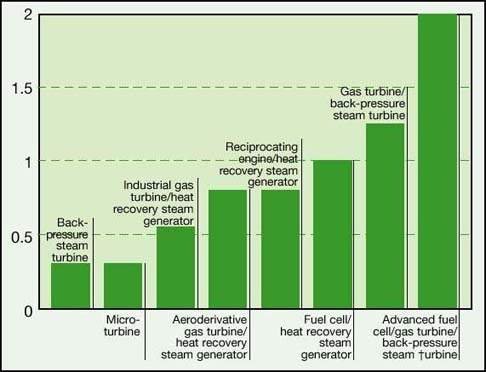
FIGURE 8.1. OUTPUT RATIOS OF POWER
(KILOWATTS-ELECTRIC) TO HEAT (KILOWATTS-THERMAL) FOR ALTERNATIVE COGENERATION
TECHNOLOGIES
Note: Ratios are for systems producing 10 bar steam.
All steam turbines are back-pressure steam turbines with no steam condenser.
Source: Simbeck, 1999b.
Cogeneration is especially important in the near term for
rapidly industrialising countries. Because these countries are in the early
stages of building their infrastructure, their process-heat-intensive,
basic-materials-processing industries are growing rapidly. Rapidly growing steam
loads represent important resource bases for cogeneration, so that these
industries have the potential of becoming major providers of clean,
cost-competitive power. In this context, cogeneration systems employing gas
turbines and combined cycles equipped with back-pressure turbines provide
several times as much electricity per unit of process steam as systems based on
simple back-pressure turbines (figure 8.1). These and other cogeneration
technologies characterised by high output ratios of electricity to steam (for
example, reciprocating internal combustion engines and fuel cells) make it
possible for cogeneration to play a far greater role in power generation than is
feasible with steam-turbine technology.16
TABLE 8.5. COGENERATION VERSUS SEPARATE PRODUCTION OF
ELECTRICITY AND STEAM USING NATURAL GAS COMBINED CYCLES
|
Rates of activity and costs |
Separate production facilities for electricity and
steam |
Cogeneration facility |
|
Electricity |
Steam |
Total |
|
|
Power generation rate (megawatts-electric) |
400 |
- |
400 |
400 |
|
Process steam production rate, 10-15 bar
(megawatts-thermal) |
- |
400 |
400 |
400 |
|
Natural gas input rate (terajoules per hour) |
2.66 |
1.77 |
4.43 |
3.48 |
|
First Law efficiency (percent) |
54.1 |
81.1 |
64.9 |
82.8 |
|
CO2 emission rate (tonnes per hour) |
132 |
88 |
220 |
172 |
|
Capital investment (millions of dollars) |
166 |
48 |
214 |
194 |
|
Energy production cost (dollars per thousand
kilowatt-hours) |
|
|
|
|
|
Capital |
6.8 |
2.0 |
- |
8.0 |
|
Operation and maintenance (4 percent of capital cost per year)
|
2.4 |
0.7 |
- |
2.8 |
|
Fuel |
18.0 |
12.0 |
- |
23.5 |
|
Credit for cogenerated steam (at $14.7 per thousand
kilowatt-hours of steam) |
- |
- |
- |
-14.7 |
|
Total (net) production cost (dollars per thousand
kilowatt-hours) |
27.2 |
14.7 |
- |
19.6 |
|
Annual cost of energy (millions of dollars) |
76.3 |
41.2 |
117.5 |
55.0+41.2 |
|
Cost of CO2 emissions avoided (dollars per tonne
of carbon) |
- |
- |
- |
-$232 |
Note: Based on calculations by Dale Simbeck, SFA
Pacific. Engineering and contingencies and general facilities are each 10
percent of process capital equipment costs. The annual capital charge rate is
11.5 percent. The natural gas price is $2.70 per gigajoule (see note c, table
8.4). The annual average capacity factor equals 80 percent. The combined cycle
plant assumed for both power only and cogeneration applications is the unit with
steam-cooled gas turbine blades analysed in table 8.4.
An example of cogeneration with NGCC technology and equal
quantities of electric and steam power is described in table 8.5. For this
system, the fuel required is a fifth less and the net cost of electricity is a
quarter less per kilowatt-hour than for electricity and heat production in
separate facilities. Moreover, net costs for CO2 emissions reduction
are strongly negative at - $230 per tonne of carbon relative to costs for
systems that produce these products singly!
Cogeneration systems based on combined cycles and other high
electricity and steam output ratio technologies will typically lead to far more
electricity generated than the host factory can consume (Williams, 1978).
Entrepreneurs will not be motivated to deploy such technologies unless they are
able to sell into the grid electricity produced at fair market rates. Existing
electric-sector policies in many countries discourage such sales - for example,
electric companies often will not purchase cogenerated power at market rates or
will charge exorbitant fees for back-up service. But other countries have
adopted policies encouraging cogeneration. In competitive power markets,
cogenerators would typically do well (see table 8.5).
A final note: NGCC economic and environmental benefits in power
and cogeneration markets are so attractive that countries with constrained
natural gas supplies (such as China and India) should consider introducing NGCC
plants as anchor users for natural gas supplies that might be introduced
transnationally, using NGCC power generation and cogeneration revenues to
underwrite pipeline and other gas infrastructure costs.
Oxygen-blown coal gasification and integrated gasifier
combined cycle technologies. Gasification technology makes it possible to
extend to coal the economic, thermodynamic, and environmental benefits of
combined cycles in the form of IGCC power plants. Gasifiers can be oxygen-blown
(O2) or air-blown. All commercial units are O2-blown,
although some systems based on air-blown units are being demonstrated. The focus
here is on systems with O2-blown gasifiers; systems with air-blown
gasifiers are discussed below.
Since the demonstration of IGCC technology with the 94-mega
watt-electric Coolwater Project in southern California (1984 - 89), there has
been much progress relating to its commercialisation. Table 8.6 lists five large
commercial-scale coal IGCC plants around the world that produce electricity or
electricity and steam (cogen-eration), as well as nine other large commercial
projects that involve gasification of petroleum residues to coproduce
electricity with H2, syngas, or steam.17 If all the syngas
capacity in these 14 plants (9,825 megawatts-thermal) were dedicated to power
generation, the equivalent electric generating capacity would be about 5,300
megawatts-electric.
Pollutant emission levels for coal IGCCs can be nearly as low as
for NGCCs - much less than for coal steam-electric plants. Environmental damage
costs associated with emission levels equivalent to those measured at the
Buggenum plant in the Netherlands are less than 2 percent of such costs for
average coal-fired power plants in the United States and about 10 percent of
such costs for coal steam-electric plants equipped with the best available
control technology (see table 8.1). Deep reductions in emissions are feasible
because pollutants are recovered in concentrated form from the fuel gas (syngas)
leaving the gasifier - undiluted by the large amounts of nitrogen from
combustion air that are present in flue gases, from which air pollutants are
recovered for conventional power plants.
IGCC technology also offers solid waste management advantages.
Most direct combustion processes recover sulphur from flue gases as a
nonmarketable wet scrubber sludge or as a dry spent sulphur sorbent (the
by-product gypsum can be marketed). For such systems, solid wastes are more
difficult to handle and market or dispose of, and volumes to be managed are two
to three times those for IGCC systems, which recover a marketable elemental
sulphur by-product.18
The cost of electricity for IGCC technology is somewhat higher
than for coal steam-electric plants (compare Frame 7F IGCC and steam-electric
plant costs in table 8.4) - when credit is not given for the environmental
benefits, which would probably tip the balance decisively in favour of IGCC (see
table 8.1). New turbine technology based on the use of steam-cooled turbine
blades (Frame 7H technology) could tip the balance slightly in favour of IGCC,
even without environmental credits (see table 8.4). But the direct economic
benefits are likely to be too small to convince users to shift from familiar
technology to any new technology, with all the attendant risks associated with
its adoption. The user will take such risks only if forced to (for example, by
environmental regulations) or because the economic benefits would be decisive.
|
Growing concerns about air quality are
leading to increased
interest in new fuels
that have a higher degree of inherent
cleanliness
than traditional
liquid fuels derived from
crude oil. |
O2-blown coal gasification probably has a better
chance of being launched in the market through applications other than
power-only - for example, cogeneration. Table 8.7 illustrates the advantages
offered by IGCC-based cogeneration. For this system, fuel requirements are
reduced one fifth and the net electricity generation cost is reduced one fourth
relative to electricity and steam production in separate facilities (as in the
corresponding natural gas case - see table 8.5).
Of course, cogeneration strategies can also be pursued with
conventional steam turbine technology. However, as illustrated by the
calculation in table 8.8 for the same levels of electricity and process steam
generation as in the IGCC case,19 the fuel savings rate (5 percent)
and the reduction in the net cost of electricity (9 percent) are far less than
for the IGCC case. Moreover, a comparison of tables 8.7 and 8.8 shows that
although there is little difference in efficiency and cost for IGCC and
ultrasupercritical steam turbine technologies in producing electricity only,
IGCC technology is a markedly better performer in cogeneration applications.
TABLE 8.6. LARGE COMMERCIAL GASIFICATION-BASED PROJECTS
INVOLVING ELECTRICITY AS PRODUCT OR COPRODUCT
|
Location |
Plant owner |
Technology |
Syngas out (megawatts - thermal) |
Feedstock(s) |
Product(s) |
Start-up year |
|
Spain |
Repsol and Iberola |
Texaco |
1,654 |
Vacuum residues |
Electricity |
2004 |
|
Italy |
SARLUX srl |
Texaco |
1,067 |
Visbreaker residues |
Electricity, H2 |
2000 |
|
Italy |
ISAB Energy |
Texaco |
982 |
ROSE asphalt |
Electricity, H2 |
1999 |
|
France |
Total France, EdF, and Texaco |
Texaco |
895 |
Fuel oil |
Electricity, H2 |
2003 |
|
Netherlands |
Shell Nederland Raffinaderij BV |
Shell |
637 |
Visbreaker residues |
Electricity, H2 |
1997 |
|
Czech Republic |
SUV and EGT |
Lurgi Dry Ash |
636 |
Coal |
Electricity, steam |
1996 |
|
United States |
Public Service of Indiana |
Destec |
591 |
Bituminous Coal |
Electricity |
1995 |
|
Spain |
Elcogas SA |
PRENFLO |
588 |
Coal, petcoke |
Electricity |
1997 |
|
United States |
Motiva Enterprises LLC |
Texaco |
558 |
Fluid petcoke |
Electricity, steam |
1999 |
|
Italy |
API Raffineria de Ancona S.p.A. |
Texaco |
496 |
Visbreaker residues |
Electricity |
1999 |
|
Netherlands |
Demkolec BV |
Shell |
466 |
Bituminous Coal |
Electricity |
1994 |
|
United States |
Tampa Electric Company |
Texaco |
455 |
Coal |
Electricity |
1996 |
|
United States |
Exxon USA Inc. |
Texaco |
436 |
Petcoke |
Electricity, syngas |
2000 |
|
Singapore |
Esso Singapore Pty. Ltd. |
Texaco |
364 |
Residual oil |
Electricity, H2 |
2000 |
Source: Simbeck and Johnson,
1999.
Once gasification technology is established in the market, a
continuing stream of innovations can be expected to improve performance and
reduce costs - because there are many opportunities (van der Burgt, 1998; Holt,
1999a). One way innovation will take place is by relatively passively
incorporating continually improving gas turbine designs into IGCC systems - the
benefits of which are illustrated by the shift from air-cooled to steam-cooled
gas turbine blades in table 8.4. And if Tophat® turbines are
developed (see above), such systems used with gasified coal would be both less
capital-intensive and more energy-efficient than current IGCC systems - for
example, van der Burgt and van Liere (1996) estimate that with such cycles
overall efficiency would increase to about 50 percent.
Specific IGCC-related improvements might also be made. For
example, new gasifiers are needed that are well suited for coals with high ash
content (typical of many coals in China, India, and South Africa) and for
low-rank coals (which are abundant world-wide; see chapter 5), because
commercially available entrained-flow gasifiers are not well suited for such
coals. Fluidised-bed gasifiers are good candidates for these coals; such
gasifiers would also be better suited for handling most biomass and waste as
co-feedstocks than are entrained-flow gasifiers. Such technology, in the form of
the High Temperature Winkler gasifier, was demonstrated with brown coal at a
plant in Berrenrath, Germany, where the syngas was used to produce methanol
(Simbeck and others, 1993). An IGCC project based on the High Temperature
Winkler gasifier for coal fines has been proposed for construction in the Czech
Republic (Holt, 1999b).
One research and development focus is technology to clean gases
at high temperatures to reduce thermodynamic losses associated with thermal
cycling of gases exiting the gasifier.20 Such technology is being
pursued largely because it is necessary for successful development of IGCC
systems based on air-blown gasifiers and advanced pressurised fluidised-bed
combustion systems (see below). However, hot gas clean-up is not necessary for
IGCC systems with O2-blown gasifiers. The technology is challenging
(especially to realise the low emission levels achievable with present cold-gas
cleanup), and potential economic benefits are modest even if positive,
especially because coal prices are low and declining (Simbeck, 1995; Williams,
1999b).
Despite coal IGCC technical successes, there are few
opportunities for deploying the technology in the industrialised world, where
electricity demand is growing slowly, and where the NGCC is the technology of
choice wherever there is a need for new power supplies and natural gas is
available. The best potential opportunities for IGCC technology are in China and
other developing countries where natural gas is not readily available and rapid
growth in coal use is expected. There, IGCC technology could have enormous
positive impacts in reducing local and regional air pollution, while
substantially improving efficiencies and reducing greenhouse gas emissions. To
make initial deployment of IGCC technology economically interesting to such
countries, the first installations might be in cogeneration or polygeneration
(see below) configurations. As in the case of NGCC cogeneration, the key to
unlocking the cogeneration potential offered by IGCC technology is policies that
make competitive electricity prices available to these producers for the
electricity they wish to sell into electricity grids.
|
Encouraging competitive power
markets could help put
industry on a
path to fossil energy with near-zero
emissions by helping
launch syngas-
based polygeneration
activities. |
Small engines for cogeneration (reciprocating engines and
microturbines). IGCC cogeneration technologies are suitable for deployment
at scales of hundreds of megawatts; NGCC cogeneration technologies can be
deployed at scales from a few up to hundreds of megawatts. But many small
factories, commercial buildings, and apartment buildings would be good
candidates for clean, gas-based cogeneration if appropriate technologies were
available at scales from less than 100 kilowatts-electric to a few megawatts.
Both reciprocating engines and microturbines show promise as near-term
technologies for cogeneration at such scales.
From June 1997 through May 1998, world-wide sales of
reciprocating engines for stationary power markets totalled about 5,100 units
(9.6 gigawatts-electric of total capacity) - a gain of five times from 10 years
earlier (Wadman, 1998). More than half of the units will be for continuous
service.21 Although most units will use oil, 13 percent will use
natural gas or will be capable of using dual fuels. Gas applications might
expand markedly under increasingly competitive power market conditions.
For spark-ignited engines, shifting to natural gas involves
significant de-rating. Compression-ignition engines can also be converted to
gas, either by adding a spark plug or by using a liquid spark - a small amount
of diesel fuel for ignition. The latter approach is preferable with regard to
both first cost and efficiency. Compression-ignition engines with liquid sparks
bring to natural gas applications the low cost and high efficiencies of these
engines, with much less de-rating. Recent advances have reduced liquid spark
requirements for dual-fuel engines to 1 percent of system fuel requirements for
larger engines. Such engine generator sets are commercially available at scales
of 1 - 16 megawatts-electric with lower heating value (LHV) efficiencies of 39 -
42 percent.
Prices for both spark-ignited and dual-fuel engine generator
sets (for equipment only) for the capacity range under 1 megawatt-electric
typically lie in the range $425 - 600 per kilowatt-electric - prices that do not
include the costs for heat recovery equipment for cogeneration. Operation and
maintenance costs for reciprocating engines are typically significantly higher
than for combustion turbines. Reciprocating engines can be used for cogeneration
by recovering both high-quality heat from the engine exhaust and low-quality
heat from the engine jacket cooling water. Like gas turbines and combined
cycles, reciprocating engines are attractive for such applications because of
their high electricity-heat output ratios (see figure 8.1). Some reciprocating
engine vendors offer complete cogeneration package systems. Very small-scale
systems (under 100 kilowatts-electric) sell in the United States for $1,500 -
2,000 per kilowatt-electric. The engines for such systems last only 3 - 4 years,
but replacement engines cost only $75 per kilowatt-electric.
TABLE 8.7. COGENERATION VERSUS SEPARATE PRODUCTION OF
ELECTRICITY AND STEAM USING COMBINED CYCLE AND COAL GASIFICATION
TECHNOLOGIES
|
Rates of activity and costs |
Separate production facilities for electricity and
steam |
Cogeneration plant |
|
IGCC plant |
Industrial boiler |
Total |
|
|
Power generation rate (megawatts-electric) |
400 |
- |
400 |
400 |
|
Process steam production rate, 10-15 bar
(megawatts-thermal) |
- |
400 |
400 |
400 |
|
Coal input rate (terajoules per hour) |
3.20 |
1.65 |
4.85 |
3.88 |
|
First Law efficiency (percent) |
45.1 |
87.2 |
59.4 |
74.3 |
|
CO2 emission rate (tonnes per hour) |
274 |
142 |
416 |
333 |
|
Capital investment (millions of dollars) |
453 |
197 |
650 |
537 |
|
Annual energy production cost (millions of dollars per
year) |
|
|
|
|
|
Capital |
52.19 |
22.69 |
74.88 |
61.86 |
|
Operation and maintenance (4 percent of capital cost per year)
|
18.12 |
7.88 |
26.00 |
21.48 |
|
Fuel |
22.44 |
11.57 |
34.01 |
27.21 |
|
Total annual energy cost |
92.75 |
42.14 |
134.89 |
110.55 |
|
Specific cost of energy (dollars per thousand
kilowatt-hours) |
For power: |
For steam: |
|
For power: |
|
Gross cost |
33.1 |
15.0 |
- |
39.4 |
|
Credit for steam coproduct |
- |
- |
- |
-15.0 |
|
Net cost |
33.1 |
15.0 |
- |
24.4 |
Note: Based on calculations by Dale Simbeck, SFA
Pacific. Engineering plus contingencies are 10 percent of process capital
equipment costs; general facilities are 10 percent of process capital equipment
costs. The annual capital charge rate is 11.5 percent. The coal price is $1.00
per gigajoule (see note c, table 8.4). The annual average capacity factor is 80
percent. Both the stand-alone integrated gasifier combined cycle (IGCC) power
plant and the cogeneration plant use a Destec O2-blown coal gasifier
coupled to a combined cycle with steam-cooled gas turbine blades.
TABLE 8.8. COGENERATION VERSUS SEPARATE PRODUCTION OF
ELECTRICITY AND STEAM USING STEAM TURBINE AND PULVERIZED COAL COMBUSTION
TECHNOLOGIES
|
Rates of PCC activity and costs |
Separate production facilities for electricity and
steam |
Cogeneration plant |
|
PCC power plant |
Industrial boiler |
Total |
|
|
Power generation rate (megawatts-electric) |
400 |
- |
400 |
400 |
|
Process steam production rate, 10-15 bar
(megawatts-thermal) |
- |
400 |
400 |
400 |
|
Coal input rate (terajoules per hour) |
3.39 |
1.65 |
5.04 |
4.68 |
|
First Law efficiency (percent) |
42.4 |
87.2 |
57.1 |
61.6 |
|
CO2 emission rate (tonnes per hour) |
291 |
142 |
433 |
402 |
|
Capital investment (millions of dollars) |
453 |
197 |
650 |
612 |
|
Annual energy production cost (millions of dollars per
year) |
|
|
|
|
|
Capital |
52.19 |
22.69 |
74.88 |
70.50 |
|
Operation and maintenance (4 percent of capital cost per year)
|
18.12 |
7.88 |
26.00 |
24.48 |
|
Fuel |
23.77 |
11.57 |
35.34 |
32.82 |
|
Total annual energy cost |
94.08 |
42.14 |
136.22 |
127.8 |
|
Specific cost of energy (dollars per thousand
kilowatt-hours) |
For power: |
For steam: |
|
For power: |
|
Gross cost |
33.6 |
15.0 |
- |
45.6 |
|
Credit for steam coproduct |
- |
- |
- |
-15.0 |
|
Net cost |
33.6 |
15.0 |
- |
30.6 |
Note: Based on calculations by Dale Simbeck, SFA
Pacific. Engineering plus contingencies are 10 percent of process capital
equipment costs, as are general facilities. The annual capital charge rate is
11.5 percent. The coal price is $1.00 per gigajoule (see note c, table 8.4). The
average capacity factor is 80 percent. The pulverized coal combustion (PCC)
plant is an ultrasupercritical unit for the stand-alone power plant and a
sub-critical unit for the cogeneration plant.
Air pollutant emissions, especially NOx, are a
concern. Uncontrolled gas engines produce significant CO and non-methane
hydrocarbon emissions; however, relatively low-cost oxidation catalytic
converters can control such emissions. Most lean-burning, spark-ignited natural
gas engines and micro-liquid-spark, dual-fuel engines can achieve NOx
emission of 1.4 grams per kilowatt-hour (100 parts per million by volume
at 15 percent O2) - about 15 times the emission rate for large modern
NGCCs with state-of-the-art NOx controls (see table 8.1). Some
vendors now offer systems with half this level of emissions but at an energy
efficiency penalty of about 1 percentage point. In some areas (for example, many
parts of the United States), NOx emission regulations will severely
limit deployment of reciprocating engines for stationary power markets at scales
from 100 kilowatts-electric to 2 megawatts-electric.
Operation of reciprocating engines on town gas (that is, syngas)
is also feasible and would be an especially attractive option for
natural-gas-poor, coal-rich regions. There town gas could be produced from coal
at centralised facilities along with syngas for other poly-generation activities
and piped up to 30 kilometres to various distributed cogeneration facilities.
The air quality benefits of such gas-based technologies relative to direct coal
combustion would be especially important in countries such as China, where coal
is used for heating in small, inefficient boilers equipped with little or no air
pollution control equipment. However, such systems would not be pollution free.
Air emission concerns would be similar to those for reciprocating engines
operated on natural gas, except that NOx emissions might be higher
because of higher adiabatic flame temperatures.
Reciprocating engines can also be adapted to small-scale
operations in rural areas using either biogas (from anaerobic digesters) or
producer gas generated by thermochemical gasification of biomass (see Mukunda,
Dasappa, and Srinivasa, 1993; chapters 7 and 10).
Efforts under way to improve reciprocating engine markets for
stationary power include the five-year Advanced Reciprocating Engine Systems
(ARES) programme - being carried out by a consortium of U.S. manufacturers, the
U.S. Department of Energy, the Gas Research Institute, and the Southwest
Research Institute. ARES is targeting development of an advanced gas engine with
an efficiency of 50 percent (LHV basis) and a NOx output of 5 parts
per million by volume (including catalytic aftertreatment if necessary).
|
There is growing confidence
among scientists that
underground
sequestration of CO2 will prove
to be a major
option for
mitigating climate-
change risks. |
The microturbine is a gas turbine just entering the market for
applications at scales less than 100 kilo-watts-electric. Its development
recently got a boost as a result of its being chosen as a cruise missile engine.
One vendor has already launched the technology in the market, and several other
aerospace firms are getting ready to market it for stationary power
applications. Promoters project that it will do well in new highly competitive
distributed power markets (Craig, 1997).
The system involves a low-pressure ratio (3 to 4) gas turbine
and compressor mounted on a single shaft.22 The most promising models
available are air cooled and have variable speed generators (the output of which
is rectified and converted electronically to the alternating-current line
frequency), no gear-box, no lubricating oil requirements, and only one moving
part. Turbine blades are not cooled, turbine inlet temperatures are modest (840
degrees Celsius), but engine speeds are high - 80,000 revolutions a minute or
more. Conversion efficiencies with natural gas fuelling are 25 percent (LHV
basis) at full power output - far less than for large reciprocating engines but
comparable to reciprocating engine generator set efficiencies at scales of tens
of kilowatts-electric. Efficiency falls off at part load - to 75 percent of the
efficiency at full output when output falls to a third of the peak level
(Campanari, 1999).
Although electric efficiencies are not especially high, the
technology offers four attractive features:
· Potentially low
capital costs in mass production, because of the simple design.
· Low maintenance costs -
probably considerably lower than for reciprocating engines, because of the low
combustion temperature and the simple design’s expected higher reliability.
· Suitability for cogeneration,
because all waste heat is of high quality, in the form of hot (230 - 270 degrees
Celsius) air.
· The possibility of low
NOx emissions without stack gas controls.23
The microturbine faces competition from both reciprocating
engines and fuel cells. Maintenance and air quality issues will be important in
determining the outcome of competition with reciprocating engines. At scales of
hundreds of kilowatts-electric, it will be very difficult for microturbines to
compete in efficiency with reciprocating engines. Moreover, if the ARES
programme meets its NOx emissions reduction target, the competition
from reciprocating engine technology will be strong at all sizes for which such
emissions can be realised.
At the small scales (under 100 kilowatts-electric) that are the
focus for market development, the major competition will be from fuel cells -
for example, the proton exchange membrane (PEM) fuel cell (see below). Fuel
cells will be more efficient in producing electricity from natural gas and will
have lower air pollutant emissions. But microturbines will be better performers
in providing heat for cogeneration than PEM fuel cells, for which the waste heat
quality is low. And microturbines will probably be valued more by utilities as
peaking units than PEM fuel cells operated on natural gas, which cannot so
readily be dispatched to serve peaking needs.
Microturbines could have great appeal in markets where low-cost
gaseous fuels are available - for example, producer gas derived from low-cost
crop residues in rural areas of developing countries (chapter 10). They also
appear to be well suited for use as bottoming cycles for hybrid cycles that
employ pressurised molten carbonate or solid oxide fuel cells as topping cycles
(Campanari, 1999; Kartha, Kreutz, and Williams, 1997).
Fuel cells for stationary power and cogeneration. The
fuel cell converts fuel into electricity electrochemically, without first
burning it to produce heat (Kartha and Grimes, 1994). Fuel cells have attractive
features for electricity markets characterised by increasing competition and
environmental regulations: high thermodynamic efficiency, low maintenance
requirements, quiet operation, zero or near-zero air pollutant emissions without
exhaust-gas controls, and high reliability. Fuel cells are likely to be
economically viable even in small-scale (100 kilowatts-electric or less)
applications. Its properties make it possible to site systems in small,
unobtrusive generating facilities close to end users.
Such distributed power sources make cogeneration designs
economically attractive and offer the potential of reducing capital outlays for
electricity transmission and distribution equipment (Hoff, Wenger, and Farmer,
1996). Low-temperature phosphoric acid fuel cells (PAFCs) and proton exchange
membrane fuel cells (PEMCs) are well suited for combined heat and power
applications in small- to medium-scale commercial and residential buildings,
providing domestic hot water and space heating and cooling (Little, 1995;
Dunnison and Wilson, 1994). Developers of high-temperature molten carbonate fuel
cells (MCFCs) and solid-oxide fuel cells (SOFCs) target medium- to large-scale
industrial applications.
The PAFC, developed largely in Japan and the United States, is
the only commercial fuel cell. Several hundred PAFC power plants (mostly
200-kilowatt-electric natural-gas-fuelled units) are operating. Accumulated
experience has demonstrated that fuel cell power plants can be made to operate
reliably. Costs are high, however, and whether they can be reduced enough with
volume production to make the PAFC widely competitive is uncertain.
Because of recent technological advances, substantial U.S.,
European, and Japanese activities are seeking to accelerate commercialisation of
the PEMFC for residential and commercial building cogeneration markets (Dunnison
and Wilson, 1994; Little, 1995; Lloyd, 1999) as well as for transportation (see
below). Several companies are developing residential PEMFC combined heat and
power systems (Lloyd, 1999). Ballard Generation Systems plans to begin selling
250-kilowatts-electric system for commercial buildings by 2003 - 04; Plug Power
is focussing on smaller (less than 35-kilowatt-electric) units and plans to
install the first residential units by 2001.24 In initial
applications it is expected that most systems would use mainly existing natural
gas infrastructure and, like PAFCs, process natural gas at the point of use in
an external fuel processor into an H2-rich gas the fuel cell can use.
The best chances for making small fuel cells competitive are in
markets that value electricity highly (for example, in residential or other
buildings, where produced electricity must be less costly than the retail rate)
and where fuel cell waste heat can be used effectively. Space heating and
cooling markets are not well matched to PEMFC capabilities; space heating demand
is seasonal with enormous variation in the heating season; and the operating
PEMFC temperature (80 degrees Celsius) is too low to use waste heat for
heat-driven air conditioners.
However, domestic hot water demand often provides a good match -
demand is fairly level year-round, and the PEM operating temperature is well
suited for domestic hot water. Especially promising opportunities are where the
fuel cell is sized to meet the demand for domestic hot water, so that very
little waste heat is discarded. If the PEMFC size were increased to meet a
larger fraction of the electrical load, it would become more and more difficult
to compete, because more and more of the waste heat would have to be discarded,
reducing the credit (per kilowatt-hour of electricity) for waste heat
utilisation.
The economic prospects are best for apartment buildings, hotels,
and hospitals, where a centralised building-scale PEM fuel cell system serves
power and hot water needs throughout. It would be more difficult for such
systems to compete at the level of single-family dwellings for currently
expected PEMFC economies of scale (Kreutz and Ogden, 2000).
The high operating temperatures for MCFCs (600 - 650 degrees
Celsius) and SOFCs (1,000 degrees Celsius) make them well suited for
cogeneration, including applications that use the waste heat to operate
heat-driven air conditioners. They also offer the option of using directly
natural gas or syngas derived through gasification from coal or other feedstocks
without an external fuel processor - because these gases can be reformed (using
waste heat from fuel cell operation) and shifted on the anode into an
H2-rich gas the fuel cell can easily use - leading, potentially, to
higher efficiency, simplified operation, and increasing reliability. (But having
an external reformer offers the flexibility of being able to switch relatively
easily to operation on alternative fuels.)
The two principal vendors for MCFCs have been Energy Research
Corporation and MC Power. Energy Research Corporation units operate at
atmospheric pressure with internal reforming; MC Power units operate at pressure
but with an external reformer. A 1.8-megawatt-electric demonstration plant based
on Energy Research Corporation technology was built and operated on natural gas
beginning in April 1996 in Santa Clara, California; a peak efficiency of 40
percent was achieved. Because of various difficulties, the unit was operated for
only 4,000 hours and was dismantled in March 1997. In March 1999 Energy Research
Corporation put into operation a 250-kilowatt-electric demonstration unit at its
Danbury, Connecticut, headquarters. In 1997 MC Power operated a
250-kilowatt-electric cogeneration unit at the Naval (now Marine Corps) Mirimar
Air Station in San Diego, California. Unable to raise new funding for research
and development, MC Power went out of business in March 2000.
SOFCs offer the potential for high efficiency, low cost, and
potentially long operating lifetimes (Bakker, 1996). The main uncertainties
concern manufacturing costs and durability in operation as a result of the fact
that SOFCs are made of ceramics. Although the cost of the materials in the
ceramics is inherently low ($7 - 15 per kilowatt-electric; Goldstein, 1992),
fabrication of ceramics is difficult and costly. Moreover, there are risks that
the ceramic components will develop cracks during operation as a result of
thermal cycling.
Siemens Westinghouse, the leading SOFC developer, has focussed
on a tubular design and has deployed seven fully integrated, automatically
controlled, packaged SOFC systems as experimental field units. The largest of
these is a 100-kilowatt-electric natural-gas-fuelled cogeneration system
deployed in the Netherlands in early 1998. The system has realised extremely low
pollutant emissions - 0.2 parts per million by volume of NOx and
undetectable levels of sulphur dioxide (SO2), CO, and unburned
hydrocarbons (Veyo, 1998).
The tubular design facilitates manufacture and realisation of
properly operating seals, but it is uncertain how low costs can become in mass
production. Planar designs that operate at lower temperatures (800 degrees
Celsius)25 seem promising with regard to both high efficiency (55 -
70 percent on natural gas, LHV basis) and capital cost in mass production ($700
- 800 per kilowatt-electric at a scale of 500 kilowatts-electric; Chen, Wright,
and Krist, 1997). But such designs require considerable more research and
development.
In the 1970s and 1980s it was expected that high-temperature
fuel cells would eventually be able to compete with conventional power
generating technologies at a wide range of scales - including large
central-station power plants as well as cogeneration plants of all sizes. But
the enormous success of gas turbines and combined cycles dampened the prospects
for large-scale fuel cell applications during the early 1990s - when it became
apparent that the marginal efficiency gains offered by fuel cells over combined
cycles would not be able to justify the expected higher capital costs - except
in small-scale operations (1 megawatt-electric or less). However, since the
early 1990s two developments have once more brightened the prospects for
high-temperature fuel cells for larger-scale installations.
The first is a hybrid concept that offers both higher efficiency
and lower capital cost. A hybrid would be made up of a high-temperature fuel
cell topping cycle and a gas turbine or a steam turbine or gas turbine - steam
turbine combined cycle bottoming cycle. A high-temperature fuel cell operated on
natural gas or syngas will utilise only 80 - 90 percent of the gas energy. The
chemical energy remaining in the hot anode exhaust gases can be burned to
generate more electricity in a bottoming cycle. Modelling carried out at the
Electric Power Research Institute indicates that a 56 percent efficient
natural-gas-fuelled SOFC combined with a regenerative gas turbine bottoming
cycle could lead to a system efficiency of 71 percent (Bakker, 1996) -
efficiencies well above the levels that can be realised with gas turbine - steam
turbine combined cycles. Because the cost per kilowatt-electric of the bottoming
cycle will typically be less than the than the cost per kilowatt-electric for
the fuel cell itself, the overall capital cost for the hybrid will be less than
for a purebred fuel cell.
The second new development is related to the fact that
pressurised high-temperature fuel cells offer an option for low-cost CO2
recovery and disposal as a response to climate change concerns. The
concept is related to the fact that CO2 is available at high partial
pressure in the anode exhaust of pressurised SOFCs or MCFCs in highly
concentrated form. To illustrate, consider operation of a pressurised SOFC on
syngas (mainly CO and H2) derived from coal through
O2-blown gasification. Both the CO and the H2 react in the
anode directly with O2 (transported across the electrolyte from the
cathode as an oxygen ion) to form CO2 and H2O. If the 10 -
20 percent of the unconverted CO and H2 exiting the anode is then
burned in O2 for use in a bottoming cycle,26 the gaseous
product will be a mixture of CO2 and H2O, from which the
H2O can easily be removed by cooling and condensation. Moreover, if
the bottoming cycle is a steam turbine, the CO2 can be recovered for
disposal at relatively high pressure, leading to low costs for further
pressurising the CO2 to the level needed for disposal. Recognising
the value of this strategy, Shell announced in July 1999 plans to develop and
market with Siemens Westinghouse SOFC technology capable of disposing of
CO2 in this manner.27
|
BOX 8.2. DEEP OCEAN SEQUESTRATION OF ANTHROPOGENIC CARBON
DIOXIDE
The ocean, containing 40,000 gigatonnes of carbon (relative to
750 GtC in the atmosphere), represents the largest potential sink for
anthropogenic CO2; disposing in the ocean of an amount of CO2
that would otherwise lead to a doubling of the atmosphere’s content
would thus increase the ocean concentration by less than 2 percent. On a
1,000-year time scale, more than 90 percent of today’s anthro-pogenic
emissions will be transferred to the oceans through a slow, natural process. The
basic idea of ocean sequestration of CO2 is to inject CO2
directly into the deep ocean to accelerate this process and reduce both
peak atmospheric CO2 concentrations and their rate of increase.
For a large fraction of injected CO2 to remain in the
ocean, injection must be at great depths. This is because CO2 would
be a gas above 800 metres and a liquid below 800 metres. Liquid CO2
is negatively buoyant relative to ordinary seawater only below 3,000
metres. Liquid CO2 is negatively buoyant relative to seawater
saturated with CO2 only below 3,700 metres. And at injection depths
of about 500 metres or more, a CO2-seawater mixture (depending on the
relative compositions) can lead to formation of a CO2 hydrate, which
is about 10 percent denser than seawater.
A consensus is developing that the best near-term strategy would
be to discharge CO2 at depths of 1,000 - 1,500 metres, which can be
done with existing technology. A major uncertainty that requires more research
for clarification relates to the sequestration efficiency (the fraction of the
CO2 that remains in the ocean) of injection at such depths (see, for
example, Brewer and others, 1999). Another approach, aimed at maximising
sequestration efficiency, is to inject liquid CO2 into a deep
sea-floor depression, forming a stable deep lake at a depth of 4,000 metres - an
approach that is technologically challenging with current technology. A simple
and feasible but very costly option is to release dry ice from a surface ship.
Another approach is to create a dense CO2-seawater mixture at a depth
of 500 - 1,000 metres and cause it to form a sinking-bottom gravity current - an
approach that has raised many environmental impact concerns.
On a global scale, both climate change and other environmental
impacts of ocean disposal (for example, increased ocean acidity) are positive.
But on a local scale, there are considerable environmental concerns arising
largely as a result of the increased acidification near the points of injection
- for example, impacts on non-swimming marine organisms residing at depths of
1,000 metres or more.
Japan has the world’s most active ocean sequestration
research programme, led by the Research Institute of Innovative Technology for
the Earth and the Kansai Environmental Engineering Centre, and funded at an
annual level of more than 10 million dollars.
Although the deep ocean has been the most-discussed option for
CO2 disposal, much more research is needed to better understand the
security, costs, and environmental impacts of various ocean disposal schemes
(Turkenburg, 1992). In addition, the viability of ocean storage as a greenhouse
gas mitigation option hinges on social and political as well as technical,
economic, and environmental considerations. The public is generally cautious
regarding ocean projects. |
Source: Herzog, 1999b.
Decarbonisation and carbon dioxide sequestration strategies
for power generation systems. Because of climate change concerns, increasing
attention has been given in recent years to strategies for extracting energy
from fossil fuels without releasing CO2 into the atmosphere. The
issues involved concern the capacity, security, and cost of alternative CO2
disposal options and the costs of separating the CO2 from
fossil energy systems and preparing it for disposal.
The options for CO2 sequestration include both the
deep ocean and geological reservoirs. Although ocean disposal has received the
most attention (box 8.2), large uncertainties in its prospects (Turkenburg,
1992) have led to a shift of focus in recent years to give more attention to
geological (underground) storage of CO2, in depleted oil and natural
gas fields (including storage in conjunction with enhanced oil and gas
recovery), in deep coal beds (in conjunction with coal bed methane recovery),
and in deep saline aquifers.
CO2 injection for enhanced oil recovery (Blunt,
Fayers, and Orr, 1993), enhanced gas recovery (van der Burgt, Cantle, and
Boutkan, 1992; Blok and others, 1997), and enhanced recovery of deep coal bed
methane (Byrer and Guthrie, 1999; Gunter and others, 1997; Stevens and others,
1999; Williams, 1999a) might become profitable focuses of initial efforts to
sequester CO2. Enhanced oil recovery using CO2 injection
is well-established technology; one project that began in 2000 in Saskatchewan,
Canada, is injecting yearly up to 1.5 million tonnes of CO2, which is
transported 300 kilometres to the injection site from a synthetic natural gas
plant in North Dakota (see below).
Sequestration in depleted oil and gas fields is generally
thought to be a secure option if the original reservoir pressure is not exceeded
(van der Burgt, Cantle, and Boutkan, 1992; Summerfield and others, 1993). One
estimate of the prospective global sequestering capacity of such reservoirs
associated with past production plus proven reserves plus estimated undiscovered
conventional resources is 100 GtC for oil fields and 400 GtC for gas fields
(Hendriks, 1994). Other estimates are as low as 40 GtC for depleted oil fields
and 90 GtC for depleted gas fields, plus 20 GtC associated with enhanced oil
recovery (IPCC, 1996a). The range is wide because reservoir properties vary
greatly in their suitability for storage, and because oil and gas recovery may
have altered the formations and affected reservoir integrity. Much of the
prospective sequestering capacity will not be available until these fields are
nearly depleted of oil and gas.
|
A fierce global
competition is underway
to accelerate
the
development of fuel
cell vehicles. |
Deep aquifers are much more widely available than oil or gas
fields. Such aquifers underlie most sedimentary basins, the total areas of which
amount to 70 million square kilometres (two-thirds onshore and one-third
offshore), more than half the 130-million-square-kilometre land area of the
inhabited continents. Some sedimentary basins offer better prospects for
CO2 storage than others (Hitchon and others, 1999; Bachu and Gunter,
1999). To achieve high storage densities, CO2 should be stored at
supercritical pressures (more than about 75 times atmospheric pressure), which
typically requires storage at depths greater than 800 metres. The aquifers at
such depths are typically saline and not effectively connected to the much
shallower (typically less than 300-metre) sweet-water aquifers used by people.
If aquifer storage is limited to closed aquifers with structural traps, the
potential global sequestering capacity is relatively limited - about 50 GtC
(Hendriks, 1994), equivalent to less than 10 years of global CO2
production from burning fossil fuel at the current rate.
However, if structural traps are not required for effective
storage, potential aquifer storage capacity might be huge; estimates range from
2,700 GtC (Omerod, 1994) to 13,000 GtC (Hendriks, 1994). For comparison,
estimated remaining recoverable fossil fuel resources (excluding methane
hydrates) contain about 5,600 GtC (see table 5.7). A growing body of knowledge
indicates that many large horizontal open aquifers might provide effective
storage28 if the CO2 is injected far enough from reservoir
boundaries that it dissolves in the formation water or precipitates out as a
mineral as a result of reactions with the surrounding rock before migrating more
than a few kilometres towards the basin boundaries (Bachu, Gunter, and Perkins,
1994; Gunter, Perkins, and McCann, 1993; Socolow, 1997). The relatively new idea
that large horizontal aquifers can provide effective sequestration has
contributed to growing confidence among scientists that underground
sequestration of CO2 will prove to be a major option for mitigating
climate-change risks (Holloway, 1996; Socolow, 1997; PCAST Energy Research and
Development Panel, 1997).
Experience with aquifer disposal will be provided by two
projects involving injection into nearby aquifers of CO2 separated
from natural gas recovered from CO2-rich gas reservoirs. One is a
Statoil project begun in 1996 to recover 1 million tonnes of CO2 a
year from the Sleipner Vest offshore natural gas field in Norway (Kaarstad,
1992). The second, which will commence in 10 years, will involve the recovery of
more than 100 million tonnes a year (equivalent to 0.5 percent of total global
emissions from fossil fuel burning) from the Natuna natural gas field in the
South China Sea (71 percent of the reservoir gas is CO2) (IEA, 1996).
Extensive historical experience with underground gas storage
contributes to the growing scientific confidence in the reliability of
geological reservoirs for storing CO2. And regulations that have been
evolving for underground gas storage provide a good basis for defining the
issues associated with formulation of regulations for CO2 storage
(Gunter, Chalaturnyk, and Scott, 1999).
More research, field testing, modelling, and monitoring are
needed to narrow the uncertainties relating to CO2 storage in
geological reservoirs. From a policy perspective, it is particularly important
to understand better potential effective storage capacities on a
region-by-region basis so that energy and environmental planners will have a
better understanding of the overall potential for fossil fuel decarbonisation
with CO2 sequestration as an option for dealing with climate change.
Getting such important information is not likely to be especially costly. For
example, Stefan Bachu of the Alberta Research Council has estimated that
obtaining a reasonable estimate of the geological CO2 storage
capacity of Canada would cost $14 million (Gunter, 1999). The cost is relatively
low because geological surveys have collected an enormous amount of relevant
data during the past 100 years, and many more relevant data from industrial
sources are available from regulatory bodies.
Public acceptability issues are paramount. Fuel decarbonisation
with CO2 sequestration is unfamiliar to most people as a strategy for
dealing with the climate change challenge. What will public attitudes be? The
scientific community has a major responsibility to inform the public debates on
the various issues relating to safety and environmental impacts. Much can be
learned from both natural events (Holloway, 1997) and from the extensive
historical experience with use of CO2 injection for enhanced oil
recovery and with underground gas storage (Gunter, Chalaturnyk, and Scott,
1999). But more research is needed to clarify the issues.
An optimistic note on which to end this discussion: in the
sections that follow, it will be shown that those advanced fossil energy
technologies offering the potential for CO2 disposal at the least
costs are also characterised by near-zero emissions of air pollutants.
TABLE 8.9. ALTERNATIVE TECHNOLOGIES FOR REDUCING CO2
EMISSIONS FROM 400-MEGAWATT-ELECTRIC COAL PLANTS
|
Technology |
Efficiency (percent, HHV) |
Capital cost (dollars per kilowatt) |
Generation cost (dollars per thousand kilowatt-hours)
|
O2 requirements (tonnes per hour) |
CO2 emissions (grams of carbon per
kilowatt-hour) |
Cost of avoiding CO2 emissions (dollars per
tonne of carbon) |
|
Ultrasupercritical pulverised coal steam turbine plant
|
|
|
|
|
|
|
|
Reference, CO2 vented |
43.1 |
1,114 |
33.0 |
0 |
196 |
- |
|
CO2 recovery from flue gasses |
34.3 |
1,812 |
52.2 |
0 |
36.8 |
134 |
|
O2 firing, CO2 recovery from flue gasses
|
32.0 |
1,661 |
52.8 |
339 |
0 |
111 |
|
Pressurised fluidised-bed combustion plant |
|
|
|
|
|
|
|
Reference, CO2 vented |
43.1 |
1,114 |
33.0 |
0 |
196 |
- |
|
O2 firing, CO2 recovery from flue gasses
|
35.4 |
1,675 |
51.6 |
307 |
0 |
104 |
|
Integrated gasifier - combined cycle plant |
|
|
|
|
|
|
|
Reference, CO2 vented |
45.9 |
1,114 |
32.5 |
80 |
184 |
- |
|
Cold CO2 recovery from synthesis gas |
36.1 |
1,514 |
47.9 |
108 |
23.9 |
96 |
|
Warm CO2 recovery from synthesis gas (advanced
technology) |
41.5 |
1,466 |
44.5 |
94 |
20.4 |
73 |
|
H2-O2 Rankine cycle plant: Cold
CO2 recovery from synthesis gas (advanced technology) |
40.5 |
1,622 |
48.4 |
259 |
6.1 |
90 |
|
Solid oxide fuel cell (SOFC) plant |
|
|
|
|
|
|
|
H2-fueled SOFC - gas turbine - steam turbine plant,
warm CO2 recovery from synthesis gas (advanced technology) |
45.7 |
1,461 |
43.3 |
85 |
19.1 |
65 |
|
SOFC - steam turbine plant, CO2 recovered from anode
exhaust burned with O2 (advanced technology) |
44.3 |
1,427 |
43.1 |
114 |
6.8 |
60 |
Note: Based on calculations by Dale Simbeck, SFA
Pacific. Engineering and contingencies are 10 percent of process capital
equipment costs; general facilities are 10 percent of process capital equipment
costs. The annual capital charge rate is 11.5 percent. The coal price is $1.00
per gigajoule. The annual average capacity factor is 80 percent. All options
involving CO2 separation and disposal include the cost of compressing
the separated CO2 to 135 bar plus a cost of $5 per tonne of CO2
($18 per tonne of carbon) for pipeline transmission and ultimate
disposal.
People are likely to be more willing to accept fuel
decarbonisation with CO2 sequestration as a major energy
option if the technology also offers near-zero emissions than if they view it as
a way to sustain a dirty energy system - away from which they would rather
evolve.
Table 8.9 presents performance and cost calculations (developed
in a self-consistent manner across options) for eight alternative technologies
and strategies for CO2 removal and disposal for coal-fired power
systems - variants of calculations developed earlier by Simbeck (1999c). Four
options are based on current or near-term (before 2005) technologies. The other
four (labelled advanced technology) require considerable technological
development. The H2-O2 Rankine cycle plant involves
producing H2 through coal gasification and burning it with O2
in a Rankine cycle - a technology proposed by Westinghouse researchers
(Bannister and others, 1996; Bannister, Newby, and Yang, 1997, 1998). The
turbine in this system looks like a gas turbine in the high-pressure stages but
a steam turbine at the condensing end - because the combustion of H2
in O2 leads to the production of only steam. If there were a
market for the turbine used in this system, it could probably be developed in
2010 - 20. The SOFC options require commercialisation of SOFC power technology,
which developers expect to take place before 2010. The two warm gas recovery
options require the development of relatively challenging advanced gas
separation technologies, which could be commercial by 2015.
The CO2 separation and disposal options are compared
with three reference technologies for power generation without CO2
removal and disposal: an ultrasupercritical steam-electric plant (see
below), a pressurised fluidised-bed combustion plant (see below), and an IGCC
plant (the Frame 7H option described in table 8.4). Identical capital costs are
assumed for these reference plants: Not only is this a reasonable approximation,
but also this assumption helps clarify cost differences for CO2
separation and disposal among alternatives.29 The cost of
avoided CO2 emissions for each case is calculated relative to the
least costly option in the table (the reference IGCC case, with CO2
venting).
The first CO2 recovery option involves CO2
scrubbing from the stack gases of an ultrasupercritical steam-electric
plant using an amine solution (flue gas scrubbing). The cost of avoiding
CO2 emissions and the power generation cost penalty are relatively
high ($134 per tonne of carbon and $0.020 per kilowatt-hour), largely because of
the high cost penalties associated with recovering CO2 from the stack
gases, where its concentration and partial pressure are low (15 percent and 0.15
bar, respectively).
The second option uses atmospheric pressure O2 rather
than air as oxidant, and recycles the separated CO2 back to the ultra
supercritical steam plant combustor. This strategy greatly increases the partial
pressure of CO2 in the flue gas. Cost penalties are comparable to
those for flue gas recovery because of the large quantities of costly O2
required. The third option is for a pressurised fluidised-bed combustion
unit that uses pressurised O2 as the oxidant instead of pressurised
air. This further increases the CO2 partial pressure in the flue gas
and reduces CO2 removal costs; however, because pressurised O2
is more costly than O2 at atmospheric pressure, the savings
relative to the ultra-supercritical steam-electric cases is modest.
|
The air pollution emissions issue will be
in centre stage
during the competition
between fuel cell and hybrid internal
combustion
engine vehicles
to be car of the
future. |
The five remaining options - which have avoided CO2
emission costs that are much lower than for the first three - are for
systems involving O2-blown gasifiers. The first, cold CO2
recovery from synthesis gas for IGCC plants, is based on existing CO2
recovery technology. This option starts with gasification to produce
syngas (mainly CO and H2). The syngas is reacted with steam in shift
reactors to convert CO into H2 and CO2. Subsequently,
CO2 is separated out for disposal, and the H2-rich fuel
gas is burned in the gas turbine combustor.30 This option has the
least cost penalties of all the near-term options ($96 per tonne of carbon and
$0.015 per kilowatt-hour). The low cost is realised largely because, when
CO2 is recovered from the shifted syngas in an IGCC, its
concentration is high (33 percent), as is its partial pressure (more than 10
bar). The advanced technology option labelled warm CO2 recovery from
synthesis gas for IGCC plants, could - if successfully developed - reduce
avoided CO2 emission costs by a fourth relative to the cold gas
recovery option. For the advanced technology option labelled cold CO2
recovery from synthesis gas for an H2-O2 Rankine
cycle, the H2-O2 turbine capital cost is expected to be
relatively low, and the efficiency of converting H2 into electricity
high. However, the system requires large quantities of costly O2. As
a result this system would not improve on the least costly current technology
option - cold CO2 recovery from synthesis gas for an IGCC plant.
The last two entries depend on the successful development of
SOFC technology. The penultimate entry also depends on the success of warm-gas
separation technology. The last entry is the least costly of the advanced
technology options - involving recovery of CO2 at pressure from the
anode exhaust (see above). This technology would provide electricity from coal
with only 3 percent of the CO2 emissions for the conventional coal
steam-electric plant at a generation cost of $0.043 per kilowatt-hour, for an
avoided CO2 emission cost of $60 per tonne of carbon.31
This is about $0.01 per kilowatt-hour more than the cost of electricity
from a coal-fired power plant today with no CO2 removal and
sequestration. This is consistent with findings by a group at the Massachusetts
Institute of Technology (MIT) Energy Laboratory that, with advanced IGCC
technology (expected to be commercially available by 2012), the cost penalty for
decarbonisation and sequestration would be less than $0.01 per kilowatt-hour
(Herzog, 1999a).
An implicit assumption for these calculations is that a new coal
plant is the least costly option - for example, the calculations are appropriate
for coal-rich, natural-gas-poor countries. If natural gas were available, the
cost of CO2 emissions avoided by CO2 recovery and disposal
at a coal plant would typically be higher. Table 8.10 presents calculations,
also based on Simbeck (1999c), that illustrate the situation for near-term
(before 2005) technology when NGCCs and coal IGCCs are competing, and emission
reductions of 90 percent are considered for both. The IGCC option is the IGCC
with cold CO2 recovery from table 8.9. For NGCCs, two CO2
separation-and-disposal options are considered. The least costly option
involves scrubbing CO2 from flue gases.
TABLE 8.10. THE COST OF ELECTRICITY FROM COAL AND NATURAL
GAS WITH AND WITHOUT CO2 SEQUESTRATION, BASED ON NEAR-TERM
TECHNOLOGIES
|
Rates of activity and costs |
USC steama |
Natural gas-fired combined cycleb |
Coal IGCCb |
|
CO2 sequestered? |
No |
No |
Yes |
Yes |
No |
Yes |
|
CO2 separation method |
- |
- |
FGSc |
NG®H2c |
- |
Syngas®H2
|
|
Efficiency (percent, HHV basis) |
43.1 |
54.0 |
45.7 |
42.2 |
45.9 |
36.1 |
|
Emission rate (grams of carbon per kilowatt-hour) |
196 |
90 |
15.7 |
11.6 |
184 |
23.9 |
|
CO2 disposal rate (grams of carbon per
kilowatt-hour) |
- |
- |
91 |
104 |
- |
210 |
|
Capital cost (dollars per kilowatt) |
1,114 |
416 |
907 |
918 |
1,114 |
1,514 |
|
Generation costd (dollars per thousand
kilowatt-hours) |
|
|
|
|
|
|
|
Capital |
18.30 |
6.83 |
14.90 |
15.08 |
18.30 |
24.87 |
|
Operation and maintenance |
6.35 |
2.37 |
5.17 |
5.24 |
6.35 |
8.64 |
|
Fuel |
8.35·PC |
6.67·PNG |
7.88·PNG |
8.53·PNG |
7.84·PC |
9.97·PC |
|
CO2 disposal (at $5 per tonne of
CO2)e |
- |
- |
1.66 |
1.90 |
- |
4.38 |
|
Total generation costf |
24.65+8.35·PC |
9.20+6.67·PNG |
21.73+7.88·PNG
|
22.22+8.53·PNG
|
24.65+7.84·PC |
37.89+9.97·PC |
|
|
at 1998 U.S. fuel prices |
34.6 |
23.8 |
39.5 |
41.5 |
34.0 |
49.8 |
|
|
at 2020 U.S. fuel prices |
32.0 |
29.7 |
45.9 |
48.4 |
31.6 |
46.7 |
|
Avoided CO2 emissions cost, relative to same
technology without separation and disposal (dollars per tonne of carbon, for
2020 U.S. fuel prices)g |
- |
- |
219 |
236 |
- |
96 |
|
Electricity cost (dollars per thousand kilowatt-hours), for
2020 U.S. fuel prices and $219 tax per tonne of carbon |
74.9 |
49.3 |
49.3 |
51.0 |
71.8 |
51.9 |
a. For a 400-megawatt-electric, pulverised-coal,
ultrasupercritical steam-electric plant; see table 8.9. b. Based on an analysis
developed in Simbeck (1999c); coal IGCC technologies are the same as for
reference and cold CO2 recovery cases in table 8.9. c. FGS = flue gas
scrubber; for NG®H2 case, natural gas
(NG) is converted to H2 using an O2-autothermal reformer.
d. Annual capital charge rate = 11.5 percent; annual operation and maintenance
cost = 4 percent of capital cost; PC = coal price, PNG =
natural gas price (dollars per gigajoule). e. To account for pipeline
transmission and ultimate disposal costs. f. For 1998: PC
= $1.19 per gigajoule; PNG = $2.26 per gigajoule, average U.S.
prices for electric generators (EIA, 1999b). For 2020: PC = $0.88 per
gigajoule; PNG = $3.07 per gigajoule, average U.S. prices projected
for electric generators in the Energy Information Administration's reference
scenario (EIA, 1998a). g. Avoided cost = (generation cost with sequestration
minus generation cost without sequestration) divided by (emissions without
sequestration minus emissions with sequestration).
Even though removal of twice as much CO2 per
kilowatt-hour is required for the IGCC case, the cost penalty per kilowatt-hour
of CO2 separation and disposal is not greater than for the NGCC case.
This counterintuitive result arises because scrubbing CO2 from NGCC
flue gases is more capital- and energy-intensive than recovering CO2
from IGCC fuel gas. H2 could also be made from natural
gas by reforming. But as shown, with current technology doing so would not be
less costly than scrubbing flue gas, because the gain in reduced cost by
avoiding the flue gas scrubber would be offset by the added costs for reformer
and shift reactors.32
One result of the analysis shown in table 8.10 is that - for the
CO2 recovery-and-disposal cases and 2020 U.S. fuel prices - the costs
of generating electricity from natural gas and coal are about the same ($0.046 -
0.047 per kilowatt-hour). The findings of Herzog (1999a) - who considered
improvements in the technologies relative to the cases presented in table 8.10
and which he projected would be commercial by 2012 - indicate that this cost
parity between coal and natural gas systems is likely to hold even when
technological improvements are taken into account for natural gas as well as
coal technologies.33
The last row in table 8.10 shows the electric generating costs
with a carbon tax high enough to induce NGCC power generators (as well as coal
IGCC power generators) to separate and dispose of CO2. This tax ($220
per tonne of carbon) is 2.3 times the carbon tax needed if there were no
competition from natural gas. The cost of power generation (including the carbon
tax) would be $0.05 per kilowatt-hour for all options except coal plants without
CO2 separation and disposal. With the advanced technologies
considered by Herzog (1999a), the carbon tax needed to induce CO2
recovery and disposal for NGCC plants would be less ($170 versus $70 per
tonne of carbon for coal IGCC plants).
The technologies considered here for CO2 recovery and
disposal do not exhaust the possibilities. A class of advanced technologies that
offers considerable promise of increasing system efficiency and reducing
CO2 removal costs for both natural gas and coal power systems
involves using inorganic membranes that are highly permeable to H2
but not other gases. If such membranes were applied to natural gas
combined cycles, they might make it possible to carry out simultaneously steam
reforming, water gas shifting, and H2 separation in a single vessel.
Continuous H2 removal by the membrane might make it feasible to carry
out reforming reactions at temperatures low enough that gas turbine exhaust heat
could be used to provide the needed heat (Moritsuka, 1999). (The application of
such technologies to coal systems is discussed below.)
Advanced fuels for transportation and other applications
This section discusses the prospects for using advanced fuels to
satisfy the sustainable development objectives of keeping fuels affordable,
increasing energy security, and evolving towards near-zero emissions of both air
pollutants and greenhouse gases. The focus here is mainly on transport fuels
that can be derived from syngas, with some reference to synthetic cooking fuels.
(The prospects for synthetic fuels derived by direct coal liquefaction are
discussed in the next section below.) This discussion of transport fuels is
presented in the context of the associated vehicle technologies and the
challenges posed by various fuel-vehicle combinations.
Oxygenated fuels: the current focus. U.S. fuel
improvement efforts have focussed on reducing levels of benzene (an extremely
carcinogenic aromatic compound) in gasoline and on adding oxygenates such as
methyl tertiary butyl ether (MTBE) to gasoline to reduce CO emissions and
inhibit photochemical smog formation, while maintaining octane ratings that
would otherwise fall as a result of lead removal. Although oxygenates are
effective in reducing CO emissions and maintaining octane rating, they offer
negligible benefits in reducing atmospheric ozone formation (Calvert and others,
1993).
MTBE derived from methanol (MeOH) is widely added to gasoline in
volumetric quantities up to 15 percent to help control CO emissions. About 30
percent of the U.S. population lives in areas where MTBE is in regular use; U.S.
production levels reached more than 6 million tonnes in 1995. But MTBE use in
the future is likely to be severely limited. In July 1999 the U.S. Environmental
Protection Agency announced that it would act to greatly reduce the use of MTBE
in reformulated gasoline, and in December 1999 the California Air Resources
Board banned the use of MTBE in reformulated gasoline in California beginning in
2003.
The shift from MTBE is taking place not only because its air
quality benefits appear to be marginal, but also because it is extremely soluble
and persistent in water, and humans may be experiencing prolonged exposure to it
through tap water. Although it is not especially harmful to humans at typical
exposure levels, it imparts a bitter taste and solvent-like odour to water that
it contaminates - and human taste and odour thresholds are extremely low (40
parts per billion). MTBE enters drinking water through leaks in gasoline tanks
or spills into surface water or groundwater. Although tank leaks also release
benzene and many other aromatic and non-aromatic compounds, MTBE tends to
migrate faster than other contaminants and is likely to be at the leading edge
of a travelling plume (Stern and Tardiff, 1997).
Alcohols. Alcohols (methanol and ethanol) have attracted
considerable interest as alternative automotive fuels, especially in Brazil and
the United States. The production from biomass of ethanol through biological
processes and methanol through t hermochemical processes that begin with
thermochemical gasification are discussed in chapter 7.
MeOH can be produced from any carbonaceous feedstock through
processes that begin with syngas production - for example, from natural gas
through steam reforming, from coal through O2- blown gasification, or
from biomass through steam gasification (Williams and others, 1995). Nearly all
MeOH is produced from low-cost sources of natural gas, which are often available
at remote sites where a natural gas pipeline infrastructure has not been
established. Because MeOH is an easily transported liquid, its production from
remote gas sources provides a means of exploiting such resources. Most MeOH is
used as a chemical feedstock. Its use as a fuel has mainly been for MTBE
manufacture. In addition, modest amounts have been used directly in blends with
gasoline for cars. With conventional technology, the cost of making it from coal
is much greater than from natural gas, because the added capital cost for
gasification generally cannot be adequately compensated for by the lower cost of
coal relative to natural gas.
Although the use of alcohol fuels in vehicles with internal
combustion engines can lead to reduced oil dependence, it is now generally
believed that alcohol fuels - especially when blended with gasoline and used in
flexible-fuel internal combustion engine vehicles - offer little or no air
quality advantages other than lower CO emissions (Calvert and others, 1993).
Moreover, reformulated gasoline can meet or surpass the air pollution reductions
of alcohol-gasoline blends (CTOFM, 1991). With MeOH, CO emissions would be
reduced, and emissions of volatile organic compounds would be less problematic
than for gasoline. NOx emissions would probably not be reduced,
however. Ethanol offers fewer air quality benefits than MeOH and may produce
more ozone per carbon atom (Calvert and others, 1993).
Emissions from alcohol-fuelled fuel cell vehicles would be a
tiny fraction of the emissions from gasoline-fuelled internal combustion engine
vehicles. Moreover, the use of alcohols in fuel cell vehicles would lead to
marked improvements in fuel economy relative to their use in internal combustion
engine vehicles. Several auto manufacturers plan to launch fuel cell vehicles in
the market using MeOH as fuel (see below).
If MeOH were to become widely used as an energy carrier for
transportation, a concern is its toxicity through direct ingestion, absorption
through the skin, or ingestion as a result of drinking methanol-contaminated
groundwater.34 Detailed risk assessments indicate that toxicity is
not likely to be a significant concern in routine use, although it might be
problematic for accidents involving large spills (Health Effects Institute,
1987). In the case of groundwater contamination, risks are generally much less
than for MTBE, because in most situations MeOH would degrade quickly. But oil
companies - having been burned by recent decisions to ban MTBE after having made
enormous investments in MTBE production, and concerned about liability issues
relating to MeOH’s toxicity - might be reluctant to make major investments
in MeOH, especially if there are promising non-toxic, clean alternative fuels.
The need for a policy framework for transport fuels and
engines. The discussions of MTBE and alcohol fuels highlight the lack of a
coherent, consistent policy framework for developing advanced fuels and engines
for transportation. Closely related to these discussions is the emerging view
that environmental regulations are not focussed on the most important
pollutants.
Recent studies indicate that by far the greatest costs
associated with health impacts arising from transport-related air pollutant
emissions are those from fine particles (chapter 3) - both those emitted from
vehicles directly and nitrate particles formed in the atmosphere from NOx
emissions. Spadaro and Rabl (1998) estimate that relative to the costs
associated with fine particles the health costs posed by CO emissions are
negligible, and health costs associated with ozone formation are modest (see
table 8.2). It thus appears that concerns about NOx and particulate
emissions will shape future technological choices for fuels and engines.
Besides the lack of a properly focused environmental policy, low
oil prices and gasoline taxes also provide no market incentive in the United
States for fuel-efficient cars. There the trend has been towards an increasing
market share of fuel-guzzling sport utility vehicles - exacerbating concerns
about energy supply security and emissions of air pollutants and CO2.
One auspicious development from Japan is recent
commercialisation of a gasoline-fuelled car powered by a hybrid of an internal
combustion engine and a battery. This hybrid offers fuel economy twice that of
conventional cars with internal combustion engines. Their high efficiency and
the fact that they can be operated most of the time near their optimal operating
points make it feasible to achieve much lower emissions with gasoline hybrids
than with conventional internal combustion engine vehicles.
Advanced hybrid vehicles are being developed under the U.S.
Partnership for a New Generation of Vehicles (PNGV), a government-industry
initiative that seeks to develop production-ready prototypes that will get 80
miles a gallon (34 kilometres a litre) by 2004 (NRC, 1998). Because this goal is
three times the fuel economy of existing cars, emphasis is being given to
hybrids based on compression ignition engines (specifically,
compression-ignition direct-injection, or CIDI, engines), which are more fuel
efficient than spark-ignited hybrids. The CIDI hybrid and the fuel cell car (see
below) are the leading contenders to meet PNGV goals for the car of the future.
But the ambitious PNGV research and development programme is not
complemented by incentives to introduce such fuel-efficient vehicles into the
market. Moreover, unlike the situation with gasoline hybrids, there is no strong
air quality driver for advancing CIDI hybrids. To the contrary, air pollution
mitigation challenges are far more daunting for compression-ignition than for
spark-ignited engines (see table 8.2). In early 2000 DaimlerChrysler introduced
a prototype CIDI hybrid car developed under the PNGV that got 72 miles a gallon
(30.6 kilometres a litre). Although this car met the air quality standards in
effect in 1993, when the PNGV was launched, the current design cannot meet the
standards that will be in effect in 2005, when such cars might first be produced
on a commercial basis.
There is also a need for better coordination between development
activities for fuels and engines. There are needs not only for new fuels but
also new engines that are optimised for these fuels.
Syngas-derived fuels for compression-ignition engines and
other applications. Compression-ignition engines play major roles in
transport, where they are used for buses, trucks, and trains, and in some
regions (such as Europe) for cars as well. Such engines are especially important
for developing and transition economies, where in 1996 diesel fuel accounted for
half of all transport fuel (relative to a fifth in the United States; EIA,
1999a). The efficiency benefits offered by these engines will be even more
important in the future as transport demand grows. For example, the World Energy
Council’s 1995 market rules scenario projects that the number of cars will
grow by six times between 1990 and 2020 in developing and transition economies,
from 95 million to 580 million (WEC, 1995). Both improved engines and improved
fuels will be needed to help mitigate the challenges that such growth poses for
energy supply security, air quality, and greenhouse gases.
CIDI engines are promising advanced technologies for improving
efficiency, especially when used in hybrid vehicles. Concerns about CIDI hybrids
include high costs and whether they will be able to meet expected tougher
regulatory goals for NOx and particulate emissions. In its fourth
review of the PNGV, the U.S. National Research Council urged the PNGV to
consider shifting emphasis in its CIDI research to non-hybrid versions, in light
of the high costs of hybrids (NRC, 1998).
Among the leading candidate fuels for addressing the challenges
posed by compression-ignition engines are synthetic middle distillates (SMDs)
and dimethyl ether (DME). SMDs are straight-chain hydro-carbon fuels (paraffins
and olefins) produced through the Fischer-Tropsch (F-T) process. The F-T process
begins with the production of syngas from a carbonaceous feedstock - for
example, from natural gas through steam reforming or partial oxidation, or from
coal through O2-blown gasification and even from biomass through
gasification.
SMDs are well suited for use in compression-ignition engines, in
part because of their high cetane numbers.35 Moreover, they contain
no benzene, other aromatic compounds, or sulphur. Measurements have shown 13 -
37 percent reductions in particulate emissions and 6 - 28 percent reductions in
NOx emissions relative to operation on diesel fuel (Sirman, Owens,
and Whitney, 1998; Schaberg and others, 1997; Norton and others, 1998). Even
greater reductions would be likely if the engines were optimised for use with
these fuels, including exhaust gas aftertreatment as well as engine
modifications.
The well-established F-T technology for making SMDs can be used
with either natural gas or coal as feedstock. Near-term activities will be
focussed on use of low-cost supplies of natural gas. Despite high production
costs, Shell’s small, natural-gas-based Malaysian SMD plant (12,500 barrels
a day; see below) made money by selling SMDs for making blends with ordinary
diesel fuel to enable compression-ignition engines to meet the tough air
pollution standards in California and by selling high-value coproducts (for
example, waxes) in niche markets.36
Efforts to reduce costs will involve building larger plants. For
example, Exxon is considering building a large (50,000 - 100,000 barrels a day)
SMD plant in Qatar as a strategy for developing that country’s vast
low-cost gas supplies (Fritsch, 1996; Corzine, 1997). Reducing costs will also
involve pursuing polygeneration strategies (see the next section).
Another candidate fuel for compression ignition engines is DME,
an oxygenated fuel that can be produced from any carbonaceous feedstock by a
process that begins, as in the case of MeOH and SMDs, with syngas production.
Today DME is produced (150,000 tonnes a year) mainly to provide a replacement
for chlorofluoro-carbons as a propellant in aerosol spray cans. Not only does
DME not harm the ozone layer (it degrades quickly in the troposphere), but it is
non-toxic and non-carcinogenic.
For compression ignition engine applications, DME offers a high
cetane number and the potential to achieve low emissions without tailpipe
emission controls. Because DME has no carbon-carbon bonds, soot emissions from
its combustion are zero. In addition, NOx emissions can be
substantially less than with ordinary diesel fuel. Truck engine emission tests
show that NOx emission are down 55 - 60 percent and particle
emissions are down 75 percent relative to diesel fuel. Residual particle
emissions appear to come from the lubricating oil (Fleisch and Meurer, 1995).
DME has also been identified as an especially promising clean
cooking fuel (Chen and Niu, 1995). Its wide availability in developing countries
could dramatically mitigate the horrendous air pollution health impacts from
burning biomass and coal for cooking (chapters 3 and 10). The main drawback of
DME is that at atmospheric pressure it boils at - 25 degrees Celsius, so it must
be stored in moderately pressurised (9-bar) tanks (much as liquid petroleum gas,
which boils at - 42 degrees Celsius, is stored). Thus infrastructure challenges
would be more demanding in shifting to DME than in shifting to SMDs. But this is
not a show-stopper.
|
The fossil energy system can evolve in ways
consistent with
sustainable development
objectives if public policies guide a
high rate of
innovation toward
super-clean fossil energy
technologies |
Today DME is produced by catalytic dehydration of MeOH and is
thus more costly than MeOH. However, an advanced single-step process under
development by Haldor Topsoe would make it possible to make DME from natural gas
at higher efficiency and less cost than for MeOH. Haldor Topsoe and Amoco have
estimated that if DME were produced in large plants in areas with low-cost
natural gas, it could be produced at costs not much higher than comparable
diesel prices, taking into account the environmental benefits of DME (Hansen and
others, 1995). Also promising is the outlook for DME production in
polygeneration systems (see below).
It is very likely that fuel strategies will have to be
complemented by engine strategies to realise needed low levels of emissions from
compression-ignition engines. The possibilities include the use of high-pressure
fuel injectors, of catalytic converters to reduce the soluble organic fraction
of the particulates, and of particulate traps positioned in the engine exhaust
stream - along with some means of burning off the collected particulate matter,
most of which is soot (Walsh, 1995; 1997). One new twist is that new engines and
exhaust controls being developed to dramatically reduce the mass concentration
of particles, in response to tightening air quality regulations, seem to give
rise to larger number concentrations (Kittelson, 1998; Bagley and others, 1996;
Kruger and others, 1997; Mayer and others, 1995).37 The larger number
concentrations might be problematic because of growing concerns about health
impacts of small particle pollutants - although the public health implications
of this emissions shift are unclear because of the paucity of data.
Although there are many promising technological opportunities to
reduce emissions from compression-ignition engines, it is not clear if advanced
fuel and engine technological strategies will be adequate to address air quality
challenges fully. The fuel cell is a competing technology for addressing these
challenges (see below).
Polygeneration strategies for synthetic fuels production.
Just as cogeneration can lead to improved economics relative to production of
electricity and process steam in separate facilities (see tables 8.5 and 8.7),
so can synthetic fuel production economics be improved by polygeneration -
including as coproducts various combinations of electricity, steam, town gas,
and chemicals. Especially promising are strategies that coproduce electricity
and synthetic fuels from syngas in once-through processes - in which syngas is
passed once through a reactor to produce synthetic fuel, and the unconverted
syngas is burned to produce electricity in a combined cycle.
Once-through processes are well matched to new liquid-phase
reactors. With conventional gas-phase reactors, relatively low conversions are
achieved in a single syngas pass through the reactor, so that syngas is usually
recycled to achieve higher conversions using recycling equipment that is
typically capital- and energy-intensive. New liquid-phase reactors - which
involve bubbling syngas through a column of heavy oil in which catalysts
appropriate to the desired conversion are suspended - offer outstanding heat
removal capability in controlling highly exothermic reactions and can achieve
high conversions in a single pass, making recycling less attractive and
once-through conversion more attractive.
TABLE 8.11. TRIGENERATION VERSUS SEPARATE PRODUCTION
OF METHANOL AND COGENERATION USING COAL GASIFICATION TECHNOLOGY
|
Rates of activity and costs |
Separate production facilities for MeOH and
cogeneration |
Trigeneration plant |
|
MeOH plant |
Cogeneration plant |
Total |
|
|
Power generation rate (megawatts-electric) |
- |
400 |
400 |
400 |
|
Process steam production rate, 10-15 bar
(megawatts-thermal) |
- |
400 |
400 |
400 |
|
Methanol production rate (megawatts-thermal) |
400 |
- |
400 |
400 |
|
Coal input rate (terajoules per hour) |
2.46 |
3.88 |
6.34 |
6.46 |
|
First Law efficiency (percent) |
58.6 |
74.3 |
68.1 |
66.9 |
|
CO2 emission rate (tonnes per hour) |
211 |
333 |
544 |
555 |
|
Capital investment (millions of dollars) |
379 |
537 |
916 |
700 |
|
Annual energy production cost (millions of dollars per
year) |
|
|
|
|
|
Capital |
43.66 |
61.86 |
105.52 |
80.64 |
|
Operation and maintenance (4 percent of capital cost per year)
|
15.16 |
21.48 |
36.64 |
28.00 |
|
Fuel |
17.25 |
27.21 |
44.46 |
45.30 |
|
Total annual energy cost |
76.07 |
110.55 |
186.62 |
153.94 |
|
Specific cost of energy (dollars per thousand
kilowatt-hours) |
For MeOH: |
For power: |
|
For MeOH: |
|
Gross cost |
27.1 |
39.4 |
- |
54.9 |
|
Credit for steam coproduct |
- |
-15.0 |
- |
-15.0 |
|
Credit for electricity coproduct |
- |
- |
- |
-24.4 |
|
Net cost |
27.1 ($0.12 per litre) |
24.4 |
- |
15.5 ($0.07 per litre) |
Note: Based on calculations by Robert Moore
(formerly Air Products), building on Dale Simbeck’s analysis in table 8.7
for a gasification-based cogeneration plant, assuming Air Products’
liquid-phase reactor for MeOH production. Engineering plus contingencies and
general facilities are each 10 percent of process capital equipment costs. The
annual capital charge rate is 11.5 percent. The coal price is $1 per gigajoule
(see note c, table 8.4). The annual average capacity factor is 80
percent.
TABLE 8.12. QUADGENERATION VERSUS SEPARATE PRODUCTION OF
TOWN GAS AND TRIGENERATION USING COAL GASIFICATION TECHNOLOGY
|
Rates of activity and costs |
Separate production facilities for towngas and
trigeneration |
Quadgeneration plant |
|
Towngas plant |
Trigen plant |
Total |
|
|
Power generation rate (megawatts-electric) |
- |
400 |
400 |
400 |
|
Process steam production rate, 10-15 bar
(megawatts-thermal) |
- |
400 |
400 |
400 |
|
Methanol production rate (megawatts-thermal) |
- |
400 |
400 |
400 |
|
Syngas production rate (megawatts-thermal) |
400 |
- |
400 |
400 |
|
Coal input rate (terajoules per hour) |
1.89 |
6.46 |
8.35 |
8.36 |
|
First Law efficiency (percent) |
76.0 |
66.9 |
69.0 |
68.9 |
|
CO2 emission rate (tonnes per hour) |
163 |
555 |
718 |
718 |
|
Capital investment (millions of dollars) |
228 |
700 |
928 |
783 |
|
Annual energy production cost (millions of dollars per
year) |
|
|
|
|
|
Capital |
26.27 |
80.64 |
106.91 |
90.20 |
|
Operation and maintenance (4 percent of capital cost per year)
|
9.12 |
28.00 |
37.12 |
31.32 |
|
Fuel |
13.25 |
45.30 |
58.55 |
58.63 |
|
Total annual energy cost |
48.64 |
153.94 |
202.58 |
180.15 |
|
Specific cost of energy (dollars per thousand
kilowatt-hours) |
For town gas: |
For MeOH: |
|
For town gas: |
|
Gross cost |
17.3 |
54.9 |
- |
64.2 |
|
Credit for steam coproduct |
- |
-15.0 |
- |
-15.0 |
|
Credit for electricity coproduct |
- |
-24.4 |
- |
-24.4 |
|
Credit for MeOH coproduct |
- |
- |
- |
-15.5 |
|
Net cost |
17.3 ($4.80
per gigajoule) |
15.5 ($0.07
per litre) |
- |
9.3 ($2.60
per gigajoule) |
Note: Based on calculations by Robert Moore
(formerly Air Products), building on Dale Simbeck’s analysis in table 8.7
for a gasification-based cogeneration plant, assuming Air Products’
liquid-phase reactor for MeOH production. Engineering plus contingencies and
general facilities are each 10 percent of process capitalequipment costs. The
annual capital charge rate is 11.5 percent. The coal price is $1 per gigajoule
(see note c, table 8.4). The annual average capacity factor is 80
percent.
To illustrate polygeneration based on coal-derived syngas, table
8.11 presents calculations for the coproduction of 400 megawatts each of MeOH,
electricity, and process steam (trigeneration) from coal by adding extra syngas
production capacity to the system described in table 8.7 for the cogeneration of
400 megawatts each of electricity and process steam. Table 8.12 presents
calculations for the coproduction of 400 megawatts each of town gas, MeOH,
electricity, and process steam (quadgeneration) from coal by adding still more
syngas production capacity to the system described in table 8.11.38
Costs for MeOH produced in liquid-phase reactors through once-through
processes have been extensively analysed (Drown and others, 1997), and the
technology is relatively well developed.39
Consider first the trigeneration system (see table 8.11). In
contrast to the cogeneration system (see table 8.7) from which it is evolved,
trigeneration does not lead to further fuel savings, but capital cost savings
are large. Values assumed for coproducts are $0.0150 a kilowatt-hour for steam
(its cost in a stand-alone boiler) and $0.0244 a kilowatt-hour for electricity
(its cost in gasification-based cogeneration). Thus the incremental cost for
methanol is $0.07 a litre ($4.30 a gigajoule) - compared with $0.012 a litre for
MeOH produced from coal in a stand-alone plant. This MeOH cost is less than the
average U.S. refinery (wholesale, untaxed) gasoline price in 1997 ($5.10 a
gigajoule).
In the quadgeneration example, extra syngas is produced as town
gas for distribution by pipelines to nearby users - for example, small-scale
cogeneration facilities based on compression-ignition reciprocating engines with
pilot oil (see above). Note that, whereas producing 400 megawatts of town gas in
a dedicated gasification facility would cost $4.80 a gigajoule, the cost of
adding an extra 400 megawatts of syngas capacity for town gas purposes at a
trigeneration plant would cost instead $2.60 a gigajoule, because of the scale
economy effect. For comparison, the average 1997 U.S. city-gate price of natural
gas was $3.30 a gigajoule.
The trigeneration and quadgeneration calculations illustrate the
importance of building large, centralised, coal-syngas-based production systems
to serve distributed markets for the products. The synthetic liquid fuels
produced can be readily transported to vast markets of remote users. Likewise,
the electricity coproduct can serve large markets if the polygenerator is able
to sell the electricity coproduct into the electric grid at market rates. In
contrast, the extra syngas produced as town gas can be transported economically
only up to distances of 10 - 30 kilometres from the production facility. But
even in this case, the markets served could be large if the centralised coal
conversion plant were located near cities where large numbers of small
factories, commercial buildings, and apartment buildings could be served.
Urban siting for these facilities can be considered for
gasification-based coal conversion systems because of the very low levels of air
pollutant emissions that can be realised (see table 8.1). The major restriction
imposed by the market for the strategy illustrated in tables 8.7, 8.11, and 8.12
is that the process steam demand is defined by the needs of the host and is thus
very site-specific, with limited overall market opportunity. Thus the
coproduction of process steam should be considered an important initial market
for helping to launch coal gasification technology in the market rather than a
large, unconstrained market opportunity. Polygeneration strategies will often
make economic sense, even without the benefit of the process steam coproduct.
Coal-based polygeneration strategies will be especially
important for coal-rich, natural-gas-poor countries like China. Although most
polygeneration activity relating to syngas production is taking place in
industrialised countries, it is also getting under way in some developing
countries (table 8.13 - and table 8.6 above). Consider that - although China has
deployed no modern O2-blown gasifiers in the power sector - it is
already using many such gasifiers in the chemical process industries.40
Such industries might provide better homes for launching IGCC technologies
on the market in China and many other countries than would the electric power
industry as it now exists.
Simbeck and Johnson (1999) point out that gasification-based
polygeneration is being carried out in some countries without subsidy at
refineries and chemical plants, because the economics are inherently attractive.
They also point out that polygeneration based on gasification of refinery
residues will often be more attractive economically than for coal. Such residues
often have high sulphur content and are priced low. Moreover, capital costs tend
to be lower - for example, because solids handling, crushing, and feeding
systems are not needed. In addition, the generally lower levels of ash in heavy
oils means less fouling of syngas coolers, so that lower cost designs might be
employed (Todd and Stoll, 1997). Yet much of the technology is the same as for
coal, so that this early experience will be helpful in buying down the cost of
the technology as experience accumulates, making the technology increasingly
attractive for coal as well.
In contrast to the use of large-scale polygeneration systems for
improving the economics of coal-based synthetic fuels, the focus for
natural-gas-based polygeneration is likely to be on making synfuels production
more attractive at small scales - by enabling the production of
easy-to-transport liquid fuels from remote, small-scale sources of cheap natural
gas.
To illustrate, consider the economics of the coproduction of F-T
liquids and electricity from natural gas using liquid-phase reactors in a
once-through process. Choi and others (1997) found that such systems producing
about 8,800 barrels a day of liquids - plus 84 megawatts-electric of by-product
power from remote gas - would be able to provide liquid fuels at a cost
competitive with liquid fuels derived from $19 a barrel crude oil, assuming that
the by-product electricity is sold for $0.03 a kilowatt-hour. The authors also
found that such a plant would be competitive with a F-T plant employing
recycling technology producing five times as much synfuels output. Thus, as long
as crude oil prices do not plunge much below $20 a barrel, gas liquids derived
from natural gas through liquid-phase reactor technology in once-through
configurations are likely to be cost-competitive.
TABLE 8.13. LARGE COMMERCIAL GASIFICATION-BASED PROJECTS
THAT DO NOT GENERATE ELECTRICITY
|
Location |
Plant owner |
Technology |
Syngas out (megawatts- thermal) |
Feedstock(s) |
Product(s) |
Start-up year |
|
South Africa |
Sasol-II |
Lurgi Dry Ash |
4,130 |
Sub-bituminous coal |
F-T liquids |
1977 |
|
South Africa |
Sasol-III |
Lurgi Dry Ash |
4,130 |
Sub-bituminous coal |
F-T liquids |
1982 |
|
United States |
Dakota Gasification Company |
Lurgi Dry Ash |
1,545 |
Lignite, refinery residues |
Synthetic natural gas |
1984 |
|
Malaysia |
Shell MDS Sdn. Bhd. |
Shell |
1,032 |
Natural gas |
Middle distillates |
1993 |
|
Germany |
Linde AG |
Shell |
984 |
Visbreaker residues |
Methanol, H2 |
1997 |
|
South Africa |
SASOL-I |
Lurgi Dry Ash |
911 |
Sub-bituminous coal |
F-T liquids |
1955 |
|
United States |
Unspecified |
Texaco |
656 |
Natural gas |
MeOH, CO |
1979 |
|
Taiwan, China |
Chinese Petroleum Corp. |
Texaco |
621 |
Bitumen |
H2, CO |
1984 |
|
Germany |
Hydro Agri Brunsb�ttel |
Shell |
615 |
Heavy vacuum residues |
NH3 |
1978 |
|
Germany |
VEBA Chemie AG. |
Shell |
588 |
Vacuum residues |
NH3, MeOH |
1973 |
|
Czech Republic |
Chemopetrol a.s. |
Shell |
492 |
Vacuum residues |
NH3, MeOH |
1971 |
|
Brazil |
Ultrafertil S.A. |
Shell |
451 |
Asphalt residues |
NH3 |
1979 |
|
China |
Shanghai Pacific Chemical Corp. |
Texaco |
439 |
Anthracite coal |
MeOH, town gas |
1995 |
|
China |
Shanghai Pacific Chemical Corp. |
IGT U-Gas |
410 |
Bituminous coal |
Fuel gas, town gas |
1994 |
|
India |
Gujarat National Fertilizer Corp. |
Texaco |
405 |
Refinery residues |
NH3, MeOH |
1982 |
|
Portugal |
Quimigal Adubos |
Shell |
328 |
Vacuum residues |
NH3 |
1984 |
Source: Simbeck and Johnson,
1999.
The benefits of this technology are related not just to the
product price but also to natural gas resource development prospects. The total
plant cost (including the cost of an 84-meagwatt-electric combined cycle power
plant) estimated by Choi and others (1997) is $415 million. This is in contrast
to capital requirement per plant of $2 - 4 billion for a typical liquid natural
gas (LNG) facility. Thus the investment hurdle is far less for a once-through
F-T liquids plus power plant than for an LNG plant. Moreover, the proven gas
reserves required per site for an F-T plant amounts to only 1 exajoule, relative
to 6 - 8 exajoules for an LNG facility.
Thus F-T technology makes it feasible to exploit much smaller
remote gas fields than is feasible for LNG. Of course, this strategy requires
that there be markets for the electricity coproduct, and many remote gas fields
are not near transmission networks. However, the costs of building transmission
lines to deliver baseload electricity to demand centres might often be
economically attractive (requiring much less investment than for
energy-equivalent gas infrastructure) given the low generation cost,
particularly if outputs of several small fields in the region could be combined
for long-distance transmission at scales on the order of 1 gigawatt-electric.
Air Products is also developing liquid-phase reactor technology
for DME production (Peng and others, 1997; Peng and others, 1998). As in the
case of MeOH and F-T liquids production, liquid-phase reactor technology used in
conjunction with once-through process is expected to make DME production from
natural gas economically attractive at relatively small scales.
There needs to be continuing research and development on all
these liquid-phase reactor synthetic fuels technologies - especially on DME,
which has attractive attributes but is the least developed of the technologies
described here. But the main barriers to the deployment of these technologies
are institutional rather than technological: Their economic viability depends on
the ability of the polygenerator to sell the electricity coproduct into the
electricity grid at a fair market price. Reforms to promote more competition in
power markets will be helpful in nurturing the development of syngas-based
synthetic fuels technology.
Hydrogen and the quest for near-zero emissions. The
strategic importance of having an energy system for the long term in which
H2 is a major clean energy carrier has been noted (see box 8.1). No
CO2 or air pollutants are emitted during use when H2 is
consumed in fuel cells. If H2 is burned in gas-turbine-based power
plants, the only air pollutant is NOx (formed by oxidation of N2
in air); but these NOx emissions can be controlled to very low
levels by lean combustion strategies or by injecting steam or water into the
combustor or compressor air stream of suitably designed power
plants.41
When H2 is made electrolytically by decomposing water
from renewable or nuclear electric sources, CO2 and pollutant
emissions associated with H2 manufacture and thus life-cycle CO2
emissions are also zero or near zero. When H2 is made from a
fossil fuel, life-cycle pollutant emissions are also very low,42
although CO2 emissions from H2 manufacture can be high.
However, for large, centralised H2 production facilities, CO2
can be generated as a nearly pure by-product that can be disposed of (for
example, in a geological reservoir) at modest cost. Even if this CO2
had to be disposed of in aquifers (where there is no credit for enhanced
resource recovery) that are as far away as 500 kilometres from production sites,
the cost of disposal based on current technology would be less than $50 a tonne
of carbon (Williams, 1999b). If the H2 so produced were a competitive
energy carrier (which is not the case today), the cost of CO2
emissions avoided would approach this disposal cost - which is less than
the least avoided cost for the coal electric generation technologies described
in table 8.9.
Concerns are often raised about H2 safety. In this
regard, H2 is better than other fuels in some ways, worse in other
ways, and in still other ways just different (Ringland, 1994). However, H2
can be used safely if procedures are followed that respect its physical
and chemical properties (box 8.3). Such theoretical considerations are
buttressed by extensive experience with residential town gas (typically 50
percent H2), which was widely used in the United States until the
1940s and in Europe until the 1960s, and is still used in China and South
Africa.
The manufacture of H2 from a fossil fuel begins with
syngas production - the mostly costly step in the overall process. Thus, if the
world pursues the syngas-based energy technologies described in previous
sections, it would be embarked on a path that would facilitate a transition to
H2.
The dominant commercial H2 production technology is
reforming of natural gas. H2 can also be made through gasification of
any carbonaceous feedstock (Williams and others, 1995), including coal, heavy
oils, biomass, or municipal solid waste (Larson, Worrell, and Chen, 1996), or
through electrolysis of water using renewables (for example, hydropower, wind,
or solar; Ogden and Williams, 1989), nuclear energy, or other power sources.
Until fossil fuel prices are far higher than at present, electrolytic approaches
for producing H2, now and in the future, will tend to be much more
costly than making H2 from natural gas, coal, or other fossil fuels -
even when the added costs of CO2 sequestration are taken into account
(Williams, 1998; IPCC, 1996a).43
Technology for producing H2 from fossil fuels is well
established commercially. Although H2 is currently used only in niche
applications as an energy carrier (for example, for the U.S. National
Aeronautics and Space Administration’s space shuttle launches), it is
widely used in oil refining and the chemical process industries. H2
is produced commercially in the United States at a rate of 8.5 million
tonnes a year (Moore and Raman, 1998) or 1.2 exajoules a year (1.25 percent of
U.S. energy consumption). Several large-scale polygeneration plants have been or
are being built around the world for the coproduction of H2 and
electricity from petroleum residues through gasification (see table 8.6).
Such projects reflect the rapid growth (10 percent a year) in
demand for H2 at refineries, as a result of cleaner transportation
fuel mandates and requirements for processing heavier crudes. The major obstacle
to widespread deployment of H2 as an energy carrier is the fact that
H2 is not competitive in energy markets. There are two ways this
situation might change: the emergence of H2-using technologies that
put a high market value on H2, and H2 production
technologies that reduce its cost - the prospects for which are reviewed in the
next two sub-sections.
Enhancing the prospects for H2 with fuel cell
vehicle technology. Successful commercialisation of fuel cell vehicles would
give H2 a high market price, because H2 fuel cell vehicles
would typically be much more fuel efficient that internal combustion engine
vehicles with the same performance and would offer substantial air quality
benefits.44 Although H2 storage onboard vehicles is
challenging, problems seem to be surmountable with existing technologies, and
some promising advanced options could plausibly make H2 storage no
more challenging for fuel cell vehicles than gasoline storage is today for
internal combustion engine vehicles (box 8.4).
|
BOX 8.3. HYDROGEN SAFETY
Hydrogen is widely perceived to be an unsafe fuel, because it
burns or detonates over a wider range of mixture with air than other fuels, and
very little energy is required to ignite H2 mixed with the minimum
amount of air needed to completely burn it. Although H2 is flammable
in air over a wide range of mixtures, when used in unconfined spaces (as will be
typical in transport applications), the lower limits for flammability and
detonability matter most. In this regard, H2 is comparable to or
better than gasoline. Gasoline and natural gas can also be easily ignited with
low-energy ignition sources such as electrostatic discharges - like those that
result from a person walking across a rug. Moreover, in dilute mixtures with
air, the ignition energy for H2 is essentially the same as for
methane. In another regard, H2 has an advantage over gasoline: In
case of a leak in an unconfined space, H2 will disperse quickly in
the air because of its buoyancy, whereas gasoline will puddle.
An important safety issue for H2 is leaks -
prevention, detection, and management, particularly in confined spaces. Areas
where H2 is stored and dispensed have to be well ventilated; because
of H2’s buoyancy, this means providing vents at the highest
points in ceilings. Considering all these issues, a major study of H2
safety (Ringland, 1994) concluded that "H2 can be handled
safely, if its unique properties - sometimes better, sometimes worse, and
sometimes just different from other fuels - are respected." |
|
BOX 8.4. HYDROGEN STORAGE FOR MOTOR VEHICLES
Storing H2 onboard motor vehicles is challenging
because of H2’s low volumetric energy density. With current
technology, the least costly option is compressed gas (typically at 350
atmospheres; James and others, 1996), for which the storage density is less than
one-tenth gasoline’s.
Volumetric storage densities do not have to equal that of
gasoline to make H2 storage manageable - in part because of the high
fuel economies of fuel cell vehicles. An H2 fuel cell car that meets
the PNGV fuel economy goal (2.94 litres per 100 kilometres or 80 miles a gallon,
gasoline-equivalent) would require 240 litres of compressed H2
storage capacity for a 680-kilometre (425-mile) range between refuellings,
compared to 64 litres for a typical gasoline ICE car (9.4 litres per 100
kilometres, or 25 miles a gallon fuel economy). A prototype H2 fuel
cell van introduced in 1997 by Daimler Benz involved storing H2
cylinders in an under-the-roof compartment; a car with a PNGV fuel economy
and a 680-kilometre range might use three such cylinders, each 110 centimetres
long and 32 centimetres in diameter.
In comparison with gaseous storage, storage volumes could be
reduced by half with metal hydrides, but storage system weight would increase
several times, and costs would be much higher. H2 liquefaction could
reduce storage volumes to a third of those for compressed H2 but
would require consuming electricity equivalent to a third of the H2
(higher heating value basis), and boil-off (typically 1.5 - 2 percent a
day) makes this option wasteful for private cars that are typically used an hour
a day or less.
H2 storage using carbon nanofibres is under
development through alternative approaches (Chambers and others, 1998; Chen and
others, 1999; Liu and others, 1999; Dresselhaus, Williams, and Ecklund, 1999).
It offers the potential for dramatically improving performance - some options
are even able to store H2 at relatively high energy densities near
atmospheric pressure and ambient temperatures. Successful development of one or
more of these technologies might make storing H2 in fuel cell
vehicles no more difficult than storing gasoline in gasoline internal combustion
engine cars. |
A fierce global competition is under way to accelerate the
development of fuel cell vehicles (Steinbugler and Williams, 1998; Appleby,
1999). Nearly all major auto manufacturers have produced test vehicles (table
8.14). Several automakers have set goals to introduce fuel cells into the
automotive market during 2003 - 10. Developmental efforts are focused on PEM
fuel cells. Industrial interest is motivated largely by the prospect that fuel
cell vehicles will have zero or near-zero emissions, without tailpipe emission
controls. The air quality benefits provide a powerful rationale for developing
fuel cells for a wide range of vehicles, including buses, trucks, locomotives,
and small two-and three-wheeled vehicles (which account for much of the air
pollution in cities of the developing world; PCAST Panel on ICERD3,
1999), as well as cars - the focus of fuel cell vehicle development in
industrialised countries.
Under a zero-emission-vehicle (ZEV) technology-forcing policy to
meet its air quality goals, the state of California has mandated that 10 percent
of new cars sold in the state be ZEVs by 2003. Initially, the battery-powered
electric vehicle (BPEV) was the focus of efforts to meet the mandate. Although
there have been some significant advances (for example, in electric drive-train
technology), the BPEV is no longer the only focus of ZEV developmental efforts;
the technological challenges of overcoming the problems of long battery
recharging times, modest vehicle ranges between rechargings, and high costs have
proven formidable. The ZEV mandate has also been catalytic in stimulating
industrial interest in fuel cell vehicles as an alternative technology that
offers good prospects for addressing the shortcomings of the BPEV.
Although the natural fuel for fuel cell vehicles is
H2, many efforts aimed at commercialising fuel cell vehicles are
emphasising H2 production onboard the car from either MeOH or
gasoline, because an H2 refuelling infrastructure is not yet in
place. MeOH and gasoline are liquid fuels that are easily stored and
transported. Processing MeOH onboard cars is easier and has been successfully
demonstrated. Processing gasoline is more difficult, requiring higher
temperatures, but gasoline offers the clear advantage that no new fuel
infrastructure is needed. Detailed modelling has shown that MeOH and gasoline
fuel cell vehicles would be a third less fuel efficient than H2 fuel
cell vehicles but still more fuel efficient than gasoline-fuelled internal
combustion engine vehicles (Ogden, Kreutz, and Steinbugler, 1998).
Although fuel cell vehicles might be launched on the market
using MeOH or gasoline, an H2 fuel cell vehicle would be less costly
to own and operate - largely because of expected lower capital and maintenance
requirements. Even if fuel cell vehicles are launched with gasoline or MeOH, an
internal market pressure subsequently would develop that would encourage a shift
to H2 as soon as an H2 infrastructure could be put in
place (Steinbugler and Williams, 1998; Ogden, Kreutz, and Steinbugler, 1998). By
the time fuel cell vehicles account for a large enough fraction of the market to
justify the infrastructure investments, a plausible scenario for supplying the
needed H2 would be to establish near each major city one or more
large facilities for making H2 from some mix of natural gas, refinery
residues, coal, municipal solid waste, and biomass. These facilities should be
large enough to justify economically sequestration of the separated CO2
but sufficiently close to vehicle refuelling stations that only relatively
modest-scale H2 pipeline networks would be needed to distribute the
H2 to users (Williams, 1999b).
With such an infrastructure in place, fuel cell vehicles could
then offer transportation services with zero or near-zero emissions of CO2
(as well as air pollutants). The added cost to consumers for sequestering
the separated CO2 would amount to less than $0.002 per kilometre of
driving (less than 1 percent of the cost of owning and operating a car),
assuming current H2 production technology for coal and natural gas
(Kaarstad and Audus, 1997) and fuel cell vehicles having the target
gasoline-equivalent fuel economy for the U.S. PNGV (80 mpg, or 2.94 litres per
100 kilometres).
The potential for reducing CO2 emissions with H2
fuel cell vehicles depends on how fast the technology penetrates the
market. Even the most optimistic scenarios project capturing a fourth of the new
car market by 2025 - which implies displacing only a tenth of all cars by that
time. If all fuel cell cars were fuelled with H2, and the separated
CO2 were sequestered, global CO2 emissions would be only
0.1 GtC less than under business-as-usual conditions. Such considerations
illustrate the long periods required for new technologies to have major impacts
- and underscore the importance of launching accelerated development initiatives
for technologies that offer major public benefits, so that they can have
significant impacts 25 years in the future.
Can fuel cell vehicles compete? The leading North American
developer of PEM fuel cell fuels has said in press releases that PEM fuel cells
will be competitive in transport applications when production volumes reach
250,000 - 300,000 fuel cell vehicle engines a year, which the company expects
well before 2010. Some studies in the public domain also project that
mass-produced fuel cell vehicles can be competitive (Thomas and others, 1998a,
b). Although the economics of fuel cell vehicle technology are still very
uncertain, no intrinsic costs of PEM fuel cell materials or fabrication are so
obviously high as to preclude mass-produced fuel cell vehicles from being
competitive. The fuel cell’s inherent simplicity (for example, no moving
parts) and mild operating conditions (80 degrees Celsius) relative to internal
combustion engine vehicles also suggest substantial cost reduction
opportunities.
It will not be easy for the fuel cell vehicle to displace the
internal combustion engine vehicle, an entrenched, mature technology. Moreover,
as noted, internal combustion engine technology is still being improved.
Japanese automakers have already introduced clean spark-ignited internal
combustion - electric hybrids that offer twice the fuel economy of conventional
internal combustion engine vehicles. It will be difficult for gasoline fuel cell
vehicles to compete with these hybrids, because the two sets of vehicles will
have comparable efficiencies, and it is always difficult for a new technology to
displace an old one - unless it offers enormous advantages.
The air pollution issue will be centre stage during the
competition between fuel cell and hybrid internal combustion engine vehicles to
be car of the future. Meeting air quality goals will be especially challenging
for hybrids involving compression-ignition engines (NRG, 1998). Moreover, Ross
and others (1995) estimate that there will be a growing gap between actual
life-cycle emissions and regulated emissions for internal combustion engine
vehicles with spark-ignited engines (see table 8.3).
Hybrids fueled with H2 would pose significant
competition for H2 fuel cell vehicles in the race to zero emissions.
NOx would be the only significant pollutant emission for H2
hybrids; because ultra-lean combustion is feasible with H2
fueling, NOx emissions of hybrids can be controlled to low
levels. However, such hybrids would be less fuel efficient than H2
fuel cell vehicles and thus more costlyto operate. The economic winner of
this race to zero emissions depends on what relative vehicle costs turn out to
be when vehicles are mass produced.
TABLE 8.14. FUEL CELL TEST VEHICLES AROUND THE WORLD
|
Year |
Company |
Fuel storage |
Fuel cell power system |
Range (kilometres) |
|
|
|
Power output (kilowatts) |
Auxiliary power |
Vehicle type |
|
|
1993 |
Ballard |
Pressurised H2 |
120 |
No |
Bus |
160 |
|
1994 |
DaimlerChrysler |
Pressurised H2 |
54 net |
No |
Necar I (van) |
130 |
|
1996 |
DaimlerChrysler |
Pressurised H2 |
50 net |
No |
Necar II (van) |
250 |
|
1996 |
Toyota |
Metal hydride |
20 |
Pb battery |
Car |
250 |
|
1997 |
Ballard |
Pressurised H2 |
205 net |
No |
Bus |
400 |
|
1997 |
DaimlerChrysler |
MeOH (onboard reformer) |
50 |
No |
Necar III (car) |
Greater than 400 |
|
1997 |
Mazda |
Metal hydride |
20 |
Ultra-capacitor |
Car |
170 |
|
1997 |
DaimlerChrysler |
Pressurised H2 |
190 net |
No |
Nebus (bus) |
250 |
|
1998 |
Renault |
Liquid H2 |
30 |
Ni-MH battery |
Station wagon |
400 |
|
1998 |
Opel |
MeOH (onboard reformer) |
50 (motor) |
Ni-MH battery |
Minivan |
- |
|
1999 |
DaimlerChrysler |
Liquid H2 |
70 |
No |
Necar IV (car) |
400 |
|
1999 |
Ford |
Pressurised H2 |
75 |
No |
Car |
96 |
|
1999 |
Nissan |
MeOH (onboard reformer) |
10 |
Li-ion battery |
Station wagon |
- |
|
1999 |
Honda |
Metal hydride |
60 |
Ni-MH battery |
Car |
- |
|
1999 |
Honda |
MeOH (onboard reformer) |
60 |
Ni-MH battery |
Station wagon |
- |
|
2000 |
General Motors |
Chemical hydride |
75 |
Ni-MH battery |
Car |
800 |
Source: Various fuel cell vehicle
newsletters.
Despite the many uncertainties, there is growing private sector
confidence in the prospects for making fuel cell vehicle technology competitive,
as indicated by substantial auto industry investment levels and growing
attention being paid to the technology also by the oil industry (API,
1999).45 Making fuel cell vehicles competitive in the near term
requires accelerated commercialisation, because current costs are high, and
large production volumes are needed to bring costs down quickly. (Fuel cells -
like many other new technologies - are expected to be well described by learning
curves for which costs decline 10 - 30 percent for each cumulative doubling of
production; Rogner, 1998; Lipman and Sperling, 1999.) Recognising this, one
industrial consortium for fuel cell vehicle development - automakers
DaimlerChrysler, Ford, and Mazda, and fuel cell developer Ballard Power Systems
- has bullishly set an ambitious goal of selling 40,000 fuel cell cars a year by
2004.
Enhancing prospects for hydrogen with advanced hydrogen
production technologies. H2 might eventually be able to compete
in fuel cell vehicle markets using current H2 production
technologies. But new H2 production technologies are needed to enable
H2 to compete in applications such as stationary power generation,
for which H2 fuels cells do not offer major efficiency advantages
over conventional fossil energy technologies. There are many opportunities.
One set of opportunities involves integrating CO2
removal into production processes in creative ways - for example,
coproduction of H2 and F-T liquids from natural gas to reduce costs
by avoiding the need for a costly air separation plant.46 Advanced
gas separation technologies warrant focussed attention, especially for
separating CO2 and H2.47 One innovative technology
receiving development support from the U.S. Department of Energy involves
cooling the pressurised gaseous mixture (mainly CO2 and
H2) exiting the water-gas shift reactors to less than 10 degrees
Celsius, then bubbling the gases through a water column. Under appropriate
conditions the H2 passes through but the CO2 is converted
into a CO2 clathrate hydrate that is heavier than water and easily
removed. With this technology it might be possible to substantially reduce the
energy and capital costs of CO2 removal and disposal (Spenser, 1999;
Spencer and Tam, 1999).
Another promising set of options involves using inorganic
membrane reactors to simultaneously drive the water-gas shift reaction towards
maximum H2 yield and separate the H2 and CO2.
Williams (1999b) points out that using such reactors offers the potential for
making H2 from coal (without CO2 sequestration) at costs
that approach typical natural gas prices for electricity producers in the United
States, with CO2 sequestration costs adding $1.00 - 1.50 a gigajoule.
At such costs, coal-derived H2 with sequestration of the separated
CO2 could be an economically attractive option even for
central-station power generation in a greenhouse gas emissions-constrained
world.
In one variant of this concept, the Parsons Group has proposed a
plant design to make H2 from coal that involves separating H2
from CO2 at high temperatures using porous ceramic membranes.
Substantial cost reductions are projected relative to conventional methods for
making H2 from coal (Parsons Infrastructure and Technology Group,
1998; Badin and others, 1999). But Williams (1999b) suggests that attention be
given instead to carrying out the gas separations at much lower temperatures
than proposed by the Parsons Group, to avoid the formidable technological
difficulties of high-temperature processes. Operation of membrane reactors at
lower temperatures increases the number of technological options for gas
separation, including especially promising non-porous composite metal membrane
technologies that can provide H2 of high purity - important for
applications involving PEM fuel cells, which are poisoned by CO at low (10 parts
per million by volume) concentrations.
If methane hydrates could be exploited at large scales (chapter
5), ways would eventually be needed to extract the energy without releasing the
separated CO2 into the atmosphere, to prevent a greenhouse
disaster.48 One way this might be accomplished is to make H2
from the methane using steam reforming and leave behind in nearby
reservoirs the by-product CO2 as CO2 clathrate hydrates
(PCAST Energy Research and Development Panel, 1997), which are stable under
pressure and temperature conditions similar to those for methane hydrates.
Indeed, sub-seabed disposal of CO2 in the form of clathrate hydrates
has been proposed as a major option for effectively disposing of CO2
generated in fossil energy systems (Koide and others, 1997).
Alternatively, H2 could be extracted through methane
thermal decomposition to produce H2 and carbon black (Steinberg and
Cheng, 1989), an endothermic process. If some of the produced H2 is
burned to provide the needed heat, the process would be CO2-emissions
free, and the net H2 energy yield would still be more than 50 percent
of the energy content of the original methane. Although this conversion would
have much less than the 80 - 85 percent efficiency that can be achieved with
conventional reforming technologies, methane thermal decomposition might prove
interesting if there are unforeseen obstacles (political or technical) to
large-scale CO2 sequestration (carbon black is easier to store than
CO2).
Other near-term advanced fossil energy technologies
Besides the advanced technologies described above that are
consistent with all sustainable development goals, other near-term advanced
fossil energy technologies - for both power generation and synthetic fuels
production - offer improved performance relative to today’s technologies
but would not be consistent with all sustainable development goals. In
particular, they would not provide a good basis for moving over the longer term
towards near-zero pollutant and CO2 emissions. Yet some of them might
become important in limited applications.
Power generation
Other candidate advanced coal-based power-generating
technologies include ultrasupercritical coal steam-electric plants, IGCC plants
that employ air-blown gasifiers, and pressurised fluidised-bed combustion
(PFBC).
Ultrasupercritical coal steam-electric plants. A typical
modern coal steam-electric plant with flue gas desulphurisation has 35.5 percent
efficiency (see table 8.4), a level that has changed little since the 1950s.
Attention has recently been given to opportunities to achieve higher
efficiencies by using advanced alloys that make it possible to increase peak
steam temperatures and pressures to ultrasupercritical steam conditions and by
deploying efficiency-boosting cycle configurations (for example, double
reheating, which increases efficiency by increasing the average temperature at
which heat is added to the cycle). For example, ELSAM of Denmark has built a
400-megawatt-electric ultrasupercritical, coal steam-electric plant with an
announced efficiency of 47 percent (Kjaer, 1993).49 This project
should be watched closely to see if operators can avoid the high forced outage
rates that plagued earlier attempts to operate steam-electric plants under
ultrasupercritical conditions. Increased forced outage risk will be more
important under future competitive market conditions than in the past, when most
electric companies had a guaranteed rate of return on investment.
One limitation of the technology is that it is not nearly as
well suited as the IGCC for cogeneration. The low electricity-heat output ratio
characteristic of steam cycles using back-pressure turbines (see figure 8.1)
limits the overall cost reduction potential, as well as the overall
power-generating and fuel-saving potentials from cogeneration based on this
technology (compare tables 8.7 and 8.8). In addition, the cogeneration operating
mode is typically not cost-effective for systems that involve steam
reheating.50
Achieving ultra-low air pollutant emissions will be much harder
than for IGCC plants with O2-blown gasifiers, because contaminants to
be removed are in flue gas volumes 40 - 60 times larger than for the pressurised
fuel gases from which pollutants are removed in IGCC plants. In addition,
although ultrasupercritical steam plants release a fifth less CO2 per
kilowatt-hour than conventional steam-electric plants, achieving deep reductions
in CO2 emissions requires approaches that involve removing CO2
from flue gases, which is much more costly than for IGCC plants with fuel
gas decarbonisation equipment (see table 8.9).
Coal IGCC technology based on air-blown gasification.
Although commercial coal IGCC technology is based on O2-blown
gasifiers, the research and development community is interested in developing
systems based on air-blown gasifiers - motivated largely by a desire to
eliminate the air separation plant.51 Interest in air-blown
gasification in turn has driven interest in research and development on warm gas
clean-up technologies that could reduce the thermal losses from cooling down the
gas exiting the gasifier for clean-up and heating it up again for
combustion.52
|
Government support for innovation
is needed - particularly
for long-
term research, and for early
deployment of new
technologies.
|
Development of warm gas clean-up is proving to be
difficult.53 But even if these difficulties were eventually overcome,
broadly based comparisons of O2- and air-blown gasifier-based systems
(Simbeck, 1995) show that O2-blown gasifiers are usually preferred
for coal.54 The advantage of avoiding the need for O2 is
offset by disadvantages of air-blown gasifier systems, considering only direct
costs. First, because of the lower heating value of the gas, an air-blown
gasifier requires twice the gasifier volume as does an O2-blown
gasifier - important in light of the capital intensity of gasifiers. Second, for
gasifiers operated at comparable temperatures, the sensible heat of the raw gas
leaving an air-blown unit is typically 50 - 60 percent more than for an
O2-blown gasifier, which implies a significant increase in the duty
of the raw gas cooler - one of a gasification plant’s more costly items.
In addition, seven strategic considerations amplify the relative
benefits of O2-blown systems. First, O2-blown gasification
facilitates an evolutionary strategy in which gas turbines and combined cycles
are fired first with natural gas and converted later to coal as natural gas
prices rise - a difficult option for air-blown gasifiers without major system
modifications and technical risk. Second, air-blown units are less able to
exploit advances in gas turbine technology that enable higher turbine inlet
temperatures and higher efficiencies.55 Third, with air-blown
gasification, polygeneration strategies (see above) other than cogeneration of
process heat and electricity are not practical. Fourth, warm-gas clean-up is
essential for favourable system economics with air-blown gasifiers, but merely
an option that offers higher efficiency for systems with O2-blown
gasifiers - the benefit of which must be traded off against capital cost,
reliability, and environmental considerations. Fifth, if warm-gas clean-up can
be made commercially viable, environmental benefits would be less for air-blown
systems, because dilution of the contaminants with N2 makes achieving
the same levels of air pollutant emissions reduction more costly than for
O2-blown systems. Sixth, achieving deep reductions in CO2
emissions with IGCCs equipped with air-blown gasifiers would require flue
gas CO2 recovery approaches that are much more costly than are fuel
gas recovery approaches for O2-blown systems (see table 8.9).
Seventh, successful development of air-blown gasifier-based systems would not
make a major contribution in moving towards near-zero emissions in the long
term, while the O2-blown gasifier is the key near-term technology
that would enable this evolutionary strategy.
Pressurised fluidised-bed combustion. PFBC is an advanced
technology evolved from atmospheric pressure fluidised-bed combustion (AFBC)
technology, which is already on the market (with both bubbling- and
circulating-bed variants).56
A review of AFBC technology is helpful in understanding PFBC.
Although not more energy-efficient than pulverised coal plants, AFBC plants make
it possible to use a wide range of coals and other fuels in a single combustor.
One manifestation of this fuel flexibility is the ability to cofire coal units
with biomass, a common practice in Scandinavia (Saviharju, 1995). This practice
makes it possible both to realise the economies of larger-scale conversion for
biomass than are typically feasible with dedicated biomass units and to reduce
the AFBC unit’s air pollutant and greenhouse gas emissions (as a result of
the typically low sulphur and nitrogen contents of biomass feedstocks and their
CO2 emissions neutrality). (This flexibility to accommodate biomass
is also provided by fluidised-bed gasification technologies.)
At the low operating temperatures of AFBC plants, thermal
NOx emissions are considerably less than for pulverised coal plants,
although about 10 percent of nitrogen in coal can be converted to NOx
(Pillai, 1989). For some coals and in areas with tight regulations on
emissions, NOx control equipment is needed. Up to 90 percent sulphur
removal can be accomplished by adding limestone or dolomite to the bed; higher
removal rates are theoretically possible but impractical because of the large
quantities of limestone and dolomite needed and consequent high solid waste
disposal rates. AFBC sulphur removal technology is practically restricted to use
with relatively low-sulphur coals and for meeting regulatory requirements
calling for relatively modest sulphur removal. The high pH of the waste (because
of free lime, accounting for a third of limestone-related wastes) might cause
the waste to be classified as hazardous in some areas and thus be subject to
especially stringent disposal regulations. Moreover, waste utilisation
strategies are difficult because potentially useful products (such as gypsum)
are intimately mixed with other wastes.
When a fluidised-bed combustor is pressurised to 10 - 15
atmospheres, electricity can be produced by feeding the combustion-product gases
to a gas turbine after clean-up and using the turbine exhaust gases to produce
steam in a heat recovery boiler that drives a steam turbine. Such PFBC
technology thus makes higher efficiency possible with a combined cycle, while
reducing boiler size. Early PFBC units have 37 - 40 percent efficiencies.
Improved designs, such as ABB Carbon’s design with an ultrasupercritical
double-reheating PFBC boiler and steam turbine, can achieve 43 percent
efficiency.
PFBC and IGCC based on O2-blown gasifiers are the
leading competing advanced coal power technologies. The main PFBC advantages are
fuel flexibility (as for AFBC) and simplicity - because PFBC uses one reactor
(combustor) relative to two (gasifier and combustor) for IGCC - which might give
PFBC a near-term cost advantage. A major PFBC limitation is that, unlike the
IGCC, it cannot take advantage of continuing advances in gas turbine technology,
because the turbine inlet temperature is fixed at the bed temperature, which is
far below the state of the art for modern gas turbines. Future systems might be
able to exploit gas turbine technology advances,57 although they
would not be simpler than IGCC systems and thus would lose the original appeal
of the PFBC concept and current designs. Efficiencies of 45 - 48 percent are
being targeted. As in the case of air-blown IGCC technology, successful
development of warm gas clean-up technology is key to achieving high performance
with future PFBC systems. Like AFBC, PFBC is limited mainly to use with
low-sulphur coals, because of solid waste disposal issues; PFBC typically
generates more solid waste per unit of fuel consumed than AFBC.
|
Energy research
and development is cheap
insurance for
addressing
the climate change
challenge. |
The higher efficiencies offered by PFBC can lead to reduced
CO2 emissions - for example, a 43 percent efficient unit equipped
with an ultrasupercritical double-reheat PFBC boiler and steam turbine would
have a fifth less CO2 emissions than a typical new 35.5 percent
efficient pulverised coal plant. But achieving deep reductions in CO2
emissions would require approaches that involve removing CO2
from flue gases, which are more costly than for IGCC plants with fuel gas
decarbonisation equipment (see table 8.9). In addition, unlike most combustion
systems, greenhouse gas emissions from fluidised-bed combustion units can be
significantly greater than emissions from fuel carbon. A powerful additional
greenhouse gas is nitrous oxide (N2O), which is produced efficiently
from nitrogen in coal at the low operating temperatures of fluidised
beds.58
Measurements of N2O in AFBC exhaust gases (de Soete,
1993) correspond to a 5 - 25 percent increase in CO2-equivalent
greenhouse gas emissions relative to CO2 emissions from coal burning.
Sub-bituminous coals and lignite generally produce less N2O than
bituminous coals, and circulating fluidised beds tend to produce more
N2O than bubbling beds, possibly because of the longer residence
times for the former (de Soete, 1993). Reducing N2O emissions from
AFBC units will be technologically challenging. For PFBC systems, N2O
emission data are relatively scant. Measurements at the Swedish V�rtan PFBC
cogeneration plant (Dahl, 1993) show that emissions vary markedly with operating
conditions. From these measurements, it is estimated that when NOx
control technologies are not deployed, the CO2-equivalent
emissions of N2O emissions are 3 - 10 percent of CO2
emissions from coal burning. In addition, when NH3 injection is
used for NOx control, the CO2-equivalent emissions are 5 -
18 percent of CO2 emissions from coal burning.
Although it is a significant improvement over conventional
pulverised coal and AFBC technologies, PFBC technology is limited for the longer
term by constraints similar to those for ultrasupercritical pulverised coal
steam plants and IGCCs using air-blown gasifiers. For applications involving
cogeneration of process heat and electricity, characteristic PFBC
electricity-heat output ratios are much less than those for IGCC technologies
(because of the relatively minor role played by the gas turbine in PFBC units),
so that cogeneration economics would tend to be less favourable than for IGCC
systems. And, as for conventional ultrasupercritical pulverised coal
steam-electric plants, energy-efficient PFBC designs that employ steam reheat
cycles are generally poor candidates for cogeneration. Moreover, PFBC systems
cannot exploit the syngas-based polygeneration opportunities feasible with
O2-blown gasification.
Whether PFBC can meet its long-term goals depends critically on
success with warm-gas cleanup; comments relating to warm-gas clean-up for PFBC
versus IGCC with O2-blown gasifiers would be similar to those
presented above for warm-gas clean-up for IGCC with air-blown gasifiers versus
IGCC with O2-blown gasifiers. Perhaps the most fundamental
shortcoming of PFBC technology is that, as for ultrasupercritical steam
technology and IGCC technology with air-blown gasifiers, it is not a stepping
stone along the path to near-zero emissions for coal.
Liquid fuels production through direct liquefaction of
low-quality feedstocks
An alternative to the indirect liquefaction technology that
provides syngas-derived synthetic fuels from carbonaceous feedstocks (see above)
is direct coal liquefaction, which involves adding H2 to coal in a
solvent slurry at elevated temperatures and pressures. Direct liquefaction was
commercialised in Germany and Japan to provide liquid fuels during World War II,
when coal-derived gasoline levels reached 75,000 barrels a day (Simbeck,
Dickenson, and Moll, 1981). Interest in the technology virtually disappeared
when low-cost Middle Eastern oil became available in the 1950s but was revived
during the oil crises of the 1970s, when several pilot and demonstration
projects were carried out. Interest almost disappeared again with the collapse
of the world oil price in the mid-1980s. Today the technology is again being
considered as an option for making synthetic fuels in natural-gas-poor regions
such as China.59
An advantage often claimed for direct liquefaction is that
overall conversion efficiencies are higher than for indirect liquefaction
(Stiegel, 1994). However, to the extent that potential efficiency gains relative
to indirect liquefaction can be realised, this is largely due to the fact that
direct liquefaction plants produce liquids that are aromatic-rich and thus
require less H2 than typical fuels derived through indirect processes
(Simbeck, Dickenson, and Moll, 1981). But here an improvement in efficiency
would represent a step backwards for environmental management, because new
environmental regulations aim to propel a shift to inherently cleaner fuels -
for example, recent U.S. regulations limit aromatic contents of transport fuels.
A review of direct coal liquefaction technology by a panel
convened by U.S. President Bill Clinton to advise him on energy research and
development needs (PCAST Energy Research and Development Panel, 1997) found that
the technology:
· Offered no
advantages relative to indirect liquefaction.
· Would lead to liquid fuels
that generate twice as much CO2 as petroleum-based fuels.
· Would provide no obvious path
to achieving deep reductions in CO2 emissions over the long term at
low cost - in contrast to syn-gas-based strategies, which can evolve to the
point where H2 is a major energy carrier with low-cost sequestration
of the separated CO2.
Because of such considerations, the panel recommended that the
U.S. Department of Energy terminate federal research and development funding for
direct coal liquefaction. The panel also recommended that the freed-up resources
be used to support research and development on syngas-based technologies that
are consistent with a technological evolution over the longer term to near-zero
emissions for fossil fuels.
The arguments set forth here favouring indirect over direct
liquefaction apply to other low-quality feedstocks as well as coal - for
example, tar sands and heavy crudes, which are far more abundant than
conventional oil and natural gas resources (chapter 5). Such feedstocks could be
used to produce cleaner fuels through indirect liquefaction, and ultimately
H2 with sequestration of the separated CO2, thereby
helping to realise the long-term goal of near-zero emissions for fossil
fuels.
Conclusion
The fossil energy system can evolve in ways consistent with
sustainable development objectives if public policies guide a high rate of
innovation toward super-clean fossil energy technologies. On the basis of
present knowledge, it is possible to identify and describe advanced fossil
energy technologiesthat meet sustainable development objectives at reasonable
cost.
The trend towards the growing use of natural gas is making clean
energy more widely available at attractive prices. But the move to gas in the
context of an increasingly competitive energy industry is also making innovation
difficult. To stimulate the needed innovation, policy-makers could set long-term
goals for advanced fossil energy technologies, including near-zero emissions of
both air pollutants and greenhouse gases. They could also enact policies with
incentives to motivate the private sector to develop and deploy technologies
that would lead the fossil energy system towards a future consistent with
sustainable development objectives.
Key technologies needed to bring about such a fossil energy
future are advanced gas turbines, fuel cells, advanced syngas production
technologies, and inorganic membranes for gaseous separations. The private
sector is fully capable of carrying out most of the needed research and
development for all such technologies. But government support for innovation is
needed - particularly for long-term research, for which private sector
incentives are especially weak, and for early deployment of new technologies
that offer major public benefits related to sustainable development (PCAST Panel
on ICERD3, 1999).
Major roles for developing countries (where most fossil energy
demand growth will take place) in the innovation process are also needed to
ensure that innovations are tailored to developing country needs (PCAST Panel on
ICERD3, 1999). Government also could play a role in guiding and
facilitating new infrastructure development - for example, for natural gas
delivery systems in the near term and H2 delivery systems in the long
term. Both the energy innovation process and infrastructure-building activities
have strong international dimensions and highlight the importance of fostering
international collaborations - for example, through industrial joint ventures
(PCAST Panel on ICERD3, 1999).
Reforms that encourage competitive power markets could help put
industry on a path to fossil energy with near-zero emissions by helping launch
syngas-based polygeneration activities that provide clean synthetic fuels for
transportation, cooking, and other applications, along with electricity and
process steam.
Two sets of research and development issues stand out for a
long-term fossil energy strategy. One concerns the effectiveness, safety, and
capacity for CO2 disposal. A better scientific and technical
understanding of these issues, on a region-by-region basis, would help
policy-makers decide how much climate-change mitigation resources to commit to
this strategy relative to other options, such as renewable or nuclear energy.
The other concerns the prospects for energy recovery from methane hydrates. A
better scientific and technical understanding of this resource, on a
region-by-region basis, would help policy-makers decide how to allocate
resources for long-term fossil energy research and development (for example, how
to allocate between coal and methane hydrate options). Getting answers to both
sets of questions would require expenditures of public resources, because
private sector interest is weak as a result of the long-term nature of the
questions. But in both cases, the required expenditures are likely to be modest.
An uncertainty regarding the strategy outlined here - guiding
the fossil energy system towards widespread fuel decarbonisation with CO2
sequestration - is whether the public will find large-scale sequestration
acceptable. The public has to be convinced that sequestration will be safe and
effective. Broad public participation in activities related to decarbonisation
and sequestration should be encouraged - for example, a wide range of
stakeholder groups should have roles in reviewing scientific studies,
demonstration projects, and planning activities. The fact that the least costly
technologies for CO2 disposal also offer near-zero emissions of air
pollutants should help gain public confidence. The public will want to know the
trade-offs, in relative costs and side effects, among fossil, renewable, and
nuclear options for realising the goal of near-zero emissions, and also the
trade-offs between pursuing near-zero emissions and not doing
so.
Advanced nuclear energy technologies
Nuclear power dominates electricity production in several
countries60 and is making substantial contributions to global energy:
At the 1998 level of installed nuclear capacity of 349 gigawatts-electric,
nuclear power provided 16 percent of world-wide electricity (IAEA, 1999).
Although there is likely to be modest expansion until 2010, most projections are
that the nuclear share of electricity generation will be less in 2020 than
today. And many projections envisage that nuclear power’s absolute
contribution in electricity will be no more than today and might even be
less.61
The regional outlook has more contrasts.62 For
industrialised countries, which accounted for 81 percent of nuclear generating
capacity in 1997, the U.S. Energy Information Administration (EIA) projects that
nuclear capacity in 2020 will be 44, 75, and 100 percent of the capacity in 1997
for its low-growth, reference, and high-growth scenarios. The projected
reductions in capacity in industrialised countries reflect the expectation that
nuclear plants retired at the ends of their useful lives will not be replaced,
although utilities in several countries are considering plant life extensions.
For Eastern Europe and the countries of the former Soviet Union (which accounted
for 13 percent of global nuclear capacity in 1997), the EIA projects that, for
these same scenarios, capacity in 2020 will be 26 gigawatts-electric less, 6
less, and 24 more than in 1997. For developing countries (which accounted for 6
percent of global nuclear capacity in 1997), the EIA projects capacity increases
for the respective scenarios of 10, 34, and 67 gigawatts-electric, with most of
the expansion in Asia.
There is a nuclear power stalemate in many regions, in part
because the technology is much more costly than was originally projected - a
problem exacerbated by low fossil fuel prices, growing numbers of new competing
technologies, and increasingly competitive market conditions world-wide in the
electric power industry. In addition, the prospects for continuing and expanding
the contribution of nuclear power to the world energy supply have been clouded
by concerns related to safety, radioactive waste management, and nuclear weapons
proliferation and diversion. All these issues have led to a loss of public
confidence in nuclear
technology.
Rationale for reconsidering the nuclear option
If ways can be found to make nuclear power widely acceptable, it
could help address problems posed by conventional fossil energy technologies -
especially health impacts of air pollution and climate change arising from
CO2 build-up in the atmosphere. Considering the chain of activities
for nuclear power production (including mining operations, nuclear fuel
conversion, nuclear power plant operation, decommissioning, transportation, and
waste disposal), recent analysis carried out under the European
Commission’s ExternE Program estimated that the total cost of environmental
damage (local, regional, and global impacts integrated during a period of up to
100,000 years) is about $0.003 per kilowatt-hour when evaluating future impacts
with a zero discount rate (Rabl and Spadaro, 2000).63 This is far
less than the environmental damage costs of coal steam-electric plants with the
best available control technologies, but (considering the margin of error in
these estimates) is comparable to damage costs of modern natural gas combined
cycle and coal IGCC plants (see table 8.1).
These externality cost comparisons for nuclear and fossil energy
systems are incomplete, however. The calculations do not take into account costs
associated with the potential diversion of nuclear materials to weapons purposes
or wars triggered by concerns about access to energy or water supplies, which
are inherently difficult to quantify in economic terms. For nuclear power,
greenhouse gas emissions are zero, a benefit (also inherently difficult to
quantify) that must also be taken into account in comparing nuclear and fossil
energy technologies.
As an aid in thinking about potential roles for nuclear energy
in mitigating climate change, consider two alternative scenarios:
· A high-growth
scenario that extrapolates the EIA’s high-growth scenario to 2100, with
nuclear capacity increasing to 1,000 gigawatts-electric by 2050, 3,000 by 2075,
and 6,500 by 2100.64
· A low-growth scenario that
extrapolates the EIA’s low growth scenario to zero nuclear capacity by
2050.
The greenhouse gas mitigation benefit of the high-growth
relative to the low-growth scenario would be reductions in CO2
emissions of 225 GtC during the next 100 years if coal power were
displaced and 110 GtC if natural gas power were displaced65 -
reductions equivalent to 16 percent and 8 percent of emissions during the period
under a business-as-usual future.66 This calculation shows that, for
nuclear energy to make a significant contribution to coping with climate change,
nuclear capacity must be increased by at least an order of magnitude during the
next 100
years.
The need for advanced technologies
It is desirable to see if acceptable solutions can be found to
the economic, safety, proliferation and diversion, and waste management concerns
that presently constrain the prospects for further nuclear deployment.67
Solutions are desirable both because nuclear energy can potentially
contribute to solving the major problems posed by conventional fossil energy
technologies and because of uncertainties associated with the prospects of other
advanced energy-supply options (both the advanced fossil technologies described
above and the renewable technologies described in chapter 7). Emphasis here is
on technological strategies and the kinds of research and development that offer
promise in making the nuclear option more attractive. However, socio-political
considerations are also discussed.
The sociopolitical context
Identification of promising technologies for future nuclear
power is complicated by the lack of consensus in the broader community of
stakeholders (utilities, governments, publics, scientists, engineers) on goals
for nuclear energy innovation and ways to address the goals. At the root of
these difficulties is the fact that the issues cannot be resolved in narrow
technical and economic terms. Perceptions of costs, safety, proliferation and
diversion impacts, and risks in waste management matter as much as
engineers’ calculations.
To illustrate, consider that although most experts believe waste
disposal is the least challenging problem facing nuclear energy and is soluble,
many in the general public regard waste disposal the most daunting challenge.
Public concerns about managing wastes for the very long term thus have focused
attention in the technical community on waste mitigation strategies that could
radically shorten the time required to keep waste under surveillance (for
example, nuclear waste separation and transmutation proposals) - relatively
costly strategies that some experts believe would exacerbate proliferation and
diversion concerns without gaining many benefits. As long as there are such
seemingly fundamental disagreements, nuclear energy innovation efforts will
remain unfocused.
|
Most projections are
that the nuclear share
of
electricity generation
will be less in 2020
than today. |
The analysis of technologies and strategies that follows is
based largely on technical considerations. But the reader should bear in mind
that bringing about a ‘nuclear renaissance’ would require more than
just doing the right research and development. Because - after an ambitious
start - nuclear power has lost its lustre, the barriers to its revival are
probably higher than if the technology were entirely new. Nuclear power may
never again be seen as "a welcome sign that the modern age is dawning; it can at
best hope to be tolerated. Therefore, nuclear power must have a substantial
advantage if it is to be used" (Lidsky, 1991). And new nuclear technology must
appeal not only to experts but also to the public.
Nuclear electricity costs
Nuclear fuel costs are low relative to fossil fuel costs. For
example, in 1998 the average fuel cost for nuclear power in the United States
was $0.0054 per kilowatt-hour (Ryan, 1999) - a third that for coal
steam-electric power and a fourth that for natural gas combined cycles in Europe
(see table 8.4). But operation and maintenance costs and capital costs have been
high for nuclear plants. Operation and maintenance costs have been declining
somewhat in recent years as a result of competitive pressures but are high
relative to operation and maintenance costs for fossil fuel plants. For example,
in 1998 operation and maintenance costs for U.S. nuclear plants averaged $0.014
per kilowatt-hour (Ryan, 1999) - more than three times the operation and
maintenance cost for U.S. coal or natural gas plants (see table 8.4). Operation
and maintenance costs have been high for nuclear plants largely because of the
large operating staff - typically 800 - 900 for a large 1,100-megawatt-electric
power station. Staffing requirements are high, to a large degree because of the
need to operate the plants within current regulatory guidelines designed to
ensure safety.
A recent survey of electricity generation costs in 18 countries
found that installed capital costs for new nuclear power plants around the world
are $1,700 - 3,100 per kilowatt-electric (Paffenbarger and Bertel, 1998),68
much higher than for typical new fossil energy plants. Despite such high
capital costs, the study found that, for new plants, nuclear power would be less
costly than coal- or natural-gas-based power in two countries - China and
France.
The costs of alternatives to nuclear power are fast-moving
targets in many regions. Privatisation is taking place in many countries where
the power sector was once dominated by parastatal energy companies, and the
trend is towards more competition in power markets, where competitive new
smaller-scale technologies have ended the historical natural monopoly status of
electricity generation. As noted, the natural gas combined cycle has become the
technology of choice for thermal power generation where natural gas is readily
available. Where competitive conditions are strong, costs have been coming down,
even for mature technologies such as pulverised coal steam-electric plants - for
example, by a fourth in the United States from 1992 - 95 (Stoll and Todd, 1996).
Moreover, since the early 1980s the average price of coal for
electric companies in the United States has fallen by a factor of 2 in real
(inflation-adjusted) terms, and the average coal price is expected to fall a
further 30 percent by 2020, to $0.90 a gigajoule (EIA, 1999a). In Europe fossil
energy prices are not as low as in the United States, but even there prices have
been falling; from 1983 - 95 the average prices for coal and natural gas
imported into the European Union fell from 55 to 65 percent (Decker, 1999). Such
intensifying competition from fossil fuels can be expected to spread to more and
more regions undergoing electric industry restructuring.
Quantification of the external costs of today’s fossil
energy plants would improve the economics of nuclear power. But these benefits
will not be so great with various advanced fossil energy technologies: Fossil
energy technologies now coming onto the market can provide electricity with very
low emissions of local and regional air pollutants. Moreover, as discussed
above, even the climate change benefits offered by nuclear power likely will
face stiff competition from advanced coal systems that involve fuel
decarbonisation and CO2 sequestration. Thus direct economic costs
will continue to be important in determining the future of nuclear power. If
nuclear power is to become economically viable once again, innovations will be
needed that can provide electricity at costs competitive with other future
near-zero-emission energy technologies. Moreover, this has to be done in ways
that are consistent with meeting concerns about nuclear safety, proliferation
and diversion, and radioactive waste disposal.
Nuclear safety
If substantial quantities of the radionuclides produced in
nuclear reactors are released to the environment, the result can be considerable
damage - not just the direct impacts on people and the environment but also the
indirect impacts on the viability of the industry itself. The loss-of-coolant
accident at Three Mile Island shook investor confidence in nuclear power, even
though radioactive material releases to the environment were minimal. As a
result of the Chernobyl accident, the public has little confidence that nuclear
power is safe.
|
For nuclear energy to qualify as a sustainable
energy
option, concerns regarding safety,
waste disposal, and proliferation
must
be addressed in ways that enable
it to compete on an
economic
basis. |
Unlike Chernobyl-type reactors, the light water reactors (LWRs)
that dominate nuclear power around the world have had a remarkably good safety
record. But LWR accidents can happen. The Three Mile Island accident stimulated
numerous improvements in reactor safety. Detailed calculations indicate that,
for current U.S. reactors, the probability of core damage is less than 10-4
per reactor per year, and the probability of significant radioactive
releases is a tenth as large (Fetter, 1999). But this record has been achieved
at a high cost for a complex technology to minimise serious accident risk, and
the technology is unforgiving of error.69
Advanced reactors are likely to be significantly safer. Two
approaches to safety are used in advanced reactor designs. One is aimed at
improving the technology in an evolutionary manner with the present
defence-in-depth approach to safety, which provides redundancy or multiple
levels of active interventions by equipment and operators to prevent fuel damage
- and, even if fuel is damaged, to prevent the release of significant quantities
of radioactivity to the environment. Although enough redundancy can reduce the
probability of failure to arbitrarily small values, sceptics can always claim
that not all events leading to accidents can be imagined, so that the
probabilities used in probabilistic risk assessment are not accurate (Spiewak
and Weinberg, 1985). Such systems depend on proper operation and maintenance of
reactors, which cannot always be assured.70
The complexity of active safety systems also can tempt workers
to ignore regulations they believe to be overly conservative (as was the case at
Chernobyl). And finally, complex systems can make it difficult to achieve the
goal of reducing capital and operation and maintenance costs. An alternative
approach to safety is to identify and develop technologies that offer a high
inherent degree of safety without the need for complicated, capital-intensive
safety controls - often called passive safety systems. If passive systems can be
developed and made to work effectively, they offer the potential to address
safety and cost challenges simultaneously. Lidsky (1991) argues that new reactor
technologies have to be not only safe but demonstrably safe, because "the public
has lost faith in all experts and has little trust in probabilistic risk
assessments".
Nuclear proliferation and diversion
The knowledge needed to design and fabricate fission bombs is
available to almost every nation. For many years, lack of access to nuclear
explosive materials,71 not lack of knowledge, has been the main
technical barrier to the spread of nuclear weapons capability. The essence of
the potential nuclear weapons link to fission power (box 8.5) is that this
technology provides the possibility of obtaining this missing ingredient, in the
form of either uranium-enrichment capability or plutonium extractable from spent
reactor fuel through chemical reprocessing. Access to such materials makes it
easier for additional countries to acquire nuclear weapons (Holdren, 1989). In
the future, as sub-national criminal groups become more sophisticated, the
related threat that these too might acquire nuclear bombs or radiological
weapons by misusing nuclear energy technologies may grow in importance (Willrich
and Taylor, 1974; Leventhal and Alexander, 1987; LLNL, 1998).
Are proliferation and diversion resistant technologies
needed? A multifaceted effort is required to minimise the motivations for
proliferation: control commerce in sensitive facilities, equipment, and
materials; detect any misuse of such facilities or equipment or diversion of
materials; and intervene where necessary to prevent an errant nation or
sub-national criminal group from acquiring nuclear weapons. The main approach to
addressing these challenges has been the Nuclear Non-Proliferation Treaty and
associated international safeguards and nuclear supplier agreements (box 8.6).
These deterrents are more significant than ever before: A nation-state deciding
to launch a nuclear weapons programme today would need to find motivation
sufficient to offset the penalties of discovery, the possibilities that the
enterprise might not succeed, and costs that might be prohibitive.
The issue of how to deal in the future with the risk that
nuclear materials in civilian nuclear power programmes will be used for weapons
purposes is a focus of debate. One view is that this risk can be adequately
addressed by a system of institutional controls, building on the historical
success of the Nuclear Non-Proliferation Treaty (Walker, 1999). Others argue
that if the role of nuclear energy were to expand substantially (for example, to
the extent that nuclear power could have a significant role in mitigating
climate change risks), the requirements imposed on institutional measures such
as safeguards would increase significantly. Thus, it is argued, research and
development is needed to see if the inherent resistance of nuclear energy
systems to proliferation can be increased, thereby lessening the intensity of
reliance on institutional measures alone to reduce proliferation risks (Bunn,
1999; Feiveson, 1999; Williams and Feiveson, 1990; PCAST Energy Research and
Development Panel, 1997; PCAST Panel on ICERD3, 1999).72
Clearly, additional countries can acquire nuclear weapons if
they want them badly enough to openly abrogate the Nuclear NonProliferation
Treaty or to take their chances that a clandestine weapons programme will not be
detected. And such countries can do this whether or not civilian nuclear energy
technology is available to them as a partial basis for their weapons effort. It
appears that the steps taken to strengthen the non-proliferation regime in
recent years have significantly increased the difficulty, cost, and
detectability of such efforts to produce nuclear weapons.
Looking to the future, the key proliferation and diversion issue
is how to minimise the temptations and advantages that nuclear programmes may
offer potential proliferator states and sub-national groups - that is, how to
minimise any contribution of nuclear energy to the rate at which additional
states or groups seek to acquire and succeed in acquiring nuclear weapons.
The sections below explore the prospects for reducing
proliferation and diversion risks with advanced technologies, which could be
especially important in a world where nuclear power is developed on a scale far
larger than at present.73 Two approaches to proliferation and
diversion resistance are considered. One involves systems in which plutonium and
other weapons-usable materials are never separated from spent fuel, the
radioactivity of which deters proliferation and diversion efforts. These systems
build on the fact that contemporary light-water reactors using low-enriched
uranium in a once-through fuel cycle that leaves the plutonium mixed with
fission products in spent fuel are the most prominent operational example of a
relatively proliferation-and-diversion-resistant fuel cycle. An improved variant
of this approach is advanced once-through reactor and fuel cycle technologies
for which the quantities of weapons-usable materials available in spent fuel are
reduced - thereby reducing incentives to mine spent fuel for weapons-usable
materials. A completely different approach is to convert nuclear energy to
electricity and hydrogen in large international energy parks at which
weapons-usable materials are maintained under tight international control and to
distribute these carriers to distant consumers. The next subsection discusses
proliferation and diversion issues associated with nuclear fuel reprocessing and
plutonium recycling for today’s civilian nuclear power technology.
|
BOX 8.5. NUCLEAR WEAPONS PROLIFERATION RISKS POSED BY
NUCLEAR ENERGY TECHNOLOGIES
Nuclear explosives can be made both from highly enriched uranium
and plutonium, including plutonium produced in civilian nuclear power plants.
Although there are complications in weapon design, fabrication, and maintenance
when reactor-grade instead of weapons-grade plutonium is used, these do not add
substantially to those that must be faced when using any nuclear-explosive
material for making weapons, according to individuals and groups with
authoritative knowledge of nuclear weapons technology (Holdren, 1989; Mark,
1993; CISAC, 1994, 1995). Reactor-grade plutonium can be used to construct
devastating nuclear weapons at all levels of technical sophistication (DOE,
1997). So that the dangers of reactor-grade plutonium will not continue to be
misunderstood, in recent years the U.S. Department of Energy (custodian of the
world’s most sophisticated knowledge base on the subject) has made this
point clear in unclassified reports and has allowed those with DOE
nuclear-weapon security clearances to make explicit statements about it in other
forums. Especially relevant points are made in the following quotations:
The difficulties of developing an effective design
of the most straight forward type are not appreciably greater with reactor-grade
plutonium than those that have to be met for the use of weapons-grade plutonium.
(Mark, 1993)
Using reactor-grade rather than weapons-grade plutonium would
present some complications. But even with relatively simple designs such as that
used in the Nagasaki weapon - which are within the capabilities of many nations
and possibly some subnational groups - nuclear explosives could be constructed
that would be assured of having yields of at least 1 to 2 kilotons. With more
sophisticated designs, reactor-grade plutonium could be used for weapons having
considerably higher minimum yields. (CISAC, 1994)
At the other end of the spectrum, advanced nuclear weapon states
such as the United States and Russia, using modern designs, could produce
weapons from reactor-grade plutonium having reliable explosive yields, weight,
and other characteristics generally comparable to those of weapons made from
weapons-grade plutonium. (DOE, 1997)
Although there are more direct ways for a country to acquire
nuclear bombs than from its commercial nuclear energy facilities (for example,
centrifuges for uranium enrichment and special reactors dedicated to plutonium
production), the acquisition of nuclear explosive materials is made easier if
the requisite technical skills and infrastructure are already in place through a
nuclear power programme. The existence or prospect of commercial nuclear power
in a country, moreover, provides a legitimating cover for nuclear activities
that, without electricity generation as their manifest purpose, would be
considered unambiguously weapons-oriented and thus potentially subject both to
internal dissent and external sanctions and counter-measures. Feiveson (1978)
points out that even countries that initially have no intention of acquiring
nuclear weapons might later be more likely to acquire them, under altered
internal or external political circumstances, because their having a nuclear
power programme has made it easier to do so. |
|
BOX 8.6. INSTITUTIONAL MECHANISMS ADDRESSING PROLIFERATION
RISKS OF NUCLEAR ENERGY
International efforts to stem the spread of nuclear weapon
capabilities have been more successful than almost anyone at the beginning of
the nuclear era dared to hope. Rather than the dozens of nuclear weapon states
once predicted, today only eight states are believed to have nuclear weapons
capabilities, a number that has not increased for more than 10 years. Indeed,
South Africa has provided the first case of genuine nuclear disarmament - a
state that had full control over its own arsenal of nuclear weapons and agreed
to give them up entirely. The international regime that has achieved this result
includes both political elements designed to convince states that acquiring
nuclear weapons is not in their interest, and technical elements designed to
increase the detectability, difficulty, and cost of nuclear weapons acquisition.
The foundation of this regime is the Nuclear Non-Proliferation Treaty, which now
has 187 parties - more than the United Nations Charter. The civilian nuclear
energy programmes of all of these besides the five nuclear-weapon states
recognised by the treaty are subject to ‘full scope’ IAEA
(International Atomic Energy Agency) safeguards designed to verify their
commitments not to acquire nuclear weapons.
Several parts of the non-proliferation regime are designed to
address the nuclear weapons proliferation risks posed by civilian nuclear energy
programmes. The most fundamental part is IAEA safeguards, which allow
international verification of the peaceful use of all nuclear materials in
non-nuclear-weapons states (OTA, 1995). In the aftermath of the post - Gulf War
revelation of Iraq’s large-scale clandestine nuclear weapons programme, and
the failure of previous IAEA monitoring and inspections to detect it, IAEA
safeguards are being substantially strengthened, with new measures designed not
only to verify that nuclear material at declared sites is not misused, but also
to help ferret out activities that may be taking place at secret sites (Hooper
1997). Other critically important institutional measures to reduce the risk of
proliferation include the international system of controls on exports of
technologies that could be used for nuclear weapons programmes, as well as
programmes to ensure that all potentially weapons-usable nuclear material is
secure and accounted for - and so cannot be stolen for use in nuclear weapons by
proliferating states or terrorist groups.
But confidence in the future effectiveness of the
non-proliferation regime in general, and the barriers to use of nuclear-energy
technologies for proliferation in particular, cannot be unconditional or
complete. The non-proliferation regime itself is imperilled by the recent
efforts in this direction by Iraq and the Democratic People’s Republic of
Korea, and by the failure of the recognised nuclear-weapons states (above all,
Russia and the United States) to move more decisively, in the aftermath of the
cold war, towards fulfilling their legal obligation under Article VI of the
Nuclear Non-Proliferation Treaty to negotiate in good faith towards nuclear
disarmament (Barletta and Sands, 1999). The extensively documented case of Iraq,
in particular, demonstrates that eternal vigilance is required to prevent states
from clandestinely acquiring critical technologies despite the existence of
export controls on them.
Moreover, the safeguards implemented by the IAEA - which include
monitoring of records and on-site inspections at reactors and fuel-cycle
facilities, along with the broader measures beginning to be implemented in the
aftermath of the Gulf War - at best only provide assurance that diversion of
nuclear materials to weaponry will be detected. These safeguards are not
intended to prevent such diversion, or to prevent theft of these materials by
sub-national groups. (Protection against theft is the province of individual
states; there are no binding international standards governing the adequacy of
such protection, and levels of protection vary world-wide from excellent to
grossly inadequate.) Even detection of diversion or theft is not completely
assured, both because of limitations on the resources being provided to the IAEA
and because of the intrinsic difficulty of the task of safeguarding nuclear
materials, particularly when large quantities of weapons-usable nuclear material
are being processed in bulk.
This difficulty has been recognised since the dawn of the
nuclear era. Addressing the adequacy of international inspections for the
purpose of preventing nuclear proliferation, the Acheson-Lillienthal Report that
formed the basis of the Baruch Plan for international control of nuclear weapons
(submitted to the UN by the United States in 1946) stated that "there is no
prospect of security against atomic warfare in a system of international
agreements to outlaw such weapons controlled only by a system which relies on
inspection and similar police-like methods. The reasons supporting this
conclusion are not merely technical but primarily the inseparable political,
social, and organizational problems involved in enforcing agreements between
nations, each free to develop atomic energy but only pledged not to use
bombs...So long as intrinsically dangerous activities may be carried on by
nations, rivalries are inevitable and fears are engendered that place so great a
pressure on a systems of international enforcement by police methods that no
degree of ingenuity or technical competence could possibly cope with them"
(Lillienthal and others, 1946). |
Nuclear fuel reprocessing and plutonium recycling.
Several countries have begun commercial-scale reprocessing to recover plutonium
along with unused uranium from spent fuel (with intentions to dispose of the
separated radioactive wastes in geologic repositories at a future date) and to
recycle plutonium in mixed-oxide uranium-plutonium (MOX) fuel for LWRs. These
activities make the nuclear weapons proliferation risk a more serious concern
than when LWRs fuelled with low-enriched uranium are operated on once-through
fuel cycles.
Commercial LWR fuel-reprocessing systems have been established
in France (at La Hague), Russia (Chelyabinsk-Ozersk), and the United Kingdom
(Windscale-Sellafield).74 These facilities are nodes of a global
nuclear fuel management system in which spent fuel is sent from reactors to
reprocessing plants, and the separated constituents (uranium, plutonium,
radioactive wastes) are to be returned (eventually) to the fuel owners.75
These three sites are reprocessing fuel from about 150 reactors operating
in nine countries (Berkhout, 1998).
Reprocessing facilities now handle a fourth of the spent fuel
discharged from power reactors. The rest is in interim storage, either targeted
for eventual geological disposal in canisters designed for direct disposal
without reprocessing, or (for the majority of the material outside Canada and
the United States) pending a decision on whether to go to geological storage or
reprocessing. Today 20 tonnes of plutonium is being separated from spent fuel
annually world-wide; by the end of 1995, 180 tonnes had been separated from
civilian nuclear reactor spent fuel - 18 percent of the total plutonium
discharged from these reactors (Albright, Berkhout, and Walker, 1997). Some of
the recovered plutonium and uranium mixed with fresh uranium (MOX fuel) is being
used as fuel for LWRs. The challenge of managing the growing stockpile of
separated civilian plutonium (the total quantity separated less the amount used
as fuel in plutonium recycling, about 180 tonnes world-wide as of 2000)
parallels the problem of managing the growing quantity of separated surplus
military plutonium produced by dismantling excess nuclear weapons in the
aftermath of the cold war, now approaching 100 tonnes in Russia and the United
States combined (PCAST Panel on ICERD3, 1999).
Although it reduces uranium requirements for power generation,
the reprocessing-recycling option does not compete in economic terms with
once-through use of low-enriched uranium fuel in LWRs,76 reflecting
the fact that it has become clear that the world has large, low-cost reserves of
uranium (chapter 5). Yet reprocessing and recycling activities continue for a
number of reasons: sunk capital costs, government subsidies, long-term contracts
signed when uranium seemed scarcer and costlier, reluctance to throw away the
energy content of unrecycled plutonium and uranium, perceptions that reprocessed
wastes are easier to manage than spent fuel, and lack of alternatives to
reprocessing as a means of removing spent fuel from reactor sites in the short
term (PCAST Panel on ICERD3, 1999).
Nuclear waste disposal
The radioactive by-products of fission must be isolated from the
human environment to the extent that they can never return in concentrations
that could cause significant harm. Spent fuel removed from a reactor is first
stored for at least a few years in cooling pools at the reactor site. After the
very short-lived fission products have decayed, the fuel can:
· Remain in the
pools (if they have sufficient capacity).
· Be stored on-site in dry casks
(which provide a safe and economic alternative for storage for several decades).
· Be transported to an
away-from-reactor storage site (either pools or dry casks).
· Be transported to a
reprocessing plant or a geologic disposal facility.
In many cases efforts to expand long-term storage capacity
on-site or particularly to establish large away-from-reactor stores not
associated with reprocessing or disposal sites have encountered public
opposition, leaving some utilities in doubt as to where to put their spent fuel
as their cooling ponds fill up.
Eventually, the spent fuel will either be reprocessed, and the
high-level wastes sent to a long-term storage site, or it will be encapsulated
in suitable canisters and sent directly to a long-term disposal site. Safe ways
of storing wastes for periods up to 1 million years may be required. For the
first hundred years of the required isolation period, the radioactivity and heat
of these wastes are dominated by fission products. After several hundred years,
the major concerns are the very-long-lived transuranics (various isotopes of
plutonium, neptunium, and Americium) and long-lived iodine and technetium
fission products.
There is a consensus among states using nuclear energy that deep
geologic disposal in mined repositories is the best currently available approach
for disposal of nuclear wastes.77 And most experts believe that
geologic repositories can be designed to be safe (NEA, 1999). However, to date,
no country has yet disposed of any spent fuel or high-level waste in such a
repository.
Because wastes are concentrated, disposal cost is not a
significant issue. In the United States, for example, utilities are charged only
$0.001 per kilowatt-hour for management and disposal of their spent fuel (2 - 3
percent of generation cost). Detailed calculations suggest that this will be
fully adequate to finance that portion of the cost of the nuclear waste disposal
programme attributable to civilian spent fuel (DOE, 1998). Costs would be higher
for small countries if repositories were established there to accommodate only
their own wastes.
Public and political opposition to waste disposal has delayed
efforts to open targeted repositories in some countries. There have also been
technical problems. But long-term waste disposal should not be an intractable
problem from a technical perspective. Even if some wastes eventually leak from
repositories, problems would be manageable because of the small storage space
required.
For example, storage density limits for spent LWR fuel at Yucca
Mountain, Nevada, are 41 square metres per megawatt-electric of nuclear
generating capacity for a power plant operated for 30 years (Kadak, 1999). At
this storage density, the area required for storing all radioactive waste
generated during the 21st century for the global high-nuclear-growth scenario
above is 270 square kilometres. Suppose that a waste-isolation land area 10
times as large is purchased at a cost of $100,000 per hectare to be maintained
in perpetuity with no human intrusion. The required land area is 0.003 percent
of the continental land areas. The cost of the land would be $0.0009 per
kilowatt-hour generated (2 percent of generation cost) for a 10 percent discount
rate, or $0.00002 per kilowatt-hour (0.05 percent of generation cost) for a 0
percent discount rate, assuming in both cases that the land is paid for in 2000.
Because the areas required are modest, it is not necessary for
every country to develop its own repository. Globally, only a small number of
sites is needed. Restricting storage to a small number of favourable sites
around the world would be attractive for various reasons (McCombie, 1999a, b;
McCombie and others, 1999; Miller and others, 1999), including realisation of
scale economies, the potential for optimising the prospects for achieving
demonstrable safety, and various additional reasons discussed below.
Although coping with the radioactive waste problem seems
manageable from a technical perspective, a technical fix by itself is not a
solution: A real solution has many non-technical features as well (see below).
Must spent fuel be reprocessed for radioactive waste
disposal? At one time, it was thought by some that reprocessing is needed to
safely dispose of radioactive wastes. However, the International Fuel Cycle
Evaluation, carried out from 1977 - 79 to consider the commercial use of
plutonium, concluded that spent fuel itself could be safely disposed of in a
waste repository (STATS, 1996). This conclusion has been strengthened by
subsequent intensive investigations of spent fuel disposal in several countries
(for example, Finland, Sweden, and the United States).
Nevertheless, both public opposition to interim
away-from-reactor storage sites and delays in opening long-term waste
repositories are causing great difficulties for utilities, because storage pools
at reactor sites are fast approaching capacity. In some countries (not the
United States, which has abandoned civilian reactor fuel repossessing), nuclear
utilities have been forced into reprocessing as a de facto interim waste
management strategy. But reprocessing does not solve the waste disposal problem
- it merely buys time and transforms the spent fuel management problem into
several other problems associated with plutonium disposition: management of
high-, medium-, and low-level wastes at reprocessing plants; management of
transuranic wastes at plutonium fuel fabrication plants; and, eventually,
decommissioning wastes from these plants (plus residual spent-fuel disposal, if
plutonium is not recycled indefinitely).
Should long-lived wastes be separated and transmuted? The
challenge of storing the very-long-lived components of radioactive wastes has
led to various separations and transmutation (S&T) proposals for separating
out the hazardous, long-lived components and transmuting them by neutron
bombardment to form nuclides that would be either stable or radioactive with
much shorter half-lives. The Committee on Separations Technology and
Transmutation Systems (STATS) was formed by the U.S. National Research Council
at the request of the U.S. Department of Energy to evaluate alternative S&T
options for addressing such issues and assess their implications for nuclear
waste management.
The STATS committee investigated several alternative reactor and
particle accelerator systems. It found that, although S&T might be
technically feasible for some of the options studied, the need for permanent
long-term storage would remain. Many decades to centuries would be required to
reduce the radioactivity to the low levels specified by S&T proponents as
their objective, and disposal costs would increase substantially (STATS,
1996).78 Moreover, it is unlikely that the modest reduction in
waste-disposal risk for the long term (which is already very small) would
outweigh the high costs and increased near-term accident and proliferation risks
that would be associated with S&T (Fetter, 1999). The most active programmes
in this area are those of France, Japan, Russia, Sweden, and the United States.
Towards geological disposal. As noted, the focus
world-wide for long-term disposal is on geologic repositories. All concepts rely
on multiple barriers provided by the storage canisters, the backfill material
used to surround the canisters in the storage rock, and the rock itself. Test
results suggest that corrosion-resistant containers may be able to keep nearly
all the waste contained for thousands of years.
|
Effectively addressing nuclear
concerns probably
requires
advanced technologies as well
as improved institutional
risk
management
strategies. |
There have been setbacks, though not always for scientific and
technical reasons; public and political opposition has sometimes slowed
technical progress. In the United States, public acceptability considerations
led Congress to choose the Yucca Mountain site in sparsely populated Nevada,
even though technically it may not be an especially good site (Fetter,
1999).79
Advances in waste disposal science and technology have been
rapid in Sweden, where the decision to phase out nuclear power facilitated a
societal consensus on a waste disposal programme (Gillena, 1994). Swedish
researchers are developing a scheme to put spent fuel in copper-clad steel
canisters to be embedded in bentonite clay in a granite monolith 600 metres
underground at a site near the sea; they anticipate a million-year canister
lifetime for the site’s reducing conditions (Whipple, 1996). Should the
storage canisters eventually leak, surrounding backfill material and rock would
inhibit movement of leaked wastes to the surface.
The widely shared judgement of the technical community that
long-term storage can be made safe is based on careful assessments of safety and
environmental impacts that take into account both waste characteristics and the
properties of all barriers involved. Several extensive safety assessments have
been carried out in OECD countries. Potential radiation exposures have been
calculated to be close to zero for periods of 100,000 years for all scenarios
and sites considered; for longer periods, the risks are so small as to impose
very small additional externality costs, even if there is no discounting for
these uncertain remote future events.80
Technical uncertainties need further study.81 But
none is likely to be a show-stopper. Moreover, there is time to resolve
technical issues because, from a technical perspective, there is no urgency to
move wastes from interim to permanent long-term storage sites. In fact, delay
for a period of 50 years would not only buy time to improve scientific
understanding of long-term storage issues and storage technology, but would also
facilitate waste disposal by reducing required heat removal rates as a result of
radioactive decay of fission products. Delaying long-term waste disposal would
probably require establishing secure storage sites (which might be the same as
the long-term disposal sites) for spent fuel for part of this cooling off
period; but, as recent experience has shown, this will not be easily
accomplished in the political arena.
Will spent fuel repositories become plutonium mines? A
final technical waste disposal issue relates to the concern that, if radioactive
wastes are stored as spent fuel rather than reprocessed wastes, repositories
might one day be mined as sources of low-cost plutonium for nuclear weapons. The
Committee on International Security and Arms Control of the U.S. National
Academy of Sciences has identified general proliferation hazards associated with
spent fuel management, including the issue of mining waste repositories for
plutonium recovery, as an area warranting continued research "at the conceptual
level" (CISAC, 1994).
Peterson (1996) has argued that, after a hundred years or so,
the costs of clandestine tunnelling into spent fuel repositories to recover
plutonium would be less than the costs for conventional dedicated facilities to
acquire plutonium. In examining this issue, Lyman and Feiveson (1998) found that
the range of conditions under which repository mining would look attractive
relative to other means of acquiring plutonium is narrow. Although safeguards
would be needed in perpetuity, the measures needed to deter mining need not
involve expensive and intrusive inspections but could focus on containment and
surveillance procedures, including remote monitoring by satellites. And the
safeguard management challenge would be greatly facilitated if there were only a
small number of repositories around the world.
Perspective on radioactive waste disposal. The most
important unresolved issues relating to radioactive waste disposal are political
rather than technical. Providing adequate disposal capacity for nuclear wastes
has been and is likely to continue to be fraught with political controversy.
The world would be better off if secure, internationally
managed, interim, away-from-reactor storage sites could be set up for spent
fuel, even for periods of 50 years before activating any permanent repository.
If such interim storage capacity were to become available, fewer and fewer
utilities would be willing to pay the extra near-term costs of reprocessing, and
the reprocessing industry would slowly be competed out of business. Yet the
world is not moving in this direction. As noted by H�ckel (1997):
The historical record of the past decades is
littered with the acronyms of defunct proposals for an internationalised back
end fuel cycle... Not only have these not materialised; it appears that at the
back end of the fuel cycle internationalisation is actually on the retreat...
Stalemate and procrastination seem to be a general phenomenon of fuel cycle
policy everywhere.
O’Neill (1998) identifies several factors as inhibiting the
development of an international spent fuel management regime or regimes:
widespread political and public opposition to siting of storage facilities
(which would be heightened in a country faced with the prospect of becoming the
world’s nuclear dumping ground) and to transport radioactive substances
within countries and across borders; differences in national interests and
practices (for example, it is unlikely that most states with existing
reprocessing capacity will give it up); sovereignty concerns; compliance,
information gathering, and dissemination issues (states need assurances that if
they comply, others will too, with appropriate verification provisions); and the
long time horizons involved (for example, even interim storage sites would have
to outlast not only political lives but the actual lifetimes of most political
leaders).
O’Neill offers no easy answers to this stalemate but
suggests an evolutionary strategy focussing initially on regional rather than
global arrangements, because states in a geographic region are more likely to
share common norms (although, of course, animosities can also be intense at the
regional level). And although both interim and permanent disposal face political
opposition, there are probably fewer obstacles to the
former.
Advanced nuclear generating options for the immediate future
In what follows, near-term advanced nuclear generating
technology options are described, focussing on advanced LWR and fuel cycle
technologies, and the pebble bed modular reactor. No attempt is made to be
comprehensive; rather, the intent is to use these examples to illustrate what
advanced technologies offer to address the challenges posed by current nuclear
technologies.
Advanced light water reactors
Can LWR technology improvements help in addressing the
challenges facing current technologies? Simpler plant designs and shorter plant
construction periods would help bring down costs. Improved safety designs could
help restore public confidence in nuclear power. And more
proliferation-resistant designs would reduce proliferation and diversion risks.
Evolutionary advanced light water reactors. In recent
years the main nuclear reactor vendors have developed modified LWRs that offer
both improved safety and lower cost than LWRs now in use (NRC, 1992; CISAC,
1995; Kupitz and Cleveland, 1999).82 These modified LWRs build on
more than 40 years of experience with LWR technology to provide technological
improvements in standardised designs, for which there can be a high degree of
confidence that performance and cost targets will be met. All of the modified
LWRs use active but simplified safety systems, and some have some passive safety
features.
One reactor in this category is the Westinghouse AP600, a
600-megawatt-electric pressurised water reactor (PWR). The design is simpler
than existing PWRs; and it is modular, with about half the capacity of most
existing PWRs - which allows some components to be factory-built and assembled
faster on-site at lower cost than for plants that are entirely
field-constructed. The AP600 is expected to be safer than existing PWRs, able to
be constructed in 3 years, and cost about 15 percent less than existing PWRs of
the same capacity (NPDP, 1998). In late 1999 the AP600 received design
certification from the U.S. Nuclear Regulation Commission.
Also in this category are the ABB/Combustion Engineering System
80+ and the GE Advanced Boiling Water Reactor (ABWR); both received design
certification from the U.S. Nuclear Regulatory Commission in 1997. The System
80+ is a large (1,350-megawatt-electric) unit, for which the estimated core
damage frequency is 2.7 times 10-6, two orders of magnitude lower
than for its predecessor. The ABWR has as a design objective a core damage
frequency of less than 10-6 and a target capital cost that is 20
percent less than for BWRs previously built in Japan (NPDP, 1998). Two ABWRs are
now operating in Japan. Two more are under construction in Japan and also in
Taiwan (China).
In Europe a Framatome-Siemens joint venture and a group of
‘nuclear’ German utilities have developed the European pressurised
water reactor (EPR), a 1,750-megawatt-electric system designed to specifications
endorsed by utilities in Europe - with hoped-for economies of scale at this
large unit size. The EPR is being offered on the international market.
Shifting light water reactors to a denatured uranium-thorium
fuel cycle. If the advanced LWRs described above were operated on
low-enriched uranium in once-through fuel cycles, they would be as proliferation
and diversion resistant as existing LWRs, with fission products in spent fuel
deterring plutonium removal by would-be proliferators and diverters. But because
plutonium inventories build up quickly (200 kilograms a gigawatt-electric per
year) - posing a significant proliferation hazard if the plutonium is separated
by reprocessing, and conceivably making spent fuel at reactors or in off-site
storage potential targets for proliferation and diversion - attention has been
given recently to LWRs operated on a denatured uranium-thorium once-through fuel
cycle that is more proliferation-diversion-resistant even than current LWRs
operated on a once-through fuel cycle (Gasperin, Reichert, and Radkowsky, 1997;
Herring and MacDonald, 1998).
Although it would not differ markedly from current LWR
technology with regard to capital cost and safety, the LWR operated on a
denatured uranium-thorium once-through fuel cycle would produce less transuranic
wastes than current LWRs. Most important, it would have proliferation and
diversion resistant features relating to both plutonium and uranium. Only a
fifth as much plutonium would be generated in spent fuel as in an LWR fuelled
with low-enriched uranium. Moreover, the plutonium would contain a significant
amount of Pu-238, which generates heat that makes weapon manufacture more
difficult. In this cycle the U-233 is bred from thorium denatured by the U-238,
at enrichment levels such that this uranium cannot be used to make weapons
without further enrichment; moreover, the uranium contains gamma-emitting
daughters of U-232, which makes weapon manufacture more difficult.83
The technology is not diversion-proof. Reliable nuclear weapons
could be made by many nations from both plutonium and uranium that could be
recovered from spent fuel by relatively straightforward chemical means.84
In the hands of terrorists or an unsophisticated country, the recovered
plutonium could be used to make weapons with yields of 1 or 2 kilotons. These
reservations notwithstanding, this system would be more proliferation-resistant
than a conventional LWR operated on slightly enriched uranium, because
incentives for recovering weapons-usable material from spent fuel would be less.
Yet discussion of the specifics of this particular technology
shows that setting goals for proliferation and diversion resistance will not be
easily accomplished. This is because trade-offs must be taken into account in
considering the weapons potential of the plutonium and uranium materials
involved.
|
There seem to be reasonably
good prospects for
making
reactors demonstrably safe
while simultaneously
reducing costs.
|
The pebble bed modular reactor. For decades, a different
approach to nuclear fission based on moderating the reactor with graphite and
cooling it with helium (rather than using water for both purposes in LWRs) has
been under development in several countries. These high-temperature gas-cooled
reactors (HTGRs) typically involve large numbers of tiny uranium fuel pellets
encased in layers of carbon, silica, or both (designed to contain the fission
products from the reaction). These pellets are generally pressed into larger
fuel elements, which are either encased in solid graphite blocks or circulate
through the reactor core in a so-called pebble bed system.85
Modern HTGRs are designed to be passively safe, offering the
potential to avoid many of the complex, expensive safety systems used in LWRs.
Moreover, HTGR concepts are being explored that would have lifetime cores - that
is, they would be installed, switched on, and the operators would not have to do
anything about fuelling or de-fuelling for the life of the reactor. In
combination, it is hoped that such features could lead to lower costs and
improved safety. In what follows, design and performance issues for the pebble
bed modular reactor (PBMR) are discussed to illustrate the possibilities that
might be offered by HTGR technology.
The key to enhanced safety for the PBMR is a design that ensures
that the highest temperature in the reactor core - under any conceivable
operating or accident condition - never exceeds the 1,600 degrees Celsius
operating limit of the fuel. This requirement limits the thermal output for a
single module to 250 megawatts-thermal and the electrical output to 100
megawatts-electric - a factor of 10 smaller than for a typical LWR. The
viability of the technology depends, among other things, on being routinely able
to produce high-quality fuel particles and pebbles. There have been problems in
the past in particle design and manufacturing, leading to release of
radioactivity from the particles (NRC, 1992). In addition, the direct helium gas
turbine cycle required with the PBMR is undemonstrated for a nuclear plant and
requires substantial engineering (CISAC, 1995).
The spent fuel of the PBMR would be high-burn-up material in
many tiny spheres, making it a comparatively unattractive source from which to
recover weapons-usable material. Moreover, the PBMR and other HTGR variants
could be operated on a denatured uranium-thorium once-through fuel cycle that
would have the same proliferation and diversion resistance features as an LWR
operated on this fuel cycle (Feiveson, von Hippel, and Williams, 1979).
The PBMR’s extraordinarily low power density86
(a key safety feature) and modest scale will tend to drive up its specific
cost (dollars per kilowatt-electric). But developers hope that these
diseconomies will be offset at least partially by cost-saving opportunities -
including design simplicity and system modularity that facilitate
standardisation and realisation of mass production economies with a high
fraction of the construction taking place in factories. Use of a closed-cycle
helium gas turbine instead of a steam turbine for energy conversion assists in
this objective, because this turbine’s specific cost is lower and less
scale-sensitive than the LWR’s steam turbine.
Eskom, the South African utility attempting to develop the
technology (Nicholls, 1998), is targeting a capital cost of $1,000 per
kilowatt-electric under mass production conditions for a power plant made up of
a block of 10 100 MWe modules. This is far less than the costs of
$1,700 - 3,100 per kilowatt-electric that characterise today’s LWRs
(Paffenbarger and Bertel, 1998). Despite the good prospects for cost cutting as
a result of the PBMR’s attractive features (such as passive safety,
modularity, and the relative scale insensitivity of the helium turbine’s
capital cost), this is an aggressive cost target, considering the high capital
cost for the reactor itself that is inherent in its low power density - which
requires, for example, very large and costly reactor vessels that can withstand
high operating pressures. An MIT group investigating the PBMR estimates a
capital cost about twice that estimated by Eskom (NPPDP, 1998). Earlier
independent estimates of the capital cost of other HTGR systems, such as the
General Atomics system developed in the United States, tended to be consistently
higher than the costs of LWRs, because of the low power density of the HTGR
concept (NRC, 1992).
The technology is at too early a developmental stage to
ascertain which of these estimates is closer to what can be expected in a
commercial product. If the MIT estimate turns out to be close to the mark, the
cost of electricity from this plant (table 8.15) would be about the same as for
an coal integrated gasifier - solid oxide fuel cell - steam turbine power plant
with CO2 separation and sequestration (see table 8.9). If the cost
turns out to be closer to the Eskom estimate, the direct economic balance would
tip in favour of the PBMR. In such circumstances, other factors such as public
attitudes towards waste disposal could be important determinants in the race
between nuclear and fossil technologies to near-zero emissions.
In contrast to the approach being taken for advanced LWR
development - an activity that is well advanced; involves making only
incremental, evolutionary changes relative to existing LWRs; and can build on a
well-established industrial base - industrial activity relating to HTGRs is
embryonic. No HTGR has yet been economically competitive. Nevertheless, the
concept illustrates reasonable prospects for achieving at least the goal of
demonstrable
safety.
Nuclear energy for the long term
Uranium resource constraints might someday become important
determinants of nuclear technology development. For the global
high-nuclear-growth scenario discussed above, cumulative uranium requirements to
2050 with current technology are 3 million tonnes - less than reasonably assured
resources recoverable at less than $130 a kilogram, so that resource constraints
are not important in this period. But cumulative uranium requirements to 2100
for this scenario are close to the estimated 20 million tonnes of conventional
uranium resources (including 12 million of speculative resources; chapter 5).
Thus, sometime after 2050, technology that can address the
resource constraint challenge might have to become available under
high-nuclear-growth conditions. Can advanced technologies address this potential
constraint while simultaneously satisfying cost, safety, and proliferation and
diversion concerns? In light of prospective long research and development
gestation times and the need to make rational near-term research and development
resource allocation decisions regarding post-2050 deployment options, it is
important for this report to address this question. Five options are considered:
conventional plutonium fast breeder reactors; alternative breeder concepts;
extracting uranium from seawater; large-scale, interna-tionalised nuclear energy
parks; and thermonuclear fusion.
Conventional plutonium fast breeder reactors
Until the mid-1970s, it was thought that uranium was scarce.
Therefore, it was expected that the LWR would be a stop-gap technology to
provide start-up fuel for the fast breeder reactor (FBR), which by 1990 would
overtake the LWR as the technology of choice for new plants (Lidsky and Miller,
1998).87
The LWR makes use of only 0.5 percent of the fission energy
stored in natural uranium - primarily that in the fissile (chain-reacting)
isotope U-235, which accounts for only 0.7 percent of natural uranium. The FBR
would alleviate this constraint by transmuting a large fraction of the abundant
fertile isotope U-238 through neutron capture into fissile isotopes of plutonium
- making it possible to extract 50 - 100 times as much energy from a kilogram of
uranium as the LWR. Among FBR options, particular attention was given to the
liquid-metal (sodium) cooled fast breeder reactor (LMFBR), which offered the
potential of being an effective fuel factory that could produce excess plutonium
- adequate not only to sustain itself but also to serve as seed stock for a
rapidly growing fleet of similar reactors.
The LWR-FBR vision has not materialised, and the prospects that
it ever will are not bright. Although a few countries have FBR development
programmes (China, France, India, Japan, Russia), these programmes are in
virtual stasis. Most countries have abandoned once-ambitious programmes as a
result of unpromising economics and a much brighter global outlook for uranium
supplies (chapter 5) than when FBR programmes were originally put in
place.88 By the late 1970s it had become clear that FBR unit capital
costs (dollars per kilowatt) would be much higher than for LWRs and that costs
for fabricating MOX LWR fuel and FBR fuel would be far higher than previously
projected. Life-cycle cost comparisons made at that time showed that the FBR
could not compete with the LWR at then-projected uranium prices (Feiveson, von
Hippel, and Williams, 1979). And now, with expectations that relatively low-cost
uranium resources are far more abundant than was thought 20 years ago, it
appears that the need for an FBR or alternative uranium-saving technology will
not materialise before 2050, and possibly long after that (STATS, 1996).
TABLE 8.15. TWO ESTIMATES OF THE ELECTRICITY GENERATION
COST FOR THE PEBBLE BED MODULAR REACTOR (DOLLARS PER THOUSAND
KILOWATT-HOURS)
|
Cost component |
Estimate based on
Eskom
parametersa |
Estimate based on
MIT parametersb
|
|
Capitalc |
16.4 |
34.2 |
|
Operation and maintenanced |
4.1 |
4.1+0.6e |
|
Fuel |
3.8 |
3.8 |
|
Total |
24.3 |
42.7 |
Note: Estimates are for a 1,000 megawatt-electric
plant made up of 10 100-megawatt-electric modules.
a. Data are from Nicholls,
1998. b. Data are from Kadak, 1999. c. For an annual capital charge rate of 11.5
percent and an 80 percent capacity factor. The unit capital cost estimated by
Eskom and MIT analysts are $1,000 and $2,090 per kilowatt-electric,
respectively. d. The staffing requirement for the plant is estimated to be 80
persons by Eskom (Nicholls, 1998) and 150 persons by MIT analysts (Andy Kadak,
private communication, 8 September 1999). e. The $0.6 per thousand
kilowatt-hours component of the cost is for decommissioning (Kadak,
1999).
Alternative breeder concepts
If uranium scarcity concerns should one day force a shift to
breeder reactors, it would be desirable to have technologies that are
simultaneously demonstrably safe and cost competitive and much more
proliferation and diversion resistant than conventional liquid-sodium-cooled
plutonium fast breeder reactors, which involve reprocessing spent fuel and
recycling recovered plutonium in fresh reactor fuel.89
One set of such technologies is metal-cooled fast reactors, for
which plutonium is never separated from fission products. One variant of the
concept under investigation is a metal-cooled fast reactor using lead or a
lead-bismuth eutectic instead of sodium as the liquid metal coolant (Filin and
others, 1999, Hill and others, 1999; Lopatkin and Orlov, 1999; Orlov and others,
1999; Zrodnikov and others, 1999), building on Russian work carried out on
lead-bismuth-cooled reactors for submarine applications.90 Spent fuel
reprocessing technology for these reactors would be designed to extract most
fission products for waste disposal but leave 1 - 10 percent of the fission
products plus plutonium and most transuranics in the reprocessed fuel that is
returned to the reactor. The radiation hazard from residual fission products and
transuranics would deter would-be proliferators and diverters.
Some natural or U-235-depleted uranium would be added to
reprocessed fuel as source material to generate more plutonium in the reactor;
the reactor would be designed to produce from uranium as much plutonium as it
consumes.91 A high level of burn-up of transuranics and long-lived
fission products in the spent fuel could be achieved with repeated recycling and
appropriate reprocessing technology - without the need for separate burners for
transuranics and long-lived fission-products. Moreover, reprocessing plants
might be co-sited with reactors, to eliminate proliferation and diversion risks
associated with the transport of spent and reprocessed fuel. A modest-scale
(100-megawatt-electric) version with a lifetime (15-year) sealed core has been
proposed for developing country applications (Hill and others,
1999).92
Although this liquid metal reactor technology would deal
effectively with the uranium supply constraint challenge and be more
proliferation and diversion resistant than conventional plutonium breeder
reactors, the reactors would have very large plutonium inventories - for
example, 8 - 9 tonnes for a large 1,200-megawatt-electric design (Filin and
others, 1999) and 2.5 tonnes for a small 100-megawatt-electric unit with a
lifetime reactor core (Hill and others, 1999).93 Although the system
would be designed so that plutonium would never be fully separated from spent
fuel, such systems would provide their operators with extensive knowledge of,
experience with, and facilities for chemical processing of intensely radioactive
spent fuel, which could provide the basis for moving quickly to separating
plutonium for a weapons programme should a decision be made to do so.
Moreover, for safeguards, either new measurement technologies
would have to be developed to allow accurate material accounting for the
intensely radioactive material involved in these fuel cycles, or almost complete
reliance would have to be placed on containment and surveillance measures rather
than material accounting. Hence, although such systems would certainly have
higher inherent proliferation resistance than traditional reprocessing and
recycling approaches involving fully separated, weapons-usable plutonium, the
overall proliferation risks that might result from widespread deployment of
these technologies across the globe are likely to be the focus of considerable
debate in the technical community, should large-scale deployment ever seem a
realistic possibility.94
Other alternative breeder concepts include molten salt thermal
breeder reactors that would integrate continuous reprocessing for removal of
fission products with reactor operations (Tinturier, Est�ve, and Mouney, 1999)
and various particle-accelerator-based reactor concepts. Each seems to have one
or more attractive features relative to conventional breeder reactor concepts,
but all are technologies whose relative merits regarding cost, safety,
proliferation-diversion risk, and waste disposal are the subject of intense
debate in the technical community (NRC, 1992; CISAC, 1995).
Extracting uranium from seawater
If low-cost uranium resources are much more abundant than
indicated by conventional uranium resource estimates (chapter 5), even high
nuclear growth to 2100 and beyond could be realised with proliferation and
diversion resistant once-through fuel cycles. The recovery of uranium from
seawater is one promising option for extending uranium resources; preliminary
estimates of recovery costs are $100 - 300 per kilogram (chapter 5). Although
the high estimated recovery cost is more than 10 times the current uranium
price, it would contribute just $0.004 per kilowatt-hour to the cost of
electricity for an HTGR operated on a once-through denatured uranium-thorium
fuel cycle95 - equivalent to the fuel cost for an oil-fired power
plant burning oil priced at $2.50 a barrel!
Recovery of 15 percent of the uranium in seawater could support
the year 2100 nuclear capacity level (6,500 gigawatts-electric) in the
high-growth scenario (discussed above) for 1,000 years using such once-through
reactor-fuel-cycle technologies. The key unresolved question is whether
production of uranium from seawater could be carried out at acceptable cost at
scales large enough to support a significant fraction of the world’s
nuclear capacity.
Large-scale, internationalised nuclear energy parks
If development of advanced proliferation- and
diversion-resistant nuclear energy systems proves to be an elusive goal and the
world opts for large-scale use of reprocessing and recycling technologies with
substantial proliferation and diversion vulnerabilities, it might become
necessary to cluster all the sensitive facilities - enrichment plants, reactors,
reprocessing plants, fuel fabrication plants - in large, heavily guarded nuclear
parks under international control to reduce the proliferation and diversion
risks of nuclear fission. Electricity produced in such parks could be made
available even to remote users through direct-current transmission lines. In
addition, with reactors operated at suitably high temperatures (for example,
high-temperature, gas-cooled reactors), hydrogen might also be produced as an
energy carrier for world-wide energy commerce - initially perhaps by
steam-reforming natural gas and ultimately with advanced thermal cycles that
would use nuclear heat to extract hydrogen from water (Marchetti, 1976; Miyamoto
and others, 1999; Scott and Hafele, 1990; Wade and Hill, 1999).
There is no doubt that this is technically feasible and would
reduce proliferation and diversion dangers substantially. Much more
questionable, however, is whether it is politically realistic to expect all the
world’s countries to place major components of their electricity supplies
under international control - and to agree on the administrative arrangements
for doing so.
Thermonuclear fusion
Another nuclear energy option for the very long term is
thermonuclear fusion, based on exploiting the energy recovered in fusing light
elements (for example, deuterium and tritium) rather than fissioning uranium or
plutonium. The resources upon which fusion would depend - lithium and deuterium
in seawater - are virtually inexhaustible.
How fusion compares with fission with regard to reactor safety,
radioactive waste management, and proliferation and diversion risks depends on
how the technology is developed. But relative to today’s LWRs, it offers
considerable promise, for three reasons (PCAST Fusion Review Panel, 1995).
First, with regard to safety, population exposures to radiation from worst-case
accidents are 100 times smaller than those from worst-case fission accidents.
Second, with respect to radioactive waste hazards, those from fusion (on the
basis of the most meaningful of indices combining volume, radiotoxicity, and
longevity) can be expected to be at least 100 times and perhaps 10,000 or more
times smaller than those from fission. Third, with regard to nuclear weaponry,
electricity supply systems based on fusion would be less likely than fission
systems to contribute to nuclear weapons capabilities acquisition by
sub-national groups and, if designed appropriately, could be easier to safeguard
against clandestine fissile material production by governments.
|
The essence of the potential
nuclear weapons link to
fission power is
that this technology provides the
possibility of
obtaining access
to nuclear explosive
materials. |
Despite these advantages, it is still unclear whether fusion
will eventually become a commercial energy technology. Even if technical goals
can be realised, fusion is not expected to become an option for commercial
energy applications before 2050 (PCAST Fusion Review Panel,
1995).
The outlook for addressing the challenges
Can the challenges related to nuclear power - cost, safety,
proliferation and diversion, and waste management - all be adequately addressed
with advanced technologies to make it widely acceptable? This question cannot be
fully answered at this time - in part because consensus has not been reached on
goals for technological innovation, and in part because the answer does not
depend only on technical considerations.
Clarification of goals is needed to facilitate the development
of a focussed nuclear energy innovation effort. The market, ideally with
external costs internalised, will determine the competitiveness of future
nuclear technologies, so that cost goals for the technology will have to be
adjusted over time to respond to the changing competition. Although this
uncertainty is common to all technologies, the intrinsic high investment cost
required to bring new nuclear technologies to market makes this a continuing
difficult challenge for nuclear power. Among externality concerns, consensus
might converge on a goal of demonstrable safety (Lidsky, 1991).
However, goals relating to proliferation and diversion
resistance and waste management require considerable clarification. There is a
strong technical case that LWRs operated on once-through fuel cycles are more
proliferation and diversion resistant than today’s reprocess-recycle
technologies, but beyond that there is little agreement in the technical
community as to the relative merits of alternative advanced concepts. For waste
management, goals need to be better defined, not only to include various
non-technical considerations but also to ensure that proliferation and diversion
resistance goals are not compromised.
There seem to be reasonably good prospects for making reactors
demonstrably safe while simultaneously also reducing cost - although this must
be demonstrated, through appropriate research, development, and dissemination.
This leaves proliferation and diversion and waste management - issues that also
involve cost considerations. How much more proliferation and diversion resistant
advanced nuclear technologies can be made relative to LWRs operated on
once-through fuel cycles is unclear - as is the potential for maintaining even
this degree of resistance in the future, when uranium might be much scarcer than
it is today. But at least for the immediately future, there are no economic
obstacles to making reactors at least as resistant to proliferation and
diversion as LWRs operated on once-through fuel cycles.
A promising option for sustaining the proliferation and
diversion resistance of reactors operated on once-through fuel cycles seems to
be extraction of uranium from seawater. Because the technology probably will not
be needed at least until sometime after 2050, there is no urgency to develop the
technology. However, a critical near-term need is assessment of the feasibility
of the concept at large scale to provide a more informed basis for prioritising
research and development on alternative nuclear technologies for the long term.
Waste management is probably a technically soluble problem, but
it is unclear whether promising technical fixes can be made broadly acceptable
to the public. S&T technologies for burning transuranics and long-lived
fission products will probably get considerable research and development support
as an option for addressing the waste disposal challenge - in large part because
many people have little confidence in human capabilities to adequately manage
waste risks for the long periods required (O’Neill, 1998) - even though
S&T technologies are probably not necessary to adequately protect the public
in the very long term. In a world where overall research and development
investment funds are limited, such investments could limit funds available for
other needed nuclear research and development activities.
In summary, for nuclear energy to qualify as a sustainable
energy option, concerns regarding safety, waste disposal, and proliferation and
diversion must be addressed in ways that enable nuclear energy to compete on an
economic basis. Effectively addressing these concerns to enable a large
expansion of nuclear power probably requires advanced technologies, as well as
improved institutional risk management strategies.
Although it is possible to envision sets of nuclear technologies
and management strategies that might fulfil the requirements for sustainability,
decisions on future nuclear power will be made largely at the political level
rather than on narrow technical and economic grounds. Gaining broad public
support for nuclear power is not simply a matter of better educating the public
on the issues, which is what many in the nuclear industry believe is needed
most. The industry should also seek to better understand public concerns.96
The industry must recognise that a stable political consensus on nuclear
goals and strategies is needed to bring about a nuclear-intensive energy future.
The industry should also consider opening up the nuclear decision-making process
to diverse interest groups, so that a well-informed public could ensure that its
concerns are addressed every step of the way (Bunn, 1999).
During the next 20 years there might be enough nuclear plant
orders (mainly in Asia) and business opportunities associated with maintaining
existing plants to keep the nuclear industry from collapsing. But taking into
account expected plant retirements, this period will probably be characterised
by little if any net nuclear power expansion world-wide. The industry might
consider this de facto moratorium on net expansion as a window of opportunity
for confidence-building, through which it could seek to convince the public and
investors that concerns about cost, safety, proliferation and diversion, and
waste disposal can be dealt with effectively.
|
Although coping with the
radioactive waste problem
seems
manageable from a technical
perspective, a technical
fix by
itself is not
a solution. |
The number one priority on the confidence-building agenda is to
reach a broad consensus on waste disposal policy. To get this consensus requires
that industry engage effectively all stakeholder groups, including those
ideologically opposed to nuclear power. Whether the needed deal-making is
feasible or not is unknowable at this time, but not implausible. For example, as
a strategy to deal with its strongest critics, industry leaders might consider
becoming vocal supporters of public-sector-supported renewable energy and energy
efficiency programmes in exchange for broad support for sensible nuclear waste
management strategies and policies - in effect, giving the renewable and energy
efficiency communities the opportunity (during the moratorium) to show whether
they can deliver on what they hope for.97
If the energy innovation effort in the near term emphasises
improved energy efficiency, renewables, and decarbonised fossil energy
strategies,98 the world community should know by 2020 or before much
better than now if nuclear power will be needed on a large scale to meet
sustainable energy goals. With broad support for a sensible waste management
strategy, the nuclear industry would be far better positioned to take off again
at that time than if it were to continue dealing with its critics in a more
confrontational manner.
In parallel with such confidence-building, the industry might
consider strategies to prioritise the nuclear energy innovation effort. The
first steps might include exploratory research and development (which is quite
inexpensive relative to building large-scale demonstration projects) aimed at
better clarifying the options.99 These steps could be followed by
efforts to reach consensus within the technical community regarding priorities,
so that the industry would be well prepared to move ahead if the world community
eventually decides that large-scale nuclear power is needed to meet sustainable
energy goals.
Notes
1. Major reviewers for this chapter were Harry Audus (United
Kingdom), Tim Brennand (United Kingdom), Ramon Espino (United States), Richard
Garwin (United States), Chris Hendriks (Netherlands), Olav Kaarstad (Norway),
Larry Lidsky (United States), Marvin Miller (United States), Larry Papay (United
States), Jefferson Tester (United States), and Maarten van der Burgt
(Netherlands).
2. Because methane is a powerful greenhouse gas (chapter 3),
getting climate change benefits from shifting to natural gas requires minimising
gas leakage from the entire gas system.
3. The Convention on Climate Change seeks to "achieve
stabilisation of the greenhouse gas concentration in the atmosphere at a level
that would prevent dangerous anthropogenic interference with the climate system.
Such a level should be achieved within a time frame sufficient to allow economic
systems to adapt naturally to climate change, to ensure that food production is
not threatened, and to enable economic development to proceed in a sustainable
manner" (UNFCC, 1992).
4. For example, the World Bank (World Bank, 1997) has estimated
that in 1995 air pollution damages in China cost $48 billion, or 7 percent of
GDP; see chapter 3.
5. In a study carried out under the auspices of the European
Commission’s ExternE Programme, Krewitt and others (1999) estimated that
for the European Union (EU-15) the total cost of environmental damages arising
from air pollutant emissions of fossil fuel power plants in 1990 was $70
billion, or more than $0.06 per kilowatt-hour of electricity generated; 97
percent of this cost is related to health - mostly fine-particle air pollution.
6. Uncontrolled emissions increase roughly in proportion to oil
plus coal consumption, which in turn grows roughly in proportion to GDP.
Assuming, as economists often do, that the willingness to pay to avoid health
damages from air pollution increases as (GDP/P), it follows that the cost of
health damages from uncontrolled emissions increases roughly as P·(GDP/P)2, where P = population.
7. The cost estimates presented in tables 8.1 and 8.2, like the
estimates in Krewitt and others (1999), were developed under the ExternE
Programme of the European Commission.
8. This gap exists for a variety of reasons - for example,
regulated emission levels are for well-maintained cars, and regulations tend to
be for driving cycles that often do not adequately reflect the way people
actually drive cars (Ross, Goodwin, and Watkins, 1995).
9. To illustrate the challenge of addressing air quality goals
as economies evolve, consider a simple model of a hypothetical average
developing country that grows from its 1990 state, in which per capita GDP
(GDP/P) = $2,300 (1990 dollars, purchasing power parity basis - the average for
all developing countries in 1990) and there are no air pollutant emission
controls in place, to a future state where per capita GDP is 7.2 times higher
(GDP/P = $16,400, the average for countries belonging to the Organisation for
Economic Co-operation and Development, or OECD, in 1990 - a level that could be
realised in 100 years with a sustained 2 percent per year GDP/P growth rate).
Suppose also that in this period per capita consumption of coal plus oil also
increases 7.3 times, from the actual average level in 1990 for developing
countries to the 1990 level for OECD countries, and that without controls
pollutant emissions increase in proportion to coal plus oil consumption levels.
Without pollution controls and taking into account an expected doubling of
population in this period, health damage costs would increase about 100 times (2
x 7.2 x 7.3; assuming, as most economists do, that the willingness to pay to
avoid pollution damages increases in proportion to per capita GDP). Thus
end-of-pipe controls that reduce emissions by 99 percent would be required to
keep damage costs in dollar terms to a level no greater than in 1990.
10. For example, the U.S. Department of Energy’s Vision 21
Program (Clean Energy Plants for the 21st Century) seeks - in addition to
achieving near-zero pollution emissions with advanced technology - reduced
CO2 emissions through both efficiency improvements and development of
the capability to reduce CO2 emissions to zero or near zero by means
of CO2 capture and sequestration. A complementary new DOE programme
is carbon sequestration - a research and development effort aimed at developing
carbon sequestration technologies to the point of deployment, so that these
sequestration technologies will be ready to be deployed (if and when needed).
11. Efficiencies have been rising continually in conjunction
with increasing turbine inlet temperatures, which have been rising at an average
rate of 13 degrees Celsius a year for the past 30 years (Chiesa and others,
1993), as a result of more heat-resistant materials being used for turbine
blades and improved turbine blade cooling technologies.
12. On a lower heating value (LHV) basis, the efficiencies of
the Frame 7F and Frame 7H are 56 and 60 percent, respectively.
13. Some regulations require controlling NOx
emissions to less than 10 parts per million, dry volume basis (at 15
percent O2) - relative to typical uncontrolled emissions for
natural-gas-fired systems of 125 parts per million.
14. In a typical gas turbine, two-thirds of the output of the
turbine is needed to drive the compressor.
15. Spray intercooling has been applied to an existing gas
turbine (without major modification) in a commercial product (McNeely, 1998).
But this unit involves only 1 - 3 percent of the maximum feasible water
injection rate.
16. The electricity generating potential through combined heat
and power in a particular industry is the heat load times the characteristic
output ratio of electricity to heat for the cogenerating technology.
17. These large syngas projects that involve electricity as a
product or coproduct are part of a recent global inventory of syngas projected
compiled by Simbeck and Johnson (1999) that involves 161 real and planned
commercial-scale projects with a combined syngas production capacity of 60,880
megawatts-thermal. Many of these are polygeneration projects that involve the
coproduction of various combinations of products - for example, electricity,
steam for process, chemicals, town gas; and many of the projects are in the
petroleum refining and chemical industries. About 44 percent of the productive
capacity is based on coal; much of the rest is based on the use of low-cost
petroleum refinery residues.
18. As an IGCC-based power industry grows, the benefit of
by-product sulphur sales per kilowatt-hour will eventually decline when the
sulphur supplies exceed demand, so that sulphur prices will fall.
19. For the cogeneration systems described in tables 8.7 and
8.8, condensing and extraction turbines rather than back-pressure turbines are
needed; otherwise the ratio of electricity to heat production would be less than
1 to 1. (In condensing and extraction systems, some of the steam is bled from
the turbine at the pressure appropriate for the process, and the rest of the
steam is used to produce more power and then condensed; for the steam that is
condensed, there is no cogeneration fuel-saving benefit.) The fraction of the
steam that must be condensed is much greater in the steam turbine case than in
the IGCC case, because of the much lower electricity-heat output ratios for
steam turbines relative to combined cycles (see figure 8.1).
20. At present, gases exiting the gasifier at temperatures of
1,000 degrees Celsius or more are cooled to about 100 degrees Celsius to
facilitate cleaning the gas of particulates and sulphur and nitrogen compounds.
Then the cleaned gas is heated up to the turbine inlet temperature of 1,300
degrees Celsius or more.
21. Most of the rest will be used for standby service.
22. Because the temperature of the turbine exhaust is higher
than that of the air exiting the compressor, the turbine exhaust heat is often
recovered to preheat the air exiting the compressor before it is delivered to
the combustor, so that moderate efficiencies are achievable despite the low
pressure ratio.
23. Less than 0.24 grams per kilowatt-hour (9 parts per million
by volume at 15 percent O2) for the 28-kilowatt-electric Capstone
Model 330 using a non-catalytic staged combustion system.
24. Ballard is a joint venture involving Ballard Power Systems,
General Public Utilities International, and GEC Alsthom. Plug Power is a joint
venture involving Mechanical Technologies, Inc., Detroit Edison, and General
Electric.
25. An operating temperature in the range 700 - 800 degrees
Celsius enables an efficiency increase of about 10 percent without compromising
fuel flexibility and the process advantages offered by SOFCs operated at 1,000
degrees Celsius. A reduced operating temperature also leads to greater choice of
electrode materials and reductions in system cost and complexity (Goldstein,
1992).
26. Oxygen would be needed for coal gasification, in any case.
27. Shell intends to use the technology in conjunction with its
own oil and gas operations - including use of the separated CO2 for
enhanced oil recovery (SIEP, 1998).
28. To be effective in sequestering CO2, aquifers
need not be leak free. Lindeberg (1997) modelled CO2 sequestration
for injection during a 25-year period into aquifers for which there is an open
boundary or fracture 8,000 metres from the injection well and showed that, if
such aquifers have high permeability, some of the injected CO2 would
eventually escape. Assuming all CO2 associated with future fossil
fuel consumption (7,000 GtC) as projected in the IPCC's IS92a scenario (IPCC,
1995) is injected into such aquifers, Lindeberg estimated for the worst
(leakiest) case that a fifth of the injected CO2 would eventually
leak out but would do so slowly over many centuries at climatically
inconsequential rates - with leakage peaking in 3100 at 2 GtC per year; in
contrast, if the same amount of CO2 were released to the atmosphere
during fossil fuel combustion, emissions would increase until they peak at 30
GtC a year in about 2150 and subsequently decline as fossil fuel resources are
depleted.
29. All cases include costs to pressurise CO2 to 135
bar plus a CO2 disposal cost of $18 per tonne of carbon (equivalent
to $5 per tonne of CO2).
30. The calculation presented is an updated calculation for this
decar-bonisation of fuel gas strategy originally advanced by Blok, Hendriks, and
Turkenburg (1989) and van der Burgt, Cantle, and Boutkan (1992); also see Chiesa
and Consonni (1998).
31. This is for disposal near the CO2 separation site
or for disposal with some credit for enhanced resource recovery. If the
separated CO2 had to be transported 500 kilometres to a remote
aquifer for disposal, with no credit for enhanced resource recovery, the avoided
cost would increase about another $10 per tonne of carbon (Williams, 1999b).
32. The system described in table 8.10 (based on Simbeck, 1999c)
involves an autothermal reformer that uses steam and O2 for reforming
natural gas. Audus, Kaarstad, and Singer (1999) describe a system that instead
uses steam and air for reforming, thereby avoiding the cost for air separation;
their estimate of the CO2 recovery cost penalty is less than
two-thirds of the estimate in table 8.10. Simbeck (1999c) also estimates costs
for autothermal reforming with steam and air but finds the cost to be higher
than for reforming with steam and O2, because savings from avoiding
the cost of an air separation unit are more than offset by higher costs for
downstream components that arise because the fuel gas is diluted with nitrogen
from air.
33. For the advanced technology (2012) cases considered by
Herzog (1999a), the lower heating value (LHV) efficiencies with CO2
recovery and disposal are 55.6 percent for the NGCC case and 42.4 percent
for the coal IGCC case, compared to 50.8 percent and 37.2 percent for the
corresponding cases presented in table 8.10. The corresponding busbar costs in
the Herzog analysis with 2020 U.S. fuel prices are $0.045 per kilowatt-hour for
the NGCC case and $0.044 per kilowatt-hour for the coal IGCC case. (To put the
Herzog analysis on the same basis as the present analysis, Herzog’s annual
capital charge rate was changed from 15 to 11.5 percent, the capacity factor was
increased from 75 to 80 percent, and a CO2 transport-and-disposal
cost - not taken into account by Herzog - of $5 per tonne of CO2 was
included.)
34. A litre of water contaminated with MeOH would contain a
fatal dose if it were 2 - 7 percent MeOH by weight.
35. The cetane number is a measure of a fuel's ability to
auto-ignite. A high cetane number is desirable for candidate fuels for
compression-ignition engines because it shortens ignition delay, lowering
premixed burning and resultant NOx emissions and noise. High octane
fuels have low cetane numbers, and fuels with high cetane numbers have low
octane ratings.
36. This plant commenced operations in 1993 but was shut down in
late 1997 by an explosion at the air separation plant (from the build-up of
small particles taken in from the air - apparently as a result of the prolonged
haze that had blanketed the entire South Asian region in late 1997). The plant
is scheduled to reopen in 2000, after repairs are completed.
37. These increased emissions of especially small particles
appear to arise as a result of controlling soot particle emissions - which
dominate the mass of particulate emissions - using current technology. Removing
soot particles thereby removes nucleating agents on which these tiny particles
would otherwise condense or adsorb; these very small particles seem to come from
ash in the lubricating oil (Abdul-Khalek and others, 1998).
38. The calculations presented in tables 8.11 and 8.12 are based
on well-established cost estimates and cost-scaling exponents for each of the
many components of these systems. However, it is assumed in these calculations
that each component (for example, the coal gasifier) can be built in a single
train to the required capacity. The maximum sizes of single-train components
that are commercially available today are less than the capacities associated
with many of the components for the polygeneration systems presented in these
tables. To the extent that multiple trains instead of single trains would have
to be used for practical systems, the cost savings would be less than indicated
in tables 8.11 and 8.12. But these tables illustrate the value of evolving
towards systems based on large single-train systems and thus represent good
targets for development.
39. Air Products and Eastman Chemicals tested liquid-phase MeOH
production technology in a process development unit at LaPorte, Texas, which was
designed to produce 6,900 litres per day and which operated for 7,400 hours.
Following this, a commercial-scale plant (designed to produce 288,000 litres per
day) went into operation in January 1997, at Kingport, Tennessee, under the U.S.
Department of Energy’s Clean Coal Technology Program, to demonstrate the
technology during a period of 4 years of expected plant operation.
40. In China more than 20 Texaco gasifiers are operating, under
construction, or on order for the production of chemical fertiliser, MeOH, town
gas, or oxochemicals. In addition, 6 Shell gasifiers and at least 1 Lurgi
gasifier are being used to produce ammonia (NH3) from coal.
41. Water or steam injection would probably not be pursued for
gas turbine and steam turbine combined cycles because these options would reduce
efficiency. However, the technique would be appropriate for low-capital-cost
systems that use steam or water injection for efficiency augmentation - such as
intercooled steam-injected gas turbines (Williams and Larson, 1989) or, for
water injection, Tophat® cycles (van Liere, 1998).
42. Consider H2 manufacture from coal - a process
that begins with O2-blown coal gasification, which is also
the first step in processing coal for IGCC plants. Just as pollutant emissions
from coal IGCC plants are almost as low as from NGCC plants (see table 8.1),
pollutant emissions from H2 production plants are expected to be very
low. Pollutant emissions per unit of coal consumed would tend to be lower than
for IGCC plants, because gases exiting the gasifier must be cleaned to a higher
degree to protect catalysts in downstream processing equipment from damage by
contaminants such as sulphur. Catalyst protection requirements are often more
stringent than regulatory requirements for air pollutant emissions.
43. For example, it is estimated that at a future (optimistic
but plausible) photovoltaic electricity price of $0.027 per kilowatt-hour, the
cost of photovoltaic-derived H2 would be $17 per gigajoule (IPCC,
1996a). For comparison, the cost of making H2 from natural gas and
coal today, including the cost of storing the separated CO2
underground, is $6 per gigajoule for natural gas and $11 per gigajoule for
coal (Kaarstad and Audus, 1997). With advanced fossil-energy conversion
technologies that are likely to be available by the time a photovoltaic
electricity price of $0.027 per kilowatt-hour is reached, fossil-energy-derived
H2 costs with CO2 sequestration would be less (Williams,
1999b). (Even credit for the by-product O2 generated in electrolytic
processes would not help much; such a credit would amount to only about $0.60
per gigajoule of electrolytic H2 ($20 per tonne of O2)
assuming an installed cost of $21.60 per tonne of O2 per day for an
air liquefaction plant).
44. An H2 fuel cell car would typically be three
times more fuel-efficient than a conventional gasoline internal combustion
engine car of comparable performance. This efficiency gain arises because, while
the efficiency of an internal combustion engine declines with decreasing load
(so that the efficiency of driving a car, averaged over all driving conditions,
is a modest 15 percent), the efficiency of a fuel cell increases as the load
decreases (so that the efficiency at average part-load conditions is a high 50
percent).
45. Some indicators of the level of industrial effort to develop
fuel cell vehicles: by the end of 1999 the four largest Japanese manufacturers
had spent $546 million on fuel cell development. Honda has announced plans to
spend up to $500 million on fuel cell research and development during the next
five years. DaimlerChrysler has spent $300 million on fuel cells and expects
that it will have spent $1.4 billion by 2004, when it starts producing engines
for fuel cell vehicles.
46. For F-T liquids production, syngas with an H2 to
CO ratio of 2 is needed. Because steam reforming instead gives a ratio of 3
(CH4 + H2O ® CO +
3H2), syngas is typically made through partial oxidation (CH4
+ 1/2 O2 ® CO +
2H2), which gives the right ratio but requires an expensive air
separation plant. When some CH4 is instead used to produce
H2, the CO2 by-product can be used for doing some CO2
reforming (CH4 + CO2 ® 2CO + 2H2), along with steam reforming, to
get the right overall ratio, thereby avoiding the need for an air separation
plant.
47. The process of making H2 from syngas (mainly CO
and H2) involves reacting the CO with steam (in water-gas shift
reactors) to produce H2 and CO2. With current technology,
this is followed by the use of capital-and energy-intensive equipment to
separate the H2 and CO2.
48. As indicated in chapter 5, global methane clathrate hydrate
occurrences have an energy content of 780,000 exajoules (table 5.7) and a carbon
content of 12,000 GtC (table 5.8). If half of this resource could ultimately be
recovered and burned along with 5,000 GtC of fossil energy reserves and
resources (table 5.8), and if half the released CO2 stayed in the
atmosphere, the atmospheric CO2 level would be eight times higher
than at present.
49. The announced efficiency is on an LHV basis, and the design
is for once-through processes using cold seawater under wintertime conditions
for northern Europe and does not include energy penalties for pollution control.
Correcting to the norm of 40 millibar (29 degrees Celsius) of the International
Standards Organization for once-through cooling with steam condensation,
accounting for fuel consumption requirements for air pollution control equipment
that would lead to low levels of SO2 and NOx emissions,
and converting to a higher heating value basis (the norm for this report), the
efficiency would be about 43 percent (see entry in the first row of table 8.9).
50. Because cogeneration systems involving condensing heat
transfer are less costly than those requiring steam cooling, reheat steam cycles
(which deliver superheated steam) are typically not attractive (Kovacik, 1996).
51. The air separation plant contributes $150 per
kilowatt-electric to the capital cost of an IGCC plant and requires 12 percent
of gross power output for operations (Simbeck, 1999a).
52. Advanced clean-up technologies being pursued operate at 500
- 600 degrees Celsius, well below the temperatures of gases exiting the
gasifiers - so that the process is described as warm rather than hot.
53. The U.S. Department of Energy - supported demonstration
project aimed at proving warm gas clean-up for IGCCs with air-blown gasification
(a 100-megawatt-electric Pinon Pine IGCC Power Project in Nevada that was put
into service in early 1997) had sustained operating runs of less than 13 hours
as of June 1999 (Motter, 1999).
54. But air-blown gasifiers are well-suited for biomass IGCCs
(Simbeck and Karp, 1995; Williams and Larson, 1993); low sulphur and nitrogen
contents of typical feedstocks make biomass a good candidate for warm-gas
cleanup. In addition, scale economies make air separation costly at the
relatively small scales of most biomass power applications.
55. Heating up the extra mass of N2 in combustion
leads to lower peak flame temperatures for air-blown units.
56. In fluidised-bed combustion, fuel is burned in a bed of fuel
and other materials that behaves like a fluid, as a result of a gas passing
upwards through the bed fast enough to support fuel and other particles but not
so fast as to transport particles out of the bed. Typically 2 - 3 percent of the
weight of the bed material is coal.
57. Second-generation technology, which is entering the pilot
and demonstration phases, will employ a coal pyrolyser to produce, from some of
the coal input, fuel gas that is burned in a gas turbine combustor so as to
increase the turbine inlet temperature of the gases delivered to the gas
turbine.
58. Still another source of greenhouse gas emissions arises
because all carbon in the limestone added to an AFBC unit for sulphur removal
(limestone is typically added at two or more times the rate theoretically
required for sulphur removal) is released as CO2 at levels that could
be significant for high-sulphur coals. The problem is less for PFBC units, which
can be designed to suppress CO2 emissions from the quantities of
limestone present in the bed at levels in excess of the theoretical amounts
needed for sulphur removal. In both cases these extra CO2 emissions
are not significant in practice because the use of high-sulphur coals is not
practical for fluidised-bed combustion units.
59. The need for H2 arises from the H-C ratio of 2
for today’s hydrocarbon fuels, relative to 0.8 for coal.
60. In 1996, more than 75 percent in France and Lithuania, and
more than 50 percent in Belgium and Sweden.
61. The reference scenario of the Energy Information
Administration (EIA) of the U.S. Department of Energy is that nuclear capacity
will be 311 gigawatts-electric in 2020; the low-growth and high-growth EIA
scenarios for 2020 project 179 and 442 gigawatts-electric of nuclear capacity,
respectively (EIA, 1999a). The most recent forecast of the International Atomic
Energy Agency (IAEA) is that nuclear capacity in 2020 will be 305 - 582
gigawatts-electric, with its share in total power generation falling by then to
10 - 14 percent (IAEA, 1999).
62. There is a considerable range in nuclear forecasts for
individual countries. For Japan in 2010, the EIA (1999) projects 39.6 - 54.8
gigawatts-electric, with a reference value of 47.5 gigawatts-electric - relative
to 43.9 in 1997. In contrast, the official (Ministry of Trade and Industry)
projection for Japan in 2010 is 70 gigawatts-electric (Matsuoka and Hiranuma,
1998); others project 55 - 60 gigawatts-electric or less (Hard, 1997; Hagen,
1998). For China in 2010, the EIA (1999a) projects 8.7 - 11.5
gigawatts-electric, with a reference value of 11.5 gigawatts-electric - up from
2.2 in 1997. The Chinese National Nuclear Corporation has projected a total
installed capacity of 20 gigawatts-electric by 2010; however, this might not be
achieved, as a result of both overall excess electric generating capacity and
the high costs of nuclear expansion.
63. The Rabl and Spadaro damage cost estimates include
consideration of severe reactor accidents, for which they assumed a reactor core
melt probability of 10-5 per year with a release of 1 percent of the
radioactivity in the core in an accident - corresponding to the reference
accident scenario used by French national safety authorities. According to the
authors, the calculations assume "a mature and stable political system, with
strict verification of compliance with all regulations."
64. This scenario involves net new nuclear generating capacity
being added at an average rate of 62 gigawatts-electric per year during the next
100 years, and, if nuclear plants last 40 years, a corresponding average rate of
nuclear plant construction (including replacement capacity) of 115
gigawatts-electric per year. For comparison, the nuclear capacity in the most
nuclear-intensive IIASA-WEC scenario (A3) is 6,000 gigawatts-electric in 2100
(chapter 9).
65. Assuming 50 percent efficient coal plants and 60 percent
efficient natural gas plants.
66. Cumulative CO2 emissions for the IPCC’s
IS92a scenario are 1,500 GtC, 1990 - 2100; or 1,420 GtC, 2000 - 2100 (IPCC,
1995).
67. This gloom-hope perspective on the prospects for nuclear
power is widely shared by governments. In the text agreed to by government
delegations at the final plenary session for Working Group II of the IPCC’s
second assessment report, it is stated that "nuclear energy could replace
baseload fossil fuel electricity generation in many parts of the world if
generally acceptable responses can be found to concerns such as reactor safety,
radioactive waste transport and disposal, and nuclear proliferation" (IPCC,
1996b). Similarly, the Energy Research and Development Panel of U.S. President
Clinton’s Committee of Advisors on Science and Technology concluded:
"Several problems cloud fission’s potential as an acceptable power source
today and into the future: disposal of radioactive waste; concern about nuclear
weapons proliferation; concern about safe operation of plants; and
noncompetitive economics...Given the projected growth in global energy
demand...and the need to stabilize and then reduce GHG emissions, it is
important to establish fission energy as an acceptable and viable option, if at
all possible...Therefore, R&D is needed to solve the problems" (PCAST Energy
Research and Development Panel, 1997).
68. Assuming a 10 percent discount rate, the value assumed in
assessing all technologies in chapter 8. For a 5 percent discount rate, this
report projected costs of $1,400 - 2,800 per kilowatt-electric (Paffenbarger and
Bertel, 1998).
69. The high cost and complexity of the LWR are related in part
to its high power density - ironically the reason it was originally chosen for
submarine use!
70. For example, the former chairman of the Atomic Energy Board
of India was warned that the safety status of nuclear energy installations in
India is far below international standards, and that in the absence of an
independent regulatory body this has serious implications for public safety
(Gopalakrishnan, 1999).
71. Nuclear-explosive materials are those that can sustain a
fission chain reaction based on fast neutrons, which is the requirement for
making a nuclear bomb. The two principal nuclear-explosive materials are
mixtures of uranium isotopes that contain more than 20 percent of the fissile
isotopes U-233 and U-235; and all mixtures of plutonium isotopes, except those
containing a high proportion of Pu-238 (see CISAC, 1995).
72. The importance of complementing institutional measures with
technological strategies was underscored recently by Evgeniy Adamov, the Russian
minister of atomic energy, who has expressed the view that the risk of diversion
of nuclear material is one of the key problems of the nonproliferation regime,
and therefore, "no matter how efficient the inspection and safety regime in
different countries may be, it is necessary to pass on to a different kind of
technological cycle in nuclear energy that has built into it a mechanism to
prevent the development of weapons-grade materials" (press conference
transcript, 25 November 1998).
73. On the institutional side, continuing efforts are under way
to strengthen the international safeguard system, export controls over key
technologies, and security systems designed to prevent the theft of
weapons-usable nuclear materials. Much more remains to be done in each of these
areas, however - particularly because the collapse of the Soviet Union has
greatly weakened controls over technologies, information, and materials in the
former Soviet states. In the case of the international safeguards regime, the
IAEA is critically in need of more resources, having been on a
near-zero-real-growth budget even while taking on substantial new
responsibilities, and the IAEA also requires strong political support to
effectively implement the new safeguard measures agreed to in recent years.
R&D is also needed to improve safeguard technologies, including those
designed to detect clandestine nuclear activities from kilometres away and those
to account more accurately for plutonium in spent fuel and in bulk processing
(as occurs during reprocessing and plutonium fuel fabrication), as well as
highly enriched uranium in bulkpro-cessing. For a detailed discussion of
institutional strategies for reducing proliferation risks associated with
nuclear power, see Walker (1999).
74. In addition, India has a small pilot reprocessing plant at
Tarapur and has recently put into operation a second reprocessing plant at
Kalpakkam. And Japan has a small reprocessing plant at Tokai Mura (currently
shut down). Under the Carter administration, the United States abandoned plans
for fuel reprocessing and plutonium recycling as a result of both nuclear
proliferation concerns and poor prospective economics. Since 1990 the Russian
reprocessing plant has been running at a modest fraction of its rated capacity;
some of its non-Russian clients have shifted from a spent fuel reprocessing
strategy to a direct spent fuel disposal strategy, and Russian reactor operators
are failing to pay their bills (Berkhout, 1998).
75. For the Russian Federation’s reprocessing plants, the
situation is somewhat more complex. There does not appear to be a requirement
for plutonium return. Older contracts do not appear to require return of
high-level wastes; high-level waste return appears to be required by at least
some interpretations of Russian law, but the law is being ignored.
76. At today’s low uranium market price of $25 per kilogram
(equivalent to an oil price of less than $0.30 per barrel), the purchase of
uranium contributes to the cost of nuclear electricity less than $0.0005 per
kilowatt-hour. A 1994 study estimated that the levelised fuel cost for the
once-through LWR fuel cycle is 14 percent less than for the reprocessing cycle
(NEA, 1994). A more recent analysis found reprocessing and plutonium recycling
to be much less attractive economically and estimated that uranium prices would
have to increase by six times before reprocessing and recycling would be
economic (Fetter, Bunn, and Holdren, 1999).
77. A variety of other possibilities have been considered over
the years and might still be pursued someday as alternatives to repositories,
including disposal in the seabed, in miles-deep drilled boreholes, in space, and
the like.
78. This cost assessment is consistent with a Framatome
assessment that a particle-accelerator-based system that would transmute minor
transuranics and long-lived fission products would not be competitive in
electricity generation with LWRs (Val�e, 1999).
79. For example, it has been recently discovered that water
moves through the mountain much faster than had been thought, and thermal
inclusions have been identified that may (or may not) suggest upwellings of
water in the not very distant past.
80. During a period of 500,000 to 1 million years, the most
exposed community 30 kilometres from Yucca Mountain (if that site becomes a U.S.
nuclear waste repository) may have exposure from groundwater that is comparable
to background radiation. However, only a tiny fraction of the population would
be so exposed.
81. For example, recent measurements challenge the widely held
technical view that the greatest long-term waste disposal hazards arise not from
transuranics but from long-lived fission products. The relative lack of concern
about transuranics arises from the belief that even if storage canisters
eventually lose their integrity, the transuranics will not dissolve readily in
reservoir groundwater because they are quite insoluble relative to long-lived
fission products under both oxidising and reducing conditions. Thus, except
where there would be human intrusion into the repository, the main doses to
humans after long periods would be from the long-lived fission products Tc-99
and I-129, which are soluble and thus can move through groundwater pathways
(STATS Committee, 1996). But recently, trace plutonium contamination was
discovered in sub-surface waters in Nevada that can be unambiguously identified
as having come from a nuclear weapons test 30 years earlier at the Nevada test
site 1.3 kilometres from the point where the plutonium contamination was found.
This measurement (Kersting, 1999) and related tracer experiments (McCarthy,
Sanford, and Stafford, 1998) suggest that sub-micron-scale colloidal particles
are the carriers of plutonium through groundwater. In addition, it has recently
been shown that water, even at ambient temperatures, can further oxidise
PuO2 into forms for which more than 25 percent of the Pu ions exist
in states that are far more soluble (Haschke, Allen, and Morales, 2000).
Although these findings do not prove that such mechanisms will provide
significant exposure pathways from nuclear weapons test sites or radioactive
waste disposal sites, they do show that concerns about long-term waste disposal
are made up of technical as well as political elements (Honeyman, 1999; Madic,
2000).
82. Vendors of heavy water reactors are also developing
evolutionary advanced designs, with features similar to those being incorporated
into evolutionary advanced light water reactor designs.
83. U-233, like U-233 and Pu-239, is a fissile material from
which nuclear weapons can be readily made.
84. Relatively pure U-233 might be obtained by extracting
chemically from spent fuel the Pa-233 precursor of U-233 before the Pa-233 (with
a 27-day half-life) has a chance to decay (Glaser, 1998). Glaser (1998) also
points out that if a would-be had access to relatively modest-scale uranium
enrichment capacity, weapons-grade uranium could be produced from both the U-233
and the U-235 in the denatured fuel, because most of the separative work
required to produce weapons-grade uranium from natural uranium has already been
carried out.
85. The type of HTGR involving fixed graphite blocks has been
the focus of considerable effort in several countries (including construction
and operation of prototype reactors with varying degrees of success); an
international consortium including France, Japan, the Russian Federation, and
the United States is developing a next-generation modular design of such a
system, with the idea of possibly constructing a prototype in the Russian
federation. The pebble bed variant of the HTGR has been the focus of development
in several countries (including construction and operation of an early prototype
in Germany some years ago), and a pebble bed modular reactor is now the focus of
an embryonic international effort led by Eskom, the electric utility of South
Africa, with particiaption from German experts and MIT, among others.
86. Less than 4.5 megawatts per cubic metre, relative to 100
megawatts per cubic metre for an LWR.
87. The nuclear LWR-FBR nuclear vision was epitomised by the US
Atomic Energy Commissions’ 1973 projection that by 2000 the United States
would get half its electric power from 400 FPRs and 600 LWRs.
88. The United States abandoned the 300-megawatt-electric Clinch
River Breeder Reactor demonstration project in 1983, after spending $7 billion,
and cancelled the follow-on Integral Fast Reactorin 1994. The United Kingdom
completed an FBR prototype in 1974 but shut it down in 1994, after abandoning
plans for construction of a follow-up full-scale demonstration project. France
completed the 300-megawatt-electric Phenix prototype FBR in 1973 and $5 billion
full-sized, 1,200-megawatt-electirc Super Phenix in 1985. Although the Phenix
has been relatively trouble free, the Super Phenix has been shut down for long
periods as a result of sodium leaks and related safety issues, and the French
government recently announced that the Super Phenix will be dismantled. Germany
completed an FBR progamme; a sodium coolant accident at the Monju prototype FBR
in 1995 has put the Japanese FBR programme largely on hold, although some
variant of the plutonium FBR remains a major objective of Japanese nuclear
energy policy (Hori and others, 1999). The Russian Federation operates the
world’s only remaining commercial-scale breeder (the BN-600 at Beloyarsk)
and has the world’s only remaining plans for near-term construction of
additional commercial breeders (the BN-800), but construction of these has been
stopped for many years for lack of funds. The BN-350 breeder reactor in
Kazakhstan was recently closed, with no plans for replacement.
89. Consider implications for plutonium management if the world
nuclear industry evolves according to the high-nuclear-growth scenario given
above, with 6,500 gigawatts-electric of installed nuclear capacity in 2100.
Suppose also that, by that time, uranium resource constraints will have led to a
decision to introduce conventional plutonium recycling. Each
one-gigawatt-electric power plant under such circumstances would discharge in
its spent fuel 103 kilograms of plutonium each year that would be
recovered via reprocessing and used in fresh fuel. The amount of plutonium
circulating in global commerce would be 6.5 million kilograms per year. The
amount of plutonium needed to make a nuclear weapon is less than 10 kilograms.
Because of the daunting institutional challenges associated with preventing
significant quantities of this plutonium from being diverted to weapons
purposes, it would be desirable to have available more proliferation-and
diversion-resistant nuclear technologies that would not be so difficult to
manage institutionally.
90. Two ground-based reactor test facilities were constructed,
and eight nuclear submarines powered with lead-bismuth-cooled reactors were
built (Crodnikov and others, 1999).
91. In constrast to conventional plutonium breeders, for which
plutonium production targets are greater than plutonium consumption rates.
92. The reactor for the proposed system would be compact (with a
core volume of 6.8 cubic metres). The reactor core would be sealed so that
individual fuel assemblies could not be removed. The entire sealed core could be
delivered as a unit to the power plant site and returned to the factory at the
end of its useful life.
93. High security would have to be provided to deter theft of
sealed reactor cores during transport to (as well as from) deployment sites.
94. It would take 10 - 15 years to develop and build an
experimental reactor and 20 years before a demonstration unit could be put into
operation (Orlov and others, 1999). Thus, even with a dedicated effort,
deployment could not take place for decades.
95. Assuming a 1970s-vintage version of this technology, for
which the uranium fuelling requirements (with a tails assay of 0.1 percent U-235
at the uranium enrichment plant) are estimated to be 13.5 times 10-6
kilograms per kilowatt-hour, which is 64 percent of the uranium fuelling
required for an LWR (Feiveson, von Hippel, and Williams, 1979).
96. To this end, Bunn (1999) sees the need for independent
research by social and political scientists on the roots of public attitudes on
nuclear technology.
97. Such a strategy was suggested by Lidsky and Cohn (1993).
98. In contrast to the situation for the renewables and energy
efficiency communities, those seeking expanded roles for fossil fuels in a
greenhouse-gas-constrained world probably do not need political support from the
nuclear industry to get a fair chance to prove whether or not decarbonised
fossil energy strategies are viable.
99. This strategy was also suggested by Lidsky and Cohn (1993).
References
Abdul-Khalek, I.S., D.B. Kittelson, B.R. Graskow, and Q. Wei.
1998. "Diesel Exhaust Particle Size: Issues and Trends." SAE Technical Paper
980525. Prepared for Society of Automotive Engineers International Congress and
Exposition, 23 - 26 February, Detroit, Mich.
Albright, D., F. Berkhout, and W. Walker. 1997. Plutonium,
Highly Enriched Uranium 1996: World Inventories, Capabilities, and Policies.
Oxford: Oxford University Press for Stockholm International Peace Research
Institute.
Appleby, A.J. 1999. "The Electrochemical Engine for Vehicles."
Scientific American 280 (7): 74 - 79.
API (American Petroleum Institute). 1999. Fuel Choices for
Fuel Cell Powered Vehicles. Washington, D.C.
Audus, H., O. Kaarstad, and G. Skinner. 1999. "CO2
Capture by Pre-Combustion Decarbonization of Natural Gas." In B. Eliasson,
P. Riemer, and A. Wokaun, eds., Greenhouse Gas Control Technologies:
Proceedings of the 4th International Conference on GHG Control Technologies.
Amsterdam: Pergamon.
Bachu, S., and W.D. Gunter. 1999. "Storage Capacity of
CO2 in Geological Media in Sedimentary Basins with Application to the
Alberta Basin." In B. Eliasson, P. Riemer, and A. Wokaun, eds., Greenhouse
Gas Control Technologies: Proceedings of the 4th International Conference on GHG
Control Technologies. Amsterdam: Pergamon.
Bachu, S., W.D. Gunter, and E.H. Perkins. 1994. "Aquifer
Disposal of CO2: Hydrodynamic and Mineral Trapping." Energy
Conversion and Management 35: 269 - 79.
Badin, J.S., M.R. DeLallo, M.G. Klett, M.D. Rutkowski, and J.R.
Temchin. 1999. "Decarbonized Fuel Production Facility: A Technical Strategy for
Coal in the Next Century." Paper presented at Gasification Technologies
Conference, 17 - 20 October, San Francisco, Calif.
Bagley, S.T., K.J. Baumgard, L.D. Gratz, J.H. Johnson, and D.G.
Leddy. 1996. "Characterization of Fuel and Aftertreatment Device Effects on
Diesel Emissions." Research Report 76. Health Effects Institute, Cambridge,
Mass.
Bakker, W. 1996. "Advances in Solid-Oxide Fuel Cells." EPRI
Journal 21 (5): 42 - 45.
Bannister, R.L., D.J. Huber, R.A. Newby, and J.A. Pattenbarger.
1996. "Hydrogen-Fueled Combustion Turbine Cycles." ASME Paper 96-GT-247.
Presented at the International Gas Turbine and Aeroengine Congress and
Exhibition, 10 - 13 June, Birmingham, U.K.
Bannister, R.L., R.A. Newby, and W.-C. Yang. 1997. "Development
of a Hydrogen-Fueled Combustion Turbine Cycle for Power Generation." ASME Paper
97-GT-14. Presented at the International Gas Turbine and Aeroengine Congress and
Exhibition, 2 - 5 June, Orlando, Fla.
Bannister, R.L., R.A. Newby, and W.-C. Yang. 1998. "Final Report
on the Development of a Hydrogen-Fueled Combustion Turbine Cycle for Power
Generation." ASME Paper 98-GT-21. Presented at International Gas Turbine and
Aeroengine Congress and Exhibition, 2 - 5 June, Stockholm.
Barletta, M., and A. Sands, eds. 1999. Nonproliferation
Regimes at Risk. Monterey, Calif.: Monterey Institute for International
Studies, Center for Nonproliferation Studies.
Berkhout, F. 1998. "The International Civilian Reprocessing
Business." University of Sussex, Science Policy Research Unit, Brighton, UK.
Berkhout, F., A. Diakov, H. Feiveson, H. Hunt, E. Lyman, M.
Miller, and F. von Hippel. 1993. "Disposition of Separated Plutonium."
Science and Global Security 3: 161 - 213.
Blok, K., C. Hendriks, and W. Turkenburg. 1989. "The Role of
Carbon Dioxide Removal in the Reduction of the Greenhouse Effect." Paper
presented at the International Energy Agency - Organisation for Economic
Co-operation and Development Expert Seminar on Energy Technologies for Reducing
Emissions of Greenhouse Gases, 12 - 14 April, Paris.
Blok, K., R.H. Williams, R.E. Katofsky, and C.A. Hendriks. 1997.
"Hydrogen Production from Natural Gas, Sequestration of Recovered CO2
in Depleted Gas Wells and Enhanced Natural Gas Recovery." Energy 22
(2 - 3): 161 - 68.
Blunt, M., F.J. Fayers, and F.M. Orr Jr. 1993. "Carbon Dioxide
in Enhanced Oil Recovery." Energy Conversion and Management 34 (9 - 11):
1197 - 1204.
Brewer, P.G., G. Friederich, E.T. Peltzer, and F.M. Orr Jr.
1999. "Direct Experiments on the Ocean Disposal of Fossil Fuel CO2."
Science 284: 943 - 45.
Bunn, M. 1999. "Enabling a Significant Future for Nuclear Power:
Avoiding Catastrophes, Developing New Technologies, and Democratizing Decisions
- and Staying away from Separated Plutonium." Paper presented at Global
’99: Nuclear Technology - Bridging the Millennia, International Conference
on Future Nuclear Systems, 29 August - 3 September, Jackson Hole, Wyo.
Byrer, C.W., and H.D. Guthrie. 1999. "Coal Deposits: Potential
Geological Sink for Sequestering Carbon Dioxide Emissions from Power Plants." In
B. Eliasson, P. Riemer, and A. Wokaun, eds., Greenhouse Gas Control
Technologies: Proceedings of the 4th International Conference on GHG Control
Technologies. Amsterdam: Pergamon.
Calvert, J.G., J.B. Heywood, R.F. Sawyer, and J.H. Seinfeld.
1993. "Achieving Acceptable Air Quality: Some Reflections on Controlling Vehicle
Emissions." Science 261: 37 - 45.
Campanari, S. 1999. "Full Load and Part-Load Performance
Prediction for Integrated SOFC and Microturbine Systems." Paper presented at
International Gas Turbine and Aeroengine Congress and Exhibition, 7 - 10 June,
Indianapolis, Ind.
Chambers, A., C. Park, R.T.K. Baker, and N.M. Rodriguez. 1998.
"Hydrogen Storage in Graphite Nanofibers." Journal of Physical Chemistry
B 102: 4253 - 56.
Chen, P., X. Wu, J. Lin, and K.L. Tan. 1999. "High H2
Uptake by Alkali-Doped Carbon Nanotubes under Ambient Pressure and
Mode-rate Temperatures." Science 285: 91 - 93.
Chen, T.-P., J.D. Wright, and K. Krist. 1997. "SOFC System
Analysis." Paper presented at the Fuel Cells Review Meeting, 26 - 28 August,
Morgantown, W.Va.
Chen, Z.H., and Y.Q. Niu. 1995. Mei Hua Gong 2: 31.
Chiesa, P., and S. Consonni. 1998. "Shift Reactors and Physical
Absorption for Low CO2 Emission IGCCs." Paper presented at ASME Turbo
Expo 98, June, Stockholm, Sweden.
Chiesa, P., S. Consonni, G. Lozza, and E. Macchi. 1993.
"Predicting the Ultimate Performance of Advanced Power Cycles Based on Very High
Temperature Gas Turbine Engines." ASME Paper 93-GT-223. Presented at the
International Gas Turbine and Aeroengine Congress and Exposition, 24 - 27 May,
Cincinnati, Ohio.
Choi, G.N., S.J. Kramer, S.S. Tam, J.M. Fox, N.L. Carr, and G.R.
Wilson. 1997. "Design/Economics of a Once-Through Fischer-Tropsch plant with
Power Co-Production." Paper presented at the Coal Liquefaction and Solid Fuels
Contractors Review Conference, 3 - 4 September, Pittsburgh, Penn.
CISAC (Committee on International Security and Arms Control of
the National Academy of Sciences). 1994. Management and Disposition of Excess
Weapons Plutonium. Washington, D.C.: National Academy of Sciences.
CISAC (Committee on International Security and Arms Control of
the National Academy of Sciences). 1995. Management and Disposition of Excess
Weapons Plutonium: Reactor-Related Options. Washington, D.C.: National
Academy of Sciences.
Collett, T., and V. Kuuskraa. 1998. "Hydrates Contain Vast Store
of World Gas Resources." Oil and Gas Journal, 11 May.
Corzine, R. 1997. "Gas into Liquid Gold." Financial Times,
4 July, p. 17.
Craig, P. 1997. "The Capstone Turbogenerator as an Alternative
Power Source." ASME Paper 97092. American Society of Automotive Engineers,
Warrendale, Pa.
CTOFM (Committee on Tropospheric Ozone Formation and
Measurement, National Research Council). 1991. Rethinking the Ozone Problem
in Local and Regional Air Pollution. Washington, D.C.: National Academy of
Sciences.
Dahl, Anders. 1993. "Operation Experience of the PFBC Plant in
V�rtan, Stockholm." In Lynn Rubow, ed., Proceedings of the 1993 International
Conference on Fluidized Bed Combustion, vol. 2. New York: American Society
of Mechanical Engineers.
Decker, Manfred. 1999. Personal communication. European
Commission, 9 September.
de Soete, G. 1993. "Nitrous Oxide Emissions from Combustion and
Industry; Chemistry, Emissions, and Control [in French]." Revue de
L’Institut Fran�ais du Petrole 48 (4).
DOE (U.S. Department of Energy). 1997. "Nonproliferation and
Arms Control Assessment of Weapons-Usable Fissile Material Storage and Excess
Plutonium Disposition Alternatives." Report DOE/NN-007. Washington, D.C.
DOE (U.S. Department of Energy). 1998. "Nuclear Waste Fund Fee
Adequacy: An Assessment." Report DOE/RW-0509. Office of Civilian Radioactive
Waste Management, Washington, D.C.
DOE (U.S. Department of Energy). 1999. "Carbon Sequestration
R&D Program Plan: FY 1999 - FY 2000." Washington, D.C.
Dresselhaus, M.S., K.A. Williams, and P.C. Eklund. 1999.
"Hydrogen Adsorption in Carbon Materials." MRS Bulletin 24 (11): 45 - 50.
Drown, D.P., E.C. Heydorn, R.B. Moore, E.S. Schaub, D.M. Brown,
W.C. Jones, and R.M. Kornosky. 1997. "The Liquid Phase Methanol (LPMEOHTM)
Process Demonstration at Kingsport." Paper presented at the Fifth Annual DOE
Clean Coal Technology Conference, 7 - 9 January, Tampa, Fla.
Dunnison, D.S., and J. Wilson. 1994. "PEM Fuel Cells: A
Commercial Reality." In A Collection of Technical Papers: Part 3, 29th
Intersociety Energy Conversion Engineering Conference. Washington, D.C.:
American Institute of Aeronautics and Astronautics.
EIA (U.S. Energy Information Administration). 1998a. Annual
Energy Outlook 1999, with Projections Through 2020. DOE/EIA-0383(99).
Washington, D.C.: U.S. Department of Energy.
EIA (U.S. Energy Information Administration). 1998b. Electric
Power Annual 1997, Volume II. DOE/EIA-0348(97)/2. Washington, D.C.: U.S.
Department of Energy.
EIA (U.S. Energy Information Administration). 1999a.
International Energy Outlook 1999, with Projections through 2020.
DOE/EIA-0484(99). Washington, D.C.: U.S. Department of Energy.
EIA (U.S. Energy Information Administration). 1999b. Monthly
Energy Review. DOE/EIA-0035(99/04). Washington, D.C.: U.S. Department of
Energy.
Feiveson, H.A. 1978. "Proliferation-Resistant Nuclear Fuel
Cycles." Annual Review of Energy 3: 357 - 94.
Feiveson, H.A. 1999. "Expanding Nuclear Power in a Greenhouse
World." Paper presented at Global ’99: Nuclear Technology - Bridging the
Millennia, International Conference on Future Nuclear Systems, 29 August - 3
September, Jackson Hole, Wyo.
Feiveson, H.A., F. von Hippel, and R.H. Williams. 1979. "Fission
Power: An Evolutionary Strategy." Science 203: 330 - 37.
Fetter, S. 1999. "Climate Change and the Transformation of World
Energy Supply." Stanford University, Center for International Security and
Cooperation, Stanford, Calif.
Fetter, S., M. Bunn, and J.P. Holdren. 1999. "The Economics of
Reprocessing versus Direct Disposal of Spent Nuclear Fuel: Short-Term and
Long-Term Prospects." Paper presented at Global ’99: Nuclear Technology -
Bridging the Millennia, International Conference on Future Nuclear Systems, 29
August - 3 September, Jackson Hole, Wyo.
Filin, A.I., V.V. Orlov, V.N. Leonov, A.G. Sila-Novitskij, V.S.
Smirnov, and V.S. Tsikunov. 1999. "Design Features of BREST Reactors;
Experimental Work to Advance the Concept of BREST Reactors; Results and Plans."
Paper presented at Global ’99: Nuclear Technology - Bridging the Millennia,
International Conference on Future Nuclear Systems, 29 August - 3 September,
Jackson Hole, Wyo.
Fleisch, T.H., and P.C. Meurer. 1995. "DME: The Diesel Fuel for
the 21st Century?" Paper presented at the AVL Conference on Engine and
Environment 1995, Graz, Austria.
Fritsch, P. 1996. "Exxon Project to Expand Use of Natural Gas."
Wall Street Journal, 30 October, p. A3.
Gasperin, A., P. Reichert, and A. Radkowsky. 1997. "Thorium Fuel
for Light Water Reactors - Reducing Proliferation Potential of Nuclear Power
Cycle." Science and Global Security 6: 265 - 90.
Gillena, E. 1994. "Science Friction: How Technology, Time, and
Concilation Could End the Bitter War over Nuclear Waste." Nukem
(November): 4 - 19.
Glaser, A. 1998. "The Thorium Fuel Cycle: A Noteworthy Gain in
Proliferation Resistance?" Paper presented at the Tenth International Summer
Symposium on Science and World Affairs, 14 - 21 July, Boston.
Goldstein, R. 1992. Solid Oxide Fuel Cell Research at EPRI.
Technical Brief. Palo Alto, Calif.: Electric Power Research Institute.
Gopalakrishnan, A. 1999. "Issues of Nuclear Safety."
Frontline, 26 March.
Gunter, W.D. 1999. Personal communication. 5 October.
Gunter, W.D., R.J. Chalaturnyk, and J.D. Scott. 1999.
"Monitoring of Aquifer Disposal of CO2: Experience from Underground
Gas Storage and Enhanced Oil Recovery." In B. Eliasson, P. Riemer, and A.
Wokaun, eds., Greenhouse Gas Control Technologies: Proceedings of the 4th
International Conference on GHG Control Technologies. Amsterdam: Pergamon.
Gunter, W.D., T. Gentzix, B.A. Rottenfusser, and R.J.H.
Richardson. 1997. "Deep Coalbed Methane in Alberta, Canada: A Fuel Resource with
the Potential of Zero Greenhouse Emissions." Energy Conversion and Management
38: S217 - 22.
Gunter, W.D., E.H. Perkins, and T.J. McCann. 1993. "Aquifer
Disposal of CO2-Rich Gases: Reaction Design for Added Capacity."
Energy Conversion and Management 34: 941 - 48.
H�ckel, E. 1997. "Internationalization of the Back End of the
Nuclear Fuel Cycle: Problems and Prospects." Paper resented at the IAEA
Symposium on the Nuclear Fuel Cycle and Reactor Strategies: Adjusting to
Realities, 3 - 6 June, Vienna.
Hagen, R.E., 1998. "Asia’s Nuclear Power Disparity: Glowing
Promises, Dismal Performance." Paper presented at the International Symposium on
Energy Future in the Asia-Pacific Region, 27 - 28 March, Honolulu, Hawaii.
Hansen, J.B., B. Voss, F. Joensen, and I.D. Siguroardottir.
1995. "Large-Scale Manufacture of Dimethyl Ether - A New Alternative Diesel Fuel
from Natural Gas." Paper presented at the International Congress and Exhibition
of Society of Automotive Engineers, 27 February - 2 March, Detroit, Mich.
Hard, R.J. 1997. "Will the Nuclear Scales Balance?" Nukem
Market Report (November): 11.
Haschke, J.M., T.H. Allen, and L.A. Morales. 2000. "Reaction of
Plutonium Dioxide with Water: Formation and Properties of PuO2+x."
Science 287 (5451): 285 - 87.
Health Effects Institute. 1987. Automotive Methanol Vapors
and Human Health. Cambridge, Mass.
Henderick, P. 1999. "An Assessment of Biomass-Powered
Microturbines and the Potential for Applications in Rural China." M.S. thesis.
Princeton University, Department of Mechanical and Aerospace Engineering and
Center for Energy and Environmental Studies, Princeton, N.J.
Henderick, P., and R.H. Williams. 2000. "Trigeneration in a
Northern Chinese Village Using Crop Residues." Energy for Sustainable
Development 4 (3): 12 - 28.
Hendriks, C.A. 1994. "Carbon Dioxide Removal from Coal-Fired
Power Plants." Ph.D. thesis, Utrecht University, Department of Science,
Technology, and Society, Utrecht, Netherlands.
Herring, J.S., and P.E. MacDonald. 1998. "Characteristics of a
Mixed Thorium-Uranium Dioxide High-Burnup Fuel." Idaho National Engineering and
Environmental Laboratory, Idaho Falls, Ida.
Herzog, H., 1999a. "The Economics of CO2: Separation
and Capture." Paper presented at the Second Dixie Lee Ray Memorial Symposium,
August, Washington, D.C. Available at
http://web.mit.edu/energylab/www/hjherzog/publications.html
Herzog, H. 1999b. "Ocean Sequestration of CO2: An
Overview." In B. Eliasson, P. Riemer, and A. Wokaun, eds., Greenhouse Gas
Control Technologies: Proceedings of the 4th International Conference on GHG
Control Technologies. Amsterdam: Pergamon.
Hill, R.N., J.E. Cahalan, H.S. Khalil, and D.C. Wade. 1999.
"Development of Small, Fast Reactor Core Designs Using Lead-Based Coolant."
Paper presented at Global ’99: Nuclear Technology - Bridging the Millennia,
International Conference on Future Nuclear Systems, 29 August - 3 September,
Jackson Hole, Wyo.
Hitchon, B., W.D. Gunter, T. Gentzis, and R. Bailey. 1999.
"Sedimentary Basins and Greenhouse Gases: A Serendipitous Association."
Energy Conversion and Management 40: 825 - 43.
Hoff, T.E., H.J. Wenger, and B.K. Farmer. 1996. "Distributed
Generation: An Alternative to Electricity Investments in System Capacity."
Energy Policy 24 (2): 137 - 47.
Holdren, J. P. 1989. "Civilian Nuclear Technologies and Nuclear
Weapons Proliferation." In C. Schaerf, B. Holden-Reid, and D. Carlton, eds.,
New Technologies and the Arms Race. London: Macmillan.
Holloway, S., ed. 1996. The Underground Storage of Carbon
Dioxide. Report prepared for Joule II Programme of Commission of the
European Communities, Contract JOU2 CT92-0031, Brussels.
Holloway, S., ed. 1997. "Safety of Underground Disposal of
Carbon Dioxide." Energy Conversion and Management 38: S241 - 45.
Holt, N. 1999a. "Comments on the DOE Vision 21 Program with
Particular Reference to Gasification and Associated Technologies." Paper
presented to the Committee on Research and Development Opportunities for
Advanced Fossil-Fueled Energy Complexes of National Research Council, 30 June,
Washington, D.C.
Holt, N. 1999b. "What’s in the Pipeline? New Projects and
Opportunities." Paper presented at the Gasification Technologies Conference, 17
- 20 October, San Francisco, Calif.
Honeyman, B.D. 1999. "Colloidal Culprits in Contamination."
Nature 397: 23 - 24.
Hooper, R. 1997. "Strengthened Safeguards: Insight into the
IAEA’s Strengthened Safeguards System." IAEA Bulletin 39 (4).
IAEA (International Atomic Energy Agency). 1999. Energy,
Electricity, and Nuclear Power Estimates for the Period Up to 2020.
Reference Data Series 1. Vienna.
IEA (International Energy Agency). 1996. "CO2 Capture
and Storage in the Natuna NG Project." Greenhouse Issues 22: 1.
IEA (International Energy Agency). 1998. Carbon Dioxide
Disposal from Power Stations. IEA Greenhouse Gas Programme,
https://www.ieagreeen.org.uk
IPCC (Intergovernmental Panel on Climate Change). 1995. "Climate
Change 1994: Radiative Forcing of Climate Change and an Evaluation of the IPCC
Emissions Scenarios." In J.T. Houghton, L.G. Meira Filho, J. Bruce, Hoesing Lee,
B.A. Callander, E. Haites, N. Harris, and K. Maskell, eds., Reports of
Working Groups I and III of the IPCC, Forming Part of the IPCC Special Report to
the First Session of the Conference of Parties to the UN Framework Convention on
Climate Change. Cambridge: Cambridge University Press.
IPCC (Intergovernmental Panel on Climate Change). 1996a. "Energy
Supply Mitigation Options." In R.T. Watson, M.C. Zinyowera, R.H. Moss, eds.,
Climate Change 1995: Impacts, Adaptations and Mitigation of Climate Change:
Scientific-Technical Analyses. Second Assessment Report of IPCC. Cambridge:
Cambridge University Press.
IPCC (Intergovernmental Panel on Climate Change). 1996b.
"Summary for Policymakers: Scientific-Technical Analyses of Impacts,
Adaptations, and Mitigations of Climate Change." In R.T. Watson, M.C. Zinyowera,
and R.H. Moss, eds., Climate Change 1995: Impacts, Adaptations and Mitigation
of Climate Change: Scientific-Technical Analyses. Second Assessment Report
of IPCC. Cambridge: Cambridge University Press.
James, B.D., G.N. Baum, F.D. Lomax, C.E. Thomas, and I.F. Kuhn.
1996. "Comparison of Onboard Hydrogen Storage for Fuel Cell Vehicles." In
Direct Hydrogen-Fueled Proton-Exchange Membrane (PEM) Fuel Cell
System for Transportation Applications. Final report prepared for Ford Motor
Company under Prime Contract DE-AC02-94CE50389. Washington, D.C.: U.S.
Department of Energy.
Kaarstad, O. 1992. "Emission-Free Fossil Energy from Norway."
Energy Conversion and Management 33 (5 - 8): 781 - 86.
Kaarstad, O., and H. Audus. 1997. "Hydrogen and Electricity from
Decarbonised Fossil Fuels." Energy Conversion and Management 38: S431 -
42.
Kadak, A.C. 1999. "The Politically Correct Reactor."
Massachusetts Institute of Technology, Nuclear Engineering Department,
Cambridge, Mass.
Kartha, S., and P. Grimes. 1994. "Fuel Cells: Energy Conversion
for the Next Century." Physics Today (November): 54 - 61.
Kartha, S., T.G. Kreutz, and R.H. Williams. 1997. "Small-Scale
Biomass Fuel Cell/Gas Turbine Power Systems for Rural Areas." Paper presented at
the Third Biomass Conference of the Americas, 19 - 24 August, Montreal.
Kersting, A.B. 1999. "Migration of Plutonium in Ground Water at
the Nevada Test Site." Nature 39 (7): 56 - 59.
Kittelson, D.B. 1998. "Engines and Nanoparticles." Journal of
Aerosol Science 29 (5 - 6): 575 - 88.
Kjaer, S. 1993. "The Future 400 MW ELSAM Units in Aalborg and
Skaerbaek, Denmark." VGB Kraftwerkstechnik 73 (11): 803 - 10.
Koide, H., J. Shindo, Y. Tazaki, M. Iljima, K. Ito, N. Kimura,
and K. Omata. 1997. "Deep Seabed Disposal of CO2: The Most Protective
Storage." Energy Conversion and Management 38: S253 - 58.
Kovacik, J.M. 1996. "Cogeneration Application Considerations."
GE Power Generation, General Electric Company, Schenectady, N.Y.
Kreutz, T., and J. Ogden. 2000. "Prospective Performance and
Economics of Residential Cogeneration Using Natural Gas-Fueled PEMFC Power
Systems." Presented at the 11th Annual U.S. Hydrogen Meeting, 29 February - 2
March, Vienna, Va.
Krewitt, W., T. Heck, A. Truckenmueller, and R. Friedrich. 1999.
"Environmental Damage Costs from Fossil Electricity Generation in Germany and
Europe." Energy Policy 27: 173 - 83.
Kruger, M., H. Luders, B. Luers, R. Kayfmann, W. Koch, and T.
Kauffeldt. 1997. "Influence of Exhaust Gas Aftertreatment on Particulate
Characteristics of Vehicle Diesel Engines [in German]." Motortechnische
Zeitshrift 58.
Kupitz, J., and J. Cleveland. 1999. "Overview of Global
Development of Advanced Nuclear Power Plants, and the Role of the IAEA."
International Atomic Energy Agency, Vienna.
Larson, E.D., and Jin Haiming. 1999. "A Preliminary Assessment
of Biomass Conversion to Fischer-Tropsch Cooking Fuels for Rural China." Paper
prepared for the Fourth Biomass Conference of the Americas, 29 August - 2
September, Oakland, Calif.
Larson, E.D., E. Worrell, and J.S. Chen. 1996. "Clean Fuels from
Municipal Solid Waste for Fuel Cell Buses in Metropolitan Areas." Resources,
Conservation, and Recycling 17: 273 - 98.
Leventhal, P., and Y. Alexander, eds. 1987. Preventing
Nuclear Terrorism. Lexington, Mass.: Lexington Books.
Lidsky, L. 1991: "Nuclear Power in a World with Options." Paper
presented at Symposium on (R)Evolutionary Reactor Types, Ultra-Centrfuge
Nederland N.V., 29 May, Almelo, Netherlands.
Lidsky, L., and S.M. Cohn. 1993. "What Now? An Examination of
the Impact of the Issues Raised. A Response to the Presentation by R.H.
Williams, ‘The Outlook for Renewable Energy’." In Proceedings of
the 2nd MIT International Conference on the New Generation of Nuclear Power
Technology. Cambridge, Mass.: Massachusetts Institute of Technology.
Lidsky, L., and M.M. Miller. 1998. "Nuclear Power and Energy
Security: A Revised Strategy for Japan." Massachusetts Institute of Technology,
Center for International Studies, Cambridge, Mass.
Lilienthal, D.E., C.I. Barnard, J.R. Oppenheimer, C.A. Thomas,
and H.A. Winne. 1946. A Report on the International Control of Atomic Energy.
Report prepared for Secretary of State’s Committee on Atomic Energy.
Washington, D.C.: U.S. Government Printing Office.
Lindeberg, E. 1997. "Escape of CO2 from Aquifers."
Energy Conversion and Management 38: S235 - 40.
Lipman, T.E., and D. Sperling. 1999. "Forecasting the Costs of
Automotive PEM Fuel Cell Systems Using Bounded Manufacturing Progress
Functions." Paper presented at the IEA International Workshop on Experience
Curves for Policy Making: The Case of Energy Technologies, 10 - 11 May,
Stuttgart.
Little, A.D. 1995. Fuel Cells for Building Cogeneration
Application - Cost/Performance Requirements and Markets. Final report
prepared for Building Equipment Division, Office of Building Technology, U.S.
Department of Energy. Springfield, Va.: National Technical Information Service.
Liu, C., Y.Y. Fan, M. Liu, H.T. Cong, H.M. Cheng, and M.S.
Dresselhaus. 1999. "Hydrogen Storage in Single-Walled Carbon Nanotubes at Room
Temperature." Science 286: 1127 - 29.
LLNL (Lawrence Livermore National Laboratory). 1998.
Comparative Analysis of Approaches to Protection of Fissile Materials.
Proceedings of a Workshop held 28 - 30 July 1997, Stanford, Calif. Document
Conf. 97-0721. Livermore, Calif.: Lawrence Livermore National Laboratory.
Lloyd, A.C. 1999. "The Power Plant in your Basement."
Scientific American 280 (7): 80 - 86.
Lopatkin, A.V., and V.V. Orlov. 1999. "Fuel Cycle of BREST-1200
with Non-Proliferation of Plutonium and Equivalent Disposal of Radioactive
Waste." Paper presented at Global ’99: Nuclear Technology - Bridging the
Millennia, International Conference on Future Nuclear Systems, 29 August - 3
September, Jackson Hole, Wyo.
Lyman, E.S., and H.A. Feiveson. 1998. "The Proliferation Risks
of Plutonium Mines." Science and Global Security 7: 119 - 28.
McCarthy, J.F., W.E. Sanford, and P.L. Stafford. 1998.
"Lanthanide Field Tracers Demonstrate Enhanced Transport of Transuranic
Radionuclides by Natural Organic Matter." Environmental Science and
Technology 32 (24): 3901 - 08.
McCombie, C. 1999a. "Multinational Repositories: A Win-Win
Disposal Strategy." Paper presented at ENS Topseal '99 Conference, October,
Antwerp, Belgium.
McCombie, C. 1999b. "A Prospective Global Solution for the
Disposal of Unwanted Nuclear Materials." Paper presented at the ICEM Conference,
Nagoya, Japan.
McCombie, C., G. Butler, M. Kurzeme, D. Pentz, J. Voss, and P.
Winter. 1999. "The Pangea International Repository: A Technical Overview." Paper
presented at the WM99 Conference, March, Tucson, Ariz.
McNeely, M. 1998. "Intercooling for LM6000 Gas Turbines."
Diesel & Gas Turbine Worldwide (July - August): 42 - 45.
Madic, C. 2000. "Towards the End of PuO2’s
Supremacy." Science 287 (5451): 243 - 44.
Marchetti, C. 1976. "Hydrogen and Energy Systems."
International Journal of Hydrogen Energy 1: 3 - 10.
Mark, J.C. 1993. "Explosive Properties of Reactor-Grade
Plutonium." Science and Global Security 4: 111 - 28.
Masters, C.D., E.D. Attanasi, and D.H. Root. 1994. "World
Petroleum Assessment and Analysis." Paper presented at the Fourteenth World
Petroleum Congress, Stavanger, Norway.
Matsuoka, J., and H. Hiranuma.1998. "Nuclear Industry and Human
Resources in Japan." Paper presented at the International Symposium on Energy
Future in the Asia-Pacific Region, 27 - 28 March, Honolulu, Ha.
Mayer, A., H. Egli, H. Burtscher, J. Czerwinski, and H. Gehrig.
1995. "Particle Size Distribution Downstream Traps of Different Design." SAE
Paper 950373. Society of Automotive Engineers, Warrendale, Pa.
Miller, I., J. Black, C. McCombie, D. Pentz, and P. Zuidema.
1999. "High-Isolation Sites for Radioactive Waste Disposal: A Fresh Look at the
Challenge of Locating Safe Sites for Radioactive Repositories." Paper presented
at the WM99 Conference, March, Tucson, Ariz.
Miyamoto, Y., S. Shizawa, M. Ogawa, and K. Hada. 1999.
"Development Program on Hydrogen Production at JAERI (Japan Atomic Energy
Research Institute)." Paper presented at Global ’99: Nuclear Technology -
Bridging the Millennia, International Conference on Future Nuclear Systems, 29
August - 3 September, Jackson Hole, Wyo.
Moore, R.B., and V. Raman. 1998. "Hydrogen Infrastructure for
Fuel Cell Transportation." International Journal of Hydrogen Energy 23
(7): 617 - 20.
Moritsuka, H. 1999. "Hydrogen Decomposed Turbine Systems for
Carbon Dioxide Recovery." In B. Eliasson, P. Riemer, and A. Wokaun, eds.,
Greenhouse Gas Control Technologies: Proceedings of the 4th International
Conference on GHG Control Technologies. Amsterdam: Pergamon.
Motter, J.W. 1999. "Operational Experience with the 100 MW Pinon
Pine IGCC Project: Lessons Learned, and Outlook for the KRW Air-Blown
Gasification Technology with Hot-Gas Cleanup." Paper presented at the Seventh
Clean Coal Technology Conference - 21st Century Coal Utilization: Prospects for
Economic Viability, Global Prosperity and a Cleaner Environment, 22 - 24 June,
Knoxville, Tenn.
Mukunda, H., S. Dasappa, and U. Srinivasa. 1993. "Wood
Gasification in Open-Top Gasifiers - The Technology and the Economics." In T.B.
Johansson, H. Kelly, A.K.N. Reddy, and R.H. Williams, eds., Renewable Energy:
Sources for Fuel and Electricity. Washington, D.C.: Island Press.
Nakicenovic, N., A. Gr�bler, and A. McDonald, eds. 1998.
Global Energy Perspectives. Cambridge: Cambridge University Press.
NEA (Nuclear Energy Agency of the Organisation for Economic
Cooperation and Development). 1994. The Economics of the Nuclear Fuel Cycle.
Paris.
NEA (Nuclear Energy Agency of the Organisation for Economic
Cooperation and Development). 1999. Progress Towards Geologic Disposal of
Radioactive Waste: Where Do We Stand: An International Assessment.
Issy-les-Moulineaux, France.
Nicholls, D.R. 1998. Status of the Pebble Bed Modular
Reactor. South Africa: Eskom.
Norton, P., K. Vertin, B. Bailey, N.N. Clark, D.W. Lyons, S.
Goguen, and J. Eberhardt. 1998. "Emissions from Trucks Using Fischer-Tropsch
Diesel Fuels." SAE Paper 982526. Society of Automotive Engineers, Warrendale,
Pa.
NPPDP (Nuclear Power Plant Design Project). 1998. "A Response to
the Environmental and Economic Challenge of Global Warming: Phase I: Review of
Options and Selection of Technology of Choice." Massachusetts Institute of
Technology, Cambridge, Mass.
NRC (National Research Council). 1992. Nuclear Power:
Technical and Institutional Options for the Future. Washington, D.C.:
National Academy Press.
NRC (National Research Council). 1998. Review of the
Partnership for a New Generation of Vehicles: Fourth Report. Prepared by the
Standing Committee to Review the Research Program of the Partnership for a New
Generation of Vehicles. Washington, D.C.: National Academy Press.
Ogden, J.M., T.G. Kreutz, and M. Steinbugler. 1998. "Fuels for
Fuel Cell Vehicles: Vehicle Design and Infrastructure Issues." SAE Technical
Paper 982500. Prepared for the International Fall Fuels and Lubricants Meeting
and Exposition, 19 - 22 October, San Francisco, Calif.
Ogden, J.M., and R.H. Williams. 1989. Solar Hydrogen: Moving
Beyond Fossil Fuels. Washington, D.C.: World Resources Institute.
Ormerod, W. 1994. The Disposal of Carbon Dioxide from Fossil
Fuel Power Stations. IEA/GHG/SR3. Cheltenham, U.K.: IEA Greenhouse Gas
Research and Development Programme.
O’Neill, Kate. 1998. (Not) Getting to
‘Go’: Recent Experience in International Cooperation over the
Management of Spent Nuclear Fuel. BCSIA Discussion Paper 98-22. Harvard
University, Kennedy School of Government, Cambridge, Mass.
Orlov, V., V. Leonov, A. Sila-Novitski, V. Smirnov, V. Tsikunov,
and A. Filin. 1999. "Nuclear Power of the Coming Century and Requirements of the
Nuclear Technology." Paper presented at Global ’99: Nuclear Technology -
Bridging the Millennia, International Conference on Future Nuclear Systems, 29
August - 3 September, Jackson Hole, Wyo.
OTA (U.S. Office of Technology Assessment). 1995. Nuclear
Safeguards and the International Atomic Energy Agency. Report OTA-ISS-615.
Washington D.C.: U.S. Congress.
Paffenbarger, J.A., and E. Bertel. 1998. "Results from the OECD
report on International Projects of Electricity Generating Costs." Paper
presented at IJPGC 98: International Joint Power Generation Conference and
Exhibition, 24 - 26 August.
Parsons Infrastructure and Technology Group, Inc. 1998.
"Decarbonized Fuel Plants Utilizing Inorganic Membranes for Hydrogen
Production." Paper presented at the Twelfth Annual Conference on Fossil Fuels
Materials, 12 - 14 May, Knoxville, Tenn.
PCAST (U.S. President’s Committee of Advisors on Science
and Technology) Fusion Review Panel. 1995. The U.S. Program of Fusion
Energy Research and Development. Washington, D.C.
PCAST Energy Research and Development Panel. 1997. Federal
Energy Research & Development for the Challenges of the 21st Century.
https://www.whitehouse.gov/WH/EOP/OSTP/html/ISTP_Home.html
PCAST Panel on ICERD3 (Panel on International
Cooperation in Energy Research, Development, Demonstration, and Deployment).
1999. Powerful Partnerships: The Federal Role in International Cooperation on
Energy Innovation. https://www.whitehouse.gov/WH/EOP/OSTP/html/ISTP_Home.html
Peng, X.D., B.A. Toseland, and P.J.A. Tijm. 1998. "Kinetic
Understanding of the Chemical Synergy under LPDMETM Conditions - Once-Through
Applications." Paper presented at the Fifteenth International Symposium on
Chemical Reaction Engineering, 13 - 16 September, Newport Beach, Calif.
Peng, X.D., B.A. Toseland, A.W. Wang, and G.E. Parris. 1997.
"Progress in Development of PPMDE Process: Kinetics and Catalysts." Paper
presented at the Coal Liquefaction and Solid Fuels Contractors Review
Conference, 3 - 4 September, Pittsburgh, Penn.
Peterson, P.F. 1996. "Long-Term Safeguards for Plutonium in
Geologic Repositories." Science and Global Security 6: 1 - 29.
Pillai, K.K. 1989. "Pressurized Fluidized Bed Combustion." In
T.B. Johansson, B. Bodlund, and R.H. Williams, eds., Electricity: Efficient
End-Use and New Generation Technologies, and Their Planning Implications.
Lund, Sweden: Lund University Press.
Rabl, A. and J.V. Spadaro. 2000. "Public Health Impact of Air
Pollution and Implications for the Energy System." Annual Review of Energy
and the Environment 25 (in press).
Ringland, J.T. 1994. Safety Issues for Hydrogen-Powered
Vehicles. Albuquerque, N.M.: Sandia National Laboratories.
Rogner, H.-H. 1998. "Hydrogen Technologies and Technology
Learning Curve." International Journal of Hydrogen Energy 23 (9): 833 -
40.
Ross, M., R. Goodwin, R. Watkins, M.Q. Wang, and T. Wnnzel.
1995. Real-World Emissions from Model Year 1993, 2000, and 2010 Passenger
Cars. Report prepared for Energy Foundation and U.S. Department of Energy,
through Lawrence Berkeley Laboratory and Oak Ridge National Laboratory.
Berkeley, Calif.: American Council for an Energy-Efficient Economy.
Ryan, M.L. 1999. "Fuel Costs Taking More of O&M Budget: Even
As Costs Drop, Efficiency Rises." Nuclear Fuel 24 (14): 1 - 10.
Saviharju, K. 1995. "Combined Heat and Power Production."
Background paper prepared for Working Group II of IPCC’s Second Assessment
Report. In VTT Research Notes. Espoo, Finland.
Schaberg, P., and others 1997. "Diesel Exhaust Emissions Using
Sasol Slurry Phase Distillate Fuels." SAE Paper 972898. Society of Automotive
Engineers, Warrendale, Pa.
Scott, D.S., and W. Hafele. 1990. "The Coming Hydrogen Age:
Preventing World Climatic Disruption." International Journal of Hydrogen
Energy 15 (10): 727 - 37.
SIEP (Shell International Exploration and Production, B.V.).
1998. "Doing It the Gentle Way: Producing Electricity from Hydrocarbons without
CO2." SIEP 98-5039. Research and Technical Services, London.
Simbeck, D. 1995. "Air-Blown versus Oxygen-Blown Gasification."
Paper presented at the Institution of Chemical Engineers Conference on
Gasification: An Alternative to Natural Gas, 22 - 23 November, London.
Simbeck, D. 1999a. Personal communication. July.
Simbeck, D. 1999b: "Perspective on the Future of Distributed
Generation - Hype or Reality?" Paper presented at the Energy Frontiers
International Conference on Distributed Generation: Microturbines & Fuel
Cells, 4 - 5 May, Orcas Island, Wash.
Simbeck, D. 1999c. "A Portfolio Selection Approach for Power
Plant CO2 Capture, Separation, and R&D Options." In B. Eliasson,
P. Riemer, and A. Wokaun, eds., Greenhouse Gas Control Technologies:
Proceedings of the 4th International Conference on GHG Control Technologies.
Amsterdam: Pergamon.
Simbeck, D., R. Dickenson, and J. Moll. 1981. "Coal
Liquefaction: Direct versus Indirect - Making a Choice." Oil and Gas Journal
(4 May): 254 - 68.
Simbeck, D., and H.E. Johnson (SFA Pacific). 1999: "Report on
SFA Pacific Gasification Database and World Market Report." Paper presented at
the 1999 Gasification Technologies Conference, 17 - 20 October, San Francisco,
Calif.
Simbeck, D., and A.D. Karp. 1995. "Air-Blown versus Oxygen-Blown
Gasification - An Honest Appraisal." Paper presented at Alternate Energy
’95: Council on Alternate Fuels, 3 May, Vancouver, Canada.
Simbeck, D., N. Korens, F.E. Biasca, S. Vejtasa, and R.L.
Dickenson. 1993. "Coal Gasification Guidebook: Status, Applications, and
Technologies." Final report TR-102034. Electric Power Research Institute, Palo
Alto, Calif.
Sirman, M., E. Owens, and K. Whitney. 1998. "Emissions
Comparison of Alternative Fuels in an Advanced Automotive Diesel Engine."
Interim report TFLRF 338. Prepared for U.S. Department of Energy by U.S. Army
TARDEC Fuels and Lubricants Research Facility. Southwest Research Institute, San
Antonio, Tex.
Socolow, R.H., ed. 1997. "Fuels Decarbonization and Carbon
Sequestration: Report of a Workshop by the Members of the Report Committee."
PU/CEES Report 302. Princeton University, Center for Energy and Environmental
Studies, Princeton, N.J. Available at https://www.princeton.edu/~ceesdoe
Spadaro, J.V, and A. Rabl. 1998. "Social Costs and Environmental
Burdens of Transport: An Analysis Using Two Case Studies in France." Ecole des
Mines, Centre d’Energetique, Paris.
Spadaro, J.V, A. Rabl, E. Jourdain, and P. Coussy. 1998.
"External Costs of Air Pollution: Case Study and Results for Transport between
Paris and Lyon." International Journal of Vehicle Design 20: 274 - 82.
Spengler, J., and R. Wilson. 1996. "Emissions, Dispersion, and
Concentration of Particles." In R. Wilson and J. Spengler, eds., Particles in
Our Air: Concentrations and Health Effects. Cambridge, Mass.: Harvard
University Press.
Spenser, D. 1999. "Integration of an Advanced CO2
Separation Process with Methods of Disposing of CO2 in Oceans
and Terrestrial Deep Aquifers." In B. Eliasson, P. Riemer, and A. Wokaun, eds.,
Greenhouse Gas Control Technologies: Proceedings of the 4th International
Conference on GHG Control Technologies, Interlaken, Switzerland, 30 August -
2 September. Amsterdam: Pergamon.
Spenser, D., and S.S. Tam. 1999. "An Engineering and Economic
Evaluation of a CO2 Hydrate Separation for Shifted Synthesis Gas."
Paper presented at the Pittsburgh Coal Conference, October, Pittsburgh, Penn.
Spiewak, I., and A.M. Weinberg. 1985. "Inherently Safe
Reactors." Annual Review of Energy 10: 431 - 62.
STATS (Committee on Separations Technology and Transmutation
Systems, National Research Council). 1996. Nuclear Wastes: Technologies for
Separations and Transmutation. Washington, D.C.: National Academy Press.
Steinberg, M., and H.C. Cheng. 1989. "Modern and Prospective
Technologies for Hydrogen Production from Fossil Fuels." International
Journal of Hydrogen Energy 14 (11): 797 - 820.
Steinbugler, M.M., and R.H. Williams. 1998. "Beyond Combustion.
Fuel Cell Cars for the 21st Century." Forum for Applied Research and Public
Policy (winter): 102 - 07.
Stiegel, G. 1994. "Indirect Liquefaction." Paper presented to
the Committee on Strategic Assessment of DOE’s Coal Program of the National
Academy of Sciences, 14 January, Washington, D.C.
Stern, B.R., and R.G. Tardiff. 1997. "Risk Characterization of
Methyl Tertiary Butyl Ether (MTBE) in Tap Water." Risk Analysis 17 (6):
727 - 43.
Stevens, S.H, V.A. Kuuskraa, D. Spector, and P. Riemer. 1999.
"Enhanced Coalbed Methane Recovery Using CO2 Injection: Worldwide
Resource and CO2 Injection Potential." In B. Eliasson, P. Riemer, and
A. Wokaun, eds., Greenhouse Gas Control Technologies: Proceedings of the 4th
International Conference on GHG Control Technologies. Amsterdam: Pergamon.
Stoll, H., and D.M. Todd. 1996. "Competitive Power Generation
Costs for IGCC." Paper presented at the EPRI Gasification Technologies
Conference, 2 - 4 October, San Francisco, Calif.
Summerfield, I.R., S.H. Goldhorpe, N. Williams, and A. Sheikh.
1993. "Costs of CO2 Disposal Options." In Proceedings of the
International Energy Agency Carbon Dioxide Disposal Symposium. Amsterdam:
Pergamon.
Thomas, C.E., B.D. James, F.D. Lomax, Jr., and I.F. Kuhn, Jr.
1998a. "Integrated Analysis of Hydrogen Passenger Vehicle Transportation
Pathways." Draft final report prepared by Directed Technologies, Inc. under
Contract AXE-6-16685-01. U.S. Department of Energy, National Renewable Energy
Laboratory, Golden, Colo.
Thomas, C.E., B.D. James, F.D. Lomax, Jr., and I.F. Kuhn, Jr.
1998b. "Societal Impacts of Fuel Options for Fuel Cell Vehicles." SAE Technical
Paper 982496. Prepared for International Fall Fuels and Lubricants Meeting and
Exposition, 19 - 22 October, San Francisco, Calif.
Tinturier, B., B. Est�ve, and H. Mouney. 1999. "Innovative
Concepts: An EDF Viewpoint." Paper presented at Global ’99: Nuclear
Technology - Bridging the Millennia, International Conference on Future Nuclear
Systems, 29 August - 3 September, Jackson Hole, Wyo.
Todd, D.M., and H. Stoll. 1997. "Integrated Gasification
Combined Cycle: The Preferred Power Technology for a Variety of Applications."
Paper presented at Power-Gen Europe ’97, June, Madrid.
Turkenburg, W.C. 1992. "CO2 Removal: Some
Conclusions." Energy Conversion and Management 33 (5 - 8): 819 - 23.
UNFCCC (United Nations Framework Convention on Climate Change).
1992. "United Nations Framework Convention on Climate Change." Convention text,
UNEP/WMO Information Unit of Climate Change (IUCC) on behalf of the Interim
Secretariat of the Convention. IUCC, Geneva.
Val�e, A.M. (Framatome). 1999. "Nuclear Reactors for the
Future." Paper presented at Global ’99: Nuclear Technology - Bridging the
Millennia, International Conference on Future Nuclear Systems, 29 August - 3
September, Jackson Hole, Wyo.
van der Burgt, M.J. 1998. "IGCC Cost Reduction Potential." Paper
presented at EPRI-GTC Gasification Technologies Conference, October, San
Francisco, Calif.
van der Burgt, M.J., J. Cantle, J., and V.K. Boutkan. 1992.
"Carbon Dioxide Disposal from Coal-Based IGCCs in Depleted Gas Fields."
Energy Conversion and Management 33 (5 - 8): 603 - 10.
van der Burgt, M.J., and C. van Liere. 1996. "Applications of
the ‘Tophat’® Cycle in Power Generation." Paper
presented at Gasification Technologies Conference, 2 - 4 October, San Francisco,
Calif.
van Liere, J.. 1998. The Tophat® Cycle.
Available at http://users.bart.nl/~jvliere/tophat.htm
Veyo, S.E. 1998. "Tubular SOFC Power System Operational
Experience." Paper presented at the Fuel Cell Seminar: Fuel Cells - Clean Energy
for Today’s World, 16 - 19 November, Palm Springs, Calif.
Wade, D.C., and D.J. Hill. 1999. "Requirements and Potential
Development Pathways for Fission Energy Supply Infrastructures of the 21st
Century: A Systems Viewpoint." Paper presented at Global ’99: Nuclear
Technology - Bridging the Millennia, International Conference on Future Nuclear
Systems, 29 August - 3 September, Jackson Hole, Wyo.
Wadman, B. 1998. "A Very Good Year for Power Generation."
Diesel & Gas Turbine Worldwide (October): 46 - 54.
Walker, W. 1999. "Nuclear Power and Non-Proliferation." In M.
Poireau and A. Zurita, eds., Nuclear in a Changing World: Proceedings of the
European Seminar, vol. 2. European Commission, Directorate General XII -
Science, Research, and Development. Luxembourg: Office of Official Publications
of the European Communities.
Walsh, M.P. 1995. "Global Trends in Diesel Emissions Control: A
1995 Update." SAE Technical Paper 950149. Presented at SAE International
Congress and Exposition, 27 February - 2 March, Detroit, Mich.
Walsh, M.P. 1997. "Global Trends in Diesel Emissions Control: A
1997 Update." SAE Technical Paper 970179. Presented at SAE International
Congress and Exposition, 24 - 27 February, Detroit, Mich.
WEC (World Energy Council). 1995. Global Transport Sector
Energy Demand Towards 2020. London.
Whipple, C.G. 1996. "Can Nuclear Waste Be Stored Safely at Yucca
Mountain?" Scientific American 274 (6).
Williams, R.H. 1978. "Industrial Cogeneration." Annual Review
of Energy 2: 313 - 56.
Williams, R.H. 1998. "Fuel Decarbonization for Fuel Cell
Applications and Sequestration of the Separated CO2." In Robert U.
Ayres, ed., Eco-restructuring: Implications for Sustainable Development.
Tokyo: United Nations University Press.
Williams, R.H. 1999a. "Hydrogen Production from Coal and Coal
Bed Methane, Using Byproduct CO2 for Enhanced Methane Recovery and
Sequestering the CO2 in the Coal Bed." In B. Eliasson, P. Riemer, and
A. Wokaun, eds., Greenhouse Gas Control Technologies: Proceedings of the 4th
International Conference on GHG Control Technologies. Amsterdam: Pergamon.
Williams, R.H. 1999b. "Towards Zero Emissions for Coal: Roles
for Inorganic Membranes." In Proceedings of the International Symposium
Towards Zero Emissions: the Challenge for Hydrocarbons. Milan:
EniTecnologie, Eni Group.
Williams, R.H., and H.A. Feiveson. 1990. "Diversion-Resistance
Criteria for Future Nuclear Power." Energy Policy (July - August): 543 -
49.
Williams, R.H., and E.D. Larson. 1989. "Expanding Roles for Gas
Turbines in Power Generation." In T.B. Johansson, B. Bodlund, and R.H. Williams,
eds., Electricity: Efficient End-Use and New Generation Technologies, and
Their Planning Implications. Lund, Sweden: Lund University Press.
Williams, R.H., and E.D. Larson. 1993. "Advanced
Gasification-Based Power Generation." In T.B. Johannson, H. Kelly, A.K.N. Reddy,
and R.H. Williams, eds., Renewable Energy: Sources for Fuels and Electricity.
Washington, D.C.: Island Press.
Williams, R.H., E.D. Larson, R.E. Katofsky, and J. Chen. 1995.
"Methanol and Hydrogen from Biomass for Transportation." Energy for
Sustainable Development 1 (5): 18 - 34.
Willrich, M., and T. Taylor. 1974. Nuclear Theft: Risks and
Safeguards. Cambridge, Mass.: Ballinger.
World Bank. 1997. Clear Water, Blue Skies: China’s
Environment in the New Century. China 2020 series. Washington, D.C.
Zrodnikov, A.V., V.I. Chitaykin, B.F. Gromov, G.I. Toshinsky,
U.G. Dragunov, and V.S. Stepanov. 1999. "Application of Reactors Cooled by
Lead-Bismuth Alloy in Nuclear Power Energy." Paper presented at Global ’99:
Nuclear Technology - Bridging the Millennia, International Conference on Future
Nuclear Systems, 29 August - 3 September, Jackson Hole,
Wyo.
| | | World Energy Assessment - Energy and the Challenge of Sustainability (UNDESA - UNDP - WEA - WEC, 2000, 517 p.) | | | PART III: ARE SUSTAINABLE FUTURES POSSIBLE? | | | Chapter 9. Energy Scenarios | | | (introduction...) | | | What are scenarios and how are they used for energy assessments? | | | (introduction...) | | | Alternative development paths and how they are reflected in scenarios | | | Energy scenarios for sustainable development | | | Brief review of the literature on energy scenarios | | | Three energy scenarios for the 21st century | | | (introduction...) | | | Economic development and equity | | | Improvement of energy intensities | | | Primary energy requirements and supply | | | Technological dynamics and structural change | | | The structure of final energy requirements | | | Temporal and spatial scales of scenarios | | | The legacy of past generations | | | The role of policies | | | Implications of sustainable energy scenarios | | | (introduction...) | | | RD&D trends and requirements and technological diffusion | | | Capital requirements and financing | | | Technological diffusion | | | International energy trade and security | | | Environmental issues at the local and regional scales | | | Climate change: Land use and other global issues | | | Conclusion | | | Chapter 10. Rural Energy in Developing Countries | | | (introduction...) | | | Rungs on the energy ladder | | | Fuels in rural areas: climbing the energy ladder | | | (introduction...) | | | Improved cooking stoves | | | Kerosene and liquefied petroleum gas | | | Biogas for cooking | | | Producer gas for cooking | | | Rural electrification | | | (introduction...) | | | The centralised approach | | | The decentralised approach | | | Leapfrogging to new rungs on the energy ladder | | | The time horizon for technological options | | | Accelerating rural energy development | | | (introduction...) | | | Integrated rural development | | | Involving rural people (particularly women) in decision-making | | | Strategies for expanding access to modern energy services | | | Strategies for making modern energy services affordable | | | Conclusion | | | Annex. Case studies of crop-residue-derived modern energy carriers in China |
|
World Energy Assessment - Energy and the Challenge of Sustainability (UNDESA - UNDP - WEA - WEC, 2000, 517 p.)
PART III: ARE SUSTAINABLE FUTURES POSSIBLE?
Chapter 9. Energy Scenarios
Nebojsa Nakicenovic (Austria)
LEAD AUTHORS: Tom Kram (Netherlands), Alexj Makarov (Russian
Federation), Bent S�rensen, (Denmark), Keiichi Yokobori (Japan), and Zhou Fengqi
(China)
CONTRIBUTING AUTHORS: Yasumasa Fujii (Japan), Jeffrey Stewart
(United States), and John Weyant (United States)
|
ABSTRACT
Energy scenarios provide a framework for exploring future
energy perspectives, including various combinations of technology options and
their implications. Many scenarios in the literature illustrate how energy
system developments will affect the global issues analysed in part 1 (chapters
1-4). Some describe energy futures that are compatible with sustainable
development goals, such as improved energy efficiencies and the adoption of
advanced energy supply technologies. Sustainable development scenarios are also
characterised by low environmental impacts (local, regional, global) and
equitable allocation of resources and wealth.
The three cases of alternative global developments presented
in this chapter suggest how the future could unfold in terms of economic growth,
population trends, and energy use. The challenge is formidable. For example, by
2100, 6-8 billion additional people - significantly more than the world
population today - will need access to affordable, reliable, flexible, and
convenient energy services. All three cases achieve this, through different
energy system developments, but with varying degrees of sustainability.
A middle-course reference case (B) includes one scenario and
is based on the direction in which the world is headed. Assuming continued
moderate economic growth and modest technological improvement, this scenario
leads to adverse environmental impacts, ranging from regional acidification to
climate change. Thus - although it is a substantial improvement over the current
situation - this scenario falls short of achieving a transition towards
sustainable development. The other two cases and their variants lead to higher
levels of economic development with vigorous improvement of energy technologies.
They both - especially the ecologically driven case (C) - also result in a
transition towards sustainable development.
Case A includes three scenarios with high economic growth
throughout the world. One of them, A3, achieves some sustainable development
goals through rapid economic growth in conjunction with a shift towards more
environmentally benign energy technologies, including a significant role for
clean fossil, renewables, and nuclear energy. The other two lead to a higher
dependence on carbon-intensive fossil fuels, resulting in high energy-related
emissions - and so are unsustainable.
Case C includes two ecologically driven scenarios with high
growth in developing countries (towards being rich and ‘green’). One
of them, C1, assumes a global phaseout of nuclear energy by 2100. The other, C2,
does not. Both assume that carbon and energy taxes will be introduced to promote
renewables and end-use efficiency improvements - rather than to reduce other
taxes in industrialised regions.
The considerable differences in expected total energy
consumption among the scenarios reflect varying approaches to addressing the
need for energy services in the future and demonstrate that policy matters.
Increases in research, development, and deployment efforts for new energy
technologies are a prerequisite for the achievement of the three scenarios that
have characteristics of sustainable development. Significant technological
advances will be required, as well as incremental improvements in conventional
energy technologies. In general, scenarios A3, C1, and C2 require significant
policy and behavioural changes in the next few decades to achieve more
sustainable development paths. Taken together, these changes, which are
described in more detail in part 4 (chapters 11 and 12), represent a clear
departure from a business-as-usual approach.
Another crucial prerequisite for achieving sustainability in
the scenarios is near-universal access to adequate and affordable energy
services and more equitable allocation of resources. Finally, environmental
protection - from indoor pollution to climate change - is an essential
characteristic of sustainable development in the scenarios. The resolution of
these future challenges offers a window of opportunity between now and 2020.
Because of the long lifetimes of power plants, refineries, and other
energy-related infrastructure investments, there will not be sufficient turnover
of such facilities to reveal large differences among the alternative scenarios
presented here before 2020. But the seeds of the post-2020 world will have been
sown by then. Although choices about the world’s future energy systems are
now relatively wide open, they will narrow by 2020, and development
opportunities, such as achieving sustainability, might not be achievable later
if forgone today. |
Sustainable development has become a synonym for desirable
transitions into the new millennium. This is often reflected in energy scenarios
that consider conditions for achieving sustainable development. Because energy
systems change slowly, energy scenarios have long time horizons - often
extending more than 100 years into the future. These long time periods are
needed to formulate transitions to sustainable development paths. And because
energy is also an important prerequisite for sustainability, there is a large
body of literature on energy scenarios that describe sustainable development
paths.
This chapter assesses that literature and summarises the main
driving forces of future energy developments and their implications. The
objective of the chapter is to link - through global scenarios - the energy
options presented in part 2 (chapters 5-8) with the salient energy issues
presented in part 1 (chapters 1-4), thereby illustrating the conditions for
sustainable futures. Three global scenarios (A3, C1, and C2) are considered that
to varying degrees lead towards sustainability. All of them require polices and
measures in the near future to accomplish the envisaged transition, and none is
compatible with current trends. They are compared with a third reference
scenario (B) that also outlines positive future developments but lacks many of
the characteristics of sustainability. This scenario is more consistent with
current developments and trends. These three scenarios have been developed
jointly by the International Institute for Applied Systems Analysis (IIASA) and
the World Energy Council (WEC) and are presented here to represent a wider
literature on reference and sustainable development scenarios (IIASA-WEC, 1995;
Morita and Lee, 1998; Nakicenovic, Gr�bler, and McDonald, 1998; Nakicenovic,
Victor, and Morita,
1998).
What are scenarios and how are they used for energy assessments?
Scenarios are images of alternative futures. Scenarios are
neither predictions nor forecasts. Each scenario can be interpreted as one
particular image of how the future could unfold. Scenarios are useful tools for
investigating alternative future developments and their implications, for
learning about the behaviour of complex systems, and for policy-making.
Energy systems are complex, their behaviour may be uncertain and
is not always well understood, and information on them is often incomplete.
Frequently scenarios are the best tool for understanding alternative energy
developments and their implications. In scientific energy assessments, scenarios
are usually based on an internally consistent, reproducible set of assumptions
or theories about the key relationships and driving forces of change, which are
derived from our understanding of both history and the current situation. Often
such energy scenarios are formulated with the help of formal models. More than
400 quantitative energy scenarios are documented in the database developed by
Morita and Lee (1998).
Formal models cannot, however, capture all aspects of energy
systems. Some aspects of energy perspectives can only be appreciated through
intuition and are best communicated by images and stories. Thus scenarios are
sometimes less quantitative and more descriptive, and in a few cases do not
involve any formal analysis and are expressed in qualitative terms. Energy
scenarios can also involve components of both; they sometimes have a narrative
part, often called a “storyline”, and a number of corresponding
quantitative scenarios for each storyline. Some scenarios are primarily
narrative and qualitative, even if actual numbers are used for illustrative
purposes. This is often the case with energy scenarios that prescribe the
achievement of sustainability and thus make particularly strong assumptions
about the future.
|
Each scenario
can be interpreted as
one particular
image
of how the future
could unfold. |
Scenarios are not value free, and can often be divided into two
broad groups: descriptive and normative. Descriptive scenarios are evolutionary
and open-ended, and explore paths into the future without any preconceived
endpoint. Normative (or prescriptive) scenarios are explicitly values-based and
teleological, and explore the routes to desired or undesired endpoints (utopias
or dystopias). The distinction between the two groups is not always clear
(Nakicenovic and others, 2000). For instance, two of the three scenarios from
the International Institute for Applied Systems Analysis and World Energy
Council (IIASA-WEC) that are considered here describe how many conditions of
sustainability could be achieved by the end of the 21st century but also contain
many normative elements that illustrate polices and measures that would be
required to change current
trends.
Alternative development paths and how they are reflected in scenarios
The starting point for any analysis of energy development is a
prospective look into the future. Because it is impossible to predict future
energy developments, an important purpose of alternative energy scenarios is to
analyse possible global and regional developments for periods of a century or
more so that their implications for sustainable development can be assessed. For
now, these long-term energy scenarios are the best way to integrate demographic,
economic, societal, and technological knowledge with our understanding of
ecological systems and environmental implications. As an integration tool,
scenarios also allow a role for intuition, analysis, and synthesis. By
developing scenarios, researchers can analyse future determinants of energy
requirements and compare them to supply availabilities, financing, environmental
constraints, and other salient factors and driving forces. Long-term scenarios
can provide a framework for a ‘retrospective view from the future’ and
for assessing near-term measures to achieve sustainable and other desirable
development paths.
The traditional method of formulating scenarios first involves
developing a ‘business-as-usual’ baseline that essentially assumes
that things will not change in the future; then ‘policy’ cases
starting from the baseline are developed. But it is becoming increasingly
evident that it is next to impossible to formulate future developments that do
not include any change in comparison with today; namely, futures that capture
the business-as-usual course of events. In fact, even though energy futures are
unpredictable, one thing that appears almost certain is that the future will be
different from today. In addition, it is virtually impossible to imagine future
developments that can avoid changes. Within a century, for example, two
technological discontinuities could occur, along with a major shift in societal
values and perhaps a change in the balance of geopolitical power. Thus there is
a growing literature on alternative scenarios that map a wide range of future
possibilities. The hope is that, by mapping alternative development scenarios,
it will be possible to identify a wider range of differing courses of action.
These alternative scenarios are tools for capturing different relationships and
the evolution of factors that determine future energy trajectories and spatial
patterns.
It is important to realise that such approaches depend on
assessments of the driving forces of energy futures and the relationships among
them, ranging from population developments to technological change. Usually a
very small subset of alternative scenarios can be identified that will lead to
sustainability. The driving forces in these scenarios must be consistent with
the concept of sustainability. For example, such scenarios should not have
dangerously high environmental impacts or inequitable resource allocation.
Such approaches also allow for the unfolding of different
futures. Differing scenarios, while sharing similar outcomes, might have varying
mixes of the same characteristics. For example, different economic development
paths might lead to similar global energy requirements by the middle of the 21st
century. A world with high population and relatively low levels of development
might have almost the same total energy needs as a world with low population and
high levels of affluence. But the latter clearly would offer more possible
choices for achieving
sustainability.
Energy scenarios for sustainable development
To assess what kinds of development will ultimately be
sustainable, one must have a global perspective and a very long time horizon
covering periods of at least a century. Chapters 1-4 amply illustrate that
access to affordable energy services is a crucial prerequisite for sustainable
development. At the same time, energy use is also a main cause of environmental
degradation at all scales and thus can impede achieving sustainability. (Often a
higher degree of equity in the world is also included in the concept of
sustainable development.)
Sustainable development is an elusive concept. It is often
easier to define those development paths that are not sustainable than those
that are. In many ways, this is the advantage of the concept. It has sufficient
clarity to identify which development paths do not lead to a sustainable future,
and it offers flexibility while being prescriptive. Sustainable energy scenarios
are often designed to offer policy guidance on managing, for example, an orderly
transition from today’s energy system, which relies largely on fossil
fuels, towards an energy system more compatible with sustainable development in
all its dimensions (Goldemberg and others, 1988).1
|
Sustainable futures
usually are not considered
to be
achievable with current
policies and prevailing
development trends. |
All sustainable futures are in some sense positive and have some
normative elements. In all of them the world develops equitably with relatively
low environmental impacts. Sustainable energy scenarios sometimes include strong
assumptions about desirable futures; because they prescribe how such futures can
be achieved, they are normative. In such normative approaches, sustainable
futures usually are not considered to be achievable with current policies and
prevailing development trends, but rather often depend on a fundamental change
or a major paradigm
shift.
Brief review of the literature on energy scenarios
The construction of scenarios to investigate alternative future
developments under a set of assumed conditions dates far back in history.
Scenarios were and continue to be one of the main tools for dealing with the
complexity and uncertainty of future challenges.
The first scenarios were probably used to plan military
operations. Scenarios now are being increasingly used in business enterprises
and for many other commercial purposes. Perhaps most famous in the literature is
the use of scenarios by the Shell Group in the wake of the so-called oil crisis
to plan its corporate response strategies (Schwartz, 1991). Today scenarios are
quite widespread and are found in all kinds of enterprises around the world.
Many are quantitative; this is often the case for enterprises in the energy
sector. Some of them also include considerations of sustainability. Recently the
World Business Council for Sustainable Development presented a set of scenarios
that was developed in collaboration with 35 major corporations (WBCSD, 1998).
During the past 30 years a number of global studies have used
scenarios as a tool to assess future paths of energy system development. One of
the first global studies to employ scenarios for this purpose was conducted by
IIASA during the late 1970s (H�fele, 1981). Another influential series of
scenarios that included the assessment of sustainable development was formulated
by the World Energy Council (WEC, 1993). The Intergovernmental Panel on Climate
Change (IPCC) has used scenarios since its inception to assess greenhouse gas
emissions and climate change. In 1992 it developed a set of very influential
scenarios that gave a detailed treatment of energy sector developments. The set
includes six scenarios called IS92, three of which describe futures that include
characteristics of sustainable development (Pepper and others, 1992; Leggett,
Pepper, and Swart, 1992).
A growing number of global studies consider futures with radical
policy and behavioural changes to achieve sustainable development (Goldemberg
and others, 1988). One of the first global scenarios to focus on achieving
sustainable development was formulated by Greenpeace (Lazarus and others, 1993).
Another among the first global energy scenarios with characteristics of
sustainable development describes a transition to renewable energy futures
(Johansson and others, 1993). In its second assessment report, the IPCC also
considered a range of global energy scenarios, based on some elements of the
IS92 set, with varying degrees of sustainability (Ishitani and others, 1996).
In more recent studies, sustainable development scenarios are
usually included among other alternative futures. This class of sustainable
scenarios can be characterised by low environmental impacts at all scales and
more equitable allocation of resources and wealth relative to current
situations. Recently the Global Scenario Group presented a set of three
scenarios that received considerable attention (Raskin and others, 1998). These
scenarios were based on elaborate narratives describing alternative futures,
including some that are decisively sustainable. The set of scenarios developed
by the WBCSD also includes narratives and describes alternative development
paths, some of which include strong emphasis on sustainable development (WBCSD,
1998).
There is also a large literature of global energy scenarios that
serve as a reference for showing that, under business-as-usual conditions, many
of the developments crucial for the achievement of sustainability would not be
realised. For example, the World Energy Outlook, regularly published by
the International Energy Agency (IEA, 1998), is very influential. Many of these
global energy scenarios are limited to developments during the next 20-30 years
and do not go far enough into the future to assess all crucial aspects of
sustainable development, such as climate change. But they often are very
relevant to issues such as the conditions for meeting the carbon emissions
targets specified in the Kyoto Protocol under the United Nations Framework
Convention on Climate Change (UNFCCC, 1992).
The literature on sustainable energy scenarios is large, and
this brief review cannot give a comprehensive account. The IPCC has developed a
database that includes a number of global energy scenarios that can be
characterised as describing sustainable development (Morita and Lee, 1998). This
database, which includes more than 400 global and regional scenarios,
illustrates that the literature is quite rich; thus not all scenarios can be
described in this chapter. (In the following sections dealing with such scenario
driving forces as economic development, some of the comparisons use scenarios
from the database.)
The IPCC, in its recent Special Report on Emissions
Scenarios, considers 40 scenarios that include a large number of sustainable
futures (Nakicenovic and others, 2000). This set of scenarios is unique in a
number of respects - it was developed using six different models, it covers a
wide range of alternative futures based on the scenarios in the literature, it
includes narrative descriptions of alternative futures, and it has been reviewed
extensively.
Here some of the conditions for achieving a transition towards
sustainable development will be illustrated with the three scenarios developed
by IIASA and WEC. These will then be contrasted to a reference case that
captures many positive future developments but cannot be characterised as
leading to sustainability. These scenarios cover a wide range of possible future
developments and are representative of the scenario literature. Where
appropriate, other scenarios will be drawn upon to illustrate the conditions and
implications of sustainable
development.
Three energy scenarios for the 21st century
IIASA and WEC undertook a five-year joint study published as
Global Energy Perspectives (Nakicenovic, Gr�bler, and McDonald, 1998).
The objectives of the study were to integrate near-term strategies through 2020
with long-term opportunities to 2100; analyse alternative future developments;
ensure consistency and reproducibility with a unified methodological framework
using formal models and databases; incorporate a dynamic treatment of
technological change; and harmonise regional aspirations with global
possibilities. The study centres on three cases of future social, economic, and
technological development for 11 world regions.
The three cases unfold into six scenarios of energy system
alternatives. Together they span a wider range of alternative future
developments and driving forces. The three cases are designated as A, B, and C.
Case A includes three variant scenarios and reflects a high-growth future of
vigorous economic development and rapid technological improvements. One of its
variants (A3) includes many characteristics of sustainable and equitable
development. Case B represents a middle course, with intermediate economic
growth and more modest technological improvements. Case C is ecologically driven
(with two variants: C1, with new renewables and a phaseout of nuclear energy by
2100; and C2, with renewables and new nuclear); it incorporates challenging
environmental and energy taxes to simultaneously protect the environment and
transfer wealth from North to South to enhance economic equity. This approach
leads to lower energy use but high overall growth, especially in the South. Case
C illustrates most vividly the conditions for achieving a high degree of
sustainability and equity in the world. Table 9.1 gives an overview of the three
cases and their six scenarios of energy development. Full documentation is
available in the published study report (Nakicenovic, Gr�bler, and McDonald,
1998) and at the study Website
(https://www.iiasa.ac.at/cgi-bin/ecs/book_dyn/bookcnt.py).
These scenarios received a wide review that included about 100
leading energy experts. They incorporate both a top-down approach based on an
integrated set of energy, economic, and environmental models to initially
develop the set of scenarios, and a bottom-up evaluation of the regional
perspectives provided by the 11 review groups. This set of scenarios will be
used to illustrate to what extent the concepts of sustainable development are
captured across the scenarios. They have been chosen because they cover a wide
range of alternative future developments and are quite representative of the
recent scenario literature. Again, where appropriate, reference will be given to
other scenarios from the literature.
Three of the six scenarios will be used to illustrate
alternative conditions for achieving transitions of energy systems towards
sustainability. Table 9.2 provides a number of indicators that may be used to
characterise the achievement of sustainable development in energy scenarios and
shows how the three scenarios selected for this assessment fare in comparison
with each other. The middle-course scenario (B) was chosen to serve as a
reference baseline because it was designed to represent a future characterised
by incremental and gradual changes. In fact, this scenario would represent a
major improvement in the global energy system and its use, but it does fall
short of fulfilling many indicators of the sustainability suggested in table
9.2. The other two scenarios shown in table 9.2 (A3 and C1) describe futures
that include characteristics of sustainability. The third scenario (C2), which
can also be characterised along the same lines, includes continuous reliance on
nuclear energy, in contrast to the other ecologically driven scenario, which has
a global nuclear phaseout by 2100 (C1). Neither the A3 nor the C1 scenario,
however, is compatible with current trends and developments, so both would
require new policy initiatives and measures directed towards achieving
sustainable development. Even so, neither of the scenarios ranks very high on
all 13 indicators of sustainability considered in table 9.2. At the same time,
table 9.2 indicates that, among the spectrum of energy futures considered here,
C1 represents the energy future that is the most compatible with sustainable
development.
TABLE 9.1. SUMMARY OF THREE ENERGY DEVELOPMENT CASES IN
2050 AND 2100 COMPARED WITH 1990
|
|
Case A
High growth |
Case B
Middle growth |
Case C
Ecologically driven |
|
Population (billions) |
1990 |
5.3 |
5.3 |
5.3 |
|
2050 |
10.1 |
10.1 |
10.1 |
|
2100 |
11.7 |
11.7 |
11.7 |
|
Gross world product (trillions of 1990 dollars) |
1990 |
20 |
20 |
20 |
|
2050 |
100 |
75 |
75 |
|
2100 |
300 |
200 |
220 |
|
Gross world product (annual percentage change) |
1990-2050 |
High |
Medium |
Medium |
|
1990-2100 |
2.7 |
2.2 |
2.2 |
|
|
2.5 |
2.1 |
2.2 |
|
Primary energy intensity (megajoules per 1990 dollar of gross
world product) |
1990 |
19.0 |
19.0 |
19.0 |
|
2050 |
10.4 |
11.2 |
8.0 |
|
2100 |
6.1 |
7.3 |
4.0 |
|
Primary energy intensity improvement rate (annual percentage
change) |
1990-2050 |
Medium |
Low |
High |
|
1990-2100 |
-0.9 |
-0.8 |
-1.4 |
|
|
-1.0 |
-0.8 |
-1.4 |
|
Primary energy consumption (exajoules) |
1990 |
379 |
379 |
379 |
|
2050 |
1,041 |
837 |
601 |
|
2100 |
1,859 |
1,464 |
880 |
|
Cumulative primary energy consumption, 1990-2100 (thousands
of exajoules) |
Coal |
8.9 - 30.7 |
17.5 |
7.1 - 7.2 |
|
Oil |
27.6 - 15.7 |
15.3 |
10.9 |
|
Natural gas |
18.4 - 28.7 |
15.8 |
12.2 - 12.9 |
|
Nuclear energy |
6.2 - 11.2 |
10.5 |
2.1 - 6.2 |
|
Hydropower |
3.7 - 4.2 |
3.6 |
3.6 - 4.0 |
|
Biomass |
7.4 -14.3 |
8.3 |
9.1 -10.1 |
|
Solar energy |
1.8 - 7.7 |
1.9 |
6.3 - 7.4 |
|
Other |
3.0 - 4.7 |
4.3 |
1.4 - 2.2 |
|
Global total |
94.0 - 94.9 |
77.2 |
56.9 |
|
Energy technology cost reductions (through learning)
|
Fossil |
High |
Medium |
Low |
|
Non-fossil |
High |
Medium |
High |
|
Energy technology diffusion rates |
Fossil |
High |
Medium |
Medium |
|
Non-fossil |
High |
Medium |
High |
|
Environmental taxes (excluding carbon dioxide taxes)
|
|
No |
No |
Yes |
|
Sulphur dioxide emissions (millions of tonnes of sulphur)
|
1990 |
58.6 |
58.6 |
58.6 |
|
2050 |
44.8 - 64.2 |
54.9 |
22.1 |
|
2100 |
9.3 - 55.4 |
58.3 |
7.1 |
|
Carbon dioxide emission constraints and taxes |
|
No |
No |
Yes |
|
Net carbon dioxide emissions (gigatonnes of carbon) |
1990 |
6 |
6 |
6 |
|
2050 |
9 - 15 |
10 |
5 |
|
2100 |
6 - 20 |
11 |
2 |
|
Cumulative carbon dioxide emissions (gigatonnes of
carbon) |
1990-2100 |
910 - 1,450 |
1,000 |
540 |
|
Carbon dioxide concentrations (parts per million by
volume) |
1990 |
358 |
358 |
358 |
|
2050 |
460 - 510 |
470 |
430 |
|
2100 |
530 - 730 |
590 |
430 |
|
Carbon intensity (grams of carbon per 1990 dollar of gross
world product) |
1990 |
280 |
280 |
280 |
|
2050 |
90 - 140 |
130 |
70 |
|
2100 |
20 - 60 |
60 |
10 |
|
Investments in energy supply sector (trillions of 1990
dollars) |
1990-2020 |
15.7 |
12.4 |
9.4 |
|
2020-50 |
24.7 |
22.3 |
14.1 |
|
2050-2100 |
93.7 |
82.3 |
43.3 |
|
Number of scenarios |
|
3 |
1 |
2 |
The three cases unfold into six scenarios of
energy system alternatives: three case A scenarios (A1, ample oil and gas; A2,
return to coal; and A3, non-fossil future), a single case B scenario (middle
course), and two case C scenarios (C1, new renewables; and C2, renewables and
new nuclear). Some of the scenario characteristics, such as cumulative energy
consumption, cumulative carbon dioxide emissions, and decarbonisation, are shown
as ranges for the three case A and two C scenarios.
Source: Nakicenovic, Gr�bler, and McDonald,
1998.
Scenario A3 envisions a future with impressive technological
improvements and subsequent high degrees of economic development, a structural
shift first towards natural gas and then towards renewable and nuclear energy
options, and very high levels of energy efficiency. Environmental impacts are
therefore quite low in this future. Equity is achieved through rapid
development, with today’s developing regions achieving a high level of
affluence by the end of the 21st century. The development gap narrows,
increasing equity in the world. This scenario also includes characteristics of
sustainability. This is achieved primarily through vigorous development (without
active redistribution of income). Rapid technological and economic development
allows access to an ever-expanding resource base with decreasing energy and
material intensities, and a radical decline in adverse environmental impacts.
However, it requires a paradigm shift and a host of new policies.
The ecologically driven case C scenario presents a rich and
‘green’ future and represents a fundamentally different development
path. It includes both substantial technological progress and unprecedented
international cooperation centred explicitly on environmental protection and
international equity - it includes a high degree of environmental protection at
all scales, from indoor air pollution to climate, with active redistribution of
wealth and very high levels of energy efficiency and conservation. It fulfils
most of the other criteria associated with sustainable development (see table
9.2), such as increasing equity, both in an economic and ecological sense, among
regions and countries. Thus it can be considered to lead to sustainable
development. For example, it incorporates a challenging, broad portfolio of
environmental control technologies and policies, such as emissions standards and
caps, incentives to encourage energy producers and consumers to use energy more
efficiently and carefully, ‘green’ taxes (levied on energy and
carbon), international environmental and economic agreements, and technology
transfer.
TABLE 9.2. CHARACTERISTICS OF SUSTAINABILITY IN THREE
ENERGY DEVELOPMENT SCENARIOS IN 2050 AND 2100 COMPARED WITH 1990
|
Indicator of sustainability |
1990 |
Scenario A3 |
Scenario B |
Scenario C1 |
|
Eradicating poverty |
Low |
Very high |
Medium |
Very high |
|
Reducing relative income gaps |
Low |
High |
Medium |
Very high |
|
Providing universal access to energy |
Low |
Very high |
High |
Very high |
|
Increasing affordability of energy |
Low |
High |
Medium |
Very high |
|
Reducing adverse health impacts |
Medium |
Very high |
High |
Very high |
|
Reducing air pollution |
Medium |
Very high |
High |
Very high |
|
Limiting long-lived radionuclides |
Medium |
Very low |
Very low |
High |
|
Limiting toxic materialsa |
Medium |
High |
Low |
High |
|
Limiting GHG emissions |
Low |
High |
Low |
Very high |
|
Raising indigenous energy use |
Medium |
High |
Low |
Very high |
|
Improving supply efficiency |
Medium |
Very high |
High |
Very high |
|
Increasing end-use efficiency |
Low |
High |
Medium |
Very high |
|
Accelerating technology diffusion |
Low |
Very high |
Medium |
Medium |
a. For this row only, the qualitative indicators are
not based on quantitative features of the scenarios, but were specified by the
authors on the basis of additional assumptions.
The case C scenario also reflects substantial resource transfers
from industrialised to developing countries to spur growth and eradicate
poverty. These transfers include stringent international environmental taxes and
incentives, which recycle funds from industrialised countries (members of the
Organisation for Economic Co-operation and Development, or OECD) to developing
countries. Specifically, it is assumed that energy and carbon taxes are applied
universally, albeit at different rates and timing, and that the tax revenues are
used to promote development. In the scenario, this means that the proceeds from
these taxes in OECD countries are recycled as resource transfers to developing
countries and are earmarked for the development of energy infrastructure, clean
technologies, efficiency, and conservation. Because this scenario requires a
fundamental paradigm shift from current socioeconomic, technological, and
environmental development trends, new policies would be required to achieve the
future it describes. Thus the transition towards more sustainable development
paths in both cases C and A3 would require a host of new policies to promote the
diffusion of advanced technologies, reliable and affordable access to energy for
all, free trade, vigorous economic growth, and reduced emissions at all scales.
These findings are consistent with chapter 12, where it is stated that new
policies would be required to achieve more sustainable development.
The three cases have a number of common features. All provide
for substantial social and economic development, particularly in the developing
world, and all give much wider access to reliable, affordable energy throughout
the world. During the 21st century, as affluence increases throughout the world,
the current distinction between developing and industrialised regions will
become less and less appropriate in the scenarios considered here. All the
scenarios provide for improved energy efficiencies and environmental
compatibility, and hence for associated growth in both the quantity and quality
of energy services.
|
BOX 9.1. DEMOGRAPHIC TRANSITION AND POPULATION GROWTH
Population is one of the driving forces of future energy
requirements. Today there are three main sources of global population
projections: the United Nations (UN, 1998), World Bank (Bos and Vu, 1994), and
IIASA (Lutz, Sanderson, and Scherbov, 1997).
Most central population projections lead to a doubling of global
population by 2100, to about 10 billion, compared with 5.3 billion in 1990. In
recent years the central population projections for 2100 have declined somewhat
but are still in line with a doubling by 2100. For example, the latest UN (1998)
medium-low and medium-high projections indicate a range of between 7.2 and 14.6
billion people by 2100, with the medium scenario at 10.4 billion. The IIASA
central estimate for 2100 is also 10.4 billion, with 95 percent probability that
world population would exceed 6 billion and be lower than 17 billion (Lutz,
Sanderson, and Scherbov, 1997).
Thus the population assumptions in the IIASA-WEC scenarios are
higher (11.7 billion in comparison with 10.4 billion) but still consistent with
recent population projections (see figure 9.3). It should be noted that the
population projections used in most scenarios that describe sustainable
development paths appear to have the same range as for all other scenarios in
the literature. This implies that population policies are apparently not
considered appropriate for achieving sustainability, nor is energy seen as an
appropriate instrument for achieving the population transition, at least across
most of the scenarios in the literature (see chapter 2). |
The task is indeed daunting. Nearly 2 billion people, or a third
of the world’s population, lack access to adequate, affordable, clean, and
convenient energy services such as electricity (chapter 2). The current
disparities in energy use mirror the disparities in access to affordable energy
services and in the distribution of wealth - the richest 20 percent of the
world’s population uses 55 percent of final, primary energy, while the
poorest 20 percent uses only 5 percent. Exclusion from modern energy services is
generally associated with poverty and environmental degradation.
Although it is true that about two-thirds of the global
population, or about 4 billion people, are now connected to electricity and that
great progress has been achieved, the challenge ahead is formidable; a simple
calculation illustrates its magnitude. In addition to the 2 billion people today
who still need to be connected to energy distribution or decentralised systems
and endowed with sufficient purchasing power to be able to afford modern energy
services, two to three times as many people are likely to be added to the global
population during the new century. This means that 6-8 billion people would need
to be provided with the access to affordable, clean, flexible, and convenient
energy services during the 21st century, a number larger than the current world
population. All scenarios considered here achieve this transition - to a varying
extent and through different energy system developments. Some of them do so
while fulfilling some of the criteria of sustainable development as well (see
the conclusion to this chapter).
In all three cases the structure of final energy develops
towards greater flexibility, quality, and environmental compatibility, and
energy intensities improve steadily. To facilitate comparisons among the three
cases, all share the same central demographic baseline assumption, in which
global population grows to 10 billion people by 2050 and to nearly 11.7 billion
by 2100. This is higher than the current medium projections of about 10.4
billion in 2100 by the World Bank, United Nations, and IIASA (box 9.1). This
means that 6-8 billion additional people would achieve access to adequate energy
services in all three
cases.
Economic development and equity
Economic development and growth are fundamental prerequisites
for achieving an increase in living standards and equity in the world. It is
therefore not surprising that assumptions about economic development are among
the most important determinants of energy scenarios. At the same time, economic
growth prospects are among the most uncertain determinants of scenarios.
Economic and social development has many dimensions, and a
number of indicators have been devised to assess progress and setbacks in human
development. The United Nations Development Programme defines development as the
furthering of human choices (UNDP, 1997). Arguably, choices are only possible
once basic human needs for food, shelter, health care, and education have been
met. Eradication of poverty is essential for achieving sustainability and human
development in general. Beyond the satisfaction of basic needs, the issue of
what constitutes development involves many cultural, social, and economic
factors that inherently involve questions of values, preferences, and policies.
Income is not an end in itself, but rather a means of enabling
human choices - or foreclosing them, in the case of poverty. Therefore per
capita income (usually measured by per capita GDP) has been widely used to
indicate the degree of economic development. In many instances this is closely
correlated (as lead or lag indicator) with other indicators and dimensions of
social development, such as mortality, nutrition, and access to basic services.
Although future rates of economic development are highly
uncertain, in all three cases of economic development considered in the
IIASA-WEC study, future economic and energy markets move to today’s
developing countries. The rate and timing of this transition varies across the
three cases, but the overall direction of change is the same. Along with
population growth, the economic catch-up of developing to industrialised
countries implies a long-term shift in the geographic focus of economic
activities.
Currently the situation is fundamentally different. OECD
countries produce and consume close to 80 percent of global economic output
(measured by gross world product), while they account for less than 20 percent
of global population. These disparities are illustrated in figure 9.1, which
shows the size of 11 world regions in proportion to their 1990 GDP (at market
exchange rates and 1990 prices). In 1990 the economic map of the world was very
different from geographic maps (Mercartor projections) - it was highly distorted
as a result of disparities among regions. Most developing regions were barely
discernible relative to Japan, Western Europe, and North America. In figure 9.1,
for example, compare the size of Japan in 1990 with that of China or the Indian
subcontinent.
For 2050 and 2100, the economic maps shown in figure 9.1
correspond to case B, the middle-course scenario of the IIASA-WEC study that is
the most cautious with respect to the speed of the developing world’s
economic catch-up. Nonetheless, over the long term economic maps begin to
resemble the geographic maps with which all of us are familiar. This means two
things. First, economic catch-up, even in relative terms, is a century-long
process and one of the greatest human challenges. Some regions may forge ahead,
but in the aggregate developing countries will require more than 50 years to
approach the income levels that OECD countries had in the 1960s or 1970s.
Second, with long-term development and catch-up (in relative but not absolute
terms), economic, as well as energy market, growth will be primarily in the
developing world.
In figure 9.1, between 1990 and 2100 the world economy increases
in size 10 times, from $20 trillion to $200 trillion (1990 dollars; or $24
trillion to $240 trillion in 1998 dollars). This leads to more equitable
distribution of economic activities geographically, but the gap in per capita
income remains very large. Therefore, in this scenario, in many parts of the
world local difficulties will persist and, despite rapid economic development,
adequate energy services may not be available to every citizen even 100 years
from now. Higher rates of economic development are required to narrow the gap
more substantially.
|
The richest 20 percent of the
world’s population uses
55 percent
of final, primary energy, while
the poorest 20 percent
uses
only 5 percent. |
This is illustrated in table 9.3, which compares per capita
income for the three cases (A, B, and C) for the 11 world regions. Cases A and C
include the three more sustainable scenarios (A3, C1, and C2). The table shows
that in case B only half of today’s developing regions will achieve the
1990 income levels of OECD countries by 2100, whereas this is the case for most
of the regions in the other three scenarios (A3, C1, and C2). The attainment of
this higher degree of economic catch-up is, however, fundamentally different for
the three more sustainable scenarios. In A3 this is achieved primarily through
economic growth that results from liberalised markets, free trade, and high
investment rates, whereas in C1 and C2 it is achieved through a substantial
redistribution of wealth (from industrialised to developing countries and
possibly from rich to poor) with a strong focus on maintaining environmental
enmities. All three futures are more equitable than reference case B, leading to
much higher economic development in the world. Gross world product increases by
a factor of 11-15 in A3, C1, and C2, to $220-300 trillion (1990 dollars;
$270-370 trillion in 1998 dollars) by 2100.
A comparison of these three cases of economic development shows
considerable uncertainty about future per capita GDP growth rates and about the
effectiveness of different policy measures in reducing the relative income gap
between today’s industrialised and developing countries. The range across
the scenarios is consistent with earlier reviews of economic growth assumptions
for long-term scenarios by Nordhaus and Yohe (1983), Gr�bler (1994), Manne and
Richels (1994), and Alcamo and others (1995). For instance, in the scenarios
reviewed in Alcamo and others (1995), and Gr�bler (1994), per capita annual GDP
growth rates typically are 1-3 percent for 1990-2100. On the basis of an average
per capita income of $4,000 in 1990, global per capita GDP could range from
$10,000-100,000 by 2100. Such uncertainties become amplified by regional
disparities, in particular future productivity growth in developing countries.
The great inherent uncertainty of future economic development
prospects is reflected in the wide range of economic development paths assumed
in the scenarios from the literature. The further one looks into the future, the
higher is the uncertainty. By 2100 the range is between 3 (IS92c scenario,
Pepper and others, 1992) and 30 times (FUND/EMF, modeller’s choice
scenario, Tol, 1995) the 1990 level (Nakicenovic, Victor, and Morita, 1998).
Thus the scenarios give a range of $60-$700 trillion, with a median of $240
trillion (1990 dollars; $290 trillion in 1998 dollars). These figures translate
into an annual growth rate variation of 1.1-3.2 percent, and a median growth
rate of 2.1 percent. Future economic growth rates therefore are generally
assumed to be lower than those of historical experience.
FIGURE 9.1. THE CHANGING GEOGRAPHY OF ECONOMIC WEALTH FOR
THE MIDDLE-COURSE (CASE B) SCENARIO IN 2050 AND 2100 RELATIVE TO 1990
Figure
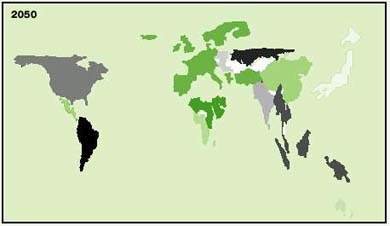
Figure
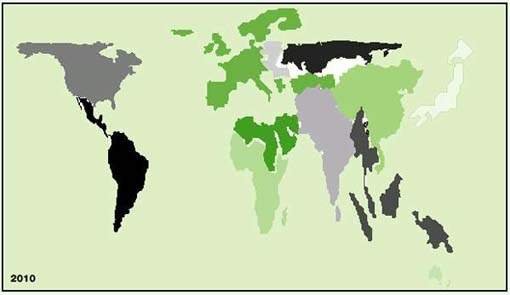
Figure
The areas of world regions are proportional to
their 1990 levels of GDP, expressed at 1990 market exchange rates.
Source: Nakicenovic, Gr�bler, and McDonald,
1998.
It is important to note that by 2100 the global scenarios that
represent sustainable development are mostly above the median of about $240
trillion (1990 dollars). Assuming a central population projection of 10 billion
people by 2100, the median growth path translates into about $24,000 (1990
dollars; $29,000 in 1998 dollars) average per capita gross world product, or
roughly the current per capita income level in more affluent industrialised
countries. Thus economic growth rates are high for the scenarios that achieve
sustainability, indicating that economic development is a prerequisite for both
higher equity and lower environmental impacts. This tendency is also reflected
in the three more sustainable scenarios in the IIASA-WEC study relative to the
reference
case.
Improvement of energy intensities
In all three cases economic development outpaces the increase in
energy, leading to substantially reduced energy intensities. As technologies
progress, and as inefficient technologies are replaced by more efficient ones,
the amount of primary energy needed per unit of GDP - the energy intensity -
decreases. In some developing regions the intensity of commercial energy
initially increases as traditional, less efficient forms are replaced by
commercial energy, but total energy intensity decreases in these cases as well.
All other factors being equal, the faster economic growth, the higher the
turnover of capital and the greater the increase in energy intensity.
In the scenarios, improvements in individual technologies were
varied across a range derived from historical trends and literature on future
technology characteristics. When combined with the economic growth patterns of
the different scenarios, the average annual overall global reduction in energy
intensity varies from about 0.8 percent, in line with historical experience, to
1.4 percent. These figures bracket the long-term average annual rate for
industrialised countries during the past 100 years of about 1 percent, and
cumulatively lead to substantial energy intensity decreases across all scenarios
(figure 4 in the overview). Efficiency improvements are significantly higher in
some regions, especially for shorter periods of time.
These differences in global developments across the scenarios
are reflected in even larger regional variations. The East Asian
‘miracle’ of double-digit average growth during the early 1990s has
been interrupted recently, but prospects for continued sound growth are good for
the coming decades. The transition economies of Central Asia, the Russian
Federation, and Eastern Europe have undergone a period of profound change and
reform, reflected in a deep recession and economic decline during the 1990s. The
prosperous economies of Western Europe have focused on reducing the high
unemployment that accompanied low growth rates.
The IIASA-WEC scenarios start in the base year 1990 and were
developed between 1992 and 1998, so that the actual trends of past years can be
compared with initial developments in the long-term scenarios. Figure 9.2 shows
the energy intensity improvement rates for six regions for the three cases of
economic development relative to historical trends (figure 4 in the overview).
They range from vigorous reduction of about 4 percent a year for China and other
centrally planned economies in Asia to a (temporary) increase in energy
intensities in the transition economies of Eastern Europe, Central Asia, and the
former Soviet Union. The scenario trajectories provide an excellent anticipation
of short-term developments during the 1990s, especially for the transition
economies. All scenarios assume that the next few decades will be characterised
by successful reform and restructuring in all transition economies, leading to
sustained investment in the energy sector and economic development that will be
reflected in long-term increases in energy intensities.
In addition to the energy intensity improvements, rates of
technological change and available energy resources also vary consistently
across the scenarios. For example, high rates of economic growth are associated
with rapid technological advance, ample resource availability, and high rates of
energy intensity increase. Conversely low rates of economic growth result in a
more limited expansion of energy resources, lower rates of technological
innovation in general, and lower rates of decrease in energy intensities.
TABLE 9.3 PER CAPITA GDP FOR THE 11 WORLD REGIONS IN 1990
AND IN THE THREE IIASA-WEC CASES IN 2050 AND 2100 (THOUSANDS OF 1990 DOLLARS,
MEASURED AT MARKET EXCHANGE RATES)
|
Region |
1990 |
2050 |
2100 |
|
|
A |
B |
C |
A |
B |
C |
|
Sub-Saharan Africa |
0.5 |
1.6 |
1.0 |
1.2 |
11.0 |
6.3 |
11.4 |
|
Centrally planned Asia and China |
0.4 |
7.0 |
3.4 |
5.4 |
21.2 |
12.8 |
15.4 |
|
Central and Eastern Europe |
2.4 |
16.3 |
7.8 |
8.0 |
52.7 |
29.0 |
21.8 |
|
Former Soviet Union |
2.7 |
14.1 |
7.5 |
7.1 |
49.3 |
26.8 |
20.2 |
|
Latin America |
2.5 |
8.3 |
7.1 |
7.4 |
27.8 |
20.1 |
21.0 |
|
Middle East and North Africa |
2.1 |
5.6 |
4.0 |
4.1 |
13.8 |
11.0 |
12.9 |
|
North America |
21.6 |
54.5 |
45.8 |
38.8 |
108.7 |
77.0 |
59.2 |
|
Pacific OECD |
22.8 |
58.7 |
45.8 |
42.8 |
111.0 |
74.6 |
62.9 |
|
Other Pacific Asia |
1.5 |
12.2 |
7.9 |
10.2 |
29.6 |
18.8 |
23.7 |
|
South Asia |
0.3 |
2.0 |
1.3 |
1.8 |
15.3 |
10.0 |
14.8 |
|
Western Europe |
16.2 |
45.9 |
37.1 |
32.9 |
93.5 |
63.9 |
53.7 |
|
World |
4.0 |
10.1 |
7.2 |
7.5 |
26.4 |
17.3 |
19.0 |
Note: Three scenarios are shown; middle-course case
B is compared with the three more sustainable scenarios, A3, C1, and C2, which
are characterised by higher economic growth, greater equity, and substantially
lower environmental impacts. All case A scenarios (A1, A2, and A3) share the
same type of economic development, as do the case C scenarios (C1 and C2).
Source: Nakicenovic, Grubler, and McDonald,
1998.
Primary energy requirements and supply
Future rates of economic development are among the most
important determinants of energy demand in the long term.2 The
IIASA-WEC study spans an increase in global energy needs in the range of 1.5-3
times by 2050, and 2-5 times by 2100. Taken together, energy requirements are
envisaged to increase at lower rates than economic growth. This means that
energy intensity is presumed to decline across all scenarios. By 2100 it falls
to between 80 and 20 percent of 1990 levels. This translates into annual
declines of between 0.8 percent and more than 1.5 percent, with a median of
about 1 percent. Thus the lowest future energy intensity improvements of 0.8
percent a year are in line with the historical experience of industrialised
countries.
Figure 9.3 shows a wide range of alternative future primary
energy requirements for the three scenarios. The energy needs for reference case
B are in the middle, about tripling by 2100. This development is bracketed by
the three more sustainable scenarios. A3 indicates substantially higher energy
needs resulting from more rapid economic growth, despite much higher energy
intensity. It nevertheless includes important characteristics of sustainability
because it leads to a substantially higher degree of economic equity with lower
environmental impacts at all scales. C1 (as well as C2) leads to the lowest
energy requirements of all scenarios, to about a doubling by 2100, resulting
from efficiency improvements and conservation; it is marked by a higher degree
of economic equity and very low environmental impacts.
For comparison, figure 9.3 also shows the highest and lowest
energy demand trajectories from the literature (Morita and Lee, 1998). The range
of future energy requirements across the scenarios is indeed large, from a
decline in the lowest scenario to an increase of 10 times in the highest. In
absolute terms, the increase by 2100 in primary energy requirements - in
comparison with 379 exajoules in 1990 - is expected to range from a moderate
increase, to 500 exajoules, to almost 3,200 exajoules. The highest energy
requirements correspond to an annual growth rate of 2 percent, exactly in line
with historical experience (since 1850; see figure 9.3). Also in line with
historical experience, many scenarios project a growing demand for fossil
energy, even if relative shares might be declining relative to alternative
sources of energy. This again emphasises the need for continuing improvement in
all energy efficiencies, including clean fossil fuels. The three IIASA-WEC
scenarios cover a significant part of the full range of primary energy
consumption spanned by other scenarios in the literature.
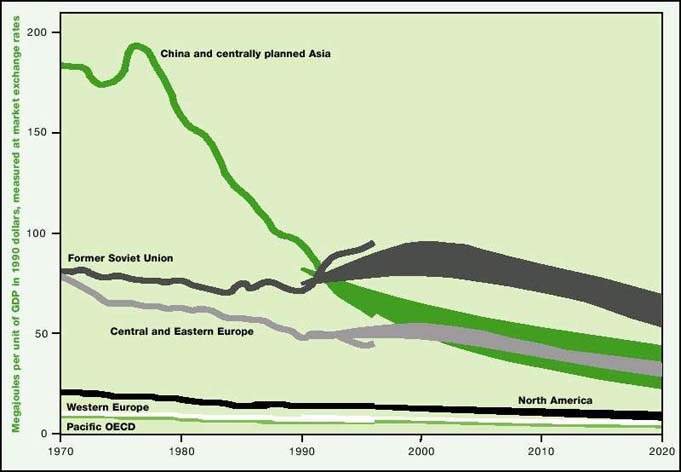
FIGURE 9.2. PRIMARY ENERGY
INTENSITIES FOR 6 REPRESENTATIVE REGIONS OUT OF THE 11 WORLD REGIONS, 1970-96,
AND IN THREE CASES, 1990-2020
Source: Nakicenovic, Gr�bler, and McDonald,
1998.
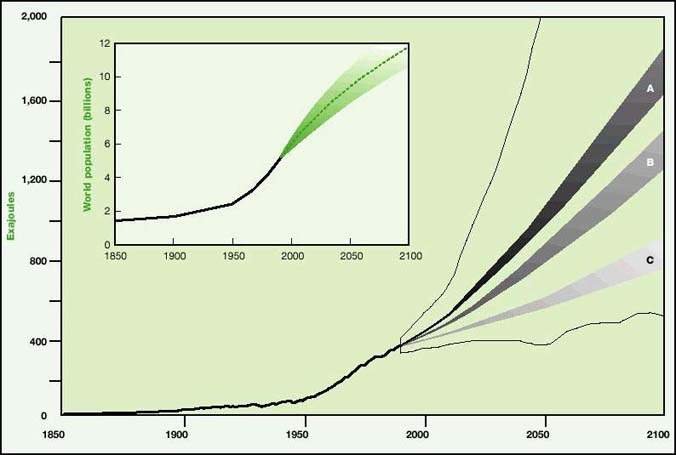
FIGURE 9.3 GLOBAL PRIMARY ENERGY
REQUIREMENTS, 1850-1990, AND IN THREE CASES, 1990-2100
The figure also shows the wide range of future
energy requirements for other scenarios in the literature. The vertical line
that spans the scenario range in 1990 indicates the uncertainty across the
literature of base-year energy requirements. The insert shows global population
growth, 1850-2000, and projections to 2100.
Source: Nakicenovic, Gr�bler, and McDonald, 1998; Morita and
Lee, 1998; Nakicenovic, Victor, and Morita, 1998; Bos and Vu,
1994.
Finally, the inset in figure 9.3 shows the global population
projections common to all IIASA-WEC scenarios. C1 leads to roughly constant per
capita primary energy consumption during the 21st century and describes a
transition towards more equity and lower environmental impacts. But it assumes
implementation of challenging policies, such as world-wide energy and carbon
taxes, that will change current development trends. In contrast A3 leads to a
higher increase - by 2.5 times - in per capita energy requirements, but it shows
that vigorous structural change of the energy system towards decarbonisation can
lead to low environmental impacts, even in conjunction with very high levels of
economic development and energy needs. The high rates of decarbonisation are,
however, not sufficient to offset increased energy demand, so the total carbon
emissions with A3 are substantially higher than those with C. Reference case B
indicates energy needs in the median range relative to the other two
alternatives (A and C) and the scenario literature in general, but it falls
short of the transitions described in the other three more sustainable
alternatives.
Alternative structures of future energy systems are capable of
meeting this growing demand for higher-quality energy end use and services.
Despite all the variations the scenarios look quite similar through 2020, and
all still rely on fossil fuels. But after 2020 the scenarios diverge, and the
energy transitions of the three more sustainable scenarios undergo a similar
degree of structural change in the energy system.
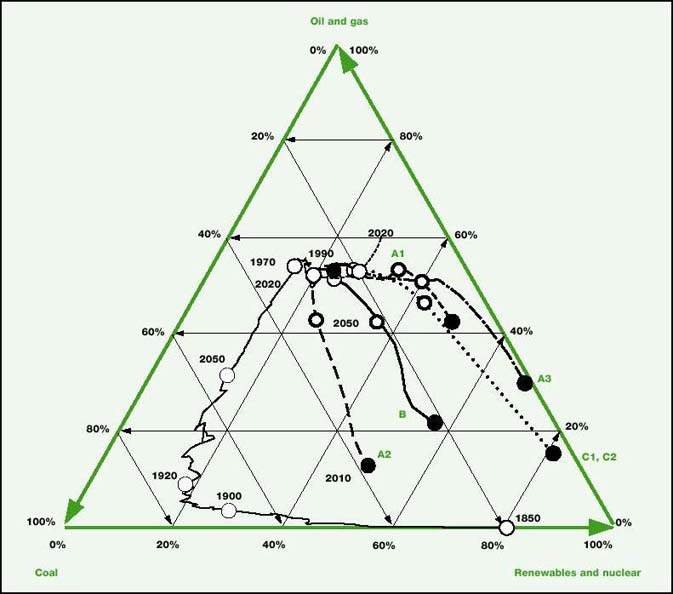
FIGURE 9.4. EVOLUTION OF PRIMARY
ENERGY STRUCTURE: SHARES OF OIL AND GAS, COAL, AND NON-FOSSIL SOURCES
(RENEWABLES AND NUCLEAR), 1850-2000, AND IN SIX SCENARIOS, 2000-2100
Shares are measured against the grid lines with
percentages shown on the three axes; see text for explanation of the figure.
Source: Nakicenovic, Gr�bler, and McDonald,
1998.
The roles of different primary energy sources, which vary across
the six scenarios, contribute to this divergence. Some continue to be fossil
fuel intensive; others envisage stronger shifts towards alternative sources such
as renewables or nuclear power. The geophysical availability of energy resources
is not a major constraint, even though currently estimated conventional oil and
gas reserves would soon be depleted across most of the scenarios. Instead the
availability of energy resources and the rates at which they are converted into
reserves are a function of the envisaged development strategies in the
scenarios. Part of the divergence in the structures of energy systems depends on
policy choices and development strategies. For example, the two case C scenarios
that assume strong international cooperation focused on environmental protection
through energy and carbon taxes rely much less on fossil fuel than do the other
scenarios. Figure 9.4 illustrates this long-term divergence in the structures of
energy systems across the scenarios.
Each corner of the triangle in figure 9.4 represents a
hypothetical situation in which all primary energy is supplied by a single
energy source: oil and gas on the top, coal on the lower left, and renewables
and nuclear energy on the lower right. Nuclear energy and renewables are grouped
together because they are in principle the non-fossil energy alternatives
available in the longer term. The illustration shows the historical development
of the global energy system starting in the 1850s, when most primary energy
needs were met by traditional (renewable) sources of energy, such as wood and
animal power, which in some cases are still harnessed in an unsustainable manner
- contributing to about 10 percent of deforestation and other adverse impacts
(chapters 3, 5, and 7).
The first transition in the historical development of the global
energy system, which lasted about 70 years, from 1850 to 1920, involved the
substitution of coal for traditional energy sources. The share of traditional
non-fossil energy sources declined from about 80 to 20 percent during this
period, while the share of coal increased from 20 to more than 70 percent. The
next transition has also lasted about 70 years, from 1920 to the present. It
involves the substitution of oil and gas for coal. The share of coal has
declined to about 30 percent, while the share of oil and gas has increased to
about 50 percent.
Figure 9.4 illustrates alternative development paths in the
structure of the energy system that might characterise the next transition.
Scenarios branch out after 2020. Some become coal intensive, such as reference
case B and high-growth A2. Others are more renewable and nuclear intensive, such
as the more sustainable A3 and ecologically driven C1 and C2. All the scenarios
eventually lead to a partial shift from fossil fuels to other sources of energy;
however, they follow alternative development paths. As the paths spread out,
they form diverging future developments. To some extent they are mutually
exclusive.
Most of the divergence after 2020 will depend on technological
developments and industrial strategies implemented between now and then. Which
energy sources in 2020 will best match the more flexible, more convenient,
cleaner forms of energy desired by consumers? Which firms will have made the
investments in research and development that will give them a technological
edge? And which will have refocused their operations away from merely providing
tonnes of coal or kilowatt-hours of electricity and towards offering better
energy services to consumers?
The answers to these questions will be determined between now
and 2020. Near-term investment decisions and efforts in technology research and
development will determine which of the alternative development paths will
dominate the post-2020 period. For example, the scenarios have the same
assumptions about fossil and nuclear energy resources and renewable energy
potentials (chapter 5). But their use differs across the scenarios, and these
differences tend to be amplified after 2020. Because of the long lifetimes of
infrastructure, power plants, refineries, and other energy investments, there
will not be a sufficiently large turnover of such facilities to reveal large
differences in the scenarios before 2020. But the seeds of the post-2020 world
will have been sown by then. Figure 9.4 illustrates that the achievement of a
more sustainably structured energy system should be seen as a cumulative,
evolutionary process: It needs to be initiated early to allow for the long time
constants required for fundamental transitions, such as a shift to cleaner
fossil fuels, renewables, and possibly nuclear energy.
|
The achievement of a more sustainably
structured energy
system needs to be
initiated early to allow for the long
time constants
required for
fundamental transitions
to cleaner fuels. |
Long-term global energy futures are no longer seen as being
geologically preordained. The imminent resource scarcity forecast in the 1970s
did not materialise. With continued exploration efforts and technological
progress, accessible and affordable reserves have increased, and this trend is
likely to continue. After 2020 all scenarios move away from their current
reliance on conventional oil and gas. As mentioned, the currently estimated
conventional oil and gas reserves do not reach much into the post-2020 periods
in any of the scenarios (chapter 5). This transition progresses relatively
slowly in scenario A1, where oil and gas are plentiful. In the more sustainable
scenarios, A3, C1 and C2, it progresses more rapidly because of faster
technological progress towards cleaner fossil energy systems (A3) or because
energy and environmental policies favour non-fossil alternatives (C1 and C2).
An ecologically driven clean-fossil version of case C is also
conceivable. Such a third C variant (C3) would incorporate most of the
environmentally compatible fossil energy conversion system together with
decarbonisation and carbon removal and storage. But such a scenario was not
developed, for two reasons. First, A3 already includes clean and efficient
fossil energy technologies, along with some carbon removal and its use for
enhanced oil recovery. Thus limited carbon removal and sequestration occur for
economic reasons and are competitive with other options for enhanced oil
recovery. But additional carbon removal, although technically possible, is
expensive and thus would require introducing carbon taxes or emissions limits.
In A3 cumulative carbon emissions are about 1,000 gigatonnes for 1990-2100. Thus
that amount of carbon - about 50 percent more than now in the atmosphere - would
need to be stored. Disposal in geological reservoirs is possible; however, the
amounts involved are gigantic, and affordable disposal and storage systems still
need to be developed (chapter 8). Second, the advantage of an ecologically
driven clean-fossil version of case C would basically be very similar to A3 but
would have the advantage of requiring storage of much less carbon, but still a
very large amount, comparable to the current carbon dioxide in the atmosphere.
In scenario A2 and reference case B, the transition away from
oil and gas includes an important contribution from coal, whose long-term market
share after 2050 is 20-40 percent. Nonetheless little of this coal is used
directly. Instead it is converted to high-quality energy carriers (electricity,
liquids, and gases) demanded by high-income consumers after 2050. Thus very
different resource and technological options can be drawn upon to meet the
cleaner energy being demanded by more and more affluent consumers
world-wide.
Technological dynamics and structural change
Technology is the key determinant of economic development and is
essential for raising standards of living and for easing humanity’s burden
on the environment (Gr�bler, 1998b). Because technological progress is based on
human ingenuity, it is thus a human-made resource that is renewable - as long as
it is nurtured. But this nurture has a price. Innovation, especially the
commercialisation of novel technologies and processes, requires continual
investments of effort and money in research, development, and demonstration
(RD&D). Technology diffusion, in turn, depends on both RD&D and learning
by doing. Some advanced technologies important in the scenarios - such as
hydrogen production, distribution, and end use - would be radical innovations
that are not likely to result from incremental improvement of current
technologies. And without investment and experience, there can be no long-term
technological improvement, either through incremental or radical change.
Innovation and technology diffusion require both that
opportunities are perceived and that the entrepreneurial spirit exists to pursue
them. Long-term scenarios cannot forecast future technological
‘winners’ or ‘losers’, but they can indicate areas of
technological opportunity. Figure 9.5 illustrates the global market potential in
the IIASA-WEC scenarios for four classes of energy technologies: new end-use
energy devices (efficient lighting, heat pumps), power plants, synfuel
production (from biomass, coal, and natural gas), and energy transport,
transmission, and distribution infrastructure. For each of the four classes of
technologies, the minimum, maximum, and average market potential for the six
scenarios are shown in 2020, 2050, and 2100.
Across the wide variation in possible energy developments
depicted in the scenarios, the importance of energy infrastructure grows
persistently. Even in the sustainable, low-demand scenarios of case C (C1 and
C2), energy infrastructure delivers at least 400 exajoules a year by 2050. By
the end of the century it averages 800 exajoules a year across all scenarios,
reaching close to 1,600 exajoules a year in the highest scenarios. The markets
for power sector technologies also grow substantially, with a wide spread
between the maximum and minimum scenarios. By 2050 the annual range is 120-560
exajoules (energy delivered). Part of this spread is due to uncertainties about
demand growth, but part arises from energy end-use innovations in the form of
new, on-site decentralised electricity generation technologies, such as
photovoltaics or fuel cells. The potential for decentralised systems in the long
term outgrows that of the power sector. The most important customers for energy
technologies would no longer be a limited number of utility managers but rather
millions of energy consumers world-wide. Synfuels also emerge in the long term
as a major technology market. An orderly transition away from conventional oil
and gas translates into large technology markets for synliquids, syngas - and,
in the long term, increasing shares of hydrogen produced from both fossil fuels
(coal and natural gas) and renewables (biomass). By 2100 the global synfuels
market could be at least 160 exajoules a year, comparable to the current global
oil market.
|
Long-term scenarios cannot
forecast future technological
'winners'
or 'losers', but they can indicate
areas of
technological
opportunities. |
As noted above, technological progress has a price - it requires
continual investment in RD&D. All the technological improvements in the
scenarios that are reflected in the expansion of all technology categories shown
in figure 9.5 presume steady RD&D investment. Given the importance of
strategic investment in RD&D, it is a cause for concern that energy-related
RD&D expenditures are currently declining in most OECD countries. Evidently
upfront RD&D expenditures are increasingly viewed as too expensive in
markets where maximising short-term shareholder value takes precedence over
longer-term socioeconomic development and environmental protection.
The important conclusion from this analysis of IIASA-WEC
scenarios is that far-reaching technological improvements (chapters 6-8) are
central to the transition towards sustainable development and thus need to be
developed and disseminated throughout the energy system - including to
decentralised systems and end users. Perhaps this is not surprising because end
use is the least efficient part of the whole energy system. These possible
developments have two important implications. First, they weaken the argument
for extensive RD&D investment in large, sophisticated, ‘lumpy’,
inflexible technologies such as fusion power and centralised solar thermal power
plants. Improvements in end-use technologies, through which millions, rather
than hundreds, of units are produced and used, are more amenable to
standardisation, modularisation, and mass production, and hence to benefit from
learning-curve effects (resulting in cost reductions and performance
improvements). Second, institutional arrangements governing final energy use and
supply are critical. The deregulation, reregulation, and liberalisation of
electricity markets can create incentives in this direction; service packages
can be tailored to various consumer preferences, especially because traditional
consumers can sell electricity back to the grid. But liberalisation could
discourage long-term RD&D by emphasising short-term
profits.
The structure of final energy requirements
In virtually all energy scenarios in the literature, economic
growth outpaces the increase in energy consumption, leading to substantial
reductions in energy intensities and efficiencies. This is to a large extent due
to technological change and structural changes towards less materials-intensive,
more knowledge-intensive activities. As individual technologies are developed
and enter the marketplace, inefficient technologies are replaced by more
efficient ones, and the structure of the energy-supply system and patterns of
energy services change. These factors reduce the amount of primary energy needed
per unit of final energy delivered to end users, as well as final energy per
unit energy service. With all other factors being equal, the faster economic
growth, the higher the rate of technological change, the higher the turnover of
capital, and the greater the decline in energy intensity and improvement of
energy efficiency. These long-term relationships between energy efficiency and
economic development are reflected in the majority of scenarios in the
literature and are consistent with historical experience across a range of
alternative development paths in different countries.
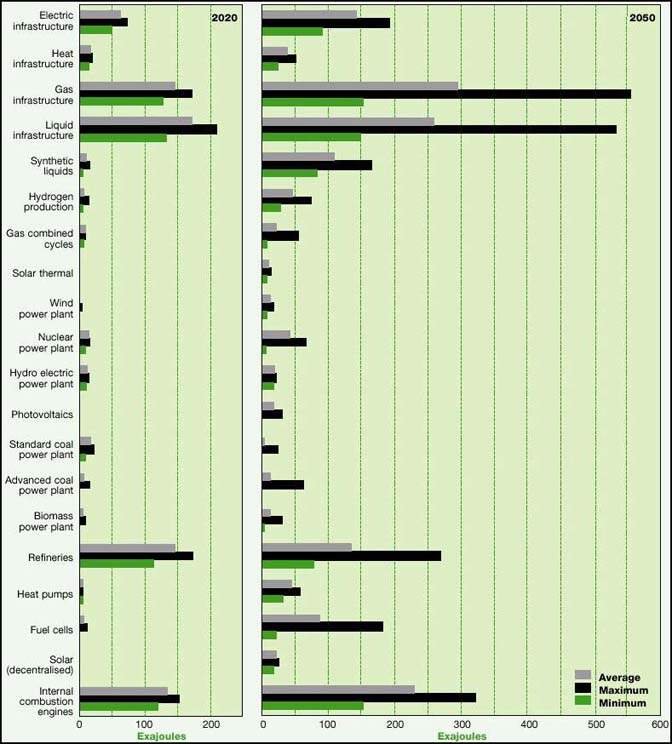
FIGURE 9.5. GLOBAL MARKET
POTENTIALS FOR POWER PLANTS, SYNFUEL PRODUCTION, NEW END-USE ENERGY DEVICES, AND
ENERGY INFRASTRUCTURE ACROSS SIX SCENARIOS, 2020 AND 2050
Source: Nakicenovic, Gr�bler, and McDonald,
1998.
The scenarios cover a wide range of energy supply possibilities
to meet growing energy requirements, from a tremendous expansion of coal
production to strict limits on it, from a phase-out of nuclear energy to a
substantial increase in its use. Yet all the variations explored in the
alternative scenarios match the continuing need for more flexible, more
convenient, cleaner forms of energy. This means that all energy is increasingly
converted into quality carriers such as electricity, liquids, and energy gases.
For example, the direct end use of solids by final consumers disappears by 2050.
Solid energy sources are more and more converted into liquids and gird-oriented
energy carriers such as energy gases and electricity.
Thus despite all the variations in major driving forces of
energy end use across a wide range of scenarios, the pattern of final energy use
is remarkably consistent across many scenarios that describe sustainable energy
development. Figure 9.6 illustrates the convergence in the structure of final
energy for the IIASA-WEC scenarios.
As shown in figure 9.6, all six scenarios portray a pervasive
shift from energy being used in its original form, such as traditional direct
uses of coal and biomass, to elaborate systems of energy conversion and
delivery. This shift continues in all cases, leading to ever more sophisticated
energy systems and higher-quality energy carriers. A second profound
transformation is the increasing delivery of energy by dedicated transport
infrastructure, such as pipelines and electric networks. This development
enhances trade possibilities and promotes similar end-use patterns across
regions with fundamentally different primary energy supply structures. Third,
changes in final energy patterns reflect the changes in economic structure
presented in the scenarios. As incomes increase, the share of transport,
residential, and commercial applications also increases.
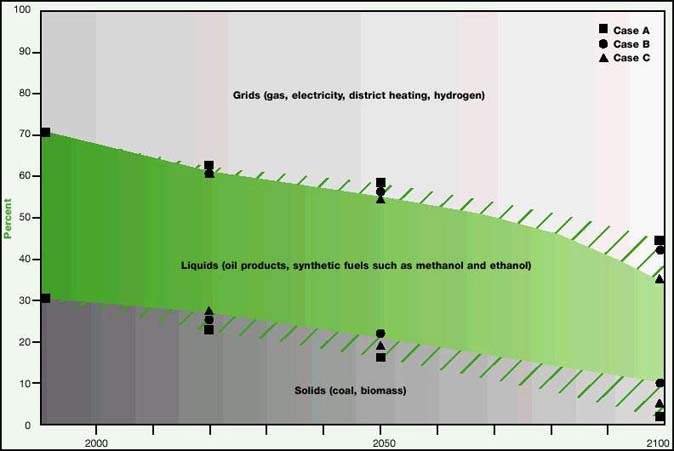
FIGURE 9.6 GLOBAL FINAL ENERGY
SHARES BY FORM IN THREE CASES
Solids include direct delivery to end users.
Overlapping areas indicate variations across the cases.
Source: Nakicenovic, Gr�bler, and McDonald,
1998.
These converging final energy patterns yield substantial quality
improvements in the energy (and energy services) delivered to the consumer.
Quality improvements are measured by two indicators: fuel-mix-induced efficiency
gains and the carbon intensity of final energy. The efficiency of final energy
use improves as the final energy carrier portfolio changes in the direction of
higher-quality fuels. The effect is an improvement via inter-fuel substitution
of 20-30 percent. The actual end-use efficiency gains are of course much larger,
for they are mostly driven by technological change in end-use devices (cars,
light bulbs, and so on). The main points are that more efficient end-use devices
will require higher-quality fuels, and there is a high degree of congruence
across all six scenarios. Thus whereas primary energy supply structures and
resulting carbon intensities diverge in the IIASA-WEC scenarios, those of final
energy converge. The decarbonisation trend of final energy relative to primary
energy is also faster across all the cases.
These energy developments are characteristic of many sustainable
scenarios. The use of non-commercial final energy generally disappears, while
industrial and transport energy shares generally grow, largely due to an
enormous increase in industrial production and mobility in developing countries.
In industrialised regions, however, residential and commercial energy needs
generally grow faster than those for industry. Growth of mobility, especially in
developing regions, is one of the pervasive changes across all the scenarios.
Even in industrialised countries, transport energy requirements grow faster than
any other final energy use. The share of final energy for transportation
increases from one-fifth today to a third in the case A scenarios and to a
quarter in the case C scenarios. The increase is more modest in C scenarios
because of their orientation towards public rather than individual transport and
towards partial replacement of mobility through communication. With high levels
of affluence and leisure, new services and new activities emerge that shift
final energy requirements away from materials- and energy-intensive production.
The demographic changes associated with ageing and single-person households
reinforce this trend in such scenarios.
As noted, some scenarios describe less-intensive mobility and
urbanisation developments. This is true for the case C scenarios that foresee a
stronger shift towards decentralised energy systems and reliance on local
solutions. Final energy needs in the residential and commercial sector increase
to more than half of all final energy after 2050. Mobility and
materials-intensive production are replaced by communication and services,
resulting in lower material and energy intensities. This leads to significant
differences across regions and scenarios in the end-use devices that are used
and in how they are used (that is, lifestyles), even when differences in total
final energy demand are small. This points to an important but still poorly
understood and thus weak interaction between lifestyles and energy services. An
illustration is given in the IIASA-WEC study, which contrasts the three
high-growth A scenarios for Latin America with the ecologically driven C
scenario for Western Europe. Both regions have a strong tradition of detailed
analyses of energy end use and associated lifestyle changes (Goldemberg and
others, 1988; Schipper and Meyers, 1992; IEA, 1993).
|
All six scenarios portray
a pervasive shift from energy
being
used in its original form to elaborate
systems of energy
conversion
and delivery. |
Temporal and spatial scales of scenarios
Energy scenarios in the literature cover a wide range of time
horizons, from 10-20 to more than 100 years. Sustainable energy scenarios
usually have long time horizons. The inertia of energy systems is high, so it
takes decades before a shift away from reliance on fossil energy sources can be
achieved in sustainable scenarios. Major exceptions are some of the recent
studies of policies and measures for meeting the carbon emission targets
specified in the Kyoto Protocol (UNFCCC, 1992). The protocol calls for the
reduction of emissions in industrialised countries (so-called Annex I under the
UNFCCC) by about 5 percent relative to the base year 1990 during the 2008-12
period (UNFCCC, 1997). A number of scenarios in the literature (such as IEA,
1998) focus on this time period and on achieving emission reductions. Some of
these scenarios would presumably lead to sustainable development in the long
run, assuming that structural change towards clean fossil and non-fossil energy
continues.
Generally, however, most scenarios that describe sustainable
development have long time horizons, usually extending for 100 years. They make
up an important share of all long-term energy scenarios. They share a number of
features with other long-term scenarios that are significantly different from
those of short-term scenarios. In general the longer the time horizon, the lower
the likely growth rates of driving forces and energy need. This tendency is
probably linked to the fundamental difference between short- and long-term
scenarios. Short-term scenarios are often national or regional and frequently
describe energy options that may be overly optimistic from a global perspective.
In contrast long-term scenarios are often global and focus on possibilities that
might be more limited than regional expectations.
The variability and uncertainty of regional and global scenarios
also tend to increase with higher temporal and spatial resolutions. Thus over
longer periods and larger areas, developments tend to average out, leading to
lower variations and uncertainties. If this is generally true, then it means
that the future is more open at higher scales of spatial and temporal
resolution, requiring a larger portfolio of alternative scenarios to cover the
range of possibilities.
Spatial phenomena are therefore important for developing and
interpreting scenarios. For example, many scenario environmental impacts require
a detailed regional resolution. Many environmental phenomena require that
scenario driving forces, energy use, and emissions be gridded with a very high
spatial resolution. Very few scenarios and modelling approaches are based on a
fine geographic scale. Thus, for a number of reasons, national or regional
spatial scales are not always ideal for energy scenarios. But such scenarios are
rare due to many unresolved methodological issues. With current methodological
approaches, energy-related spatial phenomena are more difficult to capture on
the global scale than evolution in time.
There are, of course, exceptions. Recent scenarios by S�rensen,
Kuemmel, and Meibom (1999) have high geographic resolution for driving forces as
well as energy use patterns (box 9.2). The scenarios highlight the uneven
geographic distribution of economic activities, resources, and energy patterns -
and also bring new insights into energy trade implications, energy
infrastructure, and transport. For example, the scenarios that rely on clean
fossil fuel and safe nuclear energy options entail trade and transmission of
energy in much the same pattern as today. This situation has important
implications for economic development in energy-importing countries that may
have lower economic growth relative to other scenarios with more self-sufficient
domestic provision of energy. The scenarios demonstrate that focusing on
decentralised, renewable energy sources with low energy densities would make it
difficult to match energy demand growth in some parts of the world by 2050. In
contrast scenarios that also rely on centrally produced renewable energy create
supply in excess of demand and through trade foster robust energy systems and
low adverse environmental impacts (S�rensen, Kuemmel, and Meibom,
1999).
The legacy of past generations
Energy scenarios explore the future and rarely look at the past.
But the dynamics of history matter for future developments. This is especially
relevant to scenarios that achieve sustainability for future generations. Equity
often plays an important role in such considerations.
This is in stark contrast to our common history. Both in the
past and today, a small minority of the global population accounts for most
economic activity, materials use, and mobility, just to mention a few driving
forces of energy use. Thus most energy is consumed by a relatively small,
affluent part of the global population that lives in industrialised countries;
this 20 percent of the population enjoys about 80 percent of gross world product
(see figure 9.1) and more than 60 percent of global energy consumption.
Historically, today’s affluent part of the global population has consumed
about 80 percent of fossil energy. Its many benefits from this consumption
include enormous economic development. But many of the adverse environmental and
other impacts of this cumulative energy consumption have been shared with the
rest of the world.
Most sustainable energy scenarios envisage a fundamental change
in the future from today’s inequitable distribution of benefits and adverse
impacts. The scenarios use various methods to implement policies to move global
development towards sustainability. For example, the IIASA-WEC case C scenarios
assume revenue-neutral energy and carbon dioxide taxes whose proceeds enhance
international collaboration and resource transfers from industrialised to
developing regions. This situation may appear unrealistic from the current
perspective, but it was necessary to achieve both rapid development of poor
regions and environmental protection. Another example is the so-called B1 family
of sustainable scenarios (developed by different modelling approaches) for the
IPCC Special Report on Emissions Scenarios (Nakicenovic and others, 2000)
that all achieve equity through a host of policy and behavioural changes in the
world, along with improvements of environmental compatibility at all scales (De
Vries and others, 2000). Thus sustainable energy scenarios require challenging
changes.
|
BOX 9.2. SPATIAL SCENARIO OF ENERGY END USE
S�rensen, Kuemmel, and Meibom (1999) give an example of an
energy scenario that emphasises demand-side management, high levels of energy
efficiency, and conservation while attaining high levels of global prosperity.
It assumes that average energy technology efficiency in 2050 will correspond to
the best current rates. This results in total global energy end-use demand of
about 220 exajoules in 2050. The scenario is thus characterised by relatively
low energy requirements relative to the increase in per capita energy use. The
energy available to the end user today is only about 12 percent of primary
energy, and the challenge is to increase this fraction. The resulting energy
requirements are roughly half those in the IIASA-WEC case C scenarios.
Population assumptions are about the same. S�rensen, Kuemmel, and Meibom (1999)
base their scenario on UN median population projections (UN, 1996) and UN
increasing urbanisation estimates (UN, 1997).
A unique feature of the scenario is a very high geographic
resolution (using the middle scenario of UN, 1996), increasing urbanisation (UN,
1997), and an increase from today’s per capita energy use by an average
factor of 2.7. GNP growth is larger because of the de-coupling of economic and
energy growth, and the distribution of this growth across regions is not even
(because a higher growth rate is assumed for today’s poor regions). Figure
below shows the ‘gridded’ total energy delivered to end users in 2050.
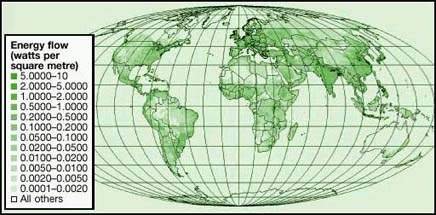
Scenario of total energy delivered
to end users, 2050
Note: Includes energy for air conditioning, process
heat, stationary mechanical energy, electric energy, energy for transportation,
and energy in food. The average energy demand is about 23 gigajoules per capita,
or three times the amount made useful at the end use
today.
Source: S�rensen, Juemmel, and Meibom, 1999.
|
The role of policies
Sustainable energy scenarios usually assume or imply a host of
measures to achieve their goals, from a transition from fossil energy sources to
adoption of environmentally friendly behaviour patterns. The policies include
market-based and regulatory mechanisms as well as assumed changes in human
behaviour (chapter 12). Regulatory standards, taxes, and emissions trading
schemes are comparatively easy to implement in scenarios developed using formal
models. But it is much more difficult to determine what measures would be
required to achieve the behavioural and institutional changes called for in such
scenarios. One example from recent IPCC scenarios is given here for illustrative
purposes (Nakicenovic and others, 2000).
The IPCC B1 scenario family includes many characteristics of
sustainable development. Its storyline or narrative description calls for
extensive changes (for further details see the Website at
http://sres.ciesin.org; https://www.ipcc.ch;
https://www.iiasa.ac.at/Research/TNT/Draft/Publications/publications.html; De
Vries and others, 2000; Nakicenovic and others, 2000; and Nakicenovic, 2000).
The storyline assumes a high level of environmental consciousness and
institutional effectiveness. Consequently environmental quality is high because
most of the potentially negative environmental aspects of rapid development are
anticipated and dealt with effectively at local, national, and international
levels. For example, transboundary air pollution (acid rain) is basically
eliminated in the long term. Land use is carefully managed to counteract the
impacts of activities that could damage the environment. Cities are compact and
designed for public and non-motorised transport, and suburban developments are
tightly controlled. Strong incentives for low-input, low-impact agriculture,
along with maintenance of large areas of wilderness, contribute to high food
prices with much lower levels of meat consumption.
These proactive local and regional environmental measures and
policies also lead to relatively low energy requirements and low emissions, even
in the absence of explicit interventions directed at conserving energy or
mitigating climate change. The IPCC B1 world invests a large part of its gains
in more efficient resource use (‘dematerialisation’), greater equity,
stronger social institutions, and increased environmental protection. A strong
welfare net prevents social exclusion on the basis of poverty. But the storyline
also considers that counter-currents may develop, and in some places people may
not conform to the main social and environmental intentions of the mainstream in
this scenario family. Massive income redistribution and presumably high taxes
may adversely affect the functioning of world markets. Environmental protection
could become an issue in some parts of the world. This all illustrates how
achieving sustainable development is a very difficult task - even in scenarios -
as new policies play out in relation to other driving forces.
|
Most sustainable energy scenarios
envisage a fundamental
change in the
future from today's inequitable
distribution of benefits
and
adverse impacts. |
Other examples of strong policies can be seen in nearly all
sustainable development scenarios. The “Transformed World” of Hammond
(1998), based on the “Great Transitions” of Gallopin and others
(1997), stresses the role of global technological innovation in addition to
enlightened corporate actions, government policies, and empowerment of local
groups. In the “Shared Space” of the Millennium Institute (Glenn and
Gordon, 1997), resources are shared more equitably for the benefit of all and
the safety of humanity. The Shell “Sustainable World” (1996, 1998) and
the WBCSD (1998) “Geopolity” and “Jazz” also examine
sustainable
futures.
Implications of sustainable energy scenarios
The divergence among the three cases described in this chapter
reflects different assumptions for a number of driving forces of future
development, such as demographic changes and economic growth. Assumptions about
future technological change are the most important determinants of how the
scenarios unfold. These assumptions include the effectiveness of RD&D and
the direction and rate of technological diffusion (including lock-in effects and
learning curves). Future capital investments and financing are also crucial
determinants of future energy development, as are global energy trade patterns.
Finally the impact of environmental changes at local, regional, and global
levels will also drive change and energy
developments.
RD&D trends and requirements and technological diffusion
The development of clean, efficient, affordable, reliable energy
systems is a common characteristic of most sustainable energy scenarios. An
important prerequisite for such future technology developments is sufficient
investment in RD&D. But this alone is not a guarantee for success. Radically
new technologies need to be introduced into the marketplace and (if successful)
need to be pervasively diffused to contribute to sustainability. Incremental
improvement of existing technologies is likely to fall short of changing
technoeconomic paradigms, as is foreseen in the three scenarios characterised by
sustainability. In fact, all these scenarios rely on pervasive diffusion, over a
long time period, of new technoeconomic systems in the energy system - from a
combination of advanced, highly efficient energy extractions, to conversion and
end-use technologies, to new, clean energy carriers such as hydrogen.
These technology needs for achieving sustainability are in stark
contrast to recent developments. RD&D efforts have increased substantially
in most OECD countries. But energy-related RD&D has declined in all of them
except Japan and Switzerland. In share of GDP, energy-related efforts may have
declined by as much as 10 percent a year on average in OECD countries. It has
been argued that this decline in public RD&D funding is more than
compensated for by private sources as a consequence of recent energy
privatisation and liberalisation. But the tentative evidence indicates that this
is not necessarily true for investments in radical new technologies, and that
private-sector energy RD&D focuses more on incrementally improving
technologies and may be declining. For example, private energy-related RD&D
has fallen by nearly a third in the United States during the past five years,
while RD&D in other sectors has increased (chapter 12).
Finally, it has been claimed that the deployment of new energy
technologies has occurred at an unprecedented rate in recent years despite the
declines in RD&D funding. This is supposed to indicate that there are plenty
of funds available for attractive new technologies. Perhaps this is true, but
many of the energy technologies that have been deployed successfully in recent
years - from combined-cycle gas turbine to horizontal drilling - were developed
long ago, when RD&D funding was plentiful. There also have been important
spillovers from other sectors; for example, the development of gas turbines
benefited from enormous progress on both military and civilian jet engines. But
new competitive pressures have probably contributed to price declines and wide
diffusion of these technologies.
A strong conclusion for a whole range of sustainable scenarios
is that a substantial increase in RD&D for new energy technologies is
needed. Otherwise most clean, efficient fossil and renewable technologies may
not reach competitiveness with traditional options. Significant improvements in
these technologies are required as traditional technologies improve as well.
This is not, however, an appeal to return to the types of exclusively public
expenditure programs on energy RD&D of past decades. The paradigm has
shifted now towards a balance between publicly and privately funded basic
research and towards far more reliance on incentives to promote private RD&D
and market applications, for example through tax and regulatory incentives for
innovation.
These kinds of advances in knowledge and technology are likely
to be as important for achieving a sustainable future as they were for
explaining the productivity growth in today’s industrialised countries. In
the original study by Solow (1956) it was estimated that 87 percent of per
capita productivity growth was due to technological change (the remainder was
attributed to increases in capital inputs). The contribution of technical
progress to pollution abatement is even greater: as the chapters on energy
technology (7 and 8) and the economy (11) show, innovations in pollution control
can often cut emissions by 95 percent, and potentially completely in some cases.
Advances in knowledge thus do not simply contribute to economic development in
general but also help achieve a higher degree of affluence, equity, and
environmental compatibility.
|
Technological diffusion
occurs over a long period
of
time, from a new technology's
first introduction to its
pervasive
adoption. |
Economic growth theory suggests that different capital and
labour productivities across countries lead to different productivity growth
rates and hence to conditional convergence across economies. As Rostow (1990)
explained, the “poor get richer and the rich slow down”. This relative
convergence of the poor and rich stems from the assumption of diminishing
returns on capital. Additional convergence potentials may accrue for economies
with a higher ratio of human to physical capital. In terms of a functional
relationship for future developments, therefore, per capita GDP growth rates are
expected (all other things being equal) to be higher for economies with low per
capita GDP levels. Notwithstanding many frustrating setbacks like the recent
‘lost decade’ for economic catch-up in Africa and Latin America,
empirical data indicate that the convergence theorem holds. The evidence put
forward by Barro (1997) and Barro and Sala-I-Martin (1995), based on the
experience of some 100 countries in 1960-85, shows per capita GDP growth rates
as a function of GDP per capita levels after accounting for all other salient
influencing variables (such as education, inflation, terms of trade, and
institutional factors).
Many sustainable scenarios have in common this kind of relative
economic convergence and catch-up between today’s developing and
industrialised regions in the next 100 years. The successful diffusion of new
technologies and different consumption patterns are therefore important
prerequisites for achieving sustainability in such scenarios.
With a few notable exceptions (for example, the scenario
developed by Lazarus and others, 1993, and the case C scenarios presented in the
IIASA-WEC study), the challenge of exploring conditions for closing the income
gap between developing and industrialised regions appears to be a fundamental
challenge for scenarios that describe sustainable development. Differential
economic growth rates can close a part of this gap; the other part needs to be
closed through additional measures ranging from accelerated rates of
technological diffusion to more equitable income and resource distribution. For
example, the C scenarios incorporate a challenging, broad portfolio of
environmental control technologies and policies, including incentives to
encourage energy producers and consumers to use energy more efficiently and
carefully, ‘green’ taxes (levied on energy and carbon), international
environmental and economic agreements, and technology transfer.
Case C reflects substantial resource transfers from
industrialised to developing countries, which spur growth and eradicate poverty.
Specifically, C assumes that energy and carbon taxes are applied universally,
albeit at different rates and timing, and are revenue neutral. The proceeds from
these taxes in OECD countries are recycled as resource transfers to developing
countries and are used to promote energy infrastructure, clean technologies,
efficiency, and conservation. Such transfers help solve part of the
scenarios’ development problem, which is fundamental for a sustainable
world. Solving the other part of the problem entails revitalising international
programs to address world poverty. These poverty alleviation aspects of
achieving sustainability are implicit in the scenarios - and include investment
in energy and environmental ends, but more important in education, health,
security against natural disasters, and so
forth.
Capital requirements and financing
Capital investment is crucial for energy development. Both the
overall development of and structural changes in energy systems result from
investments in plant, equipment, and energy infrastructure. Because adequate and
affordable energy supplies are critical for economic growth, any difficulties in
attracting capital for energy investment can slow economic development,
especially in the least developed countries, where 2 billion people have yet to
gain access to commercial energy services. And - although energy investment
accounts for only a small share of the global capital market - the availability
of the capital needed for a growing energy sector cannot be taken for granted
but depends on prices and regulations that permit investors to earn rates of
return that are competitive with other opportunities offered by international
capital markets. This is especially the case for sustainable development paths,
which require high levels of investment in new technologies and conservation
measures that may not be initially competitive with their traditional
counterparts.
Capital markets have been growing faster than total GDP for
quite some time, and this trend is unlikely to change. Present annual global
energy investments are approximately 7 percent of international credit financing
of about $3.6 trillion (Hanke, 1995). With capital markets growing relative to
GDP, and assuming largely stable future energy investment ratios, capital market
size does not appear to be a limiting factor for energy sector finance today and
is not likely to be one across a wide range of scenarios.
Very few scenarios in the literature give a detailed account of
energy-related investments. Even fewer describe investments that will promote
sustainable energy futures. Thus estimates of global capital requirements for
energy development are often based on back-of-the-envelope calculations of
aggregate energy investment indicators for several major energy-consuming
countries that have been extrapolated to the rest of the world. These estimates
tend to be highly influenced by present market realities and short-term market
expectations and necessarily incorporate a number of ad hoc (and not necessarily
consistent) assumptions about the relationship between income growth and energy
requirements.
For example, if energy intensities are assumed to increase,
capital requirements will, other things being equal, differ significantly from
scenarios in which energy intensities decline. Investments are likely to grow
faster than GDP in the former case and slower than GDP in the latter. Capital
estimates also depend greatly on the assumed costs of different technologies,
including infrastructure, and the projected energy mix. As a result, comparisons
among estimates of future investment requirements must recognise that each
reflects a set of assumptions consistent with a specific
energy-economy-environment scenario.
The IIASA-WEC scenarios provide a comprehensive assessment of
energy-related investment requirements on the basis of detailed bottom-up cost
calculations for the entire energy sector, extending from resource extraction
(such as coal mining and oil exploration) through development and production to
delivery of energy products to final consumers. The estimates of energy
investments do not include, however, those required to achieve more efficient
services or structural changes that lead to greater efficiencies. Each
technology - an oil platform, gas pipeline, liquefied natural gas (LNG)
terminal, electricity generating plant, district heat grid, and so forth - is
characterised by a set of technoeconomic parameters, one of which is investment
cost in dollars per unit of installed capacity. These costs are then aggregated
into the total investment requirements for the entire energy sector. But because
these cost estimates were derived during the 1990s (for the base year 1990),
they do not reflect more recent changes, such as declines in energy costs.
A conclusion consistent across all six IIASA-WEC scenarios is
that the capital requirements of the energy sector will be extremely large
relative to current standards, but will not be infeasible. During the next 30
years capital requirements across the scenarios are estimated to be $12-17
trillion, measured at market exchange rates and 1998 dollars (or $10-15 trillion
in 1990 dollars; this is to be compared with 1990 gross world product of about
$20 trillion; see table 9.1). (In 2000-20, investment requirements are estimated
to be $9-$13 trillion, 1998 dollars.) Figure 9.7 shows this range of cumulative
global energy investment requirements between 1990 and 2020. They are
desegregated into investments in the electricity sector, other energy conversion
systems, and energy supply (extraction, upgrading, transmission, and
distribution) for three major world regions; table 9.1 shows the cumulative
investments for 2020-50 and 2050-2100. Note that capital requirements are lowest
for the case C scenarios that describe sustainable development paths. These
scenarios’ relative advantage of substantially lower energy financing
requirements is an important indicator of the high economic value of energy
efficiency and conservation. But the costs of energy end-use changes are not
included in the assessment.
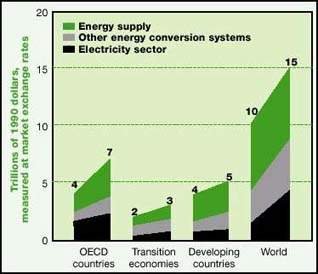
FIGURE 9.7. CUMULATIVE ENERGY
INVESTMENTS ACROSS SIX SCENARIOS, 1990-2020
The highest investments refer to case A and the
lowest to case C scenarios.
Source: Nakicenovic, Gr�bler, and McDonald,
1998.
As a share of GDP, global energy investments range from 1.5 to
1.9 percent across the scenarios. This is in line with historical norms: During
the early 1990s investment averaged just over 1 percent of global GDP (ranging
from $240-280 billion a year). In the scenarios they are highest in the
transition economies of Europe and Asia, where they range up to 7-9 percent of
GDP. These high investment needs are a legacy of the high energy intensity of
the former centrally planned economies and recent declines in investment that
went along with economic recession. The result is a substantial need to
reconstruct and upgrade energy infrastructure. Another important aspect of
future energy investment is that the share of developing regions rises sharply,
from today’s 25-30 percent to 42-48 percent, and these regions become the
largest capital investment market in all scenarios.
Overall, energy investments in the scenarios decrease as a share
of GDP throughout the world. But the challenge will be that an increasing
fraction of capital requirements will need to be raised from the private sector,
where energy needs will face stiffer competition and return-on-investment
criteria. Also most investments must be made in developing countries, where both
international development capital and private investment capital are often
scarce.
Technological diffusion
Technological progress is central to all scenarios that describe
sustainable development. The direction of technological change is of crucial
importance in these scenarios. To varying degrees they all envisage a transition
from reliance on fossil energy sources to clean fossil options, renewable energy
sources, and in some cases to safe nuclear energy. But they require the
development and diffusion of radical new technoeconomic systems. The IIASA-WEC
scenarios illustrate this by different directions of technological change in the
energy system within the framework of the three case A scenarios. Energy systems
structures range from continued reliance on fossil-intensive development paths
to high rates of decarbonisation. Otherwise the scenarios share the same
development of other driving forces such as population, economic growth, and
energy demand. Clearly the fossil-intensive scenarios do not meet sustainability
criteria - unless they radically reduce emissions, including carbon removal and
storage. Other implications of these alternative technological development paths
are equally important. This illustrates that the direction of technological
change can be as important for achieving sustainable development as all other
driving forces combined.
Technological diffusion occurs over a long period of time, from
a new technology’s first introduction to its pervasive adoption. For energy
technologies diffusion time may range from 10-20 years all the way to 100 years.
For example, the diffusion of motor vehicles or air conditioning systems usually
takes 10-20 years. In contrast, the diffusion of new energy systems consisting
of numerous individual technologies, such as a shift to renewable sources, might
take almost 100 years. A principal conclusion of many sustainable energy
scenarios is that the long-term transition to new energy technologies will
largely be determined by technological choices made in the next 10-30 years.
There is a need to anticipate technical characteristics - such as performance,
cost, and diffusion - of new energy technologies such as photovoltaics, hydrogen
production, and fuel cells; the long-term diffusion, transfer, and performance
of these technologies depends on near-term RD&D and investment policies and
decisions. If new technologies are not developed through dedicated RD&D
efforts, they will not be diffused and will not be available when needed.
Diffusion is an endogenous process. This illustrates path dependence in
technological diffusion; because there is a virtual lock-in to the development
path formed by many individual, related decisions, other possibilities are
excluded (for example, see Gr�bler, 1998b).
These lock-in effects have two implications. First, early
investments and early applications are extremely important in determining which
technologies - and energy resources - will be most important in the future. This
means that there needs to be an early investment in sustainable technologies if
the sustainable development path is to be achieved. Second, learning and lock-in
make technology transfer more difficult. This means that - in this context - the
difference between diffusion and transfer disappears; they are parts of the same
process. Successfully building and using computers, cars, and power plants
depends as much on learning through hands-on experience as on design drawings
and instruction manuals. And a technology that is tremendously productive when
supported by complementary networks of suppliers, repair workers, training
programs, and so forth, and by an infrastructure that has co-evolved with the
technology, will be much less effective in isolation.
Technology costs and performance - including energy efficiency
in particular - improve with experience, and there is a common pattern to such
improvements for most technologies. This pattern of increasing returns to
diffusion and transfer is important for the transition to sustainable energy
futures, and it needs to be incorporated more explicitly into the scenarios.
In case A, there are substantial learning-curve effects for all
new, and currently marginal, energy production and conversion technologies.
These developments are consistent with the technological perspectives given in
chapters 7 and 8. Thus there are considerable advances in hydrocarbon
exploration, extraction, and conversion, carbon removal and storage, renewable
and nuclear electricity generation, and hydrogen and biofuel production and
conversion. For case B, the learning-curve effects are also substantial,
especially for new, environmentally desirable technologies. But they lag on
average 30 percent behind those in case A, which is consistent with the less
concentrated RD&D efforts in case B. For case C, learning-curve effects by
design favour low-carbon fossil and renewable technologies. These technologies
benefit from improvements equal to those in case A. All other technologies
develop as in case
B.
International energy trade and security
Generally a lot of trade takes place in the scenarios, ranging
from capital goods to energy. Energy-related trade in capital goods includes
plant and equipment - required, for example, for the adoption of environmentally
friendly technologies. So not only trade in energy is important in the
scenarios. An analysis of the energy trade flows implied by the scenarios
reveals a general decline in the share of primary energy (equivalent) that is
traded world-wide. Currently about 18 percent of global primary energy is traded
among the main world regions (as defined in the IIASA-WEC study). This is in
close agreement with the true country-by-country figure for 1990 of about 19
percent (Nakicenovic, Gr�bler, and McDonald, 1998). Crude oil and oil products
are currently dominant, accounting for 78 percent of global energy trade; coal
accounts for 13 percent and natural gas for 9 percent. By 2050 primary energy
traded declines to between 11 and 16 percent. In comparison, oil and gas imports
to Western Europe were about 34 percent of primary energy consumption in 1990,
and oil imports to North America were about 16 percent of primary energy
consumption the same year. But absolute volumes continue to increase in the
scenarios - up to a factor of 2.5 for case A and a factor of 1.7 for case B. The
increase in case C is much lower, at 10-40 percent. Energy trade in case C is
limited primarily to sustainable energy forms (such as biomass, methanol,
ethanol, and to a lesser degree hydrogen) and actually shrinks beyond 2050. This
indicates that even in case C scenarios world trade in oil and gas continues to
increase, despite a shift towards stronger reliance on renewable energy sources
throughout the new century.
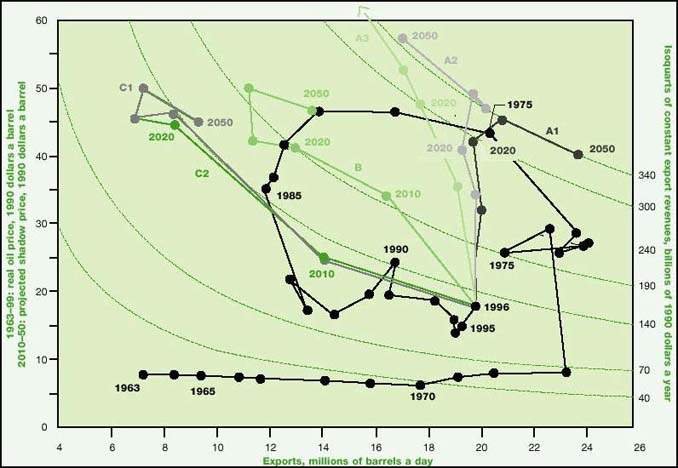
FIGURE 9.8. OIL EXPORT QUANTITIES,
PRICES, AND REVENUES FOR THE MIDDLE EAST AND NORTH AFRICA, 1963-96, AND IN SIX
SCENARIOS, 2010-2050
Source: Nakicenovic, Gr�bler, and McDonald,
1998.
The overall geopolitical shift in energy use from industrialised
regions to today’s developing regions across all scenarios is also
reflected in energy trade. In 1990 OECD imports accounted for 84 percent of
international energy trade. By 2020 OECD-country shares drop to 55 percent in
case C and 65 percent in case B, and by 2050 to 10 percent in case C and 34
percent in case A. This shift is likely to erode the current position of OECD
countries as the dominant energy buyers. Conversely import security concerns,
which traditionally have been strong in import-dependent Western Europe and
Japan, will increasingly be shared by today’s developing regions (chapter
4). Concerns about absolute import needs will also grow in developing countries
in comparison with OECD countries.
The prospects for oil-exporting regions are bright in the long
run across all scenarios, and, at least through 2050, oil revenue is unlikely to
be below $170 billion (in 1998 dollars) a year in the Middle East and North
Africa. But there are differences among the three cases, as shown in figure 9.8.
In case C, environmental policies reduce fossil fuel (that is, taxes and
regulation) demand and cause declining exports, but rising export prices keep
revenue constant. In cases A and B, technological change and the speed at which
reserves are replenished from the resource base (chapter 5) determine export
prices, export volumes, and revenues. In case A, greater technological progress
than in case B enables higher export at slightly elevated export prices, and
long-term revenues may exceed $360 billion (in 1998 dollars) annually. The
slower the rate of technological change, the more important the price component
becomes in revenue generation. Export volumes slip as reserves are replenished
more slowly, prices rise, and revenues vary as a function of the
scenario-specific oil substitution possibilities. Long-term export revenues for
the region exceed $360 billion a year in case A and are at least $240 billion a
year in case B, and thus are substantially higher than at present.
|
BOX 9.3. ENERGY SCENARIOS FOR THE NEWLY INDEPENDENT STATES
OF THE FORMER SOVIET UNION
Two scenarios of future energy developments for the former
Soviet Union, considered to include characteristics of sustainable development
from the regional perspective, are labelled “optimistic” and
“probable” (Makarov, 1999). The optimistic scenario is similar in
character to IIASA-WEC case A in that rapid globalisation of markets, vigorous
technological development, and increasing concerns for the environment are
assumed. The probable scenario has a number of characteristics in common with
IIASA-WEC case B. It basically represents a world where the optimistic scenario
is implemented more moderately.
After the recovery from the current recession in 2000-10, both
scenarios envisage rapid economic growth. In the optimistic case, per capita
income levels reach $10,000 by about 2030; in the probable scenario, by about
2040. Energy intensities are also assumed to improve, with economic growth
reversing the recent increases as the consequence of the deep recession.
The primary energy requirements range from 44 exajoules in the
probable scenario to 50 exajoules in the optimistic scenario by 2050, in
comparison with 57 exajoules in 1990. Energy intensity improvements lead to
generally lower energy requirements despite vigorous economic development. These
energy requirements correspond to 137-145 gigajoules per capita by 2050, in
comparison with almost 200 gigajoules per capita in 2050.
Already in 1990, 50 percent of final energy was delivered to
consumers in the form of high-quality energy carriers such as electricity, gas,
and district heat. The quality of final energy improves further in both
scenarios.
Electricity and gas exports grow consistently in both scenarios,
providing clean fuels to emerging energy markets in Europe and Asia. Gas is an
essential transition fuel in the scenarios because it is so well-matched to the
pervasive trend in consumer preferences for high-quality, clean, flexible
convenient final energy delivered by grids.
Both scenarios are characterised by declining energy sector
investments as a share of GDP, to 2.3-3.0 percent by 2050. In absolute terms the
cumulative financing requirements between 2000 and 2020 are in the range of
$500-$700 billion.
Concerns about possible climate change are considered limited in
the two scenarios for two reasons. First, the recession of the 1990s left the
region with other pressing economic, social, and environmental priorities.
Second, the energy development outlined in the two scenarios results in
emissions that are well below the 1990 levels specified for Russia and Ukraine
in the Kyoto Protocol. The difference between these specified emissions levels
and the much lower emissions in the two scenarios through 2050 (way beyond Kyoto
commitments) is an asset potentially worth money if and when the Kyoto Protocol
enters into force. |
Another potential exporter of fossil energy is the former Soviet
Union, where natural gas will be the principal energy export (box 9.3). Gas
exports from this region increase for all scenarios, from 4 exajoules in 1990 to
a relatively narrow range of 11-12 exajoules in 2020 and diverge afterwards
across the scenarios, as shown in figure 9.9. By 2050 annual exports range up to
27 exajoules, and annual revenues reach $150 billion (1990 dollars; $180 billion
in 1998 dollars).
Overall, crude oil and oil products remain the most traded
energy commodities through 2050. The spread is quite large, ranging between 77
percent in case A and 33 percent in case C. After 2050 methanol, piped natural
gas, LNG, and to a lesser extent also hydrogen become the key traded energy
commodities. Electricity, an important component of regional energy trade, and
is thus considered in the scenarios but is not important in global energy trade.
As noted above, trade and investment in technologies will be very important.
In general the global energy trade pattern shifts from primary
to secondary energy forms, which improves trade flexibility and lowers energy
security concerns. For example, methanol and hydrogen can be produced from a
number of primary sources ranging from coal to biomass (chapters 7 and 8).
Biofuels and eventually hydrogen production leave more value added in the
exporting regions than the export of primary energy. Exporting secondary energy
forms becomes a staple source of income for a number of developing regions.
Nevertheless oil- and gas-exporting regions generally increase their export
revenues even in the more sustainable scenarios, indicating that improved energy
efficiency and a shift towards other energy sources would not necessarily erode
the position of energy-exporting
regions.
Environmental issues at the local and regional scales
Local environmental impacts are likely to continue to take
precedence over global change in the achievement of sustainable energy
developments. According to the IIASA-WEC study, the natural capacity of the
environment to absorb higher levels of pollution is also likely to become a
limiting factor on the unconstrained use of fossil fuels. This also appears to
be the case in many other sustainable energy scenarios. Increasing income would
also lead to a higher demand for cleaner energy end uses in rural areas
world-wide. This includes a shift away from cooking with wood and coal in
inefficient traditional open fireplaces. Such a change would reduce indoor
pollution levels, currently estimated to be 20 times higher than in
industrialised countries.
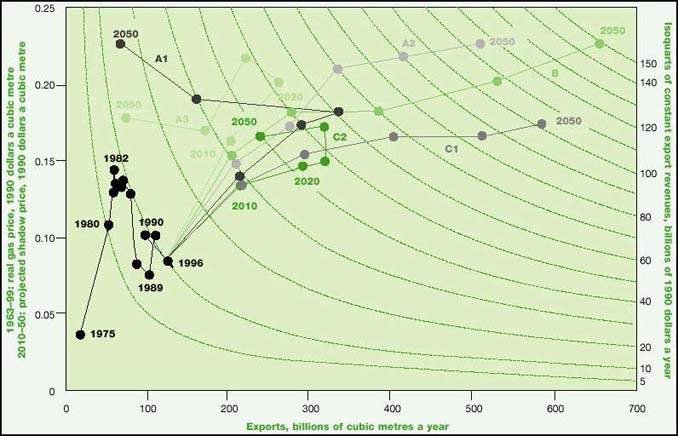
FIGURE 9.9. NATURAL GAS EXPORT
QUANTITIES, PRICES, AND REVENUES FOR THE FORMER SOVIET UNION, 1975-96, AND IN
SIX SCENARIOS, 2010-2050
Source: Nakicenovic, Gr�bler, and McDonald,
1998.
A particularly urgent environmental problem in densely populated
metropolitan areas is the high concentration of particulate matter and sulphur
dioxide. Here cleaner fuels, such as natural gas, and active abatement measures
will be required. Regional air pollution could also prove problematic,
especially in the rapidly growing, densely populated, coal-intensive economies
of Asia. In the booming cities of China and Southeast Asia, high levels of air
pollution must be addressed with appropriate measures (box 9.4).
According to the findings of the IIASA-WEC study, one of the
scenarios (A2), with a high dependence on coal (assuming no abatement measures),
would result in high sulphur dioxide emissions and significant regional
acidification, causing key agricultural crops in the region to suffer acid
deposition 10 times the sustainable level before 2020. Figure 9.10 shows excess
sulphur deposition above critical loads in Asia for the unabated A2 scenario.
According to this scenario, emissions could triple in Asia by 2020, and ambient
air quality in South and East Asia could deteriorate significantly in both
metropolitan and rural areas. Sulphur deposition would reach twice the worst
levels ever observed in the most polluted areas of Central and Eastern Europe
(for example, in the so-called black triangle between the Czech Republic,
Germany, and Poland). Of critical importance for economically important food
crops in Asia is that unabated sulphur emissions would cause critical loads to
be exceeded by factors of up to 10. As a result severe losses in crop production
could occur over large areas of Asia. In contrast to this dire outlook of
possible consequences of unabated sulphur emissions in coal-intensive A2, A3 and
C are relatively benign, leading to some, but not alarming, excess emissions in
the future; perhaps more important, by the middle of the 21st century global
sulphur emissions would be reduced to well below current levels.
|
BOX 9.4. ENERGY SCENARIOS FOR CHINA
Five scenarios are considered for China. The first is a baseline
scenario; the other four illustrate different strategies to achieve more
sustainable development from a regional perspective (Zhou, 1999).
The baseline scenario is intended to represent a practical,
feasible fulfilment of future energy demand with low risk. It is assumed that
GDP will expand by 22.7 times between 1990 and 2050, while energy demand will
increase relatively modestly by about 1.7 times during the same period. This is
due to vigorous improvement of energy intensities in combination with rapid
economic growth. The future energy supply in the baseline scenario continues to
be dominated by coal, however, with substantial technology and efficiency
improvements. The main limitations and concerns are related to potential adverse
environmental impacts. In particular, this coal-intensive baseline scenario is
likely to lead to air pollution and energy-related emissions that substantially
exceed acceptable levels. This is the main reason for the formulation of
alternative development paths that fulfil the development objectives of China,
but with substantially lower adverse environmental impacts.
The four sustainable scenarios explore alternative measures and
policies to reduce the environmental burden of energy. The first scenario
focuses on strengthening energy conservation. It is estimated that the energy
conservation potential, if fully utilised, could reduce energy demand in China
by 12 percent relative to the baseline by 2050. The second alternative scenario
focuses on adoption of clean coal technologies. The main advantage of this
scenario is that it would allow for the use of large domestic coal resources
while curbing air pollution and sulphur emissions. But it would still lead to
high carbon dioxide emissions. The third scenario focuses on renewable energy
sources as replacements for coal. The fourth scenario focuses on nuclear energy,
including breeder reactors, as a replacement for coal.
Combinations of these alternative scenarios were also
considered, resulting in a substantial decrease in the ultimate share of coal to
below 40 percent by 2050. Nevertheless coal remains the most important energy
source across all these alternatives. Thus one of the conclusions is that a high
priority should be placed on developing and diffusing clean coal technologies -
in addition to conservation - in the four more sustainable scenarios. This
strategy could lead to mitigation of 40 percent of future sulphur emissions (for
example, in the second alternative scenario, at relatively modest increases in
investment requirements, sulphur emissions decline from 23.7 million tonnes in
1995 to 13.5 millions tonnes in 2050). The energy conservation scenario had the
advantage of low financing requirements and the lowest carbon dioxide emissions
- but at the expense of a 60 percent increase in sulphur emissions. In contrast
the clean coal scenario achieves a 40 percent reduction of sulphur emissions but
has the highest carbon dioxide emissions. The renewable and nuclear energy
scenarios lead to reductions in emissions at all scales, but the reductions in
sulphur and carbon dioxide are not very large (10 percent and 20 percent), while
the investment costs are very high. |
People world-wide already suffer from local and regional air
pollution, and both governments and individuals are taking steps to improve the
situation. These actions are part of the drive towards higher efficiencies and
cleaner fuels and may also contribute to the shift towards a more sustainable
development path. They also have the positive spin-off effect of reducing carbon
emissions and possible global warming, although that is not their principal
motivation.
Consequently emissions of sulphur aerosol precursors portray
very dynamic patterns in time and space in most sustainable energy scenarios, in
contrast to the development in many reference scenarios (see figure 9.10). A
detailed review of long-term global and regional sulphur emission scenarios is
given in Gr�bler (1998a). Most recent scenarios recognise the significant
adverse impacts of sulphur emissions on human health, food production, and
ecosystems. As a result scenarios published since 1995 generally assume various
degrees of sulphur controls to be implemented in the future and are thus
substantially lower than previous projections. Other developments, such more
sulphur-poor coals and clean fossil technologies and a shift towards renewables
and natural gas in scenarios A3 and C, help promote substantial additional
emissions reductions as ancillary benefits.
A related reason for lower sulphur emission projections is the
recent tightening of sulphur-control policies in OECD countries that continue to
dominate global emissions, such as the amendments to the U.S. Clean Air Act and
implementation of the Second European Sulphur Protocol. These legislative
changes were not yet reflected in previous long-term emission scenarios, as
noted in Alcamo and others (1995) and Houghton and others (1995). The median
from newer sulphur-control scenarios is consequently significantly lower
relative to the older scenarios, indicating a continual decline in global
sulphur emissions.
Scenarios A3 and C include a host of environmental control
measures that help reduce emissions of sulphur dioxide and other pollutants.
This is consistent with most of the scenarios that lead to a long-term,
sustainable decline of particulate and sulphur levels, which would return
emission levels to those of 1900. As a general pattern, global sulphur emissions
do rise initially in recent scenarios, but eventually decline even in absolute
terms after 2050. The spatial distribution of emissions changes markedly,
generally from OECD regions to rapidly developing regions in Asia, and varies
across scenarios.
In the sustainable IIASA-WEC scenarios (A3 and C), emissions in
OECD countries continue their recent declining trend, reflecting a tightening of
control measures. Emissions outside OECD countries, most notably in Asia,
initially rise and then decline, resembling the current trend in OECD emissions.
The reductions are especially pronounced in the C scenarios because of a virtual
transition to the post-fossil era by 2100, essentially eliminating sulphur
emissions. A3 leads to substantial sulphur declines, even though it has the same
economic growth prospects as A2. There are many reasons. First, clean coal
technologies, such as gasification, remove sulphur as an inherent property of
the conversion process. Then there is a shift in fossil energy supply to low
sulphur-grade coals, higher shares of natural gas, and later to non-fossils as
well. Over the long term sulphur emissions decline in both scenarios throughout
the world, but the timing and magnitude
vary.
Climate change: Land use and other global issues
One important implication of the varying pattern of particulate
and sulphur emissions across the scenarios is that the historically important,
but uncertain, negative radiative forcing of sulfate aerosols may decline in the
very long run (Hulme, 1997; chapter 3). This means that the current cooling
effect on the climate that results from the emissions of particulates and
sulphur aerosols would diminish, causing additional, spatially different
patterns of climate change. This view is also confirmed by the model
calculations reported in Subak, Hulme, and Bohn (1997), Nakicenovic, Gr�bler,
and McDonald (1998), Nakicenovic (2000), Smith and others (forthcoming), and
Wigley (1999) and is based on recent long-term greenhouse gas and sulphur
emission scenarios. This means that precursors of air pollution and
acidification at the local and regional levels have an important role in global
climate change. But emissions of greenhouse gases such as carbon dioxide
continue to be the main source of climate warming.
Cumulative future CO2 emissions are in the first
approximation indicative of potential climate change (chapter 3). Carbon dioxide
emissions are the major anthropogenic source of climate change, and energy is
the most important source of CO2 emissions. A number of energy
scenarios in the literature account for the emissions of other greenhouse gases
and thus provide a more complete picture of possible implications for climate
change. For simplicity, only energy-related sources of CO2 emissions
are evaluated here.
Figure 9.11 shows the CO2 emissions of the six
IIASA-WEC scenarios superimposed on the emissions range of the energy scenarios
from the literature. The range is very wide by 2100, from more than seven times
current emissions to almost none for scenarios that assume a complete transition
away from fossil energy. The emission profiles are different across the range of
scenarios. Most portray a continuous increase throughout the 21st century,
whereas the sustainable scenarios generally have lower, more dynamic emission
profiles. Some of them curve through a maximum and decline.
For the scenarios in the literature, the distribution of
emissions by 2100 is very asymmetrical and portrays a structure resembling a
trimodal frequency distribution: those with emissions of more than 30 gigatonnes
of carbon (20 scenarios), those with emissions of 12-30 gigatonnes of carbon (88
scenarios), and those with emissions of less than 12 gigatonnes of carbon (82
scenarios). Most of the scenarios in this lowest cluster are situated at 2-9
gigatonnes of carbon; this cluster appears to include many of the sustainable
energy scenarios, and the second and third clusters most likely include only a
few of them. The lowest cluster may have been influenced by many analyses of
stabilising atmospheric concentrations, for example at 450 and 550 parts per
million by volume (ppmv), in accordance with the United Nations Framework
Convention on Climate Change (UNFCCC, 1992).
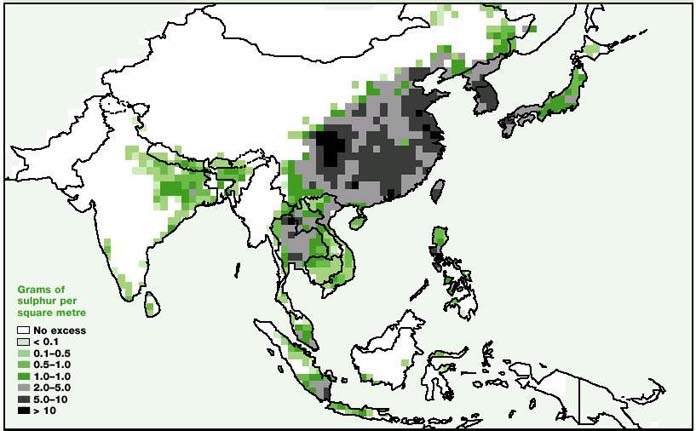
FIGURE 9.10. EXCESS SULPHUR
DEPOSITION ABOVE CRITICAL LOADS IN ASIA FOR AN UNABATED A2 SCENARIO, 2020
Source: Amann and others, 1995.
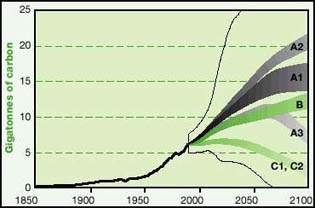
FIGURE 9.11. GLOBAL CARBON
EMISSIONS FROM FOSSIL FUEL USE, 1850-1990, AND IN SIX SCENARIOS, 1990-2100
For each scenario, the range shows the difference
between gross and net emissions. Gross emissions are actual carbon dioxide
released into the atmosphere. Net emissions include deductions for carbon
absorption (through biomass regrowth and sequestration). The figure also shows
the wider range of emissions for 190 scenarios in the literature. The vertical
line that spans the scenario range in 1990 indicates the uncertainty across the
literature of base-year carbon emissions.
Source: Nakicenovic, Gr�bler, and McDonald, 1998; Morita and
Lee, 1998.
The cumulative carbon emissions between 1990 and 2100 are 540
gigatonnes in the case C scenarios, 1,000 gigatonnes in B, 1,210 gigatonnes in
A1, 1,450 gigatonnes in A2, and 910 gigatonnes in A3. Thus A3 and C have both
the lowest cumulative emissions and lowest annual emissions towards the end of
the century. Accumulated emissions across the scenarios between 1990 and 2100
are shown in table 9.1 as well as the resulting atmospheric carbon dioxide
concentrations. Table 9.1 shows that the rising carbon dioxide emissions in
cases A and B lead to atmospheric carbon concentrations of 530-730 ppmv in 2100.
This compares with concentrations of 280 ppmv around 1800 (the beginning of the
fossil-fuel age) and current concentrations of 370 ppmv. A3, which includes
characteristics of sustainability, leads to the lowest atmospheric
concentrations of all A scenarios, about 530 ppmv by 2100. In B and A1, carbon
concentrations approach 590 and 620 ppmv, respectively, by 2100. The
concentrations of the coal-intensive A2 scenarios are the highest, 730 ppmv by
2100, about twice current levels. Only C scenarios lead to relatively benign
concentration levels of less than 450 ppmv (chapter 3).
Thus all scenarios except case C approach the doubling of
pre-industrial carbon concentrations. And again in all scenarios except C,
concentrations continue to rise throughout the 21st century. On the basis of
current knowledge, an increase of carbon concentrations to 600 ppmv by the end
of the 21st century could lead to an increase in the mean global surface
temperature of about 2.5 degrees Celsius, assuming the mean climate sensitivity
and with an uncertainty range of 1.5-4.5 degrees Celsius (chapter 3).
The C scenarios are the only ones in which carbon concentrations
stabilise by 2100, reflecting their ambitious emission reduction profile, from 6
gigatonnes in 1990 to 2 gigatonnes in 2100. After peaking at about 450 ppmv
around 2080, carbon concentrations slowly begin to decline as natural sinks
absorb excess carbon dioxide. The present carbon cycle models indicate that the
emissions reduction to about 2 gigatonnes of carbon a year (or about a third to
at most half the current global emissions) is an essential prerequisite for
eventually achieving stabilisation of atmospheric concentrations. This is the
reason why all other scenarios, including A3, result in continuously increasing
concentrations over the time horizon (although A3 is consistent, with
stabilisation at 550 ppmv in the 22nd century, assuming that the emissions would
further be reduced to about 2 gigatonnes of carbon a year).
Even with its ambitious emission reduction measures, C’s
atmospheric carbon concentrations rise by up to 90 ppmv during the 21st century.
This increase is about equal to the concentration rise since the onset of
industrialisation until today (from 280 to 370 ppmv during the past 200 years).
Thus even in C, some climate change appears inevitable: perhaps 1.5 degrees
Celsius (with an uncertainty range of 1.0-2.5 degrees Celsius) in increased
global mean surface temperature. This illustrates both the legacy of our past
dependence on fossil fuels and the considerable lead times required for an
orderly transition towards a zero-carbon economy and sustainable development
paths. It also illustrates the long residence time of carbon in the atmosphere.
Some of the carbon dioxide emissions from Watt’s first steam engine are
still airborne.
Both IIASA-WEC scenarios with characteristics of sustainability,
C and A3, are situated within the lowest cluster with emissions found in the
literature, at 2-9 gigatonnes of carbon by 2100. Thus they appear to cover the
range of future emissions associated with sustainable development quite well -
their range excludes only the most extreme emission scenarios found in the
literature. This leads to a substantial overlap in emission ranges across
different scenarios. In other words a similar quantification of the driving
forces that are all consistent with various concepts of sustainable development
can lead to a wide range of future emissions. Because this result is of
fundamental importance for assessing climate change and sustainable development,
it warrants further discussion.
Another interpretation is that a given combination of driving
forces is not sufficient to determine future emission paths. A particular
combination of forces, such as those specified in the three IIASA-WEC case A
scenarios, is associated with a whole range of possible emission paths. These
three A scenarios jointly cover the largest part of the scenario distribution
shown in figure 9.11. But only one of them, A3, can be characterised as
sustainable. The three scenarios explore different specific structures of future
energy systems, from carbon-intensive development paths to high rates of
decarbonisation. All three otherwise share the same assumptions about the
driving forces. This indicates that different structures of the energy system
can lead to basically the same variation in future emissions as can be generated
by different combinations of the other main driving forces - population,
economic activities, and energy consumption levels - with basically the same
structure of the energy system. The implication is that decarbonisation of
energy systems - the shift from carbon-intensive to less carbon-intensive and
carbon-free sources of energy - is of similar importance as other driving forces
in determining future emission paths.
Figure 9.12 shows the degree of decarbonisation achieved in the
scenarios relative to historical trends and the range observed in scenarios from
the literature. Carbon intensity of primary energy is shown as an indicator of
decarbonisation. The carbon intensity improves across all IIASA-WEC scenarios,
but is especially pronounced in the three with characteristics of
sustainability, C1, C2, and A3. Sustained decarbonisation requires the
development and successful diffusion of new technologies. An important
implication of the varying interplay of the main scenario driving forces is that
investments in new technologies during the coming decades might have the same
magnitude of influence on future emissions as population growth, economic
development, and levels of energy consumption taken together. Thus high or low
emissions can be associated with a range of social and economic scenarios; the
distinguishing feature of the low emissions and low pollution scenarios is that
the policies and technologies are in place to reduce emissions. But countries
will be better placed to implement climate-friendly policies if development, in
its broadest sense, is successful.
|
The long-term transition to new
energy technologies will
largely
be determined by technological
choices made in the
next 10-30
years. |
Furthermore decarbonisation also means that other environmental
impacts tend to be lower (Nakicenovic, 1996). Thus the energy systems structure
of IIASA-WEC scenario A3 is one of the main determinants of its sustainability.
In contrast, C scenarios require fundamental changes that encompass energy end
use as well. In many ways the transitions in the structures of the energy
systems described by the scenarios cannot be seen in isolation from the overall
development path towards sustainability. Other scenarios presented in the
IIASA-WEC study do not appear to be consistent with the characteristics of
sustainability given in table 9.2. This result suggests that the future
direction of technological change in the energy system is not only important for
reducing the dangers of climate change but can also help nudge the overall
development path in the direction of sustainability.
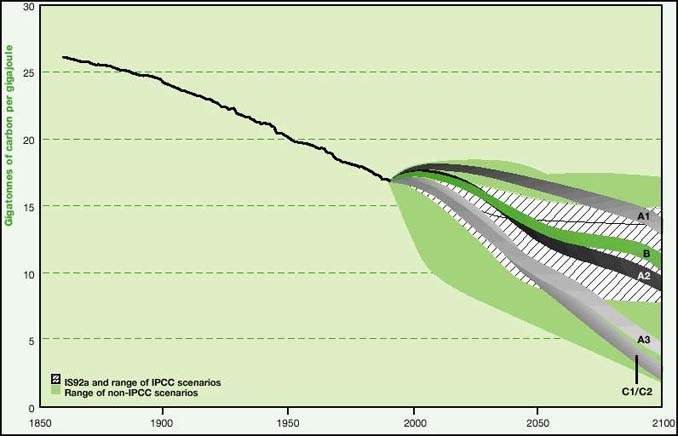
FIGURE 9.12. GLOBAL CARBON
INTENSITY OF PRIMARY ENERGY, 1850-1990, AND IN SIX SCENARIOS, 1990-2100,
RELATIVE TO THE SCENARIOS FROM THE LITERATURE AND THE IPCC IS92 SCENARIOS
Source: Nakicenovic, Gr�bler, and McDonald,
1998.
Conclusion
Scenarios are frequently used to assess sustainable development
paths. Sustainable futures often are easier to illustrate when they are compared
with other scenarios that contradict some of the conditions for achieving
sustainability. This is one of the reasons that, in recent studies, sustainable
scenarios are usually included among alternative futures. This class of
sustainable scenarios can be characterised by low environmental impacts at all
scales and more equitable allocation of resources and wealth relative to the
current situations and other alternative future energy developments. Recently
IIASA and WEC presented a set of six global and regional scenarios (Nakicenovic,
Gr�bler, and McDonald, 1998). Three of the scenarios describe futures with
characteristics of sustainability. They are used in this chapter to illustrate
the measures and policies for the near-term future that would be required to
move away from other alternative but unsustainable development paths. A single
reference scenario is used to outline quite positive future developments, but
they do not fulfil the essential conditions for achieving sustainability.
One of the three sustainable scenarios, C1, is consistent with
most of the conditions and concepts of sustainable development advanced in this
report. It presents a rich and green future and presents a fundamentally
different future development path that includes both substantial technological
progress and unprecedented international cooperation centred on environmental
protection and international equity - it includes a high degree of environmental
protection at all scales, from eradication of indoor air pollution to low
impacts on climate change, with an active redistribution of wealth and very high
levels of energy efficiency and conservation. Thus it fulfils most of the
criteria for sustainable development - such as increasing both economic and
ecological equity among world regions and countries - and leads to a
significantly lower impact on the climate than scenarios with higher greenhouse
gas emissions This scenario requires a virtually complete transition away from
reliance on fossil energy sources and towards renewable energy sources.
Two variants of this scenario were considered. One of them, C2,
foresees a nuclear phaseout by 2100. Both are characterised by a high degree of
energy conservation and vigorous efficiency improvements throughout the whole
energy system and among end users. Consequently total energy requirements are
relatively low relative to the high levels of affluence and quality of life,
especially in today’s developing regions. The achievement of such a future
is indeed challenging, and ranges from devising new RD&D policies to
bringing to market new energy technologies, to imposing energy and carbon taxes
as incentives for improving energy efficiency and conservation and increasing
the shift away from fossil fuels.
|
Local environmental impacts are
likely to continue to take
precedence
over global change in the
achievement of sustainable
energy
developments. |
The second scenario that includes characteristics of
sustainability, A3, is fundamentally different in nature and quite similar to
the reference scenario except in the future structure of the energy system. Thus
environmental protection and higher levels of affluence are achieved less
through changes in levels of energy end use and structure and more through a
dedicated decarbonisation of the energy system. Again efficiency improvements
are important, and clean fossils such as natural gas are foreseen as gaining
much larger shares of global energy needs, along with renewable sources of
energy - all contributing towards decarbonisation. Decarbonisation is in part
also achieved through more sophisticated energy conversion and processing that
includes carbon removal along with more conventional pollutants.
These scenarios illustrate different levels of compatibility
between future energy systems and sustainable development. C1 shows the highest
level of compatibility with sustainable development characteristics. It
exemplifies that the energy aspects of the major issues analysed in chapters 1-4
can be addressed simultaneously. But C1 should be taken only as one illustration
of an energy system compatible with a sustainable development future. Other
combinations of primary energy sources and energy use levels might be equally or
more compatible with sustainable development, as illustrated by C2 and A3,
depending on the level of success with the development and dissemination of new
technologies (chapters 6-8). For example, if the carbon sequestration options
discussed in chapter 8 are realised, there need not be a large conflict between
using coal and reducing carbon emissions, and the fossil fuel share in a
sustainable future could be much larger than in C1, as illustrated in A3
scenario.
All sustainable scenarios, including the three IIASA-WEC
scenarios described in this chapter in detail, have positive (desirable) and
normative (prescriptive) elements. They usually include strong assumptions about
desirable futures and prescribe how such futures can be achieved. Common to most
is that they show that sustainable futures are not achievable with current
policies and prevailing development trends. Their achievement often requires a
fundamental change or major paradigm shift. Thus sustainable energy scenarios
are often designed to offer policy guidance on managing, for example, an orderly
transition from today’s energy system, which relies largely on fossil
fuels, towards a more sustainable system with more equitable access to
resources.
More global studies are considering futures with radical policy
and behavioural changes to achieve a transition to a sustainable development
path during the 21st century. The great merit of RD&D policies, diffusion,
and the adoption of new technologies associated with market-based instruments
for environmental change is that radical developments often proceed gradually
from seemingly moderate policies, leading to major improvements over time. But
they require continuity over decades so that the cumulative effects of moderate
polices can result in radical change. These are some of the crucial
characteristics of the three IIASA-WEC scenarios that lead towards sustainable
development.
Another central feature of these three scenarios is that
adequate provision of energy services and more equitable allocation of resources
are crucial for achieving sustainability. At the same time, energy use is a main
cause of environmental degradation at all scales and so can inhibit the
achievement of sustainability. Thus environmental protection - from indoor
pollution to climate change - is an essential element of sustainable development
in these scenarios. Rapid development and clean, efficient energy are
complementary elements of most of the scenarios. The resolution of these future
challenges offers a window of opportunity between now and 2020. Because of the
long lifetimes of power plants, refineries, and other energy investments, there
is not a sufficient turnover of such facilities to reveal large differences
among the alternative scenarios presented here before 2020, but the seeds of the
post-2020 world will have been sown by then.
The choice of the world’s future energy systems may be wide
open now. It will be a lot narrower by 2020, and certain development
opportunities that are forgone now might not be achievable later. There may well
be environmental irreversibilities, but technical changes may still take place,
and it is a question of whether they will be too late rather than whether they
will occur at all. Perhaps more important is the question of development
initiatives directed at eradicating poverty, disease, and illiteracy in the
world, and whether they will be timely and sufficient to offset currently
inadequate efforts. The achievement of sustainable development dictates a global
perspective, a very long time horizon, and immediate policy measures that take
into account the long lead times needed to change the system.
Notes
1. Table 9.2 provides a number of indicators that can be used to
characterise the achievement of sustainable development in energy scenarios and
shows how the three scenarios selected for this assessment fare relative to one
another.
2. Energy prices are an important determinant in the short to
medium term. But in the long term, technology and policy are more important
determinants, although important feedback mechanisms do exist - for example, in
the form of induced technical change. As a result future levels of energy demand
can vary widely, even for otherwise similar scenario characteristics, in terms
of population and level of economic development.
References
Alcamo, J., A. Bouwman, J. Edmonds, A. Gr�bler, T. Morita, and
A. Sugandhy. 1995. “An Evaluation of the IPCC IS92 Emission
Scenarios.” In Houghton, J.T., L.G. Meira Filho, J. Bruce, Hoesung Lee, B.
A. Callander, E. Haites, N. Harris, and K. Maskell, eds., Climate Change
1994: Radiative Forcing of Climate Change and An Evaluation of the IPCC IS92
Emission Scenarios. Cambridge: Cambridge University Press for the
Intergovernmental Panel on Climate Change.
Amann, M., J. Cofala, P. D�rfner, F. Gyarfas, and W. Sch�pp.
1995. “Impacts of Energy Scenarios on Regional Acidifications.” In WEC
Project 4 on Environment, Working Group C, Local and Regional Energy Related
Environmental Issues. London: World Energy Council.
Barro, R.J. 1997. Determinants of Economic Growth.
Cambridge, Mass.: MIT Press.
Barro, R.J., and X. Sala-I-Martin. 1995. Economic Growth.
New York: McGraw-Hill.
Bos, E., and M.T. Vu. 1994. World Population Projections:
Estimates and Projections with Related Demographic Statistics, 1994-1995
Edition. Washington, D.C.: World Bank.
De Vries, B., J. Bollen, L. Bouwman, M. den Elzen, M. Janssen,
and E. Kreileman. 2000. “Greenhouse Gas Emissions in an Equity-,
Environment - and Service-Oriented World: An IMAGE-Based Scenario for the Next
Century.” Technological Forecasting & Social Change 63 (2-3).
Gallopin, G., A. Hammond, P. Raskin, and R. Swart. 1997.
Branch Points. PoleStar Series Report 7. Boston: Stockholm Environment
Institute Boston Center.
Glenn, J.C., and T.J. Gordon, eds. 1997. “State of the
Future: Implications for Actions Today.” American Council for the United
Nations University, Millennium Project, Washington, D.C.
Goldemberg, J., T.B. Johansson, A.K. Reddy, and R.H. Williams.
1988. Energy for a Sustainable World. New Delhi: Wiley Eastern.
Gr�bler, A. 1994. “A Comparison of Global and Regional
Energy Emission Scenarios.” WP-94-132. International Institute for Applied
Systems Analysis, Laxenburg, Austria.
Gr�bler, A. 1998a. “A Review of Global and Regional Sulfur
Emission Scenarios.” Mitigation and Adaptation Strategies for Global
Change 3 (2-4): 383-418.
Gr�bler, A. 1998b. Technology and Global Change.
Cambridge: Cambridge University Press.
Hammond, A. 1998: Which World? Scenarios for the 21st
Century, Global Destinies, Regional Choices. London: Earthscan.
H�fele, W., ed. 1981. Energy in a Finite World: A Global
Systems Analysis. Cambridge, Mass.: Ballinger.
Hanke, T. 1995. “Die M�rke spielen verr�ckt [in
German].” Die Zeit 18: 33.
Houghton, J.T., L.G. Meira Filho, J. Bruce, Hoesung Lee, B. A.
Callander, E. Haites, N. Harris, and K. Maskell, eds. 1995. Climate Change
1994: Radiative Forcing of Climate Change and an Evaluation of the IPCC IS92
Emissions Scenarios. Cambridge: Cambridge University Press for the
Intergovernmental Panel on Climate Change.
Hulme, M. 1997. “Comment on the First Draft of the Sulfur
Discussion Paper.” Climate Research Unit, University of East Anglia,
Norwich, U.K.
IEA (International Energy Agency). 1993. Cars and Climate
Change. Paris: Organisation for Economic Co-operation and Development.
IEA (International Energy Agency). 1998. World Energy
Outlook. Paris: Organisation for Economic Co-operation and Development.
IIASA-WEC (International Institute for Applied Systems Analysis
and World Energy Council). 1995. Global Energy Perspectives to 2050 and
Beyond. Laxenburg, Austria: International Institute for Applied Systems
Analysis.
Ishitani H., T.B. Johansson, S. Al-Khouli, H. Audus, E. Bertel
and others. 1996. “Energy Supply Mitigation Options.” In R.T. Watson,
M.C. Zinyowera, and R.H. Moss, eds., Climate Change 1995 - Impacts,
Adaptation and Mitigation of Climate Change: Scientific Analysis. Cambridge
University Press for the Intergovernmental Panel on Climate Change.
Johansson, T.B, H. Kelly, A.K.N. Reddy, and R.H. Williams. 1993.
“Renewable Fuels and Electricity for a Growing World Economy: Defining and
Achieving the Potential.” In T.B. Johansson, H. Kelly, A.K.N. Reddy, and
R.H. Williams, ed., Renewable Energy: Sources for Fuels and Electricity.
Washington, D.C.: Island Press.
Kram, T., K. Riahi, R.A. Roehrl, S. van Rooijen, T. Morita, and
B. de Vries. 2000. “Global and Regional Greenhouse Gas Emissions
Scenarios.” Technological Forecasting & Social Change 63 (2-3).
Lazarus, M.L., L. Greber, J. Hall, C. Bartels, S. Bernow, E.
Hansen, P. Raskin, and D. von Hippel. 1993. Towards a Fossil Free Energy
Future: The Next Energy Transition. Technical Analysis for Greenpeace
International. Boston: Stockholm Environmental Institute Boston Center.
Leggett, J., W.J. Pepper, and R.J. Swart. 1992. “Emissions
Scenarios for IPCC: An Update.” In J.T. Houghton, B.A. Callander, and S.K.
Varney, eds., Climate Change 1992: The Supplementary Report to the IPCC
Scientific Assessment. Cambridge: Cambridge University Press for the
Intergovernmental Panel on Climate Change.
Lutz, W., W. Sanderson, and S. Scherbov. 1997. “Doubling of
World Population Unlikely.” Nature 387 (6635): 803-05.
Makarov, A.A. 1999. “Newly Independent States of the Former
Soviet Union.” Paper prepared for the World Energy Assessment. United
Nations Development Programme, New York.
Manne, A., and R. Richels. 1994. “The Costs of Stabilizing
Global CO2 Emissions: A Probabilistic Analysis Based on Expert
Judgements.” Energy Journal 15 (1): 31-56.
Morita, T., and H.-C. Lee. 1998. “IPCC SRES Database,
Version 0.1, Emission Scenario.” Database prepared for IPCC Special Report
on Emissions Scenarios, https://www-cger.nies.go.jp/cger-e/db/ipcc.html
Nakicenovic, N. 1996. “Freeing Energy from Carbon.”
Daedalus 125 (3): 95-112.
Nakicenovic, N. 2000. “Greenhouse Gas Emissions
Scenarios.” Technological Forecasting & Social Change 65 (3).
Nakicenovic, N., A. Gr�bler, and A. McDonald, eds. 1998.
Global Energy Perspectives. Cambridge: Cambridge University Press.
Nakicenovic, N., N. Victor, and T. Morita. 1998. “Emissions
Scenarios Database and Review of Scenarios.” Mitigation and Adaptation
Strategies for Global Change 3 (2-4): 95-120.
Nakicenovic, N., J. Alcamo, G. Davis, B. de Vries, J. Fenhann,
and others. 2000. Special Report on Emissions Scenarios by the
Intergovernmental Panel on Climate Change. Cambridge: Cambridge University
Press for the Intergovernmental Panel on Climate Change.
Nordhaus, W.D., and G.W. Yohe. 1983. “Future Paths of
Energy and Carbon Dioxide Emissions.” In W.A. Nierenberg, ed., Changing
Climate: Report of the Carbon Dioxide Assessment Committee. Washington,
D.C.: National Academy Press.
Pepper, W.J., J. Leggett, R. Swart, J. Wasson, J. Edmonds, and
I. Mintzer. 1992. “Emissions Scenarios for the IPCC. An Update:
Assumptions, Methodology, and Results. Support Document for Chapter A3.” In
J.T. Houghton, B.A. Callandar, and S.K. Varney, eds., Climate Change 1992:
Supplementary Report to the IPCC Scientific Assessment. Cambridge: Cambridge
University Press for the Intergovernmental Panel on Climate Change.
Raskin, P., G. Gallopin, P. Gutman, A. Hammond, and R. Swart.
1998. Bending the Curve: Toward Global Sustainability. Report of the
Global Scenario Group, PoleStar Series Report 8. Stockholm: Stockholm
Environment Institute.
Rostow, W.W. 1990. The Stages of Economic Growth. 3rd
edition. Cambridge: Cambridge University Press.
Schipper, L., and S. Meyers. 1992. Energy Efficiency and
Human Activity: Past Trends, Future Prospects. Cambridge: Cambridge
University Press.
Schwartz, P. 1991. The Art of the Longview: Three Global
Scenarios to 2005. New York: Doubleday.
Shell International Ltd. 1996. The Evolution of the
World’s Energy Systems. The Hague: Shell International.
Shell International Ltd. 1998. People and the Environment:
The 1997 Shell International Exploration and Production Health, Safety and
Environment Report. The Hague: Shell International.
Smith, S.J., T.M.L. Wigley, N. Nakicenovic, and S.C.B. Raper.
Forthcoming. “Climate Implications of Greenhouse Gas Emissions
Scenarios.” Technological Forecasting & Social Change.
Solow, R. 1956. “A Contribution to the Theory of Economic
Growth.” Quarterly Journal of Economics 70: 56-94.
S�rensen, B., B. Kuemmel, and P. Meibom. 1999. “Long-Term
Scenarios Global Energy Demand and Supply.” IMFUFA [Department of Studies
in Mathematics and Physics and their Functions in Education, Research and
Applications], Roskilde University, Roskilde, Denmark.
Subak, S., M. Hulme, and L. Bohn. 1997. The Implications of
FCCC Protocol Proposals for Future Global Temperature: Results Considering
Alternative Sulfur Forcing. CSERGE Working Paper GEC-97-19. Centre for
Social and Economic Research on the Global Environment, University of East
Anglia, Norwich, U.K.
Tol, R.S.J. 1995. “The Climate Fund Sensitivity,
Uncertainty, and Robustness Analyses.” W-95/02, Institute for Environmental
Studies, Climate Framework. Vrije Universiteit, Amsterdam.
UN (United Nations). 1996. Annual Populations 1950-2050: The
1996 Revision. New York: UN Population Division (data on diskettes).
UN (United Nations). 1997. United Nations Commission on
Population and Development, Thirteenth Session, Report of the Secretary General
on Progress on Work in the Field of Population in 1996. New York: United
Nations.
UN (United Nations). 1998. World Population Projections to
2150. New York: Population Division, UN Department of Economics and Social
Affairs.
UNDP (United Nations Development Programme). 1997. Human
Development Report 1997. Oxford: Oxford University Press.
UNFCCC (United Nations Framework Convention on Climate Change).
1992. “United Nations Framework Convention on Climate Change.”
UNEP/WMO Information Unit of Climate Change (IUCC) on behalf of the Interim
Secretariat of the Convention. IUCC, Geneva.
UNFCCC (United Nations Framework Convention on Climate Change).
1997. “Kyoto Protocol to the United Nations Framework Convention on Climate
Change.” FCCC/CP/L7/Add.1, 10 December 1997. United Nations, New York.
WBCSD (World Business Council for Sustainable Development).
1998. “Exploring Sustainable Development.” Geneva.
Wigley, T.M.L. 1999. “The Science of Climate Change. Global
and U.S. Perspectives.” PEW Center on Global Climate Change, Arlington, Va.
WEC (World Energy Council). 1993. Energy for Tomorrow’s
World. London: Kogan Page.
Zhou, F. 1999. “China’s Future Energy Scenario
Analysis.” Paper prepared for the World Energy Assessment. United Nations
Development Programme, New
York.
Chapter 10. Rural Energy in Developing Countries
Jos� Goldemberg (Brazil)
LEAD AUTHORS: Amulya K.N. Reddy (India), Kirk R.
Smith (United States), and Robert H. Williams (United States)
|
ABSTRACT
Supplying modern energy services to the 2 billion people who
still cook with traditional solid fuels and lack access to electricity is
probably one of the most pressing problems facing humanity today. The amount of
energy needed to satisfy the basic needs of rural populations around the world
is relatively small, and appropriate technologies are available. However,
widening access to modern energy services is limited by the extreme poverty
found particularly in the least developed countries.
Living standards in rural areas can be significantly improved
by promoting a shift from direct combustion of biomass fuels (dung, crop
residues, and fuelwood) or coal in inefficient and polluting stoves to clean,
efficient liquid or gaseous fuels and electricity. Although consumers tend to
shift to these modern, higher-quality energy carriers as their incomes rise and
the carriers become more affordable, the process is slow. Yet a shift to such
carriers can reduce the damage to human health and the drudgery associated with
continued reliance on inefficient, polluting solid fuels.
This chapter describes experience with and prospects for
improving the technologies used to cook with biomass in several countries, as
well as the development of clean, non-toxic cooking fuels. Progress in rural
electrification-using both centralised, grid-based approaches and small-scale,
decentralised technologies-is also described.
Technological developments alone, however, will not improve
access or promote greater equity. New institutional measures are also needed,
including financing to cover the initial capital costs of devices and equipment.
Energy initiatives will be most successful when integrated with other policies
that promote development. And because local populations will ultimately use,
maintain, and pay for energy services, they should be involved in making
decisions about energy systems. |
The lack of adequate energy services in rural areas of
developing countries has social dimensions (chapter 2) as well as serious
environmental and health effects (chapter 3). Many of these problems are
exacerbated by the almost exclusive reliance of rural populations in most areas
on traditional fuels coupled with simple technologies characterised by low
energy efficiency and harmful emissions. This chapter thus focuses on
technological opportunities, as well as other strategies, for delivering
adequate, affordable, cleaner energy supplies to rural areas.
The second half of the 20th century witnessed a strong
urbanisation trend and the emergence of megacities (those containing more than
10 million people) in most developing countries. Between 1970 and 1990 the share
of people living in cities grew from 28 to 50 percent. But while the rural
population relatively decreased during this period, the absolute number of
people living in rural areas increased to 3 billion. Despite this, rural
development often remains low on government agendas because of increasing
demands of growing, politically and economically dominant urban populations.
Thus the explosive growth of cities makes it difficult for policy-makers to give
rural development the attention it deserves.
The dispersed character of rural populations and their low
commercial energy consumption result in poor capacity utilisation efficiency for
transmission and distribution systems and other energy infrastructure. Extending
an electric grid to a few households in a rural setting can result in energy
costs of up to $0.70 per kilowatt-hour, seven times the cost of providing
electricity in an urban area (World Bank, 1996). Thus conventional approaches to
extending energy infrastructure are economically inefficient, for both public
and private providers-which is another reason the energy problems of rural
populations are given low priority by governments.
Because the poor people in rural areas lack access to
electricity and modern fuels, they rely primarily on human and animal power for
mechanical tasks, such as agricultural activities and transport, and on the
direct combustion of biomass (wood, crop residues, dung) for activities that
require heat or lighting. Human energy is expended for household work (gathering
and preparing biomass for fuel, fetching water, washing clothes), agriculture,
and small industry. Biomass fuels are typically used for cooking (which
dominates inanimate energy consumption in most warm regions), space heating,
heating water for bathing, and meeting some industrial heating needs. Kerosene
is used predominantly for lighting, and to a small extent in rural industry.
Although much of the world’s rural population has no access to electricity
generation, many have small battery-operated devices such as radios and
flashlights.
Rungs on the energy ladder
Large amounts of human energy are spent gathering fuelwood in
many parts of the world, and the burden tends to fall more heavily on women and
children.1 Although there are exceptions, history has generally shown
that when alternatives are available and affordable, consumers opt for more
modern energy carriers. As incomes rise and opportunities for using better
technologies become available, consumer preferences shift to more efficient,
convenient, cleaner energy systems as they become more affordable. That is,
consumers move up the energy ladder (chapter 3). This involves a shift to modern
energy carriers or to more convenient and energy-efficient conversion devices.
|
Accelerating the
introduction of modern energy
is a key
strategy for promoting
sustainable development
in rural areas. |
For cooking and other heating purposes, the lowest rungs on the
energy ladder involve use of dung or crop residues, with fuelwood, charcoal,
kerosene, and liquefied petroleum gas (LPG) or natural gas representing
successively higher rungs. For lighting, the lowest rung is represented by fire,
followed in turn by liquid-fuelled (such as kerosene) lamps, gas lanterns, and
electric bulbs. To do mechanical work, consumers shift from human and animal
energy to diesel fuel and electricity as soon as they become available, because
they are almost always more cost-effective. Often a synergy between modern
energy carriers and more efficient end-use devices occurs.
One of the aims of this chapter is to explore the technological,
economic, social, and institutional prospects for more rapidly introducing
modern energy carriers into rural areas-which would allow households to move
quickly to the top of the energy ladder, ideally skipping (leapfrogging) some of
its rungs. Accelerating the introduction of modern energy, then, is a key
strategy for promoting sustainable development in rural areas of developing
countries. Principally, it involves providing:
· Clean liquid or
gaseous fuels for cooking, and electricity for lighting and other basic
household amenities.
· Liquid fuels and electricity
to mechanise agriculture.
· Electricity
sufficiently low in cost to attract industrial activity to rural areas (thereby
providing well-paying jobs and helping to stem migration to urban
settlements).
It is desirable to skip rungs and advance to the highest rungs
on the energy ladder wherever feasible.2 But because the 2 billion
rural poor live in many different circumstances, a complete range of approaches
need to be explored, and those that work best in each set of circumstances need
to be encouraged. Appropriate public policies should be implemented to
accelerate the process and reduce human suffering.
Satisfying basic human needs with modern energy carriers
requires relatively small amounts of energy in absolute terms. In regions that
do not require space heating, final household energy requirements for satisfying
basic needs are estimated to be about 2,000 kilocalories per capita per day, or
0.1 kilowatt per capita in average power provided (80 percent for cooking and 20
percent for electricity; Reddy, 1999). The cooking needs of the 2 billion people
not served by modern fuels correspond to about 120 million tonnes of oil
equivalent of LPG a year-which equals 1 percent of global commercial energy
consumption or 3 percent of global oil consumption. This is less than is
currently lost flaring natural gas in oil fields and refineries.
Thus commercial energy requirements for satisfying basic needs
in rural areas are truly modest. Yet provision of even these modest amounts of
energy to rural areas would offer the potential for enormous increases in
amenities, particularly if these modern energy carriers were coupled with
energy-efficient end-use devices.3
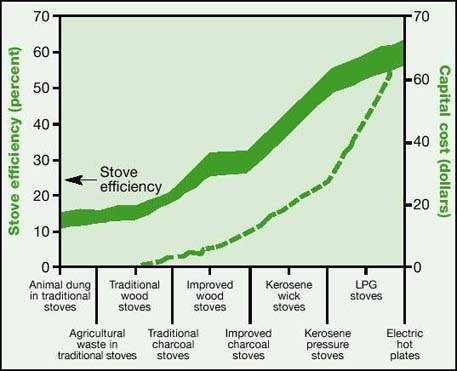
FIGURE 10.1. EFFICIENCY OF STOVES
WITH COMMERCIAL AND NON-COMMERCIAL FUELS
Source: Baldwin, 1987.
Progress in delivering modern energy to rural areas has been
slow. But as will be shown, technical options to provide rural people with
access to convenient, affordable energy services are commercially available (or
nearly so). This is particularly the case in regions where modern energy
carriers, such as biogas or producer gas, can be derived from local biomass and
where gathering biomass feed-stock can provide opportunity for income
generation. The challenge of making modern energy available to the very poorest
households is primarily institutional, notwithstanding the economic costs and
risks inherent in developing and disseminating untried systems. New financial
mechanisms and other innovative policy approaches are needed, as discussed
below.
Fuels in rural areas: climbing the energy ladder
The oldest human energy technology, the home cooking fire,
persists as the most prevalent fuel-using technology in the world. For much of
the world’s population, household fuel demand makes up more than half of
total energy demand. The energy ladder (discussed briefly above and in chapter
3) is used here as a framework for examining the trends and impacts of household
fuel use. As figure 10.1 illustrates, the fuel-stove combinations that represent
rungs on the ladder tend to increase in cleanliness, efficiency, and
controllability. Conversely, capital cost and dependence on centralised fuel
cycles also tend to increase with movement up the ladder.
Shortages of local wood supplies combined with institutional and
economic constraints on petroleum-based fuels often lead to household coal use,
which is widespread in Eastern Europe, China, and South Africa. Coal has a
higher energy density than wood and so is easier to store. Coal’s high
energy density also makes it cost-effective to ship over longer distances than
wood to efficiently supply urban or rural markets. In these senses, coal is
similar to other household fossil fuels. Unlike kerosene and gas, however, coal
often represents a decrease in cleanliness relative to wood. Like wood, another
solid fuel, coal is difficult to use efficiently in household appliances.
|
BOX 10.1. COMPARISON OF STOVE PROGRAMMES IN CHINA AND
INDIA |
|
China |
India |
|
The programme focused on areas with the greatest need and
selected pilot counties with biomass fuel deficits. |
The programme was implemented country-wide, resulting in
dispersion of effort and dilution of financial resources. |
|
Direct contracts between the central government and the county
bypassed much bureaucracy. This arrangement generated self-sustaining rural
energy companies that manufacture, install, and service stoves and other energy
technologies. |
The programme administration was cumbersome, moving from the
centre to the state level, then to the district, and finally to the taluka,
where the stove programme is just one of many national efforts being
implemented locally by the same people. |
|
Local rural energy offices run by provincial governments are in
charge of technical training, service, implementation, and monitoring for the
programmes. These efforts are separately funded and relatively independent.
|
Lack of a strong monitoring plan was a severe weakness in early
programmes. Some improvement has occurred through assignment of the task to
university-based technical backup units. Coverage is still incomplete, however.
|
|
Stoves are not only suitable for fuel savings and reduction of
household smoke, but also are designed for convenience and attractiveness,
highlighting the lessons learned from problems in early programmes that stressed
only fuel savings. |
India has made a wide variety of attempts to integrate
efficiency and convenience, which have suffered from the top-down structure of
the programme. |
|
Stove adopters pay the full cost of materials and labour. The
government helps producers through stove construction training, administration,
and promotion support. |
Stove adopters pay about half the cost of stoves; the government
pays the rest. As a result the producer’s incentive to construct stoves is
oriented towards the government. |
|
Emphasis has been on long-lived stoves made of ceramic or metal
and otherwise designed to be a significant household asset for a number of
years. |
Many of the stoves have been made from local materials and by
villagers without artisanal skills, resulting in short lifetimes in day-to-day
household use. |
Source: Smith and others, 1993; Barnes and
others, 1993; Ramakrishna, 1991a, b.
Climbing the energy ladder for cooking can be accomplished using
commercially available technologies such as improved cooking stoves and kerosene
or LPG. As discussed below, biogas and producer gas are almost at the point of
commercialisation, and additional and cleaner advanced technologies for meeting
cooking needs are under
development.
Improved cooking stoves
Since about 1980, several hundred programmes around the world
have focussed on developing and disseminating improved biomass cooking stoves in
the villages and urban slums of the developing world. These programmes have
ranged in size from the introduction of a few hundred stoves by local
non-governmental organisations to huge national efforts in China and India that
have affected millions of households. The programmes seek to accelerate the
natural trend for people to move towards cleaner, more efficient devices when
they are available and affordable.
Such programmes have had mixed success. Some have disseminated
many improved stoves with significant lifetimes. Others have not. The failures,
however, represent progress along a learning curve, and more recent programmes
have tended to have higher success rates. In this regard, it is instructive to
compare the two largest initiatives, those of China and India (box 10.1).
Over the past 20 years, perhaps 90 percent of world-wide
installations of improved cooking stoves occurred in China. From 1982-99 the
Chinese National Improved Stoves Programme reported the installation of improved
stoves in more than 175 million rural households. These were mainly biomass
stoves used for cooking. But in the northern states of China, where temperatures
drop during the winter, dual-use stoves for cooking and heating were included.
In China improved stoves are affordable, and the government contribution is low.
An improved stove in China costs about 85 yuan ($10), and the government
contributes an average of 4.2 yuan per stove ($0.84). Part of the success of the
programme is attributed to the attention-including well-publicised national
competitions and awards-given to improved stove design.
The Indian programme, initiated in 1983, is called the National
Programme on Improved Chulhas (cooking stoves). So far, nearly 30 million stoves
have been disseminated. A mix of portable (without chimneys) and fixed designs
have been approved. The government subsidises at least half of the costs of the
stoves, which amounts to 200 rupees ($4.50) per stove. Although dissemination
has been impressive, follow-up surveys suggest that less than one-third of the
improved stoves are still in use. Some reasons given for discontinuing use are
that the stoves did not really save energy, did not eliminate smoke, or broke
down. Other surveys found that adopters felt that stoves were consuming less
energy and producing less smoke. The mixed perceptions indicate differing levels
of success in implementation.
Several lessons can be learned from the two programmes. The
greater success in China can be attributed to programme design and
implementation, including the factors described in box 10.1. Both programmes now
face pressure to reduce subsidies in a more market-based approach. In addition,
although both programmes now incorporate monitoring for energy efficiency,
neither includes evaluations of the smoke-exposure benefits.
|
The cooking needs of the 2 billion people
not served by
modern fuels correspond
to about 1 percent of global
commercial energy
consumption
or 3 percent of global
oil consumption. |
Another commonly cited example of success is the introduction of
a more efficient ceramic charcoal cooking stove, the jiko, developed in
Kenya. At. least 700,000 such stoves are now in use in that country, in more
than 50 percent of urban homes and in about 16 percent of rural homes.
About 200 small-scale businesses and artisans produce more than
13,000 stoves each month. Both the stove itself and the general programme for
disseminating it have been adapted for use in a number of other African nations
(table 10.1).
The process of research, development, demonstration, and
commercialisation that led first to the improved jiko and then to other
high-efficiency stoves was seeded by international and local development funds
(in contrast to the Indian and Chinese programmes, which were almost entirely
organised and funded domestically). Most important, policy-makers decided not to
directly subsidise the production and dissemination of these stoves but to
provide support to designers and manufacturers.
Because the stoves were relatively expensive ($15) and their
quality was highly variable, sales were slow at first. But continued research
and increased competition among manufacturers and vendors spurred innovations in
both the materials used and the methods of production. An extensive marketing
network for those stoves is flourishing, and prices have fallen to $1-3,
depending on size, design, and quality. This outcome is consistent with the
learning curve theory, whereby the price of a new technology decreases by a
uniform amount (often about 20 percent) for each doubling of cumulative sales
(chapter 12).
Part of the success of the jiko, however, is due to its use of a
relatively high-quality fuel, charcoal. It is much easier to design simple
stoves with high energy efficiency for use with such low-volatility solid fuels
relative to those that use the unprocessed biomass that is the main source of
household energy in the world’s villages. Charcoal stoves are also
inherently less polluting than those burning unprocessed biomass, and thus do
not incorporate chimneys. Like other low-volatility solid fuels-such as some
coals-charcoal produces fewer health-damaging particles and gases than wood, but
it does produce substantial carbon monoxide. Households relying on such
low-volatility fuels, therefore, risk overnight carbon monoxide poisoning, which
annually causes thousands of deaths world-wide.
TABLE 10.1. NUMBER OF IMPROVED STOVES DISSEMINATED IN EAST
AND SOUTHERN AFRICA, 1995
|
Country |
Urban |
Rural |
Total |
|
Kenya |
600,000 |
180,000 |
780,000 |
|
Tanzania |
54,000 |
n.a. |
54,000 |
|
Uganda |
52,000 |
n.a. |
52,000 |
|
Ethiopia |
23,000 |
22,000 |
45,000 |
|
Rwandaa |
30,000 |
n.a. |
30,000 |
|
Sudan |
27,000 |
1,400 |
28,400 |
|
Zimbabwe |
11,000 |
10,000 |
21,000 |
|
Burundia |
20,500 |
n.a. |
20,500 |
|
Somaliaa |
15,400 |
n.a. |
15,400 |
n.a. - Not available. a. Civil strife has
significantly affected stove programmes and reduced the number of improved
stoves in use.
Source: Karekezi and Ranja, 1997.
In addition, the process of making charcoal from wood is often
quite inefficient, leading to heavy pressure on forests in much of Africa to
supply urban areas. The inefficiency of charcoal kilns means that the charcoal
fuel cycle is probably the most greenhouse-gas-intensive major fuel cycle in the
world, even when the wood is harvested renewably, and often it is not. Thus
charcoal could not be a sustainable rural energy option in the long run, unless
its supply system were to be drastically altered.
Even the best biomass stoves available today do not greatly
reduce the health-damaging pollution from biomass combustion, although they may
put it outside through well-operating chimneys or hoods. This is certainly
better than releasing the smoke inside; but in densely populated villages and
slums, it can lead to heavy neighbourhood pollution. Thus even nearby households
using clean (or no!) fuels may suffer from high levels of exposure. Therefore,
because of health concerns-unless truly clean-burning biomass stoves can be
developed at reasonable costs-in many areas, improved stoves are probably not
sustainable in the long run. They may continue to play an important interim role
in improving the quality of life of the rural and urban poor; but as concluded
in chapter 3, the long-term goal should be to eliminate household use of
unprocessed solid fuels.
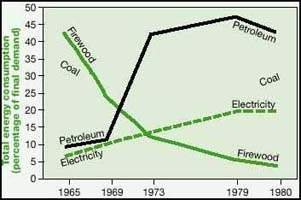
FIGURE 10.2. POST-BIOMASS ENERGY
TRANSITION IN THE REPUBLIC OF KOREA, 1965-80
Source: Baldwin, 1987.
|
Kerosene and LPG actually produce
fewer greenhouse gas
emissions
per unit of energy service
than biomass fuels used
in
traditional ways. |
Kerosene and liquefied petroleum gas
In countries that achieved successful rural development during
the past 50 years, kerosene and then LPG replaced biomass fuels. Figure 10.2
shows the changing household fuel picture in the Republic of Korea as rural
development proceeded in the 1960s. At the start of the period, wood was the
chief fuel, but 15 years later it had been replaced almost entirely by
petroleum-based fuels. Similar transitions have occurred in other regions as
well. Natural gas and town gas (made from coal) have continuing important roles
in urban development (but rarely in rural areas, because of pipeline
transmission requirements).
As consumers climb the energy ladder, kerosene is usually the
first modern fuel to be used, because it is more easily transported and stored
than LPG. However some countries-notably China-have restricted the availability
of kerosene, thereby encouraging the direct movement to LPG. Kerosene, although
substantially superior to biomass in efficiency and cleanliness, is not as
desirable as LPG, which burns nearly without pollution in comparison with fuels
on lower rungs. Of course, liquid and gaseous fuels pose other risks: For LPG,
the most important are fires and explosions; in the case of kerosene, children
may suffer poisoning due to careless household storage. Experience has shown,
however, that these risks are lower than those posed by biomass fuels.
LPG must be distributed in pressurised canisters that, along
with the stove, involve significant up-front investments by households. In
addition, both LPG and kerosene require a stable, reliable distribution system
running from the refinery to neighbourhood distributors, something that does not
exist in many parts of the developing world. The combination of these two
factors often prevents LPG from being used by many households that could
otherwise afford its daily cost. Indeed, in many developing-country cities, the
daily cost of LPG would be less than the cost of shipping biomass from rural
areas. Lack of capital for the stove and canister and poor supply reliability,
however, prevent households from shifting to LPG.
Despite these problems, LPG programmes have been very successful
in most of Latin America, particularly in Brazil, where LPG has replaced all
other fuels for cooking-even in many remote rural areas. The main reason for
this success was a very dependable system of distribution and replacement of LPG
canisters.
A study in Hyderabad, India, found that the simple measure of
stabilising LPG supplies by the local government encouraged many urban
households to shift to LPG. This is a policy without fuel subsidies that saves
money for households and has a beneficial impact on the environment (Barnes and
others, 1994). If users have a first-cost constraint, the programme should
provide low-interest loans towards initial costs. Subsidies to help households
meet the up-front costs for equipment such as stoves and canisters are much more
acceptable policies than subsidising fuel. Fuel subsidies alone tend to divert
use of fuel to industry, transport, and households that already have stoves,
making the subsidies very costly, economically inefficient ways to help the
poor.
Because fossil fuels such as kerosene and LPG are non-renewable
and their combustion contributes to greenhouse-gas emissions, some may question
their role in sustainable energy strategies. However, the quantity of LPG needed
to support cooking for the current unserved population of 2 billion is trivial
at the global level (see above). Moreover, kerosene and LPG actually produce
fewer greenhouse gas emissions per unit of energy service than biomass fuels
used in traditional ways (chapter 3).
Nevertheless, instead of relying on fossil fuels with
substantial new infrastructure requirements, it is sometimes desirable to
produce clean fuels that can be used efficiently from local biomass resources.
Biogas and producer gas systems, as well as advanced technology options such as
synthetic LPG or dimethyl ether (DME), appear promising in the longer
term.
Biogas for cooking
Biogas, a clean-burning methane-rich fuel gas produced through
anaerobic digestion (bacterial action in a tank without air) of suitable biomass
feedstocks, is the only biomass-derived modern energy carrier for household
applications with which there is widespread experience. Biogas can be generated
from cattle dung and animal wastes, and with substantially more difficulty, from
some crop residues. Although these feedstocks are frequently used directly as
cooking fuel, in most areas they are not preferred fuels and are used only when
wood is not available. Biogas systems offer multiple benefits. The
digester-effluent is usually a good fertiliser, and, if connected to latrines,
biogas plants can provide valuable sanitation services. For cooking and other
thermal household tasks, it is simple and reasonably efficient to use the gas
directly in conventional low-pressure gas burners. Biogas can also provide
lighting when used in mantle lamps.
In societies where suitable feedstocks are readily available,
small family-sized biogas digesters were thought to have considerable potential.
A number of countries initiated programmes-China and India on a large scale.
Results have been mixed, especially in the early stages. China’s efforts
resulted in the construction of 7 million household-scale digesters from
1973-78. But quality control and management problems resulted in a large number
of failures. More recently, coordinated efforts have focused on regions thought
to be most promising for the technology. Service organisations and biogas
services stations have been established. By 1994, 5 million domestic plants were
operating satisfactorily. India’s experience has been on a slightly smaller
scale, but the numbers are still impressive-by the end of 1998, almost 2.8
million domestic plants were installed. India’s Ministry of
Non-Conventional Energy Sources has identified a potential for 12 million
digesters.
Biogas experience in Africa has been on a far smaller scale and
has been generally disappointing at the household level. The capital cost,
maintenance, and management support required have been higher than expected.
Moreover, under subsistence agriculture, access to cattle dung and to water that
must be mixed with slurry has been more of an obstacle than expected. However,
possibilities are better where farming is done with more actively managed
livestock and where dung supply is abundant-as in rearing feedlot-based
livestock.
|
BOX 10.2. BIOGAS IN NEPAL
The principal objective of the Biogas Support Programme in Nepal
is to promote the wide-scale use of biogas as a substitute for the wood,
agricultural residues, animal dung, and kerosene that presently meet the cooking
and lighting needs of most rural households in the country. The rising demand
for locally available biomass from a rapidly increasing population has helped
accelerate the rates of deforestation, soil degradation, and environmental
decline in densely inhabited areas. In addition, use of biomass fuels and
kerosene has compromised health and welfare-especially of women and children,
who are most often subjected to the smoke and fumes associated with the use of
these fuels.
Since its inception, the programme has installed more than
40,000 family-size biogas units benefiting more than 200,000 members of rural
households. The programme’s target is to install an additional 100,000
units by the middle of 2003. This compares to only 6,000 biogas units installed
before the programme. This substantial increase has been achieved while
simultaneously reducing the costs and increasing the reliability and efficiency
of biogas plants.
A critical element in developing the commercial market for these
plants has been the programme’s innovative financial engineering and
judicious application of consumer subsidies. The subsidy, fixed at three levels,
accounted for 35 percent of the total cost of biogas plants in 1998. The
objective of the programme is to eliminate dependency on direct subsidies by
2003. The programme has also strengthened institutional support for the biogas
market.
At the start of the programme, essentially only one state-owned
company, the Gobar Gas Company, was producing biogas plants. By the end of 1998,
as a direct result of market development, 38 private companies besides Gobar had
entered the business. To be eligible to receive the subsidy provided to farmers,
all participating companies must meet strict production quality and service
standards for their plants. As a result of the growing competition, technical
design modifications, and better quality control measures, the overall cost of
biogas plants in Nepal has declined by more than 30 percent since 1992. In
addition to the institutional improvements, employment for skilled as well as
unskilled labour in rural areas has been generated. |
Source: Mendis, 1999.
The initial enthusiasm for biogas has thus been somewhat
dampened by experience. Because of its requirement for relatively large amounts
of animal dung, the niche for household biogas plants is likely to remain small.
Poor families do not have access to enough dung, and better-off families with
sufficient animals often prefer to purchase fuel and fertiliser rather than
spend time gathering dung and managing the often-temperamental digesters. Even
so, in the right social and institutional context, and with appropriate
technical expertise, the potential for biogas remains significant. These
conditions seem to have been achieved in the Biogas Support Programme in Nepal
through an innovative financial scheme (box
10.2).
Producer gas for cooking
An alternative to biogas is producer gas, a mixture consisting
largely of carbon monoxide, hydrogen, and nitrogen. Producer gas is generated in
a thermochemical conversion process through partial oxidation in air of biomass
feedstocks (Stassen, 1995). The basic principles of generating producer gas have
been known since the 18th century. Producer gas derived from biomass has been
used for domestic and industrial heating purposes, for cooking, for stationary
power, and for motor vehicle applications. (During World War II more than a
million gasifier-powered vehicles helped to keep basic transport systems running
in Europe and Asia.)
During periods of peace and wide availability of cheap, more
convenient fossil fuels, interest in biomass-derived producer gas has been low.
The energy crises of the 1970s rekindled interest in producer gas technology,
but interest waned again with the collapse of world oil prices in the mid-1980s.
Once again, there is growing interest in technology for making producer gas from
biomass for cooking, heating, and electricity generation. Power generation
applications of producer gas are discussed later in this chapter. Here the focus
is on domestic cooking.
Part of the reason for renewed interest in producer gas
technology is increasing concern about the adverse health effects of indoor air
pollution caused by biomass and coal burned for domestic cooking and heating
(chapter 3) and the large role that producer gas used in gas-burning stoves
could play in reducing this pollution-the air pollution from these stoves is
nearly zero. In typical agricultural regions, the energy generation potential
from producer gas is greater than that from biogas, because crop residues tend
to be more abundant than dung.4 And whereas biogas generation is
often the preferred energy conversion technology for making use of the energy
content of dung, producer gas generation is a far easier approach for exploiting
the energy content of crop residues.
In addition, because it is a chemical rather than biological
process, producer gas manufacture is not sensitive to ambient temperature,
greatly increasing the potential geographic extent of its application. Another
reason for renewed interest in biomass-derived producer gas in China is a severe
new air pollution problem caused by the burning of crop residues in fields-a
consequence of the rising affluence of farmers (see the annex to this chapter).
This problem is forcing a search for new productive uses of crop residues.
Several Chinese provinces are making efforts to convert residues
into producer gas in centralised village-scale gasifiers and to distribute the
cooking gas by pipes to households. For example, the Shangdong Academy of
Sciences has developed crop residue gasifiers and centralised households meet
equipment such gas supply system technology for are much cooking gas
applications, and 20 such policies village-scale gasification systems are
operating in the province (Dai and Lu, fuel. 1998). Monitoring and assessment of
a village experience in Shangdong Province (case 1 in the annex) shows that
current technology has considerable consumer appeal and would be highly
competitive if the gas were properly priced. The technology for making producer
gas from crop residues promises to be widely deployable for cooking
applications, and thus to largely solve the indoor air pollution problem caused
by stoves that burn biomass or coal.
TABLE 10.2. GLOBAL POPULATION AND ACCESS TO ELECTRICITY,
1970-90 (MILLIONS OF PEOPLE)
|
Country |
1970 |
1980 |
1990 |
|
World population |
3,600 |
4,400 |
5,300 |
|
Rural population |
2,600 |
3.000 |
3,200 |
|
With access to electricitya |
610 |
1,000 |
1,400 |
|
Without access to electricity |
2,000 |
2,000 |
1,800 |
|
Percentage of rural population with access |
23 |
33 |
44 |
a. Access includes people living in villages
connected to power lines. This does not necessarily mean that most households
are hooked up to electricity.
Source: Davis, 1995.
|
Subsidies to help households meet
the up-front costs for
equipment such
as stoves and canisters are much
more acceptable
policies
than subsidising fuel. |
One problem posed by current gasifiers used in China is that
they produce substantial tars (condensable hydrocarbons that are scrubbed from
the gas before delivery to consumers). If disposed of without adequate treatment
to groundwater or surface water, these tar wastes would pose significant water
pollution problems. Moreover, the option of using crop residues or producer gas
for cooking will not solve the air pollution problem in China that arises from
burning excess crop residues in the field. The producer gas option is about
twice as efficient as direct combustion in providing cooking services, so that
only about half as much residue is required for cooking relative to
direct-combustion stove systems.5 At the national level, use of just
60 percent of all crop residues potentially available for energy purposes would
be adequate to meet all rural cooking needs.
In addition, the producer gas cooking option poses another
public health risk: Typically, about 20 percent of producer gas is carbon
monoxide-of which accidental leaks into houses can be lethal. Although some
hydrocarbon impurities in the gas impart an odour to producer gas that is
usually noticed before a lethal dose is inhaled, occasional accidents are
inevitable. Therefore (as discussed below), safe, clean, advanced technological
options for producing cooking fuel from biomass should be the focus of research
and
development.
Rural electrification
Electricity is at the top of the energy ladder and is highly
efficient and convenient for some specialised cooking appliances, such as rice
cookers and microwave ovens. But for many years to come, electricity is unlikely
to be practical for general cooking in most rural areas of the developing world.
Nevertheless, for lighting, communication, refrigeration, and motor
applications, electricity is essential for a satisfactory quality of life.
Moreover, electricity is key to improving agricultural productivity through
mechanisation and is essential for many rural industrial activities.
Considerable progress has been made in rural electrification programmes designed
to extend electricity services to isolated villages (table
10.2).
The centralised approach
Between 1970 and 1990, 800 million people in rural areas gained
access to electricity. Yet of the 3 billion people living in rural areas of
developing countries in 1990, 2 billion were still without access to
electricity. This global total masks significant variations between regions and
countries. In particular, China’s rapid electrification programme-through
which 365 million rural residents gained access to electricity from
1970-90-significantly increased the world total. If China were excluded, current
access levels would drop from 44 to 33 percent, or exactly the level of
1980.6
The distinction between access to electricity by villages and
households should also be noted. India, for example, has an ambitious rural
electrification programme, targeting agricultural end use. But while 80 percent
of villages have electricity, less than 50 percent of households can afford it.
Several studies highlight an important point for economic
success: electrification cannot by itself ensure economic development. It is a
necessary but insufficient condition. Electrification works best when overall
conditions are right for rural income growth and when it is complemented by
social and economic infrastructure development-such as rural water supplies,
health programmes, primary and secondary education, and regional and feeder
roads. Thus rural electrification contributes to but is not a substitute for
other rural development measures.
Rural electrification programmes have typically concentrated on
connecting villages and remote areas to a national grid-often owned and operated
by a public utility. The tendency has been to extend the grid incrementally,
reaching towns and settlements in order of increasing capital costs. Thus remote
areas with small populations are likely to be the last to receive electricity.
Moreover, many rural areas face high transmission and distribution costs, for
several reasons:
· The capacity of
power lines is inefficiently used because of low population.
· Densities and demand levels
are low.
· Villages may have very peaky
(undiversified) demand profiles. Line losses tend to be high.
· In addition, incremental
extension of the grid (rather than extension optimised to minimise losses)
causes lines to be strung haphazardly, resulting in greater
losses.
The decentralised approach
Because of the problems of supplying grid electricity for small,
scattered, peaky loads, decentralised electricity generation is becoming more
attractive. With decentralised systems, the high costs of transmission and
distribution networks can be avoided. But small-scale, decentralised solutions
face other barriers. The decentralised generation technologies discussed below
are diesel-engine generator sets, small-scale hydropower, photovoltaics, wind,
and small-scale biopower using producer gas. No attempt is made to be
comprehensive on the technological opportunities for decentralised electricity
generation. Instead, the discussion illustrates key features of different
technologies, highlighting advantages and drawbacks for rural development needs.
Diesel-engine generator sets. Diesel generators are
common in many remote settlements, either for a single user or as part of a
local distribution network. Such systems may be operated by a power utility or,
more commonly, by private enterprises. Rural hospitals, government offices, and
police stations in remote areas typically have their own diesel generators.
Diesel sets with capacities of 50-500 kilowatts of electricity
are widely used in rural Latin America and Asia but have only recently been
disseminated in Africa. The electricity produced by diesel sets typically costs
$0.30 a kilowatt-hour-two to three times the cost of electricity from grids in
urban areas but still cost-effective relative to grid extension. (This cost is
typical of the Amazonia region of Brazil, where there are 900 diesel sets with a
total generating capacity of 391 megawatts.) The high costs of maintenance and
of transporting diesel fuel and lubricating oil to remote places make
electricity fairly expensive.7 Despite these costs, electricity is
typically highly valued by local populations because of the enormous
improvements in living standards that it brings (box 10.3). But while high-cost
electricity may be acceptable for satisfying basic needs in households and for
some agricultural and cottage industry applications, lower costs are needed to
attract a greater job-generating industrial base to rural areas.
Small-scale hydropower. Small-scale hydropower is a
locally available resource that in some regions can be exploited to deliver
electricity or mechanical power (for pumping water and other applications) to
rural areas. The resource potential for small-scale hydropower is discussed in
chapter 5; its technology, costs, and future prospects are discussed in chapter
7. Here the focus is on current activities and the prospects for using
small-scale hydropower to address rural development needs.
Small-scale hydropower technology, which is being pursued in
about 100 countries, is often divided into three categories: micro hydro (less
than 100 kilowatts), mini hydro (100-1,000 kilowatts), and small hydro (1-30
megawatts). By the end of 1994 China alone had 6,000 small-scale hydropower
stations with a total installed capacity of 15,650 megawatts, supplying 49
terawatt-hours of electricity (Qui and others, 1996)-29 percent of hydroelectric
power generation and nearly 8 percent of rural electricity consumption (Deng and
others, 1996). In 1989 China accounted for about 38 percent of world-wide small
hydropower (23.5 gigawatts), at which time more than 130 companies manufactured
equipment specifically for plants with capacities ranging from 10 kilowatts to
more than 10 megawatts. Of the 205 turbines ordered world-wide in 1989, the size
distribution was micro hydro, 15 percent; mini hydro, 57 percent; and small
hydro, 28 percent (Moreira and Poole, 1993). In China and Viet Nam even
sub-kilowatt systems have been sold for household electrification. Such turbines
are installed at the end of hose-pipes, with somewhat unreliable but serviceable
results. However, the potential market for such systems is limited by the
availability of water resources.
On a somewhat larger scale, hydropower plants of 50 kilowatts
and more can be used to electrify communities or small regions by establishing
mini grids. Costs are highly variable (chapter 7), depending on the site
topography, proximity of the site to the main load area, and hydrological
conditions.
Small-scale hydropower has one drawback: it is almost always
obtained from run-of-river plants that lack the reservoir capacity to store
water. Consequently, severe seasonal variations in power output may occur,
depending on a site’s hydrology. Thus the long-term viability of
small-scale hydropower may depend on backup electricity that is supplied either
locally or through the grid (Moreira and Poole, 1993).
Photovoltaics. Photovoltaic technology is cost-effective
in providing electricity to rural areas at the very smallest scales (typically
less than 100 watts) in areas with no access to grid electricity and where
electricity demand is characterised by such low levels and infrequency that even
diesel electricity cannot compete (see chapter 7 for details about photovoltaic
technology and its economics in such applications). The potential for
photovoltaic technology to support rural development arises from the fact that
it can be used for household lighting, radios, and television sets, and to
refrigerate medicines at rural clinics.
In 1999 global photovoltaic sales totalled 200 megawatts, 10
percent of which was for off-grid applications in rural areas of developing
countries. One important obstacle to wider rural deployment of photovoltaic
technology is the limited financing available for such small systems (see
section below on the time horizon for technological options). Kenya has the
world’s highest penetration rate of household photovoltaic systems, with
more than 80,000 systems in place and annual sales of 20,000 systems. Fifty
local and fifteen international importers, assemblers, installers, and
after-sales providers serve this market, which developed without significant
aid, subsidies, or other support. Although the current market is strong, there
is still a tremendous need to standardise equipment, as well as improve
batteries, lighting fixtures, and electronic ballasts used in integrated
household photovoltaic systems. In addition, possible credit arrangements need
to be studied, as do the relative advantages of leasing a system rather than
purchasing it.
In 1999 South Africa’s power utility, Eskom, entered into a
joint venture with Shell Solar Systems to provide 50,000 homes with
photo-voltaic systems in areas where grid connection is not considered feasible.
This three-year programme contributes to a market that is believed to exceed 2
million households. Customers pay a monthly rate to lease and use the equipment,
which allows a reasonable rate of return to Eskom.
|
BOX 10.3. DIESEL ENGINES IN A MULTIPURPOSE PLATFORM PROJECT
IN MALI
In Mali a project is under way to introduce, by 2003, 450
multipurpose platforms to provide, at the village scale, mechanical power and
electricity through diesel engines to 10 percent of the country’s rural
population. At least two-thirds of these platforms will be coupled to water and
electricity distribution networks. By 2003 rural access to electricity is
expected to be more than 3 percentage points higher than urban access. Although
the project is based on the use of diesel fuel oil, it is envisaged that in the
future pourghere nut oil or some other liquid biofuel will be used.
The engine selected for this project is a 1950s-vintage slow
diesel engine (a Lister engine, from India). This engine was chosen because of
its low initial capital cost; low prices for its spare parts; its ability to
operate without damage on the relatively low-quality diesel fuel typically
available in villages; its ease of operation, maintenance, and repair by local
artisans (blacksmiths, mechanics, carpenters); and the availability of a network
of sellers and servicers for it throughout much of Mali.
It is intended that the engine in a typical platform would power
various types of equipment, such as a cereal mill, husker, alternator, battery
charger, pump, welder, and carpentry machine. Thus the platforms would reduce
many rural women’s burdensome tasks (fetching water, grinding cereal);
offer them income-generating opportunities and management experience; and, as
they become more economically independent, help them improve their social
status. Because so many activities would be supported by the platforms, their
economic and social benefits would be felt at multiple levels, resulting in an
overall empowerment of women. In the pilot phase of the project (1996-98),
during which 45 platforms with 14 water or electricity networks were installed,
the platforms’ availability stimulated the creation, development, and
modernisation of artisanal activities in participating villages. The platforms
are being operated and maintained on a cost-recovery basis by private
enterprise.
By design, the acquisition of a multipurpose platform is a
demand-driven process. The initial request has to be made by a recognised,
registered women’s association at the grassroots level. International
donors are subsidising equipment costs (including the engine, mill, de-huller,
alternator, battery charger, and building) at up to $1,500 per module. In
situations where the supply of electricity and running water is requested, the
contribution of the international donor can be increased by up to $10,000 per
module. An equity contribution of at least 50 percent is required of the
women’s associations. Operation and maintenance costs are borne entirely by
beneficiaries.
The mechanical work provided by the engines costs about $0.25
per kilowatt-hour (see table). Notably, more than 70 percent of the cost is for
diesel fuel and lubricating oil, which must be imported into the region. If the
mechanical work were converted to electricity, the added cost associated with
the generator and conversion losses would increase the electricity cost to at
least $0.30 per kilowatt-hour. If liquid biofuels produced in the region
eventually could be substituted for imported oil, the region’s balance of
payments would be improved, although costs would probably not be reduced much or
at all, because liquid biofuels tend to be more costly than petroleum fuels.
Although this project is interesting in revealing consumer
wants, it is in its initial phase of implementation, and only experience will
supply information on real costs. Nevertheless, the project shows that there are
attractive alternatives to grid extension, that rural electrification does not
necessarily mean grid electrification, that decentralised electrification is a
serious option, and that entrepreneur-driven participatory development is
crucial. |
|
Cost of mechanical work for a diesel engine, Mali
multipurpose platform |
|
Cost |
Dollars per year |
Dollars per kilowatt- hour |
|
Capitala |
131 |
0.018 |
|
Fuelb |
1,140 |
0.138 |
|
Maintenance |
|
|
|
Every 100 hours |
|
|
|
|
Lubricating oil |
158 |
0.022 |
|
|
Other |
36 |
0.005 |
|
Every 500 hours |
179 |
0.025 |
|
Every 1,000 hours |
104 |
0.015 |
|
Every 1,500 hours |
74 |
0.010 |
|
Total |
1,820 |
0.233 |
|
a. For an 8-horsepower (6-kilowatt) Indian Lister diesel engine
with a 7-year plant life costing $600 (excluding the cost of a generator) and
operated 1,500 hours a year at 80 percent of rated capacity, on average, so that
the annual average capacity factor is 13.7 percent. Assuming a 12 percent
discount rate, the capital recovery factor is 21.9 percent a year.
b. For a diesel fuel price of $0.44 a litre and an engine
efficiency of 30 percent (higher heating value basis). |
Source: Mali and UNDP, 1999.
Still another approach to reach a greater portion of low-income
rural people was adopted by Soluz. This company developed a system to lease
small photovoltaic battery systems to provide high-quality electric services at
an affordable price while offering a positive financial return to its investors.
In 1993, with assistance from the Rockefeller Foundation, Soluz conducted a
pre-feasibility study for a solar electricity delivery company and construction
of a company prototype for 200 rural homes in the Dominican Republic. The
company installs standalone photovoltaic battery systems on or near rural homes
yet retains ownership of the systems. The photovoltaic systems provide lighting
and access to information services (through radio and television). Users make
regular payments, as determined in the lease agreement, and the company is
responsible for maintaining the systems.
In Central America customers pay a monthly fee of $15-20,
depending on the size of the photovoltaic system leased. The company has an
on-time collection rate exceeding 90 percent. Many customers are small
businesses, for whom the provision of high-quality energy services contributes
to increased profitability.
But even where appropriate financing is made available, the
poorest households often cannot afford photovoltaic systems (box 10.4). In
considering measures to support photovoltaic programmes for rural areas, it is
important to pay particular attention to the poorest households and to
strategies to make the technology available to them.
Although significant in improving the quality of life in rural
areas, without major cost reductions, photovoltaic technology will be limited
mainly to remote household and other small-scale applications and will not be
able to compete in the provision of electricity for manufacturing or even most
cottage industrial applications.
|
BOX 10.4. EQUITY ISSUES RELATING TO PHOTOVOLTAIC TECHNOLOGY
FOR RURAL AREAS IN INDIA
Of the 79 million rural households in India without electricity
(out of a total of 114 million rural households), 7, 17, and 75 percent of
households could afford, respectively, 37-watt (four-light), 20-watt
(two-light), and 10-watt (one-light) photovoltaic systems with Grameen-type
financing (five-year loans at 12 percent interest with a 15 percent down
payment; see box 10.7). Thus it appears that the poorest 25 percent of
households cannot afford any photovoltaic purchase, even with financing.
But such findings, which are based on willingness-to-pay
considerations, might be overly simplistic. The availability of lighting might
be exploited to earn extra income that could make a photo-voltaic system
affordable for even the poorest household. If, for example, a poor Indian
household could weave two extra baskets a night by the light made available by a
10-watt photovoltaic system, the technology would become affordable. |
Source: Reddy, 1999; Hande,
1999.
|
Household-scale
wind turbines (of about 100 watts)
offer
benefits to wind-rich regions
similar to those offered by
domestic
photovoltaic
systems. |
Wind. There are two promising ways to exploit wind power
to meet rural energy needs. The first is household units that provide
electricity at. scales where neither grid power nor mini-grid power from diesel
units is cost-effective. The second is village-scale wind-battery-diesel hybrid
systems (using wind turbines with capacities typically of 5-100 kilowatts).
Household-scale wind turbines (of about 100 watts) offer
benefits to wind-rich regions similar to those offered by domestic photovoltaic
systems. Such turbines have been developed, produced, and deployed, for example,
in China, mostly in the Inner Mongolian Autonomous Region. The dispersion of
houses in this region of low population density (18 people per square kilometre)
makes household wind systems a viable option for providing electricity. In Inner
Mongolia an estimated 130,000 small-scale (mostly 50-200 watt) wind energy
systems have been installed, providing electricity for lighting, radios,
television, and small appliances to more than 500,000 people, mostly rural
herdsmen (about one-third of the population). About 89,000 of these systems are
operating routinely, producing from 8.7 megawatts of installed capacity about
15.7 gigawatt-hours a year (Wu, 1995).
The success of the Chinese programme was achieved through
careful planning and the creation of an effective regional and local
infrastructure for manufacturing, sales, maintenance, and training. This
included the development of a market for individual household systems through
various subsidy mechanisms. The government of Inner Mongolia also recognised and
allowed for the long gestation period and sustained support needed to create a
thriving local industry. The project has also led to technology transfers at
many levels-between Inner Mongolia and local, regional, and national
organisations within China, as well as with other countries. Replicating the
programme would require enough institutional capacity to support such ventures.
Where rural households are clustered in villages far from
electric grids that are served instead by diesel-engine generator sets, an
alternative option is to deploy wind turbines in wind-diesel or
wind-battery-diesel hybrid configurations, which have been installed in many
parts of the world (Baring-Gould and others, 1999). In regions where diesel fuel
is costly, these hybrid systems can lead to lower electricity costs and less air
pollution than conventional diesel-engine generator sets.
Unlike the household-scale wind turbines being developed in
China, however, many components of these hybrid systems are based on technology
developed in industrialised countries, and costs of imported systems are often
prohibitive. But if these systems can be mass produced in developing countries
under arrangements-such as international industrial joint ventures-that are
conducive to technology transfer, substantial cost reductions are possible (see
chapter 7 for an example).
Small-scale biopower using producer gas. Biomass-derived
producer gas (see above) can be used to make electricity at scales comparable to
those associated with diesel-engine generator sets. The potential benefits are:
· The capacity to
use locally available biomass as fuel instead of oil imported into the region.
· Lower electricity generation
costs than with diesel.
· Increased rural income
generation, and possibly rural industrialisation, as a result of the lower
electricity cost.
The reciprocating compression-ignition (diesel) engine is the
main commercially viable engine available for these applications.8
When producer gas is used with such engines, it must be supplemented with
a pilot oil to assist ignition because mixtures of producer gas and air do not
auto-ignite at the pressures and temperatures realised when the gas is
compressed. As a result producer gas can typically displace about 70 percent of
diesel fuel consumption. When operated with producer gas in the dual-fuel mode,
diesel-engine generators have somewhat lower efficiencies and rated capacities
(typically about 20 percent lower than when operating on pure diesel fuel).
Producer gas must meet far higher standards for reciprocating
engine operation than for cooking or heating (domestic or industrial)
applications. The main problem is the propensity of tars formed in the gasifier
to condense on downstream surfaces, causing problems such as the sticking of
engine gas intake valves. Most early gasifiers generated so much tar that
adequate gas clean-up for engine operation was impractical, and tar removal
would significantly reduce the potential for power generation from a given
amount of biomass feedstock. But in recent years, gasifiers have been developed
(notably in India) that generate tars at levels that make engine operation on
producer gas acceptable (Kartha and Larson, 2000).
Biomass-derived technology for producer gas,
reciprocating-engine generators is commercially ready. In India, for example,
the Ministry of Non-Conventional Energy Sources has supported development
efforts that have led to technically sound gasifier-engine systems and trial
implementation of more than 1,600 such systems with a total installed capacity
of more than 28 megawatts (Kartha and Larson, 2000). For engines operated on
producer gas and pilot oil, fuel costs are typically much lower than for
conventional diesel systems. But capital, operation, and maintenance costs are
higher (see table A10.1).
In fact, the savings derived from diesel replacement have to pay
for the extra initial capital cost as well as the extra operation and
maintenance costs incurred for the gasifier. The technology can be
cost-effective, either where diesel fuel costs are very high (for example,
$0.35-0.40 a litre or more, as is often the case for extremely remote regions)
or, with efficient capital utilisation, in regions where diesel fuel prices are
more moderate. If the diesel fuel price is $0.25 a litre, a typical system must
be operated at full capacity for 3,000 hours a year to break even with a
conventional diesel system. About 6,000 hours of annual operation are needed to
realise a cost savings of 25 percent (see table A10.1). It is desirable to seek
opportunities for such high rates of capacity utilisation because consumers are
likely to be more motivated to adopt the technology if they can realise
substantial cost savings. Unfortunately, achieving high rates of capital
utilisation is often difficult because local electricity. demand is typically
low and sporadic but peaky, with very little electric load diversity.
|
Historically, electric utilities have
discouraged
independent power producers from selling
electricity into
grids, but this situation
is changing as electricity markets
are becoming
more
competitive. |
A promising strategy for launching a producer gas,
engine-generator technology industry would be to focus initially on market
opportunities where the technology could be deployed in large numbers in
baseload configurations. This requires that two conditions be satisfied. Biomass
supplies have to be adequate for fuelling baseload plants, and the demand for
electricity has to be adequate to justify baseload operation. Strong candidate
regions for doing this are agricultural regions of China where crop residues are
abundant and where grid connections exist (87 percent of the rural population in
China is grid-connected), so that electricity generated in excess of local needs
can be sold into the grid (Li, Bai, and Overend, 1998). Historically, electric
utilities have discouraged independent power producers from selling electricity
into grids, but this situation is changing as electricity markets are becoming
more competitive (chapter 12).
New technologies that might be commercialised in the near term
(5-10 years) offer the potential for electricity generation at costs
significantly lower than with current technology. One promising new technology
is the microturbine, which might be deployed with essentially the same gasifiers
that have been developed to provide producer gas for use with diesel dual-fuel
engine generator sets.
Microturbines are gas turbines designed for operation at scales
of 50-250 kilowatts of electricity, with electric efficiencies (lower heating
value) of 25-30 percent for larger units. Microturbines were originally
developed for military and aerospace applications and are now offered by several
companies for applications in distributed power and cogeneration markets, mainly
for use with natural gas or diesel fuel. Developers expect microturbine use to
grow rapidly for such applications in regions where there is competition in
electricity markets (chapter 8). The technology appears to be readily adaptable
for use with biomass-derived producer gas (Henderick, 2000).
Microturbines are less complex (some variants have only one
moving part) than reciprocating engines. They can be fuelled with producer gas
without de-rating and without loss of efficiency relative to operation on
natural gas or diesel fuel. Most important, they need no costly pilot oil
(Henderick, 2000). In regions where crop residues or other low-cost biomass
feedstocks are readily available, there are reasonably good prospects that the
technology could become widely competitive in grid-connected applications
(Henderick and Williams, 2000). Case 2 in the annex describes a potential
application of the technology to the trigeneration of cooking gas, electricity,
and space heating through district heating in a hypothetical village in northern
China.
To illustrate the aggregate potential of this technology,
consider that in China, 376 million tonnes of crop residues a year are
potentially available for energy purposes.9 Committing these residues
to trigeneration (case 2 in the annex) could provide enough cooking gas for 230
million people (27 percent of China’s rural population) plus 270
terawatt-hours a year of electricity (equivalent to 30 percent of coal power
generation in China in 1997) plus hot water for space heating in regions where
it is needed (for example, in regions with cold winters).
Several public policy initiatives could facilitate the creation
of a viable industry for small-scale biopower technologies. One important
measure would be to eliminate or phase out diesel fuel subsidies that exist in
many regions. Another would be market reforms that facilitate the sale of
electricity into electric grids, coupled with incentives to encourage the
extension of electric grids to more rural areas. Notably, the commercial
availability of competitive baseload biopower technology could profoundly
influence the economics of extending electric grids to rural areas. In contrast
to the poor capacity utilisation (and hence poor economics) of
transmission-distribution lines sending electrons from centralised power plants
to rural areas, high capacity factors (and thus more favourable economics) could
be realised if electrons instead flowed to urban centres from baseload
village-scale biopower plants.
Finally, demonstration projects are needed to prove the
viability of new technological concepts for biopower. Projects are needed for
biopower systems based on gasification of alternative crop residue feedstocks,
for which tar production rates are higher than for wood chips (Henderick and
Williams, 2000). Such projects could involve the use of commercially established
diesel dual-fuel engine technologies. Demonstrations are also needed of
microturbines in producer gas applications. If carried out together with the
above institutional reforms, these projects could lead to commercially viable
microturbine-based products for biopower applications in the near term
(2005-10).
Leapfrogging to new rungs on the energy ladder
The previous sections have shown that existing and near-term
energy technologies have great potential for improving the quality of life in
rural areas. But advanced technologies have residual problems that might need to
be addressed. For instance, fuels such as LPG are highly desirable for cooking,
but making LPG widely available requires considerable infrastructure for
distribution, and finding ways to make LPG affordable to the poorest households
is a major challenge. Moreover, because LPG is derived from petroleum-a
commodity for which price swings can be substantial, as recent experience has
shown-price spikes are likely to be burdensome for lower-income households that
depend on LPG for their cooking needs.
Local manufacture of clean cooking fuels (such as biogas and
producer gas derived from biomass feedstocks) is a strategy for addressing the
fuel-infrastructure challenges and price volatility concerns posed by exclusive
reliance on LPG. This strategy also provides opportunities for addressing the
needs of the very poorest households, because the need to gather typically
dispersed biomass feedstocks (such as dung for biogas or crop residues for
producer gas) and deliver them to the conversion facility can sometimes make it
possible for the poor to monetise their labour and thereby earn income to help
pay for these clean cooking fuels (case 2 in the annex).
But today’s available gaseous cooking fuel technologies
have limitations. Biogas technologies, though well suited for use with dung
feedstocks, are not easily applied to crop residues, which tend to be much more
abundant. And a persistent concern about producer gas is that it contains carbon
monoxide, accidental leaks of which might lead to fatalities. Odourants added to
producer gas could greatly reduce the risk of poisoning, but accidents are
difficult to avoid completely.
Advanced technologies can make it possible to manufacture
synthetic cooking fuels from biomass that are non-toxic as well as clean. A
promising approach is to adapt to biomass some of the technologies being
developed for fossil fuels-specifically, syngas-based fluid fuels (chapter 8).
Strong candidates are synthetic LPG (SLPG) and dimethyl ether (DME), which can
be made from any carbonaceous feedstock by catalytic synthesis from syngas (a
gaseous mixture consisting largely of carbon monoxide and hydrogen). SLPG (like
petroleum-derived LPG, a mixture of propane and butane) and DME are superclean,
non-toxic cooking fuels that are gaseous at ambient conditions but can be stored
and delivered to consumers as liquids in moderately pressurised canisters. These
fuels can be produced from crop residues or other biomass feedstocks through
thermochemical gasification to produce the needed syngas. (Case 3 in the annex
discusses the potential offered by such technologies for rural regions of China
rich in crop residues.)
In addition to the toxicity advantages offered by SLPG and DME,
both fuels could be readily transported in canisters by truck or donkey cart to
remote, scattered households. Producer gas, by contrast, is a viable option
primarily for villages in which houses are clustered closely enough to make pipe
transport economically viable. Thus SLPG and DME extend the scope of the cooking
fuel markets that could be served relative to producer gas. DME is also a
potentially strong low-polluting synthetic fuel for diesel-engine vehicle
applications (chapter 8) and might be used as tractor fuel, thereby facilitating
the mechanisation of agriculture.
Neither SLPG nor DME is currently produced for fuel
applications, but either fuel derived from biomass feedstocks could probably be
brought to market readiness by 2010-15 if there were sufficient market interest
and a focused development effort. Because neither SLPG nor DME is currently on
the market anywhere in the world, a shift from the use of current low-quality
fuels to either might be described as jumping to entirely new rungs at the top
of the energy ladder (technological
leapfrogging).
The time horizon for technological options
Chapters 6-8 and this chapter show that there are abundant
opportunities for technological change relating to rural energy. Technological
change is desirable to the extent that it serves development needs. Rural
development planners can help shape the course of technological change for
desirable options, taking into account the time horizons required for
development and implementation-demanding more of the longer-term options in
addressing societal needs. Options that warrant focussed attention in the near
term (that is, implementation in the next 5 years) as alternatives to current
technology should offer the potential for immediate improvement. For the medium
term (5-15 years), planners should emphasise technologies that can potentially
achieve dramatic improvements relative to current technology. To the extent that
technologies realisable in the medium term fall short of performance consistent
with sustainable development goals, policy-makers should also encourage for the
long-term (15-30 years) technologies that are fully consistent with sustainable
development goals.
It is also wise to have a balanced portfolio with a combination
of near-, medium-, and long-term options, to ensure a continuing flow of
improved technologies into rural energy markets. Successes with near-term
improvements can help win political support for the development of longer-term
options. Some important technological options for rural energy in the near,
medium, and long terms are summarised in table
10.3.
Accelerating rural energy development
The preceding sections show that there are many technological
opportunities for implementing the goals set forth at the start of this chapter:
providing clean liquid or gaseous fuels for cooking and electricity for lighting
and other basic household amenities, and making bulk electricity available at
low cost for mechanising rural agriculture and promoting rural
industrialisation.
Both centralised and decentralised energy technologies and
strategies can make contributions to reaching these ends. But new strategies and
policies are needed to increase access to these modern energy services and to
make modern energy services widely affordable. Coordinated efforts that include
the active participation of rural people can accelerate the
process.
Integrated rural development
Making modern energy services more readily available is a
necessary but insufficient condition for rural development. To be most
effective, certain forms of energy (such as grid-based electricity) should be
introduced into rural areas only after, or along with, other development inputs
or infrastructure components. To achieve this integration, it is essential that
there be horizontal communication among all agencies involved in rural
development.
Many rural development activities-agriculture, transport, water
supply, education, income generation, health care-have energy requirements. Yet
the ministries and departments responsible for these activities rarely
coordinate or cooperate with the ministry of energy, or with one another, to
arrive at the most rational, integrated solution to their energy needs.
Decentralisation of rural energy planning may help achieve this. But optimising
the allocation of development resources requires attention at the central
government planning level as well. In the many places where integrated rural
development has been pursued, the availability of affordable modern energy
supplies has proven to be a catalyst for economic and social transformation.
TABLE 10.3. SOME NEAR-, MEDIUM-, AND LONG-TERM
TECHNOLOGICAL OPTIONS FOR RURAL ENERGY
|
Energy source or task |
Present |
Near term |
Medium term |
Long term |
|
Source |
|
|
|
|
|
Electricity |
Grid or no electricity |
Natural gas combined cycles, biomass-based generation using
gasifiers coupled to internal combustion engines, photovoltaic, small wind,
small hydroelectric for applications remote from grids |
Biomass-based generation using gasifiers coupled to
micro-turbines and integrated gasifier combined cycles, mini grids involving
various combinations of photovoltaic, wind, small hydroelectric, batteries |
Grid-connected photovoltaic and solar thermal, biomass-based
generation using gasifiers coupled to fuel cells and fuel cell/turbine hybrids
|
|
Fuel |
Wood, charcoal, dung, crop residues |
Natural gas, LPG, producer gas, biogas |
Syngas, DME |
Biomass-derived DME with electricity coproduct |
|
Cogeneration (combined heat and power) |
|
Internal combustion engines, turbines |
Microturbines and integrated gasifier combined cycles |
Fuel cells, fuel cell/turbine hybrids |
|
Task |
|
Cooking |
Woodstoves |
Improved woodstoves, |
Producer gas, natural gas and DME stoves |
Electric stoves, catalytic burners |
|
Lighting |
Oil and kerosene lamps |
Electric lights |
Fluorescent and compact fluorescent lamps |
Improved fluorescent and compact fluorescent lamps |
|
Motive power |
Human and animal powered devices |
Internal combustion engines, electric motors |
Biofueled prime movers, improved motors |
Fuel cells |
|
Process heat |
Wood, biomass |
Electric furnaces, cogeneration, producer gas, NG/solar thermal
furnaces |
Induction furnaces, biomass/solar thermal furnaces |
Solar thermal furnaces with heat storage |
The provision of affordable financial services for rural people
has long been a prime component of rural development strategies. Originally,
these strategies focussed on concessional loans to farmers. More recently,
however, this approach has been replaced by much wider financing for rural
activities, with lower transaction costs. By creating rural financial markets
and integrating them with general financial markets, it may be possible to
mobilise substantial domestic savings as the main capital resource for rural
people-and to reduce their dependence on concessional outside funds. Where
urban-biased financial policies have inhibited the creation of effective rural
financial institutions, new policies and strategies should seek to integrate
rural and urban financial services and thus promote the greatest financial
efficiency and lowest credit costs for rural
people.
Involving rural people (particularly women) in decision-making
Above all, planning for rural energy development should have a
decentralised component and should involve rural people-the customers-in
planning and decision-making. And special attention should be devoted to
involving women, because they bear the burden of traditional energy systems and
are likely to be the greatest beneficiaries of improved systems. A major driving
force for the move towards decentralisation has been the recognition of the
limited extent to which benefits have flowed to rural people from the
investments already made. More active involvement of rural people (particularly
women) and their institutions in identifying rural energy problems, and in
formulating and implementing plans to overcome them, would result in more
efficient, rational use of resources and more equitable sharing of the benefits
of development.
Decentralisation of rural energy planning is wise for other
reasons as well. Rural energy systems are based primarily on biomass, a local
energy resource. Although historically this has involved direct combustion of
biomass for cooking or heating (as this chapter has shown), clean, convenient,
modern energy carriers can also be derived from biomass. Consequently, an
assessment of the demand and supply flows and of desirable interventions must
all also occur on the same geographic scale. Through their superior knowledge of
the local situation, local people-women in particular-can be integral parts of
the
solution.
Strategies for expanding access to modern energy services
Often, policies ensuring that supplies-even from centralised
production sources-are reliable and stable can promote the use of modern energy
carriers. The Hyderabad, India, example (see above) shows that by the simple
expedient of stabilising LPG supplies, the local government was able to
encourage many households to shift from biomass to LPG for cooking.
|
Where integrated rural development has
been pursued, the
availability of
affordable modern energy supplies
has proven to be a
catalyst for
economic and social
transformation. |
For rural electrification through grid extension, rural
cooperatives seem to be a viable alternative to grid extension by the large
parastatals that have dominated power generation in developing countries. In
Bangladesh financial and technical failures of public power utilities in 1980
led to a government-supported take-over of its parastatals by rural
electrification cooperatives. Now numbering 45, the cooperatives have engineered
a rapid expansion of grid-based rural electricity supply that serves 1.6 million
consumers-as many as the public sector in urban areas. Power outages have fallen
dramatically, while revenue collection has improved from 91 to 98 percent,
despite higher tariffs. Most important, the cooperatives have fostered an
alternative structure to meet a demand that was previously unexpected in such a
poor country. They have also demonstrated that consumers have considerable
interest in getting access to electricity and are willing to pay for reliable
service.
More effective electric grid extension measures can also help
promote the wider availability of electricity from local biomass sources by
making village-scale biopower-generating technology more attractive to
investors. Grid access would make it possible to operate biopower plants as
baseload units, thereby increasing capacity utilisation and reducing generation
costs per kilowatt-hour. Grid access would enable rural populations to sell into
the grid electricity produced in excess of local needs-until local rural
industrial capacity could be increased to more fully use the electricity
produced this way (case 2 in the annex). Thus a promising new approach would be
to couple grid extension in regions rich in crop residues (or other suitable
biomass resources) to measures that encourage village-scale biopower generation.
This strategy would also make investments in grid extension more
attractive. The availability of baseload biopower on these grids would enhance
grid capacity utilisation and make transmission costs per kilowatt-hour much
lower than when electrons instead flow from large central power plants to rural
areas to serve small, scattered, peaky rural electrical loads.
Policies that make grid access possible are needed to facilitate
the launch of such baseload biopower technologies on the market. Policies
promoting increasing competition in electricity generation would be helpful. But
consideration also has to be given to the fact that, when any new technology is
introduced, its cost is higher than that of the established technology it would
replace. That remains the case until enough new plants have been built to buy
down the cost of the new technology along its learning curve to prospective
market-clearing price levels (chapter 12).
One way to pursue technology cost buy down in a competitive
electricity market is to require that each electricity provider include in its
portfolio a small but growing fraction provided by biopower or other renewable
energy supplies. This requirement would be imposed during a transitional period
as new renewable energy industries are being launched on the market. Power
generators could either produce this renewable electricity themselves or
purchase renewable energy credits that are sold in a credit trading market.
Experiments with this mechanism are being conducted in the United States (where
it is called a renewable portfolio standard) and in Europe (where it is called
green certificate markets). The concept has great promise for developing
countries.
A major challenge in extending energy services to rural areas is
to find and pursue the least costly mix of energy options (centralised and
decentralised, fossil and renewable, end-use efficiency improvements) for a
particular region. This might be achieved, for example, through concessions for
both cooking fuels and electricity. Concessions grant the exclusive right to
provide energy services in exchange for the obligation to serve all customers in
the region. They offer the advantage of being able to reduce transaction costs
greatly in serving large numbers of small customers, relative to other
mechanisms. Concessionaires ought to have the flexibility to choose the least
costly combinations of technologies in meeting their obligations. The rural
energy concessions recently introduced in Argentina illustrate how the concept
might work (box 10.5).
|
BOX 10.5. A CONCESSION SCHEME FOR RURAL ENERGY DEVELOPMENT IN
ARGENTINA
Argentina recently began implementing an innovative rural energy
plan to encourage private sector involvement in rural energy services. To begin
with, the programme targets eight provinces with 1.4 million people and 6,000
facilities without access. In each province, private companies bid for the right
to provide electricity to the people and to the schools, medical centres,
drinking water facilities, and other public facilities without access. Solar
photovoltaic panels, small wind turbines, micro hydropower, and diesel-driven
generators compete on a least-cost basis.
Preliminary analyses show that in most cases renewable
technologies will be competitive with diesel generators. A large share of
household supply will be through solar photovoltaic home systems. Total
investment for all provinces amounts to $314 million, with a 55 percent subsidy
from provincial, federal, and World Bank funds to cover initial capital
investments. The winning bids will be those seeking the lowest government
subsidy per energy hook-up.
In 1996 two concessions were awarded in Jujuy and Salta
provinces. In Jujuy, after solving some initial problems with the tariff
structure proposed in the bidding papers, 500 of 2,000 new users are now served
through renewable sources, and a programme to supply 550 additional users
through solar home systems is in progress. By 1998 solar systems were installed
in 220 schools in Salta province, which aims to achieve full coverage of public
service electrification (including schools and first-aid medical centres) in
2000.
In April 1999 a $30 million loan from the World Bank and a $10
million subsidy from the Global Environment Facility were approved. These funds
will help finance the national government’s share of subsidies for the
first eight provinces to adopt the programme, as well as overcome barriers to
the use of renewable energies. Concessions to provide electric power to
significant portions of the population within three years were granted in the
next six provinces to adopt the programme in late 1999 and early 2000.
Eventually, all rural Argentine provinces will participate in the programme.
|
Source: Covarrubias and Reiche,
2000.
Strategies for making modern energy services affordable
Although policies aimed at widening access to modern energy
services are necessary, they are often insufficient to deliver modern energy
services to all rural residents. Modern energy technologies are useful only to
those who can afford to adopt them. Even the more affluent rural households
typically cannot afford to purchase photovoltaic systems, which may be the only
plausible electrification option for scattered rural households. Moreover, the
very poorest households are unable to pay for even less capital-intensive modern
energy options. And such households are the majority in the poorest countries:
37 of the countries listed in the World Bank’s World Development Report
1998/99 had a 1997 GDP per capita below $500 (unadjusted for purchasing
power parity).
Historically, energy price subsidies have been used extensively
to promote wider use of modern energy carriers. But energy price subsidies are
problematic. The welfare objective embodied in such subsidies is often not
realised because of their diversion to unintended uses. Typically, there is a
disproportionate exploitation of the subsidies by the more affluent, who could
afford to pay unsubsidised prices. Such subsidies help explain the poor
financial conditions of many parastatal energy companies, and have made
continued expansion of energy supplies difficult (chapter 12). Energy price
subsidies should be a policy of last resort to deliver modern energy services to
rural areas.
When attempting to increase the level of energy services
provided, a central question is: what is affordable? There is frequent mention
of affordability, but there has been no rigorous quantification of this concept.
One might argue that a consumer’s current energy expenditures-for example,
on kerosene for lighting-are a good indicator of what that consumer is prepared
to spend for electric lighting. In some cases, however, the consumer is prepared
to spend more for a new technology if it is safer or more convenient.
Policy reforms to make capital resources more readily available
for small-scale rural energy investments would be especially helpful in making
modern energy affordable to small rural consumers. Various microfinance schemes
are being tried (box 10.6), and some are proving quite successful. When the poor
have access to microfinance, they are no longer beneficiaries of government and
donor largesse but clients with assets, whose preferences and needs must be
respected. Microfinance has demonstrated success not only in providing access to
energy services for poor households, but also in generating income and
alternative economic activities. Microfinance is facilitating access to
affordable modern energy technologies for which many people are willing to pay
the full cost.
Poor Indian households that currently buy kerosene for lighting
could afford electric lighting if energy-efficient fluorescent bulbs were used
(Reddy, 1999). An appropriate microfinance scheme could make investment in
fluorescent lights a viable option, even for poor households, if total spending
on electricity plus debt servicing was less than maximum household spending on
energy (about 15 percent). The combination of modern technology and microfinance
can thus widen the window of opportunity. Because of the capital-intensive
nature of photovoltaic and other renewable energy technologies, microfinance
schemes are especially important to promote their widespread dissemination (box
10.7).
|
BOX 10.6. ALTERNATIVE APPROACHES FOR FINANCING SMALL-SCALE
RURAL ENERGY TECHNOLOGIES
At the smallest scales, many sustainable energy technologies
(including small-scale wind and hydropower supplies and photovoltaics for homes)
cost a few hundred dollars. Buying them outright is impossible for most rural
households in developing countries. But an important minority of households,
communities, and small businesses can afford to buy them with credit. The main
obstacle to serving this crucial market is the reluctance of banks to manage
numerous small loans and to lend without collateral or other guarantees against
loan defaults. A variety of innovative approaches are being used to overcome
this obstacle:
· Financing
through dealers. Banks transfer the collateral problem from the end user to
dealers by lending to dealers, who in turn lend to purchasers using payment
schemes compatible with their income. Dealers must bear the financial risk along
with technical risks. This system is best suited to large, relatively
high-income rural markets.
· Financing through energy
service companies. These companies can replace dealers as the financing
intermediary. Companies typically require greater efforts to establish higher
funding levels, because they provide a more comprehensive installation and
back-up service to clients.
· Revolving funds (with grant
support). A bank takes on the risk of operating a revolving loan fund,
usually with start-up capital provided by a grant.
· Loan aggregation through
cooperatives. To avoid the high costs of servicing many small loans,
prospective borrowers form a community association (or enlarge the functions of
an existing village or farmer cooperative). Banks lend to the cooperative or
lease the energy systems but retain ownership of the equipment in case of
payment defaults.
· Concessional funding for
public sector objectives. The government contracts and pays a local company
to provide energy services that meet development objectives, such as
photovoltaic lighting for schools. This provides entry capital for the company
to offer credit and expand its business to other local markets, such as
photovoltaics for households, health clinics, and community centres.
· Payment for energy
services. Payment for outputs, such as irrigation and drinking water, have
been used to fund the recurrent operation and maintenance costs of small-scale
energy systems. These cost streams are usually hard to fund, or remain unfunded,
when loans target the capital cost.
Most of these approaches demand high levels of local
participation and so take time to mature. Participation must start at the
concept development stage, so that local people can decide which schemes and
parameters are most appropriate. |
Source: EC and UNDP, 1999.
Microfinance by itself is no panacea, however. Two other factors
limit the affordability of energy services: the high costs of imported energy
products (including high inherent costs and inefficient procurement of small
quantities) and the low incomes of the very poorest households. But
international industrial joint ventures that manufacture modern energy
technology with gradually increasing domestic content can, over time, reduce
costs relative to the cost of the same technology if imported (Weise and others,
1995; see also the case study of wind-diesel hybrid technology in China in
chapter 7). Such cost reductions lead to expanded market opportunities, which
lead to further cost reductions resulting from higher production volumes. The
keys to success in creating this kind of virtuous cycle of cost reduction and
market expansion are policies that facilitate the formation of such joint
ventures and steer them towards the provision of energy services for rural areas
(chapter 12).
|
BOX 10.7. THE GRAMEEN SHAKTI PHOTOVOLTAIC PROGRAMME IN
BANGLADESH
In 1996 the Grameen Bank of Bangladesh, a microlending agency
with more than 1,000 branches and 2 million members, initiated a programme of
loans for photovoltaic home systems to serve those without access to
electricity. The loans are administered by a nonprofit rural energy company,
Grameen Shakti, and call for a small down payment.
Grameen Shakti’s first initiative has been a 1,000-unit
project to understand better a number of important issues concerning household
photovoltaic systems. These include:
· Technical
performance of these systems in rural Bangladesh.
· Acceptance of the systems by
the poor.
· Income-generating potential of
light in the evening.
· Affordability, factoring in
technical improvements and economies of scale.
· The training, monitoring, and
evaluation expertise that would be required to replicate this project if it
proves successful.
Grameen Shakti expects that 100,000 photovoltaic systems will be
operating in rural Bangladeshi homes in 2000. The bank plans to expand this
service by offering small loans for wind power and biogas plants. Demonstration
projects are under way to determine the most appropriate financing packages for
these technologies. |
The very poorest households may need higher incomes as well as
microfinance to afford modern energy supplies and end-use devices. Increasing
the incomes of the rural poor through macroeconomic policies is an especially
daunting challenge and takes a long time. But energy policies that facilitate
the introduction of low-cost electricity generation for rural industrialisation
could effectively promote income generation.
Especially promising are the possibilities for electricity
generation from low-cost crop residues in agriculture-intensive regions.
Moreover, village-scale, crop-residue-based biopower technologies offer the
possibility of near-term income from gathering biomass and delivering it to
conversion facilities. This could help the poor pay for modern energy supplies
without having to wait for rural industrialisation opportunities to materialise
(case 2 in the annex). A key to making such income-generating activities viable
seems to be the opportunity to sell into the grid electricity produced in excess
of local needs (see the section above on small-scale biopower).
Pursuing all the above strategies might still leave the very
poorest households in some areas unable to afford convenient energy services. If
so, subsidies may still be needed. As noted, to stimulate the use of new
technologies (such as fluorescent light bulbs), one-time equipment subsidies are
preferable to continued price subsidies.
To sum up, sustainable development implies that modern energy
carriers need to be made affordable to satisfy the basic needs of all rural
residents. Policies are needed that will make pursuing this objective
profitable. If a subsidy is needed, it might be provided as an integral part of
a new social contract that creates highly competitive conditions in the energy
sector (a key element of ongoing energy reforms), complemented by the
establishment of a public benefits fund financed with wire and pipe charges
imposed on electricity, oil, and gas providers to protect the public interest
under new competitive market conditions (see chapter 12 for a discussion of
public benefits funds). Specifically, some fund revenues could subsidise the
basic energy needs.
This public benefits fund strategy could be made entirely
consistent with a shift to greater reliance on market forces to more efficiently
allocate resources. If, for example, an energy concession proved to be the
preferred way to deliver modern energy services to a particular rural area, and
if the concession was awarded competitively, market forces would be brought into
play to find the least costly mix of energy technologies with the least amount
of subsidy to satisfy the concessionaire’s obligation to provide modern
energy services to
all.
Conclusion
Between 1970 and 1990 rural electrification from grids brought
electricity to 800 million additional people. In addition, in the past 20-30
years a number of innovative schemes have been developed to commercialise
improved cooking stove, biogas, and producer gas systems; photovoltaics; wind;
and so on-with the result that several hundred million people have improved
their access to energy. Perhaps as many as 600 million people have benefited
from these innovations. Yet despite these efforts to improve energy services to
rural areas, the population without access to such services has stayed about the
same: 2 billion.
The task is daunting but not hopeless. Technologies can be
deployed immediately or in the near term to improve energy services for rural
areas. These technologies will lead to dramatic advances in the quality of life
for rural populations. These advances can be achieved at costs that are within
the means of governments and beneficiaries. They also require quite modest
increases in the magnitudes of total energy supplied to the countries involved.
They offer attractive options for decision-makers seeking quick political
pay-offs before the next popular judgement of their performance. Even more
exciting is the possibility of interesting new technologies that might be
developed and exploited. All such possibilities would enable rural populations
to climb up the energy ladder, leapfrog to higher rungs on the ladder, or even
reach new rungs that could be added near the top of the ladder.
|
Through their superior
knowledge of the local
situation,
local people - women in
particular - can be integral
parts
of the solution. |
New policies are needed to bring the top of the energy ladder
within reach of all rural people. Past efforts to deliver modern energy to rural
areas have often been ineffective and inefficient. Some recent programmes are
showing good results, but more promising new approaches need to be tested to
determine if they can address poverty, equity, environmental, and public health
concerns in the context of the ongoing global restructuring of energy
industries. Much can be done towards these ends without resorting to large
subsidies if competitive market conditions are fostered and complemented by
measures to protect the public interest. Subsidies should be reserved for
situations in which new strategies alone cannot make modern energy widely
available. Even then, fuel price subsidies should be avoided if basic needs can
be addressed by alternatives, such as subsidised purchases of energy-efficient
equipment. Sound policies to accelerate the wide availability of modern energy
services in rural areas could lead to even more dramatic improvements in the
rural quality of life without creating large demands on public
treasuries.
Annex. Case studies of crop-residue-derived modern energy carriers in China
In densely populated countries that are largely self-sufficient
in food production and are prolific generators of crop residues, thermochemical
gasification of crop residues can provide an attractive means of providing both
clean cooking fuel and electricity or combined heat and power (CHP) to satisfy
basic human needs and generate additional electricity in support of income
generation and rural industrialisation. Prospects in this regard are here
illustrated by three case studies for China that illustrate the prospects for
providing:
· With existing
technology, residue-derived producer gas as a clean cooking fuel at the
village scale.
· With
medium-term (5-10 year) technology, cooking gas plus CHP at the village
scale, with residue-derived producer gas.
· With long-term (10-20 year)
technology, both electricity suitable for rural industrialisation and a
synthetic fluid fuel for cooking (synthetic LPG or DME derived from synthesis
gas; see chapter 8) that is safe as well as clean.
There are three reasons to focus on China in studying this
approach to making modern energy carriers widely available in rural areas.
First, China satisfies the criteria of being densely populated, self-sufficient
in food, and a prolific generator of crop residues. About 376 million tonnes a
year (about half the total residue generation rate) are potentially available
for energy; the rest is used for paper-making, forage, or returned to the fields
to sustain soil quality (Li, Bai, and Overend, 1998). The energy content of
these residues is equivalent to 15 percent of the coal energy use in China in
1998.
Second, China has a severe new air pollution problem caused by
the burning of crop residues in the field at harvest time, a consequence of the
rising affluence of farmers. Traditionally, in poor agricultural communities of
China, residues were fully utilised for heating, cooking, and other purposes.
But as incomes have risen, growing numbers of farmers have become less willing
to gather residues from the fields and store them for use throughout the
year-preferring instead to buy coal briquettes or LPG as needed. As a result,
excess crop residues that do not readily decay (because they dry out too
quickly)for incorporation into the soils have been burned off in the fields to
avoid insect infestation problems. The resulting air pollution has been
severe-often even closing airports near harvest time. As a response, the
government in 1999 banned burning crop residues near airports, railroads, and
highways. The ban will be difficult to enforce, however, unless alternative
productive uses of residues can be found.
Third, a key to providing low-cost electricity from crop
residues as a coproduct of cooking gas is being able to produce baseload
electricity and to sell electricity produced in excess of local needs into the
electric grid. In most developing countries, this is not yet feasible because
few rural communities are hooked up to grids. But in China, 87 percent of rural
households are connected, in comparison with an average of about 33 percent for
all other developing countries. Thus China stands out as a strong candidate
country for launching small-scale biopower technologies in the market.
Case 1. Cooking with producer gas generated at the village
scale
With technology currently available in China, it is feasible to
provide clean cooking gas derived from crop residues at the village scale
through partial oxidation in air, as illustrated by recent experience in
Shangdong Province.10 In May 1996 a village-scale crop residue
gasification system serving village households with producer gas for cooking
went into operation in Tengzhai village (216 households, 800 people), Huantai
County, Shangdong Province (the second village-scale gasification system
installed in the province), using an atmospheric pressure, air-blown, downdraft
gasifier developed by the Energy Research Institute of the Shangdong Academy of
Sciences. Researchers at the institute also carried out detailed socio-economic
studies of the implications of the technology and of costs in relation to
benefits.
The gasifier requires 0.25 tonnes of crop residue per capita to
meet the annual cooking needs of villagers. About 12 percent of the residues
generated by the village’s wheat and corn crops are adequate to meet all
its cooking energy requirements. Researchers estimated that, with the producer
gas cooking system, cooking time for housewives is reduced from 3.0 to 1.5 hours
a day.
In a survey of 30 randomly selected households, the researchers
found that this technology was regarded as being as good as or better than coal
or LPG (the major technologies displaced) with regard to price, convenience,
reliability of supply, environmental impact, and working intensity of housewives
(all the issues investigated in the survey) by 97.5 percent or more of all
households surveyed for each issue.
The total capital cost for the entire project (with an expected
10-year project life) was 378,000 yuan ($47,000, or $220 a household), a third
of which was provided by a government subsidy. The producer gas is sold to
villagers at a price that is a third of the market price for LPG on an
equivalent-cooking-service-provided basis.11 At this selling price,
the project is not cost-effective, even with the capital subsidy. However, if
the gas selling price were raised to two-thirds of the equivalent market price
for LPG, the technology would be cost-effective without any capital subsidy,
generating an internal rate of return of 17 percent. At this higher gas price,
the annual cost of cooking fuel per household would be 360 yuan ($45) a year,
about 25 percent less than the fuel cost for cooking with coal.
Case 2. Combined heat and power systems using producer gas
generated at the village scale
Although desirable as a way to make an affordable, clean,
convenient cooking fuel available to villagers, the strategy described above
will not solve the air pollution problem caused by burning excess residues.
However, using residues in excess of what are needed to make cooking gas power
generation or CHP could solve the problem.
This case discusses the prospects for improving village living
conditions through the ‘trigeneration’ of cooking gas, hot water for
space heating, and electricity from a village-scale gasifier that converts crop
residues (corn stalks) into producer gas (Henderick and Williams, 2000). The
system is designed to satisfy all cooking needs in the village with a clean gas,
plus meet all village electricity needs, plus generate much more electricity for
sale into the grid, plus generate hot water through waste heat recovery at the
biopower plant for distribution to village households through a district heating
system that would satisfy all space-heating needs (especially important in Jilin
Province, where winters are very cold). For specificity, the analysis is for a
hypothetical 100-household village (400 residents) in Jilin Province, where
about half the residue generated could potentially be exploited for energy
purposes at a rate of about 6.5 tonnes a household per year (Cao and others,
1998).
With currently available biopower technology, electricity could
be produced at the least cost with diesel-engine generator sets operated in
dual-fuel mode, using producer gas as the primary fuel, plus pilot diesel fuel
for ignition purposes (see the section in the main text of the chapter on
small-scale biopower using producer gas). Because this technology is more
capital-intensive than conventional diesel technology (table A10.1), a high
level of capital utilisation (high capacity factor) is often required to reach
economically attractive generation costs. Local electricity demand in poor rural
areas is often inadequate to make the required high capacity factors feasible.
If electricity could be sold into the electric grid, high capacity factors could
often be realised.
A microturbine providing 75 kilowatts of electricity, a
second-generation small-scale biopower technology (see the section on
small-scale biopower using producer gas), was selected for the detailed design
of a village trigeneration system. The microturbine is a technology for which
the potential generating cost using low-cost residues is low enough (see table
A10.1) to make the technology quite attractive for selling electricity into the
grid. The energy balance for the village trigeneration system based on the use
of this micro-turbine is shown in figure A10.1.
The estimated initial investment (base case) for the system is
$1,800 a household, a third of which is for gas and for infrastructure to pipe
hot water. It is assumed that the infrastructure investment is covered by a loan
from the government at 6 percent interest, and that the rest of the investment
is covered by equity capital provided either by an independent power producer or
by a villager-owned corporation. (Village corporation financing is plausible
because the required capital is equivalent to less than three years of the
average savings rate-38 percent of income in 1998-for Jilin’s rural
population.) For the village corporation option, the average net cash flow to
villagers (income from crop residue sales plus revenues to the corporation minus
expenses of the corporation) is adequate to cover all expenditures on energy by
the villagers for the 20-year life of the system.12
TABLE A10.1 COSTS OF ELECTRICITY WITH ALTERNATIVE
ENGINE-GENERATORS FUELLED WITH DIESEL OIL AND/OR PRODUCER GAS DERIVED FROM CROP
RESIDUES
|
System typea |
Diesel engine |
Spark-ignition engine |
Microturbine |
|
Diesel only |
Dual-fuelb |
|
|
|
Engine-generator set |
|
Equipment lifetime (years)c |
6 |
6 |
6 |
10 |
|
Rated power output (kilowatts) |
80 |
100 |
160 |
80 |
|
De-rated power output (kilowatts)d |
80 |
80 |
80 |
80 |
|
Thermal efficiency, lower heating value (percent)e
|
34 |
27 |
21 |
28 |
|
Installed equipment cost (dollars per rated
kilowatt)f |
181 |
181 |
362 |
350 |
|
Installed equipment cost (dollars per de-rated kilowatt) |
181 |
226 |
724 |
350 |
|
Present value of lifecycle capital investment for the
engine-generator set (dollars per de-rated kilowatt)g |
330 |
413 |
1,320 |
463 |
|
Total system (including building plus gasifier plus gas
clean-up)h |
|
Initial cost (dollars per de-rated kilowatt)i |
243 |
680 |
1,280 |
850 |
|
Present value of lifecycle capital investment for the total
system (dollars per de-rated kilowatt)j |
392 |
960 |
1,970 |
1,070 |
|
Operating costs |
|
Diesel fuel (dollars per hour, at full power output)k
|
5.48 |
1.65 |
0 |
0 |
|
Crop residues (dollars per hour, at full power
output)l |
0 |
0.39 |
0.66 |
0.50 |
|
Lubricating oil (dollars per hour, at full power
output)m |
0.21 |
0.42 |
0.42 |
0 |
|
Labour (dollars per hour during operation, at full power
output)n |
0.12 |
0.23 |
0.23 |
0.23 |
|
System maintenance (dollars per year)o |
1,500 |
2,800 |
2,800 |
3,300 |
|
Levelised life-cycle electricity generation cost (cents per
kilowatt-hour) |
|
Total capital cost |
0.92 |
2.26 |
4.63 |
2.51 |
|
Diesel fuel |
6.85 |
2.06 |
0 |
0 |
|
Biomass |
0 |
0.49 |
0.83 |
0.62 |
|
Lubricating oil |
0.26 |
0.53 |
0.53 |
0 |
|
Maintenance |
0.34 |
0.62 |
0.62 |
0.73 |
|
Labour |
0.16 |
0.33 |
0.33 |
0.33 |
|
Total (cents per kilowatt-hour) |
8.5 |
6.3 |
6.9 |
4.2 |
a. All costs are in 1998 U.S. dollars. All systems
are designed for an electrical output capacity of 80 kilowatts of electricity,
and operation at 65 percent average capacity factor, so that annual electricity
generation is 456,000 kilowatt-hours. Costs are calculated for a 12 percent real
discount rate and a system lifetime of 20 years, so that the capital recovery
factor is 0.134. b. Dual fuel refers to operation on producer gas plus pilot
oil. It is assumed that producer gas displaces 70 percent of the diesel fuel
required for standard operation on diesel fuel only. c. It is assumed that
reciprocating internal combustion engines have 6-year (34,000-hour) lifetimes.
The 10-year (57,000-hour) lifetime for the microturbine is an estimate by
Honeywell. d. Relative to operation on diesel fuel, a diesel engine operated on
producer gas plus pilot oil is typically de-rated 20 percent. For spark-ignited
engines operated on producer gas, a 50 percent de-rating relative to operation
on gasoline is typical. There is no de-rating penalty for microturbines operated
on producer gas (Henderick, 2000). e. The assumed efficiencies (producer gas to
electricity) for internal combustion engines converted to run on producer gas
(21 percent for spark-ignition engines and 27 percent for diesel engines) are
representative (Reed and Das, 1988). For the microturbine, 28 percent is
representative of Honeywell’s 75-kilowatt model (their target is 30
percent). The overall conversion efficiency (crop residue to electricity) is
obtained by multiplying these efficiencies by the 70 percent gasifier
efficiency. f. The diesel engine capital cost is from Mukunda and others (1993).
The spark-ignition engine is assumed to be an industrial gas engine, for which
the capital cost is typically twice that of a diesel (McKeon, 1998). Honeywell
product literature (1998) estimates year 2003 installed equipment cost at
$350-450 a kilowatt for its 75-kilowatt microturbine. g. Present value of the
life-cycle capital investment includes the installed equipment cost plus future
replacements during the 20-year life cycle, less equipment salvage value at 20
years. h. On the basis of Mukunda and others (1993), capital costs for
gasification and gas clean-up are assumed to be $1,160 for the gasifier, $8,700
for the cooling and cleaning system, $11,600 for a control system, and $5,800
for a building ($1,740 if diesel only). For the microturbine, an additional fine
filtration cleaning unit costing $20 a kilowatt is assumed. i. The total initial
cost includes a 20 percent increment over the installed equipment cost to allow
for engineering and contingencies. j. During the 20-year life cycle, the
gasifier is replaced three times (6-year life), and the clean-up and control
systems are replaced once (10-year life), while the building requires no
replacement (Mukunda and others, 1993). k. The cost of diesel fuel is assumed to
be $0.25 a litre. l. For rural Jilin Province, China, the cost of gathering corn
stalks from the field and delivering them to the trigeneration facility modelled
in Henderick and Williams (2000) is estimated to be 45 yuan a tonne ($0.33 a
gigajoule), on the basis of data for the province provided by Cao and others
(1998). m. On the basis of Mukunda and others (1993), lubricating oil
requirements are assumed to be 1.36 grams a kilowatt-hour for dual-fuel engines;
for spark-ignition engines the same value is assumed, and half this rate is
assumed for conventional diesel engines; microturbines require no lubricating
oil. Also on the basis of Mukunda and others (1993), the lubricating oil cost is
assumed to be $3.50 a litre ($3.87 a kilogram). n. On the basis of Mukunda and
others (1993) for rural India, during the 65 percent of the time the engine is
assumed to be operating at full output, labour costs are $0.23 an hour (4 rupees
an hour) for two workers for dual-fuel systems-assumed to be the same for
spark-ignition engines and microturbines. Labour costs at half this rate are
assumed for conventional diesel engines. In addition, it is assumed that these
labour cost rates are applicable for 14 hours a week during downtime, for
maintenance, preparation, and so on. o. On the basis of Mukunda and others
(1993), annual maintenance costs are estimated as fixed percentages of installed
building and equipment costs (not including engineering and contingencies) for
the diesel, dual-fuel, and microturbine cases. The assumed percentage for diesel
and dual-fuel engines is 10 percent; that for microturbines is assumed to be 8
percent. The assumed percentage for the building, gasifier, and gas clean-up is
5 percent; for the control system, 2 percent. It is assumed that the maintenance
costs for the spark-ignited engine case are the same as for the dual-fuel engine
case.
Source: Based on Henderick and Williams,
2000.
The low-interest government loan for piping infrastructure might
be justified as a cost-effective measure for avoiding the health costs of indoor
air pollution associated with burning solid fuels for cooking and heating. For
the hypothetical village, the annual health damage costs avoided would be $4,800
(assuming the average per capita value for all rural China; World Bank, 1997),
more than three times the cost savings to the villagers, as a result of having
debt instead of equity financing for piping.
Poor households that own no crop residues might earn income to
cover energy expenditures by being paid by rich farmers to remove crop residues
from their fields (for example, to enable them to comply with the ban on field
burning of residues); residue recovery from the farmland of less than five
average households would enable a poor household to earn enough income to cover
all energy expenditures.
Case 3. Coproduction at industrial-scale of synthetic liquid
petroleum gas and electricity from crop residues
The trigeneration technology described above could be improved
if the cooking fuel provided were safe as well as clean (for example, producer
gas contains carbon monoxide, so the risk of leaks poses a danger). This might
be realised through the coproduction, at industrial scales, of electricity and
synthetic liquid petroleum gas (SLPG) or dimethyl ether (DME)-synthetic fuels
well suited for cooking, the use of which would involve no risk of carbon
monoxide poisoning.
A preliminary design of a plant that would convert grain crop
residues into SLPG and electricity using a once-through Fischer-Tropsch liquids
plant coupled to a biomass integrated gasifier combined cycle (IGCC) plant has
been carried out (Larson and Jin, 1999) at plant scales appropriate for Jilin
Province, the corn belt of China, which produced 15 million tonnes of corn in
1995 (13 percent of the country’s total). The technology would build on
advances that are being made for liquid-phase syngas reactors that are being
developed for the coproduction of synthetic liquid fuels and electricity from
fossil fuel feedstocks (chapter 8).
The design involves 10-megawatt-electric biomass IGCC plants
producing SLPG as a coproduct (250 barrels of crude oil equivalent a day). For
the corn crop residue densities characteristic of Jilin, residues would have to
be gathered from cornfields within a 11-kilometre radius to meet feedstock needs
at the plant. Such plants could convert 15 percent of the biomass feedstock to
electricity and 28 percent to LPG. Preliminary estimates are that the SLPG
produced this way in rural Jilin might be competitive with conventional LPG,
once biomass IGCC technology is established in the market (Larson and Jin,
1999). As discussed in chapter 7, biomass IGCC technology has advanced to the
point where it is now being demonstrated in various parts of the world, building
on the experience that has already brought coal IGCC technology to commercial
readiness (chapter 8).13
If the technology could be used with all the 376 million tonnes
of crop residues per year potentially available for energy purposes in China, it
could provide 1.4 exajoules a year of SLPG along with 210 terawatt-hours a year
of electricity. This much LPG could meet-in the form of a super-clean fuel-the
cooking needs of 560 million people (about 70 percent of the rural population
projected for 2010), while generating electricity at a rate equivalent to the
output of 2.5 Three Gorges power plants (the Three Gorges plant’s output is
18 gigawatts of electricity). And whereas the electricity from the Three Gorges
plant would have to be transmitted long distances to most customers, this
residue-generated electricity would be produced in 3,400 power plants (each with
output of 10 megawatts of electricity), which would typically be located close
to the consumers they serve.
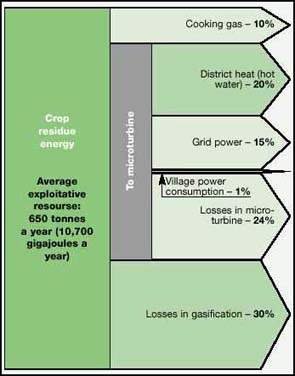
FIGURE A10.1. ENERGY BALANCE FOR A
TRIGENERATION SYSTEM BASED ON THE USE OF PRODUCER GAS DERIVED FROM CROP RESIDUES
IN A HYPOTHETICAL 100-HOUSEHOLD VILLAGE, JILIN PROVINCE, CHINA
Source: Henderick and Williams, 2000.
As in the case of the village-scale trigeneration system
described above, with this technology the very poorest households could pay
enough for electricity and clean cooking fuel to satisfy their basic needs by
gathering residues from the fields of rich farmers and delivering the residues
to the energy conversion plants, thereby monetising their labour.
DME, which is expected to be easier to manufacture as a
synthetic fuel than SLPG, would have similar properties as a cooking fuel.
Although the technology for making DME is not as far advanced as that for SLPG,
either option could probably be commercially ready by 2010-15 with a concerted
development effort. The Institute of Coal Chemistry at the Chinese Academy of
Sciences is investigating prospects for making DME from coal for cooking fuel
applications (Niu, 2000).
Notes
1. The amount of time varies widely depending on the
availability of biomass. Surveys have shown that in some regions, women spend
close to an hour a day collecting firewood, and could spend more than two hours
a day in areas where fuels are scarce (World Bank, 1996).
2. As discussed in the next section, many of the technologies
associated with the intermediate rungs on the ladder pose greater development
challenges than technologies associated with the top rungs.
3. For a family of five, 0.08 kilowatts per capita consumption
for cooking is equivalent to 21 kilograms of LPG per month. Assuming that 30
percent of the 0.02 kilowatts per capita of electricity is consumed to support
community activities, the remaining electricity would be adequate to support six
compact fluorescent light bulbs used for four hours a day in addition to a
television for two hours a day plus a refrigerator-freezer with the average
energy efficiency projected for new U.S. units in 2001.
4. For example, in China the energy content of crop residues is
twice that of animal excrement on large and medium-size farms, and the fraction
of crop residues recoverable for energy purposes (about half the total
generation rate) is equivalent in terms of contained energy to about 20 percent
of China’s coal consumption rate (Li and others, 1998; Su and others,
1998).
5. Gasifiers are about 70 percent efficient in converting
biomass energy into gas energy, and producer gas stoves are about 50 percent
efficient. Thus the overall efficiency of converting biomass into heat energy
used in cooking is about 35 percent, which is double or more the efficiency of
typical biomass stoves.
6. In China the number without access to electricity in 1996 was
only 110 million, less than 13 percent of China’s rural population (Dai,
Liu, and Lu, 1998).
7. Lubricating oil can contribute as much to the generation cost
as natural gas fuel contributes to the generation costs of a modern large
combined-cycle power plant-compare tables 10.3 and 8.4.
8. If spark-ignited instead of compression-ignited engines were
used for power generation, the need for diesel fuel could be eliminated
entirely. But such engines are less efficient and more capital intensive than
diesel engines, and they must be de-rated more (about 50 percent relative to
operation on gasoline) than compression-ignition engines. As a result or are
often not competitive (Henderick and Williams, 2000).
9. This is about half the total residue generation rate. The
rest is used for paper-making, forage, or returned to the fields to sustain soil
quality (Li, Bai, and Overend, 1998).
10. This case is based on Dai and Lu (1998), Dai and Sun (1998),
and Dai, Liu, and Lu (1998).
11. The market price for LPG in the village is 3.3 yuan per
kilogram ($8.30 per gigajoule).
12. It is assumed that villagers are paid $0.33 a gigajoule for
residues delivered to the conversion facility. It is also assumed that gas is
sold for $6 a gigajoule (somewhat less than the LPG price) and hot water is sold
for $5 a gigajoule (lower than the gas price to discourage gas burning for
heat), and that electricity is sold to villagers for $0.10 a kilowatt-hour (the
price they would otherwise pay for grid electricity) and to the grid for $0.05 a
kilowatt-hour.
13. Demonstration projects include a Global Environment
Facility-sponsored, 30-megawatt-electric IGCC project in northeast Brazil
(chapter 7).
References
Baldwin, S.F. 1987. “Biomass Stoves: Engineering Design,
Development, and Administration.” Arlington, Va.: Volunteers in Technical
Assistance.
Baring-Gould, E.I, C.D. Barley, L. Flowers, P. Lilienthal, and
M. Shirazi. 1999. “Diesel Minigrid Retrofits: Technical and Economic
Aspects.” National Renewable Energy Laboratory, Golden, Colo.
Barnes, D.F., K. Openshaw, K.R. Smith, and R. van der Plas.
1993. “The Design and Diffusion of Improved Cookstoves.” The World
Bank Research Observer 8(2): 119-41.
Barnes, D.F., K. Openshaw, K.R. Smith, and R. van der Plas.
1994. What Makes People Cook with Improved Biomass Stoves? A Comparative
International Review of Stove Programmes. World Bank Technical Paper 242.
Washington, D.C.
Cao, J., and others (Planning Committee of Jilin Province).
1998. “Evaluation of Biomass Energy Supply and Utilization Technology
Prospect in Jilin Province.” In Proceedings of Workshop on Small-Scale
Power Generation from Biomass. Beijing: Working Group on Energy Strategies
and Technologies, China Council for International Cooperation on Environment and
Development.
Covarrubias, A. and K. Reiche. 2000. “A Case Study on
Exclusive Concession for Rural Off-Grid Service in Argentina.” In Energy
Services for the World’s Poor. Energy Sector and Development Report
2000. World Bank, Washington, D. C.
Dai, L., and Z. Lu. 1998. “Biomass Gasification System for
Central Gas Supply.” In L. Dai, J. Li, and R. Overend, eds., Biomass
Energy Conversion Technologies in China: Development and Evaluation. Report
prepared by the Energy Research Institute of the State Development Planning
Commission of China and National Renewable Energy Laboratory of the United
States. Beijing: China Environmental Science Press.
Dai, L., and L. Sun. 1998. “The Development and Assessment
of Biomass Gasification Conversion Technology Fed by Crop Straw.” In L.
Dai, J. Li, and R. Overend, eds., Biomass Energy Conversion Technologies in
China: Development and Evaluation. Report prepared by the Energy Research
Institute of the State Development Planning Commission of China and National
Renewable Energy Laboratory of the United States. Beijing: China Environmental
Science Press.
Dai, L., X. Liu, and Z. Lu. 1998. “Analysis of Users of
Biomass Gasification System of Central Gas Supply.” In L. Dai, J. Li, and
R. Overend, eds., Biomass Energy Conversion Technologies in China:
Development and Evaluation. Report prepared by the Energy Research Institute
of the State Development Planning Commission of China and the National Renewable
Energy Laboratory of the United States. Beijing: China Environmental Science
Press.
Davis, M. 1995. “Institutional Frameworks for Electricity
Supply to Rural Communities: A Literature Review.” Energy and Development
Research Centre, University of Cape Town, Cape Town, South Africa.
Deng, K., S. Gu, and W. Liu. 1996. “Rural Energy
Development in China.” Energy for Sustainable Development 3
(September): 31-36.
EC (European Commission) and UNDP (United Nations Development
Programme). 1999. Energy As a Tool for Sustainable Development for African,
Caribbean and Pacific Countries. Brussels.
Hande, H. 1999. Personal communication. Solar Electric Light
Company.
Henderick, P.M. 2000. “An Assessment of Biomass-Powered
Microturbines and the Potential for Applications in Rural China.” Report
322. Princeton University, Center for the Energy and Environmental Studies,
Princeton, N.J.
Henderick, P.M., and R.H. Williams. 2000. “Trigeneration
Using Crop Residues for a Northern Chinese Village.” Energy for
Sustainable Development 4 (October).
Kammen, D. M. 1999. “Bringing Power to the People.”
Environment 41 (5): 10-41.
Karekezi, S., and T. Ranja. 1997. Renewable Energy
Technologies in Africa. London: African Energy Policy Research Network and
Stockholm: Environment Institute and Zed Books. Stockholm.
Kartha, S., and E.D. Larson. 2000. A Bioenergy Primer: Roles
for Modernized Biomass Energy Systems in Promoting Sustainable Development.
Report prepared for the Energy and Atmosphere Programme, Sustainable Energy and
Environment Division. New York: United Nations Development Programme.
Kashyap, A. 2000. Personal communication. Rockefeller
Foundation, New York.
Larson, E.D., and H. Jin. 1999. “A Preliminary Assessment
of Biomass Conversion to Fischer-Tropsch Cooking Fuels for Rural China.” In
R.P. Overend and E. Chornet, eds., Biomass-A Growth Opportunity in Green
Energy and Value-Added Products. Volume 1 of the Proceedings of the 4th
Biomass Conference of the Americas. Oxford: Pergamon.
Li, J., J. Bai, and R. Overend, eds. 1998. Assessment of
Biomass Resource Availability in China. Report prepared by the Energy
Research Institute of the State Development Planning Commission of China and
National Renewable Energy Laboratory of the United States. Beijing: China
Environmental Science Press.
Li, J., A. Zhou, J. Bai, and Z. Su. 1998. “Study on the
Availability of Straw and Stalk Resources in China.” In J. Li, J. Bai, and
R. Overend, eds., Assessment of Biomass Resource Availability in China.
Report prepared by the Energy Research Institute of the State Development
Planning Commission of China and National Renewable Energy Laboratory of the
United States. Beijing: China Environmental Science Press.
Mali, Republic of, Ministry of Industry, Trade, and Handicraft;
and UNDP (United Nations Development Programme). 1999. “Overcoming Rural
Women’s Poverty with the Multipurpose Platform.” Bamako and New York.
McKeon, M. 1998. Personal communication. Dealership
representative, Catapillar Inc.
Mendis, Matthew S. 1999. Personal communication. Alternative
Energy Development, Inc.
Moreira, J.R., and A.D. Poole. 1993. “Hydropower and Its
Constraints.” In T.B. Johannson, H. Kelly, A.K.N. Reddy, and R.H. Williams,
eds., Renewable Energy: Sources for Fuels and Electricity. Washington,
D.C.: Island Press.
Mukunda, H.S., S. Dasappa, and U. Shrinivasa. 1993.
“Open-Top Wood Gasifiers.” In T.B. Johannson, H. Kelly, A.K.N. Reddy,
and R.H. Williams, eds., Renewable Energy: Sources for Fuels and
Electricity. Washington, D.C.: Island Press.
Natarajan, I. 1999. “Social Cost Benefit Analysis of the
National Programme on Improved Chulha in India.” Paper presented at the
United Nations Food and Agriculture Organization’s Regional Wood Energy
Development Program meeting on Wood Energy, Climate, and Health, October,
Phuket, Thailand.
Niu, Y. 2000. “Dimethyl Ether: Clean Fuel in the 21st
Century.” Paper presented at the Workshop on Polygeneration Strategies
Based on Oxygen-Blown Gasification, convened by the Working Group on Energy
Strategies and Technologies, China Council for International Cooperation on
Environment and Development, 11-12 May, Beijing.
Qui, D., L. Yan, and H. Zhang. 1996. “Status Review of
Sources and End-uses of Energy in China.” Energy for Sustainable
Development 3 (September): 7-13.
Ramakrishna, J. 1991a. “India Country Review.” Report
of the East-West Center Global Review of Improved Cookstoves. Prepared for the
World Bank’s Energy Sector Management Assistance Program, Washington, D.C.
Ramakrishna, J. 1991b. “Results and Analyses of the Global
Survey of Improved Cookstoves.” Report of the East-West Center Global
Review of Improved Cookstoves. Prepared for the World Bank’s Energy Sector
Management Assistance Program, Washington, D.C.
Reddy, A.K.N. 1999. “Goals, Strategies, and Policies for
Rural Energy.” Economic and Political Weekly 34 (49): 3435-45.
Reed, T.B., and A. Das. 1988. Handbook of Biomass Downdraft
Gasifier Engine Systems. SERI/SP-271-3022. Solar Energy Research Institute,
Golden, Colo.
Smith, K.R., S. Gu, K. Huang, and D. Qiu. 1993. “100
Million Improved Stoves in China: How Was It Done?” World Development
21(6): 941-61.
Stassen, H.E. 1995. Small-Scale Biomass Gasifiers for Heat
and Power: A Global Review. World Bank Technical Paper 296. Washington, D.C.
Su, Z., J. Li, J. Bai, and Z. Huang. 1998. “Research on
Availability of Excrement Resources on Large and Medium-Size Domestic Animal
Farms in China.” In J. Li, J. Bai, and R. Overend, eds., Assessment of
Biomass Resource Availability in China. Report prepared by the Energy
Research Institute of the State Development Planning Commission of China and
National Renewable Energy Laboratory of the United States. Beijing: China
Environmental Science Press.
WEC-FAO (World Energy Council and United Nations Food and
Agriculture Organization). 1999. The Challenge of Rural Energy Poverty in
Developing Countries. London.
Weise, E., R. Klockner, R. Kniehl, Ma Shenghong, and Qin
Jianping. 1995. “Remote Power Supply Using Wind and Solar Energy: A
Sino-German Technical Cooperation Project.” In Proceedings of the
Beijing International Conference on Wind Energy. Beijing: Organizing
Committee of the Beijing International Conference on Wind Energy ‘95.
World Bank. 1996. Rural Energy and Development: Improving
Energy Supplies for Two Billion People. Washington, D.C.
World Bank. 1997. Clear Water, Blue Skies: China’s
Environment in the New Century. China 2020 series. Washington, D.C.
World Bank. 1999. World Development Report 1998/99: Knowledge
for Development. New York: Oxford University Press.
Wu, L. 1995. “Inner Mongolia: One of the Pioneers of
Chinese Wind Power Development.” In Proceedings of the Beijing
International Conference on Wind Energy. Beijing: Organizing Committee of
the Beijing International Conference on Wind Energy ‘95.
Yao, X. 1999. “Wood: Biomass Use and Emissions in
China.” Paper presented at the United Nations Food and Agriculture
Organization’s Regional Wood Energy Development Program meeting on Wood
Energy, Climate, and Health, October, Phuket,
Thailand.
| | | World Energy Assessment - Energy and the Challenge of Sustainability (UNDESA - UNDP - WEA - WEC, 2000, 517 p.) | | | PART IV. WHERE DO WE GO FROM HERE? | | | Chapter 11. Energy and Economic Prosperity | | | (introduction...) | | | Energy consumption and economic well-being | | | (introduction...) | | | The transition from traditional to modern energy sources | | | The benefits of service extension | | | Energy use forecasts and energy efficiency | | | (introduction...) | | | Ambiguities in the evidence and shortcomings in methods | | | Energy efficiency as a beneficial stimulus to energy use | | | Reconciling increased energy consumption and environmental protection | | | (introduction...) | | | Reducing local and regional pollution | | | Mitigating global warming | | | Liberalisation and globalisation | | | Conclusion: economic perspectives on policy | | | Chapter 12. Energy Policies for Sustainable Development | | | (introduction...) | | | Policy goals and challenges | | | (introduction...) | | | The findings so far | | | Defining the goals of policy | | | Responding to the challenge of widening access | | | Improving environmental acceptability | | | Making markets work better | | | (introduction...) | | | Internalising externalities | | | Phasing out subsidies to conventional energy | | | Regulatory options for restructured energy sectors | | | Raising energy efficiency | | | Mobilising investments in sustainable energy | | | (introduction...) | | | Attracting private capital | | | Tapping other sources of funding | | | Encouraging technological innovation for sustainable energy development | | | (introduction...) | | | Understanding the energy innovation chain | | | The rationale for public policies in support of energy innovation | | | Policy options for promoting technological innovation | | | Encouraging technological innovation in developing countries | | | (introduction...) | | | Opportunities for technological leadership | | | Supporting demonstration and diffusion | | | International industrial collaboration | | | Towards a supportive policy framework | | | Capacity and institution building | | | Moving towards more effective cooperation | | | (introduction...) | | | Cooperative efforts to ensure supply security | | | International cooperation on climate change | | | Widening the involvement in sustainable energy development | | | Conclusion | | | (introduction...) | | | Making markets work better | | | Mobilising additional investments in sustainable energy | | | Encouraging technological innovation | | | Supporting technological leadership and capacity building in developing countries | | | Encouraging greater international cooperation | | | Annex. Trends in research and development funding |
|
World Energy Assessment - Energy and the Challenge of Sustainability (UNDESA - UNDP - WEA - WEC, 2000, 517 p.)
PART IV. WHERE DO WE GO FROM HERE?
Chapter 11. Energy and Economic Prosperity
Dennis Anderson (United Kingdom)
|
ABSTRACT
Energy demand in developing countries will rise enormously as
per capita incomes and populations grow. By reference to the situations of
people without access to modern energy forms, the chapter shows why energy is an
economic 'good', and thus why energy supplies will need to be expanded to meet
emerging demands if living standards are to be improved and developing countries
are to achieve prosperity. Energy demand in industrialised countries is also
likely to remain strong, notwithstanding - and to some extent, because of -
continuing gains in the efficiency with which energy is produced and used. Both
energy resources and financial resources are amply available to meet market
needs.
But will solving the 'pollution problem' from energy use
prove too costly from an economic perspective? There is no evidence that it
will, and most assessments point to the likelihood of an improvement, not a
deterioration, in economic prospects with enlightened environmental policies.
Technologies are now available for addressing the most serious forms of local
and regional pollution from fossil fuel use, at costs that are small relative to
the costs of energy supplies. So there is every reason to be sanguine in this
respect. In fact, developing countries are in a position to address their local
and regional pollution problems at a far earlier phase of development than were
the industrialised countries before them - within the first third of this
century if they wish. Furthermore, there are highly promising options for
addressing global warming in the long term - renewable energy, hydrogen-related
technologies and fuel cells, for example - which could be developed through
enlightened research, development, and demonstration policies.
Much therefore will depend on energy and environmental
policies. In reviewing the ground rules for such policies, the chapter shows
that the aims of developing countries for achieving economic prosperity and of
industrialised countries for improving theirs are fully consistent with those of
simultaneously meeting rising world energy demand and realising a low-pollution
future. |
Despite rising energy taxes, demand-side interventions, and
supply shortages in many countries, world consumption of commercial energy
continues to rise. The increase averages 1.5 percent a year, or 150-200 million
tonnes of oil equivalent energy (6.5-8.5 exajoules) a year - an amount
equivalent to two-thirds of the annual energy consumption in France or the
United Kingdom. Developing countries in Asia, Latin America, the Middle East,
and Africa account for most of this growth (table 11.1). In North America,
Europe, and Japan energy markets have matured and aggregate growth is low; in
the transition economies of the former Soviet Union and Central and Eastern
Europe consumption has declined substantially with economic recession and
restructuring.
The reasons for the rapid growth of consumption in developing
regions are well known. Income elasticities of demand for energy are high, and
as per capita incomes grow people want their energy needs met - just as people
in industrialised countries did before them. Nearly 2 billion people are without
access to modern energy forms such as electricity and gas, while average
consumption levels of the 2 billion people who do have access are barely
one-fifth of those in the economies of the Organisation for Economic Cooperation
and Development (OECD). With population growth, perhaps as many as 6 billion
more people will require access to modern forms of energy over the next half
century. With successful economic growth - and especially with catch-up in the
developing regions - world economic product is set to rise 10-fold or more this
century, much as it did in the industrialised countries in the last century.
Large increases in world energy demand thus lie ahead in any scenario of
economic success. (For further details see the scenarios for the growth of
populations, economic output, and energy use in chapter 9.)
TABLE 11.1. PRIMARY ENERGY CONSUMPTION BY REGION, 1987 AND
1997 (EXAJOULES)
|
Region |
1987 |
1997 |
Total increase |
Annual percentage increase |
|
United States and Canada |
86 |
101 |
15 |
1.7 |
|
Europe |
74 |
76 |
2 |
0.2 |
|
Former Soviet Union |
58 |
38 |
- 20 |
- 4.1 |
|
South and Central America (including Mexico) |
15 |
20 |
5 |
3.4 |
|
Middle East |
10 |
15 |
5 |
4.6 |
|
Africa |
8 |
11 |
3 |
3.0 |
|
Asia and Pacific (including Japan) |
64 |
101 |
37 |
4.8 |
|
Total |
315 |
362 |
47 |
1.5 |
Note: Converted at the rate of 1 billion tonne of
oil equivalent energy = 43.2 exajoules.
Source: BP, 1998.
|
Modern energy forms are often
viewed as economic 'bads'. In
fact,
they are an economic good, capable
of improving the
living
standards of billions
of people. |
This chapter provides an economic perspective on the questions
posed by the prospective increases in consumption:
· How important is
meeting emerging energy demand to the achievement of economic prosperity in all
regions of the world in this century? What of the 2 billion people still without
access and the demands of new populations - how are their demands to be met, and
what would be the economic and environmental consequences of failing to meet
them?
· What will be the impact on
economic growth of meeting the environmental challenges discussed in chapter 3?
· How, and under what
conditions, will market liberalisation, the changing role of government, and
globalisation of the energy industry - all inter-related developments - help to
meet the challenges of achieving energy market growth, extending services to
unserved populations, and solving the environmental problem?
· Modern energy forms are often
viewed ad economic 'bads.' In fact, they are an economic good, capable of
improving the living standards of billions of
people.
Energy consumption and economic well-being
Notwithstanding the historical importance of modern energy forms
in raising economic output, they are often viewed as economic 'bads' not 'goods'
- a view that has gathered force in recent years and is the source of much
confusion in energy and environmental policies. In some countries energy use is
under attack not only from environmental groups but also from finance ministries
who see high energy taxes as a means of simultaneously raising revenues (which
of course they do) and reducing pollution (at most a secondary effect).
In fact, modern energy forms are an economic good, capable of
improving the living standards of billions of people, most of all the billions
of people in developing countries who lack access to service or whose
consumption levels are far below those of people in industrialised countries. It
is the pollution arising from energy production and use that is the economic
bad, not energy use itself.1 This distinction, however elementary, is
not trivial. Technologies are available, emerging, or capable of being developed
that can solve the pollution problem at a small fraction of the overall costs of
energy supplies. The more policies recognise the distinction, the more likely
will we be able to meet rising world energy demands with greatly reduced
pollution. Furthermore, once the benefits of pollution abatement are taken into
account, economic output and well-being are likely to be higher not lower.
No country has been able to raise per capita incomes from low
levels without increasing its use of commercial energy. In industrialised
countries demand for fossil fuels has expanded more than 50-fold (in energy
units) since 1860. Horsepower per worker in industry and agriculture has grown
commensurately and contributed to enormous increases in labour productivity.
Cross-sectional data show unequivocal correlations between the use of energy and
power and the quality of life (see figure 1 and table 1 in the overview). A
similar pattern is evident in comparisons of per capita consumption levels of
commercial energy in selected developing countries with those in industrialised
countries (table 11.2).
TABLE 11.2. PER CAPITA INCOMES AND CONSUMPTION OF
COMMERCIAL ENERGY FOR SELECTED DEVELOPING AND INDUSTRIALISED COUNTRIES,
MID-1990S
|
Country |
Per capita income, 1995 |
Per capita consumption of commercial energy, 1994
(gigajoules)a |
|
India |
340 |
10 |
|
Ghana |
390 |
4 |
|
China |
620 |
28 |
|
Egypt |
790 |
25 |
|
Brazil |
3,640 |
30 |
|
Korea, Rep. of |
9,700 |
125 |
|
United Kingdom |
18,700 |
158 |
|
United States |
26,980 |
327 |
|
Germany |
27,510 |
173 |
a. Converted at the rate of 1 kilogram of oil
equivalent = 0.0418 gigajoules.
Source: World Bank, 1997.
These are, of course, simple correlations that leave open the
questions of how much energy actually contributes to economic well-being and how
much energy per person is needed to achieve a satisfactory standard of living.
These questions are considered below, first with reference to people without
access to modern energy supplies in developing countries today and then to
people in industrialised countries before modern energy supplies were widely
available.
The transition from traditional to modern energy sources
Alongside the nearly 2 billion people in developing countries
who lack access to electricity and modern fuels2 are some 1.3 billion
people - more than twice the populations of the United States and the European
Union combined - who were newly served with electricity during 1970-95. Large
regions of the developing world are not standing still, and technical progress
is making the transition from traditional to modern fuels possible at a much
earlier phase of development than was the case for industrialised countries. In
the United States the transition from 90 percent dependence on wood fuels to
virtually none took 70 years (1850-1920), by which time average per capita
income was nearly $5,000 (in 1997 prices).3 In the Republic of Korea
the transition was substantially complete by 1980, when average per capita
income was about $3,000. For developing countries today the transition to modern
fuels tends to be nearly complete when per capita incomes are in the range
$1,000-2,000 (World Bank, 1996; figure 11.1).
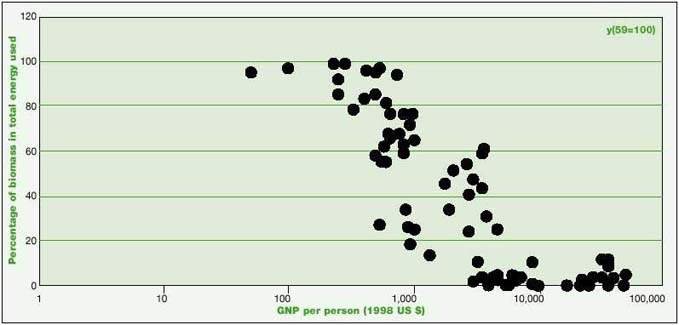
FIGURE 11.1. USE OF BIOMASS AS A
COOKING FUEL RELATIVE TO GNP PER CAPITA IN 80 COUNTRIES
Source: World Bank, 1996.
Technical progress and lower costs. Why is this
transition taking place at lower incomes? The main reasons are that modern
energy forms are more abundant and the costs of energy are much lower than they
were when today's industrialised countries were making the transition.
Electricity was not available a century ago, when per capita incomes in the
now-industrialised countries were five times those in South Asia and Sub-Saharan
Africa today. When electrification began, the costs, at $1.7 a kilowatt per hour
(in 1997 prices), were 20 times today's costs (World Bank, 1992). Natural gas
and liquefied petroleum gas (LPG) were also unavailable. Lebergott (1993, pp.
106-107) notes that, notwithstanding the massive increase in energy consumption
in the United States in the 20th century, as families began to heat and later to
cool every room in the house, U.S. consumers spent no more on heating and
cooling their homes in 1990 than they did in 1900: "Despite all the factors
driving up expenditures for fuel, .... they actually spent less than 3 percent
[of their incomes] - compared to 3 percent in 1900. The explanation? Persistent
productivity advance by businesses that mined fuel and produced electricity".
These productivity advances were made possible, in part, by public policies that
permitted the energy companies and utilities to earn good returns on their
investments (this point is developed further in the section on liberalisation
and globalisation).
The importance of per capita income growth. Although
modern energy forms contribute appreciably to economic welfare, they are not
affordable until incomes rise above a certain threshold (see figure 11.1).
Technical progress and falling costs are lowering this threshold, but ultimately
income growth is what matters. Countries that have been able to raise
productivity and incomes on a broad basis - through good macroeconomic
management, trade, and investment in human and physical resources - have been
able to extend service most
rapidly.
The benefits of service extension
At the same time, improving access to modern energy forms yields
appreciable economic and health benefits.
Savings in time and labour in the home. As the World
Bank's (1996) report on rural energy and development noted, when wood fuels are
scarce, the time people spend collecting fuel is time they cannot devote to
productive activities. Recent surveys in Nepal show that women spend up to 2.5
hours a day collecting fuel wood and fodder in areas where wood fuels are
scarce.
The saving in time and labour, however, extends far beyond the
saving arising from the displacement of fuel wood. It includes the economic
convenience of modern energy forms and the advances they make possible,
including hot and running water, washing machines, refrigeration, food and crop
processing, extension of the day through electric lighting, and an array and
diversity of other uses in homes, industry, and commerce too numerous to list
here. Table 11.3 illustrates this point with a few comparative statistics for a
developing and an industrialised country. Lebergott (1993, p. 112) comments:
From 1620 to 1920, the American washing machine was
a housewife. As late as 1920 the family laundry took about seven hours a week.
The typical housewife washed some 40,000 diapers for her four
children.4 Lacking running water, she carried 9,000 gallons [40 tons]
of water into the house each year, then boiled most of it. And she relied on a
scrub board, not a washing machine.
The heavy reliance on family labour to provide for the most
basic of energy needs - for cooking food and, in many climates, keeping the
family warm - is an immense opportunity cost to the family. When used for
pumping, modern energy forms also improve access to water. In developing
countries today a family of six people consuming 30 litres of water per person
per day (a low level of consumption, about one-fifth to one-tenth of that
consumed in industrialised countries) will fetch and carry by hand around 35
tons of water a year from wells and hand-pumps, often over appreciable
distances.5 Surveys of low income families consistently reveal the
economic importance of the saving in family labour made possible by substituting
fossil for wood fuels and of the contribution modern energy forms may make,
among other things, to improving access to water.6
Reductions in pollution and improvements in health. The
switch to modern fuels reduces the level of indoor pollution by several orders
of magnitude, eliminating a major health risk now afflicting billions of people
(see chapter 3). A study of air pollution in developing countries found air
pollution levels from biomass combustion at several multiples of the World Trade
Organisation (WHO) peak guidelines: 6 times greater for Zimbabwe, 11 times for
China, 5 to 34 times for Kenya (daily average), 9 to 38 times for Nepal, 1 to 39
times for Papua New Guinea, and 16 to 90 times for India (a 15 minute peak)
(Smith 1988). Fitting stoves with flues lowers pollution levels to well within
WHO guidelines and leads to considerable gains in efficiency as well.
TABLE 11.3. APPLIANCE USE IN HOUSEHOLDS WITH ELECTRICITY IN
INDONESIA AND THE UNITED STATES, 1987 (PERCENTAGE OF HOUSEHOLDS)
|
Appliance |
Indonesia (low-income households) |
U.S. households |
|
Lighting |
100 |
100 |
|
Television |
31 |
100 |
|
Irons |
21 |
- |
|
Refrigerator |
1 |
100 |
|
Washing machine |
- |
73 |
|
Air conditioning |
0 |
62 |
- Not available.
Source: World Bank, 1996, and Lebergott,
1993.
TABLE 11.4. POPULATIONS SIZE AND ESTIMATED PER CAPITA
CONSUMPTION OF COMMERCIAL ENERGY BY COUNTRY GROUP, 1998
|
Energy form and country group |
Estimated commercial energy consumption |
Population (millions) |
|
Primary energy |
gigajoules per person |
|
|
· OECD |
230 |
900 |
|
· Countries of the former Soviet
Union |
125 |
300 |
|
· Developing countries |
23 |
4,800 |
|
Peak electricity demand |
killowatt hours per person |
|
|
· OECD |
1.8 |
900 |
|
· Countries of the former Soviet
Union |
0.9 |
300 |
|
· Developing countries |
0.2 |
4,800 |
Note: Consumption estimates are based on statistics
for 1992 and OED projections, assuming a 55 percent load factor for electricity
demands. Population estimates are based on World Bank projections from 1992.
Source: OECD, 1995, for consumption; World Bank, 1992, for
population.
Reductions in environmental damage. The transition to
modern fuels reduces pressures on forests and land, and thus on
watersheds and groundwater resources and even on biodiversity. The dangers of
flash flooding are also reduced. By some estimates the consumption of wood, crop
residues, and animal dung for cooking fuels amounts to 1,000 million tons of oil
equivalent energy a year, more than three times the coal mined in Europe in a
single year and twice that mined in the United States and China in a year (World
Bank, 1996). The same amount of useful heat could be produced with only 100
million tons of LPG (in oil equivalent units) or 200 million tons of kerosene,
which is equal to only 3 percent of world oil and gas consumption.
Gains in energy efficiency. Thus the transition to modern
fuels can lead to large gains in energy efficiency. LPG and kerosene are just
two woodfuel substitutes that result in large efficiency gains. The use of
biogas from agricultural residues leads to similarly large gains. It is not
surprising, therefore, though the point is often overlooked, that a rise in
commercial energy use among the poorest people in the world reduces their
energy demand, a pattern that continues until incomes reach quite high levels -
in the case of Brazil, for example, to somewhere between 2 and 5 times the
minimum wage (see figure 3 in the overview; chapter 10 provides further data on
the efficiency of the alternative fuels for cooking).
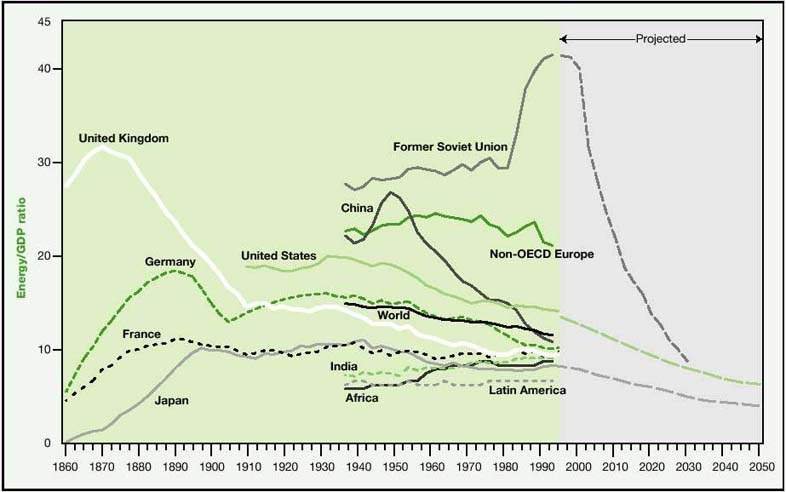
FIGURE 11.2. RATIO OF ENERGY
CONSUMPTION TO GDP FOR SELECTED COUNTRIES AND REGIONS, 1860-1996, AND
PROJECTIONS
Note: Energy consumption is measured in megajoules;
GDP in 1990 U.S. dollars in purchasing power parity. Pre-1961 GDP calculations
are based on exchange rates. Energy data exclude energy from biomass.
Source: IEA, 1997, 1998; CEC 1996; Chandler, and others,
1990; ISI
1999
Energy use forecasts and energy efficiency
In light of the contribution of modern energy forms to higher
incomes and greater economic well-being, the expansion of supplies should be
welcomed from both economic and commercial viewpoints. Energy markets are
potentially very large and are set to grow for most of the century. Recall that
per capita consumption levels of commercial energy and electricity in developing
countries are barely one-tenth of those in OECD countries, while their
populations are over five times larger (table 11.4). The energy scenarios
presented in chapter 9 point to an increase in the world's consumption of
commercial energy over this century of roughly 2.5 to 5 times today's levels.
Forecasts of long-term energy demands vary considerably with
assumptions about the growth of per capita incomes and populations.7
They also vary with assumptions about future gains in energy efficiency.
The assumptions about energy efficiency gains warrant further discussion because
of their impact on assessments of the amount of energy required to support
economic production and provide for people's energy needs.
It has been widely observed that the energy intensity of an
economy (the ratio of energy consumption to GDP) rises during the early and
middle phases of economic development, when the industrialisation and
'motorisation' of economies are strong, and then peaks and declines as the less
energy-intensive service sector begins to occupy a larger share of economic
activity (figure 11.2).8 The later a country industrialises, the
lower its peak energy intensity because of intervening improvements in the
efficiency of energy conversion processes - especially for electricity
generation - and energy use. This pattern has held for more than a century, as a
comparison of the experiences of the United Kingdom, Germany, the United States,
France, and Japan shows (see figure 11.2). Developing regions are exhibiting the
same pattern. (Exceptions are economies in transition, which have experienced
abnormally high energy intensities historically, but which are now expected to
decline with new investment and gains in energy efficiency.) A number of
engineering and economic studies have shown that the possibilities for further
gains in energy efficiency are far from exhausted, such that we can expect a
continual lowering of the peak intensity as more countries become
developed.9
Such improvements in energy efficiency mean that developing
countries are likely to need less energy to produce a unit of GNP and to meet
consumer needs per unit of income than was the case for the industrialised
countries. How much less is controversial, because of ambiguities in the
evidence and oversimplifications in both the engineering and economic models of
energy consumption. However, no empirically based study has shown that
developing countries can achieve prosperity without very large increases in
demand for energy, even with strong assumptions about improvements in energy
efficiency.
Ambiguities in the evidence and shortcomings in methods
Another perspective on the links between income growth and
energy consumption is provided by economic estimates of income elasticities of
energy demand. These show a rising trend as per capita income grows from very
low levels and then a declining trend at high income levels (table 11.5). The
income effect is weak among the most impoverished people in the world - whose
main initial demands, as incomes begin to rise, are for meeting such basic needs
as food, safe water, and improved health services - but becomes very strong as
incomes rise above a certain threshold. Recall figure 11.1, which shows that
once income moves into the $1,000 - $2,000 range, substitution from biofuels to
modern energy proceeds as rapidly as income growth permits. The income effect is
also strong in the industrialisation phase of development, but it then begins to
decline as markets mature, falling to a low value at high income levels, such as
those of the OECD economies in the 1970s and 1980s.
An intriguing estimation result in table 11.5 is the negative
per capita income elasticity in the highest income range. Judson,
Schmalensee, and Stoker (1999) caution that this estimate may not be
statistically significant, commenting that it is "more likely to reflect some
sort of isolated measurement problem than a real economic phenomenon. We are on
balance fairly confident that beyond per capita incomes of $1,500 or so (in 1985
dollars), there is a tendency of the economy-wide income elasticity of demand
for energy to fall with per-capita income, but the evidence for a negative
income elasticity at high income levels is, in this sample, less than
compelling".
Yet engineering studies also point to the possibility of a
decline in energy demand per capita at high income levels even as per capita
incomes increase. As energy markets become satiated at high income levels,
long-term improvements in the efficiency of energy use may more than offset any
further increases in demand arising from income growth.10 The effects
are complex, and it is not surprising that the study by Judson, Schmalenensee,
and Stoker (1999) is inconclusive. Economic models have so far not been able to
capture the effects in a satisfactory way.
TABLE 11.5. VARIATION IN PER CAPITA INCOME ELASTICITIES OF
DEMAND FOR COMMERCIAL ENERGY WITH PER CAPITA INCOMES
|
Income (1985 U.S. dollars in purchasing power parity)
|
Income elasticity |
|
= 823 |
0.219 |
|
823-1430 |
1.098 |
|
1,430-2,545 |
1.400 |
|
2,545-4,249 |
0.784 |
|
4,249-8,759 |
0.394 |
|
= 8,759 |
- 0.312 |
Source: Judson, Schmalensee, and Stoker,
1999.
There are five effects on energy demand that need to be
considered: income, price, population, energy efficiency as a means of
reducing energy demand for a particular purpose, and energy efficiency as
a means of reducing the price of energy and thereby raising energy demand
(sometimes called the rebound effect). These effects can be summed up in the
simplified model of energy demand growth:
e = g.g - b.p{x} - x + n
where e is growth of per capita energy demand; g
is growth of per capita income; p is growth of prices; n is
population growth; x is the growth of what is sometimes called the
autonomous energy efficiency index; g is
the income elasticity of demand for energy; and b is the numerical value of the price elasticity.
The notation p{x} summarises the fifth effect, of price as a function of
- and generally declining with - energy efficiency.
Most energy demand studies using econometric techniques have not
attempted to estimate x, the rate of improvement in the autonomous
energy efficiency index. The review by Grubb and others (1993, p.453) sums up
the uncertainties. First they note the wide range - from less than 0.5 percent
to more than 1.5 percent a year - in x. They then add:
We cannot suggest a definite value for this
parameter, but it is important to understand it. The parameter has been badly
misnamed: it is a measure of all non-price-induced changes in gross
energy-intensity - which may be neither autonomous nor concern energy efficiency
alone. It is not simply a measure of technical progress, for it conflates at
least three different factors. One indeed is technical developments....
another is structural change, i.e., shifts in the mix of economic
activities.... The third is policy-driven uptake of more efficient
technologies.... [Emphasis in original.]
Compounded over a century, the 1 percentage point difference in
estimates of the autonomous energy efficiency index results in a 2.7-fold
difference in energy demand projections and helps to explain the large
differences in the scenarios of energy demand developed in chapter
9.
Energy efficiency as a beneficial stimulus to energy use
Environmental studies frequently argue for improvements in
energy efficiency as a means of reducing environmental damage. There are,
however, two dangers in placing too much reliance on this argument. One is that
improving energy efficiency, by lowering costs and prices, may also increase
demand (the rebound effect noted above).11 The second is that the
argument neglects an important economic benefit of energy efficiency: it makes
energy more affordable and accessible to consumers, which is especially
important today for developing countries.12
|
Per capita consumption levels of
commercial energy and
electricity
in developing countries are
barely one-tenth of those
in
OECD countries. |
Consider the following examples. The efficiency of motive power
rose from less than 1 percent for the early steam engines of Newcomen and
Smeaton in the 18th century and 5 percent with the invention of the stream
condenser by Watt later in the century to 20 percent for gasoline and diesel
engines and 40 percent for electric motors today (after allowing for losses in
electric power stations). This was a 40-fold increase over two centuries. It is
conceivable that without such efficiency improvements the industrial revolution
- and the unprecedented increase it brought about in per capita incomes in the
industrial economies in the past two centuries - might not have taken place.
Or consider lighting. The efficiency in lumens per watt rose
20-fold following the displacement of kerosene by electric incandescent lamps
and then another 5-fold with the invention of fluorescent lamps in the 1930s.
These improvements help explain the massive growth in commercial lighting over
the past half century. Another socially important example, mentioned earlier, is
the contribution of modern fuels to the efficiency of cooking and heating
devices in the homes. These were a primary cause of the movement away from
traditional fuels and of improvements in the economic well-being of billions of
people.
To take a final example, the conversion efficiency of power
stations fired by fossil fuels rose from around 3 percent at the beginning of
the 20th century to more than 50 percent for combined-cycle gas-fired power
stations today (Anderson, 1993). This improvement has contributed to a 20-fold
drop in the costs of electricity since 1900, stimulated industrial expansion,
and brought the benefits of electricity consumption to more than 3 billion
people in the world today. Numerous other examples could be cited, from
commercial heating (insulation, heat pumps, double glazing, energy management
systems, combined heat and power) and air conditioning to refrigeration and
industrial processes.
In sum, the main benefits of improvements in energy efficiency
are that they make modern energy services more affordable and accessible by
reducing the energy required for any particular purpose and thereby reducing
costs. It is only in the high-income economies that there is some suggestion
that per capita energy use might eventually decline as incomes grow and energy
needs become satiated. In developing countries, however, demand is set to grow
substantially, even allowing for - and to some extent because of - improvements
in energy efficiency, in any scenario of economic
success.13
Reconciling increased energy consumption and environmental protection
Two important issues that arise in any discussion about meeting
growing energy demand are: What will be the environmental impact, and can the
impact be ameliorated at an affordable cost for developing countries? To answer
these questions we need to distinguish between local and regional pollution on
the one hand and global pollution from greenhouse gases on the other. For local
and regional pollution the technologies are well developed, based on 40 years of
operational experience in industrialised countries. For global warming the
required technologies, while promising, are at a much earlier phase of
development and use and raise different issues for
policy.
Reducing local and regional pollution
Studies have estimated high social costs of pollution from
energy production and use in developing countries (Lvovsky and Hughes, 1999;
Lovei, 1995; Downing, Ramankutty, and Shah, 1997). The costs of pollution in
cities are especially high:
· Marginal damage
costs per ton of local pollutants vary greatly across sources and locations and
are much higher for small (low-stack) sources because of the dispersion pattern.
· For some fuel uses the
marginal damage costs are as high as producer and retail prices - or even
higher.
· Diesel-powered vehicles and
small stoves or boilers burning coal, wood, or oil impose the highest social
costs per ton of fuel.
· Sulphur deposition levels are
already at 5-10 grams per square meter per year in the industrial areas of
Indonesia, Malaysia, the Philippines, and Thailand, and at more than 18 grams in
China. By comparison, deposition levels in the most heavily polluted parts of
the industrialised world - the black triangle of Central and Eastern Europe -
are about 15 grams.
· Local health effects dominate
the damage costs. Lead blood levels during the early 1990s were 25 micrograms
per decilitre in Mexico City and Budapest, 30 in Cairo, and 40 in Bangkok, well
above the 2 micrograms per decilitre in the United States (reflecting an
eightfold decline over the preceding 15 years).
TABLE 11.6. RELATIVE POLLUTION INTENSITIES AND COSTS OF
SELECTED LOW-POLLUTING TECHNOLOGIES FOR ENERGY PRODUCTION AND USE (INDEX = 100
FOR ALL HIGH-POLLUTING TECHNOLOGIES)
|
Source and pollutant |
Low-polluting technology |
Costs as share of supply or user costs
(percent)a |
Nature of low-polluting alternatives |
|
Electricity generation (coal) |
|
|
Natural gas; electrostatic precipitators, bag-house filters,
flue gas desuphurization, integrated coal gasification combined-cycle
technologies, and fluidised bed combustion (for coal); low nitrogen oxides
combustion and catalytic methods. |
|
Particulate matter |
<0.1b |
<0 - »2b |
|
|
Sulphur dioxide |
0 - 0.5 |
5 |
|
|
Nitrogen oxides |
5-10 |
5 |
|
|
Motor vehicles |
|
|
Unleaded/reformulated fuels; catalytic converters. Improved fuel
injection, engine design, maintenance. And 'proper' fuel use; catalytic
converters. |
|
Gasoline engines |
|
|
|
|
Lead |
0 |
|
|
|
Carbon monoxide |
5 |
»4 - 5 share of lifetime cost of
vehicle fuel and equipment costs, for gasoline and diesel engines |
|
|
Nitrogen oxides |
20 |
|
|
|
Volatile organic compounds |
5 |
|
|
|
Diesel engines |
|
|
|
|
Particulate matter |
»10 - 20 |
|
|
|
Nitrogen oxides |
»40 |
|
|
|
Traditional household fuels (wood and dung) in low income
countries |
|
|
Gas, kerosene. |
|
Smoke (particulate matter, carbon monoxide, and sulphur) |
<0.01 |
<0d |
|
|
Carbon dioxide emissions from combustion of fossil fuels
|
|
|
Advanced solar energy, wind, and other renewable energy
technologies for power generation; biomass for liquid fuels and power
generation; hydrogen from renewable energy sources and fuel cells for power
generation and vehicles. |
|
Electricity (developing countries) |
0 |
|
|
|
Electricity (developed countries) |
0 |
»0 - »20e |
|
|
Liquid fuel substitutes |
0 |
»30 - 50 |
|
Note: Except for carbon dioxide all the estimates
are based on technologies and practices commonly in use. a. Net private marginal
costs are used because some technologies and fuels have benefits that go beyond
their environmental benefits - use of gas as a domestic and industrial fuel is
an example. Such investments are routinely justified in terms of their economic
convenience or productivity relative to the alternatives, without reference to
their environmental benefits, however important. b. Negative costs arise if gas
is available for power generation as a substitute for coal. c. High emissions
(especially of particulate matter) in developing countries stem very much from
ageing vehicles, poor maintenance, and improper use of fuels (for example,
kerosene instead of diesel). d. In urban areas and where traditional fuels are
scarce, modern fuels are generally cheaper to use once the costs of household
labour are taken into account, in part because of their higher energy efficiency
(see chapter 10) and their convenience and savings in time (see discussion in
text). e. Estimates are much lower for developing countries than for the
northern industrialised countries because solar insolation is two to three times
greater in developing regions and its seasonal fluctuation is one-third less.
Estimates are of long-term costs.
Source: ADB, 1991, and Charpentier and Tavoulareas, 1995 for
electricity; Faiz, Weaver, and Walsh, 1996, for motor vehicles; Smith, 1993, for
traditional fuels. Anderson and Chua, 1999, review the engineering economic
literature, and Kiely, 1997, provides an introductory text on technologies; both
have ample bibliographies.
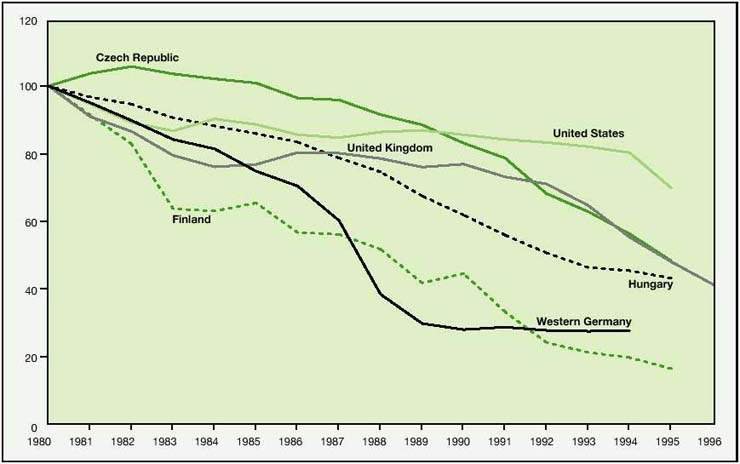
FIGURE 11.3. TRENDS IN SULPHUR
DIOXIDE EMISSIONS, SELECTED COUNTRIES, 1980-96
Source: Data from OECD, 1997; U.S. EPA, 1997; and
U.K. Department of Environment, Transport, and the Regions National Air Quality
Archive (https://www.aeat.couk/netcen/airqual/).
There are several options for substantially reducing local and
regional pollution loads over the long term. This is evident both from the
experience of industrialised countries (table 11.6) and from comparisons of
pollution loads in industrialised and developing countries (figure 11.3). Given
the time required to incorporate low-polluting options in new investments and to
replace the old capital stock, however, pollution is likely to rise before it
falls. But the experiences of industrialised countries also shows that there is
little doubt that major reductions of local and regional pollution from energy
use could be achieved in the long term with supportive policies.
Low-polluting technologies, in wide use in industrialised
countries, have led to appreciable reductions in smog, acid deposition, and
emissions of lead, particulate matter, and volatile organic compounds; and
although energy consumption per capita is an order of magnitude higher
than in developing countries, local and regional pollution is an order of
magnitude or more lower or (in the case of acid deposition) headed in
that direction. (See chapter 3 for a full discussion of pollution loads in the
industrialised and developing countries.)
The costs of controlling local and regional pollution are small
relative to the total costs of energy supply or use. If coal is used as the
principal fuel in electricity generation, the costs of pollution abatement range
from 2 percent of supply costs for particulate matter (the most environmentally
damaging of pollutants) to 5-10 percent for acid deposition. If gas is used as
the principal fuel, the costs of pollution abatement are negative once allowance
is made for the higher thermal efficiencies and lower capital costs of the power
plant. For motor vehicle emissions the absolute cost of abatement, including the
cost of catalytic converters, is estimated at less than $0.04-0.15 per gallon of
fuel consumed. Similarly, supplying modern fuels to households in place of
traditional fuels significantly reduces both indoor and local pollution (see
chapter 3) and, except in remote communities, the costs of energy supplies as
well.
Simulations of the effects of introducing abatement policies for
reducing acid deposition in Asia illustrate the potential of innovation for
enabling developing countries to address environmental problems at an earlier
phase of their development than did industrialised countries (Anderson and
Cavendish, 1999; figure 11.4). Studies that assume that environmental problems
will not be addressed until the per capita incomes of the main emitters in the
region (China and India) approach those of industrialised countries when they
began to address acid deposition in the 1970s (about $10,00014) put
that date at half a century from now for China and nearly a century from now for
India, even under optimistic growth rate assumptions. When the simulations are
run under the assumption that countries in Asia take advantage of new methods of
sulphur dioxide abatement that have emerged in recent years, including coal
desulphurization and the use of gas for power generation (now a rapidly growing
possibility in East Asia), the results clearly show the opportunity for solving
the problem much earlier with greatly reduced pollution loads. Downing,
Ramankutty, and Shah (1997), in a study of acid deposition in Asia, come to
similar conclusions; so do the scenarios in chapter 9.
The relatively low costs of pollution control suggest that the
required financing can be generated through policies that allow prices to
reflect the marginal costs of supply, including the costs of pollution control -
the central goal of internalising externalities in market prices. Simulation
studies consistently show that the extra investing, but would over time be
offset by efficiency gains in the industry as a result of new thermal
efficiencies in power plants, improvements in plant availabilities, reductions
in distribution losses, and gains in managerial efficiency from liberalisation
and improved forms of regulation (Cavendish and Anderson, 1994; World Bank,
1992). Thus while subsidies should not be necessaryto finance investments in
reducing local or regional pollution, environmental regulation and taxation
would be.
|
For some fuel uses
the marginal damage costs
are as high
as producer
and retail prices - or
even higher. |
In addition, experience in industrialised countries has shown
that there are good economic returns to such investments through improvements in
people's health and reduced damage to natural resources (chapter 3). In a review
of U.S. experience, Davies and Mazurek (1998, p. 148) conclude that:
The macroeconomic effects of pollution control and
regulation are generally modest. Regulation has had some adverse effects on GDP
growth, but most economists think that the effect has been relatively small, and
the negative effect fails to take into account most of the benefits of
regulation.... When looked at as a whole, U.S. environmental progress has made
economic sense. It can be shown that benefits exceed costs in a great number of
cases.
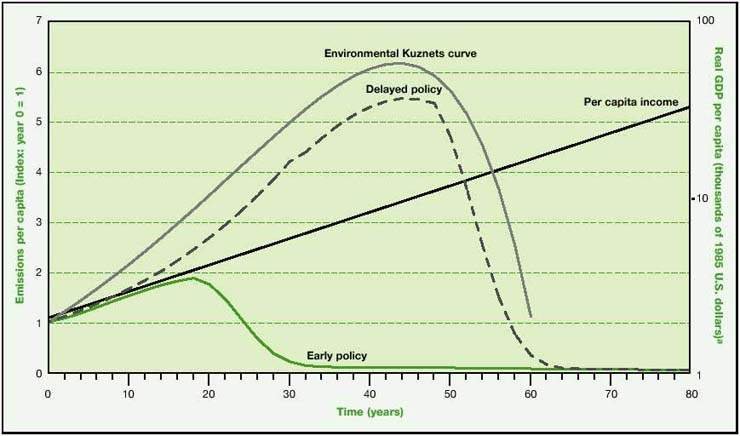
FIGURE 11.4. SIMULATED EFFECTS ON
SULPHUR DIOXIDE EMISSIONS IN ASIA OF EARLY AND LATE ENVIRONMENTAL POLICIES
a. Adjusted for real comparative purchasing power
using Penn World Table, mark 4 (Summers and Heston, 1991).
Source: Anderson and Cavendish, 1999; Selden and Song, 1994,
for the environmental Kuznets curve.
In developing countries the net effects on growth should be even
greater, since their environmental priorities in the energy sector include the
elimination of smoke, emissions of particulate matter, lead in fuels, and the
indoor air pollution and damage to soils and forests arising from the use of
traditional fuels. Thus there is no reason from an economic perspective why
developing countries cannot adopt ambitious policies for reducing local and
regional pollution from energy production and use. The technologies and
practices are now available that should, if the 'right' policies are put in
place, enable developing countries to reduce such sources of environmental
damage at a much earlier phase of development than was the case for
industrialised
countries.
Mitigating global warming
The other energy-related environmental concern is global
warming. For understandable reasons developing countries have been reluctant to
commit themselves to emission reduction targets for greenhouse gasses. The costs
of mitigation are thought to be too high, and there is some resistance to the
notion that developing countries should not use fossil fuels to further economic
development, as the industrialised countries did in the 19th and 20th centuries.
Yet developing countries may stand to benefit unexpectedly over
the long term from international policies on climate change, particularly from
the use of the renewable energy technologies now emerging from the energy
research, development, and demonstration (RD&D) programmes of the industrial
countries. In fact, some countries, such as Brazil, China, and India, have
themselves begun to put resources into the development of renewable energy. The
development and use of renewable energy have also become a focal point of the
Global Environment Facility, the financing arm of the United Nations Framework
Conventions on Climate Change and Biodiversity. What makes the technologies
promising is the abundance of renewable energy resources and the falling costs
being brought about by technical progress. (For more detailed information about
renewable potentials and technologies, see chapters 5 and 7.)
Abundant renewable energy resources. The Earth receives a
yearly energy input from the sun equal to more than 10,000 times the world's
consumption of commercial energy. Solar insolation varies from 2,000 kilowatt
hours per square metre to more than 2,500 a year over vast areas of developing
countries, from 800 to 1,700 in Europe, and from 1100 to over 2,500 in the
United States. Photovoltaic systems and solar-thermal power stations are capable
of converting 10-15 percent - 15-30 percent with further development - of the
incident solar energy into electricity.
TABLE 11.7. USE AND COMPARABLE COST OF SELECTED RENEWABLE
ENERGY TECHNOLOGIES, 1998
|
Technology |
Average cost (U.S. cents per kilowatt hour unless otherwise
indicated) |
Comments |
|
Wind (electric power) |
5 - 13 |
Costs declined fivefold from 1985 to 1995. |
|
Biomass |
|
|
|
Electric power |
5 - 15 |
Steam cycle of 25 megawatts Brazil data. Declined by factor of
three since 1980s. |
|
Ethanol |
$2 - 3/gallon
($15 - 25 gigajoule) |
|
|
Photovoltaic systems |
|
Based on costs of $5 - 10/peak watt. Costs have declined 50-fold
since 1975, 5-fold since 1980, 2-fold since 1990. Medium- and long-term storage
a major issue. With battery storage, cost of $8 - 40/peak watt in off-grid,
stand-alone applications are commonly reported; see chapter 7. |
|
Insolation, 2500 kilowatt hours/square metre |
20 - 40 |
|
|
Insolation, 1500 kilowatt hours/square metre |
35 - 70 |
|
|
Insolation, 1000 kilowatt hours/square metre |
50 - 100 |
|
|
Thermal solar (electric power) |
10 - 18 |
Parabolic troughs. Latest vintages, around 1990, in high
insolation areas only.) |
|
Geothermal |
3 - 10 |
Costs vary greatly with location. |
|
Gas-fired, combined-cycle power plant |
3 - 5 |
Higher figure is for liquefied natural gas. |
|
Grid supplies |
|
|
|
Off-peak |
2 - 3 |
Depends on spikiness of peak |
|
Peak |
15 - 25 |
|
|
Average, urban areas |
8 - 10 |
|
|
Average, rural areas |
15 to >70 |
Rural areas in developing countries |
Note: All figures are rounded. Estimates are
adjusted to 10 percent discount rates.
Source: Based on the author's interpretations of the
following reviews, of more than 500 papers and studies: Mock, Tester, and
Wright, 1997, on geothermal; Larson, 1993, on biomass; Ahmed, 1994, on solar and
biomass; Gregory, 1998, on several technologies, including fossil fuels; World
Bank, 1996, on renewable energy and grid supplies in rural areas; and chapter 7
of this report. Refer to those sources for details and
qualifications.
In theory, all of the world's primary energy requirements of 8
gigatons of oil equivalent a year could be met on an area of land equal to about
0.25 percent of the land now under crops and permanent pasture.15
There is thus no significant land constraint on the use of solar energy.
The main issue is cost. Other renewable energy technologies, such as biomass and
wind power for electricity generation, have greater land intensities than solar
energy; they have already attracted significant investment.16
Encouraging technical progress and falling costs. The
relative costs of fossil fuels and renewable energy can be assessed only within
broad limits, even assuming reasonable stability of fossil fuel prices (table
11.7). The estimates shown indicate why niche markets have emerged for renewable
energy in favourable locations: geothermal, wind, biomass for power generation;
solar thermal in areas of high insolation; and photovoltaic systems for off-grid
markets and for distributed generation when there is a good co-incidence of
solar peak and demand peak. Renewable energy installations (excluding
hydropower) generate about 30,000 megawatts world-wide. While small relative to
the world's generating capacity (more than 3 million megawatts), this experience
has provided good information on the costs and reliability of renewable energy
technologies.
Two factors, often neglected, are also important to cost
calculations. One is the comparative advantage developing countries may have in
using renewable energy. Solar insolation, for example, is two to three times
greater than in the northern regions of industrialised countries, and seasonal
swings are much lower. For this reason developing countries may enjoy a
five-to-one cost advantage in using direct solar technologies. The second factor
concerns differences between average and marginal costs. In off-peak times the
marginal cost of grid supplies may be one-quarter to one-third the average cost,
while in peak times marginal costs can be as much as two to five times higher
than average costs - or even more. This differential has been obscured in many
countries by the common practice of average cost pricing and, too often, by
subsidies. But when there is a good co-incidence between solar peaks and demand
peaks, there is an economic case for using photovoltaic systems for distributed
generation. Better efficiency in the level and structure of prices will also be
needed to provide proper incentives for solving the problem of intermittence in
renewable energy supplies. Differential pricing, with high peak and low off-peak
rates, provides the ideal incentive. Such pricing structures have already
emerged at the bulk supply level in some countries with liberalised electricity
markets (the United Kingdom is a prominent example).
Energy research, development, and demonstration. But we
need to go beyond the (undoubtedly important) principle of 'getting prices
right' for commercial investment and to revisit the case for technology
development policies. Most member countries of the International Energy Agency
have such policies in one form or another, aimed at developing new alternatives
to fossil fuels. International economic co-operation to foster trade,
investment, and the diffusion of know-how in these technologies has also begun
to emerge, albeit on a small scale considering the task in hand (see section on
liberalisation and globalisation).
|
Developing countries
may enjoy a five-to-one
cost
advantage in
using direct solar
technologies. |
The principal example of international co-operation is the
Global Environment Facility. The marketable permit systems and other flexibility
mechanisms of the Joint Implementation and Clean Development Mechanism, if
implemented, will be important extensions of these initiatives. But while public
support for commercialisation and international co-operation has been growing,
energy RD&D programmes in OECD countries have declined precipitously in the
past 20 years. Many question whether they have declined too far, considering the
severity of environmental problems and the competition from fossil fuels (see
box 11.1 for a discussion of energy research and development).
Cost uncertainties and scenarios of carbon emissions.
Notwithstanding the promise of renewable energy, the uncertainties remain
appreciable. The future use of renewable energy will depend on its costs
relative to the costs of fossil fuels and on taxes and regulation of carbon
emissions. Minor changes in assumptions about the effects of innovation on
costs, when extrapolated over long periods, lead to large differences in
estimates of the energy supply mix, as do differences in assumptions about
climate change policies.
It is possible (and many people hold this view) that renewable
energy will remain confined to niche markets in the absence of climate change
policies. It is also possible (and many others hold this view) that with further
innovations and scale economies in manufacturing and marketing, renewable energy
will eventually meet a substantial share of the world's energy needs.
Uncertainties about the costs of non - fossil fuel technologies
and different assumptions about climate change policies are the main reasons why
scenarios of carbon emissions differ so greatly. Industry scenarios (for
example, Kassler's 1994 report for the Royal Dutch Shell group of companies) and
the recent lower emission scenarios of the International Panel on Climate Change
(Nakicenovic, Victor, and Morita, 1998) show carbon emissions rising from 6
gigatons of carbon a year today to a peak of 10 gigatons by the middle of the
century and then declining to low levels by the end of the century. These
scenarios also allow for the emergence of other non - fossil fuel technologies
and for technological surprise.
These results can be reproduced using elementary simulation
models. The results of one such simulation for a developing country are shown in
figure 11.5. They contrast the emissions associated with the country's early
introduction of climate change policies with those that would arise if the
country were to wait until its per capita income began to approach that of
industrialised countries today, a projected delay of roughly half a century.
Note the long lags before the full effects of the policies are felt, a (further)
delay that arises from the scale of the problem of replacing fossil fuels in the
energy supply mix and the longevity of investments in energy supplies from
fossil fuels.
There is a wide range in costs for the early policy scenario.
Significant investment would be required in the early decades, as is clear from
the data in table 11.7 and from the report of the President's Committee of
Advisers on Science and Technology noted in box 11.1. However, the costs in the
long term may well prove to be small or negative. When the full probability
distributions for the parameters representing the effects of technical progress
on costs are included in the analysis, it can be shown that there is a
significant chance of a technological and an economic surprise arising, so that
alternatives might become less expensive than fossil fuels for a large number of
applications. This outcome is consistent with the findings of the industry
scenarios (Kassler, 1994). We cannot say with certainty that such a favourable
outcome will materialise, and it may well be that a transition to renewable
energy will eventually require a permanent and significant tax or regulation on
the use of fossil fuels. But reflecting on the technological developments and
reductions in the costs of energy over the past century, who could say with
confidence that the scope for innovation in alternatives to fossil fuels is
exhausted or that addressing climate change is unlikely to yield a technological
or an economic surprise?
|
BOX 11.1. HAS PUBLIC SUPPORT FOR ENERGY RESEARCH AND
DEVELOPMENT DECLINED TOO FAR?
Public support for energy research, development, and
demonstration (RD&D) programmes in OECD countries has declined considerably
since 1985: by 80 percent in Germany, 75 percent in Italy, 50 percent in Canada,
and 10 percent in Japan (where, as in France, nuclear power occupies the bulk of
the budget) and the United States (IEA 1997a). Recent public energy RD&D
expenditures in International Energy Agency (IEA) countries are about $8.5
billion a year. About 55 percent of spending goes for nuclear power and 40
percent for renewable energy and conservation.
In most countries the cuts were made across the board and
equally applied. The cuts were motivated in part by market liberalisation, whose
aim was to shift the onus for innovation to the private sector, and in part by
competing demands on public revenues for social sector programmes. The decline
in public support for RD&D also reflects discouragement with state-selected
programmes supported by direct state expenditures in the period from around 1950
to 1990.
Following a major re-assessment of the approach over the past 15
years, public policies in several OECD economies are now moving towards a
complex mix of incentives based on:
· Regulatory
requirements for private industry to develop technologies with low carbon
emissions.
· Technology-neutral tax
incentives for the development of low carbon technologies.
· Marketable permit and related
systems, such as the proposed programmes of Joint Implementation and the Clean
Development Mechanism.
· Special financing facilities
such as the Global Environment Facility that blend their own concessionary or
grant finance with the hard finance of the multilateral development banks and
industry to achieve a softer financial blend for innovative environmental
projects.
These are all clearly more market-oriented initiatives that
avoid the problems encountered previously under state-directed programmes. The
main issue is whether the incentives provided today are sufficient in light of
the emerging environmental problems and the continuing competition from fossil
fuels.
The U.S. President's Committee of Advisers on Science and
Technology (1999, p. ES-5) concluded that they are not. "[U.S. federal RD&D
programmes] are not commensurate in scope and scale with the energy challenges
and opportunities the twenty-first century will present....especially...in
relation to the challenge of responding prudently and cost-effectively to the
risk of global climatic change from society's greenhouse gas emissions". Yet on
a per capita basis U.S. RD&D programmes on non-fossil and non-nuclear
technologies are among the largest in the OECD (see figure).
What are the alternatives to providing incentives for RD&D?
The costs of the non-fossil components of energy RD&D programmes are about
$2.3 per ton of carbon emitted in IEA countries including nuclear power and less
than $1 per ton excluding nuclear power. Economic estimates of the carbon taxes
required to address the climate change problem are much larger, at five to
several hundred dollars per ton.1 When uncertainties are large, as
they are in the case of developing technological alternatives in response to a
highly uncertain problem such as global warming, it is a good policy, well
supported by the principles of economic analysis, to invest in options that
reduce uncertainties and costs.
1. "The World Bank Global Carbon Initiative", attachments to
a published speech by James D. Wolfensohn to the UN General Assembly, June 25,
(available from the World Bank Global Environment, Washington D.C.).
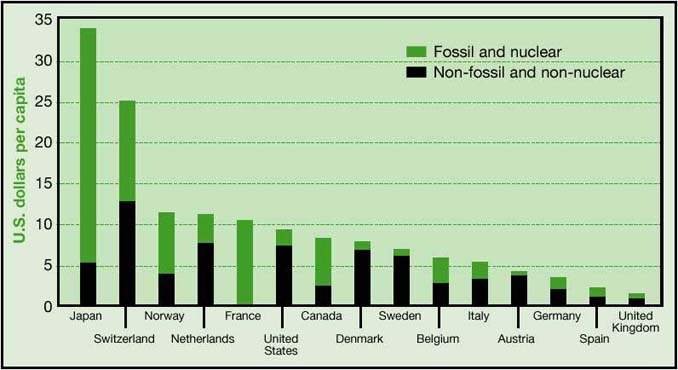
Public expenditure per capita on
energy RD&D
Note: This figure understates the actual level of
public RD&D in energy related matters since RD&D in some sectors - in
transport and building sectors in particular - also has a large bearing on the
development of energy-efficient technologies and
practices.
Source: IEA 1997a. |
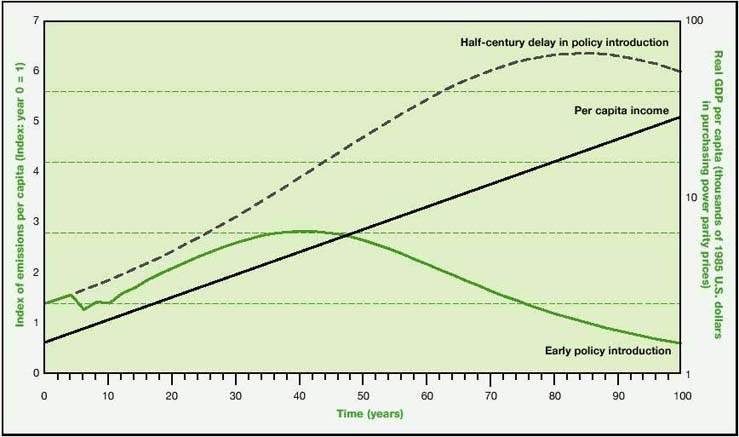
FIGURE 11.5. SIMULATED EFFECTS OF
ENVIRONMENTAL POLICY ON CARBON DIOXIDE EMISSIONS FOR A DEVELOPING COUNTRY
Note: Initial GDP per capita is $1,500 and growth is
3 percent a year. The early fluctuations in emissions in the 'early policy' case
arise from the initial price effects on demand.
Source: Special run by the author using the model described
in Anderson and Cavendish, 1999.
Competition from fossil fuels and lessons from the history of
nuclear power. In addition to the above-mentioned uncertainties, competition
from fossil fuels continues to increase. Estimates of fossil fuel reserves are
far greater today than they were 40 years ago, when nuclear power programmes
were being initiated. Estimates for the 1955 UN Atoms for Peace Conference put
proven reserves at 480 gigatons of oil equivalent and ultimately recoverable
reserves at 2,300 (United Nations, 1955) - respectively one-quarter and
one-twelfth of current estimates. With the convenience of hindsight, we now know
that the underlying premise of the nuclear power programmes that were being
advocated at the time - that fossil fuels would be severely depleted by the
first half of the 21st century - was wrong, as were two other assumptions: that
growing pressures on reserves would increase the costs of fossil fuels, while
technical progress would lower those of nuclear power.
In fact, the opposite happened. Except during the oil price
shocks of the 1970s, real oil prices have consistently been in the $10-20 per
barrel range (in 1995 dollars) for 120 years, despite huge increases in demand.
The prices of coal and natural gas (per unit of energy) have generally been even
lower than those of oil (BP 1996).17 Low costs were made possible not
only by continued discoveries, but also by technological progress in exploration
and production and throughout the downstream industries. In addition, continued
technological progress in the electricity industry reduced both the capital and
the fuel costs of generation from fossil fuels. In the 1950s the thermal
efficiencies of new fossil fuel - fired stations were 30-35 percent; today they
are around 45 percent for new coal-fired plant and 55 percent for gas-fired
plant.
Technological progress and discoveries of reserves thus reduced
the costs of power generation from fossil fuels relative to nuclear power. The
history of oil and gas is replete with predictions of rapidly depleting reserves
and rising prices.18 In addition, there are promising options for
hydrogen production from natural gas and for coal bed methane in which carbon
dioxide is re-injected in coal beds for enhanced methane recovery (on a closed,
non-net-carbon-emitting cycle), used for enhanced oil recovery, or sequestered
deep in saline aquifers (see chapter 8). In sum, non - fossil fuel technologies,
including the emerging renewable energy technologies, will continue to face
intense competition from fossil fuels for many years ahead.
Nevertheless, from an economic perspective the evidence allows
for an optimistic conclusion: technologies are emerging that should enable the
virtual elimination of carbon emissions from energy use should the need arise.
This is so even if the higher energy demand scenario (scenario A) in chapter 9
were to materialise. The estimated incremental costs of abating carbon emissions
are modest in relative terms: most studies put them at 1-6 percent of world
economic product to achieve 50-60 percent abatement by the middle of the next
century and 2-8 percent of world product by the end of the century.19
Even at the higher end these estimates would amount to less than two
year's growth of world product over a 50 year period and four year's growth over
a century. They would shave less than 0.1 percentage point a year off the
long-term growth rate (which averages about 2 percent a year in industrialised
countries and more than 4 percent a year in developing countries with
progressive economic policies).
|
BOX 11.2 HOW MARKET LIBERALISATION AND EDUCATION POLICIES
INTERACT TO AFFECT GROWTH AND POVERTY REDUCTION
Studies of investments in education demonstrate the influence of
a single policy variable on growth and poverty reduction in an environment of
market liberalism. One study (World Bank, 1991) found that education investments
have much larger impacts in countries that already enjoy a degree of economic
liberalisation than in those that do not. The combination of liberal market
policies and investments in education is particularly striking.
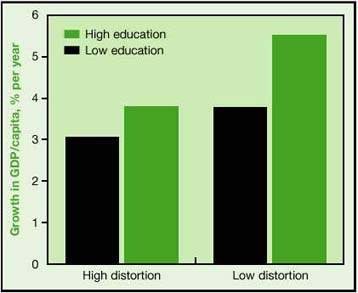
Box figure. Liberalisation,
education investment, and growth of GDP in 60 developing economies, 1965-87
Note: High and low levels of distortion relate to
the foreign exchange premium, a reasonable indicator of trade liberalisation.
High distortion reflects a foreign exchange premium of more than 30 percent; low
distortion, a premium of 30 percent or less. Education is measured by the
average years of schooling, excluding post-secondary schooling, of the
population ages 15-64. High education is defined here as more than 3.5 years;
low education, as 3.5 years or less.
Source: World Bank, 1991.
The difference between the higher and lower growth cases is 2.5
percentage points a year. This estimate of what good policies might accomplish
greatly understates the effect, as the authors acknowledge, because it
concentrates on only two policy variables, is based on average figures for a
large number of countries, and makes modest assumptions about what constitutes
high education.1 Yet even 2.5 percent a year, when compounded over a
century, would mean a 10-fold increase in per capita incomes relative to the
low-growth case - the difference between failure and success in development over
the century.
1. World Bank (1997, fig. 5, p. 13) updated the estimates to
allow for the quality of institutional development. This raised the estimate
from 2.5 to 3 percentage points a year. |
In sum? A scenario of low carbon emissions in the long term is
technologically and economically achievable and is fully consistent with the
goals of developing countries achieving economic prosperity (and enjoying higher
levels of energy consumption) in the present century, and of the industrialised
countries improving their
prosperity.
Liberalisation and globalisation
In the past half century successive multilateral rounds of
reductions in the barriers to trade and foreign investment have led to
considerable increases in the level and globalisation of economic activity.
Between 1971 and 1995, as world GDP expanded at almost 3 percent a year,
international trade increased at 5.6 percent a year and now stands at more than
22 percent of world economic product. Foreign direct investment expanded even
more rapidly, at 12 percent a year between 1980 and 1996, encouraged by
liberalisation and privatisation of formerly state-owned companies. It accounted
for more than 10 percent of total domestic investment in 1995.
What are the implications of globalisation for the energy
industry? Market liberalisation in the industry over the past two decades can be
seen as a response to a range of problems and opportunities:
· The growing
difficulties of raising finance (especially in the electricity sector), a
consequence of high levels of government intervention and subsidies.
· The growing difficulties of
the public sector in providing for the financial losses of the state-owned
industries.
· Deteriorating service levels
in many countries, reflected in frequent black-outs and brown-outs.
· The need to reduce losses and
cost inefficiencies.
· The increasing transparency of
costs and investment decisions, in the electricity, nuclear power, and coal
industries in particular, which led to increased questioning of the
cost-efficiency of public investments in the industry.
· The rapid growth of energy
markets in developing regions and related opportunities for trade and investment
in all energy sectors - electricity, coal, gas, and oil.
· New opportunities for trade
and investment in high-efficiency technologies, such as combined-cycle power
plants, brought about by the growth of world gas reserves.
But as the world economy has become more integrated, there are
fears that the rapid growth of trade and investment will have two undesirable
side effects. The first is that the most impoverished people will be left out of
the process of economic growth and development - only higher income groups will
benefit - and inequality, poverty, and social conflict will intensify. The
second is that there will be deleterious effects on the environment.
These fears are not unfounded. But they rest on the (perhaps
less commonly articulated) assumption that complementary policies will not be
put in place to achieve growth on a broad basis and to protect the environment.
It is not possible to predict reliably whether such policies will be pursued,
but we do know that the effects will be profound one way or the other. (See box
11.2 for a discussion of the influence of just one policy variable, investment
in education, that has been shown to be crucial for improving growth and
reducing poverty.)
If complementary policies are in place, the rate of economic
growth and development on a broad basis will be appreciably higher under
liberalisation. Environmental policies and a range of other policies - health
and population, agricultural extension, vocational training, physical
infrastructure, and social infrastructure, including a regulatory framework for
industry and commerce20 - are also complementary to the growth
process. No policy of market liberalisation can succeed without them.
On the environmental front there has already been a substantial
response by the energy industry. Trade and foreign investment - in environmental
as in other technologies - are ideal conduits for technology transfer and a
means of enabling developing countries to address their local and regional
environmental problems at a much earlier phase of development than
industrialised countries did. The new forms of regulation that are accompanying
liberalisation of energy markets also provide an opportunity for incorporating
investment incentives for the development and commercialisation of
environmentally friendly technologies (renewable energy, hydrogen and fuel
cells).
The problem of access will be more of a challenge. Providing
modern energy services to perhaps 6 billion new customers must be one of the
primary goals of the energy industry in this century. But it is clear from the
range of complementary policies that are needed for market liberalisation to
work that the industry cannot accomplish this alone. All markets in open
societies function within a framework of laws, legislation, standards, and
public and private information services designed to improve the clarity,
integrity, and equity of economic transactions. This framework is the 'ghost in
the machine'. Without it the risks of investment rise for any industry
attempting to address the problem of access by investing in low-income markets,
and without it sustained income growth in these markets will also be more
difficult to achieve.
While there is much evidence to show that liberalisation should
facilitate service extension, progress will need to be monitored. There is a
danger that the industry may concentrate on the easier, more established markets
in urban areas where demand growth is high. Some financial or regulatory
incentives may be required to address the problem. While the evidence is still
ambiguous, it is noticeable in the electricity sector that private investment in
liberalised markets has so far been concentrated either in greenfield
investments in power generation or in the acquisition of assets, with relatively
little investment in the expansion of distribution (table 11.8).
|
Technologies are emerging
that should enable the
virtual
elimination of carbon emissions
from energy use should
the need
arise. |
While it is possible that these investments in assets are a
prelude to service expansion and extension, service extension is too important
to rest solely on unmonitored assumptions. There will thus be a need for
independent oversight both of the industry and of the regulatory process. Ground
rules for regulation (discussed in the concluding section) will not only need to
concentrate on the usual goals of monopoly avoidance and economic efficiency,
but also on the problems of widening public access to energy
services.
Conclusion: economic perspectives on policy
Over the next half century the energy industry will need to
reach another 6 billion people or more (depending on population growth), while
meeting the rising demands of the 4 billion already served. It will need to do
this while substantially reducing local and regional pollution levels,
particularly in developing regions, where the task of pollution abatement has
hardly begun, and while developing new technologies and practices for reducing
global carbon emissions and other greenhouse gases in the long term.
Several lessons of experience and ground rules for policy can be
derived from a large number of studies that have reviewed energy and
environmental policies:
The extension of modern energy supplies to people currently
without them cannot be accomplished by the industry acting in isolation, but
will depend also on the quality of development policies. Income growth is
the main determinant of people's ability to afford and use modern energy forms.
If development policies fail to promote economic growth on a broad basis,
attempts by the energy industry to widen access will have limited success. If
development policies are progressive, the industry (and its regulators) can be
confident that markets will emerge in low-income as well as higher income
communities to meet emerging demand and so will improve the social and economic
situation of billions of people.
The liberalisation of energy markets, which experience has
shown to be fundamental for the efficient growth of the industry, is also
crucial for widening access. The liquefied petroleum gas (LPG) market in
Brazil illustrates this point. By 1991 it served nearly 90 percent of the
population. As a cooking fuel LPG is 10 times more energy efficient than wood
fuel and several thousand times less polluting. In Brazil it is supplied
entirely by private enterprise. The only times investment and progress towards
the extension of LPG service suffered were when the government heavily regulated
its price and distribution (Reis, 1991). The World Bank (1996) reports a similar
experience in Hyderabad, India. As a consequence of liberalisation of the energy
markets, LPG use expanded from the richest 10 percent of households in 1980 to
more than 60 percent of households in the early 1990s, even as the population
doubled.
TABLE 11.8. PRIVATE INVESTMENT IN DEVELOPING COUNTRY POWER
SECTORS, 1994-98
|
Type of activity |
Capacity financed (gigawatts) |
Investment (billions of U.S. dollars) |
|
Greenfield |
36 |
46 |
|
Privatisation |
26 |
14 |
|
Distribution |
0 |
58 |
|
Total |
62 |
117 |
Source: Martin, 1999, who comments that the
greenfield investments are mainly in generation.
The goals of liberalisation extend to trade and foreign
investment in energy technologies and services. Enabling trade and foreign
investment in energy technologies and services will allow the energy industry to
apply its considerable financial, technical, and managerial resources to
improving and extending energy supplies. Trade and foreign investment are also
ideal conduits for the transfer of efficient end-use and environmentally
improved technologies.
Economic efficiency provides a good basis for regulation.
It points to a range of indicators for assessing an industry's performance.
It requires regulators to look at measures of cost and price efficiency, at
environmental performance (since the persistence of undesirable external costs
is a source of economic inefficiency), and at the industry's efforts to extend
service. The following are some ground rules for the electricity industry;
parallel ones can be developed for gas:
· Price
efficiency. Prices reflect the level and structure of the marginal costs of
supply, differentiated by time of day, season, and voltage levels (an outcome of
pool pricing and supply competition in liberalised markets). Marginal costs
include the costs of compliance with environmental policy.
· Subsidies. These are
avoided, with financially minor but socially important exceptions, and are not
such as to undermine the financial performance of the industry. They are also
unnecessary, since the industry has long been capable of financing its own
expansion - including the expansion of service to new consumers - through
retained earnings and recourse to capital markets. Exceptions may be 'lifeline'
rates for household consumers with low levels of consumption, allowances for the
higher fixed costs of the extension of service to new areas, and investments in
RD&D projects.
· Cost efficiency.
Typical yardsticks are the costs and efficiencies of thermal plant relative
to known international best-practice standards, reserve plant margins,
electrical losses, and plant availability factors.
· Quality of service.
Probabilities of loss of load and brown-outs are good indicators of service
quality.
· Widening access. The
portion of the population served by grid or off-grid schemes is monitored and
used as a measure of progress towards the goal of providing universal service.
· Commercialisation policies
for environmental innovation. New forms of arm's length regulation following
market liberalisation provide opportunities for establishing new forms of
incentives for the development and commercialisation of environmentally friendly
technologies. These include competitive bidding processes and incentives for
private investment. The modularity of many of the emerging technologies means
that the financial risks are small, especially relative to those of the nuclear
power industry in the 1950s to the 1970s.
|
Providing modern energy services
to perhaps 6 billion new
customers
must be one of the primary goals
of the energy industry
in
this century. |
Taxing energy is not an effective instrument of environmental
policy, not with-standing many claims to the contrary. The case for energy
taxes has long been widely accepted on the grounds that they are an efficient
form of taxation - they raise revenues without, it is thought, seriously
distorting economic activity. The case for imposing additional energy taxes on
environmental grounds, however, is not well founded. Such taxes increase
revenues while having negligible effects on pollution. If pollution is to be
reduced, there is no substitute for taxing or regulating pollution directly.
There is no reason, from either a technological or an
economic standpoint, why the world cannot enjoy the benefits of both high levels
of energy use and a better environment. Technological and managerial options
are already available or capable of being developed that would substantially
solve both local and global environmental problems from energy use at costs that
may be large in absolute terms but are small relative to the long-run costs of
energy supplies. Reducing local pollution is likely to raise rather than
diminish economic output because of the attendant reduction in external costs.
This conclusion should be especially heartening to developing countries, whose
energy consumption will rise substantially as they strive to achieve economic
prosperity.
In light of the promise of new, 'environmentally friendly'
energy technologies on the one hand, and of emerging environmental problems on
the other, there is a good case for revisiting the role of technology policies,
including public support for RD&D. There is ample evidence of market-led
technical progress in the energy industry: reductions in the costs of off-shore
oil and gas exploration, improvements in the thermal efficiencies of power plant
and reductions in the costs of electricity supply, reductions in power plant
lead-times, and the ability to develop technologies for reducing pollution by
orders of magnitude, to note a few.
Yet many people have argued, in response to concerns about
climate change - and governments in the OECD countries are, by and large,
accepting the arguments - for public or regulatory support for the industry to
develop new non - fossil fuel technologies, based on renewable energy and fuel
cells and hydrogen. Such policies, which differ in detail and scale but not in
intent between countries, hold the potential for economic and technological
surprise. These areas are fertile ground for industry RD&D - areas that the
industry might otherwise have ignored because of the abundance of fossil fuel
reserves.
In view of the climate change problem, energy technology
development and commercialisation programmes for climate friendly technologies
also need to become more outward looking and international in scope.
Developing countries especially need to become engaged in the development
and use of such technologies. Aside from bilateral initiatives there are three
complementary instruments of policy well suited to this purpose: the Global
Environment Facility, the financing arm of the Framework Conventions on Climate
Change and Biodiversity; Joint Implementation and the Clean Development
Mechanism, which, if ratified, will enable companies to reduce carbon emissions
through foreign investment when (as it often will be) it is cheaper to do so
abroad than in the home country; and regulatory and tax policies to provide
financial incentives for the early development and use of non - fossil fuel
options in developing countries. There are now many examples in the OECD
countries to show that such policies can be pursued in market-oriented ways
without compromising the financial integrity of the industry.
Financial analysis consistently shows that, under enlightened
regulation, the energy industry is capable of mobilising the financial resources
required to expand services and address environmental problems through a mix of
internal cash generation and recourse to the financial markets. As the
report of the World Energy Council (WEC 1997, p. iv) concludes: "global capital
resources in principle are more than adequate to meet any potential demands
coming from the energy sector. These demands are unlikely to exceed 3-4 percent
of global output, the same proportion that has prevailed over past decades", a
period of rapid industry expansion similar to that of the trajectory in the
high-growth scenario (Scenario A) in chapter 9. The same conclusion applies to
the provision of finance to meet the cost of solving local and regional
environmental problems. These costs are unlikely to exceed more than 5-10
percent of the costs of supply, and any increase in costs is likely to be more
than offset by gains in efficiency. Pollution should be greatly abated and the
costs of energy supplies should fall. The financial requirements of the RD&D
effort required to develop new non - fossil fuel technologies are also likely to
be relatively small.
The main financial problem ahead could be posed by the capital
requirements of developing countries. But if this materialised, it would be a
self-inflicted problem. As the World Energy Council (WEC 1997, p. iv) further
argues, "Contrary to popular belief, savings rates in many developing countries
are double those of the US and generally one third greater than those of Europe
or Japan". A large proportion of the required finance could be generated
internally, with the remainder coming from international capital markets, which
should in a favourable economic environment find investments in energy among the
most attractive of options. The key is to offer a system of arm's length
regulatory policies that allow investors to enter energy markets and to earn
good rates of return while enabling the industry to extend service and reduce
pollution.
Notwithstanding an immense literature on the subject of
energy and the environment, four propositions remain needlessly controversial
and a source of much confusion, not least among the policy-making community.
They are that:
· Local, regional,
and global pollution arising from energy production and use can be virtually
eliminated through technological substitution towards low-polluting forms of
energy. With the important but partial exception of carbon dioxide abatement,
where significant RD&D and commercialisation efforts for new technologies
are merited, alternative fuels and technologies are already available or
emerging.
· Thanks to developments in
pollution prevention and control, most stemming from recent policies in
industrialised countries, developing countries can aspire to eliminate major
forms of pollution at a far earlier phase of development - in most cases in the
first third of this century - than the industrialised countries before them.
· The costs would not be large
in relative terms and could be financed internally through the application of
standard instruments of environmental policy.
· A low pollution future is
fully consistent with higher levels of energy use in developing countries and
the achievement of economic prosperity on a broad basis. A low pollution future
is also consistent with high levels of energy use in industrialised countries,
provided that efforts to develop the required technologies and practices
continue.
In workshops and though other forums we need to debate such
propositions further, to show just what enlightened policies might accomplish.
Notes
1. See glossary for definition of terms.
2. This figure, reported in World Bank (1996), was compiled and
presented initially by Zihong Ziang in an unpublished research note for the
World Bank. Ziang surveyed energy statistics from a large number of reports in
the World Bank's files. Figure 3.1 in chapter 3 provides a regional breakdown of
the estimate of unserved populations.
3. See Lebergott (1993, table II.16, p 107), World Bank (1996, p
39-40), and Pearson (1994).
4. Explaining this statistic, Lebergott footnotes: "As of 1990,
a yearly estimate of 4,420 cloth diapers per child, plus 8,060 gallons of water
to rinse and wash them and 2.5 years in diapers" appears in a survey by Arthur
D. Little Inc.
5. The estimates from a survey by Whittington, and others.
(1994) on water vending in Ukunda, Kenya. are based on an unpublished survey
undertaken by water supply engineers in Lagos in 1986 in connection with a World
Bank project; the average distance over which the water was carried was a
quarter of a mile.
6. Recent surveys of rural families in countries as diverse as
Colombia, Jordan, Nepal, and Ukraine on their preferences for cooking fuels
yielded identical results: the preferred fuel was gas or LPG, followed by
kerosene and then wood. But the actual choice depended crucially on availability
and costs (with costs varying immensely with the accessibility of the village
and the quality of roads). Where wood was locally abundant, low- (but not high-)
income families would use it until local resources were depleted. I thank the
following students for undertaking surveys on preferences of rural people: Mike
Hugh (in Jordan), Paras Gravouniotis (Nepal), Ernesto Salas (Colombia) and Nick
Fraser (Ukraine) on field trips to these countries. The results are available in
UNDP files.
7. Forecasts are reviewed in IPCC (1995 a, b) and Nakicenovic,
Victor, and Morita (1998), which summarise more than 300 projections of world
energy demand and carbon emissions.
8. I thank Eberhard Jochem for this figure and comments on it.
9. See Schipper and Meyers (1992); U.S. Congress (1995 a, b);
Watson, Zinyowera, and Moss (1996); WEC (1993); and IPCC (1995); chapter 6
provides further evidence and an ample bibliography.
10. As discussed below, the annual rate of improvement in energy
efficiency is thought to be in the range of 0.5 to 1.5 percent a year. If the
latter figure holds, or even a figure of 1 percent a year, then an economy whose
per capita income elasticity has declined to the 0.25. to 0.5 range and whose
long-term growth rate is 2-3 percent a year could easily enter a period in which
the long-term trend in energy demand is negative.
11. The actual effect on demand depends on two factors: the
effects on costs and prices, and the price elasticities. The change in demand
(D) following a change in price (P) is given by DD/D = aDP/P, where a is the
price elasticity. Suppose energy efficiency reduces energy needs for a given
application by a factor of 2, but also reduces the costs by the same amount; if
the price elasticity is - 0.5, demand will fall by only 0.5 × 0.5, or 25
percent, not by half as predicted by engineering calculations, which neglect the
point that the number of applications commonly rise following a reduction of
price. Overall, since energy demand is fairly price inelastic, the prevailing
consensus is that energy efficiency will lower energy demands relative to
prevailing trends. However, the effect is smaller than often thought, and much
depends on the price elasticity for the particular application. Also important,
of course, are the prices of the appliances.
12. In this respect it is lamentable that a commonly used index
of environmental damage is energy consumption, when as argued earlier energy is
a good not a bad, and the essential task for environmental policy is to abate
the pollution from energy use not energy use itself.
13. For values of g =
1.0, g = 4, n = 2, x = 1.5 (the higher limit), for example,
and neglecting for now any declines in the costs and prices of energy brought
about by further improvements in energy efficiency, the long-term growth rate
would still be more than 4 percent a year in developing regions, with demands
doubling every 15 to 18 years.
14. In 1985 prices. In these studies of the environmental
Kuznets curves, per capita incomes are based on real comparative purchasing
power data provided from the Penn World Tables (mark 4; Summers and Heston,
1991). Such data point to significantly higher real incomes in developing
countries than are provided in national income data converted at official
exchange rates. The environmental Kuznets curve (the inverted U-shaped
hypothesis) is controversial and was never put forward by the late Simon Kuznets
himself. As a device for predicting future trends in pollution, it has been
discredited.
15. In practice, rooftops and desert areas would be used for the
direct solar technologies, such that there would be little or no competition for
arable lands arising from these technologies.
16. Visual intrusion is often a serious problem with wind and is
now leading several European countries to move to introduce 'offshore' wind
farms.
17. The prices per British thermal unit (Btu) were $3.20 for
oil, $1.50-2.50 for gas, and $1.50 for coal in 1995, with the price of gas
varying with region. The figure for coal is based on a conversion factor of 27
million Btu per tonne.
18. See Odell (1998), who draws attention to past errors of
under-estimating the capacity of the fossil fuel industry to discover new
reserves and lower costs, and the moral to be drawn from this.
19. See Weyant (1993) and Grubb, and others (1993). Estimates
vary with assumptions about the rate of progress in the development of
non-carbon technologies. As noted earlier, these estimates are conservative and
fail to consider the possibilities of the innovation leading to technologies
with costs lower than those of fossil fuels. So the ranges are actually from
< 0.0 to the upper estimates cited here.
20. For an earlier assessment of the effects of social and
economic policies on growth, see Harberger (1984). The World Bank's World
Development Reports provide several syntheses of the effects of social and
economic policies on the growth and distribution of per capita incomes and
contain ample bibliographies.
References
Adelman, M.A. 1997. "My Educaton in Mineral (especially Oil)
Economics." Annual Review of Energy and the Environment. 22: 13-46
Ahmed, K. 1994. Renewable Energy Technologies: a Review of
the Status and Costs of Selected Technologies. World Bank Technical Paper
240: Energy Series. Washington, D.C.
Anderson, D. 1993. "Energy Efficiency and the Economics of
Pollution Abatement." Annual Review of Energy and the Environment 18:
291-318.
Anderson, D., and W. Cavendish. 1999. "Dynamic Simulation and
Environmental Policy Analysis: Beyond Comparative Statics and Environmental
Kuznets' Curves." Imperial College Centre for Energy Policy and Technology,
London.
Anderson, D., and S. Chua. 1999. "Economic Growth, Trade,
Liberalisation, Foreign Investment and the Environment - A Review, with Special
Reference to the Abatement of Air and Water Pollution in Developing Regions."
Oxford University, Institute of Economics and Statistics, Oxford.
ADB (Asian Development Bank). 1991. Environmental
Considerations in Energy Development. Manila.
BP (British Petroleum). 1996. BP Statistical Review of World
Energy. London.
BP (British Petroleum). 1998. BP Statistical Review of World
Energy. London.
Cavendish, W., and D. Anderson. 1994. "Efficiency and
Substitution in Pollution Abatement." Oxford Economic Papers 46: 774-99.
CEC (Commission of European Community). 2000. 1999 Annual Energy
Review. Energy in Europa. Special Issue. Brussels.
Charpentier, J.-P., and E.S. Tavoulareas. 1995. Clean Coal
Technologies for Developing Countries. World Bank Technical Paper 286: Energy
Series. Washington, D.C.
Davies, J.C., and J. Mazurek. 1998. Pollution Control in the
United States. Washington, D.C.: Resources for the Future.
Downing, R.J., R. Ramankutty, and J.J. Shah. 1997. Rains
Asia: An Assessment Model for Acid Deposition in Asia. Washington, D.C.:
World Bank.
Faiz, A., C.S. Weaver, and M.P. Walsh. 1996. Air Pollution
from Motor Vehicles: Standards and Technologies for Controlling Emissions.
Washington, D.C.: World Bank.
Gregory, K. 1998. "Energy Resources." Intergovernmental Panel on
Climate Change Special Report on Emission Scenarios.
Grubb, M., J. Edmunds, P. ten Brink, and M. Morrison. 1993. "The
Costs of Limiting Fossil-fuel CO2 Emission: A Survey and Analysis."
Annual Review of Energy and the Environment 18: 397-478.
Harberger, A.C.E. 1984. World Economic Growth: Case Studies
of Developed and Developing Nations. San Francisco: Institute for
Contemporary Studies.
IEA (International Energy Association). 1997a. Energy
Policies of IEA Countries. Paris.
IEA (International Energy Association). 1997b. Energy
Statistics and Balances of Non-OECD Countries. Paris.
IEA (International Energy Association). 1998. Balances of
OECD Countries 1995-1996. Paris
IEA (International Energy Association). 1999. Balances of
Non-OECD Countries 1996-1997. Paris
IEA (International Energy Association). 2000. Balances of
OECD Countries 1997-1998. Paris
IPCC (Intergovernment Panel on Climate Change). 1995a.
Climate Change 1995. Impacts, Adaptations and Mitigation of Climate Change:
Scientific-Technical Analyses. Cambridge: Cambridge University Press.
IPCC (Intergovernment Panel on Climate Change). 1995b.
Economic and Social Dimensions of Climate Change. Contribution of
Working Group III to the Second Assessment Report of the Intergovernmental Panel
on Climate Change. Cambridge: Cambridge University Press.
Judson, R.A., R. Schmalensee, and T.M. Stoker. 1999. "Economic
Development and the Structure of the Demand for Commercial Energy." Energy
Journal 20 (2): 29-57.
Kassler, P. 1994. "Energy for Development." Shell Selected
Papers. Shell Group of Companies, London.
Kiely, G. 1997. Environmental Engineering. London:
McGraw-Hill.
Larson, E.D. 1993. "Technology for Electricity and Fuels from
Biomass." Annual Review of Energy and the Environment 18: 567-630.
Lebergott, S. 1993. Pursuing Happiness: American Consumers in
the Twentieth Century. Princeton, New Jersey: Princeton University Press.
Lovei, M. 1995. "Why Lead Should Be Removed from Gasoline."
World Bank Environment Dissemination Note. World Bank, Washington, D.C.
Lvovsky, K., and G. Hughes. 1999. "Environmental Costs of Fuel
Use in Developing Countries." World Bank, Washington, D.C.
Martin, F. 1999. "Taking Stock of Progress: the Energy Sector in
Developing Countries. Financial Reform." In World Bank, ed., Energy and
Development Report. Washington, D.C.: World Bank.
Mock, J.E., J.W. Tester, and M.P. Wright. 1997. "Geothermal
Energy from the Earth: Its Potential Impact as an Environmentally Sustainable
Resource." Annual Review of Energy and the Environment 22: 305-56.
Nakicenovic, N., N. Victor, and T. Morita. 1998. "Emissions
Scenarios Database and Review of Scenarios." Mitigation and Adaptation
Strategies for Global Change 3: 95-120.
Norberg-Bohm, V. Forthcoming. "Technology Commercialization and
Environmental Regulation: Lessons from the U.S. Energy Sector." In J.
Hemmelskamp, K. Rennings, and F. Leone, eds., Heidelberg: Physica-Verlag,
Springer.
Odell, P.R. 1998. Fossil Fuel Resources in the 21st Century.
Vienna: International Atomic Energy Agency.
OECD (Organisation for Economic Co-operation and Development).
1995. World Energy Outlook. Paris.
OECD (Organisation for Economic Co-operation and Development).
1997. Statistical Compendium 1997 (CD-Rom). Paris: OECD.
Pearson, P.J.G. 1994. "Energy, Externalities and Environmental
Quality: Will Development Cure the Ills It Creates?" Energy Studies Review
6 (3): 199-216.
Reis, M.S. 1991. LPG In Brazil: 50 Years of History. S�o
Paulo: Sindicato Nacional das Empresas Distribuidoras de Gas Liqufeito do
Petroleo.
Selden, T.M., and D. Song. 1994. "Environmental Quality and
Development: Is There a Kuznets Curve for Air Pollution Emissions?" Journal
of Environmental Economics and Management 27 (2): 147-62.
Schipper, Lee, and Stephen Meyers. 1992. Energy Efficiency
and Human Activity: Past Trends, Future Prospects. Cambridge: Cambridge
University Press.
Smith, K. 1988. "Air Pollution: Assessing Total Exposure in
Developing Countries." Environment 30 (10): 16-35.
Smith, K.R. 1993. "Fuel Combustion, Air Exposure, and Health:
the Situation in Developing Countries." Annual Review of Energy and the
Environment 18: 529-66.
Summers, R., and A. Heston. 1991. "The Penn World Table (Mark
5): An Expanded Data Set of International Comparisons, 1950-1988." Quarterly
Journal of Economics 56: 327-69.
United Nations. 1955. Peaceful Uses of Atomic Energy.
International Conference on the Peaceful Uses of Atomic Energy. Geneva:
United Nations.
U.S. Congress, Office of Technology Assessment. 1995.
Renewing Our Energy Future. Washington, D.C.: Government Printing Office.
U.S. EPA (United States Environmental Protection Agency), U.S.
Office of Air Quality Planning and Standards. 1997. National Air Pollutant
Emission Trends, 1900-1996: National Emission Trends (NET) Data Base. N.C.:
Research Triangle Park
U.S. President's Committee of Advisers on Science and
Technology. 1999. Powerful Partnerships: The Federal Role in International
Cooperation on Energy Innovation. Washington, D.C.
Watson, Robert T., Marufu Zinyowera, and Richard H. Moss. 1996.
"Technologies, Policies and Measures for Mitigating Climate Change." IPCC
Technical Paper 1. Nairobi: United Nations Environment Programme.
Weyant, J.P. 1993. "Costs of Reducing Global Carbon Emissions."
Journal of Economic Perspectives 7 (4): 27-46.
Whittington, D., D.T. Lauria, D.A. Okun, and X. Mu. 1994. "Water
Vending in Developing Countries: A Case Study of Ukunda, Kenya." In R. Layard
and S. Glaister, eds., Cost-Benefit Analysis. Cambridge: Cambridge
University Press.
World Bank. 1991. World Development Report 1991: The
Challenge of Development. New York: Oxford University Press.
World Bank. 1992. World Development Report 1992: Development
and the Environment. New York: Oxford University Press.
World Bank. 1996. Rural Energy and Development: Meeting the
Energy Needs of Two Billion People. Washington, D.C.
World Bank. 1997. World Development Report 1997: The State in
a Changing World. New York: Oxford University Press.
WEC (World Energy Council). 1993. Energy for Tomorrow's World
- the Realities, the Real Options and the Agenda for Achievement. London:
St. Martin's Press.
WEC (World Energy Council). 1997. Financing the Global Energy
Sector - The Task Ahead. London: World Energy
Council.
Chapter 12. Energy Policies for Sustainable Development
Michael Jefferson (United Kingdom)
MAJOR REVIEWERS: John Baker (United Kingdom), Richard
Balzhiser (United States), Gerald Doucet (Canada), Anton Eberhard (South
Africa), Howard Geller (United States), Eberhard Jochem (Germany), Hisham Khatib
(Jordan), Derek Osborn (United Kingdom), Lee Solsbery (United States), R.
Vedavalli (India), and Robert H.Williams (United States)
|
ABSTRACT
The scenarios described in chapter 9 indicate that changes
are needed if energy systems are to promote sustainable development. The key
challenges are expanding access to affordable, reliable, and adequate energy
supplies while addressing environmental impacts at all levels. Policies can
support sustainable development by:
· Delivering
adequate and affordable energy supplies - including liquid and gaseous fuels for
cooking and electricity for domestic and commercial use - to unserved areas.
· Encouraging energy
efficiency.
· Accelerating the use of new
renewables.
· Widening the diffusion and
use of other advanced energy technologies.
With the right policies, prices, and regulations, markets can
achieve many of these objectives. But where markets do not operate or where they
fail to protect important public benefits, targeted government policies,
programmes, and regulations are justified when they can achieve policy
goals.
The broad strategies to encourage sustainable energy systems
are straightforward. But they require wider acknowledgement of the challenges we
face and stronger commitment to specific policies. The strategies include:
· Making markets
work better by reducing price distortions, encouraging competition, and removing
barriers to energy efficiency.
· Complementing energy sector
restructuring with regulations that encourage sustainable energy.
· Mobilising additional
investments in sustainable energy.
· Accelerating technological
innovation at every stage of the energy innovation chain.
· Supporting technological
leadership by transferring technology and building human and institutional
capacity in developing countries.
· Encouraging greater
international cooperation.
The challenge of sustainable energy includes crucial enabling
roles for governments, international organisations, multilateral financial
institutions, and civil society - including local communities, business and
industry, non-governmental organisations (NGOs), and consumers. Partnerships
will be required, based on integrated and cooperative approaches and drawing on
practical experience. A common denominator across all sectors and regions is
setting the necessary framework conditions and ensuring that public institutions
work effectively and efficiently with the rest of society to achieve sustainable
development.
Energy can be a powerful tool for sustainable development.
But redirecting its power to work towards that goal will require major policy
changes within the overall enabling framework. Unless those changes occur within
the next few decades - and are begun without further delay - many of the
opportunities now available will be lost or the costs of their eventual
realisation (where possible) greatly increased. Either way, the ability of
future generations to meet their needs would be gravely compromised. |
At the core of any sustainable energy strategy is a vision for
improving the provision and use of energy so that it contributes to sustainable
development. For that to happen, policies must widen access to reliable and
affordable modern energy supplies and reduce the negative health and
environmental impacts related to energy use. Increased energy supplies and more
efficient allocation of resources for sectoral investment will also be required
to support economic development. The key requirement is that steps be taken to
make markets work more effectively, or to help build energy markets where they
do not exist.
A competitive market is the most efficient allocator of
resources and is capable of providing high levels of consumer service and
satisfaction. Thus a key element of a sustainable energy strategy should be to
strive for, and to maintain, competitive market conditions. But the market alone
cannot be expected to meet the needs of the most vulnerable groups, to protect
the environment, to ensure energy security in the face of politically motivated
disruption, and to support other public goods, such as basic research that
underpins the innovation and diffusion of new technologies. In general, however,
given the proper framework set by government - with competitive pricing and
effective regulation - markets can achieve many of the objectives of sustainable
energy.
Where markets still fail to protect public benefits, targeted
government interventions are indicated. The need should depend on whether
government intervention will produce the desired results. Government
interventions tend to be less efficient than market approaches and often have
unintended consequences at odds with their original aims.
|
The market alone cannot be expected to
meet the needs of
the most vulnerable
groups, to protect the environment,
to ensure energy
security,
and to support other
public goods. |
Moreover, the introduction of sound policies does not prevent
backsliding. For these reasons there is a need to adopt a pluralistic approach,
to try different approaches, to learn from the experiences of other countries,
and to be prepared to adjust policies in light of lessons learned domestically
and internationally.
Chapter 9 shows, through energy scenarios, that our world needs
to change direction if the goal of sustainable development is to be achieved.
Change takes time. Economic, social, and political obstacles must be overcome.
The life cycle of some investments is long, and change cannot always be readily
accelerated. New, environmentally friendly technologies cannot be summoned out
of thin air in the quantities and in the places required. There is inertia in
behaviour and consumption patterns. There is reluctance to pay now for
uncertain, or even probable, future benefits. Widespread public awareness and
support need to go hand in hand with sound political leadership and
policy-making if successful change is to come about. Our world does not seem
ready to change in the direction and to the extent required. But unless an early
start is made on changing direction, the delay will almost certainly result in
additional costs even where change is still possible - and various long-term
development paths are likely to get blocked off (WEC, 1995; Nakicenovic,
Gr�bler, and McDonald, 1998).
TABLE 12.1. DEFINING GOALS, STRATEGIES, POLICIES, AND
POLICY INSTRUMENTS
|
Term |
Definition |
Example |
|
Goal |
Overarching aim or framework |
Sustainable development |
|
Strategies |
Broad paths to reach a goal |
Using energy provision and use to foster sustainable development
|
|
Policies |
Courses of action to implement strategies |
Making markets work more effectively by:
· Restructuring the energy sector
· Attracting private capital
· Phasing out subsidies for conventional energy supply
and consumption
· Internalising
externalities
· Strengthening
regulations
· Supporting energy sector
innovation
· Accelerating the deployment of
sustainable energy technologies
· Promoting
energy efficiency
· Building institutional
and human capacity in sustainable energy
·
Improving international cooperation and linkages between trade and the
environment |
|
Policy instruments |
Specific measures used |
· Efficiency standards
· Public procurement policies
· Voluntary agreements
· Appliance labelling
· Externality taxes and incentives (such as carbon
taxes and early retirement incentives for older, less efficient, more polluting
energy-using devices)
· Fuel
switching
· Obligation to buy energy from
renewable sources
· Obligation to supply
energy from renewable sources
· Systems
benefit charges (otherwise known as public benefits funds)
· Supporting research and development demonstration
projects
· Lowering the cost of new
technologies for more rapid deployment |
|
BOX 12.1. THE NEED FOR A NEW ENERGY PARADIGM |
|
Traditional paradigm |
Emerging paradigm |
|
Energy considered primarily as a sectoral issue |
Greater consideration of social, economic, and environmental
impacts of energy use |
|
Limitations on fossil fuels |
Limitations on the assimilative capacity of the earth and its
atmosphere |
|
Emphasis on expanding supplies of fossil fuels |
Emphasis on developing a wider portfolio of energy resources,
and on cleaner energy technologies |
|
External social and environmental costs of energy use largely
ignored |
Finding ways to address the negative externalities associated
with energy use |
|
Economic growth accorded highest priority (even in prosperous
economies) |
Understanding of the links between economy and ecology, and of
the cost-effectiveness of addressing environment impacts early on |
|
Tendency to focus on local pollution |
Recognition of the need to address environmental impacts of all
kinds and at all scales (local to global) |
|
Emphasis on increasing energy supply |
Emphasis on expanding energy services, widening access, and
increasing efficiency |
|
Concern with ourselves and our present needs |
Recognition of our common future and of the welfare of future
generations |
Policy goals and challenges
The policies considered here are targeted towards addressing the
needs of people who do not have access to modern energy carriers, making energy
supplies more reliable and encouraging the more efficient use of energy, and
accelerating the development and wider deployment of new renewable technologies
and clean and safe advanced fossil fuel technologies.1 Clean,
efficient, and safe technologies are either under-exploited or need to be
developed. But such technologies have the potential to address the health and
environmental problems associated with conventional fossil fuel technologies.
The broad policies to encourage sustainable energy systems are
straightforward. But taken together and implemented effectively, they would
represent a significant departure from current practices. They are largely aimed
at harnessing market efficiencies to achieve sustainable development. They
include, under the broad heading of making markets work better:
· Energy sector
restructuring, where this is not already taking place.
· Attracting private capital.
· Phasing out subsidies for
conventional energy supply and consumption.
· Internalising externalities,
such as health and environmental impacts.
· Promoting energy efficiency.
· Supporting energy sector
innovation and the wider and accelerated use of sustainable energy technologies.
· Building institutional and
human capacity in sustainable energy.
· Introducing wider-ranging and
more effective regulatory measures, to improve market operations and their
public benefits.
· Achieving more effective
international cooperation, as well as closer links between multilateral trade
and environmental measures.
Table 12.1 provides the framework for the overarching policy
goal of sustainable development, along with supporting strategies, policies, and
instruments that would help markets work better.
Changes are occurring around the world in all the above
directions, but on neither a wide enough basis nor at a rapid enough pace given
the scale and range of the challenges to sustainable development. Without an
appropriate sense of urgency, it becomes difficult to muster the political will
and public support to take the needed actions. This report is one attempt to
convey how much is at stake - and how soon action is needed to initiate what
will be a long process of change before sustainable energy development (in both
the static and dynamic senses) can be securely acknowledged.
Even though there is not yet a widely shared sense of urgency
about the need to shift to a sustainable energy path, many sustainable energy
policy instruments enjoy widespread support. These include efforts to raise the
efficiency and quality of energy services (heat for cooking and warmth, cooling,
lighting, mobility and motive power) and to put in place social policies that
address the plight of people who cannot afford energy services. Similarly, where
local environmental conditions have deteriorated to an unacceptable level,
communities often find alternative ways of doing things.
The greatest challenge comes when society is asked to move from
addressing tangible current needs to taking actions to manage environmental
resources for the future and for the sake of future generations. Taking such
actions in the face of competing short-term interests will require a major
reorientation in the approach to energy and energy services. What is required is
a new global consensus, essentially the evolution of a new energy paradigm
aligned with the goal of sustainable development (box 12.1). This, in turn,
needs to be reflected in national, local, and individual perspectives and
priorities.
For such a shift to occur, the sustainability debate will need
to move to centre stage, accompanied by much higher public awareness,
information, and commitment. If public support for sustainable energy
development is not forthcoming, it will be extremely difficult to implement many
of the policies discussed
here.
The findings so far
Chapters 2-4 show that energy is far more than a sectoral issue
- it cuts across many aspects of sustainable development and is vitally
connected to economic prosperity, social well-being, environmental issues, and
security. The expansion of choices that the wider availability and higher
quality of energy services can make possible is a fundamental aspect of human
development. But modern energy services are currently beyond the reach of about
one-third of the world’s people. And for development to be sustainable, the
demand for affordable energy services must be met in ways that protect human
health and the local, regional, and global environment, as well as provide
reliable supplies.
Chapters 5-8 indicate that technical progress has helped
identify ample energy resources - fossil fuel, renewable, and nuclear - to
support future economic and social development. Thus the availability of energy
resources is not likely to be a serious problem in the next century. The
critical challenge is finding ways to use these resources at reasonable costs
and in ways that do not damage the environment. The health and environmental
implications of meeting the world’s energy demands suggest that energy
technologies with near-zero emissions will eventually be required to ensure
sustainability. Technologies are already available to increase the use of
renewable energy sources and improve energy end-use efficiencies. Emerging
innovations offer the potential to use conventional sources of energy (fossil
fuels being the most significant) in ways that are cleaner, more efficient,
safer, flexible, and affordable.
Chapters 9 and 10 demonstrate that the current mix of energy
sources, energy infrastructure, and energy end-use applications is not efficient
enough, diverse enough, or clean enough to deliver the energy services required
during this century in a sustainable fashion. Incremental improvements are
occurring - such as the rapid deployment of efficient combined cycle gas
turbines for electricity generation, and wider use of renewables and other
environmentally friendly technologies. But the scenarios described in chapter 9
show that a huge increase in the scale, pace, and effectiveness of policy
initiatives and measures will be required to change course to a sustainable
path. In the absence of such changes, sustainable energy development is unlikely
to be
achieved.
Defining the goals of policy
Chapter 1 provides a definition of sustainable development. The
importance of the Brundtland Commission’s definition was that it balanced
the need to address current realities and priorities - of poverty, deprivation,
and inequity - with the needs of future generations and the desirability of
maintaining resources and biological diversity.2 Chapter 9 also
addresses the idea of sustainability, using a series of indicators.
The concept of sustainability was discussed further at the Earth
Summit (officially known as the United Nations Conference on Environment and
Development) held in Rio de Janeiro in 1992 and in one of the summit’s main
outputs, Agenda 21 (particularly in chapter 9; UN, 1992). The 1997 report of the
UN Secretary-General on progress achieved since the Earth Summit states that the
secretariats of the organisations of the UN system believe that sustainable
development “should continue to provide an ‘overarching’ policy
framework for the entire spectrum of UN activities in the economic, social and
environmental fields at the global, regional and national levels”(clause
139; see Osborn and Bigg, 1998).
|
A huge increase in the scale, pace,
and effectiveness of
policy initiatives
and measures will be required
to change course to
a
sustainable path |
The same report, however, points to major gaps in international
discussions of certain economic sectors - namely, energy, transport, and
tourism. With energy arguably being the most critical link between the
environment and development, the tensions between the legitimate needs of
developing countries for socioeconomic development and the health and pollution
issues arising from the use of conventional fuels have been inadequately
addressed. More focused analysis and action are required, including efforts that
enable developing countries to acquire the energy they need for their
development while reducing their dependence on carbon-based fuels (clause 129).
The UN Secretary-General’s report recognises the plight of
the more than 2 billion people with little or no access to commercial energy
supplies (clause 11), and identifies poverty eradication throughout the world as
a priority for sustainable development (clause 120). The report emphasises the
need for an integrated approach and for better policy coordination at the
international, regional, and national levels. It points out that since the Earth
Summit the debate has focused on the complementarities between trade
liberalisation, economic development, and environmental protection (clause 50).
Technology partnerships and arrangements to stimulate cooperation between
governments and industry at the national and international levels are needed
(clause 135). But the report claims that there has been notable progress on
industry-government partnerships and on the development of innovative policy
instruments - with greater consideration by governments of cost-efficiency and
effectiveness - and environmentally efficient technologies (clauses 89 and 90).
The report considers the increase in regional trading
arrangements to be another positive feature (clause 10). The increase in private
capital flows in the 1990s (particularly relatively stable foreign direct
investments) is highlighted (clause 101), but this is qualified by the fact that
these mainly went to a relatively small number of developing countries (clause
13). Indeed, many countries and people have failed to share in the development
and growth since the Earth Summit. Debt burdens have hampered the development
potential of many low-income countries. Official development assistance from
industrialised countries has generally been a grave disappointment for potential
recipients. And technology flows to developing countries have “not been
realized as envisaged at [the Earth Summit]” (clause 105). Limited progress
has been made with economic instruments intended to internalise environmental
costs in the prices of goods and services (clause 134). The report soberly
pronounces that “much needs to be done to ensure that sustainable
development is understood by decision makers as well as by the public”, and
states that there is a need for adequate communications strategies (clause 118).
The Programme for the Further Implementation of Agenda 21,
adopted by the UN General Assembly Special Session in June 1997, echoes many of
these sentiments (Osborn and Bigg, 1998). It recognises that overall trends for
sustainable development were worse than five years earlier (clause 4). It dwells
at greater length on the need to strengthen cooperation and coordination between
relevant UN institutions, and states that there is a particular need to make
trade and the environment mutually supportive within a transparent, rule-based
multilateral trading system. The programme argues that national and
international environmental and social policies should be implemented and
strengthened to ensure that globalisation has a positive impact on sustainable
development (clause 7). The programme recognises that fossil fuels “will
continue to dominate the energy supply situation for many years to come in most
developed and developing countries” and calls for enhanced international
cooperation - notably in the provision of concessional finance for capacity
development and transfer of the relevant technology, and through appropriate
national action (clause 42). The programme also recognises the need for
international cooperation in promoting energy conservation and improving energy
efficiency, expanding renewable energy use and research, and developing and
disseminating innovative energy-related technology (clause 45).
To advance towards sustainable patterns of production,
distribution, and use of energy at the intergovernmental level, the programme
states that the UN Commission on Sustainable Development will discuss energy
issues at its ninth session in 2001, with preparations beginning two years in
advance. The commission was established to review progress in the implementation
of Agenda 21, advance global dialogue, and foster partnerships for sustainable
development. The programme sponsored by the UN General Assembly Special Session
recognised that the commission had catalysed new action and commitments, but
that much remained to be done.
Indeed, the informed study by Osborn and Bigg (1998) concludes
that there was a gulf between the rhetoric offered by many world leaders who
addressed the UN General Assembly Special Session in June 1997 and the more
‘prosaic’ document that was agreed in their name. The authors also
found that public attention and political will to tackle these issues
constructively and cooperatively seemed to have diminished since the Earth
Summit. In particular, industrialised countries - with a few exceptions - had
failed to deliver on their promise to make new and additional resources
available to developing countries to enable them to handle their development in
a more sustainable way. But the authors noted that the UN Commission for
Sustainable Development and the UN Department of Economic and Social Affairs had
“been able to make some significant improvements in the five years since
Rio, and to give sustainable development a key role in the whole structure of UN
bodies” (pp. 19-20).
|
The critical challenge is finding
ways to use energy
resources at
reasonable costs and in ways
that do not damage
the
environment. |
Many of the themes and comments made during the deliberations on
sustainable development, including the finding that “overall energy trends
remain unsustainable” (clause 10), are still applicable. Sustainable energy
policies proceed by consideration of, and agreement on, the basic strategy and
its purpose - to contribute to sustainable development, introduce policies aimed
at implementing the strategy, and implement policy instruments (see table
12.1).
Responding to the challenge of widening access
Drawing on the objectives identified by the Brundtland
Commission (WCED, 1987) - itself drawing on earlier studies - and from
commitments made at subsequent UN conferences, the first priority of energy
policy should be to satisfy the basic needs of the one-third of the world’s
people without modern energy services. While the scale of this challenge seems
enormous, it may not be as great as is commonly perceived. For example, the
primary energy required to satisfy the cooking needs of 2 billion people - by
providing access to relatively clean modern cooking fuel - has been estimated at
5 exajoules a year, or less than 1.5 percent of world commercial energy
consumption. The electricity required to satisfy basic needs is also relatively
small (see chapter 10). In fact, relatively high levels of energy services could
theoretically be provided to those currently relying on traditional fuels
without major increases in primary energy consumption. That could happen if
sufficient emphasis were given to making modern energy carriers and
energy-efficient conversion technologies widely available.
Absolute poverty is the fundamental obstacle to widening access.
The world’s poorest 1.3 billion people live on less than $1 a day and
consume only 0.2 tonnes of oil equivalent per capita, mostly as biomass. The
only way to foster the necessary investments in situations where poverty
precludes the normal operation of energy markets is a combination of a major
increase in transfers from industrialised to developing countries and a
determined effort to mobilise the often substantial potential of domestic
savings in developing countries. Providing every person in the world with a
minimum of 500 kilowatt-hours of electricity in 2020 would require additional
investment of $30 billion a year between 2000 and 2020 (WEC, 2000). If
industrialised countries were to fulfil their agreed commitment to allocate 0.7
percent of their GDP to official development assistance (instead of their recent
performance of about 0.2 percent, on average), this additional sum would be
readily available.
But official development assistance is expected to continue to
be inadequate as long as there are concerns that recipients are using the funds
for other purposes - such as military conflicts, payments into private bank
accounts, and prestige projects of doubtful value to the community at large. As
South African President Thabo Mbeki put it in his New Year’s 2000 address:
“We must say enough is enough - we have seen too many military coups, too
many wars. We have had to live with corruption. We have seen our continent being
marginalised.” The improper use of official development assistance is also
likely to inhibit the creation and satisfactory performance of the institutions
needed to encourage the accumulation and sound use of domestic savings. For
official development assistance and the successful mobilisation of domestic
savings, it seems essential that all parties firmly commit to ensuring that
funds are used for sustainable development projects in energy and other fields.
Otherwise it will be difficult to break the vicious circle that exists in too
many needy countries.
Access to affordable commercial energy is necessary but
insufficient for rural development, and is most effective when integrated with
other rural development activities to improve water supply, agriculture, and
transport. Key components of the overall strategy for widening access, discussed
in more detail in chapter 10, include:
· Improving
access to modern, efficient cooking fuel. This is important both to reduce
the time and effort spent using traditional fuels and cooking devices, and to
reduce the environmental impacts at the household level, which have particularly
pernicious effects on women.
· Making electricity
available both to satisfy basic needs and to support economic development.
Even small amounts of electricity can greatly improve living standards and
facilitate income-generating activities, not least in rural areas (see chapter
10). Historically, most needed electricity has been provided through grid
extension. Most rural electrification projects have been the result of
cooperative efforts and public loans. The main barriers have been private
monopolies (which, with few exceptions, regarded rural electrificationas
unacceptably costly; see Hughes, 1983 and Nye, 1990), government support for
state-owned monopolies (which undermine the efforts of rural cooperatives;
Smallridge, 1999), and public interventions in private and cooperative efforts
marked by incompetence, vacillation, and disregard for the needs of investors
and the value of investments already made (Poulter, 1986; Hannah, 1979). But
historically, as today, there are examples of successful public-private
partnerships. Some rural electrification projects have been subsidised by urban
electricity users, but this appears to have been of modest significance. More
encouraging are the demonstrable benefits of shifting the responsibility for
rural electrification to private cooperatives (as in Bangladesh since 1980),
establishing effective partnerships (as with Eskom in South Africa for grid
extension to urban and rural customers and for off-grid solar photovoltaic
power), breaking up inefficient monopolies, and introducing new regulatory
frameworks. (For the historical record on these developments, see Ballin, 1946;
Bowers, 1982; Hannah, 1979; Hughes, 1983; Nye, 1990; Parsons, 1939; Poulter,
1986; Schlesinger, 1960; Shapiro, 1989; and Smallridge, 1999.) Local
circumstances should always be taken into account, however. Between 1970 and
2000 the number of rural residents in developing countries with access to
electricity jumped by 1.1 billion (chapter 10). Yet the number without access
seems to have remained much the same in 2000 as in 1990 - 1.8 billion (Davis,
1995). The main reason is that rural population growth greatly exceeded
electrification in South Asia and Sub-Saharan Africa (World Bank, 1996).
Extending grid-based electricity supplies in rural areas can cost seven times as
much as in urban areas, where load densities are low. And even where rural load
densities are high, the cost is likely to be 50 percent higher than in urban
areas (World Bank, 1996). Thus decentralised, smaller-scale solutions are being
sought. Since 1987 more rural households in Kenya have received electric
lighting from an unsubsidised solar photovoltaic programme than from the heavily
government-subsidised rural electrification programme.
· Addressing the challenges
of growing urban populations. Large urban populations in some developing
countries result in large numbers of people living a marginal existence,
suffering from widespread poverty and uncertain employment and incomes. In the
1990s more than 30 percent of the urban population in many developing countries
lived below the national poverty line. More than 400 million urban residents of
developing countries lack electricity. Whereas 46 percent of the world’s
population was urban in 1996, by 2030 the share is projected by the UN to reach
60 percent. Africa’s urban population, which was about 250 million in 1996,
may reach 850 million by 2030. In Latin America the figure is expected to rise
from 350 million to 850 million; in Asia from 1.25 billion to 2.75 billion. Much
of the increase is anticipated to come from a rural exodus propelled by
population growth, poverty, and lack of employment opportunities. Growing urban
population will also be a major factor, occurring largely among the poorer
sections of the community. (All these projections may have to be modified if the
ravages of AIDS prove higher than currently anticipated.) Whereas grid
connection will be a relatively attractive option for extending electricity
supplies to urban dwellers, affordability will be a major issue. The experiences
of Eskom in South African townships and Electropaulo in S�o Paulo, Brazil,
indicate that well-designed schemes and partnerships can make a major
contribution to addressing these challenges.
· Providing decentralised
options. This is gaining greater attention in the search for ways to
increase access to electricity in rural areas, and more options are becoming
available. Options for decentralised electricity generation include
diesel-engine generator sets (recently beginning to be deployed in Sub-Saharan
Africa), mini-hydropower, photovoltaics (being deployed in Botswana, Kenya,
Mozambique, and South Africa, as well as in numerous Asian and Latin American
countries), windpower (India’s windpower capacity reached 1,077 megawatts
at the end of 1999, and China’s reached 300 megawatts, up 34 percent from
the end of 1998), and small-scale biomass gasifier engine-generator sets (see
chapter 10). There have been problems with system reliability, and the need for
guaranteed performance standards has been highlighted in a number of project
evaluations - especially for solar home systems. Lack of sufficient capital to
purchase equipment, and costs of imported equipment (especially where import
duties and value added taxes are levied, and where the 1997-99 East Asian
financial crisis had a devastating impact on foreign exchange rates), have also
been recurring issues. Microturbines (using natural gas or diesel fuel) are
believed to have considerable potential (chapters 8 and 10). Liquefied petroleum
gas (LPG), heating oil (both kerosene and fuel oil), and biogasifiers using
anaerobic fermentation technologies (China is a world leader in this field) are
other decentralised options. When used in stoves for cooking, LPG, biogas, and
kerosene are several times more efficient than wood (see figure 10.1) and are
friendlier to the local environment. Among the conditions for success of these
alternatives to traditional fuels are good marketing and after-sales service
(including the necessary infrastructure), and the avoidance of inhibiting price
caps and regulation (see chapter 11 for details on experiences with LPG markets
in Brazil and India). A coordinated institutional approach and community
participation are also required.
· Financing rural energy.
Rural residents often pay more for commercial fuels (kerosene, LPG, diesel,
gasoline) than do urban dwellers. They often need help meeting the high initial
costs of switching to energy carriers (including the devices required for their
use) that are higher on the energy ladder, and ultimately less expensive. By
providing people with access to credit, rapid service improvements can often be
obtained at relatively low cost and without resorting to subsidies (which are
often counterproductive).
· Developing new
institutional structures and partnerships for providing rural energy
services. New institutional forms will be required to deliver rural energy
services in ways that are consistent with the more competitive conditions to
which energy systems are evolving. One option would be to issue rural energy
concessions that oblige concessionaires to serve, in the least costly ways, all
rural residents with clean cooking fuels and electricity at levels adequate to
meet basic needs. Efforts have been made to support relevant schemes by
providing financial help to systems dealers and suppliers and to participating
banks; dealers and suppliers in turn offer instalment plans to users. The
results have been mixed. (After an encouraging start, for instance,
Indonesia’s Solar Home Systems Project ran into difficulties starting in
1997, after the onset of the Asian financial crisis, and was terminated in
2000). Nevertheless, the need for innovative systems is clear, given the shift
from conventional energy carriers with relatively few actors and large
supply-side structures to new systems with a multitude of small, scattered
installations manufactured, distributed, marketed, and operated by numerous
individuals or small firms. In this context it is interesting to note that more
than 10 million people borrow from microfinance programmes world-wide, although
this remains a young industry (World Bank, 1999c, p.
128).
Improving environmental acceptability
Given the degree to which human civilisation has already altered
the planet, environmental protection is no longer a luxury. Rather, it is
critical to maintaining the health of the ecosystems on which we all depend.
Minimising the adverse environmental impacts of energy use is essential for
sustainable development. Thus much of this chapter deals with how environmental
acceptability can and should be improved, by incorporating environmental costs
into markets, by improving end-use efficiency, and by spurring the development
of new technologies with fewer adverse impacts.
|
Competition may be hampered
by too few players or too few
new
entrants, or by market distortions
that give advantages to
some
players. |
Chapters 2 and 3 provide compelling evidence on why the adverse
environmental impacts of energy use must be reduced if human living standards
and prospects are to be improved. Indoor pollution, transport emissions, other
urban pollution (including precursors to tropospheric ozone formation, which has
a radiative forcing effect), and acid deposition have been highlighted in this
report as pressing problems. Gains have been recorded in industrialised
countries, with some indicators of air, water, and land showing improvement past
degradation, along with lower emissions of sulphur, lead, and particulates. But
most of these gains are corrections of past practices. A much cheaper approach
for countries in early stages of development would be to leapfrog directly to
the cleanest modern technologies possible, thereby avoiding the mistakes of
today’s industrialised countries. A number of technology options that
combat local and regional pollution also mitigate global climate change. Because
all countries stand to gain from this, encouraging technological leapfrogging
and leadership in developing countries should be a major focus for international
cooperation.
In addition to local and regional pollution, threats to the
global environment are arousing growing concern. Energy use associated with the
combustion of fossil fuels is the main source of anthropogenic greenhouse gas
emissions, which are widely believed to be damaging the global climate (chapter
3) and threatening further temperature rises. There are, however, some promising
technological options that can mitigate climate change (chapter 8). (Global
climate change is addressed in greater detail below, in the section on more
effective cooperation.)
Many, but by no means sufficient, initiatives are being taken to
improve environmental acceptability. These include:
· The introduction
of better cooking stoves to reduce indoor pollution (chapters 2, 3, and 10).
· Energy efficiency measures
(see chapter 6 and section below on raising energy efficiency).
· Efforts to encourage new
renewable energy deployment (as in Argentina, Botswana, Brazil, China, Costa
Rica, Denmark, the Dominican Republic, Finland, Germany, Honduras, India,
Indonesia, Kenya, Mexico, Morocco, the Philippines, South Africa, Spain,
Swaziland, Sweden, the United Kingdom, and the United States; see also chapters
7 and 10).
· Cleaner fossil fuel provision
and use (as with coal washing, sulphur abatement, and reduced particulate
emissions in China and India).
· Carbon sequestration (such as
injecting separated carbon dioxide into depleted oil and natural gas formations,
and into subsea aquifers under the North Sea; or diverting recaptured carbon
dioxide from coal-fired electricity generating
plants.
Making markets work better
Markets are more effective than administered systems in
providing innovative and affordable products, securing needed finance and
investment, and achieving consumer satisfaction (box 12.2). Markets mainly
operate through competition and price signals, and thus have a built-in ability
to adjust to changes in supply and demand. They encourage learning through
continuous provision of relevant information and choices. A recurring message of
this report is that, within the energy sector, market processes are preferable
to ‘command and control’ approaches. To the extent possible, policy
initiatives should focus on helping markets operate more effectively and more
widely.
Markets never work perfectly, however. Competition may be
hampered by too few players or too few new entrants, or by market distortions
that give advantages to some players. In many countries competition is
relatively new in the energy sector or has not been introduced. Yet even if
markets were working well in these respects, they are widely regarded as unable
to address issues of equity, and externalities of health and the environment,
unless market reforms include measures to address the public benefits concerns
associated with these issues.
|
BOX 12.2. WHY ELECTRICITY SUPPLIES ARE UNRELIABLE WHEN
MARKETS ARE DISCOURAGED FROM FUNCTIONING
In many places, especially in developing and transition
economies, markets work poorly. As a result electricity supplies are highly
unreliable and have high attendant costs.
In addition to the 2 billion people who rely on traditional
fuels for cooking, about as many suffer from highly unreliable supplies. World
Bank data on transmission and distribution losses in many developing and some
transition economies reflect this. Frequent blackouts and brownouts can be
life-threatening and result in severe economic losses and social disruption.
Large Nigerian companies spend about 10 percent of their capital investment on
standby generators. In smaller companies standby generators account for nearly
30 percent of capital investment. Such diversion of investments imposes a heavy
cost on businesses and their customers (ADB, 1999).
Among the reasons for unreliable, inefficient, and low-quality
service are:
· Lack of
competition (usually due to the predominance of inefficient monopolies).
· Lack of investment (reflecting
difficulties in agreeing on adequate returns or in retaining or repatriating
earnings).
· Poor maintenance.
· Competing financial priorities
(most governments are now unwilling to provide investment capital for energy
projects to state-owned companies).
· Lack of the discipline of
competition, which fosters economic efficiency.
· Low priority accorded to
customer service.
By introducing competition, improving regulation, imposing
penalties for non-performance, offering higher and more secure returns to
investors, and exposing inefficiency and corruption, considerable progress can
be made in achieving reliable supplies. In essence, this means making markets
work better and ensuring that competition is effective. |
Markets often fail to support sustainable energy systems because
of the short-term horizons of business and investor decision-making (which takes
into account interest and discount rates and perceived risks) relative to the
long-term challenges of sustainable energy development. Government initiatives
often have a short-term orientation as well. New regulations may be required to
ensure fair competition and advance public benefits, including meeting the needs
of vulnerable customers, protecting the environment, and facilitating the
deployment of innovative energy technologies that help in the pursuit of
sustainability goals. This section discusses policies that can make markets work
better to deliver sustainable energy. The rest of the chapter deals with
targeted policies needed to deal with gaps that markets, under current
conditions, do not fill.
An ‘uneven playing field’ is one of the biggest
barriers to the widespread implementation of sustainable energy strategies. This
means that some competitors enjoy an unfair advantage, true competition is not
occurring, new entry is inhibited, and market forces cannot operate effectively.
In the energy sector, markets and prices are distorted by widespread subsidies
for fossil fuels (often introduced to benefit the poor or to encourage growth,
but frequently achieving neither goal effectively) and by a failure to account
for externalities. If subsidies were phased out, and externalities fully
reflected in energy prices, market forces could achieve many of the aims of
sustainability.
Internalising externalities
Free market prices do not reflect the full social and
environmental costs resulting from commercial and industrial activities. Since
it does not receive these pricing ‘signals’, on its own the market
will not lead to optimal investments from a societal perspective. Including
social and environmental externalities in energy prices is, in principle, an
elegant way to address many issues of sustainability. But in the real world it
proves difficult, for practical and political reasons.
Finding ways to figure externalities into energy prices is
problematic because there is no consensus on how to measure their costs (for a
more detailed discussion of cost-accounting externalities that affect health and
the environment, see chapter 3). These costs are substantial but, as chapter 11
emphasises, not insuperable.3 Environmental economists have been
proposing appropriate techniques for many years (such as willingness to pay to
avoid and willingness to accept environmental intrusion at a negotiated or
estimated price; or hedonistic pricing). Chapter 7 argues that, in principle,
carbon dioxide taxes are the simplest and most consistent method for
internalising the cost of mitigating climate change. Others favour a mix of
energy and carbon taxes as a way to curb a wider variety of energy-linked
externalities. One advantage of a mix of taxes - which could include taxes on
hydropower and biomass as well as fossil fuels - is that it would encourage
end-use efficiency for all energy users and reflect the wider range of adverse
social and environmental impacts implied by different forms of energy. Various
countries have introduced policies aimed at integrating externalities into
energy prices. For example, six Western European countries (four of them in
Scandinavia, which has a higher tolerance for taxes for social purposes than
most countries) have introduced taxes on carbon emissions or fossil fuels along
revenue-neutral lines.4 The United Kingdom plans to introduce a
climate change levy on industry in April 2001 - but with relief for the heaviest
emitters (the details have been greatly changed from those originally announced
due to lobbying by interested parties) - and a sliding-scale emissions charge on
company-owned vehicles in April 2002. Proposals for a carbon tax have been
tabled in Switzerland. These countries already have implicit carbon taxes on
gasoline exceeding $100 per tonne of carbon dioxide (Baranzini, Goldemberg, and
Speck, 2000, table 1). Residential energy consumption generally escapes such tax
innovations, undermining their effectiveness. The industrial sector in OECD
countries has demonstrated significant emission reductions over many years but
continues to be the target for emissions reduction taxation. As a general rule,
however, the heaviest emitters attract the greatest relief.
|
BOX 12.3. CARBON TAXES
A carbon tax is a charge on each fossil fuel proportional to the
quantity of carbon emitted when that fuel is burned. Carbon taxes have often
been advocated as a cost-effective instrument for reducing emissions.
Carbon taxes (and emission taxes in general) are market-based
instruments because, once the administrative authority has set the tax rates,
emissions-intensive goods will have higher market prices, lower profits, or
both. As a result market forces will spontaneously work in a cost-effective way
to reduce emissions. More precisely, taxes have two incentive effects. A direct
effect, through price increases, stimulates conservation measures, energy
efficient investments, fuel and product switching, and changes in the
economy’s production and consumption structures. An indirect effect, by
recycling the fiscal revenues collected, reinforces the previous effects by
shifting investment and consumption patterns.
In addition to emission and carbon taxes, other taxes affect
emissions from energy use, though this may not be their stated intention. For
example, carbon emissions are already implicitly taxed in most countries - even
in those that do not have explicit carbon taxes. The implicit carbon tax is the
sum of all taxes on energy, including taxes on energy sales (excise duties).
Because such taxes are not proportional to carbon content, their efficiency is
impaired as carbon taxes. There are three other problems with carbon taxes -
their impacts on competitiveness, on the distribution of the tax burden, and on
the environment.
The impact on competitiveness is the main perceived obstacle to
the implementation of carbon taxes. Yet empirical studies on carbon and energy
taxes seem to indicate that they do not have a significant impact on either
losses or gains.
On the distributive impacts of carbon and energy taxes,
empirical studies (almost entirely confined to industrialised countries)
indicate that there is an expectation that carbon taxes will be regressive. But
available studies are almost equally divided between those that support this
expectation and those that do not.
As far as environmental impacts are concerned, empirical studies
evaluating the reductions of carbon dioxide emissions resulting from carbon
taxes are rather limited. Moreover, the reduction in local pollution associated
with a decrease in fossil fuel consumption represents an additional benefit from
carbon taxes, but it is not always mentioned and studied in detail. However,
carbon dioxide is not the only greenhouse gas that can be emitted as a result of
human activities, nor is it the only one emitted in energy use. All
anthropogenic greenhouse gases should, in principle, be encompassed in policy
measures, by levying taxes proportional to their estimated global warming
potentials.
The introduction of and adjustments to carbon taxes can be
greatly facilitated by starting with a small levy along with the announcement
that the tax will be gradually increased by specified increments at specified
intervals. This approach gives energy users time to adjust their patterns of
investment and use of energy-using devices to less carbon-intensive and more
efficient ones, minimising economic disruption.
Carbon taxes are an interesting policy option, and their main
negative impacts can be compensated through the design of the tax and the use of
the generated fiscal revenues. Consideration can also be given to shifting the
imposition or collection of such taxes from downstream (consumers or importing
governments) to upstream (producers or exporting governments) to offset the
implied diversion of income that would otherwise result, in keeping with article
4.8 (h) of the UN Framework Convention on Climate Change. |
Source: Baranzini, Goldemberg, and Speck,
2000.
Box 12.3 discusses the dynamics and economic implications of
carbon taxes in greater detail. An alternative approach is greenhouse gas
emissions trading - nationally (along the lines of sulphur dioxide emissions
permit trading in the United States) or internationally (as proposed in article
17 of the Kyoto Protocol). This alternative is frequently preferred by those who
dislike new taxes or who are sceptical that revenue authorities will use
revenues for their intended purposes. There are numerous examples of revenues
from road vehicle taxes, intended to expand and upgrade road infrastructure,
being diverted for general public spending. A recent example comes from the
Netherlands, where revenues from a fuel tax introduced in 1988 were initially
earmarked for environmental spending - but in 1992 the fuel tax was modified and
revenues were no longer earmarked (Baranzini, Goldemberg, and Speck, 2000).
The logic has also been questioned of exempting energy or
emission taxes on raw materials processing and heavy industrial energy
activities involving high emissions, as is now widely the case. If the real
objective is to reduce emissions, then full imposition of energy or emission
taxes on the heaviest emitters can be expected to make a major contribution to
achieving that goal. It may encourage early and major shifts in the use of
certain materials and products, and in attitudes and behaviour, needed to effect
emission reductions but which exemptions are likely to frustrate. In pursuing
such an intellectually rigorous policy, steps may need to be taken to discourage
relocation of heavily emitting activities (‘carbon leakage’),
including barriers in international trade rules to the import and use of the
resulting materials and products to ensure global
benefits.
Phasing out subsidies to conventional energy
A second issue to consider in achieving true competition is the
significant subsidies for conventional energy that still exist in many economies
- industrialised, transition, and developing. These publicly supported subsidies
may be granted to producers, consumers, or both, and can take various forms.
Their common feature is that they distort market signals and, hence, consumer
and producer behaviour. Although subsidies are being cut in many countries, they
are still believed to account for more than $150 billion a year in public
spending (excluding the transport sector; see World Bank, 1997c; Hwang, 1995;
Larsen and Shah, 1992 and 1995; Michaelis, 1996; de Moor, 1997; Myers, 1998;
Ruijgrok and Oosterhuis, 1997).
Russia slashed fossil fuel subsides by about two-thirds between
1991 and 1996. China is also phasing out fossil fuel subsidies. They have
already been cut by 50 percent and now effectively remain only on coal, at a
much lower rate. (Moreover, between 1997 and early 2000 China closed more than
50,000 coal mines, so recent policy initiatives and economic conditions have
resulted in a significant fall in carbon dioxide emissions from coal
combustion.) As explained in chapter 11, conventional energy subsidies have been
found to be financially unsustainable as well as largely counterproductive -
because they often do not go to the most needy, and generally prolong
inefficiency and harmful emissions throughout the energy chain.
In many countries subsidies for conventional energy coexist with
incentives for conservation and new renewable energy development. Some subsidies
may be partially hidden - as with preferential tax rates on domestic fuel and
power use, incentives to use private motor vehicles (such as free or subsidised
fuel and parking), and fiscal measures that have the least impact on the
heaviest users. In addition to working at cross-purposes to the aims of
sustainable development, subsidies often impose a substantial financial burden,
especially in developing countries. The under-pricing of electricity in
developing countries was estimated to result in annual revenue shortfalls of
more than $130 billion by the early 1990s (World Bank, 1996).
Some countries ostensibly maintain energy subsidies to help poor
people. But other approaches may be more effective, particularly since subsidies
intended to help the poorest people often deliver the most benefits to richer
and heavier users. Investing in insulation for homes, for instance, could
achieve the same result as subsidising heating fuel for the poor. But investing
in insulation would have additional and longer-lasting social benefits (reducing
greenhouse gases, creating jobs). Innovative credit schemes can be more
cost-effective than subsidies in terms of extending energy services to the rural
poor. In general, subsidies to reduce kerosene or electricity prices benefit
richer and heavier users. For example, diesel subsidies to better-off farmers
may cause excessive pumping of water for irrigation, seriously lowering the
water table. Agricultural electricity tariffs in India have long caused
particular concern, being at times little more than 3 percent of those in
Bangladesh and only 6-15 percent of those in a number of other Asian countries
(World Bank, 1996).
If carefully designed, however, schemes providing the very
poorest members of society with a small quantity of electricity (say, 50
kilowatt-hours per household per month) free of charge or at a very low cost
offer a workable and effective way of helping poor people (see chapter 6). This
approach has worked well in S�o Paulo, Brazil, where Electropaulo (the local
electricity utility) and the city authorities agreed in 1979 to bill consumers a
subsidised flat rate for minimal monthly consumption of 50 kilowatt-hours. By
the late 1980s electricity consumption per shack had increased to 175
kilowatt-hours a month - and many of the dwellings and the quality of service
had improved, with an array of social benefits (Boa Nova and Goldemberg, 1998).
In addition, well-designed temporary subsidies may be needed to speed
sustainable energy innovations to the point of commercialisation, after which
time the subsidies should be phased out (see chapter 11 and the section below on
the rationale for public policy support).
|
Six Western European
countries have introduced taxes
on
carbon emissions or fossil
fuels along revenue-
neutral lines. |
Regulatory options for restructured energy sectors
Recent and ongoing changes in the electricity and natural gas
sectors are altering the long-accepted ground rules for ownership, operation,
management, and financing of utilities. For several decades, energy supply
systems were regarded as being necessarily large to achieve economies of scale
and support massive capital investments. This view encouraged the idea that
energy supply systems required the creation and support of natural monopolies,
that duplication was economically inefficient, and that the public interest
could be protected only by state-owned and -operated monopolies. Over the years
subsidies proliferated, biases in favour of large and highly visible projects
became evident, innovation stalled (often reflecting an unwillingness to access
the best available technologies from elsewhere), management was found wanting,
external finance became problematic (due to inefficiency and administrative
interventions), and strains on government budgets escalated. The assumption that
electricity generation and distribution were a natural monopoly - whether
publicly or privately controlled - eventually began to be revisited, and
industrialised and developing countries alike have begun to restructure their
energy sectors to encourage competition and improve economic efficiency.
One major problem facing policy-makers in a number of developing
countries, especially in Sub-Saharan Africa and some Southeast Asian countries,
is that options for liberalisation suffer from several constraints. Breaking up
a public monopoly often results in substitution by a private monopoly. Domestic
savings and investment institutions either do not exist or are inadequate for
requirements. And external finance is difficult to attract. Any monopoly is
likely to create problems of poor efficiency, choice, and quality of service, so
strict regulations need to be put in place and the monopoly broken up or
subjected to competition from new entrants wherever possible. External support
may be needed for capacity building that focuses on institutional creation and
reform. Political stability and a welcoming investment regime are the usual
means by which external finance is best attracted. Studies of World Bank
projects show that where the macroeconomic fundamentals of low inflation,
limited budget deficits, and openness to trade and financial flows are adhered
to, projects are more successful. But projects also require the participation of
beneficiaries and the support of governments (World Bank, 1999d).
The encouragement of competition and efficiency is leading to a
widening of the playing field and a decentralisation of systems, allowing the
forces of competition to work more effectively. Introducing competition in the
energy sector tends to lower costs and increase consumer satisfaction. At the
same time, competitive pressures can make it more difficult for energy suppliers
to support public benefits (such as clean air or research, development, and
deployment) through cross-subsidies or other means. The introduction and
effective implementation of consistent policies and measures for market players
can, however, provide the opportunity for balancing efficiency and supporting
other public benefits.
By itself energy market restructuring may not help achieve the
long-term vision compatible with sustainable energy policies and their
successful application. For instance, market liberalisation and privatisation
are claimed to have slowed rural electrification in Latin America - although
this judgement appears speculative given that liberalisation and privatisation
were only just getting under way in Latin America by 1997 (OLADE, 1997).
Restructuring is unlikely to encourage the promotion of energy forms with high
front-end costs - such as current nuclear power technologies and large
hydropower schemes. In Argentina and Brazil market reform is expected to
encourage natural gas at the expense of electricity generated by large
hydropower schemes, raising greenhouse gas emissions. In the United Kingdom
market liberalisation and privatisation have encouraged natural gas over nuclear
energy. (The same pattern is expected in Germany.)
The market reform process, however, provides a window of
opportunity for introducing reforms that facilitate the introduction of
sustainable energy technologies. Energy market restructuring should also serve
as a reminder that a number of public benefits were not addressed in the
non-competitive electricity and gas sectors in many countries. (The situation
was often different in the downstream oil sector.)
Although energy sector liberalisation tends to make energy
services more affordable (though there have been some countries where this has
not been the case), it requires the establishment of a regulatory framework to
foster other public benefits. The basic characteristics of energy sector
liberalisation include:
· Industry
restructuring, most often involving the unbundling of vertically integrated
activities to permit power to be transported and traded by more independent
entities.
· The active promotion of
competition and private sector cooperation.
· Deregulation and reduction of
barriers to new entry.
· Commercialisation (or
corporatisation) of state-owned entities and, increasingly, their privatisation.
· Industry restructuring, most
frequently involving the unbundling of vertically integrated activities to
permit power to be transported and traded by more independent entities.
· The establishment of a
regulatory framework.
|
Achieving greater
energy efficiency generally
requires
less investment
than does new
generation. |
Unlike liberalisation, privatisation may not be necessary to
make energy markets more efficient. In Norway, for example, most electric
utilities are publicly owned (more than half by municipalities and some 30
percent by the state). But since the 1990 Energy Act, there has been a
transition to a fully deregulated market at both the generation and retail
levels, allowing individual producers and customers to act as independent
sellers and buyers. The system uses negotiated bilateral agreements, maximum
five-year futures contracts negotiated on a weekly basis, spot market purchases
with market-determined prices fixed for the next 24 hours, and instant market
purchases for delivery with as little as 15 minutes’ notice (York, 1994).
However, Norway is the most frequently cited instance where electricity prices
have risen for consumers since liberalisation.
Unbundling of vertically integrated activities has widely been
regarded as essential for competition. For instance, competition among
electricity generators and suppliers (including energy service companies) has
usually been introduced for large industrial customers, then spread gradually to
households. The separation of transmission and distribution networks from
providers (generators and suppliers) has also generally marked a major
redefinition of electric utilities. Finally, retail competition may be marked by
service providers seeking to bundle together various services - taking advantage
of the databases and information technology at their disposal (initiatives that
regulators tend to watch carefully lest earlier dominant positions are abused).
While restructuring has, by and large, contributed to lower
energy costs, it is not clear how good a job it will do in protecting all
desired public benefits. For that to occur effectively, it may be useful for
policy-makers to work with the private sector to develop regulatory measures to
advance public benefits in the context of a restructured, global, and more
competitive environment. Some countries are taking advantage of the window of
opportunity opened by restructuring to consider various funding mechanisms
associated with energy use to pursue public benefits. Options include regulatory
measures to allow prices to reflect the level and structure of the marginal cost
of supply, including the costs of compliance with environmental policies. This,
in turn, would allow industry to attract finance and to earn satisfactory
returns on investments, including the investments required to comply with
environmental policies.
Regulations could also require companies to report on progress
with the extension of supplies to unserved populations, in much the same way
that progress with environmental protection is monitored. But it is clear from
Norway’s experience that, whether market reforms involve privatisation or
continued public ownership, they are unlikely to protect or advance public
benefits unless accompanied by specific regulatory measures to that end. In
framing policy to cover this wider range of objectives, it is likely to remain
important that the primary duty of competition regulators is to maintain and
further competition. In many countries there is also a need to find ways of
financing extensions of energy carriers to areas not currently considered
attractive to private investors.
Two types of policy initiatives have recently been introduced by
some countries to address the public benefits issue (apart from programmes to
raise energy efficiency and reduce local and regional pollution):
· Measures to
support renewable energy development by obliging utilities to buy or sell a
minimum proportion of energy from renewable sources.
· Systems benefits charges (also
known as a public benefits fund), which raise revenue from a ‘wires
charge’ that is then used for public goods programmes such as assisting
energy use by low-income households or promoting energy efficiency, renewable
energy, and research and development.
One of the most successful examples of an obligation to buy, in
terms of capacity created, is Germany’s windpower development programme,
introduced under its 1991 Electricity Feed Law. (However distribution utilities
raised strong objections to the premium prices they had to pay - which they were
not permitted to pass on to consumers - and the resulting financial burden. The
law was modified in 2000 to permit costs to be passed on.) By the end of 1999
Germany’s windpower capacity stood at 4,444 megawatts, up from 2,875
megawatts at the end of 1998.
In the United Kingdom a non-fossil fuel obligation (which in its
early years overwhelmingly went to subsidise nuclear power, and proved rather
disappointing in expanding windpower capacity) is not being retained. Instead, a
renewables obligation is requiring licensed electricity suppliers to supply
customers with a specified proportion of their supplies from renewable sources.
A cap will be placed on the maximum price paid for renewables, to minimise the
impact on consumer prices, and suppliers will be permitted to fulfil their
obligation through the purchase of ‘green certificates’. Concern has
been expressed, however, about the limited penalties for non-compliance implied.
The U.K. government hopes to raise the renewable energy component of electricity
supply from 2.5 percent today to 5 percent by the end of 2003, to 10 percent by
2010 (DETR, 2000). There are widespread concerns about the feasibility of these
targets and non-compliance, given the low share of ‘green’ electricity
in the United Kingdom relative to most other EU member countries (Runci, 1998).
Denmark has successfully pursued a renewables obligation for
utilities, to the point that windpower capacity stood at nearly 1,740 megawatts
at the end of 1999 and a successful international business in wind turbines had
been achieved. Power market reforms introduced in 1999 will, however, move
Denmark to a programme of both renewables portfolio standards and systems
benefits charges.
In the United States renewables portfolio standards have obliged
electricity suppliers to include a stipulated proportion of renewables-based
electricity in their supply mix. The U.S. experience, for instance with
windpower development, has been mixed. But in 1999 there was a surge in U.S.
windpower capacity, from 1,770 to 2,500 megawatts. The extension of the Federal
Production Tax Credit to January 1, 2002, is expected to help maintain rapid
expansion of windpower capacity. Buyers have also been signing up for green
power in increasing numbers - particularly in California, where customer
incentives were funded by the state’s restructuring legislation. These
incentives were so successful that by late 1999 steps had to be taken to reduce
the subsidy before the state ran out of funds. The best-known programme of
systems benefits charges also exists in California, where it was introduced in
1996. (The wires charge on electricity entering California’s transmission
and distribution system is $0.003 a kilowatt-hour, or about 3 percent of the
average tariff.) The Clinton administration proposed making such a scheme - a
public benefits fund - applicable throughout the United States under an
electricity restructuring bill.
In Brazil new concessionaires following privatisation are
required to spend 1 percent of their (after-tax) revenues on energy conservation
- and 0.25 percent specifically on end-use measures. These requirements will
provide considerable support to PROCEL, Brazil’s national electricity
conservation programme.
In summary, key regulatory options to encourage sustainable
energy include:
· Measures to widen
competition - for example, by guaranteeing independent power producers access to
power grids and giving energy service companies opportunities to bid on supply
contracts.
· Allowing prices to reflect
marginal costs of supply.
· Obligations to serve specific
regions in return for exclusive markets (concessionaire arrangements).
· Obligations to buy (such as
renewables portfolio standards, which help bring down the cost of clean new
technologies).
· Creating a public benefits
fund (for example, through a wires charge) to support wider access, or the
development and diffusion of sustainable energy technologies.
· Energy efficiency and
performance standards.
· Reporting requirements to
ensure
transparency.
Raising energy efficiency
From a societal perspective, achieving greater energy efficiency
generally requires less investment than does new generation, and it means fewer
energy-related environmental externalities. From an individual perspective, it
can mean significant savings over the long term. Why, then, do energy efficiency
measures not achieve their cost-effective potential, even in market economies?
As noted, markets do not work perfectly, and market barriers for energy
efficiency measures are many, including:
· Lack of
information, technical knowledge, and training.
· Uncertainties about the
performance of investments.
· Lack of capital or financing
possibilities.
· High initial and perceived
costs of more efficient technologies.
· High transaction costs.
· Lack of incentives for
maintenance.
· Differential benefits to the
user relative to the investor (for example, when monthly energy bills are paid
by the renter rather than by the property owner).
· Consumer patterns and habits
(such as inertia, convenience, and prestige).
As shown in chapter 6, large reductions in primary energy
requirements can be made cost-effectively using current technologies to provide
energy services. Even greater savings can be realised using advanced
technologies. Seeking to capture the full economic potential for energy
efficiency improvements is desirable in order to benefit from the lower cost of
providing energy services, to free economic resources for other purposes, to
reduce adverse environmental impacts, and to expand fuel mix flexibility.
Evidence suggests that more than 60 percent of the primary
energy initially recovered or gathered is lost or wasted in the various stages
of conversion and use. More than 60 percent of this loss or waste occurs at the
end-use stage (Nakicenovic, Gr�bler, and McDonald, 1998); hence the importance
of the discussion in chapter 6. In a similar exercise for the Intergovernmental
Panel on Climate Change, almost 71 percent of primary energy was calculated as
wasted or ‘rejected’ (Watson, Zinyowera, and Moss, 1996). Furthermore,
there is even greater theoretical potential for energy efficiency that goes
beyond the first law of thermodynamics (to the concept of exergy) and that
suggests global end-use efficiency is only 3.0-3.5 percent (WEC, 1993).
Raising the efficiency with which energy is provided and used is
a common objective for energy specialists and policy-makers, and is a strategy
that can work synergistically with each of the other strategies discussed here.
Raising energy efficiency, especially at the point of end use, eases the
apparent conflict between energy as a public good and the negative impacts of
energy use. It may also be a more politically realistic way of achieving
reductions in energy consumption than persuading individuals to change
consumption patterns. It is frequently suggested that in richer, market-driven
societies, changes in attitude and behaviour would greatly reduce energy
consumption. In principle this is true. But it is extremely difficult to get
people to change their life styles. Desired results may be more readily obtained
by lowering primary energy consumption significantly while maintaining the
quantity and quality of energy services provided - namely, through energy
efficiency improvements. Ideally, a two-pronged approach should be adopted.
Clear energy-using appliance labelling schemes are an important
first step in providing information on energy efficiency, and on the efficiency
of other resource use where appropriate (as with water use in washing machines
and dishwashers). Tighter performance standards together with labelling can
greatly enhance the energy efficiency of end-use appliances such as
refrigerators, washing machines, and videocassette recorders. Tighter
performance standards and measures to discourage avoidable use can greatly
improve the energy efficiency and environmental performance of motor vehicles. A
number of countries would claim to engage in demand-side management, a term used
in the U.S. electricity sector, to provide a comprehensive approach to raising
energy efficiency. A more piecemeal approach has been the reality. Moreover, few
countries are applying consistent and pervasive standards in road
transportation.
Western Europe, with high taxes and duties on gasoline (and in
some cases carbon taxes) and widespread emission controls, comes closest to a
consistent and effective policy framework. The often-cited Corporate Average
Fuel Economy (CAFE) standards applied to light-duty vehicles in the United
States since 1975 made a major contribution to fuel economy until the late 1980s
(reinforced by a tax on ‘gas guzzlers’ in the 1980s) and encouraged
conservation. But these achievements were undermined in the 1990s by the growing
popularity of sports utility vehicles and people carriers with size and fuel
consumption characteristics that place them in the category of trucks. (In the
Ford Excursion, Chevrolet Suburban, and Dodge Durango, for example, fuel
consumption of about 12 miles a gallon is not unusual.)
A number of developing countries are taking steps to raise
end-use efficiency in building, lighting, and appliance uses. In the early 1980s
China introduced an energy efficiency programme (including financial incentives)
that is the largest such programme ever launched in a developing country.
Overall energy intensity fell 50 percent between 1980 and 1987, helped by this
programme - although, even with steady gains since, intensity remains much
higher than in industrialised and many developing countries. Some countries are
using energy audits to raise efficiency in industrial, commercial, and
governmental uses of energy; Egypt has been doing so since 1985. A growing
number of developing countries are deploying labelling schemes and efficiency
standards. Brazil’s PROCEL programme (introduced in 1986), Mexico’s
CONAE programme (introduced in 1989), and more recent programmes in the Republic
of Korea and the Philippines offer significant examples. Thailand’s main
energy efficiency scheme is funded by customers through a levy. In a five-year
project, initial targets have already been greatly exceeded for lighting,
refrigerators, and air conditioning. The key elements are educating consumers
and labelling appliances, and the Thai utility (EGAT) has played a key role in
both elements (see also the final section of chapter 6, on policy measures).
In several transition economies in Central and Eastern Europe
and in the Russian Federation (along with Denmark and Finland) efforts to
increase energy efficiency have, in principle, long been enhanced by district
heating systems. During the 1990s numerous efforts were made to upgrade these
systems, in some cases with the support of energy service companies. But it has
been difficult to attract the necessary investment and to have confidence that
end-use efficiency will be maximised. A major barrier is getting individual
apartments metered, largely because of the costs of installing individual
meters. This has resulted in buildings continuing to be metered as a single
unit, which gives residents of individual apartments less incentive to cut their
use of heat and power. But many transition economies have taken more general
efforts to raise energy efficiency, including through lower subsidies and higher
prices. One example is Poland, where GDP increased 32 percent in 1990-98 but
primary energy consumption fell 23 percent.
There are a number of ways of addressing the ‘least
first-cost’ barrier and other barriers to ensuring that energy efficiency
is accorded higher priority in decision-making. One is through voluntary
agreements intended to ensure that business and industry are proactively
involved. As has been seen in Germany, the Netherlands, and the United States,
voluntary agreements by and with business and industry can pay considerable
dividends - provided that participants genuinely support the initiative and do
not seek it as a means of avoiding actions that would otherwise have been
required under regulatory approaches. In assessing the likely viability of
voluntary agreements, importance is usually placed on the local political and
cultural climate of industry-regulator relationships (Wallace, 1995). A second
approach is through tighter public procurement policies. Public procurement
policies can prioritise more efficient buildings and end-use devices, but few
countries have taken this very far or formally. The scope for change is large.
Since 1993, for example, the U.S. Energy Star labelling scheme has raised the
energy efficiency of computer hardware with considerable success and increasing
international collaboration.
|
BOX 12.4. IMPROVING ENERGY EFFICIENCY AND REDUCING
EMISSIONS IN THE TRANSPORT SECTOR
A discussion of energy efficiency policy options would not be
complete without reference to the transport sector. The on-road fuel intensities
of automobiles in Australia, Canada, and the United States remain high relative
to those in Western Europe. Automobile fuel intensity is also somewhat higher in
Japan and rose between 1985 and 1995 (see figure 6.3).
Light-duty vehicle energy use is highly sensitive to changes in
vehicle use and fuel efficiency. A sensitivity analysis conducted for the United
States and Canada in a World Energy Council (WEC) report on global
transportation anticipates that by 2020 light-duty vehicle energy use could be
300-512 million tonnes of oil equivalent (mtoe) - a difference of more than 40
percent (Eads and Peake, 1998). Perhaps even more important for global energy
use by the transport sector is whether the developing world follows the U.S.
pattern of relatively high light-duty vehicle fuel intensity and vehicle use, or
the pattern of Western Europe. The WEC sensitivity analysis showed that if the
latter course were pursued, global light-duty vehicle energy demand could be 350
mtoe, or 27 percent below the base case projection - and only 27 mtoe above the
1995 level. This would imply a savings of 300 million tonnes of global carbon
emissions in 2020 relative to the base case projection. Most analysts believe
that higher fuel prices reduce vehicle use and encourage motorists to purchase
more fuel-efficient vehicles. Gasoline taxes in Western Europe range from about
$2.50 to more than $4.00 a gallon.
The WEC study did not explore the longer-term potentials of
alternative fuels in general or of fuel cells in particular. Although fuel cells
could begin entering the transport market by 2010, the impact at the global
level will be modest by 2020. Beyond 2020, however, there is considerable
potential for major change.
There are also close links between transport and urban and rural
planning. An obvious planning option is to design urban systems to maximise the
accessibility of efficient collective transport modes (as was done in the
often-cited example of Curitiba, Brazil, although further development is
increasing strains even there). Another option is to discourage out-of-town
developments that impel more personal vehicle use and undermine the viability of
urban and suburban centres. Similarly, planning systems can discourage piecemeal
development in rural areas that increases use of personal motorised vehicles and
road freight.
In 1995 road freight accounted for 30 percent of global
transport energy demand, and that share is expected to rise in the next few
decades. Among the policy options for containing that change are maintaining or
increasing the shares of rail transport and water-borne freight. That requires
policy measures to improve rail and shipping infrastructure, and subsequent
measures to discourage road transport for competing routes and journeys,
especially in urban areas. Air passenger transport, which accounted for 8
percent of global transport energy demand in 1995, is expected to increase its
share sharply through 2020. The WEC report on global transport included a base
case projection of energy demand growing at nearly 4 percent a year, increasing
air passenger energy demand to 13 percent of the transport total. Policy-makers
will wish to consider the many implications of this expansion both at ground
level and in the air, not least because of the complex interactions between the
environment and aircraft flying at high speeds in or close to the lower
stratosphere. Airfares do not reflect the many environmental costs of air
travel. Transport policy options include:
· Raising vehicle
fuel efficiency and lowering use, thereby reducing light-duty vehicle fuel
intensity - particularly in Australia, Canada, Japan, and the United States.
· Applying full-cost pricing and
rigorous emission and fuel efficiency standards on all vehicles, with specific
policies targeting unnecessarily high fuel use (for example, from four-wheel
drive vehicles used by urban motorists and from low-occupant journeys by
‘people carriers’).
· Encouraging the introduction
and deployment of advanced transportation technologies that offer high
efficiency, low emissions, and opportunities for fuel diversification.
· Promoting alternative fuels,
including investments in fuel delivery infrastructure.
· Adjusting fuel prices to
achieve the above goals.
· Encouraging a shift to Western
European (rather than U.S.) driving patterns in developing countries.
· Improving effectiveness and
consistency of urban and rural planning.
· Promoting bus and rail use and
supporting related infrastructure.
· Facilitating pedestrian and
pedal-cycle journeys.
· Maintaining rail and
water-borne modal shares for freight transport.
· Monitoring passenger aircraft
use for land-use and other environmental impacts.
Even after new technologies for greater efficiency and more
pollution control are introduced, they take years to achieve full market
penetration. (It takes 15 years for a full turnover of stock in OECD countries,
and substantially longer in developing countries.) Thus policy actions initiated
now will take years to have a significant effect on the environment. |
A third approach was adopted by the National Board for
Industrial and Technical Development (NUTEK, replaced in 1998 by the Swedish
National Energy Agency). The board convened consumers to learn about their needs
in terms of efficient appliances. By indicating the existence of a market for
such appliances, this effort encouraged producers to satisfy those needs with
equipment of improved efficiency and performance. Significant results were
achieved for refrigerators and freezers, lighting, windows, heat pumps, and
washing machines.
There is considerable further potential for taking a sectoral
approach to raising the efficiency of energy use. One such area is construction
materials and building design. Since 1978 Switzerland has gone to great lengths
to ensure that architects, builders, and materials suppliers are aware of the
issues at stake. Building design competitions can also be used to heighten
awareness. The transport sector poses particular challenges, and has an evident
need for clearly focussed policy responses (box 12.4; see also chapter
6).
Mobilising investments in sustainable energy
Cumulative global energy investments required in 1990-2020 are
estimated at $9-16 trillion. The lower figure reflects a major drive towards
energy efficiency and new renewables, as in case C in chapter 9. The higher
figure reflects the challenges of meeting the higher-growth case A. At constant
1990 prices these figures imply energy investments of $300-550 billion a year,
which is within the range of current investment levels. The lower investments
estimated for case C offer an important rationale for aiming for this rich and
green future, rather than towards the higher-growth case A (assuming the
estimates are robust).
The investments required to achieve case C represent less than
10 percent of recent global domestic investment (estimated at more than $6
trillion in 1997) and would be much less than 10 percent of total global
investment over 2000-20. Thus the amounts are not large relative to the finance
available for investment, either internationally or as implied by the high
domestic savings ratios in many developing countries.5 The challenge,
then, is not so much to conjure the capital into existence, but to mobilise what
already exists. But this challenge has been described as severe - particularly
in developing countries, because of political instability, an absence of
reliable savings and investment institutions, the wariness of savers and
investors, unreliable legal procedures, and the high incidence of political and
administrative intervention (WEC, 1997). In some countries corruption is also a
problem (World Bank, 1997d, ch. 6). All these features are liable to have an
adverse impact on access to credit for parastatal energy companies,
international corporations, domestic private enterprises, and individual
consumers.
Many developing country governments, in particular, still need
to allocate sufficient public funds to meet investment needs, attract sufficient
funds from elsewhere, and underwrite energy activities. Many countries have
problems accessing capital for political or institutional reasons (or both), and
poor and needy developing countries, as well as a significant number of
transition economies, are among the weakest in terms of political stability and
institutional frameworks. In some of these countries political risks, absence of
the necessary institutional frameworks and effective legal remedies, and
prevalence of arbitrary interventions pose powerful barriers to investment and
successful project completion. The result, as the programme adopted by the UN
General Assembly Special Session in June 1997 recognises, is that
“conditions in some of these countries have been less attractive to private
sector investment and technological change slower, thus limiting their ability
to meet their commitments to Agenda 21 and other international agreements”
(clause 21).
|
BOX 12.5. CONDITIONS CONDUCIVE TO ATTRACTING FOREIGN DIRECT
INVESTMENT IN THE ENERGY SECTOR (AND OTHERS)
· Political and economic
stability, to provide reasonable predictability and reduce the risk of
non-performance.
· A functioning legal framework,
including currency convertibility, freedom to remit dividends and other
investment proceeds, and a stable domestic savings and investment regime.
· A regulatory regime that
promotes competition and efficiency and that, once created by government, is
independent of and protected from arbitrary political intervention.
· Necessary physical
infrastructure.
· Availability of, or capacity
to supply from elsewhere, technical skills, goods and services, and a trained
and trainable workforce.
· Availability of all the above
to all companies and investors through law and general practice, without the
need for recourse to special deals or treatment or discretionary decisions by
elected officials or bureaucrats. |
Source: WEC, 1997.
Several industrialised countries have developed bilateral
insurance schemes to address the problems of political risk and non-performance,
although in many instances at a considerable financial cost for the scheme and
for taxpayers in the investing country. The Multilateral Investment Guarantee
Agency (part of the World Bank Group) provides long-term investment guarantees
against political risks in Eastern Europe and Central Asia. The role of this
agency has been questioned in some quarters. But there have been suggestions
that a multilateral global energy fund should be created to cover political
risks and facilitate needed energy projects. Experience suggests that some
fairly straightforward conditions need to be met for successful project
realisation with or without political risk infrastructure, and they are not
confined to the energy sector (box 12.5).
Thus financing remains a daunting challenge for many of the
countries and areas that need sustainable energy systems the most. Public
investments are increasingly difficult to finance as governments respond to
pressures to balance budgets. Market reforms and the creation of functioning
legal frameworks (which include not only laws but also strong and fair judicial
systems to enforce them) are moving slowly in many countries. Businesses,
households, and small communities may wish to carry out projects that are too
small to attract standard bank lending, so financial incentives and credit
arrangements may be important for project viability. More extensive use of
private initiatives, cooperative schemes, and public-private partnerships will
be required, and new forms of partnership considered, to sustain long-term
investment programmes designed to deliver energy to rural areas (see chapter
10). Investors should be encouraged to work with governments and financial
institutions to extend commercial energy services to populations in developing
countries as rapidly as possible.
A major challenge will be to find ways to facilitate the
widespread deployment of new, clean, and efficient energy technologies in
developing and transition economies. One suggestion is that this task become the
main energy-related activity of the World Bank, since the main traditional
energy activity of the Bank - financing conventional energy projects - cannot
easily be justified under the reformed market conditions to which most
developing countries are evolving. (Under such conditions the World Bank would
compete for financing contracts with commercial banks, which will be fully
capable of providing the needed capital.) It has also been suggested that the
Global Environment Facility (GEF) allocate more resources to capacity and
institution building, as part of the improvements in the disbursement of funds
called for in UN documents (see Osborn and Bigg, 1998, pp. 112 and 173). In June
1997 the UN General Assembly Special Session pointed out the need for the GEF
implementing agencies - UNDP, the United Nations Environment Programme, and the
World Bank - “to strengthen, as appropriate and in accordance with their
respective mandates, their co-operation at all levels, including the field
level” (clause 79; see Osborn and Bigg, 1998, p. 173).
Earlier in the year the UN Secretary-General had recognised
UNDP’s Capacity 21 Programme as “an effective catalyst and learning
mechanism to support capacity-building for sustainable development” (clause
108; see Osborn and Bigg, 1998, p. 114), and in June 1997 the UN General
Assembly Special Session asked UNDP to give this priority attention through,
among other things, the Capacity 21 Programme (clause 99; see Osborn and Bigg,
1998, p. 180). In May 1999 a strategic partnership between UNDP and GEF was
agreed and a start made on producing a comprehensive approach for developing the
capacities needed at the country level to meet the challenges of global
environmental action. This has become the Capacity Development Initiative (CDI),
which will have three stages: assessment of capacity development needs (a
questionnaire for this purpose was being evaluated in April 2000), strategy
development to meet identified needs, and action plans for GEF. So far the focus
appears to have been on biodiversity, desertification, and climate change
because these are the three most relevant UN conventions in existence. But
consideration should be given to specific consideration of energy capacity
development needs.
The World Bank has been active in promoting capacity building
over a wide area of activities, including the Global Knowledge Partnership and
its knowledge management system, both of which are relevant to promoting
advanced energy technologies (World Bank, 1999c). In addition, institutional
arrangements such as the Clean Development Mechanism proposed under the Kyoto
Protocol could help disseminate clean new energy technologies in developing
countries.
Multilateral agencies have been criticised for their expensive,
time-consuming, and complicated procedural requirements - yet these agencies are
often the only source available for financing rural electrification and
renewable energy projects in emerging markets. In addition, the smaller size of
these projects often means that they cannot receive the allocation of staff from
the agencies, which focus on large power projects (usually fossil-fuelled).
Financing procedures are usually geared towards large national projects, and
place costly burdens on smaller renewable energy projects. Review standards may
be more stringent and time-consuming for small renewable projects, with
innovative technologies, than for well-defined large fossil fuel plants. It has
been suggested that a fast-track process for one stop financing be instituted
for renewable energy projects. The process should incorporate a short review
period, a restricted number of financing participants with a team leader, agency
teams assigned to projects from beginning to end, standard project agreements
for renewable projects, and a closing schedule agreed at the outset (Bronicki,
2000). This would help reduce transaction costs and project costs, provide more
energy services sooner, and foster more efficient and cost-effective financing
operations of multilateral agencies.
|
Financing procedures are usually
geared towards large
national
projects, placing costly hurdles
on smaller renewable
energy
projects. |
Attracting private capital
Encouraging private investment in the supply of sustainable
energy carriers to developing countries is essential for two reasons. First,
many governments no longer wish (and may not be able) to provide the needed
capital investment (see above). Second, multilateral and other official lending
institutions are unlikely to provide more than 15 percent of the funding
required for energy investments over the next few decades (WEC, 1997, p. 75).
Thus a high priority should be placed on the types of reform
required to attract both domestic and foreign private capital at the country
level. Foreign direct investment by private companies is an important and
growing share of net resource flows to developing countries. Official
development assistance fell by about 20 percent (in real terms) during the
1990s, and represents a shrinking fraction of net resource flows. In 1997
official development assistance represented only about 15 percent of net
resource flows to developing countries, down from 43 percent in 1990. In
contrast, foreign direct investment expanded rapidly in the 1990s. In 1998
foreign direct investment rose 39 percent, to $644 billion. Of this, $165
billion went to developing countries (UNCTAD, 1999).
But most foreign direct investment - 70 percent in 1998 (World
Bank, 1999c) - goes to just 10 countries, rather than to the much larger number
in serious need. In 1997 the main recipients were China (31 percent), Brazil (13
percent), and Mexico (7 percent). Nevertheless, the World Bank (1999a, p. 47)
has reported that foreign direct investment is less volatile than other forms of
capital inflows. For instance, during the 1990s foreign direct investment was
less volatile than commercial bank loans or total portfolio flows (World Bank,
1999d, p. 37). This is in keeping with the findings of the UN
Secretary-General’s report of January 1997 and the UN General Assembly
Special Session programme of June 1997 (see above, in the section on policy
goals; Osborn and Bigg, 1998).
In many ways the history of the oil and gas industries
illustrates how private enterprise, working within an established system of
concessions around the world, has been able to attract significant and
sufficient capital investments to fund energy exploration, production, and
distribution. In many countries these functions have been carried out through
public-private partnerships. Private-private joint ventures are also common, and
have led to efficient operation and transfer of technologies.
In many countries the conditions for attracting foreign direct
investment are unlikely to be met in the near future (see box 12.5). In such
cases public-private partnerships may offer an alternative structure to
encourage foreign investment in energy projects. In a public-private partnership
the two sides bring a wider range of concerns and capabilities to the table.
Given a competitive framework, private sector participation will tend to
increase economic efficiency. The public sector, on the other hand, has an
obligation to protect other public benefits. The combination can increase the
political acceptability of conditions that lead to private investment. Adequate
returns and tolerable risks are, however, a precondition for private investment.
In some institutional arrangements - such as joint ventures between publicly and
privately owned corporations - the best of both sides may be harnessed. Examples
exist in Argentina, the Dominican Republic, Honduras, Mexico, the Philippines,
and South
Africa.
Tapping other sources of funding
Where private financing is not available, developing countries
must turn to other sources. Domestic policies, as well as the broader policy
environment in which financing and lending decisions are made, will have an
impact on the ability of developing countries to finance sustainable energy
initiatives.
For example, financing at reasonable interest rates is often
critical for the successful diffusion of end-use energy efficiency and renewable
energy measures. Innovative credit schemes are facilitating the adoption of
off-grid household solar photovoltaic systems in many developing countries, with
mixed results. Multilateral development banks have contributed to many of these
programs, as in India and Indonesia. Although much has been made of the need for
microcredit - with Bangladesh’s Grameen Bank the most often-cited example
of a microcredit institution - the availability of funds falls far short of
needs. Few microcredit schemes operate specifically to finance sustainable
energy projects. Since 1974 the Grameen Bank has successfully loaned money in
small amounts to many people (particularly women) for economic and social
development purposes. And in recent years Grameen Shakti (Energy) has been
lending money for modern energy schemes - solar photovoltaic and windpower -
though it still operates on a small scale. Still, with more than 10 million
people now benefiting from microcredit facilities for all purposes, there is
potential for making greater use of such schemes in promoting sustainable energy
development.
Historically, the vast majority of energy loans from development
banks went to large-scale hydropower, fossil fuel, and traditional energy
infrastructure projects. Very little funding was devoted to energy efficiency or
smaller-scale renewable energy technologies. Recently, however, the development
banks have begun to shift the balance of their activities. In 1994-97 the World
Bank approved $1.2 billion in loans for energy end-use efficiency projects,
efficiency improvements in district heating systems, and non-traditional
renewable energy projects. This is equivalent to about 7 percent of World Bank
energy loans during this period (World Bank, 1999c). Furthermore, the Bank had
another $1.5 billion in energy efficiency and renewable energy loans scheduled
for approval in 1998-2000. This is a positive trend. The Asia Alternative Energy
Program (ASTAE) within the World Bank provides a useful model for promoting
energy efficiency and renewable energy technologies. ASTAE’s mission is to
give greater priority to such projects and technologies within the Bank’s
activities in Asia. Major loans have been approved for China, India, Indonesia,
and other countries in the region, in many cases together with grant funding
from GEF or bilateral donors for training, capacity building, and market
development. By the end of 1998 ASTAE had helped develop and obtain approval for
24 projects involving $750 million in World Bank loans and GEF grants (ASTAE,
1998).
|
While new technologies hold great
promise, their
development and
diffusion is not occurring quickly
enough or at a large
enough
scale to meet the challenges
of sustainability. |
GEF was created to help developing countries pay the incremental
costs of technologies with significant global environmental benefits. But to
date GEF has operated largely on an ad hoc project-by-project basis. GEF is
starting to work systematically on some advanced energy technologies - for
example, through its fuel cell programme and photovoltaic market transformation
initiative. But closer links between GEF and the private sector will be required
to broaden such initiatives.
New forms of international public finance have been suggested as
ways of addressing the declining share of official development assistance to
developing countries and promoting sustainable development. A variety of
proposals have been put forward for raising revenue for these purposes, ranging
from an international carbon tax to charges for using the global commons. The
suggested advantage of such taxes is their potential to raise large sums of
money automatically - that is, without continuous funding cycles and voluntary
commitments. Their disadvantage, as seen by the main revenue-raising authorities
and taxpayers, is lack of control over how the money is spent and dissent over
its allocation.
This raises the sensitive subject of conditionality in official
development assistance and other financial and technology transfers. Where
finance provided for sustainable development has been (or is being) used for
other purposes, there may be legitimate grounds for donors to apply ex ante or
ex post conditions to additional finance. To encourage flows of the funding
needed for sustainable development, this topic needs to be discussed more openly
between developing and industrialised countries. Initiatives such as the erasure
of the external debt obligations of heavily indebted poor countries could
include rules on future funding and credit allocation that foster efficient and
environmentally friendly energy technologies.
Some other relatively new options have had trouble achieving
their objectives because of reluctance by governments and bureaucracies to
establish and maintain mutually satisfactory conditions. In recent years many
developing countries have tried to introduce privately financed electrification
projects by guaranteeing markets to independent power producers in exchange for
new generating capacity. In this they have followed an approach based on
experience in the United States, following the Public Utility Regulatory Policy
Act of 1978. But the conditions that made independent power producers attractive
in the United States have changed. With the opening of the U.S. electricity
market, many utilities are unwilling to sign long-term power purchase agreements
(WEC, 1997).
A number of projects involving independent power producers in
various countries have run into problems for the following reasons:
· Authorities
failing to allow market-based prices.
· Poor
credit ratings of agencies contracting to purchase the power.
· Exposure to political risks.
· Excessive debt-equity ratios.
· Inability to raise sufficient equity.
· High foreign exchange risks.
· Efforts by the authorities to control rates of
return.
The East Asian financial crisis of 1997-99 created additional
obstacles to the introduction of independent power producers. Since then,
however, interest has revived in such producers.
Build-own-transfer (BOT) and build-own-operate-transfer (BOOT)
schemes have also been attempted, with varying success. In such projects a
developer owns the plant for a limited period, after which the asset is
transferred to a utility (usually under government control and ownership).
Because the plant is usually planned to have no residual value to the investor
at the end of the fixed period, the returns on the investment in the early
years, and the price of electricity from the plant, will have to compensate.
This makes BOT and BOOT schemes relatively costly and complicated options.
Moreover, an independent power producer’s investment in such schemes is
unmarketable, so risks cannot be spread, shares cannot be sold, and an
opportunity to develop local capital markets is lost (WEC, 1997). Where BOT and
BOOT schemes do take off successfully, it is usually due to the provision of
government guarantees, which are essentially a form of public procurement and
credit. Such schemes can have the benefits of putting projects in place, using
modern technology, and building local capacity. But their relative costliness
and complexity remain a barrier, and the time limitation can inhibit capacity
building.
Following the scope for joint implementation of policies and
measures between parties to the UN Framework Convention on Climate Change,
introduced under the convention’s article 4.2(a), more than 130 projects
have been brought forward, although the issue of crediting has not been
resolved. (This led to the introduction of the phrase ‘activities
implemented jointly’ - without crediting - at the first conference of the
parties to the convention in 1995.) The Kyoto Protocol seeks to take this
further with projects that supplement domestic action, especially under the
Clean Development Mechanism and in keeping with the sorts of action consistent
with article 2 of the protocol (for example, promoting efficiency, new and
renewable forms of energy, carbon dioxide sequestration technologies, and
advanced and innovative environmentally sound
technologies).
Encouraging technological innovation for sustainable energy development
Chapter 5 shows that limited energy resources are not expected
to constrain development. But meeting the demands of sustainability will require
major improvements in the efficiency of energy use, a much higher reliance on
renewable energy technologies, and cleaner and safer fossil fuel technologies.
While much can be accomplished through the wider deployment of commercial
technologies, new technologies are also needed. Chapters 6-10 point out that
while new technologies hold great promise, their development and diffusion is
not occurring quickly enough or at a large enough scale to meet the challenges
of sustainability. Thus there is a need to accelerate the energy innovation
process through all effective means, including appropriate public policies where
these can be identified.
The energy innovation chain has four stages: research and
development (R&D), demonstration, early deployment, and wide-spread
dissemination. Each stage has distinct requirements, faces barriers, and
involves policy options for seeking to overcome those barriers. These
characteristics are summarised in table 12.2 and described in more detail in the
remainder of this section.
While there is widespread agreement on the need for a smooth
transition through all links in the chain, different observers have different
opinions about the problems. Researchers active at the beginning of the chain,
whether or not reliant on external grants and contracts, may highlight the
dangers of bottlenecks in the early part of the chain. Those who are more
market-oriented - being engaged in the development and sale of products using
the resulting technologies - are likely to focus on the severe barriers to
wide-spread dissemination, and the desirability of gaining higher priority for
sustainable energy technologies, with which this chapter is primarily concerned.
In considering policy initiatives to support energy R&D,
some profound issues need to be addressed. For instance, a school of thought
believes, based on a careful review of U.S. experience, that government support
has often been profoundly inconsistent with successful R&D projects (such as
photovoltaics), causing the projects to suffer from “highly unstable annual
budgets” (Cohen and Noll, 1991, p. vii). On the other hand, some
unsuccessful projects (such as the Clinch River Breeder Reactor) “have
continued to receive support long past the time when the project was clearly
destined to fail, because of inflexibilities in project design and political
imperatives” (p. vii). This school of thought has concluded that
“these problems are inherent in long-term, risky investments by the
government, and thus constitute an argument for favouring generic research
activities rather than large-scale commercialization projects” (p. vii). In
this view R&D programmes are more likely to succeed the less fragmented is
responsibility for them across agencies and Congressional committees (Cohen and
Noll, 1991).
Additional lessons can be learned from the U.S. federal
programme intended to make synthetic fuels from coal. Cohen and Noll and their
colleagues identified three main reasons for failure that are liable to be
replicated in future government programmes for energy R&D. The first is the
risk that government makes decisions based on short-run circumstances and point
projections from very speculative projections, or knee-jerk reactions. Second,
cost estimates are liable to demonstrate their proponents’ ubiquitous
optimism about undeveloped processes. Third, the synthetic fuels programme
demonstrated the difficulty of government support for long-term commercial
development - an expensive development programme was required but needed a
strong, stable coalition of political interests to support it and substantial
benefits for lobbying interests such as the industry, technology providers, or
consumers. The programme did not have such sustained support. Many observers
believe that the first two reasons for failure arise only when there is an
effort to substitute government (taxpayer) funding for private risk capital in
commercialisation projects. The U.S. experience has important parallels in some
other industrialised countries. Ideally, therefore, a smooth transition through
the energy innovation chain should be aimed at, and government support should
focus on generic
research.
Understanding the energy innovation chain
Before they can reach commercial readiness, new energy
technologies, building designs, and infrastructure need several years to decades
(depending on the technology) for research, development, and demonstration. And
once they become commercially ready, these technologies typically require
decades of market growth to achieve major market shares (Gr�bler, 1998). The
juxtaposition of such long lead times against the urgency of moving towards
sustainable development goals underscores the need for smooth and, where needed,
accelerated progress along the energy innovation chain for promising
technologies. The practical implementation of this perceived need nevertheless
has to take into account:
· The time profiles
of capital stock turnover (which vary according to the type of capital item
under review) and the extent to which economic and political barriers may
constrain the pace of turnover.
· The significance of
fundamental research relative to incremental R&D.
· The amount being spent on
energy R&D under its various subheadings - and the cases where it can
reliably be claimed that more should be spent on environmentally sound
technologies or on areas where growth rates (and therefore capital stock
expansion or turnover) are fastest.
Most ongoing innovative activity is for incremental improvements
in technologies (such as combined cycles) already established in the market.
Where there has been substantial progress with radically new technologies, it
has, in a number of high-profile and important instances (such as gas turbine
and nuclear technologies), been based on past government-supported activities
for which support has subsequently declined. Although some radically new
technologies will be needed to meet sustainability goals during the 21st century
(along with wider application of already well-developed environmentally friendly
ones), it is uncertain which will prove to be the most affordable, convenient,
safe, and environmentally benign. Chapter 11 points out that when uncertainties
are large, it makes economic sense to invest in creating options and reducing
uncertainties and costs. Policies that encourage technological innovation also
open the door for unexpected side benefits.
Clean and efficient end-use energy technologies are somewhat
different. These can often be developed and marketed over much shorter periods
because they involve briefer re-investment cycles, and thus greater
opportunities for short-term change. Control techniques, appliances, production
machinery, and automobiles offer such opportunities. Here public policies that
focus on incentives, including stable macroeconomic fundamentals (which promote
innovation under competitive conditions), may be appropriate.
TABLE 12.2. THE ENERGY INNOVATION CHAIN FOR SUSTAINABLE
ENERGY TECHNOLOGIES
|
Research and development (laboratory) |
Demonstration (pilot to market) |
Early deployment (technology cost buy-down) |
Widespread dissemination (overcoming institutional barriers
and increasing investment) |
|
Key barriers |
· Governments consider R&D
funding problematic
· Private firms cannot
appropriate full benefits of their R&D investments |
· Governments consider
allocating funds for demonstration projects difficult
· Difficult for private sector to capture
benefits
· Technological risks
· High capital costs |
· Financing for incremental cost
reduction (which can be substantial)
·
Uncertainties relating to potential for cost reduction
· Environmental and other social costs not fully
internalised |
· Weaknesses in investment,
savings, and legal institutions and processes
· Subsidies to conventional technologies and lack of
competition
· Prices for competing
technologies exclude externalities
·
Weaknesses in retail supply financing and service
· Lack of information for consumers and
inertia
· Environmental and other social
costs not fully internalised |
|
Policy options to address barriers |
· Direct public funding
(national or international)
· Tax
incentives
· Incentives for collaborative
R&D partnerships |
· Direct national or
international support for demonstration projects
· Tax incentives
·
Low-cost or guaranteed loans
· Temporary
price guarantees for energy products of demonstration projects |
· Temporary subsidies through
tax incentives, government procurement, or competitive market transformation
initiatives |
· Phasing out subsidies to
established energy technologies
· Measures to
promote competition
· Full costing of
externalities in energy prices
·
‘Green’ labelling and marketing
·
Concessions and other market-aggregating mechanisms
· Innovative retail financing and consumer credit
schemes
· Clean Development Mechanism (see
text) |
Source: Adapted from PCAST,
1999.
The arguments in favour of accelerating the introduction of
inherently clean and safe energy-converting and energy-using technologies are
often as relevant for developing countries as for industrialised ones. For that
reason it is desirable to extend the scope of energy R&D so that a
significant fraction is directed to meeting the needs of the developing world,
which will account for most of the world’s incremental energy requirements
(see chapter 9). Major shifts will almost certainly be required globally,
because today nine OECD countries account for more than 95 percent of the
world’s publicly supported energy R&D (Dooley and Runci, 1999a). Simply
importing advanced technologies from industrialised countries - even if
affordable - is unlikely to suffice, although adjustments based on local
conditions and practices may be possible. New energy technologies should be
tailored to the resource endowments and specific needs and capabilities of
developing countries. Optimising new technologies for developing needs will
require significant developing country participation in the energy innovation
process.
Although there is much ongoing technological advance,6
public investment in energy innovation has been falling. In a few
countries private spending on energy R&D is low and may be falling as well.
In the United States in 1981-96, the energy sector’s R&D intensity was
extremely low and falling relative to many other sectors (Margolis and Kammen,
1999). This contrasted with a 5 percent annual increase in overall private U.S.
investment in R&D in the 1990s (Dooley, 1999b).
But there is also evidence suggesting that private spending on
energy R&D has been stable or rising in other countries - such as Finland,
Germany, and Japan. A U.K. Department of Trade and Industry survey found that
R&D spending by the world’s top 300 international companies rose 13
percent in 1997 and 12 percent in 1998, to $254 billion (The Financial Times, 25
June 1999). The oil and gas sectors strongly increased R&D spending in
1996-98, as did most of the leading engineering companies associated with
energy. No international comparison was available for electricity, but the same
source found that U.K. electricity R&D was 8 percent higher in 1998 than in
1997.
Where spending on energy R&D has fallen off, much of the
decline represents decreased funding for nuclear technologies and standard
fossil fuel technologies. Some of this funding is now going to advanced cleaner
fossil fuel research and carbon sequestration. Funding for renewables has been
relatively flat (although this may - and in some cases does - mask large
increases in some subsectors, such as solar in Japan). Funding for energy
efficiency programmes has been consistently increasing. Even in the United
States, widely portrayed as the epitome of collapsing spending on energy
R&D, real federal spending on energy efficiency R&D rose 8 percent a
year in the 1990s, and real federal spending on renewable energy R&D rose
about 1 percent a year (Dooley, 1999b). But the evidence requires careful
analysis, as discussed in more detail in the annex to this chapter.7
Nevertheless, there is concern that spending on energy innovation, from
both private and public sources, may prove inadequate relative to the challenges
confronting the world in the 21st century (see PCAST, 1997 and 1999; Margolis
and Kammen, 1999; and Dooley and Runci, 1999a).
|
New energy technologies should
be tailored to the
resource
endowments and specific needs
and capabilities of
developing
countries. |
One dilemma is how to distinguish between R&D inputs and
R&D outputs. Outputs may not flow readily from inputs and may change over
time (for instance, due to improvements in computer hardware and software).
Another challenge is to account accurately for the R&D outsourcing by mature
companies to specialised firms (as anticipated by Stigler, 1968). Furthermore,
policy, institutional, and financial barriers inhibit the pace and pattern of
technical diffusion. Hence the contention that market conditions are of
overwhelming importance.
Although demonstration plants and early production units are
often much more costly per unit of installed capacity than plants based on
existing technology, the unit cost of manufactured goods tends to fall with
cumulative production experience. This usually happens rapidly at first but
tapers off as the technology matures - a relationship called an experience curve
when it accounts for all production costs across an industry (figure 12.1).
Early investments can ‘buy down’ the costs of new technologies along
their experience curves to levels where the technologies may be widely
competitive. The three technologies in figure 12.1 have progress ratios of about
0.8, which is close to the historical median for many industries.
Successfully demonstrated technologies that are radically
different from existing technologies are typically much more costly than
established alternatives. Thus it may be desirable to promote investments aimed
at lowering their costs to competitive levels. Strategies are required for
overcoming policy, institutional, and end-user financial barriers to the wide
dissemination of new sustainable energy technologies that are both proven and
cost-competitive. The entire innovation process can be stalled if any link in
this chain is weak. Conversely, the existence of strong market demand (pull) can
overcome weaknesses earlier in the
chain.
The rationale for public policies in support of energy innovation
Schumpeter (1942) pointed out that successful innovators are
rewarded with temporary monopoly control over what they have created, and there
is an extensive literature on the relatively high returns achievable on R&D
spending. Despite these broadly supportive background conditions, there is
concern in some quarters that innovation rests on a few players - while
imitators who incur few R&D costs prevent the main R&D investors from
enjoying the full benefits of their efforts (the ‘free rider’
problem). This concern has led to the claim that spending on energy R&D is
suboptimal.
In other quarters the concern about free riders is principally
regarded as a restatement of the nature of innovation, not a justification for
public policy intervention. Further action may be more readily justified on
other policy grounds, such as the desirability of incentives to encourage
specific courses of action. Such incentives can be directed at areas where
spending is considered suboptimal. But since it can be countered that moving
from the current situation implies opportunity costs, it follows that claims of
current suboptimality may be judgmental. Where there has been a major move away
from R&D spending on nuclear power and less advanced fossil fuel
technologies, towards R&D spending on renewable energy, advanced fossil fuel
and carbon sequestration technologies, and energy efficiency - as has happened
recently in some countries - this may reflect widespread political and public
opinion. In any event, the key issue may be that it is not so much R&D
spending in preferred subsectors that is lacking, but diffusion of the preferred
technologies that is found problematic for a variety of reasons.
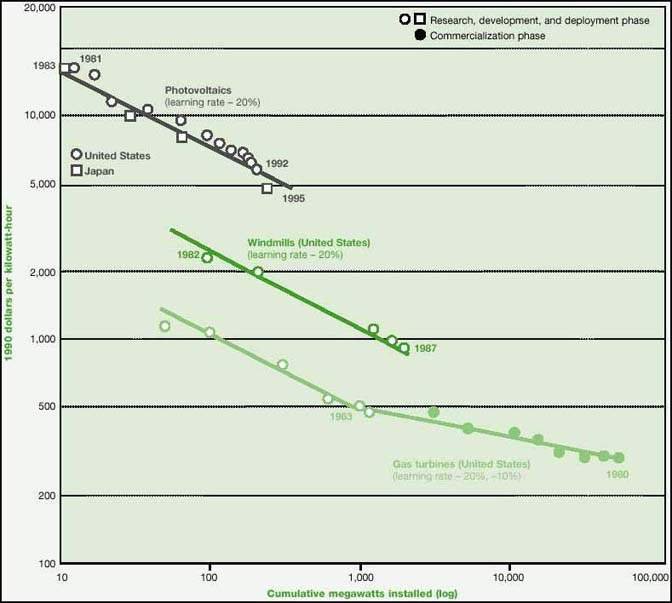
FIGURE 12.1. EXPERIENCE CURVES FOR
PHOTOVOLTAICS, WINDMILLS, AND GAS TURBINES IN JAPAN AND THE UNITED STATES
Technology performance and costs improve with
experience, and there is a pattern to such improvements common to many
technologies. The specific shape depends on the technology, but the persistent
characteristic of diminishing costs is termed the ‘learning’ or
‘experience’ curve. The curve is likely to fall more sharply as
technologies first seek a market niche, then full commercialisation, because
lower costs become increasingly important for wider success.
Source: Nakicenovic, Gr�bler, and McDonald,
1998.
Those actively engaged in or responsible for corporate R&D
often dispute claims that private R&D spending is inadequate, and severely
constrained by the free-rider problem, on the grounds that they need to - and do
- invest in R&D to keep up with competitors and survive. There are many
examples within and outside the energy sector where this is the case. But there
may also be a grey area where energy companies might gain from making additional
R&D expenditures, particularly with a view to using successful results in
their daily operations, but are reluctant to move ahead of competitors if extra
costs are going to be incurred and competitive gains eroded more quickly than
expected returns can justify. The wide range of corporate R&D spending
between innovative engineering companies, on the one hand, and energy service
providers, on the other, may reflect these differing views.
More cogently, firms may not invest adequately in R&D when
innovation is needed to reduce costs not reflected in market prices (such as
environmental costs). Public investment in R&D, as well as policies that
stimulate private investment in R&D related to sustainable energy goals, may
be warranted where there is good reason to believe that private efforts are
falling short.
In general, private efforts seem most likely to fall short in
long-term research (see chapter 8), where returns may be expected to be
particularly uncertain and deferred (and investments open-ended and potentially
large). This approach may be entirely rational for private efforts, yet it may
not advance the public good. In such cases government support for innovation may
be desirable. In the context of using energy provision and use to move towards
sustainable development in the long run, government support is potentially of
great significance.
There is considerable debate about the appropriate role for
government in supporting activities downstream of R&D that involve potential
commercial products. One widely held view is that such activities should be left
entirely to the private sector. But as noted, the private sector tends to focus
its energy innovation investments on incremental changes to existing
technologies for which initial prices for new products are not much higher than
for existing products (and might even be less). For this and other reasons, some
recent studies recommend a major government role in these areas for energy
products anticipated to provide significant benefits that are not adequately
reflected in market prices (PCAST, 1999; Duke and Kammen, 1999).
There is no guarantee, however, that such government involvement
will produce the benefits sought. Indeed, there is a risk - in this as in other
public policy areas - that as a result of lobbying for research spending (the
technology ‘pork barrel’; see Cohen and Noll, 1991 and Savage, 1999,
among others), there may be wasteful diversion of taxpayer funds from more
urgent or productive uses. Such diversion occurs despite numerous past failures
from government interventions of this kind, as indicated at the start of this
section.
Policy options for promoting technological innovation
Research and development. Options for government support
of R&D include grants and contracts, tax incentives to encourage private
R&D, and incentives for national and international collaborations involving
various combinations of private firms, universities, and other research
institutions.
Demonstration projects. Demonstration efforts to prove
technical viability at a near-commercial scale are generally costly, risky, and
difficult to finance. The public sector has a poor track record in picking
winners; its support for demonstration has rarely led to successful commercial
products.8 The most successful demonstration efforts have been those
in which the government role has been limited to setting performance and cost
goals and to providing some financial support. The private sector, meanwhile,
takes responsibility for technological choices in addressing these goals and
shoulders a major share of the needed investment.
Buying down costs. For some radically new energy
technologies intended to meet sustainable development goals, public subsidies
may be needed and justifiable to facilitate private sector-led efforts aimed at
buying down technology costs. Many industrialised and some developing countries
offer financial incentives to stimulate new renewable energy development. The
need for subsidies is especially great where external costs are not fully
internalised in energy prices.
Public resources for technology cost buy-down should be
allocated according to criteria focused on maximising societal returns on these
scarce funds. Incentives should:
· Encourage lower
technology costs through all possible means - including competition, economies
of scale in production, economies of learning through accumulated experience,
and gains from making marginal technological improvements as cumulative
production grows.
· Have sunset provisions that
limit their duration.
· Be restricted to emerging
technologies that offer major public benefits not fully valued in market prices,
that have steep learning curves, and that have good prospects for market
penetration after the subsidies have been phased out.
To spread and reduce risks, buy-down programmes can be designed
to support portfolios of new clean energy technologies.
Competitive market transformation initiatives should be given
close attention for two reasons. First, they offer cost-savings potential.
Second, ongoing energy market reforms provide an opportunity for introducing
policy measures that would make technology buy-down easier. Examples of
competitive market transformation initiatives include the U.S. Renewable
Portfolio Standard, Germany’s former Feedstock Law, and the recently
abandoned U.K. Non-Fossil Fuel Obligation (see above). As noted in the next
section, focused attention should be given to cost buy-down initiatives in
developing countries.
Widespread deployment. Even after successful buy-down,
new energy technologies being pursued for sustainable development benefits often
face significant institutional barriers to widespread deployment. The removal of
such barriers - for example, the sorting out of patent issues, or support for
domestic savings institutions - is an important public policy objective.
Many of the market reforms discussed in the section on making
markets work better (removing subsidies, internalising externalities) will
facilitate widespread deployment of some new clean energy technologies. Such
reforms will be especially helpful in accelerating the deployment of the new
cogeneration and polygeneration options discussed in chapter 8. In addition,
green energy labelling and energy marketing are made possible by market reforms
that enable consumers to choose their energy suppliers.9
One important set of policy issues relates to scale. Some
promising new clean energy technologies are small-scale and modular, offering
attractive economics through their potential for low cost through mass
production and their potential for deployment near users, where market values
are high. But deployment of such technologies, which includes both efficient
end-use technologies and small-scale production technologies, faces barriers at
both the consumer and producer levels.
As discussed in the section on raising energy efficiency, users
of small-scale technologies often lack information on product availability,
costs, and benefits and face barriers to financing. For providers of energy
services from small-scale technologies, a major challenge is overcoming the high
transaction costs that often characterise small-scale systems. Policies to
encourage economies of scope and scale would be helpful in this regard.
Economies of scale might be exploited through policies that
facilitate the development of industries that are able to exploit commercially -
through the introduction of innovative products and services - efficiency
standards, renewables portfolio standards, ‘green certificate’
markets, energy labelling of mass-produced products, and cooperative
procurement. Energy service companies that provide consumers with a broad range
of energy services - whether on their own or through franchises or concessions -
may also emerge (see also chapter 10). Franchises and concessions should be
issued competitively, under contracts that require winners to meet strict
societal obligations (often, the obligation to serve all consumers in the
franchise or concession territory) in exchange for monopoly rights. A long
history of cooperative ventures to promote rural electrification (for example,
in Argentina, Canada, and Europe) offers a model for supporting the diffusion of
small-scale technology (see the section above on widening access). Two off-grid
solar photovoltaic joint ventures in South Africa, between Eskom and Shell and
British Petroleum/Amoco, are other successful models.
A note of caution about new technologies and innovation
policies. Societies hope and expect that new technologies will liberate
humans and enhance the environment - and this is often the case. But not all
technologies provide the benefits sought or intended. Technology can be a source
of environmental damage as well as a remedy (Gr�bler, 1998). Perverse
consequences may follow from what were intended as benign interventions (Jewkes,
Sawers, and Stillerman, 1958). Experience highlights the virtues of caution, the
need for open and multiple processes, and the desirability of taking nothing for
granted.
In pursuing new technologies, the risks and liabilities of
potential negative outcomes should be addressed fundamentally and holistically,
so that actions relating to better understanding and avoiding or mitigating
potential adverse side effects are made an integral part of the innovative
process. A key element of a strategy to minimise the risks of adverse unforeseen
consequences should be to take a portfolio approach to technology development
(that is, ‘don’t put all your eggs in one basket’). The preceding
chapters show the rich diversity of technological opportunities for pursuing
sustainable development goals.
Moreover, long-term research on promising technologies is
usually cheap insurance in pursuing sustainable development (Schock and others,
1999). And because many of the more promising technologies for achieving
sustainable development objectives are small-scale and modular (fuel cells,
efficient building and automobile design, photovoltaic systems), it should be
feasible to construct commercial technology portfolios that are not too costly.
Such considerations also underscore the importance of energy strategies that
emphasise more efficient use of energy. With lower energy demands, society gains
greater flexibility in choosing among advanced energy supply options and can
avoid major commitments to those that appear to pose greater risks.
Even where there is clear evidence that public spending on
energy R&D has fallen or remained static, this may not indicate a need for
increased public spending. It may reflect shifting priorities or the need for a
change in priorities - away from unrewarding programmes or those insufficiently
geared to sustainable development. Public policies, like markets, should be in a
continuous process of evaluation and change with the intention of learning from
others and striving to do better: employing a pluralistic approach, not seeking
monolithic social ends (Popper, 1961 [addenda to 1945]).
Still, the considerations in this section suggest that it may be
desirable to seek new public-private partnerships for accelerating sustainable
energy technology innovation in the 21st century. In partnership with the
private sector, governments may seek to define broad objectives and timetables
for appropriate technological innovation consistent with sustainable
development, and back up these objectives with appropriate incentives. The
private sector would necessarily play the main role in exploring the main
technological choices and making the investments needed to meet these
objectives. The option of carrying out demonstration projects under
international auspices should also be explored, along with innovative ways of
financing such
projects.
Encouraging technological innovation in developing countries
Instead of following the example of today’s industrialised
countries, developing countries have the opportunity to leapfrog directly to
modern, cleaner, and more energy-efficient alternatives. Some developing
countries are well-positioned - from the standpoint of their rapidly growing
energy demands, nascent infrastructure, and natural resource endowments - to
reap the benefits of technological leapfrogging. In some cases developing
countries may even be able to adopt emerging new technologies with near-zero
emissions - resolving the seemingly inherent conflict between environmental
protection and economic development.
There are many developing country examples of technological
leapfrogging. One of the most familiar is the widespread adoption of cellular
telephones, which has eliminated the need for overhead telephone line
infrastructure as a precondition for the diffusion of telephone technology.
There are some notable examples of developing countries being the first to adopt
new technologies, including energy-related technologies. The following advanced
iron-making technologies are among them: direct reduction using natural gas
(Mexico), modern charcoal-based iron-making (Brazil), and first-generation smelt
reduction technology (South Africa). In addition, China is a world leader in
biogas technology. And Brazil led the world in the production and use of
biomass-derived ethanol as a transport fuel, although this initiative has
received less public support in recent
years.
Opportunities for technological leadership
Leapfrogging over some of the historical steps in the
technological development of today’s industrialised countries is a widely
accepted principle. But conventional wisdom cautions against developing
countries taking the lead in commercialising technologies not widely used
elsewhere. Because developing countries face so many pressing needs (see chapter
2), the argument goes, they cannot afford to take the many risks associated with
technological innovation. There is reason to modify this view in some
situations.
First, developing countries in general - and rapidly
industrialising countries (Brazil, China, India, Indonesia, South Africa) in
particular - are becoming favourable theatres for innovation. Most developing
countries are experiencing rapid growth in the demand for energy services, a
necessary condition for successful technological change. Moreover, many rapidly
industrialising countries have large internal markets and are moving towards the
development of strong domestic capital markets and market reforms, including
energy market reforms, that will provide more favourable investment climates. In
many cases these countries also have a large cadre of suitably trained engineers
and others who can contribute to technological advance.
Second, developing countries need new technologies different
from those of industrialised countries. For example, most developing countries
are in the early stages of infrastructure development. They have enormous
demands for basic materials and need innovative technologies that will
facilitate infrastructure development. In industrialised countries, by contrast,
the demand for basic materials is reaching the saturation point, and there is
little need for fundamentally new technologies for basic materials processing.
Third, early deployment of advanced energy generation and use
technologies that are inherently low polluting offers advantages in coping with
the growing environmental problems that are rapidly becoming major concerns in
developing countries, and where end-of-pipe solutions are inherently costly and
likely to become more burden-some as regulations tighten. This is an important
consideration for most developing countries, where regulations for environmental
management are at a very early stage.
|
Users of small-scale
technologies often lack
information
on product availability, costs, and
benefits and face
barriers
to financing. |
Fourth, local manufacturing could lead to larger domestic
markets and opportunities for export growth. Lower wage costs, at least in the
early stages of economic development, could contribute to cost competitiveness.
All these factors suggest that new sustainable energy technologies could reach
competitive levels if substantial early deployment opportunities are pursued in
developing countries.
In addition, substantial benefits may arise from combining local
customs and practices with new technologies, processes, and materials.
Vernacular architecture, long suited to local climatic conditions and culture,
may be intrinsically superior to imported designs and materials, yet open to
benefits from better processes and materials. Cooking and space heating devices
may be similarly open to local
reconfiguration.
Supporting demonstration and diffusion
Beyond the widely applicable remarks already offered on policies
supportive of energy innovation (see the section on the rationale for public
policy support), a few additional considerations apply specifically to
demonstration and cost buy-down projects in developing countries. Demonstration
projects will be needed in many developing countries because technologies
developed elsewhere should be tailored to host country needs. In addition, some
of the needed technologies - such as biogas- and biomass-derived gaseous and
liquid cooking fuels and small-scale biomass power generating technologies (see
chapter 10) - are unlikely to be developed and demonstrated elsewhere. Yet
financing such projects in developing countries is difficult, not only because
of the high costs and technological risks involved, but also because it is
difficult to get support from industrialised country governments or
international agencies.
Focused attention should also be given to possibilities for
technology cost buy-down projects in developing countries. Otherwise, large
volumes of new equipment based on old, polluting technologies are likely to be
installed in these countries and locked in place for decades to come. Moreover,
the rapid growth in energy demand in these countries offers an opportunity to
buy down technology costs more quickly than in the relatively slow-growing
markets of industrialised countries. Broad-based financial support and
risk-sharing strategies are likely to be key for both demonstration and cost
buy-down projects.
In the absence of proactive measures, barriers to international
trade may have to be resorted to, in order to impede imports of less efficient
and dirtier technologies, and to provide preferences for more efficient and
cleaner technologies. Environmental treaties using trade measures date back to
1881, when steps were taken to prevent the international transfer of phylloxera
in vines. Recent examples include CITES, which constrains trade in listed
species and products; the UN agreement on conserving and managing straddling
fish stocks and highly migratory fish stocks; and the Montreal Protocol, which
requires signatories to ban imports of ozone-depleting substances from
non-signatories not in compliance with the protocol. The World Bank has outlined
the reasons multilateral trade measures, but not unilateral ones, may be
justified to help tackle global environmental problems - provided they can be
made effective (World Bank, 1999d). And in June 1997 the UN General Assembly
adopted proposals to make trade and the environment mutually supportive. If
trade measures were used wisely and well in international environmental
agreements, they could facilitate technological
leapfrogging.
International industrial collaboration
Economic globalisation and ongoing market and institutional
reforms are attracting more private capital to developing countries, as
reflected in the sharp increase in private investment in these countries
(especially net foreign direct investment). In contrast, the drop in official
development assistance from OECD countries suggests that the adverse
environmental consequences accompanying industrialisation in developing
countries are unlikely to be corrected by aid unless there is a huge turnaround
from the declines of the 1990s. This implies that the private sector should be
looked to in order to fill the vacuum. The fact that legal rights to and
experience with most advanced and new technologies exist in the private domain
needs to be acknowledged and suitably compensated for (possibly by
industrialised governments in support of technology transfer) if the vacuum is
to be filled. Making industrialisation an instrument for sustainable development
could prove an important means of addressing these problems (Wallace, 1995).
International industrial collaboration could provide a means to
exploit the potential cost advantages of early deployment of state-of-the-art
sustainable energy technologies in some rapidly industrialising countries. Such
collaboration could also foster the development of such technologies to the
point that developing countries become world leaders and even exporters of such
technologies. Among alternative approaches to industrial collaboration, the
international joint venture is especially promising for technology transfer
(STAP and GEF, 1996).
In principle, private sector-led technology transfer holds
considerable appeal. But some developing country policy-makers believe that
payments for technology are beyond their means and that international technology
transfer contributes little to technological development in the recipient
economy. Through empirical research on factors affecting energy-saving technical
changes in Thailand's energy-intensive industrial firms, Chantramonklasri (1990)
has shown that such problems can be reduced if measures are taken to promote
“active technological behaviour” by technology-importing firms. He
points out that effective technological development requires complementing the
acquisition of capital goods, services, and operational know-how with the
acquisition of system-related knowledge.
|
Among alternative approaches to
industrial collaboration,
the
international joint venture is
especially promising for
technology
transfer. |
This includes the basic technological principles involved, the
various technical and managerial skills and experience needed to use the
acquired system effectively, and initiatives to improve the system incrementally
in light of local conditions and needs.
The research shows that the greater is the stock of
technological capabilities within and around technology-importing firms, the
greater are the increments to that stock that can be acquired in industrial
collaborations. Chantramonklasri finds that with active intervention and
interaction, a virtuous circle can lead to gains in technological capacity and
industrial productivity. Firms that fail to take actions that enable them to
enter the virtuous circle will be left in a vicious circle of technological
dependence and
stagnation.
Towards a supportive policy framework
As discussed, developing and transition economies can increase
economic efficiency by introducing reforms that price energy rationally, promote
competition in energy markets, and strengthen domestic capital markets. Such
market reforms also facilitate energy technology transfer and energy technology
innovation generally. Along with relatively rapid growth in the demand for
energy services, these reforms can create strong markets in these countries and
encourage the provision of energy technologies that are well suited to domestic
needs.
The market reform process provides a window of opportunity for
simultaneously introducing reforms that facilitate the introduction of
innovative sustainable energy technologies. The process may be enhanced by
governments setting goals that define the performance characteristics of
qualifying sustainable energy technologies (for example, by specifying
efficiency and air pollution emission characteristics). The setting of these
goals can be complemented by credible regulatory or other policy mechanisms that
favour sustainable energy technologies in energy market choices.
Policy-makers should also consider introducing institutional
reforms that facilitate the formation of international joint ventures and other
international collaborative efforts to encourage sustainable energy technology
transfer and innovation. Where such reforms are conducive to greater political
stability, more straightforward transactions, and fewer arbitrary interventions,
they are likely to prove especially supportive of technological innovation and
diffusion. Bilateral and multilateral financing and assistance agencies could
usefully be encouraged to be more open to supporting energy technology
innovation that is consistent with sustainable development
goals.
Capacity and institution building
Capacity and institution building are needed if sustainable
energy technologies are to fulfil their potential in contributing to the
sustainable energy development of developing and many transition economies.
Programmes should build on the experience of the World Bank and UNDP (such as
UNDP’s Capacity 21 Programme, cited above) and on the experience gained in
numerous developing countries (Farinelli, 1999).
One priority is training aimed at providing expertise for
staffing companies that will produce, market, install, and maintain sustainable
energy technologies. This need has been underscored by evidence that higher
technical and managerial skills among staff of host country partners in
international industrial collaborations improve prospects for successful
technology transfer and innovation (Chantramonklasri, 1990). Technological
capability can also be raised by establishing regional institutes that provide
training in the basic skills of technology management. Such institutes are
likely to be more effective if they enjoy close links to energy technology user
groups.
Public agencies and private research institutes in
industrialised countries could also help build capacity for sustainable energy
development in developing and some transition economies, by helping to form and
staff parallel institutions in these countries to assist local policy
development and technology assessment. Regional and national programmes and
centres for renewable energy and energy efficiency promotion in Brazil, China,
India, and Eastern Europe could serve as models. Such agencies and research
institutes can help provide independent assessments of alternative technology
and policy choices, and can explore strategies for overcoming barriers
inhibiting large-scale implementation of sustainable energy technologies.
There is also scope for coordinated initiatives between
specialised consultancies, companies, and local communities.10 These
ideas do not imply, however, that specialists in industrialised countries have
achieved the desired results of sustainable energy development, and that they
can now apply their efforts elsewhere. This is not the case, and it would be
condescending even if it were. The challenges remain
global.
Moving towards more effective cooperation
In recent decades there has emerged a growing sense that many of
the issues facing today’s world cross national boundaries - and that
national policies and measures are insufficient to address them. This is
particularly the case for resource exploitation, support for the needy, and
environmental issues with cross-boundary impacts. A view is emerging that
internationally harmonised measures are becoming increasingly necessary to
improve performance standards, reduce adverse environmental impacts of human
activities, and accelerate change in the directions widely desired.
To do so successfully, however, requires careful evaluation,
adequate funding, and appropriate conditionality on spending to ensure that it
conforms to its intended purpose. As set out in numerous UN documents, and
agreed to by all the parties to them, industrialised countries have undertaken
to take the lead in this endeavour, not least by supporting the transfer of
technology, finance, and know-how to developing and transition economies.
Although international cooperation in these matters is still in its infancy,
many consider the pace of progress unsatisfactorily slow relative to the scale
and nature of the problems facing our world.
In June 1997 the UN General Assembly Special Session noted the
increasing need for better coordination at the international level as well as
for continued and more concerted efforts to enhance collaboration among the
secretariats of international organisations in the UN system and beyond (clause
117; see Osborn and Bigg, 1998, p. 185). Along those lines, the UN Commission
for Sustainable Development was asked to establish closer interaction with a
range of international institutions and to strengthen its interaction with and
encourage inputs from a range of social actors (clause 133; Osborn and Bigg,
1998, p. 189).
More recently, the roles of the International Monetary Fund and
the World Bank have come under scrutiny, particularly in the contexts of whether
their resources are sufficiently targeted on improving the development
performance of the poorest countries and on the criterion of sustainable
development. Where existing jurisdictions are not sufficiently broad or
institutions do not move quickly and effectively enough to meet policy goals or
allay public concerns, consideration should be given to institutional reform or
the creation of new institutions.
Issues that fall into multiple jurisdictions require coordinated
international action. These include international trade disputes, transnational
efficiency and performance standards for equipment and appliances, international
aviation and marine bunkers, and transit corridors for energy transport
(pipelines, tankers, and grids).
The World Trade Organization (WTO), created in 1995 to succeed
the General Agreement on Tariffs and Trade (GATT) after completion of the
Uruguay Round of international trade negotiations, has a mandate to expand
multilateral trade. It operates by policing the multilateral trade system and by
seeking to resolve trade disputes through ‘independent’ dispute
panels. Widely regarded as a vehicle for globalisation, its activities have been
criticised by special interest groups who see globalisation as a threat - to
trade unions, environmental protection, and local cultural values and customs.
The WTO meeting in Seattle, Washington, in December 1999,
intended to start a new round of trade liberalisation, turned into a
“fiasco” according to The Economist (4 December 1999). The same
magazine recognised the following week that this was “only the latest and
most visible in a string of recent NGO [non-governmental organisation]
victories”. The official outcome of Seattle was that the effort to start a
new round of trade negotiations was “suspended”. Criticism continues
of what are claimed to be the WTO’s unwieldy structure, arcane procedures,
and numerous festering disputes.
Yet free international trade is of great importance to
developing countries - by 1999, 134 countries had joined the WTO (World Bank,
1999d) - and to the welfare of poor people. There is a vast literature on the
links between trade and increased incomes for the poor as well as the relatively
rich. WTO critics are particularly vocal on the need to link free international
trade with new initiatives on employment standards (which risk undermining the
competitiveness of developing countries and protecting jobs in industrialised
countries) and the environment. They are also usually highly critical of the
role of major companies involved in international business.
The International Labour Organization plays a key role in
employment conditions. There are various environmental initiatives under UN
auspices (through the United Nations Environment Programme, United Nations
Framework Convention on Climate Change, and so on). The United Nations
Conference on Trade and Development (UNCTAD) has been concerned since 1964 with
improving the prospects for developing countries’ trade. This could be
accomplished by better coordinating international action on multilateral trade,
including a closer link to the needs of sustainable development. The WTO could
play a significant role in promoting sustainable energy development in general,
and technology leapfrogging in particular, by developing supportive multilateral
trade measures. This discussion is in line with the need perceived by the UN
General Assembly Special Session in June 1997 to make trade and the environment
mutually supportive.
International initiatives on international aviation and marine
bunkers are proceeding slowly. In both cases users and beneficiaries are not
paying the full costs of operations. In international aviation, costs should
capture the impacts of flight on the lower stratosphere and upper atmosphere, of
emissions and noise at lower levels, and of infrastructure requirements on the
ground (Penner and others, 1999). In international maritime movements, the full
effects of emissions and spills should be captured in costs and the onus for
reductions and removal should be placed firmly on the operators. Increasingly
stringent standards should be imposed, especially for sea-going vessels in which
multihull construction and high maintenance standards may not be readily
detectable.
Under the aegis of the UN Framework Convention on Climate
Change, the International Civil Aviation Organization and the International
Maritime Organization have been asked to report on greenhouse gas emissions
associated with international aviation and marine bunkers. The environmental
impacts of these emissions go beyond global climate change,
however.
Cooperative efforts to ensure supply security
Supply security is a concern related to availability, the
functioning of markets, and the need for international cooperation. A priority
issue for national and international policy in 1971-85 (especially during the
crises of 1973-74 and 1978-80), it has slipped down the list of priorities. As
discussed in chapters 4 and 5, the world has huge geological resources of fossil
fuels, along with considerable potential for energy from non-fossil fuels. It is
usually in the interest of producers to keep supplies flowing smoothly. A common
view is that there will be ample oil and natural gas available, that it will be
supplied at low prices, and that if financial flows are inadequate, it will
mainly be exporters of oil and natural gas who suffer. This perception is
applicable at least to the foreseeable future - the first 20 years of this
century.
An alternative view should not be overlooked, however. The
number of people dependent on imported oil and natural gas is likely to more
than double by 2020 from the nearly 3 billion in 1990. Political unrest,
economic frustration, or simply misjudgement about the potential gains from
supply disruption could increase over the period. Despite the physical
availability of energy sources, precautionary strategies to maintain supply
security continue to have merit (see chapter 4; IEA, 1998; EC, 1999). These
include:
· Encouraging open
international trade systems.
· Maintaining harmonious
international diplomacy.
· Considering different
allocations of tax revenues between upstream and downstream governments (along
the lines of ‘compensation’ for fossil fuel producers and exporters as
indicated in article 4.8 (h) of the UN Framework Convention on Climate Change).
· Diversifying supply sources
(widening the geographic range of suppliers and maintaining adequate storage
facilities and inventories of oil and natural gas).
· Expanding indigenous supplies
of non-fossil fuels, provided there are no severely adverse
consequences.
In the meantime, fluctuating OPEC production levels may cause
large price fluctuations - as with the tripling of crude oil prices in 1999.
Market responses have included rising prices of gasoline and of oil products for
heating. By March 2000 gasoline prices at the pump had risen above $2 a gallon
in many parts of the United States, once again raising questions about ‘gas
guzzling’ vehicles and encouraging the use of public transport. This
experience has again demonstrated the potential value of market prices in the
promotion of sustainable development.
The Energy Charter Treaty is a potentially useful example of
broad international action that encourages its signatories to afford comparable
treatment of energy markets, with special protocols being negotiated on energy
transit, energy efficiency, and other matters(see also chapter 4). Originally
put forward in 1990 as the European Energy Charter, the Energy Charter Treaty
was signed in 1994 by some 50 countries, including most OECD countries, all the
republics of the former Soviet Union, and the countries of Central and Eastern
Europe.
Despite the charter’s purpose of facilitating energy trade
and investment between the signatory countries, and general recognition of the
need for this, the charter has a long way to go before it becomes meaningful in
practical terms. The reasons partly lie in the legal and administrative
weaknesses and complexities in most transition economies. Moreover, the charter
imposes no enforceable obligations on its signatories. Nevertheless, such an
approach could in principle be used more broadly to address the significant
shift needed to achieve sustainable energy.
A number of regional unions and associations could promote
sustainable energy development. More than 80 regional trading arrangements came
into force between 1990 and 1998 (World Bank, 1999d). The Mercosur customs union
created by Argentina, Brazil, Paraguay, and Uruguay in 1991 (the final protocol
was signed in 1994) is one example, with an emphasis on regional cooperation and
the abolition of tariffs. Other organisations in other regions (including
several in the Mediterranean Basin) could perform a similar role. Especially in
Africa, there is a perceived need for progress on this front. One goal of such
regional arrangements could be to promote cross-border interconnections for
electricity distribution and gas pipeline networks, to widen access to these
fuels.
International cooperation on climate change
The challenge of sustainable development presents significant
opportunities for international cooperation. The 1992 Earth Summit was a
particular landmark. Tangible outcomes from it include the Rio Declaration,
Agenda 21, and international conventions on climate change, biodiversity, and
desertification.
The most detailed convention framework is the UN Framework
Convention on Climate Change (box 12.6). The Kyoto Protocol is a potentially
useful further development - if industrialised countries take effective action
to curb their greenhouse gas emissions and supplemental action is taken to
implement the Kyoto mechanisms. But progress in implementing the provisions of
the Convention on Climate Change has been slower than the threat and likely
impacts of global climate change suggest are desirable. Agreement on many issues
is proving elusive, including realistic emission targets, speedy and effective
introduction of new mechanisms, emphasis on the priority of domestic action by
all industrialised country parties, and genuine acceptance of legally binding
agreements. Yet all these elements seem to have been agreed to in principle by
the parties to the convention.
|
BOX 12.6. THE MONTREAL PROTOCOL AND THE UN FRAMEWORK
CONVENTION ON CLIMATE CHANGE: CONTRASTING EXAMPLES OF INTERNATIONAL
COOPERATION
The 1987 Montreal Protocol (and subsequent amendments and
tightening) - which curbs the production and use of stratospheric
ozone-depleting substances - is the most successful recent initiative for
international cooperation. Except for a few outstanding issues (such as the
continued production and smuggling of these substances), this initiative was
agreed to with unprecedented speed and has proven increasingly effective.
The speed and outcome of the UN Framework Convention on Climate
Change and its subsequent agreements are far less certain, even though the
framework is solid. As a way of drawing lessons from the success of the Montreal
Protocol, it may be useful to consider some of the factors that contributed to
it, relative to similar elements in the effort on climate change.
In terms of the pace of international action on climate change,
the first point is key. Many public statements are predicated on the assumption
that climate change is problematic only over the long term. They tend to
under-estimate how much climate change is believed to have already occurred
(even taking into account natural variability) and how long it will take for
atmospheric concentrations of greenhouse gases to cease rising.
According to scientists and informed commentators, the situation
calls for greater urgency. Mean surface temperature levels have risen by about
0.8 degrees Celsius since the 1890s. The 20th century warming (in 1910-45 and
1976-99) was the fastest in more than 800 years. The 1976-99 warming converts to
a centennial rate of change of almost 2 degrees Celsius.
Perhaps of greater significance, the atmospheric concentration
of carbon dioxide (currently about 368 parts per million by volume, or ppmv) is
considerably higher than at any time in at least 400,000 years - and perhaps for
15 million years. It is already more than 30 percent higher than the
pre-industrial level (280 ppmv) of the early 1800s. Given what is firmly known
about the science of the greenhouse effect, this is disturbing. The most
optimistic and environmentally driven scenarios suggest atmospheric carbon
dioxide concentrations peaking around 2060 at about 430 ppmv, and falling only
slowly over the next 50 years, with global surface temperature rising by about
1.5 degrees Celsius. Even this increase could have significant local and
regional impacts.
But there is a real risk of much greater temperature increases,
with severe consequences, if atmospheric concentrations of the key green-house
gases continue on the upward path of recent decades. For 10 years the
Intergovernmental Panel on Climate Change has maintained its view that global
anthropogenic carbon dioxide emissions need to be cut by at least 60 percent
from their 1990 level in order to eventually stabilise atmospheric
concentrations at their 1990 level of 353 ppmv (Houghton, Jenkins, and Ephraums,
1990). |
|
Montreal Protocol |
Convention on Climate Change |
|
A widely acknowledged and immediate (as well as long-term)
threat to human well-being, with clear identification of human causation. |
Dispute over the scale, urgency, and human causation of climate
change - although in principle the convention regards scientific uncertainties
as irrelevant to the need for precautionary measures. |
|
A widely available range of alternatives for use in industry (a
result of extensive research and development in both industrialised and
developing countries). |
Alternatives to fossil fuels and clean fossil fuel technologies
are still emerging. Their widespread availability and affordability will require
further support. |
|
Support from crucial industry players. |
Industry has been receiving mixed signals and has sent mixed
signals (especially some sections of U.S. industry), and there are many players.
|
|
Industrialised countries willing to financially support
programmes for reducing ozone-depleting substances in developing countries.
|
Multilateral and bilateral support for pilot projects, but
without crediting and after considerable opposition from many developing
countries. |
Despite international concern, the UN Framework Convention on
Climate Change and its aims, and the Kyoto Protocol and its targets, many
industrialised countries continue to increase their greenhouse gas emissions,
especially of carbon dioxide (table 12.3). Data for 1999 suggest that carbon
dioxide emissions from fossil fuel combustion rose 2 percent in Canada and the
United States (though against a backdrop of even faster real GDP growth). The
three original OECD Pacific economies (Australia, Japan, and New Zealand) also
increased their carbon dioxide emissions by almost 2 percent. By contrast, the
15 members of the European Union saw emissions drop 0.5 percent from 1998.
Reductions in China’s carbon dioxide emissions from coal burning - which
first became apparent in 1997 - were even more marked, dropping by more than 5
percent in 1999. This progress is exceptional, and may not be long-lasting. The
policies, measures, and technologies that would permit the lowering of future
trajectories of developing country emissions are not being put in place quickly
enough.
Once frameworks have been established through intergovernmental
negotiation, signature, and ratification, actual progress relies on genuine
cooperation. Politics and short-term manoeuvres need to give way to seeking the
most cost-effective and technically feasible means of accelerating progress
towards the agreed goals. One problem is that commitments entered into by
negotiators are not always enacted by lawmakers, which complicates the timely
pursuit and achievement of goals relating to sustainable development. For this
reason, new mechanisms are needed and should be given practical trial without
delay. If such mechanisms prove effective, early movers could be given tangible
rewards. Short action plans could accelerate performance. Achievement of
commitments could be enhanced by legally binding penalties for non-performance.
Where divisions and delaying tactics exist, the underlying
problem of lack of societal commitment, political support, or agreement within
the national government may need to be addressed separately. The preferred
option in such circumstances is to gain the support of other social actors -
from business and industry, local communities and municipal governments, and
environmental and other socially concerned non-governmental organisations
(NGOs).
The Clean Development Mechanism and Joint Implementation
articles (12 and 6, respectively) of the Kyoto Protocol, negotiated in 1997
under the UN Framework Convention on Climate Change, offer potentially important
opportunities to increase investments in developing and transition economies,
respectively, in sustainable energy. The complex nature of climate change
negotiations and the uncertainties surrounding the issue mean that effective
introduction of such instruments may not come about for many years(though some
people hope that real implementation may follow quickly from the Sixth
Conference of the Parties to the Climate Convention, or COP-6, in November
2000). Meanwhile, a growing number of people in the industrialised world’s
business and industry community have already developed plans to participate in
relevant projects drawing on the mechanisms that have been tabled, especially in
the Kyoto Protocol, and are experimenting with emissions trading under article
17 of the protocol.
TABLE 12.3. CHANGES IN CARBON DIOXIDE EMISSIONS FROM FOSSIL
FUEL USE, 1990-99 (PERCENT)
|
Area |
Change |
|
Canada andthe United States |
+12.7 |
|
Latin America |
+23.3 |
|
European Union |
+0.8a |
|
Central and Eastern Europe/CIS Republics |
-35.8 |
|
Middle East |
+62.7 |
|
Africa |
+21.9 |
|
Asia and the Pacific (excl. Australia, Japan, New Zealand) |
+34.8 |
|
Total OECD (excl. Hungary, Rep. of Korea, Mexico, Poland) |
+10.8 |
|
Developing countries |
+34.3 |
|
World |
+7.6 |
a. If not for major reductions in Germany (-13.5
percent) and the United Kingdom (nearly -8 percent), this figure would be much
higher.
Source: Jefferson, 2000.
In 1999 a World Energy Council pilot project (strongly supported
by Asea Brown Boveri) identified nearly 400 projects in some 80 countries
expected to avert 720 million tonnes of carbon dioxide by 2005. (The project
also identified another 91 potential or planned projects that could avert an
additional 139 million tonnes of carbon dioxide.) Although many of these
projects may not be additional to what might otherwise have occurred, they
indicate that a substantial - though insufficient - effort is under way.
For several years, and especially since the Earth Summit,
companies and their senior executives associated with the World Business Council
for Sustainable Development have been promoting actions and investments
consistent with sustainable energy development, including climate change
mitigation, under an eco-efficiency programme. The European Business Council for
a Sustainable Energy Future is one of several regional and national business
associations that have been promoting sustainable energy development in general
and climate change responses in particular. In Latin America the regional
chapter of the World Business Council for Sustainable Development has been very
active. More recently, the Pew Center on Global Climate Change has brought
together major international corporations (Dow, DuPont, British Petroleum/Amoco,
Royal Dutch/Shell Group) to take voluntary steps to reduce their greenhouse gas
emissions and raise energy efficiency. These endeavours could usefully be
extended to smaller companies and to the particular challenges and opportunities
facing developing and transition economies.
Intergovernmental and international institutions have made
efforts to take forward the mechanisms set down in the Kyoto Protocol.
Potentially one of the most significant recent funding initiatives, in terms of
possible scale and geographic range, is the World Bank’s Prototype Carbon
Fund, launched in January 2000. Involving four governments and nine companies
(six of them Japanese electric utilities), the fund raises money from both the
public and private sectors. (Governments pay $10 million to participate,
companies pay $5 million.) The fund will be used to finance projects aimed at
reducing greenhouse gas emissions in developing countries. Participating
countries will receive emission credits from the World Bank in line with the
emission reductions achieved by the projects.
Although some observers have questioned whether the World Bank
is the most appropriate body to conduct this task, it does encourage
public-private cooperation, relevant projects, early action, and rewards to
early movers. Still, it will be important to ensure the commercial viability of
projects so that wider and faster diffusion of sustainable energy technologies
can be attained, and to gain general agreement on credits awarded.
Overall, however, more - and more rapid - work is needed to
implement cost-effective precautions in line with the UN Framework Convention on
Climate Change. Three features of the Programme for the Further Implementation
of Agenda 21, adopted by the UN General Assembly Special Session in June 1997,
stand out as having met with an inadequate response:
· International
cooperation on implementing chapter 9 of Agenda 21, particularly in technology
transfer to and capacity building in developing countries - which are also
essential for the effective implementation of the UN Framework Convention on
Climate Change (clause 53; see Osborn and Bigg, 1998, p. 161).
· Progress by many
industrialised countries in meeting their aim to return greenhouse emissions to
1990 levels by 2000 (clause 48; see Osborn and Bigg, 1998, p. 160).
· The need to strengthen
systematic observational networks to identify the possible onset and
distribution of climate change and assess potential impacts, particularly at the
regional level (clause 54; see Osborn and Bigg, 1998, p.
161).
Widening the involvement in sustainable energy development
A critical mass of general public support will be needed for
major changes to take place and the pursuit of sustainable development to occur.
Here the role of NGOs could prove increasingly influential and beneficial,
building on their contributions in the 1990s (for example, at the Earth Summit
and at the series of conferences taking place on climate change). Some observers
have expressed concern that rivalry between NGOs (in part to secure public
support and attract funding) could be self-defeating. There has also been
concern that NGOs may supplant the role of national governments, with negative
as well as positive consequences.
NGOs can nevertheless be expected to play an increasingly
important role in bringing the issues discussed in this chapter to a wider
audience, in mobilising opinion, and in emphasising the importance of bearing in
mind local conditions and cultures - in part through their huge network of
contacts. Policy development is likely to benefit from bringing better-informed
NGOs to the centre of policy formulation and application. For this to succeed,
however, national and intergovernmental institutions will have to genuinely
interact and consult in a two-way process.
The same is true for other social actors, whether they be local
authorities, business and industry, educational institutions, the scientific
community, the media, the young and the old, men and women - all with their
particular perspectives and needs. In June 1997 the UN General Assembly Special
Session recognised the importance of all these groups (for example, in clauses
11 and 28). But both in the programme it adopted for the further implementation
of Agenda 21 and in this chapter, two points may stand out above all others. The
first is the need to invigorate a genuine new global partnership. The second is
the need to provide adequate and predictable financial resources to developing
countries, where private capital flows and an environment conducive to their
continuation and expansion are of paramount importance if sustainable
development is to be achieved.
|
A critical mass of general
public support will be
needed
for major changes to take place
and the pursuit of
sustainable
development to occur. |
Conclusion
In essence, sustainable development means widening the choices
available to humans alive today, and to at least the next few generations. A
shift in the direction of energy systems and policies along the lines described
in this chapter - towards greater emphasis on end-use efficiency, renewable
energies, and low-emission technologies - is necessary for achieving that goal.
It is impossible to know in advance the precise combination of policies and
policy instruments that will work under different conditions, and the costs and
benefits of emerging technologies. But the broad strategies put forward here
provide an indication of the way forward. There is also a sufficient variety of
policies from which to begin to gauge the more likely successes.
The ongoing liberalisation and restructuring of energy markets
and sectors offer an important window of opportunity in which to make many of
the needed changes. Growing energy demands in the developing world provide
further impetus to make changes sooner rather than later. Energy systems
generally take decades to change. If we fail to initiate changes now, it will
become more difficult and more costly to undertake them at some later date (WEC,
1995; Nakicenovic, Gr�bler, and McDonald, 1998).
The policies likely to encourage energy systems that will
support sustainable development, as discussed in this chapter, are founded on
the underlying aim of making markets work better. Additional investments in
environmentally friendly technologies will be required, as will encouragement of
the innovation and diffusion of sustainable energy technologies. Successful
implementation of these policies requires improving the costing and pricing of
energy carriers and services, as well as specific regulations to raise
efficiency and reduce pollution, in order to ensure greater and wider public
benefits.
Making markets work better
Policies that reduce market distortions (that is, level the
playing field) would give sustainable energy - new renewable sources, energy
efficiency measures, new technologies with near-zero emissions - a considerably
better market position relative to conventional energy sources. Market
distortions can be reduced by phasing out permanent direct and indirect
subsidies to conventional energies and energy use in all end-use sectors, by
including social and environmental costs in prices, and by introducing
appropriate regulation, taxes, or financial incentives.
Another way of making markets work better is to complement
ongoing market reform with regulations that support sustainable energy. A number
of the obstacles to greater energy end-use efficiency are the result of market
imperfections or barriers. Options to overcome these barriers include voluntary
or mandatory standards for appliances, vehicles, and buildings; labelling
schemes to better inform consumers; technical training in new energy efficiency
technologies and their maintenance; and credit mechanisms to help consumers meet
higher first
costs.
Mobilising additional investments in sustainable energy
Incentives may be needed to encourage private companies to
invest in sustainable energy or to defray the risks associated with such
investments. International funding sources may also need to play a greater role
in the least developed countries, especially those where the overall conditions
that attract business are lacking and joint efforts are required to improve
those conditions. Supportive financial and credit arrangements (including many
microcredit arrangements already in existence) will be needed to introduce
commercial energy to those excluded from markets, especially in rural areas.
For decentralised provision of modern energy services, capital
costs may best be met from a mix of local equity capital (communal or private)
and loans from banks or other conventional credit organisation at commercial
rates. There may be a role for industrialised country governments in backing
loans with guarantees, on mutually acceptable criteria. Subsidies, with
‘sunset’ clauses for environmentally sustainable technologies, may
help. Above all, a one-stop approach from agencies specialising in the financing
of rural electrification and renewable energy schemes would be beneficial -
especially in overcoming the barriers associated with current time-consuming and
costly procedures. The scale of such arrangements will need to be massively
expanded to achieve the required results. The principles of good governance -
including stability, probity, and the rule of law - are also significant for the
promotion of
investment.
Encouraging technological innovation
Currently applied technologies are not adequate to deliver the
energy services that will be needed in the 21st century and simultaneously
protect human health and environmental stability. Adequate support for a
portfolio of promising advanced and new technologies is one way to help ensure
that options will be available as the need for them becomes more acute. Direct
government support is one option, but the historic record is somewhat
discouraging and suggests that support for generic research rather than
large-scale commercialisation is likely to be more fruitful. Other ways to
support technological innovation, while still using competition wherever
possible to keep down costs, include tax incentives, collaborative R&D
ventures, government and industry procurement policies, ‘green
labelling’ schemes, public benefits charges, and market transformation
initiatives.
|
The ongoing liberalisation and
restructuring of energy
markets and
sectors offer an important window
of opportunity in
which
to make many of the
needed changes. |
Supporting technological leadership and capacity building in developing countries
Because most of the projected growth in energy demand will occur
in the developing world, innovation and leadership in energy technologies could
be highly profitable for some developing countries in economic, environmental,
and human terms. But they will need assistance with technology diffusion
(including transfers), financing, and capacity building. Much of this support
will need to be led by the private sector, by private-public partnerships, or
both.
Consideration could be given on a multilateral basis to
providing preferential treatment for international trade in cleaner and more
efficient technologies and products, within international trading arrangements
that could be adjusted more clearly towards sustainable energy development.
Wider use of green labelling schemes and harmonised regulations and standards
would help. International industrial collaboration offers a way for the private
sector to gain markets while fostering the migration of new technologies to
developing countries. Public agencies, private research institutes, and regional
institutes that provide training in technological management are additional
possibilities for further technology sharing and capacity building. Coordinated
institutional approaches are required for capacity building, effective market
functioning, technology diffusion and financing, and successful international
initiatives. Community participation can also play an important role in
promoting these
policies.
Encouraging greater international cooperation
Ongoing globalisation means that ideas, finances, and energy
flow from one country to another. In this context, isolated national actions are
no longer likely to be the only or the most effective option. Two key areas in
which harmonisation could be helpful are environmental taxes and efficiency
standards. The need for concerted action on energy is also clear from the major
international conventions that emerged from the Earth Summit - particularly the
UN Framework Convention on Climate Change. Although the basic principles and
many more detailed articles of that convention encourage sustainable energy
development, and should provide an excellent framework for future progress,
implementation has been slow relative to the urgency of achieving greater
sustainability.
The challenge of sustainable energy includes crucial enabling
roles for governments, international organisations, multilateral financial
institutions, and civil society, including the private sector, NGOs, and
individual consumers. Partnerships will be required, based on more integrated
and cooperative approaches, and drawing on a range of practical experience. A
common denominator across all sectors and regions is setting the right framework
conditions and making public institutions work effectively and efficiently with
the rest of society and economic actors in reaching beneficial and shared
objectives.
Used safely and wisely, energy can make a powerful contribution
to sustainable development. Redirecting its power to work towards the
overarching goal of sustainability, however, will require major policy changes
within an enabling overall framework. Poverty, inequity, inefficiency,
unreliable service, immediate environmental priorities, lack of information and
basic skills, and absence of needed institutions and resources require that
changes be made. Unless truly significant changes begin to take place within the
next 20-30 years, many of the opportunities now available will be lost, the
possibilities for future generations diminished, and the goal of sustainable
development unrealised. The ninth session of the UN Commission for Sustainable
Development provides an opening in which to galvanise consensus on the energy
and transportation issues discussed in this chapter. The special session of the
UN General Assembly in 2002 is a further opportunity to pursue ways in which the
broader international policy framework can be more supportive of sustainable
energy
goals.
Annex. Trends in research and development funding
It is widely held that R&D expenditures on sustainable
energy technologies are too low and falling. This annex examines R&D trends
in more detail. As discussed in box A12.1, however, because of the way the data
are collected, categorised, and compared, the accuracy of the figures cited here
and elsewhere is difficult to assess.
Private sector spending on energy research and
development
Private sector spending on energy R&D, based on U.S. data,
is believed to have been low as a share of sales over a long period. In recent
years U.S. utilities appear to have invested just 10 percent as much as U.S.
industries overall. But whereas most major electric utilities and oil and gas
companies in OECD countries spend less than 1 percent of sales on R&D, the
main research-oriented firms servicing broader energy technology needs (such as
Asea Brown Boveri and Siemens) invest 8-30 times as much. Still, spending on
energy R&D generally seems low relative to the 7 percent of GDP represented
by retail spending on energy in countries that are members of the International
Energy Agency.
On the other hand, in several countries with relatively detailed
and reliable data on private sector spending on energy R&D - such as
Finland, Germany, and Japan - it is clear that there have been significant
overall increases in recent years. Part of the explanation is that during the
1990s these countries saw sharp increases in R&D spending on renewables,
energy efficiency, and advanced cleaner fossil fuel technologies. The progress
of private sector spending on energy R&D in Japan, as provided in a major
report prepared in 2000 (Ito 2000), is distinctly more upbeat than others have
reported (Dooley, 1999a). Although private sector spending on energy R&D in
Canada has remained flat in real terms since the early 1980s, this masks a
decline in fossil fuel R&D on the one hand, and an increase in energy
efficiency, fuel cell, climate change technology, and electricity R&D on the
other. There is no evidence of a decline in utilities’ spending on R&D
in Norway and Sweden (Haegermark, 2000). In Germany private sector R&D has
assumed an increasing role while government R&D has fallen. In Austria,
although there have been considerable variations in recent years, industrial
spending on renewable energy - particularly biomass - rose sharply in 1996-98
(Faninger, 2000).
Thus there are strongly contrasting experiences. The reported
decline in private sector energy R&D in the United States is seemingly
shared by Italy, Spain, and the United Kingdom. There can be no doubt that
spending on nuclear R&D collapsed in many countries during the 1990s. In the
United Kingdom spending on energy R&D is estimated to have fallen by some 40
percent in the gas and electricity industries following privatisation, and by 55
percent in the coal and oil sectors. But the position on renewable energy and
energy efficiency R&D is not so dismal even in the latter countries. And due
to increasing R&D productivity benefits arising from improving information
technology, it has been claimed that even where spending has declined,
productivity may have increased.
|
BOX A12.1. INTERPRETING DATA ON RESEARCH AND
DEVELOPMENT
There are several reasons for caution when considering the
energy R&D data presented in this annex - or almost any such data. First,
there is no universally accepted definition of energy R&D (although it
should include basic and applied research, feasibility testing, and small-scale
deployment). Detailed classifications are rarely provided for data series and
are not comparable between series. Even in the United States the only official
surveys of private industry spending on energy R&D - the National Science
Foundation annual surveys - provides only a "most cursory" definition of energy
R&D, and "there is no way of knowing what kinds of energy technologies are
being developed by industry through looking at this data set" (Dooley, 1997,
appendix I, p. 1). The surveys exclude energy R&D conducted by non-profit
organisations (recourse has been made to the Electric Power Research Institute
and Gas Research Institute to try to remedy this omission). The situation is
even less clear in other OECD countries.
Second, distortions arise because of a failure to use a common
currency basis. For example, since market exchange rates rather than purchasing
power parities are used, it has been claimed that R&D spending by Japan is
inflated relative to that by the United States (Dooley, 2000).
Third, aggregate data often exclude most military-related
R&D spending and ancillary benefits (such as the development of jet engines
for military purposes and their impact on combined-cycle gas turbines). Thus the
data are misleading.
Fourth, comparison of R&D spending over time is complicated
by increases in the productivity of R&D spending - due, for example, to the
use of better data processing hardware and software.
Two firm conclusions can be drawn from this catalogue of
problems. The first is that even official government statistics and
international comparisons thereof should be handled with extreme care. The
second is that the quality of data needs to be improved to permit sound
comparisons over time and among countries and technologies if it is to form a
basis for policy. |
There is no way of knowing with confidence what level of
spending on energy R&D is optimal, or even sufficient for short-term needs.
Although R&D spending by the oil sector seems to have been low, this did not
prevent major gains in exploration and enhanced recovery - including cost
reductions - in recent years. Similarly, low R&D spending by gas and
electric utilities does not seem to have blocked a rapid shift to combined-cycle
gas turbines for electricity generation. Nevertheless, it is widely believed
that long-range R&D spending has fallen as a share of total R&D spending
in the energy sector in several countries. This outcome is attributed to the
emphasis the private sector places on incremental improvements to existing
technologies and products relative to basic research.
Public sector spending on energy research and development
Since the mid-1980s aggregate public support for energy R&D
has fallen steadily in OECD countries (table A12.1). About 80 percent of the
decline, however, has occurred in the United States. And declining R&D for
nuclear technologies are of the same broad order of magnitude - $4 billion.
In other countries, by comparison, the declines have generally
been marginal in value terms, though sometimes large in percent-age terms, with
nuclear R&D bearing the brunt of the decline. Japan saw a 20 percent
increase in overall energy R&D spending between 1980 and the mid-1990s.
Although a small fall occurred in total public sector energy R&D spending
between 1995 and 1997, the actual falls were confined to nuclear power, coal,
and the conservation and storage of electric power - there were rises in all
other energy R&D categories. A sharp decline in public sector energy R&D
occurred during the 1990s in the United Kingdom, particularly after the
Department of Energy was abolished in 1992 and its remaining R&D
responsibilities were handed over to the Department of Trade and Industry (which
focuses on the commercial deployment of existing technologies). Declines have
also occurred in Italy and Spain. In Germany federal spending on energy R&D
has fallen somewhat, but inclusion of lander expenditures results in near
stability. Stability or expansion of public spending can be observed in Denmark
and Finland. In Switzerland, although there was a slight decline in overall
government spending on energy R&D between 1994 and 1997, spending on
renewable energy R&D remained stable. In Austria government spending on
energy R&D rose steadily through the 1990s. Between 1993 and 1998 spending
on renewable energy R&D rose 200 percent. Spending on nuclear fusion R&D
was, perhaps surprisingly, higher in 1998 than in 1993. Fossil fuels and
conservation were the only areas exhibiting a declining trend (Faninger, 2000).
However, it should be noted that the United States and Japan are by far the
heaviest public sector spenders on energy R&D.
TABLE A12.1. REPORTED RESEARCH AND DEVELOPMENT BUDGETS AND
GDP IN IEA COUNTRIES, 1983-97 (BILLIONS OF 1998 U.S. DOLLARS EXCEPT WHERE
OTHERWISE INDICATED)
|
Year |
Fossil energy |
Nuclear fission |
Nuclear fusion |
Energy conservation |
Renewables |
Other |
Total |
GDP (trillions of 1998 dollars) |
|
|
|
|
|
|
|
Billions of dollars |
Percentage of GDP |
|
|
1983 |
1.61 |
6.13 |
1.39 |
0.82 |
1.03 |
1.09 |
12.07 |
0.158 |
7.64 |
|
1984 |
1.52 |
5.85 |
1.41 |
0.73 |
1.02 |
1.01 |
11.53 |
0.147 |
7.87 |
|
1985 |
1.49 |
6.66 |
1.46 |
0.75 |
0.87 |
1.06 |
12.28 |
0.137 |
8.99 |
|
1986 |
1.49 |
5.96 |
1.33 |
0.64 |
0.67 |
0.96 |
11.05 |
0.102 |
10.82 |
|
1987 |
1.33 |
4.63 |
1.26 |
0.67 |
0.62 |
1.07 |
9.58 |
0.075 |
12.71 |
|
1988 |
1.44 |
3.94 |
1.18 |
0.56 |
0.62 |
1.24 |
8.98 |
0.065 |
13.85 |
|
1989 |
1.30 |
4.38 |
1.09 |
0.49 |
0.57 |
1.39 |
9.21 |
0.063 |
14.72 |
|
1990 |
1.74 |
3.96 |
1.06 |
0.54 |
0.58 |
1.21 |
9.09 |
0.056 |
16.23 |
|
1991 |
1.48 |
3.93 |
0.95 |
0.62 |
0.63 |
1.42 |
9.04 |
0.052 |
17.41 |
|
1992 |
1.02 |
3.29 |
0.92 |
0.59 |
0.68 |
1.32 |
7.82 |
0.045 |
17.43 |
|
1993 |
1.04 |
3.19 |
1.00 |
0.69 |
0.70 |
1.44 |
8.06 |
0.042 |
19.13 |
|
1994 |
1.06 |
3.06 |
0.96 |
0.96 |
0.63 |
1.43 |
8.09 |
0.040 |
20.07 |
|
1995 |
0.90 |
3.23 |
0.97 |
1.05 |
0.68 |
1.39 |
8.22 |
0.037 |
22.44 |
|
1996 |
0.84 |
3.17 |
0.86 |
0.98 |
0.60 |
1.38 |
7.83 |
0.035 |
22.14 |
|
1997 |
0.69 |
3.04 |
0.83 |
0.94 |
0.59 |
1.43 |
7.52 |
0.034 |
21.99 |
Source: IEA, 1999.
Among member countries of the International Energy Agency,
public sector spending on R&D for energy conservation was generally higher
in the 1990s than in the 1980s, and public spending on R&D for renewable
energy sources remained fairly static in the decade to 1997. It is worth noting
that although EU spending on nuclear fission R&D fell by more than 50
percent between 1988 and 1998, spending on energy efficiency and renewables
R&D more than doubled between 1993 and 1996 (from less than $100 million a
year to more than $200 million), and has been running in excess of $200 million
since. Even public spending on R&D for fossil fuels fell sharply only
between 1994 and 1997 - a rather short period on which to base a story of
general and sustained decline. Public and private R&D spending on coal and
natural gas has tended to increase, particularly for clean fuel technologies and
carbon sequestration. EU spending on cleaner energy systems (including cleaner
fossil fuels) has increased in recent years and is now around $140 million a
year.
There is little evidence on energy R&D spending in
developing countries, and with two or three exceptions it is likely that
spending has been modest. One exception is South Africa, where energy R&D
spending by the Department of Minerals and Energy fell during the 1990s (Cooper,
2000).
Notes
1. Renewable technologies, in the context of this chapter,
include modern bio-energy, small hydropower and solar, wind, and geothermal
technologies. They exclude large hydropower and estuarine barrage. Large-scale
biomass productivity, however, has the potential to undermine biodiversity as
well as generate serious adverse visual impacts.
2. The Brundtland Comission is formally known as the World
Commission on Environment and Development; see WCED (1987).
3. Abatement of carbon dioxide in specific projects - such as
the separation and injection of emissions from Norway’s offshore Sleipner
Field - has resulted from a $50 a tonne carbon tax levied by the Norwegian
government on offshore carbon dioxide emissions. Another project indicates
carbon dioxide abatement costs of $28-52 per tonne of carbon (Barland, 1999).
4. Revenue-neutral taxes are new taxes that result in a
corresponding reduction of other taxes. While overall government revenues do not
increase, the change in the tax regime might have other societal effects.
5. According to World Bank estimates, domestic savings ratios in
developing countries often exceed 20 percent of GDP.
6. Examples include advanced oil and gas recovery, combined
cycle gas turbine innovations, and integrated gasifier combined cycles. Among
new renewable technologies, windpower is already economically competitive in
many wind-rich regions; photovoltaic technologies are competitive in
applications remote from utility grids and are on the verge of becoming
competitive at retail price levels in grid-connected, building-integrated
applications; low-polluting internal combustion engine/battery-powered hybrid
cars that are twice as fuel-efficient as conventional cars have recently become
available; fuel cell cars are being developed that would be three times as
fuel-efficient as today's cars; and information technologies are being exploited
to improve many energy-producing and energy-consuming technologies.
7. Comparing R&D data from various sources is complicated by
the fact that there is no universally accepted definition of energy R&D.
Because of other distortions, described more fully in the annex, even official
government statistics and international comparisons must be analysed carefully.
8. Many U.S. commentators point to the failure of synfuel
projects, which were predicated on high energy prices continuing through the
1980s. Few specialists took a contrary view, and the best-known exception had
been overly confident in the 1970s that OPEC and consumer interests would fail
to keep up crude oil prices (Adelman, 1972 and 1995). These stances were never
wholly accepted in Europe, where sharp oil price rises in the late 1970s were
anticipated by 1976 - along with the assumption that relapse would follow
thereafter (Jefferson, 1983).
9. A shortcoming of relying on green pricing to facilitate
widespread deployment of clean energy technologies is that there may be a
free-rider problem: those who are unwilling to pay more for green energy enjoy
the environmental benefits that come from green energy purchases by those who
are willing to pay more (Rader and Norgaard, 1996). One way to avoid this is to
give a tax deduction on existing carbon dioxide or other energy taxes, as in the
Netherlands.
10. A number of international frameworks can be drawn on to
support this approach, such as the International Standards Organization (ISO)
14001 introduced in 1996 and for which the 1992 Earth Summit provided the
impetus, the Eco-Management and Audit Scheme introduced by the EU Commission in
1995, and the Global Reporting Initiative now under development.
References
ADB (African Development Bank). 1999. African Development
Report 1999. Oxford: Oxford University Press.
Adelman, M.A. 1972. The World Petroleum Market.
Baltimore, Md.: Johns Hopkins University Press for Resources for the Future.
Adelman, M.A. 1995. The Genie out of the Bottle: World Oil
since 1970. Cambridge, Mass.: MIT Press.
ASTAE (Asia Alternative Energy Program). 1998. “The World
Bank Asia Alternative Energy Program (ASTAE) Status Report #6.” World Bank,
Washington, D.C.
Austin, D. 1998. “Contributions to Climate Change: Are
Conventional Metrics Misleading the Debate?” Climate Notes. World
Resources Institute, Washington, D.C.
Ballin, H.H. 1946. The Organisation of Electricity Supply in
Great Britain. London: Electrical Press.
Baranzini, A., J. Goldemberg, and S. Speck. 2000. “A Future
for Carbon Taxes.” Ecological Economics 32 (3): 395-412.
Barland, K. 1999. “CO2 Capture and
Disposal.” In Technology Assessment in Climate Change Mitigation: Report
of the IPIECA Workshop. London: International Petroleum Industry
Environmental Conservation Association.
Boa Nova, A.C., and J. Goldemberg. 1998. “Electrification
of the Favelas in S�o Paulo, Brazil.” Universidade de S�o Paulo, Brazil.
Bowers, B. 1982. A History of Electric Light and Power.
London: Peter Peregrinus.
Boyle, G. 1996. Renewable Energy: Power for a Sustainable
Future. Oxford: Oxford University Press.
Brack, D., ed. 1998. Trade and Environment: Conflict or
Compatibility? London: Earthscan for the Royal Institute of International
Affairs.
Brenton, T. 1994. The Greening of Machiavelli: The Evolution
of International Environmental Politics. London: Earthscan for the Royal
Institute of International Affairs.
Broadman, H.G., ed. 1998. Russian Trade Policy Reform for WTO
Accession. World Bank Discussion Paper 401. Washington, D.C.
Bronicki, L.Y. 2000. “Financing of Private Renewable Energy
Projects.” In A.A.M. Sayigh, ed., World Renewable Energy Congress VI,
Part III. Oxford: Elsevier.
Bruce, J.P., H. Lee, and E.F. Haites, eds. 1996. Climate
Change 1995: Economic and Social Dimensions of Climate Change. Cambridge:
Cambridge University Press for the Intergovernmental Panel on Climate Change.
Chantramonklasri, N. 1990. “The Development of
Technological and Managerial Capability in the Developing Countries.” In M.
Chatterji, ed., Technology Transfer in the Developing Countries. London:
Macmillan.
Cohen, L.R., and R.G. Noll. 1991. “The Technology Pork
Barrel.” Brookings Institution, Washington, D.C.
Cooper, C. 2000. Personal communication. Director, South African
Energy Association, Melville, South Africa.
Cowan, R.S. 1997. A Social History of American Technology.
New York: Oxford University Press.
Darnell, J.R., and M. Jefferson, eds. 1994. New Renewable
Energy Resources: A Guide to the Future. London: Kogan Page.
Davis, M. 1995. “Institutional Frameworks for Electricity
Supply to Rural Communities: A Literature Review.” University of Cape Town,
Energy and Development Research Centre, South Africa.
DETR (Department of Environment, Transport, and the Regions).
2000. “Climate Change: Draft UK Programme.” London.
Dodds, F., ed. 1997. The Way Forward: Beyond Agenda 21.
London: Earthscan.
Dooley, J.J. 1997. “US National Investment in Energy
R&D: 1974-1996.” PNNL-11788. Battelle Memorial Institute, Pacific
Northwest National Laboratory, Richland, Wash.
Dooley, J.J. 1999a. “Energy Research and Development in
Japan.” PNNL-12214. Battelle Memorial Institute, Pacific Northwest National
Laboratory, Richland, Wash.
Dooley, J.J. 1999b. “Energy Research and Development in the
United States.” PNNL-12188. Battelle Memorial Institute, Pacific Northwest
National Laboratory, Richland, Wash.
Dooley, J.J. 2000. “A Short Primer on Collecting and
Analyzing Energy R&D Statistics.” PNNL-13158. Battelle Memorial
Institute, Pacific Northwest National Laboratory, Richland, Wash.
Dooley, J.J., and P.J. Runci. 1999a. “Adopting a Long View
to Energy R&D and Global Climate Change.” PNNL-12115. Battelle Memorial
Institute, Pacific Northwest National Laboratory, Richland, Wash.
Dooley, J.J., and P.J. Runci. 1999b. “Energy Research and
Development in Germany.” PNNL-12207. Battelle Memorial Institute, Pacific
Northwest National Laboratory, Richland, Wash.
Dooley, J.J., P.J. Runci, and E.E.M. Luiten. 1998. “Energy
in the Industrialized World: Retrenchment and Refocusing.” PNNL-12061.
Battelle Memorial Institute, Pacific Northwest National Laboratory, Richland,
Wash.
Dore, J., and R. De Bauw. 1995. “The Energy Charter Treaty:
Origins, Aims and Prospects.” Royal Institute of International Affairs,
London.
Duke, R.D., and D.M. Kammen. 1999. “The Economics of Energy
Market Transformation Initiatives.” The Energy Journal 20 (4):
15-64.
Eads, G.S., and S. Peake. 1998. “Global Transport and
Energy Development: The Scope for Change.” World Energy Council, London.
EC (European Commission). 1999. “Energy in Europe: Economic
Foundations for Energy Policy.” The Shared Analysis Project, Luxembourg.
Eliasson, B. 1998. “The Road to Renewables: Energy
Technologies for the Post-Kyoto World.” World Energy Council Journal
(July): 38-44. London.
Emsperger, W. 2000. Personal communication. Siemens, Power
Generation Division, Erlangen, Germany.
Engelman, R. 1998. “Profiles in Carbon: An Update on
Population, Consumption and Carbon Dioxide Emissions.” Population Action
International, Washington, D.C.
EPRI (Electric Power Research Institute). 1999.
“Electricity Technology Roadmap: Powering Progress - 1999 Summary and
Synthesis.” Palo Alto, Calif.
Evans, M.1999. “Energy Research and Development in
Italy.” PNNL-13071. Battelle Memorial Institute, Pacific Northwest National
Laboratory, Richland, Wash.
Faninger, G. 2000. Personal communication. University of
Klagenfurt, Institute for Interdisciplinary Research and Continuing Education,
Austria.
Farinelli, U., ed. 1999. Energy As a Tool for Sustainable
Development for African, Caribbean and Pacific Countries. European
Commission and UNDP. New York: United Nations.
Forsyth, T. 1999. International Investment and Climate
Change: Energy Technologies for Developing Countries. London: Royal
Institute of International Affairs and Earthscan.
Fry, A. 1997. “Business and Climate Change: Case Studies in
Greenhouse Gas Reduction.” International Chamber of Commerce and World
Business Council for Sustainable Development, Kyoto, Japan.
Goldemberg, J., and T. Johansson, eds. 1995. Energy as an
Instrument for Socio-economic Development. New York: UNDP.
Goldemberg, J., and W. Reid, eds. 1998. Issues and Options:
The Clean Development Mechanism. New York: UNDP.
Goldemberg, J., and W. Reid, eds. 1999. Promoting Development
while Limiting Greenhouse Gas Emissions: Trends and Baselines. New York:
UNDP and World Resources Institute.
Goldemberg, J., T.B. Johansson, A.K.N. Reddy, and R.H. Williams.
1988. Energy for a Sustainable World. New Delhi: J. Wiley.
Grubb, M., C. Vrolijk, and D. Brack. 1999. “The Kyoto
Protocol: A Guide and Assessment.” Royal Institute of International
Affairs, London.
Gr�bler, A. 1996. “Time for a Change: On the Patterns of
Diffusion of Innovation.” Daedalus: The Journal of the American Academy
of Arts 125 (3): 19-42.
Gr�bler, A. 1998. Technology and Global Change.
Cambridge: Cambridge University Press.
Haegermark, H. 2000. Personal communication. Vice President,
Elforsk, Stockholm, Sweden.
Hannah, L. 1979. Electricity before Nationalization.
London: Macmillan.
Hannah, L. 1982. Engineers, Managers and Politicians.
London: Macmillan.
Heede, R., R. Morgan, and S. Ridley. 1985. “The Hidden
Costs of Energy: How Taxpayers Subsidize Energy Development.” Center for
Renewable Resources, Washington, D.C.
Hippel, E. von. 1988. The Sources of Innovation. Oxford:
Oxford University Press.
Houghton, J.T., G.J. Jenkins, and J.J. Ephraums, eds. 1990.
Climate Change: The IPCC Scientific Assessment. Cambridge: Cambridge
University Press.
Hughes, T.P. 1983. Networks of Power: Electrification in
Western Society, 1880-1930. Baltimore, Md.: Johns Hopkins University Press.
Hwang, R. 1995. “Money down the Pipeline: Uncovering the
Hidden Subsidies to the Oil Industry.” Union of Concerned Scientists,
Cambridge, Mass.
IEA (International Energy Agency). 1997a. Energy Efficiency
Initiative. vols. 1 (Energy Policy Analysis) and 2 (Country
Profiles and Case Studies). Paris.
IEA (International Energy Agency). 1997b. IEA Energy
Technology R&D Statistics: 1974-1995. Paris.
IEA (International Energy Agency). 1997c. The Link between
Energy and Human Activity. Paris.
IEA (International Energy Agency). 1998. World Energy
Outlook. Paris.
Ito, F. 2000. Personal communication. Secretary General, Japan
Energy Association, Tokyo.
Jefferson, M. 1983. “Economic Uncertainty and Business
Decision-Making.” In J. Wiseman, ed., Beyond Positive Economics?
London: Macmillan.
Jefferson, M. 1996. “Climate Change 1995: The IPCC Second
Assessment Report Reviewed.” Report 5. World Energy Council, London.
Jefferson, M. 1998a. “After Buenos Aires: A World Looking
to Business and Industry for Help?” Geopolitics of Energy 20 (11).
Canada Energy Research Institute, Calgary, Alberta.
Jefferson, M. 1998b. “Instruments for Mitigating Climate
Change.” Report 10. World Energy Council, London.
Jefferson, M. 1998c. “The Kyoto Conference and
Protocol.” Report 8. World Energy Council, London.
Jefferson, M. 2000. “Carbon Dioxide Emissions from 1990 to
1999: What’s Been Happening?.” Ecoal 35 (September). World Coal
Institute, London.
Jevons, W.S. 1965 [1906]. The Coal Question. 3rd ed. New
York: A.M. Kelley.
Jewkes, J., D. Sawers, and R. Stillerman. 1958. The Sources
of Invention. London: Macmillan.
Johnson, S.P. 1993. The Earth Summit: The United Nations
Conference on Environment and Development (UNCED). London: Graham and
Trotman.
Landes, D.S. 1969. The Unbound Prometheus: Technological
Change and Industrial Development in Western Europe from 1750 to the Present.
Cambridge: Cambridge University Press.
Landes, D.S. 1998. The Wealth and Poverty of Nations: Why
Some Are So Rich and Some So Poor. London: Little, Brown.
Larsen, B., and A. Shah. 1992. “World Fossil Fuel Subsidies
and Global Carbon Emissions.” World Bank, Washington, D.C.
Larsen, B., and A. Shah. 1995. “Global Climate Change,
Energy Subsidies, and National Carbon Taxes.” In L. Bovenberg and S.
Cnossen, eds., Public Economics and the Environment in an Imperfect World.
Boston, Mass.: Kluwer.
Leggett, J. 1999. “The Carbon War: Dispatches from the End
of the Oil Century.” London: Allen Lane/Penguin Press.
Levy, H. 1968 [1909]. Monopolies, Cartels and Trusts in
British Industry. 1st German ed. London: F. Cass.
Littlechild, S.C. 2000. “Privatisation, Competition and
Regulation.” Institute of Economic Affairs, London.
Loh, J. 1998. Living Planet Report. Gland, Switzerland:
World Wildlife Fund International.
Lovei, M., and C. Weiss. 1998. Environmental Management and
Institutions in OECD Countries: Lessons from Experience. World Bank
Technical Paper 391. Washington, D.C.
Lovins, A.B. 1996. “Negawatts: Twelve Transitions, Eight
Improvements and One Distraction.” Energy Policy (April).
Luiten, E.E., and K. Blok. 1999. “Energy Research and
Development in the Netherlands.” PNNL-12177. Battelle Memorial Institute,
Pacific Northwest National Laboratory, Richland, Wash.
Luoma, H. 2000. Personal communication. VTT Energy, Jyvaskyla,
Finland.
Lutz, W.L. 1997. The Future Population of the World: What Can
We Assume Today? London: International Institute for Applied Systems
Analysis and Earthscan.
Maddison, A. 1995. Monitoring the World Economy 1820-1992.
Paris: Organisation for Economic Co-operation and Development.
Margolis, R.M., and D.M. Kammen. 1999. “Underinvestment:
The Energy Technology and R&D Policy Challenge.” Science 285 (30
July): 690-92.
Marshall, Lord. 1998. Economic Instruments and the Business
Use of Energy. London: H.M. Treasury.
Michaelis, L. 1996. Reforming Coal and Electricity Subsidies.
Paris: Organisation for Economic Co-operation and Development.
Mintzer, L.M., and J.A. Leonard. 1994. Negotiating Climate
Change: The Inside Story of the Rio Convention. Cambridge: Cambridge
University Press.
Mitchell, C. 1998. “Renewable Energy in the U.K.: Policies
for the Future.” Council for the Protection of Rural England, London.
Moisan, F. 1998. “Energy Efficiency Policies and
Indicators.” World Energy Council, London.
Moor, A.P.G. de. 1997. “Perverse Incentives.” Earth
Council, San Jos�, Costa Rica.
Mowery, D.C., and N. Rosenberg. 1998. Paths of Innovation:
Technological Change in 20th Century America. Cambridge: Cambridge
University Press.
Munasinghe, M., and R. Swart. 2000. “Climate Change and Its
Linkages with Development, Equity, and Sustainability.” Intergovernmental
Panel on Climate Change, Geneva, Switzerland.
Muraki, S. 1998. “Industry’s Technical Initiatives
Towards Climate Change Mitigation.” Report 9. World Energy Council, London.
Myers, N., with J. Kent. 1998. “Perverse Subsidies.”
International Institute for Sustainable Development, Washington, D.C.
Nakicenoviic, N., A. Gr�bler, and A. McDonald, eds. 1998.
Global Energy Perspectives. Cambridge: Cambridge University Press for
International Institute for Applied Systems Analysis and World Energy Council.
Nye, D.E. 1990. Electrifying America: Social Meanings of a
New Technology, 1880-1940. Cambridge, Mass.: MIT Press.
Nye, D.E. 1998. Consuming Power: A Social History of American
Energies. Cambridge, Mass.: MIT Press.
Obermair, G. 2000. Personal communication. Secretary General,
Austrian National Committee, World Energy Council, Vienna, Austria.
OLADE (Organizaci�n Latinoamericana de Energia). 1997. Energy
and Sustainable Development in Latin America and the Caribbean. Quito,
Ecuador.
O’Riordan, T., and J. Jaeger. 1996. Politics of Climate
Change: A European Perspective. London: Routledge.
Osborn, D. 1998. “Towards Earth Summit III in 2002.”
Millennium Paper 1. United Nations Environment and Development, London.
Osborn, D., and T. Bigg. 1998. Earth Summit II: Outcomes and
Analysis. London: Earthscan. (Contains UN Secretary-General’s Report of
January 1997 and Programme for the Further Implementation of Agenda 21, approved
by UNGASS in June 1997.)
Parsons, R.H. 1939. The Early Days of the Power Station
Industry. Cambridge: Cambridge University Press.
Patterson, W.C. 1990. “The Energy Alternative.”
Boxtree/Channel 4, London.
Patterson, W.C. 1999. Transforming Electricity: The Coming
Generation of Change. London: Royal Institute of International Affairs and
Earthscan.
PCAST (President’s Committee of Advisors on Science and
Technology). 1997. Federal Energy Research and Development for the Challenges
of the Twenty-first Century. Washington, D.C.
PCAST (President’s Committee of Advisors on Science and
Technology). 1999. Powerful Partnerships: The Federal Role in International
Cooperation on Energy Innovation. Washington, D.C.
Pearce, D.W., and others. 1996. “Government Subsidies with
Unintended Environmental Effects.” CSERGE, London and Norwich.
Penner, J.E., D.H. Lister, D.J. Griggs, D.J. Dokken, and M.
McFarland, eds. 1999. Aviation and the Global Atmosphere. A Special
Report of IPCC Working Groups 1 and 3. Cambridge: Cambridge University Press for
the Intergovernmental Panel on Climate Change.
Piscitello, E.S., and V.S. Bogach. 1998. Financial Incentives
for Renewable Energy Development. World Bank Discussion Paper 391.
Washington, D.C.
Popper, K.R. 1945, with addenda in 1961 and 1965. The Open
Society and Its Enemies. London: Routledge and Kegan Paul.
Popper, K.R. 1972 [1963]. Conjectures and Refutations: The
Growth of Scientific Knowledge. London: Routledge and Kegan Paul.
Poulter, J.D. 1986. An Early History of Electricity Supply.
London: Peter Peregrinus.
Rader, N.A., and R.B. Norgaard. 1996. “Efficiency and
Sustainability in Restructured Electricity Markets: The Renewables Portfolio
Standard.” The Electricity Journal 9 (6): 37-49.
Reddy, A.K.N., R.H. Williams, and T.B. Johansson. 1996.
Energy after Rio: Prospects and Challenges. New York: UNDP.
Romm, J.J. 1999. Cool Companies: How the Best Businesses
Boost Profits and Productivity by Cutting Greenhouse Gas Emissions.
Washington, D.C.: Island Press.
Ruijgrok, E., and F. Oosterhuis. 1997. “Energy Subsidies in
Western Europe.” Greenpeace International, Amsterdam.
Runci, P. 1998. “After Kyoto: Are There Rational Pathways
to a Sustainable Global Energy System?” Paper presented at the Aspen
Institute’s Energy Policy Forum, Washington, D.C.
Runci, P. 1999. “Energy Research and Development in the
European Union.” PNNL-12218. Battelle Memorial Institute, Pacific Northwest
National Laboratory, Richland, Wash.
Runci, P. 2000a. “Energy Research and Development in
Canada.” PNNL-13233. Battelle Memorial Institute, Pacific Northwest
National Laboratory, Richland, Wash.
Runci, P. 2000b. “Energy Research and Development in the
United Kingdom.” PNNL-13234. Battelle Memorial Institute, Pacific Northwest
National Laboratory, Richland, Wash.
Sabugal Garcia, S. 2000. Personal communication. Director,
Engineering Research and Development, Grupo ENDESA, Madrid, Spain.
Savage, J.D. 1999. Funding Science in America: Congress,
Universities, and the Politics of the Academic Pork Barrel. Cambridge:
Cambridge University Press.
Schipper, L., and S. Meyers with R.B. Howarth and R. Steiner.
1992a. Energy Efficiency and Human Activity: Past Trends, Future Prospects.
Cambridge: Cambridge University Press.
Schipper, L., and S. Meyers with R.B. Howarth and R. Steiner.
1992b. “World Energy: Building a Sustainable Future.” Stockholm
Environment Institute, Stockholm.
Schlesinger, A.M. 1960. The Politics of Upheaval. Boston,
Mass.: Houghton Mifflin.
Schock, R.N., W. Fulkerson, M.L. Brown, R.L. San Martin, D.L.
Greene, and J. Edmonds. 1999. “How Much Is Energy Research and Development
Worth as Insurance?” Annual Review of Energy and the Environment 24:
487-512.
Schumpeter, J.A. 1942. Capitalism, Socialism and Democracy.
New York: Harper.
Shapiro, D.L. 1989. Generating Failure: Public Power Policy
in the Northwest. Lanham, Md.: University Press of America.
Smallridge, C.G. 1999. “Rural Energy and Development: A
Study of Canadian Rural Electrification.” C.G. Smallridge & Associates,
Ottawa, Canada.
S�rensen, B., B. Kuemmel, and P. Meibom. 1999. “Long-term
Scenarios for Global Energy Demand and Supply.” Tekst. 359. Roskilde
Universitets Center, Denmark.
Stahel, C. 2000. Personal communication. Swiss Energy Council,
Berne, Switzerland.
STAP (Scientific and Technical Advisory Panel) and GEF (Global
Environment Facility). 1996. “International Industrial Collaboration for
Accelerated Adoption of Environmentally Sound Energy Technologies in Developing
Countries.” Nairobi, Kenya.
STAPPA (State and Territorial Air Pollution Program
Administrators) and ALAPCO. 1999. “Reducing Greenhouse Gases and Air
Pollution: A Menu of Harmonized Options - Final Report.” Washington, D.C.
Stigler, G.J. 1968. The Organization of Industry.
Holmwood, Ill.: Richard D. Irwin.
Strickland, C., and R. Sturm. 1998. “Energy Efficiency in
World Bank Power Sector Policy and Lending: New Opportunities.” Energy
Policy 26 (11): 873-84.
Swiss Office Federale de l’Energie. 1999. Plan directeur
de la recherche energetique de la Confederation, 2000-2003. Berne.
Taylor. R.P., and V.S. Bogach. 1998. China: A Strategy for
International Assistance to Accelerate Renewable Energy Development. World
Bank Discussion Paper 388. Washington, D.C.
Thomas, C. 1992. “The Environment in International
Relations.” Royal Institute of International Affairs, London.
UN (United Nations). 1992. Earth Summit Agenda 21: The United
Nations Programme of Action from Rio. New York.
UNCSD (United Nations Commission on Sustainable Development).
1997. “Critical Issues and Policies for Sustainable Development: Energy,
Transport, Water.” E/CN.17/1997/17/Add.1. Available at
https://www.un.org/esa/sustdev/csd.htm
UNCTAD (United Nations Conference on Trade and Development).
1999. World Investment Report 1999: Foreign Direct Investment and the
Challenge of Development. New York and Geneva.
UNDP (United Nations Development Programme). 1999. Human
Development Report 1999. New York.
USDOE (U.S. Department of Energy). 1998. Technological
Opportunities to Reduce U.S. Greenhouse Gas Emissions. A Report by National
Laboratory Directors. Washington, D.C. (Together with “Appendix B:
Technology Pathways Characterization - Working Document.”)
Wallace, D. 1995. Environmental Policy and Industrial
Innovation: Strategies in Europe, the US and Japan. London: Royal Institute
of International Affairs and Earthscan.
Wallace, D. 1996. Sustainable Industrialization. London:
Royal Institute of International Affairs and Earthscan.
Watson, R.T., M.C. Zinyowera, and R.H. Moss. 1996. Climate
Change 1995: Impacts, Adaptation and Mitigation of Climate Change:
Scientific-Technical Analysis. Cambridge: Cambridge University Press for the
Intergovernmental Panel on Climate Change.
Watson, R.T., and others, eds. 1998. The Regional Impacts of
Climate Change: An Assessment of Vulnerability. Cambridge: Cambridge
University Press for the Intergovernmental Panel on Climate Change.
WCED (World Commission on Environment and Development). 1987.
Our Common Future. Oxford: Oxford University Press.
WEC (World Energy Council). 1992. 15th WEC Congress
Conclusions and Recommendations. Madrid.
WEC (World Energy Council). 1993. Energy for Tomorrow’s
World. London: Kogan Page and New York: St. Martin’s Press.
WEC (World Energy Council). 1995. 16th WEC Congress
Conclusions and Recommendations. Tokyo.
WEC (World Energy Council). 1997. Financing the Global Energy
Sector: The Task Ahead. London.
WEC (World Energy Council). 1998a. The Benefits and
Deficiencies of Energy Sector Liberalisation. Three volumes. London.
WEC (World Energy Council). 1998b. 17th WEC Congress
Conclusions and Recommendations. Houston, Tex.
WEC (World Energy Council). 1999. The Challenge of Rural
Energy Poverty in Developing Countries. London.
WEC (World Energy Council). 2000. “Energy for
Tomorrow’s World - Acting Now!” Atalink Projects, London.
Williams, Robert H. 1998. “A Technological Strategy for
Making Fossil Fuels Environment and Climate Friendly.” World Energy Council
Journal (July): 59-67. London.
World Bank. 1994. A Survey of Asia’s Energy Prices.
Technical Paper 248. Washington, D.C.
World Bank. 1996. Rural Energy and Development: Improving
Energy Supplies for Two Billion People. Washington, D.C.
World Bank. 1997a. Clear Water, Blue Skies: China’s
Environment in the New Century. China 2020 series. Washington, D.C.
World Bank. 1997b. Expanding the Measure of Wealth:
Indicators of Environmentally Sustainable Development. Washington, D.C.
World Bank. 1997c. World Development Indicators 1997.
Washington, D.C.
World Bank. 1997d. World Development Report 1997: The State
in a Changing World. New York: Oxford University Press.
World Bank. 1998. Financing Decentralized Renewable Energy:
The Right Mix. Washington, D.C.
World Bank. 1999a. Natural Gas: Private Sector Participation
and Market Development. Washington, D.C.
World Bank. 1999b. Global Development Finance: Analysis and
Summary Tables. Washington, D.C.
World Bank. 1999c. World Development Report 1998/99:
Knowledge for Development. New York: Oxford University Press.
World Bank. 1999d. World Development Report 1999/2000:
Entering the 21st Century. New York: Oxford University Press.
WRI (World Resources Institute). 1998. World Resources: A
Guide to the Global Environment, 1998-1999. Washington, D.C.
York, D.W. 1994. “Competitive Electricity Markets in
Practice: Experience from Norway.” The Electricity Journal 7 (5):
48-55.
| | | World Energy Assessment - Energy and the Challenge of Sustainability (UNDESA - UNDP - WEA - WEC, 2000, 517 p.) | | | PART V. FURTHER INFORMATION AND REFERENCE MATERIAL | | | Annexes | | | Annex A: Energy units, conversion factors, and abbreviations | | | Annex B: Data consistency | | | Annex C: Energy trends | | | Annex D: Carbon emissions | | | Editorial board - Brief biographies of Editorial Board members | | | Glossary - Selected terminology | | | Contributors - World Energy Assessment Advisory Panel and peer reviewers |
|
World Energy Assessment - Energy and the Challenge of Sustainability (UNDESA - UNDP - WEA - WEC, 2000, 517 p.)
PART V. FURTHER INFORMATION AND REFERENCE MATERIAL
Annexes
Annex A: Energy units, conversion factors, and abbreviations
TABLE A1. ENERGY CONVERSIONS*
|
To: |
Terajoule
(TJ) |
Gigacalorie (Gcal) |
Megatonne oil (equiv)
(Mtoe) |
Million British thermal units (Mbtu) |
Gigawatt-hour (GWh) |
|
From: |
Multiply by: |
|
Terajoule (TJ) |
1 |
238.8 |
2.388 × 10⁻⁵ |
947.8 |
0.2778 |
|
Megatonne oil (equiv) (Mtoe) |
4.1868 × 10⁴ |
107 |
1 |
3.968 × 10⁷ |
11,630 |
|
Million British thermal units (Mbtu) |
1.0551 × 10⁻³ |
0.252 |
2.52 × 10⁻⁸ |
1 |
2.931 × 10⁻⁴ |
|
Gigawatt-hour (GWh) |
3.6 |
860 |
8.6 × 10⁻⁵ |
3,412 |
1 |
* IEA figures. Additional conversion figures
available at https://www.iea.org/stat.htm
TABLE A2. UNIT PREFIXES
|
k |
kilo (103) |
|
M |
mega (106) |
|
G |
giga (109) |
|
T |
tera (1012) |
|
P |
peta (1015) |
|
E |
exa (1018) |
TABLE A3. ASSUMED EFFICIENCY IN ELECTRICITY GENERATION (FOR
CALCULATING PRIMARY ENERGY)
|
Type of power |
Assumed efficiency |
|
Nuclear power |
. 33 |
|
Hydroelectric |
1.00 |
|
Wind and solar |
1.00 |
|
Geothermal |
.10 |
TABLE A4. UNIT ABBREVIATIONS
|
EJ |
Exajoule |
|
GJ |
Gigajoule |
|
Gtoe |
Giga tonnes oil equivalent |
|
GWe |
Giga Watt electricity |
|
GWth |
Giga Watt thermal |
|
ha |
Hectare |
|
km2 |
Square kilometre |
|
kWh |
Kilo Watt hour |
|
Mtoe |
Million tonnes oil equivalent |
|
MWe |
Mega Watt electricity |
|
PJ |
Petajoule |
|
t |
Tonne |
|
TWh |
Tera Watt hour |
Annex B: Data consistency
Energy is defined as the ability to do work and is measured in
joules (J), where 1 joule is the work done when a force of 1 newton (N) is
applied through a distance of 1 metre. (A newton is the unit of force that,
acting on a mass of one kilogram, increases its velocity by one metre per second
every second along the direction in which it acts.) Power is the rate at which
energy is transferred and is commonly measured in watts (W), where 1 watt is 1
joule per second. Newton, joule, and watt are defined in the International
System of Units. Other units used to measure energy are tonnes of oil equivalent
(toe; 1 toe equals 41.87 × 10⁹ J) and barrels of oil equivalent
(boe; 1 boe equals 5.71 × 10⁹ J), used by the oil industry;
tonnes of coal equivalent (tce; 1 tce equals 29.31 × 10⁹ J),
used by the coal industry; and kilowatt-hour (kWh; 1 kWh equals 3.6 ×
106 J), used to measure electricity. See also annex A, which provides
conversion factors for energy units.)
Studies on national, regional, and global energy issues use a
variety of technical terms for various types of energy. The same terminology may
reflect different meanings or be used for different boundary conditions.
Similarly, a particular form of energy may be defined differently. For example,
when referring to total primary energy use, most studies mean commercial
energy - that is, energy that is traded in the marketplace and exchanged at
the going market price. Although non-commercial energy is often the primary
energy supply in many developing countries, it is usually ignored.
Non-commercial energy includes wood, agricultural residues, and dung, which are
collected by the user or the extended family without involving any financial
transaction. Because there are no records and a lack of data on actual use, most
energy statistics do not report non-commercial energy use. Estimates of global
non-commercial energy use range from 23-35 exajoules a year. In contrast, wood
and other biomass sold in the marketplace is reported as solids (often lumped
together with coal) and becomes part of commercial energy.
Traditional energy is another term closely related to
non-commercial energy. This term generally refers to biomass used in traditional
ways - that is, in the simplest cooking stoves and fireplaces - and is often
meant as a proxy for inefficient energy conversion with substantial indoor and
local air pollution. But traditional does not always mean non-commercial: wood
burned in a kitchen stove may have been bought commercially and be reflected in
commercial data. Estimates of biomass used in traditional ways range from 28-48
exajoules per year.
The term modern (or new) renewables is used
to distinguish between traditional renewables used directly with low conversion
technology and renewables using capital-intensive high-tech energy conversion
such as solar, wind, geothermal, biomass, or ocean energy to produce
state-of-the-art fuels and energy services.
Another issue concerns the heating value of chemical fuels
assumed in statistics and analyses. The difference between the higher heating
value (HHV) and the lower heating value (LHV) is that the higher heating value
includes the energy of condensation of the water vapour contained in the
combustion products. The difference for coal and oil is about 5 percent and for
natural gas 10 percent. Most energy production and use are reported on the basis
of the lower heating value.
Yet another source of inconsistency comes from different
conversion factors to the primary energy equivalent of electricity generated by
hydropower, nuclear, wind, solar, and geothermal energy. In the past,
non-combustion-based electricity sources were converted to their primary
equivalents by applying a universal conversion efficiency of 38.5 percent. More
recently, hydropower, solar, and wind electricity in OECD statistics are
converted with a factor of 100 percent, nuclear electricity with 33 percent, and
geothermal with 10 percent.
The quality of data differs considerably between regions.
Statistical bureaus in developing countries often lack the resources of their
counterparts in industrialised countries, or data are simply not collected.
Countries of the former Soviet Union used to have different classifications for
sectoral energy use. Data reported by different government institutions in the
same country can differ greatly, often reflecting specific priorities.
The composition of regions also varies in statistical
compendiums and energy studies. At times, North America is composed of Canada
and the United States - but it might also include Mexico. Except where otherwise
noted, the following countries joined the Organisation for Economic Co-operation
and Development (OECD) in 1961: Australia (1971), Austria, Belgium, Canada, the
Czech Republic (1995), Denmark, Finland (1969), France, Germany, Greece, Hungary
(1996), Iceland, Ireland, Italy, Japan (1964), Korea (1996), Luxembourg, Mexico
(1994), the Netherlands, New Zealand (1973), Norway, Poland (1996), Portugal,
Spain, Sweden, Switzerland, Turkey, the United Kingdom, the United States.
Depending on when the data was collected, OECD data may or may not include the
Czech Republic, Hungary, the Republic of Korea, Mexico, or Poland.
Finally, a word on the efficiency of energy conversion. Energy
efficiency is a measure of the energy used in providing a particular energy
service and is defined as the ratio of the desired (usable) energy output to the
energy input. For example, for an electric motor this is the ratio of the shaft
power to the energy (electricity) input. Or in the case of a natural gas furnace
for space heating, energy efficiency is the ratio of heat energy supplied to the
home to the energy of the natural gas entering the furnace. Because energy is
conserved (the first law of thermodynamics), the difference between the energy
entering a device and the desirable output is dissipated to the environment in
the form of heat. Thus energy is not consumed but conserved. What is consumed is
its quality to do useful work (as described by the second law of
thermodynamics).
What this means is that a 90 percent efficient gas furnace for
space heating has limited potential for further efficiency improvements. While
this is correct for the furnace, it is not the case for delivering space heat.
For example, a heat pump operating on electricity extracts heat from a local
environment - outdoor air, indoor exhaust air, groundwater - and may deliver
three units of heat for one unit of electrical energy to the building, for a
coefficient of performance of 3. Not accounted for in this example, however, are
the energy losses during electricity generation. Assuming a modern gas-fired
combined cycle power plant with 50 percent efficiency, the overall coefficient
of performance is 1.5 - still significantly higher than the gas furnace heating
system.
Annex C: Energy trends
TABLE C.1. PRIMARY ENERGY USE PER CAPITA BY REGION,
1971-97
|
Region |
1971
(gigajoules) |
1980
(gigajoules) |
1985
(gigajoules) |
1990
(gigajoules) |
1997
(gigajoules) |
Change, 1990-97
(percent) |
Change, 1971-97
(percent) |
Annual growth rate, 1990-97
(percent) |
Annual growth rate, 1971-97
(percent) |
|
North America |
266 |
276 |
258 |
263 |
272 |
3.7 |
2.4 |
0.5 |
0.3 |
|
Latin America |
36 |
42 |
39 |
40 |
47 |
15.4 |
27.7 |
2.1 |
3.6 |
|
OECD Europea |
118 |
134 |
134 |
137 |
141 |
3.3 |
19.9 |
0.5 |
2.6 |
|
Non-OECD Europeb |
76 |
108 |
112 |
108 |
84 |
-21.8 |
10.6 |
-3.4 |
1.5 |
|
Former Soviet Union |
135 |
178 |
192 |
195 |
129 |
-33.9 |
-4.2 |
-5.7 |
-0.6 |
|
Middle East |
35 |
61 |
72 |
77 |
95 |
23.9 |
175.9 |
3.1 |
15.6 |
|
Africa |
23 |
26 |
27 |
27 |
27 |
0.1 |
17.1 |
0.0 |
2.3 |
|
China |
20 |
25 |
28 |
32 |
38 |
18.8 |
93.6 |
2.5 |
9.9 |
|
Asiac |
15 |
17 |
19 |
21 |
26 |
18.9 |
66.3 |
2.5 |
7.5 |
|
Pacific OECDd |
94 |
113 |
117 |
142 |
174 |
23.2 |
85.1 |
3.0 |
9.2 |
|
World total |
62 |
69 |
69 |
70 |
70 |
-0.1 |
12.5 |
0.0 |
1.7 |
|
Memorandum items |
|
|
|
|
|
|
|
|
|
|
OECD countries |
161 |
177 |
173 |
181 |
194 |
7.0 |
20.4 |
1.0 |
2.7 |
|
Transition economies |
124 |
165 |
177 |
180 |
121 |
-32.4 |
-2.0 |
-5.4 |
-0.3 |
|
Developing countries |
20 |
25 |
27 |
29 |
34 |
16.0 |
66.2 |
2.1 |
7.5 |
a. Includes Czech Republic, Hungary, and Poland. b.
Excludes the former Soviet Union. c. Excludes China. d. Includes Republic of
Korea.
Source: IEA, 1999a.
TABLE C.2. ELECTRICITY USE PER CAPITA BY REGION, 1980-96
(KILOWATT-HOURS)
|
Region |
1980 |
1985 |
1990 |
1996 |
|
North America |
8,986 |
9,359 |
20,509 |
11,330 |
|
OECD |
5,686 |
6,277 |
7,177 |
8,053 |
|
East Asia |
243 |
314 |
426 |
624 |
|
South Asia |
116 |
157 |
228 |
313 |
|
Sub-Saharan Africa |
444 |
440 |
448 |
439 |
|
Middle East |
485 |
781 |
925 |
1,166 |
|
China |
253 |
331 |
450 |
687 |
|
Transition economies |
2,925 |
3,553 |
3,823 |
2,788 |
|
Least developed countriesa |
74 |
66 |
60 |
83 |
|
World |
1,576 |
1,741 |
1,927 |
2,027 |
a. As defined by the United Nations.
Source: World Bank, 1999.
TABLE C.3. ELECTRICITY DISTRIBUTION LOSSES BY REGION,
1980-96 (PERCENT)
|
Region |
1980 |
1985 |
1990 |
1996 |
|
North America |
6.9 |
6.8 |
7.0 |
7.6 |
|
OECD |
7.6 |
6.8 |
7.2 |
6.4 |
|
East Asia |
8.4 |
8.8 |
8.2 |
10.1 |
|
South Asia |
19.4 |
19.1 |
18.8 |
18.7 |
|
Sub-Saharan Africa |
9.2 |
8.6 |
8.8 |
9.6 |
|
Transition economies |
8.4 |
8.9 |
8.4 |
11.0 |
|
Least developed countriesa |
11.0 |
15.8 |
20.3 |
20.9 |
|
World |
8.3 |
8.0 |
8.3 |
8.5 |
a. As defined by the United Nations.
Source: World Bank, 1999.
FIGURE C.1. CHANGES IN GDP, POPULATION, PRIMARY ENERGY USE,
AND ELECTRICITY USE BY REGION, 1971-97 (INDEX: 1971=1)
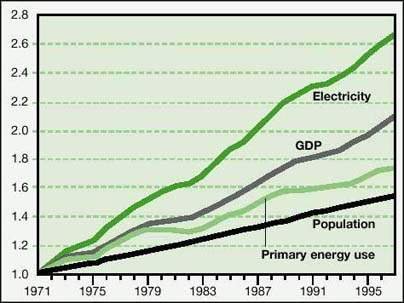
World
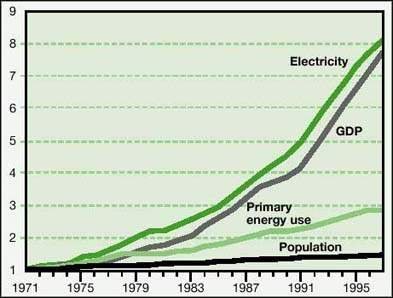
China

Economies in transition
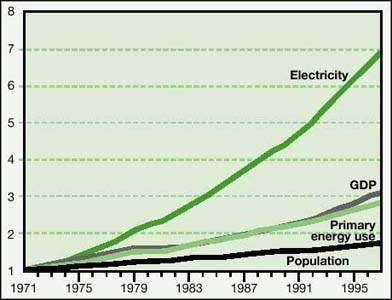
Developing countries
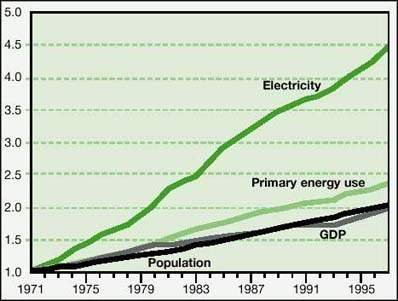
Africa
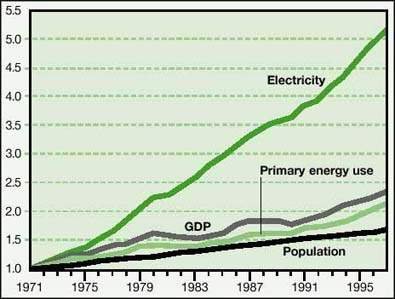
Latin America
Source: IEA, 1999a.
FIGURE C.2. ENERGY USE BY SECTOR IN SELECTED REGIONS,
1980-97 (EXAJOULES)
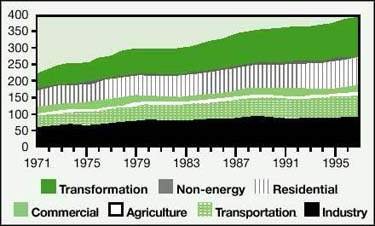
World
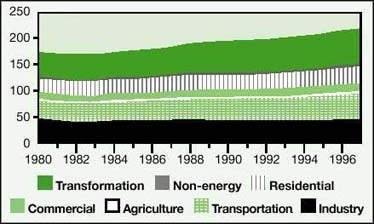
OECD
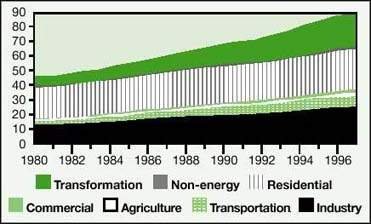
Total Asia
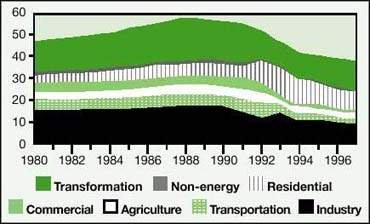
Former Soviet Union
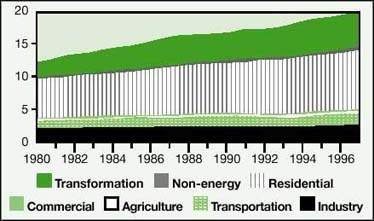
Africa
Source: IEA, 1999a.
FIGURE C.3. DEVELOPMENT OF PRIMARY AND FINAL ENERGY
INTENSITIES BY REGION, 1971-1997
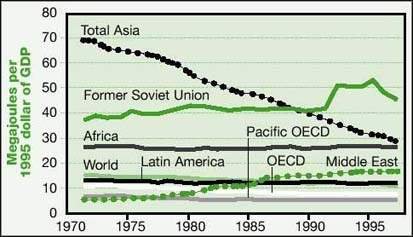
Final energy intensities
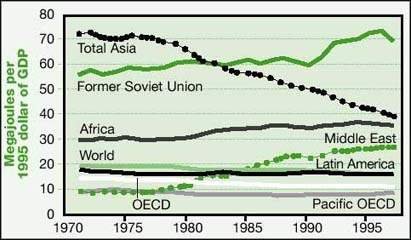
Primary energy intensities
Source: IEA, 1999a.
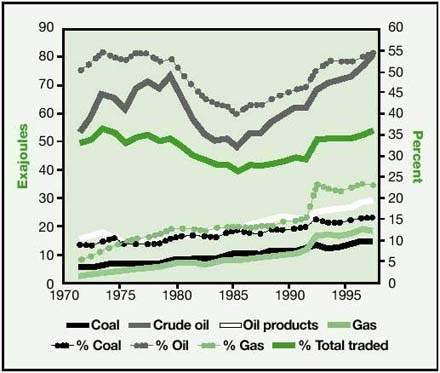
FIGURE C.4. GLOBAL TRADE IN CRUDE
OIL, OIL PRODUCTS, COAL, AND NATURAL GAS, IN ABSOLUTE AND RELATIVE TERMS
Note: Total traded shows share of total specific
fuel use that is traded, that is total traded energy/primary energy.
Source: BP, 1999, IEA, 1999a, World Bank,
1999.
FIGURE C.5. MAJOR OIL IMPORTERS AND EXPORTERS, 1980-98
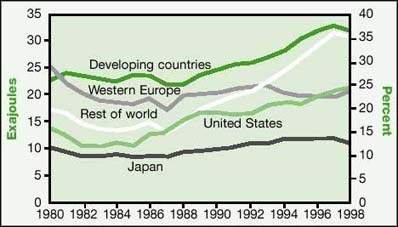
Importers
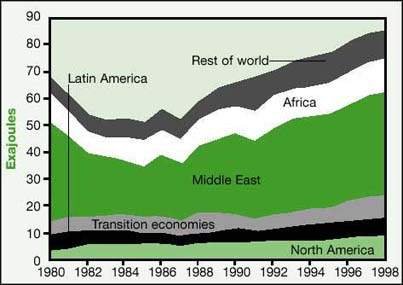
Exporters
Source: BP, 1999.
FIGURE C.6. GROSS FOREIGN DIRECT INVESTMENT AND DOMESTIC
AND FOREIGN FINANCING BY REGION, 1980-97
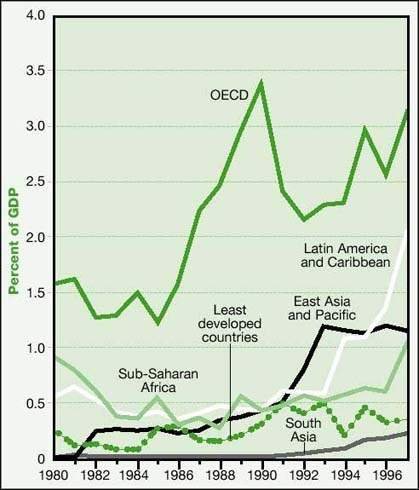
Gross foreign direct
investment
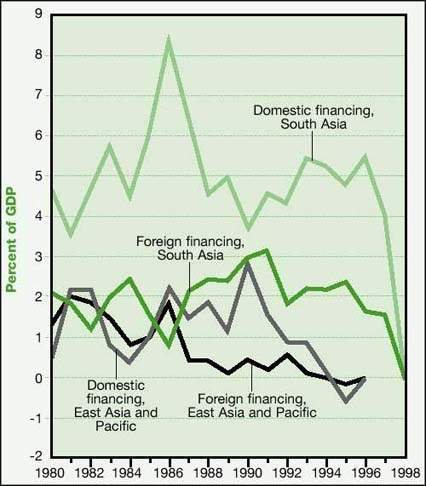
Domestic and foreign
financing
Source: World Bank, 1999.
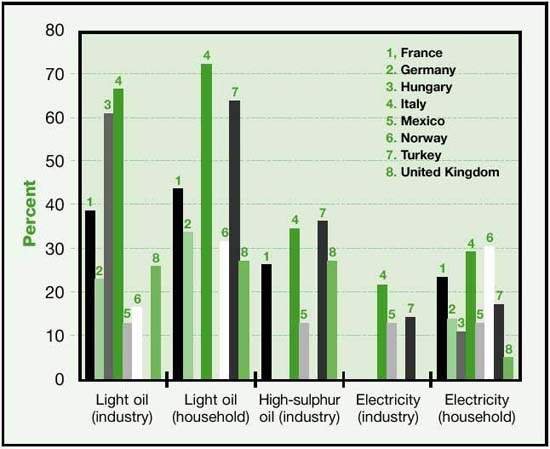
FIGURE C.7. ENERGY TAXES IN
SELECTED COUNTRIES, 1998
Source: IEA, 1999b.
FIGURE C.8. EFFICIENCY OF COAL-FUELLED AND NATURAL GAS -
FUELLED ELECTRICITY GENERATION BY REGION, 1971-97
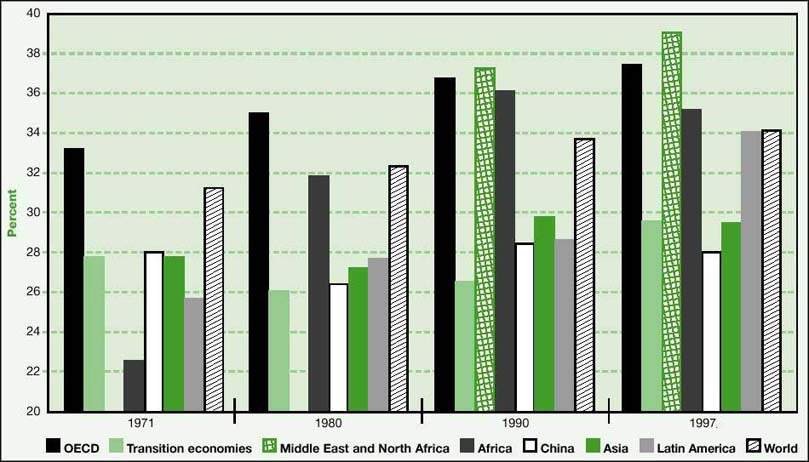
Coal
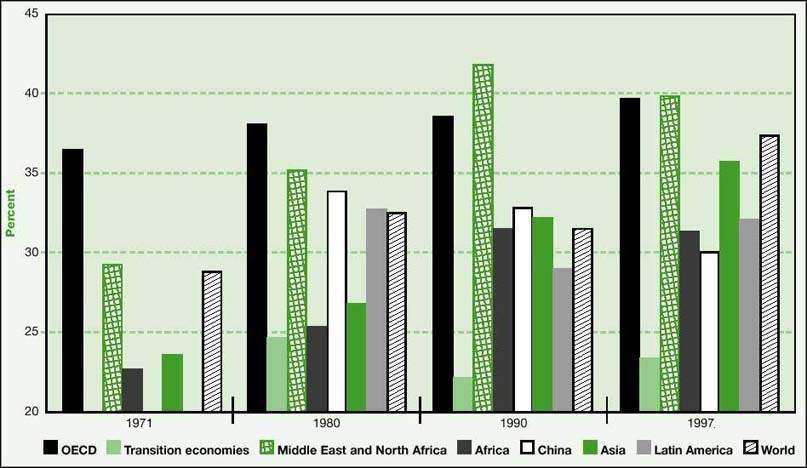
Natural gas
Source: Adapted from IEA, 1999a.
FIGURE C.9. NATURAL GAS AND STEAM COAL PRICES FOR
ELECTRICITY GENERATION BY REGION, 1990-98
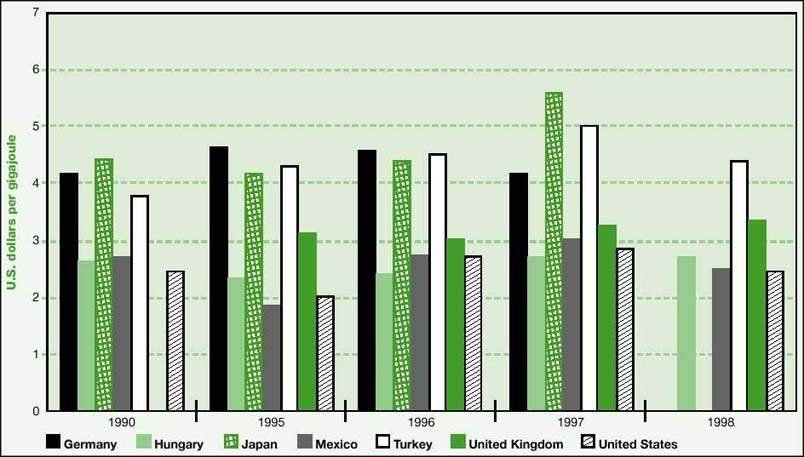
Natural gas
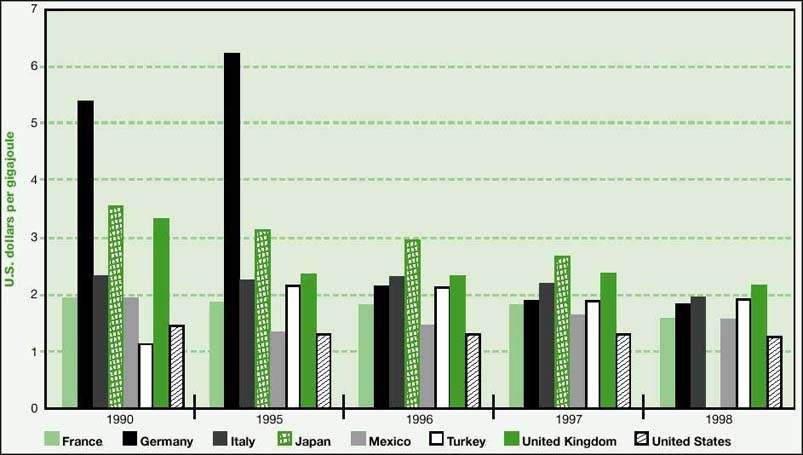
Steam coal
Source: IEA, 1999b.
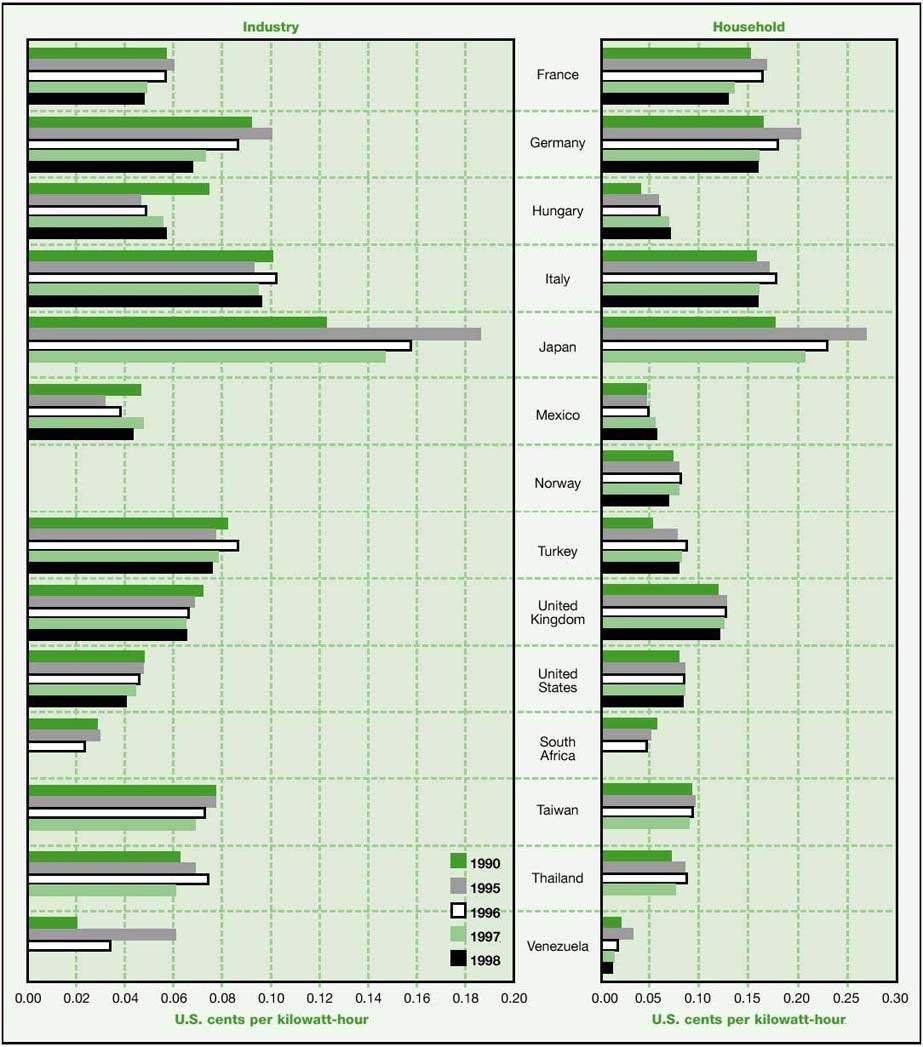
FIGURE C.10. ELECTRICITY PICES IN
SELECTED COUNTRIES, 1990-98
Source: IEA, 1999b.
FIGURE C.11. OIL PRODUCT PRICES IN SELECTED COUNTRIES,
1990-98
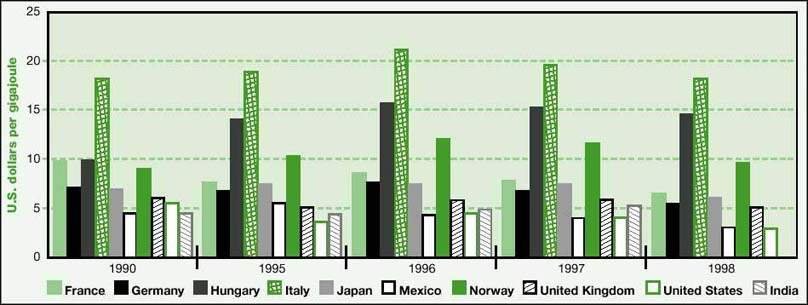
Light oil prices for industry
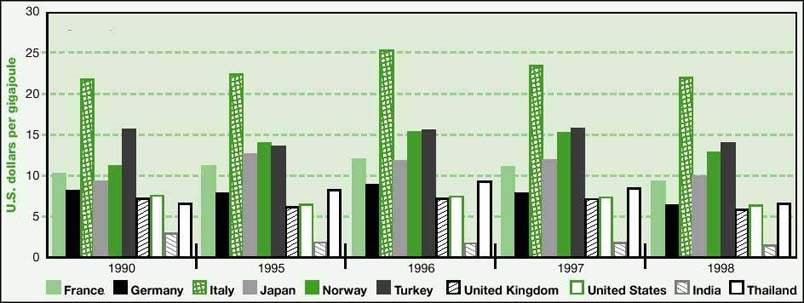
Light oil prices for
household
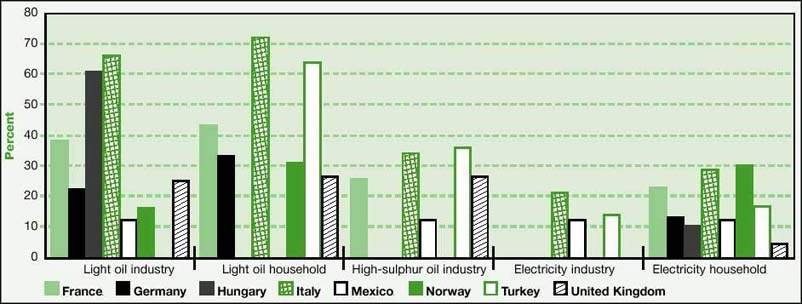
Taxes on different fuels
Source: IEA, 1999b.
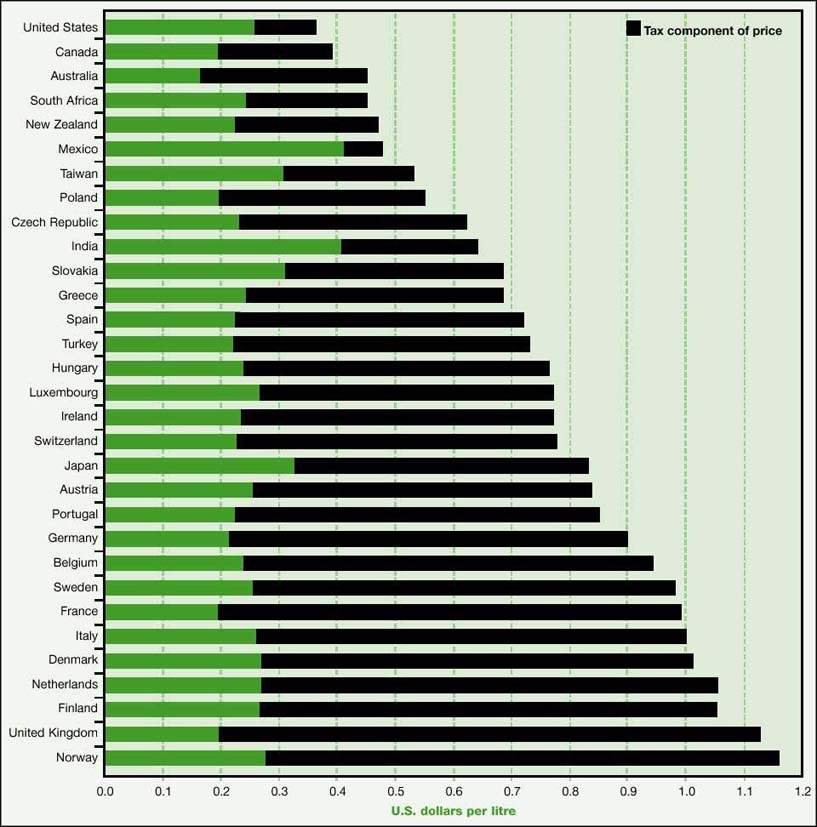
FIGURE C.12. UNLEADED GASOLINE
PRICES IN SELECTED COUNTRIES, 1998
Source: IEA, 1999b.
References
BP (British Petroleum). 1999. BP Statistical Review of World
Energy. London.
IEA (International Energy Agency). 1999a. Energy Balances.
Organisation for Economic Co-operation and Development. Paris.
IEA (International Energy Agency). 1999b. Energy Prices and
Taxes. Quarterly statistics (second quarter). Organisation for Economic
Co-operation and Development. Paris.
World Bank. 1999. World Development Indicators 1999.
CD-ROM. Washington,
D.C.
Annex D: Carbon emissions
The fossil energy used in 1998 contained about 6.5 gigatonnes of
carbon, down slightly from 1997. The slight reduction was caused by the economic
crisis in East Asia, which curbed energy use in this fast-growing region, and
China's closure of inefficient and coal-intensive heavy industry enterprises.
All this carbon essentially ends up in the atmosphere in the form of carbon
dioxide, the inevitable by-product of any combustion process involving
hydrocarbon fuels.
The energy sector emitted about 2.8 gigatonnes of carbon during
the extraction and conversion of primary energy to fuels and electricity, and
during transmission and distribution to final use. The rest, about 3.7
gigatonnes of carbon, was emitted at the point of end use. Included are 0.4
gigatonnes of carbon embodied in durable hydrocarbon-based materials and
products such as plastics, asphalt, lubricants, and pharmaceuticals. Although
these materials do not necessarily contribute to carbon emissions in the year
they are statistically accounted for as energy or non-energy use, most materials
manufactured from hydrocarbons are eventually oxidised to carbon dioxide.
Carbon is also released from the combustion of biomass. Annual
net emissions from biomass conversion are difficult to determine and depend on
the extent to which the biomass use is truly renewable. The information
presented here assumes that biomass-based energy services are renewable and so
do not result in net additions to atmospheric concentrations of carbon dioxide.
Box D.1 reports the range of carbon emission factors found in
the literature and the IPCC factors used to calculate the past and current
carbon emissions shown in figure D.1. Global carbon emissions effectively
doubled between 1965 and 1998, corresponding to an average increase of 2.1
percent a year - not surprisingly, a mirror image of the fossil fuel - dominated
global energy use. Since 1990 the average rate of increase has slowed to 0.7
percent a year, not because of carbon emission mitigation efforts but because of
the economic collapse of the former Soviet Union and the financial crisis in
East Asia. Although figure D.1 clearly identifies industrialised countries as
the main source of carbon emissions, it also shows the growing emissions from
developing countries.
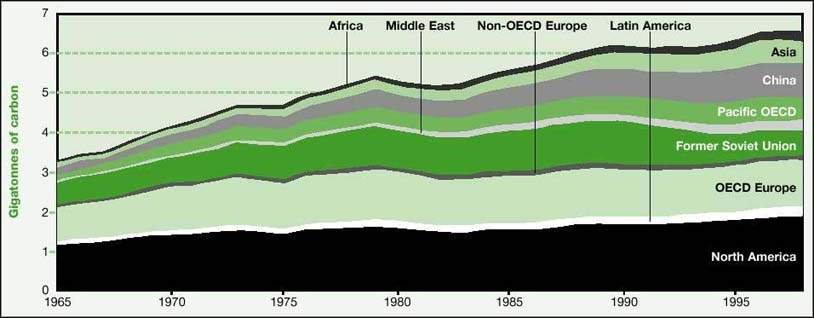
FIGURE D.1. CARBON EMISSIONS BY
REGION, 1965-98
Source: Calculated from BP, 1999 data using
carbon emission factors of IPCC, 1996.
|
BOX D.1. CARBON DIOXIDE EMISSION FACTORS
Carbon dioxide emissions are measured in units of elemental
carbon. For example, in 1998 global carbon dioxide emissions were 6.5 gigatonnes
(billion tonnes) of carbon. In the literature carbon dioxide emissions are often
reported as the mass of the carbon dioxide molecules (1 kilogram of carbon
corresponds to 3.67 kilograms of carbon dioxide). |
|
Carbon emission factors for some primary energy
sources
(kilograms of carbon per gigajoule) |
|
Source |
Heating value |
OECD and IPCC, 1995 |
Literature range |
|
Wood |
HHV |
|
26.8 - 28.4 |
|
LHV |
|
28.1 - 29.9 |
|
Peat |
HHV |
|
30.3 |
|
LHV |
28.9 |
|
|
Coal (bituminous) |
HHV |
|
23.9 - 24.5 |
|
LHV |
25.8 |
25.1 - 25.8 |
|
Crude oil |
HHV |
|
19.0 - 20.3 |
|
LHV |
20.0 |
20.0 - 21.4 |
|
Natural gas |
HHV |
|
13.6 - 14.0 |
|
LHV |
15.3 |
15.0 - 15.4 |
|
Note: HHV is the higher heating value, LHV is the lower heating
value. The difference is that the higher heating value includes the energy of
condensation of the water vapour contained in the combustion products (see annex
A).
Source: IPCC, 1996. |
The carbon intensity (carbon per unit of primary energy) of the
global energy system fell by 0.3 percent a year in the 20th century because of
substitutions of oil and gas for coal, the expansion of hydropower, and the
introduction of nuclear power. Figure D.2 shows carbon intensities for 1971-97.
The drop in the carbon intensity of the energy system and the decline in the
energy intensity of economic production have reduced the carbon intensity of GDP
by 1 percent a year. Carbon emissions per capita have not changed much since
1971. In 1997 the average carbon intensity was 16.3 grams of carbon per
megajoule, the carbon intensity per unit of economic activity was 258 grams of
carbon per 1995 U.S. dollar, and carbon emissions per capita were 1.15 tonnes.
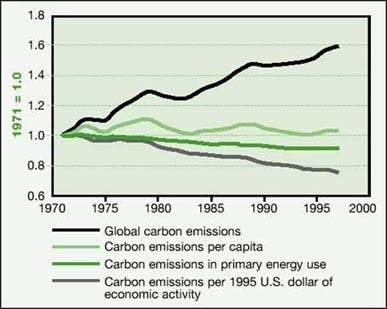
FIGURE D.2. GLOBAL CARBON
EMISSIONS, CARBON EMISSIONS PER CAPITA, AND DECARBONISATION OF THE ENERGY SYSTEM
AND OF ECONOMIC PRODUCTION, 1971-97
Source: IEA, 1999.
Regional carbon emissions per capita vary considerably around
the average of 1.15 tonnes. In 1997 the average North American emitted 4.70
tonnes of carbon, while the average African emitted just 0.28 tonnes - 6 percent
of the North American's emissions (table D.1).
TABLE D.1. CARBON EMISSIONS PER CAPITA BY REGION, 1975-97
(TONNES OF CARBON)
|
Region |
1975 |
1980 |
1985 |
1990 |
1995 |
1997 |
|
North Americaa |
4.84 |
4.96 |
4.54 |
4.54 |
4.55 |
4.70 |
|
OECD Europe |
2.42 |
2.59 |
2.41 |
2.35 |
2.26 |
2.29 |
|
Pacific OECDb |
2.06 |
2.19 |
2.14 |
2.52 |
2.86 |
3.02 |
|
Non-OECD Europe |
1.71 |
2.05 |
2.10 |
1.99 |
1.45 |
1.44 |
|
Former Soviet Union |
3.16 |
3.47 |
3.53 |
3.50 |
2.36 |
2.15 |
|
Latin America |
0.53 |
0.57 |
0.50 |
0.53 |
0.57 |
0.63 |
|
Middle East |
0.78 |
1.13 |
1.34 |
1.41 |
1.62 |
1.73 |
|
Asiac |
0.15 |
0.18 |
0.20 |
0.25 |
0.31 |
0.34 |
|
China |
0.35 |
0.42 |
0.50 |
0.59 |
0.72 |
0.73 |
|
Africa |
0.21 |
0.25 |
0.29 |
0.28 |
0.28 |
0.28 |
|
World |
1.14 |
1.21 |
1.16 |
1.17 |
1.13 |
1.15 |
a. Includes Mexico. b. Includes the Republic of
Korea. c. Excludes China.
Source: Calculated from IEA, 1999 energy data and IPCC carbon
emission factors (see box D.1).
References
BP (British Petroleum). 1999. BP Statistical Review of World
Energy. London.
IEA (International Energy Agency). 1992. Energy Balances.
Organisation for Economic Co-operation and Development, Paris.
IEA (International Energy Agency). 1999. Energy Balances.
International Energy Agency of the Organization for Economic Cooperation and
Development (OECD/IEA). Paris, France.
IPCC. 1996. Primer. In Climate Change 1995 - Impacts,
Adaptations and Mitigation of Climate Change: Scientific-Technical Analyses.
R.T. Watson, M.C. Zinyowera, R.H. Moss, eds., Second Assessment Report of the
Intergovernmental Panel on Climate Change (IPCC). Cambridge University Press,
Cambridge and New York, 879
pp.
Editorial board - Brief biographies of Editorial Board members
Dennis Anderson is a Professor and the Director of the
Imperial College Centre of Energy Policy and Technology, London, and a visiting
Professor at the University College, London. Anderson holds degrees in economics
from the London School of Economics (1967) and in engineering from the
University of Manchester (1963). He is a Research Associate at the Oxford
University Centre for the Study of African Economies and a Member of St.
Antony's College. A former Senior Economist for the World Bank and Chief
Economist for Shell, Anderson has published several works on rural energy and
development, economic and environmental interactions, and climate change
technology. His current research interests include economic and environmental
interactions, energy pricing and regulation, and development policy.
Safiatou Franciose Ba-N'Daw is a former Minister of
Economic Infrastructure in the Ministry of Energy of C�te d'Ivoire. She holds an
M.Sc. in Economic Sciences from the University of Abidjan, studied statistics at
Georgetown University, Washington, D.C., and received an MBA from Harvard
University. She is also a Certified Public Accountant. Ba-N'Daw has worked as
Financial Analyst for the World Bank, and has extensive experience in the
development of small and medium-sized businesses in Hungary, Turkey and Tunisia.
She has served as Senior Financial Specialist with the Central Bank of Pakistan
and the Government of Pakistan on the development of financial institutions in
that country. She also worked on financial issues in Sri Lanka until her
promotion to the Ministry of Energy.
John W. Baker, Chairman of the World Energy Council from
1995-98, currently serves as the Deputy Chairman of Celltech Group, a
pharmaceuticals company, and is a non-executive director for several other
companies. He is also a member of the Education Standards Task Force and the
Welfare to Work Task Force for the British Government. An arts graduate of
Oxford University, he spent ten years dealing with transport policy and finance,
and another decade in the field of urban renewal and public housing. In 1979 he
moved into the energy sector to become the Corporate Managing Director of the
Central Electricity Generating Board, and later led the management of the UK
electricity privatisation and restructuring programme. He was Chief Executive
Officer of National Power since its establishment in 1990, then serving as its
Chairman from 1995 to 1997.
JoAnne DiSano is the Director of the Division for
Sustainable Development for the UN Department of Economic and Social Affairs.
DiSano has a degree in psychology and sociology from the University of Windsor,
Ontario, and a Masters of Education from Wayne State University (U.S.). Before
joining the United Nations, she held several senior management positions with
the Government of Canada, culminating in her work with the Department of Arts,
Sport, the Environment, Tourism and Territories, where she served as the First
Assistant Secretary, Environment and Conservation Policy Division, and as Deputy
Executive Director, Environment Strategies Directorate. From 1996 to 1998,
DiSano was the Deputy Head of the Environment Protection Group of that
department. She has also held positions with the Canadian Employment and
Immigration Commission and the Treasury Board in Ottawa.
Gerald Doucet is the Secretary General of the World
Energy Council, a position he has held since September 1998. A graduate of
Ottawa University, with a Masters in Economics from Carlton University, Doucet
worked for the Government of Canada in various economic and policy roles from
1967-1981. He then joined the Retail Council of Canada as Senior Vice President,
and in 1988 he became the Agent General for Ontario in Europe for the Province
of Ontario. From 1992 to 1994 he served as President and a Founding Director of
the Europe-Canada Development Association, and from 1994-98 as President and CEO
of the Canadian Gas Association.
Emad El-Sharkawi is chairman of the Egyptian National
Committee of the World Energy Council, vice-chair of WEC's executive assembly
for Africa, general coordinator for UN-financed energy projects in Egypt, and
advisor to numerous energy organizations and commissions. He has a post-graduate
diploma in electrical power engineering from King's College, University of
Durham, and a Ph.D. in electrical power systems from the University of
Manchester. After supervising engineering projects in Egypt early in his career,
he taught and led research on electrical power systems and energy at
universities in Iraq. Returning to Egypt, El-Sharkawi joined the Ministry of
Electricity and Energy and later the Nuclear Power Plants Authority as Manager
of Technical Affairs (1977-78). Since that time he has supervised many renewable
energy programmes in Egypt and served as a member of the country's specialised
councils on energies. In 1986 he was named Chairman of the Board of Directors
for the Egyptian Electricity Authority. El-Sharkawi has co-authored many papers
on energy and systems planning, and his efforts in the field of energy led to
his election to the Royal Swedish Academy for Engineering Sciences.
Jos� Goldemberg is a member of the Brazilian Academy of
Sciences and the Third World Academy of Sciences. Trained in physics at the
University of Saskatchewan (Canada) and the University of Illinois, Goldemberg
holds a Ph.D. in Physical Sciences from the University of S�o Paulo. During his
long academic career, he has taught at the University of S�o Paulo (where he
also served as Rector from 1986-89), Stanford University, and the University of
Paris (Orsay). He was a Visiting Professor at Princeton University in 1993-94,
at the International Academy of the Environment in Geneva in 1995, and at
Stanford University in 1996-97. He served the Federal Government in Brazil as
Secretary of State of Science and Technology in 1990-91, Minister of Education
in 1991-92, and Acting Secretary of State of the Environment in 1992. The author
of several books and technical papers, Goldemberg is an internationally
respected expert on nuclear physics, the environment, and energy. In 1991
Goldemberg was the co-winner of the Mitchell Prize for Sustainable Development,
and in 1994 he was honoured with the establishment of the Jos� Goldemberg Chair
in Atmospheric Physics at Tel Aviv University. In 2000, he was awarded the Volvo
Environmental Prize, along with three of his colleagues on the World Energy
Assessment.
John P. Holdren is the Teresa and John Heinz Professor of
Environmental Policy and Director of the Program on Science, Technology, and
Public Policy in the John F. Kennedy School of Government, and a Professor of
Environmental Science and Public Policy in the Department of Earth and Planetary
Sciences at Harvard University. Trained in engineering and plasma physics at MIT
and Stanford, from 1973-96 Holdren co-founded and co-led the interdisciplinary
graduate programme in energy and resources at the University of California,
Berkeley. He is a member of the President's Committee of Advisors on Science and
Technology (PCAST) and has chaired PCAST panels on protection of nuclear bomb
materials, the U.S. fusion-energy R&D program, U.S. energy R&D strategy
for the climate-change challenge, and international cooperation on energy. He is
also a member of the U.S. National Academy of Sciences (NAS) and National
Academy of Engineering (NAE), Chairman of the NAS Committee on International
Security and Arms Control, and Chairman of the NAS/NAE Committee on U.S.-India
Cooperation on Energy.
Michael Jefferson runs a consulting firm, Global Energy
and Environment Consultants, in the United Kingdom. A graduate of the
Universities of Oxford and the London School of Economics, Jefferson has worked
extensively in the private sector, from merchant banking to head of oil supply
strategy and planning for Europe at the Royal Dutch/Shell Group of Companies. In
1990 Jefferson was seconded to the World Energy Council (WEC) as Deputy
Secretary General, and he later became director of studies and policy
development for WEC. He is the author of numerous books and articles related to
energy and climate change, including Energy for Tomorrow's World (written
for a WEC commission in 1993). He was a lead author and contributing author for
the Intergovernmental Panel on Climate Change (IPCC) Second Assessment Report, a
member of the drafting team for the IPCC's Synthesis Report, and an IPCC peer
review editor for the Third Assessment Report. He is technical coordinator and
lead consultant to the G8 Renewable Energy Task Force. He also participated in
the UNDP report, Energy after Rio, written in 1997.
Eberhard Jochem is the Senior Scientist at the Fraunhofer
Institute of Systems and Innovation Research (Karlsruhe, Germany) and
Co-director of the Centre for Energy Policy and Economics (Zurich, Switzerland).
Jochem holds degrees in chemical engineering (Aachen, 1967) and economics
(Munich, 1971), and a Ph.D. in technical chemistry (Munich, 1971). He was a
research fellow at Munich University and Harvard University. As an
internationally acknowledged expert in systems analysis, technical and
socioeconomic research, and policy evaluation, Jochem is a member of several
national and international scientific organizations and advisory committees,
including the IPCC Bureau and the Enqu�te Commission on "Sustainable Energy,
Liberalization, and Globalization" of the German Parliament. He presented
lectures at the universities in Karlsruhe and Kassel until 1999 and since then
in Zurich and Lausanne, Switzerland. He is a member of the Editorial Advisory
Board of Energy Environment and Climate Policy.
Thomas B. Johansson, who is on leave from the University
of Lund in Sweden, is the Director of the Energy and Atmosphere Programme of the
Bureau for Development Policy of UNDP. Johansson, who holds a Ph.D. in nuclear
physics from the Lund Institute of Technology, is International Co-Chairman of
the Working Group on Energy Strategies and Technologies of the China Council for
International Cooperation on Environment and Development. He has served as
Convening Lead Author, Energy Supply Mitigation Options (Working Group IIA of
the Intergovernmental Panel on Climate Change); Vice-Chairman, UN Committee on
New and Renewable Sources of Energy and on Energy for Development; Chairman, UN
Solar Energy Group for Environment and Development; and Director of Vattenfall,
the Swedish State Power Board. He is has authored or co-authored numerous books
and articles including Energy after Rio; Renewable Energy: Sources for Fuels
and Electricity; Electricity-Efficient End Use and New Generation Technologies
and their Planning Implications; and Energy for a Sustainable World.
Along with three other members of the editorial board, he was awarded the
Volvo Environment Prize in 2000.
Hisham Khatib, an engineer and economist, serves as
honorary Vice Chairman of the World Energy Council, as a member of the Roster of
Experts for the Global Environment Facility's Scientific and Advisory Panel, and
as the Advisory Editor to the Utilities Policy and Energy Policy
journals (U.K.) and the Natural Resources Forum (U.S.). Khatib
received an M.Sc. from the University of Birmingham, and a Ph.D. in electrical
engineering from the University of London, where he also received a B.Sc. in
economics. Khatib has more than 40 years' experience in matters relating to
electricity, energy, water, and environmental issues. He has consulted to the
United Nations, UNDP, UNEP, Global Environment Facility, UNIDO, World Bank, Arab
Fund, Islamic Development Bank, and many other regional and international
development agencies. Khatib also served as Minister of Planning, Minister of
Water and Irrigation, and Minister of Energy and Mineral Resources for the
government of Jordan. He is the author of two books, Economics of Reliability
in Electrical Power Systems and Financial and Economic Evaluation of
Projects, and of more than 100 articles and papers. In 1998 he was honoured
with the "Achievement Medal" of the Institution of Electrical Engineers.
Kui-Nang Mak has been chief of the Energy and Transport
Branch of the Division for Sustainable Development, UN Department of Economic
and Social Affairs (DESA) since 1990. He holds a M.Sc. in electrical engineering
from the University of Illinois, where he has completed all requirements except
dissertation for a Ph.D. in electrical engineering; an I.E. degree in industrial
economics and management from Columbia University and a Certificate from the
Executive Programme on Climate Change and Development from Harvard University.
He has worked for the United Nations since 1975, acting as an Economic Affairs
Officer specializing in energy for DESA from 1978 to 1990. He is the author of
several papers and reports on global energy issues, particularly on
international cooperation and financing. His professional affiliations include
serving as a member of the Sub-Committee on International Practices, Institute
of Electrical and Electronics Engineers; a member of the Committee on Cleaner
Fossil Fuel Systems of the World Energy Council; and an advisor for the China
Coal Preparation Association.
Nebojsa Nakicenovic is the Project Leader of the
Transitions to New Technologies Project at the International Institute for
Applied Systems Analysis (IIASA). He is also the Convening Lead Author of the
Special Report on Emissions Scenarios by the Intergovernmental Panel on Climate
Change, and Guest Professor at the Technical University of Graz. Nakicenovic
holds bachelor's and master's degrees in economics and computer science from
Princeton University and the University of Vienna, where he completed his Ph.D.
He also received an honoris causa Ph.D degree in engineering from the
Russian Academy of Sciences. Before joining IIASA, Nakicenovic worked with the
Research Centre (Karlsruhe, Germany) in the field of nuclear materials
accountability. He is the author or co-author of many scientific papers and
books on the dynamics of technological and social change, economic
restructuring, mitigation of anthropogenic impacts on the environment, and
response strategies to global change. Nakicenovic has been Associate Editor of
the International Journal on Technological Forecasting and Social Change
and of the International Journal on Energy, and he serves as an
advisor to many groups, including the United Nations Commission on Sustainable
Development. Currently, his research focuses on the diffusion of new
technologies and their interactions with the environment.
Anca Popescu is the Director of the Institute of Power
Studies and Design in Romania. Popescu holds a B.Sc. in electrical engineering
and a Ph.D. University in high-voltage technique from the Bucharest Polytechnic.
An expert in energy policy, integrated resources planning, and power sector
development and investment planning, she has served as a scientific and
technical expert to the UN Framework Convention on Climate Change and was the
Chief Scientific Investigator on the role of nuclear power plants in greenhouse
gas emission reductions in Romania in a study sponsored by the International
Atomic Energy Agency. The author of numerous papers on energy planning, policy,
and development, Popescu has also served as a guest lecturer at Bucharest
Polytechnic University and at the National Electricity Company Training Centre.
Amulya Reddy was President of the International Energy
Initiative until April 2000. Reddy received his Ph.D. in applied physical
chemistry from the University of London in 1958. From 1970-91 he was a professor
at the Indian Institute of Science, in Bangalore, India, and was a visiting
Senior Research Scientist at the Center for Energy and Environmental Studies at
Princeton University in 1984. From 1990-93, Reddy was a member of the Scientific
and Technical Advisory Panel of the Global Environment Facility. He has also
been a member of the Energy Research Group of the International Development
Research Centre in Canada; the Economic and Planning Council, Government of
Karnataka; and a member of the Panel of Eminent Persons on Power for the
Minister of Power, India. He is the author of more than 250 papers, and
co-author and editor of several books on energy, rural technology, and science
and technology policy. Reddy was awarded the Volvo Environmental Prize for 2000,
along with three other members of the World Energy Assessment editorial board.
Hans-Holger Rogner is the Head of the Planning and
Economic Studies Section in the Department of Nuclear Energy in the
International Atomic Energy Agency. He holds an industrial engineering degree
and a Ph.D. in energy economics from the Technical University of Karlsruhe. He
specialised in applying systems analysis to long-term energy demand and supply
issues and in identifying technologically and economically feasible paths to
sustainable energy systems. At the International Atomic Energy Agency, Rogner's
activities focus on sustainable energy development and technology change. He
contributes to UN efforts targeted at Agenda 21, including combating climate
change.
Kirk R. Smith is Professor of Environment Health
Sciences, Associate Director for International Programs at the Center for
Occupational and Environment Health, and Deputy Director of the Institute for
Global Health at the University of California, Berkeley. Smith holds a Ph.D. and
M.P.H. in biomedical and environmental health sciences from Berkeley. He has
been a Senior Fellow at the East-West Center's Program on Environment
(Honolulu), and was the founding head of the East-West Center's Energy Program
(1978-1985). Smith is the author of more than 200 articles and 7 books, sits on
the boards of 7 international scientific journals, and is advisor to the
governments of several developing countries on environment. He is also a member
of the India-U.S. Academies of Science Energy/Environment Program and of the
World Health Organisation's Comparative Risk Assessment and Air Quality
Guidelines committees. In 1997, he was elected to the US National Academy of
Sciences.
Wim C. Turkenburg is Professor and Head of the Department
of Science, Technology, and Society at Utrecht University. He is also a member
of the Council on Housing, Physical Planning, and Environment of the
Netherlands, Vice Chairperson of the UN Committee on Energy and Natural
Resources for Development (UN-CENRD), and Chairperson of the Subcommittee on
Energy of the UN-CENRD. He studied physics, mathematics, and astronomy at Leiden
University and the University of Amsterdam, and received his Ph.D. in science
and mathematics from the University of Amsterdam in 1971. Turkenburg is an
expert on energy, the environment, and systema analysis. He is author or
co-author of many articles on renewables (wind energy, photovoltaics, biomass
energy), energy efficiency improvement, cleaner use of fossil fuels
(decarbonization technologies), and energy and climate change. He has been
member of a number of national and international boards, committees and working
groups on energy, energy research, and energy and environmental policy
development, serving inter alia the International Solar Energy Society, the
World Energy Council, the Intergovernmental Panel on Climate Change, and the
Government of the Netherlands.
Francisco Lopez Viray is the Secretary of Energy in the
Philippines, and chairs its subsidiary agencies, including the National Power
Corporation, the Philippine National Oil Company, and the National
Electrification Administration. Viray holds an M.Sc. in electrical engineering
from the University of the Philippines and a Ph.D. in engineering from West
Virginia University. His extensive career has included advisory and research
positions on a number of energy and power planning projects. A specialist in the
areas of power system engineering, computer applications in engineering and
energy planning and management, Viray has received several citations and awards,
including the ASEAN Achievement Award in Engineering, and the Outstanding
Professional in Electrical Engineering from the Professional Regulation
Committee of the Philippines.
Robert H. Williams is a Senior Research Scientist at
Princeton University's Center for Energy and Environmental Studies, with a Ph.D.
in physics from the University of California, Berkeley (1967). He served on two
panels of the President's Committee of Advisors on Science and Technology: the
Energy R&D Panel (1997), as chair of its Renewable Energy Task Force; and
the International Energy Research, Development, Demonstration, and Deployment
Panel (1999), as chair of its Energy Supply Task Force. Since 1993 he has been a
member of the Working Group on Energy Strategies and Technologies of the China
Council for International Cooperation on Environment and Development. He was a
member of the Scientific and Technical Advisory Panel for the Global Environment
Facility and chaired its Climate and Energy Working Group (1995-1998). He has
written many articles and coauthored several books on a wide range of energy
topics. He is recipient of the American Physical Society's Leo Szilard Award for
Physics in the Public Interest (1988), the U.S. Department of Energy's Sadi
Carnot Award (1991) for his work on energy efficiency, and a MacArthur
Foundation Prize (1993). In 2000, along with three other members of the World
Energy Assessment editorial board, he received the Volvo Environmental
Prize.
Glossary - Selected terminology
Acid deposition: fallout of substances from the
atmosphere (through rain, snow, fog or dry particles) that have the potential to
increase the acidity of the receptor medium. They are primarily the result of
the discharge of gaseous sulphur oxides and nitrogen oxides from the burning of
coal and oil e.g. in electricity generation, smelting industries and transport.
"Acid rain" is the result of the combination of these gases in the air with
vapor. Acidifying deposition can be responsible for acidification of lakes,
rivers and groundwater, with resulting damage to fish and other components of
aquatic ecosystems, and for damage to forests and other harmful effects on
plants. (Note: precipitation is naturally acid as a result of the absorption of
carbon dioxide from the atmosphere.)
Agenda 21: a comprehensive plan of action to be taken
globally, nationally and locally in every area in which human impacts on the
environment. It was adopted by more than 175 governments at the UN Conference on
Environment and Development in 1992 (also known as the Rio Earth Summit).
Animate energy: energy derived from human or animal
power.
Anthropogenic emissions: the share of emissions
attributed to human activities.
API degree: the American Petroleum Institute has adopted
a scale of measurement for the specific gravity of crude oils and petroleum
products that is expressed in degrees.
Biofuels: fuels obtained as a product of biomass
conversion (such as alcohol or gasohol).
Biomass: organic, non-fossil material oil of biological
origin, a part of which constitutes an exploitable energy resource. Although the
different forms of energy from biomass are always considered as renewable, it
must be noted that their rates of renewability are different. These rates depend
on the seasonal or daily cycles of solar flux, the vagaries of climate,
agricultural techniques or cycles of plant growth, and may be affected by
intensive exploitation.
Biogas: a gas composed principally of a mixture of
methane and carbon dioxide produced by anaerobic digestion of biomass.
Breeder reactor: a reactor which produces a fissile
substance identical to the one it consumes and in greater quantity than the one
it has consumed, that is, it has a conversion ratio greater than unity.
Business-as-usual: the projected future state of energy
and economic variables in the event that current technological, economic,
political, and social trends persist.
Capacity building: developing skills and capabilities for
technology innovation and deployment in the relevant government, private-sector,
academic, and civil institutions.
Carbon sequestration: the capture and secure storage of
carbon that would otherwise be emitted or remain in the atmosphere, either by
(1) diverting carbon from reaching the atmosphere; or (2) removing carbon
already in the atmosphere. Examples of the first type are trapping the
CO2 in power plant flue gases, and capturing CO2 during
the production of decarbonised fuels. The common approach to the second type is
to increase or enhance carbon sinks.
Carbon tax: a levy exacted by a government on the use of
carbon-containing fuel for the purpose of influencing human behavior
(specifically economic behavior) to use less fossil fuels (and thus limit
greenhouse gas emissions).
Carbon sinks: places where CO2 can be
absorbed, such as forests, oceans and soil.
Clean Development Mechanism (CDM): is one of four
'flexibility' mechanisms adopted in the Kyoto Protocol to the UN Framework
Convention on Climate Change. It is a cooperative arrangement through which
certified greenhouse gas emission reductions accruing from sustainable
development projects in developing countries can help industrialized countries
meet part of their reduction commitments as specified in Annex B of the
Protocol.
Cogeneration: see combined heat and power
Combined cycle plant: electricity generating plant
comprising a gas-turbine generator unit, whose exhaust gases are fed to a
waste-heat boiler, which may or may not have a supplementary burner, and the
steam raised by the boiler is used to drive a steam-turbine generator.
Combined heat and power (CHP) station: also referred to
as a cogeneration plant. A thermal power station in which all the steam
generated in the boilers passes to turbo-generators for electricity generation,
but designed so that steam may be extracted at points on the turbine and/or from
the turbine exhaust as back-pressure steam and used to supply heat, typically
for industrial processes or district heating.
Commercial energy: energy that is subject to a commercial
transaction and that can thus be accounted for. This contrasts to non-commercial
energy, which is not subject to a commercial exchange, and thus difficult to
account for in energy balances. The term non-commercial energy thus is
technically distinct from traditional energy, but in practice they are often
used interchangeably.
Commission on Sustainable Development (CSD): was created
in December 1992 to ensure effective follow-up of the United Nations Conference
on Environment and Development, to monitor and report on implementation of the
agreements at the local, national, regional and international levels.
Compressed natural gas (CNG): natural gas stored under
pressure in cylinders and used as fuel for automotive engines.
Cost buy-down: the process of paying the difference in
unit cost (price) between an innovative energy technology and a conventional
energy technology in order to increase sales volume, thus stimulating cost
reductions through manufacturing scale-up and economies of learning throughout
the production, distribution, deployment, use, and maintenance cycle.
Developing countries: generally used in this report to
refer to the countries that are members of the Group of 77 Countries and China.
Digester: a tank designed for the anaerobic fermentation
of biomass.
Dimethyl ether (DME): an oxygenated fuel that can be
produced from any carbonaceous feedstock by a process that begins with syngas
production.
Discount rate: the annual rate at which the effects of
future events are reduced so as to be comparable to the effect of present
events.
Economies in transition: national economies that are
moving from a period of heavy government control toward lessened intervention,
increased privatization, and greater use of competition.
Energy innovation chain: the linked process by which an
energy-supply or energy-end-use technology moves from its conception in theory
and the laboratory to its feasibility testing through demonstration projects,
small-scale implementation and finally large-scale deployment.
Energy intensity: ratio between the consumption of energy
to a given quantity, usually refers to the amount of primary or final energy
consumed per unit of gross domestic or national product.
Energy efficiency: the amount of utility or energy
service provided by a unit of energy (U/E), which can be used as a
measure of energy efficiency in end-use applications. An increase in energy
efficiency enables consumers to enjoy an increase in utility or energy service
for the same amount of energy consumed or to enjoy the same utility of energy
services with reduced energy consumption, U = (U/E) E. The usual
situation is one in which an increase in energy efficiency (U/E) boosts
both energy use and the utility derived from each unit of energy consumed.
Energy payback/time: the time of exploitation of an
energy installation, necessary for recuperating all the energy consumed in its
construction and operation during the projected lifespan of the installation.
Energy sector restructuring and reform: encouraging
market competition in energy supply (often by transfer of ownership from the
public to the private sector), while removing subsidies and other distortions in
energy pricing and preserving public benefits.
Energy services: the utility of energy is often referred
to by engineers as energy services, although that term can be confusing
since units vary between applications and sometimes are not defined at all. For
example, lumens is a natural unit in lighting services, and Thomas Edison
proposed charging for lumens rather than kilowatt hours when electricity was
first used for lighting; for practical reasons he eventually settled on charging
by the kilowatt hour instead. James Watt charged for his steam engines not by
their motive power, but by the difference in the costs of fuel he and his
customers saved when they substituted his engine for their old one. However,
when the utility or 'services' provided by energy are felt through a hot shower,
chilled drinks, refrigerated food, a comfortably warm or cool house, increased
transport miles, or labour saved in washing and ironing or in producing an
innumerable array of industrial goods and services, it is only practicable to
charge for energy in energy units.
Environmental taxes (ecotaxes): levies on products or
services collected to account for environmental impacts associated with them.
Ethanol (ethyl alcohol): alcohol produced by the
fermentation of glucose. The glucose may be derived from sugary plants such as
sugar cane and beets or from starchy and cellulosic materials by hydrolysis. The
ethanol may be concentrated by distillation, and can be blended with petroleum
products to produce motor fuel.
Exergy: the maximum amount of energy that can be
converted into any other form or energy under given thermodynamic conditions;
also known as availability of work potential.
Externalities: benefits or costs resulting as an
unintended byproduct of an economic activity that accrue to someone other than
the parties involved in the activity. While energy is an economic 'good' that
sustains growth and development and human well-being, there are by-products of
energy production and use that have an undesirable effect on the environment
(economic 'bads'). Most of these are emissions from the combustion of fossil
fuels.
Final energy: is the energy transported and distributed
to the point of final use. Examples include gasoline at the service station,
electricity at the socket, or fuelwood in the barn. The next energy
transformation is the conversion of final energy in end-use devices, such as
appliances, machines, and vehicles, into useful energy, such as work and heat.
Useful energy is measured at the crankshaft of an automobile engine or an
industrial electric motor, by the heat of a household radiator or an industrial
boiler, or by the luminosity of a light bulb. The application of useful energy
provides energy services, such as a moving vehicle, a warm room, process heat,
or illumination.
Foreign direct investment (FDI): is net inflows of
investment to acquire a lasting management interest (10 percent or more of
voting stock) in an enterprise operating in an economy other than that of the
investor. It is the sum of equity capital, reinvestment of earnings, other
long-term capital, and short-term capital as shown in the balance of payments.
Gross foreign direct investment is the sum of the absolute values of inflows and
outflows of foreign direct investment recorded in the balance of payments
financial account. It includes equity capital, reinvestment of earnings, other
long-term capital, and short-term capital. Note that this indicator differs from
the standard measure of foreign direct investment, which captures only inward
investment.
Fuel cells: devices that enable chemical energy to be
converted directly into electrical energy without the intervention of the heat
engine cycle, in which electrical power is produced in a controlled reaction
involving a fuel, generally hydrogen, methanol or a hydrocarbon.
Fuelwood: wood and wood products, possibly including
coppices, scrubs, and branches, bought or gathered, and used by direct
combustion.
Global Environment Facility (GEF): a financial
institution that provides grants and concessionary financing to developing
countries and economies-in-transition for projects and activities that provide
global benefits in four topical areas: climate change; biological diversity;
international waters; and stratospheric ozone. The GEF was established for the
purpose of implementing agreements stemming from the 1992 UN Conference on
Environment and Development including the UN Framework Convention on Climate
Change. The World Bank Group is one of the three implementing agencies for the
GEF, together with the United Nations Development Program and the United Nations
Environment Program.
Green pricing: labelling and pricing schemes that allow
consumers to pay a premium for environmentally friendly services and products if
they choose.
Greenfield investment: starting up an entirely new plant,
in contrast to rebuilding an older one.
Greenhouse Gases (GHGs): heat-trapping gases in the
atmosphere that warm the Earth's surface by absorbing outgoing infrared
radiation and re-radiating part of it downward. Water vapour is the most
important naturally occurring greenhouse gas, but the principal greenhouse
gases, whose atmospheric concentrations are being augmented by emission from
human activities are carbon dioxide, methane, nitrous oxide, and halocarbons.
Grid extension: extending the infrastructural network
that supplies energy, such as transmission wires for electricity.
Gross National Product (GNP): total production of goods
and services by the subjects of a country at home and abroad. In national income
accounting, it is a measure of the performance of the nation's economy, within a
specific accounting period (usually a year).
Higher heating value (HHV): quantity of heat liberated by
the complete combustion of a unit volume or weight of a fuel in the
determination of which the water produced is assumed completely condensed and
the heat recovered. Contrast to lower heating value.
Industrialized countries: for purposes of this report,
this term refers primarily to high-income OECD countries. While many
transitional economies are also characterized by a high degree of
industrialization, they are often considered and discussed separately because of
their specific development requirements.
Infrastructure: the physical structures and delivery
systems necessary to supply energy and end-users. In the case of power plants,
the infrastructure is the high-tension wires needed to carry the electricity to
consumers; in the case of natural gas, it is the pipeline network; in the case
of liquid fuels, it is the fueling stations.
Intergovernmental Panel on Climate Change (IPCC): a
multilateral scientific organization established by the United Nations
Environment Programme (UNEP) and the World Meteorological Organization to assess
the available scientific, technical, and socioeconomic information in the field
of climate change and to assess technical and policy options for reducing
climate change and its impacts.
Irradiance: the quantity of solar energy falling per area
of plane surface and time.
Kyoto Protocol (to the UN Framework Convention on Climate
Change): contains legally binding emissions targets for industrialized
(Annex I) countries for the post-2000 period. Together they must reduce their
combined emissions of six key greenhouse gases by at least 5% by the period
2008-2012, calculated as an average over these five years. The Protocol will
enter into force 90 days after it has been ratified by at least 55 Parties to
the Climate Change Convention; these Parties must include industrialized
countries representing at least 55% of this group's total 1990 carbon dioxide
emissions. See also Clean Development Mechanism.
Leapfrogging: moving directly to most cleanest, most
advanced technologies possible, rather than making incremental technological
progress.
Liberalisation: the doctrine that advocates the greatest
possible use of markets and the forces of competition to co-ordinate economic
activity. It allows to the state only those activities which the market cannot
perform (e.g. the provision of public goods) or those that are necessary to
establish the framework within which the private enterprise economy cannot
operate efficiently (e.g. the establishment of the legal framework on property
and contract and the adoption of such policies and anti-monopoly legislation).
Lifecycle cost: the cost of a good or service over its
entire lifetime.
Light water reactor (LWR): a nuclear reactor in which
ordinary water, as opposed to heavy-water, or a steam/water mixture is used as
reactor coolant and moderator. The boiling water reactor (BWR) and the
pressurized water reactor (PWR) are examples of light water reactors.
Liquefied natural gas (LNG): natural gas made up mainly
of methane and ethane and which, generally to facilitate its transport, has been
converted to the liquid phase by having its temperature lowered.
Liquefied petroleum gas (LPG): light hydrocarbons,
principally propane and butane, which are gaseous under normal conditions, but
are maintained in a liquid state by an increase of pressure or lowering of
temperature.
Lower heating value (LHV): quantity of heat liberated by
the complete combustion of a unit volume or weight of a fuel in the
determination of which the water produced is assumed to remain as a vapour and
the heat not recovered. Contrast to higher heating value.
Macroeconomic: pertaining to a study of economics in
terms of whole systems, especially with reference to general levels of output
and income and to the interrelations among sectors of the economy.
Marginal cost: the cost of one additional unit of effort.
In terms of reducing emissions, it represents the cost of reducing emission by
one more unit.
Marginal cost pricing: a system of setting the price of
energy equal to the marginal cost of providing the energy to a class of
consumer.
Market barriers: conditions that prevent or impede the
diffusion of cost-effective technologies or practices.
Market penetration: the percentage of all its potential
purchasers to which a good or service is sold per unit time.
Market potential (or currently realizable potential): the
portion of the economic potential for GHG emissions reductions or
energy-efficiency improvements that could be achieved under existing market
conditions, assuming no new policies and measures.
Methanol (methyl alcohol): alcohol primarily produced by
chemical synthesis but also by the destructive distillation of wood. Methanol is
regarded as a marketable synthetic motor fuel.
New renewables: used in this report to refer to modern
bio-fuels, wind, solar, small hydropower, marine and geothermal energy.
Geothermal energy cannot be strictly considered renewable, but is included for
practical reasons.
Nitrogen oxides (NOx): oxides formed an
released in all common types of combustion at high temperature. Direct harmful
effects of nitrogen oxides include human respiratory tract irritation and damage
to plants. Indirect effects arise from their essential role in photochemical
smog reactions and their contribution to acid rain problems.
Nuclear fuel cycle: a group of processes connected with
nuclear power production; using, storing, reprocessing and disposing of nuclear
materials used in the operation of nuclear reactors. The closed fuel cycle
concept involves the reprocessing and reuse of fissionable material from the
spent fuel. The once-through fuel cycle concept involves the disposal of the
spent fuel following its use in the reactor.
Opportunity cost: the cost of an economic activity
foregone by the choice of another activity.
Organisation for Economic Co-operation and Development
(OECD): a multilateral organization of 29 industrialized nations, producing
among them two-thirds of the world's goods and services. The objective of the
OECD is the development of social and economic policies and the coordination of
domestic and international activities.
Pollution associated with energy use. This is usually
measured as pollution per unit of energy use, or P = (P/E)E. Modern
methods of pollution control and emerging energy technologies are capable of
reducing the ratio P/E - and thus P - to very low levels,
sometimes to zero. This means that if environmental policies focus on P
rather than E, there is no reason why high levels of energy use (and
the utility derived from it) cannot be enjoyed and pollution virtually
eliminated in the long term, a process known as delinking environmental concerns
from energy use.
Primary energy is the energy that is embodied in
resources as they exist in nature: chemical energy embodied in fossil fuels
(coal, oil, and natural gas) or biomass, the potential energy of a water
reservoir, the electromagnetic energy of solar radiation, and the energy
released in nuclear reactions. For the most part, primary energy is not used
directly but is first mined, harvested or converted and transformed into
electricity and fuels such as gasoline, jet fuel, heating oil, or charcoal.
Public Benefits Fund (PBF): a financial mechanism created
to serve the greater public interest by funding programs for environment and
public health, services to the poor and disenfranchised, energy technology
innovation, or other public goods not accounted for by a restructured energy
sector.
Purchasing power parity (PPP): GDP estimates based on the
purchasing power of currencies rather than on current exchange rates. Such
estimates are a blend of extrapolated and regression-based numbers, using the
result of the International Comparison Program. PPP estimates tend to lower per
capita GDPs in industrialized countries and raise per capita GDPs in developing
countries.
Research and development (R&D): the first two stages
in the energy innovation chain. R, D & D refers to demonstration projects as
well.
Reserves: those occurrences of energy sources or mineral
that are identified and measured as economically and technically recoverable
with current technologies and prices (see chapter 5).
Resources: those occurrences of energy sources or
minerals with less certain geological and/or economic/technical recoverability
characteristics, but that are considered to become potentially recoverable with
foreseeable technological and economic development (see chapter 5).
Revenue neutral taxes: governmental levies placed on
certain goods or services that replace other taxes and thus do not add to total
revenues collected, but rather attempt to change behaviours.
Scenario: a plausible description of how the future may
develop based on analysis of a coherent and internally consistent set of
assumptions about key relationships and driving forces (e.g. rate of technology
changes, prices). Note that scenarios are neither predictions nor forecasts.
Standards/performance criteria: a set of rules or codes
mandating or defining product performance (e.g. grades, dimensions,
characteristics, test methods, rules for use).
Structural changes: changes in the relative share of GDP
produced by the industrial, agricultural or services sectors of an economy; or,
more generally, systems transformations whereby some components are either
replaced or partially substituted by other ones.
Subsidies: publicly supported cost reductions that may be
granted to producers and consumers - directly, through price reductions, or in
less visible forms, through tax breaks, market support or inadequate metering.
Sulphur oxides (SOx): oxides produced by the
combustion of fossil fuels containing sulphur. Sulphur oxides, the most
widespread of which is sulphur dioxide, a colorless gas having a strong and
acrid odor, are toxic at a given concentration for the respiratory system and
gave harmful effects on the environment, in particular on buildings and
vegetation. They contribute to the acid rain problem.
Sustainable energy: as the term is used in this document,
is not meant to suggest simply a continual supply of energy. Rather it means
environmentally sound, safe, reliable, affordable energy; in other words, energy
that supports sustainable development in all its economic, environmental, social
and security dimensions.
Syngas: a gaseous mixture composed mainly of carbon
monoxide and hydrogen and synthesized from a carbonaceous feedstock such as coal
or biomass. It is used as a building block for the production of synthetic
liquid fuels. Syngas-based systems can make it possible to extract energy
services from carbonaceous feedstocks with very low levels of pollutant or
greenhouse gas emissions.
Transitional economies: see economies in transition
Unproven reserves: the estimated quantities, at a given
date, which analysis of geologic and engineering data indicates might be
economically recoverable from already discovered deposits, with a sufficient
degree of probability to suggest their existence. Because of uncertainties as to
whether, and to what extent, such unproven reserves may be expected to be
recoverable in the future, the estimates should be given as a range but may be
given as a single intermediate figure in which all uncertainties have been
incorporated. Unproven reserves may be further categorized as probable reserves
or possible reserves.
United Nations Framework Convention on Climate Change
(UNFCCC): a major global convention adopted in 1992 that establishes a
framework for progress in stabilizing atmospheric concentrations of greenhouse
gases at safe levels. It directs that "such a level should be achieved within a
time-frame sufficient to allow ecosystems to adapt naturally to climate change,
to ensure that food production is not threatened and to enable economic
development to proceed in a sustainable manner". It also recognizes the right of
developing countries to economic development, their vulnerability to the effects
of climate change, and that rich countries should shoulder greater
responsibility for the problem.
United Nations Conference on Environment and Development
(UNCED): also known as the Rio Earth Summit. The first of a series of major
United Nations conferences on global issues that were convened in the 1990s.
World Bank Group: a multilateral, United Nations
affiliated lending institution which annually makes available roughly $20
billion in loans to developing countries, mainly but not exclusively for large
scale infrastructure projects. The World Bank Group comprises five agencies: the
International Bank for Reconstruction and Development, the International
Development Association, the International Finance Corporation (IFC), the
Multilateral Investment Guarantee Agency (MIGA), and the International Centre
for Settlement of Investment Disputes (ICSID). The World Bank Group raises
capital from both public sources and financial
markets.
Contributors - World Energy Assessment Advisory Panel and peer reviewers
An initial draft of the World Energy Assessment formed the basis
for the first round of peer review at an Advisory Panel meeting that took place
in July, 1999 in Geneva. Based on comments from working groups at that meeting,
as well as comments received from hundreds of experts around the world, a second
draft was prepared.
The second draft of the report was circulated to the Advisory
Panel, energy experts, governments and NGOs by mail and via a website. With
input from that second round of comments, as well as from careful scrutiny by
the Editorial Board, the final versions of the chapters were produced. A list of
Advisory Panel members and peer reviewers appears below.
Advisory Panel
Mohamad Ali Abduli, Ministry of Energy, Iran
Mohammed Taoufik Adyel, Minist�re de l'Energie et des Mines,
Morocco
Jassim Al-Gumer, Organization of Arab Petroleum Exporting
Countries, Kuwait
Hani Alnakeeb, Organization for Energy Planning, Egypt
Boris Berkovski, United Nations Educational, Scientific, and
Cultural Organisation, France
Rufino Bomasang, PNOC Exploration Corporation, Philippines
Hern�n Bravo, Instituto Costarricense de Electricidad, Costa
Rica
Timothy Brennand, University of East Anglia, U.K.
Anthony Derrick, IT Power Ltd., U.K.
Bernard Devin, ADEME, UN-CERND, France
Daniel Doukoure, Minist�re de l'Energie, C�te d'Ivoire
Danilo Feretic, Faculty of Electrical Engineering and Computing,
Croatia
H.E. Irene Freudenschuss-Reichl, Austrian Mission to the United
Nations, Austria
Zdravko Genchev, Center for Energy Efficiency EnEffect, Bulgaria
Gustav R. Grob, CMDC-WSEC (World Sustainable Energy Coalition),
Switzerland
Filino Harahap, Institute of Technology of Bandung, Indonesia
Anhar Hegazi, Economic and Social Commission for Western Asia,
Lebanon
Sawad Hemkamon, Ministry of Science Technology and Environment,
Thailand
Nesbert Kanyowa, Zimbabwe Mission, Switzerland
Christian Katsande, Ministry of Transport and Energy, Zimbabwe
Jean-�tienne Klimpt, Hydro-Qu�bec, Canada
Ron Knapp, World Coal Institute, U.K.
Mansika Knut, Ministry of Petroleum and Energy, Norway
Catherine P. Koshland, University of California at Berkeley,
U.S.
George Kowalski, Economic Commission for Europe, Switzerland
Raymond Lafitte, International Hydropower Association,
Switzerland
Hans Larsen, RIS� National Laboratory, Denmark
Kevin Leydon, European Commission, Belgium
Paul Llanso, World Meteorological Organization, Switzerland
Alphonse MacDonald, United Nations Population Fund, Switzerland
Andrei Marcu, United Nations Development Programme, U.S.
Manuel F. Mart�nez, Universidad Nacional Autonoma de Mexico,
Mexico
William R. Moomaw, IVM Free University of Amsterdam, Netherlands
Mark J. Mwandosya, University of Dar-Es-Salaam, Tanzania
Raymond Myles, INFORSE, Integrated Sustainable Energy and
Ecological Development Association, India
Gary Nakarado, United Nations Foundation, U.S.
Merle S. Opelz, International Atomic Energy Agency, Switzerland
Janos Pasztor, United Nations Framework Convention on Climate
Change, Germany
Neculai Pavlovschi, Romanian Gas Corporation (Romgaz-S.A.),
Romania
H.E. Per Kristian Pedersen, Royal Ministry of Foreign Affairs,
Norway
Atiq Rahman, Bangladesh Centre for Advanced Studies, Bangladesh
Morris Rosen, International Atomic Energy Agency, Austria
Pranesh Chandra Saha, Economic and Social Commission for Asia
and the Pacific, Thailand
T. Lakshman Sankar, Administrative Staff College of India, India
E.V.R. Sastry, Ministry of Non-conventional Sources of Energy,
India
Hari Sharan, DESI Power, India
Slav Slavov, Economic Commission for Europe, Geneva
Youba Sokona, Environment Development Action in the Third World
(ENDA-TM), Senegal
Lee Solsbery, Foundation for Business and Sustainable
Development, U.K.
Istvan Tokes, United Nations Development Programme, Hungary
Eric Usher, United Nations Environment Programme, France
Dmitri Volfberg, Ministry of Science and Technologies, Russia
Yasmin Von Schirnding, World Health Organization, Switzerland
Peer Reviewers
Mark Reed Aberdeen
Dean E. Abrahamson, University of Minnesota, U.S.
Jiwan Sharma Acharya, University of Flensburg, Germany
Jim Adam, Executive Assembly, World Energy Council, U.S.
Adam Edow Adawa
Anthony O. Adegbulugbe, Obafemi Awolowo University, Nigeria
Bernard Aebisher, ETH Zentrum, Switzerland
Carlos Alberto Aguilar Molina, Ministerio de Medio Ambiente y
Recursos Naturales, El Salvador
Husamuddin Ahmadzai, Swedish Environmental Protection Agency
(SIDA), Sweden
Rafeeuddin Ahmed, United Nations Development Programme, U.S.
Francois Ailleret, World Energy Council, France
Ali Ainan Farah, Minist�re de l'Industrie de l'�nergie et des
Mines, Djibouti
Arif Alauddin, Ministry of Water & Power, Pakistan
M. Albert, Union for the Coordination of Production and
Transmission of Electricity, Portugal
Issam Al-Chalabi, Consultant, Jordan
Abdlatif Y. Al-Hamad, Arab Fund for Economic and Social
Development (AFSED), Kuwait
Suleiman Abu Alim, Ministry of Energy and Mineral Resources,
Jordan
Hugo Altomonte
Popescu Anca, Institute of Power Studies and Design, Romania
Per Dannemand Andersen, Denmark
Dean Anderson, Center for Economic Analysis r.e. (ECON), Norway
Dean Anderson, Royal Institute of International Affairs, U.K.
Michael J. Antal, Jr., University of Hawaii at Manoa, U.S.
H.E. Bagher Asadi, Permanent Mission of the Islamic Republic of
Iran to the United Nations, U.S.
Mie Asaoka, Yanaginobanba-dori, Japan
Harry Audus, International Energy Agency, France
Mohamaed M. Awad, Egyptian Electricity Authority, Egypt
Kazi Obaidul Awal, Bangladesh Atomic Energy Commission,
Bangladesh
A. Awori, Kenya Energy and Environment Organisations (KENGO),
Kenya
Emine Aybar, Ministry of Energy and Natural Resources, Turkey
Murfat Badawi, Arab Fund for Economic & Social Development,
Kuwait
Sheila Bailey, NASA Glen Research Center, U.S.
Venkatrama Bakthavatsalam, Indian Renewable Energy Development
Agency, Ltd., India
Juraj Balajka, Profing, s.r.o., Slovak Republic
Guillermo R. Balce, Asean Centre for Energy, Indonesia
Alexander Barnes, World Energy Council, France
Fritz Barthel, World Energy Council, Germany
A. Bartle, International Hydropower Association, U.K.
Reid Basher, International Research Institute for Climate
Prediction (IRI), U.S.
Sujay Basu, Jadavpur University, India
Bauer, Mexican Autonomous National University (UNAM), Mexico
Pierre Beaudouin, Federation Rhone-Alpes de Protection de la
Nature (FRAPNA), France
Carol Bellamy, United Nations Children's Fund, U.S.
Abdelali Bencheqroun, Ministry of Energy and Mines, Morocco
Natan Bernot, World Energy Council, Slovenia
Gustavo Best, Food and Agriculture Organization, Italy
Jos Beurskens, Netherlands Energy Research Foundation (ECN),
Netherlands
Somnath Bhattacharjee, Tata Energy Research Institute, India
Zbigniew Bicki, Zbigniew Bicki Consulting, Poland
Jakob Bjornsson, Iceland
Edgar Blaustein, Energy21, France
Arie Bleijenberg, Centrum voor Engergiebesparing en Scvhone
Technologie, Netherlands
Kornelis Blok, Ecofys Cooperatief Advies- en Onderzoeksbureau,
Netherlands
David Bloom, Harvard Institute for International Development,
U.S.
Brenda Boardman, St. Hilda's College, University of Oxford, U.K.
Teun Bokhoven, Netherlands
Bert Bolin, Stockholm Environment Institute, Sweden
James Bond, World Bank, U.S.
Pal Borjesson, Sweden
Daniel Bouille, Hydro-Qu�bec, Canada
Messaoud Boumaour, Silicon Technology Development Unit, Algeria
Jean-Marie Bourdaire, International Energy Agency and
Organisation for Economic Co-operation and Development, France
Christophe Bourillon, European Wind Energy Association, U.K.
Gunnar Boye Olesen, International Network for Sustainable Energy
(INFORSE), Denmark
Duncan Brack, Royal Institute of International Affairs, U.K.
Adrian John Bradbrook, University of Adelaide, Australia
Rob Bradley, Climate Network Europe, Belgium
Roberto Brandt, World Energy Council, U.K.
Klaus Brendow, World Energy Council, Switzerland
Henri Bretaudeau, World Bank, U.S.
Lucien Y. Bronicki, ORMAT Industries Ltd., Israel
Jenny Bryant, United Nations Development Programme, Fiji
Tommy Buch, INVAP, Argentina
Marites Cabrera, Asian Institute of Technology, Thailand
Andre Caille, Hydro-Qu�bec, Canada
Martin Cames, Institute for Applied Ecology, Germany
Allen Chen, Lawrence Berkeley National Laboratory, U.S.
Viravat Chlayon, Electricity Generating Authority of Thailand,
Thailand
Joy Clancy, University of Twente, Netherlands
Gerald Clark, Uranium Institute, U.K.
Andrew Clarke, World Association of Nuclear Operators, U.K.
Denis Clarke, World Bank, U.S.
Suani Teixeira Coelho, National Reference Center on Biomass
(CENBIO), Brazil
Gerry Collins, Canadian International Development Agency, Canada
Helene Connor, Helio Global Sustainable Energy Observatory,
France
Stefano Consonni
Michael Corrigall, World Energy Council, South Africa
Jos Cosijnsen, The Environmental Defense Fund, Netherlands
Teodorescu Cristinel-Dan, Romanian Gas Corporation (Romgaz
S.A.), Romania
James Currie, European Commission, DG XI, Belgium
Zhou Da Di, Energy Research Institute, State Planning
Commission, China
Anibal de Almeida, University of Coimbra, Portugal
Piet de Klerk, International Atomic Energy Agency, Austria
Dmitry Derogan, Ukraine
Jean Pierre Des Rosiers, International Energy Agency, France
V. V. Desai, ICICI, India
Eric Donni, European Commission, DG VIII, Belgium
Seth Dunn, Worldwatch Institute, U.S.
Knut Dyrstad, Statkraft, Norway
Anton Eberhard, University of Cape Town, South Africa
Simon Eddy, Ministry of Energy, Cote d'Ivoire
Dominique Egr�, Hydro-Qu�bec, Canada
Mohamed T. El-Ashry, Global Environment Facility, U.S.
Mohamed El-Baradei, International Atomic Energy Agency, Austria
Baldur Eliasson, ABB Corporate Research, Switzerland
R. Bryan Erb, Sunsat Energy Council, U.S.
Andre Faaij, Utrecht University, Netherlands
Malin Falkenmark, Stockholm International Water Institute,
Sweden
Ugo Farinelli, Conferenza Nazionale Energia E Ambiente, Italy
Lilian Fernandez, Asia Pacific Energy Research Centre, Japan
Susan Fisher, University of California at Berkeley, U.S.
Pamela Franklin, University of California at Berkeley, U.S.
Jean-Romain Frisch, Environmental Defense Fund, France
Yasumasa Fujii, University of Tokyo, Japan
Howard Geller, American Council for an Energy-Efficient Economy,
U.S.
Shokri M. Ghanem, Organization of the Petroleum Exporting
Countries, Austria
Marc Georges Giroux, International Atomic Energy Agency, France
S. Goethe Vattenfall, Sweden
Donna Green, Australia
Reg Green, International Federation of Chemical, Energy &
General Workers' Unions, Belgium
Inna Gritsevich, Center for Energy Efficiency, Russia
Violetta Groseva, European Commission Energy Centre Sofia,
Bulgaria
Ga�tan Guertin, Hydro-Qu�bec, Canada
Shen Guofang, Permanent Mission of the People's Republic of
China to the United Nations, U.S.
H.E. Ali Hachani, Permanent Mission of Tunisia to the United
Nations, U.S.
Oystein Haland, Statoil, Norway
Richard Heede, Rocky Mountain Institute, U.S.
Peter Helby, University of Lund, Sweden
Sam Holloway, British Geological Survey, U.K.
Ian Hore-Lacy, Uranium Information Centre, Australia
Roberto Hukai, BVI Technoplan, Brazil
Hassan Ibrahim, Asia Pacific Energy Research Centre, Japan
Istrate Ioan Ilarie, Romanian Gas Corporation (Romgaz S.A.),
Romania
Jon Ingimarsson, Ministries of Industry and Commerce Arnarhvoli,
Iceland
H.E. Samuel Rudy Insanally, Permanent Mission of Indonesia to
the United Nations, U.S.
Karin Ireton, Industrial Environmental Forum of Southern Africa,
South Africa
A. Jagadeesh, Nayudamma Centre for Development Alternatives,
India
Antero Jahkola, Finnish Academies of Technology, Finland
Rodney Janssen, Helio International, France
Gilberto Januzzi, Lawrence Berkeley National Laboratory, U.S.
Tamas Jaszay, Technical University of Budapest, Hungary
Karl Jechoutek, World Bank, U.S.
Sathia Jothi, New Clean Energy Development Society (NERD), India
Tian Jun, China
Yonghun Jung, Asia Pacific Energy Research Centre, Japan
Olav Kaarstad, Statoil R&D Centre, Norway
Vladimir Kagramanian, International Atomic Energy Agency,
Austria
Daniel M. Kammen, University of California at Berkeley, U.S.
Owen MacDonald Kankhulungo, Ministry of Water Development,
Malawi
Ren� Karottki, International Network for Sustainable Energy,
Zimbabwe
Arun Kashyap, The Rockefeller Foundation, U.S.
Badr Kasme, Syrian Mission to the United Nations, Switzerland
Martti K�tk�, World Energy Council, Finland
Yoichi Kaya, World Energy Council, Japan
William Kennedy, United Nations Fund for International
Partnerships, U.S.
Andrzej Kerner, Energy Information Centre, Poland
Nancy Kete, World Resources Institute, U.S.
Hyo-Sun Kim, Korea Gas Corporation, Korea
Evans N. Kituyi, Kenya National Academy of Sciences, Kenya
Tord Kjellstorm, Health and Environment International
Consultants, New Zealand
Israel Klabin, Fundacao Brasileira Para O Desenvolvimento
Sustentavel, Brazil
Hans Jurgen Koch, International Energy Agency, France
Serguei Kononov, International Atomic Energy Agency, Austria
Keith Kozloff, World Resources Institute, U.S.
Tom Kram, Netherlands Energy Research Foundation (ECN),
Netherlands
Florentin Krause, International Project for Sustainable Energy
Paths (ISEP), U.S.
Emilio La Rovere, Federal School of Rio de Janeiro, Brazil
Oddvar L�greld, Royal Ministry of Foreign Affairs, Norway
Ari Lampinen, University of Jyvaskyla, Finland
Jonathan Lash, World Resources Institute, U.S.
T�nu Lausmaa, Renewable Energy Center TAASEN, Estonia
Gerald Leach, Stockholm Environment Institute, U.K.
Barrie Leay, New Zealand
Thierry Lefevre, Centre for Energy-Environment Research &
Development; Asian Institute of Technology, Thailand
Jostein Leiro, Permanent Mission of Norway to the United
Nations, U.S.
Stella Lenny, Hydro-Qu�bec, Canada
Jip Lenstra, Ministry of the Environment, Netherlands
Andre Liebaert, European Commission, DG VIII/E/5, Belgium
Krister L�nngren, Ministry for Foreign Affairs, Finland
Laurraine Lotter, Chemical and Allied Industries' Association,
South Africa
Philip Lowe, European Commission, DG VIII, Belgium
Haile Lul Tebicke, TERRA plc, Ethiopia
Joachim Luther, Germany
Erik Lysen, University of Utrecht, Netherlands
Robert Mabro, Oxford Energy Policy Club, England
Tim Mackey, Department of Industry, Science and Resources,
Australia
Birger Madson, Denmark
Preben Maegaard, Folkecenter for Renewable Energy, Denmark
Maswabi M. Maimbolwa, The World Conservation Union (IUCN),
Zambia
Alexj Makarov, Energy Research Institute, Russia
Markku J. Makela, Geological Survey of Finland, Finland
Jose Malhaes da Silva, Developing Countries Committee, Brazil
Julio Torres Martinez, Ministerio de Ciencia Technologia y Medio
Ambiente, Cuba
John Michael Matuszak, U.S.
Charles McCombie, Pangea Resources International, Switzerland
Gene McGlynn, Organisation for Economic Co-operation and
Development, France
J. F. Meeder, International Gas Union, Netherlands
Anita Kaniz Mehdi Zaidi, Pakistan Public Health Foundation,
Pakistan
Wafik M. Meshref, Committee on Energy and Natural Resources for
Development (UN-CENRD), Egypt
Tim Meyer, Fraunhofer Institute for Solar Energy Systems ISE,
Germany
Axel Michaelowa, France
Joseph Milewski, Hydro-Qu�bec, Canada
David Mills, University of Sydney, Australia
Sandor Molnar, Systemexpert Consulting Ltd., Hungary
Barros Monteiro, Ministry of Economy, Portugal
Claus Montenem, Technology for Life, Finland
Robert B. Moore, U.S.
Jos� Roberto Moreira, Biomass Users Network, Brazil
John O. Mugabe, African Centre for Technology Studies, Kenya
Surya Mulandar, Climate Action Network South East Asia,
Indonesia
Pablo Mul�s del Pozo, World Energy Council, Mexico
J. M. Muller, International Organization of Motor Vehicle
Manufacturers (OICA), France
Michel Muylle, World Bank, U.S.
Emi Nagata, Japan
Weidou Ni, Tsinghua University, China
Lars J. Nilson, Lund University, Sweden
Ainun Nishat, Bangladesh University of Engineering and
Technology, Bangladesh
M. Nizamuddin, United Nations Population Fund, U.S.
Richard Noetstaller, Registered Consulting Office, Austria
Kieran O'Brien, EirGrid, Ireland
Jose Ocampo, Economic Commission for Latin America and the
Caribbean, Chile
Peter Odell, Erasmus University Rotterdam, Netherlands
Andy Oliver, International Petroleum Industry, U.K.
Derek Osborn, U.K.
Richard Ottinger, Pace University, U.S.
Nataa Oyun-Erdene, Mongolia
Rajenda K. Pachauri, Tata Energy Research Institute, India
Jyoti P. Painuly, RIS� National Laboratory, Denmark
Claudia Sheinbaum Pardo
Alain Parfitt, Energy Charter Secretariat, Belgium
Jyoti Parikh, Indira Gandhi Institute of Development Research,
India
Jean-Michel Parrouffe, ENERZONIA, Canada
Maksimiljan Pe�nik, Slovenian Nuclear Safety Administration,
Slovenia
Stanislaw M. Pietruszko, Warsaw University of Technology - Solar
Energy - Photovoltaics, Polish Society for Solar Energy (ISES), Poland
Asif Qayyum Qureshi, Sustainable Development Policy Institute,
Pakistan
Pierre Radane, Institut d'Evaluation des Strategies sur
l'Energie et l'Energie et l'Environnement, France
Jamuna Ramakrishna, Hivos, India
Robert L. Randall, The RainForest ReGeneration Institute, U.S.
Chris Rapley, British Antarctic Survey, U.K.
Jean-Pierre Reveret, Universit� du Quebec � Montreal, Canada
John B. Robinson, University of British Columbia, Canada
Zoilo Rodas, Environmental Assessment, Paraguay
Humberto Rodriguez, National University, Colombia
Carlos Rolz, Guatemalan Academy of Sciences, Guatemala
Felix A. Ryan, Ryan Foundation, India
Jacques Saint-Just, Gaz de France, France
Hiroshi Sakurai, The Engineering Academy of Japan, Japan
Liam Salter, Climate Network Europe, Belgium
Angelo Saullo, ICC Energy Commission, Italy
Fulai Sheng, World Wildlife Fund, U.S.
Ralph E.H. Sims, Massey University, U.S.
Rajendra Singh, Pricing Energy in Developing Countries Committee
Wim C. Sinke, Netherlands Energy Research Foundation (ECN),
Netherlands
Doug Smith
Eddy Kofi Smith, Committee on Energy and Natural Resources for
Development (UN-CENRD), Ghana
Bent S�rensen, Roskilde University, Denmark
Manuel Soriano, PT Hagler Bailly, Indonesia
S. Kamaraj Soundarapandian, Non-conventional Energy and Rural
Development Society, India
Randall Spalding-Fecher, University of Cape Town, South Africa
Helga V.E. Steeg, Ruhr-Universit�t Bochum, Germany
Achim Steiner, World Commission on Dams, South Africa
Jeffrey Stewart, U.S.
Andy Stirling, University of Sussex, U.K.
Peter Stokoe, Natural Resources Canada, Canada
Carlos Enrique Su�rez, Fundaci�n Bariloche, Argentina
Budi Sudarsono, National Nuclear Energy Agency, Indonesia
R. Taylor, International Hydropower Association, U.K.
Teng Teng, Chinese Academy of Social Sciences; Tsinghua
University, China
Jefferson Tester, Massachusetts Institute of Technology, U.S.
Jacques Theys, Minist�re de l'Equipement, du Logement, des
Transports et du Tourisme, France
Steve Thorne, Energy Transformations cc, South Africa
Yohji Uchiyama, Central Research Institute of Electric Power
Industry, Japan
Matthew Vadakemuriyil, Malanadu Development Society, India
Giap van Dang, Asian Institute of Technology, Thailand
Maarten J. van der Burgt, Energy Consultancy B.V., Netherlands
Nico van der Linden, Netherlands Energy Research Foundation
(ECN), Netherlands
Frank van der Vleuten, Free Energy Europe, Netherlands
Jean-Marc van Nypelseer, Association for the Promotion of
Renewable Energies (APERE), Belgium
Rangswamy Vedavalli, U.S.
Toni Vidan, Green Action, Zelena Akcija Zagreb, Croatia
Antonio Vignolo, Regional Electrical Integration Commission
(CIER), Uruguay
Delia Villagrasa, Climate Network Europe, Belgium
Arturo Villevicencio
Michael S. Von Der, United Nations Development Programme, Iran
Shem O. Wandiga, Kenya National Academy of Sciences, Kenya
Xiaodong Wang, Global Environment Facility, U.S.
Werner Weiss, Arbeitsgemeinschaft Erneuerbare Energie - AEE,
Austria
John Weyant, Stanford University, U.S.
H.E. Makarim Wibisono, Permanent Mission of Indonesia to the
United Nations, U.S.
Quentin Wodon, World Bank, U.S.
Nobert Wohlgemuth, RIS� National Laboratory, Denmark
Beth Woroniuk, Goss Gilroy Inc, Canada
Ernst Worrell, Lawrence Berkeley National Laboratory, U.S.
Raymond M. Wright, Petroleum Corporation of Jamaica PCJ Resource
Center, Jamaica
Anatoli Yakushau, Institute Power Engineering Problem, National
Academy of Sciences, Belarus
Remko Ybema, Netherlands Energy Research Foundation (ECN),
Netherlands
Keiichi Yokobori, Asia Pacific Research Centre, Japan
S. Zarrilli, United Nations Commission on Trade and Development,
Switzerland
Guocheng Zhang, Ministry of Science and Technology, China
ZhongXiang Zhang, University of Groningen, Netherlands
Fengqi Zhou, State Development Planning Commission,
China