| | | Small Scale Production of Lime for Building (GTZ, 1985, 80 p.) | | | 3. Technical and Production Information | | | 3.1 Quarrying and kiln feed preparation | | | 3.2 Fuels | | | 3.3 Limeburning | | | 3.4 Hydration |
|
Small Scale Production of Lime for Building (GTZ, 1985, 80 p.)
3. Technical and Production Information
3.1 Quarrying and kiln feed preparation
Economic quarrying and preparation of stone for firing is a
vitally important precondition for the long term viability of the project. It
can easily be underrated, often resulting in wasteful, uneconomic practices
which endanger the viability of the project. The techniques and methods adopted
will depend on the particular conditions at each location and therefore nothing
specific can be advised but it must be stressed that careful planning is
essential. This stage of the production process must be planned with the
following aims in mind:
a) to provide safe working conditions,
b) to install as economic a process as possible without
eliminating available working places unnecessarily and without making the
working conditions unnecessarily difficult,
c) Specially trained and experienced personnel will be required
to carry out a geological survey, advise on the quarry plan and also to do
blasting if necessary.
3.1.1 Selection of site
As a general rule, the most convenient quarrying location for a
low output limeworks is one where stone is quarried from the side of a hill. The
stone would be prepared (or dressed) at the quarry face and taken down the hill
directly into the kiln.
The following factors should be taken into consideration when
selecting a suitable quarrying site.
Geological factors: Quality of stone and the ease of extraction
are the criteria for quarry site selection.
If a choice of sites exists they must be set off against each
other, and the stone with the best quality at the lowest extraction cost
selected. The ease of extraction will depend on the type of material to be
quarried and the geological setting in which it is found.
Often there is a substantial difference between the quality of
stone in one stratum and that in another. To acquire a uniform kiln feed, the
preferred strata should be worked separately either leaving the waste material
behind or removing it to a waste dump. However, if the difference in quality is
small the different strata should be well mixed before being fired.
The ideal stratification is one where the dip of the bedding is
sloping slightly up into a hill and where the usable layer are thick and easily
accessible. The downward sloping (down into the hill) quarry makes the
transportation of the quarried stone up the slope and to the kiln more difficult
and will generate drainage problems in the rainy season.
Further it should be noted that it may be easier and cheaper to
quarry the strata along the side of the hill rather than into it, especially if
the strata dip downward. Also, quarrying should follow the dip or strike rather
than cut across it, which would result in a greater variance in feed quality.
Overburden: The thickness and hardness of the overburden, and
the corresponding cost of removing it, are the other important factors for
determining the acceptability of a lime deposit.
A thick or difficult to strip overburden could easily render a
small project unfeasible due to the relatively high cost of stripping manually.
It may very well be cheaper and will certainly be quicker to obtain the
assistance of the local division of the Roads or Public Works Department, or
even to hire a private roads contractor, to strip and remove the overburden,
especially if additional access road and site clearance work needs to be done
anyway.
Deposits on a hillside are likely to have less overburden than
those on level ground but they may be more difficult to strip. It is advisable
to dispose of waste a reasonable distance away from the quarry to avoid having
to move it again in the future.
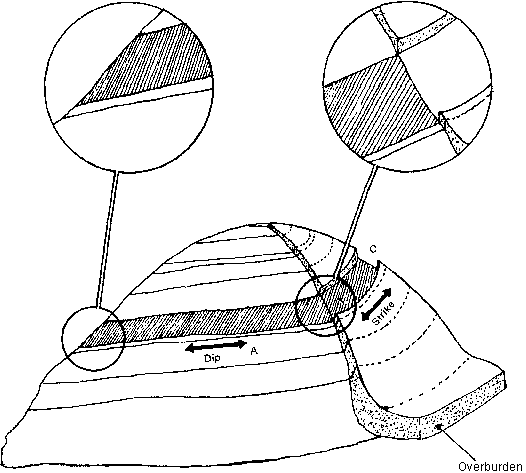
Hillside Stratification and Quarrying
Alternatives
Note: Quarrying along the dip A would make for a quarry floor
which is too steep. To avoid drainage problems during the rainy season and the
additional effort required to haul the quarried stone up the slope of the quarry
floor and then down the hill to the kiln, the area C would have to be excavated
as one progressed into the hill. The situation on side 11 of the hill is
preferable. It would be advantageous in the case described above to quarry along
the strike as far as possible before quarrying into the dip.
3.1.2 Quarry plan
The quarry plan consists of decisions on:
a) position and layout of the quarry,
b) flow of material,
i. e. haulage, stock piling,
c) the extraction techniques, i.e. blasting
method and plant equipment to be used,
d) dressing techniques,
e) future
developments of the quarry.
Since each situation presents its own conditions, only general
recommendations are made:
- The quarry layout should be such that it allows
for easy access and maneuverability of loading and haulage machinery or animal
driven carts on the quarry floor. At the same time, it should accommodate
comfortably all the necessary manpower and their movements in the quarry. Double
handling should be avoided.
- The choice of whether to use manual or mechanical means of
dressing, loading or transporting depends on the implications of the
alternatives in the particular context, but in general in a low output works, in
the rural areas of a developing country, manual means are likely to be the most
suitable.
-The method of extraction selected should be such that it
ensures an adequate supply of stone feed with a limited amount of dressing
effort. For example if blasting is necessary, the techniques used should be such
as to limit the need for secondary blasting and provide a maximum amount of
stone of the required size.
- Care should be taken to avoid flooding during the rainy
season. It is advisable to acquire specialist knowledge for this as well as for
the quarry plan in general. The local Geological Survey and Mining Department
(government) may have a section with personnel to assist small scale miners.
-The future physical development of the quarry must be
considered.
3.1.3 Quarrying
Stripping is the removal of overburden such as sand, gravel or
clay of varying densities in preparation for quarrying. The ease with which it
can be removed and the economic implications of the means available will
determine the means used.
In a small project where the amount of soil to be removed is
small and also relatively loose, the overburden can be stripped manually, using
pick and shovel and wheelbarrows. An animal driven plough could be used to
loosen the soil if it is hard.
If mechanical means such as bulldozers, scrapers and trucks are
available that may be preferable both in terms of economy and efficiency.
Extracting is the removal of limestone from the quarry face. It
should be carried out in a safe and systematic manner to provide a size of stone
which will reduce the amount of effort required in its preparation for firing.
The methods used, depend mainly on the nature of the material. The softer type
limestones could be extracted by means of chisels, wedges, crowbars and picks
and shovels, or by compressed air hammers, with or without a light blast
depending on the specific conditions. The harder variety how ever, such as
marble or dolomite, will require blasting. The type of blasting used depends on:
a) the nature of the joints and fissures in the
rock, i.e. number, size and relative position of joints in the rock;
b) size of material required;
c) explosives available and relative costs;
d) drilling equipment available and the ease with which it can
be used, i.e. hardness of material and topography of quarry.
It is essential that blasting be carried out by specialists.
Blasting is a skill acquired through many years of experience and if conducted
by "amateurs" can be both unsafe and uneconomic.
Dressing constitutes the preparation of stone, after it has been
extracted from the quarry face, to the required size and shape. The methods used
can be either mechanical or labour intensive.
The labour intensive methods are the use of hammers and chisels
of varying sizes. A system of dropping a heavy metal ball on large pieces of
rock to break them could also possibly be used. The most important thing to note
when using labour intensive methods is that stone is easier to break along the
grain than across it.
Mechanical methods of dressing and handling may become feasible
when a small limeworks and a stone crushing operation are going to be
implemented together. A saving in the blasting cost will be achieved since all
the stone blasted will be used. If a stone crusher is not implemented
concurrently, it could be that up to 30 % of the stone quarried would be lost in
dressing. Further, the demand for stone by a small limeworks alone will not
occupy a mechanical plant to an extent which will make its operation economic.
The same applies to highly mechanized loading and haulage machinery.
Transportation: The dressed stone can be transported by
wheelbarrows, wagons or tubs on rail (of wood or metal), animal driven carts, or
by aerial ropeway.
Stock piles: If the cash availability permits, it will be
cheaper when contracting for the blasting, to blast stone for a 3 to 6 month
demand rather than having the blasting contractor transport equipment out to the
site more often, especially when the distance from the contractor's site to the
limeworks is great. Furthermore under conditions where there is a possibility of
plant breakdown or labour availability fluctuation, for example where people
employed in dressing may need to work in the fields for part of the day or for a
period, it may be necessary to separate the stone preparation from the
limeburning operation. This can be done by increasing the stock pile of kiln
feed.
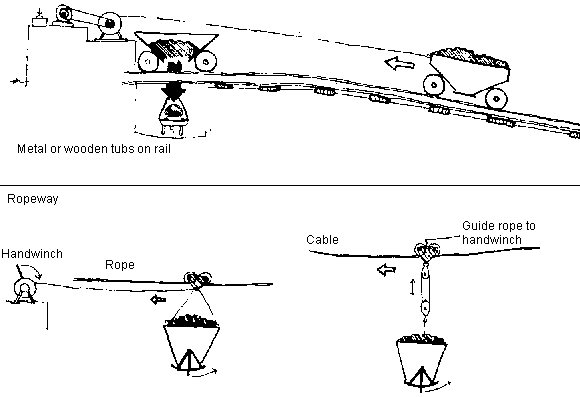
Figure
3.2 Fuels
3.2.1 Heat requirements
and thermal efficiency
Calorific values
|
coals and cokes |
|
|
25120 fuel oil |
- 37680 kJ/kg fuel |
|
37680 wood |
- 41870 kJ/kg |
|
12560 producer gas (coal) |
- 14650 kJ/kg fuel |
|
348 |
- 855 kJ/m³ |
The theoretical heat requirement for burning high calcium lime
is given by Boynton as 770 kcal/kg (i.e. 3.2 million kJ/tonne). This is a
minimum heat requirement. In practice it is inevitably exceeded due to heat
losses. Heat is lost through:
- radiation,
- products of combustion, carbon
dioxide evolved,
- discharged quicklime,
- drying stone,
- dust from
kiln.
The heat required in practice depends on the "thermal
efficiency'' of the operation which in turn depends on the nature of the
limestone fired, the type of kiln, nature of the fuel used and the skill of the
operator.
Thermal efficiency is expressed as:

According to Bessey,
thermal efficiency can vary between 30 -85 % in large modern kilns, and be as
low as 20 % in simple wood-fired batch kilns.
Assuming a well designed and operated simple mixed feed vertical
shaft kiln has a thermal efficiency of 40 %, the fuel to be used has a calorific
value of 30000 kJ/kg and the % available oxide is 85 %, the amount of fuel
required per tonne of limestone charge would be:
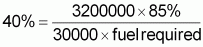

Searle says "Vertical kilns differ greatly in their efficiency,
and fuel consumptions of 400-640 lbs of coal or coke per ton of lime are
common", i.e. approximately 182-290 kg per tonne limestone.
In a mixed feed operation the mixes of 1:4 coal to stone, 2:3
wood to stone and 1:2 charcoal to stone, are weight ratios which could be
adopted to commence trials with, to be adjusted later as required. If the
calorific value per kilogram fuel and the % available lime is known, a more
accurate estimate of quantities can be made using the method described above.
Probably this will change with experience in firing.
3.2.2 Fuel types
The selection of fuel, besides the kiln design and operation
implications, depends on the cost per thermal unit (kJ), the behaviour of the
fuel in use and the quantity and nature of impurities. There are various types
of fuel that can be used for small scale lime burning; coal, coke, anthracite,
lignite, peat, wood, as well as producer gas and fuel oil.
Coal differs in calorific value, in the degree of volatility and
the type and quantity of impurities. Coal having a moderate to low volatile
content is best for use in mixed feed operations, i.e. bituminous to
subanthracite coals. The use of high volatile coals in such operations will
result in part of the heat value escaping with the exhaust gases. They are best
used in gas producers and to a lesser extent in external fireplaces.
The major impurities and levels of acceptabiIity are:
- Volatile sulphur which burns to sulphur dioxide
and is absorbed by the lime should be less than 2.5 %.
- Ash content should be less than 6 % but could go up to as much
as 10 %. Low calorific fuels tend to have a higher proportion of ash.
- Water content should not exceed 6 %. A high water content
results in excessive, cooling of the flame and therefore a waste of
heat.
The size of the coal fired should be as uniform as possible and
at least in the size range of 10-40 mm diameter.
Coke is a very good fuel for limeburning either mixed with the
limestone or to produce gas. A pure lime can be produced in a mixed feed
operation by using a furnace coke since it contains a small amount of ash and
sulphur. It is, however, difficult to light and burns less easily. For this
reason, soft burnt coke produced in coke ovens is preferable. Gasworks coke is
not satisfactory since it contains a high level of sulphur.
Anthracite can be considered as the best fuel for a mixed feed
operation, possibly with the exception of wood. It is a coal with very little
volatile matter. It has a high calorific value and ignites more easily than
coke. The only likely disadvantage is its high cost.
Peat is a fuel with a low calorific value and high volatility.
It would be best used to produce gas but could be used dry in a mixed feed
operation to produce agricultural lime.
Lignite/Brown coal has the same low calorific value and high
proportion of volatile matter as peat but also contains a large proportion of
water. It is best used to produce gas. The producer should be larger than one
for coal since lignite is a bulkier material. In addition, provision must be
made in its design to cool the gas to condense the excess water so that it may
be removed. Lignite often occurs in large quantities in locations close to
limestone and therefore may be a more economic alternative to coal transported
over a long distance.
Heavy fuel oil or a mixture of heavy oil and used motor oil can
be used to produce a very good quality lime. A simple method is to transform the
oil into an oil vapour which is then mixed with a suitable proportion of air and
ignited in chambers around the periphery of the kiln to produce a flame which is
fully developed before it leaves the combustion chamber, i. e. before it comes
into contact with the limestone. There are various methods of atomizing the oil
and mixing it with the necessary amount of air. In principle, the oil is
preheated to a runny consistency and then injected under a slight pressure into
a chamber where a blast of steam or air under pressure vaporizes it. The oil
vapour and air mixture is ignited and the flame produced is directed towards the
column of limestone in the kiln. The skill of the operator lies in his ability
to mix the necessary amount of air and oil, or steam and oil, so as to produce a
flame of such a length and intensity as to fire the limestone column to the
centre without overburning any part of it, and without choking up the pores of
the limestone with soot due to too lean a mixture.
In modern applications the oil is injected into specially
designed gasification chambers where tit is mixed with a predetermined mixture
of air and recirculated hot flue gas, and oxidized to produce hot fuel gas which
is introduced into the calcining zone where it ignites. These methods are
generally more efficient but are comparatively expensive to implement and
generally inappropriate for small scale production.
The oil must have a sulphur content of less than 2.5 %
The type of gas to be used in a small scale application is
producer gas. This is a good fuel for burning lime with the advantage of
providing the possibility of using low grade fuels which could not be used in a
mixed feed operation. The disadvantages are that its use requires a higher
capital outlay than a mixed feed kiln and also more skill and effort in
operation. If used correctly it can produce a flame similiar in quality to that
of wood with the advantage of not contaminating the lime. Further, a more evenly
burnt product could be obtained since it facilitates better control of firing.
Producer gas is made by passing a mixture of steam and air through a bed of fuel
at least 1.5 m deep. The specific design of gas producer will depend on the type
of fuel used. For example lignite . and wood will require a deeper bed than
coal. The fuel is charged at the top of the column and as it descends it is
dried by the rising hot gases. It descends further in the column and acquires
the temperature at which it parts with tar. Further down the column the fuel is
decomposed into a gas mixture of carbon monoxide and some hydrogen. Lower down
it is burnt in the ordinary manner providing the heat necessary for producing
the gas in the upper layer. The ash falls through a grate into a pit from which
it can be removed manually.
The gas can be produced by passing air through the bed of fuel
alone but the use of steam together with air is preferable. Steam will prevent
clinker forming on the grate and also produce a cooler flame. The consistent and
uniform supply of air and steam is of the utmost importance for the production
of a good and consistent supply of gas. (See below, producer gas fired kilns.)
Wood is the traditional fuel for limeburning and from a
technical point of view is ideal. It produces a long flame which is able to
penetrate further into the limestone mass and throws off heat slowly and
uniformly promoting even firing. In addition wood, on being fired, generates a
considerable amount of steam which tempers the flame temperature. It is
therefore almost impossible to overburn any of the lime when using wood as a
fuel.
The use of wood is particularly effective in batch kilns. Dry or
green wood can be used, preferably of the hard, dense varieties. It should be
cut into lengths of approximately 250 mm if it is to be used in a mixed feed
kiln, and if in an updraught type to lengths which suit the particular
requirements.
The use of wood needs very special attention to avoid denuding
the landscape which, in addition to the less important aesthetic damage, could
cause soil erosion problems and may limit its availability for other uses, e.g.
in rural areas of developing countries for heating and cooking purposes. In
principle, if it is used it should be replaced.
Wood chips and other combustibles could be burnt in specially
designed external fireplaces. Biogas is another form of fuel that could possibly
be used. Theoretically, many types of, fuels could be used but the practical
implications often limit the range of choice. It is essential to ensure that an
adequate and dependable supply exists in the long
term.
3.3 Limeburning
The purpose of this section is to provide the project worker
with:
a) a basic understanding of the principles of limeburning
(calcination) and the factors which determine successful production of Iime;
b) a general description of kilns that can be used in small
scale limeburning;
c) technical and operational information on small vertical shaft
mixed feed kilns.
3.3.1
Principles of limeburning and factors effecting the production of lime
3.3.1.1 Physical factors
Stone size: -A small stone can be fully calcined more easily and
quickly than a large one. The selection of stone size will be based on the
necessary temperature of firing and the corresponding firing time. These will
depend on the physical and chemical characteristics of the stone.
For a given stone type, the size of the stone can be increased
or decreased affecting the draught through the kiln and thus the rate at which
the heat rises up the kiln shaft. The rate at which the fire rises up the shaft
determines the length of time a stone is fired at the calcining temperature
(firing time). Large stones have larger air gaps between them allowing air to
flow through the shaft easily. Smaller diameter stones however, make the flow of
air through the kiln difficult resulting in a slow rising of the fire and
possibly overburning. Therefore, if a small stone is used the draught should be
increased, by lengthening the kiln shaft or chimney, to avoid overburning.
For a shaft length of around 4.5 m and a chimney height of 1.5 m
the following approximate stone sizes would probably be satisfactory:
- coarse crystalline 100 mm diameter
- fine
"rained crystalline marble or dolomite 150 mm diameter
- poorly crystalline
175 mm diameter
- porous (chalk or marl) 200 mm diameter
Stone shape: It is preferable to use stone of a cubical or
spherical shape. Flaky material will tend to obstruct the flow of air through
the kiln, causing channelling and a bad distribution of heat.
Grading of stone: -A uniform, consistent size of feed is of
primary importance. A variance in stone feed size will result in the smaller
size being overburnt or the larger size having a core of unburnt material, or
both. In addition, uneven firing will result, because the draught in its passage
up the shaft will select the easiest path forming chimneys (channelling) and
firing the material around the chimneys more than elsewhere.
Strength of stone: -The vertical load of a tall column of
material will crush a soft stone or, if not crushed, a tall column of soft stone
may create an excess amount of dust prohibiting successful firing, due to
abrasion in its passage down the shaft. Special care must be taken to avoid
these effects by reducing the length of the kiln shaft as is necessary. Firing
of marl or chalk, both of which are soft stones, will require short kiln shafts.
3.3.1.2 Density,
porosity and crystal structure
Effect on calcination temperature and firing: Limestone
including magnesian limestones may be highly or poorly crystalline, i. e. have a
well defined crystal structure or not. It may be coarse or fine "rained, dense
or porous. Limestone is a sedimentary rock which, when metamorphosed becomes
highly crystalline, e.g. marble or dolomite.
A highly crystalline limestone is hard, fine or coarse "rained
material, of which the coarse "rained varieties are more dense than the fine. A
dense, coarse "rained stone requires a higher calcination temperature and/or a
longer firing time than the fine "rained. Poorly crystalline rock is generally
softer e.g. calcrete, and comparatively more porous than the highly crystalline
stone. Porous stone requires a lower calcining temperature and/or shorter firing
time than do the more dense varieties.
Shrinkage - overburning: - The porosity of the stone is reduced
with a temperature increase above the calcination temperature or an extended
firing time. The stone shrinks (becomes overburnt) by the increasing of crystal
size and hence the reduction in the number and size of pores. The typical
characteristics of an overburnt stone are low reactivity requiring long and
careful hydration, and low plasticity.
Dense, coarse "rained crystalline stone becomes overburnt more
easily than the fine "rained or porous stone and therefore requires more careful
firing.
The effect of impurities:Impurities cause slags to form around
the surface of the stone which result in a reduction in porosity (overburning)
at lower temperatures than would otherwise be the case. Impurities both in the
stone and in the fuel have this effect but the purity of the stone is more
important.
Decrepitation or spalling: - It has been found that both crystal
size and structure have an effect on whether a stone will disintegrate
(decrepitate or spell) during firing. In general the coarse crystal variety is
more susceptible to fracturing and disintegration. However, the research results
are not conclusive. Therefore the only safe way of determining whether
decrepitation occurs or not is by testing the stone, preferably under field
conditions. The chemical composition of the stone does not affect its structural
stability during firing.
3.3.1.3 Heat and temperature
Heat is added to limestone to remove the CO2 (carbon
dioxide) and form quicklime.
The rate at which the stone is heated to bring it to the
temperature at which CO2 begins to dissociate itself from the
limestone (dissociation temperature), the temperature at which the stone is
fired (calcining temperature) and the length of time the stone lump is kept at
the calcining temperature (firing time), all contribute to the efficiency of the
firing process both from productivity and quality points of view.
Temperature of dissociation: -The temperatures at which
CO2 dissociates from limestone depends on the proportionate amounts
of MgCO3 and CaCO3, and on the crystallinity of the stone.
The MgCO3 begins to decompose at a lower temperature than
CaCO3, a good average being around 725°C and 900°C
respectively. Dense, coarse crystalline limestones have a higher dissociation
temperature than porous, fine "rained or poorly crystalline types.
Once the dissociation temperature is reached CO2
begins to be released at the surface of the stone lump. If the temperature is
maintained dissociation proceeds uniformly inward towards the centre of the
lump. In practice, for the CO2 at the core of the stone lump to be
released it requires a raising of the temperature above the minimum dissociation
temperature. The larger the stone size, the greater the increase in temperature
required above the dissociation temperature. Boynton suggests that “the
difference between the dissociation temperature of the surface and core may be
300-700ºF (150370°C), depending primarily on the stone's diameter."
Further factors influencing the calcination temperatures are the CO2
pressure and concentration and the firing time.
CO2 pressure and concentration: -A dense stone will
require a higher temperature of calcination because the CO2 will
encounter greater difficulty in reaching the surface of the lump, i. e. a
greater CO2 pressure is necessary than would be the case if the stone
is porous. Similarly, a large stone, as compared to a small one of the same
material, will require a higher CO2 pressure, i.e. a higher
temperature, to calcinate. Further, if the atmosphere in the kiln is such that
the % CO2 concentration is low, the dissociation temperature is
reduced.
For practical purposes, the important thing to recognize is that
an interrelationship between CO2 pressure, % CO2
concentration and dissociation temperature does exist, and that once the optimum
temperature is determined (by trial and error or by design), the firing
conditions must be kept the same to ensure a consistent quality.
Calcination temperature and firing time: At any one particular
temperature above the minimum necessary, the stone must remain at that
temperature for a length of time sufficiently long to dissociate all the
CO2 from the stone. The higher the temperature above the minimum that
the stone is fired at, the shorter the firing time necessary. However, depending
on the stone size and type, at a certain. temperature level the. stone will
begin to overburn to an unacceptable extent. Ideally, the firing temperature
should be set so as to minimize the firing time, i.e. maximize output, without
reducing the quality of the lime produced, i.e. overburning it. Boynton suggests
that 1149°C for high calcium limes and 1066°C for dolomitic limes will
probably be suitable calcining temperatures. The optimum temperature can best be
determined by experimentation.
Rate of heating: Ideally, the limestone should be sufficiently
preheated so as to bring the stone gradually to the dissociation temperature,
and then the calcining temperature, at which it should be kept for a minimum
time period.
The rapid increase of the stone's temperature to its calcining
temperature is considered to have an adverse effect on quality. Practically,
this means that the kiln must be designed in such a way so as to maximize
preheating, i.e. the shaft should be as long as possible.
Calcination of dolomite:Dolomite is particularly difficult to
fire satisfactorily since the temperatures necessary to dissociate the
CO2 from the MgCO3 component of dolomite are lower than
those necessary for the CaCO3 component. Firing at the temperature
required for CaCO3 will, to a greater or lesser extent, overburn the
MgCO3 component making it difficult to hydrate. It is recommended
that if a dolomite has to be used it should be fired at as low a temperature as
possible. Using a small mixed feed kiln of the KVI-type a temperature of around
950°C will probably suffice for a small stone size. If a choice in fuel
does exist wood is preferable since on being fired it will produce steam which
helps to cool the fire and hence avoid overburning to some extent.
3.3.2 Kiln designs
Kiln designs and methods of operation (technology) differ in: a)
the manner in which fuel is used to bring the stone to the required temperature,
and b) the conditions which the stone is subjected to during the course of being
fired.
The technology used depends on the: a) physical and chemical
characteristics of the stone used, b) fuels used, c) socio-economic and
technical factors in the particular circumstances.
The objective of the designer should be to design a limeburning
operation which will provide: a) the qualities of lime required, b) a lime of
sufficiently low cost, c) an operation which suits the local conditions.
Although it is difficult for a layman to design and determine
the optimum operating conditions of a kiln, under the circumstances where a
small batch or continuous mixed feed operation is appropriate and feasible, the
layman could implement it with a general knowledge of the subject and a minimum
of specialist assistance.
3.3.2.1 Batch fired kilns
These are kilos in which one volume of stone is fired at a time.
The kiln is fired, allowed to cool, the quicklime is extracted, stone is
reloaded and the kiln fired again.
Appart from the open air method of firing stone in layers with
wood, batch kilns are the oldest and most well tried method. They are still
successfully used in many parts of the world.
There are two types of batch fired kilns:
- the flare or updraught kiln where the stone and
fuel are kept separate, and
- the "mixed-feed" type where the stone and fuel
are loaded in alternate layers in the kiln.
Updraught kilns are either heavy stone structures or are built
into the side of a hill, traditionally conical in shape, with a height of around
two times the maximum width. The opening at the top for loading is around 1/3 of
the internal diameter, and at the base, the opening for extraction is about 1/4
of the diameter. A typical kiln of this type is the Honduran kiln. The modern
versions of updraught kilns are similar to the kilns used in the
Medani-Sennar-Kosti-Road-Project in Sudan, or the box type updraught kiln such
as the one developed by Hodges.
Firing is carried out in a firing chamber which is either
re-built with each batch or which is a permanent feature of the structure. The
former is an arch or dome built of large pieces of limestone over a grate into
which the ash from the fire can fall. Limestone of a progressively smaller size
is loaded above the firing chamber to the top of the kiln. The method of loading
and the size of stone used, which depends on the fuel used and the kiln design,
are very important factors for the production of good quality lime.
Where the firing chambers are a permanent feature, such as in
the Hodges updraught kiln, special trenches are built into the kiln. The way in
which stones of different sizes are arranged in the kiln is equally important
with this type of firing chamber. In both cases firing is very much a matter of
trial and error and can best be learnt by experience.
In both methods there are no means of ascertaining when the
limestone has been completely burnt except indirectly by observing, through the
inspection or poking holes, the colour of the limestone during firing which
should be a bright cherry red when the right temperature is reached. Usually
firing is continued for 48 hours after the fire has reached the maximum
temperature (cherry red colour). This means about 72 hours per batch in total. A
large proportion of overburnt and underburnt material can be expected (around 25
% of each).
Mixed feed type batch kilns are most commonly used in the rural
areas of developing countries, particularly because of their mode of operation.
They require relatively little attention during firing. In design they are
similar to those used for continuous mixed feed operations. They vary mainly in
the method of operation. Limestone. and fuel are fed in alternate layers up the
kiln shaft, in the required proportions, fired and allowed to cool. Then the
product is extracted.
Compared with kilns which are operated continuously they are
wasteful of heat. This is a very important factor for consideration particularly
in a situation where fuel is scarce, expensive or a long distance from the
production site. The economy of fuel is low in such kilns because of the huge
waste of heat in raising the temperature of the kiln walls each time a new batch
is started, and also because of the loss of heat to the at" mosphere when the
fire reaches the upper limits of the kiln.
The attractive feature of such a kiln for developing countries
is that it requires very little attention during firing, making it suitable in
situations where labour is scarce or its availability restricted, or where
demand is irregular.
For example, its use would be advantageous in a distant rural
road project where lime is required for soil stabilization and which is a long
distance from a lime producing centre. Under such circumstances the erection and
operation of a small lime kiln (or kilns) near the road construction site might
be preferable. The method of ascertaining whether the material is completely
burnt and the length of time for each batch is the same as in updraught kilns.
Kiln designs of this type are like those of the 'Somali kiln, the kiln used in
Papua - New Guinea and the 'Khadi Village Industries' type kiln. (See section
3.3.3)
The principles and details of kiln construction and materials
suitable for use which apply to the continuous type kilns apply to the batch
kilns as well.
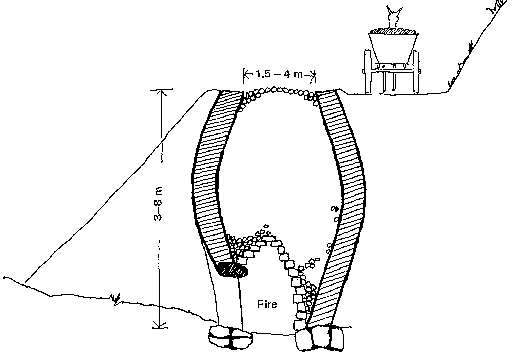
Honduran Type Kiln (after sketch in
Bessey)
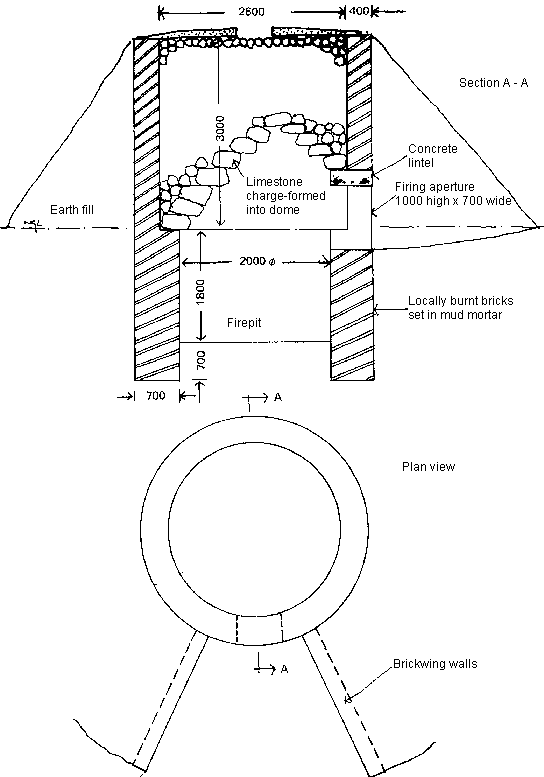
Example of Kilns Used on the
Medani-Sennar-Kosti Road in Sudan
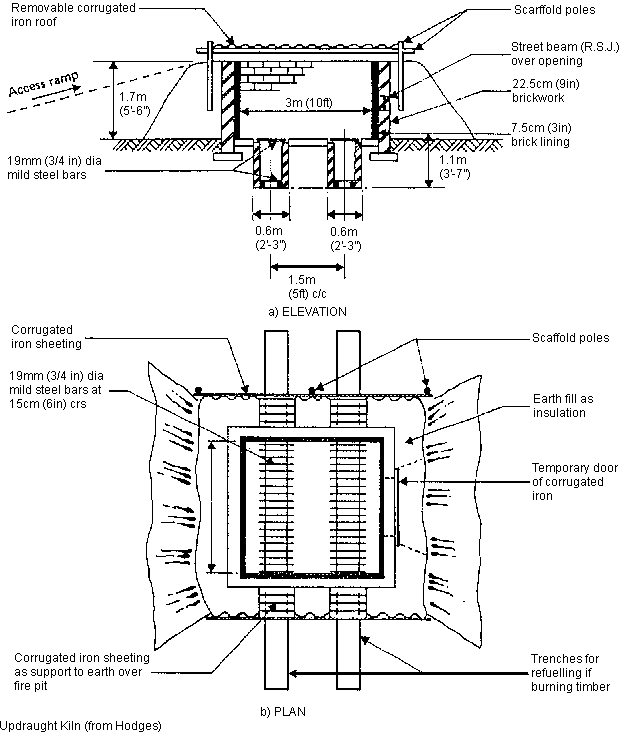
Updraught Kiln (from Hodges)
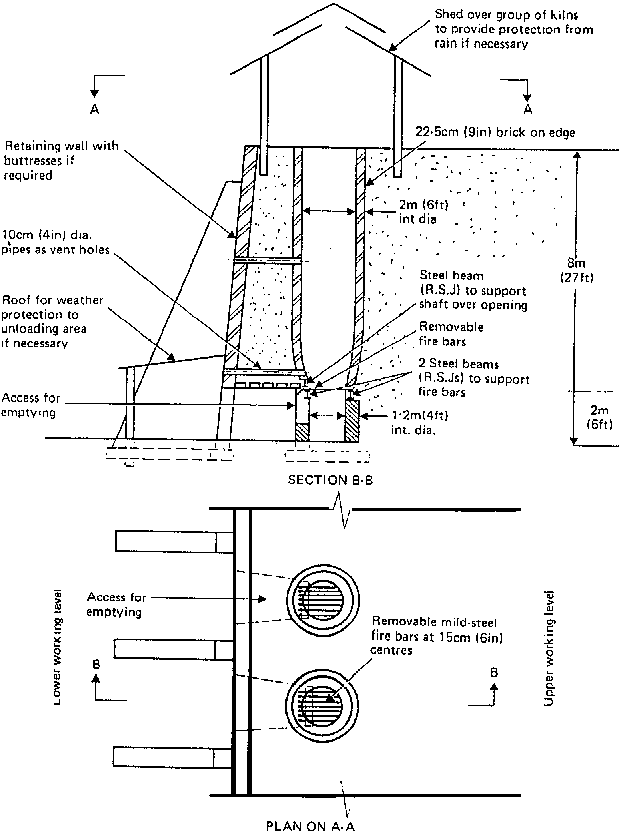
Somali Kiln (from Bessey)
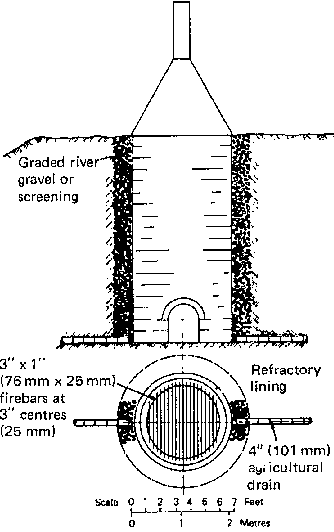
A simple Shaft Kiln for Wood-Firing
(after Hoskings)
3.3.2.2
Continous kilns
There are two different types of kilns which may be suitable for
a low demand situation; the vertical shaft kiln and the horizontal kiln.
Vertical shaft kilns are symmetrical, either circular,
elliptical or square in shape and are fired either internally or externally.
Mixed feed kilns are the internally fired type and are recommended for use
wherever a very high quality product is not required. The externally fired types
are more difficult to construct, and for efficient and effective use require
special design and operating effort. The installation of such a kiln to fire a
limestone of less than 95 % CaCO3 is considered wasted effort since
the quality lime produced will not be sufficiently high to sell as high grade
lime which would warrant the higher capital and fuel cost. Externally fired
kilns, particularly if using low technology methods, generally consume more fuel
than the mixed feed type.
In mixed feed continuously-operated kilns {internally fired)
solid fuel such as wood, coke and coal is charged id alternate layers with
limestone at the top of the kiln. The fuel is burnt in the middle third of the
kiln shaft to calcinate the limestone. The rising hot gases from the combustion
in the firing zone (middle third) preheat the limestone in the top 1/3 of the
shaft whilst the material in the lower third is cooled so +hat it may be
comfortably withdrawn through discharge openings at the base of the kiln shaft.
For the production of lime suitable for construction purposes, soil
stabilization or agricultural use, the mixed feed type kilns are likely to be
the most appropriate. They are therefore dealt with in detail in sections 3.3.3
-3.3.4. (See also the drawing of the construction of a vertical shaft kiln p.
54. This is a KVI-type kiln used in Moshaneng, Botswana with recommended
variations). A kiln design used in India, as described by R. Spence, has been
included below.
Solid fuel, furnace kilns are modernized versions of the
traditional updraught kiln. Wood, coke or coal can be burnt in fireplaces built
into the wall of the kiln approximately 1/3 the distance up the shaft. It is a
method which is most wasteful of fuel and very difficult to operate to produce a
consistently good quality quicklime. There is a tendency to fire the limestone
at the periphery of the shaft more than at the centre. To limit this, the shaft
diameter must be kept to a minimum and if possible, either by the injection of
steam or re-cycled flue gases into the fireplace, the flame should be forced
towards the centre of the column of limestone. A kiln fired in such a way
produces the best results when wood is used as fuel since this has the advantage
of producing the long, cool flame which is considered to be most suitable for
limeburning. The risk of overburning is avoided. If coal or coke, which produce
shorter and more intensive flames are used, the injection of steam or recycled
flue gases will lengthen and cool the flame. Volatile coal, which is not
suitable for mixing with limestone, could be used if special care is taken. The
difference in kiln design when coal is used as the fuel instead of wood, is the
size of the furnace. Since. wood is a bulkier material it will require a larger
furnace.
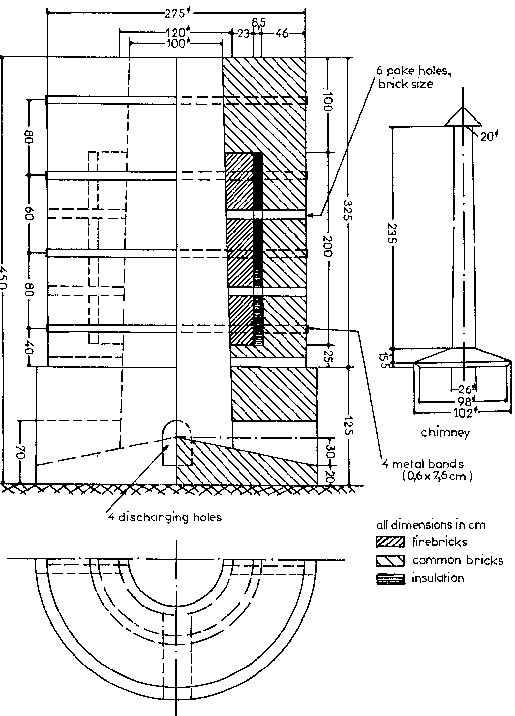
Kiln for Quicklime Burning (from
Spence)
Producer gas fired kilns: -The fuel efficiency of furnace kilns
can be improved if the fuel is converted to producer gas before being fired. The
fuel saving factor is that the combustion of the fuel takes place inside the
kiln shaft as opposed to in the fireplace. Gas can be produced in gas producers
either built into the kiln wall or as separate structures. Although more
difficult to construct and also to operate, gas producers built into the kiln
wall will guarantee far less heat loss than producers separated from the kiln.
It is difficult to say whether the one is preferable to the other. The
implications should be considered in each instance. The design of the kilns
having gas producers built into the kiln structure is similar to the externally
fired kilns with the difference that the bed of fuel in the fireplace is deeper
and provision is made to allow steam and air to pass through it. The diameter of
the kiln shaft should be a maximum of two meters. If a greater diameter is used
it will be difficult to fire evenly right across the shaft cross section.
Whether one single producer or several small ones are used, the gas should be
introduced at about 1/3 of the height of the kiln and through as many inlets as
possible. Air is mixed with the gas either in the producer (primary air), or in
the kiln with air which has passed through the cooling zone of the kiln
(secondary air), or with both. The producer gas is ignited in the firing zone by
the hot secondary air or, if only primary air is used, it is introduced under
pressure with the gas into a mixing pipe the end of which is ignited. The
proportioning of the two types of air and gas and the pressure at which the
mixture is introduced as well as the burner design determine the quality of
firing (see diagram of burner for gas firing described by Searle). A well
designed and operated gas fired kiln can produce the best quality lime. The gas
producer enables the use of fuels which would otherwise be of little value.
Lignite, peat and high volatility coal as well as certain agricultural waste
material, such as coconut, coffee husk' olive pips etc. can be used to produce
gas. Good design and operation of the producer is vitally important. As a
general principle the simpler the producer the less likely it is; to break down
or operate inconsistently.

Dimensions have not been given since
the fireplace will have to be specially designed in each case, depending on the
fuel used or the limestone fired. The fireplace must be lined with firebricks
and should be insulated. The water container shown in the drawing may be
omitted. It is a means of utilizing the heat loss to the furnace walls but its
construction and maintenance may be too difficult and costly.
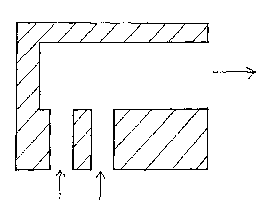
Gas from the producer rises
vertically up the gas duct into the mixing duct as does air up the air duct. The
two are mixed under a slight pressure before being ignited. The distance of the
two ducts from each other and the lenght of the mixing duct determine the nature
of the flame. Eeither primary or secondary air can be used. The larger the
mixing duct the more intensive the flame. (Sketch from Searle)
Oil fired kilns: - In the simplest form oil is burnt in
combustion chambers in the wall of the kiln at around the bottom of the middle
third of the shaft. The kiln is easier to construct and operate than the gas
fired kiln and will produce approximately the same quality product. Heavy oil or
even used motor oil can be used. It is atomized, mixed with the right
proportions of air or steam and ignited.
Accurate firing requires the regulation of the mixture of air
and oil or steam and oil to ensure a suitable length and intensity of flame. An
intensive flame will tend to overburn the limestone whereas a very long flame
with an inadequate amount of air will tend to choke the pores of the limestone
with soot and will not reach the centre of the column of material.
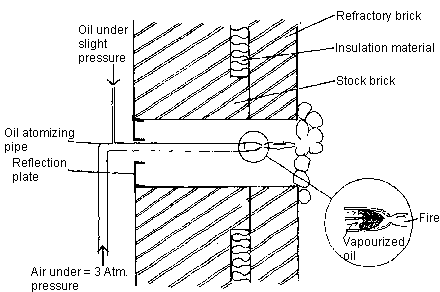
Injection System Used in Aspropigo,
Greece
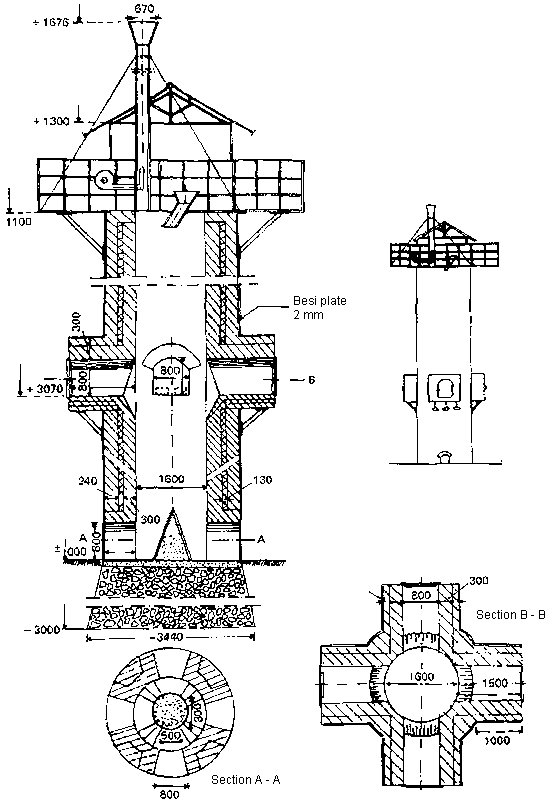
Indonesian Oil Fired Injection Kilns
(after Sobek)
Horizontal kilns: -There are three different types of horizontal
kilns: ring kilns, rotary kilns and tunnel kilns. Ring kilns are of specific
interest for situations requiring a low technology solution.
A ring kiln or Hoffman kiln can be either circular or elliptical
in shape. It is a continuous tunnel structure into which limestone is charged
and from which quicklime is extracted continuously. Hot gases are drawn
horizontally through the limestone to produce the quicklime. To describe its
operation, let us-assume that the kiln is divided into 20 chambers.
Under ideal operating conditions: 1 chamber will be empty, I
chamber will be filling, 7 chambers will be pre-heating, 4 chambers will be
under fire, 6 chambers will be cooling, 1 chamber will be emptying.
The larger the chambers the more efficient the firing process
and the efficiency of the kiln. The limestone is carefully stacked by hand with
hollow vertical shafts formed directly below the fuel feeding apertures in the
roof of the kiln to take the fuel. Coal. oil or wood can be used as a fuel which
is ignited by the very hot gases flowing horizontally through the kiln. The fire
is drawn forward by opening and closing draught-inducing caps in the successive
chambers. The air is drawn through openings in the external wall of the kiln to
a 15 m chimney.
The permanent roof of the kiln may be omitted and substituted by
a double layer of bricks covered with sand or ash. This will save on capital
cost but makes for a less fuel efficient kiln and one where the lime is
susceptible to damage by rain. This roofless kiln can be constructed below
ground level and has the advantage that the limestone can be loaded and
extracted using a mechanical grab.
The advantages of using ring kilns are that they have a low fuel
consumption and can produce a cleaner lime than that produced in a mixed feed
vertical kiln. The disadvantages are that the labour cost is high, they require
careful attention in operation and have a high capital cost.
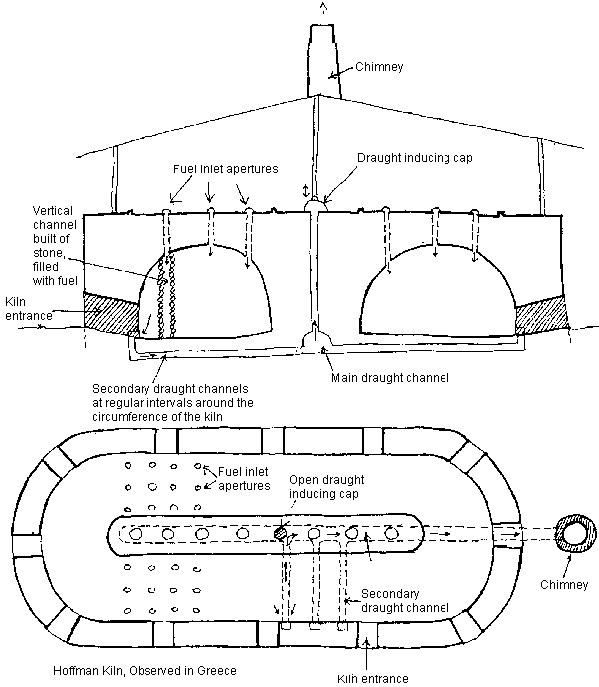
Hoffman Kiln, Observed in Greece
3.3.3 Vertical shaft mixed feed
kilns, design and construction
Of all the various shapes that have been used, the simple
cylindrical shaft type is the easiest to construct and operate. It is likely to
be suitable for most situations. Alternate layers of stone and fuel are fed at
the top, fired around the middle third and quicklime is withdrawn from openings
at the base.
Searle describes the ideal mixed feed kiln as, "... sufficiently
high to make the fullest possible use of heat from the fuel and to cool the lime
to such an extent that it can be handled with ease. It must be such a shape that
the stone and lime will pass easily down through the kiln without any poking or
other attention being necessary, and, at the same time, the lime must be burnt
uniformly, none of it being spoiled by overheating and none being incompletely
burned.
The manner in which the stone and fuel are supplied to the kiln
should require the minimum labour, and the withdrawal of the burnt lime should
be effected in the simplest possible manner.
3.3.3.1 Shape and dimensions
The circular in plan, perfectly vertical wall shaft is easy to
construct, makes for a better distribution of, heat than the square or oval plan
types, and also reduces the potential for the material to "hang" in the shaft.
The oval plan shafts are best used in externally fired kilns and the square
types, although easy to construct, are likely to have problems of heat
distribution to the corners. A possible departure from the simple cylindrical
shaft kiln is one which tapers slightly to the apex. This shape will reduce the
amount of hanging.
The kiln should be as high as possible to maximize both its
preheating and cooling zones. This will reduce the heat losses to the atmosphere
in the hot exhaust gases and the hot lumps withdrawn. Besides the fuel saving
implications, the length of the kiln affects the draught through it.
The kiln height is limited by the draught required, the stone
feed strength and the stone's resistance to abrasion during its passage down the
shaft. A soft stone such as chalk could not be fired in a tall kiln since the
individual lumps would be crushed under the weight of the column of material.
Also, a stone type which does not resist abrasion will create excess dust in the
kiln inhibiting the fire. The taller the shaft, the greater the abrasion and
dust created. Searle suggests that whereas the height of the kiln depends on the
physical characteristics of the stone feed, the diameter depends on the output
required. However, as a general rule a ratio diameter to height of 1:4 can be
recommended for a porous stone feed and 1:4.5 for a dense type.
3.3.3.2 Kiln construction
The kiln must be designed and constructed so that not only will
the highest possible quality lime at the lowest cost be attained but also that:
a) it is a strong, stable structure which will require a minimum
of maintenance and repairs;
b) it has an easy and safe access for repairs and maintenance
work and allows for safe and comfortable operation.
The most economically suitable materials should be used, bearing
in mind the social and environmental implications of the choice.
The kiln base must be constructed on firm ground and of a size
adequate to take the load of the shaft above and of the kiln contents. It should
have as safe and as comfortable a working area as is possible for the
discharging of the kiln. It can be made of concrete, masonry or brickwork.
The functions of discharge openings are firstly to allow
quicklime out of the kiln and secondly to allow air into it. There are two types
of discharge openings. In the one the burnt stone flows out from the centre of
the column of material, and in the other the material flows inward towards the
centre of the column. The inflow type has the following advantages over the
outflow: a) It makes for a more even draught because it is not affected by the
direction of the wind. In an outflow type the draught is strongest on the
windward side of the column of material. If the wind is strong enough and blows
consistently on the one side it will cause uneven burning. b) Draught control is
easiest with an inflow type since a portion of the opening can easily be blocked
off to the necessary degree (as determined after testing), without inhibiting
the extraction of quicklime. c) Extraction of material will require less manual
effort since the stone will not need to be shovelled out.
The main disadvantage is that construction is more complicated
and probably more expensive. Further, if the opening size is not sufficiently
large it will cause the stone lumps to become stuck requiring prodding to
release them to continue the discharging. An opening 1/3 of the diameter will
probably be sufficient.
An outward flow type opening will be easier and cheaper to
construct, the flow of stone out of the kiln will be easier and more even but
will require more manual effort. The main problem with this type is the control
of draught.
The inflow type is particularly useful if a kiln is built into a
hillside or embankment whereas the outflow can best be used in a free standing
kiln.
In addition to supporting its own weight and all sundry
structures, the kiln wall must support the lateral pressure of the column of
material and must resist cracking due to heat expansion. Further, the wall
construction must be such that it limits the heat loss due to radiation, and
protects the inner lining from sudden changes in temperature. The walls must be
sufficiently thick and made of the necessary materials to meet these ends. They
are normally of masonry, concrete, brickwork or a combination of these and
between 600-1000 mm in thickness depending on the materials used and the size of
the kiln.
The wall should be strapped with metal bands, reinforced with
mild steel bars, or thickened or buttressed to take the lateral loads.
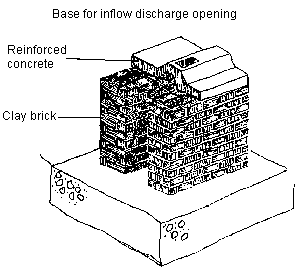
Base for inflow type discharge
opening
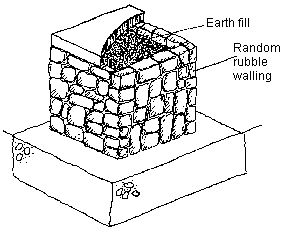
Base for outflow type discharge opening
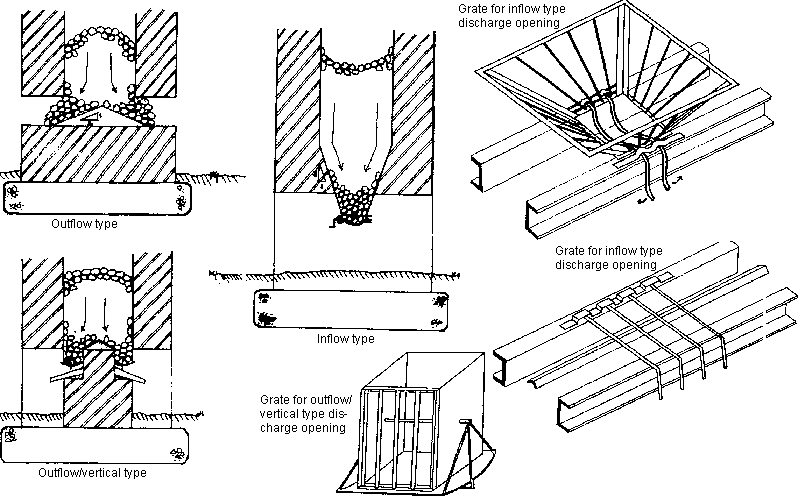
Discharge Opening Alternatives
The inner lining of the kiln wall is subject to the abrasion of
the material as it descends down the shaft. It is also subject to wear and tear
due to sudden changes in temperature, for example when opening inspection eyes
or pokeholes, and due to the chemical action of the lime and the kiln gases. The
upper part of the kiln must be protected against abrasion and the middle and
lower against chemical action.
Hard, dense bricks are suitable for the upper quarter of the
kiln, i.e. hard "blue" engineering or paving bricks, or granite worked smooth so
as to reduce the wear on the loaded material in its passage down the shaft.
Hard, fine textured refractory bricks are ideal for lining the
firing zone of the kiln. The high alumina type is the most satisfactory as the
chemical action of the lime is reduced. A refractoriness of about 1200°C is
quite acceptable.
The lining should be carefully constructed with as small a
proportion of jointing as possible. The joints between the bricks are
particularly susceptible to the abrasive and chemical action of the lime, and
must be constructed as thinly as possible or in no time at all bricks will start
to fall out of the wall. Three quarters of the kiln shaft, from the base upward
should be lined with refractory bricks.
If high alumina refractory bricks are not available hard
engineering bricks may be quite suitable and if these are not available, other
hard material such as sandstone or schist laid with the grain horizontal could
possibly be used, or even blocks of limestone.
If these latter alternatives need to be used they should be well
tried during the testing phase in the test kiln described in section 4. In any
event, both the short and the long term cost implications of the alternatives
must be carefully considered before a decision is made. The cost of regular
replacement, bearing in mind the cost of loss of production during the
replacement period, may in fact be higher than buying and transporting refectory
bricks from a distance.
It is recommended that some form of insulation be built between
the inner lining and the kiln wall (at least in the middle half of the kiln).
Large amounts of heat can be lost to the walls and then to the atmosphere.
Bricks made of diatomatious earth (Kieselguhr), loose diatomatious earth or some
other material such as pumice stone, or even air gaps can be used as a means of
containing the heat. The insulation should be built between the lining and the
kiln wall forming a 50-100 mm layer between them. In addition to insulating, the
material can take up movements due to expansion.
The charging opening does not require any special mention but
what is important to note is that the working area around the opening must be
sufficiently spacious to be safe and comfortable. If necessary a platform of the
type drawn in the figure p. 53 should be built round the opening.
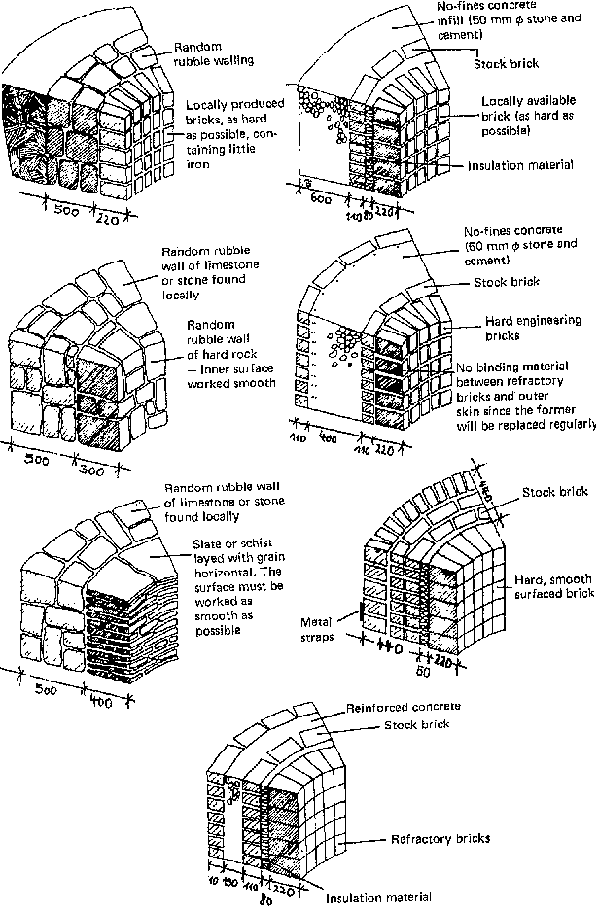
Alternative Kiln Wall Combinations
The primary function of the chimney is to assist the creation of
the necessary draught through the kiln. Secondly the exhaust gases are drawn
away from the workers feeding the kiln making their working conditions be
arable.
Loading mechanisms bring the feed (fuel and stone) to the
charging opening
Pokeholes should be constructed into the wall of the kiln at
suitable positions at the top and bottom of the firing zone to allow for poking
at regular intervals to prohibit the development of "hanging" (see hanging). The
pokeholes should be such that they can be easily opened and closed during firing
and that they are airtight. Inspection eyes should be built into the wall at
positions permitting the burning zone to be viewed and the temperature checked
at the various levels by using a thermocouple. Other apertures that may be left
in the kiln wall are airholes. These should be near the base of the cooling zone
of the shaft.
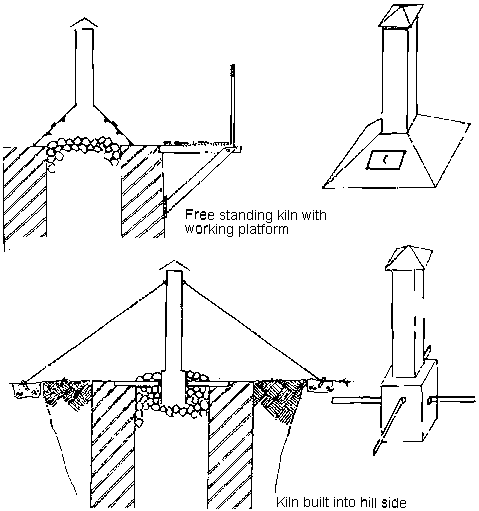
Charging Opening Alternatives and
Chimneys
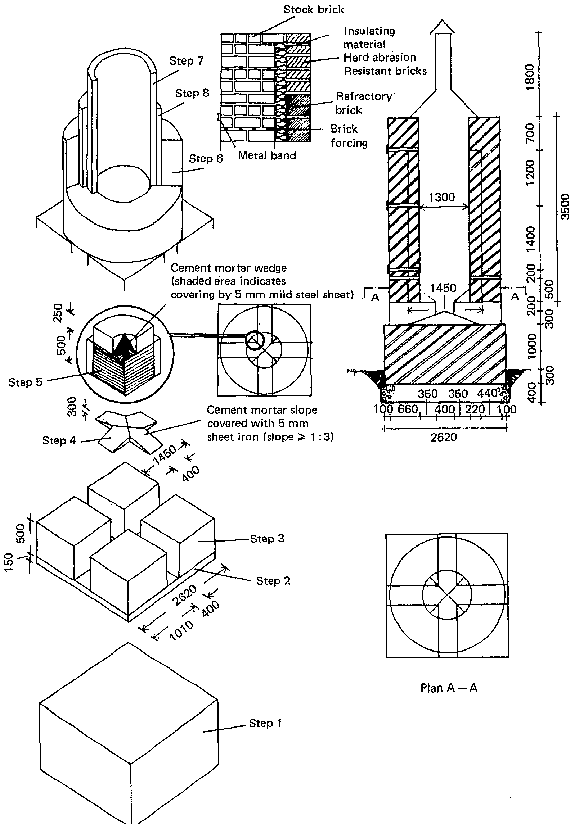
Construction of Vertical Shaft Mixed
Feed Kiln
3.3.4
Continuously operated, mixed feed kiln
To produce the best possible quality lime the kiln/e must be
designed and operated to:
a) achieve and maintain a uniform distribution of
heat,
b) achieve the necessary calcining temperature and maintain it at the
required level in the kiln,
c) fire the limestone for the required time
period.
To achieve these conditions, design and operation should ensure:
-an adequate draught,
the correct loading, sizing and grading of feed,
charging and discharging at a suitable rate.
3.3.4.1 Design factors
The purposes of the draught are to provide sufficient oxygen for
the fire to assist the combustion of the fuel, and to cool the burnt stone
(quicklime) in the lower third of the kiln so as to enable it to be handled with
ease on withdrawal. The rate at which air flows through the kiln should be such
that it draws the exhaust gases and the fire upward at a rate which corresponds
with the length of time the stone lumps must remain in the firing zone (firing
time). A short firing time will require a fast flow of air through the kiln and
vice versa.
The factors that affect both the quantity and rate of air
flowing through the kiln, i.e. the draught are:
- the length of the kiln,
- chimney length,
-
sizing and grading of stone and location,
- size and location of openings at
the base.
Length of the kiln: - Searle recommends that the kiln be as tall
as possible so that both the preheating and cooling zones can be maximized. The
length of the kiln however, does not serve this purpose alone but also
determines the rate at which the air flows through the kiln. The taller the kiln
shaft, the stronger the drawing effect upward.
Chimney length: -The draught can be increased by using a chimney
above the loading opening at the top of the kiln. The extent to which it serves
to increase the draught depends on its length and cross-sectional area. There
are various types contributing more or less to the ease with which the kiln can
be loaded, i.e. drawing exhaust gases away from operators loading the kiln.
Sizing arid grading of stone: As state a previously the smaller
the stones and the wider the range of sizes, the more difficult it is for the
draught to pass through the kiln, and also the shorter the firing time necessary
to achieve a well burnt quicklime. The length of the kiln and the chimney must
be balanced with the size of stone used so as to get the required draught in the
kiln, and hence the necessary firing time.
Charging openings/discharging ports: - The air should be drawn
up from the base of the kiln to perform the cooling function, to warm the air
used for combustion and to acquire the full effect of the kiln length for these
purposes. There are various types of discharge outlets which vary in size and
position. The size determines the amount of air let into the kiln, and the
position has a qualitative effect on the air flow through the kiln and on the
ease of operation.
3.3.4.2
Operational factors
Charging: Correct charge is most important for the assurance of
a uniform heat distribution in the volume of stone being fired. Stone of a
consistent size and grade must be fed in the correct proportions with fuel in
layers which are as fine as is practically possible. This will maximize the
degree of mixing of the limestone and fuel. The practical limitation to the
layer size or fineness is handling. Generally, the smaller the layers, the
greater the amount of handling and the corresponding handling cost, whether
manual or mechanical.
The stone feed size and grade should be checked at regular
intervals, particularly if hand dressing methods are employed. The fuel feed
should also be checked regularly for the same things.
Rate of charging and discharging: -The rate at which stone is
charged into the kiln and withdrawn from it affects both the quality produced
and the productivity. The rate at which the quicklime is extracted and limestone
subsequently charged, is dependent on the rate at which the fire rises up the
shaft which in turn depends on the draught and stone size selected. On average
1/3 of the limestone feed fired will be extracted from the kiln every 7-10
hours. In other words, the stone will be in the firing zone (middle third) for a
period of around 7-10 hours and will be kept at its peak temperature for about 4
hours. The fire will generally rise up the shaft at between 100-150 mm per hour.
Lighting the fire: -In many instances starting a fire in a mixed
feed kiln will be very difficult. Placing oil-soaked rags or wood at the base of
the column of material together with some kindling and then lighting will serve
to alleviate this problem.
3.3.4.3 Problems -causes and
remedies
Overburning results from firing for a longer time and at a
higher temperature than necessary. The result is that the stone becomes hard, it
shrinks and is then slow to hydrate.
Detection:
Overburnt stone will make a sharp ringing tone when tapped with
a hammer, compared with soft burnt stone.
- A fixed volume of overburnt stone will be heavier than soft
burnt stone due to shrinkage, i.e. more stone lumps will fit into the same
volume.
- If water is poured over an overburnt stone and a lightly burnt
stone, the former will react more slowly (low reactivity).
Remedies:
- Reduce the temperature by reducing the fuel: stone
ratio (use less fuel).
- Increase the stone size.
- Reduce firing time by
increasing the draught (increase chimney length).
Core material results - from underfiring, i. e. firing at a low
temperature and for a shorter time than is necessary.
Detection:
- The individual stone lumps when broken to show the
inside have a soft, well burnt outer shell which can be broken easily with an
ordinary hammer blow, and a hard core which is difficult to break and possibly
has a different colour.
- Another way to detect the existence of core material is by
pouring water over the burnt lump. The reactive portion will fall away leaving a
lump of core in the middle.
A core of 5 mm diameter can be considered as acceptable and can
be screened out with ease.
Remedies:
- Reduce draught by closing off some of the air
inlet area at the base of the shaft.
- Reduce the stone size.
- Use more
fuel.
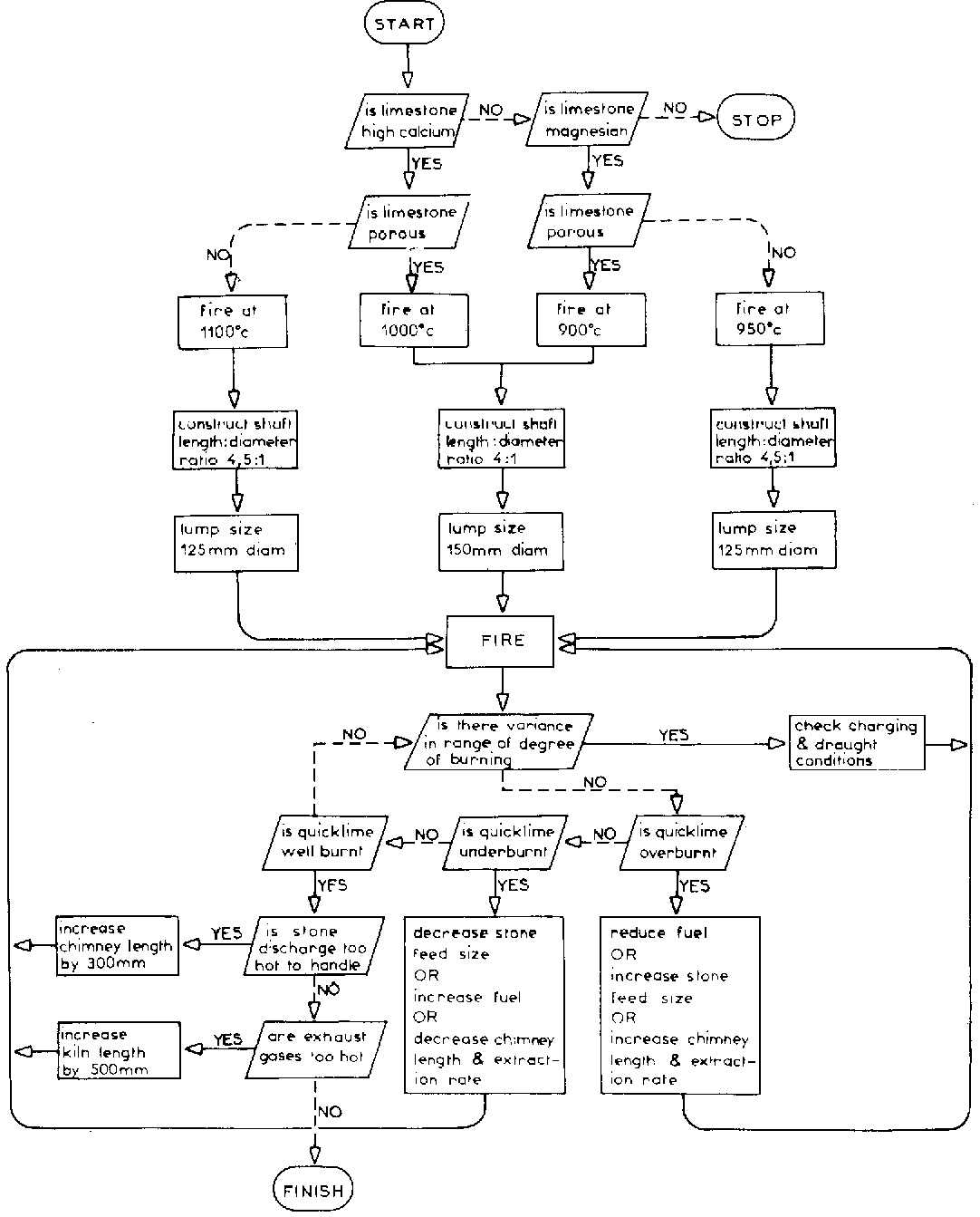
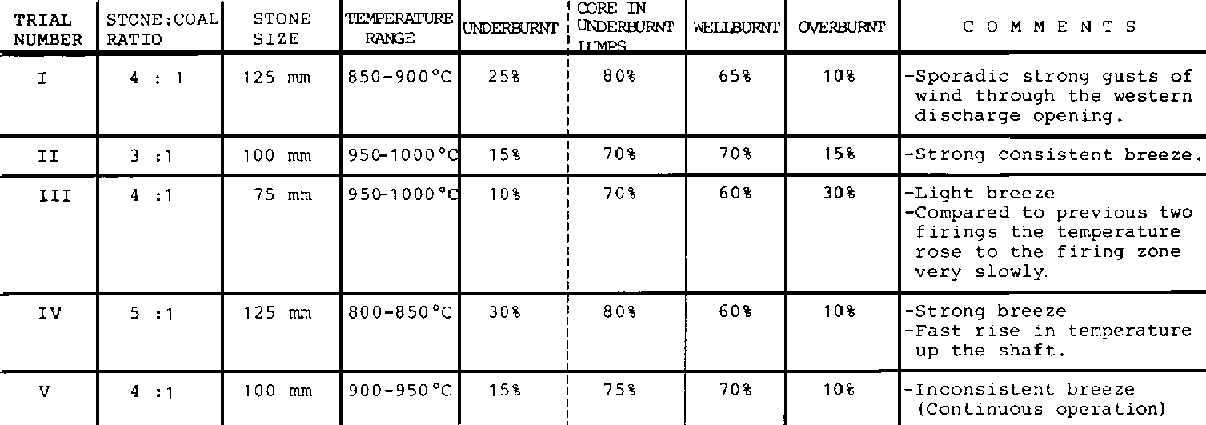
Trials Procedure
A wide range in quality is likely to be the most common feature
of a small low technology operation. It results from uneven firing which is
caused by:
- A wide range in stone feed size;
- Uneven
loading of stone and fuel, i.e. bad mixing of stone and fuel;
- Draught being drawn into the kiln unevenly, perhaps due to the
wind blowing more into one air supply hole than another;
- Hanging.
Remedies:
- Stricter control of stone feed size and
grading.
- Stricter control on charging.
- Poking regularly to prohibit
the limestone from hanging in the shaft.
- Designing discharge openings so as
to ensure the even drawing of air into the kiln.
Hanging or sticking of the material in the shaft is a result of
the lateral pressure on the walls of the kiln of the descending column of
material. Hanging can be described as the formation of an arch across the shaft
which inhibits the continuous flow of material through the firing zone.
The column of material should be inspected and poked regularly
to maintain a consistent flow of material. If arches are allowed to form and the
flow inhibited, the material above the arch when poked and thus brought into the
firing zone will not have been sufficiently preheated to allow the core of the
stone lumps to reach the dissociation temperature. Thus the core of the material
will remain
unburnt.
3.4 Hydration
Hydration or slaking can be described as the process of adding a
quantity of water to lumps of lime causing them to disintegrate to a powder,
putty or limewash. This chemical reaction between lime and water results in the
development of a considerable amount of heat (see "chemical reactions of lime",
section 1.5). The form into which lime is slaked depends on the use for which it
is required. In the case of lime for use in plasters and mortars, which could be
either in the form of a putty or a dry powder, all the implications of using
either one of the two, must be carefully studied before any decision is made.
Qualitatively, the advantage of the use of lime putty over a dry hydrate are
that it is likely to contain a greater portion of fine lime particles and will
therefore be more plastic, a characteristic which is preferred in mortars and
plasters. Also, the product is likely to be more fully slaked and will therefore
be less likely to present any of the typical popping and checking problems that
may occur due to the presence of unslaked material. However, more water is
required to slake it, so the economic implications of the availability of water
take precedence. In a dry area where distances to the market are long, it is
likely to be preferable to transport and slake quicklime lumps at sources of
water nearer the market than to bring water to the production site and then
transport dry lime hydrate or lime putty over a long distance to the
market.
3.4.1 Water for
hydration
The water used in hydration may be drinkable or even brackish
borehole water but water containing a large proportion of organic material can
have a bad effect on the lime hydrate. The water required to slake quicklime to:
a) a dry lime hydrate is around 550 litres per tonne quicklime,
b) a lime putty is around 1300 litres per tonne quicklime
depending on the consistency preferred.
The exact quantities required will vary from one quicklime to
another and can best be determined by trial and error. In general however,
highly reactive porous type quicklime will require a greater proportion of water
than dense or overburnt quicklime. Also, dolomitic lime will normally require
less water in hydration since only small portions of the MgO content, if any,
actually hydrate.
3.4.2 Rate of
hydration
The rate of hydration is determined by the type of stone that is
fired to start with, and the conditions to which it is subjected during firing.
Complete hydration can take place in a matter of a few minutes or continue over
a period of months. The factors which determine the rate of hydration are:
a) A quicklime with a high MgO content has a slow
rate of hydration since it is normally overburnt when fired at the temperature
necessary to calcine CaCO3.
b) A pure, high calcium lime hydrates faster than one containing
impurities. Impurities cause the stone to overburn at lower temperatures which
reduces porosity and consequently the rate of hydration.
c) A lightly burnt, porous quicklime will hydrate faster than an
overburnt, dense one.
d) If quicklime is crushed to a size smaller than 25 mm the rate
of hydration is increased.
e) The rate of hydration increases with an increase of both the
temperature of the quicklime lumps and of the water used for slaking. If the
quicklime lumps are slaked immediately after they are extracted from the kiln,
i.e. whilst they are still slightly hot, and the heat from the waste gases is
used to heat the water of hydration, the rate can be increased. With some limes
a 10% increase in water temperature could as much as double the rate of
hydration.
f) The use of an excess amount of water applied to the quicklime
at a rapid rate retards the rate of hydration.
g) If the quicklime and water mixture is agitated during
hydration the rate is increased.
3.4.3 Hydration of magnesian
limes
Magnesian limes are slower in slaking than calcium limes due to
the sintering caused by the overburning of the magnesium carbonate portion of
the stone. Overburnt magnesian limestone or dolomite hydrates very slowly and is
just about impossible to hydrate when impure.
Since most of the magnesium oxide portion remains unslaked when
using hand slaking methods, less water will be required. Searle suggests that up
to 20 % less water will be required for hydration. The wet slaking method
described below (handslaking) is a suitable simple means of slaking magnesian
limestone quicklimes. The period in the slaking pits can be extended to 1
month.
3.4.4 Methods of slaking
Quicklime can be hydrated either by mechanical means or by hand
slaking. For a small scale operation in a situation where employment creation is
a priority, labour is plentiful and can be hired at a sufficiently low cost, and
the quality of the material fired differs from one batch to the next requiring
special attention in slaking, hand slaking is likely to be the most cost
effective, and also preferable from the point of view of quality.
3.4.4.1 Hand slaking
One method of hand slaking to produce a dry lime hydrate is as
follows:
1. Spread a manageable amount of quicklime on the
slaking floor in a layer around 250 mm thick.
2. Spray slowly, using a watering can, approximately 1/3 of the
required water over the surface of the layer, and mix. Do the same for the
second and third portions. If the correct amount of water is used, after the
third spray the hydrated lime powder formed will be slightly damp.
3. Once the watering procedure is completed pile the hydrate in
a mound or store in a silo for a period of 12-24 hours so that the slaking
process may be completed.
4. Screen or separate hydrate and then bag.
The method of hand slaking to produce a lime putty is as
follows:
1. Spread lime lumps in a shallow slaking pit.
2. Using a watering can, spray all the water necessary to
produce the required consistency lime putty whilst stirring continuously using
paddles or some other means.
3. Leave in the slaking pit for 12-24 hours to complete slaking.
4. Take lime putty from the pit and screen out core and
overburnt lumps above 2 mm diameter.
5. Take slurry to slaking pits in which it is allowed to slake
for a period of a week before using. The oversize core and overburnt material
can be slaked separately for a longer period in deep slaking pits and then
rescreened. (See hydration of magnesian limes, section 3.4.3)
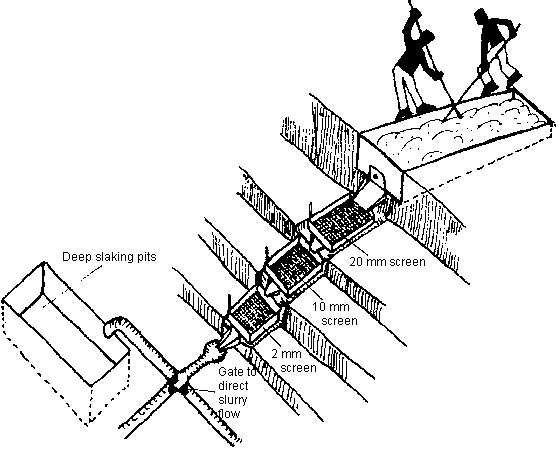
Hand Operated Lime Putty Production
System
3.4.4.2 Mechanical slaking
Mechanical methods of slaking follow the same process as hand
slaking. The difference is that water is added in specifically measured
quantities and at predetermined rates to produce either a dry or wet lime, and
mixing is done mechanically. For a dry hydrate, the lime can then be screened by
a barrel screen or an air separator can be used to separate the oversize core or
overburnt material. The screened or separated lime should ideally not contain
more than 5 % of material greater than 200 mesh (74 µ), but 30 mesh (500
µ) diameter is acceptable especially if the lime is softburnt, i.e.
contains few overburnt cores. Lime slurry should be screened ta contain stone
lumps less than 2 mm diameter. Overburnt lumps below this size will slake
completely in the slaking pits.
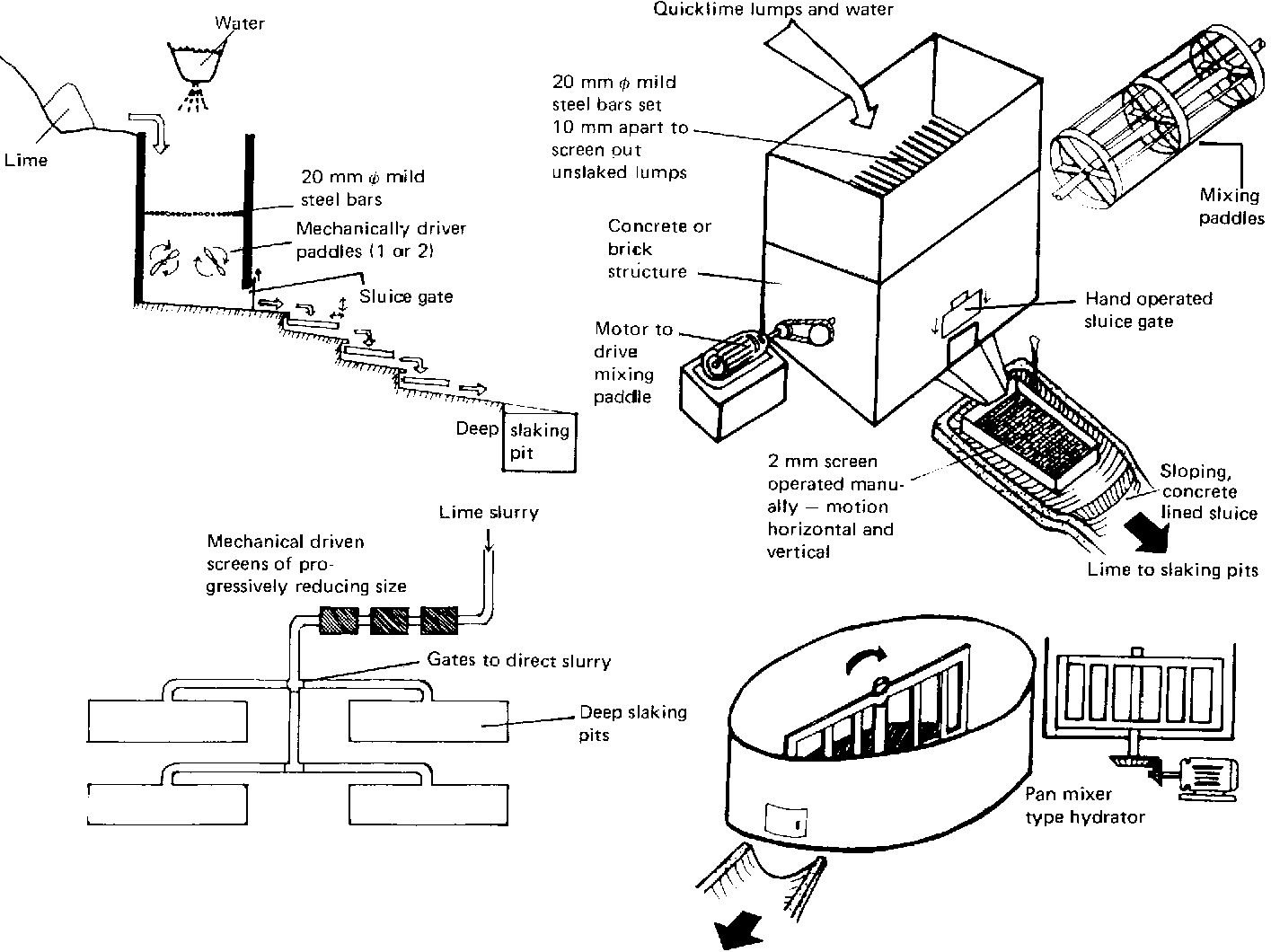
Mechanical Methods of Producing Lime
Putty
3.4.5 Causes and
effects of a badly hydrated lime
Drowning: -If water is supplied too quickly to the quicklime
lumps, their surfaces will hydrate but the water will tend not to penetrate to
the interiors of the lumps. Special care must be taken to avoid this when
impure, dense or dolomitic quicklimes are being slaked since they are
particularly susceptible to this phenomenon due to their relatively low
hydration temperature and rate of hydration. The result of drowning is
incomplete hydration.
Burning in hydration occurs when too little water is mixed with
the quicklime. A portion of the quicklime remains unslaked.
Whatever the cause, the effect of a badly hydrated lime is the
presence of unhydrated cores in the product. The presence of these in lime for
use in mortars and plasters is particularly harmful since it is the cause of
cracks in mortar joints and popping in plasterwork.
Recarbonation: - The quicklime lumps left lying for extended
periods in the open are slaked by absorbing moisture from the air. In addition
to slaking however, they absorb free CO2 from the atmosphere, thus
recarbonating. Recarbonation results in a reduction in the available oxide
content (CaO and MgO) which reduces the quality of the
lime.
| | | Small Scale Production of Lime for Building (GTZ, 1985, 80 p.) | | | 4. Testing and Quality Control | | | (introduction...) | | | 4.1 Geological investigation (the geological surveying) | | | 4.2 Laboratory testing | | | 4.3 Field testing | | | 4.4 Quality control | | | 4.5 Tests |
|
Small Scale Production of Lime for Building (GTZ, 1985, 80 p.)
4. Testing and Quality Control
The objective of this section is to describe the testing
procedures which could be adopted if specialized personnel or facilities are not
available at a sufficiently low cost, or when required. However, it must be
stressed that to avoid a waste of effort and money, it may be better to wait a
little longer for, or spend a little more money on such services. The quality
control tests can be conducted adequately on
site.
4.1 Geological investigation (the geological surveying)
The search for a suitable deposit should be avoided by the
layman. If this is definitely not possible it should be preceded by considerable
reading on the geological aspects of limestone, e.g. the forms in which it can
be found, its bedding, and its mineralogy. Further, any reports, studies and
investigations which relate to the proposed project should be collected and
analysed.
Once in the limestone region one has to:
- Establish the average thickness of the overburden.
- Determine the physical nature of the bedding, e.g. if a
deposit is calcrete, is it a hardpan type.
- Where the deposit is not thick bedded and uniform at least in
appearance, determine roughly the relative quality of the different layers by
using a solution of hydrochloric acid on samples of the different layers.
A drop of acid applied to the rock will cause it to froth and
the greater the frothing the greater the available lime in the rock. If a
difference cannot be determined, representative samples taken from the different
borrow pits and trenches must be laboratory tested, as described later.
- Determine the average thickness of the different
layers over the area and thus estimate the average volume of material available.
- Determine the strike and dip of the layer (see the fig.
above).
This information can be determined by using the following
methods:
-Inspect geographical features of the area, such as river beds
or borrow pits, which expose the strata of the deposit. These may not be
sufficient, or not present at all, in which case the following methods must be
used to acquire information or supplement that available:
- Clear the ground cover (overburden) at random
locations over the area to establish its average depth and the ease with which
it can be cleared.
- Considering the geography of the area, excavate a series of
pits and trenches at suitable relative positions to acquire the geological
information as stated above.
- Take representative samples from the different deposits and
from different locations in each deposit if necessary, for laboratory testing.
Record very accurately the sources of the samples, i.e. which pit or trench they
came from and the exact position in these.
4.2 Laboratory testing
Laboratory testing of samples taken during the geological survey
should, if possible, be carried out by the Geological Survey Department or some
other institution with specially trained personnel and the necessary equipment
and materials. Analyses to provide the following information should be conducted
to enable comparison and selection:
- available oxide content (CaO + MgO),
- expected
loss on ignition,
- reactivities of quicklime,
- types and quantities of
impurities,
- relative porosity and hardness,
- colour of
quicklime.
If it is not possible to use the services of such an
institution, the samples could be adequately compared by firing them in the
field testing kiln and analysing them using the techniques described
below.
4.3 Field testing
A representative sample of limestone from each deposit of
sufficient quantity must be prepared for firing in the kiln.
Operation of field testing kiln (see below)
The tests should be conducted in a manner which approximates the
real conditions in the full size kiln.
1. Load kiln with layers of fuel and lime, with fuel as the
first layer.
2. Start a fire in the fireplace to light the fuel in the bottom
layer.
3. Once the bottom fuel layer has caught fire shut off the front
of the fireplace to reduce the draught through the kiln.
4. After 36 hours the burning will he completed. Remove the grid
rods and extract the quicklime lumps from the kiln.
5. Separate the well burnt lumps from the underfired.
6. Take a representative sample of the well burnt quicklime
lumps and execute tests 2 and 3 described below immediately, or pack the lumps
in an airtight plastic bag or tin if these tests have to be delayed.
7. Take a further representative sample of well burnt lumps (20
litres) from the remaining portion and conduct test 1.
8. Slake the remaining well burnt quicklime lumps and conduct
test 4.
The main advantage of firing in the field test kiln, beside
providing samples for laboratory testing at a relatively low cost, is that it
enables the project manager to observe the behaviour of the limestone and fuel
when fired under field conditions. For example if a limestone decrepitates
during firing it immediately renders it unacceptable. Similarly, if a fuel
pollutes the lime excessively, the fuel will be unacceptable. Further, it
enables him to determine approximately the necessary design and operating
conditions that will be
required.
4.4 Quality control
At the level of technology referred to in this text little can
be done during firing to make adjustments which affect quality. The only direct
control is by making adjustments that will affect the extent of the draught
through the shaft, and these changes will be based on experience of the effect
of the prevailing winds on the quality of the product. Thermocouples are an
indirect method of quality control which serve to warn against overburning .
As Sobek points out, thermocouples merely measure the
temperature of the interface between the column of material and the kiln wall.
They cannot measure how efficiently the limestone has been calcined. They can
only warn against overheating. Thermocouples are particularly useful during the
firing trial stage of the project, i.e. when trials in the full size kiln are
being conducted to determine the necessary operating conditions.
Quality control tests must be carried out on the final product
and adjustments made according to the results; The quality control tests that
should be carried out at regular intervals, i.e. on a daily basis, are 1 and 2
and less regularly, say once a week, are 3 and 5, as explained below.
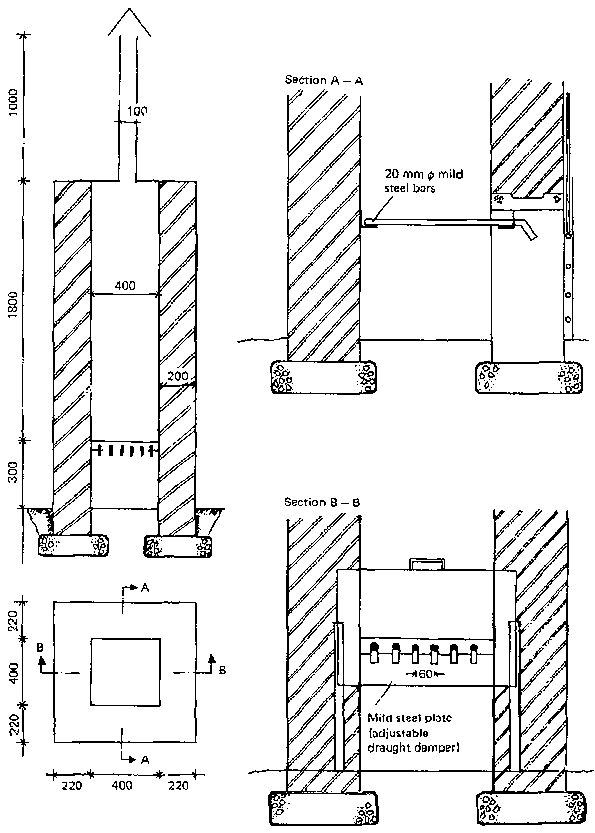
Field Testing
Kiln
4.5 Tests
These tests are used both at the testing stage of the project
when samples from the various deposits are being tested for quality and
compared, and also during production for quality control purposes.
Test 1: Loss on ignition test (LOI)
The LOI tee. can be conducted at regular intervals during
production to monitor the relative degree of calcination. It should be
accompanied by a thorough visual inspection. It is also used in the testing
stage to compare LOI of limestone from different deposits.
Apparatus:
-Container of fixed volume (20 or 50 litres), such
as a bucket.
-Scale of sufficient size to weigh the above
volume.
Method.
1. Weigh container (Wb).
2. Weigh
the container filled with a representative sample of limestone feed (Wf).
3.
Weigh the container filled with a representative sample of quicklime lumps
(Wa),
Or
Conduct the above weighing exercise several times (5 will
suffice) with different batches of limestone feed and quicklime lumps to
determine average figures for (Wf) and (Wa).
4. Calculate the % weight lost on ignition using the following
formula:
(Wf -Wa)/(Wf-Wb) X 100 % weight lost in ignition (% LOI)
The %LOI can be compared with a standard LOI figure calculated
under precise laboratory conditions to establish the relative degree of burning,
or if this is not available the theoretical value can be used. The volume of
quicklime which has been used in the weighing exercise must be inspected to
determine to what degree the limestone is overburnt. If firing is conducted
correctly there should be no, or a very little, underburnt stone, but this
should also be checked for.
Overburnt quicklime lumps can be distinguished by:
a) A difference in colour compared to lightly burnt
lumps.
b) A relative difference in weight between lumps of
approximately the same size. Overburnt material will be heavier than lightly
burnt material.
c) Shrinkage due to overburning may cause cracks to appear.
d) When tapped lightly with a hammer overburnt lumps will
produce a sharp ringing tone compared to the tone produced by a lightly burnt
stone.
Underburnt stone can be distinguished by the presence of a hard
core which has a different colour and texture to the burnt portion. The amount
of overburnt material must be estimated and compared with that normally expected
(say around 10 %). A variation in the proportion of overburnt stone from that
normally expected will produce a variation in the weight of the quicklime lumps
(Wa), which will in turn provide an inconsistent and unreliable % LOI figure.
The process of inspecting the volume visually is in itself a valuable quality
control exercise. It allows the operator to inspect the product systematically
and at close range.
Test 2: Reactivity assessment of quicklime
The addition of water to quicklime to produce a lime hydrate
results in the evolution of heat. A lightly burnt quicklime will evolve heat,
i.e. react, at a faster rate than will a hard, overburnt quicklime. This
phenomenon is used in this test to monitor the reactivity and hence the degree
of burning of the quicklime produced. It is also used in comparing limestones
from different deposits for the purpose of selection.
Apparatus:
- Pestle and mortar.
- Nr. 7 mesh sieve (2.83
mm).
- Scale to weigh from 50 g to 500 ma.
- Thermos flask.
-
Thermometer reading at least to 100 °C.
- Graph paper.
Method:
1. Take a representative sample of quicklime lumps
of around 2 kg and crush them to small fragments.
2. Take a 200 g representative sample from the fragments,
pulverize in the pestle and mortar and pass the whole 200 g sample through a 7
mesh sieve.
3. Place 170 ml of water at room temperature in the thermos
flask. Weigh out 50 g of the screened material and add it to the water in the
thermos flask.
4. Record the rise in temperature of the mixture in the flask at
one minute intervals. 5. Continue taking readings for 24 minutes. 6. Plot the
temperature-time curve on graph paper and compare with a standard curve or with
previous curves.
The previous two tests together with a thorough visual
inspection performed on a daily basis, will suffice for monitoring purposes on a
small project.
Test 3: Determination of available lime by the RAPID SUGAR TEST
This procedure is one by Boynton who considers it a simple and
accurate test.
Apparatus:
- 300 ml "Erlenmeyer flask" (Conical flask
indicating approximate volumes).
- 100 ml burette with a stand.
- Scale
weighing 500 to 1000 ma. No. 100 mesh sieve.
Materials:
- CO2 free distilled water.
-
Hydrochloric acid (17.5 ml per litre of distilled water).
- Anhydrous sodium
carbonate (Na2CO3) (0.85 g).
- Methyl orange
indicator.
- Sucrose - granulated sugar is satisfactory (15 g).
Method:
1. Take representative sample of hydrated lime and
screen through no. 100 mesh sieve.
2. Take a 500 mg sample end brush it into the Erlenmeyer flask
containing 20 ml distilled water.
3. Cork the flask, swirl and heat for 2 minutes.
4. Add 150 mg water and 15g granulated sugar.
5. Re-cork flask and shake at intervals for 5 minutes.
6. Allow to stand for 30 minutes to I hour.
7. Add 2 drops phenolphthalein.
8. Wash down sides of flask and stopper with water.
9. Titrate in the original flask with the standard HCl solution
(see note below). Add 90 % of the estimated amount of acid solution before
shaking the flask and then complete titration with the final 10% of the acid
solution being fed slowly until the pink colour disappears.
10. Note the reading: 1 ml of acid solution is equivalent to l %
available lime expressed as CaO.
Note: "A standard HCl solution is prepared of 15.7 ml of HCI
(sp. gr. 1.18) per litre of CO2-free distilled water. The solution is
standardized against 0.85 g of anhydrous NaCO3 with methyl orange as
indicator, so that this amount will neutralize exactly 90 ml of standard HCI
solution. In adjusting for this, add more water if it is too strong or more acid
if too weak." (Boynton, p. 544)
Test 4: Comparison of lime plasticity (bulk density test)
The plasticity of lime is one of its valuable features when it
is to be used in a mortar or plaster. This is due to its great specific surface
area (13000 cm²/g compared to around 3200 cm²/g for portland cement),
or fineness.
A measure of fineness or specific surface area of a lime hydrate
will indicate its plasticity. This can be done by measuring its bulk density.
Apparatus: -Container. -Scale weighing at least up to 30 kg.
Method:
1. Weigh container (Wc).
2. Fill container with water and weigh (Ww).
3. Fill container with hydrated lime (powder form) and weigh
(Wb). (The different lime hydrates for comparison must be filled and compacted
in the container in exactly the same manner).
Since 1 kg water = 1 litre, the weight of water (Ww) is equal to
its volume (Vw) (1 m³ = 1000 litres).
Bulk density = (Wb-Wc)/Vw * kg/m³
Commercial lime has a bulk density of around 575
kg/m3. It is possible to compare the bulk densities of various limes
and get an idea of the comparative plasticity. The lower the bulk density, the
higher the plasticity. This is a rough test valuable when different limestones
are being fired in the field testing kiln for comparison and subsequent
selection.
Test 5: Soundness test
The soundness test is a very simple but important test. Its
purpose is to determine how effectively the quicklime slakes. Small cores of
overburnt material may remain in the lime hydrate. They will slake very slowly.
If a lime containing such cores is used in a plaster, at some future time the
core will slake in the wall causing the material around it to pop out. Hence the
commonly known defect "popping". To avoid this defect the lime hydrate sold must
be completely slaked, without any core of overburnt material. This test is used
to control the quality of lime produced during the course of production but is
of particular value during the triad stage of the project when trials are being
conducted to determine the best method of] hydration.
Apparatus: Flat mixing surface and a saucer. Broad bladed knife
e.g. spatula.
Method:
1. Mix hydrated lime into a stiff paste on the
mixing surface using the spatula.
2. Fill the saucer with the paste leaving a smooth, flat
surface.
3. Store indoors and examine daily for three to four weeks. If
pitting or popping occurs the lime can be considered to be
unsound.