 |
| ||||||||||||||||||||||||||||||||||||||||||||||||||||||||||||
|
| ||||||||||||||||||||||||||||||||||||||||||||||||||||||||||||
A Publication of the Deutsches Zentrum f�r Entwicklungstechnologien - GATE , a Division of the Deutsche Gesellschaft f�r Technische Zusammenarbeit (GTZ) GmbH - 1991
NOTE 1: The technical details were provided by the producers. GATE is not in a position to verify these data and therefore cannot accept responsability for any inaccuracies. In cases where prices have been quoted, these are subject to change and are thus meant to serve only as guidelines valid for 1991.
NOTE 2: from the cd-rom library editors: if you perform a search on “FCR” and “roofing” in other sections or documents in this cd-rom, you will find articles, books or information that may usefully complement or update the information contained herein.
|
| ||||||||||||||||||||||||||||||||||||||||||||||||||||||||||||
Acknowledgements
German Appropriate Technology Exchange
Dag-Hammarskjold-Weg
1
Postfach 5180
D-6236 Eschborn 1
Federal Republic of Germany
Tel.
(06196) 79-0 Tlx. 41523-0 gtz d
GATE - stands for German Appropriate Technology Exchange, founded in 1978 as a special division (Division 4020) of the government-owned Deutsche Gesellschaft fur Technische Zusammenarbeit (GTZ) GmbH (German Agency for Technical Cooperation).
GATE is a centre for the dissemination and promotion of appropriate technologies for developing countries. GATE defines "appropriate technologies" as those which appear particularly apposite in the light of economic, social and cultural criteria. They should contribute to socio-economic development whilst ensuring optimal utilization of resources and minimal detriment to the environmeet. Depending on the case at hand, a traditional, intermediate or highly developed technology can be the "appropriate" one.
GATE focusses its work on the following areas:
- Technology Dissemination
- Research
and Development
- Environmental Protection
GATE offers a free information service in appropriate technologies for all public and private development institutions in countries dealing with the devolpment, adaptation, application and introduction of technologies.
BASIN is a coordinated network of experienced international professionals, set up to provide qualified advice and information in the field of building materials and construction technologies.
The activities of BASIN are divided between four leading European, non-profit appropriate technology organizations, each of which covers a separate specialized subject area, in order to provide more qualified expertise with greater efficiency.
The services offered by BASIN encompass:
· responses to technical
enquiries;
· maintenance of a documentation and computer database with.
evaluated information on documents, technologies, equipment, institutions,
consultants, projects, etc;
· monitoring of practical field
experiences;
· preparation of publications to close information
gaps;
· organization of training courses, workshops, seminars and
exhibition;
· implementation and management of research and development
projects.
This Product Information Portfolio was conceived to inform users as objectively as possible about fibre concrete and micro concrete roofing in general, and more specifically about the available equipment, as well as aspects of selecting and buying the most suitable type. The aim was not to deal with the technology in depth, as sufficient literature is available elsewhere, but to give practical information for the user to understand the advantages and limitations of the alternative technical systems and equipment available in different regions.
This enables the user to compare the machines with each other, and make a preliminary selection, before requesting more detailed information from the manufacturer.
Note: The technical details were provided by the producers. GATE is not in a position to verify these data and therefore cannot accept the responsibility for any inaccurracies. As the prices and exchange rates are subject to change, they are only meant to serve as guidelines.
Text, illustrations, layout:
K. Mukerji, H. Worner, SKAT
(1991)
|
| ||||||||||||||||||||||||||||||||||||||||||||||||||||||||||||
Technology
General
Of the roofing options available in most developing countries, galvanized corrugated iron (gci) sheeting is by far the most widely used "modern" material, mainly due to its ease of handling and large span, requiring less supporting structure. The disadvantages, however, are that it is an imported material in most developing countries; its thermal performance is very unsatisfactory (extremely hot during the day, cold at night, causing condensation problems); heavy rainfall causes serious noise problems; and the often poorly galvanized sheets tend to rust through within 2 or 3 years.
Asbestos cement (ac) sheets are also extremely popular in many countries for similar reasons as gci, and also on account of their better thermal performance and fire resistance. However, they are brittle and diffilcult to transport, the fibres or the whole sheets have to be imported in many countries, and the serious health risks of mining and processing asbestos are leading to a steady decline of the ac industry.
A promising alternative has been found in fibre reinforced concrete roofing (FCR) and more recently in micro concrete roofig (MCR). These are roofing elements basically made of sand, cement and water, and in the case of FCR, with the addition of natural or synthetic fibres for reinforcement.
The main advantages of FCR and MCR are:
+ they can be produced locally in any
developing country, where cement is available at sufficiently low cost;
+ the
technology is adaptable to any scale of production, including one-man production
units;
+ with a proper training course in the production and installation of
FCR and MCR, virtually anyone (even unskilled workers) can learn the
techniques;
+ the thermal and acoustic performance of FCR and MCR is superior
to that of gci and ac sheets;
+ compared with burnt clay tiles, FCR and MCR
require less timber for the supporting structure, can cost less to buy and can
be equally durable;
+ compared with thatch roofs, FCR and MCR are more
durable and eliminate the fire risk.
There are, however, some problems of FCR and MCR, such
as:
- the limited availability and high price of cement
in some developing countries;
- especially in dry areas with limited water
supplies, the large amount of clean water required for preparing and curing the
roofing elements
- the need for good training of producers and users of FCR
and MCR, and strict quality control, without which failures are almost
certain;
- the need for great care in handling, transporting and installing
the roofing elements to avoid cracks and breakage;
- the difficulty of
introducing this relatively new roofing system, where potential users do not
know the advantages, or have heard of past negative experiences (which were
mainly because of insufficient training of the producers and inadequate
construction of the roof substructures);
- the fact that the roof is
generally not strong enough to be walked on.
FIGURE
Development of FCR and MCR
The most well-known fibre reinforced concrete was asbestos cement, which was invented in 1899. In the 1960s fibre reinforced concretes, using steel, glass and synthetic fibres were developed and research is still underway. However, these can generally be considered inappropriate for applications in developing countries, due to the high costs and limited supplies of such fibres. Therefore, the fibres referred to in FCR are mainly natural flores.
In the mid- 1970s, FCR developments focussed on the production
of sheets of about one metre square, since the aim was to substitute gci and ac
sheets. However, the FCR sheets, which were produced with simple, locally made
equipment and without any mechanization, had several disadvantages, for
instance:
- high cement consumption (about 15 kg per
m²), similar to that of asbestos cement;
- on account of their large
size and weight, difficulty to handle and cure in water tanks, and to transport
and install without breakage;
- the need for very accurately constructed
supporting structures to avoid differential stresses and breakage of
sheets.
On the basis of a research and development projector FCR sheets,
funded until 1981 by the U.K. Government through the Intermediate
Technology
Development Group (ITDG), the Intermediate Technology Workshops (ITW) of
J.P.M.Pany & Associates Ltd., Cradley Heath, U.K., succeeded in 1983 in
developing a new pantile system, which requires only 5 kg of cement per m²
(by means of vibration compaction), is easier to manufacture, transport and
install, and is less sensitive to errors. This is the basis of the technology
dealt with here.
Research and development continued both in the field and laboratory, where the tendency of the fibres to decay m the alkaline matrix, especially in warm humid environments, was one of the main issues. Fibre decay is not a serious problem in roof tile production - as explained below - but ways were found, especially by the careful selection and preparation of the raw materials, to produce roof tiles without fibre reinforcement - this was called MCR.
Procedures
As indicated above, FCR and MCR technology requires good training and practical experience to achieve satisfactory results. The information given on this folder must therefore be regarded as a brie introduction to the technology and not as an instruction manual. The reader is advised to refer to some of the publications listed under Select Bibliography for further details, but when embarking on FCR or MCR production, advice should be sought from the Roofing Advisory Service (c/o Swiss Center for Appropriate Technology, Tigerbergstr. 2, CH - 9000 St. Gall, Switzerland), from where details of experienced equipment suppliers and users of FCR and MCR can be obtained.
Materials, Proportioning and Mixing
Cement
· Ordinary Portland cement
of the standard quality available in most places is usually suitable. Slow
setting qualities should be avoided as they delay demoulding and thus require
far more moulds and working space.
· About 0.4 kg of cement is needed
for a 6 mm thick pantile of 50 x 25 cm, corresponding to a cement: send ratio of
1 :3 by weight or volume (because their densities are roughly the same). Using
too much cement means additional cost, but too little cement will produce a
brittle and porous tile.
· Partial replacement of the cement by a
pozzolana (eg rico husk ash. crushed burntclay, fly ash) to increase the
durability of the fibres is possible, but not recommended, as it causes slow
setting.
Sand
· Usually any type of clean
sand that is suitable for cement mortars can be used for FCR and MCR, but in
order to minimize the amount of voids, angular sand particles of good grain size
distribution between 0.125 mm and 2.0 mm is ideal. The small particles fill the
gaps between the large ones, needing less cement and resulting in a less
permeable mix. Aggregates up to 4.0 mm may be used in MCR elements.
·
Fine particles of silt and clay should be reduced as far as possible, as clay
interferes with the bond between sand and cement.
· One pantile needs
about 1.2 kg of sand, but the right amount must be found by sample tests. Too
much sand makes a brittle, porous product; too little sand means a wastage of
cement and a greater tendency to develop cracks on drying.
Fibres
· Natural fibres are likely to decay
in the alkaline matrix within less clan a year, especially in warm humid areas.
In FCR this loss of strength is not necessarily a drawback. The fibres are
required to hold together the wet mix, inhibit cracking while it is being shaped
and during setting, and give the product sufficient strength to survive
transports, handling and installation. When the fibres lose their strength, the
product is equivalent to unreinforced concrete. However, by then the concrete
will have attained its full strength, and since cracking had been prevented in
the early stages, it can be stronger than a similar product made without
fibres.
· The fibre content ranges between 0.5 and 1% by weight, never
by volume, as fibre densities can vary greatly.
· Sisal is the most
common natural fibre used, but satisfactory results have also been achieved with
other fibres, such as jute, flax, hemp, coir and banana fibre, as long as they
are clean.
· In the early stages of development, long fibres were used.
These gave high impact resistance and bending strengths, but making such FCR
elements is cliff cult and thus rarely done.
· The fibres are now
normally chopped to lengths of 12 to 25 mm and thoroughly mixed with the dry
cement and sand before adding water. Since the fibres are randomly distributed,
they impart crack resistance in all directions. The length and quantity of
fibres is important, since too long and too many fibres tend to form clumps and
balls, and insufficient fibres can cause excessive cracking, if the other
ingredients are not of the right type or incorrectly proportioned.
Additives
· Generally no additives are needed for FCR and MCR, except perhaps a pigment to make a more attractively coloured product.
Water
· Tests have shown that concrete mixes
prepared with brackish water are capable of producing satisfactory FCR and MCR
elements, because they contain no steel reinforcements, which could corrode.
However, it is always recommended to use the cleanest available water,
preferably of drinking water quality, and this is essential when wire loops (for
fixing on roofs) are inserted into the tile.
· Experience is needed to
determine the correct amount of water, which should be just enough to make the
mortar mix workable. Mixes with too little water are hard to work with and mould
without cracking. Cement needs a certain amount of water to hydrate:
insufficient water leaves some cement unhydrated ( without bonding effect),
while excessive water gradually evaporates, leaving pores which weaken the
product and increase permeability.
· Water is also needed to cure the
tiles for about two weeks. The amount of water needed for this is often
underestimated and can cause serious problems where water is
scarce.
Moulding and Curing
· For these operations a screeding
machine and a set of moulds are required. These are described in the section on
Equipment.
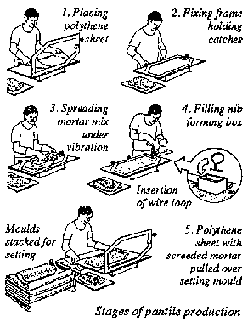
· The wet mix is trowelled onto a polythene interface sheet
on the screeding machine and, under vibration, smoothed with a trowel to the
same level as the surrounding steel frame. At a predetermined spot at the top
end of the pantile, a matchbox-size nib is formed, into which a wire loop is
inserted for better fixing to the roof.
· The steel frame is lifted off
the screeding surface and the plastic sheet slowly pulled over the setting
mould, ensuring correct aligning of the tile edge to achieve uniform
curvature.
· The mould with the fresh tile is then placed on a stack of
moulds for initial setting and curing (24 hours), after which the tiles should
be demoulded and cured for 2 weeks in water tanks.
· After curing, the
hard tiles are then allowed to harden for another 2 or 3 weeks, before they can
be used for installation on the roof.
· Since curing under water has
frequently led to an unsightly efflorescence on the tile surfaces, some
producers place the tiles on a wet gravel bed (such that the water does not
reach the tiles), and cover them with black plastic sheets. This method, called
"vapour curing", is a kind of autoclaving using solar energy. The tile quality
and appearance is improved, while the setting and curing time is greatly reduced
and a considerable amount of water is saved.
Roof Design and Installation of Tiles
· The main criteria for FCR and MCR roof construction
are:
- minimum pitch of 22° in moderate climates,
30° in areas with severe driving rains;
- although straight and parallel
rafters and battens are always recommended, pantiles tolerate slight
inaccuracies (which are less acceptable for Roman tiles and must be avoided in
the case of large sheets); pantiles may even be laid on a carefully constructed
pole timber or bamboo structure (gaps between pantiles, eg on kitchen roofs, are
often preferred, as smoke and hot air can escape easily and thus improve indoor
comfort);
- the timber connections and fixing of tiles onto the battens must
take into consideration that the uplift forces (suction) in windy areas can be
much higher than the wind pressure and weight of tiles (special wire loops and
fixing bolts have proved effective);
- only experienced craftsmen with
special training in this technique should be entrusted with the roof
construction and cladding.
· As an alternative to pantiles,
ITW introduced a larger component, called the semi-sheet, which is 60 x 60 cm
large and 8 mm thick. The semi-sheet can be produced faster than pantiles for
the same roof area and can also reduce the installation time, as only 4
semi-sheets are needed to cover 1 m² of roof, as compared to 8 to 12
pantiles. Furthermore, the full roll overlaps of the semi-sheets exclude
reflected light and lessons the entry of dust and insects. Semisheets are,
however, unsuitable for 'L' or 'U' shaped buildings with angled valleys and
hips, which require cutting of components.
· In all cases, simple 'V'
shaped tiles with no corrugations are laid along the ridge with about 25 cm
overlap, and the joints filled with
mortar.
|
| ||||||||||||||||||||||||||||||||||||||||||||||||||||||||||||
Equipment
Apart from a set of ordinary masonry irnplements (eg spades, measuring pans, wheelbarrows, sieves, trowels, sand and cement batching boxes, balance and the like), the production of FCR and MCR elements requires some special equipment:
· screeding machines
·
moulds
· testing equipment.
Screeding machine
· This comprises a vibrating screeding
surface and interchangeable, hinged frame (for products of different shapes and
thicknesses). The machine can be a small, portable 'mini-plant', or a stationary
workstation.
· The vibrating mechanism requires an energy source, which
can be electricity (from a mains outlet, converted to 12 volt dc powerby a
transformer-rectifier; or from a car battery), handpower (crank with pulley
system or metal springs), foot-power (treadle or bicycle pedal system), or
flywheel energy (hand-operated).
Advantages and problems of the various screeding machines
· Electric machines:
+ relatively
quiet, do not tire out the user, produce uniform, good quality elements;
-
relatively expensive, dependent on reliable power supplies for operating the
machines or recharging batteries, risk of production setback due to bad battery
maintenance.
· Hand-powerd
machines:
+ independent of power supplies and can thus
be used in remote rural areas;
- relatively noisy end tiring and needs 2
people to operate, uniformity of vibration dependent on the way the handle is
turned, thus possibility of non-uniform quality of
products.
· Foot-powered
machines:
+more or less the same advantages and
disadvantages as hand-powered machines, except that, depending on the design,
the second worker can be omitted, as the hands remain free to spread the mortar
duringvibration.
· Flywheel-powered
machines:
+ incorporate all the advantages of electric
and hand-powered machines and can be operated by a single person;
- cost
about the same as electric machines.
Setting moulds
· These can be of various shapes and sizes, depending on
the local requirements and are needed in large numbers - at least as many as the
number of components produced in two working days, because the tiles are
demoulded after 24 hours.
· The moulds can be made of different
materials, such as vacuum formed PVC (polyvinyl chloride) and fibreglass. FCR
and MCR producers in developing countries have devised methods of making moulds
out of concrete. These are produced in 3 stages: first making a concrete
'grandmother mould', from which several concrete 'mother moulds' are formed and
sold to local tilemakers, who make the actual concrete moulds themselves. More
recently, plywood 'mother moulds' have been devised, eliminating the
'grandmother mould'.
· The PVC and fibreglass moulds are designed for
self-stacking; in most cases, the concrete moulds are placed in special wooden
racks for initial curing, but self-stacking concrete moulds (either entirely
concrete or with metal frames) have also been developed.
Advantages and problems of the various types of setting
moulds
· PVC moulds:
+ produced industrially and
hence uniform and of good quality, extremely lightweight and easy to handle, can
be stacked airtight (vital requirement for curing) and save storage space;
-
most expensive moulds, no local production in developing
countries.
· Fibreglass moduls:
+
similar advantages as PVC moulds, can be produced locally if the materials and
skills are available;
- tend to be less accurate than PVC
moulds.
· Concrete moulds:
+
extremely cheap and can be produced by the tilemaker himself;
- heavy and
less accurate than PVC, and if not self-stacking and not airtight, the rack in
which they are placed has to be well covered with a plastic sheet (which is
often not done carefully, causing the green tiles to crack due to non-uniform
drying).
Testing Equipment
· Several tests should be carried out before, during and
after the production process to ensure that FCR and MCR products arc of
consistently good quality. The tests are generally very simple and only a few
need special equipment.
· Some FCR/MCR machines are equipped with a
demoulding jig, on which the 24 hour old tiles are placed upside down, together
with the setting mould, which can then be lifted off. Subsequently, the plastic
sheet can be peeled off carefully and the rough edges trimmed off. A close fit
of the tile and the edges being in line with those of the jig show that the tile
has exactly the right shape.
· After curing and drying, random samples
of tiles from each batch produced should be tested as follows:
· Ring
test: holding the tile by the nib and knocking a coin on the tile - a clear
metallic sound should be heard.
· Bending test: placing the tile
across a gap of 35 cm between two tables and, in the centre, hanging a piece of
wood (with a curved edge to fit in vertical position exactly on the tile), which
can be loaded with different weights 6 mm thick tiles should resist at least 30
kg; 8 mm tiles 50 kg, and 10 mm tiles 80 kg.
· Nib tensile test:
clamping the tile at the edge of a table, allowing 50 mm of the tile to project
beyond the edge with the nib on the underside, and hanging a weight from the
wire loop - the tile should withstand a load of at least 20 kg.
·
Water tightness test: placing the tile horizontally, forming mortar barriers at
the extreme ends of the channel, and after they have dried, filling the channel
with water- after 24 hours, no drops should be visible on the underside.
· These and many other tests are described in greater detail in the
SKAT/ILO publication, Quality Control Guidelines, which can be obtained from the
Roofing Advisory Service of SKAT, Tigerbergstrasse 2, CH - 9000 St. Call,
Switzerland.
|
| ||||||||||||||||||||||||||||||||||||||||||||||||||||||||||||
Criteria for selection and purchase
General Considerations
FCR and MCR being relatively new technologies, the number of equipment suppliers are still very few. In the early stages of development, the equipment used was locally made by research institutes and appropriate technology groups, which mainly experimented with the production of large sheets. No equipment was commercially available.
ITW of Cradley Heath, U.K., who were the first to develop small roofing components and a method to produce them by vibration, were also the first to supply equipment on a commercial basis. The earliest equipment was the portable 'Mini Plant' (1983), which was followed two years later by an 'Industrial' version of the same production process, and a series of other modified and improved equipment later on.
While this equipment was principally available all over the world, the relatively high capital and transport costs, prohibitive currency exchange rates and import restrictions in many developing countries led to the local production of equipment. Thus there are several types of FCR/MCR equipment on the market and it may be difficult for a newcomer to this technology to decide which one should be bought. The following points will help the potential buyer to make a good choice.
Design of Screeding Machine
· The design of a screeding
machine is the result of several stages of
development:
- Development and design of prototype
-
Testing and modification of prototype
- Field testing of 5 to 10 prototypes
for at least 1 year
- Modifications resulting from field tests
-
Finalization of design, production manual, accessories,
etc.
These steps can only be followed if appropriate workshop
facilities, qualified engineering capacity, qualified production and quality
control capacity and sufficient funds are available. Depending on the extent to
which these requirements are met, there are great differences in the quality of
machines available.
· If an FCR or MCR tile production plant is to
operate successfully in a developing country, the equipment must be capable of
withstanding rough use. If possible, machines that have been in use under such
conditions for a reasonably long time (say 3 to 4 months) should be inspected to
check, for example, whether the screeding surface and/or the hinged frame is
warped or damaged, handles or switches are broken off, and so on.
·
Special consideration should be given to the working conditions for the
production team, especially with regard to operation procedures and handling of
products, that is, avoidance of dangerous or exceptionally hard manual work and
activities that have to be done in a bent position.
· A balance must be
found between the desired output rate, quality standard and level of
sophistication. Complicated mechanical devices often necessitate special
training and experience for maintenance and repairs. Spare parts can be
expensive and if imported. may be difficult and take long to procure.
·
The choice of screeding machine will also depend on the tile size required,
which is basically a choice between the pantile (or Roman tile, depending on the
mould) of 50 to 60 cm length, 25 to 29 cm width and 6 mm thickness (requiring 8
to 12 tiles to cover 1 m²), and the larger semi-sheet, which is 60 x 60 cm
and 8 mm thick (requiring 4 elements to cover 1 m²).
Energy Sources
· The type of energy required to operate
the vibration mechanism is one of the most important selection criteria. Hand or
foot operated machines can be used anywhere, and are the only viable option in
remote areas, where power supplies are unreliable or not available. If electric
machines with car batteries are used in such areas, it may be possible to
recharge the batteries with a photovoltaic solar energy system, but such devices
have so far not proved successful.
· The vibration mechanism normally
consists of rapidly rotating eccentric weights. With two shafts rotating in
opposite directions, the horizontal component of vibrations can be neutralized,
so that the screeding surface is subjected to a simple harmonic motion in the
vertical direction only.
· A less common vibration method is with flat
metal springs, which hit the underside of the screeding plate at a rate of about
2000 times per minute, by turning a rattle wheel. With this method it is more
difficult to achieve uniform vibration frequency, but the machine is very cheap
to construct and easy to repair, but on the other hand very noisy.
Design of Setting Moulds
· Since a very large number of
moulds are needed, they represent the highest single cost factor. The
industrially produced PVC moulds are the best in all respects, but by far the
most expensive. Considerable costs can be saved if the moulds are produced
locally.
· The most successful locally made moulds are concrete moulds
(as described above). However, great care is needed in production and handling.
The usual practice for initial curing is to put the moulds with the fresh tiles
in special wooden racks, which have to be covered with plastic sheets to retain
the moisture in the tiles. If this is not done properly, parts of the tiles may
dry out earlier, causing cracks. Therefore, self stacking concrete moulds should
be preferred.
Material Quality
· With good equipment, good tiles can
be produced, but if the ingredients are of poor quality or prepared incorrectly,
good equipment is not likely to produce good tiles. Therefore, quality control
must begin with the selection and preparation of the ingredients.
·
Broken tiles, leaking roofs and other serious problems associated with FCR in
the early stages of development have shown the extreme importance of strict
quality control during all phases of tile production, roof construction and
installation of tiles. A tile testing kit, as described under Testing Equipment,
is essential in every FCR and MCR production plant.
· But, above all,
the main prerequisite for good quality products is a thorough professional
training of the production team and supervisory staff, and efficient management.
Manufacturer
· Equipment suppliers are basically of two
types:
- private, commercial producers
-
non-government organizations (NGOs) based in developing countries.
The advantages of private producers
are:
+ their dependency on good sales, and hence the
need to produce good equipment, as failures or bad service would seriously harm
their reputation and ultimately stop business;
+ their experience in
international trade and good administrative backing, making them reliable
business partners.
However, the need to support a qualified technical and
administrative staff with modern equipment, to maintain a consistently high
standard and respond to changing needs, makes their products expensive.
Importing these into a developing country not only increases the costs
considerably (high exchange rates, transport costs, insurances, duty, etc), but
also can be extremely difficult (due to import formalities and restrictions,
long delivery time, problems due to breakage in transit, etc).
The advantages
of NCOs are:
+ their high motivation and closeness to
the target group,enabling them to adapt their methods end products to local
requirements, and provide assistance and advice whenever needed;
+ their low
overhead and production costs, and if their equipment is sold locally, the
addidonal additional on foreign exchange, transport costs, duty, the trouble
with import formalities and delivery time, and the like.
However, these groups do not always have the required funds,
technical staff and workshop facilities to carry through all the tests and
modifications that the maturing of a new product needs. Unfortunately, this
problem is sometimes underestimated.
· Personal visits to the
manufacturer and/or sites at which their machines are in use should be
undertaken as far as possible. The value of reference lists is to be able to
meet or correspond with users, to learn about their experiences. If such lists
do not contain addresses, these should be specifically asked for.
Professional Training Courses
· Of special importance
are training courses offered by all good equipment suppliers. As far as
possible, these courses should be conducted at a place where the whole
production team can participate.
· There should be no preconditions for
participation in the courses, other than knowledge of the language used. The
method and content must be understandable for people without special skills or
formal school education, and the course should cover all phases of tile
production, roof construction and laying of the tiles, as well as administration
and marketing.
Purchase of Machine
· The "FOB" price (free on board)
includes packaging,transportation and insurance costs of the machine within the
retailer's country. This price can be artificially inflated in order to
compensate for the reduction offered on the factory price.
· As regards
sales or rental conditions, one must be suspicious of contracts providing for
price indexing based on the number of tiles produced or for payment of royalties
for patent use, which is often not justified. A patent is not necessarily a
proof of guaranteed quality and constructors frequently apply for patents for
processes that are already of the public domain.
· It is advisable to
include a penalty clause in the contract, to safeguard against late
delivery,
· In the case of an after sales service contract, the waiting
period for repairs and maintenance must be clearly indicated. A detailed
handbook should be provided, including specifications of all spare parts and a
maintenance plan, indicating operations necessary and expected maintenance
frequency.
|
| ||||||||||||||||||||||||||||||||||||||||||||||||||||||||||||
Checklist for Potential Buyers
The following is a summary of the main points to be considered
when selecting FCR or MCR tile production equipment:
· Available
financial resources (budget restraints can limit the choice to locally available
equipment).
· Required size and shape of FCR/MCR tiles (smaller
components are easier to produce and handle, and suitable for all sloped roofs;
pantiles are less sensitive to inaccuracies than Roman tiles; semi-sheets are
quicker to produce and install per unit area, but less suitable for complex
roofs, as semi sheets are more wasteful to cut than tiles).
· Required
production rate (this depends on the expected market demand and determines the
quantity of equipment needed).
· Available energy sources (not only the
costs must be considered, but also the frequency of power failures; manual
operation is always appropriate, but can be very tiring).
·
Availability of spares and skilled technicians for maintenance and repairs
(machines with standardized parts create less problems).
· Professional
training (this should be an important part of the deal).
· Operational
safely (this is not usually a problem in FCR/MCR tile production).
·
References (contacts with equipment users should be sought whenever possible).
. Conditions of purchase (since machines of similar types are available,
comparisons of prices, discounts for large orders, delivery time, etc. are
urgently recommended, but also - if applicable - import restrictions, after
sales service, guarantee period, etc should be taken into account).
·
After sales services (not only should the manufacturers be fair enough to
rectify defects of their machines by providing technical assistance or supplying
spare parts at minimum or no-cost; users should also take the trouble to send
accounts of their experiences and suggestions for improvements to the
manufacturers, for without this feed back, no effective development is
possible).
|
| ||||||||||||||||||||||||||||||||||||||||||||||||||||||||||||
DCS Foot-Powered Vibrating Table
Manufacturer
Development and Consulting Services
P.O. Box
8
Butwal
Nepal
Tel. [ . . 977] 73 - 20391
Tlx. 2315 umnepa
Fax [
. . 977] 73 - 20465
Description
The DCS Foot-Powered Vibrating Table is a one-person operation screeding table, manufactured in Nepal since 1987. The vibrating surface and drive mechanism are mounted on an angle iron frame. Connected to this is a seat, which is adjustable to suit the tile maker's stature, so that he can sit comfortably at the table while making the tile. Herocks the two foot pedals back and forth at an easy speed driving a bicycle wheel, which in turn drives an eccentric weight assembly beneath the aluminium vibrating surface at a speed of 2500 to 3000 rpm.Careful fitting of all nine sealed bearings ensures easy operation and long life for the machine. The screeding table has a one year guarantee.
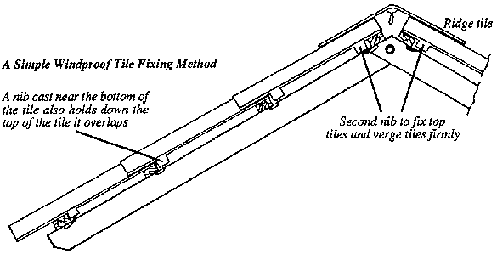
The screeding frames for tiles (6 and 8 mm thick) are shaped to provide an "interlock" at the mitre - the diagonal mitre has been replaced by a dog-legged mitre. The frames also provide nib construction boxes for a wind proof fixing of all tiles. Experience shows that wind forces are sufficient to lift tiles, so all tiles are made with a lower fixing nib. A second nib may be made at the top for special conditions (top line of monoslope roofs, edges with long overhangs). When they are not needed, these nib boxes can be swung out of the screeding area (to leave it unobstructed for quick working) and positioned when needed.
The moulds are 535 mm long concrete elements fixed into galvanized sheet stacking frames, which also serve to protect the fresh tile from drying out during setting. DCS sells fitted moulds and frames with the screeding tables. This ensures that the moulds used are accurate and of good quality and allows the entrepreneur to start tile production immediately, so that he soon can produce a demonstration roof to show interested customers and begin to earn money without delay. He can however, also buy a fibreglass mother mould, with which he can make his own moulds later (when he has sufficient experience), in order to replace broken moulds or increase his production capacity.
In addition to the sereeding table and tile moulds, the
following accessories are supplied:
· a set of batching boxes for fast
measurement of cement and sand to correct proportions and workable batch
size;
· a set of tile maker's scoops to enable correct batching of the
wet mortar as tiles are made;
· a tile thickness gauge for checking
finished tiles according to the standard;
· a batten gauge to aid quick
and accurate roof building.
Entrepreneurs may purchase extra tools for
quality checking:
· standard vessel to measure water for
mixing;
· prism mould, loading jig and thickness gauge for checking
mortar strength.
DCS also supplies sieves for screening sand and fine
aggregate, shovels, trowels, pliers, tile stack covers, interface plastics etc.
Maintenance
The screeding table is maintenance free for up to 5 years, if cleaned regularly during tile making. The tile frame and screeding surface must be cleaned after each tile is screeded, in order to avoid distorting them. Bearings are protected by seals and cover plates. The bushes for the frame clamping arms and for the vibrating drive should be lubricated before the machine is stored for a period of no production, to avoid seizure from rust. The screeding surface mounting rubbers need replacing every year, as they absorb/damp vibration when they are perished. Replacement rubbers can be hand made from a scrap truck type, footwear repairers always have this type of rubber available.
Moulds need regular cleaning to avoid build-up of spilt mortar. Daily cleaning with a cloth or handful of fibre is quick and easy. Mortar left longer can be scraped off without fear of damage to the mould, as it has a hard surface,
Training
DCS selects prospective entrepreneurs from applicants for an
11-day training course in FCR/MCR. The training is held in Butwal and includes
theory and practical sessions covering
· production (including raw
material selection, quality checks),
· tile use (roof types,
construction, tile fitting),
· entrepreneur motivation,
·
marketing skills,
· ease reports and a tour to an established tile
producer,
· book-keeping,
· obtaining finance.
Operating the DCS Vibrating Table
Before production, the tile maker must adjust the seat to enable him to sit comfortably while working. Also the screeding surface must be levelled before beginning. A small backrest is provided to give the light support needed while operating the foot pedals and screeding the mortar. Pedalling is not heavy work for the operator's legs.
When the mortar has been batched and mixed, the operator sits at the table, places a plastic interface sheet on the screeding table, then clamps down the appropriate tile frame. Using the corresponding scoop, a measured lump of mixed mortar is placed on the screeding table, and then this is trowelled out to an even thickness within the tile frame, while generating the vibration by rocking the foot pedals back and forth. When the screed surface is smooth and level with the screeding frame, the nib on the lower tile end is made by swinging the nib construction box into place, filling it with mortar under vibration, and inserting a wire loop for fixing on the supporting roof batten. Depending on the roof design, some of the tiles will need a second nib on the upper end, for which another nib box is provided.
After the nibs are made, the plastic sheet with the screeded mortar is lifted onto the next empty mould. This mould is then moved to the stack of newly moulded tiles and the position of the screed on the mould is checked. It is covered with the next mould and screed, or a mould cover if it is at the top of the stack, to prevent the mortar from drying.
The tiles are removed from the moulds after about 24 hours and subsequently cured for 2 weeks in water tanks or vapour curing beds.
|
Technical Details |
DCS Foot Powered Vibrating Table |
|
Size of machine (length x width x heigh 102 x 74 x 85 cm (40 x 29 x33 in) | |
|
Weight of machine |
48 kg |
|
Size of crate for shipment |
85 x 85 x 90 cm (33 x 33 x 35 in) |
|
Weight of packed machine plus accessories |
65 kg |
|
Standard tile size |
50 x 26 x 0.6/0.8 cm (19.7 x 10.2 x 0.24/0.31 in) |
|
Frame for ridge tile |
53.5 x 28 cm (21 x 11 in) |
|
Energy input |
manual |
|
No. of tiles per cycle/output rate |
1/50 tiles per man-day |
|
Labour force required (incl. mixing and stacking) |
1 - 5 people per machine |
|
Price (ex works) DCS vibrating table (incl. accessories) |
9000 NRs (~ 300 US$) |
|
valid June 1991 Mould (fitted to stacking frame) 80 NRs(~ 2.60 US$) | |
|
NRs = Nepali Rupees Galvanized steel stacking frame |
70 NRs(~ 2.30 US$) |
FIGURE
|
| ||||||||||||||||||||||||||||||||||||||||||||||||||||||||||||
Development Alternatives TARA Vibrator
Manufacturer
Development Alternatives
B-32, Institutional
Area
Tara Crescent, New Mehrauli Road
Hauz Khas, New Delhi 110
016
India
Tel. [ . . 91] 11 - 665370 or 657938
Tlx. 031-73216 daft
in
Fax [ . . 91] 11 - 686-6031
Description
The TARA Vibrator is the result of design and production research at the Regional Centre for FCR/MCR Technology at Development Alternatives, New Delhi. The roofing tiles are being produced since 1988 and the TARA Vibrator since 1989.
The TARA Vibrator consists of an aluminium table top, which is vibrated by a rotating eccentric mass at a frequency of 2800 rpm, and an interchangeable hinged frame for the production of different shapes and thicknesses of tiles. The machine is powered by an electric motor (1/4 hp), driven from a mains supply of 230 volts.
A clear disadvantage of some of the vibrating machines available is their inability to control the vibration. The TARA Vibrator provides a unique mechanism suspended on leather belts which allows for the vibration to be controlled by adjustable tie rods, depending on the type of cement mix, availablity of materials and water cement ratio. The machine operation is optimized to give a vibration time of about 45 seconds for high strength and minimum porosiy of tiles.
Another special feature of the machine is a swivel seating arrangement for the operator to sit on, reducing the physical strain during tile making and permitting free rotation when the fresh tile is transferred to the mould stack at the side of the machine.
The machine requires very little maintenance which is normally restricted to the changing of bearings after prolonged operation.
The TARA Vibrator is preferably used to produce micro-concrete tiles, because fibre reinforcement has proved to be a major constraint towards achieving high production and consistent quality of tiles. The micro-concrete mix consists of 1 part cement, 2 parts of graded sand and 1 part of stone grit passing through 4 mm mesh. This mix requires a water-cement ratio between 0.45 and 0.5. With this mix and a labour force of 4 persons, a production rate of up to 200 tiles a day is easily achieved.
Together with the vibrating table, Development Alternatives supplies 200 self-stacking, high impact polystyrene moulds (mounted on wooden frames) and the necessary accessory tools, such as trowels, scoops and quality control implements.
Training
Development Alternatives conducts training courses in MCR tile production for supervisors and masons. The courses, which are held in New Delhi or at one of the many collaborating institutions in India,not only deal with practical aspects, but also with economical aspects management and marketing
Operating the TARA Vibrator
Theoretically, MCR tiles can be made on the TARA Vibrator by a single person, but for an uninterrupted and constantly high production rate of about 200 tiles per day, a team of 4 persons is required.
The production process is principally the same as for all other screeding machines: clamping down a plastic sheet with the screeding frame, placing a measured amount of mortar on the screeding surface, spreading it out under vibration and smoothing the surface, filling the nib. construction box, lifting the screeding frame, removing the plastic sheet with the screeded mortar and placing it on a the mould for setting. The main difference is that the operator can remain seated during the whole operation, even when placing the fresh tile on the mould, making the work less tiresome. The 3 helpers are mainly occupied with supplying the operator with fresh mortar and moulds, as well as other odd jobs.
Development Alternatives / TARA
Development Alternatives (DA) is a nonprofit, self-financing corporate organization, established in 1983. Its main objectives are to design and promote better approaches for the sustainable development of India.
The prime commercial partner of DA is its sister organization,TARA (Technology and Action for Rural Advancement). TARA manufactures and markets all products of DA and provides feedback on relevant production engineering and market information to the designers of DA to facilitate the continual adaptation and improvement of the technologies.
The operations of TARA are self-financing and conducted through a decentralized network of franchized enterprises. An enterprise can be an individual entrepreneur, a cooperative, a voluntary organization, an existing business, a government agency, or any other entity capable of manufacturing and marketing the products designed by DA.
Under a contractual arrangement between the franchiser (TARA) and the franchisee (the local enterprise), their respective duties are clearly defined. Broadly, TARA is responsible for technology development, technology transfer and training, standardization, networking, common procurement and bulk purchasing, quality control and marketing.
The franchisee is responsible for manufacturing, selling and providing after sales service to the local market. The franchisee pays a nominal royalty and fees to TARA, which in turn pays royalty and service fees to DA.
The technologies and services of DA
include:
· Improved cookstoves (chulhas)
·
Low cost housing technologies
· Mudblock presses
· Improved
handlooms
· Biomass energy systems
· Bicycle trailers
·
Paper, board making equipment
· Pottery products
· Energy
plantations
· Solar energy systems
· Water and
sanitation
· Environment management
|
Technical Details |
TARA Vibrator |
|
Size of machine (I x w x h) without seat |
100 x 54 x 50 cm (40 x 21 x 20 in) |
|
with seat |
115x54x87cm(45x21x34in) |
|
Weight of machine without seat |
35 kg |
| |
with seat 45 kg |
|
Size of crate for shipment |
113 x 63 x 76 cm (44 x 25 x 30 in) |
|
Weight of packed machine |
160 kg |
|
Standard tile size/weight |
48.8 x 24 x 0.8 cm (19.2x 9.4 x 0.3in)/2.3kg |
|
Energy input |
electrical (80 watts) |
|
No. of tiles per cycle/output rate |
1/25 tiles per hour |
|
Labour force required (incl. Mixing and stacking) |
4 men |
|
Price (ex works) TARA Vibrator (incl. accessories) |
10000 Rs (~ 480 US$) |
|
valid June 1991 Polystyrene mould (on wooden frame) |
180 Rs (~ 8.60 US$) |
|
Rs = Indian Rupees |
|
|
| ||||||||||||||||||||||||||||||||||||||||||||||||||||||||||||
ECO Systems Concrete Rooftile Machine
Manufacturer
ECO Systems
P. O. Box
938
Blantyre
Malawi
Tel. [ . . 265] 620167
Tlx 44891 eco mi
Fax [
. . 265] 634 281
Description
Since 1986 ECO Systems has been producing rooftiles and rooftile machines. The original tiles were manufactured according to the specifications of the Malawi Government Rural Housing Proiect (RHP) staff.
The RHP/ECO machine, which is basically a wooden box, is vibrated by two flat metal springs that hit it from underneath at a frequency of 2000 per minute. This is achieved by turning a handle, which requires little manual effort to operate.
A disadvantage of the earlier versions of the machine was the noise they produced. Therefore, the machines are now fixed firmly to a brick socle (instead of a light steel frame) reducing the noise and increasing the vibration intensity.
Two types of screeding machines are available: with a flat top for standard tiles and with a concave top for improved tiles (which are 9 mm thick at the troughs and 6.5 mm at the ridges). Thus, with the improved tile machine, a separate machine is required for making moulds and ridge tiles. If standard tiles are to be produced, only a combination machine is needed, which has interchangeable frames to make moulds and ridge tiles.
The concept of ECO Systems is to produce all roofing components without fibres. The MCR mix generally comprises 1 part cement to 2.5 parts river sand. For higher qualities, a mix of 1 part cement to 1 part quarry dust (or fine sharp sand) to 2.5 parts quarry stone of 3 to 4 mm (or similar small pebbles) is recommended.
The Moulding System
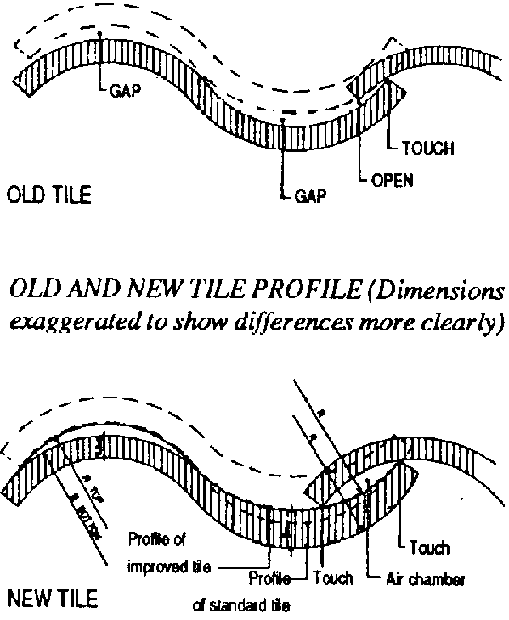
The profile of the tiles has been optimized to provide a closer fit at the overlaps (see profile sketches). This is achieved by making the crest of the tiles thinner (ie 6.5 mm) than the valley thickness (ie 9 mm). In order to obtain these different thicknesses, the screeding machine has a concave top and a moulding frame with a curved profile of 2 mm thickness. An additional advantage of this device is that the frame touches the screeding surface only along the narrow strip of 2 mm, avoiding the accumulation of motar under the frame, improving tile quality and increasing working speed.
The mothermoulds, which were previously made of concrete, are now of preformed plywood, in order to ensure greater uniformity and reduce weight. For the same reasons the grand mothermould has been omitted.
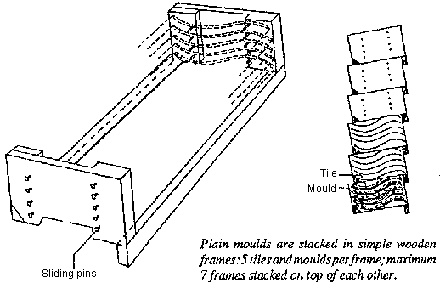
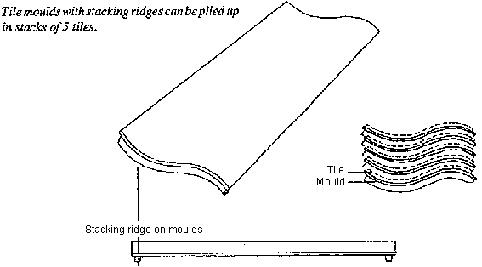
The machines are supplied together with a set of mothermoulds, with which two types of concrete moulds can be produced: with and without stacking brackets. Moulds with stacking brackets can be piled up in stacks of five tiles, while plain moulds, which are made much faster, are stacked in simple wooden frames.

FIGURE

FIGURE
|
Technical Details |
ECO Systems Concrete Rooftile Machine | |
|
Size of machine (length x width x height) |
65 x 45 x 1 5 cm (25 x 1 8 x 6 in) | |
|
Weight of machine (combination machine) |
15 kg | |
|
Size of crate for shipment |
80 x 76 x 25 cm (32 x 30 x 10 in) | |
|
Weight of packed machine |
29 kg | |
|
Standard tile size / weight |
60 x 28.5 x 0.65 cm (23.6 x 11.2 x 0.26 in) /2.45 kg | |
|
Improved tile size / weight |
60 x 28.5 x 0.65/0.9 cm (23.6 x 11.2 x 0.26/0.35 in)/3.15kg | |
|
Energy input |
manual | |
|
No. of tiles per cycle/output rate |
1/30 - 60 tiles per hour | |
|
Labour force required (incl. mixing and stacking) |
6 men | |
|
Price (ex works) |
Standard tile machine |
250 US$ |
| |
Improved tile machine |
290 US$ |
|
valid |
Combination machine for standard tile |
325 US$ |
|
June 1991 |
Mould and ridge machine |
245 US$ |
| |
Mother mould / Ridge mould |
22/8 US$ |
| |
Concrete mould |
0.5 US$ |
| |
Stacking frame |
10 US$ |
FIGURE
FIGURE
FIGURE

FIGURE
|
| ||||||||||||||||||||||||||||||||||||||||||||||||||||||||||||
MATECO Multitile Vibrator
Model "Peru"
Manufacturer MATECO S.A.
Division Equipos
Shell 319 Of.
906
Miraflores, Lima Peru
Tel. [ . . 51] 14 - 44 25 25
Fax. [ . . 51]
14 - 4126 96
Description
The Multitile Vibrator Model ''Peru" was designed and developed by Ing. Raul D'Angelo Kruger as a means to achieve increased productivity in a commercial workshop and produce more competitive FCR/MCR tiles for the open market.
The all-steel workstation has a large screeding table mounted on rubber shock absorbers. The screeding surface is a rubber sheet stuck onto the steel table, in order to ensure a tight fit of the frame and prevent the wet mortar from leaking out during vibration.
The key feature of the machine is that 3 or 4 rooftiles can be made during each screeding operation, depending on the type of interchangeable frame used, of which 5 different types are available: 2 kinds of curved tiles (Pantile and Romana) with 3 tiles per frame, and 3 kinds of plain tiles (Plane, Serrana and Provenzal) with 4 tiles per frame. These allow for a high output rate of 300 to 450 tiles per day, depending on the type of tile made and the skill of the operator.
The vibrator, which acts horizontally, is powered by a 12 volt DC electric motor, which runs on a car battery.
The MATECO Experience
MATECO S.A. is a private enterprise producing FCR products in Lima/Peru since early 1989. Its origins date back to 1986, when contacts were established between SKAT and the Peruvian architect, Manuel de Rivero which resulted in the setting up of a workshop in 1988.
The first FCR tiles were made on equipment obtained from JPM
Parry & Associates, U.K., but it was soon realized that the local
circumstances required certain modifications of the equipment and production
process. Thus, on the basis of extensive experimentation, the following
conclusions were drawn:
· Fibres: The most appropriate locally available
fibres were found to be eucalyptus waste from the manufacture of wood-wool
products. The fibres are already cut to 1.5 cm lengths (as needed for FCR tiles)
and only need to be cleaned before use.
· Mortar mix: 10 kg of clay-free sand, 3.85 kg of Portland cement and 25 g of eucalyptus fibre mixed with 2 litres of water constitute a mixture enough to produce 7 pantiles or Roman tiles, or 8 plain tiles. The relatively small proportion of fibres ensures good appearance of the tile without forfeiting the strength needed to avoid damage during transportation and handling.
· Coloured tiles (particularly red ones) are preferred among Peruvians. After numerous trials the ideal combination was found to be a blend of 60 % red and 40 % yellow pigments, added in a proportion of 200 g per unit of mixture. Black coloured tiles are now also in demand, although a uniform appearance is difficult to achieve, because of the variation in the quality of pigments. However, in general, 300 g per unit of mixture IS used.
· Solar curing: Since the tiles cured in water generally had unsightly white stains on the surface, which had to be washed off with a special solution, other methods of curing were tried out. The most ideal method turned out to be a kind of autoclaving using solar energy (called solar curing): batches of 10 - 15 tiles (held in box-like frames) are placed in the curing tanks, which contain just a few centimeters of water. The tanks are deep enough to hold two layers of frames (ie one above the other) and are covered with black plastic sheets so that the tiles remain moist and the tank and its contents are heated up by solar energy. 4 days of solar curing followed by 10 days of air curing were found to give the tiles greater impact resistance than by water immersion curing for 7 days and subsequent air curing for 14 days. This method, therefore, not only saves curing space and time, but also prevents staining and produces stronger tiles.
· Screeding table: The output of one tile per cycle was found to be commercially unsatisfactory, which is why a larger screeding table was developed, incorporating a set of interchangeable screeding frames with which 3 or 4 tiles could be made at a time, thus achieving a considerably higher output rate.
Operating the Multitile Vibrator
To operate the Multitile Vibrator, one man is needed to work at the table, while two other men are occupied (about three quarters of the time) with the preparation of the mix, demoulding the previous days tiles, moving and cleaning moulds and plastic sheets, etc.
For each tile a separate plastic interface sheet is clamped down under the screeding frame. For each tile a lump of mortar, measured with the scoop, is placed in each field, all of which are spread out and smoothed with a float under vibration, which should not take longer than 90 seconds. The frame is opened and tilted up on the side opposite the operator, who moves to the right of the table to place a PVC mould onto the projecting brackets. With both hands, the first interface sheet with the screeded mortar is carefully pulled over the mould and aligned with the guide markings. The mould is removed and placed on the mould stack for initial curing and the procedure is repeated for each of the other tiles, before the production cycle can begin again.
On the next day the tiles are demoulded and placed in solar curing tanks (described below) for 4 days and later air cured for 10 days before the tiles are ready for use.
|
Technical Details |
Multitile Vibrator Model "Peru" | |
|
Size of screeding table (1 x w x h) |
92 x 65 x 92 cm (36 x 26 x 36 m) | |
|
Weight of screeding table |
85 kg | |
|
Sizes of crates for shipment |
a. Machine & accessories |
100 x 120 x 90 cm (39 x 47 x 35 in) |
| |
b. 300 moulds |
100 x 120 x 90 cm (39 x 47 x 35 in) |
|
Weight of the two crates |
a + b (132 + 211 kg) |
343 kg |
|
Standard tile size (Roman or pantile) |
50 x 25 x 0.8 cm (19.7 x 9.8 x 0.31 in) | |
|
Energy input |
electrical (car battery) | |
|
No. of tiles per cycle/output rate |
3 or 4 / 36 to 56 tiles per hour | |
|
Labour force required (incl. mixing and stacking) |
3 men | |
|
Price (ex works) |
Multitile Vibrator |
1350 US$ |
|
valid June 1991 |
PVC Mould |
9 US$ |
| |
Screeding Frame |
50 US$ |
| |
FOB expenses |
100 US$ |
