 |
| ||||||||||||||||||||||||||||||||||||||||||||||||||||||||||||||||||||
|
| ||||||||||||||||||||||||||||||||||||||||||||||||||||||||||||||||||||
A Publication of the Deutsches Zentrum f�r Entwicklungstechnologien - GATE , a Division of the Deutsche Gesellschaft f�r Technische Zusammenarbeit (GTZ) GmbH - 1991
NOTE 1: The technical details were provided by the producers. GATE is not in a position to verify these data and therefore cannot accept responsability for any inaccuracies. In cases where prices have been quoted, these are subject to change and are thus meant to serve only as guidelines valid for 1991.
NOTE 2: from the cd-rom library editors: if you perform a search on “Clay” and “tiles” in other sections or documents in this cd-rom, you will find articles, books or information that may usefully complement or update the information contained herein.
|
| ||||||||||||||||||||||||||||||||||||||||||||||||||||||||||||||||||||
Acknowledgements
German Appropriate Technology Exchange
Dag-Hammarskj�ld-Weg
1
Postfach 51 80
D-6236 Eschborn 1
Federal Republic of Germany
Tel.
(06196) 79-0
Tel.41523-0 gtz d
GATE - stands for German Appropriate Technology Exchange, founded in 1978 as a special division (Division 4020) of the government-owned Deutsche Gesellschaft f�r Technische Zusammenarbeit (GTZ) GmbH (German Agency for Technical Cooperation).
GATE is a centre for the dissemination and promotion of appropriate technologies for developing countries. GATE defines "appropriate technologies" as those which appear particularly apposite in the light of economic, social and cultural criteria. They should contribute to socio-economic development whilst ensuring optimal utilization of resources and minimal detriment to the environment. Depending on the case at hand, a traditional, intermediate or highly developed technology can be the "appropriate" one.
GATE focusses its work on the following areas:
- Technology Dissemination
- Research and Development
-
Environmental Protection
GATE offers a free information service in appropriate technologies for all public and private development institutions in countries dealing with the development, adaptation, application and introduction of technologies.
BASIN is a coordinated network of experienced international professionals, set up to provide qualified advice and information in the field of building materials and construction technologies.
The activities of BASIN are divided between four leading European, non-profit appropriate technology organizations, each of which covers a separate specialized subject area, in order to provide more qualified expertise with greater efficiency.
The services offered by BASIN encompass:
· responses to technical enquiries;
· maintenance of a documentation and computer database with evaluated information on documents, technologies, equipment, institutions, consultants, projects, etc;
· monitoring of practical field experiences;
· preparation of publications to close information gaps;
· organization of training courses, workshops, seminars and exhibitions;
· implementation and management of research and development projects.
This Product Information Portfolio was conceived to inform users as objectively as possible about fired clay brick and tile production in general, and more specifically about the available equipment, as well as aspects of selecting and buying the most suitable type. The aim was not to deal with the technology in depth, as sufficient literature is available elsewhere, but to give practical information for the user to understand the advantages and limitations of the alternative technical systems and equipment available in different regions.
This enables the user to compare the machines with each other, and make a preliminary selection, before requesting more detailed information from the manufacturer.
Note: The technical details were provided by the producers. GATE is not in a position to verify these data and therefore cannot accept the responsibility for any inaccurracies. As the prices and exchange rates are subject to change, they are only meant to serve as guidelines.
Text, illustrations, layout:
K.Mukerji, H. Worner,
G.Merschmeyer
(1991
|
| ||||||||||||||||||||||||||||||||||||||||||||||||||||||||||||||||||||
Technology
General
The technique of firing clay to produce bricks and tiles for building construction is more than 4000 years old. It is based on the principle that clayey soils (containing 20 to 50 % clay) undergo irreversible reactions, when fired at 850 - 1000° C, in which the particles are bonded together by a glassy ceramic material.
Advantages
+ Fired clay products can have high compressive
strengths, even when wet' making them resistant to impact and abrasion. The
excellent condition of many ancient brick constructions clearly demonstrates the
durability of fired clay products.
+ The porosity of fired clay permits
moisture movement, without significant dimensional changes. Brick and tile
constructions can "breathe".
+ Solid bricks have a high thermal capacity,
required for most climates, except for the predominantly humid zones; perforated
bricks can be used (with perforations running vertically) for cavity walls,
which provide thermal insulation, or (with perforations perpendicular to the
wall face) for ventilation or screen walls.
+ Fired clay products provide
excellent fire-resistance.
+ Bricks and tiles are weather resistant and can
remain without any surface protection, thus saving costs. However, exposed
brickwork is often considered unfinished and hence not always accepted.
+
Poor quality and broken bricks are useable for other purposes, hence no
wastage.
+ The production process can be extremely labour-intensive and thus
create many jobs, even for unskilled workers.
Problems
- Relatively high fuel consumption of the firing
process. In many countries, where firewood is used, large forest areas have
disappeared causing serious ecological damage. Where firewood is still
available, it is usually extremely expensive, but this is also true for other
fuels. Therefore, good quality fired clay products tend to be expensive.
- Simple field kilns do not always produce good quality and uniform bricks, and generally operate with very low fuel efficiency. Capital investments for fuel efficient kilos that produce good bricks are often too high for small-scale producers. They are also not justified, if continuous or large supplies of bricks are not required.
- A possible defect of burnt bricks is "efflorescence", which appears temporarily on the surface of the brick, and is caused by soluble salts inherent in the clay or process water.
Procedures
Burnt brick production has reached a high level of mechanization and automation in many countries, but traditional small-scale production methods are still very widespread in most developing countries. Thus there is a great variety of non-mechanized and mechanized methods for clay winning, preparation, moulding, drying and burning, which can only be dealt with briefly in this manual. These operations are well documented in a number of publications (see Select Bibliography) and the reader is advised to refer to them for details.
Soil Selection
· A large variety of soils are suitable for this process, the essential property being plasticiy to facilitate moulding. While this depends on the clay content, excessive proportions of clay can cause high shrinkage and cracking, which is unsuitable for brickmaking. The qualities of fired clay products vary not only according to the type and quantity of other ingredients of the soil, but also to the type of clay mineral.
· Soil selection is not only a matter of experience, simple field tests and subsequent laboratory tests are vital.
Clay Testing
· The list of tests is long and not all are needed for each soil type and use.
· The main field tests are by sight, smell, touch, by making balls, ribbons and threads, by sedimentation in a glass jar and by dropping.
· Laboratory apparatus is needed for particle size analysis by sieving, for determining shrinkage, plasticity, dry strength, compressibilty, optimum moisture content and cohesion.
· As a rough guideline, the minimum clay contents required
for the production of:
- bricks is 40 %, and for
- tiles is 60 % clay.
Experience and expert advice is required to determine the optimum clay content, as high percentages can lead to shrinkage and cracking.
Clay Winning
· Clay deposits are found at the foot of hills or on agricultural land close to rivers (which naturally generates conflicting interests between the use of land for brickmaking and for agriculture). It must, however, be remembered that the fertile topsoil required for agriculture is not used for brickmaking. These 30 to 50 cm of soil have to be removed before excavating the clay for brickmaking.
· The criteria for choosing a suitable location are the quality of clay, availability of level ground and closeness of a motorable road for transports.
· Hand-digging in small and medium-sized production plants is usually done to a depth of less than 2 m. (After excavation of large areas they can be returned to agricultural use.)
· Mechanical methods, using drag-line and multi-bucket excavators, are required for large-scale brickmaking plants. These methods require proportionately less excavating area, but make deep cuts in the landscape.
Clay Preparation
· Sorting is done by picking out roots, stones, limestone nodules, etc., or in some cases by washing the soil.
· Crushing is required because dry clay usually forms hard lumps. Manual pounding is common, but laborious. However, simple labour-intensive crushing machines have been developed.
· Sieving is needed, but laborious. However, simple labour-intensive crushing machines have been developed to get particles less than 5 mm for bricks and less than 0.5 mm for roof tiles.
· Proportioning of different clays is required if the clay content or grain size distribution is unsatisfactory. However, in some cases, rice or coffee husks or saw dust, which serve as a fuel, are added to the clay, in order to obtain lighter burnt bricks and also to prevent the freshly moulded, highly plastic clay from cracking during the drying process.
· Thorough mixing is needed and a correct amount of water. Since manual mixing (traditionally by treading with bare feet) is laborious and often unsatisfactory, motor-powered mixers are preferred. The effort of mixing can be greatly reduced by allowing the water to percolate through the clay structure for some days or even months. This process, known as "tempering", allows chemical and physical changes to take place, improving its moulding characteristics. The clay must be kept covered to prevent premature drying.
Moulding
· All fired clay products require some form of compaction, either by dynamic compaction (throwing, tamping) or static compaction (with mechanical or hydraulic equipment). The principal methods are:
· Hand moulding systems: using wooden moulds, moulding tables or manually operated presses; and
· Mechanized systems: using motorized presses with mechanical or hydraulic energy transmission, or extruders, which can be partly hand operated or fully automatic.
Drying
· Natural drying is done in the open under the sun, but a protective covering (eg leaves, grass or plastic sheeting) is advisable to avoid rapid drying out. If it is likely to rain, drying should be done under a roof. But traditionally, bricks are only made in the dry season.
· Artificial drying (as in large mechanized plants) is done in special drying chambers, which make use of heat recovered from the kilns or cooling zones.
· Drying shrinkage is inevitable, and causes no special problems if below 7 % linear shrinkage. 10 % linear shrinkage should not be exceeded; therefore, if necessary, the clay proportion must be reduced by adding sand or grog (pulverized brick rejects).
Burning
· There are two types of kilns for burning bricks: intermittent and continuous kilns.
· Intermittent kilns include clamps and scove kilns (traditional field kilns), updraught and downdraught kilns. Their fuel efficiency is very low, but they are adaptable to changing market demands. They vary in size from 10 000 to 100 000 bricks.
· Continuous kilns include various versions of the Hoffmann kiln (particularly the Bull's trench kiln) and the high-draught kiln. These are very fuel efficient. Tunnel kilns, in which the bricks are passed through a stationary fire, are very sophisticated and capital-intensive.
|
| ||||||||||||||||||||||||||||||||||||||||||||||||||||||||||||||||||||
Moulding equipment
There are basically five types of moulding equipment:
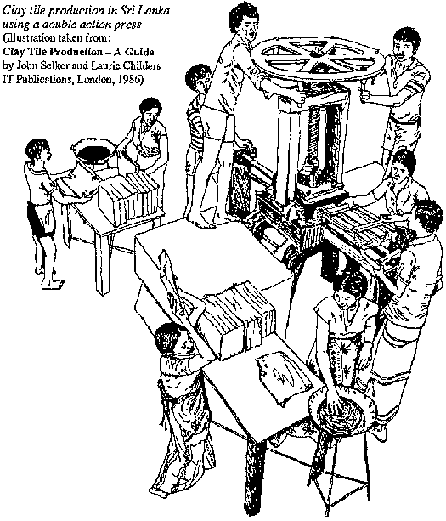
Wooden moulds: the clay is formed into a clot, thrown into the mould, and the excess cut off. There are two traditional techniques for releasing the brick from the mould:
a. the slop-moulding method, by which the mould is kept wet and the clay is mixed with more water, and
b. the sand-moulding method, by which the clot is rolled in sand to prevent the clay from sticking to the mould. Bricks made by slop-moulding are vulnerable to slumping and distortion, while sand-moulding produces firmer, well-shaped bricks, due to a little less water in the clay.
Moulding tables: the moulding is done in the same way as with simple wooden moulds, whereby the bricks are ejected by means of a foot-operated lever; table moulds require less effort, produce more accurately shaped bricks, and achieve uniform production and higher outputs.
Manual presses: the moulding and fuming out operations are carried out by a machine which is operated manually.
Motorized presses: the moulding and fuming out operations (mechanical or hydraulic) are carried out by a machine which is power driven.
Extruders (hand-operated or fully automatic): fed with wet clay and extruded continuously under great pressure through a die (mouth piece producing a uniform cross-section) and cut with a wire-cutter into components of required lengths.
Industrial production units: these production units cannot be transported, but the entire process is automated. These units are not included in the Product Information.
Corresponding to the great diversity of moulding equipment, the prices for machines other than those for industrial production, can be up to 10 000 US$. The following (extremely generalized) compilation of the respective advantages and problems clearly shows that each system caters for a certain range of needs and thus has a valid place to fill.
Advantages of manually operated equipment
+ Low capital and
operational costs.
+ Low weight (easy to transport on wheelbarrows or
bullock-carts).
+ Small size, thus little storage space required.
+
Simple to use, even for unskilled workers.
+ Apart from cleaning the mould
and lubrication of moving parts, low maintenance requirements.
+ Possibility
of repairs in local workshops, no special spare parts required.
+ No
additional costs of energy.
+ No time loss due to failure of energy supply.
Problems of manually operated equipment:
- Low rate of
production per machine, thus requiring a number of machines to achieve a
reasonable output.
- Tiring operation; thus, in the course of a series
tendency of gradual drop in quality and uniformity of products, if the work is
done only by one person.
Advantages of automatic, motor-driven machines:
+ High rate
of production .
+ Good quality products (optimum dimensional uniformity,
stability of edges).
+ Reduction of manual work, thus saving costs, where
wages are high.
Problems of automatic, motor-driven machines:
- High capital
and operational costs.
- Usually very heavy, requiring powerful lifting gear
and vehicles for transportation, ie transports are troublesome and
expensive.
- Large size, requiring large working area.
- Necessity of
skilled labour for operation of machines.
- Need of continuous supplies of
large quantides of raw material.
- Maintenance requirements (eg some
hydraulic machines) rather complex.
- Requirement of specialists for repairs;
spare parts possibly expensive and difficult to get, or only after long delivery
time.
- Dependancy on adequate energy supply. - In the case of extruders:
· need for very careful clay preparation in terms of clay type and proportion, particle size and moisture content,
· special know-how and skill in handling the dies (mouth pieces), and
· wearing of the auger and other parts.
Summary
The above list of advantages and disadvantages of the different categories of clay brick and tile moulding equipment lead to the following conclusions:
Small, manually operated equipment are best suited:
· in case of limited capital resources;
· for projects in remote areas, or those that lack the necessary infrastructure;
· in small workshops, with limited working space;
· where entrepreneurs, with a small capital base and a team of unskilled workers, produce fired clay products for the local market, where the demand is relatively low;
Powered, high capacity machines are advantageous:
· where sufficient financial resources are available;
· in cases where high production rates are needed and there is a high demand over a long period;
· for projects that specify better material qualities;
· in working environments with sufficient energy supply, as well as maintenance and repair facilities;
· in cases, where labour is expensive or not easily available;
· where management skills are available
- to organize
the supply of raw material,
- to coordinate the complex production
process,
- to market the products on a large scale, ensuring a continuously
high output rate.
A combination of both categories of machines would allow the producer to adjust the daily output rates according to current demands, and also permit continuity of manual production in case of breakdown of the automatic machines.
|
| ||||||||||||||||||||||||||||||||||||||||||||||||||||||||||||||||||||
Criteria for selection and purchase
General Considerations
In view of the vast choice of machines available, it seems difficult to decide which one should be bought. If there is not enough money to buy expensive equipment, the choice is smaller and the decision much easier. But generally, the following points need to be considered, especially when the available resources allow for the purchase of higher priced equipment.
Design of Moulding Equipment
· The moulding of bricks and tiles is only apart of the manufacture of ceramic products. For the rest of the process additional equipment is needed, such as clay crushers, pugmills (machines for mixing wet clay ready for moulding), racks for stacking fresh products, pallets and transportation equipment, and the like.
· Of special importance with regard to production efficiency and output rate is the spatial arrangement and organization of the various working areas. Some equipment suppliers offer complete production units with a system of machines and equipment that can be combined to form a production line, which is tailored to the user's requirements.
· In some cases, it may be advantageous to provide sufficient flexibility in such a way that other products can be manufactured with the same equipment, for instance by changing the moulds and using other raw materials, say to produce stabilized soil blocks. If the purchase of such a machine is contemplated, the speed and ease of changing moulds is an important selection criterium, but it must also be remembered, that this operation becomes rather difficult, the more moulds there are, as for example in the case of rotating tables, which have 3 or 4 moulds.
· Special consideration should be given to the working conditions for the production team, especially with regard to operation procedures and handling of products, that is, avoidance of dangerous or exceptionally hard manual work and activities that have to be done in a bent position.
· A balance must be found between the desired output rate, quality standard and level of sophistication. Complicated mechanical and electronic control devices often necessitate special training and experience for maintenance and repairs. Spare parts are usually expensive and difficult to procure (import).
Energy Sources
· Smaller moulding equipment is invariably manually operated (muscle power), while larger units are usually motorized (electric motor, diesel, or petrol engine). Manual equipment depends on the strength, stamina and motivation of the operator, while mechanized presses overcome the problems of human fatigue and non-uniform products.
· Energy transmission to the raw material, other than throwing or tamping, can be via a lever, toggle, cam, pivot, ball and socket joint, piston, auger (Archimedean screw) etc. But principally there are two systems of energy transmission: mechanical and hydraulic.
· Mechanical systems are usually simple but can be relatively heavy, unless special alloys are used, in which case repairs may be difficult.
· Hydraulic systems are susceptible to dust, sand and heat, under harsh conditions the hydraulic fluid must be changed once a month, so that maintenance can be difficult and costly. The systems are usually designed for operating temperatures around 70° C, but under tropical conditions temperatures can reach 120° C, requiring cooling mechanisms and/or special spare parts and oils to withstand the heat. Flexible tubing, joints, etc. that need frequent replacement should best be standardized.
Material Quality
· In order to maintain a consistently good quality of clay bricks and tiles, it is necessary to cheek the composition of the raw material and its moisture content at regular intervals before moulding. Finished products with deformations, broken edges, etc are a sure sign that the raw material was of inferior quality.
· Good quality bricks produce a ringing sound when knocked against each other. A dull sound is an indication that the bricks are cracked or underfired.
· A common defect of bricks is "lime blowing" (or "lime bursting"), leading to a weakening and breakage of the bricks. This is caused by the hydration of quicklime particles present in the clay. The problem can be minimized by reducing the paricle size of the raw mix and firing at 1000°C. The addition of 0.5 to 0.75% of common salt (sodium chloride) before firing has also proved effective.
Brick and Tile Dimensions
· For a mason to work efficiently, he should be able to hold the brick in one hand, hence a convenient width is between 100 and 120 mm. Generally, the length of a brick is twice its width plus the thickness of one mortar joint (10 mm).
· Small brick sizes require a greater number of bricks per cubic metre than larger ones, so the overall effort needed to produce small bricks is greater than that of making larger ones. Furthermore, masonry constructions with small bricks require more mortar, since the proportion of joints is higher. However, large bricks may not only be too heavy for the mason to handle, but also more difficult to fire in a kiln. If large blocks are to be used, they are usually machine-extruded perforated blocks, which are generally expensive, of high quality, and used for special purposes, eg to provide thermally insulated walls. But in general, perforated blocks reduce the drying time, facilitate uniform firing and improve the mortar bond in masonry.
· Indents (so-called "frogs") into one bed face of the bricks make the bricks lighter, also improve the mortar bond and provide a means to introduce an individual design and brand name.
· Burnt clay tiles can be plain or shaped, depending on the use to which they are put, either for flooring, wall cladding or for a large variety of roofing. Thus the number of possible shapes and sizes is too great to deal with here.
· Certain machines can produce a complete range of products (large and small blocks, paving and roofing tiles, etc.) which is a distinct advantage, but which has its price. Similarly, extruders can be supplied with different dies (mouth pieces) for the manufacture of products with different cross-sections.
Productivity and Manual Work
· The machine's output is often indicated according to the theoretical production cycle. The real productivity in the field is different and depends upon a number of factors that are totally independent of the machine's theoretical capacity, eg breakdown time, manpower organization, maintenance, etc. Real productivity lies quite often around or under 50 % of the theoretical production cycle.
· Since the methods of manufacturing bricks and tiles are so diverse, it is not possible to generalize on the amount of manual work required, but in all cases it is advisable to employ a few more workers than specified by the equipment supplier, in order to incorporate enough production flexibility.
· Special attention should be given to safety measures, such as avoidance of projecting moving parts, designing manual operations such that hands cannot get jammed between moving parts, clearly marking and/or protecting dangerous points, incorporating thermal fuses, security pins, etc. Automatic machines must at all cost tee equipped with an emergency stop switch, which is easily accessible.
Manufacturer
· Equipment suppliers for brick and tile plants range from small to large companies, with varying degrees of commercialization, offering a very diverse choice of products and services. The larger companies are usually better known, experienced in international trade and consequently reliable business partners. Small firms or their machines are often not so well-known, because of small advertising budgets, hence their list of references can be small in spite of a good product.
· Personal visits to the manufacturer and/or sites at which their machines are in use should be undertaken as far as possible. The value of reference lists is to be able to meet or correspond with users, to learn about their experiences. If such lists do not contain addresses, these should be specifically asked for.
· Of special advantage are training courses, offered by some manufacturers. To be effective, they should not only include the production of bricks and tiles, as well as handling and maintenance of the equipment, but also the testing and use of problem clays, as well as production management and design guidelines for building construction. Trainees should also learn to dismantle and assemble complicated machines, in order to understand their function and conduct repairs by themselves.
Purchase of Machine
· The "FOB" price (free on board) includes packaging, transportation and insurance costs of the machine within the retailer's country. This price can be artificially inflated in order to compensate for the reduction offered on the factory price.
· As regards sales or rental con<litions, one must be suspicious of contracts providing for price indexing based on the number of bricks and tiles produced or for payment of royalties for patent use, which is often not justified. A patent is no/necessarily a proof of guaranteed quality and constructors frequently apply for patents for processes that are already of the public domain.
· It is advisable to include a penalty clause in the contract, to safeguard against late delivery.
· In the case of an after sales service contract, the waiting period for repairs and maintenance must be clearly indicated. A detailed handbook should be provided, including specifications of all spare parts and a maintenance plan, indicating operations necessary and expected maintenance frequency.
FIGURE
|
| ||||||||||||||||||||||||||||||||||||||||||||||||||||||||||||||||||||
Checklist for potential buyers
The following is a summary of the main points to be considered when selecting the most suitable clay brick and tile production equipment:
· Available financial resources (budget restraints can limit the choice considerably).
· Required quality of bricks and tiles (single-storey low-cost houses do not need very high quality bricks, larger buildings and harsh climates may need stronger bricks and tiles).
· Required production rate (this depends on the expected market demand).
· Weight and mobility of equipment (these may have to be moved frequently from site to site).
· Available energy sources (not only the costs must be considered, but also the frequency of power failures and supply shortages of diesel, petrol, etc.).
· Availability of spares and skilled technicians for maintenance and repairs (machines with standardized parts create less problems).
· Versatility of equipment (machines with interchangeable moulds for a variety of items can bring about considerable savings).
· Operational safety (for this, several demonstrations of use, especially with unskilled workers, should be seen).
· References (contacts with equipment users should be sought whenever possible).
· Conditions of purchase (since machines with similar outputs are available, comparisons of prices, discounts for large orders, delivery time, etc. are urgently recommanded).
· After sales services (not only should the manufacturers be fair enough to rectify defects of their machines by providing technical assistance or supplying spare parts at minimum or no-cost; users should also take the trouble to send accounts of their experiences and suggestions for improvements to the manufacturers, for without this feedback no effective development is possible).
|
| ||||||||||||||||||||||||||||||||||||||||||||||||||||||||||||||||||||
Clay Bulley
Extruder
Manufacturer
Dragon Ceramex
5 Nomis Park
Congresbury,
Avon BS 19 5HB
England
Tel. [..44] 934 - 833409
Description
The Clay Bulley Extruder was introduced in 1973. It is a hand-operated clay extrusion machine, which extrudes solid or hollow clay sections up to approx. 30 cm in cross-section. It can be operated in vertical or horizontal mode with equipment to cut predetermined lengths of extrusion. A range of steel die plates is supplied to fit directly into the machine and into the two sizes of expansion box which the machine accommodates. The die plates can be made of 12 mm plywood, fired clay or perspex for the manufacture of a large number of different products ranging from pipes, self-locking (seismic) bricks, screen bricks up to tiles.
The machine, which processes about 250 kg of clay per hour, is simple to operate with relatively short training and needs very little maintenance.
(British Patent No. 1461773)
Operating the Clay Bulley Extruder
Vertical: This mode is suitable for general purpose use. The machine can be mounted against a wall (as illustrated), or on the side of a bench. Clay is fed via the hopper located on the front of the machine. Accessories are available for controlling the clay section as it emerges, and for parting off set lengths (see details overleaf). The height of the machine can be adjusted on its mounting rack to suit operating conditions.
Horizontal: This mode is convenient for the rapid production of forms with a flat side, such as squares, rectangles, bricks, tiles, etc. The roller table supplied for horizontal use (see illustration) has a built-in harp. This has two wires (extras available) which can be set to a given distance for parting off identical lengths. Sets of floor and wall mounting straps are available, so that a horizontal machine can easily be changed to vertical operation.
The die plates are simply slotted into the Clay Bulley. When an expansion box is used, which is necessary to carry the 250 mm and 330 mm die plates, the box is slotted into the place normally occupied by the 150 mm plates.
Clay is fed via a hopper either as separate lumps or continuous block. With each stroke of the handle a full charge of approximately 115 mm³ of clay is extruded. The handle is returned to the top of the stroke and a fresh charge fed via the hopper until the required length of section is obtained. This is then parted off with a harp.
The whole interior is accessible for the removal of clay on completion of work. Periodic oiling of the sliding linkage system is all the maintenance required.
|
Technical Details |
Clay Bulley Extruder |
|
Size of machine (length x width x height) |
110 x 23 x 50 cm (43 x 9 x 20 in) |
|
Weight of machine |
30 kg |
|
Size of crate for shipment |
117 x 35 x 42 cm (46 x 14 x 17 in) |
|
Weight of packed machine (incl. accessories) |
50 kg |
|
Standard brick size |
23 x 10.5 x 7.5 cm (9 x 4.2 x 3 in) |
|
Standard tile size |
40 x 20 x 2 cm (16 x 8 x 0.8 m) |
|
Maximum product size |
76 x 30 x 30 cm (30 x 12 x 12 in) |
|
Volume of clay extruded per stroke of handle |
115 mm³ |
|
Energy input/transmission |
manual / mechanical |
|
No. of bricks per cycle/output rate |
1 / 250 bricks per hour |
|
Labour force required (incl. clay preparation and stacking) |
1 - 4 men |
|
Price (ex works) valid June 1991 |
Clay Bulley 150 D.V.R. (incl. machine on rack for vertical use, brick die plate, cutting accessories, | |
| |
expansion for larger die plates) |
647 £ Sterling (» 1130 US$) |
| |
Roller table & legs |
165 £ Sterling (» 290 US$) |
| |
Pipe plate |
22 £ Sterling (» 39 US$) |
| |
Tile die plate |
52 £ Sterling (» 90 US$) |
| |
Package |
25 £ Sterling (» 44 US$) |
1. Expansion box
2. Parting platform
3. Pipe die
plate
4. Cutting harp
5. Cutting guide
6. Tile finisher
7.
Hooker
8. Tile lifter
9. Brick lifter
10. Frame guide
Accessories
Expansion boxes: supplied in two sizes - 250 and 330 mm - to
carry the larger die plates.
Cutting guide: controls a cutting harp such
that sections may be squarely parted off. Where a number of sections of a given
length are needed, two cutting guides may be used, set at the required distance
apart.
Frame guide: performs the same function as the cutting guide with the addition of adjustable guide bars to ensure the straight run of section from the die plate, when production runs are being undertaken.
Parting platform: a useful accessory for production runs of a set length. It can be locked in position below a cutting or frame guide. The section is extruded onto the parting platform and parted off at the guide. A small lever movement on the parting platform then lowers the parted section approx. 3 mm allowing for easy removal.
Brick lifter / tile lifter: designed to carry and stack the respective sections after parting off. In this way handling of the forms can be avoided. Cutting harp: with a centre handle, so that-unlike conventional harps - it can be used with one hand, leaving the other free to support the form on a suface if necessary.
Tile finisher: used to turn up the nibs of tiles and close the
channels together when required.
Hooker: for quick removal of a 100 mm die
plate.
Building Products
Apart from most standard types of extruded fired clay bricks and tiles, die plates are available for:
Self-locking bricks for earthquake resistant construction: 105 mm x 75 mm cross-section, with hollow lattice structure and interlocking ribs economizing in both material and energy facilitating drying and firing. Walls of low thermal conductivity and strong, permanent bond is achieved with relatively little mortar.
Double skin tiles: 200 mm x 20 mm cross-section, with similar features as the self-locking bricks, suitable for use as floor or roof tiles. Screen bricks: 185 mm x 90 mm cross-section, for ventilation or ornamental screens.
Pipes: with collars of 100 mm bore, sections up to 750 mm, and if required formed to make a 90° turn.
Blank die plates in 10 s.w.g. mild steel are available in order that sections can be designed for special local requirements.
Other Products of Dragon Ceramex
Clay Bulley "Rapide"
Clay extruder with maximum cross-section
of 5.5 cm.
Clay Bulley "100"
Clay extruder with maximum cross-section of
22 cm.
Countries of Application
Australia, Austria, Belgium, Botswana, Burkina Faso, Canada, Denmark, Eire, Finland, France, Ghana, Japan, Laos, Malawi, Norway, St. Lucia, Switzerland, U.K., Zambia, Zimbabwe.
|
| ||||||||||||||||||||||||||||||||||||||||||||||||||||||||||||||||||||
Parry/ITW type e brick press
Manufacturer
JPM Parry & Associates Ltd
Overend Road,
Cradley Heath
West Midlands B64 7DD
United Kingdom
Tel. [ . . 44] 384 -
69171 (3 lines)
Tlx. 334132 it parr g
Fax. [ . . 44] 384 - 637753
Operating the Type E Brick Press
The table mould is provided with a side table extension on which the wedge-shaped clot of clay is formed and covered with sand. The clot is thrown forcefully, but with some accuracy with its narrow side down into the mould, such that the sides of the clot are not cut off by the rim of the mould. A small mound of excess clay should remain on the top, which is cut off by pulling the slide cutter. The off-cut is removed and set aside for use on the next clot.
The lid is closed and locked. By pulling the handle, the base plate is pushed upwards, giving 2 tonnes compaction and shaping the brick. The lid is opened and the foot pedal depressed to eject the brick. With the help of two wooden plates, the brick is lifted off the base plate and put on a pallet for drying.
The production cycle begins again by making a slightly smaller clot, which is rolled into the flat cut off piece from the previous brick, which thus forms the outer layer of the new brick.
Description
The Type E Brick Press is a manually operated welded steel, brick moulding table for small-scale clay brick production. The machine enables a moulder to form a consolidated and accurately shaped brick in a few simple movements taking about 30 seconds. Experienced workers can produce 600 to 800 bricks in an eight hour shift.
The brick press comprises a brick mould (length x width x height = 372 x 114 x 76 mm) with movable base plate and quick release lid an excess clay cutter, lever operated compression cam and pedal operated ejection. The Type E Brick Press is part of a complete system of small-scale brickmaking plants supplied by JPM Parry & Associates.
The brick dimensions after drying and firing are of international standard (SI), ie 225 x 112.5 x 75 mm. However, non-standard sized moulds can be supplied on request. Clay pavers can also be produced with the machine. A further optional feature is that 'frogs' carrying the brick producer's inscriptions can be made to order.

FIGURE

FIGURE
|
Technical Details |
Type E Brick Press |
|
Size of machine (length x width x height) |
70 x 63 x 107 cm |
|
Weight of machine |
85 kg |
|
Size of crate for shipment |
83 x 65 x 122 cm (33 x 26 x 48 in) |
|
Weight of packed machine (incl. accessories) |
106 kg |
|
Standard brick mould size |
23.7 x 11.4 x 7.6 cm (9.3 x 4.5 x 3 in) |
|
Standard size of burnt brick |
22.5 x 11.25 x 7.5 cm (8.9 x 4.4 x 2.9 in) |
|
Energy input/transmission |
manual/mechanical |
|
No. of bricks per cycle/output rate |
1/100-250 bricks per hour |
|
Labour force required (incl. clay preparation and stacking) |
1 - 2 men |
|
Price (FOB valid June 1991) |
Type E Bric Press |
1060 £ Sterling(» 1860 US$) |
|
Other ITW equipment for small-scale brickmaking plants |
Pendulum Clay Crusher |
1730 £ Sterling (» 3030 US$) |
|
|
Clay Hopper |
150 £ Sterling (» 290 US$) |
| |
Brick Carrying Rack |
190 £ Sterling (» 330 US$) |
| |
Ground Lift Truck |
790 £ Sterling (» 1390 US$) |
| |
2 Wheel Truck |
260 £ Sterling (» 460 US$) |

FIGURE

FIGURE

FIGURE

|
| ||||||||||||||||||||||||||||||||||||||||||||||||||||||||||||||||||||
Parry/ITW Clay Pantile production plant
Description
The Clay Pantile Production Plant is a further part of the ITW small-scale production plant and handling system for burnt clay building materials. It is a cost-effective, simple alternative to the traditional methods of clay roof-tile production. The production of clay pantiles with the Parry/ITW plant is a purely manual operation, in which only local materials are processed.
The main equipment is a preparation table, on which a roller press and tile stand are mounted, and on which the raw clay is shaped to pantiles and placed on special forms for drying. Furthermore a steel box with a cutting frame is provided together with a bow cutter to cut uniform clay bats, as well as a shaping tool into which the bats are placed. Most of the ITW equipment used for brick-making (eg clay crushers, portable clay hoppers, carrying racks 3-wheel trucks) are also designed for use in pantile production.
The approximate dimensions of the finished clay pantile are 350 x 270 x 11 mm thick. The effective coverage is approx. 270 x 230 mm (about 16 tiles per square metre of roof surface).

FIGURE

FIGURE

FIGURE
|
Technical Details |
Clay Pantile Production Plant |
|
Size of preparation table (length x width x height) |
123 x 71 x 105 cm (48 x 28 x 41 in) |
|
Weight of preparation table |
65 kg |
|
Size of crate for shipment (CT 500) |
5.37 m³ |
|
Weight of packed plant |
106 kg |
|
Standard tile size |
35 x 21 x 1.1 cm (13.8 x 10.6 x 0.43 in) |
|
Effective roof coverage S no. of tiles per m² |
27 x 23 cm (10.6 x 9 in)/16 |
|
Energy input/transmission |
manual/mechanical |
|
No. of tiles per cycle/output rate |
1 / 30 - 50 tiles per hour |
|
Labour force required (incl. clay preparation and stacking) |
1 - 5 men |
|
Price (FOB) valid June 1991 |
Optional plant sizes acc. to weekly tile output: 500,1000,2000 | |
| |
CT 500 |
6185 £ Sterling (» 10830 US$) |
|
|
CT 1000 |
8085 £ Sterling (» 14150 US$) |
|
|
CT 2000 |
11835 £ Sterling (» 20720 US$) |
|
Included in each plant are: |
Clay rollers, moulds, clay crusher, clay hopper, carrying frames, 2-wheel and 1/4 tonne ground lift truck | |
How a clay tile is made
- A clay bat is thrown into the cutting frame. The excess is cut off with the bow cutter and re-used.
- The outer box of the frame is removed by sliding upwards.
- The large bow cutter is used to cut the clay into bats. The frame has slots to guide the cutter.
- The clay bat and the shaping tool is dusted with sand and the bat is laid on the shaping tool. The surface is dusted with sand to prevent sticking.
- The shaping tool with the bat on it is rolled through the roller press. This forms the bat into the correct tile shape and thickness.
- Tile and shaping tool are placed on the stand and the trimmer is drawn along the edges to cut off the excess clay.
- The drying form is placed on top of the tile, and holding the two together is lifted and fumed over.
- The shaping tool is removed, leaving the tile in position on the drying form.
- Then it is transferred to the carrying rack.
- When full, the carrying rack is picked up by the 1/4 tome truck and taken to the drying racks.
- The forms are then placed on the covered drying racks where they harden for one or two days.
- Then they are taken to the drying ground where they are removed from the drying forms and stood on edge for final drying before firing.

FIGURE
|
| ||||||||||||||||||||||||||||||||||||||||||||||||||||||||||||||||||||
Ceratile
Hydraulic Press
Manufacturer
CERATEC
Rue du Touquet 228
B-7793
Ploegsteert
Belgium
Tel. [..32] 56 - 58 86 45
Tlx. 57 834 plocer
b
Fax. [..32] 56 - 58 7101
Description
The CERATILE hydraulic press is designed for the production of high quality ceramic floor tiles, roofing and ridge tiles.
It comprises two parts: the press itself and a hydraulic unit, consisting of an electric motor pump and tank, which is connected to the press via flexible hoses, so that it can be placed some distance away.
A variety of moulds can be used with the CERATILE press, and the changing of dies takes about 20 minutes. Each mould consists of three dies: 2 lower dies bolted onto a horizontal sliding table and 1 upper die, which is moved vertically with the rod of the hydraulic jack. With this double action arrangement, tile production is extremly fast, because one form can be demoulded and refilled quickly, while another tile is being pressed.
In order to prevent clay from sticking to the dies and to make demoulding easy and fast, each die is covered with a latex sheet.
Operating the CERATILE: Hydraulic Press
Flat clay pieces of slightly greater volume than the final product are prepared manually or by means of an extrusion machine, the latter being preferable on account of the high output of the CERATILE. These slabs, containing about 20 % moisture, are piled up near the 2 operators, on either side of the press.
The sliding table with the two lower dies is operated manually. A fresh slab is placed on the exposed die and then the table is pushed under the hydraulic jack with the upper die, which is now lowered to shape the tile. During this phase, the second operator places a new slab on the other lower die. After raising the upper die the table is pulled back to expose the freshly moulded tile, while the second tile moves under the upper die, where it is moulded. During this operation, a wooden pallet is placed on the first tile, which is demoulded by inverting the die. This is piled up on a drying rack and the next slab is placed on the empty die, ready for the next pressing cycle, which takes about 12 seconds. Thus, an experienced team can mould 300 tiles per hour.
Training Programme
CERATEC offers a 35 day training programme, covering all aspects of stabilized or fired brick, block and tile production.

|
Technical Details CERATILE |
Hydraulic Tile Press |
|
Size of press (length x width x height) |
75 x 125 x 176 cm (30 x 49 x 69 in) |
|
Size of hydraulic unit |
38 x 69 x 89 cm (15 x 27 x 35 in) |
|
Weight of machine |
600 + 200 = 800 kg |
|
Size of crate for shipment Press |
87 x 137 x 196 cm (34 x 54 x 77 in) |
|
Hydraulic unit |
50 x 81 x 1 19 cm (20 x 32 x 47 in) |
|
Weight of packed machine (incl.. accessories) |
980 kg |
|
Moulds available for the following products: | |
|
Floor tiles (square), double mould |
20 x 20 cm |
|
Floor tiles (hexagonal), single mould |
15 cm length of each side |
|
Roofing tiles ("Marseille" or "Mangaiore") |
24.5 x 42.5 cm (requiring 17 tiles/m²) |
|
Roofing tiles (Flemish type) |
23 x 34 cm (requiring 20 tiles/m²) |
|
Roofing tiles (Roman type) |
18.5 x 41.9 cm (requiring 30 tiles/m²) |
|
Ridge tiles (Type I, curved) |
useful length 50 cm |
|
Ridge tiles (Type II, with angle) |
useful length 50 cm |
|
Energy input/transmission |
electrical 5.5 kW / hydraulic |
|
Maximum nominal compression forœ |
30 tonnes |
|
No. of tiles per cycle/output rate |
I or 2/300 or 600 tiles per hour |
|
Labour forœ required (incl.. clay preparation and stacking) |
2 - 4 men |
|
Price (ex works) |
CERATILE Hydraulic Tile Press |
480 000 FB |
(» 13 700 USS) |
|
valid June 1991 |
Moulds: | |
|
| |
Floor tiles(square) |
32000FB |
(» 910US$) |
| |
Floor tile (hexagonal) |
32 000 FB |
(» 910 US$) |
|
FB = Belgian Francs |
Roofing tile (Marseille/Mangaiore) |
41 000 FB |
(» 1170 US$) |
| |
Roofing tile (E:lemish) |
32 000 FB |
(» 910 US$) |
| |
Roofing tile (Roman) |
28 000 FB |
(» 800 US$) |
| |
Ridge tile (l or II) |
39000 FB |
(» 1 110 US$) |
| |
Set of spare parts |
48 000 FB |
(» 1 370 US$) |
| |
Packing, marking, FOB expenses |
49 500 FB |
(» 1 410 US$) |
| |
Training Course (incl. full board accomodation) |
240 000 FB |
(» 6 860 US$) |
|
| ||||||||||||||||||||||||||||||||||||||||||||||||||||||||||||||||||||
CERATEC extrusion plant CERAMEX V1/CERACUT/CERAFEED DL/CERABELT
Description
The CERAMEX V1 is a heavy duty, low maintenance vertical extrusion unit for the mass production of quality plain bricks, which are cut to the required size by the CERACUT multi wirecutter.
The vertical tank of the CERAMEX is fitted with removable wear jackets and base plate. The vertical shaft of the mixing and pushing screw is mounted on roller bearings and stops. The interchangeable wooden die, through which the clay is extruded, has a water sprinkling arrangement for lubrication.
Protection against overload is ensured by special security bolts and power transmission is operated by hermetic reduction gear.
The CERACUT is available in two versions manual and electrical. The adjustable cutting wires. which are fixed on springs, can cut lengths of 1.5 metres of extruded clay into 17 to 25 bricks, depending on the required brick size.
Operating the CERATEC Extrusion Plant
Either manually or with the help of the linear box feeder CERAFEED DL, which ensures a regular proportioning of the raw materials weathered or fresh clay is filled into the hopper at the top of the vertical tank, in which the clay is mixed and homogenized by the turning of the vertical Archimedean screw. Through a water-lubricated die, the clay mix is extruded as a continuous clay column of uniform cross-section onto an extrusion table, which connects the extruder to the multi wire cutter.
When the column reaches the end of the cutting table, the correct length is cut off and pushed through the wires onto a wooden board, Iying ready to receive the green bricks, which are subsequently carried away to the drying sheds.
|
Technical Details |
CERATEC Extrusion Plant | |
|
Area required for plant (length x width) |
6 x 6 m (20 x 20 ft) | |
|
Weight of total plant |
11 800 kg | |
|
Standard brick size |
22 x 10.7 x 7 cm (8.7 x 4.2 x 2.8 in) | |
|
Maximum product size for fain |
29.5 x 14 x 9 cm (11.6 x 5.5 x 3.5 in) | |
|
Energy input/transmission (CERAMEX) |
electrical 37 kW / mechanical | |
|
Nominal output rate |
4000 - 7000 bricks per hour | |
|
Labour force required |
CERAMEX |
1 worker |
| |
CERACUT |
2 workers |
|
Price (ex works) |
Total CERATEC Extrusion Plant comprising: | |
|
valid June 1991 |
CERAFEED DL (Box feeder), CERABELT (conveyor belt), | |
| |
CERAMEX V1.640 (Extrusion unit), CERACUT (Multi wire cutter), | |
|
FB = |
and Accessories |
6550000 FB (» 190 000 US$) |
|
Belgian Francs |
(including spare parts, installation, start-up and technical follow-up) | |
|
|
Packing, marking, FOB expenses |
464 000 FB (» 13 260 US$) |
| |
Training Programme (incl. full board accommodation) |
240 000 FB (» 6 860 US$) |
|
| ||||||||||||||||||||||||||||||||||||||||||||||||||||||||||||||||||||
TERSTARAM (manual) and semi-terstamatique (motorized)
Brick and Tile Presses
Manufacturer
APPRO-TECHNO
24, rue de la
Rieze
B-5660 Couvin (Cul-des Sarts)
Belgium
Tel. [..32] 60 - 37 76
71
Tlx. 51622 ap tec b
Fax. [..32] 60 - 37 78 87
Description
The TERSTARAM press is based on the design of "La Medelon", the famous Belgian machine developed at the beginning of the 20th century, which was later successfully manufactured under the names "Stabibloc" and "Landcrete" in different parts of the world. These machines were designed to produce compressed bricks for firing, while the TERSTARAM press is now also well-known as a block press for making unfired compressed earth blocks.
The main advantages of the design are the robust construction, the possibility of using various types of moulds, which take just 15 minutes to change; the mobility of the machine, which can easily be moved by two men; end the good compaction of the bricks, exerting an exceptionally high pressure for a manually operated press with mechanical energy transmission. A recent improvement is the automatic unlocking of the cover and ejection of the compressed bricks.
The TERSTARAM is available in two versions: the standard version with a maximum product size of 29.5 x 14 x 9 cm, and the special version with a broader frame and maximum product size of 40 x 20 x 10 cm.
The SEMI-TERSTAMATIQUE machine is a completely revised version of the "La Majo" press. The machine is a motorized press, supplied either with a 3 hp electric motor or 5 hp diesel engine. An oversized car clutch controls and drives the press.
The machine is designed to withstand intensive and rough use, even under critical climatic conditions, and is easy to maintain with a few tools. A powerful spring in thrust system protects the press against poor quality clays or overfilling of moulds.
Various types of bricks and paving tiles (for air-drying or for firing) can be produced, but no roofing tiles, because the compression is too quick to allow the air to escape from the clay. Special moulds can be made to order up to a maximum size of 40 x 20 x 10 cm. The SEMI-TERSTAMATIQUE is supplied with narrow tables on either side of the mould to facilitate filling the mould and removing the finished products.
|
Technical Details |
TERSTARAM Standard (ST) and Special(SP) |
SEMI-TERSTAMATIQUE |
|
Size of machine (length x width x height) |
ST 135 x 70 x 90 cm (53 x 28 x 35 in) |
220 x 65 x 110 cm (87 x 26 x 16 in) |
| |
SP 135 x 80 x 90 cm (53 x 32 x 35 in) | |
|
Weight of machine (with mould / without mould) |
ST 360/320 kg |
880/840 kg |
| |
SP 400 / 360 kg | |
|
Size of crate for shipment |
ST 150x 55 x 102 cm (59 x 22x 40 in) |
227x75 x 112 cm (90 x 30 x 18 in) |
| |
SP 150 x 65 x 102 cm (59 x 26 x 40 in) | |
|
Weight of packed machine |
ST / SP 550/590 kg |
1000 kg |
|
Maximum product dimensions |
ST 29.5 x 14 x 9 cm (11.6 x 5.5 x 3.5 in) |
40 x 20 x 10 cm (16 x 8 x 4 in) |
| |
SP 40 x 20 x 10 cm (16 x 8 x 4 in) | |
|
Energy input / transmission |
manual / mechanical |
motorized / mechanical |
|
Practical production capacity |
1400 bricks / day |
1700 - 3400 bricks I day |
|
Labour force required |
3 - 5 workers |
3 - 5 workers |
|
Price (ex works) |
ST without mould 49500 FB(» 1 400 US$) |
with electric motor347000 FB(» 9900 US$) |
|
valid June 1991 |
SP without mould 53300 FB(» 1530 US$) |
with diesel engine 374000 FB (» 10700US$) |
|
|
Double brick mould 8820 FB (» 250 US$) |
Spare parts kit 23600 FB (» 680 US$)´ |
|
FB = Belgian Francs |
Flemish tile mould 14700 FB(» 420 US$) | |
|
|
Mangalore tile mould 16200 FB(» 460 US$) | |
|
|
Spare parts kit 5300 FB(» 1 50 US$) | |
|
| ||||||||||||||||||||||||||||||||||||||||||||||||||||||||||||||||||||
CERAMAN (manual) and CERAMATIC (motorized)
Brick and Tile Presses
Manufacturer
CERATEC
Rue du Touquet 228
B-7793
Ploegsteert
Belgium
Tel. [..32] 56 - 58 86 45
Tlx. 57834 plocer
b
Fax. [..32] 56 - 58 7101
Description
The CERAMAN manual press is one of the most widely used hand operated mechanical presses for the production of clay bricks and tiles. It is an improved version of a well-known Belgian machine developed more than 80 years ago. One of the main improvements was the automatic unlocking of the cover and automatic ejection of the compressed bricks.
The filling of the mould, pressing the two levers for compaction and removal of blocks, all take place at waist level, which is ergonomically extremely efficient and convenient. The main advantage is, however, that a large variety of moulds can be used on the same machine, to produce plain and perforated clay bricks, paving tiles and even roofing tiles to be fired in a kiln. The moulds can be changed within a few minutes.
The robust all-steel press, which is fitted with castors for mobility from site to site is available as Type S, producing bricks up to 7 cm high Type H for 9 cm blocks and Type X for 10 cm blocks.
The CERAMATIC automatic press is an all-mechanical machine with a 3-station rotating table, comprising a filling station, a moulding station and a de-moulding station. The entire cycle of pressing, ejecting and turning the table is motorized, that is, by means of an electric motor, diesel or petrol engine. The bricks are pressed at high compaction pressures through a mechanical lever system. The production rate can be determined in advance through the choice of a larger or smaller fly-wheel. Considering its production, the CERAMATIC has a very low energy consumption of 1 litre of diesel per hour or 4 kW per hour in its electrical version.
Fitted on a robust base frame with four wheels, the CERAMATIC can easily be moved from site to site. Moulds for special brick sizes are available on request.
|
Technical Details |
CERAMAN Manual Press |
CERAMATIC Automatic Press | |
|
Size of machine (length x width x height) |
140 x 50 x 100 cm (55 x 20 x 40 in) |
200 x 100 x 140 cm (80 x 40 x 55 in) | |
|
Weight of machine |
370 kg |
(with motor) 2040 kg | |
|
Size of crate for shipment |
149 x 66 x 116 cm (59 x 26 x 46 in) |
226 x 114 x 166 cm (89 x 45 x 4365 in) | |
|
Weight of packed machine |
580 kg |
2400 kg | |
|
Maximum product dimensions |
40 x 20 x 10 cm (16 x 8 x 4 in) |
29.5 x 14 x 8 cm (16 x 8 x 4 in) | |
|
Energy input/ transmission |
manual /mechanical |
motorized /mechanical | |
|
Nominal production capacity |
300 bricks or 150 tiles / hour |
1400 - 2000 bricks/ hour | |
|
Labour force required |
3 - 5 workers |
3 - 5 workers |
|
|
Price (ex works) |
Type S 59000 FB (» 1690 US$) |
ME (electric) 901000 FB (»25800 US$) |
|
valid June 1991 |
Type H 79800 FB (» 2300 US$) |
MD (diesel) 961000 FB (» 27500 US$) |
|
|
Type X 89000 FB (» 2550 US$) |
Spare parts kit 85000 F (» 2450 US$) |
|
FB = Belgian Francs |
Moulds 9800 - 27200 FB (280 - 780 US$) | |
| |
Spare parts kit 6500-11400FB (190-330US$) | |
|
| ||||||||||||||||||||||||||||||||||||||||||||||||||||||||||||||||||||
Heuser Pug Mill/Extruder LSP 250 and STP 300
Manufacturer
Heuser Maschinenbau GmbH
Katharinenstrasse
4
D-5410 Hohr-Grenzhausen
Federal Republic of Germany
Tel. [..49] 2624
- 7132
Fax. [..49] 2624 - 6923
Description
For the proper mixing and kneading of clay, pug mills are widely used in the ceramic industry and brickworks. Pug mills mainly consist of two counter-rotating augers, which pull the clay downwards, where it is thoroughly kneaded by means of a helical screw, before it is extruded through an opening (mouth piece) which gives the emerging 'sausage' a uniform cross-section. This cross-section, which can be solid or hollow, is determined by the interchangeable die fixed to the mouth piece. Any suitable type of die can be made according to the customers' specifications.
The Heuser LSP 250 pug mill / extruder was specially designed to process clay for building construction. In order to achieve a better clay mix, the helical screw has been substituted by a set of blades, fixed at intervals in a spiral arrangement around a horizontal shaft.
Both the LSP 250 and STP 300 are driven by an electric motor and gearbox at the rear end of the machine. Diesel or petrol engine driven machines can be supplied on request. While the STP300 is principally a stationary machine, the LSP 250 is equipped with castors for transportation. Optional extras are cloth lined roller conveyor tables to receive the the extruded clay, and wire cutters for easier and more accurate cutting of components.
Operating the Heuser LSP 250 and STP 300
The well-tempered clay, or clay with additives, is shovelled continuously into the opening above the counter-rotating augers. Alternatively, the machine can be fed by means of a conveyor belt. In order to ensure continuous production with uniform compression of the clay, it is important that manual feeding of the LSP 250 and STP 300 is done by 2 persons and 3 to 4 persons respectively.
The clay can be received and cut to suitable sizes on a roller conveyor table with a wire cutter, or extruded onto a board or metal sheet, on which it is cut and carried away for drying.
|
Technical Details |
LSP 250 |
STP 300 |
|
Size of machine (length x width x height) |
220 x 70 x 90 cm [87 x 28 x 35 in] |
330 x 90 x 90 cm [130 x 35 x 35 in] |
|
Weight of machine |
500 kg |
1800 kg |
|
Size of crate for shipment (I x w x h) |
260 x 110 x 150 cm [102 x 43 x 59 in] |
370 x 130 x 150 cm [146 x 51 x 59 in] |
|
Weight of packed machine |
580 kg |
2000 kg |
|
Diameter of cylinder |
25 cm |
30 cm |
|
Max. section of extruded clay |
�16, or 16 x 16, or 18 x 10 cm |
�20, or 18 x 18, 24 x 12 cm |
|
Electric motor |
5.5 kW, 220/380 V |
15 kW, 380/660 V |
|
Output |
2 - 3 tonnes/hour |
3 - 5 tonnes/hour |
|
Labour force required |
2 - 3 persons |
3 - 4 persons |
|
Price (ex works) valid June 1991 |
LSP250 17900 DM (» 10500 US$) |
STP300 3 1700 DM (» 18600 US$) |
|
DM = Deutsche Mark |
| |
|
| ||||||||||||||||||||||||||||||||||||||||||||||||||||||||||||||||||||
Heuser vertical extrusion presses TS-1, LPG and TS-400
Description
The vertical extrusion presses of this series have been used since more than 100 years in the ceramic industry for mixing and compressing clay. Based on this experience, the Heuser LPG was specially developed to process clay for building purposes.
The machines principally consist of a vertical cylinder, which houses a vertical shaft with a spiral arrangement of blades, fixed at different angles to ensure an optimum mixture of the clay and additives. The blades force the clay down wards, exerting high compressive forces, on account of which the clay is pressed through a mouth piece on one side of the cylinder.
Power is supplied by a back-geared electric motor at the base of the machine. Diesel or petrol engine driven machines can be supplied on request.
Optional extras are castors, if the machine needs to be moved around frequently, cloth covered roller conveyor table to receive the extruded clay, and wire cutter for easier and more accurate cutting of components.
On account of their simple design and robust construction, the machines are well suited for use in particularly demanding conditions, even if maintenance is poor or irregular.
Operating the Heuser TS-1, LPG, TS-400
The raw material, ideally well-tempered clay, but also clay and some additives, is shovelled continuously into the opening at the top of the cylinder, in which it is mixed and compressed before it is extruded through the mouth piece. If the clay has not been sufficiently mixed, the operation should be repeated.
The clay can be received and cut to suitable sizes on a roller conveyor table with a wire cutter, or extruded onto a board or metal sheet, on which it is cut and carried away for drying.
|
Technical Details |
TS-1 |
LPG |
TS.400 |
|
Size of machine(l x w x h) |
64x44x 108cm |
74x48x 119cm |
80x52x 140cm |
|
Weight of machine |
160 kg |
190 kg |
300 kg |
|
Size of crate for shipping |
84 x 64 x 128 cm |
94 x 68 x 140 cm |
100 x 72 x 160 cm |
|
Weight of packed machine |
240 kg |
270 kg |
390 kg |
|
Diameter of cylinder |
30 cm |
35 cm |
40 cm |
|
Max. section of extruded clay |
� 9.5,or 9 x 9 cm |
�12, or 8 x 16 cm |
� 18, or 18 x 18 cm |
|
Electric motor |
1.5 kW, 2201380 V |
2.2 kW, 220/380 V |
3 kW, 220/380 V |
|
Output |
1 tonne/hour |
1.5 tonnes/hour |
2 tonnes/hour |
|
Labour force required |
1 - 2 persons |
1 - 2 persons |
1 - 2 persons |
|
Price(ex works) valid June 1991 |
TS-13980DM (» 2340US$) |
LPG 6850DM (» 4030US$) |
TS-400 8360 DM (» 4920US$) |
|
DM = Deutsche Mark |
| | |
|
| ||||||||||||||||||||||||||||||||||||||||||||||||||||||||||||||||||||
Bibliography
(E) = English; (F) = French; (S) = Spanish
01 Beamish, Anne; Donovan, Willi: ViIlage Level Brlckmaklng, Aus
der Arbeit von GATE, Vieweg, Braunschweig, 1989 (E)
02 Bonner, Roger: Better
Burnt Bricks, Action-Aid Kenia, Nairobi, 1984 (E)
03 Buchanan W.: Labour
Intensive and Small Scale Brickmaking, UNIDO, Vienna, 1985 (E)
04 Gallegos,
et al: Construyendo con Ladrillo, INIAVI, Lima, Peru, 1977 (S)
05 Handa,
S.K., Hiralal, E.S., Majumdar, N.C.: An Improved Hand Moulding Table for
Building Bricks, Central Building Research Institute, Roorkee, India, 1984
(E)
06 ILO/UNIDO: Small-scale Brickmaking, Technology Series, Memorandum No.
6, International Labour Office (ILO), Geneva, 1984 (E)
07 Keddie, James;
Cleghorn, William: Brlck Manufacture in Developing Countries, Scottish Academic
Press Ltd., Edinburgh, 1980 (E)
08 Merschmeyer, Gerhard: Basic Know-how on
the Making of Burnt Bricks and Tiles - Reference Material for Village
Brickmakers, Bischofliches Hilfswerk MISEREOR e.V., D- 5100 Aachen, Germany, in
preparation (available June l 991). Also m Luganda and Kisuaheli
languages.
09 Mestiviers, Bernard: Le point sur Briques et Tuiles, Dossier NO
6, GRET, Paris, November 1985 (F)
10 Parry, John: Brickmaking in Developing
Countries, Review prepared for the Overseas Division, Building Research
Establishment, Garston, 1979 (E)
11 Parry, John: Technical Options in Brick
and Tile Production, IT Workshops, Cradley Heath, U.K., 1983 (E)
12 Selker,
John; Childers, Laurie: Clay Tile Manufacture - A Guide, IT Publications,
London, 1986 (E)
13 Spence, R.J.S.; Cook, D.J.: Building Materials in
Developing Countries, John Wiley & Sons, Chicester, 1983 (E)
14 Stulz,
Roland; Mukerji, Kiran: Appropriate Building Materials, A Catalogue of Potential
Solutions, SKAT, St. Gall, GATE, Eschborn, IT Publications Ltd., London, 1988
(E)
15 Zhang Kunyuan (Ed.): Technology Manual on Claybricks in China, UNDP/
UNIDO Regional Network in Asia-Pacific for Low-Cost Building Materials
Technologies and Construction Systems, Manila, 1988
(E)