 |
| ||||||||||||||||||||||||||||||||||||||||||||||||||||||||||||||||||||||||||||
|
| ||||||||||||||||||||||||||||||||||||||||||||||||||||||||||||||||||||||||||||
A Publication of the Deutsches Zentrum f�r Entwicklungstechnologien - GATE, a Division of the Deutsche Gesellschaft f�r Technische Zusammenarbeit (GTZ) GmbH - 1991
NOTE 1: The technical details were provided by the producers. GATE is not in a position to verify these data and therefore cannot accept responsibility for any inaccuracies. In cases where prices have been quoted, these are subject to change and are thus meant to serve only as guidelines valid for 1991.
NOTE 2: from the cd-rom library editors: if you perform a search on “concrete block” in other sections or documents in this cd-rom, you will find articles, books or information that may usefully complement or update the information contained herein.
|
| ||||||||||||||||||||||||||||||||||||||||||||||||||||||||||||||||||||||||||||
Acknowledgements
German Appropriate Technology Exchange
Dag-Hammarskj�ld-Weg
1
Postfach 5180
D-6236 Eschborn 1
Federal Republic of Germany
Tel.
(06196) 79-0 Tlx. 41523-0 gtz d
GATE - stands for German Appropriate Technology Exchange, founded in 1978 as a special division (Division 4020) of the government-owned Deutsche Gesellschaft f�r Technische Zusammenarbeit (GTZ) GmbH (German Agency for Technical Cooperation).
GATE is a centre for the dissemination and promotion of appropriate technologies for developing countries. GATE defines "appropriate technologies" as those which appear particularly apposite in the light of economic, social and cultural criteria. They should contribute to socio-economic development whilst ensuring optimal utilization of resources and minimal detriment to the environment. Depending on the case at hand, a traditional, intermediate or highly developed technology can be the "appropriate" one.
GATE focusses its work on the following areas:
- Technology Dissemination
- Research and Development
-
Environmental Protection
GATE offers a free information service in appropriate technologies for all public and private development institutions in countries dealing with the development, adaptation, application and introduction of technologies.
BASIN is a coordinated network of experienced international professionals, set up to provide qualified advice and information in the field of building materials and construction technologies.
The activities of BASIN are divided between four leading European, non-profit appropriate technology organizations, each of which covers a separate specialized subject area, in order to provide more qualified expertise with greater efficiency.
The services offered by BASIN encompass:
· responses to technical enquiries;
· maintenance of a documentation and computer database with. evaluated information on documents, technologies, equipment, institutions, consultants, projects, etc;
· monitoring of practical field experiences;
· preparation of publications to close information gaps;
· organization of training courses, workshops, seminars and exhibition;
· implementation and management of research and development projects.
This Product Information Portfolio was conceived to inform users as objectively as possible about fibre concrete and micro concrete roofing in general, and more specifically about the available equipment, as well as aspects of selecting and buying the most suitable type. The aim was not to deal with the technology in depth, as sufficient literature is available elsewhere, but to give practical information for the user to understand the advantages and limitations of the alternative 'technical systems and equipment available in different regions.
This enables the user to compare the machines with each other,
and make a preliminary selection, before requesting more detailed information
from the manufacturer.
Note: The technical details were provided by the
producers. GATE is not in a position to verify these data and therefore cannot
accept the responsibility for any inaccurracies. As the prices and exchange
rates are subject to change, they are only meant to serve as guidelines.
Text, illustrations, layout: K. Mukerji, H. Worner, SKAT (1991)
|
| ||||||||||||||||||||||||||||||||||||||||||||||||||||||||||||||||||||||||||||
Technology
General
Concrete block construction is gaining importance in developing countries, even in low-cost housing, and has become a valid alternative to fired clay bricks, stabilized soil, stone, timber and other common constructions, providing the ingredients are available locally, are of good quality and economically viable.
The essential ingredients of concrete are cement, aggregate (sand, gravel) and water, but the physical characteristics of the material can be extremely diverse, depending on the type and relative proportions of these ingredients, the addition of other ingredients and components, and also the production method. Concrete is thus a very versatile material and can be made to satisfy a large variety of requirements, whether it is used for foundations, floor slabs monolithic walls cast in situ, or for prefabricating concrete blocks.
Assuming that the ingredients and workmanship are of average quality, the main characteristics of the most common types of concrete are:
· high compressive strength, resistance to weathering,
impact and abrasion;
· low tensile strength (but can be overcome with
steel reinforcement);
· capability of being moulded into components of
any shape and size;
· good fire resistance up to about 400°C.
The main problems, particularly with regard to developing countries, are:
· the need for a relatively large amount of cement, which
can be expensive and difficult to obtain;
· the need for a relatively
large amount of clean water for mixing and curing, which can be a serious
problem in dry regions;
· the need for special knowledge and experience
in the production process;
· the risk of deterioration through sulphates
in the soil or water to which the concrete is exposed.
Entrepreneurs wishing to start the production of concrete blocks will not only have to consider all these technical and economic aspects, but also a number of environmental, social and administrative factors, in comparison to other alternative building materials, before undertaking further steps towards the establishment of a manufacturing plant.
The information on concrete block production presented on this folder should, however, be regarded only as a brief introduction to the technology and criteria for the selection and purchase of equipment. The reader is advised to refer to the Select Bibliography for detailed information.

FIGURE
Types of Concrete Blocks
Concrete blocks are produced in a large variety of shapes and sizes, either solid, cellular or hollow, dense or lightweight, air-cured or steam-cured, loadbearing or non-loadbearing, and can be produced manually or with the help of machines.
· Block sizes are usually referred to by their nominal dimensions, which are the actual block length, width and height plus 10 mm of mortar bed thickness added to each dimension. These are normally based on the modular coordination of design with the 10cm module as its basic unit. The most commonly used concrete blocks are the stretcher blocks with a nominal length of 40 cm (half blocks: 20 cm) nominal height of 20 cm, and nominal widths of 8, 10, 15 and 20 cm. In addition, a wide variety of non-modular blocks and special shapes are available, such as corner, jamb, lintel, pilaster and interlocking blocks, to name only a few.
· Solid blocks have no cavities, or - according to US standards - have voids amounting to not more than 25 % of the gross cross-sectional area. Thinner blocks of less than 75 mm (3") width are essentially solid, because of the difficulty of forming cavities.
· Cellular blocks have one or more voids with one bed [ace closed, and are laid with this 'blind end' upwards, preventing wastage of bedding mortar, which would otherwise drop into the cavities.
· Hollow blocks are the most common types of concrete blocks, having one or more holes that are open at both sides. The total void area can amount to 50 % of the gross cross-sectional area, and - according to British Standards - the external wall thickness must be at least 15 mm or 1.75 x nominal maximum size of aggregate, whichever is greater. The use of concrete hollow blocks has several advantages:
+ they can be made larger than solid blocks, and if lightweight aggregate is used, can be very light, without forfeiting much of their load-bearing capacity;
+ they require far less mortar than solid blocks (because of the cavities and less proportion of joints, due to large size), and construction of walls is easier and quicker;
+ the voids can be filled with steel bars and concrete, achieving high seismic resistance;
+ the air-space provides good thermal insulation, which is of advantage in most climatic regions, except warm-humid zones; if desirable, the cavities can also be filled with thermal insulation material;
+ the cavities can be used as ducts for electrical installation and plumbing.
· Dense concretes are normal concretes with a density exceeding 2000 kg/m3, while the densities of lightweight concretes can be as low as 160 kg/m'. The former are produced with well graded aggregates (with a large amount of fines to fill all voids) and full compaction, while the latter comprise lightweight aggregates and/ or a high proportion of single-sized particles of coarse aggregate (no-fees concrete) in a lean mix, which is not fully compacted, or comprise a sand-cement mix with a foaming agent to aerate the mixture. Lightweight concrete is generally used for concrete blocks, provided that the ingredients are available and the strengths obtained are acceptable.
. Air curing is the standard procedure for the strength
development of concrete, by which the concrete is kept wet for at least 7 days
and then allowed to dry at ambient temperature. With steam curing, by which the
concrete is exposed to low or high pressure steam (in autoclaves),
high
early strengths can be achieved (with autoclaving the 28 day strength of
air-cured concrete can be obtained in 24 hours). However, in developing
countries, steam curing is unlikely to be implemented, because of its high cost
and sophistication.
· The definition of loadbearing and non-loadbearing blocks is fairly complex and depends not only on the compressive strengths of the blocks, but also on the ratio of their height to thickness, their density and proportion of voids.
· Manual block production is the cheapest but most laborious method, and the blocks are not likely to attain the superior qualities that are achieved by the far more expensive mechanized production.
Materials for Concrete Blocks
Since the ingredients of concrete can be of very different types and qualities, not only depending on their local availability, but also on the desired properties of block, equipment and production method, it is not possible to give detailed recommendations on materials and mix proportions, other than very general guidelines. It is up to the manufacturer to select the most suitable materials and design of mixes by trial and error, and making tests with the available equipment under the conditions of full-scale production.
Cement
· The following cements are commonly used in concrete blockmaking:
Ordinary Portland cement (OPC). cheapest and most common type used.
Rapid hardening Portland cement (RHPC): more finely ground cement, which hardens much faster than OPC. It is especially useful:
- where storage space is limited,
- when rapid production is
important, and
- to produce good strength blocks despite poor gradation of
aggregate.
Block mix cement: marketed especially for blockmaking, but can vary from one manufacturer to another. It has the high early strength qualities of RHPC, but is lower in price.
Special cements: such as Portland blast furnace cement, sulphate-resisting Portland cement and others, used where special properties are of importance. The partial replacement of cement by apozzolana, eg rice husk ash, fly ash, may be acceptable in certain cases, but should not be implemented without prior laboratory testing.
Aggregates
· In order to facilitate transportation, handling and laying concrete blocks, it is necessary to reduce their density. This is achieved by reducing compaction, ensuring a relatively high proportion of air gaps between the aggregate particles and/or using lightweight aggregates. Hence it is important to have a relatively high proportion of coarser particles, because too much fine aggregate would fill the gaps and increase the density. However, a carefully measured amount of very fine particles is necessary to produce the cement paste required to bind the coarser particles.
· The maximum particle size of coarser aggregates is 13 mm (or 10 mm for hollow blocks). Rounded stones produce a concrete that flows more easily than angular (broken) particles, but the latter give higher 'green strength' to the newly demoulded block, because the particles interlock. This is very important for concrete block production.
· Suitable aggregates are usually obtained from natural sources (eg river beds, gravel pits, stone quarries, volcanic deposits) or from industrial by-processes (eg expanded clay, aircooled, granulated or foamed blast furnace slag, sintered fly ash, etc). All aggregates, whether fine or coarse, must be free from silt, clay, dust, organic matter, salts or other chemical impurities, that could interfere with the bond between cement and aggregate or cause deleterious chemical reactions.
Aggregate-Cement Ratio
· After determining the correct blend of aggregates, the proportion of aggregate to cement must be found by trials with different ratios, eg 6:1, 8:1,10:1, up to 16:1 by weight, end testing the qualities of blocks produced.
· The proportion of fine aggregate to cement is of special importance: if the ratio is too high, the mortar will lack the cohesiveness needed for green strength and will be too weak to impart enough strength to the matured blocks; if the proportion is too low, the mortar will be very cohesive and the mix may not flow easily in handling and filling the mould.
Water-Cement Ratio
· Only water that is fit for drinking should be used to mix the concrete. The correct amount of water to be added to the mix depends on the types and mix proportions of aggregates and cement, the required strength of the block, and the production method and equipment used. The concrete must contain just enough water to facilitate production without any slumping of blocks occuring after demoulding. If the aggregates are dry, they may absorb some of the water (lightweight aggregates may absorb up to 20 % by weight), but if the aggregates are wet, the blocks will take longer to dry out.
· As a simple test for cohesiveness, no excess water should be visible when a lump of concrete is squeezed in the hand, but if the sample is rubbed quickly on a smooth round metal bar or tube (2 to 4 cm in diameter) a slight film or paste should be brought to the surface.
Production Process
Batching and Mixing
· Aggregates can be batched by volume or by weight, but the latter is more accurate. For this reason, cement should only be batched by weight, or preferrably by using only whole bags of 50 kg. In backyard block production, with less stringent quality standards, batching by volume using buckets, tins, wooden boxes or wheelbarrows is quite acceptable, if done with care to ensure uniform proportions of mix.
· Since concretes begin to set within 30 to 60 minutes, depending on the type of cement and ambient temperature, only so much concrete must be prepared as can be used up before that happens. In hot climates, the fresh mix must be shaded from the sun to avoid premature setting.
· In case of hand mixing, it must be done on a level, smooth, hard surface (eg concrete slab or steel plate). Because of the relatively low cement content of the concrete and the need for a cohesive mix, thorough mixing is essential. Thus the best mixes are obtained with mechanically operated mixers.
Moulding
· Concrete blocks can be moulded by several methods, ranging from manually tamping the concrete in wooden or steel mould boxes to large-scale production with 'egg-laying' mobile machines and fully automatic stationary machines. The quality of blocks generally increases with the degree of mechanization, but medium standards are normally adequate for most construction purposes. In all cases, the blocks are demoulded immediately after compaction, so that they have to maintain their shape even before the concrete hardens.
Curing
· The blocks are either left to set and harden where they were moulded, or carried away on pallets to the curing place. In all cases it is important to keep the concrete moist, for example, by regularly spraying with water, until the concrete has obtained sufficient strength. This can take 7 days or more, depending on the type and quality of cement. Quicker strength development is achieved by exposing the blocks to steam, but this is only viable in large scale factory production.
Building with Concrete Blocks
Design
· In order to minimize the need for cutting concrete blocks, all horizontal dimensions of walls should be multiples of nominal half blocks (most commonly 20 cm) and all vertical dimensions should be multiples of nominal full-heights (20 cm). This also applies to the positioning of doors and windows.
· In order to minimize the risk of cracking, the lengths of individual wall sections should not be greater than one-and-a-half times the height.
· Hollow blocks should be specified when good thermal insulation is required. These blocks are also useful when additional structural stability is needed, eg in earthquake areas, because the cavities align vertically and can be filled with reinforcing steel and concrete.
· Blocks with a rough surface (open textured), as in the
case of most lightweight blocks, are advantageous, because they
- provide a
better key for bedding mortar and applied finishes,
- have less capillary
attraction for water and dry out more quickly after rains.
Construction
· Concrete blocks must be dried out thoroughly before use, otherwise drying will continue after building the wall and shrinkage cracks may develop. Only dry blocks should be used and they should not be wetted before laying. Instead the preparation of the mortar must take into consideration that the blocks absorb some of the water.
· Mortars used for bedding should not be too rich in cement. Cement: hydrated lime: sand mixes of 1: 2: 9 or 1: 1: 6 have a high water retention and good workability. It is important that the strength of the mortar does not exceed that of the blocks, so that the joints can absorb a limited amount of movement, preventing the blocks from cracking.
|
| ||||||||||||||||||||||||||||||||||||||||||||||||||||||||||||||||||||||||||||
Equipment
In small-scale backyard blockmaking no special equipment is generally needed for making concrete blocks, if the concrete is mixed by hand and simple wooded or steel moulds are used. But with certain equipment the production process can be facilitated and the quality of blocks improved considerably.
Mixers
The quality of concrete blocks depends largely on the type of mixer and period of mixing. The free fall, revolving drum type mixers are not suitable, because of the semi-dry nature of the mix. Pan mixers have a quick moving action and are thus recommended. Trough mixers are also suitable.
Blockmaking Machines
Several types of machines are available, ranging form simple hand-operated ones to complex stationary or mobile plants. The simpler machines are generally mechanically operated using electric, petrol or diesel power, while the larger machines are usually electrically operated. In most of the blockmaking machines, the concrete is compacted by vibration.
1. Hand-operated moulding equipment
These are relatively inexpensive, simple and robust devices, which are especially suited for on-site production of concrete blocks. Output rates for 40 x 20 x 20 cm blocks can range from 10 to 80 blocks per hour, depending on the efficiency of the machine, rate of supply of concrete and number of workers involved. There are basically three types:
· Steel moulds that can be carried around by one person and used on a raised working surface (eg table) or on the ground; the mix is tamped with the help of special tampers that fit on the mould, but is more usually compacted by means of a vibrator fixed to the mould or to the working surface (vibrating table).
· Stationary machines with the block mould (into which a wooden pallet is inserted) at about table height; the mix is usually compacted by the tamper lid-plate, which is brought down with a few sharp blows; after compacting, the sides of the mould fold back to release the block, or it is ejected by means of a lever, which pushes the base plate upwards, so that the fresh block can be taken away on the pallet for drying. Some of these machines are equipped with a tray above the mould for preparing the mix and filling it directly into the mould.
· Stationary machines that are similar to the previous type, but have an engine operated jolting mechanism or vibrator for more efficient compaction.
Advantages of hand-operated equipment:
+ Low capital and
operational costs.
+ Quick delivery (possibly available locally).
+ Low
weight and small size, thus easy to transport, requires little storage
space.
+ Simple to use with a little training.
+ Low maintenance needs,
apart from regular cleaning and lubrication of moving parts.
+ Possibility of
repairs in local workshops, no special parts required.
Problems of hand-operated equipment:
- Low rate of
production.
- In case of manual tamping, possibility of non-uniform
compaction of concrete; since production rate is low and the use of fresh
concrete mixes is limited to the setting time, relatively few blocks are
produced per mix, which can differ in quality each time.
- Tiring operation,
which can lead to a drop in the quality of blocks, if the work is carried out by
a single person for too long.
2. "Egg-laying" mobile machines
These are machines designed for medium-scale production, either on-site or in a factory. The name was given to these machines, because they leave the blocks to dry where they are produced on a flat production surface and move a short distance away to produce the next batch of blocks, and so on. The machines, which can be manually operated or fully automatic, have output rates for 40 x 20 x 20 cm blocks ranging from 60 to 400 blocks per hour, depending on the size of machine, the degree of automation, availability of continuous supplies of concrete and production site organization.
Advantages of egg-laying machines:
+ Relatively high output
of blocks.
+ Uniform quality of blocks, since more blocks are made from each
concrete mix and most of the operations are mechanized.
+ Fairly easy to
operate with a little training.
+ Suitability for use on-site or in a
factory.
Problems of egg-laying machines:
- Rarely available locally,
usually imported.
- Higher capital and operational costs than those of
hand-operated equipment.
- Requirement of large flat production area.
-
Dependency on the weather, if not under a roof: in dry regions, if the blocks
are not covered with plastic sheets, premature drying and cracking are
inevitable; if it rains,production must cease, otherwise the green blocks will
disintegrate.
- The higher the degree of automation, the greater the
dependency on energy supplies.
- Repairs not likely to be possible in local
workshops, if spare parts are not available.
3. Fully mechanized, stationary machines
These are automatic and very versatile machines used for the medium- and large-scale production of superior quality concrete components. They can be of various sizes, but are generally far more expensive than egg-laying machines of comparable sizes. The filling of the moulds, the compaction (vibration) and ejection of the blocks is done automatically, and output rates for 40 x 20 x 20 cm blocks can range from 200 to 800 blocks per hour. These high output rates are only possible with sophisticated ancillary equipment for transportation, handling, stacking, etc, a well-trained staff, efficient management and sound financial base. Space is saved by stacking the green blocks in shelves, where they are usually steam cured for better product quality and quicker turnover.
Advantages of fully mechanized machines:
+ Very high output
rates.
+ Superior and uniform quality of products.
+ Greater adaptability
to the production of special concrete products.
Problems of fully mechanized machines:
- Not available
locally, have to be imported.
- Very high capital and operational
costs.
- Dependency on uninterrupted energy suplies, high standard of
ancillary equipment, skilled labour, good management and, above all, continuous
high demand for the products.
- Limited mobility.
- Need for specialists
for maintenance and repairs; spare parts usually expensive and difficult to get,
or only after long delivery time.
|
| ||||||||||||||||||||||||||||||||||||||||||||||||||||||||||||||||||||||||||||
Criteria for selection and purchase
Equipment for concrete block production is available for various methods and scales of production, so that newcomers to this technology may find it difficult to decide which type of equipment is best suited for a particular situation. However, by considering the following points, it should be possible to narrow down the choice, and avoid problems and disappointments after purchasing the equipment.
Type of Blockmaking Equipment
· Just as the second and third categories of blockmaking machines described above are generally more expensive than the previous category, there is also a roughly proportionate increase in output rates, variety and quality of products, dependency on special skills in manufacturing concrete products and maintaining the machines. Similarly, there is a distinct increase in the need for sophisticated additional equipment for batching, mixing, transporting, storing, curing, etc. Thus, even if the difference in the capital costs of the machines is not very large, their respective operational costs can differ considerably.
· Each type of machine has different spatial requirements, depending on the method and speed of production. Whether in a factory or on a building site, the available space is an important determining factor. The largest area is normally needed by egg-laying machines, the most suitable surface being that of a smooth concrete slab (thickness and width depending on the weight and operating width of the machine), with a minimum slope of 1 in 100 (for drainage), and contraction joints at intervals of 3 to 4.5 m (depending on the slab thickness). The production area may also have to be covered if intense sunshine or rains are to be expected, both of which would damage the fresh blocks.
· The versatility of the machine is a further important criterium, that is, the possibility of providing a variety of moulds (even special ones made to order) which are easy to change in a short time (say less than one hour), the possibility of adjusting output rates to the local conditions, the possibility of switching from automatic control to manual operation in case of power failure, etc.
·For machines that require energy sources other than manual labour, their use is dependent on the local availability and cost of such energy. For instance, power failures may occur frequently or engine fuel may not be supplied regularly, as can be the case in many rural areas in developing countries.
Productivity
· As with all production equipment, the rate of output claimed by the manufacturer is usually a theoretical figure for production under ideal conditions. However, problems, such as shortage of energy supplies or raw materials, breakdown of machines, shortcomings of the operators, harsh weather conditions and several other factors, can greatly influence the productivity of a machine, so that the real output rate in the field can be up to 50 % less than expected.
· Before aiming for a high output rate, it is essential to investigate the market potential of concrete blocks. If it is a new product in that area and its acceptance difficult to judge, it will be safer to begin with a low output, manually operated machine, and change to higher output machines when the demand increases and is likely to remain at a high level.
Operation and Maintenance
· The posture of the operator, the distances he has to move and the kind of movements needed are all factors that influence the efficiency of operation, which in turn depends on the design of the machine. This is also of importance with regard to the accessibility of vital parts for cleaning, servicing and repairs.
· Special attention should be given to safety measures, such as avoidance of projecting moving parts, clearly marking and/or protecting dangerous points, incorporating thermal fuses, secuity pins, etc. With egg-laying and stationary machines it is important that guards are positioned around mechanically moving parts, and that these guards cannot easily be removed. Automatic machines must at all cost be equipped with an emergency stop switch, which is easily accessible.
Material Quality
· Hand tamping is not likely to lead to the superior values for the strength, density, durability and consistency of blocks obtained by vibration. However, for many construction applications, such as basic housing, these values would not need to be especially high.
· Apart from the method of compacting the concrete, the method of extruding and transporting the fresh blocks also influences their quality. Jerky movements of the compacting head and moulds can cause cracks or deformations. Pallets must therefore be moved smoothly. But the less the green blocks are handled before developing strength the better. In this respect, an egg-laying machine has a distinct advantage. However, if the slab on which it works is not properly constructed, there is a risk that too much of the vibration used to compact one drop of blocks is transmitted to other recently demoulded blocks.
Manufacturer
· Equipment suppliers for concrete blockmaking plants range from small to large companies, with varying degrees of commercialization, offering a very diverse choice of products and services. The larger companies are usually better known, experienced in international trade and consequently reliable business partners. Small firms or their machines are often not so well-known, because of small advertising budgets, hence their list of references can be small in spite of a good product.
· Personal visits to the manufacturer and/or sites at which their machines are in use should be undertaken as far as possible. The value of reference lists is to be able to meet or correspond with users, to learn about their experiences. If such lists do not contain addresses, these should be specifically asked for.
· Of special advantage are training courses, offered by some manufacturers. To be effective, they should not only include the production of blocks and other concrete products, as well as handling and maintenance of the equipment, but also the testing and use of the raw materials, as well as production management and design guidelines for building construction. Trainees should also learn to dismantle and assemble complicated machines, in order to understand their function and conduct repairs by themselves.
Purchase of Machine
· The "FOB" price (free on board) includes packaging, transportation and insurance costs of the machine within the retailer's country, This price can be artificially inflated in order to compensate for the reduction offered on the factory price.
· As regards sales or rental conditions, one must be suspicious of contracts providing for price indexing based on the number of blocks, etc produced or for payment of royalties for patent use, which is often not justified. A patent is not necessarily a proof of guaranteed quality and constructors often apply for patents for processes that are already of the public domain,
· It is advisable to include a penalty clause in the contract, to safeguard against late delivery.
· In the case of an after sales service contract, the waiting period for repairs and maintenance must be clearly indicated. A detailed handbook should be provided, including specifications of all spare parts and a maintenance plan, indicating operations necessary and expected maintenance frequency.
|
| ||||||||||||||||||||||||||||||||||||||||||||||||||||||||||||||||||||||||||||
Checklist for potential buyers
The following is a summary of the main points to be considered when selecting the most suitable concrete block production equipment:
· Available financial resources (budget restraints can limit the choice considerably).
· Required quality of concrete blocks (single-storey low-cost houses do not need very high quality blocks, larger buildings and harsh climates may need stronger blocks).
· Required production rate (this depends on the expected market demand).
· Weight and mobility of equipment (these may have to be moved frequently from site to site).
· Available energy sources (not only the costs must be considered, but also the frequency of power failures and supply shortages of diesel, petrol, etc.).
· Availability of spares and skilled technicians for maintenance and repairs (machines with standardized parts create less problems).
· Versatility of equipment (machines with interchangeable moulds for a variety of items can bring about considerable savings).
· Operational safety (for this, several demonstrations of use, especially with unskilled workers, should be seen).
· References (contacts with equipment users should be sought whenever possible).
· Conditions of purchase (since machines with similar outputs are available, comparisons of prices, discounts for large orders, delivery time, etc. are urgently recommended).
· After sales services (not only should the manufacturers be fair enough to rectify defects of their machines by providing technical assistance or supplying spare parts a minimum or no-cost; users should also take the trouble to send accounts of their experiences and suggestions for improvements to the manufacturers. for without this feedback no effective development is possible).
|
| ||||||||||||||||||||||||||||||||||||||||||||||||||||||||||||||||||||||||||||
Parry/ITW multivibe blockmaking plant
Manufacturer
JPM Parry & Associates Ltd
Overend Road,
Cradley Heath,
West Midlands B64 7DD
United Kingdom
Tel, [ . . 44] 384
- 69171 (3 lines)
Tlx. 334132 it parr g
Fax. [ . . 44] 384 - 637753
Description
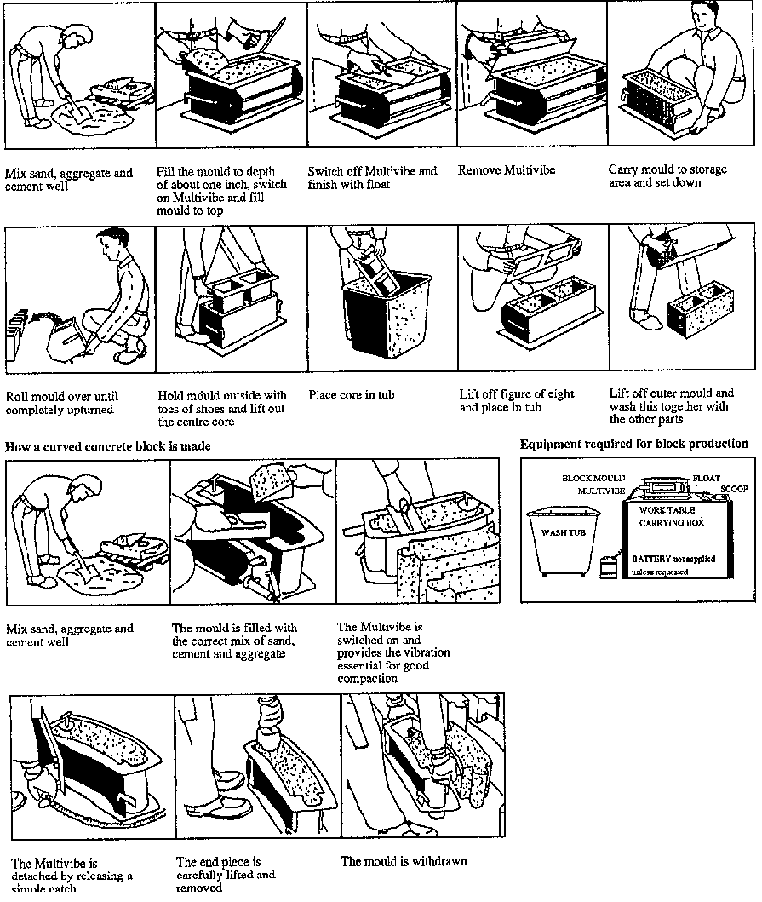
The Multivibe is a multi-purpose, detachable vibrating machine for the small-scale production of concrete blocks and a large variety of other concrete building components. It is a portable machine which can be operated from any angle and can be clamped to a wide variety of forming tools, such as concrete block moulds, rooftile screeding machines, table surfaces or to the shuttering for'in situ' concrete work.
The Multivibe can be powered from any 12 volt DC source, car battery, or from the mains through a transformer rectifier, and is available in two capacities: 4 amp and 6 amp.
For concrete hollow block production, three standard sizes of mould are available to make blocks of different widths (10,15 and 20 cm, or 4, 6 and 8 inches), the length and height being constant (39 x 19 cm, or 15 x 7.5 inches). In addition, three standard moulds are available for making curved blocks to produce water tanks of 2 m, 3 m and 4 m diameters.
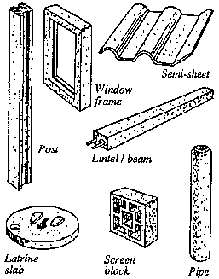
All components of the blockmaking plants are fully portable and can thus be used on any appropriate site with a flat surface large enough to place the required number of blocks for curing. With appropriate accessory packs, it is also possible to switch between products (such as floor, wall or roof tiles, posts, lintels, pipes, window frames, latrine slabs and many others) at very short notice.
Other building components produced with the Multivibe concrete technology.
FIGURE
|
Technical Details |
Multivibe Blockmaking Plant |
|
Size of Multivibe (length x width x height) |
59 x 21 x 13.5 cm |
|
Weight of Multivibe |
8 kg |
|
Size of crate for shipment (whole plant BLP 80) |
77 x 56 x 72 cm (30 x 22 x 28 in) |
|
Weight of packed plant (BLP 80) |
60 kg |
|
Standard length x height of hollow blocks |
39 x 19 cm (15 x 7.5 in) |
|
Available widths of hollow blocks |
10, 15 and 20 cm (4, 6 and 8 in) |
|
Curved blocks available for 3 water tank diameters |
2,3 and 4 m (80, 120 and 160 in) |
|
Energy input/transmission |
electric / mechanical |
|
No. of blocks per cycle/output rate (BLP 80) |
1/ 10 - 25 blocks per hour |
|
Labour force required, depending on desired output |
1 - 3 men |
|
Price (FOB) |
Optional plant sizes ace. to daily outputs: 80,120, 160 blocks | |
|
valid dune 1991 |
BLP80 |
720 £ Sterling (» 1260 US$) |
| |
BLP 120 |
940 £ Sterling (» 1650 US$) |
| |
BLP 200 |
2655 £ Sterling (» 4650 US$) |
|
|
Included in each plant are: Multivibe, moulds, wash tub, scoop, float- and for BLP 200 a 1/4 tonne ground lift truck. | |
| |
Additional mould |
180 £ Sterling (» 315 US$) |
| |
Additional vibrator |
345 £ Sterling (» 610 US$) |
FIGURE
|
| ||||||||||||||||||||||||||||||||||||||||||||||||||||||||||||||||||||||||||||
ELLSON Vibro concrete block machine
Manufacturer
Kathiawar Metal & Tin Works Pvt. Ltd.
9,
Lati Plot (Sadgurunagar)
P.O. Box 202
Rajkot 360003 (Gujarat
State)
India
Tel. [ . . 91] 281 - 33663
Cable KAMETIN
Description
The ELLSON Vibro Concrete Block Machine produced in India since 1976, is an all-steel arcwelded construction, designed for the semiautomatic production of solid, hollow and cellular concrete blocks of different sizes. The main components of the machine are the frame the mould box and stripper-head, and the vibrator unit. Irrespective of the block type, only plain, locally made wooden pallets are needed for each block produced.
The mould box and corresponding stripper-head can be replaced by other mould/stripper-head attachments, in order to produce concrete blocks and bricks of different types (solid hollow or cellular) and sizes. A standard block size is 40 x 20 x 20 cm (I x w x h), but a mould/ stripper-head attachment is also available to produce two blocks of 40 x 10 x 20 cm at the same time on a common wooden pallet. Single combination moulds with stripper-heads can be supplied to produce plain-ended blocks of different types (that is, solid, hollow or cellular), but with the same overall size. Similarly, moulds and stripper-heads are available to produce four bricks at a time on a common wooden pallet.
The vibrator unit consists of a vibrating platform supported on shock absorbing springs, and - fitted under the platform - a mechanical vibrator, which is driven via a single Vee rope pulley from a shaft with an arrangement for a flat belt fast/free drive at one end. The ELLSON Vibro has an extended detachable base, on which an electric motor can be mounted. The machine is supplied without or with the electric motor and its flat-faced drive pulley. Altenatively, it is possible to drive the machine with a diesel engine, but the engine and the flat-faced drive pulley must be procured locally.
Operating the ELLSON Vibro
The mould box is lowered onto a previously placed wooden pallet resting on the vibrating platform of the machine. The stripper-head is swung sideways, completely exposing the top of the mould box, into which the concrete mix is fed to the top, ensuring that all the face walls and webs (in the case of hollow blocks) are evenly filled.
The mould is vibrated to allow the concrete to settle about 4 - 5 cm. The mould is then filled to the top with further material, the stripper-head swung forward and positioned over the mould, and the pipe handle lowered, making the stripper-head rest on the levelled material. The vibrator is fumed on again so that the pipe handle of the stripper-head comes down to its limit position (indicating the correct block height), whereupon the vibration should be shut off immediately.
The stripping lever on the right of the machine is then pulled down completely to strip the block from the mould box. By doing so, the stripper-head still rests on the top surface of the block while the mould box moves up completely clear of the block. In order to raise the stripper-head off the block's top surface, the pipe handle is thrown back, and the freshly moulded block can then be carefully removed. resting on its pallet.
Anew pallet is oiled and placed on the vibrating platform under the raised mould and the operation repeated.
|
Technical Details |
ELLSON Vibro Concrete Block Machine | |
|
Size of machine (length x width x height) |
136 x 88 x 155 cm (54 x 35 x 61 in) | |
|
Weight of machine (incl. electric motor and I combination mould for 3 block types) |
435 kg | |
|
Size of crate for shipment |
100 x 100 x 168 cm (39 x 39 x 66 in) | |
|
Weight of packed machine |
550 kg | |
|
Standard block size (I x w x h) |
a |
40 x 20 x 20 cm (16 x 8 x 8 in) |
|
Other block sizes |
b |
40 x 15 x 20 cm (16 x 6 x 8 in) |
| |
c |
40x 10x20cm(16x4x8in) |
|
Energy input / transmission |
motorized / mechanical | |
|
No. of blocks per cycle/output rate (depending on manpower) |
1 - 2/45 - 90 blocks per hour | |
|
Labour force required (incl. mixing, carrying away blocks, etc) |
5 - 11 men | |
|
Price (ex works) valid dune 1991 |
ELLSON Vibro |
32000 Rs (» 1600 US$) |
| |
(incl 3 comb.moulds in diff. sizes for solid, hollow (or cellular) | |
|
|
blocks, electric motor, scoops, sample wooden pallets and packing) | |
|
| ||||||||||||||||||||||||||||||||||||||||||||||||||||||||||||||||||||||||||||
ELLSON combination plain and hollow concrete block machine
Description
The ELLSON Combination Plain and Hollow Concrete Block Machine, produced in India since 1958, is an ail-steel welded device, which is manually operated and produces both plain (solid) and hollow (twin rectangular cavitied) concrete blocks of the same overall size using the same mould. Apart from the mould, the machine comprises a hopper tray, a lid plate which is used to compact the block, and a lever to eject the block. The cores for forming the cavities of hollow blocks are fixed to the bed of the mould.
In addition to the concrete block machine, a wooden pallet is required for each block produced, ie plain pallets for solid blocks, and pallets with two rectangular cavities for hollow blocks.
With special inserts in the mould box, the height of the blocks can be decreased, but modified versions of the machine are available on request to produce four bricks at a time on a common pallet or solid blocks of different thicknesses using the same mould.
Operating the Combination Block Machine
The machine is first adjusted to the desired block height by placing suitable inserts into the mould, and before each new block is made, a wooden pallet is oiled and dropped into the mould. The tamper plate (which enters the mould box) can be adjusted to enter the mould box to different depths, depending on the block size, that is, the loose mix is usually compacted to about 75 % of its original volume.
A large variety of fine and coarse aggregate can be used for the concrete mix, hence the mix proportions of cement and aggregate will vary according to the type and quality of ingredients. However, the mix should not be richer than one part (by volume) of cement to six parts of mixed fine and coarse aggregates.
The fresh concrete mix is loaded onto the hopper tray, from which the machine operator feeds the mould. The surplus material is scraped off with a trowel and, using both hands, the tamper lid plate is brought down with a few sharp blows on the top of the mould box, tamping the block to the required density. By pulling down the lever, the block is ejected together with the wooden pallet, such that the pallet and block can be carried away to a level, shaded drying area. When the block is sufficiently hardened, the block is fumed onto one side and the pallet is removed, cleaned and oiled for the production of a new block, while the previous one is left to cure by keeping it moist (by regularly spraying water) for at least 7 days. Before using the block in wall construction, it must be completely dried.
Other ELLSON Equipment
A third member of the ELLSON family of machines for blockmaking is the ELLSON Blockmaster Soil Block Press (described in detail in GATE Product Information: Soil Block Presses). It is a manually operated, allsteel construction, manufactured in India since 1959, and is one of the oldest soil block presses that is still being produced.
|
Technical Details |
ELLSON Combination Block Machine | |
|
Size of machine (length x width x height) |
95 x 75 x 100 cm (37 x 29 x 39 in) | |
|
Weight of machine, |
220 kg | |
|
Size of crate for shipment |
110 x 88 x 103 cm (43 x 35 x 41 in) | |
|
Weight of packed machine |
310 kg | |
|
Standard block size (l x w x h) |
a |
40 x 20 x 20[15] cm (16 x 8 x 8[6] in) |
|
Other block sizes |
b |
40 x 15 x 20[15] cm (16 x 6 x 8[6] in) |
| |
c |
40 x 10 x 20[15] cm (16 x 4 x 8[6] in) |
|
Energy input |
manual | |
|
No. of blocks per cycle/output rate |
1 /50 - 75 blocks per hour | |
|
Labour force required (incl. mixing, carrying away blocks, etc) |
6 - 7 men | |
|
Price (ex works) valid June 1991 |
Combination Machine (incl. I mould, scoops, sample wooden pallets, packing) |
13500 Rs (» 675 US$) |
|
Rs = Indian Rupees |
Same as above, but with 2 moulds |
16500 Rs(» 825 US$) |
<TOC2>> Jesson Super
D.I.Y. brick & block makers
Manufacturer
SARANICH Close Corporation
P.O. Box
243
Port Elisabeth 6000
South Africa
Tel. [ . . 27] 41 -413173
/413152
Fax.[ . . 27] 41 - 41 3154
Description
The Super D.I.Y. Machines, developed by Harold and Richard Jesson, are all-steel constructions, designed for do-it-yourself concrete brick and blockmaking by a single operator. Four machines are available, one for making bricks (6 at a time) and the others for making single hollow blocks of three different widths (22, 15 and 10.4 cm), but the same design can be modified to produce other brick or block sizes, if there is sufficient demand for them, that is, minimum 50 units of each modified design.
The production process, including the compaction of the concrete, is entirely manual, extremely simple to carry out and permits a high output rate, as the blocks and bricks are left to dry where they were moulded ("egg-laying" principle), saving the time and effort otherwise needed to carry away the fresh products.
No aluminium or alloys are used in the construction, which is made to last for about 24 months, if used daily and maintained reasonably well. It is painted with steel primer first and then with oil based paint.
Operating the Super D.I.Y. Machines
A level, hard and clean production area of 150 to 200 m2 is required for concrete brick or block production. The whole work can be done by a single person' although far greater efficiency can be achieved, if the operator does not also have to prepare the toncrete mix.
In order to produce 1000 concrete bricks, 2 m3 of crushed stone and/or sand plus 5.5 bags of cement are required. For making concrete blocks, the crushed stone should not be larger than 6 mm and should have a fines content of 25 to 30%, while the sand must be coarse and clean - not plaster sand. 1 m3 of this aggregate plus 3.5 bags of cement are needed for 100 blocks of 22 cm width; the corresponding figures for 15 cm blocks are 0.9 m3 aggregate plus 2.75 bags cement, and for 10.4 cm blocks are 0.8 m3 aggregate plus 2.5 bags cement.
For each batch of mix, 4 wheelbarrows of aggregate are dry mixed with 0.5 wheelbarrow of cement, and just enough water (normally 35 to 40 litres) is added to ensure that binding takes place. These are, of course, recommendations which can be varied to suit the local conditions, requirements and type of material available. Each wheelbarrow load of concrete mix will produce 32 bricks, or 4, 5 and 7 blocks of 22 15 and 10.4 cm width respectively.
When the mix is ready, the mould box is placed in front of the operator at one end of the production line. The mould box is filled with concrete up to the top of the dividing plates for bricks (or up to the top of the mould box for blocks). Into the 2 tubes on the mould box sides, the compactor is fitted and rammed up and down several times until the compactor feet on the sides touch the ground, indicating the correct height of the bricks (block).
While stepping on the compactor feet to hold them down, the operator grasps the yellow mould box handles and, ensuring that the compactor feet do not move, pulls the mould straight up until the hands reach the top of the compactor frame. Then, stepping off the compactor feet, the operator lifts up the whole machine carefully, so that the bricks' (block's) edges are not damaged, and steps back to put the machine down on the new "drop" site. The compactor is removed and the process repeated.
|
Technical Details |
Super D.I.Y. Brick & Block Makers | |
|
Size of machine (length x width x height) |
85 x 30 x 70 cm (33 x 12 x 28 in) | |
|
Weight of machine |
20 kg | |
|
Size of carton for shipment |
85 x 30 x 70 em (33 x 12 x 28 in) | |
|
Weight of packed machine |
25 kg | |
|
Standard brick size (I x w x h) |
a. |
22 x 10.5 x 7.5 em (8.7 x 4.1 x 3 in) |
|
Standard block sizes |
b. |
44 x 22 x 22 cm (17.3 x 8.7 x 8.7 in) |
| |
c. |
44 x 15 x 22cm(17.3x5.9x8.7in) |
| |
d. |
44 x 10.4 x 22 cm (17.3 x 4.1 x 8.7 in) |
|
Energy input |
manual | |
|
No.of bricks per cycle/output rate (a) |
6/ 240 - 300 bricks per hour | |
|
No. of blocks per cycle / output rate (b, c, d) |
1 /40 - 50 blocks per hour | |
|
Labur force required (incl. mixing) |
2 men | |
|
Price (ex works) valid June 1991 R = South African Rand |
Super D.I.Y. Machine |
450 R (= 170 US$) |
|
| ||||||||||||||||||||||||||||||||||||||||||||||||||||||||||||||||||||||||||||
Jesson Lightning static brick/paver/block machine
Description
The Lightning Static Machine is an all-steel stationary unit capable of making a variety of concrete bricks, pavers and blorks at a high output rate. Several interchangeable moulds are available and special moulds can be made to order.
The main features are:
· 800 to 1000 drops per 8 hour day, producing up to 12000 bricks, 10000 pavers or 3000 blocks per day.
· No concrete slab needed - product made on pallets (pallet size 60 x 51 cm; recommended board thickness 19 or 21 mm).
· 220 or 380 volt electric vibration - high frequency.
· Fully protective electrical overload system. · No bronze bushing - vasconite used throughout.
· On-site maintenance avoids any costly "down" time.
· Hydraulic ram operated compactor available on specific request for ultra density needs.
Operating the Lightning Static Machine
A fully instructed, skilled operator and a constant supply of concrete are prerequisites for high production rates with the Lightning Static. But in general the machine is simple to operate.
The mould is lowered onto the wooden pallet and the compactor raised, so that concrete can be filled into the mould. The vibrator is switched on for half a second and the excess concrete is screeded off the mould. The compactor is then lowered onto the concrete and the vibrator set in motion until the locked nuts on two threaded rods rest on the housing' preventing further compaction.
The mould release handle is pulled down and secured in the lowered position by a sliding bolt, so that the product is released from the machine. A new pallet is inserted and pushed onto the vibration table, as a result of which the loaded pallet is pushed out of the machine. The freshly moulded products are carried away on their pallet to the curing place, while the mould is lowered onto the new pallet and the process repeated.
In case of a power cut due to electric overload, the red button
should be pressed after 5 minutes
to reset the machine. If the overload does
not reset, an electrician should be called.
The principle maintenance requirements are:
· thorough cleaning of the machine and moulds after daily use, because concrete deposits corrode;
· lubricating all moving parts with thin, clean oil - never grease;
· replacing vasconite bushes when worn, in order to protect the steel shafts
· protecting electrical components from getting wet;
· dipping pallets in used motor oil every 4 months to prolong their service life.
|
Technical Details |
Lightning Static Machine | |
|
Size of machine (length x width x height) |
150 x 110 x 210 cm (59 x 43 x 83 in) | |
|
Weight of machine (without mould) |
550 kg | |
|
(with mould) |
700 kg | |
|
Size of crate for shipment (palleted) |
1 |
100 x 80 x 160 cm (39 x 31 x 63 in) |
| |
2 |
100 x 80 x 90cm(39x31x35in) |
|
Weight of packed machin |
1 + 2 |
750 kg |
|
Standard brick sizes (I x w x h) |
a. |
22 x 10.5 x 7.5 cm (8.7 x 4.1 x 3 in) |
| |
b |
19x9x9cm (7.5x3.5x3.5 in) |
|
Standard block sizes |
c |
44 x 22 x 22 cm (17.3 x 8.7 x 8.7 in) |
| |
d |
44xl5x22cm(17.3x5.9x8.7in) |
| |
e |
44x 10.4x22cm(17.3x4.1x8.7 in) |
|
Bevelled pavers (rect./interlocking) |
f. |
20 x 10 cm (7.9 x 3.9 in) x any thickness |
|
Energy input |
electrical (220 or 380 V) | |
|
No. of bricks per cycle/output rate (a, b) |
12/1500 bricks per hour | |
|
No. of blocks per cycle / output rate (c, d, e) |
2 - 4 / 350 blocks per hour | |
|
No. of pavers per cycle / output rate (f) |
10 rect. or 8 interlocking / 1200 pavers per hour | |
|
Labour force required |
8 men | |
|
(1 operating machine, 4 removing loaded/resuming empty pallets, 3 loading/operating mixer) | ||
|
Price (ex works) |
Lightning Static (incl mould/compactor) | |
|
valid June 1991 |
with hydraulic compaction |
15750 R (» 5950 US$) |
|
R = South African Rand |
without hydraulic compaction |
11000 R (» 4000 US$) |