 |
| ||||||||||||||||||||||||||||||||||||||||||||||||||||||||||||||||||||||||||||||||||||||||||||||||||||||||||||||||||||||||||||||||||||||||||||||||||||||||||||||||||||||||||||||||||||||||||||||||||||||||||||||||||||||||||||||||||||||||||||||||||||||||||||||||||||||||||||||||||||||||||||||||||||||||||||||||||||||||||||||||||||||||||||||||||||||||||||||||||||||||||||||||||||||||||||||||||||||||||||||||||||||||||||||||||||||||||||||||||||||||||||||||||||||||||||||||||||||||||||||||||||||||||||||||||||||||||||||||||||||||||||||||||||||||||||||||||||||||||||||||||||||||||||||||||||||||||||||||||||||||||||||||||||||||||||||||||||||||||||||||||||||||||||||||||||||||||||||||||||||||||||||||||||||||||||||||||||||||||||||||||||||||||||||||||||||||||||||||||||||||||||||||||||||||||||||||||||||||||||||||||||||||||||||||||||||||||||||||||||||||||||||||||||||||||||||||||||||||||||||||||||||||||||||||||||||||||||||||||||||||||||||||||||||||||||||||||||||||||||||||||||||||||||||||||||||||||||||||||||||
|
| ||||||||||||||||||||||||||||||||||||||||||||||||||||||||||||||||||||||||||||||||||||
A Training Manual
TRAINING FOR DEVELOPMENT
Peace Corps
INFORMATION COLLECTION & EXCHANGE
TRAINING MANUAL NO.
T-24
INFORMATION COLLECTION & EXCHANGE
Peace Corps' Information Collection and Exchange (ICE) was established so that the strategies and technologies developed by Peace Corps Volunteers, their co-workers, and their counterparts could be made available to the wide range of development organizations and individual workers who might find them useful. Training guides, curricula, lesson plans, project reports, manuals and other Peace Corps- generated materials developed in the field are collected and reviewed. Some are reprinted "as is"; others provide a source of field based information for the production of manuals or for research in particular program areas. Materials that you submit to the Information Collection & Exchange thus become part of the Peace Corps' larger contribution to development.
Information about ICE publications and services is available through:
|
The Peace Corps Internet Web Site address: https://www.peacecorps.gov Please note the new Peace Corps Mailing Address from July 1998 on is: ICE/ Peace Corps |
Add your experience to the ICE Resource Center. Send materials that you've prepared so that we can share them with others working in the development field. Your technical insights serve as the basis for the generation of ICE manuals, reprints and resource packets, and also ensure that ICE is providing the most updated, innovative problem-solving techniques and information available to you and your fellow development workers.
SMALL-SCALE MARINE FISHERIES: An Extension Training Manual
This Publication Was Produced For PEACE CORPS
By the TECHNOS
CORPORATION San Juan, Puerto Rico
Printed By: PEACE CORPS Information Collection and Exchange
April 1983 September
1984
|
| ||||||||||||||||||||||||||||||||||||||||||||||||||||||||||||||||||||||||||||||||||||
Small-scale marine fisheries: An Extension Training Manual
This fisheries training manual has been developed for use in preservice training of prospective Volunteers whose Peace Corps service will be spent working with small-scale, artisanal fishing communities in developing nations. The module, or design, lends itself to both single-country or multicountry use.
The technical content of the training design was well researched in the field. One member of the design team spent 8 months overseas in 1980-81, researching the needs of small-scale artisanal fishing communities and meeting with ministry officials from various countries with and without existing Peace Corps programs. In September of 1982, the design team met in Boqueron, Puerto Rico, with the Fisheries Programming and Training Specialist from Peace Corps/Washington. He had just returned from 4 months in the field meeting with various Peace Corps staffs in 8 countries of the three regions Peace Corps serves, to determine the role of Volunteers in marine fisheries programs and to ascertain the types of training future Volunteers would need to maximize their effectiveness. After reviewing the task analysis, it was decided that the training format used by Peace Corps' Forestry Sector for its preservice training of forestry Volunteers would be best suited in meeting the objectives of the marine fisheries training design.
Each session of this training program builds towards or from the one(s) preceding and following it. However, with minor modification, sessions may be used independently.
The suggestions for timing, location and administration of the sessions are drawn from the results of the field testing done during the pilot training program. While the constraints of your setting may require modifying these guidelines, we suggest that special consideration be given to each of these categories, so that training programs may be of the greatest benefit to the prospective marine fisheries Volunteer.
This training program is based on the experiential learning model. The elements of each session are: the experience itself, the processing of the experience by the trainers; the generalization of the learning by the trainees; the application of the learning; summarizing; and, finally, the linking of the experience to the next session.
Training Program Overview
The general purpose of this training program is to prepare prospective Peace Corps Volunteers who will serve in small-scale, artisanal fishing communities in developing nations. This program is an eight week intensive training program designed to build trainees competence in marine fisheries technology and fisheries extension work. Further, the program helps trainees build confidence in their own abilities to transfer skills and knowledge. The technical training is experiential; trainees learn by doing rather than by being told a series of "how to's".
It is important to note that this training program puts heavy emphasis on the economic development of small-scale and subsistence-level fishermen. The trainees from this program will be involved as extensionists on the community level and thus will be in direct contact with fishermen and their families on a daily basis. This front-line contact gives the PCV exposure in which to act as a valuable resource, not only in the realm of fishing and related support areas, but also in other income generating projects which will improve the standard of living of the fishing family, i.e. improved fish smokers and solar dryers, salt-making, alternative energy production from fish silage, gardening and handicraft development.
Throughout the pilot program the trainees understood the value of the communication exercises, cultural awareness exercises and community analysis. We were certain that conducting the pilot program in Puerto Rico contributed greatly to their immediate acceptance of extension skill-building and practice.
There is at the beginning of training an orientation to Peace Corps. In this orientation, trainees learn about Peace Corps policies, explore their aspirations for Peace Corps service, use the "Cross-Cultural Workbook" from the CAST model, and do exercises that give them insight into the role of the Volunteer as a development worker.
The next phase of the program is field placement (or family live-in). The trainees are placed at different sites with commercial fishing families. While at the site, trainees are given two tasks: to collect as much data as possible using the social cybernetics sub-systems (see Community Analysis, Session T-31); and, based on their observations, to formulate a list of technical skills they believe they will need to be an effective marine fisheries PCV. Learnings that were generated by the field placement were:
- the importance of language; _ the importance of non-verbal
communication; _ different concepts of privacy;
- differences in the roles
between men and women;
- overwhelming hospitality, and how one deals with
that;
- observation of local fishing practices and marketing structures;
and,
- the government official from Washington being viewed as the solver of
all problems in the community.
All of the trainees in the pilot program saw the "live-in" as a positive experience. The staff believes that the live-in set the stage for the rest of training: it provided the trainees with a frame of reference both technical and cross-cultural - on which to build throughout the duration of the training program. During this live-in trainees can test their emotional readiness to live and work in a different culture.
The introduction to fisheries technology starts with the trainees being introduced to Diesel and outboard engines. Here, major emphasis is given to proper maintenance practices. Trouble-shooting is also thoroughly covered. Next, the trainees learn net mending; and, over the remaining weeks of training, they will continue to mend nets, using various techniques of knot tying. The next seven weeks of training will include the following technical areas:
- fish preservation and processing;
- fishing gear;
- fish
economics, marketing and income generation;
- extension;
- nutrition and
fish culinary skills;
- navigation and seamanship;
- boat building,
maintenance and construction;
- aquaculture; and,
- proposal writing and
fund raising.
In addition, special projects are assigned to trainees in all of the above areas.
Intertwined with technical training are communication skills, team building, group process, community analysis, and core curriculum exercises, as well as individual problem-solving exercises.
The identification and practice of skills developed and areas of personal growth will be useful to the trainees in their role as Peace Corps Volunteers. The identification of areas of accomplishment will aid trainees in acquiring confidence for a successful service. All sessions, exercises, special projects, and skills practice are directed toward the practical application in their work as Volunteers.
Finally, participants are made aware from the first session that they are responsible for their own learnings. What we have done in this training program is to provide them with the opportunity for educational enhancement and skills development. In the process, they are afforded the chance to examine what commitment means as a Peace Corps Volunteer.
Training Program Goals
The design of the fisheries extension training program is such that upon completion, the trainee will be provided technical information, knowledge and skills, facilitating productive and satisfying Peace Corps Volunteer service.
Specific training goals are:
- to enable trainees to recognize their skills and to feel
competent in the use of those skills;
- to teach trainees how to transfer the
technical skills they have to others;
- to identify and improve skill areas
that need strengthening;
- for trainees to understand their role as fisheries
extension Peace Corps Volunteers in their host country;
- to help trainees
identify and find resources available to them at their community sites and host
country agencies;
- the illustration of competency in fisheries extension
techniques, in fish processing, fish preservation, outboard/Diesel repair and
maintenance, fisheries economics and marketing, small-scale fishing and fishing
vessels, and vessel repair and construction;
- the ability to analyze
properly communities' social systems, which should identify problems and help
communities seek solutions;
- an understanding of the basic theories of
fisheries extension work;
- increased interpersonal, team building and
communication skills; and,
- a better understanding of global and
country-specific fisheries issues.
Each session's objectives and activities will be described to trainees at the start of the session.
Advance Information
Before training starts, country-specific information for each country with trainee assignments need to be obtained from the Country Desks at PC/Washington. The optimum plan would be to have the Desk Officer or an RPCV from that country come to training during orientation to give a country overview. It is also helpful to have the Desk Officer at orientation to discuss specific country policies, as well as Peace
Corps policies. If it is not possible to have any of the above, the Desk Officer should send slides, movies and any written materials they may have for the staff to use. It is wise to discuss with the Desk Officer any special concerns that they may have about trainees entering the host country, and to find out if there are any unique situations that trainees should be prepared for.
The training staff of the pilot program felt very strongly that the trainees were not only being trained as volunteers but also as professionals. Consequently, they established a dress code for marine fisheries volunteers. In the past, volunteers have not always been as careful about their dress as they could have been. In order for our trainees to be accepted as professionals we felt they not only had to perform as professionals would, but also dress the part as well. We felt that by establishing this dress code and enforcing it during training that trainees would become familiar with - and hopefully continue to use appropriate dress throughout their volunteer service. The following dress code should be sent out by the Country Desk Officer with the invitation to training. Please check to see if this has been done. If not, it should be done immediately.
Peace Corps training is the appropriate place to instill the appropriate image of the PCV development worker. Throughout the eight week duration of the training program, trainees need to be given feedback by the training staff on their professional appearance, or lack of it. Para-military clothes, T-shirts and jogging shorts are not appropriate attire for the PCV development worker. Men must keep their hair, and beards and mustaches neatly trimmed, and/or clean shaven. Women with medium to long hair styles must keep their hair up. Peace Corps will never be seen by the host country as a serious development organization if its volunteers dress as if they were on their junior year abroad, or worse.
What to Bring - Peace Corps Training and Volunteer Service
The following is a listing of items, clothing in particular, that prospective volunteers should bring with them to the training program and for their volunteer service overseas.
For both men and women:
- a small, two blade pocket knife;
- a small, waterproof day
pack;
- a pair of polarized sunglasses;
- a hat (for sun);
- two
towels;
- tennis shoes or deck shoes;
- one pair of canvas work boots;
- two pairs of work pants;
- cotton underwear;
- cotton-poly blend
socks;
- bathing suit;
- a light weight jacket;
For men:
- pants (Levis are ok, but they're hot. 50/50 cotton blend is
best);
- two work shirts;
- two dress shirts (short-sleeved);
- knit
shirts with collars;
- light weight sport coat;
- one tie; and,
- two
dress walking shorts (for when on boat only).
For women:
- loose skirts (below knee);
- cotton blouses (modest);
- cotton dresses;
- cotton bras;
- cotton slips; and,
- cotton
nightgown or robe.
Please note: Para-military clothes, jogging shorts, and T-shirts are not appropriate attire for the Peace Corps Volunteer development worker.
Getting Ready
There are several preparatory steps that must be taken in order to get ready for the training program.
In order for you to be well prepared, we offer the following suggestions concerning resources, materials, equipment, descriptions of training sites, or session sites, which will assist in managing staff time and handling administrative aspects of marine artisanal fisheries programs.
1. Stock the Reference Library
Several books and sets of reference materials are needed as library stock. Select materials which will aid trainees in technical skills development, special project assignments and fish technology. Further, incorporate a few manuals and research papers that you think will be of general interest. Putting together the library is a difficult task. You will find that you have few friends and fewer resources when it comes to borrowing books We give one of the trainees a special project for setting up the library. They make up a 3" x 5" card for each item with title and author:
SAMPLE CARD
Diesel Mechanics
Erich J. Schulz
McGraw Hill Book Company
Name
1.
2.
3.
4.
The appropriate card is attached with paper clip to each piece of reference material. As items are checked out, the trainee keeps the card to know who has each item throughout training. Also, they will have responsibility for seeing that all materials are returned at the end of training.
During the pilot program we were very fortunate to have a technical trainer who brought many of his own materials to share. We were also able to get materials from the ICE sector of Peace Corps. We have included here our list of reference materials used during the pilot program. This list is not exhaustive by any means; there were many materials we wished we had but were unable to locate in Puerto Rico.
Anderson, E.P. and Palmquist, R.E. Refrigeration: Home and Commercial. Theodore Audel & Co. Indianapolis, Indiana. 1977.
Aypa, Simeon N. A Study on the Viability of Salt Making in Polyethylene Plastic Material for Small Scale Industry Bureau of Fisheries and Aquatic Resources Manila, Philippines.
Bagnis, R. Fish Poisoning in the South Pacific. South Pacific Commission. Noumea, New Caledonia.
Baines, Graham K. Mangrove and Esturine Area Development in Fiji. Government of Fiji. Suva, Fiji.
Bardach, J.E. & Magnuson, J.J. Fish Behavior and its Use in the Capture and Culture of Fishes. 1977. ICLARM. Metro Manila, Philippines.
Barron, L.A. Fishery Training in Papua New Guinea. XXII Regional Technical Meeting on Fisheries. Noumea, New Caledonia.
Ben-Yami, M. Community Fishery Centers and the Transfer of technology to Small-Scale Fisheries. 1980. FAO. Rome, Italy.
Blandford, P.W. Netmaking. Brown and Son. Ferguson, Glasgow. 1977.
Bosworth, Velma. Photographing Tidepools. Sea Grant, Oregon State University. Corvallis, Oregon. 97331.
Boyd, N.S. Freezing and Cold Storage of Fish. Massey University, New Zealand.
Bowditch, Nathaniel. American Practical Navagator. U.S. Naval Hydrographic Office. 1966.
Brothers, Gerald. Inshore Fishing Gear and Technology. Industrial Development Branch, Fisheries and Marine Service. St. Johns, New Foundland, Canada. 1975.
Cansdale, George S. Report on Second Regional Consultancy Low-Cost Water Filtration. UNDP/South China Seas Programme. Manila, Philippines.
Chakroff, M.S. Marine Fisheries Case Studies. U.S. Peace Corps, I.C.E. 1981.
Chapman, Charles F. Piloting Seamanship and Small Boat Handling. Motor Boating and Sailing. 1972.
Clark, Althline M. Dangerous Marine Organisms of Hawaii. Sea Grant. University of Hawaii. Honolulu, HI 96822.
Coker, R.E. This Great and Wide Sea. Harper Touchbooks. Harper & Row. New York. 1947.
Crook, Michael, ed. A Chinese Biogas Manual. Intermediate Technology Publications, Ltd. London.
Darrow, Ken, Keller, Kent and Pam Rick. Appropriate Technology Source-book, Volume II. Volunteers in Asia Publication. Stanford, CA 94305.
Darrow, Ken and Pam Rick. Appropriate Technology Sourcebook. Volunteers in Asia. Stanford, CA. 1976.
Davidson, William D. Life Begins at 40°F: How to use a Seafood-Handlers Thermometer. Sea Grant, Oregon State University, Corvallis, Oregon 93771.
de Jesus, Arseno S. Lecture in Fish Capture, Unpublished papers. Fishermens Training Center. Cavite, Philippines.
Dempsey, Paul. How to Repair Small Gasoline Engines. Tab Books. Blue Ridge Summit, PA. 1972.
Dixon, Ruth. Rural Women at Work. John Hopkins University Press. Baltimore, Md. 1976.
Drew, Stephen. A Simple Line and Net Hauler for Small and Mid-sized
Eastman, Peter F. Advanced First Aid Afloat. Cornell Maritime Press. Cambridge, Maryland 21513.
Erickson, Ralph D. Discover the Underwater World. U.S. Divers Co. Santa Ana, CA 92702.
Fisher, R.B. and Marshall, Charles A. Hydraulic Fishing Machinery Systems for Outboard Motor-Powered Boats. Sea Grant, Oregon State University. Corvallis, Oregon 97331.
Fyson, J.F. Fishing Vessel Design Proposals for Small Scale Fisheries in the Philippines. UNDP/South China Seas Programme. Manila, Philippinest
Gentle, M.T. Population Ecology of Beche-de-mer. South Pacific Commission. Noumea, New Caledonia.
Hakim, A Detailed Structure of a Verandah Net. Fishier Division, Ministry of Ag. and Fisheries. Suva, Fiji.
Helsing, Guy Recognizing and Controlling Marine Wood Borers. Sea Grant, Oregon State University. Corvallis, Oregon 97331.
Hemingway, Ernest. The Old Man and the Sea. Charles Scribner's Sons. New York. 1952.
Hendericks, Peter L. Outboard Motor Maintenance Tips. Sea Grant, University of Hawaii. Honolulu, HI 96822.
Hermansson, Birgin. Training Fishermen at Sea. Fishing News Book. England. 1979.
Hildebrand, Kenneth S. Fish Pickling for Home Use. Pacific Northwest Publication. Oregon State University. Corvallis, Oregon 97331.
Hilderbrand, Kenneth S. Preparation of Salt Brines for the Fishing Industry. Sea Grant, Oregon State University. Corvallis, Oregon 97331.
Hillier, Albert J. How to Plan and Cut Nets. Fisheries and Marine Technology. Sea Grant, University of Rhode Island, RI 02882.
Johns, Frederick D. and Rand, Arthur G. Jr. Enzyme Methods to Assess Marine Food Quality. University of Rhode Island. Kingston, RI 02881.
Kelsen, Suend and Pizzali, A. Medina. Samahang Nayon Manual on Fish Processing and Marketing FAO/UNDP Manila Philippines. 1980..
King, Warren B. Seabirds of the Tropical Pacific Ocean. Smithsonian Institution. Washington, D.C.
Kolbe, Edward: Mate, Bruce & Jacobson, Robt. Bonding of Boats and Adjustment of Trolling Wire Voltages. Sea Grant, Oregon State University. Corvallis, Oregon 97331.
Korb, Albin W. Basic Training Manual for Marine Engineers. FAO/South China Seas Programme. Manila, Philippines.
Kotsch, William J. Weather for the Mariner. Naval Institute Press, Annapolis, Md. 1977.
Kreuzer, Rudolph L. ed. Fishery Products Fishing News Books. England. 1974.
Laevatsu, Taivo and Hayes, Murray. Fisheries Oceanography and Ecology Fishing News Books. London, England. 1981.
Linder, Gert. Field Guide to Seashells of the World. Van Nostrand Reinhold Co. New York. 1975.
Lodge, Dennis. Fish Finding Systems Course. Sea Grant/Clatsop Community College Astoria. Oregon 97103 Unpublished report.
Lodge, Dennis. Fishing Technology Course. Sea Grant/Clatsop Community College. Astoria, Oregon 97103. Unpublished report.
Mallon, Michael H., Kolbe, Edward. Cathodic Protection for Boats in Saltwater. Sea Grant, Oregon State University. Corvallis, Oregon 97331.
Martinson, Norman. Fish Signs and Techniques. Unpublished paper. Oregon State University. Corvallis, Oregon. 1980.
Matthiessen, Peter. Far Tortuga. Bantam Books, Inc. Random House. N.Y., N.Y. 1 975.
Mead, Paul. Report on the Second Visit of the South Pacific Commission Deep Sea Fisheries Development Project to the Kingdom of Tonga South Pacific Commission. Noumea, New Caledonia.
Motte, Geoffrey A. Cutting Web Tapers. Fisheries and Marine Technology. Sea Grant, University of Rhode Island. Narragansett, RI 02882.
McCeary, Linda Sunburn and Skin Care. Sea Grant, University of Hawaii Honolulu, HI 96822.
McInnis, Walter J. and Chappelle, Howard I. Wood as a Fishing Vessel Construction Material. Department of Fisheries of Canada, Ottawa.
Noble III, Maximino. The "Immersion" of an Island. Unpublished report. 1980.
Obispo, Rolando C. Some Municipal Fishing Gear Used in the Philippines. Bureau of Fisheries and Aquatic Resources. Cebu City, Philippines. Unpublished report.
Pizzalo, A. Medina. Application of Chilled Sea Water in a Small-Scale Fishery Project-A Case Study. FAO/UNDP. Manila,Philippines. 1980.
Pollnac, Richard B. Continuity and Change in Marine Fishing Communities. AID Working Paper #10,22. International Center for Marine Resource Development. University of Rhode Island. Kingston, RI 02881.
Prescott, J. A Handbook for Lobster Fishermen of the Tropical Pacific Islands. South Pacific Commission. Noumea, New Caledonia.
Reinhart, Johanna, ed. Small Boat Design. International Center for Living and Aquatic Resources Management. Metro Manila, Philippines.
Ronquillo, Inocencio A. Detecting Fish Caught with Explosives. Bureau of Fisheries and Aquatic Resources. Manila, Philippines.
Royce, William F. Introduction to the Fishery Sciences, Academic Press New York. 1972.
Sainsburg, John C. Commercial Fishing !Methods Fishing News Books England.
Sanchez, Jesus P. and Pastoral, Prospero C. Tuna Purse Seining with the Use of the Payao (Fish Aggregating Device). Bureau of Fisheries and Aquatic Resources. Metro Manila, Philippines.
Schulz, Erich J. Diesel Mechanics. Gregg Division. McGraw-Hill Book Company. New York.
Schumacher, E.F. Small is Beautiful. Blond and Briggs London 1973.
Smith, Frederick J. Organizing and Operating a Fishery Cooperative Part 1. Sea Grant, Oregon State University. Corvallis, Oregon. 97331.
Smith, Frederick J. Organizing and Operating a Fishery Cooperative Part 2. Sea Grant, Oregon State University. Corvallis, Oregon 97331.
Smith, Frederick J. Understanding and Using Marine Economic Data Sheets Sea Grant, Oregon State University. Corvallis, Oregon 97331.
Smith, Ian R. A Research Framework for Traditional Fisheries. 1979 ICLARM. Metro Manila, Philippines.
Smith, Ian R. Puzon, M.Y., Vidal-Libuans, C.N. Philippine Municipal Fisheries: A Review of Resources Technology and Socioeconomics ICLARM. Manila, Philippines.
Souchotte, E. & Smith, D.W. Marine Auxiliary Machinery. Newnes-Butterworths. Boston. 1975.
Soucy, Robert. A Curriculum for Training Marine Mechanics Southern Maine Vocational-Technical Institute. South Portland, Maine 04106.
Southcott, R.Y. Australian Venomous and Poisonous Fishes. Mitcham South Australia 5062.
Sperling, Harry. Some Comments on Technology Transfer with Respect to Fisheries. Unpublished paper. 1980.
Steinbeck, John The Log from the Sea of Cortez Penguin Books Viking Press. N.Y., N.Y. 1941.
Stoker, Ted. Birds of the Atlantic Ocean International Marine Publishers. Camden, ME 1968.
Sumner, J.L., Boyd, N.S., Wilson, N.D. Effective Cleaning and Methods of Assessment Lincoln College, Cantebury, New Zealand.
Sweat, Don E., and Cato, James C. Squid for Supper. Sea Grant, Oregon State University. Corvallis, Oregon 97331.
Taketa, Howard A. ed. Hawaiian Prawn Recipes. University of Hawaii Sea Grant, Marine Advisory Program, 2540 Maile Way, Spalding 252B, Honolulu, HI 96822.
Takenaka, Brooks. Efficient Fish Processing and Storing. Sea Grant, University of Hawaii. Honolulu, HI 98622.
Tamesis, Pablo T. Fisheries Extension: Labors for Hercules. Unpublished paper.
Thomas, Lowell P."Who's Killing the Corals?". Sport Diver Magazine. 1981.
Thomson, David B. Intermediate Technology and Alternative Energy Systems for Small-Scale Fisheries. FAO/South China Seas. Programme. Manila, Philippines.
Thomson, David B. Lecture Notes on Fishing Methods, Equipment and Deck Layout of Fishing Vessels. UNDP/South China Seas · Programme. Manila, Philippines.
Thomson, David B. Marine Fisheries Extension FAO/South China Seas Programme. Manila, Philippines.
Urrali, Augustin F. Guide to the Classification of Fishing Gear in the Philippines. Fish and Wildlife Service. U.S. Department of the Interior. 1950.
Von Brandt, Andres. Fish Catching Methods of the World. Fishing News Book. England. 1982.
West, Morris. The Navigator. Fontana Books. William Collins Sons & Co. Ltd. Glasgow. 1976.
Appropriate Technology for Alternative Energy Sources in Fisheries Asian Development Bank - ICLARM. Metro Manila, Philippines.
Beche-de-mer For Profit. Fisheries Division MAF..Suva, Fiji.
Beche-de-mer of the South Pacific South Pacific Commission Noumea, New Caledonia.
Bibliography for Fishermens Training. Fisheries Technical Paper No. 184. FAO. Rome. 1981.
The Biology of Reef-Building Corals with Notes on the Genera Commonly Found on the Reefs of Fiji. Marine Fisheries Department. University of the South Pacific. Suva, Fiji. Unpublished paper.
The Care and Handling of Lobsters Rhode Island Seafood Council. Narragansett, RI 02882.
Cituatera Poisoning. Fisheries Division. MAF. Suva, Fiji.
Commercial Trolling for Spanish Mackeral. Australia Fisheries. 1970.
Currents. Oregon State University Sea Grant, Corvallis, Oregon.
Detroit Diesel Engines. Detroit Diesel Allison General Motors Corporation. Detroit, Michigan 48228.
Fire. Fisheries Department. University of the South Pacific. Suva, Fiji.
First Aid for Fishermen. OSU Sea Grant Program. Corvallis, Oregon. 1971.
The Fish Boat. H.L. Peace Publications. Covington, Louisiana.
Fish Handling and Preservation at Sea. University of Rhode Island Marine Advisory Service. Narragansett, RI. 1981.
Fish Processing/Sun Curing. Fisheries Division. MAF. Suva, Fiji.
Fish Spoilage. Fisheries Division. MAF. Suva, Fiji.
Fisheries Newsletter. The South Pacific Commission. Noumea, New Caledonia
Fisheries Rural Training Programme for Local Fishermen. Fisheries Division. MAF. Suva, Fiji. 1980.
Fishing in Japan. Yamaha Motor Co. Japan. 1978.
Fishermans Manual. World Fishing. London. 1976
Fishing Gazette. Fishing Gazette Publishing Corp. New York.
Fishing News International. Arthur J. Heighway Publications, Ltd. London, England.
Fishing Systems. Fisheries Division. Ministry of Agriculture and Fisheries. Suva, Fiji. Unpublished paper.
General Processing Method of "Loaloa". Fisheries Division. Ministry of Agriculture and Fisheries. Suva, Fiji.
Guide to the Classification of Fishing Gear in the Philippines. Research Report 17. Fish and Wildlife Service. Department of Interior. USGPO. 1950.
Handbook of Homemade Power. Mother Earth News. Bantam Books. New York. 1974.
Handling Ships in Heavy Weather. Fisheries Department. University of the South Pacific. Suva, Fiji.
Home Curing Fish. Kanudi Fisheries Station. Department of Primary Industry. Konedobu, Papua New Guinea.
How to Get the Most Out of Your Fishing Line Berkley and Company Spirit Lake, Iowa 51360.
ICLARM Newsletter. International Center for Living Aquatic Resources Management. Metro Manila, Philippines.
Knots, Bends, and Hitches. Derrick Technical Institute. Samabla, Fiji.
Liklik Buk. The Melanesian Council of Churches. Lee, Papua New Guinea. 1978.
Makai. University of Hawaii Sea Grant. Honolulu, Hawaii.
Manual on Farming of Eucheunea Spinosum. GENU Products. Cebu City, Philippines. 1979,
Marine Fisheries Review. NDAA-NMFS. USGPO.
Navigation. Time-Life Books. Alexandria, VA.
Net Mending and Patching. Oregon State University Sea Grant Program. Corvallis, Oregon. 1978
Notes on Tropical Photography. Eastman Kodak Company. Rochester, N.Y. 14650.
Pasin Bilong Wakim Pis Igo Long Maket. National Fisheries College. Kovieng. New Ireland, Papua New Guinea.
Processing of Beche-de-mer. Fisheries Division. MAF. Suva, Fiji.
Purse Siene Fishing in the Philippines. Deep Sea Fisheries Division. BFAR Metro Manila, Philippines. Unpublished paper.
Ring Net. Deep Sea Fisheries Division BFAR. Metro Manila, Philippines. 1378. Unpublished paper.
Salt: A Major Growing Crop in Pangasinan. Countryside Banking. Manila, Philippines. 1980.
Seafood Business Report. Journal Publications. Camden, ME.
Seafood Leader, Waterfront Press Co. Seattle, Washington.
Sea Grant Today. Virginia Polytechnic Institute and State University. Blackburg, VA.
Small Scale Fisheries in Central America: Acquiring Information for Decision Making. International Center for Marine Resource Development University of Rhode Island. 1981.
Spear Fishing Fisheries Division, Ministry of Agriculture and Fisheries. Suva, Fiji. Unpublished paper.
State of Municipal Fishery Technology in the Philippines. Unpublished report.
Stock Assessment for Tropical Small-Scale Fisheries. U.S. Agency for International Development and University of Rhode Island. Kingston, RI.
Swimming and Water Safety Courses. American Red Cross. 1976.
Teaching Nutrition in Developing Countries or the Joys of Eating Dark Green Leaves. Shack, Kathryn W. ed. Meals for Millions Foundation Santa Barbara, CA. 1976.
Trap Net. Deep Sea Fisheries Division BFAR. Metro Manila, Philippines. 1978. Unpublished paper.
Tuna Fishing. Fisheries Division. MAF. Suva, Fiji.
Wooden Boat Maintenance: Decay and its Prevention. Oregon State University Sea Grant Program. Corvallis, Oregon. 1975.
Wood Destroyers in the Marine Environment. Robert Graham, Guy Helsing and John Lew. 1975. 75 Slides, 18 minutes. Rental: $15.00. Purchase: $95.00 (716.1 S-T) Describes the organisms involved in marine wood deterioration, the nature of their attack on wood, and the conditions that favor their development. Outlines preventive measures.
Wooden Boat Inspection and Maintenance. Guy Helsing, Richard Wagner and Robt. Graham. 110 Slides, 29 minutes. Rental: $15.00, Purchase: $105.00. (716.4 S-T). Describes common organisms and processes causing decay in wooden boats. Shows how to prevent decay, how to inspect boats for its presence, and how to make durable repairs. Focuses on the West Coast of the U.S., but the principles presented apply everywhere.
Both of the above are available from:
Sea Grant Communications AdS A418 Oregon State University Corvall is, Oregon, 97331, U.S.A.
Fish Aggregating Devices - FAD's. Mark Grandioni, RPCV Philippines 36 Slides, 12 minutes. Provides details of bamboo and steel FAD's. Fishing operations include both small-scale fishermen in out-rigger craft and industrial style purse seiners. Available from:
Fisheries Programmes, Office of Program Development Peace Corps Washington, D.C. 20526, U.S.A.
2. Order Books
There was one book we felt it was imperitive for trainees to have during their Peace Corps service, as well as for use during training. This book, The Fisherman's Business Guide, by Frederick Smith, needs to be ordered from:
Department of Agricultural and Resource
Economics
Oregon
State University
Corvallis, Oregon 97331, U.S.A.
Telephone: (503)
754-0123
Approximate cost $10.00 per book, one book per trainee.
The following is a list of books, catalogues and publication listings we suggest you order in advance and have on hand during the training program for staff use.
Althouse, Andrewd, Turquist and Bracciano. Modern Refrigeration and Air Conditioning. GoodheartWillcox Company, Inc. South Holland, Illinois. 1979.
Emmeshing Nets, Gill Nets and Entangling Nets, Andres Von Brandt and J.M. Hamley. Fishing News Books Ltd. 1 Long Garden Walk, Farnham, Surrey, England. (0252)726-868. Cost approximately $20.00.
FAO-Catalog of Small Scale Fishing Gear. edited by C. Nedelec. Fishing News Books, Ltd, 1 Long Garden Walk, Farnham, Surrey, England. Also available from International Marine Publishing Co. 21 Elm Street, Camden, Maine, 04843. Cost approximately $26.00.
Boat Maintenance. Bob Whittier. International Marine Publishing Co. 21 Elm Street, Camden, Maine, 04843, 1-207-236-4342. Cost approximately $12.95.
The Care and Repair of Small Marine Diesels. Chris Thompson International Marine Publishing Co. 21 Elm Street, Camden, Maine, 04843. Cost approximately $15.00.
Commonsense Coastal Navigation. Hewitt Schlereth. International Marine Publishing Co. 21 Elm Street, Camden, Maine 04843. Cost approximately $19.95.
Catalogs:
Atlantic and Gulf Fishing Supply Corporation 591 S.W. 8th Street Miami, Florida 33130, U.S.A. 1-800-3276167
Nylon Net Company 7 Vance Avenue, P.O.BOX 592 Memphis, Tennessee 38101, U.S.A. 1-800-2387529 1-800-238-6680
Publication Lists:
Fishing News Books, Ltd. 1 Long Garden Walk Farnham, Surrey, England
Marine-Related Publications Sea Grant Communications Ad S A418/Oregon State University Corvallis, Oregon 97331, U.S.A.
Commercial Fisheries Publications University of Rhode Island Marine Advisory Service - Sea Grant Narragansett, R.I. 02882, U.S.A.
International Marine Publishing Company 21 Elm Street Camden, Maine, 04843, U.S.A.
3. The Training Site
Must include the following:
1. Be located in a small coastal fishing community.
2. Have
facilities to provide room and board.
3. Staff housing/office space.
4.
Classroom facilities.
5. Workshop space.
6. Access to pier/dock.
7. Be
as close to water as possible.
We were very fortunate to discover Puerto Real in the Cabo Rojo area of Puerto Rico. Puerto Real is a small fishing community with both a private commercial fishing operation and a fishermen's association. There was a small hotel which provided breakfast, and local restaurants which provided lunch and dinner. The staff was able to rent a house next to the training site, which included office space. The fishermen's association provided the classrooms and workshop area. They also gave us access to the fish processing room, the refrigerators, and to their large dock. The trainees' hotel, the restaurants, the staff house, and the classroom were all within a square block of one another, and all on the water front.
Another advantage we had was that we were 20 miles from Mayaguez, a large town that was handy for medical needs, supplies, and trainees' shopping.
In choosing the training site it is important to remember that the focus of the training program is on participant learning. Trainees should not have to cope with a physical environment that needs a great deal of managing during the training cycle. A certain amount of privacy, running water, electricity and dependable meals are minimal requirements.
4. Equipment
A certain amount of marine-specific equipment is needed for this program. We found that it was best to locate this equipment early and have it on hand for the duration of the training program.
Equipment List
Essential:
- one life jacket P.F.D. (USCG Classification #1) for each
trainee;
- boats-17'to 21' wooden w/15 to 25 H.P., O.B. motors, one for every
six trainees;
- one small diesel engine, 15-30 H.P. and preferably Yanmar,
for maintenance and repair practice;
- one used wooden fishing boat in need
of repair, i.e., joint to be replaced, rotting wood, etc.
- a fishing boat
28' to 40', with either outboard or Diesel power, and if available, a
fishfinder/echosounder, one fish boat per 6-10 trainees depending on size of
boat;
- slide projector, with extra carrousels,
- 16 mm. movie
projector;
- one outboard motor for maintenance and repair;
- 30" x 30"
work tables, 1 for every three trainees;
- folding chairs, 1 for each trainee
and staff;
- one industrial size first aid kit; and,
- access to photo
copying machine that also furnishes copying paper.
Optional:
- 1 small sail boat, 12' to 16'.
5. Arrange for Live-ins
The criteria for site placements is that the trainees be placed in different fishing communities, and that they stay with commercial fishing families. Trainees take local transportation to their live-in sites.
We arranged these live-ins through a local fish extensionist working out of the CODREMAR marine laboratory at Joyuda. Host families were given an explanation of the purpose of the live-in by the extensionist. He also gave the family a letter in Spanish which verified the trainees' stay and explained how their expenses would be covered. The matter of paying families for hospitality has to be handled very delicately in a culture that values hospitality, as do the people of Puerto Rico. Nevertheless, an extra mouth to feed for three days can be a real burden on a small scale fishing family. See Session 013 for details of live-ins.
6. Transportation
The staff will need a car at its disposal throughout set-up and training. There will always be normal errands to run as well as the inevitable trainee emergencies. You will need to arrange transportation for field trips, medical days for overseas shots and eye examinations. We used the local taxi (Publico) for these trips. You will also need to arrange fishing vessels for fishing trips well in advance to be sure vessels will be available on the days you will need them (4 days). Small wooden boats with O.B. motors can be rented from local people. You will need these boats throughout training (one boat for each 6 trainees). If available, a small sail boat provides an excellent opportunity for trainees to learn basic small boat handling skills, as well as basic sailing skills.
7. Materials
The following is a listing of the minimal materials you will need during this training program. We have broken it down into a technical material list and a classroom/office material list.
Technical Material List
- outboard engine tool kit (1 per
o/b): 8" crescent wrench, spark plug wrench, pliers, small and large
screwdrivers, cotter pins, shear pins.
- Diesel engine tool kit (1 per
diesel): 8" cresent wrench, 10" crescent wrench, open end box wrench set, small
and large screwdrivers, injector pry bar.
- netting needles (1 size per
trainee): Duro Nylon 5 1/4" x 5/8", Duro Nylon 6" x 3/8", Duro Nylon 8" x
1".
- netting 4" mesh (twine) - (20 mesh x 20 mesh per trainee) netting 3"
mesh (Myron nsono) (20 mesh x 20 mesh per trainee)
- net twine (same
dimensions as netting)
- fish hooks (Mustad brand)
2 boxes #9 Tuna Circle
#39960ST (1 per 10 trainees)
1 box #7 Mustad-Kirby #2330 (1 per 10
trainees)
1 box #3/0 O'Shaughnessy #34007 (1 per 10 trainees)
1 box #5/0
Superior #94151 (1 per 10 trainees)
1 box #8/0 Superior $94151 (1 per 10
trainees)
- three-way swivels
1 dozen #3/0 (per 2 trainees)
- trolling
wire leader (stainless steel)
1 #120 lb test packets (per 2 trainees)
1
#160 lb test packets (per 2 trainees)
- nylon monofilament line
1 #90 test
1 spool - 600 yds (per 4 trainees)
1 #150 test 1 spool - 420 yds (per 3
trainees)
1 #240 test 1 spool - 280 yds (per 2 trainees)
- plastic hand
reels
1 6" or 8" reel (per trainee)
- parallel jaw plier ("Sargent" type
line cutters)
1 6 1/2" or 4 1/2" (per trainee)
- vise grips
1 6" or 8"
(per trainee)
- files
1 flat 1" x 8" (per 2 trainees)
1 Bastard 3/8" x
6" (per 2 trainees)
- hard bristle scrub brushes
1 8" scrub brush (per 3
trainees)
- plastic/galvinized tin buckets
1 bucket 2 1/2 gal (per 4
trainees).
- cotton mop
- brooms
- dust pans
- fillet knives -
Dexter-Russell Sani-safe
1 7" x 5/8" stiff-silver horde spoon/knife (per 2
trainees)
1 7" x 5/8" fillet (per 2 trainees)
- sharpening
stone/sharpening steel
1 stone/steel (per 10 trainees)
- wood for
construction
2" x 2" (treated)
1" x 4" (treated)
2" x 4" (treated)
4
x 8 marine plywood (treated)
- wood working tools
1 hammer (per 5
trainees)
1 saw (rip) (per 5 trainees)
1 key hole saw (per 5
trainees)
1 hack saw (per 5 trainees)
1 tri-square (per 5 trainees)
1
level (small) (per 5 trainees)
1 screwdriver set (wood) (per 5 trainees)
1
chisel set (wood) (per 5 trainees)
1 cold chisel (steel)(per 5 trainees)
1
nail punch (per 5 trainees)
1 carpenter ruler (per 5 trainees)
1 pencil
(per trainee)
1 brace drill (per 5 trainees)
1 wooden drill bits (per 5
trainees)
1 wood rasp (per 5 trainees)
1 paint scraper (per 3
trainees)
1 pry bar (per 5 trainees)
4 wood clamps (per 5 trainees)
1
carpenter wood glue (per 5 trainees)
1 spoke shave (per 5 trainees)
1
cheap paint brush (per 2 trainees)
sand paper: 20 sheets ea. #60, #80, #120
(per 10 trainees)
- wood fastenings
bronze wood screws
silicon-bronze
nails (ringed)
galvinized finish nails
galvinized framing nails
-
fiberglass resin/hardener
1 gallon (per 10 trainees)
- fiberglass fabric
matting/2-3" tape
- marine paint - enamel
1 gallon (per 10 trainees)
-
visquine plastic.006 mil
200 square feet (per 10 trainees)
- metal/nylon
mosquito screening
2 square yards (per 10 trainees)
- case outboard motor
oil 1 case (per 10 trainees)
- 3/8'' polypropylene/polyethylene line
(yellow)
#18 pounds or 600 feet, (per 10 trainees)
- splicing fids
1
plastic/wooden 8-10" fid (per 2 trainees)
- thermometer (weather-mercury
bulb-type)
2 hand held (as above)
- wind gauge
1 simpIe hand held
type
- navigation charts
1 local and 1 regional chart (per 4
trainees)
- brass coupling fittings - male-female
2 1/2" x 5/8" (per 10
trainees)
- barometer (low cost)
- cooking utensils
1 12 qt. casserole
(per 10 trainees)
1 12" skillet " " "
1 6 qt. sauce pan " " "
1 3 piece
plastic mixing bowls (per 10 trainees)
1 mixing spoons set (per 10
trainees)
- spices
1 package salt (per 10 trainees)
1 package saffron "
" "
1 package pepper (white) (per 10 trainees)
1 package tarragon " "
"
1 package allspice " " "
1 package bay leaf " " "
1 package parsley "
" "
1 package fennel " " "
1 package celery " " "
1 package curry " "
"
1 package cloves " " "
1 package paprika " " "
1 package garlic " "
"
1 package ginger " " "
1 package ginseng " " "
- charcoal briquettes
(100 lbs)
- 1 charcoal grill - Hibachi style (per 10 trainees)
- 1 package
of dried seaweed
- materials to be scrounged by the trainees:
used tires
(as many as possible)
used spark plugs (as many as possible)
beer
cans
wire
it-bar 1/2"/1/4" x 10'
4-5 gal steel drums
corroded
propellers, metal
- fish: 6 to 7 fish per 10 trainees from one to 10 days old
(see Sessions 31-32).
- 1 star map
- 1 hand held compass
Classroom and Office Materials
The following is a listing of minimal materials you will need for the classroom and staff office during this training program:
- newsprint pads (4 per week)
- three newsprint easels
-
inch wide masking tape (8 rolls)
- magic markers (various colors)
- black
ink, medium point pens (4 per trainee)
- 3 inch loose leaf binders (1 per
trainee)
- lined paper (200 sheets per trainee)
- pocket notebooks (2 per
trainee)
- one hole puncher (3 hole-desk top)
- two staplers with
staples
- two scissors
- white out (6 bottles)
- paper clips (2
boxes)
- rulers (1 per trainee)
- pencils (1 per trainee)
- maps of
each country
- vitamins (high potency)
- industrial size first aid
kit
- file folders
- scotch tape (3)
- Elmer's glue (1)
- plain bond
paper
- one dictionary
- one print out calculator
- one receipt
book
- one accounts book
- 'post it' note pads
8. Field Trips
The following is a list of places we were able to take trainees to reinforce the [earnings in some of the sessions.
1. Marine OB and Diesel repair shop.
2. Salt making
industry.
3. Swimming pool for swimming safety check and P.F.D. check.
4.
Aquaculture station.
5. Boat-building yard.
6. Fish processing plant/cold
storage.
7. Refrigeration plant/repair facility.
Many of these sites were within walking distance; others we traveled to. We encourage you to look around your site for similar resources. We found without exception that people were very receptive to the trainees visits and more than willing to answer questions.
9. Resource People
We decided to list the people we used either formally or informally during the training period. Some of these people came with the training site and were naturally part of the program. Others the training staff sought out. Some came later in the program as word got around about who we were and what we were doing. In any event they all added to the richness of the program.
1. Small-scale fishermen
2. Net menders
3. Fish
processors
4. Diesel and O.B. mechanics
5. Fish handlers
6. O.B. and
Diesel troubleshooters
7. People knowing about boat repair and
construction
8. Fish statistican and identification expert
9. Person
knowing about electronic equipment used on some small boats
10. Fisheries
extensionist
11. Proposal writer/funding resources
12. Local person who
took care of introducing us to other local people
In most of the above mentioned, contact was done on an informal basis. We found that local people were not comfortable standing up in front of a group, but did very well with 2 or 3 trainees informally. We allowed local people to sit in on any session we were giving. We had 2 or 3 regulars and for some of the outdoor sessions, we had as many as 12 on-lookers. People were very careful never to interrupt and be obtrusive in any way.
10. Certificates of Completion
Certificates need to be ordered for trainees before training starts. See Session 108 for details and rationale.
Final words about "getting ready": you will need at least two weeks prior to trainee arrival for setting up the program and for staff training. Therefore, any of the preceding steps that can be done prior to the two week lead time helps to reduce the stress generated when setting up such a program.
Conducting The Training Program
Timing
This training program comes as the initial introduction to Peace Corps service, as well as a technical training, for most of the trainees.
The design, therefore, assumes that trainees have had no actual Peace Corps field experience in smallscale marine fisheries, but that they bring allied marine fisheries experience to training.
Location
As stated in the previous section, the setting for training is important. A training center located on the waterfront is imperative, since most of the activities are water related: Being right there saves the time of moving trainees back and forth. Of equal importance is locating the training in a small fishing community; it gives the trainee insight into the interdependence of the fisherman and the community. The cycle of life in a small fishing village is very apparent in relationship to the training activities. Trainees can test their newly acquired skills immediately, and have their experiences validated in the community. In such a location, the trainees entrance skills into developing communities are identified, practiced and instilled.
Available time is limited during the training. In selecting a site, consider as critical the "time lost factor" in taking care of "creature comforts," such as getting food, bathing and sleeping. The atmosphere of the training site directly effects participants attitudes. If they have to spend time coping with the facilities, they are less likely to spend time productively during training.
Group Size
There should not be less than 10 people in the training program. Countries recruiting less than ten people for marine fisheries programs should combine their training with other countries with similar geographic, climatic and related marine conditions. The program should not exceed 25 people. If the group size is too large, the facilitators do not have enough time during sessions to offer individual assistance, especially for the sessions identifying communications skills, technical skills and "hands on" activities.
Trainers/Facilitators
This program requires one well-rounded, experienced small_scale marine fisheries technician, one experienced process trainer - who also acts as program director, and one administrative/technical trainer. If more than one country is involved, returned Volunteers from the countries who worked in small_scale marine fisheries could be added to the staff, particularly during the orientation week of this program.
During the small group activities, groups will need the assistance of a facilitator, particularly if the group is having difficulty. Once an activity is explained and the exercise begins, the trainer(s) "float" from group to group to check that the activity is moving smoothly. During these times, trainers also collect assessment data of trainees' performance. One person cannot cover all groups effectively. It is essential to have the support of another trainer/facilitator to share the load and to consult with in handling problem situations.
The trainers are the key to the success of the training program. They create the atmosphere, set the tone, role model, and help participants achieve maximum benefit from the overall training experience.
Trainers make clear that each person gets out of this program what they put into it, and that as adults they are responsible for their own learning.
Sessions
As a part of the "tone," it is important to give a clear and concise overview of the training program what we're doing, where we're going and why. At the beginning of each session it is important to state the goals of the session (posted on flip chart paper), and, at the end, to review those goals to see if they were met. The directions for each exercise should also be written to prevent confusion by the trainees. In each session we have included the goals, directions and, where necessary, special trainer's notes to help sessions flow smoothly. The elements of each session are:
· the experience
· processing the
experience
generalization
application
summarizing
linkage
Each session also highlights at least one skill area, and are intended to build a variety of skills over the training period.
Some of the sessions, particularly those where special projects are presented, also include individual problem-solving rudiments.
Materials
In the previous section on "Getting Ready", we have included a long list of equipment and material needs covering the 8 week training program. At the beginning of each session there is a materials/equipment list that you will need for each session. Since there is a great deal of managing of equipment, i.e., the small fishing boats, many materials and tools, we suggest that one trainer be in charge of all materials and equipment, to be sure that they are available when needed.
The scheduling of equipment must be done by one person to prevent confusion and to permit equal practice time by all trainees.
Sharing
Many of the activities involve sharing with a partner or small group. The reason for this is that trainees can get a different perspective about an idea or thought when they verbalize it or hear it repeated back from other people. The purpose of sharing is to add dimensions, to try to help people "stretch," and to get help and suggestings from one another.
It is up to the trainers to create an atmosphere of trust and non-judgment that will encourage people to feel free to express themselves. Early in the training process, the trainers encourage people to share with each other. Part of this sharing is the use of feedback as a tool in skills expansion and building. Trainees have a session on use of feedback as a tool during the orientation phase of this program. They are encouraged to use feedback with one another throughout the training process.
Weekly Interviews
Trainees are interviewed once a week during training. This gives trainers individual time with trainees to go over the past week's [earnings; and for trainers and trainees to explore together the individual's areas of growth and development of expertise needed by Peace Corps Volunteers involved in marine fisheries projects. Trainers can also use this time with trainees to measure progress of training, and to obtain information about the program that may require intervention or adjustments. Trainers also give trainees feedback on their progress over the last week, based on the assessment criteria (see orientation session 0-1)
Termination of a Trainee From Program
In the event that a trainee must be terminated, either by their own choice or by a decision of the entire staff that they are not suitable for Peace Corps service, it is necessary to fill out PC 1485 (2/82) which can be obtained from the Office of Special Services, Peace Corps/Washington. A well-documented report when submitted to Special Services:
- is a clear, concise, factual account of the events leading to
the action taken, whether it be a resignation or a separation;
- contains a
chronology of events that includes all pertinent information, e.g., dates of
meetings/interviews during which the trainee's behavior or performance relevant
to this action was discussed, participants' names, topics discussed, trainee's
response or reaction, whether a course of action was initiated and the
outcome;
- reflects the early terminee's input;
- is objective in
tone;
- responds to all questions asked or indicates why the information is
not provided;
- contains a recommendation for further service which is
consistent with the records of service detailed in the Report; and,
- has all
the necessary signatures.
Listed below are suggestions that if followed will assist you in completing the Report and providing OSS with the information required:
- Plan ahead. Make notes of meetings/interviews with trainees,
especially problem individuals. Use these notes to develop a plan of action to
address any offending behavior. Should the need arise, incorporate these notes
into the Report.
- State the facts. Broad generalizations such as
"inappropriate social behavior" or "not Peace Corps material" must be
avoided.
- Write in an outline, bulleted fashion rather than in narrative
paragraph form. This style lends itself to specifically stating the facts in the
case rather than generally describing the case.
Reports on Trainees
Peace Corps Country staff are anxious to know about the trainees they are receiving. For each trainee, the Director of Training should write a report to Peace Corps Country Directors at the conclusion of training using the following outline:
1. Staff's overall impression of the trainee.
2. Areas of
strength exhibited during training, i.e., skills, attributes, etc.
3. Areas
that need strengthening, as exhibited by....... (here particular need is
described behaviorly).
4. Other concerns staff may have.
In writing these reports it is to be remembered that behavioral data is the best to report. Suppositions, hunches, and assumptions are not helpful data for in-country staff to receive about the trainee. and they're certainly not fair to the trainee.
Staff Meetings
It is important for trainers, and any other staff, to meet daily. We used the following agenda for our daily staff meetings:
1. Review of day
2. Ready for tomorrow materials
3. Anyone
we are concerned about
4. Feedback to each other
5. Miscellaneous
We actually had two daily staff meetings - one mid-day for the assessment team to share and record data, and the other after the last session, where we dealt with the content and process of the day, and with our readiness for the following day. We also took care of any administrative matters at this meeting.
The staff time schedule on training days was as follows:
A.M.
7:30 Technical Training session
11:30 Staff
Assessment Data Meeting
P.M.
12:30 Staff session preparation time
4:00 Training
session
7:30 Training session
9:30 Staff Meeting
The day before individual interviews, staff assessment data meetings tend to run longer, as staff decides on feedback for each trainee. Staff must have consensus on feedback they provide to each trainee.
Presenting the Sessions
Each session has one or more exercises directed toward meeting the goals of the session. The information provided in each of the sessions includes:
1. Session Title/Exercise Title
2. Total Time required to
complete session/exercise (all times are approximate and can vary depending on
number of trainees involved).
3. Overview statement describing purpose of
session/exercise
4. Procedure and activities - sequenced and time steps which
describe what trainer and participants are required to do at a particular point
in the program
5. Material/Equipment required
6. Trainer Notes - special
instructions relevant to a particular session or exercise.
Review/Study the Training Program Guidelines
Even though each session is described in detail, it will be necessary for you and any co-staff to review carefully the entire design to assure that there is an understanding of the overall sequence of activities, and of specific trainer activities / responsibilities for each session. In reviewing the design for each session you should do the following:
1. Review the trainer and participant materials.
2. Review
the purpose/goals of each session and determine the relationship of the session
to the previous and subsequent sessions, and the total course.
3. Prepare
session/exercise goals/objectives on flip chart. Note: Write these in your own
words rather than copying them verbatim from the guidelines.
4. Be sure all
the materials are prepared, equipment is working, and that the space needed is
properly set up for training:
- Prepare flip charts before the sessions (if
an easel is not available, paper may be tacked or taped to the wall);
-
Prepare any lecture notes required (keep these to a minimum):
- Gather copies
of all handouts and worksheets.
5. Review the sequence of activities, the
points to be discussed, and materials several times before the session to become
thoroughly familiar with the session and its content.
6. Assign shared
responsibilities of co-trainers.
7. During the presentations, keep in mind
the structure of the session, i.e., introduction, major points, summary.
If you are not confident of your own knowledge as to the content of one of the sessions, you may want to look for an outside resource to cover that session.
From time to time you will want to save newsprint from one session to another. Some newsprint you will want to keep posted for the entire training period.
Schedules
We have included the schedules for each week. The basic training day schedule for trainees is as follows:
6:45 Breakfast
7:30 Training session
11:30 Lunch
12:00
Preparation of special projects; practice of net throwing; small boat handling;
and fishing.
4:00 Training session
6:00 Dinner
7:30 Training Session
There are exceptions to the above. However, the pace is intense; trainees learn how to pace themselves and handle stress while being productive in their work.
Needless to say, with a trainee schedule like this one, the staff also has to pace themselves. They need to share their work load with one another to prevent "burn out" and to insure that all sessions are well prepared and presented energetically.
Phraseology
1. Small-Scale Fisherman - denoted in the manual as being
inclusive of both men and women.
2. Small-Scale Fisheries - includes
subsistence-level fishermen.
Resource Book to be used in conjunction with this manual
As we conducted the pilot program, we had access to several research papers, articles, diagrams and charts that we found useful and informative. We have compiled these materials in a separate book, which is available in limited quantities. Those articles, diagrams and charts that are an integral part of a given session are included in this manual immediately following the session in which it is used.
Closing Words
In the preparation of this manual we have attempted to be as clear and thorough as humanly possible. We took into consideration that each trainer brings to the program their own unique style and experience. Hopefully, we have written each session to accommodate both.
|
| |||||||||||||||||||||||||||||||||||||||||||||||||||||||||||||||||||||||||||||||||||||||||||||||||||||||||||||||||||||||||||||||||||||||||||||||||||||||||||||||||||||||||||||||||||||||||||||
Small-Scale Marine Fisheries - A Training Manual (Peace Corps, 1983, 631 p.)
Week 1: Orientation

Week 1, Sessions 1 Thru
12
Session 1: Orientation: welcome to training
Time: 2 PM
Goals:
· To welcome trainees to
program
· To review the purpose of the
orientation week and to introduce orientation goals, assessment dimensions and
norms
· To introduce staff members
· To outline training site logistical
considerations
· Review Peace Corps Policies
Overview:
In this first session trainees are welcomed, and as much as possible, put at ease in their new environment. Trainees are apprised of the orientation that will take place for the next five days. The purpose of the orientation is to introduce trainees to Peace Corps and the role of the Volunteer. The training director gives an introductory lecturette including the orientation goals and assessment dimensions. Important points about orientation goals and assessment dimensions are emphasized. Each staff member is pointed out and introduced. Any necessary information about the training site should be outlined. A schedule for the next five days should be posted and reviewed during this first session. Peace Corps policies are reviewed, and it is explained that these policies are effective during training as well as Peace Corps service. Finally, an ice breaker is introduced to help trainees become acquainted.
Materials:
· Flip chart paper, markers,
tape
· Orientation schedule, Assessment
dimensions and Peace Corps Handbooks
Exercises
1. Directors Lecturette and Schedule
2. Review of Peace Corps
Policies
3. Ice Breaker
Trainers Notes:
1. In the opening lecturette, the training director sets the tone for the entire training period. The orientation period prepares the trainees for the intensive technical training as well as introduces them to Peace Corps and Volunteer service. Generally, since this is the first session and everyone will be a bit nervous and not listen too well, discussion should be at a general level.
2. The training director should have on newsprint the following:
- any staff expectations that are to be discussed in opening
lecturette
- any overall training considerations to be emphasized, including
management of the training site
- assessment dimensions
- goals of the
Orientation program
3. The sample lecturette includes a range of issues that need to be addressed in the opening session. Training directors should use this in preparing their opening lecturette.
EXERCISE I - Training Directors Lecturette and Schedule
Total Time: 2 PM to 3 PM
Procedures:
Time Activities
|
30 Minutes |
1. Training director gives the following lecturette: | |
| |
I'd like to welcome all of you to for the Marine Fisheries |
|
| |
Training. I'm , the Director (add a little background, usually how you are connected with Peace Corps). I'd like the rest of the staff who will be working with you this week to introduce themselves and share with you their particular roles in this training. (After intro's, probably add some comment on variety of backgrounds and variety of |
* exactly what is State Side Training |
| |
connections to PC.) I think I can speak for the entire staff when I say that we are excited, and relieved, that you are finally here. We've been together for the last two weeks preparing for your arrival...and I imagine that after a day's travel and a morning bus |
* just what's going to happen to me in the next eight weeks |
| |
ride, you too are excited and relieved to finally be here. The last few weeks you have probably talked with recruiters, people at Placement in Peace Corps Washington, perhaps friends who have been in Peace Corps, and you are probably still wondering |
* and exactly what do "they" expect from me? |
| |
I'd like to address those issues so we can all come to some common understanding and agreement of our purposes here over the next eight weeks, and particularly talk about the first week which we call your orientation to Peace Corps service week. We want you to get a feeling for what volunteer life is about and whether that life is for you. | |
| |
So we are here for a week long series of activities, sessions, simulations for the dual purposes of assessment and training for eventual Peace Corps service, after an additional seven weeks of technical training. You have been invited to State Side Marine Fisheries Training. You are, by the fact that you are here, considered to be Peace Corps trainees. Together, you and the staff will decide whether you are to go to for additional in country training and ultimately for Peace Corps service as a volunteer. In this next week of orientation we will interview you for Peace Corps service and you will interview the Peace Corps..."Is this what I want to do for the next two years of my life." | |
| |
What we are really talking about, of course, is two years plus the next 12 weeks of training both here and in Simultaneously we will begin training in preparation for two years as a Marine Fisheries Volunteer. The purpose of this training program is two-fold: Assessment and training. |
|
| |
Peace Corps has spent a great deal of time, effort and expenses developing this particular Marine Fisheries training program. For one thing, Peace Corps is concerned about the quality of the volunteer being sent to do development work with Third World nations - we want to be sure that we are selecting the highest quality person for volunteer service - who understands what development work is, are competent marine fisheries extensionists and confident that they will be able to do the job. Further, we want persons who are selected to understand how Peace Corps, as an agency, relates to development work. Finally, we want persons who, as individuals, will he satisfied about the quality of their PCV experience. Peace Corps also became aware that a significant number of volunteers were not completing their two year commitments - I really can't quote the exact percentage - but nonetheless, a significant number of volunteers were leaving early. In the Peace Corps language, that's referred to as an "E.T." - early termination. That, again, seemed to relate back to assessment and training What perhaps wasn't Peace Corps doing to select or train volunteers for the realities of living and doing development work in another culture? | |
| |
So in response to the issues of quality (quality of the volunteer, quality of the volunteer's service, quality of the volunteer's experience) and the rate of volunteers not completing their two year commitment to service, this intensive training program was developed to give you the best possible technical training and to assess you as a possible volunteer. I want to emphasize here that this next eight weeks is your opportunity to be sure in your own mind that you are able to make this commitment, for this service, at this time in your life. Peace Corps has identified certain basic key skills that are essential to successful or effective volunteer service anywhere - from |
|
| |
Botswana to Barbados. Training this week, then, will focus on skill building in these areas: |
* Skills for cross cultural transition and adaptation. Skills to successfully and smoothly move from your own culture into another. tools for adapting to living and working in a new situation...tools to identify and deal with various aspects of a different culture. |
| | |
* We'll also work on identifying the role of the volunteer in development work and build skills to facilitate that role: We'll identify some of the characteristics of the helping relationship, one person to another...working one person to a group, or consulting...and working one person to a system...and well tie that together by dealing with some of the key issues in development work: Paternalism, neocolonialism, racism, etc. |
| | |
* We'll provide information about___________________ |
| | |
(Country X), Peace Corps in______________________(X). |
| | |
You'll begin here at State Side Marine Fisheries |
| | |
Training to identify resources and tools for recognizing the need for support - and sources to seek support from. We'll look at stress, culture shock and wellness as they relate to volunteer service. |
| | |
* We'll look at Peace Corps expectations - both your "expectations" of Peace Corps service and Peace Corps' expectations of you. |
| |
|
* And finally, next week we will start on intensive technical training. |
|
|
To summarize, training goals this week are: |
o Cross cultural skills |
| | |
o Role of volunteer in development work |
| | |
o Building support systems |
| | |
o Health and wellness |
| | |
o Specific information on (X) and Peace Corps |
| | |
o Checking out your and Peace Corps' expectations |
| |
Now I would like to address the assessment goals of Marine |
|
| |
Fisheries Training: |
o to enable trainees to recognize their skills and to feel competent in the use of those skills; |
| | |
o to teach trainees how to transfer the technical skills they have to others; |
| | |
o to identify and improve skill areas that need strengthening; |
| |
|
o for trainees to understand their role as Fisheries |
| | |
Extension Peace Corps Volunteers in the host country; |
| | |
o to help trainees identify and find resources available to them in their community sites and host country agencies; |
| | |
o the illustration of competence in fisheries extension techniques, in fish processing, fish preservation, outboard/Diesel repair and maintenance, fisheries economics and marketing, small scale fishing and fishing vessels, and vessel repair and construction; |
| | |
o the ability to analyze properly communities' social systems, which should identify problems and help communities seek solutions; |
| | |
o an understanding of the basic theories of fisheries extension work; |
|
| |
o increased interpersonal, team building and communication skills; and, |
|
| |
o a better understanding of global and country-specific fisheries issues. |
| | |
Staff will evaluate your performance - your behavior |
| |
-according to these dimensions every week. I stress the words "performance" - and "behavior." As objectively as possible, based on an evaluation of your performance according to the assessment dimensions, we will - as a staff - make a decision about each participants' suitability for Peace Corps service as a Marine Fisheries Volunteer. In accordance with the principles of experiential learning, we all share in the responsibility for learning. As adults we know that you will learn best by experience based on your need to know, while your experience is being validated. If this sounds strange to you, just let me say that for the next eight weeks you will be learning experientially just about everything we offer you. This is based on the adult learning theory. | |
| |
You may not understand that now, but the one thing I want to make sure you understand is that "you are responsible for your own learning." As a staff we are dedicated to helping you become competent as a Marine Fisheries extensionist. We will do everything we can to help you gain the confidence you will need to be a productive volunteer, but the one thing we can't do is learn for you - this you must do for yourself. We have an expectation to begin sessions on time and to be on time. We have a lot to do, so out of respect for each other, let's all make a commitment to be on time. | |
|
15 Minutes |
I would like to share this week's schedule with you. | |
| |
Let's just go over it, shall we. (Schedule should be posted on newsprint) | |
| |
I guess you can see what I mean when I say we have a lot to do. | |
| |
Now I need to share some of the logistical concerns about our training site. | |
| |
(Posted on newsprint is schedule for meals, time and place, etc.) | |
| |
Finally, on behalf of the entire staff, I'd like you to know that we recognize that you are on the verge of choosing to make a significant change in your lives and we acknowledge that that takes courage - it takes guts to go beyond the cultural life you know so well. And most importantly, we acknowledge that you are on the verge of making a serious decision the decosopm to make a two year commitment to the development of another country. That makes you different in some ways from your friends and colleagues... You are special and unique people, and it's both a pleasure and privilege to work with you over the next eight weeks. | |
|
15 Minutes |
2. Training Director should acknowledge that everyone has sat very patiently, and we still need to go over Peace Corps Policies. But before we do, let's take a 15 minute break. |
|
EXERCISE II - The Peace Corps Policies
Total Time: 3 PM to 4:15 PM
Goal:
· To identify and discuss the Peace Corps policy issues which have an impact on volunteer service and lifestyles.
Procedures:
|
Time |
Activities |
|
5 Minutes |
1. Training Director introduces the session by explaining its purpose and what topics will be discussed. |
|
65 Minutes |
2. Training Director and other staff members as appropriate present policy information in a lecture format, responding to individual questions as they arise. The following questions may be used to wrap up the session: |
|
|
a. Is there anything still not clear to you about Peace Corps Policy? |
|
|
b. Now that you know the policies, how might they affect your decision to join the Peace Corps? |
Materials:
· Magic markers
· Flip chart paper
·
The Peace Corps Policies handout
Trainer's Notes:
1. The Peace Corps staff from Washington and in-country staff may want to add information about policies or rules specific to their program at appropriate times during the presentation.
2. This session addresses the Peace Corps/Washington and in-country policies. How this session is to be handled, who is to take a lead role(s), and what is to be covered should be discussed during staff training. Staff members should clarify what policies they will be speaking on, and how they will handle controversial questions.
EXERCISE III - Ice-Breaker
Total Time: 4:15 PM to 5 PM (approximately)
Goals:
· To encourage group
participation
· To allow individuals to
become acquainted
· To begin building a
sharing atmosphere
Procedures:
|
Time |
Activities | |
|
5 Minutes |
1. Opening remarks for structured experience: One of the things we want to accomplish is to get to know one another and to be able to share our ideas and experiences. The activity we are going to do now is intended to facilitate that process of knowing one another and sharing. | |
|
5 Minutes |
2. Ask participants to form small groups of three to five people. Give each group newsprint, ink markers, and masking tape. 30-45 |
|
| |
3. Ask each group to spend time getting acquainted, and then to draw a collaborative picture that will represent them and that will constitute their introduction to the larger group. No words are allowed in the picture. 20-30 | |
|
|
4. Return to large group and share pictures and intro auctions. Each small group is to decide how the introduction is to take place. Each small group introduction should be limited to about 5-8 minutes. (At some point the trainer should mention that the individual drawings will be used later. When the session is over the trainer should take the drawings off the wall and save them until the last day when they will be used in the session on "Closure.") |
|
|
15 Minutes |
5. Closure: Trainer then assists the group to: |
- Look for commonalties and differences among the groups |
| | |
- Generalize from the introductions some interesting interest within the group |
| | |
- Relate ideas from the introductions to the training goals, the overall schedule, and the following day's work |
Session 2: Country overview
Time: 7:30 PM to 10 PM
Goals:
· To provide general information
about the country
· To give an overview of
Peace Corps programs in-country
· To identify
and discuss expectations Peace Corps in-country may have of its volunteers
Overview:
This session will be designed jointly during the staff training period by country related staff and SS training staff, with the former being in charge of content and the latter formulating structure. Its design needs to be congruent insofar as possible with the experiential learning approach training is based on. This session needs to be an integral part of the training, both in terms of methodology and content.
Experience in previous trainings point out the following as important:
1. Any visual material is highly valued by participants --
slides, movies, etc. At this point, people are concerned about basics -- how are
they going to live, where, what to eat and so on.
2. Although this is the
only session specifically entitled "Country Overview", there is throughout the
training generally a rich interplay between country specific information and
generic training activities. Participants should be encouraged to view this as a
beginning to a process that will continue throughout training and during
volunteer service.
Trainer's Notes:
The following design is from the CAST model. It is highly unlikely that there will be more than one person to help with country overview. Therefore, emphasis should be placed on visual materials. It is necessary for training staff to be as informed as possible about the Host Country(s).
Country-Specific Session
The following design was used in the Nepal August/79 CAST with extremely successful results. This was due in part to the design itself, but probably more so to the preparation and cooperation of the Host Country, Desk staff and RPCVs. It is suggested as one option for approaching the country-specific session, and can be changed based on staffing patterns and State Side Training.
Procedures:
|
Time |
Activities | |
|
5 Minutes |
1. Country Desk Officer introduces session. | |
|
30 Minutes |
2. Trainees meet in small groups and brainstorm what they know about Nepal |
a) economics |
| |
listing topics on flip charts according to: |
b) politics |
| |
|
c) geography |
| |
|
d) culture |
| | |
e) religion |
| |
|
f) miscellaneous |
|
5 Minutes |
3. Flip charts are posted in large room where all small groups review each other's flip charts. | |
|
5 Minutes |
4. Packets with country-specific information are passed out to each trainee. | |
|
20 Minutes |
5. BREAK for coffee and time to review handouts. | |
| |
6. Desk Officer introduces two RPCVs and Host Country National. The three |
a) volunteer experience |
| |
individuals have prepared talks which cover the following aspects: |
b) housing, job, health |
| | |
c) cultural surprises, village life |
| | |
d) food, past-times, culture |
| | |
e) PC/Nepal (size of staff, role of staff, PC History) |
| | |
f) village entry |
| |
|
g) country entry and training |
Session 3: Volunteer's aspirations re: Peace Corps Service and information filtering
Time: 7:30 AM to 10:30 AM
Goals:
· To identify the aspirations
each participant has regarding Peace Corps and Peace Corps service.
· To discuss these aspirations in view of Peace Corps'
"field reality," history, expectations of volunteers, and service
ideals.
· To begin to develop skills at
gathering, validating, integrating and filtering information.
Procedures:
|
Time |
Activities | |
|
10 Minutes |
1. Trainer explains to the large group the goals of the session and general procedures, sets climate and provides rationale (See Trainer's Notes #1). | |
|
10 Minutes |
2. Ask each individual to write the aspirations he/she has about Peace Corps and Peace Corps service. | |
| |
These may be aspirations about professional growth or personal enrichment. Encourage people to be as thought full and reflective as possible, to relax and really search. The basis for degrees of satisfaction/ dissatisfaction is often related to aspirations people take with them overseas. This is a critical activity. | |
|
25 Minutes |
3. Divide large group into groups of 5-6 individuals to share, identify, pool and record common aspirations on newsprint. Each group should select their three most important aspirations and put them on newsprint. If an individual feels strongly about an aspiration even if no one else shares it, it should be recorded. | |
|
15 Minutes |
4. Take a break. During the break, trainers should look at lists and identify three, four or five common patterns and/or particularly rich (for discussion purposes) aspirations. | |
|
60 Minutes |
5. After the break, Trainer shares some of the patterns/rich aspirations that he/she identified during the break. At that point, an open discussion should be generated which responds to or focuses on these generalized aspirations. | |
|
|
The trainers may provide some yes and no answers (e.g., "No, the Peace Corps does not supply Land Rovers"). More likely, the trainers will begin to deal with the complexity of what appear to be simple issues, and ask further questions (e.g., "participant expects to make big changes in health care incountry."' Trainers: What are big changes? How will you know when you are succeeding? It has been the Peace Corps' history that ...",or "In-country, some volunteers deal with the question of change by..."). This is where the country-experience of people (country staff, RPCVs CDOs) will make appropriate comments by sharing their perspective on certain issues. This is one of the ways in which country-specific information is interwoven into sessions throughout the week. The process involves an interplay between questions, providing information, asking more questions, and going on to the next issue. | |
|
10 Minutes |
6. At about 9:00, Trainer gives a brief lecturette on information filtering. The following chart and lecturette can be used to structure a discussion about the information filter. "Consider for a moment the following conceptualization of how people chose to respond to a situation. For each event in which we are involved, we make an interpretation of the event. Events get interpreted through filters, and decisions to respond come through filters. Each of us has our own set of filters based on our values, life experiences, background, likes/dislikes, parents, self image, etc. (AT THIS POINT TRAINER SHOULD TAKE AN EVENT FROM HIS OR HER LIFE AND PUT IT THROUGH THE INFOR MATION FILTER WITH PERSONAL EXAMPLES.) The response which emerges from the filtered information becomes the event for person B, who then interprets and responds through his/her filters. Thus, we could describe communication as an attempt to get truth or reality through the filters of one or more individuals. Filters have a powerful effect on our thoughts and actions. Often we are not even aware of filters which affect the decisions we make.'' | |
|
20 Minutes |
7. Ask each person to take 10 minutes to quietly reflect on their filters and filtering processes, listing what they feel are their personal filters. Next, each person should choose one other person and share and discuss their personal filters. | |
|
20 Minutes |
8. Reconvene the large group and elicit the key learnings from this activity. Trainer then links this in creased awareness of filtering to the skills needed to gather, validate and integrate information. One way to improve those skills is to be aware of the following issues and make them a part of your method of operating in (country) culture. |
a. What am I really asking for when I ask a question? For instance, the following are examples of questions which may (whether intentionally or not) mask several different needs: Will I be placed with another volunteer? Where can my mother reach me in (country)? You may want to ask a different or more precise question in order to get at the information you really want or that meets your real need(s). |
| | |
b. Can I realistically expect to get the answer from this source or by asking this question? For example, asking a volunteer, who doesn't speak the language, about the importance of learning the language may be an ineffective strategy. |
| | |
c. How should I treat the information once it's provided? Views Not Represented Here. Most of us here have had a positive Peace Corps experience; we're not the ones who left early. What about HCN response to the Peace Corps? Truth. There's no reason the information you get about (country) should be treated as more "true" than you would treat information in a back-home setting. The Peace Corps Community. Should you treat information you receive from volunteers or staff equally? Are some volunteers better sources than others? Why? Ambiguity. Can I live with the ambiguity that seems to exist in response to this question? Own Truth. What am I going to do to follow up this information with other question, with other sources? What do I need to know in order to be satisfied? Perspective. How does the information source's perspective about life, fun, and development, match my own? The Aspirations Discussion is not meant to be a consensus-seeking activity, nor is it meant to provoke disagreement. Rather, it is a time when people can begin to reflect critically about their aspirations. As such, some of their aspirations may need to be challenged or taken to a different level of complexity. At the very least, such reflection should assist participants in their self assessment process. |
| |
|
No matter in what way you as Trainer choose to explain filtering, you should stress that there are several different ways to describe it, and that they may encounter a different way of explaining it during training. This is their introduction to Information Filtering, and it may be reintroduced during training. The PST staff is using some of the recently developed core curriculum materials. |
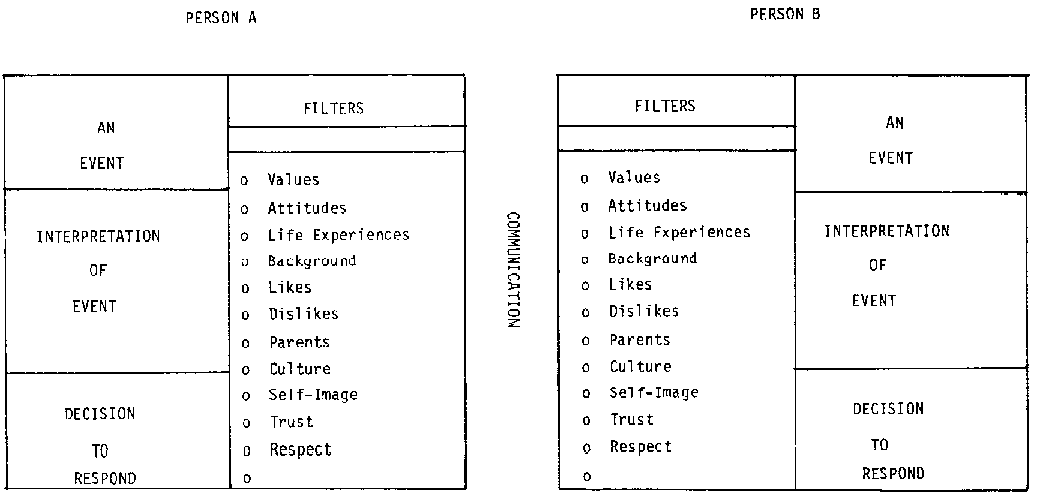
Parsons A &
B
Session 4: Feedback and journal writing
Time: 11 AM to 12:30 PM
Goals:
· To review how to give and
receive feedback;
· To learn more about
ourselves;
· To become more skillful in
obtaining and understanding information about the effectiveness of our
behavior;
· To become more sensitive to our
reactions to others and the consequences of these reactions;
· Participants will understand the importance of
keeping a journal.
Materials:
· Flip charts, marker pens, tape, note books with tabs for journal
EXERCISE I - FEEDBACK
Total Time: 1 hour
Overview:
The purpose of this exercise is for participants to practice giving timely, skillful feedback.
Procedures:
|
Time |
Activities |
|
5 Minutes |
1. Trainer should acknowledge that the trainees may know about feedback, but here in training it is a very useful tool, |
|
5 Minutes |
2. Ask individuals to jot down as many feedback rules as they can remember off the top of their heads. |
|
15 Minutes |
3. Trainer now produces newsprint with the following rules; |
FEEDBACK RULES
1. It is honest and frank rather than diplomatic or subtle. It is true reporting of your real feelings and reactions to the behavior of another person. This implies that you are aware of your reactions and are willing to run the risk of possible rejection by sharing them with the other person.
2. It is specific rather than general. To be told that one is dominating will probably be as useful as to be told that "Just now you were not listening to what the others said, but I felt I had to agree with your arguments or face attack from you."
3. It is focused on behavior rather than on the person. It is important that we refer to what a person does rather than to what we think or imagine he is. Thus we might say that a person "talked more than anyone else in this meeting" rather than that he is a "loudmouth." The former allows for the possibility of change; the latter implies a fixed personality trait.
4. It takes into account the needs of the receiver of feedback. Feedback can be destructive when it serves only our own needs and fails to consider the needs of the person on the receiving end. It should be given to help, not hurt. We too often give feedback because it makes us feel better or aives us a Psychological advantage.
5. It is directed toward behavior which the receiver can do something about. Frustration is only increased when a person is reminded of some shortcomings over which he has no control or a physical characteristic which he can do nothing about.
6. It is solicited, rather than imposed. Feedback is most useful when the receiver himself has formulated the kind of question which one can answer either by observing him or through actively seeking (soliciting) feedback.
7. It involves sharing of information rather than giving advice. By sharing information, we leave a person free to decide for himself, in accordance with his own goals, needs, etc. When we give advice we tell him what to do, and to some degree take away his freedom to decide for himself.
8. It is well-timed. In general, immediate feedback is most useful (depending of course, on the person's readiness to hear it, support available from others, etc). The reception and use of feedback involves many possible emotional reactions. Excellent feedback presented at an inappropriate time may do more harm than good.
9. It involves the amount of information that receiver can use rather than the amount we would like to give. To overload a person with feedback is to reduce the possibility that he may be able to use what he receives effectively. When we give more than can be used, we are more often than not satisfying some need of our own rather than helping the other Person.
10. It concerns what is said or done, or how, not why. The "why" takes us from the observable to the inferred and involves assumptions regarding motive or intent. Telling a person what his motivations or intentions are more often than not tends to alienate the person, and contributes to a climate of resentment, suspicion, and distrust; it does not contribute to learning or development. It is dangerous to assume that we know why a person says or does something, or what he "really" means, or what he is "really" trying to accomplish. If we are uncertain of his motives or intent, this uncertainty in itself is feedback, however, and should be revealed.
11. It is checked to insure clear communication. One way of doing this is to have the receiver try to rephrase the feedback he has received to see if it corresponds to what the sender had in mind. No matter what the intent, feedback is often threatening and thus subject to considerable distortion or misinterpretation.
| |
Trainer asks how many of you remember all eleven rules? |
| |
4. Trainer now gives the following reasons why we want to practice and become more skillful at giving and receiving feedback. |
| |
a. By learning to give and receive feedback skillfully, we help ourselves and others become more effective as volunteers. |
| |
b. The more we learn about ourselves in this training and about how effective our behavior is, the more we will be prepared for our two years as an effective volunteer. |
| |
c. We will also become more sensitive to our reactions to others and the consequences of these reactions in our interpersonal relationships. |
|
15 Minutes |
5. Trainer now asks group to break into groups of five and brainstorm ways in which we can become more skillful at giving and receiving feedback and list ideas on newsprint. |
|
5 Minutes |
6. Trainer now asks groups to present their list to entire group. |
|
|
7. By way of summarizing, two trainers model giving and receiving feedback through short role plays. |
| |
The feedback should be real; perhaps based on the aspiration exercise that they took part in. This would help set a climate of openness. It is also important to model positive feedback. |
EXERCISE II - JOURNAL WRITING Total Time: 1/2 hour
Goals:
· To understand the importance
of collecting and recording data daily in a journal as part of their
profession
· To perceive the journal as a key
to recording information and providing a tool for trainees to use once they have
left the training program
· To allow their
journal to assist project management and continued learning, as well as goal
setting, planning and personal reflection
Overview:
The purpose of this exercise is for trainees to start keeping a journal during training. Trainees need to keep a journal so that they can organize and examine their experiences during training and learn from them.
Procedures:
|
Time |
Activities | |
| |
1. Trainer introduces journal writing by posting the following on newsprint: |
a. Events |
| | |
b. People |
| | |
c. Feelings |
| |
|
d. Striking thoughts or "insights" |
| | |
e. Experiences with ideas |
| | |
f. Experiences with things |
| | |
g. Dreams/fantasies |
| |
2. Trainer explains journal format. Gives instructions to begin making journal entries for the week. Trainer stresses that collecting and recording data daily is part of the profession. They will need to record data that they will use later in training. Gives examples of how important each topic area is. | |
Session 5: Cross-cultural workbook (part I)
Time: 2 PM to 6 PM
Goals:
· To identify and discuss
personal and historical, positive and negative cross-cultural
encounters
· To reflect upon, discuss, and
compare how, when, and where one's attitudes toward strangers and people of
difference are formed
· To examine
characteristics of highs and lows participants have had over the past year and
how they may relate in a new culture
· To
reflect on leave-taking and identify major unfinished business
· To identify the problems participants expect to
encounter when entering a new culture
Procedures:
1. Trainer introduces to the reference group the goals of the
session, sets the climate.
2. Trainer presents time frames and Sections.
Divide the reference groups in half and use the Workbook. Each participant
should have a copy. Each exercise is self-explanatory.
Materials:
"Approaching Living In A New Culture: A Workbook for Cross-Cultural Transition"
(Flip Chart For Climate Setting)
Preparing to Enter a New Culture
Study yourself and realize what you are taking into experience.
Look at ways of presenting:
Yourself
Your values
Your expectations of the other
culture
Learn about leaving one culture and entering a new culture.
Make a plan for how you will learn about the new culture.
Examine any "unfinished business" and other elements of leave-taking.
Trainer's Notes:
1. The Cross-Cultural Workbook is to be worked by dividing the reference group into four groups. Reference group trainers can divide their time between groups. Movement between the groups should be done without disrupting group discussion and process. The role of the trainer is to observe and provide relevant country-specific information or information about the Peace Corps. The trainers are not to facilitate the discussions unless there is sufficient staff who are familiar with the Workbook and are comfortable facilitating the discussion.
2. The self-monitoring principle is implemented during the Workbook sessions. Times and Sections are to be written on flip charts. Participant responsibility for implementation needs to be stressed during the opening of the session. The time frames presented are estimates and participants are to adhere to them as closely as possible, but use "group judgement" to determine when to move on to the next Section. The trainer needs to be aware of time, but again, the participants are responsible for task and time monitoring. In preparing the time frame flip charts, trainers may want to delete Section 1C if time is a problem.
|
Tentative Time |
Schedule: |
|
2:10 - 2:55 |
Section 1 A and B (C) |
|
2:55 - 3:25 |
Section 2 A and B |
|
3:25 - 3:55 |
Section 2 C |
|
3:55 - 4:05 |
Break |
|
4:05 - 4:35 |
Section 3 A |
|
4:35 - 4:55 |
Section 3B |
|
4:55 - 5:25 |
Section 4 |
|
5:25 - 5:40 |
Section 5 |
|
5:40 - 6:00 |
Section 6 |
3. If staff members have not read the Cross-Cultural Workbook they should take time to read it and develop a clear understanding of its content and flow. Staff members can be introduced to the Workbook in staff training, but additional time (1 to 2 hours) will be needed to read and review it.
4. At the end of this afternoon session, trainers hand out the article, Volunteers and Neo-Colonialism. Ask participants to read it and identify one issue that is relevant and significant.
Approaching living in a new culture: A workbook for cross-cultural transition
Core Curriculum Resource Materials
Office of Programming and
Training Coordination
Revised September, 1981
Acknowledgements
This Cross-Cultural Workbook has had a long (at least for training materials) and venerable history, and many people have contributed to make it what it is today.
It was originally developed in 1971 by Jim McCray, Debra Mipos and Dick Vittitow under the auspices of the VISTA regional training center in San Francisco. I. was designed to be used in training VISTA volunteers who were working with Native Americans and Mexican Americans in the Southwest. That original edition was used in VISTA training in the Southwest for a couple of years, and it is unclear what happened with its VISTA history after that.
The Workbook made its "reappearance," albeit in a different setting, in 1978. At that time, we were looking for training designs for use in the CAST (Center for Assessment and Training) that would help prospective Volunteers begin to make the transition from one culture to another. The Cross-Cultural Workbook seemed an extremely sound training tool, and it was very close to what was needed. Thus, we adapted it to the Peace Corps setting, and inserted it into the CAST program.
Since 1978 it has been a part of all CAST's, and has been used in some stagings and pre-service training programs. It was modified in January of 1980 by John Pettit, who added a couple of elements and made changes based on feedback received about the manual over the one and a half years the Peace Corps had been using it.
We then revised the manual in September of 1981. Although we did clear up a few remaining glitches with this most recent revision, the major aim was to make the manual more congruent with the other core curriculum, training materials that were developed in the cross-cultural area over the past year. We think this goal has been accomplished, especially since the last section now helps people take a. first cut at identifying cross-cultural leaning needs and ties this process directly into the first major cross-cultural training session which is intended to occur during Week One of pre-service training.
This manual is now designed to be the first module in the cross-cultural section of the core curriculum. We hope that users find it stimulating and fun, and we wish to acknowledge Pettit, McCray, Mipos, Vittitow and the many others who have used it an¿ given us feedback, for their respective parts in its development.
Dan Edwards James A. McCaffery September, 1981
Contents
Purposes and Uses of Workbook
Exercises:
Section 1.
Historical Encounters
Section 2. Learnings from Childhood
Section 3. Past
Experiences in One Culture, Personal Needs and the Task of Satisfying Old Needs
in New Ways
Section 4. Leaving Our Own Culture Effectively
Section 5.
Responding To A New Culture
Section 6. Identifying Your Cross-Cultural
Learning
Needs
Purposes and uses of workbook
This workbook represents the First part of the Peace Corps cross-cultural training program. It is intended to help people begin the task of learning to live and work in, a culture different from their own. It is designed so that groups of 3-5 people can work through it and it is suggested that there be a facilitator. The purpose of the facilitator is to have someone to watch the time, to help in drawing out the learnings during discussion, and--as a person who has probably gone through either the Workbook or a cross-cultural experience before--to help interpret and expand upon the exercises in the Workbook.
In setting up this workbook? we have based our work on five principles which we feel must be recognized to achieve a successful experience in cross-cultural living:
1. Even though you may not realize it, you will discover that you already have some skills that will help you to be effective in cross-cultural settings.
2. As you enter a different culture you will have to take stock o~ you' present skills which are related to cross-cultural living, use those which are appropriate, modify others, drop some and build new ones. Although this seems like a simple process, it is not; rather it is exceedingly complex and will require a certain struggle as you go through different cross-cultural experiences.
3. Careful preparation and training can make you more effective more quickly as you enter a different culture.
4. Effective cross-cultural preparation emphasizes skill building rather than learning specific pieces of information.
5. You can profit by sharing your perceptions and learnings with others who are engaged in the same process, and they will also learn from your experience.
As you probably noticed from looking at the Table of Contents, this manual is divided into six sections. Each section contains a set of exercises that are designed to help you develop your learning framework for approaching the experience of living in a new culture. As you work through these in your small group you will have an opportunity to study yourself and to recognize what you are taking into the experience. After completing Sections One through Five you should be able to answer questions such as:
· In what ways do you think you present yourself, your values and your expectations of the other culture?
· How have all these personal values been built up?
· Based on your life experiences and personal needs, what are some of the learning needs and problems you might have in responding to another culture?
Adjusting to a new culture is hard but you do have many past experiences and learnings which wild parallel the things you are called upon to do. After reading the material on cross-cultural living in Section Five you will begin to get a sense of what some people refer to as culture shock. This information, along with your own self perceptions, will be a valuable bridge to learning to live in-the new culture. By developing learning needs in Section Six you will have the basis of a tentative plan for how you may want to approach this new experience. This will be followed up in-country during the first week of pre-service training. Thus, it is very important to bring this manual and your work with you.
If all of the above is done thoughtfully the results will make you more at ease as well as give you a personal framework within which you may learn to live in a new culture.
In terms of using the manual, much experience has indicated clearly that you should reflect individually and write your responses to the various Sections first, and then discuss them in your small group. That individual reflection time is a critical factor in the process, and it receives insufficient attention if you simply use the Sections as discussion questions.
A final note: We have tried to design this Workbook to fit the general needs of prospective Volunteers entering a new culture. We have also designed it to be integrated into pre-service training. Hopefully, it will be a useful tool to help you prepare yourself for a rewarding experience. It is not intended to be used once and forgotten. Thus, you should take it with you and refer to it as a kind of on-going check list for what you want to accomplish.
It remains only a tool, however, and like all tools it should be tried out, examined for effectiveness, and then modified if necessary to make it more useful to you. Use it however you think is best, but don't let the tool use you. If you find a better tool or a better use for this one, let us know so we can revise and update the Workbook as needed. Help us help others prepare themselves, and maybe our venturing into new and different cultures will be better all around.
Section 1: Historical encounters
Historically, there have been many problems when people of different cultures meet each other for the first time. These encounters have often resulted in war, exchange of disease, and the domination of one culture by the other. The cost in human life and suffering has been enormous.
A person never enters a new culture solely as an individual. Inevitably, he brings with him some of the history as well as many of the values and attitudes of his own culture, as one of many "foreigners" or "outsiders" who have come in the past, and who will continue to come in the future.
A. To begin to disentangle the complex problem of how -you learn to participate in another culture, it is helpful to go back into history and think about any one example, in either myth or reality, of how people of different cultures related to one another in a negative way and then to describe the negative qualities or consequences of their encounter.
Negative Qualities of Encounter
(Share and discuss with your group.)
B. Now, think of an historical situation, reality or myth, where people of difference encountered each other with positive consequences.
Positive Qualities of Encounter
(Share and discuss with your group.)
C. Re-examine your 'lists of the positive and negative aspects of these encounters. What criteria did you use to determine if an aspect of encounter was positive or negative? (An example of a negative criterion might be the decline of native arts and crafts; a positive criterion might be alleviation of hunger or suffering, as with the introduction of a new domesticated food plant.) Write down some criteria for positive encounters and negative encounters. After you and others have finished individually, try as a group to develop five criteria for positive encounters and five criteria for negative/encounters. Take about 10 or 15 minutes to see if you can agree on these criteria.
|
Criteria for |
Criteria for |
|
Positive Encounter |
Negative Encounter |
Section 2: Learnings from childhood
A. Our most intensive language and cultural learning takes place in childhood. At that time we are taught, among other things, how to meet strangers and how to relate to them. Remembering -hat you will be a stranger to people of the new culture, reflect back on your own childhood and think about some of the things you were taught about strangers in general. When, where and how did you learn these attitudes? Who taught them to you?
Teachings About Strangers
B. During your childhood and youth you also learned certain attitudes toward people of difference different ethnic groups, different religions, different nationalities, etc. Thinking either in general terms or in terms of specific groups, what are some of the things you learned about people who are not from your "own" group?
Teachings About People of Difference
(Compare the two sets of attitudes and discuss in your group.)
C. In working Sections 1 and 2, you may have discovered that you still have some biases about people of difference; some things that you need to be conscious of, check out occasionally, and work on. These kinds of things, often picked up during childhood or through a movie or a National Geographic, can have a profound impact on how we begin dealing with another culture; and, if unexamined, they car, seriously hamper our cross-cultural effectiveness. Bringing potential biases to a level of consciousness is a first and critical step. Please write down those "teachings" from your past that you think may still affect the way you will enter a new culture. Once you have noted these potential biases then move to the next part and jot down some specific ideas on things you could do to "work on" these biases (i.e., check your information source, try something out for yourself rather than accepting someone else's word).
Biases about people of difference I may have and/or need to work on.
Ideas and things I could do to work on these biases.
(Share and discuss in your group.)
Section 3. Past experience in one culture-personal needs and the task of satisfying old needs in new ways
Following is the outline of a chart. The vertical spaces indicate months of a past year (for you to fill in) while the horizontal lines from "0" to "10' indicate how you were feeling, with a "10" indicating a real "high" for you, and a "0" indicating a real "low." Draw a line chart, like a sales chart, to show how you felt from month-to-month during the year described. Then list and describe the qualities of these major highs and lows.
A. Indicate by a flow line on the chart below how you experienced your past year.
______________________________________________________________________________
Months
______________________________________________________________________________
10____________________________________________________________________________________________________________________________________________________________________________________________________________________________________________________________________________________________________________________________________________________________________________________________________________________________________________________________________________________________________________________________________________________________________________________________________________________________________________________________________________________________________________________________
1_____________________________________________________________________________
Describe the kinds of things that were happening when you were experiencing major highs.
Describe the kinds of things that were happening when you were experiencing mayor lows.
(Share with your group.)
B. During the past year when you were experiencing highs, you were probably meeting some important needs. When you were experiencing lows, there were probably some needs not being met. Reflect on the "picture" of highs/lows that you have drawn for the past year, and try to extract those needs which seem to be important for you (e.g., a need to have contact with two or three close friends, a need for some occasional time alone).
Important Needs
(Share with your group.)
So what good is all this? Is it useful?
To everyone, perhaps not. Some people are reluctant or unable to attempt an analysis of their own behavior. It is certainly not necessary, but each of us goes through life trying to arrange things so that we will be happy. Our needs as they develop determine many of the choices we make, and we learn ways to satisfy our needs. This process normally goes on without much conscious attention.
However, the Peace Corps Volunteers find themselves rather quickly transplanted into new and unfamiliar situations, where the taken--for-granted ways of meeting needs might be substantially different. Although our needs may evolve during the two years, the changes in basic needs are neither rapid nor easily manipulated. We are faced, therefore, with the task of satisfying our old needs in new ways. While this is not a terribly difficult process for most Volunteers, it may require some conscious analysis and thought for the first time. Knowing something about your individual balance of needs may enable you to better understand the sources of unhappiness, and thus improve your chances of taking effective action.
If I know something about my personal needs, what does that information tell me exactly?
This knowledge has the follow uses:
1. It can help you predict your emotional response to many situations, permitting you to avoid, approach or modify them as appropriate,
2. It can help you identify the causes of discontent and depression, and suggest ways to alleviate them.
3. Perhaps most important, it will allow you to be active and creative in planning ways to meet your basic needs in the new culture. Being active in finding new and culturally appropriate ways to meet your "old" needs is an integral and exciting part of cross-cultural learning. Of course, how you analyze your needs is highly individualistic, and no one would suggest that knowledge of one's needs will in itself solve anything. However, it is well known that Volunteer effectiveness and happiness overseas is determined by the ways in which needs are addressed or not addressed. As we have seen from the charts, we normally go through highs and lows here in the States. This will happen overseas, and the ups and downs will tend to be exaggerated (at least at first). "Lower lows" can help cause you to be ineffective, unrealistic, ethnocentric, even to go home early. Thus, the ability to be clear about your needs and take an active role in planning to meet '´hem is critical, and, in those instances where you are unhappy, you will be better able to identify the causes and take effective action to make the situation better.
Section 4: Leaving our own culture effectively
Much of how we experience a new culture is highly dependent upon how we feel about the culture or situation we have just left and how well we have left it. Preparing for a new culture means in large part being successful in bringing satisfactory closure to our past involvement. Our freedom to leave present situations and friendships allows us to enter new situations and friendships more easily.
Moreover, many people have either had very difficult times as Volunteers or have left early because of "unfinished business" back in the States. For example, an individual may have a strong relationship with another and decide to go into the Peace Corps even though the partner does not. This situation needs careful consideration, as it has been the Peace Corps' experience that such situations generally lead either to leaving early or to the end of the relationship. This is but one example of the critical role that "leave-taking" will play in your Volunteer experience.
Reflect carefully on the situation you are planning to leave or have just left. How do you feel about it? Are there things you wish you had done before you left or as you were leaving? How have you taken care of close relationships? What things did you leave well? Please jot down some of the good points and ragged edges connected to your leaving.
Once you have done that, identify some positive actions you could take to deal with the ragged edges (and maintain the good points). Then try to develop some personal ideas for leaving a culture, home, friends, pets, etc.
|
Good Points |
Ragged Edges |
Positive actions I might take to maintain good points and to deal with ragged cages.
Ideas for leaving-taking of culture and friendships.
(Share and discuss with your small group.)
Section 5: Responding to a new culture
So far you have been drawing upon your own experiences and sharing them with the rest of the group. This is where most real learning must take place. Sometimes, however, it can help to examine the concepts and theories of people who have either studied or been through cross-cultural experiences to aid in crystallizing your learnings. The three short readings which follow contain some ideas which people who have had successful cross-cultural living experiences have pointed out to be important. Our feeling is that they may help you get a better picture of the experience you will be going through and will help you identify some of your cross-cultural learning needs.
A. Responses: Culture Shock
Many people who enter and live in a new culture for more than a month experience what has been labeled as culture shock. This means the newcomer will experience feelings such as not belonging, alienation, unworthiness or inadequacy, and may lose touch with his or her own real feelings. In many ways the person will be experiencing real mental distress, but what must be recognized is that culture shock is a normal process. It is something we all may experience to a greater or lesser degree.
We do experience culture shock differently, however. Some people tend to get very depressed. This may mean they withdraw from people of difference and have little energy to put forth in doing anything that is new or requires much effort. They feel victimized, and they look at others--particularly those in the new culture--as being the cause of their pain and torment.
Others may search desperately for similarities with their own culture or background and then try to rely upon these similarities for support to the exclusion of other activities. Those just out of a university environment may try to recreate some of the dominant qualities of that environment in their new situation. If they were heavily involved in sports, for example, they will try to get involved in similar activities in the new culture. If they previously relied a lot upon books they will spend much of their time in the new culture simply reading. The tendency is to seek out something familiar from the past in an effort to dominate and exclude the present as well as to preserve one's own ego or sense of identity. This is normal and sometimes, in fact, useful to do especially if it is done to help get you over a period of culture shock. The first problem, however, is to recognize symptoms of culture shock.
The following are some of the signs that may (they don't always) indicate you're on the old culture shock trip:
1. Yearning for certain foods or personal comforts not readily available in the new culture.
2 Escaping to maximum structure/minimum contact situations such as movies or formal restaurants.
3. Hanging around with fellow Volunteers or others of your own ethnic group.
4. Finding yourself talking about "them", "these people" and blaring "them" for the problems you're having in your work or in your personal adjustment.
5. Finding yourself drinking excessively, or spending unusual amounts of time:
sleeping
eating
bathing
grooming
yourself
daydreaming
playing
cards (especially solitaire)
reading when you should be doing other
things
organizing and reorganizing your room, equipment, etc., or
6. Avoiding contact with people of the new culture in any of a hundred other ways which all boil down to one fact--you may be in culture shock, and you owe it to yourself as well as to those around you to start doing something about it.
One final note; the term "culture shock" is a very apt and descriptive term. However, it may also imply that there is something so alien about other cultures that they "shock" newcomers. We do not mean to imply that at all: Rather, when an individual enters a different culture, it is often the absence of taken-for-granted, everyday things from his/her native culture which causes the shock. These "everyday things" can be access to newspapers, television, books, friends, certain kinds of foods, and so on. Because these things are taken for granted, it may cause discomfort or "shock" when they are no longer there, or at least not there automatically, nor in the form one is used to. Generally, it is that period during which one realizes that something is missing or different: and before one has substituted and/or accepted new "everyday things" available in the different culture wherein culture shock may be experienced. (This, of course, assumes that one is not simply ethnocentric or unable/unwilling to adjust; people who have these characteristics present serious problems when working overseas!)
Choose at least two of the signs (numbers 1-6, above) write them down, and decide at what point they cease to be signs of simple homesickness and begins to be symptoms of genuine culture shock.
Share and discuss your opinions with your group.
B. Responses: Resolving Culture Shock
Old-timers say culture shock can only be lived through, not dealt with. This does not seem to be true if you can just take the first step of recognizing that you are in culture shock. The whole thing is usually so deceptive--and we are so clever at inventing games to screen out the reality--that we cannot or will not admit what we are going through.
If we can get through to our real feelings the best thing to do is to face the reality and then deal with it. At this point we can acknowledge that we feel terrible (which is okay because it's what everyone feels in a similar situation) and we can foresee the actions we need to take to overcome these feelings. Action is terribly difficult for people in depression because they feel so ambivalent about things, but it is only action that will help. Action cuts through ambivalence and begins to resolve it.
An important question to answer when you recognize that you are feeling "down" and lonely, and all the rest, is simply, "What can I do to make myself feel more positive about things?" People in culture shock tend to be very puritanical and demanding of themselves, which only heightens the sense of discomfort and inadequacy.
Remember that this process is simply taking note of the conditions present or absent when you experience happiness or discontent. THERE IS NO "BEST" ORDERING OF NEEDS. Perhaps the most central idea to be conveyed here is that WE SHOULD SATISFY OUR NEEDS IN CULTURALLY APPROPRIATE WAY'S RATHER THAN SUPPRESS THEM. In fact, an important part of our pre-service cross-cultural training will be aimed at helping you to do this.
C. Responses: Feedback and Overidentification
Some things to keep in mind:
1. Feedback is the way we learn how well or how badly our actions are coming across. Sometimes we learn because people tell us directly; sometimes we learn because of other, less direct means (nonverbal cues, for example).
2. Feedback "happens" all the time, and in every culture. It's a question of whether we choose to "see" it and take it seriously. (Some examples of feedback--someone runs across the street to meet you and say hello as opposed to ducking in the nearest alley; someone falls asleep while you are talking to them; people want you to take leadership roles in committees.)
3. Feedback is often very subtle. It is usually only to our closest friends that we ever talk frankly about certain actions and how we felt about them, and even then our sharing of feelings is limited.
4. Feedback, both verbal and nonverbal, is cultural. It takes a long time to learn what it really means
5. In a new culture, feedback systems may be widely different from what we're used to. At first they may be totally unintelligible. What meant "you're doing fine" in your culture may mean "don't come any closer" in another.
6. When feedback is limited or confusing a common tactic is to mimic (to do what you see others doing) by picking up and modeling their actions and mannerisms.
7. Modeling is a basic form of learning, but it has to be in character with your other actions or it may appear ridiculous.
8. When carried to extremes mimicking looks phony, and it is called overidentification. Examples would be wearing moccasins the first day on an Indian reservation, or talking ghetto talk when everybody knows you're from the white suburbs.
9. Overidentification can really turn people off. You're saying you think you can fool them with this act, and that. you're so clever you can pick up in a day or so a cultural identity that they've spent years putting together.
10. It's not real and they know it. You're probably not being yourself. Either the change to the new behavior was too sudden to be sincere, of even worse, you act differently when you're with "your own kind."
11. The only way out is to be yourself and find ways to be reinforced for it. Get to know someone who will tell you honestly how you're coming across in the new culture. If others from your own culture are available, help each other feedback on how you're doing in the new situation.
12. Be sensitive to the ways people in the new culture give each other feedback. Then look at what they're "telling" you (in one way or another).
Section 6: Identifying to your cross-cultural learning needs
Having read and discussed the articles in Section 5 and looking back on the work you have done in Sections 1-4, we would like you to make an attempt to identify your cross-cultural learning needs. You might want to reflect back particularly on Section 3 where you were trying to pinpoint some of your needs over the last year. For example, one cross-cultural learning need might be to learn about the foods in the new culture, and to learn culturally appropriate ways to cook it and eat it. A less obvious learning need might be as follows: to identify ways to spend some time alone in a culture which (at least from what you know now) does nor value "aloneness." Other learning needs might revolve around your Volunteer assignment area (e.g., health extension), language and communication, entertainment, and so on. Learning needs may even involve identifying things you could do to take care or any ragged edges you have from leaving this culture, and things that you might be able to do to maintain back home relationships and contact (Section 4). In addition, they should reflect continued work on any biases you may be taking with (Section 2). Reflect individually, then, and use the space below to take an initial cut at writing your individual cross-cultural learning needs.
Cross-cultural learning needs
(Share with you. group If someone else's sharing reminds you or something you forgot, or seems like a good idea, you can use the space below to add to your list.)
Final Note:
These are your cross-cultural learning needs as you see them right now. The list will evolve as you gain experience in the new culture, but this provides an excellent starting point. Please remember to bring this manual with you, and this Section in particular, as it will form the basis for one of your first crosscultural training sessions during the first week or so of pre-service training.
Session 6: Role of the volunteer in development work (rvdw): the helping relationship as a volunteer
Time: 7:30 AM to 10:30 AM
Goals:
· To identify some of the ways
in which individuals help one another.
· To
discuss participants' own personal motivation for helping and their own personal
theory of "helping."
· To experience and
articulate feelings individuals have about being in a position of receiving help
after a session in which they receive help from another participant.
· To articulate feelings about being a helper after
actively helping another participant in a training session.
· To discuss some of the dilemmas -- political and
personal -participants may confront as volunteers around the notion of
"helping."
Procedures:
|
Time |
Activities |
|
5 Minutes |
1. The trainer briefly discusses the goals of the activity. |
|
10 Minutes |
2. Participants complete the inventory. |
| |
3. Triads are formed and the participants in each triad identify themselves as A, B, and C. |
|
5 Minutes |
4. The following instructions are given by the facilitator: |
| |
During the first round, participant A is to be the first "helpee"; he is to present his results from the inventory. Participant B is to be the first "helper"; his task is to begin a helping relationship with the "helpee". Participant C is to be the first "observer"; he receives a copy of the Helping-Skills Observer Sheet. |
|
90 Minutes |
5. Round One is begun. The facilitator stops the process after twenty minutes and instructs participant C to report his observations and lead a discussion for ten minutes. |
| |
6. Round Two begins. Participant B becomes the "helpee"; C becomes the "helper" and A becomes the observer (thirty minutes). |
| |
7. Round Three begins. Participant C is the "helpee"; A is the "helper" and B is the observer (thirty minutes). At this point, the trainer puts flip chart paper on the walls near each triad. |
| |
8. Immediately after Round Three, the triads are instructed to spend a few minutes in order to identify the behaviors that assisted and that hindered their helping relationships. They should be prepared to share these in the large group after the break (five minutes). |
|
TAKE BREAK | |
|
15 Minutes |
9. The total group reconvenes and the trainer asks participants what they felt hindered their helping relationships. A recorder lists these on newsprint. The trainer repeats the process, this time asking for those behaviors that assisted their helping relationships. |
|
20 Minutes |
10. Stepping back from the lists, the trainer should then ask the participants if anyone would like to make some generalizations about what is needed in order to have a successful helping relationship. |
|
15 Minutes |
Trainer asks questions like the following (from news print): |
| |
- What did it feel like to be helped and what can we learn from this? |
|
|
- What did it feel like to be a giver of help and what can we learn from this? |
| |
- What may be different about helping others overseas? |
| |
- How might cultural variables affect a helping relationship? |
| |
- How can I approach asking others for help and helping others (be they PCVs or HCNs)? |
| |
- What is your personal motivation for helping others? |
Materials:
· "Helping-Skills Inventory"
FOR STAFF USE ONLY (Representative Sample of Work Generated by Participants in Small Groups/Copied from Newsprint). THIS IS NOT A HANDOUT FOR PARTICIPANTS.
Behaviors that Assist in Setting up a Helping Relationship:
Put the problem in perspective
Give confidence
Be truly interested
Ask questions that allow helpee to find real anxieties or problems
Relate experience
Be actively involved (listening)
Ask questions (relevant)
Create comfy atmosphere (putting helpee at ease, developing trust)
Help provide reasonable solution
Don't be overly solution oriented
Thought provoking silences
Let helpee define problem and re-define
Good eye contact and body language
Draw out of relevant examples
Rephrasing the problem to help him/her to be clear re: what she/he
is saying and that you're perceiving it correctly
Sincerity and sensitivity
To relate successfully overcoming past experiences to present problems
Be sensitive to the type of person you are dealing with
Effective listening
Clarifying the problem
Establish rapport
To question, probe
To clarify what you hear the person saying (to help them understand how they are coming across)
Let the person talk
Ask for examples or relate to their problems by giving personal examples occasionally
Try to help person focus the issue
Help person understand what situation may be once problem is resolved
Help to examine different alternatives Create a comfortable non-threatening atmosphere
Behaviors that Hinder in Setting up a Helping Relationship:
Rambling on a topic or suggestion (the helper)
Summarizing with a lack of depth (i.e., one work summarizations)
Reiteration (total paraphrasing and being too empathetic)
Talking too much
Making judgements - telling the person what's wrong, what to do to solve problems, etc.
Looking bored (or being bored)
Assume solution is possible and desirable
Don't get involved in yourself (if you are the helped)
Helper and helpee shouldn't expect too much from one session
Insensitivity
Interrupting over-simplification
Dominating the conversation
Not understanding the problem, person
Assuming too much
Prying
Judging
HELPING - SKILLS INVENTORY
This check list is designed to help you think about various aspects of the behaviors involved in helping. It gives you an opportunity to assess your skills and to set your own goals for growth and development. To use it best:
1. Read through the list of activities and decide which ones you are doing the right amount of, which ones you need to do more of, and which ones you need to do less of. Make a check for each item in the appropriate place.
2. Some activities that are important to you may not be listed here. Write these activities on the blank lines.
3. Go back over the whole list and circle the numbers of the three or four activities which you want most to improve at the present time.
|
General Skills |
OK |
Need to Do More |
Need to Do Less |
|
1. Thinking before I talk |
- |
- |
- |
|
2. Being comfortable with my educational background |
- |
- |
- |
|
3. Being brief and concise |
- |
- |
- |
|
4. Understanding my motivation for working in a helping profession |
- |
- |
- |
|
5. Separating personal issues and work |
- |
- |
- |
|
6. Listening actively to others |
- |
- |
- |
|
7. Appreciating the impact of my own behavior |
- |
- |
- |
|
8. Being aware of my need to compete with others |
- |
- |
- |
|
9. Dealing with conflict and anger |
- |
- |
- |
|
10. Building an atmosphere of trust and openness |
- |
- |
- |
|
Sensing and Diagnosing | | ||
|
11. Helping clients to discover their own problems |
- |
- |
- |
|
12. Asking direct questions |
- |
- |
- |
|
13. Inspiring the helpees confidence in my ability to do the job |
- |
- |
- |
|
14. Willing not to be needed by the helpee |
- |
- |
- |
|
15. Offering to find answers to questions |
- |
- |
- |
|
16. Drawing others out |
- |
- |
- |
|
17. Expecting people to use my solutions |
- |
- |
- |
|
18. Helping people generate solutions |
- |
- |
- |
|
19. Accepting the helpee's definition of the problem |
- |
- |
- |
|
Job relationships Do More | | ||
|
20. Saying no without guilt or fear |
- |
- |
- |
|
21. Working under pressure of deadlines and time limits |
- |
- |
- |
|
22. Setting realistic goals for myself and the client |
- |
- |
- |
|
23. Working comfortably with authority figures |
- |
- |
- |
|
24. Letting someone else take the glory |
- |
- |
- |
|
25. Working with people I do not particularly like |
- |
- |
- |
|
26. Giving in to client restrictions and limitations |
- |
- |
- |
|
Problem Solving |
- |
- |
- |
|
27. Stating problems and objectives clearly |
- |
- |
- |
|
28. Summarizing discussions |
- |
- |
- |
|
29. Selling my own ideas effectively |
- |
- |
- |
|
30. Helping people maintain a logical sequence for problem solving |
- |
- |
- |
|
31. Challenging ineffective solutions |
- |
- |
- |
|
32. Asking for help from others |
- |
- |
- |
|
33. Evaluating possible solutions critically |
- |
- |
- |
|
34. Contributing various techniques for creative problem solving |
- |
- |
- |
|
Implementing | | ||
|
35. Attending to details |
- |
- |
- |
|
36. Helping people make use of their strengths and resources |
- |
- |
- |
|
37. Taking responsibility |
- |
- |
- |
|
38. Changing plans when emergencies come up |
- |
- |
- |
|
39. Building and maintaining morale |
- |
- |
- |
|
40. Requesting feedback about the impact of my presentations |
- |
- |
- |
|
41. Controlling my anxiety while I am performing my task |
- |
- |
- |
|
42. Intervening without threatening my colleagues or the people I am helping |
- |
- |
- |
|
43. Intervening at the appropriate time |
- |
- |
- |
|
44. Admitting errors and mistakes |
- |
- |
- |
|
45. Admitting my own defensiveness |
- |
- |
- |
|
Evaluating |
| ||
|
46. Assessing my own contributions realistically |
- |
- |
- |
|
47. Acknowledging failure |
- |
- |
- |
|
48. Feeling comfortable with someone reviewing my work |
- |
- |
- |
|
49. Dealing with unpredicted changes |
- |
- |
- |
|
50. Relying on informal feedback |
- |
- |
- |
|
51. Letting go when the task is finished |
- |
- |
- |
|
52. Arranging for next steps and follow-up |
- |
- |
- |
|
53. Attributing failure to the helpers "resistance" |
- |
- |
- |
HELPING - SKILLS OBSERVER SHEET
The helper:
______1. Helps the helpee to analyze
problems.
______2. Helps the helpee to generate solutions.
______3. Acts
as a clarifier to the helpee.
______4. Acts as a summarizer.
______5.
Contributes suggestions from experience and knowledge.
______6. Gives the
helpee ready-made answers.
______7. Assumes that the helpee has presented the
problem accurately.
______8. Indicates that he is listening.
______9.
Picks up on nonverbal cues.
______10. Talks more than the helpee
does.
______11. Shows interest in the helpee.
______12.
Paraphrases.
______13. Confronts and/or challenges the helpee.
______14.
Collaborates with the helpee to define problem areas.
______15. Helps plan
follow-up and next steps.
What seems the most helpful thing the helper said or did?
What behaviors seemed least helpful?
Other Comments:
Session 7: Individual interviews
Optional
Time: 20-30 minutes per interview
Goals:
· To provide feedback
to each participant on his/her performance o To get to know participant on an
individual basis
Trainer's Notes:
1. These interviews are not a "chat." Trainers need to decide beforehand what feedback is to be given; care should be taken to communicate specific positive and negative feedback.
Procedures
|
Time |
Activities |
|
20 to 30 Minutes per person |
1. The Training Director should conduct the initial interview using the following format: |
| |
Interview |
| |
1. Why the Peace Corps? |
| |
2. Do you understand the Assessment Dimensions? |
| |
3. Is there anything you have left unfinished? If so, what do you plan to do about it? |
| |
4. What areas have you identified for yourself that you need to work on? |
|
|
5. What do you feel your strengths are? |
| |
6. We would like to give you the following feedback. |
Session 8 Volunteer in development and change
Time: 3 PM to 6 PM
Goals:
· To simulate certain conditions
of a development worker.
· To practice
problem identification, strategy building and solution finding.
· To explore notions, assumptions, and personal
theories about change.
· To practice
implementing solutions and strategies.
· To
examine certain variables of development work, such as ambiguity, implications
of working within system as opposed to outside system, volunteer need for
urgency in change process.
Procedures:
1. A progressive case study will be used for this session. It should be combined with role plays and simulations which emerge from each part of the case study. (Suggestions are included in the trainer's copy after each part.)
2. This session is done by dividing reference groups into smaller groups of five participants. The participants will read separately each section of the case study, Parts I-IV. They should analyze the situation, identify any problems, discuss the appropriateness of the volunteers' responses and their implications, and suggest alternative strategies. After each part, the groups will meet with the trainer(s) to share their analyses, reactions and strategies. Spontaneous role plays emerge from the discussion at this time. After discussion is completed, the next section is given out and the process is repeated in Part V.
3. At the end trainer asks participants what feelings they felt the development worker must have had during this case study. These are listed on newsprint. The trainer can close session by promising the trainees that they will experience these same feelings during their own volunteer experience.
Materials:
· The Case Study of A Development Worker, adopted from the Peace Corps training program in Liberia during the summer of 1973. Developed by Jack Koklmyers, James McCaffrey, Ed Salt and James Tashima.
Trainer's Notes:
1. While participants are working in groups of five, the staff does not play an active role. That is, the staff does not facilitate the small group problem solving discussion. Staff may observe the groups during this time, and then facilitate the discussion while participants share their reactions after each part of the Case Study.
2. Processing questions and suggested role plays are included in the Trainer's Guide for the Case Study. They should not be included in the edition given to the participants.
3. Trainers are to use their discretion in deciding when simulations are to be done based on time, staff expertise and the flow of discussion. Parts 1, 3, and 5 are rich in issues and situations for simulations.
CASE STUDY OF A DEVELOPMENT WORKER
Part I
This is a case study of a PCV working in cooperatives. He viewed this position as an important one, working in the beginnings of the country's Cooperative Movement. The Minister of Agriculture, whom the Volunteer met during training, reinforced the importance of the job he was about to begin. Since the Minister's home area was the same as the Volunteer's working area, the Minister explained in detail to the Volunteer what he knew of the people, their interest in starting a cooperative, and his expectations of the Volunteer's performance.
After nine months on the job, the Volunteer found that he was concentrating on one rice cooperative. It had taken a good part of the first nine months of his stay to settle into a life style that he was comfortable with. Although he had made a sincere start in trying to learn the local language, he gave it up after a few weeks. He said that he didn't need it on the job and had a perfectly adequate interpreter through whom he could communicate to the cooperative members. Much of his time was spent moving into his town and building relationships with the townspeople he considered key to his success as a cooperative worker. He applied the same process to the job, establishing contacts and building relationships with those in the Ministry of Agriculture on whom he knew he would eventually have to rely. This he did on both the headquarters and district level. This work was slow and frustrating, but within nine months the Volunteer felt he had established some very strong relationships with many people in the Ministry and in town. Needless to say, he knew most of the agriculture volunteers in the country and often spent time with them, talking over their frustrations.
While all this was happening, the Volunteer was in the process of defining his job. Although he was supposed to work with six budding cooperatives, he found himself spending more and more of his time with the one cooperative in his town. This was partly due to the difficulties he had in obtaining gas from the Ministry, partly due to the Minister's interest in the project, and partly due to the high visibility of the cooperative (It was on the main road).
He became the key advisor to the cooperative, working closely with the Chairman of the cooperative and the Board of Directors. He spent a considerable amount of time with each of the twenty members of the cooperative as well, visiting their homes with his interpreter. The result of his work was a group of very enthusiastic farmers whom he had taken from skepticism to active participation in nine short months. They had agreed to start a communal pilot rice scheme of some 40 acres, using one piece of land that they had obtained from the clan chief.
Since this was the first project that the cooperative was working on, both the members of the cooperative and the people of the area were watching it very closely. One measure of their wariness in spite of their enthusiasm was that each cooperative member made sure that his own traditional plot of land was prepared for the upcoming rice season. During the time that the Volunteer was building up the members' enthusiasm, he had to cope with many periods of depression, when he felt that he would not be able to bring the members to a state of readiness in time for his first full season. In fact, it took a full four months for the members and their leaders to decide that the project was at least viable with a fair chance of success.
To reach that point, the Volunteer and the Chairman of the cooperative had together arranged for certain commitments from the Ministry of Agriculture. The Ministry carried out a soil survey to determine if the plot of land was indeed suitable for rice cultivation. The Ministry promised fertilizer and helped to arrange a loan with which the members of the cooperative bought the fertilizer. The Ministry promised to supply improved rice seed, and the members had raised money for the seeds by holding a dance, a beauty contest, and by raising their fair share of membership fees. This money they sent to the Ministry via the Volunteer (when he was going down to the capital for his gamma globulin shots) some two months before the seeds were due to arrive.
By the end of April, the members and the Volunteer were fairly satisfied with their progress. A plot of land had been selected and it had been cleared and prepared by the members. The fertilizer had arrived and was stored in a shed attached to the Volunteer's house. A number of technical advisors from the Ministry and UNDP had visited, each giving a lecture or demonstration which the members felt worthwhile. The money for the seed was with the Ministry, and the Director of the Division had promised that the seed would be available by mid-April. All things considered, the Volunteer was quite pleased with the progress of his work, and had been suggesting to a number of other Volunteers, Ministry officials, and cooperatives that they may want to visit his cooperative during the next months in order to use it as an extension demonstration in cooperative work.
By the middle of May, four weeks late, the seeds had not yet arrived. The Volunteer and cooperative members were becoming worried. People were expecting the first rains by late May or very early June, and the rice had to go in just after the first rains or the yield would probably be severely reduced.
Finally, the Chairman of the cooperative and the Board of Directors met in a special session to talk over the tardy seeds. After several hours of palaver, they decided to send an urgent message to the Division Director in the capital city inquiring about the seeds. The Chairman, whose brother worked for the Ministry in the nearby county seat, suggested using the Ministry radio network to send a message to the capital city.
The Volunteer, who had returned the previous day from the county seat, mentioned that the radio was not in good working order, and it was quite difficult to communicate clearly with any assurance that the message was properly understood in the capital city. By chance, the Volunteer knew that the Peace Corps mail truck was due to pass through the town that afternoon on its way to the capital. The members agreed and the meeting ended with the Chairman and Volunteer drafting a letter to the Director of the Division.
As the Volunteer and the Chairman composed the letter, the Volunteer decided to send the letter to the Peace Corps Agricultural Programmer, asking him to take it by hand to the Division Director. He felt the situation was serious enough to ask for the Agricultural Programmer's help. If nothing else, he felt that the letter may carry a little more weight if the Agricultural Programmer discussed it with the Division Director personally.
Part II
Three days later, when the mail truck was returning up country, the Volunteer received a letter from the Agricultural Programmer in the capital city. The Agricultural Programmer had visited the Division Director, and had obtained an assurance from the Director that the rice seeds were just being arranged and should be on their way within the next ten days. The Volunteer visited the Chairman and Board of Directors and the group was considerably reassured by the Agricultural Programmer's findings. They adjourned to a local bar to celebrate their good fortune.
Ten days later, the first rains fell, good soaking rains which promised a good year if only the seeds were on hand for planting. However, they had not yet arrived. The Volunteer and the Chairman called another meeting of the Board of Directors (although they had some difficulty in contacting some Directors because they were out on their own lands planting their own rice crops).
During the meeting, the group decided that they had at the most another two to two and one half weeks to get the seed in the ground. After that, it would be almost too late. They decided that more urgent action was needed, and began to make plans to send a delegation to the capital to trace the missing seeds and to try and bring them back with the delegation. Plans were made, but when they began to talk about transport, it was found that no one could afford the trip out of their own pocket. The Treasurer of the cooperative was consulted, but it was found that almost all the cooperative's funds had been sent almost two months earlier to pay for the seeds. They had no cash on hand.
One of the members then asked the Volunteer if he could go down himself, using his own vehicle. The Volunteer's vehicle was not in working order, and so that option seemed to be useless. The Volunteer began to feel the pressure build, for he knew the next ten days were going to be crucial to the success of the cooperative. After giving it some thought, he decided to pay for taxi fare out of his own pocket for the trip. The Volunteer also wanted to involve someone else from the cooperative, so he asked the Chairman if he would accompany him and agreed to fund his trip for just this one time.
The next morning, the Volunteer and the Chairman left for the capital.
Part III
The next morning, the Volunteer met the Chairman at the Ministry headquarters, and they together went to see the Director of the Division. When they went into his office, the secretary informed them that the Director was attending a conference on the "Cooperative Movement in Africa" in Lagos, Nigeria and would not be back for another two weeks. Acting in his place, she said, was the newly appointed Deputy Director of Cooperatives.
The Volunteer and Chairman went into the new Acting Director's office, a man whom the Volunteer had never met but the Chairman knew from early grade-school. After some reminiscences by both the Chairman and the Acting Director, the Volunteer broached the problem that he was facing. Speaking on behalf of the cooperative, he outlined the problem to the Acting Director stressing the promises the Ministry had made to him, and strongly asked for some "immediate action." The Acting Director was not familiar with the case, and was not sure what authority the Director left with him to deal with the situation. However, he promised the Volunteer that he would look into the matter and asked him to return the next morning. The Volunteer, although unhappy with the response, agreed. After he left, the Chairman and the Acting Director continued to share memories, and the Acting Director invited the Chairman home for lunch with his family.
Up to this point, there were a number of different reactions from the persons involved. The Volunteer, under pressure for the success of his project, felt upset by what he regarded as the Ministry's "betrayal" (his words) of his project at a crucial moment. He did not know the Acting Director, and was not sure that he would come up with the seeds. The Acting Director, on the other hand, was confused by the whole matter. He had been transferred to the Division only two weeks before, and was just beginning to get his feet on the ground. He was happy to see his old friend, the Chairman, but was a little upset by the somewhat abrupt manner of the Volunteer. (This, he decided, was nothing to be concerned about, and was probably just the normal way this American acted.) The Chairman, who was not used to working at such high levels of the Government, was a bit overawed by the situation, and was worried about what the lack of rice seed would do to his food supplies and his reputation, but assumed that the Volunteer had everything under control.
The Acting Director spent most of the afternoon tracking down the various arrangements that the Director had made for this cooperative, and finally determined that the seeds were indeed on hand and only required some final processing and packaging and they would be ready -- perhaps within a week or so. Some seeds had already gone out (they had only two trucks available for transport) to some cooperatives and other buyers, and it turned out that this Volunteer's request was one among another 156 left to go.
Part IV
That night the Volunteer was attending the Peace Corps' party for some finishing staff members of the Peace Corps. By chance, the Minister of Agriculture (the Minister from the Volunteer's area) was attending the party. Since the Volunteer knew this man from his training program, and since he had visited his area several times in the past months, the Volunteer decided to talk to the Minister about the problem he was having. The Minister reacted very strongly and very angrily to the Volunteer's somewhat pointed description, and promised that he would look into the matter and do all he could to help.
The next morning, as the Volunteer was collecting his mail at the Peace Corps mail room, he ran into the Agricultural Programmer who asked about the problem he was having. After listening to the events, the Agricultural Programmer mentioned to the Volunteer that the United States Embassy had a self-help fund from which he might qualify for assistance in buying the seeds. Part of the arrangement, however, was that the Volunteer would have to take responsibility for the funds and project, for a national was not allowed to do so. The Volunteer was glad to have another option available, and said that he would look into it before he left.
After leaving the Peace Corps office, the Volunteer returned to the Ministry to see the Acting Director. Although the Acting Director promised that the seed would be available in three days, he said the Volunteer would have to arrange his own transport; however, the Volunteer also noticed that the Acting Director was very abrupt and cool towards him. The Volunteer left the Ministry unsure about the promise that the Acting Director gave him, and did not really trust his promise, anyway.
The Volunteer knew that if he did not obtain the seed within the next week, it would be too late. To keep his options open, he decided to go to the Embassy to investigate the self-help fund.
The Embassy officer cordially welcomed the Volunteer, and said that they would process his request in a hurry and would have a decision for him in three days.
The Volunteer then met the cooperative Chairman, and together they caught a taxi back to their town. On the ride up, the Volunteer was very happy with the results of their trip, and explained enthusiastically the two options that he had worked out for the cooperative. From at least one of the sources, he told the Chairman, they should be able to get the seed by the end of the week. The Chairman did not seem to share his enthusiasm, although the Volunteer did not notice it for another hour or so.
Finally, noticing that something was bothering his companion, he asked him what the problem was. After some fencing about , he discovered that the Chairman had visited the Acting Director after the Volunteer's visit that morning, and the Acting Director had angrily chastised his old friend for going to the Minister with their problem. The Chairman was put in a dilemma (for he did not want to pass the blame on to the Volunteer, who was their key to the seeds, but at the same time did not want to lose his friend). This he did not express to the Volunteer directly, and the Volunteer commiserated with the Chairman about the evident lack of understanding the Acting Director showed about the seriousness of the problem that faced the cooperative.
Part V
The seeds finally arrived in the capital. The Embassy turned down the Volunteer's request because they "needed at least four weeks" to fully investigate the project. However, the Volunteer had finally got his pick-up in working order and had gone down to the city to collect the seed personally at the end of the week.
Unfortunately, the seeds that arrived turned out to be of poor quality. The Volunteer had been given the wrong sacks of seed from the warehouse. The yield for that year promised to be a very poor one. A month or two later, the Volunteer noticed that the members of the cooperative did not attend their meetings as enthusiastically as they used to. The Chairman seemed to be cooler towards the Volunteer, and the Volunteer eventually found out that the Chairman and the Acting Director were no longer on friendly terms, but assumed that this was because of the poor seed that the Ministry had sent them.
Session 9: Nutrition
Time: 7:30 PM - 8:30 PM
Goals:
· To introduce the concept of
"good nutrition"
· To explore the basic
nutrient need of people
· To identify the
nutrient value of categories of food
· To
identify and research the uses and nutrient value of locally available foods at
training site and in Host Country
Overview
This session will focus on basic nutrition concepts, classification of nutrients, and the characteristics of a nutritional dish. Trainees will examine their personal eating habits and daily diets in relation to nutritional needs, and discuss how their eating habits have changed during training and may change while living overseas.
Procedures:
1. Trainer introduces the session by remarking that for most of us "good nutrition" is not a new concept. We hear about the use of chemical additives in food; the dangers of junk and fast foods; and our mother's concerns for "clean up plates" and "eating green vegetables" that are good for us. But despite the concern about "good nutrition" that we have been exposed to, how many of us actually pay close attention to what we eat? For many of us our food habits have changed here at the training site and are sure to change even more radically once we are overseas.
"We are what we eat" The quality of food which we take into our bodies determines to a great extent the quality of life we have.
The purpose of this session is to examine this area of food and nutrition so that we can maximize our nutritional intake as trainees and in the future as PCVs.
2. Trainer summarizes the goals of the session which are listed on newsprint.
3. Trainer begins next segment of exercise with the following introduction: In order to better understand the concept of "good nutrition" and how this relates to us personally we are going to take a close look at our personal eating habits and daily diets. First, however, let's take a look at food in general. The trainer facilitates discussion around the following questions: (answers are written on newsprint)
a. What are nutrients? What are the major nutrients found in foods?
b. What are the important functions of these nutrients?
Trainer then talks about the functions of the nutrients in various foods. Trainer shows following chart which has been put on newsprint.
THREE MAIN FOOD GROUPS
|
GROUP I |
GROUP II |
GROUP III |
|
(protective foods) |
(energy foods) |
(body building and repair foods) |
|
Fruits and |
Cereals, Grains, |
Meat, Fish, Poultry, |
|
Vegetables |
Starchy Roots, |
Eggs, Milk, Cheese, |
|
Extracted Oil |
Yogurt | |
|
Beer and Wine |
| |
|
Provide water, minerals and vitamins |
Contain high amounts of carbohydrates |
Contain a high percentage of protein and/or fats |
Trainer continues "As you can see, foods fall into one of three groups depending on the mayor nutrients they contain."
4. Trainer now asks each trainee to recall what they have eaten and drunk in the last 24 hours and place each of these foods in the nutrients group it belongs. Trainees complete the 24 hour diet recall.
5. The training group is then divided into small groups and encouraged to discuss their individual findings. Possible questions to facilitate the small group discussion might include:
a. In which food group did most of what you ate and drank yesterday fall?
b. Was yesterday a normal day for you in terms of what you ate? Were you tired, sluggish, energetic?
c. Were there any surprises in what you found to be the major nutrients that you got yesterday?
d. Where were you deficient? Where were you in surplus?
Trainer asks group to come up with strategies to correct deficiencies and surpluses. Small groups report out to large group. Strategies are discussed. Those that are feasible are encouraged by trainer to be acted on.
6. Trainer now asks small groups of trainees going to the same country to list what they know about foods and diets in their prospective Host Country. Also make a list of what they will need to ask in country. What dietary habits will they have to modify?
7. Trainer now talks about changes that they have agreed on for diet while in training and how this is a good place to start being aware of "good nutrition" and monitoring each other. Points out that good nutrition will help them stay energized throughout training.
Trainer's Note:
Trainees ate all meals together. Complained about lack of certain food stuffs and ways in which food was prepared. Trainers felt that trainees were not being sensitive to availability, and certainly not taking nutrition into consideration.
Session 10: The volunteer and technical assistance
Time: 7:30 AM to 9:30 AM
Goals:
· To examine some basic
assumptions about Volunteers and technical assistance, and about living and
working in a different system.
· To identify
and discuss special issues related to development assistance.
Procedures:
|
Time |
Activities |
|
5 Minutes |
1. The trainer explains that this is a part of the RVDW component and, with the aid of a flow chart, reviews the different experiences and issues covered in the earlier RYDW sessions. The intent here is to "sketch" the larger picture of development and show how Volunteers are a part of that process. The introduction ends with the trainer reviewing the specific goals of the session (which have been listed on newsprint). |
|
15 Minutes |
2. The trainer asks participants to briefly review the article and choose one issue that they feel is relevant and significant. |
|
20 Minutes |
3. The following instructions are given by the trainer and self-monitoring is initiated: |
| |
o Form triads, share and discuss individual issues. Choose one that is representative of the triad's interests. |
|
30 Minutes |
o Combine triads and form groups of 10-12. Share and discuss triad issues. Choose one issue to present creatively to the entire group. Each group also presents a flip chart with a statement of the triad issues. |
|
5 Minutes |
4. Break |
|
8-10 Minutes |
5. Group presentation per group |
|
5 Minutes |
6. The trainer presents the Peace Corps goals and links them to neo-colonialism and working as a Volunteer in development overseas. |
| |
7. Ask the group to identify generalizations about neo-colonialism as it affects the PCV. Then ask the group to reflect on what they have learned and how this will be useful to them as PCVs. |
Materials:
· The Peace Corps
Goals
· "Volunteers and Neo-Colonialism"
handout
· Flip Charts, Magic Markers
Trainer's Notes
1. While the participants are engaged in procedure #3, staff is encouraged to choose an issue and design a skit. Participants and staff are to present their issues in a fun and creative manner. Staff can offer to secure props for groups if needed.
2. Participants should be encouraged to present their issue in skit form.
3. Right after session 5 trainees should be given the "The Symptoms of Neo-Colonialism" and Long Term Service 1968 Articles to read.
THE PEACE CORPS GOALS
The purpose of the Peace Corps is to promote world peace and friendship by making available, to interested countries and areas, men and women of the United States qualified for service abroad and willing to serve under conditions of hardship if necessary:
1. To help the peoples of such countries and areas in meeting their needs for trained manpower;
2. To help promote a better understanding of the American people on the part of the peoples served; and
3. To help promote a better understanding of other peoples on the part of the American people.
LONG-TERM SERVICE 1968
A short review of volunteer service today, while revealing many young people usefully and happily at work throughout the underdeveloped world, also reveals several disturbing features.
1. Volunteer service is becoming an Institution. Increased funds, salaries, allowances and better conditions, plus large numbers of "safe" assignments, usually government approved, all combine to provoke a new public image. Volunteer service abroad is now one of the standard alternatives after school or university, or as a break between jobs. The sense of risk, of solidarity, even of privilege at being a volunteer is vanishing.
A new type of administrator is also emerging, who has no desire to "romance over the past," and is more concerned to stabilize and integrate volunteer service into other Aid forms.
2. As volunteer service becomes institutionalized so numbers of good quality applicants for service are declining. The U.S. Peace Corps, for example, must settle in 1968 for a figure some 5,000 below Jack Hood Vaun's original target of 17,200. Sweden and Germany are experiencing similar difficulties on a lesser scale. One of the reasons, commonly accepted in America, is that young people no longer wish to be identified with their governments, in whom they have lost faith. This thesis is also taken up by Mr. Dieter Dankwortt in a paper prepared for the Council Learning and Helping Overseas and presented on March 21, 1968, in Bonn. In it he suggests that "The identification with the Bonn establishment puts the German volunteer Service in a difficult position. The young generation of a country can--as the example of the U.S. Peace Corps under President Kennedy showed-identify with the goals of its government, when these goals are dynamic and appeal to idealism. When the politically active part of the youth however, is disappointed with its government and seeks to maintain a distance from the establishment, it will then also refuse volunteer service financed and controlled by that government. This development is beginning in Germany..."
3. In the field, in contrast to the early years. there is now a tendency to cooperate with Technical Assistance, the Embassies, missions and even commercial interests. The volunteer programs profit, getting administrative help, advice, introductions, tools, materials and transport--all previously unavailable. In this affluent company, host country officials accredit volunteer programs with a new "maturity."
4. Volunteers are now being assigned responsibilities which are indistinguishable from those of regular Technical Assistance personnel, sometimes positions of considerable power. Mr. Dankwortt has this to say about the German volunteers, "Today both in giver and receiver countries, one can see a trend towards the replacement of the expert by the volunteer. What was intended as an addition has become a substitute. The reason for this trend lies in the fact that volunteers are carrying out similar or even higher ranking tasks than the experts. Only a few giver countries practice a consistent division of function and authority in their projects, and make it possible for experts and volunteers to work together in a cooperative spirit with an optimum division of labor."
All credit to those volunteers capable as, or even more expert than, the experts themselves. But let us remember that it is just at this pseudo-expert level that the rot has set in. Many of these volunteers filling "normal" posts are beginning to live at the standard traditionally expected of white expatriates. Equally, their field administrators live in conditions identical to those of Foreign Aid or Embassy officials. The host country ruling classes, who already enjoy or aspire to privileged conditions themselves--and top military and civil service officials, hotel proprietors, land owners and businessmen-naturally approve that "standards be maintained."
5. The improving of conditions within volunteer programs, far from strengthening the spirit of hard work, initiative, cooperation, concern --is undermining it. Mr. Dankwortt has this to say: "The perfect bureaucracy is the volunteer's greatest enemy. In all volunteer organizations which are structured on governmental administrative principles, there is a marked trend towards the growth of a type of 'spoiled children' or 'small bureaucrats' who regard the organization as a kind of cow to be milked, and whose main worry during their period of service is to take maximum advantage of all financial and material subsidies available. The higher the subsidies, and the related maintenance standards and administrative costs, the lower the identification of the volunteers with the actual organization, and the weaker the individual initiative, assumption of risk and willingness to work hard. This trend is so strong that some organizations will need to make radical administrative and structural changes in the very near future."
In the end, except in name, a man may cease to be a volunteer at all. He becomes a mere "Contractor," one who undertakes to do certain work in return for payments and subsidies. He may consider himself underpaid--so, no doubt, does half the labor force of Europe--or he may have calculated that the "financial and material subsidies" he can claim are really quite considerable even by the standards of his home country.
Indeed, some organizations nowadays seem to be embarrassed to let the public know just how much the real income of their volunteers amounts to. In their information brochures and newspaper interviews, they write only of "broad, lodging, pocket money and local travel."
Many working men in industry take home less than this "pocket money" in their weekly pay-packets, though they do not know it.
6. The true international aspect of voluntary service has not developed; instead most governmental and even some non-governmental organizations have a distinct nationalist propaganda value. The "international understanding" spread by volunteers is, consciously or unconsciously, little more than a public relations campaign for their home country. Mr. Dankwortt has also noted in one of his theses that "...it would seem possible and desirable that a much stronger international cooperation be developed amongst the various organizations."
Just how comprehensive Mr. Dankwortt wishes the word "international" to be, is not clear. What is sure, is that sending out "international" teams of Finns, Swedes and Norwegians or Americans, Canadians and English--as seems a possible future development on the volunteer scene--will not help much the cause of true internationalism.
I would describe each of these six conditions as disturbing since they all suggest that volunteer service is compromising itself before the conventional institutions. Many of these institutions, if not all, are bound to support neo-colonialism, although this idea might shock the majority of the people concerned.
How far volunteer service, through this compromise, is becoming an operating arm of neo-colonialism, can now shortly be described.
VOLUNTEERS AND NED-COLONIALISM
Early charges of neo-colonialism against volunteers, especially the American Peace Corps, were unfounded and often touched on the ridiculous. The men were denounced as C.I.A. agents; after secret military training (candidates rejected if they missed a nickel at 50 yards with a Colt revolver, according to one lurid pamphlet) they spied on their host countries and drew up plans for sabotage or military invasion. The role of the women was even less salutary. Later, more reasonable complaints arose: That many hundreds of jobs were being "found" or made up for volunteers, in countries suffering from vast unemployment. In most places, however, skilled local people probably did not exist.
As volunteers increased, providing teachers and medical personnel on a huge scale, completely staffing schools and hospitals in some countries and making up 20% 40% of secondary school staff in other lands, the complaint arose that unscrupulous states were thereby able to avoid putting budget priority on such social services. They could keep down their expenses in public health and education and, in some cases, redirect the money saved to Defense--defense against their own citizens in the mountains. However, it is difficult to believe that the presence of volunteers could significantly affect budgets for external or internal defense. At least, no convincing statistics have come to my knowledge.] During the mid-sixties, it became clear that many European volunteers were still finding their way, via Embassy or ax-colonial channels, back to those countries with which closest colonial ties had existed. The distribution of British and French volunteers in Africa are given on page 38.
As for Belgium's 419 volunteers in 1967 (from a variety of non-governmental and official organizations), some 69% were assigned to the Congo, Kinshasa, Rwanda and Burundi. Even the Swedes' large program in Ethiopia was not without historical connections. And while the British and French were largely teaching their respective languages and consciously or unconsciously publicizing the British Way of Life and la culture francaise, their American colleagues, more variously employed, spread understanding for the United States in over sixty different lands.
The Americans thus often found themselves in countries hostile to the United States, a classic case being the Dominican Republic 1 at the time of the U.S. intervention. From countries like Ceylon, Guinea, Indonesia and Cyprus they were asked to leave.
In the early days, when the Peace Corps went to any place that would have them, many of their volunteers were very individualistic, open minded, articulate and critical of just three aspects of modern Western society which deserve criticism. Despite the source of their finances, one could not in all honesty charge them with being sinister reactionaries. For a while they were despised and disliked as much by their own US-AID personnel, who saw them as a threat to their positions, as they were by the Communist block and the Third World ruling elite.
However, as volunteer programs became entrenched in various countries, involving greater capital investment, larger administration, long term development plans, expert advisers--so the dangers of veritable neo-colonialism approached.
Eight Volunteers in the American Peace Corps, for example, noted this trend in Ecuador during the course of 1966-67 and produced a statement, part of which reads:
"We joined the Peace Corps because we thought it would afford us a means of helping developing nations without imposing the United States' political and cultural values on them. We assumed that the Peace Corps reflected the belief in a pluralistic world for which John Kennedy stood...the antithesis of the American colonialism that the rest of the world both fears and resents. We were wrong."
The eight went on to say:
"...the Peace Corps can never be a really effective organization for development if it is run unilaterally..."
since the Peace Corps rather than the host country decides which, projects should be undertaken and how. This results, they claimed, in
"volunteers determination to develop this country according to the formula which they assume made the United States great..."
without consideration for the culture into which they had intruded.
But the United States Peace Corps is too easy a target. With 12,000 volunteers in the field serving in almost every conceivable capacity from orchestral conductor to boxing coach, one can find examples of every kind of attitude, behavior, motive and philosophy.
TEN SYMPTOMS OF NED-COLONIALISM
1. Total integration into the official bilateral Aid program and dependence on this for policy, finance and professional administration --kills any chance of identity and independent action. Volunteers appointed as civil servants feel part of the official establishment and get no stimulus to develop unconventional attitudes. Careers are dangled before them like carrots to donkeys. Rules and regulations are the morality of the organization. "SIDA pays" is the motto.
2. Publicity, training and service evaluation all emphasize the technical role of volunteers, while suggestions for moral, humitarian, social role are received by SIDA with embarrassment, ridicule or silence.
3. Many artisan volunteers are selected, because of their technical skills, who prove to be skeptical of the value of volunteerism and also prove politically immature. 1 (These were often assigned to work under Swedish Technical Assistance personnel, several of whom were also opposed to volunteers and who succeeded in undermining any last traces of self-confidence in the volunteer's motives.)
4. Volunteers are increasingly appointed to jobs over Ethiopians, but seldom under or on an equal footing with Ethiopians. The result? "The volunteers very seldom described their relations with Ethiopians employed below them in terms of cooperation; rather, they explained things in terms of the character of the population as such," according to The Peace Corps Two First Years. 2
5. One notes a marked reluctance to hand over responsibility to Ethiopians. The elementary school building project was a notorious example. Supposedly shared 50-50 with the Ministry of Education, with the twin aims of building schools and training Ethiopian engineers and workmen (who should eventually take over the project entirely), finance and leadership were kept tight in the hands of the Swedes. Rather than promote Ethiopian engineers to lead Regional building programs, after they had worked two years alongside Swedish volunteers who had such responsibilities, the SVS brought three new engineers down from Sweden, on experts' salaries.
To pleas to appoint an Ethiopian as field administrator of the general SVS program, SIDA replied that such a post could be filled by a European, not necessarily Swedish, but not by an Ethiopian. Ethiopians could rise to the level of administrative clerk, but no further.
6. Most volunteers find themselves assigned to production work rather than training, especially in the school building, auto mechanic and road building work. To a lesser extent this is also true of the medical work. Several volunteers protest that they are either cogs in the wheel on the one hand, or else promoted to managerial roles on the other--neither situation giving them time or encouragement to concentrate on training. Some training courses are arranged for foremen, but this activity falls far behind production in order of priority.
7. Volunteers enjoy a standard of living which, even by European standards is comfortable middle-class and by current African standards puts them in the same class as the ruling elite Although some volunteers, by the nature of their work, must rough it for periods of time, the majority (thirty-eight of forty-one according to the SIDA report)1 have their own house, which they share with one or two colleagues, rent paid by the SVS. The SYS also pays for each house to have an Ethiopian sabanya (nightwatchman who often becomes the washer of floors, clothes and the volunteer's motor car, the fetcher of shopping and the late-night bottle of beer). In addition, most volunteers hire a mamita who cooks, washes dishes and often tidies the house and does some laundry. Cost to the volunteers, about 7 francs per month. According to the SIDA report 1 only four out of forty-one volunteers interviewed did all their housework themselves.
Over the course of three years, volunteers moved their homes from the poorer quarters of Addis Ababa, where the original group lived, to the fashionable Old Airport zone, the residential area for Embassy and Aid personnel.
In this zone, too, lies the Ethio-Swedish Building College, the spiritual center of the Swedish colony, with swimming pool, stables, landscape gardening and modern Scandinavian residences--protected by armed guards. Within this dreamland, the Swedish Volunteer Service set up its headquarters and there remained eighteen months. For a brief spell it moved to central Addis Ababa, but then transferred again to a large villa just vacated by the Cameroon Embassy.
But to return to the volunteers;
They receive 70 francs per month living allowance, of which about 50 francs in the field, plus 70 francs personal equipment allowance for two years, plus 200 francs worth of paid freight and travel allowance (Sweden-Ethiopia-Sweden, excluding the ticket), plus 70-90 francs for purchase of household furnishings, plus up to 25 francs per month rent, plus free water, electricity, gas, wood, decoration/repairs, medical care, insurance, in-service travel and hotel costs, some replacement work clothes, plus 2 francs per diem for any day (up to nineteen days, after which it is reduced by one-third) when service travel takes them more than 25 km. from their homes.
For comparison, it is worth noting that Ethiopian teachers, village level workers and public health dressers--so-called counterparts for many of the volunteers (at the same living standard as whom the Swedish volunteers are advertised as living) each earn about 30 to 60 francs per month, from which to pay all living costs, both for themselves and often for their families.
While Swedish Volunteers average Eth. $100 each per month on house rent, the U.S. Peace Corps each average Eth. $30, and the Ethiopian volunteers (EUS) Eth. $10.
Such are the conditions of service in a country where, whatever the official statistics may show in terms of average income per head, a man can count himself lucky to be making Eth. $100 or $20 per month, the majority of people do not make half that much.
Of the sixty volunteers in 1967, eight owned private cars, four on a joint basis with another volunteer, and more than half of the remainder had direct access to project vehicles. Their private journeys could seldom be controlled.
8. Uncommitted Administration. Various Sections within the SIDA, dealing mainly with experts' problems of taxes, pensions, purchases, training and so on, also handle volunteers from time to time. Normally twice a year. Yet many of these regular SIDA employees in Stockholm and in Ethiopia are just doing development work as a job, as in any other Ministry. They are certainly not concerned with volunteers' attitudes. They can give no moral support because, basically, they do not accept the philosophy of equality which voluntary service implies.
Even the SVS full-time administrators are selected from within the SIDA corridors and have no previous experience of volunteers in action. Of course they are genuinely concerned to make the program successful, but they are committed first and foremost to the regulations of the system. They are career administrators, for better or worse. Last year they were assigned to Family Planning in India, say: this year they are instructed to run the Volunteer scheme; and if fortune smiles, and they make no major administrative blunder, they can expect promotion to Chief of Section before too long. Alternatively, they are building engineers, recruited from the profession at a regular market salary, again with no commitment to volunteerism and, on occasion with a definite opposition to the whole idea.
Having traveled to Ethiopia with family, first class; having moved into the luxury villas around the Old Airport or Building College; having hired "boys," "mamitas" and other servants to cook, wait at table and do other household chores: 1 with hunting guns in the cupboard and horses in the stable, tax-free car in the garage and a three franc per diem plus hotel expenses for each day's service duty outside Addis Ababa - they proceed to set the volunteers an example...
The charge is not that they are lazy. Many of them work quite hard and long and do efficient jobs from the administrative and technical point of view. But neo-colonialism is a measure of spirit, not energy.
9. Approval by the Ethiopian ruling elite. With the possible exception of point five above, the influential Ethiopians would find nothing objectionable about any of the ten points now being discussed. The Swedes are regularly praised for their way of living.
The basic reason is not hard to find. Ethiopia is an authoritarian and feudal country, where both the rich are expected to behave as rich and the poor to behave as poor. Social barriers are almost impenetrable. Policies, not politics, is the rule. The Ethiopians welcome foreigners who are concerned with techniques which serve the status quo--not with ideas and opinions which will cause local discontent. Foreigners who busy themselves building primary schools, which suit the Ministry of Education's plan and will never give more than the most rudimentary education, especially if these foreigners pay half the cost of the school themselves--these are desirable. Foreigners who make up 40%-50% of the core syllabus secondary teachers, and who do not teach by rote as did the Indian and Ethiopian teachers before them--they may be necessary just now, but they are dangerous. "They want to change things!" complained one Ethiopian official. Naturally, as one of the ruling Amhara tribe, he was not anxious for change.
10. The last tendency, which to my mind, reveals SIDA's Peace Corps as non-volunteer, is its refusal to establish an independent, antineo-colonialist philosophy. Neither volunteers nor staff share any common bond except their nationality and the SIDA administrative rules. This causes a split throughout the program, since a few volunteers and staff felt that a common stand and identity is needed, whilst the remainder want to integrate--body, soul and bank-book--into the regular Technical Assistance.
Discussing this point with me in January, 1968, Mr. C. Strom--then responsible for in general the Peace Corps policies in Stockholm-emphasized that "a government cannot impose a philosophy on its personnel," as if it was this fear of anything beyond the civil service Rules and Regulations, which lay at the root of the dilemma. Yet nobody can force a person to volunteer to join an organization whose philosophy he rejects.
However, what Herr Strom was really saying was--you cannot expect us, organizers of a Foreign Aid program, to develop a volunteer service which will become a living criticism of our Establishment. It follows that no peace corps, sponsored and controlled by a rich-country government, can be other than neo-colonialist. It is against the present nature of things.
Session 11: Introduction to the cultural environment/Overview of field placements
Time: 2 PM - 3:30 PM
Goals:
· To acquaint trainees with the
new cultural environment they are living in
·
To help trainees understand new environment and hopefully avoid some
pitfalls
· Overview of Placements
Overview:
During pilot testing of this Marine Fisheries program Sr Carlos Chardon of Technos Inc., a life long resident of Puerto Rico and an influential person in the southwestern area gave a mini lecture about the culture of the Island. He also briefly discussed other items of interest. This session is important as it sets the stage for the up coming live-ins that trainees will be taking part in.
Materials:
· Map of Area,
flip chart, markers, tape
Procedures:
|
Time |
Activities | |
|
1 Hour |
1. Trainer or guest speaker briefly describe the following: |
a. geography |
| |
|
b. population |
| |
|
c. agriculture |
| |
|
d. fishing industry |
| |
|
e. education |
| |
|
f. political situation |
| | |
g. history |
| | |
h. cultural values |
| |
|
i. forms of address |
|
5 Minutes |
2. Talk about local communities' preceptions of the trainees, nick names that have been given, etc. | |
|
15 Minutes |
3. Conduct a question and answer period. | |
|
5 Minutes |
4. Trainer now links this information to field placements. |
|
| |
5. Training director gives overview of live-ins, talks about various sites. Reminds trainees about the importance of recording this sessions/information in their journals. | |
| |
6. Trainer announces that live-in assignments will be given day after tomorrow. Trainees will be asked to gather community data as well as technical data which they will use in subsequent session during technical training. | |
Trainer's Notes:
If there is not a guest speaker available, trainers should be encouraged to follow similar procedures as outlined In Country Overview Session 2.
Session 12: Seamanship/personal floatation devices
Time: 7:30 AM to 9:30 AM
Goals:
· To introduce the
following:
- Personal Flotation Device (PFC) Skills
- Survival in
Water
- Coast Guard Policy
- Peace Corps Policy Procedures
|
Time |
Activities |
|
15 Minutes |
1. Technical Trainer gives introduction to the life jacket (PFD). Procedure for proper wearing technique and floating techniques. |
|
30 Minutes |
2. Technical Trainer oversees and instructs in actual "in-water" application with full clothes and properly worn PFD. Body positions for personal safety/survival. Swimming techniques with PFD on. |
|
20 Minutes |
3. U.S. Coast Guard Policy for recreational and commercial fishing vessels is discussed by Technical Trainer. Technical Trainer emphasizes Peace Corps policy that all trainees will carry along a PFD while on any boat. Failure to do so gets you a ticket home. PFD's are to be taken on live-ins. |
Materials:
· 1 PFD type #1 for each Peace Corps Trainee with all prescribed U.S. Coast Guard materials attached; flip charts, pens
Trainer's Notes:
Utilized local fishing cooperative pier for each exercise.
References:
U.S. Coast Guard, American Red Cross Livesaving Manual
FEDERAL REGULATIONS REQUIRE PERSONAL FLOTATION DEVICES
Coast Guard regulations m Part 175 o! Title 33. Code of Federal Regulations require personal flotation devices in the following three situations
(a) No person may use a recreational boat less than 16 feel in length or a canoe or kayak unless at least one personal flotation device (PFD) of the following types is on board for each person:
(1) Type I PFD
(2) Type II PFD
(3) Type III PFD
(4)
Type IV PFD
(b) No person may use a recreational boat 16 feet or more m length, except a canoe or kayak, unless at least one personal flotation device of the following types is on board for each person:
(1) Type I PFD
(2) Type II PFD
(3) Type III PFD
(c) No person may use a recreational boat 16 feet or more in length, except a canoe or kayak, unless at least one Type IV PFD is on board in addition to the PFD's required in paragraph (b).
THERE ARE FIVE TYPES OF PERSONAL FLOTATION DEVICES
This is a Type II PFD.
NOTE The following types of PFD's are designed to perform as described in calm water and when the wearer is not wearing any other flotation material (such as a wet-quit).
Type 1 - A Type I PFD has the greatest required buoyancy and is designed to turn most unconscious persons in the water from a face down position to a vertical and slightly backward position and to maintain the person in the vertical and slightly backward position. and therefore, greatly increase his or her chances of survival The Type I PFD is suitable for all waters, especially for cruising on waters where there is a probability of delayed rescue, such as large bodies of water where it is not likely that a significant number of boats will be in close proximity. This type PFD is the most effective of all the types in rough water. The Type I PFD is easiest to don in any emergency because it is reversible and available in only two sizes - Adult (90 lb. or morel and child (less than 90 lb.) which are universal sizes "designed to fit all persons in the appropriate category).

Type I PFD
Type II--A type II PFD is designed to turn the wearer to a vertical and slightly backward position in the water. The turning action is not as pronounced as with a Type I and the device will not turn as many persons under the same conditions as the Type 1. The Type II PFO is usually more comfortable to wear than the Type 1. This type PFD is normally sized for ease of emergency donning and is available in the following sizes: Adult (more than 90 lb.) - Medium Child (50 lb. to 90 lb.) and two categories of Small Child (less than 50 lb or less than 30 lb.) Additionally, some models are sized by chest sizes. You may prefer to use the Type II where there is a probability of quick rescue such as areas where a is common for other persons to be engaged in boating, fishing. and other water activities.

Type II PFD
Type III - The Type III PFD is designed so that the wearer can place himself or herself in a vertical and slightly backward position, and the device will maintain the wearer in that Position and hew no tendency to turn the wearer face down. A Type III can be the most comfortable, comes in a variety of styles which should be matched to the individual use, and is usually the best choice for water sports, such as skiing, hunting, fishing. canoeing, and kayaking. This type PFD normally comes in many chest sizes and weight ranges; however, some universal sizes are available. You may also prefer to use the Type III where there is a probability of quick rescue such as areas where it is common for other persons to be engaged in boating, fishing, and other water activities.

Type IV - A
Type IV - A Type IV PFD is designed to be grasped and held by the user until rescued as well as to be thrown to a person who has fallen overboard. While the Type IV is acceptable in place of a wearable device in certain instances, this type is suitable only where there is a probability of quick rescue such as areas where it is common for other persons to be engaged in boating. fishing, and other water activities. It is not recommended for nonswimmers and children.

Type V - A
Type V - A Type V PFD is a PFD approved for restricted use No Type V PFD is currently approved for use on recreational boats to meet the mandatory carriage requirements listed in paragraph (a), (b), or (c) above.
A. YOUR PERSONAL FLOTATION DEVICE
You are required by Federal Regulations to have al least on Coast Guard approved personal flotation device (PFD) for each person in your recreational boat. You may not use your recreational boat unless all your PFD's are in serviceable condition, are readily accessible, or legibly marked with the Coast Guard approve/ number, and are of an appropriate size (within the weight range and chest size marked on the PFD) for each person on board
B. WHY DO YOU NEED A PFD?
Your PFD provides buoyancy to help keep your head above the water and to help you remain in a satisfactory position in the water. The average weight of an adult is only 10 to 12 pounds in the water and the buoyancy provided by the PFD will support that weight in water. Unfortunately, your body weight does not determine how much you will weigh in water. in fact, your weight in water changes slightly throughout the day. There is no simple method of determining your weight in water. You should try the device in the water to make sure it supports your mouth out of the water. Remember. all straps, zippers, and tie tapes must be used and of course the PFD must be the proper size ;size limitations are on the label).
C. THINGS TO CONSIDER ABOUT PFD'S
(1) USCG approval of a PFD does not imply that it is ideal for all uses. For instance, there are a number of PFD's which are better suited for water skiing and others for white water canoeing and kayaking. These and other PFD's are labeled accordingly.
2) Some PFD's are more rugged and durable than others but usually cost more. You should evaluate the tradeoffs of cost, your intended use, and how often the PFD will have to be replaced.
(3) The use of most Type IV throwable PFD's usually requires you to grasp the device until rescued, which could prove difficult if there is an extended delay or if you are overcome by hypothermia (loss of body heat to the water). Also it implies that if you find yourself in the water there will be someone available to throw it to you.
D. EACH OF THESE DEVICES IS INTENDED TO HELP YOU SAVE YOUR OWN LIFE
For your PFD to function properly, follow these suggestions to insure that it fits, floats, and remains in good condition:
(1) Try your wearable PFD on and adjust it until it fits comfortably in and out of the water
(2) Try your PFD out in the water. This will show you how it works and will give you confidence when you use it. You should be aware that your PFD may perform differently under different conditions such as in swift water, with bulky clothing, etc.
(3) M ark your PFD with your name if you are the only wearer. (4) Do not alter your PFD. if it doesn't fit properly, get one that does An altered device is no longer Coast Guard approved. (5) Your PFD is not intended for use as a fender or kneeling pad
(6) inspect your PFD periodically to ensure that it is free of rips, tears, or holes, that the flotation pads have no leaks, and that all seams and joints are securely sewn.
(7) Keep your PFD away from sharp objects which may rip the fabric or puncture the flotation pads.
(8) If your PFD contains kapok, the kapok fibers may become waterlogged and lose their buoyancy after the vinyl inserts are split or punctured When the kapok becomes hard or if the kapok is soaked with water the PFD is no longer serviceable It may not work when you need it and must be replaced
(9) if your PFD is wet, allow it to dry thoroughly before storing it. Store it in a well ventilated area
(10) Do not dry your PFD in front of a radiator or other source of direct heat
(11) If you must swim while wearing PFD use a back or side stroke.
D. PFD'S AND CHILDREN
A child is difficult to float in a safe positron because of the distribution of body weight and because a child tends to panic when suddenly in an unfamiliar environment. The violent movement of the arms and legs in an attempt to ''climb out'' of the water tends to nullity the stability of the PFD. An approved device will keep a child afloat, but not always in a face up position A child should be taught how to put on the device and should be allowed to try it out in the water. It is important that the child feels comfortable and knows what the PFD is for and how it functions. Parents should note, however, that PFD's are not a substitute for adult supervision.
F. WEAR YOUR PFD
Your personal flotation device won't help you if you don't have it on. If you don't choose to wear it at all times, you should keep it handy and put it on when heavy weather threatens, or when danger is imminent. Don't wait until it is too late; nonswimmers and children especially should wear their PFD's at all times when on or near the water.
G. HYPOTHERMIA
Hypothermia, the loss of body heat to the water, is a major cause of deaths in boating accidents. Often the cause of death is listed as drowning; but, most often the primary cause is hypothermia and the secondary cause is drowning. After an individual has succumbed to hypothermia, he will lose consciousness and then drown. The following chart shows the effects of hypothermia:
|
Water temperature Exhaustion or (degrees unconsciousness Fahrenheit) |
Expected Time of survival | |
|
32.5 |
Under 15 min |
Under 15 to 45 min. |
|
32.5 to 40 |
15 to 30 min |
30 to 90 min. |
|
40 to 50 |
30 to 60 min |
1 to 3 furs. |
|
50 to 60 |
1 to 2 hrs |
1 to 6 furs. |
|
60 to 70 |
2 to 7 hrs |
2 to 40 furs. |
|
70 to 80 |
3 to 12 furs. |
3 furs. to indefinite |
|
Over 80 |
Indefinite |
Indefinite |
PFD's can increase survival time because of the insulation they provide. Naturally, the warmer the water, the less insulation one will require. When operating in cold water (below 40°F.) consideration should be given to using a coat or jacket style PFD as they cover more of the body than the vest style PFD's.
Some points to remember about hypothermia protection:
(1) While afloat in the water, do not attempt to swim unless it is to reach a nearby craft, fellow survivor, or a floating object on which you can lean or climb. Unnecessary swimming increases the rate of body heat loss. In cold water drownproofing methods that require putting your head in the water are not recommended. Keep your head out of the water. This will greatly lessen heat loss and increase your survival time.
(2) Keep a positive attitude about your survival and rescue.. This will improve your chances of extending your survival time until rescue. Your will-to-live does make a difference!
(3) If there is more than one person in the water, huddling is recommended while waiting to be rescued. This action tends to reduce the rate of heat loss and thus increase the survival time
(4) Always wear your PFD. It won't help you fight off the effects of hypothermia if you don't have it on when you go into the water.
H. REMEMBER - SAFE BOATING IS NO ACCIDENT
If you need more information about PFD's and safe recreational boating, contact your state boating authority, U.S. Coast Guard Auxiliary, U.S. Power Squadron, Red Cross, or your nearest unit of the U.S Coast Guard.
|
| |||||||||||||||||||||||||||||||||||
Small-Scale Marine Fisheries - A Training Manual (Peace Corps, 1983, 631 p.)
Week 2: Orientation
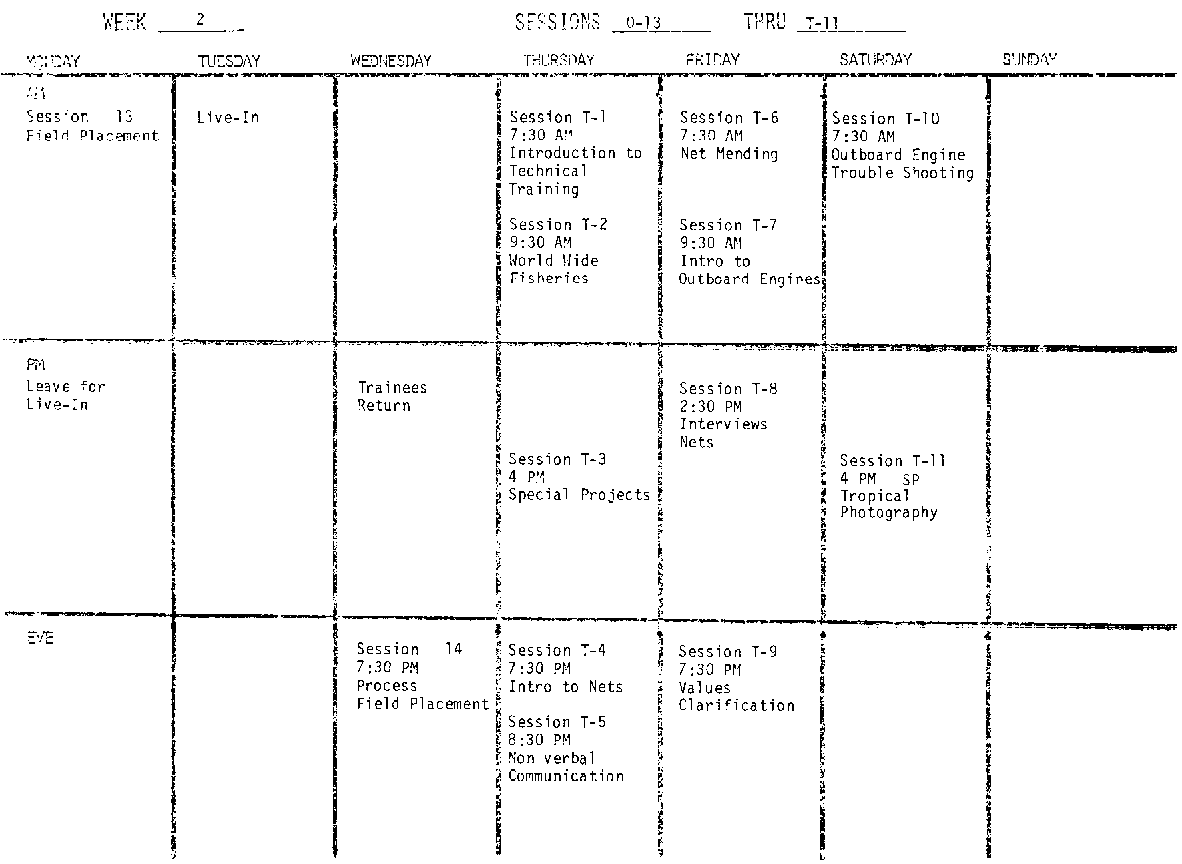
Week 2, Sessions 0-13 Thru
T-11
Session 13: Field placement
Time: 7:30 AM
Goals:
· For trainees to experience
living in a new culture, with a fishing family, in their community
· For trainees to collect data under the 14 social
sub-systems
· For trainees to identify areas
of technical competence they need to develop and skills they need to
acquire
overview :
For the next three days trainees will live with families of local small-scale fishermen. They will experience living in a different culture. Previous to trainees arrival these placements have been arranged. During the pilot program we found the only restriction was families' preferences according to the sex of the trainee. This was usually determined by the trainee having to share a room with children in the family. This was a very rewarding experience for the trainee. This field placement laid a solid foundation for later sessions where cultural differences, communication, community analysis and extension practices are introduced.
Materials:
· Flip chart paper,
markers
· Fourteen Social Sub-Systems on
newsprint or hand out
· Map of area
Procedures:
|
Time |
Activities |
|
10 Minutes |
1. Trainer gives the following assignments to the trainee to be carried out during their field placements; |
| |
a. Observe the fishing operations, ask questions, and determine what areas of expertise you will need to develop in order to be a successful marine fisheries extensionist. List technical skills you need to acquire in the next seven weeks to feel confident in your role as a Peace Corps Volunteer. |
|
30 Minutes |
b. Trainer now reveals the list of 14 social sub systems. Asks trainees to record as much data as they can without being over bearing or intrusive. Record all data in your journals; you will use data later in training program. |

Table
|
20 Minutes |
2. Trainees are now given the names and location of the families they will be staying with. They are given travel money and instructed to give money for live - in to family. Trainer explains that this is a very sensitive area, since families place high value on hospitality. Stress tact and diplomacy are to be used by trainees. A map of the area is posted and trainees are instructed to take public transportation to their sites. Trainees are told to return day after tomorrow in late afternoon. Next session is at 7:30 PM on that day. |
Trainer's Notes:
After individual interviews, you will have a good idea where trainees can best be placed. Families will have been notified of trainees' name.
Some trainees will not be comfortable taking public transportation and introducing themselves to strangers. It is important to be firm that everyone is to follow these instructions and that the families do expect them.
Session 14: Processing of field placement
Time: 7:30 PM
Goals:
· For trainees to share their experiences with each other
Overview:
During this session trainees share their experiences with each other. The data they have collected is not shared at this time, just their experience.
Materials:
· Flip chart paper, markers, tape
Procedures:
|
Time |
Activities |
|
30 Minutes |
1. Trainer welcomes trainees back. Makes a few remarks about how important the field placements will be to future training. Asks trainees to divide into small groups of three or four and list on newsprint common experiences they have had over the last three days. Be prepared to share these experiences with the rest of group. Each person should also be prepared to share with total group an experience they had that was unique. |
| |
2. Trainees now share their experiences. Trainers make appropriate remarks, and point out experiences that will he repeated in volunteer service. Each trainee tells his/her own unique experience. |
| |
3. Trainer wraps up evening by reminding trainees the importance of keeping their journals and does a general wrap up orientation and makes a few general remarks about the beginning of technical training in the morning. |
|
| ||||||||||||||||||||||||||||||||||||||||||||||||||||||||||||||||||||||||||||||||||||
Small-Scale Marine Fisheries - A Training Manual (Peace Corps, 1983, 631 p.)
Week 2: Training
Session T-1: Introduction to technical training
Time: 7:30 AM
Goals:
· Introduce goals of the
technical training program
· For trainees to
share their expectations of technical training
· Introduce schedule for technical training
· For participants to get acquainted on a professional
level
· To begin building a sharing
atmosphere
Overview:
In this first session of technical training the overall goals of the program are introduced. The program is described in some detail. Trainees share their expectations of technical training and trainers explain how expectations will be met by going over the schedule for the next seven weeks of training. Trainees have gotten to know each other on an interpersonal level during the orientation sessions, now they will work together using both interpersonal skills and technical skills. Through an exercise, trainees will reveal areas of technical expertise and start building an atmosphere of sharing and skill transference.
Exercises:
1. Introduction of Goals, Expectations and Schedule 2. Get acquainted professionally
Materials:
· Flip chart paper, markers,
tape
· Technical Training Schedule
EXERCISE 1 - Introduction of Goals, Expectations, and Schedules Time: 7:30 AM - 9:15 AM
Goals:
· Share goals of technical
training
· Share trainees
expectation
· Describe training
program
· Share schedule
Overview:
The goals are presented and posted on newsprint in the training room where they will remain throughout the duration of training. Expectations of technical training are discussed using the schedule to show trainees where they can expect to have their expectations met. During this session any expectations that are unrealistic are discussed, and explanations of why they can not be met are given.
Procedures:
|
Time |
Activities |
|
Introduction to technical training and training goals |
1. Trainer begins by describing the technical training program, using the following outline to make these points: |
|
15 Minutes |
a. be intense (little free time) |
| |
b. continue to build on cross-cultural skills |
| |
c. entails use of resource materials |
| |
d. teach technical skills |
| |
e. be experiential |
| |
f. highlight and improve interpersonal skills |
| |
2. Trainer lists goals for technical training program and briefly discusses each one. |
| |
o to enable trainees to recognize their skills and to feel competent in the use of those skills; |
| |
o to teach trainees how to transfer the technical skills they have to others; |
| |
o to identify and improve skill areas that need strengthening; |
| |
o for trainees to understand their role as Fisheries Extension Peace Corps Volunteers in the host country; o to help trainees identify and find resources avail able to them in their community sites and host country agencies; |
| |
o the illustration of competency in fisheries extension techniques, in fish processing, fish preservation, outboard/Diesel repair and maintenance fisheries economics and marketing, small-scale fishing and fishing vessels, and vessel repair and construction; |
| |
o the ability to analyze properly communities social systems, which should identify problems and help communities seek solutions; |
| |
o an understanding of the basic theories of fisheries extension work; |
|
|
o increased interpersonal, team building and communication skills; and, |
|
|
o a better understanding of global and country specific fisheries issues. |
| |
Trainer moves to next exercise after answering any questions trainees may have. |
|
Introduction5 Minutes Put items of List |
3. Divide into small groups. Explain the purpose of the exercise. Ask participants to write on news print the expectations they have for this training flip chart program. Encourage the groups to record as many items as possible in this short time. Expectations may include things they want: |
| |
o to know |
| |
o to have given to them |
| |
o to have happen/not happen |
| |
o the facilitator to do/be |
| |
o the other participants to do/be |
| |
o to be able to do |
| |
Encourage group to record as many items as possible Expectations in a short time. |
|
15 Minutes |
|
|
| |
|
Priority 10 Minutes |
4. Now ask each group to prioritize the top five expectations that they all share. |
| |
5. Ask groups to share their expectations with large group. |
Trainer's Notes:
Large schedule made by using six sheets of newsprint is made and posted in training classroom where it is intended that it remain during training program.
|
Reporting Expectations 20 Minutes |
Take a few minutes to review the list of expectations, and compare it to the training schedule now posted. | |
| |
Comment and eliminate those that the training program cannot hope to address. Those who are not part of the program may be met depending on ingenuity of the facilitator and technical expertise of the trainer. Do not leave group with a list of expectations the facilitators or the program cannot meet. | |
|
Discussion |
6. Trainer now produces on newsprint, the |
a. How did your group work together? |
|
20 Minutes |
following list of questions about group dynamics: |
b. Who took leadership? |
| | |
c. Did everyone participate? |
| | |
d. Did anyone check to see that everyone was included? |
| | |
e. Who recorded for the group; how was that decision made? |
| | |
f. Who talked a lot, who talked a little, quality? |
| | |
g. How did decisions get made (consensus, voting, railroading)? |
| |
|
h. Did anyone summarize for group? |
|
Wrap-up 10 Minutes |
Trainer asks for observations about what things were the most helpful in each group and records them on newsprint - Asks for things that perhaps weren't quite as helpful, and records them on newsprint. | |
| |
Trainer points out that a great deal of our work will be done in groups and that it is important for us to be aware of our own process, how we get work done and thus get the most out of the training program. Further, we will from time to time ask groups to look at their own process. | |
Trainer's Notes:
You will want to save the expectation list to go over at a later date. It is best to leave posted if possible.
1. Trainer now leads into next exercise.
EXERCISE 2 - Getting Acquainted Professionally
Time: 30 Minutes
Goals:
· To allow participants to get
acquainted
· To get people talking
· To begin building a sharing atmosphere
Overview:
This exercise gives participants an opportunity to get to know each other. Even though they have met in training before this activity allows them to see each other in a different way and to begin talking and interacting.
Procedures:
|
Time |
Activities | |
|
Introduction Set-up |
1. Introduce exercise by stating the purpose and asking participants to get an index card and pin. |
ON YOUR CARD WRITE OR PRINT ANY SPECIALIST CLASSIFICATION YOU MAY HAVE. NEXT LIST SPECIAL INTEREST YOU HAVE, i.e., PHOTOGRAPHY, MUSICAL |
|
10 Minutes 20 Minutes for mingling Time Check Summary |
2. After everyone has a card, show the following newsprint: |
INSTRUMENT, ART...AND FINALLY TWO HUMAN INTERACTION SKILLS THAT YOU HAVE i.e., GOOD LISTENER, ABLE TO MIX WELL IN NEW GROUP, |
| |
When you have completed your card please pin it on and start to mingle with other participants and discuss each others' card. Try and meet with as many people as possible. Trainers should join group as participants after you have set up the exercise and are sure people are mingling with each other. |
|
| |
Let the participants know when they have five minutes left so they can check to be sure that they have talked with as many people as possible. | |
|
6 Minutes |
3. Ask individuals to share some of the interesting"things" they have discovered about each other. |
|
|
5 Minutes Linkage |
4. Trainer now makes remarks about this session. Summarizes the interactions of the session and links to future sessions. | |
Trainer's Notes:
Listed below are five possible introduction exercises that can be used. You may prefer to use another exercise that will accomplish the same purpose.
1. Dyad-Quartet
Each person meets and gets to know the other; he/she in turn introduces his/her partner to another dyed.
2. Depth Unfolding Process Because it takes five minutes per person, this exercise should be done in small groups. The leader should disclose first to make trainees more comfortable.
In the first three minutes, tell what has brought you to this point in your life. Use one minute to describe your decision to join Peace Corps. Use the last minute to answer questions from others.
3. Structured Introductions
In dyads, small groups, or in large group, participants can tell why they joined Peace Corps, or write a letter to a friend about their decision.
4. Life Map
Each person draws on newsprint with crayons or magic marker a picture of their vision of their Peace Corps service, using stick figures and symbols.
5. Sentence Completion The trainer presents a series of unfinished sentences, asking each group member in turn to complete the statement.
Example:
· One of the things I anticipate
about my Peace Corps service is
· The thing I
will miss about
home
Session T-2: The oceans, rivers, streams of the world an overview of world wide fisheries
Time: 9:30 AM
Goals:
· To provide a global view of
Marine Fisheries today and in the future
· To
provide information on Peace Corps Marine Fisheries Goals
· To bring the individual volunteer's role into
perspective
· To have participants brainstorm
key problems and possible solutions concerning small scale fisheries in and
around their site
Overview:
This session is to bring into focus the global view of the worlds' fish supply. Are we depleting the fish of our oceans? Do we need controls world wide? These are two of the many questions that are addressed. Discussion then moves to Peace Corps goals in marine fisheries, and finally brings into perspective the role of the individual volunteer.
Exercises:
1. Participants brainstorm problems and solutions
2. Lecture
on global views, Peace Corps Goals, individual perspectives
Materials:
· Flip charts, markers, tape
EXERCISE 1 - Problems and Solutions in Marine Fisheries That Trainees May Encounter
Total Time: 45 Minutes
Overview:
The purpose of this exercise is to have trainees brainstorm and record problems and solutions in marine fisheries that they expect to encounter.
Procedures:
|
Time |
Activities |
|
45 Minutes |
1. Trainer asks for groups to form based on the countries they will be going to for service. Trainer then asks groups to brainstorm problems that they expect to encounter and list them on newsprint. After problems have been listed, list possible solutions. |
| |
2. Small country groups present their lists of problems and solutions to large group. |
| |
3. Trainer summarizes the activity and points out similarities and differences. |
EXERCISE 2 - Overview of Marine Fisheries From-A Global Prospective, The Peace Corps Goals, and The Individual Volunteer Role
Total Time: 1 Hour
Overview:
The purpose of this exercise is to give information on the world problems in marine fisheries, to state Peace Corps Goals and to give hope to the individual volunteer that they can play a part in changing the grim predictions for the world's fisheries.
Procedures:
|
Time |
Activities | |
|
45 Minutes |
1. Trainer (or, if possible, a visiting authority on Marine Fisheries)gives lecture on global picture. Lecture outline follows: GLOBAL PERSPECTIVE A. Commercial Ventures |
|
|
|
1. What impact they have on the small-scale fisherman | |
| |
2. What impact they have on the world fish population | |
| |
B. Small-Scale Fisheries | |
| |
1. Past |
a. Technical proficiency |
| |
2. Present |
b. Personal fulfillment |
| |
3. Future |
c. Community involvement |
| |
C. Peace Corps Goals |
|
|
|
1. Education of fisherman in: |
a. Preservation |
| |
|
b. Processing |
| |
|
c. Marketing |
| |
D. What can the individual do. | |
|
15 Minutes |
2. Trainers and/or speakers ask for questions from participants. Trainer summarizes - pointing out that volunteers are a part of a large picture and have a valuable job to do and that we are going to spend the next seven weeks getting ready to do that job. |
|
Session T-3: Special projects
Time: 4 PM
Goals:
· To introduce special projects. Explain in detail how they are to be done, and when. (Important for trainees to see how special projects are integrated into schedule of training.)
· Have trainees choose one project from special group projects to lead and take responsibility for
· Have trainees choose three individual special projects overview
The purpose of all special projects is to identify those participants with special skills and have them assume responsibility for transferring those skills during training program; and to give all participants special assignments which are problem solving exercises that they will have to complete during training. For trainees to use materials made available for their use in the resource library.
Materials:
· Newsprint with projects listed (trainer responsible for project and space for trainee to sign up.) Date that project is due is also listed
Trainer's Notes:
This session is confusing for trainees and has to be gone over several times. Should be checked again at beginning of next session.
SPECIAL PROJECTS AND SPECIAL GROUP PROJECTS
The following is a listing of the special projects and special group projects used in the pilot training program. Special projects are worked on individually; special group projects, although one trainee signs up as group leader, involve any number of trainees on a volunteer basis. Depending on the size of the group and the level of marine fisheries development in the countries of assignment, the technical trainer may wish to add to or delete from these lists. A trainer will act as advisor for each project.
In presenting the lists (with the sign-up sheet, the due date, and the trainer advisor), it is important that a brief description of the project and requirements be given. Special group projects, unless otherwise noted, each require a write-up of the project for the Trainees' Resource cook (described below) including necessary charts, diagrams, and references. Special project write-ups fall under three headings:
· List A - projects which will
require written reports along with essential diagrams, charts, and
reference;
· List B - projects which will
require diagrams with "how-to" steps, essential charts and references;
and,
· List C - projects which will require
only a list of references.
Because project write-ups most likely will not be typed, they must be concise and clearly written in black ink in order to provide a good photocopy for the Trainees' Resource Book.
Suggested Special Projects
List A:
1. Poisonous/toxic fish (see Session T-51)
2. Corrosion
control (see Session T-54)
3. Color depth charts (see Session T-69)
4.
Tropical seabirds (see Session T-50)
5. Weather for the Mariner (see Session
T-36)
6. Fish aggregating devices (see Session T-72)
List B:
1. Artificial reefs/Tire breakwaters (see Session T-94)
2.
Outboard/Diesel repair facilities (see Session T-22)
3. Water heater (see
Session T-102)
4. Water filtration systems (see Session T-34)
5. Gyotaku
(see Session T-87)
6. Filleting (see Session T-30)
7. Metric systems (see
Session T-59)
8. Anatomy of hooks (see Session T-22)
9. Anchoring
techniques (see Session T-73)
10. Fish silage (see Session Tell)
List C:
1. Tropical Photography (see Session T-11)
2. Library (see
page 7)
3. Aquaculture (see Session T-107)
4. Efficient charcoal making
(see Session T-58)
5. Blueprint reading (see Session T-68)
6. Seaweed
farming (see Session T-65)
7. Cookbook for Third World fisheries (see Session
T-28)
8. Constructing a scarf joint (see Session T-76)
9. Fiberglassing
techniques (see Session T-79)
10. Star charting (see Session T-45)
11.
Transportation Systems (see Session T-90)
12. Trainees' Resource Book (see
below)
Special Group Projects
1. Gardening, Composting and Small Animal Raising (see Session
T-16)
2. Communication through Illustration/Lesson Plans/Audiovisual Aids
(see Session T-52)
3. Diesel and Outboard maintenance Schedules, fuels, and
costs (see Session T-19)
4. Alternative Energy (see Session T-101)
5.
Nutrition/fish culinary skills (see Session T-66)
6. Salt making (see Session
T-49)
7. Ice box construction (see Session T-39)
8. Sailing (see Session
T-84)
9. Trolling for Spanish Mackeral (see Session T-22)
10. Fish
cooperatives (see Session T-91)
11. Solar fish dryer (see Session
T-56)
12. Smoker: wood and tin (see Session T-57)
13. Fund raising (see
Session T-88)
14. Fish issues (see Session T-98)
15. Ecology/conservation
issues (see Session T-99)
16. Marketing survey of local fish products (see
Session T-81)
17. Language (see Session T-3) Trainees' Resource Book
The Trainees' Resource Book is a compilation of the special project and special group project write-ups. Not only does it afford trainees the opportunity to practice putting their knowledge and experience into writing in an easy-to-follow, how-to format; it also provides them with a valuable reference in the field.
The trainee who chooses the Trainees' Resource Book as a special project will be responsible for the following:
· presenting the write-up
formats for each list to the trainees;
·
setting deadlines for write-up completions,
·
Manual cover design;
· Table of Contents;
and,
· photocopying.
SPECIAL GROUP PROJECTS AND INDIVIDUAL SPECIAL PROJECTS LISTED BY TOPIC AREAS
|
DIESEL/OB |
NAVIGATION/SEAMANSHIP |
|
Diesel and O/B Costs |
Sailing |
|
Corrosion Control |
Tropical Seabirds |
|
O/B Diesel Repair Facilities |
Weather for the Mariner |
|
Fuels |
Anchoring Techniques |
Star Charting
FISH PRESERVATION-PROCESSING
| |
BOATBUILDING, MAINTENANCE, CONSTRUCTION |
|
Salt Making Ice Box |
Metric Systems |
|
Solar Fish Dryer |
Blue Prints |
|
Smoker |
Construction of a Scarf Joint |
|
Filleting |
Fiberglassing Techniques |
|
Water Heater |
|
|
Water Filtration System |
OTHER PROJECTS |
|
EXPLORATORY FISHING |
Library Trainees' Manual |
|
Color Depth Chart |
Aquaculture |
|
Poisonous/Toxic Fish |
Efficient Charcoal making |
|
Fish Aggregating Devices |
Seaweed Farming |
|
Artificial Reef/Tire Break Waters |
Alternating Energy |
|
Physiology of Hooks |
Language Lessons |
|
Trolling for Spanish Mackeral | |
FISH ECONOMICS-MARKETING
Fish Cooperatives
Marketing Survey
Fund Raising
Gyotaku
EXTENSION
Tropical Photography
Communication Thru Illustration
Audio
Visual/Lesson Plans
Fish Issues
Ecology & Conservation
NUTRITION
Nutrition and Fish Cooking
Gardening and Small Animal
Raising
Cookbook for Third World Fisheries
Special Group Project: Languages
Time: 15 Minutes
Goals:
· To expose trainees to language
training
· To acquaint trainees with the
languages in their countries of assignment
·
To show trainees that language learning can be fun and rewarding
· For trainee assigned the special group project to
build on leadership, communication and technology transfer skills
Overview:
Many people experience anxieties around learning a new language. The few minutes spent each morning during technical training learning a few new words or phrases in French, Spanish or Swahili will insure a smooth transition to in-country language training on the part of the trainee. The daily language lessons should be no more than 10 or 15 minutes, and the content should be limited to the very basics, i.e., days of the week, numbers, colors, market items, how to ask directions, how to order in a restaurant, vocabulary for fishing gear, etc. In other words, building vocabulary is emphasized more than grammar.
Activities:
1. Trainee assigned the special group project organizes daily language lessons, alternating among the languages of the countries of assignment.
Trainer's Notes
In the pilot program held in Puerto Real, Puerto Rico, the daily language lesson was Spanish - even though none of the trainees were going to Spanish-speaking countries. It was the feeling of the training staff during the pilot program, that the importance of learning the local language - regardless of the length of time one spends in a place - needs to be emphasized and reinforced throughout the training. Trainees in the pilot program were very positive about the Spanish lessons, and were pleased with their progress over the eight weeks of training, progress which was evident to them in their day-to-day interactions with people in Puerto Real.
Resources:
· Peace Corps Language Books
APPENDIX 7
|
Glossary of fishing gear terms |
Glossaire de termes d'engins de p�che |
Glosario de t�rminos de aparejos de pesca |
|
A. aimed trawling |
chalutage contr�l� |
arrastre dirigido |
|
anchor seining (Danish seining) |
p�che � /a senne danoise au mouillage |
pesca con red de cerco danesa |
|
angle of attack |
angle d attaque |
�ngulo de ataque |
|
(of trawl board) |
(de panneau de chalut) |
(de puertas de arte de arrastre) |
|
B. backstrop (de panneau de chalut) |
patte (de las puertas) |
pate de gallo |
|
bag, bunt |
poche, sac |
copo del arte |
|
bagnet |
filet trappe |
red de copo |
|
balt |
app�t |
cebo |
|
battings (2) petit dos |
(1) diminutions (2) casarete, cazarete |
(1) reducci�n de mallas |
|
ballast |
lest |
lastre |
|
bar |
paste |
media malla |
|
(of mesh) |
(c�t� de la maille) |
(lado del cuadrado) |
|
basket |
pander |
cesto |
|
(of longline) |
(de palangre) |
(de palangre) |
|
beach seine |
senne de plage |
arte de playa, atarraya |
|
beamtrawl |
chalut � perche |
arte de arrastre de vara, vara da barra |
|
becket |
erse |
gaze |
|
belly |
ventre |
vientre |
|
(of trawinet) |
(de chalut) |
(de arte de arrastre) |
|
bellyline |
barrette do ventre |
estrobo |
|
boat seine |
senne de bateau |
red de cerco |
|
bobbin |
diabolos, sph�res |
boles. di�bolos |
|
(of groundrope) |
(de bourrelet) |
(de relinga inferior o de promos) |
|
bolchline |
fili�ra |
cabo de entrallar |
|
bonding |
fixation |
fijaci�n |
|
bosom |
carr� |
burl�n |
|
(of trawinet) |
(de chalut) |
(de arte de arrastre) |
|
bottom-act |
cal� sur le fond |
calado en el fondo |
|
bottom trawl |
chalut de fond |
arte de arrastre en el fondo |
|
bracket |
branchon |
brazo |
|
(of trawl board) |
(de panneau de chalut) |
(de puerta de arte de arrastre) |
|
braided |
tress� |
trenzado |
|
(netting Yarn) |
(fil pour filet) |
(hilo pare red) |
|
braiding |
la�age |
trenzado |
|
(of netting) |
(de filet) |
(de la red) |
|
brailer |
salabarde |
salabardo |
|
branchline |
avan�on |
brazolada |
|
breaking load |
r�sistance A la rupture |
resistencia a la rotura |
|
bull trawl |
chalut-boeuf |
baca |
|
bunt |
poche |
copo |
|
(of purse seine) |
(de senne coulissante) |
(de arte de cerco de jareta) |
|
buoyancy |
flottabilit� |
flotabilidad |
|
buoylight |
leucalenal de bou�e |
boya luminosa |
|
butterfly |
guindineau triangle |
cal�n |
|
(of trawl) |
(de chalut) |
(de red de arrastre) |
|
C chafer |
tablier |
refuerzo |
|
(for codend) |
(pour cul de chalut) |
(del copo) |
|
codend |
cul |
saco copo |
|
(of trawlnet) |
(de chalut) |
(de arte de arrastre) |
|
codline |
raban da cul |
estrobillo |
|
(of trawinet) |
(da chalut) |
(de arte de arrastre) |
|
coil |
gl�ne |
rollo |
|
(of rope) |
(de filin) |
(de cabo) |
|
coir |
coco |
bonote |
|
combination rope |
filin mixte |
malleta alambrada |
|
crowfoot |
patte d'oie |
pate de gallo |
|
cutting rata |
processus do coupo |
indice de reducci�n |
|
(of netting) |
(do filet) |
(de pa�os de red) |
|
D. Danish seine |
senna danoise |
red danesa |
|
danleno |
guindineau |
cal�n |
|
depressor |
plongeur |
depresor |
|
dipnet |
filet soulev� |
salabardo |
|
disc roller |
diabolo plat |
di�bolo, rodillo |
|
(for groundrope) |
(pour bourrelet) |
(de relinga da promos) |
|
double knot |
double noeud |
nudo doble |
|
double rig |
gr�ement double |
aparejo doble |
|
(trawling) |
(chalutage) |
(arrastre) |
|
dredge |
drague |
draga, rastra |
|
driftnet |
filet d�rivant |
arte de derive |
|
E elasticity |
�lasticit� |
elasticidad |
|
(of netting yarn) |
(do fil pour filet) |
(del hilo para red) |
|
elongation |
silongement |
estiramiento |
|
(of netting yarn) |
(de fil pour filet) |
(del hilo para red) |
|
end bracket |
gousset d'extr�mit� |
pie de gallo |
|
eye splice |
oeil �pis� |
gaze |
|
F. fishing lamp |
lampe da p�che |
l�mpara de pesca |
|
fish pump |
pompe � poisson |
bomba para peces |
|
flapper |
voile tambour |
trampa |
|
((of trawlnet) |
(de chalut) |
(de la red de arrastre) |
|
fleet (of nets) |
t�sure (de redes) |
andana |
|
float |
flotteur |
flotador |
|
floatline |
ralingue do flotteurs |
relinga alta, de corchos |
|
fly-draggTng |
dragaga � la vol�e |
pescar en marcha |
|
(Danish saining) |
(p�che � la senne danoise) |
(con red danesa) |
|
flying mesh or flymesh |
maille folle |
malla libre |
|
foam plastic |
mousse do plastique |
pl�stico poroso |
|
footrope |
bourrelet ralingue inf�rieure |
relinga de promos, burl�n |
|
front weight |
poids ant�rieur |
peso anterior |
|
full mesh |
maille franche |
malla entera |
|
(in cutting of netting) |
(on coupe de filet) |
(en la reducci�n de la red) |
|
funnel |
entonnoir |
embudo |
|
G. gear (for fishing) |
engin (pour la p�che) |
equipo, material de pesca |
|
G-(hook) |
croc en G |
gancho en G |
|
gillnet |
filet maillant |
red de enmalle |
|
grassrope |
bourrelet de coco |
relinga de bonote |
|
(of trawl) |
(de chalut) |
(de arte de arrastre) |
|
groundrope |
bourrelet |
telinga de promos |
|
H. halving back, see splitting strop | |
|
|
handline |
ligna � main |
aparejo, llnea de mano |
|
hanging |
montage armement |
armar un arte |
|
(of netting) |
(d'un filet) |
|
|
hanging ratio |
taux d'armement |
coeficiente de armadura |
|
headline |
corde da dos |
relinga de corchos |
|
heaving bag |
double poche ext�rioure |
saco de izar |
|
high opening trawl vertical |
chalut � grando ouverture verticale |
arte de arrastre de mucha abertura |
|
hook |
hame�on |
anzuelo |
|
hook shaft |
tige do l'hame�on hampe |
brazo del anzuelo |
|
hook tip |
pointe do l'hame�on ardillon |
punta del gancho, muerte |
|
hoop |
cerceau |
cercar, rodear, cerco |
|
hydrofoil |
hydrodynamique |
hidrodin�mica |
|
(trawl board) |
(panneau do chalut) |
(puerta de arte de arrastre) |
|
I. Inflatable float |
flotteur gonflable |
flotador |
|
J. jig |
faux |
muestra |
|
joining |
abouture, collage |
uni�n |
|
(of net sections) |
(do pi�ces de filet) |
(de pa�os de red) |
|
K. kelly a eye |
huit |
ocho |
|
kite |
plateau �l�vateur |
elevador |
|
knot |
noeud |
nudo |
|
knotless netting, Raschel |
filet sans noeuds, Raschel |
red sin nudos, Raschel |
|
knotless netting, twisted |
filet sans noeuds, retordu |
red sin nudos, colchada |
|
l. lacing |
transfilage |
pasar una randa, ligadura,. atadura |
|
lampara net |
filet lamparo |
mamparra |
|
lastridge |
couture |
relinga de contorno |
|
(of trawlnet) |
(de chalut) |
|
|
by |
commottega |
colchado |
|
(of rope, etc.,) |
(d'un filin etc) |
(de un cabo, etc.) |
|
lazyline |
baillon hala-�-botd |
vira-vira |
|
leadline |
ralingue plomb�e |
relinga de promos |
|
leg (of trawl) |
patte (de chalut) |
pernada |
|
lengthening piece (of trawlnet) |
rallonge (de chalut) |
antecopo |
|
liftnet |
carrelet |
balanza, medio mundo |
|
light fishing |
p�che � la lumi�re |
pesca con luz |
|
line |
ligne |
linea |
|
links |
maillons |
eslabones |
|
(of chain) |
(do chaine) |
(de cadena) |
|
live bait |
app�t vivant |
cebo vivo |
|
longline |
palangre, cordo |
palangre |
|
longliner |
palangrier, cordier |
buque palangrero |
|
lure |
leurre |
a�agaza |
|
M. mainline (of longline) |
ligne principale (de palangre) |
linea. linea madre |
|
mesh |
maille |
malla |
|
meshsize |
longueur de la maille |
luz de la malla |
|
(stretched) |
(�tir�e) |
(estirada) |
|
midwater trawl |
chalut p�legique |
aite de arrastre pelagico |
|
monofilament |
monofilament |
monofilamento |
|
mudrope (of trawl) |
bourrelet pour fond do vase (de chalut) |
relinga de promos pare fondos sucios |
|
multifilament |
multifilarnont |
multifilamento |
|
N. net |
filet |
red |
|
netting |
nappe de filet, al�ze |
pa�o de red |
|
netting Yarn |
fil pour filet |
hilo pare redes |
|
O. opening type (puree ring) otter board. See trawl board |
anneau do coulisse du type ouvrant |
anillas que se pueden abrir |
|
otter trawl |
chalut � panneaux |
arte de arrastre de puertas |
|
outrigger |
tangon |
tang�n, botal�n |
|
overhand knot |
noeud simple |
nudo llano |
|
P. pair trawl |
chalut-boeuf |
arrastre de pareja |
|
panel (of net) |
face (de filet) |
pa�o |
|
patent link pelagic trawl, see midwater trawl |
maillon brevet� |
eslab�n de patente |
|
pennant |
rapporteur |
amante |
|
plaited |
trass� |
trenzado |
|
(netting yore) |
(fil pour filet) |
(hilo para redes) |
|
point |
maille de c�t� |
malla lateral |
|
(in cutting of netting) poke, pork line, see lazyline |
(en coupe do filet) |
(corte da pa�os) |
|
pole and line (tuna fishing) |
canne (p�che du thon) |
pesca con ca�a |
|
pony board |
poney |
puerta secundaria |
|
pot |
nasse, casier |
nasa |
|
pot warp |
orin do castor |
cabo de nasa |
|
pound not |
filet pi�ge |
almadraba. trampa |
|
preservation (of yarns, etc.) |
conservation (des fils, etc.) |
conservaci�n |
|
pureed lampara net |
filet lampara coulissant |
mampara de cerco |
|
puree line |
coulisse |
jareta |
|
puree ring |
anneau do coulisse |
anilla |
|
purse ring bridle |
pantoire d'anneau de coulisse |
cabo de anillas, rabiza de anilla |
|
purse seine |
senne coulissante, bolinche |
red de cerco de jareta |
|
purse seiner |
senneur |
embarcaci�n que pesca al cerco. cerquera |
|
Q. quarter points (au coin do carr�) |
triangle d'aile |
secciones del burl�n |
|
quarter rope R. Raschel, see knotless netting |
parpaillot, biribi |
vira-vira |
|
recessed link |
maille � m�plats |
eslab�n ranurado |
|
reef knot |
noeud plat |
nudo llano |
|
rig |
gr�ement |
armar |
|
(of gear) |
(d'engin) |
(el arte) |
|
ringnet |
filet tournant |
red de cerco |
|
rollor |
diabolo |
di�bolo, rodillo |
|
(for groundrope) |
(pour bourrelet) |
(pare relinga da promos) |
|
rope |
filin, cordage |
cabo |
|
runnage |
longueur par unit� de poids |
longitud por unidad da peso |
|
S. scoop net |
�puisette, haveneau |
salabardo |
|
seam |
couture |
costure |
|
(of net) |
(de filet) |
(de red) |
|
seine |
senna |
red de cerco |
|
selner |
sonneur |
cerquero |
|
selvedge |
bordure renforc�e |
enchace, borde, costura |
|
semi-pelagic trawl |
chalut semi-p�lagique |
arte de arrastre semipel�gico |
|
et gillnet |
filet maillant cal� |
red de enmalle fija |
|
setnet |
filet cal� |
red fija |
|
hackle |
manille |
grillete |
|
shear-chain |
chaine d'�cartement |
cadena de refuerzo |
|
sheet bend, or weaver knot |
noeud d'�coute ou de tisserand |
vuelta de escota, nudo de tejedor |
|
shoe plate |
�lement de semelle |
zapata |
|
(of trawl board) |
(de panneau de chalut) |
(de puerta de arrastre) |
|
shrimp trawl |
chalut � crevette |
arte camaronero |
|
shrimp trawler |
crevettier |
camaronero (embarcaci�n) |
|
shrinkage |
retrait au mouillage |
contracci�n |
|
(of yarn, etc.) |
(de fil, etc.) |
|
|
sideseam |
couture lat�rale |
costura lateral |
|
side trawler |
chalutier lat�ral |
arrastrero por el costado |
|
sinker |
lest |
promos |
|
snood |
empire |
tanza |
|
spacer diac |
interm�diare |
espaciador |
|
(for groundrope) |
(de bourrelet) |
(de relinga de promos) |
|
splitting strop |
erse de cul |
estrobillo |
|
square (of trawinet) |
grand dos (de chalut) |
cielo del arte, visera |
|
stake |
pieu |
estaca, posse. pilote |
|
stakenet |
haut-parc et bas-parc |
arte de estacada |
|
staple fibre |
fibre, discontinue, schappe |
fibra corta |
|
sterntrawler |
chalutier arri�re |
arrastrero por pope |
|
stick-held dipnet |
filet soulev� soutenu par un b�ton |
salabardo con mango |
|
stow net |
diable, chalut � l'�talage |
bitur�n |
|
strand |
toron |
cabo trenzado, rebenque |
|
(of yarns) |
(de fil) | |
|
strengthening rope |
filin do renfort, ralingue |
cabo da refuerzo, relinga |
|
Strip |
bande |
pa�o |
|
(of netting) |
(de filet) ou nappe |
(piezas de redes) |
|
strop |
erse |
estrobo |
|
sunk driftnet |
filet d�rivant on profondeur |
red de derive en profundidiad |
|
surrounding net |
filet encerclant |
red de cerco |
|
sweepline, sweep |
bras |
malleta |
|
swivel |
�merillon |
grillete giratorio |
|
T. take-up |
recrue |
reducci�n |
|
(of meshes) |
(de mailles) |
(de malias) |
|
tanglenet |
folle, filet emm�lant |
red de enmalle |
|
tapering |
diminution |
reducci�n |
|
taper ratio |
rapport de diminution |
Indice de reducci�n |
|
throat |
gorges, tambour |
garganta |
|
(of fyke net) |
(de verveux) |
(bitur�n con alas) |
|
tickler chain |
chaine gratteuse |
cadena pare levantar camar�n |
|
trammelnet |
tr�mail |
trasmallo |
|
trapnet |
filet pi�ge |
nasa, trampa |
|
trawl board |
panneau de chalut |
puerta del arte |
|
trawler |
chalutier |
arrastreto |
|
trawl gear |
engin de chalutage |
arte de arrastre |
|
trawlnet |
chalut |
red de arrastre |
|
troller |
bateau de p�che � la traine |
curricanero |
|
trolling |
p�che � la traine |
pesca a la cacea |
|
trynet |
chalut d'essai |
red de ensayo |
|
(for shrimp trawling) |
(pour chalutago � la crevette) |
(pare pescar camar�n al arrastre) |
|
twins |
fil, fil retors |
hilo |
|
twist factor |
coefficient do torsion |
coeficiente de torsi�n |
|
(of yarn) |
(de fil) |
(del hilo) |
|
V, vinge trawl, see wing trawl | | |
|
W. warp |
fune |
cable de arrastre |
|
(for trawl) |
(de chalut) |
|
|
weaver knot |
noeud de tisserand |
nudo de tejedor |
|
(or sheet bend) |
(ou noeud d'�coute) |
(vuelta de escota) |
|
webbing, see netting |
| |
|
wing |
aile |
alsa, bandas, pernadas |
|
(of trawinet) |
(de chalut) |
|
|
wingtip |
pointe d'aile |
extremo del ala |
|
wing trawl |
chalut � grande ouverture verticale |
arte de mucha abertura vertical |
|
wire rope |
filin d'acier |
cable, cable de acero |
|
Y. yarn, see netting yarn | | |
|
Z. zipper line jareta |
ligne de transfilage |
matafi�n, cabos pare dividir 105 cerc |
|
zipper ring carco de jareta |
anneau pour transfilage |
anillas de los cabos de divisi�n de |
Session T-4: Introduction to nets
Time: 7:30 PM
Goals:
· For trainees to acquire basic information about nets and their usage by small scale-fishermen
Overview:
In this session trainees will be introduced to a variety of fish nets, tools, floats, etc. They will have several types described and they will try to ascertain their use.
Materials and Equipment:
· Flip chart, pens, nets, lines, floats, net needles and twine
Trainer's Notes:
We borrowed nets from local fishermen and had trainees handle nets, floats, etc.
Procedures:
|
Time |
Activities |
| |
1. Technical trainer has trainees pick up net. Has them straighten net out. Trainer asks how they invision net being used. |
Trainer's Note
If possible, borrow a Gill Net for this exercise.
| |
2. Technical trainer now draws a rough sketch of a Trammel Net and has trainees once again tell how they think this net is used. Trainer repeats this process with drawings of the following: | |
| | |
- Drift Gill Net |
| |
|
- Common Haul Seine |
| |
|
- Long Haul Seine |
| |
|
- Long Seine |
| |
|
- Short Seine |
| |
|
- Otter Trowl |
| |
|
- Cast Net |
Trainer's Note:
You will want to describe several types of nets, especially those that you know trainees will be using or will see being used.
3. Trainer concludes the session by saying that nets and net mending are an intrinsic part of small scale fishermen life. They not only provide a means of catching fish, but also play an important part in the social life of the fishing community. As volunteers, you will be prepared to mend nets and be good at mending nets. Over the next several weeks you will have lots of practice time.
Session T-5: Non-verbal communication
Time: 8:30 PM
Goals:
· To identify ways we
communicate verbally and non-verbally
· To
identify patterns of non-verbal communication
· To look at perceptions one has about one's non-verbal
message
· To identify some implications of
non-verbal communication for cross cultural effectiveness
· To develop non-verbal communication skills
Overview:
This session explores communication as a process. Trainees will have received some non-verbal communications training previously. This session will reinforce those learnings and concentrate on building nonverbal skills.
Exercises:
1. "Messages" and lecture
2. Reflections on non-verbal communications and observations of another.
EXERCISE 1 - Messages Total Time: 30 Minutes
Overview:
We communicate our likes and dislikes; actually, we communicate more non-verbally about relationships than we do in any other way. In this exercise we are going to communicate non-verbally only.
Procedures:
|
Time |
Activities | |
|
5 Minutes |
1. Trainer announces that "we are going to try a game, the meaning of which we will discover later, trust me." The game is structured rather like charades except that one may not use charade-like signals (such as spelling with the fingers or using word conventions). Even if you have played this game before, it is fun to see if you are becoming skillful at it. |
|
|
10 Minutes |
2. In pairs, give each person a message on a piece of paper (see list below); then tell the group that they have three minutes to try to get the message across without using words. They cannot write, spell or talk. Trainer keeps track of time. After first three minutes, switch so that the other person can try it out also. A sample list of messages follows (you may add your own but the message should include either an emotion or communicate something about a relationship, as well as try to give a message about a thing). | |
| |
Messages (have them written out on slips of paper): |
a. "I'm angry because the goats ate my garden." |
| | |
b. "I'm happy because your crew arrived to work today." |
| | |
c. "I'm frustrated because you never listen to me." |
| | |
d. "You can't understand me, and this frightens me." |
| | |
e. "I'm surprised at your youthful appearance." |
| | |
f. "I like you and want to be your friend." |
| | |
g. "I'm weak (and submissive)and you are strong(and dominant)." |
|
5 Minutes |
3. After the non-verbal experience, gather group reactions: |
o What was that like for you? |
| | |
o What was easy about it (i.e., what part of the message could you get)? |
|
| |
o What was difficult (i.e., what part of the message couldn't you get)? |
|
10 Minutes |
4. Build a lecture out of group experience: |
o How many of you know about non-verbal communication? |
| | |
o What is it? Give some examples. |
| | |
o What does non-verbal communication communicate? |
| | |
o How aware are you of your own non-verbal message? |
| |
As trainees answer these questions, write down the answers on a flip chart and examine them with the group. At the end, the group and the trainer should arrive at a working definition of non-verbal communication which they can test out during the next week with each other. | |
EXERCISE 2 - Reflections on Non-Verbal Communications and Observations Of Another
Total Time: 30 Minutes
Overview:
The purpose of this exercise is to give individuals time to think about how they communicate non-verbally. They can then decide if there is perhaps some new or different non-verbal behavior they would like to try out during training.
Procedures:
|
Time |
Activities | |
|
15 Minutes |
1. Trainer lists on newsprint the following: |
o Body Bearing |
| |
|
o Appearance |
| |
|
o Tone of Voice |
| |
|
o Use of Space |
| |
|
o Content of Language |
| | |
o Gestures |
| | |
o Ornaments |
| |
|
o Touching |
| | |
o Facial Expressions |
| |
|
o Smells |
| | |
o Colors |
| | |
o Signs |
| | |
o Grooming |
| | |
o Manners |
| | |
o Eye Contact |
| |
|
o Clothing |
| | |
o Actions |
| | |
o Sounds |
| | |
o Others |
| |
Asks participants to take a few minutes to write down how and what they think they communicate non-verbally in each one of these categories. | |
|
5 Minutes |
2. Ask participants to look over responses to the non verbal categories. Determine if there is some area of non-verbal communication they want to strengthen or perhaps change. | |
|
5 Minutes |
3. Ask participants to choose partners which will be for the purpose of "observing each other" for a one week period in order to learn more about non-verbal communication and the way we are perceived by another. The task is to "watch each other" during the week whenever possible, and to notice how the other person uses non-verbal communication. At this point, they may want to share with each other their responses to the non-verbal categories-to check-out their perceptions of how and what they communicate non-verbally. | |
|
5 Minutes |
4. Trainer says that at the end of the week, the same pairs will meet to both provide each other feedback on how they communicated non-verbally and to draw some generalizations from the experience about how people from our culture communicate non-verbally. Also, participants will be able to check their own non-verbal images with their partners. | |
Session T-6: Introduction to net construction and repair
Time: 7:30 AM
Goals:
· To have trainees learn basic net mending techniques focusing primarily on the Becket Bend as well as the nomenclature of nets
Overview:
In this session trainees learn how to construct and/or repair a net using the Becket Bend.
Materials and Equipment:
· Sections of netting, net needles (various sizes, types) net twine, hand-out on Becket Bend
Trainer's Notes:
Practice is necessary for net mending proficiency. We had trainees practice out of doors in view of local fishermen. Local fishermen took great interest, helped trainees by showing them how they tie knots, etc, and reinforced net mending as a social event as much as a practical skill.
Procedures:
|
Time |
Activities |
|
30 Minutes |
1. Technical trainer passes out instructions for Becket Bend. Next passes out net which has been cut so that it can be repaired. Trainees are given net needles and twine. Technical trainer shows each one how to mend using Becket Bend. |
|
1 Hour |
2. Trainees spend the remainder of session mending net. Technical trainer remains at scene but does not offer help unless asked. At the end of first hour, inspects trainees work and makes appropriate comments. 3. Trainees continue net mending. At end of the hour the technical trainer goes over highlights of the net session from the night before and links to future net mending sessions. |
Instruction card

Step 1
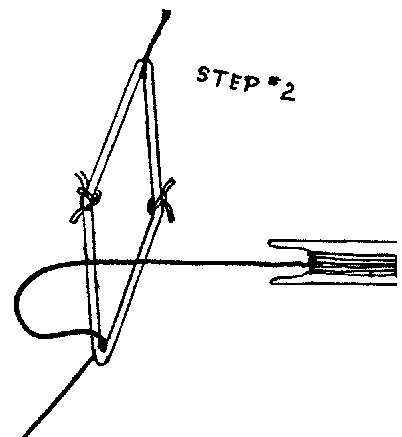
Step 2
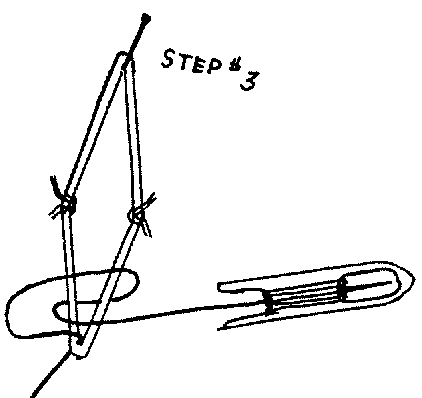
Step 3
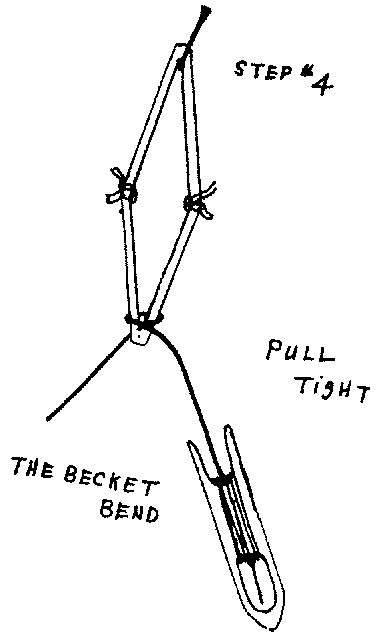
Step
4
Session T-7: Introduction to outboard engines
Time : 9:30 AM
Goals:
· To introduce very basic
internal design and operating procedures for the two-cycle low horsepower
outboard
· To have trainees be able to speak
of/about outboard in proper terminology
Overview:
In this session trainees are introduced to the outboard engine. For some this will be a refresher; for others, the workings of an engine will be brand new. The technical trainer will use an outboard motor to demonstrate the functions. As the technical trainer talks about how engine operates and various parts, used parts will be passed among trainees for them to see and handle.
Materials:
· Outboard engine, engine parts, schematic of O.B. engine
Procedures:
|
Time |
Activities | |
| |
1. Technical trainer introduces outboard engine. Points out: |
o power head |
| |
|
o water check |
| |
|
o pump vent |
| |
|
o exhaust column |
| |
|
o water pump |
| |
|
o cavitation plate |
| |
|
o lower unit |
| |
|
o carburetor |
| |
|
o spark plugs |
| |
|
o power pack (if appropriate) |
As technical trainer points these parts out, used parts are passed around for trainees to handle. Trainer explains each function.
2. Trainer covers outboard engine and asks each trainee to draw an outline of the O.B. (basic schematic) and try to identify as many parts as they can and where they belong in the engine.
3. Technical trainer now shows trainees a schematic which has been drawn earlier with all parts labeled.
4. Technical trainer explains the importance of knowing the right names for parts and their functions.
5. Technical trainer links to next O.B. engine session which will be about maintenance and its importance.
Trainer's Notes
Parts to be handed out should cover as wide a range as possible: old blocks, pistons, gears, carburetors, etc. If possible contrast an old part and a newer one pointing out signs of wear, neglect or poor maintenance.
Outboard motor maintenance tips
by Peter L. Hendricks
Hawaii County Agent
University of
Hawaii
Sea Grant College Program
Adapted, by permission, from Basic Outboard Motor Maintenance, published by the University of Hawaii Sea Grant College Program, August 1977 (UNIHISEAGRANT-AB-77-03).

Figure 1. - Cutaway drawing of
typical internal combustion, reciprocating outboard engine (Otto Cycle).
Oregon State University Extension Marine Advisory Program
A
Land Grant / Sea Grant Cooperative
SG 43 September 1978
Another title in the series
Marine recreation outboard engines
Most outboards, given proper care, require little service other than periodic maintenance and adjustment. The individual engine owner can handle most of the periodic maintenance. This bulletin was written to aid the individual in basic outboard maintenance skills. Most of the procedures are possible without special tools. If you are in doubt about your motor's service, consult a dealer or, in minor cases, the factory authorized owner's manual for your particular engine.
Power source
The power source for all outboard motors is the internal combustion, reciprocating engine (see figure 1). The basic difference in these power sources is the way in which the fuel mixture is ignited. Most outboards have their fuel ignited by an electric spark (Otto Cycle Engine), as opposed to heat of compression ignition (Diesel Cycle). In most outboards, one complete crankshaft revolution completes the series of events necessary to make the engine run. This is called a two-stroke cycle.
In a two-stroke cycle engine, five events must take place in two strokes of the piston, or in one revolution of the crankshaft. They are: (1) intake (fuel and air), (2) compression, (3) ignition, (4) power, and (5) exhaust. A compressed fuel charge is fired each time the piston reaches the top of the cylinder, and each downward stroke is a power stroke.
In order to accomplish this, the initial pressure of the incoming fuel-air mixture must be raised to a point somewhat higher than the lowest pressure existing in the cylinder; otherwise, a fresh charge of fuel could not be admitted and the engine would not run. This elevation of pressure requires the use of an air pump, or compressor, of approximately the same volume as the cylinder itself.
Coincidentally, such an air pump is available with a minimum of additional parts, cost, or frictional losses by utilizing the opposite side of the piston and cylinder as the pump. Such engines, called crankcase-scavenged, are almost universally used in the outboard motor industry.
In the crankcase-scavenged engine, most of the frictional parts requiring lubrication are located in the fuel intake system. Lubrication is accomplished by mixing the required amount of oil with the fuel, so that a small amount of oil, in the form of a fine mist, is drawn into the crankcase with each fuel charge.
It should be pointed out that the new oil brought into the crankcase can do little more than supplement the losses; therefore, it is necessary that the frictional parts be well lubricated at the time the engine is started. The use of too much oil in the fuel mixture results in spark plug fouling, excessive carbon buildup, and poor performance, as well as being wasteful. Too little oil results in excessive wear and shorter engine life.
Periodic servicing Many of the troubles related to outboard motors will be much easier to repair if caught before they do extensive damage. Sometimes the lack of proper servicing is the primary cause of failure.
The following list of procedures may help in a regular program of preventive maintenance for your outboard. Preservice checkout. Perhaps the boat has been out of the water and the engine has not been run for a long period - say, several months. Here are a few simple preservice procedures:
1. Remove, clean, inspect, and properly gap spark plugs. Replace
defective plugs. (Use new gaskets and tighten the plugs to the manufacturer's
recommendations.)
2. Remove oil level plug from gearcase and check for proper
oil level.
3. Thoroughly clean and refinish engine surface, as necessary.
Undercoat bare metal with anodyzing primer (such as zinc chromate), then paint
with marine enamel.
4. Check battery for full charge and clean terminals.
Clean and inspect battery cables. Cover cable connections with grease to prevent
corrosion.
5. If possible, run motor in test tank prior to installing on
boat. Check water pump and thermostat operation.
Inservice checkout.
1. Drain and flush gearcase. Refill to correct level, using
manufacturer's recommended lubricant.
2. Remove and clean fuel filter bowl.
Replace fuel bowl element. Always use new filter bowl gasket.
3. Clean and
regap spark plugs to recommended gap. Replace worn, cracked, or burnt spark
plugs. (Use new gaskets and tighten plugs to manufacturer's
recommendations.)
4. Check propeller for correct pitch. Replace if propeller
is badly worn, chipped, or bent.
5. Lubricate all grease fittings using
manufacturer's recommended lubricant.
6. Check remote control box, cables,
and wiring harness. Shift lever should move through full range from reverse to
forward. Throttle lever should move smoothly from low idle to full open.
Lubricate exposed movable lengths of control cables. Adjust lever tension on
control box so levers operate smoothly yet remain where positioned when you take
your hand off.
7. Check steering controls for smooth movement without slack;
lubricate mechanical steering.
8. Lubricate all carburetor and magneto
linkages with manufacturer's recommended lubricant.
9. Adjust tension on
magneto and/or generator drive belts.
10. Clean and coat battery terminals
with grease.
11. Check thermostat and water pump operation. Engine, when in
neutral, should pump warm spray of water (not more than 160° F, or 71°
C) from hole in exhaust tower.
12. Check breaker points condition and
timing.
13. Check carburetor and ignition synchronization.
14. Check
carburetor adjustment. On most models, turn high speed adjustment slowly
clockwise until engine loses speed or dies, then counterclockwise (about 1/8
turn) until engine returns to highest speed. Turn low speed adjustment slowly
clockwise until engine idles roughly or dies, then counterclockwise until it
returns to smooth idle.
Installation
Proper transom height and engine tilt are critical to good performance. If the motor is mounted too high above the water, the propeller will slip, churn, and cavitate with little useful power. If mounted too close to the water, the motor will drag, kick up excess spray, and tend to submerge in a following sea. Wrong angle or tilt of the motor pushes the bow or stern down, slows the boat, and wastes fuel. Most installations are just right when the lower unit is vertical at full boat speed, but you will probably want to experiment for best performance.
Propellers
Propeller selection (see figure 2) is generally an easy matter for the outboard owner. If the motor is used on an average runabout, the standard propeller is usually adequate.
For other than average conditions, you may want to change to a different pitch propeller. Pitch is the theoretical distance that the propeller would travel in a solid substance if it made one complete revolution without slippage (figure 3). Increasing the pitch reduces rpm at full throttle, while reducing the pitch will increase rpm at full throttle. If your boat is large and slow, you may do better with a lowpitch propeller; if your boat is light and fast, higher pitch will help. An important point is to use a propeller that allows the engine to spin within rated speed range at full throttle.
Spark plugs
Regular spark plug service is important because outboards are tough on plugs. Use exactly the recommended plugs, clean and adjust gaps regularly, keep outside porcelain dry, and always carry a spare set of plugs. Remember to use a good gasket when replacing the plugs. The gasket not only prevents loss of compression but is also responsible for keeping the plug electrode at design temperature.

Figure 2. - Propeller diameter, one
of two common dimensions wed to describe propellers.
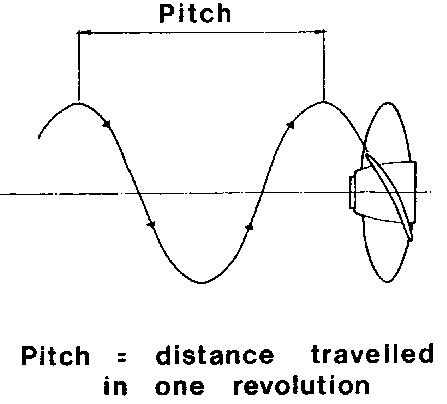
Figure 3. - Propeller pitch, the
second common dimension used in describing propellers.
Saltwater care
Motors that are used in saltwater present special problems and require meticulous care. Aluminum alloys used in outboard motors are highly resistant to corrosion by oxidation (breakdown of metal, caused by its combination with oxygen) but very susceptible to galvanic action (electrical process of depositing atoms of one metal, in solution, on the surface of a different metal).
Although oxidation cannot occur under water, it is very prevalent in humid environments. Aluminum parts are protected from galvanization by anodizing (the process of coating metal with a hard shell of aluminum oxide). But this covering is only protective if it remains unbroken. Here are some tips for care of all motors used in saltwater:
1. After each use, tilt the motor out of the water and flush out the entire motor with coot fresh water. Flush for 1 to 2 minutes and do so within 1 to 2 hours of use to prevent salt buildup inside the motor. A garden hose with a flushing attachment is convenient for rinsing saltwater out of the motor.
2. If possible, periodically flush the motor with fresh water, following manufacturer's recommendations.
3. Be sure the motor is adequately protected with an approved paint. Check regularly for chips and scratches. NOTE: Do not use antifouling paint, since it contains copper or mercury and can hasten galvanic corrosion, unless the manufacturer states that it is intended for use on aluminum.
4. Check frequently to be sure that no aluminum parts are left unprotected. Protect bare metal quickly with an anodizing primer and marine enamel topcoat.
5. A small self-sacrificing block of unpainted corrosion-susceptible metal - a "zinc" - mounted near the part to be protected will sometimes spare a valuable part from corrosion. Zincs can be mounted on the flat cavitation plate, after stripping the finish down to bare metal, with stainless steel or hot-dipped galvanized screws. All surfaces around the block must be protected with paint. NOTE: Consult a dealer before attempting to install such a device.
For further reading
Chilton's Repair and Tune Up Guide for Outboard Motors 30 Horsepower and Over, published by Chilton Book Co., Radnor, Pa. 19809.
Outboard Motor Service Manual, published by ABOS Marine
Publications, 9221 Quivira Rd.,
Overland Park, Kans. 66212.
9-78/5M
Extension Service, Oregon State University, Corvallis, Henry A. Wadsworth, director. This publication was produced and distributed in furtherance of the Acts of Congress of May 8 and June 30, 1914. Extension work is a cooperative program of Oregon State University, the U.S. Department of Agriculture, and Oregon counties. Extension's Marine Advisory Program is supported in part by the Sea Grant Program, National Oceanic and Atmospheric Administration, U.S. Department of Commerce.
Extension invites participation in its activities and offers them equally to all people, without discrimination.
Session T-8: Individual interviews/net mending
Time: 20 to 30 Minutes per Person
Goals:
· To give each trainee
individual time with trainers
· To give
feedback to each trainee on their progress
·
To review the assessment dimensions
· For
trainees to practice net mending
Overview:
In this session trainees are given formal feedback by the staff, based on staff consensus. Trainees are asked if they have any feedback for staff. Personal concerns that trainees may have are checked for. This time is seen as a time for building trust between the staff and trainee. This is basically a time for net mending practice and trainees are called out of practice for interviews.
Procedures:
|
Time |
Activities | |
| |
1. Trainees are assembled at their net mending site. Trainers conduct interviews nearby but in a private place. The following format is recommended for this weeks interviews: | |
| | |
o Do you have any concerns that you want to talk about? |
| | |
o On a scale of 1-10 and based on the eight week training design |
| |
|
content, how would you rate your technical skills? |
| | |
o Do you have any questions about the assessment dimensions? |
| |
|
o Where are you in your decision to go? |
| | |
o Anything you want the staff to be aware of? |
Trainer's Notes:
You should allow yourself a few minutes between interviews to record "quotes" and impressions from interviews. This early in the training program you will want to record all data and information.
Session T-9: Values clarification
Time: 7:30 PM
Goals:
· For trainees to get in touch
with their own value system
· To see what we
have learned so far about Purero Rican cultural values
· To explore commonalties and differences
· To find ways of accepting cultural differences
Overview:
In this session, trainees will be asked to list their own cultural values. The purpose is to see how many more of their own values they have identified since living in Puerto Rico and to look at Puerto Rican cultural values, so that trainees can begin to see commonalties and differences. Finally, trainees will be seeking ways to accept the differences. This lays the ground work for extension work training later in the program.
Exercise:
1. Cultural value explorations: mine, ours, theirs, acceptance.
Materials:
· Flip charts, marker pens, tape
EXERCISE 1 - Cultural Values: An Exploration- Mine, Ours, Theirs, Acceptance Total Time: l Hour 45 Minutes
Overview:
To explore different cultural systems. Find ways to accept the differences.
Procedures:
|
Time |
Activities | |
|
5 Minutes |
1. Trainer posts on newsprint the following diagram: |
BELIEFS |
| | |
CULTURE |
| | |
VALUES |
| | |
BEHAVIOR |
| |
Give a brief lecture stating that values are not good or bad, they just are. The reason we want to take a good look at our cultural values in this session is to start at just basically a very general point culture. The unique lifestyles of a particular group of people is a learned behavior that is communicable. We are able to see two very key concepts of culture. It is communicable, thank goodness. It means you can learn something about it. Because if it were not communicable, we would have nothing to do here today or for the rest of your volunteer service. To learn about the behavior of others is also very meaningful, not only in a social sense, but also in a management sense, because I think it is important for people to understand the influence that environment has on culture, on you and understand that you are not "born" with a culture. You can be born into a culture but you are not born a culture, if I could make that distinction. Another positive aspect of learned behavior says to us that we can also not only broaden our appreciation of other cultures, but also broaden our ability to participate in other cultures, in other cultural milieu. To start our participation in this culture, we need to go back to ourselves and then come forward. | |
|
15 Minutes |
2. Trainer asks trainees to make a list of their own cultural values. You may have done this before, so it will be easy. You may also notice that you have gotten in touch with values you were unaware of since coming to Puerto Rico. | |
|
30 Minutes |
3. Trainer now asks participants to form groups of four. 0Share their lists of cultural values and look for similarities and differences in their lists. | |
|
15 Minutes |
4. Trainer now asks group to share their differences and write them on newsprint. Then asks for ways in which we accept differences in our own culture. | |
|
20 Minutes |
5. Trainer now asks groups to list as many cultural values of Puerto Rico as they can. Trainer asks that after they have completed this list, they once again check for commonalties and differences. | |
|
15 Minutes |
6. Trainer now asks the groups to make a list on news print of ideas they may have for accepting these differences. | |
Trainer's Notes
List is included as a guide.
|
15 Minutes |
7. Trainer now requests that small groups share with large groups their ideas. |
| |
Trainer now leads discussion of how these ideas can be used in the volunteer experience. |
List of Ways of Accepting Differences
- Adjust to
environment
- Have respect for culture and customs
- Cultural
sensitivity
- Patience
- Be outgoing
- Empathy
- Introspection
-
Be flexible enough to (tolerate, accept) values different from our own
-
Educate ourselves to explain motives for values
- Realize our values are as
different to them as theirs to us
- Conformity/compromise
- Understanding
that the differences are deep-rooted and cultural
- Ability to modify outward
behavior without modifying inward values
- Keep an open mind - culturally and
personally
- Good sense of humor (able to laugh at
self)
Session T-10: Outboard engine trouble shooting
Time 7:30 AM
Goals:
· For trainees to become oriented to trouble-shooting techniques necessary in outboard engine maintenance, repair and operation
· For trainees to do actual maintenance work
· For trainees to be checked out in small boat handling skills
Overview:
During this session trainees learn about outboard engine troubleshooting. They will learn how to do simple maintenance tasks and the importance of doing these tasks regularly. During this session each trainee will go out in a small boat with technical trainer to be "checked out" in their ability to handle a small boat.
Materials and Equipment:
· Outboard engine, new parts, spark plugs, starter cord, fuel filter, transmission oil, propeller, grease gun, WD 40/Solvent, OB engine tool kit Procedures
|
Time |
Activities |
|
2 Hours |
1. Technical trainer asks for trainees to volunteer to do one of the following maintenance functions on the demo outboard engine Ignition systems |
| |
- remove spark plugs, clean and/or replace |
| |
- use spark plug wrench correctly |
| |
Starter Cord |
| |
- remove starter cord housing |
| |
- remove starter cord |
| |
- replace with new starter cord |
| |
- check main spring for cracks |
| |
- lubricate and replace starter cord housing |
| |
Carburetor |
| |
- adjust idle valve/screw (for rich and/or lean fuel mix, one quarter turn for each |
| |
adjustment) |
| |
Fuel Filter and Transmission Oil |
| |
- remove filter and clean with gasoline, replace filter |
| |
- transmission oil/drain old oil, replace lower unit housing transmission oil |
| |
Engine Housing Maintenance |
| |
- clean upper and lower unit with fresh water. Wipe salt water from unit with clean rag after use |
| |
- clean inside of upper unit with clean cloth soaked in solvent and/or WD 40. |
| |
- flush water cooling intake with fresh water, to clean out collected salts and prevent marine corrosion |
| |
Propeller |
| |
- remove and or replace propeller, locate nicks and/ or cracks in propeller and file down |
| |
- remove propeller and replace shear pins Grease |
| |
- properly grease all bearings and/or grease valves Corrosion |
| |
- locate pitting and/or corroded surfaces, clean, file down do bare metal, repaint with anti-fouling compound paint. Use only approved paints for aluminum surfaces. |
| |
2. Technical trainer announces that all trainees will have to be able to perform all of these maintenance functions within a week. They are free to practice on demo, but will be expected to do a complete maintenance check on one of the local fishermen's outboard engines. |
Trainer's Notes:
Trainee will have to make own arrangements to do free maintenance on fishermen's O.B. engines. It is advisable to have one of the trainees who understands O.B. functions to check out those who are doing maintenance for first time. Every trainee must be able to perform all functions. It is important for you to emphasize that O.B. engines will last a long time with proper maintenance, and that one of the biggest problems found in developing countries is that maintenance functions are not demonstrated thoroughly to fishermen. Consequently, there are many unnecessary costly repairs incurred by the small-scale fisherman.
|
20 Minutes/ trainer |
3. While trainees continue to practice maintenance trainee functions technical checks out trainees in small boat handling. |
Trainer's Notes:
For some of the trainees this will be the first time handling a small boat. Technical trainer will give these trainees initial instruction and allow them to operate the boat in open water. Trainees will have to find practice time, and until they check out will have to go out in boat with one of the trainees who can operate a boat safely and correctly. Once again trainees have only one week in which to acquire this skill and be checked out. When they feel they are ready, it is up to them to ask to be checked out.
1. Trainee check out list:
- PFD
- Overview of
check-out
- Starting
- Reverse
- Low speed (no wake zone)
- High
speed
- Wide circle
- Tight small circle
- Bay entrance
- Stop
engine
- Start engine
- Return to dock
- Low speed (no wake zone)
-
Docking
- Night
navigation/operation
Session T-11: Tropical photography - extension
Time: 4 PM - 5 PM
Goals:
· To provide information
regarding camera care in a tropical environment
· To suggest alternative ways to photograph subjects in
the tropics
· To provide technical transfer
and workshop skills to the trainee presenting the session
Overview:
This session is presented as a special project by a trainee. The need to document work is important, especially when dealing in technical areas. The opportunity for the PCV in the field to record workshops and/ or special projects is only limited by expertise as a photographer. In the tropics, there are special considerations that must be adhered to; it is these "rules" that this presentation of tropical photography deals with.
Procedures:
|
Time |
Activities |
|
1 Hour |
1. Trainee presents an overview of photography and brings into focus the relevant procedures for insuring quality photographs in a tropical environment. |
|
|
2. Trainee presents a list of resources for additional information on the above. |
Materials and Equipment:
· Flip chart, pens, misc. cameras and camera equipment
References:
· Eastman Kodak Co. Rochester,
N.Y. 14560 Notes on Tropical Photography, 1978
· Photographing Tidepools, Velma Bosworth, Oregon State
University Sea Grant, 1978
Notes on Tropical Photography
Suggestions for Residents:
The instructions in the following sections are intended for photographers who work in tropical climates either as residents or on location for a considerable time. The precautions may or may not be necessary, depending on the particular climate and on the facilities available. Today, many buildings in the tropics are air-conditioned, and such appliances as humidifiers, dehumidifiers, and refrigerators-portable or otherwise- are either available locally or they can be shipped in and used where there is a supply of electricity.
Care of Photographic Equipment:
Moderately high temperature is not in itself detrimental to cameras and accessories, but intense heat should be avoided except for those times when the equipment is in actual use. When high temperatures is coupled with high humidity, the growth of fungus on bellows, camera cases, fabrics and even lenses is a certainty.
Do not leave cameras and accessories either in hot sunshine for longer than is necessary or in enclosed spaces, such as the glove compartment or the trunk of a car that is standing in the sun. Remember that a white surface reflects heat as well as light. For this reason, a white-painted enclosure remains cooler in sunshine than a dark-colored one.
Abrasive dust is a major problem in many tropical climates. There are few enclosures that can exclude it altogether. Enclosing the camera and auxiliary lenses in plastic bags is helpful, but in a humid atmosphere the stagnant air in the bag promotes the rapid growth of fungus. Equipment should not be kept enclosed in this way for longer than a few hours.
Constant cleaning of the camera parts before and after use is a necessary procedure. Special care must be taken with lenses; the abrasive action of gritty dust is a serious threat to the glass surfaces, and consequently, to the photographic image. Clean lenses by gently brushing or blowing off dust. Any wiping or cleaning with fluid or tissue must be done with the greatest care and as infrequently as possible. Keep both ends of lenses capped when not in use.
Some photographers mount a haze filter or a piece of optical glass permanently on the lens as protection against abrasion by dust. A scratched filter can be renewed at moderate cost if necessary. A Haze filter has no appreciable effect on exposures.
Storage of Photographic Materials:
Sensitized photographic materials are perishable products under practically any conditions. Proper storage is therefore important at all times, especially in tropical climates, because deterioration is rapid in a hot and humid atmosphere.
Black-and-white materials withstand moderate heat without serious changes in their characteristics. Color films intended for amateur use (sometimes called "consumer" films) should be stored where the temperature will not rise above 24°C (75°F) for more than a few days. Kodak color films intended for professional use (they have the word "professional" in the film name) should always be stored in a refrigerator at 13°C (55°F) or lower.
Extremes of relative humidity are a serious threat to all photographic materials, even at moderate temperatures. At high temperatures, the effects of humidity are greatly accelerated. Not only are the sensitometric characteristics of the material impaired, but physical damage occurs as well. Sheets of film may stick together or become glazed in patches where they touch one another. Rolls of film may "block" or stock so that they cannot be unwound, or the outside edges of the roll may be affected more than the inside so that the film buckles. Moreover, cardboard cartons swell and break open, labels drop off, and cans rust. These effects can be expected if the relative humidity remains above 60 percent. Extremely low relative humidity, on the other hand, is not quite so serious, but if it falls below 15 percent for a considerable time, an electric humidifier should be installed and set to maintain a relative humidity of 40 to 50 percent in the storage area.
Storage of Films and Color Papers: These materials are supplied in packages incorporating a barrier to protect them against moisture vapor. Only when the relative humidity is above 60 percent for most of the time is it necessary to protect the packages against dampness. Black-and-white films and papers can be stored at normal room temperatures in an air-conditioned room, for example Professional color materials should be stored in a refrigerator until the seal is broken.
When the seal has been broken, films should be used as soon as possible. Since the air in a refrigerator is moist, partially used packages should be returned to the refrigerator in a sealed can together with a desiccant to absorb the moisture within the container. When partially used packages of color paper are stored in a refrigerator, press out excess air from the foil envelope, make a double fold at the open end, and seal with adhesive tape.
In general, do not keep more film and paper than necessary in stock, particularly when good storage conditions are not available. Photographic materials are also affected by chemical activity of fumes and gases. These include some plastic formulations, paints, lacquers, exhaust from internal combustion engines, and sulfide toning solutions. In a hot atmosphere, the solvents in paints, lacquers, etc, evaporate and permeate the air in an enclosed space much more rapidly than they do at normal temperatures. Consequently, do not store papers and films in newly painted rooms or cabinets, and keep the materials as far away as possible from the kind of containment mentioned above.
Storage of Black-and-White Photographic Paper: Although Kodak black-and-white papers are very stable materials, their photographic and physical properties deteriorate when they are stored for considerable periods under conditions of high temperature and high relative humidity.
Ideally, black-and-white paper should be stored at temperatures between 5 and 10°C (41 and 50°F). However, paper intended for use within a few months can be kept in an air-conditioned room at normal temperature. Unlike films and color papers, black-and-white papers are not sealed against moisture; they should, therefore, be kept in a place where the relative humidity is not too high. Remember that in a hot and humid climate, the relative humidity will be even higher in a basement or other place where the temperature is lower than that of surrounding areas. A refrigeration dehumidifier installed in the storeroom will help keep the humidity within acceptable limits. If the relative humidity is below 25 percent most of the time, photographic paper will dry out and become brittle and difficult to handle in use. Then an electric humidifier should be installed and set to maintain a relative humidity of about 45 percent.
As a general rule, do not stock more paper than you expect to use within a few months. However, if large stocks of paper must be maintained, it would probably be economical to provide the best possible storage conditions. A conditioned room or chamber in which the temperature and the relative humidity can be controlled is ideal.
Warm-up Times:
When films are taken from cold storage or from an air-conditioned room into a warmer atmosphere, allow sufficient warm-up time before opening the heat-sealed envelope or other moisture barrier. Otherwise, moisture condensation forms on the surfaces if the film temperature is below the dewpoint of the surrounding air.
Care of Exposed Films:
When a film has been removed from the moisture-resistant package, it is immediately subject to deterioration in a hot and humid climate.
When the film has been exposed, the latent image will also deteriorate. Color films are particularly susceptible in this respect. Consequently, all films should be processed as soon as possible after exposure. If processing facilities are not available in your vicinity, mail the film to the most convenient processing station immediately. If you are unable to do this for some reason, enclose the films in an airtight jar or can together with a desiccant and place them in a refrigerator. Exposed films can be kept for several days in this way.
Exposure:
Although it has often been said that less exposure is needed in the tropics as a general rule, this is not necessarily so. Measurements made in various parts of the world have shown that when atmospheric conditions are similar and when the sun is at the same elevation in the sky, the intensity of illumination is practically the same regardless of geographical location. Since the sun reaches a higher elevation in the tropics than elsewhere, the light intensity is extremely high when the sun is at its zenith. This in itself is not a difficulty--exposure can easily be adjusted for the higher light intensity. However, when the atmosphere is clear and the sky cloudless, the lighting contrast is also extremely high. In these conditions, shadows tend to lack detail even though the highlights are correctly exposed or perhaps overexposed.
With nearby subjects, fill-in flash is helfpul and the only remedy available for color pictures other than waiting for more favorable lighting conditions. In black-and-white work, you can give extra exposure to get more shadow detail and then reduce the development of the film to lower the highlight density. Another effect of taking photographs when the sun is directly overhead occurs in landscapes without high trees or buildings. The absence of shadow then yields a very flat, uninteresting picture. The only way to avoid this result is to photograph the subject either earlier or later in the day when shadows are longer.
Preservation of Negatives:
Because deterioration caused by residual chemicals in the emulsion takes place rapidly in a hot and humid atmosphere, always fix and wash films thoroughly. In handling negatives, wear Kodak Cotton Gloves to avoid finger marks. When the negatives are not in actual use, keep them in clean envelopes, because any greasy residue deposited on the surfaces by indoor atmosphere promotes the rapid growth of fungus, which eventually destroys the gelatin coatings on the film.
The most important consideration in storing negatives in a humid climate is to keep them dry. That is to say, maintain a relative humidity between 40 and 50 percent in the storage area. If a building is properly air-conditioned, the relative humidity will not be higher than this.
However, if it exceeds 55 percent for any considerable period, install an electric dehumidifier. If other means of keeping negatives dry are not available, they can be stored in a heated cabinet. Alternatively, they can be enclosed in a metal box with a desiccant.
For the best storage conditions, negative envelopes should conform to American National Standard Requirements for Photographic Filing Enclosures for Storing Processed Photographic Films, Plates, and Papers ANSI PH4.20-1958 (R1970). In a tropical climate, however, negatives should not be stored for a long time without inspecting their condition. Do this at regular intervals so that any deterioration that might have taken place can be remedied and more suitable storage conditions arranged.
Preservation of Prints:
In general, the same remarks apply to preserving prints as to preserving negatives. Careful processing and storage in a dry place are the principal requirements.
When black-and-white prints are used for decoration or display, hypo alum toning has been found helpful in preserving the prints from atmospheric effects and from attack by fungus. Color prints should be lacquered so that they can be wiped clean occasionally.
Prints should always be dry-mounted--many pastes and gums are hygroscopic, and they attract insects and fungus. Use photography-quality mounting board-impurities in ordinary cardboards may discolor the prints in a short time. This applies also to interleaving paper and album leaves.
At relative humidities below 60 percent, prints keep well in an album if the pages are large enough to allow a 3 1/2 inch border on all four sides of the prints. The closed album then gives a measure of protection against atmospheric effects and attack by insects or fungus, particularly when the prints have been treated with a fungicide such as Hyamine 1622.
If the relative humidity is above 60 percent, pack the prints or the album in a sealed container together with a desiccant. Single prints, whether mounted or unmounted, should be interleaved with good-quality paper. To be sure that-deterioration is not taking place, inspect valuable material periodically and renew the interleaving paper or any other packing material at these times.
Fungus:
Airborn spores of fungus are everywhere, and they exist in immense variety. Mold and mildew are the familiar kinds that fourish in warm, damp places. Generally, the type of fungus troublesome to photographers in the tropics grows most readily at temperatures between 24 and 29°C (75 and 84°F). It feeds on dead organic matter such as leather, cloth, wood, paper, and gelatin, but it will spread and damage other materials-the glass of lenses in cameras and binoculars, for example.
Moisture is essential to the growth of practically all varieties of fungus, and they thrive in darkness. Obviously, in a hot damp atmosphere, cameras, sensitized materials, negatives, and prints, as well as clothing and other fabrics, will be attacked. The only really practical way to prevent the attack of fungus is to keep the articles dry and clean as far as this is possible.
A heated box or a cabinet in which an electric light bulb or a small electric heater element is kept switched on can be used to keep cameras and other equipment dry. Adjust the temperature in this type of enclosure so that it is about 5.5°C (10°F) higher than the room temperature. Also, allow air to circulate through ventilation holes in the top and bottom of the box or cabinet. Do not keep films or photographic papers in enclosures such as that described above.
The best way to reduce the relative humidity in a room is by using a refrigeration-type dehumidifier. The room must, of course, be resistant to the passage of moisture through walls, ceiling, and floor, and it must be kept closed. Then the heated enclosure described above is not necessary. In this connection, remember that although a room-type air conditioner reduces the temperature, in doing so it may increase the relative humidity. Some units are more efficient in dissipating moisture than others. In a properly air-conditioned building, however, the difficulty will not arise.
Notes on Tropical Photography Kodak Publication No. C-24
|
| |||||||||||||||||||||||||||||||||||||||||||||||||||||||||||||||||||||||||||||||||||||||||||||||||||||||||||||||||||||||||||||||||||||||||||||||||||
Small-Scale Marine Fisheries - A Training Manual (Peace Corps, 1983, 631 p.)
Week 3: Training
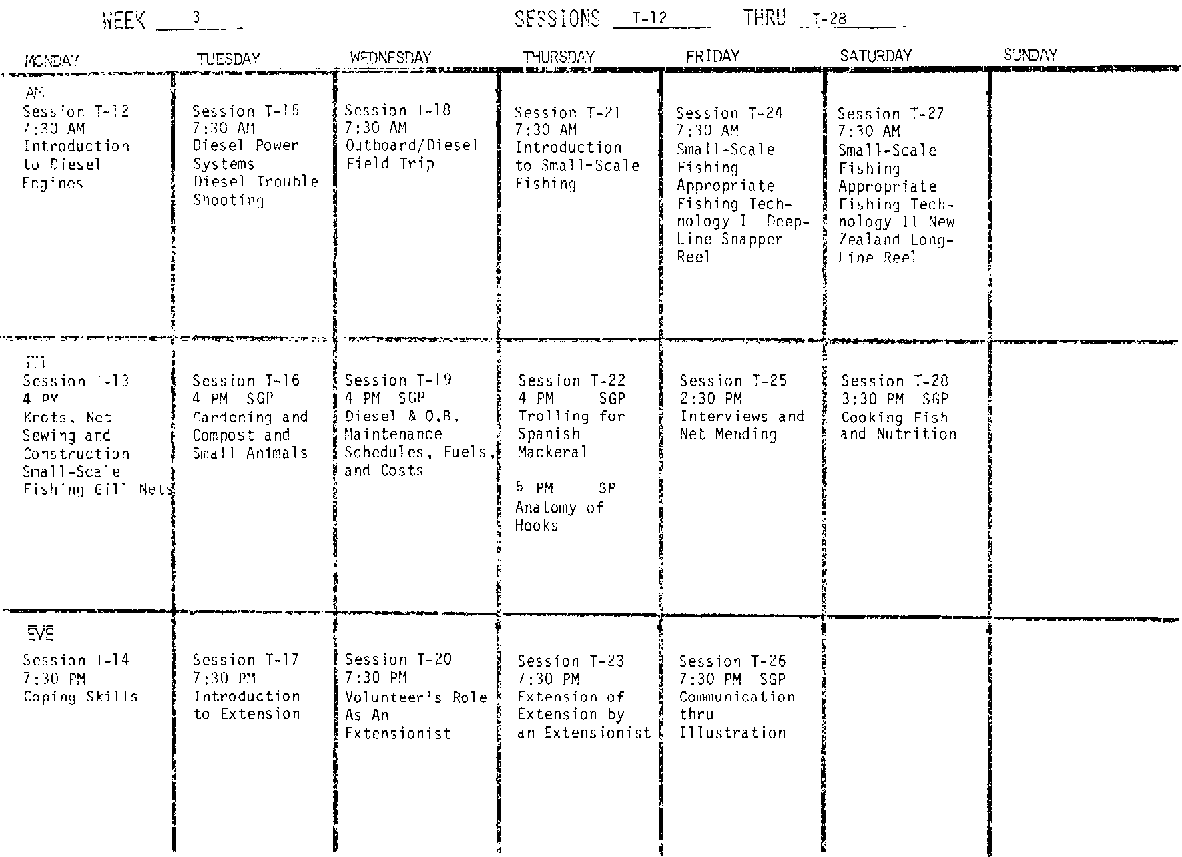
Week 3 Sessions T-12 Thru
T-28
Session T-12: Introduction to diesel engines
Time: 7:30 AM
Goals:
· To acquaint trainees with the basic principles of the operation of a Diesel engine
Overview:
This introductory session is the first of three sessions focusing upon the Diesel engine. The importance of the Diesel to small-scale fisheries is evident in its usage as the sole power plant for many fishing vessels, and with electrical generators for operating freezing and cold storage facilities. Because the diesel has not reached its maximum power and efficiency potential, we can expect it to be with us and the small-scale fisherman for years to come.
Materials and Equipment
· Diesel parts, flip chart of two-stroke cycle, Diesel engine
Procedures:
|
Time |
Activities | |
|
30 Minutes |
1. Technical trainer gives lecturette from the following outline which is posted on newsprint: | |
| |
A. Principles of Operation |
1. The diesel engine is an internal combustion power unit in which the heat of fuel is converted into work in the cylinder of the engine. |
| |
|
2. In the Diesel engine air is compressed in the cylinder; after the air has been compressed, a charge of fuel is sprayed into the cylinder and ignitions made by heat of compression. |
| |
B. Two-cycle Diesel |
1. In the two-cycle, intake and exhaust take place during part of the compression and power strokes - in contrast to the four-cycle Diesel. |
| |
|
2. A blower unit/pressure forces air to expell gases and supply cylinder with fresh air for combustion. |
| | |
3. A unidirectional flow of air produces a scavenging effect leaving the cylinder full of clean air when piston covers inlet air ports. |
| | |
4. As piston continues in upward stroke exhaust valves close and a charge of fresh air is subject to compression. |
| | |
5. Before piston reaches highest position a required amount of fuel is sprayed into the combustion chamber by fuel injection. |
| | |
6. Intense heat is generated during high compression of air ignites fine fuel immediately. Combustion continues until fuel injected has been burned. |
|
| |
7. Resulting power forces piston down on power stroke, exhaust valves are again opened when piston 1/2 down allowing exhaust gases to escape. |
| |
2. Technical trainer passes around Diesel parts for trainees to handle. | |
|
|
3. Technical trainer now takes trainees to see an operating Diesel. | |
Trainer's Notes:
It is important that arrangements be made in advance with fisherman to have trainees look over operating Diesel. It is also important to find one that is well maintained for this session.
| |
4. Technical trainer asks trainees to explain what is happening as they observe operation of the Diesel. |
Session T-13: Knots, net sewing and construction small-scale fishing gill nets
Time: 4 PM
Goals:
· To provide trainees with
opportunity to work on proficiency of knots, net sewing and
construction
· Provide individualized
instruction with Becket bend, bowline, clove hitch, reef knot and sheet bend to
trainees
· To provide instruction to trainees
in proper handling of a gill net
· To allow
trainees the opportunity to work with a gill net in proper placement and
retrieval techniques
overview
In this session trainees will review net skills to date. Trainees are allowed to work at own speed on sewing and generally becoming familiar with nets and various knots. This session also allows for the trainees to be introduced to the proper handling and fishing techniques of a gill net. In addition, a comment about the quality of the net--as to whether proper care has been given or if the net is ragged, full of holes, etc., is made by the trainer at the start of the session.
Materials:
· Flip chart, markers, tape, net
twine, netting and net needles
· Cill
net(25'-50'), small fishing boat, PFD's
Procedures:
|
Time |
Activities | |
|
1 Hour |
1. Technical trainer reviews net skills to date. Trainees practice marine knots that technical trainer introduces as follows: | |
| |
- reef | |
| |
- sheet bend | |
| |
- double sheet bend | |
| |
- figure of eight | |
| |
- clove hitch | |
| |
- rolling hitch | |
| |
- half hitch | |
| |
- sheep shank | |
| |
- bowline | |
| |
- bowline on a bight | |
| |
Trainees practice these knots under the guidance of technical trainer | |
|
|
2. Technical trainer introduces Gill nets using following outline: | |
|
|
I. Introduction to a Gill net |
A. How it works to enmesh fish. |
| | |
B. Construction materials. |
| |
II. Various Gill net styles |
A. Floating |
| |
|
B. Sinking |
| | |
C. Deep-sea |
| |
|
D. Trammel(Reference to earlier net session T-4.) |
| |
III. Demonstration of proper handling techniques |
A. Float line coil |
| |
|
B. Lead line coil |
| |
|
C. Laying net flat |
| |
IV. Demonstration of proper fishing technique |
A. Setting from boat |
| |
|
B. Mangrove encirclement |
| | |
C. Retrieval of net |
| |
V. Fish removal from Gill net |
A. Care in handling fish |
| | |
B. Care in handling net |
Trainer's Notes:
Very essential that a gill net is borrowed for this session. In addition, a fisherman skilled in the proper use of gill net fishing should be enlisted prior to the session to demonstrate or assist in the demonstration of the above. A demonstration such as this would normally attract a crowd, so take advantage of other fishermen to assist in the ''proper" techniques.
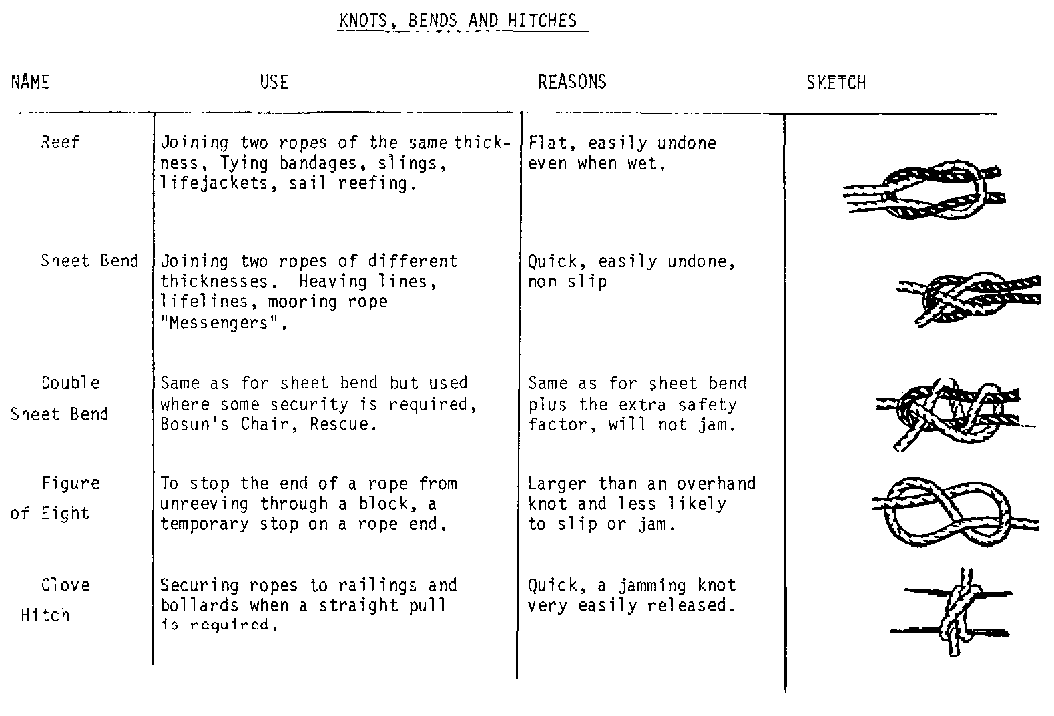
Knots, Bends and Hitches
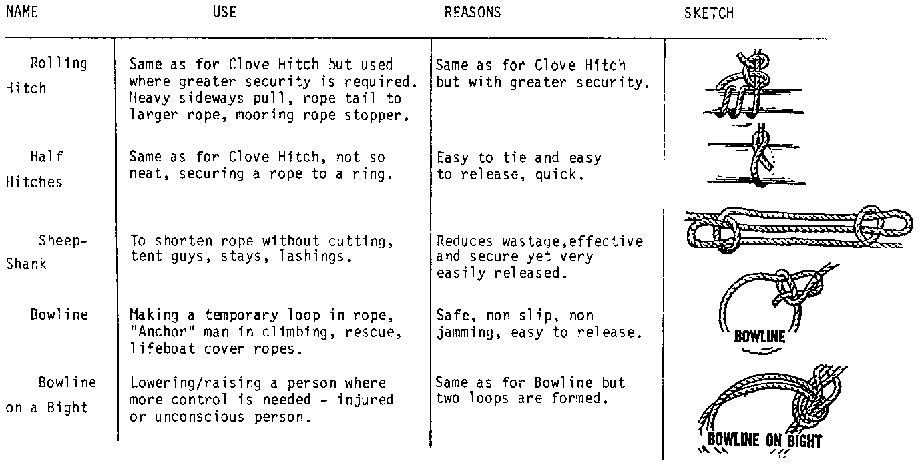
Knots, Bends and Hitches
Continued
Session T-14: Coping skills
Time: 2 Hours
Goals:
· For trainees to see how
necessary it is to have coping skills as a PCV
· To discuss with trainees openly and frankly
differences in the cultures they will be in and possible effects these
differences may have on their personal lives
Overview:
The purpose of this session is to enable trainees to introduce sensitive subject matter concerning the possible effects that living in a new culture may have on the trainees. In this session the mores of the Host Country are openly discussed, so that trainees understand how they will have to conduct themselves as PCVs if they are to be effective in their role. Trainers initiate questions and encourage open discussion between themselves and trainees.
Materials:
· Flip chart, markers
Trainer's Notes:
This session requires trainer to have researched the attitudes, values, mores, and cultural norms of Host Country, if not first hand knowledge.
Procedures:
|
Time |
Activities |
|
2 Hours |
1. On newsprint trainer lists the following items: |
| |
a. mores of Host country |
| |
b. corruption |
| |
c. sexuality |
| |
d. drinking/drugs |
| |
e. how children are treated |
| |
f. how animals are treated |
| |
g. women roles/rights |
| |
h. hospitality |
| |
i. privacy |
| |
j. personal safety |
2. Men and women are asked to meet with a trainer in separate groups. After presenting the newsprint with the above items, trainer gives brief definitions /explanation of each as follows:
a. Social customs: eating with hands, special greetings, etc.
b. Corruption that may be evident in host country, i.e., the importance of not handling others money.
c. Sexuality: the openness in some cultures or strictness, including some ways of coping with suggestiveness from members of opposite sex in host country.
d. The drinking practices 1n Host Country, ways of coping with not wanting to drink, the appropriateness of women drinking or not drinking. Drugs reinforcing Peace Corps policy of "no drugs", even if they are available.
e. How children are treated. In some countries, child beating is practiced (but only by parents). How to deal with having to tell parents that the child is misbehaving if a beating may insue.
f. How animals are treated. The sometimes rough treatment of animals and the advisability of keeping pets.
g. Women's role. Long hours of work, how to manage your feelings about women's acceptance of their roles.
h. Hospitality in Host Country. Why your denial of food or drink would be considered rude.
i. Privacy, or lack of privacy.
j. Personal safety, not inviting aggressive behavior through your own rudeness (or what could be perceived as rudeness).
It is usually advisable to go down the list one at a time. Ask trainees to feel free to ask questions in areas of concern. Trainer should state that no question is unimportant if it is of concern to trainee. Trainer should emphasize that these areas will most likely be gone over in in-country training.
Trainer's Note
We have found that trainees have concerns in these areas and are reticent to ask question. By having this session early in training you are able to dispel myths and clear up misinformation that trainees have either gotten from outside sources or faulty assumptions on their part that have created concerns.
Session T-15: Diesel power systems; Diesel trouble shooting
Time: 7:30 AM 5 Hours
Goals:
· To give trainees further
understanding of Diesel engines
· For
trainees to understand and perform the maintenance functions of a Diesel engine
Overview:
In this session trainees are further inculcated in the workings of the Diesel engine. They will learn how to perform basic maintenance functions on Diesel engines.
Materials and Equipment:
· Flip chart, markers, fishing vessel with diesel engine in operating condition, spare parts
Exercises:
1. Diesel Power Systems
2. Diesel Troubleshooting
EXERCISE 1 - Diesel Power Systems
Total Time: 3 Hours
Goals:
· To provide trainees with basic
familiarization of Diesel power systems
· To
enable trainees to become properly oriented to working capabilities and general
mechanical operation of a Diesel engine.
Overview:
This session is a follow-up on the Introduction to Diesel (Session T-12). Its scope is to allow trainees the opportunity to engage in the operation of a Diesel engine, as well as to begin to achieve some proficiency in the operation of the fuel, lubrication and cooling systems, transmission, turbocharger, instrumentation and starting systems, and exhaust systems.
Procedures
|
Time |
Activities | |
| |
1. Using the following outline posted on newsprint. | |
| |
Technical trainer gives lecture: | |
| |
I. Introduction to Diesel Power Systems |
A. Review of Introduction to Diesel (Session T-12) |
| | |
B. Review of Principles of Operation |
| |
II. Fuel Systems |
A. Operation |
| |
|
B. Filters - primary/secondary |
| |
III. Lubrication System |
A. Component operation |
| | |
B. Oil pump |
| |
IV. Injection System |
A. Purpose of the injector |
| | |
B. Nozzle Types |
| |
|
C. Droplet size |
| |
|
D. Spray Patterns |
| |
V. Cooling System |
A. Fresh water (closed) |
| | |
B. Sea water (open) |
| |
VI. Transmission Systems |
A. Operation |
| |
|
B. Gear Ratio |
| |
|
C. Clutches |
| |
VII. Turbocharger |
A. Operation |
| |
|
B. Layout |
| |
IX. Starting Systems |
A. Compression |
| |
|
B. Electrical |
| |
X. Exhaust System |
A. Dry |
| | |
B. Wet |
| | |
C. Exhaust manifold |
| |
|
D. Pyrometer |
Trainer's Notes:
Very important to have access to a Diesel engine, preferably in a fishing vessel. Again a small (under 50 HP) Diesel is preferred. Intent of session is to familiarize trainees not to make them into master mechanics.
EXERCISE 2 - Diesel Trouble Shooting
Total Time: 2 Hours
Goals:
· For trainees to understand the
necessity for proper maintenance of the Diesel engine
· For trainees to be able to perform simple maintenance
chores
Overview:
This session follows the O.B. engine trouble-shooting. It will not be possible for each trainee to do a maintenance check-up on a Diesel engine; each trainee should be able to do one maintenance function based on what they have learned from O.B. engine sessions.
Materials and Equipment:
· operating diesel engine preferably in fishing vessel
Procedures
|
Time |
Activities | |
|
1 Hour |
1. Technical trainer asks each trainee to perform one of the following maintenance functions until complete maintenance check-up is done: | |
|
45 Minutes |
Sea water cooling system: |
Trace water intake pipes/hoses to engine block inlet. |
| | |
Trace water outlet pipes/hoses to overflow part. |
| | |
Locate and remove zinc plugs, check for corrosion and possible replacement of zinc; replace zinc plug. |
| |
Fresh water cooling system: |
Check and maintain proper water level in fresh water reservoir. |
| |
Both systems: |
Check all hoses/pipes and clamps for leakage and/or abrasion. |
| |
|
Remove and install replacement hoses or clamps. |
| |
Diesel Fuel System: |
Trace fuel lines from fuel tank to engine - locate fuel shut off valves. |
|
| |
Locate filters. |
| |
|
Add Diesel fuel to tank, measure gallon capacity of fuel tank cubic inches of outside dimension divided by 235 = U.S gallon. |
| | |
Fuel filters |
| |
|
Replacement of fuel filters |
| | |
- shut off valve on fuel line |
| | |
- drain fuel from filter and line |
| | |
- open fuel filter casing |
| | |
- clean with fuel to remove grit, grime and loose rust particles |
| |
|
- replace filter with new filter |
| | |
- fill casing with clean Diesel fuel |
| | |
- replace casing and turn shut off line back on |
| | |
- check engine oil level |
| | |
- add engine oil to engine |
| | |
- check transmission oil level; add transmission oil to transmission housing if necessary. |
| |
Exhaust System: |
Trace exhaust system from exhaust manifold to muffler to stack |
| |
|
Identify whether system is a wet exhaust system or a dry exhaust system |
|
| |
Check all couplings for wear, rust, need for replacement |
| |
Gear and Throttle linkages: |
Trace cable and wires from control panel to engine; check RPM gauge |
|
| |
Oil pressure gauge, water temperature gauge, pyrometer gauge, volt/amp gauge |
| | |
Grease gear cauplings and check connections on linkages |
| | |
Grease bearings |
| |
|
Grease propeller shaft bearing |
| | |
Use grease gun properly |
|
10 Minutes |
3. Technical trainer gives short lecturette on the importance of proper maintenance for the longevity and reliability of a Diesel engine. |
|
|
5 Minutes |
4. Links the Diesel sessions to the field trip the following day. | |
Session T-16: Special group project gardening, composting and small animal raising
Time: 4 PM - 5:45 PM
Goals:
· For trainee assigned to the project to build on leadership, communication and technology transfer skills
· For trainees to acquire a basic understanding of gardening and good gardening techniques
· To acquaint trainees with the techniques of composting
· For trainees to acquire a basic understanding of rabbit raising and poultry production
Overview:
This special group project emphasizes the importance of the 'backyard garden,' both for meeting the nutritional needs of the PCV and as a secondary activity demonstrating good gardening practices to the community. All trainees should work in the garden and help with the compost pile--under the leadership of the group project leader--throughout the duration of the training program. Because of time constraints, rabbit raising and poultry production, on the other hand, are limited to a short presentation.
Procedures:
|
Time |
Activities |
|
40 Minutes |
1 Group project leader and project team give presentation on garden site selection, seed bed preparation and layout, companion cropping and pest control (including fencing). |
|
20 Minutes |
2. Group project leader gives presentation on techniques of composting. |
|
40 Minutes |
3. Group project leader and project team give presentation on rabbit raising and poultry production. |
|
5 Minutes |
4. Group project leader presents garden planting schedule and sign-up sheet. All trainees are to have a garden assignment. |
Trainer's Notes:
Rather than one presentation on all aspects of gardening, it is better to have several short presentations over the course of the training, scheduled appropriately to coincide with garden activities, i.e. thinning, weeding, staking.
Depending on the size of the group, small animal raising can be a separate group project.
References:
· Small Vegetable Gardening,
ICE.
· Small Animal Raising Resource Packet,
ICE.
· Rabbit Raising, ICE.
· New Methods Pay with Poultry, ICE.
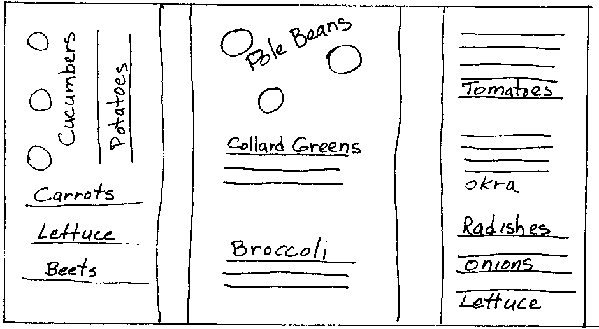
Garden Plan
Plant basil, mint, parsley, oregano, garlic, thyme, rosemary, marigolds around whole border of garden.
Steps in small scale gardening
1. Considerations in picking a site
a. Available sunlight - amount depends upon crops to be
planted
b. Soil - type depends on type of crops to be planted
c.
Water
d. Miscellaneous - at present site I had to take into consideration the
fact that there are many chickens around - chicken wire
Before Planting Soils and Soil preparations
1. pH
pH is probably the soil factor which the farmer can easily
control.
The pH is easily tested with litmus paper and with a little bit of
work can easily be altered. The ideal pH is between 65-70, slightly acidic to
neutral. Most crops and flowers grow best in this range. If the soil is too
acidic, add limestone (readily available). Why pH is important - some plants
cannot take up nutrients if the soil is too acidic or alkaline.
Testing soil for pH - Take soil samples from different parts of the garden plot. Mix 10 parts water to 1 part calgon (if no calgon don't worry) solution with the crushed dirt. Test with both acid (blue) and base (red) litmus paper by putting a drop of the solution on each. If there is no change in color in either then the soil is neutral. If blue turns red = acid soil, if red turns blue = alkaline soil. Corrective measures should be taken.
Soil Nutrients
With the equipment available it will be hard to determine what and how much of the three major nutrients, Nitrogen, Phosphorus, and Potassium are present in your soil. You can, through compost, insure that there will be enough of these nutrients present in order to have a successful garden.
Nitrogen - Too much or too little causes a decline in plant productivity, but it is hard to get too much. This and the other two nutrients are easily depleted therefore they have to be continually renewed. It is very important in the building of a plant structure. If there is not enough n2 in the plant the color will be pale green or even yellow. Too much n comes from chemical fertilizers which causes the plant to grow too fast, therefore they are not made of a strong structure and are more susceptible to disease and insects.
Good N2 containing material
|
Raw bone meal |
any type of manure |
Peanut waste |
pea hay |
|
cottonseed meal |
or urine |
nutshells |
coffee wastes |
|
steamed bonemeal |
crab |
feathers |
sewage sludge |
|
gluten meal |
lobster waste |
dried jellyfish |
|
|
wheat meal |
fish waste |
dried blood |
|
Phosphorous - Again, this element is essential for plant growth, strong roots, fruit development, and resistance to disease. There must be plenty of organic material in the soil for there to be an abundance of phosphorous present.
Sources of Phosphorous
|
raw bone meal |
dried ground fish |
banana trash ashes |
|
steamed bone meal |
lobster refuse |
citrus wastes |
|
shrimp waste |
raw sugar wastes |
dried blood |
|
any manure or urine |
wood ash |
cottonseed meal |
|
|
peapod ashes |
|
Potassium - Potash - Good for strong plant structure and resistance to plant diseases, also for counteracting affects of too much n2. Weak stems may indicate need for potash.
Sources of Potassium
|
wood ashes |
tobacco stems |
banana trash (ash) |
|
any manure or urine |
garbage | |
|
cattail reeds |
vegetable wastes |
|
|
waterlily stems |
hay | |
|
coffee grounds |
weeds | |
Composting
The use of a compost is the best method of returning nitrogen, potassium, phosphorous to the soil of your garden. Composting also increases the earthworm population in the soil which is very beneficial. Anything that will rot can make compost or humus, everything from kitchen scraps to bluejeans. Compost can be arranged in an open pile or a closed bin.
Compost pile construction
1. Work ground underneath pile site to allow soil microbes to migrate to pile.
2. Materials are added in two inch layers, vegetation first, soil next. Add soil quick to initiate decomposition and to keep smell down.
3. Each layer should be watered lightly (like a damp towel).
4. Try to mix in high n containing materials. N2 is good food for soil microbes and therefore it speeds up their activity.
5. If it is still slow chemical fertilizers can be added.
6. Also, the pile can be turned with a pitch fork in order to get more air introduced into the pile to speed up the process (take care when forming pile as not to pack down layers). All material on the outside should be turned to the inside.
7. Shredding the material also helps speed up the process.
8. The pile should be located near the garden, but also near a good water supply.
9. It should take 2 -3 months to be ready. The compost is ready when the material is brown and crumbly and the material first used cannot be recognized.
10. A pile 3 x 3 x 3 is enough for a 1000 ft garden.
11. Add to garden by turning it under.
Important - never add hot compost to garden.
Bed Construction Raised Bed Intensive Gardening - Benefits
A raised bed has a planting surface which is 4-10 inches above original surface area. They are usually 3-5 feet wide and any length. They are easier to weed, plant, fertilize, harvest, and control insects when compared to flat beds. When performing these activities the beds do not need to be walked upon. Therefore roots are not damaged and air space in soil is not destroyed. Also, all fertilizers are placed in root areas and not wasted in path ways. One last thing. Having the ground in the root area extensively prepared and loosened makes it easier for the roots to grow downward and thus they don't interfere with each others growth with sideways growth of roots.
Construction of the raised bed
This is difficult but it will pay off in the long run.
1. Soak for two hours with water
2. Let dry for two days
3. Loosen dirt with a shovel but do not turn
4. Weed area
5. One day rest Double-Digging
Plot - goal is to loosen and improve soil to two feet
1. Dig a trench across one end of the bed
2. Carry to the other side of the bed
3. Dig a second trench next to the first and put the dirt into the first trench
4. Repeat until the bed is completed. Put the dirt from the first trench into the last trench.

Composting (see compost section)
Add completely broken down compost before planting is done Antierosion device
This is especially helpful with a soil that has a high clay content.
1. Rake from center of the bed until edges are built up at a 45° angle from surrounding ground level

--Rick Winkler, PCV Sierra
Leone
Session T-17: Introduction to extension
Time: 7:30 PM
Goals:
· To introduce extension
work
· To give historical overview
· To look at specific goals of extension
· To begin the process of developing an extension agent
Overview:
Each trainee regardless of their job assignment will eventually become involved in fisheries extension work. This session begins by giving the historical overview of extension work in North America; then goes into "Six Axioms of Fisheries Extension."
Exercises
1. Historical overview and some techniques used in the
past.
2. Six Axioms forfisheries extension; small group discussions
Materials
· flip charts, marker pens, tape
EXERCISE 1 - Historical Overview and Some Techniques Used in The Past
Total Time: 40 Minutes
Overview:
During the introduction to extension it is important for trainees to understand that the extension movement has 100 years of history. Though it may be a new concept in developing countries it come as a tried and true system for helping farmers. Experiences are shared to help trainees get a picture of an extension worker as one who must interact on a one to one basis in order to help a community develop.
Procedures:
|
Time |
Activities |
|
40 Minutes |
1. Lecture on history of extension outline: |
| |
- 1862 Morrill Act - Land Grant Colleges |
| |
- 1887 Research - Experimentation |
| |
- 1914 Extension |
| |
- 1940-1950 - Good Neighbor Policy of Harry S. Truman, "Partners in Progress." |
| |
- 1950 Application of extension principles to other areas of food production |
| |
For extension to be most effective, it must achieve: |
| |
General: |
| |
1. National concern to improve agrarian structures. |
| |
2. Rural population with high level of self esteem. |
| |
3. Active participation in significant development programs, i.e., agrarian. |
| |
Specific Goals of Extension: |
| |
1. Significant objectives - precise, measurable, realistic |
| |
2. Appropriate image |
| |
3. Power - legal, money, political |
| |
4. Institutional mystique |
| |
5. Internal efficiency |
| |
6. Effective communication with public |
| |
7. Coordination with other agencies |
| |
8. Democratic procedures |
Trainer's Notes:
This is a good time for trainers to talk about their own experiences as extension agents or community development workers.
EXERCISE 2 - Six Axioms of Marine Fisheries Extension
Total Time: 1 Hour 10 Minutes
Overview:
In this exercise participants become familiar with the basic rules of extension work. Since extension work is such an instructional activity, the extension worker will find that there are ions periods of time when he/she feels as if he/she is not doing anything and is tempted to do more; he/she may also wonder, from time to time, if what he/she is doing is actually advancing or retarding extension work in the community. In extension work the temperament and sensitivity of the worker influences to a large degree how effective the work will be.
Procedures:
|
Time |
Activities | |
|
15 Minutes |
1. The trainer posts on newsprint the following axioms and speaks about each one. |
o The marine fisheries extensionist should never do anything for people that they are able to do for themselves |
| | |
o The marine fisheries extensionist should never encourage the use of resources from outside the community until all the resources within the community have been exhausted |
| |
|
o The marine fisheries extensionist should never try to organize people to deal with a need they don't themselves recognize (may have to educate first). |
|
| |
o Marine fisheries extensionist's most important dedication must be to his/her community |
| | |
o Marine fisheries extension must be carried out from an understanding of the host culture and in terms of that culture |
| | |
o The marine fisheries extensionist role in his/her community is transitory. (There is no room for ego needs.) |
| |
The trainer then adds that he/she was tempted to add a seventh axiom, which says that the above six should not be taken too seriously. If there is one single encompassing rule in extension work, it is that given the basic goals, the means ultimately are flexible - subject to variations according to specific conditions. | |
|
45 Minutes |
2. The trainer now asks participants to break into groups of four or five and discuss ways in which they can be successful extension workers. (Allow 20 minutes) Ideas are recorded on newsprint and presented to the entire group. | |
|
10 Minutes |
3. Trainer now does summary of session, emphasizing that trainees are becoming members of a historical tradition - extension. | |
Session T-18: Outboard/diesel field trip
Time: 7:30 AM
Goals:
· To allow trainees the
opportunity to expand on information received during regular sessions
· To provide "on line's examples of Diesel and outboard
repair facilities
· To provide trainees with
functional examples of operating Diesel engines and to gather information from
Diesel and outboard engine marine engineers.
Overview:
This session allows for trainees to break away from the confines of the training site and to be able to gather information on Diesel and outboard operation, maintenance and repair. Since the availability of marine engineers to the training facility field trip is essential, a confirmation trip prior to the field trip should be made.
Procedures
|
Time |
Activities |
|
30 Minutes |
1. Orientation to Diesel/outboard field trip |
|
1 Hour |
2. Overview of Diesel maintenance, overview of outboard engine maintenance |
|
30 Minutes |
|
|
1 Hour |
3. Repair facilities outboard/Diesel |
Materials and Equipment:
· Diesel repair
facility
· outboard repair facility
Trainer's Notes:
Important to have introduction session to both outboard and Diesel, and principle operating mechanics of each before taking trainees on a field trip of this magnitude. The trainees need to ask questions about what they see, but more important need to know what questions to ask. Trainers should encourage the asking of questions and role model if necessary.
Session T-19: Diesel and outboard maintenance schedules, fuels and costs special group project
Time: 4 PM
Goals:
· To acquaint trainees with maintenance schedules for outboard and Diesel engines
· For trainees to understand that preventive maintenance practices as an extension package will benefit small-scale fishing operations more than expertise in Diesel or outboard engine repair
· To acquaint trainees with Diesel and outboard fuels, and some of the problems one might encounter in developing countries
· To acquaint trainees with initial Diesel and outboard investment costs, along with projected maintenance and operating costs
· For the trainee assigned the special project to build on leadership, communication and technology transfer skills
Overview:
In this special group project, responsibility for obtaining information on Diesel and outboard engines over the course of the training program is placed directly on trainees. Eight weeks is not enough time to make Diesel and outboard engine experts out of anyone, especially when there are many other technical subjects to cover during the formal sessions. What this special group project demonstrates to trainees is that there are resource people among themselves and within the fishing community who can provide information and answers to questions on Diesel and outboard engines. This session should emphasize preventive maintenance schedules, fuel efficiency, and the economics of Diesel verses outboard engines for the small-scale fisherman.
Materials and Equipment:
· Flipchart, marking pens, Diesel and outboard demonstration engines, Diesel and outboard operator/repair manuals
Procedures:
|
Time |
Activities | |
|
15 Minutes |
1. Group leader asks trainees to identify maintenance practices for the outboard...for the Diesel. Group leader records on separate newsprint. | |
|
40 Minutes |
2. Group leader and teen' members go over each newsprint, using a Diesel and outboard engine to demonstrate each point, and then adding additional maintenance practices overlooked by the trainees. It should be stressed that by far the greatest cause of Diesel and outboard break downs in developing countries is the result of poor maintenance practices. Daily, weekly, monthly and yearly maintenance schedules should also be thoroughly covered. | |
|
25 Minutes |
3. Group leader and/or member(s) of team present mini lecture on fuels and fuel efficiency. The following areas should be covered: | |
| |
a. fuel efficient technology - gear modification, vessel design, low RPM's and fuel efficient engines; and, (See Appendix 1) | |
| |
b. fuel quality and availability. (See Appendix 2) | |
|
25 Minutes |
4. Group leader and/or member(s) of team present mini lecture on initial investment costs - type and size of engine in relation to boat size - and their projected annual maintenance and operating costs. | |
|
5 Minutes |
5. Group leader assigns every trainee the following task: |
o interview in the next two days one fisherman who operates a Diesel or outboard powered boat, to find out his initial investment and estimated monthly maintenance and operating costs. |
| |
Trainees report information to the large group at the beginning of Session 25. | |
|
10 Minutes |
6. Trainer draws closure to the session by reviewing the topics covered, adding relevant personal knowledge and experience, and highlighting the important points made. Linkage is made back to previous Diesel and outboard sessions, and ahead to Sessions 23,89 and 99. | |
Trainer's Notes
When trainees report out their information from activity #5 at the beginning of Session 25, trainer must process both the information collected (or lack of it) and the interviewing techniques used. Linkage should then be made to the session on interview (Session 39) and to the session on Economic Data Sheets (Session 89).
References:
· Shulz, Erich Diesel Mechanics
· Perkins Diesel Engine Owner's Manual (Perkins Engines, 24175 Research Drive, Farmington, Michigan 48024 or 515 11th St., Canton, Ohio 44707.)
· Johnson or Evinrude Outboard Engine Owner's Manual. (Outboard Marine International, Inc., 37 N.E. 179th St. P.O. Box 693539, Norland Branch, Miami, Florida 33169.)
Factors To Consider in Selecting Power Units for Small Fishing Boats
BRIAN FALCONER
Marine and General Engineering Division Andrews and Beaven Limited Auckland, New Zealand
Engine Horsepower Selection
Various factors must be considered when selecting an engine that is best suited to a particular vessel and fishery:
1. The required speed of the vessel, keeping in mind that the hull has a maximum speed irrespective of the engine's maximum speed.
2. The types of tasks required of the vessel, e.g., line fishing, trolling, and trawling.
3. The auxiliary power requirements of the engine, such as supplying power to a voltage alternator, freezer compressor, deck and bilge pump, trawl winch, etc. These auxiliary duties all require additional horsepower from the engine.
4. The lines of a vessel, as well as its displacement and weight. These factors determine the engine's placement in the hull. If a displacement hull is used, the ratio of engine weight to horsepower is not a critical factor; with a planing hull, however, this ratio becomes a major consideration.
5. The amount of available clearance that the hull design allows for a propeller. With a planing hull with twin engines, the propeller shaft is extended on a strut or "A" frame. This structure has the disadvantage of leaving the propeller unprotected and there fore more liable to damage from flotsam, reefs, etc.
From the above facts, a general rule for determining appropriate engine horsepower to hull length can be derived:
Vessels up to 4 m in length require up to 6 hp Vessels of 7 m require 6-15 hp Vessels of 8 m require 1525 hp Vessels of 10 m require 25-50 hp Vessels of 12 m require 50-100 hp
Engine Type Selection and Drive
A first consideration in choosing between gasoline or diesel engines is the availability of fuel. Assuming that both types of fuel are available, the cost per gallon (or litre) should be assessed against the amount the engine will burn per hour.
In addition, the dangers of gasoline must not be overlooked. Gasoline exhaust fumes are toxic, whereas diesel fumes are not. Also, the electrical system of a gasoline engine is very susceptible to damage from moisture and in general, this engine type is more difficult to maintain. The diesel engine will generally provide more hours of trouble-free service than the gasoline engine.
Having selected an engine, one must next consider the drive unit. Several types exist: a conventional shaft directly coupled to the gear box, vee belt drive from engine to propeller shaft, inboard/outboard drive, outboard motor, jet unit, or vee gear box drive.
Gear boxes can be either hydraulic or manual. An advantage of the hydraulic gear box is its "fingertip control." Within this gear box, or bolted directly behind it, are the reduction gear and thrust bearings. As a rule, with a smaller number or propeller revolutions, slip is reduced and a greater operating efficiency is thus achieved.
When using the vee belt drive between engine and shaft, it is important to fit a thrust bearing onto the propeller shaft. A "jockey pulley" can be incorporated in this drive unit which will allow the propeller to idle while the engine is running. Unlike a gear box which can reverse the propeller's rotation, the vee belt drive is restricted to one direction only.
The inboard/outboard motor requires that the engine be mounted in the aft section in the vessel. In both cases, the purchase price includes a complete unit, including propeller, shaft and other parts. These units offer the advantage of being able to raise the propeller clear of any. obstructions. The outboard motors with lower horsepower can be readily removed for servicing as well. The jet unit must also be placed near the stern of the vessel and requires a high rpm engine. The absence of a propeller has definite advantages, but this type of drive is very inefficient at low rpm and thus is inapplicable for activities such as longlining and trolling.
Selection of Engine Systems
"Optional extras" offered by manufacturers are additional considerations when purchasing a marine engine:
Cooling. Three cooling systems are available. A saltwater cooling system involves pumping salt water directly through the engine. This system is simple to install, but often subjects the engine to severe internal corrosion.
Air cooling is a second system. If the motor is located in an open cockpit, this method poses no problem but if the engine is installed in an engine room, an air flow must be maintained to and from the engine.
The best cooling system is perhaps that of freshwater cooling. The simplest method is to "keel cool" an engine; the fresh water is first circulated through external pipes on the hull where it is cooled by water and then passed through the engine. The other freshwater method uses a head exchanger whereby salt water is pumped through a stack of tubes while the fresh water is circulated around these tubes and through the engine.
Starting System. The simplest starting method is hand starting. The other common type of starting is electrical, which relies on battery power and is more difficult to maintain. Some manufacturers, however, offer both forms of starting and this is a major advantage.
Auxiliary Drives. If other tasks are required of the engine, such as powering a trawl winch, line hauler, or freezer, it is advantageous to purchase a clutch-operated power takeoff. Generally, if no power takeoff is available, vee pulleys can be mounted on the front end of the crankshaft.
Instruments. Instruments can be either mounted directly on the
engine or remote-mounted on the dash, and can be of the capillary tube variety
or electrical. They should include a tachometer (preferably with a service house
meter), oil pressure gauge, and water temperature gauge. If electricity is
available, alarm units for low oil pressure and high water temperature should be
fitted as they forewarn of problems before a serious breakdown
occurs.
operation of Engine.
For maximum engine reliability and performance, some simple training should be provided to the operator. Initially, the operator should read the manufacturer's handbook for familiarization with the engine.
Any proficient boat operator should be capable of changing the engine lubricating oil and lube oil filters as specified by the manufacturer. For all engine types it is imperative that the correct grade of lubricating oil be used. In addition, the oil level in the sump should be checked daily, together with the freshwater level if applicable.
The operator should also be able to trace the fuel system from the tanks, through the primary filter/water trap, to the lift pump and thence to the fuel pump via the secondary fuel filter. All fuel filters should be changed and the water trap drained periodically. In the case of gasoline engines, a basic knowledge of electrical connections is necessary. For example, an operator should know how to deal with dampness on leads.
In addition, an operator should know how to check battery water levels, clean engine air filters and assess daily fuel consumption. A working knowledge of the bilge pumping arrangements is necessary as well.
If a diesel engine is difficult to start but has fuel, it can be assumed that the compression is down and the cylinder head should be removed so that the valves can be ground. In general terms, all modern engines require a valve grind at about 3,500-4,500 service/hours, which should be done by qualified engineers. The number of hours varies with different engine makes and models, however, and this figure serves as a guide only. All engines give better performance and lower running costs if they are not "overpropped," i.e., they must obtain their designed rpm when underway.
In summary, three major factors arc involved in selecting an appropriate engine type: the size of the boat, the desired speed, and the type of work required of the boat.
For greater reliability and economy the diesel engine is the better choice. After the horsepower and weight of a unit, the next important consideration is the availability of replacement parts and servicing. From experience gained, I would recommend the engines listed in Table I for marine use. These are drawn from those in the larger list in Table 2.
The necessary accessories (i.e., the type of gear box) must also be considered. Correct and careful installation of the engine is an additional critical factor. With regular and intelligent maintenance by the operator, many motors can be operated almost continuously, without frequent overhauling, for many thousands of hours.
An important point to remember is that when at sca and a breakdown occurs, you cannot get out and walk.
Table 1. Brands of motors recommended for marine use with comments on their best features.
|
Up to 12 hp | |
|
Yanmar YSE 8 |
Simple to operate and install. |
|
Yanmar YSE 12 |
Economical and very reliable. Has hand and/or electric starting. |
|
Lister SRIN/G |
For air-cooled applications. |
|
Volvo Penta MD1 B |
Similar to Yanmar. |
|
Stuart Turner |
Good reliable gasoline engine. |
|
12 to 17 hp | |
|
Yanmar 2QM20 |
Simple to operate. Reliable, economical and has optional starting. |
|
Lister ST2MG/R |
For air-cooled applications. |
|
Volvo Penta MD2B |
For inboard use. |
|
Volvo Penta MB2A |
For gasoline fuel. |
|
Volvo Penta MD1 1C/100B |
Diesel inboard/outboard use. |
|
27 to 50 hp | |
|
Lister ST3MG/R |
For air-cooled applications. |
|
Volvo Penta MD3B |
For diesel inboard. |
|
Volvo Penta MB20C |
For petrol fuel. |
|
50 to 80 hp | |
|
Fiat CO3M |
Reliable diesel. |
|
G.M. Detroit 3.53 |
Compact 2-stroke diesel. Has good power to weight ratio. |
|
Volvo Penta AQD21A/2700 |
Reliable diesel for inboard/outboard application. |
|
Ford Cortina |
Compact gasoline engine. |
|
80 to 100 hp | |
|
Fiat OMCP3M |
Compact and reliable. |
|
G.M. 4/53 |
Compact 2-stroke diesel. Has good power to weight characteristics. |
|
Lister HR6 |
For air-cooled applications. |
|
Volvo Penta AQI 15A/100 |
Gasoline inboard/outboard. |
|
Volvo Penta BB11SC |
Gasoline inboard. |
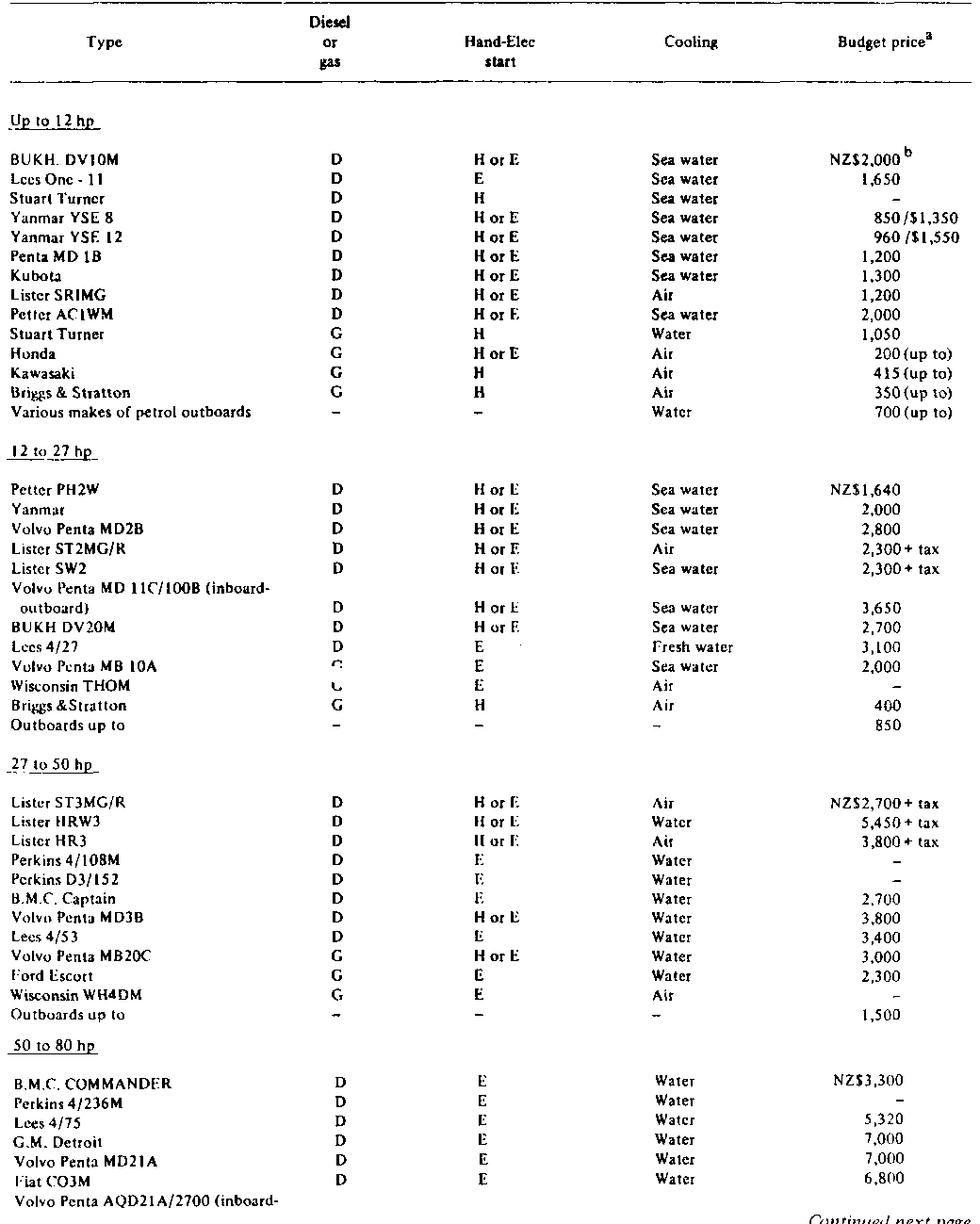
Table 2. Brands of motors available
in various ranges of horsepower and selected features of each brand.
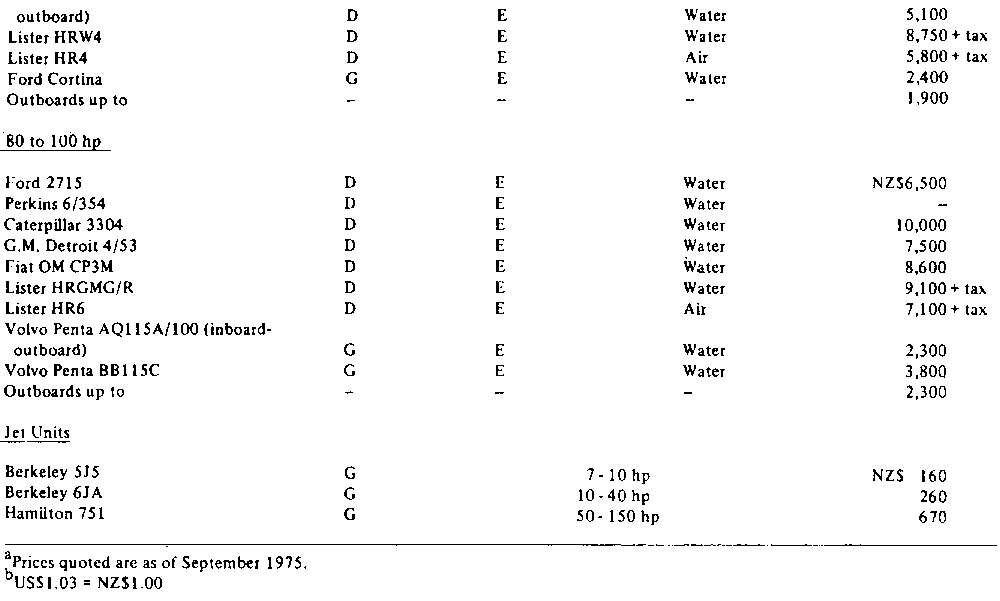
Table 2 contd.
Marine fuels and primary fuel
Introduction
4 well designed fuel system will store, clean and supply fuel at the proper pressure and rate to satisfy all demands placed on the engine. A mechanic called to check an engine installation for proper operation must be totally familiar with all aspects of the fuel system. Each part of the fuel system should be checked to assure its operation whenever a lack of power complaint is registered by the owner of a ship.
To effectively accomplish this, the mechanic should be made familiar with the following:
Fuel Classification Numbers
Fuels that are usable in Caterpillar Diesel Engines fall into two groups: these are Fuel Oil and Diesel Fuel Oil. Fuel oil is listed by number as follows: No. 1, No. 2, No. 4, No. 5, No. 6. The higher the number the thicker the fuel. The thicker fuels have a greater BTU value but are not fluid enough to successfully operate in the Caterpillar fuel system. The number 1 and number 2 fuel oils are compatible in the fuel systems. The number 2 fuel oil is heavier and therefore supplies more BTU's per gallon and is more economical to use.
Diesel Fuel Oil is classified as No. 1-D, No. 2-D and No. 4-D. The number 4-D is a heavy fuel and is too viscous to be used in the Caterpillar fuel systems. The No. 1-D and No. 2-D fuels are acceptable in the Caterpillar fuel systems with the No. 2-D fuel preferred because of its greater BTU content.
The No. 3 and No. 3-D fuels are missing from the list. These classifications were dropped from the listing by the American Society for Testing Materials and are no longer used.
A marine Diesel fuel is also available in several areas of the world. This fuel is basically the same as the No. 2 and No. 2-D fuels with the provision that the sulfur content is held to a specific low level.
Fuel Variables
When checking a vessel's fuel system, more than the type of fuel in the ship's tanks must be known. Fuel qualities that directly affect the operation of the engine are as follows:
|
Sulfur content |
Pour point |
Filterability |
|
Cetane number |
Cloud point |
|
Sulfer Content
Sulfur is present in all fuels and should be held at minimal levels. During the combustion process the sulfur combines with the water that is produced by the burning of the fuel and forms sulfuric acid, H2SO4. The sulfuric acid will attack and react with the metals of the engine if it is left to build up within the engine. Series 3 lubricating oil will take care of most of this accumulation of sulfuric acid if the level of the sulfur in the fuel is less than 0.4%
When the sulfur content of the fuel is greater than 0.4%, the oil change period should be reduced by one half. If the sulfur content of the fuel is greater than 1.0% the oil change period should be reduced by three-quarters. The sulfur content of the fuel should always be known to prolong the life of the engine. If at all possible, the sulfur content of the fuel should never exceed 1.0%.
Cetane Number
Cetane number is an indication of the ignition performance of the fuel. The higher the cetane number, the easier the fuel will self ignite in the combustion chamber of the Diesel engine. The numbers range from 0 to 100. Generally, the heavier the fuel the lower the cetane number. Heavy fuels are very difficult to self ignite and generally have to be preheated. The minimum cetane rating that Caterpillar engines are designed to operate at is 35. The normal cetane ratings of several fuels are: No. 2 Fuel Oil 35-45, No. 1 Diesel Fuel Oil-55-60, No. 2 Diesel Fuel Oil-48-50, and Marine Diesel Fuel-35-40.
Pour Point
Pour point is the lowest temperature at which the fuel will flow by gravity feeding. This figure should be at least 10°F. (6°C) below the lowest temperature at which the engine will be required to start. In extremely cold weather, No. 1 or No. 1-D fuel may be required because of its lower pour point.
In most marine applications the pour point figure is a relatively unimportant factor as the temperature of the fuel is very seldom below freezing.
Cloud Point
Cloud point is the temperature at which the wax that is present in the fuel will form crystals and plug fuel filters. The cloud point is usually about 10 to 15°F. above the pour point of the fuel. The cloud point should always be below the lowest temperature that the engine is required to operate in.
Filterability
Filterability is a measurement of the lack of sediment and water. Fuels used should be free from most contaminants. Generally no more than 1% of sediment and water should be allowed in the fuel. If a greater amount of sediment or water is present in the fuel, the filters and screens will plug at short intervals and hamper the overall performance of the engines.
From the preceding information it can be seen that if any of the fuel conditions listed are not corrected, an engine may not perform according to specifications. In the United States most fuels available for marine usage meet the minimal requirements for good operation. However, in foreign countries fuel may not meet all of the specifications set forth above. The most common difference in fuels is the sulfur content. In several areas of the world the sulfur content will reach or exceed 1.0%. When this type of fuel is encountered, reduced oil change periods are a must.
Fuel Tanks
The fuel tanks are generally built into the ship at the time of construction by the shipyard. Normally a mechanic is unable to do anything about the general installation. However, if a problem in the fuel system is indicated, it is important that the mechanic knows several design features that are involved in the construction of the tanks and connecting lines.
The material that is used in the construction is one thing to consider. The material used should not react with the Diesel fuel placed in the tank. The main material that is objectionable is galvanized iron. The zinc used in galvanizing is unstable in the presence of sulfur, especially in the presence of moisture. A sludge is formed by the chemical action of the sulfur, zinc and moisture which is extremely harmful to the engine's fuel injection system and may cause deposits on piston rings, pistons, valves, etc. Any form of zinc should be avoided where continuous contact with Diesel fuel is involved.
This problem can occur when a pleasure boat is repowered from a gasoline powered boat to a Diesel powered boat. Galvanized fuel tanks are satisfactory for use with gasoline powered boats and are found in many installations. For the above reasons, when a boat is repowered, the material used in the construction of the fuel tanks should be checked.
Fuel Tank Drain Valves
All fuel tanks should have a drain valve located near the bottom of the tank. The bottom of the tank should be sloped towards the drain valve so that all the water and sediment can be removed from the tank. The drain valve should be periodically opened to remove any accumulated water and sediment. This procedure may be required as often as every crew watch change.
If a failure indicates that dirt in the fuel system may have been a contributing factor to the failure, be sure to check the fuel tanks to see if provisions have been made to drain off sediment.
Fuel Tank Vents
All fuel tanks should be vented to the atmosphere. The vent should be constructed so it will not allow water to enter the tank under any operating conditions of the boat. The vent equalizes the air pressure in the tank when fuel is drawn off and also when the tank is filled. Most fuel tank vents use a ball type check valve and a screen to prevent the entrance of water and dirt.
Fuel Fill Pipes and Caps
One of the main places where dirt can enter the fuel system is the fill pipe. It is important to assure that the area around the fill pipe is clean and free of dirt whenever the cap is removed for fueling. This will prevent the entrance of unwanted dirt during the fueling operation.
The fuel cap should be chained to the fill pipe to prevent loss of the cap. A cap can be lost over the side very easily during a fueling operation. When this occurs, it generally takes some time before the cap is replaced, allowing the entrance of unwanted dirt into the tank while missing.
Fuel Tank Clean Outs
The fuel tanks of some large boats have cleanout plates. If the fuel tanks become contaminated over a long period of usage, they may require internal cleaning. The cleanout plates provide access to the tank.
Causes of Moisture Accumulation in the Fuel Tanks
The fuel transfer pump on the engine supplies more fuel than the engine can use during normal operation. Excess fuel is usually returned to the fuel tank. When this is done, it is important that several design features be checked. The returning fuel will have picked up heat from the engine. This hot fuel returning to a cold tank can cause a build up of moisture in the fuel system. The fuel tank which is vented to the atmosphere can contain moisture laden air. The returning hot fuel heats the air in the tank and the moisture in the air condenses on the colder metal sides of the tank. The moisture then runs down the side of the tank and accumulates at the bottom of the tank. If this is not removed at frequent intervals, the water can enter the engine's fuel system.
Water and Sediment Trap
All fuel systems should have some type of water and sediment trap in the fuel supply network before the fuel transfer pump, This trap should be large enough to allow the fuel flow to slow down to a point where the large particles that are present in the fuel can drop out and collect in the sediment trap. The purpose of this type of trap is to reduce the load on the primary filters and prolong the life of all fuel system components. The water trap is located at the lowest point in the fuel system. Water, being heavier than the Diesel fuel, will settle to the lowest point in the system.
Primary Filters
Primary filters are used to remove the larger particles of sediment that enter the fuel system. They are generally installed before the fuel transfer pump so that the internal components of the transfer pump are protected from damage. In most marine applications two primary filters will be connected in parallel. With this arrangement the engine does not have to be stopped to service the filters. When the filters are to be serviced, a valve can be closed stopping the flow through one of the filters. The remaining filter will carry all of the pump flow. After the filter is serviced, it can be put back into the system and the remaining filter can be serviced.
If the primary filter becomes restricted it will reduce the flow of fuel to the engine and directly affect the performance of the engine. Air leaks in the filter gasket area can also cause poor engine performance; air drawn into the fuel system will cause the engine to lose power and run rough.
Secondary Filters
The secondary filters of the fuel system are the last protective components in the fuel system. The number of filter elements that are used vary from engine to engine. These filters offer very little restriction to the flow of fuel and are generally mounted in parallel. The filters will remove any particles larger than 10 microns in size. The filters are located at the highest point of the fuel system. This provides a very convenient place for any air that might enter the system to accumulate. A bleed valve is provided at this point to help remove the air.
The filters are changed only when the fuel pressure gauge reading drops. If the restriction of the fuel filter causes the gauge to enter the red zone of the gauge, the filter elements should be replaced. With this method the fuel system is not opened up and exposed to the dirty surroundings unnecessarily. The fuel filter housing has a drain valve at the base of the housing. This drain should be opened every 50 hours to remove any accumulated water and sediment. If dirty fuel is encountered, this procedure may have to be repeated more frequently.
A bypass valve is located in the filter housing to return the excess fuel that the transfer pump delivers back to the supply tank or standpipe. If the bypass valve does not seat properly the fuel pressure to the fuel injection pumps will drop and poor engine response will result.
Fuel Day Tanks
In many large boat applications a fuel day tank is used. This tank is generally large enough to hold a fuel supply for eight hours of engine operation at the full load rating. Several rules should be followed when using this type of installation.
1. The day tank should be located so that the level of the fuel in the tank (when the tank is full) is no higher than the injection valves. The day tank should not be mounted so high "relative to the engine) that the gravity will allow fuel to leak into the combustion chamber in the event of the injection valve leakage. 2. The tank should be close enough to the engine so that the total of suction lift to the transfer pump with the fuel at low level, plus the restriction of the supply line, is less than 12 feet.
Session T-20: Volunteer's role as an extensionist
Time: 7:30 PM
Goals:
· Examination of the roles of an
extensionist
· Exploration of ways in which
to introduce innovations to communities
·
Practice in communicating with community people regarding an
innovation
· To examine communication skills,
verbal and non-verbal once more
Overview:
In this session, seven roles are isolated in the process by which a volunteer in the role of an extensionist introduces new ideas to his/her community. The importance of good communication skills is brought up again and skills that volunteers need are focused on. The non-verbal observation assignment from the previous week is discussed, and trainees share with their partner their observations over the past week.
Exercises:
1. Extensionist roles
2. Communication skills - verbal and
non-verbal, of an extensionist
Materials:
· Flip charts, marker pens, tape
EXERCISE 1 - Extensionist Roles Total Time: 1 Hour 20 Minutes Overview:
In this exercise we look at the seven roles of an extension worker. Trainees discuss ways in which they can adopt these roles as volunteers doing extension work in their communities.
Procedures:
|
Time |
Activities | |
|
1 Hour |
1. Trainer introduces the following seven roles and gives an explanation of each: |
1.1 develops need for change |
|
20 Minutes |
|
1.2 establishes a change relationship |
| | |
1.3 diagnoses the problem |
| | |
1.4 creates intent to change in community members |
| | |
1.5 translates intent into action |
| | |
1.6 stabilizes change and prevents discontinuances |
| | |
1.7 achieves a terminal relationship |
Trainer's Notes:
For trainer's discussion use local examples to illustrate each role.
| |
1.1 Develops need for change - A volunteer is often initially required to help his/her community become aware of the need to adopt a new technique, such as using ice to preserve the catch. The unwillingness to accept change readily often results in the volunteer serving as a catalyst in the community. In order to do fisheries extension work, the volunteer points out new alternatives to existing problems, dramatizes these problems and convinces fishermen that they are capable of confronting them. The volunteer acting as an extension worker not only assesses the community at this stage, but also helps to create these needs in a consultative and persuasive manner. |
| |
1.2 Establish a change relationship - Once the need for change is created, the volunteer must develop rapport with the community. He/she enhances his/her relationship with the community by creating an impression of credibility, trustworthiness, and empathy toward their needs and problems. Communities must trust the volunteer worker before they will accept the innovations he/she proposes. |
| |
1.3 Diagnosis of the problem - The extension worker is responsible for analyzing his community's problems/ situation in order to determine why existing alternatives do not meet the community's needs. In arriving at his/her diagnostic conclusions, the extension worker must view the situation empathetically from the community's point of view and not his/her own. The volunteer extension worker must psychologically place themselves in their situations, put him/herself in their shoes, see their lives through their eyes. This empathy transferal is difficult. |
| |
1.4 Creates intent to change in community members - After the volunteer explores various avenues of action that his/her community might take to achieve their goals, he should encourage an intent to change, a motive to innovate; but the change must be community-centered, rather than for change for the sake of change. Here the volunteer's role is to motivate. |
| |
1.5 Translates intent into action - The volunteer now seeks to influence his/her community's behavior in accordance with his recommendations which are based on the community's needs. In essence, the volunteer works to promote compliance with the program he/she advocates. This means more than simple agreement or intent. It means action or behavioral change. |
| |
1.6 Stabilizes change and prevents discontinuances Volunteers may effectively stabilize new behavior by directly reinforcing messages to those community members who have adapted, thus "freezing" the new behavior. This assistance frequently is given when the individual is at the trial-decision or confirmation function in the innovation-decision process. |
| |
1.7 Achieves a terminal relationship - The end goal for the worker is development of self-renewing behavior on the part of his/her community. The volunteer should seek to put him/herself out of business by developing his/her communities' ability to be their own change agent. In other words, the volunteer must seek to shift the community from a position of reliance on the volunteer to self-reliance. |
|
(The above 7 roles have been adapted from: Communication of Innovations by Rogers & Shoemaker) | |
|
40 Minutes |
2. Trainer now asks group to form into small groups and envision the seven roles of an extension worker as objectives they have set for themselves and then come up with action steps to achieve these objectives. Make a list of these steps on newsprint. |
|
15 to 20 Minutes |
3. Small groups now share with large group their action steps. |
4. Trainer now does a summary of the presentations and introduces the next exercise.
EXERCISE 2 - Communication Skills - Verbal and Non-verbal, of an Extensionist Total Time: 1 Hour 15 Minutes
Overview:
In the preceeding exercise we have looked closely at the seven roles that an extension worker plays. Now we want to look at the kind of communication skills a volunteer will need to carry out extension work. In this exercise, we also process the session of the previous week by discussing, generalizing and applying the experience accumulated by the trainees in one week of observing non-verbal behavior with each other. Then the participants give each other feedback on what they saw each other doing, discuss observations and arrive at some working assumptions/generalizations about how non-verbal communications may be the most important part of their communications system in the early days of their volunteer work.
Procedures:
|
Time |
Activities | |
|
5 Minutes |
1. Trainer asks participants to list various kinds of communication skills they are going to need to carry out their role as extension workers. | |
|
5 Minutes |
2. Trainer now asks participants to call out skills, and lists them on newsprint while they are called out. | |
|
3 Minutes |
3. Trainer makes general comments about skills trainees have not identified. If non-verbal skills have not been listed, trainer adds and makes the point that in the early days of volunteer service participants will send out many non-verbal messages that will be his/her first impact on communities. |
|
|
10 Minutes |
4. Ask the group to form into the same pairs that have been observing each other for the past week and spend a few minutes telling each other what they observed each other doing in terms of non-verbal communication during that time. This should serve as a way for individuals to gain insights into how they use non-verbal processes in ways which they may not be aware of. | |
|
5 Minutes |
5. Bring group back together and draw out some generalizations from the experience of observing each. | |
| |
6. Ask each pair to get with another pair and discuss the following questions. | |
| |
Discussion questions should be posted on flip chart. |
o Did any of you learn anything new about yourselves? What? |
| |
|
o Is there anything about non-verbal communications in general that you have learned from the experience? |
| | |
o Have you any ideas on how you can use non-verbal communication as an extension worker? What are they? |
|
15 Minutes |
7. Trainer now asks for comments from participants on communication skills. He then summarizes the verbal and non-verbal skills that an extension worker needs. | |
Session T-21: Introduction to small-scale fishing
Time: 7:30 AM
Goals:
· To acquaint trainees with
various small-scale fishing gear apparatus
·
For trainees to learn the proper care and maintenance of fishing gear
· To have trainees be able to identity various kinds of
fishing gear and uses of that gear
Overview:
This session is the introduction to small-scale fisheries and lays the foundation for all future fishing sessions. Gear identification is stressed in this session as well as gear care and maintenance of fishing gear. Trainees conduct a survey of the local dock area and identify as much fishing equipment as possible while conducting the survey to ascertain how to care for and maintain their fishing gear.
Materials:
· Flip charts, markers, tape
Procedures:
|
Time |
Activities | ||
|
1/2 Hour |
1. Technical trainer gives lecturette using the following outline: (with flip chart drawings) | ||
| |
I. Fishing Gear Identification |
A. Nets | |
| | |
B. Hooks and line | |
| |
|
C. Traps | |
| | |
D. Fish Boats and gear | |
| | |
E. Fishery | |
| |
II. Trolling | ||
| |
III. Deep-line, Long-line | ||
| |
IV. Care and Maintenance of Fishing Gear |
A. Causes of Deterioration |
1. chaffing |
| |
| |
2. oxidation |
| |
| |
3. bacterial action |
| |
IV. |
B. Preserving Fishing Gear |
1. Prolong Life |
| |
| |
2. Protect twine from abrasion |
| | |
C. Maintain a good appearance, color, odor, other physical features | |
|
| |
D. Camouflage the gear to be less visible to fish | |
| |
V. Care of Fishing Gear |
A. Washing by removing excess fish, seaweed, other debris |
|
| | |
B. With fresh water remove solidified salts to lines, hooks | |
| |
|
C. Drying, in shade, before reuse; allow sufficient time to dry | |
| |
|
D. Storing, thoroughly dry the gear; do not compress in storage; storage area should not be damp; provide good ventilation | |
| |
VI. Causes of Damage to Gear |
A. Rough handling | |
| |
|
B. Obstruction encountered while fishing | |
| | |
C. Physical friction | |
| |
|
D. Mechanical wear and tear | |
| | |
E. Distructive fish | |
| |
|
F. Rodent, insect damage | |
| |
VII. Maintenance of Gear |
A. Repairing and mending nets, lines | |
| | |
B. Checking seams, knots | |
| | |
C. Sharpening hook points | |
| | |
D. Checking hardware | |
|
2 Hours |
2. Trainees are given assignment to survey dock and water front area to locate and identify small scale fishing gear, nets, hook and lines, etc. | ||
| |
Whenever possible they are to interview fishermen asking the following questions: |
a. why they use that particular equipment or gear | |
| | |
b. what maintenance procedures do they follow | |
| | |
c. what other types of gear they have used | |
| | |
d. do they make their own gear or buy their gear | |
|
1/2 Hour |
3. Trainees are to diagram on chart fishing systems for gear identified. Write synopsis on each inter view conducted. Prepare a five minute presentation on information gathered during survey/interview period for large group. | ||
|
1 Hour |
4. Trainees give presentations to large group. Trainer makes appropriate remarks as to use of systems and care and maintenance. As this is the first time trainees will have interviewed, trainer will want to stress techniques which were good and generated valuable information. | ||
|
10 Minutes |
5. Trainer makes point of linking the session to future sessions by reviewing training schedule. | ||
Session T-22: Trolling for spanish mackeral - special group project; Anatomy of hook - special project
Time: 4 PM
Goals:
· For trainees to become familiar with techniques used while trolling for Spanish Mackeral and other fish species
· To familiarize trainees with appropriate fishing gear used while trolling
· For trainees to become competent in tying '"Fisherman Knot #1".
Overview:
This session was done as a special group project. In it the trainee becomes aware of small-scale fishing, utilizing trolling as a means of fish capture. The trainees have the opportunity to learn the technical skills associated with rigging bait/lure for use in trolling.
Materials and Equipment:
· Flip chart, pens, wire leader, wire cutters, hooks (single, double), lures, line bait, trolling wire cable, nylon monofillament
Procedures:
|
Time |
Activities |
|
1 Hour |
1. Trainer presents an overview of small-scale trolling techniques on a world wide basis. |
| |
2. Demonstration by trainee of proper gear usage while engaged in trolling. |
|
|
3. Hands-on of hook knot tying, baiting by trainees. |
| |
4. Philosophies of various small-scale fishing operations and what techniques can best be utilized by the trainees. |
Trainer's Notes:
Tie this SP session in with earlier sessions -Introduction to Exploratory Fishing.
References:
· Australian Fisheries Review, 1978
"TROLLING"
The following information is taken from Peace Corps pamphlet 27-7, "Commercial Trolling for Spanish Mackeral". The authors name is not shown. The author was careful to state that any procedure or tackle mentioned was only a variation among many. Each individual fisherman will find variations in tackle and procedure that bring in a good catch. It is therefore incumbent on the fisheries extensionist to keen eyes, ears and mind open when learning any fishing technique.
Backing Cord - This is a heavy duty cord of approximately 8 MM x forty feet in length, and its purpose is to give the fisherman something thick to grasp when the strike comes. By its elasticity, it also has a tendency to take the initial strain if let out to its full length. Without the backing cord, the line would tear through the hand and serious injury could result.
Main Line - The main line can consist of anything from .045 steel Bowden cable, to nylon line up to a breaking strain of 350 lbs (in training ours was 150 lbs). Roughly 80 feet is attached to the backing by means of a swivel. It must be remembered that when using steel cable, the shock of the strike is transmitted directly to the backing as the steel will not give, whereas nylon easily absorbs the shock.
Traces - Traces are usually made up of No. 8 or No. 10 steel piano wire. At the beginning of a season, 80 to 100 feet, and usually gradually shortened as the season intensifies. Special care must be made in tying swivels to trace and main line. Make neat knots as line disturbance in the water will spook the wary fish.
Leads - Leads are attached between the main line and trace. They are normally used only when garfish is used for bait. This adds "depth" to the bait and often produces positive results.
Hooks and Bait - The hook, usually a 3" or 9.0, is fastened onto the trace, by passing the trace through the eye, around the shank, away from the gap in the turn, bound three times around the shank and taken again through the eye from the other side, then wound around the trace three or four times and broken off.
The garfish bait mentioned is, ideally, about 9" long. Longer bait will tend to produce "short-strikes" where only the tail of the bait is taken. Refer to the diagram for hooking instructions.
The gar must be as near natural as circumstance will permit. If the soft under-belly of the bait is found to be broken open when checked, then it should be replaced.
Remember these pieces of gear: 1) Gloves (See illustration); 2) Wire ; 3) Knife; 4) wire cutters; 5) Hook.
The most important piece of equipment you have is yourself. A good nights rest will allow you to be alert while trolling. Check the bait every 10-15 minutes or more often if you suspect short strikes. Look lively at all times and be patient. Observe the trolling gear constantly You're out there to catch the big ones so think big, act positively and with assurance that you will get results.
Appendix 1

Important to wear hand protection,
in this case inner-tube cut to fit the wearers hand. Inner-tube is sewn with
monofillament line.
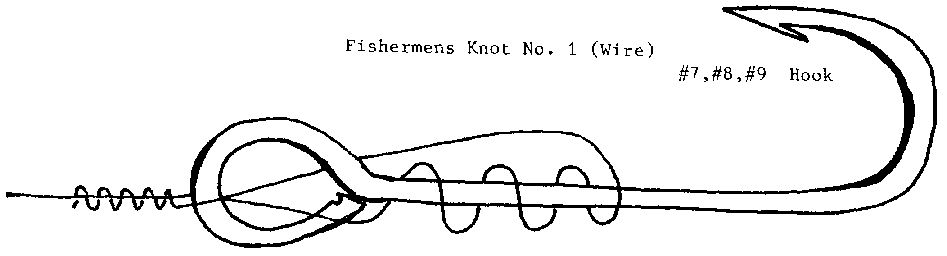
Wire leader attached to hook, final
wrapping is tightly wound and securely snugged.
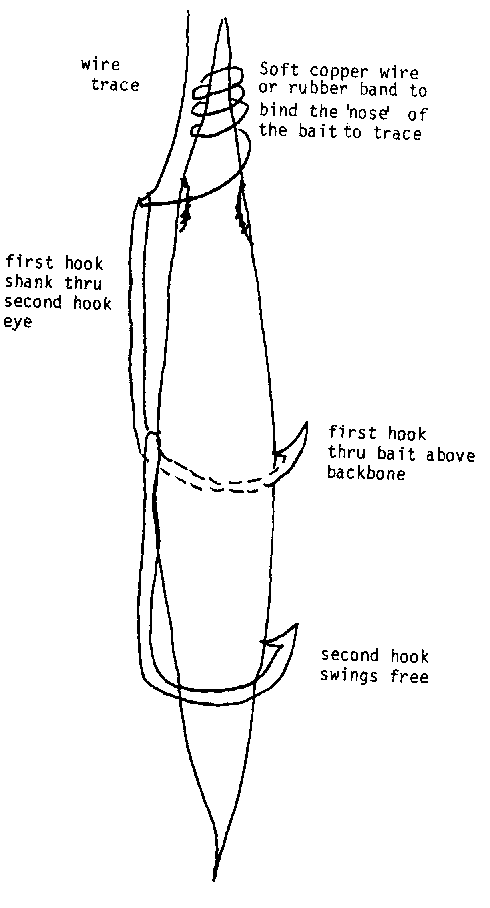
Hook

Hooks
Part Two - Anatomy of Hooks Time: 5 PM
Goals:
· To acquaint trainees with
various hook designs, functions and usage.
·
To provide information on hook nomenclature to trainees.
Overview:
This session is to be done as a special project by a trainee. This session is used as a complement to the introduction to Exploratory Fishing, as well as the Trolling for Spanish Mackeral SGP. In this session trainees become aware of the number one element in fish capture, its history, etc. Trainers have the opportunity to tie back to Introduction to Exploratory Fishing.
Materials:
· Flip chart, pens, numerous hooks by different net manufacturers.
Procedures:
|
Time |
Activities |
|
1/2 Hour |
1. Trainee presents an overview of hook designs, uses and functions. |
|
|
2. Various hooks are distributed, and various sizing systems explained to trainees. |
| |
3. Final wrap-up by trainee presenting session. |
References:
· Guide to Small-Scale Fishing Gear of the World, FAO, 1976 o 0. Mustad. A History of the Fish Hook, 1972.

Fish hook anatomy
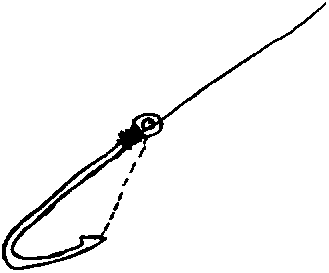
The Curvature Angle
The curvature of a fish hook is such that the point makes a direct line with the eye. This allows maximum tension when landing a fish.
Fish Hook Material:
1 Spring steel
Commercial
3. Bronze Alloy
4. Sea Shells
5. Bamboo
6. Bones
7.
Teeth
8. Coconut Shells
9. Almost anything else
DESIGN ANO FUNCTION

Trolling Hooks
- average length 2"-3"
- heavy gauge steel
- natural or
live bait
- larger fish - 10 lbs up to hundreds of lbs. Tuna - (all types),
Marlin (all types), Mackeral Bonita, Wahoo
- hook may tee offset to
facilitate hooking

Double Hooked Hook
- 2"-3" - larger fish also
- used with lures to facilitate
hooking since fish will only hit a lure or jig once
- from same types of fish
as mentioned above

Bait Holder Hook
- bait holder barbs prevent bait from sliding off
- 1"-2'' -
bottom fishing, squid or any cut bait
- for grouper, snapper, cod fish, sole,
halibut, flounder and any other bottom fish

Straight Hook
- under 2" - lighter gauge
- bottom fishing, halibut,
snapper, grouper, cod fish
- natural bait
- small fish under 20 lbs.
-
hooks can be offset (out of line) to facilitate hooking

Small Bait Hook actual size
- small hook with very light gauge steel
- usually used for
catching bait fish
- bottom fishing

Live Bait Hook
- short shank
- heavy gauge
- used with live bait (placed
through mouth and gills) live bait will "run" along surface or close to it
-
larger surface feeding fish (tuna, marlin)
Circle, Self-Hooking, Cod, Japanese
Hook
- self-hooking hook
- when a fish tries to back off from hook
it will hook itself even further
- no pressure needed on line to hook fish -
usually used for bottom fishing and long lining

Barb-less Hooks
- live bait (sardines) or lures - short line attached
-
usually used for schooling fish where time can be saved by not having to unhook
barbs from fish (tuna, mackerel)
- squidering used to simulate squid bait
References:
· Fishery in Japan - Yamaha Motor Co., Ltd. Printed in Japan
Session T-23: Extension III - Extension of extension by an extensionist
Time: 1 Hour 30 Minutes
Goals:
· To enable trainees the opportunity to verify what they've learned about extension with a real extensionist
Overview:
In Extension I and II, trainees learned about the role of the extensionist in the community and the important resource linkage the extensionist provides the fishing family to outside technical and material assistance. In this session, trainees have the opportunity to ask a local extensionist about his or her job: the positive and negative aspects of it; what works and what doesn't work when trying to convey a new idea or technology; how association with the government helps or hinders his/her job; and helpful hints for interacting with individual (or groups of) fishermen and fish processors, particularly members of the opposite sex.
Procedures:
|
Time |
Activities |
|
20 Minutes |
1. Trainer introduces extensionist to trainees, and sets the climate for questioning by first dividing the group into small groups of 5 or 6 and asking them to put on newsprint everything they know about extension work. The groups report out. |
|
1 Hour |
2. The extensionist comments on the newsprint, provides examples and observations from personal experiences, and answers follow-up questions from the trainees. |
|
10 Minutes |
3. The trainer draws closure to the session by linking back to the previous sessions on extension and ahead to the upcoming community analysis sessions. Any personal experiences that the trainer has relevant to the extension discussion should also be added at this time. |
Trainer's Notes:
The trainees should be told at the conclusion of the previous extension session to prepare a list of questions for the guest extensionist. See the alternative session outline attached should a local extensionist not be available.
Alternate session T-23: Marine fisheries extension
Procedures:
|
Time |
Activities | |
|
5 Minutes Individual discussion |
1. Introduce session by briefly stating its goals and presenting an overview of the session. | |
|
20 Minutes |
2. Ask participants to individually identify the major things they have learned regarding extension by writing down on a piece of paper the four or five thoughts or ideas which stand out in their minds as being most important about extension. Trainer can briefly summarize each extension session before participants start in order to help them remember and identify their learnings. | |
|
Subgroup work 15 Minutes |
3. Ask participants to form groups of five or six and share their most important conclusions of extension work. Ask them to look for similarities and differences and select any ideas, questions, concerns, they want to present to the total group. | |
|
Group discussion 20 Minutes |
4. Reconvene and ask participants for important ideas, questions or concerns which they discussed in their small groups. Example: You have identified ideas, questions, concerns, and now have some conclusions regarding extension. Are there any important thoughts you want to share with the group? Any similarities or differences which surprised you? Were there any concerns raised in your small group discussion you want to bring to the group? Trainer jots down on newsprint, remarks for each group. A discussion ensues based on statements and questions made by participants. | |
|
Individual work15 Minutes |
5. Ask participants to do individually the following task: |
|
| |
Based on what you have learned about |
a) entering the community, |
| |
extension, what could you do differently |
b) getting to know the community, |
| |
(strategies, actions, activities) as a PCV |
c) meeting community people and making friends, |
| |
starting extension work. Think of the following |
d) identifying community needs, |
| |
aspects of your future work: |
e) entering the job, |
| |
|
f) establishing secondary projects, |
| | |
g) evaluating "how you are doing" as a PCV. |
| |
This is not an exhaustive list and participants do not need to address each of these areas. It is a guideline to help them think about the different aspects of their work and different actions they might take to consider extension projects and communities. | |
|
Sub group analysis 20 Minutes |
6. Ask participants to form groups of two or three and discuss their individual analysis. As they discuss, they should pay attention to which actions or strategies seem to address extension work more effectively; which seem more feasible given the culture, history and considerations in the host country, which are more practical and easy to implement. They should select the best strategies or activities to present to total group and receive feedback from other participants and trainer. The sub groups task can be presented on a flip chart as follows: Discuss your strategies or actions taking into consideration their effectiveness, cultural appropriate ness and feasibility. If necessary, develop new strategies out of your discussion. Select the best strategies to present for analysis and feedback. | |
|
Group discussion 30 Minutes |
7. In general session, trainer asks for examples of participants strategies. Trainers react to proposed strategies using the following guidelines: | |
|
|
o most likely to succeed strategies and why, | |
| |
o most likely to fail strategies and why, | |
| |
o suggestions and new ideas about strategies and activities which work and do not work based on their own experience. | |
|
Closure 10 Minutes |
8. Trainer summarizes session by presenting or developing with the participants a list of different ways in which extension can take place in Peace Corps activities. | |
Materials:
· Newsprint for activities #5 and #6.
Session T-24: Small-scale fishing
APPROPRIATE FISHING TECHNOLOGY I
DEEP-LINE SNAPPER REEL
Time: 7:30 AM
Goals:
· To make trainees aware of the
various applications of intermediate fishing technology
· To acquaint trainees with various fishing systems
that are appropriate, both technically and financially on the community
level
· To familiarize trainees with basic
fishing gear design and construction techniques appropriate for deepwater
underutilized species exploitation
Overview:
This session is particularly important for developing design and construction abilities in trainees. On the community level, little money will be available for "new'' fishing gear, thus the need for the trainer to be aware of techniques in utilizing materials for fishing projects that will benefit the community. (Session will cover marketing)
Procedures:
|
Time |
Activities | |
|
1/2 Hour |
1. Trainer reviews present Industrial Fishing Technology |
a) large vessels |
| |
|
b) mechanized gear |
| |
|
c) capital intensive operations |
| | |
d) fishery |
| |
Trainer moves into review of Small-Scale Fishing Technology: |
a) small boats for fishing |
| | |
b) subsistence level - no boats |
| | |
c) hand gear |
| |
|
d) labor intensive |
| |
|
e) fishery |
| |
He continues on into introduction to labor/time saving "mechanized" fishing gear. |
a) comparison of han-dline fishery with automated |
| | |
deep-line snapper reels (See appendix I) |
| | |
b) lowering of technology from deep-line electric or hydraulic reel to a hand-powered model. |
| |
Lastly trainer covers application of hand-powered reel for small-scale fishing: |
a) opening new offshore fishery |
| | |
b) marketing approaches |
| | |
c) fishermen training |
| |
2. Trainer now gives trainees drawing of Deep-line Snapper Reel, with the following instructions (in groups of three): |
a) Design snapper reel using locally available materials. After design is completed have technical trainer check design and approve design before moving to b. |
| | |
b) Construct snapper reel using woodworking tools. Pre-plan all cutting and fitting of parts for tight/secure fit. |
| | |
c) Fishing gear; after reel is constructed, prepare deep-line set up. |
|
| |
- no hardware other than hooks needed, prefer tuna circle |
| | |
- weight - beer can with concrete |
| | |
d) Rig to be utilized on following fishing trip Session |
Materials and Equipment:
· Flip chart, pens, woodworking tools, tire innertube (used), wood, hardware; nails, 10"-12" bolt/A-Bar for reel shaft, monofillament nylon #160 lb. tuna circle hooks if available
Trainer's Note:
It is important to guide trainees in the actual design of the reel, but allow a free flow of ideas to put it all together. A working model can be easily built from the line drawing.
References:
· Mead, Paul. Report on the Second Visit of the South Pacific Commission Deep Sea Fisheries Development Project to the Kingdom of Tonga. South Pacific Commission. Noumea, New Caledonia. 1980.
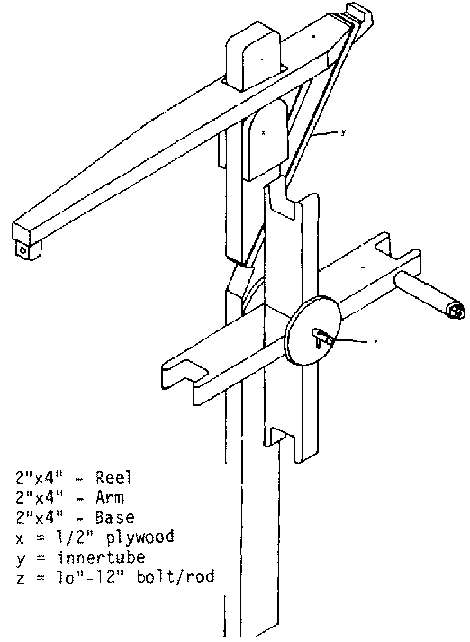
Figure
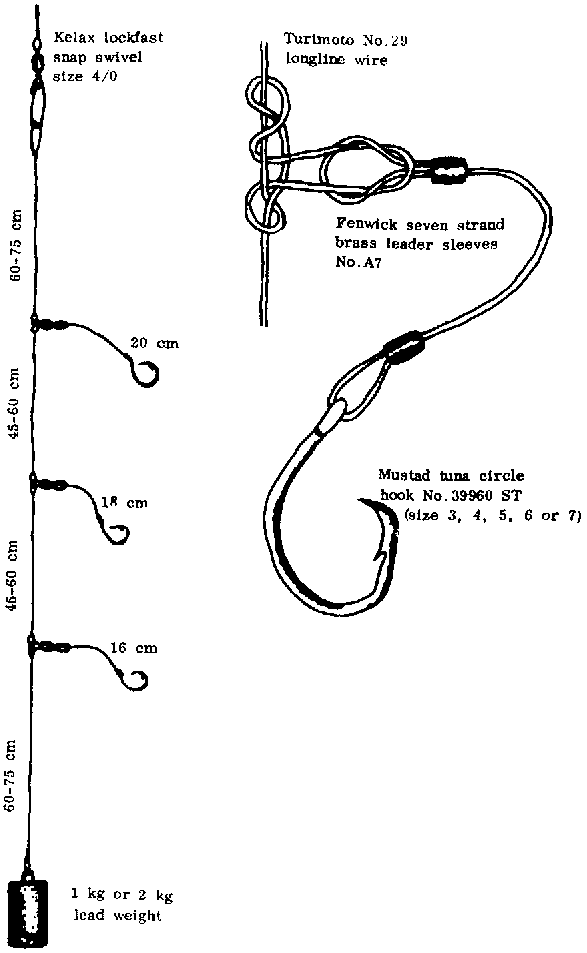
Terminal rig used for deep bottom
fishing. Turimoto No. 29 longline wire and Mustad tuna circle hooks (sizes as
shown) were used.
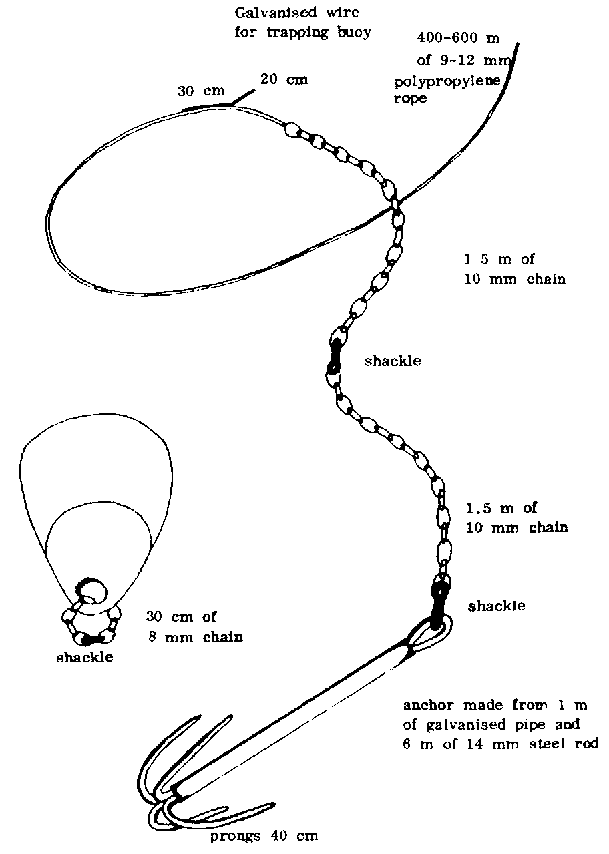
Anchoring system suitable for deep
bottom fishing. Rope diameter depends on size of boat. All shackles should be
seized.
Session T-25: Individual interviews/net mending
Time: 2:30 PM
Goals:
· The goals for this session are the same as in previous interview session.
Procedures:
| |
The following questions are recommended for this session, in addition to formal feedback. |
| |
1. Do you have any concerns that you want to talk about? |
| |
2. On a scale of 1-10 and based on the training design content, how would you rate your technical skills in marine fisheries? |
| |
3. Where are you in your decision to go to? |
| |
4. Anything you want the staff to be aware of? |
Session T-26: Communication through illustration special group project
Time: 7:30 PM
Goals:
· To show trainees simple
drawing techniques
· To have trainees
understand the importance of being able to illustrate what they are saying
verbally
· To have trainees practice
drawing
· Special group project on simple
poster drawing techniques and use of other materials for making posters
Overview:
This session introduces the importance of illustration as a communication technique. In future sessions trainees will be expected to use illustrations as part of their presentations. The importance of using visual aids while talking to a group is also emphasized.
Exercises:
1. Special group project on simple poster drawing
techniques.
2. Communication through illustration.
Procedures
|
Time |
Activities | |
|
30 Minutes |
1. Trainees give presentation on various techniques for enlarging, lettering, etc., for posters and other visual aids. | |
|
15 Minutes |
2. Trainer then presents self as a non-artistic person and draws a series of stick figures which tell a message. Trainer explains that it's ok to make people laugh by your drawings as long as it gets your message across. |
|
|
30 Minutes |
3. Trainer then tells trainees to use stick figures to put |
- best presentation of message |
| |
across a message related to marine fisheries. Trainer |
- most creative use of materials |
| |
explains that this is a contest and there will be prizes |
- best effort by non-artistic person |
| |
awarded. Awards will be given on: |
- honorable mention in above categories |
|
15 Minutes |
4. Trainees present their posters. | |
|
15 Minutes |
5. Judges decide on awards. Apples are given out. | |
Trainer's Note:
It's important for the trainer to link his/her non-artist approach to visual aids to the special group project presentation.
BASIC PRODUCTION OF ILLUSTRATIONS
I. Illustrations must be accurate, attractive and appropriate.
II. The basis for the production of good illustrations is a
collection
of visual materials.
A. Newspaper, magazines, calendars and catalogs are good sources of visual materials.
B. Embassies, consulates, information services, and local commercial concerns may have attractively illustrated literature which is representative of their countries.
C. Potentially useful pictures should be clipped and filed into appropriate categories so that they can be located easily. Example: fish handling, fish marketing, fish preservation, fish identification, outboard motors.
D. Pictures may be placed on bulletin boards, backed with sand paper for flannel boards, used as "models" for larger drawings (flip charts, posters, etc.), and photographed for slides.
III. The production of an illustration generally involves one of two methods.
A. An illustration may be transferred to a chalkboard, sheet of
cardboard, or paper using an enlarging/reducing technique.
1. The squaring
method requires no special skills or equipment.
a. A series of squares (grid)
is drawn lightly on the paper to be transferred.
b. A grid made
proportionately larger or smaller is drawn on the copy paper, cardboard, or
chalkboard.
c. The lines of the original picture are drawn one square at a
time on the copy paper.

Figure
2. The pantograph is a device constructed from four strips of
wood about 1/4"x 3/4"x 16".
a. Holes are drilled in each stick at one-inch
intervals.
b. Bolts are inserted in certain holes to hold the strips together and to form joints which will move easily.
c. The position of the bolts determines the relative size of the copy.
d. The left end of the pantograph (for a right-handed person) is anchored to the drawing surface using a wood screw.
e. A pointed stick or pencil is inserted at the base of the pantograph diamond, and the picture to be copied is fastened beneath it.
f. A pencil is inserted at the right end of the pantograph, and the copy paper is fastened beneath it.
g. The picture to be copied is traced using the pointed stick or pencil at the base of the device and is simultaneously enlarged/reduced and copied onto the copy paper.
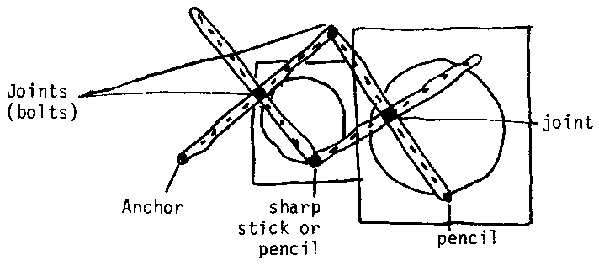
Figure
3. The outline of a small object may be enlarged or reduced by producing its shadow on copy paper using a flashlight or lamp and tracing it.

Light source
4. If an opaque projector (and/or electricity) is available, the projected image of a picture or object may be traced onto copy paper.
B. An illustration may be produced using simple drawing techniques.
1. Simplified drawings and stick figures may communicate better than detailed drawings or photographs.
2. Almost any object may be viewed as geometric shapes or a combination of geometric shapes.

Building

Cat
3. Figures to represent people are composed of basic shapes, but the factors of proportions, distinguishing features and body movement must also be considered.
a. If the length of the adult body is seven units, the head occupies one unit, the torso and arms occupy 2 1/2 units, and the legs occupy 3 1/2 units.

Figure
b. Distinguishing features include the shape of the face, hair and clothing, the shape of the eyes and the position of the pupils, the shape and position of the eyebrows, and the shape and position of the mouth and other facial features.

Figure
c. Body movements are indicated by the position and degree of extension of body parts.
1) use yourself as a model.
2) the weight on the left side of the backbone should balance the weight on the right side.
4. Drawings appear more realistic if the rules of perspective are observed.
a. Horizontal lines appear to converge toward a vanishing point on the horizon as the distance from the viewer's eye increases.
b. Vertical lines decrease in length with distance as do any spaces which occur between those lines.
c. In two-point perspective, horizontal lines to the right of the nearest corner of an object converge toward the vanishing point on the right and horizontal lines to the left nearest corner coverge toward a vanishing point on the left.
d. Almost anything that is drawn in perspective can be described initially within the framework of a rectangle.
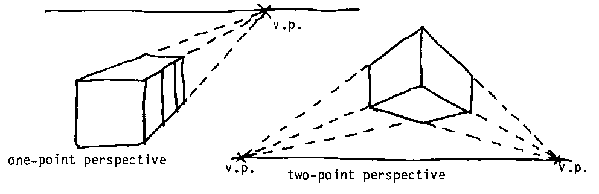
Figure
References:
· Peace Corps Audiovisual
Communication Handbook
-Marilyn Berry, PCV Sierra
Leone
Session T-27: Small scale fishing appropriate fishing technology II New Zealand long-line reel
Time: 7:30 AM
Goals:
· To make trainees aware of
various applications of intermediate fishing technology
· To acquaint trainees with various fishing systems
that are appropriate, both technically and financially at the community
level
· To familiarize trainees with basic
fishing gear design and construction techniques appropriate for shallow water
and reef edge fish species exploitation
· To
enable trainees to design a labor saving piece of equipment for long-line
fishermen
Overview:
This session is second in a series of appropriate fishing technology. The benefit of the long-line reel is not in the fishing system per se, but rather in the easy hauling and line handling ability the reel offers. Time is very much a factor, and this reel enables fishermen the opportunity to fish more hooks in less time.
Procedures:
|
Time |
Activities | ||
| |
1. Technical Trainer reviews Deep-Line Reel Session #24. |
||
| |
a. Reel | ||
| |
b. Mount Gives lecture using the following outline | ||
| |
I. Introduction of New Zealand Long-Line Systems | ||
| |
A. Original concept was hand-lining | ||
| |
1. European) | ||
| |
2. Alaskan - U.S.) brief overview | ||
| |
3. Indo-Pacific) of long lining | ||
| | | ||
| |
B. Modern technology has mechanized long-line systems. |
1. European | |
| |
|
2. Alaska - U.S. | |
| |
|
3. Capital Intensive Ventures | |
| |
C. Small-Scale fishermen still haul lines by hand |
1. Indo-Pacific | |
| |
|
2. Latin America/Africa | |
| | |
3. Labor/time intensive | |
| |
D. New Zealand long-line reel |
1. Simple storage reel for long-lines | |
| | |
2. Keeps hooks separated; laying in water; hauling out |
|
| | |
3. On small-scale basis is better suited for fishermen: |
a. very low cost (scrounge) |
| | | |
b. allows more hooks in water |
| | | |
c. allows more "fishing time" per trip |
| |
2. Trainees are instructed to do the following in groups of three: |
a. Design using locally available materials (bamboo, old wood, etc.). Tire size denotes diameter of reel. Design is approved by Technical trainer then proceed to b | |
| | |
b. Construction using wood working tools; preplan all cutting and fitting of parts for tight/secure fit. Construction checked by Technical trainer then move on to c. | |
| | |
c. Fishing Gear; long-line set up. No hardware other than hooks and homemade anchor(prefer tuna circle type). Long-line will be utilized on the following fishing trip, Session T-47. | |
Materials and Equipment:
· Flip chart, pens, woodworking tools, wood, hardware; nails and 10"-12" bolt/A-bar for reel shaft. Monofillament nylon #160 lb., tuna-circle hooks if available
Trainer's Note:
This session is designed to allow the trainees the opportunity to design the long-line reel. The responsibility of dimensions for this reel can be left up to the trainees decision (tire size denotes diameter of reel). The scrounge technique can be utilized if there is no pre-cut lumber nearby, and a tire can be found most anywhere. If not, locating one prior to the session is important. Let the trainees be innovative but keep to the master plan of the New Zealand long-line reel.
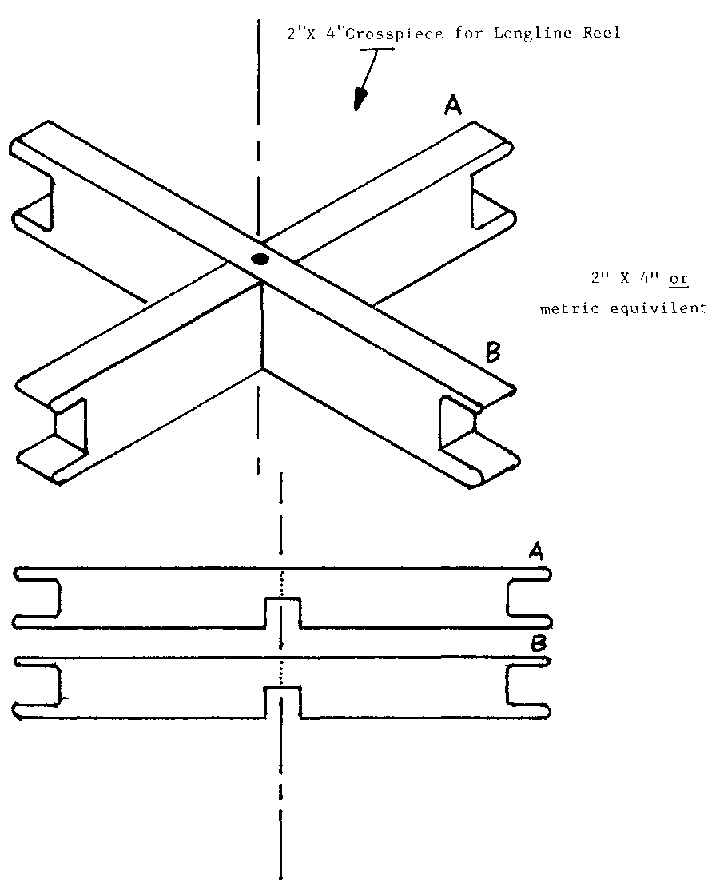
Appendix 1
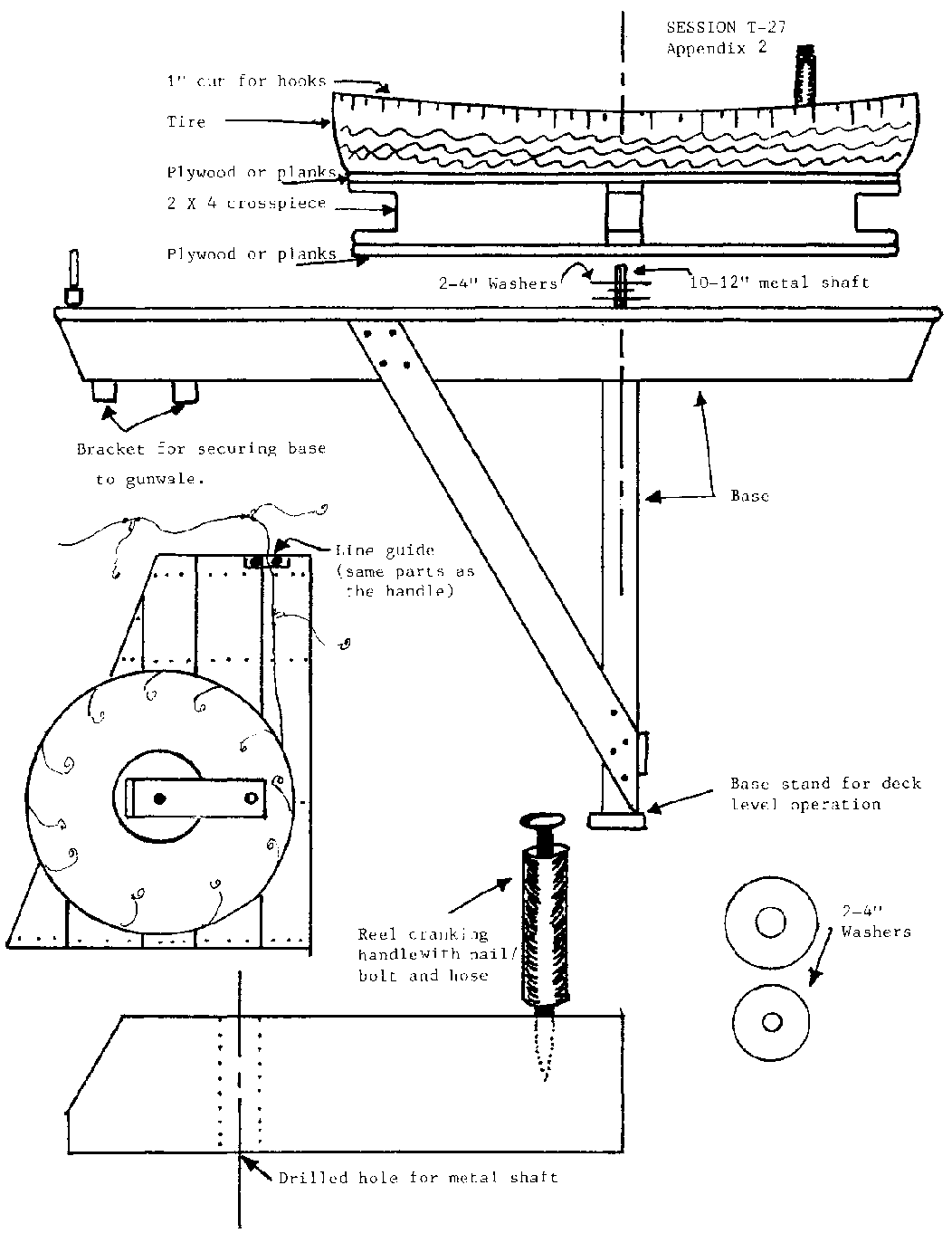
Appendix 2
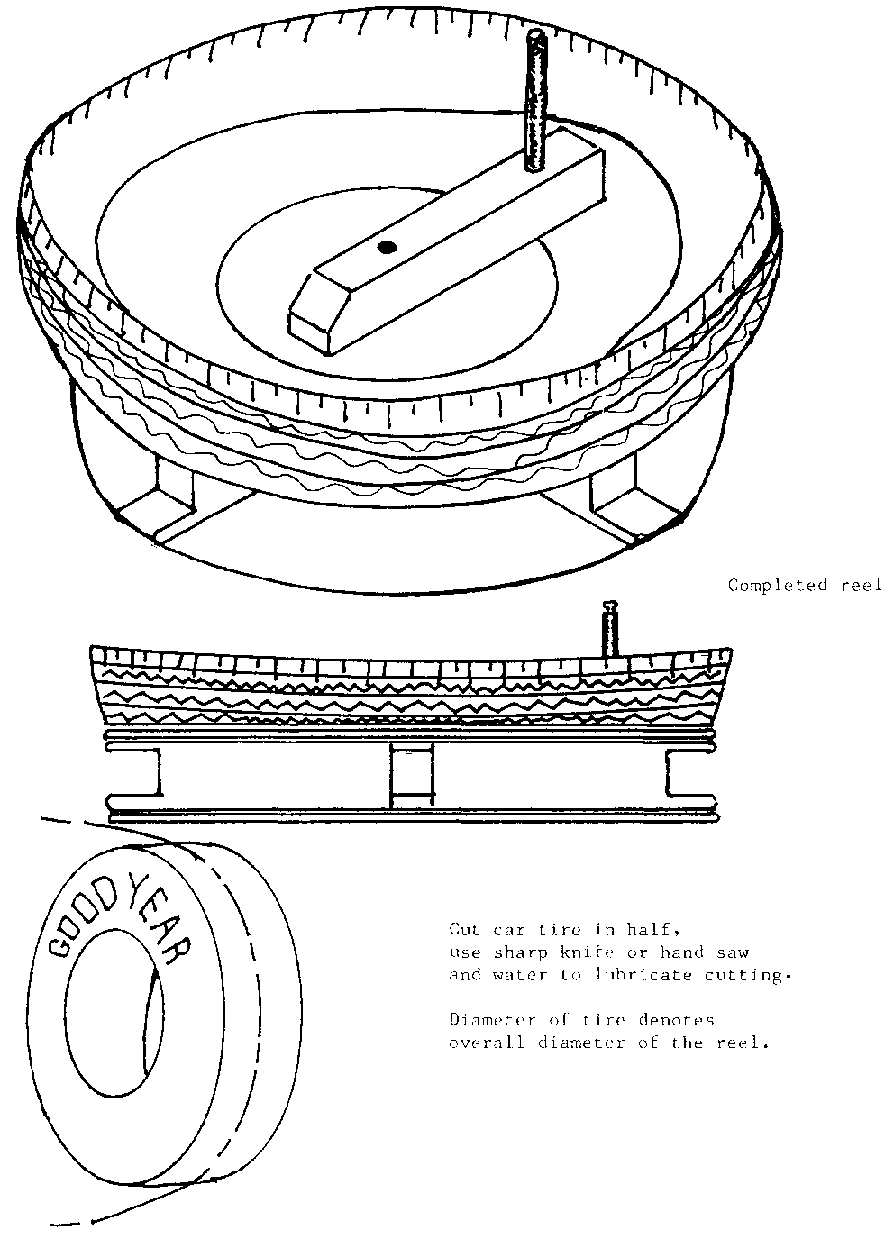
Appendix 3
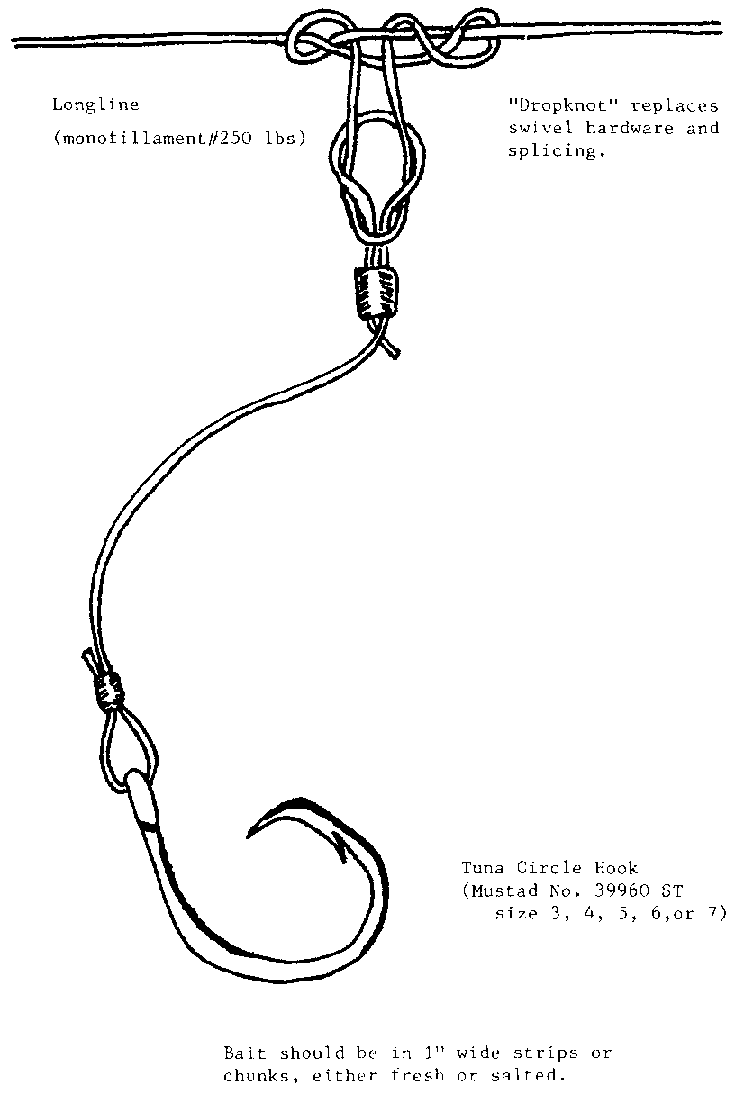
Appendix
4
Session T-28 Special group project cooking fish and nutrition
Time: 3:30 PM
Overview:
Group project leader for cooking fish and nutrition gives presentation to trainees on relevant cooking techniques and nutrition. This special project emphasizes the importance of various seafood preparation techniques utilizing local fish products, as well as nutritional information for the needs of the PCV; and as a secondary activity demonstrating quick, easy, and nutritional cooking practices to the community.
Procedures:
|
Time |
Activities |
|
25 Minutes |
1. Group Project leader gives presentation on relevant cooking techniques, as well as basic nutritional information. |
|
15 Minutes |
2. Group Project leader presents cooking schedule and sign-up sheet for other trainee participation. |
|
1 Hour 30 Minutes |
3. Preparation time for group cooking (important - time beforehand should be well organized by Group Project Leader). |
Trainer's Note:
Rather than one presentation, the advising trainer should suggest a time where trainees will be relaxed and able to enjoy a cooking demonstration. Enough demonstrations should take place to enable all trainees to be directly involved in baking, boiling, broiling, poaching fresh fish.
Materials and Equipment:
· Flip chart, pens, cooking utensils, fish and food
References:
· Fanny Farmer
Cookbook
· Joy of Cooking
· Marine Fish Recipe Cards
· Session Developed by URI Marine Fisheries SST, August
1981
SEAFOOD PREPARATION
Mussels
|
2 lb. fresh mussels |
3 tsp. coriander |
|
3 Tbsp. oil |
1/4 tsp. chill powder |
|
2 large onions, chopped |
1/2 tsp. salt |
|
4 cloves garlic, chopped |
1 cup water |
|
1/2 tsp. tumeric |
Lemon juice |
Scrub mussels well and beard them. Fry onions and garlic in oil. Add tumeric, coriander and chili powder and stir for three minutes. Add salt and water, bring to a boil and simmer covered for five minutes. Add the mussels, cover and steam for 10-15 minutes or until the shells have opened. (Discard any that do not open during cooking.) Remove from heat. Taste gravy -- add lemon juice and more salt, if necessary. Spoon gravy over and into mussel shells.
Shrimp
|
1 1/2 lb. shrimp |
1 tsp. tumeric |
|
1 Tbsp. oil |
2 cups coconut milk |
|
2 medium onions, sliced |
1 tsp. salt |
|
2 cloves garlic, crushed |
Lemon juice to taste |
|
1 tsp. grated ginger |
|
Wash shrimp. Heat oil, fry onions, garlic and ginger. Add tumeric and fry one minute longer. Add coconut milk and salt and bring to simmering point. Simmer, uncovered, for 10 minutes, then add shrimp and cook for 10-15 minutes. Remove from heat, stir in lemon juice.
Coconut Milk
Put two cups grated coconut in a bowl. Add 2 1/2 cups hot water. Cool. Kneed coconut with hands. Strain coconut through cheese cloth. Squeeze out as much liquid as possible.
Squid
|
8 oz. fresh squid |
1/2 tsp. salt |
|
4 dried chilies |
4 Tbsp. palm oil |
|
1 small onion, chopped |
2 tsp. sugar |
|
3 cloves garlic |
1/4 cup lemon juice |
Clean squid, removing head and ink sac. Cut squid into narrow rings. Grind chilies, onion and garlic in mortar and pestle. Fry mixture in oil. Add squid, lemon juice and salt. Simmer uncovered for 30 minutes. Stir in sugar.
NUTRITIONAL VALUE OF FISH
The following is a brief summary of the nutritional value of fish.
Proteins - Fishery products contain useful amounts of fish protein which is important to maintain good health both in children and adults. Fish protein contains little or no connective tissue and is therefore very easily digested and assimilated by the body. This fact makes it especially valuable in diets for children, older people and convalescents.
Vitamins - The same fishery products that contain the fish protein also contain vitamins in useful amounts to help maintain the health of nerve tissues and the normal energy-yielding processes of the body. B complex vitamins which include thiamine, riboflavin, niacin, vitamin B6, vitamin B12 and pantothenic acid are found in fishery products.
Minerals - Minerals are essential for certain functions of the body, particularly the maintenance of teeth and bones. Fish are a good source of calcium, iron, potassium, phosphorus, copper, iodine, manganese, cobalt, and other trace minerals. The flesh of both salt-water and fresh-water fish is quite low in sodium content, making it particularly adaptable for strict, low sodium diets.
Fats - Of interest to weight-watchers is the fact that fish are high in protein but low in calories. The fat content of the different species varies widely-- it may be less than one percent for fish of the cod family or as much as 20 to 25 percent for salmon or mackerel. When fish are cooked by means other than frying, and served without the addition of rich sauces, they tend to be low in calories.
Distributed by the Rhode Island Seafood Council, P.O. Box 219, Narragansett, Rhode Island 02882
TROPICAL FOODS
I. Calorie Sources
A. Grains In many areas of the world, cereal grains provide 70% or more of the total calorie intake. Although high in carbohydrate, cereals contain between 6% and 13°/ protein. In general, the biological value of cereal proteins are not as high as that of animal protein. Most cereal grains are relatively low in the amino acid lysine. Whole grain cereals contain significant amounts of iron, thiamin (Vitamin B1), riboflavin (Vitamin B2) and niacin. Milling of grain removes the germ which contains a large percentage of the vitamins, minerals and fat present in the grain. The principle cereal grains used in tropical areas are:
1. Rice - Grows best in wet, tropical climates. It is not widely grown in the Pacific Islands, but is often imported. Rice is relatively low in protein, but the quality of the protein is good. Beri Beri, the thiamin deficiency disease, was widespread in rice eating populations of Southeast Asia following introduction of commercial rice milling.
2. Maize - Grown widely in the Southern United States, Southern and East Europe, Latin America and parts of Asia and Africa. Maize is about 10% protein. The biological value is poor as maize is limited in the amino acid tryptophan as well as lysine. Niacin in maize is not available biologically unless the grain is treated. Maize is traditionally a "poor man's food". Pellegra, the niacin deficiency disease, was widespread in poor populations whose diets consisted mainly of maize. Yellow maize does contain some carotene.
3. Millet - Several varieties are grown in poor soil in areas of little rainfall. Millet is traditionally a "poor man's food". Millet contains about 10% protein.
4. Wheat - Grown widely in temperate or dry climates. Wheat contains about 10-12°% protein; biological value is poorer than that of rice. Although not widely grown in Southeast Asia and the Pacific, wheat and wheat products are often imported.
I. B. Starches and Starchy Roots Starches provide a major calorie source in some areas of the world including the Pacific Islands. They are easily cultivated and give high yields. They are generally poor in protein (1 to 2% protein) and seem limited in most vitamins and minerals. Principle starchy foods used in tropical areas include:
1. Taro - A major crop in wetlands of the Pacific Islands and part of Africa and Asia. Several varieties are grown. Improperly prepared taro may cause irritation to the gums and mucous membranes due to the presence of raphides (oxalate crystals).
2. Yam - A basic crop in some dry areas of the Pacific. Several varieties are grown; some grow to very large sizes. This is not the sweet potato-type crop grown in the United States.
3. Sweet Potato - A basic crop in some Pacific areas including Papua New Guinea. Several varieties are grown. Those with orange flesh provide carotene.
4. Cassava (manioc) - Grown on the Pacific Islands and in parts of Southeast Asia and Africa. Easily cultivated but very low in protein. The leaves can be eaten and supply protein, ascorbic acid and carotene. However, leaves and tubors must be processed carefully to remove the cyanide.
5. Green Banana - Used as a staple food in parts of the Pacific. They do not have the sweet taste of ripe bananas.
6. Sago - Prepared from the trunk of the Sago palm. The starch is extracted from the inner stem of the palm.
7. Breadfruit - This fruit can be boiled, cooked in stews, baked or roasted. In the Pacific, it is sometimes dried and fermented.
C. Sugars
Sugar is generally obtained from sugarcane or coconut palm. Unrefined sugars contain small amount of vitamins and minerals. They do not contain protein.
D. Fats and Oils
Concentrated energy sources, yielding twice as much energy as an equivalent amount of protein or carbohydrate. Fats and oils used in tropical areas include palm oil, coconut oil and pork fat. Red palm oil is a source of carotene.
II. Foods for Proteins and Amino Acids
A. Meats and Poultry Meats of domestic and wild animals and birds are used. Meats average about 20% protein and biological value is relatively good. Red meat is an excellent source of iron. Meat and poultry are good sources of several vitamins including riboflavin and vitamin B12 and of many minerals including zinc. In general, however, meats lack vitamin C, vitamin A and calcium.
B. Insects
Serve as a valuable source of protein for much of the world's population. They are especially important for populations which cannot afford other sources of animal protein.
C. Eggs An excellent source of protein, but very expensive in many parts of the world. Eggs have the highest biological value of all foods usually consumed by humans. The yolk is a source of vitamin A and also contains significant amounts of thiamin, riboflavin and niacin. There is no vitamin C. Duck eggs may be more available than chicken eggs. Duck eggs should be cooked thoroughly to prevent salmonella poisoning.
D. Fish and Shell Fish Fish and shell fish are excellent sources of protein of good biological value. Small fish and shrimp, eaten whole, are excellent sources of calcium. Fish liver is a source of vitamins A and D. The nutritional value of fish and shell fish are similar to red meat except that they are not as rich in iron.
E. Milk Availability of milk is limited in most tropical countries. Dairy production is difficult and milk products pose serious sanitation problems when refrigeration is limited. Milk products are excellent sources of protein, calcium, riboflavin, vitamin A, vitamin B12, thiamin and other nutrients. Milk products are lacking in vitamin C and iron. Although fresh milk may not be available, canned and powdered milks are often imported. Because of expense, these milks are frequently over diluted thus decreasing their nutritional value. Dilution with unclean water may lead to infection and illness.
F. Legumes Legumes, dried beans and peas are approximately 20% protein. Dry soybeans, with about 38% protein, are a noticeable exception. In general, protein quality is relatively poor; again, soybean is an exception. Legume proteins are low in the amino acid methionine but they provide lysine. Therefore, legumes and cereal grains are complementary proteins and, when eaten together, provide relatively high quality protein. Legumes also provide carbohydrate, iron, thiamin, niacin, zinc and fiber. They are lacking in vitamin C and vitamin A. Legumes, except soybeans, are relatively low in fat. Legumes are important sources of protein for world populations when animal products are expensive; not available or unacceptable.
III. Foods for Vitamins and Minerals
A. Leafy Vegetables In general, leafy vegetables are good sources of vitamin C, carotene, folic acid, calcium and iron. Indigenous dark green leafy vegetables such as the leaves of papaya, sweet potato and taro are usually richer in nutrients than introduced vegetables such as lettuce and cabbage.
B. Root Vegetables In addition to those discussed under Starchy Roots, turnips, carrots, yam bean, Chinese radishes and onions are also available in the Pacific and Southeast Asia. Carrots are valuable because of the carotene content.
C. Fruit-Bearing Vegetables Pumpkin and several varieties of squash are widely used. Those with yellow flesh are useful for their carotene content. Tomatoes are fairly widespread and provide some carotene and ascorbic acid. Other vegetables include bitter melon, okra and eggplant.
D. Seaweeds Several varieties of seaweed can be used. They are sources of iodine and flourine and some fresh seaweed contains vitamin C. Some seaweeds are thought to provide vitamin B12 due to the bacterial contamination.
E. Fruits Containing Vitamin C Many tropical fruits provide considerable amounts of vitamin C. These include oranges, lemons, lime, pineapple, soursoup, jack-fruit, pummelo, carambola and mulberry.
III. F. Fruits Containing Carotene In general, dark yellow fruits are good sources of carotene. In tropical areas, mango, papaya, and passion fruit are rich sources.
NUTRIENT CONTRIBUTION OF SELECTED FOOD GROUPS
|
Food Group |
Major Nutrients |
Alternate Sources of Nutrients |
|
Meat, Fish Poultry |
protein |
Milk products, legumes, grains, nuts, seeds. (Complement poor quality proteins) |
| |
iron |
Legumes, grains, dark green vegetables(iron from these sources poorly absorbed, add ascorbic acid to increase absorption). |
| |
Vitamin B12 |
Milk products, eggs, fortified soy milk, fortified yeast products, vitamin supplements. |
| |
Zinc |
Eggs, whole grain cereals, legumes |
| | |
(absorption may be poor from plant |
| | |
sources). |
|
Milk Products |
riboflavin |
Meat products, green leafy vegetables, whole grain and enriched cereals. |
|
|
Vitamin D |
Fish liver oil, fortified soy milk, vitamin supplements, adequate exposure to sun. |
| |
calcium |
Collard greens, kale, mustard greens, broccoli, lesser amounts in legumes and seeds. |
| |
Protein, Vitamin B12 |
Listed above. |
| |
| |
|
Cereal Products |
fiber (whole grain) |
Fresh fruits and vegetables, legumes. |
| |
Carobhydrate |
Fruits and vegetables, legumes, sucrose. |
| |
thiamin |
Legumes, meat, fish, poultry, milk products eggs. |
| |
riboflavin |
Listed above. |
|
Fruits |
ascorbic acid |
Dark green vegetables, tomatoes, cabbage, lesser amounts in onions and potato. |
| |
Carotene |
Dark green and yellow vegetables; preformed vitamin A from milk products, egg yolk. |
| |
fiber |
Listed above. |
|
Vegetables |
carotene |
Dark yellow fruit, sources of vitamin A. Listed above. |
| |
ascorbic acid |
Citrus fruits, berries, cantaloupe, mango. |
| |
fiber |
Listed above. |
|
| |||||||||||||||||||||||||||||||||||||||||||||||||||||||||||||||||||||||||||||||||||||||||||||||||||||||||||||||||||||||||||||||||||||||||||||||||||
Small-Scale Marine Fisheries - A Training Manual (Peace Corps, 1983, 631 p.)
Week 4: Training
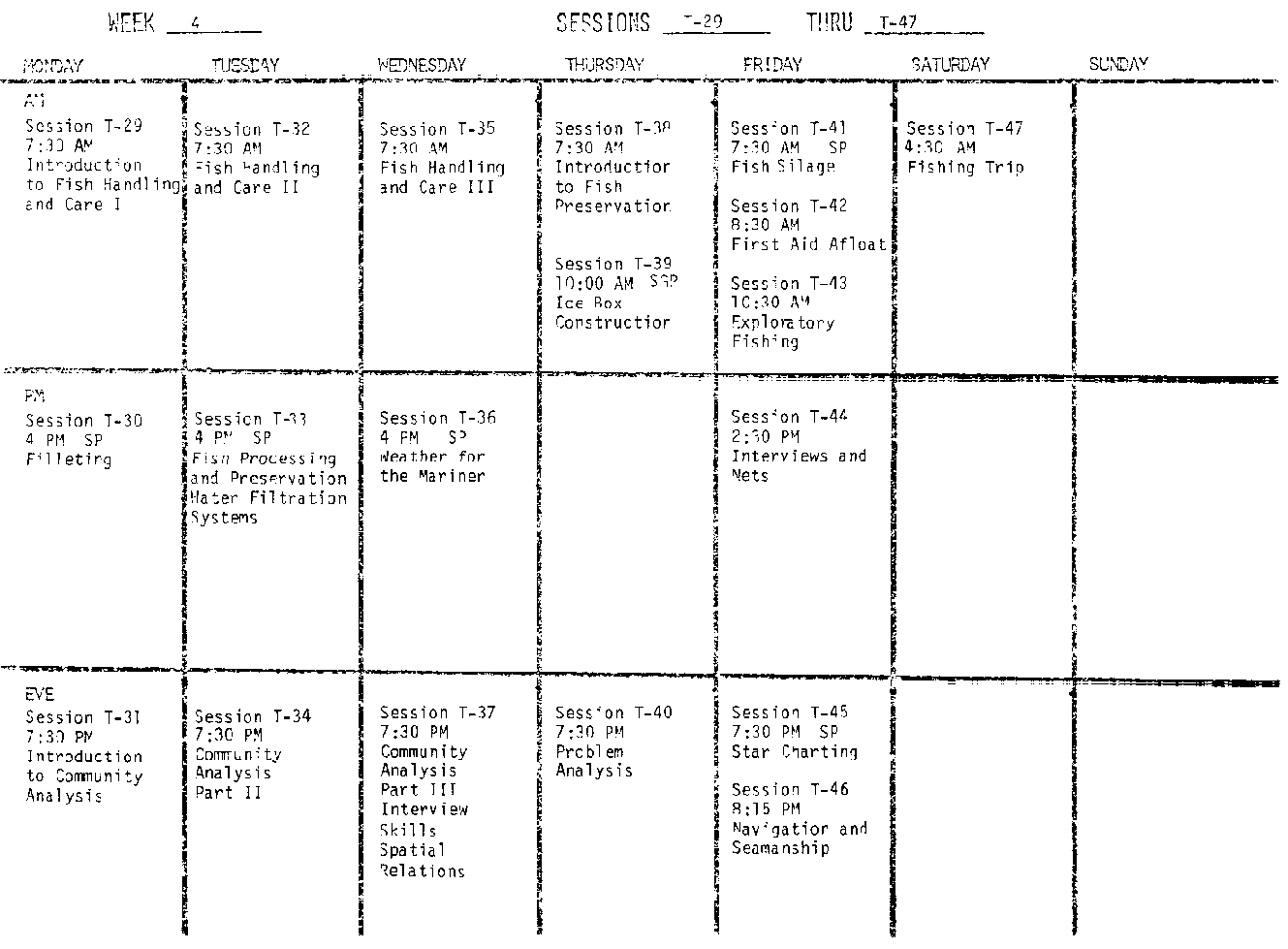
Week 4, Sessions T-29 Thru
T-47
Session T-29: Introduction to fish handling and care - I
Time: 7:30 AM
Goals:
· To provide trainees with
proper orientation on procedures necessary for good fish handling and
care
· To give trainees opportunity to work
in a fish processing area, with proper tools, on fish in a hygienic manner
Overview:
This session begins by explaining the basic tenets of fish handling and care. A guest lecture by a local fisherman at the outset emphasizes the need for proper care control of fish when first brought aboard the fish vessel. Also, this lecturette promotes a basis for future involvement of local fishermen in the area of fish handling and care.
Procedures:
|
Time |
Activities |
|
30 Minutes |
1. Guest lecturette (local fisherman) |
| |
a. handling of fish on board the boat |
| |
b. care of fish on board the boat |
| |
c. equipment necessary for proper handling and care (knife, ice) |
|
2 Hours |
2. Technical trainer continues lecture with the shelf life of fish |
|
|
a. 32°F is ideal holding temperature |
| |
b. ice is the best cooling medium |
| |
c. white fish (snapper, cod) will stay edible approximately 15 days after caught if well iced and held at constant 32°F |
| |
d. fatty fish - herring, tuna, have slightly shorter shelf life |
| |
e. shelf life is the measure of success in delaying the inevitable microbial meal Fish go bad because: |
| |
a. bacteria |
| |
b. microbes live symbiotically in skin, skull and guts of fish |
| |
c. after fish dies, enzymes in stomach are first to trigger an autolytic process "self-digesting" |
| |
d. if fish is reasonably well handled, microbiologists expect to find a bacteria count of about 300 organisms per gram of tissue e. punctured and bruised fish can have a bacteria count as high as 800 million per gram of tissue Seafood handlers thermometer a. water temperatures b. danger zone c. critical zone d. fresh storage zone e. freezing temperature f. frozen storage temperature 9. quick frozen |
|
1 Hour |
2. Fish processing room orientation |
|
30 Minutes |
a. explanation of room's function |
| |
b. traineeslearn fish care, handling, cleaning by doing five fish each |
|
|
c. demonstration of clean-up procedures (prior to processing, post-processing). Trainees do clean-up after demonstration |
Materials and Equipment:
· flip chart, pens, scrub brush, bucket, fresh water, demo fish
Trainer's Note:
Important to utilize local fisherman in initial orientation to fish handling and care.
References
· "Life Begins at 40°: How
to use Seafood-handlers Thermometer". W. O. Davidson. Oregon State University,
Sea Grant Extension SG32. September, 1975
·
Ocean Leader. Fall 1981. Seattle, Washington. "Life on the Shelf is a race
against bacteria" p. 26
· Local fisherman
Ramon Corrales. Puerto Real,
P.R.
Session T-30: Fish processing and presentation special project - filleting
Time: 4 PM
Goals:
· To provide trainees with
proper filleting techniques
· To acquaint
trainees with the various skills needed in the filleting procedure
· To build on technology transfer skill
Overview:
This session was done as a special project. The trainee in charge of this project needs to be properly versed in filleting techniques of the various fish, i.e., round, flat, etc.
Procedures:
|
Time |
Activities |
|
15 Minutes |
1. Trainee presents lecture on the reasons for filleting fish. Also, a step-by-step chart on filleting techniques assists in the understanding of the fillet process. |
|
45 Minutes |
2. Trainees each fillet one fish. Clean up. |
Trainer's Note:
It is important that the trainee restrict the presentation to the fillet process. Other sessions are devoted to related areas and also providing time for filleting of fish by other trainees.
Materials:
· Fillet knife, cutting board, knife sharpener, fish (round and flat), flip chart, markers
References:
· Manual on Fish Processing and
Marketing. UNPD/FAO. Manila, Philippines. 1980.
· Local Fisherman. Puerto Rico.
· Fish Cooperative. Puerto Real,
P.R.
Session T-31: Community analysis introduction
Time: 7:30 PM
Goals:
· For trainees to understand the
14 sub-systems in the social cybernetics framework
· For trainees to see themselves as a system
Overview:
In this session community analysis is introduced. The fourteen social cybernetic sub-systems will begin to enable trainees to understand and analyze the various segments of the community and how change in one segment can affect the other and vice versa.
Procedures:
|
Time |
Activities |
|
15 Minutes |
1. Trainer introduces the sub-systems, and gives rief lecture on social cybernetics. |
|
1 1/2 Hour |
2. Trainees then write their own autobiographies ccording to the 14 sub-systems of social cybernetics. (They should be told earlier in the day to bring their journals to the evening session.) Trainer explains how important it is for trainees to see and understand themselves as a system before they can begin to see a community as one. |
|
15 Minutes |
3. The group reconvenes and breaks into groups of three to discuss the following questions: |
| |
- What is it like to see oneself as a system? |
| |
- Which systems do they know the least about themselves? The most? |
|
15 Minutes |
4. Large group comes back together. Trainer asks for general discussions on the small group findings. |
|
10 Minutes |
5. Trainer summarizes the session and links back to the marine fisheries Volunteer's role as an extensionist. |
Trainer's Note:
For this exercise, trainees will need a working area/classroom with tables on which to write comfortably.
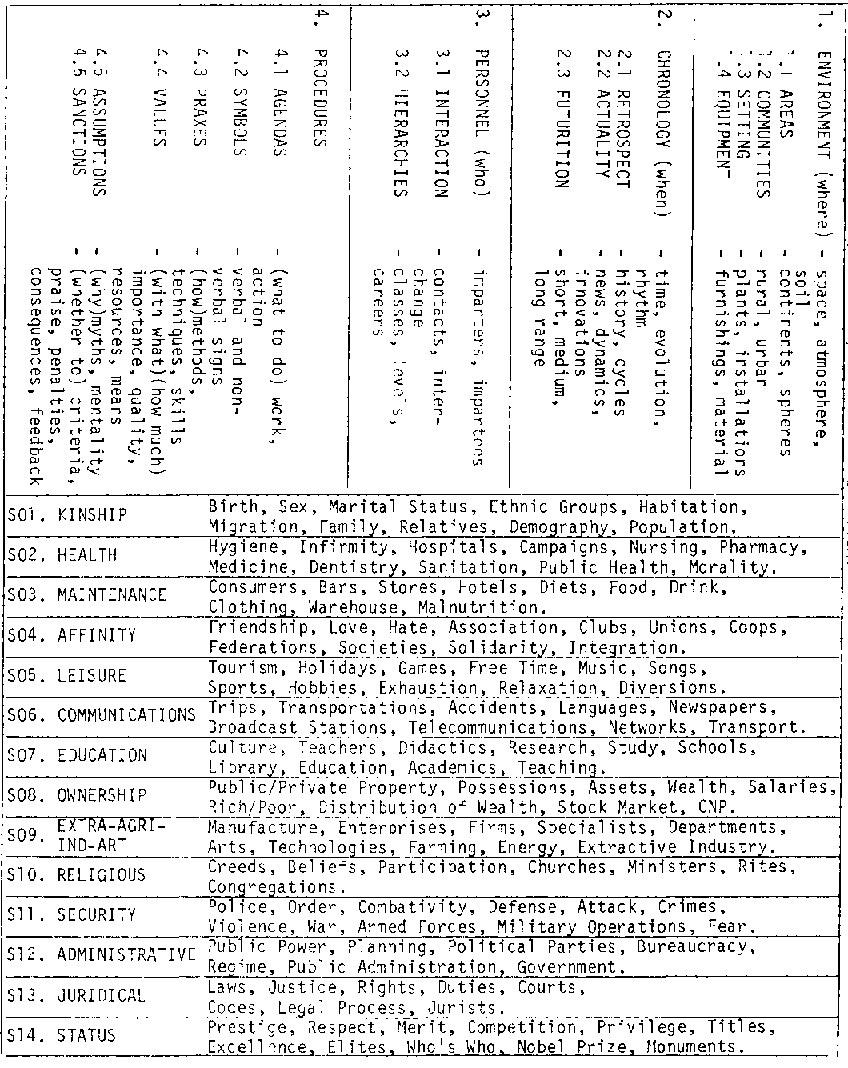
Theory of Human Organization - A.R.
MULLER
Session T-32: Fish handling and care II
Time: 7:30 AM
Goals:
· To introduce trainees to score
sheets which will enable them to be professional in judging fish
quality
· Trainees will perform the basic
steps in the fish processing room, starting with pre-processing cleaning through
clean-up
· Trainees to become aware of
quality control
· For trainees to
individually explore methods of transferring information as an extensionist
Overview:
In previous Fish Handling and Care Session T-29, trainees learned how to ready fish handling area, clean fish and clean area after fish were cleaned. In this session trainees will repeat the steps. In addition they will judge the quality of the fish as they clean them. After completing a full cycle, trainees will explore methods they might utilize to transfer information to others about quality control as an extensionist.
Materials and Equipment:
· Approximately six to seven
pounds of fish per trainee from one to 10 days old
· One to two blade steel knives per trainee
· Equipment for cleaning processing room
Trainer's Note:
You will need to get a variety of fresh fish for this session. It is important that the fish be a wide variety of species as well as from one to ten days in age. We found that we had to age the fish ourselves and freeze them in order to insure having fish of a variety of ages.
Procedures:
|
Time |
Activities |
|
10 Minutes |
1. Technical trainer reviews the learnings from previous session and introduces the score sheet for raw fish. Trainees take time to acquaint themselves with the content of the score sheets. |
|
10 Minutes |
2. Technical trainer now gives instructions for trainees to prepare processing room and to clean and grade fish for quality. |
|
20 Minutes |
3. Trainees prepare processing room by scrubbing and following procedures learned in previous sessions. |
|
2 Hours |
4. Each trainee takes a fish to clean. After cleaning, judges the quality of fish and checks out their judgement 1 with technical trainer. Each trainee should process at least five different fish and check findings on each one with technical trainer. |
|
20 Minutes |
5. Processing room is scrubbed completely as previously performed in Session 29. |
|
20 Minutes |
6. Trainees are asked to break into small groups of three or four and asked to brainstorm ways in which they could pass on the information about fish quality as an extensionist. From the list of ideas generated by small group trainees prioritize which they feel will be most effective and why. |
|
20 Minutes |
7. Small groups report out to large group. Trainer processes presentations and reflects back to extension session. |
SCORE SHEET FOR RAW FISH
|
Score |
General Appearance |
Approximate Days in ice |
|
10 |
Black pupil, translucent cornea, glossy thin transparent Slime, bright opalescent silver gray-green Sheen, bright luminous spots, gills bright pastel rose. |
1 |
|
9 |
Eyes flattening, slight greyness of pupil, loss of Sheen, specks no longer luminous, body slime cloudy, Slight bleaching of gills and accumulation of slightly cloudy slime. |
3-4 |
|
8 |
Eyes similar, loss of greenness and irridescence of Spots, generally more pink, gills dark red, mottled, Appearance of some dark brown slime. |
5 |
|
7 |
Eyes concave and general cloudiness of pupil, body Lost gloss, going grey, pinkening around head, slime On gills thickening and blood diffusing into slime, Lateral line less distinct. |
6-7 |
|
6 |
Eyes either flat and cloudy or swollen and bloodshot, Body pale and anemic (bleached) no spots, lateral Line obvious, gills bleached in patches, slime more Copious becoming dark maroon-purplish. |
8-9 |
|
5 |
Eyes sinking and cloudy, body well bleached, dorsal Area insipid steely grey (anemic), gills either well Bleached dark brown or mottled red, lateral line Very obvious. |
11-12 |
|
4 |
Eyes sunken, pink or very cloudy, body covered in Yellow slime and loss of most grey color on dorsal Area, gills have thick slime which is brick red or Pale dirty pink. |
14-16 |
|
2 |
Eyes cloudy and bloodshot, gills bleached with thick Pink slime, body white with patches of yellow slime. Eyes bloodshot, skin showing a mauve hue and starting |
18-19 |
|
1 |
To disintegrate, gills totally bleached to a Pale brown pink, with watery rose colored slime. Odor of Gills |
20-21 |
|
10 |
Seaweedy |
1 |
|
9 |
Fresh celery |
|
|
8 |
Musty, earthy, stale mustard, wheatstocks, 4-5 Stale celery | |
|
7 |
Briny, eely, bready, malty |
7 |
|
6 |
Strong stale celery |
9 |
|
5 |
Little odor, slightly eely, mustiness, Mousy |
11-12 |
|
4 |
Turnipy, musty, brye, spicy celery (little odor) |
14-16 |
|
2 |
Septic tank, faecal, rotting potatoes, Fermenting grass |
18-19 |
|
1 |
Sour, faecal, acidic, rotting Vegetables, nauseating Flesh and Gut Cavity Appearance |
20-21 |
|
5 |
Translucent flesh, gut cavity pearly white, blood Bright red. |
1 |
|
4 |
Flesh steely grey but loss of some transparency, Gut cavity white and glossy, blood bright red, cut Flesh clear but pinkish. |
2 |
|
3 |
Flesh lost transparency, now waxy white, but no |
5 |
| |
Reddening, belly flaps pearly pink. | |
|
2 |
Flesh white waxy, some pinkening on ventral half, Cut surfaces of belly flaps more pink. |
9 |
|
1 |
Pinkening on ventral half of fillet, considerable Pinkening on gut cavity, blood dark, browning Along mid-line. |
12 |
|
0 |
Considerable pinkening of fillet. Raw Texture |
15 |
|
5 |
Firm and elastic (hard) |
1 |
|
4 |
Firm but some loss of elasticity, Scales starting to lift |
3 |
|
3 |
Becoming soft, no elasticity, Flaccid |
6 |
|
2 |
Plasticine like, sticky, plastic Rubber, scales loose |
8-11 |
|
1 |
Very soft, mushy and gaping, scales Very loose Cooked Odor |
14-18 |
|
10 |
Slightly seaweedy |
1-2 |
|
9 |
Boiled or condensed milk, fish Fingers, mousy |
3-4 |
|
8 |
Neutral, wet cotton wool, wet string |
5-7 |
|
7 |
Condensed milk, toffee like, Slight carmel |
8 |
|
6 |
Faint vomit, slightly burnt, Smoked fish |
9 |
|
5 |
Slight oniony, soapy or tallow like, Boiled potatoes |
11 |
|
4 |
Junket, wet newspapers |
12-14 |
|
2 |
Slight ammoniacal odors, slight Burnt rubber |
15-17 |
|
1 |
Sour vomit Cooked Texture |
18-20 |
|
5 |
Firm thick white curd, wooly and juicy | |
|
4 |
Firm elastic but drier | |
|
3 |
Short but dry |
|
|
2 |
Firm, dry, sticky, stringy | |
|
1 |
Soft and dry, no slickness | |
|
0 |
Dry, chewy, like chewing newspapers Cooked Flavor | |
|
10 |
Sweet, characteristic of species (meaty/lamb flavor) |
1-2 |
|
9 |
Less sweet, faint lamb, herring Like, less flavor |
4-5 |
|
8 |
Canned meat, metallic slight Oniony, definite loss of flavor |
6-7 |
|
7 |
Little flavor, flounder like, flat - Sour, cold mutton |
8-9 |
|
6 |
Absolutely no flavor, faint musty, Sweaty |
10-11 |
|
5 |
Neutral, faint turnipy |
12 |
|
4 |
Very slightly rancid, herring like, Slight fishmealy | |
|
3 |
Strong metallic aftertaste, Astringent |
15-16 |
|
2 |
Sour cold chicken, slight green Peas aftertaste |
17-18 |
|
1 |
Strong ammoniacal, sour, difficult To taste |
19-21 |
Session T-33: Fish processing and preservation water filtration systems special project
Time: 4:30 PM
Goals:
· For trainee to research and
present to other trainees the concept of clean water for fish
processing
· For trainee to demonstrate the
construction of a simple water filtration system which can be used on the
community level in fish processing
· For
trainee, for whom this is a special project, to practice transference of skills
in communication and technology
overview
This session is done by a trainee as a special project. The important concepts to be covered are: the use of clean fresh water in fish processing and the need to demonstrate filtration systems to the community if clean fresh water is not readily available.
The following outline was used in the pilot Small Scale Marine Fisheries Program.
Water Filtration
1. Water treatment includes a number of quality control processes by which impurities found in natural waters are reduced to acceptable levels.
A. Disinfection of water is the adequate destruction of water-borne pathogenic microorganisms.
1. Water-borne diseases include typhoid fever and bacillary and amoebic poliomyelitis (viruses) and salmonella - caused diarrhea.
2. Heating water to a temperature of 140° F for 15 minutes or boiling it for 10 minutes is sufficient for disinfecting.
3. The most reliable type of disinfectant for small-scale applications is chlorine or a chloric compound.
a. Chlorine stock solutions are generally prepared using calcium hypochlorite or chlorinated 1-ime and should not exceed 10% chlorine by weight (5% is typical of common laundry bleach).
b. The required concentration of chlorine in solution for adequate disinfection is about 1 to 5 parts per million (ppm).
c. The volume of water that can be disinfected by a specific volume of stock chlorine solution is given by the following equation:
Vw = 10,000 * PV * c1/C
where V is the volume of water to be disinfected (gallons); Vcl is the volume of stock chlorine solution (gallons): P c is the percent, by weight, of chlorine in the solution; and C is the concentration of chlorine in the final mixture (ppm).
B. Filtration, probably the oldest and most easily understood process of water treatment available, is used to remove suspended particles and some bacteria from water.
1. The filtration process is inexpensive and makes use of readily available materials (i.e., sand, gravel, screen, ceramic filter candles, burnt rice husks, coconut fibers).
2. The filtration process has a variety of applications in developing areas.
a. It can be used to provide water supplies of acceptable quality for drinking and general use in towns and villages and for ice making.
b. It can be used in pollution control, bringing effluents to a condition allowing discharge into rivers
c. It can be used in fish farming, providing clean water (both salt and fresh, free from parasites), especially for rearing fry.
d. It can be used to abstract water from harbors for use in washing fish, boxes, boats and fish markets. e. It can be used to provide bulk supplies of clean sea water for marine laboratories and aquariums.
3. The filtration process takes place in two parts.
a. The physical cleaning of the water occurs on the surface layer of the filter where a mat forms.
1) Running the system to waste for 15 minutes will establish it and form a good filter surface. 2) Particles down to about 203 microns (excluding the larval forms of parasites) and approximately 80% of the bacteria are removed.
b. As oxygenated water is drawn through the bed, the zone becomes aerobic and a biological filter forms.
1) The biological filter requires between 8 and 10 days to build up in tropical regions. 2) Total bacteria is reduced by 95% and ammonia and BOD are reduced by 70-90%.
II. Sand/gravel filtration systems, such as the Sea Water Supplies (SWS) village unit, the SWS mini unit, the horizontal prefilter and the upward flow sand filter are perhaps the most commonly used.
A. The SWS village unit utilizes gravel and sand bed rivers, streams and sea shores by abstracting water which has been cleaned by passing through the water bed.
1. The site can be simply and easily assessed, and artificial beds may be used if the natural bed is not suitable.
2. Relatively polluted rivers or streams can be utilized.
3. Physical filtration takes place at the layer on the top of the river bed.
4. The biological filter is created as oxygen laden water is drawn through the bed to the filter box from a six meter radius.
5. A manual or power pump is used to abstract the water.
6. During the first hour's operation after installation, fine particles are evacuated through a slotted septum filter plate, thus ensuring that the filter box is filled with coarse gravel.
7. The village unit has a capacity of approximately 20,000 liters/hour.

SWS village unit
II. B. The SWS mini unit is used in situations requiring only small volumes of water or where it is not possible to use an existing gravel bed.
1. Any strong plastic bucket or barrel (50-100 liter capacity) may be used to contain the filter.
2. Layers of fine sand (5 cm layer on surface), fine gravel (2 to 5 mm) and coarse gravel (15 to 20 mm) serve as the filter medium
3. The mini unit is not involved in the abstraction process.
4. The mini unit has a capacity of approximately 1000 liters/hour.
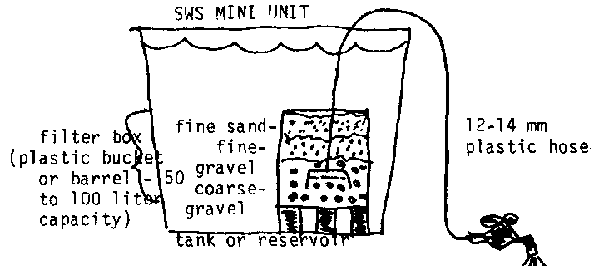
SWS mini unit
C. A horizontal prefilter is used to prevent the clogging of a filtering system by inorganic materials.
1. Because it is horizontal, the prefilter allows both coarse crushed stone and gravity to remove large organic and inorganic materials.
2. Approximately 60-7�% of solid matter is removed by the prefilter.
3. The prefilter/filter combination has been shown to remove much but not all of the non-fecal coliform organisms present in untreated water.
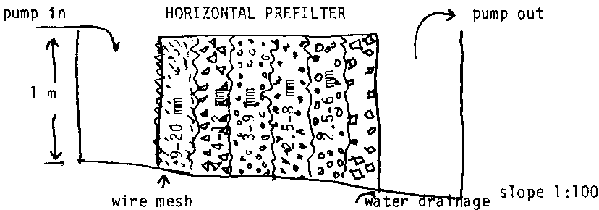
Horizontal prefilter
D. The upward flow sand filter involves relatively simple preparation, assembly and operation at a very low cost.
1. A 44-gallon drum will make a filter able to treat 230 liters (50 gallons) per hour.
2. The top of the drum is removed, trimmed to fit inside the drum and pierced with 2 to 3 mm holes at 5 cm intervals all over.
3. The drum is pierced to fit the inlet pipe, drain pipe and delivery pipe (optional - water may simply be removed from the filter drum as needed).
4. All the inside metal surfaces of the drum are painted with bituminous paint to prevent rusting (alternative - cement slurry).
5. The filter is assembled as shown in the diagram and a 25 to 30 cm layer of 3 to 4 mm grade sand is added.
6. Water is allowed to filter at up to 230 liters per hour.
7. The filter should be backwashed occasionally by stopping the flow, removing the drain plug and allowing the dirt to flow out.
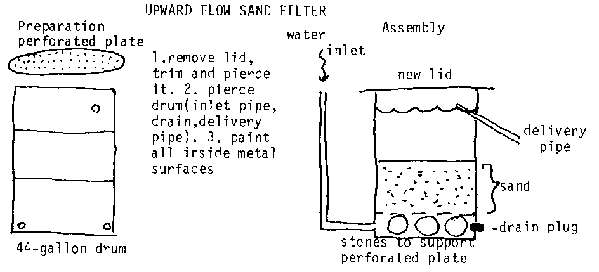
Upward flow sand filter
Sources:
· Appropriate Technology
Sourcebook, Volume I. Darrow and Pam. 1978.
·
Appropriate Technology Sourcebook, Volume II. Darrow, Heller and Pam.
1981.
· More Other Homes and Garbage. Leikie,
Masters, Whitehouse and Young. 1981
· Report
on Second Regional Consultancy Low-Cost Water Filtration. Cansdale. 1979.
- Marilyn Berry , PCV Sierra Leone
Session T-34: Community analysis - Part II
Time: 7:30 PM
Goals:
· For trainees to explore the 14
social cybernetic subsystems on the community level
· For trainees to share their learnings about the
community that they have lived in for the last four weeks
Overview:
In the session which introduced trainees to the 14 social cybernetic sub-systems they wrote their own autobiographies: it is essential for trainees to see themselves as a system before they can begin to see a community as one. In community analysis - Part II, trainees take a look at their last four weeks living in the community and at how much they know (or don't know) about the community.
Procedures:
|
Time |
Activities |
|
15 Minutes |
1. Trainer assigns 1 sub-system to each trainee. The trainee lists on newsprint all information he/she has learned about the community. An additional sub-system is assigned to those trainees finishing up early. |
| |
2. Each trainee reports out his/her sub-system. Trainees as a group add additional information to the newsprint. |
|
Sub-Systems Kinship Maintenance Affinity |
Birth, sex, marital status, ethnic groups, habitation, migration, family, relatives, demography, population. Health Hygiene, infirmity, hospitals, campaigns, nursing, pharmacy, medicine, dentistry, sanitation, public health, mortality. Consumers, bars, stores, hotels, diets, food/drink, clothing, warehouse, malnutrition. Friendship, love, hate, association, clubs, unions, coops, federations, societies, solidarity, integration. |
|
Leisure |
Tourism, holidays, games, free time, music/songs, diversions, sports, hobbies, exhaustion, relaxation. |
|
Communications |
Trips, transportation, accidents, languages, newspapers, broadcast stations, telecommunications, networks. |
|
Education |
Culture, teachers, didactics, research, study, school, library, education, academics, teaching. |
|
Ownership |
Public/private property, possessions, assets, wealth/salaries, rich/poor, distribution of wealth, stock market GNP. |
|
Extra Ag-IND-ART |
Manufacture, enterprises, firms, specialists, departments, arts, technologies, farming, energy, extractive industry. |
|
Religious |
Creeds, beliefs, participation, churches, ministers, rites, congregations. |
|
Security |
Police power, combativity, defense, attacks, crimes, violence/war, armed forces, military operations, fear. |
|
Administrative |
Public power, planning, political parties, bureaucracy, regime, public administration, government. |
|
Judicial |
Laws, justice, rights, duties, courts, codes, legal process, jurists. |
|
Status |
Prestige, respect, merit, competition, privilege, titles, excellence, elites, "who's who", nobel prize, monuments. |
Trainer's Note
He have used this model because it is all inclusive of social sub-systems used in social planning in the Americas. You may wish to use a shorter version called KEEPRAH, Holistic Model, developed by Phil Donohue and used in the early 1960's at Peace Corps Training Center, Escondido, California.
|
1 1/2 Hours |
3. Trainer now states that if you were doing a community analysis, you would formulate a series of questions under each sub-system, then try to find the answer to the question by going into the community and seeking information Ask the group to break into small groups of 5 or 6, and brainstorm questions in each area: for example, write these examples on flip chart as follows: Kinship (This has to do with family patterns, relations and organization) |
| |
1. How big are families? |
| |
2. Is the mother or the father the decision maker, land owner, bread winner, etc.? |
| |
3. Who raises the children? etc. |
|
Education |
1. What is the average grade that children achieve in school? |
| |
2. Are there schools? Etc. |
Trainer's Note
You have several choices here. Each group may do all sub-systems or may select one or more then share results with the other groups.
|
30 Minutes |
4. Bring the group together. If appropriate, share questions. If not appropriate, move on to asking people how they plan to find out the answers to their questions. Hint: There are several methods of gathering data and the group should try out a variety of ways: sitting in one place and watching what goes on (flow analysis); asking questions; looking for anything written if it exists; conducting a non-threatening interview; observations, etc. Each person should think about how he/she is going to gather data. Stress that each person must keep notes and write down findings in their journals. |
|
10 Minutes |
5. Trainer closes session with short wrap - up on how inter - realted the 14 sub-systems are. Change cannot be made in one without changing or affecting all of the others. Cultural change takes a long time; PCV's need to analyze the possible impact on all systems when interventions are made. |
Trainer's Note:
Newsprint reflecting data collected and questions should be saved for Community Analysis III Session T-37.
Session T-35: Fish handling and care III - Cleaning and processing on the fishing boat
Time: 7:30 AM
Goals:
· For trainees to be introduced
to procedures used while on fishing boat for cleaning of fish
· For trainees to understand the importance of icing
fish after cleaning
Overview:
In this session local fisherman describes how fish are cleaned at sea, the reasons, the process, and disposal of fish viscera at sea. Trainees learn about icing of fish.
Exercises:
1. Lecturette by local fisherman on fish cleaning at sea.
2.
Iced fish in transit.
Materials:
· Flip chart paper, markers, tape, newsprint of tables for ice usage
Trainer's Note:
You will need to look around to find which fisherman's fish are in really good condition when they arrive at the pier. We were very fortunate -the fisherman we used followed our presentation format and used newsprint drawings
EXERCISE 1 - Lecturette: Cleaning and Processing of Fish At Sea
Goals:
· For trainees to have contact
with local expert
· For local expert to
transfer knowledge about fish cleaning and processing at sea
Overview:
This session is a preparatory session for trainees as they will be cleaning fish and processing fish at sea during training. By using a local fishing expert, trainees have a chance to interact with community member and ask questions based on information they are receiving.
Procedures:
|
Time |
Activities |
|
1 Hour |
1. Local fisherman gives lecture on fish cleaning and processing while at sea, using newsprint diagrams to show techniques. |
Trainer's Note:
You will want to go over outline for session with lecturer, and you may have to assist in the drawing of newsprint diagrams.
Lecturette should include the following items. a. cleaning and gutting of fish. b. proper icing procedures. c. disposal of viscera at sea.
|
15 Minutes |
2. Trainer encourages trainees to ask questions after lecture. Trainers should also be prepared to surface through questions items that may have been overlooked or not mentioned by lecturer. |
|
10 Minutes |
3. Trainer now wraps up session and leads into next exercise. |
EXERCISE II - Iced Fish in Transit
Goals:
· To acquaint trainees with
formulas in which to determine rate ice melts
· For trainees to be able to accurately determine the
amount of ice needed to chill fish while fish is in transit
Overview:
In this exercise simple tables are introduced that will allow trainees to be able to estimate the amount of ice needed to keep fish chilled while in transit. During future session trainees will need to determine proper icing amounts.
Procedures:
|
Time |
Activities |
|
30 Minutes |
1. Technical trainer gives following lecture with Table 1 and Table 2 posted on newsprint. |
Table 1. shows the weight of ice needed to chill 10 kg. fish from various starting temperatures at 0°C.
Table 1. Weight of ice needed to chill 10 kg. of fish
|
Starting temperature of fish (°C) |
Weight of Ice (kg) |
|
30 |
3.8 |
|
25 |
3.1 |
|
20 |
2.5 |
|
15 |
1.9 |
|
5 |
0.7 |
The necessary amount of ice is diminshed by 81.5% when
ice-packing fish at 5°C instead of 30°C.
obviously, to store or
distribute fish at 0°C, more ice has to be used than what is required for
simply cooling it down. However, the advantages in chilling the fish before they
are packed, are to reduce the amount of ice required during the journey, and to
reduce spoilage before dispatch.
It is not easy to estimate how much extra ice is needed to keep the fish chilled in transit. This depends on the length of the journey, the side temperature, and the degree of protection given the cargo by insulation and refrigeration of the transport vehicle or container. The position of the boxes in the load will also affect the amount of heating it is subjected to. For example, a box on the floor of the truck needs more ice than one in the middle of the load.
Table 2 gives a rough estimate of the amount of ice melted in two different sizes of wooden box by heat from outside. When the box is surrounded by others, the meltages may be only half or a quarter of these amounts.
From Table 1 and 2 it is easy to calculate the amount of ice needed in a box of fish.
Table 2. Melting time of ice in a simple wooden box
|
Outside Air Temperature |
Weight of Ice melted in 12 hours | |
| |
in a 10 kg box |
in a 40 kg box |
|
30°C |
4.0 kg |
9.2 kg |
|
25°C |
3.5 kg |
7.8 kg |
|
20°C |
3.0 kg |
6.4 kg |
|
15°C |
2.5 kg |
3.0 kg |
|
10°C |
2.0 kg |
3.5 kg |
Let us consider a couple of examples:
Example 1. The chilling practice of the port merchant is poor. The fish start the journey at 30°C. The country is a tropical one; the outside air temperature is 30°C. How much ice is needed in the 10 kg box for a 12 hour journey?
A. For chilling fish (Table 1) 3.8 kg
B. To make up for
melting by outside air temperature (Table 2)
3.8 kg Ice + 4 kg Ice = 7.8 kg
Total amount of Ice

Figure
If the journey, instead of 12 hours, would last 24 hours, the amount of ice would have been 11.8 kg.
|
15 Minutes |
2. Trainees are asked to record in their journals Tables 1 and 2 for their own use In the future. |
|
30 Minutes |
3. Technical trainer wraps up the fish handling and care segment by reviewing all sessions. Links to introduction to fish preservation on following day. |
Session T-36: Weather for the mariner special project
Time: 4 PM
Goals:
· For trainee for whom this is a
special project to expand on communication/technology transference
skills
· To provide trainees with basic
information about weather
· For trainees to
become aware of the importance of weather to the fisherman both when at sea and
on shore
Overview
This session is a special project for one of the trainees. Trainee will continue to report on the weather for the remainder of the training program.
Trainer's Note:
It's important that the trainee restrict his presentation to information and resources 'appropriate' to the small-scale fisherman in less developed countries, (i.e. the barometer and how it works may not be the best topic for the presentation).
Procedures:
|
Time |
Activities |
|
1 Hour |
1. Trainee presents lecturette on weather patterns, cloud formations, and weather danger signals. An example follows. |
Weather for the Mariner
"How is it possible to expect mankind to take advice when they
will not so much as heed warnings."
--J. Swift 1667-1745
My favorite quote is: "The Price of Safety is constant
vigilance"
--Author unknown
Together they offer a sound formula for success and safety on the ocean. The formula would be thus:
Constant vigilance and knowledge of warnings = safety at sea. There is nothing smaller than a boat at sea. Boats and ships somehow shrink considerably when the weather worsens. Distances to be travelled stretch to the end of the universe and time becomes the existential dilemma.
It has been said many times and places that a boat or ship starts sinking the minute it is launched. Whether they sink, are skuttled, or are dismantled, the boats life is affected in no small degree by the condition of the seas it has travelled. The sea is mindless and moldable. It is mostly a reactionary element and it reacts positively with the weather.
There is, of course, 100% weather everyday. The good weather is taken for granted by nearly everyone and quite often so by the successful fisherman.
You are not a successful fisherman if you do not tie your boat up to the dock for an equal amount of time that you untie it to go to sea. If all other variables (mechanical, collision, etc.) are controlled, the one that the mariner cannot control is the weather.
Local Knowledge
There are many, many names for the one ocean. Her, there, and beyond are a few important ones. A good, or at least adequate, analogy is to compare the "one" ocean with the human body. The mind is yours of course. If you are floating, proudly, on the outstretched palm of your left hand does it matter that the right big toe was just crushed by a stone? However, if you normally hung out in the vicinity of the right instep and happened to consciously look up and see a stone falling you would try to get at least to the knee if not further. In this instance the left inner ear would be ideal.
This is the essence of local knowledge. Hurricane "Bula" will not be significant to you if it is eight thousand miles away. On the other hand if you are twenty miles to sea and the wind goes from a balmy eight (8) knots at 10:00 AM to a fresh, crisp 25 knots by 2:30 PM, it will no doubt cross your mind that there must be an easier way to earn a living.
Local knowledge is acquired, primarily, in two ways; (1) Personal experience and (2) the experience of others. It goes without saying at length, that a mariner new to an area should acquire as much information as possible about local weather phenomena before untying the dock lines.
As a "new" mariner/fisherman it should be noted that unless you are at the open-information sharing level your fellow mariner/fishermen are quite often willing to let you leave the harbor to live the sequel to "The Longest Day." This will go into your "personal experience" file and, since you made it back, you will have gained a degree of respect from the others in the "business."
Ask, look for yourself, ask again, evaluate all information about the conditions and then if it reasonably seems right, do it. There is also the event that will take that degree of respect from others away and that is always being the last boat on the fishing grounds.
It might occur to you the question, "How might produce and aggressiveness live so close together?" The answer is simple: they must. The fisherman most often chooses and enjoys his way of making a livelihood. All fishermen are aware that an element of risk is involved and make it a part of their "business" to daily (and more often) check the "weather" so that they minimize the risk element. There is no other way but to make it your business as well if you are to be a mariner.
'WX"
on all VHF (marine wand) radios can be found the symbols
"WX". This indicates the weather frequency. It is an "international" frequency
as such and it will give projections of swell height, visibility, air
temperature as well as notices to mariners pertaining to adverse weather. It is
normally updated every six (6) hours. All effort should be made to obtain this
basic information. It is more regional in scope and should be used in
conjunction with local knowledge.
The following tables and graphics are taken from Weather for the Mariner. 1977. William J. Kotsch, R.A. U.S.N. (retired).
For our purposes it is overly comprehensive at first glance. The
reader should, however, avail him/herself of the manuscript at an early date if
possible. The examples used here are only bits and pieces of a much bigger
puzzle, the weather. Have an on-going educational process in mind when you
attempt to master the weather: It is loaded with surprises even for the experts.
Good luck to you all and good fishing!
-- Fred Gibson, PCV Papua New Guinea
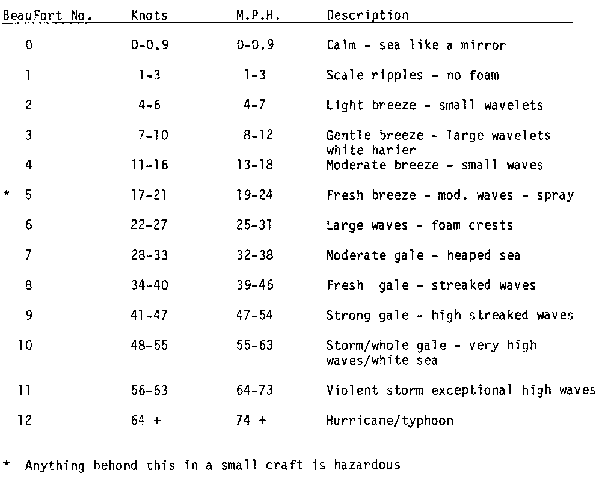
Table 3. Partial BeauFort Wind Scale
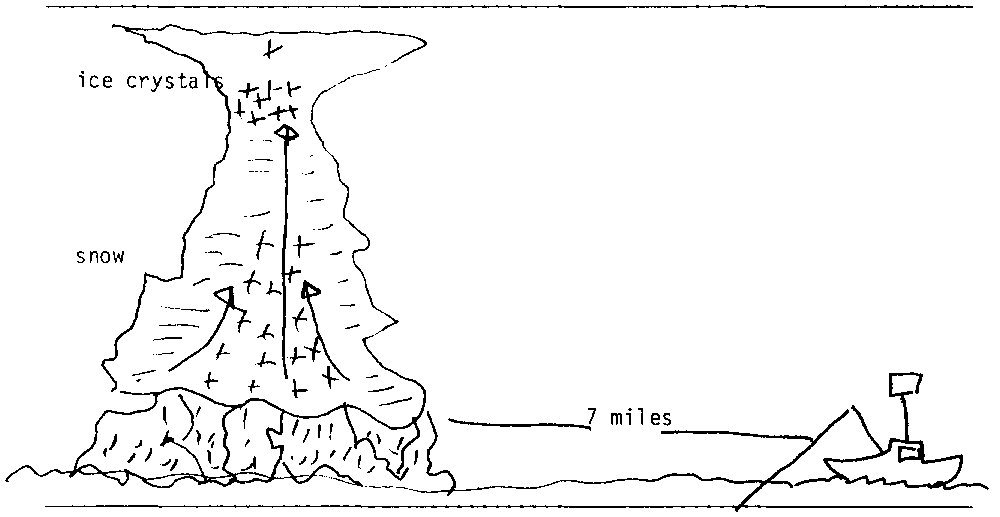
Table 4. Schematic of a Thunderstorm,
including the distribution of electric charge
1. Lightning flash observed at 4:25:10 PM 2. Thunderclap heard at 4:25:45 PM 3. Divide (sec.) time interval by 5 4. 35 = 755. You are approximately 7 miles from storm
Session T-37: Community analysis - part III interview skills - spatial relationships
Time: 7:30 PM
Goals:
· For trainees to learn how to
prepare for an interview
· To learn the
actual steps In interviewing
· To plan an
interview
· For trainees to understand the
importance of knowing their community on a personal level
Overview:
In the session on Community Analysis Part II, trainees took a look at the data they have gathered in the last four weeks of living in the community where training is being conducted and at how much they know about the community. In this session trainees have an opportunity to hear from a community member familiar with the community to validate some of trainees learnings and to clarify some data that may be confused or misconstrued by trainees. Trainees explore the process of interviewing, learn how to plan for an interview and conduct the interview in order to obtain data or verify data they have already obtained.
Materials:
· Flip chart paper, magic markers, tape
Procedures:
|
Time |
Activities |
|
45 Minutes |
1. Community member goes over 14 social sub-systems and data collected by trainees in previous Community Analysis session listed on newsprint. Community member goes over data, validates and/or clarifies trainees' learnings or general assumptions. |
|
30 Minutes |
2. Community member asks trainees to each draw a map of the community putting in key places and residences of community members with the names of key people, their titles, and locations also placed on map. Community member goes over each map with the group pointing out the importance of knowing the names of people who work and live in these places. For maps with very little information, trainer suggests to trainee that he/she draw up a street map when they get to their new communities, and ask colleague or friend to help fill it in. Newsprint showing incomplete or misunderstood data is gone over, and trainer leads into interviews. |
|
15 Minutes |
3. Trainer now introduces guideposts and suggestions for interview preparation and implementation posted on newsprint. |
Guideposts and Suggestions For Interview Preparation and Implementation
Preparing for the interview:
1. Decide what is to be accomplished.
2. Know the interviewee as much as possible.
3. Make appointments.
4. Practice taking the interviewee's point of view.
5. Know your own personality, prejudices, filters.
6. Plan thoroughly:
A. Prepare the environment
1) Comfortable and private
2)
Free from distractions and interruptions
B. Prepare whatever aids you will need for the interview.
1)
Gather necessary and relevant data
2) Prepare a checklist of points to cover
C. Plan the opening of the interview.
1) Opening remarks to
build rapport
2) Clarify the "why" and "what" of the interview
3) Make
sure that the opening is consistent with the objectives of - the interview
D. Choose a strategy. Consider your objective and the
situational factors to determine whether your strategy should be:
1)
Directive, in which you get or give specific information a. It is highly
structured; interviewer follows outline or plan closely and has tight control of
the process b. Closed questions are used frequently c. Interviewer does most of
the talking
2) Non-directive, in which interviewer is encouraged to talk
freely
a. Assumes that person will say what is on his/her mind
b.
Listening skills are important
c. Non-authoritarian; interviewer has a
purpose, but no rigid outline
3) A mixture of directive and non-directive
E. Plan the close of the interview.
1) Review or summarize to
avoid misunderstanding
2) Agree on the next step, or action plan; set up a
report-back process
Interviewing:
7. Establish a relationship of confidence.
8. Establish appropriate atmosphere.
9. Help the interviewee to feel at ease and ready to talk.
10. Listen.
11. Allow enough time.
12. Don't waste time; don't "dawdle".
13. Keep control of the interview.
14. At the close of the interview, watch for additional information or new leads in the casual remarks of the interviewee.
|
30 Minutes |
4. Trainer now refers to the incomplete data from newsprint previously generated by trainees. Trainees are asked to identify community person they feel they could interview and obtain pertinent date from. Trainer now introduces the interview planning guide and each trainee plans his/her interview. Interview planning guide is posted on newsprint. |
Interview Planning Guide
WHO is to be interviewed? (Know as much about him/her as possible.)
WHAT do you already know about the interviewee?
WHERE did you get the information?
WHY are you interviewing him/her?
From your perspective, the desired result is: (Having completed
this interview, I should know...)
From the interviewee's perspective, the
desired result is: (Having completed the interview, he/she should know...)
WHAT information do you need from the interviewee in order to meet your desired objective?
1.
2.
3.
4.
WHAT do you plan to do with the information received from him/her?
WHEN do you plan to hold the interview?
WHERE
WHAT is on your checklist of important points to cover?
HOW do you plan to organize question topics?
HOW do you plan to word some of your most important questions?
WHAT strategy do you plan to use in this interview?
HOW do you plan to open the interview? (remarks, clarifying objectives) HOW do you plan to close the interview? (review, next steps)
WHAT questions do you expect from the interviewee?
|
15 Minutes |
5. Trainees are instructed to conduct an interview the following day, or no later than the day after that, as there will be follow up. |
Session T-38: Introduction to fish preservation
Time: 7:30 AM to 9:30 AM
Goals:
· To acquaint trainees with various fish preservation techniques using salt as a curing agent, natural air drying, hot and cold smoking
Overview:
This session introduces the fish preservation sessions. Fish drying, salting and smoking are closely intertwined. This session is involved with salt usage. After this session fish will be ready to be used in drying and smoking sessions.
Materials and Equipment:
· Flip chart paper,
markers,
· Container designed for drainage of
brine, weights for lid of container, brine solution, rock salt, fish (previously
cleaned in Session T-35)
Procedures:
|
Time |
Activities |
|
20 Minutes |
1. Technical trainer gives lecture on fish preservation using following outline: |
| |
Why is there a need for fish preservation? |
| |
a. storage for future use |
| |
b. taste, culture, habit |
| |
c. marketability |
| |
d. spoilage |
| |
e. health |
| |
Types of preservation |
| |
a. salting |
| |
b. brine solutions (sugar, salt) |
| |
c. natural air dry |
| |
d. solar air dry |
| |
e. hot smoking |
| |
f. cold smoking |
| |
g. pickling |
|
30 Minutes |
2. Technical trainer gives trainees instructions for preparing brine. Trainees prepare brine and soak fish cleaned in previous sessions. |
|
30 Minutes |
3. While fish are soaking in brine solution technical trainer gives directions for salting fish using wet method/dry method: |
| |
a. Step by step |
| |
Step 1 - one part salt-three parts fish too much salt may burn fish too little allows fermentation |
| |
Step 2 - thin layer of salt on bottom of containers enough to completely cover bottom |
| |
Step 3 - arrange fish, skin side down scatter thin layer of salt |
| |
salt heavy over thickest portion of fish |
| |
Step 4 - finish filling containers with alternate layers of fish and salt top layer is skin side up |
| |
Step 5 - brine will drain away in dry salting place a loose cover over top of container weighted down with rocks brine will make itself |
| |
Step 6 - keep container covered and off ground to protect from insects |
|
|
Step 7 - keep container in cool place |
| |
Step 8 - let fish stay in solution from 2 days to a week dry salting goes farther when weather is warm large fish must stay in solution longer |
|
|
Step 9 - remove fish, wash thoroughly in clean, fresh, strong brine solution 3-4 cups salt to 1 gallon water drain 15-20 minutes fish is now ready for either drying or smoking |
|
30 Minutes |
4. Trainees remove fish from brine solution and using wet/dry method, salt fish. Fish will be ready for future smoking and drying sessions the following week. Trainer links to smoking and drying sessions. |
Trainer's Note
There should be time allowed for discussion of techniques. Trainers need to resist taking part in salting of fish.
Preparation of salt brines for the fishing industry
by
Kenneth S. Hilderbrand, Jr., Extension Seafood Technologist, Oregon State
University
Oregon State University Extension Marine Advisory Program A Land
Grant / Sea Grant Cooperative
SG 22 Reprinted January 1979
The use of salt brine for refrigerants and fish curing is common in the seafood industry. It is important to understand a few basic principles In order to make and use brines properly. This bulletin attempts to point out some basic concepts and principles and provides some charts which are useful to anyone who uses brines frequently.
PROPERTIES OF SALT BRINE
When added to water, salt lowers the freezing point of water by a known and predictable degree, making it useful as a secondary refrigerant (freezing solution). Figure 1 shows the relationship of a brine's freezing point to its concentration of salt Note that the lowest freezing point obtainable in a salt-water mixture is about -6°F at 23.3% salt. This is called the eutectic point and any concentration of salt above or below this point will result in a solution with a freezing point higher than -6°F. Table 1 gives specific data on freezing point, concentration, and relationships useful in preparing salt brines.
PREPARING SALT BRINES
After selecting the desired brine concentration for any desired purpose, use Table 1 to determine how much water and salt are needed. Column 2 in Table 1 gives freezing points while Column 3 is computed in percent salt by weight. Salometer degree (°SAL) is a useful way of describing and measuring brines and is explained later under "MEASURING SALT SOLUTIONS."
An easy way to prepare a brine solution of any given strength is to refer to Column 4 in Table 1 and then add the proper amount of salt per gallon of water. Salt will increase the volume of the solution, however. Thus, if an exact quantity of brine is needed, use Columns 5 and 6 to determine the weight of salt and volume of water needed to make a gallon of brine at the desired concentration.
Be sure to mix thoroughly

Figure 1. Freezing point of salt
brine mixtures.
EXAMPLES
About twenty (20) gallons of brine are needed at 15.8% sat (60°SAL) to brine salmon for smoking. If it isn't necessary to have exactly 20 gallons, simply find 60°SAL (15.8% salt) in Column 1 and note that 1.568 pounds salt/gallon of water (Column 4) is needed. Put 20 gallons of water in a tank and dissolve 31 1/3 pounds of salt (20 gallons x 1.568 pounds salt/gallons water).
The result will be a solution which has exactly 15.8% salt by weight (60° SAL). It will be found, however, that the resulting solution is more than 20 gallons; it will be more like 21 gallons. This increase in volume is usually insignificant; if precision is needed and an exact quantity desired, use the data in Columns 5 and 6.
For example, if exactly 500 gallons of 88° SAL brine (-5.8F freezing point) is needed for a brine freezing tank on board a vessel, Column 5 in Table 1 will show that each gallon is SAL brine needs 2.279 pounds of salt and .904 gallons of water (Column 5). Adding 1140 pounds of salt (500 gallons x 2.279 pounds salt/gallon brine) to 452 gallons of water (500 gallons x .904 gallons water/gallon brine) would give exactly 500 gallons of brine at 88° SAL (23.3%) with a freezing point of -5.8°F.
MEASURING SALT SOLUTIONS
Although careful attention to proportions will give good control of salt concentration in brine, the best way to be sure is to measure it. Sometimes, after a brine has been used and possibly diluted, it is useful to be able to measure its concentration.
Figure 2 shows the basic tools used to measure salt solutions. These may be purchased at most scientific supply houses for about $15. A salometer is a device that measures brine density saturation (26.4% salt at 60°F) on a convenient scale of 0 to 100. Each °SAL would therefore represent about .26% salt by weight as fully saturated brine contains about 26.4% salt.
To read a salometer, place it in a vessel, like the graduate cylinder shown in Figure 2, and allow it to float. The depth that it floats measures the brine concentration. Readings are taken by noting the point on the scale where the salometer emerges from the surface of the brine solution. These readings in °SAL can then be used with Table 1 to obtain data such as freezing point and percent salt by weight.
The thermometer is used to determine the temperature of the brine as it is being tested with the salometer. If the temperature varies more than a few degrees from 60°F, then a correction factor should be used for accurate work.
A rule of thumb states that for every 10°F the brine is above 60°F, one degree salometer should be added to the observed reading before using Table 1, which is standardized for 60°F. For each 10°F the brine is below 60°F, one degree salometer should be subtracted from.
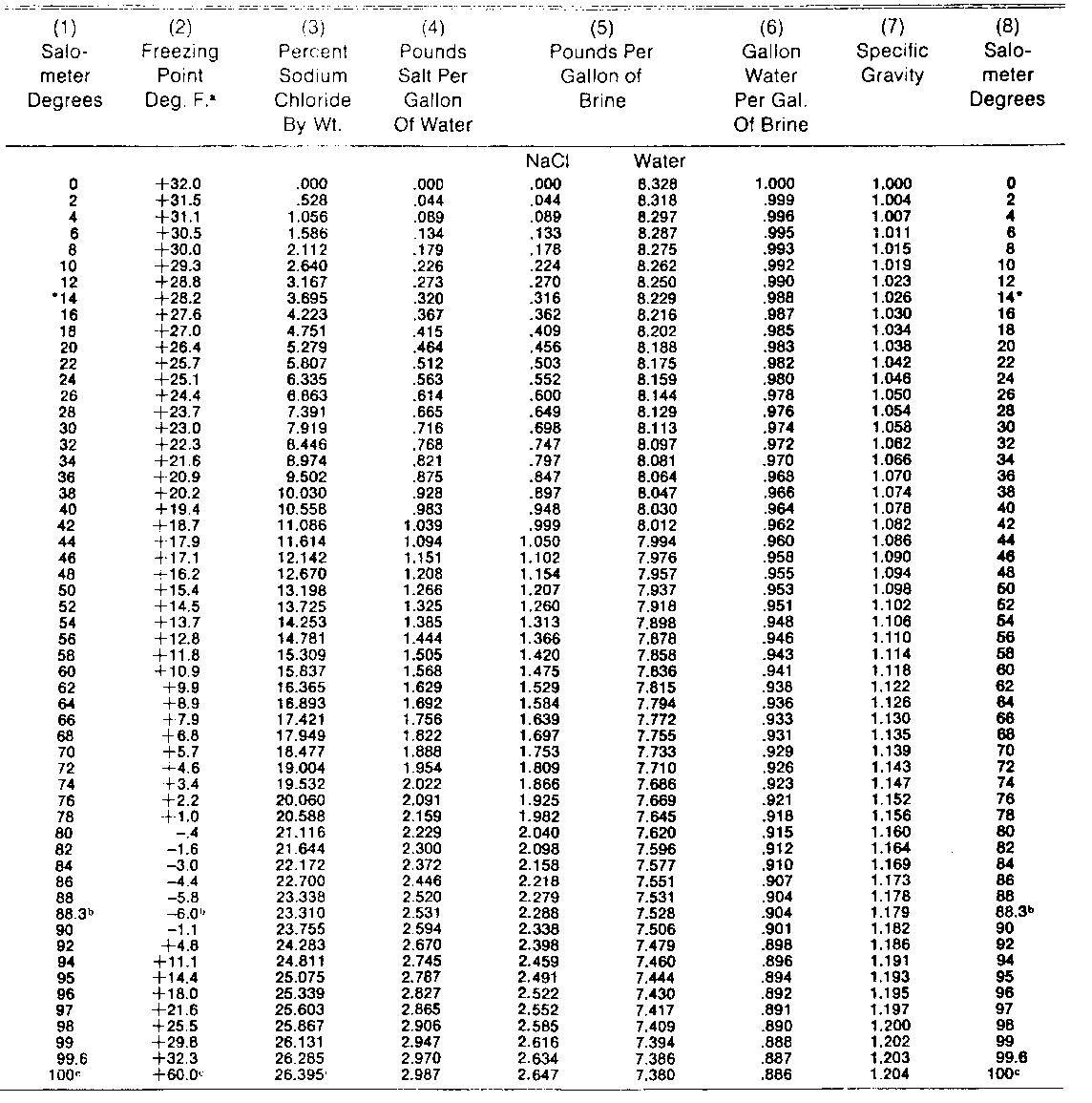
Table 1: sodium chloride brine tables
for brine at 60°F
The above table applies to brine tested at 60°F. For other brine temperatures the observed salometer readings must be converted before using them in the table. For practical purposes, add one degree salometer for each ten degrees above 60°F and deduct one degree salometer for each ten degrees below 60°F. ^ Approximate salinity range for sea water.
a Temperature at which freezing begins. Ice forms, brine concentrates and freezing point lowers to eutectic. b Eutectic point. For brines stronger than eutectic, the temperatures shown are the saturation temperatures for sodium chloride dihydrate. Brines stronger than eutectic deposit excess sodium chloride as dihydrate when cooled, and freeze at eutectic. c Saturated brine at 60°F.
the observed salometer reading. For instance, if a salometer reading was observed to be 80°SAL in a brine which was 40°F, the corrected salometer reading would be 78° SAL (subtract 1°SAL for each 10°F below 60°F).
IMPORTANT POINTS TO REMEMBER
Dissolving salt: Finely ground salt such as canner's salt or table salt dissolves much taster than coarsely ground salt (rock salt). It is essential that all salt added is dissolved if a solution is to have the proper strength.
Salt dissolves much faster in hot water than in cold water. It may take days for salt to dissolve in a brine freezer at 0°F.
Salt dissolves much slower as the salt concentration increases. The last bit of salt in a 90°SAL solution may take a long time to dissolve.
Agitation greatly increases the rate at which salt dissolves. A layer of salt on the bottom of a tank may take days to dissolve if left undisturbed.
In summary, try to dissolve salt in a warm, well agitated container or tank and make sure it is all dissolved before using it or measuring its concentration.
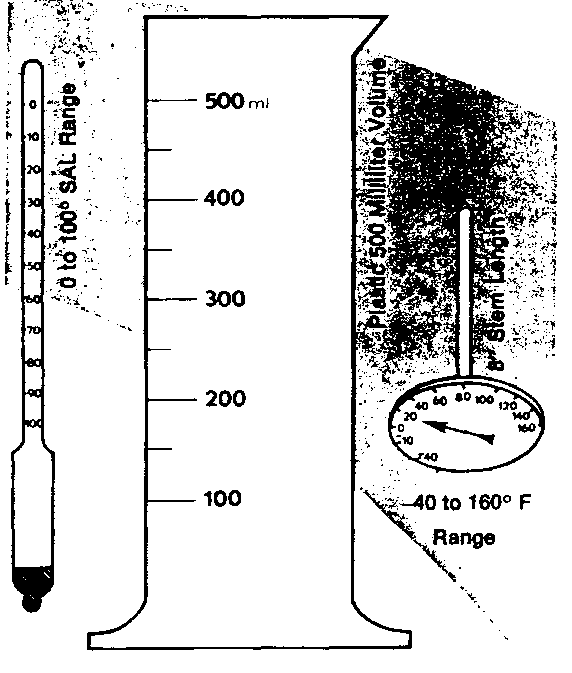
Figure 2. Equipment for measuring
salt concentration in brine. Left, salometer; center, graduate cylinder: right,
dial thermometer.
Brine refrigeration: Always make up a brine to be used for refrigeration so that its freezing point is well below the temperature you want to maintain. If you don't, it may freeze to the refrigeration coils or heat exchanger surfaces as they usually run 5 to 10°F colder than the operating temperature of the brine.
Using sea water for brines: Sea water may contain as much as 3 to 3.5% salt (12 to 14°SAL), which is equivalent to about .3 pounds of salt per gallon. Take this into consideration when making brine from sea water and deduct it from the amount of salt needed to make up a brine.
Adding salt to existing brines: If you want to increase the concentration of salt in a brine (decrease its freezing point), be sure to measure its strength and estimate its volume first. Then use the data in Table 1, Columns 5 and 6, to calculate how much more salt needs to be added.
Appendix. - Metric/customary conversion factors (approximate) for the units cited in this bulletin
|
To convert to multiply by | ||
|
liters |
gallons |
0.26 |
|
gallons |
liters |
3.78 |
|
kilograms |
pounds |
2.20 |
|
pounds |
kilograms |
0.45 |
|
grams per liter |
pounds per gallon |
0.0083 |
|
pounds per gallon |
grams per liter |
118.8 |
|
degrees Celsius (formerly Centigrade) degrees |
Fahrenheit |
9/5, then add 32 |
|
degrees Fahrenheit |
degrees Celsius |
519, after subtracting 32 01 -79/3M |
Extension Service, Oregon State University, Corvallis, Henry A. Wadsworth, director. This publication was produced and distributed in furtherance of the Acts of Congress of May 8 and June 30, 1914. Extension work is a cooperative program of Oregon State University, the U.S. Department of Agriculture, and Oregon counties. Extension's Marine Advisory Program is supported in part by the Sea Grant Program National Oceanic and Atmospheric Administration U.S. Department of Commerce.
Extension invites participation in its activities and offers them equally to all people, without discrimination.
Session T-39: Ice box construction - special group project
Time: 10 AM to 2 PM
Goals:
· To make trainees aware of the
importance of ice to fishing
· To acquaint
trainees with basic construction and design of fish boxes
· Introduce the "marine fisheries ice box" to
· Trainees to build on technology transfer skill
Overview:
This session is done as a special group project. The trainee leader responsible for the initial design will have a team of trainees ready to construct a workable ice box. He/she will present a detailed plan and have all materials ready for execution of project.
Materials and Equipment:
· Marine plywood (treated), polystyrene, bronze nails or screws, woodworking tools (hammer, wood hand saw, rasp screwdriver, wood plane, level, tri-square, sand paper, paint brushes, fiberglass resin and fabric, acetone)
· Flip chart, pens, Ice (cubed, block)
Trainer's Note:
The amount of time necessary for this project necessitates early involvement of the group. An icebox 3/4 finished will furnish enough of the construction details so that the remaining time (3 hours approximately) can be spent in construction.
Procedures:
|
Time |
Activities |
|
15 Minutes |
1. Trainee gives lecturette covering Introduction to Ice: |
| |
a. importance of ice |
| |
b. minimizes changes in marketability waste, food spoilage |
| |
c. Slowing down of destructive process, care in handling, hygiene, cooling |
|
15 Minutes |
2. Trainee gives lecturette covering basic construction and design of fish boxes: |
| |
a. basic construction, gluing, taping, screws vs nails |
| |
b, design, insulation, framing, waterproof |
| |
c. fiberglass techniques, resins, fabric |
|
2 Hours |
3. Group project leader introduces partially completed |
|
30 Minutes |
"marine fisheries ice box" to trainees. Trainees complete construction after trainee leader goes over plans. |
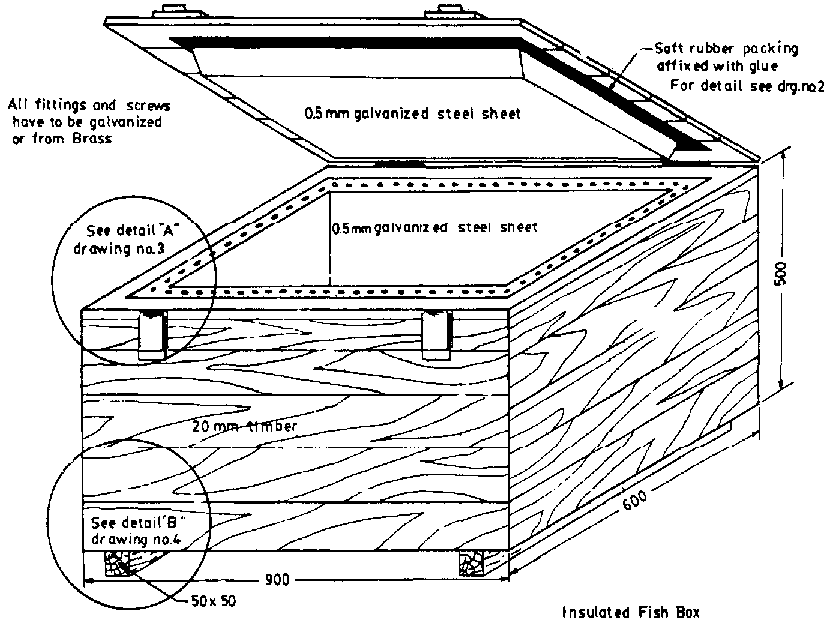
Insulated Fish Box

Corner Detail for Insulated Fish Box

Lid for insulated Fish Box
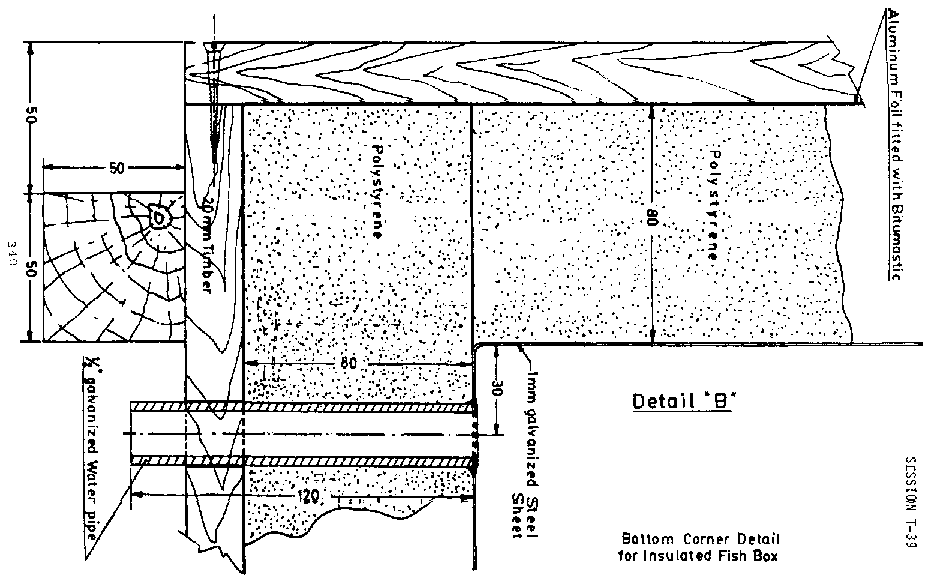
Bottom Corner Detail for Insulated
Fish
Box
Session T-40: Problem analysis
Time: 2 Hours
Goals:
· Using same social cybernetic
sub-systemsas used in Session 37, trainees do problem analysis
· Explore possible solutions measuring each solution
for impact on 14 social sub-systems
Overview:
Building on the previous session on community analysis, trainees should analyze problems using the 14 social cybernetic sub-systems to discover resources, patterns, and see how possible solutions affect other segments of the community. They may also discover possible support for solutions. In this session, trainees work further with the 14 social sub-systems to see how each problem and each solution impacts on subsystems other than the one with the original problem.
Procedures:
|
Time |
Activities | |
|
1 1/2 Hours |
1. Trainer describes the following |
a. problem identification |
| |
problem-solving system to group |
b. information gathering |
| |
(place on newsprint). |
c. Pre-conclusion (hypothesis) |
| | |
d. diagnosis |
| |
|
e. brainstorming |
| |
|
f. decision making |
| |
|
g. planning |
| |
|
h. implementation stages |
| |
Trainer now gives the following directions: |
a. We are going to give you some problems we have identified. |
| |
|
b. You will check problems with 14 sub-systems to see how many are affected. |
| | |
c. You will come to some preconclusions and will have to include some assumptions on your part. |
| |
|
d. You will diagnose the problem. |
| | |
e. You will brainstorm for possible solutions. |
| | |
f. You will decide on one solution and once again see how solutions will affect other sub-systems. |
| | |
g. You will decide how your solution could get implemented. |
| |
|
h. Try to look at what steps would have to be taken in implementation and what other sub-systems might be involved. |
| |
You will list all steps taken on newsprint. At the end of this exercise you will describe to the group your process. Each group will have a different problem on which to work. | |
| |
2. Group now describes on newsprint the problems and process they used as a group. | |
| |
3. Trainer summarizes, emphasizing that there is no way to affect just one sub-system with a solution, just as there is no problem that effects just one sub-system. In addition, most development projects that fail - no matter how large or how small - do so because of insufficient information gathering prior to the decision-making planning and implementation steps. |
|
Trainer's Note:
For this session, the group was divided into groups of three and by country. With the start of week five trainees need to begin team-building with their own country group, as well as begin preparing emotionally for separation from friends going to other Peace Corps countries.
Problem 1
A group of fishermen come to ask your support in forcing a small fleet of government owned Tuna bait boats away from their tribal waters. It seems that the fishing has suffered a great deal since the bait boats first appeared three months earlier off tribal waters. The fishermen decided to come ask your assistance after one of them heard you speak about fisheries conservation during one of your recent workshops.
As it turns out after initial research on your part, the Department of Fisheries is promoting the capture of skip jack Tuna and sends its fisheries recruits out on the boats to assist in locating bait fish for the Tuna operation.
Problem 2
After six months of hard work in developing an interest in better fishing and marketing techniques, your project is going full speed. Seeing this success your counterpart is getting nervous and realizes he is going to have to spend more time on the project than anticipated, or else look very bad. He is planning a trip to headquarters to complain about you and suggest that you be changed to another site.
Problem 3
The head political person in town wants to start a sea cucumber project. He asks the PCV for advice and help in the project. At first it sounds like a good extension project, but it becomes clear that he intends to utilize the cash from the project for his own benefit and not for the community, and only wants the PCV as free labor to supervise the workers.
Session T-41: Fish silage - Special project
Time: 7:30 AM
Goals:
· To make trainees aware of the
need to utilize all fish waste materials
· To
acquaint trainees with the various utilization techniques now possible for fish
silage
· To build technology transfer skills
Overview:
This is a special project session. The trainee who is responsible presents a design for construction of a fish silage cooker. Trainee will also describe the various operating components of manufacturing fish silage.
Materials and Equipment:
· Fish offal, carcasses, five gallon steel drum, propane stove/fire pit with fire, ladle, strainer for oil, flip charts, markers
Trainer's Note:
It is important to allow for collection of fish offal prior to session. Two weeks collection of fish offal should fulfill needs. It is important for trainee to initiate cooking of offal prior to class as process is time intensive.
Procedures:
|
Time |
Activities |
|
1 Hour |
1. Trainee gives lecturette using the following outline: |
| |
a. introduction to fish silage |
| |
b. uses of silage: |
| |
- animal feed |
| |
- bio-gas production |
| |
c. production techniques |
| |
d. actual demonstration of silage production |
| |
The following is a sample lecture on the use of fish silage. |
Fish Silage Uses of Fish silage: Direct uses, Oil, Biogas, Fertilizers
Direct Uses:
I. Bait
A. Chum Bag = plastic bag with perforations to distribute odor to surrounding area. Guts and unused fish are placed in here.
B. Cut Bait = noncommercial species and guts are cut and distributed over bow.
II. Animal Feed
A. Direct Administration
1. Fish guts (offal) have a good consistency for livestock and are high in nutrients. Livestock tend to develop a fishy taste.
B. Mixed with meals
1. Cereal meal is added. When solar dried by itself fish offal loses nutrients since they are hydroscopic and are lost in evaporation.
C. Mixed with acids
1. Formic acid (or other acid) is added to offal to lower ph. This stimulates proteolitic enzyme activity which helps digest fish oils. Also postpones microbial invasion.
III. Miscellaneous
A. Commercial Cheese making
1. Digestive enzymes in fish stomach is similar to rennin which is found in the rumen of cattle. Rennin helps to curdle milk for cheese making.
Fish Oil Production:

Water is high in nutrients, offal is
a good fertilizer after oil production 50% of volume of container is water offal
added should be l/2 the water content
Water and offal are heated. Offal should be finely chopped to facilitate oil exchange. After mixture has boiled for about 20 minutes, remove heat and allow to cool. Oil should form a layer on the top which can be spooned off and filtered.
Uses for Fish Oil:
1. Cooking oil - makes a good cooking oil when fresh but tends to spoil rapidly.
2. Fuel oil - good use for stale cooking oil, burns well in lamps and oil stoves.
3. Oil based pesticides - 20% less than petroleum based pesticides. Also: Attracts beneficial predator insects, reduces shock from spraying, reduces spraying frequency.
4. Lubricants - used like any oil to increase lubrication and also a good metal protector.
5. Fertilizers - by-product of oil production water is high in nutrients and offal, makes a good fertilizer
Biogas Production:
Biogas is the by-product or decay of organic matter under anaerobic conditions. Biogas consists of methane (principle element), CO , Hydrogen Sulfide, N2 and CO. It is a valuable energy source where any other type of natural gas is used.
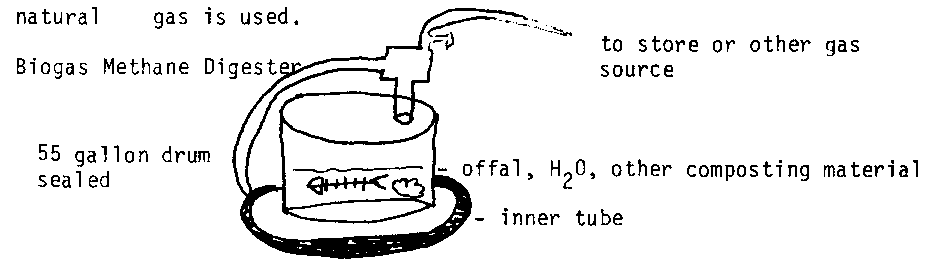
Biogas Methane Digester
Offal and other organic matter is place in 55 gallon drum and sealed. Within two-three days fermentation is pretty well along. Oxygen present in system should be bled off of gas to insure that no oxygen is present. The inner tube acts as a pressure regulation device. Burner units can range from simple bamboo pieces to very complex units.
Biogas Products:
Gas - Biogas - combustible gas Liquid-Scum - fertilizer Supernant - biologically active layer Solid Digested slurry - fertilizers Inorganic sediment - fertilizers
Uses for Biogas:
Raw materials for chemicals, carbon tetrachloride, etc., Heating Fuel, Cooking Fuel, Internal combustion fuel 1) cars, 2) boats
Fish Silage vs Fish Meal
| |
Silage |
Meal |
|
Capital Cost |
Low |
High |
|
Processing Skills |
Unskilled |
Skilled |
|
Smell |
None or pleasant |
Greater problem |
|
Transport |
Expensive (bulky) |
Cheap (light weight) |
|
Marketing |
Unknown product |
Established channels |
|
Storage Facilities |
Plastic container |
Packing material and dry storage room |
|
Capacity required |
none |
Big capacity |
References:
The Mother Earth News - Handbook of Homemade Power by the Staff of the Mother Earth News 1974 Bantom Books A Chinese Biogas Manual, edited by Arlane Von Baren, Science Publishing House, 1976, China Fishery in Japan, Yamaha Motor Co., Ltd, printed in Japan
Intermediate Technology and Alternative Energy Systems for Small
Scale Fisheries - by David B Thompson, South China Sea Fisheries Development and
Coordinating Program, Manila, Philippines, November 1979
--Alan Friedlander,
PCV
Tonga
Session T-42: First aid afloat
Time: 8:30 AM
Goals:
· For trainees to become aware of the need for proper safety precautions at sea
· To acquaint trainees with simple procedures in emergency treatment of wounds, burns, heat exhaustion/stroke and infections
· To provide a guide to a properly stocked medical kit for the marine fisheries volunteer
Overview:
This session is devoted to medical emergencies encountered by fishermen. The marine fisheries PCV will be out of reach of medical assistance a good deaf of the time. This session covers emergency first aid only.
Procedures:
|
Time |
Activities |
|
1 1/2 Hours |
1. Trainer gives lecture and demonstrates techniques. Where possible have trainees practice demonstrated techniques. The following areas should be covered: |
| |
a. Survival in water: One of the dangers faced by fishermen is falling into the sea or being swept overboard by a wave, particularly at night. If you fall into the sea, air trapped in your clothes will keep you afloat for a short time. But as air bubbles dissipate the weight of your clothes will drag you down deeper into the water making it difficult to keep afloat and breathe. Discard your seaboots or shoes and outer garments as quickly as possible. Footwear is best removed in a face-under-water position, one knee at a time being drawn up nearly to the nose so each boot or shoe can be removed. Clothes should be removed while you are treading water or in a floating position. If you are wearing a heavy overcoat shed it first, then remove lower garments. Clothes that have to be pulled up over the head should first be gathered up under the armpits then taken off with the head tipped forward. Alternatively withdraw one arm from the garment, then the head, then the other arm. If a person is rescued from the water unconscious, artificial respiration must be applied immediately. See section on artificial respiration. |
| |
b. Burns and Scalds: Knowing how to treat burns and scalds quickly and effectively can save a lot of pain and can reduce the danger of later infection. For superficial burns there is reddening of the skin and minor blister formation: Treatment - Wash copiously with cold water for up to 20 minutes. Sea water will do if fresh water is not readily available. Apply ice if it is available. Apply a sterile dressing or the cleanest material available and bandage firmly to exclude air and reduce risk of infection. Burnt tissue swells, so be prepared to loosen the bandage if it becomes uncomfortable. Deep Burns: Remove or cut away clothing over the burned area but leave clothing that is stuck. Wash liberally with cold water. Cover burned area with sterile cloth or cleanest material available and bandage firmly, loosening if it becomes uncomfortable. Cover large burns with sheet or towel. Do not apply any lotions, ointments or oil dressings. Do not prick blisters. Obtain medical assistance immediately. If the casualty is thirsty or if there is a long delay getting medical help give him small amounts of tea, providing he is conscious. When medical aid is not readily available, treat patient for shock. Sunburn: Prolonged exposure to the sun can result in painful burning. The most simple treatment is to apply clean cloth soaked in cold water. Treatment - rest in a cool place, give plenty to drink, if sunburn is serious and there is severe blistering seek medical help. Sunburn is best prevented by gradual exposure to the sun. Creams or lotions with ultraviolet screening oil may be helpful as preventive measure. Chemical or corrosive burns: Treatment - Wash off chemical immediately with large volume of water, plunge head in bucket of water if necessary. Remove contaminated clothing, but avoid contaminating yourself. Obtain medical help immediately. Eye injuries caused by chemicals should be flushed with water for 20 minutes or up to one hour if medical care is not readily available. |
| |
c. Bleeding: A severe gash can result in a hemorrhage. There are several types of hemorrhage: |
| |
Arterial - Bleeding from an artery. This comes in spurts |
| |
associated with the heart beats and the blood is red. |
| |
Capillary - Bleeding from the capillaries. Small in amount and flows with a gentle ooze. |
| |
Venous - Bleeding from the veins. There is a continuous flow and the blood is dark in color. |
| |
Treatment of serious cases - If bleeding is profuse or a dressing is not readily available grasp the sides of the wound and firmly squeeze them together. |
| |
Apply firm pressure with hand or fingers to the bleeding point. This method will tend to increase risk of infection but is justified when the hemorrhage is severe. Watch for shock and do not apply warmth. Normal treatment - Apply pressure to wound by placing large thick dressing over it, then bandage firmly. Do not remove dressing as this will dislodge blood clot which will form and lead to further hemorrhaging. A tourniquet must not be used. Rest patient. Elevate bleeding part if necessary with patient lying down. If bleeding continues, do not remove first dressing and bandage. Place additional ones on top. |
|
|
d. Wounds and infection: Infection cannot be prevented at time of injury but keep a wound as clean as possible afterwards. Treatment - Clean and dress the wound using maximum care to avoid infection. Avoid use of antiseptics except those specially recommended. Wash the wounds outwards; do not swab from side to side. To do so will carry bacteria from skin to wound. Handle all wounds gently. Watch for and treat any signs of fainting. |
| |
e. Fainting: This can be caused by a nervous shock, an injury, standing still for a long time or sudden change in position, or from a hemorrhage. Treatment - If the casualty is in a sitting position and cannot lie flat, press his head down between his knees. If he can lie down, raise his legs and lower his head. Encourage deep breathing if he is conscious. Loosen clothing around neck, chest and waist. Ensure plenty of fresh air. Reassure the patient. If the patient is unconscious ensure breathing by keeping airway open (tilt head back). f. Shock: This is brought about when a state of collapse occurs. It can result in death if left uncontrolled. It can be caused by loss of blood, loss of serum following burns or through heart failure. Treatment - Start first aid immediately. Ensure plenty of fresh air. Control any bleeding. Relieve pain by 1) covering wounds, 2) splinting fractures. Do not give fluids to the patient if he is unconscious, or if there is a risk of immediate operation; he feels sick; or there is an internal injury. Do not give alcohol or attempt to warm body up (that can cause shock to worsen). Seek immediate medical care. G. Shark attack: Treatment - Immediate control of the hemorrhage. Attempt this in the water if practical by pressing hard right into or just above the spurting point with the fingers. As soon as the casualty is ashore or on board lie him flat with head down. Pack the wound with any available clothing. Maintain pressure until a firm bandage is applied. Elevate the injured part if possible. Summon medical aid. Do not move the casualty without medical advice. Transport and handling must be gentle to avoid worsening the shock. H. Marine stings: Marine creatures may inflict their stings by: injection of venom through puncture wounds; contact with tentacles bearing stinging cells. Treatment - Clean the wound with water. Remove any foreign bodies. Immerce the part in hot water. Treat for shock. Stings from Tentacles: Pour methlylated spirits or other alcoholic spirits over the area of the sting. This destroys undischarged sting cells. If no alcohol is available spread dry sand over the sting. Scrape off remaining tentacles. Do not rub the area...this causes more venom to be absorbed. Severe Stings: Keep the casualty at rest. Treat for shock. Sustain respiration. Sustain circulation. Send for medical aid. |
| |
I. Sprains: A sprained ankle or wrist is another occupational hazard for fishermen. Treatment - Rest the joint in the most comfortable position. Apply ice packs or cold compresses to the joint. In the case of an ankle, remove socks. Firmly bandage the joint. Remember that a sprain can easily be confused with a fracture. If a fracture or dislocation is suspected get medical help immediately. J. Fumes and Gases: A fisherman can be overcome by fumes or gas aboard his vessel. Treatment - Make sure the rescuer does not become the next casualty. Put on protective equipment immediately. Rescue must be carried out with extreme care, preferably by a person trained in rescue procedure. Get the casualty into the fresh air. If breathing is failing or has stopped start artificial respiration. Remove any contaminated clothing. Wash contaminated skin thoroughly. Treat for shock. Seek medical aid. Coral Cuts: Treatment - Clean cuts and scratches thoroughly with fresh water or open sea water (rather than lagoon). Cover with clean dressing and avoid exposure. Seek medical help if they do not heal quickly. Salt Water Boils: Treatment - Clean thoroughly with fresh plain water. Apply a non-soluble cream and protect from sun and exposure. K. Removing embedded fish hooks: Hooks embedded in the hand are one of the many occupational hazards faced by fishermen. Treatment - The most common method is to force the hook outwards until the point pierces the skin again. Then break or file off the barb and draw the curved part of the hook along the track of entry. This method can be extremely painful unless a local anaesthetic is ad ministered, but this is not normally within reach of the first aider. Another method is to flick the embedded hook out with a piece of string. String is made into a loop, the ends are wrapped firmly around the manipulator's right index finger, and the loop, some 18 inches long, is placed over the shank of the embedded hook. The fish-hooked finger is placed upon a firm surface, the eye pointing to the left of the manipulator, who then grasps the eye and shank with the thumb and index finger of his left hand which rests upon the patient's hand. He holds the shank rigid and depresses it. This disengages the barb and is painless, provided that the hook is not moved sideways. As a trial the string is slowly straightened out horizontally in the plane of the long axis of the shank. After the trial run the manipulator with the tip of his left third finger holds the central point of the loop of string against the juncture of the hook with the patient's finger. The manipulator's right hand is brought back to the hook and suddenly jerked away again, with full follow-through, in the same direction as in the trial run, spinning the hook back out of the finger without enlarging either the track or the hole of entry. For hooks larger than a size 1 whiting hook, a double loop and a loop length of 24 to 30 inches is used. L. Artificial respiration: Decide quickly the method of artificial respiration. Those who have been taught the Schafer, Holger-Nielson or Silvester methods of resuscitation will know what to do. The easiest and best known method is the mouth-to-mouth system. Mouth-to-mouth treatment - Lie casualty on his back, kneel beside head. Check mouth and throat and make sure they are clear of foreign matter. Remove false teeth. Hold head in both hands, one hand pressing downwards and backwards, the other pushing lower jaw upwards and forwards. Open your mouth wide and take a deep breath. Seal your lips around casualty's mouth. Pinch nostrils between your thumb and forefinger. Breathe out firmly into casualty's mouth and watch the chest rise. It should be similar to that in normal inspiration. Then remove your mouth. Allow chest to collapse. If the victim is an infant inflation should be gentle and at the rate of 20 times a minute. Time is vital, the first three or four inflations should be given as quickly as possible. For continued artificial respiration, inflations should be at the rate of 10 per minute. If chest does not fill with air, check the airway and check air seal of your mouth over that of patient. Mouth-tonose treatment - Where the mouth-to-mouth system cannot be used because of an obstruction or damage to the mouth - mouth-to-nose should be used. This method is often used in drowning cases. With the casualty on his back, kneel beside him. Position the head as for mouth-to-mouth. Take a deep breath and seal your lips widely on the casualty's face around his nose. Make sure your lips don't obstruct the nostrils. Close the casualty's mouth by placing your thumb on the lower lip. Breathe out and watch the chest rise. Remove your thumb, part the casualty's lips and allow the chest to collapse. Rate of inflation is the same as mouth-to-mouth. Points to Note: Air must pass in and out of the casualty's lungs. The chest must be seen to rise and fall or the expirations be heard. The head must be positioned correctly throughout. An airtight seal should be maintained during the operator's exhalation into the casualty's nose and mouth. The operator must turn his face away from the casualty's face to watch the chest and to take in fresh air for the next application. When the casualty starts to breathe again, the operator should continue with assisted breathing but he should try to keep In time with the patient's own attempts. Recovery is often accompanied by vomiting. Turn casualty on side with one arm underneath going through to the back, and face resting on the other. This assists with the breathing and allows any discharge to be easier. When the patient has recovered, obtain medical assistance, remove wet or contaminated clothing, promote warmth by blanket cover to prevent pneumonia. In certain emergencies breath can be given to a casualty who is still in the water, provided you can open an airway. |
|
15 Minutes |
2. Trainer emphasizes the seriousness of injuries at sea. Discusses what first aid supplies trainees feel should be taken with them on upcoming fishing trip and the contents of first aid kits they should have as PCVs. |
|
5 Minutes |
3. Trainer concludes session by linking to upcoming fishing trip and appointing trainee to be in charge of assembling medical kit. |
Session T-43: Exploratory fishing trip I - Preparation
Time: 10:30 AM
Goals:
· To allow trainees time to
organize and prepare for the next day's trip
· To acquaint trainees with the necessary details
essential to preparation
Overview:
This session is the preliminary to session 47. The organization of the fishing trip is much too large a task for one individual. Also, the trainees need to be made aware of the time factor involved in preparing for a fishing trip, and the actual work making sure all is ready. By organizing the trainees into teams - food preparation, fish gear, fish processing, handling and care and miscellaneous - and making them responsible for the actual preparation, a better understanding of the role of a small-scale fisherman is achieved.
Materials:
· Flip chart, markers, tape
Procedures:
|
Time |
Activities |
|
1 Hour |
1. Technical trainer gives fishing trip preview. Trainer |
|
15 Minutes |
should have "check-off list" prepared ahead of time to assist in the preparation procedure. |
| |
A. Departure time: early enough to travel to fishing grounds, fish and return. |
| |
B. Type of fishing for trip: |
| |
- handline (session T-22) |
| |
- deep line (session T-24) |
| |
- long line (session T-27) |
| |
- nets (session T-4) |
| |
C. Personal gear to bring: |
| |
- PFD |
| |
- proper clothing |
| |
- gloves |
| |
- hat |
| |
- sunglasses |
| |
- tennis shoes |
| |
- knife |
| |
D. Food to prepare: |
| |
- protein types |
| |
- fruit |
| |
- water |
| |
E. Fishing gear to prepare: (see session T-21) |
| |
- extra hooks, lines, hardware |
| |
- fishing tools, pliers, clubs |
| |
- trolling gear |
| |
- hand lines |
| |
- deep line gear and reels long line gear and reels |
| |
- nets if involved in net fishery |
| |
F. Fish processing, handling and care preparation: (see sessions T-29, T-32, T-35) |
| |
- buckets |
| |
- scrub brushes |
| |
- knives |
| |
- ice box (see session T-39) |
| |
- ice (see session T-39) |
| |
G. Miscellaneous preparation: |
| |
- first aid kit (see session 42) |
| |
- hand cloths for cleaning tool kit for fish boat engine |
| |
- sun screen lotion |
| |
- sea sickness medication |
| |
H. Assigning of groups to prepare: |
| |
- food |
| |
- fishing gear |
| |
- fish processing, handling and care |
| |
- miscellaneous |
|
5 Minutes |
2. Technical trainer produces check-off list and wraps up session by underlining the importance of preparation to successful fishing trip. |
Session T-44: Individual interviews/net mending
Time: 2:30 PM to 5:30 PM net mending 20 to 30 minutes per person for interview
Goals:
· To give each trainee
individual time with trainers
· To give
feedback to each trainee on their progress
·
To review assessment dimensions
· To
introduce cutting and mending of nets
· To
have trainees practice net mending
Overview:
In this session trainees are once again given formal feedback by the staff, based on staff consensus. Trainees are asked if they have feedback for staff. Personal concerns that trainees may have are checked for. Cutting and mending are introduced by technical trainer at beginning of session.
Materials and Equipment
· flip chart, markers, pens; nets, twine, needles
Procedures:
|
Time |
Activities |
|
20 Minutes |
1. Trainees are given brief demonstration of net cutting and mending by technical trainer. They will practice this technique for rest of session. |
|
2 Hours 30 Minutes |
2. The following format is recommended for this week's interview: |
|
|
o Any concerns you want to talk about. |
| |
o How much time outside of classroom is spent on: |
| |
- your special projects, |
| |
- your group special projects, |
| |
- pacing yourself? |
| |
o Where are you in your decision to go to? |
| |
o Anything you want to say to staff? |
| |
o We have the following feedback for you |
Cutting and mending
Cutting out
ID a piece of netting each knot always has four bars leading to it, never three or two unless it is on the edge of the netting, and never five under any circumstances. When the starting knot is tied the twine on the needle forms the lourth her to the knot. On half mesh, pick up and side knots, the twine on the needle forms one her as it is brought to the knot and another as it leaves alter the knot is tied. In the finishing knot the twine on the needle forms one bar as it is brought to the knot and tied.
Therefore, when cueing out a hole, preparatory to mending it, the knot to which the starting knot is to be tied must have three bars leading to it, only one of the normal four bars being cut away (Fig. 28). All the other knots tied in mending the hole, except the finishing knot, must be tied to a knot with only two bars ;leading to it, requiring two bars to be cut away. The finishing knot is tied to a knot with three bars leading to it, so only one bar is cut away.
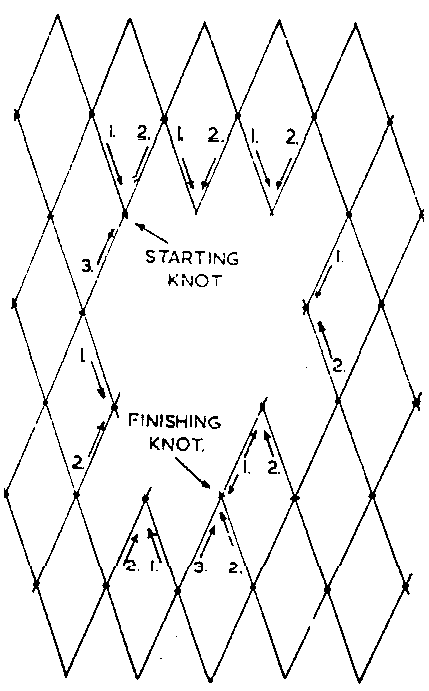
Fig. 28
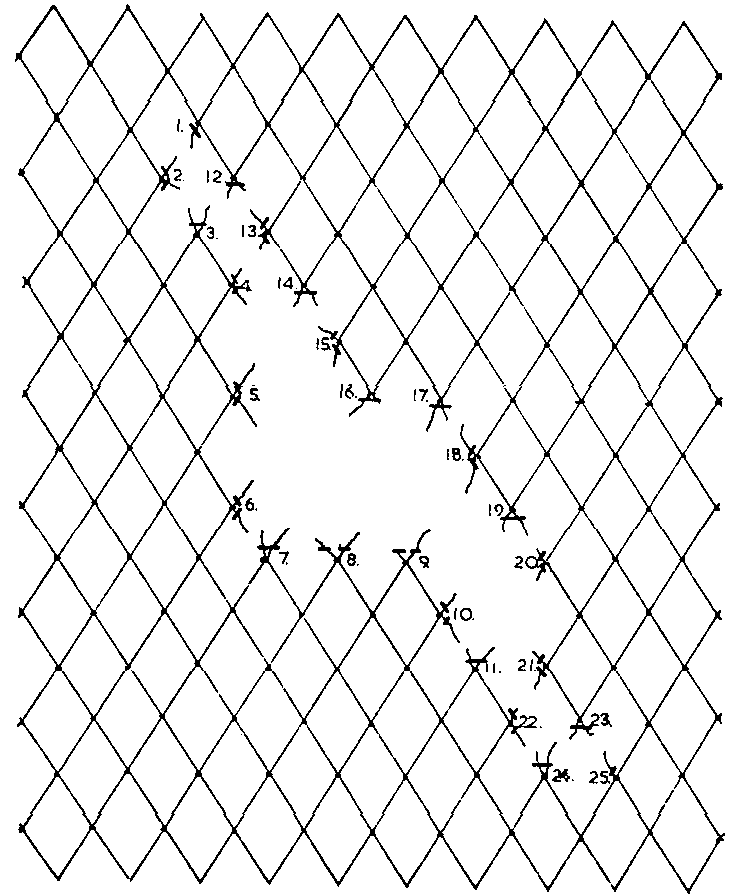
Fig. 29
The procedure for cutting out i. therefore:
1. Arrange and support the net 50 that it is pulling in the right direction with the rows of knots in line (Photo 1). Select the starting knot at the highest point of the hole (Fig. 29-1) and cut away one bar, !leaving three bars to the knot.
3. Work down the left hand side o the hole cutting away two bars from each knot, leaving two bars (Fig. 29-2 to 11) to within a few meshes of the bottom of the hole.
4. Starting at the top again, immediately to the right of the starting knot, work down the right band side of the hole, cutting away two bars from each knot and leaving two bars (Fig. 29-12 to 21) to within a few meshes of the bottom of the bole.
5. Cut two bars away from each remaining knot alternately on the left then the right hand side of the hole (Fig. 29-22 to 24) until a finishing knot ([fig. 29-25) remains, when only one bar is cut sway.
The hole is then ready for mending. With large holes or rips in the net it is often easier to cut out on each side for the first five to 10 meshes from the starting point. Mend this in then cut out a further section and mend it in, so progressing from cutting to mending until the job is completed.
Mending
Mending is a straight forward procedure once the hole has been
prepared by cutting out.
However, there arc five simple rules to follow and
it is essential that the mender does not deviate from them.
1. With the exception of the starting and finishing knot, every knot formed must complete a mesh with four equal sides. (Fig. 30 and 31, half mesh knot; Fig. 32 side lino.; rig. 33 pick up knot.) When the starting knot is made no mesh is formed; when the finishing knot is made two meshes are formed.
2. Each half mesh row, whether moving from right to left or left to right across the hole, must be completed before the next is started.
3. Each change of direction across the hole, at the end of each row, is made by progressing to a side knot.
4. With one exception, after making a side knot the next knot will be a half mesh knot (Fig. 34), a pick up knot followed by a half mesh knot, (Fig. 35) or a finishing knot.
5. A side knot cannot follow a side knot on the same side of the hole (Fig.. 36). This would entail progressing down the hole by a full mesh (two rows) instead of the specified half mesh (one row).).
The exception to rule 4 is when only one bar of a mesh is needed to join the two edges of the hole. Side knot then follows side knot but each successive knot is on the opposite side of the hole and each involves a change of direction (Fig. 37).

Fig. 34
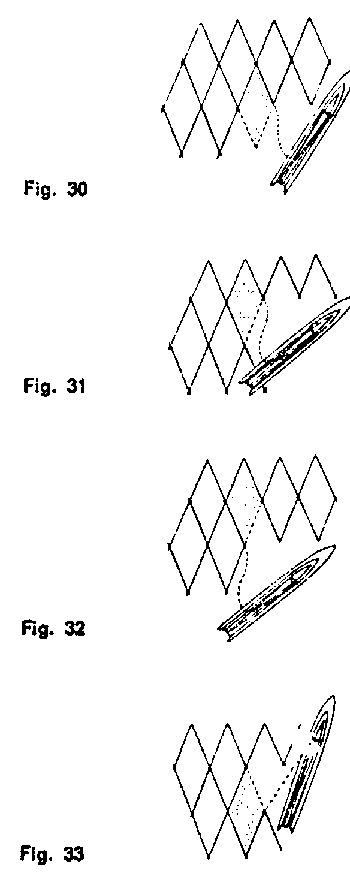
Figs. 30-33
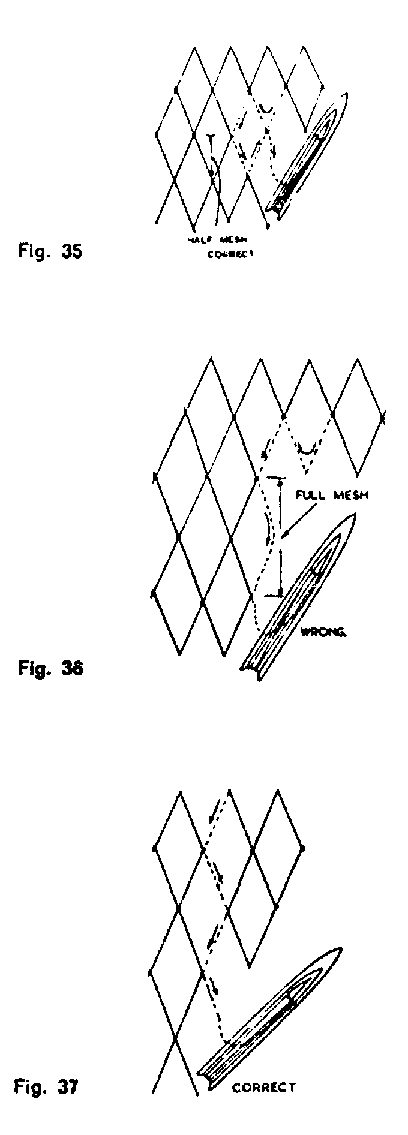
Figs. 35-37
Fig. 38 shows a .simple mend in which all the knots are used The curved arrows indicate that a half mesh (two bars) is formed to complete a mesh. Moving from left to right from the starting knot 1, two meshes are completed with half mesh knots at 2 and 3. these are followed by a side knot 4; the direction is changed to right to left and a pick up knot made at S. Half mesh knots arc made at 6 and 7 on the loops left when knots 2 and 3 were made. Eight 8 is a side knot followed by a change of direction to a risk up knot 9, a half mesh knot 10 then the finishing knot 11.
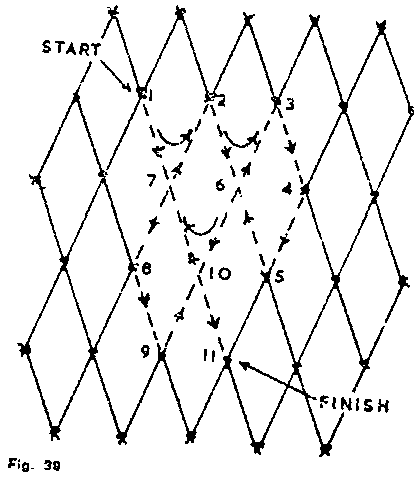
Fig. 38
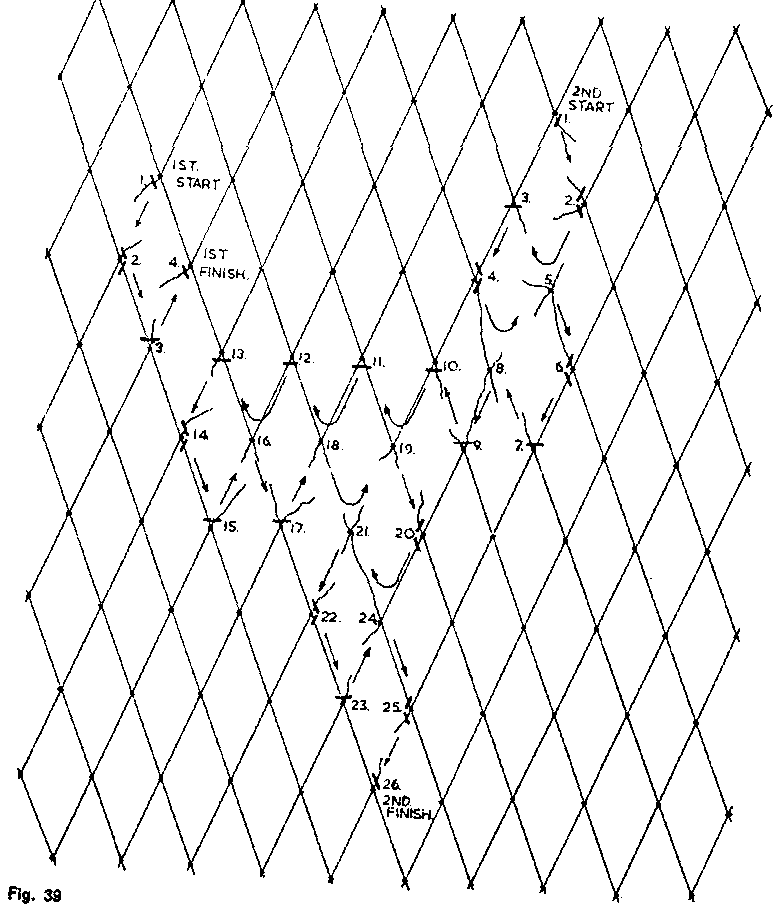
Fig.
39
Session T-45: Star charting special project
Time: 7:30 PM
Goals:
· To acquaint trainees with
proper observation techniques when viewing celestial bodies
· To familiarize trainees with major star bodies and
procedures on locating and identifying them
·
To utilize technical transfer and presentation skills
Overview:
This session is to be presented by a trainee as a special project. By focusing trainees on the practicality of star charting and its present day application in small-scale fisheries, in case the fishing vessel is disabled, etc. There is a need to identify traditional styles and technologies. The PCV focuses on the practicality of star charting and present day small scale fishing applications.
Materials:
· Flip chart, pens, guide to star gazing
Procedures:
|
Time |
Activities |
|
10 Minutes |
1. Introduction to star charting |
| |
A. overview of traditional navigation techniques(see reference) |
|
10 Minutes |
2. Major celestial bodies |
| |
A. planets ) northern hemisphere |
| |
C star gazers) southern hemisphere |
|
25 Minutes |
3. Identification of celestial bodies (rest of presentation to be out of doors to bring realism into session) |
Trainer's Note
You will have to provide star map of your location to trainee.
Session T-46: Navigation and seamanship
Time: 8:15 PM to 9 45 PM
Goals:
· To acquaint trainees with
basic navigation systems utilized by small-scale fishermen
· To familiarize trainees with simple navigation
devices and their proper usage
· To introduce
to the trainees the navigational chart
Overview:
The purpose of this session is to provide trainees basic navigation skills. In the following session (47), when trainees are on a fishing vessel, they should have a rudimentary knowledge of navigation, be able to distinguish direction and understand the navigational chart.
Materials and Equipment:
· flip chart, markers, compasses (hand held), local navigation charts
Procedures:
|
Time |
Activities |
|
20 Minutes |
1. Introduction to navigation |
| |
A. Charts |
| |
B. Basic Tools |
| |
C. Currents and Tides |
|
20 Minutes |
2. Introduction to compass usage |
| |
A. Bearings and deviation |
|
20 Minutes |
3. Chart usage |
| |
A. Local/inshore navigation |
| |
B. Off-shore |
| |
C. Nautical mile measurement |
| |
D. Tool usage |
|
20 Minutes |
4. Navigation of a fishing vessel |
| |
A. Steering the course |
| |
B. Understanding bearings |
| |
C. Use of the navigation chart |
|
10 Minutes |
5. Celestial (See session 45) |
Trainer's Note:
This session is a preliminary to the fishing trip, session 47. It is important that this session be held prior to the first fishing trip. If the trainer does not feel competent in navigation, an outside resource person should be brought in to assist in the session.
Session T-47: Small scale fishing trip I
Time: 4:30 AM to 4:30 PM (approximately 12 hours)
Goals:
· To allow all trainees the opportunity to utilize skills learned in formal and special project sessions
· To acquaint all trainees with proper small-scale fishing techniques: trolling, hand-line, deep-line and long-line
· To give all trainees the opportunity to navigate a small-scale Diesel fishing vessel
· To give all trainees the opportunity to operate and be responsible for a small Diesel marine engine
· To allow all trainees the opportunity to follow fish handling and care techniques with fresh caught fish
· To give trainees opportunity to experience deep sea fishing on a small-scale fishing vessel
Overview:
This session is held at sea. The trainees will practice techniques previously learned. They will have the experience of using different types of fishing gear, and processing fish at sea.
Materials and Equipment:
· Personal floatation devices (PFD), fishing gear, food for X people, ice for fish, fish handling and care equipment, fillet and cleaning knives, drinking water, first aid kit, radio am/fm for weather, blankets for seasick trainees
Trainer's Note:
Very important to utilize boats which are appropriate to small-scale fishery. The trainer should offer guidance, but not interfere with the trainees. If the trainees have been properly trained up to this point, very little input is needed other than suggestions for safe handling of more dangerous species, i.e., shark, barracuda. A team system for fishing and navigating is helpful and allows fuller use of the trainees time and makes them responsible for their actions on board the boat. It is prudent to have the operation/owner of the boat along on the session.
Procedures:
|
Time |
Activities |
|
12 Hours |
1. Technical trainer does very little during this session which includes the following: |
| |
a. fishing trip |
| |
- trolling with shava-shava to the fishing grounds |
| |
- handline |
| |
- long-line reel |
| |
- deep-line reel |
| |
- nets |
| |
b. navigation (see session 46) |
| |
- chart course |
| |
- compass orientation |
| |
- helmsmanship |
| |
c. Diesel |
| |
- maintenance; oil, water |
| |
- power systems, shaft |
| |
d. fish handling and care |
| |
- cleaning of fish |
| |
- proper icing techniques |
Trainer's Note:
For many trainees this will be the first time they have been at sea in a small fishing vessel. If the sea is rough you can expect some trainees to become seasick.
SHAVA SHAVA "The Artificial Bird"
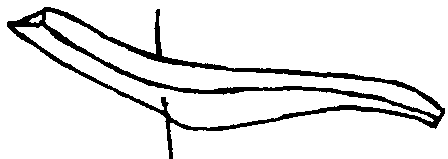
Figure
Shava Shava skips across top of water when trolled from behind boat. When a fish strikes the lure the Shava Shava is pulled the water surface.
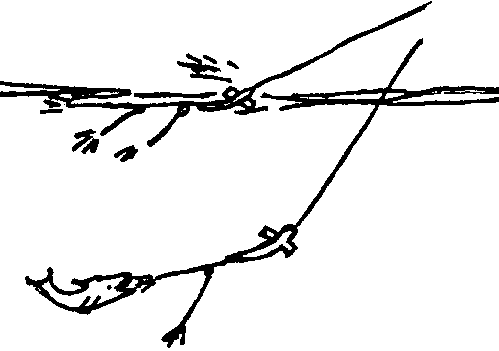
Figure
Shava Shava body of single piece of wood with wooden wing
Size varies, but is approx. 16-20 inches with a wing span of approx. 6-8 inches.
Four variations:

Figure
|
| |||||||||||||||||||||||||||||||||||||||||||||||||||||||||||||||||||||||||||||||||||||||||||||||||||||||||||||||||||||||||||||||||||||||||||||||||||
Small-Scale Marine Fisheries - A Training Manual (Peace Corps, 1983, 631 p.)
Week 5: Training

Week 5, Sessions T-48 Thru
T-66
Session T-48: Small-scale fishing - fishing trip assessment
Time: 7:30 AM
Goals:
· For trainees to formally assess their fishing trip
· To make trainees aware of the need for maintenance of fish gear and possible improvements of fish gear for future trips
· For trainees to work on gear repair, line quality and hook sharpening, etc.
Overview:
In this session trainees look back over fishing trip and discern which learnings were reinforced from previous sessions. They rate their skill level and through self assessment decide areas they need skill improvement. Trainees look over gear and make necessary repair to gear and generally ready gear for next trip. They examine which preparations were beneficial to trip and which could have been done differently to have been more beneficial.
Materials and Equipment:
· Flip chart, markers, tape, fishing gear used on trip
Procedures:
|
Time |
Activities |
|
30 Minutes |
1. Technical trainer has trainees list on newsprint those aspects of fishing trip that went well, and what made them go smoothly. On another piece of newsprint trainees list aspects of fishing trip that could have gone better, and what could be done to remedy problems on future trips. |
|
20 Minutes |
2. Trainees are asked to get into pairs (preferably with someone they worked together with during fishing trip). Trainees are asked to give each other feedback about skills. Trainees ask other trainees to help them improve skills which trainees feel they need to work on. Trainees are reminded that they can use feedback positively as well as negatively. Feedback should be limited to aspects of fishing trip. |
|
40 Minutes |
3. Technical trainer now reviews: |
| |
a. pre-planning |
| |
- food |
| |
- fish gear |
| |
- fish preparation/handling |
| |
b. fishing trip |
| |
- trolling |
| |
- lure |
| |
- hand line |
| |
- deep line |
| |
c. navigation |
| |
- boat handling |
| |
d. Diesel |
| |
- premaintenance |
|
40 Minutes |
4. Trainees check fishing gear and ready it for next trip. Trainer wraps up session. |
Trainer's Note:
Closure would be more appropriate immediately after fishing trip session, however after 12 hours at sea (and some sea sickness) trainees are just not up for processing of their fishing trip session.
Session T-49: Salt making - special group project
Time: 10 AM
Goals:
· To acquaint trainees with the
various methods of salt making
· To make
trainees aware of salt making methods from sea water
· To construct and demonstrate a small-scale salt
evaporator
· To provide technology transfer
skills to trainees
Overview:
This is an ongoing group exercise in salt making. Though the initial session is primarily concerned with introducing the concept of salt production and building a model salt evaporator, the actual manufacture of salt will take place during the remainder of the training.
Materials and Equipment:
· Flip chart, markers, wood nails, woodworking tools, plastic liner (.006 mil), clean sea water
Procedures:
|
Time |
Activities |
|
20 Minutes |
1. Trainee leader for whom this is a special project gives lecturette covering the following aspects of salt and salt making. |
| |
a. Various salt usages |
| |
- refrigeration and brine |
| |
- food preservation: salting, drying, smoking |
| |
b. Antiseptic effect of salt |
| |
- osmosis effect in water |
| |
- prevention of spoilage |
| |
- longer shelf life |
| |
c. Simple salt making |
| |
- evaporation of sea water solar, cooking |
| |
- evaporation process |
| |
d. Demonstration process |
| |
- site selection |
| |
adequate sunlight, protection from wind |
| |
e. Construction |
| |
- dig evaporation pond |
| |
- build structure |
|
1 Hour 30 Minutes |
2. Trainee leader now has team construct and set up evaporation box. Evaporation Box Construction |
| |
a. finish box |
| |
b. plastic liner |
| |
c. collect clean sea water |
Trainer's Note:
1. Trainee group should prepare all construction materials ahead of time.
2. If the importance of salt making as a viable cottage industry is not brought out by trainee leader, trainer should bring it up.
The following is a sample lecturette given by trainee leader during pilot program.
SALT MAKING
Summary:
1. What is salt used for (in general, in fishing communities)?
2. Some simple methods for making salt from seawater
3 . Demonstration small-scale salt evaporator
General uses for salt:
1. Food preservation
2. Spices in cooking
3. Health (greater need for salt in hot climates)
4. Refrigeration (use of brine as a secondary refrigerant to lower freezing temperature)
5. Industrial uses: soap, bleaching powder, dyes, pottery, fertilizer
Main uses for salt in small-scale fisheries:
Refrigeration - A concentrated brine solution can be used as a secondary refrigerant to lower the freezing temperature of water. This temperature will vary, depending on the concentration of salt in the brine. The lowest temperature which can be reached is -6° F at a brine concentration of 23.3% salt (by weight).
Food preservation - Salting, especially in conjunction with smoking and drying, retards bacterial growth and subsequent spoilage of fish, giving preserved fish a longer shelf life.
Why is salting not more frequently used in small-scale fishing communities?
Problems often exist with cost and availability of salt. Despite the abundance of natural resources (seawater), coastal communities often import salt from hundreds of miles away. Thus, the establishment of small-scale salt making operations can be a very worthwhile investment for a fishing community.
Methods for small-scale salt making:
All salt making at the simple level in which we are interested involves evaporation of seawater, leaving coarse salt crystals. This can be done by solar evaporation or wood fired cooking.
Solar Methods - Ponds - Shallow ponds dug near a salt water source are frequently used as salt evaporators. In the Philippines, fish culture in the wet season alternates with salt production during the dry season. Where a sandy substrate is available, a pond may be shaped in sand and then lined with plastic to hold water. Bamboo Halves - Also from the Philippines, this technique utilizes a preconcentrated brine set out in shallow bamboo troughs to crystallize. The seawater is first concentrated by leaching it for several days through a sand filter. This makes the process somewhat more laborious, but where bamboo is readily available, it may be a practical technique. Structures lined with plastic - For our demonstration project, we chose to build a wooden box and line it with plastic, since sites for pond digging were not available. This provides a permanent structure which can be moved if necessary, though costs for materials will be higher than with the above methods.
Cooking Salt - Most methods which produce salt by cooking give a refined table quality salt, as opposed to the coarser grade salt produced by solar evaporation. The basic method entails boiling a concentrated brine (sometimes made from impure or 'dirty' coarse salt) until only fine salt crystals remain. Note: When using salt in fish processing, be aware that impurities in the salt can affect the final product, eg. color, taste, etc. For instance, concentrations of copper and iron can cause a yellow and brown discoloration in the salted product. Bacterial molds adapted to high concentrations of NaCl can cause spoilage of salted fish. These bacteria can be killed by pre-heating salt at 100°C for 15-30 minutes before use in processing. The following diagram illustrates a basic two-step salt making process for a pond or other evaporation container:
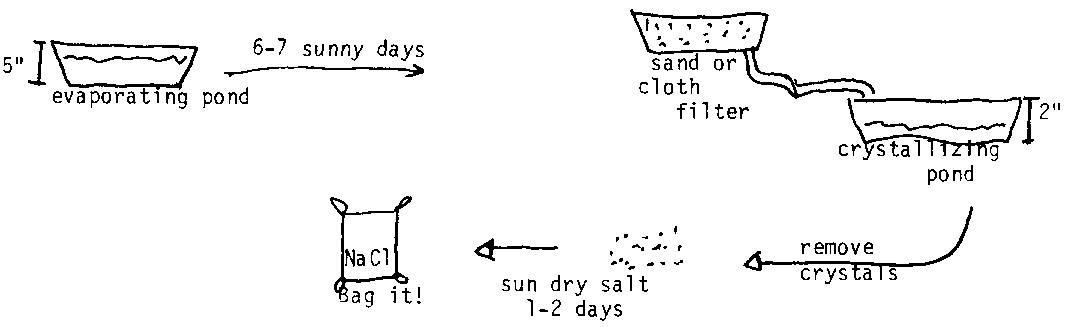
Figure
1) Clean seawater sits in an evaporation pond at approximately 5" depth until it evaporates to a more concentrated brine solution. The rate of evaporation will vary depending on weather conditions: air and ground temperature, amount of sunlight, rain, etc. An example from a demonstration project in the Philippines found that with an atmospheric temperature of 26°C-29°C and a ground temperature of 40°C52°C, daily evaporation is 12-15% of seawater for a six square foot surface area at 2" depth. 2) The brine solution is run through a sand or fine cloth filter to remove dirt or impurities, then put into a crystallization pond at no more than 2" in depth 3) If the brine in the crystallization pond is not agitated and there is adequate sunlight, salt crystals should begin to form. The salinity will be about 200% at this point. 4) Remove salt crystals by hand, let dry in the sun for 1-2 days. 5) Crystallizing ponds should be cleaned after use especially if a white slurry remains. This contains carbonate and sulfate crystals which are sharp and not desirable in the pond or salt crystals.
Demonstration Project:
The following categories were considered in planning a demonstration salt maker: 1) site, 2) design, 3) materials and construction, 4) maintenance.
1) Three important aspects to consider when choosing a site are: proximity to and availability of clean sea water, protection from wind, good exposure to sunlight for most of the day. Due to the lack of open sandy areas near the shore for digging a pond, it was decided to build a box evaporator and line it with plastic. Originally, a small corner on the cooperative grounds was to be used for the site. Later, this was changed to the flat roof of the storeroom as this would be out of reach of curious onlookers, children, etc. The roof also has a two foot ledge which shelters the site from wind. 2) The design was taken from a project model done in the Philippines: One simple wooden box 4 ft x 6 ft divided into four compartments: two evaporation ponds and two crystallizing ponds.
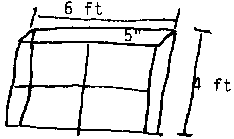
Figure
3) Materials used were low grade plywood for the base, 2 x 5" lengths for the evaporation pond edges and 2 x 3" for the crystallizing pond edges. Gauge six plastic was originally intended for the lining, but as this could not be obtained, doubled garbage bags were used. These were stapled in place. (Seawater was obtained in buckets with a boat outside the bay, as this was thought to be cleaner.) 4) Maintenance included covering the pond with a sheet of plywood during heavy rainstorms, measuring the depth each day to gauge evaporation rates, and filtering and harvesting salt at the appropriate stage.
References:
· "A Study on The Viability of Salt Making in Polyethelene Plastic Material For Small Scale Industry'' by Simeon N. Aypa, Bureau of Fisheries and Aquatic Resources, Manila, Philippines
· "Salt: A Growing Major Crop of Pangasinan". Countryside Banking. April 1980
· "Preparation of Salt Brines For The Fishing Industry" Kenneth S. Hilderbrand Jr., Oregon State University Extension Service January 1979
· "Intermediate Technology and Alternative Energy Systems For Small-Scale Fisheries". David B. Thompson, South China Seas Fisheries Development and Coordinating Program, Manila, Philippines November 1979
Session T-50: Tropical sea birds special project
Time: 4:00 PM
Goals:
· To acquaint trainees with the
identifying characteristics of tropical sea birds
· To learn how to identify families of birds at
sea
· To make trainees aware of special uses
for sea birds in fishing and navigation
Overview:
This session is a special project for one of the trainees. Trainee acquaints other trainees with sea bird identification as a way to gain useful information for navigation and better fishing. Sea bird identification also gives insight into ecological problems. In future PCVs will be able to use sea bird identification to assist local fishermen in more efficient fish capture.
Materials:
· Flip chart, markers
Procedures:
|
Time |
Activities |
|
1 Hour |
1. Trainee for whom this is special project gives lecturette using the following example outline used during pilot program. |
| |
2. Trainees should make an attempt to identify sea birds in the surrounding area. |
Tropical Sea Bird Identification
Importance of Seabird identification
1. Indicators of land
2. Indicators of fish
3. Indicators of health of environment
4. General knowledge
Important characteristics for bird identification at sea
1. Silhouettes - most times will only get a glimpse of bird
2. Size - length of bird from bill to tail and wingspread
3. Shape - relative proportions of head, neck, body, appendages
4. Colors - not so important, most seabirds are black, white, grey or brown
5. Patterns - very important. i.e., dark cap, eye spot, dark or light eyebrow, light collar, rump, dark "M" pattern on mantle, wingtip, underwing pattern, breast, tail, wingband
6. Bill shape - long, short, heavy, slim, hooked, pointed
7. Bill color - helps indicate species
8. Foot and eye color - only good at close range
9. Voice
10. Flight - glide or soar, fly rapidly with stiff wings, or slowly with flexible wings, hover, light and buoyant or heavy and sluggish rapid, deliberate, leisurely, how high, just above waves, above horizon or high over masthead
11. Feeding habits
12. Flocking
13. Habitat - distance off shore
14. Distribution
Seabird Identification
Albatross Diomedeidae: Hugh, largest seabird, long, narrow wings, conspicuous bill, soars and glides. Ship followers.
|
Jaeger |
Stercorariidae: Brown or gray and white. White flash at base of flight feathers, pointed wings, bent at wrists. Elongated central tail feathers. |
|
Tropic Bird |
Phaethontidae: Elongated central tail streamers, long wings, pelagic. |
|
Gull |
Larinae: Long wings, stocky body. Powerful buoyant flight. Ship followers. |
|
Frigate Bird |
Fregatidae: Mainly black, deeply forked tail, slender body, hooked bill, never land on water - feathers not waterproof. Pirates - force others to disgorge their catch, males all black, red throat patch inflate, females black with white throat. |
|
Tern |
Sterninae: Small, slim body. Long wings, forked tail, pointed bill, related to gulls, flock indicates fish. |
|
Noddy |
Sterninae: Contrasting colored cap, slim body, long wings, wedge shaped tail. |
|
Booby |
Sulidae: Large pointed bill, large head, long pointed wings and tail, throat patch, long neck, black and white or brown and white, brightly colored feet, legs, and bill, indicate fish. |
|
Gadfly Petrel |
Procellariidae: Long wings, bent at wrists, heavy hooked bill, erratic flight, highly pelagic, all dark or dark with white underparts. Wedgeshaped tail, tubular nostrils. |
|
Shearwater |
Procellariidae: Long, narrow wings, fully extended, slim hooked bill, all dark or dark with white underparts, paired tubular nostrils. |
|
Cormorant |
Phalacrocoracidae: Long hooked bill, long neck and tail, rounded wings, black, flight pattern V, submerge to escape, float low in water, prefer shallow offshore water. |
|
Pelican |
Pelicanidae: Huge, heavy body, broad wings, head folded on breast, flaps slowly, white, distensible throat pouch, never far from land, head drawn in while flying. |
|
Alcid |
Alcidae: Short narrow wings, heavy body, large head, conspicuous feet. Small body, black and white, fly low over water, escape by submerging, become airborne with difficulty. |
|
Storm Petrel |
Hydrobatidae: Very small, long rounded wings, flits over waves, "butterfly flight", pelagic , nostrils united into one tube. |
|
Phalarope |
Phalaropodidae: Very small, slim bill, pointed wings, pelagic, lobed feet, breeding plumage chestnut, fly low over water. |
- Margie Hulsair, PCV Sierra Leone
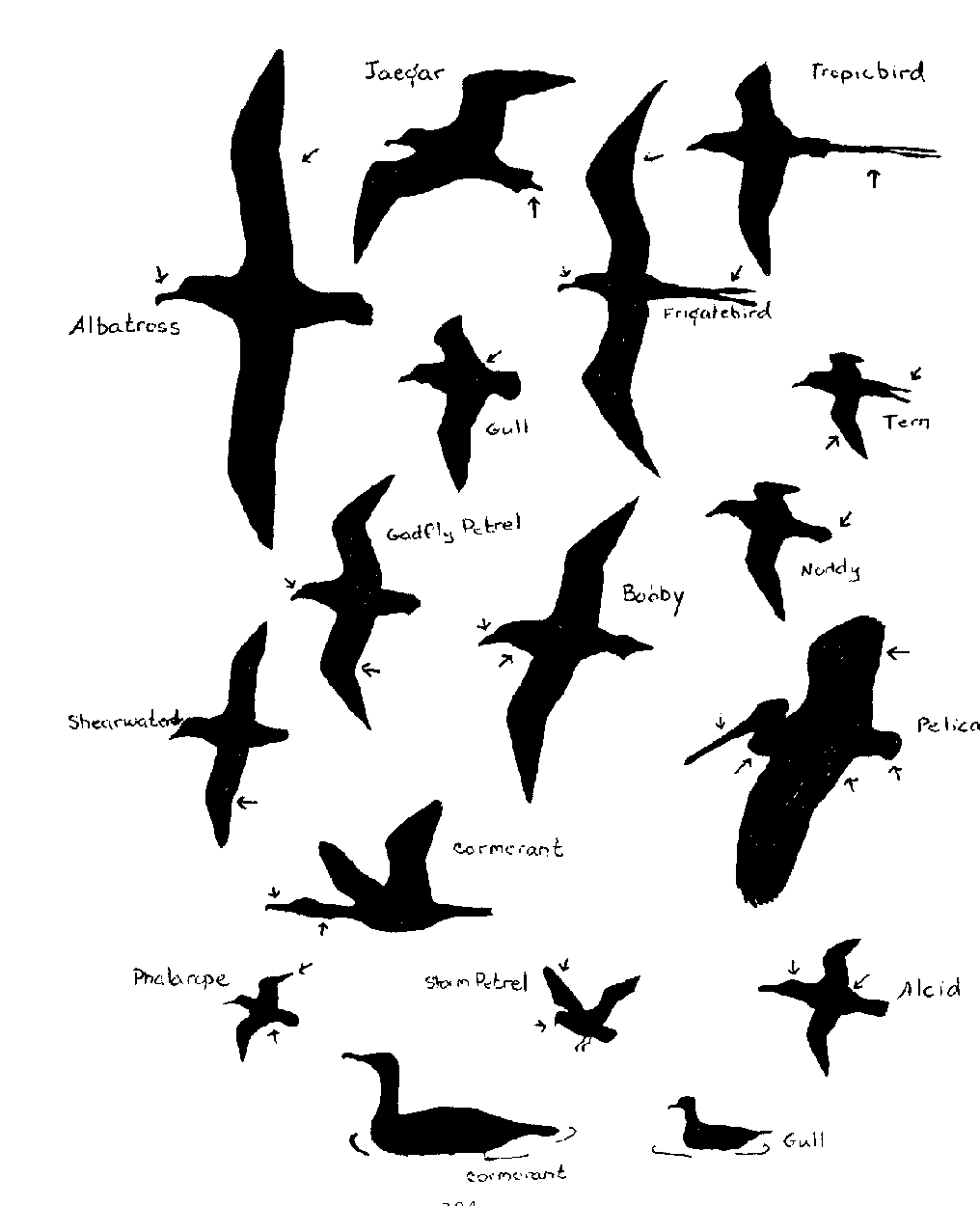
Birds
Session T-51: Poisonous and toxic fish - special project
Time: 5:00 PM
Goals:
· To acquaint trainees with
marine fish which are poisonous to eat
· To
acquaint trainees with marine fish which are dangerous and/or toxic to
touch
· To introduce simple remedies and/or
treatments for marine fish poisoning or toxicity
· To provide technical transfer and workshop skills to
the trainee presenting the session
Overview:
This session is presented by a trainee for whom this is a special project. Poisonous fish and other marine life can be dangerous. Harmful marine life is more prevelent in tropical waters than in temperate waters. There is a need to be able to identify those fish which are potentially harmful to the PCV in the field.
Materials:
· flip chart, markers
Procedures:
|
Time |
Activities |
|
45 Minutes |
1. Trainee presents lecturette on ciguatera, the symptoms and possible treatment. Also covers fish which carry toxins, bacterial toxicity and fish dangerous to the touch as well as venomous fish. Following is an outline presented by trainee during pilot program. |
POISONOUS AND TOXIC FISH
Fish which are poisonous to eat:
Ciguatera - Ciguatera is a general term for fish poisoning with a common group of symptoms resulting from a not well understood toxin. Over 300 species of fish have been associated with ciguatera, especially those occuring in reefs and shallow water areas and around islands, usually within 35° of the equator. It has been suggested that the toxin may originate with a benthic alga and some correlation is seen with fish at higher levels of the food chain such as snapper, barracuda, groupers, and surgeon fishes. Poisoning occurrences can vary with season and locality.
Symptoms, which can begin from within 4 hours to 30 hours after a meal, include tingling of lips, tongue and throat followed by numbness, nausea, abdominal cramps, diarrhea, metallic taste in mouth and temperature confusion. More severe symptoms include muscular weakness, dizziness, pallor, insomnia, exhaustion and muscle pains. The death rate is 10% or less.
Treatment varies according to symptoms present, as there is no single antidote.
Other Toxic Organisms - In general, viscera, ovaries and liver of all species will have a higher concentration of any toxins present in the fish. The livers of sharks, seals and whales are poisonous due to high levels of vitamin A. Turtles also have been reported to cause poisoning similar to ciguatera, though this is not a common occurrence.
Bacterial Toxicity - The largest proportion of illnesses caused by eating fish and shell fish result from bacterial toxicity. Direct causes are polluted waters, and indirect causes are secondary contamination during processing.
Food poisoning occurs with greater frequency in warm water and in warm climates. Be very careful about eating raw seafood, especially raw invertebrates. If purchasing shellfish or crustacea, make sure the animals are alive when purchased. Shellfish can be decontaminated by placing them in a bucket of clean seawater for 24 hours.
Type E Botulism is commonly associated with seafood and usually is contracted from raw or improperly processed seafood. Be especially careful of fish or fish roe which is fermented, smoked or held in vinegar. Heat (cooking) will kill the type E Botulism.
Parasites, though occuring in the majority of cases in fresh water organisms, also exist in marine forms and certainly will be found in some estuarine species. Again, they are usually contracted from insufficiently cooked, raw, or improperly processed seafood.
Fish which are poisonous to touch:
- Jellyfish, Portugese Man 0"' War - causes skin irritations, welts; allergic reactions include an asthma like reaction. Treatment: urine, green papaya, hard liquor, isopropyl alcohol, followed by dilute ammonia or saturated baking powder solution.
- Urchins - sharp spines with barbs lodge in feet or arms and break off. Treatment: remove spines if possible, clean and watch carefully for infection.
- Stingrays - are common in shallow coastal waters, burrow in sand. The rapid action of the spine causes injury or laceration plus injection of venom. Treatment: irrigate wound with clean salt water, soak wound in hot water (the venom is sensitive to heat) for 30-90 minutes, later apply antibiotics.
- Corals, Sponges, Hydrozoans - some of the above cause stings similar to those from jellyfish; sponge spicules lodge in skin - do not handle; "Fire coral", actually a hydrozoan, causes skin irritation, corals are sharp and can cause cuts. Treatment: remove pieces of coral, wash with hydrogen peroxide and treat with antiseptics.
Bony Fishes:
Stonefish - Stonefish are the most dangerous poisonous fish of the Indo-Pacific. They live in warm shallow waters, in crevices of rocks and corals and are well camouflaged. Stepping on any of the numerous spines which inject venom into the victim causes excruciating, immediate pain, sometimes delirium and death. Treatment: an antivenom exists, developed in Australia.
Scorpion Fishes - These fish occur in all oceans and all have one or more venom glands. They camouflage themselves in weedy habitats and if stepped on, cause extremely painful stinging which can last months. Hypotension and impairment of respiration can occur. Treatment: no antivenom exists, seek medical attention, try applied heat to detox poison.
Porcupine Fish - These fish are related to puffers and the spines erect when disturbed. The toxin can cause respiratory failure and a fall in blood pressure. Treatment: no known antidote.
Others:
Moray Eels - Bites from morays can be severe, are easily infected, and the eel will usually not let go. Treatment: irrigate wound, clean, watch for infection.
Sea Snakes - Of 50 species of sea snakes, many are widely distributed geographically. Some are aggressive, some docile, and the fangs are located far back in the snake's mouth. Most bites result from handling nets at night. Only a small prick occurs with no pain; within 5 minutes to 8 hours muscles ache, are stiff, tongue is thick. A small proportion of bites are fatal. Treatment: antivenom exists for some species - try to capture the snake and seek medical attention.
A general rule is to be careful! Medical help may not be readily available.
References:
· Australian Venomous and Poisonous Fishes. R.V. Southcott M.D. D.Sc. 1975. Pub. by R.V. Southcott, Mitchem, South Australia 5062
· Fish and Shellfish Hygiene. Report of a WHO expert committee convened in cooperation with FAO, WHO technical series No. 550. Geneva 1974.
· Fish Poisoning in the South Pacific. Dr. R. Bagnis. 1973, South Pacific Commission, Noumea, New Caledonia
· Dangerous Marine Organisms of Hawaii. Athline M. Clark 1978. University of Hawaii Sea Grant Marine Advisory Program.
- Rebecca Hoff, PCV Sierra Leone
Session T-52: Audiovisual and lesson plans
SPECIAL GROUP PROJECT
Time: 7:30 AM
Goals:
· To show trainees that lesson plans can facilitate the planning, preparation and presentation of instructional activities, i.e. workshops and meetings
· To acquaint trainees with various audiovisual aids appropriate to Third World settings
· For the trainee assigned the special project to build on communication/technology transfer skills
Overview:
This session is a follow-up to Session 28, Communication Through Illustration. Audiovisual aids and well planned and presented workshops are key elements of successful extension services.
Procedures:
|
Time |
Activities |
|
30 Minutes |
1. Trainee assigned the special project gives a lecture on audiovisual aids and lesson plans. Emphasized are materials appropriate to Third World settings, such as grass matting or banana leaves for bulletin boards, home made chalk boards, etc. |
|
1 3/4 Hours |
2. Trainee divides the group into small groups of 4 and 5 to prepare a lesson plan for any topic using the attached format. Small groups report out on their lesson plan and then present the lesson. |
|
15 Minutes |
3. Trainee draws closure to the session by linking back to previous sessions on extension, community analysis and WID and stressing the importance of workshops and audio visual aids, as non-formal educational tools. |
References
· Visual Aids: A Guide for Peace
Corps Volunteers
· Peace Corps Audiovisual
Communications Handbook
· Forestry Training
Manual
Following model presentation taken from pilot program.
AUDIOVISUAL AIDS AND LESSON PLANS
I. Audiovisual aids are instructional materials which utilize the senses (seeing, hearing, tasting, touching, smelling) to communicate an idea or to convey a need for action.
A. Audiovisual aids facilitate learning by "attacking" the learner from additional angles. (Make sure that the message is the same from all angles.)
B. Audiovisual aids may be divided into five categories: printed materials, presentation boards, three-dimensional materials, active aids and electrical materials.
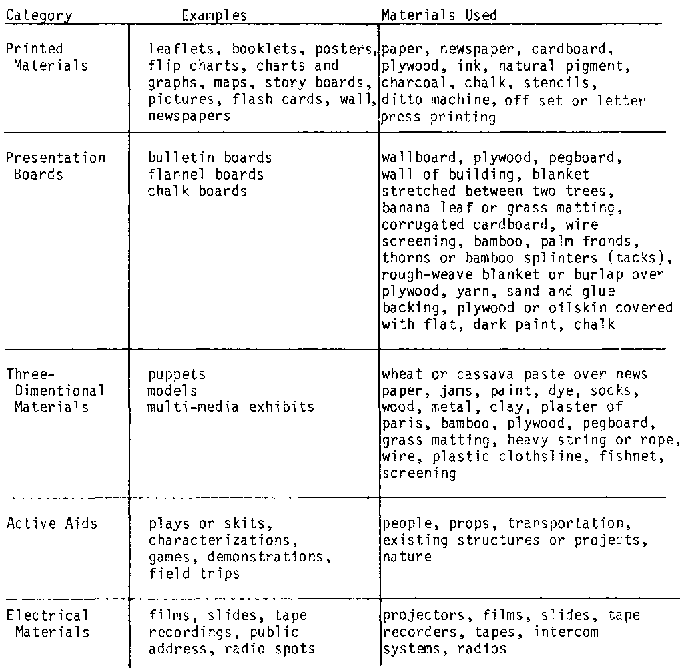
Table
C. The use of audiovisual aids involves planning, preparation and presentation.
1. Planning
a. Identification of needs/audience analysis
1) The need to know and the need to change must be derived from the value system of the audience.
2) The problems and solutions addressed must be acceptable to the audience.
3) The group affiliation, age level, occupational, educational, cultural, social and language backgrounds of the audience must be identified.
b. Statement of objectives
1) Objectives should address the knowledge, skill or attitude change desired of the audience.
2) Objectives should be stated specifically and should indicate the process by which they will be evaluated.
c. Presentation strategy
1) The objectives should define how best to meet them.
2) The type of audiovisual aid to be used is selected based on the objectives.
d. Selection of information
1) The objectives should indicate the content necessary to accomplish them.
2) The content to be used is selected based on the objectives
e. Organization of information
1) A content outline is developed and then specific details are added (treatment).
2) The content must be arranged so that it is attractive, interesting, understandable and easy to follow.
2. Preparation
a. Base the A-V aid on one or two simple ideas presented in a simple, straightforward manner. (Simplicity is an asset!)
b. Be neat and use basic principles of color and design.
c. Be careful in your selection of symbols and your representation of them. (Things don't look the same and aren't seen the same - visual perception - all over the world.)
d. Have some members of the intended audience assist you in the preparation of the A-V aid; their involvement will make it more effective.
e. Evaluate effectiveness in advance by asking some members of the intended audience appropriate questions relating to planning, preparation and presentation.
1) What would you say was the purpose of this material? Why?
2) What are the main points made?
3) What other points are made?
4) Is there something that might not be clear?
5) Is there something that might be added to make this material more understandable?
3. Presentation
a. If included in a presentation, make sure that the A-Y aid is appropriate to its context.
b. Make sure that the A-V aid is visible to all members of the audience and that their attention is focused on it when it is being used.
c. If not included in a presentation, locate the A-V aid so that it will be seen by as many members of the intended audience as possible.
d. Evaluate.
1) Who saw the A-V aid?
2) Were the objectives met?
II. Lessons plans are forms which facilitate the planning, preparation and presentation of instructional activities (i.e., audiovisual aids, workshops, presentations, formal and informal meetings).
PRESENTATION PLAN
|
Name: Marilyn Berry |
Place: Association of Fishermen |
|
Subject: Presentation Plans Audience Peace Corps Trainees |
Date: November 9, 1982 Time: 7:30 PM |
|
Special Considerations: |
Prerequisite Learning: |
|
What occupational, cultural, educational and social considerations may affect the audience's understanding and acceptance |
What knowledge, skill or attitude must the audience have prior to the presentation? of the presentation? |
|
Objectives: |
Materials: |
|
What knowledge, skill, or attitude will the audience have after the presentation? |
What materials will be used during the presentation? |
Presentation Strategy: How will the objectives be accomplished? What information will be presented? How will the information be presented? In what order will the ideas be presented? What questions will the audience be asked to answer? What techniques will be used to reinforce the ideas presented?
Evaluation: Have the goals been accomplished? What aspects of the presentation contributed to the accomplishment of the goals? What improvements should be made?
References:
· Peace Corps Audiovisual
Communications Handbook. Pett, editor.
·
Visual Aids: A Guide For Peace Corps Volunteers. 1977.
- Marilyn Berry, PCV
Sierra Leone
PRESENTATION PLAN
Name:___________________
Place:_____________________
Subject:__________________Date:
_____________________
Audience:________________Time:______________________
Special
Considerations: Prerequisite
Objectives: ______________ Materials:
Presentation Strategy:
Evaluation:
Session T-53: Salt making industry: field trip
Time: 7:30 AM
Goals:
· To allow trainees opportunity to view a small-scale salt making operation
· To make trainees aware of the possibilities of income generation on the community level a salt making system
· To acquaint trainees with the entire salt making process from start to finished product
Overview:
This session is important in that it combines key areas of the training - fish preservation and income generation. The field trip is short four hours of walking through a salt making processing facility. The availability of industry personnel to answer questions is also an important facet of this session. Generally, the industrialization of salt making is on a larger scale than the PCV will be dealing with; however, the salt making process will be the same - except on a smaller level. Tie into SP on salt making, Session 49.
Materials and Equipment:
· Transportation for trainees,
trainers
· Sunglasses due to salt glare,
cameras, notebooks
Procedures:
|
Time |
Activities |
|
20 Minutes |
1. Technical trainer gives brief orientation to the salt making industry to be visited. |
| |
a. salt making process |
| |
b. facility |
| |
c. economics of salt making |
| |
Technical trainer reminds trainees of the interview techniques they have practiced previously and gives a few minutes for trainees to form questions that they might want to ask while on field trip. |
|
3 Hours |
2. Tour of salt making facility |
| |
a. salt ponds |
| |
b. dike system |
| |
c. plant facility |
|
30 Minutes |
3. Upon return technical trainer processes the experience of the field trip. Questions that were asked are reviewed, interview techniques are critiqued by trainers |
Trainer's Note:
A preliminary trip to facility to arrange field trip with the facility personnel is a must. A follow-upletter giving exact dates and times is advised.
Session T-54: Corrosion control special project
Time: 4 PM
Goals:
· For trainees to become aware of the proper cathodic protection for boats in salt water
· For trainees to become conversant with various methods and techniques available for protecting boats
· To enable trainee assigned to build on communication/technology transfer skills
Overview:
This is a special project session. This session points out the basics of corrosion and the various methods to protect vessels from corrosion.
Materials:
· flip chart, markers, corroded objects for demonstration
Procedures:
|
Time |
Activities |
|
1 Hour |
1. Trainee for whom this is a special project gives presentation on corrosion covering the following: |
| |
a. types of corrosion |
| |
- galvanic |
| |
- stray-current |
| |
b. preventing |
| |
corrosion |
| |
c. factors influencing the proper amount of zinc |
| |
d. overprotection |
| |
e. placement of zincs |
| |
The following presentation is from the pilot program. |
CORROSION CONTROL
Any action, chemical or biological, which breaks down the integrity of a vessel is corrosion. Fighting corrosion is never an inexpensive proposition. The costs in time and money are often high but are borne out when you consider the monetary value of your vessel and the personal value that you attach to your life.
Electrochemical corrosion occurs in boats by an electrolytic reaction of two metals ~ with salt water acting as an electrolytic solution. The more easily reactive or lower value metal will corrode first due to the current or charge set up between two unlike metals. Any water will carry the charge but salt water is a much more potent electrolytic solution than fresh water. Salt water speeds up corrosion.
What we do on boats is use a lower value metal, usually zinc, as a sacrificial metal. As the zinc corrodes it provides electrons to other higher value metals (brass, copper, steel) to prevent the loss of their electrons. When there is no zinc remaining, copper, the next higher value will start to corrode away, acting as a sacrificial metal.

Figure
Zinc anodes (referred to as zincs) are the most common form of maritime defense against electrolytic corrosion. Zincs are usually cast around an iron bar, to guarantee a tight clean fit. This bar is then bolted or welded in place below the waterline of a vessel. On wooden boats all metal fittings usually have their own zincs. Those which cannot hold their own zinc are connected to a nearby zinc by a piece of copper wire tightly fixed. It is important to fix zincs tightly to the metal. They protect so that corrosion doesn't form between the two metals and reduce the effectiveness of the system.
Common practice is to concentrate a higher number of zincs to the after part of a vessel. This gives added protection to the rudder and the propeller. From the point of view of navigational safety it is "desirable" to protect both.
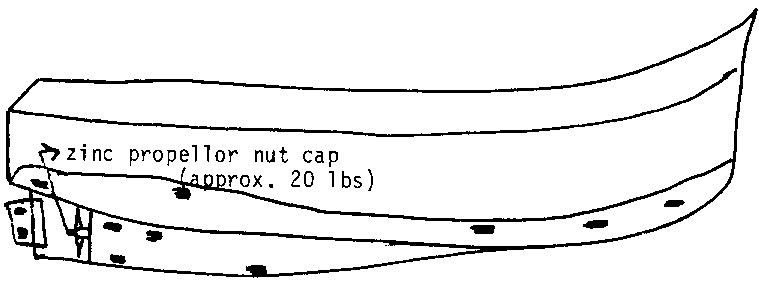
Suggested placement of zinc on each
side of a 65 foot shrimper. Each bar represents 11.5 lb anode.
The amount and placement of zincs on a hull is often decided by the use of charts and by guesstimation. The following chart gives some good basic ideas of recommended amounts of zinc to be used on vessels, but it is essential that the amount of zinc be checked and tailored to each individual vessel. These amounts are based on recommendations for ships underway (5 knots or better) when a boat sits in mooring and has very little current, or sits in water with less salinity it doesn't need as much protection.
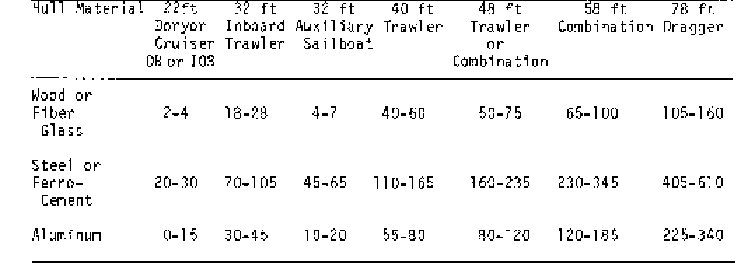
Table
These figures are general. They assume differences in amount of equipment on board. When paint is patchy or flakey more protection is necessary to counteract the larger area of metal exposed to saltwater. To use this chart you would check the zincs on your hull when it is slipped. If they are 50% to 80% disintigrated after a year in the water you have adequate protection. If they are gone you have been operating without protection and have widespread problems.
A more scientific method to measure the protection of zincs is done in the water. This calls for measuring the electrical potential of the hull relative to a reference electrode. Here zinc is added until the following measurements are recorded on a silversilver chloride reference electrode:
steel hull - 0.85
Aluminum hull - 0.95
Copper sheathed -
0.65
There are inherent dangers in overprotecting a boat. Over zincing can damage wood or aluminum hulls and blister paint on all types of hulls. Over protecting releases hydroxide ions by electrochemical reaction on the surface of protected metals. These hydorxide ions form lye which eats into wood and aluminum.
The simplist check for "over protection" is to look inside your boat for white deposits around thru-hull fittings. The deposit could be salt. If it has a bitter taste you probably have lye and need to remove zincs immediately. Flush off lye with vinegar and keep your eyes on the area in the future.
Another serious type of electrical corrosion is stray electrical current. Loose or corroded connections, frayed insulation, or undersized wiring all allow electricity to escape along steel plates or wooden planks. (Wood always contains some moisture to help pass along electrical currents.) This leads to rapid desintigration of zincs.
This isn't the last of your electrical problems. Large metal objects on your vessel can have different charges, leading to a flow of current and a loss of metal. The best defense against this problem is called "bonding". This means wiring all large metal objects on a vessel together to equalize their voltage and keep them from corroding.
Fiberglass and wooden vessels are "bonded" by running a copper rod or wire along the length of the hull. All metal objects such as stacks, winches, masts, coamings, engine blocks, stoves, appliances and stays are securely grounded to these copper rods so that built-up current can flow to the zincs. In steel hulled vessels it is only necessary to connect these fixtures to the hull.
Electrical corrosion is a major problem to protect against and very expensive to repair if it does major damage. Corrosion by marine life organisms is another major problem. There are two forms of marine organism corrosion, surface and internal.
Surface barnacles and weed grow on the hull and slow the boat drastically. A clean bottom is a big fuel money saver. Marine organisms can also grow unevenly on the hull due to differences of lighting angles and different grades of anti fouling paint being used on the hull. This can affect the handling of your vessel.
While the organisms are wet they clean off the bottom much easier than after they dry. Thus a boat that sees a lot of use is usually cleaner than one that is moored for months on end. The best protection against a build-up of weed is a good healthy coat of anti-fouling or bottom paint.
Bottom paint usually contains a suspension of copper. As with all paints it is applied to a clean, salt free, dry surface. After the boat is placed in the water the copper is slowly released and acts as a poison to kill organisms which try to lodge in imperfections, cracks, and crevasses on the hull. It usually works effectively for six months to a year and must then be reapplied because the copper has all been released.
When bottom paint is applied it should dry enough to bond with the hull but never enough to totally dry. The copper makes the paint disintegrate and flake off if it dries completely. Check your paint and put the boat back into the water six to twelve hours after you finish painting. (Check the tides and finish painting six to twelve hours before you put your boat back in the water.)
The second major category of marine organisms detrimental to wooden boats are marine borers. The major tropical borer is the toredo navalis. Toredo is found throughout the tropics. It has shells at the head which chew a passage thru wood while the siphons hang out the tail end of the organism. When toredo enters wood it only makes a hole 1/16 inch in diameter so it is very hard to identify on the surface. As it bores into wood, the hole increases in diameter and the worm grows in length. Toredos grow into a diameter of 1/2 inch and a length of one to two feet. The best defense is a good coat of bottom paint.
The most effective cure is to remove the wormeaten plank and replace with a new plank. There are always effective half measures as well since it isn't always possible to replace a plank immediately.
Toredo can live in water with a salinity as low as five parts per thousand (sea water is normally thirty to thirty-five parts per thousand). Leaving your vessel in flowing fresh water, upstream from the tidal estuaries for two weeks should kill toredo in your planking. The lack of salt in the water kills them.
When you find tiny holes, heating them with a blow torch identifies them as worm holes As the flame heats the area you will see a spurt of water erupt as from a small water pistol. Now that you have found and possibly killed the worm, you want to guarantee yourself of its demise. Insert a piece of stripped, small gauge copper wire into the hole and plug with a small epoxied driven wooden plug. The copper acts as a poison to kill young organisms and the plug keeps them from getting adequate supplies of fresh water while guarding from further invasion.
Now that we have discussed hull corrosion and maintenance we are ready to come above decks. There are four major categories in the open salt air: 1) rusting of iron members, 2) dry rot and moss on exposed wood, 3) checking, splintering and cracking on exposed wood, and 4) solar disintegration of manmade fibers.
1. Rusting of iron members: Iron rusts due to exposure to moisture which causes oxidation. Much shipboard iron is galvanized, which provides a bit of protection. Non galvanized iron should never be exposed to moisture or air. It should be sealed as well as possible. To preserve iron fixtures it is first necessary to have a clean surface. Existing rust does not hold a coat of paint Step 1. Chip rust pockets and scrape off loose paint. After chipping out major pockets with a hammer, wire brush with lots of elbow grease. Step 2. Surfaces with coatings of grease will not bond paint so it is necessary to remove with soap and water. Step 3. Acid etch to prepare the surface to accept paint. Most commercial etches contain a high percentage of dilute phosphoric acid (about 15% acid) so phosphoric acid diluted works well. This removes the last bits of rust from the metal surface. Step 5. Flush with fresh water (never salt) to remove last bits of residue from surface. Step 6. Apply protective coating to dry surface. There are two types of paint being used today on ships. The best, most expensive and hardest to obtain is epoxy resin paint. This is a two stage paint where a hardener is added to the paint before applying. It is usually applied over a special epoxy resin undercoat. The more traditional system calls for a red lead undercoat followed by two coats of marine grade (or any) external enamel paint.
On shipboard there are many articles which cannot hold a coat of -taint due to banging, chafing and flexing. These are traditionally protected by a coating of flexible tar. Many steel structures are bedded to a deck where water would seep in and are very hard to remove and clean. Therefore, when they are attached they are coated with tar and bedded on a piece of tar impregnated felt. Flexible cable and stays are brushed down periodically with a mixture of tar and diesel or oil to give a thin flexible coating.
2. Dry rot and moss on exposed wood: Work decks cannot be painted well because of the tackle, chain and cases that are constantly dragged across them. Wooden decking has a special problem from fresh water. It impregnates the wood and causes moss to grow, thus breaking down the integrity of the wood grain. This is where that most corrosive element, salt water, saves the mariner. Exposed wood is flushed and scrubbed with salt water. The water keeps the wood from drying out and cracking while the salt kills fresh water mosses which would otherwise harm the planking.
3. Checking, cracking and splintering of exposed wood surfaces: Where possible wood surfaces should be covered. This keeps the wood from cracking. First make sure that wood is clean and splinter free. Wash with fresh water to remove salt and allow paint to bond. There are now preparations to preserve wood from rot. Here in Puerto Rico you can get Metal-Ex which is painted into the wood before painting. After this thoroughly dries, apply two or three thin coats of an enamel paint. Thin coats ensure bond and flexibility of the paint so it doesn't weather off so rapidly.
4. Solar disintegration of man-made -fibers This is the easiest of all to guard. The beauty of man-made fibers at sea is that they don't shrink or rot when wet. On the minus side, sunlight causes them to deteriorate. Therefore, nylon, tryalene end polypropaline nets, fibers, sails and cases should be covered from sunlight as a protection and to extend their life.
Bill Yost, PCV Sierra Leone
References:
· Corrosion Control, Bonding of Boats, Oregon State University by Edward Kolbe, Burce Mate, Robert Jacobson
· Cathodic Protection for Boats in Saltwater, Oregon State University. Nov. 1979
· Metrics
· Weather for the Mariner, William J. Kotsch, 1377 Naval Institute Press
· Preserving food by drying, Manual M-10, Peace Corps Information Collection and Exchange
Session T-55: The ugly american
Time: 7:30 PM
Goals:
· To acquaint trainees with the
elements of effective development work
· To
have trainees explore why effective development work is time taking, patient
work
· To have trainees understand the
importance of community involvement
Overview:
Trainees are given chapter 18 of The Ugly American titled "The Ugly American and the Ugly Sarkhanese." This particular reading points out the necessity for clearly thinking out your project as a development worker. Moves into the absolute necessity for community involvement in a project. Emphasizes the need for ownership of project by community members.
Procedures:
|
Time |
Activities |
|
20 Minutes |
1. Trainer passes out reading, asks trainees to spend next 20 minutes reading and underlining elements they see as important in development work. |
|
15 Minutes |
2. Trainees are asked to form small groups of 5 or 6 and to list on newsprint the elements which they decide are the most important to them as Peace Corps volunteers. They briefly share these lists with large group. Trainer should point out any elements which they have missed. |
|
15 Minutes |
3. Trainees are asked to go back into small groups and list traits the "Ugly American" exhibited which they would wish to emulate. Once again they share lists with large group. |
|
20 Minutes |
4. Trainees are now given copies of Chapter 19, "The Bent Backs of Chang 'Dong," asked to read the material and make observations about Emma's behavior that they could apply to their own Peace Corps service. Trainer suggests that trainees may want to write these observations in their own journals. |
|
10 Minutes |
5. Trainer asks for any observations that anyone may want to make. Trainer now gives short talk on the learnings over past two weeks - summarizing the role of the extensionist, the need for community analysis and the necessity for setting realistic goals for oneself as a PCV. |
Materials:
· flip chart paper, marker, copies of "The Ugly American and The Ugly Sarkhanese" and copies of "The Bent Backs of Chang 'song " for each trainee
THE UGLY AMERICAN AND THE UGLY SARKHANESE
Two weeks later Atkins and his wife left by plane for Sarkhan. Emma, a stout woman with freckles across her nose was, in her way, quite as ugly as her husband. She was hopelessly in love with Atkins, but had never been able to tell him why adequately.
She did not blink when Atkins told her they were going to Sarkhan. She told Homer that she'd be pleased to move into a smaller house where she could manage things with her own hands, and where she wouldn't need servants.
Two weeks later the Atkins were living in a small cottage in a suburb of Haidho. They were the only Caucasians in the community. Their house had pressed earth floors, one spigot of cold water, a charcoal fire, two very comfortable hammocks, a horde of small, harmless insects, and a small, darkeyed Sarkhanese boy about nine years old who apparently came with the house. The boy's name was Ong. He appeared promptly at six each morning and spent the entire day following Emma around.
Emma Atkins enjoyed herself in Sarkhan. She learned enough of the language so that she could discuss with her neighbors the best places to buy chickens, ducks, and fresh vegetables. She learned how to prepare beautifully fluffy rice seasoned with saffron. She liked working in her house, and it was a matter of some pride to her that she was as good a housekeeper as most of her neighbors.
Homer Atkins kept busy with his man-powered water pump. The idea had developed very slowly in his mind. What was needed was some kind of efficient pump to raise the water from one terraced paddy to another. Lifting water in the hilly sections consumed enormous amounts of energy. It was usually done by a pail, or by a cloth sack, attached to the end of a long pole. One man would lower the pail and swing it up to the next terrace where another man would empty it. It was a slow and cumbersome method, but the Sarkhanese had been doing it for generations and saw no reason to change. Atkins had decided that there was no sense in trying to talk them out of an obviously inefficient method unless he could offer them a more efficient method to replace it.
He solved two-thirds of his problem. A simple pump needed three things. First, it needed cheap and readily available piping. He had decided that the pipes could be made out of bamboo, which was abundant. Second, the pump needed a cheap and efficient pump mechanism. This had taken longer to find, but in the end Atkins had succeeded. Outside many Sarkhaese villages were piled the remains of jeeps which had been discarded by the military authorities. Atkins had taken pistons from one of these jeeps and had replaced the rings with bands of cheap felt to make a piston for his pump. He then cut the block of the jeep in two; he used one of the cylinders as a suction chamber, and the other cylinder as a discharge chamber. With a simple mechanical linkage the piston could be agitated up and down, and would suck water as high as thirty feet. The third problem, which Atkins had not yet solved, was the question of what power could be applied to the linkage.
In the end Emma gave him the answer.
"Why don't you just send off to the States for a lot of hand pumps like they use on those little cars men run up and down the railroads?" she asked one day.
''Now look, dammit, I've explained to you before," Atkins said. "It's got to be something they use out here. It's no good if I go spending a hundred thousand dollars bringing in something. It has to be something right here, something the natives understand."
"Why, Homer," Emma said, "with all that money you've got in the bank back at Pittsburg, why don't you give some of it to these nice Sarkanese?"
Atkins looked up sharply, but saw at once that she was teasing him. He grunted.
"You know why. Whenever you give a man something for nothing the first person he comes to dislike is you. If the pump is going to work at all, it has to be their pump, not mine,"
Emma smiled fondly at Homer Atkins. She turned and looked out the window. A group of Sarkhanese on bicycles, as usual, were moving in toward the market places at Haidho She watched them for a few moments, and then spun around, excitement in her eyes.
"Why don't you use bicycles? There are millions of them in this country and they must wear out. Maybe you could use the drive mechanism of an old bicycle to move the pump."
Atkins looked at Emma and slowly sat up straight. He slapped his hand against his knee.
"By God, I think you've got it, girl," he said softly. "We could take the wheels off an old bike, link the chain of the bike to one large reduction gear, and then drive the piston up and down with an eccentric "
Atkins began to walk around the room. Emma, a slight grin on her face, returned to her charcoal fire over which she had a fragrant pot of chicken cooking. In a few moments she heard the rustle of paper and knew that Atkins was bent over his drawing board. Two hours later he was still drawing furiously An hour after that he went to a footlocker, took out a half-dozen bottles of beer, and brought them back to his work table. By dinner time he had drunk them all and was whistling under his breath When Emma tapped him on the shoulder and told him that dinner was ready, he swung around excitedly
"Look, baby, I think I've got it," he said, and began to explain to her rapidly, interrupting himself to make quick calculations on a piece of paper. When she finally got him to sit down, he ate so fast that the chicken gravy ran down his chin. He wiped his chin with his shirt sleeve and made sure none of the gravy got on his precious drawings. Emma Atkins watched her husband fondly. She was proud of him, and she was happy when he was happy. Today she felt very happy, indeed.
"Stop drinking beer, Homer Atkins," Emma said, grinning. "You'll get drunk. And then you'll forget that it was my idea about the bicycle."
"Your idea?" he yelled in astonishment. "Woman, you're crazy. I was thinking about that all along. You just reminded me of it."
But then he went back to the locker, brought back two bottles of beer, and blew suds at her when he filled her glass.
Two days later Atkins had a working model. Not a single item in the crude pump would have to be imported. He had calculated that there was probably enough scrap around the countryside to make a couple of thousand pumps. What he had to do now was to get a couple of pumps actually in operation, to see how they worked. At this point Emma Atkins demonstrated her diplomatic skills.
"Now look, Homer, don't go running off like a wild man," Emma said softly. "You've got a good machine there. I'm proud of you. But don't think that just because it's good the Sarkhanese are going to start using it right away. Remember the awful time that you had getting trade unions In America to accept earth-moving equipment. These people here are no different. You have to let them use the machine themselves and in their own way. If you try to jam it down their throats, they'll never use it."
"All right, Mrs. Foster Dulles, you tell me what to do," Atkins said. He knew she was right and he was grateful to her. "You tell me how I ought to approach the Sarkhanese."
Emma calmly explained her plan to Homer. He realized that she had been thinking of this for some time. It was an intricate, beautiful plan, and he wished that some of the stuffed-shirts in the American Embassy could hear his wife talking.
The next day he put into operation Emma Atkins' grand strategy.
He drove in his used jeep to the tiny village of Chang 'song, a community of one hundred souls, living in fifteen or twenty houses. The village was set precariously on a steep hill sixty miles outside of Haidho. The soil there was rich; but the backbreaking, time-consuming process of lifting water up seven or eight levels--even though the differentials were small-had always made Chang 'song a poor village.
Atkins politely asked the first person he met in Chang 'song where the home of the headman was. He talked to the headman, a venerable man of seventy five, without an interpreter. It was not easy, but he could tell that the headman was pleased that Atkins was making the effort to talk his language. With infinite courtesy the old man sensed what words Atkins was searching for, and politely supplied them. The conversation moved along more rapidly than Homer had expected it would.
Atkins explained that he was an American and that he was an inventor. He had an idea for a pump to lift water. He, Atkins, wanted to develop and patent this pump and sell it at a profit. What Atkins wanted the headman to find was a Sarkhanese worker with mechanical skill. Atkins said he would pay well for this man's time and skill; if he was able to help with the pump, he would become half-owner of the patent. The old man nodded gravely. They then began a long, complicated, and delicate negotiation over the matter of how much the native mechanic should be paid. Atkins understood all of this quite well--it was just like negotiating with a trade union organizer in the States. Each man knew that he would eventually have to compromise; and each took pleasure in talking the whole thing out. In the end Atkins got the services of a mechanic for a price which he knew was just slightly higher
than the going rate. Both the headman and Atkins were satisfied. They shook hands, and the headman left to bring in the mechanic. Atkins reached in his shirt pocket, took out a cigar, and lit it with pleasure. This would, he thought, be fun.
When the headman returned he brought with him a small, stocky, heavily-muscled man whom he introduced as Jeepo. The headman explained that the name was not a native name. He was called Jeepo because of his reputation as a famous mechanic in the maintenance and repair of jeeps. Atkins didn't listen too closely to what the headman was saying. He was studying Jeepo, and he liked what he saw.
Jeepo looked like a craftsman. His fingernails were as dirty as Atkins', and his hands were also covered with dozens of little scars. Jeepo looked back steadily at Atkins without humility or apology, and Atkins felt that in the mechanic's world of bolts and nuts, pistons and leathers, and good black grease he and Jeepo would understand one another.
And Jeepo was ugly. He was ugly in a rowdy, bruised, carefree way that pleased Atkins. The two men smiled at one another.
"The headman says you are a good mechanic," Atkins said. "He says that you're an expert on repairing jeeps. But I must have a man who is expert at other things as well. Have you ever worked on anything besides jeeps?"
Jeepo smiled.
"I've worked on winches, pumps, Citroens, American and French tanks, windmills, bicycles, the toilets of wealthy white people, and a few airplanes."
"Did you understand everything that you were working on?" Atkins asked.
"Who understands everything that he works on?" Jeepo said. "I feel that I can work with anything that is mechanical. But that is only my opinion. Try me."
"We'll start this afternoon, "Atkins said. "In my jeep outside is a heap of equipment. You and I will unload it and we'll start at once."
By the middle of the afternoon they had assembled most of Atkins' equipment on the edge of a paddy on the second level of the village of Chang 'Dong. Twenty-five feet of bamboo pipe had been fastened together; the bottom of the pipe was put into a backwater of the river that flowed by the village. The top piece of the pipe was fitted by a rubber gasket to the crude pump which Atkins had designed. Above the pump was the frame of a used bicycle with both of its wheels removed. Jeepo had done the assembly entirely by himself. Atkins had made one attempt to help, but Jeepo had gone ahead on his own, and Atkins realized that he wanted to demonstrate his virtuosity. By late afternoon the assembly was ready.
Atkins squatted calmly in the mud waiting for Jeepo to finish. The headman and two or three of the elders of the village were squatting beside him. Although they were externally as passive as Atkins, he was aware that they were very excited. They understood perfectly what the machine was intended for; they were not sure it would work.
"Sir, the mechanism is ready to operate," Jeepo finally said quietly. "I'm not sure we can get suction at so great a height; but I'd be pleased to turn the bicycle pedals for the first few minutes to test it."
Atkins nodded. Jeepo climbed aboard the bicycle and began to pump slowly. The chain-drive of the bicycle turned with increasing speed. The crude pipes made a sucking noise. For several seconds there was no other sound except this gurgle. Then, suddenly, from the outflow end of the pump a jet of dirty brown water gushed forth. Jeepo did not stop pedaling nor did he smile; but the headman and the other elders could not restrain their excitement about the size of the jet of water that was being lifted to the second rice terrace.
"This is a very clever machine," the headman said to Atkins. "In a few minutes you have lifted more water than we could lift by our old methods in five hours of work."
Atkins did not respond to the man's delight. He was waiting to see how Jeepo reacted. He sensed that Jeepo was not entirely happy or convinced.
Jeepo continued to pump at the machine. He looked down at the machinery, noted some tiny adjustments that had to be made, and called them out to Atkins. When the small paddy was full of water he stopped, and swung down out of the bicycle seat.
"It is a very clever machine, Mr. Atkins," Jeepo said quietly. "But it will not be a sensible machine for this country."
Atkins looked steadily at Jeepo for a long moment, and then nodded.
"Why not?" he asked.
Jeepo did not respond at once. He moved silently around the mechanism, twisting a bolt here, adjusting a lever there; then he stood up and faced Atkins.
"The machine works very, very well," Jeepo said. "But to make It work a person would have to have a second bicycle. In this country, Mr. Atkins, very few people have enough money to afford two bicycles. Unless you can find another way to drive the pump, or unless your government is prepared to give us thousands of bicycles, your very clever device is a waste of time."
For a moment Atkins felt a flush of anger. It was a hard thing to be criticized so bluntly. For a hot, short moment, Atkins calculated how many bicycles his three million dollars would buy; then, with the memory of Emma's tact in his mind, he put the thought aside. He turned back to Jeepo.
"What happens to old bicycles in this country?" he asked. "Aren't there enough of them to serve as power machines for the pumps?"
"There are no old or discarded bicycles in this country," Jeepo said. "We ride bicycles until they are no good. When a man throws his bicycle away, it's too old to be used for one of these pumps."
For a moment the ugly American faced the ugly Sarkhanese. When he was younger, Atkins would have turned on his heel and walked away. Now he grinned at Jeepo.
"All right, Jeepo, you say you're an expert mechanic. What would you do? Am I simply to give up my idea-or can we find some other way to give power to the pump?'
Jeepo did not answer at once. He squatted in the shallow rice-field, his khaki shorts resting in three inches of mud. He stared fixedly at the improbable machine. For ten minutes he said nothing. Then he stood up and walked slowly to the machine. He turned the pedal and held his finger over the rear-drive sprocket of the wheel as if to test its strength. Then he walked back and squatted again.
The headman looked once at Atkins and then talked in a sharp voice to the elders. The headman was embarrassed at Jeepo's arrogance, and he was saying that the entire village of Chang 'Dong would lose face by this ridiculous performance. Jeepo's ears became slightly red at the criticism, but he did not turn his head or acknowledge that he heard the headman's words.
Atkins felt like laughing. The headman and the elders reminded him very much of the diplomats to whom he had talked for so many months in Phnom Penh. He was quite sure that Jeepo had an answer for these comments, and he was also sure that it was not a political or personal answer, but technical. Atkins squatted down beside Jeepo, and for fifteen minutes the two men sat quietly on their heels studying the machine. Atkins was the first to speak.
"Perhaps we could make the frame of the bicycle out of wood and then we'd only have to buy the sprocket mechanism," Atkins said in a tentative voice.
"But that's the part of the bicycle which is most expensive," Jeepo said.
For perhaps another ten minutes they squatted motionless. Behind him Atkins could hear the shrill voices of the headman and the elders. Although they were attempting to maintain their dignity and manners, it was clear to Atkins that they were trying to find a way to apologize to him and to smooth the whole thing over. It never occurred to Atkins to talk to them. He and Jeepo were hard at work.
Once Atkins walked to the mechanism, turned the pedals rapidly, held his finger on the sprocket gear, and looked at Jeepo. Jeepo shook his head. He understood the mechanical question that Atkins had asked and was giving his answer. Without exchanging a word they demonstrated six or eight alternative ways of making the pump work, and discarded them all. Each shake of the head upset the headman and elders profoundly.
It was dusk before they solved the problem, and it was Jeepo who came up with the solution. He suddenly stood bolt upright, walked over to the bicycle, remounted, and began to pedal furiously. Water gushed out of the outflow of the pump. Jeepo looked back over his shoulder at the lower level of the pump, then started to shout at Atkins in a loud and highly disrespectful voice in which there was the sound of discovery. It took Atkins another five minutes to understand fully what Jeepo was proposing.
It was the height of simplicity. What he proposed was that a treadmill be built which could be turned by the rear wheel of an ordinary bicycle fitted into a light bamboo frame. What this meant was that a family with a single bicycle could put the bicicle in the bamboo rack, mount it, and pedal. The rear wheel would drive the treadmill which in turn would drive the pump with an efficiency almost as great as Atkin's original model. When anyone needed to use the bike, he could simply pick it up from the rack and ride away.
"This man has made a very great discovery," Atkins said solemnly to the headman and the elders. "He has developed a way in which a bicycle can be used to drive the pump and still be used for transportation. Without Jeepo's help my idea would have been useless. What I propose is that we draw up a document giving Jeepo one-half of the profits which might come from this invention."
The headman looked at Jeepo and then at the elders. He commenced talking to the elders in a solemn voice. Atkins grasped that the headman had never heard of a binding legal document between a white man and a Sarkhanese. It became clear to him, also, that the headman was determined to drive a hard bargain. After several minutes of consultation he turned to Atkins.
"Do you propose that you and Jeepo will begin to build such pumps?" the headman asked.
"Yes. I would like to enter into business with Jeepo. We will open a shop to build this kind of a pump, and we will sell it to whoever will buy. If the customer does not have the money, we will agree that he can pay off the cost of the pump over a three-year period. But don't get the idea that Jeepo will be paid by me for doing nothing. He must work as the foreman of the shop, and he will have to work hard. Not any harder than I work, but as hard as I do."
One of the elders broke in excitedly. He pointed out that it was very unlikely that a white man would work as hard as Jeepo. He had never seen a white man work with his hands before, and what guarantee could they have that Atkins would work as hard. Another of the elders agreed, pointing out that this looked like the trick of a white man to get cheap labor from a Sarkhanese artisan. Both of the elders were firmly opposed to Jeepo entering into the partnership.
During all of this discussion, Jeepo did not speak. He tinkered with the pump and bicycle mechanism, tightening gears, checking valves, and tightening the bicycle chain, When the two elders had finished talking, he turned around and came through the mud of the rice paddy to where the group was talking.
"I have listened without speaking to what you foolish old men have been saying." Jeepo said, his voice harsh with anger. "This American is different from other white men. He knows how to work with his hands. He built this machine with his own fingers and his own brain. You people do not understand such thing. But men that work with their hands and muscles understand one another. Regardless of what you say, I will enter into business with this man if he will have me."
There was a quick flush of shame on the headman's face. "I think that Jeepo is correct," he said. "This man can be trusted. I will now write up the document which will assure that he and Jeepo share the profits and the work equally."
"And the document should say that neither I nor the American shall license or patent the idea of the pump," Jeepo said. "We will make the idea available to anyone else who can make it. But on the ones we make, we deserve the profit. That is the way of working men."
Jeepo looked at Atkins. Atkins was pleased, and he nodded.
"Also, when we have made some pumps and sold them we will print little books and it will show others how to do it," Atkins said. "We will send it around the whole of Sarkhan, and the village of Chang 'song will become famous for its mechanical skills."
Jeepo and Atkins did not wait for the headman to complete their contract before beginning work. Two days later they had rented a large old rice warehouse on the edge of Chang 'song. In another day they had hired twelve workers. Jeepo and Atkins drove into Haidho, bought used tools and supplies, and carted them back to the warehouse. In a week the plant was in full operation. Over the entrance to the warehouse a small sign written in Sarkhanese said: "The Jeepo-Atkins Company, Limited." Inside the warehouse was a scene of incredible and frantic effort. Jeepo and Atkins worked eighteen to twenty hours a day. They trained the Sarkhanese'; they installed a small forge which glowed red-hot most of the day; they tested materials; they hammered; they swore; and several times a day they lost their tempers and ranted at one another. Their arguments, for some reason, caused the Sarkhanese workmen a great deal of pleasure, and it was not until several months had passed that Atkins realized why--they were the only times that the Sarkhanese had ever seen one of their own kind arguing fairly and honestly, and with a chance of success, against a white man.
Emma Atkins did not stay long in the suburb outside of Haidho. Within a week she had moved their belongings to a small house in Chang 'song. She bustled about her home and through the village, buying chickens and vegetables, and making huge casseroles of rice and chicken. Every day at noon she and several of the village women brought two of the casseroles to the warehouse and all of the men ate from them. Emma seemed to find it not at all unusual that her husband should be in a tiny hillside village constructing something as outlandish as bicycle water pumps.
Once a technical advisor from the American Embassy called at the warehouse and watched quitely for several hours. The next day the counsellor of the Embassy called. Taking Atkins to one side, he pointed out to him that for white men to work with their hands, and especially in the countryside, lowered the reputation of all white men. He appealed to Atkins' pride to give up this project, Moreover, he pointed out that the French, most experienced of colonizers, had never allowed natives to handle machinery. Atkins' reply was brief, but it was pointed, and the counsellor drove away in anger. Atkins returned joyfully to his work in the warehouse.
At the end of six weeks they had manufactured twenty-three pumps. When the twenty-fourth pump was finished, Atkins called all of the men together. He and Jeepo then faced the group and between them outlined what now had to be done. Jeepo did most of the talking.
"This is the difficult part," Jeepo started quietly. "You have worked hard and well to build these pumps-now you must sell them. Our friend Atkins here says that in America one of the best things that can happen to engineers like yourself is to be allowed to sell what they make. So each of you will now take two of these pumps as samples, and go out and take orders for more. For each pump that you sell you will get a ten per cent commission." one of the men interrupted. He did not understand what a commission was. There was a confused five minutes while Atkins and Jeepo explained, and when they were finished the prospective engineer salesmen were smiling cheerfully. They had never heard of such a proposal before, but it struck them as both attractive and ingenious. When the discussion was over, twelve contracts were laid out on a table; and each of the Sarkhanese signed a contract between himself and The Jeepo-Atkins Company, Limited.
The next morning twelve oxcarts were lined up outside the warehouse. Two of the pumps were carefully laid out on beds of straw on each of these carts. By noon the twelve salesmen had left for all parts of the province.
Now the waiting began. Jeepo, the headman, the elders, and everyone else in the village realized that everything rested on the persuasiveness of the engineer-salesmen and the performance of the bicycle-powered pump. If no orders were placed, Atkins would have to leave, and the excitement of the factory would disappear. In only a few weeks all of this activity had become very important to the people of Chang 'song. The people drifted into the warehouse, and watched Jeepo and Atkins at work, and many of them began to help. The tension grew steadily; and when four days had passed and not one of the salesmen had returned, a blanket of gloom as thick as a morning mist settled over the village.
Then on the morning of the fifth day one of the salesmen returned. He drove at a speed which, for an oxcart, is rare. The ox stumbled and splashed mud in the air, and the salesman beat the animal with gusto and enthusiasm.
As the ox labored up the hill, everyone in the village came to the warehouse to learn what would happen. When the cart, covered with mud, drew to a halt, there was a low murmur. They could all see that the cart was empty. The driver got down from the cart slowly, fully aware of his importance. He walked over calmly and stood before his two employers.
"I have the pleasure to inform you, sirs, that I have done wrong," he began, a grin on his face. "You told me that I should bring back the two samples, but I was unable to do it. I have taken orders for eight pumps. But two of my customers insisted that I deliver the pumps at once. Because their paddies were in desperate need of water and the crops might have been ruined, I reluctantly gave them the pumps. I hope I have not made a mistake."
There was a deep sigh from the crowd and everyone turned and looked at Jeepo and Atkins. These two squat, ugly, grease-splattered men stared at one another for a moment, and then let out shouts of joy. Jeepo hugged Atkins. Atkins hugged Jeepo, and then Jeepo hugged Mrs. Atkins. Then everyone in the village hugged everyone else. For several hours an improvised party involved the entire village.
The next morning the village was up early, but notes early as Atkins and Jeepo. As the people went down to the warehouse, they heard the clank of hammers and wrenches. They peered into the dim interior of the warehouse and smiled at one another. Atkins and Jeepo were in the midst of a terrible argument over a modification of the pump. Emma Atkins was laying out a huge breakfast in front of the two men, and they were ignoring it as they continued their argument.
THE BENT BACKS OF CHANG 'DONG
Emma Atkins was a simple and straightforward person. She was not a busybody; but she had learned that when she wanted to know something the best way to find out was to ask a direct question. She had been in Chang 'song only two weeks when she asked an unanswerable question.
She was working in her kitchen with two of her Sarkhanese neighbors, trying to make a small guava which grew in the jungle into a jam. The glowing charcoal stove and the sweet aroma of the bubbling fruit gave the kitchen a cozy and homey atmosphere. Emma felt good. She had just finished telling her neighbors about how a kitchen was equipped in America; then through the open window, she saw an old lady of Chang 'song hobble by, and the question flashed across her mind. She turned to the two women and spoke slowly, for the Sarkhanese language was new to her.
"Why is it that all the old people of Chang 'song are bent over" Emma asked. "Every older person I have seen is bent over and walks as if his back is hurting."
The two neighbor women shrugged.
"It is just that old people become bent," one of them answered. "That's the natural thing which happens to older people."
Emma was not satisfied, but she did not pursue the problem any further then. Instead, she kept her eyes open. By the time the rainy season was over, she had observed that every person over sixty in the village walked with a perpetual stoop. And from the way they grimaced when they had to hurry, she realized that the stoop was extremely painful. The older people accepted their backaches as their fate, and when Emma asked them why they walked bent over, they only smiled.
Three weeks after the monsoon ended, the older people in the village began to sweep out their own homes, the paths leading from their houses to the road, and finally the road itself. This sweeping was inevitably done by older people. They used a broom made of palm fronds. It had a short handle, maybe two feet long, and naturally they bent over as they swept.
One day, as Emma was watching the wrinkled and stooped woman from the next house sweep the road, things fell into place. She went out to talk to the woman.
"Grandmother, I know why your back is twisted forward," she said. "It's because you do so much sweeping bent over that short broom. Sweeping in that position several hours a day gradually moulds you into a bent position. When people become old their muscles and bones are not as flexible as when they were young."
"Wife of the engineer, I do not think it is so," the old lady answered softly. "The old people of Southern Sarkhan have always had bent backs."
"Yes, and I'll bet that they all got them from sweeping several hours a day with a short-handled broom," Emma said. "Why don't you put a long handle on the broom and see how it works?"
The old woman looked puzzled. Emma realized that in her excitement she had spoken in English. She put the question to the woman in Sarkhanese.
"Brooms are not meant to have long handles," the old lady said matter-offactly. "It has never been that way. I have never seen a broom with a long handle, and even if the wood were available, I do not think we would waste it on long handles for brooms. Wood is a very scarce thing in Chang 'song.
Emma knew when to drop a conversation. She had long ago discovered that people don't stop doing traditional things merely because they're irrational. She also knew that when people are criticized for an action, they stubbornly persist in continuing it. That evening Emma had a talk with Homer.
"Homer, have you noticed the bent backs of the old people in this village?' Emma asked.
"Nope, I haven't," Homer said, washing down a bowl of rice with a bottle of beer. "But if you say they're bent, I'll believe it. What about it?"
"Well, just don't say 'what about it'," Emma said angrily. "I'm getting to the age where when my bones get stiff, it hurts. Imagine the agony those old people go through with their backs perpetually bent over. It's worse than lumbago. I've asked them, and they tell me it's excruciating."
"All right, all right, Emma," Atkins said. "What are we going to do about it?"
"Well, the first thing we're going to do is get longer broom handles," Emma said with heat.
However, Emma found that it was difficult to get longer handles. Wood of any kind was scarce in that area, and expensive. The handles the Sarkhanese used for their brooms came from a reed with a short strong stem about two feet long. For centuries this reed had been used; and, centuries ago people had given up looking for anything better. It was traditional for brooms to have short handles, and for the brooms to be used exclusively by people too old to work in the rice fields. But Emma wasn't bound by centuries of tradition, and she began to look for a substitute for the short broom handle.
It would have been simple, of course, to have imported wooden poles, but long ago Homer had taught her that only things that people did for themselves would really change their behavior. With mid-western practicality, Emma set about researching her problem. It was a frustrating task. She tried to join several of the short reeds together to make a long broomstick. This failed. Every kind of local material she used to try to lenghten the broomstick handles failed.
Emma refused to be defeated. She widened the scope of her search, until one day she found what she was after. She was driving the jeep down a steep mountain road about forty miles from Chang 'song. Suddenly she jammed on the brakes. Lining one side of the road for perhaps twenty feet was a reed very similar to the short reed that grew in Chang 'song--except that this reed had a strong stalk that rose five feet into the air before it thinned out.
"Homer," she ordered her husband, "climb out and dig me up a half-dozen of those reeds. But don't disturb the roots."
When she got back to Chang 'song, she planted the reeds beside her house and tended them carefully. Then, one day, when several of her neighbors were in her house, she casually cut a tall reed, bound the usual coconut fronds to it, and began to sweep. The women were aware that something was unusual, but for several minutes they could not figure out what was wrong. Then one of the women spoke.
"She sweeps with her back straight," the woman said in surprise. "I have never seen such a thing."
Emma did not say a word. She continued to sweep right past them, out on the front porch, and then down the walk. The dust and debris flew in clouds; and everyone watching was aware of the greater efficiency of being able to sweep while standing up.
Emma, having finished her sweeping, returned to her house and began to prepare tea for her guests. She did not speak to them about the broom, but when they left, it was on the front porch, and all of her guests eyed it carefully as they departed.
The next day when Emma swept off her proch, there were three old grandmothers who watched from a distance. When she was finished Emma leaned her long-handled broom against the clump of reeds which she had brought down from the hills. The lesson was clear.
The next day, perhaps ten older people, including a number of men, watched Emma as she swept. This time when she was finished, an old man, his back bent so that he scurried with a crab-like motion, came over to Emma.
"Wife of the engineer, I would like to know where I might get a broom handle like the one you have," the man said. "I am not sure that our short-handled brooms have bent our backs like this but I am sure that your way of sweeping is a more powerful way."
Emma told him to help himself to one of the reeds growing beside the house. The old man hesitated.
"I will take one and thank you; but if I take one, others may also ask, and soon your reeds will be gone."
"It is nothing to worry about, old man," Emma said. "There are many such reeds in the hills. I found these by the stream at Nanghsa. Your people could walk up there and bring back as many as the village could use in a year on the back of one water buffalo The old man did not cut ore of
Emma's reeds. Instead he turned and hurried back to the group of older people. They talked rapidly, and several hours later Emma saw them heading for the hills with a water buffalo in front of them.
Soon after, Homer completed his work in Chang 'song, and they moved to Rhotok, a small village about seventy miles to the east. And it was not until four years later, when Emma was back in Pittsburgh that she learned the final results of her broom handle project. One day she got a letter in a large handsome yellow-bamboo paper envelope. Inside, written in an exquisit script, was a letter from the headman of exquisit script, was a letter from the headman of Chang 'song.
"What does he mean, 'lucky accident'?" Emma said to Homer. "Why I looked all over for three months before I found those long reeds. That was no accident."
Homer did not look up at her from the letter. He knew that the indignation in her voice was false. He knew that if he looked now he would see tears glittering in the corners of her eyes. He waited a decent amount of time; when he raised his head she was just pushing her handkerchief back into the pocket of her apron.
Session T-56: Solar fish drying
Time: 7:30 AM
Goals:
· To acquaint trainees with the
principles behind various fish drying techniques
· To design a simple solar fish dryer
· To understand proper sizing elements when designing
equipment
Overview:
This session is important in that the vast majority of fish dried in third world countries are done without benefit of proper hygienic care and handling during the processing phase. A solar drier offers a great deal to the small-scale fisherman intent on producing a quality product. The trainees are given the principals in design, but are "allowed" to offer measurements reflecting their own personal working area needs. This is seen as a problem solving exercise for trainees.
Materials and Equipment:
· Wood/bamboo, plastic (.006 mil), nails, cordage, screening, flip chart, markers, woodworking tools, salted fish for drying
Procedures:
|
Time |
Activities |
|
40 Minutes |
1. Trainee leader gives brief introduction to drying of fish. |
| |
a. lecture on drying principles |
| |
- reduction of water content |
| |
- bacterial action stoppage |
| |
- cessation of fungal activity |
| |
b. salting of fish prior to drying |
| |
- water content |
| |
- antiseptic quality |
| |
- bacteria growth inhibited |
| |
c. open air drying |
| |
- advantages |
| |
- disadvantages |
| |
d. solar air dryer |
| |
- advantages: increased heat |
| |
- total exclusion of flies, beetles, elimination of maggot infestation |
|
|
- weather proof |
| |
e. construction and design |
| |
- simple |
| |
- wood, bamboo frame |
| |
- glass, plastic liner |
| |
- chimney effect |
| |
- need of constant air flow |
| |
- screening |
| |
- intake |
| |
- out-flow |
|
3 Hours 30 Minutes |
2. Trainees build their own solar driers. Each trainee will make their own design. However, they will only construct one drier for each five trainees. Technical trainer will choose which design should be built. |
FISH PROCESSING - Sun Curing
1. Cleaning
a. cut open back of fish lengthwise
b. remove gills and
guts
c. scrub inside clean with coconut husk. (make sure slime and blood is
removed)
2. Brining
a. mix 1 lb salt to every 1 gallon clean seawater, in a clean
container to make brine solution
b. immerse cleaned fish until all covered
with brine solution
c. leave for 2 hours
N.B. When brining use coarse salt
3. Air Drying
a. take out of brine solution and hang in shade tail side
up
b. leave for 1/2 hour or until no drip off
c. smear again with salt
(coarse) only on flesh - not skin
d. stack neatly open side down in rows in a
clean container
e. leave overnight
4. Sun drying
a. shake dried salt out and rinse with sea water
b. place on
corrugated iron or shelf open side up to dry in sun
c. cover with netting
material to keep flies away
Smoke Drying
1. Cleaning
a. same as for Sun Curing
2. Brining
a. mix 2 lb salt to every 1 gallon seawater in a clean
container
b. immerse cleaned fish until all covered with brine solution
c.
leave for 2 hours
3. Dripping
a. rinse fish in seawater
b. hang tail side up for 1/2 hour
to drip to remove excess moisture
4. Smoke Drying
a. arrange skin side down in the smoke drying rack
b.
smoke-dry by using fire with a lot of smoke; sawdust is best
c. smoke until
nice brown and hard
N.B. Coarse salt can be bought from Burns Philip at $7.50/cwt. (1 cwt. = 112 lbs)

Solar fish
dryer
Session T-57: Fish smoker special project
Time: 7:30 AM
Goals:
· To acquaint trainees with the
fish smoking process
· To make trainees aware
of different fish smoking methods and techniques
· To plan and construct a smoker for on-line fish
processing and preservation
Overview:
This is an important session in the fish preservation sequence. The nonrefrigerated fish product in most developing countries is met by the smoking of fish.
Materials and Equipment:
· Tin roofing or plywood, wood working tools, charcoal, fish, flip chart, markers
Procedures:
|
Time |
Activities |
|
40 Minutes |
1. Lead trainee presents lecturette based on following outline: |
| |
a. three processes in smoking fish |
| |
- salting |
| |
- smoking |
| |
- drying and cooking |
| |
b. types of smoking |
| |
- cold |
| |
- hot |
| |
c. cold smoking |
| |
- temp range 15-30° C |
| |
- not preservation |
| |
- needs refrigeration |
| |
- disastrous for tropics because of spoilage |
| |
d. hot smoking |
| |
- temp range 30°-85° C |
| |
- minimum time l/2 hour at 85°C |
| |
- two processes involved salt application moisture reduction by hot air currents |
| |
e. smoking facilities |
| |
- simple |
| |
- sophisticated |
| |
f. kilns |
| |
- chimney type |
| |
- wood, tin, brick |
| |
g. smoking problems maintaining proper temperature |
| |
- proper air flow |
| |
- rate of humidity |
| |
- smoke intensity |
| |
h. smoking duration |
| |
- overnight |
| |
- two days |
| |
- week |
| |
- humidity |
| |
- size, type of fish |
| |
i. hanging fish for smoking |
| |
- S-shaped hooks round wood sticks |
| |
- square sticks |
| |
- bamboo |
| |
j. fuels |
| |
- hardwoods kwila, mangrove |
| |
- careful of pine, greenwood, casurina, wetwood |
| |
- use no petroleum products |
| |
k. design of a smoker |
| |
- measurements equal volume of fish |
| |
l. construction of a smoker |
| |
m. use of smoker with fish |
|
3 Hours 30 Minutes |
2. Trainees build their "own" fish smoker, with only a minimum of design, structural and construction input from the technical trainer. |
| |
The following is a sample of presentation by trainee leader from pilot program. |
FISH PRESERVATION - SMOKING
Three processes in smoking: 1) Salting - extracts body liquid, assists in drying process, 2) Smoking flavors fish and darkens flesh. Preserving qualities are improved by the antiseptic action of smoke, 3) Drying and Cooking - wood for heat and smoke used will give cure desired.
Types of Smoking: 1) Cold smoking - 27-54° F (15-30°C). Temperature not enough to cook the fish. Form of curing, not preservation, fish will only keep for a few days. Produces good flavor. Not used in tropics, temperature and humidity spoilage overtakes cure and ruins fish. 2) Hot smoking 180°F for at least 30 minutes. Flesh is cooked. Heat cooks fish and sets up hot air currents over the fish to conduct heat away. Temperature is controlled either by increasing or decreasing the fire underneath or by altering the height of the racks above the fire. To remove moisture from body tissue in hot smoking: 1) salt somosis extracts moisture from tissue and penetrates cells, 2) hot air currents.
Facilities for smoking: 1) open fire, 2) kilns - chimney kiln constructed from barrel or constructed from brick or metal.
Conditions affecting uniformity of product: 1) weather conditions, 2) size and construction of kiln, 3) type and moisture content of sawdust, 4) experience of smoker operator - turning, removing ones that are near the fire that get done first, then moving down the upper ones.
Complete operation for smoking fish: 1) landing, 2) temperature storage, 3) salting, 4) spitting, 5) smoking, 6) cooking, 7) trimming, 8) storage, 9) market.
References:
· "Smoking fish at home-safely" by Kenneth S. Hilderbrand Jr., Extension Sea food technologist, Oregon State University, Extension Marine Advisory Program
HANGING FISH FOR SMOKING

S-shaped hooks - one end through
belly slit. Hang from stick.
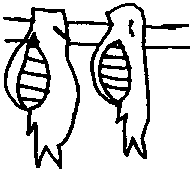
Round wood sticks - under gill flap
through mouth, open belly cavity with sticks

Square sticks with nails driven
through fillets. Drive nails through stick pointing up to keep fish secure.

Bamboo sticks
- Margie Hulsair, PCV Sierra Leone

Plywood smoker
Drying the Fish
After brining comes step three, drying the fish. Pat fish dry with a cloth, then place them on a rack in the refrigerator and drain one to three hours. Drying increases keeping quality and promotes development of the ''pellicle," a glossy finish of dissolved proteins on fish surfaces which gives them the desired appearance, retains natural juices, and helps spread smoke evenly.
Building the Smoker
A simple smokehouse may be designed from a large cardboard box, a metal oil drum, a wooden barrel, an old refrigerator, or even plywood The cardboard box is perhaps easiest to obtain; it should be 30 inches square and 48 inches high. Here are the construction directions:
a. remove one end of box to form bottom of smokehouse.
b. unfasten flaps at opposite end so they fold back and serve as a cover.
c. strengthen box, if necessary, by tacking 3/4 inch strips of wood on outside of box--vertically at corners and horizontally across sides.
d. cut a door 10 inches wide and 10 inches high in bottom center of one side; make one vertical and one horizontal cut, so uncut side serves as hinge.
e. suspend several rods or sticks (iron or wood) across top of box; cut holes through box, so rods rest on wooden strips; a rack of wire mesh (1/2" or 1/4'' mesh hardward cloth) may replace rods; refer to diagrams below.
Cardboard Smokehoue. Courtesy U.S. Department of the Interior Fishery Leaflet 209.

Drying the fish; Building the smoker

Corrigated smoker
(portable)
Session T-58: Charcoal making special project
Time: 4 PM
Goals:
· To acquaint trainees with the benefits of charcoal as an easy-to-transport, efficient fuel
· For trainees to understand the basic principles of small-scale charcoal making, including the earthmound kiln and the portable kiln
· For the trainee assigned the special project to build on communication/technology transfer skills
Overview:
In most developing countries, firewood is becoming increasingly expensive and difficult to get. In the last session, trainees built a smoker for smoking fish, a technology which requires a prolonged source of heat. In this session, trainees learn that wood converted to charcoal is a much more efficient use of wood as a fuel. Charcoal is relatively simple to make, and certainly much easier to transport than wood.
Procedures:
|
Time |
Activities |
|
5 Minutes |
1. After presenting the goals for the session, the trainee assigned the special project asks trainees to give reasons why firewood as a fuel is a problem in developing countries. Trainee lists the reasons on newsprint. |
|
20 Minutes |
2. Trainee then gives a brief lecturette on the advantages of charcoal as a fuel, and presents the simple, "how-to" steps in making charcoal. Both the earth-mound kiln and the portable kiln are discussed (the trainee presents diagrams of both). |
|
20 Minutes |
3. Trainee divides the large group by country into small groups of 3 or 4, and tells each group to list out on newsprint the different ways a charcoal making secondary activity might benefit their projects, i.e., to make smokers more economically feasible for the subsistance fisherman, to free women from the arduous chore of hauling firewood, etc. Groups report out to the large group. |
|
5 Minutes |
4. Trainee draws closure to the session by linking back to the session on smokers and links to the special project on alternative source of fuel and energy, including mention of the mudstove, methane digesters, etc. |
References:
· Small-scale Charcoal Making: A Peace Corps Manual for Trainers. July, 1982.
Session T-59: Metric system special project
Time: 5 PM
Goals:
· For trainee assigned this
special project to build on communication/technology transfer skills
· To acquaint trainees with the metric system
Overview:
In their work as marine fisheries extensionist, trainees need to know the metric system well and be able to do conversions between the two systems with ease.
Materials:
· Flip chart, markers
Procedures:
|
Time |
Activities |
|
30 Minutes |
1. Trainee assigned the special project compares Fahrenheit scale with the Celsius scale. Conversions between the two scales are practiced. A chart is then presented on "simple conversions": inches to centimeters; mile to kilometer; hectar to acre; cups, quarts, gallons to liters; pounds to kilograms; etc. |
METRIC SYSTEM
There are two major systems of measurement used in the world today: The metric system and American Dummy units.
Metric is a decimal system of weights and measurements devised in revolutionary France. It was established that the meter is equal to one ten millionth of the distance from the equator to either pole back before the world became pear shaped.
Decimal measurement of temperature had already been established by the Swedish astronomer Anders Celsius in 1742. He proposed a centigrade temperature scale using 0° as the freezing point and 100° as the boiling point of pure water.
Conversion factors of Fahrenheit to Celsius is fairly simple if you remember that 0°C = 32° F and 100°C = 212° F. Thus 100°C = 212°-32° F or 180. The distance between freezing and boiling is 180°F. Thus 1.8 times the number of degrees Celsius plus 32 = the Fahrenheit temperature.
Given 27° C you multiply by 1.8 for a total of 48.6. To this add the 32 degrees below freezing and you have a total of 80.6° F.
The gram - The basic metric wt. was established as the wt. of one cubic centimeter at 4°C (the temp. of water at its greatest density).
Resources:
· Weather for the Mariner, WM.
J. Kotsch. 1977 Naval Institute Press o Preserving food by Drying Manual M-10
ICE
- Bill Yost, PCV Sierra Leone

Temperature conversion
Other Handy Conversions
*within 2%
Distance
1 in = 2,540 cm
* 1 cm = .4 in
*1 yard = .9 meters
1 m.
= 39.37 in
*1 mile = 1.6 kilometers
*1 k = 5/8 mile
*1 acre = 2/5
hectare
*1 hectare = 2.5 acres
Volume Measurements
100 ml. = 3.4 oz
500 ml. = 17.0 oz
30 ml. = 1 oz
120
ml. = 1/2 cup
240 ml. = 1 cup
480 ml, = 1 pint
960 ml. = 1
quart
3.81 liters = 1 US gallon
Weight
1 lb. = .454 kg.
1 kg. = 2.204 lb.
1 oz. = 28.4
grams
100 grams = 3.5 oz
British and American systems are the same except in volume measures:
British:
1 oz. = 28 ml.
5 oz.(1/4 pint) = 140 ml.
10 oz. (1/2 pint)
= 280 ml.
1 pint (20 oz.) = 560 ml.
1 qt. (40 oz,) = 1.1 L.
1 gallon =
4.5 liters
44 British gallon = 55 U.S. Gallon
Barometric Pressure is measured both inches and millimeters
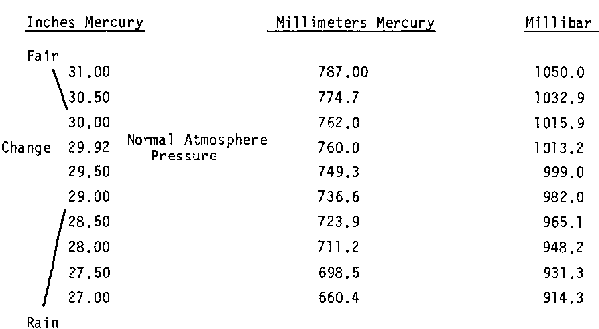
Barometric pressure conversion
One millibar is 1000 dynes per square centimeter. A dyne is the unit of force in the centimeter-gram-second system of measurement.
One last conversion is for speed through the water 10 knots = 11.5 miles per hour = 18.5 kilometers per hour
Session T-60: Team building
Time: 7:30 PM
Goals:
· To improve the communication and relationship between trainees who will be stationed in same Peace Corps country
Overview:
In this session trainees use their feedback skills. This exercise also requires some degree of personal risk taking. At the end of session trainees feel closer to each other and are eager to come together as a team.
Procedures:
|
Time |
Activities | |
|
5 Minutes |
1. Trainer makes statement that during this exercise the participants themselves will conduct the time frames Trainers will be available only if they are asked to facilitate one of the dyads interactions. | |
|
2 Hours 30 Minutes |
2. Participants make a list being as specific as possible for everyone in |
- Things you do or say which make me feel good. |
| |
their group of: |
- Things you do or say which make me feel bad. |
| | |
- Things I do toward you which make me feel good. |
| | |
- Things I do which I regret or make me feel bad. |
| | |
- Things I would like us to do more of. |
| | |
- Help I think you can give me. |
| | |
- Differences and disagreements between you and me are? |
| | |
- The source of our disagreement seems to be,.... |
| | |
- I handle these disagreements by.... |
| | |
- You handle these disagreements by.... |
| |
Each trainee explores the questions with all other trainees in their country group. In cases where there is a problem or difference the following is put in writing by the two parties: - Situation, problem or difference - What I intend to do about it - What I might do in spite of myself - How I would like you to help me. | |
Trainer's Note:
At the end of session people will still be engaged in dialogue. Your role is to be sure that everyone shares with everyone else.
Adapted from Cross Cultural Trade-off, by Paul Pedersen
Session T-61: Introduction to basic refrigeration and ice making with field trip
Time: 7:30 AM
Goals:
· To acquaint trainees with the fundamentals of basic refrigeration and ice making
· For trainees to become aware of the refrigeration cycle
· To acquaint trainees with refrigerants, compressors, refrigeration systems and various ice making systems
· To allow trainees the opportunity to view first hand the various ice making and refrigeration components and to interview refrigeration technicians
Overview:
This session deals with basic refrigeration and ice making. The PCV in the field will not be a refrigeration specialist and should only be expected to have a basic comprehension and awareness of the refrigeration cycle and the various components in a system. The ability of the PCV to understand the operating principle and functions of components will provide a starting point for further, more in-depth study of the particular model or make of refrigeration equipment used in-country, if required.
Materials and Equipment:
· Flip chart, markers, freezer/refrigeration models for demonstration
Procedures:
|
Time |
Activities | |
| |
1. Technical trainer gives overview of what trainees are to look at while on field trip. | |
| |
a. introduction |
- refrigeration: what is it? |
| | |
- process of removing heat from space or area |
| | |
- problems associated with refrigeration |
| | |
- thermometers |
| |
|
- basic systems direct expansion indirect expansion |
| | |
- definition latent heat sensible heat |
| |
b. Refrigeration cycle components |
- compressor (pump) |
| |
|
- condensor (receiver tank) |
| | |
- evaporator (cooling coils) |
| | |
- expansion valve (pressure reducing valve) |
| |
c. compressors |
- single cylinder |
| |
|
- multi cylinder |
| |
|
- reciprocating |
| |
|
- rotary |
| | |
- centrifugal |
| |
|
- direct drive |
| |
|
- belt drive |
| |
d. refrigerants |
- desirable properties low boiling point safe - non-toxic mixes well |
|
| |
with oil non-corrosive to metal high latent heat valve ease of liquification at moderate temperatures and pressure |
| | |
- toxic refrigerants amonia methyl chloride sulfur dioxide |
| | |
- non-toxic refrigerants carbon dioxide calcium chloride freon |
| |
e. freon |
- most widely used |
| |
|
- colorless |
| |
|
- odorless |
| | |
- non-irritating |
| |
|
- non-flammable |
| |
|
- chemically inert |
| |
|
- freon types 12,14,22,502 |
| |
f. ice makers |
- plate |
| | |
- flake |
| |
g. refrigeration cycle (see Appendix 1) |
- graphic example |
| |
|
- explanation of cycle |
| |
2. Tour of refrigeration/freezer facility. This is a tour with explicit examples and demonstration. Trainees are reminded of their interview techniques and the need to get the most out of field trip by asking questions. | |
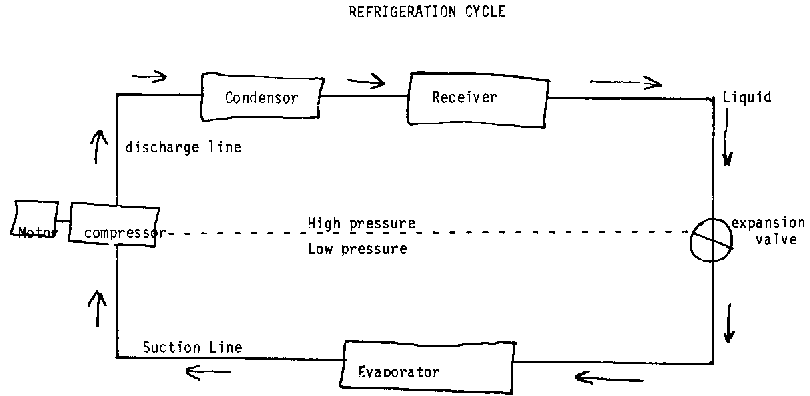
Refirigeration Cycle
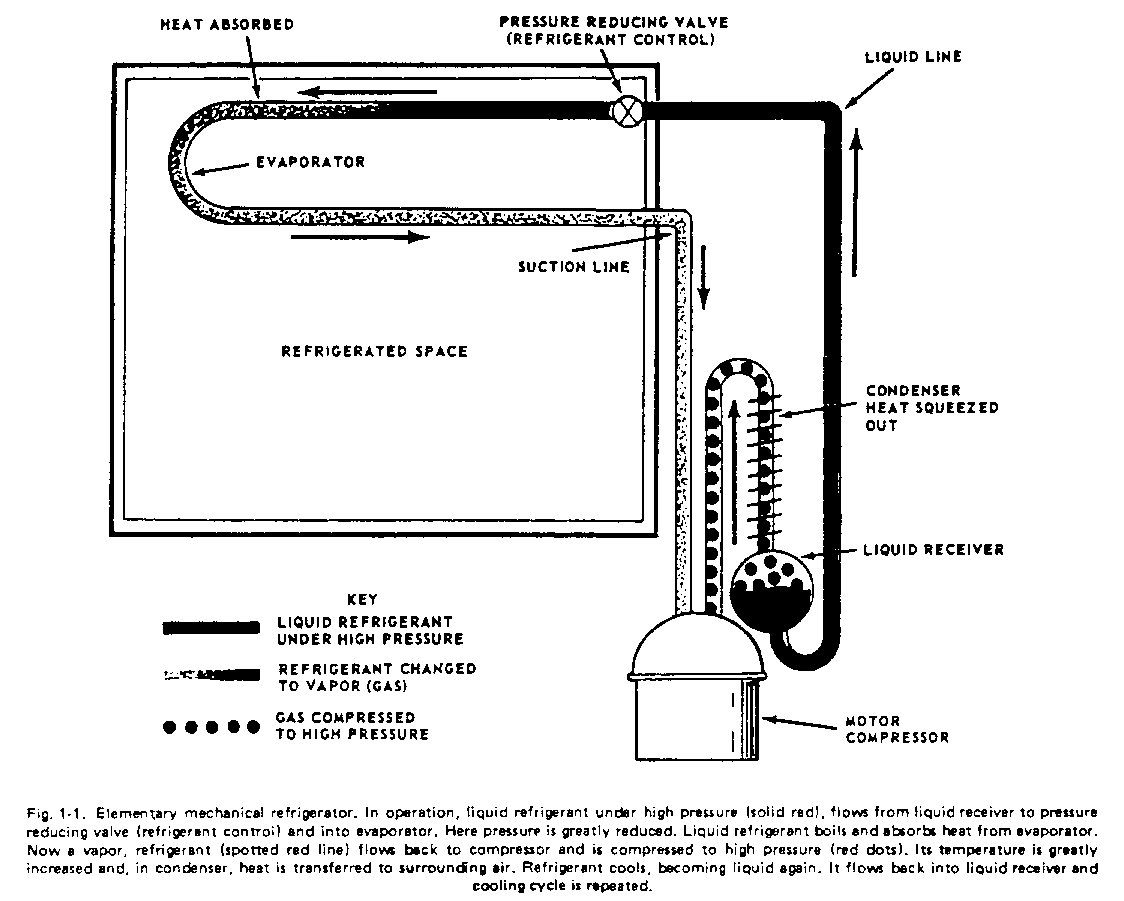
Elementary Mechanical Refrigerator
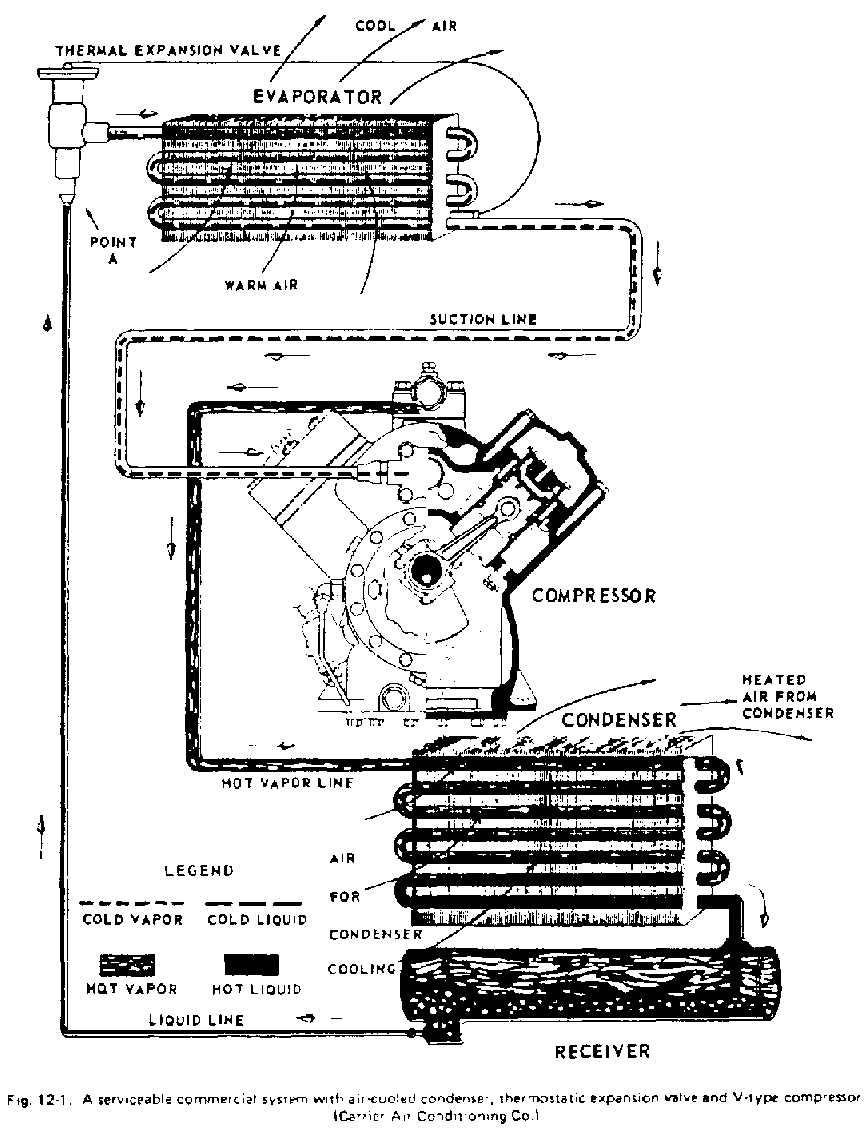
Refrigerator

Flake Ice Refrigeration System
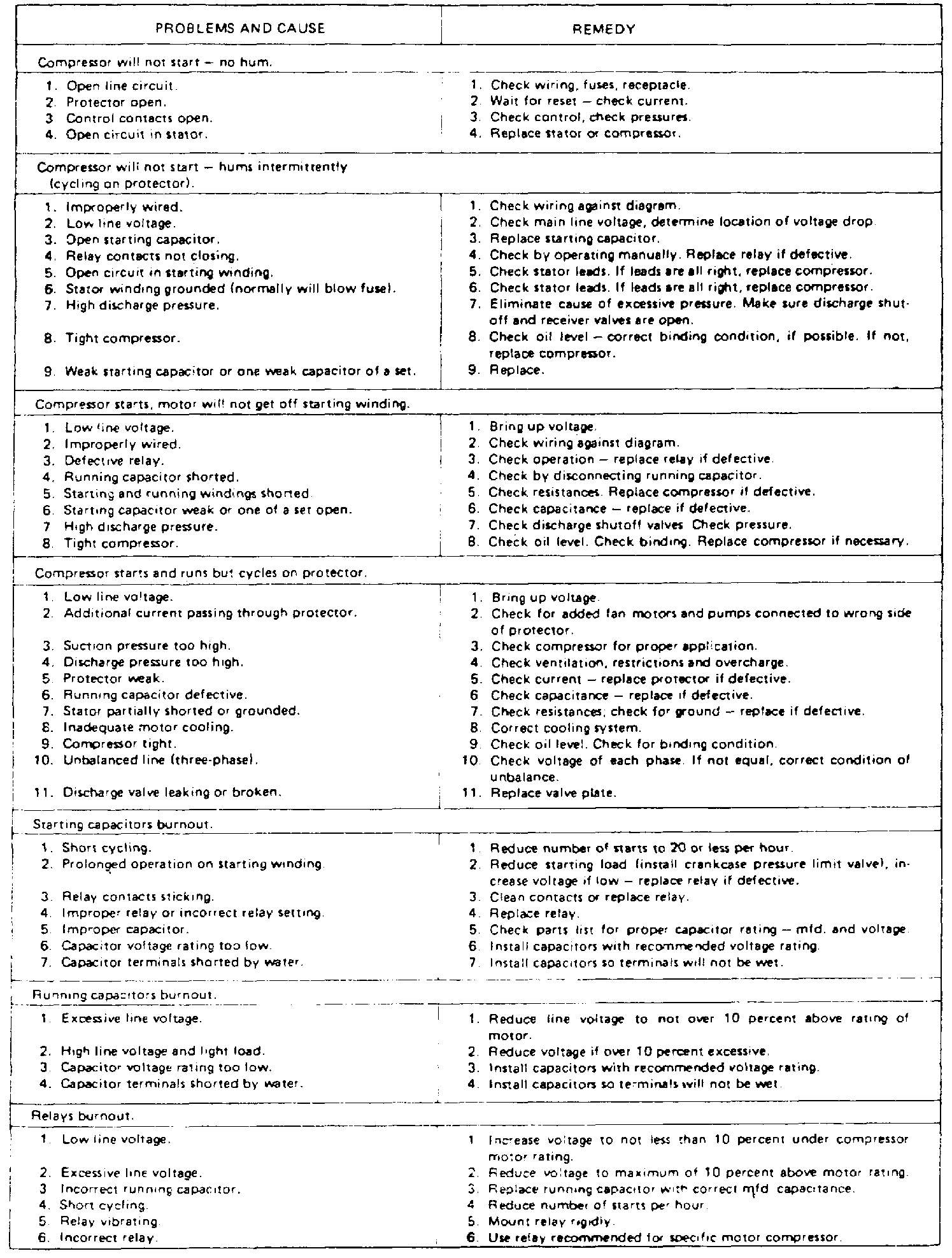
Hermetic compressor service
chart
Session T-62: Individual interviews and net mending
Time: 2:30 PM
Goals:
· The interview goals for this session are the same as in previous interview sessions
· To provide trainees with formal instruction in net sewing techniques utilizing the Becket Bend and R and L side knots
· To increase speed of sewing and mending nets
Overview:
Individual interviews continue as in previous weeks. Trainees learn new net mending techniques and knots. Trainees practice net mending to increase speed.
Procedures:
|
Time |
Activities |
|
30 Minutes |
1. Technical trainer reviews net sewing and mending skills developed to date. Introduces R and L side knots. Trainees practice. |
|
20 Minutes/ |
2. Interviews are conducted using format from previous trainee sessions. |
Trainer's Note:
If at all possible ask fishermen from community to "drop in" during net sewing session to encourage trainees and possibly transfer new skills to trainees in area of net sewing and mending.
Session T-63: Support systems
Time: 7:30 PM
Goals:
· For trainees to look at their support system - personal and professional - over the last year, at the present time, and over the next two years
Overview:
This session reinforces the learnings of Team Building, session T-60. Trainees need to see their country teams as an important part of their support system - both professional and personal - over the next two years.
Materials:
· flip chart, markers, journals
Procedures
|
Time |
Activities | |
|
20 Minutes |
1. Trainer asks trainees to define personal support systems and professional support systems. Trainer has an opportunity to discuss with trainees the importance of a "team approach" to their program. | |
|
30 Minutes |
2. Trainees record in their |
a. Six months ago, who was part of your support system? |
| |
journals the following: |
b. Who at the present time? |
| | |
c. Any similarities between the two systems? |
| | |
d. How are you going to find your support system once at your site. |
|
|
3. There is no formal wrap to this session. It is meant to be a reflective time for trainees. | |
Session T-64: Processing field trip
Time: 7:30 AM
Goals:
· To process the Refrigeration
and Ice Making Field Trip from the previous session
· To review points made by refrigeration technicians
about the refrigeration process and ice making/refrigeration components
Overview:
The previous session in refrigeration and ice making has given all particulars from the principles of operation and component identification to refrigerants. The field trip reinforced this by allowing the trainees the opportunity to interview the refrigeration technicians about problems, designs, etc. This session processes the field trip -- particularly the information gathered, and enables trainees to identify additional areas of refrigeration where they feel they need further information.
Materials:
· flip chart, markers
Procedures:
|
Time |
Activities |
|
15 Minutes |
1. Technical trainer asks trainees for an overview of the field trip based on the following outline posted on newsprint: |
| |
a. refrigeration systems |
| |
b. ice making facilities |
| |
c. repair facilities |
| |
d. repair tools |
|
5 Minutes |
2. Technical trainer asks trainees to brainstorm additional areas where they feel they would like to have more information. |
|
10 Minutes |
3. Technical trainer asks where and how they feel they can get this information. Trainees are given assignments to gather data. Trainer gives deadline for assignments the following week. |
Trainer's Note:
This is a session in problem-solving. It is important for trainees to recognize that there will be many times when they need information and will have to use various methods to get technical information.
Session T-65: Special project - seaweed farming
Time: 8 AM
Goals:
· To acquaint trainees with the
basic principles of seaweed farming
· To
acquaint trainees with the nutritive value of seaweed as a food
· For the trainee assigned the special project to
practice and build on communication and technology transfer skills
Overview:
In many areas of the world, seaweed is farmed as a food crop. It is high in nutritive value, particularly in iodine, potassium and other vitamins.
Seaweed farming would be a worthwhile project activity in developing countries where seaweed is already harvested in the wild and consumed by the local population, and if available supplies are insufficient to meet the demand.
Materials:
· dried seaweed, i.e. Chinese or Korean, flipchart, marking pens
Procedures:
|
Time |
Activities |
|
30 Minutes |
1. Trainee assigned the special project presents a lecture on the nutritive value of seaweed, its uses in cooking, and the basic principles of seaweed farming. |
|
5 Minutes |
2. Trainee tells group that in the next session, Nutrition and Fish Culinary Skills, they will all have a chance to sample "dried fish and seaweed soup." |
| |
3. Trainer draws closure to session by linking it to nutrition sessions and to sessions on income generation. |
References:
· Manual on Farming of Eucheuma Spinosum. Gena Products Phil. Inc., P.O. Box 568, Cebu City, Philippines.
DRIED FISH AND SEAWEED
|
Dried seaweed |
Chinese cabbage |
|
Water |
Dried fish |
|
Green Onions, sliced |
Soy Sauce Noodles |
Use one length of dried seaweed. Place in pot with about three cups of water. Bring water just to boiling point. Remove seaweed. Add vegetables and dry fish to broth. Cook until tender. Soak noodles in hot water for 10 minutes. Drain. Add to soup. Add soy sauce and/or other seasonings.
Session T-66: Culinary skills and fish nutrition special group project
Time: 11 AM
Goals:
· For trainees working on the group project to build on communication/technology transfer skills
· For trainee assigned the special group project to build on leadership, organizational and communication/technology transfer skills
· To acquaint trainees with various ways of cooking fish
· To acquaint trainees with nutritional information around meal preparation
Overview:
In the first cooking session, the special group project leader presented general fish culinary techniques and nutrition. In this second session, the group leader emphasizes the important role minerals play in good nutrition.
Materials and Equipment
· flip chart, markers, food to be prepared, cooking facilities
Procedures
|
Time |
Activities |
|
20 Minutes |
1. Group leader presents the two recipes to be prepared in the session: fish chowder and fish salad. A chart is then presented with minerals listed and which common foods they are found in. Group leader then points out which minerals will be found in the ingredients for the two recipes. |
|
30 Minutes |
2. The three trainees who signed up for this session proceed to prepare the fish salad and the fish chowder, explaining the procedure and useful tips in preparation. Recipes are located prior to session by trainees. |
| |
3. Trainees enjoy the food. |
Trainer's Note:
The following is nutritional information that group project leader should impart to other trainees during the session.
NUTRITION
Nutrients - necessary to feed cells, supply energy, supply heat, repair cells, facilitate growth.
Necessary nutrients - protein, carbohydrates, fats, vitamins, minerals.
Functions of nutrients: 1) build and repair body, 2) regulate body processes, 3) furnish energy.
PROTEIN
Sources: Meat, liver poultry, fish, milk, cheese, eggs, dried beans, peas.
Functions: 1) build and maintain all body tissue, 2) regulate acid-base balance of body, 3) formation of body hormones and enzymes, 4) build resistance to disease.
Deficiency symptoms: 1) poor muscle tone and posture, 2) lowered resistance to disease, 3) premature aging, 4) anemia, 5) stunted growth (children), 6) tissue degeneration, 7) slow recovery from illness or surgery.
CARBOHYDRATES
Sources: Sugars, syrups, molasses, flour and flour products, bread, crackers, cereals, potatoes, starchy vegetables.
Functions: 1) furnish heat and energy.
Deficiency symptoms: 1) loss of weight (if calorie intake is deficient).
FATS
Sources: Butter, lard, vegetable shortening, margarine, salad dressings, meat meals, bacon, oils, nuts, cheese, cream.
Functions: 1) furnish heat and energy, 2) carry fat soluble vitamins, 3) supply essential unsaturated fatty acids, 4) supply spare thiamine (vitamin B1).
Deficiency symptoms: 1) loss of weight (if calorie intake is deficient), 2) abnormal skin.
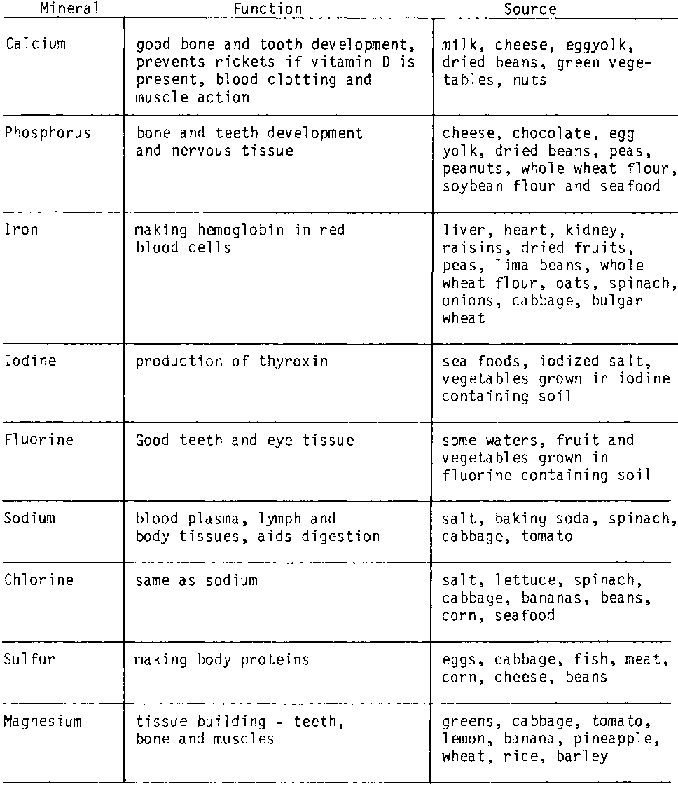
Minerals chart

Minerals chart (continued)
From PRESERVING FOOD BY DRYING, ICE, pg. 158.
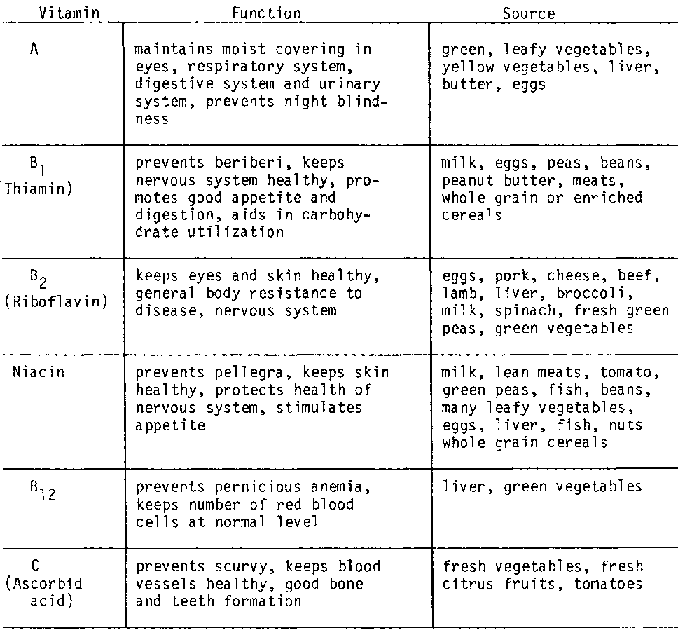
Vitamin chart
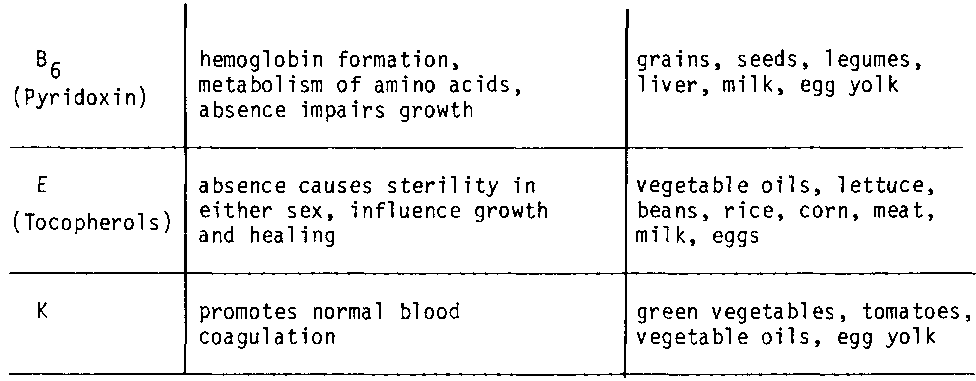
Vitamin chart (continued)
From PROCESSING FOOD BY DRYING, ICE, pg 159
- Margaret Hul
sair, PCV Sierra
Leone
|
| ||||||||||||||||||||||||||||||||||||||||||||||||||||||||||||||||||||||||||||||||||||||||||||||||||||||||||||||||||||||||||||||||||||||||||||||||||||||||||
Small-Scale Marine Fisheries - A Training Manual (Peace Corps, 1983, 631 p.)
Week 6: Training

Week 6, Sessions 67 Thru
85
Session T-67: Introduction to boat repair, maintenance and construction
Time: 7:30 AM
Goals:
· To acquaint trainees with basic fishing vessel repair needs
· To make trainees aware of the needs of proper maintenance and maintenance schedules for small wooden vessels
· To acquaint trainees with proper woodworking tool handling techniques
Overview:
In this session trainees are introduced to the basic steps in small boat repair, maintenance and construction. In the field the PCV will be primarily involved with older, more seasoned fishing boats and should be able to assist in the repair and maintenance of these vessels.
Materials and Equipment:
· Small-scale wooden fishing boat in need of repair, scrapers, scrub brushes, knives, ice picks, chalk, flip charts, markers, woodworking tools
Procedures
|
Time |
Activities |
|
20 Minutes |
1. Technical trainer gives short lecture on need of boat repair and maintenance of small boats. |
|
30 Minutes |
2. A small boat in need of repair (see Trainer's Notes below) is available for trainees' scrutiny. Technical trainer has trainees examine boat and make list of repairs trainees can see need to be done. |
|
10 Minutes |
3. Technical trainer goes over trainees' list and adds repairs that trainees may have overlooked. Trainer now has trainees develop list of methods they would use to make repairs. |
|
3 Hours |
4. Technical trainer produces scrapers, scrub brushes, ice picks and chalk. After removing boat from water to pre-arranged site, trainees, under technical trainer's direction, secure boat and proceed to thoroughly clean boat inside and out. |
|
30 Minutes |
5. After boat is cleaned trainees are instructed in survey work of checking for rotting planks, timbers, split seams, using ice pick or knife blade. |
|
|
6. Boat is marked with chalk on areas of potential problems. |
| |
7. Technical trainer reviews session activities and links to future sessions where repairs will be completed. |
Trainer's Note:
Prior arrangements with local fishermen to repair boat is needed as well as locating boat close enough to training facility for trainees to work on. Boat should be in a condition that is not hopeless, i.e., sunk or completely rotted. Also, to allow all trainees experience in survey work and repair, a ratio of one boat per 4-5 trainees is essential.
Session T-68: Blueprint reading special project
Time: 4 PM
Goals:
· To provide proper instruction
in reading blueprints and understanding blueprints to trainees
· To acquaint trainees with scale and the need to
utilize it in design/construction work
· To
familiarize trainees with simple line drawings for plans
Overview:
This session is done by trainee for whom this is a special project. Trainees need to be able to read simple blueprints, comprehend symbols and understand scales.
Materials
· Flip chart, markers, copies of blueprint (preferably of a small boat)
Procedures:
|
Time |
Activities | |
| |
1. Trainee for whom this is a special project gives presentation |
a. explain what they are |
| |
covering the following aspects of blueprints: |
b. how they are used |
| |
|
c. what symbols mean d. what scale is |
| |
2. Trainee provides examples of blueprints (of boats, preferably) and line drawings (plans of boats without dimensions) and passes them around. | |
|
|
3. Trainee ties blueprints and boat building together. Trainees practice reading blueprints. | |
Trainer's Note:
This is intended to be an informational session. Trainees should be able to read simple blueprint at end of session.
References:
· Olivo, Thomas C. and Payne, Albert. Basic Blue Print Reading and Sketching Delmar Publications. Albany, NY 1978
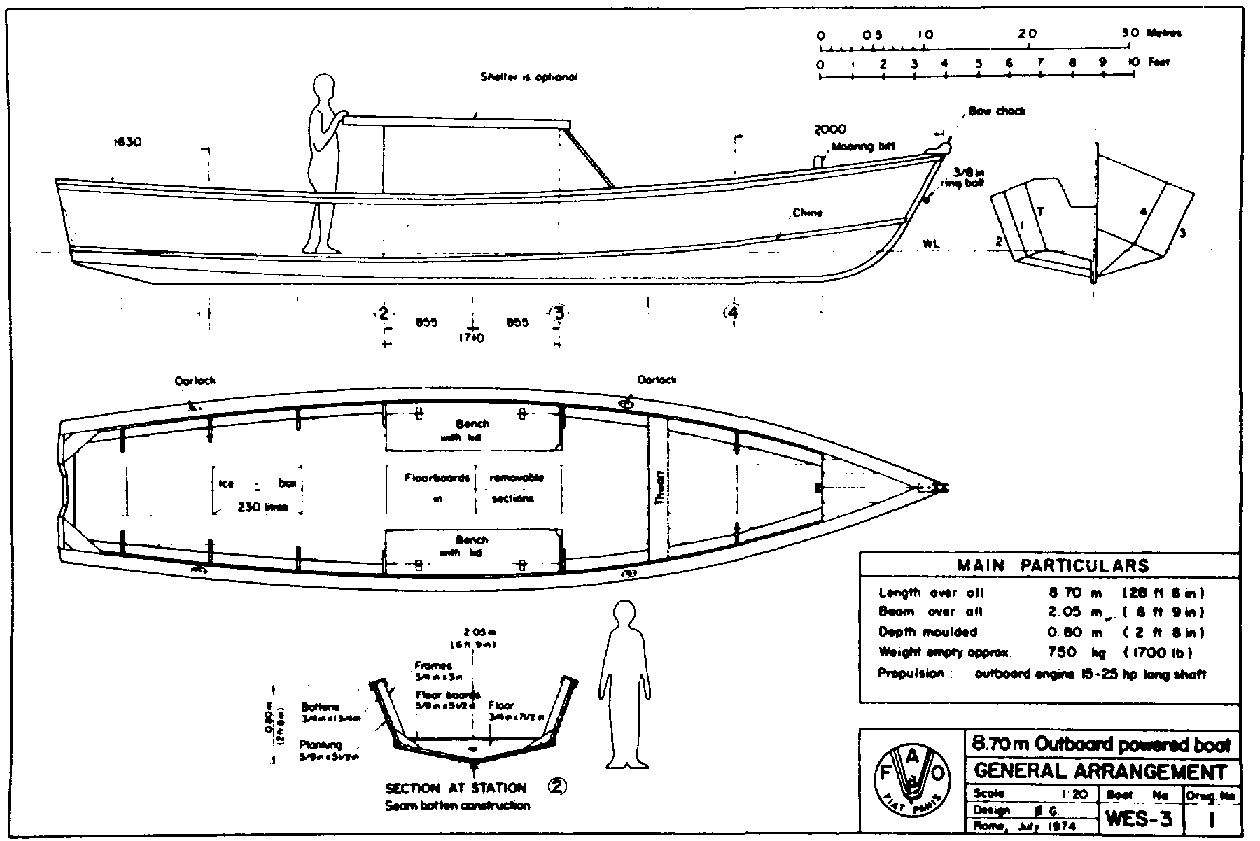
Fig. 1. A 28-ft outboard powered
boat suitable for village fishery operations.

Fig. 2. A 30-ft inboard powered boat
based on a Texas dory Sampan Express
30.
Session T-69: Color depth charts special project
Time: 5 PM
Goals:
· To enable trainees to
understand coloration differences at various depths for fishing
purposes
· To understand the importance of
color when fishing and conducting exploratory surveys
· To provide initial understanding of nutrient levels,
temperature substrates, suspended particulates in seawater
Overview:
This session was done as a special project by a trainee. The session should be used to complement the small-scale fishing sequence as well as the reef survey session. In this session trainees become aware of the importance of color to the marine environment, for purposes of camoflage and also fish capture.
Procedures:
|
Time |
Activities | |
|
1 Hour |
1. Following is session outline: | |
| |
A. Introduction - wave lengths |
1. physical, optical |
| |
|
2. physiological, visual |
| |
B. Alteration of physical aspects |
1. radiation penetration |
| | |
- visible light |
| |
|
- blue/green spectrum |
| | |
2. radiation absorption |
| | |
- rapid absorption 1 m = 62% |
| | |
- H2O is highly selective absorber red more than blue/green turbid water |
|
| |
3. angle of incidence |
| | |
- tropical regions |
| |
|
- temperate regions |
| |
C. Physiological Aspects |
1. fish can see color |
| | |
- lines, lures can "scare" fish |
| | |
- record keeping of lures |
| |
D. Fish coloration |
1. camoflage- color - depth |
| | |
2. lures for fish capture |
| |
E. Sea Coloration |
1. blue seas indicitive of poverty |
| | |
2. green - thermoclines, turbidity |
| | |
3. red, yellow, brown - concentration of dinoflagellates, capepods, diatoms |
| |
2. The following is a sample lecture: | |
COLOR DEPTH CHARTS
I. Color is the way the brain interprets the wavelength distribution of light entering the eye.
A. Color has two aspects - physical or optical, and physiological, or visual.
1. The physical, or optical, aspect of color involves the wave length distribution of light.
a. The visible spectrum includes wavelengths between 390 nm and 760 nm and, consequently, the colors violet, indigo, blue, green, yellow, orange and red.
b. Light entering the eye is either emitted by or reflected from the objects that we see.
2. The physiological, or visual, aspect of color involves the interpretation of the wavelength distribution by the eye and the brain.
a. The cones of the eye are of three types, and each type is sensitive to a particular band of wavelengths (those which correspond with the red, green and blue components of the spectrum).
b. The brain "adds" the messages sent from the three types of cones and thus creates the sensation of color.
B. The physical aspect of color is altered in water because the penetration of radiation in water is different from that in air.
1. The distribution of energy taken in by the sea is an important factor affecting the penetration of radiation.
a. Most of the energy that reaches the sea is in the form of visible light.
b. The energy taken in by the sea is greatest in the blue and green region of the spectrum, declines rapidly on the short wave side of the spectrum, and is considerable but declines steadily on the long wave side.

Graphic
2. Radiation that enters the water decreases in passage downward because it is absorbed (converted to another energy form) and it is scattered laterally by impact against suspended particles, colored substances and water molecules.
a. Much radiation that passes through the surface of the water is absorbed quickly, some 62% in the first meter in clear water.
b. Water is a highly selective absorber and is most penetrable to just those wavelengths which are useful to plants.
1. Red is absorbed more rapidly than blue and green.
2. Blue and green will penetrate well beyond 100 meters in clear water.
c. The scattering of blue radiation among water molecules accounts for the blue color of the ocean (this is similar to the atmospheric effect).
d. Turbid water is less penetrable to the shorter wavelengths because it scatters them more quickly, and , as a result, green and yellow penetrate farther than blue in turbid water.
3. The angle of incidence of light striking the water surface has little effect on non-reflected light penetration, but the greater the obliquity of the light rays striking the water, the greater the amount of light that is reflected.
C. The physiological aspect of color in water may be summarized by the fact that fish can see color.
1. Scientists believe that certain color lines and lures do scare fish.
2. Many fishermen use color lines and lures and experience no problems.
3. An accurate record of lure colors and the depths at which they are effective should be the fisherman's guide.
II . The changes which colors undergo in water have significant implications in the determination of fish coloration, lure coloration and the apparent color of the sea.
A. Fish are generally colored in such a way that they are protected from predators.
1. Fish in the first 150 meters of water are generally blue or transparent so that they blend with the apparent color of the water.
2. Fish between 150 meters and 500 meters are generally silvery or gray.
3. Fish below 500 meters are generally black or red. a. Loss of sunlight occurs between 500 meters and 750 meters and, at these depths, red will appear black. b. Black fish are usually day feeders while red fish feed at night.
B. Lures rely on movement, scent and/or color to attract fish and, therefore, are colored so that they will be seen.
1. The distribution of lure colors used in the three depth regions is the inverse of the distribution of fish colors found in those regions.
2. Red, orange and black lures will be highly visible in the first 150 meters of water.
3. Silver and white lures will be visible between 150 meters and 500 meters but are generally used in all three depth regions.
4. Blue and green lures may be visible below 500 meters; yellows lures may be visible if the water is slightly turbid.
C. The apparent color of the sea may be a function of suspended substances, temperature or a collection of living organisms.
1. Blue seas are generally indicative of poverty as they contain relatively small amounts of suspended matter.
2. Green waters may indicate the presence of a thermocline, a coral reef (due to the amount of suspended calcareous material) or high turbidity (i.e. - coastal waters).
3. Red, brown and yellow waters appear colored because they contain high concentrations of shrimp, dinoflagellates, capepods or diatoms.
Note: A Secchi disc is a disc with pie sections of various colors which is lowered into the water to determine at what depths the various colors cease to be visible.
References:
· Concise Encyclopedia of the
Sciences. Yule, editor. 1978. Zebco Brunswick Company, Tulsa, Oklahoma
74101.
· This Great and Wide Sea: An
Introduction to Oceanography and Marine
Biology. Coker. 1954
- Marilyn Berry, PCV Sierra
Leone
Session T-70: Working with groups as an extension worker
Time: 7:30 PM
Overview:
This session continues to focus on extension work. Working with groups is stressed as a way of doing extension work.
Procedures:
|
Time |
Activities |
|
30 Minutes |
1. Trainer gives lecture on why it is best to try to do extension work with groups of people, rather than individuals. Trainer goes into group dynamics and stresses risk taking. (Sample lecture follows) |
Trainer's Note:
Lecture should be in your own words, use situations with which you are familiar to stress points.
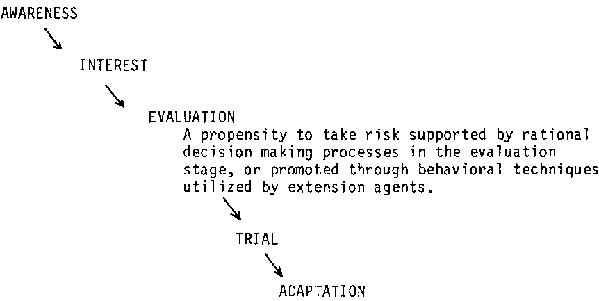
Sample lecture
WHY GROUPS ORGANIZE
Both subsistence fishermen and larger scale fishermen are less disposed to take risk on an individual basis. The behavioral tool however, or the risk-shift phenomenon largely used in a business-making atmosphere, can be used more effectively to promote risk taking by small groups of people involved in collective decision-making.
Small groups of people concerned with decisions that involve some element of risk, unlike large group members, will, after engaging in various modes of group discussion, make a collective decision that is far more risky than their individual decision on the same matter would be. Key elements here is that group discussion on a matter of importance must take place to the point of group consensus on that particular matter before the shift occurs.
In the case of subsistence fishermen, much depends on the extension agent's ability to explain the risk involved to group members, and consequently show how the new technology substantially exceeds, in cost/benefit advantages, the fishermen's present traditional technology.
For example, if an extension agent suggests to a group of fishermen that a particular technology or fishing technique could improve productivity, but is unable to explain how much the technology would cost, where it could be obtained, how to use it and what benefits could be expected from its use, one can rightly predict that conservative influences will prevail and a risk decision will not be taken to adapt the technology.
There are four major hypotheses that support the process of group acceptance of risky technical innovations. These four are the leadership, familiarization, diffusion-of-responsibility, and risk-as-value hypothesis. In order for risk-shift to occur, regardless of the particular hypothesis, a group discussion to the point of group consensus on the issue must take place beforehand; for without discussion and consensus the shift will not occur.
In the leadership hypothesis, it is believed that certain group members are viewed as both natural risk takers and group leaders who have an above average influence on the rest of the group membership. The risk-shift condition is believed to occur because these people are inclined to be more dominant and/or influential in the group discussions and consequently influence the group in the direction of accepting risk. However, a behavioral problem with the leadership approach is that leaders can be either conservative influencers or risk takers under certain circumstances. This brings us back to the extension agent's ability to explain adequately the nature of the risk involved: An effective group leader can play a very conservative role if he perceives that the extension agent does not know what he/she is talking about or has not adequately explained the risk involved. Once convinced that a suggested program is adequately organized and supported, leaders become effective promoters.
Current thought on the role of opinion leaders in village societies is that extension agents should be made aware of the potential effect, negative and/or positive, leaders can have on the transference of new technology to group members.
Familiarization: Group discussion allows persons to become more familiar with the issue being discussed and consequently increases familiarity with the issue. As a result of becoming familiar with other group members' attitudes toward the risk, members will be even more willing to take a risk because they know where all the members stand on the particular issue. (Rogers: "There appears to be a pooling effect in media forums (groups) by which those members who begin at lower levels of knowledge, persuasion, or adoption gain more in these respects than do forum group members who begin at higher levels. Knowledge reduces risk".)
A group of fishermen (who have attained at least the minimum capacity to function together as a cohesive decision-making unit) in deciding whether or not to take the risk to adopt a new technology, should test the technology by discussing and becoming familiar with its stated objective - to improve production.
Diffusion of Responsibility: It is felt that group discussion and cohesion develops emotional bonds between members and frees the individual from full responsibility for his risky decision. An individual feels that his decision has been shaped by the group and if it fails, he is no worse off than the others since they will fail together. It is difficult for fishermen to establish strong emotional bonds with each other, even in many cases, when they are related. Short term groups will probably not develop strong emotional ties in any event.
This hypothesis cannot account for cautious shifts. The hypothesis does not specify how the creation of emotional bonds among subjects makes them less concerned about the negative consequences of risky decisions.
Most damaging of all appears to be the exchange of relevant information, not the development of emotional bonds that is necessary for the risk-shift to occur.
Risk as Cultural Value: This hypothesis maintains that moderate risk has a cultural-value which develops during the life span of a group and consequently individuals come to view themselves as being as willing as their peers (within the group culture) to take risks. The major mode of implementation is peer pressure to conform the deviants who are not reflecting views of the majority of the group's members.
All of the hypotheses interact in varying degrees to produce the shift in small group decision-making.
Let's go back to familiarization and talk about that process, information exchange, feedback and group discussion.
VARIABLES TO RISK TAKING
Not Known or Understood - Not Within Fisherman's Managerial Competence
Fishermen may have heard but the comprehension of what it can do or the effective utilization of the new technology may require additional knowledge and skills which they are not lacking.
Not Socially, Culturally or Psychologically Acceptable
A great deal is made in the development literature of those cases where a new practice or a new technique has not been adapted because it would upset too severely the established pattern of social or economic political organization.
Not Technically Viable or Adequately Adapted
Very often the new recommended technology has not in fact been locally adapted or tested under conditions which more closely approximate those faced by the fisherman. Fishermen are shrewd and can discern whether practice has had enough adaptive research and local testing to meet their unique local needs.
Not Economically Feasible
Probably the biggest single cause of resistance to change is the unprofitability of the new technology as seen by the fisherman. Often the new technology requires the purchase of additional inputs to achieve the higher productivity and these inputs have a cost. Further, when the fisherman compares the expected output plus its associated income with the additional costs of the input, the balance sheet employing the new technology is found wanting.
Not Available
often the new technology is imbedded in a
physical item. Unless the new item is readily available to the farmer in
quantities at the time he needs it, knowledge of its potential contribution to
his fish production will not result in its adaption.
|
30 Minutes |
2. Divide into small groups and give each group a different problem (see examples) to search their own experience for specific examples of situations in which they encountered a similar problem and what solutions were used in that group situation. Would it work in host countries they're soon going to? |
|
|
3. Groups give presentations to large group on problems they had, experiences that were similar, and possible solutions: |
| |
Examples: |
| |
o To get outside organizations (including local governments, voluntary organizations and technical departments) to cooperate in fishery extension work. |
| |
o To get local leaders to cooperate. |
| |
o To work in a community divided by racial or religious factions or by other factional rivalries. |
| |
o To regain the confidence of a community once it has been lost. |
|
5 Minutes |
4. Trainer draws learnings from presentations that would apply to extension work. Asks for generalizations about groups from participants. |
| |
5. Trainer now does summary of the three sessions on extension work. Conclude with the following: |
Relative advantage is the degree to which an innovation is perceived as better than the idea it supercedes. The relative advantage of a new idea, as perceived by members of a social system, is positively related to its rate of adoption.
Compatibility is the degree to which an innovation is perceived as consistent with the existing values, past experience, and needs of the receivers. The compatibility of a new idea, as perceived by members of a social system, is positively related to its rate of adoption.
Complexity is the degree to which an innovation is perceived as relatively difficult to understand and use. The complexity of an innovation, as perceived by members of a social system, is negatively related to its rate of adoption.
Trialability is the degree to which an innovation may be experimented with on a limited basis. The trialability of an innovation, as perceived by members of a social system, is positiviely related to its rate of adoption.
Observability is the degree to which the results of an innovation are visible to others. The observability of an innovation, as perceived by members of a social system, is positively related to its rate of adoption.
(Communication of Innovation by Rogers & Shoemaker)
After studying more than 1500 publications on the diffusion of ideas and the change process, Rogers and Shoemaker found that extensionists were more successful when they:
1. Expend more effort in change activities with communities;
2. Are community oriented rather than change agency oriented;
3. Propose programs compatible with community needs;
4. Have empathy with their communities and community members;
5. Are similar to their community members;
6. Work through opinion leaders;
7. Have credibility in the eyes of their community;
8. Increase their community's ability to evaluate innovations.
References:
· "Training for the Cross-cultural Mind," The Society for International Education, Training and Research, Washington, D.C., 1980.
· Everett Rogers and Floyd Shoemaker, Communication of Innovations: A Cross-Cultural Approach, New York Free Press, 1971.
· Allen D.Jedicka, Praeger Publications, 200 Park Avenue, New York, 10017, Organization for Rural Development. 1977
Trainer's Note:
· See also The Fisherman's Business Guide, chapter two, "The Decision Making Process," and chapter seven, "Coping with Risk and Uncertainty."
Session T-71: Navigation and seamanship - electronics
Time: 7:30 AM
Goals:
· To acquaint trainees with the varied assortment of electronic navigation and fish finding gear available to the small-scale fisherman
· To enable trainees the opportunity to work with an echo sounder, understand its basic principles of operation, functions and design characteristics
Overview:
This session is particularly useful to the trainee who will be working in a fishing environment and to those whose work entails workships of small-scale fishermen. Electronic fishing and navigation equipment is available to small-scale fishermen. Echosounders, previously very expensive pieces of equipment, can now be obtained for less than 1/3 the price of conventional outboard engines. The increased volume of fish catch does pay for the initial expenditure. Radio Direction Finders (RDF) are also available and also at a very nominal cost. The importance of upgrading a small-scale fishing enterprise is paramount in the overall development of the industry. By making available items of equipment that assist in safe navigation and increased production of fish, the need to over exploit fishing grounds decreases. Whereas, the ability of the small-scale fisherman to fish grounds never exploited opens up opportunities which before never existed.
Materials and Equipment:
· flip chart, markers, working fish finder/echosounder, Radio Direction Finder (RDF), navigation chart of local area
Procedures:
|
Time |
Activities |
|
1 Hour |
1. Technical trainer starts with informational lecturette, using following outline: |
| |
A. Orientation to Electronics |
| |
1. What are they? |
| |
2. How do they help? |
| |
B. Electronics for the small-scale fisherman |
| |
1. Radio Direction Finder (RDF) |
| |
2. Radios - EPIRB |
| |
3. Echosounders - Depth finders |
| |
C. Basic Principles of Sound Transmission |
| |
1. Sound waves |
| |
- air |
| |
- water |
| |
2. Frequency |
| |
- human |
| |
- fish |
| |
- echosounders |
| |
3. High-Low Frequency |
| |
D. Densities of Mass |
| |
1. Changes with: |
| |
- fish |
| |
- seabed |
| |
- thermoclines |
| |
2. Returning Echos |
| |
- hard/soft seabed |
| |
- swim bladders in fish |
| |
3. Thermoclines |
| |
E. Transducers |
| |
1. Types |
| |
2. Physical shape and size |
| |
3. Transducer location |
| |
F. Tranducers Frequency |
| |
1. Size |
| |
2. Depth |
| |
3. Angle |
| |
G. Echo Returns |
| |
1. Seabed ratio 14:1 |
| |
2. Fish size |
| |
3. Scale of paper |
|
1 Hour 45 Minutes |
2. Technical trainer now takes trainees out on fishing vessel where they take turns operating an echosounder and RDF. |
|
10 Minutes |
3. Trainer wraps up session tieing in with other Navigation and Seamanship work. Reminding trainees that they will use echosounder in future fishing sessions and reef survey. |
Trainer's Note:
Advance contact should be made with local fisherman or government agency for use of a boat with selectronic equipment aboard. If technical trainer does not feel comfortable doing this session, an outside resource should be found.
References:
· Fisherman's Manual, World
Fishing Pub. London 1976, 1982.
· FURUNO
Electronics, Tokyo,
Japan.
Session T-72: Fish aggregating devices (fad) special project
Time: 10:30 AM
Goals:
· To introduce a fishing system
unique to pelagic fisheries
· To relate this
system to small-scale and commercial fisheries
· To make trainees aware of uses of FADs in the fishing
community
· To design and construct a FAD
Overview:
This session is to be done as a special project by a trainee. The importance of Fish Aggregating Devices to the fishing industry worldwide is becoming more apparent as its uses increase. Not only are industrial scale fishing operations benefiting, but also small-scale and subsistence level fishing. Linkages back to the Special Project Session of Fuels and Trolling for Spanish Mackeral are made.
Materials and Equipment:
· flip chart, markers, wood working tools, bamboo poles, monofiliment line
Procedures:
|
Time |
Activities |
|
2 Hours |
I. Introduction to Fish Aggregating Devices (FADs). |
| |
A. What is a FAD? |
| |
B. How does it work? |
| |
II. Styles of FADs |
| |
A. Bamboo |
| |
B. Steel |
| |
C. Drum |
| |
D. Hawaii Tire |
| |
III. Design of the FAD |
| |
A. Raft |
| |
B. Appendage |
| |
C. Anchor |
| |
D. Anchor connectors |
| |
IV. Small-Scale Fishing |
| |
A. Hand lining |
| |
B. pole and line |
| |
C. Multiple hook and line |
| |
D. Drift gill nets |
| |
E. Ring nets |
| |
F. Bag nets |
| |
V. Industrial Scale Fishing |
| |
A. Purse Seine |
| |
B. Pole and line |
| |
VI. Market Set-up |
| |
A. Organization |
| |
B. Harvest |
| |
C. Estimated Costs |
| |
VII. Construction of a FAD (bamboo) |
| |
A. Design |
| |
B. Construction of a raft |
| |
C. Construction of appendages |
| |
D. Construction of anchor system |
| |
The following is a sample of presentation given during pilot program. |
FISH AGGREGATING DEVICES (FAD) or "PAYAO"
What is a Payao? An anchored, floating raft which supports submerged bamboo or coconut fronds or some other appendage.
The appendage provides habitat for phyto-and zooplankton which attracts small pelagic fish. The small fish which are feeding around the FAD, in turn, attract larger species of fish, such as tuna.
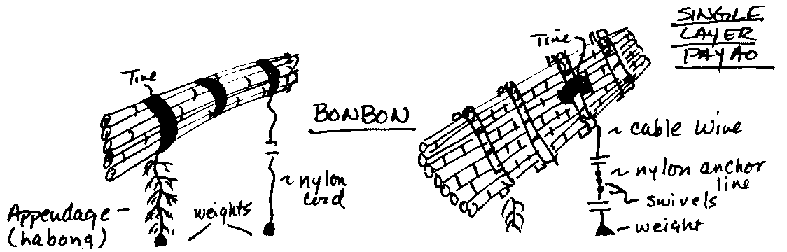
The evolution of the "PAYAO"

Double layer payao (most common in
use)

Payao variations
Small-Scale uses: 1) hand lining, 2) pole and line, 3) multiple hook and line, 4) drift gill nets, 5) ring nets, 6) bag nets.
Commercial uses: 1) tuna fishing with purse seine involves caretaker and vessel owner with the caretaker taking 20% of the catch, 2) membership/ cooperative venture, 3) municipality project.
Harvest time from setting: 20-30 days.
References:
· Project Fund Proposal, Peace Corps, Mark Grandoni, 1980
· The Commercial Harvesting of Tuna Attracting Payaos: A Possible Boon for Small Scale Fishermen. E.O. Murdy, 1980. ICLARM Newsletter; Also by same author.
· Tuna Purse Seining with the Use of Payao. T.P. Sanchez and F.C. Pastoral. Technical Service Division, Bureau of Fisheries and Aquatic Resources.
· Fishing Aggregating Devices.
Steven Martinson, 1979. Special Report.
- Janet Kelly, PCV Papua New
Guinea
Session T-73: Anchoring techniques special project
Time: 4 PM
Goals:
· To make trainees aware of the
principles of anchor setting and anchoring
·
To present an overview of the different types of anchors
Overview:
This session is presented by a trainee for whom this is a special project. In this session trainees become aware of anchor setting and anchoring techniques.
Materials:
· Flip chart, markers, anchors
Procedures:
|
Time |
Activities |
|
1 Hour |
I. Anchor identification |
| |
A. Danforth |
| |
B. Plow share |
| |
C. Mushroom |
| |
D. Trawl |
| |
E. Kedge |
| |
F. Grappling Hook |
| |
G. "R" Bar with pipe |
| |
H. Sea anchor |
| |
I. Bag of rocks |
| |
J. Old auto parts |
| |
II. Anchor Structure |
| |
A. Fluke |
| |
B. Shank |
| |
C. Eye |
| |
D. Shackle |
| |
E. Shaft |
| |
F. Tongue |
| |
III. Anchor Setting |
| |
A. Scope 3:1 - 5:1 |
| |
B. Currents |
| |
C. Boat Size |
The following is a sample writeup of the special session done by trainee during pilot program.
ANCHORING TECHNIQUES
Anchor Structure:
Fluke - swings down to bite into bottom
Shank - long straight
part of anchor
Shackle - attaches the chain to the eye of the anchor
Mousing wire - goes through end of pin in shackle around stem to prevent pin from loosening and unscrewing itself
Principles of Anchoring:
An anchor operates similarly to the principle of a pick axe. When the pick is driven deep into the ground, it is very difficult to pull out at the same angle as the handle. However, by lifting the handle, leverage is exerted which breaks the pick free.
By the same token, the anchor chain allows the pull on the anchor to be in line with the shank (handle). The chain can move and drag from side to side, and the anchor will remain lodged in place. If the chain is pulled up, the shank is lifted upright, loosening the grip of the anchor.
The amount of line and chain to be let out will vary according to the water depth, size of boat and weather conditions. Generally, a small boat should have 10-15 ft of chain and the rest will be line.
The ratio of line to water depth will vary from 3:1 to 5 or 6:1. Greater amounts of line should be let out for increased winds and rougher weather.
Setting Anchor:
The anchor should be kept in the bow of the boat, the chain and line stacked neatly. Often the line will be marked every 10 feet so you know how much line has been played out at any one time.
Bring the boat to the spot where you want to set the anchor. Allow for swings due to wind, current and tidal changes. Drop anchor over the bow and play out line quickly while backing the boat away. When the appropriate amount of line has been let out, fasten off with half hitches onto a cleat on the boat. Apply chaffing gear to the area of line which will rub against the boat - this can be a piece of hose, cloth or anything else which will protect the line. Take bearings of boat position so you will tee aware if the anchor begins to drag. It is a good idea to carry a spare anchor in the boat.
Types of Anchors:
1. Mushroom - for muddy bottoms
2. Kedge - for large
ships
3. Plowshare - used by sport boats
4. Danforth - sandy bottom
5.
Trawl anchor - for anchoring long lines or nets
6. Grapnel - for anchoring
onto reefs or other obstructions
7. "Puerto Real Rebar" - made of railroad
tie with rebar welded onto it
8. Pipe filled with cement with rebar
hooks
9. Bag of rocks
10. Old auto parts
11. Blocks of cement
General rule for anchor weight is 1- 1 1/2 lbs anchor for each ton of the vessel's displacement.
Sea Anchors:
Sea anchors are used to position the boat with the bow into the wind and slow the speed in water depths too great for bottom anchoring. They include special parachute-shaped sea anchors dragged behind the boat, or any object, bucket, box which will allow water current to pass through and create a drag in the water.
- Rebecca Hoff, PCV Sierra Leone
Session T-74: Project planning - goal setting
Time: 7:30 PM
Goals:
· To integrate the technical material, problems identified and personal learnings into a clarified set of personal and project goals and objectives
· To write immediate project goals and those in three months
· To identify and list resources needed to accomplish goals
· To identify personal learning goals for the next three months
· Review learnings and accomplishments in last five weeks of training
Overview:
In this session trainees bring together technical learnings/materials and personal learnings into a clarified set of personal and project goals and objectives. They write immediate project goals for the rest of training and write possible goals for next three months. They make a list of resources they are able to ascertain. They will need to accomplish goals they have set for themselves. They will review accomplishments in last five weeks of training and note their own progress.
Materials:
· Flip charts, markers, trainees bring journals
Procedures:
|
Time |
Activities |
|
20 Minutes |
1. Trainer opens the session with a brief lecturette on the need for planning for effective Peace Corps Service. Sample lecturette outline follows: |
Introduction to Planning (Sample Outline for Lecture)
I. The ability to plan is a key characteristic of a
professional.
A. Need for Planning:
1. Necessary for effective Peace Corps
Service.
2. Necessary for most host country agencies.
3. Underdevelopment
is as much due to poor planning as it is to resource limitations.
B. The
planning process begins with the establishment of clear objectives.
II. The
formation of clear useful objectives.
A. The need for clear objectives.
1.
The desired outcome of the project must be clear to plan necessary activities
and tasks.
2. Evaluation of project effectiveness requires clear
objectives.
B. The qualities of meaningfully stated objectives.
1. They
identify in concrete terms the terminal project situation or behavior and give a
picture of what should exist at the end of the project.
2. They identify any
pertinent conditions or assumptions that would affect the achievement of the
project objectives.
a. To forewarn participants of any possible
problems
b. To avoid misunderstandings when objectives are not met due to
outside factors.
3. They specify the criteria used to establish acceptable
project performance, giving a statement of specific quality, quantity or time
necessary for fulfillment.
4. They are stated in concrete non-ambiguous
terms: a. Terms often used in objectives that are open to many interpretations.
· To Motivate people to
fish,
· To Train people in fish
marketing,
· To Understand the essentials of
fishing
· To Encourage fish capture
b. Terms open to fewer interpretations:
· To Establish a salt making facility capable of producing 1,000 pounds of salt each year,
· After participating in the training course participants will be able: To Describe and Demonstrate the following essential skills of a fish extensionist,
· After training they will be able to make a list of most common techniques used in anchoring
Trainer makes linkages to prior sessions and tells trainees that all the information they have gathered over the past five weeks is to be incorporated into a series of plans for the future.
|
15 Minutes |
2. Ask each person to review and list their major learnings during training. |
|
15 Minutes |
3. Ask each person to review the learning goals they had set for themselves at the start of training and put into a written statement if these goals were reached. |
|
40 Minutes |
4. Ask each person to then fill out the following matrix, which considers the specific volunteer project assignment: |
| |
a) When I get to my site, I plan to do the following things first: Goals To Do's By When Resources Needed |
| |
b) Where would I like to be on my project in three months?: Goals To Do's By When Resources Needed |
| |
c) To get to those three month goals, I plan to have accomplished the following in the first six weeks: Goals To Do's By When Resources Needed |
|
10 Minutes |
5. After trainees have completed their matrix, ask them to review the "goals", "to do's" and "resources needed". |
| |
o Is the plan realistic, feasible? |
| |
o What will I do to measure success? |
|
15 Minutes |
6. Ask trainees to consider next what they want to set as personal learning or action goals for the next three months, and considering the additional training (language) they will get once in-country. |
|
15 Minutes |
7. When trainees have completed their lists, ask them to go back into their same pairs and review each person's plan. The group should be instructed to share only what they feel comfortable sharing. |
|
15 Minutes |
8. Close the session by asking: |
| |
a. What have you learned by this process? |
| |
b. Will you be able to apply these tools in your work with the community? |
Trainer's Note:
The trainer must stress to trainees at the start of activity how important it is to be able to conceptualize what you want to happen with your project six weeks, three months, six months down the road. This process of conceptualization also helps identify major information gaps and resource constraints.
Session T-75: Boat repair, construction and maintenance II
Time: 7:30 AM
Goals:
· To provide trainees with interior vessel maintenance time and increase their awareness for proper wooden boat maintenance schedules
· To increase competence in working with basic wood working concepts in boat repair and construction
· To become aware of simple fastening techniques utilized in repair and construction
Overview:
This session is another in a series of basic wooden boat maintenance, repair and construction. Work from the previous session on boat repair maintenance and construction are reflected upon, woodworking skills and proper tool handling are again called to attention of the trainees. It is necessary to have trainees work upon a small-scale vessel that does need work done.
Materials and Equipment:
· Flip chart, markers, woodworking tools, nails, screws, exterior/ interior boat paint, brushes, small-scale fishing boat(s) 18-24 feet
Procedures:
|
Time |
Activities |
|
10 Minutes |
1. Technical trainer introduces session and reviews goals for session. Review previous boat repair session where repair work needed to be done was identified on boat. |
|
10 Minutes |
2. Trainer asks for trainee to volunteer to go over proper use of woodworking tools as a refresher for everyone. |
|
3 1/2 Hours |
3. Trainer lists work to be done on vessel(s) |
| |
a. checking wood for soundness/rot |
| |
b. scraping |
| |
c. filling holes |
| |
d. replacement of bad wood/planks/ribs |
| |
e. construction of replacement piece (ribs, planks) |
| |
f. installation |
| |
g. painting, puttying |
The trainees are assigned tasks that they are to do for repairing the boat(s). Under the watchful eye of the trainers and with specific individual instruction from time to time trainees proceed to make repairs.
Trainer's Notes:
It is important for trainees to do all steps outlined in trainer list, Section 3 of this session.
|
10 Minutes |
4. Trainer wraps up session and links to next boat repair and maintenance session. |
References:
· Bob Whittier, Boat
Maintenance, 1980. International Marine Pub. Camden, Maine
· John Scarlet, Wooden Boat Repair Manual, 1981,
International Marine Pub. Camden,
Maine
Session T-76: Construction of scarf joint special project
Time: 4 PM
Goals:
· To provide step-by-step
procedures for construction of a scarf joint
· To familiarize trainees with proper techniques used
when installing a scarf joint
· To provide
trainee with technology transfer and group presentation skills
Overview:
This session is to be done by a trainee as a special project. There is a need for proper boat building techniques in developing countries, and the "how to's" of a well constructed scarf joint is probably the most important skill needed in boat building that trainees can take with them to their countries of assignment. Procedures:
|
Time |
Activities |
|
1 Hour |
1. "How to build a scarf joint". Trainee introduces session and provides examples of what a scarf joint is. |
| |
2. Trainee gives step-by-step presentation of how to build a scarf joint. Dry run. |
| |
3. Trainee reviews process with other trainees and now applies glue to wood, attaches wood clamps, and nails, pre-set nails into scarf joint. |
| |
4. Review of session (linkage to boat-building session) |
Reference
· Boat Building with Plywood. Glen Witt. International Publishing Company. 1978.
Session T-77: Women in development - part I
Time: 7:30 PM
Goals:
· To acquaint trainees with WID
issues
· To heighten trainees' awareness of
the significant role women play in the development process
· For trainees to look at their work as marine
fisheries extensionists and the role that women will play in the success of
their program
Overview:
Several WID readings are passed out to trainees four days prior to the WID Sessions. Specific reading assignments are given to country-groups of three, with each group told to prepare a presentation to the large group at this session. Reading assignments are given to each group by topic, i.e. women and health, Peace Corps and WID, etc.
In this session, trainers have the opportunity to relate personal experiences from their own work in developing countries. It should also be stressed during the discussions that PCV men as well as women need to see themselves as role models in their countries of assignment - for how women should be treated and for what women are capable of achieving.
Materials:
· Peace Corps' Programming and Training Journal, Vol IV. No. 6, 1977. Programming for Women and Health. Africa Report: Special Issue on Women and Africa. March-April 1981 Fairy Tales and Facts: Economy, Family, Fertility and the Female. Counting in the Women. Women in Development: Peace Corps Policy. Life on the Global Assembly Line. Integrating Women into Development. The NFE Exchange: Women in Development.
Procedures:
|
Time |
Activities |
|
2 Hours |
1. Small groups have been previously assigned presentations |
|
15 Minutes |
for larger group. They will have completed reading assignments and be ready to make presentation which lists at least six to nine points from the readings which could affect their programs. Each presentation should not take over 30 to 40 minutes including group discussion. |
|
5 Minutes |
2. Trainer draws closure to the session by emphasizing the predominant role that women play in the processing and marketing of fish in most developing countries. |
Linkage is made to WID - Part II with mention that strategies for assuring involvement in small-scale development programs will be looked at.
Although the order in which her tasks are performed may vary, the day for a rural woman during the busy agricultural seasons is likely to be along the following lines:

Figure
Session T-78: Boat repair, construction and maintenance III
Time: 7:30 AM
Goals:
· To further familiarize
trainees with basic wooden boat repair and maintenance.
· To have trainees acquire proper woodworking tool
handling techniques and to reinforce those skills
Overview:
From the previous session trainees should have an understanding of the condition of the fishing vessel they are engaged in repairing. To some trainees this is all very basic, to others it is a major renovation. It pays to bear in mind the need to utilize those trainees with previous woodworking skills as transfer agents for those who have as yet few.
Materials and Equipment:
· Flip chart, markers, woodworking tools, vessel to be repaired, marine paint, brushes
Procedures:
|
Time |
Activities |
|
15 Minutes |
1. Technical trainer reviews work accomplished in Sessions 67 and 76. |
|
2 Hours |
2. Trainees complete repairs, finish scraping, sanding and caulking. |
|
1 Hour 30 Minutes |
3. Vessel(s) are painted both inside and out. |
Trainer's Note:
The complexity of the repair to be done on the boat is the determining factor in how much time will be spent on the session. It is important that there be enough vessels for trainees to work on and also that work to be done is of a nature to offer some "challenge".
Session T-79: Fiberglass techniques special project
Time: 4 PM
Goals:
· To provide step-by-step
procedures for the proper application of fiberglass resin and matting
· To familiarize trainees with proper safety techniques
to use when working with fiberglass
· To
provide trainees with technology transfer and group presentation skills
Overview:
This session is to be done by a trainee as a special project. The techniques employed in the correct preparation of fiberglass and its application are needed in developing countries. By providing the trainee with proper steps in mixing preparation, laying matting and application of resin they will be able to transfer these techniques as PCVs.
Materials:
· Flip chart, markers, fiberglass resin, hardener, paint brush, mixing bowl/tray, sand paper, wood
Procedures
|
Time |
Activities |
|
15 Minutes |
1. Trainee provides presentation on correct fiber glassing techniques, methods and application and safety. |
|
5 Minutes |
2. Trainee demonstrates cutting of matting. |
|
5 Minutes |
3. Trainee demonstrates the proper mixing of resin to harder/catalyst. |
|
5 Minutes |
4. Trainee demonstrates correct application of resin to fiberglass matting cloth. |
|
5 Minutes |
5. Proper sanding technique to piece of wood (with fiberglass dried prior to session) demonstrated to trainees. |
|
20 Minutes |
6. Each of the trainees now: |
| |
a. cuts piece of matting |
| |
b. mixes resin to proper consistency |
| |
c. applies resin to matting correctly as previously demonstrated. |
|
15 Minutes |
7. Technical trainer does wrap up of boat maintenance construction and repair sessions. |
Reference:
· The Fiberglass Repair and Construction Handbook. Jack Wiley. International Marine Publishing Company. 1982.
Session T-80: Women in development - part II
Time: 7:30 PM
Goals:
· To develop strategies for involving women in small-scale development programs
Overview:
The role of women in small-scale fisheries development efforts should be reflected in the project design and supported by project documentation throughout the life of the project. In this session, trainees develop possible strategies for accomplishing this objective.
Materials:
· Markers, flip charts, tape
Procedures:
|
Time |
Activities |
|
30 Minutes |
1. Trainer gives the following lecture. |
| |
A. Information gathering |
| |
- The division of labour by sex in tasks related to scope of the project. |
|
|
- The role of women in decisions likely to affect the success of the project. |
|
|
- The extent to which existing extension services reach women. |
| |
- The existence of grassroots-level women's groups which might serve as vehicles for project activites. |
| |
- The social services available in the project area, including water supply, health facilities, schools, housing - how do these particularly affect women? (Day care centers?) |
| |
- The anticipated impact of the project on women's tasks (i.e. household, farming, fishery, income, generation) and possible conflicting demands on women's time, especially during peak seasons. |
| |
- The percentage of income (household) contributed by women, and its source. |
|
|
- The education level and functional literacy of women, men and children. |
|
|
- Opportunities which exist for women in community-level adult education programs. |
| |
B. Project documentation |
| |
- Should describe the situation before project implementation and the changes during implementation and give indications on the future situation. |
|
|
C. Project design |
| |
1. Training |
| |
- Does the project contain a training component, and if so, are women benefiting from the program, particularly where the training relates to tasks traditionally performed by women? |
| |
- Do training programs for women reflect the actual roles women play in processing and marketing? |
| |
- Do training programs for women take account of the potential roles women are expected to play in management, etc? |
| |
2. Monitoring and Evaluation |
| |
a. Monitoring project operations |
| |
- Have village women been consulted in the project identification, formation, decision-making, monitoring and evaluation? |
| |
- Is women's component on schedule relative to the rest of the project? |
|
|
- What percentage of project funds are earmarked for women? Actually distributed to women? |
| |
b. Monitoring project performance |
| |
- The percentage of women among participants in project activities by type. |
| |
- The ratio of female participants to total potential female participants (females of eligible age within project area) |
| |
- Socio-economic group of female participants. |
| |
- Percentage of women among persons trained. |
| |
- Percentage of women among persons for whom jobs created. |
| |
- Percentage of women among persons receiving credit. |
| |
- Percentage of women among members and leaders of groups organized. |
|
|
c. Monitoring project impact |
| |
Economic |
| |
- Percentage increase in income from women's productive activities. |
|
|
- Percentage increase in individual income of female participants. |
| |
- Net change in female employment (type, increase/decrease) |
| |
Social |
| |
- Changes in the division of labour by sex (including workload). |
| |
- Changes in the distribution of production resources (credit, inputs, technology). |
| |
- Changes in the distribution of knowledge and skills. |
| |
- Changes in women's community participation. |
| |
- Apparent stresses within intra-familial roles. |
|
1 Hour 30 Minutes |
2. Trainer divides group into trios by country to develop a list of strategies for their own programs for integrating women into the design and implementation. Group reports out with strategies listed on newsprint. |
|
10 Minutes |
3. Trainer draws closure to the session, linking back to the sessions on extension and social cybernetics. |
Trainer's Notes:
Since the reference for this session is the AID guidelines for involving women in AID projects, it's important that the trainer draws from past Peace Corps experience and/or experience from small-scale development projects sufficiently during the lecture so that trainees have enough of a framework for activity 2.
References:
· AID Program Guidelines: WID This session developed by Bordman-Joyce, 1982.
Session T-81: Fish economics and marketing/fish marketing survey - special group project
Time: 7:30 AM
Goals:
· To familiarize trainees with
market survey techniques
· To allow trainees
the opportunity to record data on local fish landings and sales
· To acquaint trainees with marketing price structures
and market inspired changes
· To have
trainees practice interview skills and market data recording
techniques
· For the trainee assigned the
special group project to practice and build on leadership, communication and
technology transfer skills
Overview:
This session is to be done as a special group project by a group of trainees with a trainee group leader. The PCV in-country will be involved primarily with the economics of the local small-scale fishery. The marketing aspect has been given a low priority in previous years. It is the responsibility of the PCV to be aware of minor and major shifts in the local fish market price structures - both current and past, in order to determine preferences in the local community/region for fish - processed, unprocessed, etc. By ascertaining the local preferences - new fish types, different processing styles, techniques can be developed to enhance the marketing of fish. This special group project is involved with collecting data from local fish markets, fish sellers and fishermen.
Materials:
· flip chart, markers
Procedures
|
Time |
Activities |
|
4 Weeks prior to session |
1. Four weeks prior to this presentation trainee leader determines what data needs to be collected for market survey. He/she sets up format for interviews and determines who should be interviewed. Technical trainer goes over the above steps and either approves plan or has plan revised. |
|
3 Weeks prior to session |
2. After technical trainer approves steps for data collection trainee leader with other trainees in group collect data. |
|
1 Week prior to session |
3. After data is collected trainee leader compiles data and processes data into report. |
|
1 Hour |
4. Lead trainee gives presentation showing group the process for determining what data to gather, from whom, the interpretation of data and the use of this data in forecasting future marketing trends. |
Trainer's Note
Normally a market survey would take a much longer period of time, and the data would be more valid; however, for the purpose of having trainees understand the process, four to five weeks is adequate.
Session T-82: Small-scale fishing trip II, preparation
Time: 9 AM
Goals:
· For trainees to organize and begin preparation for the next day's fishing trip
Overview:
This session is the preliminary work session in preparation for Session 86. The trainees have previously organized and prepared for a fishing trip; this session allows trainees to repeat preparation steps.
Materials:
· Flip chart, markers
Procedures:
|
Time |
Activities |
|
1 Hour |
1. Technical trainer previews upcoming fishing trip, Session 86. Covers the following: |
| |
a. departure time |
| |
b. type of fishing on trip |
| |
c. personal gear to prepare |
| |
d. food to prepare |
| |
e. fishing gear to organize |
| |
f. fish processing handling and care |
| |
g. miscellaneous |
| |
h. assigning groups |
Trainer's Notes:
When assigning groups, make sure trainees are in different preparation teams/roles from the first trip.
Session T-83: Interviews/net mending
Time: 2:30 PM
Goals:
· To conduct individual
interviews
· For trainees to practice net
mending
Overview:
This session follows same format as previous Interview/Net Mending session.
Session T-84: Navigation and seamanship II
Time: 7:30 PM
Goals:
· To provide additional exposure
to trainees in navigation skills
· To allow
trainees to plot their "own" course using proper navigation tools
· To familiarize trainees with additional navigation
systems
Overview:
This session provides trainees the opportunity to practice navigation skills, compass work and chart work. Discussion of traditional/electronic navigation systems that small-scale fishermen utilize throughout the marine world also takes place.
Materials and Equipment
· Flip chart, markers, navigation charts of local waters, parallel rules (1 per 2 trainees),compasses, dividers (1 per 2 trainees), and local tide tables if available Trainer's Notes:
This session should reference the following days fishing trip (Session 85) for navigation practice. Again, if the trainer does not feel competent in navigation, a local resource should be brought in.
Procedures:
|
Time |
Activities |
|
50 Minutes |
1. Technical trainer reviews navigation charts using the following outline: |
| |
A. Fishing ground destination |
| |
B. Setting course heading |
| |
C. Use of compass rose on chart |
| |
D. Parallel rule, dividers |
| |
E. Traditional navigation |
| |
- Stars (celestial) |
| |
- Wave/swell patterns |
| |
F. Electronic |
| |
- Loran-C, Decca |
| |
- Sat-Nav Satellite |
| |
- Radio Direction Finders - RDF |
|
30 Minutes |
2. Trainees divide into small groups and review navigation charts. Each group plots a course for the following days fishing trip. |
|
30 Minutes |
3. Small groups share their proposed courses, with large group, stating their reasons for ploting these courses. |
|
10 Minutes |
4. Technical trainer reviews courses and makes appropriate remarks, leads into next session. |
References:
· Dutton's Navigation and Piloting, E.S. Maloney. Naval Institute Press. Annapolis, Md. 1981.
Session T-85: Small-scale fishing trip II
Time: 4:30 AM
Goals:
· To provide trainees an opportunity to reinforce skills learned in technical and special project sessions
· To provide trainees additional time in which to practice skills
Overview:
This session reinforces previously practiced skills. Conditions may vary i.e., weather, availability of fish, etc.
Materials and Equipment:
· Personal Flotation Devices (PFD), fishing gear and apparatus, food for X people, ice for fish, ice box, fish processing, handling and care equipment, fillet and cleaning knives, drinking water, first aid kit, AM/FM radio for weather, blanket for seasick trainees
Procedures:
|
Time |
Activities |
|
12 Hours |
1. Fishing trip will include the following: |
| |
a. Fishing trip |
| |
- trolling to fish grounds |
| |
- hand line |
| |
- deep line |
| |
- long line |
| |
- nets |
| |
b. Navigation (see Sessions T-50 and T-84) |
| |
- charting course |
| |
- helmsmanship |
| |
c. Diesel maintenance |
| |
- oil, water, belts, hoses |
| |
- checking shaft, rudder, steering |
| |
d. Fish processing handling and care (Session T-51) |
| |
- cleaning of fish |
| |
- proper icing |
| |
e. Clean-up (fishing gear and vessel). |
|
| ||||||||||||||||||||||||||||||||||||||||||||||||||||||||||||||||||||||||||||||||||||||||||||||||||||||||||||||||||||||||||||||
Small-Scale Marine Fisheries - A Training Manual (Peace Corps, 1983, 631 p.)
Week 7: Training
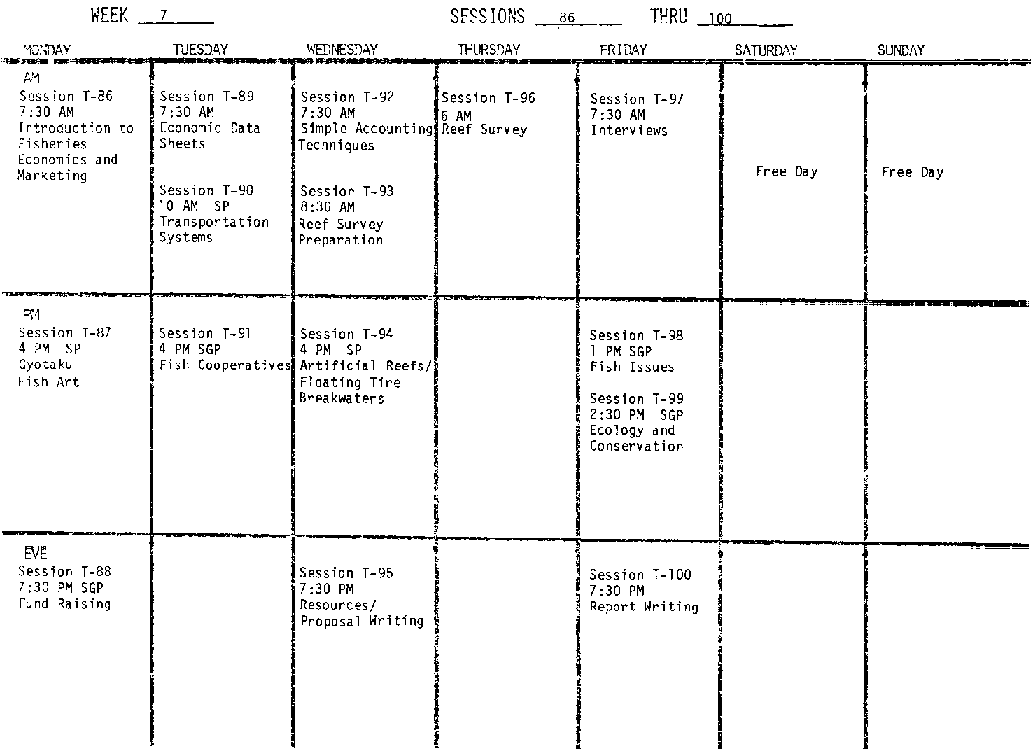
Week 7, Sessions 86 Thru
100
Session T-86: Introduction to fisheries economics and marketing
Time: 7:30 AM
Goals:
· For trainees to become aware of the various economic activities in which small-scale fishermen are involved
· To bring the individual volunteer's role as a development worker into perspective
· For trainees to become knowledgable of the basic components in the decision-making process and procedures necessary to make a sound decision
Overview:
This session begins by explaining the basic economic concepts fishermen must contend with in their daily lives. Possible solutions are brought out, and the role of the fisheries extensionist as an agent of change is discussed. The decision making apparatus is explored, and its economic relationship to the fishermen is discussed - as well as the logical five-ate? process to better decision making.
Exercises:
1. Fishery Economics/Economic Activities:
a. definitions of
economic activities (see appendix 1);
b. natural fisheries (see appendix
2);
c. economic treadmill (see appendix 3).
2. Development Role Play
3. Decision-Making in Fishery Economics
Materials:
· flip chart, markers, handouts, Appendix 1, 2, 3
Trainer's Note:
We felt it was important to keep the human perspective when dealing with economics. We kept in mind that trainees would be transferring basic economic/marketing skills to people who would not be impressed with flow charts, graphs or analysis tables.
References:
· The Fisherman's Business Guide Smith, Fred. Oregon State University
Press. Corvallis, Oregon 97331
EXERCISE 1 - Fishery Economic Activities
Total Time: 2 Hours Goal 5
· To give definitions of
economic activities
· To help trainees
understand basic concepts of economics
Overview:
In this session trainees are exposed to the basic concepts of fish economics. The general economic condition of small-scale fishermen is the focus.
Materials:
· flip charts, markers, tape, Appendix 1, 2, and 3 drawn on flip chart paper
Procedures
|
Time |
Activities |
|
15 Minutes |
1. Talk on economic activities (using flip chart drawing of appendix 1) |
|
|
a. definition of economics |
| |
b. production and services |
| |
c. consuming and using |
| |
d. costs of production, market availability |
|
10 Minutes |
2. Natural Fisheries. Technical trainer uses flip chart drawing of appendix 2, and covers the following topics: |
| |
a. artisinal |
| |
b. industrial |
| |
c. needs of artisinal fisheries development |
| |
d. cash income for increased standard of living; production of protein |
|
10 Minutes |
3. Technical trainer now asks trainees for questions they may have. Points out that this is a western economic concept. Asks trainees how they think these concepts may be in conflict with cultures they are going to work in Trainer lists replies on newsprint. |
|
15 Minutes |
4. Technical trainer now continues with Economic Treadmill using appendix 3 drawn on flip chart paper. |
| |
a. what is a treadmill - beast of burden inside going nowhere |
| |
b. artisinal fishermen are caught up in an economic treadmill benefiting others more than themselves |
| |
c. fish merchant prospers |
| |
d. ice plant owner prospers |
| |
e. engine Salesmen prosper |
| |
f. fuel agent prospers |
| |
g. fishermen stay the same, remain at bottom of social scale in terms of income, housing, education, health care |
| |
h. money advanced by merchants or money lenders to keep boat, gear, in repair |
| |
i. interest rate is so high, by the time money is repaid for a loan, fishermen need another loan to carry them through |
| |
Trainer points out that once western economics/marketing, fishing technology and equipment are Introduced to developing countries, western economic problems are introduced at the same time. |
|
10 Minutes |
5. Technical trainer returns to newsprint of conflicts generated during step 3. Given these conflicts and the economic realities presented in step 4, what are the possible solutions to the dilemma? |
|
10 Minutes |
6. Technical trainer responds to solutions on news print and goes into the following: |
| |
Role of Fisheries Extensionist |
| |
a. cooperative marketing |
| |
b. injection of credit with easier repayment |
| |
schedules |
| |
c. improvement on productivity |
| |
d. improved catch quality |
|
10 Minutes |
7. Trainees are asked to list on paper how they, as fisheries extensionists, envision becoming part of the solution. |
|
35 Minutes |
8. The trainees now form into small groups, share their lists, and on flip chart paper list what they think are the most feasible solutions that an extensionist can be part of. These are presented to larger group. |
|
5 Minutes |
9. Technical trainer responds to small group presentations, and leads into next exercise. |
APPENDIX 1: FISHERY ECONOMICS
Introduction
Economic Activity
Every person has his own
definition for Economics:
Economics affects our everyday life in many ways;
what we eat, where we live, where we work, what we do in our spare time.
All
these above examples are economic activity.
Any act of producing or servicing
a product is an economic activity:
Fish farming, building, teaching.
In
the same way any act of consuming or using a service is an economic activity:
Buying, transporting, learning.
We can now see that fishing, fish farming,
transporting fish, buying fish, are all economic activities.
In Economics we
look at the costs of production and availability of markets.
NATURAL FISHERIES
In Natural Fisheries we look at two levels of fishing:
A. Artisanal i.e. low scale
B. Industrial i.e. large
scale
- here bigger boats, more crews and sophisticated gear are used
We will concentrate on artisanal fisheries since they need extension work.
There are two kinds of artisanal fisheries:
(a) Subsistence Fishing - only interested in catching fish for the pot
(b) Commercial Fishing - concerned with earning income
Just like in other types of fishing there are subsistence fishermen and commercial fishermen and we must try to encourage more subsistence fishermen to become commercial fishermen so they will (1) earn a higher income and gain a better standard of living and (2) produce valuable protein which will improve the health of the whole population.
So for both fishermen and fish farmers it is important to encourage the motivation for a higher income.
All of us want to exchange something we produce with other items to consume. This is very difficult. We cannot say how many bags of rice are worth a pair of shoes.
Therefore we use money. Our money is dollars and cents. We sell fish for $15.00. We buy a pair of shoes.
Economists look at fish mainly as a food product. Fish is popular because it tastes good, it gives plenty of protein, it normally is cheaper than meat. All these points make up the demand for fish.
APPENDIX 3
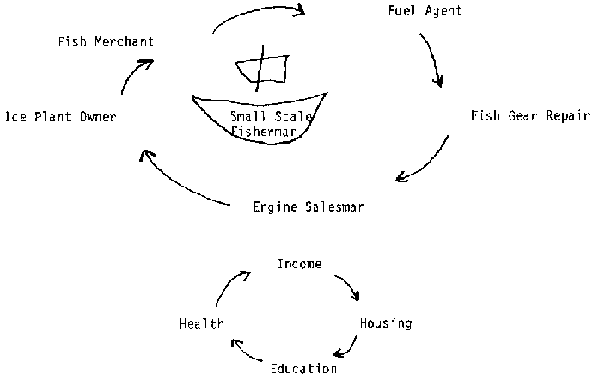
Economic treadmill
EXERCISE 2 - Development Role Play
Total Time: 1 1/2 Hours
Goals:
· To introduce different points
of view about development
· For trainees to
envision possible frustrations they will have as a PCV
· For trainees to conceptualize different strategies
that could be used in development work
Overview:
In this exercise trainees try to conceptualize their role as a PCV, the possible frustrations that could arise around economic issues, and strategies that they could employ to overcome resistance to development.
Materials:
· flip charts, markers, Development Story
Trainer's Note:
Immediately after Exercise 1, trainer asks for two volunteers to do a role play for this exercise. The two volunteers are given 15 minutes to prepare before exercise starts.
Procedures
|
Time |
Activities |
|
15 Minutes |
1. Trainees present role play. |
|
15 Minutes |
2. Trainer asks the following questions posted on newsprint: |
| |
a. What would you have done differently? |
| |
b. What was the development worker really trying to do? |
|
20 Minutes |
3. Trainees break into two or three groups and prepare their own role plays based on previous discussion. (role plays 5 to 8 minutes) |
|
20 Minutes |
4. Trainees present skits. |
|
3 Minutes |
5. Trainer processes each skit. |
|
15 Minutes |
6. Trainer asks if trainees can envision frustrations they might have as development workers. Trainer has trainees get in touch with the feelings that were generated during role play. Lists the feelings on newsprint. |
DEVELOPMENT STORY
There is the old story about a fisheries expert with an international development organization who was extremely keen to promote increased fish production and improve the economic status of subsistence fishermen. He was walking the beach on a South Pacific atoll one calm, sunny morning when he came across an islander sitting under a palm tree, obviously relaxing and letting the world go by. There was a fine looking small runabout with an outboard motor anchored a short way offshore so the expert struck up a conversation that went something like this:
"Good morning. Is that your runabout out there?"
"Good morning. Yes it is."
"Do much fishing with it?"
"Not too much. Only what I need for the family and to sell a few fish to pay for petrol."
"Well look here. I know a village a couple of miles down the coast that is always short of fish so there is a good market, and if I were you I'd go into fishing full time to satisfy that market."
"Why should I? I really don't have to fish full time."
"But man, look what you could do for your family with some extra cash. You could buy them better clothing, some luxury items, provide your children with better education - there's really no limit on what you could do to improve your standard of living."
"O.K. Suppose the money does start coming in and my standard of living improves, what happens then?"
"Well, in time you could probably afford a larger boat and spend more time catching fish, and perhaps employ some of your people to fish with you."
"Alright. What happens then?"
"Well, after more time you will probably pay off the boat, start a savings account, and eventually you will be able to enjoy a comfortable retirement."
"So what do you think I'm enjoying now?"
At the risk of committing heresby, one would be less than honest not to admit that there are times when the islander's philosophy is much more appealing than our own.
EXERCISE 3 - Decision-Making in Fishery Economics Total Time: 1 Hour
Goals:
· To make trainees aware that
decision-making is an important part of business management
· For trainees to understand the procedures in making a
logical decision; the five-step process
Overview:
Trainees as extensionists, will have to present data to help others make decisions. They need to be clear about their own participation in this decision-making process.
Materials:
· flip chart, markers
Procedures:
|
Time |
Activities | |
|
10 Minutes |
1. Trainer makes opening remarks |
a. What is decision-making? |
| |
and asks the following questions: |
b. How does it work? |
| |
|
c. Is decision-making a necessity in a fishing environment? |
| |
Trainees respond to questions and discuss premises. | |
|
10 Minutes |
2. Technical trainer presents the |
a. make observation and obtain ideas |
| |
following five steps in decision- |
b. analyze your observations |
| |
making: |
c. make the decision - yes or no |
| | |
d. take action |
| |
|
e. accept responsibility |
|
25 Minutes |
3. Trainees break into small groups and come up with a process by which they can work with fishermen to use the five steps in decision-making. They list process on newsprint and present to large group. | |
|
10 Minutes |
4. Trainer comments on each presentation, pointing out areas that are clearly working with someone and areas that are doing something for someone. It must be clear that local fishermen must make their own decisions. | |
|
5 Minutes |
5. Trainer wraps up session by talking |
a. the fisherman as a businessman |
| |
briefly about: |
b. fishing as a business |
| | |
c. decisions which face a businessman |
Link to future session.
Session T-87: ''Gyotaku'' fish art special project
Time: 4 PM
Goals:
· For trainees to learn the
step-by-step process of Gyotaku, or Japanese fish art
· For trainees to think about ways of income generation
for fishing families, i.e. arts and crafts
·
For trainee assigned this project to be able to transfer skills and technology
to others
Overview:
This session is a special project. Trainee presents this project as an income generating technique which can be passed on to fishing families, women's groups, youth groups and fishing associations.
Procedures
|
Time |
Activities | |
|
2 Hours |
1. Trainee gives brief history of Gyotaku. | |
| |
2. Trainee demonstrates |
a. wipe all excess moisture from the fish, using paper towels |
| |
Gyotaku techniques as |
b. clear the gills and the anus of any residue, and stuff cotton into the anus |
| |
follows: |
c. set the fins so that they will be clearly defined in the print; do this by inserting pins at the base of the spines until they are erect (you'll have to poke around for the right spot) |
| | |
d. apply the paint (or speed ball ink) to the fish, making sure it isn't too runny |
| | |
e. place the paper lightly on the fish letting it adhere to the fish (if the paper wrinkles to the touch it has absorbed too much) |
| | |
f. remove the paper very carefully so that it does not tear one fish can produce many prints. Gyotaku can be used on T-shirts as well as paper. |
Materials:
· Flip chart, markers, several fish of various sizes, ink (speed ball is best), alcohol, cotton, long pins, cloth/paper towels
Trainer's Note:
During pilot program we had trainees make graduation invitations during this session.
| |
3. Trainees now all try their hand at producing Gyotaku prints. |
Gyotaku
fish
Session T-88: Fund raising - special group project
Time: 7:30 PM
Goals:
· To introduce possible fund raising ventures applicable to those countries where trainees will be working
· To provide opportunity for trainees assigned to the special group project to build on communication technology transfer skills
Overview:
This session is done as a special group project by trainees. The SPG leader researches and presents as many forms of fund raising/income generating projects as possible. The importance of locally-raised funds is emphasized, since outside money is not regarded as belonging to the community; "ownership" of a project may be questioned. Fund raising of entirely local money may take much longer than ever anticipated, but the project would then be by the community - for the community.
Materials:
· flip chart, markers
Procedures:
|
Time |
Activities | |
|
30 Minutes |
1. Trainee leader gives orientation |
a. traditional income generation |
| |
to fund raising: |
b. non-traditional income generation |
| | |
c. women, youth, fishing groups d. cultural considerations e. other |
|
15 Minutes |
2. Trainees brainstorm various income generation/fund raising activities. Group leader makes list on newsprint. | |
|
30 Minutes |
3. Trainees present various schemes for fund raising, using props or visual aids. | |
Session T-89: Economic data sheets
Time: 7:30 AM
Goals:
· For trainees to become acquainted with a profit analysis format that they will be able to use when working with small-scale fishermen
Overview:
In this session trainees become conversant with Marine Economic Data Sheets and their purposes.
Materials:
· Marine Economic Data Sheet, flip chart, markers
Procedures:
|
Time |
Activities | |
|
30 Minutes |
1. Technical trainer introduces Marine Economic Data | |
| |
Sheet using following outline: | |
| |
What are Marine Economic Data Sheets? | |
| |
a. MEDS are single-sheet summaries of costs and returns for different types of marine businesses - commercial fishing, boatyards, charter fishing and marinas. | |
| |
MEDS have these purposes: | |
| |
a. to illustrate a proper profit-analysis procedure that can be used in a fishing business | |
| |
b. to provide costs and returns data for comparison with other fishermen's costs and returns | |
| |
c. as an indicator of potential profitability in a marine business | |
|
|
Presentation of sample chart on newsprint (see appendix 1) | |
| |
a. explanation of each section: | |
| |
- boat, equipment and fishery | |
| |
- gross returns | |
| |
- variable costs | |
| |
- fixed costs | |
| |
- opportunity costs operator labor and management | |
| |
- opportunity costs total business involvement | |
| |
- return to operators labor, management and total investment | |
| |
- return to operators labor and management | |
| |
- return to total investment | |
| |
- net cash available | |
|
15 Minutes |
2. Discussion of sample MEDS |
a. How could it be modified for use in developing countries. |
| |
|
b. Would this information be useful to small-scale fishermen |
|
30 Minutes |
3. Trainees are now broken into small groups of 3-4 and asked to develop their "own" MEDS, one which they perceive would be beneficial in-country. They will report back to the large group. | |
|
20 Minutes |
4. Trainee groups present "low-tech" MEDS to entire group. Technical trainer comments about points brought out and possible points missed. | |
|
30 Minutes |
5. Technical trainer now extracts key elements from each groups MEDS and "builds" a low-tech model which all trainees have an interest in. |
|
|
10 Minutes |
6. Wrap-up by technical trainer. Trainees are asked to write down finished MEDS. | |
APPENDIX I
ASTORIA SALMON GILLNET FISHING BUSINESS
Boat
30 feet by 10 feet, fiberglass hull, $33,000 market value, 330 hp gasoline engine.
Equipment
Hydraulic net reel, 7 floating nets, 2 diving nets, CB, fathometer.
Fishery a/
54 days fishing coho and chinook salmon, production of 7 tons (14,000 pounds) at an average price of $2,820 per ton ($1.41 per pound).
|
Gross Returns | |
|
Salmon |
$19,740 |
|
(1) Total gross returns |
$19,740 |
|
Variable Costs b/Boat and engineer repair |
$800 |
|
Gear repair |
$6,616 |
|
Fuel |
$1,936 |
|
Transportation |
$980 |
|
Food |
$1,170 |
|
(2) Total variable costs |
$11,502 |
|
Fixed Costs c/Insurance |
$500 |
|
Depreciation |
$1,650 |
|
Drift rights maintenance |
$825 |
|
Licenses |
$220 |
|
Union dues |
$110 |
|
Miscellaneous |
$348 |
|
(3) Total fixed costs |
$3,653 |
Understanding and Using Marine Economics Data Sheets
This report explains the purpose and use of Marine Economics Data Sheets. The explanation begins at the right and continues on page 4. Pages 2 and 3 illustrate both sides of a Marine Economics Data Sheet and describe its parts.
by Frederick J. Smith Extension Marine Economist Oregon State University
Oregon State University
Extension Marine Advisory
Program
A Land Grant / Sea Grant Cooperative
Special Report 500 November
19
Capt Mark is a Charleston shrimp
boat, similar to the one described in Marine Economics Data Sheet SR 500-20,
shown and explained on pages 2 and 3.
What are Marine Economics Data Sheets?
Marine Economics Data Sheets (MEDS) are single-sheet summaries o costs and returns for different types o marine businesses - commercial fishing, charter fishing, marinas, and boatyards. MEDS have been a service of Oregon State University's Extensio Marine Advisory Program since April 1969. All MEDS have a similar format and general plan, even though the costs and returns vary considerably.
MEDS have these purposes:
to illustrate a profit-analysis procedure that you can use in your own business;
to provide costs and returns data for comparison with your own costs and returns; and
to indicate the potential profitability of different marine businesses.
Is the information accurate?
The National Marine Fisheries Service and various universities have conducted studies of "sample" marine businesses. Some MEDS use the results of these studies. Most MEDS are based on studies conducted by the Marine Advisory Program staff, especially for the purpose of developing MEDS.
From three to six local marine business managers are selected on the basis of their knowledge, success and similarity among their businesses A MAP staff person then interviews the group, obtaining a consensus on each of the items the planned MEDS will illustrate. These and other marine business managers then review draft. of the MEDS to verify accuracy.
Data developed in this manner represent only the business involved. However, since the marine business managers participating in the studies are usually more successful than the average, MEDS usually represent an above-average marine business in all aspects.
For each MEDS, the data source is indicated in a footnote
1. Boat, equipment, and fishery
Each MEDS gives first the physical description and market value of business equipment and property. Depending on the nature of the marine business, volume of sales, and production, this item also provides effort expended and expected prices.
2. Gross returns
This is the total value of all goods and services sold, before any deductions.
3. Variable costs
These include all costs that vary as the volume of the business varies. The value of unpaid family labor [excluding the operator) is included, as is the net cost of labor (crew). Some costs, such as equipment and repair, may not vary exactly with the volume of business but are included under the "Variable costs" category for simplicity.
4. Fixed costs
These are all costs that remain constant, regardless of the volume of business. Interest on any debt is not included in this category as it is considered under item 7, "Opportunity costs: Total investment."
5. Opportunity costs:
Operator labor and management
This is the estimated value of the operator's time, or the amount the operator could have earned managing and working in another, similar business. The manager gives up this salary because it is the manager's own business. Therefore, it is an opportunity cost.
6. Opportunity costs:
Total business investment
This is the estimated fair return (interest) to the total investment, regardless of actual debt.

Marine Economic Data Sheet SR 500
20 (Front)
7. Return to operator's labor, management, and total investment
This is what the owner/operator earned for the time, skill, risk, decision-making, and money invested in the business. All costs have been covered except costs of the operator's labor, management, and total investment.
8. Return to operator's labor and management
This is what the operator earned for the time, skill, risk, and decision-making he invested in the business. Ail costs (including opportunity costs of total business investment) except the operator's labor and management have been covered.
9. Return to total Investment
This is what the total investment earned in the business. All costs except the opportunity cost of investment have been covered This can be compared with item 6 above "Opportunity costs: Total business investment," in measuring the financial success of this business.
10. Net cash available for personal outlays and debt service
Depreciation and interest are added back to "Return to operator's labor, management, and total investment," as calculated above (item 7). This is not a measure of profitability but a measure of this business' ability to meet cash needs.
11. Footnotes
These explain the technicalities of some of the costs, and they provide other necessary supporting information.

Charleston Shrimp and Crab Fishing
Business (Back)
Now do you use your MEDS?
Study the breakdown of the sample MEDS provided on pages 2 and 3 of this report. Note the organization o' costs and returns. Note, too, that this arrangement is not appropriate for tax reporting or crew settlement.
Once familiar with the way MEDS work, you will find it useful to develop similar information and analysis of your own marine business. This new information and the MEDS can be used in the following way:
1. Compare your costs with those shown on the MEDS. Are some of yours too high?
2. Take your costs and returns data, and the MEDS, to your lender. Can you get better credit terms?
3. Use your costs and the MEDS to determine "break-even" prices.
4. Use MEDS to project profit or loss for a new boat, new fishery, etc.
MAP is here to help you
Your Extension marine agent can provide further assistance, and he will usually have other publications that will be useful to you.
There are four Extension marine advisory offices on the Oregon coast (listed here from north to south):
Astoria 97103 Clatsop County Extension Office Post Office (P.O. Box 207) phone: (503) 325-7441, ext. 50
Tillamook 97141 Tillamook County Extension Office Courthouse phone: (503) 842-5511, ext. 372
Newport 97365 Lincoln County Extension Office Courthouse (225 W. Olive) phone: (503) 265-5376
Coquille 97423 Coos County Extension Office 290 N. Central phone: (503) 396-3121, ext. 242
SR 500 is a revision of SG 24, November 1973, by the same author.
Extension Service, Oregon State University, Corvallis, Henry A. Wadsworth, director. This publication was produced and distributed in furtherance of the Acts of Congress of May 8 and June 30, 1914. Extension work is a cooperative program of Oregon State University, the U.S. Department of Agriculture, and Oregon counties. Extension's Marine Advisory Program is supported in part by the Sea Grant Program, National Oceanic and Atmospheric Administration, U.S. Department of Commerce.
Extension invites participation in its activities and offers them equally to all people, without discrimination.
Session T-90: Transportation systems - special project
Time: 10 AM
Coals:
· To acquaint trainees with different transportation systems and the problems associated with them in developing countries
· For trainees to develop strategies for alleviating transportation bottlenecks, particularly those affecting the marketing of food produce from rural areas to population centers
· For the trainee assigned the special project to build on communication/technology-transfer skills
Overview:
One of the major problems that marine fisheries extensionists will face in their programs are transportation bottlenecks which hinder the flow of fish (fresh, smoked, dried) to markets. In some cases, PCV's may need to lay the ground work by identifying middlemen to transport fish from rural areas to population centers (i.e. taxi drivers, truckers, etc.); PCVs may also need to seek out inland markets with potential demand for processed fish. In this session, trainees look at their role as catalysts in boosting outside demand for their communities' fish products.
Materials:
· flip charts, markers, tape
Procedures:
|
Time |
Activities |
|
10 Minutes |
1. Trainee assigned the special project delivers a short lecture on the importance of good transportation systems for the successful marketing of quality fish products. |
|
40 Minutes |
2. Trainee acts as facilitator and divides the large group into groups of four or five. Each group is assigned a transportation system, either land or water. The small groups identify problem areas within each system, and possible solutions. Groups report out to the large group. Trainee turns session over to technical trainer. |
|
15 Minutes |
3. Trainer processes the group report outs, drawing on own personal experiences and knowledge of transportation and marketing problems in developing countries, Trainer emphasizes the volunteer's role as a catalyst in boosting outside demand for their communities' fish products. |
|
5 Minutes |
4. Trainer draws closure to the session, linking back to the extension and community analysis sessions. |
Trainer's Note:
For a large training group, it may be better for the trainee assigned the special project to write up specific land or water problems for each group, and have the group identify possible solutions.
Session T-91: Fish cooperatives special group project
Time: 4 PM
Goals:
· To become familiar with
cooperatives
· To become familiar with the
functions of a cooperative
· To become
familiar with the organizational prerequisites of a cooperative
Overview:
This session is to be done as a special group project by trainees. The importance of cooperatives throughout the developing world should be stressed in this session. By tying in the marketing and economic needs of a small fishing community the trainees get a clearer picture of the needs for cooperatives.
Materials:
· flip chart, markers
Procedures:
|
Time |
Activities | |
|
1 Hour 30 Minutes |
1. Trainee leader offers introduction using following outline: | |
| |
A. Introduction - What are examples of some cooperatives? |
|
| |
B. The cooperative principle | |
| |
C. Functions of a fishery cooperative | |
| |
D. Organizing cooperatives |
- Needs or wants to be provided? |
| | |
- Potential profitability? |
| | |
- Volume of business to be expected? |
| | |
- Money required to operate, organize the cooperative? |
| | |
- Managerial requirements. |
| | |
- Can the cooperative be profitable? |
| |
E. Initial capital can be obtained in many |
- Membership stock |
| |
ways |
- Preferred stock |
| |
|
- Borrowing from a bank |
| | |
- Membership fee |
| |
F. The Board |
- Operation of long range planning |
| | |
- Policy making body |
| |
F. The Manager |
- Day to day operation of cooperative |
Trainer's Note:
This is a group project. It is up to the trainee leader to cover all material and involve other team members.
References:
· Peace Corps, ICE, Resource Packet #5
EXTENSlON MARINE ADVISORY PROGRAM
S. G. Number
19
Commercial Fishing Publication
Organizing and Operating
A fishery cooperative one
Part
One
By FREDERICK J. SMITH EXTENSION SPECIALIST, MARINE ECONOMICS OREGON STATE UNIVERSITY
The organization and operation of a successful fishery cooperative requires a knowledge and understanding of cooperative management and marketing concepts.
This publication provides information about cooperative organization, management, and legal instruments used in organizing and operating a cooperative. It is available in two parts. This portion, part one, provides an overview of cooperative organization and operation. Part two provides greater detail about the legal instruments and requirements of a fishery cooperative.
Questions or suggestions about fishing cooperatives should be directed to the Oregon State University marine economics extension specialist, Department of Agricultural Economics, Oregon State University, or to any of the marine extension agents in Oregon.
Part two (S. G. Number 19a) of this publication is available from Bulletin Mailing Services, Oregon State University, Corvallis, Oregon 97331.
THE COOPERATIVE PRINCIPLE
A fishery cooperative consists of a group of individual fishermen acting together for mutual benefit and is designed to accomplish group objectives. Through the cooperative members jointly perform or obtain services which individuals usually could not accomplish alone.
Fishermen members own the cooperative by owning capital stock or by paying membership fees Each member usually has only one vote, in contrast to non. cooperative corporations In a non-cooperative corporation, votes are based upon the number of shares (stock) held by an individual
Therefore, in a cooperative, ownership and control are equally vested in each cooperative member, guaranteeing equal voice in the affairs of the organization Management is usually placed in the hands of persons selected by the board of directors who, in turn, are elected by members.

A cooperative consists of a group of
Individual fishermen acting together to accomplish group objectives.
The cooperative can be incorporated or organized as an unincorporated association. If the unincorporated association is used, it can be further organized under one of the following:
"i. General partnership - A partnership is an association of two or more persons who engage in business for profit. Each partner may bind his co-partner to obligations of the business and each partner is personally liable for business debts.
2. Limited partnership - This is the same as a general partnership except the liability of one or more partners is limited.
An incorporated cooperative has the advantage of providing limited liability to members, providing a business life independent of the individual members', and encouraging a more business-like organization and operation.
Fishery cooperatives must incorporate under state laws, but they can utilize the protective provisions of the Federal Fishery Cooperative Marketing Act of 1934 in their interstate and foreign commerce activities. This protection is gained through the assistance of the National Marine Fisheries Service of the U. S. Department of Commerce. The provisions of this Act require the cooperative to provide one vote per member, eight percent maximum dividend payment on capital stock, and that the cooperative's business with non-members be less than with members.
The organizing fishermen should obtain copies of state statutes regulating the establishment of a cooperative and a corporal-ion and should employ the services of an attorney and a certified public accountant - one preferably familiar with cooperative law and taxation. A simple mistake in organization or accounting procedures can cause problems in operations. Part two of this publication provides some sample fishery cooperative by-laws.
Once the initial capital requirements are determined, there are three ways to obtain the necessary capital. The initial capital may be provided by members who buy stock (shares) in the cooperatives - or it can be provided from membership fees. In addition, capital may be obtained from outside sources (nonmembers) by sale of preferred stock or by borrowing a portion of the required initial capital. Capital is also frequently borrowed from cooperative members as well as nonmembers.
When determining the initial capital requirements, allowance should be made for at least a year or more of operation with costs exceeding revenues. (It usually takes some time for the cooperatives to get established and develop efficient operating procedures.) Therefore, it is necessary that more capital than required for the initial buildings, inventory, equipment, land purchases, and normal operating needs must be provided.
The board of directors is the range planning and policy making body of the cooperative. The salaried manager is responsible for the day to day and week to week decisions, and is accountable to the board of directors, who represent the fishermen members.
Election of the board of directors is regulated by the cooperative by-laws, but they are usually fellow fishermen elected by members at annual meetings.
The board is responsible for hiring the manager, defining his duties, and setting his salary. The board is also responsible for such things as audit of the cooperative's books, execution of purchase, and sales agreements with members. The board creates and has control of special committees dealing with such things as finance and membership.
The manager is placed in charge of business operations. He controls the daily flow of funds and is accountable to the board of directors for those funds. The manager maintains records and periodically presents a business report to the board of directors and the cooperative members. He also has full responsibility for cooperative employees. The manager of a fishery cooperative must be a man of many talents and should be paid accordingly.
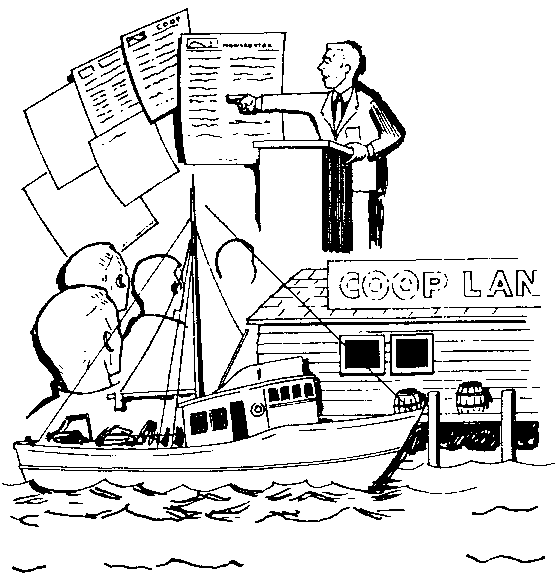
Good membership and public relations
should be established and maintained It the cooperative is to be successful.
The creation of a fishery cooperative must be based upon a real economic need. For example, cooperatives may be created to:
stabilize income from season to season,
improve quality control,
pool funds to finance fishing operations at lower interest rates,
reduce cost of fishing supplies and equipment,
transport fish products more efficiently,
establish a competitive market for fish products,
provide a market for processing waste, and
provide special harbor and dockside facilities and services.
A single cooperative may perform a number of different functions or may specialize in just one. For example, the more than 75 fishery cooperatives in the United States presently perform one or more of the following functions:
transportation of fish products to processors or other markets,
operation of vessel servicing stations,
operation of vessel repair shops,
rental of trucks and other equipment to members,
negotiation with buyers on prices,
marketing of member's products,
purchasing of supplies and equipment for members,
arranging for financing,
operation of retail outlets,
operation of freezer and cold storage warehouses,
provision of docking facilities, and
operation of seafood processing plants.
In most states there are very few limitations on the functions of a fishery cooperative. However, the functions must be legal.
ORGANIZING A COOPERATIVE
Interested fishermen should thoroughly discuss their common problems and needs. If the fishermen can agree on some common objectives that can be accomplished best by cooperative effort, they should then clearly define the purpose and functions of the proposed cooperative.
From this group of fishermen, a smaller group can proceed to investigate whether it would be economically sound to organize a cooperative with the desired functions and investigate the procedures of establishing a cooperative.
Much assistance can be obtained from the Cooperative Extension Service, Oregon State University Sea Grant Marine Advisory Program, National Marine Fisheries Service, Small Business Administration, some local attorneys, accountants, and financial institutions.
The smaller study group should find at least partial answers to the following questions:
What services do fishermen need or want in their particular geographical area that are not now being provided adequately by existing business?
What is the potential profitability of providing such services to fishermen?
What volume of business can be expected?
How much money will be required to organize and operate the cooperative?
What are the managerial requirements of operating the cooperatives?
Can competition be met and the cooperative remain profitable over an extended period of time?
Answers to these questions will assist the larger group of interested fishermen in deciding whether to go ahead and organize a cooperative.
It is important to remember that a cooperative is a non-profit business only from the legal and accounting standpoint. A cooperative will surely fail if it does not provide services of economic value and its costs are greater than its revenues.
When it has been determined that a cooperative should be organized and its services are identified, consideration should then be given to its legal, capital, and operational structure. The fishery cooperative must organize under state laws and comply with the provisions of the Federal Fishery Cooperative Marketing Act of 1934.

A cooperative must guard against
hiring a manager from the membership simply because he's a good fellow and needs
a job!

This information is published by
Oregon State University as part of the Department of Commerce National Oceanic
and Atmospheric Administration Sea Grant Program.
Cooperative Extension work in agriculture and home economics, Lee Kolmer, director, Oregon State University and the U.S. Department of Agriculture, cooperating. Printed and distributed in furtherance of the Acts of Congress of May and June 30, 1914.
A 1970 survey of seven successful fishery cooperatives showed that, with one exception, the selection of the manager was the key element in the success of a fishery cooperative, and all surveyed indicated that business experience and business management ability was the key to being a good manager.
Although fishing knowledge is useful and should be acquired by any person managing a fishery cooperative, the cooperative must guard against hiring a manager from among the membership primarily because he is a good fisherman, or even because he is a poor fisherman but a good fellow and needs a job! The same survey also indicated that the board of directors should give the manager enough authority so that he can successfully exercise his managerial ability.
A regular audit and periodic financial reports and analysis of the cooperative are a crucial part of operation. These records will indicate the financial success of the cooperative from one time period to the next, give an indication of the efficiency of the operation, and provide information for more effective control of the organization's activities.
In many cases, the cooperative will be competing with large, aggressive, and well managed private firms that specialize in processing, marketing, and selling supplies and services. The fishery cooperative, on the other hand, depends heavily on the voluntary support of members, and occasionally a contribution of some members' time (serving on committees or the board of directors), and members' capita!. The benefits of the cooperative must more than offset the negative effect of these contributions upon the members' first business - fishing. Therefore, an efficient and financially successful cooperative is not an "extra," it is a necessity!
A marketing cooperative may use a variety of methods to pay members who deliver fish. These include:
Outright purchase plan - Under this arrangement, the fisherman is paid the current market price at time of delivery.
Pool payment plan - A plan whereby all catches are delivered to the cooperative and each fisherman is paid on the basis of the average prices over each pooling period for each pool.
Direct payment plan - The terms of each sale are arranged by or subject to approval of the cooperative.
The outright purchase plan usually causes less confusion. The pool payment plan is especially beneficial when landings are seasonal and of mixed species, or the marketing is erratic over an extended time period. The direct payment plan allows the cooperative to evaluate the market situation and cooperative financial picture before payments are finally made to fishermen.
The disposition of profit at year end depends on whether the cooperative is stock or non-stock. For a stock corporation cooperative, dividends are first distributed to preferred stockholders and then to common stockholders. The balance may then be returned to patrons based upon their rate of patronage. Adequate reserves must be maintained within the cooperative, not only to meet emergencies, but to provide for business expansion.
Another important factor in operating a fishery cooperative is membership relations. An educational program that will keep membership informed of cooperative policy, financial condition, and operational and personnel changes will contribute much to cooperative success. In addition, procedures should be established to keep the cooperative in close touch with the current and changing needs of members. Cooperative members are not only the primary investors, they are also the patrons. They are, in fact, the cooperative, and it succeeds only to the extent that the members are committed to the cooperative's success.
Session T-92: Simple accounting techniques
Time: 7:30 AM
Goals:
· To introduce simple accounting
techniques
· For trainees to learn to read
and use simple accounting forms
Overview:
The use of Marine Economic Data Sheets and the simple accounting forms introduced in this session are all that is necessary to set-up a fishery station and operate it efficiently with adequate record keeping.
Materials:
· Flip charts, markers, copy of Accounting Formats, Fish Stock Analysis (see Appendix 1 and 2)
Procedures:
|
Time |
Activities |
|
5 Minutes |
1. Technical trainer starts session by reviewing MEDs. |
|
15 Minutes |
2. Presents simple accounting format as follows: |
| |
a. Income |
| |
b. Unpaid accounts |
| |
c. Accounts paid |
| |
d. Summary |
|
10 Minutes |
3. Trainer introduces fish stock analysis format: |
| |
a. Incoming Stock |
| |
b. Outgoing Stock |
|
30 Minutes |
4. Trainer now passes around sample forms. Gives trainees information based on fictitious fishing operation. Trainees put information in proper places. Trainer checks for accuracy. |

Appendix 1
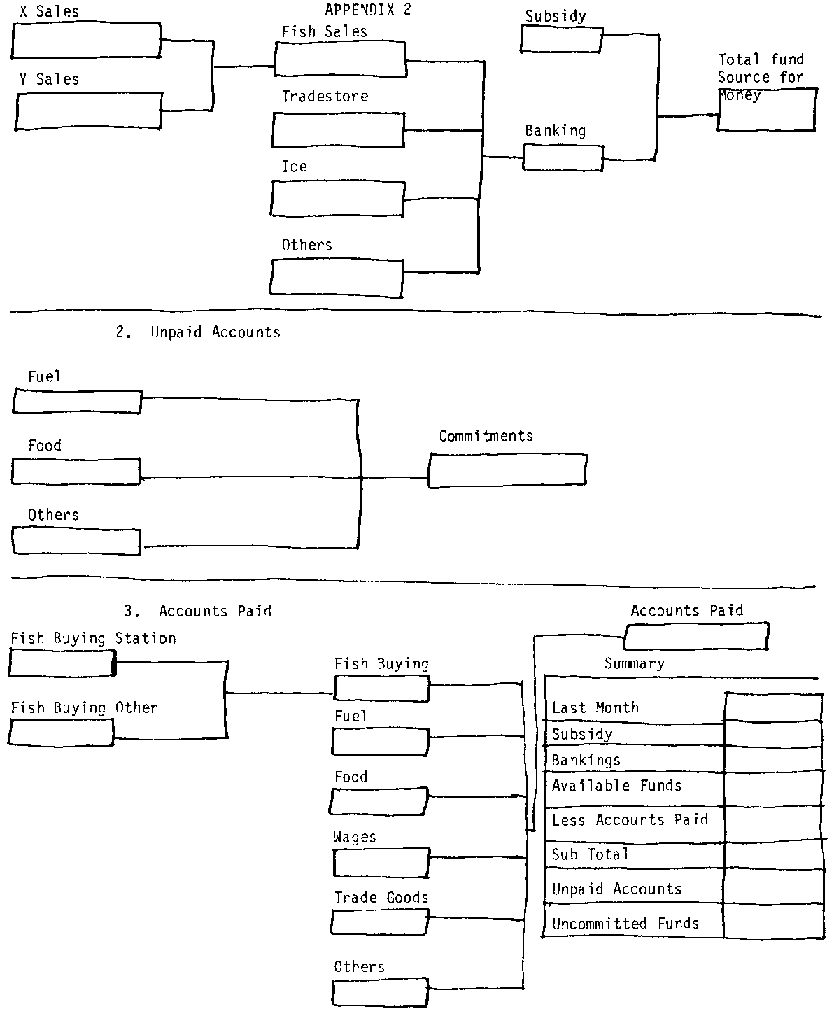
Appendix
2
Session T-93: Reef survey preparation
Time: 8:30 AM
Goals:
· To provide orientation to
coral reefs and the marine flora and fauna
·
To acquaint trainees with skin diving/snorkeling techniques and the buddy
system
· To acquaint trainees with the
necessary preparation details essential to a reef dive and survey
Overview:
This session is the preliminary to session 96. An orientation is essential as most trainees are not familiar with open water skin diving/ snorkeling. Also, the trainees should be aware of associated dangers whenever working on a reef system. A special emphasis is placed on the necessity of the buddy system when diving. A theme of safety is a requirement for this session.
Materials and Equipment:
· Flip chart, markers, masks, snorkles, fins, marine flora/fauna identification guides Procedures:
|
Time |
Activities |
|
2 Hours |
1. Technical Trainer gives presentation using following outline posted on flip chart paper: |
| |
A. Reef survey preview |
| |
- Departure time early enough to travel to reef area, dive and return |
|
|
- Type of diving snorkel only (for safety considerations) |
| |
- Personal gear |
| |
PFD, proper clothing, gloves, hat, sunglasses, tennis shoes, knife, swim suit with t-shirt, mask, snorkel, fins, dive knife/tool, sun block lotion (NO SPEARGUNS OR SPEARS ALLOWED) |
| |
- Food to prepare protein types water fruits |
| |
- Miscellaneous first aid kit ice, ice box |
| |
- Assigning of groups to prepare food miscellaneous ice box/ice |
| |
- Orientation to Coral Reef flora and fauna dangerous marine organisms poisonous and toxic marine fish (see Session T-51) |
| |
- Skin diving/snorkeling prerequisite to diving equipment buddy system |
|
|
- Survey skills ability to recognize and identify coral types, reef fishes, other marine animals locate and identify beche-de-mer (Sea cucumbers) (see SPC Booklet on South Pacific Beche-de-mer) check reef area for dead, dying corals from siltation, identify other ecological damage |
Session T-94: Artificial reefs and floating tire breakwaters - special project
Time: 4 PM
Goals:
· To enlighten trainees regarding the design and function of artificial reefs and floating tire breakwaters
· To construct an artificial reef
· To provide technical transfer and workshop skills to the trainee conducting the session
Overview:
This session is done by a trainee as a special project. The protection of estuarine habitats is becoming an important consideration in developing countries.
Materials and Equipment:
· Flip charts, markers, used tires, monofillament twine, knives, handsaw
Procedures
|
Time |
Activities |
|
2 Hours |
1. Trainee gives presentation on floating tire breakwaters and their uses. |
|
|
2. A scale model of a floating tire breakwater may be constructed if materials and time permits |
| |
3. Trainee gives a presentation on artificial reefs, habitat development and possible construction materials. |
| |
4. A construction project utilizing used tires for an artificial reef is conducted by the trainee. Ample materials for all trainees' involvement and understanding is a prerequisite. |
Trainer's Note:
During pilot program, local fishermen assisted trainees in the construction of tire breakwater and artificial tire reef structures, and utilized them afterwards. References:
· Ross, N. University Rhode Island, Narragansett, R.I. 02882 USA
URI Peace Corps Training Program

Floating tire breakwater
Goodyear Design
For more information write: Neil Ross, University of Rhode Island, Narragansett, R.I.. 02882, USA
Session T-95: Resources/proposal writing
Time: 7:30 PM
Goals:
· To restate the importance of
local resources so that trainees can register this approach again
· To identify local resources, where to find them, how
to approach them
· To identify national and
international resources and look at how best to approach them
· To acquaint trainees with the elements of a well
presented proposal
Overview:
This session reinforces previous extension and community analysis learnings by once again stressing the concepts of community self-reliance and the importance of relying on local resources when initiating community projects. As important as a new bridge or well might be for the long term welfare of a community, equally important is the degree of local 'capacity-building' that results. Could the community build another bridge or well without the volunteer's assistance? As a result of the bridge or well, has the ability of individuals and communities to identify and seek out their own problem-solving information, learning needs and resources been strengthened? This session explores the implications of bringing in outside resources and the where, who and how of locating funds and writing small grants proposals.
Materials:
· Article by E.F. Schumacher, Catalogs, guidelines, newsletters from funding sources for display and perusal by trainees
Procedures:
|
Time |
Activities |
|
30 Minutes |
1. The trainer gives a lecture on resources using the following outline posted on newsprint. |
| |
A. Do you really need outside help? |
| |
o Have you exhausted local solutions? |
| |
o What are the implications of outside help? |
| |
- dependency |
| |
- non-support of local potential (capacity building) |
| |
- creativity |
| |
B. If you really need help: |
| |
o What resources are available? |
| |
- financial |
| |
- material |
| |
- technical |
| |
o What sources? |
| |
- Local private: clubs, service organizations, professional associations, churches, etc. government: local, national |
| |
- National |
| |
- International USAID, Peace Corps (ICE, Partnership Program), CARE, Catholic Relief Services, FAO, World Bank, IITA, etc. |
| |
C. Elements of a good proposal: |
| |
o A clear description of the problem. |
| |
o A description of the proposed solution. |
| |
o A statement of what is needed in terms of funds. |
| |
o A simple budget showing the items to be purchased. |
| |
o The name of the organization to whom the grant is to be made. |
|
20 Minutes |
2. Trainer passes out a short excerpt from E.F. Schumacher's Small is Beautiful. Trainees take 20 minutes to read the article. |
|
30 Minutes |
3. Trainees break into their country-specific groups and are told to put on newsprint those points from the article which will most likely have impact on their own programs. Groups report out to the large group. Trainers relate personal experiences from their own programs in developing countries. |
|
10 Minutes |
4. Trainer draws closure to the session by again stressing the importance of capacity-building goals as an integral part of any community project. |
Trainer's Note:
Draw comparison between 'capacity-building' and Schumacher's 'evolution' before trainees read the excerpt Development.
References:
· Forestry Training Manual
DEVELOPMENT by E.F. Schumacher (from: Small is Beautiful) A British Government White Paper on Overseas Development some years ago stated the aims of foreign aid as follows:
To do what lies within our power to help the developing countries to provide their people with the material opportunities for using their talents, of living a full and happy life and steadily improving their lot.
It may be doubtful whether equally optimistic language would be used today, but the basic philosophy remains the same. There is, perhaps, some disillusionment: The task turns out to be much harder than may have been thought - and the newly independent countries are finding the same. Two phenomena, in particular, are giving rise to world-wide concern - mass unemployment and mass migration into cities. For two-thirds of mankind, the aim of a "full and happy life" with steady improvements of their lot, if not actually receding, seems to be as far away as ever. So we had better have a new look at the whole problem.
Many people are having a new look and some say the trouble is that there is too little aid. They admit that there are many unhealthy and disrupting tendencies but suggest that with more massive aid one ought to be able to overcompensate them. If the available aid cannot be massive enough for everybody, they suggest that it should be concentrated on the countries where the promise of success seems most credible. Not surprisingly, this proposal has failed to win general acceptance.
One of the unhealthy and disruptive tendencies in virtually all developing countries is the emergence, in an ever more accentuated form, of the "dual economy," in which there are two different patterns of living as widely separated from each other as two different worlds. It is not a matter of some people being rich and others being poor, both being united by a common way of life: It is a matter of two ways of life existing side by side in such a manner that even the humblest member of the one disposes of a daily income which is a high multiple of the income accruing to even the hardest working member of the other. The social and political tensions arising from the dual economy are too obvious to require description.
In the dual economy of a typical developing country, we may find fifteen percent of the population in the modern sector, mainly confined to one or two big cities. The other eighty-five percent exists in the rural areas and the small towns. For reasons which will be discussed, most of the development efforts goes into the big cities, which means that eighty-five percent of the population are largely bypassed. What is to become of them? Simply to assume that the modern sector in the big cities will grow until it has absorbed almost the entire population--which, is of course, what has happened in many of the highly developed countries--is utterly unrealistic. Even the richest countries are groaning under the burden which such a maldistribution of population inevitably imposes.
In every branch of modern thought, the concept of "evolution" plays a central role. Not so in development economies, although the words "development" and "evolution" would seem to be virtually synonymous. Whatever may be the merit of the theory of evolution in specific cases, it certainly reflects our experience of economics and technical development. Let us imagine a visit to a modern industrial establishment, say a great refinery. As we walk around in its vastness, through all its fantastic complexity, we might well wonder how it was possible for the human mind to conceive such a thing. What an immensity of knowledge, ingenuity, and experience is here incarnated in equipment! How is it possible? The answer is that it did not spring ready-made out of any persons mind-it came by a process of evolution. It started quite simply, then this was added and that was modified, and so the whole thing became more and more complex. But even what we actually see in this refinery is only, as we might say, the tip of the iceberg.
What we cannot see on our visit is far greater than what we can see: The immensity and complexity of the arrangements that allow crude oil to flow into the refinery and ensure that a multitude of consignments of refined products, properly prepared, packed and labelled, reaches innumerable consumers through a most elaborate distribution system. All this we cannot see. Nor can we see the intellectual achievements behind the planning, the organizing, the financing and marketing. Least of all can we see the great educational background which is the precondition of all extending from primary school to university and specialized research establishments, and without which nothing of what we actually see would be there. As I said, the visitor sees only the tip of the iceberg; there is ten times as much somewhere else, which he cannot see, and without the "ten", the "one" is worthless. And if the "ten" is not supplied by the country or society in which the refinery has been erected, either the refinery simply does not work or it is, in fact, a foreign body depending for most of its life on some other society. Now, all this is easily forgotten, because the modern tendency is to see and become conscious of only the visible and to forget the invisible things that are making the visible possible and keep it going.
Could it be that the relative failure of aid, or at least our disappointment with the effectiveness of aid, has something to do with our materialist philosophy which makes us liable to overlook the most important precondition of success, which are generally invisible? Or if we do not entirely overlook them, we tend to treat them just as we treat material things--things that can be planned and scheduled and purchased with money according to some all-comprehensive development plan. In other words, we tend to think of development, not in terms of evolution, but in terms of creation.
Our scientists incessantly tell us with the utmost assurance that everything around us has evolved by small mutations sieved out through natural selection. Even the Almighty is not credited with having been able to create anything complex. Every complexity, we are told, is the result of evolution. Yet our development planners seem to think that they can do better than the Almighty, that they can create the most complex things at one throw by a process called planning, letting Athene spring, not out of the head of Zeus, but out of nothingness, fully armed, resplendent, and viable.
Now, of course, extraordinary and unfitting things can occasionally be done. One can successfully carry out a project here or there. It is always possible to create small ultra-modern islands in a pre-industrial society But such islands will then have to be defended, like fortresses, and provisioned, as it were by helicopter from far away, or they will be flooded by the surrounding sea. Whatever happens, whether they do well or badly, they produce the "dual economy" of which I have spoken. They cannot be integrated into the surrounding society, and tend to destroy its cohesion.
We may observe in passing that similar tendencies are at work even in some of the richest countries, where they manifest as a trend toward excessive urbanization, toward "megalopolis", and leave, in the midst of affluence, large pockets of poverty-stricken people, "drop-outs," unemployed and unemployables.
Until recently, the development experts rarely referred to the dual economy and its twin evils of mass unemployment and mass migration into cities. When they did so, they merely deplored them and treated them as transitional. Meanwhile, it has become widely recognized that time alone will not be the healer. On the contrary, the dual economy, unless consciously counteracted, produces what I have called a "process of mutual poisoning," whereby successful industrial development in the cities destroys the economic structure of the hinterland, and the hinterland takes its revenge by mass migration into the cities, poisoning them and making them utterly unmanageable. Forward estimates made by the World Health Organization and by experts like Kingsley Davies predict cities of twenty, forty and sixty million inhabitants, a prospect of "immiseration" for multitudes of people that staggers the imagination.
Is there an alternative? That the developing countries cannot do without a modern sector, particularly where they are in direct contact with the rich countries, is hardly open to doubt What needs to be questioned is the implicit assumption that the modern sector can be expanded to absorb virtually the entire population and that this can be done fairly quickly. The ruling philosophy of development over the last twenty years has been: "What is best for the rich must be best for the poor." This belief has been carried to truly astonishing lengths, as can be seen by inspecting the list of developing countries in which the Americans and their allies and in some cases also the Russians have found it necessary and wait to establish "peaceful" nuclear reactors--Taiwan, South Korea, Philippines, Vietnam, Thailand, Indonesia, Iran, Turkey, Portugal, Venezuela--all of them countries whose overwhelming problems are agriculture and the rejuvenation of rural life, since the great majority of their poverty-stricken peoples live in rural areas.
The starting point of all our considerations is poverty, or rather, a degree of poverty which means misery, and degrades and stultifies the human person; and our first task is to recognize and understand the boundaries and limitations which this degree of poverty imposes. Again, our creduly materialistic philosophy makes us liable to see only "the material opportunities" (to use the words of the White Paper which I have already quoted) and to overlook the immaterial factors. Among the causes of poverty, I am sure, the material factors are entirely secondary-such things as a lack of infrastructure. The primary causes of extreme poverty are immaterial; they lie in certain deficiencies in education, organization, and discipline.
Development does not start with goods; it starts with people and their education, organization and discipline. Without these three, all resources remain latent, untapped, potential, There are prosperous societies with but the scantiest basis of natural wealth, and we have had plenty of opportunity to observe the primacy of the invisible factors after the war. Every country, no matter how devastated, which had a high level of education, organization, and discipline, produced an "economic miracle". In fact, these were miracles only for people whose attention is focused on the tip of the iceberg. The tip had been smashed to pieces, but the base, which is education, organization and discipline was still there.
Here, then, lies the central problem of development. If the primary causes of poverty are deficiencies in these three respects, then the alleviation of poverty depends primarily on the removal of these deficiencies. Here lies the reason why development cannot be an act of creation, why it cannot be ordered, bought, comprehensively planned: Why it requires a process of evolution. Education does not "jump") it is a gradual process of great subtlety. Organization does not "jump"; it must gradually evolve to fit changing circumstances. And much the same goes for discipline. All three must evolve step by step, and the foremost task of development policy must be to speed this evolution. All three must become the property not merely of a tiny minority, but of the whole society.
If aid is given to introduce certain new economic activities, these will be beneficial and viable only if they can be sustained by the already existing educational level of fairly broad groups of people, and they will be truly valuable only if they promote and spread advances in education, organization, and discipline. There can be a process of stretching--never a process of jumping.
If new economic activities are introduced which depend on special education, special organization, and special discipline, such as are in no way inherent in the recipient society, the activity will not promote healthy development but will be more likely to hinder it. It will remain a foreign body that cannot be integrated and will further exacerbate the problem of the dual economy.
It follows from this that development is not primarily a problem of economists, least of all for economists whose expertise is found on a crudely material philosophy. No doubt, economists of whatever philosophical persuasion have their usefulness at certain stages of development and for strictly circumscribed technical jobs, but only if the general guidelines of a development policy to involve the entire population are already firmly established.
The new thinking that is required for aid and development will be different from the old because it will take poverty seriously. It will not go on mechanically, saying: "What is good for the rich must also be good for the poor." It will care for people - from a severely practical point of view. Why care for people? Because people are the primary and ultimate source of any wealth whatsoever. If they are left out, if they are pushed around by self-styled experts and high handed planners, then nothing can ever yield real fruit.
Session T-96: Reef survey
Time: 6 AM
Goals:
· To provide fundamentals in coral identification, reef fish identification and coral reef topography
· To allow trainees the opportunity to acquire basic snorkeling/ diving techniques
· To acquaint trainees with survey techniques in which to properly assess the carrying capacity of a given reef in as short a time as possible
Overview:
This session is particularly useful to the marine fisheries PCV. They have a need to understand the dynamics of change affecting coral reefs. For the PCY to be able to survey a reef for potential exploitation of underutilized fish species and assess the carrying capacity is also important. In addition, the role of the PCV as a coral reef ecologist providing extension workshops on conservation to fishing communities, underutilized species exploitation or implementation of artificial reefs will greatly assist the development of small-scale fisheries in the PCV specific country.
Materials and Equipment:
· Flip chart, markers, diving gear (mask, snorkel, flippers, diving knife/tool, storage bag) small boat 8-12 feet with outboard, or large Diesel vessel for bigger group.
Trainer's Note:
This session can be supplemented with tie-ins to other small-scale fishing sessions. Orientation to Poisonous/Toxic Marine Fish- Special Project should be conducted prior to this session.
Procedures:
|
Time |
Activities |
|
12 Hours |
1. The following areas are covered during reef survey: |
| |
a. introduction to surveys |
| |
- visual sightings |
| |
- classification of marine life |
| |
b. orientation to coral reefs |
| |
- corals identification |
| |
- reef fishes identification |
| |
- coral reef topography |
| |
c. equipment (snorkeling) |
| |
- hardware |
| |
- software |
| |
d. survey of a living coral reef |
| |
- buddy system |
| |
- group system |
| |
e. survey of a dying/dead coral reef |
| |
- analysis of cause |
| |
- solutions |
| |
f. data aquisition |
| |
- visual |
| |
g. potential markets |
| |
- underutilized species |
| |
- processing |
Trainer's Notes:
Care should be taken to insure an adequately stocked first aid kit, innertubes for diver floats, and fresh drinking water. Most trainees will be entering an environment which is new to them, an environment with hidden dangers, i.e. sea urchins, coral cuts, shark menace, sunburn--the list goes on. Caution and safety must be stressed at all times. Again, spearguns and spears should not be allowed on the trip.
Session T-97: Interviews
Time: 7:30 AM
Trainer's Note:
Although throughout training, net mending and interviews have been conducted simultaneously during this session we have deliberately omitted net mending. Our experience has been when trainees have been out on the boat for long periods of time, i.e. reef survey, they are extremely tired the next day.
Interviews are conducted the same as in previous interview sessions.
Session T-98: Fish issues - special group project
Time: 1 PM
Goals:
· To look at fishing issues that marine fisheries extensionists may encounter in their work, particularly those involving the local economy and local and international politics
· To look at various approaches and methods that a marine fisheries extensionist can use to raise the consciousness of a community and assist them in dealing with fishing issues
· To look at specific approaches and methods for different audiences i.e., a fishermen's cooperative, government officials, officials from an international organization, such as FAO
· For the trainee assigned the special project to build on leadership, communication and technology transfer skills.
Overview:
The local economy of many third world fishing communities is being adversely affected by the advanced fishing technology of trawlers from developed countries fishing off their coastal waters. This issue and other issues, such as tribal and family fishing rights, are often very politically-charged. Marine Fisheries PCVs may come face to face with one or more of these issues. In this session, trainees look at various approaches to dealing with these issues at the local, national and international level, approaches which are appropriate to the PCV development worker. Trainers have the opportunity as well in this session to relate personal experiences and knowledge of these issues.
Materials:
· flip chart, markers
Procedures:
|
Time |
Activities |
|
15 Minutes |
1. Trainee assigned the special group project gives a mini-lecture on current fishing issues in developing countries, particularly as they relate to the local economy and local and international politics. The difficulties PCVs and other "outsiders" encounter in dealing with these issues at the community level is also discussed. |
|
1 Hour |
2. Trainees assisting the group project leader give three presentations: each presentation is directed at a different "audience", i.e., a fishermen's cooperative, government officials, a village meeting; and a different fishing issue is the topic of the presentation. After each presentation, the group project leader processes the points made and the approach used, and gives trainees a list of suggestions for working with that particular audience. |
|
5 Minutes |
3. Trainee group leader draws closure to session by linking back to extension and community analysis sessions. |
Trainer's Note:
As in the session on ecology and conservation issues, the training program may or may not have access to country-specific fishing issues. It's important to keep in mind that the major learnings of this session are not the issues, but rather the approaches used in presenting these issues to particular audiences.
References:
· Marine Fisheries Case Studies, Peace Corps.
Session T-99: Ecology and conservation - special group project
Time: 2:30 PM
Goals:
· To look at ecology and conservation issues that marine fisheries extensionists may encounter in their work
· To look at various approaches and methods that a marine fisheries extensionist can use to raise the consciousness of the community around ecology and conservation issues
· To look at specific approaches and methods for different audiences, i.e., a women's group, school children, fishermen's cooperative, etc.
· For the trainee assigned the special project to build on leadership, communication and technology transfer skills
Overview:
There are many problems associated with good ecology and conservation practices in developing countries which trainees need to be aware of: many ecology issues are complex and abstract; good practices may conflict with the livelihood of local fishermen; ecology and conservation problems are often "invisible"; and the government may be indifferent. In this session, these issues and problems are discussed, and trainees look at ways ecology issues could be presented to a community. Trainers also have an opportunity to talk about their own experiences in developing countries, and to point out that until the basic needs of third world people are met, good ecology and conservation practices have little chance of succeeding.
Materials:
· flip chart, markers
Procedures:
|
Time |
Activities |
|
15 Minutes |
1. Trainee assigned the group project asks trainees to define ecology and conservation. Trainee then gives a mini-lecture on current areas of concern: marine fisheries ecology and conservation-related issues. The difficulties in introducing good environmental practices are also presented to the group. |
|
1 Hour |
2. Trainees assisting the group project leader give three presentations: each presentation is directed at a different "audience", i.e. women, trap fishermen, school children; and a different ecology issue is the topic of the presentation. After each presentation, the group project leader processes the points made and the approach used, and gives trainees a list of suggestings for working with that particular "audience." |
|
5 Minutes |
3. Trainee group leader draws closure to session, linking back to previous sessions on extension, WID and community analysis. |
Trainer's Note:
The training program may or may not have access to country-specific ecology and conservation issues. It's important to keep in mind that the major learnings of this session are not the issues, but rather the approaches used in presenting these issues to particular audiences.
Sample report developed during pilot program follows:
TEACHING ECOLOGY AND CONSERVATION Papua New Guinea * Sierra Leone * Tonga
Introduction
1. What is ecology?
Ecology is the study of the intraspecific and interspecific interactions of organisms in and with their environment and the interactions of environmental elements with each other. Ecological problems are generally problems of imbalance.
2. What is conservation?
Conservation is the preservation, management and/or wise use of resources. Conservation involves careful planning. Conservation problems are generally problems of exploitation.
3. What areas of concern may be confronted in marine fisheries work?
Overfishing of particular species (i.e. lobster in Puerto Real, bonga in Sierra Leone) and/or areas (i.e. within the barrier reef in Tonga). Destruction of habitat - pollution of harbors and estuaries by silt, sewage and agricultural run-off. Destruction of reefs by suffocation (silt), lysis (fresh water) and extraction for use as building material. Conflict of usage (i.e. fish productivity vs fuel consumption in mangrove estuary). Deforestation (silting, erosion). Introduction of exotic species which results in imbalance. Introduction of environmental policy/management concepts.
4. What are some problems of introducing ecology and conservation in a developing nation?
Ecological concepts are complex and abstract and may be difficult to comprehend for individuals with limited educational backgrounds. Ecologically sound conservation practices may conflict with the livelihoods of some fishermen. Ecology and conservation occupy advanced positions in the hierarchy of needs and will be of little concern to individuals who have not met their safety needs. The results of ecologically sound conservation practices are generally delayed, taking long periods of time to become apparent. The symptoms of environmental problems may be subtle. Why deal with an "invisible" problem? The government may be indifferent to problems of ecology and conservation. The source of an ecological or conservation problem may be external to a village or its resources (i.e. Japanese tuna fishing vessel). Greed runs rampant and international law is difficult to enforce.
Presentation
1. The extensionist meets a group of village women while fetching water at the well. She discovers that their husbands, the local fishermen, are having difficulty catching bonga, a popular variety of fish, but are catching large quantities of trigger fish, a variety which, at present, is not marketable. She explains that if they can develop a market for trigger fish (by filleting it or preparing it in a desirable manner) and sell all the trigger fish that their husbands catch, they can make more money and leave more "room" in the water for bonga.
Suggestions for working with women:
a. Tie concepts into their daily lives and activities: family, making money, etc.
b. Remember high illiteracy rates and low levels of formal schooling.
c. Keep in mind demands on time.
d. Utilize pre-existing groups or gathering spots.
e. Elicit responses and ideas.
2. The extensionist meets informally with a group of trap fishermen who are having difficulty catching lobsters because divers from a neighboring village are exploiting the lobster population. She explains that it is important to release female lobsters with eggs and young lobsters if there are to be lobsters when their children are grown. She then facilitates the fishermen's decision to meet with the divers and to share the importance of this practice with them.
Suggestions for working with fishermen:
a. Organize fishermen - either informally or formally.
b.
Keep topics simple and relative to fisherman's daily life.
c. Discuss
benefits and drawbacks of techniques or topics to be discussed
d. Discuss
monetary gains and losses
e. Relate effects to family, both immediate and
future generations.
f. Assess time spent- both long term and short
term.
g. Review existing legislation and discuss possible legislation which
may affect fishermen and fishing.
3. The extensionist is invited to talk with a group of school children. Upon arrival, she distributes tags which bear the names of the sun, man and several organisms which live in a mangrove swamp to the children. She then shares with them the two types of webs found in a mangrove swamp: spiders' webs and food webs. To show how the food web is weakened when some of its components are eliminated, she has the children construct a "food web" using string to connect related "organisms" and then has some of the "organisms" drop their strings. To show the flow of energy through the food web, the extensionist has the children play a special variety of tag in which "organisms" tag what they eat and are tagged by what eats them. (energy is individually wrapped candies or peanuts. Plants get their energy from the sun. If an "organism" is tagged, he gives one piece of "energy" to his tagger and one to "used up energy.") Finally, she facilitates analysis of the distribution of energy by the children.
Suggestion for working with children:
a. Limit your presentation or program to just a few key ideas, and keep those ideas simple.
b. Use examples which are part of the childrens day-to-day experiences.
c. Use questioning strategies to help children formulate the desired information themselves.
d. Remember that children have short attention spans and that it is best for them to learn actively (have fun!).
e. If active learning is to take place, an informal setting is usually best. Environment is important!
f. Be aware that many of the children may have basic needs which have not been met. It is difficult to learn when you are hungry!
g. Use the children's names often.
h. Do not underestimate the importance of working with children; they are tomorrow's decision-makers.
Addendum 1. Food Web Game - Components of mangrove food web and what takes their energy:
|
Man |
Mosquito |
Oyster |
Mangrove |
|
Mosquito |
Heron |
Man |
Mosquito |
|
Crocodile |
Mullet |
Heron |
Man |
Session T-100: Report writing
Time: 7:30 PM
Overview:
The purpose of this session is for the trainees to evaluate the training program in the format of an official memorandum.
Procedures
|
Time |
Activities |
|
1 Hour 30 Minutes |
1. The trainer presents the following report format and content outline, and tells trainees to write a three to five page memorandum to a Peace Corps/Washington official, i.e. Fisheries Specialist or Director, OPD. |
Trainer's Note:
Trainer may want to suggest that trainees do a draft during the session, and hand in the final copy at the end of the next day.
SAMPLE FORMAT
Memorandum
TO: Fisheries Specialist or Director, OPD
FROM: Trainee
SUBJECT: Marine Fisheries Training Program
Content Outline
1. List out your major learnings in this training program.
2. Which dimensions of this training program will have the most impact on your success as a Peace Corps Volunteer?
3. How do you see your competence/confidence level as a marine fisheries extensionist?
4. In what ways do you feel you have met your personal learning goals for this training program?
5. The training site and facilities.
6. Other - optional.
7. Conclusion/summary of report.
|
| ||||||||||||||||||||||||||||||||||||||||||||||||||||||||||||||||||||||||||||||||||||||||||||||||||
Small-Scale Marine Fisheries - A Training Manual (Peace Corps, 1983, 631 p.)
Week 8: Training
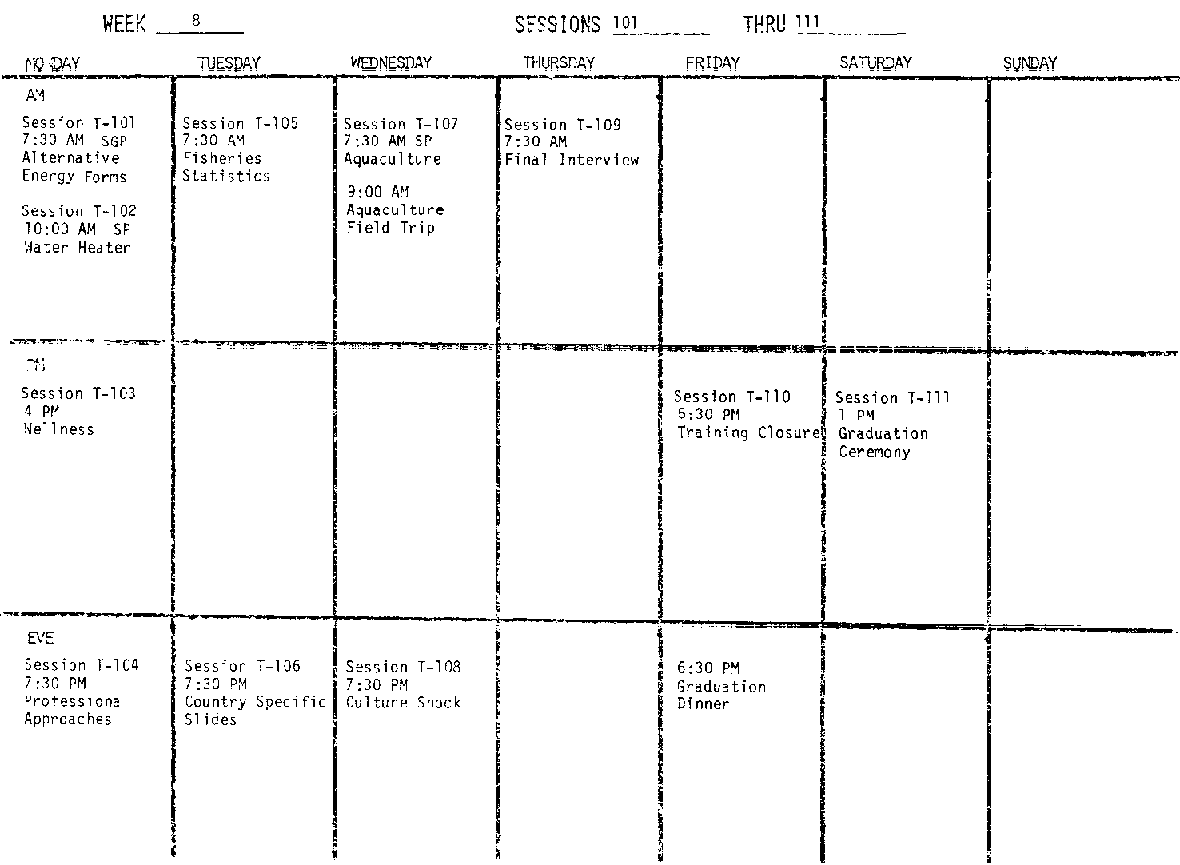
Week 8, Sessions 101 Thru
111
Session T-101: Alternative energy forms special group project
Time: 7:30 AM
Goals:
· To acquaint trainees with
alternative forms of energy
· To look at some
applications for wind, solar, biogas and other alternative energy
sources
· To identify resources for
additional information on alternative energy technologies
· To enable trainee doing the special group project to
practice and build on leadership communication/technology transfer skills
Overview:
In this session trainees become familiar with third world energy issues and current appropriate energy technologies. Trainers have the opportunity as well in this session to discuss the long and arduous hours that women in particular spend on daily household chores in developing countries chores such as collecting firewood and hauling water. The time required for those diary tasks will most likely compete directly with the interventions they as Peace Corps Volunteers will be trying to introduce. Trainers stress the value of mud stoves and other labor-saving technologies and devices as secondary project activities.
Procedures:
|
Time |
Activities |
|
2 Hours |
1. Group leader and team members present an overview of energy technologies and their degree of appropriate ness in developing countries, including water pumping wind systems, wind generators, solar dryers, solar water heaters, photo-voltaic cells, methane digesters, mud stoves and hydrams. |
|
15 Minutes |
2. Group leader and team members present a list of resources for additional information on the above, including ICE, the Appropriate Technology Sourcebook Vol I and II, and the ITDG publication list. |
References:
· A.T. Sourcebook I, II; The Chinese Biogas Manual; Lorena Stoves; How to Build a Cretan Sail Windpump; Wind and Windspinners; Simplified Wind Power Systems for Experimenters; and the ICE Publication List
ALTERNATIVE ENERGY FORMS
Why Consider alternative energy?
Fossil fuels, the most widely used energy source, are expensive, must usually be imported and are unavailable to many poorer rural communities. The importation of fossil fuels accounts for one of the major causes of balance of payment constraints for many developing countries.
Alternative energy sources such as wind, solar, water, biogas and wood can provide appropriate technologies for the village level and contribute to self sufficiency. By helping ease some of the burdensome labor of daily life, such technologies can free people's labor and energy for other aspects of the development process.
A definition of energy is the capacity to do work. A process for considering and choosing alternative energy technologies is the following:
1. Decide what type of work needs to be done, eg: heating, lifting, pumping water, cooling.
2. Consider all appropriate technologies for doing this work; include considerations of cost, availability of parts and materials, skills required for construction and maintenance and cultural preferences.
3. Conduct a detailed cost comparison between two or three specific technologies being considered.
4. Choose one plan.
5. Build the project; utilize locally available materials, skills and labor when possible.
6. Plan for ongoing maintenance and repair.
Different Types of Alternative Energy:
Wind - Coastal areas tend to have consistent winds and open unobstructed areas, thus they can be good sites for wind power. Uses of wind consistent with small-scale fisheries could include: water pumps for fish cleaning and processing, for salt making, use of sail power on boats and for generation of electricity.
Sail - Sail powered fishing boats are traditionally used in many parts of Asia, the Caribbean, and more recently on the US west coast. A modern trend is towards specially designed boats with a motor/sail combination. The more streamlined sailboat design contributes to fuel efficiency, while sails can be used in favorable winds and for emergencies.
Windmills - Pumps: windmill powered water pumps are available in designs at low cost ($600-$800) There are numerous designs which utilize cloth sails, wood propellers, and a rotor design (savonius rotor) made of a 50 gallon metal drum. (See references for details).
Electricity Generation - Highly efficient windmills with propellor type blades can be used to generate electricity. Estimated installation and construction costs run $1000 per kilowatt produced in size ranges of 0.5 - 30 kw. Some necessary considerations include power storage, conversion from DC to AC and inconsistent wind speeds.
Below is a sample cost comparison for a Diesel and wind powered electric generator.
| |
Diesel |
Wind |
|
Output |
10-20 kw |
10-20 kw |
|
cost, complete and installed |
$ 9,000 |
$23,000 |
|
Diesel fuel |
45,000 |
-0- |
|
Maintenance at$1,000 per year |
5,000 |
5,000 |
|
Cost over five years |
59,000 |
28,000 |
|
Power cost per kw/hour |
$0.20 to $0.40 |
$0.10-$0.20 |
Solar Energy - Solar energy has multiple applications at varying levels of technology, from simple water heaters or food dryers to solar refrigeration systems, heating, and electricity production by photo voltaic cells.
Food preparation - see section on fish dryer.
Water heaters - Hot water heaters for personal use can be made simply by painting a small water tank black and giving it a good exposure to the sun. More elaborate hot water systems include solar collectors which store solar energy by heating water in circulating pipes fitted into a roof panel. Industrial uses of solar heated water include pre-heating in canning and bottling industries.
Refrigeration - We have discussed the desert water bag principle of solar cooling; e.g. hanging a damp cloth bag in a breezy area, while evaporation of the water lowers the temperature inside the bag. In addition, high cost prototypes of solar refrigerators and ice plants have been developed, but are still impractical for widespread application due to cost.
Electricity - Photo voltaic cells produce electricity and require little maintenance. They are however, expensive and must be imported. Cost should come down in the future however, so these may become a practical means for producing solar electricity.
Biogas - see fish silage section for description. Diesel engines on boats can be converted to run on biogas.
Water - Small hydro dams, tidal power and water wheels all have potential applications for production of electricity and for performing mechanical work. Small dams have little ecological impact and are a very efficient means of producing hydro electricity. Where waterfalls or rivers exist, small turbines can be installed to produce low levels of electrical production (1.5 kw), or for turning water wheels. Tidal power, though not currently applicable at a low cost technology level, has possible applications through extraction by paddle wheels on floating barges in large slow moving rivers.
Wood - Efficient wood burning stoves can save many hours of labor by village women who must walk miles daily to collect fuel wood. Lorena stoves, (see reference book) provide a design for a well-insulated stove, built out of local materials which burns wood at a high level of efficiency. The design can be readily adapted to different use patterns and localities.
References:
· Intermediate Technology and Alternative Energy Systems For Small Scale Fisheries. David B. Thomson South China Seas Fisheries Development and Coordinating Programme Manila, Philippines, 1 97 9
· Appropriate Technology Sourcebook Vol 1. Ken Darrow and Rick Pam. Volunteers in Asia Publication 1981
· Appropriate Technology Sourcebook Vol II. Ken Darrow, K. Keeler and R. Pam Volunteers in Asia Pub. 1981
· Hand Book of Homemade Power, Mother Earth News 1979
· Preserving Food By Drying. Cynthia Fahy, Carl Vogel and Per Christiansen. Peace Corps Information Collection and Exchange Manual No. M-10 1980
· Bio-Gas Plant, Generating Methane From Organic Wastes and Designs With Specifications. By Ram Bux Singh, Gobar Gas Research Station, AjitMal, EtaWah (U.P.) India, 1975
· How to Build a "Cretan Sail" Windpump. R.D. Mann 1979. Intermediate Technology Publications Ltd.
· Wind and Windspinners. M. Hackleman. 1974. Peace Press, Culver City, CA.
· Simplified Wind Power Systems for Experimenters. Jack Park. 1975. Helion, Inc. Brownsville, Ca.
· A Chinese Biogas Manual. Adriane Van Buren, ed. 1976. Intermediate Technology Publications, Ltd. London
· More Other Homes and Garbage: Designs for Self Sufficient Living. Jim Leckie, Gil Masters, Harry White House, Lilly Young. 1981. Sierra Club Books, San Francisco, Ca.
· Lorena Stoves. Ianto Evans and
Michael Boutette. Aprovecho Institute. 1981. Published by Appropriate Technology
Project of Volunteers in Asia
- Rebecca Hoff, PCV Sierra
Leone
Session T-102: Water heater special project
Time: 10 AM
Goals:
· To have trainees become
acquainted with the necessary construction of a simple water heater
· To enable trainee on special project to practice
technology transfer skills and to build on communication skills.
Overview:
In this session a water heater is constructed. The purpose is to construct an appropriate technology example.
Materials and Equipment:
· Flip charts, markers, copper tubing, male-female brass fittings, 4-5 gallon steel container, flaring tool, sand, soldering torch
Procedures:
|
Time |
Activities |
|
2 Hours |
1. Trainer and trainees construct water heater together. |
Trainer's Note:
In the pilot program the technical trainer knew how to build this particular example, however any demonstration that you are familiar with will suffice.
WATER HEATER
Parts List: 1) 4-5 gallon steel drum, clean of any residue inside: chemicals, paint, oils; 2) Brass fittings/connectors (male and female) 1/2" x 3/8"; 3) Copper tubing, 7-8 feet, 1/2" x 3/8".
Tool List: 1) Cooper tubing flaring kit (to flare ends of tubing); 2) Metal punch (to make initial holes in drum); 3) Large metal punch (to increase hole size to 1/2" diameter); 4) Sand (for filling copper tubing prior to shaping loops); 5) Wrench (for tightening brass connectors); 6) log, cement pipe, metal piping, diameter 6"-B" (open end to facilitate removal of copper tubing); 7) Gas torch, brazing rod (for welding brass connectors to steel drum).
Construction of Water Heater:
Punch two holes in steel drum. Both should be centered - one 2" above the bottom of the drum, the second hole 4" above the first. Holes should have an inner diameter of 1/2"-5/8", so as to facilitate insertion of the male brass connectors prior to welding. The welding process is technical and someone skilled in it should be contacted to do the actual brazing of the brass connectors to the steel drum. The process can be done on the outside of the drum. The copper tubing will come in either straight lengths 8'-10' or coils. If tubing is coiled, it should be straightened carefully. The straightened tubing should then be filled with sand, a center point (3 1/2 feet on 7' length) located and marked. Next, the tubing filled with sand (to prevent collapse of the copper) is wrapped around the open-ended log/pipe. Step 1. Wrap the copper around the pipe, carefully holding the copper tight against the pipe. Steps 2 and 3. Continue the wrapping process taking one end of the copper tubing and carefully bending around the pipe. Step 4. Finish the bending by taking the other copper end and wrapping it so the two ends are parallel and pointing in the same direction. Step 5. Bend ends so they complete a second loop, but run parallel together away from coil. Step 6. Copper tubing is now ready to have both ends flared. Use the flaring tool kit to flare both ends. Prior to flaring, the female brass connector should be inserted onto the copper tubing. Copper tubing is now ready to be connected to the steel drum. Step 7. Attach the female connectors on the copper coil to the male connectors on the steel drum. Some adjustment of the spacing of the copper ends will be necessary. Carefully bend the copper to the required spacing and connect.
Always insure water is in the steel drum when copper coil is over a fire. Cooking can be done in the steel drum, but wire screens should be placed over the connector openings in the drum to prevent clogging of food.
Trainer's Note:
Reference should be made to the lack of adequate supplies of hot
water in rural areas of developing countries. This water heater, simplistic in
design, can be the beginnings of a cottage industry.
--Steven Martinson,
Technical Trainer, Pilot Program --Mario Teisl, PCV Papua New
Guinea
Session T-103: Wellness
Time: 4 PM
Goals:
· To enable trainees to see that
they are responsible for their wellness as volunteers
· To introduce the topic of stress and its effects on
our wellness
· To have trainees identify ways
in which they can deal with stress
Overview:
In this session trainees are asked to read article "Plain Talk" about stress, National Institute of Mental Health. They are then asked to come up with some concrete ways that they could handle stress as a volunteer.
Materials:
· article "Plain Talk" about Stress, flip chart, markers
Procedures:
|
Time |
Activities |
|
15 Minutes |
1. Trainer passes out article "Plain Talk" about Stress , asks trainees to take next 15 minutes to read article. |
|
5 Minutes |
2. Trainer now asks participants what one thing hit them about the article, records statements on news print. Trainer then makes points about stress being one of the major factors in illness and that awareness leads to prevention. |
|
20 Minutes |
3. Trainer now asks small groups to take the 10 points for living with stress, plan a strategy for using each, points to your advantage as a volunteer. List strategies on newsprint. If trainees can think of other points they should also list these. |
|
5 Minutes |
4. Small groups report back to larger group. |
|
5 Minutes |
5. Trainer points out how important it is to record these strategies In their journals and refer to them from time to time. Living and working in a new culture will be stressful, but by dealing with the stress, they will be able to turn stress into a positive force in their volunteer service. |
"PLAIN TALK" about STRESS
National Institute of Mental Health
A 19-year-old girl learns her boyfriend has been killed in an auto accident,
A businessman loses an important business deal to his competitor.
An athlete receives a first-place award for his efforts in a track event.
A 15-year-old boy approaches a girl to ask her out for the first time.
What do all of these people and situations have in common? STRESS. This may surprise you because the last two situations both involve happy events. The fact is that it doesn't matter whether the situation is pleasant or unpleasant, according to Hans Selye, M.D. What counts is the intensity of the demand it places on you to readjust. Mr. Selye, a Montreal, Canada, physician and author of several books on stress, calls these incidents "stressors."
He states that the physical reaction of the body to stress is basically the same, regardless of the stressor. Furthermore, he feels that the only complete freedom from stress is death. Humans thrive on stress because it makes life more interesting.
No matter what you are doing, you are under some amount of stress. Even while you sleep, your body must continue to function and react to the stress imposed by dreaming. Stress comes from two basic forces-the stress of physical activity and the stress of mental/emotional activity. It is interesting to note that stress from emotional frustration is more likely to produce disease, such as ulcers, than stress from physical work or exercise. In fact, physical exercise can relax you and help you deal with mental stress.
Stress or Distress
Then would it be true to assume there is no such thing as bad stress? Dr. Selye feels that there is a type of stress that can be harmful. He calls it distress. Distress is continual stress that causes you to constantly readjust or adapt. For example, having a job you do not like can be constantly frustrating, and frustration is "bad" stress. If this distress lasts long enough, it can result in fatigue, exhausting, and even physical or mental breakdown. The best way to avoid it is to choose an environment that allows you to do the activities you enjoy, that are meaningful to you. Your friends, your work, and even your future mate can be sources of challenging good stress or harmful distress.
Mr. Selye also believes that the absence of work is not necessarily a way to avoid stress. An example of this is the retired person who has nothing to do. Boredom then becomes an enemy capable of causing tremendous distress. Work is actually good for you as long as you can achieve something by doing it. It will only wear you out if it becomes frustrating because of failure or a lack of purpose.
To avoid distress, you should seek work or tasks that: a) You are capable of doing, b) You really enjoy, c) Other people appreciate.
Body Reactions to Stress
Regardless of the source of stress, states Dr. Selye, your body has a three-stage reaction to it.
Stage 1 - Alarm
Stage 2 - Resistance
Stage 3 - Exhaustion
In the alarm stage, your body recognizes the stressor and prepares for fight or flight. This is done by a release of hormones from the endocrine glands. These hormones will cause an increase in heartbeat and respiration, elevation in blood sugar level, increase in perspiration, dilated pupils, and slowed digestion. You will then choose whether to use this burst of energy to fight or flee.
In the resistance stage, your body repairs any damage caused from the stress. If, however, the stressor does not go away, the body cannot repair the damage and must remain alert.
This plunges you into the third stage-exhaustion. If this state continues long enough, you may develop one of the "diseases of stress," such as migraine headaches, heart irregularity, or even mental illness. Continued exposure to stress during the exhaustion stage causes the body to run out of energy, and may even stop bodily functions.
Since you cannot build a life completely free from stress or even distress, it is important that you develop some ways of dealing with stress.
Getting a Handle on Stress and Distress
Recognizing that stress has a lifelong influence on you, what can you do about handling it? Doctors have come up with a few suggestions on how to live with stress.
1. Work off stress--If you are angry or upset, try to blow off steam physically by activities such as running, playing tennis, or gardening. Even taking a walk can help. Physical activity allows you a "fight" outlet for mental stress.
2. Talk out your worries--It helps to share worries with someone you trust and respect. This may be a friend, family member, clergyman, teacher, or counselor. Sometimes another person can help you see a new side to your problem and thus, a new solution. If you find yourself becoming preoccupied with emotional problems, it might be wise to seek a professional listener, like a guidance counselor or psychologist. This is not admitting defeat. It is admitting you are an intelligent human being who knows when to ask for assistance.
3. Learn to accept what you cannot change--If the problem is beyond your control at this time, try your best to accept it until you can change it. It beats spinning your wheels, and getting nowhere.
4. Avoid self-medication--Although there are many chemicals, including alcohol, that can mask stress symptoms, they do not help you adjust to the stress itself. Many are habit-forming, so the decision to use them should belong to your doctor. It is a form of flight reaction that can cause more stress than it solves. The ability to handle stress comes from within you, not from the outside.
5. Get enough sleep and rest--Lack of sleep can lesson your ability to deal with the stress by making you more irritable. Most people need at least seven to eight hours of sleep out of every 24. If stress repeatedly prevents you from sleeping, you should inform your doctor.
6. Balance work and recreation--"All work and no play can make Jack a nervous wreck." Schedule time for recreation to relax your mind. Although inactivity can cause boredom, a little loafing can ease stress. This should not be a constant escape, but occasionally, you deserve a break.
7. Do something for others--Sometimes when you are distressed, you concentrate too much on your self and your situation. When this happens, it is often wise to do something for someone else, and get your mind off of yourself. There is an extra bonus in this technique--it helps make friends.
8. Take one thing at a time--It is defeating to tackle all your tasks at once. Instead, set some aside and work on the most urgent.
9. Give in once in a while--If you find the source of your stress is other people, try giving in instead of fighting and insisting you are always right. You may find that others will begin to give in, too.
10. Make yourself available--When you are bored and feel left out, go where the action is! Sitting alone will just make you more frustrated. Instead of withdrawing and feeling sorry for yourself, get involved. Is there a play or musical coming up? Chances are they will need help back stage. Get yourself back there and somebody will probably hand you a hammer or paint brush.
Reprinted with permission from CURRENT HEALTH, 501 Lake Forest Ave., Highwood, I1 60040. Further reproduction is prohibited without permission of the publisher.
Recognizing stress as an ongoing part of life may well be the first step in dealing with it. Turn stress into a positive force and let it make life more interesting.
DHEW Publication No. (ADM) 78-502 May 1977
Session T-104: Professional approaches to interaction with host country officials
Time: 7:30 PM
Goals:
· To help trainees adopt a professional demeanor when interacting with host country officials
Overview:
Through a series of role plays and the processing of those role plays, trainees will come to understand the importance of interacting professionally with host country officials.
Procedures
|
Time |
Activities |
|
1 Hour 30 Minutes |
1. Trainer introduces a series of role plays, and trainees take on roles of volunteers to practice professional interactions. |
Trainer's Note:
The important part of this exercise is the processing. Sample role plays are attached, although you may want to write your own based on actual experiences.
Sample Role Plays
1. Female PCV marine fisheries extensionist goes to see Chief Fisheries Officer with her monthly report. He's more interested in her, than in her monthly report.
2. PCV marine fisheries extensionist goes to see the Permanent Secretary for the Ministry of Agriculture and Natural Resources about a matter concerning his/her project. The meeting is constantly interrupted by telephone calls and messages. Little is accomplished.
3. PCV marine fisheries extensionist arrives at new site where he/she is to work with two experts (expatriate) with an international development agency. Their plans for the work he will be doing are much different from what the PCV had in mind. They see the PCV as a "logistics coordinator" and office assistant. (This role play emphasizes the importance of role clarification by the PCV on Day 1 of arrival at a new site.)
4. PCV marine fisheries extensionist and counterpart (i.e, Chief Fisheries Officer) admire the deep line reel the PCV and local fishermen have constructed out of scrap lumber. The Permanent Secretary arrives on an official visit to see the PCV's project, sees the deep line reel and asks the PCV if it is what American fishermen use to catch fish. The PCV tries to explain "appropriate technology" - with no support from his/ her counterpart.
2. Trainer takes part in role plays. After each role play trainer processes the experience with the trainees.
Session T-105: Fisheries statistics
Time: 7:30 AM
Goals:
· Develop a conceptual framework for understanding factors which affect fish population structure
· Review some management strategies for effective exploitation and conservation of stock
Overview:
During this session an outside lecturer is invited to review and critique methods for estimating population size, to examine factors affecting fish populations and to tell trainees how to recognize overexploitation. Lecturer will also describe creel survey design to collect essential information. Further, lecturer discusses management philosophies and different approaches. The conclusion of lecture describes difficulties of obtaining statistical data from small-scale fishermen in developing nations. At the conclusion of the lecture, trainees will have a brainstorming session of at least three procedures, using parallel experience, common sense and technical information. They will also brainstorm advantages/disadvantages of these procedures. This session concludes with a question and answer period.
Exercises:
1. Lecture/Brainstorming/Question and answers
Materials:
· Flip chart paper, markers, tape
Trainer's Note
This area is highly specialized and requires someone who is well versed in the subject, but also understands the problems involved in the collecting of statistical data from small-scale fishermen. If there is no one available with the sensitivity to present the subject from the viewpoint of a developing nation, it is best to omit session.
EXERCISE 1 - Fisheries Statistics
Procedures:
|
Time |
Activities | |
|
1 Hour |
1. Lecture by statistical expert. Outline as follows: |
|
Fishermen have been interacting with the sea for thousands of years. In their attempts to wrest a living from it, they have made influences from their observations and constructed taxonomics and theories concerning the environment of the sea and its flora and fauna. Not all conclusions may be adequate, their observations of correlations and variability within the sea are usually accurate since their livelihood depends on the ability to locate fish of specific types.
Basic Models for the assessment of fish stocks
+ the empirical
- Schaefer production model (1954, 1957)
+
analytic constant - recruitment
- Beverton and Holt model (1957)
All other models are permutations, variations, simplifications and/or improvements of the basic material.
Static procedures are primarily applicable to estimating future yields in incipient fisheries. The "dynamic" procedures are mostly for ongoing fisheries or for newly created fisheries where adequate catch, effort, and biological data exist or are obtainable.
1. Static procedures
a. Estimate catch potential from behavior of similar ecosystems for which data are available and simultaneously estimate the effort (or numbers of fishermen) that the stock can support.
b. Estimate potential catch from measurement of standing crop (with variations perhaps allowing 30 to 50% of the stock to be available for annual harvest.)
c. Estimate potential catch by application of existing, adapted or newly developed indices morphoedaphic for lakes, Inundation zone extent or floodwater volume in large rivers, etc. 2. Dynamic procedures
Use, adapt, or develop new models for maximum sustainable yield (e.g. Schaeffer, Beverton and Holt) when catch, effort and supporting biological data are available or obtainable, as in ongoing fisheries.
- Small-scale fisheries are bona fide fisheries involving the
need for resource identification, harvesting, processing, marketing and
management.
- Why are age and growth of fish important statistical data for
fishermen. What the data tells.
Criteria for validating age marks
Not all are applicable in every case.
1. Length - frequency analysis of a population sample, Peterson method.
2. Model - progression analysis in a time series of population samples.
3. Comparison with growth rates derived from tag-recapture data or growth in captivity.
4. Determination of the period and timing of mark formation. This is usually carried out by a qualitative and quantitative examination of the margin of the scales, bones, or otoliths in samples taken in different times of the year. This may require special collecting efforts.
5. Determination of the proportionability of growth of the aging structure and length or weight of the fish. Once a relationship is established and mathematically or graphically described, measurements to earlier formed time marks can be used to back calculate the growth history of individuals. A growth curve constructed from the data should approximately conform to the curve derived from ages of fish at the time of capture.
6. Comparison of ages derived from different structures, e.g. scales vs otoliths.
7. Tag and recapture studies where the calcified structure itself is also marked, using chemicals such as 45 CA (Erie, 1960) lead (Ickekawa and Hiyama, 1954) or tetracycline (Weber and Ridgeway, 1967; Jones and Bedford, 1968). Here the numbers of marks between the chemical tag and the margin is compared to the known elapsed time period. This is a powerful tool, but it requires a large effort in time, energy and money. An easier but related method simply compares the number of annual or seasonal zones on fish of known age. This may be accomplished by tag release where age is known (e.g. for young of the year) or by holding the fish in captivity of some sort. All of these techniques require relatively long periods of time before results are meaningful, and they are also subject to the various biases introduced by tagging and/or artificial confinement. William and Bedfore (1975) and Poinsad and Trooder (1966) point out an analogous validating technique which relies upon recognition of unusual zones formed in particular years. These marks may be used as a reference point for subsequent counts.
8. Comparison of the empirically derived growth curve to mathematical formulations such as non-Bertalanffy growth curve. This is only one of several possible comparisons. (Ricker, 1979). All have different biological and non-biological assumptions and a particular one will usually fit the data better than others. However widely deviant empirical patterns should be suspect.
9. Correlation of the time of mark formation with various exogenous and endogenous cycles such as temperatures, salinity, rainfall, feeding intensity, condition, or reproductive activity. Correlation will not establish a causatine relation but this method will at least help establish a biological basis for the observed periodically marked structures.
10. Establishment of objective criteria to discriminate marks; avoidance of bias by aging fish without knowing their size, and comparison between readers for consistency.
Schematic diagram showing series of steps leading to estimation of instantaneous growth rates from length-frequency data.
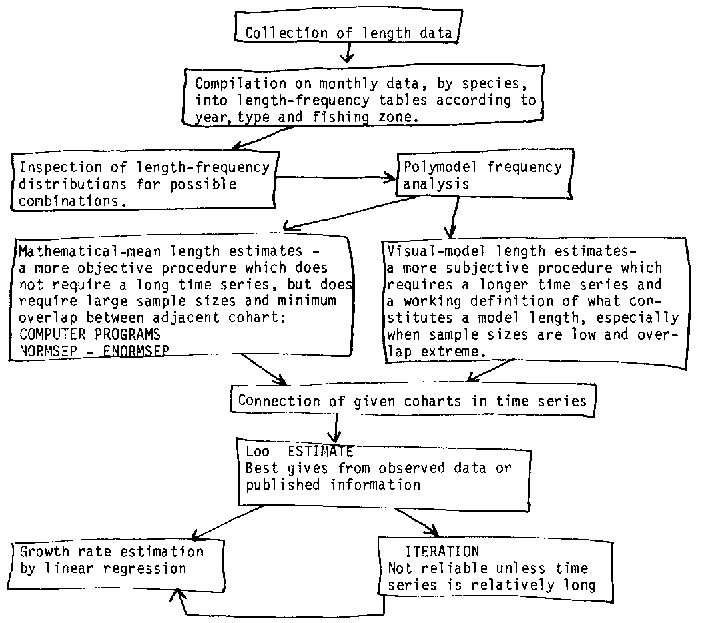
Figure
Focusing on the act of data collection, we see the need to engender trust, show clear intent, indicate utility to fishermen, use proper code (language), setting, vehicle, opinion leaders, etc. For example, research shows that local taxonomies of species are complete, complex and repeatable.
Information from fishermen can be difficult to obtain and biased. However, there is a great amount of historical information held by fishermen; it is expedient to use it.
|
1 Hour |
2. Group is now asked to break into small groups, each group takes one of the procedures described in lecture and brainstorms the following areas, putting findings on flip chart paper: |
| |
a. one of the procedures described in lecture and its possible utilization to small-scale fishermen |
| |
b. advantages/disadvantages of each including assumptions |
| |
c. equipment, personnel needed, cost - trainees should provide as much detail as possible utilizing parallel experience and common sense |
|
15 Minutes |
3. Trainees now make a list of questions to ask lecturer based on discrepancies generated during brain storming session. |
|
45 Minutes |
4. Lecturer now responds to list of questions. |
Session T-106: Country specific slides
Time: 7:30 PM
Trainer's Note:
During this session some slides that are country specific are desirable. During pilot program slides were shown with very little explanation.
Session T-107: Aquaculture special project and field trip
Time: 7:30 AM
Goals:
· To acquaint trainees with the basic principles of small-scale fish farming
· To provide trainees with enough background information on aquaculture to conduct a preliminary feasibility study for the area where they will be working
· For the trainee doing aquaculture as a special project (see Activity 1) to build on communication/technology transfer skills
Overview:
It is not expected that trainees will be ''experts" on aquaculture after this session. Rather, it is hoped that the two activities in this session will provide trainees with enough of a framework to determine if aquaculture would be technically and economically feasible in their project area.
Exercises:
1. Special Project
2. Field Trip
Materials:
· Flipcharts, marking pens
References:
· Freshwater Fisheries: Program
Planning, Peace Corps
· Freshwater Fish Pond
Culture and Management, Peace Corps
EXERCISE 1 - Special Project on Aquaculture Total Time 1 Hour
Overview:
one major purpose for this exercise, aside from it
being a special project, is for the trainees to generate a solid list of
questions - along with observations they hope to make for the field trip which
follows.
Procedures:
|
Time |
Activities |
|
15 Minutes |
1. Trainee gives a lecture on the basic principles of aquaculture, including stocking, feeding, harvesting, and fish farming economics. |
|
15 Minutes |
2. Trainee divides the group into small groups of three or four to make a list of specific questions for the field trip around stocking, feeding, and harvesting of fish and the economics of fish farming. Groups report out to large group. |
|
15 Minutes |
3. Trainee draws closure to the exercise by going back over his/her special project goals. |
|
15 Minutes |
4. Trainer links the exercise to the field trip, and concludes with transportation instructions. |
EXERCISE 2 - Aquaculture Field Trip
Total Time: 3 Hours
Overview:
In this exercise, trainees have the opportunity to visit a fish station, or a private fish farm, to see firsthand the construction-specifics of fish ponds and the irrigation requirements. In addition, trainees hear from the station manager or fish farmer about day-to-day operations, responsibilities and fish farming economics and marketing.
Procedures:
|
Time |
Activities |
|
1 Hour |
1. Question and answer period with station manager or fish farmer. |
|
1 Hour |
2. Station manager or fish farmer explains layout of station or farm, showing trainees the irrigation system, breeding ponds and feeding methods. Informal question and answer time. |
|
30 Minutes |
3. Trainer reviews what has been seen, mentioning high lights, and does linkage to past and future sessions. |
Session T-108: Culture shock
Time: 7:30 PM
Overview:
Most trainees, when they leave SST for their countries of assignment, will undergo intensive language training in-country for one or two months. It is during this period of time, as they are adjusting to a new environment and struggling with learning a new language, that they will be particularly vulnerable to culture shock. In this session, trainers have an opportunity to talk about their own experiences with culture shock.
Procedures:
|
Time |
Activities |
|
10 Minutes |
1. Trainer gives brief introduction and goes over goals. Reminds trainees that this subject has been covered before, but now they are almost ready to go to their sites for two years of volunteer service. Trainer then goes over the following stages (see attached). |
| |
2. Trainer asks trainees to break into groups of five or six and discuss each stage. The following in particular should be covered: |
|
10 Minutes |
a. ways to cope with the problems in stage two |
|
10 Minutes |
b. feelings that will be generated during stage three |
|
10 Minutes |
c. the inevitable reactions in stage four |
|
20 Minutes |
3. Trainer tells each group to now make a list on newsprint of their fears and their hopes. (i.e. to fail, to hurt people, to help others, to be successful...) |
|
20 Minutes |
4. Trainer now hands out "check list" for fears and hopes (see attached). Trainees discuss their lists using the check list. |
|
5 Minutes |
5. Each group is asked to prepare a statement to give |
|
per group |
to the large group, highlighting the small group discussion including points they would like to stress. |
|
15 Minutes |
6. Trainer now does summary of exercise, picking up points that have been raised during the presentation. Adds own experiences which are appropriate to alleviate fears that have been raised. |

The culture shock process
Check List for Fears and Hopes
1. Are the fears and hopes realistic or not? (Let's find out through concrete examples.)
2. What is the cultural dimension of each fear and hope? (From where are those fears and hopes coming?)
3. What can be done to overcome the fears if necessary and build upon the hopes?
a. The anticipated negative responses from others: are they real or imaginary?
b. The obstacles which prevent the implementation of what people wish to do but do not do.
c. The required modifications for making ideas acceptable?
Session T-109: Final interviews
Time: 7:30 AM
Goal:
· To conduct final interviews with trainees
Overview:
This is the final interview with trainees. Last chance for coaching. Trainees will definitely be praised for good work and positive skills.
Procedures:
|
Time |
Activities |
|
2 Hours |
1. Same as other interviews except trainers may choose which trainees to interview. It is suggested that those trainers with whom trainees identify most closely interview those trainees. Solid feedback should be given. Well thought out areas that trainees need to work on should be given to trainees. |
Session T-110: Training closure
Time: 5:30 PM
Goals:
· To review learnings of the
past eight weeks
· To go trainees'
expectations for training from
Session 1
· To discuss last minute
logistics for trainees' graduation ceremony and departure
· To go over the goals of training from Session
1
· To relax and have fun
Overview:
This session draws closure to the eight weeks of technical training. Trainers put back on the walls the following newsprint from Session 1 and from the orientation:
Fisheries Training Goals
Trainee expectations for technical
training
Trainee aspirations for Peace Corps service from the
Orientation
Trainee newsprint drawings from Orientation on how they see
themselves in their new communities overseas
It is important for trainers and trainees to go back over these newsprint, in order to show trainees what they didn't know when they came to Peace Corps training and what they now know. It is also a time for trainers to talk some about in-country language training, the next hurtle for trainees before they become Peace Corps Volunteers. Finally, this session is an appropriate time to go over the last minute logistics for the graduation ceremony and for trainee departure (travel money can be passed out, etc.).
Materials:
· Newsprint from Orientation:
Trainee Aspirations, Drawings by trainees of themselves
· Newsprint from Session 1:
Training goals, expectations
· flipchart and marking pens
Procedures:
|
Time |
Activities |
|
5 Minutes |
1. Trainer introduces the "agenda" for the session. Asks if any additions. |
|
15 Minutes |
2. Trainees read out their aspirations from the newsprint... their expectations for Peace Corps Training. Discuss what has been met and what hasn't. |
|
5 Minutes |
3. Trainer goes over last minute logistics. |
|
5 Minutes |
4. Trainer discusses briefly in-country language training: what it will be like. |
|
10 Minutes |
5. Trainer goes over the goals of training. |
| |
6. (optional) Graduation B-B-Q at trainers' house. Slides are shown from past eight weeks. |
Trainer's Note
It is important to re-stress during the read-out of trainees' expectations that eight weeks of training is not enough time to cover everything, We can't make them experts in Diesel mechanics or fish identification: It's up to them to make themselves experts.
Finally, closure is as important as the opening session. Regardless of how frazzled trainers are, be energetic and pleasant one more time.
Session T-111: Graduation ceremony
Time: 1 PM
Overview:
The graduation ceremony belongs to the trainees. They plan it; they line up speakers; they invite the people they wish to attend (see attached invitation from the pilot program).
One major contribution to the ceremony made by the training staff is the "Certificate of Completion". (See attached certificate from the pilot program.) This certificate is the trainees' "non-verbal credential" at their sites. It should hang on the wall of their fisheries extension office or in their house. Such certificates are extremely important in developing countries.

Certificate of Completion
Since 1961 when the Peace Corps was crested, more than 80,000 U.S. citizens have served as Volunteers in developing countries, living and working among the people of the Third World as colleagues and coworkers. Today 6000 PCVs are involved in programs designed to help strengthen local capacity to address such fundamental concerns as food production, water supply, energy development, nutrition and health education and reforestation.
Peace Corps overseas offices:
BELIZE P.O. Box 487 Belize City
BENIN BP 971 Cotonou
BOTSWANA P.O. Box 93 Gaborone
BURK INA FASO BP 537 Ouagadougou
BURUNDI BP 1720 Bujumbura
CAMEROON BP 817 Yaounde
CENTRAL AFRICAN
REPUBLIC BP 1080 Bangui
COSTA RICA Apartado Postal 1266 San Jose
DOMINICAN REPUBLIC Apartado Postal 1412 Santo Domingo
EASTERN CARIBBEAN
Including: Antigua, Barbados, Grenada, Montserrat, St. Kitts-Nevis, St. Lucia,
St. Vincent, and Dominica Peace Corps P.O. Box 696-C Bridgetown, Barbados West
Indies
ECUADOR Casilla 635-A Quito
FIJI P.O. Box 1094 Suva
GABON BP
2098 Libreville
GAMBIA, The P.O. Box 582 Banjul
GHANA P.O. Box 5796
Accra (North)
GUATEMALA 6 tat Avenida 1-46 Zone 2 Guatemala City
HAITI
c/o American Embassy Port-au-Prince
HONDURAS Apartado Postal C-51 Tegucigalpa
JAMAICA 9 Musgrave Avenue Kingston 10
KENYA P.O. Box 30518 Nairobi
LESOTHO P.O. Box 554 Maseru
LIBERIA 80x 707 Monrovia
MALAWI Box 208
Lilongwe
MALI BP 85 Bamako
MAURITANIA BP 222 Nouakchott
MICRONESIA
P.O. Box 9 Kolonia Pohnpei F.S.M. 96941
MOROCCO 1, Zanquat Benzerte Rabat
NEPAL P.O. Box 613 Kathmandu
NIGER BP 10537 Niamey
PAPUA NEW GUINEA
P.O. Box 1790 Boroko Port Moresby
PARAGUAY c/o American Embassy
Asuncion
PHILIPPINES P.O. Box 7013 Manila 3120
RWANDA BP 28 Kigali
SENEGAL BP 2554 Dakar
SEYCHELLES Box 564 Victoria
MAHE SIERRA LEONE
Private Mail Bag Freetown
SOLOMON ISLANDS P.O. Box 547 Honiara
SRI LANKA
50/5 Siripa Road Colombo 5
SWAZILAND P.O. Box 362 Mbabane
TANZANIA Box
9123 Dar es Salaam
THAILAND 242 Rajvithi Road Amphur Dusit Bangkok 10300
TOGO BP 3194 Lome
TONGA BP 147 Nuku' Alofa
TUNISIA BP 96 1002 Tunis
Belvedere Tunis
WESTERN SAMOA Private Mail Bag Apia
YEMEN P.O. Box 1151
Sana'a
ZAIRE BP 697
Kinshasa