 |
| |||||||||||||||||||||||||||||||||||||||||||||||||||||||||||||||||||||||||||
E. T. O'Dowd
ODNRI
Bulletin No. 23
Supplement to ODNRl Bulletin No. 10 - An evaluation of structures suitable for emergency storage in tropical countries
Overseas Development Natural Resources Institute
Bulletin
Published by ODNRI
The Scientific Unit of the Overseas Development Administration
© Crown copyright 1989
|
| |||||||||||||||||||||||||||||||||||||||||||||||||||||||||||||||||||||||||||
Valedictory
Sadly, the author of this bulletin, Tate O'Dowd, died just before the manuscript went to press. Tate O'Dowd was a storage engineer of many years' experience, who contributed greatly to the knowledge and application of storage technology, particularly in the developing world.
|
| |||||||||||||||||||||||||||||||||||||||||||||||||||||||||||||||||||||||||||
Acknowledgements
I wish to acknowledge the help given me by Dr Alan Mayo of the Building Research Establishment, Overseas Division, by Dr Adam Robertson, The Building and Livestock Division, AFRC, Institute of Engineering Research and by Mr B. D. Castle, the Meteorological Office, Advisory Services. Any mistakes are my own responsibility.
This bulletin was produced by the Overseas Development Natural Resources Institute which was formed in September 1987 by the amalgamation of the Tropical Development and Research Institute and the Land Resources Development Centre. ODNRI is the scientific unit of the British Government's Overseas Development Administration and is funded from the overseas aid programme. The Institute provides technical assistance to developing countries and specializes in the utilization of land resources, pest and vector management and post-harvest technology.
Short extracts of material from this bulletin may be reproduced in any non advertising, non-profit making context provided that the source is acknowledged as follows:
O'Dowd, E.T. (1989) Supplement to ODNRI Bulletin No. 10-An evaluation of structures suitable for emergency storage in tropical countries 1. Wind forces on emergency storage structures (1989). Overseas Development Natural Resources Institute Bulletin No. 23, viii + 15pp.
Permission for commercial reproduction should, however, be sought from the Head, Publications and Publicity Section, Overseas Development Natural Resources Institute, Central Avenue, Chatham Maritime, Chatham, Kent, ME4 4TB, United Kingdom.
Price £9.15
No charge is made for single copies of this publication sent to governmental and educational establishments, research institutions and non-profit making organizations working in countries eligible for British Government Aid. Free copies cannot normally be addressed to individuals by name, but only under their official titles.
Overseas Development Natural Resources Institute
ISBN 0 85954
251-3
ISSN 0952
8245
|
| |||||||||||||||||||||||||
Wind forces on Emergency Storage Structures (supplement) (NRI)
Summaries
Summary
Wind forces on emergency storage structures
The supplement aims to alert donors, designers, suppliers and users of emergency stores to the magnitude and importance of wind loads in tropical countries. This is effected by providing three-second gust speeds and the means to calculate wind loads and also some practical design aids.
R�sum�
Forces du vent sur les structures de stockage d'urgence
Ce suppl�ment a pour but d'�veiller l'attention des donateurs, concepteurs, fournisseurs et utilisateurs de magasins d'urgence sur l'ampleur et l'importance des charges de vent dans les pays tropicaux. Ceci est obtenu en cr�ant des vitesses de rafales de trois secondes et en fournissant les moyens de calculer les charges de vent, ainsi que gr�ce � divers autres dispositifs pratiques de mise au point.
Resumen
Impacto de las fuerzas e�licas sobre las estructuras de almacenamiento provisionales
Este suplemento tiene por objeto alertar a las organizaciones donantes, dise�adores, proveedores y usuarios de almacenes provisionales sobre la magnitud e importancia de las cargas e�licas en los pa�ses tropicales. Ello se consigue mediante la provisi�n de velocidades de r�fagas de tres segundos, m�todos pare el c�lculo de las cargas e�licas y sugerencias pr�cticas de dise�o.
Supplement to ODNRI Bulletin No. 10 - An evaluation of structures suitable for emergency storage in tropical countries
1. Wind forces on emergency storage structures
|
| |||||||||||||||||||||||||||||||||||||||||||||||||||||||||||||||||||||||||||
Introduction
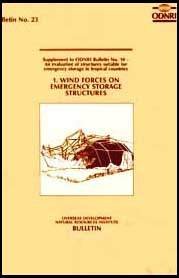
Emergencies requiring food relief are sadly a regular occurrence, especially in Africa. The various structures required to store this food have been evaluated (O'Dowd et al., 1988). Relief workers reported that although plastic-clad steel frame stores were easy to erect and relocate, this type of structure was vulnerable to wind damage (see Frontispiece). Twenty have recently been destroyed by wind in three disaster areas: Mali, Uganda and Sudan. (Hodges, 1987; Timpson, 1987; Fortman, 1987). Although open door flaps/ventilators and poor foundations certainly contributed, it is also likely that under-design was to blame; it is known that at least two manufacturers used design wind speeds suited to the United Kingdom rather than to the Sahel. Another manufacturer uses the British Standards Institution Code of Practice CP3 (1972), applicable to rigid structures, for inflatable warehouses which are flexible. In this supplement the nature of wind damage and how design procedures can be improved are examined.
|
| |||||||||||||||||||||||||||||||||||||||||||||||||||||||||||||||||||||||||||
The nature of weather
Wind is air in motion caused by horizontal pressure difference, itself caused by heating and cooling of the troposphere - the lower 11 km of the atmosphere. (Houghton and Carruthers, 1976). Horizontal temperature changes are shown on a map by isotherms; isobars indicate pressure gradients, important in estimating winds. Gravity-induced convection and the rotation of the earth are responsible for nearly all atmospheric motion; if a volume of air becomes lighter than its surroundings it will rise and start a new phase in wind. Hurricanes progress with heating from below and cooling from above.
In conditions, known as temperature inversion, where temperature increases with height, vertical air movements are damped out and, in simple terms, stability results. Normally in the troposphere temperature falls with height, the rate of fall being described as the lapse rate. The value of the lapse rate determines the stability of the atmosphere and a lapse rate calculation is shown in Appendix 1. The standard lapse rate for a semi-saturated atmosphere is 1 °C per 150 m; if the atmosphere cools any faster with height it is unstable. Such instability can lead to rapid and violent convection of air masses which in turn cause storms and associated winds. Dry rather than humid air only reaches instability over hot surfaces like roads or deserts where convection causes a shimmering effect. Conditional instability is when humid air loses moisture by condensation as rain and then behaves like dry air.
Winds are common over hot deserts, and are caused by the rise of warm air which finds its way through the cooler air above it; a special case is the dust devil. Its larger relative is the tornado, a storm whose surface winds cause severe structural damage. Wind forces in tropical climates are frequently dangerously high. This movement of air and the forces it exerts are the subjects discussed next.
|
| |||||||||||||||||||||||||||||||||||||||||||||||||||||||||||||||||||||||||||
Wind forces
Air flow in wind is laminar and/or turbulent. Laminar flow implies little exchange of mass between different layers, while turbulent flow has such exchange with resultant Reynolds or shearing stresses. Figure 1 below contrasts laminar with turbulent flow.
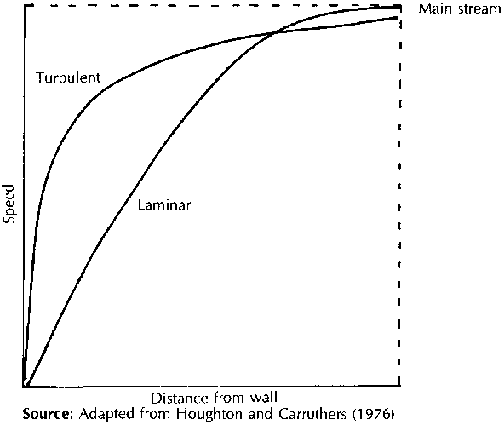
Figure 1 Laminar and turbulent flow
At the edge of the boundary layer next to the main stream, the fluid velocity is equal to the main stream speed. With laminar flow speed drops sharply, but with turbulence velocity falls only when the fluid is close to the surface. With turbulent flow there is interchange of energy between layers and therefore mean velocity is almost the main stream speed. The British Standards Institution CP3: Ch V-Part 2 (1972) defines the mean 'turbulent' wind speed for the United Kingdom as the 3-second basic gust speed to be exceeded on average once in fifty years. The Building Research Establishment (Eaton, 1981) and the Meteorological Office (1987) have provided 3-second basic gust speeds for a selection of tropical countries (Table 1). For rigid structures these basic gust speeds can be translated into wind loads based on the dynamic pressure of wind; for calculation of wind forces see Appendix 2. Gust speeds are squared for this purpose, hence the importance of accuracy at the design stage to achieve robust structures.
|
| |||||||||||||||||||||||||||||||||||||||||||||||||||||||||||||||||||||||||||
Combating wind loads
For film plastic-clad greenhouses which are not dissimilar to emergency stores the Ministry of Agriculture Fisheries and Food (MAFF, 1983) recommend that cladding is anchored at ground level either by gripping with a continuous structural member fixed to the main hoops, or by being buried in the trench not less than 300 mm deep by 300 mm wide, firmly backfilled and rammed with earth. Such structures should be supplied with an erection manual giving:
· erection instructions in diagramatic form;
· a maintenance procedure;
· details of constraints in use.
Correctly applied storm rigging for tents ensures that wind forces are distributed evenly; mountaineering tents are low, steeply pitched and present no vertical faces to the wind. Although such measures may not be applicable to relief stores, efforts can be made to site these structures away from areas which experience strong winds, such as hill tops and valley bottoms, and behind any available cover or wind break.
Rigid rectangular structures should have a roof pitch of well over 10° and if possible greater than 15°. The optimum is 30°-40°. Rigid structures likely to be subjected to strong winds should have hip-angled rather than gable ends.
Once-in-50-year basic gust speeds for selected countries and territories

Table 1
Sources: Met Office (1987) and Eaton (1981)
Notes: To obtain the design wind speed the basic gust speed must be multiplied by constants, S1, S2 and 53, see Appendix 2.
This figure will be revised on account of Hurricane Gilbert (Lawson 1988)
Large roof overhangs should be avoided, or vents included in these to relieve wind pressure. If eaves ventilators are employed the structure should be strengthened with a ring-beam at eaves' level. Similarly, every part of the structure should be tied together roof to walls, walls to walls, walls to floor, floor to foundations. The latter should have reinforcing bars which anchor the construction. All masonry construction should also be reinforced and horizontal reinforcement used round corners, between intersecting walls and between columns, infill walls and doors. Timber columns should be notched to resist uplift forces and cast into the concrete foundations in situ.
Timber roofs should be connected to masonry walls with a fastening strap or reinforcing bar that is firmly embedded in the concrete or masonry. If timber walls are used it should be ensured that nails are driven in so they act in shear rather than in tension. Purlins should be tied to rafters with strap connectors. When nailing corrugated roof sheeting, the top of the corrugations should be nailed through and a washer at least 20 mm (3/4 inch) in diameter used. Every corrugation of roof edges and every other corrugation elsewhere (see Figure 2) should be nailed.
These measures should reduce and combat wind loads; to be confident that a structure can resist cyclical loads cyclical testing is necessary (see Appendix 3). Normally, full-scale testing is sufficient.
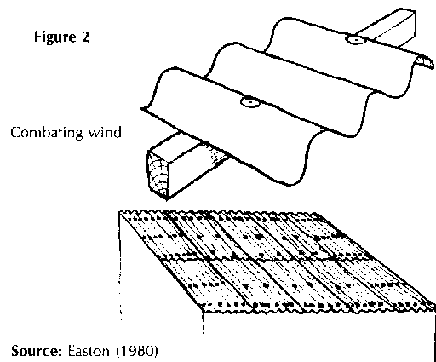
Figure
2
|
| |||||||||||||||||||||||||||||||||||||||||||||||||||||||||||||||||||||||||||
Full-scale testing of film plastic-clad structures
Full-scale testing of film plastic-clad structures by the Buildings and Livestock Division, Agricultural and Food Research Council (AFRC) Institute of Engineering Research has provided information useful for design (Hoxey and Richardson, 1984; Richardson, 1985; Richardson, 1986; Richardson and Westgate, 1986). This information includes tables of pressure coefficients for tunnel shaped, film plastic-clad structures (see Table 2). Comparing these pressure coefficients with those for rectangular rigid structures (see Tables 3 and 4) there is no obvious relationship, and therefore the BSI CP3 Code is not applicable to plastic-clad emergency structures with different shapes. AFRC Institute of Engineering Research has the necessary expertise to design plastic clad emergency structures with particular attention to the method of load transfer from cladding to structure and from structure to the ground. Foundation failure is a common cause of building collapse under wind action (Robertson, 1 988).

Table 2
Pressure coefficients Cpe for curved roofs of film plastic covered greenhouses (Single-span)

Table 3
Pressure coefficients Cpe for vertical walls of rectangular clad buildings
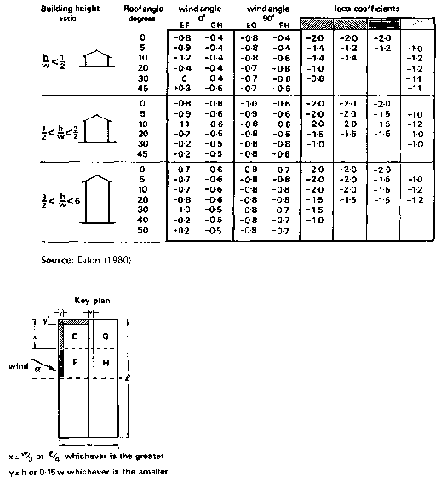
Table 4
Pressure coefficients Cpe on roofs of rectangular clad buildings
Note: The pressure coefficient on the underside of any roof overhang should be taken as that on the adjoining wall surface The coefficient for a low-pitch monopitch roof should be taken as -1.0
|
| |||||||||||||||||||||||||||||||||||||||||||||||||||||||||||||||||||||||||||
Discussion
This investigation of the nature of weather in tropical climates shows that at the extreme, 3-second gust speeds of up to 90 m/s (201 mph) are possible. These can be in excess of the 3-second gust speed for the United Kingdom (BSI CP3, 1972). Commonly in the Carribean, Mali, Mauritius, Niger, parts of India, Taiwan, Bermuda and the Philippines, 3-second gust speeds exceed 60 m/s (see Table 1). If these speeds are underestimated this has serious consequences for design because the square of the wind speed is employed to calculate wind load, which will therefore be much reduced. In this context it has also been shown how wind loads on rigid structures may be derived from local 3-second gust speeds. There is no straightforward way of calculating wind loads on plastic-clad steel frame structures, but professional advice is obtainable.
Because emergency storage structures are used for food relief in developing countries where no supervision is easily available, it is important that they are accompanied by clear instructions in diagram form to overcome language problems.
Robertson (1988) has suggested that failure of plastic-clad structures is commonly caused by inadequate foundations and this is ODNRI experience too. Mayo (1988) suggests that failures often relate to:
· use of the incorrect design wind speed
· inapplicability of Code CP3 - for example, because the building shape is not included in those covered
· unknown cladding properties at the design stage. In addition, Robertson suggests that some manufacturers of film plastic-clad structures may use incorrect design procedures. Because of failures caused by wind it is considered that this may also be true of emergency stores.
|
| |||||||||||||||||||||||||||||||||||||||||||||||||||||||||||||||||||||||||||
Recommendation
It is recommended that manufacturers and donors answer the following questions before supplying emergency stores:
· What is the correct 3-second gust speed for the exact location of the store?
· Have adequate foundations been provided, especially in sandy soils?
· Is the structure shape adequately covered by CP3?
· Are the properties of the cladding materials known for tropical exposure?
· Have diagrammatic, easily comprehensible erection instructions been provided ?
In this context the following addresses may be useful.
Gust speeds are obtained from reliable local data or from:
The Meteorological Office
Advisory Services
London
Road
BRACKNELL
Berks RG12 2SZ
United Kingdom
Telephone: 0344
420242
Telex: 849801
If there is some doubt about design, manufacturers and donors can contact: The Buildings and Livestock Division Agricultural and Food Research Council (AFRC) Institute of Engineering Research
Wrest Park
SILSOE
Bedford MK45 5HS
United
Kingdom
Telephone: 0525 60000
Telex: 825808
and
Department of the Environment
Building Research Establishment
(BRE)
Overseas Division
Building Research Station
GARSTON
Watford
WD2 7JR
United Kingdom
Telephone: 0923 894040
Telex: 923220
for advice on tropical applications.
|
| |||||||||||||||||||||||||||||||||||||||||||||||||||||||||||||||||||||||||||
Conclusion
If donors and suppliers of plastic-clad emergency stores take the advice given here or seek specialist advice as a matter of urgency it is likely that design can be improved. This will go some way towards preventing wind damage and loss of relief food.
|
| |||||||||||||||||||||||||||||||||||||||||||||||||||||||||||||||||||||||||||
References
BRITISH STANDARDS INSTITUTION (BSI) (1972) CP3 Code of basic data for the design of buildings: Chapter V: Part 2: Wind Loads.
EATON, K. J. (1980) How to make your building withstand strong winds. Paper presented at Building Research Establishment seminar on low income housing, St Vincent 26-27 March 1980.
EATON, K. J. (1981) Buildings and tropical rainstorms. Overseas Building Note No. 188. Building Research Establishment, Department of the Environment.
EATON, K. J. (1986) Research into hurricane-resistant houses in Tonga. Paper presented to 10th CIB Congress. Advancing Building Technology.
EATON, K. J. (1986) and REARDON, G. (1985) Cyclone housing in Tonga. Building Research Establishment, Department of the Environment.
FORTMAN, M. de G. (1987) (Officer in Charge WFP Sudan.) Personal communication.
HODGES, R. (1987) Personal communication.
HOUGHTON, E. L. and CARRUTHERS, N. B. (1976) Wind forces on buildings and structures. London: Edward Arnold.
HOXEY, R. P. and RICHARDSON, G. M. (1984). Measurement of wind loads on full-scale film plastic-clad greenhouses. Journal of Wind Engineering and Industrial Aerodynamics, 16, 57-83.
LAM, L. H. C. and LAM, R. P. (1985) Application of the British Code of Practice on Windloading in areas subject to typhoon winds. Proceedings of the Institute of Civil Engineers. Part 2, 135-148. Paper 8884, Structural Engineering Group.
LAWSON, J. S. (1988) Personal communication.
MAYO, A. (1988) Personal communication.
METEOROLOGICAL OFFICE (1987) Personal communication.
MINISTRY OF AGRICULTURE, FISHERIES AND FOOD (MIFF) (1983) Single skin film plastic structures a guide to the appraisal of tunnel buildings for agriculture and horticulture. Land and Water Service, Technical note No. TN/FBS/23.
MORAN, P. (1980) Full-scale experiments to acquire wind loading data for use in the design of agricultural buildings. Journal of Agricultural Engineering Research 25, 287-297.
MORAN, P. and WESTGATE, P. R. (1981) (unpublished) Wind loads on farm buildings: (5) full-scale measurements on an 18.5 m long, single 11.9 m span, ridged roof building of 4.6 m eaves height and 16° roof pitch. Divisional Note DN/1019 National Institute of Agricultural Engineering, Silsoe
O'DOWD, E. T., NEW, J. H., BISBROWN, A. K. J., HALLAM, J. H. and JOY, C. (1988) An evaluation of structures suitable for emergency storage in tropical countries. Overseas Development Natural Resources Institute, Bulletin No. 10 v+ 78pp.
RICHARDSON, G. M.(1985) Wind loading on film plastic-clad greenhouses. National Institute for Agricultural Engineering Technical Note.
RICHARDSON, G. M. (1985) The design of film plastics-clad buildings for horticulture. Plasticulture No. 67.
RICHARDSON, G. M. (1986) Windloads on a full-scale plastic-clad greenhouse: with and without shelter from a wind break. Journal of Wind Engineering and Industrial Aerodynamics, 23 321 -331.
RICHARDSON, G. and WESTGATE, G. R. (1986) Full-scale measurements of the wind loads on film plastic-clad greenhouses: a comparison of measurement and calculated strains on the supporting hoops of a tunnel greenhouse. Journal of Agricultural Engineering Research, 33, 101-110.
ROBERTSON, A. P. (1986) Design wind loads for canopy roof structures. Journal of Wind Engineering and Industrial Aerodynamics, 24, 185-192.
ROBERTSON, A. P. (1988) Personal communication.
TIMPSON A. (1987) (Save the Children Fund, Uganda) Personal communication.
|
| |||||||||||||||||||||||||
Wind forces on Emergency Storage Structures (supplement) (NRI)
Appendices
Apendix 1 Lapse rate
The expression which describes the relationship between pressure p and density d in the atmosphere is
p= kdn
where n is the index of expansion and k is a constant. If n is less than gamma, the ratio of the specific heats at constant volume and constant pressure, the atmosphere will be stable. If n is equal to gamma the atmosphere is neutrally stable and if n is greater than gamma it is unstable. The index of expansion n is related to the lapse rate mentioned above by the expression
n = g/(g - LR)
where g is the acceleration caused by gravity, L is the lapse rate and R is the gas constant.
Appendix 2 Calculation of wind forces and pressures, with examples
If wind is brought to rest against the windward face of a
structure all its kinetic
energy is transferred to a dynamic pressure q,
where
q = 0.5dVS2
d is the density (see Table 5) VS is design wind speed.
Selection of a design wind speed involves consideration of the maximum gust speed for the geographical area, the building, its immediate location and the probability of high winds occurring during the design life. Then,
where V = the 3-second basic gust speed, from local meteorological data (see Table 1); S1 is a topographical factor, normally = 1; S2 is a factor embracing ground roughness, building size and height above ground; and S3 is a statistical factor which can be obtained from Figure 3. The probability P that a wind speed of greater value will occur at least once in a period of N years is normally taken as P=0.63. Taking a five-year Ifie as a reasonable exposure period for an emergency store, Figure 3 gives S3=0.83. Lam and Lam (1985) suggest that 3-second gust speeds are adopted as the basis for building design because the natural oscillation period for most structures is only a few seconds, but Robertson (1988) states that 3-second gust speeds are used primarily because of limitations in the response of wind-measuring instrumentation. Research findings support the use of quasi-static loadings - even for plastic film greenhouses. Initial indications are that gusts of about 3 seconds or longer are appropriate design gusts depending on the size of the structure or member in question.
Table 5
Variation of air density d (kg/m3)
|
Temperature |
Pressure (mb) | |||
|
(°C) |
960 |
980 |
1000 |
1020 |
|
0 |
1.225 |
1.250 |
1.276 |
1.302 |
|
5 |
1.203 |
1.228 |
1.253 |
1.278 |
|
10 |
1.182 |
1.206 |
1.231 |
1.255 |
|
15 |
1.161 |
1.185 |
1.209 |
1.234 |
|
20 |
1.144 |
1.165 |
1.189 |
1.213 |
|
25 |
1.122 |
1.145 |
1 169 |
1.192 |
|
30 |
1.103 |
1.126 |
1.149 |
1.172 |
|
35 |
1.086 |
1.108 |
1.131 |
1.153 |
Source: Eaton (1981)
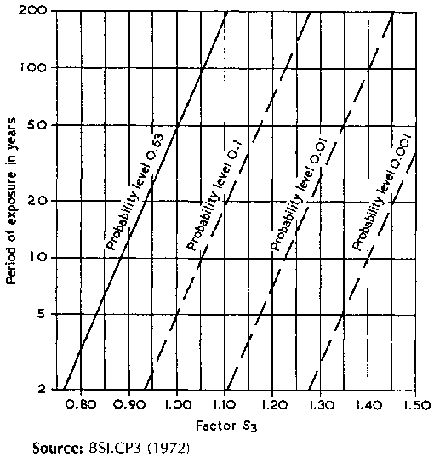
Figure 3
A statistical factor S3
Air density d varies with air temperature and pressure (see Table 5). Eaton (1981) suggests that in tropical storms the temperature should be taken as 25°C and the pressure as 960 mbar so that q = 0.5dVS2 becomes
q = 0.561 VS2
Lam and Lam (1985) suggest that q=0.576VS2 for typhoons.
The pressure p at any point on the external surface of a rigid building can be expressed in terms of q by means of a pressure coefficient Cpe
P = Cpe · q
where e stands for external.
For rigid rectangular buildings with double pitch roofs pressure coefficients for individual external loads are shown in Tables 3 and 4 (BSI 1972, Eaton 1981). Local coefficients can be greater, for example in Table 4 at the corner of roofs with 20° pitch with the coefficient Cpe is double the general figure.
Wind forces have also been measured directly for these buildings and force coefficients derived such that
F = Ae · q · Cf
where F is the force in the direction of the wind, Ae is the effective frontal area of the structure and Cf is the force coefficient in the wind direction. Values of Cf are shown in Figure 4 and an example of force calculation is shown below.
When calculating total wind forces on a structure internal pressures also contribute. On the windward side, open doors and windows will increase the pressure inside and will increase the loading on parts of the roof and walls already subjected to external suction; on the leeward side these openings will decrease the pressure and decrease the force on the roof, but increase the force on the windward wall (see Figure 5). For most design purposes internal pressures are calculated using an internal pressure coefficient Cpi where
Cpi = 0.75 Cpe
Robertson (1986) suggests -0.5<Cpi<0.6 depending on position of dominant opening (-0.5 when in leeward wall, 0.6 when in windward wall). This applies to structures likely to have dominant openings in a storm.
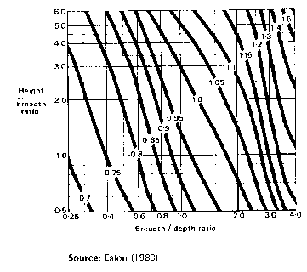
Figure 4
Force coefficients Cf for rectangular buildings
Judicious placing of such openings can ensure that internal forces are always suction forces and therefore reduce total roof and wall loads except for the windward wall, for example by placing a ridge ventilator on a low pitch roof (BSI 1972, Eaton 1980).
Internal pressure in a building with dominant openings

Figure 5
Example of pressure calculation
For a building or structure where the height to width ratio is less than half and the roof angle is 10° calculate the pressure at the gable end, trailing edge, when the basic gust speed is 53 m/s, the temperature is 25°C and pressure 960 mbar
(Assume S1 = S2 = S3 = 1 SO that V = Vs)
|
Dynamic pressure |
q=0.561 VS2 |
| |
=0.561 x 532 |
| |
=1575.8 Newtons/m² |
|
Local pressure p=Cpe · q where Cpe from Table 4=1.4 |
|
| |
=1.4 x 1 575.8 |
| |
=2206 Newtons/m² |
Example of force calculation
For a similar building where the breadth to depth ratio is 2.0, Cf = 1.0 and effective areas is 80 m²
|
F |
= Ae · q · Cf |
| |
=80 x 1 575.8 x 1.0 |
| |
=126,064 Newtons |
| |
=126 kN |
The effective area is the frontal area at right angles to the wind direction.
Appendix 3 Cyclic load testing
In Tonga after Hurricane Isaac in 1982 when damaged structures were inspected it was found that joints between structural members were inadequate, particularly at roof level. A new design was tested at the Cyclone Testing Station in Townsville, Australia. The structure was erected exactly as it would have been in Tonga and simulated wind forces were applied and distributed so that they produced the same structural effect as design loads. Racking forces and uplift forces were applied using hydraulic rams which operated a series of cables, beams and load spreaders. Transducers monitored these loads and deflections all over the structure. A programme of cyclic load tests were conducted to simulate the continual buffeting that a structure receives during a hurricane. Failure of roof-wall straps resulted and therefore these were improved; the modified structure successfully resisted the sequence of cyclic loading that simulated a four-hour hurricane with wind gusts up to the design speed of 62 m/s. Ultimate failure of the structure was caused by fracture of a strap at 1.3 times the design uplift and racking loads. (Eaton and Reardon, 1985).
(1421/89 Hobbs the Printers of Southampton)