 |
| |||||||||||||||||||||||||||||||||||||||||||||||||||||||||||||||||
by Peter Fellows and Barrie Axtell
Published by Transfer of Technology for
Development-Amsterdam
for International Labour Office - Geneva
This publication is published by:
Tool Publications
Sarphatistraat 650
1018 AV
Amsterdam
The Netherlands
for
International Labour Office
Entrepreneurship and Management
Development Branch
FIT Project
CH-1211 Geneva22
Switzerland
Copyright (C)1993 International Labour
Organization
ISBN
90 70857 28 6
First impression 1993
The designations employed in ILO publications, which are in conformity with United Nations practice, and the presentation of material therein do not imply the expression of any opinion whatsoever on the part of the International Labour Office concerning the legal status of any country, area or territory or of its authorities, or concerning the delimitation of its frontiers. The responsibility for opinions expressed in signed articles, studies and other contributions rests solely with their authors, and publication does not constitute an endorsement by the International Labour Office of the opinions expressed in them. Reference to names of firms and commercial products and processes does not imply their endorsement by the International Labour Office, and any failure to mention a particular firm, commercial product or process is not a sign of disapproval.
This publication was made possible with the financial contribution of the Ministry for Development Co-operation of the Netherlands. Responsibility for the contents and for the opinions expressed rests solely with the author(s); publication does not constitute an endorsement by the Ministry for Development Co-operation of the Netherlands.
All rights reserved. No part of this publication may be reproduced in any form, by punt, photography, microfilm, or any other means without written permission from the publisher.
While every care has been taken to ensure the accuracy of the information given in this publication, neither the publisher nor the author(s) can be held responsible for any damage resulting from the application of the described methods. Any liability in this respect is excluded.
|
| |||||||||||||||||||||||||||||||||||||||||||||||||||||||||||||||||
Preface
Over the years both the ILO and TOOL Question/Answer Service received signals indicating that there is a considerable demand for information on food packaging materials and the application of packaging methods in developing countries. Plans to produce a publication on this subject were made within the joint ILO and TOOL project Farm Implements and Tools.
An inventory of available documentation showed that information on packaging materials and methods can be found in several publications on processing one particular kind of food (fish, fruit, etc.) or in publications on a particular packaging method (canning). A disadvantage of these publications is that they do not offer an overview of alternatives in packaging and packaging methods. Often economic aspects are omitted, although the costs of packaging materials are a major point of concern in developing countries.
This publication on packaging materials for food products should offer an inventory of packaging materials and cost effective methods which can be applied on a small scale in developing countries. The information is primarily aimed at entrepreneurs in small-scale food processing industries in developing countries and employees of development organizations supporting these entrepreneurs.
Maurice Allal, ILO
Albert Jan van Weij, TOOL
About the authors
Dr Peter Fellows is a food technologist with 15 years' experience in small-scale food processing in Africa and Asia. He is currently a Senior Technical Manager with the development agency Intermediate Technology in the United Kingdom. Previously, he was a Senior Lecturer at Oxford Polytechnic and he has worked in the United Kingdom's food industry. He obtained his Doctorate from Reading University after conducting research into the symbiotic growth of edible yeasts on fruit processing wastes. His specialisms include fruit and vegetable processing, small food enterprise development and food packaging.
Barrie Axtell worked in the United Kingdom's food industry for over ten years and then joined the British Overseas Development Programme. He then spent four years in the Eastern Caribbean as an adviser in food processing followed by three years in Guatemala teaching and developing small scale drying systems. In 1981, he joined Intermediate Technology to start its agroprocessing programme and travelled extensively to developing projects in Asia and Latin America His particular areas of interest are drying, packaging and fruit processing. After ten years as Senior Technical Manager with ITDG he became a private consultant providing technical consultancy inputs to agencies such as FAO, ILO, UNIFEM and ITDG.
|
| |||||||||||||||||||||||||||||||||||||||||||||||||||||||||||||||||
Acknowledgements
The authors greatly acknowledge the help and assistance given by Clare Sheffield for the preparation of the manuscript, Matthew Whitton for the illustrations, Jean Long for the photography, Gordon Keddie for his constructive editorial comment, and PRODEC for their co-operation in allowing us to use their illustrations from their publication: Handbook on the Procurement of Packaging by Tuula Ramsland.
We would also like to thank the following companies for supplying information about their products: MAISA, Mar del Plata, Argentina; Botswana Technology Centre, Gaborone, Botswana; FEFCO, Paris, France; PRODEC, Helsinki, Finland; and (all from the United Kingdom) AID &Packaging Services (UK) Ltd., Worcester, Atwell Self-Adhesive Labellers, South Godstone; C. R. Clarke & Company (UK) Ltd., Ammanford; CMB Packaging Technology plc, Wantage; Chadwicks Ltd., Bury; Erapa (UK) Ltd., Luton, ICI Plastics Division, Welwyn Garden City; Limpet Tapes, Huntingdon; MARIA Ltd., Bradford; Metal Closures Ltd., West Bromwich; Perafrap Ltd., High Wycombe; Thames Packaging Ltd., London; and Thomas Hunter Ltd., Rugby.
|
| ||||||||||||||||||||||||||||||
Appropriate Food Packaging (Tool)
1 Food and packaging
1.1 The importance of food processing
Food has been processed and packaged since the earliest days of man's history on earth. Meat and fish were salted, smoked and dried. Herbs were dried and stored for use as medicines. Alcoholic beverages were made from fruits and cereals. In the early days of traditional food processing the main aim was preservation to maintain a supply of wholesome, nutritious food during the year and in particular to preserve it for hungry periods, for example when hunting was poor. Food was seldom sold but traded and bartered.
While food processing still has the main objective of providing a safe nutritious diet in order to maintain health other aspects, particularly the generation of wealth for the producer and seller, have become increasingly important.
With the change from traditional to industrial food processing there has also been a change in the types of product processed. Traditional processors worked with foods that grew locally and the methods they developed were in harmony with the climate in which they lived. Only simple packaging using leaves, animal skins and pottery was possible and necessary to protect the food for its planned storage life. Nowadays non-traditional crops are grown all over the world. For example, the potato which originated in Peru, rice which came from Asia, and numerous fruits and vegetables are now grown away from their area of origin This together with consumer demand influenced by radio, advertising and television has lead to a demand for non-traditional foods that are not appropriate to the local environment. They need special processing and packaging to protect them for their required storage life.
While most people in the world still rely on traditional foods
for their basic diet those in industrialized centres tend more and more to
purchase processed and packaged foodstuffs for convenience. The increasing
number of women who now work away from home adds additional
pressure for such
changes. Even people with a heavily traditional diet are demanding external
products either as occasional treats, such as gassy drinks or basic commodities
such as white sugar and flour.
To meet these demands the industrial food processing sector has emerged. Food and crop processing is generally considered to be the largest industry in most countries. Studies in several developing countries for example have shown that up to 25% of the urban population can be involved in making or selling ready-to-eat meals. While in developed countries food processing is almost totally carried out in large, automated factories small-scale food processing still remains a vitally important economic activity in the developing world. The small-scale food processing sector:
- is a major source of employment,
- adds value to crops by
processing,
- is a major source of food in the diet,
- in some cases, by
export, earns valuable foreign exchange,
- provides opportunities for import
substitution,
- benefits a large number of poor people, such as farmers,
packaging suppliers and vendors.
The small-scale food processing sector is however under increasing threat and competition from large manufacturers who, through economies of scale and better presentation and marketing, can put them out of business. The powerful large-scale food sector is also often able to influence government and international policies and laws and so prevent the small manufacturer from entering production or selling in a particular market.
Much of the customer appeal of foods produced in large factories in reality lies less with the food itself than with the appearance, presentation and advertising used to sell it. Good packaging lies at the very heart of presentation and thus customer appeal. It is an area of vital importance for small and medium food manufacturers if they are going to continue to compete and expand.
1.2 What is good packaging?
Good packaging serves two purposes are essentially technical and presentational.
Technical changes in packaging aim to extend the shelf-life of the product by better protecting the food from all the hazards it will meet in storage, distribution and use. Changing from one type of plastic bag to another for example may mean that less moisture from the atmosphere is absorbed into the food so extending the shelf-life. Making the bag re-closable in addition would mean that the customer could keep the food in good condition for forger in the home. If shelf-life is extended then it may be possible to market the product over a bigger area so increasing sales
Presentational aspects of packaging do not actually do anything to make the food keep longer or in better condition. Such packaging increases sales by creating a brand image that the buyer instantly recognises. It also aims to appeal to the customer in terms of shape, size, colour, convenience, etc.
The ultimate aim of good packaging is increased sales against any competition and thus improved income for the producer. This cannot be achieved without a cost. It is not only the direct cost of the packaging material that needs to be considered but other changes such as different processing systems, purchase of fillers, staff training, etc.
The small and medium-scale food manufacturer considering improvements to their existing packaging system face difficult decisions that will need careful thought and investigation. One of the central problems is the impossibility of really knowing if the proposed changes will indeed result in increased sales that will have to be made to meet the costs involved. In addition, for most small producers, the choice is really not theirs but dictated by what kinds of packaging are locally available. In most cases it will not be possible to select the best type of package but only select the best of available alternatives.
Some of the positive and negative factors that need to be thought about are included in Table 1-1.
Positive
By how much will the shelf-life be extended?
Will food losses
be reduced?
Can this result in a wider distribution, if so at what
cost?
If returnable containers are used by how much will transport
rise?
Will the new packaging give entry to a new area of the market?
How
much more competitive will be product be?
Negative
How much will the new packaging raise the product's selling
price?
Will new equipment be needed, at what cost?
Will staff need special
training and higher pay?
Will special quality control measures have to be set
up?
Will external experts need to be used?
Table 1-1: Positive and negative factors of packaging
1.3 Environmental and economic aspects
As well as considering various types of industrial food packaging and their application, this book also briefly examines related areas such as re-cycling and economic aspects of the use of different materials.
With the increasing use of plastic packaging the whole subject of damage to the environment is becoming of increasing concern One main problem is that plastic packaging is invariably cheaper than alternatives such as glass. If glass is given a monetary value of 10, then tins cost 6 to 8 units while plastic costs 3 to 8. The shift to plastic, at the present time, therefore appears unstoppable. However re-cycling and re-use of packaging can not only generate jobs and wealth but save energy and help to protect the environment A study carried out in Thailand, for example states that it would be possible to set up a $40 million a year industry based on recycling paper, cardboard and plastics.
In its final section this book considers some economic aspects of packaging changes. Not only must the direct cost of the pack be thought about but other associated costs such as equipment and training. Economic choices can be difficult and complicated. A glass container for example, is more expensive than a tin can. It can, however, be re-used, which may in the long run make it cheaper. The manufacturer would need to think about how many times the same bottle could be re-used, the costs of collection and costs involved in washing and preparing the returned bottles.
1.4 The aim of this book
It is hoped that this book will assist the small and medium food manufacturer to consider not only which packaging is best for their product but other related aspects. The whole package including its materials, label and shipping container should be considered as part of the overall business plan and not, as often happens, as an afterthought. The book is mainly written for entrepreneurs who wish to increase their sales and competitiveness by improving their business. Some of the technologies described may appear too large and costly for the very small cottage industry sector. In many cases, however, it is companies from this sector which, with advice and good management, have grown into well known brand names.
It is also hoped that this publication will be of interest to food research institutions, non-government organizations, development workers and extension workers who are involved in projects to improve the small-scale food processing industry sector.
It is believed that this book is somewhat unique in the bibliography of packaging, concentrating as it does on the small-scale application of packaging against a background of basic food technology.
|
| |||||||||||||||||||||||||||||||||||
Appropriate Food Packaging (Tool)
2 Types of food and prevention of deterioration
In this chapter, one of the main reasons for packaging foods that was introduced in Chapter 1 - prevention of deterioration during storage - is covered in more detail. First the types of foods that are commonly produced by small to medium-scale processors are briefly described. This is followed by the main ways in which these foods spoil, together with other hazards that foods face during storage and distribution. The role of packaging in protecting foods against a variety of hazards is then described and the typical extension of shelf-life that arises from correct packaging is shown.
2.1 Food products that are suitable for small-scale processing
Some processed foods are not suitable for manufacture on a small scale and others have no local or regional demand. The factors that determine whether a food is suitable for production in a particular location are complex and inter-related. They are also specific to each production site. However broad guidelines on how to select the types of food that can be produced are as follows.
The selection of the type of food to process depends in part on the level of skill and experience of the staff that will do the production. Care should be taken with all low-acid wet foods, including meat products (especially sausages, burgers and pies), vegetable products, milk products (except yoghurt, butter and ghee) due to the risk of food poisoning. These foods require strict hygienic processing and an understanding by the operators of the risks involved. They should not be produced by inexperienced or untrained people.
Other products require the use of expensive high-technology equipment that is not generally affordable or repairable by small-scale producers. Examples include any low-acid canned foods (for example, canned meats, fish, vegetables, milk), hot-extruded snackfoods, carbonated (fizzy) drinks, homogenized or UHT (Ultra-Heat Treated) milk, solvent-extracted cooking oils and irradiated foods (the last is not legal in some countries). Some foods (for example, some baked goods and sugar confectionery) require a degree of flair, skill, imagination and experience to produce interesting and appealing products. Again these would normally only be produced by trained or experienced staff.
It can be seen from the above considerations that packaging is only one of the many factors that should be taken into account when setting up a business to process foods for sale. However because of problems of availability of packaging materials in many developing countries the problem of packaging assumes great importance. The methods used to select a product and the scale of production may need to be modified to take this into account. For example, the authors know of at least one food business in Africa in which the entrepreneur first found an available source of packaging materials and then designed a product that would suit it.
With these considerations in mind it is possible to analyse the factors that influence the likely success of a small food business and plan carefully to overcome any constraints. Typical questions that should be asked during the planning stage are shown in Table 2-1. In all cases, for a small business to be successful there should be:
- a good demand for the food, either locally or as exports to
neighbouring areas or countries,
- supply of raw materials, ingredients and
packaging materials,
- affordable, easily operated, maintained and repaired
equipment,
- suitable infrastructure and facilities for processing and
distribution of the selected food under hygienic conditions.
These considerations are shown as a 'decision tree' in Figure 2-1.
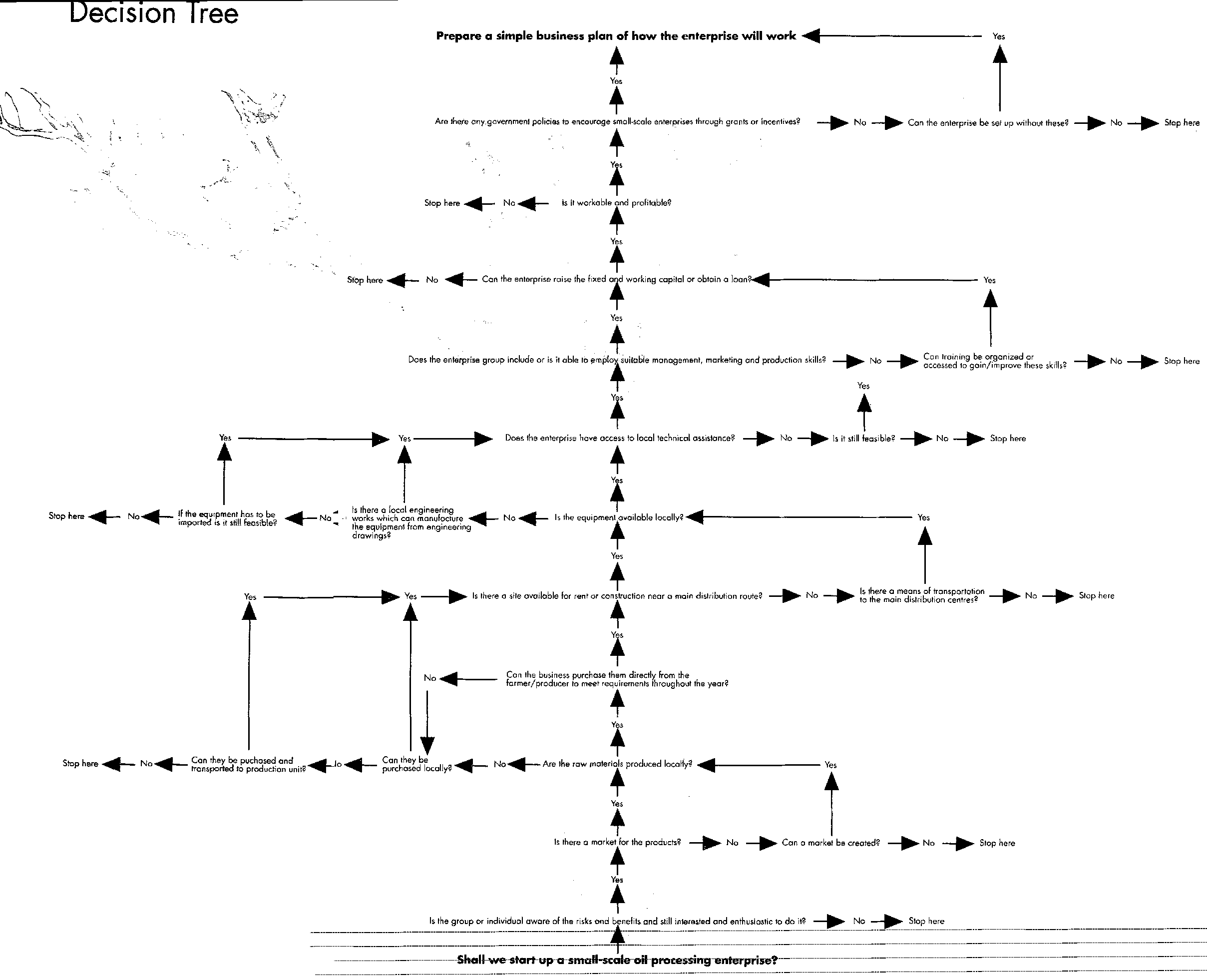
Figure
|
Questions to ask |
How to find the answer |
|
Who is the product aimed at? |
Conduct a market survey |
|
What is the demand for the processed food? |
Conduct a market survey |
|
Is there a health hazard associated with the food? |
Consult a food technologist |
|
What type of packaging is most suitable for the processor, distributor, retailer and consumer? |
Conduct surveys, ask each group |
|
Are all raw materials, ingredients and packaging materials available in sufficient quantities and at a low enough price when they are required? |
Consult farmers, and suppliers to obtain prices, order sizes and plan ordering schedule |
|
What is the expected scale of production? |
Calculate from market surveys and resource availability |
|
What is the expected profitability at the planned scale of production |
Do a feasibility study |
|
How much money is available to Invest in equipment and materials? |
Consult suppliers or technical advisors |
|
How will the food be sold |
Have detailed discussions with potential distributors and retailers |
|
What are the relevant regulations |
Consult government authorities to find details of business registration, taxes(Ministry of Small Industries or equivalent) and food regulations, Ministry of Health, Food Standards |
Table 2-1: Typical questions that should be asked during the planning stage
Taking these and other factors into account, Table 2-2 shows the foods that are commonly seen as suitable for production at the small scale. Short shelf-life products are those that are expected to be eaten within a few days of production. In general the following short shelf-life products are suitable for small-scale production because there is a good opportunity to add value to low-cost raw materials. There is often a good demand for such products and there are fewer packaging and distribution problems than occur with some other foods.

Table
2-2
2.2 Types of deterioration
The section above indicated the types of food that can tee
processed on a small scale. The reasons for their selection are mostly concerned
with the demand from customers (the popularity of a food) and the feasibility of
small-scale production. If it is decided that there is a good demand for a food
and that production is feasible, it is then necessary to make sure that
processing adequately preserves the food for its expected shelf-life. An
understanding of the various factors that cause food to deteriorate is helpful
to ensure that the correct processing and packaging is selected. In this section
the causes of deterioration of foods are first described and then the different
roles of processing and packaging in preservation of the food are
described.
The main causes of deterioration of foods are as follows:
- micro-organisms,
- enzymes,
- chemical changes due to
water, heat, metals, air or light,
- contamination by soils, stones, insects
etc.
- physical (or mechanical) damage.
2.2.1 Micro-organisms
All fresh foods have micro-organisms on their surfaces, often in enormous numbers, and these can grow rapidly to spoil foods. A main purpose of processing foods is to destroy unwanted micro-organisms. Packaging prevents recontamination and together processing and packaging prevent micro-organisms from spoiling the product during distribution and storage (that is to give the food the shelf-life that is expected).
Micro-organisms may be divided into general groups such as bacteria, yeasts or moulds, each of which may be further divided into sub-groups. Of the many microorganisms, the main types of interest are those that cause food spoilage and those that cause food poisoning.
When food is processed correctly, the number of spoilage micro-organisms and their activity is reduced and controlled at known levels. It is when there is a failure in processing conditions or packaging materials that spoilage micro-organisms can have an effect on the food. They can result in the food going mouldy, developing an off-smell or fermenting. The different types of spoilage depend to a large extent on the nature of the food and in particular its acidity and its moisture content.
Food poisoning is mostly caused by bacteria. These are also controlled by the acidity and moisture content of a food as shown in Table 2-3.
Food poisoning micro-organisms may grow in low-acid foods. Heat processing to 121°C for 15-50 minutes in jars or cans is required to destroy these micro-organisms.
Such heating requires the use of pressure cooking and detailed technical knowledge. For these reasons it is strongly advised that these foods are not produced by small-scale processors, especially as a first venture.
| |
Acidic or dry products |
Low-acid products |
|
Will support the |
Moulds and yeasts |
Many types of |
|
growth of: | |
bacteria (including |
| |
|
food poisoning types) |
| | |
and moulds |
|
Production errors |
Surface mould |
Food poisoning |
|
can cause: |
growth or |
especially from |
| |
fermentation. Low |
canned |
| |
risk of health |
vegetables or fish, |
| |
hazard |
meat products |
|
Examples of the |
Fruit juices, |
|
|
product: |
yoghurt, jam dried |
|
|
|
fruit | |
Table 2-3: Microbial growth on different foods
2.2.2 Enzymes
Enzymes are naturally occurring proteins that act on foods to cause changes in flavour, colour or texture. There are many hundreds of different enzymes but some of the more important spoilage changes include softening of fruits, rancidity of oils, browning of cut fruit or root crops and loss of green colour in vegetables. In general enzymes are either destroyed by heating or prevented from acting by changing the acidity or water content of the food.
2.2.3 Water
Enzymes and micro-organisms can only spoil foods if water is present. If the water is removed or made unavailable they cannot act. Different foods have different water contents (Table 2.4). Some, for example grains, are relatively dry when harvested and these can be easily preserved by removing the remaining water by drying. Other fresh foods such as fruits, vegetables and meat have a much higher water content and this should be made unavailable by either drying or concentration (water removed) or by freezing (water held as ice, which together with the low temperature, prevents micro-organisms and enzymes from acting).
However, removing water only prevents the action of enzymes and micro-organisms, it does not destroy them They can act again when water returns, for example during re-hydration of dried food, thawing of frozen food. Foods are therefore often heated (blanched) to destroy some of the enzymes and micro-organisms before drying or freezing.
|
Fresh food |
Water content (%) |
Shelf-life at room |
| |
temperature (days) |
|
|
Fruits |
80 - 95 |
1 - 30 |
|
Meat/Fish |
55 - 70 |
2 - 7 |
|
Vegetables |
75 - 90 |
2 - 20 |
|
Grains |
8 - 14 |
more than 175 |
Table 2-4: Water content of some foods
The normal moisture content of a processed food should be maintained during storage. This is a main function of packaging for some foods. If the moisture content falls below an acceptable level in moist foods, the food dries out, shrivels and is seen as spoiled by consumers. Similarly if the moisture content of a dry food is allowed to rise above an acceptable level it will first lose its crispness and become unacceptable to consumers, but it may also gain sufficient moisture to allow micro-organisms to grow and cause further spoilage. The acceptable range of moisture contents is different for each processed food and for some it is a critical factor. Table 2.5 shows some foods that require careful control of the moisture content by processing and packaging to maintain their quality.
2.2.4 Heat
|
Food |
Moisture contents (%) |
|
Cooking oil |
trace |
|
Sugar |
trace |
|
Snack foods |
1 - 5 |
|
Biscuits |
2 - 6 |
|
Sweets |
trace -10 |
|
Dried fish |
5-10 |
|
Flours |
12 - 14 |
|
Dried fruit |
15 - 25 |
|
Honey |
18 |
|
Jam |
30 - 32 |
|
Tomato paste |
55 - 65 |
Table 2-5: Foods that require careful control of the moisture content
Higher temperatures increase the rate of spoilage by micro-organisms and enzymes, up to a maximum above which they are destroyed (Figure 2-2).
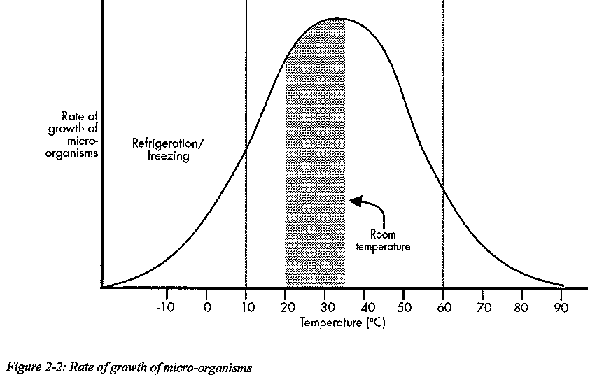
Figure
When foods are heated above 60°C most enzymes and micro-organisms are destroyed - the higher the temperature the faster they are destroyed. This is one of the easiest methods of preservation and includes boiling, frying, baking and pasteurization. However, cooked food can be easily re-contaminated if it is not properly packaged.
Heat can also spoil packaged food. It can melt fats, cause a loss of texture or flavour and cause more rapid changes such as development of rancidity in oils and movement of moisture within a food which in turn leads to spoilage.
2.2.5 Light
Sunlight contains ultra-violet (UV) rays which cause rapid deterioration of some foods (especially oils and fatty foods) or specific components of a food such as certain vitamins. UV can also cause packaging materials to fade or to become brittle and lose their properties (for example polythene in Section 3.2.2). In general all foods should be stored in the shade away from direct sunlight. Electric lights do not have the same effects on foods because they do not contain the UV component.
2.2.6 Air
Some foods, especially those that have a high fat content or those with delicate flavours and aromas, are susceptible to oxidation (attack by air which causes off flavours to develop, known as rancidity). Biscuits, cooking oils, dried fish and other fatly foods are liable to spoilage by rancidity. These foods should therefore be protected from contact with air by storing them in airtight containers.
2.2. 7 Contamination
Foods are often contaminated when harvested or slaughtered and most processing involves a cleaning stage to remove these contaminants. However foods may also be contaminated after processing and this is more serious because the contamination will not be removed before the customer buys the food. The main types of post-processing contamination and possible sources are shown in Table 2-6.
|
Contaminant |
Possible source |
|
Hair |
Operators, animals |
|
Dust, soil, stones |
Workplace, equipment, |
| |
transport |
|
Bacteria, moulds |
Air, operators, animals, |
| |
insects, birds, dust |
|
Excreta |
Animals, insects, birds |
|
Oil, grease |
Equipment, transport |
|
Wood, glass, paper, cloth, |
Workplace, transport |
|
leaves etc | |
|
Metal |
Equipment, workplace, |
| |
transport |
|
Insects |
Air, workplace, |
| |
transport |
Table 2-6: Types of post-processing contamination and possible sources
One of the main functions of packaging is to protect foods against contamination from the time it has been processed until it is consumed. It should be noted that the contamination described before is accidential contamination. Contamination that is done deliberately to increase profitability or from malice is named adulteration. Packaging that is intended to prevent or reveal adulteration is described briefly in Chapter 3.
2.2.8 Mechanical damage
Foods are frequently fragile and easily crushed, scratched, split or otherwise damaged during storage and distribution. Damage is caused in four ways:
- by pressure such as that caused by stacking or piling foods
too high,
- by impact from hitting or dropping the food,
- by vibration
from transport,
- by foods rubbing against each other or against container
sides.
Another main function of packaging is to minimise these types of physical damage to foods during transport and storage. This type of packaging is often known as a shipping container and these are described in more detail in Chapter 4. A summary of the different roles of processing and packaging to prevent deterioration described above is shown in Table 2-7. The factors that affect the shelf-life of foods and the protection offered by different packaging materials are shown in Table 2-8.
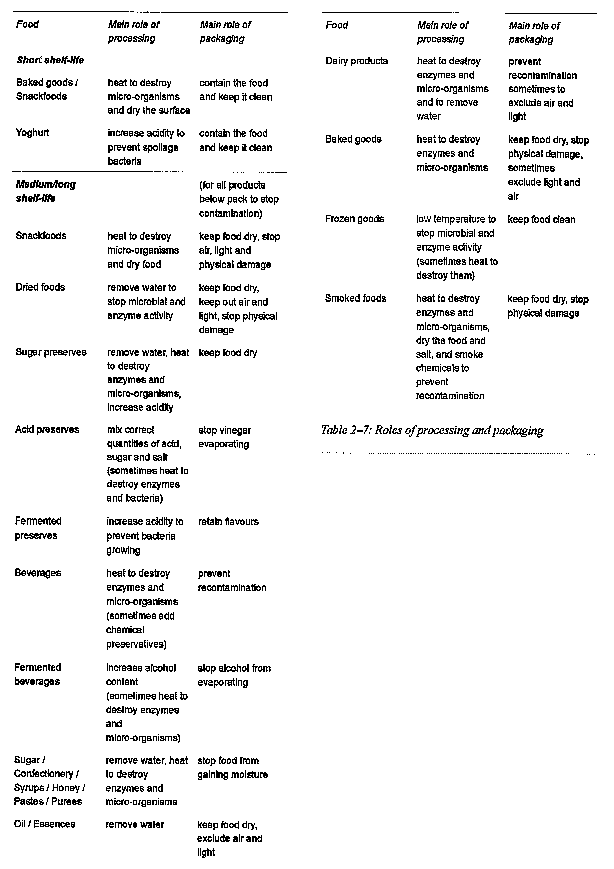
Table 2-7
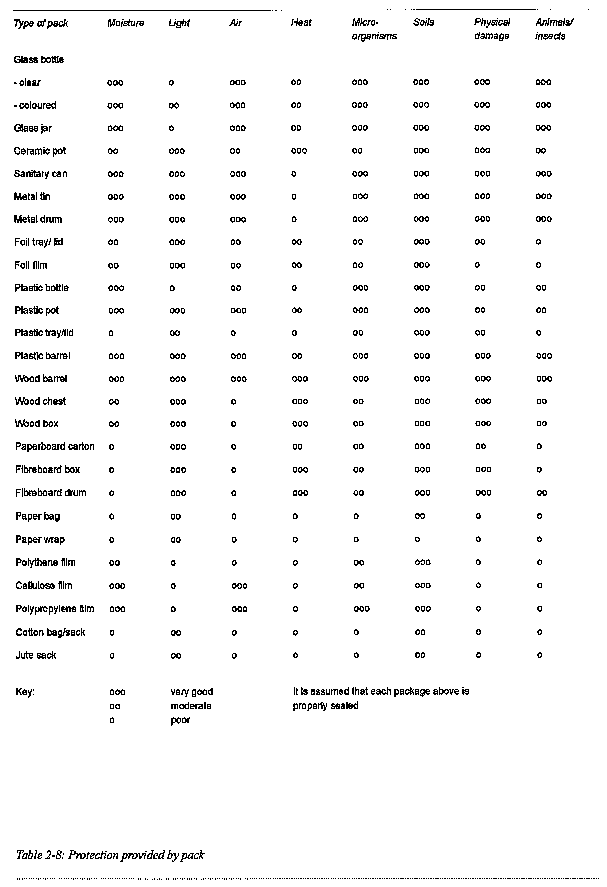
Table
2-8
2.3 Extension of shelf-life
The section above describes the processing and packaging that is needed to preserve foods for their expected shelf-life. It also indicated that for different foods the importance of packaging can vary from simply keeping foods clean to being the main factor that controls the shelf-life. It was noted that for many foods the humidity of the climate in which the food is stored is one of the most important considerations.
In the following section the actual extension of shelf-life for different foods is shown for two types of climate. Readers should note that the data given is indicative only and that shelf-life will vary according to the local storage conditions used. Table 2-9 indicates the likely extension of shelf-life of the foods to be achieved by proper packaging.
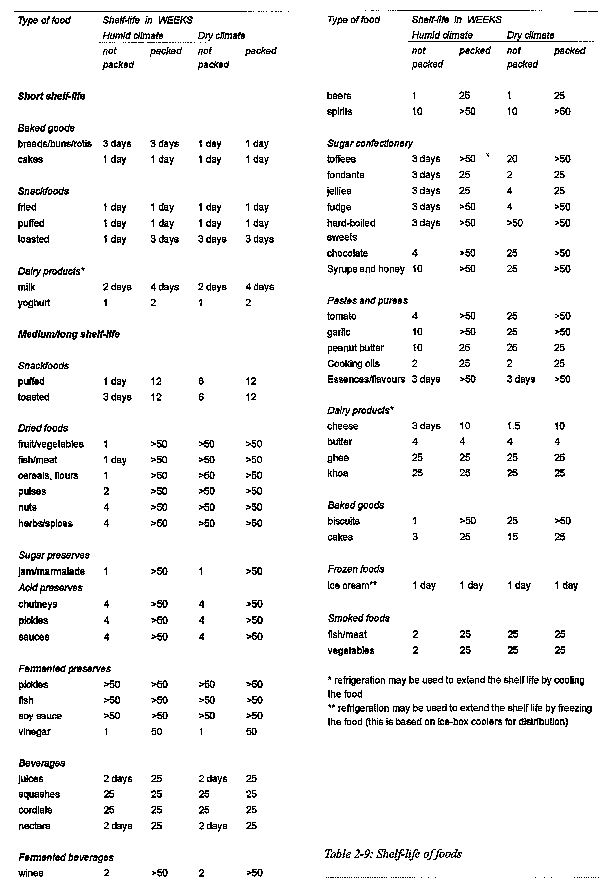
Table 2-9
2.3.1 Short shelf-life products
Baked goods
Breads and cakes are normally sold by small-scale bakers within a day of baking to retain the fresh baked flavour and odour and the correct texture. Staling takes place rapidly at tropical temperatures and leads to a toughening of the crumb and, in some breads a softening of the crust. The changes happen in both humid and dry climates but additionally there may be drying out of some products in dry climates. Because of the short shelf-life packaging is mainly used to keep these products clean and it is not used as a barrier to moisture or air.
Clean paper (for example tissue paper) is an adequate packaging material, but old newspapers should not be used because the ink is poisonous. Plain or coated cellulose is likely to be too expensive for most small bakers and is not needed if the products are to be consumed on the day of production or the following day. Polythene bags are used by some bakers to give a 'more attractive' or 'professional' image. If polythene is used to wrap baked goods, care should be taken to allow them to cool to room temperature after baking. This will prevent moisture condensing on the inside of the bag and wetting the surface of the food. If this is allowed to happen it will result in mould growth at the wet spots as well as a loss of the required texture in these places.
Snackfoods
Many snackfoods are produced by small-scale entrepreneurs for immediate consumption as 'streetfoods' and these are rarely packaged except for a container to hold the pieces together and keep them clean. In particular some fried foods cannot be stored for more than a few hours because migration of oil softens the crisp crust of such foods and spoils their texture.
Others snackfoods are sold in packets with an expected shelf life of a few days to several weeks. These include puffed and toasted cereals and fried legumes/cereals in such products as 'Bombay mix'.
The main causes of spoilage are moisture pickup in humid climates, which leads to softening of the products within a few hours, and rancidity which develops over a few days or weeks depending on the type of oil used for frying and the storage conditions. Packaging should therefore be used to prevent moisture pickup in humid climates and also prevent air and light from reaching the product in both humid and dry climates to restrict the development of rancidity. As these products tend to be fragile the pack should also protect against crushing and other types of mechanical damage. It is usual to use a barrier film such as polypropylene for sealed bags of product and a cardboard box to protect against light and mechanical damage.
Dairy products
Pasteurized milk depends on both the heat treatment of pasteurization and post-processing cooling to maintain its shelf-life. Packaging should be sterilized to prevent contamination after processing but its main function is to contain the milk and keep it clean.
Spoilage is mostly due to micro-organisms that survive pasteurisation and these then cause the milk to sour after a few days. Spoilage may also be due to rancidity and loss of some vitamins, which is accelerated by sunlight. During distribution and storage the milk should therefore be kept cool and away from direct sunlight to achieve the expected shelf-life. Polythene bags are commonly used because they have lower costs than other packs. These are adequate if the milk is carried home by the customer and used straight away but they are less successful if the milk is distributed to retailers first. Reusable glass bottles with foil lids are used in some countries as a relatively low cost package. To be economical there should be a high rate of bottle return (usually above 90%) and particular care is needed to ensure that returned bottles are thoroughly cleaned and inspected (Section 3.1.1).
Yoghurt should be stored and distributed in a similar way to milk to give a longer shelf-life. Here however the higher acidity delays spoilage by micro-organisms and extends the shelf-life by several days compared to milk. As a result there is less need for cooling but the product should be protected from sunlight to prevent development of rancidity. Packaging is mostly to contain the yoghurt, keep it clean and insect free and keep out sunlight. Clay pots, and plastic pots are most commonly used. These may be unsealed or covered with a cloth or film. Plastic pots may also be heat-sealed with a foil lid.
2.3.2 Medium/long shelf-life products
Dried foods
The shelf-life of dried foods depends mostly on the relationship between the individual product and the humidity of the air during storage. Foods that are in equilibrium with the surrounding air will neither gain nor lose moisture and, provided that their moisture content is low enough to stop micro-organisms from growing, they will remain stable.
Foods that are traditionally dried in a particular area are suited to the local conditions and will remain stable for long periods with very simple packs to contain the food and keep it clean. However there are situations in which a dried food needs to have more elaborate protection if the humidity in an area changes (for example at the beginning or end of a rainy season), if the food is moved to another area which has a different air humidity, or finally if a new food is dried in a particular area. These are all reasons why packaging is needed to form a barrier to moisture.
Changes in humidity affect dried foods in one of two ways: if the humidity increases the food becomes more moist and this may then allow micro-organisms to grow and spoil the product. This also happens if the food is allowed to become wet from rain during storage. The food also becomes softer and the change in texture may also be seen as spoilage in some foods (for example snackfoods and biscuits). If the humidity falls this will cause the food to dry out further. For most foods this does not result in spoilage, but in some (for example some dried fruits) sugars may crystallize, the texture may harden excessively and the product may be seen as spoiled.
It can be seen from Table 2-9 that the benefits of packaging are substantial for some dried products, particularly in humid areas where the package should provide a barrier to moisture. Many dried foods are susceptible to rancidity and for these a barrier to air and light is needed. Many dried foods are also fragile and easily broken. They are therefore packed in cartons or boxes to give protection against mechanical damage. Products stored in dry areas do not benefit from an extension of shelf-life by packaging and the pack is simply used to contain the food and keep it clean.
Sugar preserves
These products are stable for long periods without packaging due to their high acidity and high sugar content. Packaging is mostly used to contain the product, keep it clean and prevent contamination from insects that are attracted to the sugar. Care needs to be taken that the temperature of the preserve is at 80 - 85 °C when it is filled into containers. If it is higher, steam from the product may condense on the inside of the lid and moisten the surface of the preserve. This dilutes the product and may allow mould growth If the temperature of filling is too low it is more difficult to pour the preserve and a partial vacuum will not form in the container headspace (Section 3.1.1).
Acid and fermented preserves
Here preservation is achieved by the combined effects of salt, acid and sugar. In acid preserves, added vinegar (acetic acid) is used whereas in fermented preserves lactic acid is formed by the bacteria used in the fermentation. The proportion of salt, acid and sugar can be changed within limits to suit local tastes, but any decrease in one should be compensated for by an increase in the others. Acetic acid (in acid preserves) is volatile and the container should therefore be airtight to prevent it escaping and allowing mould growth Fermented preserves contain lactic acid which is not volatile. Here the packaging does not have a major effect on the shelf life of the preserve and is simply used to contain the food and protect it from contamination.
Beverages and fermented beverages
Fruit juices and nectars which are intended for immediate consumption after opening rely on pasteurisation for their preservation. The package is therefore used to protect the juice from re-contamination by micro-organisms and maintain its shelf life. For squashes and cordials that are diluted with water before drinking, preservation is achieved by a high sugar content, by pasteurization and by added chemical preservatives. Here the package is opened and the contents are used over a long period, a little at a time. The package therefore has no preservative effect and is simply used to contain the food and keep it clean and free of insects that are attracted by the sugar.
Wines and spirits rely on a high alcohol content and a high acidity for preservation. However in these drinks the flavour components and the alcohol itself are both volatile and also able to react with air to produce off-flavours. The packaging should therefore be airtight. In some products, particularly wine and beers, there may be chemical changes caused by sunlight and the packaging in this case should also be lightproof. Glass is the preferred packaging for each type of product because it is inert. If necessary coloured glass can be used to protect against light. Other containers, such as metal or some plastic pots and bottles, may react with the beverage and create off-flavours.
Sugar confectionery
The main cause of spoilage for most types of confectionery is moisture pickup which softens the sweet, dilutes the sugar at the surface and leads to yeast or mould growth. This is related to the humidity of the storage air and the effects of this are similar to those described above for dried foods. A barrier film such as cellulose or polypropylene is used to form sealed bags and cardboard carton used to protect softer confectionery from mechanical damage. Chocolate is an exception in that the high fat content makes it more susceptible to spoilage by high temperatures or by rancidity. High temperatures (above 35°C) cause movement of the cocoa butter or vegetable fats to the surface of the chocolate where they appear as a white 'bloom'. This is harmless but is unacceptable to most consumers and effectively spoils the food. Aluminium foil or metallized film is commonly used to reflect heat from chocolate and cardboard boxes provide additional heat insulation as well as protection from mechanical damage.
Syrups, honey, pastes, purees and oils
In each case these foods rely for preservation on their low moisture content and in some cases, high acidity. They are mostly stable at a wide range of air humidities and packaging is therefore used to contain the products and keep them clean. Some products such as cooking oils, peanut butter and other nut pastes, have a high fat content and are therefore likely to go rancid if storage conditions are incorrect. In these foods the shelf life is increased by using an airtight and lightproof container. Care is needed when packaging fatty products in some types of plastic pots or bottles as there is a risk of migration of chemicals from the plastic into the fat. This produces off-flavours and is a potential health hazard (Section 3.1.4).
Essences/flavours
The main economic value of these food components is their volatile flavours and aromas. They rely entirely on the package to contain these flavours and aromas, and because of the high value of these products it is often worthwhile to use a more expensive package. These products are also susceptible to rancidity and the package should be lightproof and airtight. Metal cans and glass bottles are the only suitable containers for these products.
Dairy products
Cheese, butter, ghee and khoa rely for their preservation on a reduced moisture content. The shelf-life is also extended by cool storage. Packaging does not contribute significantly to the extended shelf-life and is mostly used to keep the foods clean and free of contamination. Simple packages such as plastic film, waxed or greaseproof paper are commonly used. Polythene is commonly used in developing countries but this should be discouraged for long-term storage because of migration of chemicals from the plastic into the fatly food. Some cheeses are dipped into edible wax which provides a protective coating and extends the shelf-life.
Baked goods
Biscuits and some types of cake are preserved by their low moisture content and for a long shelf-life, they should not gain nor lose moisture. They are therefore subject to the same factors that are described for dried foods above. When packaged for the humid tropics they require a moisture barrier and because of their often high fat content, they should also be protected from rancidity by a lightproof and airtight package. Plastic films such as polypropylene or coated cellulose together with a cardboard carton to resist mechanical damage are satisfactory. In dry climates glass jars, metal boxes or plastic tubs are suitable for protecting these products from breaking and for preventing contamination. Polythene should not be used for long term storage due to migration of chemicals into the fats contained in these foods.
Frozen foods
In the context of this publication, the only frozen food being considered is ice cream and this should not be stored by small-scale producers for more than a day or so. It is usually kept in a freezing box and is sold directly to consumers. No packaging is therefore required other than to contain the product.
Smoked foods
Smoked fish and to a lesser extent, meats and vegetables, are preserved by their low moisture content, the chemicals from the smoke and by added salt. They are essentially dried foods and as such are subject to the same factors that are described above for dried foods.
A summary of the packaging options for the groups of food described above is shown in Table 2-10.
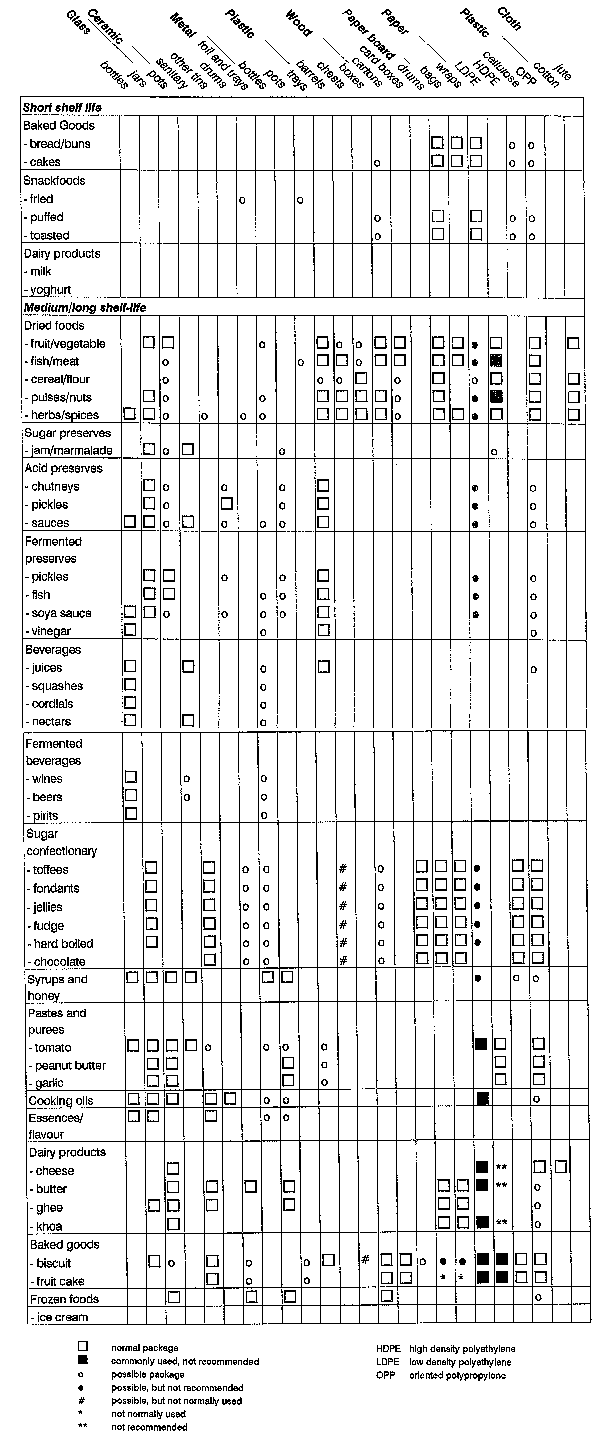
Table
2-10
2.4 Summary of the chapter
In Chapter 2 the reasons why some foods are more suitable than others for small-scale processing were first described. These included business and technical considerations and a list of suitable foods was drawn up, indicating the principle of preservation, expected shelf-life and packaging requirement for each food. The main causes of deterioration of these foods were then described and this was followed by the ability of different types of packaging to protect the foods and extend their shelf life. Finally the chapter concluded with a description of the packaging options that are available for processors to use when making the foods described. In the next chapter the properties and methods of use of individual packaging materials are described in detail.
|
| |||||||||||||||||||||||||
Appropriate Food Packaging (Tool)
3 Packaging materials
This chapter examines packaging materials that are commonly used by small and medium-scale food processors. It first covers rigid containers such as glass, pottery, tins and cans, plastic bottles, wood and cardboard. The second part deals with flexible packaging including paper, plastic films, aluminum foil and cloth.
3.1 Rigid containers
Rigid containers include glass and plastic bottles and jars, cans, pottery, wood, boxes, drums, tins, plastic pots and tubes. They all, to varying degrees, give physical protection to the food inside that is not provided by flexible packaging. While most rigid containers are strong, they are, because of the amount of material used in their production, more expensive than flexible packaging. Some types of rigid packaging have the advantage of providing a perfect airtight hermetic seal.
3.1.1 Glass
Glass is made by heating a mixture of sand, soda ash and lime usually with a proportion (up to 30%) of broken glass or gullet to about 1500 °C until it melts into thick liquid mass. The molten glass is blown into moulds, in two stages, to make bottles and jars which are then cooled under carefully controlled conditions to prevent weaknesses and breakage. As the raw materials for making glass are cheap and available in most countries glass factories are to be found worldwide. Glassmaking is however a very energy intensive industry.
Glass packaging manufacture is only economically possible at large scale. As the moulds are very expensive, only very large food companies can afford to have their own moulds in the glass factory to produce their own special bottles. Various standard colors are made including clear, green or brown depending upon the protection needed from light.
If a glass factory exists in a country then bottles and jars can be a good option for small scale food manufacturers. If the bottles have to be imported, however, they tend to be very expensive compared with alternatives such as plastic due to their extra weight. Many small manufacturers start packaging with second hand glass. As the enterprise expands however it is found that new bottles have to be bought. The high cost and poor availability of new bottles then becomes a major concern. Many producers finally turn to alternatives, such as plastic packaging, or accept total reliance on second hand containers. In many countries a sub-industry exists to collect, wash, sort and sell used bottles and jars.
As will be described later, use of the correct type of lid is vitally important. Once again however many small producers find obtaining lids a major problem as the minimum orders required by the suppliers are high and few glass manufacturers also supply lids. The names used for the various parts of a glass container are shown in Figure 3.1
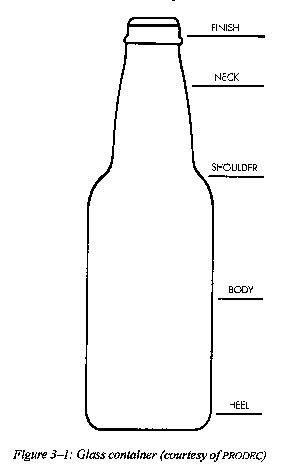
Figure
Glass has several advantages and disadvantages as a packaging material as shown in Table 3.1.
|
Advantages |
Disadvantages |
|
Chemically inert (no reaction |
Breaks with rapid |
|
with any food) |
temperature change |
|
Strong, can resist internal |
Fragile, poor shock resistance |
|
pressure and weight |
|
|
| |
|
Can be re-used and re-cycled |
is heavy |
| |
In-plant breakage carries |
| |
danger of splinters in food |
|
Impermeable to gases, | |
|
aromas and moisture |
|
|
Can give protection against | |
|
light | |
|
Barrier to micro-organisms, | |
|
insects etc |
|
|
Can be heat-sterilised | |
|
Good product display in clear | |
|
glass | |
|
Long shelf-life possible | |
|
High customer appeal and | |
|
acceptability |
|
|
Good protection against | |
|
physical damage |
|
Table 3-1: Advantages and disadvantages of glass
Physical properties
The main physical advantage of glass is its inertness and impermeability. Processors do not need to worry about the type of glass needed as they do with cans and plastics which can react with certain types of foods. Glass has the additional major advantage of being re-usable, re-cyclable and not damaging to the environment.
Products that are affected by light or have a long shelf-life benefit from packing in coloured bottles. While glass is fragile to shock it is strong in terms of bearing weight so stacking on pallets is possible. Protection is needed against shock by the bottles knocking each other or being dropped. For this reason glass bottles are usually put into cardboard outer boxes with dividers or card layers.
By the nature of the way they are made, glass bottles can var, in wall thickness and also in weight. In many developing country glass factories such variations are greater than international accepted norms due to the reluctance of the producer to replace expensive worn moulds. This is very important as it can give false data on the true fill weight or net weight. This is discussed more fully later in the section on specific quality control aspects for glass.
Most glass containers are made with a wall thickness related to their size but carbonated dunks bottles, which have to withstand high internal pressures, are made of thicker glass. Table 3.2 shows typical data on the some common types of glassware used for foods selected from the very wide range available.
|
Container |
Height |
Diameter |
Weight |
Volume |
Closure |
| |
mm |
mm |
mm |
g |
ml |
|
Bottles | |
| | | |
|
Round |
188.7 |
55.3 |
280 |
192 |
Crown |
|
mineral | |
| | | |
|
Round |
165.0 |
65.5 |
187 |
265 |
Crown |
|
mineral | |
| | | |
|
Round |
254.4 |
75.5 |
454 |
550 |
Crown |
|
mineral | |
| | | |
|
Round |
298.2 |
77.8 |
500 |
700 |
ROPP |
|
liquor | | | | | |
|
Square |
268.9 |
71.8 |
490 |
700 |
ROPP |
|
liquor | | | | | |
|
Round |
270.9 |
77.7 |
440 |
750 |
RO |
|
cordial | |
| | | |
|
Winw |
285.0 |
81.1 |
440 |
750 |
Cork |
|
Jars | | | | | |
|
Jam jar |
120.9 |
70.6 |
180 |
1 lb/366* |
Push-on |
|
Jam jar |
121.0 |
72.5 |
185 |
1 1b/375* |
TO |
*Jam jars are commonly measured in Ibs
Codes
RO Roll-on
TO Twist-off
ROPP Roll-on Pilfer Proof
Table 3-2: Common types of glassware
The shape of the bottle or jar is also important as some shapes are weaker than others and so need greater protection. A round bottle is about 4 times as strong as a square one with rounded comers and 10 times as strong as a square one with sharp corners. Unless there are important reasons related to marketing, the use of simple round bottles is thus recommended to reduce breakage and shipping container costs.
Preparation of glassware for filling
All glass packaging, whether new or second hand requires cleaning before use. In the case of new glass simple washing in clean water is all that is required. Much greater care is required when using secondhand or returnable bottles and the following steps are recommended;
- visual inspection for cracks, chips, etc.
- containers
should be smelt to make sure they have not been used to hold a substance that
might be poisonous or taint the food being packed,
- removing labels by
soaking in 1% caustic soda and detergent,
- thorough washing, using bottle
brushes,
- rinsing in clean water,
- if prepared re-used glass is to be
held in store until required it must be re-washed prior to use.
As has been pointed out glass breaks if rapidly heated or cooled so bottles must be carefully heated before hot filling with product and then carefully cooled. It is usual to pre-sterilize glass by either pre-heating in water and holding at 100 °C for 10 minutes or steam sterilizing. Steam sterilizing has the advantage that any weak bottles are more likely to break at this time rather than when they have been filled with a hot product. This reduces the risk of contaminating the food or wasting the product. Steam sterilizing of bottles (Figure 3-3) must be carried out in an area that prevents any splinters from bottles that may break entering the product so injuring the consumer. This is discussed further in Chapters 4 and 5.
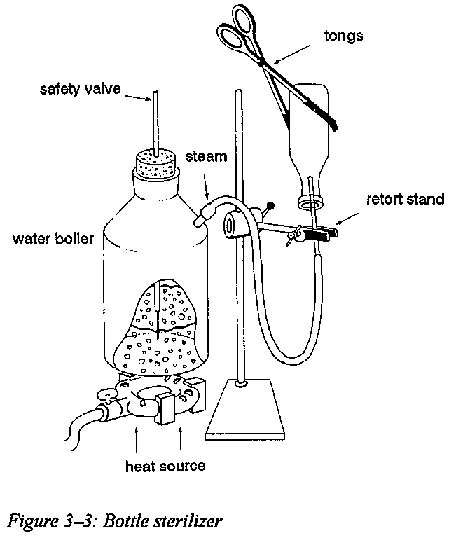
Figure
Food packaged in glass containers can have a very long shelf life provided that the food has been properly processed before packaging, no contamination occurs at the filling stage and that the container is properly closed with a lid or seal. It should be remembered that the pack is only as good as the closure. Recommended shelf-lives vary but are usually 6 to 12 months not because the product actually deteriorates, but because over time there is a gradual loss of colour and flavour. Some foods, wines and spirits for example actually improve during prolonged storage and it is not unusual for a bottle of wine to be drunk ten or more years after packing.
Filling and cooling glass containers
Foods packed in glass containers fall into two broad groups.
- Hot filled: Fruit juices, jams, some pickles and chutneys,
some sauces.
- Cold filled: Wines, vinegars, milk, some pickles and sauces
In addition, in some countries vegetables and meats are packed in glass jars which, after closing, are heat treated under pressure in the same way as canned foods. The use of glass in this way cannot be recommended to small producers due to the health risk it carries.
When hot filling, the sterilization by hot water or steam described earlier ensures that the container is clean and 'sterile' when filled. In addition the hot filling operation at 80°C or above means that the product is also 'sterile'.
It has been found that when hot filling products such as fruit juice it is good practice to lay the capped filled bottles on their side for about ten minutes before cooling. This allows a vacuum to form in the bottle and the cap to 'tighten down' onto the bottle neck. Experience has shown that this laying on the side dramatically reduces post-filling contamination because it removes the possibility of small amounts of air being sucked into the bottle until the neck seal is perfectly formed.
After hot filling, careful cooling must take place as a hot bottle put in cold water will probably shatter. The packs can be laid on their side to cool, which takes time, may result in flavour changes and occupies valuable factory space. Alternatively a simple cooler shown in Figure 3-4 can be made which gives controlled cooling. In this cooler cold water enters at the deep end of the trough and overflows from the shallow end. The hot bottles enter at the shallow end and are taken out from the deep end. What happens in practice is that the temperature is cool at the deep end and becomes warmer and warmer towards the shallow end due to the heat being taken from the bottles as they cool down. At the start of the day the whole tank needs to be filled with hot water to prevent damage to the first few bottles placed in the cooler.
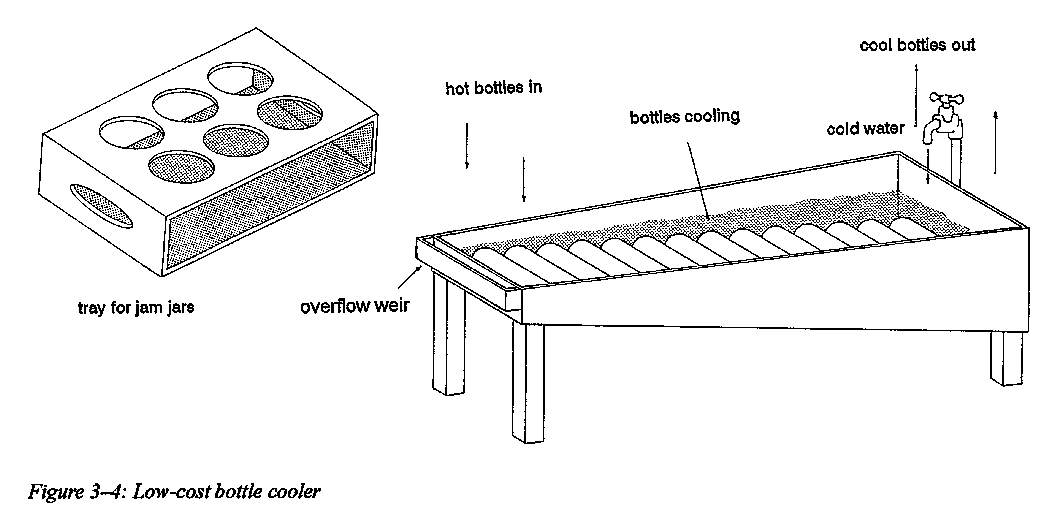
Figure
When cold filling there is much more risk of contamination and so cold filled glass must be thoroughly washed in water containing chlorine (about 5 to 10 drops of bleach per gallon of water). In some cases, particularly when bottling wines and vinegars, bleach can cause off-flavours and the use of sodium metabisulphite is recommended (one teaspoon per gallon of water).
Glass bottles may be filled by hand, from gravity fillers, piston fillers or vacuum fillers, either manual or automatic depending on the product and scale of operation. Suitable fillers are described in Chapter 4.
Sealing or closing jars and bottles
The type of cap or closure and the method of application depend on which of five main types of container is being used. Closures are mainly made from metal or plastic although corks still find wide application for wines. Whatever the type of closure used:
- no part of the closure should affect or be affected by the
food in the container,
- it must seal properly and remain sealed for the
shelf-life of the food,
- it should be convenient for the customer and if the
product is one that is not all used at once, it should be able to be
re-closed,
- it must meet the increasing demand of both customers and traders
for being tamperproof.
When selecting caps for a particular combination of bottle and product it is very important to take advice from the supplier regarding the suitability of the closure for the intended use. The range of alternatives in terms of lacquers, finishes and linings is great. It appears that no written data is produced recommending a particular lacquer or coating for a particular food. In practice the best alternative is found by packing the food and testing for any interaction between closure and contents by visual inspection.
Metal caps are made from tinned steel or aluminium. Being strong they are very suitable when the bottle has a vacuum formed after hot filling or when it is under pressure. Steel caps are the strongest. Both types can be lacquered to give added resistance to reacting with the product.
Plastic caps are made mainly from polypropylene (OPP) and polythene, both low and high density (LDPE and HDPE). The gas barrier properties of LDPE and HDPE are lower than OPP. As they are supplied moulded with a pre-formed thread, plastic caps have to be very accurately matched to the type of bottle or jar being used. Variations in glass neck and thread sizes may cause sealing problems that will not occur when using crown, RO and ROPP caps.
Almost all caps contain a lining material which has two functions, first to provide a soft 'cushion' so that the cap will tighten down to the bottle neck and secondly to reduce contact of the food with the cap. Liners can be plastic (usually PVC), plastic coated paperboard, waxed paperboard etc.
Some caps such as screw-on and twist-on twist-off can be applied by hand. Crown caps, push-on type caps, ROPP caps, plastic hinge-open and snap-shut and corks need machines to put them onto the bottle. Small manual equipment is available for this. All caps can of course be applied by semi- and fully automatic machines but the small and medium-scale food producer is likely to use only manual methods.
Crown caps are applied by a combination of downwards pressure and crimping the skirt and small flutes over the lip on the bottle neck finish, so locking it on. They always have a liner. As crowns cannot be put back on by the customer they are only suitable for products that are opened and used at one time. For larger-scale operations semi- and fully automatic versions are available but beyond the scope of this publication.
Small manual machines are available for push-on caps commonly used on jars of jam - which crimp the rim of the cap around the bottle neck finish. The lowest-cost machine simply crimps the cap edge while the larger version is fitted with fingers that make small indentations in the cap edge, so giving a firmer seal.
Roll on caps (RO) are made of aluminium and supplied unthreaded as a small cup. The action of the capping machine forces the cap wall into the thread of the bottle, then forming a thread in the cap. RO closures are often supplied with a perforation along the bottom edge which breaks when the cap is unscrewed. Such caps are pilfer proof and thus called roll-on pilfer proof (ROPP). They are most commonly fitted to high-value food products where there is a risk of pilfering or adulteration.
As far as is known no commercially available very cheap manual RO or ROPP capping machines exist. Drawings are however available from ITDG, United Kingdom of such a machine that has been developed in Sri Lanka.
Corkers
Corks are mainly used to close wine bottles by pressing them into the neck under considerable pressure while at the same time squeezing them, to reduce the diameter so that they will enter the bottle neck. The corks are wetted before use so that they will slide more easily into the bottle neck. Once inside the neck the cork then expands to give a tight fit. As corks are natural materials and so may well be contaminated with micro-organisms it is recommended that they are soaked in a solution of sodium metabisulphite (approx 1 teaspoon to the gallon).
After corking it is widely recommended that bottles be stored laying on their sides. This prevents the corks drying out and shrinking which would increase the risk of external contamination.
Plastic hinge-open snap-shut closures
In some countries it may be possible to obtain closures of this type which are becoming increasingly common for liquid products that are opened and closed several times in use. Common applications include cooking oils, sauces and fruit toppings. Simple hand-operated presses are available to fit this type of closure.
Other tamperproof systems
Instead of fitting tamperproof caps it is possible to fit several types of sleeve over the bottle cap that will show if the bottle has been interfered with. Typical products are plastic shrink sleeves and aluminium foil capsules. Two types of plastic capsule are used. One type is supplied wet in tins and is simply slid over the bottle neck. As it dries it shrinks tightly around the neck. The other type is heat shrunk in a small electrically heated cylinder. At the small scale, aluminium capsules are applied with a simple push-down crimping machine.
All the above capping machines are easy to use and require
little maintenance. They are suitable for small producers with production rates
from a few hundred to several thousand packs per day. In developing countries it
is unlikely that semi- or fully automatic capping ma
chines would be
appropriate except in large plants. The use of several small hand-operated
machines would be more economical.
Bulk transport of foods packed in glass
As has been mentioned glass is strong under compression so finished goods can be piled in boxes, onto pallets or stacked. Glass will break however if subjected to shock. Great care is needed not to drop full cases and avoid one bottle banging against the next by using cases with card dividers. The use and design of suitable boxes is described in detail in Chapter 3.1.6.
Quality control
One important quality control measure when using glass is the variation in weight of the empty packs which distorts the net weight when full packs are checked. General methods of controlling net weight are discussed in Chapter 6.4.3. In the special case of glass however, a random sample (approx 1 in 50 containers) should be taken from each delivery. Sampling should be scattered, not all from one case. The sample is then individually weighed and the net weight calculated using the heaviest container. Thus: required filled weight = Weight of heaviest bottle + net weight of product
In addition samples should be kept to make sure that cap corrosion does not occur and that good seals are maintained for the shelf-life. In hot filled packs this may involve checking for the maintenance of internal vacuum. If automatic fillers and cappers are to be used, then variations in height and diameter of glassware may become very important but production at this scale is outside the scope of this publication.
As described under Quality Control, (Chapter 6.4) defects are commonly divided into critical, major and minor defects. In the case of glass:
- Critical defects:
- broken bottles,
- cracks in bottle or neck finish,
- contaminated interior (bubbles, strings of glass).
- Major defects:
- glass weight below minimum,
- height or diameter outside tolerances.
- Minor defects:
- Uneven outer surface,
- slightly off-colour glass,
- rough mould lines.
3.1.2 Pottery
Pottery is one of the most ancient forms of traditional packaging. Pottery wine and oil jars have been used for thousands of years. Hundreds of yeas ago crude sugar was crystallised in pots, a stage known as potting. Potting later was used to describe the method of preserving 'potted meats' in clay containers. Although pottery containers have now been largely replaced by other materials for commercial food packaging they still are widely used in some countries for certain products, for example cooking oil, tomato paste and gun They also find application when packing high value, luxury foods. In Europe, for example, very expensive marmalades, meat pastes and cheeses may be bought in glazed pots. The use of pottery for the small producer will thus fall into two areas:
- as a low-cost, locally obtainable alternative to glass,
etc.,
- to pack high-value foods for the richer customer or perhaps tourists.
Pottery containers are made from clays either by hand or with the use of moulds. Hand-made pots vary considerably in size and shape while moulded ware is far more standard and thus more suitable for routine food packaging. After production the pot has to be baked or fired in a kiln at high temperatures, between 600 and 1250°C. The appearance and properties of the final product depend upon the type of clay used, the firing temperature and whether or not the pot is glazed. Ordinary clays fired at low temperatures yield earthenware. Other clay types, fired at higher temperatures produces stoneware while the use of special clays and very high temperatures yields porcelain. The fired pot may, if required, be dipped in a glaze and returned to the kiln where the glaze melts to a glassy coating. Both external and internal glazing can be applied. When earthenware is glazed, the glaze does not bond into the pot but essentially sticks to the surface. As the pot cools such a glaze often 'crazes' and the tiny cracksso produced mean that an incomplete impervious glaze coating forms. When stoneware is glazed the glaze bonds into the clay and a far more perfect protection results.
As the moulds for pottery containers are cheap to make it is possible, unlike glass, to have special packaging made. An The basic properties of both unglazed and glazed pottery are shown in Table 3-3.
| |
Earthenware |
Glazed |
Stoneware |
| | |
earthenware |
|
|
Chemical |
Reasonably |
Very resistant |
Extremely |
|
properties |
resistant to |
if glaze not |
resistant |
| |
chemical |
crazed | |
| |
attack | | |
|
Permeability |
Very |
Low if glaze |
Impermeable |
|
to moisture |
permeable |
not grazed | |
|
and gases | |
| |
|
Pack product |
Can react |
Little if well |
None |
|
interaction |
with very acid |
glazed with |
|
|
|
foods |
correct glaze |
|
|
Operating |
Good resistance. Can break if not warmed before hot filling | | |
|
temperature |
| | |
|
Weight |
Heavy, has to be made thicker than glass to give equal strength | | |
|
Strength |
Very easily |
Stronger than earthenware but breaks if | |
| |
broken if |
knocked | |
| |
knocked | |
|
| | |
All are strong under load | |
Table 3-3: Properties of pottery packaging
Glazes
Great care must be taken if considering the use of glazed pottery for food packaging that the glaze will not react with the food. This becomes even more crucial if even slightly acid foodstuffs such as honey or yoghurt are involved. Many glazes contain chemical salts of heavy metals which are toxic. The main problem lies with lead.
Lead glazes are widely used on pottery since they are cheap and easy to use. Other heavy metal glazes, which are generally highly colored are used for decoration and so unlikely to be encountered on the inside of pottery being used for food packaging. The food producer must make sure from the pottery supplier that lead glaze is not used. The seriousness of the problem has been highlighted from work in Central America where people traditionally use lead glazed bowls and cups for food. Changes in diet, particularly children drinking acid fizzy drinks, is showing up as increased lead in the body with resulting chances of impaired brain development. Simple chemical tests exist for checking for lead and any food manufacturer with doubts over the suitability of a glaze is advised to have a container tested in a local laboratory.
Packaging applications for pottery containers
Pottery is still widely used all over the world for the traditional packaging and storage of foods such as grains, pulses, wines, honey, pickles, yoghurts and dried foods. Such traditional uses are outside the scope of this publication which is concerned with the use of packaging materials for commercial production.
It is almost, if not totally, impossible to hermetically seal pottery containers due to the variations that occur in the neck diameter and shape (slight ovality). For this reason their use is limited to products that are either very stable, such as honey, or have a short shelf-life such as yoghurts and soft cheeses.
In cases where pottery is being used for products aimed at high-value markets, that is to say more for their visual appeal than barrier properties, dry foods that would tend to absorb moisture can be packed in plastic bags inside the outer pottery pot.
|
Product |
Comments |
|
Honey |
Very stable, long shelf-life in |
| |
glazed pots, needs sealing to |
| |
keep out insects such as ants |
|
Yoghurt and soft cheeses |
Packed in shallow |
| |
earthenware bowls. Short |
| |
shelf-life. Needs covering ie |
| |
with paper tied round neck to |
| |
protect from dust and insects. |
| |
Must be very well cleaned if |
| |
re-used as food is absorbed |
| |
into the earthenware. |
|
Solid block sugar (for |
Very stable, pot needs to be |
|
example gur) |
broken to remove the product. |
|
Spices, teas, herbs |
Inner plastic liner needed in |
| |
humid climates, should be |
| |
sealed |
|
Jams and jellies |
Stable products with long |
| |
shelf life in glazed pots, must |
| |
be sealed |
Table 3-4: Foods suitable for packaging in pottery containers
Using pottery containers
When using pottery packaging the same basic precautions apply as for glass. Incoming pots should be inspected and any showing damage rejected. Pottery pots are likely to be more dusty than glass due to the conditions they are made in and the rougher surface. Thorough washing in clean water is essential. The pots should be turned upside down and allowed to dry before filling.
If hot filling is planned, for example with jam, pottery pots may break during filling. Pre-heating in an oven is recommended. Pottery containers are not usually heat processed. In practically all cases the small producer wilt hand-fill the containers although small volumetric piston fillers, as described in Chapter 4, can be used. Indeed, the use of volumetric filling, even using a simple measuring jug, is recommended in view of the considerable weight and size variations that occur in pottery containers.
Sealing
As has been mentioned it is almost impossible to hermetically seal pottery containers. However, the following methods are commonly used to produce an acceptable seal:
- Use of a cork bung. The seal can be improved by running
sealing wax around the bung edge.
- Use of a pottery insert and a disc of
polythene.
- Waxed paper or polythene held on with a rubber band or string.
Examples are shown in Figure 3-12. It is essential to keep filled pots vertical as all the above seals are likely to leak if the pot is turned upside down.
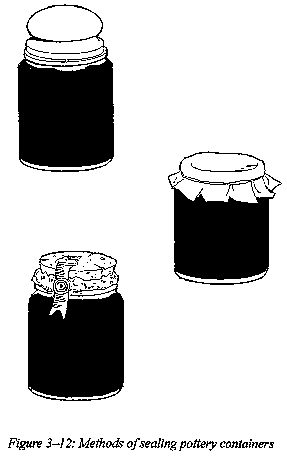
Figure
Shipping containers
Pottery, like glass, is easily broken. Careful packing in outer boxes in the same way as glass jars is thus recommended. Larger pots, of the type used for solid sugars or bulk distribution, are often packed in hand-made wooden boxes lined with soft material like dry grass to absorb any shocks in transport
Skills required
No special skills are required when packing in pottery except perhaps learning to seal effectively with wax.
Quality control
There are several important quality control checks needed when using pottery. First considerable size (volume) and weight variations may exist from pot to pot or delivery to delivery. Samples should be taken and checked for volume and weight on delivery. Samples of filled containers need to be taken and checked for net weight more frequently than when using glass. If volumetric filling is not used, it may be necessary to fill each container on a scale so ensuring that the correct net weight is obtained.
The food producer must make sure that only safe, nonlead, glazes are used by the supplier. Re-check periodically as the potter may change his glaze.
If the pots are made of earthenware and re-used then great attention must be paid to thorough washing and cleaning as earthenware, being porous, will absorb food into the structure of the pot. This, due to microbiological grown, can make the food deteriorate.
- Critical faults:
- cracks,
- use of lead glaze,
- ovality of neck
- Major faults:
- large size and/or shape variations,
- incomplete layer of glaze
- Minor faults:
- minor variations in size and/or shape that allow declared net weight to be packed,
- variation in colour.
Pottery containers have certain advantages for small producers, particularly those living in very isolated areas where alternatives may be hard to obtain Indeed it is in such areas that the skills of the potter are most likely to have survived
3.1.3 Metal containers
Metal containers commonly used in the food industry include steel drums, tins with push-on or screw-on closures, sanitary cans (the 'tin' can), composite cans (usually a combination of paper board and steel), aerosols, aluminium cans and aluminium foil made into dishes, etc. The level of technology involved in filling into aluminium cans (used for beers and carbonated beverages) is high and as generally it is only applicable to large production units will be only briefly covered. Aerosols are beyond the scope of this publication.
Sanitary cans
Cans and glass are still perhaps the most common rigid containers used for packaging and preserving food. While almost any food, including dried goods, can be canned the most common applications are to fruit juices, fruit in syrup, tomatoes, meats, fish and vegetables.
The processing methods required to can acid foods, such as fruit, are very different from those needed to can low-acid foods safely, such as vegetables and meats. Acid food products only require heating to temperatures below 100°C in order to inactivate naturally occurring enzymes and destroy most micro-organisms present Low-acid foods on the other hand need to be heated in pressure vessels, called retorts, at 121°C for a pre-determined time based on the product and size of can being processed. Cooling, under pressure from compressed air, then has to take place in the retort
Equipment costs (steam boiler, retort, compressor) for low-acid food canning are high and considerable technical skills and knowledge are required to safely can low-acid products. Errors can cause severe food poisoning or even death. It is strongly recommended that small and medium-scale food manufacturers should not attempt to can low-acid foods such as vegetables, soups or meats unless they have, in house, the necessary expertise and laboratory facilities to make sure that production errors do not occur. The reasons for this, and the food poisoning dangers that exist have been described in Chapter 2. This chapter has been written with only the canning of acid foods in mind.
The can has distinct advantages over glass which include:
- good heat transmission,
- not subject to thermal shock so
rapid heating and cooling are possible,
- lighter in weight,
- not subject
to breaking,
- little or no interaction between the food and can occurs
provided the correct type of can is selected,
- resistant to physical damage.
They are also totally impervious to light and air. The main disadvantage of cans is, of course, that the contents cannot be seen by the purchaser.
Canning may be a good option for small and medium-scale producers, particularly when a can-making facility exists in country. It should also be remembered that cans are considerably lighter than glass containers so transport costs can be lower. Cans are still an expensive option when compared to alternatives such as plastics.
Can manufacture
There are three main methods of making cans. The most common produces the traditional three-piece sanitary can which consists of a body and two end pieces that are joined together to provide a hermetic or perfect seal. While most commonly used for foods that are heat processed they also find application in packaging powders, syrups, etc. that are not heat-processed. The most common shape is a round cylinder but square and oval flat cans are used, particularly for fish processing. The other two methods which produce a two-piece can (integral body and base plus a lid) have become increasingly common in recent years. Two-piece cans require less metal and thus are lighter and cheaper.
Three-piece cans
Cans are most commonly made from thin sheets of steel that have been electrolytically coated with tin on both sides. The type of steel used depends on the corrosion resistance needed for the particular product to be canned. The most resistant grade is called Type Land is used for strongly corrosive foods such as apple juice, prunes, cherries and pickles.
Type MR steel is less resistant to attack and is used for mildly acid products such as apricots, peaches and grapefruit as well as low-acid foods like peas, corn, meats and fish Type MC is used for the low-acid foods mentioned previously.
The tin layer is 0.1 to 0.3 mm thick (2.8 to 11.2 g/m2). The layer thickness required depends on how corrosive the food being canned is. Thicker tin layers are needed for high-acid foods. The tin layer may be of equal thickness on both sides of the plate or thicker on one side. The sheets of tinned steel are coated with a lacquer on the 'inside' face.
Lacquer is used to:
- prevent taste changes that might occur from traces of metal
that dissolve in the food,
- prevent discolouration of the inside of the can
especially in foods rich in sulphur such as fish and meat,
- prevent
discolouration of the product.
Lacquers are often described fruit juice, meat or fish grade. The actual detail of the composition, thickness, etc., of these lacquers is beyond the scope of this publication. The most common lacquers include:
- Oleoresin lacquer now being replaced by epoxyphenolics. These
have poor resistance to attack by sulphur. R or fruit enamels have resistance to
staining by fruit pigments of the type found in berry juices. C enamels are used
when packing high-protein foods such as corn, peas and poultry.
- Vinyl
lacquers have good adhesion and flexibility but do not resist high-temperature
sterilization well. Often used as second layers for canned beer, wine and
carbonated beverages as well as dry foods.
- Phenolic lacquers have very good
chemical stability and low permeability especially against sulphide. Used for
fish and meat products.
- Acrylic lacquers have good color retention and high
heat resistance.
- Epoxy-phenolic lacquers, the most comonly used type.
Resistant to acids, good flexibility and high heat resistance. A wide range is
available to cover different uses such as fruits, vegetables, meats and fish
The choice of the correct lacquer is of great importance and readers considering canning are strongly recommended to consult specialists in the can supply industry regarding the best coating for the food to be processed.
Can lids have a ring of flexible sealing material around the rim which is compressed in the canning machine to give a perfect seal.
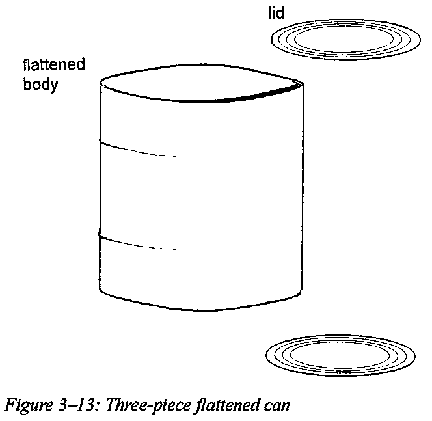
Figure
Three-piece cans are supplied to the user in two forms:
- with the base joined to the can body by the can manufacturer
and sent to the food manufacturer together with the lid, or
- as a
'flattened' or 'collapsed' can with the body cylinder flattened into an oval
shape and supplied with loose bases and lids
Flattened cans are cheaper to transport as more cans are packed into each cubic metre. The user however has to invest in can-reforming machines and incur additional labour costs in attaching both the can base and lid.
Two-piece aluminium cans are commonly used for beers and carbonated drinks. The technology used is high and costly. Recently, a small-scale beverage filling/carbonating/closing system has been developed. This unit can produce up to 5750 cans per day and can also accommodate bottles. It is of low cost compared to existing alternatives.
The production of cans involves high technology and large outputs. This is particularly true of the two-piece can where outputs of at least 150 million cans per year are needed for economical production.
Can sizes
While a wide range of can sizes exist with capacities between 71 ml and 10200 ml most foods are packed into cylindrical cans with a capacity of 140 to 900 ml. When ordering cans it should be remembered that in the United States and Imperial systems the first digit relates to the number of inches and the second digits the number of 1/16 of an inch Can sizes are always expressed as diameter x height. Thus a can 307 x 409 is 3 7/16" by 4 9/16". It should be noted that in the United Kingdom and Europe metric sizes are increasingly replacing imperial sizes.
When placing orders canners must ensure that the correct size of can for the chuck size of their can sealing machine is ordered.
Reforming and closing (or seaming) of sanitary cans
As has been mentioned previously cans will be delivered to the food processor either 'erected' (with the base fitted by the supplier) or 'Battened' (with the body as a flattened cylinder). If flattened cans are used the canner will need three machines in order to erect, flange and seal (or seam) the cans:
- A can-body reforming machine which re-forms the flattened body
into a perfect cylinder.
- A body flanger which bends over the ends of the
cylinder to form a flange into which the lid and base are sealed.
- A seaming
machine which seals the bases and lids to the can body to make what is known as
a double seam shown in Figure 3-14. Seamers go through two operations by means
of two rollers. The first operation roller rolls the cover hook around the body
hook and the second operation roller tightens the two hooks to provide a double
seam.
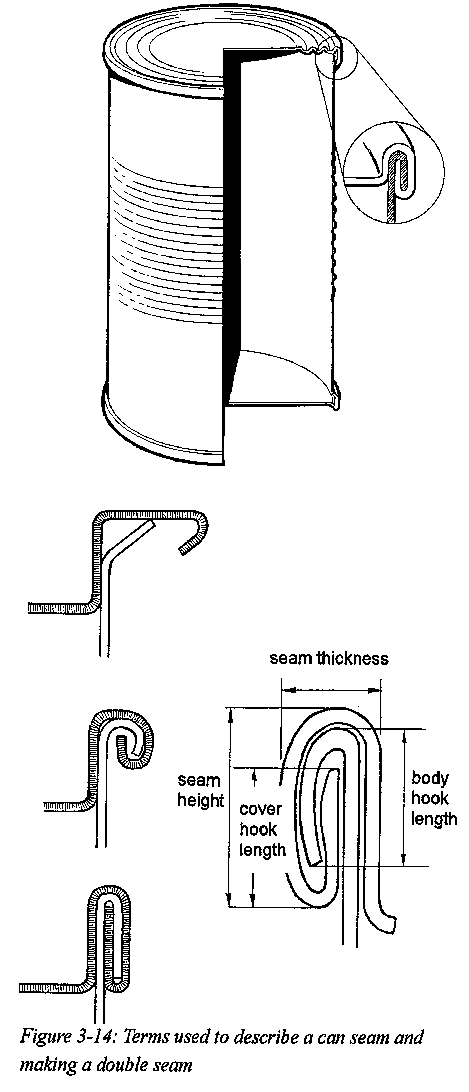
Figure
If erected cans are bought, only one machine, the seamer, is required to seam the lid to the body.
The choice for the processor between using erected or flattened cans will greatly depend on local circumstances. Broadly, for the flattened can it can be said that:
- they are cheeper,
- transport costs are lower,
-
equipment costs are higher,
- higher operator skills are needed, since three
mechanical steps are involved,
- labour costs are higher.
The decision thus involves balancing the first two advantages above in financial terms against the latter three disadvantages largely on the basis of the level of production.
Washing cans
Cans received from the supplier must be washed prior to filling as shown in Figure 3-16. Hot water is sprayed into the can which is laying on its side. As the cans roll forward to the filling point they tip half upside down to allow any water to drain away.
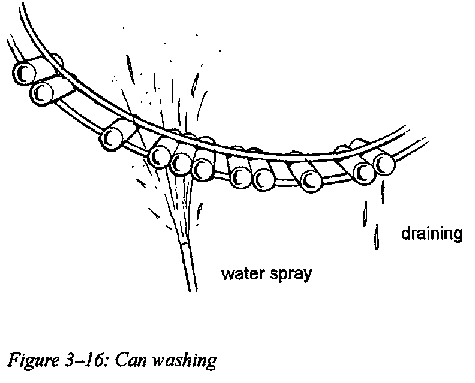
Figure
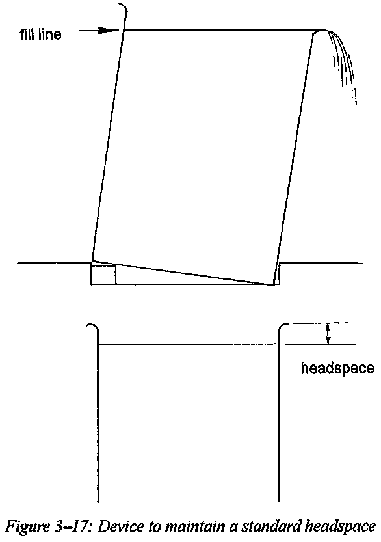
Figure
Filling of cans
While automatic rotary or carousel fillers are used in large canneries hand-filling is the usual method for small and medium producers. If liquids, such as fruit juices are being packed normal filling systems involve jugs, piston fillers or simple gravity fillers. When products such as fruit in syrup are being produced the fruit should be packed into the can first and then topped up with hot syrup. In order to facilitate further processing, juices and top-up syrups are usually filled into the can at temperatures of about 80°C.
It is most important that the can is not filled to the top and that a 'headspace' of 0.3 to 0.5 cms is left. The simple device shown in Figure 3-17 will greatly assist in maintaining a standard headspace.
Exhausting
Before sealing the can, air present in the headspace is removed from the container by exhausting. This reduces any strain on the can that would result from the air expanding during further heat processing and reduces the possibility of the air oxidizing the inner can surface during storage. Exhausting is carried out by:
- filling very trot,
- cold filling and then putting the cans
with the lids loosely fitted into a steam chest or exhaust box,
- blasting a
jet of steam into the headspace immediately before seaming.
The cans are then closed using seamers of the type shown earlier. The next stage involves heat processing the sealed cans in boiling water or in steam retorts.
Cooling
After processing for the required time the cans should be cooled in clean chlorinated water. The cooler illustrated in Figure 3-4 in the section on glass packaging has been found equally applicable for can cooling. The cans are removed from the cooler while still warm as this allows them to dry quickly and prevent rusting. They then pass on for labelling.
Can quality control
The double seam is the potential weak point of a can and for proper hermetic seals it must be made to stringent tolerances. Routine inspection of cans by 'tearing down' is important. Table 3-5 shows typical tolerances for selected sizes of cans.
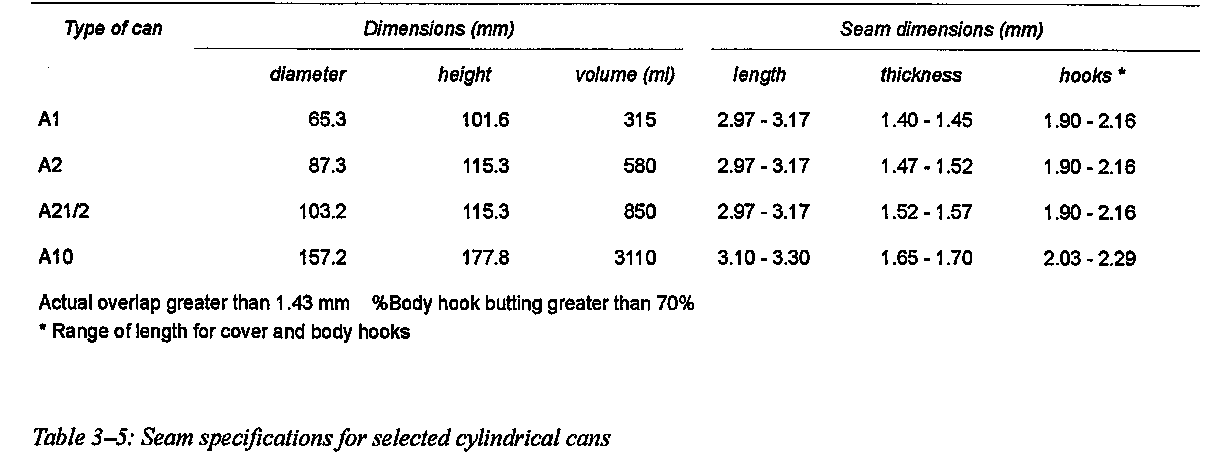
Table 3-5
Inspecting cans and adjusting the seamer is skilled work and operator training is essential. Such training is usually provided by the can supplier. It is not possible in a publication of this size to include full details of can seam inspection and machine adjustment, this can be found in special booklets, about 20 pages long, provided by can suppliers. The use of a special micrometer, called a can micrometer, is necessary to measure the seam width, seam depth and the cover hook and body hook. From these measurements the % overlap of the two hooks can be calculated. The % overlap is the main factor to maintain a hermetic seal. If necessary the canning machine is then adjusted by increasing or decreasing the tightness of the first and second rolls. As every change in roll tension made results in changes to all the other seam dimensions this is a highly skilled job. Common seam defects are shown in Figure 3-18.
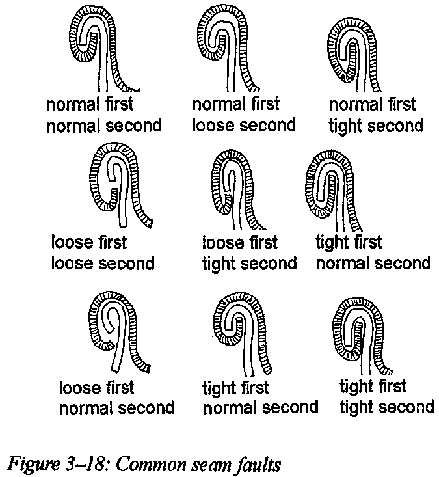
Figure
After filling and seaming an internal vacuum will form as the hot contents cool. This internal vacuum is essential for preservation of the contents and regular samples need to be taken and tested with a special can vacuum gauge, again available from can suppliers.
Problems with poorly sealed or processed canned foods will usually show up in store as 'swells' or 'blown cans.' Swelling takes place as the food deteriorates and gives off gas. Instead of an internal vacuum the cans are under pressure and if punctured the contents will blow out. The lids will bow outwards due to the internal pressure; rather than inwards as in a can with normal internal vacuum. Samples of finished stock in store should be routinely checked for internal vacuum and any sign of blowing. If blowing occurs it is often necessary to reject the whole batch.
Better stockroom control and response to customer complaints are possible if the cans are date-coded. Small peddle-operated presses are available that indent a series of numbers or letters into the lid before it is joined to the can body.
The following critical, major and minor faults occur in cans:
- Critical faults:
- leaks in body seam or manufacturers end seam,
- seaming compound missing,
- seriously dented flanges,
- missing or incomplete interior lacquer,
- contaminated interior.
- Major faults:
- dents over 2.5 cm (1") long,
- out of round shape,
- too much or too little seaming compound in can end,
- loose solder in can.
- Minor faults:
- dents less than 2.5 cm (1") long,
- scratches on ends or exterior surface of the body.
Steel drums
Drums are large cylindrical metal containers with capacities between 10 and 240 litres, the most common size being 210 litres or 55 Gallons us. In the food industry, they find three main uses:
- for bulk safe,
- for bulk storage of ingredients,
- for
safe storage of finished goods, particularly dried foods.
Drums are made of sheet steel 0.4 to 1.5 mm thick which may be galvanised and coated internally. They are strong and provide excellent protection against light, moisture and rodents etc. As many drums are made for use in the chemical industry it is important to check that any internal coating is of 'food grade' quality.
There are two main types of steel drums: closed head or open head as shown in Figure 3-20. Closed head drums are used for packaging liquids, in particular edible oils, while open head drums find use for packing solid products.
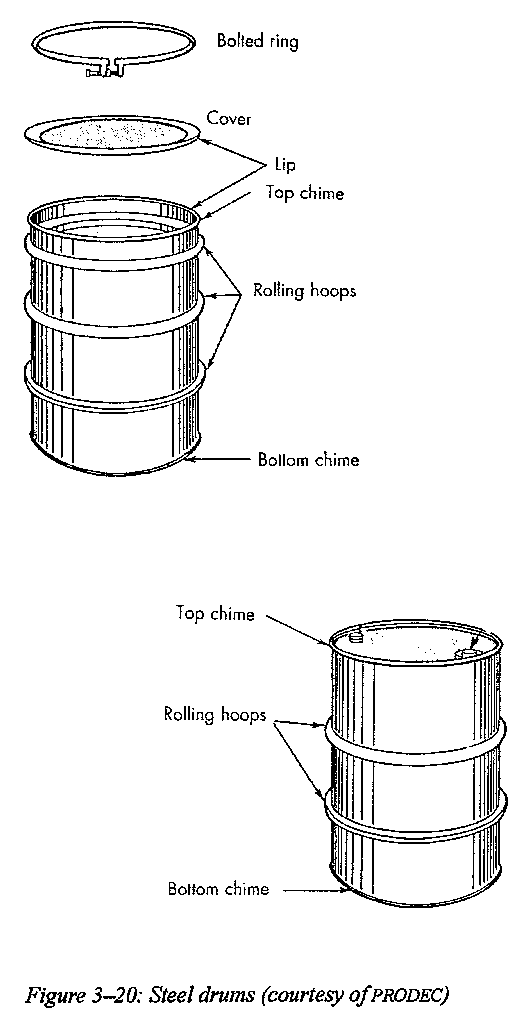
Figure
In many parts of the world second hand drums find use for bulk packaging and distribution. It is very important that the food manufacturer makes sure that these drums have not been used for dangerous chemicals.
The use of open-ended drums for storage of finished dried foods is important. Such storage can provide good protection against pests, light and moisture particularly if the drums are lined with plastic. Drums lined with heavy plastic bags also provide good packaging for semi-processed ingredients, for example fruit pulp preserved with sulphur dioxide or vegetables in brine.
Tins
Being totally impervious to light, air and moisture, tins provide excellent protection. A large range of shapes and sizes, round, square and cylindrical are available. Lids may be of the simple push-on type or hinged. In many cases tins used for food packaging are attractively printed and have great promotional and customer appeal. They also have appeal to the purchaser in that they can be used for food storage in the home after use. Tins, and in particular printed ones, are however an expensive form of packaging.
Two main types are of interest to the small to mediumscale food manufacturer. Round tins with push-on lids are excellent for packing high-value solids such as herbs. Round or square tins with a small pouring spout are commonly used for packing cooking oils.
As round tins for dry goods are expensive compared to alternatives such as plastic bags they are normally only used for packing high-value products, particularly those that may loose flavour, odour or colour if not well protected. Large manufacturers often pack such materials under an inert gas (carbon dioxide or nitrogen) in order to protect them from oxidation. Gas packing, as a technology, is generally considered to be beyond the means of the small to medium producer. A low-cost system shown in Figure 3-21 has however been successfully applied in trials for packing high-value herbs.
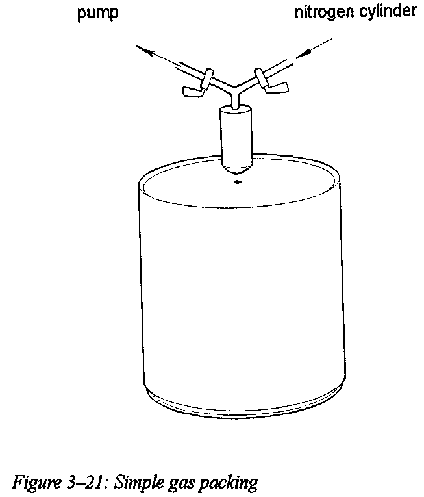
Figure
In use, the product is filled into the tin and the lid put on, a tiny hole is then punched through the can base. Vacuum is applied to this hole and the air drawn out. The vacuum valve is then closed and the gas valve opened. This fills the can with gas. Finally a small drop of solder is applied to the hole.
As in the case of drums, tins are often re-used. Again the food manufacturer must assure themself that they have not been used for any toxic or dangerous material.
Simple labour-intensive technologies for making cans of the screw-on-lid type for vegetables oils at rates between 20 and 1000 per hour have been developed and tested. The basic steps involved in making a round can with a pouring spout for packaging oil are shown in Figure 3-22. It is not known how much uptake there has been of this small-scale can-making technology.
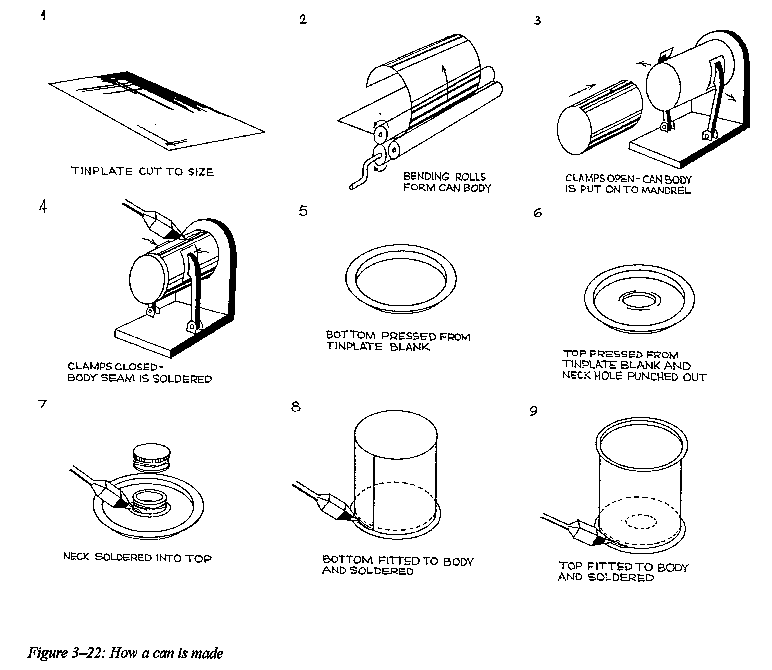
Figure
In general smaller industries will fill tins by hand, possibly with the aid of funnels. However overhead gravity fillers, piston fillers and volumetric powder fillers, of the type described in Chapter 4 may be used.
Quality control for drums and tins
- Critical factors
- must not have been used for poisonous substances if second-hand,
- linings must be food grade.
- Major faults
- must not leak,
- lids must seal,
- no internal corrosion.
- Minor faults
- dented.
3.1.4 Plastic bottles, jars, tubes, cups and trayes
Largely for cost reasons rigid plastic bottles, jars, tubes, cups and trays are increasingly replacing glass and tin cans for food packaging. Unfortunately the widespread use of plastic is having a bad impact on the environment. Plastics do not rot or break down under the natural action of the environment. They cause visual pollution floating in water or laying on the ground and if burnt give off noxious and often toxic fumes. At the present time, biodegradable plastics are not commercially available. With time it is hoped, however, that safer, biodegradable plastics will be developed and, probably due to pressure from legislation, replace the existing range of plastic packaging.
The range of plastics and co-polymers used to make rigid plastic food containers is wide. In reality for most small food processors in developing countries the choice will be restricted to packaging made of polypropylene, polythene and polyvinylchloride (PVC). Polyethylene tetraphthalate (PET) is however rapidly becoming more common. For the food processor plastic containers have the great advantages of:
- lower cost,
- lightness,
- resistance to impact
damage,
- availability both clear and colored,
- squeezability, useful for
spreads and honey.
Plastic containers however give less protection than colored glass and cans against light and air. In addition they are not as strong, in terms of weight bearing and crushing, as glass or cans and are easily punctured by sharp objects. It should also be remembered that rigid plastic packaging has the considerable disadvantage of causing environmental since they are not biodegradable. In general they cannot be easily re-used or re-cycled.
As is described later most plastic packaging cannot be used at high temperatures so hot filling and heat processing are less common. If high-temperature resistant polypropylene packs are not available then the types of food that can be packaged at small scale into plastic are thus limited to:
- Foods that are naturally stable for the planned shelflife and
can tee cool filled (such as dried goods, some pickles, cooking oils, fats,
yoghurt, fruit juices containing preservative, beers, vinegar and honey).
-
Jams and pasteurized pickles, such as chutney provided that the product is
cooled to below about 60°C before filling. In the case of jams this means
that a special recipe has to be used using a slow-setting pectin (a pectin that
does not set until the jam has cooled).
The commonest uses for rigid plastic containers are shown in Table 3-6.
|
Container |
Application |
|
Plastic bottles |
non alcoholic beverages, |
| |
cooking oils, ketchups, |
| |
sauces |
|
Plastic jars |
honey, spreads, peanut |
| |
butter, dry foods |
|
Trays and tubs |
butter, fats, spreads,ice |
| |
cream, jams, condiments |
|
Cups |
drinks, yoghurt |
|
Tubes |
honey, spreads |
Table 3-6: Common uses for plastic containers
A wide range of different types and mixtures of plastics are used to make plastic containers many of which are not suitable for contact with food for they contain chemicals, known as plasticizers, that are toxic and can migrate from the plastic to the foods. Oily foods are particularly likely to dissolve plasticizers. The food manufacturer must make certain that the type of plastic being used to make the container is food grade. It should be noted that one particular type of plastic, PVC, is made in many grades only some of which are food grade. In many countries regulations state which types of plastic can be used and local Standards Offices can advise. In cases where no such standards exist the recommendations of countries with established standards should be consulted.
Production of plastic containers
Plastic bottles are made by several methods:
- Blow moulding is similar to glass bottle making and is used as
a one or two stage process to make bottles, jars and pots
- Injection
moulding. Here grains of plastic polymer are heated by a screw in a moulding
machine and then injected under high pressure into a cool mould. The method is
mainly used for wide necked containers and lids.
- Injection blow moulding.
Polymer is injection moulded around a blowing stick and, while molten is
transferred to the blowing mould. It is then blown into shape by compressed air
(Figure 3-23).
- Extrusion blow moulding. In this method a continuously
extruded tube of softened polymer is trapped between the two halves of a mould.
It is then inflated by compressed air into the mould.
- Stretch blow
moulding. A shape is prepared by either injection or extrusion moulding. It is
then re-heated, which causes the molecules of plastic to 'line up'. This gives a
glass clear container of greater strength which has good barrier properties to
gases and moisture over a wide temperature range.
The costs of moulds for injection moulding are much higher than those for extrusion moulding, but the surface finish and size accuracy of the finished product is better. It is possible, by injecting two or more different types of softened plastic, one inside each other, to produce bottles with layers of different types of plastic. These are called co-extruded bottles and are used to give special properties such as improved gas permeability characteristics.
Tubs, trays and cups are made by heating sheets of thermoplastic material and then shaping the soft sheet into a mould by means of vacuum or pressure. While such packaging is normally made in large factories, smallscale semi-automatic vacuum thermoforming machines are available (Figure 3-23). Such small-scale local production of plastic containers could offer opportunities for entrepreneurs in developing countries.
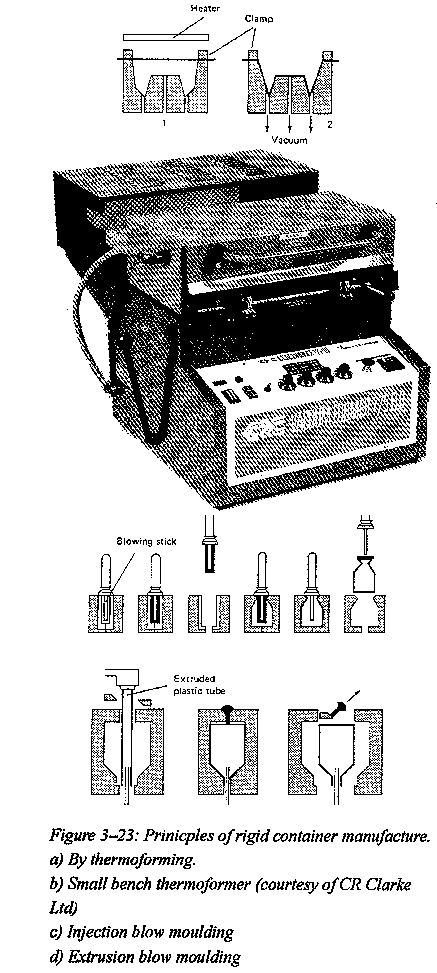
Figure
The types of plastic commonly used for food packaging materials likely to be available in developing countries are shown in Table 3-7.
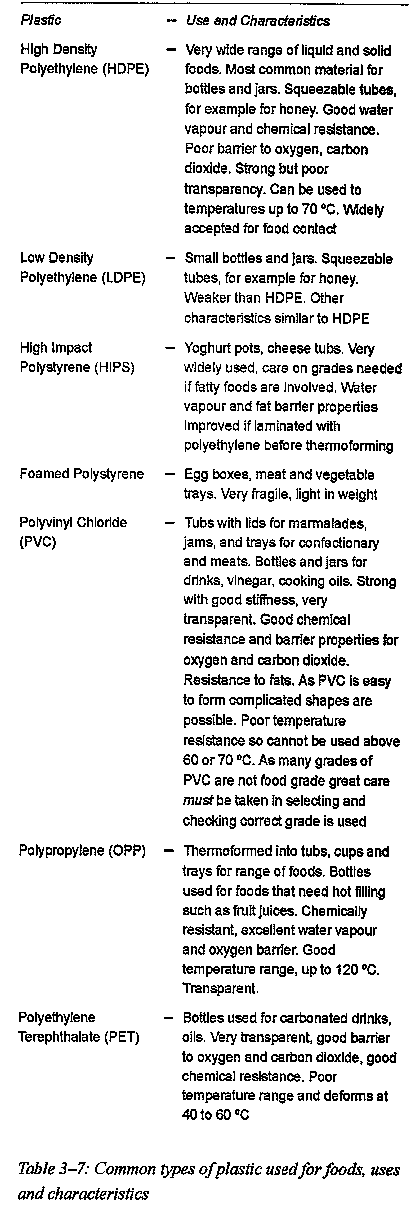
Table 3-7
In addition to the above, plastic packaging is made by combining different plastics or co-forming them to improve, for example, the packs water vapour or gas barrier properties. In this way the materials used in the coforming can be tailored to the product. In some cases up to six different layers of material may be used.
Selection of best material for a product
Ideally the type of plastic used for a particular packaging application should be selected with advice from the supplier. The reality for many small-scale food manufacturers however will be that only one or two types of bottle are available. The food producer should find out what type of plastic containers are available and then carefully consider aspects such as:
- Is the plastic suitable for contact with food.
- Is
resistance to oils and fats important.
- Strength, particularly if gassy
drinks are involved.
- Is permeability to gases (oxygen and carbon dioxide)
important.
- Maximum filling temperature that can be used.
- Color,
clarity and surface finish.
- If hand capping can be used or if special
closing machines are involved.
- If heavier grade, stronger shipping
containers will be needed to protect against crushing and impact damage.
- If
plastic cups are to be used considerable transport savings can be made by
selecting types that stack one inside the other. It is possible to pack 8700
conical stacking cups per cubic metre but only 1500 straight sided ones.
Transport cost savings of over 80% could thus be made by using conical cups.
Processing, filling and sealing
Plastics, with the exception of polypropylene, have poor resistance to high temperatures; In general then packaging cannot be hot water or steam sterilized before filling. Thorough washing in clean water to remove any dust is thus essential followed by draining.
If OPP or HDPE are being used hot filling is possible. In the case of other plastics filling temperatures will need to be kept below 60°C. At a small scale, hand-filling will commonly be used but of course piston, vacuum and gravity fillers as described in Chapter 5 can be appropriate. Closing or sealing plastic packaging depends on the type being used.
Bottles and Jars.
The most common closures used are the same as those used for glass bottles. These include plastic screw-on caps that may if desired be pilferproof (ROPP) and hinge up/snap down plastic caps that are increasingly being used for products, such as oils, that are frequently opened and closed. In some cases these hinge up caps are fitted with a small pouring spout, very convenient to the customer for sauces and honey. Caps of these types and small equipment for applying them are described in Chapter 3.1.1 on glass packaging. Plastic shrink sleeves and aluminium foil capsules can be slipped over the cap to make it pilferproof and more attractive. Such sleeves are also described in Chapter 3.1.1 on glass.
Tubs and cups.
Containers of this type are closed in two ways: with snap-on or push-on plastic lids or heat sealed aluminium foil. At a small scale, hand-closing is invariably used. If heat sealed lids are to be used then the container must have the correct shaped rim to which the foil lid is sealed. This has an electrically operated sealing head operating at about 200 °C and can seal 10 pots/minute. As the thin foil closure can easily be damaged some manufacturers place a snap-on lid over it to give added protection
In operation the filled cup is placed onto the platform and a foil lid is laid onto the cup rim. The heat sealer head is brought down for a set time and the plastic on the back melts and heat seals onto the rim. It is possible, if heat sealers of the type above are unavailable or too expensive, to use a household domestic iron to heat seal foil to cups as shown in Figure 3-26. Several locally made sealers made this way have been seen. The main problems in using them are obtaining the correct sealing temperature and time. This must be found by trial and error.
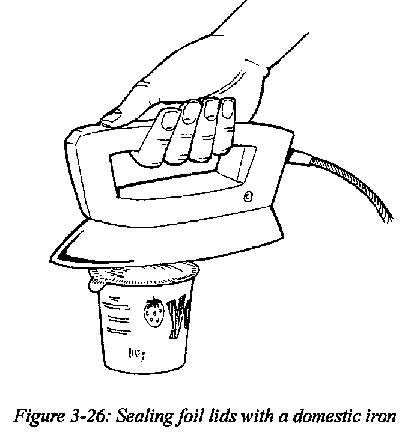
Figure
Plastic tubes.
While plastic tubes are not commonly used for food packaging in developing countries they are an option for food manufacturers who wish to sell their products with greater customer convenience. Applications include honey, mustard and sauces. Tubes are purchased with the neck and cap complete, the bottom end being open. The product is filled into the open bottom, taking great care to keep the part that is later heat-sealed completely clean (Figure 3-27). Piston fillers are very useful for such filling. After filling the open end of the tube is heat-sealed in a jaw sealer of the type described in Chapter 3.2.2 on films.
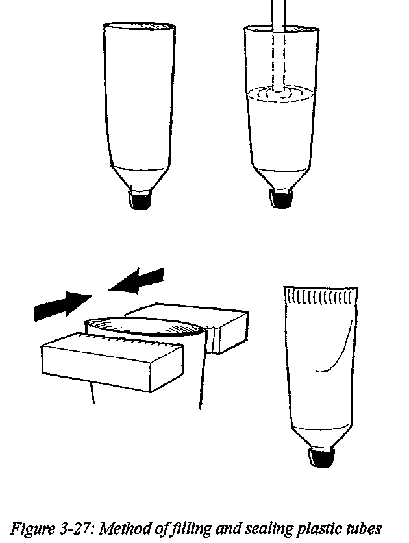
Figure
After filling, sealing and labelling, plastic containers should be packed into outer cardboard shipping boxes. While it is best to use cardboard dividers in the boxes it is not as important as when using glass for plastic is not subject to impact damage. It should be remembered that plastic is not as strong as glass or cans and so care is needed not to stack boxes too high to avoid crushing. This is particularly true of products, such as yoghurt, packed in cups. Outer cases should then be sealed, preferably labelled and date-stamped to make stockroom control easier.
Quality control and special skills needed
The main quality control procedures needed when using rigid plastic packaging are those general methods described in Section 6.4 of this publication (net weight, shelf life etc). Because plastic packaging is light in weight variations will cause considerably less final net weight control problems than when using glass.
If heat-sealed foil is being used it is important to carry out frequent checks for proper sealing. Packs should be turned upside down to make sure they do not leak and checks made by filling with warm water and sealing so that an internal vacuum forms after cooling. This can be easily seen as the foil will bow inwards.
Likely faults in plastic containers include:
- Critical faults:
- split or punctured,
- badly formed neck or sealing area,
- incorrect non-food grade of plastic.
- Major faults:
- if printed poor printing quality,
- poor color or transparency,
- mishapen packs,
- denting.
- Minor faults:
- slight mix-alignment of print,
- surface scratching.
No specialized skills that cannot be learnt in the plant are needed for filling and sealing rigid plastic packaging at a small scale.
3.1.5 Wooden containers
While wood is widely used for packaging fresh produce its use is limited when dealing with processed foods. The most common applications are:
- barrels for wines, beers, spirits, salted fish and vegetables
in brine,
- wooden crates, particularly for bottles that are returnable,
-
tee chests,
- small fancy boxes for foods aimed at a tourist or gift
market,
- to construct pellets.
Wood is strong and provides better protection against crushing and impact than cardboard boxes. It is however heavier and more expensive. Wood containers can be made lightproof and leakproof. As a material wood is porous and so does not form a perfect barrier to moisture and air. Depending on the method of construction wood containers can provide excellent protection against pests.
Barrels are very difficult to make and the training takes several years. They are also very expensive and so are re-used over and over again' being sent back to coopers to repair any damage. They are available in many sizes from less than 5 gallons up to huge barrels that contain a tonne or more of product. The common sizes however are light enough for a person to lift or move.
If barrels are to be considered as a packaging for foods the following points need to be borne in mind:
- they must be returnable, deposits should be charged,
- care
should be taken if buying second-hand that no contamination, for example the
odour of fish, is possible,
- the food producer should have space and
facilities for thorough washing and cleaning and workers skilled in minor
repairs, fitting the wood lids and tightening the metal barrel hoops.
Many small food manufacturers use wooden crates to distribute food in bottles to shops, particularly when the bottle is returnable. Such crates, which usually hold 24 packs, can easily be made by local carpenters and Figure 3-28 shows a simple jig being used to greatly speed up production.
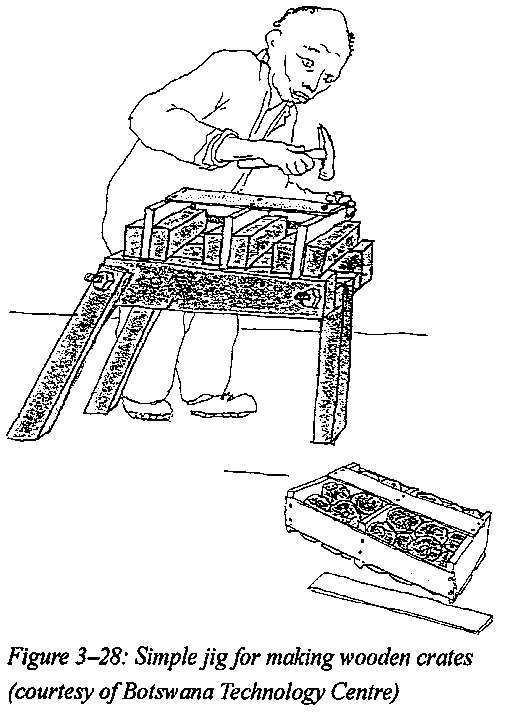
Figure
If distribution of products that might suffer from crushing, for example yoghurt or foods in plastic bags, is considered then crates used should have 'stacking corners' as shown in Figure 3-29.
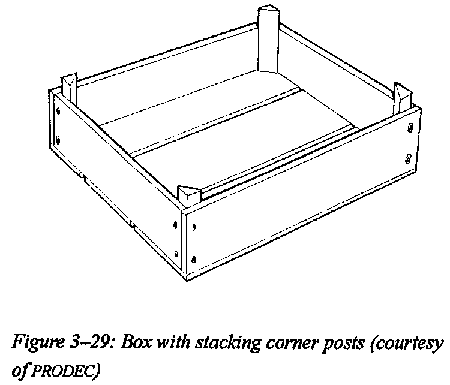
Figure
It is recommended that some form of permanent owners mark -painted or burned in -is made on delivery crates to make sure they are indeed returned.
Tea chests are a very special case where a wood packaging has become the accepted standard all over the world. They are made of thin plywood over a timber frame and corners and edges are bound with tin strips to give protection against dropping. Tea chests are lined internally with a paper/foil laminate which provides an excellent moisture and air barrier. The only real application of tea chests is for bulk distribution and export of tea.
The use of small wood boxes, for packaging goods for the tourist and gift market can, in certain cases, provide opportunities for small food manufacturers. Generally the containers will be supplied by a local craft group or carpenter. They are ideal for dry goods such as spices and herbal teas although an inner plastic bag would always be recommended to give better moisture protection and avoid the chance of wood splinters entering the food. Some producers market a range of local foods in an open-topped box over wrapped with cellophane.
Few small or medium-scale food producers are likely to distribute final products on pallets but their use is strongly recommended in order to hold finished products in store off the ground. They can easily be built by local carpenters, the simplest design being shown in Figure 3-31. It can easily be seen how such a pallet keeps the food off a possibly damp floor and also allows easy cleaning of the storeroom.
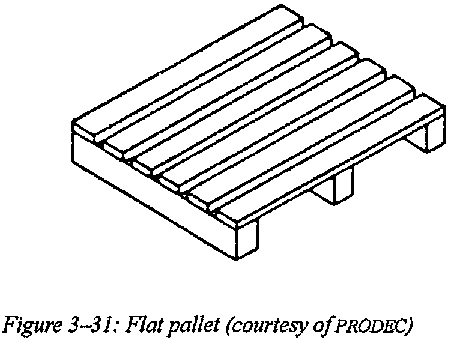
Figure
3.1.6 Paperboard
Paperboard is the general name given to a variety of different types of materials that are used to make boxes, cartons and trays to package foods. They can be used as shipping (outer) containers or as consumer packs, but only a few types of materials can tee used directly in contact with foods.
In this section the different boards are first described. Corrugated boxes are dealt with in more detail because these are among the most common types of shipping container available to small processors. It should be noted that paperboard packs can be designed, made up, printed and sealed by the processors and are therefore one of the few packaging systems that are within their control. The methods for doing this are described in some detail in this section and are also included in Chapter 5.
Paperboard is produced in the same way as paper (section 3.2.1) but it is made thicker and often in multiple layers, to protect foods from mechanical damage (crushing, puncturing, vibration). There is a large range of paperboard types for different applications as consumer packs or shipping containers. Cartons or boxes are printed (if necessary), cut out to the appropriate size and shape and creased. The flat carton (or 'blank') may then be glued and assembled by the board manufacturer or alternatively delivered to the food processor for assembly on site. Types of paperboard are discussed in the following sections.
Moulded Paper Packaging
A number of packaging materials are made from recycled waste paper. The most common of these are egg trays and egg boxes but others such as fruit trays, small shallow dishes and protective bottle cases are available.
Moulded paper packaging (MPP) is mainly produced at very large scale but technology has been developed to produce such items at medium scale, which is still too expensive for small or medium producers. Recently the technology has been further scaled down to a level that is within the reach of small entrepreneurs at a cost of approximately œ12,000 and with an output of 240 trays per hour .
The first step in making MPP is to prepare paper pulp by liquidizing paper in water. Printed paper should not be used if the packaging is to come into direct contact with food. If necessary colours may be added or, if a degree of waterproofing is necessary, waxes.
Moulding takes place on a two-part mould, a forming mould and a transfer mould. The forming mould is made of fine wire mesh and the transfer mould of plaster like material. Vacuum and compressed air are supplied to the moulds. The process involves dipping the forming mould into the paper slurry so sucking up a coating of fine fibres of paper. Compressed air is then used to blow the formed item off the transfer mould. After moulding the trays are very wet and have to be dried, usually in the sun.
Paperboard that is used for fibreboard (more commonly named cardboard) boxes has no coating and as a result the barrier properties to air and moisture are low. Cardboard boxes are widely used as shipping containers for almost all foods. The properties of cardboard can be improved by a coating of wax or by lamination with polythene for use in consumer packs (for example paperboard cartons). These are used alone for products such as salt, rice, pasta products and spices or to provide protection against mechanical damage, or for inner plastic or paper bags containing a wide range of foods such as cereal products, snackfoods, coffee and confectionery. The main types of paperboard that are used for foods are described below. It should be noted however that there are many variations on these basic types and a large number of tradenames, particularly for specialist boards that have specific properties. A comprehensive list of these boards is not included in this publication. Board thickness is one of the main considerations and the figures below are the weight of board per square metre which is a measure of the thickness (higher weight = thicker board).
White board
This is the only type of paperboard that is recommended for direct contact with foods. It is made from several thin layers of bleached chemical pulp and it is usually used as the inner layer of a carton combined with other types of board which form the outer layers of the carton. It may be coated with wax or laminated with polythene to enable it to be heat sealed.
Triplex board (or foodboard)
This is widely used for food packaging. It normally has three layers, the inner and outer layers being made from white board (bleached chemical pulp). The outer layer may be machine glazed and/or coated to enable a better print quality to be achieved and it is supplied as 200 400 g/m2. Another board named Duplex board (or boxboard) is similar but the inner layer is made from grey (ie unbleached) chemical pulp.
Chipboard
This is made from re-cycled paper and is used to make the outer cartons for packets of foods such as tea and cereals. It is not suitable for direct contact with foods. It is less strong than Triplex or Duplex board for an equivalent thickness but it is cheaper than these materials. It is usually supplied as 300 g/m2 and it may be lined with white board to improve its appearance and strength
Solid board
This is a multiple layer of bleached sulphate board that is white, strong and durable. It is usually supplied as 150 - 400 g/m2 and when laminated with polythene it is used for liquid cartons (sometimes named Liquid Packaging Board or Milk Board). Examples of typical products packaged in liquid packaging board include fruit juices and soft drinks.
Fibreboard
This can be either solid or corrugated board The solid type has an outer kraft layer and an inner white board It provides good protection against impact and compression and is often spirally wound into cylinders or small tubs which are fitted with a plastic or metal cap at the top and a board inserted at the base. A composite can is a can-like package with the body and ends made of different materials. The body is usually made of paper and then ends of metal and increasingly plastic. The body is made from spirally wound paper in a tube shape. Better barrier properties are obtained if the paper is laminated with plastic or aluminium foil. Composite cans may, rather like sanitary cans, be bought plain or printed with the base fitted or for total assembly in the factory. They mainly find use for packing dry goods including coffee, cocoa, ilk powder and mustard powder. They are cheaper than metal tins and can be made from re-cycled paper. Small containers are used to package spices or confectionery for retail sale and larger drums are used to package a variety of powders and dried foods for shipping and distribution.
It is important that these containers are kept dry at all times and not stored in a humid environment to avoid delamination and loss of integrity of the drum.
Corrugated cardboard (or fibreboard)
This is made with two layers of kraft paper and between them, a
central corrugating (or fluting) material. The corrugations are made by
softening the fluting paper with steam and then passing it over corrugating
rollers. The kraft paper is then glued to each side. Thicker boards may have
several layers of corrugated board glued together, although these are not widely
used in food
applications. The best quality board has unbleached kraft paper
with equal thickness either side of the fluting and uses no re-cycled material.
Both bleaching and the use of re-cycled paper reduces the strength of the
cardboard.
The degree of protection from mechanical damage that is provided by cardboard depends on the size and number of corrugations or 'flutes'. Smaller more numerous corrugations give rigidity to resist compression from stacking, whereas larger corrugations give a cushioning effect that resists impacts and puncturing.
Corrugated boards resist impact, abrasion and crushing damage and are therefore widely used for shipping containers for bulk foods such as dried fruit, nuts, etc., and for containers such as glass jars and plastic films that require protection. They are also used to contain cans and plastic tubs or bottles for convenient handling. An alternative to boxes is shrinkwrapping or stretchwrapping (Section 3.2.2) which, if available, gives a more sophisticated image. In many countries however these remain more expensive than cardboard.
Supply of boards
Dimensions of boxes and cartons are always quoted in the order: length x width x height and the dimensions are always the inside measurements of the box taken from the centre of a crease to the centre of the next crease (Figure 3-34). Designs of cardboard box are shown in Figure (3-35).
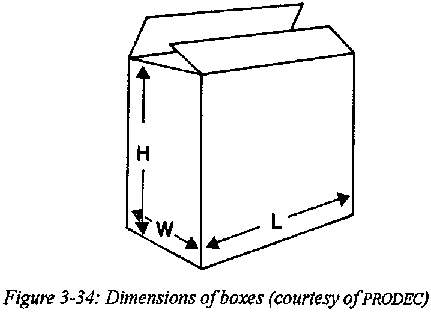
Figure
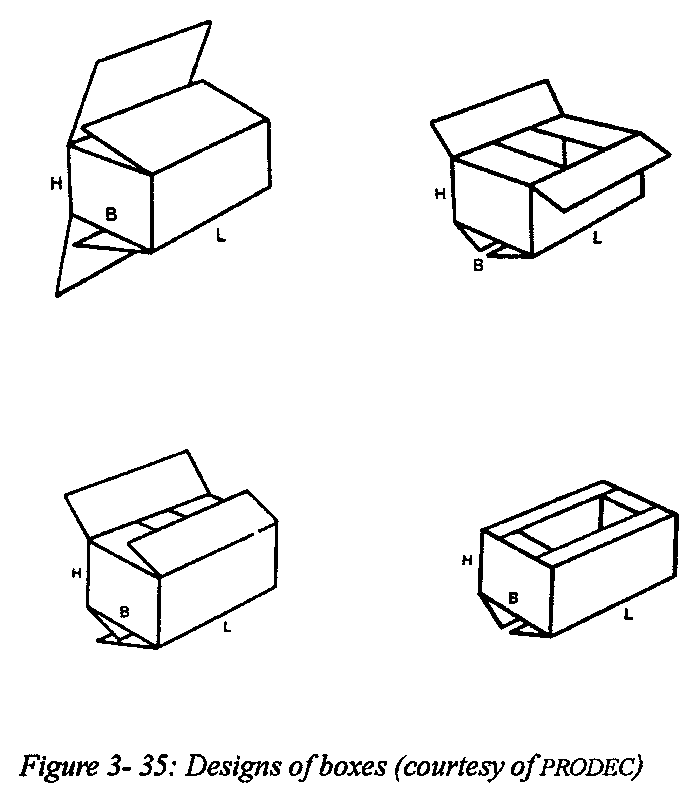
Figure
The board can be supplied in a number of ways to smallscale processors. The most convenient, but also the most expensive, is to receive the board already formed into blanks. Here the board is cut to the correct shape and scored along the folding lines so that it can be easily assembled in the production area (Figure 3-36). It can also be supplied pre-printed.
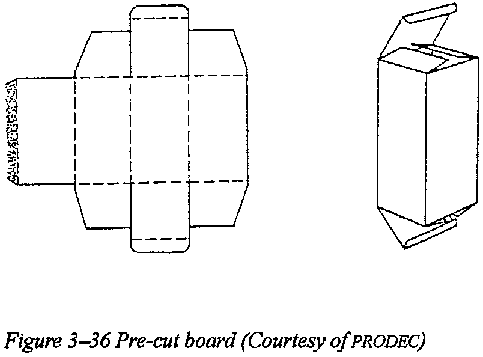
Figure
Alternatively the board can be supplied as plain sheets which must be cut to shape, scored and folded by the processor. This is more time-consuming and requires a separate preparation area away from the food production to prevent contamination of the food with dust and fragments of card. Additionaly the processor is paying for the waste card that is not used (Figure 3-37). However in many countries where large packing boxes are available, perhaps from imported equipment, the supply of corrugated cardboard sheets is a suitable way for smallscale processors to solve their packaging problems by producing their own boxes. Methods for doing this are therefore described below.
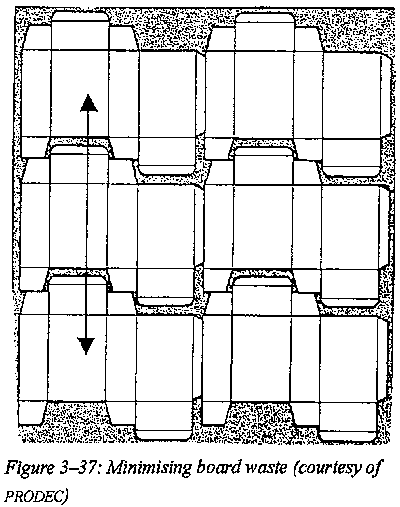
Figure
All cardboard boxes should be carefully stored, especially in humid conditions to prevent deterioration of the material and separation of the corrugations or delamination of the layers of a package. This depends on both the type of adhesive that is used to seal the board and the conditions under which the containers are stored and handled. In general they should be kept dry, cool and off the ground on pallets or shelves.
Calculation of box size
The factors to consider when deciding on a cardboard box for packaging foods are the box size required to adequately contain the contents and the most economical box shape. The size of box required can be found by placing together the containers to be packed (not forgetting dividers if these are to be used between jars or bottles) and measuring the size of the stacked food (Figure 3-38). These sizes are then the minimum internal dimensions of the box. In practice it is usual to then choose the nearest standard size of box that is supplied, rather than pay the extra cost of a specially made box. Care is needed that there is not too much free space inside when it is full. The containers should be firmly held in place to prevent them from moving and being damaged during transport.
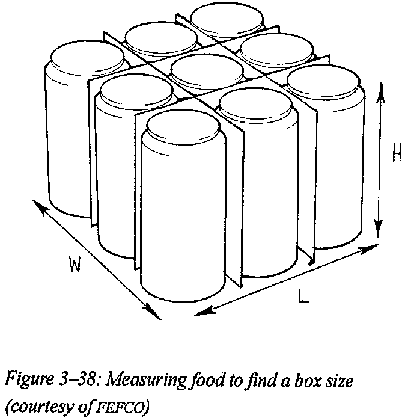
Figure
The most economical design which minimises the amount of board used to make a box of a given volume is found when the ratio of length:width:height equals 2:1:2. This is because less card is used to form overlapping flaps compared to other designs where the ratio is different (Figure 3-39).
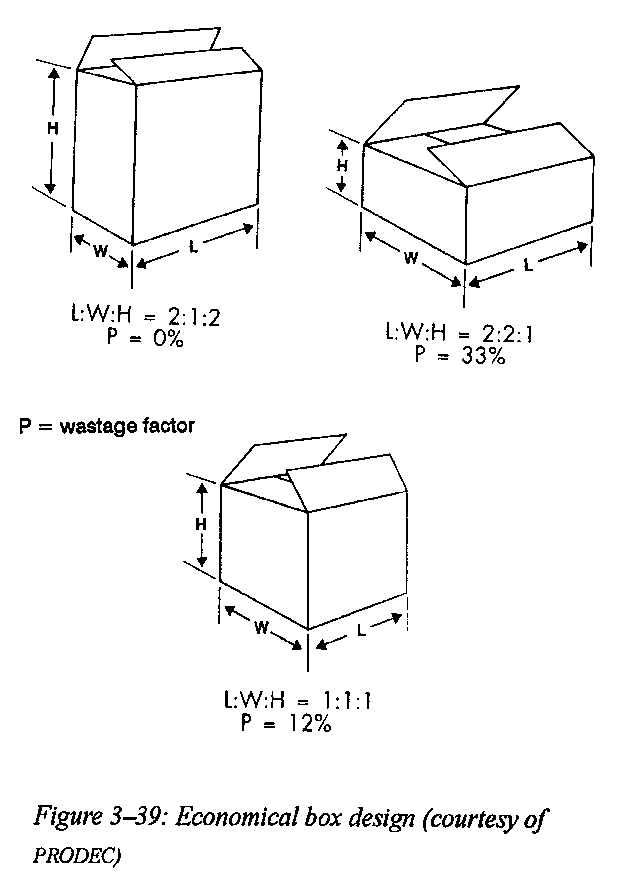
Figure
Sealing
The most common type of adhesive used for gluing cardboard boxes is based on starch (usually cornstarch) which is specially treated for hot, humid conditions to make it more resistant to moisture pickup and consequent weakening of the bond. Boxes may also be stapled (Figure 3-40) or occasionally stitched. After filling the boxes may be sealed using glue, staples or stitches as above. Glues should be fast-setting (for example polyvinyl acetate glues) to ensure that the cardboard flaps stay in place. Alternatively they may be tied with string/rope or taped or strapped with tape (Figure 3-41). Simple tape applicators are available which make sealing faster and more economical.
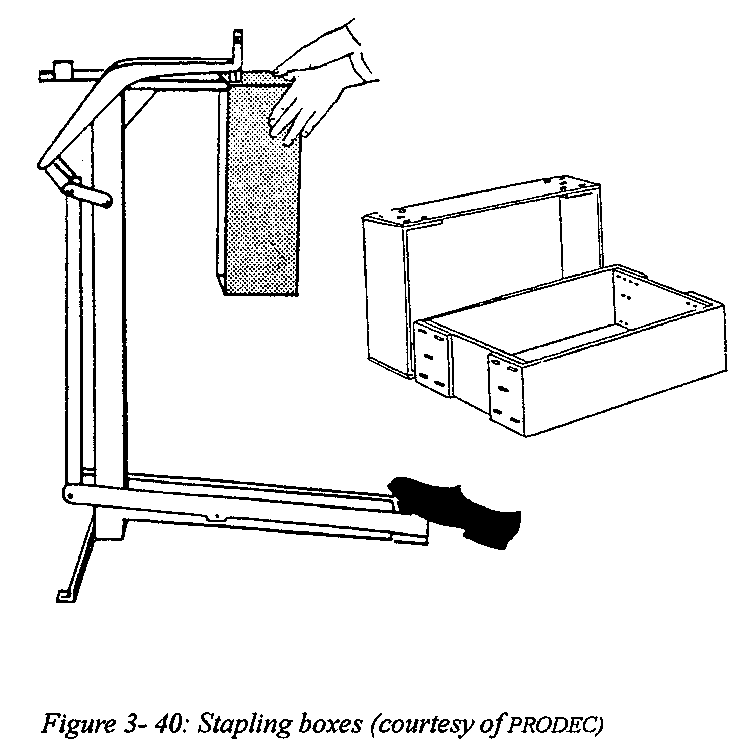
Figure
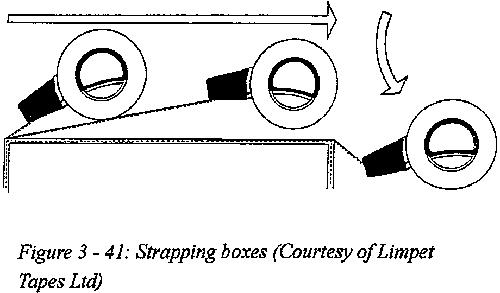
Figure
Quality control tests for paperboard
In practice most small-scale producers have only one supplier of boxes or cartons and in some countries the only supply is recycled used boxes. In these situations it is unlikely that any action can be taken if the quality of boxes falls below specification. However, for those producers that have a choice of supply it is worth monitoring the quality of boxes and cartons and ensuring that the supplier understands the needs of the processor. Specific tests for paperboard are described below and more general quality control considerations are described in Chapter 6.4.
The main characteristics of paperboard are as follows:
- thickness,
- stiffness,
- ability to crease without
cracking,
- whiteness,
- surface properties,
- suitability for priming.
The main faults found in paperboards are as follows:
- Critical faults:
- dimensions outside limits,
- bursting strength too low so that box/carton splits,
- score lines cut right through,
- tears or holes in the box,
- contamination with odours or foreign materials (especially reused boxes),
- Major faults:
- incomplete gluing,
- joints not square,
- incomplete, illegible or incorrect printing,
- flaps do not fold along score lines,
- gap between flaps greater than 5 mm (when boxes made up)
- Minor faults:
- printing faults,
- stains or scratches on box
The operators in a food processing unit can check the appearance, print quality, etc., of cartons and boxes by looking for these faults on a routine basis. If a problem arises then the dimensions of the boxes can easily be measured with a rule and the position and depth of score lines can be checked. No other special quality control equipment is needed.
3.2 Flexible packaging
Flexible packaging is a major group of materials that includes plastic films, papers, foil, some types of vegetable fibres and cloths that can be used to make wrappings, sacks and sealed or unsealed bags. The wide variety of bags, wrappings and sacks that are available makes this group of packaging materials very important for small scale producers and for this reason they are dealt with in detail in this chapter.
Paper is often made locally in large-scale factories and where this is the case the cost may be low enough to make it a feasible option for food processors. In general small-scale papermaking is not able to produce the quality of paper required for direct contact with foods but it may be suitable for outer cartons.
Flexible plastic films are not often made in developing countries but are imported from industrialized regions. However in some countries plastic film manufacture from imported granules is becoming established and the cost of packaging may be substantially reduced as a result.
Woven sacks and bags made from sisal, jute or cotton are highly suited to small-scale manufacture and can form a viable rural industry. Details of each of these materials are given in the following section and the re-use of some of these materials is described in Chapter 5.
Leather packaging and some traditional vegetable fibre packs are not included because they are not normally used in commercial processing but are restricted to household storage.
Many of the sophisticated plastic films that are used in industrialized countries are also not included because they are not widely available or they are very expensive in developing countries.
3.2.1 Papers
There are many different types of paper used for food packaging and this section describes the main types that are likely to be found in developing countries. Treated papers are used for dry foods (flours, dried fruits), fats, baked goods and confectionery. However plain paper is not heat-sealable and has poorer barrier properties and therefore finds fewer applications. Paper is produced by beating wood chips to break them down to a pulp which contains the wood fibres and then treating the fibres with alkali or acid. After treatment the fibres are pressed through a series of rollers to form paper. Sizing is the term given to chemicals that are added to the pulp during preparation to give particular properties to the final paper.
There are two basic types of paper which result from the alkaline or acid treatment: alkaline treatment produces a 'sulphate' pulp which is used to make Kraft papers and vegetable parchment whereas acid treatment produces a 'sulphite' pulp which is used to make sulphite papers. The differences in the properties of these two types of paper are described in more detail below.
Papers and boards are fully biodegradable in the environment because their component chemicals (mostly cellulose) are broken down by moulds, bacteria and animals.
Types of papers
The properties and applications of different types of paper that are used for foods are shown in Table 3-8.
|
Type of paper |
Weight(g/m2) |
Notes |
Applications |
|
Kraft |
70 -180A |
strong paper that can be bleached white and printed or |
25 - 50 kg sacks for |
| |
|
unbleached and brown. Usually used in multiple layers or 'plies' |
(3 flour, sugar, dried fruits |
| | |
or 4 ply are most common) to give the necessary strength. Can also |
and vegetables |
| |
|
be laminated to polythene or wax treated to give greater moisture | |
| | |
protection. The different plies need not be the same weight of paper. | |
| | |
Sack material is described from the outer ply inwards according to | |
| | |
the number and weight of the layers (for example 2/90 1/80 kraft | |
| | |
means that there are three plies, the two outer ones having a weight | |
| | |
of 90 g/m2 and the inner having a weight of 80 g/m2). | |
|
Vegetable |
40-75 |
Kraft paper that has been further treated with acid during its |
Fats such as butter or |
|
parchment | |
preparation to make the surface smoother and more resistant to |
lard fresh/smoked fish |
| | |
penetration by oils or water (more greaseproof and greater wet | |
| | |
strength than kraft paper). Negligible barrier properties to air or | |
| | |
moisture and not heat sealable. Not therefore used to package | |
| | |
foods that require protection against air or moisture pickup over a | |
| | |
long storage period. |
|
|
Sulphite |
30 - 50 |
A lighter and weaker paper than Kraft or parchment, usually made |
Used as small bags or |
|
paper | |
with a glazed surface to improve the appearance and to increase |
wrapper for biscuits or |
| | |
wet strength and oil resistance. (When glazed it is known as MG |
confectionery |
| |
|
Sulphite paper- MG = machine glazed.) The glazed surface can be | |
| | |
printed using flexographic methods (section 4.2.3) but for higher | |
| | |
print quality the paper should be coated. It is also used in laminates | |
| | |
of paper and plastics or foil (Sections 3.2.2. and 3.2.3). |
|
|
Greaseproof |
40 - 60 |
Made by beating fibres more thoroughly during the manufacture of |
Fresh fish or meat, |
|
paper | |
sulphite pulp. The smaller fibres make a more dense surface which |
liner for shipping |
| |
|
is more resistant to oils. However this resistance is lost when the |
containers for |
| |
|
paper becomes wet. |
butter/cheese, liner for |
| | | |
packs of biscuits, fats |
| | | |
and other greasy foods |
|
Glassine |
20 - 40 |
A translucent sulphite paper that is given a high gloss surface by the |
Liner for biscuits, |
| |
|
heated rollers used in its manufacture. The gloss makes it more |
cooking fats, fast foods |
| | |
resistant to water when it is dry, but if the paper does become wet it |
and baked goods |
| |
|
loses this resistance. | |
|
Tissue paper |
25 |
A thin, weak sulphite paper. It is often machine glazed on one side |
Wrapping fresh fruit to |
| | |
(known as MG tissue). A special type of tissue paper with small |
prevent bruising |
| |
|
regular perforations is used to make tea bags. | |
|
Newspapers |
- |
Commonly available in most developing countries and are often | |
| | |
used for food packaging. However newsprint should not be used in | |
| | |
direct contact with foods (especially fatty foods) as the ink is | |
| | |
carcinogenic (causes cancer). It is also an unattractive outer wrap | |
| | |
and does not give a professional image to the processor. However it | |
| | |
is cheap and widely available and is therefore a source of material | |
| | |
for making into paperpulp for the production of moulded trays | |
| | |
(Section 3.1.6). |
|
|
Re-cycled |
- |
Recycled paper from Government forms and school exercise books | |
|
paper | |
is also widely used for packaging in many countries. There is a | |
| | |
flourishing small industry in some countries which converts this type | |
| | |
of paper into pre-formed bags which are used to contain foods and | |
| | |
other items for short periods of time. Again care should be taken to | |
| | |
avoid direct contact with foods, especially fatty foods as any ink on | |
| | |
the paper is likely to contaminate the food. | |
- Weight = g/m2 = the weight of one square metre of paper.
Table 3 - 8: Properties and use of different types of paper
Improving the properties of papers
The lack of heat sealing properties and poor barrier properties to air and moisture are disadvantages of paper that have been addressed in a number of ways:
Wax treatment
Papers can be treated with wax to improve their barrier properties and make them heat-sealable. These papers are used to package cereal products, bread and spices. The three methods of applying wax to paper are as follows:
- Coating: this is applied after the paper has been made.
However the coating is easily damaged by folding the paper or by abrasive foods
(eg dried foods). Damage can be avoided by laminating the layer of wax between
two layers of paper or between a layer of paper and a layer of polythene.
-
Dry waxing: during manufacture, the hot paper is treated with melted wax so that
it penetrates into the fibrous structure of the paper. This improves the
durability of the wax barrier.
- Wax sizing: here wax is added to the pulp
during the initial stages of preparation and becomes fully integrated into the
structure of the paper. Both this method and dry waxing enable the wax to become
deeply ingrained into the paper and therefore it is not easily damaged by
folding the paper or by abrasion.
Laminates
Paper can be laminated to low-density polythene to make it heat sealable and improve its barrier properties to air and moisture. Other methods include lamination to aluminium foil or to other types of plastic. However in each case the cost is increased and many of these paper laminates are not widely available in developing countries. Where laminates are available they are used to package coffee, dried soup, herbs and spices and other dried foods that require a barrier to moisture and air during a long shelf-life.
Wrapping
Wrapping is a type of packing in which a solid food is enveloped in a sheet of flexible material, usually paper, cellulose, cloth or foil. Wrappings of paper cloth or foil are not usually sealed and therefore do not provide a substantial barrier to moisture, air or micro-organisms. They are used to keep food clean and hold items together. Examples include wrapping spices in paper, wrapping confectionery in cellulose film, and wrapping chocolate in foil.
Sealing
Plain paper is not heat-sealable and as the barrier properties of papers are insufficient to protect most foods for long storage periods, the seal on paper packages is designed to simply contain the contents. Paper wraps for confectionery and small amounts of flour, spices, sugar, salt, soils etc are very common for containing the food to carry home and for short term storage. They are made by twist-wrapping, folding the paper by hand or by tying with string or cotton.
Paper bags can be folded, stapled, taped or glued. Larger paper sacks can be stitched using an electric bag-stitcher or glued with adhesive. Wire twisting tools (Figure 3-43) are also used for larger sacks. Details of equipment are given in Section 3.1.6. Locally-made adhesives using starch or gelatin are suitable provided that the humidity is not too high during storage as this would cause them to fail. One special type of sealing involves heating of special perforated tissue paper to make tea bags. This is described further in Chapter 5. Heat-sealing of waxed paper requires equipment as described in Section 3.2.2.
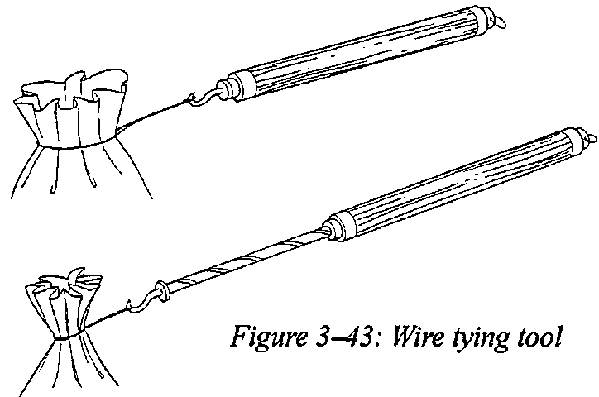
Figure
Specific quality control tests for papers
The main tests that are important for papers are described below. Other more general requirements for adequate quality control are described in Section 6.4.
- Weight (or substance): this is the weight of one square metre
of paper measured in grams - ie g/m2. (in USA in lbs per 3000 sq.
ft).
- Yield: is the area of paper and hence the number of packs that can be
made from a unit weight of paper or film and is expressed as m2/kg.
As paper is usually sold by weight, especially in larger quantities or on rolls,
the yield is important in ensuring that the most economical use is made of
available supplies.
- Surface formation: should be smooth and even without
loose fibres or other faults. This is particularly important if machine-wrapping
is to be used.
- Folding endurance: this is particularly important for papers
that are to be used for twist wrapping.
There are no critical faults that are likely to be found when new paper is used. Newsprint and reused paper may be contaminated by inks or other materials and as has been mentioned above, these are not recommended for contact with foods. Major faults include tears or stains in the paper, incorrect surface preparation and excessively high or low yield. Each fault can be checked for by a visual examination of the paper and for yield, by carefully weighing a sample of paper (Section 3.2.2). Minor faults include creases, minor surface imperfections and minor color variations
Storage
All papers are sensitive to changes in the humidity and temperature of storage. Under humid conditions they may curl or stick together and any adhesives may lose their strength. In general they should be stored for the shortest time possible under constant low temperatures and moderate humidities (for example 20 °C and 50% relative humidity). However in many developing countries packaging cannot be bought in small quantities and if supplies are irregular a food manufacturer may wish to buy as much as possible to guarantee continuity of production.
Under these circumstances great care should be taken to store the packaging materials properly. All papers should be stored without opening the outer wrapping, rolls should be stored uptight, flat sheets should be stored on a firm, flat surface so that they stay absolutely flat. All materials should be kept off the ground, and especially off concrete floor&which can make papers damp very quickly.
Ideally papers should be stored on shelves or pallets in a well ventilated room where the temperature does not vary much throughout the day (eg a dry underground cellar). Rats and cockroaches eat papers and measures should be taken to prevent them entering the paper store. Similarly birds and animals should be excluded and papers should be covered to prevent them getting dirty.
If the humidity in the production area is different from that in the store mom the papers should be moved to the processing room the day before they are to be used to allow them to acclimatize slowly to the new humidity.
3.2.2 Films
Plastic films are becoming increasingly important in most developing countries because they have several advantages over other forms of packaging used in food processing. Briefly:
- they are better able to protect foods and extend the
shelf-life,
- they are tough and durable to withstand rough handling during
transport and distribution,
- they are convenient to handle by both
processors and customers,
- they add very little weight to the product which
reduces transport costs,
- they can be easily printed to inform customers
about the product (eg the type of food, its optimum storage conditions or any
special preparation needed),
- they fit closely around the product which
takes up little extra space for transport,
- they have an attractive
appearance to most customers which helps the processor to increase sales,
-
they are mostly inert (they do not react with foods or taint them),
- they
have good barrier properties to moisture and air.
The importance of plastic films is reflected in the more detailed descriptions found in this chapter. The plastic films described below are those that are becoming increasingly available in developing countries and include polythene, polypropylene and cellulose. Many large scale plastics manufacturers also make an extensive range of films that are a combination of these plastics or laminates of these films with paper, foil, or other plastics. These may be available through local agents, but are often only available in large quantities and at a relatively high cost. They are not generally suitable for small-scale processors for these reasons (and in some countries because of restrictions on foreign exchange) and they are therefore only briefly described at the end of this section.
Barrier properties
Barrier properties are the resistance that a package has to moisture, air, light, micro-organisms, puncturing, etc. Measurement of the properties gives an indication of the amount of protection that is given to a food by a particular packaging material.
Flexible films have large variations in their barrier properties in contrast to other materials such as cans and glass jars. The processor does not have to specify the degree of protection required when ordering cans or bottles because they are all a complete barrier. However because of the wide variations in film barrier properties, due to differences in types of film or even differences in the thickness of the same film, it is necessary for the processor to carefully specify the degree of protection required for a given product.
Alternatively if there is only a limited range of films available it is more difficult for the processor to know whether they are suitable for the intended use. In these cases the producer should ask the film supplier whether the intended use will be suitable for the available film.
The barrier properties of films and other packaging materials are described by two main factors: the Water Vapour Transmission Rate (WVTR) and the Oxygen Transmission Rate (OTR). These are a measure of how much water vapour or oxygen is able to pass through a known area of packaging material in a given time (by convention this is usually the amount passing through one square metre of material in 24 hours). The units of WVTR and OTR are therefore: g or ml/m2/24 h.
The higher the value of WVTR or OTR the more permeable the material is to moisture or air (or to put it another way, the lower the value the better the barrier to moisture or air). Because the permeability of most materials varies with the temperature and humidity of the surrounding air it is usual to measure WVTR and OTR under known air conditions (eg 25°C and 65% relative humidity).
It is important for a food processor to know the conditions under which the food is likely to be stored and then get data on the barrier properties of the proposed packaging which have been measured under similar conditions (available from the packaging supplier). This will enable the processor to assess the likely shelf-life of the food under these conditions. An example of the importance of this is shown in Figure 3-44 where the amount of moisture taken up by the crisps during storage is measured by their gain in weight. When this reaches 2% the crisps are spoiled.
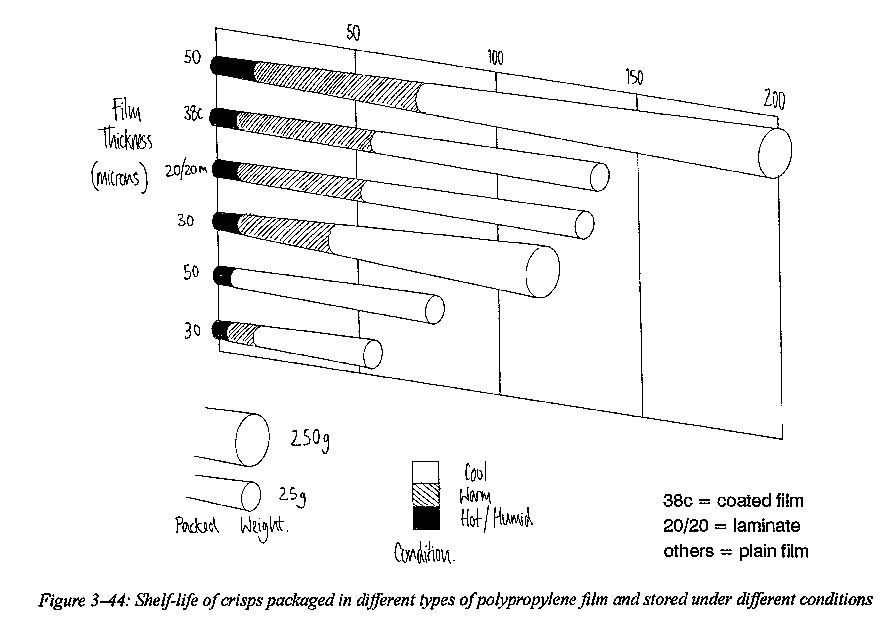
Figure
Figure 3-44 shows that different films control the WVTR to different extents so that the gain in moisture is slower for some films than for others. As a result the shelf-life of the crisps varies from a few days in a hot humid climate using plain polypropylene to more than 50 days using a coated polypropylene film. Also the barrier properties of all films are much better in cooler climates and the shelf-life of the crisps is extended in all cases, often doubling the time before spoilage compared to the shelf-life in a hot/humid climate.
An important general implication of this is that food processors may need to put different 'best before' dates on packages of the same food that is intended to be sold in areas which have different climates.
Types of plastic films are discussed in the following sections.
Low Density Polythene
Polythene (full name: polyethylene) is the cheapest and most widespread plastic films used for food packaging in developing countries. It is available in a wide range of thicknesses and grades, all of which are flexible, relatively tough and transparent and heat-sealable. In general thicker films are stronger and have better barrier properties to moisture and air, but thicker films are also less transparent and less flexible. All thicknesses are susceptible to damage by sunlight over a period of time which leads to them becoming more brittle and more opaque.
Polythene is widely used as a single bag to protect almost any food from dust or dirt over a short period. It is also widely used in combination with other flexible packaging such as paper or cellulose to make these materials heat sealable.
Compared to some other films Polythene has a relatively poor resistance to oils and also allows moisture and air to pass through at a higher rate than many films. It is not therefore recommended for the long term storage of foods that are affected by air or moisture (eg fatty foods where the products are susceptible to spoilage by rancidity, or those that should be crisp or dry).
The thin film is known as low-density polyethylene (LDPE) and is transparent and glossy. The barrier properties of LDPE to moisture and air are relatively poor and the film has little strength to resist puncturing, although it does not tear easily. Because LDPE, like other films, does not protect foods against mechanical damage, these packages require outer cartons or boxes for transport and distribution.
The film also has a relatively low melting point which makes it easily heat sealable. Details of heat sealing are given below. The properties of LDPE in comparison to other films of a similar thickness are shown in the Figures 3-45 and 3-46.
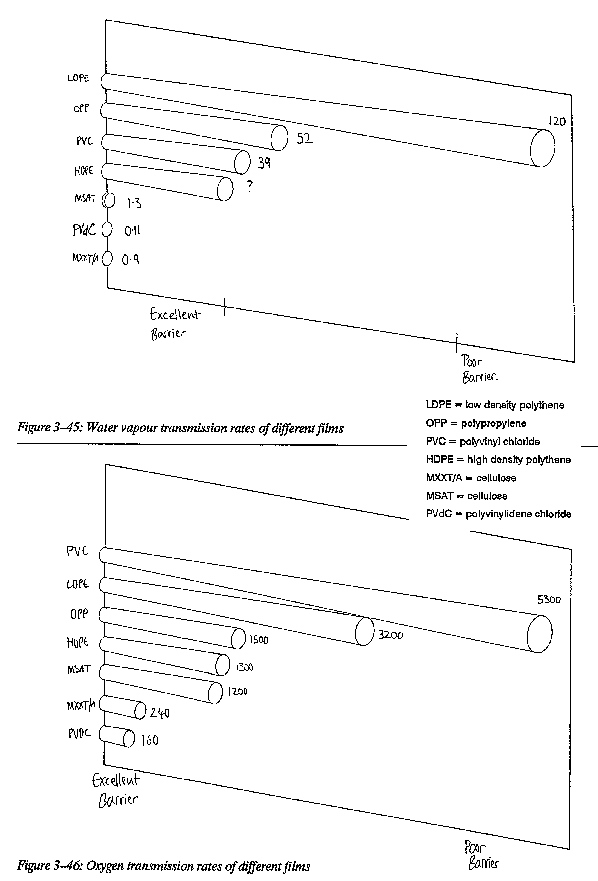
Figure
LDPE is relatively inert in that it does not react with foods. However, recently research indicated that the plasticizers used to make the film flexible can be absorbed by fats in foods and may be linked to nerve damage to eyes and development of cancers. LDPE should not therefore be used to package fatty foods (including cooking oils, butter, cheese or biscuits) for long periods of time.
Medium and High Density Polyethylene
Increasing the thickness of polythene (to a gauge sometimes named Medium Density Polyethylene or MDPE) improves the barrier properties to moisture but it remains a relatively poor barrier to air and odours. Thicker grades of Polythene become progressively less transparent.
Thick Polythene (0.03 -0.15 mm often expressed as 200 - 500
gauge film) is known as High Density Polyethylene (HDPE) and this is a
relatively good barrier against moisture, air and odours (Figures 3-45 and 346).
It is stronger, less flexible and more brittle than LDPE or MDPE and has a
higher softening temperature
(121°C).
HDPE is a strong film that gives a strong heat seal and will withstand puncturing, tearing and stretching. This makes it suitable for use as sacks where it withstands the rough handling that they often receive. However it is more slippery than jute, paper or other natural fibres and this makes it more difficult to stack piles of more than four or five sacks.
All grades of polythene have relatively poor resistance to sunlight and become less flexible and more brittle after approximately six months' exposure to light under tropical conditions. This is more noticeable with the thicker films that have less plasticizer than LDPE.
Polypropylene
This film (full name: oriented polypropylene or OPP) is a clear, glossy film that is fully transparent and sparkling. It is strong, heat sealable and it withstands puncturing and tearing. It does not stretch as much as Polythene and has good barrier properties to moisture, air and odours (Figures 3-45 and 3-46) which make it more suitable for foods that have a long expected shelf-life (eg biscuits, snackfoods and confectionery).
Unlike polythene it is not damaged by sunlight and unlike cellophane it is not affected by drying out or by low temperatures. Thicker films (above 50 microns) have greater barrier properties and seal strengths than thinner films and are therefore more suitable for larger heavy duty packs or as stronger packages (for example for foods which have sharp pointed particles). Thicker grades are used for pasta, pulses, dried fruits and cereal products.
Polypropylene does not have the same problem of movement of plasticizers into fatty foods that is found with polythene, but it has a higher sealing temperature than polythene which requires an electric heat sealer to seal it effectively. It is becoming more widely available in developing countries where, because of its attractive, glossy appearance and better barrier properties, it is replacing polythene in many applications. It is however usually more expensive than polythene.
Polypropylene is also woven into sacks for bulk transport of both fresh and processed foods. Until recently the production of sacks was confined to industrialized countries but they are now made on continuous equipment in a number of developing countries. These sacks are very tough and resist puncturing, tearing and stretching. They allow moisture and air to pass through the weave (in contrast to HDPE sacks) and they are therefore more useful for fresh produce or for foods that do not require protection against these factors.
In some countries there is a viable small industry which converts used polypropylene sacks into shopping bags and other domestic containers.
Cellulose (cellophane)
Cellulose is one of the very few plastic films that is made from renewable materials instead of from petroleum products. It is made from wood pulp (mostly eucalyptus) by a complex chemical process, to produce a clear glossy transparent film that is biodegradable within approximately 100 days under tropical conditions.
It is a strong, puncture-resistant film that can be 'dead folded' (ie a crease or fold made in the film will stay in place). This is particularly useful for twist-wrapping small foods such as confectionery. It also has excellent clarity, high gloss and a crisp feel which is attractive to most customers. Unlike polythene it is not damaged by sunlight.
However cellulose tears easily and more importantly, it is not heat sealable in its plain form. In addition it is a relatively poor barrier to moisture (Figure 3-45 and 3-46) and the dimensions and barrier properties of the film can change if the humidity of the surrounding air changes. If the air is very dry the film becomes brittle and tears very easily. As a result, plain cellulose is mostly used for foods that do not require full protection against moisture or air, or where an exchange of moisture is required (eg fresh baked goods where moisture is 'breathed out' at a controlled rate to maintain a crisp crust, or for dried foods where moisture should not collect inside the package where it could cause mould growth).
The barrier properties of plain cellulose film are improved and made more constant if it is coated with nitrocellulose or PVdC (polyvinylidene chloride, Figure 3-47). Nitrocellulose coating improves the barrier to air and odours but it does not improve the barrier to moisture. PVdC coated films vary depending on whether the coating is applied using water as a solvent or using an organic solvent. The aqueous solvent has a much lower risk of odour remaining in the film and it is therefore used for bland foods that have a particular risk from odour pickup.
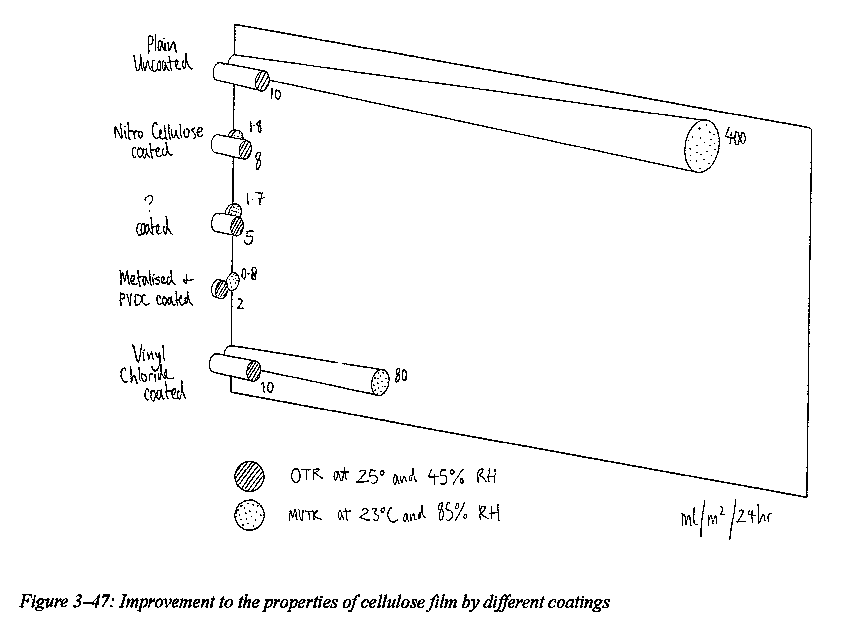
Figure
PVdC coatings also make the film heat sealable and resistant to oils, moisture, air and odours. They are used typically for foods such as cereal products, dates, currants, sultanas, pasta, pulses, snackfoods, nuts and biscuits. An international code is used to identify the various forms of cellulose as follows:
|
Code |
Meaning |
|
P |
plain |
|
T |
transparent |
|
M |
moistureproof |
|
C |
coloured |
|
S |
heat sealable |
|
A |
anchored |
|
X |
PVdC coated |
|
W |
winter quality (withstands |
| |
low temperatures) |
|
F |
freezing quality (withstands |
| |
freezing) |
One of the most common types of cellulose is MSAT which is moistureproof, heat sealable, anchored and transparent.
Other films
In some countries films such as metallized film, and laminated films that have very good barrier properties are becoming more widely available. However, because these are not yet widespread and are in general considerably more expensive than polythene, polypropylene or cellulose, they are only mentioned briefly here. These films offer considerably greater protection to foods over a long shelf-life than do the films described above.
Metallized films are plastics such as cellulose or polypropylene on which a very thin layer of aluminium metal is deposited. This not only makes the film highly reflective, like a mirror, which is attractive to many consumers, but also greatly improves the barrier properties to moisture, oils, air, odours and light. Other advantages are that the film is less expensive and more flexible than laminated films which have similar properties.
Laminated films are those in which two or more films are bonded together or bonded to paper or to aluminium foil. The most common method is to apply adhesive to one film and then the two films are passed between rollers to pressure bond them together. Examples include cellulose/LDPE/cellulose for coffee, cellulose/paper/foil/LDPE for dried soups, LDPE/foilpaper for dried vegetables and polypropylene (coated with PVdC)/LDPE for confectionery and dried fruit.
In general laminated films are only used in developing countries where special protection is required for high value foods. They are expensive and generally not widely available. Similarly nylon and nylon laminates are very effective barrier films but are expensive and not widely available.
PVC (polyvinylchloride) is also used for shrinkwrapping and stretchwrapping (described below) but is more expensive and less easily available than polythene in most developing countries. Additionally there may be restrictions on its use in some countries because of residues from the vinyl starting material and plasticizers in the film.
Filling methods
When filling food into plastic bags the most important consideration is to prevent any food from contaminating the inside of the bag where the seal will be formed. If food is trapped between the two layers of film it will make the seal ineffective and the barrier properties of the film will have no effect. This is a particular problem with fine powders that can cover the inside of a bag very easily. Some simple techniques to fill plastic film containers are described in more detail in Chapter 4.
Wrapping
To wrap food is to envelop it in a sheet of flexible material. It may then be tied, taped, glued or heat sealed depending on the material. Cellulose films are used for twistwrapping and overwrapping of cartons such as tea and confectionery cartons. Small overwrappers for plastic films are available and heated plates or bars (Figure 3-49) are suitable for the manual sealing of overwraps.
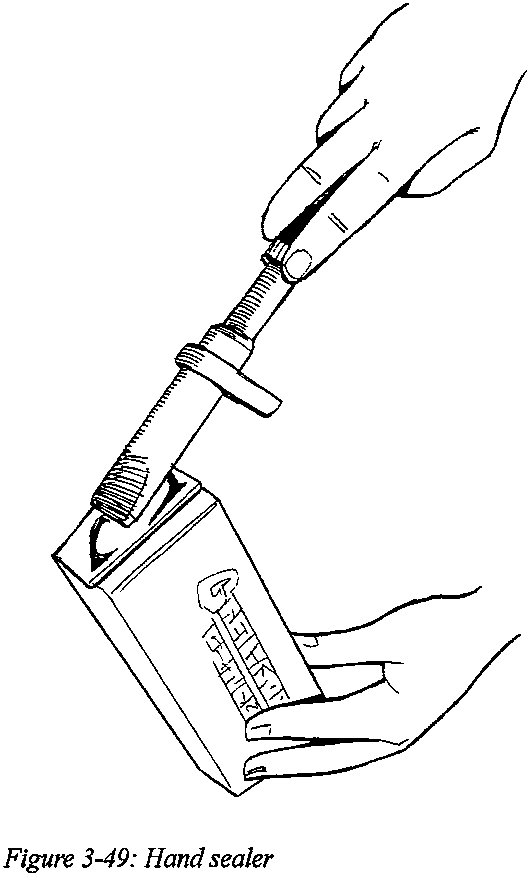
Figure
Shrinkwrapping, stretchwrapping and clingfilm
Special types of LDPE are also available in forms known as shrinkwrapping film and stretchwrapping (or cling) film. For shrinkwrapping, the property of LDPE to shrink when it is heated is used to make a pack that holds the contents together tightly. The film (45 - 75 microns thick) is placed over the items to be wrapped and then heated with hot air either in a tunnel or using a hot-air gun to make the film shrink (Figures 3-50 and 3-51).
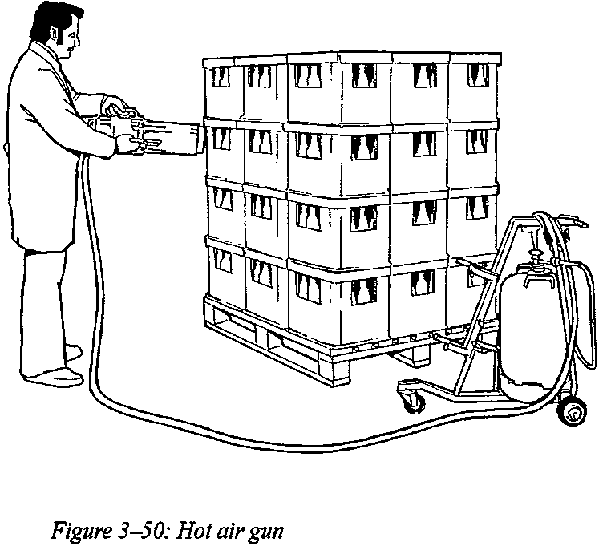
Figure
Note: it is not possible to shrinkwrap cartons that have a wax or polythene coating because this will fuse with the shrink film when it is heated. In this case stretchwrapping is a suitable alternative.
The film is also made to have low-slip properties which allows the wrapped packages to be safely stacked. The most common use is to replace cardboard boxes as shipping containers for smaller packages of foods. Cans, bottles or packets of food are placed on a card tray and the shrinkwrapping film holds them together.
Different films are available which shrink by a known amount from 10 - 35% across the film (known as the transverse direction) and by 20 - 60% along the length of the film (known as the machine direction). For bag type shrinkwrapping or 'full wrap' the required shrinkage is usually the same in each direction whereas in sleeve type shrinkwrapping it is usually specified as 60% in the machine direction and 20% in the transverse direction (Figure 3-53).
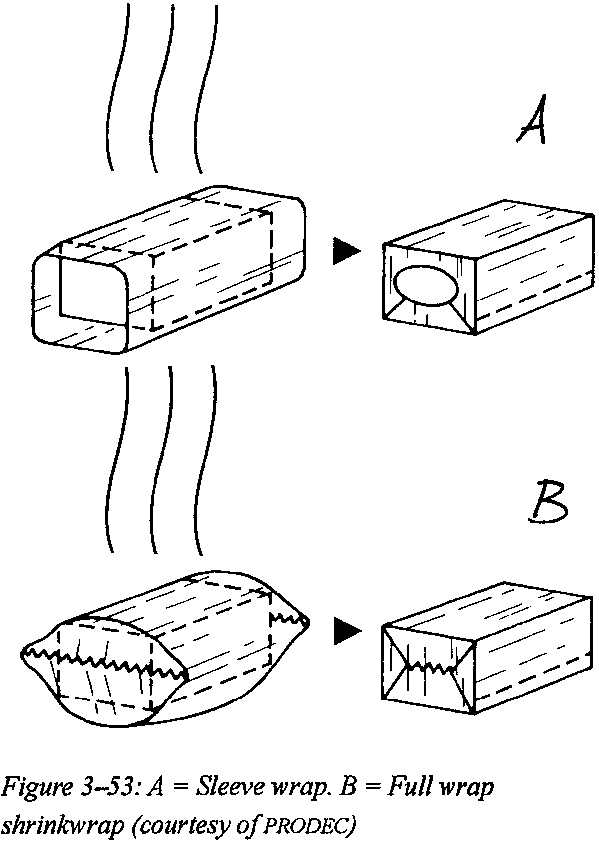
Figure
There are two types of shrinkwraps:
- a full wrap (or bag type) which completely encloses the
product to be wrapped except for a small hole to allow air to escape during the
shrinking process,
- a sleeve wrap in which a sleeve of polythene is longer
that the items to be wrapped.
The sleeve is formed around the product and when heated, the ends contract over the ends of the product to securely grip it. This type is often used for trays of bottles, jars, cans, etc.
Shrinkfilms are available in different thicknesses and this can be used to calculate the amount of film that is needed for each pack as follows. For sleevewrap packing (Figure 3-54):
Width of film =A +3/4C
Length of wrap = 2(B + C) + 10% shrink
allowance
Total film used per pack (kg) = (width of film x length of
wrap)/yield
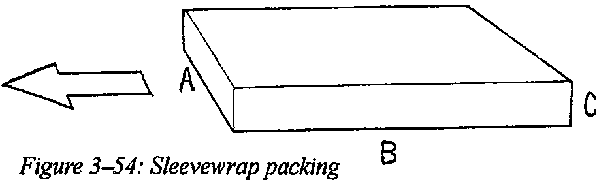
Figure
A simple 'rule' is that the thickness of shrinkwrapping film should be increased by 10 microns for every kilogram of product wrapped. For example if a shipping load of 24 cartons, each weighing 250g is to be shrinkwrapped the film should be 24 x 0.25 x 10 = 60 microns.
Details of the yield of a film and its relation to thickness are given in the section on quality control below.
LDPE is also produced in a thinner (25-38 micron), more stretchable form known as linear low density polythene (LLDPE) or 'stretch film' (in domestic use it is known as 'clingfilm'). This is made so that it can stretch by up to 60% without breaking. One side of the film has greater 'cling' properties than the other and this makes it stick to other film when wound around a stack of boxes or other items (Figure 3-55). This keeps the items together during transport and also keeps the load clean. Because the film only has cling properties on one side the wrapped loads do not stick to each other. The film also has the property of not tearing easily if punctured so that the load remains together even if the film is damaged during handling. Both shrinkwrapping and stretchwrapping help to prevent pilferage.
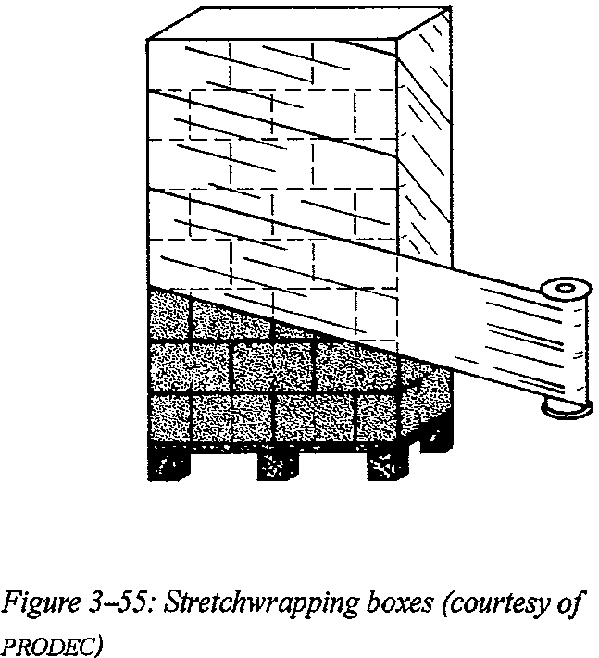
Figure
In domestic use or during processing stretchfilm can be used for covering containers or for wrapping small amounts of food for short-term storage. The film should not be used for long-term storage or for fatty foods because of the risks from migration of plasticizer into the food as described above.
Sealing
The simplest sealing for plastic bags involves tying a knot in a pre-formed bag. Other methods include stapling folded layers at the top of a bag or using adhesive tape (Figure 3-56). In each of these methods the bag is not completely sealed and air or moisture can enter and leave, although more slowly than if it is not sealed at all. These methods should therefore be used only for foods that do not require much protection during storage or for those that are expected to have a shelf life of only a few days.
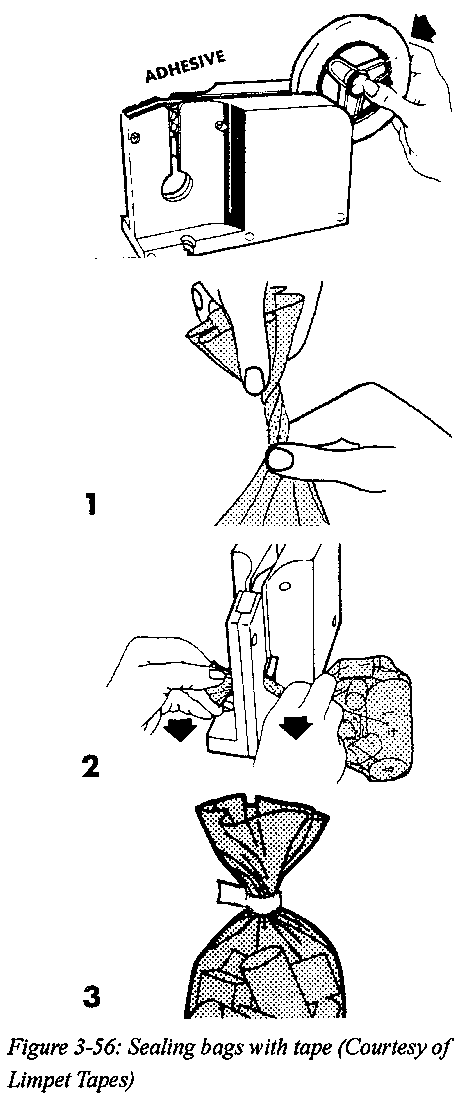
Figure
Heat sealing
To form a moistureproof and airtight seal it is necessary to heat seal the film by melting the plastic on either side of the bag opening, fusing the two films together. This provides a more effective barrier than folding or tying the film. This type of seal can only be made using materials that are thermoplastic (ie they melt on heating and then solidify on cooling) or by using thermoplastic coatings on a base film Waxed paper is also a heat sealable material which is used to wrap bread whereas cellulose is used as an overwrap for cartons of tea or confectionery.
Heat sealing of polythene can be done simply by folding the top of the bag over an old hacksaw blade and heating the film with a flame (e.g. from a candle or spirit burner). This produces a thin seal which is adequate for short term storage. However there are likely to be small faults in the seal which allow air and moisture to enter over a period of time. In addition the seal is weak and easily torn and, unless produced carefully, is less attractive to consumers than machine-made heat seals. This method is not suitable for cellulose or polypropylene because of their higher sealing temperatures.
A broader seal can be made using an electric or fuel heated sealer . This type of seal has similar barrier properties to the film being used. It is stronger than other seals and more attractive to many consumers. In operation two films are pressed together between coated metal bars (the coating stops the film from sticking to the metal). The bars are heated by an electric element or burning fuel. The heat melts the plastic and the pressure fuses the two films together. The heat is then stopped and the plastic cools and solidifies. Full seal strength is obtained when the plastic has cooled to room temperature.
The strength of a seal formed in this way is determined by the temperature of the bars (controlled by an adjustable thermostat in electric equipment), the pressure applied by the operator and the time of heating and cooling. Each type of plastic film has its own range of sealing temperatures, pressures and times over which it will form a good seal.
The following sections discuss different types of heat sealers.
Jaw sealer
This type has two coated metal bars and the films to be sealed are placed between them. One or both of the bars are heated and one bar moves to press the films together. The heating time can vary from 1/20th second to several seconds depending on the film, and it is controlled by a switch that is activated when the bars are pressed together.
Roller sealer
This type of sealer has a heated metal wheel that is pressed along the film to be sealed (Figure 3-59).
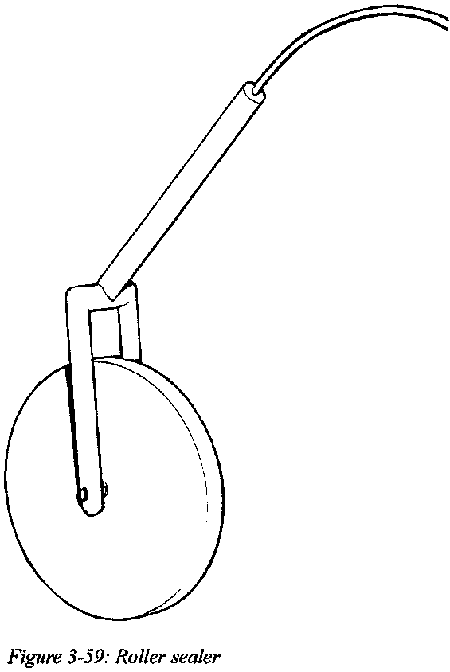
Figure
The seal thickness is determined by the width of the interchangeable wheel and the seal strength is determined by the speed and pressure used by the operator. The wheel is not usually coated and it is necessary to use a sheet of paper between the sealer and the film to prevent the film from sticking to the wheel. With practice it is possible for an operator to obtain perfectly straight seals. An advantage of this type of sealer is that curved seals can be made which may have a decorative appeal for consumers. There is no limit to the length of seal that can tee made.
Hot wire sealing
Here a metal wire, heated to red heat, is used to form a bead seal while cutting the film at the same time (Figure 3-60).
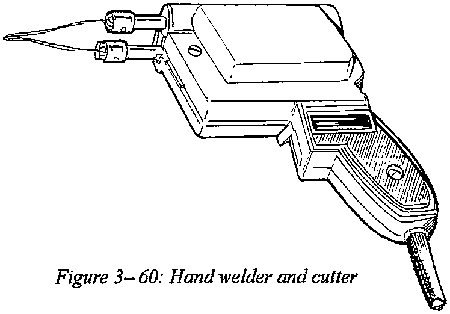
Figure
Impulse sealer
This is similar in appearance to the jaw sealer but operates in a different way. Initially both bars are cold, but when they are closed together on the films one bar is heated electrically for a pre-set time. After heating the pressure is maintained for a few seconds to hold the seal in place while it cools and sets. Each of these sealers is relatively cheap and simple to make by a local engineering company.
Types of bags
Plastic films can be bought as pre-formed bags, as tubing or as 'flat' film (either in sheets or on a roll). Preformed bags am filled and sealed by the packer and they are commonly used in small and medium-scale enterprises where production volumes are too small for formfill-seal machines (below) or where the products have an irregular shape or size. Typically they are used for flours, confectionery, sugar, salt, root crops, bread and processed fruits.
Pre-formed tubing is used to form bags by heat sealing the base. Flat film can be used to make bags or other types of pack described below by sealing each side separately. These bags are often made with only side seals although bottom seals are also common. They can be made flat or with gussets on the sides and/or the base. Although there are no international standards for bag manufacture most bag makers have a range of standard products and it is always cheaper to use a manufacturer's standard product than asking for a special design, especially if small quantities are ordered.
Different types of bag designs are shown in Figure 3-61. The gusseted bags (or wedge bag) are normally used for packing solid, bulky foods such as bread. They are also used as an inner liner for cartons containing such products as cereals or biscuits.
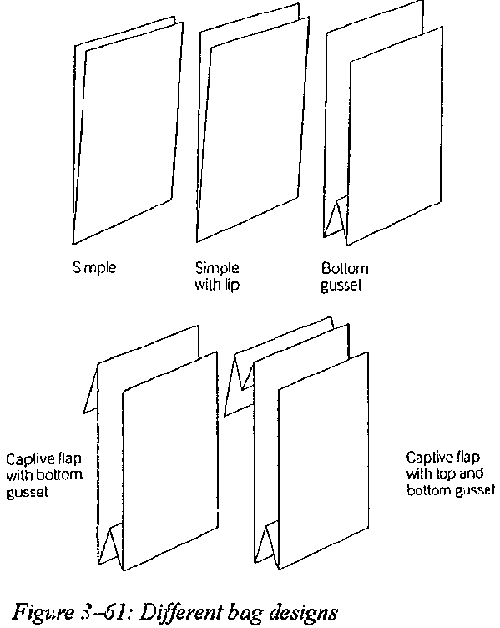
Figure
Small bagging machines in which a product is filled and sealed into pre-formed bags are also available. They can be manually operated or semi-automatic and are ideally suited to small items such as confectionery, dried fruit pieces, nuts, etc.
Vacuum packing
Vacuum packaging is a development of the impulse sealer, but here most of the air is first removed from a bag of food which is then heat sealed. For foods that are susceptible to deterioration due to air, vacuum packing can extend their shelf life. The tight fitting package around the food is also more attractive to some consumers. In general a strong film such as polypropylene is needed to avoid puncturing and thus to retain the vacuum in the pack.
There are, however, two important constraints on the use of vacuum packaging which should be considered seriously before it is used: first the removal of most of the air from a bag creates an 'anaerobic' environment inside the bag. If certain types of bacteria are present on the food, this oxygen-free environment will encourage them to grow rapidly. Many types of food poisoning bacteria are of this anaerobic type and vacuum packaging could therefore cause good food to become dangerous. In particular low-acid, moist foods such as meat, fish, dairy and vegetable products should not be vacuum packed at the small scale.
Secondly, vacuum packing is not suitable for many dried foods unless a strong film is used. The sharp points on pieces of dried food can easily puncture a film as it is drawn onto the food by a vacuum. This destroys the purpose of vacuum packing and dramatically reduces the shelf-life of the food.
Until recently vacuum packing was beyond the reach of many small-scale processors of the high cost of the equipment and difficulties and cost in maintaining the vacuum pump. Cheaper, locally produced and maintained vacuum packing equipment is available in some developing countries and as a result this method is becoming increasingly common.
Form-fill-seal
There are three types of form-fill-seal equipment; the vertical (VFFS) and horizontal (HFFS) types which are distinguished by the way in which the food and film pass through the machine, and a pouch former which seals the pouch simultaneously on four sides. At present there are no simple, low-cost, horizontal or pouch machines so these are not described further. There are a limited number of low-cost vertical machines and interest is increasing in further developments to these.
This equipment (VFFS) makes bags from a wide range of packaging materials in a continuous operation and then fills food into them and seals the bags. In operation a film is formed into a tube and the long seal is made by a heated roller. An impulse sealer then makes a seal across the film - to make the base of a bag - and the bag is filled with food. A second seal is then made above the food to seal the bag and simultaneously form the bottom seal on the next bag (Figure 3-63).
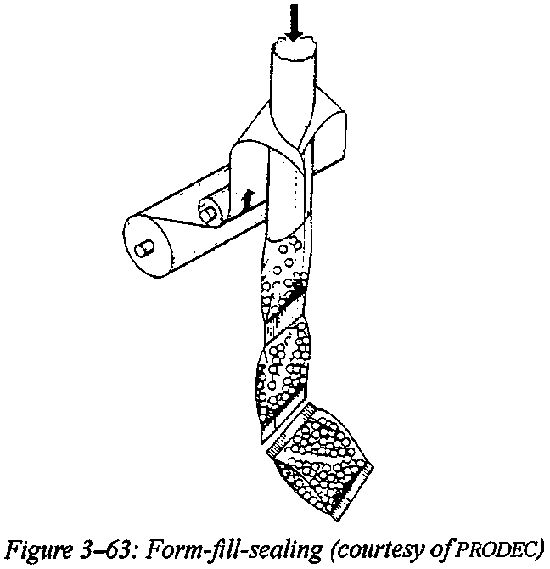
Figure
This type of equipment is suitable for powders and flours, granular foods such as beans, nuts, confectionery or liquid foods. As in all heat sealing care is needed to prevent food from sticking to the inside of the film and contaminating the seal. The film must also be strong enough to form a bottom seal that will withstand the weight of food while the seal is still warm. Commonly used films include heat sealable cellophane, polypropylene, and coated or laminated papers. Polythene can be used but filling speeds are slower to prevent the film from stretching when placed under tension.
Specific quality control procedures for flexible films
The reader is advised to read Section 6.4 in conjunction with this section to find additional, more general quality control procedures that are needed when packaging foods
There are a number of faults that can occur in rolls of plastic film which can result in an inability to use the film, a poor appearance after packaging or a reduction in the barrier properties of the film and seat There are no critical faults in films (that could injure operators or customers) but a number of major faults are possible and these are described below, as are the routine tests for checking films before they are used.
It must be remembered that if film is bought on a roll, there is no simple way of finding out whether there are faults inside the roll. The only checks that can be done are on the film at the outside of the roll and it is then assumed that the remainder of the roll has a similar quality. It is therefore essential to find a reliable supplier of film and if possible to agree the quality checks with the supplier.
The faults that can occur are as follows (the classification assumes that manual and not automatic packaging equipment is used. A different classification is needed for automatic packaging):
-Major faults
- Incorrect yield: the barrier properties of a film depend in part upon its thickness.
Yield is the area per unit weight of film (m2/kg) and is a measure of the thickness of a film (In the USA the yield is measured as square inches per pound - sq. in./Ib.)
A film thicker than specified is unlikely to be important technically in small-scale processing (although it will be important financially) but a high yield (thinner film) could result in inferior barrier properties and the risk of incorrect sealing, jamming in a sealing machine or tearing.
Thickness can be measured directly and is usually expressed in microns (= 0.001 mm) or in the USA as gauge (0.00001 inches = 0.254 microns). Normally a variation of 10% on the specification for the film is acceptable. A comparison of yield and thickness is essential when film is being ordered because it is usually sold by weight especially when it is sold as a roll.
For example cellophane and polypropylene can both be used to wrap a product. The cellophane has a yield of 22.7 m2/kg and a thickness of 30 microns, whereas the equivalent polypropylene film has a yield of 44.0 m2/kg and a thickness of 25 microns. If one package requires 0.05 m2 of film then 1000 packages would use 50 m2 of film. This means that 2.2 kg of cellophane would be needed but only 1.1 kg of polypropylene. In many countries the price of cellophane is about 1.5 times the price of polypropylene which means that the cost of packaging in cellophane would be 2 to 3 times the cost of packaging in polypropylene, other factors being equal. It is necessary to use a micrometer to accurately measure the thickness of a film but for most processors the high cost of this equipment is not usually justified.
- Incorrect printing: this can be a fault in the design, the
wrong design, incorrect colours, smudged, blurred or incorrectly positioned
print.
- Odour: in some films a coating is applied using organic solvents and
some printing inks may be solvent based. If the film is not properly prepared,
residual solvents may be present and these will contaminate the product. The
only simple method of checking this is to smell the film.
- Blocking: this
fault causes layers of film on a roll to stick together and not unwind smoothly.
In extreme cases it may cause the film to tear. For manual methods minor
blocking is not a problem but for machine sealing it can cause the film to
become misaligned (so that any printing is not positioned correctly on the pack)
or cause the machine to jam Serious blocking can make a film unusable even with
manual methods.
- Minor faults
- Marks: the presence of blemishes on the film.
- Dimensions:
the width of the film should be correct for the intended package. Oversized or
undersized film is more difficult to handle in the sealing machine although this
is unlikely to be important for manual sealing methods.
- Curl: this is a
fault which causes the film to curl up instead of lying flat. It is due to
incorrect storage conditions (especially humidity), a build-up of static
electricity, incorrect film thickness or variation in the coating on a film. In
martial sealing this is a nuisance which will slow down the operation but in
machine sealing the film may jam the machine and be unusable.
- Winding: this
is where a film is wound too loosely on a roll. In extreme cases it may cause
the film to slip off the roll and become damaged. In manual sealing this fault
is unlikely to be a problem but in machine sealing the lack of correct tension
in the film may cause it to feed through the machine incorrectly and cause
jamming.
- Slip: is the property of a film to slide over machine parts or
other film. It is important when automatic filling machines like form-fill-seal
equipment are used. If slip is too low the film will not rim through the machine
properly but if it is too high it will slip away from the sealer before a seal
can be formed.
- Register mark position: these marks are used in machine
sealing to correctly position the film so that the printing appears in the
proper place on the package. If they are misplaced or not clear the packs will
be improperly labelled. These marks are not used for manual sealing.
Film testing
To inspect a roll of film for these faults the following procedures are used:
- Remove any outer covering and check the roll for looseness
(winding).
- Measure the width of the roll to check that it is within +5 mm
or -5 mm of the expected width.
Check the diameter or weight of the roll to
ensure that the correct quantity has been supplied.
- Remove two layers from
the roll and either discard them (in machine sealing) or used them for packing
(in manual methods) if the subsequent checks show that the film is
satisfactory.
- Use the next two layers for testing, check for any blocking
as they are unwound.
- Lay the sample on a flat surface and note if there is
any curling. Examine it closely for print quality and position, correct colours,
register marks and the presence of any blemishes.
- Cut out five standard
sized squares of film using a 10cm x 10 cm template (Figure 3-64) and weigh them
carefully (eg using scales reading 0- 50 g in 0.2 g divisions). Convert this
weight to a yield value using a calibration curve such as the one shown in
Figure 3-65.
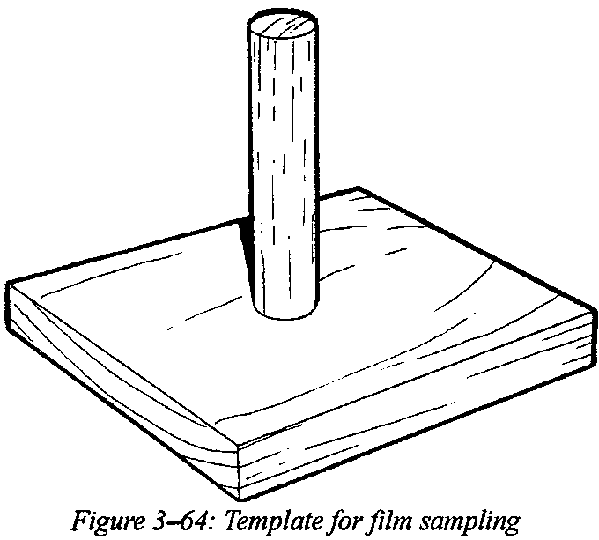
Figure
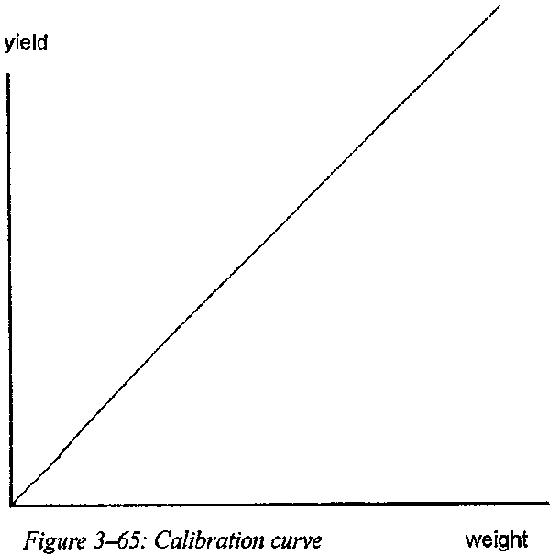
Figure
- Crumple some of the film and smell it for any solvent odours.
A final test is to take part of the sample and heat seal it under the conditions that are used in production. When the seal is cold test it by gently pulling the two films apart at right angles. A faulty seal is one that:
- does not form at all,
- comes apart with little force,
or
- tears unevenly when pulled.
If required the permeability of a film to moisture can be measured to predict the shelf-life of a product under known conditions. Although it is possible to buy special permeability testers they are very expensive. In practice similar results can be obtained by using a sealed box (an old refrigerator cabinet is ideal) in which a tray of saturated salt solution is used to control the humidity of the air in the cabinet. If necessary the temperature can be changed by a small electric heater or a light bulb in the cabinet. Both temperature and humidity should be similar to those expected during the shelf-life of the food in the area in which it will be sold.
A weighed amount of food is packaged, placed in the cabinet and then re-weighed at regular intervals. If the weight falls or increases too much before the end of the expected shelf-life it is then known that the film is not a sufficient barrier to moisture.
The gas barrier properties of a film can also be measured, but this requires more expensive and sophisticated equipment and would not usually be undertaken by a small-scale producer.
Need for shipping containers
Although plastic films provide a good barrier to moisture, air, sometimes light, micro-organisms, etc., they do not protect the food against mechanical damage such as crushing, vibration and puncturing. In addition few films can prevent tats, birds and some insects from attacking the processed food during storage. It is therefore necessary to protect the plastic bags or packs during transport, distribution and storage using shipping containers. The most commonly used in developing countries are cardboard or wooden boxes, baskets and crates. Shrinkwrapped or stretchwrapped containers are also now being used in some countries.
Special skills needed
In manual and sealing methods, a few simple skills need to be acquired by production staff. Similarly quality control procedures for packaging materials also need a certain amount of experience and expertise. The operation of automatic packaging equipment such as form-fill-seal equipment requires training and this would normally be given by the equipment supplier. However in general, packaging in flexible materials requires little formal or intensive training.
3.2.3 Foil
Aluminium foil is generally expensive and thus not widely used by small and medium-scale producers. However for some applications where very good protection of a food is needed or where local aluminium production makes foil cheaper, this can be an important material. It is therefore included in this publication but the level of detail is less than for some other materials.
Aluminium foil is made by rolling out pure aluminium metal into very thin sheets and then annealing it to give dead-folding properties. It is available in a range of thicknesses from 7 - 20 microns when it is used as wrapping for foods and 50 - 100 microns when it is used as trays for streetfoods. In this section the use of foil for wrapping foods is described.
Foil is an excellent barrier to moisture, air, odours, light and micro-organisms and it is therefore used to wrap foods that are sensitive to off-flavours or odours, light or air. Its properties are described in Table 3-9. In addition it is reflective, which is attractive to most consumers and helps to reflect heat from the wrapped food. It has no reaction with foods and is therefore entirely inert with acidic foods, oily foods or others that may react with some types of packaging. As a result foil does not need to be lacquered or protected in any way from contact with foods.
It is either used alone or as a component of laminated packaging where it is bonded to paper or a plastic film to improve the barrier properties of these packs. Foil is not heat sealable unless laminated to a plastic, but the deadfolding properties allow it to be folded tightly. The resulting seal is not a total barrier to moisture and air, but it is adequate for short/medium term storage. The major disadvantage of foil is the relatively high cost.
Quality control
There are normally no critical faults (causing harm to operators or customers) in the use of foil. Major faults include excessive numbers of pinholes, incorrect thickness and tearing or creasing.
|
Foil thickness (micron) |
7 |
9 |
12 |
15 |
20 |
|
Yield (m2/kg) |
52.9 |
41.2 |
30.8 |
24.7 |
18.5 |
|
Number pinholes/m2 |
<800 |
<200 |
<150 |
<75 |
<10 |
|
Water Vapour |
| |
almost zero |
| |
|
Transmission Rate |
| | |
| |
|
(WVTR) | | | | | |
|
Oxygen Transmission |
| |
almost zero |
| |
|
Rate (OTR) | |
| | | |
Table 3-9: Properties of foils
The most common fault with foil is the presence of tiny holes (named 'pinholes') that are formed during its manufacture. Most foil manufacturers conform to a voluntary standard on the number of pinholes per square metre of foil which is set at a level that does not affect the performance of the foil (for example in a commonly used foil that is 9 microns thick the average number of pinholes should be less than 200/m2). If the number is substantially higher than the agreed standards the foil will tear more easily and the barrier properties to moisture and air are reduced. Although it is not a routine quality control procedure the number of pinholes in foil can be checked by the following method:
- Cut a length of 30 cm of foil from the width of a roll and
hold it up against the sun or a bright light.
- Check which part of the foil
seems to have the most pinholes and then carefully cut a 10 x 20 cm sample.
-
Count the number of pinholes in the sample and multiply the result by 50 to find
the number of pinholes per m2.
Other useful checks on a roll of foil are first that the roll is wound tightly which can be checked by seeing that the roll can stand vertically without falling over, and that when the vertical roll is lifted with both hands the layers of foil do not slip. Secondly that there are no wrinkles or creases in the foil.
Resistance to handling
Foil is easily damaged by handling and it should therefore be handled as little as possible. It is almost impossible to remove creases from foil once they are made and these will not only spoil the appearance of the pack but may also damage the foil and lower its barrier properties.
Foil is usually bought in roll care should be taken that scratches dents and cuts are not made in the roll by careful handling and storage. When the roll is being used a simple dispenser with a serrated metal cutting edge allows the foil to be unwound without wrinkling. With practice, food can then be wrapped by hand without causing creases.
3.2.4 Cloth and vegetable fibres
The main types of material that are used for food packaging are cotton, jute, linen and sisal. With a few exceptions these materials are not used for small retail or consumer containers but are more commonly used to transport larger quantities of food as shipping containers. For this reason the level of detail in this section is less than for some other materials. One particular use for cloth packs is for foods that are sold in specialist markets such as tourist souvenirs. Here a decorative package made from a locally produced jute or cotton material may have good promotion potential.
Textile containers have no significant barrier properties to moisture, odours and air. In addition they do not protect foods from mechanical damage such as crushing or puncturing or from micro-organisms, insects, rodents or birds. They are therefore used for foods that are not susceptible to odour pickup or changes in humidity and foods that are not easily damaged by crushing. They are mostly intended as a lightweight container to hold the food together in a package that can easily be bandied and transported. They are used for free-flowing foods such as flours, sugar, salt, spices, cereals, tea and coffee beans. They are also widely used for short-term transport of a wide variety of other foods including fresh fruits and vegetables and dried fish, although the protection offered to foods carried in this way is minimal.
The main advantages of textiles are that they can be manufactured locally from available materials and they can be easily repaired by sewing with a suitable sack needle and thread. They are lightweight and have good non-slip properties which means that sacks can be safely stacked. They are re-usable when cleaned and they are biodegradable when discarded
Textile packages can be closed by sewing with a bag stitcher or by tying with wire or rope (Figure3-43).
|
| ||||||||||||||||||||
Appropriate Food Packaging (Tool)
4 Filling and labelling
4.1 Filling equipment
Filling equipment is designed to handle solid foods, liquid foods or powders. In general manual filling methods are most commonly used for small-scale production. For each type of filler, however, a number of options of scale are available. These range from more convenient and accurate manual fillers through semi-automatic equipment up to fully automatic high speed systems.
4.1.1 Fillers for solids
The types of small-scale equipment for filling solid foods such as confectionery and dried foods is somewhat limited. In practice most producers fill by hand as the high cost of semi-automatic bag fillers cannot be justified by relatively low production rates. A scoop of known volume can be a useful way of obtaining similar weights of product in each pack. Ideally the scoop should fill some 90% of the required net weight into the pack. The pack is then passed on to a second operator who places it on a scale and adds product, from a smaller scoop, until the required net weight is reached.
Filling speeds can be increased by using a volumetric powder filler of the type shown in Figure 4-2.
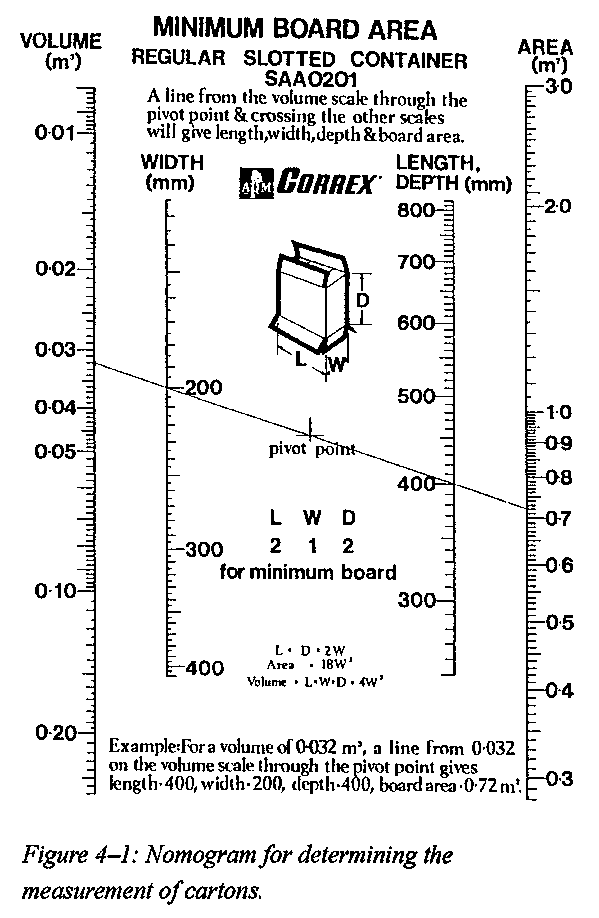
Figure
At larger scales of production, plastic bags can be filled using small bagging machines or form-fill-seal equipment as has been described in Chapter 3.2.2. When filling into cardboard cartons the nomogram in Figure 4-1 is useful for determining the size of carton that is required.
Before using the nomogram, it is necessary to know the bulk density of the product (volume occupied by a known weight; usually 100 g). To measure bulk density 100 g of product is placed in a measuring cylinder. The cylinder is then tapped gently on a table, to settle the product down, and the volume occupied by the 100 g read off.
Tea bag filling is a somewhat specialized area of solid packaging as fairly high speed packing is necessary in order to reach an economic throughput. Tea bag paper is a special type of paper that combines great wet strength with porosity and heat sealability. Tea bagging machines work on the basic principle of form-fill-seal and small machines with outputs of 100 bags per minute are commercially available.
When using the machine in Figure 4-2 the lower valve is closed and solid product flows down and fills the tube. The top valve is then closed. On opening the bottom valve a measured volume of product falls out of the outlet. The distance between the two valves can be adjusted, allowing for good net weight control. Such fillers are not, as far as is known, commercially available, but can easily be built in a local workshop from drawings available from ITDG.
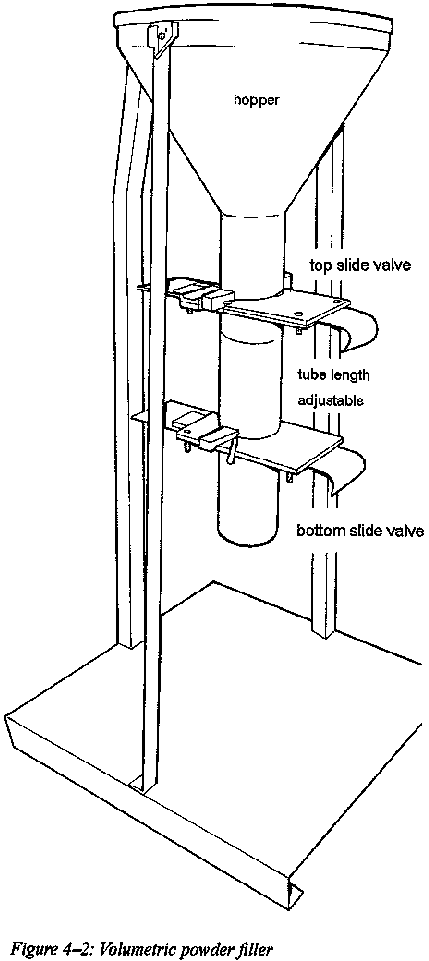
Figure
4.1.2 Liquid fillers
At the simplest level, liquids can be filled into containers using jugs. Small liquid gravity fillers can be made from a vessel such as bucket fitted with outlet taps (Figure 4-4). Two or five-gallon plastic tubs or double-walled water coolers with taps make useful fillers if the product is not too hot. At higher temperatures a stainless steel bucket can be used A small stirrer may be needed to prevent particles of food from settling out in the filler. Outputs of some 1000 packs per day are possible with such fillers.
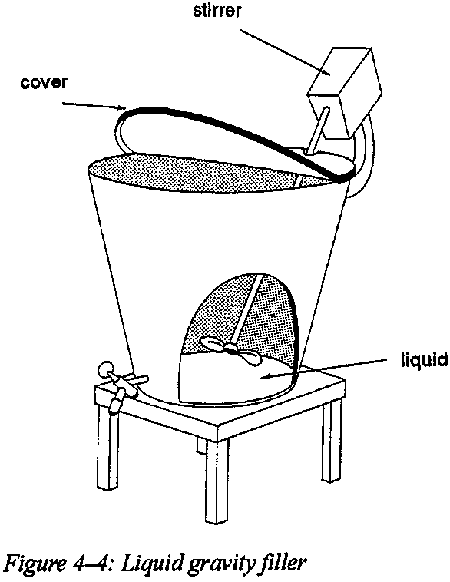
Figure
Some products, such as sauces, flow rather slowly through a small tap and a different approach is required. A simple low cost filler (Figure 4-5) has been used successfully for such products. A large plastic funnel is cut so that the stem just fits into the bottle neck. A length of plastic rod acts as a simple on-off valve. In practice a team of four using such fillers with two people to cap bottles could produce some 6000 packs of sauce per day.
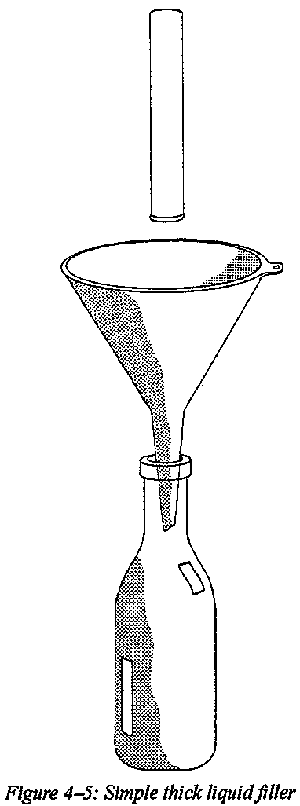
Figure
Several companies produce small hand-operated or semi-automatic powered volumetric fillers (Figure 4-6). These essentially consist of a piston working in a cylinder which pumps a known quantity of liquid food into the container. A whole range of cylinder sizes from few millilitres up to a litre or more are available. The length of the stroke of the piston is adjustable, allowing good net weight control.
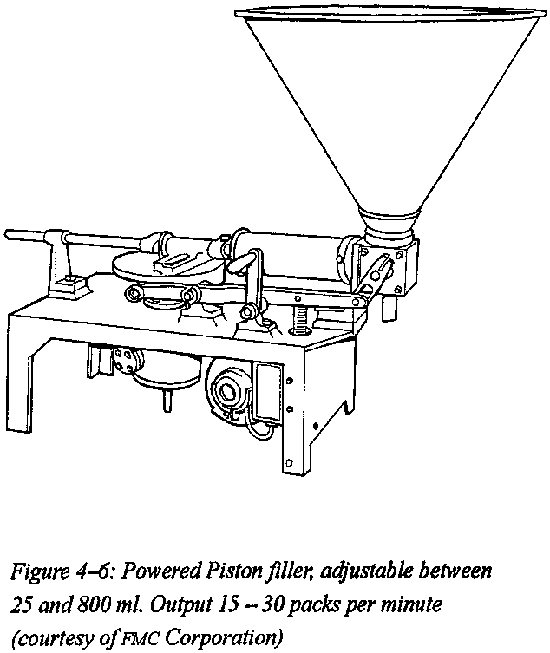
Figure
Another approach is to use small vacuum fillers. These are commercially available and can also be made very easily locally. Figure 4-7 shows the principle of a locally made vacuum filler that has been successfully used for hot filling fruit juices. Vacuum is obtained from a water Venturi pump attached to a tap. These are obtainable from laboratory suppliers. One good feature of vacuum fillers is the fact that they give a constant fill level as when the level in the bottle being filled rises to the vacuum tube the juice starts to suck out of the bottle.
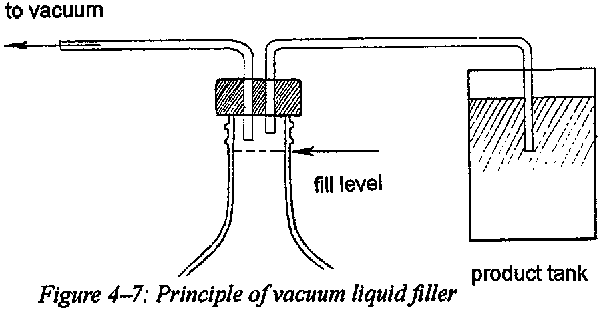
Figure
4.2 Labels and labelling
Although the label on a packet or container generally has little functional role in terms of product protection it is nevertheless of vital importance. The label is the primary point of contact between the producer and the purchaser and should be thought of as an integral part of the producer's marketing plan. It is not just a piece of paper stuck onto the container but should be an expression of a number of important decisions that have been made about marketing. Good labels are not just for large producers but can be used by small enterprises as well. If producers have confidence in their products that confidence should show through at the selling point. The old adage 'Failing to Plan is Planning to Fail' is worth remembering.
The most important roles of the label include:
- Persuading the buyer to purchase the product without tasting
or smelling it, rather than that of a competitive brand which may be next to it
on the shelf. For the first-time buyer the appearance of the food, including the
label, is the most influential factor that attracts the customer. If a
first-time buyers find nothing wrong with the product they will buy again and
quickly develop a loyalty to the brand.
- Informing the customer clearly
about the product; its contents, ingredients, its weight. The label must also
comply with any local labelling regulations.
- Increasingly the label is
required to inform the customer about the shelf-life of the food - its 'use by
date'.
- In some cases the label needs to inform the buyer about storing the
food. Examples include frozen foods or foods that need refrigeration after
opening.
- Sometimes the customer may need to be told how to use the food
product and recipes are commonly included on products that are used as
ingredients in cooking.
There are two distinct categories of labels:
- Direct printed labels: These are printed directly onto the
container which may be a box, bottle, tin or plastic bag which is then filled
and closed.
- Applied labels: Those that are attached or glued to the
container, generally after filling and closing. Such labels are attached, most
commonly by sticking them on to the package. Applied labels are available plain
(they have to be stuck on with a glue), or selfadhesive ready-glued (simple
wetting is required prior to application). It is recommended that plain labels
and self-adhesive labels are used in humid tropical countries, as ready-glued
labels loose their efficiency and may stick together while in store.
If the product is sold in a returnable bottle wet strength paper labels should be used. These can be easily removed in one piece when washing returned bottles so reducing bottle washing times.
Special finish labels such as metallized paper and paper-aluminium foil laminates are sometimes used for foods that require a highly decorative label, particularly spirits and beers where the greater profits justify the extra expense.
For the small and medium producer the most common available choices are shown in Table 4-1.
|
For canned foods |
Glued on paper labels that |
| |
wrap right round the tin |
| |
Self adhesive labels |
| |
Note: direct printing of cans |
| |
requires very large orders |
|
Glass bottles and jars |
Glued on paper labels of |
| |
many shapes |
| |
Self adhesive labels |
|
Plastic bottles |
Self adhesive labels |
| |
Glued on paper |
| |
Direct printing at medium to large scale |
|
Heat sealed plastic bags and |
Paper label inserted inside |
|
cellophane |
bag |
| |
Self adhesive labels |
| |
Direct printing onto film is |
| |
economic at medium scale |
|
Paper bags |
Direct printing or stencilling |
| |
Glued on or self adhesives |
|
Cardboard boxes |
Direct printing or stencilling |
| |
Glued on or self adhesive labels |
Table 4-1: Types of labels
Labels may be applied to different parts of the container. This is particularly true of bottles and typical applications are shown in Figure 4.8.
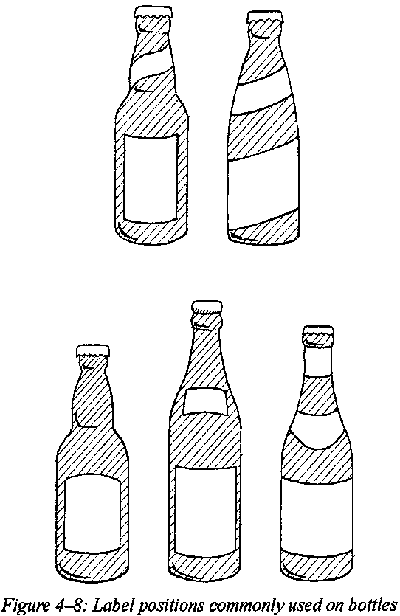
Figure
The first step will be for the manufacturer to decide which of the above label options are available and then select depending on cost, volume needed, and the minimum order that can be placed.
4.2.1 Label design
Good label design is very important. Unfortunately many small producers either seem prepared, or are forced due their circumstances, to accept a second-rate design and quality when, for little extra cost per package, they could use a quality label that would raise the food's brand image and competitiveness. Some very small manufacturers try to market their food products with a hand written label, often stuck to the container with Sellotape. While it was possible to see many products for sale labelled in this way it is now much less common because it is less acceptable to the customer who is increasingly informed and being offered alternative brands.
If a product range is being produced it is normally best to use a common basic design in order to develop a Brand Image. Indeed for the smaller producer the use of a basic generic or family label is often a good way of reducing both design and print costs. Generic labels have a standard artwork design and can include other standard information such as the manufacturer's name and address and possibly the net weight together with a blank area into which the other information such as the product name and ingredients can be overprinted or even added by means of a rubber stamp. With the availability of computers such overprinting onto self-adhesive strips of labels is an easy job. The use of generic labels means that larger print runs of the basic colored label can be made so lowering the unit cost of printing and design. The same system of a generic design can be used for rubber stamp printing labels. An example of a generic label is shown in Figure 4.9.
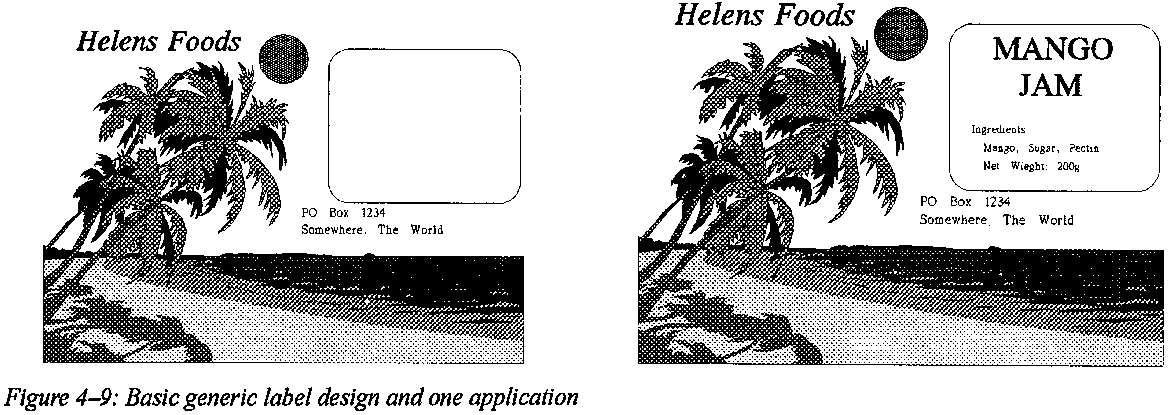
Figure
When using printed labels, the work of designing the label is too often left to a local printer rather than using professional designers who are also skilled in the marketing and brand image aspects of product presentation. The proper use of color, pictures and graphics can change a poor looking pack of food into one that suggests quality and reliability. The design also has to relate to the customer. A confectionery product aimed at children for example needs to give a different message than one aimed at upper middle-class customers. This is the skill and craft of the designer. When possible it is recommended that the services of a designer should be used. Designers may be contacted through bodies such as local art schools and export development agencies.
If the small producer is unable to afford or find assistance in design what can they do? In thinking about a label design the following questions need to be seriously considered for they are part of the overall business and marketing plan:
- Who are the potential buyers? Women, men, children, etc.
-
Are there any local laws governing labelling? (here advice needs to be sought
from the local Standards Bureau). This leads to what information must be
included.
- Has a brand name been decided upon? If not this is
essential.
- What message is given by the label (i.e. it is nutritious, high
quality, convenient to use).
- What other information should be given to
assist the consumer such as: How to use? Use by date? Recipes?
- Are the
labels to be sent out to a printer and if so is one color or more going to be
used? This last point will greatly influence any artwork or drawings used.
-
Is the product going to face competition from other brands? If so it is a very
good idea to carefully examine their labels and think about how your design can
give a greater visual impact.
The next step is to begin to design the label and it is usually possible to find a local person who is artistic to help. It often helps to write and draw the needed information (weight, Brand, address, etc) on small bits of paper which can then be moved around a 'blank' of the label until the most attractive layout is found. It is useful to look carefully at as many other labels as possible and learn from them. The final aim is a good design that will give a message to the customer in a few seconds.
- Too much artwork or words should be avoided and label kept
visually clear.
- The BRAND name should stand out.
- Colors should be used
carefully and colors most commonly used by large companies noted.
- The label
should state confidence in the product.
The size of label used is very important and packs of food are often to be seen whose appearance is spoiled by the use of a label that is too large and which 'kinks' over the curved top or bottom part of a jar (Figure 4-10).
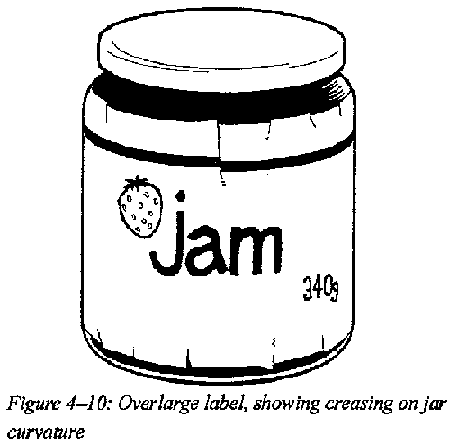
Figure
The quality of the paper used in terms of brightness and gloss is also of prime importance. In general a white, high-gloss label with crisp printing has a higher customer appeal - it says 'quality'.
4.2.2 Information needed on the label
The information that needs to be given on a label varies depending on the country and the product. Most countries now have some form of food labelling laws and the manufacturer should consult the relevant local standards authority before designing any label. As a minimum the label should clearly state:
- the name of the product,
- the net weight,
- the
ingredients, in order of amount,
- the name and address of the
manufacturer,
- the Brand name.
Other information such as a sell-by date may be required. This can be done using small rotary date stamps (the type commonly used in offices). If a product with a shelf-life of six months then was made on 1/4/92 it would need to be stamped Best By 1/10/92.
In many countries, particularly in Europe and North America, the laws governing labelling are complex. Manufacturers in developing countries often state that they wish to export but few realize the complexity of conforming to the laws of the importing country. Figure 4-11 shows the typical information needed for a jam to be sold in the United Kingdom.
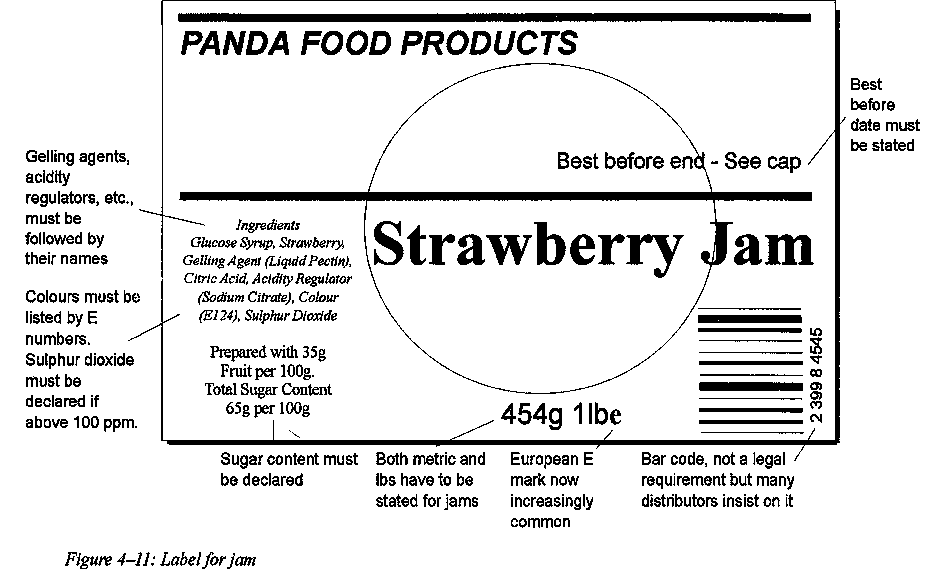
Figure
4.2.3 Production of printed labels
Printed labels are produced by five basic methods: letterpress, flexographic, silk screen, offset litho and rotogravure. In developing countries all of these systems may be available but vary considerably in standard of equipment and the printer's skill. Always look at samples of the printer's work!
Letterpress is mainly for sheet printing particularly of labels. While popular it is rather slow and tends to be used for short runs. One color is printed at a time so multicolor labels require several passes through the press and any 'slipping' of a second color can give disastrous results. It can give crisp and sharp images on good surfaces. Artwork should be drawings not photographs.
Flexography is perhaps the most widely used method for paper, board, flexible plastics and aluminium foil. The printing method is fast and several colors can be printed on one run as the inks used are rapid drying.
Suitable for short, medium and long runs. Photographs can only be reproduced if the printer has special plates. It can print on rolls of self-adhesive labels.
Silkscreen printing is used for plastic and glass bottles. It is excellent for both small or large operations and can be applied manually or automatically. It is essential that the type of ink used does not react with the container. The artwork should not involve very fine lines or small text. Not suitable for photographs.
Offset Litho printing is used for paper, board and tinplate. Commonly used for stationary, posters and boxes. It varies in range from small two-color print shops to high-speed machines that can produce full-color photographs. While self-adhesive labels (called crack and peel) can be be produced they are more difficult to use manually and are better for machine labelling. Artwork can include photographs. Although unit costs are higher the final result can tee excellent. Due to the type of inks used there can be an odour or taint problem which means that care is needed when used for packaging foods.
Rotogravure is used on very smooth boards, paper, flexible plastics and foils. As it is an expensive method to set up it is used for large print runs, not a feasible option for the small business. Photographs can be reproduced. While the most expensive method it gives the best results especially on plastic films and aluminium foil.
|
Matt |
Non-shiny finish, does not |
| |
take very fine print, cheap |
|
One side gloss |
Thickness and type of coating |
| |
selected based on printing |
| |
system used. Does not stain |
| |
as easily as matt |
|
Weight |
Normally in range 80 to |
| |
100 g/m2 |
|
Wet strength |
Strongly recommended if |
| |
returnable bottles are involved |
|
Grain |
The direction of the fibres. |
| |
Important to prevent labels |
| |
curling (Figure 4-12) from the |
| |
package. As a rule fibre |
| |
direction should be at right |
| |
angles to the vertical axis of |
| |
the package |
Table 4-2: Common characteristics of paper used for labels
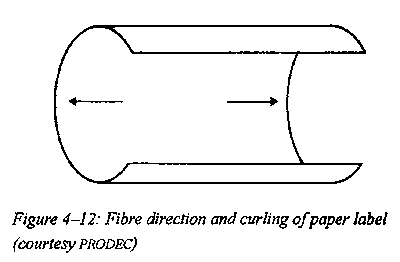
Figure
The type of paper used will also need to be discussed with the printer who will know which papers run best on his presses. The purchaser however needs to be sure that the best paper is used for the type of product and intended market.
Liaison with the printer
If using a label designer it is most important that the person has a knowledge of the types of printing systems and paper types that are locally available and the skill levels of particular printers when preparing artwork. The client should be sure that the designer does indeed have this local knowledge prior to contracting for artwork. The following points need to be considered:
- Which methods are best for the package and its surface? Check
with printers and ask for samples to try on your container.
- What systems do
local printers have?
- How many colors can the printer handle? Ask to see
examples to check that they really can multicolour print well.
- What is the
minimum run, how do unit prices change if print runs are increased? Ask for
quotes for different print runs and see which is most economical, but do not
forget that you may have to pay interest on a loan to buy larger amounts.
-
What redress is there if the printer does not deliver work of the required
quality? Make sure there is a written agreement.
- Are the inks to be used
safe for contact with food and does any local legislation cover printing inks
for food use? Discuss with relevant local, Food Standards office.
- If
automatic labelling machines are to be used can the printer meet the size
tolerances of the machine, often less than plus or minus 0.25 mm. Also the grain
or fibre direction of the paper may be important for some machines. Try and talk
to another customer to make sure they are satisfied with the printer's work.
Other ways of snaking labels
While the use of printed labels should be the aim of small entrepreneurs wishing to expand their sales, in many cases the costs involved are simply too high or labels are difficult to obtain. What then can be done other than sticking a hand-written label onto the package?
The use of rubber stamps and stencils is often appropriate for small-scale producers, indeed stencils are commonly used even by large companies for marking and coding outer boxes (Figure 4-13).
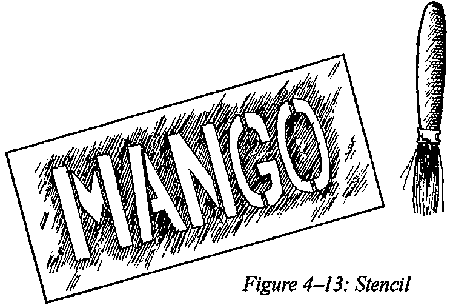
Figure
Manual stamping with rubber stamps onto paper board or cloth is possible (Figure 4-14). In many developing countries hand made rubber stamps are available at moderate cost. Essentially the letters, etc., are cut from sheet rubber and stuck to a back board. Children's rubber stamp sets are made which contain capital and small letters together with numbers. The use of such a set would allow the production of crisp labels that could be made more visually attractive by using colored inks and papers. By using more than one hand stamp a multicolor label is possible.
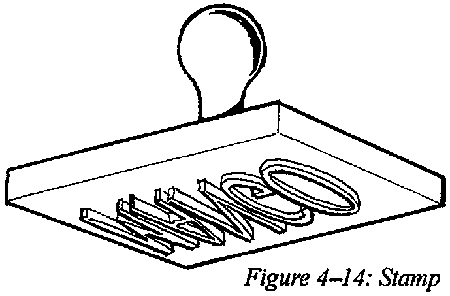
Figure
Costs
While labels are individually cheap they do, because of the numbers that have to be ordered, represent a major cash outlay for the small producer. Printers often, on receiving a request for labels cost the job as a 'one-off'. If possible the producer should try and give the printer an estimated annual need, on which a better price can be given. Many print shops may be prepared to print the number of labels needed for a year but allow the customer to take delivery and pay for monthly volumes provided that a commitment is made to buy all the stock. This is worth exploring.
4.2.4 Application of labels
The type of glue used to fix the label to the container is very important, particularly when machine labelling cans and glass. The two main types of glues used are water soluble (starch and cellulose based) and non-water soluble (plastic polymer based). The producer should try out a number of glues that are locally available and select the best suited to their purpose. While glue can also be made up cheaply in house from boiled starch it should be remembered that starch-based glues will tend to loose adhesion in humid climates. If returnable bottles are involved water soluble glues should be used to make bottle washing easier. If machine labelling is to be used the machine supplier should be consulted about the best adhesive.
Most small-scale food manufacturers in developing countries hand label their products and a good operator can label two to five simple packs per minute. When hand-labelling it should be remembered that workers tire doing such a repetitive job so rotation of staff to other work will maintain efficiency.
Labelling speeds can be increased by using simple manual or powered machines to apply the strips of glue to the label. Figure 4-15 shows a typical powered label gluer with an output of up to 40 labels per minute.
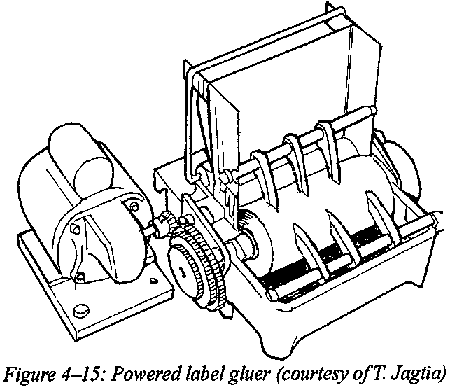
Figure
Small semi-automatic labelling machines, such as that shown in Figure 4-16 are available but, unless a large daily output of product is involved or local labour costs are extremely high, they are unlikely to be economical. It should also be remembered that such machines have very critical tolerances regarding label size, paper grain, type of glue, etc.
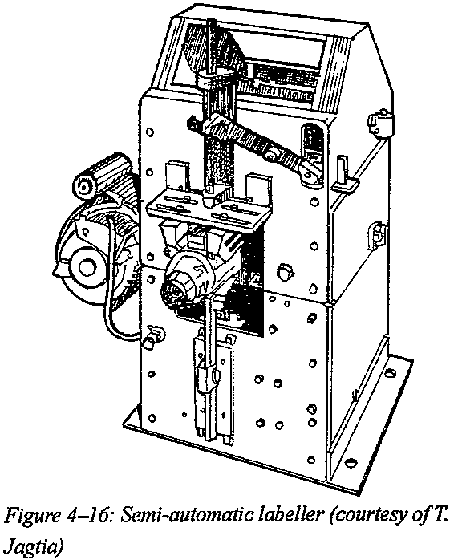
Figure
Self-adhesive labels are supplied in rolls and sheets fixed to a 'release' paper. While paper self-adhesive labels are most common, special types such as plastic and aluminium foil laminates are available. The label is peeled off the release paper, exposing the adhesive and simply applied to the container. Although more expensive than glued paper labels they are quicker to apply by hand giving lower labour costs. Self-adhesive labels can be applied with small hand-held machines and by semiautomatic labellers. The typical semi-automatic self-adhesive labeller can apply 30 to 40 labels/min to flat and curved surfaces.
Labelling of plastic bags
Foods packed in plain (non-printed) plastic bags can be labelled in several ways. Self-adhesive labels can be applied to the outside. When using self-adhesive labels it is often best to label before filling to obtain a flat bag surface and hence better adhesion. Labels are often simply slipped into the packet where they are in contact with the food. This practice is not recommended unless the manufacturer is sure that the inks used are safe for food contact. A much better way is to actually seal the label into a pouch or pocket above the foodstuff.
Storage of Labels
All labels should be stored flat under cool, dry conditions. As paper expands and contracts with humidity changes it may be necessary, when using semi-automatic labellers to have a small heated conditioning chamber in which the labels are brought to the correct moisture (and hence size) before passing to the machine.
4.2.5 Quality control
- Major faults:
- information on label wrongly printed, mis-spellt,
- incorrect colors used,
- major error in size,
- major print quality errors,
- no glue, if applicable.
- Minor faults:
- strong but acceptable color variations,
- size error, but label usable,
- minor error of registration of colors.
The importance of the label should not be underestimated by small-scale manufacturers. Consumers all over the world are becoming increasing affected by advertising and media and more conscious of what they perceive as 'quality'. This perception, at least at the point of first purchase, is based largely on the appearance of the food they are buying and the message it gives. Nowadays a high quality product that does not look attractive and professional is unlikely to survive against what may well be inferior competition.
|
| ||||||||||||||||||||||||||||||
Appropriate Food Packaging (Tool)
5 Production, re-use and re-cycling of packaging
Most small and medium-scale food manufacturers will purchase their packaging ready-made from a supplier. Such packaging will either be standard lines such as bottles, paper and films or special lines such as wooden boxes or pottery. This chapter describes the opportunities that exist for food processors to make their own packaging on site in cases where external sources may be difficult to find or too expensive. It ends with a brief discussion of environmental aspects of packaging and opportunities for re-use and re-cycling of packaging.
The manufacture of packaging that is bought readymade has been briefly described in the relevant sections of this publication. It must be remembered that ordering 'special' packaging from large suppliers will always be very expensive. However in many countries there are medium-sized companies that can make up packaging to order which may prove cheaper and more economic (because they are prepared to accept smaller orders) than importing standard packaging from the large suppliers. When looking for packaging supplies it is worth exploring local sources. Such medium-sized suppliers will mainly make:
- cardboard boxes, often printed,
- paper bags, often
primed,
- plastic bags, often printed,
- pottery and ceramic
containers,
- wooden crates, boxes, etc.
In some cases it is possible to produce packaging which is normally made at very large scale with scaled-down equipment. Examples include:
- the production of moulded paper pulp trays and egg boxes from
waste paper, which has been described in Chapter 3.1.6,
- the small-scale
vacuum forming of shallow tubs, etc., from sheet plastic, as illustrated in
Figure 3.23,
- the manufacture of tins for packaging of oils or powders at
rates between 20 and 1000/hr depending on the equipment used, briefly mentioned
in section 3.1.3, a small entrepreneur in Sri Lanka who developed a production
system for approximately 5000 push-on type jam jar lids per day.
The application of such appropriate scale manufacturing could be of considerable benefit in some developing countries. Benefits would include increased availability of packaging for local industry, saving of foreign exchange by import substitution and job creation. Unfortunately information and access to these appropriate scale packaging material production systems is difficult. They are mainly produced by small companies who do not advertise their equipment widely. It would seem that there is a role for International Development Agencies, interested in assisting the small-scale food processing sector, to draw together information and experiences and disseminate such technologies.
5.1 Materials that can be made on site
Some packaging can be made on site by the food manufacturer. The most common examples are cardboard boxes and bags. Large sheets of cardboard are often available as waste from large companies and importers. It is perfectly feasible to cut out such board and make up boxes of the types described in Chapter 3.6, and even outer cases with dividers of the type used for bottles.
The method is simple and involves preparing an accurately cut out shape from a pattern which, when folded will make up into a box of the required size. It is best if the pattern is made from thin sheet metal. The pattern is laid on the cardboard and cut round with a very sharp blade. Next is generally best to lightly score the fold lines. The box is then folded and joints glued, taped or stapled using either retractable anvil staplers or stapling pliers depending on the type of join. Two designs for a two-piece and a one-piece box are shown in Figure 5-1. Making up the pattern does requires a lot of thought. One easy way to design the pattern is to carefully take apart a box of the style required and use this as the starting point.
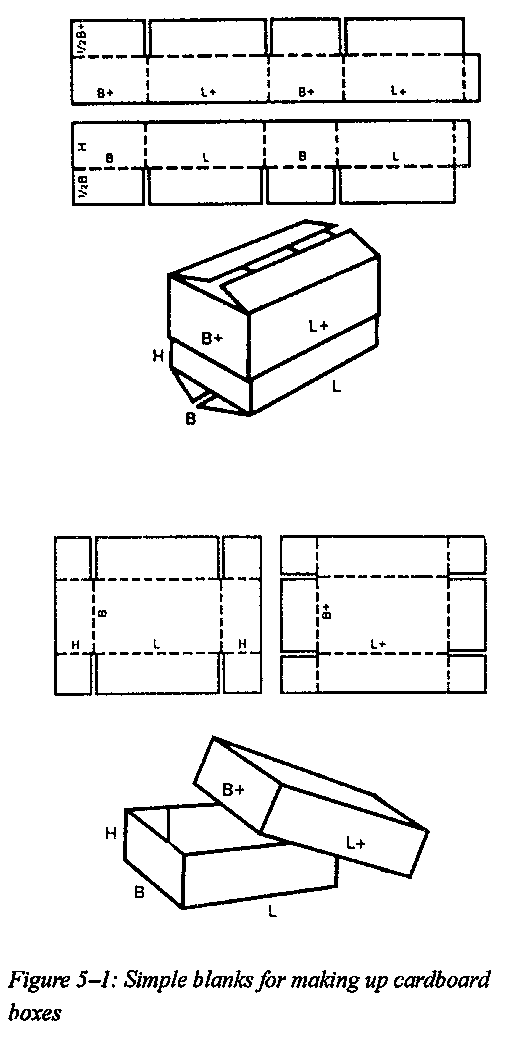
Figure
Hand-made boxes with attractive glued labels can be a good option for small producers who cannot afford to buy large quantities of ready-made boxes.
Various fabrics or textiles can tee cut and sewn into small retail size bags that can be very attractive. Examples include small hessian sacks which are stencil printed for teas, coffees and spices and more colorful fabrics for sweets generally using an inner polythene bag. Such packaging gives 'style' and 'quality' to the brand image and may allow producers to penetrate new, higher-value markets.
Some manufacturers cut out small circles of attractive fabric and use them, tied with a ribbon, to cover the lids of jars of jam to make the product more appealing.
While paper and plastic packaging is not generally re-usable there are occasions in which bags can be made up in house from paper and plastic. In some situations it is possible to obtain used office stationery which can be cut down and glued to make simple bags. If this is planned it should be remembered that printing inks can be toxic and thus not allowed to contact the food directly. Unfortunately where such bags are made there is often a tendency to put the printed side of the paper inside the bag to give a better external appearance; the opposits would be better.
Plastic film off cuts are available from larger companies in some countries. These can be cut up and heat sealed into bags or tubes for packaging foods.
In all cases it will be found more efficient to cut round a pre-made metal template. The work will be quicker and the final bag more uniform in size. When using a template and very sharp blade it is also possible to cut several layers of paper or plastic at a time.
5.2 Re-use of packaging
5.2.1 Glass
Glass bottles are commonly re-used either by buying in second hand or selling the product in returnable bottles. In both cases the treatment of re-cycled glass is crucial for they must be inspected and properly cleaned.
The most serious risk when using second hand bottles is that they may have contained a poisonous substance such as insecticide. It is strongly recommended that a responsible worker in the plant checks each bottle visually and by smell and rejects any that are suspect. The payment of a bonus for the number of contaminated bottles, often acts as an incentive.
After examination the bottles need to be washed thoroughly. While commercial bottle washing powders are available most small producers will find it more convenient to use a 1 to 2% solution of caustic soda to which a standard 'washing-up liquid' is added. Remember that caustic soda will damage the hands. Operatives should wear protective rubber gloves. After washing the bottles must be thoroughly rinsed to remove all traces of detergents and caustic. This can be a time-consuming job, repeatedly rinsing till all traces of bubbles have gone, and the semi-automatic rinser shown below can speed up the process (Figure 5-3). If the bottles are not to be re-filled immediately after washing, but put into store, remember that they will need another rinse before filling.
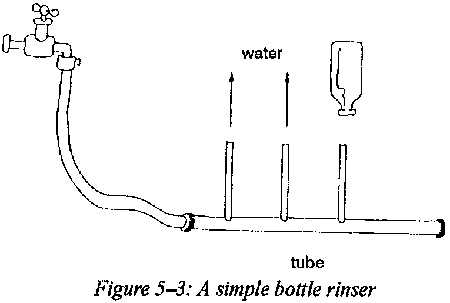
Figure
If labelled returnable bottles are involved then it is worth using labels that will fall off easily in water (wet strength paper and water soluble adhesive) as described in the chapter on labelling. The actual washing operation should be carried out with bottle brushes which can usually be found in a local pharmacy.
When selling in returnable bottles the deposit charged is seldom enough to buy a new bottle. For this reason the average bottle must make a given number of trips to maintain economic production. The profitability of many small businesses depends on this average trip life of bottles so accurate records should be kept and pressure put on customers with a low return rate.
5.2.2 Drums and tins
Drums and tins are commonly re-used (Table 5-1) as they are very expensive to replace. The same warnings apply, as in glass above, regarding to their having been used for poisonous substances. They must be properly inspected and cleaned. Drums that are used for poisonous substances generally have warning markings on the outside, often a skull, and should never be used for packaging foods.
If drums or tins are to be used for packing oils they must be absolutely dry before filling since the presence of water will speed up the development of rancidity. It should also be remembered that oils packed in plain, unlined, steel drums will quickly go rancid.
|
Type |
Main uses |
|
Large drums |
Oils, Intermediate storage of |
| |
fruit juices, Vegetables in |
| |
brine, Pickles and chutneys, |
| |
Packed finished dry foods |
|
Tins with pourer 1-5 gall |
Oils |
|
Push on lid tins |
Dried foods |
Table 5-1: Most common metal containers re-used
5.2.3 Plastic barrels and drums
Large plastic containers are increasingly replacing metal drums and can often be bought second hand. Once again the food producer must be certain that they have not been used for any toxic substance. In addition the food producer should check that the type of plastic is food grade. It is recommended that plastic drums are not used for packing oils or oily foods.
5.3 Environmental aspects of packaging and re-cycling possibilities
In many developed countries there is increasing concern over the environmental impact of packaging disposal. Indeed in some countries, most notably Germany, the small number of remaining waste disposal or land fill sites is causing grave concern. This is leading the government to consider moves in legislation that would make the packaging supplier or user responsible for the disposal of the waste they generate.
The effects of pollution can be seen in many parts of the developing world, especially in the cities. In some cities waste disposal is very inefficient, and in extreme cases almost non existent. Street litter and polluted air and water are causing health problems such as respiratory diseases. Re-cycling helps combat pollution by using materials that would be thrown away to make other materials. It may be cheaper to re-cycle than use new materials. Re-cycling may also replace imports and save foreign exchange. The recycling of glass and aluminium has considerable potential for saving energy.
All around the world waste, much of it hazardous, is being generated. Cairo, in Egypt for example produces 6000 tonnes of waste per day. The costs of dealing with waste are huge. Dakar, Senegal spends 52% of its city budget on waste disposal while Bangkok, Thailand spends US$ 40 million a year.
In many developing countries there is less concern and control over waste and packaging disposal than in northern countries. Food manufacturers however have the opportunity to show that they have a responsible attitude to the environmental impact of packaging. Fortunately in most developing countries foods are not, for cost reasons, overpackaged as they are in developed countries. Also the use of returnable containers such as bottles and metal drums is far more common and often forms a sub-industrial activity for very poor people. In developed countries, to a great extent due to consumer pressure, there has been a considerable growth in re-cycling as a profitable business. Sophisticated plants have been built which separate out valuable materials such as metal and glass. Many towns now have centres where people can dispose of wastes into different bins for cans, bottles, textiles, paper and aluminium.
Essentially there are two types of packaging materials those that break down under natural conditions (biodegradable) and those that nature cannot break down (non-biodegradable). Packaging can also be re-cyclable or non-re-cyclable. Table 5-2 shows common materials according to their possibilities for biodegradation, re-use and re-cycling.
|
Material |
Biodegradable |
Re-cyclable |
Re-usable |
|
Wood |
highly |
highly |
highly |
|
Paper |
highly |
highly |
highly |
|
Glass |
not, but finally |
highly |
highly |
| |
breaks down |
| |
|
Metal drums |
not, but finally |
slightly |
highly |
| |
corrodes | |
|
|
Tin cans |
not, but finally |
slightly |
slightly |
| |
corrodes | |
|
|
Cloth / |
highly |
moderately |
highly |
|
vegetable fibre |
| | |
|
Thermoplastics |
not |
moderately |
not |
|
(films and | |
| |
|
bottles) | |
| |
|
Thermosetting |
not |
not |
not |
|
plastic | |
| |
|
Cellulose films |
highly |
not |
not |
|
Ceramics |
not, but finally |
highly |
highly |
| |
breaks down |
| |
|
Aluminium |
not |
highly |
not |
|
cans, foil | |
| |
Table 5-2: Biodegradability and recyclability of packaging materials
The responsible producer should thus:
- first give preference to a packaging material which is
biodegradable,
- if this material is not suitable choose one that is
recyclable or will eventually break down,
- only use plastics if essential
and try and avoid those that cannot be recycled.
It should also be remembered that a growing number of consumers are becoming environmentally aware and 'green'. It may even help sales to state on the package that it is biodegradable or returnable.
Much research is being done to develop plastics that are either biodegradable or break down into tiny pieces under the action of sunlight for example. To date the materials developed are not widely commercially available. One biodegradable plastic, trade name Biopol, is recently reported to have found application to packaging of non-food items such as shampoos. With time it is hoped that biodegradable plastics will become affordable and the terrible environmental impact of discarded packaging a thing of the past.
|
| |||||||||||||||||||||||||||||||||||
Appropriate Food Packaging (Tool)
6 Implications of introducing packaging
6.1 Introduction
Improvements to the packaging methods used by small-scale food processors, or the introduction of a packaging stage into a process that previously did not pack the products, is likely to require significant changes to the layout of the equipment, the process and work organization. In this section the types of change needed are described in more detail for a representative range of foods.
In previous chapters, the types of spoilage that foods may undergo were first described and then the use of packaging to preserve foods (as well as to promote the foods to customers) was shown. Details of the properties of different materials, their applications and methods of use were given in Chapter 3. The methods of filling foods into packs and labelling them were described in Chapter 4 and reusable packages or those that can be made on site were described in the previous chapter.
In this chapter some of the general implications of using these methods of packaging for the first time or for improving existing methods are examined. In particular it should be noted that changes that result from introducing new packaging are not simply the extra costs of equipment and materials but may also involve changes to the production process and the introduction of new quality control and storage systems. In each case however, the benefits of new packaging in terms of increased market size, better product quality and increased sales should outweigh the extra costs involved.
A summary of the requirements for introducing different packages for selected foods is shown in Table 6-1 (following pages). To use the table first look up the type of food that is to be packed and then look down the column to see the types of packaging that could be used. When a pack is selected note the numbers in the box and look these up on the key below the table. This will give a summary of the factors that are important when using this type of package for the particular food that is selected.
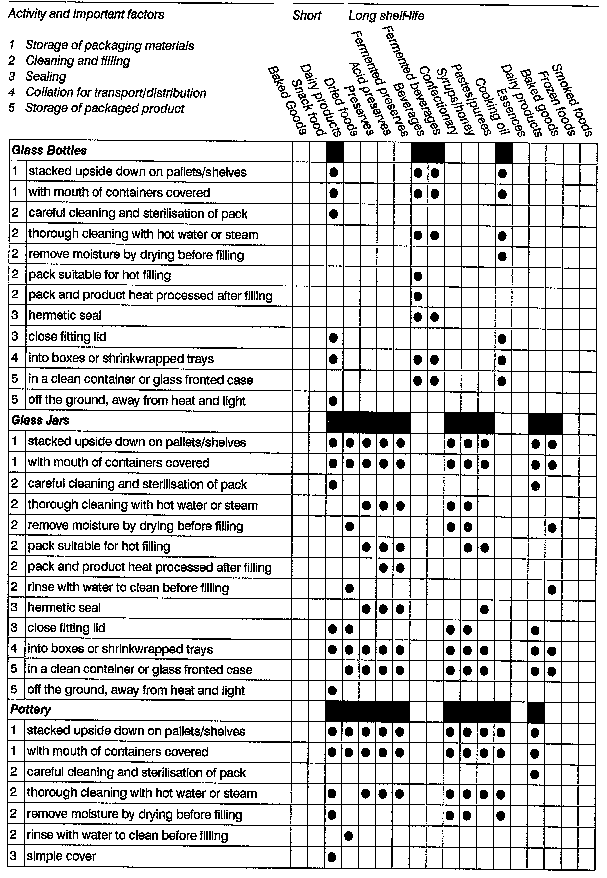
Figure
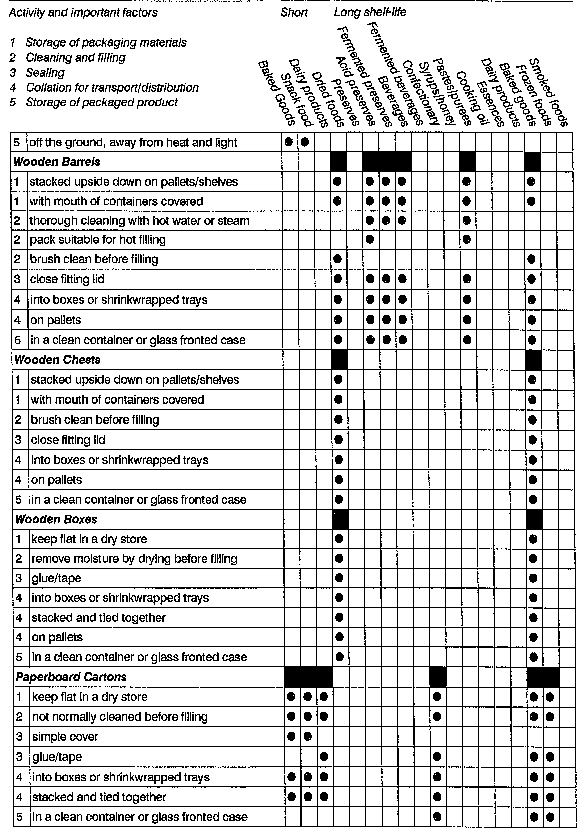
Figure
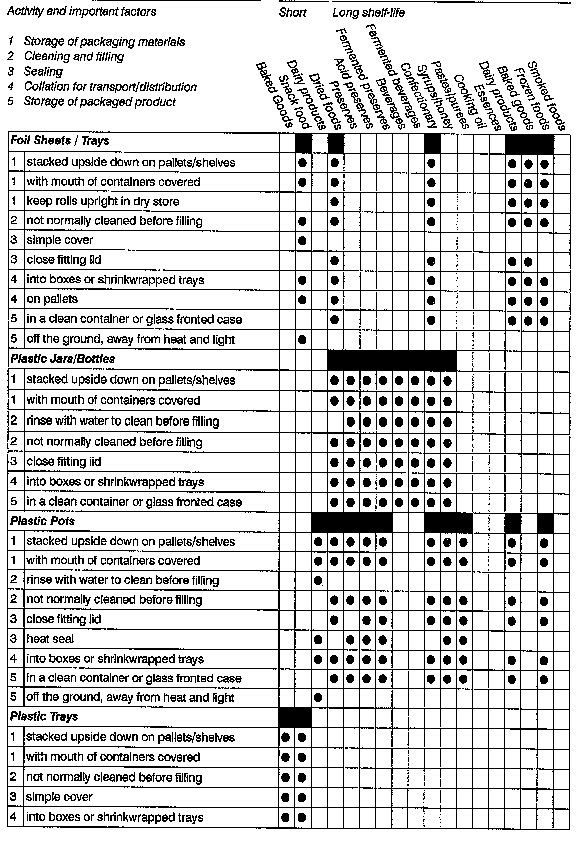
Figure
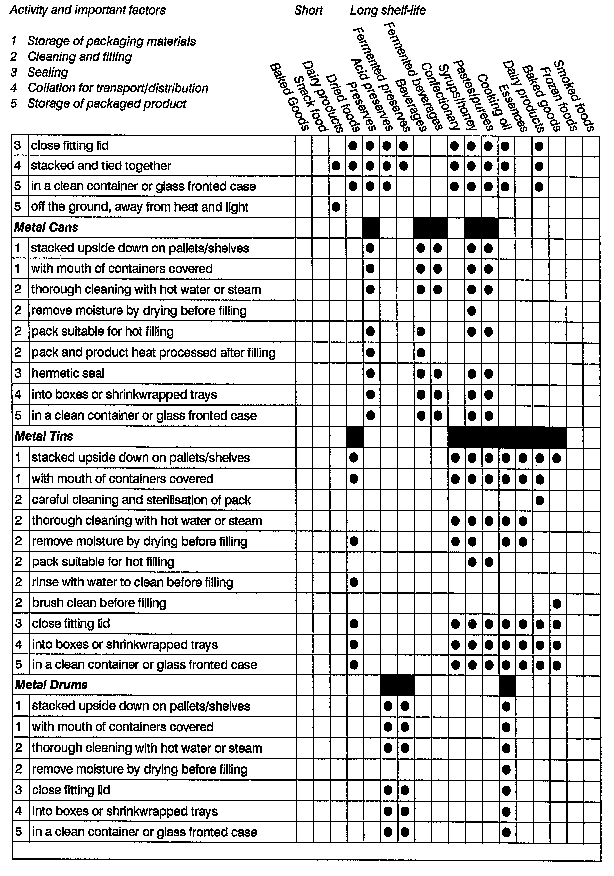
Figure
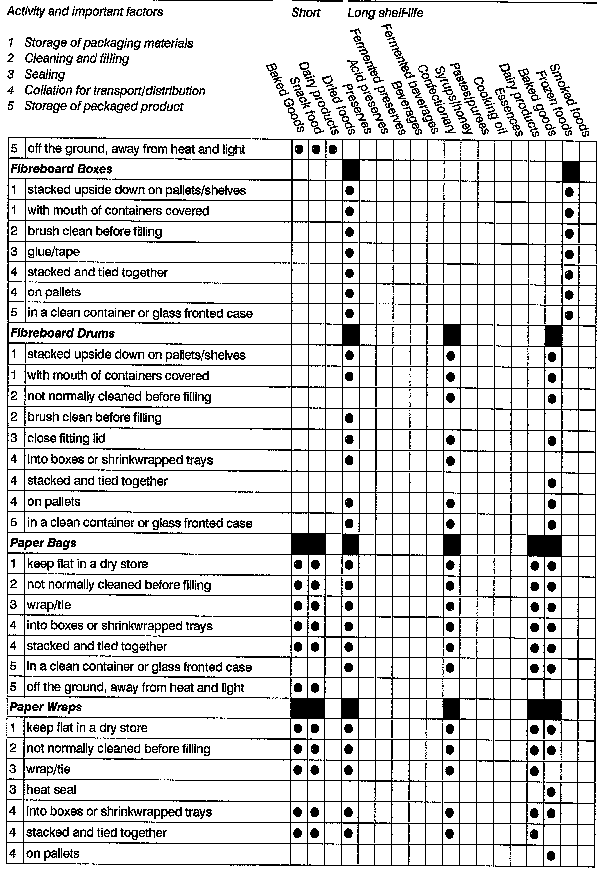
Figure
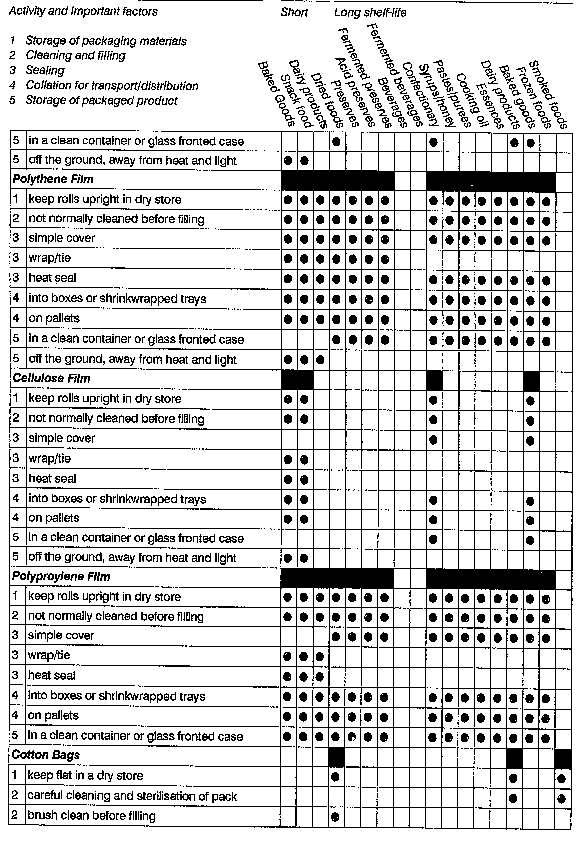
Figure
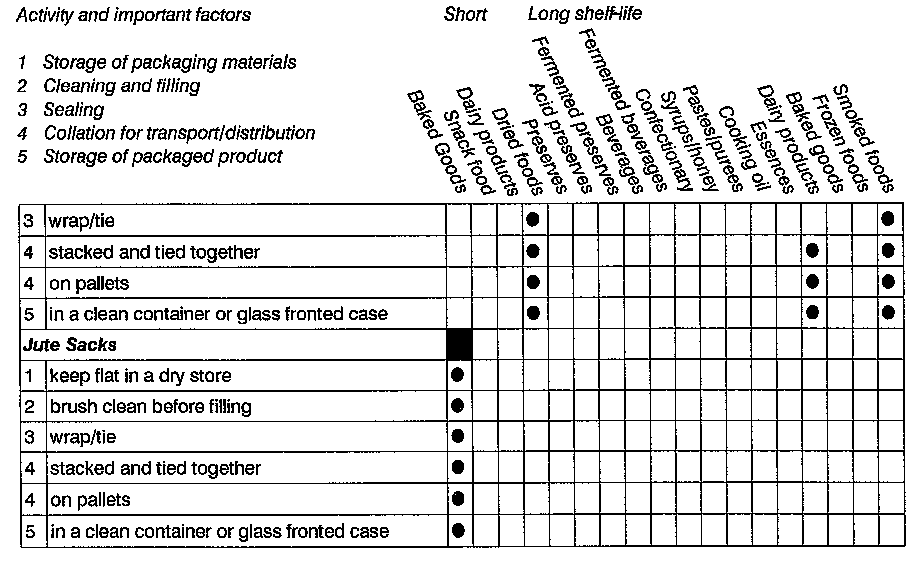
Figure
6.2 Pre-packaging changes
6.2.1 Process room layout
In all food production there should be a flow of materials around the production room to prevent cross-contamination between raw food and the processed product and provide smoother working (Figure 6-1). The introduction of a packaging stage should be done so that this flow is maintained. Typically the introduction of packaging will require a store for the packaging materials, a packaging area, a quality control area for finished products and a store to hold the finished products before they are sent out for distribution to customers. Some types of packaging materials will also require an area for making them into containers (for example cardboard boxes), for cleaning and/or sterilizing the packaging before filling (for example glass jars or bottles) and a place for inspecting the packaging materials before filling.
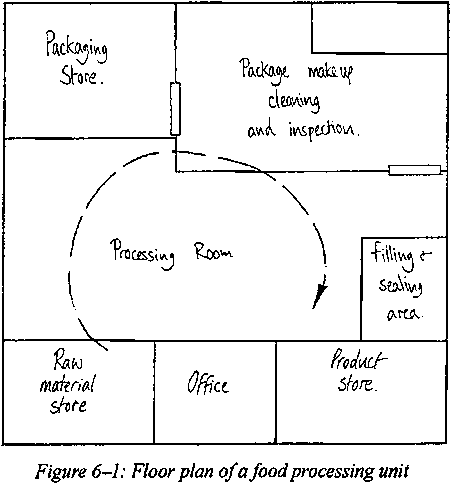
Figure
6.3 Packaging store
All packaging materials should be stored in a mom that is not used for processing and is protected from rats, birds and insects. It is a common fault to concentrate on hygiene in the production area and ignore storerooms. However faeces from animals, insects or birds that contaminate packaging has a high chance of also contaminating the final product.
Rodents may also destroy packaging by eating it or making it into nesting which is a direct economic loss to the processor. Rooms should therefore be screened at doors and windows to prevent birds and insects, all drains and wall-roof joints should be made rodentproof, and the fabric of the storeroom (the roof, walls and floor) should be intact without holes that animals and insects could enter (Figure 6-2).
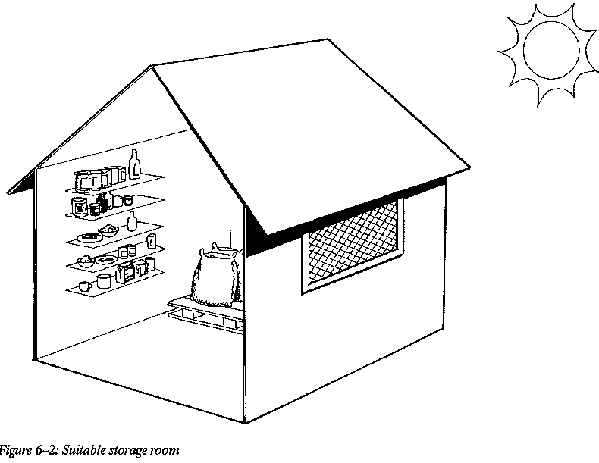
Figure
The storeroom should not be used for processing to minimize the entry of dust, dirt and food particles which would contaminate the packaging and in turn contaminate the product.
Packaging materials should be stored off the ground on shelves or pallets. This is especially true for papers, cardboard and films which are damaged by dampness (see also Sections 3.1.6, 3.2.1 and 3.2.2 ).
6.3.1 Preparation of packaging materials
Some materials are bought flat and must be made up into containers before filling. Examples include paper for bags, cardboard for boxes and film for packs. These preparation procedures are often dusty and may produce small pieces of material which could contaminate the product. Package make-up should therefore be done away from the filling and processing area and ideally in a room away from the processing room.
Other types of packaging such as pre-prepared glass, metal and plastic containers, require rinsing with clean water as a minimum before filling. Many will also require sterilization if there is a risk of contaminating the product or if the product is not to be further processed after filling and sealing.
The washing and preparation of re-used bottles and jars is most important. A good product packed in a dirty container will soon deteriorate. As a minimum all used jars and bottles should be thoroughly washed in detergent and then rinsed in clean water (chlorinated if necessary). An inspection at this stage is necessary to detect any trace smell of kerosene, petrol or other liquids that may have been stored in the container. If operators suspect that a container has been used to store insecticides, herbicides or other chemicals it should be discarded as it is not possible to clean the container properly.
Most glass containers also require sterilization by either steam or boiling water for at least ten minutes. This is important even if the product is to be filled hot into the jar or bottle because the heating will show up any weakness in the container and it will break before it is filled. The producer will therefore save any wasted product. This is discussed in more detail in Section 3.1.1.
All packaging should be routinely inspected for the common faults that are likely to occur with the particular material. An outline of these inspection procedures is given below and details are given in the individual sections for each packaging material.
6.3.2 Filling and sealing
The introduction of a packaging stage to a process will require a filling and sealing area to be set aside. This is a critical stage in the production of most packaged food, but particularly for those foods that are not processed further after filling and sealing. This is because at the filling stage it is often the last opportunity for the staff to properly inspect the food for contaminants, correct quality, etc.
It is also the stage at which the correct weight of food is filled into the container and it is the last stage that a package can be inspected by staff for foreign bodies or gross contamination before it is filled.
Great care should therefore be taken to ensure that the filling area and equipment are kept clean, free of waste food and away from open doors or windows. The lithting (either artificial or preferably natural light) should be good in the filling area to allow operators to inspect the product and packages as filling and sealing takes place.
Automatic or semi-automatic fillers are normally too expensive for small-scale producers, and their high capital cost cannot be justified in terms of the income generated at small production levels. Appropriate small-scale fillers are in general difficult to buy from suppliers and examples of locally made equipment are therefore described in Chapter 4. Sealing equipment for bottles, cans, jars, bags and boxes are described in detail under each section in Chapter 3.
6.4 Quality control
In this section the general inspection procedures that are needed for packaging materials are described. Specific checks on the quality of individual packaging materials are described in detail in Chapter 3 following the description of each material. It should be noted that the analysis and quality control of the final product itself is not covered in this publication and the reader is recommended to read one of the many texts available for specific foods.
It should be noted that for very small-scale enterprises no formal quality control schemes or quality control staff are normally employed. The quality of both packaging and products is checked informally by the owner and/or the operators. This is satisfactory provided the people involved know what to check for but as the size of a business increases it is necessary to adopt more formal procedures. This publications is intended for small to medium-scale producers and it therefore includes basic quality control procedures for packaging materials. Larger-scale industries, particularly those that export foods may have to consider more sophisticated quality control systems than those described here and it is recommended that they employ a specialist to advise on their specific requirements.
6.4.1 Incoming packaging
Quality control should be seen as a method of saving money and not as an unnecessary expense. The time and effort put into quality control should therefore be related to the nature and importance of the likely fault that is being checked for. For example splinters of glass in a bottle or jar (Section 3.1.1) is a hazard that is very important to both customers and manufacturers because of the risk of injury. On the other hand if a design on a label (Chapter 4) is a few millimetres out of alignment this is not so important and not worth spending a lot of money to check for.
These differences in importance give rise to a general classification of faults (or defects) into the following categories:
- critical fault
- major fault
- minor fault
Critical faults are those that may injure an operator in the plant or a customer, or alternatively they may be so serious that they may cause the food to become unsafe. The example of glass splinters above is one example of a critical fault and another is faulty can seam dimensions (Section 3.1.3), which could allow food poisoning micro-organisms to enter a can and contaminate the food.
Major faults are those that make a package unsuitable for use in the process or result in a serious loss of money for a business (for example through wasted product, legal action etc). For example if glass containers are not vertical (Section 3.1.1) they may break in a filling machine, if layers of plastic Film on a roll are stuck together (Section 3.2.2) it cannot be unwound and used or if foil has too many pinholes (Section 3.2.3) its barrier properties are affected and it will not protect the food as required.
Minor faults are the majority of faults that occur in packaging materials. For example a printing ink may be slightly the wrong color, the dimensions of a glass bottle or jar may vary a little or a plastic film may have marks or ink smudges which make it less attractive.
It should be noted however that each producer should carefully consider the market in which the package is to compete. An acceptable package with a few minor faults in one market may be totally unacceptable for a different market situation.
When quality control procedures are being set up or reviewed it is important to record the types of faults that have occurred in the past as well as those that could occur. The manager of the food plant then decides which of these faults is so important that they are critical to the success of the business or health of the operators and customers. It is possible that in some processes them are no critical faults, but if they are likely to occur (especially with glass containers) they must be included. Next the manager decides which faults will lose the business money if they occur. These major faults may result from a problem that the packaging supplier has or they may be connected with preparation of the packaging materials in the food plant.
These critical and major faults are the ones that a quality control scheme will be designed to check for. It is not ususally worthwhile checking for minor faults on a routine basis, unless they result in customer complaints.
6.4.2 Requirements for routine inspection of packaging materials
To monitor the quality of packaging materials successfully, each incoming batch should be examined. Routine inspection requires the following:
- trained staff,
- an established procedure,
- space,
-
some equipment and facilities.
The most important of these is properly trained staff and it is desirable that all staff involved in a process are trained to look out for faults in packaging materials as they are being used (as well as other faults in the product or process). In addition it is desirable to have one member of the production staff who routinely examines the packaging material as it is purchased for a set of likely faults that are important (critical or major) and who knows from experience are likely to occur. The operators who fill the packs with product should also be trained to look out for packaging faults. The training should make sure that the operators draw the manager's attention to the faults and do not simply let the faulty pack go out with the others. In some cases a bonus system in which operators are paid for identifying faulty products or packages can be beneficial provided safeguards are in place to prevent fraud.
It is not usually necessary to spend time and money examining every package that is bought (an exception to this is the examination of glass jars or bottles, particularly if they are to be re-used and may have been used by customers to store non-food materials such as kerosene. Here every container must be checked and this is often most conveniently done by the operators who wash the jars/bottles).
More often an established procedure is set up in which a sample of containers is checked for the expected critical or major faults. Deciding on the number of samples to check is not an easy decision. The number will depend on how many packages there are in a load and the number of faults that have been found previously (the reliability of the supplier) among other factors. There are published statistical tables that can be used to decide on the number of packages to inspect. They are based on different risks that a processor will accept faulty packages if not enough are inspected. However these are only useful if they are agreed with the packaging supplier so that any faulty packs can be returned and the money refunded. In practice small-scale processors in developing countries rarely have such an arrangement with a packaging supplier and the cost of any faulty packs is carried by the processor. The reason for checking the packages in these situations is therefore to prevent harm to customers and to removeseriously faulty packages before they are filled and so save the business money and protect its reputation.
Space should be set aside in the packaging store room or in the processing area to check routinely both the quality of the packaging materials and the weight of filled packs. This does not need to be elaborate, and a table, a checkweighing scale and a few simple items of equipment are usually adequate.
6.4.3 Checking filled packs
The main checks that should be done on packaged foods are as follows:
- net weight,
- appearance of pack and product,
-
integrity of seal,
- presence and position of label,
- presence of faults
in the pack.
Fill weight
It is a legal requirement in most countries that a package has the weight of the food written on the label and that the net weight of food inside the pack is not less that this. To be sure that the correct amount of food is being filled it is necessary to check the weight of a sample of filled containers (except for very low production rates it is usually not possible nor worthwhile to check every container).
To do this a scale is needed which has a package plus a known weight on one side (Figure 6-3). In the case of glass the heaviest container from a batch should be used. Samples taken during the day's production are placed on the other side of the scale. All should be equal to, or greater than, the test weight. If an automatic filler is used in the process a record of the average weight of five samples can be kept which is then written on a chart (Figure 6-4). This shows the trends in fill weight over a period of time and lets the operators know when the machine needs to be adjusted If filling is done by hand it is still necessary to check the fill weights but the chart is less valuable. Instead operators who fill the containers should be told routinely of the results of the checks so that they can make the necessary adjustments to their filling.
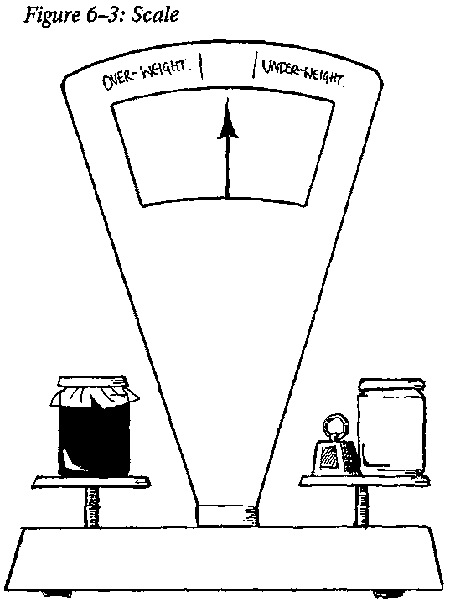
Figure
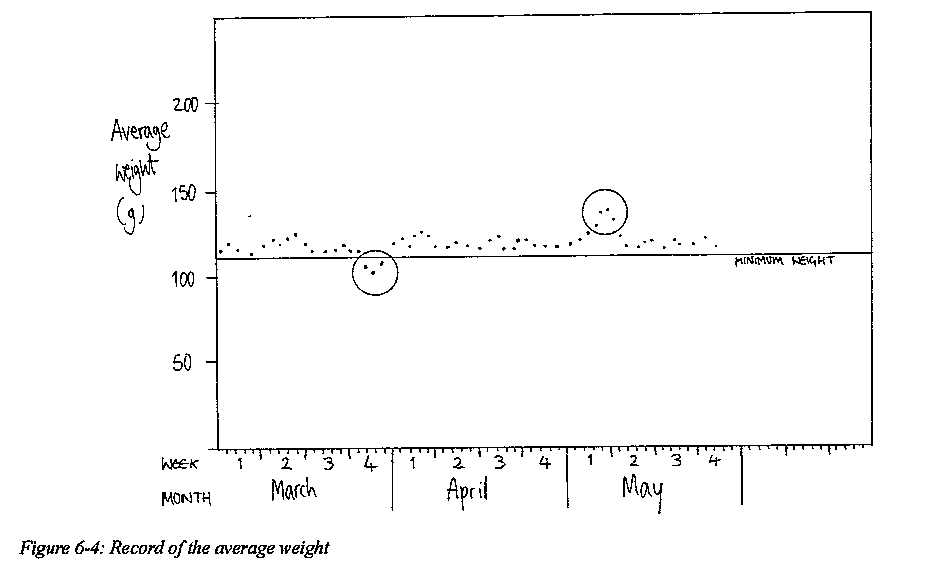
Figure
The number of samples that should be taken to check fill weight depends in part on the amount of food that is produced and the method of filling (hand filled containers usually need more frequent checking). As a rough guide one in every twenty packages could be checked, but the proper number of samples will vary according to the production. The check does not damage the packages and if their weight is satisfactory, they can be returned for sale.
The method of checking fill-weights described above is known as the Minimum Weight system and it is intended to make sure that every package of food contains at least the net weight that is shown on the label. This is the simplest system for small scale producers to operate. In Europe another system has been introduced to take account of the highly mechanized, automatic filling and packaging that is used by most producers. This is known as the Average Weight system and relies on a statistical probability that a known proportion of packages will be above the weight written on the label. This system is unnecessarily complex for small-scale producers and is intended to operate when producers use automatic filling and checkweighing machines. However, if small-scale producers are intending to export foods to Europe they should be aware of this system and the implications for both labelling and import restrictions. It is recommended that further advice is obtained from local Export Development Boards or their equivalents.
6.4.4 Labelling
This is described in detail in Chapter 4. For routine quality control it is often sufficient to check that the correct label has been placed on a container in the correct position when the fill weight is being checked. In addition the general appearance of the pack and product (including any food smeared on the outside) and the integrity of the seal can be checked at this time.
6.4.5 Batch coding
It is important to be able to identify when a batch of food was produced so that proper stock control can be achieved. In this way packaged foods are sold in the sequence that they are produced and there is no risk of packages being left in the store room until they spoil. At its simplest a batch code is a single number which is stamped onto the label of all packages that contain food from that batch. The number is then increased by one for each subsequent batch. A written record is kept by the processor to show which numbers correspond to the date of production. This can also be a useful double check on the shelf-life of the food when the batch code is taken together with the sell-by date (see also Chapter 4).
6.5 Post-packaging operations
The introduction of new packaging techniques requires changes to the production routines that do not end when the product is packaged. The packages themselves most often require labelling, coding and collation into larger loads that are suitable for handling and transport to customers. In addition the packaged product should be checked to make sure that it conforms to national legislation or, for export, that it conforms to the legislation of the importing country. Finally the packaged food may require storage until enough is produced to make a full load for transporting to customers.
6.5.1 Collation and preparation of shipping containers
Once packages have been filled, sealed and labelled they are grouped together into larger packs to make handling and transport easier. The most common shipping containers used in developing countries are fibreboard (more commonly known as 'cardboard') boxes which are described in detail in Section 3.1.6. Newer shipping containers include shrinkwrapped and stretchwrapped film around packs contained on cardboard trays (Section 3.2.2). Some products may require the greater protection of wooden crates or boxes and these are described in Section (3.1.5). A summary of the common combinations of package and shipping container is shown in Table 6-2.
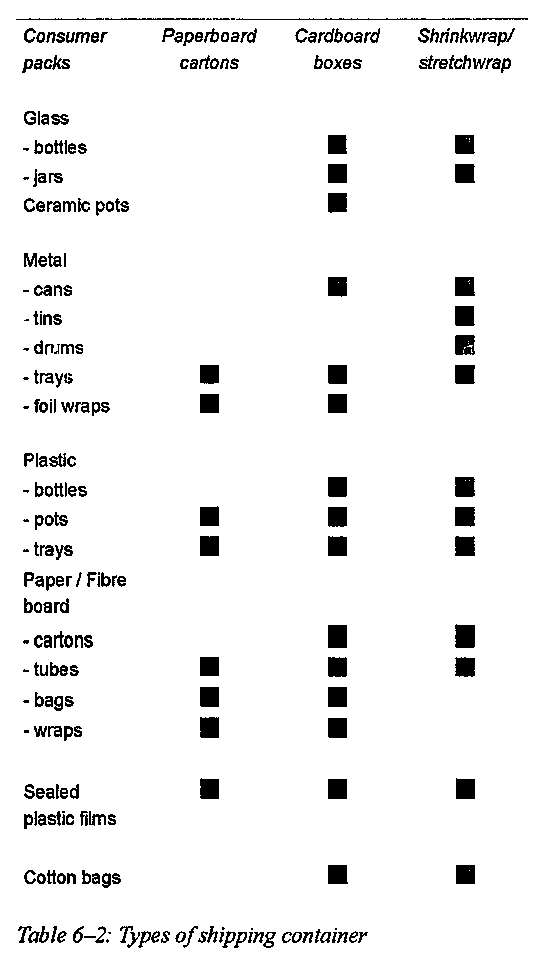
Figure
In general a filled shipping container should weigh between 10 and 15 kg. If it is heavier it is likely to be dragged rather than carried, if it is lighter it is likely to be thrown rather than carried. Both would result in damage to the package and possibly to the product inside.
Detailed descriptions of metal, wood, shrink/stretch film and fibreboard materials used for shipping containers are given in Chapter 3. In this section the methods used to seal the boxes and drums made from these materials are described.
Boxes
Wooden boxes, chests and crates are nailed or stapled together, often using metal reinforcement to protect the corners. Fibreboard boxes can be glued, stapled, banded with metal or plastic tape, or tied with rope/twine. Equipment used to seal fibreboard boxes is shown in Figures 3-40 and 3-41.
Drums and barrels
The lids of drums can be pressed into place, held by a retaining band or by a screw thread. Metal drums are found with each of these types of lids whereas it is more common for fibreboard drums to hays banded lids and plastic drums to have screw-threaded lids. Wooden barrels are normally fitted with a removeable wooden plug that is hammered in for transport.
Sacks
Jute and cotton sacks can be tied with wire or rope, stapled or stitched. An example of an electrical sack stitcher is shown in Figure 3-42. Polythene or polypropylene sacks are usually heat sealed.
6.5.2 Storage and handling of shipping containers
Shipping containers should be stacked in storerooms or on pallets in a neat way so that there is no danger of the stack falling over and that the best use is made of the available space. All packages should be stored off the ground in rows. Space should be allowed for operators to walk between the rows to inspect the food and to collect packages for delivery to retailers or consumers. A typical stacking design for boxes on a pallet is shown in Figure 6-6.
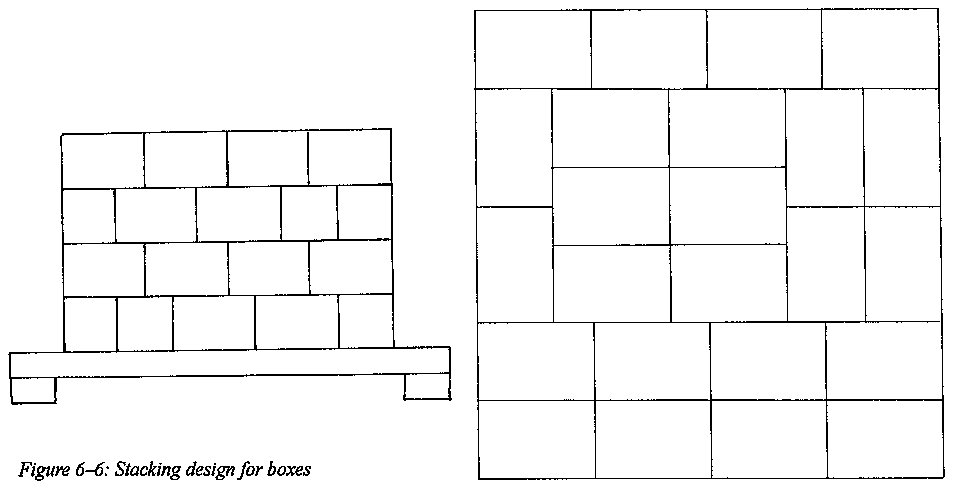
Figure
Packaged products are the most valuable materials on site and represent the future income to the business. Every care should therefore be taken to protect them and avoid any deterioration before they are transported to retailers and consumers. Storerooms should be kept as clean as the processing mom and protected against rats, insects, birds and other animals using wire mesh screens and fully sealed doors and ceilings.
A system should be introduced to monitor the amount and types of packaged food that are held in the storeroom. This can be a simple board on which the batches are written as the packages are taken into the store (Figure 6-7). The first packs in are then removed from the store first. This ensures that the processor knows how much food is in the store at any time, the age of the oldest stock and it helps to ensure that stock is used in the correct order.
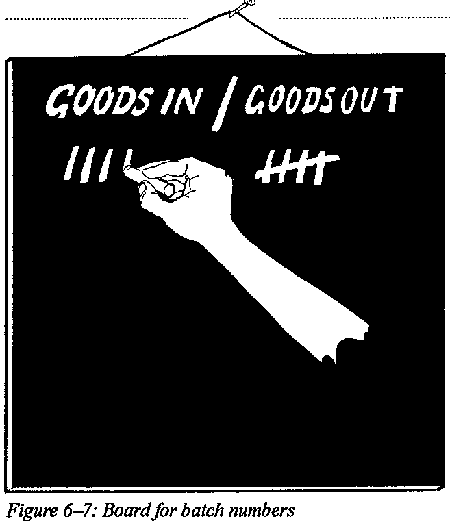
Figure
Although processing and packaging are able to stabilize foods against spoilage it should not be assumed that foods are impervious to climatic conditions during distribution and storage. In general a longer shelf-life for processed foods will be achieved if they are kept in cool dry conditions away from direct sunlight and temperature fluctuations. These conditions are also ideal for maintaining the condition of the packaging materials and the colors used in printing.
The types of deterioration of foods are described in detail in Chapter 2. Processing slows or halts this deterioration provided that the storage conditions and/or package integrity are maintained. If these are not adequate the processed food will spoil in a similar way to the fresh food.
Packaging materials may also deteriorate under incorrect storage conditions. In general most packaging materials will keep their properties and appearance if they are stored in cool, dry and dark conditions. However some types of packaging are more susceptible to deterioration than others.
Glass packs are the most stable and little change in the glass itself is expected under most conditions. However the caps or lids are less stable and in damp, humid and hot conditions metal caps can corrode and the Lining material can separate away (Section 3.1.1.) Metal cans will corrode at weak spots in the tin coating in hot humid conditions (Section 3.1.3).
Plastic caps, jars or bottles are in general fairly stable under most storage conditions, but higher temperatures increase the rate of plasticizer movement into foods from some plastics and soften the plastic which may affect the seal strength. Direct sunlight affects the structure of plastics such as polythene and also makes some printing inks fade more quickly (Sections 3.1.4 and 3.2.2).
Cellulose film has barrier properties that vary with changes in the humidity and temperature of the storage environment which can affect the shelf-life of foods that are stored in this packaging. The barrier properties of other flexible films also change to a small extent with changes in storage temperature but if these changes are not extreme this will not substantially affect the shelflife of the foods being stored (Section 3.2.2).
Papers and fibreboard are very susceptible to changes in the humidity of storage. In high humidity they lose their rigidity and strength thus making puncturing and tearing more likely. In damp conditions the adhesive that is used to form bags, corrugated fibreboard or cartons may also lose its strength and the container will fall apart (Section 3.2.1).
Papers, fibreboard and cloth/fibre containers are all susceptible to mould growth in humid or damp conditions. Even if the mould growth is not visible, it can produce a musty odour which will taint foods that have a delicate flavour or odour.
6.5.3 Transport and distribution
One of the main functions of shipping containers is to protect the food against physical damage and pilfering during transport and distribution. Different containers are designed to have different strengths and these should be matched to the requirements of the food. Table 6-3 shows the effectiveness of different shipping containers in protecting foods against physical damage during transport.
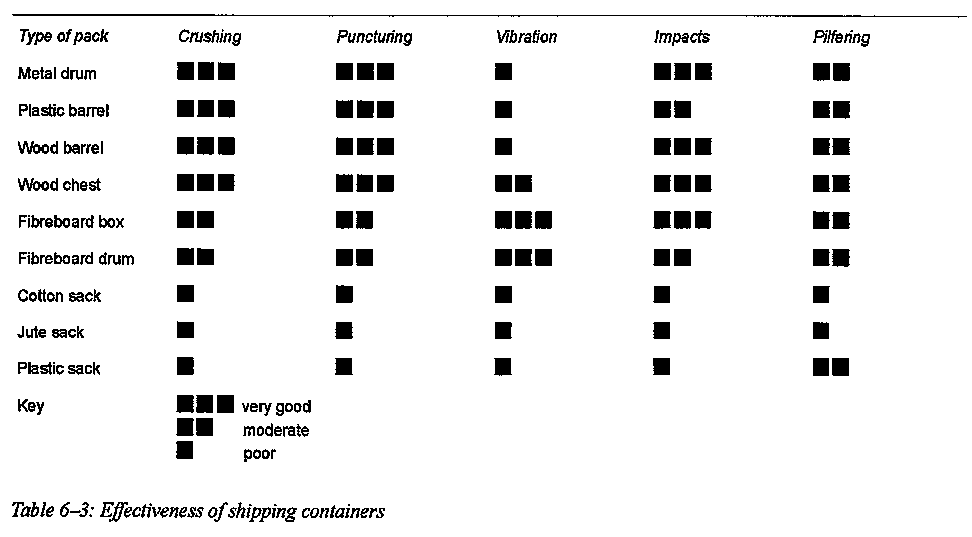
Figure
|
| ||||||||||||||||||||
Appropriate Food Packaging (Tool)
7 Benefits and costs of food packaging
In previous chapters the benefits of food packaging to small-scale food processors have been described in detail. To summarise, these benefits include:
- improved protection for the food and an increased
shelf-life,
- better quality products reaching the consumer,
- more
attractive products to compete with other manufacturers,
- easily
identifiable products for consumers to select from retail shops,
- sometimes
re-usable containers,
- tamperproof packages reduce the risk of
adulteration,
- making foods more easily handled and stored by retailers and
consumers,
- increased production output as a longer shelf-life enables a
larger market to be found and year round production possible.
However there are also a number of costs associated with the introduction or improvement of food packaging in a process. In some cases these costs may be higher than the other production costs combined and it is therefore important for a producer to weigh up the costs involved and find out whether the likely benefits to be gained are worthwhile.
This chapter aims to assist extension agents and producers to do this by first describing the various costs in more detail. It then gives a simple example of how to calculate packaging costs.
The main costs associated with the introduction of packaging to a small scale business are as follows:
- changes to existing production facilities and processing
techniques
- purchase of equipment and costs of depreciation
- additional
working capital required
- additional labour required
- higher operating
costs, including the cost of packaging
materials
7.1 Summary of how to calculate packaging costs
In this section the main costs associated with introducing or upgrading packaging, as described above, are grouped together and an explanation of how they are calculated is given for each.
7.1.1 Changes to existing production
The costs involved in these changes include creation of space for storing packaging materials, in some cases for assembly of the container, for storage of the packaged food before distribution and space for quality control checks on both the packaging and the filled product. New processing and packaging equipment, storage racks and insect and rodent proofing for storerooms are additional costs.
The cost of extra space may include moving the processing unit to a new building or construction of an extension to an existing room. This, together with any new equipment and upgrading of facilities, will be a capital cost to the business. It may be necessary to take out a loan to cover these costs and the loan repayments will then need to be included in the business accounts as an additional expense.
Other costs are the extra training required for operators in the changes to the process, use of the packaging and inspection of the packaging materials and final product. There may also be a cost associated with a potential reduction in output while new procedures are being introduced. These costs would normally be treated as a capital cost and included with the cost of new processing equipment or a new building.
7.1.2 Packaging equipment
An indication of the range of likely costs involved in different types of packaging equipment is shown in Table 7-1. However, it should be noted that the cost of packaging equipment depends on similar considerations to the cost of other types of processing equipment (for example type and size of equipment, degree of complexity required, materials of construction, country of origin, etc) and it is not therefore possible to be more specific about the costs of individual equipment. Similarly the expected life of packaging equipment will vary according to the type and method of manufacture, the production rates used, the amount of maintenance given and the working environment. Depreciation costs will therefore also vary widely.
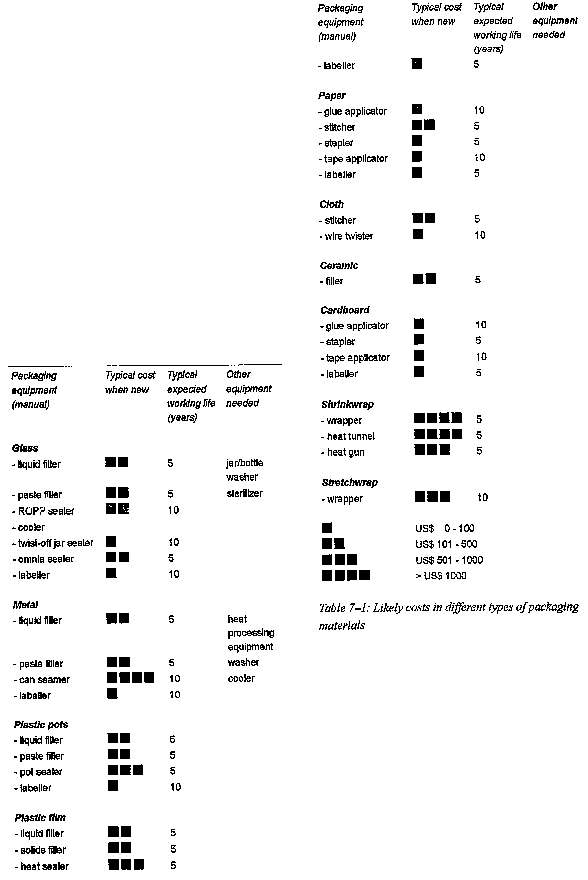
Figure
Ancillary equipment such as washers for bottles and jars, and the costs of spare parts, lubricants, installation of electricity or other services required for packaging should each tee taken into account at this stage.
The costs of equipment and spare parts are capital expenditure and if a loan is required the loan repayments are included in the business accounts.
7.1.3 Working capital
One common problem with the purchase of packaging materials in many countries is the requirement to buy large quantities at a time from the supplier or distributor. This is particularly the case if the materials are to be printed as it is cheaper for the supplier to produce a large number at one time rather than having to reset the printing equipment each time for a number of short production runs. As a result the small-scale processor may have to buy several months supply of packaging materials at the outset. This in turn requires a large working capital and good storage facilities to prevent deterioration to the materials until they are used. If packaging results in an increase in the amount of food being processed there will also be an increase in the working capital required to purchase the larger quantities of raw materials and ingredients.
Working capital is treated as capital expenditure in the business accounts and the above remarks on loan repayment apply equally in this case.
7.1.4 Labour
Costs of introducing or improving packaging include both direct training costs and the opportunity cost of lost production during training and familiarization with the new procedures. In addition trained staff may require higher salaries, particularly those involved in quality control and testing.
Labour costs may be either fixed operating costs if the staff are permanently employed or alternatively the costs can be treated as variable operating costs if staff are employed only when they are needed.
7.1.5 Operating costs
Operating costs may increase as a result of higher production rates, but this should also increase the profitability Or the business. The only likely net increase in operating costs from higher production may therefore be greater loan repayments on the working capital.
Other operating costs that are directly associated with the new or improved packaging may include increased fuel/power consumption (for example for bottle sterilization or heat sealing), the cost of the packaging material itself, and possibly higher transport costs to take advantage of a larger potential market created by the longer shelf life of packaged food.
Operating costs are divided into fixed costs that do not change whether production takes place or not and variable costs that increase as the level of production increases. Examples of fixed operating costs include loan repayments, the rent on a building, a business registration tax or depreciation on equipment. Examples of variable operating costs include packaging materials, food ingredients and fuel.
A summary of the costs associated with producing and packaging foods is shown in Table 7-2.
Capital costs
- Building construction
- Facilities (water, fuel, insect
proofing)
- Processing equipment
- Packaging equipment
- Distribution
vehicle (for example bicycle or truck cost)
- Working capital
If a loan is used to raise part or all of the capital this will result in repayments to the lending agency which will include the interest that is charged on the loan. These repayments are treated as a fixed operating cost below.
Operating costs - fixed
- Loan repayment
- Labour
- Rent on building
- Business
registration tax and licenses
- Equipment depreciation
Operating costs
- variable
- Packaging materials
- Food ingredients
-
Labour
- Fuel and power
- Distribution costs
Can be either fixed or variable depending on how workforce is employed - see text.
Table 7-2: Costs associated with producing and packaging foods
To calculate profitability, the total fixed and operating costs over a known period (for example one month) are added to give the total costs. The income over the same period is calculated by multiplying the number of packages sold by the selling price per package. The gross profit is the difference between income and costs. The net profit is the amount remaining after taxes (for example income tax) has been paid and other debts are taken into account.
7.2 The cost of introducing Packaging to a small business
In this section an example of fruit juice production is taken to show how a process is changed when packaging is introduced and where some of the associated costs arise. Initially a street vendor is described who sells fresh orange juice directly from a handcart. The juice is squeezed from a hand-operated fruit press into re-usable cups. The vendor sells 50 cups containing 150 ml juice per day at US$ 5 per cup and he works for 6 days per week. One orange supplies a cupful of juice on average.
The following costs are associated with this business:
|
Capital costs |
US$ |
|
Juice press |
85 |
|
Handcart |
50 |
|
Cups |
15 |
|
Total capital cost |
150 |
|
Working capital required for two weeks production |
1500 |
For simplicity it is assumed that a loan for the capital + working capital (150 + 1500) of US$ 1650 is repaid over two years in equal amounts. The weekly repayment is therefore 1650104 = US$ 15.86 per week as a fixed operating cost.
|
Operating costs |
US$/week |
|
Fixed | |
|
Equipment depreciation (over 5 years) 150/260 |
0.58 |
|
Loan repayment (from above) |
15.86 |
Operating costs
|
Variable | |
|
Fruit (50 x 6 oranges/week @ $2.5/orange) |
750 |
|
Labour (the owner does not pay himself a wage but keeps whatever proms he makes) |
0 |
|
Total costs |
766.44 |
|
Income (50x 6x 5) |
1500 |
|
Gross Prom |
733.56 |
|
Prom per glass (733.56/300) |
2.4 |
This profit is taken as a wage and amounts on average to nearly US$ 3000 per month. However, any investment in the business is taken from the monthly wage.
The fruit juice seller then wishes to expand the business and sell juice that is pasteurized and filled into returnable glass bottles. He processes juice for six days per week and sells the juice in 110 ml bottles for US$ 5.5 each and he sells 500 bottles per day through retail shops in the neighbouring towns. The following are the main costs associated with the expansion of the business:
|
Capital costs |
US$ |
|
Bottle washer |
125 |
|
Bottle steriliser |
130 |
|
Juice press |
285 |
|
Product pasteuriser |
240 |
|
Filler |
135 |
|
Capper |
245 |
|
Total capital cost |
1160 |
|
Working capital required for | |
|
two weeks production |
25990 |
For simplicity it is assumed that a loan for the capital + working capital (1160 + 25990) of US$ 27150 is repaid over 2 years in equal amounts. The weekly repayment is therefore 27150104 = us$ 261.05 per week as fixed operating costs.
|
Operating costs |
US$/week |
|
Fixed | |
|
(The owner pays two |
540 |
|
assistants US$ 25 each per | |
|
day and himself $40 per day) | |
|
Business tax/registration |
12 |
|
Depreciation (over 5 years) |
4.46 |
|
1160/260 | |
|
Loan repayment (from above) |
261.05 |
|
Variable |
|
|
Fruit (500x110/1000 x 6) = |
5500 |
|
330 litres per week or | |
|
330/0.15 = 2200 |
|
|
oranges/week |
|
|
@ US$ 2.5/orange |
|
|
Bottles, labels and caps |
6600 |
|
(3000 + 10% wastage |
|
|
@ US$ 2 each) |
|
|
Boxes (24 bottles/box) |
187.5 |
|
@ US$ 1.5/box |
|
|
Fuel costs |
65 |
|
Distribution costs |
75 |
|
Total operating costs |
12995.11 |
|
Total expenditure |
13256.16 |
|
Income (500 x 6 x 5.5) |
16500 |
|
Gross Profit |
3243.84 |
|
Profit per bottle |
1.08 |
|
(3243.84/3000) |
|
The total funds available to the owner as both a wage and profit to invest in the business is therefore US$ 1440 (wage) and US$ 12975.36 (profit per month). In addition the owner is providing employment for two people.
From the above example there are a number of aspects that should be noted:
- Packaging costs are the single highest cost of the bottling
business.
- The capital cost of equipment is relatively low because simple
hand-operated and locally made equipment designs are available.
- The loan
required is much higher for the bottling plant in order to pay for both the
equipment and particularly the working capital. This may present difficulties if
banks or other lending institutions are unwilling to advance larger amounts
without an additional owner's security.
- An average price has been assumed
for the fruit. In reality the price would be likely to vary throughout the
season and the amount of money required as working capital would be higher.
-
It has been assumed that packaging can be bought when it is needed. In practice
a minimum order may be necessary which would increase the working capital
required.
- The profit per unit of product is more than twice as large for
the fresh juice than for the bottled juice. In order for the business to be
profitable the owner has to take advantage of the longer shelf-life of the
bottled juice to find a larger market and maintain production at the higher
production volume. However the opportunities for further expansion of the
business are greater using bottled juice because the potential market is greater
than that for the fresh
juice.
|
| |||||||||||||||||||||||||||||||||||||||||||||||||||||||||||||||||
Glossary
Acid preserves: foods that have a high acid content to stop spoilage.
Adulteration: deliberate contamination of foods with materials of low quality or value.
Average-weight system: a known percentage of all filled packs must have a fill weight above that shown on the package.
Barrier properties: resistance of a packaging material to moisture, air, light, micro-organisms or physical damage.
Biodegradable: a material that breaks down under the natural action of micro-organisms, light, air and water.
Bulk density: volume per unit weight of a material.
Capital costs: the money spent on buildings, equipment and other long lasting items for production.
Consumer packs: the package that customers buy their food in .
Contamination: materials such as leaves, dirt, wood, glass, etc., accidentally included with a food.
Critical faults: those faults that would injure a customer or cause significant financial loss to a producer.
Enzymes: natural complex chemicals in foods that can cause changes to flavour, color or texture of a food.
Exhausting: removing the air from the headspace of a can or jar and replacing it with steam.
Feasibility study: a study of the technical factors, the economic factors and the marketing factors that affect a business.
Fermented preserves: foods that have an increased acid content which is produced by safe micro-organisms.
Fill weight: the weight of food placed in a package (also net weight on a package).
Flexible packaging: plastic, papers, foil, cloth and other materials that are made into bags, wraps and sacks.
Form-fill-seal equipment: machines that make up a bag then fill it with food and heat seal it.
Hazards: influences such as heat, crushing, microorganisms that can damage a food.
Headspace: the gap between the top of a food in a can or jar and the lid.
Heat seal: two layers of plastic film melted together.
Hermetic seal: an airtight, moistureproof and microorganism resistant seal.
Humidity: the amount of water vapour in air.
Impermeable: proverbs the passage of (e.g. a film is impermeable to air if it prevents the air from passing to the food).
Inert: does not react with anything.
Lacquer: a type of varnish on the inside of a can.
Laminates: packaging made from two or more materials glued together.
Low-acid: foods that have a low acid content and can contain food poisoning bacteria
Major faults: those faults that would cause a financial loss to a producer.
Market survey: a study of the demand for a food, including who buys it, where it is sold, how much is bought and how often.
Metailized films: plastic films coated with a very thin layer of aluminium metal.
Micro-organisms: very small creatures (invisible until they group together) which includes yeasts, bacteria and moulds.
Minimum-weight system: all filled packages must have a fill weight above that shown on the package.
Minor faults: those faults that affect the appearance of a pack but do not stop it being used.
Moulded paper packaging: trays and dishes made from dried paper pulp.
Net weight: the amount of food filled into a package.
Nomogram: a drawing which can be used instead of a calculation.
Operating costs -fixed: those costs that do not change when the amount of production changes.
Operating costs - variable: those costs that increase or decrease as the level of productions increases or decreases.
Oxygen Transmission Rate (OTR) the amount of water that passes through a known area of packaging material in a 24-hour period.
Paperboard: general name for different types of package made from wood pulp.
Pectin: a natural gelling material found in some fruits.
Physical damage (or mechanical damage): crushing, splitting, cracking, squashing, rubbing.
Rancidity: development of off-flavours in fatty foods.
Shelf-life: the time of storage of a processed food before changes in flavour, color or number of micro-organisms make it unacceptable.
Shipping container: box or bag that protects foods or other smaller containers during transport and distribution.
Shrinkwrapping: polythene film that is shrunk tightly around packages by hot air.
Sodium metabisulphate: a chemical preservative or disinfectant.
Sterile: in strict sence means no micro-organisms present. In food processing usually means the risk of micro-organisms being present is low.
Stretchwrapping: special polythene film that sticks to itself but not to other packs or foods. It is used to wrap other packages tightly.
Sugar preserves: foods that have a high sugar content to stop spoilage.
Tamperproof: a pack that stops people opening it and reclosing it before it is sold (also a pack that shows evidence of being opened).
Thermoplastic: plastic that melts when heated and solidifies again on cooking.
Vacuum packaging: removing most of the air from a bag and then sealing it.
Water Vapour Transmission Rate (WVTR): the amount of water that passes through a known area of packaging material in a 24 hour period.
Working capital the amount of money needed to buy raw materials, packaging, etc., before income is received from production.
Yield: the area of a film or paper that weighs 1 kg.
|
| |||||||||||||||||||||||||||||||||||||||||||||
Appropriate Food Packaging (Tool)
Resources
A - References to literature related to packaging of food
Alles D., 1982, Traditional forms of packaging & vending Facets of Sri Lanka, Seevali Design and Printing Centre, 179 Sir James Peiris Mawatha, Colombo 2, Sri Lanka.
Bakker M., 1986, The Wiley Encyclopedia of Packaging Technology, United States.
Barail L. C., 1954, Packaging Engineering, Reinhold Publishing Corporation, 430 Park Avenue, New York 22, United States.
British Standards Institute, British Standard 1133 Packaging Code, 2 Park Street, London W1A 2BS, United Kingdom.
Brody A. L., 1971, Flexible packaging of foods, Newnes-Butterworths, London, United Kingdom.
Dea-Sung Lee, 1984, The choice of packaging materials for developing countries, Paper: Packaging research and development department, Korea Design and Packaging Center, Seoul, Republic of Korea
FAO, 1988, Manual on fish canning, Fisheries technical paper 285, Rome, Italy.
FEFCO, Transport requirements and quality standards for corrugated boxes in different countries, European Federation of Corrugated Board Manufacturers, FEFCO, 37 Rue de l'Amsterdam, F-75008 Paris, France.
Fibre Box Association, Fibre box handbook, 5725 North East River Road, Chicago, Illinois 60631, United States.
Friedman Walter F. and Jerome J. Kipnees, 1977, Distribution Packaging, Robert Krieger Publishing Co, 645
New York Avenue, Huntington, NY 10036, United States.
Ghali Gamal el Din, 1983, Main parameters influencing packaging in developing countries, Paper: Egyptian Packaging Development Association.
Griffin R. C., S. Sacharow and A. L. Brody, 1972, Principles of food packaging, AVI Publishing, Westport, Connecticut, United States.
Hanlon J. F., 1992, Handbook of packaging engineering, McGraw Hill Inc. 330 West 42nd Street, New York, NY 10036, United States.
Haney J. D., 1986, Manual on wooden packaging, Export Packaging Note No. 12, International Trade Centre UNCTAD/GATT, 54 - 56 rue de Montbrillant, CH-1202 Geneva, Switzerland.
Heiss R. 1970, Principles of food packaging: An international guide, Food and Agriculture Organisation of the United Nations, Via delle Terme di Caracalla, I-00100 Rome, Italy.
ILO, Technical Memorandum Series, CH-1211 Geneva 22, Switzerland.
ISO, Various test methods for paper, paperboard and corrugated boxes, International Organization for Standardization (ISO), 1 rue de Varembe, CH-1211 Geneva 20, Switzerland.
ITC/UNCTAD/GATT, 1988, Manual on the packaging of fresh fruits and vegetables, 54-56 Rue de Montbrillant, CH-1202 Geneva, Switzerland.
ITC/UNCTAD/GATT, The arrival conditions of export packages from developing countries, Export Packaging Note No. 20, 54-56 rue de Montbrillant, CH-1202 Geneva, Switzerland.
Jones A., 1983, Packaging problems in India and elsewhere, Consultant report, UNIDO.
Kim H., 1984, Reducing wastage and improving distribution through packaging, Paper of the 10th APF Congress in Jakarta 14-17 November 1983, Indonesian Packaging Federation, JL Gajah Mada 162-C, Jakarta 11130, Indonesia.
Leonard E., 1987, Packaging Specifications, Purchasing and Quality Control, Morgan-Grampian Publishing Company, 205 East 42nd Street, New York, NY 10016, United States.
McDonalds G. M., Food packaging: Coffee/tea and spices, Consultancy report for PIRA, Randalls Road, Leatherhead, Surrey KT22 7RU, United Kingdom.
McDonalds G. M., Packaging materials, PIRA, Randalls Road, Leatherhead ,Surrey, KT22 7RU, United Kingdom.
Milligan I., 1981, Developing new markets: Packaging Review, June 1981.
Moody B. E., 1964, Packaging in glass, Hutchinson Publishing Group, 178-202 Great Portland Street, London W1, United Kingdom.
Package Engineering, Modern package encyclopedia, 5 South Wabash Avenue, Chicago, Illinois 60603, United States.
Paine F. A. and Paine, 1983, A Handbook of food packaging, Leonard Hill, London, United Kingdom.
Paine, F. A. et al., 1962, Fundamentals of packaging, Blackie and Son Ltd., 450/452 Edgware Road, London W2 1EG, United Kingdom.
Paine F. A., The Packaging Media, Blackie and Son Ltd. 450/452 Edgware Road, London W2 1EG, United Kingdom.
Railroad Freight Classifications, Uniform freight classification, Room 206 Union State Building, 515 West Jackson Boulevard, Chicago ,Illinois 60606, United States.
Ranger H. O., 1985, Visiting experts help solve tough packaging problems, in: Packaging, April 1985, page 73-77.
Sacharo S. and R. C. Griffin, 1970, Food packaging: A guide for the supplier, processor and distributor, AVI Publishing, Westport, Connecticut, United States.
Selin, J. Thirty-three Ways to Improve Your Packaging Economy and Avoid Costly Waste, Export Packaging Note No. 12, International Trade Centre UNCTAD/GATT, 54 - 56 rue de Montbrillant, CH-1202 Geneva, Switzerland.
Selke Susan E. M., l990, Packaging and the environment: Alternatives, trends and solutions, Technomic Publishing Compact, 851 New Holland Avenue, Box 3535, Lancaster, Pennsylvania 17604, United States.
Sprenger Instituut, Guide for the packaging of vegetables and fruit, Sprenger Instituut, Haagsteeg 6, 6708 PM Wageningen, Netherlands.
Subramanian M. R., 1981, Packaging and pollution, from: Proceedings of 8th Asia packaging congress.
Tuszynski W., 1978, Packaging, storage and distribution of processed milk, FAO, Rome, Italy.
UN, 1986, Packaging, Food cycle technology sourcebook 5, New York, United States.
UNIDO, 1977, Information sources on the packaging industry, UNDO Guides to Information Sources No 27, United Nations Publications, One UN Plaza, New York, NY 100167, United States.
UNDO, Packaging and packaging materials with special reference to the packaging of food, ID/SER 1/5.
VITA, Small-scale paper bag manufacturing process, VITA Publications Service, 1815 North Lynn Street, Suite 200, Arlington, Virginia 22209, United States.
Vogler J., 1982, The so called developed world falls behind in plastic recycling, in: Materials Reclamation Weekly, Feb 6.
Wong C. S., 1983, Role of packaging in the distribution system, Paper of the 10th APF Congress in Jakarta
14-17 November 1983, Indonesian Packaging Federation, JL Gajah Mada 162-C, Jakarta 11130, Indonesia.
Worgan J. T., 1977, Canning and bottling as methods of food preservation in developing countries, Appropriate Technology, vol 4 no 3.
World Food Programme, 1983, Food storage manual, WFP Publication, Via Cristoforo Colombo 426, 00145 Rome, Italy.
B Packaging Periodicals
Among a large number of general and specialized packaging periodicals in the English language, the following can be considered as giving the best overall information, suitable to conditions in developing countries.
Packaging Engineering (includes Modern Packaging), 5 South Wabash Avenue, Chicago ,Illinois 60603, United States.
Food and Drug Packaging, Magazines for Industry Inc., 777 Third Avenue, New York NY 10017, United States.
Packaging Review, IPC Industrial Press Ltd., Quadrant House, The Quadram, Sutton Surrey SM2 5AS, United Kingdom.
Packaging News, McLean-Hunter Ltd., 30 Old Burlington Street, London W1X 2AE, United Kingdom.
PIRA Abstracts Journal, PIRA, Randalls Road, Leatherhead, Surrey KT22 7RU, United Kingdom.
Modern Plastics International, 50 avenue de la Gare, 1003 Lausanne, Switzerland.
C International packaging research institutes
World Packaging Organization
(WPO)
1 Vere Street
London
WIM 9HQ
United
Kingdom
D Bilateral packaging research institutes
These institutes are usually (semi) private research institutes interested in international exchange of experience and knowledge in packaging technology, education and training of packaging specialists, international standardization of packaging and marketing They might charge for their assistance.
Asia
Asian Packaging Federation c/o Hapan Packaging Institute Honshu Building, 2-5 chome Ginza Higashi, Chou-ku Tokyo Japan
Indian Institute of Packaging H-24 Green Park Extension New Delhi 16 India
Packaging Institute of the Philippines Room 207 Far East Building Buendia Avenue Makati, Rizal Philippines
Hong Kong Productivity Centre Rooms 512-516 Gloucester Building Des Voeux Road c P.O. Box 16132 Hong Kong
Korea Packaging Institute Daewan Building 513 111 Hap Dong Suh Dae Mun-Ku Seoul Republic of Korea
Thailand Industrial Product Design Centre Department of
Industrial Promotion Ministry of Industry Rama VI Road Phyathai Bangkok
Thailand
Australia
The National Packaging Association of Australia Manufacturers House 370 St. Kilda Road Melbourne 3004 Australia
Latin America
Centro Argentino de Servicios y Estudios del Packaging (CESEP) Hipolito Yrigoyen 850 Buenos Aires Argentina
Instituto Mexicano del Envase y Embalaje AG Asociacion Nacional de Importadores y Exportadores de la Republica Mexicana (ANIERM) Paseo de la Reforma No. 122 Mexico 6 DF Mexico
Middle East
The Israel Institute of Packaging and Industrial Design 2 Carlebach Street P.O. Box 20038 Tel-Aviv Israel
Europe
European Packaging Federation (see World Packaging Organisation)
Inhaber der Firmen Tuwa and Tuwaplastik Dampfmuhlgasse 5 X! Vienna Austria
Osterreichisches Institut fur Verpackungswesen Franz Nein-Gasse 1 A-1190 Vienna Austria
Laboratoire General pour Emballages 105 Boulevard Suchet Paris 16 France
Institut fur Lebensmitteltechnologie und Verpackung Schragenhofstr 35 8000 Munich 54 Germany
Beratungsstelle fur Seemassige Verpackung Bleichenbrucke 10 Hamburg 36R Germany
PIRA Randalls Road Leatberhead, Surrey KT22 7RU United Kingdom
British Plastic Federation 5 Belgrade Square London SW1X 8PH United Kingdom
Institute TNO for Packaging Research Schoemakerstraat 97 Delft Netherlands
Stichting Verpakkingssontwikkeling Nederland Parkstraat 18 The Hague Netherlands
Sprenger Instituut
Haagweg 6
6708 PM
Wageningen
Netherlands
The Norwegian Pulp and Paper Research Institute Post Box 250 Vinderen, Oslo Norway
Norwegian Agricultural Institute for Food Packaging Boks 64
Vollebekk Pr Oslo Norway
Swedish Packaging Research Institute Elektravagen 53
Box 42054 Stockholm 42 Sweden
North America
The Society of the Plastics Industry Inc. 355 Lexington Avenue New York NY 10017 United States
Flexible Packaging Association 1111 19th Street NW Washington DC 20036 United States
The Packaging Institute
342 Madison Avenue
New York NY
10017
United States
Packaging Association of Canada 45 Charles Street East Toronto 5 Canada
E National institutes of packaging
Australia
National Materials Handling Bureau The National Materials
Handling Bureau
105-115 Delhi Road North Ryde NSW 2113
Australia
Telephone: (02) 887 8111
Telex: AA25386
Austria
Packaging Laboratory for Foodstuffs and Beverages
(Verpackungslabor fur Lebensmittel und Getranke) c/o Universitat fur Bodenkultur
Gregor Mendel Strasse 33 A-1180 Vienna
Telephone: (0222) 342500 KL 188/189,
(0220) 316321
Belgium
Belgian Packaging Institute n.p.a Institute Belge de l'Emballage
a.s.b.l. -Belgisch Verpakkingsinstituut 15 Rue Picard, B-1020
Bruxelles
Telephone: (02) 4272583, 427259
Telex: 62514 ibedvib B
Brazil
CETEA-National Food Packaging Center / Inshtuto De Tecnologia De
Alimentos Ac Brazil 2880 CX Postal 139 Campinas - Sao Paulo
Telephone:
415222
Telex: 019 1009
Czech Republic
IMADOS Institute of Handling, Transport, Packaging and Storage Systems 130 83 Praha 3-Zizkov Konevova 131 Telephone: 2641409, 2632889 Telex: 121 402 IMOS PHA
Denmark
Danish Packaging, Distribution and Transport Research Institute
(Emballeageinstituttet) Meterbuen 15 Dk-2740 Skovlunde
Telephone: 452843066
Finland
Association of Packaging Technology and Research
(Pakkaustenknolofiaryhma r.y) c/o The Finnish Pulp and Paper Research Institute
P.O. Box 136 S.F-00101 Helsinki
Telephone: 90460411, 904550791
Telex:
121030 kcl SF
The Finnish Pulp & Paper Research Institute (Oy Keskuslaboratorio-Centrallaboratorium Ab) Tekniikantie 2 SF-02150 Espoo 15 P.O. Box 136 SF-001001 Helsinki 10 Telephone: 90-460411 Telex: 12-1-3-KCL SF
France
Packaging Division of the National Testing Laboratory (Laboratoire National d 'Essais) 11-13 Avenue Georges Politzer, 78190 Trappes Telephone: (3) 051 10 9 Telex: 202319 F
French Packaging Institute (Institut Francais de l'Emballage et du Conditionnement IFEC) 1 Cite Bergere 75009 Paris Telephone: (1) 246 31 20
Germany
Federal Institute for Materials Testing (BAM- Bundesanstalt fur Materialprufung) Unter den Eichen 87 D-1000 Berlin 45 Telephone: (030) 8104-1
Advisory Board for Transport Packaging - Institute for Export Packaging (Beratungs- und Forschungsstelle fur Versandverpackung EVBFSV - Institut fur Export-Verpackung IFE) Lohbrugger Kirchstrasse 65 D-2050 Hamburg 80 Telephone: 040/72522756 Telex: 2165327 bfsv D
Fraunhofer-Institut fur Lebensmitteltechnologie und Verpackung (ILV) - Institute for Food Technology and Packaging
Schragenhofstrasse 35 D-8000 Munchen 50 Telephone: (089) 141 10 91
Israel
Packaging Laboratory - Debartment of Food Engineering Technion -
Israel Institute of Technology Technion City Haifa 32 000
Telephone (04)
292451 292454,292903, 292659, 292626
The senior staff members of the Packaging Laboratory belong to the faculties of Food Engineering and Biotechnology and Agricultural Engineering of the Technion - Israel Institute of Technology.
Japan
Japan Packaging Research Institute Honshu Bldg 5-12-8 Ginza
Chuo-ku, Tokyo 104
Telephone: 03 543 2641
Cable: JAPANPKGINST
Telex:
02522610 PKG1NS J
Mexico
National Laboratories for Industrial Development Packaging Division (Division Envase y Embalaje -Laboratorios Nacionales de Fomento Industrial - LANFI) Avenida Industria Militar 261 Mexico 10 DF Apartado Postal 41-537 Mexico 10 DF Telephone:(905) 5890199, 589 0233 Telex: 017-71996 LNFIME
Morocco
Moroccan Packaging Institute (Institut Marocain de I 'Emballage
et du Conditionnement - IMEC) Km 9.5 Route de Nonaceur Casablanca P.O. Box 8006
Casa-Oasis
Telephone: 362501, 362266, 365950
Telex: 24086
Netherlands
Institute TNO forPackaging Research (Instituut TNO voor
Verpakking) Schoemakerstraat 97 Delft Postbus 169 2600 AD Delft
Telephone:
015 569330
Telex: 31453
Norway
Norwegian Food Research Institute P.O. Box N1432 AS-NLH
Oslo
Telephone (02) 940860
Poland
Polish Packaging Research and Development Centre (Centrainy
Osrodek Badawczo-Roswojowy Opakawan) U1. Konstancinska 11 02-942
Warzawa
Telephone: 422011
Telex: 812473 COBRO
Spain
Institute Espanol del Envase y Embalaje Breton de los Hemevos 57 Madrid 3
Sweden
Swedish Packaging Research Institute (Svenska Forpackningsforskningstitutet) Torshamnsgatan 24 Box 9 S-163 93 Spanga Stockholm Telephone: 752028
Switzerland
Swiss Federal Laboratories for Materials Testing and Research (EMPA - Eidg. Materialprufungs- und Versuchsanstalt fur Industrie, Bauwesen und Gewerbe) Unterstrasse 11 CH 9001 St Gallen Telephone: 071 209141 Telex: 71278
United Kingdom
Pira (The Research Association for the Paper and Board, Printing
& Packaging Industries) Randalls Road Leatherhead, Surrey KT22
7RU
Telephone: 376161
Telex: 929810
United States
Michigan State University of America School of Packaging,
College of Agriculture & Natural Resources East Lansing Michigan
48824
Telephone: 517 353 6462
Rutgers - The State University of New Jersey, Centre for Packaging Engineering PO Box 99 Piscataway NJ 08854
Dept. of Packaging Science Rochester Institute of Technology
P.O. Box 9887 Rochester NY 14623-0887
Telephone:
716-475-6925
F Selected information sources
(on packaging) in Africa
United Nations Development Programme Caixa Postal 910 Luanda Angola
United Nations Development Programme BP 506 Cotonou Benin
General Packaging Industries Ltd. PO Box 1523 Gaborone Botswana
Food Technology Research Service Private Bag 11 Kanye Botswana
GTZ Gaborone Office Private Bag X12 Gaborone Botswana
Botswana Technology Centre Private Bag 0082 Gaborone Botswana
Ministry of Commerce and Industry Private Bag 004 Gaborone Botswana
Kgalagadi Plastic Industries PO Box 20529 Gaborone Botswana
United Nations Development Programme PO Box 54 Gaborone Botswana
United Nations Development Programme BP 575 Ouagadougou Burkina Faso
United Nations Development Programme BP 1490 Bujumbura Burundi
United Nations Development Programme BP 836 Yaounde Cameroun
United Nations Development Programme BP 465 and 51 Brazzaville Congo
United Nations Development Programme BP 1747 Abidjan Cote d'Ivoire
United Nations Development Programme PO Box 5580 Addis Ababa Ethiopia
United Nations Development Programme PO Box 553 Banjul Gambia
United Nations Development Programme PO Box M27 Accra Ghana
United Nations Development Programme BP 222 Conakry Guinea
United Nations Development Programme CP179
Bissau
Guinea Bissau
United Nations Development Programme PO Box 30218 Nairobi Kenya
Fruit and Vegetable Canners Ltd PO Box 1047 Maseru 100 Lesotho
United Nations Development Programme PO Box 301 Maseru Lesotho
Lesotho National Development Corporation Private Bag 496 Maseru 100 Lesotho
United Nations Development Programme PO Box 274 Monrovia Liberia
Plastic Products Ltd. PO Box 907 Blantyre Malawi
United Nations Development Programme PO Box 30135 Lilongwe Malawi
Packaging Industries PO Box 30533 Chichiri, Blantyre 3 Malawi
Bureau of Standards PO Box 946 Blantyre Malawi
Blantyre Print and Packaging Private Bag 39 Blantyre Malawi
United Nations Development Programme PO Box 253 Port Louis Mauritius
United Nations Development Programme Casier ONU Rabat-chellah, Rabat Morocco
United Nations Development Programme PO Box 4595 Maputo Mozambique
United Nations Development Programme BP 11207 Niamey Niger
United Nations Development Programme PO Box 2075 Lagos Nigeria
UNDP Field Sub-Office PO Box 400 GPO Kaduna Nigeria
United Nations Development Programme BP 445 Kigali Rwanda
United Nations Development Programme BP 154 Dakar Senegal
United Nations Development Programme PO Box 1011 Freetown Sierra Leone
United Nations Development Programme PO Box 24 Mogadishu Somalia
NEOPAC Ltd. PO Box 618 Manzini Swaziland
United Nahons Development Programme Private Mail Bag Mbabane
Swaziland Swazi-Pak Ltd. PO Box 119 Manzini Swaziland
Swaziland Fruit Canners Ltd. PO Box 77 Malkerns Swaziland
Paper Products Ltd. PO Box 9422 Dar es Salaam Tanzania
International Trade Centre PO Box 9182 Dar es Salaam Tanzania
Tanzania Bureau Standards PO Box 9524 Dar es Salaam Tanzania
Ministry of Industries and Trade PO Box 9503 Dar es Salaam Tanzania
United Nations Development Programme PO Box 9182 Dar es Salaam Tanzania
United Nations Development Programme BP 911 Lome Togo
United Nations Development Programme PO Box 7184 Kampala Uganda
United Nations Development Programme BP 7248 Kinshasa Zaire
United Nations Development Programme Box 31966 Lusaka Zambia
Zambia Bureau of Standards PO Box 50259 Lusaka Zambia
United Nations Development Programme PO Box 31966 Lusaka Zambia
Standards Association of Zimbabwe PO Box RY 129 Raylton, Bulawayo Zimbabwe
International Trade Centre PO Box 4775 Harare Zimbabwe
IT Field office PO Box 1744 Harare Zimbabwe
United Nations Development Programme PO Box 4775 Harare Zimbabwe
Ministry of Trade and Commerce Private Bag 7708 Harare Zimbabwe
G Companies used as information sources for this publication
AID & Packaging Services (UK) Ltd Eltric Road Worcester WR3 7NU United Kingdom
Atwell Self-Adhesive Labellers Unit D1 Hays Bridge Business Centre Brickhouse Lane South Godstone Surrey RH9 8JW United Kingdom
Botswana Technology Centre Private Bag 0082 Gaborone Botswana
C R Clarke & Company (UK) Ltd. Betws Industrial Park Ammanford Dyfed SA18 2LS United Kingdom
CMB Packaging Technology plc Downsview Road Wantage OX12 9BP United Kingdom
Chadwicks Ltd. Villiers Street Bury Lancashire United Kingdom
Erapa (UK) Ltd. Pakrap House 7 York Street Luton LU2 OEZ United Kingdom
FEFCO 37 rue de l' Amsterdam F-75008 Paris France
ICI Plastics Division Welwyn Garden City Hertfordshire United Kingdom
Limpet Tapes Ltd. 9A George Street Huntingdon Cambridgeshire PE18 6BD United Kingdom
MAISA Solis 8250 7600-Mar del Plata Argentina
MARIA Ltd. 10 Worden Grove Lidgit Green Bradford West Yorkshire BD7 SD United Kingdom
Metal Closures Ltd. Bromford Lane West Bromwich Staffordshire United Kingdom
Perafrap Ltd. M40 Industrial Centre Coronation Road High Wycombe Bucks HP12 3RS United Kingdom
PRODEC Toolonkatu 11 A 00100 Helsinki Finland
Thames Packaging Ltd.. Senate House Tyssen Street London E8 2ND United Kingdom
Thomas Hunter Ltd. Omnia Works Mill Road Rugby CV21 4BA United Kingdom
While food processing still has the main objective of providing a safe nutritious diet in order to maintain health, other aspects, particularly the generation of wealth for the producer and seller, have become increasingly important. While in developed countries food processing is almost totally carried out in large, automated factories, small-scale food processing still remains a vitally important economic activity in the developing world.
This publication on packaging materials for food products offers an inventory of packaging materials and cost-effective methods that can be applied on a small scale in developing countries. The information is primarily aimed at entrepreneurs in small-scale food-processing industries in developing countries and employees of development organizations supporting these entrepreneurs.
ISBN 90 7085728 6
International Labour Office - Geneva . Transfer of Technology
for Development -
Amsterdam