 |
| ||||||||||||||||||||||||||||||||||||||||||||||||||||||||||||||||||||
|
| ||||||||||||||||||||||||||||||||||||||||||||||||||||||||||||||||||||
Casuarinas: Nitrogen-Fixing Trees for Adverse Sites
Report of an Ad Hoc Panel of the Advisory Committee on
Technology Innovation
Board on Science and Technology for International
Development Office of International Affairs
National Research Council
NATIONAL ACADEMY PRESS
Washington, D.C.
1984
|
| ||||||||||||||||||||||||||||||||||||||||||||||||||||||||||||||||||||
Notice
The project that is the subject of this report was approved by the Governing Board of the National Research Council, whose members are drawn from the Councils of the National Academy of Sciences, the National Academy of Engineering, and the Institute of Medicine. The members of the committee responsible for the report were chosen for their special competences and with regard for appropriate balance.
This report has been reviewed by a group other than the authors according to the procedures approved by a Report Review Committee consisting of members of the National Academy of Sciences, the National Academy of Engineering, and the Institute of Medicine.
The National Research Council was established by the National Academy of Sciences in 1916 to associate the broad community of science and technology with the Academy's purposes of furthering knowledge and of advising the federal government. The Council operates in accordance with general policies determined by the Academy under the authority of its congressional charter of 1863, which establishes the Academy as a private, nonprofit, self-governing membership corporation. The Council has become the principal operating agency of both the National Academy of Sciences and the National Academy of Engineering in the conduct of their services to the government, the public, and the scientific and engineering communities. It is administered jointly by both Academies and the Institute of Medicine. The National Academy of Engineering and the Institute of Medicine were established in 1964 and 1970, respectively, under the charter of the National Academy of Sciences.
The Board on Science and Technology for International Development (BOSTID) of the Office of International Affairs addresses a range of issues arising from the ways in which science and technology in developing countries can stimulate and complement the complex processes of social and economic development. It oversees a broad program of bilateral workshops with scientific organizations in developing countries and conducts special studies. BOSTID's Advisory Committee on Technology Innovation publishes topical reviews of technical processes and biological resources of potential importance to developing countries.
This report has been prepared by an ad hoc panel of the Advisory Committee on Technology Innovation, Board on Science and Technology for International Development, Office of International Affairs, National Research Council. Program costs for the study were provided by the Office of the Science Advisor, Agency for International Development, under Grant No. DAN/5538-G-SS-1023-00.
Funding for the second printing was provided by the Office of Forestry and Natural Resources, Agency for International Development, under Grant No. DAN-1046-G-SS4001-00.
First printing, April 1984
Second printing, December
1984
Library of Congress Catalog Card Number
84-060045
|
| ||||||||||||||||||||||||||||||||||||||||||||||||||||||||||||||||||||
Study participants
Australia
MATTHEW ALEXANDRA, Brunswick, Victoria
BRYAN A. BARLOW,
Herbarium Australiense, Division of Plant Industry, Commonwealth Scientific and
Industrial Research Organization (CSIRO), Canberra, Australian Capital Territory
(A.C.T.)
DOUGLAS J.BOLAND, Division of Forest Research, CSIRO, Canberra,
A.C.T.
T. H.BOOTH, Division of Water and Land Resources, CSIRO, Canberra,
A.C.T.
C. J. BOROUGH, Division of Forest Research, CSIRO, Canberra,
A.C.T.
GLYNN D. BOWEN, Division of Soils, CSIRO, Glen Osmond, South
Australia
MICHAEL CHUK, Forestry Unit, Conservation Commission of the
Northern Territory, Alice Springs, Northern Territory
PETER D. COYNE,
Australian National Parks and Wildlife Service, Norfolk Island, New South
Wales
PETER M.DAVIDSON, Airport Engineering Services Branch, Department of
Transpoprt, Canberra, A.C.T.
MAXWELL F.C.DAY, Deakin, A.C.T.
JOHN C.DORAN,
Division of Forest Research, CSIRO, Canberra, A.C.T.
A. FLEMING, Department
of Forestry, Australian National University, Canberra, A.C.T.
A.H.GIBSON,
Division of Plant Industry, CSIRO, Canberra, A.C.T.
NORMAN HALL, Division of
Forest Research, CSIRO, Canberra, A.C.T. (retired)
HEATHER HOWARD, Division
of Forest Research, CSIRO, Canberra, A.C.T.
R. DOUGLAS JOHNSTON, Division of
Forest Research, CSIRO, Canberra, A.C.T.
A.C.LAWRIE, Department of Botany,
Monash University, Clayton, Victoria
JOHN LEIGH, Division of Plant Industry,
CSIRO, Canberra, A.C.T.
STEPHEN J.MIDGLEY, Division of Forest Research,
CSIRO, Canberra, A.C.T.
HENRY A. NIX, Division of Water and Land Resources,
CSIRO, Canberra, A.C.T.
PAUL REDDELL, Division of Soils, CSIRO, Glen Osmond,
South Australia
J. REDMOND, Australian Development Assistance Bureau,
Department of Foreign Affairs, Canberra, A.C.T.
IAN RILEY, School or
Environmental and Life Sciences, Murdoch University, Murdoch, Western
Australia
JOHN SAUNDERS, Division of Water and Land Resources, CSIRO,
Canberra, A.C.T.
KENNETH R. SHEPHERD, Department of Forestry, Australian
National University, Canberra, A.C.T.
JOHN W.TURNBULL, Division of Forest
Research, CSIRO, Canberra, A.C.T.
K. B. WALSH, Department of Botany,
University of Queensland, St. Lucia, Queensland
Egypt
M. H. EL-LAKANY, Forestry and Wood Technology Department, Faculty of Agriculture, Alexandria University, Alexandria
India
S.KONDAS, Tamil Nadu Forest Plantation Corporation Ltd.,
Tiruchirapalli, Tamil Nadu
l.S.P.YADAV, Central Soil Salinity Research
Institute, Karnal, Haryana
Papua New Guinea
ANDREW ATAIA, Provincial Forest Officer, Goroka, Eastern
Highlands Province
K.THIAGALINGAM, Department of Agriculture, University of
Papua New Guinea, Port Moresby
Philippines
SATURNINA C. HALOS, Forest Research Institute, College, Laguna
Senegal
Y.DOMMERGUES, Office de la Recherche Scientifique et Technique Outre-Mer, Dakar
Sri Lanka
K.VIVEKANANDAN, Forestry Department, Colombo
Thailand
PRAVIT CHITTACHUMNONK, Silviculture Research Sub-Division, Royal Forests Department, Bangkok
USA
EDWARD S.AYENSU, Office of Biological Conservation, Smithsonian
Institution, Washington, D.C. (Chairman, National Research Council Casuarina
Panel)
H.W.ESBENSHADE, International Tree Crops Institute, Winters,
California
THOMAS F.GEARY, USDA Forest Service, Southeastern Forest
Experimental Station, Lehigh Acres, Florida
DAVID NORTHINGTON, Texas Tech
University, Lubbock, Texas
JOHN G.TORREY, Maria Moors Cabot Foundation for
Botanical Research, Harvard University, Petersham, Massachusetts
Zimbabwe
M.CHIHAMBAKWE, Mafungabusi Forest, Gokwe
L.J.MULLIN, Forest
Research Centre, Harare
NOEL D.VIETMEYER, Professional Associate, Board on Science and Technology for International Development, Casuarina Study Director
National Research Council Staff
F.R.RUSKIN, BOSTID Editor
MARY JANE ENGQUIST, Staff
Associate
CONSTANCE REGES, Administrative
Secretary
|
| ||||||||||||||||||||||||||||||||||||||||||||||||||||||||||||||||||||
Preface
This book highlights eighteen species of casuarina, a group of underexploited Australasian trees that could have exceptional potential in reforesting difficult terrain in many parts of the world. The idea for the study arose at a 1980 meeting of the Commission for the Application of Science to Agriculture, Forestry, and Aquaculture - a commission of the International Council of Scientific Unions - when Max Day was asked to propose a project in forestry for Third World countries, emphasizing trees for firewood, soil protection, and fodder production.
Dr. Day's suggestion for a joint study of casuarinas interested the U.S. National Research Council (NRC) because in 1980 it had briefly mentioned the promise of casuarinas in its report, Firewood Crops: Shrub and Tree Species for Energy Production
It is not our purpose here to recommend casuarinas over all other possible reforestation species. No single species or group of species can provide the answer to the vast problem of tropical deforestation. Instead, we want to encourage broad consideration for increased planting of casuarinas.
Whenever governments, researchers, corporations, or private landowners are attempting to replenish their tropical lands with trees, they should carefully assess native species; the best-known fast-growing species such as pines, eucalypts, and gmelina; and additionally, the lesser-known exotics such as leucaena, casuarinas, acacias, and calliandra. (These lesser-known species and others are described in companion reports listed below.) When all such species are included in trials, the best combination for a given site will become apparent, misplaced enthusiasm will be avoided, and some of today's obscure species, such as most of these casuarinas, may become major resources.
This study was done in cooperation with the Commonwealth Scientific and Industrial Research Organization (CSIRO) of Australia, which convened a meeting of casuarina experts in Canberra, Australia,in August 1981. Some 43 delegates attended from 10 countries. After the conference, the study participants stayed for two days of discussion and the drafting of the statements that led to this report.
The participants are grateful to the organizations that made this study possible. CSIRO hosted the conference; the Australian Development Assistance Bureau sponsored a participant from Papua New Guinea; the International Development Research Centre (Ottawa, Canada) provided travel support for the participants from India, Thailand, Egypt, and Papua New Guinea; the Government of Zimbabwe supported the two participants from that country; and the U.S. Agency for International Development supported the participants from the United States, Philippines, Senegal, and Norfolk Island.
The Advisory Committee on Technology Innovation of the NRC Board on Science and Technology for International Development (see page 113) is assessing scientific and technological advances that might prove especially applicable to problems of developing countries.
This report is one of an ACTI series Innovations in Tropical
Reforestation. Other titles include:
· Leucaena: Promising Forage and
Tree Crop for the Tropics (1977)
· Firewood Crops: Shrub and Tree
Species for Energy Production Volume I (1980)
· Sowing Forests from the
Air (1981)
· Mangium and Other Fast-Growing Acacias for the Humid
Tropics (1983)
· Calliandra: A Versatile Small Tree for the Humid
Tropics (1983)
· Firewood Crops: Shrub and Tree Species for Energy
Production Volume II (1983)
Information on promising fast-growing, nitrogen-fixing trees is
also contained in Tropical Legumes: Resources for the Future (1979). An updated
edition of the 1977 leucaena book is in preparation.
These activities are
supported largely by the U.S. Agency for International Development (AID). This
study was sponsored by AID's Office of the Science Advisor, which also made
possible the free distribution of this report in developing countries and to
members of the development community.
How to cite this report:
National Research Council. 1984.
Casuarinas: Nitrogen-Fixing Trees for Adverse Sites.
National Academy Press,
Washington,
D.C.
|
| ||||||||||||||||||||||||||||||||||||||||||||||||||||||||||||||||||||
1. Introduction
TROPICAL DEFORESTATION
We are, says a recent U.S. Government report, "in transition from global forest wealth to global forest poverty." Europe and North America began a century ago to balance cutting and regrowth carefully, but in the great equatorial greenbelt - at once among the richest and most fragile of resources - poverty and lack of effective controls have combined to unleash a voracious appetite for trees. Two-thirds of Latin America's original forest are gone or seriously depleted. Half of Africa's woodlands have disappeared. Thailand has lost one- quarter of its forest in the last 10 years, and the Philippines, one-seventh in the last 5.
Spreading patches of the Amazon, Central Africa, and the Himalayan foothills have taken on the barren look of North Africa and the Middle East, both of which once boasted verdant stands of trees.
The issue goes far beyond millions of acres of lost trees. Land haphazardly cleared for crops or grazing - the single leading cause of deforestation - typically replaces rich jungle with virtually useless shrubs or sharp-edged grasses.
For one-half of the world's population, the principal fuel is firewood, and the hills are stripped for it. More than 90 percent of the wood cut in Africa (nearly 2 million hectares a year) is burned as fuel. In East Africa, as trees thin out, women spend up to six days a week collecting wood simply to keep their families in cooking fuel; without it, food supplies are useless. In West African cities, where it often costs more to heat a pot than fill it, organized syndicates use trucks, donkeys, and porters to spread the destruction far into the bush.
Ultimately, the only sure way to stop deforestation is to minimize its causes - lack of fuel, fodder, and farmland for the third of humanity that lives on the edge of starvation. For most sites, this means growing more trees. And to make any impact, it will take hardy, adaptable, and vigorous trees that can colonize the harsh, eroded land and begin its return to productivity. This is where casuarinas may find a role.
CASUARINAS
Casuarinas comprise a group of about 80 species of shrubs and trees that are primarily native to the southern hemisphere, mostly to Australia, where they occur in tropical, subtropical, and temperate coastal regions as well as in the arid inland. A few species are native to Indo-Pacific areas from Peninsular Malaysia to Polynesia.
One species, Casuarina equisetifolia, has been used widely as a seaside ornamental tree and to stabilize coastal sand dunes because it thrives in sand and saline conditions. Two others, Casuarina cunninghamiana and Casuarina glauca, have also been planted outside their native habitats. But there are at least 15 more casuarinas with apparent promise, particularly as firewood crops. They deserve wider recognition.
APPEARANCE
Some casuarinas are small diffuse or spreading shrubs only a few centimeters high, while others are tall, erect, and graceful evergreens with open, feathery crowns. Some attain heights of 50 m and diameters of 1 m. Many, however, are only 15-25 m tall. Viewed from a distance, their small cones and long, drooping branchlets, which look like pine needles, make them look like conifers.
USES
The casuarinas produce high-quality fuelwood that burns with great heat and has been called the best firewood in the world. It splits easily, burns readily even when green, has low ash content, and makes excellent charcoal. It is useful for both domestic and industrial fuel and was a prime fuel for Australian bakeries until they began to be electrified, only 50 years ago.
Casuarina wood was one of Australia's first exports: British ships that took convicts to the colony of New South Wales often loaded with casuarina and red cedar for the return voyage.
It is a very dense wood, but because it splits and warps on drying it is difficult to use for lumber or furniture. However, in the form of poles and beams it is used for construction because it is very strong. Small items such as roofing shingles and turnery products are also made from it. The wood can be pulped for paper, but so far the cost of grinding up this hard, dense wood has kept it from becoming an industrial pulpwood. Nevertheless, in Egypt, several particle board factories rely on casuarina, almost the only trees to grow in Cairo's arid environs.
Casuarina trees, taken collectively, have many other uses. Among the various species there are casuarinas capable of stabilizing shifting sand dunes, stabilizing eroding hillslopes, and reclaiming marshy soils that are periodically inundated by fresh, or even brackish, water.
Many make useful shade trees, windbreaks, and shelterbelts; the shape and form of their foilage makes them excellent for these purposes, and most species are fairly wind firm and often retain branches to ground level. They also withstand clipping and, in Hawaii, for example, they are frequently trimmed as hedges and yard trees. Casuarinas are poor forage sources, but in times of extreme drought Australian farmers use them as emergency animal feed. In Madagascar the bark, reported to contain 6-18 percent tannin, has been used extensively for tanning leather.
ADVANTAGES
On suitable sites casuarinas may grow as rapidly as the fastest growing tropical trees. In parts of the Philippines Casuarina equisetifolia has been known to outgrow Leucaena leucocephala and Gmelina arborea. On granitic uplands in Puerto Rico Casuarina equisetifolia grows faster than Pinus caribaea. In India Casuarina equisetifolia saplings have been measured as growing 3 m a year.
Most casuarinas are easy to propagate. They usually set seeds in abundance, and for the majority of species, the seeds store well and germinate readily. Probably all casuarinas can be propagated vegetatively. A sterile hybrid of Casuarina equisetifolia and C. junghuhniana is propaged almost entirely by cuttings in Thailand and India, and it seems likely that other species can also be propagated this way, but most have not been tried. Cuttings have the advantage of being a rapid, sure method of perpetuating the traits of superior trees and also of allowing trees of a single sex to be planted so as to avoid weedy regeneration through the spread of natural seedlings.
With their hardy nature, casuarinas need little care. They are fairly resistant to pests and suffer few major diseases. Most species also tolerate extreme heat. Casuarina decaisneana, for example, grows in parts of central Australia where summer temperatures may reach 47°C.
In most cases, young Casuarina seedlings compete aggressively with weeds. In the Philippines Casuarina equisetifolia is recognized as one of the best trees for planting in sites covered by Imperata grass, a tenacious weed that renders large areas of the tropics useless for agriculture. In the Highlands of Papua New Guinea Casuarina oligodon is also planted in areas infested with Imperata. This ability of casuarina trees to withstand competition from grasses in their early years could give them an advantage over eucalypts, particularly in Africa and Asia, where grass competition has caused some extensive failures of eucalypt plantings.
Casuarinas seem good candidates for planting in barren or polluted areas. They have the basic physiology for survival in diverse situations, and they often serve to colonize and revegetate poor sites. Many species will grow on soils of low fertility, some thriving on light soils, others on heavy soils. Along India's west coast as well as in Madagascar, for instance, Casuarina is found on laterite - the infertile, red, iron-rich, leached soil widely found in the tropics. In Uruguay, Brazil, Senegal, and elsewhere, Casuarina equisetifolia thrives in very deep sandy soils. In Argentina Casuarina cunninghamiana has been observed colonizing bare limestone. At a lime-grinding factory southwest of Cairo, Egypt, casuarinas grow right in the lime, where no other tree survives. In Kenya Casuarina equisetifolia grows well around a cement works, and in Malaysia it colonizes sterile tin tailings. In Hawaii Casuarina equisetifolia is growing well in sterile pumice.
Some casuarinas are salt tolerant. Near Bangkok, Thailand, there are commercial plantings of the hybrid between Casuarina equisetifolia and Casuarina junghuhniana in salt-marsh areas sometimes inundated with saline water. Casuarina obesa occupies saline sites in the wheat belt of Western Australia. Casuarina glauca grows naturally on estuarine lowlands of New South Wales and Queensland that are flooded with brackish tidal water. And both Casuarina equisetifolia and Casuarina glauca thrive in dunes at or near the seaside - often directly in the path of ocean spray. Casuarina equisetifolia even grows on the shores of Hilo Bay, Hawaii, on tidal rocks often submerged in salt water.
SYMBIOSES
The outstanding ability of various casuarinas to grow vigorously on poor soils is due partly to their unusual symbiosis with an actinomycete, Frankia, that enables them to use nitrogen directly from the atmosphere. Casuarinas belong to a group of more than 170 species of actinomycete-nodulated woody plants that fix atmospheric nitrogen. In moist soils at certain sites in Australia and elsewhere, the roots of one-third or more of the trees of a given Casuarina species are well nodulated by this nitrogen-fixing, bacteria-like microorganism.
Frankia infects root hairs of fine casuarina roots, forming nodules (swellings). These nodules are woody and perennial and can form large masses in the root system. The nitrogen that the actinomycete in the nodules fixes enables the casuarinas to grow well in soils that otherwise would be too deficient in nitrogen to sustain plant growth. The amounts of nitrogen they fix is roughly comparable to the amounts fixed by legumes with their Rhizobium symbionts. In sand dunes in the Cap Vert peninsula of Senegal, nitrogen in the soil around casuarinas has increased annually at rates of about 60 kg per hectare. This fixed nitrogen is added to the soil through decay of dead rootless and leafy litter.
Casuarina roots also have symbiotic relationships with three other types of microorganisms. Two forms of mycorrhizal fungi enter the root and facilitate the uptake of minerals, notably phosphorus, and some trace elements. Furthermore, a range of unidentified microorganisms interact with the plant roots to produce dense mats of "proteoid roots," the large surface area of which probably also helps to absorb phosphorus and other vital minerals. Experiments have shown that proteoid roots can double the growth of plants in soils that are very low in phosphorus.
With the combination of all four symbionts, it seems hard to imagine plants better suited than casuarinas to the reforestation of low-fertility lands.
LIMITATIONS
Care must be taken when introducing a casuarina to a new area. Some species are so innately vigorous that they can get out of hand and could develop into major pests by "escaping" into natural areas. This is already happening in southern Florida (USA), where
Casuarina equisetifolia and Casuarina glauca in many instances are becoming undesirable weeds. Casuarina glauca is also a pest in Hawaiian pastures, where it spreads by root suckering. Because of this, casuarinas are not recommended for planting in areas where their wood is not needed.
Along the edges of roads and farm fields, as well as in lawns, root suckers are a nuisance and have to be cut back continually. On the other hand, in many situations root suckering is an advantage - in fuelwood plantations, for example, the cut trees rapidly regenerate from root sprouts and do not have to be replanted. This is particularly true in eroded "blowouts" where the suckering species can quickly occupy the whole area.
Casuarinas have still other limitations. Because the branchlets are often rich in selenium, silica, and salt, the copious leaf litter under casuarinas may be toxic to nearby plants. On some sites the thick litter under the trees may contribute to acidification or salinization of the soil, and casuarinas, therefore, may not be good companion crops. In such cases, the effects are probably similar to those of pine trees.
Although most casuarinas are well adapted to survive fires (some by producing shoots from thick woody rootstocks, others by coppice shoots from buds in the stem), a few are fire sensitive. Casuarina equisetifolia, for example, is readily killed even by light fires.
Without their Frankia symbiont, casuarinas are often disappointing when planted as exotics.
CONCLUSION
Casuarinas occur in a wide range of habitats, from rainforest to desert, from seashore to high mountaintop, and from cool temperate regions to the hot humid tropics. They have modest site requirements and most are rapid-growing, trouble-free trees. Many may be salt tolerant, others are especially wind firm, and all seem adaptable to poor soils. Casuarina trees form root nodules in symbiotic association with the soil actinomycete Frankia that fixes atmospheric nitrogen. They also form symbioses with at least two different groups of fungi, which endow various species with the ability to extract phosphorus and other minerals from even the poorest soils.
Casuarinas can be used for many purposes, from amenity planting, land reclamation, shelterbelts, and dune stabilization to the production of shingles, particle board, tannin, timber and roundwood, and perhaps paper pulp. The wood makes outstanding fuel.
During the past century, most casuarinas have been largely neglected in comparison with many Australian Eucalyptus species that have become established forest resources in many of the world's warm regions. Now casuarinas warrant increased attention. One day they may complement eucalypts as a global wood resource, especially as they have the advantage of fixing nitrogen and seem to tolerate competition from weedy grasses better than eucalypts.
|
| ||||||||||||||||||||||||||||||||||||||||||||||||||||||||||||||||||||
2. Experiences with Casuarinas
This chapter briefly mentions how various casuarinas are grown and used in almost 20 different regions. Although Australia has had the most extensive involvement with the trees, its experience is dealt with under the species themselves in chapters 6 and 7.
ASIA
CHINA
A new great wall has appeared in China - a green shelterbelt along the southern coast covering an area of more than 1 million hectares, built mainly with Casuarina equisetifolia.
In 1949, immediately after the People's Republic of China was established, the government made efforts to stimulate forestry development. People were mobilized and large afforestation projects started. These included forests primarily established for protection purposes, such as shelterbelts to stop the encroachment of coastal and desert sand dunes and to diminish the force of strong winds.
Since 1954, vast plantings of Casuarina equisetifolia have been established along the coast fronting the South China Sea. Much of the coast there comprises bare dunes that formerly were constantly moving inland, destroying arable land. This belt of casuarina stretches for 3,000 km and varies from 0.5 to 5 km in width. Most of it is in the province of Guangdong, but it extends into Fujian province and the Guanxi autonomous region.
The plantations grow in a mild, subtropical climate between the latitudes of 20°N and 30°N. Strong northeasterly winds occur frequently, and typhoons in summer are common.
Forestry officials in the area promote the use of casuarina. New plantations are planted using seeds collected selectively from trees that are tall, straight, fast growing and disease free.
Seedlings can reach 3 m tall 1 year after planting, and trees in an average plantation are 7-8 m tall and 5-7 cm in diameter after 4 years. The rotation period ranges from 10 to 15 years, and the mean annual increment averages 4-5 m3 per hectare.
The major benefits of this gigantic belt of Casuarina equisetifolia are the control of drifting sand, the sheltering of villages from coastal winds, and the production of wood for construction and fuel. The wood is used for house construction, especially for beams, as well as for boatbuilding and furniture. Fuel is a very important product for domestic use and for firing local brick kilns. In addition to branch wood and scrap wood that are used as fuel, each hectare of plantation annually provides up to 4 tons of litter and twigs that are continuously harvested for domestic fuel.
(In some areas the trees are attacked by a disease that causes the whole tree to wilt and die. This has been attributed to a bacterium, Pseudomonas, attacking the roots. Casuarina glauca is reportedly less susceptible.)
MICRONESIA
Casuarina equisetifolia (gago) is a common native tree in Guam and most other high islands of Micronesia where it grows both along the coasts and in upland savannas. On Guam the spread of the trees in savannas is retarded by frequent fires, which kill them. It occurs naturally on both limestone and volcanic soils.
PAPUA NEW GUINEA
Casuarinas are part of village life in the Highlands of Papua New Guinea. In the early 1950s the Department of Primary Industry (Office of Forests), together with various patrol officers, set up tree nurseries throughout the Highlands and people were taught the value of Casuarina oligodon and some other species. Since then the people have been growing casuarina, transforming the landscape from one predominantly of grasslands to an attractive and varied one with many trees.
In the early 1960s, as a small-scale research project, Casuarina oligodon was successfully underplanted beneath Araucaria hunsteinii and Araucaria cunninghamii. In recent years casuarinas have been used to revegetate copper mine spoil at Bougainville. And since before World War I, Casuarina equisetifolia has been an ornamental in Port Moresby, Wewak, Lae, Madang, Rabaul, and other coastal towns.
Casuarinas are also used as a cover crop for coffee. Coffee is a major cash crop in the Papua New Guinea Highlands, and Casuarina oligodon is a very useful shade tree because it lets light through to the crop and fixes nitrogen to improve the soil.
THAILAND
Casuarina equisetifolia is widespread in Thailand, and it has long been planted along coastlines to produce the poles used in building fishing traps as well as for fuelwood. A sterile hybrid between Casaurina junghuhniana and Casuarina equisetifolia was introduced to Thailand around 1900 as an ornamental tree. It soon received greater attention as a plantation species, owing to its fast growth, good stem form, and its adaptability to difficult site conditions. Both species are now used extensively to reclaim land abandoned after mining as well as for fuelwood production in village woodlots and for durable pilings for urban construction.
INDIA
Casuarina equisetifolia was introduced into Madras State in the 1860s to fuel steam locomotives. Villagers then spread it along the coasts of the Indian Peninsula, especially on the east coast. In due course, farmers brought it into the South Indian agricultural system by planting it around their homes and fields. Casuarinas now provide protection to exposed sand on the shores of South India and on the Andaman Islands.
In South India Casuarina equisetifolia is considered the best species for colonizing sand dunes. In certain parts it is used to check dunes near farmers' fields, fishermen's dwellings, roads, railways, and ports. It makes life less wearisome in the coastal sands, with their fierce winds, flying sand, and dust under the hot tropical sun.
This tree is now one of the main firewood species in peninsular India. There are some 39,000 hectares under cultivation in plantations. Normally harvested on a 7- to 15-year rotation, the species yields 100-200 tons of fuelwood per hectare. The wood brings high prices. It is used for home cooking as well as for drying agricultural products such as cocoa, tea, copra, and tobacco.
Today, Casuarina equisetifolia is being planted on a large scale in parts of Tamil Nadu, where the dry season is 5-6 months long and the soil is coastal sand, river alluvium, red loam, red gravelly soil, or hard laterite.
In the 1970s the Casuarina junghuhniana x Casuarina equisetifolia hybrid was brought to India from Thailand as fuel for the tea-drying industry. This hybrid is performing well. There is also an unidentified casuarina species growing sparsely as shade trees in tea gardens in the Nilgiri Hills in Madras State. This species has not spread much.
In India, when casuarinas are felled they are converted and marketed in at least four forms: stumps, thicker branches, finer branches with needles, and billets 1 m long. These products meet the various needs of both the rich and poor. The stumps are exceptionally good for making charcoal.
In certain parts of India well-to-do agriculturists plant a few hectares to casuarina when their daughters are young. A 5-year rotation provides sufficient dowry at the time of the marriage settlement.
ISRAEL
Casuarina equisetifolia is used with much success for binding sand near the seashore. The casuarina plantations are widespread along roadsides and as windbreaks and small woodlots. Casuarina plantations in Israel were found to be mixed stands of Casuarina cunninghamiana and Casuarina glauca, with the former comprising 75 percent or more of the trees. Growth of Casuarina glauca is superior to that of Casuarina cunninghamiana.
In addition, 15 Casuarina species are being tested in 16 experimental plots.
AFRICA
EGYPT
Casuarina is the most important genus of trees in Egyptian forestry. Three species are grown: Casuarina equisetifolia, Casuarina glauca, and Casuarina cunninghamiana. A natural hybrid between the last two species has also been identified.
Along the coast, Casuarina equisetifolia is planted to protect houses against wind and salt. Inland, desert highways are protected by belts of Casuarina glauca and Casuarina cunninghamiana. And when farmers receive land from the government, the first thing they do is to plant casuarina shelterbelts. The casuarinas' popularity in Egypt can be judged from the fact that annual planting was 1 million seedlings in the mid-1970s, 4 million in 1980, and is projected at 10-15 million by 1990.
KENYA
Casuarina equisetifolia occurs along the Kenya Coast, often in sand dunes close to the sea. It has proved to be the best growing tree for reafforesting a formerly strip-mined limestone quarry of a cement factory near Mombasa. Approximately 40,000 trees were planted and vast numbers of seedlings are now colonizing the surrounding barren area. They are planted together with trees such as Conocarpus lancifolius and neem (Azadirachta indica). The estimated per hectare yield of wood is 120 tons and more in 5 years of growth. The charcoal and firewood produced from the casuarina is of superior quality. The straight stems are used for building poles and fence posts. (They must be treated to last if they are to be exposed to rain and high moisture.) The leaves are eaten by goats and eland. The humus under the trees rapidly increases as a result of the constant leaf fall. The dry leaves are eaten by the red-legged millipedes during the wet season, accelerating the process of humus production. In one part of the quarry 10 cm of humus has been produced in the last 10 years.
The trees are planted at 1 m x I m spacing, thinned out in the second and third year to 2.5 m x 2.5 m. The thinnings are sold for use in building mud-and-wattle houses.
Casuarina equisetifolia is also a popular amenity tree. About 10 years ago, establishment of the species started on plantation scale in Arabuka-Sokoke Forest Reserve. To date, there are about 350 hectares planted. The rate of growth is quite acceptable. In 9-year-old stands established at a spacing of 2.5 m x 2.5 m, the trees attained a mean height of 20 m and diameter of 12 cm. The wood is used mainly for building poles, fence posts, fuelwood, and charcoal.
Casuarina cunninghamiana and Casuarina glauca were introduced in 1908 and 1910, respectively. They are popular as ornamentals at an elevation of 1,600-1,800 m. Old trees of Casuarina cunninghamiana tend to be stag-headed.
Casuarina junghuhniana, introduced in 1956, has shown impressive performance. In a 26- year-old trial plot at an elevation of 2,100 m, trees have reached a mean dominant height of 25.5 m and diameter of 38.0 cm.
Casuarina torulosa was introduced in 1952. In a 30-year-old experimental plot on the same site as Casuarina junghuhniana, trees have reached a mean dominant height of 18.9 m and diameter of 29.6 cm.
SENEGAL
Only one species, Casuarina equisetifolia, is successfully grown in coastal areas of Senegal. Introduced in 1925, it is now extensively used to stabilize coastal sand dunes between Dakar and St. Louis. These plantations now cover about 4,000 hectares and are being increased at the rate of 300-400 hectares per year.
The rainfall in the region is less than 500 mm annually. Brushwood, plastic fences, or fine nylon nets are first laid on the soil for temporary stabilization. Then, after rain has moistened the upper 40 cm of soil, the seedlings are planted. They receive no further attention.
Casuarina equisetifolia is the only plant yet found that can survive this harsh treatment in the very poor soils and hostile climate.
ZIMBABWE
Casuarina cunninghamiana was probably introduced into Zimbabwe during the early years of this century, and since then it has been widely used for street and roadside plantings and windbreaks. Over the years the species has been largely neglected, but foresters now look at it with new interest. Agroforestry projects using it are being started, and researchers hope that it can help relieve Zimbabwe's acute fuelwood shortage.
In 1964-1965 two small plots of Casuarina junghuhniana were established in a high-rainfall locale from a seed sample obtained from Kenya. The health and general performance of these plots has been good. In 1982 seed of Casuarina decaisneana was sown in trials of trees for the country's arid areas.
THE AMERICAS
ARGENTINA
Casuarinas, together with eucalypts and acacias, are common trees in Argentinean pampas and other dry areas of the country. To develop agriculture and livestock in these naturally treeless regions required the planting of trees for shade and to protect homesteads, animals, and crops from the strong, hot, and (in the north) salty winds. As a result, Casuarina cunninghamiana is very well known, although many people do not realize that it is not a pine.
In the Parana River delta, casuarinas are planted along the edges of rivers and creeks to protect the banks from erosion by waves. The intricate system of roots forms a strong wall against the water. The growth in these conditions is reported to be extraordinarily fast.
MEXICO
Casuarinas are now being planted around the huge saline Lake Texcoco in an effort to tame the dust storms that often overwhelm Mexico City.
HAITI
Casuarinas are not common in Haiti, but a small plantation of Casuarina glauca has grown well on a severely eroded hillside. The stand, which has nitrogen-fixing nodules and root suckers, is proliferating over the stony soil surface, and litter buildup is protecting against further erosion. Casuarinas appear to be good candidates for restoring Haiti's eroded mountain soils and for providing the fuelwood, charcoal, and poles so desperately needed in that country.
DOMINICAN REPUBLIC
In the dry zones of the Dominican Republic, and especially on alkaline soils, there are a few casuarina trees (thought to be Casuarina equisetifolia) that have grown to a large size. A private company has made trial plantings of Casuarina equisetifolia on reclaimed stripmined land in a humid zone and has found that it grows faster than Eucalyptus camaldulensis, Pinus caribaea var. hondurensis, and the native Pinus occidentalis.
Casuarina equisetifolia was a common street tree in the coastal city of Santo Domingo until hurricanes in 1979 blew the trees down. Trees 20-25 cm in diameter snapped off 3-5 m above ground, while larger trees were uprooted. Streets were clogged with debris from downed trees, and cleanup was costly. Casuarina equisetifolia is being replanted in some sections of the city, but it may not again become a common ornamental.
Because the Dominican Republic depends heavily on charcoal and wood for home cooking, and the native forests have been overexploited, casuarina plantations could become important to the fuelwood industry of the island.
PUERTO RICO
In Puerto Rico, Casuarina equisetifolia is the only casuarina commonly planted. It is found along the coast and, less commonly, in the lower mountain regions. It is recommended for beaches and windbreaks. Planting close to buildings is discouraged because a disease sometimes kills old trees and there is danger that they will blow over in hurricanes. Natural regeneration is rare in Puerto Rico because ants eat nearly all the seeds.
In screening trials of trees for commercial timber production on granitic uplands, Casuarina equisetifolia grew faster than Pinus caribaea var. hondurensis and most other fast-growing species tried. Only Eucalyptus tereticornis outpaced it.
CALIFORNIA
Various casuarina species, particularly Casuarina cunninghamiana and Casuarina stricta, have been used for street trees and ornamentals in California. They have also been planted along public highways and, along one particularly windy stretch of road in the San Francisco Bay delta, have proved superior to pine as a windbreak. Casuarina cunninghamiana windbreaks are being tested on croplands in several regions of the state, including high desert and inland valley sites, as part of a state-funded windbreak-demonstration program. It is also among the tree species recommended by the state forestry department for planting for fuelwood. Growth rates as high as 2 m in 6 months have been recorded for Casuarina cunninghamiana planted adjacent to irrigated and fertilized cropland. A number of species are also being tested on salt-affected soils in the southern San Joaquin Valley, including Casuarina decussata, Casuarina cristata, Casuarina glauca, and Casuarina helmsii.
FLORIDA
Australian pines, as the casuarinas are known locally, are common on the Florida coast, as well as along roads and property lines, on ditch and canal banks, and around buildings. The identities of the different species are uncertain, but it appears that all trees are Casuarina equisetifolia, Casuarina glauca, Casuarina cunninghamiana, or their various hybrids. Once these trees were highly regarded for landscaping, windbreaks, and shade because they grow well on acid and alkaline soils, sand dunes, calcareous rocky soils, muck, and many other soils. Now Floridians are not so enthusiastic.
Casuarina wood has no economic use in Florida, and several problems are associated with the trees. On fore-shore dunes the roots can prevent sea turtles from digging nests for their eggs, and sometimes turtles are trapped by these roots. The casuarinas have crowded out native vegetation in some parts of coastal southern Florida. Much of the pollen is airborne from December to April and is suspected of being the cause of respiratory complaints during these months. Giant specimens along city streets threaten adjacent dwellings in this hurricane-prone region. As a result, some efforts are being made to eradicate the tree from environmentally critical areas, and landscape plantings that are being removed in the process of highway widening are not being replaced.
Casuarina equisetifolia is naturalized in southern Florida, and over many decades the land it occupies has slowly increased. Along the coast it is appreciated for its shade and the pleasant sound when the wind whispers through its foliage. The spread of Casuarina equisetifolia into the interior of southern Florida is limited by the frequent fires and severe freezes that periodically eliminate it there. It is out of control, however, on some sandy coastal habitats.
Casuarina glauca is also found as an ornamental windbreak and is used for cattle shade in southern Florida. On the coast it is usually found near brackish waters, but inland is where it is more prominent. Because of its prolific root suckering, it is now considered a pest: some counties have laws banning its planting and the planting of other casuarinas. While its root suckers create "mini-jungles" and its widespreading root system disrupts pavements and lawns, the scarcity of female trees in Florida fortunately restricts Casuarina glauca from getting entirely out of hand.
Casuarina cunninghamiana is less common in Florida, even though it is the most cold-hardy and the least objectionable. It is relatively slow growing and is intolerant of coastal sites.
HAWAII
Hawaii has perhaps tested more species of casuarina than any other location. Although there is estimated to be only 3,800 hectares of casuarina, 12 of the different species listed in this report are represensed.
In addition, there are plantings of Casuarina angularis, Casuarina nodiflora, and an unknown species from Timor.
Locally known as "ironwood," casuarinas have been planted for erosion control, dune stabilization, windbreaks, fuelwood plantations, beautification, and watershed cover. In the lowlands, the most extensively planted species has been Casuarina equisetifolia. In the uplands, Casuarina glauca has been most commonly used, primarily for erosion control.
Experience accumulated over the years suggests that in Hawaii casuarinas are best suited for elevations below 300 m, with annual rainfall of 500 1,000 mm. Elsewhere they cannot compete in growth rate with other species, especially on good sites. In high rainfall areas, most casuarina species have been slow starters and have ended up as understory trees in mixed planted stands. On the other hand, in low rainfall coastal sites casuarinas can and often do compete successfully with Prosopis and Leucaena, which are also fast-growing nitrogen fixers.
OTHER PLACES
Casuarina equisetifolia is extensively planted in Portugal, Tunisia, Corsica, and other Mediterranean sites. It is also common in West Africa, for example Togo and Benin, where casuarina is systematically grown for charcoal in sandy coastal soils on a 10- to 12-year rotation.
Three species of casuarina occur in South Africa. Casuarina cunninghamiana, Casuarina equisetifolia, and Casuarina glauca grow rapidly and are hardy to both drought and frost. They are used for timber, poles, firewood, shelterbelts and windbreaks, and for reclamation.
Two species of casuarina occur naturally in Fiji. Casuarina equisetifolia (nokonoko) and Casuarina vitiense (velau) are both popular firewoods; velau is also utilized in construction where hardness and strength are required.
|
| ||||||||||||||||||||||||||||||||||||||||||||||||||||||||||||||||||||
3. The Plants
FOLIAGE
As noted earlier, casuarina foliage consists of long "needles" with regularly spaced nodes. The needles are actually modified branchlets, termed cladodes, and differ from pine needles in that they are segmented and pull apart easily. The leaves are so reduced that they look like whorls of tiny teeth and are barely visible as small scales forming a ring around the node between each segment. The number of teeth in each whorl reflects the number of leaves and is, in part, diagnostic of the species.
The branchlets bear tiny ridges along their length formed from the fused leaves. The stomata (the pores for gas exchange) lie between the ridges, mostly in furrows, which protect them from the environment. This protection of the stomata endows casuarinas with great tolerance to drought and salt. But casuarinas have more features that help them resist stress. A thick, waxy cuticle covers the branchlets, and the roughly circular cross-section reduces the surface area exposed to the sun. Both of these features help reduce the plant's water losses. In this way, casuarinas avoid desiccation in dry areas. Furthermore, the cylindrical form and high amount of structural tissue prevents wilting of the foliage at low tissue-water potentials. Thus, in drought conditions casuarinas can survive without danger of tissues collapsing.
FLOWERING
Casuarinas have very reduced male and female flowers, arranged in catkin-like inflorescences. Most species have separate male and female trees (dioecious), but in a few species the male and female flowers occur on the same tree (monoecious). They are wind pollinated. After pollination the female inflorescence develops into a small woody "cone," which has beak-like valves that open at maturity to release small winged seeds.
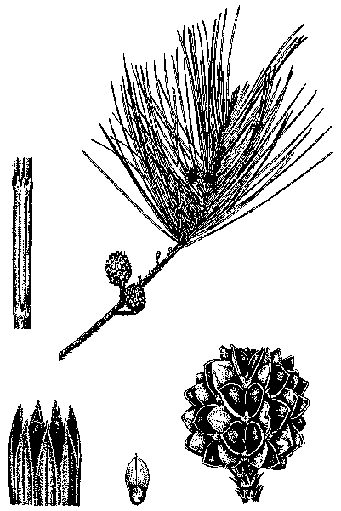
FIGURE: Casuarina equisetifolia.
Although these drawings are of one species, they are generally representative of
the parts of most casuarinas. (P. B. Tomlinson)
For many Australian species of casuarina, flowering takes place during a brief period of the year and is more or less consistent from year to year. Other species are less regular. Casuarina cristata, for example, flowers either in spring or following a heavy rain.
NITROGEN FIXATION
As discussed previously, the root hairs of most casuarina species are invaded by the filamentous soil actinomycete, Frankia. When the microorganism's infectious threads reach the cortical root cells they divide and expand, forming lobes on the outsides of the root. The result is a woody perennial "nodule" that is spherical and up to 10 cm in diameter.
The association with Frankia benefits the casuarina, and the resulting symbiosis provides nitrogenous compounds that fertilize the plant's growth. Only the young tips of each nodule appear to actively fix nitrogen. The woody nodules are found in large masses from the base of the trunk out to near the drip line. They are most readily visible just beneath the soil surface, but they have been located as deep as 10 m in the soil.
The woody nodules are long lived, but eventually they decay, releasing Frankia spores and particles into the soil. The survival time and mechanisms of distribution of Frankia in the soil are unknown and deserve research.
The greatest number of nodules have been found where the soil activity is close to neutral. However, natural stands of Casuarina glauca are well nodulated in soils that are quite acidic (to pH of about 4). Nevertheless, nodulation normally is most successful within the range of soil pH from 6 to 8.
Nodulation is very much influenced by the available moisture and the soil aeration. Oxygen is necessary for the fixation process, so that active nodules normally occur only on surface roots that are obtaining adequate moisture. The symbiosis cannot occur in waterlogged sites. However, nodules are abundant in natural stands of Casuarina glauca where the water table is within 30 cm of the soil surface and nodules occur on the root system of Casuarina cunninghamiana growing at sites that are periodically submerged, such as river banks.
Also necessary for nitrogen fixation are minute amounts of mineral elements such as molybdenum, cobalt, and copper. These, however, are usually provided by even the poorest of soils.
Casuarinas fix about as much nitrogen as legumes. In a study in Senegal, the amount of nitrogen in soil under casuarina trees increased annually at rates of 58 kg per hectare when compared with nearby unplanted sand dunes.
In a natural forest of Casuarina littoralis near Sydney, Australia, the annual nitrogen accumulated in the litter under the trees was 290 kg per hectare, largely because of nitrogen fixation.
In one experiment, nodulated seedlings of Casuarina glauca grown in a greenhouse increased their shoot nitrogen content about thirteenfold within 60 days of the first appearance of nodules.
The actual rate of nitrogen fixation appears to depend on environmental factors and on the casuarina species (and perhaps even on the particular strain of tree) as well as on the strain of the Frankia symbiont.
The Frankia that inhabits root nodules of actinorrhizal plants, such as casuarinas and alders, was first isolated and cultured from alders only in 1978. Since that time, microbiologists have isolated a dozen strains of Frankia from the roots of different host plants maintained in a worldwide collection in Middlebury College, Vermont (USA). Some of them have been shown to fix atmospheric nitrogen when grown in pure culture.
In 1983 pure strains of Frankia were, for the first time, isolated from casuarina nodules and cultured in artificial media. Tests have shown that these pure cultures are suitable as inoculum for casuarina seedlings and rooted cuttings.
Using such isolates and pure cultures, growers may in the future be able to match the best strain of Frankia to the appropriate casuarina species so as to maximize nitrogen fixation.
Whether a single Frankia strain will infect all of the casuarina species or whether more than one strain will be needed is not yet known, but some recent experiments suggest that different strains of Frankia are needed to infect and nodulate the different casuarina species.
MYCORRHIZAL SYMBIOSES
Casuarina roots, in common with roots of many other tree species, have symbioses with a number of genera of soil fungi that help the trees scavenge mineral nutrients from the soil. These fungi are called mycorrhizae ("fungus-root"); two main types occur:
1. Ectomycorrhizae. These form an intricate meshwork of threads, or hyphae, clinging to the root surface and penetrating between root cells. From this mantle of fungal hyphae, thin filaments, barely visible to the naked eye, radiate out into the soil where they absorb nutrients and water and transport them back to the root. Ectomycorrhizal fungi on casuarinas include such genera as Cenococcum, Pisolithus, Hymenogaster, Thelephora, Rhizopogon, and Amanita.
2. Endomycorrhizae. The hyphae of these fungi actually invade the cortex of the root and proliferate between, and actually penetrate into, the root cells themselves. They are identified by microscopic arbuscules (hyphae-branched-like trees) and vesicles (thick-walled oval structures that develop within the cells). These fungi belong to the family Endogonaceae and are abundant in many soils. The most common genus is Glomus.
The association of casuarina roots with both types of
mycorrhizae significantly enhances the trees' adaptability as well as their
ability to grow in harsh environments. Specifically, the fungi help the trees
by:
· Improving mineral nutrition. Mycorrhizae have been shown to be
particularly important in making phosphorus available to the tree, but they also
help absorb soil nitrogen and microelements.
· Increasing tolerance to
drought. This is of special importance during field plantings, as it prevents or
improves recovery from wilting.
· Influencing the nitrogen-fixing
activity of Frankia. In phosphorus-deficient soils, nitrogen fixation in root
nodules is markedly reduced in the absence of mycorrhizae.
· Improving
soil structure. Hyphal mats contribute to the binding of soil particles and thus
reduce the harmful effects of wind and water erosion.
· Increasing
resistance to some disease infections by preventing access of the organisms to
the plant root.
· Alleviating the effects of acid soils, excessive
aluminum, and certain other toxic soil conditions.
PROTEOID ROOTS
Casuarina roots also interact with unidentified soil microorganisms that cause the development of "proteoid roots." These unusual structures occur as tight-packed rows of lateral rootless that form thick mats just below the soil surface. They greatly increase the surface area that casuarina roots have for nutrient absorption.
To date, proteoid roots usually have been observed in association with organic debris in the soil and in sand under the tree drip-lines. Little is known about their benefits. However, other plants that form such roots demonstrate increased absorption of phosphate from soil.
|
| ||||||||||||||||||||||||||||||||||||||||||||||||||||||||||||||||||||
4. Management
PROPAGATION FROM SEED
Casuarinas are normally propagated by seed. As previously noted, most species have separate male and female trees, but some have both flowers on one tree. (See table.) Trees normally flower at an early age and produce seed in good quantities most years. Extracting the seeds is relatively simple: cones, or cone-bearing branches are placed in the sun to dry.
In 2 or 3 days the woody valves (bracteoles) open and the winged seeds are released and can be collected.
The seed of most Australian casuarinas stores well when dried and kept in closed containers at room temperature. Tests showed little loss in germination after 12 years of storage for Casuarina cristata, Casuarina decaisneana, Casuarina glauca, Casuarina stricta, and Casuarina torulosa. On the other hand, seed of Casuarina equisetifolia is best stored at low temperatures, and although Casuarina cunninghamiana seeds will keep well for 1 or 2 years, the viability of even freshly collected seed is sometimes low. In general, seed of Asian and Pacific Island casuarinas seems to store poorly.
Seed of the different species varies greatly in size and germination requirements. Most germinate in 2-3 weeks, but Casuarina decaisneana is quicker, probably because it is adapted to take advantage of sporadic rainfall in its arid native habitat.
To produce seedlings in a nursery, conventional supplies - such as pots, tubes, and sleeves - can be employed. Even extremely primitive techniques are successful in many cases. Young trees are often transplanted bare-rooted, usually when 30-50 cm tall.
On many reforestation sites direct seeding is likely to be successful because casuarinas naturally reseed themselves very well on open, disturbed areas. Road banks in Australia, for example, are often revegetated naturally by casuarinas. Deep volcanic ash, that erupted in 1960 at Kapoho, Hawaii, has become completely revegetated by Casuarina equisetifolia, seeding itself during the years since the eruption. Natural seeding seldom occurs directly beneath a parent tree or under the canopy of a casuarina stand. However, abundant reproduction occurs in shallow, windblown litter in open areas adjacent to the trees.
Flowering Character and Seed Size
| |
Monoecious a (M) |
Mean Numbers of Seeds |
| |
Dioecious b (D) |
per Kg |
|
Casuarina campestris |
D |
780,000 |
|
C. cristata |
D |
420,000 |
|
C. cunninghamiana |
D |
1,800,000 (>3,000,000) |
|
C. decaisneana |
D |
85,000 |
|
C. dielsiana |
D |
270,000 |
|
C. equisetifolia |
| |
var.equisetifolia |
M |
760,000 (616,000-1,488,000) |
var. incana |
M |
470,000 |
|
C. fraseriana |
D |
235,000 |
|
C. glauca |
D |
1,760,000 |
|
C. huegeliana |
D |
510,000 |
|
C. junghuhniana |
D |
-- |
|
C. littoralis |
D |
480,000 |
|
C. luehmannii |
D |
-- |
|
C. obesa |
D |
840,000 |
|
C. oligodon |
D |
-- |
|
C. stricta |
D |
200 000 |
|
C. torulosa |
D |
260 000 |
a Male and female flowers occur on the same plant.
b Male and
female cowers occur on different plants.
Source: D. J. Boland, J. C. Doran,
R. D. Johnson, S. J. Midgley, and J. W. Turnbull.
VEGETATIVE PROPAGATION
Probably all casuarinas can be propagated vegetatively. A sterile hybrid of Casuarina equisetifolia and Casuarina junghuhniana is reproduced almost entirely by cuttings in Thailand and India, and it seems likely that other species can also be propagated this way, although most have not been tried. Cuttings have the benefit of being a rapid, sure method of perpetuating the traits of superior specimens and also of allowing trees of a single sex to be planted so as to avoid weedy regeneration through the spread of natural seedlings.
A vegetative propagation technique recently developed in India for both Casuarina equisetifolia and the Casuarina junghuhniana hybrid involves the rooting of clusters of shoots (sprigs). These are dipped in rooting hormone (sometimes this step is omitted) and placed in a humid atmosphere - for example, in a sealed plastic tent in the light shade under coconut trees. After 20 days they establish roots and can be planted out. This seems like a promising breakthrough for the rapid propagation of desirable casuarina specimens and it may be applicable to species other than the two used by the Indian researchers
MANAGEMENT
As discussed earlier, several species of casuarinas are characterized by "root suckering," that is, by the abundant formation of root-originated shoots. This ability makes them candidates for management under a sort of "coppice" rotation. However, it can create a random, dense mass that makes management difficult. Root suckering occurs in Casuarina cristata, Casuarina glauca, Casuarina junghuhniana, Casuarina luehmanii, Casuarina obesa, and Casuarina stricta. Some of these species sucker more readily than others, and it is not known whether this characteristic is genetic, and therefore limited only to them, or whether it is a general property of casuarinas that is elicited only when environmental conditions are favorable.
INOCULATION
The Frankia actinomycete that forms the symbiosis with casuarinas is found naturally in soils where casuarinas are native. However, when the trees are planted outside their normal range the microorganism could be missing. In nursery plantations where sterile soil mixtures are used, the seedlings must be inoculated with Frankia from pure cultures or from ground- up nodules. It seems probable that even where casuarinas do form nodules without inoculation, the rate of nitrogen fixation might be improved by introducing a more effective strain of Frankia. Techniques for handling the microorganism were worked out in 1983.
A practical inoculation technique for general use in the field is to shovel some surface soil from under a casuarina tree into the planting medium used in the nursery. Its Frankia spores then infect the seedlings.
A more sophisticated technique involves obtaining some root nodules from established trees and soaking them in 70 percent ethanol for a few seconds (to reduce the risk of contamination from microbes on the outside of the nodules). They are then washed, crushed in water, and the coarser particles filtered out. The resulting suspension is applied to the roots of casuarina seedlings or injected into the soil within the seedling's area.
Fresh nodules can be dried over silica gel and stored for up to a year without losing their infective ability. Ground-up nodule suspension can be stored also in saline solution or in a polyvinylpyrrolidone solution.
Frankia are easier to handle than rhizobia (the bacteria that live symbiotically with many legumes and help them the way Frankia helps casuarinas) as the spores can be dried and stored at room temperature without losing viability.
In phosphorus-deficient soils, casuarina plantings should also include inocula of the mycorrhizal fungi that help the trees obtain phosphorus. In soils devoid of all available phosphorus (as might occur in some sand dunes, for instance), it is necessary to apply a small quantity of phosphate fertilizer, since this induces a good response from both plants and mycorrhizae. The mycorrhizae are not available in inoculum form; a sample of soil from around established trees is currently the only source.
PLANTATION ESTABLISHMENT
Normally, casuarina plantings are given little site preparation. Even in the aridity of Egypt the saplings receive only a little watering during the first year, and after that they have to survive on their own.
Spacings differ with the end use and the site. For rain-fed plantations, 1,000-2,500 trees per hectare are used if billet-sized materials are desired. With irrigation, it is possible to plant 10,000 or more per hectare, although the products are smaller in diameter. In Egypt, for example, planters use an in-row spacing of 0.5 m for fuelwood and 2.5 m for scaffolding poles. Where plantations are established for wind protection in harsh sites, 3 m x 3 m spacing is appropriate. In Papua New Guinea 4 m x 4 m is used for shading coffee plantations.
DISEASES
Although some diseases and pests have been noted in specific locations, casuarinas are generally healthy plants.
In India, the fungus Trichosporium vesiculosum, which causes a serious peeling of bark and may kill the trees, has been noted on Casuarina equisetifolia. It infects roots, especially where excessive watering and crowding occurs, such as along river banks. Another, but less serious, fungus, Ganoderma lucidum, starts as a saprophyte on nearby decaying stumps and then becomes a parasite on living trees by entering through wounds.
In the Guanica area of Puerto Rico, many casuarinas were killed in 1940 by a dieback disease, and stem canker and dieback have affected trees there since that time. Investigators attribute these syndromes to the fungus Diplodia natalensis. A similar problem was noted in some casuarinas in Florida in 1965.
In Florida there has been a high rate of mortality from mushroom root rot caused by the fungus Clitocybe tabescens, primarily on sandy soils previously populated by oaks. Casuarina cunninghamiana, Casuarina equisetifolia, and Casuarina glauca are all affected.
PESTS
To date, no major insect problems have been encountered in adult plantations except for Apate monachus, the black borer, which tunnels into the stems and makes them susceptible to wind damage.
Nursery seedlings are liable to attack by crickets, chiefly Brachy-trupes achaetinus. Caterpillars and aphids also occur in nurseries, but not in older trees and not when the nursery is near the sea.
In the sapling stage in Puerto Rico, grubs of Coelosterna scabrata have been noted boring into the root column, eventually killing the plant. Arbela tetraonis is a bark- and wood-boring caterpillar that can be easily detected by a characteristic covered trail winding over the bark.
The caterpillar of Phassus malabaricus bores into the stem close to the ground and pupates in the larval burrow; it kills the tree by girdling it. In Nigeria casuarinas up to age 3 years have been damaged or killed by termites.
LIVESTOCK AND WILDLIFE
Young trees can be damaged by browsing or trampling, but they are resilient and tend to recover quickly. In Florida, deer sometimes browse seedlings so severely that the plants are killed. In California, as in Australia, young seedlings are susceptible to browsing by rabbits.
Damage can be severe in some areas and seasons when other palatable vegetation is sparse, especially in desert environments. In Hawaii, on the goat-infested island of Kahoolawe, Casuarina equisetifolia survived nicely behind a fence but were eaten when the fence rusted away.
TEMPERATURE
Most casuarinas are severely damaged or killed by frost. Non-Australian species, such as Casuarina oligodon and Casuarina junghuhniana, grow in regions that are largely frost free. Coastal species such as Casuarina glauca rarely experience temperatures below-3°C, while Casuarina equisetifolia occurs naturally only in frost-free areas.
However, in southern inland Australia, a few species such as Casuarina cunninghamiana and Casuarina stricta are found where occasional temperatures of-10°C occur. And in California, in the Sacramento Valley, Casuarina cunninghamiana is more frost tolerant than either Casuarina stricta or Casuarina equisetifolia. Casuarina cunninghamiana has survived temperatures of-8°C with no apparent injury.
FIRE RESISTANCE
Most species of Casuarina are moderately tolerant of fire. This is a serious problem in Guam. Casuarina decaisneana, for instance, can tolerate extremely hot summer fires in Central Australia - the black color of its thick bark is a result of fire scorch. If tops are killed the trees will coppice, develop shoots from the roots, or (if not too severely damaged) produce new crown shoots. Some species shed seed soon after the seeds mature, so at times of fire there is usually no seed stored on the tree and seedling regeneration is therefore sparse.
Some casuarinas, however, appear to be fire-tender. These include Casuarina fraseriana, Casuarina littoralis, and Casuarina torulosa. They can be damaged by fire but produce vigorous new shoots afterwards. And because they carry cones for several years without shedding seed, seedling regeneration may be profuse in the seedbed created by the fire.
|
| ||||||||||||||||||||||||||||||||||||||||||||||||||||||||||||||||||||
5. Uses
FUEL
Casuarina wood, as mentioned, has been called the best firewood in the world, and fuel is its most universal use. It is very dense, with a specific gravity ranging from 0.8 to 1.2. It is easy to split, has a high calorific value (about 5,000 kcal per kg), and tends to burn slowly with little smoke or ash. It also can be burned when green, an important advantage in fuel- short areas.
When large trees are cut, the branches and brushwood are often used for fuel. In addition, the needles and cones burn well, so that the trees provide fuel even before they are cut down. From their fourth year, trees shed cones in quantities amounting to almost 4,000 kg per hectare. In India the cones are a cheap and handy fuel for hawkers selling roasted peanuts (groundnuts) from carts. They are also used to fuel pottery kilns.
Casuarina wood is excellent for charcoal making. Whereas most woods lose about three- quarters of their weight when made into charcoal, casuarinas lose only about two-thirds. The entire tree - stems, branches, and roots - can be converted to charcoal.
WOOD
The wood of most casuarinas is so hard and heavy that it is difficult to saw and is not a good source of lumber. Moreover, it tends to split, crack, and warp as it dries.
Nevertheless, this dense, straight-grained wood has many important uses. Australian aboriginals use it to make boomerangs, and the first Europeans to settle in Australia found it useful to have about their farms for shingles, tool handles, fences, farm buildings, masts and oars, yokes, walking sticks, and other items. Even today in Western Australia, casuarina wood is commercially valued for wood turnery, tool handles, piano legs, shingles, veneer, and panelling.
In general, casuarina wood is useful as roundwood for fencing, pilings, beams, and rafters; as split wood for fencing, pilings, and roofing shingles; and as comminuted wood for particle board, pulp, and parquetry. In India it is used for scaffolding and structural members for buildings, as well as for masts for country fishing boats. In Egypt three particle-board factories are consuming casuarina windbreaks and shelterbelts so excessively that agronomists are becoming concerned that crops will suffer. The wood of Casuarina equisetifolia has been found to make a good paper pulp through use of the neutral sulfite semichemical process. But, as noted earlier, the difficulty of breaking up this extremely hard wood complicates pulping.
SHELTERBELTS
Casuarina equisetifolia is often planted as a windbreak in North Africa, West Africa, Yemen, Somalia, the Middle East, India, and South China. In southern Australia Casuarina stricta has been widely used as a windbreak. The abundance of highly branched twigs on casuarinas absorbs wind energy amazingly well. A wind strong enough to blow hats off can be stripped of? its force by a belt of casuarinas two or three deep, leaving the leeward air calmed. By reducing windspeed to almost zero, the shelterbelts stop wind erosion, and in areas with hot, dry winds they protect crops and animal herds and increase yields.
An advantage of casuarinas is that their roots do not readily harbor nematodes that affect the neighboring crops, a problem that is increasingly recognized as a serious limitation of shelterbelts. (In Egypt, however, Casuarina equisetifolia has been found to carry some nematodes, although Casuarina glauca has not.)
Egyptian farmers have solved the problem of root suckers coming up in their fields. They dig a ditch between the crop and their Casuarina glauca shelterbelts. Sheep and goats then eat the exposed shoots and keep them from becoming pests.
In addition to their wind firmness casuarinas have desirable characteristics for shelterbelts: adaptability to many soils and climates, self-sufficiency for nitrogen, rapid early growth, adequate height and longevity, dense crown, and useful wood. It is most unusual for a single tree to have all of these attributes; to reduce wind adequately, shelterbelts normally require two or more species.
EROSION CONTROL
Casuarinas can protect soil by reducing wind erosion, but they also do it with their network of fine subsurface roots and by building up a litter of intertwined needles that protects against rain and wind.
Casuarina equisetifolia is much used for stabilizing sandy soils (see below) and Casuarina cunninghamiana is valued for protecting riverbanks. For erosion control, the copious root suckering of species such as Casuarina glauca can be an advantage, because it helps the trees spread and hold down the land, especially on severe slopes or washed areas. In addition, the litter from the trees blows over the bare ground, protecting it from erosion and providing a good seedbed for natural reproduction.
SAND DUNE STABILIZATION
Because it is salt- and drought-tolerant and can grow and reproduce in sand, Casuarina equisetifolia is used to control erosion along coastlines and estuaries. Thousands of square kilometers of casuarina forests have been planted in coastal sand dunes in southern China (see chapter 2). Casuarina is also used in Egypt to stabilize sand dunes that are drifting into the Nile Delta and Nile Valley. And in Mexico it is being planted in saline sandy areas near Mexico City to reduce dust storms. Casuarina equisetifolia is also stabilizing moving dunes on the coast of northern Senegal.
On the leeward side of sand dunes, when lower branches touch the ground they often root and develop upright branches. In this manner, they firmly fix the shifting sand with an expanding cover of trees.
TANNING
The bark of Casuarina equisetifolia contains 6-18 percent tannin and has been used extensively in Madagascar for tanning purposes. In Australia the tannin content is considered too low for commercial interest; however, casuarina bark enjoys a certain standing among amateur tanners. The tannins penetrate hides quickly and furnish a swollen, pliant, and soft leather of pale reddish-brown colon Other casuarina species probably could also be used for tanning.
HONEY PRODUCTION
Casuarinas furnish no nectar for honeybees. However, Casuarina littoralis and Casuarina cunninghamiana are rated as having medium value as pollen sources; Casuarina glauca and Casuarina torulosa are rated as being of minor value.
FODDER
While domestic animals will graze seedlings and suckers of casuarinas, the foliage is high in tannin and is astringent and constipating and may interfere with the animal's ability to utilize protein.
|
| ||||||||||||||||||||||||||||||||||||||||||||||||||||||||||||||||||||
6. Best-Known Species
Because of their proven performance, Casuarina cunninghamiana, Casuarina equisetifolia, Casuarina glauca, Casuarina junghuhniana, and Casuarina oligodon are each described in more detail in this chapter. Lesserknown species with promise are discussed in chapter 7.
Botanic Name Casuarina cunninghamiana Miq.
Common Names River sheoak, creek oak, river oak, casuarina
Main Attributes The tree is one of the largest of the casuarinas. Handsome of appearance, it can be used for ornamental planting as well as for shade and shelter. It is a good street tree and is suitable for semiarid regions. It provides heavy shade and is almost trouble free. It has some cold tolerance, is very adaptable, and withstands periodic inundation so that its major use in Australia is for protecting stream banks from erosion. Because of its importance for this purpose, in New South Wales it may not be felled without a permit.
Description Casuarina cunninghamiana grows up to 40 m in height and more than 1 m in diameter. Its thin deciduous branchlets are soft and short and carry whorls of 6-8 leaf-teeth.
Distribution Native to eastern and northern Australia, it is found growing from the south of New South Wales (latitude 37°S) to the north of Queensland (latitude 12°S). Typically, it occurs fringing freshwater streams and rivers on both sides of the Great Dividing Range. A distinct race, possibly a separate species, is found along the larger rivers in the higher rainfall areas of the Northern Territory.
Casuarina cunninghamiana is extensively planted in Argentina and neighboring countries for windbreaks and to protect stream banks. It is also established in Florida. In Egypt it is important for shelterbelts. In Israel it is widely planted along railroads and highways for windbreaks and woodlots. And in Bulawayo, Zimbabwe, it is planted as a street tree.
Environmental Requirements
· Temperature. Adapted to climates varying from temperate
to tropical. The climatic range in its native habitat varies from warm subhumid
to warm semiarid. The species is able to tolerate up to 50 light frosts per year
- such incidences occurring mainly in the southern parts of
its-distribution.
· Altitude. Sea level to about 800 m.
·
Rainfall. From 500 to 5,000 mm per year, but, as the tree is riverine, rainfall
alone is no indication of the total moisture available. The incidence of the
principal rainfall varies from a weak summerautumn maximum in southern New South
Wales to a strongly defined summer maximum (monsoonal) in the north.
·
Soil. Soils are usually alluvial and vary from silty loams to sands to gravels.
In Hawaii it grows well on histosols developed over acidic lava (pH 5.0).
Nodulation Prolific.
Root Suckering Occurs, definitely in eastern Australia.
Limitations Not as salt tolerant as the closely related Casuarina glauca. On highly calcareous soils it is likely to turn chlorotic. Seedlings are susceptible to browsing damage and need protection from grazing in the early years.
Botanic Name Casuarina equisetifolia Forst. & Forst.
Synonym Casuarina litorea L.
Common Names Casuarina, sheoak, horsetail oak, Australian pine, ironwood, whistling pine, agoho (Philippines), ru (Malaysia), filao (Senegal), nokonoko (Fiji)
Main Attributes This is a large and usually long-lived tree and has the widest distribution both natural and planted of all the casuarinas. It has proved itself in scores of tropical countries. It is particularly valuable for stabilizing sand dunes, as it withstands salt spray, tolerates infertile soils, and is drought tolerant. Most of the experiences described in chapter 2 are with this species.
This is a species for warm to hot subtropical and tropical climates. Although it is not frost hardy, it tolerates a wide range of temperatures. The calorific value of its charcoal, 7,181 kcal per kg, is among the highest of any firewood species. The trees grow fast, sometimes reaching heights of 3 m within 8 months of transplanting to the field.
Description Two subspecies are recognized, Subspecies incana is a small tree that could be useful for low-growing shelterbelts but that has been little tried as an exotic. Subspecies equisetifolia has a tall stem and narrow crown. Unless otherwise stated, any reference to Casuarina equisetifolia in this book refers to this subspecies.
Distribution Subspecies incana occurs only along the coast of Queensland and northern New South Wales. The natural distribution of subspecies equisetifolia extends along seacoasts from Malaysia to subtropical Australia, Melanesia, Micronesia, the Philippines, and Polynesia.
Environmental Requirements
· Temperature. In Australia these trees occur in the hot
humid climatic zone, but they extend into the hot subhumid zone (while
subspecies incana has its main distribution in the warm subhumid zone). Frosts
are absent in most of its habitats, although in the south there may be 1-3
frosts a year.
· Altitude. This is generally a lowland tree but is grown
up to about 600 m elevation in Hawaii.
· Rainfall. In its natural
habitat, annual rainfall is from 700 to 2,000 mm, often with a dry season of 6-8
months. However, it has been planted successfully in areas with annual rainfall
as little as 200-300 mm or as much as 5,000 mm.
· Soil. The species
tolerates calcareous and slightly saline soils. Reportedly it grows poorly on
fine-textured soils but it grows well on clays in Hawaii. It can withstand
partial waterlogging for a time.
Nodulation Prolific.
Root Suckering Occurs.
Limitations Initially, the trees have poor ability to compete with weeds, especially in dense grass cover. Seedlings are vulnerable to attack by ants, crickets, and other insect pests. The trees are susceptible to root rot. Casuarina equisetifolia can exhaust the moisture in the soil, lower the water table of the site, and restrict growth of a healthy understory. The tree is fire sensitive and can be browsed only lightly without being damaged. Although other Casuarina species coppice readily, Casuarina equisetifolia coppices only to a limited extent and only when cut young (3-4 years).
Botanic Name Casuarina glauca Sieb. ex Spreng.
Common Names Swamp sheoak
Main Attributes This tall tree can survive on difficult sites where other trees fail because of salinity, waterlogging, or shallow water table. It withstands even periodic tidal inundation.
Sometimes it occurs where it gets drenched in salt spray from the sea. In Egypt it has proved more drought tolerant than Casuarina cunninghamiana and Casuarina equisetifolia.
In Israel it outperforms all the other casuarinas, reaching 20 m after 12-14 years, even on saline water tables.
It is favored for shelter purposes. Its canopy tends to commence at ground level, owing to low branching or the development of root suckers, which arise spontaneously around the parent tree.
Description This is an erect, fast-growing tree, typically 10-14 m tall, although in favorable localities it may reach 30 m. The main stem, which may be buttressed and fluted, is moderately straight and typically dominant for most of the tree's height. Free-growing specimens have a somewhat sparse and narrow crown. The slender deciduous branchlets (about 1 mm in diameter) carry 12-20 small leaf-teeth in widely spaced whorls. They are much coarser (and a little longer) than those of Casuarina equisetifolia or Casuarina cunninghamiana.
Distribution Casuarina glauca is found in a narrow belt hugging the coast of eastern Australia from Bega in New South Wales to Rockhampton in Queensland. It has also been successful in the marshes and saline soils of Israel, Cyprus, India, Kenya, Malawi, South Africa, Egypt, and Florida.
This casuarina is most common along the edges of swampy flats near estuaries and along tidal reaches of rivers. It is also sometimes found on or near beach fronts. The flats may be only marginally above tidal limits; the water table is usually close to the surface (often within 30 cm of the surface).
Environmental Requirements
· Temperature. 5°-33°C.
· Altitude. Sea
level to 900 m (in Hawaii).
· Rainfall. 500-4,000 mm (in
Hawaii).
· Soil. In its native habitat soils are often sandy or clayish
and are underlain with rock. Salt content is often high. However, the trees
occasionally occur on moist, rocky headlands.
In Israel the tree grows on very dry sites in the Negev Desert. It has grown where a layer of salt covers the soil surface (50,000 ppm).
Although most natural stands are on acidic soils, Casuarina glauca has shown good growth on alkaline clay-loam soils with shallow water tables in hot semiarid areas of Central Australia. In Thailand the seedlings have tolerated high levels of calcium in the soil and as much as 30 percent limestone. In southern Florida it flourishes on oolitic limestone. In Hawaii it is frequently planted on much-weathered parent basalt in eroded blowouts, sometimes in holes blasted by dynamite. It is also planted in pure limestone sand and does well.
Nodulation Prolific. The tree sometimes produces huge growths from which root suckers later arise.
Root Suckering Even without root damage it forms thickets of suckers. Suckering is increased by pruning the trees.
Limitations Suckers are grazed by livestock, but they have
little value as forage. Because it regenerates vigorously from root sprouts,
this species is a possible weed and, as already noted, is a pest in parts of
Florida and is regarded as noxious in Hawaii.
In Hawaii it does not attain
the height of Casuarina cunninghamiana or Casuarina equisetifolia, probably
because it stagnates from abundant suckering.
Botanic Name Casuarina junghuhniana Miq.
Synonym Casuarina montana Jungh.
Common Name Jemara (Indonesia)
Main Attributes This tall, straight casuarina has good form for
a plantation species. It is adapted to hot, humid conditions, to monsoonal
climates with a long dry period, and to highland areas in the tropics. It grows
quickly in compact clay soils near Bangkok, Thailand.
It has some salinity
tolerance and thrives on many types of soil. It reportedly competes well with
vigorous tropical weeds such as lmperata cylindrica. So far, it is widely used
only in Thailand. There the trees do not produce seed and are reproduced
artificially using vegetative methods.
Description This is a long-lived pioneer tree that grows to majestic size - 35 m in height and l m in diameter. The branchlets are graygreen to dark green and carried in a narrow conical crown.
Distribution Casuarina junghuhniana is native to highland
regions of eastern Indonesia - to East Java, Bali, and the Lesser Sunda group of
islands. There it occurs in extensive pure stands on mountain summits. It
pioneers the natural revegetation of deforested grassland, volcanic ash and
sand, gravelly stream beds, and screes. Man-made grassland has allowed it to
extend its area manyfold, at the cost of mixed mountain forest and scrub forest
that formerly prevailed.
A hybrid of Casuarina junghuhniana and Casuarina
equisetifolia was introduced to Thailand around 1900. Today, its good, straight
stems and symmetric conical crown make it a popular ornamental and cultivated
crop throughout the country.
Environmental Requirements
· Temperature. Unknown.
· Altitude. Its natural
distribution is up to 3,000 m. In Thailand and South India, however, it is
mostly grown near sea level.
· Rainfall. In its native habitat the
rainfall pattern is monsoonal with a well-defined summer maximum and a range
from 700 to 1,500 mm. The tree is moderately drought tolerant. (In 1951 the
hybrid was introduced into South India from Thailand. In 1972 a severe drought
killed all 6-year-old Casuarina equisetifolia trees, but not the C. junghuhniana
x C. equisetifolia hybrid.)
· Soil. It can grow well in various types of
soil, from compact clay to light volcanic soil.
Nodulation Nodules have been found on a tree in the Bandung region of Indonesia.
Root Suckering The root system extends laterally and produces abundant root suckers.
Limitations In Thailand and India the hybrid trees do not produce seed and are propagated only by vegetative means, usually by airlayering, using the abundant suckers or branches.
Botanic Name Casuarina oligodon L. Johnson
Common Names Yar or soft yar (Papua New Guinea), sheoak
Main Attributes The Papua New Guinea government is encouraging local people to grow Casuarina oligodon as firewood in the Highlands. The Office of Forests in the Highland provinces distributes seedlings, which are planted by local landowners. The trees are highly self-regenerating, and they help in reforesting grasslands. The wood is used in construction, but because it is durable, it is also suitable for fences. Its main use is for fuelwood in the
Highlands where nights are cool. It is also used for windbreaks, and most villages have Casuarina oligodon planted around their boundaries. The tree grows well even with competition from vigorous grasses (such as Imperata cylindrica, Saccharum robustum, and Themeda australis). Coffee is a major cash crop in the Papua New Guinea Highlands, and
Casuarina oligodon is useful on coffee plantations because it shades the coffee bushes and improves the soil by fixing nitrogen.
Description This is a medium to tall tree, reaching 30 m in height and 0.6 m in diameter. The bark is gray-brown and fissured, peeling off in irregular flakes. The tree produces small cones (diameter less than 1 cm).
Distribution The species is native to New Guinea and is found mostly in upland valleys. It forms extensive pure stands along river beds, but at times it is associated with Casuarina papuana (see page 94). It occurs commonly on stream banks and ridge tops and on abandoned garden and village sites. In the Papua New Guinea Highlands, people fallow the land 10-20 years under Casuarina oligodon. It is part of their traditional land-use pattern.
This species is little known outside New Guinea, but in Hawaii it has grown very rapidly.
Environmental Requirements
· Temperature. This is truly a tropical highland
species.
· Altitude. The tree is found up to 2,500 m or higher in Papua
New Guinea.
· Rainfall. It occurs naturally in areas where the rainfall
ranges from 1,900 mm to 2,600 mm and humidity is high throughout the year. In
Hawaii it is planted in an area with 5,000 mm rainfall but good
drainage.
· Soil. It is mostly found in sandy soils along creeks and
rivers but grows well in colluvial soils, humic brown-clay soils, and alluvial
and meadow soils.
Nodulation Occurs.
Root Suckering The species mainly spreads through seed and generally does not spread through suckers. However, it has been known to form epicormic shoots after fire or when damaged by other natural causes.
Limitations Casuarina oligodon may not grow successfully on poor soils. It seems to be very sensitive to areas of high salt concentrations. It has also proved susceptible to wind breakage in Hawaii; it appears to be much more brittle than any of the other species.
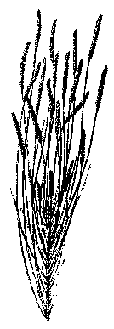
FIGURE
|
| ||||||||||||||||||||||||||||||||||||||||||||||||||||||||||||||||||||
7. Other Promising Species
In addition to the five species described in chapter 6, there are several lesser-known casuarinas that have real or potential value. As more introductions are attempted and more is learned about them, they could make an important place for themselves. None has yet been tested significantly outside its native habitat.
The following pages describe:
Casuarina campestris
|
C. cristata |
C. Iittoralis |
|
C. decaisneana |
C. Iuehmannii |
|
C. dielsiana |
C. obesa |
|
C. fraseriana |
C. stricta |
|
C. huegeliana |
C. torulosa |
Botanic Name Casuarina campestris Miq.
Synonym Allocasuarina campestris (Miq.) L. Johnson
Main Attributes This species provides perhaps the ultimate in wind protection. Single rows with plants 2-3 m apart provide excellent shelter for livestock and dwellings. Casuarina campestris protects soil well and is planted for conservation purposes. It is now used mainly for low, hedge-type shelterbelts. It will grow on a wide range of soils, including coastal sands.
Description Although it may also grow as an erect tree with a dense crown, this species is usually a very bushy, multistemmed shrub only 1-3 m high.
Distribution Casuarina campestris is native to the southwestern part of Western Australia.
Environmental Requirements
· Temperature. This species is native to temperate areas of
Western Australia. Throughout most of its range it receives 1-12 frosts per
year.
· Altitude. It occurs from near sea level to about 375
m.
· Rainfall. It is found mainly in the semiarid climatic zone, but it
also extends into both subhumid and arid zones. The 50th percentile rainfall is
225-400 mm, and the lowest precipitation on record in the area is 140-250 mm.
There is a clearly defined winter maximum.
· Soil. Casuarina campestris
has been recorded on some extremely poor soils such as those derived from
cemented laterite, greenstone, ferric-conglomerate, broken quartzite, and
limestone. It has been also recorded on loams, shallow clays over laterite, and
coarse gravelly soils.
Nodulation Unreported.
Root Suckering Unreported.
Limitations The wood is available only in small diameters. Its technical properties are unknown.
Botanic Name Casuarina cristata Miq. There are two subspecies: Casuarina cristata subspecies cristata and Casuarina cristata subspecies pauper.
Synonyms Casuarina lepidophloia F. Muell.; Casuarina glauca Benth., in part; not Sieb.
Common Names Black sheoak, belah
Main Attributes This tree is valued as a source of light shade and shelter on farms, for timber, and, to a limited extend, as an emergency drought fodder.
Subspecies pauper is more suited to drier (as low as 250 mm
annual rainfall) and harsher conditions than subspecies cristata, as well as to
areas where there is limestone in the soil.
It also appears suitable for
saline soils.
Subspecies cristata seems to require a rainfall greater than 400 mm. It is an excellent tree for windbreaks and is an attractive ornamental. Specimens growing in the open develop a dense crown, almost to ground level.
Description This smallish tree reaches a height of 20 m. It is erect in form, and when trees are planted close together the main stem is straight for more than half the total height.
Distribution Subspecies cristata is native to eastern Australia. It grows in a belt on the inland side of the Great Dividing Range in New South Wales and southern Queensland.
Subspecies pauper is native to a wide belt from western New South Wales across the central latitudes of South Australia to Western Australia.
Environmental Requirements
· Temperature. Subspecies pauper occurs in an arid region
with burning hot summers and a few winter frosts.
· Altitude. The tree
is found mainly below 350 m.
· Rainfall. Subspecies pauper grows where
annual rainfall is very erratic, as low as 175 mm, and where there is a
potential annual evaporation of 2,500 mm or more. In this region of low, open
woodland or shrub steppe, this casuarina is often the only tree to be
seen.
· Soil. This species seems to withstand compact clay soils and
high alkalinity - pH 8.8 and lime content up to 3.5 percent calcium in the
surface soil, for example.
Nodulation Good at most sites. In dry inland areas nodules are more difficult to locate as they are generally found deeper in the soil.
Root Suckering It reproduces readily by root suckers, often
forming large, dense stands of one sex, which could make it a pest in some
areas.
Limitations Young trees must be protected from grazing animals.
Botanic Name Casuarina decaisneana F. Muell.
Synonym Allocasuarina decaisneana (F. Muell.) L. Johnson
Common Name Desert sheoak
Main Attributes This is one of the remarkable trees of central Australia, the hottest and driest part of the continent. In parts of this area it may be the dominant tree of the landscape, occurring as scattered individuals or in groves. Frequently, it is the only tree species present in a landscape where even shrubs are not common.
Description This tree has a graceful pendulous habit when
mature, but the young plants are more upright. The trunk is straight and may be
more than half of the total height of 10-15 m.
The cones are ovoid and oblong
and are 3-5.5 cm long and 2.5-3.5 cm thick.
Distribution It occurs mainly south and west of Alice Springs in the southern half of the Northern Territory and in adjacent areas of Western Australia and South Australia.
Environmental Requirements
· Temperature. The trees withstand incredible conditions.
Mean maximum temperature of the hottest month is about 35°C, with readings
up to 47°C common. On the other hand, winter temperatures may fall to -
7°C.
· Altitude. Within the range of 250-700 m.
· Rainfall.
The mean annual rainfall value is 220 mm, based on 13 years of observation; in
the lowest recorded year, only 38 mm of rain fell. The potential evaporation may
exceed 3,000 mm a year.
· Soil. In its native habitat, Casuarina
decaisneana grows on deep sandy soils and on undulating or low sites where the
maximum seepage into the subsoil can be expected during the rare heavy rain.
Nodulation Nodules have been found on this species in the field, but they were not common at the sites examined.
Root Suckering Unreported.
Limitations The species has not been widely tested, and there is no knowledge of it under cultivation. It appears to be slower growing than other casuarinas. Some specimens, drip- irrigated at Alice Springs, reached 4 m in 6 years. The trees may have restricted soil requirements perhaps being intolerant of alkali.
Botanic Name Casuarina dielsiana C.A. Gardn.
Synonym Allocasuarina dielsiana (C.A. Gardn.) L. Johnson
Common Name Diels' sheoak
Main Attributes This small, compact tree provides good shelterbelt or shade trees when young (with age, the lower branches die). The Western Australian Forests Department recommends it for use in multirow shelterbelts. It merits trials for amenity planting or for the production of fuelwood and timber in areas with high summer temperatures, low and erratic rainfall, and rocky and freely draining soils.
Description The tree is commonly 5-8 m tall on moderately good sandy loams, but it is sometimes reduced to a bush only 4 m high on the top of dry gravelly ridges. The crown tends to be carried in the upper part of the trunk, while the lower parts are thinly branched.
Distribution It is a native of Western Australia, mainly within 300 km of the west coast and between latitudes 26°-30°S.
Environmental Requirements
· Temperature. Summers are long and very hot, with the mean
maximum of the hottest month approaching 38°C.
· Altitude. Its
habitat ranges in elevation from near sea level to about 300 m.
·
Rainfall. Its native area averages 300-500 mm, with a well-defined winter
maximum and only moderate variability.
· Soil. This species is typically
found around or on the more rocky and rugged sites, and while it may edge sand
plains, it is rarely found on them. The soils are mainly sand, sandy loams, or
stony skeletal. Other soil types include gravels on ironstone ridges and
light-red loams associated with granitic outcrops. Although it occurs naturally
on welldrained, poor, and rocky soils, it is thought to have potential for
compact clay soils in areas where the rainfall may be as low as 300 mm.
Nodulation Unreported.
Root Suckering Unreported.
Limitations Unreported.
Botanic Name Casuarina fraseriana Miq. (formerly spelled C. fraserana)
Synonym Allocasuarina fraseriana (Miq.) L. Johnson Common Name Fraser's sheoak
Main Attributes This is a tall tree with promise for winter rainfall areas with nutrient-poor lateritic clays and sandy soils. In the southwest of Western Australia, one company is licensed to cut casuarinas and it utilizes only Casuarina fraseriana. Its products are wood turnery items (goblets, planters, saucers, bowls, and piano legs), roof shingles, and veneer for paneling. Reject logs are made into dowelling, moldings, and picture frames. Firewood is still cut from this species for the Perth market.
Description At its best this is an erect, somewhat pyramidal tree with a straight bole two- thirds of the tree height and an open crown. In particularly favorable areas it may reach heights of 14-15 m, but it is commonly only 9-12 m tall. Even on lateritic clay the height may be 10 m, but on poor sites such as dry sandy plains or rocky areas, the trees may be reduced to tall shrubs 2-5 m high.
Distribution This is a species of coastal southwestern Western Australia. It occurs mainly on a narrow belt on the seaward side of the ranges.
Environmental Requirements
· Temperature. This is typically a species of warm humid
climates, but it extends slightly into the adjacent warm subhumid zone. Areas
immediately adjacent to the sea are frost free, while further inland, frosts may
average up to 11 per year.
· Altitude. From 50 m to about 500 m above
sea level.
· Rainfall. The 50th percentile rainfall has a wide range,
varying from 900 to 1,250 mm; in the lowest year on record, 500-750 mm of
rainfall was recorded. There is a well-developed winter maximum
rainfall.
· Soil. This casuarina is found on a wide range of soils,
including deep, white, acid sands, oxisols, ultisols, and gravels, as well as
yellow (iron stained) calcareous sands near Perth, Western Australia. It does
not grow on the adjacent compact clay soils. It can handle nutrientpoor soils,
but they must be well drained.
Nodulation Very variable; absent on some specimens, good on others.
Root Suckering Cut stumps produce vigorous new shoots and may be suitable for coppice management. Living trees are often burnt into hollow trunks in very hot wildfires; however, the trees recover, and new branches break out from beneath the very thick bark to form badly disfigured survivors.
Limitations Unreported. Actually, the species exhibits no features to suggest that it is invasive or would cause problems difficult to control.
Botanic Name Casuarina huegeliana Miq.
Synonym Allocasuarina huegeliana (Miq.) L. Johnson
Common Name Rock sheoak, granite sheoak
Main Attributes This is one of the largest casuarinas in the inland dry areas of Western Australia. The Forests Department of Western Australia considers that this species merits greater recognition for shade planting on poor, shallow sandy soils with low rainfall. The species also deserves consideration for ornamental planting on some difficult sites.
Description This tree is commonly only 5-12 m tall, although under favorable conditions it sometimes attains 14 m. In close stands the trees have a columnar habit, while open- growing specimens have a wide crown and a main stem that divides at one-fourth to one- third of plant height.
Distribution This casuarina is native to semiarid and subhumid areas in the southwest of Western Australia. Much of its occurrence is in the wheat belt.
Environmental Requirements
· Temperature. In its native habitat summers are hot, with
mean maximum temperatures of the hottest month 29°-35°C, while mean
minimum temperatures of the coldest month are as low as 4°C. Areas near the
coast may be frost free, but inland there are 1-10 frosts a year.
·
Altitude. It grows from just above sea level to 450 m.
· Rainfall. This
is in the range of 300-750 mm. It is a winter rainfall zone with dry
summers.
· Soil. The species derives its common names - rock sheoak and
granite sheoak - from its occurrence on massive rocky outcrops (inselbergs). It
is also found on sandy plains and on highly ferrugineous banded ironstone. It
has been recorded on a wide range of other soil types: yellow clay-sands, sandy
and gravelly loams, sandy clays, sandy types of all gradations, and oxisols and
ultisols.
Nodulation It is difficult to obtain quantitative data because of problems excavating root systems at sites where this species grows.
Root Suckering Not known.
Limitations The tree is less suitable for shelterbelts, since the moderately dense crown is carried on the upper part of the stem, though it can be used in association with lower-story shrubs such as Casuarina campestris (page 68).
Botanic Name Casuarina littoralis Salisb.
Synonyms Casuarina suberosa, Allocasuarina littorals (Salisb.) L. Johnson
Common Name Black sheoak
Main Attributes Probably the most plentiful casuarina in Australia, this is mainly an understory species of tall open forests, but it occurs in woodland areas and in the more open patches of closed forest. It probably provides the neighboring trees with the nitrogen required for growth. This is a tree for relatively low, narrow shelterbelts and for use in avenues where larger trees are undesirable. It recolonizes sand blows and regenerates vigorously from seed drop after forest fires.
Description Casuarina littoralis is usually a small open tree or sometimes a large shrub in the height range of 3-12 m. In forest and shrubland associations this species has an erect habit and narrow crown, but on windswept coastal heaths it may be reduced to a procumbent plant.
Distribution This tree has the widest range of latitudes of any Australian casuarina. It is native to a belt (mainly within 100 km of the sea) from the northern tip of Queensland (latitude 12°S) to Tasmania (latitude 43°S).
Environmental Requirements
· Temperature. The species is found in widely varying
climates. Most of the trees occur in warm subhumid and humid climates, but
appreciable stands are found in the cool subhumid zone and some in the hot humid
zone. At the highest altitudes in New South Wales the trees are subjected to as
many as 70 frosts a year.
· Altitude. While most plentiful at altitudes
under 300 m, the tree is found at elevations up to 1,200 m.
· Rainfall.
The 50th percentile rainfall is 650-1,250 mm and the lowest on record is 300-500
mm. In the far north, rainfall follows a strong monsoonal pattern with very dry
winters and springs. This pattern changes southwards and has a more or less
uniform distribution in Tasmania.
· Soil. Black sheoak grows on a
variety of sites from lowland flats to undulating topography and mountain peaks,
though it is most common on well-drained hills and mountain slopes. It may be
found in rocky gorges, near the edge of swamps, on heathlands, and on sandy
lowlands behind sandy dunes. The most common soil types are sand, podzolics,
skeletals, and rocky areas where soil is almost absent. Well-drained sites are
preferred.
Nodulation Variable; absent on some specimens, prolific on others. Environmental influences are critical for nodulation.
Root Suckering Unreported.
Limitations Not suited for very humid (5,000 mm rainfall) histosols in Hawaii.
Botanic Name Casuarina luehmannii (R. T. Baker)
Synonym Allocasuarina luehmannii (R. T. Baker) L. Johnson
Common Name Bull oak
Main Attributes This is mainly an open woodland species that is tolerant of light frost, poorly aerated soils, waterlogging, and slight salinity. It is often an understory tree that can be planted in association with tall trees. It is suitable for amenity planting in parks or avenues. It will provide satisfactory but somewhat open shelterbelt protection. On moderately good sites its early growth is relatively fast, and there are reports that it will withstand some seasonal inundation by floodwaters.
Description This is a medium-sized tree, reaching heights of 20
m and diameters of 60 cm.
On all except the poorest sites, the main stem is
straight and often up to half the total height, after which it divides into
several large ascending stems that carry the rather open crown.
Distribution This casuarina has a wide natural occurrence in eastern Australia, from northern
Queensland to eastern South Australia.
Environmental Requirements
· Temperature. In its native habitat summer temperatures
are warm in the south and hot in the north, with mean maximum temperatures of
the hottest month varying from 29°-35°C.
· Altitude. Casuarina
luehmannii commonly grows on plains, gently undulating slopes, and, especially
in the drier areas, around the edges of swamps and depressions where surface
drainage is poor, but it also extends - as a poorer tree - to slopes and
ridges.
· Rainfall. For most of its area the rainfall is 380-630 mm, but
in northern New South Wales and Queensland it may be as high as 800
mm.
· Soil. Soils show a wide range, from poor, well-drained sands to
sandy loams and poorly drained clays, all usually low in nutrients.
Nodulation No nodulation has yet been found.
Root Suckering Under some conditions the species may develop a suckering habit.
Limitations Seed is difficult to obtain and germinates poorly.
Botanic Name Casuarina obesa Miq.
Common Name Western Australian swamp sheoak
Main Attributes This species grows well in wetlands near somewhat saline waterways in both coastal and semiarid inland situations. The species is salt tolerant, and it forms abundant nodules near the soil surface. This tree is closely related to Casuarina glauca and can probably be grown in the same locations and used in the same ways. For instance, it can be planted as a decorative row of shade trees along the seaside. However, it grows in more inland situations than Casuarina glauca and may be even more drought tolerant.
Description This species is a handsome, well-shaped tree that
may reach about 14 m high.
The main stem is branchless for much of its
height, and in close stands, if the growing situations is good, it is usually
moderately straight.
Distribution The tree is predominantly found along seacoasts and shores of inland saline depressions of Western Australia.
Environmental Requirements
· Temperature. For most of the area the mean temperature of
the hottest month is 29°-34°C and the mean minimum of the coolest
month 5°-9°C. Coastal areas, especially from Perth northwards, are
frost free, but elsewhere there are 1-12 heavy frosts a year.
·
Altitude. From near sea level to about 300 m.
· Rainfall. Its native
habitat has a pronounced winter rainfall. The South Australia occurrence is in
the arid zone, but near the boundary in the semiarid zone. It is drought
tolerant down to 200 mm.
· Soil. It often occupies low-lying, swampy
flats just above hightide limits and along river banks and the edges of inland
salt lakes. In these areas it may grow as pure, dense thickets or as the
principal small tree. Soils include a wide range of sands and silts. Other soils
on which it has been recorded include pink granitic sands, red clay loams, and
swampy soils.
Nodulation Prolific.
Root Suckering Occurs.
Limitations Unreported.
Botanic Name Casuarina stricta Ait.
Synonym Allocasuarina verticillata (Lam.) L. Johnson
Common Names Drooping sheoak, coast sheoak, mountain oak
Main Attributes Casuarina stricta is a graceful ornamental with a spreading form and beautiful, drooping blue-green branches. The branchlets are among the largest (46 cm) of any casuarina. It has demonstrated good growth on irrigated lands in Egypt and has shown early success in Cyprus, India, Israel, and several countries of southern Africa. It grows rapidly (up to 2 m per year), even on poor soils, but after a few years it stops, so that it remains a small tree. The trees form effective shelterbelts and tolerate lopping well, which allows most of the smaller branches of the crowns to be cut off to provide fodder in times of severe drought without killing the trees. On even moderately good soils, open-grown specimens are useful for shade and ornament.
Description Usually only about 6-10 m high, this species typically has a straight, but usually short, main stem. When it is grown in the open, the crown is dense, deep, and almost as wide as the tree is high. The smallest branchlets droop.
Distribution The tree is found on the coastal plains and ranges of New South Wales, Victoria, South Australia, and Tasmania and grows from near the high water mark to inland sand dunes.
Environmental Requirements
· Temperature. The tree probably requires a temperate
climate. In its native habitat mean minimum temperature in winter is from
-2° to + 5°C; mean maximum in summer is 15°-32°C.
The
number of frosts varies from 0 to 40 per year.
· Altitude. The tree is
found from coastal headland areas to tablelands at about 800 m
elevation.
· Rainfall. The 50th percentile rainfall is within the limits
of 600900 mm, with the lowest on record 250-375 mm.
· Soil. Casuarina
stricta grows on dry ridges and rocky ground, poor coastal sands, and saline
soils. It is found growing in salt-spray and wind-affected coastal sites.
Nodulation It nodulates well.
Root Suckering The trees coppice vigorously with shoots from the cut stumps. It is a species likely to produce thickets of suckers, but it is not an invasive weed.
Limitations Where the tree is lopped for fodder in times of drought, little natural regeneration is found.
Botanic Name Casuarina torulosa Ait.
Synonym Casuarina tenuissima, Allocasuarina torulosa (Ait.) L.Johnson
Common Names Forest sheoak, rose sheoak
Main Attributes This species produces better timber than other casuarinas. The wood is less liable to checking and splitting and this is the only species that is commercially sawn for construction timber in Australia.
Description This is a handsome tree, attaining 25 m in height and I m in diameter on favorable sites. The bole is often more than half the tree height, the main branches are spreading to erect, and the crown has an open appearance.
Distribution Native to the coastal ranges of eastern Australia from northern Queensland to southern New South Wales, this tree is associated with wetter forests than most Australian casuarinas. It is shade tolerant and typically grows as an understory species in open forest or grows in tall open-forest formations.
Environmental Requirements
· Temperature. Winter minimum, 2°C; summer maximum,
31°C in its native habitat.
· Altitude. Sea level to 1,100
m.
· Rainfall. 900-2,500 mm evenly distributed or with a summer maximum
often in areas with a relatively dry spring.
· Soil. Casuarina torulosa
adapts to a wide range of soils from sandy alluvials to compact clays. It has
been recorded on steep slopes, moderate hillsides, tablelands, and undulating
lowlands, while the soils noted include tertiary basalts, rhyolite, quartzite,
various sedimentary rocks, sandstone, and shale.
Nodulation Observed on most specimens examined. No quantitative information.
Root Suckering Unreported.
Limitations This species grows on poor soils, but not as poor as those where the other common eastern Australian species, Casuarina littoralis, grows (page 80).
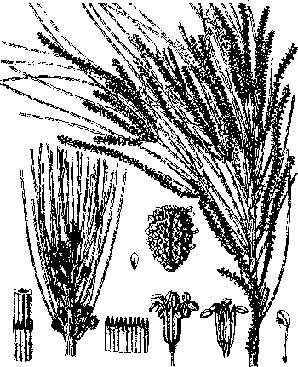
FIGURE
|
| ||||||||||||||||||||||||||||||||||||||||||||||||||||||||||||||||||||
8. Recommendations and Research Needs
The work yet to be done on casuarinas challenges researchers in many parts of the world and in disciplines such as botany, forestry, soil science, microbiology, ecology, and etanobotany. For philanthropic institutions, foundations, and international development agencies concerned with problems of fuel, fiber, and other resources, casuarina research presents an area worthy of financial support.
Specific research needs and recommendations follow.
ASSESSMENT OF GENETIC RESOURCES
In the past, the introduction of casuarinas has been made haphazardly, without regard to relationships between species, provenances, and site requirements. Yet there is much genetic diversity within the broad group of casuarinas and within individual species. It is now important to learn about this diversity and to broaden the genetic base of casuarina plantations. The time has come to make extensive field collections, with a view to selecting species and individual plants with the greatest potential for specific sites and purposes.
In particular, it is important to establish seed collections and to study populations from many and diverse provenances. Almost all seeds so far distributed have come from southern Australia. Species from the Pacific Islands and more tropical areas have been little used, nor have their populations been studied. Few of the many species of Western Australia have been collected, studied, or tested elsewhere. Because so many casuarinas are native to Australia, it is clear that much of the research on the genetic resources will be done there and will be crucial for casuarina development in the rest of the world.
Assessment of genetic resources should include:
· Accurate mapping of worldwide distribution;
·
Seed collections of known species from identified provenances;
·
Assessment of the importance of hybridization, both natural and experimental;
and
· Seed distribution and genetic-information exchange.
COOPERATIVE WORLDWIDE PLANTATION TRIALS
Commercial experience with casuarinas is restricted to a small number of species planted randomly throughout the tropics. It is now imperative to establish a series of carefully planned and replicated plantation trials at selected sites throughout the tropical and subtropical world to allow comparisons of growth and performance. A common methodology should be used at each trial location. Sites for the trials should be selected that test the responses of various species to different soils, altitudes, latitudes, temperatures, moisture levels, and pests. Information from the trials, brought together for assessment and comparison, will provide the technical foundation to enable rational choices about the establishment of large casuarina plantations under the most favorable conditions.
This effort in international scientific cooperation will require a coordinator with sufficient funding to collect and distribute seeds, to establish contact and maintain correspondence with research groups, and, ultimately, to collect data and publish results of the trials.
SILVICULTURAL RESEARCH
Information available in the published literature, though suggesting a promising future for casuarinas, is insufficient to support recommendations for the immediate establishment of large plantations throughout the tropics and subtropics. Much of the information still needed must come from carefully planned and coordinated silvicultural trials. However, basic research in a number of areas can make future forestation efforts more effective, less expensive, and more widely applicable.
Silvicultural research on casuarina species is needed in the following areas:
· Phenology of flowering and fruiting;
· Methods of
seed storage, especially of tropical species;
· Nutrient requirements,
including microbial interactions;
· Methods of establishing plantations,
including planting densities and cluster planting;
· Methods of
vegetative propagation from mature superior trees, including the influence of
tree age, sex, and type of cuttings, the use of hormone treatments, potential of
tissue culture and of air-layering;
· Intercropping with other tree
crops such as Eucalyptus for biomass, timber, or pulp and of interplanting with
agricultural field crops;
· Coppice cropping and root
suckering;
· Fire tolerance and regeneration after fire;
·
Photosynthetic effectiveness, including effects of stress;
·
Investigation of potential plant pathogens, nematodes, and other plant pests;
and
· Accurate measurements of growth and productivity of casuarinas.
Casuarinas are pioneer species with the ability to establish and persist on poor sites. They exhibit capacities to flourish under stressed environments that include extremes of soil acidity and salinity, water stress (both flooding or drought), high temperatures, and other adverse conditions. Physiological studies of these tolerances will make possible the best use of the genetic capacities within the group.
MICROBIOLOGICAL RESEARCH
Specific research needs into the casuarinas' symbioses include the following:
· Isolation and culture of Frankia strains, optimum methods
of inoculation and nodule establishment, and combinations that most effectively
boost symbiotic nitrogen fixation;
· Vegetative propagation of trees
selected on the basis of their ability to nodulate and fix nitrogen;
and
· Identification of mycorrhizal fungi, as well as development of
inoculation methods and analysis of phosphorus and micronutrient requirements of
casuarinas.
UTILIZATION RESEARCH
Examples of research areas needed on casuarina utilization include:
· The design and planning of shelterbelts;
·
Methods of improving land stabilization and controlling erosion;
· Use
of casuarinas for biomass plantations;
· Methods for making pulp and
particle board from casuarina wood; and
· Conversion of casuarina wood
to firewood and charcoal.
RESEARCH ON OTHER SPECIES
This report has highlighted 18 of the 67 species of casuarina. Among the remainder are species certain to be just as valuable as those we describe here - they are merely less we's known. These species offer interesting research challenges to botanists and foresters.
Species worth particular study include the following:
· Casuarina collina A little-known tree native to New
Caledonia. It seems to have properties similar to those of Casuarina glauca, but
it occurs in more humid and tropical areas. It is well worth more-widespread
testing.
· Casuarina grandis Often larger than Casuarina cunninghamiana
(to 50-60 m), but commonly 35-40 m. This tree is closely related to Casuarina
cunninghamiana and Casuarina junghuhniana. It is known only from southeastern
Papua New Guinea from near Tufi in the Northern Province to the Gwariu River in
the Milne Bay Province. It forms dense stands along rivers, regenerating on
gravel banks and other open sites, possibly partly from root suckers.
·
Casuarina papuana One of the most attractive species. It makes an excellent
ornamental in Hawaii and has pleasing foliage display and red adventitious root
masses on the trunk. A medium-sized tree native to Papua New Guinea, it is found
at low altitudes and is also scattered in the Highlands. It grows mostly on
rocky creek banks or in secondary forests on ridges. The species is useful
because it can grow on poorer soils than Casuarina oligodon and tolerates a wide
range of rainfall and temperatures in the country. It is used mostly as firewood
but can also be used for heavy construction (usually in the round), tool
handles, shuttles, charcoal, and pilings permanently submerged in fresh water.
The tree grows to 30 m with dark open crown composed of tufted branches; its
branchlets are not obviously drooping. It grows commonly in hill and mountain
upland areas, notably on poor or variously nutrient-imbalanced soils, but it may
also occur along rocky river banks and on top of limestone hills and pinnacles.
It is restricted to the Moluccas and New Guinea. The tree is often cultivated,
both in villages and in towns; it is known in New Guinea Pidgin as "Hat
Yar."
· Casuarina nobilis Tree reaches at least 25 m, with slender bole,
growing in various types of forest and bush, usually on nutrient-poor or
unbalanced soils. It has been reported by Whitmore and others working on Borneo
vegetation as occurring in heath forest (kerangas), peat-swamp forest, forest on
ultramafic rocks, and on limestone hills and pinnacles. It has, when young, a
bushier habit that Casuarina papuana. It is found in Borneo and New Guinea and
is cultivated in towns and settlements (for instance, Kepong, West Malaysia, and
Lae, Papua New Guinea).
· Casuarina rumphiana Found in Moluccas,
Celebes, and Philippines, in mountain forests, 10-14 m high. It is a
slow-growing species. The tree grows to 20-25 m with large open crowns when
mature. The "needles" have a tendency to drop somewhat and not to form tufts as
bushy as those of Casuarina papuana and Casuarina sumatrana. It grows on dry
fire-prone slopes, limestone hills, and volcanic blast areas from low elevations
to about 1,000 m. It is a common local tree and is perhaps "encouraged" in
villages. On the karstic Lelet Plateau in New Ireland all trees of this species
form a striking feature of the landscape, sometimes giving a park-like aspect on
the limestone hills. It is the characteristic upland casuarina of New Britain,
as well as New Ireland, the Philippines, Moluccas, and the Bismarck Archipelago.
It was originally described by Rumphius in the 17th century.
· Casuarina
sumatrana A moderately large tree up to 30 m tall with a clear cylindrical bole.
It occurs in heath forest in Borneo on very poor, acid soils from sea level to
1,000 m. It grows quickly and has been planted as a fuelwood crop in Sarawak. It
produces a very high grade of charcoal and is a popular ornamental tree. The
wood seasons well with little degrade. Nodules were found on all 72 trees
examined in Bogor. It is slow growing. The tree grows to 30 m with crowns
similar to those of Casuarina papuana, but its cones are about twice the size.
In Papua New Guinea it is only known from one locality where it grows in swamps
mixed with sago palms, but records from Irian Jaya suggest it also grows in
nutrient-poor upland areas. The trunk has better form than that of Casuarina
papuana; in swamps it may be stilt-rooted. It is found in Burma, Sumatra, Java,
Borneo, Celebes, Philippines, western Irian Jaya, and New Britain. It is also
cultivated in towns and settlements (for example, Kepong, West
Malaysia).
· Casuarina deplancheana An efficient colonizer of
ferrallitic soils in New Caledonia. It is resistant to fire. Both
endomycorrhizae and nitrogen-fixing nodules with Frankia have been identified on
its roots.
· Casuarina spicigera Grows to perhaps 20 m along rocky banks
of lowland rivers, like Casuarina grandis (see above). The crowns are fairly
open. It is restricted to the northern side of the north coast ranges of Papua
New Guinea and also to the Van Rees range of Irian Jaya. The tree is locally
cultivated, for example, at Vanimo in Papua New Guinea.
DISSEMINATION OF INFORMATION
The panel recommends that casuarina researchers undertake to publish three documents:
1. A field guide to the identification of members of the family
Casuarina and hybrids between them. This is an urgent task if confusion and
wasted effort are to be avoided as researchers in various parts of the world
begin work with the different species.
2. Planting guides. Handbooks should
be published with practical, step-by-step information on propagating, planting,
managing, and utilizing the plants.
3. A newsletter. In exploring the
potential of casuarinas as useful crops, it will be important to maintain
communication among researchers working with the plants. Since these researchers
are likely to be situated in far-flung research stations, universities,
missions, and villages, their findings may not be widely noted in technical
journals. A newsletter would bring together results from botany and forestry
science, would provide rapid exchange of information, and would be a forum for
informal opinions, observations, and preliminary experimental data that are
usually not accepted by
journals.
|
| ||||||||||||||||||||||||||||||||||||||||||||||||||||||||||||||||||||
Appendix A
Selected Readings
A report that complements this one is: Midgley, S. J., J. W.
Turnbull, and R. D. Johnston. 1983. Casuarina Ecology, Management and
Utilization. Proceedings of an International Workshop. Canberra, Australia,
August 17-21, 1981. Commonwealth Scientific and Industrial Research
Organization, Melbourne, Victoria, Australia. 286 pp.
Copies are available
from: Division of Forest Research, CSIRO, P.O. Box 4008, Canberra, A.C.T. 2600,
Australia.
A newsletter that keeps up with research developments on casuarina
is published by the Casuarina Working Group of the International Union of
Forestry Research Organizations. Copies are available from: M. H. El-Lakany,
Department of Forestry, Faculty of Agriculture, University of Alexandria,
Egypt.
A bibliography containing 447 casuarina references, with annotation,
was prepared for an International Meeting on Casuarina, Canberra, August 17-21,
1981, by Heather Howard, Division of Forest Research, CSIRO. The following is a
selection from the bibliography.
GENERAL
Burkill, 1. H. 1966. A Dictionary of the Economic Products of
the Malay Peninsula. Governments of Malaysia and Singapore by the Ministry of
Agriculture and Cooperatives, Kuala Lumpur, Malaysia.
Conover, C. A., and E.
W. McElwee. 1971. Selected Trees for Florida Homes. Florida Cooperative
Extension Service Bulletin 182. Institute of Food and Agricultural Sciences,
University of Florida, Gainesville, Florida, USA. 77 pp.
Little, E. L., Jr.,
and F. H. Wadsworth. 1964. Common Trees of Puerto Rico and the Virgin Islands.
Agricultural Handbook No. 249. Forest Service, U.S. Department of Agriculture,
Washington, D.C., USA. 548 pp.
Maiden, J. H. 1889. The Useful Native Plants
of Australia (facsimile edition of the 1889 edition,) produced by Compendium
Pty, Ltd., Melbourne, Victoria, Australia, 1975.
Midgley,S. J., J. W.
Turnbull, and R. D. Johnston. 1983. Casuarina Ecology Management and
Utilization. Proceedings of an International Workshop, Canberra, Australia,
August 17-21, 1981. Commonwealth Scientific and Industrial Research Organization
Melbourne, Victoria, Australia. 286 pp.
Rhoads, A. H. 1952. The
destructiveness of Clitocybe root rot to plantings of casuarinas in Florida.
Lloyda 15(3):161,184.
Schubert, T. H. 1979. Trees for urban use in Puerto
Rico and the Virgin Islands. General Technical Report S0-27. Forest Service,
U.S. Department of Agriculture, Washington, D.C., USA. 91 pp.
Watt, G. 1889.
A Dictionary of the Economic Products of India. Printed by the Superintendent of
Government Printing, Calcutta, India.
SOIL AND SYMBIOSES
Diem, H. G., D. Gauthier, and Y. R. Dommergues. 1983.
Inoculation of Casuarina using a pure culture of Frankia. Nitrogen Fixing Tree
Research Reports 1:18-19.
Diem, H. G., D. Gauthier, and Y. Dommergues. In
Press. An effective strain of Frankia from Casuarina sp. Canadian Journal of
Botany.
Dommergues, Y. 1963. Evaluation du taux de fixation de l'azote dans
un sol dunaire reboise en Filao [Nitrogen-fixation rate of a dune soil
afforested with Casuarina equisetifolia.] Agrochimica, Pisa
7(4):335-340.
Analysis of the nitrogen content of a plot at the Cape Verde
peninsula established 13 years earlier showed an addition of 64 kg to the 80 kg
per ha present in the nonafforested soil. Taking into account contribution by
rainwater and losses through leaching, the annual fixation is estimated at 58.4
kg per ha, chiefly by the nodules of Casuarina equisetifolia.
Junor, R. S.
1978. Control of wind erosion on coal ash. Journal of the Soil Conservation
Service of New South Wales 34(1):8-13.
Coal ash from the Lake Tallawarra
power station is sluiced with water from a saline lake and allowed to settle in
large ponds. Once dry, it is subject to water and wind erosion. Acacia decurrens
and Casuarina glauca were successfully planted on a stabilization trial and have
since spread naturally over the site.
Lundquist, R., and J. G. Torrey. In
press. the propagation of Casuarina species from rooted stem cuttings. Botanical
Gazette.
Zhang, Z., M. F. Lopez, and J. G. Torrey. In press. A comparison of
cultural characteristics and infectivity of Frankia isolates from root nodules
of Casuarina species. Plant and Soil.
GENERAL BOTANY
Barlow, B. A. 1959. Chromosome numbers in the Casuarinaceae.
Australian Journal of Botany 7(3):230-237.
Chromosome numbers of 37 species
of Casuarina are reported and found to conform with a suggested division of the
genus into major groups. The extra-Australian species (x = 8 or 9) are probably
ancient. Somatic chromosome numbers from 28 to 20 occur in Australian
stocks.
Narashimhan, M. J. 1918. Preliminary study of the root nodules of
Casuarina. Indian Forester 44:265-268.
Preliminary study of root nodules
showed that Casuarina trees improved sandy soils so much that inland flora
regenerated.
SYSTEMATIC BOTANY
Doran, J. C., and N. Hall. 1981. Notes on fifteen Australian
Casuarina species. Division of Forest Research, CSIRO, Canberra, A.C.T.,
Australia. 34 pp.
Notes are provided for 15 Australian Casuarina species and
subspecies with value or potential for planting. The description of each species
includes a map of geographical distribution and photos showing tree, habit,
"cone," and bark. The main characteristics of each species are
tabulated.
Godfrey, A. L. 1979. Casuarina - the neglected tree. Victoria's
Resources 21(4):31-33, 35. Describes species occurring in Australia and covers
some of their useful qualities.
Johnson, L. A. S. 1982. Notes on
Casuarinaceae II. Journal of the Adelaide Botanic Gardens 6:73-87.
Terry, M.
1941. Desert oak. Australian Timber Journal 7(2):82-83, 85.
A popular account
of Casuarina decaisneana, which is widely distributed in dry sandy country in
south central Australia. It grows 35-50 ft in height and has a tough wood that
is apparently highly resistant to termites.
Treub, M. 1891. Sur les
Casuarinees et leur place dans la systeme naturelle. Annales du Jardin Botanique
de Buitenzorg 10:145-231. Article describing the Casuarina. Text in French. No
English summary.
Troup, R. S. 1921. Order LVII. Casuarinaceae. Casuarina,
Forst. Pp. 900-908 in Silviculture of Indian Trees, R. S. Troup, ed. Clarendon
Press, Oxford, England. Describes distribution, habitat, reproduction, and
plantation methods for Casuarina equisetifolia.
PLANT ECOLOGY
Becking, J. H. 1970. Plant-endophyte symbiosis in non-leguminous
plants. Plant and Soil 32(3):611-654.
This review includes a survey of the
non-leguminous plant species (14 genera of 7 families) that bear root nodules
and are capable of nitrogen fixation. Most of these plants are woody and are
important to the colonization of bare soil. The particular roles of Alnus
glutinosa and Casuarina equisetifolia are described, with quantitative data on
nitrogen fixation.
Dommergues, Y. 1976. Mycorrhizes et fixation d'azote.
[Mycorrhizae and fixation of nitrogen.] Anales de Edafologia y Agrobiologia
35(11/12):1039-1056.
A literature review, drawing attention to the lack of
knowledge about the reasons why nonsymbiotic nitrogen fixation occurs in the
mycorrhizosphere of some plants but not others. Suggests lines for further
research into known cases of tripartite associations between plant host,
nitrogen-fixing bacterium, and mycorrhizal fungus; for example, in
Casuarina.
Gauthier, D., H. G. Diem, and Y. Dommergues. 1981. In-vitro
nitrogen fixation by two actinomycete strains isolated from Casuarina
equisetifolia nodules. Applied and Environmental Microbiology
41(1):306-308.
Lawrie, A. C. 1982. Field nodulation in nine species of
Casuarina in Victoria. Australian Journal of Botany 30(4):447.
Mendoza, V. B.
1978. Adaptability of six tree species to cogonal areas: additional information
on the possible role of phenols and sugars. Sylvatrop 3(1):1-7. A leaching
experiment was conducted to investigate whether lmperata cylindrica produced
compounds that may be harmful to plant growth. Casuarina equisetifolia displayed
the best height growth in Imperata grass.
Torrey, J. G. 1978. Nitrogen
fixation by actinomycete-nodulated angiosperms. BioScience 28(9):586-592.
Describes the infection process in the root system and the ultrastructure of the
hostendophyte relationship. Evaluates the significance of actinomycete-nodulated
plants in providing nitrogen through mixed plantations, succession plantings,
and other forestry management practices.
REGENERATION AND FORMATION OF STANDS
Anonymous. 1954. Research studies: the mountains; shallow loam
problem area. Carribbean Forester 15(1/2):8-9.
Of the trees tested on the
shallow, erodible soils of Puerto Rico, Casuarina equisetifolia displayed the
best growth.
Barr, D. A. 1965. Restoration of coastal dunes after beach
mining. Journal of the Soil Conservation Service of New South Wales
21(4):199-209.
Restoration procedures include stripping, stockpiling, and
replacement of topsoil levering of tailings, and revegetation. After initial
stabilization with brush matting primary stabilizers (grasses) are sown,
followed by secondary stabilizers (creepers and shrubs) and tertiary stabilizers
(trees: Casuarina equisetifolia).
Esbenshade, H. W., and A. Grainger. 1980.
Bamburi reclamation project. International Tree Crops Journal
1(2/3):199-203.
Eighty acres of the Bamburi limestone quarry near Mombasa,
Kenya, have been reclaimed since 1971 and 30,000 trees have been planted.
Conocarpus lancifolia and Casuarina equisetifolia are grown for timber and
fuelwood on the quarry floor. The quarry sides grow fodder for bees and
livestock.
Geary, T. F., and C. B. Briscoe. 1972. Tree species for
plantations in the granitic uplands of Puerto Rico. USDA Forest Service Research
Paper ITF No. 14. Forest Service, U.S. Department of Agriculture, Washington,
D.C., USA. 8 pp.
Gives details of the survival and growth of 32 tree species
tested for adaptability in Puerto Rico's humid granitic uplands, a region of
sandy, well-drained erosive soils. Casuarina equisetifolia is recommended for
post and pole crops.
Husain, A. M. M., and P. K. Ponnuswamy. 1980.
Propagation of Casuarina junghuhniana by planting shoots and root suckers.
Indian Forester 106(4):298-299.Casuarina junghuhniana does not produce seeds, as
the original stock is only male. Therefore, it is essential to propagate only be
vegetative means. This paper describes rooting of sprigs and root suckers
vegetatively.
Karschon, R. 1960. Effects of spacing and irrigation on yield
of eucalypts and Casuarina. La-Yaaran 10(1/4):9-11, 61-58.
Shows the
advantage of wider spacing and irrigation in the production of wood chips,
posts, pulpwood, and poles. With 9-year-old Casuarina spp., irrigation improved
the volume m.a.i. almost twofold.
Karschon, R. 1962. Casuarina introduction
trials (preliminary results). La-Yaaran 12(2):41-43, 69-67.
Some results of
small-scale trials, in Ilanoth and the northern Negev, of 15-16 species of
Casuarina. Most successful are C. cunninghamiana, C. decaisneana, C. fraseriana,
C. glauca, C. Iepidophloia, C. Iuehmanni, and C. torulosa.
Le Roux, P. J.
1974. Establishing vegetation in saline soil to stabilise aeolian sand at Walvis
Bay, South-West Africa. Forestry in South Africa 15:43-46.
Describes the
climate and soil conditions of the area and reports on trial plantings on sand
dunes and saline wet silt since 1970. Casuarina equisetifolia failed on saline
silt and dune sand irrigated with seawater. Casuarina equisetifolia grew well
under irrigation with sewage water.
Maheut, J., and Y. Dommergues. 1959.
Fixation par le reboisement des dunes de la presqu'ile du Cap-Vert et
['evolution biologique des sols. [Sand dune fixation by afforestation on the
Cape Verde peninsula and the biological development of the soil.] Bois et Forets
des Tropiques 63:3-16.
Describes successful afforestation with Casuarina
equisetifolia, including topography, climate, and soils of the site; nursery
techniques, spacing, irrigation, and protection.
Malcolm, C. V., and S. T.
Smith. 1971. Growing plants with salty water. Journal of Agriculture of Western
Australia, Series 4 12(2):41-44.
For those using saline irrigation water,
this article gives some hints on how to reduce salt damage to plants. Includes a
table of plants that may be irrigated with water of specified degrees of
salinity and lists precautions to be taken with each group. Casuarina cristata
and Casuarina glauca are listed.
Mitchell, B. A. 1957. Malayan tin tailings -
prospects of rehabilitation. Malayan Forester 20(4): 181-186.
Describes
conditions to be dealt with and research into possible methods of rehabilitation
and afforestation, as well as improved methods of dumping tin tailings. Species
trials show that Casuarina equisetifolia is promising on very infertile
tailings.
Patro, C., and R. N. Behera. 1979. Cashew helps to fix sand dunes
in Orissa. Indian Farming 28(12):31-32.
An outline of pilot
dune-stabilization and shelterbelt trials with plantations of Casuarina/cashew
and cashew/coconut. Details are given of establishment and tending
methods.
Somasundaram, T. R., and S. S. Jagadees. 1977. Propagation of
Casuarina equisetifotia Forst. by planting shoots. Indian Forester
103(11):735-738.
Although Casuarina equisetifolia is usually produced from
seed, cuttings taken from young lateral shoots, with a heel smeared with Seradix
2 and planted under mist, showed up to 90 percent rooting success (maximum with
July plantings). Shoots without treatment did not survive.
Spurway, B. J. D.
1950. Ru Ronang (Casuarina sumatrana) as a plantation crop. Malaysian Forester
13(2):73-74.
A successful experiment was made in planting wildling seedlings
of Casuarina sumatrana at a spacing of 7 ft x 7 ft in prepared lines. The
seedlings averaged 8 in. from root tip to top shoot, and survival was good. This
species is considered suitable for establishing fuel plantations.
Toth, J.
1965. Aspect forestiere d'une plantation Saharienne. (Forest aspect of a
plantation in the Sahara.) Revue Forestiere Fran�aise
17(10):674-695.
Describes and illustrates the establishment, since 1959, on
coarse and fine sands with pH 8 near the surface of 35 ha of shelterbelts and
amenity blocks in the north Sahara. Casuarina torulosa has been planted as
windbreaks. Propagation by seeds and cuttings, and natural and artificial
regeneration under the plantations, are briefly discussed. van der Westhuyzen,
J. J. N. 1957. Combating sand dunes at Port Edward: trees and shrubs used in
reclamation. Farming in South Africa 33(7):37-39.
Recommendations for the
fixation of sand dunes (probably the result of overgrazing) at Port Edward on
the south coast of South Africa include the control of livestock and the
planting of at least three zigzag rows of Casuarina equisetifolia 4-6 ft apart
and 30-50 yards to windward.
COMBINATIONS OF FORESTRY WITH AGRICULTURE AND PASTORAL HUSBANDRY,
IRRIGATED WOODLAND FORESTS, AND SHELTERBELTS
Anonymous. 1980. Planim diwai yar. [Grow Casuarina.] Mapping
Branch, Office of Forests, Papua New Guinea. 18 pp.
Booklet with
illustrations showing how the indigenous population plant and grow Casuarina
with their other crops.
Badran, O. A., and M. H. El-Lakany. 1978. Breeding
and improving Casuarina for shelterbelt plantations in Egypt. Pp. 573-578 in
Third World Consultation on Forest Tree Breeding, Volume 2. CSIRO, Canberra,
A.C.T., Australia.
In Egypt, and in many countries with no natural productive
forests, Casuarina spp. are receiving increased attention because of their
superiority as windbreaks and their high salt and drought resistance. Gives some
primary results of a program to provide fast-growing, drought-resistant
casuarinas that have desirable stem, crown, and branch
characteristics.
Brockway, G. E. 1959. Tree establishment in the wheatbelt.
Bulletin, No. 2616. Department of Agriculture, South Perth, Western Australia.
21 pp.
Examines the problems of establishing trees, mainly for cover,
recreation, and fodder is semiarid areas in Western Australia. Includes a
comprehensive tabulated planting guide listing requirements and uses of four
Casuarina species.
Leigh, J. H., A. D. Wilson, and W. E. Mulham. 1979. A
study of sheep grazing on a belah (Casuarina cristata)-rosewood (Heterodendum
oleifolium) shrub woodland in western New South Wales. Australian Journal of
Agricultural Research 30:1223-1336.
Koki, Z. 1978. Studies on flying salt in
Okinawa from the viewpoint of seashore conservation. Science Bulletin of the
College of Agriculture, University of the Ryukyus 25:429-554.
As part of a
study on the distribution and effects of wind-borne salt, salt deposition was
measured on various trees. Casuarina equisetifolia with needle-like leaves
collected more salt than the broad-leaved trees examined. It was estimated that
tree shelterbelts should reduce downwind salt deposition by 60 percent, as
compared with 40-50 percent for nets. Text in Japanese.
Morton, J. F. 1976.
Pestiferous spread of many ornamental and fruit species in South Florida.
Proceedings, Florida State Horticultural Society 89:348-353.
The massive
invasion of large tracts of South Florida by Casuarina equisetifolia and other
introduced species is an environmental problem now receiving serious attention.
Further plantings are being discouraged to reduce the maintenance load of
cultivated grounds and the threat to undeveloped areas being overrun by vigorous
alien vegetation.
Sanger, C., G. Lessard, and G. Poulsen. 1977. Trees for
people, an account of the forestry research program supported by the
International Development Research Centre. International Development Research
Centre, Ottawa, Canada. 52 pp.
Describes 10 different projects including
breeding and improvement of Casuarina spp. for shelterbelts in Egypt.
Wilson,
A. D., and W. E. Mulham. 1980. Vegetation changes and animal productivity under
sheep and goat grazing on an arid belah (Casuarina cristata)-rosewood
(Heterodendrum oleifolium) woodland in western New South Wales. Australian
Rangeland Journal 2(2):183-188.
ARBORICULTURE FOR ORNAMENTAL PURPOSES
Garnet, J. R. 1965. Casuarina. Australian Plants
3:185-187.
Descriptions of casuarina as street trees.
Ratnasabapathy, M.
1974/75. Acacia auriculaeformis and Casuarina equisetifolia - the urban
invaders. Malayan Nature Journal 28(1):18-21.
Presents notes on the ecology,
propagation, and pests (relatively few) of these two popular street trees in the
new town of Petaling Jaya, Malaysia, which are also the dominant trees in
pioneer vegetation on disturbed sites in the same area.
Weinstein, A., and G.
Schiller. 1979. Afforestation and tree planting in Sinai. II. Northwestern
Sinai. La-Yaaran 29(1-2):12-16, 32.
A list of species planted in agricultural
and urban settlements between Rajah and El Arish is presented. Casuarina glauca
and Casuarina cunninghamiana are among the ornamental species successfully grown
under irrigation.
FOREST PRODUCTS AND THEIR UTILIZATION
Bawagan, B. O., and A. A. Faulmino. 1978. Qualities of agoho del
monte dissolving pulp. Forpride Digest 7(1):12-17.
A good-quality dissolving
pulp was obtained from Casuarina rumphiana wood using the pre-
hydrolysis-sulfate process. Describes physical and chemical
properties.
Guha,S. R. D., and R. N. Madan. 1963. Chemical pulps for writing
and printing papers from Casuarina equisetifolia. Indian Forester
89(5):365-367.
Laboratory experiments in sulphate pulping of Casuarina
equisetifolia are described. Mean fibre length of the pulp was 1.08 mm and mean
fibre diameter 0.011 mm. Easybleaching pulps in good yield could be prepared,
and the species is regarded as promising raw material for writing and printing
papers.
Guha, S. R. D., Y. K. Sharma, R. Pant, and S. N. Shoundiyal. 1970.
Chemical, semichemical and mechanical pulps from Casuarina equisetifolia. Indian
Forester 96(11):830840.
Laboratory-scale experiments indicate that Casuarina
equisetifolia is a suitable raw material for chemical and semi-chemical pulps.
It is unsuitable for mechanical pulps.
Labate, P. J. 1973. [Industrial use of
the wood of Casuarina.] Folleto Tecnio Forestal No. 32. Instituto Forestal
Nacional, Argentina. 38 pp.
Describes some characteristics of wood of
Casuarina cunninghamiana from three different sources in Argentina and offers
information on the suitability of the wood for flooring, packing cases, and
veneer. Text in Spanish.
FORESTS AND FORESTRY FROM THE NATIONAL POINT OF VIEW
Alston, A. S. 1981. Fiji timbers and their uses. (Available from
Department of Forestry P.O. Box 2218, Suva, Fiji.) 6 pp.
Nolan, C. 1980. Loss
of a treescape - a report from Bermuda. Quarterly Journal of Forestry
74(3):165-176.
An account of the destruction of the natural tree species by
scale insects. Casuarina equisetifolia was successfully used to replace tree
cover quickly, despite insufficient spacing and pruning.
Shatta, H. 1969.
Forestry proceeds in Saudi Arabia. World Wood, San Francisco 10(9):9,28.
A
short, illustrated note on forestry in the less-arid parts of the country. In
trials of exotic trees, Casuarina spp. have shown promising
results.
Williams, L. 1969. Forest and agricultural resources of Dahomey,
West Africa. Economic Botany 23(4):352-372.
The forest resources of Dahomey
have been much reduced by excessive exploitation and clearing for agriculture
and are now sufficient for only 75 percent of the country's domestic
requirements. Casuarina equisetifolia has been found useful as a fuel
species.
|
| ||||||||||||||||||||||||||||||||||||||||||||||||||||||||||||||||||||
Appendix B
Research Contacts
ARGENTINA
L. A. Mendonza, Coordinator, Programa Arboles Forestales, Centro de Investigaciones de
Recursos Naturales - INTA, 1712 Castelar
AUSTRALIA
M. Alexandra, Forester, Australian Seed Co., Box 136, Albert
Park, Victoria 3206
B. A. Barlow, Division of Plant Industry, CSIRO, P.O. Box
1600, Canberra, A.C.T. 2601
D. J. Boland, Division of Forest Research, CSIRO,
P.O. Box 4008, Canberra, A.C.T. 2600
C. J. Borough, Division of Forest
Research, CSIRO, P.O. Box 4008, Canberra, A.C.T. 2600
G. D. Bowen, Division
of Soils, CSIRO, Private Bag No. 2, Glen Osmond, S.A. 5064
M. Chuk, Forestry
Unit, Conservation Commission of Northern Territory, P.O. Box 1046, Alice
Springs, N.T. 5750
D. M. Churchill, Director and Government Botanist, Royal
Botanic Gardens and National Herbarium, Birdwood Ave., South Yarra, Victoria
3141
J. Clemens, Department of Agronomy and Horticultural Science, University
of Sydney, Sydney, N.S.W. 2006
Conservator of Forests, Forests Department,
P.O. Box 104, Como, W.A. 6152
P. D. Coyne, National Parks and Wildlife
Service, P.O. Box 636, Canberra, A.C.T. 2601
G. M. Crowley, Post Office,
James Cook University, Townsville, Queensland 4811
P. Davidson,
Ornithologist, Airports Division, Department of Aviation, P.O. Box 367 Canberra,
A.C.T. 2601
M. F. C. Day, 12 Melbourne Avenue, Deakin, A.C.T.
2600
Department of Forestry, G.P.O. Box 944, Brisbane, Queensland 4001
J.
Doran, Division of Forest Research, CSIRO, P.O. 4008, Canberra A.C.T.
2600
Forest Commission of Victoria, I Treasury Place, Melbourne, Victoria
3002
A. Fleming, Forestry Department, Australian National University, P.O.
Box 4, Canberra, A.C.T. 2600
A. H. Gibson, Division of Plant Industry, CSIRO,
P.O. Box 109, Canberra, A.C.T. 2600
H. Gray, Country Roads Board, Godenmark
St., Kew, Victoria 3101
D. M. Griffin, Forestry Department, Australian
National University, P.O. Box 4, Canberra, A.C.T. 2600
L. A. S. Johnson,
Director, Royal Botanic Gardens, Sydney, N.S.W. 2000
R. D. Johnston, Division
of Forest Research, CSIRO, P.O. Box 4008, Canberra, A.C.T. 2600
A. C. Lawrie,
Department of Applied Biology, R.M.I.T., G.P.O. Box 2476V, Melbourne, Victoria
3001
J. Leigh, Division of Plant Industry, CSIRO, P.O. Box 1600, Canberra,
A.C.T. 2601
T. B. S. Mahat, Forestry Department, Australian National
University, P.O. Box 4, Canberra, A.C.T. 2600
S. J. Midgley, Division of
Forest Research, CSIRO, P.O. Box 4008, Canberra, A.C.T. 2600
N. J. Moore,
Department of Forestry, Australian National University, P.O. Box 4, Canberra,
A.C.T. 2600
H. A. Nix, Division of Land Use Research, CSIRO, P.O. Box 1666,
Canberra, A.C.T. 2601
P. Reddell, Division of Soils, CSIRO, Private Bag No.
2, Glen Osmond, S.A. 5064
J. Redmond, Appraisals and Evaluation Unit,
Australian Development Assistance Bureau, Department of Foreign Affairs, P.O.
Box 887, Canberra, A.C.T. 2601
I. Riley, School of Environmental and Life
Sciences, Murdoch University, Murdoch, W.A. 6153
J. Saunders, Division of
Land Use Research, CSIRO, P.O. Box 1666, Canberra, A.C.T. 2601
K. R.
Shepherd, Forestry Department, Australian National University, P.O. Box 4
Canberra, A.C.T. 2600
W. A. Shipton, Botany Department, James Cook
University, Townsville, Queensland 4811
Tasmanian Forestry Commission, P.O.
Box 207B, Hobart, Tasmania 7001
J. W. Turnbull, Division of Forest Research,
CSIRO, P.O. Box 4008, Canberra, A.C.T. 2600
K. B. Walsh, Department of
Botany, University of Queensland, St. Lucia, Queensland 4067
Wood Technology
and Forest Research Division, Forestry Commission of New South
Wales, P.O.
Box 100, Beecroft, N.S.W. 2119
BANGLADESH
M. Omar Ali, Director, Forest Research Institute, Forestdale, P.O. Box 273, Chittagong
BENIN
A. G. Agbahungba, Unit� de Recherche Foresti�re, B.P. 884, Cotonou
CANADA
O. Sziklai, Faculty of Forestry, University of British Columbia,
Vancouver, B.C. V6T 1W5
L. G. Lessard, Associate Director, Forest Science,
IDRC, P.O. Box 8500, Ottawa, K1G 3H9
CHINA
Pan Chih-kang, Chinese Academy of Forestry, Wan Shou Shan,
Beijing 100091
Zhu Zhi-Song, Deputy Director, Forest Research Institute,
Shahe, Guangzbou, Guangdon
EGYPT
Adly Bishay, American University in Cairo, Desert Development
Project, 113 Sharia Kasr El-Aini, Cairo
M. H. El-Lakany, Department of
Forestry, Faculty of Agriculture, University of Alexandria, El-Shatby,
Alexandria
M. A. Haikel, Horticulture Research Institute, Cairo University
St., Giza, Cairo
S. A. E. Kandeel, Department of Forestry and Wood
Technology, University of Alexandria, El-Shatby, Alexandria
M. M. Megahed,
Department of Forestry, Faculty of Agriculture, University of Alexandria,
El-Shatby, Alexandria
T. A. Omran, Department of Forestry, Faculty of
Agriculture, University of Alexandria, El-Shatby, Alexandria
M. M. Youness,
Department of Forestry, Faculty of Agriculture, University of Alexandria,
El-Shatby, Alexandria
FRANCE
Centre Technique Forestier Tropical, 45 bis Avenue de la Belle-Gabrielle, 94130 Nogentsur-Marne
INDIA
M. Stephen Duraivaj, Associate Professor, Department of
Agriculture Botany, Tamil Nadu Agricultural University, Coimbatore 641003, Tamil
Nadu
R. Jambulingam, Associate Professor of Forestry, Faculty of
Horticulture, Tamil Nadu Agricultural University, Coimbatore 641003, Tamil
Nadu
S. Kondas, Managing Director, Tamil Nadu Forest Plantation Corporation
Ltd., No. 4, Promenade Road, Cantonment, Tiruchirapalli 620001, Tamil Nadu
R.
S. Mathur, Director, Forestry Research Institute and Colleges, New Forest P.O.,
Dehra Dun, Uttar Pradesh
J. S. P. Yadav, Director, Central Soil Salinity
Research Institute, Karnal 132001, Haryana
INDONESIA
Syafii Manan, Senior Lecturer, Faculty of Forestry, Bogor Agricultural University, Bogor
ISRAEL
A. Weinstein, Forestry Division, Agricultural Research
Organisation, llanot, Doar Na Lev Hasharon 42805
Y. Zohar, Agricultural
Research Organisation, Forestry Division, llanot, Doar Na Lev Hasharon 42805
KENYA
Ren� de Haller, Baobab Farms Ltd., P. O. Box 90202,
Mombasa
P. A. Huxley, ICRAF, P.O. Box 30677, Nairobi
P. K. Arap Konuche,
Silviculturist, Forest Department, P.O. Box 74, Kikuyu
P. K. R. Nair, Senior
Scientist, ICRAF, P.O. Box 30677, Nairobi
K. Oka, IDRC Regional Office, P.O.
Box 30677, Nairobi
MALAYSIA
Director, Forest Research Institute, Kepong, Selangor
NIGERIA
Forestry Research Institute of Nigeria, P.M.B. 5054, Ibadan
PAKISTAN
M. Ahmed, Department of Botany, University of Karachi,
Karachi-32
A. H. Chaudhary, Associate Professor, Department of Biological
Sciences, Quaid-I-Azam University, Islamabad
PAPUA NEW GUINEA
A. Allison, Wau Ecology Institute, Box 77, Wau
A. Bryon,
Environmental Science Council, Port Moresby
Chief Research Of ficer,
Management Research Branch, Office of Forests, Boroko
K. Thiagalingam, Senior
Lecturer, Faculty of Agriculture, P.O. Box 32O, University of Papua New Guinea,
Port Moresby
THE PHILIPPINES
R. B. Aspiras, BIOTECH, University of the Philippines at Los
Banos, College. Laguna 3720
S. C. Halos, Chief, Science Research Specialist,
Forest Research Institute, College, Laguna 3720
B. N. Ganguli, Senior
Forestry Specialist, Asian Development Bank, P.O. Box 789, Manila 2800
SAUDI ARABIA
M. L. El-Osta, Department of Plant Production, College of Agriculture, King Saud University, P.O. Box 246O, Riyadh
SENEGAL
Y. Dommergues, Office de la Recherche Scientifique et Technique
Outre Mer, Centre
Ostrom de Dakar, B.P. No. 1386, Dakar
N. A. Moctar,
Direction des Eaux et Foret, Parc Forestier de Hann, B.P. 1831, Dakar
SOUTH AFRICA
R. J. Poynton, South African Forestry Research Institute, P.O. Box 727, Pretoria 0001
SPAIN
C. Rodriguez-Barrueco, Unit of Nitrogen Fixation, C.S.I.C., Aptdo. 257, Salamanca
SWEDEN
M. Zumer-Linder, Department of Ecology and Environmental
Sciences, Swedish
University of Agriculture, 75007 Uppsala
SRI LANKA
K. Vivekanandan, Research Division, Forest Department, P.O. Box 509, Colombo 2
TANZANIA
J. E. Maphole, Arid Zone Afforestation Research, P.O. Box 840,
Dodoma
I. M. Shehaghilo, Forest Division, Silvicultural Research Station,
P.O. Box 95, Lushoto
THAILAND
Pravit Chittachumnonk. Division of Silviculture, Royal Forest Department, Bangkok 10900
TUNISIA
Mohamed Charfi, Institut National de Recherche Foresti�res, B.P. 2, Ariana
URUGUAY
R. Pou Ferrari, Forestry Department, Universidad de la Republica, Avda 18 de Julio 1968, Montevideo, Uruguay
USA
J. L. Brewbaker, NFTA, Box 680, Waimanalo, Hawaii 96795
C. B.
Davey, Department of Forestry, North Carolina State University, Raleigh, North
Carolina 27650
H. W. Esbenshade, International Tree Crops Institute, USA,
P.O. Box 665, Winters, California 95694
T. F. Geary, USDA Forest Service, P.O. Box 2417, RPE, 606A,
Washington, D.C. 20013
Hawaii Division of Forestry and Wildlife, Department
of Land and Natural Resources, 1151
Punchbowl Street, Room 325, Honolulu,
Hawaii 96813
R. K. Hermann, School of Forestry, Oregon State University,
Corvallis, Oregon 97331
W. Jones, Landscape Architecture Program, Bioscience
East, University of Arizona, Tucson, Arizona 85721
W. S. Silver, Department
of Biology, University of South Florida, Tampa, Florida 33620 (Florida
casuarina)
R. G. Skolmen, Institute of Pacific Islands Forestry, 1151
Punchbowl Street, Honolulu, Hawaii 96813
J. G. Torrey, Professor of Botany,
Cabot Foundation, Harvard University, Petersham, Massachusetts 01366
R. Van
den Beldt, Department of Horticulture, University of Hawaii at Manoa, Honolulu,
Hawaii 96822
ZIMBABWE
L. J. Mullin, Forest Research Center, P.O. Box HG 595, Highlands, Harare
|
| ||||||||||||||||||||||||||||||||||||||||||||||||||||||||||||||||||||
Advisory Committee on Technology Innovation
HUGH POPENOE, Director, International Programs in Agriculture, University of Florida, Gainesville, Florida, Chairman
Members
WILLIAM BRADLEY, Consultant, New Hope, Pennsylvania
HAROLD
DREGNE, Director, International Center for Arid and Semi-Arid Land Studies,
Texas Tech University, Lubbock, Texas (member through 1981)
ELMER L. GADEN,
JR., Department of Chemical Engineering, University of Virginia,
Charlottesville, Virginia
CARL N. HODGES, Director, Environmental Research
Laboratory, Tucson, Arizona
CYRUS MCKELL, Native Plants, Inc., Salt Lake
City, Utah
FRANCOlS MERGEN, Pinchot Professor of Forestry, School of Forestry
and Environmental Studies, Yale University, New Haven, Connecticut (member
through 1982)
DONALD L. PLUCKNETT, Consultative Group on International
Agricultural Research, Washington, D.C.
THEODORE SUDIA, Deputy Science
Advisor to the Secretary of Interior, Department of Interior, Washington,
D.C.
|
| ||||||||||||||||||||||||||||||||||||||||||||||||||||||||||||||||||||
Board on Science and Technology for International Development
GEORGE BUGLIARELLO, President, Polytechnic Institute of New York, Brooklyn, New York, Chairman
Members
SAMUEL P. ASPER, Educational Commission for Foreign Medical
Graduates, Philadelphia, Pennsylvania
DAVID BELL, Department of Population
Sciences, Harvard School of Public Health, Boston, Massachusetts
LEONARD
BERRY, Professor, Graduate School of Geography, Clark University, Worcester,
Massachusetts
ERNEST J. BRISKEY, Dean, School of Agriculture, Oregon State
University, Corvallis, Oregon
HARRISON S. BROWN, Director, Resources Systems
Institute, East-West Center, Honolulu, Hawaii
ROBERT H. BURRIS, Department of
Biochemistry, University of Wisconsin, Madison, Wisconsin
CLAUDIA JEAN CARR,
Associate Professor, Conservation and Resource Studies, University of California
at Berkeley, Berkeley, California
NATE FIELDS, Director, Developing Markets,
Control Data Corporation, Minneapolis, Minnesota
ROLAND J. FUCHS, Chairman,
Department of Geography, University of Hawaii at Manoa, Honolulu,
Hawaii
ELMER L. GADEN, JR., Department of Chemical Engineering, University of
Virginia, Charlottesville, Virginia
JOHN HOWARD GIBBONS, Director, U.S.
Congress, Office of Technology Assessment, Washington, D.C.
N. BRUCE HANNAY,
Foreign Secretary, National Academy of Engineering, Washington, D.C.
WILLIAM
HUGHES, Director, Engineering Energy Laboratory, Oklahoma State University,
Stillwater, Oklahoma
WILLIAM A. W. KREBS, Vice President, Arthur D. Little,
Inc., Acorn Park, Cambridge, Massachusetts
GEORGE I. LYTHCOTT, University of
Wisconsin, School of Medicine, Madison, Wisconsin
JANICE E. PERLMAN,
Executive Director, Committee for a New New York, New York City Partnership, New
York, New York
HUGH POPENOE, Director, International Programs in Agriculture,
University of Florida, Gainesville, Florida
FREDERICK C. ROBBINS, President,
Institute of Medicine, National Academy of Sciences, Washington, D.C.
WALTER
l:. ROSENBLITH, Foreign Secretary, National Academy of Sciences, Washington,
D.C.
FREDERICK SEITZ, President Emeritus, The Rockefeller University, New
York, New York
RALPH HERBERT SMUCKLER, Dean of International Studies and
Programs, Michigan State University, East Lansing, Michigan
GILBERT F. WHITE,
Institute of Behavioral Science, University of Colorado, Boulder,
Colorado
BILL C. WRIGHT, Assistant Dean for International Programs, Oklahoma
State University, Stillwater, Oklahoma
JOHN G. HURLEY, Director
MICHAEL G.
C. McDONALD DOW, Associate Director/Studies
MICHAEL P. GREENE, Associate
Director/Research Grants
The National Academy of Sciences
The National Academy of Sciences was established in 1863 by Act of Congress as a private, nonprofit, self-governing membership corporation for the furtherance of science and technology, required to advise the federal government upon request within its fields of competence. Under its corporate charter the Academy established the National Research Council in 1916, the National Academy of Engineering in 1964, and the Institute of Medicine in 1970.
The National Research Council
The National Research Council was established by the National Academy of Sciences in 1916 to associate the broad community of science and technology with the Academy's purposes of furthering knowledge and of advising the federal government. The Council operates in accordance with general policies determined by the Academy under the authority of its congressional charter of 1863, which establishes the Academy as a private, nonprofit, self-governing membership corporation. The Council has become the principal operating agency of both the National Academy of Sciences and the National Academy of Engineering in the conduct of their services to the government, the public, and the scientific and engineering communities. It is administered jointly by both Academies and the Institute of Medicine. The National Academy of Engineering and the Institute of Medicine were established in 1964 and 1970, respectively, under the charter of the National Academy of Sciences.
The Office of International Affairs
The Office of International Affairs is responsible for many of the international activities of the Academy and the Research Council. Its primary objectives are to enhance U.S. scientific cooperation with other countries; to mobilize the U.S. scientific community for technical assistance to developing nations; and to coordinate international projects throughout the institution.
The Board on Science and Technology for International Development
The Board on Science and Technology for International Development (BOSTID) of the Office of International Affairs addresses a range of issues arising from the ways in which science and technology in developing countries can stimulate and complement the complex processes of social and economic development. It oversees a broad program of bilateral workshops with scientific organizations in developing countries and conducts special studies. BOSTID's Advisory Committee on Technology Innovation publishes topical reviews of unconventional technical processes and biological resources of potential importance to developing countries.