 |
| ||||||||||||||||||||||||||||||||||||||||||||
|
| ||||||||||||||||||||||||||||||||||||||||||||
Institut f�r berufliche Entwicklung e.V.
Berlin
Original title:
Arbeitsmaterial f�r den Lernenden
“Stiftverbindungen”
Author: Frank Wengh�fer
First edition © IBE
Institut f�r berufliche Entwicklung e.V.
Parkstra�e
23
13187 Berlin
Order No.: 90-35-3132/2
|
| ||||||||||||||||||||||||||||||||||||||||||||
Preliminary Remarks
This material has been drawn up for the training in occupations which require a good command of assembling work, as well as basic knowledge of manual and mechanical techniques of metal working.
This material contains descriptions of the types of different joints which can be made with pins and considers these in the context of their technical function.
The main steps of making and undoing pinned joints are also described.
The questions at the end of each section are intended to help the trainees check their acquired knowledge.
|
| ||||||||||||||||||||||||||||||||||||||||||||
Hints on Labour Safety
Generally, for accident and damage prevention those labour safety rules are valid which are also binding on the techniques of boring, drilling, countersinking and reaming. The following points, however should be emphasized:
- Use only clean, undamaged and sharp tools.- Use hammers and punches that are in proper condition.
- Clamp workpieces securely and tightly. But never apply excessive pressure. This may damage the work.
- Drive in pins only when the component parts are securely clamped and cannot slip.
- When loosening a pinned joint, rest the workpiece on a suitable support which does not allow the components to slip.
- Put all measuring and testing means down at their proper places. Use pads, supports and the like, in order to protect them against impact, shock and corrosion.
- It is regarded as good workmanship to keep one’s workplace tidy and in good order and always to place individual parts next to their matching components.
|
| ||||||||||||||||||||||||||||||||||||||||||||
1. The Purpose of Pinned Joints
Pinned joints are detachable joints consisting of two or more individual component parts with latter being connected with each other in different was, by means of standardized fasteners, such as pins.

Figure 1 Pinned joint
1 pin, 2 wheel, 3 shaft
Pinned joints are made, in order
- to keep the component parts in a desired position to each another,
- to prevent the component parts from accidental loosening,
- to protect the component parts from overloads,
- to produce firm and tight joints of component parts,
- to produce joints for rotary motions.
Pins are also used to produce hinged connections, hold springs or limit the path of a moving part.
What are pinned
joints?
__________________________________________________________________________
__________________________________________________________________________
__________________________________________________________________________
|
| ||||||||||||||||||||||||||||||||||||||||||||
2. Types of Pins
Pins should be harder than the component parts which they join. Pins which are not supposed to wear should be hardened.
- Cylindrical pins
Cylindrical pins are made of bright-drawn constructional steel having tensile strength of approximately 500 MPa.
Cylindrical pins which are not hardened will be deformed permanently and cannot be used again.
There are different types of cylindrical pins. Some are hardened, some are not. There are two grades of unhardened pins with different tolerance zones, viz. m 6 and k 9. Outwardly you can know them by the shapes of their heads. A close fit of pins can be achieved by reaming the bore hole.
Sample designation: Cylindrical pin Æ 6 m 6 × 20
- Nominal diameter 6 mm
- Tolerance zone m 6
- Pin length 20 mm
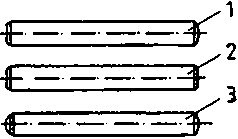
Figure 2 Cylindrical pins
1 with ISA tolerance zone m 6, 2 with ISA tolerance zone h 9, 3 with ISA tolerance zone m 6-hardened
- Taper pins
Taper pins are generally made of mild steel having tensile strength of approximately 500 MPa. Taper pins can be used several times. Their taper per unit length is mostly 1: 50. Most taper pins are inserted into tapered holes to provide safe and firm pinning. The tapered hole (which has a taper per unit length of 1:50) is produced with a taper reamer. The nominal diameter of a taper pin is measured at its narrow end. Some taper pins have external or internal threads at their opposite end.
Sample designation: Taper pin Æ 6 × 20
- Nominal diameter 6 mm (at thin end)
- Taper pin length 20 mm

Figure 3 Tapered pins (1: 50)
1 standard design, 2 pin with internal thread
- Grooved pins
Grooved pins are made of blank-drawn steel having tensile strength of 600 to 700 MPa. Grooved pins have three grooves arranged lengthwise at distances of 120 degrees along the circumference. Different types of grooved pins are known by the shape of their grooves.
Grooved pins are driven into simple, unreamed bore holes. A tight fit is obtained by the deformation of the edges along the grooves. Grooved pins can be used as many as 20 times.
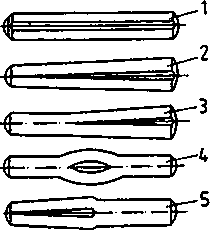
Figure 4 Grooved pins
1 cylindrical grooved pin, 2 grooved taper pin, 3 close-tolerance grooved pin, 4 center-grooved dowel pin, 5 half length reserve taper grooved dowel pin
- Grooved drive studs
Grooved drive studs are a special variety of grooved pins. They are made of steel having tensile strength of about 400 MPa, or of copper, brass or light metal. Grooved drive studs are identified by the shape of their heads.
Sample designations: Grooved drive stud, round head Æ 4 × 20
- Nominal diameter 4 mm
- Length without the head 20 mm
Grooved drive stud, countersunk Æ 4 × 20
- Nominal diameter 4 mm
- Length with the head 20 mm

Figure 5 Grooved drive studs
1 grooved drive stud, round head, 2 grooved drive stud, countersunk
- Dowel pins (taper sleeve)
Dowel pins are made of rolled and hardened spring steel strip. They have very high strength. Oversize dowel pins are driven into simple bore holes where they respond to elastic shocks.
Dowel pins can be used as often as needed.

Figure 6 Dowel pin
Name the main types of pins
used.
__________________________________________________________________________
__________________________________________________________________________
__________________________________________________________________________
|
| ||||||||||||||||||||||||||||||||||||||||||||
3. Types of Pinned Joints
Pinned joints are specified below as to the function the pin serves in a joint.
- Pinned joint for fastening
Pinned joints for fastening hold together two or more component parts without frictional connection. A good example of a pinned joint for fastening is a toothed wheel on a shaft where only low torques are to be transmitted. All types of pins can be used in joints for fastening.
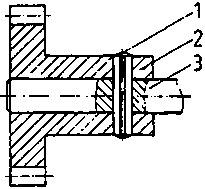
Figure 7 Pinned joint for
fastening
1 pin, 2 gear wheel, 3 shaft
- Pinned joint for driving
One part of a machine drives another part, such as in switchgears or couplings which are shifted when at rest. Cylindrical pins, close-tolerance grooved pins and dowel pins can be used in joints for driving.
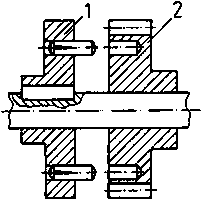
Figure 8 Pinned joint for
driving
1 fixed component (feather key joint) with drive pins, 2 driven component
- Pinned joint for holding
Pinned joints of this type hold one component part to another component part. Cylindrical pins and grooved pins can be used in joints for holding.

Figure 9 Pinned joint for
holding
1 holding pins with spring, 2 movable part, 3 fixed part
- Pinned joint for swivelling
Pinned joints of this type connect two or more movable or rotary component parts. Cylindrical pins, grooved cylindrical pins and center-grooved dowel pins can be used in joints for swivelling.
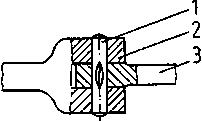
Figure 10 Pinned joint for
hinging
1 hinge pin, 2 hinged component I, 3 hinged component II
- Pinned joint for fitting
Pinned joints of this type fix two component parts in a definite position relative to one another. Taper pins, close-tolerance grooved pins and cylindrical pins can be used in joints for fitting.

Figure 11 Pinned joint for
fitting
1 screwed joint of the three component parts, 2 fitting pins, 3 component part I (lid), 4 component part II (spacer ring), 5 component part III (casing)
- Pinned joint for securing
Pinned joints of this type prevent parts of machines from becoming loose inadvertently under dynamic loads (vibration). Cylindrical pins, taper pins and grooved pins can be used in joints for securing.

Figure 12 Pinned joint for
securing
1 securing pin, 2 screw, 3 component part I, 4 component part II
- Pinned joint for shearing
Pinned joints of this type secure parts of machines which are connected directly with each other, from overloads. The pin in the joint will break when the load becomes too heavy. Thus, the component parts of the joint will not be damaged. Cylindrical pins can be used in joints for shearing.

Figure 13 Pinned joint for
shearing
1 shearing pins, 2 shaft I, 3 sleeve, 4 shaft II
How are pinned joints
specified?
__________________________________________________________________________
__________________________________________________________________________
__________________________________________________________________________
What types of pinned joints are
produced?
__________________________________________________________________________
__________________________________________________________________________
__________________________________________________________________________
What is typical of a pinned joint for
holding?
__________________________________________________________________________
__________________________________________________________________________
__________________________________________________________________________
What is typical of a pinned joint for
fitting?
__________________________________________________________________________
__________________________________________________________________________
__________________________________________________________________________
|
| ||||||||||||||||||||||||||||||||||||||||||||
4. Stresses in Pinned Joints
Pinned joints are positive joints. The pin engages a snugly fitting pre-worked bore hole. It is kept in place by the friction that is generated between the walls of the bore hole and the pin.
External forces, if any, that act on the component parts of a joint will be transmitted from the wall of the bore hole to the surface of the pin. The pin is exposed to shearing stress by the parts of the joint. When the force is too strong, the pin will shear off just where the parts are joined.
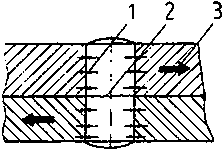
Figure 14 Stresses in Pinned
Joints
1 friction, 2 shearing, 3 external forces
Identify stresses to which pins in joints are
exposed.
__________________________________________________________________________
__________________________________________________________________________
__________________________________________________________________________
|
| ||||||||||||||||||||||||||||||||||||||||||||
5. Tools and Auxiliary Accessories
- Drills, countersinks, reamers
Various types of drills, spiral countersinks and 90° included angle countersinks, as well as cylindrical and taper reamers are used for preparing pinned joints.

Figure 15 Drills,
countersinks, reamers
- Locksmith’s hammers
The pins are driven into the bore holes by means of hand-held hammers of 200 grams to 400 grams weight. Very small pins are driven in with a riveting hammer of 50 grams to 200 grams weight.
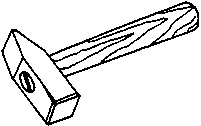
Figure 16 Locksmith’s
hammer
- Light-metal hammers
Aluminium hammers are used to drive in pins which might be damaged if other hammers were used.
Aluminium hammers will not cause permanent deformations to cylindrical pins or taper pins.
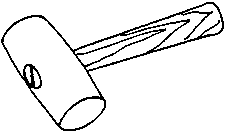
Figure 17 Light-metal
hammer
- Non-ferrous metal punches
Cylindrical punches made of copper or brass are used to drive in pins which might be damaged if a locksmith’s hammer were used. Punches are mostly used where access to pins is difficult.

Figure 18 Non-ferrous
metal punches
- Drifts
Cylindrical drifts made of non-ferrous metal or steel are used to drive pins out of their holes.
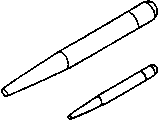
Figure 19 Drifts
- Clamping devices
Several types of clamping devices are used to clamp the component parts before and during joining operations.

Figure 20 Clamping device
- Supports
Any kind of unhardened steel plate can be used as a support for driving in or driving out pins.
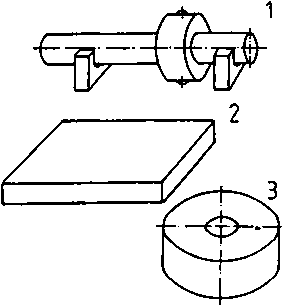
Figure 21 Supports
1 for cylindrical parts, 2 for flat parts, 3 for undoing pinned joints of flat component parts
|
| ||||||||||||||||||||||||||||||||||||||||||||
6. The Technological Steps of Making Pinned Joints
The technological steps of making pinned joints are different for the various types of pins used.
6.1. Joints Using Cylindrical Pins or Taper Pins
- Setting up and clamping
Clean the component parts and fit them together. Set them up and clamp them in a suitable device. While being held in the device, the component parts are to be mounted in the work-holding fixture of the boring machine.
- Drilling
Produce an undersize bore hole for cylindrical pins. The amount of undersize is removed by reaming. In general practice, the following amounts of undersize are employed for the respective nominal bore hole sizes in steel.:
|
N in mm |
U in mm |
|
up to 5 |
0.1 - 0.2 |
|
5 - 20 |
0.2 - 0.3 |
|
21 - 32 |
0.3 |
|
33 - 50 |
0.5 |
Allow a greater amount of undersize for bore holes in tough material and light metals.
N = nominal diameter
U = amount of undersize
· Use the following formula to calculate the drill diameter:
|
D = N - U |
D = drill diameter
Remember the following points for bore holes over 20 mm diameter:
|
|
1. Rough-drill using drills which satisfy the following formula: |
D = N - 2 mm |
| |
2. Countersink with a twist countersink. Use this formula: |
D = N - U |
|
| |
· Produce bore holes for taper pins to the nominal diameter of the taper pin: |
D = N |
| | |
· Read the drill speed from the respective table or calculate it, using the following general formula: |
|
| | |
· For producing large bore holes for taper pins, taper reamers of the appropriate size are used. The bore holes are produced stepwise. |
n = speed (min-1) |
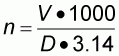

Figure 22 Drilling steps
(1-2-3)
Stepped bore holes:
Calculate the diameter of the drill from the taper per unit length:
A taper per unit length of 1:50 means that the diameter is reduced by 1 mm for every 50 mm of length.
Example:
Produce a joint of two component parts having on overall thickness of 150 mm, use a taper pin of 20 mm diameter.
What steps will you drill?
|
Answer |
Diameter |
Depth |
|
1st bore hole |
Æ 20 mm |
150 mm through hole |
|
2nd bore hole |
Æ 21 mm |
100 mm |
|
3rd bore hole |
Æ 22 mm |
50 mm |
What holes will you drill for a cylindrical pin having a
diameter of 26
mm?
__________________________________________________________________________
__________________________________________________________________________
__________________________________________________________________________
How will you produce bore holes for taper
pins?
__________________________________________________________________________
__________________________________________________________________________
__________________________________________________________________________
- Countersinking
Using a 90° included angle countersink, countersink the bore hole on both ends 0.2 mm larger than the nominal diameter. This removes the burr from the hole.
|
DS = N+0.2 mm |
where
Ds = Countersunk diameter
- Reaming
Make the bore hole larger by reaming. Use a cylindrical or taper reamer that fits the type and size of the pin which is to be used.
When reaming a hole for a taper pin joint, test the fit of the pin before you drive it in.
With the force of your thumb, push the taper pin into the reamed hole. Clean the hole before you insert the pin. The upper edge of the pin should stick out above the edge of the hole by a length that depends on the nominal diameter of the pin. Where the size is that specified in the table below, apply two or three blows with a hammer to drive in the pin.
Testing the fit of taper pins having taper per unit length of 1: 50
|
Nominal diameter of the taper pin (mm) |
Size for testing the fit (mm) |
|
5 |
3 |
|
6 |
4 - 5 |
|
8 |
5 - 6 |
|
10 |
8 |
Remember:
The length of the taper pin you want to use must be 2 mm shorter than the thickness of all parts of the proposed joint.
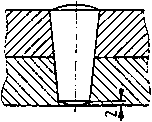
Figure 23 Accurate fit
of a taper pin
Thus, the pin can be driven out with a drift from the opposite end. The drift will not slip and the one end of the pin cannot be mistaken for the other.
The upper edge of the pin is flush with the edge of the bore in the upper component part.
Where no taper pin of the required size is available, saw a longer pin to the dimension you need. Always saw off the thicker end of the pin. Do not change the nominal diameter of the pin. Produce a new head by filing.
What type of countersink will you use to deburr a bore
hole?
__________________________________________________________________________
__________________________________________________________________________
__________________________________________________________________________
What should be taken into consideration when reaming a taper pin
hole?
__________________________________________________________________________
__________________________________________________________________________
__________________________________________________________________________
What condition must be satisfied with respect to the length of a
taper
pin?
__________________________________________________________________________
__________________________________________________________________________
__________________________________________________________________________
How will you shorten the length of a taper
pin?
__________________________________________________________________________
__________________________________________________________________________
__________________________________________________________________________
- Cleaning the bore hole
Use compressed air or a brush to remove chips and any remaining fluid from the bore hole after reaming.
- Pinning
Apply a thin film of grease to the pin and drive it in by several blows with an aluminium hammer. Proceed from the end at which you applied the reamer.
Use a non-ferrous metal punch and a locksmith’s hammer to drive the pin in when access to its location is difficult.
- Checking
Check the pin for tight fit in the hole and that the upper edge of the pin is Gush with the surface of the component part of the joint.
How should a pin fit the
hole?
__________________________________________________________________________
__________________________________________________________________________
__________________________________________________________________________
What are the steps of producing a joint using a cylinder pin?
6.2. Joints Using Grooved Pins and Dowel Pins
- Setting up and clamping
Clean the component parts and fit them together. Set them up and clamp them in a suitable device.
While being held in the device, the component parts are to be mounted in the work-holding fixture of the drilling machine.
- Drilling
Produce a bore hole equal to the nominal diameter of the pin.
|
D = N |
- Countersinking
Use a 90-degree included angle countersink and countersink the bore hole at both ends or remove the burr with a triangular reamer.
|
Ds = N + 0.2 mm |
- Cleaning the bore hole
Use compressed air or a brush to remove chips and any remaining fluid from the bore hole.
- Pinning
Apply a thin film of grease to the pin and drive the pin in by several slight blows with a hammer. Proceed from the end at which you applied the drill.
- Checking
Check the pin for tight fit in the hole and that the upper edge of the pin head is flush with the surface of the component part of the joint.
What are the differences in the sequences of operations when
producing a joint by means of a grooved pin on one hand and a cylindrical or
taper pin on the other
hand?
__________________________________________________________________________
__________________________________________________________________________
__________________________________________________________________________
|
| ||||||||||||||||||||||||||||||||||||||||||||
7. Undoing Pinned Joints
Pins in through holes can be driven out by several blows onto a drift (of a nominal diameter somewhat smaller than that of the pin). Apply the blows in the opposite direction of driving in the pin. Make sure that there is a larger hole in the support through which the pin can slip.
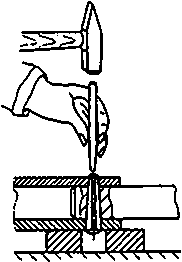
Figure 24 Undoing a pinned
joint with a drift
Pins that are flush with the surface of the workpiece and have seized up or pins in blind bores must be removed by drilling. Use a drill of the nominal diameter of the pin.
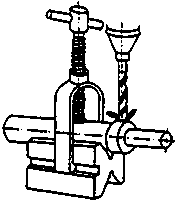
Figure 25 Removing pins
with a drill
To remove grooved drive studs, apply a flat chisel sideways between the head of the grooved drive stud and the surface of the component part, and by a few hammer blows, lift the drive stud and remove it with a pair of tongs.

Figure 26 Undoing a grooved
drive stud joint
When you remove pins from joints, make sure always to place the joint on a pad or other support that will not slip.
How can you remove a pin from a through
hole?
__________________________________________________________________________
__________________________________________________________________________
__________________________________________________________________________