 |
| |||||||||||||||||||||||||||||||||||||||||||||||||||||||||||||||||||||||||||||||||||||
Distribution
The hand over of commodities to the intended beneficiaries, fairly, according to specified rations, selection criteria and priorities.
Provisional version
UNHCR
Division of Operational Support
June
1997
|
| |||||||||||||||||||||||||||||||||||||||||||||||||||||||||||||||||||||||||||||||||||||
Purpose of this guide and how to use it
Purpose
This guide outlines procedures to assist UNHCR Field staff and operational partners in the design and implementation of systems for commodity distribution. Needs assessment, the planning of rations and the management of the logistics chain, up to the distribution site, are not covered.
Assistance operations rarely fit textbook models. Though there may be broad agreement on what the response should be, there are always factors which stand in the way of the ideal. Problems are often situation specific so, it is only through Field level intersectorial cooperation that an agreed appreciation of the constraints can be built up and optimal compromises found. Therefore this guide does not provide simple prescriptive recipes which can be used in all situations, but rather a framework for making the right decision in each situation.
How to use this guide
This guide will help you by pointing out issues which are important. It offers techniques and ideas based on best current practice which must be adapted to the particular circumstances of your operation. It does not present a set of rules and procedures which must be followed, except in the case of the reporting requirements.
|
As soon as possible, you should read through the entire guide in order to become familiar with the ideas and experience it presents. However, to use it in any refugee situation, you should read: Key points (p.7) |
This guide should be read in conjunction with other UNHCR policy papers, guidelines and manuals which impact on the area of distribution management. Of particular importance are the UNHCR/WFP Memorandum of Understanding on the Joint Working Arrangements for Refugee, Returnee and Internally Displaced Persons Feeding Operations, Geneva March 1997, Registration - a practical guide for field staff, UNHCR Geneva 1994, UNHCR Policy on Refugee Women, UNHCR Geneva and Refugee Children, Guidelines on Protection and Care, UNHCR, Geneva 1994. Please refer to the bibliography in Annex 6.
This guide was produced through a process of consultation with organisations directly involved in commodity distribution, principally WFP the Red Cross and Red Crescent movement and NGO implementing partners of UNHCR. The inputs of these organisations are gratefully acknowledged.
In using this guide those actually involved in commodity distribution will see ways to improve it based on field experience. Suggestions for improvements to this guide based on this will be welcomed and can be incorporated into the revision planned for 1998. Suggestions should be addressed to the Head of the Food and Statistics Unit, PCS, Division of Operational Support, UNHCR, Geneva, e-mail hqcs00@unhcr.ch.
|
| |||||||||||||||||||||||||||||||||||||||||||||||||||||||||||||||||||||||||||||||||||||
Glossary
|
Commodity |
This term covers both food and non-food items given in mass distribution to the refugees. |
|
Distribution Cycle |
The time period between regular distributions. |
|
Family |
A group of people living together, related by blood or otherwise and recognised by the society as a family. |
|
Household |
A group of people living together who pool their resources. They may or may not be members of the same family. |
|
Head of Family |
The person accepted by the family and by the society as representing that family within the society. The head of family can be female or male. |
|
Head of household |
The person accepted by the household and by the society as representing that household within the society. The head of household can be female or male. |
|
Ration Shop |
A form of distribution to individual heads of family. |
|
Refugee |
The word “Refugee” is used throughout this guide when referring to beneficiaries. However the principles outlined can be applied to returnees, internally displaced people and others of concern to the High Commissioner and therefore targeted in UNHCR assistance programmes. |
|
Registration Card |
A standard forgery-proof card to be issued to all heads of household/families. The uniquely numbered card allows for easy identification as well as for the distribution of food and non-food items and can be procured through UNHCR/STS in Geneva. |
|
Scooping or Tipping |
A method of approximating a given weight of food by the volume of a container. |
|
Vulnerable |
Individuals or groups who have particular problems with fair access to commodity distribution by virtue of their physical or social status and the norms with which the refugee community treat that status. |
(...)
|
| |||||||||||||||||||||||||||||||||||||||||||||||||||||||||||||||||||||||||||||||||||||
Key Points
The Ideal Distribution System should be safe and easily accessible to the intended beneficiaries.
Safe: Organised in such a way that the system is free of threat to all who use it, with particular attention to women and the vulnerable.
Accessible: Distribution points are close to where people live and are located in places which do not restrict the access of particular groups. The timing of distributions should suit the intended beneficiaries.
· Inform the refugees. They must know what they should receive, how much, when and how. The refugees themselves can be the best monitors and controllers of the distribution process. Refugees should be able to see the distribution process for themselves. Involve them directly, don't let information on the distribution process come to them only through their leadership. Ensure the participation of the refugees (women and men) at all levels of the distribution process.
· In the early stages of an emergency there will probably be a period when it will not be possible to register or issue ration cards. However, you will have to distribute commodities in that period. Effective distribution is possible without ration cards.
· The provision of plastic sheeting, tents and other shelter material is very important for the structuring of refugee sites. The distribution of shelter material reduces the fluidity of the population. Once it is issued, the population can settle.
· The family, as a natural unit, is the target of distribution. This applies to food and non-food items. However this does not mean that you always have to hand the ration to each family directly, in some situations this can also be done more effectively through groups of families or other community structures.
· Irregularities in the distribution cycle undermine the confidence of the beneficiaries and increase their need to circumvent the system.
· In camps, aim to have at least 1 distribution site per 20,000 refugees.
· You should aim to have a distribution system which allows beneficiaries to collect rations close to where they live and at regular intervals of about one month. For dispersed populations refugees should not have to travel more than 5 to 10 km to distribution sites. In camps, refugees should not have to travel far to the distribution sites. Depending on the situation, and having met site selection criteria, the centre should be located as close as possible to the beneficiaries, and not more than 5 km away.
· Distribution of dry uncooked rations in bulk is usually the most desirable. Avoid mass cooked food distribution for the general ration.
· In your distribution system plan to have a minimum of 2 staff per 1,000 beneficiaries.
· Avoid payment in kind for distribution workers. It makes monitoring difficult. In times of shortages, vulnerable people may be deprived of the commodities in order to pay staff.
· In the early stages of a new programme, particularly in large emergencies, effective control over distribution may not be possible. However, from the start, each action you take should contribute to a process whereby stable control is progressively established.
|
| |||||||||||||||||||||||||
Commodity Distribution, A Practical Guide for Field Staff (UNHCR, 1997, 77 p.)
I. OVERVIEW
1.1 Definition of distribution
Distribution is the hand-over of commodities to the intended beneficiaries, fairly, according to specified rations, selection criteria and priorities. Distribution is the process during which control over the commodity passes to the intended beneficiaries.
For the purposes of this guide the term distribution does NOT include the process by which commodities are procured, nor the process of transportation, storage and handling, except at the final handover point.
The objective of UNHCR distribution systems is to provide material assistance to and through families, respecting the guiding principles of humanitarian action. Thus, the distribution system should aim to support the family as the most effective coping structure. Only in exceptional circumstances, and for short periods, should the focus of assistance move from the family level to individuals within the family.
|
“The family is the basic social unit in almost all societies. It plays a key role in meeting basic needs and solving the problems of individuals. Strengthening families will improve the ability of refugees to take care of themselves”. From Refugee Emergencies A community-based approach, UNHCR Geneva 1996 |
Distribution should enable families to junction as the basic social unit. Persons outside families must, of course, also be assisted through the distribution system. This group often includes unaccompanied minors, single women, unsupported elderly and young men. Often, efforts are made to build household groups from these individuals to facilitate the provision of shelter and other services and commodity distribution itself.
Getting the commodities to families does not necessarily mean handing the commodities directly to the head of the family. You may decide to channel the commodities through existing community structures, leaders etc, or structures which you help to create; groups of families, women family representatives etc.
(...)
UNHCR & WFP
Contingency planning.
Joint plans of action.
Establishment of the number of food aid beneficiaries, in consultation with the host Government.
Assessment of food aid needs (in consultation with the host Government).
Establishment of the food basket.
Designation of the implementing partner responsible for food distribution.
Establishment of effective food aid coordination mechanisms.
Monitoring and reporting on distribution of all food aid commodities.
Working out joint workplans under the MOU framework.
Promotion of self reliance.
UNHCR IMPLEMENTING PARTNERS
Management and equitable distribution of relief commodities using the appropriate distribution system.
Dissemination of information to refugee population.
Ensuring maximum refugee participation.
Reporting to UNHCR (and simultaneously to WFP, in the case of food distribution) on quality, quantity and impact of commodity distributions. The specific reporting requirements for each operation will be specified in agreements with the implementing partner.
1.3 Food and non-food items
Integration of Food and Non-food distribution systems
Where possible, there should be an integrated distribution system for Food and Non-Food Items (NFI).
The systems described in these guidelines apply equally to NFI as well as food commodities; special arrangements may be needed for some NFI commodities under some circumstances, but these should be designed into a common system rather than require a parallel system.
The layout of the physical distribution system and the documents used for control and reporting should be similar for food and NFI distribution.
Non-Food Items
Non-food items can be classified into two main groups:
|
1. Routine consumables |
e.g. soap, firewood, fuel, sanitary supplies, health supplies, condoms, education supplies. |
|
2. Non-consumables, longer life items |
e.g. mattresses, blankets, plastic sheeting, tents, building materials, kitchen sets, jerrycans, sleeping mats, farming tools. |
There are three types of NFI distribution:
|
1. Initial |
new arrivals, first time distribution. |
|
2. Routine replacement |
consumables and non-consumables, following routine wear and tear. |
|
3. Special circumstances |
following disasters, (storm, fire etc), to vulnerable groups, upon repatriation or departure. |
Frequency of NFI replacement
The frequency of NFI distribution will depend on each situation. As it is likely to be irregular, specific advance information to the beneficiaries is essential. There are no universal standards for the replacement of NFI and each situation must be judged on its own merits.
1.4 Programme planning questions
1.4.1 Do you know the needs?
Before designing your distribution system it is assumed that a needs assessment has taken place, that you have decided which food and non-food items will be distributed, in what quantity and to whom. The assessment should consider the needs of the specific groups within the population (women, at risk groups) as well as of the population as a whole. For example, the physical dangers that the collection of firewood sometimes involves for women should be taken into consideration in prioritising the commodities.
The needs, and your assessment of them, will change with time, but at any given time it is assumed that you will have reached a consensus with key partners as to what they are.1
1.4.2 Do you know the refugees?
Each refugee group has its own characteristics. Experience shows that it is essential to find out specific information concerning every distinct refugee group in order to provide appropriate services efficiently. Before designing a distribution system you must have specific information on the refugees, including on the population composition, gender and age, division of labour, access to and control of resources. Remember that the role of children may also have changed as a result of flight. A good framework for this, and for programme planning in general, is provided in the UNHCR POP Handbook.2
2 See People-Oriented Planning at Work - Using POP to Improve UNHCR Programming, UNHCR Geneva 1994.
UNHCR recognises that women have a key role in the health and well-being of their families and that distribution systems should support rather than undermine that role by ensuring their equitable access to relief commodities. While such access may be ensured, in some circumstances, by women receiving the commodities directly or being responsible for the actual distribution, this must be verified, not assumed.
1.4.3 Do you know the host government's policy?
It is important to know the policy of the host government regarding refugees. For example, land use, type of settlement, local economy, job opportunities and other related issues may influence the type of distribution system and selection of commodities.
1.4.4 Do you know UNHCR's policy?
The commodity distribution systems and selected commodities should be in line with the general programming policies of UNHCR in the host country and for the particular group or refugees. The Country Operation Plan should provide a guide to country specific policies. In addition to this, several key documents outline UNHCR's general policies. (See Bibliography, Annex 6)
1.4.5 How much do you communicate with the beneficiaries?
Experience has shown that in order to provide a sound basis for a distribution system, it is essential that the beneficiaries know what are their entitlements and know how the distribution system is supposed to work. Normally there will be many times more beneficiaries than UNHCR or distribution agency staff, and the beneficiaries have the capacity to be extremely effective monitors of the distribution system. However they can only do this if they are well informed. Any well designed distribution system must provide a way to keep refugees continuously and directly informed (i.e. not just through the refugee leadership).
(...)
|
| |||||||||||||||||||||||||||||||||||
Commodity Distribution, A Practical Guide for Field Staff (UNHCR, 1997, 77 p.)
II. GETTING STARTED
(...)
Agreement on a population figure is essential
A planning figure for the population in need of assistance is essential in order to implement any commodity distribution. Ideally, the number in need of assistance should be known and agreed to by all key partners (government, WFP, NGOs, donors and refugees). It is important that all understand that, while exact population figures will not always be available, the assistance programme must continue for an agreed number of beneficiaries. At the same time, steps should be taken, through registration and monitoring, to improve the accuracy of the population figure. It is critical to the cost-effectiveness and credibility of an assistance programme that the planning figures used for distribution are realistic.
Your distribution strategy should be based on these agreed assumptions, rather than on an ad hoc basis. As the programme develops and more information is available, assumptions will change and distributions will more closely align with the verified needs.
Where a satisfactory registration has not been possible within three months, UNHCR and WFP will jointly determine the number of beneficiaries in need of food assistance. Should there be disagreement between the country offices of UNHCR and WFP on the number of beneficiaries, the problem shall be referred to the headquarters level for resolution. Pending such resolution, WFP will provide food to the number of beneficiaries it estimates are in need of assistance.
2.3 Beneficiary ration/registration cards/kits4
4 See Registration - a practical guide for field staff, UNHCR Geneva 1994 and MOU UNHCR/WFP 1997
Ration cards are a key tool in the provision of assistance. However, in new situations, particularly in emergency situations, you may need to begin distributions before ration cards have been issued. Registration and issue of ration cards requires considerable resources of time, people and security.
¨ Registration establishes an agreed number of beneficiaries.
¨ Registration also provides the profile of the refugee population, making it easier to target special groups.
¨ Ration cards identify the beneficiaries and make monitoring and control easier.
The use of standard UNHCR registration software (Field Based Registration System - FBARS) makes it easy to produce printed lists and cards from registration data.
Obtaining registration/ration cards
Standard UNHCR Registration cards, which can also be used as ration cards, are contained in UNHCR registration kits. Each kit contains all the items (wristbands, forms, tokens, cards, etc.) needed for registration of 30,000 people (10,000 families). The kit includes 10,000 temporary ration/registration cards and 10,000 permanent ration/registration cards. (1 card per family). If the whole kit is not needed, registration cards, and/or other specific items, can be ordered separately. It takes the supplier in Geneva 17 working days to produce and deliver these separate orders. So add transportation time from Geneva to your location to estimate how long a separate order might take to arrive.
How to obtain registration kits
Registration kits are stockpiled at UNHCR Headquarters in Geneva by GSS. Requests for kits should be addressed to the Desk, while the Food and Statistical Unit of PCS authorises their deployment. GSS deploy the kits on the basis of a purchase authorisation (PA) raised by the Desk.
Each kit comes in two boxes measuring 112 × 52 × 53 cm each and weighing a total of 400 kg per complete kit of two boxes. Each kit costs US$ 9,000 (in mid-1997) and the cost of the kit, plus transportation, usually by air, must be charged to the relevant operational project; provision must be made in your budget for this.
How to use the registration cards as ration cards
Both the temporary registration card and the permanent registration card from the kit have been designed for distribution purposes. They both have numbers printed around the edge which should be punched to record each distribution. A block of numbers in the middle of the card should be punched to indicate family size. Numbers 1 through 30 should be used to record food distributions and 31 through 36 for non-food items. See the instructions with the kit and the registration guide.
2.4 By whom
Distribution of food and non-food assistance is a UNHCR responsibility
UNHCR normally discharges this responsibility through an implementing partner. To select implementing partners you must have the information which can guide you in that process5. For general food distribution, the designation of the agency should be jointly agreed by UNHCR and WFP. The responsibilities of this agency should be set out in a short tripartite agreement UNHCR/WFP/Implementing Partner, separate from any UNHCR implementing partner sub-agreement.
5 See UNHCR Manual Chapter 4, Section 5.1 for more on Implementing Partner selection.
Information needed for the selection of a distribution
agency:
¨ Their past experience in relief operations, especially in refugee/returnee/IDPs situations, and distribution.¨ Their previous experience in the country or location of operation.
¨ Their capacity to contribute their own resources to the programme.
¨ The acceptability of the agency by the host government.
¨ Their readiness and ability to respect UNHCR's policies, and in particular their ability to incorporate the needs of women into their distribution project implementation.
¨ Their time frame for mobilisation, especially in an emergency situation.
2.5 Where - How many distribution points, their location
As a general rule, it is best to have the distribution points close to the beneficiaries and located in such a way as to minimise the numbers of people who attend any one distribution point at any one time. This makes it easier for them to carry the commodities home (a typical one month food ration for a family of 5 can weigh 75 kg), reduces their exposure to theft and harassment and minimises the time spent away from home - a particularly important consideration in female headed households. For dispersed populations, refugees should not have to travel more than a maximum of 10 km to distribution points.
In selecting distribution points, factors affecting women's access should be taken into consideration, e.g. physical security of women may be threatened if they have to pass through a military/police camp; traveling a long distance may also be threatening, especially if women have to travel while it is dark.
Minimising the number of beneficiaries at any one distribution point is important for crowd control reasons. Fewer people also helps to ensure fairness in the distribution - everyone can see what everyone else is getting. For camp situations you should aim to have at least 1 distribution site per 20,000 people.
|
Organise the distributions so that the number attending the site at any given time is as low as possible. |
The earliest possible distribution of shelter material will help to organise the population
The provision of plastic sheeting, tents and other shelter materials is very important for the structuring of refugee sites. The distribution of shelter material reduces the movement of the population. Once shelter material has been issued the population can settle. Even if full scale site planning is not yet possible you can use the distribution of shelter material to begin a rough lay-out of the site, organising refugees into blocks and using this as an incentive for people to move from areas which could be used for distributions. Keep in mind that populations can increase and it is wise to plan for more distribution sites than are currently needed to allow for increases.
In situations where people have moved on to a site in an unplanned way, it is better to rearrange them without delay if they are occupying areas which are needed for distribution. This will create short term problems, but the alternative might be long-term problems and lasting inefficiencies.
(...)
How often, distribution cycles
There is usually a single distribution of the main non-food items, e.g. shelter material, kitchen sets, blankets. Timing of the distribution cycle is dependent on food distributions for which there is, normally, a continuing need.
The distribution cycle should be:
1. Predictable and known to the refugees.
2. Set so as to ensure simultaneous distribution in neighbouring camps/communities.
Irregularities in the distribution cycle undermines the confidence of the beneficiaries and increases their need to circumvent the system.
Shorter intervals between distributions allows greater flexibility in adjusting the ration size to compensate for delayed deliveries/shipments. Scarce commodities can be included periodically in more frequently distributed smaller rations, rather than waiting until enough is on hand for larger, less frequent, distribution. Smaller quantities take less time to distribute and are easier to carry home. Low bulk items such as sugar or salt might be distributed less frequently.
Longer intervals between distribution frequently lead to greater delays, as more commodities must be pre-positioned prior to distribution. However, longer intervals may suit some people better, as they will travel at less frequent intervals to collect rations. The weight of the ration and distance from site to household and household level storage capacities are important factors to consider. Long intervals with relatively large amount of commodities distributed each time may make it more likely that refugees will sell commodities, particularly when whole sacks or other containers of food are distributed.
2.7 Equipment for distribution
Non-food items usually need little or no equipment for distribution. Food, however, may need various items of equipment.
Scoops
Scooping gives scope for significant variation in the weight of portions measured out. The basic problem is that food rations are calculated by weight but scooped by volume. The actual weight of the food delivered will depend on whether the scoop is filled below or level with the top, or the food is piled high to overflow. Even a small amount of under scooping can result in a significant total amount of food being misappropriated. Scooping is also very staff and supervision intensive. Even when closely supervised, it provides an easy opportunity for cheating.
|
Scooping (sometimes called “tipping”), i.e. measuring of individual rations, by volume, using containers is often seen as the natural way to ensure fairness in distribution. This can be a dangerous assumption as there are many difficulties associated with this method. Scooping has even been described as “a notorious means for cheating the beneficiaries”. |
The composition and quantity of the individual ration may change considerably from one distribution to the next depending on food supply. The same volume measuring cups will give different weights of, for example, cereals, depending whether the cereal is maize, sorghum etc. whole grain or milled. Different shipments of the same commodity may have a different weight to volume ratio.
Scooping can be used when bulk distribution is not possible. Provision of scoops is a UNHCR responsibility. When scoops have to be used they should be standard, marked with the commodity and weight, regularly checked and provided from a central source. The team of scoopers should include adequate proportions of women and men, should be rotated randomly between distribution points and should be chosen at random just prior to the distribution.
Weighing scales
These should be available at each distribution point in order to carry out spot checks on unit weights. Scales capable of weighing up to 100 Kg are needed.
Scales should also be available at distribution points for use by the refugees to check the weights of their own rations, these scales should be suitable for the convenient weighing of the ration distributed.
Other equipment related to food preparation/consumption
The provision of non-food items essential for the preparation and consumption of food such as fuel, grinding equipment, cooking utensils and stoves will influence, substantially, the amount of time and labour spent by women in food preparation and should therefore receive priority.
|
| |||||||||||||||||||||||||||||||||||
Commodity Distribution, A Practical Guide for Field Staff (UNHCR, 1997, 77 p.)
III. HOW TO CHOOSE AND SET UP A SYSTEM
3.1 The framework - an overview
Distribution systems can be classified according to whom the commodities are given. In each of these categories of distribution the recipient can either be a woman or a man. There are three broad categories of distribution system (see Fig. A).
|
Distribution to groups of beneficiaries through the group leadership. |
Distribution to groups of heads of family. |
Distribution to individual heads of family. |
|
1 |
2 |
3 |
|
System Description | ||
|
Commodities are given in bulk to a representative of a group of beneficiaries who further divide it among the group. |
All of the commodities for the group of families are handed over to a representative of the group. The commodities are then immediately redistributed to the individual family heads by the representatives. |
Commodities are handed over directly to each family head. |
|
Type of situation in which these systems have been used | ||
|
Early days of an emergency. |
When people are settled. |
Settled population. |
|
Eastern Zaire, large influx, no registration or ration cards. |
Somali refugees in Eastern Ethiopia. |
Somalia, Malawi, Thai-Cambodian border, Cambodian repatriation. |
|
Former Yugoslavia. |
Rwandese refugees in Tanzania | |
(...)
3.2 Advantages and disadvantages of the three categories of distribution
1. Distribution to groups of beneficiaries through the leadership
|
Advantages |
Disadvantages |
|
· You need limited staff · You can use community leadership structures already in place. · The beneficiaries themselves can act as monitors of the distribution process. · Gives responsibility to the community, places some responsibility for assisting at risk groups on the community itself. · Gives possibility for community to allocate commodities according to their priorities including giving extra to at risk groups. · Can be used in first stages of a large influx with limited space for distribution · Can be implemented without registration or ration cards · Distribution is relatively quick to get started. |
· Easy for community leadership and/or the 'strongest' to abuse their position and discriminate against parts of the population. · There may be many levels of re-distribution, from the leadership to many layers of “sub-leaders” until it reaches the individual household, this makes monitoring by outsiders difficult. · Distribution may not be equal. Based on the communities' own norms, certain groups or individuals (not at risk) may receive more than others. · Can be difficult for the most at risk to receive their share · Lack of control on beneficiaries figures. · Difficulty in monitoring the distribution. · If women are not properly represented in the leadership, they may have difficulty of access. |
2. Distribution to groups of heads of family
|
Advantages |
Disadvantages |
|
· Promotes social interaction within the refugee community and enhances social adjustment to the new situation and environment. · You can have some influence
over the selection of leaders, you can introduce new community leadership
structures, ensure the representation of women etc. · You can set up specialised groups of families e.g. all female headed in separate groups, all families of marginalised groups together. · Shares responsibility for distribution with the beneficiaries. · The beneficiaries themselves act as monitors of the distribution process. · Requires a small number of distribution staff · Because the food is handed over in bulk to groups, individual scooping by the distributing agents is avoided. Can be used when standardised scoops are not available while food rations are frequently changing. · Quick implementation. · Security problems related to crowd control are minimized by the presence of the family group representatives. |
· Needs registration and substantial administration to organise family groups · An extensive information campaign is needed. · Needs homogeneous group of beneficiaries · Needs reliable and verified population figures · Abuses by family group representatives may happen. · Monitoring of the final re-distribution within the groups is needed when this is taking place away from the agency distribution site. |
3. Distribution to individual heads of family
|
Advantages |
Disadvantages |
|
· You retain control over the whole delivery process right to family level. This may be important in situations where there are inadequate community structures. · Makes it possible to target at risk groups. · Transparency. · Commodities reach the beneficiaries directly. · Easy to monitor that female headed households, and vulnerable families have proper access. |
· Very staff intensive · Needs a lot of infrastructure. · Needs registration and a substantial administration. · Takes away most of the responsibility for distribution from the beneficiaries themselves. · Can be difficult for the
beneficiaries · Not applicable in early stages of an emergency · Standardised scoops are needed, these need to change every time there is a change in the ration. · Scooping could prove difficult to monitor. |
3.3 Choosing the system
Two basic questions which will help you to choose a system are: how much responsibility is it appropriate to give to the refugees themselves? How much resources do you have available to set up and run the system? (refer to Fig A). Resources include time, space, experienced staff as well as financial resources.
In case of food distribution the modalities of distribution as well as the reporting requirements will be set out in a tripartite agreement between UNHCR, WFP and the implementing partner.
(...)
Distribution day
a. Commodities are moved to the distribution point on the morning of the distribution.b. The group representatives are called one by one to collect the commodities. The distribution agency uses its own staff to call up the group representatives using lists previously prepared.
c. Each group representative will come forward with a pre-arranged number of porters from the group. She/he will sign to acknowledge receipt of the quantity of the commodity. The distribution agency will have divided the commodities into separate piles by type and will have appointed adequate staff based on the quantity of the commodities. The staff will be responsible for handing over these commodities to the porters. The amount of commodities handed over is calculated as (ration/person/day) × (no. of people in the group) × (no. of days)
d. The representative and the porters will leave the distribution site and carry the commodities to a place nearby where the group's population is waiting for them. There, the group representative will use the name list of beneficiaries and will call them one by one to collect their share.
(Make sure that the self-distribution is carried out at a place to which you have access and where it can be monitored.)
If the group is a very large one, the representative will further share the commodities received among smaller groups. The final stage will be the distribution to individual families.
For sharing, the representatives will use their own scoops or utensils taken from their cooking sets.
e. The distributing agency should have monitors who will circulate among the groups.
Security
Security is an important consideration for this method of distribution.
Security problems are more likely to occur in the afternoon, when people are getting tired of waiting and are afraid that commodities will run out before their turn comes. Try to distribute quickly, with no long delays.
Crowd control staff should be a mix of beneficiary representatives and agency staff, preferably those able to speak the refugee language. Where possible staff should not be paid in kind (remember commodities could be scarce at the early stage of the emergency).
Another element, important for crowd control, is to make sure that the commodities are unloaded in a place away from the crowd of beneficiaries. An area of minimum 50 × 50 m is required. The waiting beneficiaries should be at least 20 m from the bulk of commodities.
The area should have boundaries. If there is not time or resources enough to build fences then stones, ropes etc. should be used to delimit the area. Crowd control staff should surround the area and be close to the stock of commodities.
How to implement for dispersed populations in towns, villages
Geographical division
The country is sub-divided into regions based on existing administrative boundaries. A needs assessment is made for each of these areas. These assessments result in the establishment of food and non-food items targets for each area.
Prioritise
Together with the local authorities in each area, establish categories of individuals prioritised in regard to their need for assistance. Categories include sick, elderly, handicapped and others.
Hand-over
The commodities are transported to a central warehouse in the region by UNHCR (or WFP in the case of food) where they are handed over to the local authorities. When the total amount available for that month is known, a distribution plan is worked out jointly between UNHCR and the authorities. Information on the quantity of commodities to be distributed is made available to the beneficiaries.
Distribution
Commodities are transported by the local authorities from the regional warehouse to distribution points in towns and villages from which the beneficiaries collect their rations.
3.5 How to distribute through groups of heads of families (one method)
|
How |
The commodities for the group of families are handed over to a representative of the group by the implementing agency staff. |
| |
The commodities are then re-distributed to the individual family heads by the group representative. |
| |
|
|
Situation |
When people are settled. |
| |
When formal registration is done and cards are available. |
| |
Homogeneous groups (same tribe, culture,...) |
| | |
|
Used in |
Large camps, can be used in smaller camps. |
There are two ways in which this can be implemented.
1. Distribution to groups of families of the same size (preferable)
or
2. Distribution to groups containing different family size.
1. Distribution to groups of families of the same size
Organise families into groups
Request refugees to organise themselves in groups of 206 heads of family (HOF), each having a family ration card. Each group of 20 comprises families of the same size. Head of families can be women or men. For example one group would have heads of family size 2, another of family size 3 etc. You may decide not to allow family size 1 so as to prevent families splitting up in order to maximise their allocation of non-food items. All those claiming to be alone and be of family size 1 should be asked to join together with others in the same situation to form households of 2 or 3 persons (depending on what minimum you decide). These groups are maintained for future distributions.
6 20 is used here as an indicative size, actual circumstances may demand bigger or smaller groups, it is usually better to keep groups small, not more than 50 families per group.
|
Make sure that the size of the group remains relatively small. This allows for easier self monitoring by the beneficiaries. |
Each group of 20 selects a representative, who can be a woman or a man. Having groups of the same family size means that each household should receive the same quantity. It will be easier for all to see if some households are being more or less favoured than others. It also makes life easier for the distribution staff who do not have to make a different calculation as to quantity for each household.
Divide the Camp into Zones
In the case of large populations it may be useful to divide the camp into zones (or blocks). Within each zone, groups of families of the same size are formed by the refugees. It is recommended to prepare a list (computerised) per group indicating name of HOF, card numbers and family size.
A distribution enclosure is constructed at each distribution site, see Fig 1.
(...)
Distribution day
Pre-position supplies
Sufficient commodities for the distribution are pre-positioned in the distribution enclosure the day before distribution. The quantities are based on prior calculations considering number of beneficiaries to be served and the ration agreed upon. Up to 5% extra commodities should be pre-positioned to allow for damages and short-weight.
Inform the beneficiaries
A signboard is posted, in advance, outside each distribution point advising the quantities of commodities to be received according to family size. The PA system should also announce this.
The beneficiaries assign a representative within each group who, on the day of distribution, collects the cards of all HOF within the group.
The group representative collects the commodities
The group representative goes to the counter corresponding to her family size. A checker retrieves the cards and verifies them against her list. Cards are punched and the group representative signs for receipt against her name on the list.
The commodities are handed over to the group representative who, together with some assistants from her group, carries them to the distribution area where all the HOF of the group are waiting.
Each group member receives the same quantity
The actual handing over of the commodities to the HOF takes place with the participation of all group members. The principle is that every group member (HOF) has to receive the same quantity, since all the families are of the same size. This puts the responsibility for fair distribution in the hands of the refugees themselves. The division of the commodities should take place in full view of the family heads so that all can see that everyone receives the same amount.
While the distribution within the group is going on, monitoring is done by the staff of the implementing agency. This distribution system also allows for on-site food basket monitoring.
Note:
Have more distribution points for those family size groups which are most frequent (e.g. groups 3 and 4). However, distribute to one family size at a time.
Have one combined counter for family size groups that are less frequent (e.g. combine size 9 and 10)
In cases where distribution takes place over several days, designate particular group sizes for particular days, e.g. mix groups of frequent family size with groups of less frequent size: e.g. day one: family size 2 and 5, and so on.
2. Distribution to groups containing different family size
Sometimes it may be difficult to organise the families into groups of the same family size. Same family size groups do not follow normal social groupings and there may be resistance from refugees to joining with other families of the same size who are strangers to them. It may be easier to form groups of families from pre-existing structures following the administrative or social organization coming from the refugee country of origin. This can allow the refugee community to maintain security and social aggregation. People from the same place in the country of origin will know each other and be able to self-monitor the distribution and prevent ‘infiltrators’ from joining the group. Prior to complete registration, it is faster to organise than by same family size.
Experience shows, however, that distribution to groups of the same family size has more advantages in the long run.
3.6 How to distribute through individual heads of family (three methods)
|
How |
Commodities are handed over directly to each family head (or representative of the family) by the implementing agency staff. |
| | |
|
Situation |
Settled population. |
| |
Registered population with ration cards. |
| |
Beneficiaries living in camps, settlements or integrated within the local population. |
| | |
|
Used in |
Well established camps, ration shop. |
Method one
Ration cards
Population figures have to be confirmed through registration and subsequent verification. Ration cards are issued to all family heads. The cards have a serial number, show the family size and have a box to record each distribution. Distribution registers, consisting of names of family heads, family size and breakdown and registration card serial numbers, are kept at each distribution centre and are updated regularly. Distribution registers can be computer generated using FBARS.
Establish distribution sites
The implementing agency, in liaison with others concerned decides the number and location of the distribution sites, which, according to the population size they are serving, are themselves divided into a certain number of distribution points.
Construct distribution points
A commodity shelter, with enough storage capacity for one distribution, is erected at every distribution centre. Shelters consist of a light roofed structure. If the security situation allows, the structure could be left without walls and fencing.
The distribution centre should consist of a limited number of chutes, i.e. narrow passages, (not more than ten). A corresponding number of corridors should lead to each chute. The corridors should be designed to allow a limited number of beneficiaries to queue at a given time. There should be a wide waiting area in front of the corridors in order to accommodate the waiting beneficiaries. They should be kept at a safe distance from the commodities in order to facilitate easy movement of the distribution workers and of the individual recipients (and also to reduce the possibilities of thefts). Fences, ropes, ash, or lines on the ground should be used to mark the distribution centre boundaries, and between each chute.
In the chute itself, the commodities should be lined up, starting with the smaller ones (e.g. soap, salt, sugar, oil) and ending with the heaviest (e.g. shelter material, cereals).
The chute exits should lead to paths or roads taking recipients away from the distribution centre.
Full use of the natural environment should be made to facilitate a good distribution. Commodities should be placed on a high ground, and shaded areas should be utilized for the waiting area. Uniformity of chute lay-out and adequate spacing between chutes are necessary for supervision of the centre.
An adequate number of trained staff should be positioned to manage the distribution centre; for instance, one distribution officer per centre, two supervisors per chute and casual workers/tippers and crowd controllers.
Distribution day
The right quantities of commodities should be pre-positioned at least one day before the distribution. The beneficiaries should be informed well in advance about the distribution date and time and the ration composition and size (for this purpose, an information board could be placed in front of each centre and announcements made).
Once the beneficiaries have assembled in the waiting area, family heads should be called by their names to enter the corridors. Before entering the chute itself, each family head has to present his/her registration card, which is checked against the list. He/she will then receive the different commodities according to the above described order. Before leaving the chute, the card is punched (or ticked). Weighing scales should be available after the chute exit at a place which will not impede the flow of beneficiaries. There, beneficiaries could check that they received the correct rations.
(...)
On-site distribution monitoring can be carried out at the exit points (see below).
Method two (sometimes called Demographic Distribution)
Distribution to an individual (in lieu of head of family).
Commodities are distributed through eligible females by the implementing agency.
Under this system, women are accorded a key role in channeling relief commodities to the beneficiaries.
Such a system was implemented on the Thai-Cambodian border in the 1980s, where food and other relief assistance was distributed to some 250,000 displaced Cambodians living in a dozen border encampments. The distinct feature of this system is its selection criteria for eligibility to the ration cards - only females above a pre-determined age receive ration cards and they, in their turn, share the rations with other household members. The person selected by this criteria does not have to be the head of the household, and there may be more than one ration card per household.
The system was established because previous distribution methods were abused by the leaders and male population and food was diverted either to the “military” (the various resistance groups operating along the border) or sold to traders.
The system is based on a headcount of all eligible females, who are given ration cards by the implementing agency. The card holders are required to come and collect their rations. Hence, in societies where an active role of women outside the home is not the norm, this system would not work. It is also unsuitable if the camp population is predominantly male.
When considering using this system, examine carefully the composition of the population. Irregularities in the male/female ratio will result in inequalities in the distribution system, the greater these irregularities, the greater the inequalities that will result.
Before conducting the headcount and distribution of ration cards, two parameters have to be set:
1. criterion for eligibility
2. ration multiple
Eligibility
The criterion for eligibility for ration cards can be defined on the basis of minimum age. That is, all women above a certain age would receive a ration card. The lower age limit should be set based on the lowest age deemed suitable for females to participate in the distribution. In the case of the Thai-Cambodian border, the minimum age limit was set at 10 years.
A height can equally be used as an indicator of age. This is because people are often uncertain about their exact age, in the absence of official records. For processing large numbers it is easier to select on the basis of height than to interview about age.
The following table7 indicates reference heights for age between 10 and 17 years. This table is based on average heights and significant variation will exist within any group. This table can provide only a rough guide to height for age for any particular population and a survey is needed to plot height for age in any given population. This table can be used initially until an exact survey of the beneficiary population can take place. For example, using Table 1, if you want to select all females in a population who are 12 years and older then you select all females who are 152 cm or higher.
7 From Measuring Change in Nutritional Status, WHO, Geneva 1983.
Table 1 - Reference heights for age
|
AGE >= |
HEIGHT FEMALE, cm |
HEIGHT MALE, cm |
|
7 |
125 |
122 |
|
8 |
125 |
127 |
|
9 |
132 |
132 |
|
10 |
138 |
138 |
|
11 |
145 |
143 |
|
12 |
152 |
150 |
|
13 |
157 |
157 |
|
14 |
160 |
163 |
|
15 |
162 |
169 |
|
16 |
162 |
174 |
|
17 |
163 |
176 |
Ration multiple
Since the commodities are distributed exclusively to a selected group of females, a multiple is applied to the basic ration entitlement in order to cover the needs of all the beneficiaries. In order to determine the ration multiple it is necessary to calculate the ratio of eligible females to the total population. This figure can be obtained in different ways.
If the population has been registered, then the total population size will be known. The eligible females are then registered separately and issued with a ration card (see below). The ration multiple is then calculated by dividing the total population number by the number of eligible females. For example, if the total population is 90,000 and the number of eligible females is 30,000, then the ration multiple is 90,000/30,000 or 1:3.
If the total population is not reliably known then estimation techniques have to be used. The best is to have data from the population directly. For example, this can be through nutrition surveys, immunisation, or MCH activities, which give a representation of the entire refugee population. A random sample of household size and number of females older than the cut-off age (or higher than the height) per household can be taken. From the sample, extrapolate the ratio of eligible females to the population as a whole.
Another method is through the use of average age/sex distribution figures.
Table 2 8 can be used to estimate the proportion of the total population represented by a particular age group. For example, for a population in Sub-Saharan Africa, if you want to distribute to all females who are 13 years and older, what proportion of the population do they theoretically represent and how many rations each should they receive? Referring to Table 2 you will see that females 13 years and older represent 30% of the population and the ration multiple would be 3.3, i.e. each female 13 years and older would receive 3.3 times the basic ration.
8 From The Sex and Age distribution of the World Population, UN, New York 1994
Table 2 - Age Distribution in a Population
Group 1: Sub-Saharan, Eastern, Middle, and Western
Africa
Group 2: Northern and Southern Africa, and South Central Asia
Group
3: Eastern Europe
| |
Group 1 |
Group 2 |
Group 3 | |||
|
Female >= |
% of total population |
Ration |
% of total population |
Ration multiple |
% of total population |
Ration multiple |
|
10 years |
34% |
3.0 |
37% |
2.7 |
46% |
2.2 |
|
11 years |
32% |
3.1 |
35% |
2.8 |
45% |
2.2 |
|
12 years |
31% |
3.2 |
34% |
2.9 |
45% |
2.2 |
|
13 years |
30% |
3.3 |
33% |
3.0 |
44% |
2.3 |
|
14 years |
29% |
3.5 |
32% |
3.1 |
43% |
2.3 |
|
15 years |
28% |
3.6 |
31% |
3.2 |
42% |
2.4 |
Accordingly, estimates can be obtained when other age limits are chosen. It should be noted that refugee populations often do not follow the standard population distribution. This table should therefore be used only when more accurate data is not available.
Different methods can be cross-checked, the exact number of eligible women will finally be determined in the screening exercise.
In the Thai-Cambodian border encampments, field surveys carried out revealed that the ratio of eligible females (> 10 years) to household size was 2:5, this therefore gave a multiple of 2.5, which was applied to the basic ration entitlement. This implies that one ration card provides food assistance to two and a half persons.
Note
|
When setting the ration multiple, it must be borne in mind that the multiple denotes an estimated figure of the total camp population (i.e. estimated camp population = total number of eligible females × ration multiple). For instance, if the ration multiple is set at 2.5, the issuance of 20,000 ration cards implies that the total beneficiary population is 50,000. Raising the multiple to 3 would raise the camp population estimate to 60,000. |
(...)
That period corresponds to the number of days covered by the ration. If a 10 day ration is being distributed, then the ration can be collected any time in that 10 day period. Rations which are not collected in that period cannot be collected later.
A distribution shop is constructed at each distribution site, see Fig 2. Aim to have each shop cater for about 4 - 5,000 refugees (i.e. about 1,000 family heads).
The distribution shop should be located away from crowded areas, markets, health centres etc. Each shop can be designated to cater for a certain family size with each family head always collecting their ration from the same shop.
Shops are organised according to family size
In order to match each ration shop to family size, the family size distribution of the population must be determined. For convenience, single individuals may be grouped and treated as a 2 or 3 person household. Each shop serves two or more family sizes: the aim is to have similar numbers of rations distributed from each shop to avoid a concentration of beneficiaries at some, leading to excessive queuing.
Example
Ration shop distribution to a camp with a total population of 4,185 families and the following family size distribution:
|
Family Size |
No. of Families |
|
1 |
293 |
|
2 |
801 |
|
3 |
1,183 |
|
4 |
815 |
|
5 |
520 |
|
6 |
220 |
|
7 |
109 |
|
8 |
111 |
|
9 |
30 |
|
10 |
89 |
|
11-15 |
14 |
|
Total |
4,185 |
With four ration shops, the family distribution per ration shop could be as follows:
|
Family Size |
1, 3 |
2, 5 |
6, 7, 8, 9, 10 |
4, 11, 12, 13, 14, 15 |
|
|
3,842 rations |
4,202 rations |
4,149 rations |
3,440 rations |
|
|
Shop A |
Shop B |
Shop C |
Shop D |
1. A signboard should be posted at each shop indicating the family sizes assigned to that shop as well as the commodity and quantity to be distributed. The information should be displayed in writing and pictorially.
2. Sufficient commodities for the distribution period should be pre-positioned in the ration shop in advance of the distribution.
3. The family head can collect her/his ration from the designated shop on any day in the distribution cycle. Upon presentation of the ration card the number is checked against a tally sheet of all cards allowed to collect rations at that shop (the tally sheet can be computer generated if FBARS is used). The card number is crossed off on the tally sheet and the ration card is punched at a predetermined number at the edge.
4. The refugees then move to the commodity distributors while the Storekeeper passes the punched card to the Scoopers which shows the family size of the beneficiary.
5. At the end of the day the tally sheet contains a record of the cards presented and thus the quantity of commodities issued. Actual stock balances can then be verified against the opening stocks, minus the amount distributed according to the tally sheet.
Physical layout of the Ration Shop
The ration shop distribution site is divided into three zones and a waiting area.
Zone 1: Delivery and storage area.
Zone 2: Distribution
area.
Zone 3: Entry, documentation, collection & exit lane.
Staff
Each ration shop should have one Storekeeper/Registrar, who will have overall responsibility for the functioning of the shop. This person will punch the ration cards and mark off the refugee on the tally sheet as having received the ration.
She will supervise the scoopers and account for all commodities delivered to and stock balances at the shop.
This system requires about 6 staff (excluding security staff) for the whole distribution period, for a population of approximately 5,000 beneficiaries.
|
| ||||||||||||||||||||||||||||||
Commodity Distribution, A Practical Guide for Field Staff (UNHCR, 1997, 77 p.)
IV. INVOLVING THOSE CONCERNED
4.1 Refugee participation
A sense of control over all aspects of distribution can be illusory. Redistribution can occur independently of any official distribution system. The way a refugee community is structured socially will greatly influence the way in which commodities are redistributed and used. Therefore the question is not, should you have refugee participation in distribution but rather how to ensure that the participation works with rather than against programme objectives.
Refugee populations are rarely random collections of families or individuals. A degree of social organisation will be present from the start. You need to identify the existing structures and take account of them in the design of your system.
4.2 The leadership may not truly represent the refugees
The support of the refugee leadership will be important to success, but the leadership may not be properly representative of all the refugees. UNHCR and implementing partner staff will have a role to play to ensure that refugee representatives are as truly representative as possible of the whole community, its different social groups, women, the most vulnerable. This is difficult and will take time. It is rarely as simple as organising an election among the refugees. A thorough and subtle understanding of the social norms of the refugee community and how these may have changed in exile will be needed.
4.3 Refugee committees
In most refugee communities there are formal/informal structures or committees formed by refugees. These most often reflect those existing before flight. Ideally, the representatives in such structures should change periodically in order to limit the potential for abuse which can accumulate over time. Often, the leadership starts out predominantly (or totally) male. Through community development activities, women's participation can be increased in order to allow full community representation. How to implement this will depend on the social context and implementation is an ongoing process. It should start at once. In an emergency situation, directive action may be necessary to ensure the participation of women and any marginalised groups.
(...)
Family-specific factors include the demographic composition of the family: the number, age and health of children, the presence of men or other adult support, and the presence of dependent adults, for example, the elderly. Optimum use of the women's time is a key consideration. Some generalisations are possible: for example, on average some 10% of the women will be pregnant or lactating and thus should be using MCH services. Other assessments require an analysis of the situation of individuals within the community. The health and the educational needs of children will help determine women's priorities for the use of their time. Health needs are likely to be most acute in the early stages of an emergency, demanding, for example, a mother's presence at selective feeding centres.
The role of men may also have changed
Many of the necessary practical decisions covered in these guidelines can and must take account of the needs of women. For some arrangements, however, there may be no choice, and the involvement of women will be conditioned accordingly. The implications of different approaches for the role of refugee men must be considered, and the possibility of their relieving women of some of their traditional and most time-consuming tasks investigated. Before flight, most heads of household were male and the providers or “bread-winners”, while the women bore the major domestic burden of work. With flight, refugee men have often lost much of their role, while the tasks of refugee women have both increased and become more difficult.
Deciding the nature of involvement of refugee women
All of the previously mentioned factors influence the type of involvement in food distribution that is possible and appropriate. The benefits for women of their involvement, and the advantages of using their expertise, must be considered against the additional burden and any attendant risks. The refugee womens own assessment of the relative importance of each factor should generally be determining. In some societies establishing this may not be possible unless those seeking the information are not only well informed and sensitive to these issues, but are themselves women (interpreters, if needed, should also be women).
Areas for women's involvement
There are three broad possible areas for the involvement of refugee women: in the decision-making processes and monitoring; in the food distribution itself (women supervise and/or hand out the commodities); and in collecting the food (where it is distributed to women not men).
¨ Women must be involved, through their own representation, in decision making and monitoring, from the elaboration of the system and the determination of their own participation in its implementation, to membership of the food or supervisory committees that should be established to monitor both the system's effectiveness and each distribution. In the great majority of refugee communities, the objective will be better served if refugee men are represented too.¨ Women should choose representatives who will be involved in the food distribution itself. The extent and nature of this participation will depend on factors specific to that situation.
¨ Women should actually collect, or at least be present at the distribution of, the food for their household (whether or not they are its head), if they themselves feel that this is the most effective way to ensure that they receive their fair share and retain control of its use thereafter.
The involvement of refugee women must be kept under review. As for other aspects of the design and implementation of the distribution system, constraints at a given time, and particularly in the early stages of a refugee emergency, may prevent optimal involvement. As soon as these constraints can be removed or are no longer present, the involvement of refugee women must be improved.
4.5 Information to all the beneficiaries, the crucial factor
Experience shows that one of the most important factors underlying the success of distribution systems is to ensure that all of the refugees are well informed. Otherwise, information and misinformation concerning the distribution system will circulate among the beneficiaries in a way which you cannot control, In particular, make sure that information reaches women. You must ensure that information is not monopolised and manipulated by special groups within the beneficiary population. Make sure that ordinary refugees have direct access to accurate information about the system.
Communication with beneficiaries

Set up a distribution committee to represent the refugees in discussions concerning the distribution system.
Keep in mind the cultural context but ensure that women are well represented on this committee.
Use local interpreters (women and men as appropriate) to inform refugees about distribution.
Hold community meetings in the place where the recipients are most at ease. Go to them instead of having them come to you.
Choose locations to which women have easy access.
Ask questions, listen to the answers.
Allow refugees to see commodities being measured and distributed.
Provide refugees access to measuring equipment.
Identify and create communication with specific groups which may not be well represented in the refugee leadership, women, elderly, handicapped or ethnic or social groups which may be excluded from the refugee mainstream.
Structures should be developed to allow direct communication with the mass of the beneficiaries. Field Officers should set up a schedule of regular, open, meetings with the beneficiaries so that information gets directly to the mass of the people. Information filtered through the leadership alone may be distorted. Even in the best functioning distribution system there will be complaints. Provide channels for these, and act quickly on those that are well founded.
Posters
Posters are one means of informing the refugees of their entitlements. This is particularly important in situations where the quantity or composition of the ration is changing. Posters should be designed so that they can be easily understood by the population, whether literate or not. Posters should be placed in locations where women will see them. They should be in a language and format which can easily be understood by the woman in the population. This will entail finding out which language is most easily understood by women. For example, among Rwandan refugees in Zaire, while many of the male refugees spoke French and Kiswahili, many of the women spoke only Kinarwanda. Posters should have an official stamp, or other sign of authenticity, to guard against bogus information.
(...)
|
| |||||||||||||||||||||||||||||||||||||||||||||||||||||||||||||||||||||||||||||||||||||
V. MANAGEMENT
(...)
Monitoring helps to ensure that voluntary funds provided to UNHCR are being used to best advantage.10
10 From UNHCR Manual, Chap 4, Section 6, UNHCR, December 1995.
One can only be sure that refugees are benefiting as they should from distributions if there is a systematic way of checking, i.e. monitoring/reporting. The level of monitoring should match the extent of problems which you want to detect.
The whole picture
|
“Monitoring is of little use unless the results can be interpreted and used as a basis for decision making and action to improve the distribution system.” |
It is essential that the persons responsible for monitoring have first hand knowledge of the situation. This can be acquired by familiarity with the logistic system, on-site distribution system, frequent visits to the refugees where they live, discussions with individuals, groups and with implementing partners. This first hand knowledge is essential in interpreting the results of the formal monitoring of distribution as well as the results of other monitoring, e.g. nutrition, health and other aspects of refugee well being.
Summary of UNHCR Reporting Requirements
|
Report type |
By Whom |
To Whom |
Format |
Frequency |
|
1. Food Distribution |
Implementing Partners |
UNHCR Sub/Field Office and WFP at Sub/Field Office Level |
Annex 1 |
Emergency Daily-Weekly |
|
2. Non-Food Distribution |
Implementing Partners |
UNHCR Sub/Field Office |
Annex 2 |
Emergency Daily-Weekly |
|
3. Both Food & Non-Food |
UNHCR BO |
UNHCR HQs (Desk, copy to FSU for Food reports) |
Annex 1 & 2 |
Emergency Daily-Weekly |
|
4. On Site Distribution |
Implementing Partners, and/or UNHCR/WFP |
UNHCR & WFP Sub/Field Office |
Annex 3 |
1-2 times per month |
|
5. Household Monitoring Report |
Implementing Partners or UNHCR |
UNHCR Sub/Field Office and share with WFP |
Annex 4 |
Monthly |
|
6. Market Survey Report |
Implementing Partners or UNHCR |
UNHCR Sub/Field Office and share with WFP |
Annex 5 |
Monthly |
The elements of a comprehensive distribution monitoring system include:
· Logistic Monitoring
· On-site Distribution Monitoring
· Post Distribution Monitoring
Logistic Monitoring
Is there enough, where is it?
The objective of logistic monitoring is to track the quantity, quality and timeliness of the supply, transportation, storage and distribution of commodities. This function is carried out by the various agencies responsible for these activities. For example in the case of food, WFP is responsible for all reporting up to, and including, the EDP11. From the EDP onwards, UNHCR is responsible for monitoring and reporting. This is usually based on implementing partner reports.
11 MOU, UNHCR/WFP
Although the responsibility for monitoring and reporting varies, depending on the commodity and the stage in the logistics and distribution process, UNHCR must ensure that it is actively informed on the overall supply and distribution picture.
The following are report formats for Logistic Monitoring
· Food Distribution Monitoring Report (for format see Annex 1)
· Non-food Distribution monitoring Report (for format see Annex 2)
Purpose of these reports
To record what quantity of commodities were distributed to a particular population in a given period and to show what percentage of the total needs was met. It does not tell you about the equity of the distribution system. These are quantitative reports.
This report is prepared by the distribution agency and is submitted to the UNHCR Sub/Field Office. The Sub-Office consolidates the reports from several agencies and sites for onward transmission to the Branch Office. The BO in turn consolidates these reports countrywide and passes the consolidated report to the Desk at HQs. The same format should be used at all levels in the reporting chain. Reports from one level should be consolidated and passed to the next level.
The reporting format for Food and Non-Food Distribution Reporting and a guide on how to complete it is shown in Annex 1 and 2. Photocopy these and give them to the distribution agencies, set up a time table for distribution reporting, weekly, monthly etc. as the situation demands. Arrange training for implementing staff as necessary.
On-Site Distribution Monitoring
Is the right quantity getting to the right people?
The objective of on-site monitoring is to determine whether the planned number of people received the specified quantity of commodities in a certain time frame.
The following is the standard report format for On Site Distribution Monitoring
On Site Distribution Monitoring Report (Annex 3)
Purpose of this report
To record the equity of the distribution. This is a monitoring method, based on a random survey, which tests the performance of your distribution system. It checks what the beneficiaries are taking away from the distribution centre. It does not cover the part of the population without ration cards or those otherwise excluded from distributions. It does not detect people who collect multiple rations through manipulation of ration cards. This is a quantitative report.
On site monitoring makes considerable demands on time and manpower and may be implemented by an agency other than the one responsible for the distribution. It should be carried out once or twice per month. Distribution points and days should be chosen in a random way for successive surveys so as to avoid expectations of distribution staff and/or refugees affecting the results.
The appropriate report form and work sheet are provided as Annex 3, where the methodology is also explained. Photocopy these and give them to the agency concerned. Set up a monitoring schedule with them.
Post Distribution Monitoring
What is the impact?
The objective of post distribution monitoring is to assess the impact of the food and nonfood items distributed to the beneficiaries. This is done through household surveys, to assess the availability of food and non-food items/accessibility/appropriateness at the household level.
The following are standard report formats for Post Distribution Monitoring
· Household Monitoring
Report
· Market Survey Report
Household Monitoring Report (Annex 4)
Purpose of this report
To assess the overall impact of the commodity distributions. This is a qualitative report.
Household monitoring will help you to assess the impact of assistance programmes and give you information enabling you to adjust or redirect the programme as necessary. Household monitoring is an integral part of the overall surveillance of any assistance...
(...)
|
| |||||||||||||||||||||||||||||||||||||||||||||
Commodity Distribution, A Practical Guide for Field Staff (UNHCR, 1997, 77 p.)
VI. SPECIAL ISSUES
6.1 Common questions
Q. Should refugees who settle outside camps be eligible for assistance?
A. Generally the refugees living outside camps will be eligible for assistance on the basis of assessed needs. To live outside camps is often in the best interests of the refugees. Distribution outside camps will help the refugees to support themselves and reduce the impetus to congregate in camps. Constraints on distribution outside camps include the difficulty of accessing a scattered population and distinguishing them from the host population.
Q. Should refugees who arrived in earlier influxes be eligible for the same assistance as newcomers?
A. The needs of the new arrivals are often greater than those of the old caseload. However, needs assessment should decide on the level of assistance for each group. Constraints on providing differing levels of assistance include difficulty in distinguishing old from new refugees, undesirability of providing old refugees with a motivation for registering as new.
Q. Should local people, whose lives are disrupted by an influx, be eligible for assistance?
A. The local population is sometimes assisted, based on need, by UNHCR in order to alleviate the impact of a refugee influx.
Q. Should assistance be used to elicit the cooperation of officials, even where it is not really needed?
A. Ideally food and non food assistance should not be used to elicit cooperation of officials.
6.2 How much to distribute when numbers are not agreed?
It is assumed that you have a good estimate of the population based upon sound estimating techniques. However in the absence of formal registration, it may be difficult to convince everyone, particularly the refugees, that your estimation is realistic. You may well have to organise distribution in this situation of uncertainty.
One way to proceed is as follows
|
a. It is assumed that you have an estimate of the overall population size. If not it will be necessary to make one.12 b. Calculate the refugee leaders estimate of the total population by taking each individual leader's estimate of the group which they represent and add them all together. Try to reach a consensus with the leaders on the population figures. c. The total supply of commodities will be based on your overall population estimate. d. Assume that each group leader will exaggerate the size of their group by the same proportion. Therefore you distribute commodities in the proportion between your total population estimate and the leaders estimate. e. Example: Your estimate of the total population =
80,000
Quantity of commodities to be given to any group: (Leaders estimate of size of that group) × (Ration scale) × (No. of Days) × 80% 12 See Registration, a practical guide for Field staff, UNHCR, Geneva, 1994 pages 4-31. |
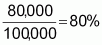
6.3 When you do not have enough to go around
There may be insufficient commodities on hand on the distribution day to meet the agreed basket of food and/or non-food items. This can happen in stable long term operations as well as in emergencies. At the same time there may be pressure to distribute whatever is in stock.
The options are:
· Postpone distribution until a full ration for the total population is available.· Distribute an equal share of available commodities to all of the population.
· Give a larger or full ration to vulnerable groups in the population and a small (or no) ration to the general population.
Whichever option you adopt you will need to ensure that the population is properly informed. They will need this information in order to plan their consumption during periods of shortage. Security problems are less likely if the refugees know what is happening and why.
|
Options when there is not enough to go around |
||
|
1. |
2. |
3. |
|
· Can the refugees, especially vulnerable groups, support the wait without serious consequences? · Is the monitoring system good enough to detect real hardship which could be caused by delay? |
· Can the vulnerable people survive with reduced rations? |
· Have you clearly identified the vulnerable groups? · Do you have the means to deliver targeted assistance? · How will the general population react when they get little or nothing, will they support this option? |
6.4 Trading rations
A limited degree of trading in commodities at the household level may be accepted provided there is no evidence of large scale diversion of assistance or detrimental effects on the health/nutritional status of the community. Situations where a large volume of commodities are being sold by “leaders” is an indication that the commodities have never reached their intended target, the individual families.
(...)
Make distribution staff visible by providing them with hats, vests and other visibility material.
Carry out the distribution as quickly as possible, minimise waiting periods.
Deal quickly and fairly with cases of cheating or disorder.
Ensure that there is clear space between people waiting and the stacks of commodities.
Keep in mind the limitations of fences at distribution points: The type of construction usually available will not be able to stop a large determined crowd. Aim at creating an orderly process which will not attract large numbers of people at any one time rather than relying on physical barriers. If the process is well structured, people will respect even token barriers such as a line of stones or a single strand of rope. Convince people to sit down during waiting periods - the result will be much less pushing forward or jostling.
6.6 Payment in kind
Avoid payment in kind to distribution staff. This might seem like a simple and cost effective method but may in fact complicate the distribution procedure. It can be difficult to check if commodities in the possession of distribution staff are legitimate payments or pilferage. In situations of short supply, giving commodities to distribution staff in payment rather than to vulnerable people, would be inappropriate.
6.7 Retroactive distribution
This question arises most often in relation to food distribution but can also relate to the distribution of consumable NFI e.g. soap. There is no automatic retroactive entitlement when full distribution of the agreed ration has not been possible, In the case of food, the decision on any retroactive distribution will be made jointly by UNHCR and WFP, taking into account the nutritional status of the beneficiaries, measures taken by them, and any liabilities incurred in coping with the shortfall, its economic impact, and the future availability of resources.
6.8 Sacks and other empty containers
Beneficiaries are often allowed to keep empty food containers and sacks. For the first distribution following an influx, these containers may be the only way for the refugees to carry and store the commodities. Where rations are distributed in bulk (not scooped), it would in any event be impractical to retrieve them. Empty containers are often used as shelter material or as cooking pots etc. They can be sold to provide valuable extra support to the family. The costs of collection and storage of empty containers can be significant. It is useful however to maintain a stock of empty sacks and containers which can be used for re-bagging when food containers are damaged.
In cases where WFP wishes to retrieve empty food containers, responsibility for this rests with WFP, who will pay for their collection, storage and transportation. Collection of empty containers is normally only possible when they have been retained at the distribution point, and the commodities distributed without containers to the refuges. Where containers have already been distributed with the ration, it is usually impractical or causes too much resentment, to retrieve them.
(...)
|
| |||||||||||||||
Commodity Distribution, A Practical Guide for Field Staff (UNHCR, 1997, 77 p.)
Annex 1 - Reporting on Food Distribution
1. Food Distribution Monitoring Report (Food 1)
In the first instance this report should be completed by the implementing partner responsible for distribution and submitted simultaneously to the UNHCR and the WFP Sub/Field Office. Distribution reports from several sites/implementing partners should be consolidated at Sub Office level and transmitted to the Branch Office. The BO, in turn, consolidates reports from Sub Offices and submits the consolidated report to HQs.
Offices should decide themselves on the mechanism and the frequency of the data collection depending on the actual situation. For stable operations the information should be compiled on a monthly basis. In emergencies, reports may have to be compiled daily or weekly.
UNHCR and WFP should agree at Field level on the format for distribution reporting and, if needed, modify the format presented here accordingly. The format should be incorporated into the tripartite agreement between UNHCR, WFP and the implementing partner.
Food Distribution reports submitted to HQs should be addressed to the Desk, copied to FSU.
Explanation of the Food Distribution Monitoring Report form
|
1.1 |
“BO/SO/FO/SITE” |
Fill in the name of the distribution site, or of the area which will indicate who the beneficiaries are. |
| | | |
|
1.2 |
“Project No” |
Refers to the WFP reference number for the Emergency Operation (EMOP) or Protracted Refugee Operation (PRO). For caseloads under 5,000, (UNHCR responsibility), the LOI reference number should be used. |
| | |
|
|
1.3 |
“Reporting period/month” |
If reporting on a monthly basis, only give the name of the month. Otherwise, give exact dates for the reporting period, including the exact number of days, i.e. from 6 to 16 January 1997, 11 days. |
| | |
|
|
1.4 |
“No of beneficiaries” |
The number of beneficiaries for this reporting period should be given, for general feeding, supplementary (SFP) and therapeutic (TFP) feeding and any other feeding programmes, e.g. Food for Work (FFW), special feeding for unaccompanied minors. |
| | | |
|
1.5 |
“Rations” |
The daily ration (grams) per person for each commodity. The information requested on rations is collected from the basic WFP and/or UNHCR documents, as those provide the theoretical rations for a certain caseload and time period. |
|
| |
Information on kilocalories is important so as to compare the theoretical calorific value of the different rations against the agreed basic requirements (e.g. the minimum calorific intake for a general feeding operation is currently 1,900 kcal/person/day). |
| |
| |
|
1.6 |
“Opening stocks” |
(a) is the quantity physically available at the EDPs (or the total of all EDPs, if completing a consolidated report for the whole country operation) at the beginning of the reporting period. This should not take into consideration pipeline projections. |
| | | |
|
1.7 |
“Quantity received” |
(b) refers to the food actually delivered to the EDP during the reporting period. |
| | | |
|
1.8 |
“Total quantity available” |
(a)+(b) is the sum of the opening stocks and the quantity received during the reporting period. |
| | | |
|
1.9 |
“Total quantity required” |
Is the sum of the requirements for general, supplementary and therapeutic feeding and/or any other feeding programmes. Requirements for each programme are computed as (daily ration/person) × (number of beneficiaries) × (number of days covered by the reporting period). |
| | |
|
|
1.10 |
“Distribution” |
Indicates the quantities actually distributed for each feeding operation, within the given period. |
| |
| |
|
1.11 |
“Percentage of needs covered” |
[(d)/(c)] compares the actual distribution versus the theoretical requirements. |
| | | |
|
1.12 |
“Losses” |
Record any losses due to damage, theft etc. |
| | |
|
|
1.13 |
“Stock transfer to other sites” |
Use this row to record stock movements not used for distribution to the target group, e.g. losses, spoilage, stocks transferred to another site or warehouse. |
| | | |
|
1.14 |
“Closing stocks” |
Represents the total quantity of food available after the distribution (at the different EDPs or for all EDPs, if reporting at country level - see para 1.6 above). In addition to actual quantities distributed this should also take into consideration losses and stock transfers to other sites. |
(...)
|
| |||||||||||||||
Commodity Distribution, A Practical Guide for Field Staff (UNHCR, 1997, 77 p.)
Annex 2 - Reporting on Non-Food Items Distribution
1. Non-Food Item Distribution Report (NFI. 1)
In the first instance this report should be completed by the implementing partner responsible for distribution. Distribution reports from several sites/implementing partners should be consolidated at Sub-Office level and transmitted to the Branch Office. The BO in turn consolidates reports from Sub-Offices and submits the consolidated report to HQs.
Offices should decide themselves on the mechanism and the frequency of the data collection, depending on the actual situation. For stable operations the information should be compiled on a monthly basis. In emergencies, reports may have to be compiled daily or weekly.
Non-Food Item Distribution reports submitted to HQs should be addressed to the Desk.
|
1.1 |
“BO/SO/FO/SITE” |
Fill in the name of the distribution site, or of the area, which will indicate who the beneficiaries are. |
| | | |
|
1.2 |
“Project No” |
Refers to the project symbol of the LOI under which the NFI were purchased. |
|
| | |
|
1.3 |
“Reporting period/month” |
If reporting on a monthly basis, only give the name of the month. Otherwise, give exact dates for the reporting period, including the exact number of days, i.e. from 6 to 16 January 1997, 11 days. |
| | |
|
|
1.4 |
“No of beneficiaries” |
The number of beneficiaries for this reporting period should be given, both for the general distribution and for any special distribution to other groups. The number of families should also be specified as the NFI ration is often specified per family. Often an average family size is used (e.g. 5 persons/family) to calculate the number of families. |
| | |
|
|
1.5 |
“Rations” |
The ration of NFI should be specified, e.g. 3 blankets/family, 1 bar of soap/person. |
| | | |
|
1.6 |
“Opening stocks” |
(a) is the quantity physically available at the warehouse (or the total of all warehouses, if completing a consolidated report for the whole country operation) at the start of the reporting period. This should not take into consideration pipeline projections. |
| | |
|
|
1.7 |
“Quantity received” |
(b) refers to the commodities actually delivered to the warehouse during the reporting period. |
| | | |
|
1.8 |
“Total quantity available” |
Is the sum of the opening stocks and the quantity received during the reporting period. |
| |
| |
|
1.9 |
“Total quantity required” |
(c) is the sum of the requirements for general distribution and/or any other special distribution programmes. |
| | | |
|
1.10 |
“Distribution” |
Indicates the quantities actually distributed. |
| | |
|
|
1.11 |
“Percentage of needs covered” |
[(d)/(c)] compares the actual distribution versus the theoretical requirements. |
| | | |
|
1.12 |
“Closing stocks” |
Represents the total quantity of commodities available after the distribution (at the different warehouses or for all warehouses, if reporting at country level - see para 1.6 above). In addition to actual quantities distributed this should also take into consideration losses and stock transfers to other sites. |
|
| ||||||||||||||||||||
Commodity Distribution, A Practical Guide for Field Staff (UNHCR, 1997, 77 p.)
Annex 3 - Reporting on Food Distribution
Worksheet for On Site Food Distribution Monitoring Report
SURVEY WORKSHEET
|
Camp/Area: _________________ |
No. of days covered by this distribution: _______ |
|
Distribution Site: _____________ | |
|
Survey Date: ________________ | |
What was aimed to be distributed
|
Commodity |
Cereal |
Pulses |
Veg Oil |
Sugar |
Other |
Other |
Other |
Total |
|
Targeted ration | | | | | | | | |
|
Targeted ration | | | | | | | | |
90% of targeted ration = ----------Kcal/person/day
110% of targeted ration = ---------- Kcal/person/day
What was actually distributed
|
Family |
M/F |
Family |
Cereal |
Pulses |
Veg Oil |
Sugar |
Other |
Other |
Other |
Total |
Kcal/pers/day |
|
1 | |
| | | | | | | | | |
|
Kcal |
| | |
| | |
| | |
| |
|
2 | |
| | | | | | | | | |
|
Kcal |
| | |
| | |
| | |
| |
|
3 | |
| | | | | | | | | |
|
Kcal |
| | |
| | |
| | |
| |
|
4 | |
| | | | | | | | | |
|
Kcal |
| | |
| | |
| | |
| |
|
5 | |
| | | | | | | | | |
|
Kcal |
| | |
| | |
| | |
| |
|
6 | |
| | | | | | | | | |
|
Kcal |
| | |
| | |
| | |
| |
|
7 | |
| | | | | | | | | |
|
Kcal |
| | |
| | |
| | |
| |
|
8 | |
| | | | | | | | | |
|
Kcal |
| | |
| | |
| | |
| |
|
9 | |
| | | | | | | | | |
|
Kcal |
| | |
| | |
| | |
| |
|
10 | |
| | | | | | | | | |
|
Kcal |
| | |
| | |
| | |
| |
|
11 | |
| | | | | | | | | |
|
kcal |
| | |
| | |
| | |
| |
|
12 | |
| | | | | | | | | |
|
Kcal |
| | |
| | |
| | |
| |
|
13 | |
| | | | | | | | | |
|
Kcal |
| | |
| | |
| | |
| |
|
14 | |
| | | | | | | | | |
|
Kcal |
| | |
| | |
| | |
| |
|
15 | |
| | | | | | | | | |
|
Kcal |
| | |
| | |
| | |
| |
(...)
Explanatory Notes
Methodology13
13 From: MSF Nutritional Guidelines, Paris 1995 and State of the Art about Food Basket monitoring (Draft) MSF Holland 1995.
This method seeks to measure the calorific value (per person per day) of the ration actually collected by each family and to compare this with the value intended to be delivered by the distribution system. The measure is against the food value actually intended on the day, not against the theoretical ration. For example if the calorific value of the theoretical ration is 2,000 Kcal/p/d but due to logistic problems the distributing agency only has 1,500 Kcal/p/d on hand for distribution, then the calculation is made against the 1,500 value.
|
NOTE: Although Kcals are used as a measure in this methodology this method does not provide any information or analysis on nutritional aspects of the ration system. IT MEASURES ONLY THE EFFICIENCY OF THE DISTRIBUTION SYSTEM, NOT THE ADEQUACY OF THE FOOD BASKET. |
To prepare this report you will need the “On Site Distribution Monitoring Report, Survey Worksheet” and the “Results Table”, see p. 65, (photocopy these and give them to your implementing partners)
Before you go to the distribution site:
1. First calculate the Calorific value of the ration (per person per day) which the distribution agency is aiming to distribute on that day. Fill in the row in the Worksheet “Targeted ration g/person/day” for each commodity.
Then calculate the calorific value (per person per day) for each commodity (use Table 3) and fill the row “Targeted ration Kcal/person/day”
Add each of these up to give the total value of the ration and fill the box “Total Kcal/person/day”.
2. Calculate what 90% and 110% of the targeted ration would be. These will be used as a cut off points.
Fill in the boxes on the table “90% of targeted ration” and “110% of targeted ration”.
3. Determine the number of days which the distribution is intended to cover.
If the number of days is unknown or unreliable then the calculation is only possible retroactively. The calculation is only possible when the next distribution has been performed, and so the number of days covered can be counted. Fill in the space on the Worksheet “No. Of days covered by this distribution:”.
At the distribution site:
4. Choose a site close to the distribution point, but at such a distance that the activities do not interfere with the distribution itself. The beneficiaries must not have a chance to sell or dispose of the commodities. Have two monitors and one supervisor present, with a 50 kg and 5 kg scales (e.g. Salter scales). Have the monitors select the beneficiaries (often the family heads) for the sample.
5. A random systematic sample of 30 persons is drawn from all persons receiving commodities at each of the distribution points which you survey. The sample should be equally spread over the total number of households and over the whole distribution day, (e.g. if 500 persons/family heads will attend today, you will measure the ration of every 500/30 = 16th family). The beneficiary is selected and accompanied to the point where the ration will be weighed by a monitor.
6. Record if the person collecting the ration is male or female. Fill the box “M/F” on the Worksheet.
7. Determine the number of people for whom the ration is intended from the ration or registration card. Fill the box “Family Size” on the worksheet.
8. Weigh all food items separately and note their weights on the work-sheet
Fill in the weight under the commodity name on the Worksheet for each family.
Back at the office:
9. Calculate the calorific value of the weight of each commodity which was given to each family. A table of the calorific values of various commodities is attached, Table 3. Fill in the row “Kcal” for each commodity.
10. Calculate the total calorific value of the food given to that family by adding the individual values for each commodity. Fill in the Column “Total Kcal” for each commodity.
11. Calculate the average calorific value, per person, per day for each family by dividing the Total Kcal by the number of days and the number of persons in that family. Fill in the box in the Worksheet “Kcal/person/day” for each family.
12. When you have calculated the “Kcal/person/day” for each family then count the number of families who have a value of “Kcal/person/day” less than the “90% of targeted ration” which you calculated earlier. (See 2 Above) Fill in the appropriate box in the Results Table.
13. Calculate the percentage of families (out of the total of 30 families) receiving less than “90% of targeted ration”
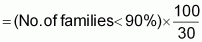
14. Do a similar calculation and fill in the boxes for “No. of families 90% - 110%” and “No of families >110%”.
Interpretation
In a good efficient distribution system none of the families should receive < 90% of the intended Kcal. Therefore that figure should be A0.
The majority of families should be in the 90% - 110% range.
Over time if the percentage of families in the 90% - 110% range is decreasing then the efficiency of the distribution system is deteriorating. Action must be taken to correct this.
Compare the “% Female” result on the worksheet with information you have on the overall % of female headed households among the beneficiaries. If the % of females collecting rations is significantly different from the % of female headed households in the population then it may be that your distribution system is not allowing fair access to women. Corrective action should be taken.
(...)
Table 3
|
PULSES AND OILSEEDS: | |
|
BEANS, DRIED |
335 |
|
PEAS, DRIED |
335 |
|
CASHEW NUT |
543 |
|
COCONUT, FRESH, MATURE |
388 |
|
GROUNDNUTS, DRY |
549 |
|
LENTILS |
340 |
|
SESAME SEEDS |
558 |
|
SOYBEAN |
405 |
|
SUNFLOWER SEEDS |
486 |
| | |
|
VEGETABLES: |
|
|
EGGPLANT |
32 |
|
KIDNEY BEANS, RAW |
36 |
|
LEAVES, MEDIUM GREEN (PUMPKIN) |
27 |
|
LEAVES, LIGHT GREEN (CABBAGE) |
26 |
|
MAIZE, FRESH |
152 |
|
ONION |
41 |
|
SHALLOT |
41 |
|
PEPPERS, SEEDS REMOVED |
48 |
|
TOMATO |
21 |
|
LEMON |
59 |
|
AMLA |
58 |
| | |
|
FRUITS (FRESH) | |
|
AVOCADO |
121 |
|
BANANA |
88 |
|
CITRUS |
49 |
|
GUAVA |
64 |
|
MANGO |
60 |
|
PAWPAW |
32 |
|
PAPAYA |
32 |
|
PINEAPPLE |
47 |
|
WATERMELON |
22 |
| | |
|
FRUIT (CANNED): | |
|
FRUIT IN SYRUP |
60 |
| | |
|
FRUIT (DRIED): | |
|
APRICOTS |
270 |
|
DATES |
245 |
| | |
|
SUGAR |
400 |
|
SALT |
0 |
| | |
|
MEAT (CANNED) |
|
|
MEAT, AVERAGE |
220 |
|
CHICKEN |
215 |
|
CORNED BEEF |
233 |
|
PORK |
271 |
| | |
|
FISH: |
|
|
CANNED FISH IN OIL |
305 |
|
CANNED FISH |
150 |
|
DRIED FISH, HARD |
380 |
|
DRIED FISH, SALTED |
270 |
|
DRIED FISH, WHOLE (FRESHWATER) |
309 |
|
SARDINES, CANNED IN OIL |
309 |
|
FPC (NORSE) TYPE B |
390 |
| | |
|
MILK AND MILK PRODUCTS: | |
|
MILK, COW, WHOLE |
79 |
|
DRIED WHOLE MILK (DWM) |
490 |
|
DRIED SKIM MILK (DSM) |
360 |
|
DRIED SKIM MILK (DSM), FORTIFIED |
360 |
|
CONDENSED MILK, SWEETENED |
325 |
|
EVAPORATED MILK |
150 |
|
CANNED CHEESE |
355 |
| | |
|
OILS AND FATS: | |
|
ANIMAL FAT, RENDERED |
902 |
|
BUTTER |
725 |
|
BUTTER OIL, GHEE |
862 |
|
MARGARINE, MARGARIT |
735 |
|
PALM OIL, RED |
875 |
|
VEGETABLE OIL |
890 |
| | |
|
MISCELLANEOUS: | |
|
TEA |
40 |
|
COFFEE GROUND |
56 |
|
HIGH-PROTEIN BISCUITS |
500 |
|
LICHIS BASTARD |
61 |
|
SPICES MIXED, GARLIC |
145 |
|
SPICES MIXED, TUMERIC |
349 |
|
YEAST DRIED (FOOD) |
344 |
| | |
| | |
| |
|
|
| |
|
| |||||||||||||||||||||||||||||||||||||||||||||||||||||||||||||||||||||||||||||||||||||
Annex 4 - Household Monitoring Report
This can be carried out in three ways:
Individual household-level questioning and observation
Key informant interviews
Focus group discussions
Results from each of these methods can be cross checked with the others.
Individual household level
This is an essential part of any monitoring system. It involves visiting a selection of refugee homes/shelters and asking questions of the family members as well as observing the actual conditions. Physical conditions of shelters, sanitation, etc. should be noted. The presence and quantity of distributed commodities should be noted, e.g. plastic sheeting, kitchen sets, food quantity/type etc. Weighing of food found in the household is not recommended as this can be highly misleading.
A wide number of households should be visited near/far in relation to distribution points and other services.
Women in each household must be questioned on their access to the distribution, appropriateness of the ration, any difficulties created by the type of non-food items etc.
Key Informant Interviews
Interviews are held with individuals selected for their knowledge of the situation in general or of a particular aspect of it. Key informants usually include teachers, religious leaders, womens group representatives, traders, camp committee members, government officials and local staff of agencies.
Focus Group Discussions
Focus groups can be composed of people selected widely from the whole camp, from a particular area of the camp, from a particular group within the population (e.g. women). The composition of your focus group will depend on what exactly you are trying to find out. However within any given category you must include women in the group (unless it is a category which usually does not include women, e.g. ex-combatants).
(...)
|
| |||||||||||||||
Commodity Distribution, A Practical Guide for Field Staff (UNHCR, 1997, 77 p.)
Annex 5 - Post Distribution Monitoring
Market Survey Report Form
|
Survey Location: ____________ |
Agency: |
|
Date: ______________________ |
Currency: |
|
Commodity |
Unit |
Price per unit |
| | | |
| | |
|
|
| | |
| |
| |
| | |
|
|
| | |
| |
| |
| | |
|
|
| | |
| |
| |
| | |
|
|
| | |
| |
| |
| | |
|
|
| | |
| |
| |
| | |
|
|
| |||||||||||||||||||||||||||||||||||||||||||||||||||||||||||||||||||||||||||||||||||||
Annex 6 - Bibliography
Handbook for Emergencies, UNHCR Geneva 1982
UNHCR Policy on Refugee Women, UNHCR Geneva
Guidelines on the Protection of Refugee Women, UNHCR Geneva 1991
Food Aid & Nutrition “Briefing Kit”, UNHCR Geneva 1993.
People-Oriented Planning at Work - Using POP to Improve UNHCR Programming, UNHCR Geneva 1994.
Working with Unaccompanied Minors in the Community, a family based approach, UNHCR Geneva 1994
Refugee Children, Guidelines on Protection and Care, UNHCR, Geneva 1994
Registration - a practical guide for field staff, UNHCR Geneva 1994.
MSF Nutritional Guidelines, MSF Paris 1995
Sexual Violence against Refugees, Guidelines on Prevention and Response, UNHCR, Geneva 1995
State of the Art about Food Basket Monitoring (DRAFT), MSF Holland 1996
Refugee Emergencies a community based approach, UNHCR Geneva 1996
Partnership: A Programme Management Handbook for UNHCR's Partners, UNHCR Geneva 1996
Memorandum of Understanding On the Joint Working Arrangement for Refugee, Returnee and Internally Displaced Persons Feeding Operations, UNHCR/WFP Geneva 1997
UNHCR Needs Assessment Manual, UNHCR Geneva (currently under preparation).