 |
| ||||||||||||||||||||||||||||||||||||||||||
Published by arrangement with the
Institut africain pour le
d�veloppement �conomique et social
B.P. 8008, Abidjan, C�te d'Ivoire
FOOD AND AGRICULTURE ORGANIZATION OF THE UNITED NATIONS
Rome
1976
FAO Economic and Social Development Series No. 3/5
First edition 1970
Reprinted 1972
Second edition, revised,
1976
Reprinted 1983,1994
P-69
ISBN 92-5-100144-8
© French edition, Institut africain pour le d�veloppement
�conomique et social (INADES) 1970
© English edition, FAO
1976
|
| ||||||||||||||||||||||||||||||||||||||||||
Preface
The first 26 volumes in FAO's Better Farming Series were based on the Cours d'apprentissage agricole prepare in Cote d'lvoire by the Institut africain de developpment economique et social for use by extension workers. Later volumes, beginning with No. 27, have been prepared by FAO for use in agricultural development the farm and family level. The approach has deliberate, been a general one, the intention being to create a basic model that can be modified or expanded according tolocal conditions of agriculture.
Many of the booklets deal with specific crops and techniques, while others are intended to give farmers more general information that can help them to understand why they do what they do, so that they will be able to do better.
Adaptations of the series, or individual volumes in it, hay been published in Amharic, Arabic, Bengali, Creole Hindi, Igala, Indonesian, Kiswahili, Malagasy, SiSwati Thai and Turkish. This volume has been prepared by the FAO Animal Production and Health Division (Dr P.L Pugliese).
Requests for permission to issue this manual in other languages and to adapt it according to local climatic and ecological conditions are welcomed. They should be addressed to the Director, Publications Division, Food and Agriculture Organization of the United Nations, Viale delle Terme di Caracalla, 00100 Rome, Italy.
Booklets 27 to 41 in the FAO Better Farming Series were written and illustrated by Tom Laughlin, working closely with the technical divisions concerned.
|
| ||||||||||||||||||||||||||||||||||||||||||
Plan of work
FIRST WEEK
Erosion.
· Read pages 4 to 7.
This
lesson for the first week is not very long.
But you have to understand that
erosion is very bad, and how and why soils are carried away by rain and wind.
SECOND WEEK
How to stop the flow of water.
· Reread pages 4 to 7.
· Read pages 8 to 16.
We see that there are several ways of controlling erosion.
· Where you live, do they make
contour line ridges or ditches?
Or barrier strips?
Do they go in for
terrace farming?
· You must understand why keeping to the contour lines prevents erosion.
THIRD WEEK
How to cover the soil.
· Reread pages 7 to 9.
· Read pages 17 to 22.
Why is mulching used?
Why sow cover crops?
Where you live,
do they make brush fires?
Try to find out why.
In what season do they make
brush fires?
Why?
FOURTH WEEK
Fallow, crop rotation, land- use allocation.
· Read pages 23 to 28.
Fallow
and green manuring improve the soiI.
It is best to grow crops and raise
animals as well. Why?
Were crop rotations and land- use allocation used in
the past?
How long did the fallow last?
Why must a change be made?
· Reread the whole booklet.
· Answer the question paper.
|
| ||||||||||||||||||||||||||||||||||||||||||
Better Farming Series 05 - The Soil: How to Conserve the Soil (FAO - INADES, 1976, 29 p.)
The soil can change
In Africa many soils can become bad.
Why?
The sun, the
rain and the wind change the soil a great deal.
In Africa the rains are often
very heavy.
After the rains the heat is very great.
Great heat after heavy
rains ruins the soil: the humus is quickly destroyed.
The wind too ruins the
soil So we have to protect the soil from sun, rain and wind by stopping the
water from flowing away; by covering the soil.
· If you always farm the same field, the plants will take all the mineral salts out of the soil.
You must let the earth rest by fallows; by crop rotation; by land- use allocation.
Erosion
Rainwater may carry away cultivable land.
This is water erosion.
Let us see what happens when it rains heavily.
Every drop of
heavy rain that falls on the soil takes away a little earth.
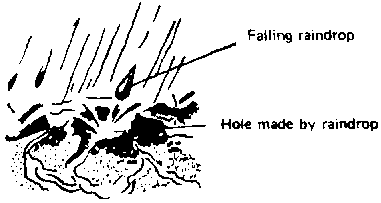
Heavy rain
Around the house, the water that falls from the roof makes holes and takes away earth.
When the rain falls gently, it does not flow off, it goes into the soil. All the earth becomes wet. Gentle rain does not carry away earth.
When the rain is very heavy, it does not all go into the soil. It flows and makes ditches. If the soil is on a slope, the water flows more quickly, and makes deeper ditches. A lot of earth is carried away. Along the sides of the road, the water runs very fast, it carries away the earth, and makes deep ditches.
Water erosion is worse
· when the soil slopes: the water flows quickly and carries away a lot of earth;
· when there are no plants growing on the soil: plant roots hold the earth and the leaves shelter it from the rain.
For instance, at Adiopodoume, Ivory Coast, the weight of earth in kilogrammes (kg) carried away by the rain in one year has been calculated as follows:
from 1 hectare of kg carried away
|
bare land |
117 000 |
|
land under crops |
52 500 |
|
forest land |
2 400 |
The wind can also carry away earth. This is erosion by wind.
In some very dry regions where the wind is very strong, it carries away earth.
Bare soils, without plants, and soils with a bad structure (see Booklet No. 4, page 24) are most easily carried away by the wind. What remains in the field is poor soil.
Strong sun spoils the soil.
When there are no plants on the soil, the soil is bare, the earth is not protected. The earth becomes dry. The humus is quickly destroyed. The soil structure becomes bad. Good earth is easily carried away. The soil becomes poor.
|
| ||||||||||||||||||||||||||||||||||||||||||||||||||||||||||||||||||||||||||||||||||||||||||||||||||||||
Better Farming Series 05 - The Soil: How to Conserve the Soil (FAO - INADES, 1976, 29 p.)
How to conserve the soil
Erosion can be prevented:
· by stopping the water from flowing away.
Quickly running water carries earth away. It is dirty water,
mixed with earth
If the flow of water is stopped, the earth mixed with the
water settles on the ground.
The water becomes cleaner. The earth is not
lost.
In order to stop the flow of water and keep the earth, we use:
· contour line ridges,
· ditches,
· barrier
strips,
· strip cropping.
· by covering the soil.
Water that falls on bare soil carries away the soil.
Water
that falls on soil covered by plants damages the soil less.
The plants that
cover the soil reduce erosion.
To cover the soil, use mulches and sow cover
crops.
Brush fires leave the soil bare and without plants. They destroy
organic matter. The soil structure becomes bad.
Brush fires are bad for the
soil.
Prevent erosion by stopping the flow of water
Contour line ridges
Water flows very fast on sloping land. It flows strongly and
carries away earth.
When ridges are made in the direction of the slope, or if
you plough in the direction of the slope, the water flows faster and faster
between the ridges.
It carries away a lot of earth.
Look at this drawing:
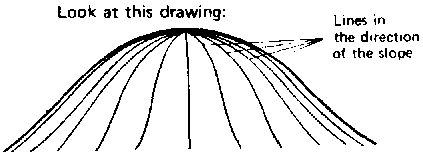
Figure
The lines are in the direction of the slope.
The water flows
very fast. Earth is carried away.
When ridges are made across the slope,
water cannot go fast. It is stopped by the ridges. Earth is not carried away.
Look at this drawing:
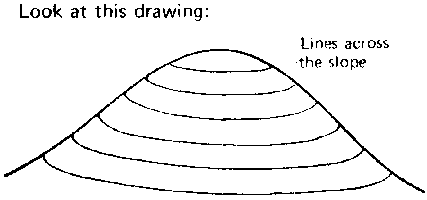
Figure
These lines are across the slope. Water and earth are held
up.
When you make ridges across the slope,
When you plough across the
slope,
You are working on the contour line.
A contour line is a line
across the slope running always at the same height!
Making ridges along the
contour lines helps to control erosion.
The water cannot flow fast
The
water is held by the ridges.
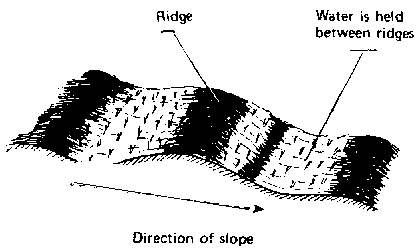
Direction of
slope
How to make contour lines
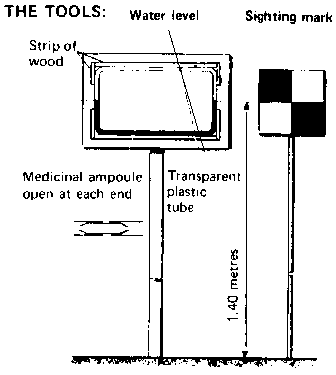
The tools
The water level
We need:
· a board 80 centimetres by 50
centimetres;
· an empty medicinal
ampoule;
· 1.80 metres of plastic tube of the
same size as the ampoule (the dispensary may have it).
Half fill the tubing with water mixed with a little ink.
Join
the two ends of the tube with the ampoule, which should be open at each end.
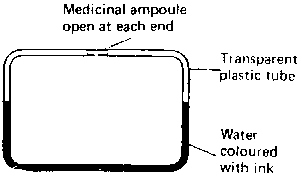
Medicinal ampoule
Fix the tube on the board as shown in the drawing, putting the
ampoule at the top.
Protect the tube by strips of wood, except in the places
shown in the drawing.
Nail the board to a stake 1.40 metres high.
· The sighting mark
Get a board 30 centimetres by 30 centimetres. Nail the board to a stake 1.40 metres high. Paint two squares on the board as shown in the drawing. This is our sighting mark.
· Stakes
Get ten stakes 1 metre high.
MARKING THE LINES
Two people are needed, the man in charge and his helper.
The
man in charge takes the water level.
His helper takes the sighting board and
the stakes.

Marking the lines
The man in charge goes to the top of the field. His helper goes to the same height at a distance of 15 metres or paces. The sighting mark and the level are held quite straight.
As shown in the drawing, the man in charge tries to get in the same line of sight the levels of the water in the tube and the centre of the sighting mark.
He takes a sight.
The man in charge does not move from his place. He signs to his helper to go up or down the slope. When he has got a good sight, the helper fixes a stake in place of the sighting mark.
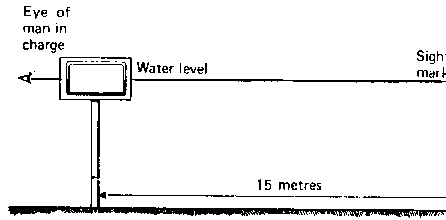
Signing to helper
The helper goes 15 metres or 15 paces away from the stake he has
just fixed in the ground. He is now 30 metres from the man in charge.
The man
in charge takes a new sight. His helper marks the spot with another
stake.
The helper again goes 15 metres away. The man in charge takes another
sight.
The helper gets to the end of the field. All the stakes are at the
same level.
The man in charge marks a ridge joining all the stakes.
This ridge marks the contour line.
To make a line 30
centimetres lower, the man in charge puts his level on the line he has just
marked.
His helper puts a block 30 centimetres high under the sighting
mark.
The man in charge takes a sight.
He finds the beginning of a contour
line that is 30 centimetres lower.
He looks for points on the new line.
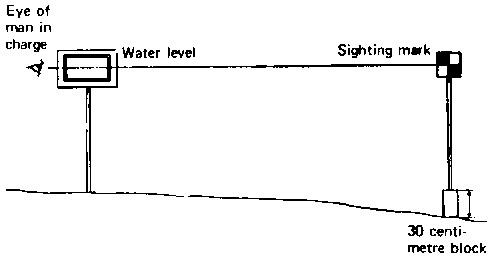
Setting a new line 30 cm below
Then he marks a third line, and a fourth line.
Contour line barrier strips
· On a slope the soil can be even better protected by making barrier strips.
A strip of uncultivated land is left. Grass grows on this strip;
it stops the flow of water and the earth is not carried away.
Barrier strips
must also be made on the contour lines, across the slope.
A barrier strip
should be at least 2 metres wide.
To better stop the flow of water tall
grasses can be planted. Even trees can be planted.
· If the slope is slight, barrier strips are made 30 to 40 metres apart.
If the slope is a little steeper, barrier strips are made 10 to 20 metres apart.
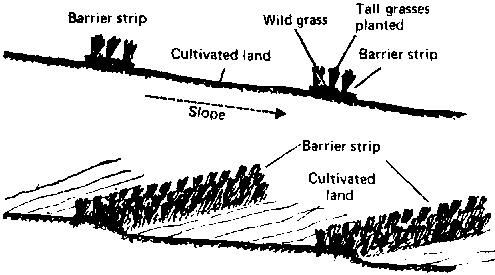
Slopes
Contour line ditches
· If the slope is very steep, and if the water flows very fast, it is difficult to stop the water with ridges or barrier strips.
· Ditches 30 centimetres deep are dug along the contour lines.
The earth from the ditch is piled up along the lower edge of the ditch and forms a big ridge, The water is stopped by the ditch and the ridge.
· No crops are grown on this big ridge.
Grass is allowed to grow on it; the roots prevent water from
carrying away the ridge
The ditches are made 20 to 30 metres apart.
Crops
are grown on the strips of land between the ditches.
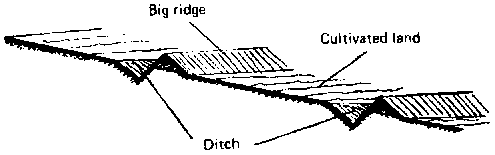
Crops are grown on the strips of
land between the ditches
Ditches control erosion very well, but they must be cleaned out from time to time.
Terrace farming
· If the slope is even steeper, it is impossible to grow crops on the slope.
But little walls of earth or stone can be built.
These walls
are built across the slope.
Earth is put behind the little walls.
In this
way terraces are made. Crops are grown on the terraces.
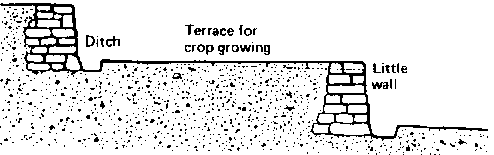
Crops are grown on the terraces
A ditch is made at the foot of the wall.
The ditch takes the
water that runs down from the terrace.
In some African countries there is a
lot of terrace farming, for example:
· among the Dogons in
Mali;
· among the people of the highlands of
northern Cameroon;
· among the hill people of
Rwanda and
Burundi.
Prevent erosion by covering the soil
Heavy rains, dry wind and sun all ruin the soil (see pages 5 to
6).
Plants protect the soil against rain, wind and sun.
· Plants that cover the soil prevent erosion.
The rain drops do not fall on the soil.
They fall on the
leaves.
Then they run gently on to the soil and do not carry away earth.
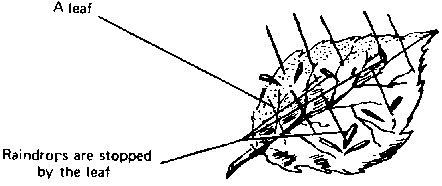
Raindrops are stopped by the leaf
Plants break the force of the wind, and make it less
strong.
Herbage protects the soil. The wind does not blow away the soil in
dust.
The sun does not shine straight on to the soil. Plants with their
leaves cast shade. The earth remains damp. Humus is not
destroyed.
Mulching
· You can cover the soil with:
straw cut herbage; leaves, stems of millet, maize, etc.
This
cover of dead plants is called a mulch.
· A mulch is useful because:
It protects the soil against water and wind that carry away earth. It protects the soil against the sun which dries the earth. The soil stays damp. It prevents weeds from growing
· After mulching
the straw etc. rots and makes humus. The soil is made richer.
· Mulching is used to protect the soil of gardens, and in growing bananas.
Mulches are also spread round certain fruit trees, such as
mango, papaw and orange.
For palms and coconuts the residues of fruit
clusters and coconut fibre are used for mulching.
· When you clear a field, do not burn the herbage and the small trees. Leave them on the soil so that the leaves and cut trees cover the soil.
Cover crops
· Cover crops are the plants which are sown or planted to cover the soil in certain plantations.
When you let soil rest by leaving it fallow after three or four years of crop production, you can sow cover crops which protect the soil from erosion.
In tree plantations, such as palms, coffee, cocoa, rubber, you must sow a cover crop between the lines of trees, for example, Pueraria.
When the cover crops grow too big, cut them down. Prevent them from climbing up the trees.
· Choose the right cover crops.
A good cover crop must grow quickly and last a long time.
Some cover crops can be used for feeding animals, for example, Stylosanthes and Pueraria.
The agricultural extension service will tell you which is the best cover crop for your plantation.
· The cover crop also improves the soil by giving it organic matter (see Booklet No. 2, page 23).
BRUSH FlRES
During the dry season, many plants die and lie on the
soil.
They are burned in a brush fire.
Why are brush fires made?
· To clear the land.
Fire cleans the field and makes work easier.
· For hunting.
Animals are afraid of the fire and take flight.
They are
caught and eaten.
· To make the grass grow again.
Cattle do not want to eat dry grass.
After the fire, green
grass grows, and cattle eat it.
· To protect the following crop (see Booklet No. 2, page 28).
Many little animals, such as agoutis, rats and insects spoil
crops.
The fire kills them.
They won't attack the following crop.
The
fire also burns up diseased plants.
They won't pass the disease to the
following crop.
· To walk more easily in the bush.
The fire burns tall grasses.
It is easier to get
about.
Why we must not make brush fires
Fire destroys organic matter.
Plants burned by the fire do not yield any humus.
After the
fire there is nothing left but ashes.
Wind and rain can carry them
away.
Humus enriches the soil and improves its structure.
Ashes enrich the
soil but do not improve its structure.
Fire leaves the soil bare.
Grass cannot grow again on soil burned at the end of the dry
season; the soil is too dry.
The first rains are often very heavy.
They
fall on bare soil.
They easily carry it away after a brush fire.
Fire destroys good plants.
After the fire a lot of plants die.
Often the good plants die
more easily than the bad ones.
Each year bad plants take the place of good
plants.
In this way savanna takes the place of forest.
Fire is dangerous.
Often whole plantations are destroyed, for instance coffee
trees, or oil palms.
Often houses and barns are burned, sometimes the whole
village.
In Africa many soils have often become poor because of fire.
The brush fire is bad.
If we want to stop making it, we must:
· destroy insects, small animals
and diseases by using chemical products
·
bury weeds by ploughing.
· feed animals
during the dry season with hay
But farmers do not always have the machines and the chemical products Many of them must still make fires However, they can prevent the fire being too bad.
If the fire is lit at the beginning of the dry season, the fire is not so fierce and not everything is burned The grass has time to grow again
Then the soil will not be bare at the beginning of the rainy season.
When a farmer cannot get the good results of fire by other means, he should make brush fires at the beginning of the dry season.
Fallow
When you clear a field, the first harvests are good.
But
after four or five years the harvest is less good; the plants have taken the
mineral salts from the soil and the soil becomes poor.
The soil must not be
used again.
The soil must be allowed to rest.
This rest for the soil is
called a fallow.
On soil that is left fallow, grass and other herbage
grows.
The plants protect the soil against erosion.
The plants die.
The
organic matter from the plants (see Booklet No. 2, page 23) enriches the soil
with humus.
The soil becomes rich again.
To get a better fallow:
· Sow plants.
These plants grow more quickly than grasses, and cover the soil
better.
They make more organic matter.
For example, Stylosanthes and
Crotalaria are good fallow plants.
· Do not bum plants growing on the fallow.
· The fallow can be used for feeding animals.
But the animals must not eat all the plants.
Because then the
soil will no longer be
protected.
Crop rotation
· If the same crop is grown on the same field every year the harvests get much smaller, and the soil becomes poor.
· if the crop is changed on the same field every year, the harvest can stay good, and the soil does not become poor. This is called crop rotation.
An example of crop rotation from the Baoule country,
|
Ivory Coast: |
first year: |
yams |
| |
Second year: |
maize or rice |
| |
Third year: |
cotton |
| |
Fourth year: |
fallow |
· In traditional farming, the same crop is grown on the same field for several years.
The crop takes all the mineral salts.
The soil becomes very
poor.
The soil structure (see Booklet No. 4, page 24) becomes bad.
Erosion
carries away soil. Sometimes even the village has to be moved.
Crop rotation means growing a different crop each year on the same field.
REASONS FOR CROP ROTATION
· To make better use of all parts of the soil.
For example:
The first year / grow cotton.
Cotton has a
tap- root {see Booklet No. 1, pa
Cotton gets its food deep down.
The
second year I grow rice.
Rice has fibrous roots {see Booklet No. 1,
pag
Rice gets its food on the surface.
Thus all parts of the soil are
used.
· To make better use of all the mineral salts in the soil.
For example:
The first year / grow cotton.
Cotton uses
chiefly one mineral salt phosphoric acid.
If I grow cotton for two years
running on the same field, the cotton will lack phosphoric acid.
The second
year I grow rice.
Rice uses chiefly another mineral salt, one containing
nitrogen.
A farmer who grows cotton and then rice makes better use of all the
mineral salts in the soil.
· To control insects and diseases.
For example:
When you grow cotton, the insect pests and
diseases of cotton increas
If you grow cotton again the next year, the pests
and diseases which have remained in the field do a lot of harm to the
cotton.
If you grow rice after cotton, the pests and diseases of cotton do no
harm to the rice, and disappear.
· An example of crop rotation in the Central African Republic:
|
First year: |
groundouts |
|
Second year: |
cotton. |
|
Third year: |
rice |
|
fourth year: |
cassava |
|
Fifth year: |
fallow |
|
Sixth year: |
fallow |
|
Seventh year: |
fallow |
Thus four years of crops are followed by three years of
fallow.
Fodder crops can be sown on the fallow, and so the animals can be
fed.
This is a seven- year rotation; every seven years the same crops are
grown.
HOW TO CHOOSE A CROP ROTATION
Before choosing a rotation you must think carefully.
· You must choose crops that will feed the family all the year.
· You must choose crops that will bring in money (industrial or cash crops).
· You must choose crops that can be grown one after the other without making the soil poor. They must be plants that have different roots, plants that do not use the same mineral salts.
· A crop rotation enables you to keep the soil rich. cut down the length of fallow, farm the same fields.
Land - use allocation
· Every year the farmer needs several different crops.
For example: millet or cassava to eat, cotton or maize to sell, grass for his animals.
· So every year he must grow different crops on different fields. He must allocate his land according to crop use.
Examples of land- use allocation:
Mamadou has six fields. He
does not grow millet on all his fields. On field 1, he plants cotton. On field 2
he sows rice. On field 3 he sows groundnuts. On field 4 he sows millet. Fields 5
and 6 he leaves fallow.
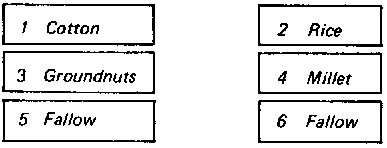
Fields 1- 6
Mamadou has made a good land- use a/location. He has crops to eat {millet and rice}. He has crops to sell (cotton, groundouts, riced. He has two fields of fallow to feed his animals and to let the soil rest.
REASONS FOR LAND - USE ALLOCATION
· To organize your work better.
Sowing, hoeing, cultivating, applying pesticides and harvesting of different crops do not always have to be done at the same time.
For instance, it is easier to grow during the same season one hectare of millet and one hectare of groundnuts, than to grow two hectares of millet.
If you grow only one crop, you have to do all the work at the same time.
With a good land- use allocation you always have enough time to do all your jobs well: ploughing, sowing, cultivating and harvesting.
· To provide a safeguard.
If you grow only one crop, and if a tornado, drought or animals destroy this crop, you have nothing left.
If you grow only one crop and this crop fetches a poor price, you earn no money.
By growing several crops you can always have both food and money.
|
| ||||||||||||||||||||||||||||||||||||||||||
Suggested question paper
FILL IN THE MISSING WORDS
Many soils can become ... .
Wind, sun and rain destroy soil;
this is called ... .
Erosion must be controlled by ... or by covering the
soil with ... and with ... crops.
A good farmer ... brush fires.
He knows
that fire is ... for the soil.
Fire destroys ... and ... and it also leaves
the soil ... .
To conserve the soil, a good farmer lets his soil rest; this
is called a ... .
He grows a different crop each year on the same field; this
is called ... .
Each year he grows different crops on different fields; this
is called ... .
ANSWER THE FOLLOWING QUESTIONS
What is erosion?
Why do we let soil lie fallow?
What is a
cover crop?
Your field is on a steep slope. What do you do in order to grow a
crop and conserve the soil?
What are the advantages of a good crop
rotation?
Tell a friend why you do not make brush fires.
After having
studied this course, what are you going to do to improve your
farming?