Better Farming Series 09 - Animal Husbandry: Animal Diseases; How Animals Reproduce (FAO - INADES, 1976, 33 p.)
Animal health
(introduction...)
Injuries
Parasites
Diseases
(introduction...)
Vaccination
Looking after ill animals
Better Farming Series 09 - Animal Husbandry: Animal Diseases; How Animals Reproduce (FAO - INADES, 1976, 33 p.)
Animal health
A man is sometimes ill. Animals too can fall ill. When an animal is
ill, it becomes thin, and may even die. Then the farmer loses a lot of money.
HOW TO KNOW WHEN AN ANIMAL IS ILL
Signs of good health
Signs of illness
(food appetite
No appetite
Very restless or too quiet Sensitive back, cold ears, fever
Bright eyes
Dull eyes
Shiny coat
Dry, brittle coat
Growing well
Losing weight
An animal may be injured, may have parasites, may have a
disease.
Injuries
Pay great attention to animal injuries.
If you see an animal walking with difficulty (limping), or
bleeding after a fight with another animal, or which has hurt itself, do not
wait to treat it.
If you wait, the wound will become worse, it will become
infected.
An infected wound is slow to heal; it may prevent the animal
from walking, from going to the pasture, from working, from giving milk. An
animal in pain produces less.
· Find out why the animal is
injured.
Has it a thorn in its foot? Has a piece of wood or iron torn
its skin ? Has a rope, collar or yoke rubbed, or been too tight? Is there
a vicious animal in the herd? When you have found out why the animal is
injured, you must get rid of the cause of the injury. If it is a working animal,
do not make it work; it is better to lose a few days' work than to lose the
animal.
· Treat the wound.
Wash the wound with warm water in which you have put something
to prevent the wound from getting infected.
You can use soap or a chemical product such as permanganate of
potash or cresol.
Wash the wound often. A wound that is always kept clean heals
quickly.
Parasites
Parasites are little animals that live on the skin or in the
body of other animals.
PARASITES ON THE SKIN
· Ticks
Ticks stick to the animal's skin and suck its blood. If an
animal has many ticks, it can lose a lot of blood. After a time, it will
become very weak. Kill ticks with chemicals such as DDT or BCH.
· Mange or scab
The parasite makes little holes under the skin and lays its eggs
there. If an animal has many parasites, it scratches a great deal. Treat
mange with products containing sulphur. Skin parasites injure animals. The
animals become restless, they walk with difficulty, they eat little. Skin
parasites can carry many serious diseases.
PARASITES THAT LIVE IN THE BODY
· Usually they live in the
digestive tract., For example, worms such as tapeworm and ascarid. They damage
the digestive tract and prevent animals from digesting their food. Animals with
worms get thin and sometimes die.
To kill these parasites, give the animals a medicine to drink,
such as phenothiazine. You can also use some traditional medicines.
· Parasites also get into the
liver. The animal does not digest well. Give it a medicine to kill the
parasites.
· Parasites also live in the
muscles. The animal has difficulty in walking. It has fever. An example is the
trichinella of pigs.
· Parasites can live in the
lungs. The animal has difficulty in breathing. It has broncho- pneumonia.
· Parasites even attack the
brain. The animal turns round and round. This is the gid or sturdy of sheep. The
animal dies.
The treatment for parasites often has to be repeated. The
agricultural service will tell you what medicines to use.
With the digestive tract animals and people digest and absorb
food and reject the waste matter.
A good way of controlling parasites is to let pastures rest.
Why is this?
The eggs of parasites fall on to the pasture in the animals'
droppings.
The eggs develop in the grass.
Then they may stick to the animals' skin or be eaten with the
grass, for instance, ticks and worms.
If you let the pasture rest long enough, the parasites cannot
feed on the animals' skin, or live inside the animals, and they die.
So in order to control parasites, let the pastures rest. Do not
put the animals always in the same pasture.
· Pay attention to the animals'
wafer.
Dirty water contains many parasites. Give the animals clean
water to drink.
· Clean the animals' housing.
On the floor and walls put a disinfectant that will kill
parasites (see Booklet No. 8, page
36).
Diseases
Besides parasites that live on animals' skin or in their bodies,
there are many diseases which prevent animals from growing and which may even
kill them.
In the animal husbandry courses on chickens, cattle, sheep and
goats, we shall deal with the diseases which each kind of animal may have:
· Diseases due to germs, such as
anthrax, rinderpest, pox, pneumonia. ·
Diseases due to bad feeding through lack of mineral salts (see Booklet No. 8,
page 17).
An animal that is badly fed, badly housed, badly looked after,
resists disease badly. It is often ill.
For animals to resist disease, a good farmer must: feed them
well (see Booklet No. 8, page 10); give them clean water to drink (see Booklet
No. 8, page 18); house them well (see Booklet No. 8, page 34); treat their
wounds (see page 5).
A good way of controlling diseases is to protect the animals by
vaccination.
Vaccination
A child is vaccinated before it is ill in order to prevent it
becoming ill. An animal should be vaccinated before it is ill, to prevent it
becoming ill. Vaccination tires animals a little, but it is not dangerous if
the animals are well housed and well fed.
For example:
Chickens are vaccinated for fowl diphtheria, fowl cholera, fowl
pest. Cows are vaccinated for pneumonia and anthrax. Pigs are vaccinated
for anthrax and swine erysipelas. Sheep are vaccinated for anthrax and foot-
and- mouth disease. You must take all the animals to be
vaccinated. Usually vaccination is compulsory and free of charge. If all
farmers do not take their animals to be vaccinated, the animals which have not
been vaccinated may catch the disease. Then the disease remains in the
district.
Looking after ill animals
To look after ill animals, you must:
· Go and see the veterinary
surgeon. When a man is ill, he goes to the doctor. When an animal is ill,
ask advice from the veterinary assistant or the veterinary surgeon. The
assistant will tell you what medicine to give the animal.
· Keep the animal alone, by
itself. Why? Because of the danger of infecting other animals. There
are two kinds of disease:
· contagious diseases These
are diseases which can pass from one animal to another. If one animal in a
herd is ill, it can give this disease to all the other animals. For example,
rinderpest and anthrax are contagious diseases.
· non- contagious diseases
These are diseases which do not pass from one animal to another.
If one animal is ill with such a disease, this disease is no danger to the other
animals.
When an animal has a contagious disease it must be kept alone by
itself.
Do not leave it with the rest of the herd. In this way you keep
the disease away from the whole herd.
You must not eat the meat of animals which have died from
certain contagious diseases such as tuberculosis. This disease can pass from
animals to people.
You must not let your herd mix with strange herds travelling
through, especially if they come from far away. Passing herds can bring diseases
with them.
Do not put in your herd an animal you have bought, or which
comes from elsewhere, unless you are sure it has been vaccinated. The animal may
bring disease to all the herd.
To make a country's animal husbandry modern, veterinary services
are necessary. All farmers should follow the advice of these services.
· Remember that a good way of
controlling diseases is to give pastures a period of
rest.
Better Farming Series 09 - Animal Husbandry: Animal Diseases; How Animals Reproduce (FAO - INADES, 1976, 33 p.)
Reproduction
How animals reproduce
(introduction...)
The reproductive systems
The female
The male
Pregnancy and birth
Choosing breeding animals
Why choose?
How to choose
Better Farming Series 09 - Animal Husbandry: Animal Diseases; How Animals Reproduce (FAO - INADES, 1976, 33 p.)
Reproduction
How animals reproduce
We have studied how plants reproduce themselves (see Booklet No.
3, page 14).
We shall now study how animals reproduce.
It is very important to study this, in order to improve animal
husbandry.
When you have a good knowledge of how animals give birth to
their young, of how they reproduce, you can make a better choice of the animals
for breeding.
To get a good harvest, a farmer chooses good seed (see Booklet
No. 3, page 24).
To get good animals, a farmer chooses good breeding stock.
To get a good harvest, a farmer chooses good varieties of seed
(see Booklet No. 3, page 22).
To get good animals, a farmer chooses good breeds.
To understand how animals reproduce, we must study the
reproductive organs of the females and
males.
The reproductive systems
The female
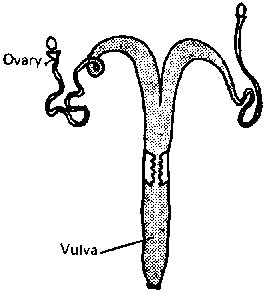
The reproductive organs of the female are all inside the
animal. You can see only the entry to the system which is called the vulva.
Genital organs of the cow
Genital organs removed from cow
Flowers have ovaries which contain ovules (see Booklet No. 3,
page 11). When the ovules are fertilized by pollen, the ovules become
seeds. Female animals have two ovaries which normally produce one or more
ova. (In animals the female reproductive cell is called ovum, plural ova.) If
the female is covered (served) by the male at this time, the ovum is fertilized.
It develops and becomes a young one in its mother's
womb.
The male
This system consists of two testicles, which hang between the
hind legs, the penis, and two ducts which connect the testicles with the penis.
Reproductive organs of the bull
Stamens give the pollen that fertilizes the ovule in a flower
(see Booklet No. 3, page 14). Testicles give the semen that fertilizes the
ovum. The fertilized ovum becomes a young one in its mother's
womb.
Pregnancy and birth
When the female carries a young one in her womb, we say she is
pregnant. Pregnancy begins with fertilization and ends with the birth of the
young animal. It lasts a shorter or longer time depending on the kind of animal.
If the mother already has a young one, she must not feed it
during the last stage of pregnancy, because the baby the female is carrying
needs more food (see Booklet No. 8, page 21 ). The female cannot feed both the
young animal already born and the one that is growing in her womb.
Some days before the birth, the udder of the mother swells.
At the time of birth, some of the membranes which cover the baby
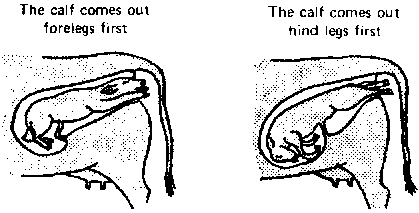
in the womb come out. These membranes contain water. Next, you see the legs come
out, either the two forelegs or the two hind legs.
Sometimes you have to pull downward a little on the legs of the
young animal so as to help the birth.
When the young animal has come out, if it is still joined to the
mother by the umbilical cord: cut this and clean it carefully.
After the birth, the rest of the membranes come out. They must
all come out. Otherwise they may rot inside the mother and cause her to die.
At birth the calf may come out in
two ways
When the young animal is born the mother licks it with her
tongue. Let her do this. At this time the mother is often thirsty. Give
her water to drink. During the first few days after the birth, the mother's
milk is thick and yellow. The young animal must drink this milk, which will
clean its digestive tract. Take great care of new- born animals. They are
delicate. They easily catch parasites and diseases. To protect them, have
them vaccinated (see page 10). Take good care of the young animals. feed them
well and house them well. Otherwise they may die and you may lose a lot of
money.
Choosing breeding animals
Why choose?
Animals that are to produce offspring must be well chosen.
Breeding animals must be well chosen because the offspring are
like the parents.
Cows that give a lot of milk usually produce females that will
also give a lot of milk.
This quality is passed on from the mother (dam) to the daughter.
(In animal breeding the mother is called the dam).
Pigs that grow and gain weight quickly usually produce males and
females that grow and gain weight quickly.
This good quality is passed on from the dam to her young ones.
Sheep that have well- developed bones and muscles usually
produce offspring that have well- developed bones and muscles.
This good quality is passed on from the dam to her young ones.
Pigs that grow and gain weight quickly, that have well-
developed bones and muscles, usually produce offspring that grow and gain weight
quickly, that have well- developed bones and muscles.
The young ones often have the good qualities of their father
(sire). (In animal breeding the father is called the sire.)
Bulls born from a cow that gave a lot of milk often sire females
that will also give a lot of milk.
The good qualities of the bull's dam are often passed on to the
bull's daughter.
Cattle that have little resistance to sleeping sickness produce
calves that have little resistance to this disease.
The parents' bed quality is passed on to their young.
A badly formed pig with poorly developed bones and muscles often
produces badly formed offspring.
The parents' bad qualities are passed on to their young.
The good qualities of the male and the female are often passed
on to their young.
The bad qualities of the male and the female are also passed on
to their young.
So it is very important to make a good choice of males and
females.
It is easier to improve a herd by a good choice of male.
A female passes on her good qualities to a few offspring each
year.
A male passes on his good qualities to all the offspring of the
herd.
· A male should not produce
young from one of his daughters.
The offspring would not be of good
quality.
How to choose
If you want to have animals that are strong for work; that give
a lot of milk; that gain weight quickly and make plenty of meat, you must choose
breeding animals that are:
· well formed.
You must eat or sell all poorly developed animals. Keep animals
that have plenty of muscle. The muscles of the back and rump are the most
important, because they give the best meat.
· resistant to disease.
For example, do not raise zebu cattle in forest country where
there is tsetse fly.
· good producers.
It is important to choose animals that produce a lot. For
example: pigs that gain weight quickly; cows that give a lot of milk; chickens
that lay plenty of eggs; ewes that produce two lambs.
· not too young or too old.
A breeding animal that is too young, not yet fully grown, gets
tired, does not gain weight. It becomes a bad breeder. Its offspring will be
poorly nourished, for a female cannot both feed the young she is carrying, and
go on growing
herself.
Better Farming Series 09 - Animal Husbandry: Animal Diseases; How Animals Reproduce (FAO - INADES, 1976, 33 p.)
1st No. of sire
..............................................................................
Date of service
....................................................................... No.
of offspring
..................................................................... No. of
deaths before weaning .............................................
2nd No. of sire
.............................................................................
Date of service
.....................................................................
Vaccinations Remarks
3rd and disease 4th 5th
Two pages of a herd book recording a female.
RECORD OF A MALE
No. of animal
Year of birth
No. of sire
No. of dam
SERVICE No. of
femaleDate ............................................................................... 2nd............................................. 3rd............................................ 4th............................................ 5th............................................ 6th............................................ 7th............................................
First of two pages of herd book in which each male is
recorded. The second page is the same as for females (see preceding page).
PRACTICAL ADVICE
· Selection is very important
especially of the male.
In one year the sire will produce a lot of offspring.
· The best way to improve your
stock raising is selection of male breeding
animals.
Better Farming Series 09 - Animal Husbandry: Animal Diseases; How Animals Reproduce (FAO - INADES, 1976, 33 p.)
Selling animals
(introduction...)
Animals are sold for their meat.
Animals are sold for breeding.
Young animals are sold for fattening.
The yield of a herd
Farmers' groups
Better Farming Series 09 - Animal Husbandry: Animal Diseases; How Animals Reproduce (FAO - INADES, 1976, 33 p.)
Selling animals
Production of stock is not enough. You have to sell. It is
not enough to have a fine herd. You must be able to sell your animals at the
right time, at a good
price.
Animals are sold for their meat.
Often live animals are sold by their size. They are not weighed.
The price is not fixed according to the animal's weight.
Sometimes animals are slaughtered and the meat is sold in the
village or at the market. No attention is paid to the weight or the quality of
the meat.
Nowadays meat should be sold by weight. Several farmers can get
together to buy a weighing machine.
It is easy to sell your animals at the time of traditional
festivals. A stock farmer should arrange for the sale of animals for these
festivals.
But apart from these festivals you may have difficulty in
finding buyers. You may have to keep for a long time animals which are ready to
be sold. You have to go on feeding them uselessly,, the animals do not benefit
from the food, and you lose
money.
Animals are sold for breeding.
We saw that it is very important to have good breeding animals
(see pages 18 and 19). Animals of a good breed that have good parents can be
sold at a high price.
Modern farmers are ready to spend money to buy a good sire to
improve their
herd.
Young animals are sold for fattening.
They can be sold at a higher price because they will earn money
for whoever raises them.
SUPPLEMENTARY NOTE A good breeder does not keep his animals
too long. He sells his lambs at about 6 months. He sells his pigs at
between 8 and 12 months. He sells his bullocks at 4 years. It is useless
to keep animals too long; they do not get any bigger. All the feed that you
give them is not changed into meat. Sell your animals as soon as they are big
enough. A breeding animal that is too old has less good' offspring. Then you
will have enough food to raise younger ones. The yield of your herd will be
better (see page 29).
THE MEAT YIELD OF AN ANIMAL All the animals of the same kind
do not yield the same amount of meat. For example: Two cows each weigh
250 kilogrammes. They are slaughtered. The blood, skin, hoofs, head and
everything in the belly are removed. What remains is called the carcass, that
is, the meat with the bones. Now let us weigh the carcass of each cow. One
weighs 115 kg; the other weighs 134 kg. So the carcass of one cow weighs 19
kg more than that of the other: the yield in meat of the two cows is
different. All cows do not give the same amount of meat. The meat yield of
an animal is the relation of the carcass weight to the weight of the live
animal. If a cow weighs 250 kg and if the carcass weighs 115 kg, the yield
is: 115x100/250 = 46% If a cow weighs 250 kg and if the carcass weighs 134
kg, the yield is: 134x100/250 = 54 % If a sheep weighs 25 kg and if the
carcass weighs 11 kg, the yield is 11x100/25 = 44% If a pig weighs 40 kg and
if the carcass weighs 26 kg, the yield is: 26x100/40 = 65% All animals do not
give the same quality of meat. The meat of an old, thin animal does not fetch
such a high price as the meat of a young animal, because it is not of good
quality. The meat of a fine, young animal is of very good quality. So all
animals are not worth the same price. The price changes with the amount of
meat and with the quality of meat. For example, in some places, a thin,
sterile cow is worth about 7 500 francs, but a fat, sterile cow of the same age
is worth about 15 000 francs. It is better to make 30 000 francs with two
animals of 15 000 francs each, than 22 500 francs with three animals at 7 500
francs each. You can earn more by selling fewer animals, if each animal is
sold at a very high
price.
The yield of a herd
If you can sell each year many fat animals, the herd is said to
have a good yield.
A herd has a good yield:
· if you raise animals of a good
breed.
The animal husbandry service is finding out which breeds produce
most and thrive best in each region.
· if the animals grow quickly.
On the same pasture, all the animals do not gain weight as
quickly as each other.
You should keep only the offspring of males and females that
have grown quickly.
· if there are many dams which
give birth each year.
You must sell the old dams because they do not produce young any
more, they do not put on weight any more, and they eat a lot
You must also sell the surplus males; they eat but are no use.
You must keep the most fertile dams and make them breed.
A fertile dam gives birth every year.
· if the animals are well cared
for,
If you take good care of the herd, all the young grow up and
become strong animals.
Then you can sell them and earn a lot.
If many of the young animals die, the farmer does not earn as
much as he could.
In Africa many young animals die because of lack of care.
Even if diseases do not kill the animals, they do them a lot of
harm.
The animals become very weak and do not fatten much.
It takes a long time for animals that have been to fatten up for
sale.
If animals are well fed, and have enough to drink all the year,
they quickly become big and heavy.
If they are badly fed, and if they do not drink enough during
the dry season, they lose a lot of weight.
Animals lose in the dry season kilogrammes they have put on in
the rainy
season.
Farmers' groups
· Farmers do well to form groups
(see Booklet No. 7, page 28); this gives them greater strength in regard to
dealers.
A dealer will readily go out into the bush to buy animals if he
is sure of finding some. He knows that he will not make his journey for nothing,
and that he will not waste his time looking for animals.
A group of farmers can make an arrangement with the dealer.
Every month or every week the group will sell him a certain
number of animals
The group agrees to sell regularly.
The dealer agrees to buy regularly
To succeed, a group must:
· not be too big. Everyone knows
each other and everyone trusts the others ·
have simple and clear rules. · have one man
in charge who makes sure that the rules are kept
It is in the interest of farmers to get together not only for
sales, but also in raising their stock. Fences will be made more quickly.
feeding will be more regular. Sales will be easier.
By organizing the sale of their animals, farmers can organize
their stock raising.
· They can plan the birth dates
with a view to the sales dates. · They can
plan what feeding the herd will need, the use of pastures, so that no food is
wasted. · They know at what time they will
get money, and can better think about what they will do with it.
Here is a practical example of what the course means.
A local pig, raised in the traditional way, eats what it can
find in the bush. At one year it weighs 30 kg. Its sale price is 30 X 100 francs
= 3 000 francs
A local pig is well housed, and gets fed once a day. At one year
it weighs 60 kg. Its sales price is 60 X 100 francs = 6 000 francs.
A pig of improved breed is well housed, and is fed twice a day.
At one year, it weighs 100 kg. Its sale price is 100 X 100 francs = 10 000
francs
Better Farming Series 09 - Animal Husbandry: Animal Diseases; How Animals Reproduce (FAO - INADES, 1976, 33 p.)