TECHNICAL PAPER #22
UNDERSTANDING ENERGY
STORAGE METHODS
By
Clyde S. Brooks
Technical Reviewers
Paul L. Hauck
LeGrand Merriman
Lester H. Smith, Jr.
Published By
VITA
1600 Wilson Boulevard, Suite 500
Arlington, Virgnia 22209 USA
Tel: 703/276-1800 . Fax: 703/243-1865
Internet: pr-info[at]vita.org
Understanding Energy Storage Methods
ISBN: 0-86619-222-0
[C]1985, Volunteers in Technical Assistance
PREFACE
This paper in one of a series published by Volunteers in Technical
Assistance to provide an introduction to specific state-of-the-art
technologies of interest to people in developing countries.
The papers are intended to be used as guidelines to help
people choose technologies that are suitable to their situations.
They are not intended to provide construction or implementation
details. People are urged to contact VITA or a similar organization
for further information and technological assistance if they find
that a particular technology seems to meet their needs.
The papers in the series were written, reviewed, and illustrated
almost entirely by VITA Volunteer technical experts on a purely
voluntary basis. Some 500 volunteers were involved in the production
of the first 100 titles issued, contributing approximately
5,000 hours of their time. VITA staff included Maria Giannuzzi
as editor Julie Berman handling typesetting and layout, and
Margaret Crouch as project manager.
The author of this paper, Clyde S. Brooks, has been a VITA Volunteer
for many years. He holds a B.S. in chemistry and has done
graduate work at Duke University and Carnegie-Mellon University.
Currently, Brooks performs independent research consultancies in
applied physical chemistry. His experience includes coal chemical
processing, chemical stimulation of oil recovery, and energy
conversion processes. The reviewers of this paper are also VITA
Volunteers. Paul J. Hauck has been a mechanical engineer for
Westinghouse for the past 20 years. He designs piping systems and
pressure vessels and operates and maintains pumps, motors, heat
exchangers, valves, etc. LeGrand Merriman is an electrical engineer
who worked for Westinghouse for 31 years. His duties included
directing the installation, start-up and servicing of
electrical equipment. Lester H. Smith, Jr., an electrical engineer,
is a founding partner of an electrical consulting firm
responsible for various medical, institutional, commercial, and
residential projects in the United States.
VITA is a private, nonprofit organization that supports people
working on technical problems in developing countries. VITA offers
information and assistance aimed at helping individuals and
groups to select and implement technologies appropriate to their
situations. VITA maintains an international Inquiry Service, a
specialized documentation center, and a computerized roster of
volunteer technical consultants; manages long-term field projects;
and publishes a variety of technical manuals and papers.
ENERGY STORAGE METHODS
By VITA Volunteer Clyde S. Brooks
I. INTRODUCTION
Energy storage capability is essential if the maximum economic
advantage is to be gained from small power plants. Unless the
power plant is operated at full load on a continual basis, there
will be periods when there is a lower load demand upon the plant.
As a result of this lower demand, excess energy will be generated
by the plant. The use of an energy storage system will allow for
the recapture of this surplus energy and its later use during
periods of high demand.
This paper presents a critical review of the technical features,
state of development, and economics of various energy storage
systems and their compatibility with small power plants. The
small power plants examined here have generation capacities within
a range of 1 to 50 kilowatts (kW) and consist of systems such
as windmills and small-scale hydropower.
Energy storage systems potentially compatible with small power
plants include batteries, flywheels, pumped water, and compressed
air.(*) In selecting an energy storage system for small power
plants in developing countries, the most important factors to
consider are storage capacity required; capital costs; operating
costs; nature of storage/generation duty cycles; system complexity
in terms of how easily the system can be built, operated, and
maintained; hardware availability; form of energy recoverable
from storage; conversion efficiency; and the country's current
state of technical development in related fields.
In this examination of energy storage systems, emphasis will be
placed on the overall technical features of the systems and their
comparative performance and efficiency. The characteristics of
the various energy storage technologies are considered below
individually and then compared with each other. Based on this
comparison, recommendations as to the most promising storage
systems for use in combination with small-scale hydropower and
wind energy generators are made. It should be noted that the
discussion of economic factors (e.g., operating costs) is based
on data obtained for the most part from large power plants in
highly industrialized countries such as the United States.
----------------------
(*) Other more advanced energy storage technologies are beyond the
scope of this paper.
One word of caution: It is beyond the scope of this paper to
provide a detailed engineering or economic analysis of energy
storage systems. A feasibility study will have to be performed
for any given site. Nevertheless, this paper will aid in the
selection of promising energy storage system that merit more
detailed study.
II. SYSTEM ALTERNATIVE
Several energy storage systems will be examined in this section:
batteries, compressed air, pumped water, and flywheels.
BATTERIES
Batteries are commonly used to store the electricity generated by
wind machines and small-scale hydropower plants. A typical system
couples the drive shaft of the power source to a direct current
(DC) generator. The rotating shaft produces mechanical energy,
which is converted to electricity by the generator. Excess electricity
can then be stored in banks of batteries.
Before choosing any generating and storage system, you must
determine how much power you will need. Tables 1 through 3 show
average annual power usage for electric home heating and appliances
in the range of 5,000-8,000 kilowatt-hours per year
(kWh/yr). A small wind power system of 5 kW, such as one currently
marketed by an American company, is estimated by the manufacturer
to provide about 1,0000 kWh/yr under average wind conditions.
Such a system would be more than adequate to meet the
energy requirements of an individual household in a highly industrialized
country such as the United States. (No attempt is made
here to specify the wind conditions essential for the economic
operation of windmills. But it is fairly well established that if
the wind velocity does not achieve or exceed 12 miles per hour
for most of the year, the siting of even a small wind machine
would be economically impractical.) Based on this estimate, even
a household with many appliances could generate sufficient excess
power to justify the cost of battery storage.
In order to determine the cost of a combination generation and
battery storage system, the capacity and number of wind or hydropower
generators would have to be established, as well as an
appropriate bank of storage batteries.
Proper design of battery storage capacity must be based on anticipated
excess power for storage and recommended battery charge
and discharge rates.
Table 1. Average Annual Energy Requirements of 110 Volt Electrical Appliances
Average Power Estimated
Required per Annual Energy
Appliance Consumption
(Watts) (kwh)
* Food Preparation
Blender 385 15
Broiler 1,436 100
Carving Knife 92 8
Coffee Maker 894 106
Deep Fryer 1,448 83
Dishwasher 1,201 383
Egg Cooker 516 14
Frying Pan 1,196 185
Hot Plate 1,257 90
Mixer 127 13
Oven (microwave) 1,450 190
Range
with oven 12,200 1,175
self-cleaning oven 12,200 1,205
Roaster 1,333 205
Sandwich Grill 1,161 33
Toaster 1,146 39
Trash Compactor 400 50
Waffle Iron 1,116 22
Waste Disposer 445 30
* Food Preservation
Freezer (15 cu ft) 341 1,195
Freezer (2 cu ft
frostless) 440 1,761
Refrigerator (12 cu ft) 241 728
Refrigerator (12 cu ft
frostless) 321 1,217
Refrigerator/freezer
(14 cu ft) 326 1,137
(14 cu ft frostless) 615 1,829
Low Energy Model
1973, 21 cu ft frostless
starting 2,480
running 320 1,200
* Health & Beauty
Germicidal lamp 20 141
Hair Dryer 381 14
Heat Lamp (infrared) 250 13
Shaver 14 18
Sun Lamp 279 16
Tooth Brush 7 0.5
Vibrator 40 2
* Home Entertainment
Radio 71 86
Radio/Record Player 109 109
Television
black & white tube type 160 350
solid state 55 120
color
tube type 300 660
solid state 200 440
* Housewares
Clock 2 17
Floor Polisher 305 15
Sewing Machine 75 11
Vacuum Cleaner 630 46
* Lights
75 Watt bulbs (8 each) 600 864
* Laundry
Clothes Dryer 4,856 993
Iron (hand) 1,008 144
Washing Machine
(automatic) 512 103
Washing Machine
(non-automatic) 286 75
Water Heater 2,475 4,219
(quick recovery) 4,474 4,811
* Comfort Conditioning
Air Cleaner 50 216
Air Conditioner (room) 1,565 1,889
Bed Covering 177 147
Dehumidifier 257 377
Fan (attic) 370 281
Fan (circulating) 83 43
Fan (rollaway) 171 138
Fan (window) 200 170
Heater (portable) 1,322 178
Heating Pad 65 10
Humidifier 177 163
* Tools
1/4" drill 250 2
Sabre Saw 325 1
Skill Saw 1,000 5
Typewriter 40 7
Water Pump (1/3 HP) 420 150
3" Sander, Belt 770 10
* Electric Home Heating [a]
Measured Living Area
1,000 Sq. Ft. 17,000 16,300
1,500 Sq. Ft. 21,500 20,800
2,000 Sq. Ft. 26,000 25,500
Sources: Electric Energy Association, 90 Park Avenue, New York, New York; Henry
Clews, "Electric Power from the Wind," Business Week, March
24, 1973.
Note: The estimated annual kilowatt-hour consumption of the electric appliances
listed in this table are based on normal usage. When using these figures for
projections, such factors as the size of the specific appliance, the
geographical area of use, and individual usage should be taken into
consideration. Please note that the wattages are not additive since all units
are normally not in operation at the same time.
[a] Based on figures published by local utilities for electrically heated homes.
Table 2. Typical Home Power Usage
Average Power Daily Energy
Required per Consumption
Type of Appliance Appliance (Watts) (kWh) [a]
Refrigerator:
14 cu. ft. frostless 615 5.00
1/2 HP oil burner 400 3.21
Lights (100-watt bulb) 100 x number of lights 5.60
TV color tube 300 1.80
Coffee maker 900 0.60
Toaster 1,146 0.40
Frying pan 1,196 0.60
Clocks (3) 2 0.14
Hot plate 1,257 0.42
Vacuum cleaner 630 0.63
Dishwasher 1,201 0.80
Clothes washer 512 0.25
Clothes dryer 4,856 2.41
Total 21.86
Source: Grumman Aerospace Corporation, Living with Wind Power
(Bethpage, New York, 1975), p. 4.
[a] 21.86 x 30 = 655.80 kWh per month; 655.80 x 12 = 7,869 kWh
per year.
Table 3. Planned Home Usage
Average Power Daily Energy
Required per Consumption
Type of Appliance Appliance (Watts) (kWh) [a]
Refrigerator: 21 cu. ft.
frostless Philco Ford 320 2.56
1/2 HP oil burner 400 3.21
Lights (40-watt bulb) 40 x number of lights 2.24
TV color solid state 200 1.20
Coffee maker 900 0.60
Toaster 1,146 0.40
Frying pan 1,196 0.60
Clocks (3) 2 0.14
Hot plate 1,257 0.42
Vacuum cleaner 630 0.63
Dishwasher 1,201 0.80
Clothes washer 512 0.25
Clothes dryer 4,856 2.41
Total 15.46
Source: Grumman Aerospace Corporation, Living with Wind Power
(Bethpage, New York, 1975), p. 4.
[a] 15.46 x 30 = 463.80 kWh per month; 463.80 x 12 = 5,565.5 kWh
per year.
Specific questions that must be considered in designing such a
system are:
1. The types of electrical loads to be served by the system.
Whether direct current (DC) power only is required or
whether inverters must be included to complete the conversion
of stored DC electricity to alternating current
(AC). If the loads to be served are largely incandescent
lighting and heating, the output of the battery system
may remain direct current since incandescent lamps and
most heat producing equipment (space heaters, toasters,
irons) operate successfully on DC or AC. If the loads are
motors (pump drives, fans) of 1/2 horsepower and larger
or are communication equipment (radio and television
transmitters), inverters will be required as a part of
the storage system.
2. Whether a multiple power generation and multiple user
system is required. In most applications, a single prime
mover (windmill, turbine) will be required. However, if
multiple generators are employed, additional equipment
must be added to the system to enable paralleling of
electrical output. Multiple battery installations accompany
multiple generators as a general rule. For most
applications, a single prime mover, generator, and battery
bank will be preferred due to the simplicity of
installation, operation, and maintenance. Where extended
systems to serve more loads are desired, an increase in
capacity of the single system is the preferred approach.
3. Whether commercial hardware with established performance
characteristics is available. While it is possible to
assemble and fabricate a system from unrelated components,
the chances for successful operation will be enhanced
by using factory-assembled systems that have been
designed to match one another. A compromise in development
of the system would be to purchase and match groups
of commercial equipment. For example, a prime mover and
generator could be purchased and matched to a battery
bank, charger, and inverter.
4. Energy source characteristics, by day and by season. If
wind is the source of energy, its availability must be
determined, on average, for each day of each season. Its
velocity must also be estimated. If water is the source,
the same determinations must be made. Whether the energy
source is wind or water, these determinations must be
made in advance of designing the storage system. For
example, winds usually vary in velocity throughout the
day; during periods of low or no wind, the battery system
must be capable of making up the electrical energy the
generator cannot produce during those periods. Similarly,
knowing the length and time of occurrence of strong wind
velocity will enable a designer to estimate how large a
battery bank can be recharged.
5. Electrical load demand characteristics, by day and by
season. The daily, weekly, and seasonal characteristics
of the electrical load demand must be determined in
advance of design of the system. To make electrical
energy available at the moment it is needed requires an
accurate estimate of how much is needed at what hours of
which days during the year. For example, if water is to
be pumped for irrigation, it will likely be a continuous
load throughout certain seasons. Lighting loads will
appear only in the early morning, evenings, and early
hours of the night, but these loads will appear every day
of the year even though the number of hours will vary
each day. If space heating will be provided, it will
likely appear as a load on the system only during a
specific season.
The costs of a given system will have to be estimated, based on
discussions with specific hardware suppliers regarding:
* performance specifications for the system;
* capital costs;
* shipping costs;
* power consumption and efficiency of operation;
* labor commitment required for system operation; and
* anticipated life of hardware components.
Having stated these requirements for initial system design and
pricing, it is clear that an experienced electrical engineer
should be selected to plan and oversee system installation. Once
a system has been assembled, semi-skilled laborers could become
operators, but there should be supervision by someone sufficiently
trained in the component hardware to conduct all necessary
routine maintenance.
No attempt is made here to specify hardware, which must be done
by the electrical engineer selected for system design, in collaboration
with specific hardware suppliers.
There are many types of storage batteries. Many of these, in
various stages of development, have performance characteristics
superior to the lead-acid battery. However, in terms of overall
demonstrated performance, cost, useful life, and commercial
availability, the lead-acid battery is the most conservative and
economical choice (see Table 4). Industrial lead-acid batteries
with power ratings to 225 ampere-hours and regeneration life
cycles to about 1,800 are available commercially.
Table 4. Comparison of Today's Storage Batteries
Battery Density By: [b]
Cost [a] Weight Volume Life[c]
Battery Type (Dollars/kWh) (Wh/kg) (kWh/cu.meter) (Cycles)
Silver-Zinc 900 120 310.8 100/300
Nickel-cadmium 600 40 127.1 300/2,000
Nickel-iron 400 33 49.4 3,000
Load-acid: 50 22 91.8 1,500/2,000
Source: D.L. Douglas, "Batteries for Energy Storage," Symposium
on Energy Storage, 168th National Meeting, American Chemical
Society, Preprint Fuel Division, Vol. 19, no. 4
(Washington, D.C.: ACS, 1974), pp. 135-154.
[al Cost to the user.
[b] Battery capacity is inversely related to rate of discharge.
The values shown are for the 6-hour rate.
[c] Cycle life depends on a number of factors, including depth
of discharge, rate of charge and discharge, temperature, and
amount of overcharge. Range shown is from most severe to
modest duty.
COMPRESSED AIR
The drive shafts of wind power systems or small-scale hydropower
plants can be linked to conventional gas compressors and used to
store air at pressures on the order of 600 pounds square inch
(psi). The compressed air can be depressurized subsequently
through conventional turbines to generate electricity, or it can
be linked through gearing for use of the stored energy to power
any mechanical machinery driven by a rotating shaft or drive
belt. Efficiencies of 75 percent can be attained for utilization
of the stored energy.
The compressed gas can either be air or fuel gases (e.g., natural
gas or hydrogen). However, for purposes of this paper, the discussion
will relate to compressed air only.
The economics of storage will be most favorable if existing
underground storage capacity such as depleted oil fields, coal
mines, or aquifers can be used. Underground storage of natural
gas is a widely used and economical technology. If underground
storage containers are used, costs are minimized, but a certain
amount of unrecoverable residual gas loss (20 percent or more)
will have to be accepted as a penalty. High pressure gas can also
be stored in steel containers. However, if new containers must be
purchased, the capital costs for a large power plant may be
greatly increased. For small plants, steel tanks are a practical
alternative.
PUMPED WATER
Pumped water, stored above ground or underground, can also be
used as an energy storage device in combination with either
small-scale hydro or wind energy generators. Pumped water as an
aid in peak leveling for electric hydropower generation has been
used in the United States since the early 1930s. The options for
energy retrieval are quite similar to compressed air with perhaps
5-15 percent' less overall efficiency than that obtained from
compressed air. Underground storage in various types of depleted
mines or aquifers offers some cost advantages over surface storage,
since the costs of reservoir construction can greatly increase
the total cost of power plant construction.
Pumped water storage in a special reservoir can be provided
during high river flow periods. During spring thaws or rainy
seasons the river flow may be able to develop more power than the
electrical system can consume. The stored water may then be
released for power generation during future peak load periods or
dry seasons. Extensive areas of land must be flooded to provide
sufficient storage or pondage for a hydroplant. Losses due to
evaporation, irrigation, and infiltration into the soil are difficult
to estimate and may vary from time to time. When evaporation
rates are high, a shallow pond with a large surface area is
disadvantageous.
The available data on costs for pumped water storage systems are
derived entirely from megawatt size power plants. For small power
plants, applicable cost data will have to be calculated for any
given site considered.
FLYWHEELS
The flywheel is a device that permits storage of energy in the
form of a rotating wheel. Mechanical energy such as that from the
rotating shaft of a wind energy or hydropower system can be
converted to the kinetic energy of a low-friction flywheel for
storage. Surplus energy from a wind or hydropower system stored
in the rotating flywheel can be subsequently recovered as rotating
shaft mechanical energy or possibly converted to electrical
energy via a generator to satisfy peak demands.
The energy stored in the flywheel is given by the formula
W = 1/2 [Iw.sup.2] where "W" is the stored energy, "I" is the moment of
inertia of the flywheel, and "w" is the angular velocity in radians
per second of the flywheel. One of the attractive features
of the flywheel is its adaptability to a wide range of energy
requirements for small power plants in the 1-50 kW range. The
mass of the flywheel and its angular velocity can be varied to
obtain this range of storage capacities. Efficiencies are potentially
high and energy densities of 66 watts/kilogram can be attained
for power peaking rotation speeds of 1,800 to 3,600 revolutions
per minute (rpm) by gearing to the rotating shaft of
small power generators, whether wind or hydro.
Successful performance requires careful design and high-strength
materials. Steel has been used for years, but modern composites,
such as metal alloys, glass fiber, and polymer/carbon fiber, provide
the strength required for coherence during extended duty
cycles to prevent catastrophic failure of the flywheel at high
rotation speeds. Actually, wood and bamboo are low-cost, high-strength
flywheel materials that are economically competitive
with the synthetic composite materials cited above.
The flywheel is quite competitive with alternative energy storage
systems for small power plants in terms of efficiency, storage
energy density, and cost. Small flywheels that provide 30-1,000
watt-hours (Wh) of energy storage for around $50-100/kW
have been developed (see Figure 1).
ues1x11.gif (600x600)
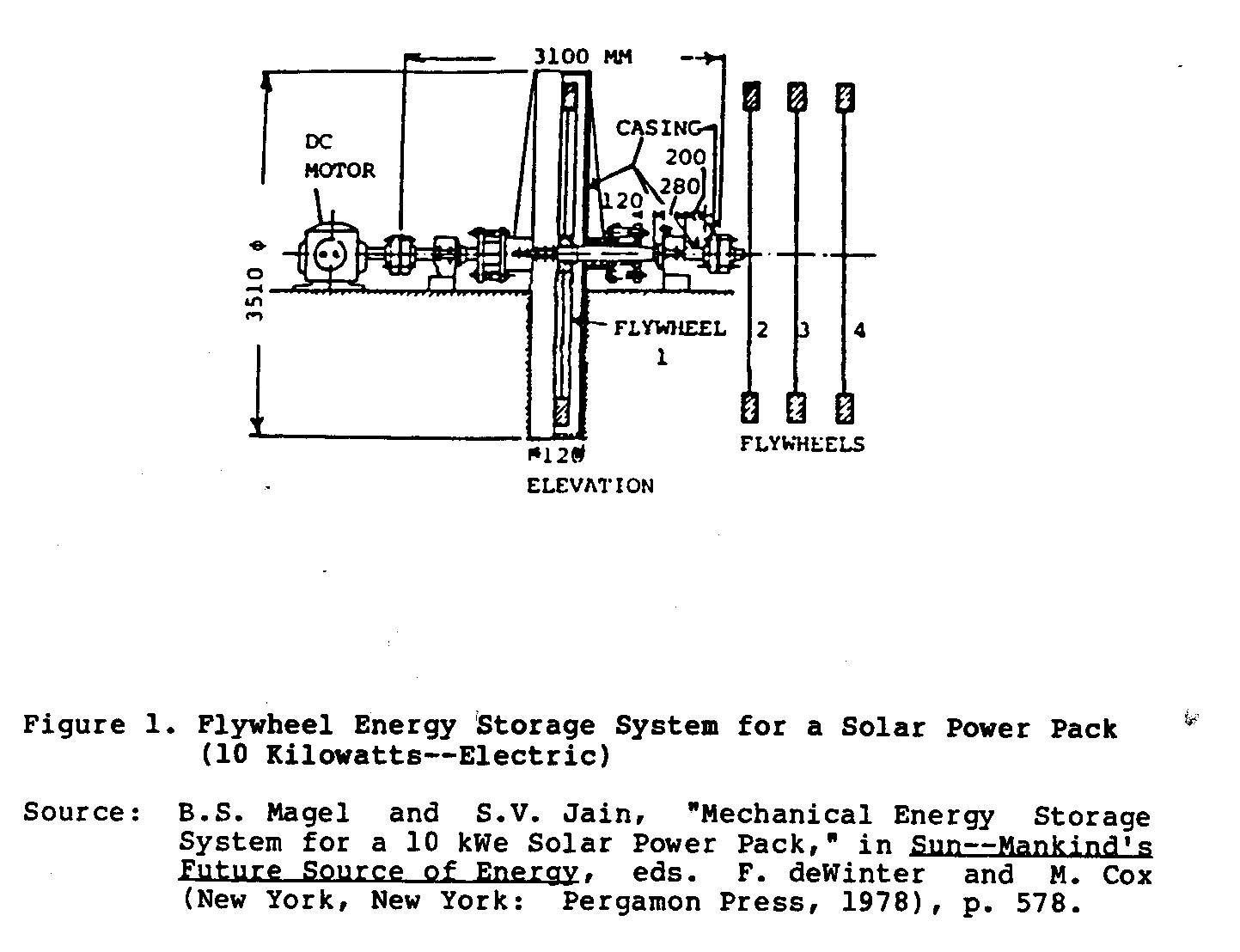
Flywheels are small, but are high technology devices requiring
sophisticated engineering know-how on the part of those who will
select the hardware and design the match to the wind or hydropower
installation. Once installed, semi-skilled operators can
maintain these installations under the supervision of an engineer.
III. COMPARISIONS AND RECOMMENDATIONS
Tables 5 and 6 give comparisons of the energy densities, conversion
uest50.gif (600x600)

efficiencies, state of technical development, cost data, and
potential applications of the various types of energy storage
systems. These comparisons, however, were based on data obtained
from large power plants, and therefore must be adjusted for small
power plants.
The essential criteria for selecting an energy storage system
are: (1) the technology should provide high conversion efficiency;
(2) commercial hardware should be currently available; and
(3) costs should be favorable compared to alternative options.
Based on the above criteria, the energy storage systems most
likely to be both technically feasible and economical are:
1. Conversion to electricity via generators and storage in
lead-acid batteries.
2. Storage as mechanical energy in a flywheel with recovery
as mechanical energy.
3. Compressed air storage, combined with a turbogenerator
for recovery of stored energy as electricity or as mechanical
energy.
4. Pumped water combined with a turbogenerator for recovery
of stored energy as electricity or as mechanical energy.
BIBLIOGRAPHY/SUGGESTED READING LIST
Abelson, P.H., ed. Energy: Use, Conservation and Supply. Special
Science Compendium. Washington, D.C.: American Association
for the Advancement of Science, 1974.
Adams, J.T. Electricity and Electrical Appliances Handbook. New
York, New York: Arco Publishing Co., 1976.
Ayer, Franklin A. Symposium on Environment and Energy Conservation.
EPA 600/2-76/212:PB-271 680. Washington, D.C.: U.S.
Environmental Protection Agency, 1975.
Berkowitz, J.B. and Silverman, H.P. "Energy Storage." Proceedings
of Symposium, October 6, 1975. P.O. Box 2071, Princeton, New
Jersey 08540: New Technology Subcommittee and Electrothermics
and Metallurgy Divisions, Electrochemical Society,
1976.
Bockris, J.O. Energy Options. New York, New York: John Wiley &
Sons, 1980.
Brookhaven National Laboratory. Proceedings of the ERDA Contractors'
Review Meeting on Chemical Energy Storage and Hydrogen
Energy Systems. CONF-761134. Upton, New York: Brookhaven
National Laboratory, 1976.
Chubb, T.A. "Analysis of Gas Dissociation Solar Thermal Power
System." Solar Energy 17. New York, New York: Pergamon
Press, 1975, pp. 129-136.
Cohen, R.L. and Wernick, J.H. "Hydrogen Storage Materials: Properties
and Possibilities." Science 214, 1981, pp. 1081-1095.
deWinter, F. and Cox, M., eds. "Mechanical Energy Storage System
for a 10 kWe Solar Power Pack." Sun--Mankind's Future Source
of Energy. New York, New York: Pergamon Press, 1978.
Douglas, D.L. "Batteries for Energy Storage." Symposium on Energy
Storage. 168th National Meeting, American Chemical Society,
Division of Fuel Chemistry. Preprints Vol. 19, No. 4,
135-154. Washington, D.C.: American Chemical Society, 1974.
Duffie, J.A. and Beckman, W.A. Solar Energy Thermal Processes.
New York, New York: John Wiley & Sons, 1974.
Fickett, A.P. "Fuel-Cell Power Plants" Scientific American
293(6), 1978, pp. 70-76.
Gross, S., ed. Battery Design and Optimization. Proceedings of
Symposium. Vol. 79. P.O. Box 2071, Princeton, New Jersey
08540: Battery Division, Electrochemical Society, 1979.
Grumman Aerospace Corporation, Living With Wind Power. Bethpage,
New York: Grumman Aerospace Corporation, 1975.
Harboe, Henrik. The Use of Compressed Air for Energy Storage.
168th National Meeting, American Chemical Society, Division
of Fuel Chemistry. Preprints Vol. 19, No. 4, 155-161. Washington,
D.C.: American Chemical Society, 1974.
Jensen, J. Energy Storage. London, England and Boston, Massachusetts:
Newnes-Butterworths, 1980.
Johnson, D.G.; Escher, W.J.D.; and Pangborn, J.B. New Energy from
an Old Source: Hydrogen from Falling Water. Society of Automotive
Engineers, No. 789135, Warrendale, Pennsylvania:
Society of Automotive Engineers, 1978.
Marier, D. Wind Power for the Homeowner. Emmaus, Pennsylvania:
Rodale Press, 1981.
Mathis, D.A.: Hydrogen Technology for Energy 1976. Energy Technology
Review No. 9. 18901 Cranwood Parkway, Cleveland, Ohio
44128: CRC Press, 1976.
McMullan, J.T.; Morgan, R.; and Murray, R.B. Energy Resources and
Supply. New York, New York: John Wiley & Sons, 1976.
McGown, L.B. and Bockris, J.O. How to Obtain Abundant Clean Energy.
New York, New York and London, England: Plenum Press,
1980.
McGuigan, D. Harnessing the Wind for Home Energy. Charlotte, Vermont
05445: Garden Way Publishing Co., 1978.
McGuigan, D. Harnessing Water Power for Home Energy. Charlotte,
Vermont 05445: Garden Way Publishing Co., 1978.
McIntyre, J.D.G.; Srinivasan, S. and Will, F.G., eds. Electrode
Materials and Processes for Energy Storage. Proceedings of
Symposium. Vol. 77-6. P.O. Box 2071, Princeton, New Jersey
08540: Battery and Physical Electrochemistry Divisions and
Energy Technology Group, Electrochemical Society, 1977.
Portola Institute. Energy Primer--Solar, Water, Wind, and Biofuels.
Fremont, California 94536: Fricks-Parks Press, Inc.,
1974.
Scott, F.M. Hydropower From Underground Pumped Storage. 168th
National Meeting, American Chemical Society, Division of
Fuel Chemistry. Preprints Vol. 19, No. 4, 85-91. Washington,
D.C.: American Chemical Society, 1974.
Silverman, J., ed. "Demonstration of a Low-Cost Flywheel in an
Energy Storage System." Energy Storage. New York, New York:
Pergamon Press, 1980.
Veziroglu, T.N. and Seifritz, W., eds. "Hydrogen Energy System."
Proceedings of Second World Hydrogen Energy Conference,
Zurich, Switzerland, 21-24 August 1978. New York, New York:
Pergamon Press, 1978.
========================================
========================================
UNDERSTANDING ENERGY
STORAGE METHODS
By
Clyde S. Brooks
Technical Reviewers
Paul L. Hauck
LeGrand Merriman
Lester H. Smith, Jr.
Published By
VITA
1600 Wilson Boulevard, Suite 500
Arlington, Virgnia 22209 USA
Tel: 703/276-1800 . Fax: 703/243-1865
Internet: pr-info[at]vita.org
Understanding Energy Storage Methods
ISBN: 0-86619-222-0
[C]1985, Volunteers in Technical Assistance
PREFACE
This paper in one of a series published by Volunteers in Technical
Assistance to provide an introduction to specific state-of-the-art
technologies of interest to people in developing countries.
The papers are intended to be used as guidelines to help
people choose technologies that are suitable to their situations.
They are not intended to provide construction or implementation
details. People are urged to contact VITA or a similar organization
for further information and technological assistance if they find
that a particular technology seems to meet their needs.
The papers in the series were written, reviewed, and illustrated
almost entirely by VITA Volunteer technical experts on a purely
voluntary basis. Some 500 volunteers were involved in the production
of the first 100 titles issued, contributing approximately
5,000 hours of their time. VITA staff included Maria Giannuzzi
as editor Julie Berman handling typesetting and layout, and
Margaret Crouch as project manager.
The author of this paper, Clyde S. Brooks, has been a VITA Volunteer
for many years. He holds a B.S. in chemistry and has done
graduate work at Duke University and Carnegie-Mellon University.
Currently, Brooks performs independent research consultancies in
applied physical chemistry. His experience includes coal chemical
processing, chemical stimulation of oil recovery, and energy
conversion processes. The reviewers of this paper are also VITA
Volunteers. Paul J. Hauck has been a mechanical engineer for
Westinghouse for the past 20 years. He designs piping systems and
pressure vessels and operates and maintains pumps, motors, heat
exchangers, valves, etc. LeGrand Merriman is an electrical engineer
who worked for Westinghouse for 31 years. His duties included
directing the installation, start-up and servicing of
electrical equipment. Lester H. Smith, Jr., an electrical engineer,
is a founding partner of an electrical consulting firm
responsible for various medical, institutional, commercial, and
residential projects in the United States.
VITA is a private, nonprofit organization that supports people
working on technical problems in developing countries. VITA offers
information and assistance aimed at helping individuals and
groups to select and implement technologies appropriate to their
situations. VITA maintains an international Inquiry Service, a
specialized documentation center, and a computerized roster of
volunteer technical consultants; manages long-term field projects;
and publishes a variety of technical manuals and papers.
ENERGY STORAGE METHODS
By VITA Volunteer Clyde S. Brooks
I. INTRODUCTION
Energy storage capability is essential if the maximum economic
advantage is to be gained from small power plants. Unless the
power plant is operated at full load on a continual basis, there
will be periods when there is a lower load demand upon the plant.
As a result of this lower demand, excess energy will be generated
by the plant. The use of an energy storage system will allow for
the recapture of this surplus energy and its later use during
periods of high demand.
This paper presents a critical review of the technical features,
state of development, and economics of various energy storage
systems and their compatibility with small power plants. The
small power plants examined here have generation capacities within
a range of 1 to 50 kilowatts (kW) and consist of systems such
as windmills and small-scale hydropower.
Energy storage systems potentially compatible with small power
plants include batteries, flywheels, pumped water, and compressed
air.(*) In selecting an energy storage system for small power
plants in developing countries, the most important factors to
consider are storage capacity required; capital costs; operating
costs; nature of storage/generation duty cycles; system complexity
in terms of how easily the system can be built, operated, and
maintained; hardware availability; form of energy recoverable
from storage; conversion efficiency; and the country's current
state of technical development in related fields.
In this examination of energy storage systems, emphasis will be
placed on the overall technical features of the systems and their
comparative performance and efficiency. The characteristics of
the various energy storage technologies are considered below
individually and then compared with each other. Based on this
comparison, recommendations as to the most promising storage
systems for use in combination with small-scale hydropower and
wind energy generators are made. It should be noted that the
discussion of economic factors (e.g., operating costs) is based
on data obtained for the most part from large power plants in
highly industrialized countries such as the United States.
----------------------
(*) Other more advanced energy storage technologies are beyond the
scope of this paper.
One word of caution: It is beyond the scope of this paper to
provide a detailed engineering or economic analysis of energy
storage systems. A feasibility study will have to be performed
for any given site. Nevertheless, this paper will aid in the
selection of promising energy storage system that merit more
detailed study.
II. SYSTEM ALTERNATIVE
Several energy storage systems will be examined in this section:
batteries, compressed air, pumped water, and flywheels.
BATTERIES
Batteries are commonly used to store the electricity generated by
wind machines and small-scale hydropower plants. A typical system
couples the drive shaft of the power source to a direct current
(DC) generator. The rotating shaft produces mechanical energy,
which is converted to electricity by the generator. Excess electricity
can then be stored in banks of batteries.
Before choosing any generating and storage system, you must
determine how much power you will need. Tables 1 through 3 show
average annual power usage for electric home heating and appliances
in the range of 5,000-8,000 kilowatt-hours per year
(kWh/yr). A small wind power system of 5 kW, such as one currently
marketed by an American company, is estimated by the manufacturer
to provide about 1,0000 kWh/yr under average wind conditions.
Such a system would be more than adequate to meet the
energy requirements of an individual household in a highly industrialized
country such as the United States. (No attempt is made
here to specify the wind conditions essential for the economic
operation of windmills. But it is fairly well established that if
the wind velocity does not achieve or exceed 12 miles per hour
for most of the year, the siting of even a small wind machine
would be economically impractical.) Based on this estimate, even
a household with many appliances could generate sufficient excess
power to justify the cost of battery storage.
In order to determine the cost of a combination generation and
battery storage system, the capacity and number of wind or hydropower
generators would have to be established, as well as an
appropriate bank of storage batteries.
Proper design of battery storage capacity must be based on anticipated
excess power for storage and recommended battery charge
and discharge rates.
Table 1. Average Annual Energy Requirements of 110 Volt Electrical Appliances
Average Power Estimated
Required per Annual Energy
Appliance Consumption
(Watts) (kwh)
* Food Preparation
Blender 385 15
Broiler 1,436 100
Carving Knife 92 8
Coffee Maker 894 106
Deep Fryer 1,448 83
Dishwasher 1,201 383
Egg Cooker 516 14
Frying Pan 1,196 185
Hot Plate 1,257 90
Mixer 127 13
Oven (microwave) 1,450 190
Range
with oven 12,200 1,175
self-cleaning oven 12,200 1,205
Roaster 1,333 205
Sandwich Grill 1,161 33
Toaster 1,146 39
Trash Compactor 400 50
Waffle Iron 1,116 22
Waste Disposer 445 30
* Food Preservation
Freezer (15 cu ft) 341 1,195
Freezer (2 cu ft
frostless) 440 1,761
Refrigerator (12 cu ft) 241 728
Refrigerator (12 cu ft
frostless) 321 1,217
Refrigerator/freezer
(14 cu ft) 326 1,137
(14 cu ft frostless) 615 1,829
Low Energy Model
1973, 21 cu ft frostless
starting 2,480
running 320 1,200
* Health & Beauty
Germicidal lamp 20 141
Hair Dryer 381 14
Heat Lamp (infrared) 250 13
Shaver 14 18
Sun Lamp 279 16
Tooth Brush 7 0.5
Vibrator 40 2
* Home Entertainment
Radio 71 86
Radio/Record Player 109 109
Television
black & white tube type 160 350
solid state 55 120
color
tube type 300 660
solid state 200 440
* Housewares
Clock 2 17
Floor Polisher 305 15
Sewing Machine 75 11
Vacuum Cleaner 630 46
* Lights
75 Watt bulbs (8 each) 600 864
* Laundry
Clothes Dryer 4,856 993
Iron (hand) 1,008 144
Washing Machine
(automatic) 512 103
Washing Machine
(non-automatic) 286 75
Water Heater 2,475 4,219
(quick recovery) 4,474 4,811
* Comfort Conditioning
Air Cleaner 50 216
Air Conditioner (room) 1,565 1,889
Bed Covering 177 147
Dehumidifier 257 377
Fan (attic) 370 281
Fan (circulating) 83 43
Fan (rollaway) 171 138
Fan (window) 200 170
Heater (portable) 1,322 178
Heating Pad 65 10
Humidifier 177 163
* Tools
1/4" drill 250 2
Sabre Saw 325 1
Skill Saw 1,000 5
Typewriter 40 7
Water Pump (1/3 HP) 420 150
3" Sander, Belt 770 10
* Electric Home Heating [a]
Measured Living Area
1,000 Sq. Ft. 17,000 16,300
1,500 Sq. Ft. 21,500 20,800
2,000 Sq. Ft. 26,000 25,500
Sources: Electric Energy Association, 90 Park Avenue, New York, New York; Henry
Clews, "Electric Power from the Wind," Business Week, March
24, 1973.
Note: The estimated annual kilowatt-hour consumption of the electric appliances
listed in this table are based on normal usage. When using these figures for
projections, such factors as the size of the specific appliance, the
geographical area of use, and individual usage should be taken into
consideration. Please note that the wattages are not additive since all units
are normally not in operation at the same time.
[a] Based on figures published by local utilities for electrically heated homes.
Table 2. Typical Home Power Usage
Average Power Daily Energy
Required per Consumption
Type of Appliance Appliance (Watts) (kWh) [a]
Refrigerator:
14 cu. ft. frostless 615 5.00
1/2 HP oil burner 400 3.21
Lights (100-watt bulb) 100 x number of lights 5.60
TV color tube 300 1.80
Coffee maker 900 0.60
Toaster 1,146 0.40
Frying pan 1,196 0.60
Clocks (3) 2 0.14
Hot plate 1,257 0.42
Vacuum cleaner 630 0.63
Dishwasher 1,201 0.80
Clothes washer 512 0.25
Clothes dryer 4,856 2.41
Total 21.86
Source: Grumman Aerospace Corporation, Living with Wind Power
(Bethpage, New York, 1975), p. 4.
[a] 21.86 x 30 = 655.80 kWh per month; 655.80 x 12 = 7,869 kWh
per year.
Table 3. Planned Home Usage
Average Power Daily Energy
Required per Consumption
Type of Appliance Appliance (Watts) (kWh) [a]
Refrigerator: 21 cu. ft.
frostless Philco Ford 320 2.56
1/2 HP oil burner 400 3.21
Lights (40-watt bulb) 40 x number of lights 2.24
TV color solid state 200 1.20
Coffee maker 900 0.60
Toaster 1,146 0.40
Frying pan 1,196 0.60
Clocks (3) 2 0.14
Hot plate 1,257 0.42
Vacuum cleaner 630 0.63
Dishwasher 1,201 0.80
Clothes washer 512 0.25
Clothes dryer 4,856 2.41
Total 15.46
Source: Grumman Aerospace Corporation, Living with Wind Power
(Bethpage, New York, 1975), p. 4.
[a] 15.46 x 30 = 463.80 kWh per month; 463.80 x 12 = 5,565.5 kWh
per year.
Specific questions that must be considered in designing such a
system are:
1. The types of electrical loads to be served by the system.
Whether direct current (DC) power only is required or
whether inverters must be included to complete the conversion
of stored DC electricity to alternating current
(AC). If the loads to be served are largely incandescent
lighting and heating, the output of the battery system
may remain direct current since incandescent lamps and
most heat producing equipment (space heaters, toasters,
irons) operate successfully on DC or AC. If the loads are
motors (pump drives, fans) of 1/2 horsepower and larger
or are communication equipment (radio and television
transmitters), inverters will be required as a part of
the storage system.
2. Whether a multiple power generation and multiple user
system is required. In most applications, a single prime
mover (windmill, turbine) will be required. However, if
multiple generators are employed, additional equipment
must be added to the system to enable paralleling of
electrical output. Multiple battery installations accompany
multiple generators as a general rule. For most
applications, a single prime mover, generator, and battery
bank will be preferred due to the simplicity of
installation, operation, and maintenance. Where extended
systems to serve more loads are desired, an increase in
capacity of the single system is the preferred approach.
3. Whether commercial hardware with established performance
characteristics is available. While it is possible to
assemble and fabricate a system from unrelated components,
the chances for successful operation will be enhanced
by using factory-assembled systems that have been
designed to match one another. A compromise in development
of the system would be to purchase and match groups
of commercial equipment. For example, a prime mover and
generator could be purchased and matched to a battery
bank, charger, and inverter.
4. Energy source characteristics, by day and by season. If
wind is the source of energy, its availability must be
determined, on average, for each day of each season. Its
velocity must also be estimated. If water is the source,
the same determinations must be made. Whether the energy
source is wind or water, these determinations must be
made in advance of designing the storage system. For
example, winds usually vary in velocity throughout the
day; during periods of low or no wind, the battery system
must be capable of making up the electrical energy the
generator cannot produce during those periods. Similarly,
knowing the length and time of occurrence of strong wind
velocity will enable a designer to estimate how large a
battery bank can be recharged.
5. Electrical load demand characteristics, by day and by
season. The daily, weekly, and seasonal characteristics
of the electrical load demand must be determined in
advance of design of the system. To make electrical
energy available at the moment it is needed requires an
accurate estimate of how much is needed at what hours of
which days during the year. For example, if water is to
be pumped for irrigation, it will likely be a continuous
load throughout certain seasons. Lighting loads will
appear only in the early morning, evenings, and early
hours of the night, but these loads will appear every day
of the year even though the number of hours will vary
each day. If space heating will be provided, it will
likely appear as a load on the system only during a
specific season.
The costs of a given system will have to be estimated, based on
discussions with specific hardware suppliers regarding:
* performance specifications for the system;
* capital costs;
* shipping costs;
* power consumption and efficiency of operation;
* labor commitment required for system operation; and
* anticipated life of hardware components.
Having stated these requirements for initial system design and
pricing, it is clear that an experienced electrical engineer
should be selected to plan and oversee system installation. Once
a system has been assembled, semi-skilled laborers could become
operators, but there should be supervision by someone sufficiently
trained in the component hardware to conduct all necessary
routine maintenance.
No attempt is made here to specify hardware, which must be done
by the electrical engineer selected for system design, in collaboration
with specific hardware suppliers.
There are many types of storage batteries. Many of these, in
various stages of development, have performance characteristics
superior to the lead-acid battery. However, in terms of overall
demonstrated performance, cost, useful life, and commercial
availability, the lead-acid battery is the most conservative and
economical choice (see Table 4). Industrial lead-acid batteries
with power ratings to 225 ampere-hours and regeneration life
cycles to about 1,800 are available commercially.
Table 4. Comparison of Today's Storage Batteries
Battery Density By: [b]
Cost [a] Weight Volume Life[c]
Battery Type (Dollars/kWh) (Wh/kg) (kWh/cu.meter) (Cycles)
Silver-Zinc 900 120 310.8 100/300
Nickel-cadmium 600 40 127.1 300/2,000
Nickel-iron 400 33 49.4 3,000
Load-acid: 50 22 91.8 1,500/2,000
Source: D.L. Douglas, "Batteries for Energy Storage," Symposium
on Energy Storage, 168th National Meeting, American Chemical
Society, Preprint Fuel Division, Vol. 19, no. 4
(Washington, D.C.: ACS, 1974), pp. 135-154.
[al Cost to the user.
[b] Battery capacity is inversely related to rate of discharge.
The values shown are for the 6-hour rate.
[c] Cycle life depends on a number of factors, including depth
of discharge, rate of charge and discharge, temperature, and
amount of overcharge. Range shown is from most severe to
modest duty.
COMPRESSED AIR
The drive shafts of wind power systems or small-scale hydropower
plants can be linked to conventional gas compressors and used to
store air at pressures on the order of 600 pounds square inch
(psi). The compressed air can be depressurized subsequently
through conventional turbines to generate electricity, or it can
be linked through gearing for use of the stored energy to power
any mechanical machinery driven by a rotating shaft or drive
belt. Efficiencies of 75 percent can be attained for utilization
of the stored energy.
The compressed gas can either be air or fuel gases (e.g., natural
gas or hydrogen). However, for purposes of this paper, the discussion
will relate to compressed air only.
The economics of storage will be most favorable if existing
underground storage capacity such as depleted oil fields, coal
mines, or aquifers can be used. Underground storage of natural
gas is a widely used and economical technology. If underground
storage containers are used, costs are minimized, but a certain
amount of unrecoverable residual gas loss (20 percent or more)
will have to be accepted as a penalty. High pressure gas can also
be stored in steel containers. However, if new containers must be
purchased, the capital costs for a large power plant may be
greatly increased. For small plants, steel tanks are a practical
alternative.
PUMPED WATER
Pumped water, stored above ground or underground, can also be
used as an energy storage device in combination with either
small-scale hydro or wind energy generators. Pumped water as an
aid in peak leveling for electric hydropower generation has been
used in the United States since the early 1930s. The options for
energy retrieval are quite similar to compressed air with perhaps
5-15 percent' less overall efficiency than that obtained from
compressed air. Underground storage in various types of depleted
mines or aquifers offers some cost advantages over surface storage,
since the costs of reservoir construction can greatly increase
the total cost of power plant construction.
Pumped water storage in a special reservoir can be provided
during high river flow periods. During spring thaws or rainy
seasons the river flow may be able to develop more power than the
electrical system can consume. The stored water may then be
released for power generation during future peak load periods or
dry seasons. Extensive areas of land must be flooded to provide
sufficient storage or pondage for a hydroplant. Losses due to
evaporation, irrigation, and infiltration into the soil are difficult
to estimate and may vary from time to time. When evaporation
rates are high, a shallow pond with a large surface area is
disadvantageous.
The available data on costs for pumped water storage systems are
derived entirely from megawatt size power plants. For small power
plants, applicable cost data will have to be calculated for any
given site considered.
FLYWHEELS
The flywheel is a device that permits storage of energy in the
form of a rotating wheel. Mechanical energy such as that from the
rotating shaft of a wind energy or hydropower system can be
converted to the kinetic energy of a low-friction flywheel for
storage. Surplus energy from a wind or hydropower system stored
in the rotating flywheel can be subsequently recovered as rotating
shaft mechanical energy or possibly converted to electrical
energy via a generator to satisfy peak demands.
The energy stored in the flywheel is given by the formula
W = 1/2 [Iw.sup.2] where "W" is the stored energy, "I" is the moment of
inertia of the flywheel, and "w" is the angular velocity in radians
per second of the flywheel. One of the attractive features
of the flywheel is its adaptability to a wide range of energy
requirements for small power plants in the 1-50 kW range. The
mass of the flywheel and its angular velocity can be varied to
obtain this range of storage capacities. Efficiencies are potentially
high and energy densities of 66 watts/kilogram can be attained
for power peaking rotation speeds of 1,800 to 3,600 revolutions
per minute (rpm) by gearing to the rotating shaft of
small power generators, whether wind or hydro.
Successful performance requires careful design and high-strength
materials. Steel has been used for years, but modern composites,
such as metal alloys, glass fiber, and polymer/carbon fiber, provide
the strength required for coherence during extended duty
cycles to prevent catastrophic failure of the flywheel at high
rotation speeds. Actually, wood and bamboo are low-cost, high-strength
flywheel materials that are economically competitive
with the synthetic composite materials cited above.
The flywheel is quite competitive with alternative energy storage
systems for small power plants in terms of efficiency, storage
energy density, and cost. Small flywheels that provide 30-1,000
watt-hours (Wh) of energy storage for around $50-100/kW
have been developed (see Figure 1).
ues1x11.gif (600x600)
Flywheels are small, but are high technology devices requiring
sophisticated engineering know-how on the part of those who will
select the hardware and design the match to the wind or hydropower
installation. Once installed, semi-skilled operators can
maintain these installations under the supervision of an engineer.
III. COMPARISIONS AND RECOMMENDATIONS
Tables 5 and 6 give comparisons of the energy densities, conversion
uest50.gif (600x600)
efficiencies, state of technical development, cost data, and
potential applications of the various types of energy storage
systems. These comparisons, however, were based on data obtained
from large power plants, and therefore must be adjusted for small
power plants.
The essential criteria for selecting an energy storage system
are: (1) the technology should provide high conversion efficiency;
(2) commercial hardware should be currently available; and
(3) costs should be favorable compared to alternative options.
Based on the above criteria, the energy storage systems most
likely to be both technically feasible and economical are:
1. Conversion to electricity via generators and storage in
lead-acid batteries.
2. Storage as mechanical energy in a flywheel with recovery
as mechanical energy.
3. Compressed air storage, combined with a turbogenerator
for recovery of stored energy as electricity or as mechanical
energy.
4. Pumped water combined with a turbogenerator for recovery
of stored energy as electricity or as mechanical energy.
BIBLIOGRAPHY/SUGGESTED READING LIST
Abelson, P.H., ed. Energy: Use, Conservation and Supply. Special
Science Compendium. Washington, D.C.: American Association
for the Advancement of Science, 1974.
Adams, J.T. Electricity and Electrical Appliances Handbook. New
York, New York: Arco Publishing Co., 1976.
Ayer, Franklin A. Symposium on Environment and Energy Conservation.
EPA 600/2-76/212:PB-271 680. Washington, D.C.: U.S.
Environmental Protection Agency, 1975.
Berkowitz, J.B. and Silverman, H.P. "Energy Storage." Proceedings
of Symposium, October 6, 1975. P.O. Box 2071, Princeton, New
Jersey 08540: New Technology Subcommittee and Electrothermics
and Metallurgy Divisions, Electrochemical Society,
1976.
Bockris, J.O. Energy Options. New York, New York: John Wiley &
Sons, 1980.
Brookhaven National Laboratory. Proceedings of the ERDA Contractors'
Review Meeting on Chemical Energy Storage and Hydrogen
Energy Systems. CONF-761134. Upton, New York: Brookhaven
National Laboratory, 1976.
Chubb, T.A. "Analysis of Gas Dissociation Solar Thermal Power
System." Solar Energy 17. New York, New York: Pergamon
Press, 1975, pp. 129-136.
Cohen, R.L. and Wernick, J.H. "Hydrogen Storage Materials: Properties
and Possibilities." Science 214, 1981, pp. 1081-1095.
deWinter, F. and Cox, M., eds. "Mechanical Energy Storage System
for a 10 kWe Solar Power Pack." Sun--Mankind's Future Source
of Energy. New York, New York: Pergamon Press, 1978.
Douglas, D.L. "Batteries for Energy Storage." Symposium on Energy
Storage. 168th National Meeting, American Chemical Society,
Division of Fuel Chemistry. Preprints Vol. 19, No. 4,
135-154. Washington, D.C.: American Chemical Society, 1974.
Duffie, J.A. and Beckman, W.A. Solar Energy Thermal Processes.
New York, New York: John Wiley & Sons, 1974.
Fickett, A.P. "Fuel-Cell Power Plants" Scientific American
293(6), 1978, pp. 70-76.
Gross, S., ed. Battery Design and Optimization. Proceedings of
Symposium. Vol. 79. P.O. Box 2071, Princeton, New Jersey
08540: Battery Division, Electrochemical Society, 1979.
Grumman Aerospace Corporation, Living With Wind Power. Bethpage,
New York: Grumman Aerospace Corporation, 1975.
Harboe, Henrik. The Use of Compressed Air for Energy Storage.
168th National Meeting, American Chemical Society, Division
of Fuel Chemistry. Preprints Vol. 19, No. 4, 155-161. Washington,
D.C.: American Chemical Society, 1974.
Jensen, J. Energy Storage. London, England and Boston, Massachusetts:
Newnes-Butterworths, 1980.
Johnson, D.G.; Escher, W.J.D.; and Pangborn, J.B. New Energy from
an Old Source: Hydrogen from Falling Water. Society of Automotive
Engineers, No. 789135, Warrendale, Pennsylvania:
Society of Automotive Engineers, 1978.
Marier, D. Wind Power for the Homeowner. Emmaus, Pennsylvania:
Rodale Press, 1981.
Mathis, D.A.: Hydrogen Technology for Energy 1976. Energy Technology
Review No. 9. 18901 Cranwood Parkway, Cleveland, Ohio
44128: CRC Press, 1976.
McMullan, J.T.; Morgan, R.; and Murray, R.B. Energy Resources and
Supply. New York, New York: John Wiley & Sons, 1976.
McGown, L.B. and Bockris, J.O. How to Obtain Abundant Clean Energy.
New York, New York and London, England: Plenum Press,
1980.
McGuigan, D. Harnessing the Wind for Home Energy. Charlotte, Vermont
05445: Garden Way Publishing Co., 1978.
McGuigan, D. Harnessing Water Power for Home Energy. Charlotte,
Vermont 05445: Garden Way Publishing Co., 1978.
McIntyre, J.D.G.; Srinivasan, S. and Will, F.G., eds. Electrode
Materials and Processes for Energy Storage. Proceedings of
Symposium. Vol. 77-6. P.O. Box 2071, Princeton, New Jersey
08540: Battery and Physical Electrochemistry Divisions and
Energy Technology Group, Electrochemical Society, 1977.
Portola Institute. Energy Primer--Solar, Water, Wind, and Biofuels.
Fremont, California 94536: Fricks-Parks Press, Inc.,
1974.
Scott, F.M. Hydropower From Underground Pumped Storage. 168th
National Meeting, American Chemical Society, Division of
Fuel Chemistry. Preprints Vol. 19, No. 4, 85-91. Washington,
D.C.: American Chemical Society, 1974.
Silverman, J., ed. "Demonstration of a Low-Cost Flywheel in an
Energy Storage System." Energy Storage. New York, New York:
Pergamon Press, 1980.
Veziroglu, T.N. and Seifritz, W., eds. "Hydrogen Energy System."
Proceedings of Second World Hydrogen Energy Conference,
Zurich, Switzerland, 21-24 August 1978. New York, New York:
Pergamon Press, 1978.
========================================
========================================