INDUSTRY PROFILE #7
UNFERMENTED
GRAPE JUICE
Prepared By
George Rubin
Reviewed By
Robert H. Dickman
Warren D. Winterson
Vernon L. Singleton
VITA
Published By
VOLUNTEERS IN TECHNICAL ASSISTANCE
1600 Wilson Boulevard, Suite 500, Arlington, Virginia 22209 USA
Telephone: (703) 276-1800, Fax: (703) 243-1865
Telex 440192 VITAUI, Cable: VITAINC
Internet vita@gmuvax.gmu.edu, Bitnet. vita@gmuvax
Unfermented Grape juice
ISBN: 0-86619-294-8
[C]1987, Volunteers in Technical Assistance
INDUSTRY PROFILES
Introduction
This Industry Profile is one of a series briefly describing small or medium-sized industries. The
Profiles provide basic information for starting manufacturing plants in developing nations.
Specifically, they provide general plant descriptions, financial, and technical factors for their
operation, and sources of information and expertise. The series is intended to be useful in
determining whether the industries described warrant further inquiry either to rule out or to
decide upon investment. The underlying assumption of these Profiles is that the individual
making use of them already has some knowledge and experience in industrial development.
Dollar values are listed only for machinery and equipment costs, and are primarily based on
equipment in the United States. The price does not include shipping costs or import-export taxes,
which must be considered and will vary greatly from country to country. No other investment
costs are included (such as land value, building rental, labor, etc.) as those prices also vary.
These items are mentioned to provide the investor with a general checklist of considerations for
setting up a business.
IMPORTANT
These profiles should not be substituted for feasibility studies. Before an investment is made in
a plant, a feasibility study should be conducted. This may require skilled economic and
engineering expertise. The following illustrates the range of questions to which answers must
be obtained:
* What is the extent of the present demand for the product, and how is it now being
satisfied?
* Will the estimated price and quality of the product make it competitive?
* What is the marketing and distribution plan and to whom will the product be
sold?
* How will the plant be financed?
* Has a realistic time schedule for construction, equipment, delivery, obtaining
materials and supplies, training of personnel, and the start-up time for the plant
been developed?
* How are needed materials and supplies to be procured and machinery and
equipment to be maintained and repaired?
* Are trained personnel available?
* Do adequate transportation, storage, power, communication, fuel, water and
other facilities exist?
* What management controls for design, production, quality control, and other
factors have been included?
* Will the industry complement or interfere with development plans for the area?
* What social, cultural, environmental, and technological considerations must be
addressed regarding manufacture and use of this product?
Fully documented information responding to these and many other questions should be
determined before proceeding with implementation of an industrial project.
Equipment Suppliers, Engineering Companies
The services of professional engineers are desirable in the design of industrial plants even though
the proposed plant may be small. A correct design is one that provides the greatest economy in
the investment of funds and establishes the basis of operation that will be most profitable in the
beginning and will also be capable of expansion without expensive alteration.
Professional engineers who specialize in industrial design can be found be referring to the
published cards in various engineering magazines. They may also be reached through their
national organizations.
Manufacturers of industrial equipment employ engineers familiar with the design and installation
of their specialized products. These manufacturers are usually willing to give prospective
customers the benefit of technical advice by those engineers in determining the suitability of their
equipment in any proposed project.
VITA
Volunteers in Technical Assistance (VITA) is a private, non-profit, volunteer organization
engaged in international development. Through its varied activities and services, VITA fosters
self-sufficiency by promoting increased economic productivity. Supported by a volunteer roster
of over 5,000 experts in a wide variety of fields, VITA is able to provide high quality technical
information to requesters. This information is increasingly conveyed through low-cost advanced
communication technologies, including terrestrial packet radio and low-earth-orbiting satellite.
VITA also implements both long- and short-term projects to promote enterprise development and
transfer technology.
UNFERMENTED GRAPE JUICE
PRODUCED BY: George Rubin
REVIEWED BY: Robert H. Dickman
Warren D. Winterson
Vernon L. Singleton
PRODUCT DESCRIPTION
1. The Product
The product is grape juice that has not been fermented, sweetened,
or concentrated. It is shipped in 50-55 gallon drums or other
bulk containers to bottling plants, or can be bottled on site.
most grape juice is white and of different mild flavors, depending
on whether the variety is European wine grapes (Vitis
vinifera) or species (Vitis abrusca).
2. The Facility
This profile describes a plant operating with one shift and
producing 125,000 gallons of grape juice a year, and another that
produces 260,000 gallons a year.
The plant should be located near a grape-growing area to provide
an assured and adequate supply of grape.
Prevention of fermentation of grape juice is difficult. Either
some form of pasteurization or very cold storage (below freezing)
and transit will be necessary.
GENERAL EVALUATION
Total capital requirements are high and some skilled labor is
needed. The general increase in the consumption of fruit juices
make the prospects for a business of this kind seem reasonably
good, as long as a reasonable local market exists.
since the juice has to settle or be clarified by other methods,
initial working capital is fairly high. No income should be
expected to accrue from sales during the first few months of
operation.
1. Outlook
A. Economic
The market is a local one due in large part to excess grape
production in much of Europe and the economical production of
concentrated juice for easier shipment and preservation.
B. Technical
Prevention of fermentation and other spoilage is not easy
with single strength grape juice. Some basic knowledge of the
microbiology of foods is needed by the manager.
There are several alternatives to choose from in producing this
product. Used equipment of the sort described is frequently
available.
2. Manufacturing Equipment Flexibility
Although the equipment described ere is specialized for grape
handling, with minor additions and sufficient labor, it can
process other fruit juices. Concentrates can be produces with the
addition of evaporator.
3. Knowledge Base
A basic understanding of yeast, mold, and bacterial spoilage is
essential. However, with grape juice such spoilage should not
lead to health hazard but only product deterioration.
4. Quality Control
Microbial and sensory chemical analysis are required to check
sugar, acid, pH, color, clarity, and perhaps acetic acid,
ethanol, and sulfur dioxide (S02). Incoming fruit should be
checked, and an operation log should be kept on the pasteurizer.
5. Constraints and Limitations
In temperate climates the grape harvesting season is short.
Therefore, plant capacity must be large enough to produce,
process, and store within a few weeks the juice for a year's
sales. Storage of single strength juice must be free from any
spoilage (mold, bacteria, or yeast). Tropical countries can
spread their harvest, but usually will have more disease problems.
MARKET ASPECTS
1. Users
Ordinarily the profit is made at the bottler-retail end. If
possible, the bulk processing should be combined with the
bottling operation or at least closely coordinated.
2. Suppliers
A minimal supply of grapes f rom local grape growers at economically
satisfactory prices is essential.
3. Sales Channels and Methods
Sales will be made mostly to bottling plants, depending on the
number of potential customers, the quantity they are willing to
acquire, and the availability of a good transport system.
4. Geographic Extent of Market
Plant must be located close to the supply of grapes. The finished
product is bulky and must be packaged for transport; it may need
to be refrigerated. A nationwide distribution is possible; the
plant would not ship abroad, except possibly into immediately
surrounding areas of neighboring countries.
5. Competition
Domestic: Other fruit juices possibly imported, may compete,
Export: Plant will not ship abroad because competition from well-established
large foreign firms may be too strong, especially
since concentrates have been developed that considerably reduce
shipping costs.
6. Market Capacity
Consumption will largely depend on the income levels and drinking
habits of the population. Bottling plants serving a population of
four to five million might absorb the output of the plant.
PRODUCTION AND PLANT REQUIREMENTS
Requirements Annual output:
(1 shift) 125,000 gals. 260,000 gals.
1. Infrastructure, Utilities Small Plant Medium Plant
Land 16,000 sq.ft. 40,000 sq.ft.
Building one story 60'x80' 80'x100'
Power connected load apx. 20 hp 100 hp
Fuel about 8,000 20,000 gals.
Water potable 3,200,000 gal. 4,000,000 gal.
Other _____________ ____________
A 28-32[degrees] F holding room for pressed juice
2. Major Equipment & Machinery Small Plant Medium Plant
Tools & Machinery
conveyor
crusher
heating coil
stainless steel kettle with motor-driven
stirrer
dejuicer
boiler
continuous screw press
vacuum belt continuous filter
pasteurizer/heat exchanger
cooler
Support equipment & parts
Production tools & equipment
Furniture, fixtures, and
office equipment
Analytical instrumentation
for quality control
Pumps & plumbing
Electrical wiring
Control panels
Recorders
(*)TOTAL ESTIMATED COSTS
of equipment & machinery only $650,000 $ 900,000
(*)Based on $US 1987 prices. The costs provided are estimates and
are given only to provide a general idea for machinery costs;
they are not intended to be used as absolute prices. Costs still
need to be determined on a case by case basis.
3. Materials & Supplies Small Plant Medium Plant
Raw Materials
grapes 1,500 tons 3,120 tons
Supplies
lubricants & hand tools
cellulose, pressing aid
diatomaceous earth for
polish filtration
maintenance, spare parts
office supplies
Packaging 4,750
drums, 55 gal.
(may be used 5 or 6 times before wearing
out - available in S.S. and in plastic)
4. Labor Small Plant Medium Plant
Skilled
(120 days) 1 2
Semiskilled
(60 days) 4 8
(120 days) 2 4
Unskilled
(120 days) 1 2
Indirect
Manager (120 days) 1 1
Office (120 days) 1 1
5. Distribution/Supply flow Small Plant Medium Plant
Amount in per day Varies seasonally and daily
Amount out per day
External transport facilities - grapes delivered at plant.
Shipments about 750 tons per month. A good highway is needed.
6. Market Requirements Small Plant Medium Plant
-
-
PROCESS DESCRIPTION (see plant layout>
ugjx6.gif (600x600)
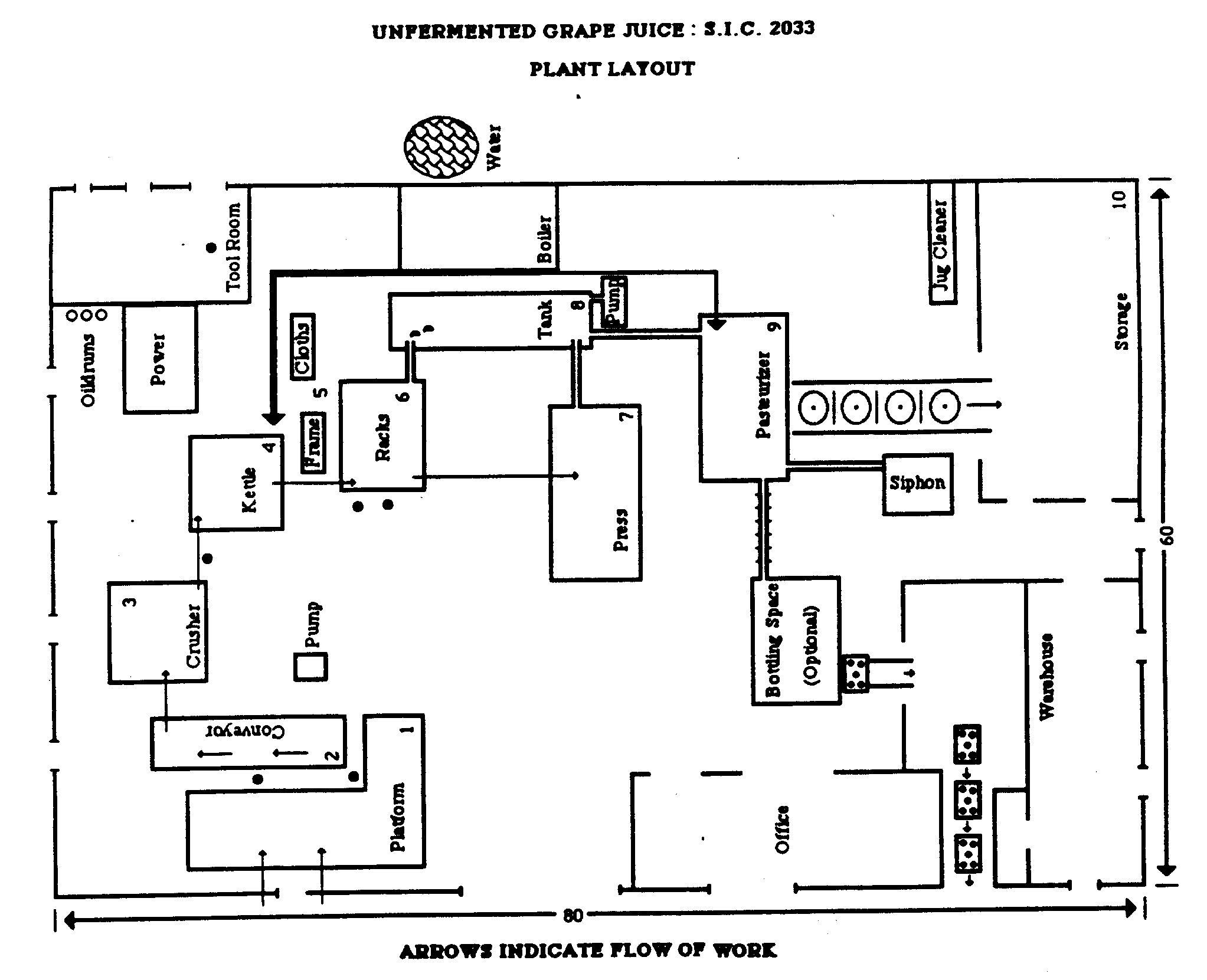
1. Diagram
2. Remarks
The steps in processing unfermented grape juice are:
1. Grape samples are tested
2. Grapes are stemmed and crushed
3. Peptic Enzyme is added to must (the newly pressed juice)
4. Grape must is pressed
5. Solid particles are filtered out
6. Juice is pasteurized
7. Juice is stored at low temperature until bottled
Note that the waste products--the seed & oil--can be used for
compost or for other by-products.
REFERENCES
Unless otherwise stated, these addresses are in the United
States.
1. Technical Manuals & Textbooks
General Viticulture, by A.J. Winkler et al, University of
California Press, Berkeley, California. 1974. Devoted to all
aspects of the culture of grapes.
Technology of Winemaking. 4th Edition, Amerine et al. AVI
Publishing Co., Westport, Connecticut.
Sensory Evaluation Guide for Testing Food and Beverace products.
by A.E. Dethmers et al, Institute for Food Technology, IFT
Reprint Department, P.O. Box 94332, Chicago, Illinois 60690.
2. Periodicals
Wines & Vines (Monthly and Directory)
1800 Lincoln Ave.
San Rafael, California 94901-2398
Food Technology,
221 N. LaSalle Street
Chicago, Illinois 60601
(312) 782-8424.
3. Trade Associations
Institute for Food Technology
P.O. Box 94332
Chicago, Illinois 60690
4. Equipment Suppliers, Engineering companies
Komline-Sanderson
Peapack, North Dakota 02977
Filtration equipment
Valley Foundry & Machine Works
PO Box 1626
2510 Southeast Avenue
Fresno, California 93717
Dejuicers & screw press
5. Directories
Wine & Vines (Directory)
1800 Lincoln Avenue
San Rafael, California 94901-2398
6. VITA Venture Services
VITA Venture Services, a subsidiary of VITA, provides commercial
services for industrial development. This fee-for-service
includes technology and financial information, technical assistance,
marketing, and joint ventures. For further information,
contact VITA.
========================================
========================================
UNFERMENTED
GRAPE JUICE
Prepared By
George Rubin
Reviewed By
Robert H. Dickman
Warren D. Winterson
Vernon L. Singleton
VITA
Published By
VOLUNTEERS IN TECHNICAL ASSISTANCE
1600 Wilson Boulevard, Suite 500, Arlington, Virginia 22209 USA
Telephone: (703) 276-1800, Fax: (703) 243-1865
Telex 440192 VITAUI, Cable: VITAINC
Internet vita@gmuvax.gmu.edu, Bitnet. vita@gmuvax
Unfermented Grape juice
ISBN: 0-86619-294-8
[C]1987, Volunteers in Technical Assistance
INDUSTRY PROFILES
Introduction
This Industry Profile is one of a series briefly describing small or medium-sized industries. The
Profiles provide basic information for starting manufacturing plants in developing nations.
Specifically, they provide general plant descriptions, financial, and technical factors for their
operation, and sources of information and expertise. The series is intended to be useful in
determining whether the industries described warrant further inquiry either to rule out or to
decide upon investment. The underlying assumption of these Profiles is that the individual
making use of them already has some knowledge and experience in industrial development.
Dollar values are listed only for machinery and equipment costs, and are primarily based on
equipment in the United States. The price does not include shipping costs or import-export taxes,
which must be considered and will vary greatly from country to country. No other investment
costs are included (such as land value, building rental, labor, etc.) as those prices also vary.
These items are mentioned to provide the investor with a general checklist of considerations for
setting up a business.
IMPORTANT
These profiles should not be substituted for feasibility studies. Before an investment is made in
a plant, a feasibility study should be conducted. This may require skilled economic and
engineering expertise. The following illustrates the range of questions to which answers must
be obtained:
* What is the extent of the present demand for the product, and how is it now being
satisfied?
* Will the estimated price and quality of the product make it competitive?
* What is the marketing and distribution plan and to whom will the product be
sold?
* How will the plant be financed?
* Has a realistic time schedule for construction, equipment, delivery, obtaining
materials and supplies, training of personnel, and the start-up time for the plant
been developed?
* How are needed materials and supplies to be procured and machinery and
equipment to be maintained and repaired?
* Are trained personnel available?
* Do adequate transportation, storage, power, communication, fuel, water and
other facilities exist?
* What management controls for design, production, quality control, and other
factors have been included?
* Will the industry complement or interfere with development plans for the area?
* What social, cultural, environmental, and technological considerations must be
addressed regarding manufacture and use of this product?
Fully documented information responding to these and many other questions should be
determined before proceeding with implementation of an industrial project.
Equipment Suppliers, Engineering Companies
The services of professional engineers are desirable in the design of industrial plants even though
the proposed plant may be small. A correct design is one that provides the greatest economy in
the investment of funds and establishes the basis of operation that will be most profitable in the
beginning and will also be capable of expansion without expensive alteration.
Professional engineers who specialize in industrial design can be found be referring to the
published cards in various engineering magazines. They may also be reached through their
national organizations.
Manufacturers of industrial equipment employ engineers familiar with the design and installation
of their specialized products. These manufacturers are usually willing to give prospective
customers the benefit of technical advice by those engineers in determining the suitability of their
equipment in any proposed project.
VITA
Volunteers in Technical Assistance (VITA) is a private, non-profit, volunteer organization
engaged in international development. Through its varied activities and services, VITA fosters
self-sufficiency by promoting increased economic productivity. Supported by a volunteer roster
of over 5,000 experts in a wide variety of fields, VITA is able to provide high quality technical
information to requesters. This information is increasingly conveyed through low-cost advanced
communication technologies, including terrestrial packet radio and low-earth-orbiting satellite.
VITA also implements both long- and short-term projects to promote enterprise development and
transfer technology.
UNFERMENTED GRAPE JUICE
PRODUCED BY: George Rubin
REVIEWED BY: Robert H. Dickman
Warren D. Winterson
Vernon L. Singleton
PRODUCT DESCRIPTION
1. The Product
The product is grape juice that has not been fermented, sweetened,
or concentrated. It is shipped in 50-55 gallon drums or other
bulk containers to bottling plants, or can be bottled on site.
most grape juice is white and of different mild flavors, depending
on whether the variety is European wine grapes (Vitis
vinifera) or species (Vitis abrusca).
2. The Facility
This profile describes a plant operating with one shift and
producing 125,000 gallons of grape juice a year, and another that
produces 260,000 gallons a year.
The plant should be located near a grape-growing area to provide
an assured and adequate supply of grape.
Prevention of fermentation of grape juice is difficult. Either
some form of pasteurization or very cold storage (below freezing)
and transit will be necessary.
GENERAL EVALUATION
Total capital requirements are high and some skilled labor is
needed. The general increase in the consumption of fruit juices
make the prospects for a business of this kind seem reasonably
good, as long as a reasonable local market exists.
since the juice has to settle or be clarified by other methods,
initial working capital is fairly high. No income should be
expected to accrue from sales during the first few months of
operation.
1. Outlook
A. Economic
The market is a local one due in large part to excess grape
production in much of Europe and the economical production of
concentrated juice for easier shipment and preservation.
B. Technical
Prevention of fermentation and other spoilage is not easy
with single strength grape juice. Some basic knowledge of the
microbiology of foods is needed by the manager.
There are several alternatives to choose from in producing this
product. Used equipment of the sort described is frequently
available.
2. Manufacturing Equipment Flexibility
Although the equipment described ere is specialized for grape
handling, with minor additions and sufficient labor, it can
process other fruit juices. Concentrates can be produces with the
addition of evaporator.
3. Knowledge Base
A basic understanding of yeast, mold, and bacterial spoilage is
essential. However, with grape juice such spoilage should not
lead to health hazard but only product deterioration.
4. Quality Control
Microbial and sensory chemical analysis are required to check
sugar, acid, pH, color, clarity, and perhaps acetic acid,
ethanol, and sulfur dioxide (S02). Incoming fruit should be
checked, and an operation log should be kept on the pasteurizer.
5. Constraints and Limitations
In temperate climates the grape harvesting season is short.
Therefore, plant capacity must be large enough to produce,
process, and store within a few weeks the juice for a year's
sales. Storage of single strength juice must be free from any
spoilage (mold, bacteria, or yeast). Tropical countries can
spread their harvest, but usually will have more disease problems.
MARKET ASPECTS
1. Users
Ordinarily the profit is made at the bottler-retail end. If
possible, the bulk processing should be combined with the
bottling operation or at least closely coordinated.
2. Suppliers
A minimal supply of grapes f rom local grape growers at economically
satisfactory prices is essential.
3. Sales Channels and Methods
Sales will be made mostly to bottling plants, depending on the
number of potential customers, the quantity they are willing to
acquire, and the availability of a good transport system.
4. Geographic Extent of Market
Plant must be located close to the supply of grapes. The finished
product is bulky and must be packaged for transport; it may need
to be refrigerated. A nationwide distribution is possible; the
plant would not ship abroad, except possibly into immediately
surrounding areas of neighboring countries.
5. Competition
Domestic: Other fruit juices possibly imported, may compete,
Export: Plant will not ship abroad because competition from well-established
large foreign firms may be too strong, especially
since concentrates have been developed that considerably reduce
shipping costs.
6. Market Capacity
Consumption will largely depend on the income levels and drinking
habits of the population. Bottling plants serving a population of
four to five million might absorb the output of the plant.
PRODUCTION AND PLANT REQUIREMENTS
Requirements Annual output:
(1 shift) 125,000 gals. 260,000 gals.
1. Infrastructure, Utilities Small Plant Medium Plant
Land 16,000 sq.ft. 40,000 sq.ft.
Building one story 60'x80' 80'x100'
Power connected load apx. 20 hp 100 hp
Fuel about 8,000 20,000 gals.
Water potable 3,200,000 gal. 4,000,000 gal.
Other _____________ ____________
A 28-32[degrees] F holding room for pressed juice
2. Major Equipment & Machinery Small Plant Medium Plant
Tools & Machinery
conveyor
crusher
heating coil
stainless steel kettle with motor-driven
stirrer
dejuicer
boiler
continuous screw press
vacuum belt continuous filter
pasteurizer/heat exchanger
cooler
Support equipment & parts
Production tools & equipment
Furniture, fixtures, and
office equipment
Analytical instrumentation
for quality control
Pumps & plumbing
Electrical wiring
Control panels
Recorders
(*)TOTAL ESTIMATED COSTS
of equipment & machinery only $650,000 $ 900,000
(*)Based on $US 1987 prices. The costs provided are estimates and
are given only to provide a general idea for machinery costs;
they are not intended to be used as absolute prices. Costs still
need to be determined on a case by case basis.
3. Materials & Supplies Small Plant Medium Plant
Raw Materials
grapes 1,500 tons 3,120 tons
Supplies
lubricants & hand tools
cellulose, pressing aid
diatomaceous earth for
polish filtration
maintenance, spare parts
office supplies
Packaging 4,750
drums, 55 gal.
(may be used 5 or 6 times before wearing
out - available in S.S. and in plastic)
4. Labor Small Plant Medium Plant
Skilled
(120 days) 1 2
Semiskilled
(60 days) 4 8
(120 days) 2 4
Unskilled
(120 days) 1 2
Indirect
Manager (120 days) 1 1
Office (120 days) 1 1
5. Distribution/Supply flow Small Plant Medium Plant
Amount in per day Varies seasonally and daily
Amount out per day
External transport facilities - grapes delivered at plant.
Shipments about 750 tons per month. A good highway is needed.
6. Market Requirements Small Plant Medium Plant
-
-
PROCESS DESCRIPTION (see plant layout>
ugjx6.gif (600x600)
1. Diagram
2. Remarks
The steps in processing unfermented grape juice are:
1. Grape samples are tested
2. Grapes are stemmed and crushed
3. Peptic Enzyme is added to must (the newly pressed juice)
4. Grape must is pressed
5. Solid particles are filtered out
6. Juice is pasteurized
7. Juice is stored at low temperature until bottled
Note that the waste products--the seed & oil--can be used for
compost or for other by-products.
REFERENCES
Unless otherwise stated, these addresses are in the United
States.
1. Technical Manuals & Textbooks
General Viticulture, by A.J. Winkler et al, University of
California Press, Berkeley, California. 1974. Devoted to all
aspects of the culture of grapes.
Technology of Winemaking. 4th Edition, Amerine et al. AVI
Publishing Co., Westport, Connecticut.
Sensory Evaluation Guide for Testing Food and Beverace products.
by A.E. Dethmers et al, Institute for Food Technology, IFT
Reprint Department, P.O. Box 94332, Chicago, Illinois 60690.
2. Periodicals
Wines & Vines (Monthly and Directory)
1800 Lincoln Ave.
San Rafael, California 94901-2398
Food Technology,
221 N. LaSalle Street
Chicago, Illinois 60601
(312) 782-8424.
3. Trade Associations
Institute for Food Technology
P.O. Box 94332
Chicago, Illinois 60690
4. Equipment Suppliers, Engineering companies
Komline-Sanderson
Peapack, North Dakota 02977
Filtration equipment
Valley Foundry & Machine Works
PO Box 1626
2510 Southeast Avenue
Fresno, California 93717
Dejuicers & screw press
5. Directories
Wine & Vines (Directory)
1800 Lincoln Avenue
San Rafael, California 94901-2398
6. VITA Venture Services
VITA Venture Services, a subsidiary of VITA, provides commercial
services for industrial development. This fee-for-service
includes technology and financial information, technical assistance,
marketing, and joint ventures. For further information,
contact VITA.
========================================
========================================