LAB TESTS OF FIRED CLAY AND METAL
ONE-POT CHIMNEYLESS STOVES
Interim Field Report
Ouagadougou, Upper Volta
February 1983
Written By:
Issoufou Ouedraogo
Georges Yameogo
Sam Baldwin
IVE/CILSS/VITA
Published By:
VITA
1600 Wilson Boulevard, Suite 500
Arlington, Virginia 22209 USA
Tel: 703-276-1800 * Fax: 703/243-1865
Internet: pr-info@vita.org
Foreword
This is the second in a series of field reports on the work done by
the CILSS Regional Woodstoves Technical Coordinator and collaborators.
These are not polished, final reports but rather represent an
attempt to get research results into the field quickly in order to aid
other ongoing work and to stimulate debate.
Thanks again go to numerous people and organizations. First, thanks go
to the National Center for Rural Artisan Training (CNPAR), Ouagadougou
for use of their courtyard in Cissin to perform these tests. We would
like to express special thanks to Mamadou Traore of the Handicapped
Artisans Center, Ouagadougou, and Frederic Yerbanga, Guilougon, for
their construction of the fired clay stove prototypes; to Mr. Norbert
of the Cissin Metal Center for his construction of the metal stoves;
and to Fred Hottenroth, President of the ZZ Corporation, for use of
the Z Ztove. Thanks also go to the Wood-Burning Stove Group at
Eindhoven for their pioneering work on shielded fires. Without the
excellent support by these individuals and groups, the work presented
here would not have been possible.
TABLE OF CONTENTS
Foreword
I. Introduction and Summary
II. Design of the Stoves Tested
III. Test Methodology
IV. Calculating the Percent Heat Utilized
V. Error Analysis
VI. Test Results
VII. Analysis of Test Results
VIII. Conclusions
References
LIST OF TABLES
I. Summary of Pot Dimensions
II. Summary of Fired Clay Stove Dimensions
III. Summary of Metal Stove Dimensions
IV. Summary of Stove Variations
V. List of Tests With Problems
VI. List of Data
VII. List of Calculated Results
VIII. Summary of Test Results by Variation
IX. Comparison of Results
I. INTRODUCTION AND SUMMARY
In this study, a wide variety of one-pot chimneyless stoves were
tested a few times each in order to provide some direction for future
efforts to develop optimal stove designs. Such an effort has recently
begun at the Voltaic Institute of Energy (IVE).
As in the first field report, from October 1982, all the stoves tested
here were the one-pot chimneyless type. As discussed in the October
report, these stoves have a number of advantages, as well as a few
potential disadvantages, over the massive stoves now being disseminated
throughout West Africa and many other parts of the world. These
are briefly discussed below.
EFFICIENCY: The fired clay and metal stoves presented here show higher
thermal efficiency than any known massive stove. Massive stoves
with chimneys typically show Percents of Heat Utilized (PHUs) of 14 to
21%, and up to 25% for chimneyless models (report to be published).
There are several reasons for the low efficiency of massive stoves:
* Surface for heat exchange. The one-pot stoves tested here provide
for the hot gases to escape up around the pot, effectively increasing
the surface area for heat exchange. Massive stoves with chimneys provide
little surface for heat exchange to any of the pots because of
the necessity to close off the stoves to prevent the escape of smoke
into the room. Spherical pots aggravate this problem. The use of brittle
materials such as banco (or sand and clay) can also reduce the
exposed surface area, since providing a sufficiently strong support
for the pot often requires constructing a very thick top plate, covering
even more of the pot than could be exposed to the hot gases. Chimneyless
massive stoves perform better than those with chimneys, since
the second pot (or first, in the one-pot model) has more heat exchange
area with the hot gases.
* Combustion. Combustion is better in the stoves tested here than in
massive stoves generally because a grate is provided that uniformly
aerates the entire firebed.
* Draft. The draft in a massive stove is uncontrolled and usually far
too large. At the door, air pulled into the stove can hit the first
pot and cool it. Because of the large channel below the first pot and
the more or less stagnant air just below the top plate around it, convective
heat transfer to this pot is small. To control the draft and
improve heat transfer to the second pot, a baffle is usually placed
directly below it to force the hot gases onto the second pot. However,
the performance of the stove is fairly sensitive to the construction
of this baffle and, at best, the thermal efficiency of the second pot
is low. Tests show second pot efficiencies of roughly a fourth to a
third that of the first pot. Because of this the second pot often does
not heat well enough to actually cook, and the heat recuperated is of
little use other than for preheating cooking or bathing water, or
keeping food warm.
A high efficiency stove with a chimney is possible but requires a complete
redesign of both the pot and the stove (report to be published).
HEAT RECUPERATION: Because of their very low mass, these lightweight
stoves do not absorb a significant amount of heat that might later be
used to heat water after the fire is out; massive stoves do. However,
tests (report to be published) indicate that the total amount of
recuperable heat in a massive stove is only 1 to 2% of the total
generated by the fire and is thus negligible. Therefore, it is more
efficient to always use a high efficiency stove such as the lightweight
ones discussed below than to use a low efficiency massive stove
and attempt to recuperate heat from it after cooking.
COST: The fired clay and metal stoves tested here can be produced for
less than 1,000 CFA (US$ 1 = 350 CFA) for a single small- to medium-sized
pot. It is likely that the cost of fired clay stoves can be
reduced considerably. In Mali, a traditional one-pot, chimneyless
fired clay stove costs the equivalent of 150 - 250 CFA. By comparison,
massive cement stoves for two pots cost roughly 5,000 CFA.
PRODUCTION: The fired clay stoves similar to those presented here
have been produced at a rate of 12 to 15 per day, and rates of 20 per
day per potter may be possible. In a production test of the metal
stoves (Sepp), rates of 60 per day by a team of three teenagers were
achieved with no difficulty. By comparison, a mason cannot construct
more than two cement stoves or one banco stove per day. In addition,
facilities that could be used for the production of fired clay or
metal stoves are already in place throughout much of the Sahel, and
artisans are already trained to work with these types of materials.
This may dramatically reduce the difficulty of establishing production
facilities and logistics support, as well as reduce the magnitude of
the artisan training programs necessary. Stove dissemination programs
would thus be simply a matter of adding an additional product to the
existing product lines of local artisans.
PORTABILITY: Portable stoves may be desirable for both the urban
poor, who move frequently and who can't afford to buy a massive, fixed
stove that they can't carry with them, and for people who prefer to
cook in different areas according to the weather.
STABILITY: The portable stoves are not as stable as massive stoves;
this may be a drawback.
LIFETIME: All the materials used have potential drawbacks in terms of
lifetime. Fired clay resists heat and water well but is brittle.
Cement resists water and physical shocks well but breaks down when
exposed to heat. Banco tends to crack somewhat when exposed to a fire,
and to melt in the rain. Metal is strong and shock resistant but tends
to corrode (depending on the type) when exposed to high temperatures
in the presence of water vapor, such as occurs when burning wet wood.
HEALTH: The chimneyless stoves presented here do not provide for the
evacuation of smoke (part of the reason for their high efficiency) and
thus do not provide the health benefits that a stove with a chimney
provides.
SOCIAL ACCEPTABILITY: Many portable metal stoves and massive stoves
are already in use in West Africa.
There were several significant tests results. First, despite the high
thermal conductivity of their metal walls, the metal stoves performed
quite well. With very simple design changes from the traditional West
African "malgache" metal stove, significant improvements in thermal
performance are possible. Simply adding a grate to this "malgache"
stove increased its average PHU from 18% to 24%. Further, raising the
walls around the pot and leaving only a narrow gap (1 cm) between the
pot and stove walls for the smoke to escape further increased the PHU
to 29%. It is hoped that rather simple adjustments in existing metal
artisan stoves can mean important savings in wood use. As the skills,
materials (in cities), and facilities are already in place, dissemination
of metal stoves, in principle, may become much easier.
Second, the importance of this pot shielding was strongly emphasized
by comparing the performance of the simple metal cylinder stove with a
grate to the Z Ztove (Hottenroth). The Z Ztove has optimized combustion,
but because it does not provide pot shielding to force the hot
gases against the entire pot surface, it does not perform any better
than the simple cylinder. Presumably, though not yet tested, adding a
pot shield to this stove would improve its performance.
Third, following the October report further tests were done on the
effect of secondary air and grate height. It was found that the
addition of secondary air had no observable effect on the performance
of the fired clay stoves tested, but that a smaller grate to pot
distance did improve heat transfer somewhat.
Fourth, several double wall and preheated primary air arrangements
were tried. Though the double wall arrangement improved performance
somewhat over the one wall metal cylinder, it is not likely to be
sufficiently economically justified. The preheating arrangement showed
no statistically significant improvement over the simple double wall.
Further testing needs to be done before any definitive statement is
made.
II. DESIGN OF THE STOVES TESTED
A traditional three-stone "stove," five one-pot chimneyless fired clay
stoves, and fourteen one-pot chimneyless metal stoves were tested. The
three-stone and fired clay stoves, as well as the pots, were described
in the October report and are summarized on the following pages for
convenience. Detailed descriptions of the metal stoves are also
provided, as is a discussion of the parameters tested with each variation.
It must be noted in examining the stove and pot designs that the
values given for the dimensions are not very precise. For the fired
clay stoves in particular, the edges are rounded, making difficult a
determination of where a certain feature starts or stops; wall thicknesses
vary; and, firing warps the form of the stove so that even
forms shaped on a potter's wheel do not remain constant (i.e., have a
constant diameter.) Some of these imprecisions are noted on the
following pages. In addition, none of the drawings are precisely to
scale; they are only illustrative.
POTS: The pots used were made of aluminum. Their dimensions are given
in Table I below, and a sketch is provided in Figure 1B. The two #3
07p7b.gif (317x317)

pots were used interchangeably in all stoves, except stove F where the
small difference in dimensions prevented the heavier #3b pot from
entering the stove opening and seating properly. Only with stove B
were the #2 and #4 pots used.
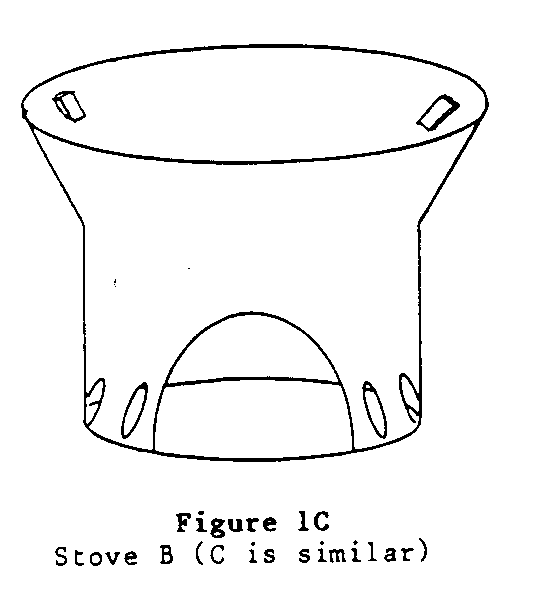
<Figure 1C>
07p7c.gif (317x317)
<Figure 1D>
07p7d.gif (353x353)
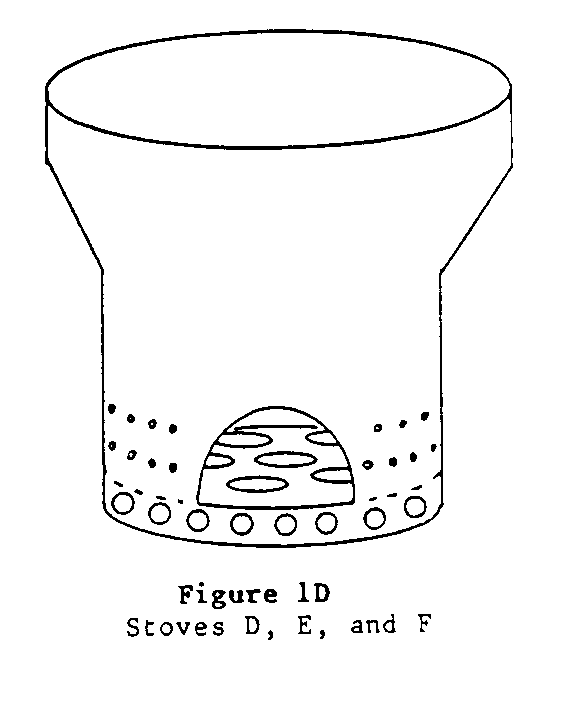
TABLE I
SUMMARY OF POT DIMENSIONS
Pot
#2 #3a #3b #4
Top diameter (cms) 22.0 24.5 24.5 27.5
Maximum diameter 24.5 26.5 27.0 30.5
Total height 18.0 19.0 19.0 21.0
Height from bottom to
maximum diameter 8.0 10.0 10.0 10.0
Weight (kgs) 0.93 1.28 1.58 1.81
Volume (liters) 5.5 7.8 7.9 11.5
STOVE A: A sketch of "stove" A, the traditional three-stone fire, is
shown in Figure 1A (traced from De Lepeleire). Three rocks are placed
07p7a.gif (393x393)
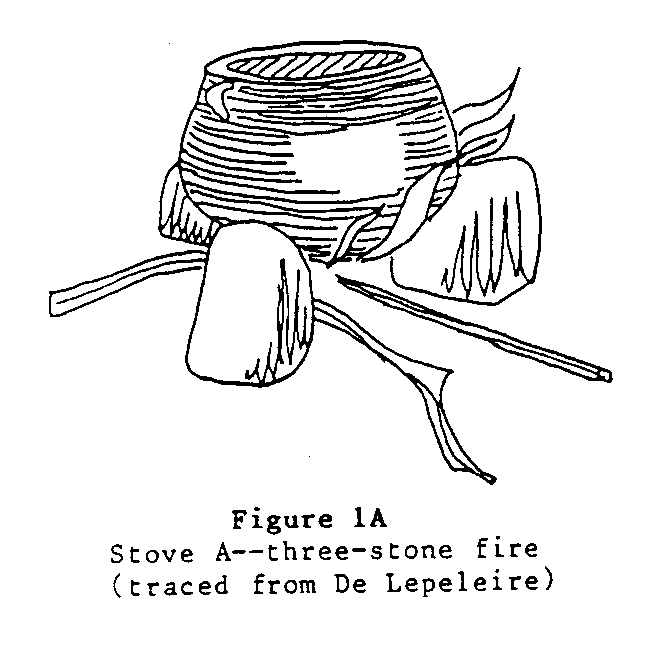
on a concrete slab to support the pot. The distance from the slab to
the pot bottom is kept at roughly 10 cm. The diameter of the firebed
can be as large as 20 cm but is typically 10 to 15 cm.
STOVES B, C, D, E, and F: These are all fired clay stoves and are
described in more detail in the October report. All of the stoves are
made entirely of fired clay, including the grate. They have a single
wall and an open (unclosable) door for wood entry. There is no preheating
of primary or secondary air. Pot supports, five in all, consist
of three equally spaced strips of fired clay 0.5 cm thick by 4 to
5 cm long, and 2.5 cm wide. Sketches of these stoves are found in
Figure 1. A summary of their dimensions is given in Table II.
STOVES H, K, L, M, and N: These are cylindrical and are made of 1 mm
sheet steel (and, in some cases, iron rebar for pot supports). Stove
ZZ is a combination of metal with fiberglass insulation.
STOVE H: This is a traditional metal "malgache" stove purchased in a
local market. It consists of a metal cylinder with a solid bottom, a
large door, and three metal tabs on the top rim of the cylinder extending
inwards and downwards at a small angle to support the pot. The
tabs are 6 cm wide by 6 cm long, with the corners well rounded and a
slight taper going out.
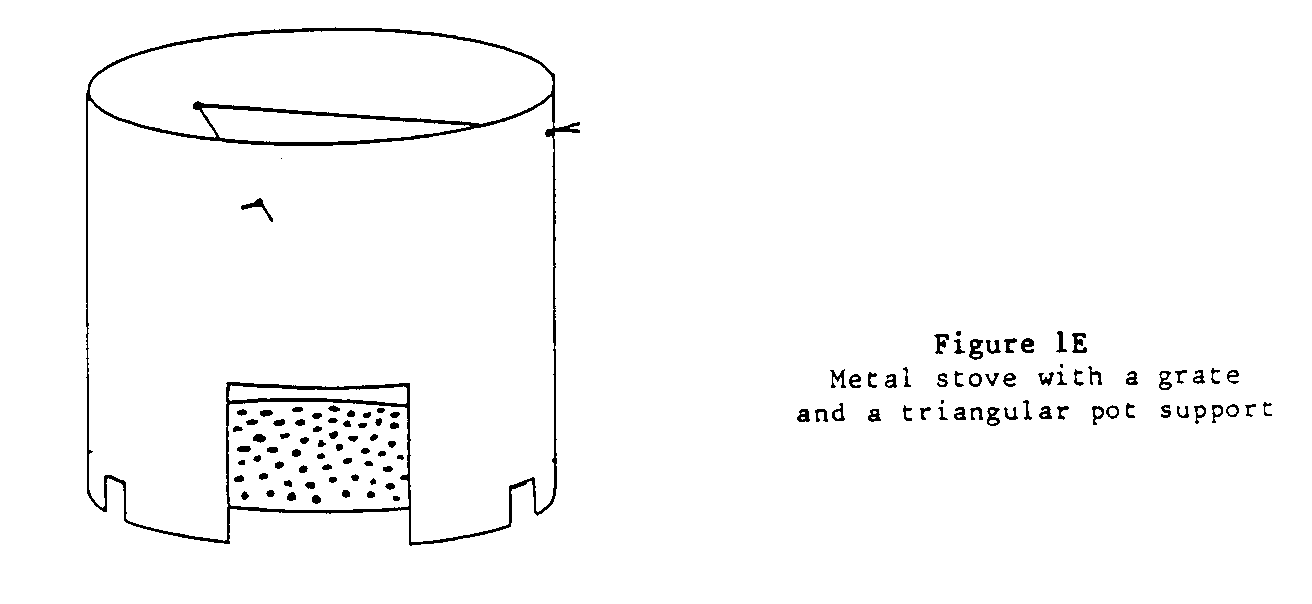
STOVE K: This stove has a grate, a wall that rises up around the pot,
and a triangular pot support made of rebar as shown in Figure 1E.
07p7e.gif (437x437)
STOVE L: This is nearly identical to the traditional "malgache" stove
(Stove H) except that it has a smaller door and a grate punched into
the normally solid bottom. For air to enter the grate it was necessary
to place this stove on three supports to raise it off the ground.
STOVE M: This is a double wall stove with a closable door. The outer
wall is simply a cylinder with a solid bottom and a sliding door. The
inner wall has the rounded and tapered tabs for pot supports as in
Stove H, a grate that is raised up off the solid bottom of the exterior
wall, and vents in its walls to let air in below its grate. When
used with the door open, the space between the walls was closed at the
top with a piece of cloth to create an insulating dead air space. When
used with the door closed, the space between the walls was left open
for air to enter at the top, descend, and preheat from contact with
the hot inner wall before entering the combustion chamber.
STOVES N: These are all simple metal cylinders with the same size
door (10 cm high by 12 cm wide, of which the lower 3.5 cm is below the
grate) and vents (two vents, 8 cm wide and 3.5 cm high) to let air in
below the grate. The vents are on opposite sides of the stove and at
right angles to the door. The grate (with 200 holes 0.8 cm in diameter)
itself is removable, as is the pot support (12 cm from grate to
pot bottom). The pot support is made of two pieces of rebar bent into
upside down "W's," contoured to the shape of the pot and welded
together at their point of contact in the center, with additional
struts attached between their legs for strength. For larger diameter
shields a metal ring is placed on the grate to block air entry between
the grate and the stove wall. As the same grate and pot support are
always used in these tests, the parameters of firebed aeration and pot
height above the firebed do not affect the results. In this way
different heights and diameters of pot shields can be tested to determine
the effect on efficiency and the sensitivity of the efficiency to
variations in these parameters.
STOVE ZZ: The Z Ztove is produced by the ZZ Corporation. It consists
of an outer shell of sheet metal 17 cm wide by 15 cm deep by 24 cm
high. Within is a layer of high temperature insulation around a cylindrical
combustion chamber 10 cm in diameter and 16 cm deep from grate
to stove top. There are three openings into the stove: a 3.5 cm diameter
hole whose center is 4.5 cm from the top of the stove for wood
entry (this limits the size of wood to less than 3.5 cm diameter by 9
cm long); a slot, 5.5 cm wide by 1 cm high, 17 cm from the top of the
stove, with a sliding door for secondary air to enter; and a slot, 21
cm from the top of the stove, 12 cm wide and 1.5 cm high, for primary
air and for a tray to catch the cinders that fall from the grate. The
sliding tray is 11.5 cm wide by 14 cm long by 1.5 cm deep. Secondary
air is preheated and enters the combustion chamber through 36 holes
0.6 cm in diameter, each spaced 3 cm apart in spiral strips from the
level of the grate to within 4 cm of the top of the stove. The pot
rests on a spacer about 3 cm above the top of the stove. There is no
provision for pot shielding.
A number of variations in the basic stoves listed above were tried to
determine the effect of different parameters on stove performance. A
summary of these variations is given in Table IV, using the same notation
as on the data sheets.
For the fired clay stoves these variations give data on the effect of
side vents (B and C), the effect of a grate (D), the effect of the
grate height (E and F), the effect of primary and secondary air (D, E,
and F), and the effect of the height of the stove wall around the pot
(E vs. F).
Stoves H, K, and L show the effect on the traditional metal stove of
adding a grate and raising the wall of the stove around the pot. Stove
M crudely shows the effect of a door, double wall, and preheating the
primary and secondary air. The N stoves show the effect of various
heights and diameters of stove walls around the pot. Stove ZZ shows
the effect of optimized combustion without the advantages of pot
shielding.
TABLE II
SUMMARY OF FIRED CLAY STOVE DIMENSIONS
Stove
Feature B C D E F
Wall thickness, cms 2.0 2.0 1.0 1.0 1.0
Total height 19 19 22 21.5 26
Height, base to flare 14 12 13 13 13
Height, base to top of flare 19 19 19 19 19
Outside diameter, base 22 22 23 23 23
Outside diameter, top 31 35 30 30 30
Base solid solid open open open
Grate no no fixed mobile mobile
Space below bottom of grate -- -- 3.0 5.5 6.0
Grate thickness -- -- 1.0 1.0 1.0
Grate holes (1.5 cm diameter) -- -- 13 19 19
Grate supports (3 x 9 cm long,
3 wide, and 1.5 thick) -- -- -- yes yes
Air entry below grate
(1.5 cm diameter holes) -- -- 20 18 17
Side vents above solid bottom
(5 x 1.5 cm) 4 2 -- -- --
Door (height x width, cm) 11x10-16 10x12 8x12 9x11 9x10
Number secondary air holes
(0.8 cm diameter)
3 cm above grate top -- -- 16 16 16
5 cm above grate top -- -- 17 15 15
Height, grate top to
bottom #3 pot 11 8 10 6.5 6.0
with grate lowered -- -- -- 10 9.5
with #2, #4, pot 9, 12.5 -- -- -- --
Height of pot exposed
above stove, #3 pot 13 11 13 11 6
#2 pot, #4 pot 9, 16 -- -- -- --
TABLE III
SUMMARY OF METAL STOVE DIMENSIONS
Stove
Feature H K L M M
(outer) (inner)
Height 18 22 18.5 17.5 20
Circumference 93 91.5 93 92 85
Grate, holes 0.8 cm diameter no 62 45 no 60
Air entry below grate,
2.5 x 2.5 slots no 5 open no 5
Door, height x width 13x17 10x12 10x12 11x12 10x12
Secondary air, 0.8 cm
diameter, 5 cm above grate no no no no 15
Grate to pot height 13 12 11 -- 11
Feature N1 N2 N3 N4 N5 N6 N7[\N
Height 28 25 22 19 25 25 25 25 25
Circumference 91 91 92 91.5 98 104 110 98 92
TABLE IV
SUMMARY OF STOVE VARIATIONS
A1: Three-stone fire
B1: Stove B with all vents open
B2: Stove B with all vents closed
B3: Stove B with all vents open, #2 pot
B4: Stove B with all vents open, #4 pot
C1: Stove C with all vents open
C2: Stove C with all vents closed
D1: Stove D with primary and secondary airholes open
D2: Stove D with primary (grate) holes closed, secondary open
D3: Stove D with primary open, secondary closed
D4: Stove D with primary closed, secondary open
E1: Stove E with grate in place, secondary open
E2: Stove E with grate lowered, secondary open
E3: Stove E with grate in place, secondary closed
E4: Stove E with grate lowered, secondary closed
E5: Stove E with grate in place, upper half secondary closed, lower
half secondary open
F1: Stove F with grate in place, secondary open
F2: Stove F with grate lowered, secondary open
F3: Stove F with grate in place, secondary closed
F4: Stove F with grate lowered, secondary closed
F5: Stove F with grate in place, upper half secondary closed, lower
half secondary open
H1: Stove H unchanged
K1: Stove K unchanged
L1: Stove L unchanged
M1: Stove M with door open
M2: Stove M with door open
N1: Stove N1 unchanged
N2: Stove N2 unchanged
N3: Stove N3 unchanged
N4: Stove N4 unchanged
N5: Stove N5 unchanged
N6: Stove N6 unchanged
N7: Stove N7 unchanged
N8: Stove N8 unchanged
ZZ: Stove ZZ unchanged
III. TEST METHODOLOGY
The methodology used, described in detail in the October report, generally
followed the draft procedure developed by the "Working group
meeting on a woodstove field test standard, Marseille, 12 - 14 May
1982" and by Dr. Timothy S. Wood. Tests were completed November - December
1982. A sample test sheet follows the testing procedure
described below. On the sample test sheet letters are filled in that
correspond to the column headings in the raw data in section VI, Test
Results.
The testing procedure listed here is identical to that used in the
October report.
1. The stove and area around it is swept clean of ashes and other
debris. The stove is felt to make sure it is cool. Because of the
stoves' very low thermal mass, cooling generally takes no more than
30 minutes.
2. Weather conditions, particularly wind, are noted.
3. Wood is chopped into pieces roughly 3 cm by 3 cm by 20 to 30 cm
long, along with a number of very small pieces to start the fire.
All wood, including kindling, is then weighed on scales accurate to
10 g over 5 kg and set to the side of the stove. A smaller amount
is withdrawn from this pile, separately weighed, and used to start
the fire. Any wood put into the fire is weighed and recorded separately,
in addition to the overall wood weight. This provides a
check that wood is not misplaced during the test
4. The pot to be used is weighed and its weight recorded. Approximately
3 kg of water are added to the pot, and the total weight of pot
plus water recorded.
The same pots and same balance tray are used each time, and their
weights are known. Nevertheless, they are carefully weighed each
time so that, first of all, changes in the balance performance can
be quickly spotted, and secondly, so that analysis of all the readings
will provide a rough error analysis and estimate of the
balance's precision.
5. The wood is then arranged in the stove, a small (1 m1 or so) amount
of kerosene added to the wood, and the wood set on fire. While the
fire becomes established, (a minute or so) the water temperature is
taken. Once the fire is burning well, the pot is placed on the
stove, and a stopwatch is started.
6. The temperature of the water is recorded every five minutes until
the water begins to boil. The wood is pushed in or added (after
weighing and recording) in order to maintain a reasonably steady,
but not excessively large, fire. Different testers vary dramatically
in their attitude as to what constitutes "a reasonably steady
but not excessively large fire." (In this study, variation was
reduced by attempting to ensure that a tester tested each stove
the same number of times.) Observations such as the color and
extent of smoke, the effect of the wind on the stove, or flames
shooting out the door or stove top are recorded.
7. As soon as the water starts to boil, the flames are blown out; the
wood left in the stove is weighed and recorded; the total amount
of wood remaining is weighed and recorded; and the pot is weighed
and recorded. The amount of charcoal in the stove is neither
weighed nor estimated until the end of the second part of the
test. In those cases where the pot refuses to come to a boil,
i.e., where it stays at a temperature of 90 [degrees] C for more than 15
minutes, the first part of the test is ended as though it had been
successfully completed.
8. No lids of any sort are used during any part of the test. The pots
remain completely uncovered throughout.
9. After all wood and pot weights are taken and recorded, a small
amount of wood is again taken from the larger pile, weighed, and
added to the stove. The fire is relit, the water temperature
recorded, the pot of water returned to the stove, and the timing
begun again.
10. Temperature is again recorded every five minutes. The fire is
maintained at a steady level to keep the water temperature above
90 [degrees] C but below a vigorous boil. Again, lids are not used on the
pots.
11. After 60 minutes the fire is again blown out, the weight of the
wood remaining in the stove recorded, the total remaining wood
weight recorded, the pot weight recorded, and the weight of the
charcoal remaining after the test recorded.
It should be noted that this procedure does not provide a good resolution
of the high power and low power abilities of the stove, because
as pot lids are not used there is a high rate of heat loss from the
pot. In order to keep temperatures close to boiling under these circumstances,
the tester is obliged, even during the second part of the
test--the "low power phase"--to maintain a fairly high power level. It
is not clear in practice, however, how useful a true low power measurement
is. Combustion can be maintained at nearly any power level
with dry wood. In testing a low power level, one may be testing more
the patience of the tester to cut the wood into small pieces and feed
it into the stove than a real performance parameter of the stove
itself.
SAMPLE LABORATORY TEST DATA SHEET
Test Number "A" Date
Name of tester _____________________ Weather conditions
Pot used ___________________________ Time
Stove "B"
START:
Weight of pot "C" Weight of pot w/water "D"
Weight of balance tray "E"
Weight of balance tray with wood "F"
BOILING TEST:
Time Elapsed Water Weight of Remarks
time temperature wood added
to fire
_____ 0 "G" ______ _________________
_____ 5 _____ ______ _________________
_____ 10 _____ ______ _________________
_____ 15 _____ ______ _________________
_____ 20 _____ ______ _________________
_____ 25 _____ ______ _________________
_____ 30 _____ ______ _________________
_____ 35 "I" _____ ______ _________________
_____ 40 _____ ______ _________________
_____ 45 _____ ______ _________________
Weight of the balance tray and wood remaining in the stove _______________
Total weight of unused wood and the balance tray "J"
Weight of the pot and water "K"
(*) Note that "H" is the temperature of the boiling water, and "I" is
the elapsed time.
SIMMERING TEST:
Time Elapsed Water Weight of Remarks
time temperature wood added
to fire
_____ 0 "G" ______ _________________
_____ 5 _____ ______ _________________
_____ 10 _____ ______ _________________
_____ 15 _____ ______ _________________
_____ 20 _____ ______ _________________
_____ 25 _____ ______ _________________
_____ 30 _____ ______ _________________
_____ 35 _____ ______ _________________
_____ 40 _____ ______ _________________
_____ 45 _____ ______ _________________
_____ 50 _____ ______ _________________
_____ 55 _____ ______ _________________
_____ 60 _____ ______ _________________
Weight of the balance tray and wood remaining in the stove
Total weight of unused wood and the balance tray "M"
Weight of the charcoal remaining and the balance "N"
Weight of the pot and water "O"
REMARKS:
IV. CALCULATING THE PERCENT HEAT UTILIZED
The procedure used for calculating the percent heat utilized (PHU) was
identical to that in the October report. The formula used was
PHU = 4.184 (water)(temp) + 2,260 (evap)
18,000 (wood) - 29,000 (charcoal)
where "water" is the initial weight of the water, "temp" is the temperature
change of the water, "evap" is the mass of water evaporated,
"wood" is the mass of the wood burned, and "charcoal" is the mass of
charcoal remaining at the end of the test.
All weights are given in kilograms and all temperatures are given in
centigrade. Note that the thermal capacity (weight x specific heat) of
aluminum is ignored as it is small. The error due to this factor is
discussed in greater detail below.
As noted previously, this calculation contains some implicit assumptions.
It assumes, with little error, that the latent heat of evaporation of
water is 2,260 J/gm, and that the specific heat of water is 4.184 J/gm
C.
Much less justifiable are the assumptions that the heat values of wood
and charcoal are 18,000 J/gm and 29,000 J/gm respectively. This was
not verified during the course of these tests.
In the data and analysis that follow, three different PHUs are calculated:
the PHU to bring the water to a boil; the PHU of simmering the
water for one hour; and the average PHU for these two parts.
The PHU for bringing the water to a boil was calculated using the
equation:
[PHU.sub.1] = 4.184 (D-C) (H-G) + 2,260 (D-K)
18,000 (F-J) - 14,500 (N-E)
where the letters indicate the data listed in the sample test sheet
(see previous section) and in the columns of raw data that follow.
Note that the calorific value of the charcoal remaining at the end of
the test is divided equally between the first and second phases. The
values for [PHU.sub.1] are listed as a percentage under column "E1" in the
List of Calculated Results, Table VII.
The PHU for simmering the water for an hour is calculated similarly.
In this case, the equation used is:
[PHU.sub.2] = 4.184 (K-C) (H-L) + 2,260 (K-0)
18,000 (J-M) - 14,500 (N-E)
The values for [PHU.sub.2] are listed as a percentage in column E2, Table
VII, List of Calculated Results.
The average PHU, listed as a percentage in column EA, Table VII, was
calculated using the equation:
[PHU.sub.A] = 4.184 (D-C) (H-G) + 2,260 (D-0)
18,000 (F-M) - 29,000 (N-E)
Although the charcoal was weighed only once and its weight divided
between the boiling and simmering stages of the test in calculating
the PHU, it is likely that the charcoal is established mostly during
the first stage and a steady state condition reached during the second
stage. Dividing it equally between the two stages will then tend to
understate the first PHU figure and overstate the second figure.
The fire power during the first and second stages was also calculated
and is listed in Table VII as "P1" and "P2," in units of kilowatts.
The equations used to calculate these values were:
P1 = 18,000 (F-J) - 14,500 (N-E)
60 (I)
P2 = 18,000 (J-M) - 14,500 (N-E)
3,600
Greater detail on all these points is given in the October report.
V. ERROR ANALYSIS
A complete error analysis was made in the October report and will not
be repeated here. In summary, it was shown that for a balance accurate
to 10 grams and a stove with a PHU of 27%, intrinsic measurement
errors gave an error of roughly [+ or -] 1.4%. Thus, extreme attention must be
given to the accuracy of the balance and, further, to ensure that the
balance does not drift during the testing series. In the work done
here a set of standard OHAUS weights was used to check the balance's
accuracy periodically.
In addition to the problems with balance precision, it was noted above
that the weight of the aluminum pot itself was not included in the PHU
calculation. When the same pot is always used this obviously does not
pose problems. However, in this series of tests, pot sizes from #2 to
#4 were used with stove B.
Beginning with a representative test for stove B, #214, we can calculate
the amount of energy used to heat the different aluminum pots,
and compare that to the average PHU as calculated.
Adding a term for heating the mass of aluminum from the starting to
the boiling temperature for the different sized pots we find:
Pot Mass PHU
-- -- 27.1%
#2 0.93 kg 27.5
#3a 1.28 27.7
#3b 1.58 27.8
#4 1.81 27.9
where we have used 0.896 J/gm-C for the specific heat of aluminum
(water has C=4.184 J/gm-C).
It must be noted that using the values as given in the List of Data
(Table VI) gives a PHU of 26.95% instead of 27.1%. The difference is
due to using a data printout format that rounds off the values listed
to fit them into the column width. In this case the value for the
initial wood weight was rounded from 2.205 kg to 2.21 kg, which causes
the above discrepancy. The calculated values of PHU, etc., listed in
the tables use the original values, with no rounding.
The values found above show that the error due to not including the
aluminum weight of the pot itself is small and can be ignored for the
tests presented here.
In addition to the above internal errors, there were several problems
with the test methodology.
WIND: As previously discussed, the wind was observed to be an important
factor affecting the tests. A wall was placed around each test
site to reduce the wind's effect. Each wall was 80 cm high and in the
shape of a "U" 70 cm wide and 110 cm deep. The open end of the U faced
a three story building approximately 2 m away, reducing wind from that
direction to essentially zero. Nevertheless, crosswinds were observed
to disturb the stoves, and some data taken on the most windy days have
been removed from consideration.
WOOD MOISTURE CONTENT: The wood moisture content was not highly variable
during this series of tests since all wood was pre-dried before
use, as discussed in the October report. Drying was done by placing
the wood in clear polyethylene tubes 30 cm in diameter and 200 cm long
for about one week before use. These tubes full of wood were left in
the sun and tilted at an angle of approximately 10 degrees, to both
heat the wood and provide a small air current through the thermosyphon
effect to remove the moisture from the tube. Internal temperatures at
midday were about 10 [degrees] C above ambient. Flaps at the end of the tubes
were left hanging to prevent the rain from entering. The moisture content
of air-dried wood was later measured and found to be about 6%.
Although unknown, it is likely that the moisture content of the wood
used for these tests was less than that.
A number of problems were observed in individual tests and are listed
in Table V on the following page.
TABLE V
LIST OF TESTS WITH PROBLEMS
Test Number Problem
134 Problems with fire, wood lost during test
145 Problems with fire
154 Missing weight of pot and water at intermediate
step
157 Missing weight of pot and water at intermediate
step
170 Stopped after the first half due to darkness
189 Door was opened and closed throughout the test
to observe the effect
193 Heavy winds
196 Test with covered pot
199B Test with covered pot
200 Test with covered pot
204 Test with covered pot
205 Test with covered pot
206 Test with covered pot
207 Test with covered pot
221 Heavy winds
224 Heavy winds
241 Problems with fire
242 Missing data
261 Missing data
267 Heavy winds
275-289 Tests were done at a new testing site to give
new testers some experience using these stoves
It is clear from looking at the variation in PHUs between tests that
there remain several uncontrolled variables.
None of the above data is included in the stove PHU averages. In the
summary in Table VIII they are listed in parentheses.
VI. TEST RESULTS
TABLE VI
LIST OF DATA
A B C D E F G H I J K L M N 0
109 E2 1.28 4.28 .65 2.39 24 97 27 2.08 4.04 83 1.59 .68 3.04
110 D3 1.57 4.66 .65 2.64 27 97 50 2.13 4.05 73 1.68 .70 3.12
111 F4 1.27 4.25 .65 2.34 24 97 27 2.05 4.01 84 1.62 .685 2.85
112 E4 1.29 4.28 .645 2.55 29 98 21 2.24 4.08 86 1.73 .69 2.93
113 B2 1.29 4.43 .645 2.69 28 97 45 2.28 4.08 84 1.82 .725 3.18
114 C2 1.57 4.57 .645 2.35 29 98 42 1.88 4.23 80 1.38 .77 3.30
115 A1 1.27 4.38 .64 3.75 30 97 47 2.40 3.99 85 1.53 .84 3.26
116 E1 1.58 4.60 .65 2.71 26 97 33 2.39 4.36 84 1.99 .675 3.41
117 F1 1.28 4.36 .645 2.59 25 97 25 2.28 4.13 86 1.83 .68 3.04
118 D2 1.27 4.29 .645 2.44 29 98 34 2.11 4.05 88 1.75 .71 3.15
119 B1 1.28 4.35 .64 2.65 28 97 35 2.23 3.99 80 1.70 .71 2.98
120 C2 1.29 4.34 .65 2.56 27 97 45 2.15 3.94 84 1.64 .75 2.97
121 E3 1.28 4.21 .645 2.73 30 97 33 2.45 4.05 85 2.06 .685 3.24
122 F1 1.28 4.43 .65 2.53 27 97 40 2.19 4.08 78 1.82 .70 3.17
123 D1 1.29 4.51 .65 2.44 27 97 33 2.07 4.21 84 1.63 .70 3.26
124 F3 1.28 4.53 .645 2.70 27 97 43 2.36 4.17 82 1.90 .68 2.94
125 E2 1.29 4.29 .65 2.63 28 97 28 2.27 4.00 87 1.82 .69 2.93
126 H1 1.57 4.65 .64 2.59 28 97 33 2.09 4.33 84 1.13 .76 3.28
127 F4 1.27 4.41 .65 2.46 27 97 25 2.15 4.17 86 1.66 .69 2.97
128 K1 1.57 4.68 .645 2.79 33 97 22 2.45 4.44 88 1.86 .72 3.20
129 E4 1.28 4.35 .65 2.71 26 97 38 2.25 4.05 87 1.85 .695 2.38
130 B2 1.58 4.65 .65 2.74 29 98 45 2.27 4.29 78 1.70 .80 3.32
131 L1 1.29 4.45 .655 2.49 27 97 44 1.99 4.06 83 1.47 .78 3.28
132 A1 1.28 4.28 .65 3.91 31 97 40 3.21 3.92 83 2.34 .84 3.10
133 E1 1.57 4.58 .65 2.38 25 97 30 2.06 4.34 85 1.64 .68 3.26
134 F2 1.28 4.33 .65 2.29 28 97 43 1.94 4.04 83 1.44 .69 2.95
135 M1 1.57 4.62 .65 2.36 29 97 34 1.88 4.25 86 1.44 .78 3.15
136 B1 1.27 4.56 .64 2.61 30 97 43 2.15 4.22 87 1.64 .76 3.27
137 ZZ 1.34 4.49 .65 2.03 26 97 38 1.60 4.12 83 1.04 .72 3.17
138 E3 1.57 4.53 .645 2.13 27 97 27 1.85 4.29 89 1.42 .685 3.14
139 Fl 1.28 4.25 .64 2.51 30 97 23 2.21 3.93 84 1.67 .70 2.66
140 M2 1.58 4.69 .64 2.28 28 94 45 1.67 4.35 80 1.32 .76 3.29
141 F5 1.28 4.33 .645 2.64 29 98 26 2.36 4.04 82 1.98 .67 2.97
142 H1 1.58 4.47 .65 2.67 26 97 35 1.98 4.06 86 1.29 .77 3.06
143 F3 1.28 4.34 .65 2.41 27 97 35 2.12 4.07 86 1.72 .68 2.77
144 E2 1.58 4.69 .65 2.54 27 97 24 2.18 4.42 87 1.63 .68 3.23
145 F4 1.28 4.31 .65 2.82 28 98 35 2.43 3.97 81 1.87 .71 2.81
146 K1 1.58 4.68 .65 2.64 26 97 30 2.27 4.39 85 1.74 .72 3.25
147 E4 1.28 4.32 .65 2.81 30 97 18 2.53 4.12 87 2.03 .68 2.89
148 B2 1.28 4.33 .65 2.64 29 95 49 2.08 3.82 81 1.48 .77 2.83
149 L1 1.57 4.51 .645 2.58 28 97 30 2.16 4.17 79 1.62 .73 3.22
150 E1 1.58 4.40 .64 2.37 28 97 38 1.98 4.07 86 1.54 .69 2.89
151 A1 1.28 4.31 .65 3.74 29 97 34 2.98 4.01 86 1.77 .84 2.86
152 F2 1.28 4.53 .65 2.23 26 97 21 1.98 4.31 88 1.53 .69 3.12
153 M1 1.58 4.59 .65 2.51 28 98 35 2.02 4.11 87 1.43 .78 3.02
154 B1 1.28 4.37 .65 2.35 27 97 25 2.03 0 83 1.47 .70 3.05
A B C D E F G H I J K L M N O
155 E3 1.58 4.74 .65 2.21 28 97 22 1.90 4.54 88 1.44 .67 3.28
156 ZZ 1.35 4.54 .64 2.19 27 97 35 1.75 4.17 82 1.16 .73 3.18
157 F1 1.28 4.30 .65 2.43 27 97 26 2.13 0.00 88 1.75 .70 3.03
158 M2 1.57 4.51 .655 2.60 24 97 18 2.23 4.32 83 1.68 .74 3.12
159 F5 1.28 4.29 .655 2.60 25 97 26 2.30 4.02 86 1.82 .69 2.80
160 F3 1.27 4.31 .645 2.15 29 97 20 1.89 4.09 88 1.51 .69 3.05
161 H1 1.58 4.58 .65 2.66 22 97 40 2.02 4.21 85 1.11 .80 3.05
162 E2 1.28 4.44 .645 2.57 26 97 20 2.22 4.25 88 1.64 .70 2.95
163 F4 1.28 4.42 .645 2.15 30 97 18 1.85 4.20 88 1.40 .685 3.00
164 K1 1.57 4.56 .65 2.42 24 97 20 2.11 4.29 86 1.57 .70 3.07
165 E4 1.27 4.43 .65 2.32 25 97 20 2.01 4.22 88 1.55 .68 3.08
166 A1 1.28 4.41 .65 3.60 30 97 43 2.66 4.10 84 1.56 .89 2.95
167 B2 1.57 4.60 .645 2.60 31 97 20 2.24 4.34 85 1.68 .70 3.12
168 L1 1.57 4.61 .65 2.33 25 97 25 2.00 4.42 88 1.43 .75 3.44
169 E1 1.28 4.39 .65 2.42 27 97 27 2.04 4.27 87 1.72 .70 3.00
170 F4 1.28 4.29 .645 2.31 30 97 31 1.97 3.93 0 0 .73 0
171 M1 1.58 4.66 .65 2.36 27 97 21 2.04 4.42 89 1.57 .69 3.31
172 B1 1.28 4.38 .65 2.05 27 97 25 1.68 4.12 87 1.11 .73 3.09
173 E3 1.28 4.30 .645 2.61 31 97 18 2.31 4.12 88 1.86 .68 2.91
174 ZZ 1.34 4.42 .64 2.13 27 97 18 1.86 4.20 88 1.39 .69 3.22
175 F1 1.28 4.30 .64 2.28 25 97 20 2.04 4.10 88 1.61 .68 2.76
176 M2 1.58 4.33 .64 2.23 25 97 25 1.85 3.99 88 1.29 .80 2.82
177 F5 1.28 4.30 .64 2.15 25 97 19 1.91 4.13 85 1.53 .67 3.03
178 F3 1.27 4.30 .64 2.16 32 97 29 1.82 3.97 86 1.37 .72 2.74
179 H1 1.58 4.57 .65 2.62 26 97 25 2.08 4.33 87 1.30 .82 3.31
180 E2 1.27 4.31 .64 2.28 25 97 15 2.02 4.13 87 1.60 .68 3.12
181 F4 1.28 4.27 .65 2.24 24 97 22 1.94 4.05 85 1.49 .68 2.63
182 K1 1.57 4.57 .64 2.49 24 97 30 2.11 4.28 85 1.43 .73 3.09
183 E4 1.27 4.38 .64 2.69 23 97 22 2.23 4.14 89 1.76 .68 2.86
184 A1 1.27 4.29 .64 3.20 30 92 35 2.34 4.02 79 1.36 .81 3.22
185 B2 1.28 4.28 .645 2.77 24 97 25 2.38 3.93 84 1.80 .71 2.74
186 L1 1.57 4.58 .64 2.28 25 97 25 1.89 4.32 86 1.37 .70 3.29
187 E3 1.27 4.35 .645 2.21 29 97 20 1.96 4.15 88 1.54 .70 3.08
188 F2 1.28 4.38 .65 2.27 24 97 26 2.00 4.14 88 1.52 .69 2.82
189 M12 1.56 4.88 .645 2.52 25 98 25 2.04 4.63 85 1.35 .77 2.25
190 B1 1.28 4.31 .645 2.27 23 97 33 1.88 3.99 86 1.34 .72 2.82
191 E3 1.28 4.39 .64 2.26 29 97 31 1.98 4.15 88 1.51 .70 3.02
192 ZZ 1.34 4.44 .645 2.49 22 97 25 2.12 4.16 85 1.53 .71 3.15
193 F1 1.28 4.29 .65 2.35 24 97 25 2.03 4.06 85 1.57 .695 2.91
194 M1 1.27 4.28 .64 2.69 26 97 21 2.36 4.05 87 1.77 .75 2.87
195 ZZ 1.63 4.71 .65 2.11 26 92 45 1.58 4.23 84 0.94 .72 3.42
196 F5C 1.28 4.32 .645 2.63 25 98 23 2.42 4.22 86 2.04 .675 3.14
197 F5 1.28 4.32 .645 2.30 24 97 31 1.99 4.07 88 1.66 .68 2.95
198 H1 1.28 4.29 .645 2.84 25 97 44 2.06 3.91 85 1.11 .82 2.81
199 F3 1.27 4.33 .64 2.36 21 97 30 2.03 4.05 85 1.58 .695 2.81
1998 F3C 1.27 4.40 .64 2.43 23 98 19 2.15 4.25 89 1.74 .69 3.12
200 E2C 1.27 4.39 .645 2.37 23 98 27 2.08 4.30 88 1.68 .685 3.54
201 K1 1.56 4.58 .65 2.68 20 97 38 2.24 4.10 83 1.56 .79 2.75
202 F4 1.27 4.29 .65 2.12 23 97 27 1.81 4.05 88 1.37 .69 2.80
203 E4 1.27 4.27 .64 2.22 22 97 21 1.93 4.04 87 1.38 .685 2.72
A B C D E F G H I J K L M N O
204 F1C 1.27 4.39 .65 2.31 25 98 23 2.08 4.31 90 1.73 .685 3.36
205 F1C 1.27 4.31 .65 2.26 23 98 24 2.01 4.19 91 1.61 .69 3.05
206 F1C 1.27 4.28 .65 2.28 25 98 38 2.00 4.18 90 1.58 .71 3.13
207 F1C 1.28 4.29 .65 2.44 22 98 25 2.21 4.21 90 1.84 .69 3.30
208 F1 1.27 4.30 .65 2.13 30 97 25 1.86 4.03 89 1.36 .68 2.56
209 B2 1.27 4.29 .64 2.61 19 97 30 2.24 4.03 87 1.68 .725 2.80
210 L1 1.27 4.28 .64 2.47 24 97 50 1.93 3.84 85 1.32 .75 2.86
211 E1 1.57 4.57 .64 2.47 22 97 27 2.20 4.32 87 1.71 .71 3.02
212 F2 1.27 4.35 .645 2.53 23 97 30 2.20 4.09 89 1.69 .71 2.75
213 M1 1.57 4.57 .65 2.42 23 97 23 2.03 4.32 88 1.47 .74 3.17
214 B1 1.57 4.55 .645 2.21 22 97 37 1.80 4.29 87 1.22 .735 3.15
215 E3 1.27 4.33 .645 2.59 21 97 25 2.29 4.10 88 1.85 .70 2.95
216 A1 1.27 4.32 .64 3.18 27 97 36 2.25 4.08 86 1.10 .885 3.12
217 F5 1.27 4.28 .64 2.05 22 97 23 1.78 4.02 87 1.31 .675 2.64
218 K1 1.57 4.59 .645 2.10 21 97 24 1.72 4.25 83 1.17 .71 3.16
219 F3 1.27 4.35 .64 2.52 23 97 23 2.18 4.05 88 1.73 .73 2.72
220 H1 1.57 4.57 .64 3.24 20 97 30 2.54 4.27 85 1.43 .93 3.04
221 E2 1.27 4.35 .645 2.53 20 97 23 2.07 4.08 88 1.29 .695 2.85
222 F4 1.27 4.27 .65 2.43 19 97 33 2.08 3.97 88 1.55 .71 2.59
223 M3 1.57 4.54 .65 2.39 21 97 33 1.92 4.23 85 1.30 .695 3.10
224 E4 1.28 4.28 .65 2.30 19 97 32 1.74 3.90 86 1.03 .70 2.27
225 L1 1.57 4.58 .645 2.32 22 97 29 1.82 4.25 83 1.04 .78 3.12
226 F3 1.27 4.37 .64 2.44 27 97 25 2.11 4.09 87 1.51 .71 2.80
227 H1 1.58 4.58 .65 2.59 23 97 28 1.94 4.25 87 1.08 .815 3.04
228 B3 .935 3.94 .65 2.02 23 97 21 1.67 3.77 88 1.15 .75 2.73
229 F4 1.27 4.34 .645 2.14 21 97 27 1.87 4.15 88 1.36 .71 2.76
230 N2 1.57 4.58 .645 2.21 22 97 28 1.85 4.28 88 1.35 .73 3.24
231 A1 1.27 4.35 .65 3.75 22 97 34 2.80 4.13 86 1.59 .86 3.05
232 B1 1.27 4.26 .645 2.02 27 97 21 1.68 4.08 88 1.12 .77 2.93
233 N4 1.27 4.28 .645 2.49 32 97 39 1.93 3.92 88 1.20 .765 2.95
234 F2 1.28 4.28 .645 2.33 22 97 25 2.06 4.06 87 1.55 .71 2.74
235 N1 1.58 4.58 .645 2.65 22 97 35 2.25 4.25 86 1.66 .735 3.11
236 B4 1.81 4.82 .65 2.39 27 97 32 1.91 4.38 85 1.45 .73 3.30
237 N5 1.57 4.57 .64 2.53 23 97 35 2.02 4.27 87 1.34 .74 3.40
238 F1 1.27 4.28 .645 2.57 23 97 30 2.31 4.02 88 1.91 .69 2.80
239 N3 1.57 4.57 .64 2.76 20 97 26 2.22 4.24 86 1.35 .745 2.90
240 N6 1.58 4.58 .645 2.67 19 97 40 1.80 4.24 88 0.99 .78 3.12
241 F5 1.28 4.30 .64 2.31 21 97 27 1.76 3.93 86 1.06 .71 2.88
242 N7 1.57 4.57 .645 2.41 27 91 70 0 0 0 1.21 .735 3.70
243 N8 1.58 4.59 .64 2.21 18 97 19 1.88 4.32 88 1.23 .70 2.97
244 F3 1.27 4.28 .64 2.29 21 97 30 1.94 3.98 87 1.40 .70 2.53
245 H1 1.57 4.57 .645 3.65 24 97 40 2.78 4.14 88 1.79 .87 3.05
246 B3 0.93 3.93 .645 2.33 24 97 25 1.96 3.71 89 1.40 .73 2.62
247 F4 1.26 4.27 .645 2.24 24 97 25 1.84 3.97 88 1.29 .725 2.69
248 N2 1.57 4.57 .65 2.44 21 97 26 2.05 4.33 89 1.40 .73 2.95
249 A1 1.27 4.27 .65 3.43 23 97 40 2.49 3.92 87 1.57 .81 2.88
250 B1 1.27 4.27 .645 2.53 28 97 22 2.20 4.05 88 1.67 .72 2.80
251 N4 1.57 4.57 .645 2.24 22 97 34 1.59 4.28 90 0.82 .78 3.18
252 F2 1.26 4.26 .645 2.14 19 97 27 1.77 3.99 89 1.34 .70 2.80
253 N1 1.57 4.57 .64 2.25 27 97 18 1.93 4.34 88 1.26 .69 2.97
A B C D E F G H I J K L M N O
254 B4 1.81 4.81 .645 2.43 18 97 27 1.95 4.53 86 1.10 .79 3.02
255 N5 1.57 4.57 .64 2.35 19 94 45 1.54 4.06 85 0.85 .73 3.24
256 F1 1.27 4.27 .645 2.08 23 97 25 1.72 3.93 87 1.16 .695 2.58
257 N3 1.57 4.57 .645 2.55 23 97 31 1.97 4.29 88 1.23 .715 3.02
258 N6 1.57 4.57 .645 2.61 18 97 39 1.94 4.28 87 1.17 .76 3.24
259 F5 1.27 4.27 .645 2.36 18 97 32 2.02 4.00 89 1.60 .715 2.87
260 N7 1.27 4.27 .64 3.19 26 97 25 2.49 4.03 89 1.47 .79 2.82
261
262 F3 1.27 4.27 .645 2.11 19 97 23 1.83 4.03 89 1.32 .69 2.53
263 H1 1.57 4.57 .645 3.00 18 97 24 2.34 4.31 86 1.43 .81 3.09
264 B3 0.93 3.93 .645 2.09 18 97 24 1.69 3.74 88 1.08 .715 2.48
265 F4 1.27 4.27 .645 2.23 19 97 18 1.95 4.05 90 1.37 .70 2.61
266 N2 1.57 4.57 .64 2.26 24 97 22 1.89 4.35 89 1.15 .72 2.97
267 A1 1.57 4.57 .64 4.89 22 85 40 3.41 4.25 79 1.16 .83 3.45
268 B1 1.27 4.27 .64 2.50 21 97 29 2.01 3.93 86 1.42 .71 2.76
269 N4 1.27 4.27 .645 2.66 22 97 33 1.96 3.96 83 0.78 .79 2.81
270 F2 1.27 4.27 .64 2.07 19 97 33 1.62 3.94 86 0.99 .70 2.52
271 N1 1.57 4.57 .64 2.46 17 97 24 2.01 4.23 85 1.19 .74 2.91
272 84 1.79 4.79 .645 2.60 25 97 25 1.95 4.44 88 1.04 .80 3.01
273 N5 1.57 4.57 .64 2.59 17 97 32 1.84 4.19 87 0.85 .715 3.12
274 F2 1.27 4.27 .645 2.11 18 97 27 1.65 3.95 89 1.10 .685 2.45
275 L1 1.27 4.33 0 2.78 20 99 17 2.41 4.13 83 1.49 .067 2.37
276 C1 1.41 4.45 0 2.55 24 98 17 2.07 4.28 85 1.17 .077 2.54
277 B1 1.39 4.37 0 2.44 23 98 12 2.01 4.18 85 .962 .094 2.13
278 K1 1.36 4.33 0 2.24 22 99 19 0 0 86 .846 .049 2.08
279
280 F1 1.24 4.21 0 2.74 20 99 11 2.46 4.07 80 1.86 .018 2.17
281 1.27 4.27 0 2.36 22 98 12 1.91 4.08 85 .961 .083 2.15
282 K1 1.53 4.64 0 2.86 19 99 16 2.37 4.43 86 1.14 .098 2.31
283
284 N3 1.34 4.38 0 2.31 23 98 13 2.10 4.22 85 1.01 .026 2.32
285 B1 1.24 4.23 0 2.78 19 98 18 2.38 4.06 88 1.43 .081 2.33
286 C1 1.40 4.39 0 2.37 19 99 19 1.90 4.18 82 1.01 .109 2.28
287 1.45 4.49 0 2.19 23 99 13 1.59 4.29 82 0.53 .111 2.32
288 N6 1.41 4.43 0 2.32 22 99 12 1.79 4.30 84 .392 .089 2.57
289
VII. ANALYSIS OF THE TESTS RESULTS
TABLE VII
LIST OF CALCULATED RESULTS
A B P1 P2 E1 E2 EA
109 E2 3.1 2.3 28.3 28.8 27.4
110 D3 2.8 2.0 27.0 31.8 27.7
111 F4 2.9 2.0 30.8 38.3 34.1
112 E4 3.9 2.3 26.4 31.7 28.8
113 B2 2.3 1.9 26.7 31.1 27.8
114 C2 2.6 2.0 24.5 32.0 27.0
115 A1 7.5 3.5 8.1 14.0 9.9
116 E1 2.7 1.9 26.4 33.6 29.2
117 F1 3.3 2.1 28.5 34.1 30.8
118 D2 2.4 1.5 28.3 38.8 32.7
119 B1 3.1 2.3 25.9 29.0 26.4
120 C2 2.2 2.1 30.1 30.2 29.1
121 E3 2.2 1.7 26.5 30.5 27.6
122 F1 2.2 1.6 31.7 39.0 33.5
123 D1 3.0 2.0 27.3 32.0 28.7
124 F3 2.1 2.1 31.4 38.1 33.9
125 E2 3.5 2.0 25.8 33.6 29.3
126 H1 3.7 4.2 21.9 16.3 17.4
127 F4 3.3 2.2 29.2 34.5 31.5
128 K1 3.7 2.6 27.8 30.5 28.8
129 E4 3.3 1.8 20.6 43.8 30.5
130 B2 2.3 2.2 27.0 29.9 27.0
131 L1 2.7 2.1 25.1 25.5 24.2
132 A1 4.1 3.5 16.6 15.5 15.3
133 E1 2.9 1.9 27.2 36.2 31.2
134 F2 2.2 2.3 26.8 31.1 28.2
135 M1 3.3 1.6 25.2 43.2 32.7
136 B1 2.5 2.0 25.8 30.1 27.2
137 ZZ 2.9 2.5 26.3 25.6 24.8
138 E3 2.7 1.9 31.6 37.5 34.5
139 F1 3.2 2.4 34.3 34.0 33.0
140 M2 3.4 1.2 17.6 56.1 29.1
141 F5 3.0 1.8 32.8 40.1 35.4
142 H1 5.0 2.9 16.7 22.2 18.9
143 F3 2.2 1.8 31.5 45.3 38.4
144 E2 4.2 2.6 25.1 29.6 27.1
145 F4 2.9 2.5 26.9 30.5 27.8
146 K1 3.1 2.3 27.9 31.8 29.3
147 E4 4.2 2.3 28.3 33.8 31.0
148 B2 2.8 2.5 23.9 26.3 24.3
149 L1 3.5 2.3 25.5 27.6 25.4
150 E1 2.7 2.0 24.7 38.6 31.3
151 A1 5.3 5.2 14.1 14.3 13.8
152 F2 3.1 2.0 37.3 37.2 36.2
A B P1 P2 E1 E2 EA
153 M1 3.3 2.4 28.3 29.5 28.2
154 B1 3.3 2.6 27.0
155 E3 4.0 2.2 25.7 37.0 31.7
156 ZZ 3.1 2.5 26.7 25.9 25.1
157 F1 3.0 1.7 34.8
158 M2 5.0 2.4 24.4 33.1 28.6
159 F5 3.1 2.2 31.0 35.4 32.8
160 F3 3.3 1.7 33.8 39.7 36.3
161 H1 3.8 3.9 19.0 19.3 18.6
162 E2 4.5 2.6 24.8 31.6 28.4
163 F4 4.4 2.0 28.6 37.5 33.1
164 K1 4.0 2.5 31.3 31.7 30.7
165 E4 4.2 2.1 27.7 34.2 30.8
166 A1 5.2 4.5 11.7 16.8 14.0
167 B2 4.7 2.5 25.0 31.2 27.9
168 L1 2.9 2.4 29.9 26.3 26.7
169 E1 3.7 1.4 19.3 59.4 36.3
170 F4 2.6 9.5 33.9 29.0 26.9
171 M1 4.1 2.1 27.4 33.4 30.2
172 B1 3.6 2.5 27.1 26.8 26.1
173 E3 4.5 2.1 25.3 37.4 31.8
174 ZZ 3.8 2.1 33.8 30.0 30.4
175 F1 3.1 1.9 36.4 43.7 40.2
176 M2 3.0 2.1 35.3 35.2 34.5
177 F5 3.4 1.7 33.3 41.0 36.7
178 F3 2.8 1.9 31.6 41.8 36.5
179 H1 4.8 3.2 19.7 20.9 19.8
180 E2 4.5 1.9 32.2 34.4 32.5
181 F4 3.7 2.1 28.4 43.6 36.5
182 K1 3.0 3.0 28.4 25.8 25.8
183 E4 5.8 2.1 19.5 37.9 28.2
184 A1 6.2 4.2 10.7 12.9 11.3
185 B2 4.0 2.6 28.0 29.8 28.2
186 L1 4.1 2.3 24.3 28.9 26.1
187 E3 3.0 1.8 35.8 37.3 35.8
188 F2 2.8 2.2 34.0 38.7 36.2
189 M12 4.5 2.9 23.1 30.9 26.9
190 B1 3.0 2.4 28.0 32.0 29.5
191 E3 2.2 2.1 34.2 35.0 33.8
192 ZZ 3.8 2.6 28.0 25.0 25.2
193 F1 3.4 2.1 28.1 35.9 31.7
194 M1 3.5 2.4 31.8 31.1 30.5
195 ZZ 3.1 2.9 22.7 18.2 19.7
196 F5C 2.4 1.7 34.5 40.5 37.0
197 F5 2.7 1.5 29.2 48.5 38.2
198 H1 4.3 4.0 15.3 17.9 16.3
199 F3 2.8 2.0 31.2 40.2 35.4
199B F3C 3.7 1.8 30.6 40.0 35.3
200 E2C 2.8 1.8 25.4 27.8 25.7
201 K1 2.5 2.8 34.9 31.3 31.7
A B P1 P2 E1 E2 EA
202 F4 3.0 2.0 29.2 40.0 34.8
203 E4 3.6 2.5 31.9 33.5 32.1
204 F1C 2.6 1.6 31.2 38.2 34.4
205 F1C 2.7 1.8 31.2 40.2 36.0
206 F1C 1.8 1.8 27.4 37.4 32.6
207 F1C 2.3 1.6 32.4 35.4 33.3
208 F1 3.0 2.3 32.3 40.2 36.8
209 B2 3.0 2.4 28.7 32.7 30.4
210 L1 2.7 2.6 23.5 24.9 23.5
211 E1 2.3 2.1 39.4 39.4 38.4
212 F2 2.7 2.2 31.6 37.9 34.8
213 M1 4.1 2.4 26.3 30.6 28.2
214 B1 2.7 2.5 25.6 29.3 27.1
215 E3 3.0 1.9 32.6 38.3 35.1
216 A1 6.1 4.7 10.9 13.2 11.8
217 F5 3.1 2.2 35.5 40.5 37.8
218 K1 4.1 2.4 28.6 29.5 28.1
219 F3 3.4 1.8 33.8 45.7 39.9
220 H1 4.6 4.3 19.4 18.5 18.3
221 E2 5.5 3.6 20.7 21.9 20.9
222 F4 2.7 2.4 30.5 37.1 33.8
223 M3 3.9 2.8 20.9 25.6 22.9
224 E4 4.8 3.3 19.6 31.5 25.8
225 L1 4.1 3.3 23.8 22.5 22.2
226 F3 3.2 2.7 31.8 31.0 30.4
227 H1 5.5 3.6 18.0 21.6 19.6
228 B3 3.8 2.2 26.8 30.7 28.4
229 F4 2.4 2.2 35.9 39.5 37.5
230 N2 3.1 2.1 30.1 31.9 30.4
231 A1 6.8 5.2 10.3 13.7 11.9
232 B1 3.4 2.3 29.1 32.7 30.6
233 N4 3.5 3.1 19.4 20.2 19.3
234 F2 2.6 2.3 36.4 37.2 36.0
235 N1 2.8 2.6 28.6 28.7 27.8
236 B4 3.9 1.9 25.0 36.2 29.6
237 N5 3.6 3.0 20.7 19.1 19.2
238 F1 2.2 1.8 38.0 43.5 40.4
239 N3 5.2 3.9 20.7 22.2 21.1
240 N6 5.7 3.5 12.7 20.8 16.2
241 F5 5.4 3.2 20.2 21.5 20.3
242 N7 14.5
243 N8 4.4 3.0 31.6 29.1 29.2
244 F3 3.0 2.4 29.6 38.7 34.4
245 H1 5.1 4.0 15.3 17.6 16.2
246 B3 3.6 2.4 26.0 28.8 27.1
247 F4 4.0 2.4 26.2 33.9 30.1
248 N2 3.7 2.9 25.5 30.8 28.3
249 A1 6.1 3.9 11.6 17.4 14.1
250 B1 3.6 2.3 28.0 34.6 31.4
251 N4 4.7 3.3 16.3 21.5 18.8
A B P1 P2 E1 E2 EA
252 F2 3.5 1.9 27.5 40.0 33.6
253 N1 4.6 3.1 28.0 28.2 27.5
254 B4 4.0 3.6 24.8 26.8 25.5
255 N5 4.9 3.0 15.6 17.7 16.2
256 F1 3.8 2.6 29.4 33.6 31.3
257 N3 5.0 3.4 16.6 23.8 20.3
258 N6 4.4 3.4 15.8 20.1 17.6
259 F5 2.7 1.7 30.8 41.1 35.7
260 N7 6.9 4.5 13.7 17.5 15.7
261
262 F3 3.2 2.3 33.9 40.8 37.7
263 H1 6.5 3.9 16.6 20.5 18.4
264 B3 4.3 2.7 22.9 29.7 26.5
265 F4 3.8 2.6 35.5 34.5 34.2
266 N2 4.1 3.3 25.9 26.3 25.6
267 A1 9.9 10.4 6.3 4.9 5.4
268 B1 4.4 2.6 22.2 28.4 24.9
269 N4 5.3 5.3 15.6 14.4 14.3
270 F2 3.6 2.9 23.8 31.9 27.9
271 N1 4.6 3.7 26.6 23.2 23.7
272 B4 6.3 3.9 17.8 23.5 20.8
273 N5 6.4 4.6 15.0 15.1 14.6
274 F2 4.7 2.6 22.2 36.9 29.8
275 L1 5.6 4.3 25.2 26.7 25.4
276 C1 7.3 4.2 17.8 27.0 23.3
277 B1 8.8 4.8 21.2 27.4 25.1
278 K1 27.1 29.9 25.6
279
280 F1 7.1 2.9 27.9 42.6 36.6
281 9.4 4.4 19.9 28.5 25.2
282 K1 7.6 5.7 20.6 23.9 22.4
283
284 N3 4.5 5.3 37.1 23.2 24.7
285 B1 5.5 4.4 22.8 25.0 23.9
286 C1 5.9 4.0 21.6 31.0 27.0
287 11.6 4.8 15.5 26.6 22.0
288 N6 11.4 6.6 15.5 17.1 16.1
289
TABLE VIII
SUMMARY OF TESTS RESULTS BY VARIATION
A1 #115 10.0%, #132 15.4%, #151 13.8%, #166 14.0%, #184 11.4%,
#216 11.9%, #231 11.9%, #249 14.1%, (#267 5.4%)
B1 #119 26.4%, #136 27.3%, #154 27.0%, #172 26.2%, #190 29.6%,
#214 27.1%, #232 30.7%, #250 31.5%, #268 25.0%, (#277 25.2%,
#285 23.9%)
B2 #113 27.9%, #130 27.1%, #148 24.3%, #167 27.9%, #185 28.2%,
#209 30.4%
B3 #228 28.4%, #246 27.2%, #264 26.5%
B4 #236 29.6%, #254 25.5%, #272 20.8%
C1 (#276 23.3%, #286 27.1%)
C2 #114 27.0%, #120 29.1%
D1 #123 28.7%
D2 #118 32.7%
D3 #110 27.7%
D4
E1 #116 29.2%, #133 31.2%, #150 31.3%, (#169 36.4%) #211 38.5%
E2 #109 27.5%, #125 29.4%, #144 27.2%, #162 28.4%, #180 32.5%,
(#200C 25.8%, #221 21.0%)
E3 #121 27.7%, #138 34.5%, #155 31.7%, #173 31.8%, #187 35.8%,
#191 33.9%, #215 35.2%
E4 #112 28.8%, #129 30.6%, #147 31.0%, #165 30.8%, #183 28.2%,
#203 32.2%, (#224 25.8%)
F1 #117 30.9%, #122 33.6%, #139 33.1%, #157 34.8%, #175 40.3%,
(#193 31.7%), #208 36.8%, #238 40.4%, #256 31.3%, (#280 36.7%,
#204C 34.5%, #205C 36.1%, #206C 32.7%, #207C 33.3%)
F2 (#134 28.3%), #152 36.3%, #188 36.2%, #212 34.9%, #234 36.0%,
#252 33.7%, #270 27.9%, #274 29.8%
F3 #124 34.0%, #143 38.5%, #160 36.3%, #178 36.6%, #199 35.4%,
(#199BC 35.3%), #219 39.9%, #226 30.5%, #262 37.8%
F4 #111 34.1%, #127 31.5%, (#145 27.9%), #163 33.2%, (170 26.9%),
#181 36.6%, #202 34.9%, #222 33.9%, #229 37.5%, #244 34.4% #247
30.1%, #265 34.3%
F5 #141 35.5%, #159 32.8%, #177 36.7%, (#241 20.4%, #196C 37.0%),
#197 38.2%, #217 37.8%, #259 35.8%
H1 #126 17.5%, #142 18.9%, #161 18.7%, #179 19.8%, #198 16.3%,
#220 18.3%, #227 19.6%, #245 16.2%, #263 18.5%
K1 #128 28.9%, #146 29.3%, #164 30.7%, #182 25.9%, #201 31.7%,
#218 28.1%, (#278 25.6%, #282 22.5%)
L1 #131 24.2%, #149 25.4%, #168 26.8%, #186 26.1%, #210 23.6%,
#225 22.2%, (#275 25.4%)
M1 #135 32.8%, #153 28.3%, #171 30.3%, #194 30.5%, #213 28.3%
M2 #140 29.2%, #158 28.7% #176 34.5%
N1 #235 27.9%, #253 27.5%, #271 23.7%
N2 #230 30.4%, #248 28.4%, #266 25.7%
N3 #239 21.2%, #257 20.3%, (#284 24.7%)
N4 #233 19.4%, #251 18.9%, #269 14.3%
N5 #237 19.2%, #255 16.2%, #273 14.7%
N6 #240 16.3%, #258 17.7%, (#288 16.2%)
N7 #242 14.6%, #260 15.7%
N8 #248 29.3%
ZZ #137 24.9%, #156 25.2%, #174 30.5%, #192 25.3%, #195 19.8%
TABLE IX
COMPARISON OF RESULTS(*)
Variation October This Study
A1 11.5 [+ or -] 1.9% (6) 12.8 [+ or -] 1.8% (8)
B1 23.0 [+ or -] 3.7% (7) 27.9 [+ or -] 2.2% (9)
B2 25.6 [+ or -] 3.4% (6) 27.6 [+ or -] 2.0% (6)
B3 -- 27.4 [+ or -] 1.0% (3)
B4 -- 25.3 [+ or -] 4.4% (3)
C1 22.4 [+ or -] 3.2% (7) --
C2 24.8 [+ or -] 3.1% (5) 28.1 [+ or -] 1.5% (2)
D1 25.4 [+ or -] 2.9% (5) #123 28.7%
D2 27.2 [+ or -] 4.0% (5) #118 32.7%
D3 27.8 [+ or -] 3.4% (5) #110 27.7%
D4 28.5 [+ or -] 1.9% (4) --
E1 27.0 [+ or -] 4.6% (6) 32.6 [+ or -] 4.1% (4)
E2 26.8 [+ or -] 3.7% (5) 29.0 [+ or -] 2.1% (5)
E3 29.8 [+ or -] 1.6% (5) 32.9 [+ or -] 2.8% (7)
E4 27.5 [+ or -] 2.1% (6) 30.3 [+ or -] 1.5% (6)
E5 24.8 [+ or -] 3.7% (5) --
F1 36.7 [+ or -] 2.1% (3) 35.2 [+ or -] 3.7% (8)
F1c -- 34.2 [+ or -] 1.5% (4)
F2 30.2 [+ or -] 4.0% (6) 33.5 [+ or -] 3.4% (7)
F3 31.7 [+ or -] 1.5% (3) 36.1 [+ or -] 2.9% (8)
F4 29.4 [+ or -] 4.0% (7) 34.1 [+ or -] 2.2% (10)
F5 -- 36.1 [+ or -] 1.9% (6)
H1 -- 18.2 [+ or -] 1.3% (9)
K1 -- 29.1 [+ or -] 2.0% (6)
L1 -- 24.7 [+ or -] 1.7% (6)
M1 -- 30.0 [+ or -] 1.9% (5)
M2 -- 30.8 [+ or -] 3.2% (3)
(*) The values listed in Table IX give:
average [+ or -] standard deviation (number of tests)
Lines connecting adjacent tests indicate which tests do not have a
statistically significant difference. This was determined only
between adjacent stove variations for the same stove, by using the
t-test (Brownlee).
N1 -- 26.4 [+ or -] 2.3% (3)
N2 -- 28.2 [+ or -] 2.4% (3)
N3 -- 20.8 [+ or -] 0.6% (2)
N4 -- 17.5 [+ or -] 2.8% (3)
N5 -- 16.7 [+ or -] 2.3% (3)
N6 -- 17.0 [+ or -] 1.0% (2)
N7 -- 15.2 [+ or -] 0.8% (2)
N8 -- #243 29.3%
ZZ -- 25.1 [+ or -] 3.8% (5)
VIII. CONCLUSIONS
In analyzing the preceding data, the following can be noted.
A three-stone fire has significantly better performance (at least when
using an aluminum pot) than the typical values of 3 - 5% or 5 - 8%
given for it in most stove literature. Further testing at field sites
verifies this; results will be presented elsewhere.
Stove B performance is relatively independent of the size of pot used.
Stoves E and F show that having a higher wall around the pot and a
grate closer to the pot improve performance but do not show any significant
difference between having and not having secondary air. An
analysis of variance on these factors is being done and will be
presented elsewhere.
Stoves H, K, and L show that, first, the traditional improved stove H
does perform significantly better than an open fire. However, by adding
a grate (stove L), and by raising the wall up around the pot
(stove K), significant improvements in the performance of the traditional
stove can be made. These improvements can be made at little
cost and with the same artisans, production facilities, and distribution
networks as presently used. Further, as will be shown elsewhere,
such a stove (stove K), performs significantly better than
massive stoves with chimneys.
Stove M showed no significant difference between having the door open
(and dead air space between the walls) and the door closed (and air
descending between the walls to preheat before entering the combustion
chamber). Further, the improvement over a single-wall stove such as
stove K was small and likely would not be economical. More work will
be done on this.
Stoves N crudely showed the effect on stove efficiency of the stove
diameter and height relative to the pot. Though the data presented are
far too brief, they indicate a rapid reduction in stove performance
with increasing diameter and/or declining height. Further work is
being done on this to determine in greater detail the sensitivity of
the stove performance to these parameters.
Stove ZZ showed that it is not enough to have optimized combustion; it
is also necessary to force the heat into the pot by using a shield
that rises up around the pot, as in stoves K and N. This can be seen
very clearly in heat balance analyses such as those done at Eindhoven,
which indicate that the losses due to incomplete combustion are typically
less than 10% of the total heat output of the fire, while stove
body and flue gas losses combined are typically close to 70%.
In terms of large-scale dissemination, stove ZZ has several other
problems. It is more expensive and more difficult to fabricate than a
simple metal cylinder with a grate, and it requires that wood be
chopped into small pieces to enter the stove. Cutting wood into small
pieces will require chipping machines. Small wood also requires that
the person using the stove pay considerably more attention to feeding
the fire than is now necessary. All these points pose serious obstacles
to putting such stoves out into the field.
Finally, it is interesting to note for stove Fl that the tests with
the pot covered show no significant difference in performance compared
to the tests with the pot open. This is expected since the parameter
being tested is the heat transfer to the pot from the hot gases. As
the pot temperature is at boiling with or without the lid, the heat
transfer, determined by the temperature difference between the hot
gases and the pot , remains the same. Only at low power, and at
temperatures below boiling where the evaporation of water from the pot
changes dramatically with the use of a lid, will there be a
significant difference.
REFERENCES
Brownlee. Statistical Theory and Methodology. John Wiley & Sons, 1960.
Eindhoven. Some Studies on Open Fires, Shielded Fires, and Heavy
Stoves. October 1981.
Hottenroth. ZZ Corporation, 10806 Kaylor Street, Los Alamitos,
California 90720. Personal communication.
Sepp, Bussman, and Sepp. Production Tests of Metal Stoves in Upper
Volta. To be published.
Yameogo, Ouedraogo, and Baldwin. Lab Tests of Fired Clay Stoves, the
Economics of Improved Stoves, and Steady State Heat Loss from
Massive Stoves. CILSS/VITA, October 1982.
Yameogo, Bussman, Simonis, and Baldwin. Comparison of Improved Stoves,
Lab Tests and Controlled Cooking Tests. IVE, Eindhoven,
CILSS/VITA. To be published.
========================================
========================================
ONE-POT CHIMNEYLESS STOVES
Interim Field Report
Ouagadougou, Upper Volta
February 1983
Written By:
Issoufou Ouedraogo
Georges Yameogo
Sam Baldwin
IVE/CILSS/VITA
Published By:
VITA
1600 Wilson Boulevard, Suite 500
Arlington, Virginia 22209 USA
Tel: 703-276-1800 * Fax: 703/243-1865
Internet: pr-info@vita.org
Foreword
This is the second in a series of field reports on the work done by
the CILSS Regional Woodstoves Technical Coordinator and collaborators.
These are not polished, final reports but rather represent an
attempt to get research results into the field quickly in order to aid
other ongoing work and to stimulate debate.
Thanks again go to numerous people and organizations. First, thanks go
to the National Center for Rural Artisan Training (CNPAR), Ouagadougou
for use of their courtyard in Cissin to perform these tests. We would
like to express special thanks to Mamadou Traore of the Handicapped
Artisans Center, Ouagadougou, and Frederic Yerbanga, Guilougon, for
their construction of the fired clay stove prototypes; to Mr. Norbert
of the Cissin Metal Center for his construction of the metal stoves;
and to Fred Hottenroth, President of the ZZ Corporation, for use of
the Z Ztove. Thanks also go to the Wood-Burning Stove Group at
Eindhoven for their pioneering work on shielded fires. Without the
excellent support by these individuals and groups, the work presented
here would not have been possible.
TABLE OF CONTENTS
Foreword
I. Introduction and Summary
II. Design of the Stoves Tested
III. Test Methodology
IV. Calculating the Percent Heat Utilized
V. Error Analysis
VI. Test Results
VII. Analysis of Test Results
VIII. Conclusions
References
LIST OF TABLES
I. Summary of Pot Dimensions
II. Summary of Fired Clay Stove Dimensions
III. Summary of Metal Stove Dimensions
IV. Summary of Stove Variations
V. List of Tests With Problems
VI. List of Data
VII. List of Calculated Results
VIII. Summary of Test Results by Variation
IX. Comparison of Results
I. INTRODUCTION AND SUMMARY
In this study, a wide variety of one-pot chimneyless stoves were
tested a few times each in order to provide some direction for future
efforts to develop optimal stove designs. Such an effort has recently
begun at the Voltaic Institute of Energy (IVE).
As in the first field report, from October 1982, all the stoves tested
here were the one-pot chimneyless type. As discussed in the October
report, these stoves have a number of advantages, as well as a few
potential disadvantages, over the massive stoves now being disseminated
throughout West Africa and many other parts of the world. These
are briefly discussed below.
EFFICIENCY: The fired clay and metal stoves presented here show higher
thermal efficiency than any known massive stove. Massive stoves
with chimneys typically show Percents of Heat Utilized (PHUs) of 14 to
21%, and up to 25% for chimneyless models (report to be published).
There are several reasons for the low efficiency of massive stoves:
* Surface for heat exchange. The one-pot stoves tested here provide
for the hot gases to escape up around the pot, effectively increasing
the surface area for heat exchange. Massive stoves with chimneys provide
little surface for heat exchange to any of the pots because of
the necessity to close off the stoves to prevent the escape of smoke
into the room. Spherical pots aggravate this problem. The use of brittle
materials such as banco (or sand and clay) can also reduce the
exposed surface area, since providing a sufficiently strong support
for the pot often requires constructing a very thick top plate, covering
even more of the pot than could be exposed to the hot gases. Chimneyless
massive stoves perform better than those with chimneys, since
the second pot (or first, in the one-pot model) has more heat exchange
area with the hot gases.
* Combustion. Combustion is better in the stoves tested here than in
massive stoves generally because a grate is provided that uniformly
aerates the entire firebed.
* Draft. The draft in a massive stove is uncontrolled and usually far
too large. At the door, air pulled into the stove can hit the first
pot and cool it. Because of the large channel below the first pot and
the more or less stagnant air just below the top plate around it, convective
heat transfer to this pot is small. To control the draft and
improve heat transfer to the second pot, a baffle is usually placed
directly below it to force the hot gases onto the second pot. However,
the performance of the stove is fairly sensitive to the construction
of this baffle and, at best, the thermal efficiency of the second pot
is low. Tests show second pot efficiencies of roughly a fourth to a
third that of the first pot. Because of this the second pot often does
not heat well enough to actually cook, and the heat recuperated is of
little use other than for preheating cooking or bathing water, or
keeping food warm.
A high efficiency stove with a chimney is possible but requires a complete
redesign of both the pot and the stove (report to be published).
HEAT RECUPERATION: Because of their very low mass, these lightweight
stoves do not absorb a significant amount of heat that might later be
used to heat water after the fire is out; massive stoves do. However,
tests (report to be published) indicate that the total amount of
recuperable heat in a massive stove is only 1 to 2% of the total
generated by the fire and is thus negligible. Therefore, it is more
efficient to always use a high efficiency stove such as the lightweight
ones discussed below than to use a low efficiency massive stove
and attempt to recuperate heat from it after cooking.
COST: The fired clay and metal stoves tested here can be produced for
less than 1,000 CFA (US$ 1 = 350 CFA) for a single small- to medium-sized
pot. It is likely that the cost of fired clay stoves can be
reduced considerably. In Mali, a traditional one-pot, chimneyless
fired clay stove costs the equivalent of 150 - 250 CFA. By comparison,
massive cement stoves for two pots cost roughly 5,000 CFA.
PRODUCTION: The fired clay stoves similar to those presented here
have been produced at a rate of 12 to 15 per day, and rates of 20 per
day per potter may be possible. In a production test of the metal
stoves (Sepp), rates of 60 per day by a team of three teenagers were
achieved with no difficulty. By comparison, a mason cannot construct
more than two cement stoves or one banco stove per day. In addition,
facilities that could be used for the production of fired clay or
metal stoves are already in place throughout much of the Sahel, and
artisans are already trained to work with these types of materials.
This may dramatically reduce the difficulty of establishing production
facilities and logistics support, as well as reduce the magnitude of
the artisan training programs necessary. Stove dissemination programs
would thus be simply a matter of adding an additional product to the
existing product lines of local artisans.
PORTABILITY: Portable stoves may be desirable for both the urban
poor, who move frequently and who can't afford to buy a massive, fixed
stove that they can't carry with them, and for people who prefer to
cook in different areas according to the weather.
STABILITY: The portable stoves are not as stable as massive stoves;
this may be a drawback.
LIFETIME: All the materials used have potential drawbacks in terms of
lifetime. Fired clay resists heat and water well but is brittle.
Cement resists water and physical shocks well but breaks down when
exposed to heat. Banco tends to crack somewhat when exposed to a fire,
and to melt in the rain. Metal is strong and shock resistant but tends
to corrode (depending on the type) when exposed to high temperatures
in the presence of water vapor, such as occurs when burning wet wood.
HEALTH: The chimneyless stoves presented here do not provide for the
evacuation of smoke (part of the reason for their high efficiency) and
thus do not provide the health benefits that a stove with a chimney
provides.
SOCIAL ACCEPTABILITY: Many portable metal stoves and massive stoves
are already in use in West Africa.
There were several significant tests results. First, despite the high
thermal conductivity of their metal walls, the metal stoves performed
quite well. With very simple design changes from the traditional West
African "malgache" metal stove, significant improvements in thermal
performance are possible. Simply adding a grate to this "malgache"
stove increased its average PHU from 18% to 24%. Further, raising the
walls around the pot and leaving only a narrow gap (1 cm) between the
pot and stove walls for the smoke to escape further increased the PHU
to 29%. It is hoped that rather simple adjustments in existing metal
artisan stoves can mean important savings in wood use. As the skills,
materials (in cities), and facilities are already in place, dissemination
of metal stoves, in principle, may become much easier.
Second, the importance of this pot shielding was strongly emphasized
by comparing the performance of the simple metal cylinder stove with a
grate to the Z Ztove (Hottenroth). The Z Ztove has optimized combustion,
but because it does not provide pot shielding to force the hot
gases against the entire pot surface, it does not perform any better
than the simple cylinder. Presumably, though not yet tested, adding a
pot shield to this stove would improve its performance.
Third, following the October report further tests were done on the
effect of secondary air and grate height. It was found that the
addition of secondary air had no observable effect on the performance
of the fired clay stoves tested, but that a smaller grate to pot
distance did improve heat transfer somewhat.
Fourth, several double wall and preheated primary air arrangements
were tried. Though the double wall arrangement improved performance
somewhat over the one wall metal cylinder, it is not likely to be
sufficiently economically justified. The preheating arrangement showed
no statistically significant improvement over the simple double wall.
Further testing needs to be done before any definitive statement is
made.
II. DESIGN OF THE STOVES TESTED
A traditional three-stone "stove," five one-pot chimneyless fired clay
stoves, and fourteen one-pot chimneyless metal stoves were tested. The
three-stone and fired clay stoves, as well as the pots, were described
in the October report and are summarized on the following pages for
convenience. Detailed descriptions of the metal stoves are also
provided, as is a discussion of the parameters tested with each variation.
It must be noted in examining the stove and pot designs that the
values given for the dimensions are not very precise. For the fired
clay stoves in particular, the edges are rounded, making difficult a
determination of where a certain feature starts or stops; wall thicknesses
vary; and, firing warps the form of the stove so that even
forms shaped on a potter's wheel do not remain constant (i.e., have a
constant diameter.) Some of these imprecisions are noted on the
following pages. In addition, none of the drawings are precisely to
scale; they are only illustrative.
POTS: The pots used were made of aluminum. Their dimensions are given
in Table I below, and a sketch is provided in Figure 1B. The two #3
07p7b.gif (317x317)
pots were used interchangeably in all stoves, except stove F where the
small difference in dimensions prevented the heavier #3b pot from
entering the stove opening and seating properly. Only with stove B
were the #2 and #4 pots used.
<Figure 1C>
07p7c.gif (317x317)
<Figure 1D>
07p7d.gif (353x353)
TABLE I
SUMMARY OF POT DIMENSIONS
Pot
#2 #3a #3b #4
Top diameter (cms) 22.0 24.5 24.5 27.5
Maximum diameter 24.5 26.5 27.0 30.5
Total height 18.0 19.0 19.0 21.0
Height from bottom to
maximum diameter 8.0 10.0 10.0 10.0
Weight (kgs) 0.93 1.28 1.58 1.81
Volume (liters) 5.5 7.8 7.9 11.5
STOVE A: A sketch of "stove" A, the traditional three-stone fire, is
shown in Figure 1A (traced from De Lepeleire). Three rocks are placed
07p7a.gif (393x393)
on a concrete slab to support the pot. The distance from the slab to
the pot bottom is kept at roughly 10 cm. The diameter of the firebed
can be as large as 20 cm but is typically 10 to 15 cm.
STOVES B, C, D, E, and F: These are all fired clay stoves and are
described in more detail in the October report. All of the stoves are
made entirely of fired clay, including the grate. They have a single
wall and an open (unclosable) door for wood entry. There is no preheating
of primary or secondary air. Pot supports, five in all, consist
of three equally spaced strips of fired clay 0.5 cm thick by 4 to
5 cm long, and 2.5 cm wide. Sketches of these stoves are found in
Figure 1. A summary of their dimensions is given in Table II.
STOVES H, K, L, M, and N: These are cylindrical and are made of 1 mm
sheet steel (and, in some cases, iron rebar for pot supports). Stove
ZZ is a combination of metal with fiberglass insulation.
STOVE H: This is a traditional metal "malgache" stove purchased in a
local market. It consists of a metal cylinder with a solid bottom, a
large door, and three metal tabs on the top rim of the cylinder extending
inwards and downwards at a small angle to support the pot. The
tabs are 6 cm wide by 6 cm long, with the corners well rounded and a
slight taper going out.
STOVE K: This stove has a grate, a wall that rises up around the pot,
and a triangular pot support made of rebar as shown in Figure 1E.
07p7e.gif (437x437)
STOVE L: This is nearly identical to the traditional "malgache" stove
(Stove H) except that it has a smaller door and a grate punched into
the normally solid bottom. For air to enter the grate it was necessary
to place this stove on three supports to raise it off the ground.
STOVE M: This is a double wall stove with a closable door. The outer
wall is simply a cylinder with a solid bottom and a sliding door. The
inner wall has the rounded and tapered tabs for pot supports as in
Stove H, a grate that is raised up off the solid bottom of the exterior
wall, and vents in its walls to let air in below its grate. When
used with the door open, the space between the walls was closed at the
top with a piece of cloth to create an insulating dead air space. When
used with the door closed, the space between the walls was left open
for air to enter at the top, descend, and preheat from contact with
the hot inner wall before entering the combustion chamber.
STOVES N: These are all simple metal cylinders with the same size
door (10 cm high by 12 cm wide, of which the lower 3.5 cm is below the
grate) and vents (two vents, 8 cm wide and 3.5 cm high) to let air in
below the grate. The vents are on opposite sides of the stove and at
right angles to the door. The grate (with 200 holes 0.8 cm in diameter)
itself is removable, as is the pot support (12 cm from grate to
pot bottom). The pot support is made of two pieces of rebar bent into
upside down "W's," contoured to the shape of the pot and welded
together at their point of contact in the center, with additional
struts attached between their legs for strength. For larger diameter
shields a metal ring is placed on the grate to block air entry between
the grate and the stove wall. As the same grate and pot support are
always used in these tests, the parameters of firebed aeration and pot
height above the firebed do not affect the results. In this way
different heights and diameters of pot shields can be tested to determine
the effect on efficiency and the sensitivity of the efficiency to
variations in these parameters.
STOVE ZZ: The Z Ztove is produced by the ZZ Corporation. It consists
of an outer shell of sheet metal 17 cm wide by 15 cm deep by 24 cm
high. Within is a layer of high temperature insulation around a cylindrical
combustion chamber 10 cm in diameter and 16 cm deep from grate
to stove top. There are three openings into the stove: a 3.5 cm diameter
hole whose center is 4.5 cm from the top of the stove for wood
entry (this limits the size of wood to less than 3.5 cm diameter by 9
cm long); a slot, 5.5 cm wide by 1 cm high, 17 cm from the top of the
stove, with a sliding door for secondary air to enter; and a slot, 21
cm from the top of the stove, 12 cm wide and 1.5 cm high, for primary
air and for a tray to catch the cinders that fall from the grate. The
sliding tray is 11.5 cm wide by 14 cm long by 1.5 cm deep. Secondary
air is preheated and enters the combustion chamber through 36 holes
0.6 cm in diameter, each spaced 3 cm apart in spiral strips from the
level of the grate to within 4 cm of the top of the stove. The pot
rests on a spacer about 3 cm above the top of the stove. There is no
provision for pot shielding.
A number of variations in the basic stoves listed above were tried to
determine the effect of different parameters on stove performance. A
summary of these variations is given in Table IV, using the same notation
as on the data sheets.
For the fired clay stoves these variations give data on the effect of
side vents (B and C), the effect of a grate (D), the effect of the
grate height (E and F), the effect of primary and secondary air (D, E,
and F), and the effect of the height of the stove wall around the pot
(E vs. F).
Stoves H, K, and L show the effect on the traditional metal stove of
adding a grate and raising the wall of the stove around the pot. Stove
M crudely shows the effect of a door, double wall, and preheating the
primary and secondary air. The N stoves show the effect of various
heights and diameters of stove walls around the pot. Stove ZZ shows
the effect of optimized combustion without the advantages of pot
shielding.
TABLE II
SUMMARY OF FIRED CLAY STOVE DIMENSIONS
Stove
Feature B C D E F
Wall thickness, cms 2.0 2.0 1.0 1.0 1.0
Total height 19 19 22 21.5 26
Height, base to flare 14 12 13 13 13
Height, base to top of flare 19 19 19 19 19
Outside diameter, base 22 22 23 23 23
Outside diameter, top 31 35 30 30 30
Base solid solid open open open
Grate no no fixed mobile mobile
Space below bottom of grate -- -- 3.0 5.5 6.0
Grate thickness -- -- 1.0 1.0 1.0
Grate holes (1.5 cm diameter) -- -- 13 19 19
Grate supports (3 x 9 cm long,
3 wide, and 1.5 thick) -- -- -- yes yes
Air entry below grate
(1.5 cm diameter holes) -- -- 20 18 17
Side vents above solid bottom
(5 x 1.5 cm) 4 2 -- -- --
Door (height x width, cm) 11x10-16 10x12 8x12 9x11 9x10
Number secondary air holes
(0.8 cm diameter)
3 cm above grate top -- -- 16 16 16
5 cm above grate top -- -- 17 15 15
Height, grate top to
bottom #3 pot 11 8 10 6.5 6.0
with grate lowered -- -- -- 10 9.5
with #2, #4, pot 9, 12.5 -- -- -- --
Height of pot exposed
above stove, #3 pot 13 11 13 11 6
#2 pot, #4 pot 9, 16 -- -- -- --
TABLE III
SUMMARY OF METAL STOVE DIMENSIONS
Stove
Feature H K L M M
(outer) (inner)
Height 18 22 18.5 17.5 20
Circumference 93 91.5 93 92 85
Grate, holes 0.8 cm diameter no 62 45 no 60
Air entry below grate,
2.5 x 2.5 slots no 5 open no 5
Door, height x width 13x17 10x12 10x12 11x12 10x12
Secondary air, 0.8 cm
diameter, 5 cm above grate no no no no 15
Grate to pot height 13 12 11 -- 11
Feature N1 N2 N3 N4 N5 N6 N7[\N
Height 28 25 22 19 25 25 25 25 25
Circumference 91 91 92 91.5 98 104 110 98 92
TABLE IV
SUMMARY OF STOVE VARIATIONS
A1: Three-stone fire
B1: Stove B with all vents open
B2: Stove B with all vents closed
B3: Stove B with all vents open, #2 pot
B4: Stove B with all vents open, #4 pot
C1: Stove C with all vents open
C2: Stove C with all vents closed
D1: Stove D with primary and secondary airholes open
D2: Stove D with primary (grate) holes closed, secondary open
D3: Stove D with primary open, secondary closed
D4: Stove D with primary closed, secondary open
E1: Stove E with grate in place, secondary open
E2: Stove E with grate lowered, secondary open
E3: Stove E with grate in place, secondary closed
E4: Stove E with grate lowered, secondary closed
E5: Stove E with grate in place, upper half secondary closed, lower
half secondary open
F1: Stove F with grate in place, secondary open
F2: Stove F with grate lowered, secondary open
F3: Stove F with grate in place, secondary closed
F4: Stove F with grate lowered, secondary closed
F5: Stove F with grate in place, upper half secondary closed, lower
half secondary open
H1: Stove H unchanged
K1: Stove K unchanged
L1: Stove L unchanged
M1: Stove M with door open
M2: Stove M with door open
N1: Stove N1 unchanged
N2: Stove N2 unchanged
N3: Stove N3 unchanged
N4: Stove N4 unchanged
N5: Stove N5 unchanged
N6: Stove N6 unchanged
N7: Stove N7 unchanged
N8: Stove N8 unchanged
ZZ: Stove ZZ unchanged
III. TEST METHODOLOGY
The methodology used, described in detail in the October report, generally
followed the draft procedure developed by the "Working group
meeting on a woodstove field test standard, Marseille, 12 - 14 May
1982" and by Dr. Timothy S. Wood. Tests were completed November - December
1982. A sample test sheet follows the testing procedure
described below. On the sample test sheet letters are filled in that
correspond to the column headings in the raw data in section VI, Test
Results.
The testing procedure listed here is identical to that used in the
October report.
1. The stove and area around it is swept clean of ashes and other
debris. The stove is felt to make sure it is cool. Because of the
stoves' very low thermal mass, cooling generally takes no more than
30 minutes.
2. Weather conditions, particularly wind, are noted.
3. Wood is chopped into pieces roughly 3 cm by 3 cm by 20 to 30 cm
long, along with a number of very small pieces to start the fire.
All wood, including kindling, is then weighed on scales accurate to
10 g over 5 kg and set to the side of the stove. A smaller amount
is withdrawn from this pile, separately weighed, and used to start
the fire. Any wood put into the fire is weighed and recorded separately,
in addition to the overall wood weight. This provides a
check that wood is not misplaced during the test
4. The pot to be used is weighed and its weight recorded. Approximately
3 kg of water are added to the pot, and the total weight of pot
plus water recorded.
The same pots and same balance tray are used each time, and their
weights are known. Nevertheless, they are carefully weighed each
time so that, first of all, changes in the balance performance can
be quickly spotted, and secondly, so that analysis of all the readings
will provide a rough error analysis and estimate of the
balance's precision.
5. The wood is then arranged in the stove, a small (1 m1 or so) amount
of kerosene added to the wood, and the wood set on fire. While the
fire becomes established, (a minute or so) the water temperature is
taken. Once the fire is burning well, the pot is placed on the
stove, and a stopwatch is started.
6. The temperature of the water is recorded every five minutes until
the water begins to boil. The wood is pushed in or added (after
weighing and recording) in order to maintain a reasonably steady,
but not excessively large, fire. Different testers vary dramatically
in their attitude as to what constitutes "a reasonably steady
but not excessively large fire." (In this study, variation was
reduced by attempting to ensure that a tester tested each stove
the same number of times.) Observations such as the color and
extent of smoke, the effect of the wind on the stove, or flames
shooting out the door or stove top are recorded.
7. As soon as the water starts to boil, the flames are blown out; the
wood left in the stove is weighed and recorded; the total amount
of wood remaining is weighed and recorded; and the pot is weighed
and recorded. The amount of charcoal in the stove is neither
weighed nor estimated until the end of the second part of the
test. In those cases where the pot refuses to come to a boil,
i.e., where it stays at a temperature of 90 [degrees] C for more than 15
minutes, the first part of the test is ended as though it had been
successfully completed.
8. No lids of any sort are used during any part of the test. The pots
remain completely uncovered throughout.
9. After all wood and pot weights are taken and recorded, a small
amount of wood is again taken from the larger pile, weighed, and
added to the stove. The fire is relit, the water temperature
recorded, the pot of water returned to the stove, and the timing
begun again.
10. Temperature is again recorded every five minutes. The fire is
maintained at a steady level to keep the water temperature above
90 [degrees] C but below a vigorous boil. Again, lids are not used on the
pots.
11. After 60 minutes the fire is again blown out, the weight of the
wood remaining in the stove recorded, the total remaining wood
weight recorded, the pot weight recorded, and the weight of the
charcoal remaining after the test recorded.
It should be noted that this procedure does not provide a good resolution
of the high power and low power abilities of the stove, because
as pot lids are not used there is a high rate of heat loss from the
pot. In order to keep temperatures close to boiling under these circumstances,
the tester is obliged, even during the second part of the
test--the "low power phase"--to maintain a fairly high power level. It
is not clear in practice, however, how useful a true low power measurement
is. Combustion can be maintained at nearly any power level
with dry wood. In testing a low power level, one may be testing more
the patience of the tester to cut the wood into small pieces and feed
it into the stove than a real performance parameter of the stove
itself.
SAMPLE LABORATORY TEST DATA SHEET
Test Number "A" Date
Name of tester _____________________ Weather conditions
Pot used ___________________________ Time
Stove "B"
START:
Weight of pot "C" Weight of pot w/water "D"
Weight of balance tray "E"
Weight of balance tray with wood "F"
BOILING TEST:
Time Elapsed Water Weight of Remarks
time temperature wood added
to fire
_____ 0 "G" ______ _________________
_____ 5 _____ ______ _________________
_____ 10 _____ ______ _________________
_____ 15 _____ ______ _________________
_____ 20 _____ ______ _________________
_____ 25 _____ ______ _________________
_____ 30 _____ ______ _________________
_____ 35 "I" _____ ______ _________________
_____ 40 _____ ______ _________________
_____ 45 _____ ______ _________________
Weight of the balance tray and wood remaining in the stove _______________
Total weight of unused wood and the balance tray "J"
Weight of the pot and water "K"
(*) Note that "H" is the temperature of the boiling water, and "I" is
the elapsed time.
SIMMERING TEST:
Time Elapsed Water Weight of Remarks
time temperature wood added
to fire
_____ 0 "G" ______ _________________
_____ 5 _____ ______ _________________
_____ 10 _____ ______ _________________
_____ 15 _____ ______ _________________
_____ 20 _____ ______ _________________
_____ 25 _____ ______ _________________
_____ 30 _____ ______ _________________
_____ 35 _____ ______ _________________
_____ 40 _____ ______ _________________
_____ 45 _____ ______ _________________
_____ 50 _____ ______ _________________
_____ 55 _____ ______ _________________
_____ 60 _____ ______ _________________
Weight of the balance tray and wood remaining in the stove
Total weight of unused wood and the balance tray "M"
Weight of the charcoal remaining and the balance "N"
Weight of the pot and water "O"
REMARKS:
IV. CALCULATING THE PERCENT HEAT UTILIZED
The procedure used for calculating the percent heat utilized (PHU) was
identical to that in the October report. The formula used was
PHU = 4.184 (water)(temp) + 2,260 (evap)
18,000 (wood) - 29,000 (charcoal)
where "water" is the initial weight of the water, "temp" is the temperature
change of the water, "evap" is the mass of water evaporated,
"wood" is the mass of the wood burned, and "charcoal" is the mass of
charcoal remaining at the end of the test.
All weights are given in kilograms and all temperatures are given in
centigrade. Note that the thermal capacity (weight x specific heat) of
aluminum is ignored as it is small. The error due to this factor is
discussed in greater detail below.
As noted previously, this calculation contains some implicit assumptions.
It assumes, with little error, that the latent heat of evaporation of
water is 2,260 J/gm, and that the specific heat of water is 4.184 J/gm
C.
Much less justifiable are the assumptions that the heat values of wood
and charcoal are 18,000 J/gm and 29,000 J/gm respectively. This was
not verified during the course of these tests.
In the data and analysis that follow, three different PHUs are calculated:
the PHU to bring the water to a boil; the PHU of simmering the
water for one hour; and the average PHU for these two parts.
The PHU for bringing the water to a boil was calculated using the
equation:
[PHU.sub.1] = 4.184 (D-C) (H-G) + 2,260 (D-K)
18,000 (F-J) - 14,500 (N-E)
where the letters indicate the data listed in the sample test sheet
(see previous section) and in the columns of raw data that follow.
Note that the calorific value of the charcoal remaining at the end of
the test is divided equally between the first and second phases. The
values for [PHU.sub.1] are listed as a percentage under column "E1" in the
List of Calculated Results, Table VII.
The PHU for simmering the water for an hour is calculated similarly.
In this case, the equation used is:
[PHU.sub.2] = 4.184 (K-C) (H-L) + 2,260 (K-0)
18,000 (J-M) - 14,500 (N-E)
The values for [PHU.sub.2] are listed as a percentage in column E2, Table
VII, List of Calculated Results.
The average PHU, listed as a percentage in column EA, Table VII, was
calculated using the equation:
[PHU.sub.A] = 4.184 (D-C) (H-G) + 2,260 (D-0)
18,000 (F-M) - 29,000 (N-E)
Although the charcoal was weighed only once and its weight divided
between the boiling and simmering stages of the test in calculating
the PHU, it is likely that the charcoal is established mostly during
the first stage and a steady state condition reached during the second
stage. Dividing it equally between the two stages will then tend to
understate the first PHU figure and overstate the second figure.
The fire power during the first and second stages was also calculated
and is listed in Table VII as "P1" and "P2," in units of kilowatts.
The equations used to calculate these values were:
P1 = 18,000 (F-J) - 14,500 (N-E)
60 (I)
P2 = 18,000 (J-M) - 14,500 (N-E)
3,600
Greater detail on all these points is given in the October report.
V. ERROR ANALYSIS
A complete error analysis was made in the October report and will not
be repeated here. In summary, it was shown that for a balance accurate
to 10 grams and a stove with a PHU of 27%, intrinsic measurement
errors gave an error of roughly [+ or -] 1.4%. Thus, extreme attention must be
given to the accuracy of the balance and, further, to ensure that the
balance does not drift during the testing series. In the work done
here a set of standard OHAUS weights was used to check the balance's
accuracy periodically.
In addition to the problems with balance precision, it was noted above
that the weight of the aluminum pot itself was not included in the PHU
calculation. When the same pot is always used this obviously does not
pose problems. However, in this series of tests, pot sizes from #2 to
#4 were used with stove B.
Beginning with a representative test for stove B, #214, we can calculate
the amount of energy used to heat the different aluminum pots,
and compare that to the average PHU as calculated.
Adding a term for heating the mass of aluminum from the starting to
the boiling temperature for the different sized pots we find:
Pot Mass PHU
-- -- 27.1%
#2 0.93 kg 27.5
#3a 1.28 27.7
#3b 1.58 27.8
#4 1.81 27.9
where we have used 0.896 J/gm-C for the specific heat of aluminum
(water has C=4.184 J/gm-C).
It must be noted that using the values as given in the List of Data
(Table VI) gives a PHU of 26.95% instead of 27.1%. The difference is
due to using a data printout format that rounds off the values listed
to fit them into the column width. In this case the value for the
initial wood weight was rounded from 2.205 kg to 2.21 kg, which causes
the above discrepancy. The calculated values of PHU, etc., listed in
the tables use the original values, with no rounding.
The values found above show that the error due to not including the
aluminum weight of the pot itself is small and can be ignored for the
tests presented here.
In addition to the above internal errors, there were several problems
with the test methodology.
WIND: As previously discussed, the wind was observed to be an important
factor affecting the tests. A wall was placed around each test
site to reduce the wind's effect. Each wall was 80 cm high and in the
shape of a "U" 70 cm wide and 110 cm deep. The open end of the U faced
a three story building approximately 2 m away, reducing wind from that
direction to essentially zero. Nevertheless, crosswinds were observed
to disturb the stoves, and some data taken on the most windy days have
been removed from consideration.
WOOD MOISTURE CONTENT: The wood moisture content was not highly variable
during this series of tests since all wood was pre-dried before
use, as discussed in the October report. Drying was done by placing
the wood in clear polyethylene tubes 30 cm in diameter and 200 cm long
for about one week before use. These tubes full of wood were left in
the sun and tilted at an angle of approximately 10 degrees, to both
heat the wood and provide a small air current through the thermosyphon
effect to remove the moisture from the tube. Internal temperatures at
midday were about 10 [degrees] C above ambient. Flaps at the end of the tubes
were left hanging to prevent the rain from entering. The moisture content
of air-dried wood was later measured and found to be about 6%.
Although unknown, it is likely that the moisture content of the wood
used for these tests was less than that.
A number of problems were observed in individual tests and are listed
in Table V on the following page.
TABLE V
LIST OF TESTS WITH PROBLEMS
Test Number Problem
134 Problems with fire, wood lost during test
145 Problems with fire
154 Missing weight of pot and water at intermediate
step
157 Missing weight of pot and water at intermediate
step
170 Stopped after the first half due to darkness
189 Door was opened and closed throughout the test
to observe the effect
193 Heavy winds
196 Test with covered pot
199B Test with covered pot
200 Test with covered pot
204 Test with covered pot
205 Test with covered pot
206 Test with covered pot
207 Test with covered pot
221 Heavy winds
224 Heavy winds
241 Problems with fire
242 Missing data
261 Missing data
267 Heavy winds
275-289 Tests were done at a new testing site to give
new testers some experience using these stoves
It is clear from looking at the variation in PHUs between tests that
there remain several uncontrolled variables.
None of the above data is included in the stove PHU averages. In the
summary in Table VIII they are listed in parentheses.
VI. TEST RESULTS
TABLE VI
LIST OF DATA
A B C D E F G H I J K L M N 0
109 E2 1.28 4.28 .65 2.39 24 97 27 2.08 4.04 83 1.59 .68 3.04
110 D3 1.57 4.66 .65 2.64 27 97 50 2.13 4.05 73 1.68 .70 3.12
111 F4 1.27 4.25 .65 2.34 24 97 27 2.05 4.01 84 1.62 .685 2.85
112 E4 1.29 4.28 .645 2.55 29 98 21 2.24 4.08 86 1.73 .69 2.93
113 B2 1.29 4.43 .645 2.69 28 97 45 2.28 4.08 84 1.82 .725 3.18
114 C2 1.57 4.57 .645 2.35 29 98 42 1.88 4.23 80 1.38 .77 3.30
115 A1 1.27 4.38 .64 3.75 30 97 47 2.40 3.99 85 1.53 .84 3.26
116 E1 1.58 4.60 .65 2.71 26 97 33 2.39 4.36 84 1.99 .675 3.41
117 F1 1.28 4.36 .645 2.59 25 97 25 2.28 4.13 86 1.83 .68 3.04
118 D2 1.27 4.29 .645 2.44 29 98 34 2.11 4.05 88 1.75 .71 3.15
119 B1 1.28 4.35 .64 2.65 28 97 35 2.23 3.99 80 1.70 .71 2.98
120 C2 1.29 4.34 .65 2.56 27 97 45 2.15 3.94 84 1.64 .75 2.97
121 E3 1.28 4.21 .645 2.73 30 97 33 2.45 4.05 85 2.06 .685 3.24
122 F1 1.28 4.43 .65 2.53 27 97 40 2.19 4.08 78 1.82 .70 3.17
123 D1 1.29 4.51 .65 2.44 27 97 33 2.07 4.21 84 1.63 .70 3.26
124 F3 1.28 4.53 .645 2.70 27 97 43 2.36 4.17 82 1.90 .68 2.94
125 E2 1.29 4.29 .65 2.63 28 97 28 2.27 4.00 87 1.82 .69 2.93
126 H1 1.57 4.65 .64 2.59 28 97 33 2.09 4.33 84 1.13 .76 3.28
127 F4 1.27 4.41 .65 2.46 27 97 25 2.15 4.17 86 1.66 .69 2.97
128 K1 1.57 4.68 .645 2.79 33 97 22 2.45 4.44 88 1.86 .72 3.20
129 E4 1.28 4.35 .65 2.71 26 97 38 2.25 4.05 87 1.85 .695 2.38
130 B2 1.58 4.65 .65 2.74 29 98 45 2.27 4.29 78 1.70 .80 3.32
131 L1 1.29 4.45 .655 2.49 27 97 44 1.99 4.06 83 1.47 .78 3.28
132 A1 1.28 4.28 .65 3.91 31 97 40 3.21 3.92 83 2.34 .84 3.10
133 E1 1.57 4.58 .65 2.38 25 97 30 2.06 4.34 85 1.64 .68 3.26
134 F2 1.28 4.33 .65 2.29 28 97 43 1.94 4.04 83 1.44 .69 2.95
135 M1 1.57 4.62 .65 2.36 29 97 34 1.88 4.25 86 1.44 .78 3.15
136 B1 1.27 4.56 .64 2.61 30 97 43 2.15 4.22 87 1.64 .76 3.27
137 ZZ 1.34 4.49 .65 2.03 26 97 38 1.60 4.12 83 1.04 .72 3.17
138 E3 1.57 4.53 .645 2.13 27 97 27 1.85 4.29 89 1.42 .685 3.14
139 Fl 1.28 4.25 .64 2.51 30 97 23 2.21 3.93 84 1.67 .70 2.66
140 M2 1.58 4.69 .64 2.28 28 94 45 1.67 4.35 80 1.32 .76 3.29
141 F5 1.28 4.33 .645 2.64 29 98 26 2.36 4.04 82 1.98 .67 2.97
142 H1 1.58 4.47 .65 2.67 26 97 35 1.98 4.06 86 1.29 .77 3.06
143 F3 1.28 4.34 .65 2.41 27 97 35 2.12 4.07 86 1.72 .68 2.77
144 E2 1.58 4.69 .65 2.54 27 97 24 2.18 4.42 87 1.63 .68 3.23
145 F4 1.28 4.31 .65 2.82 28 98 35 2.43 3.97 81 1.87 .71 2.81
146 K1 1.58 4.68 .65 2.64 26 97 30 2.27 4.39 85 1.74 .72 3.25
147 E4 1.28 4.32 .65 2.81 30 97 18 2.53 4.12 87 2.03 .68 2.89
148 B2 1.28 4.33 .65 2.64 29 95 49 2.08 3.82 81 1.48 .77 2.83
149 L1 1.57 4.51 .645 2.58 28 97 30 2.16 4.17 79 1.62 .73 3.22
150 E1 1.58 4.40 .64 2.37 28 97 38 1.98 4.07 86 1.54 .69 2.89
151 A1 1.28 4.31 .65 3.74 29 97 34 2.98 4.01 86 1.77 .84 2.86
152 F2 1.28 4.53 .65 2.23 26 97 21 1.98 4.31 88 1.53 .69 3.12
153 M1 1.58 4.59 .65 2.51 28 98 35 2.02 4.11 87 1.43 .78 3.02
154 B1 1.28 4.37 .65 2.35 27 97 25 2.03 0 83 1.47 .70 3.05
A B C D E F G H I J K L M N O
155 E3 1.58 4.74 .65 2.21 28 97 22 1.90 4.54 88 1.44 .67 3.28
156 ZZ 1.35 4.54 .64 2.19 27 97 35 1.75 4.17 82 1.16 .73 3.18
157 F1 1.28 4.30 .65 2.43 27 97 26 2.13 0.00 88 1.75 .70 3.03
158 M2 1.57 4.51 .655 2.60 24 97 18 2.23 4.32 83 1.68 .74 3.12
159 F5 1.28 4.29 .655 2.60 25 97 26 2.30 4.02 86 1.82 .69 2.80
160 F3 1.27 4.31 .645 2.15 29 97 20 1.89 4.09 88 1.51 .69 3.05
161 H1 1.58 4.58 .65 2.66 22 97 40 2.02 4.21 85 1.11 .80 3.05
162 E2 1.28 4.44 .645 2.57 26 97 20 2.22 4.25 88 1.64 .70 2.95
163 F4 1.28 4.42 .645 2.15 30 97 18 1.85 4.20 88 1.40 .685 3.00
164 K1 1.57 4.56 .65 2.42 24 97 20 2.11 4.29 86 1.57 .70 3.07
165 E4 1.27 4.43 .65 2.32 25 97 20 2.01 4.22 88 1.55 .68 3.08
166 A1 1.28 4.41 .65 3.60 30 97 43 2.66 4.10 84 1.56 .89 2.95
167 B2 1.57 4.60 .645 2.60 31 97 20 2.24 4.34 85 1.68 .70 3.12
168 L1 1.57 4.61 .65 2.33 25 97 25 2.00 4.42 88 1.43 .75 3.44
169 E1 1.28 4.39 .65 2.42 27 97 27 2.04 4.27 87 1.72 .70 3.00
170 F4 1.28 4.29 .645 2.31 30 97 31 1.97 3.93 0 0 .73 0
171 M1 1.58 4.66 .65 2.36 27 97 21 2.04 4.42 89 1.57 .69 3.31
172 B1 1.28 4.38 .65 2.05 27 97 25 1.68 4.12 87 1.11 .73 3.09
173 E3 1.28 4.30 .645 2.61 31 97 18 2.31 4.12 88 1.86 .68 2.91
174 ZZ 1.34 4.42 .64 2.13 27 97 18 1.86 4.20 88 1.39 .69 3.22
175 F1 1.28 4.30 .64 2.28 25 97 20 2.04 4.10 88 1.61 .68 2.76
176 M2 1.58 4.33 .64 2.23 25 97 25 1.85 3.99 88 1.29 .80 2.82
177 F5 1.28 4.30 .64 2.15 25 97 19 1.91 4.13 85 1.53 .67 3.03
178 F3 1.27 4.30 .64 2.16 32 97 29 1.82 3.97 86 1.37 .72 2.74
179 H1 1.58 4.57 .65 2.62 26 97 25 2.08 4.33 87 1.30 .82 3.31
180 E2 1.27 4.31 .64 2.28 25 97 15 2.02 4.13 87 1.60 .68 3.12
181 F4 1.28 4.27 .65 2.24 24 97 22 1.94 4.05 85 1.49 .68 2.63
182 K1 1.57 4.57 .64 2.49 24 97 30 2.11 4.28 85 1.43 .73 3.09
183 E4 1.27 4.38 .64 2.69 23 97 22 2.23 4.14 89 1.76 .68 2.86
184 A1 1.27 4.29 .64 3.20 30 92 35 2.34 4.02 79 1.36 .81 3.22
185 B2 1.28 4.28 .645 2.77 24 97 25 2.38 3.93 84 1.80 .71 2.74
186 L1 1.57 4.58 .64 2.28 25 97 25 1.89 4.32 86 1.37 .70 3.29
187 E3 1.27 4.35 .645 2.21 29 97 20 1.96 4.15 88 1.54 .70 3.08
188 F2 1.28 4.38 .65 2.27 24 97 26 2.00 4.14 88 1.52 .69 2.82
189 M12 1.56 4.88 .645 2.52 25 98 25 2.04 4.63 85 1.35 .77 2.25
190 B1 1.28 4.31 .645 2.27 23 97 33 1.88 3.99 86 1.34 .72 2.82
191 E3 1.28 4.39 .64 2.26 29 97 31 1.98 4.15 88 1.51 .70 3.02
192 ZZ 1.34 4.44 .645 2.49 22 97 25 2.12 4.16 85 1.53 .71 3.15
193 F1 1.28 4.29 .65 2.35 24 97 25 2.03 4.06 85 1.57 .695 2.91
194 M1 1.27 4.28 .64 2.69 26 97 21 2.36 4.05 87 1.77 .75 2.87
195 ZZ 1.63 4.71 .65 2.11 26 92 45 1.58 4.23 84 0.94 .72 3.42
196 F5C 1.28 4.32 .645 2.63 25 98 23 2.42 4.22 86 2.04 .675 3.14
197 F5 1.28 4.32 .645 2.30 24 97 31 1.99 4.07 88 1.66 .68 2.95
198 H1 1.28 4.29 .645 2.84 25 97 44 2.06 3.91 85 1.11 .82 2.81
199 F3 1.27 4.33 .64 2.36 21 97 30 2.03 4.05 85 1.58 .695 2.81
1998 F3C 1.27 4.40 .64 2.43 23 98 19 2.15 4.25 89 1.74 .69 3.12
200 E2C 1.27 4.39 .645 2.37 23 98 27 2.08 4.30 88 1.68 .685 3.54
201 K1 1.56 4.58 .65 2.68 20 97 38 2.24 4.10 83 1.56 .79 2.75
202 F4 1.27 4.29 .65 2.12 23 97 27 1.81 4.05 88 1.37 .69 2.80
203 E4 1.27 4.27 .64 2.22 22 97 21 1.93 4.04 87 1.38 .685 2.72
A B C D E F G H I J K L M N O
204 F1C 1.27 4.39 .65 2.31 25 98 23 2.08 4.31 90 1.73 .685 3.36
205 F1C 1.27 4.31 .65 2.26 23 98 24 2.01 4.19 91 1.61 .69 3.05
206 F1C 1.27 4.28 .65 2.28 25 98 38 2.00 4.18 90 1.58 .71 3.13
207 F1C 1.28 4.29 .65 2.44 22 98 25 2.21 4.21 90 1.84 .69 3.30
208 F1 1.27 4.30 .65 2.13 30 97 25 1.86 4.03 89 1.36 .68 2.56
209 B2 1.27 4.29 .64 2.61 19 97 30 2.24 4.03 87 1.68 .725 2.80
210 L1 1.27 4.28 .64 2.47 24 97 50 1.93 3.84 85 1.32 .75 2.86
211 E1 1.57 4.57 .64 2.47 22 97 27 2.20 4.32 87 1.71 .71 3.02
212 F2 1.27 4.35 .645 2.53 23 97 30 2.20 4.09 89 1.69 .71 2.75
213 M1 1.57 4.57 .65 2.42 23 97 23 2.03 4.32 88 1.47 .74 3.17
214 B1 1.57 4.55 .645 2.21 22 97 37 1.80 4.29 87 1.22 .735 3.15
215 E3 1.27 4.33 .645 2.59 21 97 25 2.29 4.10 88 1.85 .70 2.95
216 A1 1.27 4.32 .64 3.18 27 97 36 2.25 4.08 86 1.10 .885 3.12
217 F5 1.27 4.28 .64 2.05 22 97 23 1.78 4.02 87 1.31 .675 2.64
218 K1 1.57 4.59 .645 2.10 21 97 24 1.72 4.25 83 1.17 .71 3.16
219 F3 1.27 4.35 .64 2.52 23 97 23 2.18 4.05 88 1.73 .73 2.72
220 H1 1.57 4.57 .64 3.24 20 97 30 2.54 4.27 85 1.43 .93 3.04
221 E2 1.27 4.35 .645 2.53 20 97 23 2.07 4.08 88 1.29 .695 2.85
222 F4 1.27 4.27 .65 2.43 19 97 33 2.08 3.97 88 1.55 .71 2.59
223 M3 1.57 4.54 .65 2.39 21 97 33 1.92 4.23 85 1.30 .695 3.10
224 E4 1.28 4.28 .65 2.30 19 97 32 1.74 3.90 86 1.03 .70 2.27
225 L1 1.57 4.58 .645 2.32 22 97 29 1.82 4.25 83 1.04 .78 3.12
226 F3 1.27 4.37 .64 2.44 27 97 25 2.11 4.09 87 1.51 .71 2.80
227 H1 1.58 4.58 .65 2.59 23 97 28 1.94 4.25 87 1.08 .815 3.04
228 B3 .935 3.94 .65 2.02 23 97 21 1.67 3.77 88 1.15 .75 2.73
229 F4 1.27 4.34 .645 2.14 21 97 27 1.87 4.15 88 1.36 .71 2.76
230 N2 1.57 4.58 .645 2.21 22 97 28 1.85 4.28 88 1.35 .73 3.24
231 A1 1.27 4.35 .65 3.75 22 97 34 2.80 4.13 86 1.59 .86 3.05
232 B1 1.27 4.26 .645 2.02 27 97 21 1.68 4.08 88 1.12 .77 2.93
233 N4 1.27 4.28 .645 2.49 32 97 39 1.93 3.92 88 1.20 .765 2.95
234 F2 1.28 4.28 .645 2.33 22 97 25 2.06 4.06 87 1.55 .71 2.74
235 N1 1.58 4.58 .645 2.65 22 97 35 2.25 4.25 86 1.66 .735 3.11
236 B4 1.81 4.82 .65 2.39 27 97 32 1.91 4.38 85 1.45 .73 3.30
237 N5 1.57 4.57 .64 2.53 23 97 35 2.02 4.27 87 1.34 .74 3.40
238 F1 1.27 4.28 .645 2.57 23 97 30 2.31 4.02 88 1.91 .69 2.80
239 N3 1.57 4.57 .64 2.76 20 97 26 2.22 4.24 86 1.35 .745 2.90
240 N6 1.58 4.58 .645 2.67 19 97 40 1.80 4.24 88 0.99 .78 3.12
241 F5 1.28 4.30 .64 2.31 21 97 27 1.76 3.93 86 1.06 .71 2.88
242 N7 1.57 4.57 .645 2.41 27 91 70 0 0 0 1.21 .735 3.70
243 N8 1.58 4.59 .64 2.21 18 97 19 1.88 4.32 88 1.23 .70 2.97
244 F3 1.27 4.28 .64 2.29 21 97 30 1.94 3.98 87 1.40 .70 2.53
245 H1 1.57 4.57 .645 3.65 24 97 40 2.78 4.14 88 1.79 .87 3.05
246 B3 0.93 3.93 .645 2.33 24 97 25 1.96 3.71 89 1.40 .73 2.62
247 F4 1.26 4.27 .645 2.24 24 97 25 1.84 3.97 88 1.29 .725 2.69
248 N2 1.57 4.57 .65 2.44 21 97 26 2.05 4.33 89 1.40 .73 2.95
249 A1 1.27 4.27 .65 3.43 23 97 40 2.49 3.92 87 1.57 .81 2.88
250 B1 1.27 4.27 .645 2.53 28 97 22 2.20 4.05 88 1.67 .72 2.80
251 N4 1.57 4.57 .645 2.24 22 97 34 1.59 4.28 90 0.82 .78 3.18
252 F2 1.26 4.26 .645 2.14 19 97 27 1.77 3.99 89 1.34 .70 2.80
253 N1 1.57 4.57 .64 2.25 27 97 18 1.93 4.34 88 1.26 .69 2.97
A B C D E F G H I J K L M N O
254 B4 1.81 4.81 .645 2.43 18 97 27 1.95 4.53 86 1.10 .79 3.02
255 N5 1.57 4.57 .64 2.35 19 94 45 1.54 4.06 85 0.85 .73 3.24
256 F1 1.27 4.27 .645 2.08 23 97 25 1.72 3.93 87 1.16 .695 2.58
257 N3 1.57 4.57 .645 2.55 23 97 31 1.97 4.29 88 1.23 .715 3.02
258 N6 1.57 4.57 .645 2.61 18 97 39 1.94 4.28 87 1.17 .76 3.24
259 F5 1.27 4.27 .645 2.36 18 97 32 2.02 4.00 89 1.60 .715 2.87
260 N7 1.27 4.27 .64 3.19 26 97 25 2.49 4.03 89 1.47 .79 2.82
261
262 F3 1.27 4.27 .645 2.11 19 97 23 1.83 4.03 89 1.32 .69 2.53
263 H1 1.57 4.57 .645 3.00 18 97 24 2.34 4.31 86 1.43 .81 3.09
264 B3 0.93 3.93 .645 2.09 18 97 24 1.69 3.74 88 1.08 .715 2.48
265 F4 1.27 4.27 .645 2.23 19 97 18 1.95 4.05 90 1.37 .70 2.61
266 N2 1.57 4.57 .64 2.26 24 97 22 1.89 4.35 89 1.15 .72 2.97
267 A1 1.57 4.57 .64 4.89 22 85 40 3.41 4.25 79 1.16 .83 3.45
268 B1 1.27 4.27 .64 2.50 21 97 29 2.01 3.93 86 1.42 .71 2.76
269 N4 1.27 4.27 .645 2.66 22 97 33 1.96 3.96 83 0.78 .79 2.81
270 F2 1.27 4.27 .64 2.07 19 97 33 1.62 3.94 86 0.99 .70 2.52
271 N1 1.57 4.57 .64 2.46 17 97 24 2.01 4.23 85 1.19 .74 2.91
272 84 1.79 4.79 .645 2.60 25 97 25 1.95 4.44 88 1.04 .80 3.01
273 N5 1.57 4.57 .64 2.59 17 97 32 1.84 4.19 87 0.85 .715 3.12
274 F2 1.27 4.27 .645 2.11 18 97 27 1.65 3.95 89 1.10 .685 2.45
275 L1 1.27 4.33 0 2.78 20 99 17 2.41 4.13 83 1.49 .067 2.37
276 C1 1.41 4.45 0 2.55 24 98 17 2.07 4.28 85 1.17 .077 2.54
277 B1 1.39 4.37 0 2.44 23 98 12 2.01 4.18 85 .962 .094 2.13
278 K1 1.36 4.33 0 2.24 22 99 19 0 0 86 .846 .049 2.08
279
280 F1 1.24 4.21 0 2.74 20 99 11 2.46 4.07 80 1.86 .018 2.17
281 1.27 4.27 0 2.36 22 98 12 1.91 4.08 85 .961 .083 2.15
282 K1 1.53 4.64 0 2.86 19 99 16 2.37 4.43 86 1.14 .098 2.31
283
284 N3 1.34 4.38 0 2.31 23 98 13 2.10 4.22 85 1.01 .026 2.32
285 B1 1.24 4.23 0 2.78 19 98 18 2.38 4.06 88 1.43 .081 2.33
286 C1 1.40 4.39 0 2.37 19 99 19 1.90 4.18 82 1.01 .109 2.28
287 1.45 4.49 0 2.19 23 99 13 1.59 4.29 82 0.53 .111 2.32
288 N6 1.41 4.43 0 2.32 22 99 12 1.79 4.30 84 .392 .089 2.57
289
VII. ANALYSIS OF THE TESTS RESULTS
TABLE VII
LIST OF CALCULATED RESULTS
A B P1 P2 E1 E2 EA
109 E2 3.1 2.3 28.3 28.8 27.4
110 D3 2.8 2.0 27.0 31.8 27.7
111 F4 2.9 2.0 30.8 38.3 34.1
112 E4 3.9 2.3 26.4 31.7 28.8
113 B2 2.3 1.9 26.7 31.1 27.8
114 C2 2.6 2.0 24.5 32.0 27.0
115 A1 7.5 3.5 8.1 14.0 9.9
116 E1 2.7 1.9 26.4 33.6 29.2
117 F1 3.3 2.1 28.5 34.1 30.8
118 D2 2.4 1.5 28.3 38.8 32.7
119 B1 3.1 2.3 25.9 29.0 26.4
120 C2 2.2 2.1 30.1 30.2 29.1
121 E3 2.2 1.7 26.5 30.5 27.6
122 F1 2.2 1.6 31.7 39.0 33.5
123 D1 3.0 2.0 27.3 32.0 28.7
124 F3 2.1 2.1 31.4 38.1 33.9
125 E2 3.5 2.0 25.8 33.6 29.3
126 H1 3.7 4.2 21.9 16.3 17.4
127 F4 3.3 2.2 29.2 34.5 31.5
128 K1 3.7 2.6 27.8 30.5 28.8
129 E4 3.3 1.8 20.6 43.8 30.5
130 B2 2.3 2.2 27.0 29.9 27.0
131 L1 2.7 2.1 25.1 25.5 24.2
132 A1 4.1 3.5 16.6 15.5 15.3
133 E1 2.9 1.9 27.2 36.2 31.2
134 F2 2.2 2.3 26.8 31.1 28.2
135 M1 3.3 1.6 25.2 43.2 32.7
136 B1 2.5 2.0 25.8 30.1 27.2
137 ZZ 2.9 2.5 26.3 25.6 24.8
138 E3 2.7 1.9 31.6 37.5 34.5
139 F1 3.2 2.4 34.3 34.0 33.0
140 M2 3.4 1.2 17.6 56.1 29.1
141 F5 3.0 1.8 32.8 40.1 35.4
142 H1 5.0 2.9 16.7 22.2 18.9
143 F3 2.2 1.8 31.5 45.3 38.4
144 E2 4.2 2.6 25.1 29.6 27.1
145 F4 2.9 2.5 26.9 30.5 27.8
146 K1 3.1 2.3 27.9 31.8 29.3
147 E4 4.2 2.3 28.3 33.8 31.0
148 B2 2.8 2.5 23.9 26.3 24.3
149 L1 3.5 2.3 25.5 27.6 25.4
150 E1 2.7 2.0 24.7 38.6 31.3
151 A1 5.3 5.2 14.1 14.3 13.8
152 F2 3.1 2.0 37.3 37.2 36.2
A B P1 P2 E1 E2 EA
153 M1 3.3 2.4 28.3 29.5 28.2
154 B1 3.3 2.6 27.0
155 E3 4.0 2.2 25.7 37.0 31.7
156 ZZ 3.1 2.5 26.7 25.9 25.1
157 F1 3.0 1.7 34.8
158 M2 5.0 2.4 24.4 33.1 28.6
159 F5 3.1 2.2 31.0 35.4 32.8
160 F3 3.3 1.7 33.8 39.7 36.3
161 H1 3.8 3.9 19.0 19.3 18.6
162 E2 4.5 2.6 24.8 31.6 28.4
163 F4 4.4 2.0 28.6 37.5 33.1
164 K1 4.0 2.5 31.3 31.7 30.7
165 E4 4.2 2.1 27.7 34.2 30.8
166 A1 5.2 4.5 11.7 16.8 14.0
167 B2 4.7 2.5 25.0 31.2 27.9
168 L1 2.9 2.4 29.9 26.3 26.7
169 E1 3.7 1.4 19.3 59.4 36.3
170 F4 2.6 9.5 33.9 29.0 26.9
171 M1 4.1 2.1 27.4 33.4 30.2
172 B1 3.6 2.5 27.1 26.8 26.1
173 E3 4.5 2.1 25.3 37.4 31.8
174 ZZ 3.8 2.1 33.8 30.0 30.4
175 F1 3.1 1.9 36.4 43.7 40.2
176 M2 3.0 2.1 35.3 35.2 34.5
177 F5 3.4 1.7 33.3 41.0 36.7
178 F3 2.8 1.9 31.6 41.8 36.5
179 H1 4.8 3.2 19.7 20.9 19.8
180 E2 4.5 1.9 32.2 34.4 32.5
181 F4 3.7 2.1 28.4 43.6 36.5
182 K1 3.0 3.0 28.4 25.8 25.8
183 E4 5.8 2.1 19.5 37.9 28.2
184 A1 6.2 4.2 10.7 12.9 11.3
185 B2 4.0 2.6 28.0 29.8 28.2
186 L1 4.1 2.3 24.3 28.9 26.1
187 E3 3.0 1.8 35.8 37.3 35.8
188 F2 2.8 2.2 34.0 38.7 36.2
189 M12 4.5 2.9 23.1 30.9 26.9
190 B1 3.0 2.4 28.0 32.0 29.5
191 E3 2.2 2.1 34.2 35.0 33.8
192 ZZ 3.8 2.6 28.0 25.0 25.2
193 F1 3.4 2.1 28.1 35.9 31.7
194 M1 3.5 2.4 31.8 31.1 30.5
195 ZZ 3.1 2.9 22.7 18.2 19.7
196 F5C 2.4 1.7 34.5 40.5 37.0
197 F5 2.7 1.5 29.2 48.5 38.2
198 H1 4.3 4.0 15.3 17.9 16.3
199 F3 2.8 2.0 31.2 40.2 35.4
199B F3C 3.7 1.8 30.6 40.0 35.3
200 E2C 2.8 1.8 25.4 27.8 25.7
201 K1 2.5 2.8 34.9 31.3 31.7
A B P1 P2 E1 E2 EA
202 F4 3.0 2.0 29.2 40.0 34.8
203 E4 3.6 2.5 31.9 33.5 32.1
204 F1C 2.6 1.6 31.2 38.2 34.4
205 F1C 2.7 1.8 31.2 40.2 36.0
206 F1C 1.8 1.8 27.4 37.4 32.6
207 F1C 2.3 1.6 32.4 35.4 33.3
208 F1 3.0 2.3 32.3 40.2 36.8
209 B2 3.0 2.4 28.7 32.7 30.4
210 L1 2.7 2.6 23.5 24.9 23.5
211 E1 2.3 2.1 39.4 39.4 38.4
212 F2 2.7 2.2 31.6 37.9 34.8
213 M1 4.1 2.4 26.3 30.6 28.2
214 B1 2.7 2.5 25.6 29.3 27.1
215 E3 3.0 1.9 32.6 38.3 35.1
216 A1 6.1 4.7 10.9 13.2 11.8
217 F5 3.1 2.2 35.5 40.5 37.8
218 K1 4.1 2.4 28.6 29.5 28.1
219 F3 3.4 1.8 33.8 45.7 39.9
220 H1 4.6 4.3 19.4 18.5 18.3
221 E2 5.5 3.6 20.7 21.9 20.9
222 F4 2.7 2.4 30.5 37.1 33.8
223 M3 3.9 2.8 20.9 25.6 22.9
224 E4 4.8 3.3 19.6 31.5 25.8
225 L1 4.1 3.3 23.8 22.5 22.2
226 F3 3.2 2.7 31.8 31.0 30.4
227 H1 5.5 3.6 18.0 21.6 19.6
228 B3 3.8 2.2 26.8 30.7 28.4
229 F4 2.4 2.2 35.9 39.5 37.5
230 N2 3.1 2.1 30.1 31.9 30.4
231 A1 6.8 5.2 10.3 13.7 11.9
232 B1 3.4 2.3 29.1 32.7 30.6
233 N4 3.5 3.1 19.4 20.2 19.3
234 F2 2.6 2.3 36.4 37.2 36.0
235 N1 2.8 2.6 28.6 28.7 27.8
236 B4 3.9 1.9 25.0 36.2 29.6
237 N5 3.6 3.0 20.7 19.1 19.2
238 F1 2.2 1.8 38.0 43.5 40.4
239 N3 5.2 3.9 20.7 22.2 21.1
240 N6 5.7 3.5 12.7 20.8 16.2
241 F5 5.4 3.2 20.2 21.5 20.3
242 N7 14.5
243 N8 4.4 3.0 31.6 29.1 29.2
244 F3 3.0 2.4 29.6 38.7 34.4
245 H1 5.1 4.0 15.3 17.6 16.2
246 B3 3.6 2.4 26.0 28.8 27.1
247 F4 4.0 2.4 26.2 33.9 30.1
248 N2 3.7 2.9 25.5 30.8 28.3
249 A1 6.1 3.9 11.6 17.4 14.1
250 B1 3.6 2.3 28.0 34.6 31.4
251 N4 4.7 3.3 16.3 21.5 18.8
A B P1 P2 E1 E2 EA
252 F2 3.5 1.9 27.5 40.0 33.6
253 N1 4.6 3.1 28.0 28.2 27.5
254 B4 4.0 3.6 24.8 26.8 25.5
255 N5 4.9 3.0 15.6 17.7 16.2
256 F1 3.8 2.6 29.4 33.6 31.3
257 N3 5.0 3.4 16.6 23.8 20.3
258 N6 4.4 3.4 15.8 20.1 17.6
259 F5 2.7 1.7 30.8 41.1 35.7
260 N7 6.9 4.5 13.7 17.5 15.7
261
262 F3 3.2 2.3 33.9 40.8 37.7
263 H1 6.5 3.9 16.6 20.5 18.4
264 B3 4.3 2.7 22.9 29.7 26.5
265 F4 3.8 2.6 35.5 34.5 34.2
266 N2 4.1 3.3 25.9 26.3 25.6
267 A1 9.9 10.4 6.3 4.9 5.4
268 B1 4.4 2.6 22.2 28.4 24.9
269 N4 5.3 5.3 15.6 14.4 14.3
270 F2 3.6 2.9 23.8 31.9 27.9
271 N1 4.6 3.7 26.6 23.2 23.7
272 B4 6.3 3.9 17.8 23.5 20.8
273 N5 6.4 4.6 15.0 15.1 14.6
274 F2 4.7 2.6 22.2 36.9 29.8
275 L1 5.6 4.3 25.2 26.7 25.4
276 C1 7.3 4.2 17.8 27.0 23.3
277 B1 8.8 4.8 21.2 27.4 25.1
278 K1 27.1 29.9 25.6
279
280 F1 7.1 2.9 27.9 42.6 36.6
281 9.4 4.4 19.9 28.5 25.2
282 K1 7.6 5.7 20.6 23.9 22.4
283
284 N3 4.5 5.3 37.1 23.2 24.7
285 B1 5.5 4.4 22.8 25.0 23.9
286 C1 5.9 4.0 21.6 31.0 27.0
287 11.6 4.8 15.5 26.6 22.0
288 N6 11.4 6.6 15.5 17.1 16.1
289
TABLE VIII
SUMMARY OF TESTS RESULTS BY VARIATION
A1 #115 10.0%, #132 15.4%, #151 13.8%, #166 14.0%, #184 11.4%,
#216 11.9%, #231 11.9%, #249 14.1%, (#267 5.4%)
B1 #119 26.4%, #136 27.3%, #154 27.0%, #172 26.2%, #190 29.6%,
#214 27.1%, #232 30.7%, #250 31.5%, #268 25.0%, (#277 25.2%,
#285 23.9%)
B2 #113 27.9%, #130 27.1%, #148 24.3%, #167 27.9%, #185 28.2%,
#209 30.4%
B3 #228 28.4%, #246 27.2%, #264 26.5%
B4 #236 29.6%, #254 25.5%, #272 20.8%
C1 (#276 23.3%, #286 27.1%)
C2 #114 27.0%, #120 29.1%
D1 #123 28.7%
D2 #118 32.7%
D3 #110 27.7%
D4
E1 #116 29.2%, #133 31.2%, #150 31.3%, (#169 36.4%) #211 38.5%
E2 #109 27.5%, #125 29.4%, #144 27.2%, #162 28.4%, #180 32.5%,
(#200C 25.8%, #221 21.0%)
E3 #121 27.7%, #138 34.5%, #155 31.7%, #173 31.8%, #187 35.8%,
#191 33.9%, #215 35.2%
E4 #112 28.8%, #129 30.6%, #147 31.0%, #165 30.8%, #183 28.2%,
#203 32.2%, (#224 25.8%)
F1 #117 30.9%, #122 33.6%, #139 33.1%, #157 34.8%, #175 40.3%,
(#193 31.7%), #208 36.8%, #238 40.4%, #256 31.3%, (#280 36.7%,
#204C 34.5%, #205C 36.1%, #206C 32.7%, #207C 33.3%)
F2 (#134 28.3%), #152 36.3%, #188 36.2%, #212 34.9%, #234 36.0%,
#252 33.7%, #270 27.9%, #274 29.8%
F3 #124 34.0%, #143 38.5%, #160 36.3%, #178 36.6%, #199 35.4%,
(#199BC 35.3%), #219 39.9%, #226 30.5%, #262 37.8%
F4 #111 34.1%, #127 31.5%, (#145 27.9%), #163 33.2%, (170 26.9%),
#181 36.6%, #202 34.9%, #222 33.9%, #229 37.5%, #244 34.4% #247
30.1%, #265 34.3%
F5 #141 35.5%, #159 32.8%, #177 36.7%, (#241 20.4%, #196C 37.0%),
#197 38.2%, #217 37.8%, #259 35.8%
H1 #126 17.5%, #142 18.9%, #161 18.7%, #179 19.8%, #198 16.3%,
#220 18.3%, #227 19.6%, #245 16.2%, #263 18.5%
K1 #128 28.9%, #146 29.3%, #164 30.7%, #182 25.9%, #201 31.7%,
#218 28.1%, (#278 25.6%, #282 22.5%)
L1 #131 24.2%, #149 25.4%, #168 26.8%, #186 26.1%, #210 23.6%,
#225 22.2%, (#275 25.4%)
M1 #135 32.8%, #153 28.3%, #171 30.3%, #194 30.5%, #213 28.3%
M2 #140 29.2%, #158 28.7% #176 34.5%
N1 #235 27.9%, #253 27.5%, #271 23.7%
N2 #230 30.4%, #248 28.4%, #266 25.7%
N3 #239 21.2%, #257 20.3%, (#284 24.7%)
N4 #233 19.4%, #251 18.9%, #269 14.3%
N5 #237 19.2%, #255 16.2%, #273 14.7%
N6 #240 16.3%, #258 17.7%, (#288 16.2%)
N7 #242 14.6%, #260 15.7%
N8 #248 29.3%
ZZ #137 24.9%, #156 25.2%, #174 30.5%, #192 25.3%, #195 19.8%
TABLE IX
COMPARISON OF RESULTS(*)
Variation October This Study
A1 11.5 [+ or -] 1.9% (6) 12.8 [+ or -] 1.8% (8)
B1 23.0 [+ or -] 3.7% (7) 27.9 [+ or -] 2.2% (9)
B2 25.6 [+ or -] 3.4% (6) 27.6 [+ or -] 2.0% (6)
B3 -- 27.4 [+ or -] 1.0% (3)
B4 -- 25.3 [+ or -] 4.4% (3)
C1 22.4 [+ or -] 3.2% (7) --
C2 24.8 [+ or -] 3.1% (5) 28.1 [+ or -] 1.5% (2)
D1 25.4 [+ or -] 2.9% (5) #123 28.7%
D2 27.2 [+ or -] 4.0% (5) #118 32.7%
D3 27.8 [+ or -] 3.4% (5) #110 27.7%
D4 28.5 [+ or -] 1.9% (4) --
E1 27.0 [+ or -] 4.6% (6) 32.6 [+ or -] 4.1% (4)
E2 26.8 [+ or -] 3.7% (5) 29.0 [+ or -] 2.1% (5)
E3 29.8 [+ or -] 1.6% (5) 32.9 [+ or -] 2.8% (7)
E4 27.5 [+ or -] 2.1% (6) 30.3 [+ or -] 1.5% (6)
E5 24.8 [+ or -] 3.7% (5) --
F1 36.7 [+ or -] 2.1% (3) 35.2 [+ or -] 3.7% (8)
F1c -- 34.2 [+ or -] 1.5% (4)
F2 30.2 [+ or -] 4.0% (6) 33.5 [+ or -] 3.4% (7)
F3 31.7 [+ or -] 1.5% (3) 36.1 [+ or -] 2.9% (8)
F4 29.4 [+ or -] 4.0% (7) 34.1 [+ or -] 2.2% (10)
F5 -- 36.1 [+ or -] 1.9% (6)
H1 -- 18.2 [+ or -] 1.3% (9)
K1 -- 29.1 [+ or -] 2.0% (6)
L1 -- 24.7 [+ or -] 1.7% (6)
M1 -- 30.0 [+ or -] 1.9% (5)
M2 -- 30.8 [+ or -] 3.2% (3)
(*) The values listed in Table IX give:
average [+ or -] standard deviation (number of tests)
Lines connecting adjacent tests indicate which tests do not have a
statistically significant difference. This was determined only
between adjacent stove variations for the same stove, by using the
t-test (Brownlee).
N1 -- 26.4 [+ or -] 2.3% (3)
N2 -- 28.2 [+ or -] 2.4% (3)
N3 -- 20.8 [+ or -] 0.6% (2)
N4 -- 17.5 [+ or -] 2.8% (3)
N5 -- 16.7 [+ or -] 2.3% (3)
N6 -- 17.0 [+ or -] 1.0% (2)
N7 -- 15.2 [+ or -] 0.8% (2)
N8 -- #243 29.3%
ZZ -- 25.1 [+ or -] 3.8% (5)
VIII. CONCLUSIONS
In analyzing the preceding data, the following can be noted.
A three-stone fire has significantly better performance (at least when
using an aluminum pot) than the typical values of 3 - 5% or 5 - 8%
given for it in most stove literature. Further testing at field sites
verifies this; results will be presented elsewhere.
Stove B performance is relatively independent of the size of pot used.
Stoves E and F show that having a higher wall around the pot and a
grate closer to the pot improve performance but do not show any significant
difference between having and not having secondary air. An
analysis of variance on these factors is being done and will be
presented elsewhere.
Stoves H, K, and L show that, first, the traditional improved stove H
does perform significantly better than an open fire. However, by adding
a grate (stove L), and by raising the wall up around the pot
(stove K), significant improvements in the performance of the traditional
stove can be made. These improvements can be made at little
cost and with the same artisans, production facilities, and distribution
networks as presently used. Further, as will be shown elsewhere,
such a stove (stove K), performs significantly better than
massive stoves with chimneys.
Stove M showed no significant difference between having the door open
(and dead air space between the walls) and the door closed (and air
descending between the walls to preheat before entering the combustion
chamber). Further, the improvement over a single-wall stove such as
stove K was small and likely would not be economical. More work will
be done on this.
Stoves N crudely showed the effect on stove efficiency of the stove
diameter and height relative to the pot. Though the data presented are
far too brief, they indicate a rapid reduction in stove performance
with increasing diameter and/or declining height. Further work is
being done on this to determine in greater detail the sensitivity of
the stove performance to these parameters.
Stove ZZ showed that it is not enough to have optimized combustion; it
is also necessary to force the heat into the pot by using a shield
that rises up around the pot, as in stoves K and N. This can be seen
very clearly in heat balance analyses such as those done at Eindhoven,
which indicate that the losses due to incomplete combustion are typically
less than 10% of the total heat output of the fire, while stove
body and flue gas losses combined are typically close to 70%.
In terms of large-scale dissemination, stove ZZ has several other
problems. It is more expensive and more difficult to fabricate than a
simple metal cylinder with a grate, and it requires that wood be
chopped into small pieces to enter the stove. Cutting wood into small
pieces will require chipping machines. Small wood also requires that
the person using the stove pay considerably more attention to feeding
the fire than is now necessary. All these points pose serious obstacles
to putting such stoves out into the field.
Finally, it is interesting to note for stove Fl that the tests with
the pot covered show no significant difference in performance compared
to the tests with the pot open. This is expected since the parameter
being tested is the heat transfer to the pot from the hot gases. As
the pot temperature is at boiling with or without the lid, the heat
transfer, determined by the temperature difference between the hot
gases and the pot , remains the same. Only at low power, and at
temperatures below boiling where the evaporation of water from the pot
changes dramatically with the use of a lid, will there be a
significant difference.
REFERENCES
Brownlee. Statistical Theory and Methodology. John Wiley & Sons, 1960.
Eindhoven. Some Studies on Open Fires, Shielded Fires, and Heavy
Stoves. October 1981.
Hottenroth. ZZ Corporation, 10806 Kaylor Street, Los Alamitos,
California 90720. Personal communication.
Sepp, Bussman, and Sepp. Production Tests of Metal Stoves in Upper
Volta. To be published.
Yameogo, Ouedraogo, and Baldwin. Lab Tests of Fired Clay Stoves, the
Economics of Improved Stoves, and Steady State Heat Loss from
Massive Stoves. CILSS/VITA, October 1982.
Yameogo, Bussman, Simonis, and Baldwin. Comparison of Improved Stoves,
Lab Tests and Controlled Cooking Tests. IVE, Eindhoven,
CILSS/VITA. To be published.
========================================
========================================